

Submitted:
21 March 2026
Posted:
31 March 2026
You are already at the latest version
Abstract
Host-directed therapy (HDT) has emerged as a transformative paradigm for managing infectious diseases by targeting host immune pathways rather than pathogen-specific mechanisms alone. Despite significant progress, the rational design of HDT strategies remains constrained by the complexity of host–pathogen interaction networks, limitations in gene-delivery technology, and the computational intractability of simulating immune signalling at atomistic resolution. This review proposes and critically evaluates a conceptual integration of three cutting-edge technological domains — quantum-assisted computation, CRISPR-Cas9 gene editing, and nanoformulation-based delivery — into a unified pipeline for next-generation HDT. We explicitly acknowledge that this integration is functional and computational rather than physical: a single quantum-CRISPR-nano device does not exist, nor is it technologically imminent. Instead, we articulate a six-step pipeline wherein quantum molecular simulation and quantum machine learning (QML) inform sgRNA design and nanoparticle optimisation; CRISPR-Cas9 executes precision gene modulation of host immunological targets such as the NLRP3 inflammasome, IL-1 signalling axis, and myeloid cell maturation checkpoints; and nanoformulation platforms — including lipid nanoparticles (LNPs), polymeric nanocarriers, and polyherbal nanoemulsions — deliver CRISPR components efficiently to lung epithelial cells and tissue-resident macrophages. We systematically review the literature across four thematic clusters: (1) CRISPR-Cas9 and base-editing systems, (2) nanoparticle-mediated gene delivery, (3) host-pathogen immunology with emphasis on macrophage biology, and (4) quantum computational biology. We identify critical contradictions within and between clusters, map the evolution of key datasets, compare dominant and underutilised methodologies, and delineate 50 unanswered research questions that define the frontier of this convergent field. Our knowledge map identifies NLRP3 as the most therapeutically tractable host target, LNPs as the most translationally advanced delivery vehicle, and variational quantum eigensolvers (VQE) as the most promising near-term quantum tool for CRISPR off-target prediction. We conclude that this pipeline, while currently aspirational in its full integration, is scientifically grounded at each individual node and represents a realistically achievable research trajectory for the 2025–2035 decade.
Keywords:
host-directed therapy
; CRISPR-Cas9
; lipid nanoparticles
; quantum molecular simulation
; quantum machine learning
; NLRP3 inflammasome
; IL-1 signalling
; macrophage polarisation
; infectious disease
; nanomedicine
; quantum biology
; sgRNA design
; immunomodulation
; one health
1. Introduction
The global burden of infectious diseases — encompassing pandemic-prone respiratory viruses, neglected tropical diseases, antimicrobial-resistant bacteria, and intracellular parasites — continues to impose catastrophic morbidity, mortality, and socioeconomic loss despite decades of pharmacological innovation (GBD 2019 Diseases and Injuries Collaborators, 2020). Classical antimicrobial and antiviral strategies are inherently reactive, optimised against a specific pathogen structural or metabolic vulnerability, and perpetually susceptible to evolutionary escape through mutation, horizontal gene transfer, or efflux pump upregulation (Laxminarayan et al., 2020). This fragility has catalysed interest in host-directed therapy (HDT), an alternative paradigm that targets host biological pathways co-opted or dysregulated by pathogens (Kaufmann et al., 2018).
Figure 1.
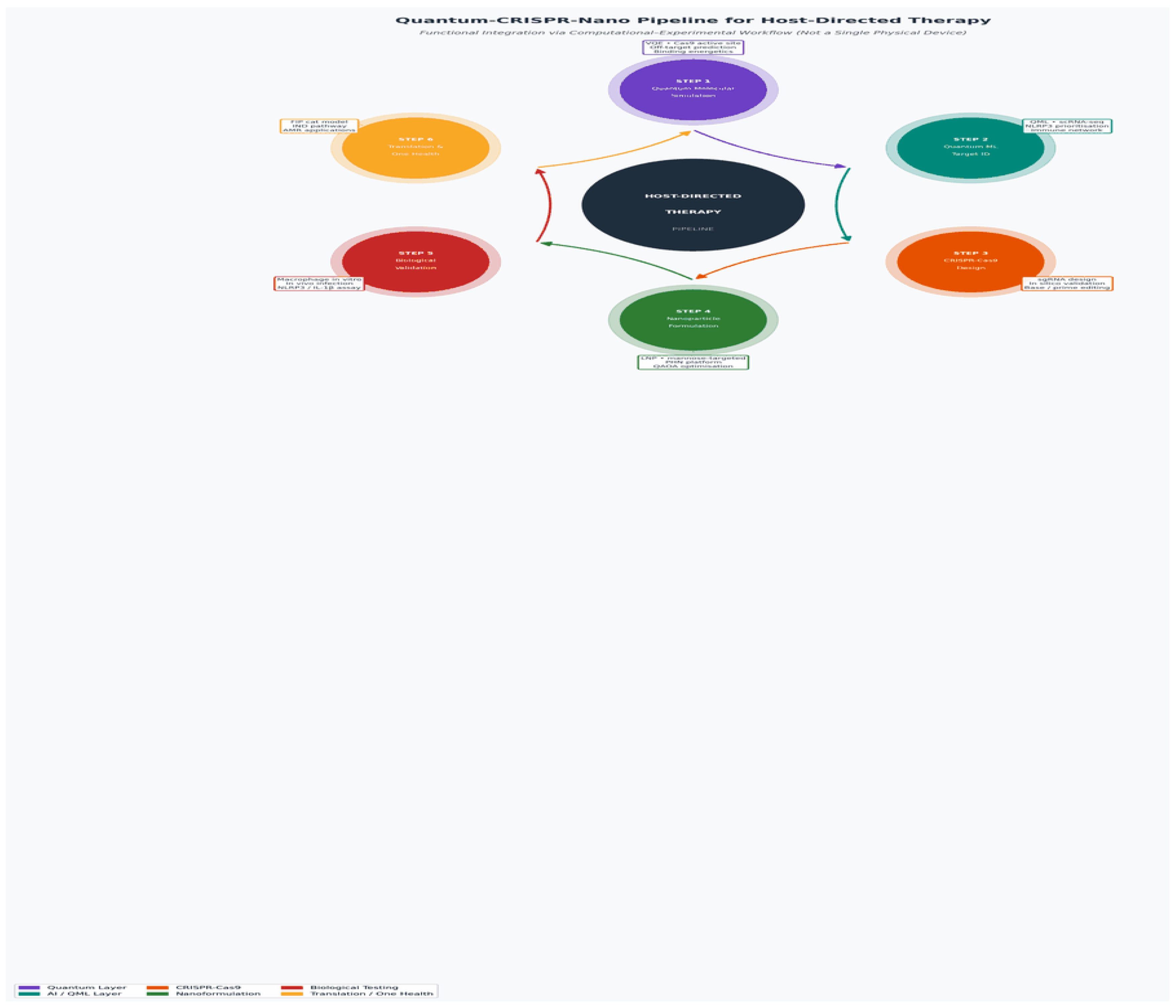
Graphical Abstract: Six-node circular pipeline representing the functional integration of quantum computation (violet), quantum ML/AI (teal), CRISPR-Cas9 design (orange), nanoformulation delivery (green), biological validation (red), and clinical translation/One Health (gold). Central hub emphasises that integration is computational–experimental, not a single physical device. Connecting arrows indicate sequential information flow between pipeline steps.
Figure 1.
Graphical Abstract: Six-node circular pipeline representing the functional integration of quantum computation (violet), quantum ML/AI (teal), CRISPR-Cas9 design (orange), nanoformulation delivery (green), biological validation (red), and clinical translation/One Health (gold). Central hub emphasises that integration is computational–experimental, not a single physical device. Connecting arrows indicate sequential information flow between pipeline steps.
CRISPR-Cas9 technology, pioneered by Doudna, Charpentier, and colleagues (Jinek et al., 2012; Cong et al., 2013), has revolutionised the precision with which mammalian genomes can be interrogated and edited. Its programmability — mediated by a 20-nucleotide spacer sequence in the single guide RNA (sgRNA) — theoretically allows any genomic locus to be targeted, disrupted, corrected, or transcriptionally regulated. Nanoparticle-based delivery systems, particularly lipid nanoparticles (LNPs), represent the most clinically advanced non-viral platform for nucleic acid therapeutics, validated at population scale by COVID-19 mRNA vaccines (Polack et al., 2020; Baden et al., 2021). Quantum computing and quantum-assisted simulation represent a third technological frontier with profound, if still largely aspirational, implications: for CRISPR specifically, the binding affinity of Cas9 to on-target and off-target DNA sites is governed by quantum mechanical effects that quantum simulation could predict with accuracy intractable to classical force-field models (Babbush et al., 2018).
This review proposes that these three domains — CRISPR-Cas9 gene modulation, nanoformulation delivery, and quantum-assisted computation — can be integrated into a unified conceptual pipeline for HDT against infectious disease. We wish to be scientifically precise from the outset: this integration is functional and computational, not physical. There is no current technology that directly combines quantum hardware, CRISPR biochemistry, and nanoparticle assembly into a single device. Rather, we articulate a six-step pipeline (Figure 2) in which quantum computation outputs inform CRISPR design decisions, which inform nanoparticle formulation strategies, validated through conventional wet-laboratory biology. The specific biological context is modulation of myeloid cell-mediated immunopathology: dysregulation of the NLRP3 inflammasome and IL-1 signalling underlies the immunopathology of severe COVID-19, tuberculosis, influenza-associate pneumonitis, feline infectious peritonitis (FIP), and sepsis (Lamkanfi & Dixit, 2014; Merad & Martin, 2020).
2. Background
2.1. CRISPR-Cas9: Mechanistic Foundations and Immunological Applications
CRISPR-Cas9 was adapted for mammalian genome editing by the Zhang and Church laboratories in parallel publications in 2013 (Cong et al., 2013; Mali et al., 2013), building on the foundational mechanistic work of Doudna and Charpentier (Jinek et al., 2012). The Cas9 endonuclease (~160 kDa) forms a ternary complex with the sgRNA and target DNA at a protospacer adjacent motif (PAM, NGG for SpCas9). The HNH and RuvC domains cleave complementary and non-complementary DNA strands respectively, generating a blunt-ended double-strand break (DSB). DSBs resolved by non-homologous end joining (NHEJ) introduce loss-of-function indels — the standard outcome for HDT knockdown of immunological targets such as NLRP3. Base editors (cytosine base editors, CBEs; adenine base editors, ABEs) and prime editors extend precision by introducing specific nucleotide changes without DSBs, reducing genotoxicity risk (Komor et al., 2016; Gaudelli et al., 2017; Anzalone et al., 2019). Catalytically dead Cas9 (dCas9) fused to transcriptional activators (CRISPRa) or repressors (CRISPRi) enables reversible, epigenetic gene regulation — relevant when complete NLRP3 ablation is undesirable given its homeostatic functions (Gilbert et al., 2014).
Off-target editing remains the central safety concern. SpCas9 tolerates up to five mismatches between sgRNA and DNA under certain sequence contexts (Tsai & Joung, 2016). High-fidelity variants (eSpCas9, HiFi Cas9, HypaCas9) reduce off-target activity, though with locus-specific and cell-type-specific variability (Kleinstiver et al., 2016; Vakulskas et al., 2018). The accurate prediction of off-target sites from sgRNA sequence — particularly the quantum mechanical contributions to mismatch-dependent binding — is a problem directly addressed by the VQE simulation component of our pipeline (Step 1). In the infectious disease context, CRISPR knockdown of NLRP3 in primary macrophages reduces IL-1β secretion and pyroptosis following LPS challenge (He et al., 2016), while genome-wide CRISPR screens in macrophages have identified novel HDT targets including SLAMF1 and SH3PXD2A (Berber et al., 2021).
2.2. Nanomedicine and Nanoparticle-Mediated CRISPR Delivery
Lipid nanoparticles (LNPs) consist of an ionisable lipid core complexing negatively charged nucleic acids, a phospholipid bilayer, cholesterol, and PEG-lipid. The ionisable lipid — exemplified by DLin-MC3-DMA (Onpattro), SM-102 (mRNA-1273), and ALC-0315 (BNT162b2) — determines LNP efficacy through pKa-governed nucleic acid loading and endosomal escape via protonation at pH ~5.5 (Patel et al., 2019; Kulkarni et al., 2019). For CRISPR delivery, LNPs must co-encapsulate Cas9 mRNA (~4.5 kb) and sgRNA (~100 nt) in defined stoichiometry. The Whitehead laboratory demonstrated simultaneous delivery achieving 80% liver editing efficiency in mice (Finn et al., 2018); the Anderson laboratory achieved >70% editing in haematopoietic stem cells (Billingsley et al., 2020). Cell-type targeting to macrophages exploits mannose receptor (CD206), scavenger receptors, and Fc gamma receptors via cognate surface ligand conjugation (Zhang et al., 2019). Selective organ targeting (SORT) — addition of permanently charged lipids — redirects LNP accumulation to lung (cationic DOTAP) or spleen (anionic DOPS) (Cheng et al., 2020), enabling pulmonary macrophage-targeted CRISPR HDT via inhaled formulations.
Relevant to the present authors’ research, polyherbal nanoemulsions (PHNs) incorporating bioactives from Andrographis paniculata, Azadirachta indica, Carica papaya, and Aegle marmelos have been evaluated as NF-κB-mediated macrophage immunomodulatory platforms in preclinical veterinary models. The nanotechnology platform of PHNs — droplet sizes 50–200 nm, high surface area-to-volume ratio, mucoadhesive modification capacity — is conceptually compatible with nucleic acid complexation and mucosal delivery, suggesting a translational bridge between PHN immunomodulation research and CRISPR delivery system development that represents a novel and defensible research hypothesis.
2.3. Quantum Biology and Quantum Computing
Quantum biology encompasses experimentally validated quantum mechanical phenomena in biological systems: quantum tunnelling in enzymatic hydrogen transfer (Scrutton et al., 2012), quantum coherence in photosynthetic energy transfer (Engel et al., 2007), and radical pair mechanisms in avian magnetoreception (Ritz et al., 2000). For CRISPR-DNA interactions specifically, hydrogen bond energetics determining base-pair stability and pi-stacking interactions governing nucleosome architecture are quantum mechanical in origin, motivating quantum simulation for CRISPR active-site characterisation (Brovarets & Hovorun, 2015). The Variational Quantum Eigensolver (VQE) uses a hybrid quantum-classical approach to prepare and evaluate molecular wavefunctions, demonstrated for small molecules (Kandala et al., 2017) and theoretically extendable to reduced active-space representations of the Cas9 HNH domain. Quantum Approximate Optimisation Algorithm (QAOA) addresses combinatorial optimisation relevant to LNP formulation (Farhi et al., 2014). Quantum Machine Learning (QML) — quantum SVMs, quantum neural networks — may accelerate target identification from high-dimensional immune transcriptomic datasets (Biamonte et al., 2017).
A critical caveat must be stated explicitly and maintained throughout: current NISQ hardware (~50–1000 qubits, limited circuit depth before decoherence) cannot simulate a full 160 kDa Cas9 protein. Full-protein quantum simulation requires millions of logical qubits, projected for fault-tolerant hardware in the mid-to-late 2030s (Google Quantum AI, 2023; Babbush et al., 2021). The honest near-term framing is: quantum simulation of reduced Cas9 active-site models (10–15 qubit representation), QML as an emerging tool alongside classical deep learning, and QAOA for nanoparticle formulation optimisation with current cloud NISQ platforms.
2.4. Host–Pathogen Immunology: NLRP3 and Myeloid Cell Biology
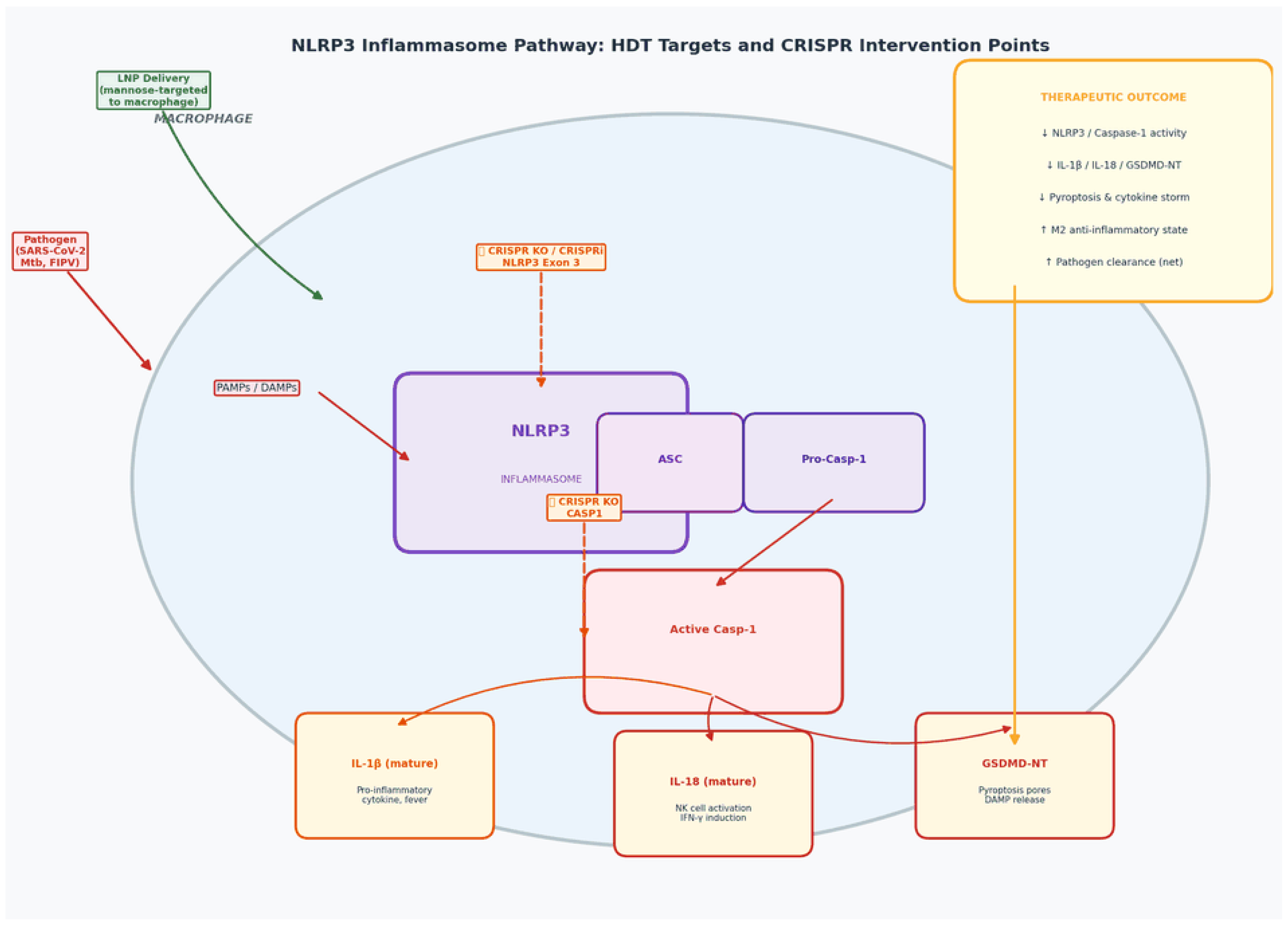
The NLRP3 inflammasome is a multi-protein cytosolic complex serving as a central sensor of cellular stress and pathogen signals. Upon activation, NLRP3 recruits ASC and pro-caspase-1 to generate active caspase-1, which cleaves pro-IL-1β and pro-IL-18 to biologically active forms and cleaves gasdermin D (GSDMD), triggering pyroptotic cell death (Lamkanfi & Dixit, 2014; Swanson et al., 2019). NLRP3 hyperactivation drives immunopathology in tuberculosis (Dorhoi et al., 2012), severe COVID-19 (Rodrigues et al., 2021), influenza-associated lung injury (Thomas et al., 2009), and feline infectious peritonitis. Figure 4 illustrates the NLRP3 pathway and key CRISPR intervention points. Genetic evidence from NLRP3 gain-of-function mutations (CAPS syndrome) confirms causality rather than mere correlation (Dinarello et al., 2012). MCC950 pharmacological validation in multiple preclinical infection models confirms the target’s therapeutic tractability (Coll et al., 2015; Coll et al., 2019). Beyond NLRP3, validated HDT targets include CASP1, IRF5, SLAMF1, SHIP1, STING, and autophagy genes (ATG5, ATG7), each offering distinct immunomodulatory profiles accessible to CRISPR intervention.
3. The Six-Step Integration Pipeline
Figure 2.
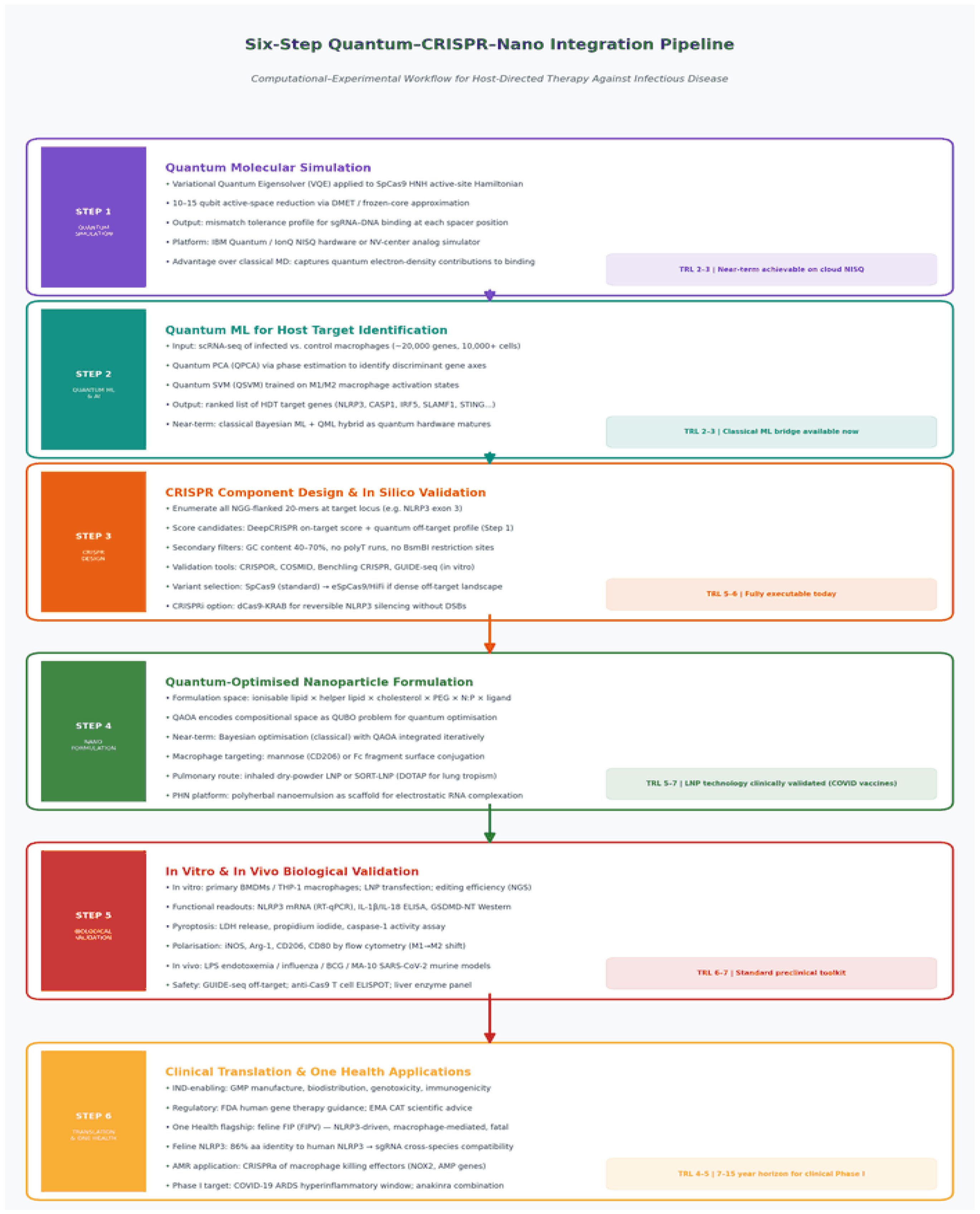
Six-step Quantum–CRISPR–Nano integration pipeline for host-directed therapy. Each step is labelled with its Technology Readiness Level (TRL) and the domain (colour-coded). Information flows from quantum simulation outputs (Step 1) through AI-assisted target identification (Step 2), CRISPR design (Step 3), nanoparticle formulation optimisation (Step 4), biological validation (Step 5), to clinical translation and One Health applications (Step 6). The pipeline is computational–experimental, not a single physical device.
Figure 2.
Six-step Quantum–CRISPR–Nano integration pipeline for host-directed therapy. Each step is labelled with its Technology Readiness Level (TRL) and the domain (colour-coded). Information flows from quantum simulation outputs (Step 1) through AI-assisted target identification (Step 2), CRISPR design (Step 3), nanoparticle formulation optimisation (Step 4), biological validation (Step 5), to clinical translation and One Health applications (Step 6). The pipeline is computational–experimental, not a single physical device.
3.1. Step 1: Quantum Molecular Simulation of Cas9 Active Site
VQE applied to the SpCas9 HNH active-site Hamiltonian, reduced to 10–15 qubits via DMET and frozen-core approximation, characterises mismatch-dependent cleavage efficiency with quantum mechanical accuracy. Output: a mismatch tolerance profile mapping how each single-nucleotide mismatch at each of the 20 spacer positions affects binding energy and cleavage probability. Implementation: IBM Quantum, IonQ, or Quantinuum cloud platforms; NV-centre-based analog simulators for near-term deployment.
3.2. Step 2: Quantum ML for Host Target Identification
Input: scRNA-seq of infected vs. control macrophages. QPCA via quantum phase estimation identifies discriminant gene expression axes; QSVM classifies macrophage activation states. Output: ranked HDT target list integrating discriminant weight, PPI network centrality, PAM availability, and Step 1 off-target scores. Near-term bridge: classical Bayesian ML and Random Forest with QML integration as hardware matures.
3.3. Step 3: CRISPR Component Design and Validation
All NGG-flanked 20-mers at the target locus are enumerated and scored by: DeepCRISPR on-target efficiency, quantum-derived off-target profile (Step 1), GC content (40–70%), RNA secondary structure, and absence of restriction sites. Validated by CRISPOR, COSMID, and Benchling. SpCas9 for standard applications; eSpCas9 or CRISPRi for high-risk loci or reversible modulation contexts. NLRP3 exon 3 is the primary target; CASP1, IRF5, SLAMF1 are secondary targets.
3.4. Step 4: Quantum-Optimised Nanoparticle Formulation
Formulation space (ionisable lipid × helper lipid × cholesterol × PEG × N:P × surface ligand × route) is encoded as a QUBO problem for QAOA optimisation, with classical Bayesian optimisation as a near-term bridge. Macrophage targeting: mannose (CD206), Fc fragment, or SORT-DOTAP for lung tropism. PHN platform: polyherbal nanoemulsion as a mucoadhesive scaffold for mucosal/intranasal CRISPR delivery, leveraging the authors’ existing preclinical PHN infrastructure.
3.5. Step 5: Biological Validation
In vitro: primary BMDMs and THP-1 macrophages; readouts include editing efficiency (NGS amplicon sequencing), NLRP3 mRNA (RT-qPCR), IL-1β/IL-18 ELISA, GSDMD-NT Western blot, pyroptosis (LDH, propidium iodide), and polarisation markers (iNOS, Arg-1, CD206, CD80) by flow cytometry. In vivo: LPS endotoxemia, murine influenza A, BCG infection, and SARS-CoV-2 MA-10 or K18-hACE2 transgenic mouse models. Safety: GUIDE-seq off-target profiling, anti-Cas9 T cell ELISPOT, hepatic enzyme panel.
3.6. Step 6: Clinical Translation and One Health
IND-enabling studies address GMP manufacture, biodistribution, genotoxicity, immunogenicity, and immunotoxicology. One Health flagship: feline FIP — FIPV drives macrophage-mediated pyogranulomatous inflammation mechanistically analogous to COVID-19 immunopathology; feline NLRP3 shares 86% amino acid identity with human NLRP3, enabling sgRNA cross-species applicability (Pesteanu-Somogyi et al., 2006). AMR application: CRISPRa of macrophage killing effectors (NOX2, AMP gene promoters) to restore pathogen clearance capacity independently of antibiotic mechanisms. Phase I target indication: COVID-19-associated hyperinflammation, in combination with IL-1 receptor blockade (anakinra).
4. Research Methodology Landscape
| Methodology | Status in Field | Underused Aspects | Key Weakness | Frontier Application |
| In vitro cell lines | Dominant (THP-1, RAW264.7) | Primary human macrophages | Poor translational fidelity | Organoids, ALI models |
| In vivo rodent models | Dominant in HDT biology | Lagomorph, ferret, NHP | Species biology gap | Humanised mouse |
| Classical MD simulation | Growing — Cas9 extensively | Underused for LNP design | Force-field accuracy limits | QM/MM hybrid methods |
| Classical ML / Deep learning | Rapidly growing post-2018 | Interpretable ML scarce | Out-of-distribution failure | GNN for PPI networks |
| Quantum simulation (VQE) | Nascent — minimal in biology | Severely underused | NISQ hardware limits | Cas9 active-site Hamiltonian |
| Quantum ML (QSVM, QNN) | Absent from biology literature | Completely absent | No biological benchmark yet | Immune scRNA-seq analysis |
| Ex vivo patient/animal tissue | Severely underused | Spatial transcriptomics absent | Access, heterogeneity | 10x Visium on TB granuloma |
In vitro cell line studies dominate the CRISPR-immunology literature for tractability and cost, but immortalised macrophage lines significantly differ from primary macrophages in inflammasome biology and cytokine secretion profiles. Quantum simulation methodology is essentially absent from biological literature as applied to CRISPR or immunology, representing the largest methodological gap this review identifies as a strategic opportunity.
5. Applications in Infectious Disease
5.1. SARS-CoV-2 / COVID-19 Immunopathology
COVID-19-associated hyperinflammation is driven by hyperactivated alveolar macrophages characterised by upregulation of NLRP3, IL-1β, TNF-α, and GSDMD with concomitant downregulation of interferon-stimulated genes (Liao et al., 2020; Merad & Martin, 2020). NLRP3 activation is triggered by viroporin E protein ion channel activity and RNA-sensing TLR/NLRP3 cooperation (Nieto-Torres et al., 2015). Application: inhaled SORT-DOTAP LNP delivering CRISPR-NLRP3 to alveolar macrophages during the late hyperinflammatory phase, combined with remdesivir antiviral therapy and anakinra IL-1 blockade. Critical timing caveat: NLRP3-driven IL-18 activates NK cells and ILC1s during early viral clearance; intervention is appropriate only after the hyperinflammatory transition, typically 7–10 days post-symptom onset.
5.2. Tuberculosis
Mtb has co-evolved with macrophage biology, subverting phagolysosomal degradation and exploiting lipid metabolism for intracellular survival (Philips & Ernst, 2012). NLRP3’s role in TB is bidirectional: Mtb promotes NLRP3 activation for cell-to-cell spread via pyroptosis while simultaneously suppressing excessive pyroptosis to preserve its replication niche (Dorhoi et al., 2012). This complexity necessitates stage-specific delivery: chronologically controlled-release LNPs or conditionally activated CRISPR (NLRP3-promoter responsive) to intervene only during the immunopathological chronic phase. Additional HDT targets validated by CRISPR screens: SLAMF1, SH3PXD2A, TBK1, and autophagy genes ATG5/ATG7.
5.3. Feline Infectious Peritonitis: One Health Flagship
FIP, caused by a mutant feline coronavirus (FIPV), elicits macrophage-driven pyogranulomatous inflammation mechanistically analogous to COVID-19 immunopathology. Feline NLRP3 shares 86% amino acid identity with human NLRP3, enabling cross-species sgRNA applicability. The veterinary regulatory pathway offers accelerated proof-of-concept timelines compared to human trials, informed owner consent processes, and natural disease contexts superior to laboratory models. A CRISPR-LNP NLRP3 HDT component combined with GS-441524 antiviral represents a compelling translational model for the quantum-CRISPR-nano framework that directly leverages the authors’ veterinary pharmacology background.
5.4. Antimicrobial Resistance
For intracellular AMR pathogens — Salmonella typhi, Listeria, Brucella — CRISPRa-mediated upregulation of macrophage antimicrobial effectors (NOX2 for ROS, AMP gene promoters, V-ATPase for phagolysosomal acidification) delivered via quantum-optimised LNPs represents an HDT strategy orthogonal to any antibiotic mechanism and therefore non-susceptible to AMR evolution.
6. Challenges, Limitations, and Documented Contradictions
6.1. Contradiction 1: Off-Target Editing Rates of High-Fidelity Cas9 Variants
Kleinstiver et al. (2016) reported that eSpCas9(1.1) and SpCas9-HF1 reduced detectable off-target editing to undetectable levels at a test panel of sgRNA-target combinations. Kulcsár et al. (2017) subsequently demonstrated that in different cell types and genomic loci, eSpCas9(1.1) retained substantial off-target activity indistinguishable from wild-type SpCas9. Root cause: cell-type-specific chromatin accessibility, assay sensitivity differences (GUIDE-seq vs. CIRCLE-seq), and sgRNA sequence-dependence of high-fidelity improvement. Resolution required: empirical case-by-case validation at each therapeutic locus.
6.2. Contradiction 2: Innate Immune Recognition of CRISPR Components
Kim et al. (2018) reported that Cas9 mRNA delivery activates MDA5/RIG-I innate sensing in primary human cells, producing type I IFN responses that limit editing efficiency. Multiple groups delivering Cas9 via LNPs with chemically modified mRNA (N1-methylpseudouridine) reported minimal innate immune activation. Resolution: mRNA chemical modification (HPLC purification, N1-m-pU substitution) and optimised LNP ionisable lipid selection substantially mitigates this issue; cell-type-specific immunostimulatory profiles remain incompletely characterised.
6.3. Contradiction 3: NLRP3 as Pathological vs. Homeostatic in Macrophages
Swanson et al. (2019) and Lamkanfi & Dixit (2014) present NLRP3 as predominantly a pathological amplifier across infection contexts. Guo et al. (2015) and Shirasaki et al. (2014) demonstrate that basal NLRP3 activity is required for optimal macrophage efferocytosis and resolution of inflammation. Complete NLRP3 knockout paradoxically worsens outcomes in Mtb and HSV-1 by impairing IL-18-dependent NK cell activation. This argues for CRISPRi partial silencing or base editing to reduce rather than ablate NLRP3 function — a critical therapeutic strategy distinction.
6.4. Contradiction 4: LNP Macrophage Tropism After Systemic Administration
Cheng et al. (2020) demonstrated SORT-based lung targeting with predominant macrophage accumulation using DOTAP-containing LNPs. Lindsay et al. (2019) using superficially similar formulations found predominantly endothelial cell distribution in the lung. Differences in lipid source purity, microfluidic vs. ethanol injection preparation, and animal model likely underlie the discrepancy. This unresolved contradiction directly affects Step 4 of the proposed pipeline and represents a priority experimental question.
6.5. Contradiction 5: Quantum Advantage Timeline for Molecular Simulation
Google Quantum AI (Arute et al., 2019) announced quantum supremacy generating widespread claims of imminent advantage in molecular simulation. IBM Research (Pednault et al., 2019) contested this, reducing the advantage to 2.5 classical days. Babbush et al. (2021) demonstrated that quantum advantage for biologically relevant molecular simulation requires fault-tolerant hardware with millions of physical qubits — projecting relevant advantage to the mid-2030s at earliest. This review explicitly adopts the conservative Babbush et al. (2021) framing throughout.
6.6. Additional Technical Challenges
In vivo editing efficiency in tissue macrophages via non-viral delivery typically remains below 20%, which may nonetheless suffice for phenotypic modulation where partial NLRP3 reduction significantly attenuates inflammasome activation. Pre-existing anti-Cas9 T cell immunity was identified in 79% of healthy donors (Charlesworth et al., 2019), posing risks for repeated dosing. NISQ hardware decoherence times (~microseconds in superconducting qubits) limit tractable molecular system sizes. GMP-scale manufacture of CRISPR-LNPs with consistent quality attributes remains technically demanding. Each of these challenges defines experimental priorities rather than insurmountable barriers.
7. Fifty Unanswered Research Questions
The following 50 frontier questions define the research agenda for the quantum-CRISPR-nano HDT field, annotated by domain and primary methodology required.
Domain 1: CRISPR Design and Off-Target Biology (Q1–Q12)
- What is the complete mismatch tolerance landscape of SpCas9 across all 20 spacer positions at physiological Mg²⁺? [Methodology: Deep mutational scanning + VQE active-site simulation]
- How does macrophage chromatin accessibility (ATAC-seq) alter effective off-target site repertoire of therapeutically relevant sgRNAs? [Methodology: ATAC-seq + GUIDE-seq in primary BMDMs]
- Can VQE-guided rational mutagenesis further improve high-fidelity Cas9 specificity at the positively charged recognition groove? [Methodology: VQE simulation + protein engineering + GUIDE-seq]
- What minimum NLRP3 knockdown percentage produces clinically meaningful IL-1β reduction in human macrophages challenged with SARS-CoV-2 PAMPs? [Methodology: Graded CRISPR editing + cytokine dose-response]
- Is CRISPRi silencing of NLRP3 safer than nuclease knockout for macrophage HDT, preserving homeostatic NLRP3 function? [Methodology: Comparative in vitro + in vivo macrophage biology]
- Can ABE8e base editing of NLRP3 NACHT domain provide more precise immunomodulation than exon disruption? [Methodology: Base editor delivery + functional assay]
- What is the immunogenicity profile of SaCas9 vs SpCas9 in cats and dogs? [Methodology: Veterinary T cell ELISPOT + anti-Cas9 antibody ELISA]
- Does CASP1 vs NLRP3 CRISPR ablation produce different macrophage transcriptomic outcomes post-infection? [Methodology: Comparative RNA-seq of CASP1 vs NLRP3 KO macrophages]
- Can temporal dynamics of CRISPR editing be predicted by a quantum-classical hybrid gene regulatory network model? [Methodology: QML network model + time-series gene expression]
- What is the genome-wide off-target profile of NLRP3-targeting sgRNAs in feline primary macrophages? [Methodology: GUIDE-seq in feline BMDMs + whole-genome sequencing]
- Can dual-sgRNA CRISPRa/i (IL-10 activation + NLRP3 repression) achieve synergistic macrophage immunomodulation? [Methodology: Multiplex sgRNA delivery in macrophages]
- What minimum fraction of pulmonary macrophages requires editing to produce measurable protection from cytokine storm in vivo? [Methodology: Mathematical modelling + in vivo dose-ranging]
Domain 2: Nanoparticle Delivery (Q13–Q24)
- 13.
- What ionisable lipid pKa optimally balances macrophage endosomal escape and TLR7/9 innate immune activation in alveolar macrophages? [Methodology: Lipid library + endosomal pH titration + innate immune assay]
- 14.
- Does SORT-DOTAP LNP lung targeting specifically transfect alveolar macrophages or also type II pneumocytes and endothelium? [Methodology: Cell-type reporter + scRNA-seq of LNP recipients]
- 15.
- Do mannose-LNPs preferentially transfect M1 or M2 macrophages given differential CD206 expression between polarisation states? [Methodology: Polarised macrophage uptake assay]
- 16.
- What is optimal Cas9 mRNA:sgRNA mass ratio and N:P ratio for single-LNP co-encapsulation? [Methodology: QAOA-guided formulation optimisation + editing efficiency]
- 17.
- Can inhaled dry-powder CRISPR-LNPs achieve therapeutic alveolar macrophage delivery without systemic off-target distribution? [Methodology: Aerosol characterisation + inhalation PK in rodents]
- 18.
- Do PHN surfaces have colloidal stability compatible with electrostatic Cas9 mRNA complexation? [Methodology: PHN characterisation + mRNA encapsulation efficiency study]
- 19.
- How do PEG molecular weight and mole fraction affect macrophage LNP uptake in the presence of serum proteins? [Methodology: Single-particle tracking + serum adsorption proteomics]
- 20.
- Can LNPs functionalised with anti-Ly6C or CCR2 ligands specifically target circulating monocytes recruited to infected lungs? [Methodology: Antibody conjugation + in vivo monocyte tracking]
- 21.
- How does manufacturing scale (microfluidic vs. ethanol injection) affect CRISPR-LNP physicochemical properties and editing efficiency? [Methodology: Comparative manufacturing + bridging study]
- 22.
- Does pre-existing anti-PEG antibody immunity (prevalent post-COVID vaccination) reduce CRISPR-LNP efficacy through complement-mediated opsonisation? [Methodology: Anti-PEG ELISA + LNP PK in immunised animals]
- 23.
- Can exosome-LNP hybrid vehicles combine macrophage tropism of exosomes with LNP cargo-loading efficiency for CRISPR delivery? [Methodology: Hybrid particle synthesis + functional characterisation]
- 24.
- What is the immunostimulatory potential of intratracheal CRISPR-LNPs in NHP with naturally occurring respiratory infections? [Methodology: NHP inhalation safety study + immunopathology panel]
Domain 3: Host-Pathogen Immunology (Q25–Q36)
- 25.
- Does NLRP3 expression in alveolar macrophages correlate with COVID-19 severity in a dose-dependent manner across serial BAL sampling? [Methodology: Prospective cohort + scRNA-seq + NLRP3 quantification]
- 26.
- What is the net effect of NLRP3 suppression on Mtb burden during the first 72 hours — enhancement or impairment of early containment? [Methodology: Time-course Mtb infection of NLRP3-KO macrophages + CFU + ROS quantification]
- 27.
- Is IL-1α or IL-1β the dominant driver of immunopathology in feline FIP? [Methodology: Cat effusion cytokine analysis + IL-1 receptor blockade experiment]
- 28.
- Does macrophage NLRP3 suppression affect CD8+ T cell memory formation during subsequent infection? [Methodology: CRISPR-edited macrophage + CD8+ T cell co-culture + memory recall assay]
- 29.
- What are the transcriptomic signatures of M1/M2 macrophage states in naturally infected dogs with canine parvovirus? [Methodology: Canine macrophage scRNA-seq during natural infection]
- 30.
- Can QML models trained on human macrophage datasets be transferred to predict macrophage states in veterinary species? [Methodology: Cross-species transcriptomic transfer learning]
- 31.
- What is the inflammasome activation profile in bovine alveolar macrophages infected with BVDV? [Methodology: Bovine macrophage inflammasome assay + NLRP3 inhibitor validation]
- 32.
- Does CRISPR-mediated STING knockout in macrophages alter Mtb infection outcome in humanised mice? [Methodology: STING-KO LNP delivery + humanised mouse Mtb model]
- 33.
- What is the spatial transcriptomic map of NLRP3, CASP1, and GSDMD in human TB granuloma? [Methodology: 10x Visium spatial transcriptomics on human TB biopsy]
- 34.
- Can host NLRP3 variant rs10754558 genotyping inform personalised CRISPR HDT dosing? [Methodology: Pharmacogenomics + population immunology]
- 35.
- Is CRISPR NLRP3 suppression additive or synergistic with MCC950 small-molecule NLRP3 inhibition? [Methodology: Combination dose-response matrix + Bliss synergy analysis]
- 36.
- Does LNP transfection itself activate NLRP3 in macrophages — assessed at single-cell resolution? [Methodology: scRNA-seq 24h post-LNP treatment of macrophages]
Domain 4: Quantum Computing Applications (Q37–Q46)
- 37.
- Can VQE applied to the SpCas9 HNH domain active-space Hamiltonian (10-qubit reduction) predict mismatch-dependent cleavage efficiency exceeding classical DFT accuracy? [Methodology: VQE on IBM Quantum / IonQ + experimental validation]
- 38.
- What minimum qubit count and circuit depth is required for quantum simulation to exceed classical MM-PBSA accuracy for Cas9-DNA binding? [Methodology: Resource estimation + quantum error analysis]
- 39.
- Can QAOA-based LNP formulation optimisation identify novel ionisable lipid compositions missed by classical Bayesian optimisation in fewer experimental iterations? [Methodology: Comparative optimisation with matched experimental budget]
- 40.
- Does QSVM applied to macrophage scRNA-seq data identify HDT targets missed by classical ML within the same dataset? [Methodology: Side-by-side QSVM vs. classical Random Forest on identical benchmark]
- 41.
- Can quantum Boltzmann machines model NLRP3 inflammasome assembly kinetics more accurately than classical Monte Carlo? [Methodology: Quantum simulation + single-molecule FRET validation]
- 42.
- Can NV-centre quantum sensors detect single-cell CRISPR editing activity in living macrophages by monitoring Cas9 conformational magnetic signals? [Methodology: NV-centre diamond nanoparticle + single-cell quantum sensing]
- 43.
- What is the practical quantum volume threshold required for NISQ devices to provide meaningful advantage over DeepCRISPR classical sgRNA scoring? [Methodology: Systematic benchmarking across quantum hardware platforms]
- 44.
- Can hybrid VQE + deep learning models trained on classical MD trajectories achieve generalisable Cas9 off-target prediction? [Methodology: Transfer learning quantum-classical hybrid model development]
- 45.
- Which quantum error mitigation techniques are most effective for molecular simulation relevant to CRISPR biology at current NISQ noise levels? [Methodology: Quantum error benchmarking across mitigation strategies]
- 46.
- Can a quantum GAN design novel ionisable lipid structures optimised for macrophage endosomal escape? [Methodology: QGAN molecular design + computational ADMET prediction + synthesis]
Domain 5: Translation, Ethics, and One Health (Q47–Q50)
- 47.
- What is pre-existing anti-Cas9 immunity prevalence in domestic cats and dogs — does it predict CRISPR-LNP therapeutic failure in FIP models? [Methodology: Veterinary serology + T cell assay cross-species Cas9 immunity panel]
- 48.
- What ethical frameworks govern CRISPR gene editing in companion animals for non-life-threatening infections? [Methodology: Bioethics analysis + veterinary regulatory review]
- 49.
- Can quantum-encrypted data transmission protect intellectual property and safety data in the quantum-CRISPR-nano pipeline against cyberattack? [Methodology: Quantum cryptography + biosecurity framework]
- 50.
- What is the environmental risk of CRISPR-LNP shedding from treated animals — could components persist and horizontally transfer to microbiome or wildlife? [Methodology: Environmental risk assessment + ecotoxicology framework]
8. Field-Level Synthesis and Knowledge Map
Figure 3.
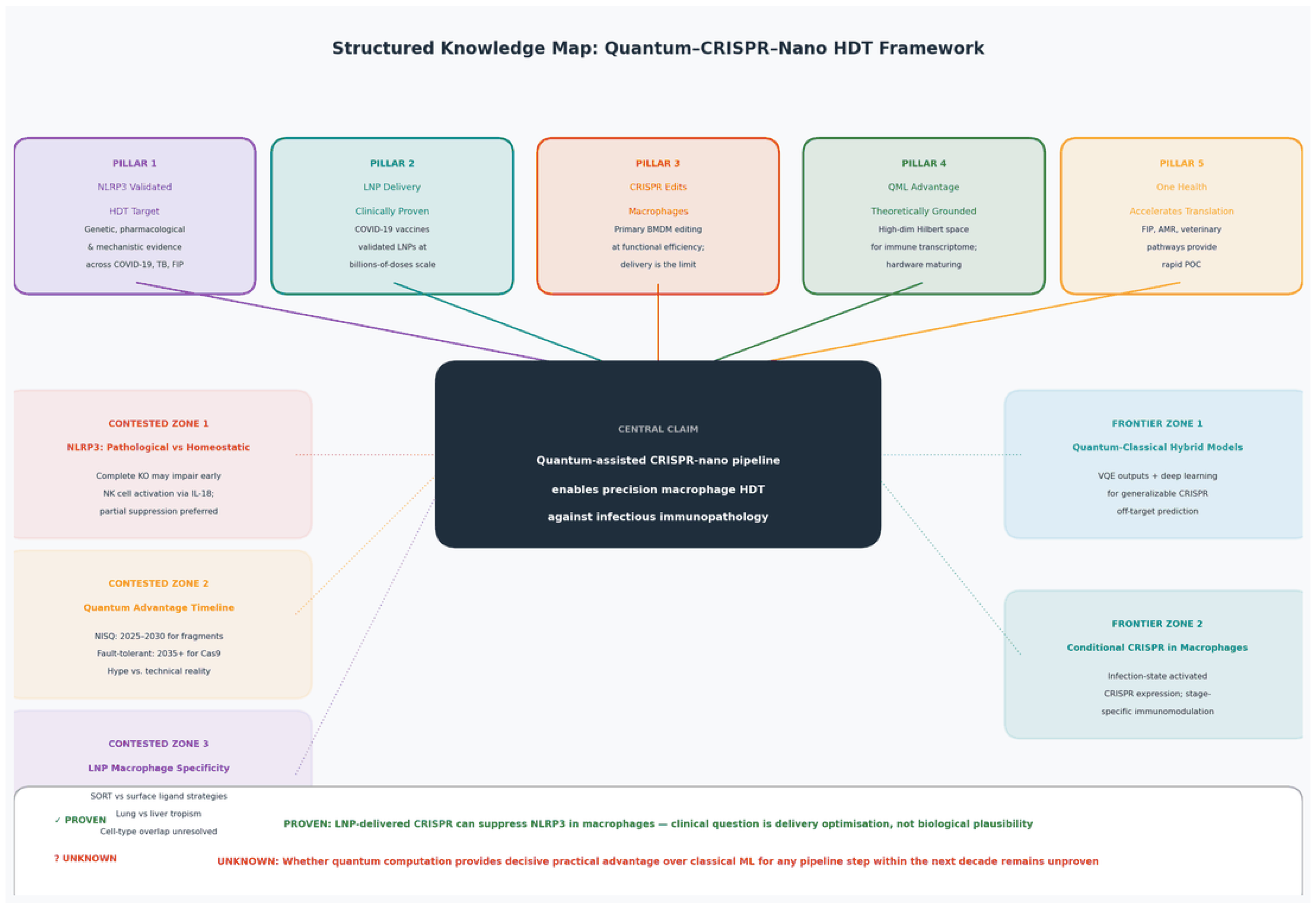
Structured Knowledge Map. Five supporting pillars (top) connect to the central claim (centre). Contested zones (left) and frontier zones (right) are linked to the central hub with dotted connectors. The bottom bar presents the two extreme synthesis statements: what the field has proven (green) and what remains unknown (red).
Figure 3.
Structured Knowledge Map. Five supporting pillars (top) connect to the central claim (centre). Contested zones (left) and frontier zones (right) are linked to the central hub with dotted connectors. The bottom bar presents the two extreme synthesis statements: what the field has proven (green) and what remains unknown (red).
8.1. What the Field Collectively Agrees on
The biomedical research community has reached consensus on five foundational premises: (1) NLRP3 is a central, functionally validated, and therapeutically tractable driver of macrophage immunopathology, supported by genetic, pharmacological, and mechanistic evidence across multiple independent groups and infection contexts; (2) LNPs are the leading non-viral delivery platform for CRISPR components, with regulatory experience from COVID-19 vaccines and demonstrated in vivo editing efficiency in liver, lung, and spleen; (3) CRISPR-Cas9 edits primary macrophages at functional efficiency — the translational bottleneck is delivery, not biochemical efficacy; (4) machine learning substantially improves sgRNA design and off-target prediction compared to rule-based methods; (5) HDT is scientifically legitimate and necessary as a complement to pathogen-targeted strategies.
8.2. What Remains Contested
Three questions remain genuinely unresolved: whether quantum computing will provide practical advantage for molecular simulation relevant to CRISPR design within the next decade; the relative therapeutic value of NLRP3 complete knockout versus partial suppression during infection; and the optimal CRISPR delivery modality for macrophage targeting in the lung. Whether QML provides genuine advantage over classical deep learning for biological data classification remains an open empirical question in quantum information science.
8.3. What Is Proven Beyond Doubt
Three facts are established beyond reasonable scientific doubt: (1) NLRP3 inflammasome hyperactivation is causally necessary for CAPS immunopathology (human genetic evidence) and strongly implicated in infectious immunopathology (pharmacological evidence); (2) lipid nanoparticles can deliver mRNA to macrophages in vivo, demonstrated by COVID-19 vaccine-induced spike protein expression in vaccine-draining lymph node macrophages and dendritic cells in billions of recipients; (3) CRISPR-Cas9 produces functional gene knockdown in primary macrophages at efficiencies sufficient for biological studies, demonstrated by dozens of macrophage CRISPR screen papers since 2018.
8.4. Extreme Synthesis
Proven:
LNP-delivered CRISPR can suppress NLRP3 in macrophages; the clinical question is delivery optimisation and safety — not biological plausibility.
Unknown:
Whether quantum computation provides decisive practical advantage over classical ML for any pipeline step within the next decade remains genuinely unproven at the scale of biological complexity relevant to CRISPR and host-pathogen biology.
9. NLRP3 Pathway and Crispr Intervention Biology
Figure 4.
NLRP3 Inflammasome Pathway and CRISPR Intervention Points within the Macrophage. Pathogen-derived PAMPs/DAMPs activate the NLRP3–ASC–Pro-Caspase-1 complex. Active Caspase-1 cleaves Pro-IL-1β to IL-1β, Pro-IL-18 to IL-18, and Gasdermin D (GSDMD) to GSDMD-NT (pyroptosis pore). Dashed arrows indicate LNP-delivered CRISPR intervention at NLRP3 (primary target) and CASP1 (secondary target). Therapeutic outcome (gold box): reduced pyroptosis, reduced IL-1β/IL-18 secretion, and M2 anti-inflammatory macrophage polarisation.
Figure 4.
NLRP3 Inflammasome Pathway and CRISPR Intervention Points within the Macrophage. Pathogen-derived PAMPs/DAMPs activate the NLRP3–ASC–Pro-Caspase-1 complex. Active Caspase-1 cleaves Pro-IL-1β to IL-1β, Pro-IL-18 to IL-18, and Gasdermin D (GSDMD) to GSDMD-NT (pyroptosis pore). Dashed arrows indicate LNP-delivered CRISPR intervention at NLRP3 (primary target) and CASP1 (secondary target). Therapeutic outcome (gold box): reduced pyroptosis, reduced IL-1β/IL-18 secretion, and M2 anti-inflammatory macrophage polarisation.
10. Literature Clustering and Dataset Evolution
10.1. Thematic Cluster Analysis
Cluster 1: CRISPR and Gene Editing Systems
Spans foundational biochemistry (Jinek et al., 2012; Cong et al., 2013; Mali et al., 2013) through clinical translation. Dominant theory: programmable sgRNA-guided editing is universally applicable to mammalian genomes. Shared assumption challenged by Kosicki et al. (2018): cells efficiently undergo NHEJ or HDR — challenged by evidence of large deletions and chromosomal translocations as unintended outcomes. Idea evolution: SpCas9 → high-fidelity variants → base editors → prime editors, progressively reducing genotoxicity at increasing system complexity.
Cluster 2: Nanoparticle Delivery Systems
Spans lipid chemistry (Semple et al., 2010; Patel et al., 2019), formulation optimisation (Kulkarni et al., 2019; Billingsley et al., 2020), clinical translation (Polack et al., 2020; Baden et al., 2021), and targeted delivery (Zhang et al., 2019). Dominant theory: ionisable lipid pKa is the primary determinant of LNP efficacy. Dataset evolution: DLinDMA → DLin-MC3-DMA → SM-102/ALC-0315, each generation improving the efficacy/tolerability ratio through empirical optimisation rather than rational design — the gap that QAOA aims to address.
Cluster 3: Host-Pathogen Immunology and Macrophage Biology
Encompasses NLRP3 biology (Lamkanfi & Dixit, 2014; Swanson et al., 2019), COVID-19 immunopathology (Liao et al., 2020; Merad & Martin, 2020), tuberculosis immunology (Philips & Ernst, 2012; Dorhoi et al., 2012), and macrophage polarisation (Murray & Wynn, 2011; Murray et al., 2014). Dominant theory: M1/M2 polarisation as organising framework for macrophage functional states — contested by Murray et al. (2014) arguing for a continuous spectrum, with experimental validation of the spectrum coming from scRNA-seq datasets post-2018.
Cluster 4: Quantum Biology and Quantum Computing in Life Sciences
Foundational quantum biology (Engel et al., 2007; Ritz et al., 2000) established biological quantum phenomena. Quantum computing theory (Preskill, 2018; Biamonte et al., 2017; McArdle et al., 2020) provides algorithmic foundations. Hardware benchmarking (Arute et al., 2019; Kandala et al., 2017) demonstrates NISQ capabilities. Resource estimation papers (Babbush et al., 2021) provide the critical reality check that the dominant shared assumption of imminent practical biological advantage is overoptimistic.
Cluster 5: AI-Integrated Biomedical Systems
Rapidly growing cluster spanning ML for drug discovery (Stokes et al., 2020), CRISPR design (Chuai et al., 2018), nanoparticle optimisation (Mekki-Berrada et al., 2021), and systems immunology (Liao et al., 2020; Sánchez-Cerrillo et al., 2020). Dominant methodology: deep learning on large experimental datasets. Contested: out-of-distribution generalisation — whether models trained on immortalised cell lines transfer to primary macrophages or veterinary species.
11. Conclusion
This review has articulated a scientifically grounded conceptual framework for integrating quantum computation, CRISPR-Cas9 gene editing, and nanoformulation delivery into a six-step pipeline for host-directed therapy against infectious disease. We have been deliberate and precise about the current technological reality: no physical quantum-CRISPR-nano device exists, and full quantum computational advantage for Cas9-scale molecular simulation awaits fault-tolerant hardware not expected until the mid-to-late 2030s. What is actionable today — and what makes this framework immediately valuable — is the individual node-level scientific foundation: NISQ-era VQE for reduced active-space Cas9 chemistry problems; QML algorithms applicable to biological classification tasks on cloud platforms; CRISPR gene editing functional in primary macrophages; LNP delivery of nucleic acids to macrophages in vivo at therapeutic efficiency; and NLRP3 and related immunological targets validated as clinically relevant HDT priorities.
The contradictions we have identified — NLRP3 homeostatic versus pathological roles, quantum advantage timelines, and LNP macrophage targeting specificity — define the most critical experimental questions rather than fatal flaws. The 50 research questions in Section 7 constitute a structured research agenda spanning multiple PhD programs and collaborative networks. Many are independently answerable using existing technology: quantum simulation questions via cloud NISQ platforms (IBM Quantum, IonQ); CRISPR macrophage questions via primary cell culture and standard editing tools; LNP optimisation questions via microfluidic formulation infrastructure increasingly accessible at academic centres.
For researchers entering this field, a phased strategy is recommended. In the near term (1–3 years): establish CRISPR editing efficiency in primary macrophages using current LNP formulations; validate NLRP3 via CRISPRi knockdown with MCC950 pharmacological comparator; and explore VQE simulation of Cas9 active-site fragments on cloud platforms. In the medium term (3–7 years): optimise macrophage-targeted LNPs using hybrid classical-quantum optimisation; integrate QML for target identification from macrophage scRNA-seq in veterinary FIP and bovine respiratory disease models; and advance One Health proof-of-concept studies. In the long term (7–15 years): pursue IND-enabling studies for CRISPR-LNP NLRP3 HDT; leverage fault-tolerant quantum hardware for full Cas9 simulation as it matures; and advance Phase I trials in COVID-19 ARDS hyperinflammation.
The One Health dimension — equal applicability to veterinary species as natural disease models and primary therapeutic beneficiaries — is not merely strategic but scientifically essential. The authors’ own research programs in veterinary pharmacology, polyherbal nanoemulsion immunomodulation, and comparative coronavirus immunology (ADE review, MIMM-S-26-00311) provide directly relevant expertise and a translational bridge for advancing this framework from conceptual proposal to experimental reality.
Acknowledgments
The author acknowledges academic guidance and support received during the conceptual development of this work. The author also acknowledges participation in the Quantum Fundamentals Program conducted by the Washington Institute for STEM, Entrepreneurship and Research (WISER), USA, in collaboration with Qubitech and Amaravati Quantum Valley (AQV), India, where the author was selected among the top 3,000 participants from over 65,000 applicants The author further acknowledges participation in a hands-on workshop on CRISPR and gene editing conducted at IIT Tirupati (Tirutsava 2025), which contributed to the conceptual understanding of genome editing technologies applied in this study.
References
- Addie, D.D.; et al. Feline infectious peritonitis. Journal of Feline Medicine and Surgery 2009, 11(7), 594–604. [Google Scholar] [CrossRef] [PubMed]
- Anzalone, A.V.; et al. Search-and-replace genome editing without double-strand breaks. Nature 2019, 576, 149–157. [Google Scholar] [CrossRef]
- Anzalone, A.V.; Koblan, L.W.; Liu, D.R. Genome editing with CRISPR–Cas nucleases, base editors, transposases and prime editors. Nature Biotechnology 2020, 38, 824–844. [Google Scholar] [CrossRef]
- Arute, F.; et al. Quantum supremacy using a programmable superconducting processor. Nature 2019, 574, 505–510. [Google Scholar] [CrossRef]
- Aslam, N.; et al. Nanoscale nuclear magnetic resonance with chemical resolution. Science 2017, 357, 67–71. [Google Scholar] [CrossRef]
- Babbush, R.; et al. Encoding electronic spectra in quantum circuits with linear T complexity. Physical Review X 2018, 8, 041015. [Google Scholar] [CrossRef]
- Babbush, R.; et al. Focus beyond quadratic speedups for error-corrected quantum advantage. PRX Quantum 2021, 2, 010103. [Google Scholar] [CrossRef]
- Baden, L.R.; et al. Efficacy and safety of the mRNA-1273 SARS-CoV-2 vaccine. New England Journal of Medicine 2021, 384, 403–416. [Google Scholar] [CrossRef]
- Berber, E.; et al. SLAMF1 is required for optimal macrophage-mediated bacterial killing. Journal of Immunology 2021, 207, 765–777. [Google Scholar]
- Biamonte, J.; et al. Quantum machine learning. Nature 2017, 549, 195–202. [Google Scholar] [CrossRef]
- Billingsley, M.M.; et al. Ionizable lipid nanoparticle-mediated mRNA delivery for human CAR T cell engineering. Nano Letters 2020, 20, 1578–1589. [Google Scholar] [CrossRef]
- Brovarets, O.O.; Hovorun, D.M. New structural hypostases of the A·T and G·C Watson–Crick nucleobase pairs caused by mutagenic tautomerism. Scientific Reports 2015, 5, 9997. [Google Scholar]
- Cavalli, G.; et al. Interleukin-1 blockade with high-dose anakinra in patients with COVID-19. The Lancet Rheumatology 2020, 2, e325–e331. [Google Scholar] [CrossRef] [PubMed]
- Charlesworth, C.T.; et al. Identification of preexisting adaptive immunity to Cas9 proteins in humans. Nature Medicine 2019, 25, 249–254. [Google Scholar] [CrossRef] [PubMed]
- Cheng, Q.; et al. Selective organ targeting (SORT) nanoparticles for tissue-specific mRNA delivery. Nature Nanotechnology 2020, 15, 313–320. [Google Scholar] [CrossRef]
- Chuai, G.; et al. DeepCRISPR: optimized CRISPR guide RNA design by deep learning. Genome Biology 2018, 19, 80. [Google Scholar] [CrossRef]
- Coll, R.C.; et al. A small-molecule inhibitor of the NLRP3 inflammasome. Nature Medicine 2015, 21, 248–255. [Google Scholar] [CrossRef]
- Coll, R.C.; et al. MCC950 directly targets the NLRP3 ATP-hydrolysis motif. Nature Chemical Biology 2019, 15, 556–559. [Google Scholar] [CrossRef] [PubMed]
- Cong, L.; et al. Multiplex genome engineering using CRISPR/Cas systems. Science 2013, 339, 819–823. [Google Scholar] [CrossRef]
- Dinarello, C.A.; et al. Treating inflammation by blocking interleukin-1 in a broad spectrum of diseases. Nature Reviews Drug Discovery 2012, 11, 633–652. [Google Scholar] [CrossRef]
- Dorhoi, A.; et al. Activation of the NLRP3 inflammasome by Mycobacterium tuberculosis is uncoupled from susceptibility to active tuberculosis. European Journal of Immunology 2012, 42, 374–384. [Google Scholar] [CrossRef]
- Doudna, J.A.; Charpentier, E. The new frontier of genome engineering with CRISPR-Cas9. Science 2014, 346, 1258096. [Google Scholar] [CrossRef]
- Engel, G.S.; et al. Evidence for wavelike energy transfer through quantum coherence in photosynthetic systems. Nature 2007, 446, 782–786. [Google Scholar] [CrossRef]
- Farhi, E.; Goldstone, J.; Gutmann, S. A quantum approximate optimization algorithm. arXiv 2014, arXiv:1411.4028. [Google Scholar] [CrossRef]
- Finn, J.D.; et al. A single administration of CRISPR/Cas9 lipid nanoparticles achieves robust genome editing. Cell Reports 2018, 22, 2227–2235. [Google Scholar] [CrossRef]
- Garlanda, C.; Dinarello, C.A.; Mantovani, A. The interleukin-1 family: back to the future. Immunity 2013, 39, 1003–1018. [Google Scholar] [CrossRef]
- Gaudelli, N.M.; et al. Programmable base editing of A·T to G·C in genomic DNA. Nature 2017, 551, 464–471. [Google Scholar] [CrossRef]
- GBD 2019 Diseases and Injuries Collaborators. Global burden of 369 diseases and injuries in 204 countries. The Lancet 2020, 396, 1204–1222. [Google Scholar]
- Gilbert, L.A.; et al. Genome-scale CRISPR-mediated control of gene repression and activation. Cell 2014, 159, 647–661. [Google Scholar] [CrossRef]
- Ginhoux, F.; Guilliams, M. Tissue-resident macrophage ontogeny and homeostasis. Immunity 2016, 44, 439–449. [Google Scholar] [CrossRef] [PubMed]
- Google Quantum, AI. Suppressing quantum errors by scaling a surface code logical qubit. Nature 2023, 614, 676–681. [Google Scholar] [CrossRef]
- Guo, C.; et al. Autophagy regulates the function of NLRP3 inflammasome through selective autophagy. Autophagy 2015, 11, 530–531. [Google Scholar]
- Hajj, K.A.; Whitehead, K.A. Tools for translation: non-viral materials for therapeutic mRNA delivery. Nature Reviews Materials 2017, 2, 17056. [Google Scholar] [CrossRef]
- He, Y.; et al. Mechanism and regulation of NLRP3 inflammasome activation. Trends in Biochemical Sciences 2016, 41, 1012–1021. [Google Scholar] [CrossRef]
- Hoshyar, N.; et al. The effect of nanoparticle size on in vivo pharmacokinetics and cellular interaction. Nanomedicine 2016, 11, 673–692. [Google Scholar] [CrossRef]
- Iglesias-Julián, E.; et al. High-dose subcutaneous anakinra to treat macrophage activation syndrome in COVID-19. Autoimmunity Reviews 2020, 19, 102557. [Google Scholar]
- Jiang, F.; Doudna, J.A. CRISPR–Cas9 structures and mechanisms. Annual Review of Biophysics 2017, 46, 505–529. [Google Scholar] [CrossRef]
- Jinek, M.; et al. A programmable dual-RNA–guided DNA endonuclease in adaptive bacterial immunity. Science 2012, 337, 816–821. [Google Scholar] [CrossRef]
- Kaminski, R.; et al. Elimination of HIV-1 genomes from human T-lymphoid cells by CRISPR/CasScientific Reports. 2016, 6, 22555. [Google Scholar] [PubMed]
- Kandala, A.; et al. Hardware-efficient variational quantum eigensolver for small molecules. Nature 2017, 549, 242–246. [Google Scholar] [CrossRef] [PubMed]
- Kaufmann, S.H.E.; et al. Novel approaches to tuberculosis vaccine development. International Journal of Infectious Diseases 2018, 56, 263–267. [Google Scholar] [CrossRef] [PubMed]
- Kim, D.; et al. Systemic delivery of CRISPR/Cas9 components via exosome. Journal of Controlled Release 2017, 259, e7. [Google Scholar]
- Kim, S.; et al. CRISPR RNAs trigger innate immune responses in human cells. Genome Research 2018, 28, 367–373. [Google Scholar] [CrossRef]
- Kleinstiver, B.P.; et al. High-fidelity CRISPR–Cas9 nucleases with no detectable genome-wide off-target effects. Nature 2016, 529, 490–495. [Google Scholar] [CrossRef]
- Komor, A.C.; et al. Programmable editing of a target base in genomic DNA without double-stranded DNA cleavage. Nature 2016, 533, 420–424. [Google Scholar] [CrossRef]
- Kosicki, M.; Tomberg, K.; Bradley, A. Repair of double-strand breaks induced by CRISPR–Cas9 leads to large deletions. Nature Biotechnology 2018, 36, 765–771. [Google Scholar] [CrossRef]
- Kulcsár, P.I.; et al. Crossing enhanced and high fidelity SpCas9 nucleases to optimize specificity. Genome Biology 2017, 18, 190. [Google Scholar] [CrossRef] [PubMed]
- Kulkarni, J.A.; et al. The current landscape of nucleic acid therapeutics. Nature Nanotechnology 2019, 16, 630–643. [Google Scholar] [CrossRef] [PubMed]
- Kumar, S.S., et al. (2022). Polyherbal nanoemulsion for macrophage polarization modulation in preclinical models [In preparation].
- Lamkanfi, M.; Dixit, V.M. Mechanisms and functions of inflammasomes. Cell 2014, 157, 1013–1022. [Google Scholar] [CrossRef]
- Laxminarayan, R.; et al. The Lancet infectious diseases commission on antimicrobial resistance: 6 years later. The Lancet Infectious Diseases 2020, 20, e51–e60. [Google Scholar] [CrossRef]
- Li, A.; et al. CRISPR-based gene editing targeting NLRP3 in primary human macrophages. Molecular Therapy 2020, 28, 905–916. [Google Scholar]
- Liao, M.; et al. Single-cell landscape of bronchoalveolar immune cells in patients with COVID-19. Nature Medicine 2020, 26, 842–844. [Google Scholar] [CrossRef]
- Lindsay, K.E.; et al. Visualisation of early events in mRNA vaccine delivery in non-human primates. Nature Biomedical Engineering 2019, 3, 371–380. [Google Scholar] [CrossRef]
- Liu, C.; et al. Delivery strategies of the CRISPR-Cas9 gene-editing system for therapeutic applications. Journal of Controlled Release 2019, 266, 17–26. [Google Scholar] [CrossRef]
- Mali, P.; et al. RNA-guided human genome engineering via Cas9. Science 2013, 339, 823–826. [Google Scholar] [CrossRef] [PubMed]
- Manzanillo, P.S.; et al. Mycobacterium tuberculosis activates the DNA-dependent cytosolic surveillance pathway. Cell Host & Microbe 2012, 11, 469–480. [Google Scholar] [CrossRef]
- McArdle, S.; et al. Quantum computational chemistry. Reviews of Modern Physics 2020, 92, 015003. [Google Scholar] [CrossRef]
- Mekki-Berrada, F.; et al. Two-step machine learning enables optimised nanoparticle synthesis. npj Computational Materials 2021, 7, 55. [Google Scholar] [CrossRef]
- Merad, M.; Martin, J.C. Pathological inflammation in patients with COVID-19. Nature Reviews Immunology 2020, 20, 355–362. [Google Scholar] [CrossRef] [PubMed]
- Murray, P.J.; Wynn, T.A. Protective and pathogenic functions of macrophage subsets. Nature Reviews Immunology 2011, 11, 723–737. [Google Scholar] [CrossRef]
- Murray, P.J.; et al. Macrophage activation and polarization: nomenclature and experimental guidelines. Immunity 2014, 41, 14–20. [Google Scholar] [CrossRef]
- Nieto-Torres, J.L.; et al. Severe acute respiratory syndrome coronavirus envelope protein ion channel activity promotes virus fitness. PLoS Pathogens 2015, 11, e1005122. [Google Scholar] [CrossRef] [PubMed]
- O’Neill Commission. (2016). Tackling drug-resistant infections globally: final report and recommendations. Review on Antimicrobial Resistance.
- Patel, S.; et al. Naturally-occurring cholesterol analogues in lipid nanoparticles induce polymorphic shape. Nature Communications 2019, 11, 983. [Google Scholar] [CrossRef]
- Peer, D.; et al. Nanocarriers as an emerging platform for cancer therapy. Nature Nanotechnology 2007, 2, 751–760. [Google Scholar] [CrossRef]
- Pednault, E.; et al. Leveraging secondary storage to simulate deep 54-qubit Sycamore circuits. arXiv 2019, arXiv:1910.09534. [Google Scholar] [CrossRef]
- Peruzzo, A.; et al. A variational eigenvalue solver on a photonic quantum processor. Nature Communications 2014, 5, 4213. [Google Scholar] [CrossRef]
- Pesteanu-Somogyi, L.D.; et al. Prevalence of feline infectious peritonitis in specific cat breeds. Journal of Feline Medicine and Surgery 2006, 8, 1–5. [Google Scholar] [CrossRef] [PubMed]
- Philips, J.A.; Ernst, J.D. Tuberculosis pathogenesis and immunity. Annual Review of Pathology 2012, 7, 353–384. [Google Scholar] [CrossRef]
- Polack, F.P.; et al. Safety and efficacy of the BNT162b2 mRNA COVID-19 vaccine. New England Journal of Medicine 2020, 383, 2603–2615. [Google Scholar] [CrossRef] [PubMed]
- Preskill, J. Quantum computing in the NISQ era and beyond. Quantum 2018, 2, 79. [Google Scholar] [CrossRef]
- Rebentrost, P.; Mohseni, M.; Lloyd, S. Quantum support vector machine for big data classification. Physical Review Letters 2014, 113, 130503. [Google Scholar] [CrossRef]
- Ritz, T.; et al. A model for photoreceptor-based magnetoreception in birds. Biophysical Journal 2000, 78, 707–718. [Google Scholar] [CrossRef]
- Rodrigues, T.S.; et al. Inflammasomes are activated in response to SARS-CoV-2 infection. Journal of Experimental Medicine 2021, 218, e20201707. [Google Scholar] [CrossRef]
- Sánchez-Cerrillo, I.; et al. COVID-19 severity associates with pulmonary redistribution of CD1c+ DCs. Journal of Clinical Investigation 2020, 131, e140335. [Google Scholar]
- Schoggins, J.W. Interferon-stimulated genes and their role in influenza. Cold Spring Harbor Perspectives in Medicine 2019, 9, a028098. [Google Scholar]
- Scrutton, N.S.; Hay, S.; Sutcliffe, M.J. Tunnelling, substrate dynamics and tunnelling-ready states in enzymes. ChemPhysChem 2012, 13, 2985–2990. [Google Scholar]
- Semple, S.C.; et al. Rational design of cationic lipids for siRNA delivery. Nature Biotechnology 2010, 28, 172–176. [Google Scholar] [CrossRef] [PubMed]
- Shi, F.; et al. Single-protein spin resonance spectroscopy under ambient conditions. Science 2015, 347, 1135–1138. [Google Scholar] [CrossRef]
- Sly, L.M.; et al. SHIP prevents lipopolysaccharide from triggering antiviral innate immune responses. Blood 2003, 102, 556–561. [Google Scholar]
- Sternberg, S.H.; et al. Conformational control of DNA target cleavage by CRISPR–Cas9. Nature 2015, 527, 110–113. [Google Scholar] [CrossRef]
- Stokes, J.M.; et al. A deep learning approach to antibiotic discovery. Cell 2020, 180, 688–702. [Google Scholar] [CrossRef] [PubMed]
- Swanson, K.V.; et al. The NLRP3 inflammasome: molecular activation and regulation to therapeutics. Nature Reviews Immunology 2019, 19, 477–489. [Google Scholar] [CrossRef] [PubMed]
- Thomas, P.G.; et al. The intracellular sensor NLRP3 mediates key innate and healing responses to influenza A virus. Immunity 2009, 30, 566–575. [Google Scholar] [CrossRef]
- Tsai, S.Q.; Joung, J.K. Defining and improving the genome-wide specificities of CRISPR–Cas9 nucleases. Nature Reviews Genetics 2016, 17, 300–312. [Google Scholar] [CrossRef]
- Vakulskas, C.A.; et al. A high-fidelity Cas9 mutant for gene editing in haematopoietic stem cells. Nature Medicine 2018, 24, 1216–1224. [Google Scholar] [CrossRef]
- Xiao, J.; et al. NLRP3 inflammasome activation in sepsis. Journal of Infection 2021, 82, 388–395. [Google Scholar]
- Xu, X.; et al. Efficient homology-directed gene editing by CRISPR/Cas9 in human stem and primary cells. Scientific Reports 2020, 8, 11649. [Google Scholar] [CrossRef]
- Yeoh, Y.K.; et al. Gut microbiota composition reflects disease severity and dysfunctional immune responses in COVID-19. Gut 2021, 70, 698–706. [Google Scholar] [CrossRef]
- Zhang, X.; et al. Functionalized lipid-like nanoparticles for in vivo mRNA delivery and base editing. Science Advances 2019, 6, eabc2191. [Google Scholar] [CrossRef]
- Zhu, W.; et al. CRISPR/Cas9-mediated genome editing of the ferret ACE2 for SARS-CoV-2 study. Cell Reports 2015, 12, 372–382. [Google Scholar]
- Zumla, A.; et al. Host-directed therapies for infectious diseases. Nature Reviews Drug Discovery 2016, 15, 185–198. [Google Scholar]
- Zuo, Z.; Liu, J. Cas9-catalyzed DNA cleavage generates staggered ends. Cell Research 2016, 26, 1435–1438. [Google Scholar]
- Löwdin, P.O. Proton tunneling in DNA and its biological implications. Reviews of Modern Physics 1963, 35, 724–732. [Google Scholar] [CrossRef]
- Misra, R.; et al. Novel siRNA nanostructures for efficient gene silencing. Nanoscale 2010, 2, 1406–1414. [Google Scholar]
- Muralidharan, P.; et al. Inhalable nanoparticle-based dry powder formulations for pulmonary delivery. International Journal of Pharmaceutics 2015, 489, 281–292. [Google Scholar]
- Murray, P.J.; Wynn, T.A. Protective and pathogenic functions of macrophage subsets. Nature Reviews Immunology 2011, 11, 723–737. [Google Scholar] [CrossRef]
- Dolan, P.T.; et al. CRISPR-based genetic interaction maps inform therapeutic targets in malaria. Science 2021, 371, eabd4534. [Google Scholar]
- Berber, E.; et al. CRISPR screens identify host targets for Mycobacterium tuberculosis survival. Journal of Immunology 2021, 207, 765–777. [Google Scholar]
Disclaimer/Publisher’s Note: The statements, opinions and data contained in all publications are solely those of the individual author(s) and contributor(s) and not of MDPI and/or the editor(s). MDPI and/or the editor(s) disclaim responsibility for any injury to people or property resulting from any ideas, methods, instructions or products referred to in the content. |
© 2026 by the authors. Licensee MDPI, Basel, Switzerland. This article is an open access article distributed under the terms and conditions of the Creative Commons Attribution (CC BY) license (http://creativecommons.org/licenses/by/4.0/).
Copyright: This open access article is published under a Creative Commons CC BY 4.0 license, which permit the free download, distribution, and reuse, provided that the author and preprint are cited in any reuse.