
Submitted:
27 March 2026
Posted:
27 March 2026
You are already at the latest version
Abstract
Concerns about the environmental and health impacts of plasticized PVC have created a clear demand to find alternative packaging materials for medical and pharmaceutical use. As polyolefin-based alternative, we blended polypropylene-ethylene copolymers of different, ethylene content-controlled, phase structure, with styrene-ethylene/butylene-styrene block copolymer (SEBS), as modifier, the latter being elastomeric and mechanically acting as cross-linked rubber due to a unique microphase separated morphology of hard spherical PS domains dispersed in the soft EB phase. Tests with injection-molded samples and cast films demonstrated promising combinations of flexibility, durability, and transparency—qualities essential for soft medical packaging like infusion pouches and blow-fill-seal bottles. For the desired level of flexibility (reflected by a flexural modulus of about 150 MPa), blends with two random-heterophasic (RAHECO) copolymers achieved this with only 15–25 wt.-% SEBS, compared to 37 wt.-% needed for a single-phase random copolymer (RACO); these blends also exhibited greater toughness. In contrast, a standard impact copolymer (HECO), with its more crystalline structure, required a higher modifier content of 45 wt.-% SEBS. Film morphology analysis indicated a gradual shift in disperse phase structure and orientation, leading to phase inversion at the highest SEBS content—without negatively affecting transparency.
Keywords:
polypropylene
; film
; medical applications
; styrene elastomers
; morphology
; mechanics
; optics
1. Introduction
Polymers are the only packaging materials capable of combining transparency and flexibility, making them very useful in multiple food- and non-food flexible packaging applications, but also in the pharmaceutical sector. Next to avoiding potentially toxic components and limiting migration into the packaged goods, recyclability is a key aspect for many of these applications. The materials must combine flexibility to allow complete emptying of a collapsing package, toughness for safe handling and transparency for checking the content. Combining these properties while meeting legal requirements and customer expectations is, however, no trivial task.
Especially in the medical and pharmaceutical area, plasticized poly(vinyl chloride) (PVC-P) has long been a standard material, but comes under significant pressure because of health [1,2] and environmental concerns [3,4]. Compositions based on polypropylene (PP) are, however, attracting increasing attention due to their excellent cost-performance ratio and the possibility to design copolymers in a wide property range [5]. Already soft impact copolymers (ICPs) based on a PP random-copolymer matrix, commonly called random-heterophasic copolymers (RAHECOs), which can be produced in multi-reactor plants using modern technology [6] are capable of giving good property combinations, but it is difficult to reach the ultimate softness for collapsible bottles or pouches while maintaining sterilizability and not exceeding the necessary limits of extractables.
Using external elastomers such as styrene–ethylene/butylene–styrene triblock copolymers (SEBS) was first applied to PP random copolymers (RACOs) and later extended to more complex polyolefin systems [7,8,9,10,11]. SEBS, typically applied in the form of triblock copolymers, is a class of thermoplastic elastomers without chemical crosslinking. It forms a dense physical network of polystyrene (PS) spheres or rods connected covalently by elastic ethylene–butylene (EB) chains resulting from hydrogenated polyisoprene [12,13,14]. This morphology arises from microphase separation between the glassy PS end blocks and the rubbery EB midblock, producing well defined nanometer-scale domains whose size and geometry are governed by the relative block lengths. This morphology combines two attractive properties not easily obtained with polyolefins—optical transparency due to the small domain size that does not scatter light in the visible wavelength and a mechanical behavior like a chemically cross-linked rubber due to the network structure. This two phase structure—schematically illustrated in Figure 1—is primarily determined by the PS/EB volume ratio, with the producer specified styrene content serving as a practical proxy for the PS block fraction. In turn, the extent of microphase separation and the resulting domain connectivity dictate the material’s flexibility, modulus, and compatibility with other polymers.
In the broad field of PP blends and compounds, SEBS has been applied primarily for impact modification [15,16,17,18,19,20,21] and for compatibilization in PP/PS blends [22,23,24]. The latter subject, which has not found widespread application to date despite many years of research, will not be discussed here. In contrast to that, impact modification by SEBS is applied on a commercial scale, not just for the here discussed soft and flexible compositions, but also for mineral-reinforced compounds for automotive applications [25,26] and in recycling of multi-polymer materials [27,28].
Relevant for the context of the present study are just studies on PP-based systems without reinforcing fillers, as transparency is a relevant target. One of the earliest systematic studies in that area with a variation of the SEBS elastomer structure comes from Stricker et al. [15], who investigated molecular weight and related particle size effects, finding that lower values of both parameters resulted in improved ductility. Concentration series with one or more types of SBS and SEBS based on single-phase PP were done by Abreu et al. [16] and Bassani et al. [17]. The former study also shows better compatibility for a RACO in comparison to a crystalline PP homopolymer matrix, resulting in smaller dispersed particles and toughness. Matsuda et al. [18] compared SEBS and two further styrene elastomers in blends based on a PP homopolymer, finding better toughening effects for triblock structures and higher styrene content, but doing all tests at a constant elastomer content of 30 wt.-%.
An earlier study from our company by Grein et al. [19] used both RACOs and HECOs for modification with SEBS and/or a PE-plastomer (ethylene-octene copolymer, EOC), trying to maximize impact strength in combination with transparency. The route was to achieve a bimodal size distribution of the elastomer phase, which was only achieved for an SEBS with higher styrene content. Combining SEBS or EOC modification with α-nucleation of PP was studied by Fanegas et al. [20], again based on a homopolymer base, finding that this allowed a parallel improvement of stiffness and impact strength. More directed towards softness and transparency was the study of Ahmad et al. [21], in which high concentrations (30-70 wt.-%) of SEBS in PP were tested, and a co-continuous morphology was found at the upper limit. A similar structure was observed in the aforementioned development towards flexible medical pouches in our company [8] and by Kiehle et al. [9].
A possible variation towards even higher toughness is the combination of styrene elastomers with crosslinking, for which different routes have been presented [20,29]. This was also tested at Borealis, using a styrene-isoprene-styrene (SIS) triblock copolymer [31]. The better toughness with crosslinking was confirmed, but the resulting materials were found to be unsuitable for film applications due to gel formation causing massive surface roughness.
The goal of this work is to compare four different PP grades, one RACO, one HECO (ICP) and two RAHECOs regarding their ability to form soft, transparent, tough films when blended with SEBS. We combine injection-molded and cast-film testing with TEM morphology analysis to establish how matrix crystallinity and the disperse phase content (HECO, RAHECO) control the required SEBS loading. This allows identifying optimal PP base polymer and blend designs for future medical packaging formulations.
2. Materials and Methods
2.1. Components and Blends
Four different types of ethylene-propylene copolymer were used as base components for the mixing series, one single-phase PP random copolymer (RACO) [32], one heterophasic or impact PP copolymer with a crystalline PP homopolymer matrix (HECO) [33] and two different RAHECO types as defined above [34,35], wherein the matrix is less crystalline than in the HECO. All four polymers are developmental materials from pilot-scale production using the multi-stage Borstar PP process and conventional or post-phthalate type Ziegler-Natta catalyst [6], using one loop and gas phase reactor (GPR1) for the RACO but loop and GPR1 for the matrix part of the HECO and RAHECO types with one further GPR2 for the amorphous copolymer part (EPC) of HECO and RAHECO2 and in total 4 reactors including GPR3 for RAHECO 1 with the highest amount of EPC. Details of the production of such copolymers can be found in the literature [5] and respective patents [31,36].
All base polymers were subjected to a basic analytical characterization, Table 1 summarizes the results together with the stiffness:
- Melt flow rate (MFR) as a proxy for processability was determined according to ISO 1133 at a temperature of 230 °C and a load of 2.16 kg.
- Differential scanning calorimetry (DSC) analysis was used for determining melting temperature(s) (Tm), melting enthalpy/ies (Hm) and crystallization temperature (Tc). We used a TA Instrument Q200 on 5 to 7 mg samples, running DSC according to ISO 11357 / part 3 /method C2 in a heat / cool / heat cycle with a scan rate of 10 °C/min in the temperature range of -30 to +225 °C.
- Quantitative nuclear-magnetic resonance (13C-NMR) spectroscopy was used to determine the ethylene (C2) content of the polymers; details can be found in the related patents [31].
- Xylene Cold Soluble (XCS) fraction was determined at 25 °C according to ISO 16152. For the multi-phase copolymers also qualitative XCS was used to generate a sample for determining the C2 content of said fraction by NMR and the intrinsic viscosity IV(XCS). IV was measured according to ISO 1628/1 in decalin at 135 °C.
As modifier, the commercial SEBS type Kraton G 1645 of Kraton Polymers LLC, USA, was applied. This thermoplastic elastomer is characterized by an MFR (230 °C / 2.16 kg) of 2.0–4.5 g/10min, a styrene content of 11.5–13.5 wt.-%, a Shore A hardness of 35 and a tensile strength of 10.3 MPa. This SEBS type has been found to be better compatible to PP copolymers [6,21] than the previously used Kraton G 1652 (styrene content 28.2–30 wt.-%) [19], resulting in higher transparency.
2.2. Processing and Characterization
The base polymers were mixed with varying amounts of the SEBS modifier in a co-rotating twin screw extruder, type Coperion ZSK57 of Coperion, Germany, at temperatures of 200-230 °C, without adding specific extra stabilization on top of the usual combination of 0.05 wt.-% of Ca-stearate as acid scavenger and 0.10 wt.-% of the commercial stabilizer package ‘Irganox B215 FF’, a 2:1 blend of tris-(2,4-di-t-butylphenyl) phosphite (‘Irgafos 168’ of BASF SE) and tetrakis[methylene (3,5-di-t-butyl-4-hydroxhydrocinnamate)] methane (‘Irganox 1010’ of BASF SE). No nucleating agents were added, and strand pelletization after water bath cooling was applied.
MFR and XCS were determined as for the base polymers. The mechanical and optical performance of all blend compositions was determined first on standard injection molded (IM) specimens:
- The flexural modulus (FM) was determined in 3-point-bending at 23 °C according to ISO 178 on 80 x 10 x 4 mm³ test bars injection molded in line with EN ISO 1873-2.
- The Charpy notched impact strength (NIS) was measured according to ISO 179 1eA at +23 °C or -20 °C, using the same type of specimen as for FM.
- Haze was determined according to ASTM D1003 on plaques of 60 x 60 x 1 mm³ produced by injection molding in line with EN ISO 1873-2.
Subsequently, cast films were produced from the blends on a small-scale laboratory cast film line from company COLLIN Lab & Pilot Solutions GmbH, Germany. The line consists of three extruders (diameters A 25 / C 30 / B 25 mm), of which only extruder B was used, a coat-hanger slit die of 300 mm width and a chill roll with an air knife, followed by a side trimmer a winder. A melt temperature of 230 °C and a chill roll temperature of 15 °C was used to get maximum transparency, in line with experience [37]. The resulting films had an as-trimmed width of 250 mm and a thickness of 50 µm. Like the molded specimens, the films were stored at least 96 h at 23 °C before testing as follows:
- Tensile modulus in machine direction (MD) was determined according to ISO 527-3 at 23 °C at a cross-head speed of 1 mm/min.
- Haze was determined according to ASTM D1003.
- A penetration test according to ISO 7765-2, also commonly known as Dynatest, was performed at 0 °C to asses film toughness, recording the total penetration energy W(break).
In addition, the morphology of cast films was studied in detail for the blend series based on the HECO material. These investigations were performed in transmission electron microscopy (TEM) on ultrathin sections in both machine (MD) and transverse direction (TD) to assess phase structure orientation. Samples were contrasted with RuO4 as established technique for semicrystalline polymers [38,39].
3. Results and Discussion
One of the key targets in the development of PP-based compositions for collapsible bottles or pouches is reaching the necessary flexibility, for which low density polyethylene (LDPE) serves as a suitable reference because it is commonly used in flexible medical applications that do not require steam sterilization [40,41]. This means a flexural modulus (FM) on molded specimen of 150-200 MPa, corresponding to values given as target in earlier studies [8,10,11]. The FM for all compositions evaluated in the present study is presented in an overview in Figure 2, showing the significant non-linearity as a function of SEBS modifier content.
This contrasts to the linear function found in a variation of the reactor-based EPC content by dilution with matrix polymer as done before for RAHECOs [34], meaning that no simple linear mixing rule can be applied in the present case. In previous studies with less concentrations this has been related to morphology effects [16,17], meaning that the base polymer morphology—single- or multi-phase, homopolymer or RACO matrix—should affect the relation.
Two further critically relevant parameters are transparency, corresponding to a low haze value, and toughness. Nucleating agents as used by Fanegas et al. [20] are largely excluded for medical applications, meaning that for the matrix crystallinity comonomer content and quenching efficiency are defining transparency [37]. For the disperse phase, SEBS alone or in combination with EPC, morphology and difference in refractive index are decisive for haze contribution [5]. For toughness, in addition, a critical amount of elastomer phase must be exceeded to achieve ductility [34].
3.1. Blends Based on Single-Phase Random Copolymer (RACO) and Impact Copolymer (HECO)
Using a RACO as base for SEBS modification was the standard approach when first moving to polyolefin-based solutions for soft medical applications [7,8]. In contrast to that, the HECO series based on a copolymer with rather C2-rich EPC to enhance the compatibility stems from the development of sterilizable food packaging like stand-up pouches, where transparency combined with limited flexibility and high toughness was required [42]. Having a rather high C2 content in the disperse phase favorably lowers the glass transition temperature as shown for example by Doshev et al. [43], enhancing toughness at low temperatures, but results in crystalline PE formation limiting transparency [33].
The compositions tested in these two series and their related performance are listed in Table 2. Here, the SEBS content reaches up to 45 wt.-% for the HECO (which already has ~ 13 wt.-% EPC, see Table 1) and up to 61 wt.-% for the RACO. A similar disperse phase content as expressed by the XCS is reached, but the resulting stiffness is clearly different, with the RACO-based blends being more flexible due to the lower crystallinity of the matrix phase. Toughness assessment at room temperature, as presented in Figure 3, reaches its limits for the 39/61-composition of RACO/SEBS, meaning that the last point for Charpy NIS is off the scale. Comparable data, based on the same standard and test specimen type, from a RAHECO dilution series [34] have been added to this diagram, showing that an increase in the EPC content allows reaching the brittle-to-ductile transition at lower XCS (even considering the 6 wt.-% of the here used matrix), however sacrificing the flexibility presented by a blend system.
The film performance data in Table 2 show that a modulus level well below 100 MPa combined with low haze and good toughness at 0 °C can be reached in both series, pointing out the key advantage of SEBS as a modifier. Details of this balance will be discussed below in relation to the RAHECO blends, but Figure 4 already presents the effect of SEBS addition to the phase morphology for the HECO series. All images were taken close to the film surface, but actual variation of the morphology across the thickness is very limited. The dispersed phase orientation is strong, as expected from the rather low IV of the EPC (see Table 1) and—in case of the modification with SEBS—the good viscosity match expressed by the very limited MFR reduction with increasing modifier content (see Table 2).
MD and TD images for the base HECO show a predominantly ‘spaghetti’-shaped disperse phase with 1-dimensional (1D) orientation, which implies a ‘pancake’-shape with 2D orientation parallel to the film surface. This is known both from similar PP/SEBS compounds [8,9], but also from automotive compositions based on PP, where the 2D-oriented particles have been shown to affect shrinkage and thermal expansion [44]. In analogy to that, films from PP/SEBS compounds sustain steam sterilization with less anisotropy in shrinkage. At the highest SEBS content of 45 wt.-%, phase inversion is observed, meaning that the crystalline PP matrix phase becomes the dispersed one (XCS is above 50 wt.-% here). This phase inversion is also described in other studies [9]; films like that are less suitable as single layers due to their inherent tackiness but can be used as the core layer in medical or other packaging systems with skin layers from other PP types [7,11].
The higher resolution images in Figure 5 only show the base HECO and the phase-inverted structure of the blend with the highest SEBS content in MD. The crystalline PE core of the EPC particles is characterized by a higher lamellar thickness than the PP matrix. In film production, this core obviously resists orientation more than the amorphous part, as clearly seen for the base HECO. This clearly limits transparency, and the SEBS mixing with the amorphous EPC breaks these bigger particles into smaller and more stretched sub-units as seen for the blend. This compatibilization or ‘encapsulation’ has been observed before for this SEBS type, and no independent dispersion generating bimodal particle size distribution occurs [19]. In this image, the PS-domains are also visible similar to the structure shown in Figure 1, although smaller here due to the ~ 50% lower styrene content of the grade.
3.2. Blends Based on RAHECOs
There are several motivations for moving from single-phase RACOs to RAHECOs as blend base for soft packaging systems: Economically, the cost for PP copolymers is simply lower than for styrene elastomers; in terms of production, lowering the SEBS amount facilitates compounding and may even allow direct feeding in film production, and finally increasing the PP content improves recycling, which is also becoming a relevant requirement in the medical area [45].
Table 3 again sums up the compositions tested in the two RAHECO-based series and their related performance. Starting from a quite different level of flexibility (FM) and XCS for RAHECO 1 (254 MPa and 47.0 wt.-%) and RAHECO 2 (561 MPa and 20.5 wt.-%), the ranges of SEBS addition are again different, reaching up to 25 and 50 wt.-%, respectively. Again, a similar disperse phase level as expressed by the XCS of ~ 60 wt.-% is reached, but the terminal compositions based on RAHECO 2 are softer due to a different ratio between EPC and SEBS.
Considering only the series targeted at soft medical applications (RACO- and RAHECO-based), the necessary flexibility can be reached in all cases, and with higher SEBS content also the inherently more hazy RAHECO 2 becomes sufficiently transparent. Assessing toughness based on Charpy NIS is not possible for the whole series, as several points are outside the method range. Figure 6 therefore compares film data of the three series, using the same reference to blend XCS as proxy for the disperse phase like in Figure 3 above. The combination of EPC and SEBS is clearly better in improving toughness, and both RAHECO series reach at least the onset of ductile behavior at ~ 60 wt.-% XCS. Also, this speaks clearly for the advanced copolymer base in designing blends.
4. Summary and Conclusions
Blends based on single- and multi-phase PP copolymers with SEBS as modifiers show attractive property combinations of flexibility, toughness and transparency as required in soft medical packaging applications like infusion pouches or blow-fill-seal bottles [7,8,9,41]. Replacing plasticized PVC for such applications is already progressing rapidly in the area of medical pouches as used for infusions or dialysis, and the applicability of steam sterilization also allows to substitute LDPE.
The present study compares four different base polymers using the same SEBS type modifier, targeting the flexibility level of LDPE as reference, i.e., a flexural modulus (FM) on molded specimen of ~ 150 MPa. Figure 7 presents the property balance for four compositions reaching this target in terms of transparency (haze as injection molded and on cast film) and toughness (Dynatest at 0 °C on cast film). A significant reduction of the SEBS amount of 37 wt.-%, which was found necessary for the single-phase RACO, is achieved for both RAHECO types. The resulting blends also show higher toughness. The HECO-based compound requires even more modifier, a sole possible advantage being the higher melting point of the matrix enabling better heat resistance. Differences in the haze relation between molded plaques (1 mm thickness) and cast films (50 µm thickness) are likely related to the differences in cooling conditions [37], and for molding the use of a suitable nucleating agent (soluble type, also called clarifier) can improve the situation [20].
The high SEBS content of 57 wt.-% used in the substitution studies for blood bag films from plasticized PVC cited above [10,11] is not necessary for the targeted performance, and an improved level of water vapor and oxygen barrier can be expected for compositions with a higher PP content. A further argument for keeping the SEBS fraction at levels below 30 wt.-% is the increasing need for recycling of medical articles [27,45].
Author Contributions
For research articles with several authors, a short paragraph specifying their individual contributions must be provided. The following statements should be used “Conceptualization, M.G. and D.G.; methodology, M.S. and J.W.; investigation, K.K. and D.G..; writing—original draft preparation, M.G..; writing—review and editing, K.K. and D.G.; visualization, M.G. All authors have read and agreed to the published version of the manuscript.
Funding
No public funding was acquired for the here presented study.
Data Availability Statement
Acknowledgments
The authors are grateful to the team of the Austrian Centre for Electron Microscopy and Nanoanalysis (FELMI-ZFE) in Graz, Austria, and especially Dr. Elisabeth Ingolic, for the excellent TEM images resulting from many years of collaboration. This publication would also not have been possible without the superb work of the laboratory teams at Borealis Innovation Headquarters in Linz, Austria.
Conflicts of Interest
All authors were employed by the company Borealis Polyolefine GmbH, Innovation Headquarters, Linz, Austria at the time of this study.
Abbreviations
The following abbreviations are used in this manuscript:
| C2 | Ethylene |
| DSC | Differential scanning calorimetry |
| EB | Ethylene-butene elastomer |
| EPC | Ethylene-propylene copolymer (elastomer) |
| FM | Flexural modulus |
| HECO | Heterophasic (impact) copolymer of PP with C2 (ICP) |
| IV | Intrinsic viscosity |
| LDPE | Low density (high pressure) polyethylene |
| MD | Machine direction (for films) |
| MFR | Melt flow rate (230 °C / 2.16 kg) |
| NIS | Notched impact strength (Charpy) |
| PE | Polyethylene |
| PP | Polypropylene (isotactic) |
| PS | Polystyrene (atactic) |
| PVC | Poly(vinyl chloride) |
| RACO | Random copolymer of PP with C2 |
| RAHECO | Random-heterophasic copolymer of PP with C2 |
| SEBS | Styrene-ethylene/butylene-styrene block copolymer |
| SIS | Styrene-isoprene-styrene triblock copolymer |
| TD | Transverse direction (for films) |
| TEM | Transmission electron microscopy |
| Tm | Melting point (DSC) |
| XCS | Xylene cold soluble fraction |
References
- Tickner, J.A.; Schettler, T.; Guidotti, T.; McCally, M.; Rossi, M., Health risks posed by use of Di-2-ethylhexyl phthalate (DEHP) in PVC medical devices: A critical review. Am. J. Ind. Med. 2001, 39, 100–111. [CrossRef]
- Rowdhwal, S.S.S.; Chen, J. Toxic Effects of Di-2-ethylhexyl Phthalate: An Overview. BioMed Res. Int. 2018, 1750368. [CrossRef]
- Gao, D.-W.; Wen, Z.-D. Phthalate esters in the environment: A critical review of their occurrence, biodegradation, and removal during wastewater treatment processes. Sci. Tot. Env. 2016, 541, 986–1001. [CrossRef]
- Brignon J-M. Costs and benefits of recycling PVC contaminated with the legacy hazardous plasticizer DEHP. Was. Man. Res.: J. Sust. Circ. Econ. 2021, 39, 1185–1192. [CrossRef]
- Gahleitner, M.; Tranninger, C.; Doshev, P. Polypropylene Copolymers, In: Karger-Kocsis, J., Bárány, T. (eds) Polypropylene Handbook. Springer, Cham. [CrossRef]
- Bergstra, M.E.; Denifl, P.; Gahleitner, M.; Jeremic, D.; Kanellopoulos, V.; Mileva, D.; Shutov, P.; Touloupidis, V.; Tranninger, C. Polymerization in the Borstar polypropylene hybrid process: Combining technology and catalyst for optimized product performance. Polymers 2022, 14 4763. [CrossRef]
- Nicola, T.; Kreischer, T. Medical bag, EP 0765654 A1 for Fresenius AG, 1994. https://worldwide.espacenet.com/patent/search/family/040091444/publication/EP0765654A1?q=ep0765654.
- Sandholzer, M.; Bernreitner, K.; Klimke, K. Polypropylene and polypropylene-elastomer blends for medical packaging. AIP Conf. Proc. 2016, 1779, 110001. [CrossRef]
- Kiehle, C.; Roth, S.; Wießner; S. Morphology-property-relationships of SEBS/PP compounds for medical application. AIP Conf. Proc. 2019, 2055, 080001. [CrossRef]
- Murthe, S.S.; Sreekantan, S.; Mydin, R.B.S.M.N. Study on the Physical, Thermal and Mechanical Properties of SEBS/PP (Styrene-Ethylene-Butylene-Styrene/Polypropylene) Blend as a Medical Fluid Bag. Polymers 2022, 14, 3267. [CrossRef]
- Murthe, S.S.; Sreekantan, S.; Mydin, R.B.S.M.N.; Vasudevan, M.; Appaturi, J.N. Shelf-life, bioburden, water and oxygen permeability studies of laser welded SEBS/PP blended polymer. Sci. Rep. 2023, 13, 14379. [CrossRef]
- Laurer, J.H.; Bukovnik, R.; Spontak, R.J.; Morphological Characteristics of SEBS Thermoplastic Elastomer Gels. Macromolecules 1996, 29, 5760–5762. [CrossRef]
- Mortensen, K.; Almdal, K.; Kleppinger, R.; Mischenko, N.; Reynaers, H. Networks of gel-forming triblock copolymer solutions: In situ SANS and rheological measurements. Phys. B: Cond. Mat. 1997, 241-243, 1025-1028. [CrossRef]
- Bicy, K.; Jiji, A.; Hanna, J.M.; Thomas, S. Styrene–Butadiene Copolymers. Encyclopedia of Polymer Science and Technology, 2018. [CrossRef]
- Stricker, F.; Thomann, Y.; Mülhaupt, R. Influence of rubber particle size on mechanical properties of polypropylene–SEBS blends. J. Appl. Polym. Sci. 1998, 68, 1891–1901. [CrossRef]
- Bassani, A.; Pessan, L.A.; Hage, E. Toughening of polypropylene with styrene/ethylene-butylene/styrene tri-block copolymer: Effects of mixing condition and elastomer content. J. Appl. Polym. Sci. 2001, 82, 2185–2193. [CrossRef]
- Abreu, F.O.M.S.; Forte, M.M.C.; Liberman, S.A. SBS and SEBS Block Copolymers as Impact Modifiers for Polypropylene Compounds. J. Appl. Polym. Sci. 2005, 95, 254–263. [CrossRef]
- Matsuda, Y.; Hara, M.; Mano, T.; Okamoto, K.; Ishikawa, M. The Effect of the Volume Fraction of Dispersed Phase on Toughness of Injection Molded Polypropylene Blended with SEBS, SEPS. and SEP. Polym. Eng. Sci. 2005, 45, 1630–1638. [CrossRef]
- Grein, C.; Gahleitner, M.; Bernreitner, K. Mechanical and optical effects of elastomer interaction in polypropylene modification: Ethylene-propylene rubber, poly-(ethylene-co-octene) and styrene-butadiene elastomers. eXP. Polym. Lett. 6 (2012) 688-696. [CrossRef]
- Fanegas, N.; Gómez, M.A.; Jiménez, I.; Marco, C.; Garcia-Martínez,J.M.; Ellis G. Optimizing the Balance Between Impact Strength and Stiffness in Polypropylene/Elastomer Blends by Incorporation of a Nucleating Agent. Polym. Eng. Sci. 2008, 48, 80–87. [CrossRef]
- Ahmad, Z.; Kumar, D.K.; Saroop, M.; Preschilla, N.; Biswas, A.; Bellare, J.R.; Bhowmick, A.K. Highly Transparent Thermoplastic Elastomer From Isotactic Polypropylene and Styrene/Ethylene-Butylene/Styrene Triblock Copolymer: Structure-Property Correlations. Polym. Eng. Sci. 2010, 50, 331–341. [CrossRef]
- Radonjič, G. Compatibilization effects of styrenic/rubber block copolymers in polypropylene/polystyrene blends, J. Appl. Polym. Sci. 1999, 72, 291–307. [CrossRef]
- Samsudin, S.A.; Hassan, A.; Mokhtar, M.; Jamaluddin, S.M.S. Effect of SEBS on the Mechanical Properties and Miscibility of Polystyrene Rich Polystyrene/ Polypropylene Blends. Progr. Rubb. Plast. Rec. Tech. 2005, 21, 261–276. [CrossRef]
- Luna, C.B.B.; Siqueira, D.D.; Araújo, E.M.; Wellen, R.M.R. Tailoring PS/PPrecycled blends compatibilized with SEBS. Evaluation of rheological, mechanical, thermomechanical and morphological characters, Mater. Res. Express 2019, 6, 075316. [CrossRef]
- Švab, I.; Musil, V.; Šmit, I.; Makarovič, M. Mechanical properties of wollastonite-reinforced polypropylene composites modified with SEBS and SEBS-g-MA elastomers, Polym. Eng. Sci. 2007, 47, 1873–1880. [CrossRef]
- Liu, S.; Qiu, J.; Han, L.; Luan, J.; Ma, X.; Chen, W. Effect of SEBS Molecular Structure and Formula Composition on the Performance of SEBS/PP TPE for Automotive Interior Skin. Polymers 2023, 15, 2753. [CrossRef]
- Ragaert, K.; Hubo, S.; Delva, L.; Veelaert, L.; Du Bois, E. Upcycling of contaminated post-industrial polypropylene waste: A design from recycling case study. Polym. Eng. Sci. 2018, 58, 528–534. [CrossRef]
- Li, H.; Sui, X.; Xie, X.-M. High-strength and super-tough PA6/PS/PP/SEBS quaternary blends compatibilized by using a highly effective multi-phase compatibilizer: Toward efficient recycling of waste plastics. Polymer 2017, 123, 240–246. [CrossRef]
- Bassani, A.; Pessan, L.A. Toughening of polypropylene with styrene/ethylene-butylene/styrene tri-block copolymer: Effects of reactive and nonreactive compatibilization. J. Appl. Polym. Sci. 2002, 86, 3466–3479. [CrossRef]
- Leite, P.R.S.; Soares, B.G.; Sirqueira A.S. Dynamically vulcanized polypropylene/styrene–butadiene rubber blends: The effect of a peroxide/bismaleimide curing system and composition. J. Appl. Polym. Sci. 2011, 120, 981–990. [CrossRef]
- Ek, C.-G., Gahleitner, M.; Wang, J.; Bernreitner, K. Soft Polypropylene with improved properties. EP 3615098 A1 for Borealis AG, 2020. https://worldwide.espacenet.com/patent/search/family/058640725/publication/EP3615098A1?q=EP%203615098%20A1.
- Paulik, C.; Tranninger, C.; Wang, J.; Shutov, P.; Mileva, D.; Gahleitner, M. Catalyst type effects on structure/property relations of polypropylene random copolymers. Macromol. Chem. Phys. 2021, 222, 2100302. [CrossRef]
- Grein, C.; Gahleitner, M.; Knogler, B.; Nestelberger, S. Melt viscosity effects in Ethylene-Propylene Copolymers. Rheol. Acta 2007, 46, 1083–1089. [CrossRef]
- Starke, J.U.; Michler, G.H.; Grellmann, W.; Seidler, S.; Gahleitner, M.; Fiebig, J.; Nezbedova, E. Fracture Toughness of Polypropylene Copolymers: Influence of Interparticle Distance and Temperature. Polymer 1998, 39, 75–82. [CrossRef]
- Pereira, J.; Bernardes, G.; Silva, J.; Bönmann, V.; Calcagno, C.; Santana, R; Structure-property correlation of an impact-modified random polypropylene copolymer. J. Elastom. Plast. 2020, 53, 450–468. [CrossRef]
- Ciafaroni, M; Massari, P.; Biondini, G.; Caputo, T.; Galvan, M. Propylene polymer compositions, EP 2432809 A1 for Basell Poliolefine SrI, 2012. https://worldwide.espacenet.com/patent/search/family/043125755/publication/EP2432809A1?q=EP2432809A1.
- Di Sacco, F.; Gahleitner, M.; Wang, J.; Portale, G. Systematic Investigation on the Structure-Property Relationship in Isotactic Polypropylene Films Processed via Cast Film Extrusion. Polymers 2020, 12, 1636. [CrossRef]
- Sano, H.; Usami, T.; Nakagawa, H. Lamellar morphologies of melt-crystallized polyethylene, isotactic polypropylene and ethylene-propylene copolymers by the RuO4 staining technique. Polymer 1986, 27, 1497–1504. [CrossRef]
- Pölt, P.; Ingolic, E.; Gahleitner, M.; Bernreitner, K.; Geymayer, W. Characterization of Modified Polypropylene by Scanning Electron Microscopy. J. Appl. Polym. Sci. 2000, 78, 1152–1161. [CrossRef]
- Wörz, A.; Beuzelin, F.; Schmidt, C.-U.; Maurer, T.; Müller, J.; Freudenstein, M.; Mannebach, G. High pressure LDPE for medical applications, EP 2239283 A1 for Basell Polyolefine GmbH, 2010. https://worldwide.espacenet.com/patent/search/family/042292867/publication/EP2239283A1?q=pn%3DUS8969501B2.
- Gopanna, A.; Rajan, K.P.; Thomas, S.P.; Chavali, M. Polyethylene and polypropylene matrix composites for biomedical applications. In: Grumezescu, V.; Grumezescu, A.M. (eds) Materials for Biomedical Engineering, Elsevier, 2019, 75-216. [CrossRef]
- Schedenig T., Grein C., Gloger D. Composition based on polypropylene compounds with styrenic elastomers, EP 2310450 A1 for Borealis AG, 2011. https://worldwide.espacenet.com/patent/search/family/039892374/publication/EP2310450A1?q=EP%202310450%20A1.
- Doshev, P.; Lohse, G.; Henning, S.; Krumova, H.; Heuvelsland, A.; Michler, G.; Radusch, H.-J. Phase Interactions and Structure Evolution of Heterophasic Ethylene–Propylene Copolymers as a Function of System Composition, J. Appl. Polym. Sci. 2006, 101, 2825–2837. [CrossRef]
- Grestenberger, G.; Potter, G.D.; Grein, C. Polypropylene/ethylene-propylene rubber (PP/EPR) blends for the automotive industry: Basic correlations between EPR-design and shrinkage, Expr. Polym. Lett. 2014, 8, 282–292. [CrossRef]
- Joseph, B.; James, J.; Kalarikkal, N.; Thomas, S. Recycling of medical plastics, Adv. Ind. Eng. Polym. Res. 2021, 4, 199–208. [CrossRef]
Figure 1.
Phase morphology of an SEBS Triblock copolymer: a. Schematic representation (from [12], reprinted with permission from American Chemical Society); b. Transmission electron microscopy image of Kraton G 1652 (Styrene content 28–30 wt.-%) showing microphase separated spherical PS domains in the amorphous EB matrix (compression molded sample, RuO4 contrasting, scale bar 200 nm).
Figure 1.
Phase morphology of an SEBS Triblock copolymer: a. Schematic representation (from [12], reprinted with permission from American Chemical Society); b. Transmission electron microscopy image of Kraton G 1652 (Styrene content 28–30 wt.-%) showing microphase separated spherical PS domains in the amorphous EB matrix (compression molded sample, RuO4 contrasting, scale bar 200 nm).
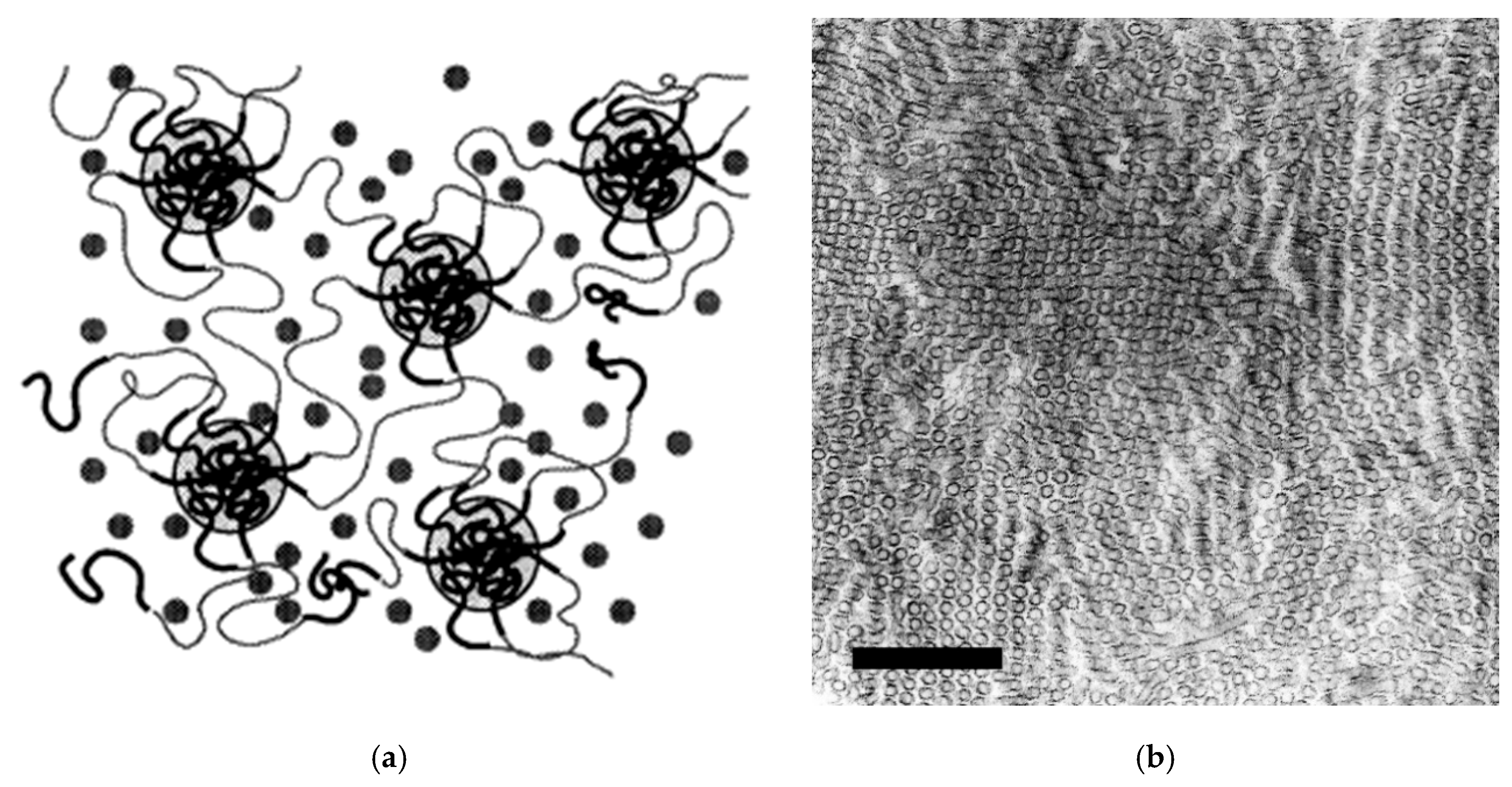
Figure 2.
Flexural modulus of base polymers and blend compositions as function of SEBS content; open symbols and dashed lines for RACO (blue) and HECO blends (red), full symbols and lines for RAHECO blends (RAHECO 1 green, RAHECO 2 orange).
Figure 2.
Flexural modulus of base polymers and blend compositions as function of SEBS content; open symbols and dashed lines for RACO (blue) and HECO blends (red), full symbols and lines for RAHECO blends (RAHECO 1 green, RAHECO 2 orange).
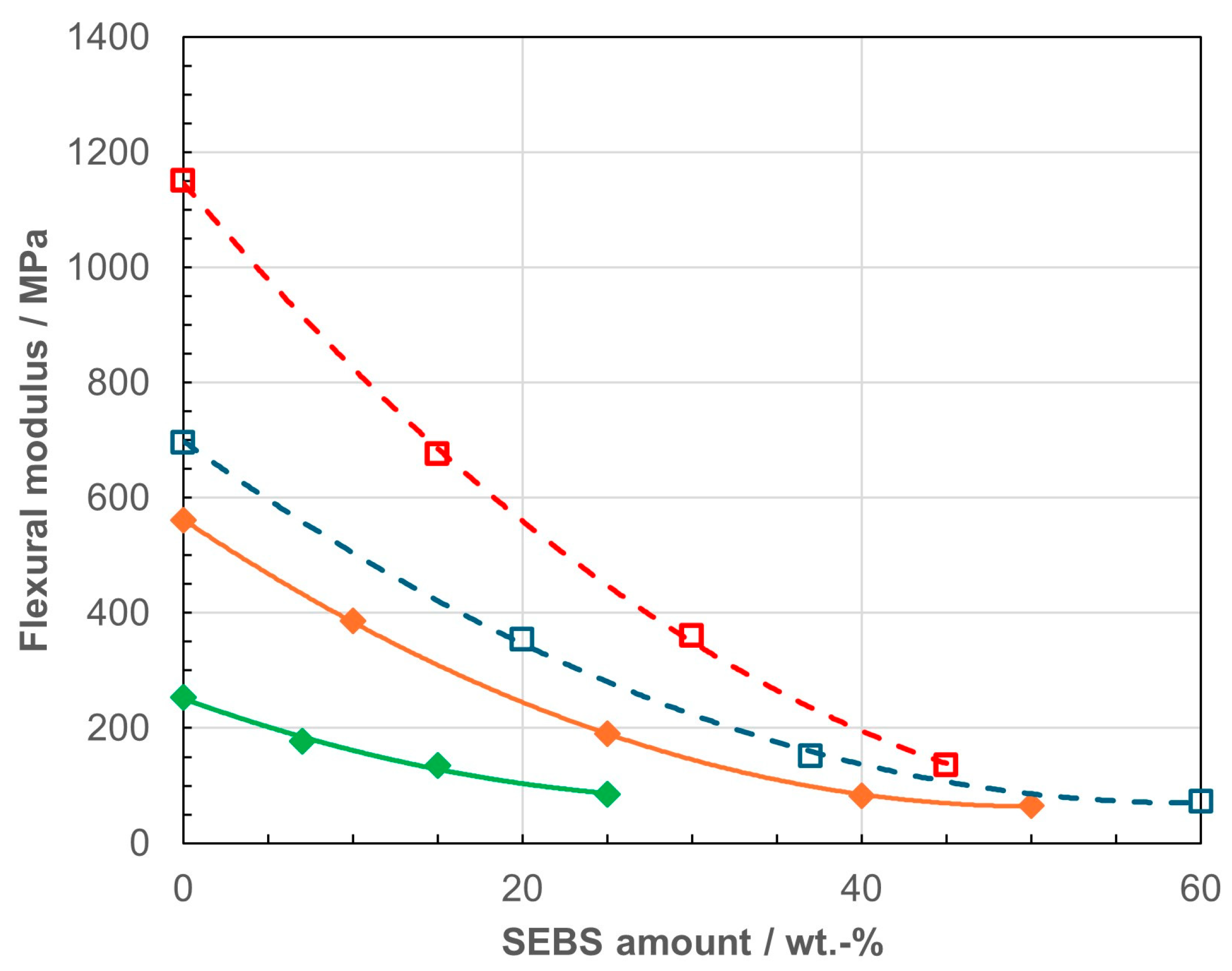
Figure 3.
Toughness as expressed by Charpy NIS at 23 °C as function of XCS content; open symbols and dashed lines for RACO (blue) and HECO blends (red), black symbols and dotted lines for reference data from RAHECO series with variation of EPC content [34].
Figure 3.
Toughness as expressed by Charpy NIS at 23 °C as function of XCS content; open symbols and dashed lines for RACO (blue) and HECO blends (red), black symbols and dotted lines for reference data from RAHECO series with variation of EPC content [34].
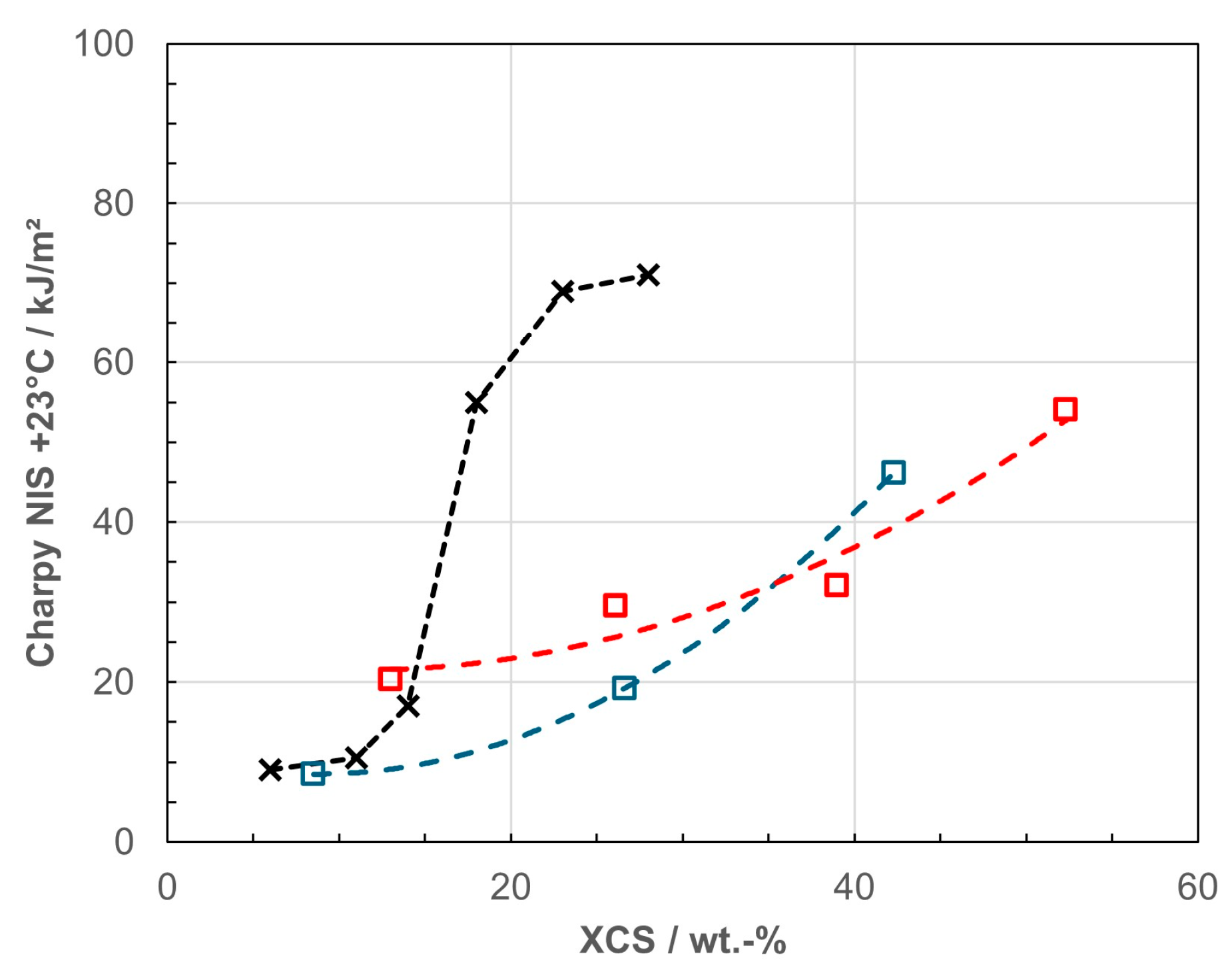
Figure 4.
Phase morphology of cast films in MD (top, a-c) and TD (bottom, d-f) for the HECO base polymer (a & d), 85/15 blend with SEBS (b & e) and 55/45 blend with SEBS (c & f); TEM images contrasted with RuO4 as in [39] with 2 µm scale bars.
Figure 4.
Phase morphology of cast films in MD (top, a-c) and TD (bottom, d-f) for the HECO base polymer (a & d), 85/15 blend with SEBS (b & e) and 55/45 blend with SEBS (c & f); TEM images contrasted with RuO4 as in [39] with 2 µm scale bars.
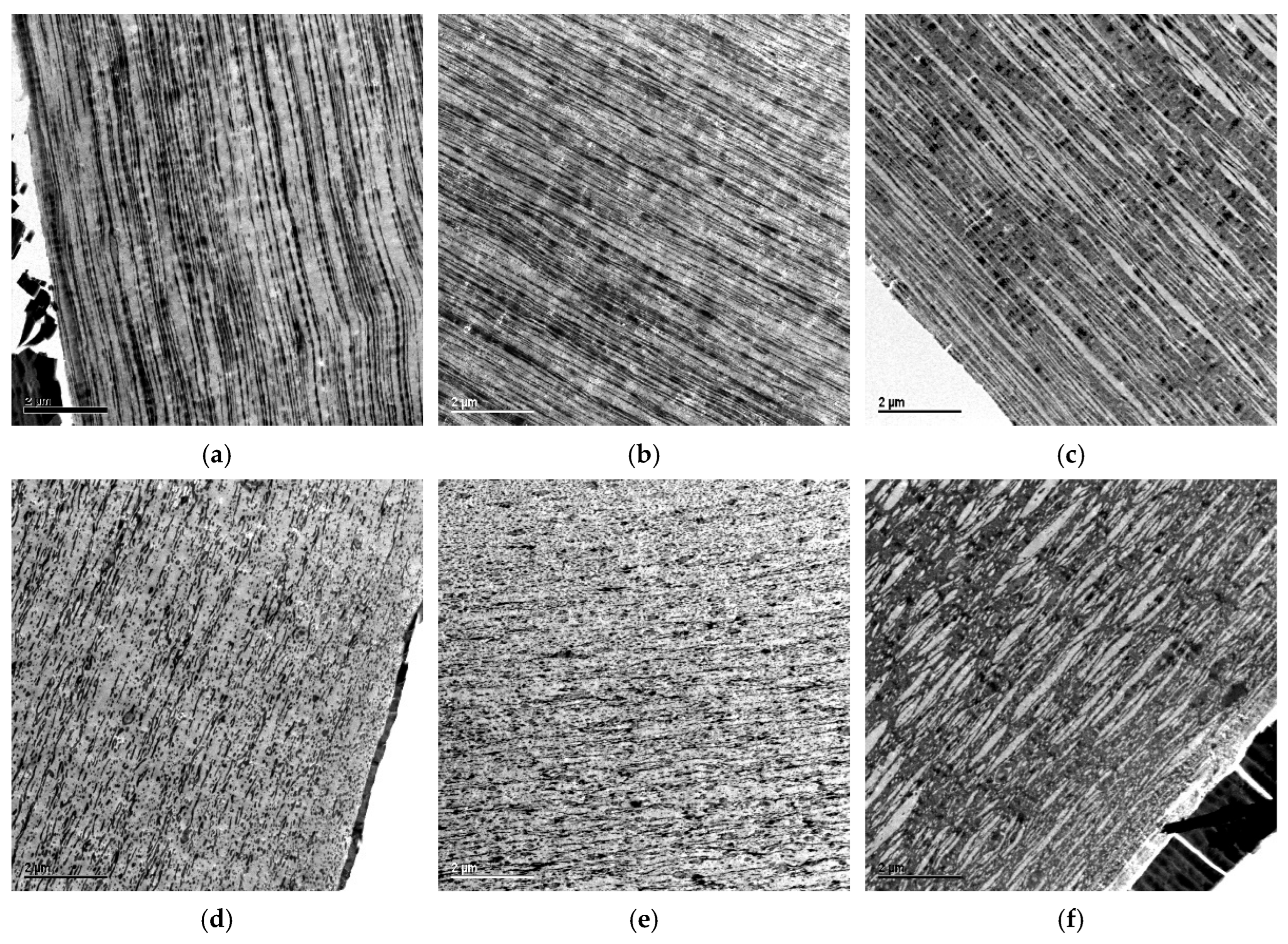
Figure 5.
Details of phase morphology of cast films in MD for the HECO base polymer (a) and the 55/45 blend with SEBS (b); TEM images contrasted with RuO4 as in [39] with 0.2 µm scale bars.
Figure 5.
Details of phase morphology of cast films in MD for the HECO base polymer (a) and the 55/45 blend with SEBS (b); TEM images contrasted with RuO4 as in [39] with 0.2 µm scale bars.
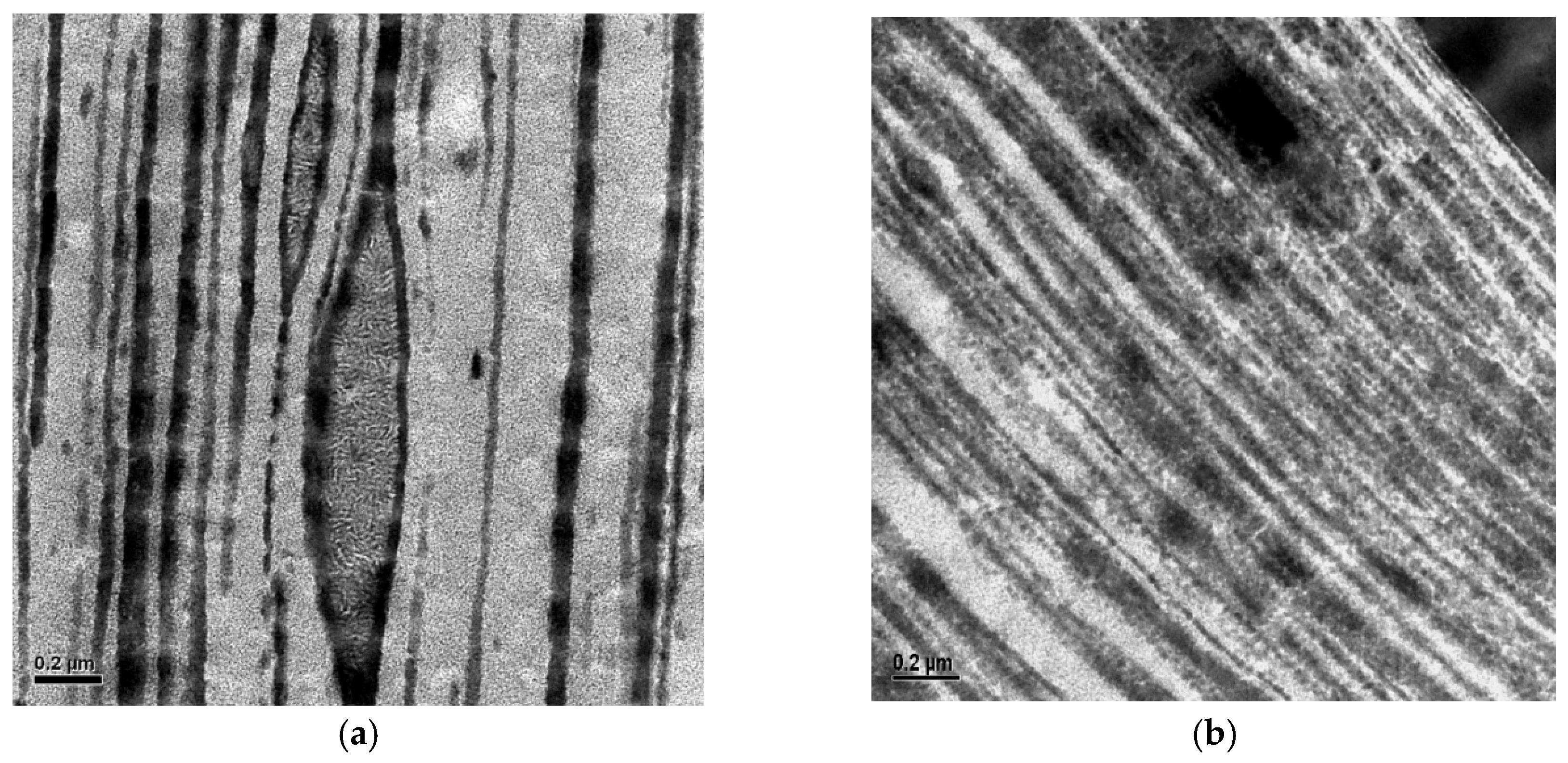
Figure 6.
Film toughness as W(total) from penetration test (ISO 7765-2, Dynatest) at 0 °C for RACO and RAHECO polymers and blend compositions as function of SEBS content; open symbols and dashed lines for RACO (blue), full symbols and lines for RAHECO blends (RAHECO 1 green, RAHECO 2 orange).
Figure 6.
Film toughness as W(total) from penetration test (ISO 7765-2, Dynatest) at 0 °C for RACO and RAHECO polymers and blend compositions as function of SEBS content; open symbols and dashed lines for RACO (blue), full symbols and lines for RAHECO blends (RAHECO 1 green, RAHECO 2 orange).
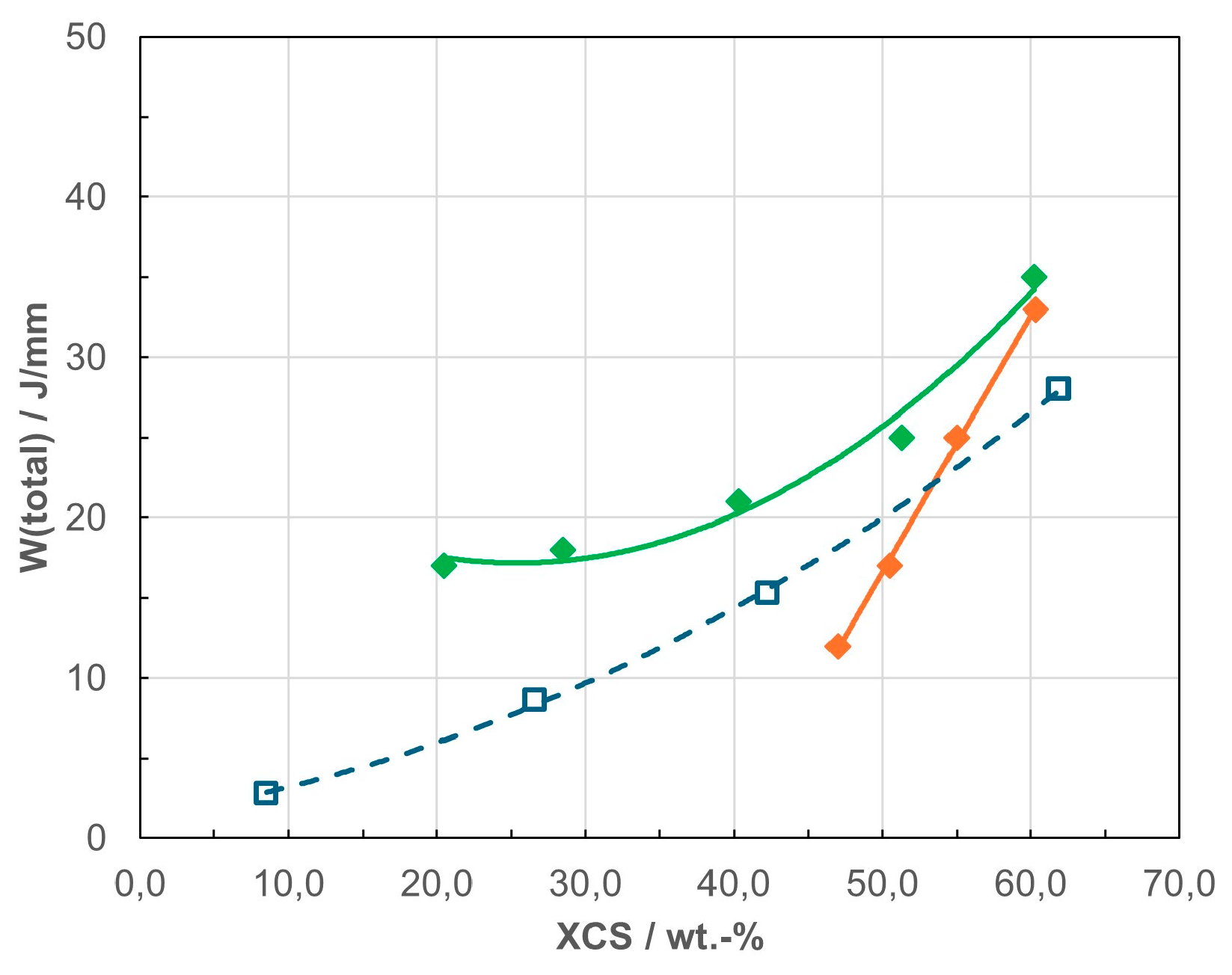
Figure 7.
Balance of optical and mechanical properties for PP/SEBS blends having a similar flexibility of FM (molded) ~ 150 MPa and TM (film) ~ 90 MPa, percentages above the bars indicating the SEBS content; a—Haze (molded & film), b—Film toughness (Dynatest 0 °C).
Figure 7.
Balance of optical and mechanical properties for PP/SEBS blends having a similar flexibility of FM (molded) ~ 150 MPa and TM (film) ~ 90 MPa, percentages above the bars indicating the SEBS content; a—Haze (molded & film), b—Film toughness (Dynatest 0 °C).
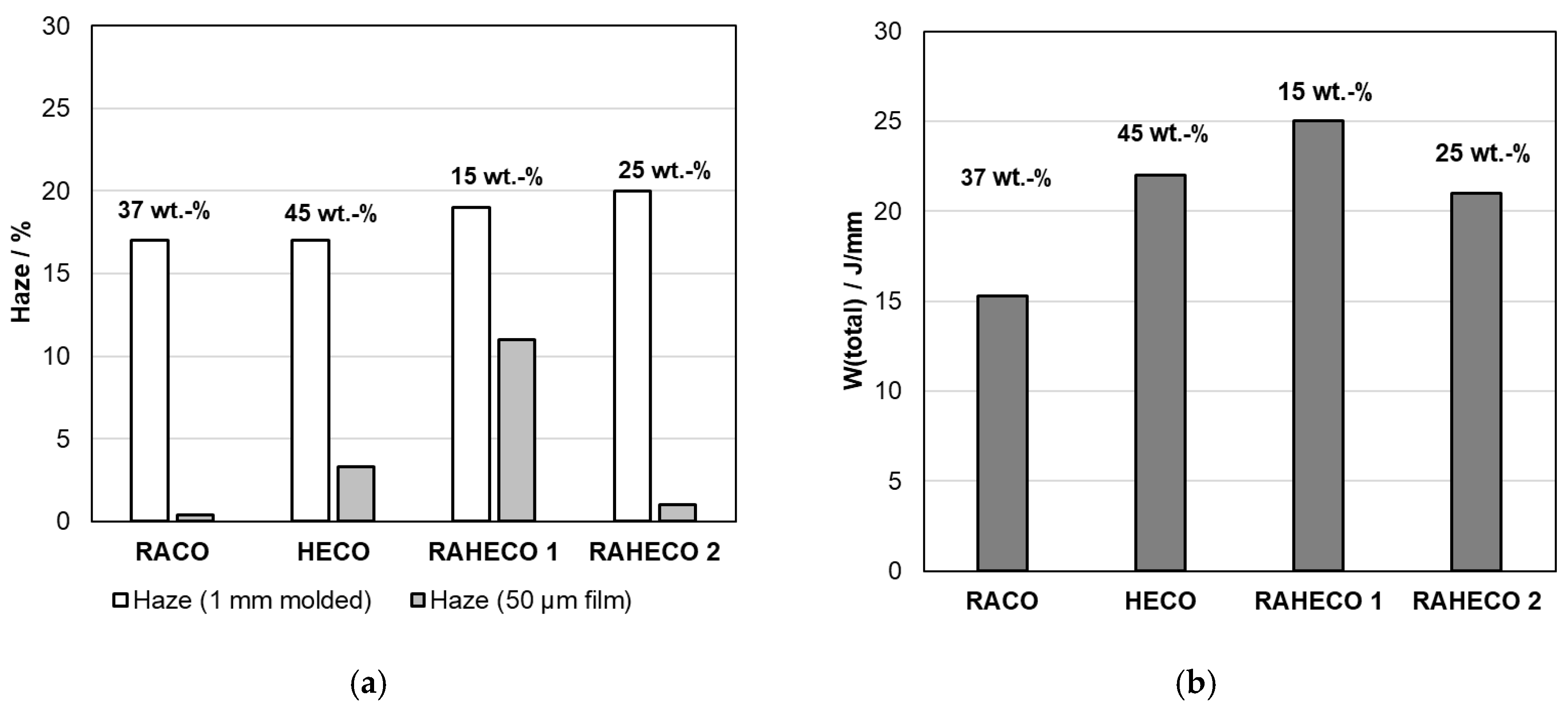

Table 1.
Base polymer characteristics.
| Type | RACO | HECO | RAHECO 1 | RAHECO 2 | |
| MFR 230 °C / 2.16 kg | g/10 min | 4.5 | 2.3 | 3.1 | 4.9 |
| C2(total) | wt.-% | 4.2 | 6.0 | 11.3 | 9.2 |
| XCS | wt.-% | 8.5 | 13 | 47 | 20.5 |
| C2(XCS) | wt.-% | n.d. | 46 | 19.4 | 33.4 |
| IV(XCS) | dl/g | n.d. | 1.7 | 2.0 | 1.5 |
| Tm(DSC) | °C | 140 | 162 | 149 | 142 |
| Flexural modulus | MPa | 696 | 1150 | 254 | 561 |
Table 2.
Composition and properties of RACO and HECO blends with SEBS.
| Base type | RACO | ||||
| Base amount | wt.-% | 100 | 80 | 63 | 40 |
| SEBS amount | wt.-% | 0 | 20 | 37 | 60 |
| MFR(blend) | g/10 min | 4.5 | 4.0 | 3.1 | 3.0 |
| XCS(blend) | wt.-% | 8.5 | 26.6 | 42.3 | 61.9 |
| IM specimens | |||||
| Flexural modulus | MPa | 696 | 354 | 152 | 72 |
| Charpy NIS +23 °C | kJ/m² | 8.5 | 19.2 | 46.2 | n.b. |
| Haze (1 mm) | % | 41 | 28 | 17 | 13 |
| Cast film 50 µm | |||||
| Tensile modulus | MPa | 393 | 236 | 88 | 41 |
| Haze (film) | % | 1.9 | 1.3 | 0.4 | 0.5 |
| W(break) 0 °C | J/mm | 2.8 | 8.6 | 15.3 | 28.0 |
| Base type | HECO | ||||
| Base amount | wt.-% | 100 | 85 | 70 | 55 |
| SEBS amount | wt.-% | 0 | 15 | 30 | 45 |
| MFR(blend) | g/10 min | 2.3 | 2.9 | 3.2 | 3.7 |
| XCS(blend) | wt.-% | 13 | 26.1 | 39.0 | 52.3 |
| IM specimens | |||||
| Flexural modulus | MPa | 1150 | 675 | 360 | 135 |
| Charpy NIS +23 °C | kJ/m² | 20.3 | 29.5 | 32.0 | 54 |
| Haze (1 mm) | % | 65 | 44 | 31 | 17 |
| Cast film 50 µm | |||||
| Tensile modulus | MPa | 663 | 390 | 206 | 80 |
| Haze (film) | % | 13.2 | 8.9 | 6.0 | 3.3 |
| W(break) 0 °C | J/mm | 9.2 | 12.5 | 14.1 | 22.0 |
Table 3.
Composition and properties of RAHECO blends with SEBS.
| Base type | RAHECO 1 | |||||
| Base amount | wt.-% | 100 | 93 | 85 | 75 | |
| SEBS amount | wt.-% | 0 | 7 | 15 | 25 | |
| MFR(blend) | g/10 min | 3.1 | 4.0 | 4.6 | 4.0 | |
| XCS(blend) | wt.-% | 47.0 | 50.5 | 55.0 | 60.3 | |
| IM specimens | ||||||
| Flexural modulus | MPa | 254 | 177 | 135 | 85 | |
| Charpy NIS +23 °C | kJ/m² | 69 | 95 | n.b. | n.b. | |
| Haze (1 mm) | % | 30 | 24 | 19 | 14 | |
| Clarity (1 mm) | % | 95 | 96 | 97 | 97 | |
| Cast film 50 µm | ||||||
| Tensile modulus | MPa | 198 | 110 | 82 | 52 | |
| Haze (film) | % | 13 | 17 | 11 | 5 | |
| Clarity (film) | % | 78 | 86 | 89 | 96 | |
| W(break) 0 °C | J/mm | 12 | 17 | 25 | 33 | |
| Base type | RAHECO 2 | |||||
| Base amount | wt.-% | 100 | 90 | 75 | 60 | 50 |
| SEBS amount | wt.-% | 0 | 10 | 25 | 40 | 50 |
| MFR(blend) | g/10 min | 4.9 | 4.6 | 4.7 | 4.9 | 4.9 |
| XCS(blend) | wt.-% | 20.5 | 28.5 | 40.3 | 51.3 | 60.2 |
| IM specimens | ||||||
| Flexural modulus | MPa | 561 | 386 | 190 | 83 | 65 |
| Charpy NIS +23 °C | kJ/m² | 13.5 | 32 | 98 | n.b. | n.b. |
| Haze (1 mm) | % | 47 | 32 | 20 | 14.5 | 12 |
| Clarity (1 mm) | % | 92 | 95 | 96 | 97 | 98 |
| Cast film 50 µm | ||||||
| Tensile modulus | MPa | 322 | 262 | 101 | 60 | 35 |
| Haze (film) | % | 1.0 | 1.0 | 1.0 | 1.0 | 1.0 |
| Clarity (film) | % | 98 | 98 | 98 | 98 | 98 |
| W(break) 0 °C | J/mm | 17 | 18 | 21 | 25 | 35 |
Disclaimer/Publisher’s Note: The statements, opinions and data contained in all publications are solely those of the individual author(s) and contributor(s) and not of MDPI and/or the editor(s). MDPI and/or the editor(s) disclaim responsibility for any injury to people or property resulting from any ideas, methods, instructions or products referred to in the content. |
© 2026 by the authors. Licensee MDPI, Basel, Switzerland. This article is an open access article distributed under the terms and conditions of the Creative Commons Attribution (CC BY) license (http://creativecommons.org/licenses/by/4.0/).
Copyright: This open access article is published under a Creative Commons CC BY 4.0 license, which permit the free download, distribution, and reuse, provided that the author and preprint are cited in any reuse.


