
Submitted:
27 March 2026
Posted:
31 March 2026
You are already at the latest version
Abstract
Leaks in pipe systems result in significant economic losses, environmental hazards, and public health risks. Transient-based leak detection methods, which exploit the dynamics of pressure waves in response to system anomalies, have emerged as efficient techniques for identifying and characterizing leaks in pressurized pipelines. These methods offer dis-tinct advantages, including minimal data requirements, high sensitivity to low-pressure anomalies, and resilience to the ill-posed conditions often affecting steady-state models. This paper reviews transient-based leak detection, synthesizing findings from over 138 peer-reviewed publications spanning the past three decades. The review categorizes tran-sient-based methods into transient damping, transient reflection, system response, and inverse transient methods, analyzing the prevalence, evolution, and research rate of each category over time. By structuring the review around key aspects such as simulation do-main type, analysis approach, system response, solver strategies, adaptability to noise, viscoelasticity, and network complexity, this paper identifies significant trends and shifts in research focus. A comprehensive tabular dataset of 138 studies captures how research activity in various areas has accelerated, slowed, or reached stability, offering insights into the evolving priorities within the field. This review highlights areas for further develop-ment, particularly in addressing AI-enhanced applications, transient excitation and measurement sites design, noise resilience, comprehensive leak characterization, valida-tion approaches, and scalability for complex network applications, providing a resource to guide future research in transient-based leak detection.
Keywords:
leak detection
; transient flow
; pipeline
; water distribution networks
1. Introduction
Pipeline systems form a critical infrastructure in modern societies, enabling the efficient transport of essential fluids, including water, oil, and gas, over vast distances. These systems’ reliability and operational integrity are vital to preventing significant economic losses, mitigating environmental hazards, and safeguarding public health. Among the persistent challenges in pipeline management is leak detection, as leaks contribute to considerable resource wastage, increased maintenance costs, and potential contamination risks. This issue is especially pronounced in water distribution systems, where background leaks can degrade water quality, reduce service levels, and cause public health threats through contamination. With the escalating focus on sustainable resource management, the demand for fast, precise, and cost-effective leak detection methods has intensified, positioning transient-based methodologies as a promising solution.
Leak detection approaches in pipeline networks are broadly classified into steady-state and transient-based (unsteady) methods, each with unique benefits and challenges. Traditional steady-state methods rely on monitoring continuous pressure and flow data, typically requiring extensive datasets, including leak-free periods, to identify leaks. These methods, while foundational, often necessitate large-scale sensor networks (Ayati and Haghighi 2023) and could be subject to ill-posed conditions (Sophocleous, et al. 2019), where minor errors in data or model assumptions can yield inaccurate results.
Transient-based methods have emerged as a technically superior alternative for leak detection, leveraging the physics of wave propagation to offer high-resolution insights into pipeline conditions (Chaudhry 2014; Xu and Karney 2017). These methods utilize pressure waves propagating through the system in response to sudden changes, such as valve closures, pump startups, or intentional pressure injections. Transient flow generates dynamic fluctuations that amplify the impact of system features and anomalies, including leaks. This dynamic nature of transient flow enables more precise detection and localization of leaks by capturing how transient waves reflect, absorb, or alter in response to disruptions within the system (Xu and Karney 2017). The following technical benefits underscore the advantages of transient-based methods over the steady methods:
- Transient waves interact acutely with structural features such as bends, valves, blockage, and leaks. As a transient wave encounters a leak, it undergoes unique partial reflection and attenuation, with distinctive alterations in the system’s pressure profile (Xu and Karney 2017). This sensitivity allows for high-resolution leak detection by analyzing how pressure waves are distorted and reflected due to anomalies.
- A primary benefit of transient-based methods is their efficiency in data utilization. Instead of requiring a network of continuously monitoring sensors, transient-based approaches leverage short, high-resolution data during transient events, generally in minutes. This data minimalism reduces the need for extensive, costly sensor networks, allowing for more streamlined sensor placement and overall cost savings (Ayati and Haghighi 2023). This feature is particularly advantageous for large-scale or older infrastructure systems, where widespread sensor installation might be impractical or cost-prohibitive, and historical data is unavailable.
- Steady-state approaches rely on significant pressure differentials to reliably detect leaks, a requirement that limits their applicability in low-pressure systems. Transient-based methods, however, circumvent this issue by inducing high-pressure conditions dynamically (Haghighi and Ramos 2012). These pressure pulses amplify the leak signal, making leaks detectable even in low-pressure scenarios.
- Steady-state models are prone to ill-posed conditions, where the low sensitivity of steady-state hydraulic equations, combined with minor inaccuracies in sensor data or model parameters, can lead to significant error propagation, compromising the accuracy of leak detection results (Zaman, et al. 2020). In contrast, transient-based methods offer exceptional resolution due to their ability to capture the unique “fingerprints” of various system elements. Each wave’s interaction with pipeline features such as a junction, valve, or leak imprints a distinct pattern on the transient response (Xu and Karney 2017). This results in enhanced resolution for leaks, as transient waves provide specific information on the leak’s location, size, and nature. Additionally, transient-based methods can distinguish between different types of anomalies, such as blockages or structural faults, due to their sensitivity to the spatial arrangement of system components.
- Transient-based approaches are highly effective for non-destructive testing (NDT), enabling rapid assessment of pipeline conditions in minutes without relying on leak-free and extensive historical data or significantly disrupting regular operations (Gong, et al. 2016). Transient events, such as those induced by routine valve closures or pump operations during off-peak hours, e.g., midnight tests, facilitate real-time diagnostics without the need for extended shutdowns. This non-invasive capability makes transient methods particularly well-suited for in-situ diagnostics.
Given the substantial advantages of transient-based methods, this review conducts a statistical analysis of existing transient-based leak detection techniques, examining their hydraulic principles, technical applications, and trends in research focus over time. While previous reviews, such as Romero-Ben, et al. (2023), have extensively covered steady-state methods, this paper concentrates uniquely on transient-based methodologies.
Wang, et al. (2001) conducted a comprehensive survey of various leak detection methods, discussing each method’s advantages and limitations with a focus on selecting appropriate solutions for specific pipeline systems. They classified hydraulic leak detection techniques into eight distinct categories: Hydrostatic Leak Detection (Williams, et al. 1983), Mass/Volume Balance (Liou 1994), Pressure-Flow Deviation (Fukushima, et al. 2000), Inverse Analysis (Nash and Karney 1999; Pudar and Liggett 1992), Reflected or Negative Waves (Brunone 1999; Covas and Ramos 1999), Transient Frequency (Mpesha, et al. 2001), Transient Damping (Wang, et al. 2001), and Artificial Neural Networks (Salvatore, et al. 1998) Methods. Notably, they provided an in-depth analysis of inverse transient methods, recommending the application of transient-based techniques, such as transient reflection, transient damping, and transient frequency analysis, in simpler pipeline systems to enhance response time, detection accuracy, and leak localization. They also suggested that combining these transient-based methods with traditional approaches, such as online surveillance and acoustic leak detection, could improve the detection of minor leaks.
Colombo, et al. (2009) presented a selective review of transient-based leak detection methods, categorizing them into Inverse Transient Analysis (ITA) (Pudar Ranko and Liggett James 1992), Frequency Domain Techniques (Mpesha, et al. 2001), and Direct Transient Analysis (Covas, et al. 2001). Within Direct Transient Analysis, they further distinguished three subgroups: Time-Domain Reflectometry (Brunone 1999), Advanced Reflection Techniques (Beck, et al. 2005; Brunone 1999), and Transient Damping Methods (Wang, et al. 2002). They highlighted a significant gap in the field: insufficient fieldwork and limited empirical verification of transient-based methods, emphasizing the need for practical validation in future research.
Puust, et al. (2010) reviewed leakage management strategies in pipe networks, organizing methods into three main categories: (1) leakage assessment methods (Pilcher, et al. 2007), focused on quantifying water loss; (2) leakage detection methods (Ferrante and Brunone 2003a; Kapelan, et al. 2003), aimed at identifying leakage hotspots; and (3) leakage control models (Misiunas, et al. 2005; Mounce and Machell 2006)targeting the management and reduction of both current and future leaks. Within the second category, they introduced three sub-categories: Leakage Awareness (Brunone and Ferrante 2004; Brunone and Ferrante 2001; Covas and Ramos 2001), Leakage Localization (Farley, et al. 2008; Pilcher, et al. 2007), and Leakage Pinpointing (Cascetta and Vigo 1992; Muggleton and Brennan 2005) Methods. Leakage Awareness Methods, in particular, rely on hydraulic models to identify potential leakage areas without pinpointing precise locations. This classification encompasses widely used transient-based techniques, including the leak reflection method, ITA, impulse response analysis, transient damping method, and frequency response method.
Datta and Sarkar (2016) provided a concise evaluation of various pipeline fault detection techniques, including vibration analysis (Lile, et al. 2012), pulse echo methodology (Duan, et al. 2015), acoustic techniques (Wang, et al. 2009), negative pressure wave-based leak detection (Sun and Chang 2014), support vector machine-based leak detection (Qu, et al. 2010), interferometric fiber sensor detection (Huang, et al. 2007), and filter diagonalization method (Lay-Ekuakille, et al. 2009). Their comparison revealed that acoustic reflectometry was especially effective for detecting minor blockages and leaks, offering a cost-efficient solution applicable to pipes of various shapes, configurations, and fluid densities.
Xu and Karney (2017) reviewed theoretical and strategic approaches to transient-based fault detection, encompassing both leakage and blockage identification in active and passive systems. Their classification included four primary techniques: transient reflection, transient damping, system response, and inverse transient methods. They emphasized a significant drawback in existing methods: the need for ideal system assumptions, which can significantly hinder the accuracy and broader applicability of these methods in complex networks.
Gupta and Kulat (2018) categorized leak detection and localization approaches into four groups: acoustic techniques (Khulief, et al. 2012; Ozevin and Harding 2012), non-acoustic (Fan, et al. 2005), transient analysis (Covas, et al. 2010; Haghighi and Ramos 2012; Kapelan, et al. 2003; Liggett and Chen 1994), and predictive modeling techniques (Ye and Fenner Richard 2011). Within the transient analysis, they highlighted ITA and frequency domain analysis as key approaches. Predictive Modeling Techniques, including ANNs, pattern sequence forecasting (Bokde, et al. 2017), and Autoregressive Integrated Moving Average (ARIMA) (Farley, et al. 2008), were noted for their potential to refine leak detection predictions through Machine Learning (ML).
Ayati, et al. (2019) systematically reviewed the transient-based leak detection literature, summarizing three decades of research. That review included a detailed analytical table summarizing each study’s methodological approach, domain type, analysis technique, system response, optimization strategies, and inclusion of factors such as viscoelasticity, noise, and topographic complexity. Their analysis was structured into three main sections: (1) significant considerations and methodologies in transient-based leak detection, (2) application of Xu and Karney (2017) classification framework to categorize previous studies, and (3) a discussion of significant challenges and future development needs in the field.
Duan (2020) reviewed the transient flow studies for the urban water supply system (UWSS) management. The review consists of two aspects. The first aspect concerns the development and progress of current transient theory, encompassing transient flow models, unsteady friction and turbulence models, and numerical simulation methods. The second is about the application of transient-based methods for effective UWSS diagnosis and management, including leakage, discrete and extended partial blockages, unknown branches, and other defects in water pipelines.
Che, et al. (2021) also reviewed the development and application of transient wave-based methods. They discussed techniques for generating and measuring transient waves. They presented a summarized review of the signal processing techniques commonly used for feature extraction from the measured signals. The primary focus of that paper was on the review of the technological advances and characteristics of five common types of transient wave-based anomaly detection methods for fluid pipe systems, namely (1) reflection-based method; (2) damping-based method; (3) frequency response function (FRF) peak pattern-based method; (4) time domain full-waveform inversion method; and (5) frequency domain full-waveform inversion method.
Building upon the structure of Ayati et al. (2019), we update and extend their review up to 2025, analyzing the evolution, advantages, and persistent challenges in implementing these approaches. We extend their review by incorporating recent publications and emerging concepts to address evolving challenges in transient-based leak detection. Considering innovations in materials, methodologies and technology, this work systematically organizes and assesses the literature, tracks statistical trends in technique adoption, research intensity, and topic shifts.
2. Review Methodology
2.1. Literature Search and Selection
A comprehensive literature search was conducted across various databases, including ASCE, IEEE Xplore, ScienceDirect, SpringerLink, and Taylor & Francis Online, to identify peer-reviewed articles published up to 2025. This review focuses on studies published in key journals in hydraulics, water resources, signal processing, and artificial intelligence that employ transient-based methods for leak detection. Only studies relevant to practical applications or theoretical advancements in water supply systems were retained, focusing on transient hydraulic phenomena for leak detection rather than other faults.
2.2. General Classification Framework
Transient-based methods were systematically classified following the structure suggested by Xu and Karney (2017), grouping studies into:
- Transient Damping Methods (TDM)
- Transient Reflection Methods (TRM)
- System Response Methods (SRM)
- Inverse Transient Methods (ITM)
2.3. Classification Based on Analysis Approach
Based on the applied analytical techniques, the reviewed literature was categorized into:
- Model-Based Methods (time or frequency domains)
- Signal Processing Techniques
- AI-Enhanced Methods
2.4. Quantitative and Qualitative Analytical Approach
Each selected study was analyzed for its contributions to transient-based leak detection, focusing on domain type, analysis method, system complexity, and innovations. A detailed table (Appendix) captures each study’s analysis approach, optimization technique if used, uncertainty and noise management, and validation strategy. Statistical trends, such as temporal shifts in methodology adoption, optimization technique prevalence, and changes in focus on topographic complexity, are visualized in figures to illustrate developments across three decades.
2.5. Comparative Evaluation of Methods
The review includes a comparative analysis to assess the methods for the following features.
- Time vs. Frequency Domain Analysis: Examines real-time applicability of time-domain methods versus the accuracy of frequency-domain techniques in noisy environments.
- Single-Pipe vs. Network Applications: Evaluates effectiveness across network types, from simple pipelines to large, branched systems.
- Data Requirements: Analyze the data efficiency of transient-based methods.
- Scalability and Accuracy: Highlights models’ robustness in large networks with complex dynamics.
2.6. Identification of Research Gaps and Challenges
Key technical challenges are identified, including environmental noise interference, boundary condition sensitivity, and limitations in scalability for real-world applications. This analysis statistically highlights trends in research focus over time, identifying areas where research has accelerated, slowed, or remained stable, providing insights into evolving priorities within the field.
2.7. Future Directions
Based on the statistical findings, future research directions are discussed. They emphasize the integration of AI with hydraulic modeling to enable real-time adaptive leak detection and recommend interdisciplinary collaboration between hydraulic engineers and data scientists. This statistical analysis informs potential advancements in noise management, network scalability, and real-time applications, aiming to guide future research toward more resilient and scalable solutions.
3. Transient Flow Governing Equations
In pipe systems, the flow is termed steady when the flow conditions, including pressure and velocity, at a particular point remain unchanged over time. If the conditions change with time, the flow is called unsteady. Transient is an intermediate-stage flow that happens when the flow conditions change from one steady-state condition to another. Two conservative rules of mass and momentum govern transient flows in pressurized pipes. For most hydraulic engineering applications, these equations are generally written as (Chaudhry 2014),
where is the distance along the pipe, is time, is wave speed, is gravitational acceleration, is the pipe cross-sectional area, is pipe diameter, is instantaneous discharge, is the instantaneous piezometric head, and is Darcy–Weisbach friction factor.
The more realistic simulation of transient flow in pipe networks involves consideration of unsteady friction effects. To do so, the term in Equation (3) could be extended as follows.
In which and are quasi-steady and unsteady friction factors, respectively. The quasi-steady friction factor can be obtained implicitly using the Colebrook-White equation (Colebrook 1939), and the unsteady friction factor can be calculated by the Brunone model (Brunone, et al. 1995). For a detailed discussion on the unsteady friction factor, refer to Bergant, et al. (2001). Also, the leak in a pipe is simulated by the orifice equation as follows.
where is leak discharge, is the effective leak area, is the coefficient of discharge, is the apparent leak area, and are respectively, the elevation and the instantaneous piezometric head at the leak location and if and is equal to 0 otherwise.
Solving the governing equations in the time domain
The Method of Characteristics (MOC) is the most widely used and efficient technique for solving the governing equations of transient flow in pressurized pipe systems in the time domain. This method transforms the above partial differential equations into a set of ordinary differential equations along specific curves known as characteristic lines. By linearly combining the continuity and momentum equations, the partial derivatives are reformulated into total (directional) derivatives using the chain rule. This transformation enables the integration of the equations along characteristic lines, allowing the computation of head and discharge at discrete points within the pipeline (Wylie and Streeter 1978). At each time step, the flow conditions at future points are determined based on known head and discharge values at nodal points from the previous time step. This stepwise approach can be continued indefinitely, provided that appropriate boundary conditions are specified at the pipe’s extremities. A boundary condition must be defined at each end of the pipe, either by prescribing one of the unknowns (head or discharge) or by specifying a relationship between them.
Solving the governing equations in the frequency domain
Frequency-domain analysis provides an alternative to time-domain simulations for analyzing transient flow in pipe systems. This approach leverages Fourier and Laplace transforms to convert the governing partial differential equations of fluid dynamics into algebraic equations. This transformation simplifies the analysis by decoupling the spatial and temporal variables, allowing for efficient investigation of the system’s dynamic response. The primary advantage of this method lies in its capability to characterize system properties such as wave attenuation, resonance frequencies, and damping characteristics. These properties are directly related to the system’s FRF. The FRF describes how the system’s output (e.g., pressure) responds to a given input (e.g., valve closure) at various frequencies. Once the system’s behavior is analyzed in the frequency domain, the results can be converted back to the time domain using the inverse Fourier or Laplace transform to obtain pressure and flow variations over time.
Frequency-domain methods are highly effective for linear and linearized systems, making them suitable for applications involving minor disturbances, steady-state oscillations, and periodic inputs. Conversely, the method is less ideal for systems with significant nonlinearities, such as large-amplitude transients like rapid valve closures, which necessitate direct numerical integration in the time domain.
For a more detailed discussion of the MOC and frequency-domain analysis, standard references like Wylie and Streeter (1993) and Chaudhry (2014) are essential. These texts provide in-depth explanations of the mathematical formulations and numerical implementations of these techniques, making them foundational resources for researchers and engineers in the field.
4. General Classification of Transient-Based Leak Detection Methods
Transient signal propagation within pipeline systems serves as a diagnostic tool, probing the system’s integrity and identifying anomalies such as leaks. The behavior of reflected transient signals, including their damping patterns, encodes critical information about the system’s properties. By interpreting pressure time histories at measurement points, one can deduce characteristics of discontinuities, notably the location and size of leaks (Ferrante and Brunone 2003a; Xu and Karney 2017). Figure 1 illustrates the distribution of studies over time, categorized by these methodologies, highlighting the evolution and focus areas within transient-based leak detection research. This classification framework provides a structured approach to understanding the diverse methods employed in transient-based leak detection, facilitating a comprehensive analysis of their respective advantages and limitations.
4.1. TDM
Similar to all discontinuities, leaks can induce damping in an injected pressure signal as it propagates through a pipe system. This effect can be exploited in leak detection by comparing the observed damping pattern with a fault-free benchmark for the same system. The TDM approach was first proposed by Wang, et al. (2002). Recognizing that transient flow in pipes is nearly linear, they expressed the governing equations’ solution using a Fourier series. They noted that while steady pipe friction damps all Fourier components uniformly, a leak causes differential damping across the components. Thus, leak-induced damping can be decomposed into two distinct parts: the damping magnitude, which is related to the leak size, and the varying damping ratios of Fourier components, which can be used to pinpoint the leak location.
Additionally, the leak-induced damping rate is influenced by factors such as pipe pressure, transient signal shape, and the transient signal’s origin (Wang, et al. 2005). The application of TDM is generally limited to single-pipe systems since damping is not exclusively caused by friction and leaks. Other physical features in complex networks introduce additional damping effects, complicating or even preventing the accurate identification of leak-induced damping patterns (Xu and Karney 2017). TDM also assumes the pipe system operates as a linear system with steady friction. Nixon, et al. (2006) validated this linearity assumption through transient modeling. Their findings indicated that the accuracy of the method improves with an accurate representation of unsteady friction effects.
Compared to other methodologies, the TDM remains relatively underrepresented in the literature, accounting for only about 3% of studies (Figure 1). Notable contributions are primarily limited to the foundational works referenced above, highlighting a significant gap and potential for further exploration in this area.
4.2. TRM
TRM leverages the behavior of pressure waves within a pipeline network. When a transient event is introduced into the system, the resulting pressure wave propagates through the pipe. Upon encountering a discontinuity, such as a leak or a blockage, a portion of this wave is reflected, with the remainder being transmitted and attenuated. The core of TRM lies in analyzing the characteristics of this reflected signal. Duan, et al. (2010b) found that all transient-based methods struggle to detect and locate leaks without the leak-reflected signal; however, leaks are still detectable even if damping effects are minimized. Their results indicated that the information previously attributed to damping in slow transients is, in fact, primarily due to low-frequency reflections from the leak.
In TRM, pipeline features cause additional reflections in transient pressure, creating multiple wave paths within the system. Leak characteristics can be identified by finding discrepancies between measured results and fault-free benchmark data. The location of a leak can be discerned from the timing of reflected waves in the measured pressure trace. In contrast, the magnitude of the leak depends on the ratio between the generated transient wave’s intensity and the leak orifice size (Puust, et al. 2010).
Jönsson and Larson (1992) noted that a leak in a hydraulic system generates reflected waves when a pressure wave is introduced, making it possible to detect leaks by measuring and analyzing time-varying pressure data at a single point. They employed spectral analysis on time-series pressure data to detect reflected waves originating from a leak. Brunone (1999) proposed a technique for detecting leaks in outfall pipes by analyzing transient pressure wave properties. The effects of leaks on wave propagation were numerically discussed, and the leak discharge behavior was estimated using a first-order formula. Laboratory tests confirmed the reliability and validity of this approach on a long single pipe.
Practically, two significant challenges arise when applying and generalizing TRM. First, obtaining accurate, leak-free benchmark data for a system with unknown characteristics poses difficulties in extracting and classifying signal features. Such data can only be reliably obtained from well-defined laboratory models or highly accurate numerical models. However, real systems often contain numerous unknowns, such as unanticipated blockages, leaks, and branches, which introduce uncertainties and perturbations in the benchmark data. Second, loops in pipe networks create intricate reflection patterns that complicate the pattern recognition process. Due to these challenges, obtaining satisfactory results for complex pipeline networks is challenging, making the TRM approach less applicable for real-world systems (Xu and Karney 2017). Additionally, TRM is inherently a pattern recognition problem within the broader context of signal processing. Researchers in this area have applied various techniques to improve leak detection accuracy, including ANNs (Salvatore, et al. 1998), the Cumulative Sum (CUSUM) change detection algorithm (Lee, et al. 2007a), and wavelet analysis (Ferrante, et al. 2007; Ferrante, et al. 2009a; Ferrante, et al. 2009b).
Recent studies have further expanded the scope and efficacy of TRM. For instance, Zhang, et al. (2022) explored the characteristics of leak-induced transient wave reflections in pipeline systems, finding enhanced TRM applications. Duan (2018) assessed the sensitivity of the transient frequency response, a TRM variant, for detecting leaks in complex systems. Moreover, Li, et al. (2020) introduced a multiple signal classification method to improve accuracy in pipeline leak localization through TRM, highlighting the method’s adaptability to different pipeline types.
Statistics from Figure 1 indicate that, while only 12% of all reviewed papers utilized TRM, significant advancements have occurred in the past five years, demonstrating a renewed interest in and application of this method.
4.3. SRM
SRM utilizes the full spectrum of signal information, including damping and reflection effects, to maximize the extraction of informative features that are critical for accurately identifying leaks in pipe networks (Ayati, et al. 2019; Xu and Karney 2017). In SRM, a pipe system is conceptualized as a function, with transient excitation serving as the input and the system’s response as the output. A well-designed input signal is introduced into the system, and the resulting response is recorded either through hydraulic simulation or field measurements. Data analysis can be conducted in either the time or frequency domain (Brunone and Ferrante 2004; Brunone and Ferrante 2001; Mpesha, et al. 2002). SRM fundamentally relies on pattern recognition, where prior knowledge of leak characteristics and their effects on the response signal are necessary for accurate interpretation. Typically, this baseline knowledge is acquired by comparing system responses with those of a leak-free benchmark (Ayati and Haghighi 2023; Ayati, et al. 2022a).
In time-domain hydraulic simulations, a complex input signal is decomposed into a series of weighted unit impulses, with the system’s overall response determined by aggregating these contributions through a convolutional integral. The impulse response function (IRF) sharpens the output signal into distinct impulses with clear peaks, enhancing leak detectability (Lee, et al. 2007b; Vitkovsky, et al. 2003a; Xu and Karney 2017). In frequency-domain simulations, the FRF is derived by applying a Fourier Transform (FT) to the time-domain convolutional form of the system’s response, allowing for an alternative analysis approach that provides insights into the system’s behavior (Duan and Lee 2016; Duan, et al. 2012b; Lee, et al. 2005b; Liao, et al. 2021; Pan, et al. 2021).
Numerical solutions to the system’s hydraulic equations offer alternatives to the use of IRF and FRF. In the time domain, a hydraulic model with an MOC functions similarly to the IRF. In the frequency domain, assuming certain linearization conditions, the governing equations can be transformed to the frequency domain and solved using either the impedance method (Brunone and Ferrante 2004; Guo, et al. 2012; Kim 2005; Kim Sang, et al. 2014; Kim 2022) or the transfer matrix method (Keramat and Duan 2021; Lee, et al. 2005a; Mpesha, et al. 2001; Sattar and Chaudhry 2008; Vitkovsky, et al. 2003a), providing direct frequency-domain results. For cases in which system responses are measured directly from field transducers, raw data are typically acquired in the time domain and can be converted to the frequency domain through FT (Ayati, et al. 2022a; Brunone and Ferrante 2004; Ranginkaman, et al. 2017). In such situations, leak detection often becomes a signal-processing problem, where system behavior is inferred from the data, even without a complete understanding of the complex pipe network’s internal structure (Ayati, et al. 2019). Researchers employ various signal-processing techniques and estimation theories to analyze field-measured data. These techniques include wavelet transforms, statistical estimation methods, and advanced algorithms for pattern recognition. Significant studies in this area include contributions by (Al-Shidhani, et al. 2003; Amin, et al. 2014; Beck, et al. 2006; Brunone and Ferrante 2004; Ferrante and Brunone 2003b; Ghazali, et al. 2010; Ghazali, et al. 2012; Hamat, et al. 2017; Hanafi, M.Yusop, et al. 2017; Hu, et al. 2011; Lee, et al. 2007a); Liou (1998); (Meniconi, et al. 2011; Motazedi and Beck 2017; Srirangarajan, et al. 2012; Taghvaei, et al. 2006; Wang and Ghidaoui 2017; Wang and Ghidaoui 2018).
SRM’s popularity is underscored by its ability to handle complex systems and yield reliable results in both simulated and real-world scenarios. According to Figure 1, SRM has garnered the highest level of attention among transient-based methods, with over half of all studies in the field utilizing SRM. Despite its strengths, SRM requires careful calibration and baseline comparison with a leak-free system, which can be challenging to obtain in diverse and large-scale systems (Ayati, et al. 2019; Xu and Karney 2017; Zhang, et al. 2024). The requirement for such detailed prior knowledge can limit its applicability in real-world networks with unknown or highly variable conditions.
By leveraging both damping and reflection effects, SRM can offer high sensitivity and reliability in detecting leaks across various network configurations. Its adaptability to both time and frequency domains further enhances its applicability across a broad range of network complexities. Additionally, SRM’s reliance on pattern recognition requires accurate and detailed prior knowledge of leak characteristics, which poses limitations in systems with significant uncertainties or in highly complex network geometries (Ayati and Haghighi 2023; Ayati, et al. 2022a).
In summary, while SRM remains a highly effective and widely adopted method, there is still a need for further refinement in handling uncertainties and achieving greater automation in the absence of detailed baseline data. Advances in ML and data-driven approaches could offer promising pathways to address these limitations and improve SRM’s robustness in real-world applications. According to Figure 1, SRM has garnered the most attention from researchers over the past three decades, with more than 60% of all studies employing this method.
4.4. ITM
ITMs are widely applied in the leak detection and calibration of pressurized pipe systems. The primary configuration of ITM generally involves the following steps (Ligget and Chen 1994):
- A transient flow is induced by performing a rapid maneuver of a control valve.
- Transient pressure heads are measured at some sampling sites.
- The pipe system hydraulics is simulated as a function of unknown leaks.
- Using the measured data and numerical model responses, a nonlinear optimization problem is formulated. A least-squares criterion objective function is defined to evaluate discrepancies between the measured and simulated pressure signals, while the leak parameters are the decision variables.
- An optimization solver is employed to minimize the objective function, iteratively adjusting leak parameters until the best fit between measured and simulated signals is achieved.
A primary area of interest has been improving the computational efficiency of ITM by reducing the number of objective function evaluations or enhancing the optimization algorithms to find the global optima (Haghighi, et al. 2012; Shamloo and Haghighi 2009). Given that ITM studies are typically conducted in the time domain, they rely heavily on hydraulic models that integrate the MOC solvers. While these solvers are precise, they are computationally intensive (Appendix table). To address computational demands, recent studies have suggested applying FRF within the ITM framework. FRF could potentially reduce computation time, as frequency-domain analysis of pipe networks generally requires fewer resources than time-domain simulations (Ranginkaman, et al. 2016). However, due to linearization assumptions in the frequency domain, questions remain about its accuracy compared to MOC-based time-domain models (Ranginkaman, et al. 2017). Capponi, et al. (2017) contributed to this area by evaluating frequency-domain modeling of transients and proposing improvements, including a modified linearized friction term to incorporate flow dependency and a correction factor to bring frequency-domain results closer to those of MOC.
A significant advantage of ITM is its ability to leverage both leak-induced reflections and damping effects within response signals. This dual capability enhances ITM’s sensitivity to leak characteristics and allows it to be used not only for leak detection but also for fault diagnosis and system parameter calibration (Shamloo and Haghighi 2010). Properly configured measurement sites enable ITM to generalize across different network configurations, making it highly adaptable (Haghighi and Shamloo 2011; Vitkovsky, et al. 2003b).
Nevertheless, limitations remain. The reliance on detailed, time-domain hydraulic models introduces high computational costs, which may limit ITM’s feasibility for real-time applications in large or complex networks (Ayati, et al. 2022a). The potential for adopting frequency-domain approaches represents a promising direction for addressing this challenge; however, it requires further validation to ensure accuracy in diverse conditions. The linearization in frequency-domain methods introduces approximations that may affect precision (Ranginkaman, et al. 2019b), necessitating additional research to assess and mitigate these effects, particularly for networks with varying operational and structural complexities.
In summary, while ITM stands as a robust and adaptable approach in transient-based leak detection, future research should continue to explore computational optimizations, especially within frequency-domain frameworks. Advances in this area could further increase ITM’s efficiency and extend its applicability in real-time leak detection across complex and large-scale water distribution systems.
Compared to other methods, ITM ranks second, representing 33% of the studies (Figure 1), which reflects the strong interest of researchers in this approach. The appendix table provides detailed information on key ITM studies.
5. Classification Standpoints
5.1. Domains of Hydraulic Analysis (Time/Frequency)
The transient response of a hydraulic system can be captured as data either through hydraulic modeling or direct measurements using transducers. For hydraulic modeling, the response signals are derived based on the methodology used to solve the governing equations and can be represented in the time domain (Al-Khomairi 2008; Brunone 1999; Brunone and Ferrante 2001; Covas and Ramos 2001; Covas and Ramos 2010; Haghighi, et al. 2012; Haghighi and Keramat 2012; Huang, et al. 2015; Jung and Karney 2008; Kapelan, et al. 2003; Kim 2005; Liggett and Chen 1994; Nash and Karney 1999; Nixon and Ghidaoui 2007; Rahmanshahi, et al. 2017; Shamloo and Haghighi 2009; Shamloo and Haghighi 2010; Soares, et al. 2011; Torres, et al. 2009; Vitkovsky John, et al. 2007; Vitkovsky, et al. 2002; Vitkovsky, et al. 2000; Zecchin Aaron, et al. 2012) or in the frequency domain (Covas, et al. 2005; Duan and Lee 2016; Duan, et al. 2011; Duan, et al. 2012b; Ferrante and Brunone 2003a; Gong, et al. 2013a; Gong, et al. 2014; Guo, et al. 2012; Kim 2017; Kim Sang, et al. 2014; Lee, et al. 2002; Lee 2013; Lee, et al. 2006; Lee Pedro and Vitkovsky John 2010; Lee, et al. 2005a; Lee, et al. 2005b; Mpesha, et al. 2001; Ranginkaman, et al. 2016; Ranginkaman, et al. 2017; Rubio Scola, et al. 2017; Sabzkouhi and Haghighi 2018; Sattar and Chaudhry 2008; Vítkovský John, et al. 2011; Zecchin Aaron, et al. 2009) because they can capture the frequency content of the collected signals and use the governing equations (Asghari, et al. 2023). These advantages of frequency-based methods are mainly due to the fact that they focus on the resonant frequencies of the target system configuration, which are invariant to boundary conditions and excitation mechanisms (Keramat and Duan 2021).
Data from sensors and transducers are recorded in the time domain for direct measurements. These time histories are commonly used in signal-processing approaches to interpret system responses for leak detection (Amin, et al. 2014; Beck, et al. 2006; Ferrante and Brunone 2003b; Ferrante, et al. 2009b; Ghazali, et al. 2010; Hanafi.M.Yusop, et al. 2017; Lee, et al. 2007a; Srirangarajan, et al. 2012; Taghvaei, et al. 2007; Taghvaei, et al. 2006) or as an objective function with the least squared criterion to be minimized in ITM, also known as time-domain reflectometry, or as a benchmark in validating new pipe network analysis techniques (Al-Khomairi 2008; Covas and Ramos 2001; Covas and Ramos 2010; Haghighi, et al. 2012; Haghighi and Ramos 2012; Huang, et al. 2015; Kapelan, et al. 2003; Liggett and Chen 1994; Nash and Karney 1999; Rahmanshahi, et al. 2017; Shamloo and Haghighi 2009; Shamloo and Haghighi 2010; Soares, et al. 2011; Stephens, et al. 2004; Vitkovsky John, et al. 2007; Vitkovsky, et al. 2002; Vitkovsky, et al. 2000).
Several studies exploit both time and frequency domains to extend and validate their leak detection methods (Covas, et al. 2005; Duan 2017; Duan, et al. 2010b; Ferrante, et al. 2016; Kashima, et al. 2012; Kim 2014; Lee 2013; Lee, et al. 2014; Lee, et al. 2013; Lee, et al. 2006; Vítkovský John, et al. 2011; Wang, et al. 2002). According to the studies in the appendix, 40% of research on transient-based methods employs the time domain, another 43% uses the frequency domain, and approximately 17% applies both. Figure 2 illustrates how the research focus has shifted across these domains over the past three decades, showing that while most studies before 2000 favored time-domain analyses, recent years have seen a growing preference for frequency-domain methods, with the majority of studies in the past twelve years employing this approach. Researchers have shifted to frequency-domain analysis because it offers enhanced signal resolution by separating overlapping signals that are difficult to distinguish in the time domain (Duan 2017; Lee, et al. 2005a), and it improves noise filtering by isolating relevant frequency bands (Bohorquez, et al. 2022), leading to more accurate leak identification.
Additionally, frequency-domain methods handle complex system dynamics more effectively, accounting for frequency-dependent behaviors like resonance and damping, and they are more computationally efficient for large datasets (Duan, et al. 2011). These technical advantages make frequency-domain analysis more effective and practical for detecting leaks in complex network systems, prompting increased adoption in recent years. However, a significant limitation of frequency-domain methods is their reliance on linearizing the governing equations of transient fluid flow and boundary conditions. Linearization simplifies these equations by assuming that system responses are proportional to inputs, neglecting higher-order terms and nonlinear phenomena. This assumption is valid only when dealing with small perturbations around an operating point and when nonlinear effects are negligible. In highly dynamic transients and large, complex systems, nonlinearities become significant due to steady friction, leak orifice, and interactions between multiple transient events. Lee and Vitkovsky (2010) and Ranginkaman, et al. (2019b) have highlighted that neglecting nonlinearities can result in substantial errors, particularly in systems with large pressure variations or when the transient events involve significant changes in flow velocity. Therefore, it is crucial to consider the limitations imposed by linearization when applying frequency-domain techniques to systems where nonlinear effects are non-negligible. Advanced modeling approaches or time-domain methods that can incorporate nonlinear dynamics may be necessary to achieve accurate results in such cases.
5.2. Analysis Approaches: Hydraulic Modeling, Signal Processing, and AI-Enhanced
Two primary approaches, hydraulic Modeling (often referred to as model-based methods) and Signal Processing, are commonly employed in analyzing transient wave responses within pipeline systems. Each approach offers distinct methodologies and applications in transient-based leak detection, providing complementary perspectives on system behavior.
Hydraulic modeling is a critical tool for simulating pipeline behavior, particularly for detecting leaks through transient-based methods. These models are designed to predict transient flow responses at specific locations, typically where sensors are placed, enabling direct comparison between model-predicted responses and actual measurements. Differences between these predicted responses and real measurements can indicate the presence, location, and severity of leaks, forming the foundation of transient-based leak detection methods. The precision and efficiency of hydraulic modeling solutions vary depending on the approach and domain type, striking a balance between computational accuracy and resource requirements. For instance, the MOC (Al-Khomairi 2008; Brunone 1999; Covas and Ramos 2001; Duan, et al. 2010b; Haghighi, et al. 2012; Jung and Karney 2008) is a widely recognized approach for solving transient flow equations. Known for its high precision, MOC discretizes the governing equations along characteristic lines, allowing for the accurate simulation of transient responses. However, it demands significant computational resources, which may be a limitation for large-scale systems.
Alternatively, frequency-domain methods, such as the Transfer Matrix Method (Bartecki 2009; Duan and Lee 2016; Gong, et al. 2013a; Lee, et al. 2002; Ranginkaman, et al. 2017), provide faster solutions by simplifying the model through linearization assumptions. While this approach is computationally efficient, it may lose accuracy in complex systems where certain nonlinearities are present, potentially impacting its sensitivity in detecting subtle leak signatures. Other modeling techniques applied in leak detection include the Impedance Method (Brunone and Ferrante 2004; Gong, et al. 2014; Guo, et al. 2012), which models the response of pipeline systems by treating each segment as an impedance that impacts transient wave propagation, and Transmission Line Modeling (TLM) (Al-Shidhani, et al. 2003; Hamat, et al. 2017), which simplifies the pipeline into discrete segments. The Orthogonal Collocation Model (OCM) (Torres, et al. 2009) provides an alternative for complex geometries by solving differential equations over collocation points, balancing computational efficiency with the ability to handle various boundary conditions.
Signal processing encompasses analyzing, synthesizing, and modifying signals, which convey critical information about a system’s behavior and characteristics (Priemer, 1990). This approach applies to diverse phenomena, including sound, images, and biological measurements (Sengupta, et al. 2016). Signal processing techniques are frequently used to enhance signal transmission fidelity, optimize storage efficiency, and emphasize components of interest within a measured signal (Oppenheim and Schafer 1998). In the context of transient-based leak detection, the system is often treated as a “black box,” where the focus lies on interpreting output signals to infer system conditions without requiring detailed knowledge of the system structure. By analyzing measured data against fault-free benchmark signals, signal processing methods extract informative features indicative of leaks. Various signal-processing techniques have been applied in transient-based leak detection over time, spanning preprocessing, processing, and post-processing functions. Key techniques in the literature include Cross-Correlation Analysis (Liou 1998; Motazedi and Beck 2017), Wavelet Analysis (Al-Shidhani, et al. 2003; Beck, et al. 2006; Brunone and Ferrante 2004; Ferrante and Brunone 2003b; Ferrante, et al. 2007; Ferrante, et al. 2009a; Ferrante, et al. 2009b; Hamat, et al. 2017; Hu, et al. 2011; Meniconi, et al. 2011; Srirangarajan, et al. 2012), Cepstrum Analysis (Beck, et al. 2006; Ghazali, et al. 2012; Hanafi.M.Yusop, et al. 2017; Motazedi and Beck 2017; Taghvaei, et al. 2007; Taghvaei, et al. 2006), Cumulative Sum Change Detection (CUSUM) (Lee, et al. 2007a), and other advanced techniques such as the Gilbert Transform, Hilbert-Huang Transform (HHT), and Synchrosqueeze Wavelet Transform (SWT) (Amin, et al. 2014; Ghazali, et al. 2010; Ghazali, et al. 2012).
Signal processing approaches offer significant advantages, such as reduced dependence on detailed system modeling, effective noise reduction, and computational efficiency, enabling the extraction of leak-related features from measured signals without extensive knowledge of the pipeline’s physical properties. However, these methods are primarily effective in simple, single-pipeline systems, as they treat the system as a “black box” and may struggle with the complex transient interactions present in large and intricate pipeline networks (Ayati, et al. 2019). In complex systems with multiple branches, loops, and varying boundary conditions, the transient signals become convoluted due to reflections and superimposed waves, making it challenging for signal processing techniques to isolate and identify leak-induced features accurately (Beck, et al. 2006; Ferrante, et al. 2009b; Lee, et al. 2007a). Consequently, their limitations in handling the nonlinearities and dynamic complexities of larger systems necessitate the incorporation of detailed hydraulic modeling or hybrid approaches for effective leak detection and localization in more complex networks.
AI-Enhanced Methods exploit ML and deep learning algorithms to enhance leak detection accuracy and scalability in complex systems. These algorithms build a model based on sample data, known as training data, to make predictions or decisions without explicit programming. In this approach, learning algorithms are applied to datasets of system responses in time and/or frequency domains to learn the patterns of different leak scenarios from sample datasets and predict unseen leak events (Ayati, et al. 2022b). In terms of general categorization of the methods, most of the AI-enhanced techniques use both damping and reflection features in the system response spectrum; therefore, they can be categorized under SRM methods (Ayati, et al. 2019).
Standard AI algorithms applied for Transient-based leak detection are: Deep Learning and Artificial Neural Networks (ANN) (Amini, et al. 2020; Bohorquez, et al. 2020; Bohorquez, et al. 2022; Liao, et al. 2021; Waqar, et al. 2025), Support Vector Machines (SVM) (Amini, et al. 2020; Ayati, et al. 2022b), Linear Discriminant Analysis (LDA)(Ayati and Haghighi 2023; Ayati, et al. 2022a), Data Fusion (Li and Zhang 2024), surrogate modeling (Wang 2022), K- Nearest Neighborhood (KNN) (Ayati and Haghighi 2023; Ayati, et al. 2022a).
By nature, AI-enhanced techniques are data-driven; thus, their accuracy is highly dependent on the quality and quantity of the datasets used. Datasets should fulfill three criteria of authenticity, proportionality, and scale (Zhang, et al. 2016). Authenticity means that the training set should precisely reflect the hydraulic nature of the system, as defined by the governing equations. Proportionality states that the training set should contain as wide a range of leak scenarios as possible. Scale corresponds to the size of the datasets and directly impacts the accuracy and reliability of leak detection. On this basis, preparing a representative and high-quality dataset has always been a challenging issue in the AI-enhanced approach.
The sample data can be obtained from real events from the field or laboratory experiments, or can be generated by a hydraulic simulation model or another algorithm. Technically, experimental and field data can fulfill authenticity, but due to practical and cost restrictions, they are limited in proportionality and scale. Considering these challenges, most AI-enhanced studies utilize hydraulic simulation models to generate datasets that satisfy proportionality and scale criteria. Some investigations only conduct numerical validation (Asghari, et al. 2023; Ayati and Haghighi 2023; Li and Zhang 2024), others utilize some laboratory data for experimental validation (Ayati, et al. 2022b; Bohorquez, et al. 2022; Waqar, et al. 2025).
Despite the high potential of AI techniques in generalization, scalability, and solving complex problems, most works in the literature are limited to simple pipeline systems, and less than 2% of AI-enhanced studies (Ayati and Haghighi 2023; Ayati, et al. 2022a) are dedicated to water distribution networks.
Figure 3 illustrates the prevalence of hydraulic modeling in transient-based leak detection research, with approximately 84% of studies employing these model-based methods. This popularity highlights the robustness and detailed insights that hydraulic modeling provides in simulating pipeline behavior. However, as pipeline systems become increasingly complex and the demand for real-time, non-invasive leak detection grows, signal processing and AI-enhanced applications are emerging as a complementary approach. Signal processing and AI-enhanced techniques enable the interpretation of sensor data without extensive system knowledge, making them valuable tools for real-time monitoring and condition assessment in challenging environments where computationally intensive hydraulic models may be impractical.
5.3. Applied Solver (Optimization) Techniques
Over the period studied, the ITM for fault detection has gained considerable attention from researchers due to its distinctive advantages, particularly its ability to detect faults while simultaneously calibrating model parameters. Consequently, various ITM approaches incorporate a range of optimization techniques to achieve accurate and efficient fault detection. Given the mathematically underdetermined and multimodal nature of the ITM search space in complex systems, combined with the computational demands of numerical transient analysis, efficient global optimization techniques are crucial (Ayati, et al. 2019). This challenge has been a central focus in research, prompting the testing of various optimization methods to improve both solution accuracy and computational efficiency. Among the optimization techniques commonly applied in ITM, several stand out for their unique contributions to the accuracy and computational efficiency of leak detection methods as follows. Levenberg-Marquardt Method: A widely used algorithm for parameter estimation in nonlinear least-squares problems, the Levenberg-Marquardt method combines the gradient descent and Gauss-Newton approaches to minimize error (Levenberg, 1944) iteratively. Known for its robustness and stability in refining parameter estimates, it is frequently applied in ITM for fine-tuning leak detection models (Covas and Ramos 2001; Covas and Ramos 2010; Liggett and Chen 1994; Nash and Karney 1999; Soares, et al. 2011; Vitkovsky, et al. 2002). Genetic Algorithms (GA): Inspired by the principles of natural selection, Genetic Algorithms use population-based search techniques to explore global optimization landscapes (Petrowski and Ben-Hamida 2017). GA is especially suitable for complex pipeline networks, where traditional local search methods may not perform well, as it explores multiple solution paths to find optimal leak locations and sizes (Duan and Lee 2016; Duan 2017; Guo, et al. 2012; Kim 2014; Kim 2005; Kim Sang, et al. 2014; Lee, et al. 2014; Rahmanshahi, et al. 2017; Vitkovsky, et al. 2003b). Shuffled Complex Evolution (SCE): SCE (Duan, et al. 1993) is a global optimization algorithm designed to handle complex, nonlinear search spaces. By dividing potential solutions into subgroups and shuffling them, SCE enhances convergence efficiency and avoids local minima, making it effective for challenging ITM landscapes (Lee, et al. 2002; Lee, et al. 2005a; Stephens, et al. 2004). Model Parsimony and Error Compensation: This approach focuses on achieving high accuracy while minimizing model complexity, thereby reducing computational requirements. By compensating for potential errors in simplified models, it balances precision with resource efficiency, making it a practical choice in real-time leak detection scenarios (Vitkovsky John, et al. 2007). Particle Swarm Optimization (PSO): PSO (Kennedy and Eberhart 1995) is a population-based optimization technique that mimics the social behavior of birds or fish. With each “particle” representing a possible solution, PSO balances exploration and exploitation of the search space, making it suitable for fluid systems with dynamic environments (Jung and Karney 2008; Ranginkaman, et al. 2016). Sequential Quadratic Programming (SQP): SQP iteratively solves quadratic subproblems to optimize nonlinear objectives, making it precise for systems with continuous variables and well-defined constraints (Gill and Wong 2012). It is commonly applied in ITM for accurately locating leaks within constrained hydraulic systems (Haghighi, et al. 2012; Shamloo and Haghighi 2009; Vítkovský John, et al. 2011). Central Force Optimization (CFO): CFO (Formato 2008) simulates the motion of particles under central forces to find optimal solutions. Known for its ability to manage nonlinear characteristics, CFO is robust in handling complex detection scenarios, addressing nonlinearities inherent in hydraulic systems (Haghighi and Ramos 2012). Simulated Annealing (SA): This probabilistic technique mimics the annealing process in metallurgy to gradually converge towards an optimal solution (Pardalos and Mavridou 2009). SA is beneficial for avoiding local optima in complex search spaces, making it advantageous for detailed leak localization in intricate pipeline networks (Haghighi and Keramat 2012; Huang, et al. 2015).
The primary objective of employing these various optimization methods was to effectively address the challenges posed by multimodality and ill-posed conditions within complex pipeline systems. The multimodal nature of the ITA search space, combined with the underdetermined nature of the inverse problem, often leads to multiple possible solutions and increases the risk of convergence to local minima. These optimization techniques are therefore selected to enhance the robustness of the leak detection process, enabling efficient exploration of the search space and improving the likelihood of converging on the correct solution. Additionally, given the computational load of transient analysis, the goal is not only accuracy but also computational speed. By employing efficient global optimization algorithms, ITA can yield reliable results in a shorter time frame, making real-time or near-real-time leak detection feasible in practical applications. The frequency distribution of these optimization techniques, illustrated in Figure 4, indicates that GAs are the most frequently employed among all methods, reflecting their adaptability and robustness in a variety of transient-based leak detection scenarios.
5.4. Topographic Complexity (Network/Pipeline)
Studies on transient-based leak detection methods can also be classified into the following categories. The first category includes the methods that are valid for simple Reservoir-Pipe-Valve (RPV) systems (Ayati, et al. 2022c; Ferrante, et al. 2007; Ferrante, et al. 2009a; Shamloo and Haghighi 2009); (Al-Shidhani, et al. 2003; Ferrante and Brunone 2003b; Lee Pedro, et al. 2008; Lee, et al. 2005b; Vitkovsky, et al. 2003a; Vítkovský, et al. 2004; Wang 2002). These systems are hydraulically simpler to analyze, as their geometries prevent interaction effects between hydraulic responses across multiple pipes, allowing for more straightforward modeling and leak detection.
The second category encompasses studies applicable to systems with more geometric complexity, systems with branches or loops (Ayati and Haghighi 2023; Ayati, et al. 2022c; Beck, et al. 2006; Che, et al. 2022a; Che, et al. 2022b; Covas, et al. 2005; Motazedi and Beck 2017; Ranginkaman, et al. 2017; Srirangarajan, et al. 2012; Vítkovský John, et al. 2011; Zecchin Aaron, et al. 2009). These systems present greater analytical challenges due to the interaction of hydraulic responses across various sections of the network, which complicates the interpretation of transient signals and requires more sophisticated modeling and detection methods.
Figure 5 shows the distribution of studies by year and topographic complexity, based on data from the Appendix table. While real-world infrastructure often involves complex, interconnected pipeline networks, research in transient-based leak detection remains primarily focused on simpler, linear pipeline configurations. Only about a quarter of studies address complex network geometries, revealing a significant gap in the literature. This gap highlights the need for further research into leak detection techniques specifically designed for diverse and intricate network topographies, where interactions between multiple pipeline segments and varied boundary conditions present additional challenges for accurate leak localization and system monitoring. The limited focus on complex network configurations suggests that current transient-based leak detection methods may be insufficiently equipped for application in real-world, large-scale networks. Addressing this gap would require developing more advanced methodologies capable of handling the complexity of interconnected systems, potentially involving hybrid models or swarn sensor technologies to improve detection accuracy and robustness in diverse topographic scenarios.
5.5. Characterization of Leak Specifications: Single vs. Multiple Leaks, Location, and Intensity
Characterizing leaks accurately is crucial for effective pipeline management. Simply detecting the presence of a leak is not enough; the number, precise location, and size (or intensity) of each leak must be identified to enable targeted and efficient repair. This comprehensive approach is vital for minimizing water loss, reducing operational costs, and preventing environmental damage. These specifications, however, present considerable challenges, as each attribute adds complexity to the detection model and increases the number of variables to be optimized. For example, determining multiple leaks with precise locations and sizes significantly raises the complexity and dimensionality of the problem. Among the studies reviewed, only 29% address all leak specifications, providing a complete leak profile. Another 45% of the studies focus specifically on leak location and intensity. In comparison, approximately 22% (primarily those utilizing signal processing techniques) concentrate exclusively on locating leaks without estimating their size or number (Figure 6).
By limiting the detection process to fewer characteristics, researchers aim to make leak detection methods more manageable, especially in larger or more complex network systems. However, this approach also limits the comprehensiveness of the leak profile, which may be critical for accurate assessment in complex networks. Figure 6 illustrates the frequency of studies addressing different combinations of leak specifications over the past three decades, revealing trends in the field’s evolution. Although advancements have been made in single-leak localization, the limited focus on simultaneously estimating multiple leak attributes underscores a significant gap in current methods.
The trend toward simplified leak specifications reveals a substantial gap in the field: the need for robust, efficient techniques capable of simultaneously identifying multiple leak characteristics (number, location, and intensity) without overwhelming computational requirements. Future research should aim to develop methods that can effectively handle the complexity of characterizing multiple leak features in a single framework, ideally incorporating hybrid modeling approaches to achieve a balanced trade-off between computational efficiency and detection accuracy.
5.6. Consideration of Noise and Uncertainty
Noise, defined as any unwanted signal interfering with the communication or measurement of a desired signal, carries essential information about its sources and the environment in which it propagates (Vaseghi 2008). In the context of hydraulic transient-based leak detection, noise commonly originates from measurement devices (e.g., transducers), pumps, or external environmental factors affecting the pipeline. As an inherent and unavoidable element in real-world applications, noise can significantly impact the accuracy and reliability of leak detection results, underscoring the necessity of effective noise management to ensure robust field deployment of leak detection technologies (Beck, et al. 2005; Lee, et al. 2006). Beyond noise, uncertainties in various network parameters also play a crucial role in transient-based leak detection outcomes. For instance, one significant uncertainty stems from the variability in legitimate water consumption within the network, which can be difficult to distinguish from actual leaks. Similarly, uncertainties in pipe friction factors and other hydraulic elements introduce further complexity, as these parameters can vary over time due to factors such as wear, scaling, and operational conditions. Together, noise and parameter uncertainties create a challenging environment for precise leak detection, as these factors can obscure leak signals, reduce detection sensitivity, and lead to errors in leak localization and characterization.
To mitigate these effects, many studies utilizing signal processing techniques incorporate noise filtering and uncertainty management within data preprocessing and analysis phases (Beck, et al. 2006; Ferrante, et al. 2007; Ferrante, et al. 2009b; Ghazali, et al. 2010; Hanafi.M.Yusop, et al. 2017; Hu, et al. 2011; Taghvaei, et al. 2006; Wang, et al. 2020; Zecchin, et al. 2013). These methods, such as wavelet transformation, cross-correlation, and adaptive filtering, are designed to enhance signal clarity by isolating leak-related signals from background noise and other operational fluctuations. In contrast, studies based on hydraulic modeling approaches often omit explicit noise and uncertainty considerations, likely to simplify the mathematical model and reduce computational demands. However, this simplification may limit the applicability and reliability of these methods in complex, real-world scenarios where noise and uncertainties are inevitable.
Data from the Appendix table reveal that 53% of reviewed studies explicitly address noise in their analyses, with even fewer accounting for a broader range of uncertainties, such as variability in friction factors, fluctuations in network consumption patterns, and reliable methods to distinguish detected leaks from legitimate water usage. This finding indicates that a substantial proportion of research has disregarded the impacts of noise and uncertainty, favoring simplified models over comprehensive solutions.
The limited consideration of noise and uncertainty highlights a significant gap in the literature: the need for more advanced leak detection methods that can robustly account for both environmental noise and parametric uncertainties. Future research should prioritize the development of techniques that integrate noise reduction, uncertainty quantification, and adaptive modeling to enhance accuracy in field applications.
5.7. Validation Approach
Validation is essential in scientific research, as it enhances the generalization and reliability of findings. In leak detection studies, the primary validation methods include numerical simulations, laboratory experiments, and field applications, each contributing unique insights and varying degrees of reliability. Most transient-based defect detection methods rely on matching the transient model to the measured data to localize defects. Despite the high degree of success in laboratory systems, this approach has not been successful in the field because the necessary system information for proper modeling is often lacking, as records are usually unavailable or incomplete (Waqar, et al. 2021).
Brunone, et al. (2022) reviewed the available experimental data concerning the use of transient tests for leak identification in pressurized pipe systems. The selected data were examined with respect to the main features (categories) influencing the transient response of a leaky pipe system: layout, modality of transient generation, material, diameter, pre-transient pressure and flow conditions, inserted pressure wave, and leak characteristics.
Due to the high costs and logistical challenges of laboratory experiments and field applications, numerical simulations are the most widely used validation approach (Ayati, et al. 2019). However, these simulations often rely on idealized assumptions regarding boundary conditions, initial conditions, and governing equations, which can result in significant inaccuracies. Laboratory modeling, by contrast, provides a reliable benchmark for validating numerical results and identifying potential sources of error (Lee, et al. 2006; Soares, et al. 2011; Vitkovsky John, et al. 2007). However, laboratory tests are typically conducted in controlled environments, which limits their ability to capture the uncertainties inherent in real-world field conditions.
For the most robust validation, integrating all three methods: numerical simulations, laboratory experiments, and field applications, is recommended. This comprehensive approach enables a thorough assessment of the reliability and robustness of leak detection methodologies. Figure 7 illustrates the distribution of studies by validation type over the years, as detailed in the Appendix table. Notably, only 3% of studies have employed all three validation methods, while a significant number rely solely on numerical simulations. Studies that combine numerical and laboratory validations account for approximately 37% of the reviewed literature.
Recent trends have revealed a strong preference for numerical methods alone over the past five years, highlighting a gap in comprehensive validation practices that incorporate both laboratory and field testing. This trend highlights the need for further investigation through real-world field applications to improve the applicability and robustness of leak detection techniques.
5.8. Transient Test Considerations
The initiation of a transient flow in a pipeline system, followed by the measurement of pressure heads at specific sampling points, is the foundational step of any transient-based leak detection method. This phase is critical as it sets the quality and quantity of information available for leak analysis, directly influencing the success of the detection method. In simpler, single-pipeline systems, transient excitation is relatively straightforward: a rapid valve maneuver can generate an intensive transient wave, and a single measurement at the pipeline’s end often suffices to capture the necessary data for leak detection (Haghighi and Shamloo 2011). However, the situation becomes far more complex in large, interconnected pipe networks. Such systems introduce a range of dynamic interactions, uncertainties, and multiple structural elements that influence hydraulic responses, creating significant challenges in designing a practical transient test. In complex networks, the response to a transient excitation is subject to attenuation and dispersion due to factors such as pipe material, network geometry, and flow conditions. These effects can distort the transient signal and reduce its diagnostic power, making it challenging to distinguish leak-induced anomalies from other network behaviors. To optimize the transient test for complex networks, several technical factors must be carefully managed:
Timing of the Test: In large water distribution networks, conducting transient tests during low-demand periods (such as at midnight) minimizes interference from regular consumption, allowing the transient signal to propagate more clearly through the network (Haghighi and Shamloo 2011; Jung and Karney 2008). Low-demand conditions also reduce the impact of unsteady flow fluctuations, providing a cleaner baseline for leak detection.
Location and Method of Transient Excitation: Selecting the optimal site and technique for inducing the transient flow is essential. A well-placed excitation, such as a rapid valve closure or pump operation, can enhance the transient wave’s ability to travel through the network, ensuring that it interacts with potential leaks and other anomalies. The excitation must be as rapid as possible to generate an intensive wave, as slower transients are prone to attenuation and may lose critical information before reaching the sensors (Haghighi and Shamloo 2011).
Transient Excitation Pattern and Maneuver Design: The design of the transient excitation pattern must consider the detection method’s requirements and limitations. For instance, some leak detection methods require highly detailed pressure signals to differentiate leak signatures from other anomalies, while others may be more robust to signal distortion (Xu and Karney 2017). A rapid, controlled valve maneuver is typically ideal, as it generates a high-intensity transient with rich information content (Haghighi and Shamloo 2011). However, in networks with extensive branch structures, additional excitation points may be necessary to ensure adequate coverage of all regions.
Optimal Measurement Sites and Sensor Placement: In complex networks, determining the optimal number and locations of pressure sensors is crucial for gathering comprehensive data without inflating costs. Multiple measurement points may be necessary to capture the system’s complete dynamic response, as a single measurement location is insufficient for larger systems. Effective sensor placement should consider zones where the transient wave interacts with potential leak sites or where high-pressure gradients are expected, maximizing the information gain from each measurement (Ayati and Haghighi 2023; Ranginkaman, et al. 2019a).
Decomposition Methods for Large Networks: In vast networks, transient waves can attenuate and disperse quickly, limiting their effectiveness for leak detection over long distances. To address this, decomposition methods can be employed to break down the network into smaller, more manageable sub-graphs (Zhang and Yang 2024; Zheng, et al. 2013). By creating discrete test sections, the transient test can focus on localized areas, maintaining wave intensity and diagnostic value. Decomposition enables targeted leak detection in complex networks, preventing signal loss and making the test more feasible in practical applications.
Mutual Dependence Between Test Design and Detection Method: The design of transient test conditions, specifically the transient excitation method, location, and placement of measurement sites, must be closely aligned with the leak detection method’s requirements and constraints (Ayati and Haghighi 2023). Each detection method has specific needs in terms of data resolution, signal clarity, and response time, which must inform the test design to ensure compatibility and effectiveness. For instance, signal processing-based methods may require higher resolution and less signal distortion, whereas model-based approaches like ITM may be more adaptable to signal attenuation (Xu and Karney 2017). Conversely, the limitations of the detection method should guide the selection of excitation points, sensor locations, and even the network sections included in the test.
Despite the evident importance of optimizing transient excitation and measurement design for complex networks, few studies have focused on this area, and it remains an open challenge. The lack of systematic approaches for designing transient tests specifically designed for large, intricate networks represents a significant gap in the literature. Future research should prioritize the development of frameworks that integrate transient test design with leak detection method requirements, particularly for large-scale, complex networks where signal attenuation and noise can severely limit detection accuracy. Furthermore, additional studies are required to develop effective decomposition methods for large networks, thereby facilitating the application of transient-based leak detection across interconnected systems and ensuring high diagnostic reliability.
6. Key Technical Challenges in Leak Detection Methods
Regardless of the specific leak detection method employed, several critical technical challenges must be addressed to facilitate the effective development and practical application of these methods. Key challenges include (1) designing appropriate transient excitation to generate informative response signals, (2) optimizing the placement and configuration of measurement sites for maximal data accuracy, (3) analyzing the energy characteristics of transient signals, (4) managing noise and uncertainty in field measurements, and (5) addressing limitations related to incomplete data and inadequately calibrated simulation models.
Based on the studies reviewed in this work, limited research has been dedicated to these essential areas, revealing both an opportunity and a pressing need for further investigation. This section provides a comprehensive review of prior studies and presents the current state of the art in addressing these technical challenges, outlining directions for future research.
6.1. Transient Excitation
Despite the variety of transient-based leak detection techniques proposed in the literature, limited research has focused on determining the characteristics of transient signals best suited for fault detection (Lee, et al. 2014). Proper design of transient excitation addresses critical challenges that are essential for advancing leak detection technology. This section reviews prominent works on transient excitation design and its impact on detection accuracy.
Covas, et al. (2005) explored leak detection in pipe systems using the Standing Wave Difference Method (SWDM), adapted from cable fault location techniques in electrical engineering. They proposed a sinusoidal valve maneuver to induce a steady-oscillatory flow within the pipeline, thus generating a detectable transient response. This adaptation demonstrated the potential for cross-disciplinary techniques in improving fault localization.
Shamloo and Haghighi (2010) investigated optimal leak detection and pipe network calibration using ITA. They introduced a programming-based method to generate an optimal transient signal, maximizing an “intensity index” as the objective function within high and low permissible pressure bounds. Results confirmed that this parameter significantly enhances ITA performance, underscoring the importance of tailored signal characteristics for effective leak detection.
In a follow-up study, Haghighi and Shamloo (2011) emphasized the strategic generation of excitation and its placement within pipe networks. They developed a mathematical programming model to produce rapid transient variations, using the transient generation point, excitation interval, and magnitude as decision variables. A numerical model employing the MOC was used to evaluate the system’s response, demonstrating substantial improvements in ITA’s effectiveness for a water distribution network with unknown friction factors and leaks.
Gong, et al. (2013b) conducted a numerical study comparing different persistent transient signals, specifically the maximum-length binary sequence and the inverse-repeat sequence (IRS), to determine their effectiveness in estimating the linear frequency response of a pipeline at resonant frequencies. The IRS’s antisymmetric properties were shown to be advantageous in suppressing nonlinear responses, making it more suitable for identifying the linear components of the frequency response diagram (FRD) of a pipeline.
Lee, et al. (2014) provided a comprehensive examination of signal bandwidth on fault detection in pipes. Signal bandwidth, defined by the frequency content of the induced transient, directly affects the ability to detect faults. Their study was the first to highlight the trade-offs associated with high-bandwidth signals. While these signals offer higher accuracy and better differentiation of closely spaced pipeline features, they suffer from greater attenuation due to wave scattering and frequency-dependent effects, thus limiting their detection range. Through numerical, analytical, and experimental analysis, they proposed a hybrid approach, initially using low-bandwidth signals for wide-ranging inspection, followed by high-bandwidth signals to examine suspect areas more closely. This method strikes a balance between detection accuracy and range, thereby enhancing the practical applications of transient-based detection methods.
This review highlights that although advancements have been made in excitation design for transient-based leak detection, significant challenges remain. Future research should aim to refine these methods, optimize transient signal characteristics, and develop adaptive techniques for complex network configurations to further improve detection accuracy and applicability in field conditions.
6.2. Optimal Measurement Site Design
In hydraulic transient-based leak detection and parameter calibration, the data acquisition stage plays a critical role, as it requires determining the optimal quantity and location of measurement sites. Since not all measurements contribute equally to the accuracy of the results, strategically positioning sensors is essential for both the cost-effectiveness and precision of leak detection.
Mathematically, the optimal placement of measurement sites is a combinatorial optimization problem. It involves selecting the best sensor configuration from a vast array of possible site layouts. For smaller networks, exhaustive enumeration can yield the optimal solution. However, in complex pipe networks, optimization techniques become necessary to manage the computational complexity. Despite its importance, only a limited number of studies have focused on optimizing measurement sites. The following section reviews key works in this area, summarizing significant contributions.
Yu and Powell (1994) developed an approach for optimal sampling design using a decision-tree technique based on the A-optimality criterion, sampling cost, and the distance of sampling locations from a control center. This technique aimed to balance cost with data utility, laying the groundwork for strategic site selection.
Liggett and Chen (1994) suggested using locations in pipe networks where accumulated transient sensitivities relative to unknown parameters are highest. These high-sensitivity points were identified as ideal sites for measurements, enabling more precise calibration in ITA.
Bush and Uber (1998) introduced a ranking approach based on three sensitivity-based criteria to produce near-optimal sampling designs for network calibration. Their approach used sensitivity rankings to prioritize measurement locations that would most effectively improve calibration accuracy.
Meier and Barkdoll (2000) tackled calibration through multiple flow tests by opening fire hydrants in a network. Genetic algorithms (GAs) were employed to determine the optimal number and positioning of hydrants to ensure thorough network coverage, demonstrating how GAs can address the sampling design challenge in larger networks.
De Schaetzen, et al. (2000) formulated a single objective function by combining Shannon’s entropy with measurement cost, which they optimized using genetic algorithms. This method provided a balance between information gain and cost, leveraging entropy to prioritize measurements that contribute the most novel information.
Vitkovsky, et al. (2003b) proposed an approach for identifying configurations of measurement sites that yield optimal results. They introduced three performance indicators based on A- and D-optimality criteria and the sensitivities of hydraulic heads relative to the parameters. Using both a fully enumerable small network and a more complex larger network, they demonstrated that while GA can effectively search for optimal configurations in larger systems, engineering judgment remains necessary to select practical, near-optimal solutions.
Shamloo and Haghighi (2010) further refined the concept of optimal site design by introducing sensitivity-based criteria for measurement placement in ITA. Their study found that transients were generally more sensitive to leaks than to friction factors. Based on this observation, they developed a weighted sensitivity criterion to prioritize sites with uniformly high sensitivities to all unknown parameters. They also introduced a novel weighted standard deviation criterion, aiming to measure sites that evenly distribute sensitivity across parameters, thereby increasing the likelihood of detecting various faults. Finally, a “fitness index” (λ) was assigned to each candidate site, with higher λ values indicating sites with strong and balanced sensitivities. Measurement sites with high λ values were selected as optimal locations, ensuring robust and consistent sensitivity to unknown parameters.
Wang (2021) investigated sensor placement in water supply pipe networks for transient-based leakage localization. In this method, each sensor is placed where the Fisher information of the measurement concerning leaks is maximized; equivalently, the Cramér–Rao lower bound (CRLB), representing the lower limit of leak localization error, is minimized. An explicit algorithm for computing the CRLB concerning leak parameters in a general pipe network is utilized. The presence of a leak is considered stochastic and modeled in a probabilistic framework, assuming that the leak location follows a probabilistic distribution with support over the entire network. Then, the optimal distribution of the sensors is determined via a quasi-Monte Carlo simulation, where the expectation of the CRLB of the leak localization error is minimized.
Ayati and Haghighi (2023) introduced a novel sampling design (SD) method for hybrid Machine Learning/Transient-Based (ML/TB) leak detection of pipe networks. They applied the hydraulic responses of the network in the frequency domain in conjunction with Filter and Wrapper feature selection techniques from an ML approach. Additionally, multi-objective optimization was employed to address the trade-off between leak detection error and the number of sampling nodes. To reduce the dimensions of the initial frequency domain feature vector, a threshold was applied to filter out the very high frequencies. Then, a classifier based on a Linear Discriminant Algorithm (LDA) coupled with a binary-coded Non-dominated Sorting Genetic Algorithm (NSGA-II) was applied to preprocessed datasets. Moreover, four measurement site design methods were adopted from the literature and modified for application in the frequency domain. Investigating two example pipe networks using five introduced approaches demonstrated that the proposed method outperforms existing approaches in terms of higher accuracy in leak detection with fewer sampling sites.
Despite these advances, challenges remain in achieving practical and reliable measurement site configurations, particularly in large and complex networks. Many existing methods focus on small, simplified networks, leaving a gap in addressing the scalability and complexity of real-world systems. Further research is required to develop adaptive optimization techniques that can manage network complexities and account for practical constraints.
6.3. The Impact of Unsteady Friction and Viscoelasticity on Transient Modeling in Pressurized Pipe Networks
Accurate modeling of pressurized pipe networks necessitates consideration of energy losses resulting from viscoelasticity and unsteady friction effects. However, many studies have simplified the system by assuming ideal conditions with steady friction and disregarding the impact of unsteady friction, which introduces uncertainties in estimating energy loss. Such assumptions can result in deviations in phase and damping between measured and calculated results (Wylie and Streeter 1978). While steady or quasi-steady friction loss may be appropriate for slow transients, this assumption is less valid for the rapid transients that are common in fault detection techniques (Xu and Karney 2017). The following section provides a brief review of recent research addressing these critical effects.
Nixon and Ghidaoui (2007) examined the role of unsteady friction in water hammer analysis for pipe systems with external fluxes due to demands, leaks, and other factors. They employed a quasi-two-dimensional flow model to analyze the relative contributions to energy from total friction, unsteady friction, and external flow. Their findings revealed that unsteady friction effects diminish as external fluxes increase, suggesting that unsteady friction is less relevant in systems with significant external flows. This insight raises concerns about the validity of transient leak detection methods that assume quasi-steady friction, as such simplifications may overlook important frictional dynamics.
Duan, et al. (2010a) studied both unsteady friction and viscoelasticity in pipe fluid transients. Their numerical results indicated that, during the initial stages of a transient event, the pressure head attenuation due to unsteady friction is comparable to that caused by viscoelastic effects. However, at later stages, viscoelasticity becomes the dominant factor in both damping and phase shift. Through analytical analysis, they demonstrated that the viscoelastic effect is particularly significant when the viscoelastic retardation time is shorter than the wave travel time along the pipeline length. Furthermore, their study clarified a common misconception in water hammer literature, explaining that viscoelastic effects represent energy transfer between the fluid and pipe wall rather than energy dissipation, as previously suggested.
In a later study, Duan, et al. (2012a) investigated the influence of pipe size and length on unsteady friction in fluid transients, specifically examining how pipe scale, length, and diameter affect unsteady friction’s role in transient damping. Their results showed that the impact of unsteady friction on the transient damping rate decreases when (1) the wave travel time is significantly longer than the radial diffusion time, and (2) the initial friction factor and Reynolds number product are high. These findings imply that unsteady friction effects are less pronounced in large-scale pipe systems compared to smaller laboratory-scale systems. Consequently, laboratory studies, which typically involve shorter pipes with smaller diameters, may overestimate the role of unsteady friction in large real-world pipelines.
(Pan, et al. 2021) presented a FRF-based transient wave analysis method (TWAM) for the identification of viscoelastic pipe properties as well as the detection of leaks in water-filled plastic pipes. They derived an analytical FRF expression for the interaction of transients with pipe-wall elasticity and leaks in plastic pipes. This expression was used to identify viscoelastic parameters and potential leaks in plastic pipes. Laboratory experiments are conducted to validate the proposed FRF-based TWAM and to examine the effective range of injected wave bandwidth for accurate leak detection in the presence of pipe-wall viscoelasticity. The method was further analyzed through extensive numerical applications to systematically explore the influences of different system and flow conditions. Their results confirm the feasibility and accuracy of the process for identifying viscoelastic parameters, as well as detecting plastic pipe leaks.
In a later study, Pan, et al. (2022) presented a single-step frequency domain ITA method for simultaneous identifications of viscoelastic parameters and leaks in plastic pipes, to enhance the applicability and accuracy of transient-based methods. Both single- and branched-polymeric pipe systems were used for method development and application. Firstly, analytical solutions for single and branched systems, derived using the transfer matrix method, were obtained to represent the transient frequency responses of viscoelastic pipelines with leaks. Then, a global optimized nonlinear curve fitting method was used to identify both viscoelastic parameters and potential leaks by knowing/measuring other system and flow conditions. Furthermore, they analyzed the mechanism of transient wave-leak-viscoelasticity based on these application results and theoretical evidence.
These studies demonstrate that unsteady friction and viscoelastic effects are crucial factors for accurately modeling transients in pipe networks, particularly in rapid transient events and large-scale systems. However, the extent to which these effects influence transient behavior varies with system scale and flow characteristics, suggesting a need for further investigation into how these factors impact real-world applications.
7. Conclusions
This paper presented a comprehensive literature review on hydraulic transient-based leak detection for pipe systems, covering research from 1992 to 2025. This review focused exclusively on hydraulic transient-based leak detection, excluding studies on other types of faults. The paper makes a unique contribution by consolidating 138 peer-reviewed publications, representing over three decades of advancements in this field. Additionally, it includes detailed, structured information on over 138 studies in tabular form, categorizing them by method type, domain type, analysis approach, system response, optimization techniques, friction model, viscoelasticity inclusion, noise considerations, topographic complexity, leak specifications, measurement points, validation approach, and other relevant factors.
Based on the findings, several areas are identified for future research:
- Signal Processing Application: Further exploration of signal processing methods in transient-based leak detection is necessary, as they remain underutilized.
- AI-Enhanced Application: Despite the high potential of AI techniques, only 8% of studies dedicated to this field are mostly restricted to simple pipeline systems with numerical and experimental validation. This context is still in its infancy, and extensive investigations and developments are required, focusing on scalability for complex water distribution networks and field applications.
- Complex Network Application: Approximately 71% of reviewed studies use only single and simple pipelines as case studies, leaving pipe networks relatively underexplored. Expanding research on networked systems would enhance applicability to real-world scenarios.
- Comprehensive Leak Characterization: Only about 29% of the studies address leak detection with all specifications—number, location, and intensity. Future studies that fully characterize leaks will improve detection accuracy and reliability.
- Noise Consideration: To simplify modeling, around 47% of previous works disregard noise, which may limit the applicability of their models in real-world settings. Addressing noise impact in future research would enhance the robustness of field applications.
- Validation Approaches: Only 3% of studies apply all three validation approaches—numerical, laboratory, and field methods. While most studies rely on numerical validation, further experimental and field-based validations are crucial for increasing reliability and applicability.
- Frequency Domain Analysis in ITM: Given the efficiency of frequency domain analysis, particularly the FRF, its application in ITM is recommended to reduce computational cost. However, further studies on the accuracy of frequency-domain transient modeling are essential to ensure reliable results.
- Transient Excitation and Measurement Site Design: Despite valuable progress, additional research is needed on excitation design, measurement site optimization, and energy loss due to viscoelasticity and unsteady friction. These factors remain crucial for enhancing leak detection accuracy, especially in complex pipe networks.
These recommendations highlight both the progress made and the ongoing challenges in hydraulic transient-based leak detection, encouraging focused research to address these gaps and improve leak detection techniques in increasingly complex pipeline systems.
This review aims to provide a comprehensive resource for researchers and practitioners by synthesizing and analyzing recent advances in transient-based leak detection methods. This review identifies research gaps and practical challenges that remain unaddressed by the analysis approach, domain type, optimization techniques, and validation methods. It compiles an extensive database of studies, each categorized by these factors. In particular, it emphasizes the importance of hybrid models that integrate data-driven techniques with transient-based principles, underscoring the potential of ML and AI to enhance leak detection capabilities further.
Future research can leverage the insights provided by this review to develop robust, scalable, transient-based leak detection systems tailored to complex and large-scale networks. By highlighting the technical benefits, sensitization efficiencies, and diagnostic advantages of transient-based methods, this paper serves as a critical foundation for advancing sustainable pipeline management practices and guiding innovations in fluid transport infrastructure.
Supplementary Materials
The following supporting information can be downloaded at the website of this paper posted on Preprints.org, Table S1: Summary of reviewed papers.
Author Contributions
Conceptualization, A.H. and A.H.A.; methodology, A.H.; and A.E.B; formal analysis, A.H.; investigation, A.H.A.; resources, U.D.; data curation, A.H.A. and A.H.; writing—original draft preparation, A.H.A.; writing—review and editing, A.H.A. and A.H.; visualization, A.H.A.; supervision, A.H.; project administration, U.D; funding acquisition, A.E.B. and U.D. All authors have read and agreed to the published version of the manuscript.
Funding
The author(s) declare that financial support was received for the research and/or publication of this article. We gratefully acknowledge the financial support provided by the Deutsche Forschungsgemeinschaft (DFG) for this project under project number 544048327.
Conflicts of Interest
The authors declare no conflicts of interest.
References
- Al-Khomairi, Abdulrahman. Leak detection in long pipelines using the least squares method. Journal of Hydraulic Research 2008, 46(3), 392–401. [Google Scholar] [CrossRef]
- Al-Shidhani, I; Beck, SBM; Staszewski, WJ. 2003 Leak monitoring in pipeline networks using wavelet analysis. In Key engineering materials; Trans Tech Publ, 2003; Vol. 245, pp. 51–58. [Google Scholar]
- Amin, Makeen M.; Hadi, Abdul; Ghazali, Mohd Fairusham. Leakage Detection in Pipeline Using Synchrosqueeze Wavelet Transform. Applied Mechanics and Materials 2014, 465-466, 467–471. [Google Scholar] [CrossRef]
- Amini, I.; et al. 2020 A Two-Stage Deep-Learning Based Detection Method for Pipeline Leakage and Transient Conditions. 2020 IEEE Electric Power and Energy Conference (EPEC); 2020; pp. 1–5. [Google Scholar]
- Asghari, Vahid; et al. Machine learning modeling for spectral transient-based leak detection. Automation in Construction 2023, 146, 104686. [Google Scholar] [CrossRef]
- Ayati, Amir Houshang, and Ali Haghighi 2023 Multiobjective Wrapper Sampling Design for Leak Detection of Pipe Networks Based on Machine Learning and Transient Methods. Journal of Water Resources Planning and Management 149(2), 04022076.
- Ayati, Amir Houshang; Haghighi, Ali; Ghafouri, Hamid Reza. Machine Learning–Assisted Model for Leak Detection in Water Distribution Networks Using Hydraulic Transient Flows. Journal of Water Resources Planning and Management 2022a, 148(2), 04021104. [Google Scholar] [CrossRef]
- Ayati, Amir Houshang; Haghighi, Ali; Ghafouri, Hamid Reza. Machine learning approach to transient-based leak detection of pressurized pipelines: Classification vs Regression. Journal of Civil Structural Health Monitoring 2022b. [Google Scholar] [CrossRef]
- Ayati; Houshang, Amir; Haghighi, Ali; Ghafouri, Hamid Reza. Machine Learning Assisted Model for Leak Detection in Water Distribution Networks Using Hydraulic Transient Flows. Journal of Water Resources Planning and Management (ASCE) 2022c. [Google Scholar] [CrossRef]
- Ayati; Houshang, Amir; Haghighi, Ali; Lee, Pedro. Statistical Review of Major Standpoints in Hydraulic Transient-Based Leak Detection. Journal of Hydraulic Structures 2019, 5(1), 1–26. [Google Scholar]
- Bartecki, Krzysztof. Frequency-and time-domain analysis of a simple pipeline system. IFAC Proceedings Volumes 2009, 42(13), 366–371. [Google Scholar] [CrossRef]
- Beck, S. B.; et al. Pipeline Network Features and Leak Detection by Cross-Correlation Analysis of Reflected Waves. Journal of Hydraulic Engineering 2005, 131(8), 715–723. [Google Scholar] [CrossRef]
- Beck, S. B. M.; Foong, J.; Staszewski, W. J. 2006 Wavelet and Cepstrum Analyses of Leaks in Pipe Networks. In Progress in Industrial Mathematics at ECMI 2004, Berlin, Heidelberg; Springer Berlin Heidelberg, 2006; pp. 559–563. [Google Scholar]
- Bergant, Anton; Angus, Ross Simpson; Vìtkovsk, John. Developments in unsteady pipe flow friction modelling. Journal of Hydraulic Research 2001, 39(3), 249–257. [Google Scholar] [CrossRef]
- Bohorquez, Jessica; et al. Leak Detection and Topology Identification in Pipelines Using Fluid Transients and Artificial Neural Networks. Journal of Water Resources Planning and Management 2020, 146(6), 04020040. [Google Scholar] [CrossRef]
- Bohorquez, Jessica; et al. Stochastic Resonance Enhancement for Leak Detection in Pipelines Using Fluid Transients and Convolutional Neural Networks. Journal of Water Resources Planning and Management 2022, 148(3), 04022001. [Google Scholar] [CrossRef]
- Bokde, N.; et al. 2017 PSF: introduction to R package for pattern sequence based forecasting algorithm. The R Journal 2017, 9:1, pages 324–333. [Google Scholar] [CrossRef]
- Brunone, B. Transient test-based technique for leak detection in outfall pipes. Journal of Water Resources Planning and Management 1999, 125(5), 302–306. [Google Scholar] [CrossRef]
- Brunone, B.; Ferrante, M. 2004 Pressure waves as a tool for leak detection in closed conduits. Urban Water Journal 1(2), 145–155. [CrossRef]
- Brunone, B.; Golia, U. M.; Greco, M. Effects of Two-Dimensionality on Pipe Transients Modeling. Journal of Hydraulic Engineering 1995, 121(12), 906–912. [Google Scholar] [CrossRef]
- Brunone, Bruno; Ferrante, Marco. Detecting leaks in pressurised pipes by means of transients. Journal of Hydraulic Research 2001, 39(5), 539–547. [Google Scholar] [CrossRef]
- Brunone, Bruno; et al. A review of physical experiments for leak detection in water pipes through transient tests for addressing future research. Journal of Hydraulic Research 2022, 60(6), 894–906. [Google Scholar] [CrossRef]
- Bush, A.; Uber, G. 1998 Sampling Design Methods for Water Distribution Model Calibration. Journal of Water Resources Planning and Management 124(6), 334–344. [CrossRef]
- Capponi, Caterina; et al. Numerical study on accuracy of frequency-domain modelling of transients. Journal of Hydraulic Research 2017, 55(6), 813–828. [Google Scholar] [CrossRef]
- Cascetta, F. P Vigo 1992 Location and Assessment of Water Leakage. Measurement and Control 25(9), 269–275. [CrossRef]
- Chaudhry, M.H. 2014 Applied Hydraulic Transients; Springer New York, NY.
- Chaudhry, M.H. 2016 Applied Hydraulic Transients; Springer New York.
- Che, Tong-Chuan; Duan, Huan-Feng; Lee, Pedro J. Transient wave-based methods for anomaly detection in fluid pipes: A review. Mechanical Systems and Signal Processing 2021, 160, 107874. [Google Scholar] [CrossRef]
- Che, Tong-Chuan; Wang, Xun; Ghidaoui, Mohamed S. Leak Localization in Looped Pipe Networks Based on a Factorized Transient Wave Model: Theoretical Framework. Water Resources Research 2022a, 58(4), e2021WR031364. [Google Scholar] [CrossRef]
- Che, Tong-Chuan; et al. Leak Localization in Looped Pipe Networks Based on a Factorized Transient Wave Model: 2. Regularization of Ill-Conditioned Problems. Water Resources Research 2022b, 58(11), e2022WR033293. [Google Scholar] [CrossRef]
- Colebrook, C. F. Turbulent Flow in Pipes, with Particular Reference to the Transition Region Between the Smooth- and Rough-Pipe Laws. Journal of the Institution of Civil Engineers 1939, 12(1), 133–156. [Google Scholar] [CrossRef]
- Colombo, Andrew F.; Lee, Pedro; Karney, Bryan W. A selective literature review of transient-based leak detection methods. Journal of Hydro-environment Research 2009, 2(4), 212–227. [Google Scholar] [CrossRef]
- Covas, D; Ramos, H. Leakage detection in single pipelines using pressure wave behaviour. Water Industry System: modelling and optimisation application 1999, 1, 287–299. [Google Scholar]
- Covas, D.; Ramos, H. Hydraulic transients used for leakage detection in water distribution systems. 4th Intl. Conf, Water pipline system, York UK; 2001; pp. Pp. 227–241. [Google Scholar]
- Covas, D.; Ramos, H. Case Studies of Leak Detection and Location in Water Pipe Systems by Inverse Transient Analysis. Journal of Water Resources Planning and Management 2010, 136(2), 248–257. [Google Scholar] [CrossRef]
- Covas, D.; et al. 2001 Leakage detection in pipeline systems by inverse transient analysis-from theory to practice. In Proc. Sixth Int. Conference on Computing and Control in the Water Industry (CCWI) Water Software Systems: Theory and Applications; Leicester, England, Ulanicki, Coulbeck, Rance, Eds.; Research Studies Press Ltd.: Hertfordshire, England, September 2001; ISBN 0863802737. [Google Scholar]
- Covas, Dídia; Ramos, Helena. A Betamio De Almeida 2005 Standing wave difference method for leak detection in pipeline systems. Journal of Hydraulic Engineering 131(12), 1106–1116. [CrossRef]
- Covas, Dídia; et al. The dynamic effect of pipe-wall viscoelasticity in hydraulic transients. Part II—model development, calibration and verification. Journal of Hydraulic Research 2010, 43(1), 56–70. [Google Scholar] [CrossRef]
- Datta, Shantanu; Sarkar, Shibayan. A review on different pipeline fault detection methods. Journal of Loss Prevention in the Process Industries 2016, 41, 97–106. [Google Scholar] [CrossRef]
- De Schaetzen, W. B. F.; Walters, G. A.; Savic, D. A. Optimal sampling design for model calibration using shortest path, genetic and entropy algorithms. Urban Water 2000, 2(2), 141–152. [Google Scholar] [CrossRef]
- Duan, H. F. Accuracy and Sensitivity Evaluation of TFR Method for Leak Detection in Multiple-Pipeline Water Supply Systems. J Water Resources Management 2018, 32, 2147–2164. [Google Scholar] [CrossRef]
- Duan, H. F.; et al. Relevance of Unsteady Friction to Pipe Size and Length in Pipe Fluid Transients. Journal of Hydraulic Engineering 2012a, 138(2), 154–166. [Google Scholar] [CrossRef]
- Duan, H. F.; Lee, P. J. Transient-Based Frequency Domain Method for Dead-End Side Branch Detection in Reservoir Pipeline-Valve Systems. Journal of Hydraulic Engineering 2016, 142(2), 04015042. [Google Scholar] [CrossRef]
- Duan, Huan-Feng. Transient frequency response based leak detection in water supply pipeline systems with branched and looped junctions. Journal of Hydroinformatics 2017. [Google Scholar] [CrossRef]
- Duan, Huan-Feng. State-of-the-art review on the transient flow modeling and utilization for urban water supply system (UWSS) management. In Journal of Water Supply: Research and Technology - AQUA; 2020. [Google Scholar]
- Duan, Huan-Feng; et al. Unsteady friction and visco-elasticity in pipe fluid transients. Journal of Hydraulic Research 2010a, 48(3), 354–362. [Google Scholar] [CrossRef]
- Duan, Huan-Feng; et al. Essential system response information for transient-based leak detection methods. Journal of Hydraulic Research 2010b, 48(5), 650–657. [Google Scholar] [CrossRef]
- Duan, Huan-Feng. Leak detection in complex series pipelines by using the system frequency response method. Journal of Hydraulic Research 2011, 49(2), 213–221. [Google Scholar] [CrossRef]
- Duan, Huan-Feng; et al. System Response Function–Based Leak Detection in Viscoelastic Pipelines. Journal of Hydraulic Engineering 2012b, 138(2), 143–153. [Google Scholar] [CrossRef]
- Duan, Q. Y.; Gupta, V. K.; Sorooshian, S. Shuffled complex evolution approach for effective and efficient global minimization. Journal of Optimization Theory and Applications 1993, 76(3), 501–521. [Google Scholar] [CrossRef]
- Duan, Wenbo; et al. On the use of power reflection ratio and phase change to determine the geometry of a blockage in a pipe. Applied Acoustics 2015, 87, 190–197. [Google Scholar] [CrossRef]
- Fan, C.; Sun, F.; Yang, L. Investigation on nondestructive evaluation of pipelines using infrared thermography. Infrared and Millimeter Waves and 13th International Conference on Terahertz Electronics, 2005. IRMMW-THz 2005. The Joint 30th International Conference on 2005, Vol. 2, 339–340. [Google Scholar]
- Farley, B.; Boxall, J. B.; Mounce, S. R. 2008 Optimal Locations of Pressure Meters for Burst Detection. Water Distribution Systems Analysis; 2008. [Google Scholar]
- Ferrante, Marco; Brunone, Bruno. Pipe system diagnosis and leak detection by unsteady-state tests. 1. Harmonic analysis. Advances in Water Resources 2003a, 26(1), 95–105. [Google Scholar] [CrossRef]
- Ferrante, Marco; Brunone, Bruno. Pipe system diagnosis and leak detection by unsteady-state tests. 2. Wavelet analysis. Advances in Water Resources 2003b, 26(1), 107–116. [Google Scholar] [CrossRef]
- Ferrante, Marco; Brunone, Bruno; Meniconi, Silvia. Wavelets for the Analysis of Transient Pressure Signals for Leak Detection. Journal of Hydraulic Engineering 2007, 133(11), 1274–1282. [Google Scholar] [CrossRef]
- Ferrante, Marco; Brunone, Bruno; Meniconi, Silvia. Leak-edge detection. Journal of Hydraulic Research 2009a, 47(2), 233–241. [Google Scholar]
- Ferrante, Marco; Brunone, Bruno; Meniconi, Silvia. Leak detection in branched pipe systems coupling wavelet analysis and a Lagrangian model. Journal of Water Supply: Research and Technology - Aqua 2009b, 58(2), 95. [Google Scholar] [CrossRef]
- Ferrante, Marco; et al. Numerical transient analysis of random leakage in time and frequency domains. Civil Engineering and Environmental Systems 2016, 33(1), 70–84. [Google Scholar] [CrossRef]
- Formato, Richard A. 2008 Central Force Optimization: A New Nature Inspired Computational Framework for Multidimensional Search and Optimization. In Nature Inspired Cooperative Strategies for Optimization (NICSO; Krasnogor, N., Nicosia, G., Pavone, M., Pelta, D., Eds.; Springer Berlin Heidelberg: Berlin, Heidelberg, 2007; pp. Pp. 221–238. [Google Scholar]
- Fukushima, Kenya; et al. Gas pipeline leak detection system using the online simulation method. Computers & Chemical Engineering 2000, 24(2), 453–456. [Google Scholar] [CrossRef]
- Ghazali, M. F.; et al. Instantaneous phase and frequency for the detection of leaks and features in a pipeline system. Structural Health Monitoring 2010, 10(4), 351–360. [Google Scholar] [CrossRef]
- Ghazali, MF; et al. Comparative study of instantaneous frequency based methods for leak detection in pipeline networks. Mechanical Systems and Signal Processing 2012, 29, 187–200. [Google Scholar] [CrossRef]
- Gill, Philip; Wong, Elizabeth. Sequential Quadratic Programming Methods. 2012, Pp. 147–224. [Google Scholar]
- Gong, James Jinzhe; et al. Field study on non-invasive and non-destructive condition assessment for asbestos cement pipelines by time-domain fluid transient analysis. Structural Health Monitoring 2016, 15, 113–124. [Google Scholar] [CrossRef]
- Gong, Jinzhe; et al. Single-Event Leak Detection in Pipeline Using First Three Resonant Responses. Journal of Hydraulic Engineering 2013a, 139(6), 645–655. [Google Scholar] [CrossRef]
- Gong, Jinzhe; et al. Determination of the linear frequency response of single pipelines using persistent transient excitation: a numerical investigation. Journal of Hydraulic Research 2013b, 51(6), 728–734. [Google Scholar] [CrossRef]
- Gong, Jinzhe; et al. Frequency Response Diagram for Pipeline Leak Detection: Comparing the Odd and Even Harmonics. Journal of Water Resources Planning and Management 2014, 140(1), 65–74. [Google Scholar] [CrossRef]
- Guo, XinLei; Yang, KaiLin; Guo, YongXin. Leak detection in pipelines by exclusively frequency domain method. Science China Technological Sciences 2012, 55(3), 743–752. [Google Scholar] [CrossRef]
- Gupta, Aditya; Kulat, K. D. A Selective Literature Review on Leak Management Techniques for Water Distribution System. Water Resources Management 2018, 32(10), 3247–3269. [Google Scholar] [CrossRef]
- Haghighi, Ali; Covas, Didia; Ramos, Helena. Direct backward transient analysis for leak detection in pressurized pipelines: from theory to real application. Journal of Water Supply: Research and Technology - Aqua 2012, 61(3), 189–200. [Google Scholar] [CrossRef]
- Haghighi, Ali; Keramat, Alireza. A fuzzy approach for considering uncertainty in transient analysis of pipe networks. Journal of Hydroinformatics 2012, 14(4), 1024–1035. [Google Scholar] [CrossRef]
- Haghighi, Ali; Ramos, Helena M. Detection of Leakage Freshwater and Friction Factor Calibration in Drinking Networks Using Central Force Optimization. Water Resources Management 2012, 26(8), 2347–2363. [Google Scholar] [CrossRef]
- Haghighi, Ali; Shamloo, Hamid. Transient generation in pipe networks for leak detection. Proceedings of the Institution of Civil Engineers - Water Management 2011, 164(6), 311–318. [Google Scholar] [CrossRef]
- Hamat, A. Malik; Ghazali, M. Fairusham; Priyandoko, Gigih. The Use of Transmission Line Modelling for Detection of Leakage in Pipeline. Journal of Mechanical Engineering 2017, 4(4), 74–83. [Google Scholar]
- Yusop, Hanafi.M.; et al. Improvement of Cepstrum Analysis for the Purpose to Detect Leak, Feature and Its Location in Water Distribution System based on Pressure Transient Analysis. Journal of Mechanical Engineering 2017, 4(4), 103–122. [Google Scholar]
- Hu, Jinqiu; Zhang, Laibin; Liang, Wei. Detection of small leakage from long transportation pipeline with complex noise. Journal of Loss Prevention in the Process Industries 2011, 24(4), 449–457. [Google Scholar] [CrossRef]
- Huang, Shih-Chu; et al. Fiber optic in-line distributed sensor for detection and localization of the pipeline leaks. Sensors and Actuators A: Physical 2007, 135(2), 570–579. [Google Scholar] [CrossRef]
- Huang, Yen-Chen; Lin, Chao-Chin; Yeh, Hund-Der. An Optimization Approach to Leak Detection in Pipe Networks Using Simulated Annealing. Water Resources Management 2015, 29(11), 4185–4201. [Google Scholar] [CrossRef]
- Jönsson, Lennart; Larson, Magnus. Leak Detection through Hydraulic Transient Analysis. In Pipeline Systems; Coulbeck, B., Evans, E.P., Eds.; Springer Netherlands: Dordrecht, 1992; pp. Pp. 273–286. [Google Scholar]
- Jung, B. S.; Karney, B. W. Systematic exploration of pipeline network calibration using transients. Journal of Hydraulic Research 2008, 46(sup1), 129–137. [Google Scholar] [CrossRef]
- Kapelan, Zoran S.; Savic, Dragan A.; Walters, Godfrey A. A hybrid inverse transient model for leakage detection and roughness calibration in pipe networks. Journal of Hydraulic Research 2003, 41(5), 481–492. [Google Scholar] [CrossRef]
- Kashima, Ayaka; Lee, Pedro J.; Nokes, Roger. Numerical errors in discharge measurements using the KDP method. Journal of Hydraulic Research 2012, 50(1), 98–104. [Google Scholar] [CrossRef]
- Kennedy, J.; Eberhart, R. 1995 Particle swarm optimization. Proceedings of ICNN’95 - International Conference on Neural Networks 1995, Vol. 4 vol.4, 1942–1948. [Google Scholar]
- Keramat, Alireza; Duan, Huan-Feng. Spectral based pipeline leak detection using a single spatial measurement. Mechanical Systems and Signal Processing 2021, 161, 107940. [Google Scholar] [CrossRef]
- Khulief, Y. A.; et al. Acoustic Detection of Leaks in Water Pipelines Using Measurements inside Pipe. Journal of Pipeline Systems Engineering and Practice 2012, 3(2), 47–54. [Google Scholar] [CrossRef]
- Kim, S. Inverse Transient Analysis for a Branched Pipeline System with Leakage and Blockage Using Impedance Method. Procedia Engineering 2014, 89, 1350–1357. [Google Scholar] [CrossRef]
- Kim, Sang Hyun. Extensive development of leak detection algorithm by impulse response method. Journal of Hydraulic Engineering 2005, 131(3), 201–208. [Google Scholar] [CrossRef]
- Kim, Sang Hyun. Multiple Leakage Function for a Simple Pipeline System. Water Resources Management 2017, 31(9), 2659–2673. [Google Scholar] [CrossRef]
- Kim, Sang Hyun; Zecchin, Aaron; Choi, Lakwon. Diagnosis of a Pipeline System for Transient Flow in Low Reynolds Number with Impedance Method. Journal of Hydraulic Engineering 2014, 140(12), 04014063. [Google Scholar] [CrossRef]
- Kim, Sanghyun. Time-domain impedance method for transient analysis and leakage detection in reservoir pipeline valve systems. Mechanical Systems and Signal Processing 2022, 167, 108527. [Google Scholar] [CrossRef]
- Lay-Ekuakille, Aimé; Vendramin, Giuseppe; Trotta, Amerigo. Spectral analysis of leak detection in a zigzag pipeline: A filter diagonalization method-based algorithm application. Measurement 2009, 42(3), 358–367. [Google Scholar] [CrossRef]
- Lee, P. J.; et al. Leak location in single pipelines using transient reflections. Australasian Journal of Water Resources 2007a, 11(1), 53–65. [Google Scholar] [CrossRef]
- Lee, Pedro J; et al. 2002 Leak detection in pipelines using an inverse resonance method. 2002 Conference on Water Resources Planning & Management; 2002. [Google Scholar]
- Lee, Pedro J. Energy analysis for the illustration of inaccuracies in the linear modelling of pipe fluid transients. Journal of Hydraulic Research 2013, 51(2), 133–144. [Google Scholar] [CrossRef]
- Lee, Pedro J.; et al. Numerical and Experimental Study on the Effect of Signal Bandwidth on Pipe Assessment Using Fluid Transients. Journal of Hydraulic Engineering 2014, 141(2), 04014074. [Google Scholar] [CrossRef]
- Lee, Pedro J.; et al. The effect of time–frequency discretization on the accuracy of the transmission line modelling of fluid transients. Journal of Hydraulic Research 2013, 51(3), 273–283. [Google Scholar] [CrossRef]
- Lee, Pedro J.; et al. Experimental verification of the frequency response method for pipeline leak detection. Journal of Hydraulic Research 2006, 44(5), 693–707. [Google Scholar] [CrossRef]
- Lee Pedro, J.; Vitkovsky, P. John 2010 Quantifying Linearization Error When Modeling Fluid Pipeline Transients Using the Frequency Response Method. Journal of Hydraulic Engineering 136(10), 831–836.
- Lee Pedro, J.; et al. Valve Design for Extracting Response Functions from Hydraulic Systems Using Pseudorandom Binary Signals. Journal of Hydraulic Engineering 2008, 134(6), 858–864. [Google Scholar] [CrossRef]
- Lee, Pedro J.; et al. Leak location in pipelines using the impulse response function. Journal of Hydraulic Research 2007b, 45(5), 643–652. [Google Scholar] [CrossRef]
- Lee, Pedro J.; et al. Frequency Domain Analysis for Detecting Pipeline Leaks. Journal of Hydraulic Engineering 2005a, 131(7), 596–604. [Google Scholar] [CrossRef]
- Lee, Pedro J.; et al. Leak location using the pattern of the frequency response diagram in pipelines: a numerical study. Journal of Sound and Vibration 2005b, 284(3), 1051–1073. [Google Scholar] [CrossRef]
- Levenberg, Kenneth. A Method for the Solution of Certain Non-Linear Problems in Least Squares. Quarterly of Applied Mathematics 2(2), 164–168. [CrossRef] [PubMed Central]
- Li, Juan; Wu, Ying; Lu, Changgang. Pipeline leak detection using the multiple signal classification-like method. Journal of Hydroinformatics 2020, 22(5), 1321–1337. [Google Scholar] [CrossRef]
- Li, Juan; Zhang, Zheming. Pipeline leakage localization method based on transient signal detection and data fusion from multi-sensor. Journal of Hydroinformatics 2024, 26(9), 2235–2250. [Google Scholar] [CrossRef]
- Liao, Ziyuan; et al. Deep learning identifies leak in water pipeline system using transient frequency response. Process Safety and Environmental Protection 2021, 155, 355–365. [Google Scholar] [CrossRef]
- Liggett, A.; Chen, Li-Chung. 1994 Inverse Transient Analysis in Pipe Networks. Journal of Hydraulic Engineering 120(8), 934–955. [CrossRef]
- Lile, NLT; et al. Blockage detection in circular pipe using vibration analysis. Int. J. Adv. Sci. Eng. Inf. Technol 2012, 2(3), 252–257. [Google Scholar] [CrossRef]
- Liou, Chyr. Pyng 1994 Mass Imbalance Error of Waterhammer Equations and Leak Detection. Journal of Fluids Engineering 116(1), 103–109. [CrossRef]
- Liou, Chyr. Pyng 1998 Pipeline Leak Detection by Impulse Response Extraction. Journal of Fluids Engineering 120(4), 833–838. [CrossRef]
- Meier, W.; Barkdoll, D. 2000 Sampling Design for Network Model Calibration Using Genetic Algorithms. Journal of Water Resources Planning and Management 126(4), 245–250. [CrossRef]
- Meniconi, Silvia; et al. Small Amplitude Sharp Pressure Waves to Diagnose Pipe Systems. Water Resources Management 2011, 25(1), 79–96. [Google Scholar] [CrossRef]
- Misiunas, D.; et al. Pipeline break detection using pressure transient monitoring. Journal of Water Resources Planning and Management 2005, 131(4), 316–325. [Google Scholar] [CrossRef]
- Motazedi, Niloufar, and Stephen Beck 2017 Leak detection using cepstrum of cross-correlation of transient pressure wave signals. Proceedings of the Institution of Mechanical Engineers, Part C: Journal of Mechanical Engineering Science 0954406217722805.
- Mounce, Stephen R.; Machell, John. Burst detection using hydraulic data from water distribution systems with artificial neural networks. Urban Water Journal 2006, 3(1), 21–31. [Google Scholar] [CrossRef]
- Mpesha, Witness; Sarah, L. Gassman; Chaudhry, M. Hanif. 2001 Leak Detection in Pipes by Frequency Response Method. Journal of Hydraulic Engineering 127(2), 134–147. [CrossRef]
- Mpesha, Witness; Chaudhry, M. Hanif; Gassman, Sarah L. Leak detection in pipes by frequency response method using a step excitation. Journal of Hydraulic Research 2002, 40(1), 55–62. [Google Scholar] [CrossRef]
- Muggleton, J. M.; Brennan, M. J. Axisymmetric wave propagation in buried, fluid-filled pipes: effects of wall discontinuities. Journal of Sound and Vibration 2005, 281(3), 849–867. [Google Scholar] [CrossRef]
- Nash, G. A.; Karney, B. W. Efficient inverse transient analysis in series pipe systems. Journal of Hydraulic Engineering 1999, 125(7), 761–764. [Google Scholar] [CrossRef]
- Nixon, W.; Ghidaoui, M. S.; Kolyshkin, A. A. Range of Validity of the Transient Damping Leakage Detection Method. Journal of Hydraulic Engineering 2006, 132(9), 944–957. [Google Scholar] [CrossRef]
- Nixon, William; Ghidaoui, S. Numerical Sensitivity Study of Unsteady Friction in Simple Systems with External Flows. Journal of Hydraulic Engineering 2007, 133(7), 736–749. [Google Scholar] [CrossRef]
- Oppenheim, Alan V.; Schafer, Ronald W. 1998 Digital Time-Signal Proccessing; Prentice-Hall Inc: Upper Saddle River, NJ, USA.
- Ozevin, Didem; Harding, James. Novel leak localization in pressurized pipeline networks using acoustic emission and geometric connectivity. International Journal of Pressure Vessels and Piping 2012, 63–69. [Google Scholar] [CrossRef]
- Pan, Bin; et al. Efficient leak detection in single and branched polymeric pipeline systems by transient wave analysis. Mechanical Systems and Signal Processing 2022, 162, 108084. [Google Scholar] [CrossRef]
- Pan, Bin; et al. FRF-based transient wave analysis for the viscoelastic parameters identification and leak detection in water-filled plastic pipes. Mechanical Systems and Signal Processing 2021, 146, 107056. [Google Scholar] [CrossRef]
- Pardalos, Panos M.; Mavridou, Thelma D. Simulated annealing. In Encyclopedia of Optimization; Floudas, C.A., Pardalos, P.M., Eds.; Springer US: Boston, MA, 2009; pp. Pp. 3591–3593. [Google Scholar]
- Petrowski, A.; Ben-Hamida, S. Wiley; 2017 Evolutionary Algorithms.
- Pilcher, R.; et al. 2007 Leak location and repair guidance notes; International Water Association. Water Loss Task Forces: Specialist Group Efficient Operation and Management: Bucharest, Romania.
- Priemer, Roland. Introductory Signal Processing. Volume 1990, Volume 6. [Google Scholar]
- Pudar Ranko, S.; James, A. Liggett. Leaks in Pipe Networks. Journal of Hydraulic Engineering 1992, 118(7), 1031–1046. [Google Scholar] [CrossRef]
- Pudar, Ranko S. James A. Liggett 1992 Leaks in Pipe Networks. Journal of Hydraulic Engineering 118(7), 1031–1046. [CrossRef]
- Puust, R.; et al. A review of methods for leakage management in pipe networks. Urban Water Journal 2010, 7(1), 25–45. [Google Scholar] [CrossRef]
- Qu, Zhigang; et al. A SVM-based pipeline leakage detection and pre-warning system. Measurement 2010, 43(4), 513–519. [Google Scholar] [CrossRef]
- Rahmanshahi, M; Fathi-Moghadam, M; Haghighi, A. Leak Detection in Viscoelastic Pipeline using Inverse Transient Analysis. 2017. [Google Scholar]
- Ranginkaman, M. H.; Haghighi, A.; Samani, H. M. Vali. INVERSE FREQUENCY RESPONSE ANALYSIS FOR PIPELINES LEAK DETECTION USING THE PARTICLE SWARM OPTIMIZATION. IUST 2016, 6(1), 1–12. [Google Scholar]
- Ranginkaman, Mohammad Hadi; et al. Transient Measurement Site Design in pipe networks using the Decision Table Method (DTM). Journal of Hydraulic Structures 2019a, 5(2), 32–48. [Google Scholar]
- Ranginkaman, Mohammad Hadi; Haghighi, Ali; Lee 2019b, Pedro Jose. Frequency domain modelling of pipe transient flow with the virtual valves method to reduce linearization errors. Mechanical Systems and Signal Processing 131, 486–504. [CrossRef]
- Ranginkaman, Mohammad Hadi; Haghighi, Ali. Hossein Mohammad Vali Samani 2017 Application of the Frequency Response Method for Transient Flow Analysis of Looped Pipe Networks. International Journal of Civil Engineering 15(4), 677–687. [CrossRef]
- Romero-Ben, Luis; et al. Leak detection and localization in water distribution networks: Review and perspective. Annual Reviews in Control 2023, 55, 392–419. [Google Scholar] [CrossRef]
- Rubio Scola, Ignacio; Besançon, Gildas; Georges, Didier. Blockage and Leak Detection and Location in Pipelines Using Frequency Response Optimization. Journal of Hydraulic Engineering 2017, 143(1), 04016074. [Google Scholar] [CrossRef]
- Sabzkouhi; Moradi, Adell; Haghighi, Ali. Uncertainty Analysis of Transient Flow in Water Distribution Networks. In Water Resources Management; 2018. [Google Scholar]
- Salvatore, Belsito; et al. Leak detection in liquefied gas pipelines by artificial neural networks. AIChE Journal 1998, 44(12), 2675–2688. [Google Scholar] [CrossRef]
- Sattar, Ahmed M.; Chaudhry, M. Hanif. Leak detection in pipelines by frequency response method. Journal of Hydraulic Research 2008, 46(sup1), 138–151. [Google Scholar] [CrossRef]
- Sengupta, Nandini; Sahidullah, Md; Saha, Goutam. Lung sound classification using cepstral-based statistical features. Computers in Biology and Medicine 2016, 75, 118–129. [Google Scholar] [CrossRef]
- Shamloo, Hamid; Haghighi, Ali. Leak detection in pipelines by inverse backward transient analysis. Journal of Hydraulic Research 2009, 47(3), 311–318. [Google Scholar] [CrossRef]
- Shamloo, Hamid; Haghighi, Ali. Optimum leak detection and calibration of pipe networks by inverse transient analysis. Journal of Hydraulic Research 2010, 48(3), 371–376. [Google Scholar] [CrossRef]
- Soares; Kepler, Alexandre; Covas, Dídia I. C.; Reis, Luisa Fernanda R. Leak detection by inverse transient analysis in an experimental PVC pipe system. Journal of Hydroinformatics 2011, 13(2), 153. [Google Scholar] [CrossRef]
- Sophocleous, Sophocles; Savić, Dragan; Kapelan, Zoran. Leak Localization in a Real Water Distribution Network Based on Search-Space Reduction. Journal of Water Resources Planning and Management 2019, 145(7). [Google Scholar] [CrossRef]
- Srirangarajan, Seshan; et al. Wavelet-based Burst Event Detection and Localization in Water Distribution Systems. Journal of Signal Processing Systems 2012, 72(1), 1–16. [Google Scholar] [CrossRef]
- Stephens, M.L.; et al. Field Tests for Leakage, Air Pocket, and Discrete Blockage Detection Using Inverse Transient Analysis in Water Distribution Pipes. 6th Annual Symposium on Water Distribution Systems Analysis; American Society of Civil Engineers: Salt Lake City, Utah, USA, 2004. [Google Scholar]
- Sun, Liang; Chang, Ning. Integrated-signal-based leak location method for liquid pipelines. Journal of Loss Prevention in the Process Industries 2014, 32, 311–318. [Google Scholar] [CrossRef]
- Taghvaei, M; Beck, SBM; Staszewski, WJ. Leak detection in pipeline networks using low-profile piezoceramic transducers. Structural Control and Health Monitoring 2007, 14(8), 1063–1082. [Google Scholar] [CrossRef]
- Taghvaei, M.; Beck, S. B. M.; Staszewski, W. J. Leak detection in pipelines using cepstrum analysis. Measurement Science and Technology 2006, 17(2), 367. [Google Scholar] [CrossRef]
- Torres, Lizeth; Besançon, Gildas; Georges, Didier. 2009 Multi-leak estimator for pipelines based on an orthogonal collocation model. In Decision and Control, 2009 held jointly with the 2009 28th Chinese Control Conference. CDC/CCC 2009. Proceedings of the 48th IEEE Conference on; IEEE, 2009; pp. 410–415. [Google Scholar]
- Vaseghi, Saeed V. Noise and Distortion. In Advanced Digital Signal Processing and Noise Reduction, 4th edition; A John Wiley and Sons, Ltd: Publication, 2008. [Google Scholar]
- Vitkovsky, J.; et al. Leak blockage detection in pipelines via an impulse response method. In Pumps, Electromechanical Devices and Systems Applied to Urban Water Management; Cabrera, E., Jr, E.C., Eds.; A.A. Balkema Publishers: Lisse, The Netherelands, 2003a; pp. Pp. 423–430. [Google Scholar]
- Vitkovsky John, P.; et al. Experimental Observation and Analysis of Inverse Transients for Pipeline Leak Detection. Journal of Water Resources Planning and Management 2007, 133(6), 519–530. [Google Scholar] [CrossRef]
- Vítkovský John, P.; et al. Head- and Flow-Based Formulations for Frequency Domain Analysis of Fluid Transients in Arbitrary Pipe Networks. Journal of Hydraulic Engineering 2011, 137(5), 556–568. [Google Scholar] [CrossRef]
- Vitkovsky, John P.; et al. Optimal Measurement Site Locations for Inverse Transient Analysis in Pipe Networks. Journal of Water Resources Planning and Management 2003b, 129(6), 480–492. [Google Scholar] [CrossRef]
- Vitkovsky, John P.; Simpson, Angus R.; Lambert, Martin F. 2002 Minimization algorithms and experimental inverse transient leak detection. Conference on Water Resources Planning and Management, Roanoke, Virginia, USA; 2002. [Google Scholar]
- Vítkovský, John; et al. Efficient and accurate calculation of Zielke and Vardy-Brown unsteady friction in pipe transients. 2004. [Google Scholar]
- Vitkovsky, P.; Simpson, R.; Lambert, F. Leak Detection and Calibration Using Transients and Genetic Algorithms. Journal of Water Resources Planning and Management 2000, 126(4), 262–265. [Google Scholar] [CrossRef]
- Wang, X. J.; et al. 2001 Leak detection in pipeline systems and networks: a review. 6th Conference on Hydraulics in Civil Engineering:The State of Hydraulics, Australia; Institution of Engineers, 2001; p. pp. 391. [Google Scholar]
- Wang, X.; et al. Blockage detection in long lengths of pipeline using a new acoustic method. : 16th International Congress on Sound and Vibration, Krakow, Poland; 2009; pp. 1–8. [Google Scholar]
- Wang, Xiao-Jian. Leakage and Blockage Detection in Pipetines and Pipe Network Systems Using Fluid Transients. 2002. [Google Scholar]
- Wang, Xiao-Jian; Martin, F. Lambert; Angus, R. Simpson. 2005 Detection and Location of a Partial Blockage in a Pipeline Using Damping of Fluid Transients. Journal of Water Resources Planning and Management 131(3), 244–249. [CrossRef]
- Wang, Xiao-Jian; et al. Leak Detection in Pipelines using the Damping of Fluid Transients. Journal of Hydraulic Engineering 2002, 128(7), 697–711. [Google Scholar] [CrossRef]
- Wang, Xun. Uniformly optimal multi-sensor design in pipe networks for transient-based leakage localization. Mechanical Systems and Signal Processing 2021, 149, 107216. [Google Scholar] [CrossRef]
- Wang, Xun. Fast computation of inverse transient analysis for pipeline condition assessment via surrogate modeling with sparse sampling strategy. Mechanical Systems and Signal Processing 2022, 162, 107995. [Google Scholar] [CrossRef]
- Wang, Xun; Ghidaoui, Mohamed. Pipeline leak detection using the matched-field processing method. 2017. [Google Scholar] [CrossRef]
- Wang, Xun; Ghidaoui, Mohamed S. Identification of multiple leaks in pipeline: Linearized model, maximum likelihood, and super-resolution localization. Mechanical Systems and Signal Processing 2018, 107, 529–548. [Google Scholar] [CrossRef]
- Wang, Xun; et al. Pipeline leak localization using matched-field processing incorporating prior information of modeling error. Mechanical Systems and Signal Processing 2020, 143, 106849. [Google Scholar] [CrossRef]
- Waqar, Muhammad; et al. Model-Free Matched Field Processing for Condition Assessment of Pressurized Pipes. Journal of Water Resources Planning and Management 2021, 147(10), 04021066. [Google Scholar] [CrossRef]
- Waqar, Muhammad; et al. Pipeline leak detection using hydraulic transients and domain-guided machine learning. Mechanical Systems and Signal Processing 2025, 224, 111967. [Google Scholar] [CrossRef]
- Williams, J. A.; Kozak, S.; Rodenbaugh, T. J. Leak Location Methods for HV Underground Cables. IEEE Transactions on Power Apparatus and Systems PAS- 1983, 102(7), 2029–2037. [Google Scholar] [CrossRef]
- Wylie, E. B.; Streeter, V. L. Fluid Transient; McGraw-Hill International Book Co: New York, 1978; Volume 1. [Google Scholar]
- Wylie, EB. and VL Streeter 1993 Fluid Transients in Systems; Prentice Hall: Englewood Cliffs, New Jersey, USA.
- Xu, Xinge; Karney, Bryan. An Overview of Transient Fault Detection Techniques. In Modeling and Monitoring of Pipelines and Networks: Advanced Tools for Automatic Monitoring and Supervision of Pipelines; Verde, C., Torres, L., Eds.; Springer International Publishing: Cham, 2017; pp. Pp. 13–37. [Google Scholar]
- Ye, Guoliang; Fenner, Andrew. Richard 2011 Kalman Filtering of Hydraulic Measurements for Burst Detection in Water Distribution Systems. Journal of Pipeline Systems Engineering and Practice 2(1), 14–22. [CrossRef]
- Yu, Guoping; Powell, Roger S. 1994 Optimal design of meter placement in water distribution systems. International Journal of Systems Science 25(12), 2155–2166. [CrossRef]
- Zaman, Dina; et al. A review of leakage detection strategies for pressurised pipeline in steady-state. Engineering Failure Analysis 2020, 109, 104264. [Google Scholar] [CrossRef]
- Zecchin Aaron, C.; Martin, F. Lambert; Angus, R. Simpson. 2012 Inverse Laplace Transform for Transient-State Fluid Line Network Simulation. Journal of Engineering Mechanics 138(1), 101–115. [CrossRef]
- Zecchin Aaron, C.; et al. Transient Modeling of Arbitrary Pipe Networks by a Laplace-Domain Admittance Matrix. Journal of Engineering Mechanics 2009, 135(6), 538–547. [Google Scholar] [CrossRef]
- Zecchin, Aaron C.; et al. Parameter identification of fluid line networks by frequency-domain maximum likelihood estimation. Mechanical Systems and Signal Processing 2013, 37(1), 370–387. [Google Scholar] [CrossRef]
- Zhang, Duihong; Yang, Yi. Development of a sectionalizing method for simulation of large-scale complicated natural gas pipeline networks. Journal of Pipeline Science and Engineering 2024, 4(4), 100209. [Google Scholar] [CrossRef]
- Zhang, Qingzhou; et al. Leakage Zone Identification in Large-Scale Water Distribution Systems Using Multiclass Support Vector Machines. Journal of Water Resources Planning and Management 2016, 142(11), 04016042. [Google Scholar] [CrossRef]
- Zhang, Ying; et al. On the leak-induced transient wave reflection and dominance analysis in water pipelines. Mechanical Systems and Signal Processing 2022, 167, 108512. [Google Scholar] [CrossRef]
- Zhang, Ying; Keramat, Alireza; Duan, Huan-Feng. Formulation and analysis of transient flows in fluid pipelines with distributed leakage. Mechanical Systems and Signal Processing 2024, 212, 111294. [Google Scholar] [CrossRef]
- Zheng, Feifei; et al. A graph decomposition-based approach for water distribution network optimization. Water Resources Research 2013, 49(4), 2093–2109. [Google Scholar] [CrossRef]
Figure 1.
General Classification of Transient-Based Leak Detection Methods.
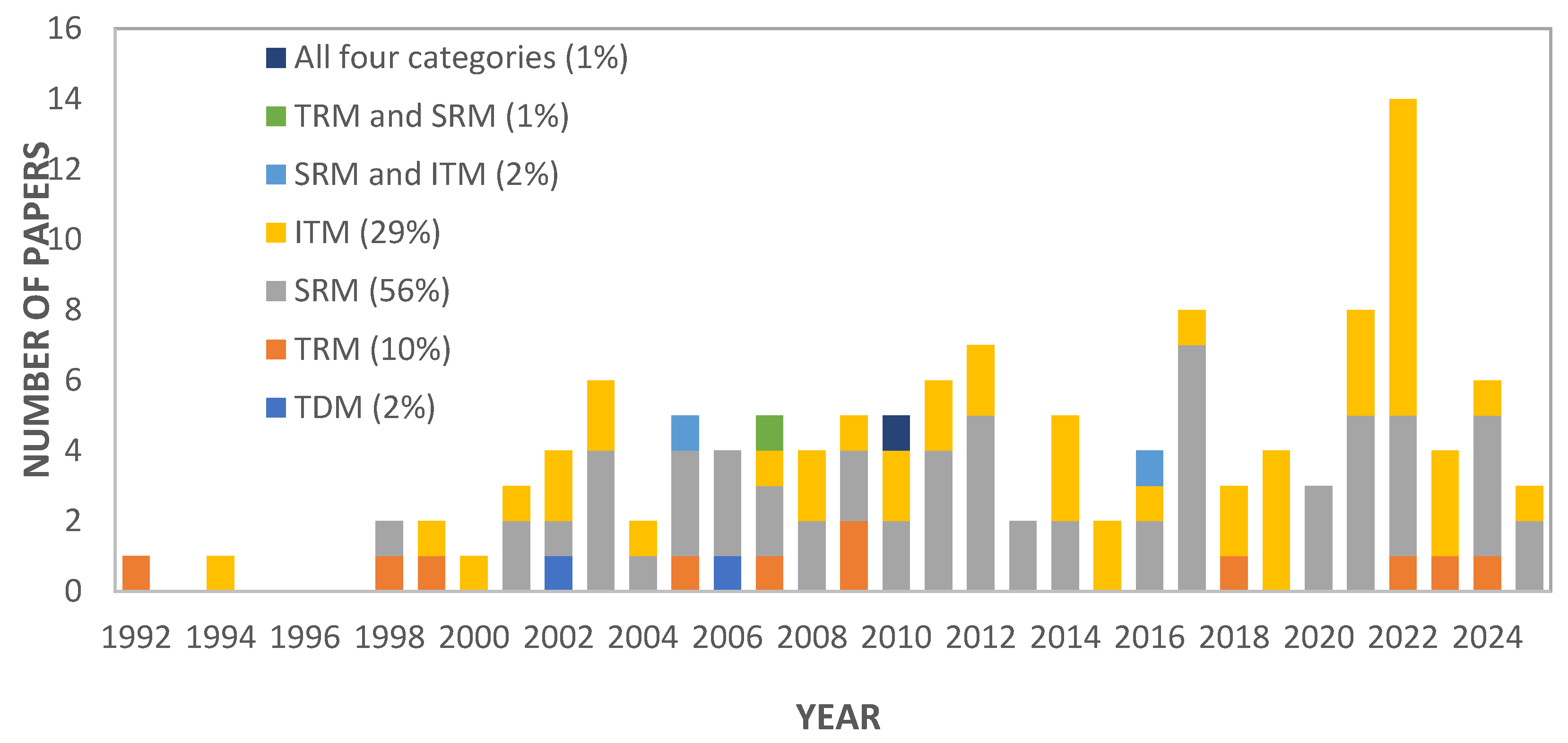
Figure 2.
Domains of hydraulic analysis (Time/Frequency).
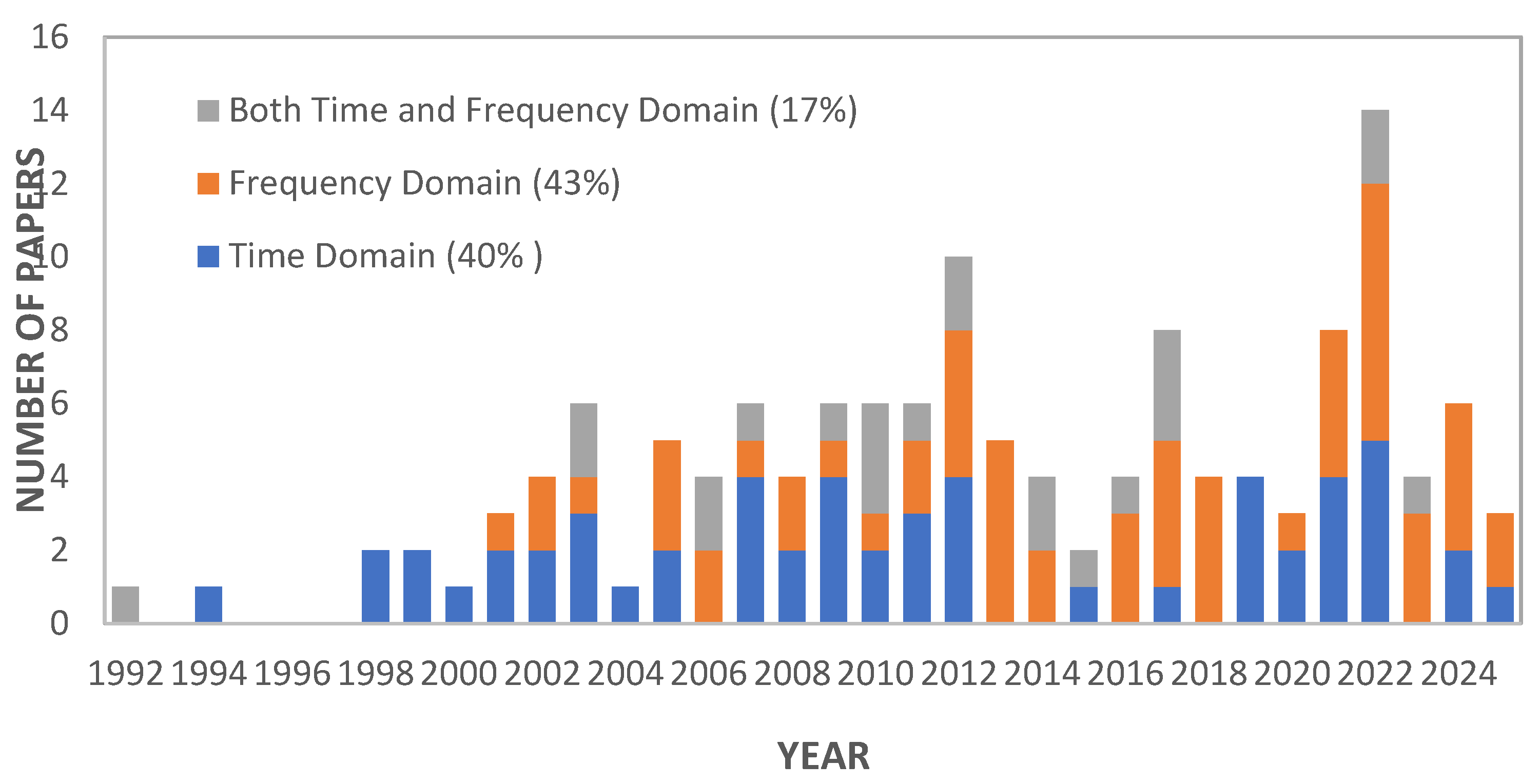
Figure 3.
Analysis Approaches: Hydraulic Modeling, Signal Processing, and AI-Enhanced.
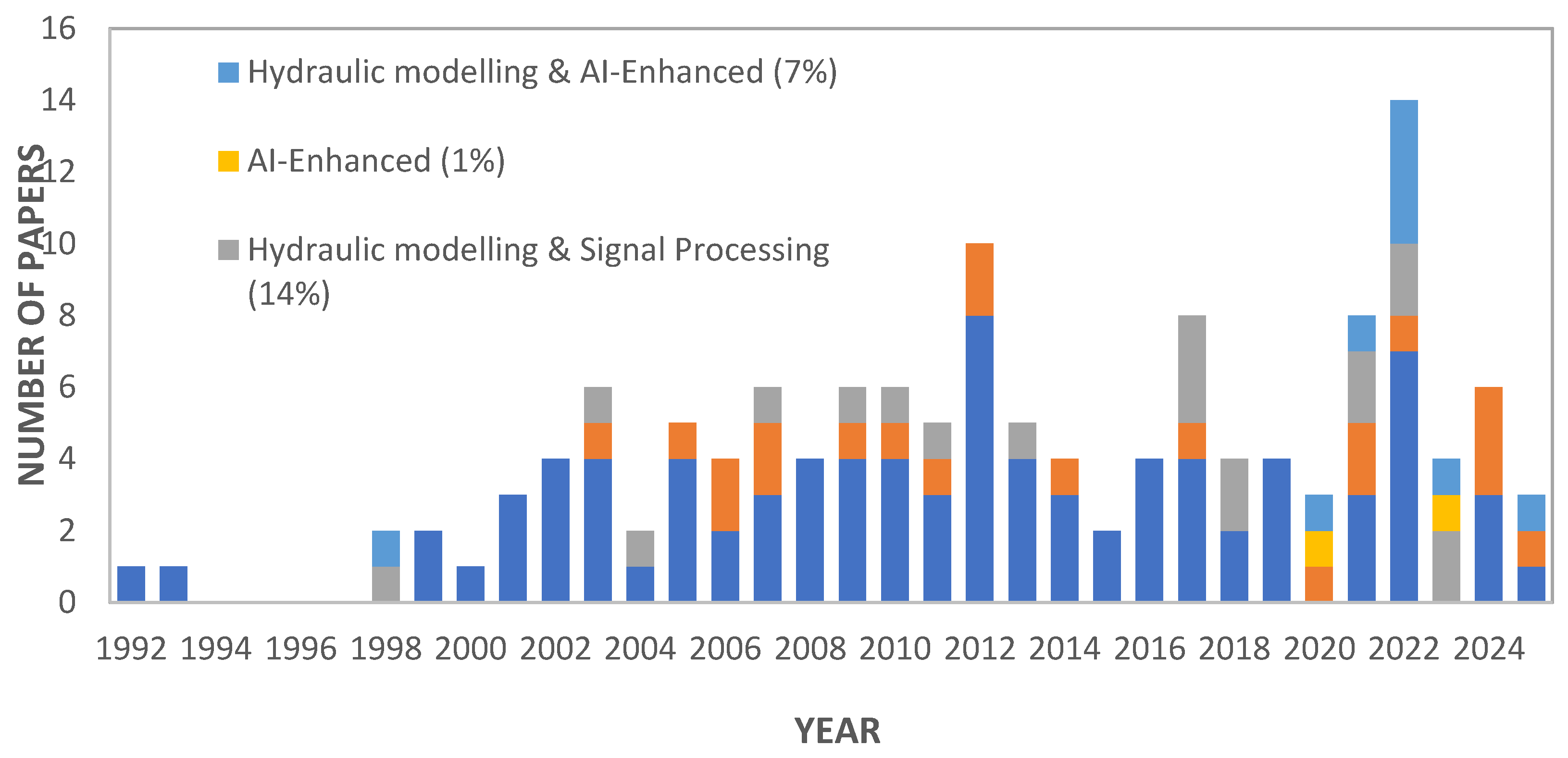
Figure 4.
Applied Solver (Optimization) Techniques.
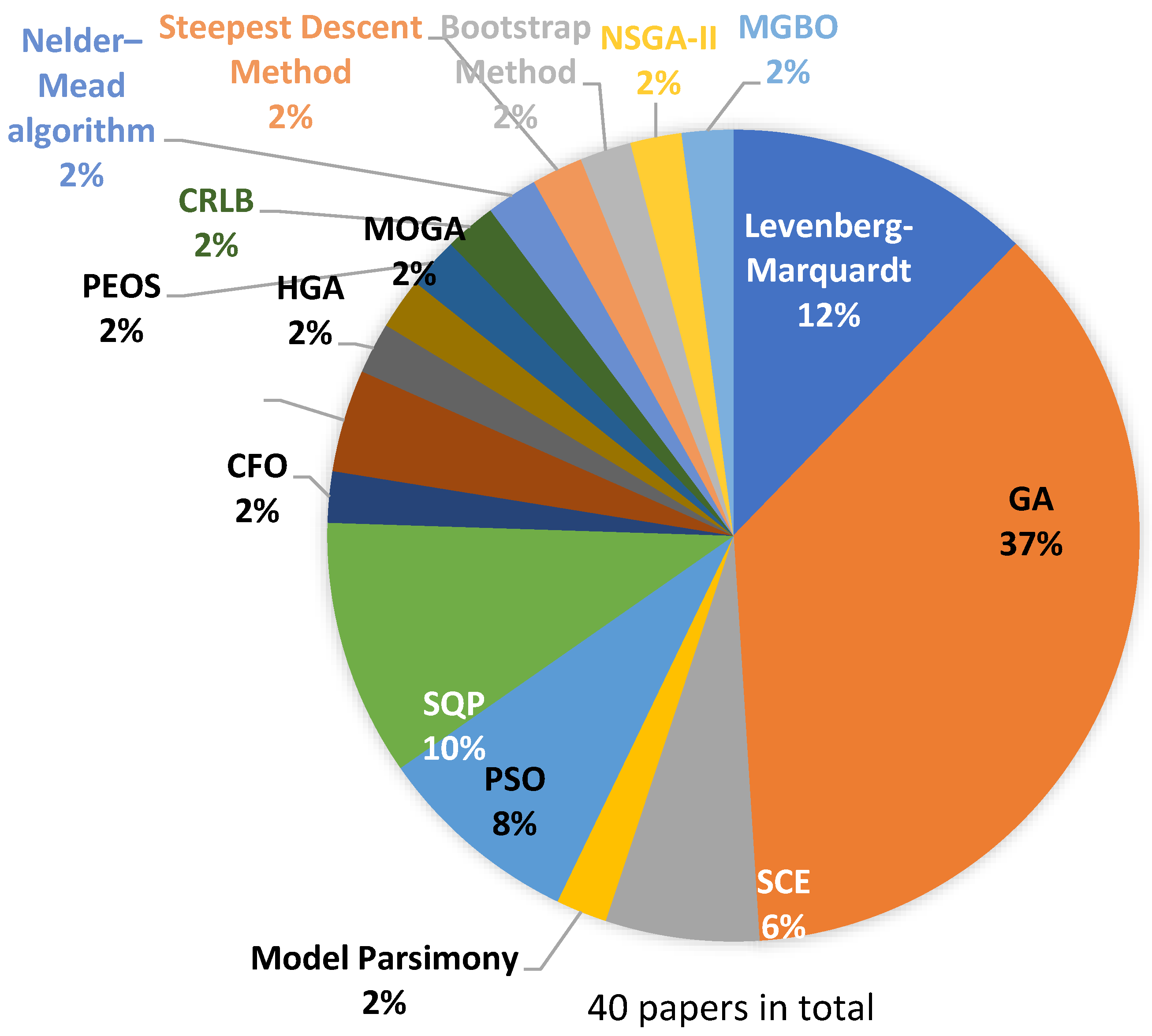
Figure 5.
Topographic Complexity of the System (Network/Pipeline).
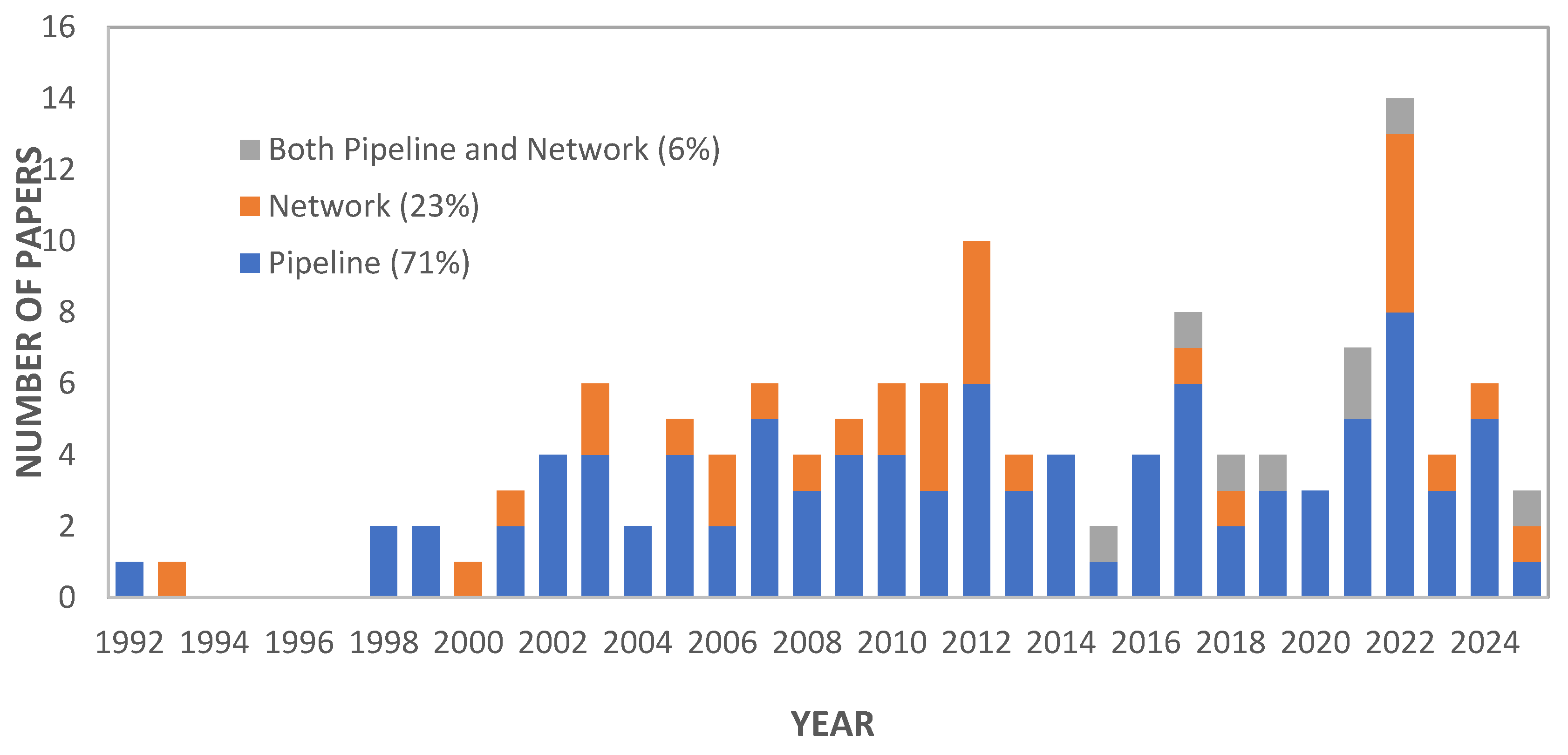
Figure 6.
Characterization of Leak Specifications: Single vs. Multiple Leaks, Location, and Intensity.
Figure 6.
Characterization of Leak Specifications: Single vs. Multiple Leaks, Location, and Intensity.
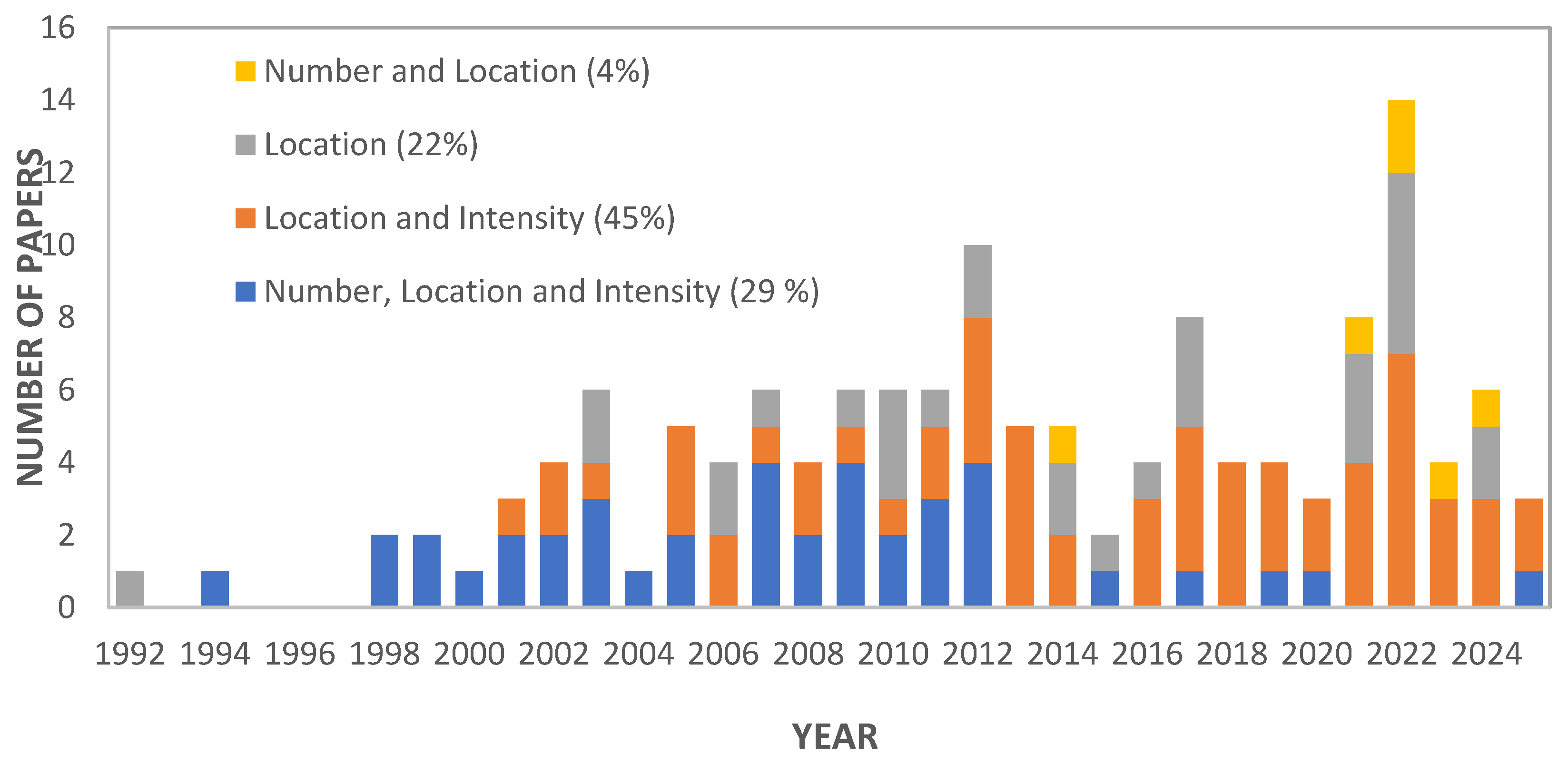
Figure 7.
Validation Approach.
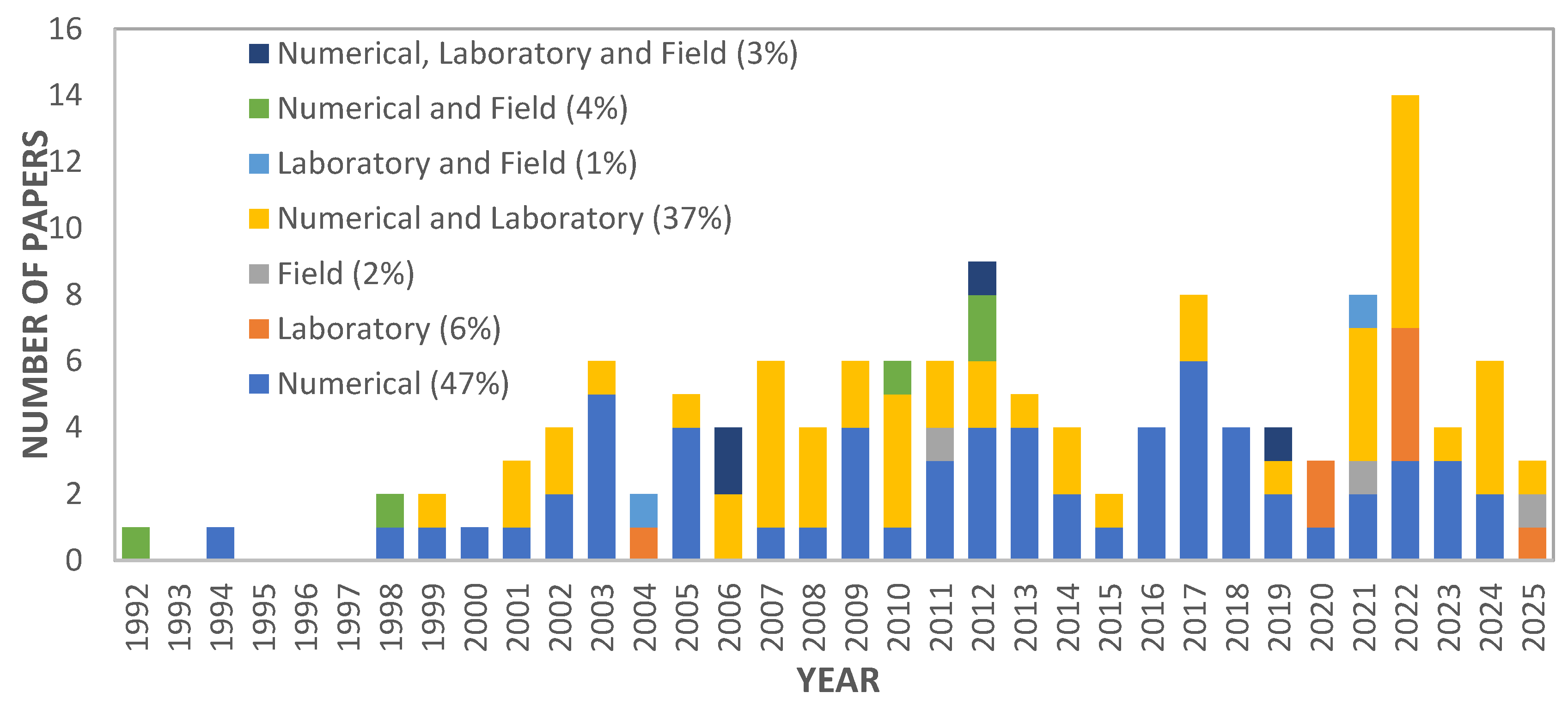
Disclaimer/Publisher’s Note: The statements, opinions and data contained in all publications are solely those of the individual author(s) and contributor(s) and not of MDPI and/or the editor(s). MDPI and/or the editor(s) disclaim responsibility for any injury to people or property resulting from any ideas, methods, instructions or products referred to in the content. |
© 2026 by the authors. Licensee MDPI, Basel, Switzerland. This article is an open access article distributed under the terms and conditions of the Creative Commons Attribution (CC BY) license.
Copyright: This open access article is published under a Creative Commons CC BY 4.0 license, which permit the free download, distribution, and reuse, provided that the author and preprint are cited in any reuse.