
Submitted:
26 March 2026
Posted:
27 March 2026
You are already at the latest version
Abstract
High-intensity, repetitive exercise induces metabolic stress and neuromuscular fatigue in skeletal muscle. Muscle fatigue involves both peripheral and central mechanisms, impairing contractile function and increasing pain perception, thereby compromising athletic performance and elevating injury risk. Using a repeated-measures crossover design, eight male amateur swimmers completed five experimental sessions at one-week intervals. Following an isokinetic fatigue protocol, five recovery interventions were applied in randomized order: control, foam roller (FR), vibration foam roller (VFR), whole-body vibration at 12 Hz (WBV-12), and 20 Hz (WBV-20). Outcome measures included visual analogue scale (VAS) scores, blood lactate concentration, and knee extensor peak torque assessed at three time points. Significant main effects of recovery method were observed for VAS scores (F = 2.892, p = .036, η² = 0.248), blood lactate (F = 2.937, p = .034, η² = 0.251), and peak torque (p < .05). Active recovery interventions, particularly vibration-based modalities, were more effective than passive rest. WBV-20 demonstrated the most consistent recovery effects, suggesting its potential as an effective post-exercise recovery strategy.
Keywords:
muscle fatigue
; recovery intervention
; foam rolling
; vibration therapy
; whole-body vibration
; lactate clearance
; isokinetic muscle function
1. Introduction
High-intensity or repetitive exercise induces metabolic stress and neuromuscular fatigue in skeletal muscle [2]. Muscle fatigue is not merely a state of energy depletion but rather a complex physiological phenomenon driven by the interplay of peripheral and central fatigue mechanisms. Peripheral fatigue encompasses ATP depletion, phosphocreatine reduction, H+ accumulation, elevation of inorganic phosphate (Pi), and impaired Ca2+ reuptake within muscle fibers [2], all of which interfere with excitation–contraction coupling and diminish force production capacity. Central fatigue manifests as a progressive reduction in cortical excitability during exercise, resulting in decreased motor neuron discharge rates and reduced voluntary muscle activation [13]. These fatigue processes are frequently accompanied by delayed-onset muscle soreness (DOMS), associated with the release of pro-inflammatory cytokines such as TNF-α and IL-6, sensitization of peripheral nociceptors, and tissue edema [11]. Collectively, these physiological disturbances impair athletic performance and recovery capacity, negatively affecting both training continuity and injury prevention.
A diverse range of recovery strategies has been proposed to attenuate muscle fatigue and accelerate physiological recuperation, including cold-water immersion [23], sports massage [38], compression garments [24], neuromuscular electrical stimulation [3], and foam rolling [4]. Among these, self-myofascial release (SMR) techniques have attracted considerable attention due to their accessibility and ease of application. Foam rollers, vibration foam rollers, and whole-body vibration exercise (WBVE) have been increasingly adopted as recovery tools in both clinical and athletic settings [4,29].
Foam rolling effectively induces myofascial relaxation and improves lymphatic circulation and autonomic nervous system regulation through mechanical compression, leading to increased joint range of motion [9]. The vibration foam roller builds upon conventional foam rolling by incorporating localized vibratory stimulation, thereby amplifying mechanoreceptor activation and facilitating simultaneous effects on muscle spindle and Golgi tendon organ function, reflex muscle contraction, pain inhibition, and neuromuscular recovery [29].
WBVE delivers vibratory stimuli ranging from 15 to 50 Hz, stimulating mechanoreceptors and the neuromuscular system while inducing increased blood flow, enhanced muscle activation, and myofascial relaxation [8]. Vibration stimulation is known to elicit the tonic vibration reflex (TVR), which activates the neuromuscular feedback loop and may thereby contribute to the recovery of fatigued muscle [30]. Vibration frequencies of 20–30 Hz are considered particularly effective for improving blood flow and modulating pain, whereas frequencies above 40 Hz are more efficacious for enhancing muscle activation [37].
Despite the growing adoption of vibration-based recovery strategies, direct comparative research between recovery modalities remains insufficient, and the physiological response differences associated with varying vibration frequencies have not been fully elucidated. Accordingly, the purpose of this study was to comparatively analyze the effects of foam rolling, vibration foam rolling, and WBVE at 12 Hz and 20 Hz on VAS scores, blood lactate concentration, and isokinetic muscle joint function following exercise-induced muscle fatigue, and to provide evidence-based guidance for practical application in athletic and training environments.
2. Materials and Methods
2.1. Participants
A total of eight male amateur swimmers volunteered to participate in this study. All participants were fully informed of the study’s purpose, procedures, potential risks, and expected levels of physical exertion prior to enrollment. Written informed consent was obtained from all participants. This study was approved by the Institutional Review Board (IRB approval number: 201906-SB-090-01).
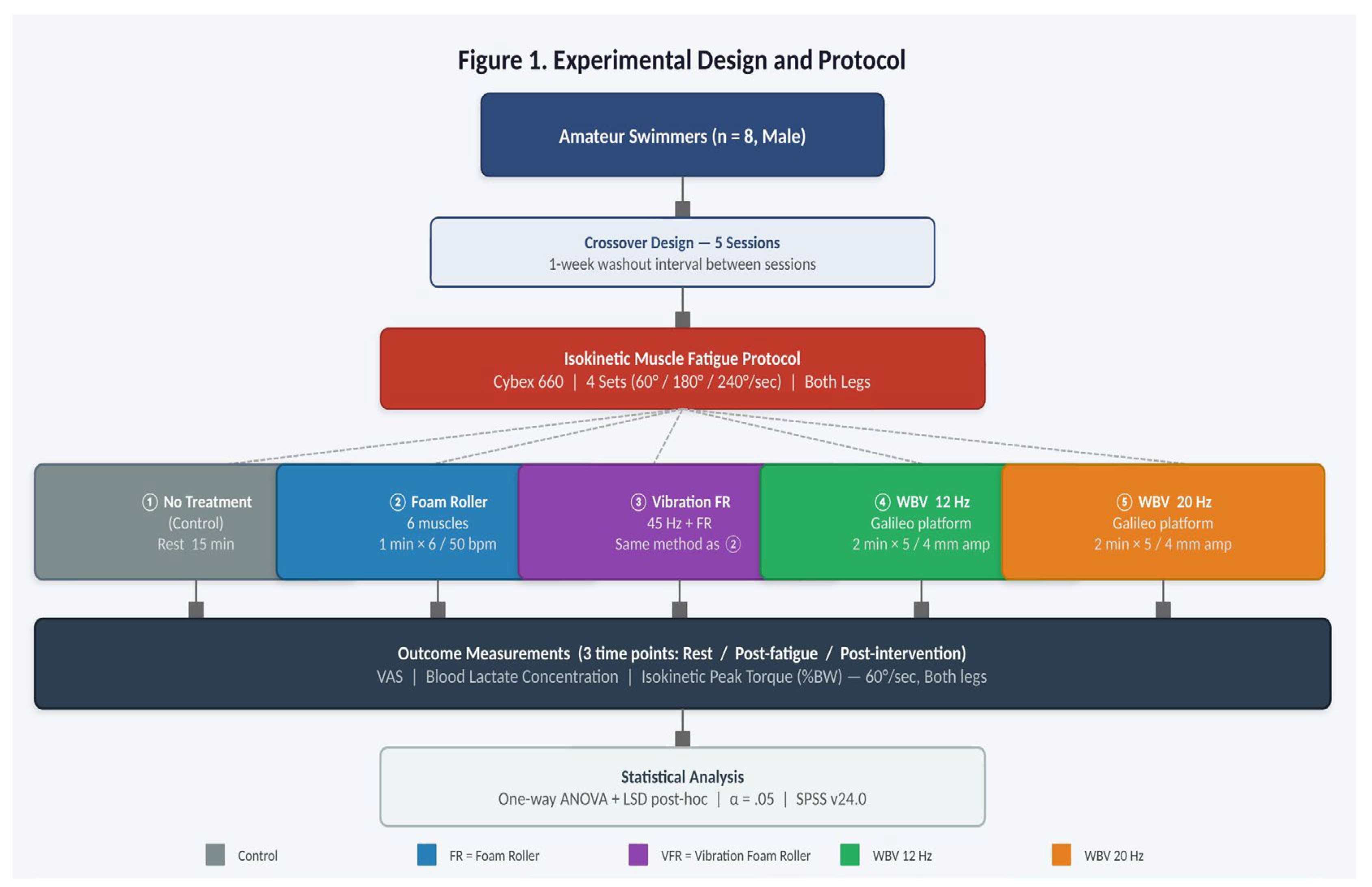
This study employed a within-subjects repeated-measures crossover design, in which each participant completed five experimental sessions at one-week intervals. At each session, participants performed light stretching and warm-up activities, followed by a standardized rest period of at least 10 minutes, after which baseline measurements were obtained and the fatigue induction protocol was administered. One of five recovery interventions—no treatment (control), FR, VFR, WBV-12, or WBV-20—was applied in randomized order, with each intervention separated by one week. VAS scores, blood lactate concentration, and isokinetic muscle joint function were measured at three time points: at rest, five minutes post-fatigue, and immediately post-intervention. Participants’ physical characteristics are summarized in Table 1.
Figure 1.
Experimental Design and Protocol. FR = Foam Roller; VFR = Vibration Foam Roller; WBV = Whole-Body Vibration.
Figure 1.
Experimental Design and Protocol. FR = Foam Roller; VFR = Vibration Foam Roller; WBV = Whole-Body Vibration.
2.2. Exercise-Induced Muscle Fatigue
Knee extensor and flexor muscle fatigue of both dominant and non-dominant limbs was induced using an isokinetic dynamometer (Cybex 660 Norm System; Cybex Inc., USA). Participants were seated with the hip flexed at approximately 90°, and the axis of rotation of the dynamometer was aligned with the lateral femoral epicondyle. The fatigue induction protocol, adapted from Kang et al. [17], consisted of one set comprising 5 repetitions at 60°/sec, 10 repetitions at 180°/sec, and 30 repetitions at 240°/sec, performed for four sets for both limbs. The complete protocol is presented in Table 2.
2.3. Recovery Interventions
(1) No Treatment (Control): Following the fatigue induction protocol, participants remained seated in a chair for 15 minutes without any treatment.
(2) Foam Roller (FR): A foam roller (Hyperice VYPER 2.0; Hyperice, Irvine, CA, USA) was employed. The protocol was adapted from Cheatham et al. [9] and targeted six muscle groups: gastrocnemius, gluteus maximus, iliotibial band, hamstrings, hip adductors, and quadriceps. Each group was rolled from origin to insertion for one minute under body weight, followed by a 15-second rest. Rolling cadence was standardized using a metronome at 50 bpm in 3/4 time.
(3) Vibration Foam Roller (VFR): The same device and protocol as the FR condition (Hyperice VYPER 2.0) were used, with the device’s internal vibration function activated at 45 Hz throughout the session [9,29].
(4) Whole-Body Vibration at 12 Hz (WBV-12): A vibratory platform (Galileo; Novotec Medical GmbH, Germany) delivered vibration at 12 Hz with an amplitude of 4 mm. Each bout consisted of 2 minutes of vibration followed by 1 minute of rest, for five sets (15 minutes total). Participants maintained an upright torso posture with the knee joint flexed to approximately 120° [30,37].
(5) Whole-Body Vibration at 20 Hz (WBV-20): The same vibratory platform was used with the frequency adjusted to 20 Hz at an amplitude of 4 mm. The session structure was identical to WBV-12 (five sets of 2 minutes vibration and 1 minute rest; 15 minutes total), maintaining the same standardized posture [30,37].
2.4. Outcome Measures
Muscle Pain Assessment: Perceived fatigue was assessed using a visual analogue scale (VAS). Participants marked their perceived level of fatigue on a 100 mm horizontal line anchored at 0 (no fatigue) and 10 (extreme fatigue). Assessments were conducted at three time points: at rest, five minutes post-fatigue, and immediately post-intervention.
Blood Lactate Concentration: Blood samples were collected from fingertip capillaries using a standardized single-use lancet. Approximately 25 μL of capillary blood was collected and immediately analyzed using a portable lactate analyzer (Biosen C-line; EKF Diagnostics, Germany; measurement range: 0.5–40 mmol/L; CV < 3%). All samples were analyzed by the same investigator to minimize inter-operator variability.
Isokinetic Muscle Function: Isokinetic peak torque was measured using the Cybex 660 Norm System. The range of motion was restricted to 0° to 100°. Participants were seated with the knee joint axis aligned with the dynamometer’s axis of rotation. An isokinetic angular velocity of 60°/sec was selected, with five repetitions per set. Knee extensor and flexor peak torque (%BW) was assessed after the final fatigue set and after each recovery intervention.
2.5. Statistical Analysis
All data were analyzed using SPSS Statistics version 24.0 (IBM Corp., Armonk, NY, USA). Descriptive statistics are reported as mean ± standard deviation (SD). A one-way repeated-measures analysis of variance (ANOVA) was applied to identify differences among recovery interventions at each time point. Where significant main effects were detected, post-hoc comparisons were conducted using the Least Significant Difference (LSD) method. Statistical significance was set at α = .05 for all analyses. Effect sizes were calculated using eta squared (η2) and interpreted according to conventional thresholds: small ≥ 0.01, medium ≥ 0.06, large ≥ 0.14.
3. Results
3.1. Changes in VAS Scores After Recovery Interventions
VAS scores at each time point are presented in Table 3. No significant main effect of recovery method was observed at rest (F = 0.522, p = .720, η2 = 0.056) or five minutes post-fatigue (F = 0.144, p = .964, η2 = 0.016). A significant effect of recovery method was observed following recovery interventions (F = 2.892, p = .036, η2 = 0.248). Post-hoc LSD analysis revealed that VAS score reductions were significantly greater in the FR, VFR, WBV-12, and WBV-20 conditions compared to the no-treatment control (a > b, c, d, e).
3.2. Changes in Blood Lactate Concentration After Recovery Interventions
Blood lactate concentrations at each time point are presented in Table 4. No significant main effect was observed at rest (F = 0.419, p = .794, η2 = 0.046) or five minutes post-fatigue (F = 0.066, p = .992, η2 = 0.007). A significant effect was observed following recovery interventions (F = 2.937, p = .034, η2 = 0.251). Post-hoc LSD analysis indicated that lactate reductions were significantly greater in the FR, VFR, and WBV-20 conditions compared to control (a > b, c, e).
3.3. Changes in Blood Lactate Recovery Rate After Recovery Interventions
The blood lactate recovery rate was calculated as follows: Recovery Rate (%) = [(Lactate post-fatigue − Lactate post-intervention) / (Lactate post-fatigue − Lactate at rest)] × 100. Results are presented in Table 5. A significant effect of recovery method was observed (F = 4.625, p = .004, η2 = 0.346). Post-hoc LSD analysis revealed that the lactate recovery rate was significantly higher in the FR, VFR, and WBV-20 conditions compared to control (a < b, c, e).
3.4. Changes in Isokinetic Knee Extensor Variables After Recovery Interventions
Results for the right knee extensor are presented in Table 6. No significant main effect was observed following the fatigue protocol (F = 0.965, p = .439, η2 = 0.099). A significant effect was observed after the recovery intervention (F = 2.975, p = .032, η2 = 0.254). Post-hoc LSD analysis indicated that WBV-12 and WBV-20 produced significantly greater improvements than the no-treatment control, and WBV-20 also produced significantly greater improvements than FR (a < d, e; b < e).
Results for the left knee extensor are presented in Table 7. No significant main effect was observed after fatigue induction (F = 0.910, p = .469, η2 = 0.094). A significant effect was observed following recovery interventions (F = 4.006, p = .034, η2 = 0.314). Post-hoc LSD analysis indicated that WBV-20 produced significantly greater improvements compared to both the no-treatment control and FR (a, b < e).
3.5. Changes in Isokinetic Knee Flexor Variables After Recovery Interventions
Results for the right knee flexor are presented in Table 8. No significant main effect was detected after fatigue induction (F = 0.796, p = .536, η2 = 0.083). Following recovery interventions, a significant effect was observed (F = 3.540, p = .047, η2 = 0.288), with WBV-20 producing significantly greater improvements than both the no-treatment control and FR (a, b < e).
Results for the left knee flexor are presented in Table 9. No significant main effect was observed after fatigue induction (F = 0.186, p = .944, η2 = 0.021) or after recovery intervention (F = 1.350, p = .271, η2 = 0.134).
4. Discussion
Recovery from acute exercise-induced muscle fatigue encompasses restoration of neuromuscular stability, maintenance of metabolic homeostasis, and normalization of muscle functional capacity. The present study compared five recovery interventions and demonstrated that vibration-based modalities—specifically VFR and WBV-20—produced significant improvements across multiple physiological recovery indices, including VAS scores, blood lactate concentration, and isokinetic muscle joint function. These findings may be attributed to the distinct yet complementary physiological mechanisms of foam rolling and vibratory stimulation, including mechanical compression, mechanoreceptor stimulation, muscle spindle activation, and autonomic nervous system modulation.
With respect to VAS scores, all active interventions—FR, VFR, WBV-12, and WBV-20—produced significantly greater reductions compared to the no-treatment control. These analgesic effects are consistent with prior research demonstrating that foam rolling and vibration-based strategies significantly reduce VAS scores [9,11]. Mechanistically, foam rolling reduces myofascial adhesions through localized mechanical compression and activates the parasympathetic nervous system to promote autonomic stabilization [9]. Vibratory stimulation acts upon peripheral mechanoreceptors—particularly Aβ mechanoreceptors and proprioceptors within muscle spindles—to inhibit pain transmission at the spinal dorsal horn [33]. Vibration also reduces the excitability of Aδ and C fiber nociceptive pathways and activates inhibitory interneurons at the spinal level, inducing gate control analgesia [13].
With respect to blood lactate concentration, FR, VFR, and WBV-20 produced significantly greater lactate reductions compared to the no-treatment control. Vibration-based interventions enhance local blood flow in skin and fascial tissues and stimulate lymphatic circulation, thereby accelerating the clearance of accumulated lactate and hydrogen ions (H+) from muscle fibers [23]. Notably, WBV-20 most effectively facilitated metabolic recovery, consistent with prior evidence that vibratory stimulation promotes both intramuscular lactate diffusion and vascular reuptake simultaneously [4].
Regarding muscle functional recovery, vibration-based interventions yielded superior outcomes across multiple neuromuscular indices. These findings align with prior studies [30,32] demonstrating that vibration stimulation activates group Ia afferent fibers within muscle spindles, enhancing neuromuscular function. By increasing α-motor neuron responsiveness and eliciting the TVR, vibratory stimulation augments neuromuscular excitability [30]. The TVR is particularly important during fatigued states, as it transiently restores the voluntary drive of the central nervous system, re-facilitating voluntary muscle contractions [18]. Furthermore, vibration accelerates motor unit recruitment and increases the discharge rate of alpha motor neurons, positively influencing fast-twitch muscle fiber activation [32]. Collectively, these findings suggest that WBV-20 may offer a strategically advantageous recovery approach in high-performance sport environments requiring rapid neuromuscular restoration.
Several limitations should be acknowledged. The sample was restricted to young male amateur swimmers, which limits the generalizability of the findings to other populations. Future research should incorporate participants of diverse sexes, ages, and training backgrounds to broaden the applicability of these results. Additionally, the specific effects of varying vibration parameters—including frequency, amplitude, session duration, and stimulation site—warrant more detailed investigation. Subsequent studies should also integrate multi-layered physiological assessments including inflammatory markers, oxidative stress indicators, and hormonal responses to provide a more comprehensive evaluation of these recovery modalities.
5. Conclusions
The present study demonstrated that among the various post-fatigue recovery interventions examined, vibration-based modalities yielded superior recovery responses overall. In particular, whole-body vibration at 20 Hz (WBV-20) produced the most consistent and pronounced improvements in perceived fatigue, blood lactate concentration, and isokinetic muscle function following acute exercise-induced fatigue, indicating meaningful physiological recovery responses that may translate into practical performance benefits.
The findings suggest that WBV-20 may simultaneously influence neuromuscular and metabolic systems, thereby facilitating a more efficient restoration of functional capacity impaired by fatigue. Compared with passive rest, vibratory stimulation appears to accelerate recovery processes through enhanced neuromuscular activation and circulatory support. Consequently, WBV-20 may represent a strategically advantageous recovery modality in athletic contexts where limited recovery time and repeated high-intensity efforts necessitate rapid restoration of performance capacity.
Author Contributions
Conceptualization, Y.S.K. and J.-J.K.; methodology, Y.S.K., J.-J.K., H.-G.P., K.-J.L. and W.-L.L.; formal analysis, Y.S.K. and J.-J.K.; investigation, Y.S.K. and J.-J.K.; writing—original draft preparation, Y.S.K. and J.-J.K.; writing—review and editing, H.-G.P., K.-J.L. and W.-L.L.; supervision, K.-J.L. and W.-L.L.; project administration, W.-L.L. All authors have read and agreed to the published version of the manuscript.
Funding
This research received no external funding.
Institutional Review Board Statement
The study was conducted in accordance with the Declaration of Helsinki, and approved by the Institutional Review Board (IRB approval number: 201906-SB-090-01).
Informed Consent Statement
Informed consent was obtained from all subjects involved in the study.
Data Availability Statement
The data presented in this study are available on request from the corresponding author.
Conflicts of Interest
The authors declare no conflicts of interest.
References
- Abbiss, C.R.; Laursen, P.B.; Peiffer, J.J.; Meeusen, R. Role of ratings of perceived exertion during self-paced exercise: What are we actually measuring? Sports Med. 2013, 43, 623–633. [Google Scholar] [CrossRef] [PubMed]
- Allen, D.G.; Lamb, G.D.; Westerblad, H. Skeletal muscle fatigue: Cellular mechanisms. Physiol. Rev. 2008, 88, 287–332. [Google Scholar] [CrossRef]
- Alghadir, A.H.; Zafar, H.; Anwer, S.; Iqbal, Z. Effect of localised vibration on muscle strength in healthy adults: A systematic review. Physiotherapy 2018, 104, 18–24. [Google Scholar] [CrossRef]
- Behm, D.G.; Wilke, J.; Doan, J.B. Foam rolling as a recovery tool after an intense bout of physical activity. Med. Sci. Sports Exerc. 2015, 47, 136–143. [Google Scholar]
- Bosco, C.; Iacovelli, M.; Tsarpela, O.; Cardinale, M.; Bonifazi, M.; Tihanyi, J.; Viru, A. Adaptive response of human skeletal muscle to vibration exposure. Clin. Physiol. 1999, 19, 183–187. [Google Scholar] [CrossRef]
- Byrne, C.; Eston, R.; Edwards, R.H. Characteristics of isometric and dynamic strength loss following eccentric exercise-induced muscle damage. Scand. J. Med. Sci. Sports 2004, 14, 101–106. [Google Scholar]
- Cardinale, M.; Bosco, C. The use of vibration as an exercise intervention. Exerc. Sport Sci. Rev. 2003, 31, 3–7. [Google Scholar] [CrossRef]
- Cardinale, M.; Wakeling, J. Whole body vibration exercise: Are vibrations good for you? Br. J. Sports Med. 2005, 39, 585–589. [Google Scholar] [CrossRef]
- Cheatham, S.W.; Kolber, M.J.; Cain, M.; Lee, M. The effects of self-myofascial release using a foam roll or roller massager on joint range of motion, muscle recovery, and performance: A systematic review. Int. J. Sports Phys. Ther. 2015, 10, 827–838. [Google Scholar] [PubMed]
- Cheatham, S.W.; Stull, K.R.; Kolber, M.J. Roller massage: Comparison of three different surface-type pattern foam rollers on passive knee range of motion and pain perception. J. Bodyw. Mov. Ther. 2019, 23, 555–560. [Google Scholar] [CrossRef] [PubMed]
- Cheung, K.; Hume, P.; Maxwell, L. Delayed onset muscle soreness: Treatment strategies and performance factors. Sports Med. 2003, 33, 145–164. [Google Scholar] [CrossRef] [PubMed]
- Delecluse, C.; Roelants, M.; Verschueren, S. Strength increase after whole-body vibration compared with resistance training. Med. Sci. Sports Exerc. 2003, 35, 1033–1041. [Google Scholar] [CrossRef] [PubMed]
- Gandevia, S.C. Spinal and supraspinal factors in human muscle fatigue. Physiol. Rev. 2001, 81, 1725–1789. [Google Scholar] [CrossRef]
- Gerdle, B.; Karlsson, S.; Crenshaw, A.G.; Elert, J.; Fridén, J. The influences of muscle fibre proportions and areas upon EMG during maximal dynamic knee extensions. Eur. J. Appl. Physiol. 2000, 81, 2–10. [Google Scholar] [CrossRef]
- Han, S.W.; Lee, Y.S.; Lee, D.J. The influence of the vibration foam roller exercise on the pains in the muscles around the hip joint and the joint performance. J. Phys. Ther. Sci. 2017, 29, 1844–1847. [Google Scholar] [CrossRef]
- Hill, A.V.; Long, C.N.H.; Lupton, H. Muscular exercise, lactic acid, and the supply and utilization of oxygen. Q. J. Exp. Physiol. 1924, 86, 8–29. [Google Scholar] [CrossRef]
- Kang, C.W.; Kim, D.J.; Kim, J.H. The effect of whole-body vibration training on recovery from high-intensity exercise. J. Phys. Ther. Sci. 2017, 29, 129–133. [Google Scholar]
- Kang, S.R.; Min, J.Y.; Yu, C.; Kwon, T.K. Effect of whole body vibration on lactate level recovery and heart rate recovery in rest after intense exercise. Technol. Health Care 2017, 25, 115–123. [Google Scholar] [CrossRef]
- Kim, J.-S.; Moon, D.-C.; Chang, K.-S. Changes of flexibility and plasma catecholamine by myofascial release approach. Korea Contents Assoc. J. 2012, 12, 214–221. [Google Scholar] [CrossRef]
- Kosar, A.C.; Candow, D.G.; Putland, J.T. Potential beneficial effects of whole-body vibration for muscle recovery after exercise. J. Strength Cond. Res. 2012, 26, 2907–2911. [Google Scholar] [CrossRef]
- Laimi, K.; Mäkilä, A.; Bärlund, E.; Katajapuu, N.; Oksanen, A.; Seikkula, V.; Karppinen, J.; Saltychev, M. Effectiveness of myofascial release in treatment of chronic musculoskeletal pain: A systematic review. J. Rehabil. Med. 2017, 49, 546–554. [Google Scholar] [CrossRef]
- Macdonald, G.Z.; Button, D.C.; Drinkwater, E.J.; Behm, D.G. Foam rolling as a recovery tool after an intense bout of physical activity. Med. Sci. Sports Exerc. 2014, 46, 131–142. [Google Scholar] [CrossRef]
- Mawhinney, C.; Jones, H.; Joo, C.H.; Low, D.A.; Green, D.J.; Gregson, W. Influence of cold-water immersion on limb and cutaneous blood flow after exercise. Med. Sci. Sports Exerc. 2013, 45, 2277–2285. [Google Scholar] [CrossRef] [PubMed]
- Meeusen, R.; Duclos, M.; Gleeson, M.; Rietjens, G.; Steinacker, J.; Urhausen, A. Prevention, diagnosis and treatment of the overtraining syndrome. Eur. J. Sport Sci. 2007, 7, 1–14. [Google Scholar] [CrossRef]
- Osawa, Y.; Oguma, Y.; Ishii, N. The effects of whole-body vibration on muscle strength and power: A meta-analysis. J. Musculoskelet. Neuronal Interact. 2013, 13, 380–390. [Google Scholar]
- Pearcey, G.E.P.; Bradbury-Squires, D.J.; Kawamoto, J.E.; Drinkwater, E.J.; Behm, D.G.; Button, D.C. Foam rolling for delayed-onset muscle soreness and recovery of dynamic performance measures. J. Athl. Train. 2015, 50, 5–13. [Google Scholar] [CrossRef]
- Pojednic, R.M.; Clark, D.J.; Fielding, R.A. Vibration exercise in rehabilitation and sports: Mechanisms and applications. Phys. Ther. Sport 2021, 49, 108–117. [Google Scholar]
- Ramos-Campo, D.J.; Llorente-Cantarero, F.J.; Clément-Suárez, V.J.; Rubio-Arias, J.Á. A meta-analysis of foam roller effects on performance and recovery. Front. Physiol. 2019, 10, 376. [Google Scholar]
- Romero-Moraleda, B.; La Torre, A.; Juárez, D.; García-López, D.; Maestro, A.; Morencos, E. Effects of vibration and non-vibration foam rolling on recovery. J. Sports Sci. Med. 2019, 18, 172–180. [Google Scholar] [PubMed]
- Rittweger, J. Vibration as an exercise modality: How it may work, and what its potential might be. Eur. J. Appl. Physiol. 2010, 108, 877–904. [Google Scholar] [CrossRef] [PubMed]
- Simao, R.; Santos, L.; Ferreira, J.V.; Prestes, J. Vibration training and recovery: A review. Sports Med. Open 2022, 8, 65. [Google Scholar]
- Song, C.H. The effects of whole-body vibration exercise on body composition, flexibility, and muscular strength. J. Phys. Ther. Sci. 2010, 22, 7–11. [Google Scholar]
- Spencer, M.; Bishop, D.; Dawson, B.; Goodman, C.; Duffield, R. Performance and metabolism in repeated sprint exercise: Effect of recovery intensity. Eur. J. Appl. Physiol. 2008, 103, 545–552. [Google Scholar] [CrossRef]
- Takahashi, J.; Ishihara, K.; Aoki, J. Effect of aqua exercise on recovery of lower limb muscles after downhill running. J. Sports Sci. 2006, 24, 835–842. [Google Scholar] [CrossRef] [PubMed]
- Weerapong, P.; Hume, P.A.; Kolt, G.S. The mechanisms of massage and effects on performance, muscle recovery and injury prevention. Sports Med. 2005, 35, 235–256. [Google Scholar] [CrossRef]
- Watanabe, Y.; Madarame, H.; Ogasawara, R.; Nakazato, K.; Ishii, N. Effect of very low-intensity resistance training with slow movement on muscle size and strength in healthy older adults. Clin. Physiol. Funct. Imaging 2019, 51, 725–731. [Google Scholar] [CrossRef]
- Wiewelhove, T.; Schneider, C.; Döweling, A.; Hanakam, F.; Rasche, C.; Meyer, T.; Kellmann, M.; Pfeiffer, M.; Ferrauti, A. Effects of different recovery strategies following a half-marathon on fatigue markers in recreational runners. PLOS ONE 2018, 13, e0207313. [Google Scholar] [CrossRef]
- Zainuddin, Z.; Newton, M.; Sacco, P.; Nosaka, K. Effects of massage on delayed-onset muscle soreness, swelling, and recovery of muscle function. J. Athl. Train. 2005, 40, 174–180. [Google Scholar]

Table 1.
Physical Characteristics of Participants (Mean ± SD).
| Variables | Age (years) | Height (cm) | Weight (kg) | BMI (kg/m2) | Fat (%) |
Career (years) |
|---|---|---|---|---|---|---|
| Subjects (n = 8) | 25.1 ± 2.7 | 175.8 ± 5.8 | 75.7 ± 8.1 | 24.5 ± 2.7 | 14.4 ± 6.5 | 6.1 ± 3.0 |
Note. Values are presented as mean ± standard deviation. BMI = body mass index.
Table 2.
Muscle Fatigue Protocol of the Isokinetic Test.
| Item | Angular Velocity (°/sec) | Repetitions (REP) | Recovery Time | Sets |
|---|---|---|---|---|
| Right lower extremity | 60 | 5 | 1 min 30 sec | 4 |
| Right lower extremity | 180 | 10 | ||
| Right lower extremity | 240 | 30 | ||
| Left lower extremity | 60 | 5 | ||
| Left lower extremity | 180 | 10 | ||
| Left lower extremity | 240 | 30 |
Note. Recovery time (1 min 30 sec) was applied between sets. Four sets were performed for both right and left lower extremities.
Table 3.
Effects of Recovery Interventions on Perceived Fatigue (Mean ± SD).
| Time Point | a (Control) |
b (FR) |
c (VFR) |
d (WBV-12) |
e (WBV-20) |
F | p | η2 | Post-hoc |
|---|---|---|---|---|---|---|---|---|---|
| Rest | 1.38 ± 0.92 | 1.63 ± 0.92 | 1.75 ± 1.39 | 2.13 ± 1.55 | 2.13 ± 1.36 | 0.522 | .720 | 0.056 | NS |
| PF | 7.25 ± 1.16 | 7.50 ± 1.41 | 7.00 ± 1.60 | 7.25 ± 1.58 | 7.50 ± 1.93 | 0.144 | .964 | 0.016 | NS |
| PR | 5.75 ± 0.89 | 3.88 ± 1.81 | 3.38 ± 1.73 | 3.88 ± 1.73 | 3.88 ± 1.64 | 2.892 | .036 * | 0.248 | a > b, c, d, e |
Note. Values are presented as mean ± SD. η2 = eta squared effect size. NS = not significant. * p < .05. Post-hoc comparisons. conducted using LSD. PF = Post-fatigue, PR = Post-recovery, a = no treatment; b = foam roller; c = vibration foam roller; d = WBV 12 Hz; e = WBV 20 Hz.
Table 4.
Comparison of Blood Lactate Concentration Across Recovery Methods (Mean ± SD, mmol/L).
| Time Point | a (Control) |
b (FR) |
c (VFR) |
d (WBV-12) |
e (WBV-20) |
F | p | η2 | Post-hoc |
|---|---|---|---|---|---|---|---|---|---|
| Rest | 1.74 ± 0.44 | 1.80 ± 1.26 | 1.59 ± 0.36 | 1.47 ± 0.43 | 1.44 ± 0.57 | 0.419 | .794 | 0.046 | NS |
| PF | 10.15 ± 1.95 | 10.00 ± 1.88 | 10.07 ± 2.37 | 10.41 ± 2.18 | 9.95 ± 1.36 | 0.066 | .992 | 0.007 | NS |
| PR | 5.72 ± 1.79 | 4.70 ± 1.47 | 3.72 ± 1.01 | 5.16 ± 1.51 | 3.92 ± 0.95 | 2.937 | .034* | 0.251 | a > b, c, e |
Note. Values are presented as mean ± SD. η2 = eta squared effect size. * p < .05. Post-hoc comparisons performed using LSD. PF = Post-fatigue, PR = Post-recovery, a = no treatment; b = foam roller; c = vibration foam roller; d = WBV 12 Hz; e = WBV 20 Hz.
Table 5.
Comparison of Blood Lactate Recovery Rate Across Recovery Methods (Mean ± SD, %).
| Item | a (Control) |
b (FR) |
c (VFR) |
d (WBV-12) |
e (WBV-20) |
F | p | η2 | Post-hoc |
|---|---|---|---|---|---|---|---|---|---|
| PR | 52.18 ± 16.82 | 67.45 ± 15.30 | 75.10 ± 8.76 | 59.73 ± 8.02 | 70.82 ± 8.02 | 4.625 | .004 ** | 0.346 | a < b, c, e |
Note. Values are presented as mean ± SD. η2 = eta squared effect size. ** p < .01. Post-hoc comparisons performed using LSD. PF = Post-fatigue, PR = Post-recovery, a = no treatment; b = foam roller; c = vibration foam roller; d = WBV 12 Hz; e = WBV 20 Hz.
Table 6.
Comparison of 60°/sec Peak Torque (%BW) of Right Knee Extensor Across Recovery Methods (Mean ± SD).
Table 6.
Comparison of 60°/sec Peak Torque (%BW) of Right Knee Extensor Across Recovery Methods (Mean ± SD).
| Item | a (Control) |
B (FR) |
c (VFR) |
d (WBV-12) |
e (WBV-20) |
F | p | η2 | Post-hoc |
|---|---|---|---|---|---|---|---|---|---|
| PF | 186.75 ± 32.94 | 192.75 ± 33.25 | 190.13 ± 25.88 | 202.50 ± 24.88 | 212.25 ± 50.77 | 0.965 | .439 | 0.099 | NS |
| PR | 176.63 ± 41.78 | 201.25 ± 41.47 | 216.13 ± 38.92 | 228.88 ± 50.94 | 252.25 ± 50.77 | 2.975 | .032 * | 0.254 | a < d, e; b < e |
Note. Values are presented as mean ± SD. η2 = eta squared effect size. * p < .05. Post-hoc comparisons performed using LSD. PF = Post-fatigue, PR = Post-recovery, a = no treatment; b = foam roller; c = vibration foam roller; d = WBV 12 Hz; e = WBV 20 Hz.
Table 7.
Comparison of 60°/sec Peak Torque (%BW) of Left Knee Extensor Across Recovery Methods (Mean ± SD).
Table 7.
Comparison of 60°/sec Peak Torque (%BW) of Left Knee Extensor Across Recovery Methods (Mean ± SD).
| Item | a (Control) |
b (FR) |
c (VFR) |
d (WBV-12) |
e (WBV-20) |
F | p | η2 | Post-hoc |
|---|---|---|---|---|---|---|---|---|---|
| PF | 192.88 ± 25.55 | 181.50 ± 31.86 | 197.25 ± 24.92 | 205.00 ± 24.84 | 202.88 ± 30.64 | 0.910 | .469 | 0.094 | NS |
| PR | 180.75 ± 27.54 | 185.25 ± 31.21 | 212.00 ± 49.42 | 216.63 ± 47.43 | 227.63 ± 47.69 | 4.006 | .034 * | 0.314 | a, b < e |
Note. Values are presented as mean ± SD. η2 = eta squared effect size. * p < .05. Post-hoc comparisons performed using LSD. PF = Post-fatigue, PR = Post-recovery, a = no treatment; b = foam roller; c = vibration foam roller; d = WBV 12 Hz; e = WBV 20 Hz.
Table 8.
Comparison of 60°/sec Peak Torque (%BW) of Right Knee Flexor Across Recovery Methods (Mean ± SD).
Table 8.
Comparison of 60°/sec Peak Torque (%BW) of Right Knee Flexor Across Recovery Methods (Mean ± SD).
| Item | a (Control) |
b (FR) |
c (VFR) |
d (WBV-12) |
e (WBV-20) |
F | p | η2 | Post-hoc |
|---|---|---|---|---|---|---|---|---|---|
| PF | 99.75 ± 28.84 | 102.50 ± 28.25 | 108.50 ± 14.78 | 106.25 ± 17.33 | 118.63 ± 22.30 | 0.796 | .536 | 0.083 | NS |
| PR | 99.38 ± 27.25 | 101.50 ± 22.70 | 114.63 ± 21.84 | 119.38 ± 26.17 | 129.50 ± 25.66 | 3.540 | .047 * | 0.288 | a, b < e |
Note. Values are presented as mean ± SD. η2 = eta squared effect size. * p < .05. Post-hoc comparisons performed using LSD. PF = Post-fatigue, PR = Post-recovery, a = no treatment; b = foam roller; c = vibration foam roller; d = WBV 12 Hz; e = WBV 20 Hz.
Table 9.
Comparison of 60°/sec Peak Torque (%BW) of Left Knee Flexor Across Recovery Methods (Mean ± SD).
Table 9.
Comparison of 60°/sec Peak Torque (%BW) of Left Knee Flexor Across Recovery Methods (Mean ± SD).
| Item |
a (Control) |
b (FR) |
c (VFR) |
d (WBV-12) |
e (WBV-20) |
F | p | η2 | Post-hoc |
| PF | 100.75 ± 23.19 | 94.25 ± 24.42 | 102.63 ± 22.93 | 103.63 ± 27.42 | 101.13 ± 22.07 | 0.186 | .944 | 0.021 | NS |
| PR | 93.38 ± 25.63 | 93.38 ± 21.80 | 106.75 ± 26.05 | 109.75 ± 31.85 | 120.13 ± 32.51 | 1.350 | .271 | 0.134 | NS |
Note. Values are presented as mean ± SD. η2 = eta squared effect size. Post-hoc comparisons performed using LSD. PF = Post-fatigue, PR = Post-recovery, a = no treatment; b = foam roller; c = vibration foam roller; d = WBV 12 Hz; e = WBV 20 Hz.
Disclaimer/Publisher’s Note: The statements, opinions and data contained in all publications are solely those of the individual author(s) and contributor(s) and not of MDPI and/or the editor(s). MDPI and/or the editor(s) disclaim responsibility for any injury to people or property resulting from any ideas, methods, instructions or products referred to in the content. |
© 2026 by the authors. Licensee MDPI, Basel, Switzerland. This article is an open access article distributed under the terms and conditions of the Creative Commons Attribution (CC BY) license.
Copyright: This open access article is published under a Creative Commons CC BY 4.0 license, which permit the free download, distribution, and reuse, provided that the author and preprint are cited in any reuse.


