

Submitted:
26 March 2026
Posted:
27 March 2026
You are already at the latest version
Abstract
In this work, we develop machine-learned moment tensor potentials (MTPs) to simulate the static and dynamic structural properties in AlxGa1−xN and related materials. The potentials are trained on DFT-calculated data for forces, stresses, and energies obtained from random atomic displacements and cell deformations. MTP-calculated physical properties, including lattice and elastic constants, thermal expansion, harmonic and anharmonic vibrational properties, and the thermal conductivity, are benchmarked against first-principles results and experimental data. The comparisons testify to the very high accuracy achieved by the machine-learned potentials despite the massively reduced computational effort. Additionally, the impact of various aspects of the MTP training procedure is examined.
Keywords:
MTP
; thermal transport
; thermal conductivity
; machine-learning
; force fields
; phonon
; AlN
; GaN
; AlGaN
1. Introduction
The rapid development of microelectronic devices, coupled with the ongoing demand for higher integration density and smaller feature sizes, presents significant design challenges. Effective management of waste heat has become increasingly critical, making a detailed quantitative understanding of thermal transport at the micro- and nanoscales essential. To achieve this, several computational approaches are available, such as molecular dynamics [1], anharmonic lattice dynamics [2], and atomistic Green’s functions (AGF)[3]. All of these approaches require an accurate description of interatomic forces for comparably large supercells, which often need to be calculated millions of times. This makes first-principles methods like density functional theory (DFT) computationally too expensive. As a result, empirical force-field potentials (FFPs) are commonly used instead. These are parameterized analytical functions that approximate interatomic interactions. The parameters are typically obtained by fitting the empirical FFPs to experimental or first-principles data for material properties relevant to the intended application, and often, empirical FFPs are designed to work for a whole class of materials. Unfortunately, this approach does not guarantee a highly accurate description of the underlying forces, stresses, and energies. By fitting material properties, it is merely guaranteed that the configurations associated with these properties are described well. The parameterized empirical FFPs are frequently incapable of extrapolating to unfamiliar configurations. Recently, machine-learned FFPs have gained popularity as a promising alternative [4,5]. They aim to achieve close to first-principles accuracy while retaining the low computational cost of empirical FFPs. This is usually achieved by expressing the potential energy in terms of highly flexible analytical basis functions, or descriptors, thereby enabling systematic improvements in accuracy by including higher-order terms. Unlike empirical FFPs, the parameters in machine-learned FFPs are determined from ab initio datasets that include forces, stresses, and energies for relevant atomic configurations. This approach ensures that both the derived material properties and the underlying physics are accurately represented. In this work, we generate machine-learned potentials using MLIP (version 2) [6], a software package that uses moment tensors as basis functions to expand the potential energy as a sum of atomic energies. In particular, we evaluate how well the trained moment tensor potentials (MTPs) describe key material properties, including lattice and elastic constants, harmonic and anharmonic phonon properties, thermal expansion, and thermal transport. This is done for materials relevant to modern microelectronics: wurtzite AlN, GaN, and N. To do so, we compare MTP predictions with experimental data and first-principles results, and analyse how the choice of training-dataset hyperparameters affects model performance.
2. Methodology
2.1. MLIP
In this work, we use MLIP (Machine-Learned Interatomic Potentials) [6] to train machine-learned force field potentials of the moment tensor potential type (MTP), which we will refer to as MTPs throughout this paper. Additional details on moment-tensor potentials can be found in the Supporting Information. Two approaches for training machine-learned force field potentials are commonly used throughout the literature, passive training [7,8], which uses a fixed training dataset, and active training, where training configurations are dynamically selected, in an iterative procedure, from molecular dynamics (MD) trajectories [9,10,11]. While active learning enables a more targeted selection of relevant configurations, its implementation requires a well-structured workflow to manage tasks such as model updates, uncertainty estimation, and data selection. Recent developments are focusing on software solutions that tackle this complexity [12]. In passive training, configurations can be obtained either from molecular dynamics (MD) trajectories—e.g., via ab initio molecular dynamics [13]—or from supercells with randomly displaced atoms. In contrast to active learning, the MD-based approach is non-iterative and typically relies on single simulations, which can be computationally expensive. The randomly displaced approach, by contrast, is simpler to implement and offers a more uniform sampling of configuration space, thereby reducing the likelihood that rare or strongly correlated outlier configurations dominate or destabilise the model’s performance. Especially in the initial stages, when only a limited number of training configurations is available, this results in more stable force fields [14]. The downside is that the training configurations are not necessarily representative of actual physical conditions, making it more difficult to control certain aspects of the training data, such as the anharmonicity of the displacements, which, in MD-based methods, can be directly controlled via the temperature of the MD trajectory.
In this work, we choose the passive training approach. Our training data consist of DFT-calculated forces, stresses, and energies of random supercell configurations (Section 2.2). The parameters of our MTPs are determined by minimizing the cost function
where labels the configurations, the number of atoms in each configuration. are the potential energies, the forces acting on individual atoms and the components of the stress tensors. For the forces, the regular vector norm is used and for the stress tensors, the Frobenius norm. The weights for forces, stresses and energies are , and . The optimization is run for 4000 steps of the underlying BFGS optimization routine [15], which is well converged for the MTP levels and dataset sizes considered here. We use a fixed number of steps because different MTP levels and training sets required noticeably different BFGS convergence thresholds to obtain reliable results, likely due to the fact that the BFGS stopping criterion is based on absolute cost values. In practice, for the cases considered here, the change in cost typically becomes negligible after about 1000–1500 steps.
2.2. Datasets
Our MTPs are trained on datasets consisting of forces, stresses, and energies obatined from DFT calculations for a variety of (distorted) atomic configurations relevant to the target system. For solid bulk materials, as in the present study, these configurations are typically supercells. In this study such configurations are obtained from supercells with randomly displaced atoms and deformed cell vectors (passive training). Specifically, we consider supercells consisting of 32 atoms, created from the wurtzite unit cells of AlN, GaN and AlGaN (determined with Vegard’s law). In these supercells all atoms are simultaneously displaced in random directions by random distances ranging from zero to a maximum displacement, . The equilibrium supercell vectors are varied according to , where is a random factor between zero and a maximum deformation given as a fraction of the original cell vector length, and is a normalized random direction vector. After deforming the cell vectors, the atomic positions are shifted so that the scaled atomic positions remain unchanged. This formulation allows for fully triclinic cell deformations. Therefore, configurations are defined by two parameters: the maximum atomic displacement, (in Å), and the maximum fractional change in cell vectors, . In practice, two datasets were considered, each consisting of randomly generated configurations. The primary training dataset, referred to as "set 1", was generated with a maximum atomic displacement of Å and a maximum cell deformation of (2%). The secondary dataset "set 2", employs smaller atomic displacements ( Å) and smaller cell deformations (0.5%). Considering these two sets allows investigating the effects of sampling different anharmonic regimes. In both cases, an additional random configurations were generated for validation purposes using the same parameters. Since "set 1" serves as the primary dataset for training the material-specific MTPs, separate "set 1" datasets were constructed for each material (AlN,GaN, N). For alloys (N), the configurations were evenly distributed across all alloy compositions that can be realized with supercells. Since each supercell contains 32 atoms, 16 of which are Al/Ga sites, the possible Al fractions are given by with . Details of the datasets are summarized in Table 1.
2.3. Statistical Variability and Overall Performance Cost
At the start of the fitting process, MLIP initializes the MTPs’ parameters randomly, introducing considerable variability among the resulting MTPs. This variability arises because the cost function that is minimized during the fitting is highly complex, containing numerous local extrema due to the large number of fitting parameters and the substantial size of the training data set. Since the number of fitting parameters in MTPs is typically too large for global optimization methods, local optimization algorithms suitable for high-dimensional problems are used instead. In MLIP this is the BFGS routine [15]. Depending on the initial position in parameter space, the optimization converges to one of the many local minima. To account for these inherent fluctuations, we first focus on average trends and train ensembles of 10 independently parameterized MTPs. The ensembles allow us to estimate the variability of predicted results and investigate the impact of different training-related hyperparameters. Here we focus on three key hyperparameters: the MTP level, which measures how many basis functions are included in the MTP expansion (see Supporting Information for details); the number of configurations included in the training data set; and the maximum atomic displacements used in the training data. For a straightforward assessment of the general quality of an MTP, without having to analyze individual properties, we define a performance cost in the form of a second cost function, separate from the one being optimized by MLIP, that combines the deviations between MTP and DFT results for several material properties. The performance cost function is constructed as a weighted sum of the normalized root mean square errors (NRMSE) between DFT and MTP simulated material properties studied in this work. These include lattice constants (1.0), elastic constants (1.0), forces (2.0), stresses (2.0), and energies (2.0) of configurations in the validation set, phonon band structure (2.0), mode-resolved thermal conductivities (3.0), and the thermal conductivity tensor (3.0), where the values in parentheses denote dimensionless weights that control the relative importance of each property. The motivation behind these weights is given below. To combine errors associated with different material properties, which may be characterized by distinct magnitude scales and different numbers of target data points, an appropriate and scale-consistent metric is required. In this work, we employ the normalized root-mean-square error (NRMSE) [16]. As an average error measure, the NRMSE is independent of the number of data points associated with a given property. Furthermore, normalization by the full range of the corresponding target values ensures a consistent scale across different properties, enabling a balanced and meaningful comparison of errors. It is given by
where y denotes a material property predicted by the MTP and represented as an array, i indexes it’s elements, are the corresponding DFT reference values, N is the number of data points, and min and max refer to the minimum and maximum values of the DFT results. Another aspect that needs to be taken into account is that the supposedly more accurate MTPs with higher levels (and, thus, more fitting parameters) are significantly slower than those with lower levels. To what extent this is relevant depends strongly on the type of simulations to be performed with the MTPs: for example, for calculating harmonic phonon frequencies the number of simulations to be performed as well as the computational effort per simulation are much smaller than when calculating molecular dynamics trajectories for large systems over many nanoseconds. Therefore, for the overall performance it is useful to also evaluate the impact of the MTP level on computational efficiency. To this end, we determined the average time per MD step for NPT simulations of 50 ps duration (using a 0.5 fs timestep) perfomed on supercells. The weighting factors are not uniquely defined and therefore introduce a degree of arbitrariness. In the present work, they were selected to reflect the authors’ assessment of the relative importance of accurately reproducing the respective physical properties. For instance, lattice constants are well described by all MTPs and are, therefore, assigned a relatively low weight of 1.0. Similarly, elastic constants are given a weight of 1.0, as they are less critical for the intended application of thermal transport simulations. Harmonic phonon frequencies, forces, stresses, and energies, while important, are comparatively easier to reproduce and are assigned a slightly higher weight of 2.0. In contrast, mode-resolved and bulk thermal conductivities, which are central to the application, receive the highest weight of 3.0.
2.4. MTP-Based Material Property Calculations
To assess the MTPs capability to accurately capture the phyiscs in wurtzite AlN, GaN and their alloys, structural, harmonic and quasi-harmonic vibrational, and anharmonic thermal transport properties are benchmarked. These include lattice and elastic constants, the volume thermal expansion, the phonon band structure, the Grüneisen parameters and the thermal conductivities. All MTP-based calculations are performed using LAMMPS (version 20220623) [17], an open-source molecular dynamics simulation package. Due to the complexity of evaluating material properties of the alloy N, we restrict the benchmarking to just N and model it as a periodic system whose primitive unit cell contains one aluminum and one gallium atom.
The static equilibrium lattice constants are obtained with LAMMPs, using the minimize command together with fix box/relax. This performs a structural optimization, which simultaneously minimizes the total energy and stress tensor. The optimization is terminated when the norm of the global force vector, a composite vector of the forces acting on all atoms, falls below eV/Å. We also report the temperature-dependent volume and volume thermal expansion coefficients predicted by our MTPs. These are determined from molecular dynamics simulations and from lattice dynamics using the quasi-harmonic approximation. For the MD results, we run NPT simulations on supercells relaxed for 500 ps using a Nose-Hoover style barostat. A timestep of fs was used and the temperature and pressure damping parameters were ps and ps, respectively. The first 200 ps were discarded as they are associated with the equilibration of the system. The volume thermal expansion coefficient is obtained by fitting the volumes calculated at different temperatures with a model function and taking the derivative with respect to the temperature. For classical results, such as those produced by MD, we use a cubic polynomial ansatz and for experimental results, which include quantum effects, we use an ansatz based on the Einstein model [18]. They are given by
where are the fit parameters. The second approach for calculating the thermal expansion is the quasi-harmonic approximation (QHA), which is implemented in Phonopy [19], an open-source package for phonon calculations. In this approach, the phonon frequencies are allowed to vary with volume. This allows one to determine the Gibbs free energy to extract the temperature dependence of several key material properties. These include the equilibrium volume , the corresponding volumetric thermal expansion coefficient , the bulk Grüneisen parameter and the bulk modulus . The approach requires second-order force constants to be computed at multiple volumes. In this study, we use a set of 11 volumes obtained by isotropically straining the cell vectors (the same factor for all lattice constants) ranging from -2.5% to +2.5% around the static equilibrium volume.
The elastic constants describe the relationship between applied stress and the resulting strain. They are directly related to the propagation of sound waves, and, in the long-wavelength limit, they determine the propagation of acoustic phonons. The MTP-based elastic constants were calculated using LAMMPS, using the example script provided on the official LAMMPS website. This approach is based on the linear stress–strain relationship, , where are the elastic constants, and all indices run over the three Cartesian directions. The elastic constants are obtained by evaluating the derivatives of the stress tensor components with respect to the strain components . In practice, unit cell vectors are first deformed by %, after which the atomic positions are relaxed until the norm of the total force vector acting on all atoms falls below eV/Å. The resulting stress tensors are then computed with LAMMPs to extract the elastic constants.
Phonon calculations were performed with Phonopy [20], employing a supercells for second-order force constants (FC2) and a Brillouin zone grid for sampling the phonon reciprocal space. The FC2 are computed using the finite-difference method implemented in Phonopy, with a default atomic displacement amplitude of 0.01 Å.
The mode-Grüneisen parameters provide a quantitative measure of the anharmonicity of the interatomic potential and are related to thermal transport properties. They are defined as the (negative) relative changes in phonon frequencies as a function of relative changes in unit cell volumes. Here we determine the mode-Grüneisen parameters with ShengBTE, the software used for calculating the thermal conductivity (see below). ShengBTE uses a different expression that yields identical results but links them to the third-order force constants (FC3), which more directly relate them to thermal transport. Details can be found in [21]. The results provided by the FC3-based approach are usually more accurate for MTPs, since the FC3 are calculated from equilibrium supercells with small atomic displacements, which are far easier to predict than the far-from equilibrium, isotropically strained configurations needed for the first approach. This is particularly relevant for these highly harmonic systems, where significant deviations from equilibrium configurations would be necessary to properly capture the variation of phonon frequencies with respect to volume.
Lastly, the thermal conductivity is calculated using ShengBTE [21], a program based on anharmonic lattice dynamics (ALD). In this perturbative approach, the phonon Boltzmann transport equation (BTE) is solved using phonon scattering rates obtained from perturbation theory. Anharmonic phonon–phonon interactions are included through higher-order terms in the expansion of the lattice potential energy. In practice, this expansion is typically truncated at third-order (cubic) terms due to the immense complexity and computational cost associated with evaluating higher-order scattering processes [22], and ShengBTE follows this standard approximation. As a consequence of neglecting higher-order anharmonicity, the method becomes less accurate at elevated temperatures and in materials with strongly anharmonic interactions. To assess the influence of these higher-order effects, we also performed calculations with the FourPhonon module [22], an extension to ShengBTE that includes fourth-order terms. Because these calculations are computationally demanding, we restricted them to two temperature points (300 K and 800 K) for GaN, which is sufficient to illustrate the impact of higher-order anharmonicity. The required third (FC3) and fourth (FC4) order force constants were computed with the finite-displacement method using Python scripts provided by ShengBTE and FourPhonon. For FC3 we used supercells and the default atomic displacement of . The forces in these supercells were obtained with LAMMPS [17]. The Peierls–Boltzmann equation is solved within the relaxation-time approximation on a reciprocal-space phonon grid in the case of ShengBTE and grid for FourPhonon. We observed, that for the materials studied here, the change between RTA and a full iterative solution is small at room temperature and above, therefore we restrict ourself to the RTA. The convergence with respect to the grid size is shown in Figure S7a (3-phonon) and Figure S7b (4-phonon). For all materials, isotope scattering was included for a better comparison with experimental data. This is only really relevant for GaN, where the impact is stronger [23]. For thermal transport simulations of the alloy N, instead of treating it as a hypothetical ordered compound as done for the other observables (see beginning of this section), we employed the virtual crystal approximation (VCA). In this approach, the lattice parameters, atomic masses, and second- and third-order force constants (FC2 and FC3) of AlN and GaN were linearly interpolated according to the alloy fraction x. The effects of mass disorder were additionally included using the perturbative Tamura model [24].
Finally, to evaluate the contributions of different spectral regions to the thermal conductivity, we calculated the average frequency-resolved thermal conductivity . Since the mode-thermal conductivities are calculated on a q-point grid this quantity is approximated in pratice by Gaussian smearing
where i and label the reciprocal grid points and phonon branch indices, are the mode-thermal conductivities, are the phonon frequencies on the Brillouin zone grid and is the standard deviation assumed for the smearing. We use a standard deviation of half the frequency resolution of for smearing.
2.5. First-Principles Calculations
All DFT calculations were performed with Quantum ESPRESSO [25], using the PBESol exchange–correlation functional along with pseudopotentials of the precision version from the Standard Solid-State Pseudopotential (SSSP) library [26]. The wavefunction and density cutoffs used are those suggested by the authors of the pseudopotential library, which we independently verified to be sufficiently converged. Convergence tests can be found in the supplementary material (Section S6). The wavefunction cutoffs are 30 Ry (408 eV) for Aluminium, 90 Ry (1225 eV) for Ga and 80 Ry (1088 eV) for Nitrogen. In practice, the largest cutoff among the elements present in the system is used: 80 Ry (1088 eV) for AlN and 90 Ry (1225 eV) for both GaN and N. The density cutoffs used are 8 times the wavefunction cutoff. All DFT calculations use a self-consistency threshold for the electronic energy of 1e-12 Ry. The reciprocal-space grid size for electrons is application-specific and reported below.
The first-principles lattice constants were calculated with QE using the vc-relax option, minimizing both energy and stresses by adjusting atomic coordinates and cell vectors. The calculation used a 12×12×12 k-point grid for self-consistently calculating the electron density and convergence thresholds of Ry (eV) and Ry/Bohr ( eV/Å) for the total energy (etot_conv_thr) and forces (forc_conv_thr) were chosen.
Elastic constants were obtained from the QE driver package thermo_pw [27]. The calculation was performed on a 12×12×12 reciprocal-space grid.
DFT-based second-order force constants were obtained using Quantum ESPRESSO through density functional perturbation theory (DFPT), where the dynamical matrices are computed on a 5×5×5 phonon reciprocal-space grid and subsequently Fourier transformed into real space. The electronic structure calculations performed in the course of the DFPT simulations employed a 10×10×10 k-point grid and a phonon self-consistency threshold (tr2_ph) of .
Third-order force constants (FC3) were computed for 2×2×2 supercells, using the finite displacement method implemented in a python script provided by ShengBTE. The required forces are calculated with QE on a 4×4×4 electron k-point grid, which combined with the real space supercell size is sufficient for convergence. The reference supercell configurations for the training and validation of MTPs are computed with the same settings as the FC3 supercells.
3. Results
3.1. Statistics and Trends
In this section, we discuss general observations concerning the influence of the MTP level, the number of configurations in the training datasets, and the magnitude of atomic displacements and cell deformations in those training configurations. The effect of the MTP level is relatively straightforward and is illustrated in the top panel of Figure 1. It shows the performance cost, evaluated according to the procedure described in Section 2.3, for 10 MTPs at levels 10, 12, 14, 16, and 18. As expected, the performance cost decreases with increasing MTP level, demonstrating improved overall accuracy with MTP level. The variance of cost values within each ensemble also genereally tends to decrease with MTP level. Because the MTP basis at higher levels provides a better representation of the true potential energy surface, the fitting error is dominated by approximation bias rather than statistical variance when an abundance of data is available. As a result, at higher MTP level independently trained models converge toward similar solutions and thus, exhibit reduced ensemble variability of predicted material properties. This behavior reflects the well-known bias–variance decomposition [28], whereby increasing model capacity primarily reduces bias when sufficient training data constrain the parameters.
Despite the continous improvement with MTP level, the best performaning MTP at level 18, achieves only a lower performance cost than the best performing MTP at level 10, presumably due to the comparably simple structure of the inorganic semiconductor materials investigated here. At the same time, the computational cost, illustrated in the center panel of Figure 1, increases by roughly a factor of seven. A practical approach is, therefore, to tailor the MTP to the specific application, as some of us did for conjugated polymers [29,30]. If an application requires very high accuracy, i.e., lattice dynamics or other non-MD calculations, a higher MTP level is justified. In this work, however, we aim for a general-purpose potential that can also be used efficiently in large-scale MD simulations, and therefore mainly focus on MTPs of level 10.
The bottom panel of Figure 1 shows how the number of training configurations affects the accuracy of the results. Increasing the number of training configurations from 100 to 300 clearly improves the overall performance of the MTPs.
To obtain a more comprehensive picture, we next briefly discuss the impact of these hyperparameters, for some of the individual material properties studied in this work. In general, all properties improve with higher MTP level. This can be clearly seen in Figure S1.
The average increase in accuracy is substantial, generally ranging between depending on the property, with phonon frequencies and mode-thermal conductivities on the lower end (clsoer to ∼30%) and forces, stresses, energies, lattice constants and elastic constants on the higher end (closer to ). However, due to the huge variability among MTPs of level 10, especially for derived properties such as the lattice constants, elastic constants, phonon frequencies and mode-thermal conductivities, the variations between individual MTPs of the same level clearly exceeds the overall increase in accuracy. The differences in errors between the best performing level-10 MTP and those of the average level-18 MTP is generally much smaller. For example, for the phonon-related properties such as the frequencies or mode-thermal conductivity the difference is and respectively. This justifies our approach, especially when it comes to phonon-related computations.
Notably, as far as the lattice constant are concerned, all trained MTPs were able to reproduce the DFT results remarkably well, with mean absolute errors (MAEs) of approximately . The average error for DFT drops with the MTP level up to MTP level 14, at which point it remains roughly the same (Figure S1d), indicating that a maximum accuracy for the given training dataset has been achieved. Increasing the number of training configurations from 100 to 300 also does not improve the lattice constants (Figure S2d) and even slightly worsens the results. This suggests that MTPs of level 10, in this particular case, have reached their representational limit with respect to the number of training data, and the remaining error is likely due to limited model flexibility rather than insufficient data, as shown in Figure S2d. The MTPs trained on the dataset with smaller maximum atomic displacements (set 2, Table 1) achieve better results for the lattice constants (see Figure S3d). This can be explained by a denser sampling of near-equilibrium configurations due to the smaller strain, allowing the level-10 MTP to more accurately capture the equilibrium geometry.
The elastic constants, unlike the lattice constants, improve significantly with increasing dataset size (see Figure S2e) because they depend on the second derivative, that is, the curvature of the potential energy surface with respect to strain, whereas the lattice constants are determined by the first derivative. As a result, accurately describing the elastic constants requires a more thorough sampling of configurations around equilibrium. The effect of cell deformations on the elastic constants is twofold. First, a minimum amount of strain must be present in the training data for the MTP to interpolate stresses reliably; however, this threshold is extremely small () and was comfortably exceeded in all datasets, becoming noticeable only when no strain at all was included. Second, when the configurations are too strongly strained, the sampling density near equilibrium decreases, which, similar to the case of the lattice constants, can lead to less accurate predictions (Figure S3e). A similar observation has been made by Reicht et al. [29], when training MTPs for describing polymers using an active-learning approach: also there for elastic constants (and phonon-related properties), a better agreement with DFT data was observed when training the MTPs on low-displacement structures (in that case generated via low-temperature MD trajectories). Another important factor to consider for the hexagonal cells of AlN, GaN, and AlGaN is that the the training data contains cells that are sufficiently triclinically strained. Otherwise, components of the elastic constants other than and are poorly described.
Phonon frequencies benefit slightly from larger datasets sizes (Figure S2f) and become slightly worse with larger displacements (Figure S3f). The reasons are the same already discussed for the elastic constants. Anharmonic (FC3-based) phonon properties, such as the mode-Grüneisen parameters (Figure S2g) and mode-thermal conductivity (Figure S2h) show slight improvements with larger dataset sizes. The Grüneisen parameters (FC3-based) also improve with larger atomic displacements (Figure S3g), while the mode-thermal conductivities (Figure S3h) remain mostly unchanged.
In summary, for our purposes, MTPs of level 10 provide the best compromise between performance and accuracy and will therefore be the focus for the remainder of this work.
So far, we have analyzed the performance of the MTPs in terms of the overall effective performance cost, defined as the sum of the weighted, normalized mean error contributions. We have also examined the trends in the errors of individual properties with respect to the training-related hyperparameters. In both cases, the analysis focused on ensemble-averaged properties of the trained MTPs. Because most practical applications require the use of a single force field throughout a calculation, and because reporting benchmarking results for all MTPs in the ensemble across the three materials and all considered properties would be unnecessarily exhaustive while providing limited additional insight, a representative force field is selected from the main ensemble for each material based on its overall performance (see Figure 2). The performance cost implicitly reflects our prioritization of specific material properties through the chosen weights (see Section 2.3). As the present work focuses on thermal transport, the mode-thermal conductivity is assigned the highest weight (3.0) followed by the phonon band structure (2.0). Consequently, the selected MTPs exhibit the lowest, or near-lowest (where differences are small), errors for these properties. For properties assigned lower weights (e.g., lattice and elastic constants), the errors are generally at least below average in all cases.
In the following section, we present a detailed comparison of the predictions obtained from the selected MTPs with results from DFT calculations and available experimental data for all considered observables. Thus, in the remainder of this work when we refer to our MTPs, we explicitly mean the selected optimal level-10 MTPs for each material.
3.2. Prediction of Forces, Stresses and Energies
First, we evaluate the MTPs’ performance on the validation set. Figure 3 presents the mean absolute errors (MAEs) for forces, stresses, and energies. All MAEs fall below 40 meV/Å for forces, 0.15 GPa for stresses, and 1.4 meV/atom for energies. These values are comparable to those reported for state-of-the-art machine-learned FFPs for semiconductor materials. For example, Minamitani et al. [31] train high-dimensional neural network potentials and achieve a MAE for the forces of meV/Å for Si and meV/Å for GaN and Gao et al. [32] use a Deep Potential Model on phosphorus-doped silicon and report a MAE of 33 meV/Å. In our case, depending on the MTP and material, errors can be even lower. For example, in GaN, the MAEs for forces, stresses, and energies are around 5 meV/Å, 0.03 GPa, and 0.3 meV/atom, clearly outperforming current standards. The larger force errors observed for AlN compared to GaN may reflect it’s stiffer, more ionic Al–N bonds and the resulting steeper potential-energy surface, which tend to produce larger forces for similar atomic displacements. These factors make it more challenging for FFPs to accurately reproduce forces, stresses and energies, at least at the fairly low MTP levels considered here.
As expected, the material-specific MTPs perform better because they are trained exclusively on AlN or on GaN configurations and do not need to interpolate, regarding the material’s composition. In contrast, the alloy MTPs are trained on configurations spread uniformly across all alloy fractions, leaving relatively few data points near the ends of the composition range. Despite this, our alloy MTP still achieves highly competitive results.
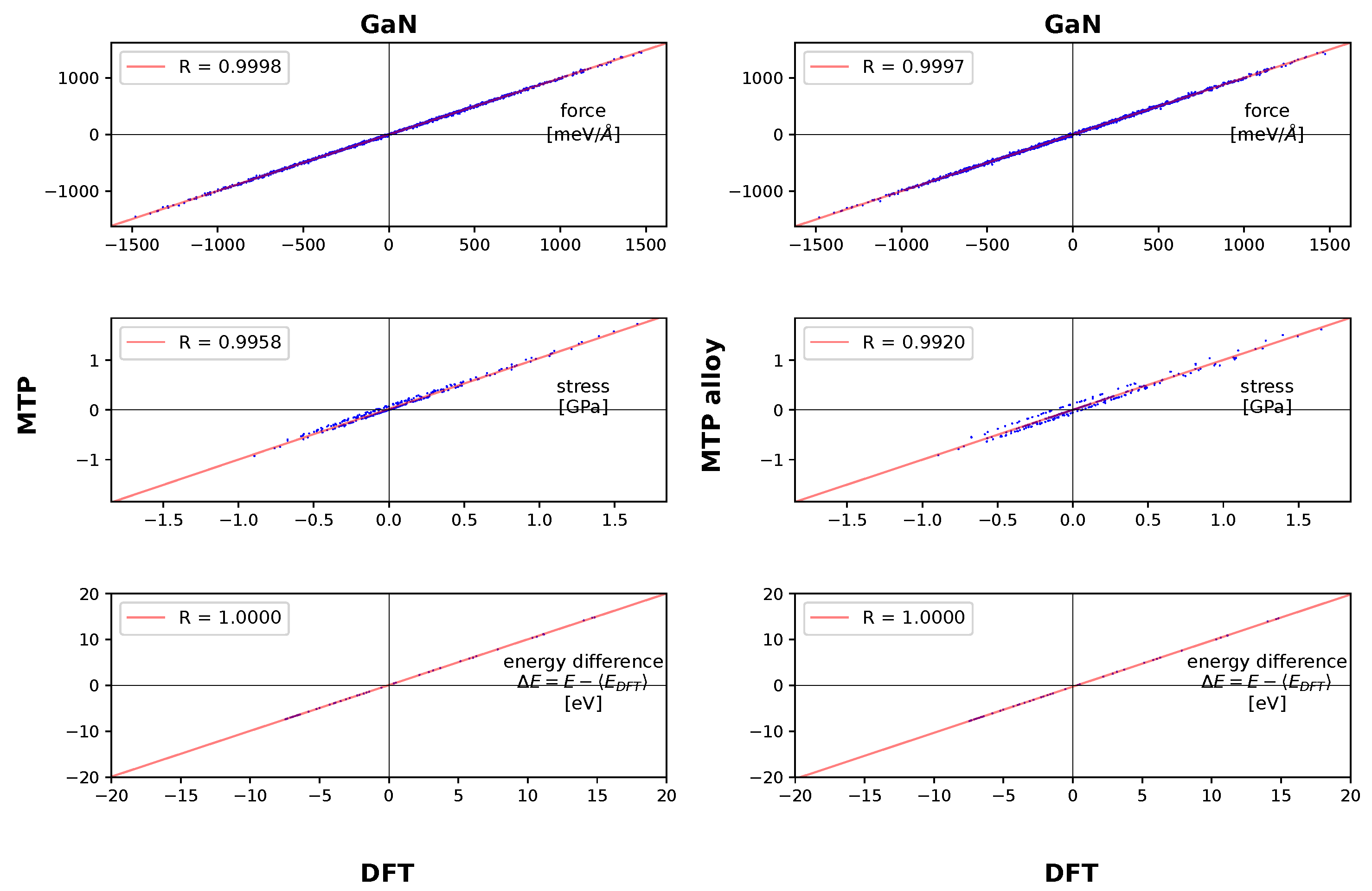
In addition to reporting average deviations, it is useful to compile correlation plots that illustrate the resemblance between MTP and DFT results for all calculated quantities. Correlation plots for forces, energies and strains are shown in Figure 4. Such plots would reveal systematic biases or scaling issues. In correlation plots, a nonzero intercept of a hypothetical line through the datapoints would indicate a systematic offset (bias), while a slope of that line different from one would reveal a scaling issue with the predicted values being proportionally too large or too small. To illustrate that such problems do not occur here, all plots in Figure 4 contain straight lines through the origin with a slope of exactly one (red lines). To be more quantitative, we also calculated the Pearson correlation coefficient (R value), which measures the linearity and agreement between the two data sets, with values above 0.99 indicating excellent correspondence. Our MTPs achieve R values of 0.999 and higher, thus providing an essentially DFT-level accurate and reliable description of forces, stresses, and energies.
Figure 3.
The figure shows the mean absolute errors in forces, stresses, and energies predicted by the selected MTPs for the validation datasets of AlN, GaN and N. Results for the force fields fit to the individual material are shown in red and those for the alloy force field in green.
Figure 3.
The figure shows the mean absolute errors in forces, stresses, and energies predicted by the selected MTPs for the validation datasets of AlN, GaN and N. Results for the force fields fit to the individual material are shown in red and those for the alloy force field in green.
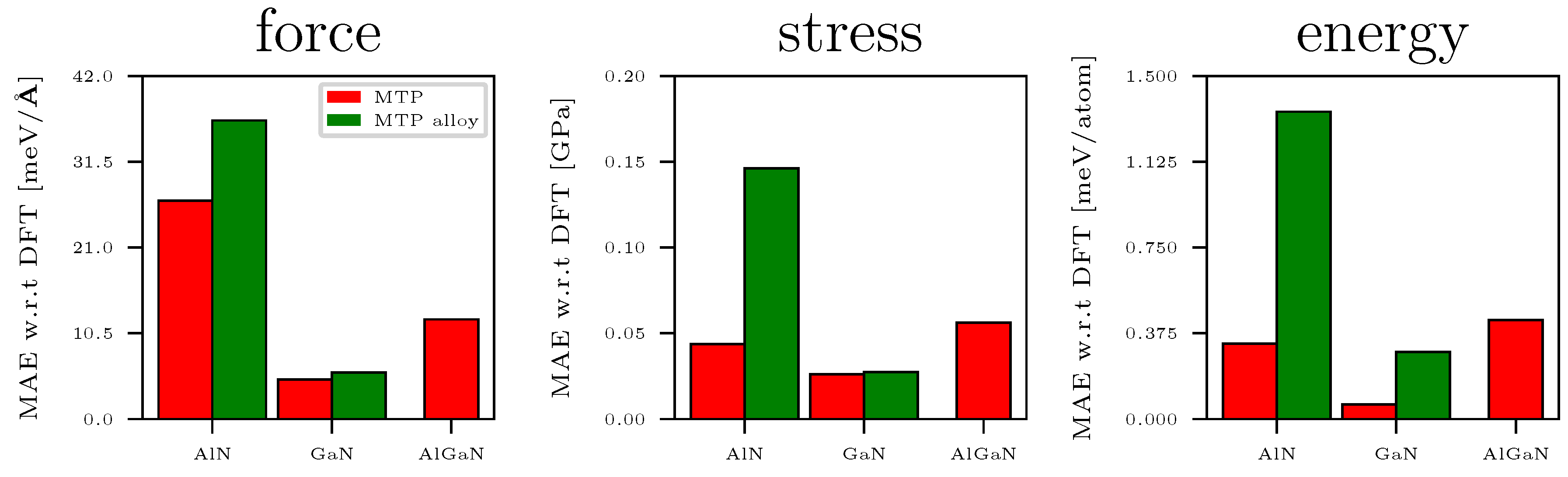
Figure 4.
Correlation between DFT and MTP-calculated forces, stresses, and energies for structures taken form the validation sets of AlN. The panels on the left show results for the material-specific MTP and those on the right show results for the alloy MTP. The red lines represent the linear regression fit between the DFT and MTP-predicted data.
Figure 4.
Correlation between DFT and MTP-calculated forces, stresses, and energies for structures taken form the validation sets of AlN. The panels on the left show results for the material-specific MTP and those on the right show results for the alloy MTP. The red lines represent the linear regression fit between the DFT and MTP-predicted data.
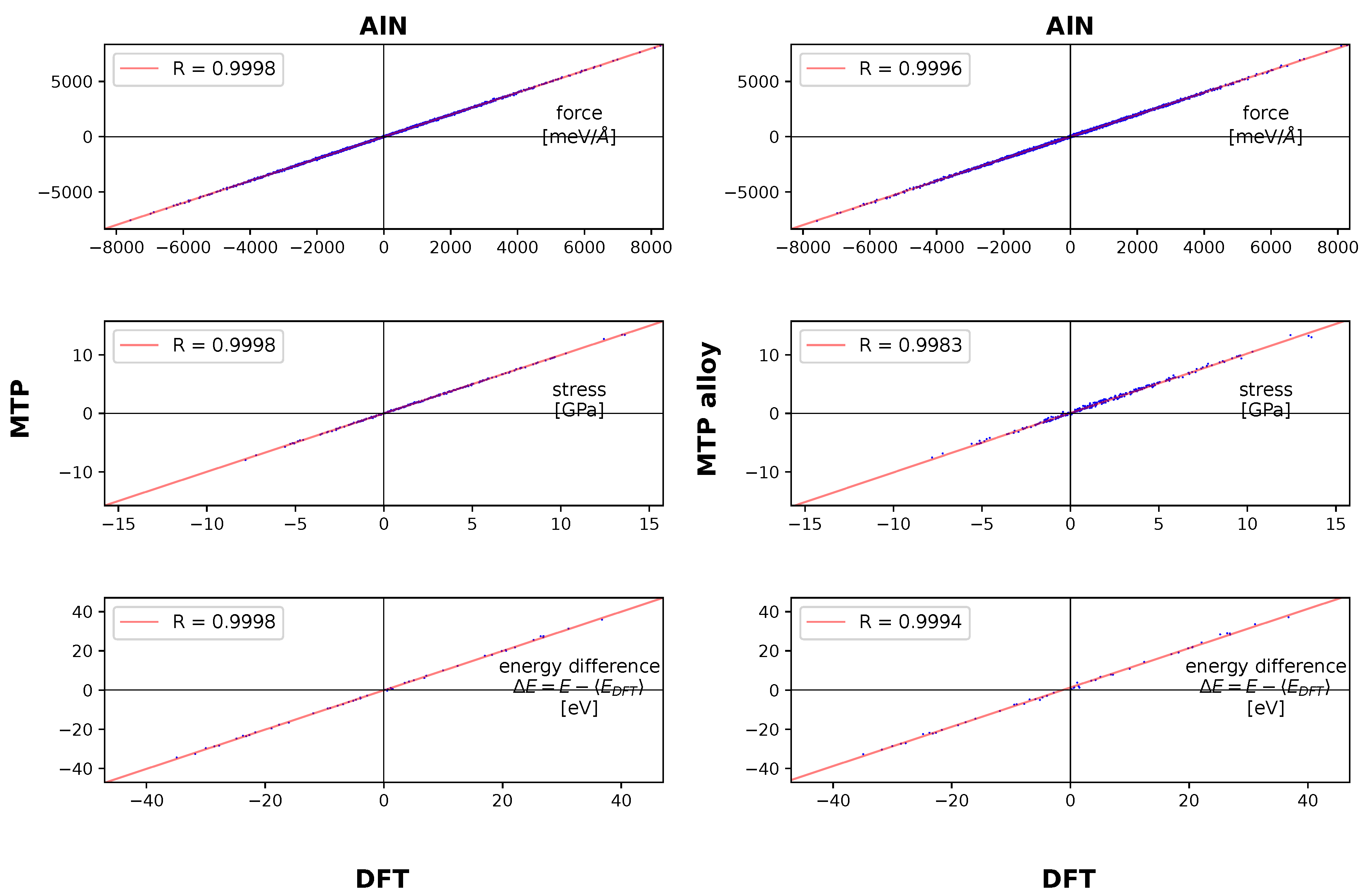
Figure 5.
Correlation between DFT and MTP-calculated forces, stresses, and energies for structures taken form the validation sets of GaN. The panels on the left show results for the material-specific MTP and those on the right show results for the alloy MTP. The red lines represent the linear regression fit between the DFT and MTP-predicted data.
Figure 5.
Correlation between DFT and MTP-calculated forces, stresses, and energies for structures taken form the validation sets of GaN. The panels on the left show results for the material-specific MTP and those on the right show results for the alloy MTP. The red lines represent the linear regression fit between the DFT and MTP-predicted data.
3.3. Lattice Constants
In our study, we focus on the wurtzite phase of the materials investigated, which has a hexagonal crystal structure with space group mc. The primitive cell is defined by two lattice parameters, a and c. The DFT- and MTP-calculated static values of these lattice constants, as well as the results of low-temperature diffraction experiments are listed in Table 3. For N, experimental data are only available for thin films, which are strained and, therefore, deviate from the bulk values [33]. Instead, we apply Vegard’s law [34] to estimate the alloy lattice constants from the average of the AlN and GaN values listed in Table 2. The agreement between the MTP and DFT simulations is excellent, with lattice constants agreeing to within four significant digits. For the material-specific MTPs, the mean relative deviations between MTP and DFT results are 0.01%, 0.01%, and 0.08% for AlN, GaN, and N, respectively. The alloy MTP also excellently reproduces the AlN and GaN lattice constants, with slightly larger errors of 0.09% and 0.03%, respectively. This shows that, for lattice constants, the MTP perfectly reproduces the results of the parent methodology used to train it.
Both the DFT and MTP results obtained by static geometry optimizations agree extraordinarily well with the low-temperature experimental data. This agreement, however, must be taken with a grain of salt, as in the simulations, phonon effects and, in particular, the zero-point motion of the atoms, have been neglected in the structural optimization. When phonon contributions are included using the quasi-harmonic approximation (QHA), the lattice constants increase by for all materials (see DFT, MTP, MTP in Table II). As a consequence, the agreement between theory and simulations becomes slightly worse. Notably, because MTP and DFT results show very similar changes, this is not due to the MTP parametrisation but rather an intrinsic shortcoming of the underlying DFT methodology. The slight overestimation of the lattice constants when zero-point motion is included in the simulations is most likely due to the PBESol exchange-correlation functional used in the calculations. Functionals based on the generalized gradient approximation (GGA), such as PBE, are known to underbind, which generally leads to overestimated lattice constants [35]. The PBESol functional was developed to compensate for the underbinding tendency and performs well for many materials [36]. In our case, when disregarding the zero-point motion, a partial error cancellation between the remaining tendency to underbind and the neglected zero-point motion occurs. This error cancellation is eliminated by explicitly considering the zero-point motion, and the lattice constants are overestimated. While this complication leads to an offset in the “0K” lattice constants, it is not expected to impact the thermal expansion of the materials.
This is indeed the case, as illustrated in Figure 6, which shows the temperature-dependent volumes for AlN (top-left), N (top-center), and GaN (top-right). The corresponding volume thermal expansion coefficients are displayed in the bottom panels. The figure presents molecular dynamics (MD) results obtained with the material-specific MTPs (red data points and lines) and the alloy MTP (green data points and lines). Additionally, results obtained using the quasi-harmonic approximation (QHA, see Section 2.4) are shown for the MTPs (red and green dashed lines) and for DFT (blue dashed lines). Most importantly, the QHA results reveal an excellent agreement between the simulations performed with DFT and those using an MTP. This is particularly true for the system-specific force fields but also the alloy MTP, which provides a satisfactory agreement but somewhat overestimates the crystal volume close to 0 K and slightly underestimates the thermal expansion at higher temperatures. At elevated temperatures the MD results calculated with the MTPs also agree well with the DFT-based QHA predictions. This agreement, however, deteriorates at lower temperatures, which is not surprising considering that in the MD simulations, the effective phonon calculations follow the equipartition theorem [37], neglecting the quantum effects manifested in the Bose-Einstein statistics. This is consistent with the results of Ramírez et al. [18], who observed a similar effect in silicon carbide (SiC) when comparing classical molecular dynamics simulations with path-integral molecular dynamics.
Regarding a direct comparison with experimental measurements (unconnected datapoints in Figure 6), one observes the above-discussed overestimation of the low-temperature unit cell volume. Nevertheless (as already suggested above), the change in volume with temperature and, thus, the volumetric thermal expansion coefficients are excellently reproduced by all QHA simulations. More specifically, for AlN and GaN, the QHA results obtained with the material-specific MTPs (red dashed line) and DFT (blue dashed line) accurately reproduce experimental measurements, and the agreement only starts to deteriorate for GaN above approximately 400 K, where the QHA somewhat overestimates the thermal expansion. We attribute this to additional anharmonic effects that are not captured within the QHA framework and that are more pronounced in GaN, which is more anharmonic in nature, as can be seen by the lower thermal conductivity, which will be discussed in section Section 3.7, and the smaller phonon life times [48].
3.4. Elastic Constants
Table 3 presents the elastic constants calculated using DFT and the MTPs, together with the range of experimental values found in the literature. The full collection of experimental results from the literature is given in Table S1. Overall, the elastic constants predicted by our MTPs agree well with the DFT results, with average relative errors of only a few percent across all investigated materials. For the material-specific MTPs, when considering all five independent elastic constants, we obtain mean relative errors of , , and for AlN, GaN, and N, respectively. Applying the alloy MTP to AlN and GaN yields mean errors of and . Our calculated values also show good agreement with experimental data, with relative errors of and for the DFT results, and for the material-specific MTPs, and and for the alloy MTP. It is important to note that the experimental measurements were conducted at T = 300 K, while the calculated values correspond to T = 0 K.This is, however, not expected to introduce significant discrepancies, as temperature-dependent measurements for AlN by Kim et al. [28] and for GaN by Adachi et al. [29] indicate that the elastic constants are only weakly temperature-dependent. A general trend is that compared to experiments, both our DFT and MTP results underestimate the elastic constants and . This can be attributed to the underbinding caused by the chosen exchange–correlation functional (see Section 3.3), which results in an underestimation of the stiffness of the bonds and smaller elastic constants.

Table 3.
DFT and MTP calculated static elastic constants of wurtzite AlN, GaN and N. Also shown is the range of experimental values at room temperature found in the literature (the full table of experimental data can be found in S1). MTP and dennote the MTPs trained specifically for the material and for the N alloy, respectively. Units are given in GPa.
Table 3.
DFT and MTP calculated static elastic constants of wurtzite AlN, GaN and N. Also shown is the range of experimental values at room temperature found in the literature (the full table of experimental data can be found in S1). MTP and dennote the MTPs trained specifically for the material and for the N alloy, respectively. Units are given in GPa.
| AlN | GaN | N | ||||||||
| DFT | MTP | Exp. | DFT | MTP | Exp. | DFT | ||||
| 381 | 382 | 380 | 401−413 | 346 | 342 | 346 | 365−390 | 363 | 362 | |
| 356 | 360 | 389 | 368−390 | 384 | 385 | 387 | 379−398 | 381 | 385 | |
| 112 | 111 | 103 | 120−127 | 92 | 92 | 89 | 90−109 | 98 | 100 | |
| 137 | 144 | 145 | 127−149 | 128 | 128 | 133 | 106−145 | 133 | 139 | |
| 108 | 113 | 109 | 96−119 | 93 | 96 | 97 | 70−114 | 98 | 108 | |
3.5. Phonon Band Structure
Figure 7 shows the phonon frequencies along the high symmetry directions in the first Brillouin zone for AlN (left), N (center), and GaN (right). The DFT- and MTP-calculated frequencies show very good agreement, with only minor deviations in the higher optical branches. As expected, the alloy MTP performs slightly worse than the material-specific MTPs, however, the difference is small, and its overall performance remains very good. The minor discrepancies between DFT and MTPs at higher frequencies are attributed to the presence of long-range Coulomb interactions in semiconductors with polar bonds, which must be treated separately because their dipole–dipole nature leads to non-analytic contributions to the dynamical matrix in the long-wavelength limit [58]. In DFT phonon calculations, these long-range forces are excluded from the short-range interatomic force constants and incorporated instead through the non-analytic term correction (NAC), ensuring an accurate description of the LO–TO splitting in polar materials. Unfortunately, the same approach cannot be applied to the MTPs, since long-range Coulomb forces are already, at least in part, implicitly included in the training dataset forces and, consequently, in any forces predicted by the MTPs. Thus, the long-range forces would have to be removed from the training data beforehand to avoid double-counting and an oscillatory behaviour near the Gamma point when the NAC is applied. However, this is beyond the scope of this work and is not relevant to thermal transport (the final target of the MTP parametrizations). This is because deviations occur in the upper optical branches that usually don’t contribute much. Therefore, in this work NACs are not considered in any of our calculations. Despite this limitation, the mean relative deviation between DFT-and MTP-calculated phonon frequencies, averaged over the entire, homogeneously sampled Brillouin zone, is in the range of only .
Our data also agree very well with the experimental data from Schwoerer et al. (b)[56] for AlN (Figure 7 left, black circles) and Ruf et al. [57] for GaN (Figure 7 center, black circles). Only for the LO-TO splitting near the -point, larger deviations are observed for the reasons discussed above.
In addition to the comparison between theory and experiment discussed above, Tables S2 and S3 in the Supplementary Material present a comparison with available Raman measurements. Good agreement is also observed in this case, with mean relative errors (MRE) in the frequencies of approximately 2% for all materials. The Raman data further reveal a systematic tendency of both the MTP and DFT results to slightly underestimate the experimental frequencies. This trend is consistent with the underbinding behavior discussed in Section 3.3. In principle, the observed frequency shift could also be attributed to a temperature-dependent phonon renormalization; however, previous studies [59,60] have shown that such effects are small () and, thus, insufficient to explain the discrepancy.
3.6. Mode-Grüneisen Parameters
The mode-Grüneisen parameters characterize the relative shift in phonon frequencies with respect to changes in the unit cell volume (see Section 2.4). They are often used as a measure of a material’s anharmonicity, making them a useful quantity for benchmarking in thermal transport applications. These parameters are among the most challenging material properties to reproduce accurately, as the changes in phonon frequencies with volume are often comparable in magnitude to the errors in the MTP-predicted phonon frequencies. Despite these challenges, our MTPs reproduce the DFT reference data well, as shown in Figure 8. Some deviations persist, especially in the acoustic and lower-optical branches, which correspond to the lower-frequency region of the two. Relative errors of the material-specific MTPs with respect to DFT are 15.9%, 13.0% and 20.9% for AlN, GaN and N. For alloy MTP applied to AlN and GaN, the errors are 14.3% and 26.0%, respectively. It should be noted that relative errors are dominated by modes with small Grüneisen parameters, where they tend to blow up. The mean absolute errors (MAE) are actually fairly small with 0.048, 0.041 and 0.049 for AlN, GaN and AlGaN in the case of the material-specific MTP, and 0.048 and 0.074 for the alloy MTP applied to AlN and GaN. When compared with the average Grüneisen parameters of the respective materials, these correspond to errors in the range of roughly to . Experimental data are available only for the Raman-active modes (Table S4). Table S5 provides an overview of the DFT- and MTP-calculated mode Grüneisen parameters for the Raman-active modes, along with the range of experimental values reported in the literature. The agreement is acceptable, with mean relative errors with respect to experiments of approximately for DFT, for the material-specific MTPs, and for alloy MTP.
3.7. Lattice Thermal Conductivity
The final goal of our MTPs is to accurately simulate thermal transport, which requires them to reproduce both the full thermal conductivity tensor as well as the frequency-dependent thermal conductivity contributions. The focus below will be on calculating the thermal conductivity from harmonic phonon frequencies and anharmonic lifetimes, using the Boltzmann transport equation in the relaxation-time approximation. Molecular-dynamics based studies will be left for follow-up studies. Figure 9 shows the temperature-dependent values of the thermal conductivities of AlN, GaN, and N in the c-direction of the crystals, . These results are calculated using anharmonic force constants obtained with DFT and our MTPs. The simulations are compared to a series of experimental data. The focus here is on heat transport in the c-direction because, in most applications, thin films are grown in the c-orientation. For the sake of completeness, Table 4 also reports the diagonal components of the thermal conductivity tensors at 300K. When comparing the solid red lines obtained from system-specific MTPs to the blue dashed lines calculated using DFT, an impressive agreement is revealed between the ab initio results and those generated by the machine-learned force fields. This testifies to the enormous potential of MTPs of the type discussed here for accurately and efficiently predicting heat transport in inorganic semiconductors. The performance of the alloy MTP is slightly worse but still acceptable.
Comparing the simulations to the experiments on single crystals (adopted from literature), one observes again an excellent agreement for AlN up to 400K especially when considering the data by Inyushkin et al. [62]. Unfortunately, there are no experimental data beyond 400 K available from that source. When comparing the simulations to the data by Slack et al. [63] a similarly favourable picture evolves at low temperatures, but one also sees that at 600K the simulations overshoot the experiments by , with the deviation becoming worse at 1000 K. For GaN the agreement between theory and experiments at low temperatures is again satisfactory, but here already at 300K the simulations overestimate the experiments by about 10%. The deviation gets significantly worse at higher temperatures. The temperature-dependence of the deviation, as well as the fact that they are worse in the more anharmonic GaN (see above) suggest that the deviations are likely a consequence of considering only 3rd-order force constants (i.e., 3-phonon scattering processes) in the determination of phonon lifetimes when using ShengBTE. To verify this hypothesis, the impact of 4th order force constants (i.e., inlcuding 4-phonon scattering processes) was tested at 300 K and at 800 K, using an extension module for ShengBTE that incorporates four-phonon scattering [22] (see Methods section). Indeed, including higher-order anharmonicities distinctly reduces the calculated thermal conductivity, getting it closer to the experimental values (see green crosses at 300K and at 800K in the central panel of Figure 9). At 300 K, the thermal conductivity agrees remarkably well with the largest reported value for GaN by Shibata et al. [66] with a relative error of only 1.4%. At 800 K, the deviation between theory and experiment remains sizable. This is not surprising, considering that at very high temperatures even higher-order scattering processes may play a role. Additionally, factors such as impurity scattering, which strongly affects high-frequency phonons () and thus has a more significant contribution at 800 K, are not considered here. Shibata et al. [66] report Si impurities of , which could explain the discrepancy between their measurements (Figure 9 orange diamonds) and our results (Figure 9 lime crosses) at 800 K, even when fourth-order contributions are included.
For N, the situation is more involved. First, there are only a few measurements on N in general and even fewer that consider the target alloy fraction . Moreover, to the best of the author’s knowledge, no bulk measurements are available in the literature, which is particularly unfortunate, since alloys are known to display strong size effects on the thermal conductivity. Therefore, no reliable data on the thermal conductivity of ideal bulk N are known to date. The closest match for our case is the data by Daly et al. [61] for a single-crystalline thin-film N sample. From a theoretical point of view, the standard ALD-based approach has serious limitations when applied to alloys. First, the virtual crystal approximation (VCA) is used to enforce periodicity on the material, which is required for ALD. This is already a fairly big approximation. Second, the missing randomness is approximated using a lowest-order perturbative treatment of mass disorder via the Tamura model [24], while disorder in the force constants (i.e., variations in interatomic bonding strength) is neglected. A perturbative approach cannot be rigorously justified in the case of large alloy fractions. Despite these glaring problems, the method is widely used and accurately describes the thermal conductivity of many alloys [23,69,70,71]. With these caveats aside, our N results show a reasonable agreement with the available experimental data but overeshoots the experiment, likely due to size effects. It also has to be mentioned, that the axis orientation of the sample by Daly et al. is not known and that N has an extremly large anisotropy () for the thermal conductivity as can be seen in Table 4). The scalar thermal conductivity (average over trace elements) agrees much better with the data reported by Daly et al.
To analyze the contributions of various phonon regions to the thermal conductivity, Figure 10 illustrates the average frequency-resolved contributions to the thermal conductivity , as determined by eq:kappaDOS. As usual, the results for the material-specific MTPs, for the alloy MTP and for DFT are compared. The positions, shapes and widths of main peaks of the DFT curve are excellently reproduced by the MTPs. The only minor deviations are shifts in peak positions, which can be traced back to the minor differences in phonon bands. This clearly illustrates that the MTPs presented in this work can accurately capture even the microscopic details of thermal transport.
4. Conclusion
This work demonstrates that machine-learned force fields can be a highly effective tool for simulating the static and dynamic structural properties of N and related materials, including thermal transport. They combine the computational efficiency of empirical force fields with the reliability and accuracy of first-principles calculations. Specifically, moment tensor potentials (MTPs) were trained for three materials commonly used in microelectronics, AlN, GaN, and N, using datasets of supercells with varying atomic displacements and cell deformations. The performance of the MTPs was assessed by benchmarking thermal transport–related properties against experimental and DFT reference data.
We investigated the impact of dataset parameters, such as the number of configurations and the magnitude of atomic displacements and cell deformations. MTP prediction quality generally improves with increasing MTP levels and with larger dataset sizes. Increases beyond a certain point (∼ 300 in our case) yield little further improvement, at least at low MTP levels. Larger atomic displacements and cell deformations were found to negatively affect certain properties, such as the lattice and elastic constants. For the materials studied here, level-10 MTPs are found to be sufficient, but careful selection from an ensemble is necessary due to the large variability at lower MTP levels. When chosen this way, optimal MTPs can achieve accuracy comparable to much higher-level models while requiring only a fraction of the computational cost.
The MTPs show excellent overall agreement with DFT, with relative errors below 5% for most benchmarked properties. In some cases, such as lattice constants and phonon band structures, the MTPs reproduce the DFT results nearly exactly. Notably, the alloy MTP performs only slightly worse than MTPs trained specifically for AlN and GaN, highlighting its potential for studying N alloys and heterostructures, including interfaces and superlattices. Their combination of high computational efficiency and near-DFT accuracy makes them a powerful tool for MD-based simulations.
In general, our MTP- and DFT-based calculations show good agreement with experiment. When minor discrepancies arise, they are systematic and occur in the same direction for both MTP and DFT results, suggesting that their origin lies in the underlying DFT description. We attribute these deviations to the choice of exchange–correlation functional (PBEsol) employed in our simulations, which is known to exhibit slight underbinding.
Supplementary Materials
The following supporting information can be downloaded at the website of this paper posted on Preprints.org. Figure S1: Dependence of MTP prediction errors on MTP level, Figure S2: Dependence of MTP prediction errors on dataset size, Figure S3: Dependence of MTP prediction errors on atomic displacement magnitude, Figure S4: Convergence of DFT-predicted forces, stress and energies with wavefunction cutoff and electronic reciprocal grid size, Figure S5: Convergence of DFT-predicted material properties with wavefunction cutoff and electronic reciprocal grid size, Figure S6: Convergence of DFT-calculated thermal conductivity with third-order force constants, Figure S7: Convergence of DFT-calculated thermal conductivity with phonon reciprocal grid size, Table S1: Overview of experimental data for the elastic constants, Table S2: Overview of experimental data for the Raman frequencies, Table S3: Calculated results for the Raman frequencies, Table S4: Overview of experimental data for the mode-Grüneisen parameters of Raman-active modes, Table S5: Calculated results for the mode-Grüneisen parameters of Raman-active modes.
Funding
This work was conducted as part of the iRel4.0 project which is a european co-funded innovation project that has been granted by the ECSEL Joint Undertaking (JU) under grant agreement No 876659. The funding of the project comes from the Horizon 2020 research program and participating countries. National funding is provided by Germany, including the Free States of Saxony and Thuringia, Austria, Belgium, Finland, France, Italy, the Netherlands, Slovakia, Spain, Sweden, and Turkey. Additional funding by the Austrian Federal Government (in particular from Federal Ministry for Climate Action, Environment, Energy, Mobility, Innovation and Technology) represented by the Austrian Research Promotion Agency (FFG), within the framework of the “IKT der Zukunft” Programme (project number: 877534) is gratefully acknowledged.
Data Availability Statement
The following data files of the simulations will be made available via the TU Graz repository ([DOI ....]): These data will be provided as soon as the manuscript has been accepted, as addiional simulations might be required following reviewer suggestions.
Acknowledgments
S. Fernback and N. Bedoya-Martinez gratefully acknowledge the financial support under the scope of the COMET program withinthe K2 Center“Integrated Computational Material, Process and Product Engineering(IC-MPPE)” (Project 886385). This program is supported by the Austrian FederalMinistriesfor Climate Action, Environment, Energy, Mobility, Innovation and Technology (BMK) and for Labour and Economy (BMAW), representedbythe Austrian research funding association (FFG), and the federal states of Styria, Upper Austria and Tyrol. During the preparation of this manuscript, the authors used ChatGPT 5 in order to improve the language and readability of the text. After using this tool, the authors reviewed and edited the content as needed and take full responsibility for the publication’s content.
References
- McGaughey, A.; Kaviany, M. Phonon Transport in Molecular Dynamics Simulations: Formulation and Thermal Conductivity Prediction. In Advances in Heat Transfer; Elsevier, 2006; Vol. 39, pp. 169–255. [Google Scholar] [CrossRef]
- Lindsay, L. First Principles Peierls-Boltzmann Phonon Thermal Transport: A Topical Review. Nanoscale and Microscale Thermophysical Engineering 2016, 20, 67–84. [Google Scholar] [CrossRef]
- Mingo, N.; Yang, L. Phonon transport in nanowires coated with an amorphous material: An atomistic Green’s function approach. Phys. Rev. B 2003, 68, 245406. [Google Scholar] [CrossRef]
- Unke, O.T.; Chmiela, S.; Sauceda, H.E.; Gastegger, M.; Poltavsky, I.; Schütt, K.T.; Tkatchenko, A.; Müller, K.R. Machine Learning Force Fields. Chemical Reviews 2021, 121, 10142–10186. [Google Scholar] [CrossRef] [PubMed]
- Luo, Y.; Li, M.; Yuan, H.; Liu, H.; Fang, Y. Predicting lattice thermal conductivity via machine learning: a mini review. npj Computational Mathematics 2023, 9, 4. [Google Scholar] [CrossRef]
- Novikov, I.S.; Gubaev, K.; Podryabinkin, E.V.; Shapeev, A.V. The MLIP package: moment tensor potentials with MPI and active learning. Machine Learning: Science and Technology 2020, 2, 025002. [Google Scholar] [CrossRef]
- Togo, A.; Seko, A. On-the-fly training of polynomial machine learning potentials in computing lattice thermal conductivity. The Journal of Chemical Physics 2024, 160, 211001. [Google Scholar] [CrossRef] [PubMed]
- Lee, H.; Hegde, V.I.; Wolverton, C.; Xia, Y. Accelerating high-throughput phonon calculations via machine learning universal potentials. Materials Today Physics 2025, 53, 101688. [Google Scholar] [CrossRef]
- Jinnouchi, R.; Karsai, F.; Kresse, G. On-the-fly machine learning force field generation: Application to melting points. Phys. Rev. B 2019, 100, 014105. [Google Scholar] [CrossRef]
- Jinnouchi, R.; Karsai, F.; Verdi, C.; Asahi, R.; Kresse, G. Descriptors representing two- and three-body atomic distributions and their effects on the accuracy of machine-learned inter-atomic potentials. The Journal of Chemical Physics 2020, 152, 234102. [Google Scholar] [CrossRef]
- Podryabinkin, E.; Garifullin, K.; Shapeev, A.; Novikov, I. MLIP-3: Active learning on atomic environments with moment tensor potentials. The Journal of Chemical Physics 2023, 159, 084112. [Google Scholar] [CrossRef]
- Hodapp, M.; Anciaux, G. AutoPot: Automated and massively parallelized construction of Machine-Learning Potentials. arXiv 2026, arXiv:physics.comp. [Google Scholar]
- Mortazavi, B.; Zhuang, X.; Rabczuk, T.; Shapeev, A.V. Atomistic modeling of the mechanical properties: the rise of machine learning interatomic potentials. Mater. Horiz. 2023, 10, 1956–1968. [Google Scholar] [CrossRef]
- Stolte, N.; Daru, J.; Forbert, H.; Marx, D.; Behler, J. Random Sampling Versus Active Learning Algorithms for Machine Learning Potentials of Quantum Liquid Water. Journal of Chemical Theory and Computation 2025, 21, 886–899. [Google Scholar] [CrossRef] [PubMed]
- Fletcher, R. A new approach to variable metric algorithms. The Computer Journal 1970, 13, 317–322. Available online: https://academic.oup.com/comjnl/article-pdf/13/3/317/988678/130317.pdf. [CrossRef]
- Jadon, A.; Patil, A.; Jadon, S. A Comprehensive Survey of Regression-Based Loss Functions for Time Series Forecasting. In Proceedings of the Data Management, Analytics and Innovation; Sharma, N., Goje, A.C., Chakrabarti, A., Bruckstein, A.M., Eds.; Singapore, 2024; pp. 117–147. [Google Scholar]
- Thompson, A.P. LAMMPS - a flexible simulation tool for.
- Ramirez, R.; Herrero, C.; Hernandez, E.; Cardona, M. Path-integral molecular dynamics simulation of 3C-SiC. Physical Review B 2008, 77. [Google Scholar] [CrossRef]
- Togo, A.; Chaput, L.; Tanaka, I. Distributions of phonon lifetimes in Brillouin zones. Phys. Rev. B 2015, 91, 094306. [Google Scholar] [CrossRef]
- Togo, A.; Tanaka, I. First principles phonon calculations in materials science. Scr. Mater. 2015, 108, 1–5. [Google Scholar] [CrossRef]
- Li, W.; Carrete, J.; Katcho, N.A.; Mingo, N. ShengBTE: a solver of the Boltzmann transport equation for phonons. Comp. Phys. Commun. 2014, 185, 1747–1758. [Google Scholar] [CrossRef]
- Han, Z.; Yang, X.; Li, W.; Feng, T.; Ruan, X. FourPhonon: An extension module to ShengBTE for computing four-phonon scattering rates and thermal conductivity. Computer Physics Communications 2022, 270, 108179. [Google Scholar] [CrossRef]
- Li, W.; Lindsay, L.; Broido, D.A.; Stewart, D.A.; Mingo, N. Thermal conductivity of bulk and nanowire Mg2SixSn1-x alloys from first principles. Phys. Rev. B 2012, 86, 174307. [Google Scholar] [CrossRef]
- Tamura, S.i. Isotope scattering of dispersive phonons in Ge. Phys. Rev. B 1983, 27, 858–866. [Google Scholar] [CrossRef]
- Giannozzi, P. QUANTUM ESPRESSO: a modular and open-source software project for quantum simulations of materials. J. Phys. Condens. Matter 2009, 21, 395502. [Google Scholar] [CrossRef] [PubMed]
- Prandini, G.; Marrazzo, A.; Castelli, I.E.; Mounet, N.; Marzari, N. Precision and efficiency in solid-state pseudopotential calculations. npj Computational Materials 2018, 4, 72. Available online: http://materialscloud.org/sssp. [CrossRef]
- Dal Corso, A. Thermo_pw: a driver of Quantum‒ESPRESSO routines for ab-initio material properties. 2025. Available online: https://dalcorso.github.io/thermo_pw/.
- Bias Variance Decomposition. In Encyclopedia of Machine Learning; Sammut, C., Webb, G.I., Sammut, C., Webb, G.I., Eds.; Springer US: Boston, MA, 2010; pp. 100–101. [Google Scholar] [CrossRef]
- Reicht, L.; Legenstein, L.; Wieser, S.; Zojer, E. Designing Accurate Moment Tensor Potentials for Phonon-Related Properties of Crystalline Polymers. Molecules 2024, 29, 3724. [Google Scholar] [CrossRef]
- Reicht, L.; Legenstein, L.; Wieser, S.; Zojer, E. Analysing heat transport in crystalline polymers in real and reciprocal space. npj Computational Materials 2026. [Google Scholar] [CrossRef]
- Minamitani, E.; Ogura, M.; Watanabe, S. Simulating lattice thermal conductivity in semiconducting materials using high-dimensional neural network potential. Applied Physics Express 2019, 12, 095001. [Google Scholar] [CrossRef]
- Gao, M.; Bie, X.; Wang, Y.; Li, Y.; Zhai, Z.; Lyu, H.; Zou, X. Accurate Deep Potential Model of Temperature-Dependent Elastic Constants for Phosphorus-Doped Silicon. Nanomaterials 2025, 15. [Google Scholar] [CrossRef]
- Feng, Y.; Saravade, V.; Chung, T.F.; Dong, Y.; Zhou, H.; Kucukgok, B.; Ferguson, I.; Lu, N. Strain-stress study of AlxGa1-xN/AlN heterostructures on c-plane sapphire and related optical properties. Scientific Reports 2019, 9. [Google Scholar] [CrossRef]
- Angerer, H.; Brunner, D.; Freudenberg, F.; Ambacher, O.; Stutzmann, M.; Höpler, R.; Metzger, T.; Born, E.; Dollinger, G.; Bergmaier, A.; et al. Determination of the Al mole fraction and the band gap bowing of epitaxial AlxGa1-xN films. Applied Physics Letters 1997, 71, 1504–1506. [Google Scholar] [CrossRef]
- Skelton, J.M.; Tiana, D.; Parker, S.C.; Togo, A.; Tanaka, I.; Walsh, A. Influence of the exchange-correlation functional on the quasi-harmonic lattice dynamics of II-VI semiconductors. The Journal of Chemical Physics 2015, 143, 064710. Available online: https://pubs.aip.org/aip/jcp/article-pdf/doi/10.1063/1.4928058/15501644/064710_1_online.pdf. [CrossRef]
- Haas, P.; Tran, F.; Blaha, P. Calculation of the lattice constant of solids with semilocal functionals. Phys. Rev. B 2009, 79, 085104. [Google Scholar] [CrossRef]
- Puligheddu, M.; Xia, Y.; Chan, M.; Galli, G. Computational prediction of lattice thermal conductivity: A comparison of molecular dynamics and Boltzmann transport approaches. Phys. Rev. Mater. 2019, 3, 085401. [Google Scholar] [CrossRef]
- Kroencke, H.; Figge, s.; Hommel, D.; Epelbaum, B. Determination of the Temperature Dependent Thermal Expansion Coefficients of Bulk AlN by HRXRD. Acta Physica Polonica A 2008, 114, 1193. [Google Scholar] [CrossRef]
- Paszkowicz, W.; Knapp, M.; Podsiadlo, S.; Kamler, G.; Pelka, J. Lattice Parameters of Aluminium Nitride in the Range 10–291 K. Acta Physica Polonica A - ACTA PHYS POL A 1999, 101. [Google Scholar] [CrossRef]
- Slack, G.A.; Bartram, S.F. Thermal expansion of some diamondlike crystals. Journal of Applied Physics 1975, 46, 89–98. Available online: https://pubs.aip.org/aip/jap/article-pdf/46/1/89/18369550/89_1_online.pdf. [CrossRef]
- Yim, W.M.; Paff, R.J. Thermal expansion of AlN, sapphire, and silicon. Journal of Applied Physics 1974, 45, 1456–1457. Available online: https://pubs.aip.org/aip/jap/article-pdf/45/3/1456/18366881/1456_1_online.pdf. [CrossRef]
- Kirchner, V.; Heinke, H.; Hommel, D.; Domagala, J.Z.; Leszczynski, M. Thermal expansion of bulk and homoepitaxial GaN. Applied Physics Letters 2000, 77, 1434–1436. Available online: https://pubs.aip.org/aip/apl/article-pdf/77/10/1434/18551921/1434_1_online.pdf. [CrossRef]
- Leszczyński, M.; Teisseyre, H.; Suski, T.; Grzegory, I.; Bockowski, M.; Jun, J.; Palosz, B.; Porowski, S.; Pakuła, K.; Baranowski, J.; et al. Thermal Expansion of GaN Bulk Crystals and Homoepitaxial Layers. Acta Physica Polonica A 1996, 90, 887–890. [Google Scholar] [CrossRef]
- Maruska, H.P.; Tietjen, J.J. THE PREPARATION AND PROPERTIES OF VAPOR-DEPOSITED SINGLE-CRYSTAL-LINE GaN. Applied Physics Letters 1969, 15, 327–329. Available online: https://pubs.aip.org/aip/apl/article-pdf/15/10/327/18422744/327_1_online.pdf. [CrossRef]
- Reeber, R.R.; Wang, K. Lattice parameters and thermal expansion of GaN. Journal of Materials Research 2000, 15, 40–44. [Google Scholar] [CrossRef]
- Roder, C.; Einfeldt, S.; Figge, S.; Hommel, D. Temperature dependence of the thermal expansion of GaN. Phys. Rev. B 2005, 72, 085218. [Google Scholar] [CrossRef]
- Minikayev, R.; Paszkowicz, W.; Piszora, P.; Knapp, M.; Bähtz, C.; Podsiadło, S. Thermal expansion of polycrystalline gallium nitride: an X-ray diffraction study. X-Ray Spectrometry 2015, 44, 382–388. Available online: https://analyticalsciencejournals.onlinelibrary.wiley.com/doi/pdf/10.1002/xrs.2644. [CrossRef]
- Bergman, L.; Alexson, D.; Murphy, P.L.; Nemanich, R.J.; Dutta, M.; Stroscio, M.A.; Balkas, C.; Shin, H.; Davis, R.F. Raman analysis of phonon lifetimes in AlN and GaN of wurtzite structure. Physical Review B 1999, 59, 12977–12982. [Google Scholar] [CrossRef]
- Ohashi, Y.; Arakawa, M.; Kushibiki, J.; Epelbaum, B.; Winnacker, A. Ultrasonic microspectroscopy characterization of AlN single crystals. Applied Physics Express 2008, 1, 770041–770043. [Google Scholar] [CrossRef]
- Kim, T.; Kim, J.; Dalmau, R.; Schlesser, R.; Preble, E.; Jiang, X. High-Temperature Electromechanical Characterization of AlN Single Crystals. IEEE Transactions on Ultrasonics Ferroelectrics and Frequency Control 2015, 62, 1880–1887. [Google Scholar] [CrossRef]
- Yamaguchi, M.; Yagi, T.; Azuhata, T.; Sota, T.; Suzuki, K.; Chichibu, S.; Nakamura, S. Brillouin scattering study of gallium nitride: elastic stiffness constants. Journal of Physics: Condensed Matter 1997, 9, 241. [Google Scholar] [CrossRef]
- Polian, A.; Grimsditch, M.; Grzegory, I. Elastic constants of gallium nitride. Journal of Applied Physics 1996, 79, 3343–3344. Available online: https://pubs.aip.org/aip/jap/article-pdf/79/6/3343/18681835/3343_1_online.pdf. [CrossRef]
- Deger, C.; Born, E.; Angerer, H.; Ambacher, O.; Stutzmann, M.; Hornsteiner, J.; Riha, E.; Fischerauer, G. Sound velocity of AlxGa1-xN thin films obtained by surface acoustic-wave measurements. Applied Physics Letters 1998, 72, 2400–2402. Available online: https://pubs.aip.org/aip/apl/article-pdf/72/19/2400/18533753/2400_1_online.pdf. [CrossRef]
- Takagi, Y.; Ahart, M.; Azuhata, T.; Sota, T.; Suzuki, K.; Nakamura, S. Brillouin scattering study in the GaN epitaxial layer. Physica B: Condensed Matter;PHONONS 1996, 95, 219-220, 547–549. [Google Scholar] [CrossRef]
- McNeil, L.E.; Grimsditch, M.; French, R.H. Vibrational Spectroscopy of Aluminum Nitride. Journal of the American Ceramic Society 1993, 76, 1132–1136. Available online: https://ceramics.onlinelibrary.wiley.com/doi/pdf/10.1111/j.1151-2916.1993.tb03730.x. [CrossRef]
- Schwoerer-Böhning, M.; Macrander, A.T.; Pabst, M.; Pavone, P. Phonons in Wurtzite Aluminum Nitride. physica status solidi (b) 1999, 215, 177–180. [Google Scholar] [CrossRef]
- Ruf, T.; Serrano, J.; Cardona, M.; Pavone, P.; Pabst, M.; Krisch, M.; D’Astuto, M.; Suski, T.; Grzegory, I.; Leszczynski, M. Phonon Dispersion Curves in Wurtzite-Structure GaN Determined by Inelastic X-Ray Scattering. Phys. Rev. Lett. 2001, 86, 906–909. [Google Scholar] [CrossRef]
- Gonze, X.; Lee, C. Dynamical matrices, Born effective charges, dielectric permittivity tensors, and interatomic force constants from density-functional perturbation theory. Phys. Rev. B 1997, 55, 10355–10368. [Google Scholar] [CrossRef]
- Liu, M.S.; Bursill, L.; Prawer, S.; Nugent, K.; Tong, Y.; Zhang, G. Temperature dependence of Raman scattering in single crystal GaN films. Applied Physics Letters 1999, 74, 3125–3127. [Google Scholar] [CrossRef]
- Kazan, M.; Zgheib, C.; Moussaed, E.; Masri, P. Temperature dependence of Raman-active modes in AlN. Diamond and Related Materials;Diamond 2006, 15, 1169–1174. [Google Scholar] [CrossRef]
- Daly, B.C.; Maris, H.J.; Nurmikko, A.V.; Kuball, M.; Han, J. Optical pump-and-probe measurement of the thermal conductivity of nitride thin films. Journal of Applied Physics 2002, 92, 3820–3824. Available online: https://pubs.aip.org/aip/jap/article-pdf/92/7/3820/19044709/3820_1_online.pdf. [CrossRef]
- Inyushkin, A.V.; Taldenkov, A.N.; Chernodubov, D.A.; Mokhov, E.N.; Nagalyuk, S.S.; Ralchenko, V.G.; Khomich, A.A. On the thermal conductivity of single crystal AlN. Journal of Applied Physics 2020, 127, 205109. Available online: https://pubs.aip.org/aip/jap/article-pdf/doi/10.1063/5.0008919/15247444/205109_1_online.pdf. [CrossRef]
- Slack, G.A.; Tanzilli, R.; Pohl, R.; Vandersande, J. The intrinsic thermal conductivity of AIN. Journal of Physics and Chemistry of Solids 1987, 48, 641–647. [Google Scholar] [CrossRef]
- Jeżowski, A.; Danilchenko, B.; Boćkowski, M.; Grzegory, I.; Krukowski, S.; Suski, T.; Paszkiewicz, T. Thermal conductivity of GaN crystals in 4.2–300 K range. Solid State Communications 2003, 128, 69–73. [Google Scholar] [CrossRef]
- Paskov, P.P.; Slomski, M.; Leach, J.H.; Muth, J.F.; Paskova, T. Effect of Si doping on the thermal conductivity of bulk GaN at elevated temperatures – theory and experiment. AIP Advances 2017, 7, 095302. Available online: https://pubs.aip.org/aip/adv/article-pdf/doi/10.1063/1.4989626/12982864/095302_1_online.pdf. [CrossRef]
- Shibata, H.; Waseda, Y.; Ohta, H.; Kiyomi, K.; Shimoyama, K.; Fujito, K.; Nagaoka, H.; Kagamitani, Y.; Simura, R.; Fukuda, T. High Thermal Conductivity of Gallium Nitride (GaN) Crystals Grown by HVPE Process. MATERIALS TRANSACTIONS 2007, 48, 2782–2786. [Google Scholar] [CrossRef]
- Simon, R.B.; Anaya, J.; Kuball, M. Thermal conductivity of bulk GaN—Effects of oxygen, magnesium doping, and strain field compensation. Applied Physics Letters 2014, 105, 202105. Available online: https://pubs.aip.org/aip/apl/article-pdf/doi/10.1063/1.4901967/14305716/202105_1_online.pdf. [CrossRef]
- Tran, D.Q.; Paskova, T.; Darakchieva, V.; Paskov, P.P. On the thermal conductivity anisotropy in wurtzite GaN. AIP Advances 2023, 13, 095009. Available online: https://pubs.aip.org/aip/adv/article-pdf/doi/10.1063/5.0167866/18117971/095009_1_5.0167866.pdf. [CrossRef]
- Arrigoni, M.; Carrete, J.; Mingo, N.; Madsen, G.K.H. First-principles quantitative prediction of the lattice thermal conductivity in random semiconductor alloys: The role of force-constant disorder. Phys. Rev. B 2018, 98, 115205. [Google Scholar] [CrossRef]
- Cheaito, R.; Duda, J.C.; Beechem, T.E.; Hattar, K.; Ihlefeld, J.F.; Medlin, D.L.; Rodriguez, M.A.; Campion, M.J.; Piekos, E.S.; Hopkins, P.E. Experimental Investigation of Size Effects on the Thermal Conductivity of Silicon-Germanium Alloy Thin Films. Phys. Rev. Lett. 2012, 109, 195901. [Google Scholar] [CrossRef] [PubMed]
- Tian, Z.; Garg, J.; Esfarjani, K.; Shiga, T.; Shiomi, J.; Chen, G. Phonon conduction in PbSe, PbTe, and PbTe1-xSex from first-principles calculations. Phys. Rev. B 2012, 85, 184303. [Google Scholar] [CrossRef]
- Shapeev, A.V. Moment Tensor Potentials: A Class of Systematically Improvable Interatomic Potentials. Multiscale Modeling & Simulation 2016, 14, 1153–1173. [Google Scholar] [CrossRef]
- Gubaev, K.; Podryabinkin, E.; Shapeev, A. Machine learning of molecular properties: Locality and active learning. The Journal of Chemical Physics 2017, 148. [Google Scholar] [CrossRef]
- Sotnikov, A.; Schmidt, H.; Weihnacht, M.; Smirnova, E.; Chemekova, T.; Makarov, Y. Elastic and Piezoelectric Properties of AlN and LiAlO2 Single Crystals. Ultrasonics, Ferroelectrics and Frequency Control, IEEE Transactions on 2010, 57, 808–811. [Google Scholar] [CrossRef] [PubMed]
- Deguchi, T.; Ichiryu, D.; Toshikawa, K.; Sekiguchi, K.; Sota, T.; Matsuo, R.; Azuhata, T.; Yamaguchi, M.; Yagi, T.; Chichibu, S.; et al. Structural and vibrational properties of GaN. Journal of Applied Physics 1999, 86, 1860–1866. Available online: https://pubs.aip.org/aip/jap/article-pdf/86/4/1860/19175605/1860_1_online.pdf. [CrossRef]
- Jin, L.; Wu, H.; Zhang, Y.; Qin, Z.; Shi, Y.; Cheng, H.; Zheng, R.; Chen, W. The growth mode and Raman scattering characterization of m-AlN crystals grown by PVT method. Journal of Alloys and Compounds 2020, 824, 153935. [Google Scholar] [CrossRef]
- M. Hayes, J.; Martin Kuball, M.K.; Ying Shi, Y.S.; James H. Edgar, J.H.E. Temperature Dependence of the Phonons of Bulk AlN. Japanese Journal of Applied Physics 2000, 39, L710. [Google Scholar] [CrossRef]
- Kuball, M.; Hayes, J.M.; Prins, A.D.; van Uden, N.W.A.; Dunstan, D.J.; Shi, Y.; Edgar, J.H. Raman scattering studies on single-crystalline bulk AlN under high pressures. Applied Physics Letters 2001, 78, 724–726. Available online: https://pubs.aip.org/aip/apl/article-pdf/78/6/724/18555485/724_1_online.pdf. [CrossRef]
- Davydov, V.Y.; Kitaev, Y.E.; Goncharuk, I.N.; Smirnov, A.N.; Graul, J.; Semchinova, O.; Uffmann, D.; Smirnov, M.B.; Mirgorodsky, A.P.; Evarestov, R.A. Phonon dispersion and Raman scattering in hexagonal GaN and AlN. Phys. Rev. B 1998, 58, 12899–12907. [Google Scholar] [CrossRef]
- Haboeck, U.; Siegle, H.; Hoffmann, A.; Thomsen, C. Lattice dynamics in GaN and AlN probed with first- and second-order Raman spectroscopy. physica status solidi (c) 2003, n/a, 1710–1731. Available online: https://onlinelibrary.wiley.com/doi/pdf/10.1002/pssc.200303130. [CrossRef]
- Kozawa, T.; Kachi, T.; Kano, H.; Taga, Y.; Hashimoto, M.; Koide, N.; Manabe, K. Raman scattering from LO phonon-plasmon coupled modes in gallium nitride. Journal of Applied Physics 1994, 75, 1098–1101. Available online: https://pubs.aip.org/aip/jap/article-pdf/75/2/1098/18663301/1098_1_online.pdf. [CrossRef]
- Manchon, D.; Barker, A.; Dean, P.; Zetterstrom, R. Optical studies of the phonons and electrons in gallium nitride. Solid State Communications 1970, 8, 1227–1231. [Google Scholar] [CrossRef]
- Perlin, P.; Jauberthie-Carillon, C.; Itie, J.P.; San Miguel, A.; Grzegory, I.; Polian, A. Raman scattering and x-ray-absorption spectroscopy in gallium nitride under high pressure. Phys. Rev. B 1992, 45, 83–89. [Google Scholar] [CrossRef]
- Callsen, G.; Reparaz, J.S.; Wagner, M.R.; Kirste, R.; Nenstiel, C.; Hoffmann, A.; Phillips, M.R. Phonon deformation potentials in wurtzite GaN and ZnO determined by uniaxial pressure dependent Raman measurements. Applied Physics Letters 2011, 98, 061906. Available online: https://pubs.aip.org/aip/apl/article-pdf/doi/10.1063/1.3554434/14442173/061906_1_online.pdf. [CrossRef]
- Goñi, A.R.; Siegle, H.; Syassen, K.; Thomsen, C.; Wagner, J.M. Effect of pressure on optical phonon modes and transverse effective charges in GaN and AlN. Phys. Rev. B 2001, 64, 035205. [Google Scholar] [CrossRef]
- Van Uden, N.W.A.; Hubel, H.; Edgar, J.H.A.P.M.K.D.D.J.D.Y.S.J. Determination of the Mode Grüneisen Parameter of AlN using different Fits on Experimental High Pressure Data. High Pressure Research 2002, 22, 37–41. [Google Scholar] [CrossRef]
- Li, X.; Kong, L.; Shen, L.; Yang, J.; Gao, M.; Hu, T.; Wu, X.; Li, M. Synthesis and in situ high pressure Raman spectroscopy study of AlN dendritic crystal. Materials Research Bulletin 2013, 48, 3310–3314. [Google Scholar] [CrossRef]
- Manjón, F.J.; Errandonea, D.; Garro, N.; Romero, A.H.; Serrano, J.; Kuball, M. Effect of pressure on the Raman scattering of wurtzite AlN. physica status solidi (b) 2007, 244, 42–47. Available online: https://onlinelibrary.wiley.com/doi/pdf/10.1002/pssb.200672518. [CrossRef]
- Siegle, H.; Goñi, A.; Thomsen, C.; Ulrich, C.; Syassen, K.; Schöttker, K.; As, D.; Schikora, D. High-Pressure Raman Scattering of Biaxially Strained GaN on GaAs. MRS Proceedings 1997, 468. [Google Scholar] [CrossRef]
Figure 1.
The upper panel shows the performance cost values of ensembles of 10 MTPs at levels 10, 12, 14, 16, and 18 in AlN. The center panel shows the average time per MD step as a function of the MTP level. The bottom panel shows the performance cost for ensembles of ten level-10 MTPs for AlN, fitted to 100 and 300 training configurations from the main dataset (Section 2.2). Red lines in the bottom and upper panels indicate the mean (solid) and standard deviation (dashed) of the ensembles.
Figure 1.
The upper panel shows the performance cost values of ensembles of 10 MTPs at levels 10, 12, 14, 16, and 18 in AlN. The center panel shows the average time per MD step as a function of the MTP level. The bottom panel shows the performance cost for ensembles of ten level-10 MTPs for AlN, fitted to 100 and 300 training configurations from the main dataset (Section 2.2). Red lines in the bottom and upper panels indicate the mean (solid) and standard deviation (dashed) of the ensembles.
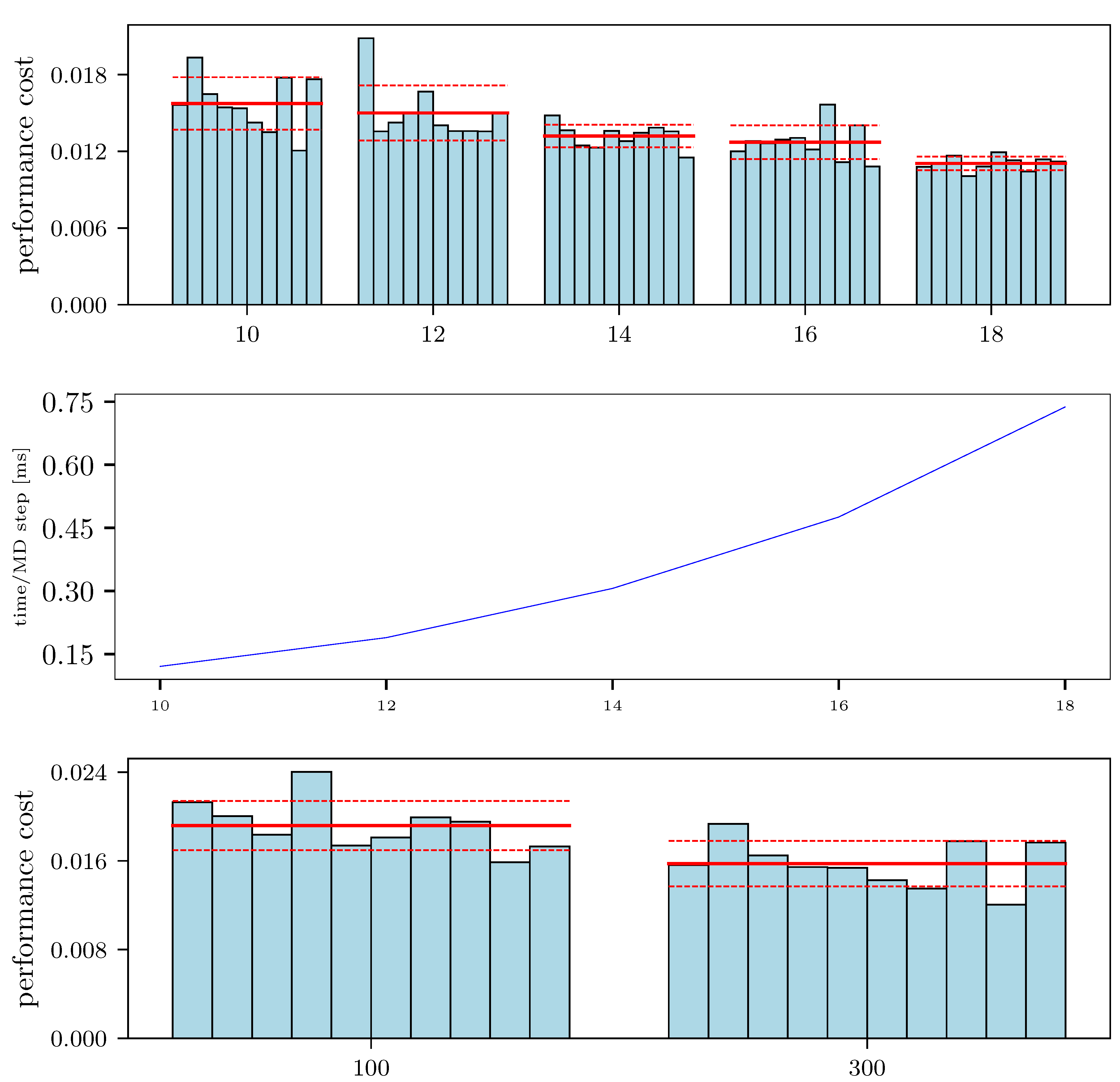
Figure 2.
The figure presents the performance cost of the primary MTP ensembles generated for each material. They are trained on the main dataset (Section 2.2, set 1). From the set of ten level-10 MTPs, the best-performing one (i.e., the one with the lowest cost) is selected for each material and highlighted in red.
Figure 2.
The figure presents the performance cost of the primary MTP ensembles generated for each material. They are trained on the main dataset (Section 2.2, set 1). From the set of ten level-10 MTPs, the best-performing one (i.e., the one with the lowest cost) is selected for each material and highlighted in red.
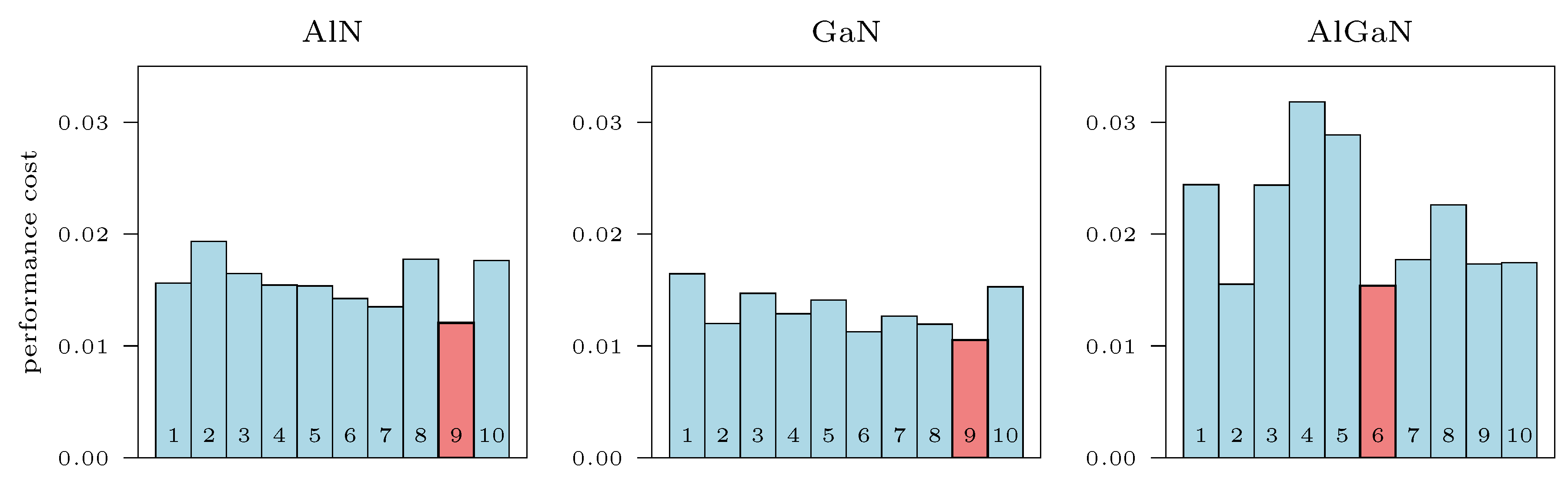
Figure 6.
The top panels display the unit cell volumes as a function of temperature and the bottom panels the corresponding volumetric thermal expansion coefficients. Depicted are MD results calculated with the material-specific (red circles) and alloy (green circles) MTPs and the corresponding fits (red and green lines), obtained using eq:latticeconstantsclassical. Results calculated in the quasi-harmonic approximation (QHA, Section 2.4) are shown as dashed lines. They have been obtained using the material-specific MTP (red), the alloy MTP (green), and DFT (blue). Experimental data are shown as unconnected points and have been taken from a number of publications. For AlN: Kröncke et al. [38] (cyan diamond), Paszkowicz et al. [39] (brown left-sided triangle), Slack et al. [40] (magenta upside triangle) and Yim et al. [41] (grey cross). For GaN: Kirchner et al. [42] (cyan diamond), Leszczynski et al. [43] (magenta left-sided triangles), Maruska et al. [44] (brown cross), Reeber et al. [45] (grey squares) and Roder et al. [46] (pink right-sided triangle).
Figure 6.
The top panels display the unit cell volumes as a function of temperature and the bottom panels the corresponding volumetric thermal expansion coefficients. Depicted are MD results calculated with the material-specific (red circles) and alloy (green circles) MTPs and the corresponding fits (red and green lines), obtained using eq:latticeconstantsclassical. Results calculated in the quasi-harmonic approximation (QHA, Section 2.4) are shown as dashed lines. They have been obtained using the material-specific MTP (red), the alloy MTP (green), and DFT (blue). Experimental data are shown as unconnected points and have been taken from a number of publications. For AlN: Kröncke et al. [38] (cyan diamond), Paszkowicz et al. [39] (brown left-sided triangle), Slack et al. [40] (magenta upside triangle) and Yim et al. [41] (grey cross). For GaN: Kirchner et al. [42] (cyan diamond), Leszczynski et al. [43] (magenta left-sided triangles), Maruska et al. [44] (brown cross), Reeber et al. [45] (grey squares) and Roder et al. [46] (pink right-sided triangle).
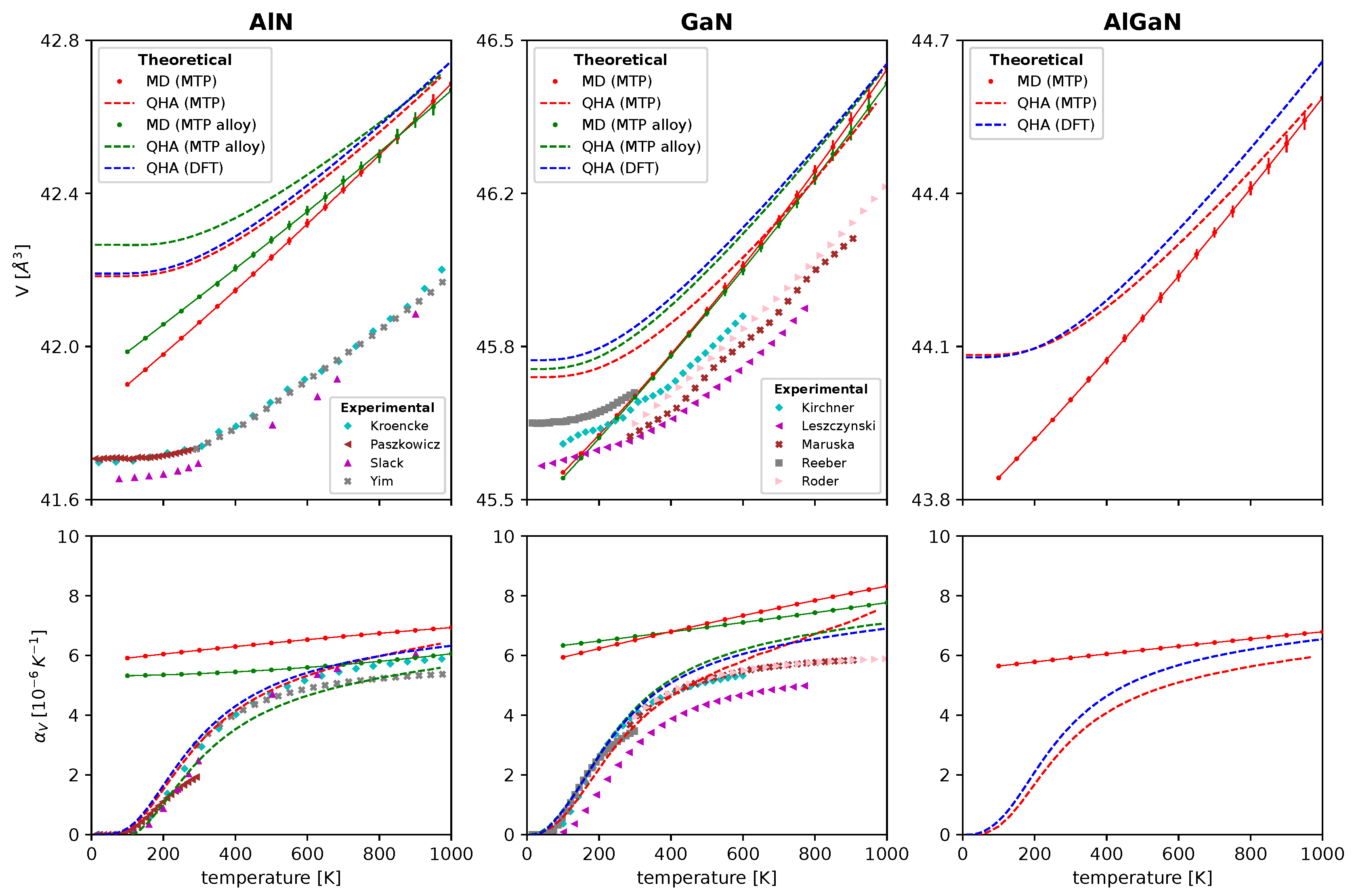
Figure 7.
Phonon dispersion along high-symmetry paths in the first Brillouin zone. The results for the material-specific MTP are plotted in red, the alloy MTP in green, and the DFT-calculated results in blue. Black dots represent experimental data from Schwoerer-Böhning et al. [56] for AlN and Ruf et al. [57] for GaN. In the panels to the right of the band structures, densities of states are shown.
Figure 7.
Phonon dispersion along high-symmetry paths in the first Brillouin zone. The results for the material-specific MTP are plotted in red, the alloy MTP in green, and the DFT-calculated results in blue. Black dots represent experimental data from Schwoerer-Böhning et al. [56] for AlN and Ruf et al. [57] for GaN. In the panels to the right of the band structures, densities of states are shown.
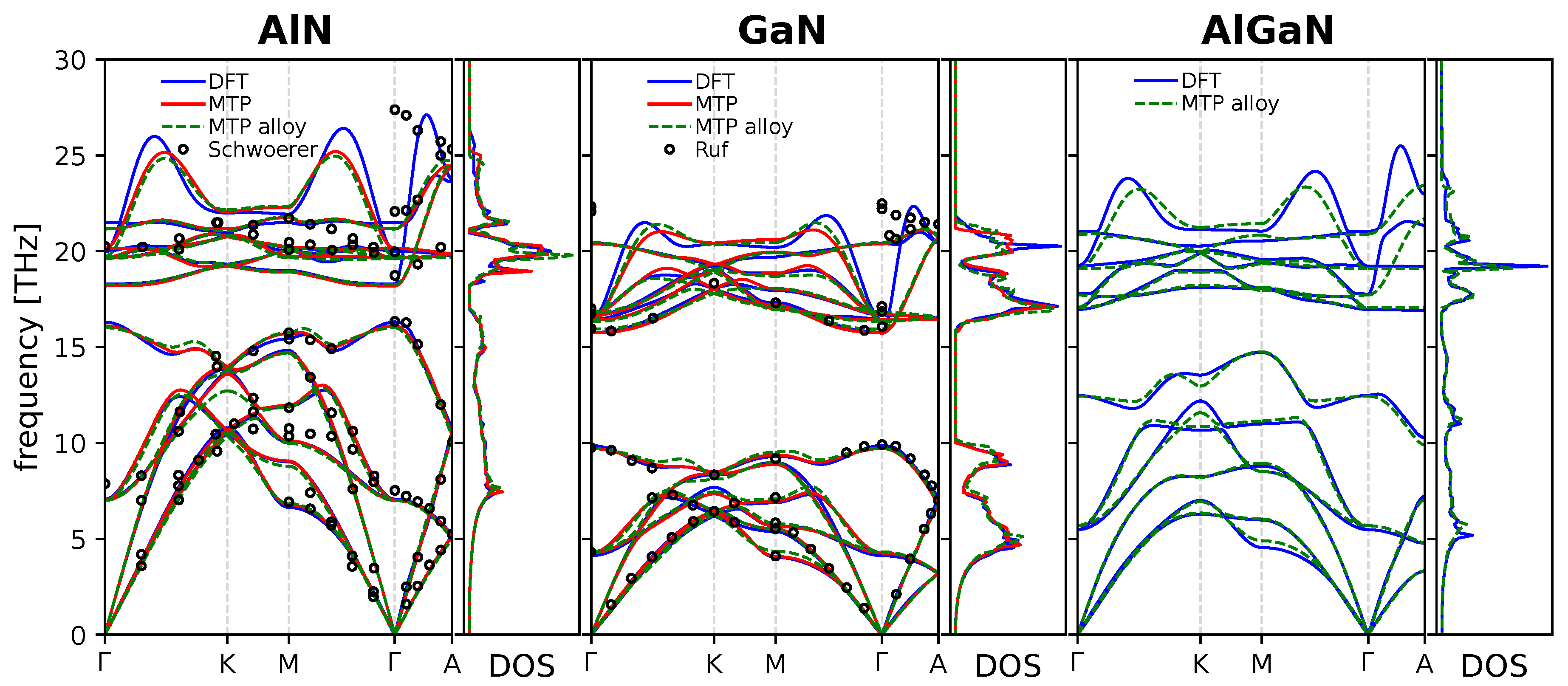
Figure 8.
Scatter plots of the mode-Grüneisen parameters as a function of the phonon frequency. Grüneisen parameters are determined from third-order force constants using ShengBTE on reciprocal space grid (see Section 2.4). DFT calculated results are shown in blue, results of the material specific FFP in red and those of the alloy FFP in green.
Figure 8.
Scatter plots of the mode-Grüneisen parameters as a function of the phonon frequency. Grüneisen parameters are determined from third-order force constants using ShengBTE on reciprocal space grid (see Section 2.4). DFT calculated results are shown in blue, results of the material specific FFP in red and those of the alloy FFP in green.
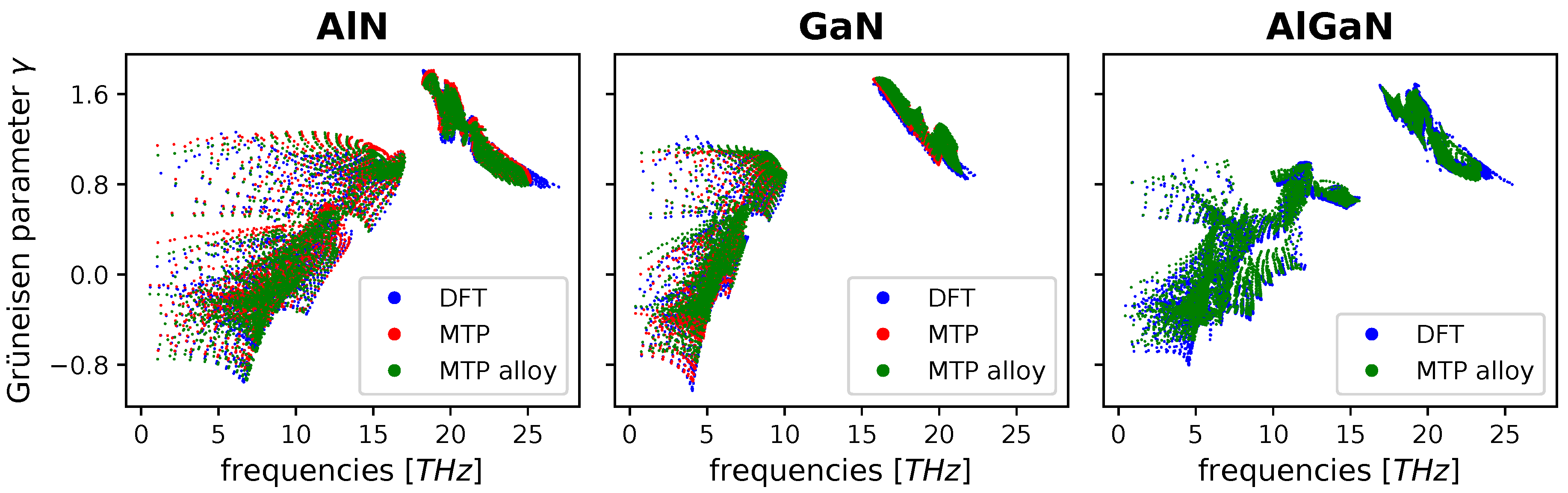
Figure 9.
Comparison of experimental and calculated thermal conductivities in z-direction, , as a function of temperature. DFT calculated results (blue dash-dotted lines), material specific MTPs (red solid lines) and alloy MTP (green dotted lines). The lime-colored crosses in the central panel at 300K and 800K denote results for the material specific MTP that also include fourth-order contributions to phonon scattering. All of the literature data reported here is of c-oriented bulk single-crystals, except for the N data by Daly et al. [61] (cyan spheres), which are of single-crystalline thin films of unknown orientation and crystal quality. The data for AlN are by Inyushkin et al. [62] (cyan spheres) and Slack et al. [63] (magenta upside triangles). The data for GaN are from Jezowski et al. [64] (cyan spheres), Paskov et al. [65] (magenta upside triangles), Shibata et al. [66] (orange diamonds), Simon et al. [67] (brown downside triangles), Slack et al. [63] (pink plus signs) and Tran et al. [68] (grey leftside triangles).
Figure 9.
Comparison of experimental and calculated thermal conductivities in z-direction, , as a function of temperature. DFT calculated results (blue dash-dotted lines), material specific MTPs (red solid lines) and alloy MTP (green dotted lines). The lime-colored crosses in the central panel at 300K and 800K denote results for the material specific MTP that also include fourth-order contributions to phonon scattering. All of the literature data reported here is of c-oriented bulk single-crystals, except for the N data by Daly et al. [61] (cyan spheres), which are of single-crystalline thin films of unknown orientation and crystal quality. The data for AlN are by Inyushkin et al. [62] (cyan spheres) and Slack et al. [63] (magenta upside triangles). The data for GaN are from Jezowski et al. [64] (cyan spheres), Paskov et al. [65] (magenta upside triangles), Shibata et al. [66] (orange diamonds), Simon et al. [67] (brown downside triangles), Slack et al. [63] (pink plus signs) and Tran et al. [68] (grey leftside triangles).
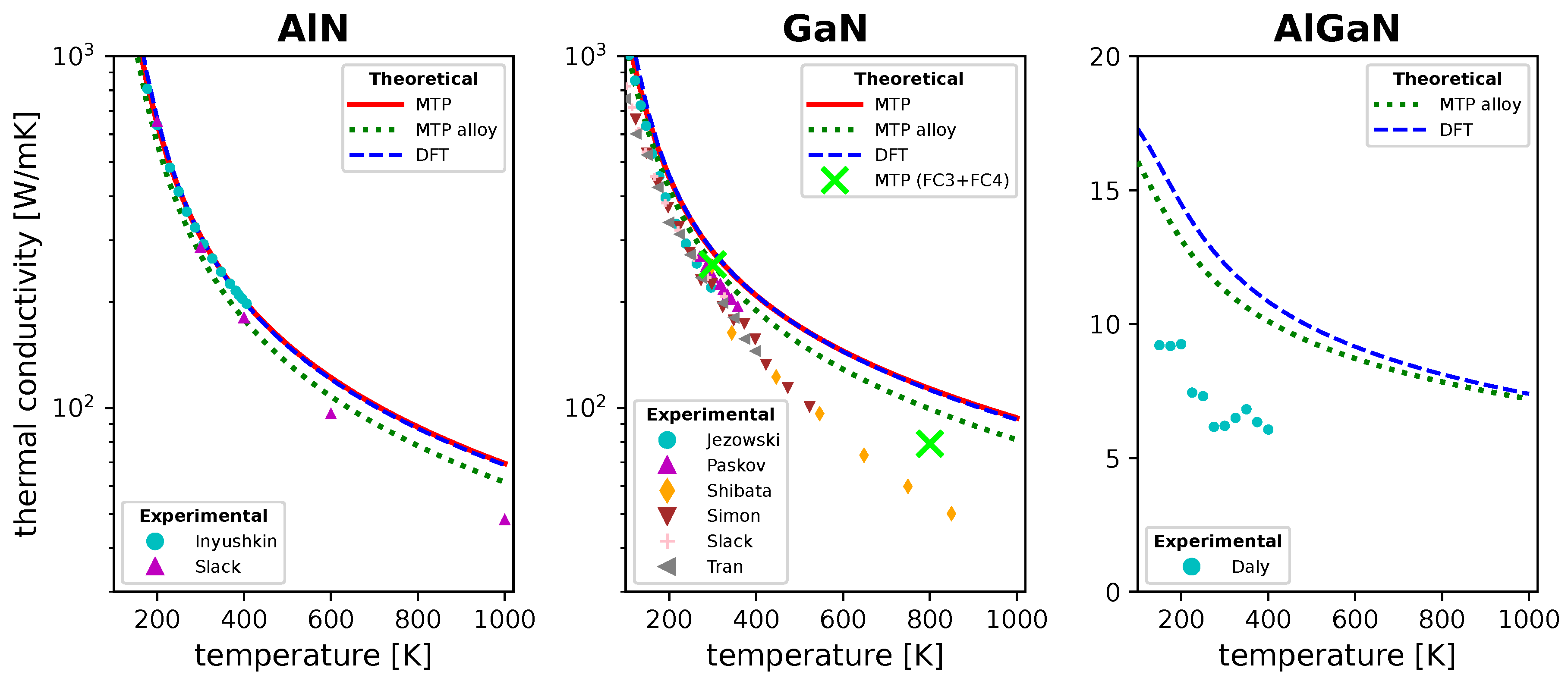
Figure 10.
Frequency-resolved average thermal conductivity calculated with the material-specific MTPs, the alloy MTP and DFT at 300 K. The results for the material-specific MTPs are shown in red, the alloy MTP in green and the DFT results in blue. These results are calculated from the contributions of the different modes to the thermal conductivity for a discrete sampling of reciprocal space using a Gaussian smearing (see eq:kappaDOS).
Figure 10.
Frequency-resolved average thermal conductivity calculated with the material-specific MTPs, the alloy MTP and DFT at 300 K. The results for the material-specific MTPs are shown in red, the alloy MTP in green and the DFT results in blue. These results are calculated from the contributions of the different modes to the thermal conductivity for a discrete sampling of reciprocal space using a Gaussian smearing (see eq:kappaDOS).
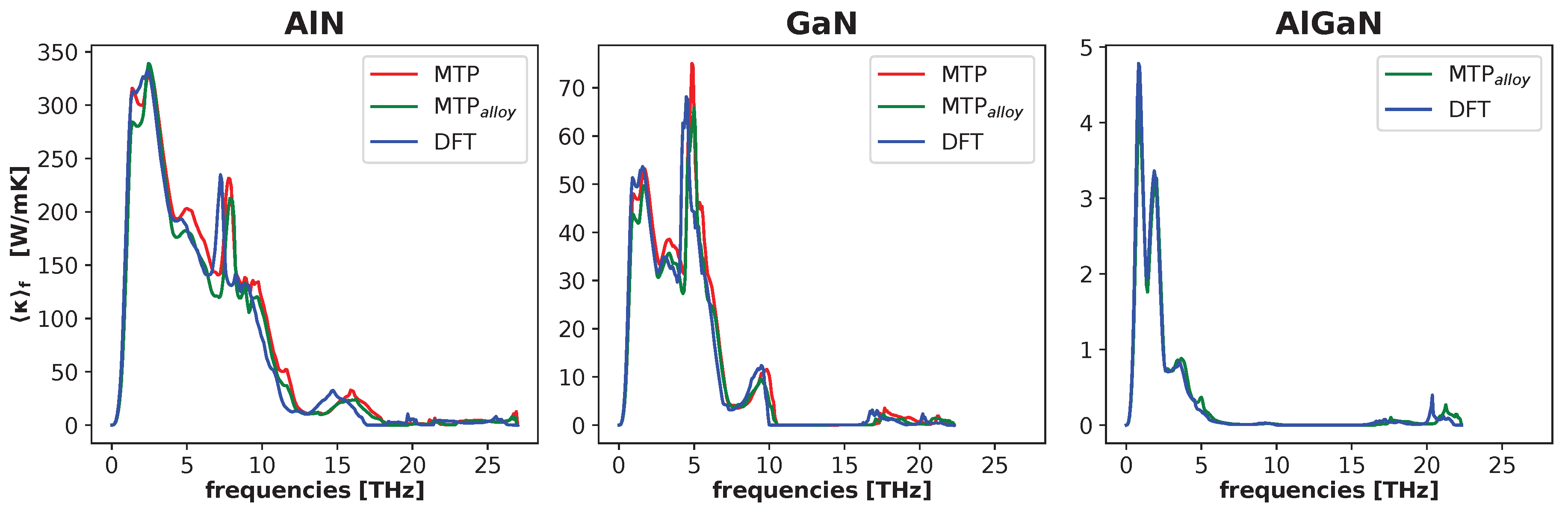
Table 1.
Summarizes the data sets used in this work.
| Name | [Å] | [%] | ||
|---|---|---|---|---|
| set 1 | 300 | 50 | 0.2 | 2 |
| set 2 | 300 | 50 | 0.05 | 0.5 |
Table 2.
Lattice constants of wurtzite AlN, GaN and N, determined by static structural optimization using our MTPs and DFT. DFT, MTP, MTP were obtained in the framework of the quasi-harmonic approximation and include the zero-point motion of phonons. The last column shows low temperature experimental data from Kröncke et al. [38] (at 20 K) and Paszkowicz et al. (at 10 K) [39] for AlN and Reeber et al. [45] (15 K) and Minikayev et al. [47] (15 K) for GaN. The N values are determined with Vegard’s law from the data of AlN and GaN using the average experimental results for AlN and GaN. Units are in Å.
Table 2.
Lattice constants of wurtzite AlN, GaN and N, determined by static structural optimization using our MTPs and DFT. DFT, MTP, MTP were obtained in the framework of the quasi-harmonic approximation and include the zero-point motion of phonons. The last column shows low temperature experimental data from Kröncke et al. [38] (at 20 K) and Paszkowicz et al. (at 10 K) [39] for AlN and Reeber et al. [45] (15 K) and Minikayev et al. [47] (15 K) for GaN. The N values are determined with Vegard’s law from the data of AlN and GaN using the average experimental results for AlN and GaN. Units are in Å.
| DFT | MTP | DFT | MTP | MTP | Exp. | |||
| AlN | a | 3.1135 | 3.1134 | 3.1148 | 3.1221 | 3.1218 | 3.1229 | 3.1102, 3.1106 |
| c | 4.9830 | 4.9838 | 4.9895 | 4.9968 | 4.9972 | 5.0025 | 4.9800, 4.9799 | |
| GaN | a | 3.1824 | 3.1825 | 3.1815 | 3.1904 | 3.1894 | 3.1893 | 3.1893, 3.1880 |
| c | 5.1853 | 5.1857 | 5.1870 | 5.1983 | 5.1969 | 5.1996 | 5.1856, 5.1842 | |
| N | a | 3.1464 | - | 3.1456 | 3.1547 | 3.1532 | 3.1495(4) | |
| c | 5.0962 | - | 5.1026 | 5.1095 | 5.1148 | 5.0824(4) | ||
Table 4.
Room temperature (300 K) data for the diagonal thermal conductivity tensor components , , in AlN, GaN and N. The values are calculated with anharmonic lattice dynamics considering only three-phonon scattering. Shown are results for the material-specific and alloy MTPs and for DFT. The last column reports experimental values of at 300K. For GaN we also report values calcualted with the material-specific MTP, that include four-phonon scattering. Units are in .
Table 4.
Room temperature (300 K) data for the diagonal thermal conductivity tensor components , , in AlN, GaN and N. The values are calculated with anharmonic lattice dynamics considering only three-phonon scattering. Shown are results for the material-specific and alloy MTPs and for DFT. The last column reports experimental values of at 300K. For GaN we also report values calcualted with the material-specific MTP, that include four-phonon scattering. Units are in .
| MTP | DFT | MTP (FC4) | Exp. | |||
| AlN | 329.9 | 302.2 | 327.3 | |||
| GaN | 263.9 | 242.7 | 258.9 | - | - | |
| N | - | 5.9 | 6.0 | |||
| AlN | 329.9 | 302.2 | 327.3 | |||
| GaN | 263.9 | 242.7 | 258.9 | - | - | |
| N | - | 5.9 | 6.0 | |||
| AlN | 307.6 | 272.0 | 308.1 | - | 285.0, 306.4 | |
| GaN | 278.7 | 256.6 | 279.9 | 255.8 | 252.3,245.0(5) | |
| N | - | 11.3 | 12.2 | - | 6.2(6)[61] | |
Disclaimer/Publisher’s Note: The statements, opinions and data contained in all publications are solely those of the individual author(s) and contributor(s) and not of MDPI and/or the editor(s). MDPI and/or the editor(s) disclaim responsibility for any injury to people or property resulting from any ideas, methods, instructions or products referred to in the content. |
© 2026 by the authors. Licensee MDPI, Basel, Switzerland. This article is an open access article distributed under the terms and conditions of the Creative Commons Attribution (CC BY) license (http://creativecommons.org/licenses/by/4.0/).
Copyright: This open access article is published under a Creative Commons CC BY 4.0 license, which permit the free download, distribution, and reuse, provided that the author and preprint are cited in any reuse.


