

Submitted:
26 March 2026
Posted:
26 March 2026
You are already at the latest version
Abstract
Pathogenic variants in the NEXMIF gene have been linked to a broad neurodevelopmental phenotype, encompassing autism spectrum disorder, intellectual disability, and epilepsy. Among epileptic manifestations, Jeavons Syndrome was observed in 24% of affected females in the largest cohort of NEXMIF-related disorders reported to date, but long-term adult outcomes remain poorly documented. We report a 25-year-old Italian woman with drug-resistant Jeavons syndrome in which the combined approach of next generation sequencing and chromosomal microarray analysis allowed us to identify, after a 13-year diagnostic odyssey, a de novo ~350 Kb microdeletion at Xq13.2q13.3 encompassing the entire NEXMIF coding region, with no other OMIM genes involved. To our knowledge, this is the first reported case of a patient harboring a deletion restricted to the entire coding sequence of the NEXMIF gene. The patient presented with moderate intellectual disability and seizure onset at age 10 years. Her epilepsy proved refractory to multiple antiseizure medications, Video-EEG/polygraphic monitoring at age 23 years confirmed epilepsy with eyelid myoclonia, demonstrating characteristic eyelid myoclonia with absences triggered by eye closure. This case provides a detailed clinical description of an adult patient useful for genetic counseling regarding adult outcomes and prognostic expectations. Furthermore, this study underscores the complementary diagnostic value of chromosomal microarray analysis alongside next-generation sequencing in individuals with intellectual disability and drug-resistant epilepsy, in order to expedite the diagnostic pathway and enable timelier and more appropriate patient management.
Keywords:
NEXMIF
; Jeavons syndrome
; long-term follow-up
; neurodevelopmental disorders
1. Introduction
The NEXMIF gene (OMIM *300524) is located at Xq13.3 and encodes the Neurite Extension and Migration Factor protein, which is highly expressed in the cerebral cortex and plays vital roles in neurite outgrowth by regulating cell-cell adhesion during early brain development [1,2,3,4]. Pathogenic NEXMIF variants are associated with X-linked intellectual developmental disorder 98 (XLID98, OMIM# 300912), a clinical condition characterized by delayed psychomotor development, impaired or absent speech, behavioral abnormalities, and epilepsy [5]. These variants were initially identified and characterized in hemizygous male patients with nonsyndromic X-linked intellectual disability (ID), poor or absent speech, subtle dysmorphic features, and sometimes epilepsy [6,7], while heterozygous females in these families were mostly unaffected. Subsequently, many symptomatic females carrying deleterious variants in this gene have been described, ranging from mild to severe phenotypes [5,8,9,10]. In 2021, Stamberger et al. released an extensive molecular and clinical investigation that included 87 patients with NEXMIF associated encephalopathy (46 novel cases and 41 from the literature), establishing the reference standard for comparing male and female phenotypes [11]. Among the epileptic manifestations reported by females with NEXMIF-related disorders, epilepsy with eyelid myoclonia (EEM) emerged as a distinctive feature, occurring in 24% of affected females in their cohort.
EEM, also known as Jeavons Syndrome (JS), is a generalized epilepsy syndrome clinically characterized by eyelid myoclonia with or without absences, eye closure-induced electroencephalography paroxysms, and photosensitivity [12]. The clinical onset of this condition typically occurs during childhood, and several candidate genes are associated with this syndrome, including SYNGAP1, NEXMIF, RORB, NAA10, and CHD2 [13].
Despite increasing recognition of NEXMIF-related disorders, the number of reported adult patients with pathogenic NEXMIF variants, particularly in association with specific epileptic syndromes such as Jeavons syndrome, remains poorly characterized. Furthermore, the mutational spectrum includes predominantly point mutations and small insertions/deletions, while large copy number variations (CNVs) remain exceptionally rare.
Here, we report the first case of a complete NEXMIF coding region microdeletion in a female patient with drug-resistant Jeavons syndrome and moderate intellectual disability.
2. Materials and Methods
2.1. Patient Recruitment
A blood sample from the patient and both her parents was collected at Fondazione IRCCS Casa Sollievo della Sofferenza (San Giovanni Rotondo, Italy). The family provided written informed consent to molecular testing and gave their consent to publish clinical and molecular data. The study was approved by the Casa Sollievo della Sofferenza Hospital ethics committee (protocol no. 90/CE/2024) and is in accordance with the Declaration of Helsinki (1984) and subsequent versions.
Genomic DNA was extracted from peripheral blood leukocytes using the automated Bio Robot EZ1 (Quiagen, Solna, Sweden) following the manufacturer's instructions. DNA concentration and purity were assessed spectrophotometrically using the Nanodrop 2000C spectrophotometer (Thermo Fisher Scientific, Waltham, MA).
2.2. Genetic Analysis
Gene panel sequencing on proband DNA was performed using custom SureSelect gene panels (Agilent Technologies, Boulder, CA, USA) designed to selectively capture 162 and 294 known genes associated with syndromic and non-syndromic forms of epilepsy and neurodevelopmental disorders (Supplementary Materials and Methods), respectively. Libraries were prepared using the SureSelect enrichment kit (Agilent Technologies, Boulder, CO, USA) following the manufacturer’s instructions.
Subsequently, the targeted fragments obtained were sequenced on a NextSeq 500 sequencer (Illumina, San Diego, CA, USA) using a NextSeq 500 mid-output kit V2.5 (300-cycle flow cell) and identified variants were prioritized as previously described [14]. The clinical significance of the identified putative variants was assessed according to the American College of Medical Genetics and Genomics (ACMG) guidelines [15].
Chromosomal microarray analysis (CMA) was performed using the CytoScan HD Array (Thermo Fisher Scientific, Waltham, MA, USA) according to the manufacturer's protocol while data analysis has been performed processing Raw data (CEL files) with Chromosome Analysis Suite (ChAS) software version 4.3 (Thermo Fisher Scientific) as previously described [16]. In addition to the American College of Medical Genetics (ACMG) and Clinical Genome Resource (ClinGen) guidelines [17], the clinical significance of each identified CNV was established by comparing the chromosomal alterations found in the patient with those from public databases such as the Database of Genomic Variants (DGV) (https://dgv.tcag.ca/dgv/app/home), ClinVar (https://www.ncbi.nlm.nih.gov/clinvar/), DECIPHER (https://www.deciphergenomics.org), SFARI (Simon’s Foundation Autism Research Initiative, https://gene.sfari.org), and OMIM (Online Mendelian Inheritance in Man database, https://www.omim.org/). Genomic coordinates, genes impacted by CNV, and disease associations were determined from the University of California Santa Cruz (UCSC) Genome Browser (GRCh37/hg19) (https://genome.ucsc.edu).
3. Results
3.1. Clinical Description
The patient is a 25-year-old Italian woman, first-born of two children from unrelated and healthy parents. Family history for neurological disorders was unremarkable. Perinatal distress was noted, including maternal hypertensive crises and an urgent Cesarean section at term (39 weeks of gestation) due to fetal distress. Birth weight was 2200 gr (<3rd percentile), and birth length was 46 cm (10-25th percentile). The neonatal period following the perinatal distress was unremarkable, with no recorded enduring complications. Since early childhood, the patient has shown a psychomotor developmental delay and moderate intellectual disability, requiring educational support throughout primary school. Despite these challenges, she successfully completed her secondary education, suggesting that her practical skills and ability to perform structured tasks were relatively intact compared to her overall cognitive abilities.
At age 10 years, she developed daily seizures characterized by brief absences associated with generalized spike-and-polyspike-and-slow-wave discharges on electroencephalography (EEG). These episodes frequently evolved into prolonged non-convulsive status epilepticus and proved refractory to multiple antiseizure medications, including valproic acid (VPA), ethosuximide (ETS), lamotrigine (LTG), topiramate (TPM), and perampanel (PER). At least two generalized tonic-clonic seizures occurred at ages 15 and 18 years. Prolonged video-EEG/polygraphic monitoring at age 23 years revealed brief and prolonged bursts (5-10 seconds) of low-amplitude, diffuse, fast spike-and-polyspike-and-slow-wave discharges. These abnormalities were accentuated by eye closure and clinically associated with ocular deviation. The electroclinical pattern was consistent with epilepsy with eyelid myoclonia (formerly Jeavons syndrome). Brain magnetic resonance imaging (MRI) was unremarkable.
At 25 years old, she underwent her last physical examination, which revealed a height of 152 cm (3rd-5th percentile), a weight of 82 kg, a body mass index (BMI) of 35.5 kg/m² (obesity class II), and a head circumference of 53 cm (50th percentile). Subtle dysmorphic features, including mild left eyelid ptosis and bilateral pes planus (flat feet), were noted.
3.2. Genetic Findings
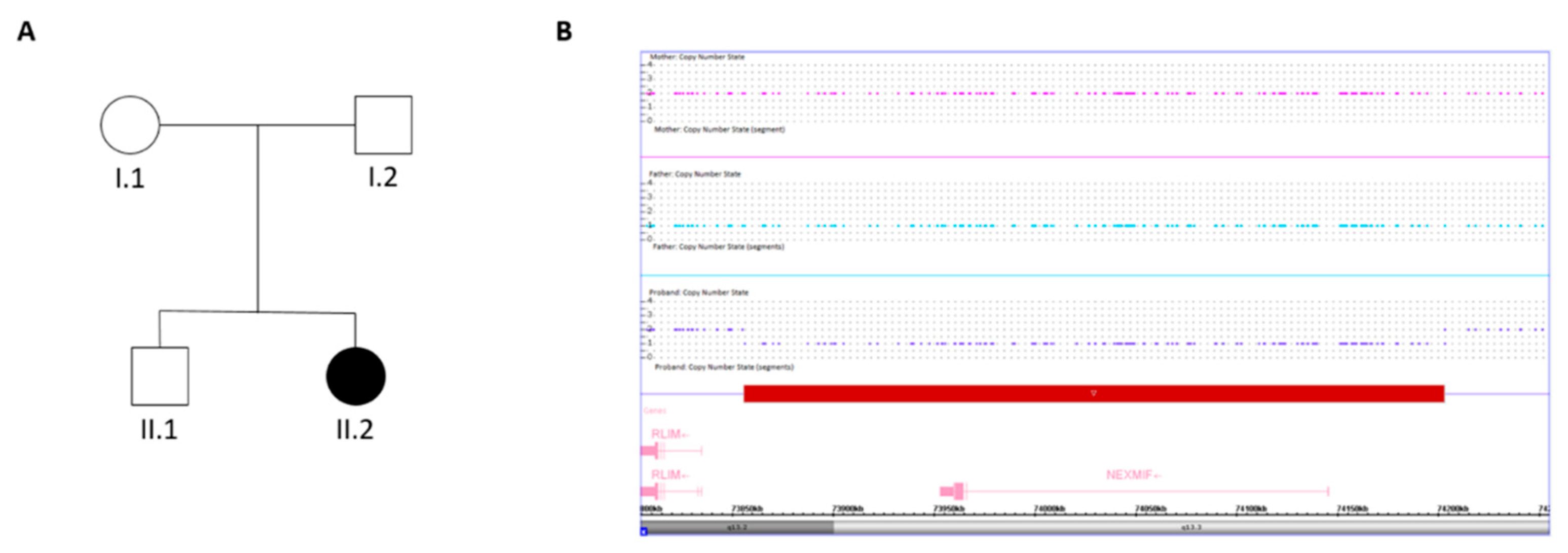
No pathogenic or likely pathogenic sequence variants were detected by gene panels sequencing while CMA revealed a heterozygous microdeletion at locus Xq13.2q13.3, spanning approximately 350 kb from position 73,855,585 to 74,202,615 (hg19 release). The deletion encompassed only the entire coding region of the NEXMIF gene and was covered by 427 SNP array probes. Subsequently, the parental CMA showed a normal copy number state in both parents suggesting the de novo occurrence of the microdeletion (Figure 1).
The highlighted region did not show any benign copy number variants in the DGV database. Furthermore, neither the ClinVar nor the DECIPHER databases contained any annotated patients with similar rearrangements. The molecular karyotype of the patient, according to the International System for Human Cytogenetic Nomenclature (ISCN 2020), is arr[GRCh37] Xq13.2q13.3(73855585_74202615)x1 dn. Following ACMG/ClinGen guidelines for CNV interpretation, this microdeletion was classified as “pathogenic” based on the complete deletion of NEXMIF, an established haploinsufficiency gene associated with a syndromic form of X-linked neurodevelopmental disorder (total score: +1.00, 2A).
4. Discussion
In this study we report the clinical, and molecular characterization of a 25-year-old Italian woman harboring a de novo ~350 Kb interstitial microdeletion on Xq13.2q13.3 chromosome region. This microdeletion encompasses the complete coding region of the NEXMIF gene. The patient presented with a complex neurodevelopmental phenotype characterized by drug-resistant Jeavons syndrome (JS), moderate intellectual disability, and obesity.
NEXMIF-related disorders (OMIM # 300912) are X-linked neurodevelopmental conditions caused by pathogenic variants in the NEXMIF, leading to intellectual disability, autism spectrum disorder, and epilepsy. The condition shows a pronounced sex influence, with males typically having more severe developmental impairment and exhibiting more severe intellectual disability and behavioral abnormalities, consistent with X-linked inheritance, whereas females have a disproportionately high seizure rate [11]. Jeavons syndrome has been identified as a distinctive feature in 24% of affected females in the largest cohort of NEXMIF-related disorders reported to date [11]. This case represents long-term longitudinal documented clinical follow-ups, carrying the pathogenic NEXMIF deletion associated with JS.
The longitudinal observation reveals three clinical stages in our patient: i) she showed seizure onset at 10 years with rapid evolution of severe pharmacoresistance; ii) adolescent progression was marked by persistent absence seizures, status epilepticus, and two generalized tonic-clonic seizures; iii) adult progression was characterized by frequent, drug-resistant absence status epilepticus but was stable from a cognitive perspective.
Seizure onset in Jeavons syndrome typically occurs in childhood between ages 2 -14 years, with most cases presenting between ages 6-8 years [18]. Our patient had seizure onset at 10 years and subsequently developed severe drug resistant epilepsy, resistant to five pharmacological treatments, including VPA, ETS, LTG, TPM, and PER. Valproic acid, ethosuximide, and lamotrigine are three of the four most effective treatments identified in JS [18], underscoring the severe pharmacoresistance in our case. She successfully completed secondary education despite daily seizures and moderate intellectual disability, suggesting that educational achievement may be preserved in selected NEXMIF-related cases despite significant seizure burden. This outcome extends observations from JS, in which 23% of patients have intellectual disability [19], but does not preclude functional or educational achievements. The development of obesity during adolescence is consistent with Langley et al. (2022), who suggested that obesity may be an underestimated feature of NEXMIF-related disorders [7].
Video-EEG/polygraphic monitoring only established the diagnosis of Jeavons syndrome at age 23, highlighting the diagnostic challenges inherent to these disorders. Finally, these long-term remarks offer valuable, useful prognostic insights for counseling families and underscore the need for systematic longitudinal studies to better understand natural history patterns in NEXMIF-related disorders.
From a molecular point of view, this case represents the first report describing a complete NEXMIF coding region deletion in a female with Jeavons syndrome. The mutational spectrum of NEXMIF-related disorders can be defined by loss-of-function point mutations and small indels, whereas large copy number variations are uncommon. In 2021, Stamberger et al. reported a female carrying a microdeletion of 77 kb that covers a part of the NEXMIF gene [11]. The microdeletion identified in our patient does not encompass any other OMIM genes, providing a direct genotype-phenotype correlation. A query in the ClinVar and DECIPHER databases (February, 2026) confirmed that there are no previously reported cases with microdeletion that involves the entire NEXMIF coding region with no other contiguous OMIM genes. This finding expands the mutational landscape and provides further molecular evidence supporting haploinsufficiency as the primary pathogenic mechanism in this syndrome.
To acquire a mechanistic understanding of epileptogenesis, it is essential to understand the biological function of the NEXMIF protein. NEXMIF is an X-linked gene that encodes a nuclear protein highly expressed in the cerebral cortex. It is crucial in neuronal morphogenesis, migration, and synapse formation [1,2,4]. Loss of function variants lead to abnormal dendritic arborization and decreased synaptic density [1,4], which may disrupt excitatory/inhibitory balance and predispose individuals to hyperexcitability. The high prevalence of generalized epilepsy with absence features in NEXMIF patients [11] suggests the involvement of circuits generating spike-wave discharges.
5. Conclusions
We report the electro-clinical features of an adult female affected by Jeavons Syndrome carrier of a heterozygous microdeletion of NEXMIF gene. Seizure onset occurred at 10 years of age, showing a refractory course despite treatment with several anti-seizure medication. Characterizing the natural history of a disorder through the study of adult patients represents a fundamental step toward improving clinical management, implementing targeted surveillance and preventive interventions, and enhancing genetic counseling for families. In this regard, long-term follow-up in our patient is useful to better understand NEXMIF-related disorders adult outcomes, improving patient care and management. In addition, this is the first reported case, resolved after a 13-year diagnostic odyssey, of a microdeletion restricted to the entire coding sequence of the NEXMIF gene useful to highlight once again the importance to use complementary genetic technologies for solving complex neurodevelopmental disorders cases.
Supplementary Materials
The following supporting information can be downloaded at the website of this paper posted on Preprints.org, Neurodevelopmental disorders gene panel; Epilepsy gene panel.
Author Contributions
Conceptualization, G.d. and O.P.; data curation, M.B., P.P. and O.P.; formal analysis, M.B., P.P., and O.P.; investigation, U.C. and G.d.; funding acquisition, M.Car. and M.Cas.; supervision, G.d., M.Car. and M.Cas.; writing—original draft, M.B. and O.P.; writing—review and editing, G.d. and O.P. All authors have read and agreed to the published version of the manuscript.
Funding
This research was funded by the European Union—Next-Generation EU—PNRR M6/C2. Project ‘Creating next-generation databases to improve molecular diagnosis in neurodevelopmental disorders’—PNRR-MR1-2023-12377843 to Massimo Carella and by the Italian Ministry of Health Ricerca Finalizzata 2021 (Project no. RF_2021_12373524) to Marco Castori.
Institutional Review Board Statement
The study was conducted according to the guidelines of the Declaration of Helsinki and approved by the Ethics Committee of Casa Sollievo della Sofferenza Hospital (protocol no. 90/CE/2024).
Informed Consent Statement
The families provided written informed consent for the molecular testing and for the full content of this publication.
Acknowledgments
The authors thank the patients’ families for their kind availability and for authorizing the publication of the data.
Conflicts of Interest
The authors declare no conflicts of interest. The funders had no role in the design of the study, in the collection, analyses, or interpretation of data, in the writing of the manuscript, or in the decision to publish the results.
References
- Gilbert, J.; Man, H.Y. The X-linked autism protein KIAA2022/KIDLIA regulates neurite outgrowth via N-cadherin and δ-catenin signaling. eNeuro 2016, 3, ENEURO.0238-16.2016. [CrossRef]
- Magome, T.; Hattori, T.; Taniguchi, M.; Ishikawa, T.; Miyata, S.; Yamada, K.; Takamura, H.; Matsuzaki, S.; Ito, A.; Tohyama, M.; et al. XLMR protein related to neurite extension (XPN/KIAA2022) regulates cell-cell and cell-matrix adhesion and migration. Neurochem. Int. 2013, 63, 561–569. [CrossRef]
- Ishikawa, T.; Miyata, S.; Koyama, Y.; Yoshikawa, K.; Hattori, T.; Kumamoto, N.; Shingaki, T.; Katayama, T.; Tohyama, M. Transient expression of XPN, an XLMR protein related to neurite extension, during brain development and participation in neurite outgrowth. Neuroscience 2012, 214, 181–191. [CrossRef]
- Gilbert, J.; O'Connor, M.; Templet, S.; Moghaddam, M.; Di Via Ioschpe, A.; Sinclair, A.; Zhu, L.Q.; Xu, W.; Man, H.Y. NEXMIF/KIDLIA knock-out mouse demonstrates autism-like behaviors, memory deficits, and impairments in synapse formation and function. J. Neurosci. 2020, 40, 237–254. [CrossRef]
- de Lange, I.M.; Helbig, K.L.; Weckhuysen, S.; Møller, R.S.; Velinov, M.; Dolzhanskaya, N.; Marsh, E.; Helbig, I.; Devinsky, O.; Tang, S.; et al. De novo mutations of KIAA2022 in females cause intellectual disability and intractable epilepsy. J. Med. Genet. 2016, 53, 850–858. [CrossRef]
- Lorenzo, M.; Stolte-Dijkstra, I.; van Rheenen, P.; Smith, R.G.; Scheers, T.; Walia, J.S. Clinical spectrum of KIAA2022 pathogenic variants in males: Case report of two boys with KIAA2022 pathogenic variants and review of the literature. Am. J. Med. Genet. A 2018, 176, 1455–1462. [CrossRef]
- Langley, E.; Farach, L.S.; Koenig, M.K.; Northrup, H.; Rodriguez-Buritica, D.F.; Mowrey, K. NEXMIF pathogenic variants in individuals of Korean, Vietnamese, and Mexican descent. Am. J. Med. Genet. A 2022, 188, 1688–1692. [CrossRef]
- Athanasakis, E.; Licastro, D.; Faletra, F.; Fabretto, A.; Dipresa, S.; Vozzi, D.; Morgan, A.; d'Adamo, A.P.; Pecile, V.; Biarnés, X.; et al. Next generation sequencing in nonsyndromic intellectual disability: From a negative molecular karyotype to a possible causative mutation detection. Am. J. Med. Genet. A 2014, 164A, 170–176. [CrossRef]
- Moysés-Oliveira, M.; Guilherme, R.S.; Meloni, V.A.; Di Battista, A.; de Mello, C.B.; Bragagnolo, S.; Moretti-Ferreira, D.; Kosyakova, N.; Liehr, T.; Carvalheira, G.M.; et al. X-linked intellectual disability related genes disrupted by balanced X-autosome translocations. Am. J. Med. Genet. B Neuropsychiatr. Genet. 2015, 168, 669–677. [CrossRef]
- Farach, L.S.; Northrup, H. KIAA2022 nonsense mutation in a symptomatic female. Am. J. Med. Genet. A 2016, 170, 703–706. [CrossRef]
- Stamberger, H.; Hammer, T.B.; Gardella, E.; Vlaskamp, D.R.M.; Bertelsen, B.; Mandelstam, S.; de Lange, I.; Zhang, J.; Myers, C.T.; Fenger, C.; et al. NEXMIF encephalopathy: An X-linked disorder with male and female phenotypic patterns. Genet. Med. 2021, 23, 363–373. [CrossRef]
- Striano, S.; Capovilla, G.; Sofia, V.; Romeo, A.; Rubboli, G.; Striano, P.; Trenité, D.K. Eyelid myoclonia with absences (Jeavons syndrome): A well-defined idiopathic generalized epilepsy syndrome or a spectrum of photosensitive conditions? Epilepsia 2009, 50 (Suppl. 5), 15–19. [CrossRef]
- Mayo, S.; Gómez-Manjón, I.; Fernández-Martínez, F.J.; Camacho, A.; Martínez, F.; Benito-León, J. Candidate genes for eyelid myoclonia with absences, review of the literature. Int. J. Mol. Sci. 2021, 22, 5609. [CrossRef]
- Dinoi, G.; Conte, E.; Palumbo, O.; Benvenuto, M.; Coppola, M.A.; Palumbo, P.; Lastella, P.; Boccanegra, B.; Di Muro, E.; Castori, M.; et al. The biallelic inheritance of two novel SCN1A variants results in developmental and epileptic encephalopathy responsive to levetiracetam. Biomedicines 2024, 12, 1698. [CrossRef]
- Richards, S.; Aziz, N.; Bale, S.; Bick, D.; Das, S.; Gastier-Foster, J.; Grody, W.W.; Hegde, M.; Lyon, E.; Spector, E.; et al. Standards and guidelines for the interpretation of sequence variants: A joint consensus recommendation of the American College of Medical Genetics and Genomics and the Association for Molecular Pathology. Genet. Med. 2015, 17, 405–424. [CrossRef]
- Di Muro, E.; Petracca, A.; Castori, M.; Palumbo, O. Gonadal mosaicism for an ASH1L intragenic deletion makes a bridge between MRD52 and 1q22 microdeletion. Am. J. Med. Genet. A 2025, 197, e63960. [CrossRef]
- Riggs, E.R.; Andersen, E.F.; Cherry, A.M.; Kantarci, S.; Kearney, H.; Patel, A.; Raca, G.; Ritter, D.I.; South, S.T.; Thorland, E.C.; et al. Technical standards for the interpretation and reporting of constitutional copy-number variants: A joint consensus recommendation of the American College of Medical Genetics and Genomics (ACMG) and the Clinical Genome Resource (ClinGen). Genet. Med. 2020, 22, 245–257. [CrossRef]
- Zawar, I.; Knight, E.P. Epilepsy with eyelid myoclonia (Jeavons syndrome). Pediatr. Neurol. 2021, 121, 75–80. [CrossRef]
- Smith, K.M.; Youssef, P.E.; Wirrell, E.C.; Nickels, K.C.; Payne, E.T.; Britton, J.W.; Shin, C.; Cascino, G.D.; Patterson, M.C.; Wong-Kisiel, L.C. Jeavons syndrome: Clinical features and response to treatment. Pediatr. Neurol. 2018, 86, 46–51. [CrossRef]
Figure 1.
(A) Pedigree of the family. Filled and unfilled circles/squares represent affected and unaffected individuals, respectively. (B) Results of SNP-array analysis in the analyzed individuals. Copy number state of each probe is drawn along chromosome X (UCSC Genome Browser, build GRCh37/hg19). The upper panel represent the copy number state of the mother (I.1), the middle panel represent the copy number state of the father (I.2), the lower panel that of the proband (II.2). Values of Y-axis indicate the inferred copy number according the probes intensities. Red bar indicates the Xq13.2q13.3 microdeletions identified in the patient.
Figure 1.
(A) Pedigree of the family. Filled and unfilled circles/squares represent affected and unaffected individuals, respectively. (B) Results of SNP-array analysis in the analyzed individuals. Copy number state of each probe is drawn along chromosome X (UCSC Genome Browser, build GRCh37/hg19). The upper panel represent the copy number state of the mother (I.1), the middle panel represent the copy number state of the father (I.2), the lower panel that of the proband (II.2). Values of Y-axis indicate the inferred copy number according the probes intensities. Red bar indicates the Xq13.2q13.3 microdeletions identified in the patient.
Disclaimer/Publisher’s Note: The statements, opinions and data contained in all publications are solely those of the individual author(s) and contributor(s) and not of MDPI and/or the editor(s). MDPI and/or the editor(s) disclaim responsibility for any injury to people or property resulting from any ideas, methods, instructions or products referred to in the content. |
© 2026 by the authors. Licensee MDPI, Basel, Switzerland. This article is an open access article distributed under the terms and conditions of the Creative Commons Attribution (CC BY) license (http://creativecommons.org/licenses/by/4.0/).
Copyright: This open access article is published under a Creative Commons CC BY 4.0 license, which permit the free download, distribution, and reuse, provided that the author and preprint are cited in any reuse.


