

Submitted:
26 March 2026
Posted:
26 March 2026
You are already at the latest version
Abstract
This study evaluates simple exhaust, relative humidity-controlled and heat recovery ventilation systems in northern Spain (SEV, RHCV, HRV systems) through simulations of IAQ, energy, and exergy performance. The IAQ analysis reveals poor performance of the RHCV system for indoor source pollutants such as formaldehyde and TVOC. The HRV system demonstrates superior energy efficiency, with 30% lower primary energy consumption than the SEV system, though it is necessary to evaluate whether the heat recovered compensates for the increased fan energy consumption. This condition is evaluated by defining an outdoor air temperature limit value. The exergy analysis shows the HRV system requires 30% less primary exergy than the SEV system despite higher system demand. While HRV emerges as the optimal solution for balancing IAQ and energy performance, the findings highlight that source control remains necessary to effectively manage HCHO and TVOC concentrations. The research provides guid-ance for selecting ventilation systems that minimize pollutant exposure while opti-mizing energy resources.
Keywords:
indoor air quality
; energy performance
; exergy analysis
; ventilation system
1. Introduction
People spend approximately 80% of the time indoors [1], so it is necessary to maintain an adequate indoor air quality (IAQ), since poor IAQ causes numerous health problems [2,3,4,5]. Therefore, to reduce the exposure to pollutants indoors, their concentrations can be diluted by ventilation.
Ventilation represents an important part of the total energy consumption in a building, especially in modern and retrofitted buildings. Awbi [6] estimated this part between 30% and 60% of the total energy consumption. In terms of annual energy consumption, according to Orme [7], ventilation represents approximately 48% of the heating energy in the residential and commercial sectors in 13 industrialized countries. Similar values were given by other researchers [8,9,10]. Consequently, different organizations have expressed the necessity to reduce energy consumption in residential and commercial sectors, and they have also assigned to this sector the responsibility for around 40% of the total energy consumption and greenhouse gas emissions [11,12]. Therefore, selecting suitable ventilation strategies and systems to achieve adequate IAQ is of great importance, as well as achieving thermal comfort in an energy-efficient way.
According to the literature, there are two main ventilation strategies [13]: heat recovery ventilation (HRV) and demand-controlled ventilation (DCV). As an example, the Health-Vent project includes the results of a survey carried out in several European countries [14]. Accordingly, one objective of the survey was to find out what types of ventilation systems were installed in residential buildings and to determine the evolution of the installed system types, while the demand and consumption limitations continue growing. The results show a wide variety of installed ventilation systems, such us, on the one hand, HRV systems predominate on the north of Europe. On the other hand, the simple exhaust ventilation systems (SEV) are usually installed in zones with a mild climate, while natural ventilation is used in southern countries. Regarding the DCV systems, the regulations concerning ventilation in such countries as the United States [15], England and Wales [16], France [17,18] and Spain [19] allow and encourage their installation, even though this do not appear in the survey results.
Since the entry in force of the Spanish Technical Building Code in 2007, minimum airflow rates are required in each room of a dwelling [19]. Therefore, to guarantee the requirement, mechanical ventilation systems are being installed in newly built residential buildings. In the case of the Basque Country (a region in the north of Spain), three main types of ventilation systems are installed: SEV system, relative humidity-controlled ventilation system (RHCV) and HRV system. As the Basque Country is a small region (around 2,000,000 people in 7,000 km2), one of the objectives is to determine which ventilation system is the most suitable, considering both energy use and IAQ.
Therefore, the challenge of selecting the most appropriate ventilation system extends beyond a simple technical comparison; it lies at the heart of building sustainability. In the context of the built environment, sustainability implies a holistic balance between occupant health, energy efficiency, and environmental impact. On the one hand, inadequate ventilation compromises indoor air quality, directly affecting the health and well-being of occupants, which contradicts the social pillar of sustainability. On the other hand, excessive or inefficient ventilation leads to unnecessary energy consumption and greenhouse gas emissions, undermining the environmental pillar. Consequently, identifying a ventilation system that simultaneously minimizes pollutant exposure and optimizes energy use is not merely an engineering goal, but a fundamental requirement for advancing towards a more sustainable residential stock. This study aims to address this gap by providing a multi-criteria assessment that places sustainability at the core of the decision-making process.
Many papers compare the performance of different types of ventilation systems in terms of energy use. For example, Dodoo et al. [20] analyzed the impact of the ventilation system from two different perspectives, with and without heat recovery, considering different heating systems. They focus on the primary energy use of conventional and passive house standard apartments. According the results, they found that HRV system can significantly reduce the final energy use, but the primary energy use savings depend on the type of heating system and the electric load of the ventilation system. Laverge and Janssens [21] analyzed the operation of the natural, SEV and HRV systems in terms of primary energy, carbon dioxide emissions, household consumer price and exergy for different climates in Europe. They found that the HRV system could be profitable all over Europe if the specific fan power (SFP) is low enough. However, none of these studies compared the energy performance of the DCV systems to SEV and HRV systems.
Very few articles focus on the study of the DCV systems behavior. Pavlovas [22] studied the performance of the DCV systems in terms of IAQ and heating energy demand in comparison to the SEV system. The researcher found an important reduction in heating demand in the case of CO2 and relative humidity control strategies. Similar studies were done by other researchers in Denmark and Belgium [13,23], who compared the energy performance of different types of DVC systems to the SEV system. They also assessed the IAQ adequacy by checking the CO2 concentration and relative humidity values, as did Pavlovas. However, these studies do not consider an analysis of pollutants poorly correlated with occupancy, such as volatile organic compounds emitted by building materials and furnishing, or atmospheric pollutants transported indoors by the ventilation air. Turner et al. [24] assessed IAQ and energy impacts is SEV and HRV systems, changing the airflow rates of the system on the basis of energy aspects instead of considering the IAQ for controlling the ventilation flow. Hesaraki and Holmberg analyzed the influence of four different control strategies in a newly built Swedish residential building by means of IAQ and energy consumption [25]. They did the IAQ analysis considering CO2 and volatile organic compounds. Anyway, none of these studies compared the energy performance of DVC systems to the energy performance of HRV system.
El Fouih et al. [26] analyzed the energy performance of the HRV, the SEV and the RHCV systems in terms of primary energy consumption for different climatic zones in France. They found that the adequacy of using the HRV system depends on the building type, the heating loads and the ventilation device characteristics. Nevertheless, the IAQ analysis was missing, so the comparison was not fully completed. Evola et al. [27] also analyzed the performance of different types of ventilation systems (SEV and HRV systems, either constant or relative humidity controlled airflow rate). They compared the performance of the ventilation systems considering the primary energy uses and financial issues, but they did not analyze the IAQ related issues. The main goal of the MONICAIR project was to investigate and compare the IAQ performance and energy use during the heating period of ten types of mechanical ventilation systems [28]. During the project, they monitored 62 Dutch residential dwellings. The IAQ analysis was carried out using sensors for CO2 and relative humidity in habitable rooms, so this work also did not consider the pollutants poorly correlated with occupancy.
The exergy analysis compares different kinds of energy under the same basis, which can be, among others, thermal, chemical or electric energy. Besides, the energy used to get and maintain comfort conditions indoors can be determined by its amount of exergy. In a simple way, exergy can be though as the way to measure the quality of the energy, being work the energy with the highest quality, which can be converted to any other type of energy [29]. So that exergy can be defined as the minimum theoretical work that a system needs to go from equilibrium with the reference environment to another defined thermodynamic state. Regarding the specific case of ventilation systems, that system is defined as the indoor environment of the building, the thermodynamic state is the one that accomplishes the indoor thermal comfort requirements and the reference environment is the outdoor condition. Although the exergy demand to maintain room air temperature at around 21 ºC is low (close to the reference environment temperature), the demand is usually covered by high-quality energy sources (such us electricity). Therefore, the potential for improvement of energy use in the residential ventilation sector is high.
Regarding research that combines exergy analysis in ventilation systems, Sakulpipatsin et al. [30] used the exergy analysis as an assessment tool. They compared ventilation systems, with and without heat recovery, through steady-state energy and exergy analyses. Consequently, they discussed the relative influence of heat and electric load requirements on the exergy demand, but they only considered the energy and exergy demands due to air renewal, not considering the transmission thermal losses. As said before, Laverge and Janssens [21] analyzed the operation of the natural, simple exhaust and heat recovery ventilation systems in terms of primary energy, carbon dioxide emissions, household consumer price and exergy for different climates in Europe. As in Sakulpipatsin et al. [30], these authors did the study using steady-state and only considering the losses due to air renewal.
1.1. Objectives
The objective of this paper is to determine the most suitable ventilation system for residential buildings located on the Basque Country. To do that, and as a novelty in the literature, the suitability of the system is evaluated in full terms of IAQ, energy and exergy. In addition, some parameter have been identified as key indicators to determine the systems suitability. Consequently, the limit values for those indicators are also stablished, in order to make easier the selection of the ventilation system. Although the study focuses on the Basque Country, it is possible to extend the study to other regions applying the methodology described in this paper.
2. Methods
Three different types of ventilation are simulated along the work: the SEV, the RHCV and the HRV systems, which are compared according to the produced IAQ, and the energy and exergy use. Concerning IAQ analysis, the considered pollutants are carbon dioxide, nitrogen dioxide, ozone, total volatile organic compounds, formaldehyde and particulate matter (PM2.5). In residential buildings, high CO2, VOCs and HCHO concentrations are due to indoor sources. Regarding CO2, the main source is the occupancy of the building, while for VOCs and HCHO, their sources are building materials, furniture and household products. The rest of the pollutants are largely produced outdoors, and are transported indoors by the ventilation air. Regarding the energy and exergy analysis, the heating and fans demand are calculated, together with the final and primary energy consumption.
On the one hand, the IAQ study is carried out using CONTAM [31], which is a multi-zone airflow and contaminant simulation software developed by NIST. As this type of model is fully validated against tracer gas measurements [32,33], CONTAM has been used in numerous studies, such as in [34] and [35]. On the other hand, TRNSYS dynamic simulation software is used to calculate energy-related issues. Therefore, the simulations integrate ventilation, IAQ and energy use coupling both software for the whole year. So that CONTAM is used to feed TRNSYS by including the airflow rates inputs between the zones of the building and between the building and outdoors, and is used to calculate the concentration of the pollutants in each zone. In contrast, TRNSYS feeds CONTAM with the temperature of the zones and allows performing the energy analysis of the building.
The ventilation model considers the outdoor concentration and the indoor emission rates of the pollutants, as well as deposition velocities for NO2, O3 and PM2.5. Air leakage characteristics have been defined based on measurements and the wind pressure coefficients using CpCalc+ [36]. The thermal model has been built defining the thermal characteristics of walls and windows, while the internal loads were considered in agreement to those defined by the Spanish regulation [19].
2.1. Building Model
Two different apartment types are selected to carry out the research. These apartment typologies correspond to almost 50% of the apartments located in multi-story apartment blocks in Spain [37]. The configuration and dimensions of the apartments and rooms agree to statistical studies done by Spanish National Institute of Statistics. Accordingly, the apartment Type A is composed of three bedrooms, a living room, a kitchen, a hallway, and two bathrooms; while the apartment Type B consists of two bedrooms, a living room, a kitchen, a hallway, and a bathroom, see Figure 1 and Table 1. Although the layouts of both apartments could seem similar to each other, the occupation and the minimum ventilation rates change according to the Spanish regulation calculation method [19]. This affects the balancing of the ventilation system in the case of continuous systems, and the behaviour of demand-controlled ventilation systems. Accordingly, a multi-zone model is set for each apartment type defining airflow paths between rooms.
To consider to the most unfavorable case, all the windows and doors are simulated closed. The leakage of the envelope of the apartments is defined according to the results of measurements taken in Vitoria-Gasteiz, north of Spain [38]. Thus, the specific leakage referred to 50 Pa is considered equal to 2.25 m3·h-1·m-2, and the flow exponent equal to 0.62. The distribution of the air leakages over the roof/floor and the walls is considered according to the ratio 2/3 [34]. The air leakages on the walls are divided in two cracks: the first one at 1/4 of the height of the wall, and the second one at 3/4 of the height [39].
2.2. Airflow Rate Requirements
The minimum ventilation rates are defined according to the Spanish Technical Building Code [19] and two ventilation strategies are allowed: a constant airflow rate or a demand-controlled ventilation. Table 2 shows the required minimum airflow rates for each room when a constant airflow rate ventilation system (SEV or HVR system) is installed.
Conversely, when the installed ventilation system is a DCV system, the IAQ requirements have to be satisfied in the design [19]. These requirements are satisfied if the CO2 concentration is kept under the following limits:
- average concentration lower than 900 ppm for the whole year;
- the accumulated value of the CO2 concentration above 1,600 ppm should be below 500,000 ppm·h for each constructed unit.
Therefore, it is necessary to verify whether the DCV system fulfils these requirements, which is performed by simulation. Such a model has to satisfy some requirements concerning the number of occupants (4 occupants in apartment Type A, and 3 in apartment Type B), their occupancy scenarios, and the CO2 emission rate (19 l·h-1 when people are awake, and 12 l·h-1 when asleep), as well as the outdoor CO2 concentration (400 ppm) [20]. Table 3 shows the occupancy scenarios for apartment Type A. If the apartment Type B is to be analyzed, there would be no fourth occupant, and the third one would use “Bathroom 1”.
2.3. Ventilation Systems
As said, three ventilation systems are considered: a simple exhaust ventilation system, a relative humidity-controlled ventilation system and a heat recovery ventilation system. These election is done since, as noted above, the SEV and the HVR systems are widely installed in Europe, and the RHCV systems appears in some European countries such as Spain, France, Germany or Belgium [40].
2.3.1. Simple Exhaust Ventilation System (SEV)
This ventilation system works by depressurizing the dwelling with a mechanical exhaust fan, which has a constant airflow rate. The ducting system connects the fan and the exhaust grilles located in wet-rooms (kitchen and bathrooms). The trickle vents allow the air to enter the dry-rooms (bedrooms and living room); the opening size of the trickle vents located in dry-rooms depends on the required airflow rates. Consequently, the air flows from the bedrooms and living room to the kitchen and the bathrooms through the transfer grilles. This kind of ventilation system does not include filters.
The effective supply areas for inlets are defined as 4·qs cm2 (qs being the supply airflow rate in l·s-1); and the value of the effective internal transfer areas is the maximum, between 70 and 8·qt cm2 (qt being the internal transfer airflow rate in l·s-1) [19].
2.3.2. Relative Humidity-Controlled Ventilation System (RHCV)
This is a DCV system, which works by depressurizing the dwelling with a mechanical exhaust fan, as in the previous SEV system, but in this case, the exhausted airflow rate varies according to the relative humidity measured in the wet-rooms. The opening size of the trickle vents located in each dry room also changes according to the relative humidity measured in the room. To do that, the trickle vents and extract grilles include nylon strands, which expand and contract depending on the relative humidity generating tension over a mechanism that modifies the opening size.
Specifically, the trickle vents change their opening size to modulate the airflow rate between 6 m3·h-1 at RH ≤ 45% and 45 m3·h-1 at RH ≥ 60%. On the other hand, the extract units vary the airflow rate between 15 m3·h-1 at RH ≤ 30% and 75 m3·h-1 at RH ≥ 60% in the case of kitchens; and between 5 m3·h-1 at RH ≤ 25% and 45 m3·h-1 at RH ≥ 65% in the bathrooms [41]. This RHCV system has received official certification from the Spanish Government, complying with all technical specifications outlined in Section 2.2 for DCV systems.
2.3.3. Heat Recovery Ventilation (HRV)
The HRV system recovers energy from the exhaust air to preheat the supply air, which, for this study, an air-to-air heat exchanger is considered. The effectiveness of the heat recovery unit is considered equal to 85% [20,42]. Unlike the SEV and RHCV systems, the HRV system allows filtering the intake air. Because of this, the use of F7 class filters is also included.
In summer, to avoid overheating, a bypass system is considered whose setting is shown in Figure 2. Therefore, the extraction and supply air temperatures are first of all measured, and considering both temperatures, the bypass system determines if the extraction and supply air streams should exchange heat or not.
2.4. Indoor Air Quality Assessment
Although a limitless number of pollutants are present in indoor environments, the concentration of many of them is very low, and their toxicological effects are unknown [43]. Therefore, some of the most representative are selected for the IAQ analysis: CO2, NO2, TVOCs, HCHO and PM2.5.
Carbon dioxide levels are analyzed by determining the time fraction that occupants are exposed to each indoor air (IDA) class [44]. According to this classification, the indoor air quality is categorized in four classes, from IDA class I, the highest quality, to IDA class IV, low-quality indoor air. IDA class I corresponds to exposure below 400 ppm, IDA class II to exposure between 400 ppm and 600 ppm, class III between 600 ppm and 1,000 ppm, and finally IDA class IV to exposure higher than 1,000 ppm. All these values are above the outdoor CO2 concentration, which is considered equal to 400 ppm.
Among the remaining pollutants, formaldehyde—though a volatile organic compound (VOC)—is typically analyzed separately, as its concentration requires a different measurement technique compared to the other VOCs [6]. Additionally, the exposure limit values established by several agencies are considered to assess the adequacy of the indoor air quality, see Table 4.
The concentration of TVOCs by itself is not associated with health problems, but low concentration values are indicative of low emissions of hazardous compounds [46].
As a result, to consider the IAQ as appropriate, the threshold limit values defined in Table 4 should not be exceeded, neither for long-term nor for short-term. Therefore, the simulations are performed for the whole year and the aim is to assess and detect long and short-term undesirable situations, and relate those situations to the ventilation systems.
2.5. Pollution Sources
As said, the wide variety of pollutants present indoors can be classified according to their sources: the metabolic and domestic activity of the occupants, the emissions from building materials, and the ventilation air.
The main sources of CO2 are the metabolic activity of the occupants, considered equal to 19/12 l·h-1 (awake/asleep) [19], and the intake ventilation air, considered equal to 400 ppm [19].
The rest of the outdoor pollutants introduced by ventilation air are NO2, O3 and PM2.5, which concentrations are included considering the records in IAQ measurement stations located all over Vitoria-Gasteiz [47]. To briefly describe the outdoor air quality on location, the most relevant values are shown in Figure 3, where the TVOCs and HCHO outdoor concentrations are defined as equal to zero.
Figure 3 demonstrates that outdoor air contains elevated concentrations of NO2 and PM2.5. Therefore, the measured concentrations exceed the long-term threshold limit values during most of the year, with PM2.5 concentrations surpassing the limit for approximately 70% of the monitoring period and NO2 concentrations exceeding the limit for about 90% of the time. Regarding short-term exposure limits, only PM2.5 concentrations occasionally exceed the threshold limit value, doing so for less than 10% of the observed period.
The indoor constant emission rates for TVOCs and HCHO are defined as equal to 266 and 23 µg·mFloor Area-2·h-1, respectively. These emission rates are defined using the database of the IA-Quest software [48] developed by the National Research Council from Canada with the aim of evaluate the effect of VOC emissions in buildings. Even if the emission rates of those pollutants depend on the aging of the materials and temperature, these issues are not considered in the simulation model.
Besides, the simulations assume the kitchen is equipped with an electric cooker, which is very common, since it reduces the amount of pollutants produced. Because of that, during the cooking process, only the water vapor emission is taken into account. The water vapor emissions related to metabolic and domestic activity are defined according to [49]. Concerning the metabolic emission rate, it is defined as equal to 55/30 g·h-1 (awake/asleep) per person, while the main water vapor emitting domestic activities are considered to be having a shower, cooking, and washing and drying clothes, see Table 5.
Regarding the PM2.5 generated indoors, 1.17 µg·min-1 generation is considered related to the vacuum cleaning process [50]. Table 6 shows the schedule for both types of apartment, where the time dedicated to this task is defined based on the floor surface area of each room.
The interaction of internal surfaces with air pollutants has a strong influence on indoor air quality [51]. In relation to the pollutant considered in this study, the constant deposition velocities for NO2, O3 and PM2.5 are defined according to the literature [52,53], see Table 7 and Table 8. In order to simplify the model, the influence of the temperature on deposition velocity is not considered, and neither are the chemistry of the by-products of pollutants nor the aging of the surface materials.
2.6. Energy Use Analysis
For each apartment typology and ventilation system, we calculate the heating energy demand, the total final and primary energy consumptions, where the total energy consumption considers both, space heating and operation of the ventilation system.
The apartments are located in Vitoria-Gasteiz, where the heating degree day index is equal to 2,273 (taking 18 ºC as base temperature). Consequently, the climate can be considered as temperate oceanic climate, so Cfb climate according to the Köppen-Geiger climate classification. Weather data file used is generated using Meteonorm. As the heating demand depends on the orientation of the building, both apartments are simulated facing north and south to obtain the average value. For that, the exterior walls are defined with 0.55 W·m-2·K-1 thermal transmittance value (see Table 9); while for the windows this value is equal to 2.50 W·m-2·K-1 with a solar gain value of 0.755, and the window percentages for apartment Type A and Type B are equal to 24% and 27%, respectively. Besides, thermal loads are defined according to the Spanish regulation [54]. The space heating is considered to be produced by a natural gas-fired boiler with an energy efficiency of 82% [55] and it is configured to maintain the indoor temperature higher than 21ºC. As in the case of the vast majority of dwellings in Spain, the relative humidity of the indoor environment is not controlled.
In addition to the energy needed for space heating, the energy use of the fans has been taken into account to analyze the total energy use associated with ventilation. The fan power depends on the efficiency of the fan and the pressure drop through the ducting system, which is calculated considering the path from the intake until the air is exhausted, including the pressure drop in trickle vents, grilles, silencers, ducts, and in the particular case of the HRV system also in the heat exchanger and filters. The electric load for fan operation is considered by means of specific fan power approach, SFP [21].
A centralized ventilation system was considered for the whole building to define the specific fan power in the case of each ventilation system. According to this, suitable equipment is selected based on the manufacturer’s guidance [41]. A typical ducting system for a residential building is considered for the SEV system. The total airflow rate for each fan is 1,250 m3·h-1 and the static pressure is equal to 196 Pa. According to this, we select a mechanical exhaust fan, and then determine its SFP. In this case, the value is equal to 0.50 kW·s·m-3.
As the total airflow rate of the RHCV system is variable, we determine the specific fan power considering this variability. For this case study, the minimum and maximum airflow rates are 270 and 1,710 m3·h-1, and the allowed maximum and minimum pressure drops are equal to 290 and 240 Pa, respectively, according to the manufacturer [41]. The characteristics of the selected fan are shown in Figure 4.
The ducting system for the HRV system is defined including filters (F7 for the inlets and G4 for the outlets), where the pressure drop is chosen equal to 540 Pa (including heat exchanger) and the total airflow rate is 1,250 m3·h-1. The characteristics of the selected fan are shown in Figure 5 [41]. The SFP, in this case, is defined as equal to 1.51 kW·s·m-3.
Finally, the primary energy factor values are considered according to the energy efficiency of the electrical system and the efficiency of the heating generation and distribution of the Spanish energy system [55].
2.7. Exergy Analysis
Space heating is required to thermally condition the ventilation air and to compensate for heat losses through the building envelope. However, the thermal energy quality of air is lower than that of heat at the same temperature [56]. This issue has to be taken into account by maximizing the outdoor air preheating to calculate the exergy demand. Therefore, two different situations can arise in the preheating scenario [57]: the total energy demand is higher or lower than the ventilation losses (including infiltration).
where is the air mass flow rate (kg·s-1); is the specific heat at constant pressure of the air (J·K-1·kg-1); and are the indoor and outdoor air temperatures (ºC) respectively.
However, when , it is not necessary to heat the ventilation air until the set indoor temperature is reached, heat gains will help to achieve that temperature:
Concerning exergy consumption, the chemical exergy of natural gas has to be considered, according to the amount of natural gas consumed, which depends on the efficiency of the boiler:
where is the efficiency of the boiler (%); is the lower heating value of the natural gas (J·kg-1); is the amount of natural gas consumed (mol·s-1); is the molar mass of natural gas (kg·mol-1). The volume composition of natural gas is considered , and , so the combustion equation using the stoichiometric oxygen-fuel ratio is:
As said, the reference environment is the ambient air, and being its temperature and pressure, respectively. Additionally, it is considered to have the following composition on a molar basis: 75.67%; 20.35%; 3.12%; 0.03%; others 0.83%. Concerning the components present in the environment, is a reactive of the combustion process, while and are products and they are at and at their partial pressures in the environment [29]. Therefore, the chemical molar exergy of the natural gas per unit time is given by
The specific Gibbs functions are calculated at the environment temperature and pressure. The Gibbs formation function is given at reference temperature and pressure (298 K and 1 atm, respectively). When the temperatures and pressures of the environment and the reference for the Gibbs formation function are different, the specific Gibbs function is obtained as follows:
where is enthalpy (J·kg-1); and is entropy (J·kg-1·K-1).
Once the chemical exergy consumption associated with the natural gas consumption has been calculated, it is possible to obtain the primary exergy consumption using the conversion factor for natural gas.
Finally, the exergy demand of the fan operation was calculated by the shaft work expression, Eq. 15.
where is the airflow rate (m3·s-1); and is the pressure increase through the fan (Pa).
The exergy consumption of the fan is equal to its electrical energy consumption, since electric energy is a high-quality energy (it can be fully converted into useful work). Therefore, the final energy and exergy consumptions of the fan can easily be calculated by the SPF.
The exergy content of the primary energy required by the fan is the primary exergy consumed by the fan, which incorporates all the irreversibility generated during the energy generation and supply process, and it is the maximum useful work that can be obtained from the consumed primary energy. If the contribution of different primary energy sources is known, as well as their energy and exergy efficiencies (or the quality factor), the primary exergy consumption can be calculated as follows:
where is the contribution of the jth primary energy source in power generation plants in Spain, is the energy efficiency of the jth primary energy source, is the exergy efficiency of the jth primary energy source, is the primary energy consumption by the fan for the ith time-step, is the exergy content of the energy consumed for electric generation, and is the energy content of the primary energy consumed for electric generation.
Therefore, the exergy analysis can be referred to the primary exergy by primary exergy factors. In this case, those values are equal to 1.04 for natural gas and 1.1 for electricity [57].
3. Results and Discussion
3.1. Indoor Air Quality Assessment
Figure 6 depicts, for the whole year, the cumulative frequency values of the air change per hour (ACH) for the considered ventilation systems.
Regarding the constant airflow rate ventilation systems, the ACH varies slightly around a constant value, due to air infiltration. In the case of the HRV system, the air changes are higher than in the case of the SEV system. The HRV system is balanced ventilation systems, so it is pressure neutral. Therefore, their resistance is low to wind and temperature difference driven infiltration [58].
The RHCV system, conversely, employs relative humidity as the control parameter to modulate ventilation rates. Figure 7 shows weekly average total airflow rates for each orientation.
Accordingly, between March and November, ventilation performance differs depending on the apartment’s orientation. Ventilation flow rates are higher in north-facing apartments. During the heating season, indoor temperature is largely imposed by the set point of the heating system, while the rest of the year the temperature is higher in the south-facing apartment. As a result, for the same absolute humidity at higher temperature the relative humidity is lower and the RHCV system ventilates less. This can be considered a weakness because it is not associated with the IAQ, but with the indoor air temperature.
Although this behavior is observed in both apartment types, it is more marked in Type A apartments. This is because the apartment Type A has one more extraction which increases the effect. We have lower air change rates more frequently in the case of apartment oriented to south, and the opposite for the apartment oriented to north.
If, compared to the SEV system, the airflow rates are lower during the heating season, while the opposite happens during the warmer months of the year; there is a seasonal variation in the total airflow rate of the RHCV system.
IAQ results are presented exclusively for occupied periods. Due to the orientation-dependent performance of the RHCV system, both north- and south-facing scenarios are analyzed separately. Analysis of CO2 concentrations reveals Bedroom 1 exhibited the most unfavorable values among all the spaces in both apartment typologies. Consequently, Figure 8 presents the temporal distribution of CO2 exposure levels categorized by IDA classification for this space.
The HRV system demonstrates superior performance in CO2 control, maintaining concentrations below 1,400 ppm (the threshold for IDA Class IV) in both apartment types. While the SEV system in apartment Type B exceeds this threshold during approximately 10% of occupancy hours (primarily due to transient peaks), these events remain within acceptable limits even in the worst-case scenario. In contrast, the RHCV system shows significantly poorer performance, with CO2 levels consistently reaching IDA Class IV during >50% of occupied periods, particularly pronounced in apartment Type B. Notably, north-facing orientations with RHCV systems exhibits marginally better IAQ, correlating with differences in air exchange rates.
Table 10 summarizes the concentration values for all remaining pollutants regarding the room exhibiting the highest pollutant concentrations within each apartment type.
The simulated pollutant concentrations reported in Table 10, particularly for TVOCs and HCHO, require careful interpretation since their emission rates were obtained from published literature rather than experimental measurements specific to this study. This methodological approach, while common in indoor air quality assessments, introduces potential uncertainties in the absolute concentration values. However, comparative analysis with international studies employing similar ventilation rates supports the plausibility of our findings. Published measurements report comparable concentration ranges: Langer and Bekö [59] observed mean values of 174 µg·m-3 (TVOCs) and 14.3 µg·m-3 (HCHO) in Swedish apartments, while Stamatelopoulou et al. [60] documented 234 µg·m-3 for TVOCs in Greek residences. Similarly, HCHO concentrations of 17.2 µg·m-3 were reported in U.S. homes [61], and 21.3 µg·m-3 in French student housing [62]. This consistency across diverse geographical contexts suggests our simulation results fall within expected ranges for residential environments.
The analyzed pollutants comprise both outdoor- and indoor source contaminants. NO2, O3, and PM2.5 are predominantly of outdoor source pollutants, with their indoor concentrations governed by two key factors: ambient outdoor concentrations and ventilation rates. This dependence results in a positive correlation between indoor pollutant levels and both ventilation rates and outdoor concentrations. Consequently, systems maintaining higher air exchange rates (SEV and HRV) exhibit slightly higher indoor NO2 and O3 concentrations compared to the demand-controlled RHCV system. While annual mean concentrations remain below long-term exposure limits for O3 across all systems, NO2 levels consistently exceed the long-term threshold limit value, regardless of ventilation strategy.
The analysis of PM2.5 concentrations reveals compliance with established exposure limits across all ventilation systems, except on specific days for the SEV and RHCV systems. Note that, the HRV system integrates particulate filtration demonstrates superior performance, reducing PM2.5 levels significantly compared to unfiltered systems.
TVOCs and HCHO originate primarily from building materials and furnishings, with their indoor concentrations determined by the emission strength and the air change rate. The analysis reveals that HCHO consistently exceeds the 8-h mean exposure limit across all systems, though the RHCV system demonstrates the highest concentrations. The RHCV system exhibits concerning peak HCHO levels approaching the short-term TLV. TVOCs concentrations surpasses the annual guideline in RHCV systems and SEV system equipped apartment Type B, with maximum daily averages reaching 485 μg/m³ (more than two times the limit). The HRV system again shows the best performance.
3.2. Analysis of the Energy Use
Figure 9 presents the annual energy demand (averaging the results for apartment facing north and south) for the space heating and fan operation for all ventilation systems in apartment Type A. The energy demand patterns show negligible variation between apartment types, validating the generalizability of the findings for the apartment Type B.
Using the SEV system as a baseline, comparative analysis reveals a 10% reduction in heating demand for the RHCV system and a 46% reduction for the HRV system. As shown in Figure 7, the RHCV system maintains lower airflow rates during heating period compared to SEV and HRV systems, so that, the fan operation energy demand is 8% of the total energy demand for the HRV system, even lower for the rest of the systems. Anyway, fan energy demand is 64% higher in HRV system relative to SEV.
The total primary energy consumption for apartment Type A was 63.38 kWh·m⁻²·year⁻¹ under the SEV system. Compared to this baseline, the RHCV system achieved an 8% reduction, while the HRV system yielded 30% lower primary energy consumption. Although both RHCV and HRV systems significantly reduce heating demand relative to SEV system, their higher fan energy requirements can cancel out the heating energy savings if the SFP value is not optimized.
The SFP values for the SEV, RHCV, and HRV systems were determined as 0.50, 0.72 (annual average), and 1.51 kW·s·m⁻³, respectively. Taking the SFP value for the SEV system as a reference, the maximum acceptable SFP values for the RHCV and HRV systems can be calculated to ensure primary energy savings.
where is the primary energy consumption (kWh· m-2), is the total airflow rate of the apartment (118.8 m3·h-1 for apartment Type A), is equal to 8760 h for the whole year, is the primary energy factor for electricity, is the surface area for the apartment (m-2) and is in (kW·s·m⁻³). Using the calculated values, we can get the limit values for and using as baseline SEV:
The derived equations are graphically represented in Figure 10 to facilitate visual interpretation and comparative analysis of systems performance.
Figure 10 reveals that the calculated SFP values substantially exceed those values obtained according to manufacturers’ guidance. It can be concluded that the colder the climate, the higher the SFP values will be acceptable, and vice versa in more temperate climates. While these values are specific to the studied case, the proposed methodology provides a generalizable framework for equipment selection in any other case.
A critical analysis point is the determination of the outdoor temperature threshold beyond which heat recovery becomes energetically unfavorable. This break-even point occurs when the additional primary energy required for fan operation equals the primary energy savings from recovered heat. Above this temperature, the HRV system’s energy penalty exceeds its benefits.
where is the primary energy saving per time unit (J· s-1), is the density of the air (1.204 kg·m-3), is the effectiveness of the heat recovery unit, and are the indoor and outdoor air temperature (indoor comfort temperature is considered 21 ºC), respectively, and are the primary energy factors for natural gas and electricity, respectively.
The results show that the threshold temperature is 19.4 ºC if the SEV system is compared to the HRV system. When the RHCV system is considered, the threshold limit temperature is even higher, 19.7 ºC. These results do not depend on the location or type of building but they depend on the characteristics of the technical systems. In the case of Vitoria-Gasteiz, the outdoor temperature is lower than the threshold temperature value for the SEV system during the entire heating season, see Figure 11.
3.3. Exergy Demand and Consumption Analysis
Figure 12 presents the annual exergy demand, the final exergy consumption and the primary exergy consumption for each ventilation system.
Analysis of exergy demand reveals that while HRV system minimize heating exergy (1.14 kWh·m⁻²), the total demand (2.75 kWh·m⁻²) exceeds SEV systems (2.2 kWh·m⁻²) due to fan operation. This highlights the exergy penalty of converting high-grade electrical energy to recover low-grade heat, making the least energy-efficient system (SEV) paradoxically the most exergy-favorable.
The exergy destruction of each ventilation system is quantified by comparing the total exergy demand (useful output) to the final exergy consumption (input). For the SEV system, exergy destruction reaches 51.13 kWh·m⁻², while the RHCV and HRV systems demonstrate 9% and 40% reductions in irreversibility, which comes primarily from the low exergy efficiency of the heat generation system.
Despite the SEV system’s lower total exergy demand (2.2 kWh·m⁻²), its total final exergy consumption (53.35 kWh·m⁻²) significantly exceeded that of the RHCV (48.55 kWh·m⁻², 9% lower) and HRV (33.08 kWh·m⁻², 38% lower) systems. This paradox arises because the SEV system’s higher thermal energy requirements exacerbate the inefficiencies of the heat production process, outweighing its reduced electrical exergy demand. Consequently, while SEV minimizes exergy demand, its poor integration with low-efficiency heating infrastructure renders it thermodynamically inferior to alternatives.
The total primary exergy consumption analysis shows significant differences between systems: 66.16 kWh·m⁻² for SEV, with an 8% reduction (60.87 kWh·m⁻²) for RHCV and a 29% reduction (46.97 kWh·m⁻²) for HRV. These results demonstrate that while all systems incur substantial exergy losses due to energy conversion inefficiencies, the HRV system offers the most thermodynamically advantageous configuration.
For the exergy analysis, as has been done for energy, the outdoor limit temperature is calculated for which the exergy savings of the HRV system is zero compared to the SEV system.
The outdoor limit temperature for the exergy analysis is still higher than in the case of the energy analysis. This is because the heat generation system, natural gas-fired boiler, is an exergy inefficient system.
4. Conclusions
This study evaluates the performance of residential ventilation systems commonly installed in the Basque Country through comprehensive analysis of indoor air quality, energy efficiency, and exergy performance. The results demonstrate that heat recovery ventilation system provides the optimal compromise between maintaining acceptable IAQ and achieving energy efficiency, although certain limitations are identified across all systems.
A critical finding reveals that none of the analyzed ventilation systems can maintain NO2 and HCHO concentrations below established long-term threshold limits. These pollutants exhibit fundamentally different behavior patterns, with NO2 originating from outdoor sources while HCHO emissions occur indoors. This dichotomy creates a challenging trade-off, where increasing ventilation rates to reduce HCHO concentrations consequently elevates NO2 levels, and vice versa. Consequently, effective mitigation requires source control strategies that extend beyond ventilation system optimization.
When examining IAQ performance in isolation, the HRV system demonstrates superior performance compared to both SEV and RHCV systems. The HRV system maintains CO2 concentration below 1,400 ppm during occupied periods and achieves more than 70% reduction in PM2.5 levels through integrated particulate filtration. Furthermore, it records the lowest concentrations for both HCHO and TVOCs among all evaluated systems. In addition, all analyzed ventilation systems fail to maintain NO2 levels below established long-term thresholds limit value, although the HRV system exhibits slightly poorer. The RHCV system shows particularly poor performance for indoor-source pollutants, with substantially higher concentrations compared to other systems. Nevertheless, it is crucial to acknowledge the persistently elevated concentrations of nitrogen dioxide and particulate matter in ambient air.
From an energy and exergy perspective, the HRV system reduces heating energy demand by 45% and total primary energy consumption by 30% relative to the SEV system. The analysis identifies two critical performance thresholds: a specific fan power limit of 3.90 kW·s·m⁻³ for the HRV system (case-specific but methodologically generalizable) and an outdoor temperature threshold of 19.4 °C. The latter represents the point where recovered heat energy balances the additional operational energy consumption, providing a more universally applicable selection criterion that depends solely on equipment specifications, ventilation rates, and primary energy factors.
The HRV system achieves the lowest primary exergy consumption, 29% less than the SEV system. Paradoxically, while the SEV system demonstrates lower exergy demand, it exhibits the highest exergy destruction due to inefficient heat generation process. The RHCV system reveals several noteworthy deficiencies requiring further investigation. Its performance as an IAQ indicator proves unreliable, showing excessive dependence on seasonal weather patterns rather than actual air quality requirements. Our findings suggest that RHCV system substantially compromise air quality without delivering meaningful energy improvement. Since maintaining a healthy indoor environment must remain the paramount objective, energy efficiency considerations should assume secondary importance in system selection and design.
Author Contributions
Moises Odriozola Maritorena: Writing—original draft, Investigation, Visualization, Supervision, Software, Methodology, Formal analysis, Data curation, Conceptualization. Joseba Gainza-Barrencua: Writing—review & editing, Visualization, Formal analysis, Data curation, investigation. Ana Picallo-Perez: Writing—review & editing, Visualization, Formal analysis. Zaloa Azkorra-Larrinaga: Writing—review & editing, Formal analysis, Data curation. Iñaki Gomez-Arriaran: Writing—original draft, Investigation, Supervision, Methodology, Conceptualization.
Funding
This research received no external funding.
Data Availability Statement
Data will be made available on request.
Acknowledgments
This work was supported by the European Union’s Interreg Sudoe Programme through the ARCAS project ‘New assessment Methodology for social, sustainable and eco-friendly housing. Climate architecture for the Sudoe’s area’, project reference SOE3/P3/E0922.
Conflicts of Interest
The authors declare no conflicts of interest.
Abbreviations
The following abbreviations are used in this manuscript:
| Abbreviations | |
| DCV | Demand-controlled ventilation |
| HDD | Heating degree day |
| HRV | Heat recovery ventilation |
| IAQ | Indoor air quality |
| IDA | Indoor air |
| LHV | Low heating value |
| NIST | National Institute of Standard and Technology |
| PEF | Primary energy factor |
| RH | Relative humidity |
| RHCV | Relative humidity controlled ventilation |
| SEV | Simple exhaust ventilation |
| TLV | Threshold limit value |
| TVOCs | Total volatile organic compounds |
| Nomenclature | |
| c | Thermal capacity (J·kg-1·K-1) |
| d | Thickness (m) |
| Energy per unit time (W) | |
| Exergy per unit time (W) | |
| Specific Gibbs function (J·kg-1) | |
| Specific Gibbs formation function (J·kg-1) | |
| h | Specific enthalpy (J·kg-1) |
| M | Molar mass (kg·mol-1) |
| Mass flow rate (kg·s-1) | |
| Greek symbols | |
| Pressure difference (Pa) | |
| Contribution of the primary energy source (-) | |
| η | Energy efficiency (%) |
| θ | Temperature (ºC) |
| λ | Conductivity (W·m-1·K-1) |
| λd | Global deposition constant (h-1) |
| ρ | Density (kg·m-3) |
| Exergy efficiency (%) | |
| Subscripts | |
| a | Air |
| ch | Chemical |
| D | Demand |
| F | Final |
| I | Indoor |
| Inf | Infiltration |
| NG | Natural gas |
| O | Outdoor |
| P | Primary |
| PreH | Preheating |
| Ref | Reference |
| rm | Outdoor running mean |
| Vent | Ventilation |
| Trans | Transmission |
References
- INE Encuesta de Empleo del Tiempo 2009-2010. Avance de resultados; Instituto Nacional de Estadística: Madrid, Spain, 2010.
- Smith, B.J.; Nitschke, M.; Pilotto, L.S.; Ruffin, R.E.; Pisaniello, D.L.; Willson, K.J. Health effects of daily indoor nitrogen dioxide exposure in people with asthma. Eur. Respir. J. 2000, 16, 879–885. [Google Scholar] [CrossRef] [PubMed]
- Raub, J.A.; Mathieu-Nolf, M.; Hampson, N.B.; Thom, S.R. Carbon monoxide poisoning a public health perspective. Toxicology 2000, 145, 1–14. [Google Scholar] [CrossRef] [PubMed]
- World Health Organization. WHO Global Air quality guidelines. Particulate matter, ozone, nitrogen dioxide, sulphur dioxide and carbon monoxide; World Health Organization, 2021. [Google Scholar]
- Schwartz, J. Is there harvesting in the association of airborne particles with daily deaths and hospital admission? Epidemiology 2001, 12, 55–61. [Google Scholar] [CrossRef]
- Awbi, H.B. Chapter 7—Ventilation. Renew. Sustain. Energy Rev. 1998, 2, 157–188. [Google Scholar] [CrossRef]
- Orme, M. Estimates of the energy impact of ventilation and associated financial expenditures. Energy Build. 2001, 33, 199–205. [Google Scholar] [CrossRef]
- Koffi, J. Analyse multicritère des stratégies de ventilation en maisons individuelles (in French) HAL Theses. Doctoral dissertation, Université de La Rochelle, 2009. Available online: https://theses.hal.science/tel-00433348/ (accessed on 22 June 2025).
- Jansen, S.C. The exergy in built environment. The added value of exergy in the assessment and development of energy systems for the built environment. Doctoral dissertation, Delft University of Technology, 2013. [Google Scholar]
- Guillén-Lambea, S.; Rodríguez-Soria, B.; Marín, J.M. Review of European ventilation strategies to meet the cooling and heating demands of nearly zero energy buildings (nZEB)/Passivhaus. Comparison with the USA. Renew. Sustain. Energy Rev. 2016, 62, 561–574. [Google Scholar] [CrossRef]
- Intergovernmental Panel on Climate Change, IPCC Fifth Assessment Report: Climate Change 2013 (AR5), Geneva, 2014.
- European Commission. Action plan for energy efficiency: realising the potential; Brussels, 2006. [Google Scholar]
- Laverge, J.; Van Den Bossche, N.; Heijmans, N.; Janssens, A. Energy saving potential and repercussions on indoor air quality of demand controlled residential ventilation strategies. Build. Environ. 2011, 46, 1497–1503. [Google Scholar] [CrossRef]
- Seppänen, O.; Brelilh Goeders, G.; Litiu, A. Ventilation system types in some EU countries, HealthVent. Health-Based ventilation guidelines for Europe. Work package 5; Brussels, Belgium, 2012. [Google Scholar]
- ASHRAE ASHRAE Standard 62.2—2019—Ventilation for acceptable indoor air quality in residential buildings; American Society of Heating Refrigerating and Air-Conditioning Engineers: Atlanta, GA, 2019.
- HM Government. The Building Regulations 2000 Approved Document F-Ventilation; United Kingdom, 2010. [Google Scholar]
- République Française. R.111-20 du Code de la construction et de l’habitation (Dernière modification: 10 mars 2015); France, 2015. [Google Scholar]
- Ministère del’industrie chargé del’énergie le ministère de la santé et le ministère de l’urbanisme et du Logement. Arrêté du 24 mars 1982 relatif à l’aération des logements. France, 1982. [Google Scholar]
- Ministerio de transportes; movilidad y agenda urbana. Código Técnico de la Edificación. Documento Básico HS 3 (in Spanish) Salubridad. Spain, 2019. (in Spanish)
- Dodoo, A.; Gustavsson, L.; Sathre, R. Primary energy implications of ventilation heat recovery in residential buildings. Energy Build. 2011, 43, 1566–1572. [Google Scholar] [CrossRef]
- Laverge, J.; Janssens, A. Heat recovery ventilation operation traded off against natural and simple exhaust ventilation in Europe by primary energy factor, carbon dioxide emission, household consumer price and exergy. Energy Build. 2012, 50, 315–323. [Google Scholar] [CrossRef]
- Pavlovas, V. Demand controlled ventilation. A case study for existing Swedish multifamily buildings. Energy Build. 2004, 36, 1029–1034. [Google Scholar] [CrossRef]
- Nielsen, T.R.; Drivsholm, C. Energy efficient demand controlled ventilation in single family houses. Energy Build. 2010, 42, 1995–1998. [Google Scholar] [CrossRef]
- Turner, W.J.N.; Logue, J.M.; Wray, C.P. A combined energy and IAQ assessment of the potential value of commissioning residential mechanical ventilation systems. Build. Environ. 2013, 60, 194–201. [Google Scholar] [CrossRef]
- Hesaraki, A.; Holmberg, S. Demand-controlled ventilation in new residential buildings: Consequences on indoor air quality and energy savings. Indoor Built Environ. 2015, 24, 162–173. [Google Scholar] [CrossRef]
- El Fouih, Y.; Pascal Stabat, P.; Rivière, P.; Hoang, P.; Archambault, V. Adequacy of air-to-air heat recovery ventilation system applied in low energy buildings. Energy Build. 2012, 54, 29–39. [Google Scholar] [CrossRef]
- Evola, G.; Gagliano, A.; Marletta, L.; Nocera, F. Controlled mechanical ventilation systems in residential buildings: primary energy balances and financial issues. J. Build. Eng. 2017, 11, 96–107. [Google Scholar] [CrossRef]
- van Holsteijn, R.C.A.; Li, W.L.; Valk, H.J.J.; Kornaat, W. Improving the energy and IAQ performance of ventilation systems in Dutch dwellings. Int. J. Vent. 2016, 14, 363–370. [Google Scholar] [CrossRef]
- Moran, M.J.; Shapiro, H.N.; Boettner, D.D.; Bailey, M.B. Fundamentals of engineering thermodynamics, 8th ed.; Wiley: New Jersey, USA, 2012. [Google Scholar]
- Sakulpipatsin, P.; Boelman, E.C.; Cauberg, J.J.M. Exergy Analysis as an Assessment Tool of Heat Recovery of Dwelling Ventilation Systems. Int. J. Vent. 2007, 6, 77–85. [Google Scholar] [CrossRef]
- Walton, G.N.; Dols, W.S. CONTAM User guide and program documentation; National Institute of Standards and Technology, USA, 2016. [Google Scholar]
- Emmerich, S.J. Validation of multizone IAQ modelling of residential-scale buildings: a review. ASHRAE Transactions 2001, 619–628. [Google Scholar]
- Bossaer, A.; Ducarme, D.; Wouters, P.; Vandaele, L. An example of model evaluation by experimental comparison: pollutant spread in an apartment. Energy Build. 1999, 30, 53–59. [Google Scholar] [CrossRef]
- Laverge, J.; Janssens, A. Optimization of design flow rates and component sizing for residential ventilation. Build. Environ. 2013, 65, 81–89. [Google Scholar] [CrossRef]
- Fabian, P.; Adamkiewicz, G.; Levy, J.I. Simulating indoor concentrations of NO2 and PM2.5 in multifamily housing for use in health-based intervention modeling. Indoor Air 2012, 22, 12–23. [Google Scholar] [CrossRef]
- Grosso, M. CpCalc+: Calculation of wind pressure coefficients on buildings. CECDGXII Pascool Progamme, Final Report, Greece, 1995.
- INE Censos de población y viviendas, Instituto Nacional de Estadística, Madrid, Spain, 2015. INE. Available online: http://www.ine.es/dyngs/INEbase/es/categoria.htm?c=Estadistica_P&cid=1254735576757 (accessed on 1 July 2025).
- Odriozola-Maritorena, M.; Martin, K.; Flores, I.; Campos-Celador, A.; Sala, J.M. Ventilation requirements based on carbon dioxide concentration criteria: implications on IAQ and energy use. Int. J. Vent. 2018, 17, 256–271. [Google Scholar] [CrossRef]
- CEN EN 15242; Ventilation for buildings-Calculation methods for the determination of airflow rates in buildings including infiltration. Brussels, Belgium, 2007.
- Guyot, G.; Sherman, M.H.; Walker, I.S.; Clark, J.D. LBNL-2001056; Residential smart ventilation: a review. Lawrence Berkeley National Laboratory: California, 2017.
- Instituto de Ciencias Eduardo Torroja. Evaluación Técnica de Productos Innovadores de Construcción, Madrid, Spain, 2021. Instituto de Ciencias Eduardo Torroja. Available online: https://dit.ietcc.csic.es/documentos/?fwp_grupo=c9035642ccd629ff98c64f5ab1a54719 (accessed on 4 May 2025).
- Picallo-Perez, A.; Sala-Lizarraga, J.M.; Odriozola-Maritorena, M.; Hidalgo-Betanzos, J.M.; Gomez-Arriaran, I. Ventilation of buildings with heat recovery systems: Thorough energy and exergy analysis for indoor thermal wellness. J. Build. Eng. 2021, 39, 102255. [Google Scholar] [CrossRef]
- Liddament, M. Chapter 2: Indoor air quality and comfort. In book A guide to energy efficient ventilation; Air Infiltration and Ventilation Centre: Coventry, Great Britain, 1996. [Google Scholar]
- CEN EN ISO 15665 Ventilation for non-residential buildings—performance requirements for ventilation and room-conditioning systems; Brussels, Belgium, 2009.
- OEHHA Air Toxicology and Epidemiology, California, USA, 2025. OEHHA. Available online: http://www.oehha.ca.gov/air/allrels.html (accessed on 12 May 2025).
- Kephalopoulos, S. Harmonisation framework for indoor material labelling schemes in the EU; ECA Report Nº27; European Commission: Brussels, Belgium; 2010.
- Ingurumena. Departamento de Medio ambiente y Política Territorial, País Vasco, 2014. Ingurumena. Available online: http://www.ingurumena.ejgv.euskadi.eus/r49-3614/es/aa17aCalidadAireWar/datohistorico?locale=es (accessed on 14 May 2025).
- Sander, D.; Won, D.; Magee, R.J. IA-QUEST Version 1.1 Users Guide; National Research Council Canada, Canada, 2006. [Google Scholar]
- Månsson, L.-G. Simplified tool handbook-Annex 27; International Energy Agency, 2002. [Google Scholar]
- He, C.; Morawska, L.; Hitchins, J.; Gilbert, D. Contobution form indoor sources to particle number and mass concentrations in residential houses. Atmos. Environ. 2004, 38, 3405–3415. [Google Scholar] [CrossRef]
- Nazaroff, W.W.; Gadgil, A.J.; Weschler, C.J. Critique of the use of deposition velocity in modelling indoor air quality. ASTM STP 1205; American Society for Testing and Materials. Nagda, N.L., Ed.; 1993; pp. 81–104. [Google Scholar] [CrossRef]
- Grøntoft, T.; Raychaudhuri, M.R. Compilation of tables of surface deposition velocities for O3, NO2 and SO2 to a range of indoor surfaces. Atmos. Environ. 2004, 38, 533–544. [Google Scholar] [CrossRef]
- Abadie, M. Contribution à l’étude de la pollution particulaire: Rôle des parois, rôle de la ventilation (in French). Doctoral dissertation, Université de La Rochelle, La Rochelle, France, 2000. [Google Scholar]
- IDAE Condiciones de aceptación de procedimientos alternativos a LIDER y CALENER; Anexos. Instituto Diversificación para el Ahorro de Energía: Madrid, Spain, 2009.
- IDEA. Factores de emisión de CO2 y coeficientes de paso a energía primaria de diferentes fuentes de energía final consumidas en el sector de edificios en España, Documento Reconocido del Reglamento de Instalaciones Térmicas en los Edificios (RITE); Ministerio de Industria, Energía y Turismo: Madrid, Spain, 2016. [Google Scholar]
- Torio, H.; Schmidt, D. Annex 49 Final report. Low exergy systems for high-performance buildings and communities; International Energy Agency, 2011. [Google Scholar]
- Pérez-Iribarren, E. Optimización en la operación y el diseño de plantas de microcogeneración para edificios de viviendas. Doctoral dissertation, University of the Basque Country, Basque Country, 2016. (In Spanish) [Google Scholar]
- Liddament, M. Chapter 5: Ventilation strategies. In book A guide to energy efficient ventilation; Air Infiltration and Ventilation Centre: Coventry, Great Britain, 1996. [Google Scholar]
- Langer, S.; Bekö, G. Indoor air quality in the Swedish housing stock and its dependence on building characteristics. Build. Environ. 2013, 69, 44–54. [Google Scholar] [CrossRef]
- Stamatelopoulou, A.; Asimakopoulos, D.N.; Maggos, T. Effects of PM, TVOCs and comfort parameters on indoor air quality of residences with young children. Build. Environ. 2019, 150, 233–244. [Google Scholar] [CrossRef]
- Hun, D. E.; Corsi, R. L.; Morandi, M. T.; Siegel, J. A. Formaldehyde in residences: long-term indoor concentrations and influencing factors. Indoor Air 2010, 20, 169–203. [Google Scholar] [CrossRef]
- Blondel, A.; Plaisance, H. Screening of formaldehyde indoor sources and quantification of their emission using a passive sampler. Build. Environ. 2011, 46, 1284–1291. [Google Scholar] [CrossRef]
Figure 1.
CONTAM sketch of the apartment Type A (left) and Type B (right).
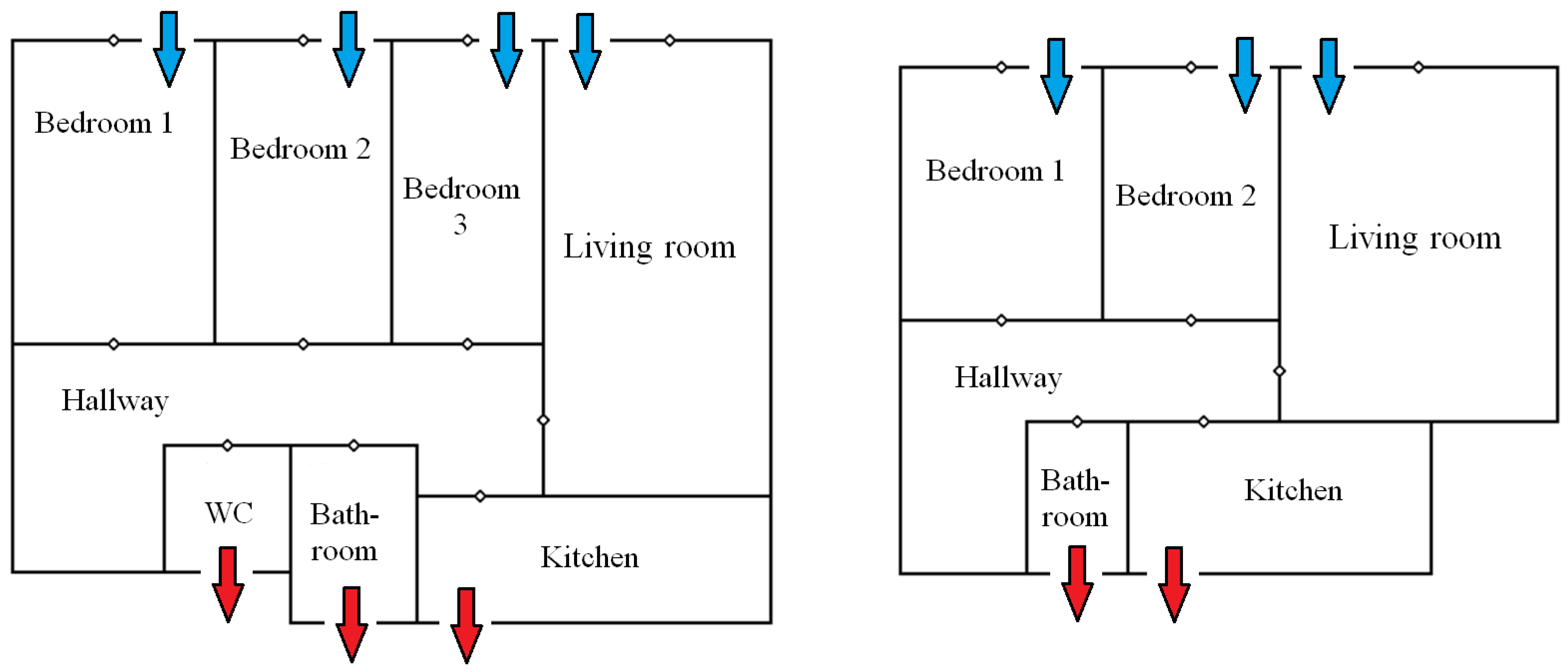
Figure 2.
Setting of the bypass system of the heat exchanger (e.g., when the indoor temperature is 25 ºC and outdoor temperature 15 ºC, the supply air and exhaust air do not exchange heat).
Figure 2.
Setting of the bypass system of the heat exchanger (e.g., when the indoor temperature is 25 ºC and outdoor temperature 15 ºC, the supply air and exhaust air do not exchange heat).
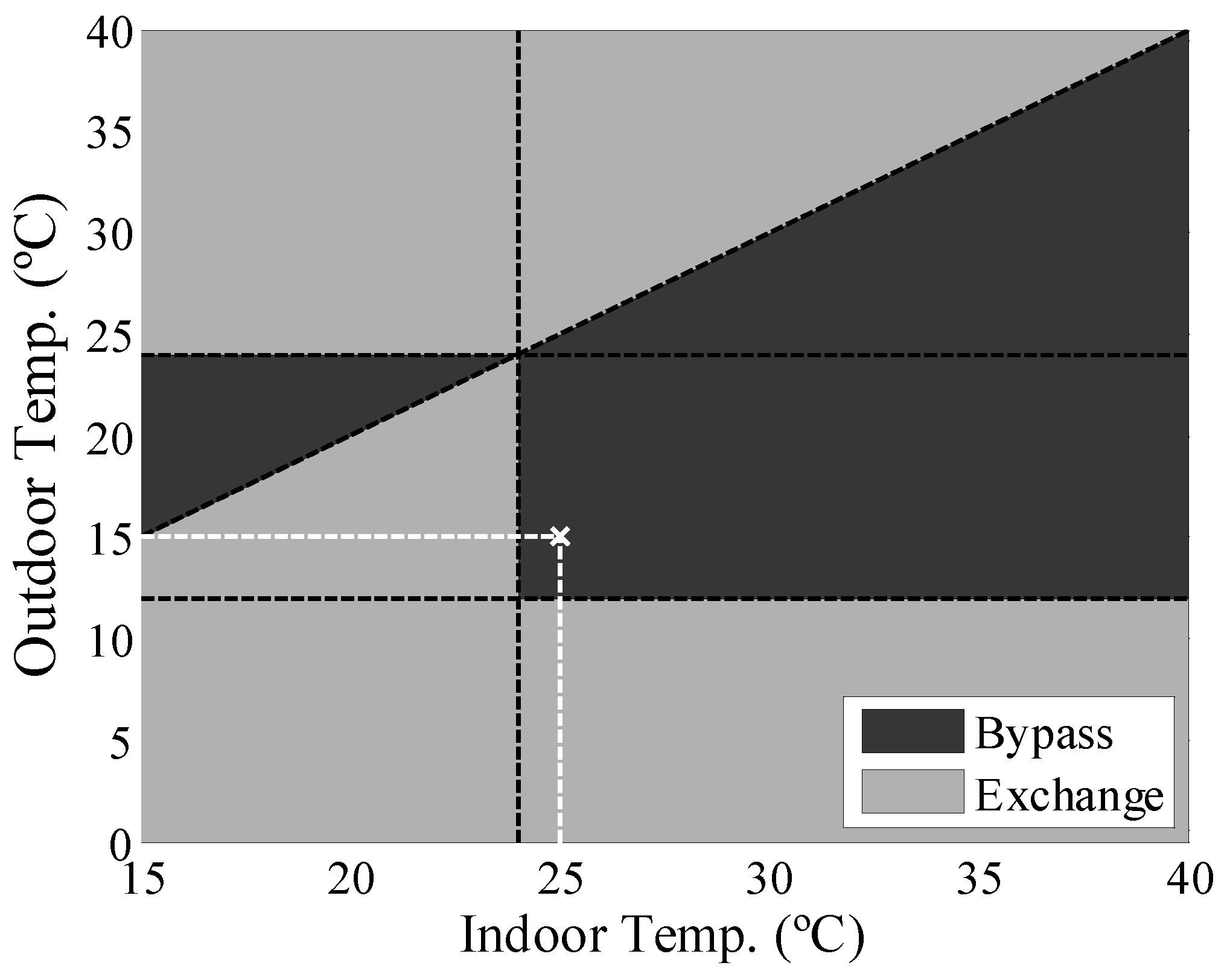
Figure 3.
Long-term (left) and short-term (right) cumulative frequency value for the ratio of the concentration of the contaminant against its exposure limit value (see Table 4).
Figure 3.
Long-term (left) and short-term (right) cumulative frequency value for the ratio of the concentration of the contaminant against its exposure limit value (see Table 4).
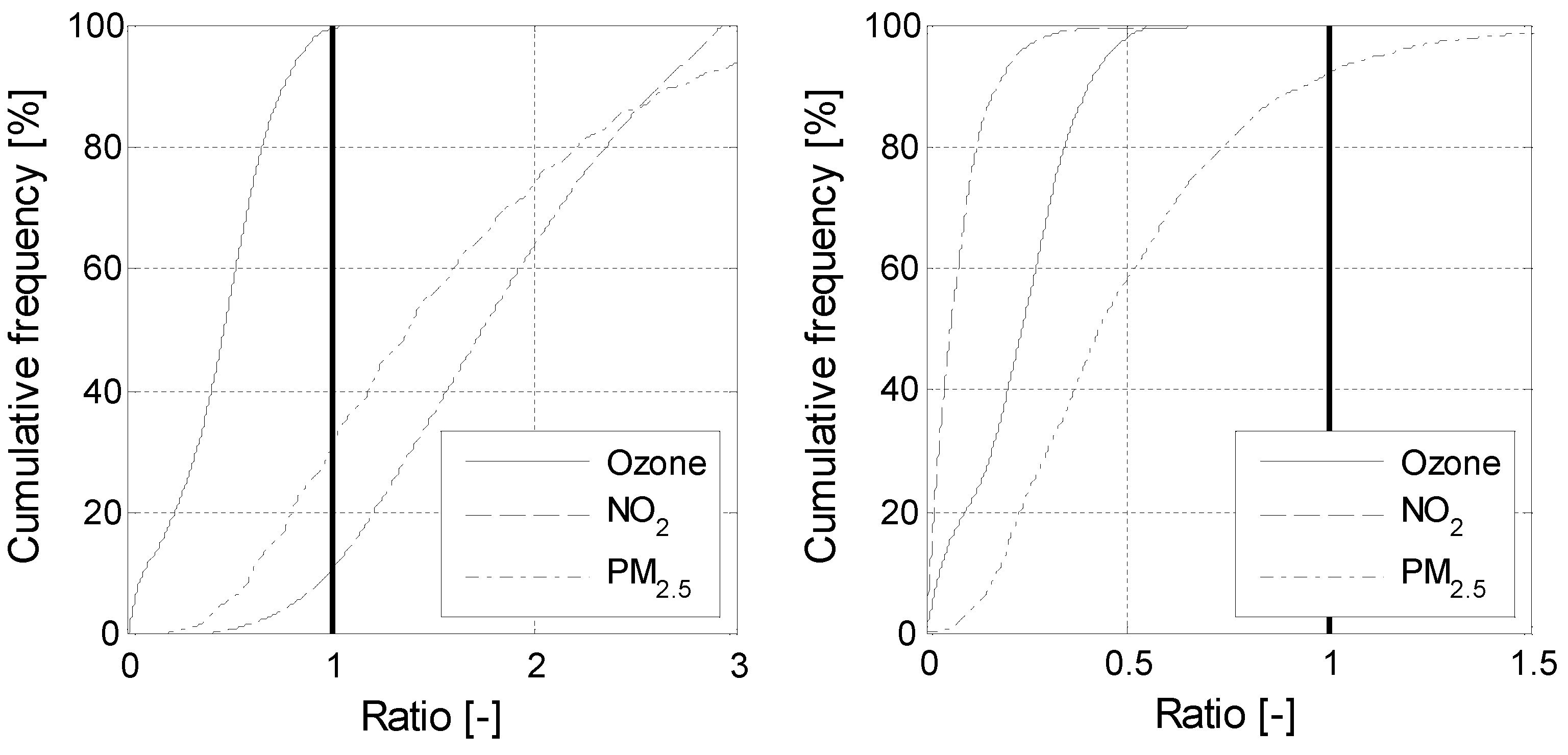
Figure 4.
Characteristic curves of the selected fan according to the manufacturer.
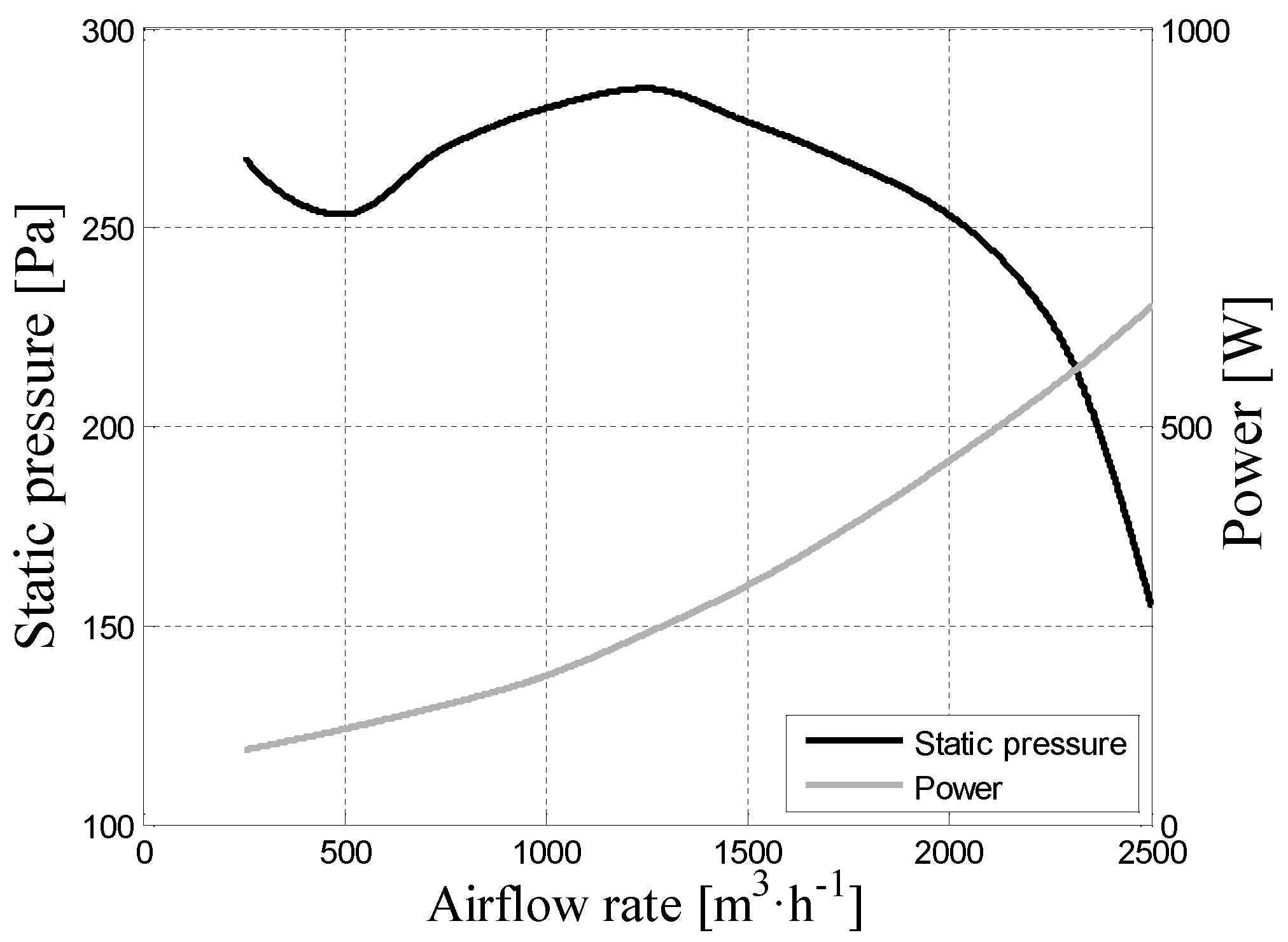
Figure 5.
Characteristic curves of the selected fan when the HRV system is installed.
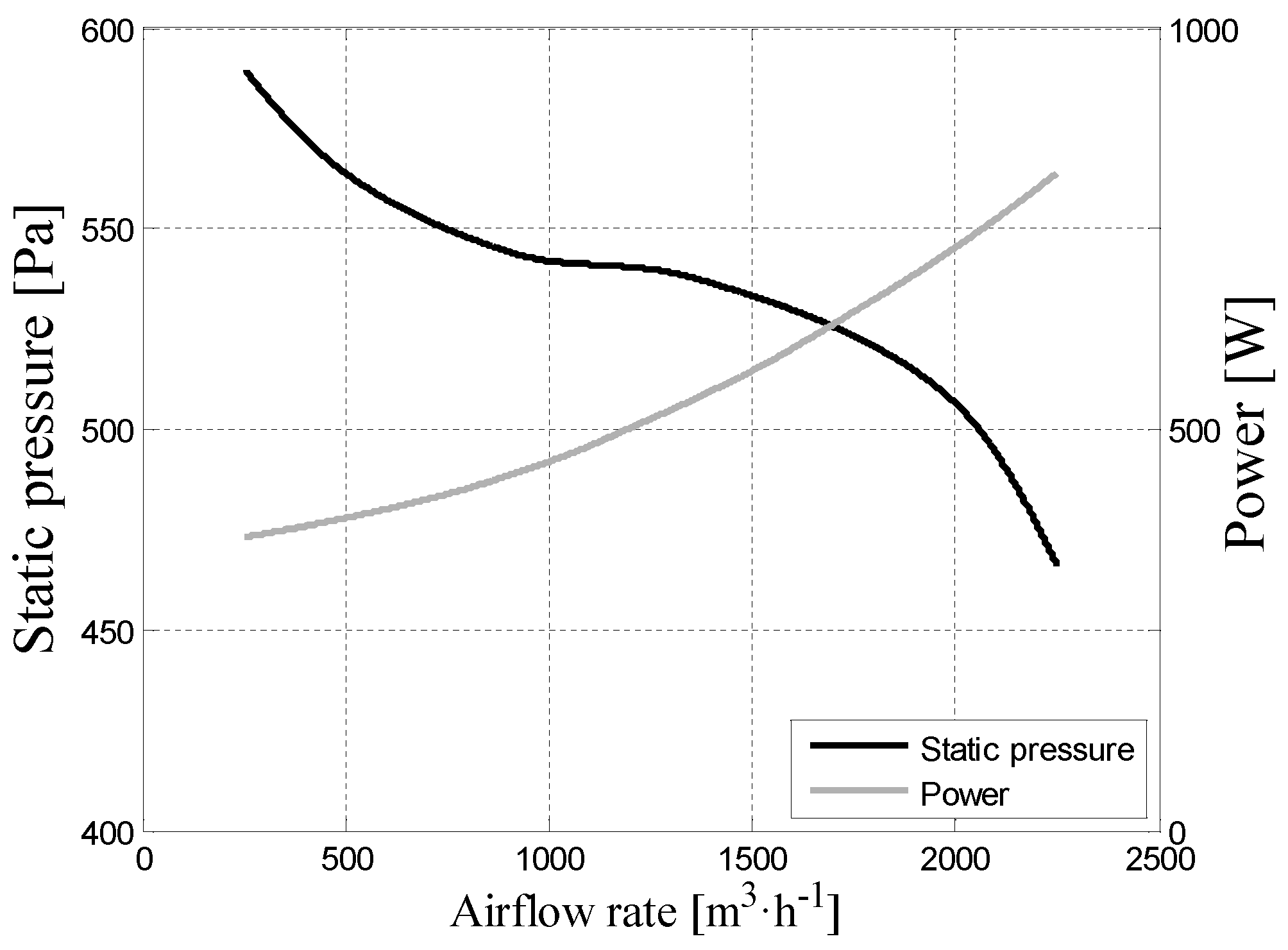
Figure 6.
Cumulative frequency values of the ACH depending on the ventilation system for apartment Type A (left) and Type B (right).
Figure 6.
Cumulative frequency values of the ACH depending on the ventilation system for apartment Type A (left) and Type B (right).
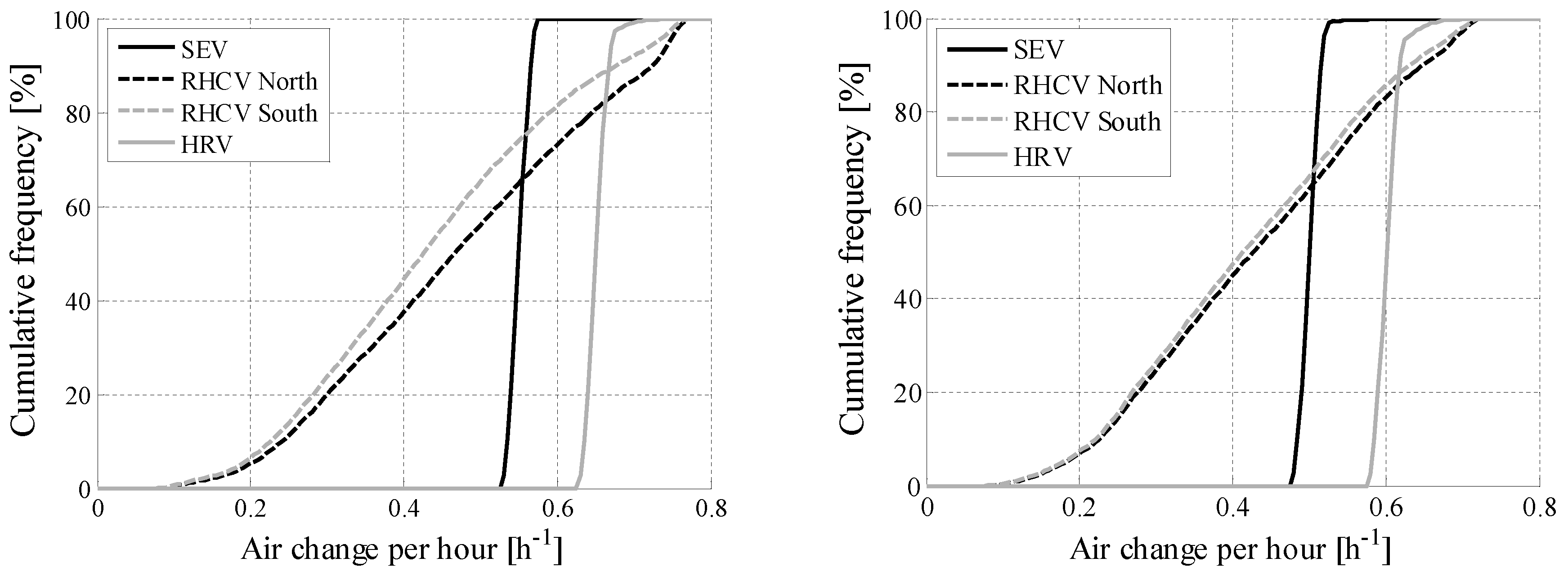
Figure 7.
The weekly average values of the airflow rates and the outdoor temperature for apartment Type A (left) and Type B (right).
Figure 7.
The weekly average values of the airflow rates and the outdoor temperature for apartment Type A (left) and Type B (right).
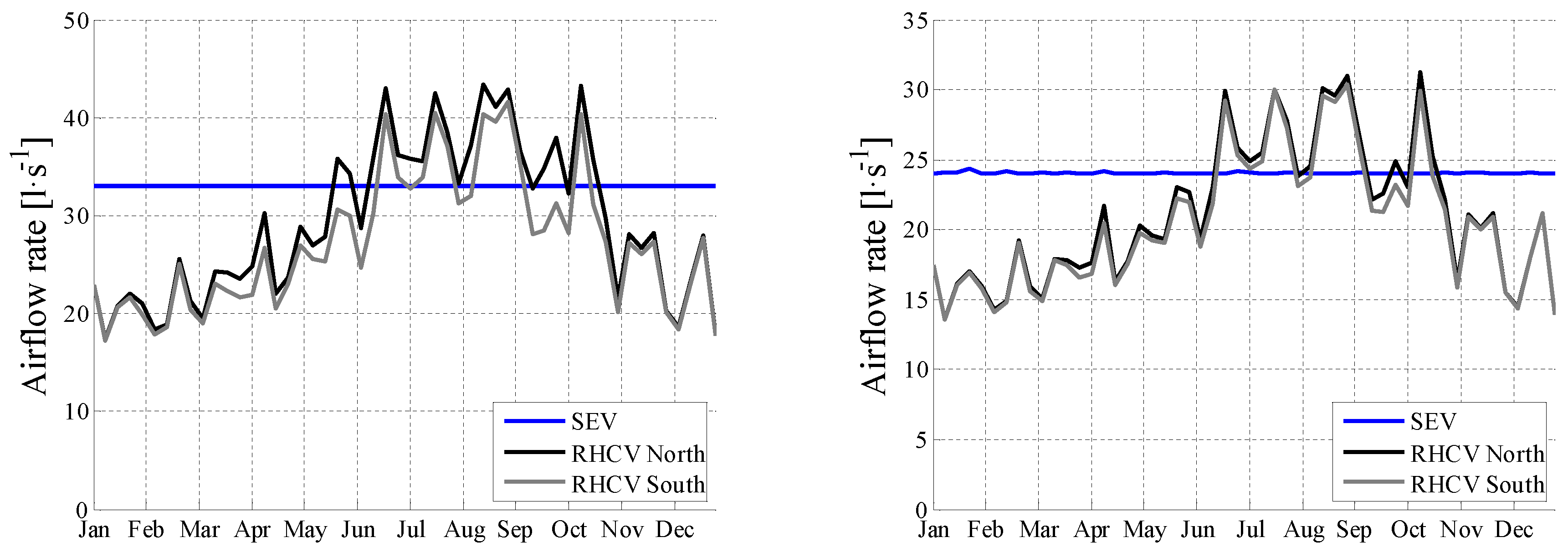
Figure 8.
The time fractions for the IDA classes for different ventilation systems during occupation in apartment Type A (left) and Type B (right).
Figure 8.
The time fractions for the IDA classes for different ventilation systems during occupation in apartment Type A (left) and Type B (right).
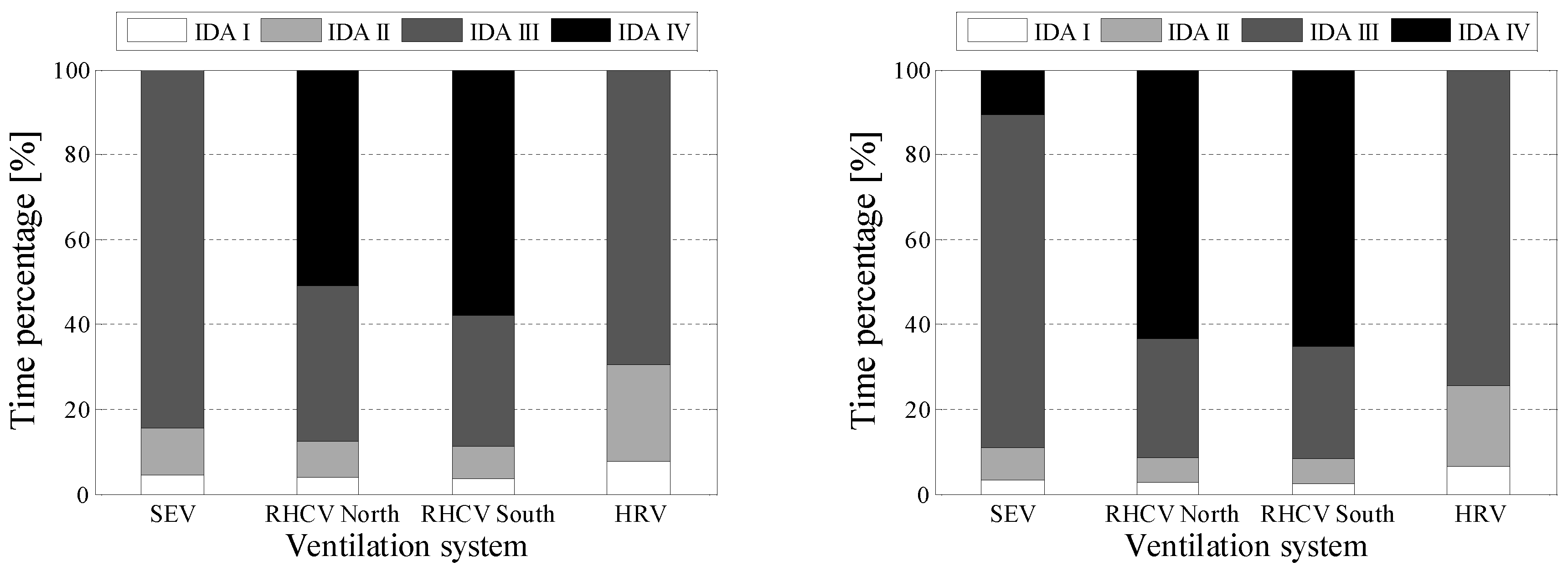
Figure 9.
Energy demand analysis considering the energy used for heating and in fans for apartment Type A (H-D: Heating demand; F-D: Energy demand of the fans; H-FEC: Heating final energy consumption; F-FEC: Final energy consumed in fans; H-PEC: Heating primary energy consumption; F-PEC: Primary energy consumed in fans).
Figure 9.
Energy demand analysis considering the energy used for heating and in fans for apartment Type A (H-D: Heating demand; F-D: Energy demand of the fans; H-FEC: Heating final energy consumption; F-FEC: Final energy consumed in fans; H-PEC: Heating primary energy consumption; F-PEC: Primary energy consumed in fans).
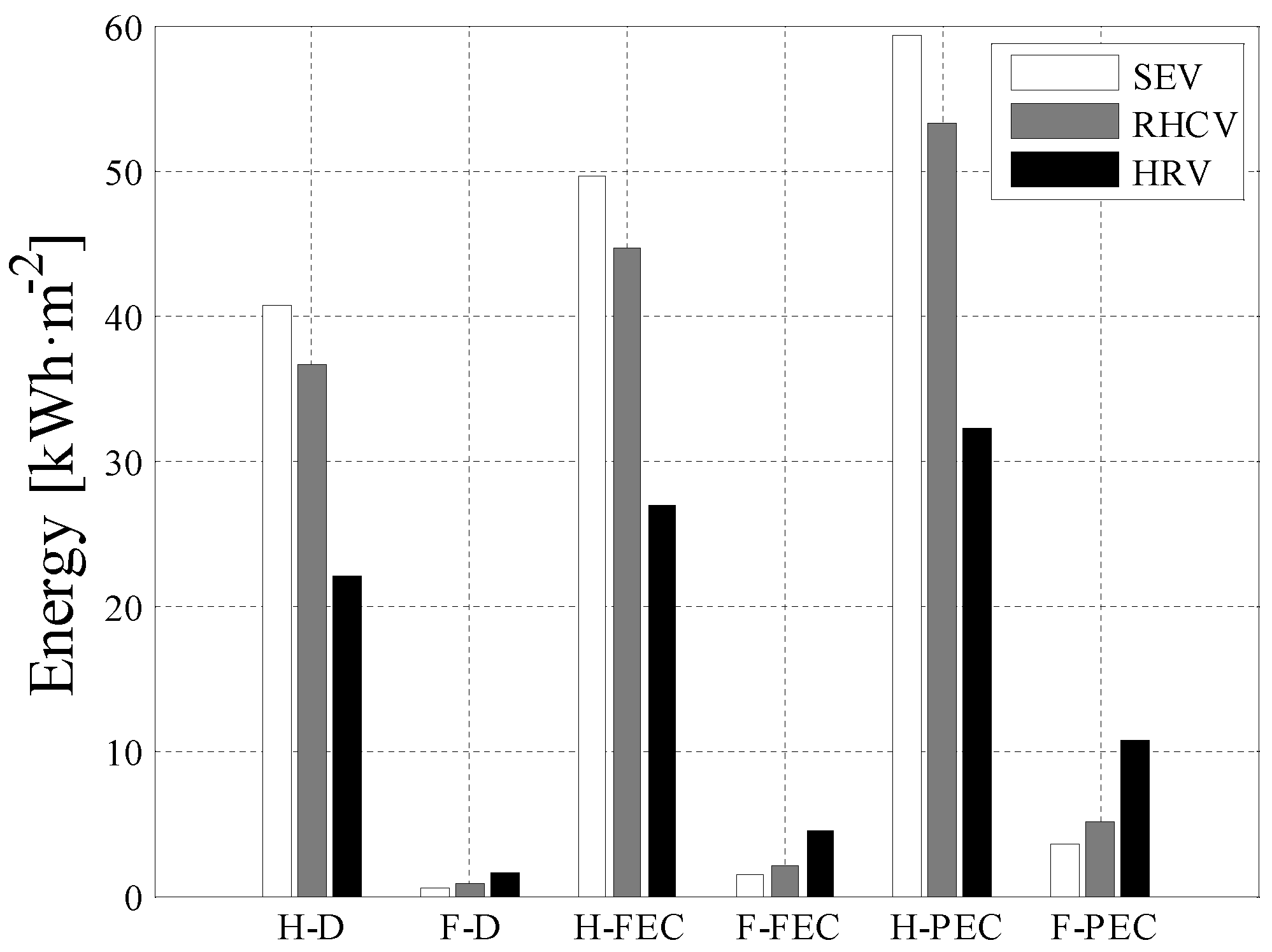
Figure 10.
The specific fan power limit values for the RHCV and HRV systems.
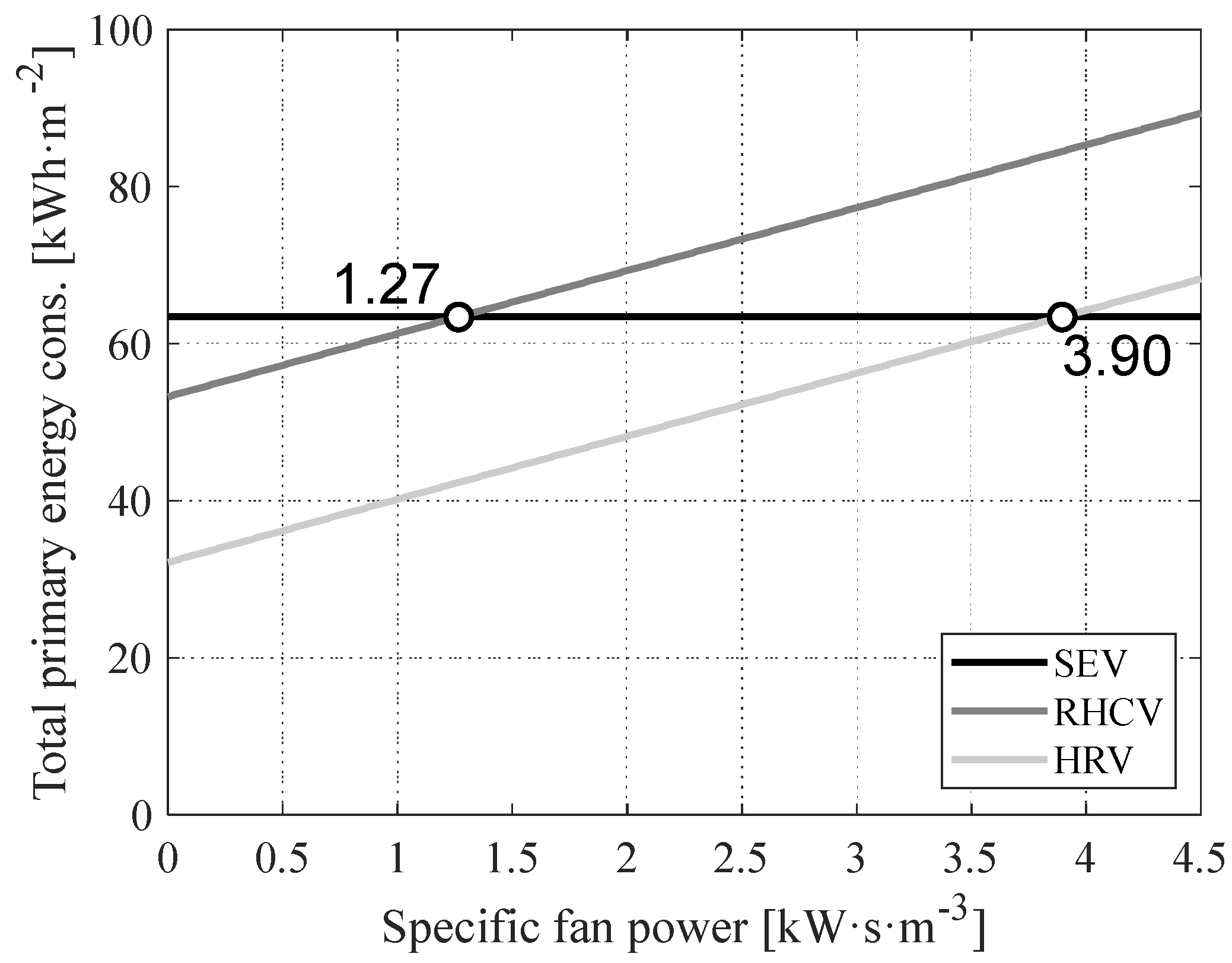
Figure 11.
Cumulative frequency of the outdoor temperature in Vitoria-Gasteiz during the heating season.
Figure 11.
Cumulative frequency of the outdoor temperature in Vitoria-Gasteiz during the heating season.
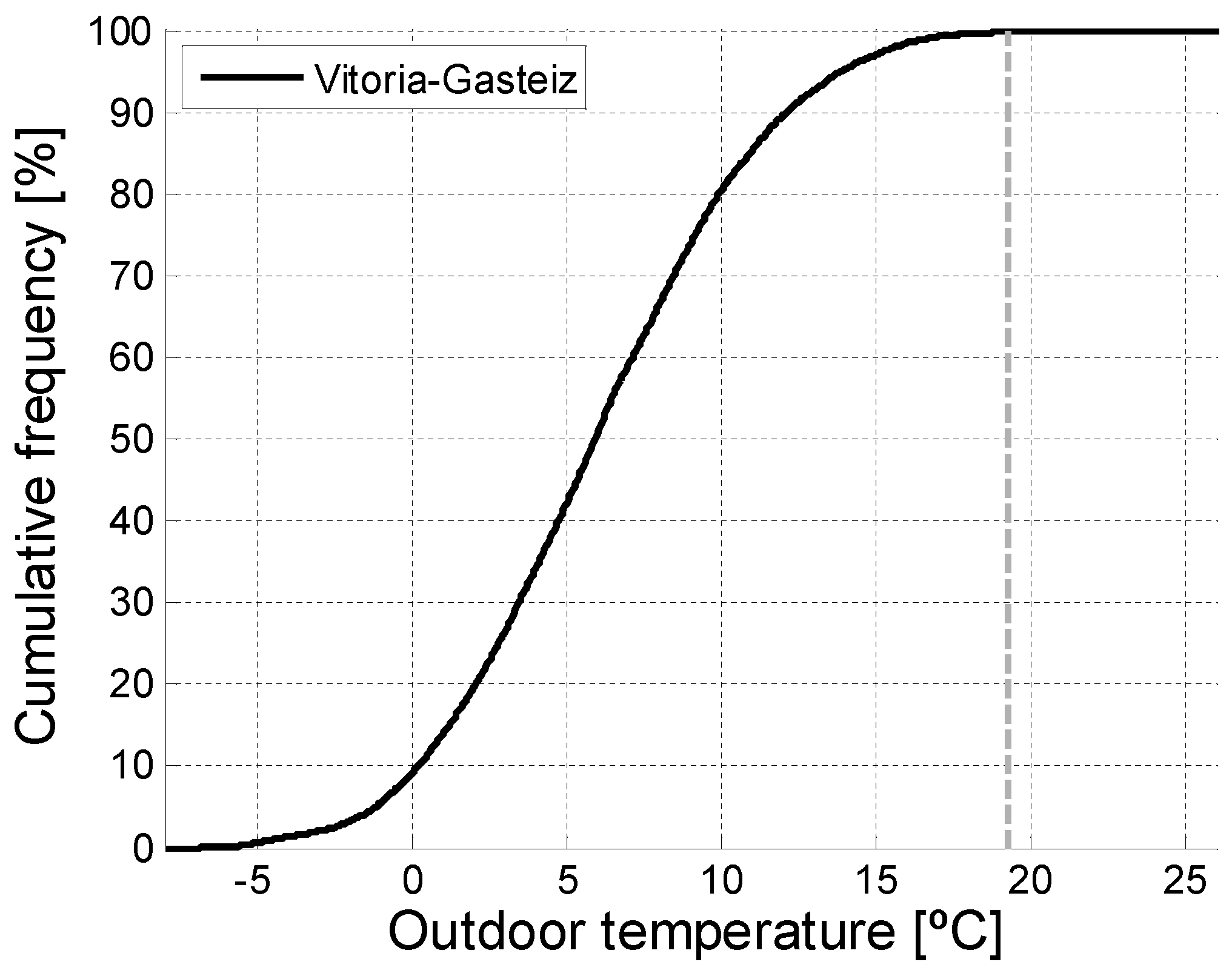
Figure 12.
Exergy use analysis considering the exergy used for heating and in fans for apartment Type A (H-ExD: Heating exergy demand; F-ExD: Exergy demand of the fans; H-FExC: Heating final exergy consumption; F-FExC: Final exergy consumed in fans; H-PExC: Heating primary exergy consumption; F-PExC: Primary exergy consumed in fans).
Figure 12.
Exergy use analysis considering the exergy used for heating and in fans for apartment Type A (H-ExD: Heating exergy demand; F-ExD: Exergy demand of the fans; H-FExC: Heating final exergy consumption; F-FExC: Final exergy consumed in fans; H-PExC: Heating primary exergy consumption; F-PExC: Primary exergy consumed in fans).
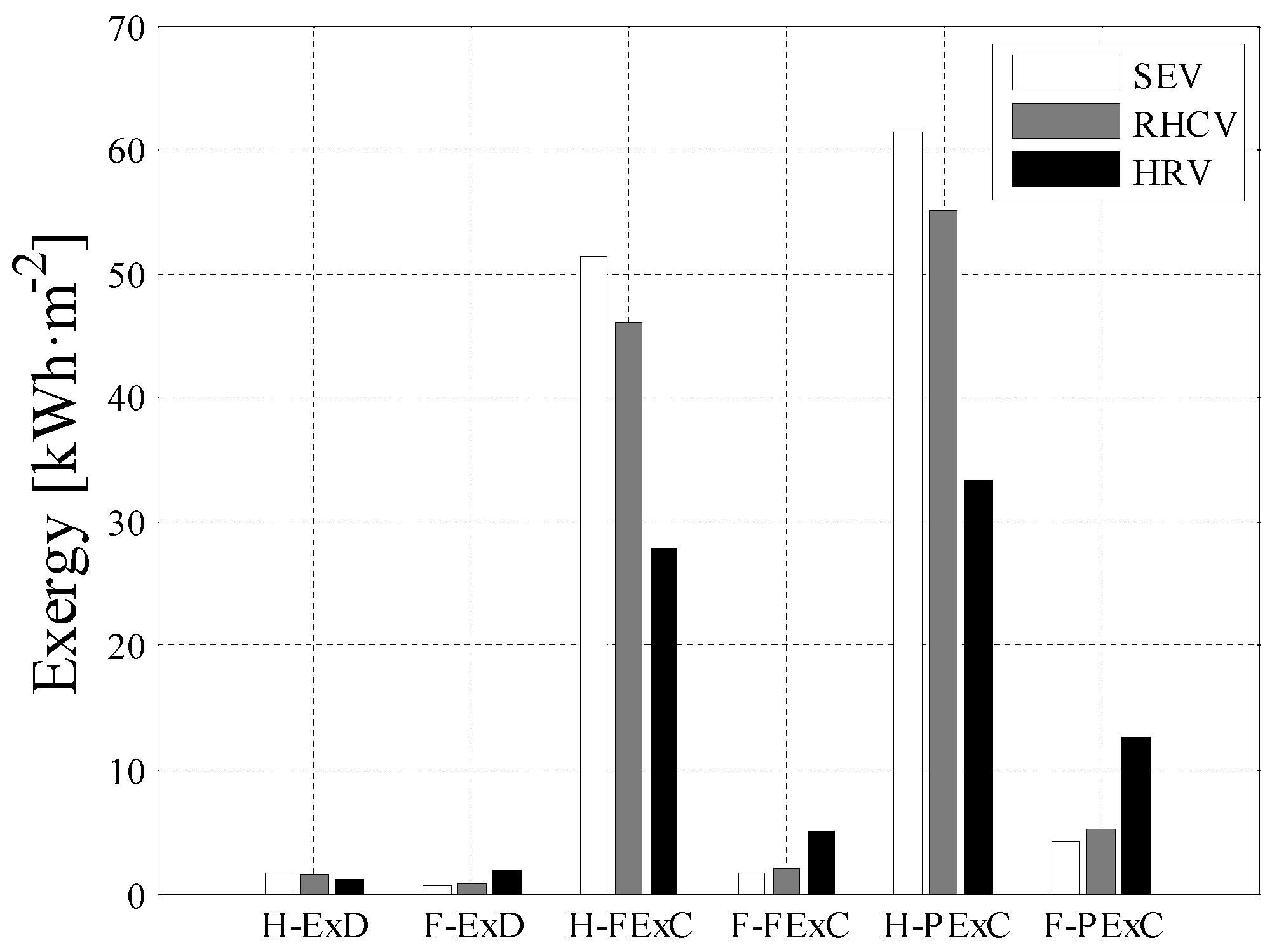

Table 1.
Average floor area (m2) of the rooms in the apartment models.
| Ground floor | Type A | Type B | |
| Bedroom 1 | 13.37 | 11.66 | |
| Bedroom 2 | 11.87 | 11.02 | |
| Bedroom 3 | 10.71 | - | |
| Living room | 20.49 | 22.52 | |
| Kitchen | 10.3 | 8.4 | |
| Bathroom 1 | 4.73 | 4.52 | |
| Bathroom 2 | 3.47 | - | |
| Hallway | 10.54 | 8.67 | |
| Total | 85.48 | 66.79 |
Table 2.
Continuous airflow rates (m3·h-1) of the rooms in each apartment model.
| Type A | Type B | ||||
| Ground floor | Admission | Exhaust | Admission | Exhaust | |
| Bedroom 1 | 28.8 | - | 28.8 | - | |
| Bedroom 2 | 14.4 | - | 14.4 | - | |
| Bedroom 3 | 14.4 | - | - | - | |
| Living room | 36 | - | 28.8 | - | |
| Kitchen | - | 39.6 | - | 43.2 | |
| Bathroom 1 | - | 39.6 | - | 43.2 | |
| Bathroom 2 | - | 39.6 | - | - | |
| Hallway | - | - | - | - | |
| ACH (h-1) | 0.56 | 0.52 | |||
Table 3.
Occupancy scenarios for the apartment Type A.
| Occupant | Day | Kitchen | Living room | Bedroom 1 | Bedroom 2 | Bedroom 3 | Bathroom 1 | Bathroom 2 |
| Occupant 1 | Work-day | 8:30-9:00 | 0:00-8:00 (Asleep) | 8:00-8:30 | ||||
| 22:00-24:00 | ||||||||
| Weekend | 19:00-20:00 | 10:30-11:00 | 0:00-10:00 (Asleep) | 10:00-10:30 | ||||
| 13:00-15:00 | 15:00-17:00 (Asleep) | |||||||
| 20:00-24:00 | ||||||||
| Occupant 2 | Work-day | 21:00-22:00 | 8:00-8:30 | 0:00-8:00 (Asleep) | 8:30-9:00 | |||
| 17:00-21:00 | ||||||||
| 22:00-24:00 | ||||||||
| Weekend | 13:00-14:00 | 10:00-10:30 | 0:00-10:00 (Asleep) | 10:30-11:00 | ||||
| 19:00-20:00 | 14:00-15:00 | 15:00-17:00 (Asleep) | ||||||
| 20:00-24:00 | ||||||||
| Occupant 3 | Work-day | 8:30-9:00 | 0:00-8:00 (Asleep) | 8:00-8:30 | ||||
| 21:00-24:00 | 17:00-21:00 | |||||||
| Weekend | 10:30-11:00 | 0:00-10:00 (Asleep) | 10:00-10:30 | |||||
| 13:00-15:00 | 15:00-17:00 | |||||||
| 20:00-24:00 | 19:00-20:00 | |||||||
| Occupant 4 | Work-day | 8:00-8:30 | 0:00-8:00 (Asleep) | 8:30-9:00 | ||||
| 21:00-24:00 | 17:00-21:00 | |||||||
| Weekend | 10:00-10:30 | 0:00-10:00 (Asleep) | 10:30-11:00 | |||||
| 13:00-15:00 | 15:00-17:00 | |||||||
| 20:00-24:00 | 19:00-20:00 |
Table 4.
Exposure limit values for the analyzed contaminants (µg·m-3).
| Contaminant | Long-term | Short-term | Reference |
| NO2 | 10 (annual mean) | 200 (1-h mean) | [4] |
| O3 | 100 (8-h mean) | 180 (1-h mean) | [4,46] |
| TVOCs | 200 (annual mean) | - | [47] |
| HCHO | 9 (8-h mean) | 55 (1-h mean) | [46] |
| PM2.5 | 5 (annual mean) | 15 (24-h mean) | [4] |
Table 5.
Daily water vapor production due to domestic activities.
| Activity | Production rate | Room (period) | |
| Having a shower | 300 g per person | Bathroom 1 and 2 (while the room is occupied, see Table 3) |
|
| Cooking | Breakfast | 50 g·h-1 per person | Kitchen (Work-day: 8:00-9:00; Weekend: 10:00-11:00) |
| Lunch | 150 g·h-1 per person | Kitchen (Weekend: 13:00-14:00) | |
| Dinner | 300 g·h-1 per person | Kitchen (Work-day: 21:00-22:00; Weekend: 19:00-20:00) | |
| Washing clothes | 200 g | Kitchen (8:00-10:00) | |
| Drying clothes | 1,000 g | Kitchen (10:00-12:00) | |
Table 6.
Indoor PM2.5 generation schedule due to vacuum cleaning on Saturdays.
| Room | Type A | Type B | |
| Bedroom 1 | 10:00-10:10 | 10:00-10:08 | |
| Bedroom 2 | 10:10-10:18 | 10:08-10:16 | |
| Bedroom 3 | 10:18-10:26 | - | |
| Living room | 10:26-10:41 | 10:16-10:32 | |
| Kitchen | 10:41-10:48 | 10:32-10:38 | |
| Bathroom 1 | 10:48-10:52 | 10:38-10:43 | |
| Bathroom 2 | 10:52-10:56 | - | |
| Hallway | 10:56-11:00 | 10:43-10:47 |
Table 7.
Constant deposition velocities for NO2 and O3 (cm·s-1).
| Pollutant | Material classes | vd |
| NO2 | Glass | 0 |
| Surface treated wood | 0.003 | |
| Gypsum wall board, surface treated | 0.003 | |
| O3 | Glass | 0.00015 |
| Surface treated wood | 0.0055 | |
| Gypsum wall board, surface treated | 0.036 |
Table 8.
Global deposition constant of the surfaces for PM2.5 (h-1).
| Pollutant | Material classes | λd |
| PM2.5 | Glass | 0.34 |
| Surface treated wood | 0.21 | |
| Gypsum wall board, surface treated | 0.08 |
Table 9.
Thermal properties of the constructive solution.
| Material | d(m) | λ(W·m-1·K-1) | ρ(kg·m-3) | c(J·kg-1·K-1) | R(m2·K·W-1) | ||
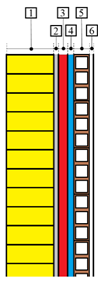 |
1 | Facing lightweight brick | 0.115 | 0.75 | 1140 | 1000 | 0.18 |
| 2 | Water control layer | 0.01 | 1.3 | 1000 | 1000 | 0.012 | |
| 3 | XPS rigid foam | 0.04 | 0.036 | 800 | 800 | 1.11 | |
| 4 | Air cavity | 0.02 | - | - | - | 0.17 | |
| 5 | Single hollow clay brick | 0.07 | 0.52 | 1000 | 1000 | 0.135 | |
| 6 | Plaster | 0.015 | 0.28 | 900 | 900 | 0.054 |
Table 10.
Summary of contaminant concentrations (µg·m-3) for apartment Type A and Type B.
| Daily average contaminant concentrations | Daily peak contaminant concentrations | |||||||||
| Apartment | Pollutant | Ventilation system | Mean +/- SD | Max. | Min. | Mean +/- SD | Max. | Min. | ||
| Type A | NO2 | SEV | 22.3 ± 11.1 | 58.9 | 8.5 | 30.9 ± 12.5 | 76 | 4.1 | ||
| RHCV | North | 20.6 ± 9.7 | 54.2 | 6.2 | 28.5 ± 11.1 | 66.9 | 3.8 | |||
| South | 20.2 ± 9.6 | 54.1 | 6.3 | 28 ± 11 | 66.5 | 3.7 | ||||
| HRV | 23.6 ± 12.1 | 63.7 | 9 | 33.3 ± 13.7 | 83.7 | 4.2 | ||||
| O3 | SEV | 14.6 ± 6.7 | 30.5 | 1.1 | 19.3 ± 5.8 | 33.3 | 0.2 | |||
| RHCV | North | 14.1 ± 7.5 | 32.6 | 0.6 | 19.5 ± 6.8 | 36.3 | 0.2 | |||
| South | 13.3 ± 7.1 | 32.1 | 0.6 | 18.9 ± 6.6 | 36.5 | 0.2 | ||||
| HRV | 18.3 ± 8.4 | 38.2 | 1.4 | 24.3 ± 7.2 | 41.5 | 0.2 | ||||
| TVOCs | SEV | 167.4 ± 0.5 | 167 | 165.2 | 168.2 ± 0.8 | 172 | 162 | |||
| RHCV | North | 214.9 ± 89.5 | 479.6 | 125.7 | 266.6 ± 108 | 556.2 | 124.1 | |||
| South | 230.4 ± 91 | 474.4 | 125.9 | 283.9 ± 106.8 | 546.9 | 125.4 | ||||
| HRV | 155.5 ± 3.3 | 161.3 | 146.5 | 158.7 ± 2.5 | 162.5 | 131.3 | ||||
| HCHO | SEV | 14.7 ± 0.2 | 15.6 | 14.4 | 14.8 ± 0.2 | 16.3 | 14.2 | |||
| RHCV | North | 18.8 ± 7.8 | 41.8 | 11 | 23.2 ± 9.4 | 48.7 | 10.9 | |||
| South | 20.2 ± 7.9 | 41.4 | 11 | 24.7 ± 9.4 | 47.9 | 10.9 | ||||
| HRV | 13.5 ± 0.4 | 14 | 12.7 | 14.1 ± 0.3 | 14.5 | 11.7 | ||||
| PM2.5 | SEV | 4.3 ± 2.5 | 15.4 | 0.7 | 5.5 ± 2.8 | 16.4 | 0.6 | |||
| RHCV | North | 3.8 ± 2.4 | 16.7 | 0.4 | 5.5 ± 2.8 | 18.5 | 0.3 | |||
| South | 3.5 ± 2.2 | 15.2 | 0.4 | 5.2 ± 2.7 | 17.8 | 0.3 | ||||
| HRV | 0.8 ± 0.4 | 2.5 | 0.1 | 1.1 ± 0.5 | 3.7 | 0.1 | ||||
| Type B | NO2 | SEV | 21.2 ± 10.2 | 55.6 | 8.1 | 28.8 ± 11.5 | 69.6 | 4 | ||
| RHCV | North | 19.4 ± 9 | 50.7 | 5.9 | 26.5 ± 10.4 | 63.6 | 3.7 | |||
| South | 19.4 ± 9 | 50.7 | 6 | 26.4 ± 10.4 | 63.7 | 3.6 | ||||
| HRV | 22.4 ± 11.1 | 58.9 | 8.5 | 31 ± 12.5 | 76.7 | 4.1 | ||||
| O3 | SEV | 12.2 ± 5.6 | 27.6 | 0.9 | 16.3 ± 5 | 32.6 | 0.2 | |||
| RHCV | North | 11.5 ± 6.1 | 29.9 | 0.6 | 16.6 ± 5.7 | 37.9 | 0.2 | |||
| South | 11.5 ± 6.1 | 29.6 | 0.6 | 16.5 ± 5.6 | 37.6 | 0.2 | ||||
| HRV | 15.6 ± 8.8 | 36.6 | 0.9 | 22.1 ± 8.1 | 40.3 | 0.4 | ||||
| TVOCs | SEV | 213.5 ± 9.2 | 235.9 | 160.2 | 219.1 ± 5.8 | 250.9 | 136.2 | |||
| RHCV | North | 268.9 ± 88 | 485 | 151.8 | 317.3 ± 102.1 | 557.2 | 110.9 | |||
| South | 270.9 ± 87.2 | 482.5 | 152.3 | 321.5 ± 99.1 | 554.2 | 113.3 | ||||
| HRV | 169.5 ± 4.9 | 173.3 | 142.2 | 171.6 ± 2.4 | 173.3 | 124.3 | ||||
| HCHO | SEV | 18.7 ± 0.8 | 20.6 | 14 | 19.2 ± 0.5 | 21.8 | 12 | |||
| RHCV | North | 23.5 ± 7.6 | 42.3 | 13.3 | 27.6 ± 9 | 48.8 | 9.7 | |||
| South | 23.7 ± 7.6 | 42.1 | 13.3 | 28 ± 8.7 | 48.4 | 10 | ||||
| HRV | 14.9 ± 0.4 | 15.2 | 12.5 | 15.1 ± 0.2 | 15.3 | 10.9 | ||||
| PM2.5 | SEV | 4.2 ± 2.4 | 15.2 | 0.7 | 5.4 ± 2.7 | 16.2 | 0.6 | |||
| RHCV | North | 3.5 ± 2.2 | 15.2 | 0.4 | 4.7 ± 2.6 | 16.7 | 0.3 | |||
| South | 3.5 ± 2.1 | 14.8 | 0.4 | 4.6 ± 2.6 | 16.2 | 0.3 | ||||
| HRV | 0.7 ± 0.4 | 2.4 | 0.1 | 1 ± 0.5 | 3.8 | 0.1 | ||||
Disclaimer/Publisher’s Note: The statements, opinions and data contained in all publications are solely those of the individual author(s) and contributor(s) and not of MDPI and/or the editor(s). MDPI and/or the editor(s) disclaim responsibility for any injury to people or property resulting from any ideas, methods, instructions or products referred to in the content. |
© 2026 by the authors. Licensee MDPI, Basel, Switzerland. This article is an open access article distributed under the terms and conditions of the Creative Commons Attribution (CC BY) license (http://creativecommons.org/licenses/by/4.0/).
Copyright: This open access article is published under a Creative Commons CC BY 4.0 license, which permit the free download, distribution, and reuse, provided that the author and preprint are cited in any reuse.


