

Submitted:
25 March 2026
Posted:
26 March 2026
You are already at the latest version
Abstract
Research on personality and behaviour has established that individuals exhibit relatively stable patterns of conduct across time, commonly described in terms of trait dimensions such as conscientiousness. At the same time, self-regulation and habit research have identified mechanisms involved in behavioural initiation, persistence, and automatization. Despite these advances, existing frameworks do not adequately specify the intermediate processes through which behavioural continuity is maintained across everyday contexts.
This article introduces the concept of micro-discipline to address this gap. Micro-discipline refers to recurrent low-level acts of behavioural regulation that preserve continuity between intention and action under ordinary conditions of friction, including returning attention to a task, sustaining effort despite resistance, modulating minor impulses, and completing small obligations that might otherwise be deferred.
The central claim is that these repeated regulatory acts constitute a distinct and temporally cumulative process through which behavioural patterns are stabilized and, over time, modified. Drawing on personality theory, self-regulation research, and related process-based approaches, the article develops a conceptual model explaining how such micro-regulatory processes bias the recurrence, persistence, and interruption of behavioural states, thereby contributing to trait stabilization and trait change.
By clarifying this intermediate process layer, the framework provides a more precise account of how local regulatory acts scale into durable patterns of behaviour. It further offers implications for understanding personality development, the maintenance of goal-directed behaviour, and the conditions under which intentional behavioural change succeeds or fails.
Keywords:
micro-discipline
; character formation
; agency
; self-regulation
1. Introduction
Research on personality and behaviour has established that individuals exhibit relatively stable patterns of conduct across time. Trait theories conceptualize these patterns as relatively enduring dispositional structures that organize behaviour across situations (McCrae & Costa 2008). Within the Five Factor Model, traits such as conscientiousness capture broad tendencies toward organization, persistence, and goal-directed behaviour. These traits show substantial stability across the life course and reliably predict outcomes including occupational performance, health behaviours, and interpersonal functioning.
At the same time, research on self-regulation and related processes has begun to clarify how behaviour is initiated, maintained, and adjusted in response to situational demands. However, despite substantial progress in both trait theory and self-regulation research, an important aspect of behavioural organization remains insufficiently specified. Existing frameworks describe relatively stable behavioural outcomes and identify mechanisms involved in behavioural control, yet they do not fully explain how behavioural continuity is maintained across everyday contexts through repeated low-level regulatory processes.
A related issue can be observed in philosophical accounts of character. Within the Aristotelian tradition, virtues such as courage, temperance, and practical wisdom are understood as enduring qualities formed through habituation and expressed through appropriate practical judgment (Aristotle, Nicomachean Ethics II; Annas 2011). Contemporary virtue theorists likewise emphasize stable evaluative dispositions that shape perception, deliberation, and conduct across contexts (Snow 2010; Miller 2013). Despite differences in method and normative orientation, these accounts share a structural similarity with trait-based approaches in psychology. Both primarily describe relatively stable outcomes, whether in the form of virtues or dispositional traits.
What remains less clearly specified across these traditions is the behavioural process through which such stability gradually emerges.
Virtue ethics typically explains character development through habituation, yet the concept of habit often operates at a relatively coarse level, referring to repeated morally significant actions that gradually form dispositions. Personality psychology, by contrast, explains behavioural regularity through dispositional trait structures but often leaves under-specified the fine-grained behavioural processes through which traits develop, stabilize, or change over time.
Recent developments in personality science suggest that this intermediate behavioural layer may be crucial for understanding character formation. Longitudinal research shows that personality traits change gradually across the life course and that these changes frequently reflect cumulative behavioural adjustments rather than abrupt psychological transformations (Roberts, Walton & Viechtbauer 2006; Hudson & Fraley 2015). Social-cognitive approaches similarly emphasize stable situation–behaviour contingencies rather than global traits alone (Mischel & Shoda 1995). Process-based accounts of personality further conceptualize traits as distributions of behavioural states enacted across situations (Fleeson 2001).
Taken together, these developments point toward a level of behavioural organization that lies between isolated actions and stable dispositions. This level consists of repeated acts of behavioural regulation through which continuity between intention and action is maintained across time.
The present article introduces the concept of micro-discipline to describe this intermediate process layer. Micro-discipline refers to recurrent low-level acts of behavioural regulation that preserve continuity between intention and action in the face of ordinary friction. These acts include returning attention to an ongoing task, sustaining effort despite temporary resistance, inhibiting minor distractions, and completing small obligations that could easily be deferred. Individually they appear insignificant, yet when repeated across time they accumulate into structured patterns of behavioural maintenance that gradually stabilize into enduring forms of conduct.
The central claim of this article is not that such regulatory processes have gone entirely unnoticed. Elements of the relevant domain are already distributed across work on self-regulation, habit formation, implementation, trait enactment, executive control, and virtue habituation. The contribution of the present account lies in treating these processes not as isolated mechanisms or episodic events, but as a temporally cumulative system through which behavioural continuity is maintained and character is gradually formed. Existing theories illuminate important components of this process, but the role of repeated low-level regulatory acts as a distinct explanatory layer linking momentary behaviour to durable behavioural patterns remains under-theorized.
This article contributes to theoretical work on self-regulation, personality development, and behavioural maintenance by clarifying this intermediate level of analysis. More specifically, it offers a conceptual account of the micro-regulatory processes through which behavioural continuity is maintained across time and through which dispositional stability gradually emerges.
The contribution is conceptual rather than empirical. The article develops an interdisciplinary synthesis that integrates personality theory, research on self-regulation, virtue-theoretic insights, and ecological accounts of action in order to clarify a missing level in existing models of character formation. More specifically, the article advances four claims. First, character formation operates across multiple temporal scales and cannot be adequately explained solely in terms of isolated actions or stable traits. Second, repeated low-level regulatory acts constitute a distinct mechanism through which behavioural continuity is maintained across time. Third, the cumulative effect of these acts can gradually shift the probability distribution of behavioural states and thereby contribute to trait stabilization and trait change. Fourth, these processes are not purely internal but emerge within person–environment systems shaped by social roles, institutional structures, and environmental scaffolding.
Character formation, on this view, cannot be adequately explained without recognizing this intermediate regulatory layer. The article proceeds as follows. Section 2 examines the problem of behavioural scale in existing accounts of action and character. Section 3 defines micro-discipline more precisely and distinguishes it from adjacent constructs. Section 4 explains the cumulative mechanism through which repeated micro-regulatory acts shape behavioural trajectories and trait expression. Section 5 clarifies the relation between behavioural organization and moral evaluation. Section 6 argues that micro-discipline is best understood as a person–environment regulatory system rather than an internal capacity alone. Section 7 draws out the implications of this framework for agency across temporal scales.
2. Character Between Action and Structure: The Problem of Behavioural Scale
Accounts of character traditionally operate at two primary levels of analysis. The first concerns individual actions, where ethical theory evaluates behaviour in terms of right and wrong or virtue and vice. The second concerns relatively stable dispositions. Within virtue ethics, character is understood as an enduring configuration of evaluative tendencies that reliably guide behaviour across circumstances (Annas 2011; Snow 2010; Miller 2013).
Between these two levels lies a largely under-specified domain: the fine-grained behavioural processes through which momentary actions gradually stabilize into enduring patterns of conduct.
This gap reflects what may be described as a problem of behavioural scale. Ethical theory often analyzes agency at the level of deliberative decision making, whereas personality psychology typically analyzes behaviour at the level of relatively stable traits. Yet much of everyday behaviour unfolds at an intermediate scale consisting of repeated regulatory acts that structure behaviour across time. Understanding character formation therefore requires attention to how behavioural regulation operates across multiple temporal levels.
2.1. Actions, Traits, and the Architecture of Behaviour
In Aristotelian virtue ethics, character emerges through habituation. Repeated actions gradually form dispositions that shape perception, judgment, and conduct (Aristotle, Nicomachean Ethics II.1). Contemporary virtue theorists retain this emphasis. Annas (2011) argues that virtues develop through practice in which agents acquire stable patterns of evaluative judgment, while Snow (2010) emphasizes the role of reliable motivational and perceptual orientations in guiding behaviour across contexts.
However, philosophical accounts of habituation rarely specify the behavioural mechanisms through which repeated actions accumulate into stable dispositions. Habituation is typically invoked as a developmental process but is seldom analyzed at a fine behavioural resolution.
A comparable abstraction appears in personality psychology. Trait models describe behavioural stability in terms of dispositional structures such as conscientiousness or neuroticism (McCrae & Costa 2008; DeYoung 2015). These constructs capture reliable patterns of behaviour and experience across situations, yet they often function primarily as descriptive summaries rather than as detailed accounts of the processes through which such patterns are generated and maintained.
Across both traditions, the emphasis falls on relatively stable behavioural outcomes. Philosophy describes the normative organization of character, while psychology describes the descriptive structure of traits. What remains less clearly articulated is the process-level architecture through which behavioural stability emerges and is maintained across time.
2.2. Situation–Behaviour Dynamics and Behavioural Signatures
Developments in personality science suggest that this intermediate behavioural layer is essential for understanding character formation. The social-cognitive framework proposed by Mischel and Shoda (1995) argues that personality coherence arises not only from global traits but from stable situation–behaviour contingencies, often described as behavioural signatures.
On this view, individuals exhibit characteristic if–then patterns of behaviour across contexts. Rather than behaving uniformly, they respond systematically to particular classes of situations. For example, an individual may remain calm under routine pressure but react strongly to perceived social rejection. Behavioural consistency therefore emerges through repeated configurations of situational cues and behavioural responses.
This perspective highlights an important point. Behavioural stability is not solely a function of abstract traits but is sustained through repeated, context-sensitive regulatory responses. Character coherence, in this sense, reflects the consolidation of such patterned responses across time.
2.3. Personality Development and Incremental Behavioural Change
Research on personality development further supports this process-oriented view. Longitudinal studies show that personality traits change gradually across the life course and that these changes often reflect cumulative behavioural adjustments rather than abrupt psychological transformations (Roberts, Walton & Viechtbauer 2006; Roberts et al. 2007).
For example, increases in conscientiousness are frequently associated with changes in roles, responsibilities, and behavioural routines. Small shifts in everyday behavioural organization, such as maintaining schedules, completing tasks reliably, or regulating impulses, can accumulate into more stable patterns of behaviour over time. Hudson and Fraley (2015) similarly demonstrate that intentional behavioural adjustments can produce measurable personality change.
These findings suggest that both trait stability and trait development emerge through repeated behavioural regulation occurring at relatively fine temporal scales. This interpretation is consistent with DeYoung’s Cybernetic Big Five Theory, which conceptualizes personality traits as parameters of goal-directed regulatory systems (DeYoung 2015). Within this framework, behavioural coherence arises through continuous processes of feedback, monitoring, and adjustment.
Taken together, these developments indicate that stable behavioural patterns are supported by ongoing regulatory processes that operate below the level of global trait descriptions.
2.4. Habit Formation and Repetition
Research on habit formation provides additional insight into how repeated behaviours generate stable patterns. Habits are typically understood as behaviours that become automatically triggered by contextual cues through repetition (Wood & Rünger 2016). Such processes can produce durable regularities that persist even in the absence of deliberate intention.
However, habit formation does not fully account for many forms of behaviour central to character development. Activities such as maintaining a writing practice, fulfilling obligations, regulating emotional responses, or sustaining effort on difficult tasks often require ongoing regulation rather than complete automaticity. These forms of behaviour depend on repeated acts of attention, effort, and adjustment rather than purely cue-driven execution.
In these domains, behavioural stability emerges not through full automatization but through the repeated regulation of small actions across time.
2.5. The Intermediate Layer of Behavioural Regulation
The convergence of these perspectives points to an intermediate layer of behavioural organization situated between isolated actions and stable traits. This layer consists of repeated regulatory acts through which individuals maintain behavioural continuity across time.
Such acts typically involve small adjustments in attention, effort, impulse control, and task completion. Individually they appear minor. Yet when repeated across days, months, and years, they accumulate into structured behavioural trajectories that may eventually manifest as relatively stable personality characteristics.
This intermediate layer can be understood as the microstructure of behavioural regulation.
Micro-discipline refers to the stabilization of this microstructure through repeated regulatory acts. Through the accumulation of such acts, individuals construct behavioural patterns that influence future conduct and contribute to the emergence of enduring forms of behavioural organization.
From this perspective, behaviour is not fully explained by isolated decisions or by fixed dispositions alone. Instead, behavioural continuity is maintained through ongoing processes of regulation operating at a finer temporal resolution. Recognizing this intermediate layer helps explain how momentary actions gradually stabilize into more durable patterns of conduct.
2.6. What Micro-Discipline Explains That Adjacent Constructs Do Not
A natural objection is that the behavioural domain described here is already addressed by existing theories of habit, self-control, trait regulation, executive function, or virtue habituation. Each of these frameworks captures an important aspect of behavioural organization. However, none isolates the specific explanatory role at issue in this article.
Habit theory explains how repeated behaviour becomes increasingly automatic through contextual cueing. Self-control research explains episodes of impulse inhibition and conflict resolution. Trait theory describes relatively stable behavioural tendencies and, in some cases, their regulatory parameters. Virtue ethics explains how character becomes normatively structured through habituation and practical judgment.
What these frameworks do not isolate with sufficient precision is the temporally cumulative role of repeated low-level regulatory acts in maintaining continuity between intention and action under ordinary conditions of friction.
The concept of micro-discipline is introduced to specify this intermediate process layer. Its contribution lies not in identifying entirely novel psychological events, but in integrating dispersed mechanisms into a more precise account of how behavioural continuity is maintained and how stable patterns of conduct gradually emerge. In this sense, micro-discipline is best understood not as a competing theory, but as a clarifying framework that links momentary regulatory processes to longer-term behavioural organization.
3. The Microstructure of Agency and the Concept of Micro-Discipline
If character formation unfolds through a fine-grained layer of behavioural regulation, the next task is to specify that layer more precisely. The argument of this article is that behaviour is organized not only through episodic decisions and not only through relatively stable dispositions, but also through recurrent low-level acts that preserve continuity between intention and action across time. This intermediate layer may be described as the microstructure of behavioural regulation, and its repeated stabilization constitutes what is here termed micro-discipline.
Micro-discipline refers to recurrent low-level regulatory acts through which agents maintain continuity between intention and action under ordinary, non-exceptional conditions of friction. Three features of this definition are central. First, the acts are low-level. They involve small adjustments in attention, effort, impulse inhibition, sequencing, and completion rather than major decisions or salient moments of conflict. Second, they are recurrent. Micro-discipline does not refer to isolated successes of willpower but to repeated enactment across days, weeks, months, and years. Third, they function to maintain behavioural continuity. These acts sustain commitments, routines, and role obligations in the face of ordinary disruption, including distraction, fatigue, boredom, uncertainty, and competing demands.
This definition is intended to delimit the concept more precisely than neighbouring constructs. Micro-discipline is not simply any instance of self-regulation. It refers specifically to those repeated low-level acts through which behaviour remains connected to temporally extended intentions. In that respect, it is best understood as a process of behavioural maintenance rather than as a set of isolated psychological events.
The concept should also be interpreted with an important qualification. Micro-discipline is not proposed as a complete account of all intermediate mechanisms of character formation. Social learning, emotional development, institutional constraint, role identification, and broader forms of habituation also contribute. The present claim is narrower: repeated low-level regulatory acts constitute one under-theorized but indispensable mechanism through which behavioural continuity is sustained over time. In this sense, the framework aligns with process-based approaches to personality by specifying how repeated regulatory acts contribute to behavioural persistence and trait development across time.
To clarify the internal structure of the concept, micro-discipline can be analyzed in terms of four interacting regulatory dimensions.
First, attentional regulation plays a foundational role. Coherent behaviour often depends on repeated acts of attentional return. Individuals are continually subject to distraction from competing stimuli, minor urgencies, emotional noise, and environmental interruption. In many cases, progress depends less on a single decision to act than on the repeated re-stabilization of attention on a task, relationship, or obligation.
Second, effort continuation sustains activity through fluctuations in motivation. Many forms of goal-directed behaviour do not depend on stable desire but on the ability to continue despite boredom, fatigue, uncertainty, or resistance. Research on self-regulation in aversive goal pursuit indicates that persistence often depends on small strategies of effort management rather than on sustained high motivation alone (Hennecke, Czikmantori, & Brandstätter 2019).
Third, impulse modulation protects ongoing activity from minor derailments. While self-control research often focuses on salient temptations and conflict episodes, everyday behaviour is frequently disrupted by lower-level forms of friction, such as checking messages, shifting tasks prematurely, or abandoning effort at early points of discomfort. Process models of self-control suggest that regulation often operates through the management of attention, motivation, and situational selection before explicit inhibition becomes necessary (Inzlicht, Schmeichel, & Macrae 2014; Milyavskaya et al. 2015).
Fourth, behavioural completion stabilizes continuity by preserving closure between intention and execution. Completing small obligations reduces fragmentation and cognitive backlog, whereas repeated non-completion generates residual load and weakens expectations of follow-through. Over time, patterns of completion or non-completion can influence the reliability of behavioural sequences.
These dimensions are analytically distinct but dynamically interdependent. Attentional regulation supports effort continuation, effort supports completion, impulse modulation protects all three, and repeated completion feeds back into expectations of efficacy and continuity. Micro-discipline refers to the repeated stabilization of this interacting system through cumulative acts of behavioural regulation.
This formulation clarifies the novelty of the concept. The contribution does not lie in identifying previously unrecognized psychological processes. Rather, it lies in theorizing recurrent low-level regulatory acts as a temporally cumulative mechanism of behavioural stabilization. The concept identifies a more precise explanatory structure linking local regulatory processes to longer-term patterns of behavioural organization.
3.1. Objections and Clarifications
The concept of micro-discipline is best clarified by distinguishing it from adjacent frameworks.
Habit theory explains how repeated behaviour becomes increasingly automatic through contextual cueing and reduced deliberative demand (Wood & Rünger 2016; Lally et al. 2010). It therefore accounts for the transition from effortful action to automatized repetition. Micro-discipline concerns a different phase of behavioural organization: the repeated regulatory acts that sustain behaviour prior to full automatization and in domains where complete automatization may not occur.
Self-control research typically focuses on episodes of temptation, conflict, and impulse inhibition (Duckworth, Gendler, & Gross 2016; Tangney, Baumeister, & Boone 2004). Implementation intention research further shows how pre-specified cue-response links can support behavioural consistency (Gollwitzer 1999). Micro-discipline overlaps with these literatures but extends beyond them. It captures the ongoing pattern of behavioural maintenance in situations where no salient temptation is present and no explicit plan is being actively executed, yet continuity still depends on repeated low-level regulation.
Trait theory, including work on conscientiousness and cybernetic personality structure, describes relatively stable behavioural tendencies and regulatory parameters (McCrae & Costa 2008; DeYoung 2015). These frameworks are essential for characterizing behavioural regularity at the dispositional level. Micro-discipline operates at a different level of analysis. It concerns the repeated enactments through which such regularities are maintained, reinforced, or gradually altered over time.
Virtue ethics addresses the normative organization of character, including the proper ordering of perception, motivation, and judgment (Aristotle 2000; Annas 2011; Snow 2010). Micro-discipline does not itself constitute virtue. It is better understood as part of the behavioural infrastructure through which commitments, including morally significant ones, become sustainable in practice.
Taken together, these distinctions show that micro-discipline is not reducible to habit, self-control, trait structure, or virtue. It identifies a specific explanatory layer: the repeated low-level acts through which behavioural continuity is maintained and through which more stable patterns of conduct become increasingly likely.
3.2. Conceptual Distinctions
Two clarifications are particularly important.
First, micro-discipline is not simply conscientiousness under another name. Conscientiousness is a dispositional construct that summarizes relatively stable patterns of orderliness, persistence, and dependability. Micro-discipline refers instead to the repeated acts through which such patterns may be constructed, stabilized, or weakened over time. The distinction is therefore explanatory rather than terminological.
Second, the concept should not be interpreted in moralized or evaluative terms. Micro-discipline is not an endorsement of productivity norms, nor a basis for attributing individual failure in contexts where behavioural continuity is undermined by instability, scarcity, or excessive cognitive load. The framework is descriptive in its primary function. It aims to explain a real layer of behavioural organization rather than to assign normative value to behavioural consistency itself.
4. Accumulation, State Distributions, and Behavioural Trajectories
If micro-discipline refers to recurrent low-level acts that preserve continuity between intention and action, its explanatory significance becomes clearest when behaviour is examined across extended temporal horizons. Individual regulatory acts are typically minor, local, and easily overlooked. Yet when repeated across days, months, and years, they accumulate into structured behavioural trajectories that may gradually stabilize into recognizable patterns of conduct.
Character formation therefore exhibits a temporal architecture. Behaviour does not unfold merely as a sequence of isolated choices, nor solely as the expression of fixed dispositions. Instead, it unfolds through successive episodes of maintenance, interruption, correction, and completion. The central claim of this section is that micro-discipline matters because these recurrent acts alter the temporal organization of behaviour. In doing so, they help explain how local regulatory successes and failures scale into more enduring forms of behavioural organization.
Research on everyday self-regulation supports this view, showing that goal pursuit often depends on repeated regulatory adjustments under conditions of low motivation or aversive task demands rather than on isolated acts of willpower (Hennecke, Czikmantori, & Brandstätter, 2019). From this perspective, behavioural continuity is not a given but an achievement sustained through ongoing regulation.
4.1. Small Regulatory Differences and Long-Range Divergence
The cumulative significance of micro-discipline becomes particularly clear when considering individuals who differ only slightly in everyday behavioural regulation. Consider two agents with comparable abilities, aspirations, and opportunities. One tends, with moderate consistency, to return attention after distraction, complete small obligations, and maintain routines despite minor friction. The other is only somewhat more likely to defer effort, abandon routines intermittently, or allow minor interruptions to redirect behaviour.
At any single moment, these differences appear negligible. Neither individual is making dramatic decisions, nor do they exhibit clearly distinct personality profiles. Yet across repeated episodes, these small differences can generate divergent behavioural trajectories. One trajectory gradually consolidates reliability, persistence, and continuity between intention and execution. The other may produce increasing fragmentation, including unfinished tasks, unstable routines, and weakened links between intention and follow-through.
Differences that later appear at the level of traits, such as conscientiousness or self-regulatory reliability, may therefore reflect the accumulated effects of numerous minor acts of behavioural maintenance. Longitudinal personality research is consistent with this interpretation. Trait change is typically gradual and is often associated with ongoing changes in routines, roles, and behavioural organization rather than with singular transformative events (Roberts, Walton, & Viechtbauer 2006; Roberts, Wood, & Caspi 2008; Hudson & Fraley 2015).
The implication is not that all minor acts are equally consequential, nor that every local failure produces lasting effects. Rather, repeated small differences in behavioural maintenance can become developmentally significant when they consistently bias the temporal organization of behaviour in particular directions.
4.2. Micro-Discipline and the Distribution of Enacted States
The mechanism underlying these effects can be clarified using process-based approaches to personality. Fleeson’s density-distribution model proposes that traits are best understood as distributions of enacted states across situations and time (Fleeson 2001). From this perspective, stable traits reflect patterned regularities in how individuals behave, how long they remain in particular behavioural modes, and how frequently those modes recur.
Micro-discipline contributes to this process by shaping the recurrence, persistence, and interruption of behavioural states. Acts of attentional return increase the likelihood that focused states recur after disruption. Effort continuation extends the duration of task-sustaining states despite boredom or resistance. Impulse modulation reduces premature interruption by competing demands. Behavioural completion increases the probability that intention-linked episodes terminate in execution rather than abandonment.
Recent developments in whole trait theory similarly emphasize that traits emerge from repeated patterns of state enactment across time and context (Jayawickreme, Zachry, & Fleeson, 2021). From this perspective, micro-disciplinary acts influence how behavioural states are distributed across episodes by biasing their recurrence and persistence.
Over time, repeated regulatory acts can shift these distributions. Some behavioural patterns become more frequent, more durable, and less susceptible to interruption, while others become less probable because they are consistently displaced. Micro-discipline does not produce trait change through direct transformation. Instead, it reorganizes the probability structure of behaviour across episodes. Stabilized state distributions then contribute to recognizable patterns of trait expression.
This mechanism is cumulative and probabilistic rather than instantaneous or deterministic. It also clarifies why the processes described here cannot be reduced to isolated episodes of self-control or to post hoc trait labels. Micro-discipline matters because it shapes the temporal patterning through which local behavioural enactments become more stable and predictable.
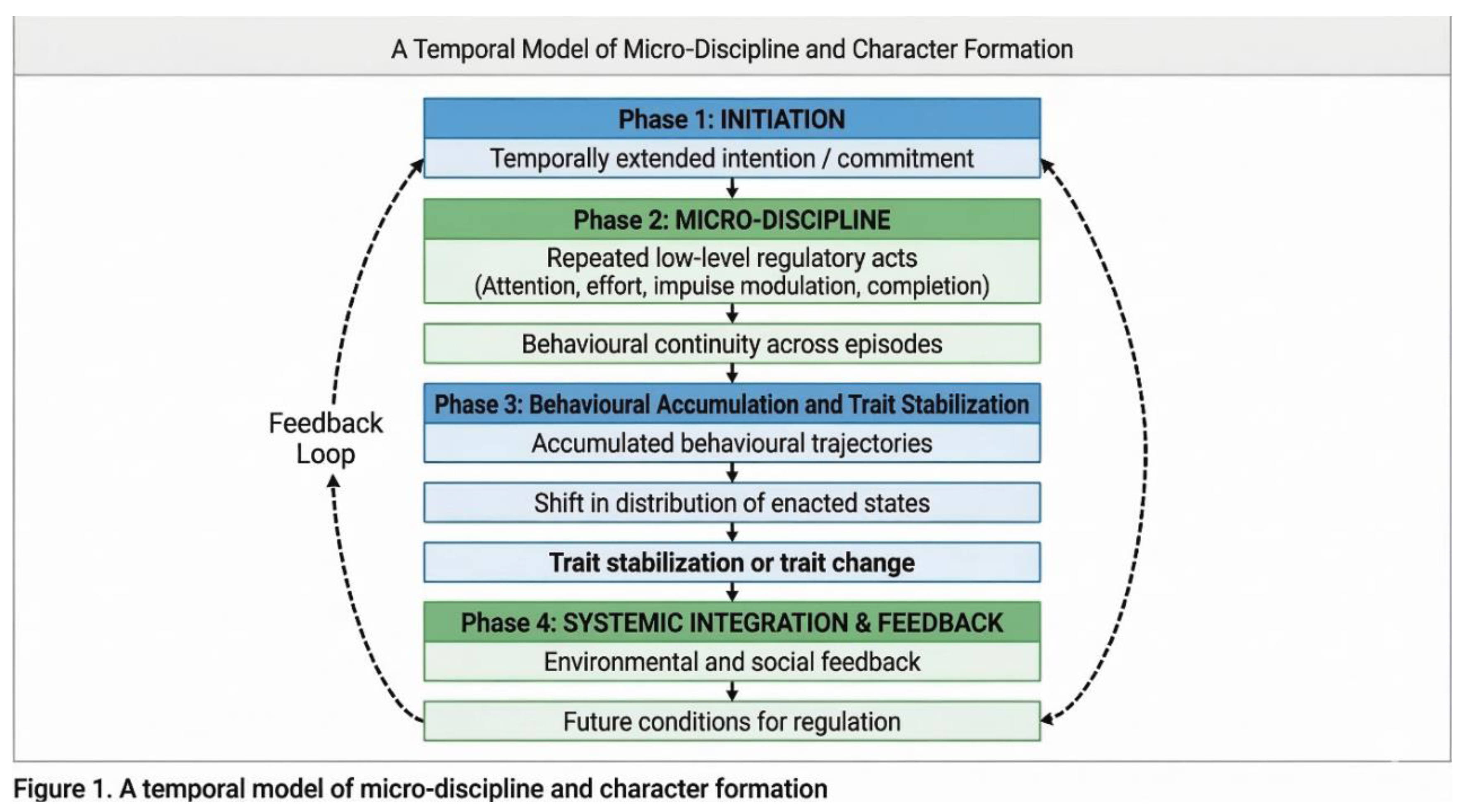
The cumulative process linking repeated regulatory acts to trait development can be summarized as a temporal dynamic in which behavioural maintenance stabilizes trajectories and gradually alters the distribution of enacted states (see Figure 1).
4.3. Recursive Effects and Behavioural Self-Reinforcement
The developmental importance of micro-discipline is further amplified by its recursive effects. Repeated follow-through does not merely sustain individual episodes of action; it alters the conditions under which subsequent action occurs. Completion reduces backlog and cognitive load, while routine reduces the need for repeated deliberation. Consistent follow-through can strengthen expectations of efficacy and generate trust from others, thereby stabilizing the behavioural environment.
The inverse process is equally important. Repeated fragmentation produces unfinished obligations, cognitive residue, and weakened expectations of follow-through. Irregularity increases the effort required to reinitiate tasks. Others may become less willing to rely on the individual, reducing external supports that would otherwise facilitate behavioural continuity. Behavioural instability can therefore become self-reinforcing.
This recursive dynamic helps explain why micro-discipline has long-term developmental significance despite the apparent triviality of individual acts. Small regulatory acts reshape not only immediate behaviour but also the future probability structure of action. They influence what becomes easier, more likely, and more stable across subsequent episodes. Character formation, in this sense, reflects a process in which behaviour progressively reorganizes the conditions of its own recurrence.
4.4. A Concrete Illustration: Writing Practice as Behavioural Formation in Miniature
A concrete example illustrates these dynamics. Consider an individual attempting to sustain a writing practice. A coarse explanation might attribute success or failure to motivation, ability, or trait-level conscientiousness. In practice, however, continuity depends on a series of small regulatory acts: beginning at the intended time, resisting distractions, persisting through difficulty, returning after interruption, and completing modest units of work.
Individually, these acts appear insignificant. Missing a session, checking messages, or leaving a paragraph unfinished rarely seems consequential. Yet over time, these micro-level decisions structure the trajectory of the practice. Repeated attentional return, tolerance of discomfort, and completion of small goals increase the recurrence and duration of writing-related behavioural states. Repeated postponement, distraction, or early disengagement produces a different pattern of behaviour.
Over time, these differences may be described in dispositional terms. One individual appears reliable or disciplined, while the other appears inconsistent. However, these descriptions follow from the behavioural process rather than explain it. The divergence reflects the cumulative effects of repeated regulatory acts that either preserve or disrupt continuity between intention and action.
The example also illustrates why micro-discipline cannot be reduced to habit. Some elements of writing may become routinized, but many remain effortful. The relevant process involves ongoing regulation under conditions of distraction, uncertainty, fatigue, and fluctuating motivation. It is in such contexts that micro-discipline has particular explanatory value.
4.5. Path Dependence, Plasticity, and the Conditions of Change
The cumulative effects of micro-discipline imply a path-dependent model of behavioural development. Early patterns of regulation can make later behavioural options easier or more difficult to sustain. Stable routines of attentional return and completion may build competence, confidence, and access to structured roles. Repeated fragmentation may undermine reliability and limit opportunities for further development.
This does not imply determinism. Behavioural trajectories remain revisable. However, revision is constrained by previously established patterns of enactment. Behaviour is neither fixed nor fully unconstrained. It is durable because patterns can become self-reinforcing, yet plastic because those patterns can be reorganized under appropriate conditions.
This perspective bears directly on trait plasticity. Personality research increasingly shows that traits are modifiable and that individuals can sometimes alter traits such as conscientiousness or emotional stability through intentional behavioural change (Hudson & Fraley 2015; Hudson & Roberts 2014). However, such changes are often uneven in their success.
The present framework helps explain this variability. Trait change depends less on intention alone than on whether intentions are repeatedly translated into low-level regulatory acts. Without consistent enactment of attentional return, effort continuation, impulse modulation, and behavioural completion, change efforts fail to accumulate. When these processes are stabilized, repeated enactment can gradually reorganize behavioural distributions and contribute to observable changes in trait expression.
Process models of personality development similarly emphasize that long-term change emerges from repeated micro-level cycles linking situational triggers, behavioural states, and feedback processes (Wrzus & Roberts, 2017). Micro-discipline can be understood as stabilizing the regulatory component within these cycles, thereby influencing which behavioural states recur and consolidate over time.
Micro-discipline therefore provides an intermediate explanatory layer between intention and dispositional change. It clarifies how momentary regulation can scale into durable behavioural organization and why character formation is best understood as the cumulative outcome of repeated behavioural maintenance rather than as the result of isolated decisions.
5. Behavioural Organization and Normative Evaluation
The analysis developed thus far suggests that micro-discipline functions as an important mechanism in the formation of behavioural stability. Through repeated acts of attentional regulation, effort continuation, impulse modulation, and task completion, individuals gradually construct coherent behavioural trajectories that may later appear as stable aspects of character. At this point, however, an essential distinction must be made. Behavioural organization, however important, does not by itself amount to moral virtue.
This distinction matters because discussions of discipline often move too quickly from functional coherence to ethical praise. In both popular and philosophical discourse, discipline is frequently treated as though it were inherently admirable. That assumption cannot be sustained. A person may be organized, reliable, and persistent while pursuing ethically deficient or actively harmful ends. Behavioural efficiency can serve domination as readily as justice, manipulation as readily as honesty, and exploitation as readily as care. For that reason, micro-discipline should not be identified with virtue itself. It is better understood as a structural capacity that may support virtue, distort it, or remain morally neutral depending on the ends and judgments that govern its exercise.
This distinction is also important for the broader aim of the article. If micro-discipline is to function as a useful intermediate concept between momentary action and stable disposition, it must not collapse into an uncritical celebration of behavioural order. Its explanatory value depends on separating the formation of behavioural stability from the question of whether that stability is ethically well-directed.
5.1. Virtue as Normatively Ordered Agency
Within Aristotelian and neo-Aristotelian ethics, virtue is not merely a pattern of stable behaviour. It is a normatively ordered disposition involving appropriate perception, rightly formed desire, and sound practical judgment (Aristotle, 2000; Annas, 2011). The virtuous agent does not simply behave consistently, but responds in the right way, for the right reasons, and in a manner proportionate to the situation.
This point clarifies why behavioural regularity is insufficient for virtue. Courage is not reducible to persistence under threat, since one may persist recklessly, stubbornly, or fanatically. What distinguishes courage is the proper ordering of fear, judgment, and purpose. The same is true of temperance, justice, honesty, generosity, and practical wisdom. In each case, the ethical significance of conduct depends on the orientation of the agent’s evaluative and motivational life, not simply on the fact that behaviour is regulated and sustained.
Contemporary virtue theorists make this point in complementary ways. Annas emphasizes that virtue involves intelligent responsiveness rather than mere habituated compliance. Snow stresses the role of socially and perceptually informed moral understanding in stable character. Miller similarly argues that moral character cannot be reduced to a simple pattern of outward consistency because it involves a more complex dispositional architecture. Taken together, these accounts show that virtue is better understood as normatively structured agency than as behavioural efficiency.
Micro-discipline therefore cannot be equated with virtue without conceptual loss. It is neither equivalent to practical wisdom nor interchangeable with morally ordered habituation. It belongs to a different explanatory level. Where virtue concerns the moral quality of an agent’s orientation to action, micro-discipline concerns the repeated regulation of the behavioural processes through which action is maintained across time.
5.2. Micro-Discipline as Enabling Infrastructure
Although micro-discipline is not itself a virtue, it can function as part of the enabling infrastructure through which virtues are enacted. Moral commitments often fail not because agents reject the relevant values, but because the behavioural processes required to sustain those values are fragile. A person may sincerely value honesty, justice, care, or generosity while repeatedly failing to act accordingly because attention collapses, effort dissipates, distraction prevails, or follow-through breaks down.
From this perspective, micro-discipline helps explain how moral aspiration becomes behavioural continuity. The claim is not that virtue can be reduced to attentional return, impulse modulation, or task completion. Rather, many virtues depend on these processes as conditions of enactment. Honesty may require the inhibition of expedient deception. Justice may require sustained attention to obligations that are easy to overlook. Generosity may require perseverance in other-regarding action despite inconvenience or competing self-interest. Reliability in friendship, work, caregiving, or institutional responsibility often depends on repeated acts of behavioural maintenance that are too ordinary to register as major moral events, yet are indispensable to moral life in practice.
One of the central claims of this article is therefore that ethical life is not sustained by evaluative endorsement alone. It is sustained through temporally distributed patterns of behavioural maintenance. Micro-discipline functions as part of the practical infrastructure through which morally significant dispositions become behaviourally real.
The term infrastructure is deliberate. Infrastructure is not identical with the ends it serves, but without it those ends cannot be reliably enacted. In the same way, micro-discipline should be understood as a supporting architecture of agency. It does not determine moral content, but it helps determine whether moral content can be translated into stable conduct.
5.3. Instrumental Discipline and Moral Orientation
The distinction between micro-discipline and virtue becomes clearer when instrumental discipline is separated from moral orientation. Instrumental discipline refers to the capacity to sustain organized and reliable behaviour in the service of some end. Moral orientation concerns the normative ordering of those ends and the evaluative quality of the practical reasoning that governs action.
A person may possess considerable instrumental discipline while remaining morally disordered. History offers many examples of highly organized agents, institutions, and systems devoted to harmful projects. Precision, consistency, and reliability are not in themselves moral achievements. They are forms of behavioural order that can be directed toward many different purposes. Once this is recognized, the moral neutrality of micro-discipline becomes clearer. It is a mode of organized behavioural regulation whose ethical significance depends on the broader practical context in which it operates.
Without this distinction, the concept of micro-discipline would be vulnerable to two opposite errors. The first would be to moralize discipline and assume that stable behavioural order is inherently admirable. The second would be to dismiss discipline altogether as merely instrumental or technocratic. Both responses are inadequate. Behavioural organization matters, but its significance depends on the role it plays within a broader practical life whose ends remain open to moral assessment.
Seen in this way, micro-discipline does not compete with virtue theory. It supplements it. Virtue theory explains what morally ordered character is and why it matters. Micro-discipline helps explain one part of how behaviour becomes stable enough for such character to be enacted consistently in everyday life.
5.4. Character Formation and Moral Evaluation
The distinction developed here also clarifies the status of the present theory. The concept of micro-discipline is primarily descriptive and explanatory. It names the repeated behavioural regulation through which coherence, continuity, and dispositional stability are gradually built. It does not itself provide a criterion of moral worth.
At the same time, the concept has indirect normative significance. Because moral life depends on the reliable enactment of values across time, any account that explains the behavioural conditions of such reliability is relevant to ethical theory. Micro-discipline matters normatively not because it is itself a virtue, but because it helps explain how virtues become behaviourally sustainable or behaviourally fragile.
This point may be stated more strongly. One reason agents fail to live according to their endorsed values is not a defect at the level of explicit belief alone, but instability at the level of behavioural maintenance. Ethical aspiration without micro-regulatory continuity remains vulnerable to interruption, fragmentation, and dissipation. In this sense, micro-discipline is descriptively primary but normatively consequential. It identifies a practical condition under which moral agency becomes more or less durable.
The theory therefore occupies a middle position. It does not reduce moral evaluation to behavioural efficiency, but neither does it treat the behavioural mechanics of agency as philosophically irrelevant. If ethical theory is concerned with how commitments are enacted in lived time rather than merely endorsed in abstraction, then the processes described by micro-discipline become important for understanding moral formation.
5.5. Avoiding Moralized Interpretations of Discipline
A final clarification is necessary because the language of discipline is easily drawn into ideological misuse. In contemporary discourse, discipline is often associated with productivity culture, meritocratic self-optimization, or moralized expectations of self-management. Under such interpretations, behavioural inconsistency is treated as evidence of personal failure, lack of worth, or insufficient will. The present account should not be read in those terms.
The concept of micro-discipline is not intended to celebrate busyness, reward performative efficiency, or blame persons whose behavioural continuity is undermined by unstable environments, scarcity, disability, chronic stress, institutional overload, or fractured social conditions. Indeed, one of the broader claims of this article is that behavioural regulation is always partly ecological. The capacity to sustain coherent action depends not only on internal effort but also on access to scaffolds, stable contexts, supportive roles, and manageable cognitive demands. A concept of discipline detached from those conditions becomes morally and sociologically distorted.
For this reason, the distinction between behavioural organization and moral virtue is more than conceptual housekeeping. It protects the concept of micro-discipline from ideological drift. Without that distinction, the concept could be absorbed into a language of individual blame or treated as a simple metric of personal merit. With it, the concept remains properly constrained. It explains a real and important dimension of character formation while leaving open the further questions of moral orientation, social condition, and environmental support.
Micro-discipline should therefore be understood neither as a virtue in itself nor as a covert defense of self-optimization. It is a theoretically specific account of the repeated behavioural regulation through which continuity of conduct is formed, supported, or eroded. Its ethical importance lies in showing that moral life depends not only on what agents value or decide, but also on whether the behavioural conditions for sustained enactment are in place.
6. Micro-Discipline as an Ecological System
The preceding analysis has described micro-discipline as a repeated process of behavioural regulation. Any account that treats this process as purely internal, however, remains incomplete. The capacity to sustain coherent patterns of action depends not only on individual regulatory effort, but also on the social, institutional, and material environments within which behaviour unfolds.
Micro-discipline should therefore be understood as a person–environment regulatory system rather than as an internal capacity alone.
This is not a secondary qualification but a condition of adequacy. Recurrent low-level acts of regulation are made easier or harder by external scaffolds, including routines, deadlines, physical arrangements, role expectations, institutional rhythms, and the broader distribution of time, stability, and cognitive burden. What appears as individual discipline is often partly co-produced by environmental design.
Understanding micro-discipline ecologically clarifies two points. First, behavioural continuity depends on more than effort or willpower. Second, differences in behavioural stability cannot be interpreted straightforwardly as differences in virtue or character. The formation of behavioural continuity is partly scaffolded, distributed, and unequally supported across social contexts.
6.1. Environmental Stability and Behavioural Regulation
Sustaining coherent behavioural patterns typically depends on relatively stable contexts. Routines and forms of self-regulation are easier to maintain when environments provide predictability, reliable cues, and manageable demands. Work habits, sleep patterns, exercise routines, and practices of focused attention all benefit from temporal regularity and resource stability.
Habit research illustrates this clearly. Behavioural repetition is facilitated by stable contextual cues, while disruption of those cues can fragment even well-established routines (Wood & Rünger 2016; Lally et al. 2010). The implication extends beyond habit formation. Even effortful forms of behavioural maintenance rely on environmental support. The microstructure of agency is therefore neither wholly internal nor purely spontaneous, but emerges through the interaction between agents and structured contexts.
6.2. Distributed Regulation and Cognitive Scaffolding
The ecological conditions of micro-discipline can be further clarified through theories of distributed cognition and extended agency. Cognitive processes are often partially realized through structures outside the individual, including tools, environments, and institutional arrangements (Clark & Chalmers 1998). In everyday practice, individuals routinely rely on external systems to stabilize memory, attention, and behavioural sequencing.
Calendars, reminders, task lists, deadlines, institutional routines, and shared expectations function as cognitive scaffolds. These structures reduce the regulatory burden placed on internal attention and working memory. Rather than continuously reconstructing intentions, agents embed them in external arrangements that sustain behavioural continuity across time.
Within this framework, such structures can be understood as supports for micro-discipline. They stabilize the microstructure of agency by externalizing components of regulation. A calendar entry preserves commitment to a future obligation. A deadline structures completion. A shared schedule aligns individual action with collective rhythms.
Behavioural economics provides a complementary perspective. Research on choice architecture shows that small environmental features can systematically shape behaviour by influencing the micro-decisions that accumulate over time (Thaler & Sunstein 2008). Defaults, reminders, prompts, and friction-reducing mechanisms can redirect behavioural trajectories without requiring substantial changes in motivation or deliberation. Micro-discipline is therefore not only enacted but also designed.
6.3. Social Roles, Cognitive Load, and Unequal Support
Social roles do not merely constrain behaviour. They often scaffold it. Life transitions such as entering employment, forming long-term partnerships, or assuming caregiving responsibilities are associated with increases in conscientiousness and emotional stability (Roberts et al. 2008). One interpretation is that such roles impose stable expectations, recurring tasks, and external accountability that reinforce repeated acts of behavioural regulation.
At the same time, environmental conditions shape micro-discipline by altering cognitive load. Behavioural regulation depends on monitoring, planning, inhibition, and sustained attention. Conditions of uncertainty, chronic stress, financial strain, or role overload increase competing demands and reduce available regulatory capacity.
For this reason, behavioural instability should not be interpreted too quickly as a trait deficiency or moral failure. Under high-load conditions, fragmentation may reflect situational burden rather than lack of character. Even strong intentions may fail to stabilize behaviour when the surrounding ecology is persistently disorganizing.
The conditions that support micro-discipline are also unevenly distributed. Access to stable housing, predictable schedules, low-chaos environments, and manageable cognitive demands varies significantly across social contexts. Opportunities for behavioural continuity are therefore socially patterned.
6.4. Character Within an Ecology of Agency
Integrating these ecological considerations alters the broader account of character. Character can no longer be understood solely as an internally generated dispositional structure. It must also be understood as the emergent product of repeated behavioural regulation occurring within social and material environments that support, disrupt, or channel such regulation.
This expansion is not an optional addition but a requirement of explanatory adequacy. A theory of micro-discipline that ignores scaffolding, distributed regulation, and structural conditions risks collapsing into an individualistic account of self-management. A more accurate view is that behavioural continuity arises through an ongoing interaction between regulatory effort and environmental support.
6.5. Inequality and the Distribution of Behavioural Conditions
The ecological perspective has a further implication. The conditions that support micro-discipline are unevenly distributed across populations. Stable environments, predictable institutional structures, and access to time and cognitive bandwidth are not universally available. Behavioural continuity is therefore shaped, in part, by structural conditions.
This matters philosophically because it places limits on individualistic interpretations of character. If behavioural stability depends partly on access to supportive scaffolds, then differences in behavioural organization cannot be attributed solely to effort, virtue, or personal merit. A robust account of micro-discipline must therefore incorporate the unequal distribution of the conditions that make sustained regulation possible.
7. The Temporal Structure of Agency
The concept of micro-discipline has implications that extend beyond behavioural maintenance. It requires a reconsideration of the temporal structure of agency itself. Much philosophical reflection has focused on two poles: the moment of deliberative choice and the relatively enduring disposition. The argument of this article is that this picture is incomplete. Agency also unfolds within a middle temporal layer composed of repeated regulatory acts that organize behaviour across time.
7.1. The Temporal Stratification of Agency
Agency is temporally stratified. At the shortest scale are episodes of deliberation and decision. At an intermediate scale are routines, maintenance practices, and recurring forms of self-regulation. At the longest scale are durable dispositions and traits that structure patterns of conduct across extended periods.
Philosophical accounts of moral agency have often privileged the first scale because decisions are normatively salient. One can evaluate whether an action is justified, whether a reason is sufficient, or whether a choice is rational. Personality psychology has often privileged the third scale, where behavioural regularities are summarized in dispositional terms. However, much of the practical work of character formation occurs at the intermediate level, where behaviour is maintained, interrupted, restored, and stabilized through repetition.
Recognizing this middle layer clarifies that behavioural stability is not simply expressed by traits or initiated by isolated choices. It is constructed through temporally extended processes of regulation.
7.2. Agency as Maintenance
A central implication of this account is that agency should be understood not only as the capacity to initiate action, but also as the capacity to sustain action across time. This reframing shifts attention from episodic decision making to the ongoing processes through which intention remains behaviourally effective.
Models centered on choice risk overestimating moments of deliberation while underestimating the cumulative work required to maintain continuity between intention and execution. Many failures of agency do not occur at the point of endorsement. They emerge in the breakdown of behavioural continuity after a decision has been made.
This perspective helps explain a familiar phenomenon: individuals often endorse values and commitments that they repeatedly fail to enact. Such failures need not reflect insincerity, ignorance, or defective reasoning. They may instead reflect instability in the regulatory processes required to sustain action over time. Micro-discipline brings this dimension of agency into focus by identifying the mechanisms through which continuity is either preserved or eroded.
7.3. Ethical and Theoretical Implications
Much of moral life depends on temporally extended patterns of conduct. Trustworthiness, reliability, fairness, and care are not established through isolated actions, but through repeated enactment across time. A promise acquires meaning through sustained follow-through. Justice depends on ongoing attentiveness to obligations and the consistent regulation of bias. Responsibility, in practice, is inseparable from the capacity to maintain action under ordinary conditions of friction.
The theoretical implications follow directly. By identifying a middle temporal layer of agency, the concept of micro-discipline helps explain how behavioural coherence is built, why traits change gradually rather than abruptly, and why virtue requires more than isolated acts of correct judgment. It also clarifies why ecological scaffolding plays a central role in character formation, since the maintenance of behaviour depends on conditions that extend beyond the individual.
A theory of character that omits this intermediate layer may adequately describe stable dispositions or evaluate discrete actions, but it will not explain how character is practically sustained, eroded, or transformed in lived time. Micro-discipline contributes precisely at this point by specifying the processes through which behavioural continuity is constructed across temporal scales.
8. Conclusion
This article has argued that both philosophical and psychological accounts of character tend to emphasize relatively stable outcomes, whether in the form of virtues or traits, while leaving under-specified the fine-grained behavioural processes through which such stability emerges over time. In response, it has introduced the concept of micro-discipline to describe recurrent low-level acts of regulation through which continuity between intention and action is preserved across temporally extended sequences of behaviour.
The central claim has not been that these processes are unknown. Elements of them are already present in research on habit, self-control, behavioural persistence, trait enactment, and virtue habituation. The contribution of the present account is to integrate these strands into a more precise explanatory framework. Micro-discipline identifies a temporally cumulative mechanism through which repeated low-level regulatory acts contribute to the formation, maintenance, and transformation of character. Without this intermediate layer, accounts of character remain descriptively incomplete and explanatorily thin.
The analysis has shown that behavioural stability is not merely expressed by traits or initiated through isolated decisions. It is constructed through repeated processes of maintenance, interruption, restoration, and completion that unfold across time. Micro-discipline helps explain how behavioural trajectories stabilize, how trait expression may gradually shift, and why moral aspiration so often depends on ordinary patterns of follow-through rather than on episodic moments of choice alone.
The account has also emphasized that these processes are ecological as well as psychological. Behavioural continuity is shaped by routines, roles, institutional structures, and material scaffolds that support or undermine regulatory success. Character formation is therefore neither purely internal nor reducible to situational factors. It emerges through the interaction between regulatory effort and structured environments that distribute the conditions of behavioural continuity unevenly across contexts.
The theoretical contribution is threefold. First, for virtue theory, micro-discipline clarifies how moral commitments become behaviourally durable rather than remaining episodic endorsements. Second, for personality science, it provides a process-oriented account of how repeated enactments may stabilize or gradually reshape trait distributions. Third, for research on behavioural change, it highlights that durable transformation depends less on episodic motivational intensity than on the repeated preservation of intention–action continuity under ordinary conditions of friction.
More broadly, the analysis supports a reconceptualization of agency. Agency is not exhausted by moments of deliberation, nor fully captured by dispositional summaries. It is also realized in the ongoing work of maintaining action across time. Recognizing this temporally extended layer helps explain how commitments remain effective in practice and why character formation proceeds through cumulative processes rather than isolated decisive acts.
Future research can extend this framework by examining how micro-disciplinary processes vary across contexts, how environmental scaffolds alter their likelihood and stability, and how repeated regulatory acts contribute to longitudinal patterns of personality development. In doing so, the concept of micro-discipline offers a point of integration between philosophical accounts of character and empirical research on behavioural regulation, while also providing a more precise account of how agency is enacted in lived time.
Author Contributions
Conceptualization, methodology, formal analysis, and writing—original draft preparation and review and editing were performed by the author.
Funding
This research received no external funding.
Institutional Review Board Statement
Not applicable.
Informed Consent Statement
Not applicable.
Data Availability Statement
No new data were created or analyzed in this study. Data sharing is not applicable.
Conflicts of Interest
The author declares no conflict of interest.
References
- Annas, J. Intelligent virtue; Oxford University Press, 2011. [Google Scholar]
- Aristotle. Nicomachean ethics; Crisp, R., Translator; Cambridge University Press; (Original work published ca. 4th century BCE); 2000. [Google Scholar]
- Baumeister, R. F.; Tierney, J. Willpower: Rediscovering the greatest human strength; Penguin Press, 2011. [Google Scholar]
- Carver, C. S.; Scheier, M. F. On the self-regulation of behavior; Cambridge University Press, 1998. [Google Scholar]
- DeYoung, C. G. Cybernetic Big Five theory. Journal of Research in Personality 2015, 56, 33–58. [Google Scholar] [CrossRef]
- Duckworth, A. L.; Gendler, T. S.; Gross, J. J. Situational strategies for self-control. Perspectives on Psychological Science 2016, 11(1), 35–55. [Google Scholar] [CrossRef] [PubMed]
- Fleeson, W. Toward a structure- and process-integrated view of personality: Traits as density distributions of states. Journal of Personality and Social Psychology 2001, 80(6), 1011–1027. [Google Scholar] [CrossRef] [PubMed]
- Gollwitzer, P. M. Implementation intentions: Strong effects of simple plans. American Psychologist 1999, 54(7), 493–503. [Google Scholar] [CrossRef]
- Hennecke, M.; Luhmann, M. The role of self-regulation in the daily pursuit of personal goals. Journal of Personality 2017, 85(4), 429–442. [Google Scholar] [CrossRef]
- Hennecke, M.; Czikmantori, T.; Brandstätter, V. Doing despite disliking: Self-regulatory strategies in everyday aversive activities. European Journal of Personality 2019, 33(1), 104–128. [Google Scholar] [CrossRef]
- Hudson, N. W.; Fraley, R. C. Volitional personality trait change: Can people choose to change their personality traits? Journal of Personality and Social Psychology 2015, 109(3), 490–507. [Google Scholar] [CrossRef] [PubMed]
- Hudson, N. W.; Roberts, B. W. Goals to change personality traits: Concurrent links between personality traits, daily behavior, and goals to change oneself. Journal of Research in Personality 2014, 53, 68–83. [Google Scholar] [CrossRef]
- Inzlicht, M.; Schmeichel, B. J.; Macrae, C. N. Why self-control seems (but may not be) limited. Trends in Cognitive Sciences 2014, 18(3), 127–133. [Google Scholar] [CrossRef] [PubMed]
- Jayawickreme, E.; Zachry, C. E.; Fleeson, W. Whole trait theory: An integrative approach to examining personality structure and process. Personality and Individual Differences 2021, 169, 109906. [Google Scholar] [CrossRef]
- Lally, P.; van Jaarsveld, C. H.; Potts, H. W.; Wardle, J. How are habits formed: Modelling habit formation in the real world. European Journal of Social Psychology 2010, 40(6), 998–1009. [Google Scholar] [CrossRef]
- McCrae, R. R.; Costa, P. T., Jr. The Five-Factor Theory of personality. In Handbook of personality: Theory and research, 3rd ed.; John, O. P., Robins, R. W., Pervin, L. A., Eds.; Guilford Press, 2008; pp. 159–181. [Google Scholar]
- Milyavskaya, M.; Inzlicht, M. What’s so great about self-control? Examining the importance of effortful self-control and temptation in predicting real-life depletion. Social Psychological and Personality Science 2017, 8(6), 603–611. [Google Scholar] [CrossRef]
- Mõttus, R. Towards more rigorous personality trait–outcome research. European Journal of Personality 2017, 31(4), 292–303. [Google Scholar] [CrossRef]
- Roberts, B. W.; Walton, K. E.; Viechtbauer, W. Patterns of mean-level change in personality traits across the life course: A meta-analysis of longitudinal studies. Psychological Bulletin 2006, 132(1), 1–25. [Google Scholar] [CrossRef] [PubMed]
- Roberts, B. W.; Wood, D.; Caspi, A. The development of personality traits in adulthood. In Handbook of personality: Theory and research, 3rd ed.; John, O. P., Robins, R. W., Pervin, L. A., Eds.; Guilford Press, 2008; pp. 375–398. [Google Scholar]
- Snow, N. E. Virtue as social intelligence: An empirically grounded theory; Routledge, 2010. [Google Scholar]
- Tangney, J. P.; Baumeister, R. F.; Boone, A. L. High self-control predicts good adjustment, less pathology, better grades, and interpersonal success. Journal of Personality 2004, 72(2), 271–324. [Google Scholar] [CrossRef] [PubMed]
- Wood, W.; Rünger, D. Psychology of habit. Annual Review of Psychology 2016, 67, 289–314. [Google Scholar] [CrossRef] [PubMed]
- Wrzus, C.; Roberts, B. W. Processes of personality development in adulthood: The TESSERA framework. Personality and Social Psychology Review 2017, 21(3), 253–277. [Google Scholar] [CrossRef] [PubMed]
Figure 1.
Temporal model of micro-discipline and character formation. Repeated low-level regulatory acts preserve continuity between intention and action across behavioural episodes. Through accumulation over time, these acts bias the distribution of enacted behavioural states, contributing to the stabilization or transformation of personality traits. Environmental and social feedback loops shape the conditions under which future regulation occurs, producing a recursive person–environment system of character development.
Figure 1.
Temporal model of micro-discipline and character formation. Repeated low-level regulatory acts preserve continuity between intention and action across behavioural episodes. Through accumulation over time, these acts bias the distribution of enacted behavioural states, contributing to the stabilization or transformation of personality traits. Environmental and social feedback loops shape the conditions under which future regulation occurs, producing a recursive person–environment system of character development.
Disclaimer/Publisher’s Note: The statements, opinions and data contained in all publications are solely those of the individual author(s) and contributor(s) and not of MDPI and/or the editor(s). MDPI and/or the editor(s) disclaim responsibility for any injury to people or property resulting from any ideas, methods, instructions or products referred to in the content. |
© 2026 by the author. Licensee MDPI, Basel, Switzerland. This article is an open access article distributed under the terms and conditions of the Creative Commons Attribution (CC BY) license.
Copyright: This open access article is published under a Creative Commons CC BY 4.0 license, which permit the free download, distribution, and reuse, provided that the author and preprint are cited in any reuse.


