

Submitted:
24 March 2026
Posted:
26 March 2026
You are already at the latest version
Abstract
Magnetizing living cells with superparamagnetic iron oxide nanoparticles (SPIONs) enables their remote manipulation using external magnetic field. This lays the foundation for magnetically assembling tissue precursors within cell-friendly, proliferation-permissive environments and holds considerable promise for biomedical applications, particularly in the development of complex single- and multicellular tissue constructs for bone and organ reconstruction. However, progress in this field is limited by the lack of robust mathematical tools for accurate control of ensembles of magnetic nano- and micro-objects. In practical printing scenarios, collective behavior and unavoidable statistical heterogeneity—such as variations in SPION size and shape or deviations in cell magnetization—render traditional equation-based modeling inadequate. We developed a hybrid modeling framework integrating conventional physics-based simulations with artificial intelligence–driven image analysis. Dynamic parameters were extracted from video recordings of magnetized cells moving within model microfluidic devices exposed to well-defined magnetic fields and gradients. The AI-based analysis enabled quantitative characterization of ensemble behavior under heterogeneous conditions. The proposed framework successfully captured the collective dynamics of magnetized cell ensembles and enabled accurate prediction and control of their spatial organization under external magnetic actuation. The integration of simulation and data-driven analysis provided robust parameter identification despite statistical heterogeneity within the system. This combined modeling approach offers a practical and effective tool for guiding the 3D magnetic assembly of living cells into functional tissue architectures. The framework advances the precision control of magnetically assisted bioprinting and supports future applications in bone and organ reconstruction.
Keywords:
3D bioprinting
; tissue engineering
; magnetized cells
; remote field control
; COMSOL simulations
; AI data analysis
; machine learning
1. Introduction
Regenerative medicine (RM) holds significant promise for advanced healthcare by offering personalized and specific approaches to tissue repair. Central to RM is the restoration and revitalization of damaged cells and tissues, presenting a potential revolution in managing various medical challenges. Despite advancements in the field and notable successes in specific cases, the full potential of regenerative medicine in clinical settings remains unrealized.
Progresses in materials science and engineering have enabled the realistic design and printing of complex tissue arrangements, aiming to achieve full-scale organ printing [1,2,3]. Nevertheless, the bone treatments proceed so far through transplantation, which is the second most common transplant procedure after blood transfusion. Structurally and functionally adaptive artificial bone must incorporate stimuli-responsive materials compatible with 3D (bio)printing techniques and suitable biological and mechanical properties, a connected porous structure, and the shape matching the bone defect [4,5,6,7]. Traditional bioprinting approaches frequently fall short in reproducing the intricate cellular architectures and interactions essential for complex tissue formation. A key obstacle to that is the correct assembly of living cells into functional tissues. This challenge is particularly pronounced for tissues characterized by heterogeneous cell compositions and architectural gradients – such as such as the articular tissues, including meniscus, cartilage etc. [8], where the cell supply issues and controlled migration of stem cells represent problems still waiting for efficient solutions. Accomplishing accurate cellular organization and ensuring optimal metabolic support in such tissues pose significant challenges, limiting the broader clinical implementation of 3D printing.
Magnetic technologies—typically relying on the manipulation of magnetic micro- and nanoparticles by spatially defined magnetic fields [9] have already been established as a powerful platform for numerous biomedical applications [10]. These include targeted drug and gene delivery [11], magnetic hyperthermia for cancer treatment [12], scaffold-supported bone reconstruction [13], the capture and concentration of biomarkers for early diagnostics [14] among others. In this context, the remote magnetic guidance of living cells for 3D assembly emerges as a versatile and promising technology for tissue prototyping. This approach offers a strongly competitive edge over conventional 3D bioprinting techniques in the ongoing effort to translate the remarkable scientific advances into clinical practice [15]. Magnetic 3D printing of functional tissues leverages magnetically (SPIONs) labelled cells, which can be precisely directed through remote magnetic control, offering thus a number of advantages with respect to other bio-printing techniques. Among main advantages clearly stands out the capability to generate hierarchical multi-type cellular architectures by fast (pseudo-spontaneous) assembling of living cells. Note that the remote guiding allows to handle the cells in friendly environments and move them gently by acting exclusively on the magnetic component [16]. Magnetic nanoparticles exhibit intrinsic magnetic properties, and when incorporated into biomimetic scaffold structures, they can sustain osteoconduction, osteoinduction, and angiogenesis [17,18]. Noteworthily, thorough toxicological investigations showed low cytotoxicity values for concentrations of magnetic material not exceeding 100 pg/cell, fully functional for the activation of cells by realistic and safe remote magnetic fields [16,19].
Functionally correct on-demand assembling of cells of the same or of different types, to produce tissue precursors for the repair of various injuries requires suitable and accurate printing protocols. The motion of a single magnetic object in any defined magnetic gradient can be calculated by straightforward mathematics [20]. On the other hand, describing the motion of a large set of nanoparticles, typically characterized by only approximately known distributions of shapes, sizes and magnetization, represents a clear challenge for the direct equation-based approach. Recently Machine Learning/Artificial Intelligence (ML/ AI) method was successfully employed to predict the magnetization of SPIONs from the video tracking of the dynamics of magnetic particles drugged in micro-capillaries by magnetic gradients [21].
The aim of this study is to demonstrate that a combined mathematical approach, integrating standard COMSOL-based and AI analyses, provides an excellent descriptive framework for the remotely controlled motion of magnetized cells. Experiments are conducted in a versatile model system using standard microfluidic chips compatible with direct optical observation and fluorescence detection, while SPION doped fibroblasts were selected as a suitable and useful cell model.
2. Materials and Methods
2.1. Cell Magnetization
To magnetize fibroblast line 3T3-GFP enabled with green fluorescence cultivated under a standard culture condition, we used commercial Chemicell MAG/G-PAA SPIONs with an average total diameter of 20 nm and a magnetic core diameter of 10 nm. The magnetizing procedure was based on previously established protocols [16,22] and employed concentrations from 1x10³ to 5x10⁶ SPIONs/cell. Although other concentrations were also tested, this range constituted the main basis for analyzing the effects of magnetization on the cellular fluxes in magnetic field.
2.2. Experimental System
To analyze the flux of magnetized cells in magnetic fields, we used the ChipShop 25 mm x 75 mm microfluidic chip coated with Zeonor polymer (Figure 1a). The chip has five inlets and an array of 25 narrow channels that subsequently merge into five wider outlet channels, optimizing fluid drainage and maintaining laminar flow regime. The cell suspension and buffer were introduced into the microfluidic network using a peristaltic pump to reduce the pulsation and ensure steady-state flows. This provides volumetric flow velocities within a range of a few tens up to several hundred micrometers per second in the central part of the chip and generates stable laminar flow conditions for the magnetized cells.
In order to monitor the dynamics of the magnetized cells, the chip was placed under a standard fluorescent Olympus IX71 microscope equipped with a digital camera for video recording. A 10X-15X magnification was used to visualize the 100×100 pixel field in the chamber. Images and video sequences are recorded for data analysis with standard imaging software. Post-acquisition adjustments to brightness and contrast were also made to enhance the quality of visualization and enable a maximally precise assessment of the flow dynamics under the influence of the magnetic field. The recorded dynamics were analyzed using COMSOL and AI-based methods.
This setup has been already successfully validated on the flow of SPIONs, realized in similar conditions [23].
2.3. Comsol Simulations
Standard computer simulations were employed to model the transport behavior of magnetized cells. These simulations were carried out using COMSOL Multiphysics, specifically employing the Chemical Engineering Module with Mass Transport (Convection and Diffusion) and Transient Analysis.
The simulation environment consisted of a microfluidic chamber with dimensions: height = 175 µm, width = 14 mm, and length = 32 mm. A cylindrical permanent magnet (PM) with a diameter and height of 10 mm, and a residual magnetization of 1.3 T, was positioned horizontally and perpendicular to the chamber (Figure 1). The magnet was placed 5 mm (dist_y) from the nearest edge of the chamber (or 12 mm from the flow axis) and 25 mm (dist_x) from the chamber inlet. Magnetized cells, each with a diameter of 10 µm, were introduced into the chamber filled with a physiological solution having a dynamic viscosity of 1.1 mPa·s (1.1 × 10⁻³ N·s/m²).
The mathematical description in COMSOL is based on the balance of magnetic and fluid-dragging forces for magnetic particles:
,
where the magnetic force is given by:
,
the dragging force is given by:
,
and the particle velocity is:
,
Here is the fluid velocity, η - fluid dynamic viscosity, - particle magnetization, and H is the applied field. The buoyancy force is ignored throughout the paper as non-relevant for the horizontal projection of the motion, detected in our configuration.
2.4. AI—Methodology
To move on complementary to COMSOL algorithms, we shall consider that the real magnetized cells contain nanoparticles with dispersions in size, shape, and aggregation state, which directly influence their net magnetic moment [24]. When SPIONs are internalized by cells, clustering within endosomes functionally behaves as a larger “magnetic inclusion” rather than isolated nanoparticles [25]. Reported intracellular iron concentration typically spans in the 1–5 pg Fe/cell interval, depending on SPION type, coating, and incubation protocol [26]. Thus, commonly employed mathematical models for magnetic nanoparticle dynamics can result in significant deviations from instrumentally validated parameters [27]. The complex behavior of magnetized living cells - influenced by factors like cytoskeletal interactions, membrane fluidity, and variable SPION internalization - is poorly described by standard magnetostatic and hydrodynamic equations alone [28].
Machine learning (ML) and artificial intelligence (AI) techniques were employed to evaluate the magnetization of cells by analyzing their response to a remote magnetic field. This approach characterizes the displacement patterns—specifically within regions affected by magnetic forces—formed by magnetically controlled microflows. Video recordings, captured via standard fluorescence microscopy, served as input data for the neural network model.
Using the microfluidic chip described above, we estimate the drift (deflection) of the magnetized microflow under the influence of the external magnetic field. The recorded video of the temporal dynamics of the deflection (drift) of the cells microflow under the influence of magnetic field served as a data set for ML processing. For training and validation, the video frames were extracted from the experimental recordings using the Python OpenCV framework, with the resolution reduced to 50 FPS and the field of view to 500x500 pixels. The subsequent processing of the data largely followed the methods presented in [29]. Namely, after loading LabelMe, the annotated JSON files were converted to the standard COCO data format, resulting in files annotated with the areas. Different convolutional neural network (CNN) libraries [30,31] such as ResAt-UNet, MLP, SVM, FCN8, Bilateral Segmentation Network (BisNet), DRNet and DFA-Net were tested. Finally, the standard U-Net module was employed for the cell flow evaluation (IoU: 0.88; Recall: 0.86). The CNN approach has resulted particularly effective in the analysis of consecutive video frames. Its design includes a contracting path to capture a broader context and an expanding path that enables precise localization. This symmetry allows the U-Net to capture both high-level features and intricate details, which is crucial for analyzing minimally distinguishable details. Moreover, the efficiency of U-Net on limited training data makes it practical for applications where large datasets are difficult to obtain, which is particularly valuable in the case of analyzing the behavior of MCs with limited experimental data.
3. Results
3.1. Video Recordings
Figure 2 and Figure 3 show the laminar flow of the magnetized cells and its deviations caused by magnetic fields for low- and high-concentration of cells respectively. Also, while Figure 2 displays the large-scale distribution of cells over tens of mm, Figure 3 is strongly zoomed on a few-mm optical frame.
The snapshots from the recorded videos in Figure 2 give a clear indication of a strong deviating effect of the magnetic field on highly magnetized cells (1x10⁶ SPIONs/cell). While in the absence of dragging magnetic field the cell flow is fairly uniform (Figure 2a), the presence of the permanent magnet, generating an upward force with respect to the image plane (Figure 2b), strongly deviates the magnetized cells towards the magnet, demonstrating evident remote cell-manipulating capabilities.
The raw data shown in Figure 3 corresponds to snapshots from the starting time (0 min) to 3 min, taken at 0.5 min intervals. The top and bottom rows depict example figures for two chosen concentrations of 1x10⁵ and 1x10⁶ SPIONs/cell and for the sake of simplicity the figures are oriented so that the magnetic forces drag the cells upward, similarly to Figure 2. It can be seen that the green fluorescence pattern, corresponding to magnetized cells fluid, continuously diverges over time towards the magnet, and this deviation is more sizeable for higher concentrations.
Building on direct experimental observations, we now construct a proper mathematical treatment of the data, enabling us to provide a correct quantitative description of magnetic fluids and set the conditions for accurate 3D printing and assembling living cells.
3.2. COMSOL Simulations
The motion of magnetized cells is simulated by considering cells as large cell-size microparticles borrowing a magnetic core, corresponding to the SPIONs number inside the cell. To simplify the computer simulations, it is assumed that the whole magnetic material inside the cell is concentrated as a sphere with diameter d_mag, instead of considering specifically the MNP diameters, their number and their distribution.
In Figure 4 are shown the results of the simulations for two fluid velocities, namely dUx = 0.2 mm/s (a - d) and 0.5 mm/s (e – h), and a range of magnetic diameters d_mag from 1.0 µm to 1.6 µm, corresponding to 1x10⁶ – 4x10⁶ internalized SPIONs. The distribution of the cell concentration is represented as a color scale from 0 (green) to 1 mol/m3 (red) and the position of PM axes is indicated by dash–dot lines. One can see that the magnetic fluid is sensitive to both magnetic core size and the fluid velocity – both parameters allow to control and adjust the remote guiding and manipulation effect. For dUx = 0.2 mm/s and d_mag = 1.0 µm the flux only slightly turns toward the magnet. For bigger d_mag it strongly turns moving closer to PM axis. For higher velocity dUx = 0.5 mm/s this occurs only for the biggest d_mag = 1.6 µm, while for smaller diameters the flux only slightly modifies or do not change at all. Evidently, for low velocity of the fluid the vertical magnetic force stronger dominates over the horizontal dragging component, while the higher laminar velocity requires more magnetic material to induce a sizeable deviation. The flexibility of the remote magnetic guiding is confirmed by essentially similar distribution of fluids in Figure 4a,g and in Figure 4b,h enabling efficient magnetic control through the competition of the two parameters. Note that the microfluidic environment represents an appropriate model research instrument, feasibly adaptable to 3D printing settings.
To investigate further the guiding capability of the remote magnetic control, we show in Figure 5 the effects produced on the fluid motion and accumulation by the magnet repositioning, for fixed d_mag = 1.6 µm and dUx = 0.2 mm/s parameters. For the sake of clarity, the initial position is shown in Figure 5b, while Figure 5a corresponds to the magnet moved away from the fluid by 1 mm (from 5 to 6 mm along y). Instead, Figure 5c,d represent the concentration distribution for PM shifted along the x axis by 1 mm (x = 26 mm) and 5 mm (x = 30 mm) respectively.
The motion of magnet clearly results in a manifest flux rearrangement. The magnetized fluid follows the magnet motion with roughly 1:1 transmission coefficient, allowing for an accurate remote control. Indeed, standard precision mechanical transmitters allow to achieve a few µm precision in magnet positioning, projecting this accuracy into the fluid control and confinement.
Reassuming, COMSOL simulations have proven effective in accurately modeling and predicting the behavior of magnetized nano- and microcarriers, recovering large-scale behavior similar to those shown in Figure 1b and Figure 2b for various magnetic fluids. COMSOL is perfectly applicable for monodisperse ensembles, but can also handle polydisperse assemblies, provided the dispersion function is known.
However, real samples—such as magnetized living cells—tend to form far more complex aggregates, characterized by non-uniform distributions of magnetic material within cells of variable sizes. Accurately modeling such systems requires advanced, iterative approaches. Today, these challenges are increasingly addressed using artificial intelligence, particularly machine learning, which excels at developing and refining predictive models in complex, data-rich environments. The next paragraph demonstrates the great power and efficiency of AI approach for the treatment of highly dense cellular fluids.
3.3. AI Analysis of Detected Videos
More than 1700 images from 8 consecutive experimental sets were extracted and manually labeled for training. For training we used the stochastic gradient descent implementation with a high momentum (0.9) to ensure that many previously seen training samples determined the update in the current optimization step. The energy function was computed using a pixel-wise soft-max over the final feature map combined with the cross-entropy loss function, which effectively penalized deviations from the true label at each pixel position. To characterize the features of MC`s micro-flow deflection in the framed field area of the microfluidic chamber, the trained U-net model was employed to analyze 847 images (in 5 experimental sets).
The rectangular regions of interest (ROI) outlined in Figure 6 was selected empirically from the microscopy recordings based on most reproducible magnetic deflections across experimental runs. These regions served as the primary input for the AI/ML pipeline, ensuring that training and validation frames contained the strongest signal-to-noise ratio for flow displacement and fluorescence contrast. By focusing on areas where the changes were mostly expressed, we maximized segmentation accuracy and temporal feature extraction, improving the reliability of the U-Net predictions while reducing error detections in peripheral, low-contrast regions.
In our analysis the contracting path followed the typical CNN architecture with repeated application of two 3×3 convolutions (unpadded), each followed by a rectified linear unit (ReLU) and a 2×2 max-pooling operation with stride 2 for downsampling. In each downsampling step, the feature channels are doubled. The expanding path consists of an upsampling of the feature map followed by a 2×2 up-convolution that halves the number of feature channels, a concatenation with the correspondingly cropped feature map from the contracting path, and two 3×3 convolutions, each followed by a ReLU. This is essential for maintaining the integrity of small features like nanoparticles or cell flow similarities in different experimental sets and in segmented outputs. In microfluidics, U-Net has proven invaluable for tasks such as synthesizing and analyzing nanoparticles. It enables real-time segmentation and tracking of magnetized objects in microfluidic devices and provides insights into their behavior and interactions29.
Thus, the frame sets with clear deviations and distinct coloring were segmented more reliably, whereas failures were concentrated in faintly colored regions distant from the main cell flow. Possible errors could arise from limited training diversity (fewer than 250 segmented visual fields), implying insufficient variation and over-similarity in the training frames and indicating the need to broaden and balance the training set to improve robustness.
To solve the problem of limited training data, we applied extensive data augmentation techniques, including elastic deformations of the training samples. This approach helps to teach the network the desired invariance and robustness properties without requiring a large, annotated dataset.
Smooth deformations were generated using random displacement vectors on a coarse grid, where the displacements were taken from a Gaussian distribution. This augmentation strategy was crucial for training an effective segmentation network with a relatively small set of annotated images, especially given the natural variations in microfluidic flow patterns.
The results shown in Table 1 indicate that the proposed AI approach has proven accurate for the extraction and scoring of key parameters of the magnetized cells (see Table 1), with subsequent analysis by a specialized CNN (U-Net). For cells loaded with SPIONs, the AI-based approach shows a good ability to predict the relative cell magnetization for concentrations of more than 1x10⁵ SPIONs per cell.
Table 1 indicates additionally that COMSOL modelling, while providing an efficient description for the large scale fluid behavior (Figures 4,5), is characterized by relatively low accuracy for the local sub-mm features. The projected concentrations substantially diverge from the nominal ones, deviating from 24 to 900%, with a better fidelity for high concentrations. The same fidelity trend is observed for AI, but a much higher description accuracy is achieved, with acceptable 8-10% errors for typical operating concentrations and even correct order of magnitude for lower concentrations. The failure of method at very low concentration respects the critical lowering of the magnetic force with respect to all competing effects.
The two methods, COMSOL and AI, are thus highly complementary to each other, providing a complete theoretical set for the system parametrization.
4. Discussion
The precise and gentle manipulation of living cells, particularly those functionalized with superparamagnetic iron oxide nanoparticles, represents a transformative approach for the 3D assembly of complex tissue constructs in regenerative medicine. Our study addresses a critical limitation in this field: the absence of robust mathematical tools for accurately controlling ensembles of magnetic nano- and micro-objects, especially given the inherent heterogeneity in SPION properties such as size, shape, and magnetization. Our presented hybrid framework, integrating experimental data, conventional COMSOL simulations and AI-driven image analysis, offers a practical and effective solution to this challenge, enabling the guided 3D magnetic assembly of living cells in functional tissues in microfluidic and other bioprinting environments.
COMSOL simulations appear to provide a comprehensive theoretical foundation for the description of the large-scale (chip size) transport dynamics of magnetized cells under remote field effect (see experimental data in Figure 1b and Figure 2). It shows that the microfluidic flow of the cells can be efficiently and with good accuracy controlled through the balance of magnetic and dragging forces. Indeed, at lower fluid velocities the magnetic deflection and concentration towards the permanent magnet are both very strong, while at higher fluid velocity the increased drag force partially neutralizes the magnetic influence, leading to a broader distribution. These achievements are crucial for optimizing bioprinting protocols, as they allow for the prediction of optimal flow rates and magnetic field gradients required to achieve desired cellular patterns and densities. Such predictive capabilities are essential for overcoming the challenges of recreating intricate cellular architectures and architectural gradients, which are often problematic for traditional bioprinting methods [32]. The ability to precisely control cell localization directly supports the goal of assembling hierarchical multi-type cellular structures. The level of control is crucial for the definition of spatial resolution and accuracy while constructing tissue precursors with specific architectural features, such as the cell density distribution in osteochondral tissues [32]. The revealed by COMSOL simulations near 1:1 correspondence between magnet displacement and fluid stream rearrangement (Figure 5) is promising and reveals the potential for the nearly cell size precision accuracy in positioning of cells in tissue aggregates. Indeed, considering the easily available tools for electro-mechanical control on the micro-scales and employing properly shaped permanent magnets [9], a 10-15 µm (cell size) spatial control looks totally feasible.
Note also that the magnetic force can be tuned by both the cell magnetization and by the magnetic field intensity-distribution, while the dragging force can also be tuned via two parameters – the fluid velocity and the viscosity. This endorses a high versatility for the control and modulation of the cellular fluids and the formation of bio-constructs.
The U Net–based AI analysis represents a functional extension of the COMSOL modelling, advancing the mainly theoretical/predictive description of magnetic manipulation into a quantitative tool that operates in real time under realistic experimental conditions. U Net driven video analysis enables the extraction, at sub millimeter resolution, of dynamic parameters of magnetized cellular microflows that are difficult to obtain with conventional methods, especially under weak signal, optical noise, cell overlap, and local density variations typical of microfluidic settings.
In this paper we start from the experimental cell-flow pattern and end up with the cell magnetization amount responsible for the cellular motion in applied magnetic fields. The use of this approach in 3D printing will clearly require a reciprocal inversion of the modelling, where statistically defined magnetization and precisely defined magnetic gradients will bring the cell assemblies to desired cellular pattern or special position.
Robust tracking of microflow deflection is not only a methodological advance but also supports translation to osteogenic bioprinting. The performance of bone bioconstructs strongly depends on the deposition derived microarchitecture, including local distribution of osteoblasts/MSCs, controlled heterogeneity, spatial gradients, and preservation of filament geometry during layer by layer printing. Even small local deviations in flow trajectory or cohesion can yield hyper/hypocellular regions, interlayer discontinuities, and altered microenvironments (oxygen/nutrient diffusion and metabolite accumulation), ultimately affecting matrix deposition and mineralization. Here, U Net’s ability to jointly capture global context and fine spatial details (via contraction/expansion paths and skip connections) is well suited to detect collective effects and micro heterogeneities that impact process reproducibility.
A further advantage is U Net’s effectiveness with limited training data—common in biological studies. Data augmentation (including elastic deformations) improves robustness and invariance to morphological/kinematic variability, which is essential in bioprinting where bioink viscosity, temperature, batch variability, and flow/pressure fluctuations can alter flow dynamics and thus cell distribution within constructs.
Quantitatively, the AI approach accurately infers relative cellular magnetization for concentrations >10⁵ SPION/cell, outperforming standalone FEM simulations. Because magnetization directly links field/gradient design to patterning outcomes, improved estimation reduces systematic force prediction errors and increases reproducibility of bone relevant strategies: cell enrichment in load bearing regions, density modulation near perfusable/vascularizable pores or channels, and precise interfaces in multi material or osteochondral constructs. Finally, reliable magnetization quantification helps balance manipulation efficacy with biological constraints, avoiding unnecessary nanoparticle loading; notably, the total iron oxide volume remains <1% of cell volume in the tested range, while still warranting dedicated assessment of oxidative stress, osteogenic phenotype, and long term function.
Overall, the synergy between COMSOL and AI is central to the framework: COMSOL supplies a physically grounded, predictive model, while the AI extracts high resolution observables from the real system, effectively bridging the gap between theoretical predictions and actual behavior under complex experimental conditions. This integration supports a model informed, data driven approach to magneto assisted bioprinting, where real time estimation of magnetization and flow dynamics can enable in process quality control and, ultimately, closed loop control (e.g., tuning process parameters or magnetic configuration to keep cell distribution within specifications). Key challenges remain, including achieving accurate quantification below 10⁵ SPIONs per cell—a desirable range to minimize biological impact—ensuring generalizability across different geometries and printing conditions, and establishing direct correlations between flow and magnetization metrics and osteogenic outcomes (e.g., ALP activity, matrix deposition, and mineralization) to validate the functional fabrication of bone constructs.
5. Conclusions
The advanced predictive capability presented in this paper is crucial for the progression of 3D magnetic bioprinting of living cells. By enabling precise control over magnetized cells within complex 3D microenvironments, our framework facilitates the assembly of intricate, hierarchical multi-type cellular architectures. This is an important step towards realizing the full potential of regenerative medicine, offering a pathway to address challenges such as controlled stem cell migration and the accurate organization of cells in complex tissues like articular cartilage or meniscus. The ability to remotely guide cells gently and precisely, acting exclusively on their magnetic component, represents a significant competitive advantage over conventional bioprinting techniques, as it minimizes mechanical stress and maintains a cell-friendly environment. This paves the way for the clinical translation of functional tissue constructs with enhanced structural integrity and biological functionality. Extrapolating our large-scale experimental results and their COMSOL treatment to the bioprinting context, the precision and versatility of the magnetic guiding look highly promising, and together with the two employed mathematical approaches constitutes a fairly complete technology.
Author Contributions
VG: Conceptualization, Investigation, Methodology, Data curation, Writing – original draft, Writing – review & editing, Supervision, Funding acquisition. TS: Investigation, Software, Data curation, Writing – original draft, Writing – review & editing. JK: Software, Formal analysis, Writing – review & editing, Data curation. AM: Software, Formal analysis, Writing – review & editing, Data curation. GG: Supervision, Writing – review & editing, Validation, Funding acquisition. VAD: Conceptualization, Supervision, Project administration, Funding acquisition, Writing – original draft, Writing – review & editing.:.
Funding
This research has been partly funded from the European Union’s Horizon 2020 research and innovation program under the projects MADIA—MAgnetic DIagnostic Assay for neurodegenerative disease—grant agreement no. 732678 and BOW—Biogenic Organotropic Wetsuits—grant agreement no. 952183.
Institutional Review Board Statement
Not applicable.
Informed Consent Statement
Not applicable.
Data Availability Statement
Data is available from the corresponding author upon motivated request.
Acknowledgments
The authors thank Federico Bona for technical assistance and Alessandro Surpi for useful discussions.
Conflicts of Interest
The authors declare no conflicts of interest. The funders had no role in the design of the study; in the collection, analyses, or interpretation of data; in the writing of the manuscript; or in the decision to publish the results.
References
- Mirsky, N.A.; Ehlen, Q.T.; Greenfield, J.A.; Antonietti, M.; Slavin, B.V.; Nayak, V.V.; Pelaez, D.; Tse, D.T.; Witek, L.; Daunert, S.; et al. Three-Dimensional Bioprinting: A Comprehensive Review for Applications in Tissue Engineering and Regenerative Medicine. Bioengineering 2024, 11, 777. [Google Scholar] [CrossRef] [PubMed]
- Aizarna-Lopetegui, U.; Bittinger, S.C.; Álvarez, N.; Henriksen-Lacey, M.; de Aberasturi, D.J. Stimuli-responsive hybrid materials for 4D in vitro tissue models. Mater. Today Bio 2025, 33, 102035. [Google Scholar] [CrossRef] [PubMed]
- Wang, P.; Sun, Y.; Shi, X.; Shen, H.; Ning, H.; Liu, H. 3D printing of tissue engineering scaffolds: a focus on vascular regeneration. Bio-Design Manuf. 2021, 4, 344–378. [Google Scholar] [CrossRef] [PubMed]
- Feng, P.; Zhao, R.; Tang, W.; Yang, F.; Tian, H.; Peng, S.; Pan, H.; Shuai, C. Structural and Functional Adaptive Artificial Bone: Materials, Fabrications, and Properties. Adv. Funct. Mater. 2023, 33. [Google Scholar] [CrossRef]
- Zhang, Z.; Demir, K.G.; Gu, G.X. Developments in 4D-printing: a review on current smart materials, technologies, and applications. Int. J. Smart Nano Mater. 2019, 10, 205–224. [Google Scholar] [CrossRef]
- Belluomo, R.; Khodaei, A.; Yavari, S.A. Additively manufactured Bi-functionalized bioceramics for reconstruction of bone tumor defects. Acta Biomater. 2022, 156, 234–249. [Google Scholar] [CrossRef]
- Pitacco, P.; Sadowska, J.M.; O'BRien, F.J.; Kelly, D.J. 3D bioprinting of cartilaginous templates for large bone defect healing. Acta Biomater. 2022, 156, 61–74. [Google Scholar] [CrossRef]
- Hosseini, M.; Dimaraki, A.; van Osch, G.J.V.M.; Fratila-Apachitei, L.E.; Díaz-Payno, P.J.; Zadpoor, A.A. Three-Dimensional Bioprinting of Regenerative Cartilage Constructs with Directional Ionically Derived Stiffness Gradients. J. Funct. Biomater. 2025, 16, 451. [Google Scholar] [CrossRef]
- Surpi, A.; Shelyakova, T.; Murgia, M.; Rivas, J.; Piñeiro, Y.; Greco, P.; Fini, M.; Dediu, V.A. Versatile magnetic configuration for the control and manipulation of superparamagnetic nanoparticles. Sci. Rep. 2023, 13, 1–10. [Google Scholar] [CrossRef]
- Toudeshkchouei, M.G.; Abdoos, H. Magnetic nanoparticles fabricated/integrated with microfluidics for biological applications: A review. Biomed. Microdevices 2024, 26, 1–18. [Google Scholar] [CrossRef]
- Price, P.M.; Mahmoud, W.E.; Al-Ghamdi, A.A.; Bronstein, L.M. Magnetic Drug Delivery: Where the Field Is Going. Front. Chem. 2018, 6, 619. [Google Scholar] [CrossRef]
- Das, P.; Colombo, M.; Prosperi, D. Recent advances in magnetic fluid hyperthermia for cancer therapy. Colloids Surfaces B: Biointerfaces 2019, 174, 42–55. [Google Scholar] [CrossRef] [PubMed]
- Maglio, M.; Sartori, M.; Gambardella, A.; Shelyakova, T.; Dediu, V.A.; Santin, M.; Piñeiro, Y.; López, M.B.; Rivas, J.; Tampieri, A.; et al. Bone Regeneration Guided by a Magnetized Scaffold in an Ovine Defect Model. Int. J. Mol. Sci. 2023, 24, 747. [Google Scholar] [CrossRef] [PubMed]
- Surpi, A.; Murgia, M.; López-Amoedo, S.; González-Gómez, M.A.; Piñeiro, Y.; Rivas, J.; Perugini, V.; Santin, M.; Sobrino, T.; Greco, P.; et al. Magnetic separation and concentration of Aβ 1–42 molecules dispersed at the threshold concentration for Alzheimer’s disease diagnosis in clinically-relevant volumes of sample. J. Nanobiotechnology 2023, 21, 1–13. [Google Scholar] [CrossRef] [PubMed]
- Natta, M.; Cocchi, G.; Tognato, R.; Cianciosi, A.; Serra, T. Advanced Contactless Bioassembly Approaches: Leveraging Sound, Optical, and Magnetic Fields. Adv. NanoBiomed Res. 2025, 5. [Google Scholar] [CrossRef]
- Goranov, V.; Shelyakova, T.; De Santis, R.; Haranava, Y.; Makhaniok, A.; Gloria, A.; Tampieri, A.; Russo, A.; Kon, E.; Marcacci, M.; et al. 3D Patterning of cells in Magnetic Scaffolds for Tissue Engineering. Sci. Rep. 2020, 10, 1–8. [Google Scholar] [CrossRef]
- Dousti, M.; Parsa, S.; Sani, F.; Bagherzadeh, E.; Zamanzadeh, Z.; Dara, M.; Sani, M.; Azarpira, N. Enhancing bone regeneration: Unleashing the potential of magnetic nanoparticles in a microtissue model. J. Cell. Mol. Med. 2024, 28, e70040. [Google Scholar] [CrossRef]
- Paltanea, G.; (Paltanea), V.M.; Antoniac, I.; Antoniac, A.; Nemoianu, I.V.; Robu, A.; Dura, H. A Review of Biomimetic and Biodegradable Magnetic Scaffolds for Bone Tissue Engineering and Oncology. Int. J. Mol. Sci. 2023, 24, 4312. [Google Scholar] [CrossRef]
- Wei, H.; Hu, Y.; Wang, J.; Gao, X.; Qian, X.; Tang, M. Superparamagnetic Iron Oxide Nanoparticles: Cytotoxicity, Metabolism, and Cellular Behavior in Biomedicine Applications. Int. J. Nanomed. 2021, 16, 6097–6113. [Google Scholar] [CrossRef]
- Furlani, E.P. Magnetic Biotransport: Analysis and Applications. Materials 2010, 3, 2412–2446. [Google Scholar] [CrossRef]
- Goranov, V.A.; Mikhaltsou, S.; Surpi, A.; Cardellini, J.; Piñeiro, Y.; Rivas, J.; Valle, F.; Dediu, V.A. Evaluation of Nano-Object Magnetization Using Artificial Intelligence. Serbian International Conference on Applied Artificial Intelligence, LOCATION OF CONFERENCE, SerbiaDATE OF CONFERENCE; pp. 81–89.
- Kobayashi, T.; Ochi, M.; Yanada, S.; Ishikawa, M.; Adachi, N.; Deie, M.; Arihiro, K. A Novel Cell Delivery System Using Magnetically Labeled Mesenchymal Stem Cells and an External Magnetic Device for Clinical Cartilage Repair. Arthroscopy 2007, 24, 69–76. [Google Scholar] [CrossRef]
- Goranov, V.A.; Makhaniok, A. Evaluation of Magnetized Micro- and Nano-Object Parameters Using Artificial Intelligence. Serbian International Conference on Applied Artificial Intelligence, LOCATION OF CONFERENCE, SerbiaDATE OF CONFERENCE; pp. 412–418.
- A Pankhurst, Q.; Connolly, J.; Jones, S.K.; Dobson, J. Applications of magnetic nanoparticles in biomedicine. J. Phys. D: Appl. Phys. 2003, 36, R167–R181. [Google Scholar] [CrossRef]
- Baldea, I.; Iacoviță, C.; Gurgu, R.A.; Vizitiu, A.S.; Râzniceanu, V.; Mitrea, D.R. Magnetic Hyperthermia with Iron Oxide Nanoparticles: From Toxicity Challenges to Cancer Applications. Nanomaterials 2025, 15, 1519. [Google Scholar] [CrossRef] [PubMed]
- Kim, S.J.; Lewis, B.; Steiner, M.S.; Bissa, U.V.; Dose, C.; Frank, J.A. Superparamagnetic iron oxide nanoparticles for direct labeling of stem cells and in vivo MRI tracking. Contrast Media Mol. Imaging 2015, 11, 55–64. [Google Scholar] [CrossRef] [PubMed]
- Rietberg, M.T.; Waanders, S.; de Loosdrecht, M.M.H.-V.; Wildeboer, R.R.; Haken, B.T.; Alic, L. Modelling of Dynamic Behaviour in Magnetic Nanoparticles. Nanomaterials 2021, 11, 3396. [Google Scholar] [CrossRef]
- Lucaciu, C.M. Magnetic Nanomaterials for Hyperthermia-Based Therapy, Imaging, and Drug Delivery. Pharmaceutics 2024, 16, 263. [Google Scholar] [CrossRef]
- Mao, Y.; Zhou, X.; Hu, W.; Yang, W.; Cheng, Z. Dynamic video recognition for cell-encapsulating microfluidic droplets. Anal. 2024, 149, 2147–2160. [Google Scholar] [CrossRef]
- Ronneberger, O; Fischer, P; Brox, T. U-net: convolutional networks for biomedical image segmentation. In Proceedings of the International Conference on Medical image computing and computer-assisted intervention, 2015; Springer; pp. 234–241. [Google Scholar]
- Riordon, J.; Sovilj, D.; Sanner, S.; Sinton, D.; Young, E.W. Deep Learning with Microfluidics for Biotechnology. Trends Biotechnol. 2019, 37, 310–324. [Google Scholar] [CrossRef]
- Murphy, S.V.; De Coppi, P.; Atala, A. Opportunities and challenges of translational 3D bioprinting. Nat. Biomed. Eng. 2019, 4, 370–380. [Google Scholar] [CrossRef]
- Santos-Beato, P.; Midha, S.; A Pitsillides, A.; Miller, A.; Torii, R.; Kalaskar, D.M. Biofabrication of the osteochondral unit and its applications: Current and future directions for 3D bioprinting. J. Tissue Eng. 2022, 13. [Google Scholar] [CrossRef]
Figure 1.
Experimental set-up. (a) The magnetic control and manipulation of all magnetic species is performed by a cylindrical NdFeB permanent magnet (10 × 10 mm) positioned at 12 mm from the central axis of the chamber and at 25 mm downstream from the inlet. The magnet can be set in both upward and downward positions. (b) The formation of the laminar flow of the magnetized object`s flow and its deviation (downwards) by the magnetic field [23].
Figure 1.
Experimental set-up. (a) The magnetic control and manipulation of all magnetic species is performed by a cylindrical NdFeB permanent magnet (10 × 10 mm) positioned at 12 mm from the central axis of the chamber and at 25 mm downstream from the inlet. The magnet can be set in both upward and downward positions. (b) The formation of the laminar flow of the magnetized object`s flow and its deviation (downwards) by the magnetic field [23].
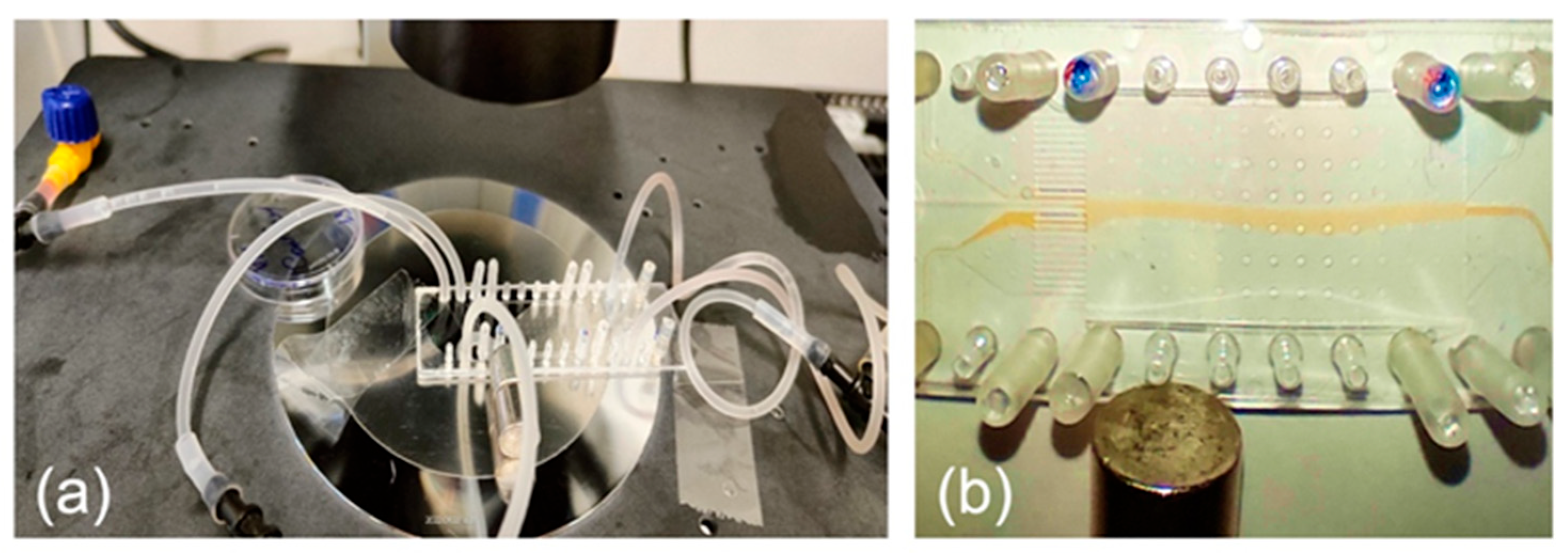
Figure 2.
Row data – microscopic observations of the low-concentration flow of magnetized cells – general top-down view. The cells are additionally evidenced by red circles, used as a guide for the eye.
Figure 2.
Row data – microscopic observations of the low-concentration flow of magnetized cells – general top-down view. The cells are additionally evidenced by red circles, used as a guide for the eye.
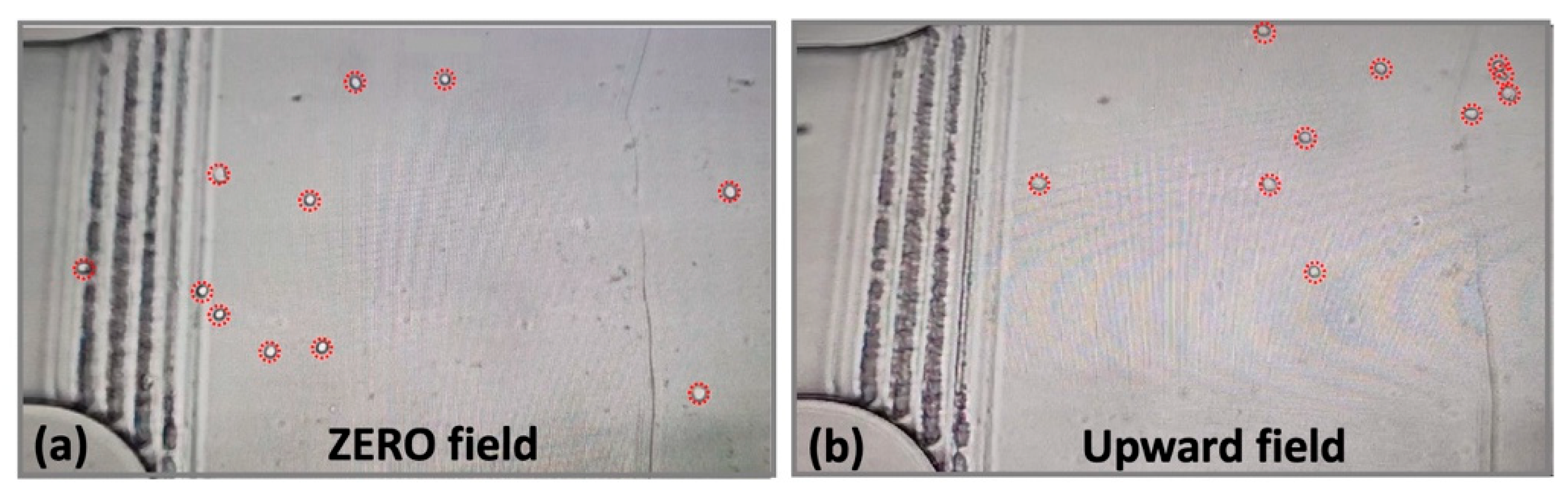
Figure 3.
Row data: Microscopic observations of the high-concentration flow of magnetized cells in fixed 22.5 x 12 mm2 frames.
Figure 3.
Row data: Microscopic observations of the high-concentration flow of magnetized cells in fixed 22.5 x 12 mm2 frames.

Figure 4.
Distribution of the cell concentration for two fluid velocities dUx and different cell magnetic diameters d_mag: (a - d) dUx = 0.2 mm/s, (e – h) dUx = 0.5 mm/s; (a, e) d_mag = 1.0 µm, (b, f) d_mag = 1.2 µm, (c, g) d_mag = 1.4 µm, (d, h) d_mag = 1.6 µm. The PM axes indicated by dash–dot lines. Color scale from 0 to 1 mol/m3.
Figure 4.
Distribution of the cell concentration for two fluid velocities dUx and different cell magnetic diameters d_mag: (a - d) dUx = 0.2 mm/s, (e – h) dUx = 0.5 mm/s; (a, e) d_mag = 1.0 µm, (b, f) d_mag = 1.2 µm, (c, g) d_mag = 1.4 µm, (d, h) d_mag = 1.6 µm. The PM axes indicated by dash–dot lines. Color scale from 0 to 1 mol/m3.
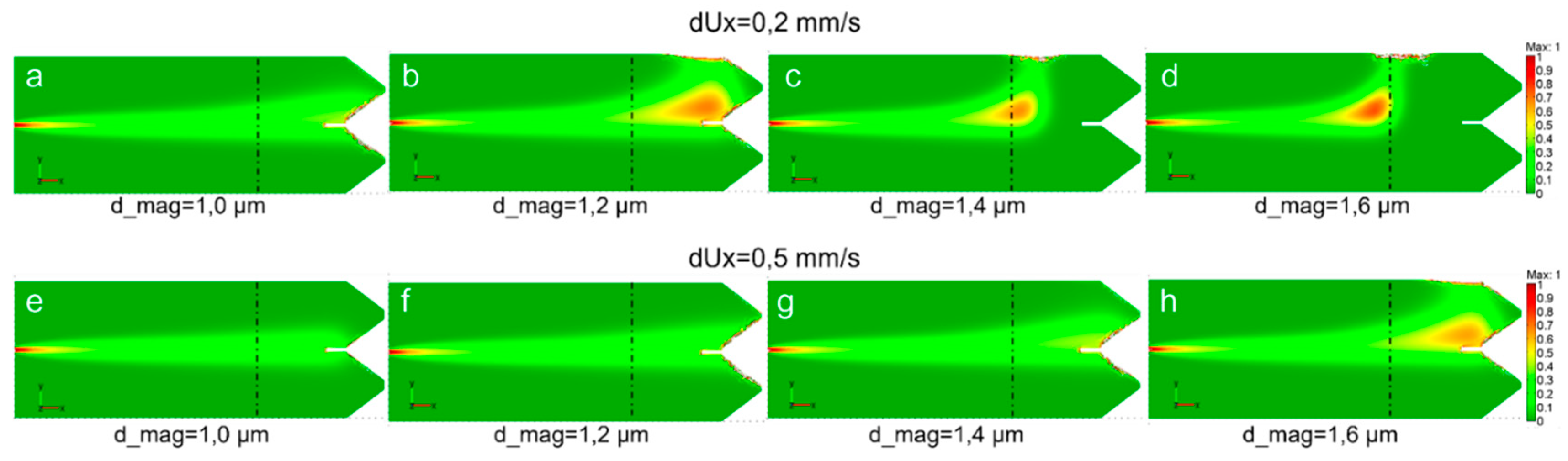
Figure 5.
Distribution of the cell concentration for different magnet positions: (a) x = 25 mm, dist_y = 6 mm; (b) x = 25 mm, dist_y = 5 mm; (c) x = 26 mm, dist_y = 5 mm; (d) x = 30 mm, dist_y = 5 mm, where x – distance from the flux input to the PM axis, dist_y - distance from PM to the box edge for d_mag = 1.6 µm, dUx = 0.2 mm/s. The dash-dot lines indicate the PM axes. Color scale from 0 to 1 mol/m3.
Figure 5.
Distribution of the cell concentration for different magnet positions: (a) x = 25 mm, dist_y = 6 mm; (b) x = 25 mm, dist_y = 5 mm; (c) x = 26 mm, dist_y = 5 mm; (d) x = 30 mm, dist_y = 5 mm, where x – distance from the flux input to the PM axis, dist_y - distance from PM to the box edge for d_mag = 1.6 µm, dUx = 0.2 mm/s. The dash-dot lines indicate the PM axes. Color scale from 0 to 1 mol/m3.
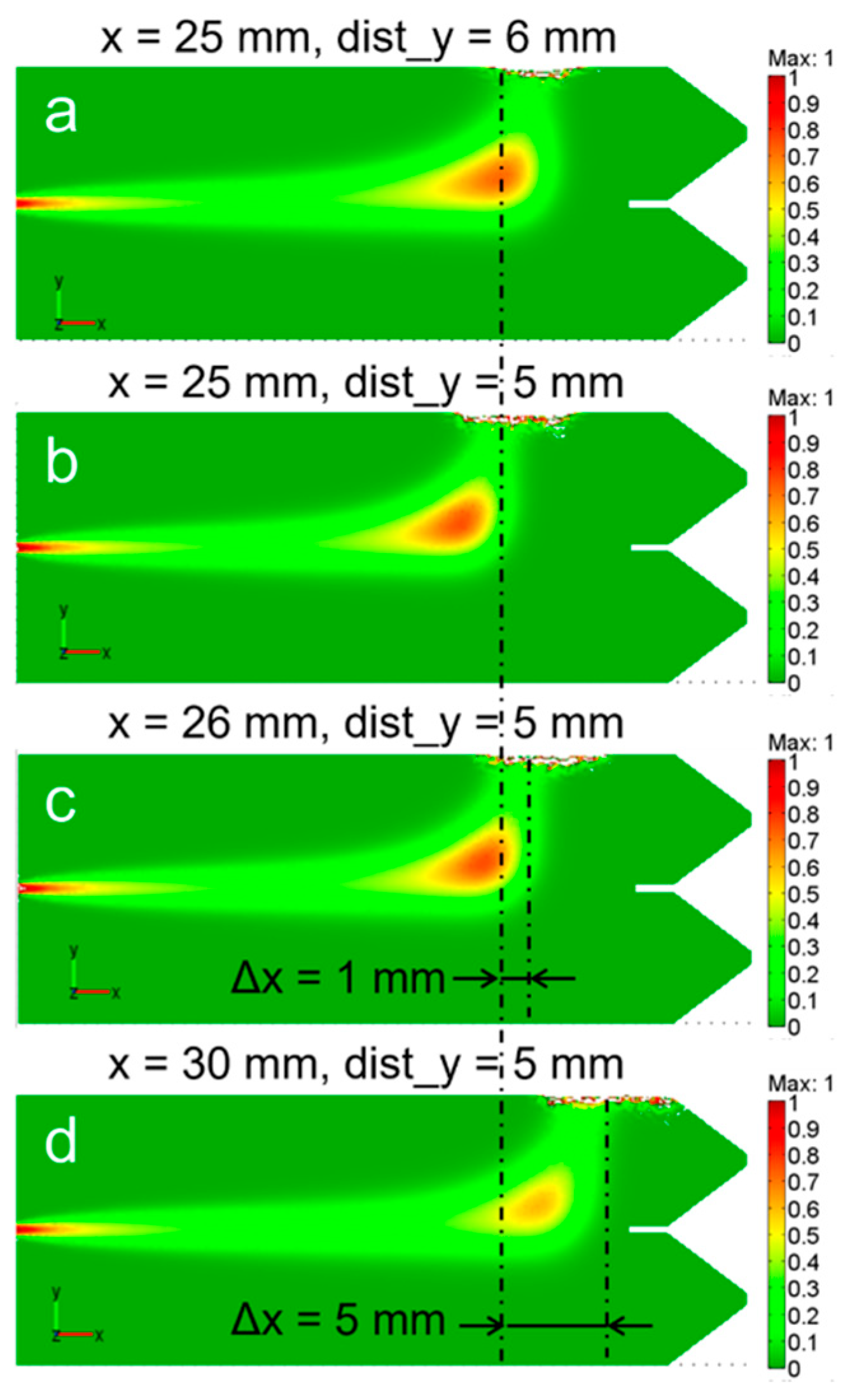
Figure 6.
Fluorescence microscopic observations of the high-concentration flow of magnetized cells in fixed 22,5 x 12 mm2 frames – examples of quality-enhanced experimental recordings for 1x10⁵, 1x10⁶ and 5x10⁶ SPIONs/cell concentrations respectively (from left to right).
Figure 6.
Fluorescence microscopic observations of the high-concentration flow of magnetized cells in fixed 22,5 x 12 mm2 frames – examples of quality-enhanced experimental recordings for 1x10⁵, 1x10⁶ and 5x10⁶ SPIONs/cell concentrations respectively (from left to right).


Table 1.
COMSOL- and AI-based analysis of magnetized cellular fluids: estimates for cell magnetization and comparison with nominal experimental data.
Table 1.
COMSOL- and AI-based analysis of magnetized cellular fluids: estimates for cell magnetization and comparison with nominal experimental data.
|
SPIONs/cell Nominal |
SPIONs/cell AI |
Approximation Error, % |
SPIONs/cell COMSOL |
Approximation Error, % | |
| 5x10⁶ | 4.6x10⁶ | 8 | 3.8x10⁶ | 24 | |
| 1x10⁶ | 0.9x10⁶ | 10 | 1.7x10⁶ | 70 | |
| 5x10⁵ | 6.0x10⁵ | 20 | 1.2x10⁶ | 140 | |
| 1x10⁵ | 2.0x10⁵ | 100 | 7.0x10⁵ | 600 | |
| 1x10⁴ | - | - | 1.0x10⁵ | 900 | |
| 1x10³ | Non applicable | ||||
| 1x10² | Non applicable | ||||
Disclaimer/Publisher’s Note: The statements, opinions and data contained in all publications are solely those of the individual author(s) and contributor(s) and not of MDPI and/or the editor(s). MDPI and/or the editor(s) disclaim responsibility for any injury to people or property resulting from any ideas, methods, instructions or products referred to in the content. |
© 2026 by the authors. Licensee MDPI, Basel, Switzerland. This article is an open access article distributed under the terms and conditions of the Creative Commons Attribution (CC BY) license.
Copyright: This open access article is published under a Creative Commons CC BY 4.0 license, which permit the free download, distribution, and reuse, provided that the author and preprint are cited in any reuse.


