

Submitted:
24 March 2026
Posted:
25 March 2026
You are already at the latest version
Abstract
Background: Severe neurocognitive decline is often seen in elderly glioblastoma patients after treatment with radiation and chemotherapy. But the mechanism behind their deterioration is unclear. We describe one such patient with concomitant primary age-related tauopathy (PART) in bilateral hippocampi. Case presentation: An 88-year-old woman experienced unsteadiness, memory loss, and slurred speech that was caused by an epithelioid glioblastoma with wild-type isocitrate dehydrogenase-1 and methylated promoter of O6-methylguanine-DNA methyltransferase. She was treated with gross total resection, followed by intensity-modulated radiotherapy and daily temozolomide. Shortly after starting treatment, she developed fatigue, anorexia, and neurocognitive impairment, which were refractory to corticosteroids. After two cycles of adjuvant temozolomide, she experienced impulsivity, disorientation, hallucinations, somnolence, and incontinence despite stable neuroimaging findings. Treatment was subsequently discontinued, and she died 20 months from the time of her glioblastoma diagnosis. Autopsy revealed tau-positive neurofibrillary tangles, but rare Aβ plaques, in the transentorhinal and entorhinal cortices of both hippocampi. These findings are consistent with a diagnosis of PART. Conclusions: Undiagnosed tauopathy could be a negative modifier of glioblastoma treatment. Identification of PART and other tauopathies as risk factors in the elderly population may be important to guide treatment decision.
Keywords:
glioblastoma
; PART
; tauopathy
; case report
Introduction
Radiation and concomitant radiotherapy are the best available therapeutic modalities to control glioblastoma.[1] Because elderly patients at age 70 or older are particularly susceptible to treatment toxicities, disease management is tailored based on their neurologic performance and O6-methylguanine-DNA methyltransferase (MGMT) promoter methylation status, and consequently they are stratified to receive (i) 3 weeks of concurrent temozolomide and radiation to 4000 cGy in 15 fractions, (ii) radiation alone, or (iii) supportive care.[2] However, this leaves the question of intrinsic vulnerability in this population unanswered.
Primary Age-Related Tauopathy (PART) is a neurodegenerative condition increasingly recognized in cognitively normal elderly individuals when neurofibrillary tangles are found in the medial temporal lobe, basal forebrain, olfactory areas and brainstem.[3] It differs from Alzheimer disease by a lack of concomitant β-amyloid deposition. When PART patients have cognitive decline, their symptoms are milder even when adjusted for age and Braak stage.[4] Here, we describe a patient who experienced subacute neurocognitive decline after treatment for glioblastoma, and PART was diagnosed unexpectedly at post-mortem.
Case Description
An 88-year-old woman, with a history of ophthalmic migraine and triple-positive breast cancer, experienced paroxysmal seizures and a cystic heterogeneously enhancing mass was found on MRI in her right frontal lobe. A family history of breast cancer was reported in her paternal grandfather and cousin, together with renal cell carcinoma in her mother. She underwent a gross total resection of the tumor (Figure 1A-D), and pathology revealed a grade 4 epithelioid glioblastoma with wild-type isocitrate dehydrogenase-1 (IDH-1) and methylated promoter of the MGMT enzyme, according to the 2021 World Health Organization histologic grading criteria. Additional histological features and molecular characteristics from next generation sequencing of her tumor were previously reported.[5]
At initial presentation to the Neuro-Oncology Clinic, she was found to have cogwheel rigidity in her wrists, dysdiadochokinesia in her left upper extremity, unsteadiness upon Romberg testing, and poor tandem gait. One of 3 skin punch biopsies identified α-synuclein aggregates from her upper cervical region, suggesting a possibility of Parkinson’s disease, but a dopamine active transfer scan (DATscan) showed normal dopamine uptake in the basal ganglia. No family history of neurological, psychiatric or psycho-social disorders was noted.
The patient’s glioblastoma was treated with daily temozolomide chemotherapy and intensity-modulated radiation therapy directed at the right frontal brain to a total dose of 6,000 cGy in 33 fractions (Figure 2). The 6-week regimen was chosen due to her excellent initial neurologic performance status, and the smaller radiation fraction size was thought to have less neurocognitive sequela compared to the larger fraction size in the 3-week regimen.[1,2] However, the temozolomide had to be discontinued due to thrombocytopenia. She developed extreme fatigue, anorexia, and a 15-pound weight loss. She also experienced her first ophthalmic migraine in ten years. A Montreal Cognitive Assessment (MOCA)[6] performed during this time had a score of 17/30. She was treated with dexamethasone for subacute radiation-induced encephalopathy followed by a 5-month slow taper of the medication. During this period, she developed daily aphasia after physical exertion and had a convulsive seizure once. After completion of radiation and steroid taper, she experienced improvement in her neurological function with independence in activities of daily living and a higher MOCA score of 25/30.
After her recovery, she was treated with two cycles of adjuvant temozolomide at monthly intervals. During her second cycle, she developed increased impulsivity, driving her car to a nearby convenience store against medical advice. She became disoriented to her location and time of day, and experienced visual hallucinations seeing her late husband. Her hallucinations became progressively more persistent, and she developed increased somnolence, generalized weakness, and urinary incontinence. A gadolinium-enhanced head MRI obtained during this period, about 6 months after her second cycle of adjuvant temozolomide, showed hyperintense signals on fluid-attenuated inversion recovery sequence suggesting tumor extension to or presence of treatment effect at the genu of the corpus callosum, septum pellucidum, and mamillary bodies (Figure 1E-F). She continued to develop worsening neurologic symptoms and expired four months later, 17 months from completion of radiation and concomitant temozolomide or 20 months from initial histologic diagnosis of glioblastoma.
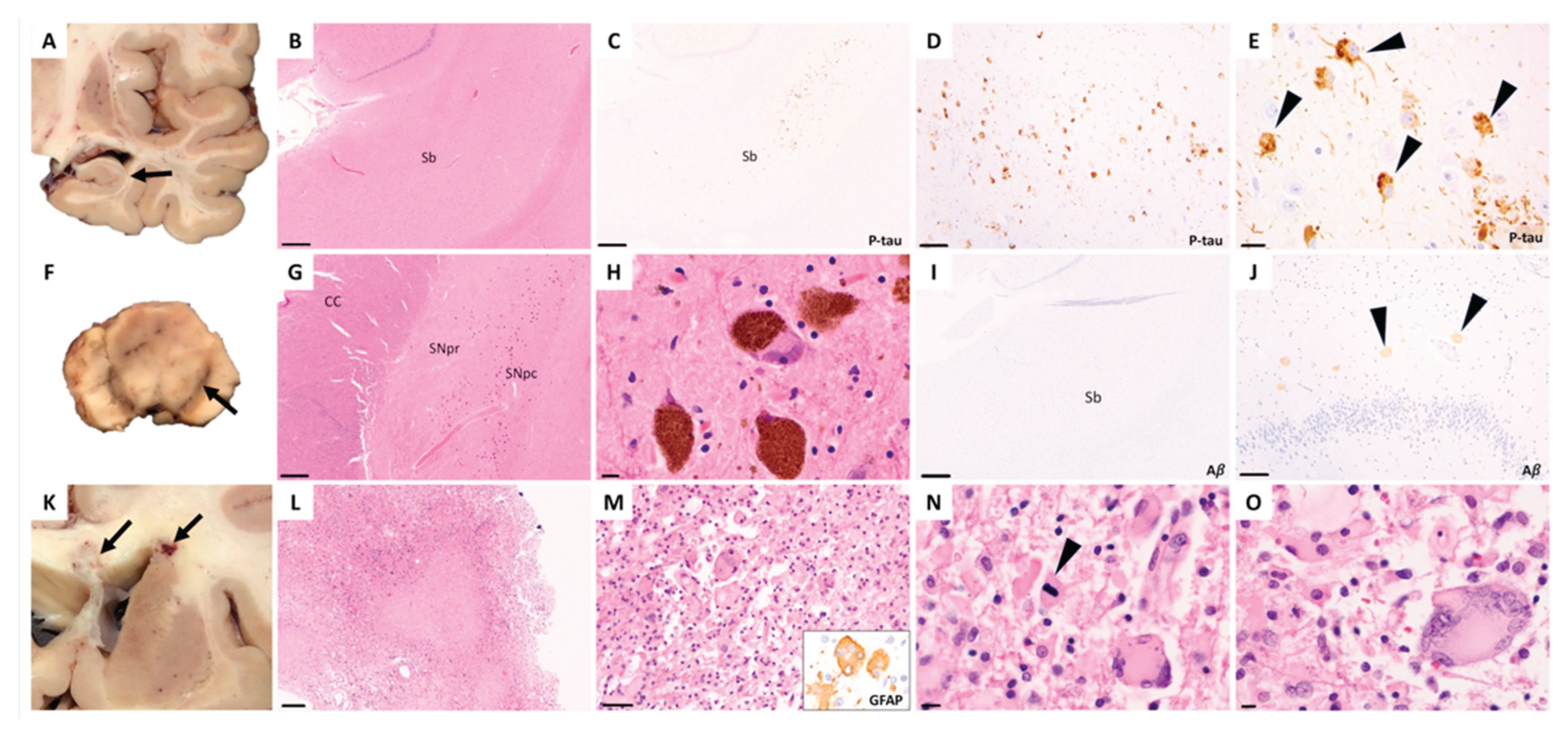
Post-mortem examination of the brain identified residual glioblastoma tumor cells involving the right frontal lobe, right basal ganglia, corpus callosum, and left basal ganglia, but none in the midbrain, pons, medulla, or spinal cord. The patient was also found within bilateral hippocampi to have tau-positive neurofibrillary tangles involving transentorhinal and entorhinal cortices and rare, mild Aβ plaques, consistent with a diagnosis of possible PART, Braak stage III and Thal Aβ phase 2 (Figure 3). The substantia nigra had intact neuronal density and pigmentation, without intracytoplasmic Lewy bodies or α-synuclein positive neurites (Figure 3 E-G). Mild to moderate cerebral amyloid angiopathy was seen involving small vessels within the cerebral cortex and leptomeninges.
Discussion
The finding of neurofibrillary tangles without significant β-amyloid in the entorhinal cortex of our patient is consistent with possible PART, and we postulate that this predisposed her to early subacute neurocognitive decline from radiation and chemotherapy treatments. Whether PART is a stand-alone entity among those minimally affected or part of a spectrum of Alzheimer disease is unclear. Regardless, neurofibrillary tangles are found in both disorders, and pathologic tau is just one of many protein-protein aggregates that are associated with neurodegeneration.[3,7] Lewy bodies, which consist of pathological aggregates of α-synuclein proteins, can also negatively impact treatment outcome in glioblastoma.[8] Therefore, it is prudent for neurologists and oncologists to look for potential signs of neurodegeneration among patients diagnosed with glioblastoma.
Pre-mortem diagnosis of PART, Alzheimer disease or other tauopathies can be specifically established by 18F-flortaucipir positron emission tomography (PET) and β-amyloid PET with the 11C-Pittsburgh compound-B.[9,10] Among patients with tau pathology, it is notable that the presence of β-amyloid predicts a faster longitudinal memory decline compared to those who are β-amyloid negative, consistent with the differences in clinical manifestation between PART and Alzheimer disease.[11] These PET modalities may offer a means to stratify more precisely treatment-related neurocognitive risks among the elderly glioblastoma patients.
Hippocampal neurogenesis is reduced in both aging and after irradiation alone or radiation potentiated by temozolomide. Dysfunctional neurogenesis has been associated with impaired spatial learning and memory in animal models.[12,13] We believe that PART in the entorhinal cortex and hippocampi of our patient may predispose her to radiation toxicity. In humans, whole brain radiotherapy (WBRT) for brain metastasis results in a higher incidence of mental decline, and the impairment can appear in as early as 3 months after treatment, affecting multiple neurocognitive domains.[14] However, hippocampal avoidance WBRT (HA-WBRT) has been shown to reduce the rate of neurocognitive decline among patients based on their performance on the Hopkins Verbal Learning Test.[15] In glioblastoma, hippocampal avoidance radiotherapy has been proposed but it is limited by inadequate dosing at the margins of the clinical treatment volume where infiltrative tumor cells are located.[16] Although proton radiation is not standard-of-care for invasive glioblastoma, it could spare the hippocampi for preservation of neurocognitive functions. Furthermore, there is no effective means of clearing tau from the brain and whether anti-β-amyloid antibody like lecanemab can prevent neurocognitive decline from radiation in susceptible individuals is unclear.
No Lewy bodies or evidence of α-synucleinopathy was found in the substantia nigra or locus coeruleus, and therefore this patient does not have Parkinson’s disease. The presence of α-synuclein aggregates in the subcutaneous nerve endings from the skin punch biopsy therefore may be a marker of aging rather than disease.[17] This is because migration of these pathological aggregates may take years if not decades from the peripheral to the central nervous system.
Conclusions
In summary, our patient with PART experienced a subacute decline in neurocognitive function after treatment for glioblastoma. The presence of tau and neurofibrillary tangles in the entorhinal cortex could be a negative outcome modifier.
Author Contributions
RT and ETW drafted the manuscript and substantially contributed to the conception, design, acquisition, analysis, and interpretation of patient data. SY helped with patient care and developed and provided radiation dosimetry data. JD and MP performed the autopsy on the patient and provided high resolution microscopies. RT, JD, SY, MP and ETW critically reviewed and revised the manuscript for important intellectual content and gave final approval.
Funding
None.
Institutional Review Board Statement
Not applicable.
Informed Consent Statement
Written informed consent for publication of findings was obtained from the patient prior to her death. This work was also performed under an Institution Review Board Protocol #218622, entitled “Retrospective Analysis of Imaging and Pathology Data in Cancer Patients”.
Data Availability Statement
Not applicable.
Conflicts of Interest
The authors declare that they have no competing interests.
List of abbreviations
Aβ, beta amyloid; cGy, centigray; CC, crus cerebri; DaTscan, dopamine active transfer scan; GFAP, glial fibrillary acidic protein; FLAIR, fluid-attenuated inversion recovery; hippocampal avoidance WBRT (HA-WBRT); IDH, isocitrate dehydrogenase; IMRT, intensity-modulated radiotherapy; MGMT, O6-methylguanine-DNA methyltransferase; MOCA, Montreal Cognitive Assessment; MRI, magnetic resonance imaging; PART, primary age-related tauopathy; PET, positron emission tomography; SNpc pars compacta; SNpr, nigra pars reticulata; WBXRT, whole brain radiotherapy.
References
- Stupp, R; Hegi, ME; Mason, WP; et al. Effects of radiotherapy with concomitant and adjuvant temozolomide versus radiotherapy alone on survival in glioblastoma in a randomised phase III study: 5-year analysis of the EORTC-NCIC trial. Lancet Oncol. 2009, 10(5), 459–466. [Google Scholar] [CrossRef] [PubMed]
- Ironside, S; Das, S; Sahgal, A; Moroney, C; Mainprize, T; Perry, JR. Optimal Therapies for Newly Diagnosed Elderly Patients with Glioblastoma. Curr Treat Options Oncol. 2017, 18(11), 66. [Google Scholar] [CrossRef] [PubMed]
- Crary, JF; Trojanowski, JQ; Schneider, JA; et al. Primary age-related tauopathy (PART): a common pathology associated with human aging. Acta Neuropathol. 2014, 128(6), 755–766. [Google Scholar] [CrossRef] [PubMed]
- Teylan, M; Mock, C; Gauthreaux, K; et al. Cognitive trajectory in mild cognitive impairment due to primary age-related tauopathy. Brain 2020, 143(2), 611–621. [Google Scholar] [CrossRef] [PubMed]
- Mondia, MWL; Kritselis, MA; Donahue, JE; et al. Dimorphic glioblastoma with glial and epithelioid phenotypes: Clonal evolution and immune selection. Frontiers in Neurology. 2023, 13. Available online: https://www.frontiersin.org/articles/10.3389/fneur.2022.1017087 (accessed on 30 January 2024).
- Nasreddine, ZS; Phillips, NA; Bédirian, V; et al. The Montreal Cognitive Assessment, MoCA: A brief screening tool for mild cognitive impairment. J Am Geriatr Soc. 2005, 53(4), 695–699. [Google Scholar] [CrossRef] [PubMed]
- Duyckaerts, C; Braak, H; Brion, JP; et al. PART is part of Alzheimer disease. Acta Neuropathol. 2015, 129(5), 749–756. [Google Scholar] [CrossRef] [PubMed]
- Wong, ET; Rosenberg, H; Dawood, O; et al. Lewy body disease as a potential negative outcome modifier of glioblastoma treatment: a case report. BMC Neurol. 2023, 23(1), 257. [Google Scholar] [CrossRef] [PubMed]
- Ossenkoppele, R; Rabinovici, GD; Smith, R; et al. Discriminative Accuracy of [18F] flortaucipir Positron Emission Tomography for Alzheimer Disease vs Other Neurodegenerative Disorders. JAMA 2018, 320(11), 1151–1162. [Google Scholar] [CrossRef] [PubMed]
- Klunk, WE; Engler, H; Nordberg, A; et al. Imaging brain amyloid in Alzheimer’s disease with Pittsburgh Compound-B. Ann Neurol. 2004, 55(3), 306–319. [Google Scholar] [CrossRef] [PubMed]
- Chen, X; Cassady, KE; Adams, JN; Harrison, TM; Baker, SL; Jagust, WJ. Regional Tau Effects on Prospective Cognitive Change in Cognitively Normal Older Adults. Journal of Neuroscience 2021, 41(2), 366–375. [Google Scholar] [CrossRef] [PubMed]
- Cheng, Z; Li, YQ; Wong, CS. Effects of Aging on Hippocampal Neurogenesis After Irradiation. International Journal of Radiation Oncology*Biology*Physics 2016, 94(5), 1181–1189. [Google Scholar] [CrossRef] [PubMed]
- Lensu, S; Waselius, T; Mäkinen, E; et al. Irradiation of the head reduces adult hippocampal neurogenesis and impairs spatial memory, but leaves overall health intact in rats. Eur J Neurosci. 2021, 53(6), 1885–1904. [Google Scholar] [CrossRef] [PubMed]
- Leskinen, S; Shah, HA; Yaffe, B; et al. Hippocampal avoidance in whole brain radiotherapy and prophylactic cranial irradiation: a systematic review and meta-analysis. J Neurooncol 2023, 163(3), 515–527. [Google Scholar] [CrossRef] [PubMed]
- Gondi, V; Pugh, SL; Tome, WA; et al. Preservation of memory with conformal avoidance of the hippocampal neural stem-cell compartment during whole-brain radiotherapy for brain metastases (RTOG 0933): a phase II multi-institutional trial. J Clin Oncol. 2014, 32(34), 3810–3816. [Google Scholar] [CrossRef] [PubMed]
- Thippu Jayaprakash, K; Wildschut, K; Jena, R. Feasibility of hippocampal avoidance radiotherapy for glioblastoma. Clin Oncol (R Coll Radiol) 2017, 29(11), 748–752. [Google Scholar] [CrossRef] [PubMed]
- Gibbons, CH; Levine, T; Adler, C; et al. Skin biopsy detection of phosphorylated α-synuclein in patients with synucleinopathies. JAMA 2024, 331(15), 1298–1306. [Google Scholar] [CrossRef] [PubMed]
Figure 1.
Chronology of clinical progression and MRI findings. (A) Timeline depicts the patient’s progressive clinical course (A). A multi-cystic enhancing glioblastoma with surrounding vasogenic edema in the right frontal lobe is shown in T2/FLAIR-weighted axial sequence as well as post-gadolinium T1-weighted sequences in axial (C), sagittal (D), and coronal (E) views. Stable resection cavity and slight thickening of the septum pellucidum is seen in T2/FLAIR-weighted axial sequence (F) as well as post-gadolinium T1-weighted sequences in axial (G), sagittal (H), and coronal (I) views. IMRT: Intensity-Modulated Radiotherapy, MOCA: Montreal Cognitive Assessment.
Figure 1.
Chronology of clinical progression and MRI findings. (A) Timeline depicts the patient’s progressive clinical course (A). A multi-cystic enhancing glioblastoma with surrounding vasogenic edema in the right frontal lobe is shown in T2/FLAIR-weighted axial sequence as well as post-gadolinium T1-weighted sequences in axial (C), sagittal (D), and coronal (E) views. Stable resection cavity and slight thickening of the septum pellucidum is seen in T2/FLAIR-weighted axial sequence (F) as well as post-gadolinium T1-weighted sequences in axial (G), sagittal (H), and coronal (I) views. IMRT: Intensity-Modulated Radiotherapy, MOCA: Montreal Cognitive Assessment.
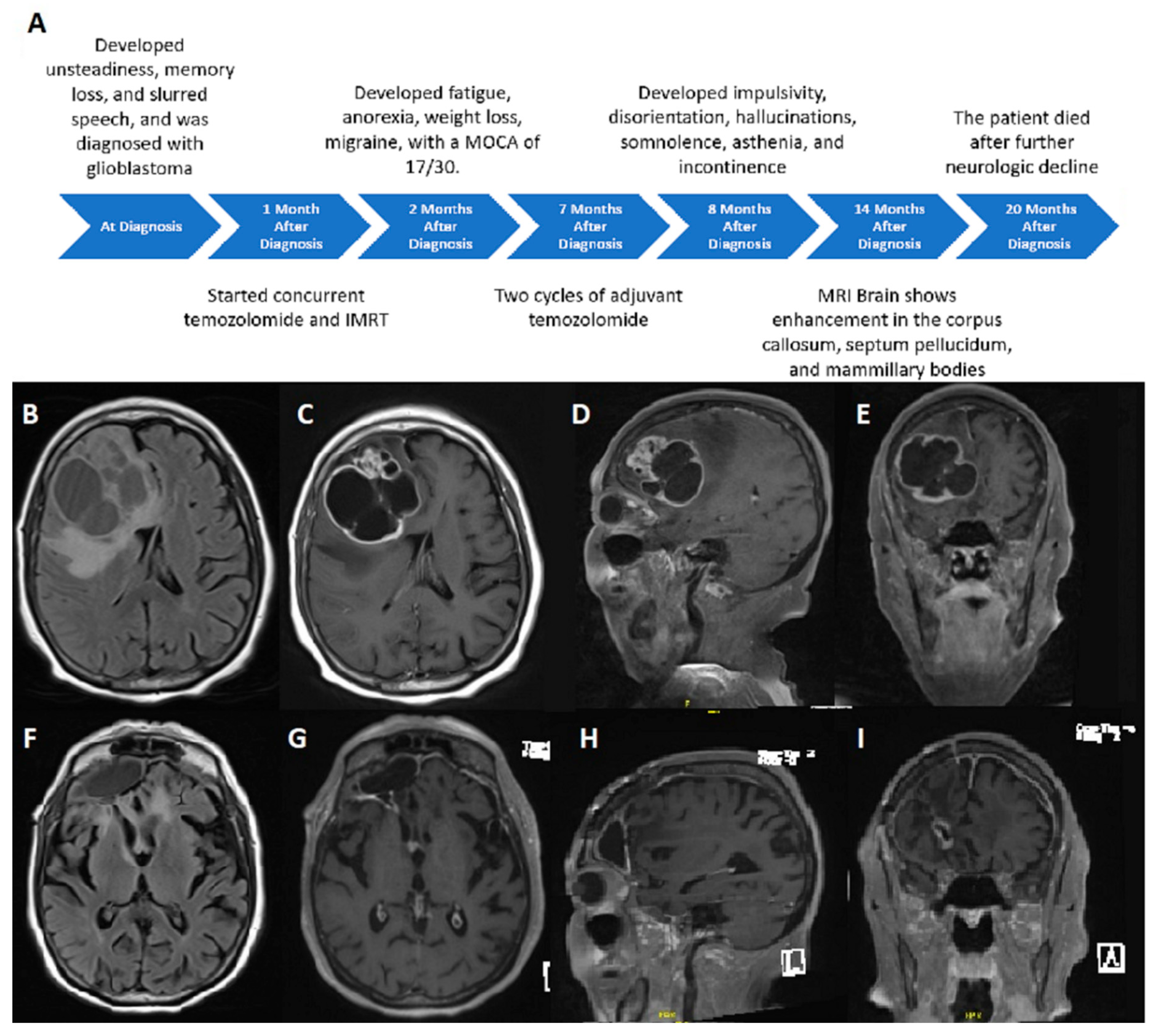
Figure 2.
Extensive radiation coverage of both temporal lobes. The left temporal pole and the left hippocampus were exposed to the full dose or 6,000 cGy of radiation as shown in axial (A), coronal (B) and left sagittal (C) images. The right temporal pole received between 1,800 to 3,000 cGy (D) while the right hippocampus was exposed to 3,000 cGy of radiation (B).
Figure 2.
Extensive radiation coverage of both temporal lobes. The left temporal pole and the left hippocampus were exposed to the full dose or 6,000 cGy of radiation as shown in axial (A), coronal (B) and left sagittal (C) images. The right temporal pole received between 1,800 to 3,000 cGy (D) while the right hippocampus was exposed to 3,000 cGy of radiation (B).
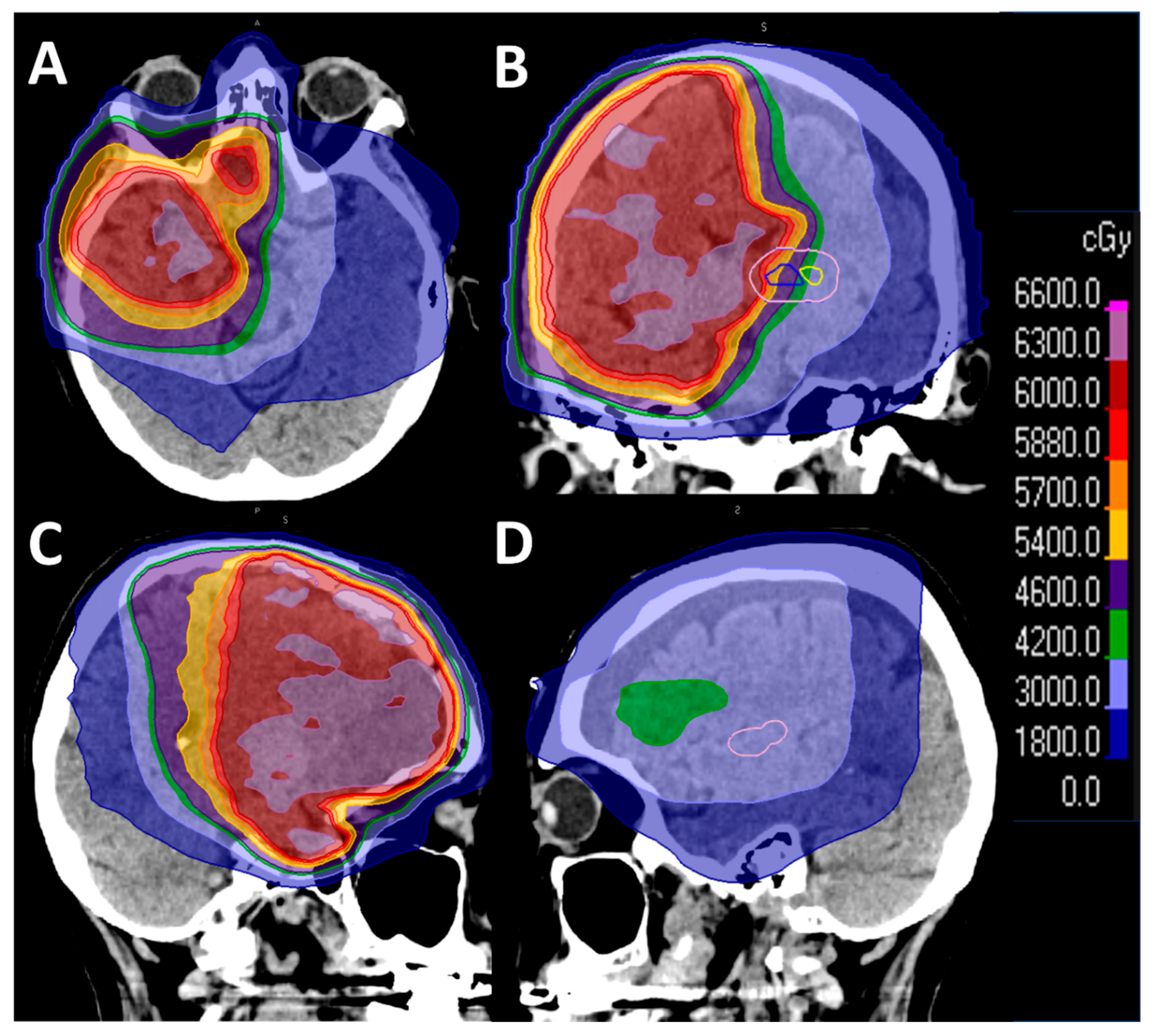
Figure 3.
Neuropathology at post-mortem. (A) Gross image of the right temporal lobe without atrophy (arrow shows the hippocampus). (B) Low power image of the hippocampal formation with intact architecture (scale bar: 500μm, hematoxylin and eosin). (C-E) Low, medium, and high-power images of phosphorylated tau-stained sections showing p-tau positive neurofibrillary tangles and neurites in the subiculum (sb=subiculum; scale bars: 500μm, 100μm, 10μm). (F) Gross image of a midbrain cross section shows a well-pigmented substantia nigra (arrow). (G-H) The substantia nigra pars reticulata (SNpr) and pars compacta (SNpc) demonstrate appropriate neuronal density with neurons containing neuromelanin without evidence of Lewy bodies (CC=crus cerebri; scale bars: 500μm and 10μm, hematoxylin and eosin). (I-J) Staining for beta amyloid (Aβ) in the hippocampal formation shows rare but mild plaques (arrowheads) in CA3 (scale bars: 500μm and 100μm). (K) Gross image of a coronal section of the brain with tumor (arrows) present in the corpus callosum and right basal ganglia at the level of the dorsal striatum. (L-M) Residual treated, GFAP+ (Glial Fibrillary Acidic Protein, inset) glioblastoma tumor cells with large areas of necrosis, (N-O) occasional mitoses (arrowhead), and multinucleation (scale bars: 200μm, 50μm, 10μm; hematoxylin and eosin).
Figure 3.
Neuropathology at post-mortem. (A) Gross image of the right temporal lobe without atrophy (arrow shows the hippocampus). (B) Low power image of the hippocampal formation with intact architecture (scale bar: 500μm, hematoxylin and eosin). (C-E) Low, medium, and high-power images of phosphorylated tau-stained sections showing p-tau positive neurofibrillary tangles and neurites in the subiculum (sb=subiculum; scale bars: 500μm, 100μm, 10μm). (F) Gross image of a midbrain cross section shows a well-pigmented substantia nigra (arrow). (G-H) The substantia nigra pars reticulata (SNpr) and pars compacta (SNpc) demonstrate appropriate neuronal density with neurons containing neuromelanin without evidence of Lewy bodies (CC=crus cerebri; scale bars: 500μm and 10μm, hematoxylin and eosin). (I-J) Staining for beta amyloid (Aβ) in the hippocampal formation shows rare but mild plaques (arrowheads) in CA3 (scale bars: 500μm and 100μm). (K) Gross image of a coronal section of the brain with tumor (arrows) present in the corpus callosum and right basal ganglia at the level of the dorsal striatum. (L-M) Residual treated, GFAP+ (Glial Fibrillary Acidic Protein, inset) glioblastoma tumor cells with large areas of necrosis, (N-O) occasional mitoses (arrowhead), and multinucleation (scale bars: 200μm, 50μm, 10μm; hematoxylin and eosin).
Disclaimer/Publisher’s Note: The statements, opinions and data contained in all publications are solely those of the individual author(s) and contributor(s) and not of MDPI and/or the editor(s). MDPI and/or the editor(s) disclaim responsibility for any injury to people or property resulting from any ideas, methods, instructions or products referred to in the content. |
© 2026 by the authors. Licensee MDPI, Basel, Switzerland. This article is an open access article distributed under the terms and conditions of the Creative Commons Attribution (CC BY) license (http://creativecommons.org/licenses/by/4.0/).
Copyright: This open access article is published under a Creative Commons CC BY 4.0 license, which permit the free download, distribution, and reuse, provided that the author and preprint are cited in any reuse.


