
Submitted:
24 March 2026
Posted:
25 March 2026
You are already at the latest version
Abstract
The monitoring of modern technology is an important starting point for the preventive protection and risk management of immovable cultural heritage. At present, monitoring practices for China’s immovable heritage generally lack a clearly defined structural linkage among monitoring approaches, management and operational mechanisms, and spatial governance. How to formulate—at the level of top-level design—the organizational arrangement and operational logic of a monitoring system therefore remains a pressing bottleneck in current heritage conservation practice. This paper attempts to study the monitoring system framework of immovable cultural heritage, which is composed of technical monitoring, management monitoring and national spatial monitoring. The study demonstrates that a collaborative operational mode oriented toward risk identification and governance decision-making can be established through continuous condition sensing, the managerial translation of monitoring data, and the integration of spatial scales, thereby forming a monitoring system with explicit feedback relationships. Based on this, we validated the applicability of the system framework for monitoring the status of immovable cultural heritage asset through the practice of monitoring the Hanguang Gate site of the Tang Dynasty city wall in Xi'an. This case study provides a flexible organizational framework: it adapts to the material characteristics, management needs, and spatial environments of different types of immovable cultural heritage. This study provides a methodological reference for the construction of China's immovable cultural heritage monitoring from decentralized exploration to unified adaptation, and has certain practical guiding significance for improving the supporting role of monitoring in the preventive protection and comprehensive management of immovable cultural heritage asset.
Keywords:
immovable cultural heritage resource
; monitoring system construction
; resilient organizational logic
; the Hanguang Gate Site
; preventive conservation
1. Introduction
Immovable cultural heritage constitutes a crucial component of China’s cultural heritage system. At present, there are approximately more than 760, 000 registered immovable heritage sites, characterized by diverse types, large quantities, and wide geographical distribution. The management and monitoring of their conservation status are closely related to the continuity of national historical and cultural information as well as national cultural security. With changes in the natural environment, increasing human activities, and the acceleration of urbanization, risks faced by immovable cultural heritage and historic urban areas in international cultural heritage conservation research have become increasingly diversified and marked by greater uncertainty[1]. In China, the development of monitoring for immovable cultural heritage has undergone a gradual transition from manual patrol inspections to specialized technical monitoring, followed by the establishment of information-based platforms and more recent explorations into intelligent applications. To some extent, these efforts have enhanced risk identification and enabled preventive early warning. Nevertheless, they have also revealed persistent challenges, including a disconnect between monitoring technologies and management mechanisms, insufficient integration and sharing of data, and limited capacity for monitoring outcomes to be translated into feedback that effectively supports preventive conservation and governance decisions. Consequently, how to construct—at the level of top-level design—a coherent organizational structure and operational logic for a monitoring system remains a critical bottleneck that must be addressed in current heritage conservation practice.
Existing research on the management and monitoring of immovable cultural heritage asset has largely focused on single-site technical practices, particularly those related to World Cultural Heritage properties and nationally designated archaeological site parks. However, systematic studies addressing the overall structural framework, operational logic of immovable cultural heritage monitoring systems, and their relationship with the national governance system remain insufficient. Against this backdrop, this paper takes China’s monitoring practices for immovable cultural heritage as its research object. On the basis of systematically reviewing the developmental stages of monitoring practices and the practical issues identified through case studies, the study seeks to expand from a top-level design perspective to construct a monitoring system oriented toward the secure conservation of diverse types of immovable cultural heritage asset, coordinated management and governance, and alignment with national spatial planning. This study aims to address the fragmentation and limited coordination evident in current monitoring practice, and to examine how an effective linkage can be established among technology, management, and spatial governance. It provides a theoretical reference for the further refinement and broader implementation of China’s monitoring system for immovable cultural heritage.
2. Developmental Stages and Characteristics of Monitoring China’s Immovable Cultural Heritage Asset
2.1. The Initial Stage Dominated by Manual Patrol Inspection
Before the application of modern monitoring technologies, the routine monitoring and management of immovable cultural heritage in China primarily depended on traditional manual inspection practices, making it difficult to identify, at an early stage, changes resulting from natural processes or human activities. Existing studies note that this approach has long remained dominant in grassroots heritage protection practice. Constrained by limitations in funding, professional capacity, and institutional arrangements[2], some heritage management bodies have lacked the necessary conservation and monitoring measures, leaving certain sites exposed to natural environments for prolonged periods and resulting in varying degrees of deterioration in their preservation conditions[3]. In practice, manual patrol inspection is generally conducted by heritage personnel who observe the physical condition of the heritage fabric at regular or periodic intervals. Through visual inspection, occasionally supplemented by simple measurement tools and documented in paper-based records, staff obtain a basic understanding of the conservation status of the heritage entity and changes in its surrounding environment[4]. From a methodological perspective, however, research has pointed out that traditional visually driven inspection often lacks unified quantitative indicators and reproducible, standardized procedures; as a result, monitoring outcomes inevitably depend on the inspector’s personal experience and judgment[5]. Moreover, given the limited frequency of patrol inspections, practitioners are often unable to continuously track rapid environmental fluctuations or detect microstructural changes that are difficult to perceive but may accumulate over time into deformation-related risks. Monitoring records are also commonly preserved in dispersed paper files or other unstructured formats. Such practices not only hinder long-term comparison, but also make it difficult to support comprehensive cross-regional and cross-temporal comparative analysis. In addition, conventional heritage monitoring and archival data are frequently collected by different individuals and stored over long periods in paper-based or standalone records, lacking a unified data structure and management framework. This in turn leads to data fragmentation and impedes effective sharing and integration—an issue that has also been widely identified in existing research on heritage risk management[6].
This manual patrol–based conservation logic, which relies predominantly on human experience, remains largely at the level of a “post-damage remediation” response. Previous studies have noted that, for a long time, China’s heritage conservation practice has primarily relied on repairs carried out after deterioration has occurred, with limited emphasis on forward-looking risk management and preventive intervention mechanisms[7,8].
2.2. The Initial Stage of Special Monitoring of Modern Technology
With the development of information technologies and the gradual integration of monitoring methods into the field of heritage conservation, monitoring practices shifted from a purely manual patrol model to a hybrid approach combining routine inspection with targeted technical measures. A prominent feature of this stage was the implementation of problem-oriented, specialized technical monitoring practices focusing on specific high-risk issues affecting immovable cultural heritage asset, particularly cave temples and ancient buildings. During this period, studies began to introduce technologies such as surveying and mapping, sensing systems, and infrared cameras, with monitoring efforts primarily targeting deterioration of the heritage fabric and structural deformation of heritage properties.
Taking archaeological sites and grotto temples as illustrative cases, some scholars employed monitoring and sensing approaches to conduct specialized research on structural stability and deformation risks. For instance, wireless sensor networks have been used to assess deformation states in earthen sites[9], enabling continuous monitoring and identification of deformation processes and demonstrating the advantage of sensing technologies in capturing micro-level changes in heritage fabric. For typical deterioration phenomena frequently observed in grotto conservation—such as seepage and weathering—non-destructive monitoring methods including close-range photogrammetry and ground-penetrating radar have been applied for continuous observation, providing technical support for identifying the progression and intensification of such deterioration[10]. In addition to monitoring the heritage entity itself, other studies have focused on external disturbances and the monitoring of the heritage setting. For example, Internet of Things technologies have been deployed for environmental monitoring at the Mausoleum of the First Qin Emperor[11], where continuous collection of factors such as temperature and humidity has helped verify the effectiveness of low-intervention, long-term environmental monitoring for large-scale sites. Moreover, a vibration-based monitoring and early-warning system grounded in a wireless sensor network has been used to detect looting-related damage at outdoor monuments[12]. By installing vibration sensor nodes in the vicinity of heritage assets and collecting ground vibration data, the system can detect anomalous disturbances and issue timely alerts, thereby compensating for the limitations of manual patrol inspection in covering spatiotemporal disturbances. Overall, these multi-target specialized monitoring efforts—addressing the heritage fabric, specific deterioration types, and the heritage environment—have, to a certain extent, mitigated the shortcomings of manual patrol inspection in identifying concealed risks. By leveraging technological means, they have expanded both the depth and precision of monitoring.
Compared with manual patrol inspection, specialized monitoring technologies have delivered more substantial improvements in acquiring data on changes to the heritage fabric and in extending the temporal scale of monitoring. Practice at this stage relied on quantitative data as the primary basis for assessment, facilitating a shift from subjective, experience-based judgment toward more objective and scientific understanding. In some cases, monitoring outputs began to be recorded in electronic formats, which is conducive to subsequent analysis and research. Advances in monitoring technologies at this stage have strengthened early identification and risk warning capacities, supporting the transition of heritage conservation from “post-damage remediation” toward “proactive prevention,” while also creating greater demand for theoretical frameworks that enable systematic data integration, sustained management, and effective utilization.
2.3. The Stage of Informatization Platform Development
With technological advances and improving monitoring capacity, the monitoring of immovable cultural heritage has entered a new stage centered on the development of informatization platforms. By establishing heritage monitoring platforms, data from different monitoring methods can be centrally managed, thereby improving overall monitoring efficiency and managerial coordination for individual cultural heritage protection units.
During early explorations of platform development, some scholars pointed out a misalignment between the rapid evolution of monitoring technologies and the comparatively lagging approaches to data storage, management mechanisms, and data sharing[13]. Due to the “information silo” effect of fragmented digital platforms, monitoring data have become difficult to integrate and centrally manage, resulting in low service efficiency. Moreover, the logical relationship between environmental monitoring data and the actual conservation needs of cultural heritage remains insufficiently clarified. Accordingly, research in this stage began to shift toward building capacities for centralized data management and service provision. In response to the problem that current environmental monitoring systems are difficult to adapt to the protection requirements of cultural heritage and sites, some scholars have proposed a real-time environmental monitoring system based on Internet of Things technology, designed to continuously collect and analyze the key parameters of the habitat environment of cultural heritage. This system is capable of real-time parsing and automatic processing of monitoring data, and provides reliable information support for protection decision-making[14]. Other studies have proposed intelligent data-driven conservation systems for architectural heritage[15]. By integrating multi-source monitoring data, historical archives, and digital models, these systems establish a unified data management framework and enhance the support that informatization platforms can provide for analysis, assessment, and decision support. Notably, these studies have provided technical references for the subsequent development of informatization platforms, particularly in data organization, system stability, and data utilization efficiency.
In addition, GIS technology has gradually become an important tool for cultural heritage monitoring and management. By integrating environmental monitoring data with the site’s spatial information and conducting in-depth analysis, it can achieve visualization of the site’s spatiotemporal dynamics and targeted scientific management[16]. With the expansion of data storage and visualization functions, the conceptual emphasis of heritage monitoring platforms has gradually shifted from basic presentation toward spatial analysis and integrated management. Researchers have increasingly aligned informatization platform development with risk management and preventive conservation principles, embedding these concepts into comprehensive monitoring-management platforms. Representative cases—including the Mausoleum of the First Qin Emperor, the Palace Museum, and the Mogao Grottoes in Dunhuang have benchmarked global heritage monitoring platforms and explored applications such as unified management of multi-source monitoring data, standardized processing workflows, and decision-support functionalities, as well as the establishment of monitoring and early-warning systems incorporating risk inventories, indicator systems, threshold studies, and decision-support section. Through systematic data integration and risk assessment mechanisms, monitoring outcomes can be directly applied to preventive conservation, marking a shift in heritage monitoring from recording site conditions to identifying and issuing early warnings of risks[7,8,17]. By integrating multi-source inputs—including monitoring of the heritage fabric, environmental monitoring, structural monitoring, video surveillance, and manual patrol inspection—these platforms have enabled centralized data storage, visual presentation, and online management. For example, the dynamic, informatized, and visualization-integrated monitoring and early-warning system developed for the Dazu Rock Carvings[18], together with the operational mechanisms, institutionalization of platform management, and the design of early-warning procedures and process-based management, has facilitated faster feedback of monitoring results to management and decision-making levels. This has helped overcome previously inefficient workflows characterized by slow information transmission and reliance on hierarchical, manual reporting.
Overall, monitoring for immovable cultural heritage has gradually moved from the application of isolated technical tools toward system building supported by informatization platforms, in which monitoring data play a more direct and significant role in risk identification and decision-making support. However, it is also recognized that, due to differences in heritage types, geographic conditions, environmental contexts, and socio-economic factors, no single information technology can adequately address such heterogeneity or achieve uniformly effective conservation and management outcomes.
With the continuous development of technologies such as big data analytics and artificial intelligence, the integration and intelligent analysis of multi-source data have made it possible to promote a unified, operational, and identifiable monitoring and management system for immovable cultural heritage. By establishing a unified framework for data processing and integration, improvements can be achieved in data standardization, metadata consistency, interoperability, and dynamic query capabilities of heritage monitoring data, which helps to resolve cross-system data compatibility issues and enhance decision-support capacity[19].
2.4. The Stage of Intelligent Development
With the rapid iteration of next-generation information technologies—such as big data, artificial intelligence, and digital twins—monitoring of China’s immovable cultural heritage has entered a new stage characterized by the integration of intelligent analysis and more precise assessment[20]. Alongside frontier applications of AI in the conservation of immovable heritage[21], related research has increasingly focused on how to conduct deep mining and integrated analysis of multi-source data, and how to employ algorithmic models to identify, predict, and evaluate heritage-related risks. It is evident that emerging methods such as machine learning and image recognition are reshaping the technological paradigm of heritage monitoring and research.
In applied studies, intelligent algorithms have begun to be introduced into predictive analysis of monitoring data for immovable heritage. For example, a BP (back propagation) neural network was used to model and predict crack deformation monitoring data at the Zhoukoudian site, demonstrating the feasibility of intelligent models in revealing trends in structural change[22]. By comparatively examining the performance of support vector machines (SVM) and BP neural networks in site damage assessment, findings indicate that SVM offers advantages in both predictive accuracy and stability, and can be applied to intelligent evaluation of damage severity for earthen heritage such as the Ming Great Wall in Qinghai[23]. At the regional scale, machine learning approaches have gradually been adopted for disaster-risk assessment of immovable heritage to address complex risk conditions shaped by multi-factor coupling. Based on a random forest model[24], risks under heavy rainfall scenarios with different return periods were predicted, suggesting that intelligent models can provide reliable evidence for disaster-risk classification. Other scholars have applied intelligent approaches to comprehensive risk assessment under higher-intensity hazard scenarios. Meanwhile, a seismic risk assessment framework for ancient buildings based on the entropy-weight TOPSIS model[25] also offers a pathway for quantitative, multi-dimensional analysis of disaster risk.
In the field of heritage risk assessment, existing risk assessment frameworks generally suffer from issues such as fragmented data and the inability to effectively support management decisions. This is particularly problematic when addressing long-term risks, such as those posed by climate change. To tackle this, it is necessary to utilize information technology to integrate the processes of risk identification, assessment, and governance[26]. With respect to risk management systems for immovable cultural heritage, some studies—integrating the technical foundations of the “Cultural Heritage Cloud” (Wenwu Cloud) platform—have highlighted the potential of intelligent technologies in risk assessment and management decision-making[27]. In addition, digital twin technologies have been introduced into site conservation research, leading to the development of virtual reconstruction and scenario re-enactment models based on digital twins[28]. This has further extended the application boundaries of intelligent technologies in both the conservation and interpretation of heritage sites.
It is important to note that, although artificial intelligence technologies have shown potential in enhancing data analysis capabilities and risk identification in cultural heritage protection, their practical application still faces multiple limitations. These include issues such as variations in data quality and sources, the lack of interpretability in algorithmic results, and the difficulty in achieving effective collaboration and dissemination of technological outcomes across different management levels and organizational systems. As a result, these challenges constrain the broader role of intelligent methods in heritage protection practices[29].
2.5. The Internal Logic of the Evolution Across Monitoring Stages and the Practical Challenges Encountered
Taken together, the four stages outlined above suggest that monitoring of China’s immovable cultural heritage has not followed a linear, replacement-driven trajectory of technological evolution (as shown in Table 1). Rather, driven by changing management needs, it has gradually developed an evolutionary logic in which manual patrol inspection, targeted (specialized) monitoring, informatization platform development, and intelligent analysis are layered and coexist. Manual patrol inspection, through long-term practice, established a basic cognitive framework for understanding common deterioration types and risk sources. Targeted monitoring introduced technologies such as sensing and surveying to achieve technical breakthroughs for specific risk problems. Informatization platforms promoted centralized management of monitoring data, while intelligent explorations shifted the monitoring focus from condition documentation toward risk identification, trend inference, and early-warning support. It should be noted that these four stages do not represent a process of replacement or linear iteration; rather, they continue to coexist and develop in parallel in practice, with each playing differentiated roles across various types of heritage sites and administrative levels.
It is precisely within this context of the coexistence of multiple stages that a series of challenges in the management and monitoring of immovable cultural heritage asset have gradually emerged. For example, significant disparities exist in monitoring and management needs across different regions and among different levels of the cultural heritage conservation and management system. Affected by factors including the division of management responsibilities, unbalanced resource allocation, and uneven technical foundations, regions have developed differentiated development paths in constructing monitoring systems, resulting in a lack of uniformity and comparability in terms of monitoring system design, the formulation of standards and norms, and data structures[30]; Moreover, the organization of large volumes of accumulated monitoring data, as well as their effective intelligent analysis, research, and utilization, remain clearly insufficient. Finally, stable and efficient feedback pathways have yet to be established between monitoring outcomes and routine management procedures, emergency response mechanisms, and cross-departmental coordination, thereby reducing the efficiency with which monitoring results are translated into practical conservation actions.
These issues indicate that improving the monitoring system for immovable cultural heritage cannot be achieved through a single technical pathway or incremental optimization at isolated points. Rather, on the basis of systematically synthesizing the experience accumulated across different stages of development, it is necessary to re-examine the organization and collaborative modes of the monitoring system from the perspectives of overall architecture, operational mechanisms, and long-term governance, and to further explore pathways toward system-oriented construction of monitoring for immovable cultural heritage[31]. Clarifying the collaborative relationships among different technical approaches, management hierarchies, and institutional design[32] therefore becomes the practical foundation and logical prerequisite for subsequent research.
3. Methods for Monitoring-System Construction and the Scope of Research Objects
3.1. Definition of Research Objects and Scope
This study builds its framework and analysis upon China’s immovable cultural heritage recorded in the data from the Third National Cultural Heritage Survey. The research objects include six categories: ancient sites; ancient tombs; ancient buildings; grotto temples and stone carvings; important modern and contemporary historical sites and representative buildings associated with major historical events, revolutionary movements, or notable figures; and other related representative heritage asset.
The technical monitoring component focuses primarily on monitoring the conservation condition of the heritage fabric and its associated setting across these six categories, with attention to both commonalities and differences in material properties, structural forms, and environmental sensitivity among different heritage types. The managerial coordination component takes the multi-source monitoring data generated through the practical management of these six categories as its object, emphasizing the transformation of information produced by technical monitoring into management information asset that can be operationalized in practice. The national spatial component extends beyond the safety of the heritage entity itself, placing greater emphasis on comprehensive monitoring of external factors—such as socio-economic activities, sudden disasters, ecological conditions, geographical characteristics, and environmental change—and providing long-term and forward-looking spatial risk cognition to support heritage conservation at the spatial scale. In this way, it also offers an evidence base for the coordinated, national-level governance and management of cultural heritage asset.
3.2. Research Methods
This study adopts an integrated research design that combines literature analysis, expert consultation, field investigation, and data analysis.
Through a systematic review of domestic and international studies and practical outcomes related to cultural heritage monitoring, the research focuses on technical pathways, approaches to monitoring-indicator design, and management experience that have been validated as stable and sustainable in long-term application. This work provides a foundational reference for monitoring-system construction, while also clarifying generalizable ideas and mature practices that can be incorporated into a system-oriented framework.
Field investigations were carried out at representative heritage sites and relevant management institutions to verify the applicability of monitoring technology deployment, data acquisition procedures, and management workflows under real operating conditions. This process identifies technical and managerial constraints that may affect implementation, thereby offering empirical evidence for adjusting and refining the proposed system structure. In parallel, data-analytical methods were employed to organize and examine the heritage attribute data and spatial datasets accumulated since the Third National Cultural Heritage Survey, enabling a national-scale understanding of the spatial distribution of immovable cultural heritage and its external risk context. Building on this foundation, expert workshops were used to align monitoring information with broader governance objectives—such as national spatial planning and disaster prevention and mitigation—and to explore design pathways for embedding the national spatial monitoring component within the overall system.
The selection and integrated use of these methods respond to practical requirements for ensuring the monitoring system’s technical feasibility, managerial adaptability, and spatial coordination. Through this multi-method approach, the study develops a research pathway oriented toward monitoring-system construction and provides support for the framework design of China’s immovable cultural heritage monitoring system.
4. Construction of China’s Monitoring System for Immovable Cultural Heritage
A review of the evolution of monitoring for China’s immovable cultural heritage—from manual patrol inspection to today’s explorations in intelligent applications—shows that each stage reflects progress in both technology and management concepts. Overall, however, advancement has largely been pursued in a fragmented manner. Monitoring approaches that emerged across different periods have long coexisted in practice, yet they lack a unified structural framework and collaborative logic. As a result, monitoring work often struggles to provide stable and continuous support when confronted with complex risks, and it has also been difficult to develop monitoring models with demonstrable value for international benchmarking, replication, and broader application. This indicates that breakthroughs achieved solely at the technical level are insufficient to meet the needs of systematic protection of immovable cultural heritage asset, while existing research in China remains limited in terms of top-level design that addresses integrity and coordination at the resource-system scale.
Accordingly, this paper proposes to construct a monitoring system for China’s immovable cultural heritage around three interrelated sections: technical monitoring, managerial coordination, and national spatial monitoring (as shown in Figure 1). Grounded in safeguarding the heritage entity itself, the system aims to enhance management effectiveness and governance capacity in heritage conservation through the synergistic operation of technical monitoring and managerial monitoring. At the provincial scale, the incorporation of a national spatial monitoring component further promotes the formation of a cross-regional, holistic framework for a national top-level monitoring platform. Building on this design, the paper seeks to establish an overarching monitoring logic that connects the heritage entity, management actors, and national spatial governance. In doing so, the monitoring system is endowed with attributes of dynamic operation and interlinked responsiveness, ultimately forming an internally coherent system organized around the logic of “heritage entity—service to people—national governance.” This framework elucidates an implementation pathway through which system integration, data-driven operation, and governance embedding can jointly strengthen national capacities for the overall management and conservation governance of immovable cultural heritage.
4.1. The Technical Monitoring Component Oriented Toward Heritage Security
Within the monitoring system for China’s immovable cultural heritage constructed in this study, the technical monitoring component serves as the foundational layer of the overall framework. It is oriented toward the safety of the heritage entity and focuses on conservation monitoring of the heritage fabric. This component pays particular attention to structural conditions, material change, and the interactions between the heritage entity and its associated environment. Its core task is to employ integrated, stable, and continuously operable technical approaches to conduct continuous monitoring of both the heritage entity and its setting, thereby capturing comprehensive datasets on changes in conservation condition and providing reliable information to support risk identification and conservation decision-making. It emphasizes treating the heritage condition and environmental dynamics as an integrated whole; through multi-source data acquisition and coordinated interpretation, it seeks to establish a baseline perception-and-cognition system for heritage security.
This component underscores the stable operation and long-term sustainability of monitoring systems, with particular attention to the continuity and comparability of monitoring data across time scales[27], so as to provide accurate and reliable evidence for system-level integrated analysis, judgment, and conservation decision-making. It should be noted that conservation decisions cannot be directly derived from any single monitoring output; rather, they depend on comprehensive interpretation and analysis of multi-dimensional, multi-source sensing data. Only by further aligning such analysis with management decision-making and spatial governance can scientifically sound and reasonable risk anticipation and conservation decisions be achieved.
4.2. The Management Monitoring Component Oriented Toward Collaborative Governance
The managerial coordination component serves as a bridge between technical monitoring and conservation action. Its core task is to organize and analyze monitoring data before integrating them into routine management workflows, enabling data circulation across different administrative levels and management actors[32].
In terms of monitoring content, the managerial coordination component is organized around the integrated use of monitoring information, feedback on the implementation of management actions, and social participation management. It establishes a multi-layered management-monitoring framework that includes monitoring data management, operational information management, and the management of social participation. Monitoring data management emphasizes the standardized organization, categorized storage, and integrated analysis of technical monitoring data together with relevant management datasets, providing evidence for risk identification, trend diagnosis of condition change, and management decision-making. Operational information management focuses on continuous monitoring of how conservation-related policies, plans, and routine management requirements are implemented in practice, and—alongside tracking and evaluating phased or project-specific conservation actions—helps identify deviations and shortcomings in institutional execution and management practice. The management of social participation management emphasizes the collection and analysis of information related to heritage value interpretation, presentation and use, and visitor activity patterns, in order to assess the impacts of opening and utilization on the heritage fabric and its associated environment, while also supporting public communication, information sharing, and collaborative governance.
At the institutional level, regulations are revised, institutional arrangements improved, and operational mechanisms strengthened to provide clear bases and boundaries for monitoring. Through targeted inspections and special supervision of key links, a management mechanism capable of feedback and adjustment is established, promoting a shift in heritage conservation from an outcome-oriented approach toward a process-oriented one and enabling technical monitoring data to enter management procedures and form institutionalized support.
In addition, the managerial coordination component also plays a complementary role at the societal level. By incorporating the public into the peripheral structure of the monitoring system, information such as public feedback, volunteer reports, and community observations can serve as auxiliary inputs to the professional monitoring system, expanding channels for risk perception and improving the efficiency of anomaly detection[33]. At the same time, participatory mechanisms can help enhance public understanding and a sense of responsibility regarding heritage conservation, thereby providing a relatively stable foundation of social engagement and oversight support for the long-term safeguarding of immovable cultural heritage.
4.3. The Monitoring Component Oriented Toward National Spatial Governance
The national spatial monitoring component takes the broader spatial environment in which immovable cultural heritage is situated as its primary object of observation, placing heritage conservation within a wider context of spatial governance. It focuses on monitoring external factors such as socio-economic activities, sudden disasters, ecological conditions, and environmental change to identify potential risks to heritage security at the spatial scale. By examining the distribution of risks affecting heritage resources within the overall spatial configuration, it provides long-term spatial risk awareness to support conservation.
Technically, this component relies on spaceborne remote sensing, aerial photography, and field investigation to acquire macro-scale spatial information, complemented by internet-based technologies for monitoring key areas, forming an integrated “space–air–ground–network” monitoring structure that links multi-scale information. In practice, In practice, many immovable heritage assets are located in areas prone to natural hazards or intensive construction, yet monitoring information often remains confined within the heritage sector and is not incorporated into national spatial planning or disaster-prevention systems, creating a disjunction between heritage conservation and spatial governance and becoming an important source of systemic risk[34]. Accordingly, this component integrates monitoring data and risk assessment results through spatial overlay analysis to identify regional patterns of heritage risk and incorporate heritage security considerations into national spatial planning, promoting a shift from passive response to proactive control. At present, however, the national spatial governance dimension of China’s heritage monitoring system remains at the stage of top-level design and has not yet formed a mature model. Therefore, the national spatial monitoring component proposed in this study mainly represents a theoretical framework linking institutional arrangements and technical approaches, whose implementation will depend on improved cross-regional and cross-departmental data-sharing mechanisms at the national level.
4.4. The Logic and Operational Mechanism of Technology–Management–Spatial Coordination
From the perspective of the system architecture proposed in this paper, the three sections—technical monitoring, managerial coordination, and national spatial monitoring—are not independent of one another. Rather, they form an integrated system characterized by explicit feedback relationships (as shown in Figure 2). Within this system, the technical monitoring component is responsible for acquiring baseline monitoring data on the heritage entity and its associated environment. The managerial coordination component integrates, standardizes, and translates monitoring data so that it becomes actionable information with decision-support attributes. The national spatial monitoring component, operating at a broader spatial scale, synthesizes relevant information to support regional spatial coordination, planning, and governance decision-making. Through this process, monitoring outputs are progressively transformed from technical condition identification into decision-support instruments that serve management and governance. At a higher level, national strategic demands and spatial governance objectives continuously generate new requirements regarding the precision of monitoring data, the standardization system, and modes of managerial coordination. These demands in turn act back upon technical monitoring methods and management procedures, driving ongoing adjustment and optimization, and thereby forming a dynamic operational feedback mechanism across technical monitoring, managerial coordination, and spatial governance. The resulting multi-dimensional feedback structure enables the monitoring system to be continuously updated and to evolve in response to changing governance needs. It also maintains effective linkage across different scales—heritage security assurance, improved governance efficiency, and national spatial coordination—providing stable support for the long-term conservation and systematic governance of immovable cultural heritage.
5. Case Analysis of the Hanguang Gate site (HGS), Practical Verification of the Monitoring System Model
This paper takes HGS in Xi’an as the case study for examining the proposed monitoring system. Classified as an archaeological site within the category of immovable cultural heritage, it remains are predominantly earthen in nature and are designated as a National Key Cultural Heritage Protection Unit. Owing to its high heritage value, complex structural composition, and location within a dense urban setting, the site is subject to the combined influence of natural factors and human activities. The results in conservation and monitoring challenges that are both comprehensive and complex, making it well suited for testing the feasibility of the monitoring system constructed in this study—particularly with regard to the comprehensiveness of technical indicators and the effectiveness of risk identification. Accordingly, this chapter uses existing monitoring practice at HGS as the empirical basis for comparison against the monitoring-system architecture proposed in this paper, in order to examine how the three dimensions—technical monitoring, managerial coordination, and spatial governance—operate in practice.
5.1. Overview of the HGS
The site was discovered in 1983 during maintenance work on the Xi’an city wall. Subsequent archaeological excavations conducted in 1986 and 2004 clarified the site’s structural composition and historical development. The extant remains primarily comprise three parts: the gate passageway remains, a city-wall section profile, and a water culvert (drainage) remains. Among the various excavations of Tang-dynasty gate sites in China, the Hanguang Gate is considered one of the best-preserved examples, demonstrating the uniqueness, integrity, authenticity, and outstanding universal value characteristic of earthen archaeological sites[35,36]. At present, HGS is housed within a site museum. A fully enclosed protective building has been constructed to shelter the remains from above and on all sides, creating an indoor conservation environment for the earthen site. This form of protection has, to some extent, mitigated the direct impacts of natural factors such as wind and rainfall erosion. At the same time, however, it has altered the site’s original moisture exchange processes and environmental conditions[37]. As a result, fluctuations in groundwater and the stability of the indoor microclimate have gradually become key factors affecting the safety of the earthen remains, creating new monitoring requirements for long-term preservation and preventive conservation.
5.2. Comparative Analysis Between the Monitoring-System Model and Practice at HGS
Building on a clarification of the basic configuration of the existing monitoring practice at HGS, this section conducts a comparison—following the monitoring-system architecture proposed in this paper—of how practice-related sections correspond to the three sections: technical monitoring, managerial coordination, and national spatial governance (Table 2, Table 3 and Table 4).
5.2.1. Technical Monitoring Module: Matching and Implementation of Monitoring Sections for Ontology and Occurrence Environment
From the perspective of the technical monitoring component, HGS has to some extent established a relatively comprehensive set of monitoring indicators (as shown in Table 2). Its monitoring contents show a high degree of consistency with the core objects emphasized in the technical monitoring component proposed in this paper. With regard to monitoring of the heritage fabric, long-term monitoring has been carried out for risks and deterioration phenomena related to deformation, settlement, and vibration in order to safeguard the structural safety and stability of the earthen remains. Technologies such as 3D laser scanning and electronic levels have been employed to continuously observe changes in structural morphology and dynamic responses of the site remains[35]. Key attention has also been given to groundwater level, soil moisture content, and variations in temperature and humidity within the site’s associated environment (as shown in Figure 3). In addition, supported by an informatization platform, continuous acquisition of multi-source monitoring data has been preliminarily realized (as shown in Figure 3). Through real-time online monitoring as well as integrated data management across different assessment cycles, an initial risk perception of typical deterioration issues at the site has been formed, providing a basis for data analysis and early warning to support subsequent preventive conservation assessment and decision-making.
Overall, the system-structure comparison suggests that the existing technical monitoring practice at the site—across both the heritage entity and its associated environment—can be mapped onto corresponding sections within the monitoring system constructed in this study. The practical contents are consistent with the proposed structural design and system settings, demonstrating the implementability of the technical monitoring component in a real site context.
5.2.2. Management Monitoring Module: Allocation and Operation of Monitoring Data and Management Sections
At the management level, monitoring practice at HGS has been conducted primarily through the systematic management of basic heritage information and monitoring data (as shown in Table 3). In its underlying logic, this aligns with the “translation of monitoring data into usable management information” emphasized in the management monitoring component of the proposed framework. Within the site’s current management system, basic information on the heritage asset, monitoring datasets, image materials, and deterioration conditions of different types and severities have been classified and archived, enabling systematic storage through categorized recording. It also developed a visualized management information platform, through which heritage information and monitoring data can be presented in visual form, allowing managers to retrieve and interpret information more efficiently. This approach responds to the framework’s requirements for standardized recording and traceability of monitoring data, and it creates conditions for the long-term accumulation and horizontal comparison of monitoring outcomes.
Nevertheless, beyond data management, the management module also stresses coordination among monitoring activities, personnel, responsibilities, and workflows. Based on the field investigation, management practice at HGS remains concentrated at the level of information and data, while system-oriented development is lacking in areas such as monitoring staff organization, division of responsibilities, and the standardization of monitoring procedures. Overall, the site’s current management practice provides relatively comprehensive coverage in terms of information and data management; however, further development is still required with respect to personnel-and process-related coordination sections within the management component.
5.2.3. National Spatial Monitoring Module: Coverage of Spatial Environment, Human Activities and Governance Sections
At present, HGS has only a small-scale meteorological monitoring facility installed in the North Plaza area to collect localized weather data. To some extent, this provides baseline information for understanding environmental conditions in the vicinity of the site. However, from the national spatial scale emphasized by the proposed framework, this component should not be limited to point-based environmental conditions; it should also address the relationships between the site and its surrounding urban space, subsurface space, and broader regional environmental change (as shown in Table 4).
At present, the site’s monitoring practice has not yet developed a systematic regime for monitoring and managing national spatial sections at an integrated scale. Accordingly, at the level of spatial governance, it is necessary for the site to establish as soon as possible a spatial monitoring and assessment mechanism that covers multi-scale and multi-type potential risks, so as to enable forward-looking identification and dynamic control of external risks affecting the site.
5.2.4. Summary
In summary, when examined against the monitoring-system model proposed in this paper, the monitoring contents at HGS show a high degree of alignment with the model’s technical monitoring component, particularly with respect to the heritage entity and its associated environment. Within the managerial coordination component, however, coverage remains insufficient in terms of institutional arrangements and personnel coordination. Meanwhile, the sections corresponding to the national spatial governance component have yet to be fully developed and strengthened in current practice. These findings indicate that the proposed monitoring model enables, to a certain extent, an evaluation of issues that have emerged in the site’s monitoring practice, such as an incomplete monitoring system, inadequate standardization of personnel management, and limited effectiveness in the practical utilization of monitoring data. It also provides important and necessary recommendations that can serve as references for subsequent improvements in site management.
6. Practical Implications and Broader Significance of the Monitoring-System Model
6.1. Current Monitoring Status of the Monitoring System at HGS
Based on the structural comparison between monitoring practice at HGS and the monitoring-system model developed in this paper, further analysis can be undertaken at the level of system operation to examine the case’s real-world conditions.
At the level of technical monitoring, HGS has established an indicator system that covers both the heritage entity and its associated environment. Long-term continuous monitoring has been conducted around key factors such as deformation, settlement, vibration, soil moisture content, and ambient temperature and humidity, providing a stable data source to support the structural safety and environmental stability of the earthen remains. Continuous monitoring across defined cycles also offers a more reliable long-term data foundation in the temporal dimension. Through the integrated application of technical methods in the monitoring process, the site is able to obtain early-warning support simultaneously in relation to structural responses and environmental change. It should be noted, however, that the existing technical monitoring system remains centered on engineering safety and physical environmental parameters, with relatively limited direct quantitative attention to socio-environmental factors. This, to some extent, constrains the depth of interpretation that monitoring information can offer in comprehensive risk assessment.
Building on this foundation, whether continuously acquired monitoring data can be effectively integrated and translated into actionable management decisions becomes another key dimension for evaluating the operational effectiveness of the monitoring system. At the level of management monitoring, HGS has established an informatization platform to integrate and manage data obtained from multi-source monitoring, providing data support for risk identification and early-warning judgment. This has preliminarily demonstrated the potential for moving from monitoring-based perception to application within risk management. Archival management centered on basic heritage information and monitoring data has also contributed positively to standardized storage and long-term accumulation of monitoring outputs. The practical use of monitoring data in deterioration identification, condition assessment, and routine maintenance indicates that technical monitoring has begun to enter the decision-making process, enhancing the practical value of the monitoring system for comparison and management support. From the perspective of the management monitoring component—covering monitoring data, operational information, and public-facing management—the site currently has a relatively clear pathway for managing the heritage asset itself; however, personnel organization and process coordination around monitoring activities have not yet been systematized through standardized governance, leaving room for improvement in the structured control of operational information. This situation is, to a certain extent, representative of monitoring systems at many heritage sites in China.
As monitoring data are increasingly incorporated into routine site management, the scope of their application is no longer confined to the interior of the site itself. Addressing environmental risks at a larger spatial scale is a key focus of national spatial monitoring in guiding preventive conservation. At present, HGS has installed meteorological monitoring facilities and groundwater-level monitoring equipment in the North Plaza area, reflecting an initial awareness of situating site conservation within a broader environmental context. The resulting data have certain reference value for micro-environmental regulation and risk judgment at the site. More broadly, in China’s large-site conservation practice, national spatial management is gradually evolving from single-parameter environmental monitoring toward comprehensive governance at the regional scale with multi-system linkage. For example, the Liangzhu site has achieved an institutionalized embedding of heritage protection information into macro-level governance by interfacing with national spatial planning and ecological regulation platforms[38]. By comparison, HGS remains in an exploratory stage with respect to monitoring coverage and cross-system coordination, and further development is still needed in its national spatial governance component.
6.2. Cross-Type Applicability and Guiding Significance of the Monitoring System for Immovable Cultural Heritage
The monitoring system proposed in this study is structured as a general framework that can be adjusted for different types of immovable cultural heritage. Its cross-type applicability derives from a monitoring logic centered on the heritage entity and its associated environment, which shows strong typological generality. For heritage types dominated by earthen deposits or subsurface structures, such as archaeological sites and ancient tombs, indicators including structural deformation, settlement, groundwater level, and soil moisture content remain central. For ancient buildings, important modern and contemporary historical sites, and representative buildings, the heritage-entity monitoring dimension can shift toward indicators such as component deformation, structural stress, material degradation, and micro-vibration, while environmental monitoring places greater emphasis on temperature and humidity, air pollution, and the impacts of use-related activities. For grotto temples and stone carvings, the model’s monitoring logic regarding microclimate, moisture migration, and environmental disturbance can likewise be adapted by adjusting sensor types and monitoring scales. In this sense, the technical monitoring component does not depend on any single technical tools themselves; rather, it follows the core principle of generating stable datasets through continuous monitoring of risk-relevant indicators, enabling differentiated configurations across heritage types.
In addition, the management sections proposed in this system exhibit even more explicit cross-type applicability. Regardless of heritage category, standardized recording of monitoring data, long-term archiving, condition comparison, and decision support constitute prerequisite conditions for the monitoring system to function effectively. At the same time, the model’s emphasis on the standardization of monitoring data, operational information, and the governance of public behavior provides a reusable management framework for different types of immovable cultural heritage. This feature is especially important for heritage contexts characterized by complex management actors and frequent use activities, such as ancient buildings, grotto temples, and urban heritage sites.
More importantly, the monitoring system developed in this study offers an extensible analytical direction for the spatial governance of different types of immovable cultural heritage. Although heritage categories vary substantially in spatial scale and environmental context, the system’s core proposition—understanding heritage monitoring within a broader spatial governance framework—has clear and widely applicable value. For large-scale site complexes and linear heritage, the monitoring system can be linked with regional disaster prevention and mitigation, ecological regulation, and land-use planning. For ancient buildings and important historical sites distributed within urban space, the system provides a feasible pathway through which monitoring data can inform urban renewal, infrastructure development, and risk assessment. In this way, heritage conservation is progressively incorporated into a spatial governance framework characterized by multi-departmental coordination.
Taken together, the immovable cultural heritage monitoring system proposed in this paper establishes a resilient structure across technology, management, and national spatial governance, adaptable to the material attributes, patterns of use, and spatial environments of different heritage types. Its methodological framework also provides a transferable basis for constructing monitoring systems for other types of immovable cultural heritage.
6.3. Implications for Preventive Governance of Immovable Cultural Heritage Monitoring
The significance of the monitoring system constructed in this study lies in its reconfiguration of the relationships among the heritage entity, management actors, and national spatial governance, thereby endowing the monitoring system with dynamic, governance-oriented operational attributes. Within this framework, the heritage entity—through continuous condition sensing and the generation of risk-relevant information—becomes a key basis for the ongoing updating of governance decisions. Management actors participate in the construction of risk anticipation and response mechanisms by integrating, interpreting, and coordinating monitoring data. At a higher level, the spatial governance system provides the scale support and institutional environment necessary for the comprehensive application of monitoring information, enabling heritage conservation to be embedded within broader processes of public governance. Together, these three sections form a dynamic, mutually reinforcing structure driven by data circulation and decision-feedback loops. Under this structure, the focus of heritage conservation shifts gradually from passive response to proactive prevention, allowing potential risks to be identified and intervened before they develop into irreversible damage. The monitoring system—organized around the internal logic of “heritage entity–management actors–national spatial governance”—articulates an innovative pathway for enhancing national capacity in the overall governance of cultural heritage through system integration, data-driven operation, and governance embedding.
7. Conclusions
Monitoring is a critical foundation for the preventive conservation and risk management of immovable cultural heritage. However, current practice in China still lacks clear structural linkages among monitoring methods, managerial operation, and spatial governance, limiting stable, system-level support. Constructing, from a top-level design perspective, the organizational configuration and operational logic of a monitoring system remains a key bottleneck in heritage conservation.
Based on a review of developmental stages and major challenges, this study proposes a monitoring-system framework composed of three interrelated sections: technical monitoring, managerial coordination, and national spatial monitoring. Grounded in continuous condition sensing, the framework clarifies functional divisions and collaborative relationships among the sections in risk identification and governance decision-making, emphasizing the managerial translation of monitoring data and integration of spatial scales. This provides a conceptual pathway for applying monitoring outcomes to practical heritage management.
A comparative analysis based on the monitoring case of HGS with the Tang Imperial City Wall in Xi’an indicates that the framework can map and evaluate indicator configurations and operational conditions in real-world practice. By empirically comparing the strengths and limitations of different sections, the case study further verifies the framework’s rationality and applicability. Importantly, the system does not depend on specific technologies but offers an adjustable framework adaptable to the material characteristics, management needs, and spatial environments of different heritage categories. This research provides a methodological reference for advancing monitoring in China from fragmented exploration toward systematic construction and offers guidance for strengthening monitoring’s role in preventive conservation and integrated governance.
Author Contributions
The manuscript was prepared through the contributions of all authors. J.C. planned the study together with J.Y. Q, conducted all data analysis, and wrote most of the manuscript. C.X. Y, R.Z., B.J. M and D.X. D, collected a large amount of data, conducted on-site research and data analysis. Z.Q. Z. constructed the monitoring model and improved the framework of the detection system. All authors have given approval to the final version of the manuscript.
Institutional Review Board Statement
This article does not contain any data based on experiments in humans or animals.
Data Availability Statement
The data that support the findings of this study are available from the corresponding author upon reasonable request.
Acknowledgments
The authors would like to thank the The Hanguang Gate Museum, for their support and research cooperation. This work was supported by the National Social Science Foundation Special Project on Cultural Heritage Protection and Transmission Research (No. 24VWBN013).
Conflicts of Interest
The authors declare no competing interests.
References
- Romao, X.; Bertolin, C. Risk protection for cultural heritage and historic centres: Current knowledge and further research needs. Int. J. Disaster Risk Reduct. 2022, 67, 102652. [Google Scholar] [CrossRef]
- Nie, C.H. Discussion on the dilemmas and countermeasures of basic-level cultural heritage protection work—Taking the Ancient County Cultural heritage and Tourism Service Center as an example. Identif. Appreciat. Cult. heritage 2021, 8, 160–162. [Google Scholar]
- Teng, X.H. Dilemmas and countermeasures of conservation and restoration work in state-owned basic-level museums—Taking museums in the Taizhou region as an example. Shanghai Vis. 2021, 2, 123–128. [Google Scholar]
- Rossi, M.; Bournas, D. Structural health monitoring and management of cultural heritage structures: a state-of-the-art review. Appl. Sci. 2023, 13, 6450. [Google Scholar] [CrossRef]
- Mishra, M.; Lourenço, P.B. Artificial intelligence-assisted visual inspection for cultural heritage: State-of-the-art review. J. Cult. Herit. 2024, 66, 536–550. [Google Scholar] [CrossRef]
- Yu, Y.; et al. How digital technologies have been applied for architectural heritage risk management: a systemic literature review from 2014 to 2024. npj Herit. Sci. 2025, 13, 45. [Google Scholar] [CrossRef]
- Wang, X.D. Construction of the Mogao Grottoes monitoring and early warning system based on risk management theory and exploration of preventive conservation. Dunhuang Res. 2015, 1, 104–110. [Google Scholar]
- Zhu, M.Y. Management of immovable cultural heritage from a collection perspective—Taking the Emperor Qinshihuang's Mausoleum Site Museum as an example. Chinese Mus. 2023, 3, 12–19. [Google Scholar]
- Fu, Y.; et al. Deformation determination of earthen sites based on cloud model. J. Comput. Res. Dev. 2010, 47, 251–255. [Google Scholar]
- Shi, C.J.; Zhai, H.M. Application of digital panoramic borehole camera technology in cultural heritage site protection engineering. Geophys. Geochem. Explor. 2020, 44, 1490–1494. [Google Scholar]
- Li, H. Application of Internet of Things technology in environmental monitoring of the Emperor Qinshihuang's Mausoleum Site Museum. Sci. Conserv. Archaeol. 2020, 32, 110–116. [Google Scholar]
- Zhang, J.T.; Jiang, L.B.; Chen, X.L. A field monument monitoring system based on wireless sensor network. Chinese J. Electron Devices 2014, 37, 77–80. [Google Scholar]
- Meyer, É.; et al. A web information system for the management and the dissemination of cultural heritage data. J. Cult. Herit. 2007, 8, 396–411. [Google Scholar] [CrossRef]
- Zalbidea-Muñoz, A.; et al. Remote monitoring of rock art shelters: an innovative application in the Cultural Park of Albarracín. npj Herit. Sci. 2025, 13, 548. [Google Scholar] [CrossRef]
- Rao, Z.; Wang, G. Smart data-enabled conservation and knowledge generation for architectural heritage system. Buildings 2025, 15. [Google Scholar] [CrossRef]
- Fu, J.; Mao, H. Study on the spatiotemporal distribution patterns and influencing factors of cultural heritage: a case study of Fujian Province. Herit. Sci. 2024, 12, 324. [Google Scholar] [CrossRef]
- Chang, M.L. Research and practice on immovable cultural heritage data management—Taking the Palace Museum World Heritage Monitoring Master Platform project as an example. Southeast Cult. 2022, S2, 117–123. [Google Scholar]
- Zhao, G.; et al. Research on the construction and operation mechanism of the monitoring and early warning system for the Dazu Rock Carvings World Cultural Heritage. Stud. Cave Temples 2024, 1, 240–249. [Google Scholar]
- Kong, L.; et al. A unified framework for cultural heritage data historicity and migration: The ARGUS approach. Proc. IEEE Int. Conf. Cyber Humanities, 2025; pp. 1–6. [Google Scholar]
- Li, B.W.; et al. Review of the development of cultural heritage risk management in China. J. Beijing Univ. Chem. Technol. Nat. Sci. 2025, 52, 42–52. [Google Scholar]
- Zhou, H. Cutting-edge applications of artificial intelligence technology in the conservation and research of modern and contemporary sites and heritage. Cult. Exch. China Foreign Countries 2025, 16, 191–193. [Google Scholar]
- Kang, K.; et al. Data analysis and prediction of crack deformation monitoring at the Zhoukoudian site based on BP neural network. Saf. Environ. Eng. 2024, 31, 169–178. [Google Scholar]
- Du, Y.; et al. Damage assessment of earthen sites of the Ming Great Wall in Qinghai Province: a comparison between Support Vector Machine (SVM) and BP Neural Network. J. Comput. Cult. Herit. 2020, 13, 1–18. [Google Scholar]
- Xu, H.; Gong, A.D.; Bao, W.X. Risk assessment of rainstorm disasters for immovable cultural heritage based on machine learning—A case study of Shanxi Province. J. Nat. Disasters 2023, 32, 25–35. [Google Scholar]
- Ba, W.R.; et al. Seismic disaster risk assessment of ancient buildings based on entropy weight TOPSIS model. J. Nat. Disasters 2024, 33, 1–10. [Google Scholar]
- Dimabayao, J.J.; et al. Integrating climate risk in cultural heritage: A critical review of assessment frameworks. Heritage 2025, 8, 312. [Google Scholar] [CrossRef]
- Li, X.W.; Yang, H.S.; Xiang, N. Discussion on the construction of a risk management system for immovable cultural heritage. Study Nat. Cult. Herit. 2019, 4, 74–85. [Google Scholar]
- Hu, Y.; et al. Digital twin-driven virtual reconstruction and scene representation of the Pingliangtai Site. Furniture Interior Des. 2024, 31, 140–144. [Google Scholar]
- Colace, F.; et al. New AI challenges for cultural heritage protection: A general overview. J. Cult. Herit. 2025, 75, 168–193. [Google Scholar]
- Min, W. A scientometric review of cultural heritage management and sustainable development through evolutionary perspectives. npj Herit. Sci. 2025, 13, 215. [Google Scholar]
- Cao, J.; Zhang, Z.Q. High-quality construction and development prospects of the monitoring system for immovable cultural heritage asset in China. China Cult. Heritage News 2025. [Google Scholar]
- Wang, Z. Thoughts on building a monitoring system for China's World Cultural Heritage suited to national conditions. China Cult. Herit. 2018, 1, 39–45. [Google Scholar]
- Zhang, Y.M.; Luo, Y.; Song, X.W. Analysis report on the current status of monitoring and early warning system construction for World Cultural Heritage in China. China Cult. Herit. 2018, 6, 29–34. [Google Scholar]
- Zhao, Y. Current status and development ideas for the construction of China's World Cultural Heritage monitoring and early warning master platform—Reflections based on demand research. China Cult. Herit. 2018, 1, 46–50. [Google Scholar]
- Du, D.X.; Feng, N. Deformation monitoring and simulation for preventive conservation of earthen sites: A case study of the Hanguangmen Site in Xi'an. Res. China’s Frontier Archaeol. 2022, 2, 381–393. [Google Scholar]
- Jiang, B.L.; Qin, J.M.; Liang, X.Q. Archaeological investigation of the stratum on the north side of Hanguangmen in Sui-Tang Chang'an City. Heritage Museol. 2006, 5, 43–48. [Google Scholar]
- Huang, S.P.; Gao, H. Study on the influence of soil moisture changes in a sealed environment on the earthen site of the Tang Imperial City Wall's Hanguangmen. Sci. Conserv. Archaeol. 2022, 34, 97–104. [Google Scholar]
- Huang, L. Construction and exploration of the monitoring and early warning system for the Liangzhu Ancient City Site. Hangzhou Cult. Museums 2018, 2, 108–117. [Google Scholar]
Figure 1.
Monitoring System for China’s Immovable Cultural Heritage Asset.
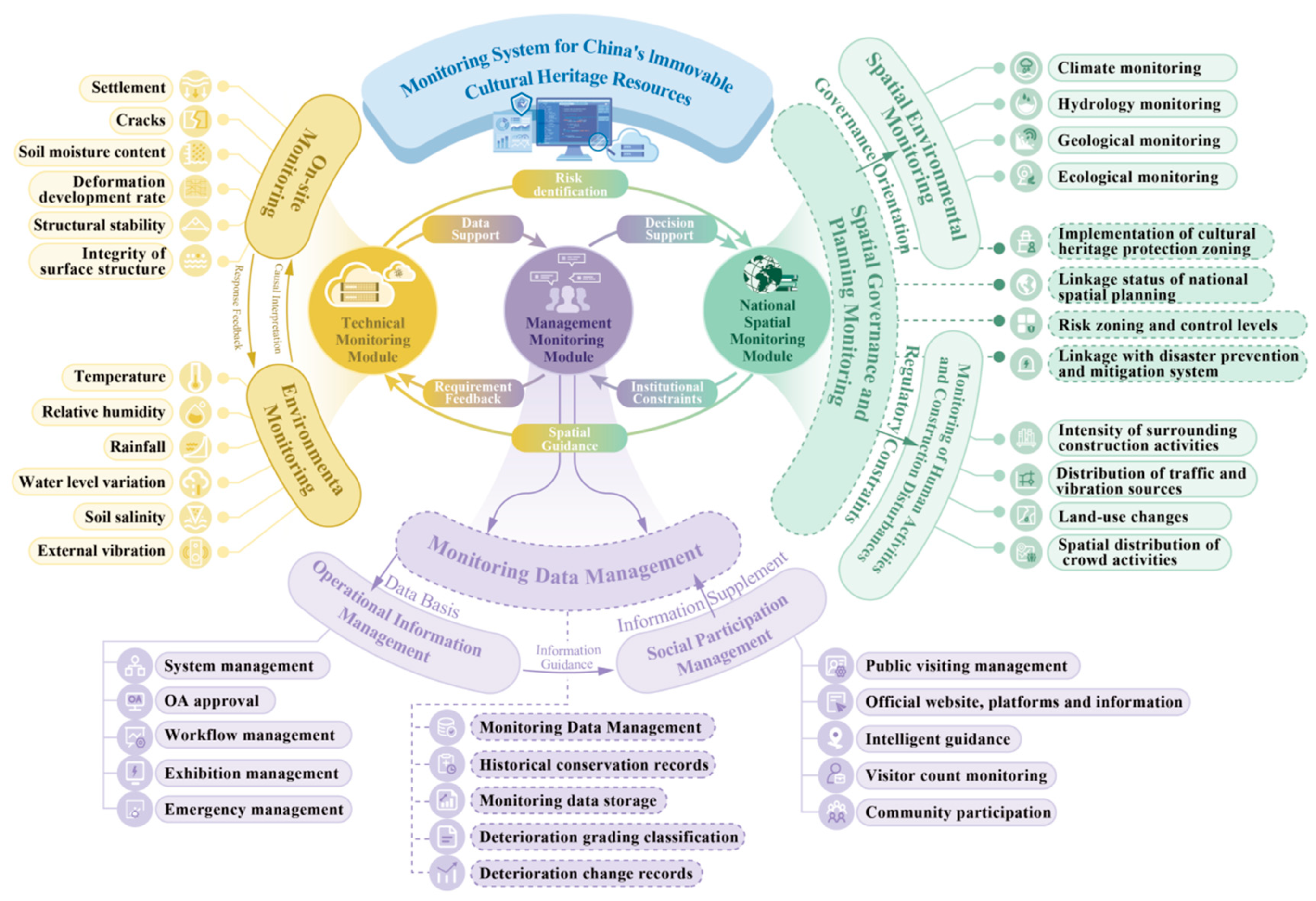
Figure 2.
The Logic and Operational Mechanism of Technology-Management-Spatial Coordination.
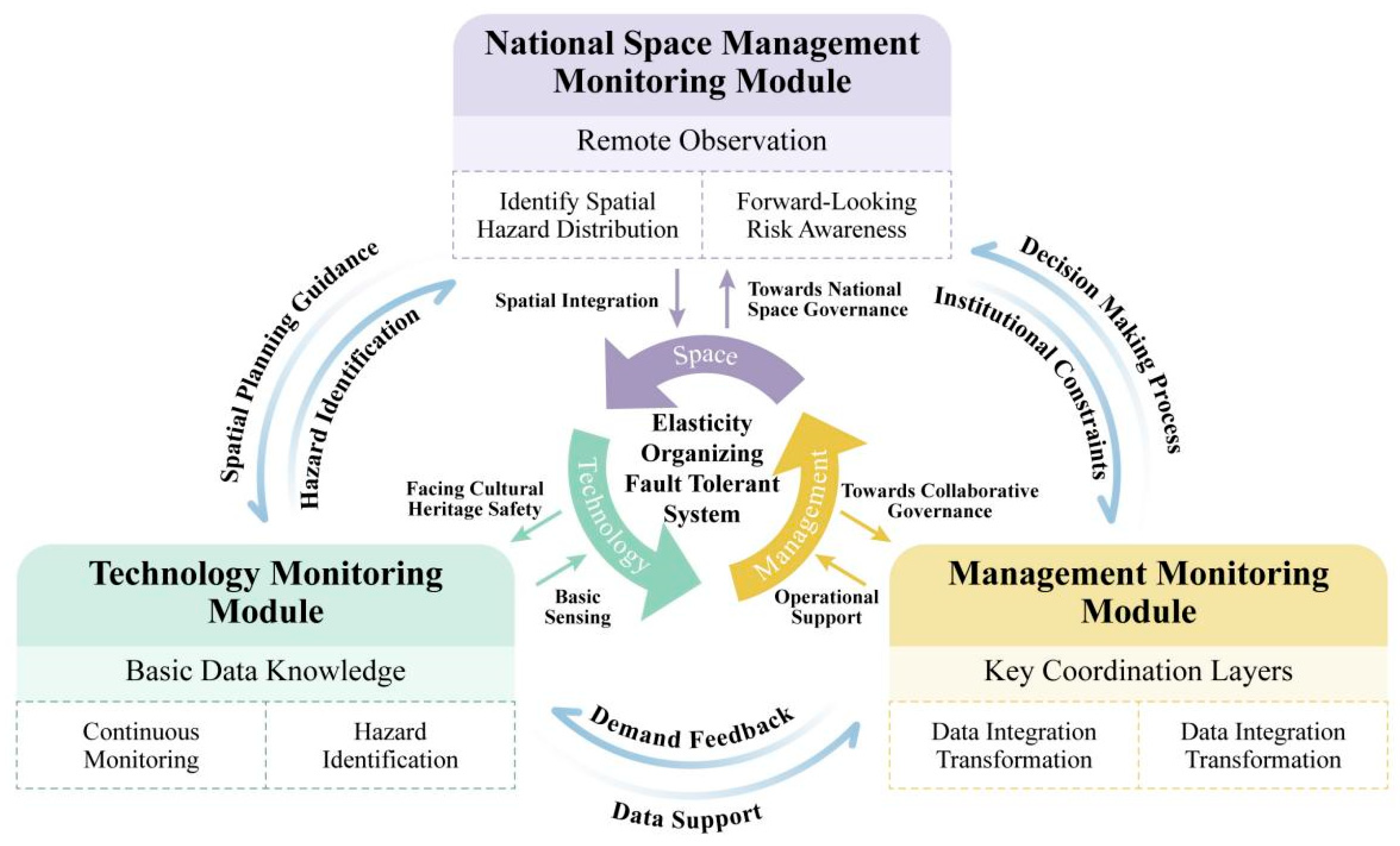
Figure 3.
Current Status of Monitoring Sections at HGS (A: Air Temperature and Humidity Sensor; B: Gateway; C/D: Soil Moisture Content Sensor; E: Weather Station; F/G: Vibration Pickup; H: Settlement Monitoring; I: 3D Scanning Equipment; J: Hanguang Gate site Monitoring Information Management Platform; K: Weather Station; L: Groundwater Level Monitoring Equipment; M: Panoramic Surveillance).
Figure 3.
Current Status of Monitoring Sections at HGS (A: Air Temperature and Humidity Sensor; B: Gateway; C/D: Soil Moisture Content Sensor; E: Weather Station; F/G: Vibration Pickup; H: Settlement Monitoring; I: 3D Scanning Equipment; J: Hanguang Gate site Monitoring Information Management Platform; K: Weather Station; L: Groundwater Level Monitoring Equipment; M: Panoramic Surveillance).
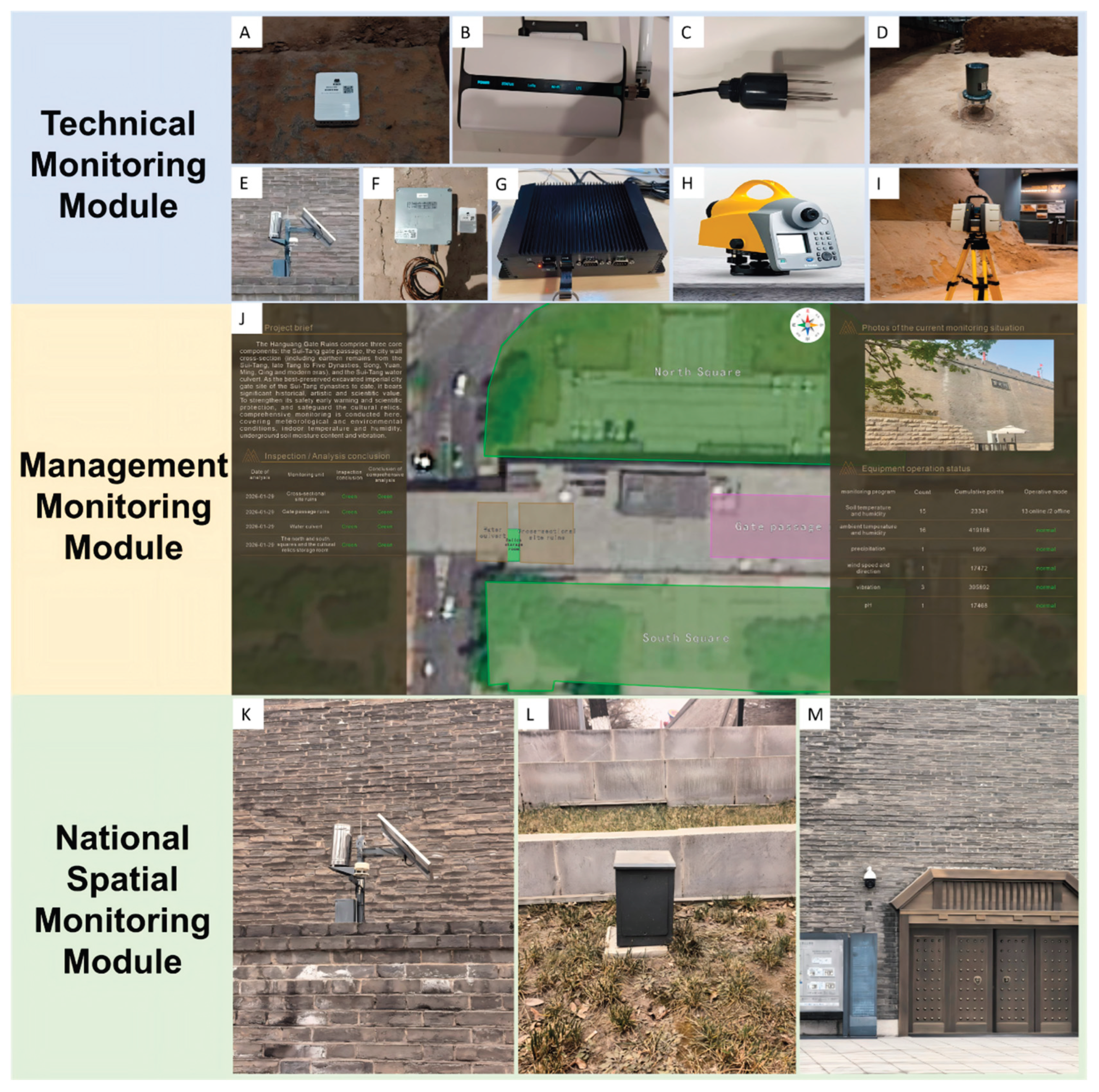

Table 1.
Developmental Stages and Key Features of Monitoring China’s Immovable Cultural Heritage Asset.
Table 1.
Developmental Stages and Key Features of Monitoring China’s Immovable Cultural Heritage Asset.
| Developmental Stages and Key Features of Monitoring China’s Immovable Cultural Heritage Asset | ||||
| Development Stages | StageⅠ | StageⅡ | StageⅢ | StageⅣ |
| Manual Inspection | Project-Based Monitoring | Information Platform–Based | Intelligent development stage | |
| Monitoring targets | Heritage fabric | Heritage fabric and preservation environment | Heritage fabric, preservation environment, and management information | Integrated monitoring of heritage–environment–human activities–hazard risks |
| Monitoring Methods | Visual inspection and paper-based documentation | Project-specific sensor deployment and data collection | Continuous monitoring with platform-based data integration | Intelligent analysis, automated anomaly detection, and predictive early warning |
| Characteristics | Experience-driven and judgment-based | Experience combined with quantitative data support | Multi-source heritage monitoring data integration and analysis | Risk identification and prediction as primary objectives |
| Limitations | Strong subjectivity and low temporal continuity | Fragmented technologies and limited system coordination | Lack of unified standards and insufficient system interoperability | Inadequate cross-institutional data-sharing mechanisms |
| Management Approach | Reactive, post-deterioration management | Problem-oriented technical intervention | Risk-informed and system-based management | Collaborative, cross-sector governance |
| Objectives | Basic safeguarding of heritage integrity | Targeted mitigation of specific deterioration processes | Risk early warning and systematic conservation management | Enhanced foresight in heritage risk identification |
Table 2.
Implementation of the Technical Monitoring Module at HGS.
| Technical Monitoring Module | |||
|---|---|---|---|
| On-site Monitoring | Environmental Monitoring | ||
| Settlement | √ | Temperature | √ |
| Cracks | √ | Relative humidity | √ |
| Soil moisture content | √ | Rainfall | √ |
| Deformation development rate | √ | Water level variation | √ |
| Structural stability | √ | Soil salinity | √ |
| Integrity of surface structure | √ | External vibration | √ |
Notes: “√” indicates that the corresponding monitoring has been implemented at the site, whereas “–” indicates that the monitoring has not yet been implemented or requires further improvement.
Table 3.
Configuration and Operation of the Management Monitoring Module at HGS.
| Management Monitoring Module | |||||
|---|---|---|---|---|---|
| Monitoring Data Management | Operational Information Management | Social Participation Management | |||
| Monitoring Data Management | √ | System management | - | Public visiting management | - |
| Historical conservation records | √ | OA approval | √ | Official website, platforms and information | - |
| Monitoring data storage | - | workflow management | √ | Intelligent guidance | √ |
| Deterioration grading classification | √ | Exhibition management | √ | Visitor count monitoring | √ |
| Deterioration change records | √ | Emergency management | √ | Community participation | - |
Notes: “√” indicates that the corresponding monitoring has been implemented at the site, whereas “–” indicates that the monitoring has not yet been implemented or requires further improvement.
Table 4.
Configuration and Operation of the Management Monitoring Module at HGS.
| National Spatial Monitoring Module | |||||
|---|---|---|---|---|---|
| Spatial Environmental Monitoring | Monitoring of Human Activities and Construction Disturbances | Spatial Governance and Planning Monitoring | |||
| Climate monitoring | √ | Intensity of surrounding construction activities | - | Implementation of cultural heritage protection zoning | √ |
| Hydrology monitoring | √ | Distribution of traffic and vibration sources | √ | Linkage status of national spatial planning | √ |
| Geological monitoring | - | Land-use changes | - | Risk zoning and control levels | √ |
| Ecological monitoring | √ | Spatial distribution of crowd activities | √ | Linkage with disaster prevention and mitigation system | - |
Notes: “√” indicates that the corresponding monitoring has been implemented at the site, whereas “–” indicates that the monitoring has not yet been implemented or requires further improvement.
Disclaimer/Publisher’s Note: The statements, opinions and data contained in all publications are solely those of the individual author(s) and contributor(s) and not of MDPI and/or the editor(s). MDPI and/or the editor(s) disclaim responsibility for any injury to people or property resulting from any ideas, methods, instructions or products referred to in the content. |
© 2026 by the authors. Licensee MDPI, Basel, Switzerland. This article is an open access article distributed under the terms and conditions of the Creative Commons Attribution (CC BY) license (http://creativecommons.org/licenses/by/4.0/).
Copyright: This open access article is published under a Creative Commons CC BY 4.0 license, which permit the free download, distribution, and reuse, provided that the author and preprint are cited in any reuse.


