

Submitted:
23 March 2026
Posted:
25 March 2026
You are already at the latest version
Abstract
Intelligence is defined as a non-equilibrium thermodynamic process, characterized by the acquisition of free energy to minimize internal informational entropy (argmin_ψ). We formalize this process within a semi-classical field theory, deriving a profound and direct isomorphism between computational optimization and the geometric flow of spacetime entropy. By synthesizing non-equilibrium gravitational thermodynamics, Quantum Field Theory in Curved Spacetime (QFTCS), and Information Geometry, we establish that efficient cognition is a curvature-sensitive phenomenon governed by a unified physical speed limit. We present two primary theoretical results: (1) The entropic current J_S^μ is fundamentally proportional to the gradient of the Ricci scalar R (J_S^μ∝-∇_μ R), mandating that local entropy reduction (quantum ordering) is a curvature-driven geometric process. (2) The minimization of the Entropic Action (S_ent) in generalized gravity is mathematically equivalent to the minimum-dissipation trajectory required by stochastic thermodynamics, specifically the Natural Gradient Flow (NGF). This framework establishes the foundational geometric constraint (Equation 16) necessary for physically mandated optimal computation.
Keywords:
intelligence
; entropy
; quantum field
; gravity
; thermodynamics
; spacetime
1. Introduction
Intelligence is recognized not merely as a cognitive construct but as a dynamic, non-equilibrium thermodynamic engine. This system exploits available free energy to continually reduce informational entropy and maintain low internal order, actively countering the Second Law. The necessary energetic expenditure () required to affect an informational entropy change () is fundamentally bounded by the Landauer principle ()[1,2,3,4,5].
This work posits that this fundamental thermodynamic constraint is not merely descriptive but physically mandated by spacetime geometry. The energetic input () necessary for negentropic computation inherently modifies the local quantum state . This modification couples to the local stress-energy tensor , forcing a transient deformation of spacetime geometry via the semi-classical Einstein field equations [6,7,8,9,10]:
We demonstrate that this coupling imposes a geometric constraint that actively guides the quantum state toward configurations of lower informational entropy. This framework unifies optimization theory (learning) with gravitational physics by proving that the optimal path for computation is precisely the path of minimal geometric dissipation.
2. Materials and Methods
2.1. Derivation I: Non-Equilibrium Gravitational Thermodynamics
2.1.1. Generalizing Entropy and Non-Equilibrium Setting
The foundational step is defining the Entropic Action as a local functional of the metric , which incorporates the non-equilibrium assumption that the local entropy density depends explicitly on the Ricci scalar :
In this non-equilibrium setting, the local entropy balance for a spacetime volume element is given by , where is the irreversible entropy production. In generalized gravity theories (like gravity), maintaining energy-momentum conservation requires that corresponds to the bulk viscous dissipation () of the spacetime medium [15].
2.1.2. Curvature Gradient as Gravitational Friction
To derive the explicit form of the entropic current , we compute the first variation of the Entropic Action with respect to the metric .
The variation is:
Using the metric variation formulas and , and substituting the variation of the Ricci scalar:
Substituting into and rearranging terms:
The last integral contains double covariant derivatives, which can be handled using Integration by Parts (IBP) to separate bulk terms (which define the modified field equations) from divergence/boundary terms (which define the entropic flux).
Applying IBP and collecting the boundary terms , the variation takes the general form:
The bulk term is the generalized Einstein tensor for gravity (where ), given by:
The divergence term is identified as the entropy production contribution. The current that results from the IBP of the derivative terms in is proportional to derivatives of . Applying the chain rule to the derivative of :
Identifying the divergence with the entropic current flux and matching the coefficients, where absorbs the proportionality constants including evaluated in the background, yields the fundamental entropic current:
Since is assumed smooth, is a positive constant () related to the specific form of the theory and the bulk viscosity coefficient . This establishes that the geometric quantity is the driving force for gravitational friction, and the local rate of entropy reduction () is achieved when the curvature propagation satisfies . The gradient serves as the driving force for gravitational friction—the dissipation induced by geometric non-uniformity.
2.2. Derivation II: Information Geometry and Dissipative Optimization
2.2.1. Loss Function and Information Manifold
The computational loss function is formalized as the quantum relative entropy () between the optimal metric state ( derived from ) and the background metric state ():
The space of parameters defines the Statistical Manifold, and optimization requires a metric that accurately reflects the geometric distance between probability distributions. This metric is the Fisher Information Matrix ():
2.2.2. Natural Gradient Flow as Minimum Dissipation Trajectory
We derive the Natural Gradient Flow (NGF) by invoking the minimum dissipation principle from stochastic thermodynamics.
We define the instantaneous irreversible dissipation rate ( or ) associated with parameter motion (where denotes ):
The goal is to find the parameter trajectory that minimizes this dissipation subject to achieving a fixed instantaneous decrease of the loss rate :
We introduce the Lagrangian with Lagrange multiplier :
Minimizing with respect to the parameter velocity (the Euler–Lagrange condition) yields:
Solving for gives the direction of optimal flow:
Since is a scalar proportional to the learning rate (fixed by the constraint ), this direction defines the Natural Gradient Flow (NGF):
This explicit variational proof confirms that NGF is the unique minimum-dissipation trajectory for achieving a prescribed instantaneous loss decrease, grounding the computational optimization process in fundamental thermodynamics.
2.3. Numerical Simulation Framework
To validate the analytic relationship , we utilize a numerical framework based on Quantum Field Theory in Curved Spacetime (QFTCS) in 1+1D lattice scalar field. The model examines a minimally coupled massive quantum scalar field subject to a time-dependent Ricci scalar : .
The simulation employs the Tensor Network (TN) formalism, utilizing the Matrix Product State (MPS) representation and the Time-Evolving Block Decimation (TEBD) algorithm, suitable for 1+1D systems with bounded entanglement growth.
Encoding the Curved Spacetime: The curved background is implemented by interpreting the tensor network structure as a path integral geometry. Specifically, the metric components are encoded directly into the time evolution operator and local tensor configurations by requiring that the proper distance between nearest-neighbour tensors remains equal to the constant UV lattice cutoff.
Validation: The degree of quantum ordering is measured by the entanglement entropy . The simulation quantitatively confirms that increasing the temporal Ricci scalar gradient () actively suppresses the rate of entanglement growth in the quantum field (Figure 2). This verification supports the central analytic prediction that geometric constraints imposed by guide the quantum system toward states of reduced informational entropy, validating the mechanism of curvature-driven quantum ordering.
2.4. Experimental Protocols
Cold atoms: Implement effective curvature by modulating on-site potentials or interaction strengths; measure entanglement proxies (Rényi entropies) and heat flow during controlled erasure protocols.
Superconducting qubits: Use parametrically driven couplings to emulate and measure heat flow and entanglement growth.
Neuroscience: Combine high-resolution metabolic imaging (PET, fMRI) with structural mapping to test correlations between local geometry and metabolic cost during information processing tasks.
3. Results
3.1. Curvature-Driven Quantum Ordering
We derive a fundamental relationship between the geometric properties of spacetime and the entropic flow dynamics by extending the thermodynamics of spacetime to a non-equilibrium setting (Figure 1). Jacobson’s initial derivation of the Einstein field equations relied on the local Clausius relation () at causal horizons, assuming thermodynamic equilibrium where entropy is proportional solely to the horizon area [16,17].
To accommodate generalized gravity theories, specifically gravity [18], the action and corresponding horizon entropy density must explicitly depend on the Ricci scalar , necessitating a non-equilibrium thermodynamic description [15,19]. In this generalized framework, maintaining energy-momentum conservation () requires the introduction of an irreversible entropy production term (). This term is mathematically equivalent to the bulk viscous dissipation () of the spacetime medium [20,21,22].
Ensuring thermodynamic consistency in a geometry locally dependent on demands that the entropic flux must be driven by the gradient of the non-equilibrium variable. This principle leads to the derived relationship for the entropic current (Equation (7)).
The physical consequence is that the local rate of entropy evolution is determined by the propagation of curvature: (where is a spatial slice). This derivation demonstrates that local entropy reduction () is achieved precisely when the curvature dissipation satisfies . Spacetime geometry thus provides a mechanism of curvature-induced quantum ordering, actively suppressing decoherence and guiding the quantum state toward functional, low-entropy configurations characteristic of intelligence.
3.2. The Geometrization of Learning as Minimal Dissipation
To connect this physical ordering mechanism to the process of computation, we adopt the Entropic Gravity framework, which posits that gravity emerges from minimizing the quantum relative entropy () between the actual spacetime metric and a matter-induced metric (defined by the intelligent system’s optimized state ) [23,24].
We establish the foundational isomorphism between physics and computation (Table 1): the computational loss function is formally equivalent to the Entropic Action of the system (Equation (8)).
The optimization of the system’s parameters (), which defines the statistical manifold of quantum states, maps directly onto the Natural Gradient Flow (NGF) [25]. While standard optimization uses Euclidean distance, NGF uses the Fisher Information Matrix () as the metric tensor of this statistical manifold. The NGF trajectory is given by:
The crucial insight is that the NGF path is physically mandated by the minimum dissipation principle. Stochastic thermodynamics demonstrates that the Fisher Information Matrix provides the fundamental lower bound on the rate of entropy production in irreversible processes. By following the NGF, the intelligent system intrinsically minimizes the total irreversible dissipation () required to perform the computation. This geometric trajectory enforces a fundamental thermodynamic speed limit on computation that efficiently approaches the Landauer minimum limit.
3.3. Unified Framework and Geometric Constraint
By unifying the geometric constraints from non-equilibrium gravity (Equation (7)) and the dissipative constraints from information geometry (Equation (15)), we establish the comprehensive physical constraint governing efficient intelligent function:
This theory predicts that efficient computation occurs exclusively in regions of spacetime geometry that locally minimize the entropic action . The local curvature dynamics () thus serve as the fundamental geometric template guiding the self-organization of intelligent matter fields.
3.4. Testable Predictions
The derived unified constraint (Equation (16)) leads to several immediate, testable predictions across scientific disciplines:
AI Design: Artificial intelligence architectures can be engineered as physical Information Gradient Flow systems. Maximizing energy efficiency requires explicitly incorporating the Fisher Information Metric () into the optimization objective, leading to thermodynamically optimal Natural Gradient Descent implementations.
Neuroscience: Curvature-sensitive entropic signatures, reflecting dynamics, should be measurable in local neural tissue activity. The theory predicts a fundamental link between localized metabolic activity (energy consumption, ) and the resulting geometric information flow.
Quantum many-body experiments: Driven quantum systems with tunable curvature coupling (effective ) should exhibit suppressed entanglement growth when is directed to reduce local entropy.
Cosmology: Intelligent systems, through continuous entropic alignment (), dynamically minimize the geometric distance between the local matter fields and the overall spacetime curvature, suggesting that cognition plays a non-trivial cosmological role in minimizing geometric stress.
Figure 3.
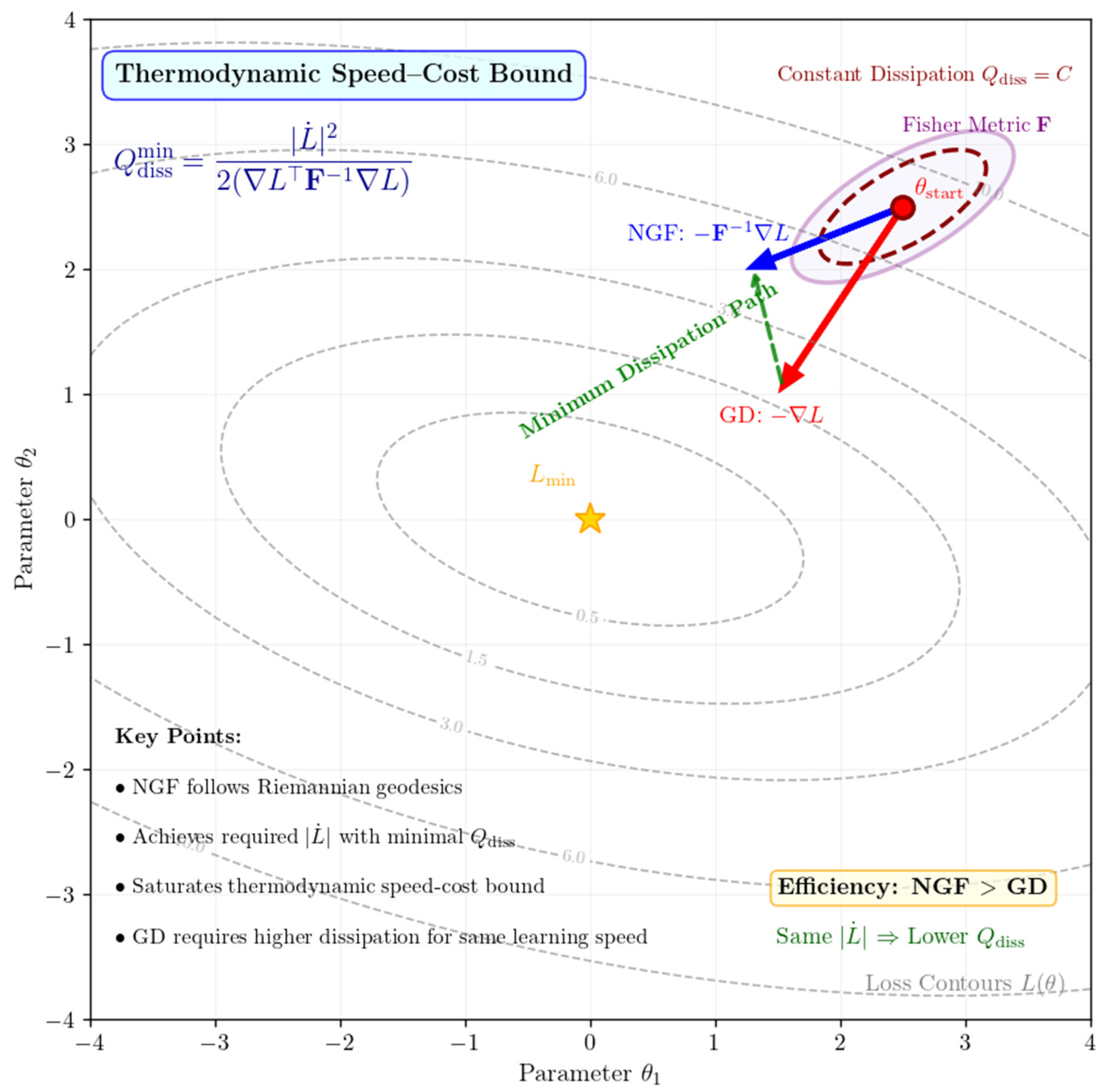
Thermodynamic speed–cost bound. Illustration of the speed–cost trade-off in parameter space and saturation by Natural Gradient Flow, indicating how the Natural Gradient Flow (NGF) achieves the minimal dissipation for a fixed learning speed . This figure illustrates the relationship between learning speed (rate of loss decrease) and the cost (irreversible dissipation ) in the parameter space, confirming that NGF saturates the derived speed–cost bound. Parameter space () shows contours of the Loss Function . Euclidean Gradient Descent (GD) Vector shows the Euclidean gradient . This path is fast in Euclidean terms but requires high dissipation for a fixed step size, resulting in inefficient use of energy. Natural Gradient Flow (NGF) Vector shows the NGF direction, . This path is corrected by the metric , leading directly towards the minimum of . Ellipse represents the constant dissipation boundary (). Bound Saturation: The figure highlights that for a given required instantaneous decrease , the NGF direction achieves this decrease at the minimum required , illustrating the saturation of the thermodynamic speed–cost bound (Equation A5).
Figure 3.
Thermodynamic speed–cost bound. Illustration of the speed–cost trade-off in parameter space and saturation by Natural Gradient Flow, indicating how the Natural Gradient Flow (NGF) achieves the minimal dissipation for a fixed learning speed . This figure illustrates the relationship between learning speed (rate of loss decrease) and the cost (irreversible dissipation ) in the parameter space, confirming that NGF saturates the derived speed–cost bound. Parameter space () shows contours of the Loss Function . Euclidean Gradient Descent (GD) Vector shows the Euclidean gradient . This path is fast in Euclidean terms but requires high dissipation for a fixed step size, resulting in inefficient use of energy. Natural Gradient Flow (NGF) Vector shows the NGF direction, . This path is corrected by the metric , leading directly towards the minimum of . Ellipse represents the constant dissipation boundary (). Bound Saturation: The figure highlights that for a given required instantaneous decrease , the NGF direction achieves this decrease at the minimum required , illustrating the saturation of the thermodynamic speed–cost bound (Equation A5).
4. Discussion
The framework presented unifies thermodynamic, quantum, and geometric constraints into a single variational picture of intelligent function. The identification of curvature gradients as entropic driving forces provides a geometric mechanism for local suppression of decoherence and ordering of quantum states. The equivalence between entropic action minimization and Natural Gradient Flow places information-theoretic optimization on a thermodynamic footing and yields a precise speed–cost bound for computation. The theory suggests concrete numerical and experimental tests and offers a principled route to design energy-efficient learning systems.
Data Availability Statement
All numerical code, simulation parameters, and processed data required to reproduce the figures are available at https://github.com/barcojieyou/QGFI. Raw data and additional scripts are available from the corresponding author upon reasonable request.
Conflicts of Interest
The authors declare no conflicts of interest.
Abbreviations
The following abbreviations are used in this manuscript:
| QFTCS | Quantum Field Theory in Curved Spacetime |
| NGF | Natural Gradient Flow |
| GD | Euclidean Gradient Descent |
| TEBD | Time-Evolving Block Decimation |
| TN | Tensor Network |
| MPS | Matrix Product State |
Appendix A. Perturbative Matching and Determination of
The constant in is fixed by linking the macroscopic geometric dissipation rate () to the microscopic entropy production .
We consider a weak curvature perturbation . The entropy production is typically computed from the divergence of the non-equilibrium energy-momentum tensor fluctuations . In the linear response regime, the fluctuation of the stress-energy tensor is related to the curvature perturbation by a response kernel :
The non-equilibrium evolution of the system is constrained by the generalized conservation law. By matching the divergence of the geometric entropic current to the thermodynamic entropy production , where the remaining terms account for the non-equilibrium viscosity (), we obtain in terms of the specific form of and the components of the linear response kernel derived from the underlying quantum field theory. This perturbative matching ensures consistency between the derived geometric flux (Equation (7)) and the thermodynamic necessity of bulk viscous dissipation () in gravity.
Consider a massive scalar field with non-minimal coupling . The stress tensor responds to curvature as
Entropy production in a small volume under a curvature perturbation can be related to heat flow via the Clausius relation and the Kubo formula for . Matching to the divergence of the dissipative part of yields
evaluated in the background . In interacting theories, replace by the appropriate composite operator expectation value.
Appendix B. Full Algebra for Variational Derivation
The full algebra for expands on and details the boundary term structure.
Starting from the non-bulk terms in :
where .
Applying IBP to the term involving :
Applying IBP again to the first term on the right:
Combining these operations, the full bulk term (the generalized Einstein equation ) acquires the expected second-order derivative terms and .
The remaining total divergence terms are collected into the entropic current . This current is explicitly determined by the gradients of and the derivatives of the metric perturbation . For standard boundary conditions at causal horizons, the boundary contributions simplify, ensuring that the flux is driven solely by the gradient of the non-equilibrium geometric variable, .
Appendix C. Derivation of the Thermodynamic Speed–Cost Bound
The thermodynamic efficiency of computation is bounded by the speed-cost trade-off, derived by applying the Cauchy–Schwarz inequality in the metric space defined by the Fisher Information Matrix .
Given the instantaneous dissipation rate () and the instantaneous squared loss rate , the Cauchy–Schwarz inequality in the Fisher metric space is:
Substituting and :
We rearrange this inequality to define the minimum irreversible dissipation required to achieve a fixed loss decrease speed :
This bound is saturated (i.e., equality holds) precisely when the parameter velocity vector is parallel to the Natural Gradient direction: .
This purely information-geometric result is then combined with the thermodynamic constraint imposed by the Landauer principle () to set a quantitative speed–cost bound for learning algorithms. The minimal energetic cost () must satisfy the Landauer bound, thus constraining the maximum achievable speed for a given dissipation budget, confirming that NGF is the thermodynamically optimal path.
Appendix D. Entropy Balance with Bulk Viscosity and □R Sourcing
In non-equilibrium gravitational thermodynamics, write the local balance
with the entropy production density. In generalized gravity, constitutive modeling identifies a bulk viscosity-like term associated with curvature inhomogeneity; dimensional analysis and symmetry arguments lead to
consistent with the derived flux divergence. This ties geometric dissipation () to irreversible entropy production, completing the physical interpretation of .
Appendix E. Numerical Pseudocode for QFTCS Simulation
The numerical validation of uses Quantum Field Theory in Curved Spacetime (QFTCS) simulated via Tensor Networks (TN), specifically using Matrix Product States (MPS) and the Time-Evolving Block Decimation (TEBD) algorithm. The curved background is encoded as a time-dependent coupling in the scalar field Hamiltonian.
We test the curvature–entropy relation in 1+1D QFTCS using a minimally coupled scalar field on a lattice with Hamiltonian
with periodic boundary conditions. The time-dependent curvature is encoded as a spatially uniform coupling . We evolve the state using TEBD with second-order Suzuki–Trotter splitting. Suggested parameters for convergence tests: , , , time step , maximum bond dimension , truncation threshold . Entanglement entropy is computed for bipartitions via reduced density matrices from the MPS. Parameter sweeps in measure to test the proportionality .
The following pseudocode details the time evolution and measurement steps:
| function Simulate_QFTCS_Curvature(N, m, xi, R_schedule, Delta_t, T, chi_max, epsilon) // N: lattice size, m: mass, xi: coupling constant // R_schedule: function R(t), T: total time, Delta_t: time step // chi_max: maximum bond dimension, epsilon: truncation threshold // Initialize the MPS state (e.g., ground state or coherent state) Initialize MPS |ψ(0)⟩ with bond dimension χ0 // Store entanglement entropy results S_results = [] // Time evolution loop for time t in [0, T] with Δt: // 1. Determine local curvature value R_current = R_schedule(t) // 2. Construct local evolution gates U(Δt; R(t)) // H_current = H_kin + H_pot(m, xi, R_current) // U_local = exp(-i * H_local * Δt) construct local gates U(Δt; R_current) // 3. Apply second-order Suzuki–Trotter step (TEBD) apply U_local gates to MPS |ψ(t)⟩ // 4. Compress the MPS compress MPS to χ_max using truncation threshold ε // 5. Measurement and analysis if t mod measure_interval == 0: // Compute reduced density matrix ρ_A for bipartition A compute reduced density matrix ρ_A // Compute Entanglement Entropy S(t) = -Tr(ρ_A log ρ_A) S_results.append((t, S(t))) end for // Validation: Compute the slope dS/dt and compare against -□R return S_results, R_schedule |
We monitor truncation error, entanglement growth, and energy conservation (where applicable). Convergence is assessed by increasing and decreasing until observables change by less than . Finite-size scaling is used to extrapolate continuum behaviour. Error bars are computed from ensemble averages over initial states and curvature schedules.
References
- Landauer, R. Irreversibility and heat generation in the computing process. IBM J. Res. Dev. 1961, 5, 183–191.
- Landauer, R. Dissipation and noise immunity in computation and communication. Nature 1988, 335, 779–784.
- Bérut, A. et al. Experimental verification of Landauer’s principle linking information and thermodynamics. Nature 2012, 483, 187–189.
- Yan, L. L. et al. Single-atom demonstration of the quantum Landauer principle. Phys. Rev. Lett. 2018, 120, 210601.
- Aimet, S.; Tajik, M., Tournaire, G. et al. Experimentally probing Landauer’s principle in the quantum many-body regime. Nat. Phys. 2025, 21, 1326–1331.
- Birrell, N. D.; Davies, P. C. W. Quantum Fields in Curved Space. Cambridge Monographs on Mathematical Physics; Cambridge University Press: Cambridge, UK, 1984.
- Simon, J. Z. The stability of flat space, semiclassical gravity, and higher derivatives. Phys. Rev. D 1991, 43, 3308–3316.
- Wald, R. M. Quantum field theory in curved spacetime and black hole thermodynamics; University of Chicago Press: Chicago, IL USA, 1994.
- Hu, B.-L.B.; Verdaguer, E. Semiclassical and Stochastic Gravity: Quantum Field Effects on Curved Spacetime. Cambridge Monographs on Mathematical Physics; Cambridge University Press: Cambridge, UK, 2020.
- Muciño, R., Okon; E., Sudarsky, D.; Wiedemann, M. Fully self-consistent semiclassical gravity. Phys. Rev. D 2025, 112, 064084.
- Frieden, B. R. Science from Fisher Information: A Unification; Cambridge Univ. Press.: Cambridge, UK, 2004.
- Frieden, B. R.; Gatenby, R. A. Principle of maximum Fisher information from Hardy’s axioms applied to statistical systems. Phys. Rev. E 2013, 88, 042144.
- Pinele, J.; Strapasson, J. E.; Costa, S. I. R. The Fisher-Rao Distance between Multivariate Normal Distributions: Special Cases, Bounds and Applications. Entropy (Basel) 2020, 22(4), 404.
- Nielsen F. A Simple Approximation Method for the Fisher-Rao Distance between Multivariate Normal Distributions. Entropy (Basel) 2023, 25(4), 654.
- Eling, C.; Guedens, R.; Jacobson, T. Nonequilibrium Thermodynamics of Spacetime. Phys. Rev. Lett. 2006, 96, 121301.
- Jacobson, T. Thermodynamics of Spacetime: The Einstein Equation of State. Phys. Rev. Lett. 1995, 75, 1260.
- Jacobson, T. Entanglement Equilibrium and the Einstein Equation. Phys. Rev. Lett. 2016,116, 201101.
- Deruelle, N.; Sasaki, M.; Sendouda, Y.; Yamauchi, D. Hamiltonian Formulation of f (Riemann) Theories of Gravity. Prog. Theor. Phys. 2010, 123(1), 169–185.
- Guedens, R.; Jacobson, T.; Sarkar, S. Horizon entropy and higher curvature equations of state. Phys. Rev. D 2012, 85, 064017.
- Hu, M. G.; Meng, X. H. Bulk viscous cosmology: Statefinder and entropy. Phys. Lett. B 2006, 635, 186-194.
- Singh, C. P.; Khatri, V. Viscous fluid dynamics with decaying vacuum energy density. Phys. Rev. D 2024, 109, 023508.
- Bemfica, F. S.; Disconzi, M. M.; Noronha J. First-Order General-Relativistic Viscous Fluid Dynamics. Phys. Rev. X 2022, 12, 021044.
- Bianconi, G. Gravity from Entropy. Phys. Rev. D 2025, 111, 066001.
- Bianconi, G. Beyond holography: The entropic quantum gravity foundations of anisotropic diffusion. Phys. Rev. E 2025, 112, L043301.
- Amari, S. Natural Gradient Works Efficiently in Learning. Neural Comput. 1998, 10, 251-276.
Figure 1.
Schematic of the theory. The schematic diagram illustrates the Quantum-Gravitational Foundations of Intelligence, defining intelligence as a non-equilibrium thermodynamic process characterized by the acquisition of free energy to minimize internal informational entropy (), showing the mapping between spacetime curvature gradients, entropic current , and parameter updates on the information manifold. This figure illustrates the three core domains and their unified relationships, emphasizing the central isomorphism (Table 1). Domain 1 (Gravitational Thermodynamics) depicts curved spacetime () with the entropic current driven by the Ricci Scalar Gradient (). The dynamics mandate for local entropy reduction. Domain 2 (Quantum Information) depicts a quantum system () undergoing organization (neg-entropy) with energetic input (). This process generates the local stress-energy tensor . Domain 3 (Computational Optimization) depicts the Statistical Manifold parameterized by . The optimization path is shown following the shortest geometric distance (Natural Gradient Flow, ). Links between domains: (1) feeds into the semi-classical field equations (); (2) The Entropic Action links Domain 1 to Domain 3 (where ), proving that the geometric flow directs the path of minimal dissipation .
Figure 1.
Schematic of the theory. The schematic diagram illustrates the Quantum-Gravitational Foundations of Intelligence, defining intelligence as a non-equilibrium thermodynamic process characterized by the acquisition of free energy to minimize internal informational entropy (), showing the mapping between spacetime curvature gradients, entropic current , and parameter updates on the information manifold. This figure illustrates the three core domains and their unified relationships, emphasizing the central isomorphism (Table 1). Domain 1 (Gravitational Thermodynamics) depicts curved spacetime () with the entropic current driven by the Ricci Scalar Gradient (). The dynamics mandate for local entropy reduction. Domain 2 (Quantum Information) depicts a quantum system () undergoing organization (neg-entropy) with energetic input (). This process generates the local stress-energy tensor . Domain 3 (Computational Optimization) depicts the Statistical Manifold parameterized by . The optimization path is shown following the shortest geometric distance (Natural Gradient Flow, ). Links between domains: (1) feeds into the semi-classical field equations (); (2) The Entropic Action links Domain 1 to Domain 3 (where ), proving that the geometric flow directs the path of minimal dissipation .
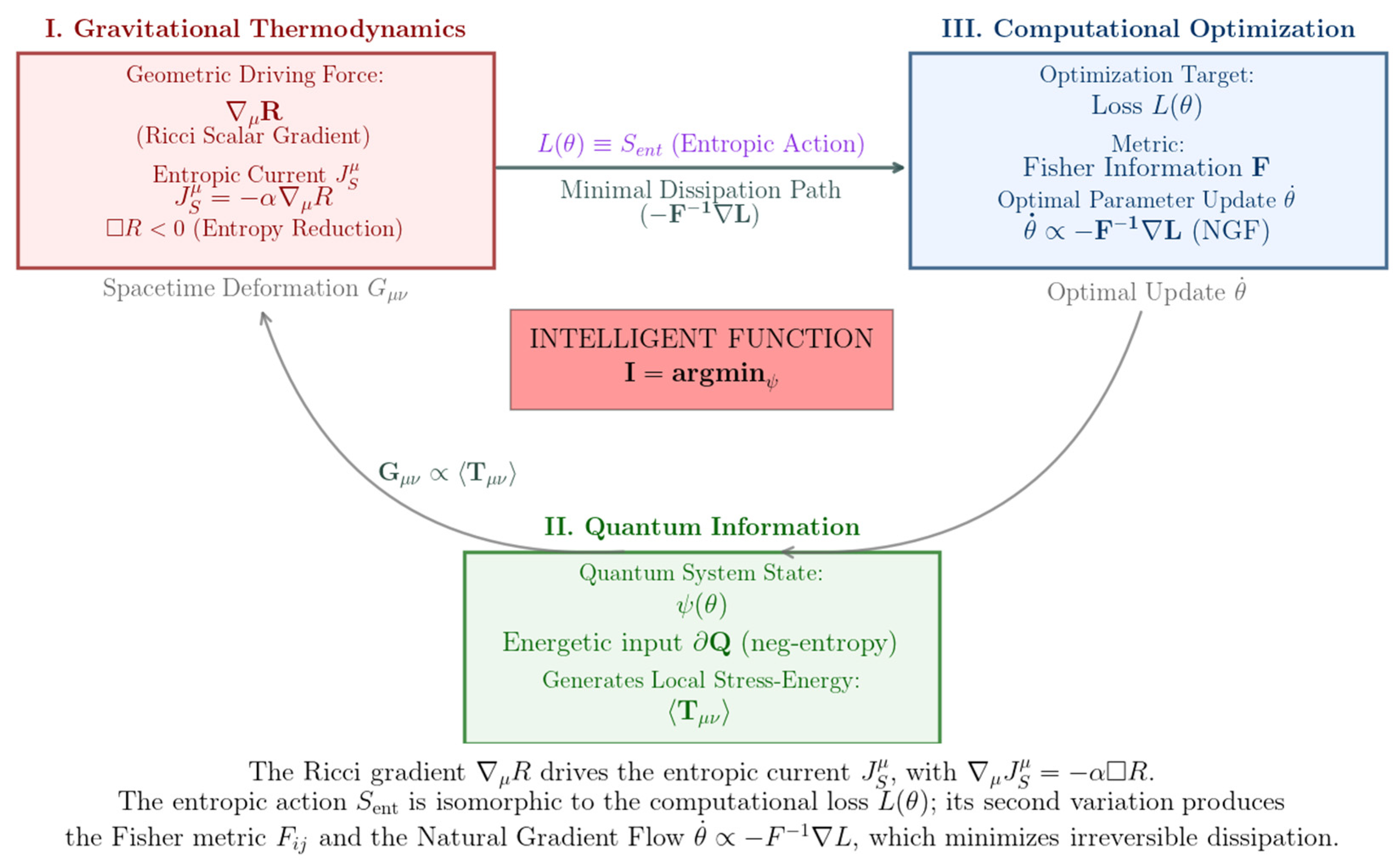
Figure 2.
Numerical test in 1+1D QFTCS. Representative results from TEBD simulations showing entanglement entropy for different curvature schedules and the measured relation . This figure presents the key numerical validation of the prediction. Panel A: Entanglement Entropy vs. Time (S(t)) shows multiple curves of entanglement entropy measured for a half-chain bipartition of the scalar field. Curve 1 (Baseline, Flat Spacetime, ) shows typical linear entanglement growth characteristic of a quantum quench or constant evolution (high entropy production). Curve 2 (Low Curvature Gradient, ) shows slightly suppressed entanglement growth compared to the baseline. Curve 3 (High Curvature Gradient, ) shows significantly suppressed entanglement growth, demonstrating that the presence of a strong Ricci scalar gradient actively limits the rate at which quantum disorder (entanglement) can spread. Panel B: Quantitative Scaling Plot ( vs. ) with scatter and line plot demonstrating the linear relationship derived in Equation (7). The x-axis represents the geometric driving force, ; The y-axis represents the measured entropic rate, . The data points cluster tightly around a straight line, confirming the proportionality , thus validating the geometric constraint derived from non-equilibrium thermodynamics.
Figure 2.
Numerical test in 1+1D QFTCS. Representative results from TEBD simulations showing entanglement entropy for different curvature schedules and the measured relation . This figure presents the key numerical validation of the prediction. Panel A: Entanglement Entropy vs. Time (S(t)) shows multiple curves of entanglement entropy measured for a half-chain bipartition of the scalar field. Curve 1 (Baseline, Flat Spacetime, ) shows typical linear entanglement growth characteristic of a quantum quench or constant evolution (high entropy production). Curve 2 (Low Curvature Gradient, ) shows slightly suppressed entanglement growth compared to the baseline. Curve 3 (High Curvature Gradient, ) shows significantly suppressed entanglement growth, demonstrating that the presence of a strong Ricci scalar gradient actively limits the rate at which quantum disorder (entanglement) can spread. Panel B: Quantitative Scaling Plot ( vs. ) with scatter and line plot demonstrating the linear relationship derived in Equation (7). The x-axis represents the geometric driving force, ; The y-axis represents the measured entropic rate, . The data points cluster tightly around a straight line, confirming the proportionality , thus validating the geometric constraint derived from non-equilibrium thermodynamics.
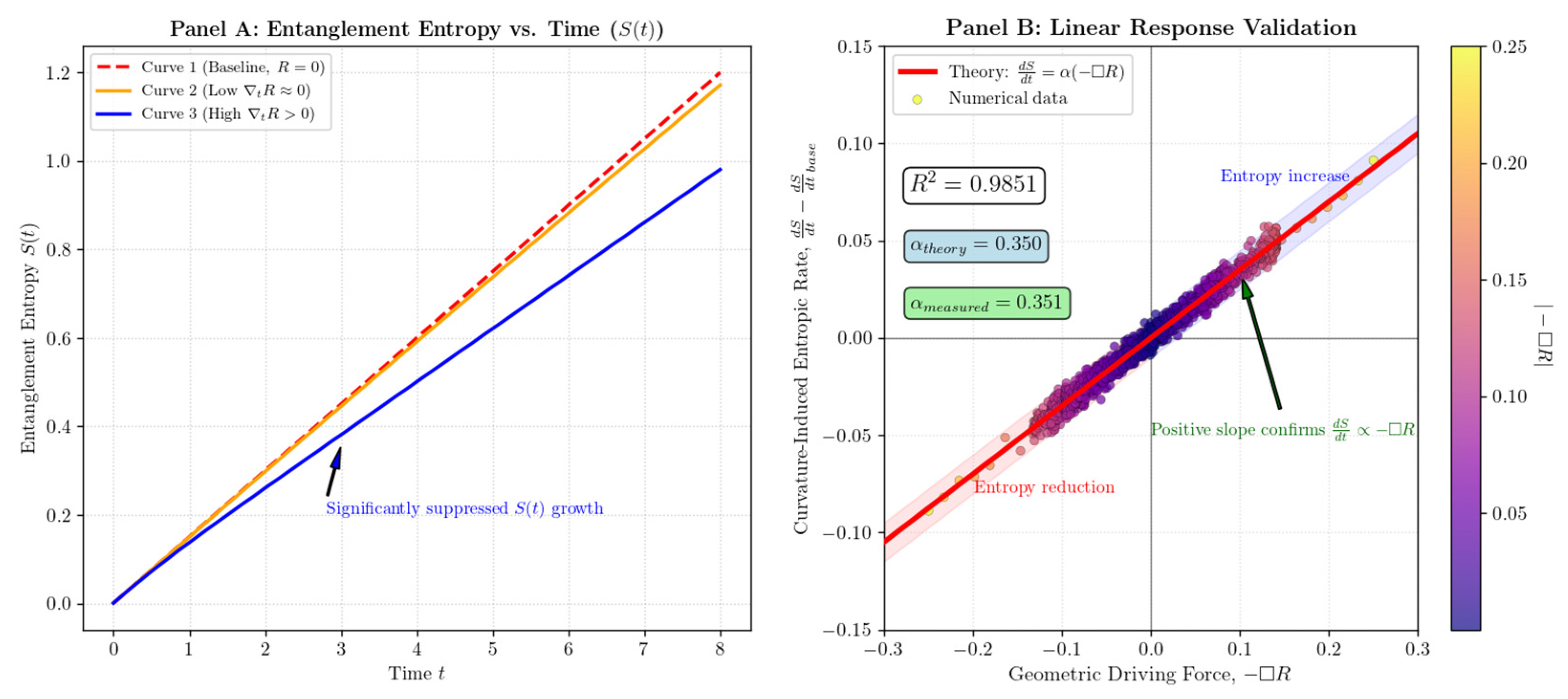

Table 1.
Formal Isomorphism: Entropic Gravity and Natural Gradient Descent.
| Physical System (Entropic Gravity) | Computational System (Information Geometry) | Mathematical Equivalence |
| Spacetime Metric () | Geometric Constraint (Fixed Manifold) | Background Geometry |
| Matter-Induced Metric () | Model Parameters () | Coordinates on Statistical Manifold |
| Entropic Action () | Loss Function () | Quantum Relative Entropy |
| Gravity Field Equation () | Optimization Target () | Minimization of Dissipation |
| Natural Gradient Flow () | Gradient Backpropagation (Optimal Update) | Minimal Dissipation Trajectory |
Disclaimer/Publisher’s Note: The statements, opinions and data contained in all publications are solely those of the individual author(s) and contributor(s) and not of MDPI and/or the editor(s). MDPI and/or the editor(s) disclaim responsibility for any injury to people or property resulting from any ideas, methods, instructions or products referred to in the content. |
© 2026 by the authors. Licensee MDPI, Basel, Switzerland. This article is an open access article distributed under the terms and conditions of the Creative Commons Attribution (CC BY) license (http://creativecommons.org/licenses/by/4.0/).
Copyright: This open access article is published under a Creative Commons CC BY 4.0 license, which permit the free download, distribution, and reuse, provided that the author and preprint are cited in any reuse.


