Preprint
Article

This version is not peer-reviewed.

Postural Ergonomic Risk in Fish Processing Tasks Using the Rapid Entire Body Assessment (REBA)

A peer-reviewed article of this preprint also exists.

Submitted:

25 March 2026

Posted:

25 March 2026

You are already at the latest version

Abstract

Musculoskeletal disorders represent one of the most frequent occupational health problems in labor-intensive industries, particularly in fish processing, where repetitive tasks and prolonged postures are common. The objective was to determine the level of ergonomic risk by applying the Rapid Entire Body Assessment (REBA) method and based on the results, to formulate recommendations aimed at preventing musculoskeletal disorders and improving preventive management within the organization. The assessment included 30 workers distributed across three operational workstations, where the overall average REBA score was 8.60 ± 1.65 (range: 6–12), indicating a predominantly high level of ergonomic risk. In categorical terms, 60.0% of the workers were classified as high risk, 13.3% as very high risk, and 26.7% as medium risk, while none reached negligible or low risk levels. Significant differences were observed between workstations (Kruskal-Wallis H = 16.72, p < 0.001, ε² = 0.545), with the nobbing stage exhibiting the highest biomechanical load (mean REBA = 10.38 ± 1.06). It is concluded that ergonomic risk is structurally integrated into the operational design of the evaluated production system; therefore, ergonomic interventions focused on redesigning workstations, adjusting height, and configuring tasks are recommended to reduce biomechanical exposure and strengthen the organization’s preventive occupational safety framework.

Keywords: 
;  ;  ;  ;  

1. Introduction

The fishing industry is a strategic sector that demands complex operations, but despite this, experimental studies are limited, unlike other sectors such as mining and construction, which conduct studies more frequently. These studies, specifically focused on fishing, propose innovative solutions such as the use of Mo-Cap technology to optimize work activities and improve working conditions [1,2,3,4]. Load handling in various industries (mining, construction, agribusiness, etc.), as well as the physical activities of mining vehicle drivers, require prolonged standing, constant trunk flexion, and repetitive upper limb movements. This increases exposure to ergonomic risk factors. Studies conducted in India found that 83.6% of tea farmers showed muscle injuries, and data on injuries in mining vehicle drivers showed an accuracy of 0.975 using neural networks [5,6,7]. In academic research, various studies report a significant prevalence of musculoskeletal disorders associated with deficiencies in workplace design across different industries, as well as among people with disabilities, where complex agricultural activities generate musculoskeletal risks [7,8,9].
Ergonomic risk assessments have revealed high exposure to awkward postures and repetitive movements, as evidenced in Asia and Europe [10,11], reporting a high prevalence of musculoskeletal disorders in the lumbar region, neck, and upper extremities, associated with repetitive manual tasks, with levels 1, 2, 3, and 4. This establishes a significant relationship with work experience, since, according to the International Labour Organization (2019), musculoskeletal disorders account for 59% of occupational diseases [12,13]. Several of these studies have applied the Rapid Entire Body Assessment (REBA) method as a tool to classify the level of postural risk, frequently identifying medium and high risk categories that require immediate intervention, specifically in pineapple basket loading, where musculoskeletal risks in the lumbar region reach 64.8% [14,15,16].
Similarly, specialized studies on repetitive work and occupational health have highlighted the need to develop ergonomic monitoring tools to optimize the workforce, proposing holistic personnel scheduling models. These studies have achieved a 44% reduction in the assignment of high-risk tasks, as well as a reduction in inadequate postures among workers in the electronics industry, where 83.62% of jobs involve repetitive activities [17,18]. These results confirm the importance of developing systematic assessments to technically support the implementation of preventive measures aimed at reducing biomechanical strain and protecting workers’ health, where work at different heights demands greater muscle activity and a higher degree of flexion [19].
Likewise, repetitive activities in industry have shown that adopting structured assessment methods using AI allows for the identification of differentiated levels of postural risk and the establishment of intervention priorities, considering specific industry cases where between 40% and 90% of physiotherapists present with musculoskeletal disorders (MSDs), demonstrating that ergonomic risks are present in various operational activities [20,21]. The lack of specific ergonomic analysis in operational positions limits the implementation of effective corrective measures, as continuous exposure to awkward postures and repetitive movements is directly related to the development of lower back pain, neck pain, and shoulder and wrist problems [22,23]. These studies support the need to apply validated tools that allow for the quantification of actual postural load in specific production contexts, since ergonomic analysis is an essential component of occupational health surveillance programs, especially in activities where intensive manual labor and process standardization predominate [24,25].
Ergonomics is a scientific discipline that studies the interaction between humans and the elements that make up their work environment, with the purpose of adapting working conditions to the physical, cognitive, and organizational characteristics of the worker. It is based on principles of anatomy, physiology, biomechanics, and psychology, integrating knowledge aimed at optimizing safety, comfort, and efficiency in production processes [26]. Likewise, ergonomics seeks to prevent musculoskeletal injuries and disorders resulting from inadequate postures, repetitive movements, and overexertion, promoting appropriate workplace design. Three main areas are distinguished: physical ergonomics, focused on bodily demands; cognitive ergonomics, related to mental processes and decision-making; and organizational ergonomics, linked to the structure and dynamics of work, as it focuses on the direct observation of the process [27].
Among the most widely used assessment tools is the REBA method, designed to comprehensively evaluate the posture adopted during work tasks. This method allows for the analysis of body segments, grip type, load handled, and muscle activity, assigning scores that determine the level of risk and the urgency of intervention [28]. Its application in diverse, dynamic industrial environments makes it a relevant tool for the fishing sector, where activities combine repetitiveness and physical exertion, leading to prolonged absenteeism and musculoskeletal disorders. Therefore, this method facilitates technical decision-making aimed at redesigning workstations and implementing preventive measures based on objective evidence, thus strengthening occupational safety and health management [29].
The evaluation of ergonomic risk factors is a fundamental aspect of preventing musculoskeletal disorders and improving occupational safety and health conditions [2]. In the fishing sector, nobbing, handling, and filleting activities often involve awkward postures, repetitive movements, and prolonged exposure to postural loads that can affect workers’ physical well-being and reduce their job performance. Therefore, the systematic identification and assessment of these risks is relevant for strengthening preventive management strategies and promoting safer work environments, especially in certain jobs. These jobs represent a temporary constraint that may not reflect seasonal variations or changes in workload [3,30]. In this sense, the objective of this study was to determine the level of ergonomic risk by applying the REBA method and, based on the results obtained, to formulate recommendations aimed at preventing musculoskeletal disorders and strengthening preventive management within the organization.

2. Materials and Methods

2.1. Study Design and Population Dynamics

This research is integrated within an occupational health monitoring framework, as stipulated in Peruvian Ministerial Resolution R.M. No. 375-2008-TR. This national standard is technically aligned with the international guidelines of ISO 11228-3:2007 for assessing repetitive tasks. Instead of seeking statistical representativeness through probabilistic sampling, the design prioritized biomechanical coverage critical to the activity; therefore, an intentional census was conducted of all workers assigned to the three highest-demand production stations at a fish processing plant on the evaluation date (November 22, 2025). This sampling logic is called maximum variability purposive sampling [31].
The sample (Table 1) comprised n = 30 workers (women: 23, 76.7%; men: 7, 23.3%), distributed among Filleting (n = 18, 60%), nobbing (n = 8, 26.7%), and rolling (n = 4, 13.3%). The distribution by sex reflects the gender composition of the workforce characteristic of anchovy processing facilities in the Peruvian artisanal or semi-industrial fishing industry.
Inclusion criteria included active participation in production in one of the three evaluated jobs at the time of the evaluation and voluntary participation with written informed consent. Exclusion criteria included administrative or supervisory roles; absence due to sick leave or temporary job reassignment; and inability to give consent. No worker who met the inclusion criteria was excluded. The gender imbalance between nobbing (50% women) and Filleting/Rolling (83-100% women) was not corrected by stratification, as sex differences in REBA score were not an objective of the present study; this constitutes an important boundary condition for future disaggregated analyses.
The study was conducted under the ethical framework approved by the Institutional Ethics Committee of Universidad Nacional del Santa (CEI-UNS; Certificate N°: CEI-UNS-FI-0001-2026; Project identification code: PIC. FF. II. 012-2025), which classified it as minimal-risk observational research in accordance with the Declaration of Helsinki (Fortaleza revision, 2013).

2.2. Task Characterization and Workstation Ergometrics

A prerequisite for the valid quantification of postural risk is a precise biomechanical taxonomy of the human-machine interface for each workstation. The three tasks evaluated differ not only in their motor patterns but also in their geometric constraints, which are fundamental to the spatial relationship between the worker’s body and the functional work surface. These constraints mechanically determine the angular configuration of the load-bearing segments.
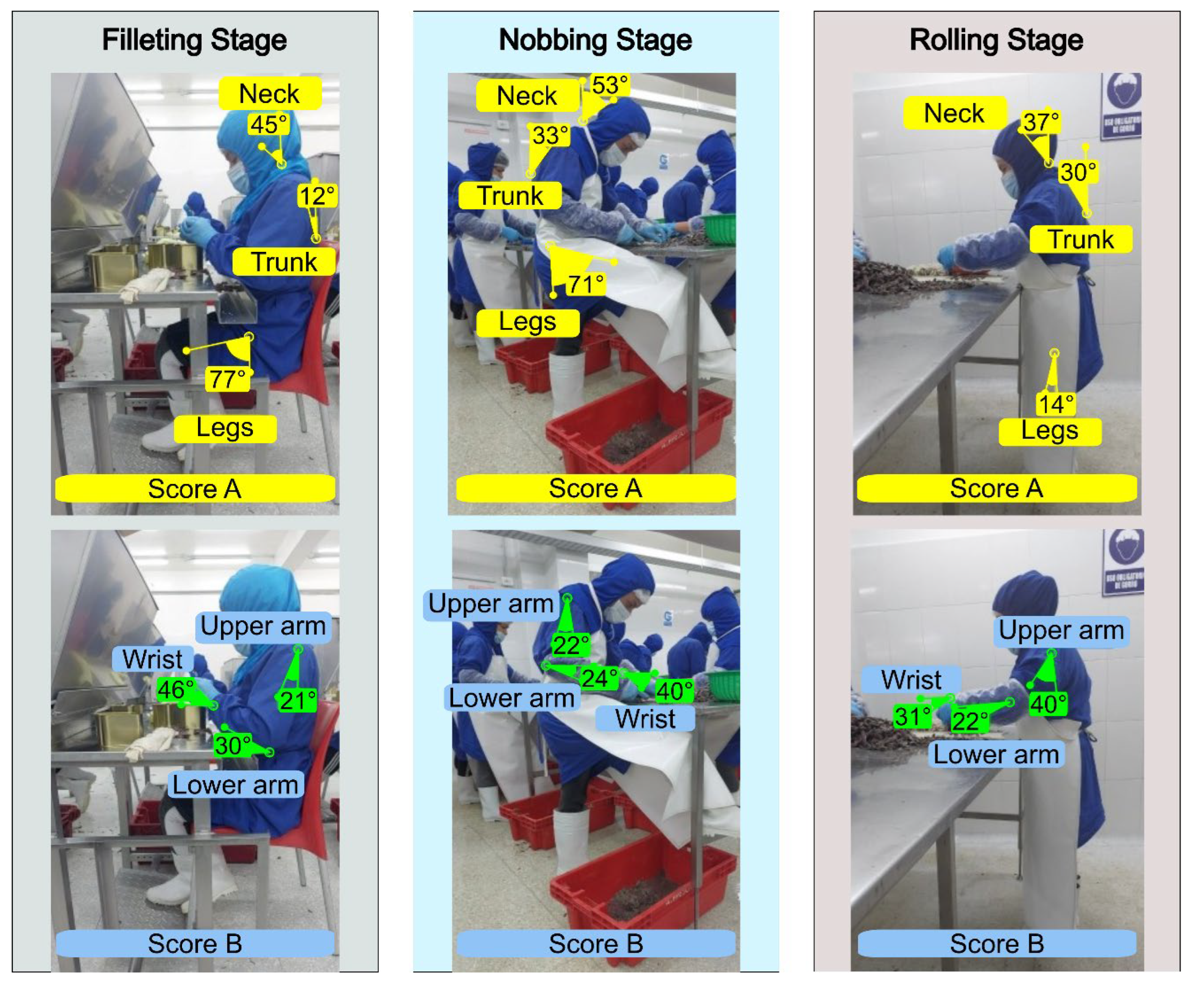
The postural assessment procedure (Figure 1) applied during the study using the Rapid Entire Body Assessment (REBA) method was used to quantify the biomechanical load on workers in a fish processing plant. The images correspond to three representative workstations: filleting, nobbing, and rolling. Photographic records were captured during the normal execution of tasks and subsequently analyzed to identify anatomical reference points in the main body segments. Vectors and angles were projected onto these reference points to estimate the inclination of the neck, trunk, and limbs, obtaining angular values in degrees. This procedure allowed for the objective documentation of the postural configuration adopted by the workers during routine activities and ensured the visual traceability of the measurement process used to calculate the REBA scores.
The assessment corresponding to Group A of the REBA method, which considers the posture of the neck, trunk, and legs, is presented at the top. For each segment, the flexion or tilt angle was estimated using visual reference and digital measurement, obtaining representative values during task execution (e.g., approximate cervical flexion between 37° and 53° and trunk flexion between 12° and 33°). These angles were subsequently classified according to the ranges defined by the REBA method to assign the corresponding partial scores. Leg posture was also evaluated, considering support stability, knee flexion, and body weight distribution—factors that directly influence the final score of Group A within the ergonomic assessment system.
The lower section corresponds to Group B, where the postures of the upper extremities upper arm, forearm, and wrist were evaluated using the same procedure. This was performed using the same methodology for identifying joint points and calculating angles, where the ranges of motion adopted during product handling were estimated. The results show postural configurations with upper arm elevations between approximately 21° and 40°, forearm flexions close to 30°–40°, and wrist deviations reaching up to 46°. These measurements were subsequently transformed into REBA scores using the method’s classification tables and integrated with the results of Group A to calculate the overall postural risk index. This procedure allowed for the standardization of the biomechanical evaluation of the tasks observed within the analyzed production system.
At the Filleting station, workers performed bilateral filleting and packaging of salt-cured anchovies (Engraulis ringens) in 595g tin and glass containers on tables of fixed height (without a height adjustment mechanism). The visual focus on the fish product was constantly at or below the wrist crease for workers who remained standing, imposing a geometrically determined trunk inclination of 20 to 40° and cervical flexion exceeding 60° throughout the 10-hour workday. Handling individual fillets (3 to 8 cm long and weighing less than 20g) structurally required wrist deviation, performed at a frequency exceeding 6 repetitions per minute during continuous 90-minute work blocks without a formal break.
The nobbing stage required sustained bilateral manual cutting (tail removal and surface cleaning of cured fish) on a centralized worktable at waist height. The cutting path required arm spans of 30 to 45 cm in the sagittal plane, performed from a standing position with the torso leaning forward between 40 and 70°, the configuration with the greatest trunk load observed at all stations. The load on the legs was exacerbated by the absence of anti-fatigue mats and the need for a bilateral posture with partial knee flexion during cutting, resulting in Leg scores ranging from 2 to 4 (observed values: 50.0% scored 2, 25.0% scored 3, and 25.0% scored 4).
At the rolling stage, workers placed and rolled anchovy fillets onto sheets of fabric on a flat work surface. The rolling operation required a lateral displacement of the trunk combined with a sustained bilateral extension of the arms, reaching up to 60 cm from the body’s midline; a posture that simultaneously increases the shoulder abduction angle and generates ulnar deviation of the wrist under a low-magnitude, but high-frequency load. All four rolling workers scored a Wrist Score of 3, indicating a wrist deviation > 15° in all observed cycles. The geometry of the workstation prevented workers from adopting a neutral trunk posture, as the surface height was fixed at approximately 85 cm, imposing a trunk flexion of 30–45° for the observed height range (163–166 cm). These geometric characterizations operationally validate the selection of REBA as an assessment instrument: unlike the specific tools for the upper limbs (RULA, OCRA), REBA’s whole-body scoring architecture captures the trunk-neck-lower limb coupling that is the defining biomechanical characteristic of anchovy processing tasks, and its sensitivity to load, coupling, and activity type matches the operational demands described above [24].

2.3. Data Acquisition and Kinematic Measurement Protocol

Biomechanical data were captured using a structured photographic goniometry protocol, which served as the primary kinematic measurement tool. For each of the 30 workers, a trained evaluator identified the posture of maximum demand, operationally defined as the configuration with the highest biomechanical load maintained continuously for ≥ 4 seconds in a representative task cycle, after a minimum observation period of 5 minutes. This posture was recorded simultaneously from two standardized camera positions: lateral (90° relative to the sagittal plane) and anterior (frontal plane), using a digital camera calibrated to a fixed focal distance of 3.5 m to minimize perspective distortion. Angular estimation was performed from the photographic record by superimposing joint reference points on the screen, in accordance with the validated photographic goniometry methodology for trunk and upper limb angles (ICC = 0.87–0.93) [32].
To quantify inter-rater reliability and avoid systematic observer bias in the scoring of REBA items, a randomly selected subsample of 10 postural records (33.3% of the total) was independently scored by a second certified ergonomist, who was unaware of the primary rater’s scores. Inter-rater agreement was assessed by calculating the percentage of exact agreement per item and the mean absolute difference in final REBA scores between raters. Exact agreement rates ranged from 80% (Legs) to 100% (Neck, Forearm), with a mean absolute difference in final REBA score of 0.40 ± 0.52 points, within the conventionally accepted tolerance of ± 1 point for ergonomic observation instruments [33]. No systematic directional bias was detected (rater 1 mean: REBA = 8.6 vs. rater 2 mean: 8.4; t(9) = 0.71; p = 0.49).
A data integrity audit was performed before any inferential analysis. The scores for the 30 × 6 items were checked against the published normative limits of the REBA worksheet [33]. The algebraic identity REBA = C-Score + Activity Score was confirmed for all 30 observations without exception. No out-of-range values were detected. Two items, Neck and Forearm, showed zero variance across the entire sample (all observations scored 3 and 1, respectively), a finding of substantive, rather than merely technical, importance.

2.4. Ergonomic Risk Assessment Engine: The REBA Framework

The REBA method was not applied as a checklist, but rather as a segmented biomechanical loading model, understood as a hierarchical scoring system that disaggregates total body postural stress into two anatomically and functionally distinct groups before recombining them into an overall risk index [33].
Group A operationalizes axial segment loading: trunk flexion/extension/rotation (score 1–5), cervical flexion/extension (1–3), and lower limb loading, including posture, knee flexion, and weight distribution (1–4). The composite Group A score (range 1–12) is modulated by a load/force adjustment factor (+0: load ≤ 5 kg; +1: load 5–10 kg; +2: load > 10 kg or sudden force). In the evaluated sample, all load adjustments were 0 (no manipulation of objects exceeding 5 kg), isolating postural load as the main determinant of Score A. Group B operationalizes distal upper limb load: arm elevation/abduction/support (1–6), forearm flexion arc (1–3), and wrist flexion/deviation (1–3). Score B (range 1–12) is adjusted using a coupling quality factor (0: good grip; +1: fair grip; +2: poor grip; +3: unacceptable coupling). All coupling adjustments in this sample were 0 (acceptable grip on fish and cutting tools). Scores A and B are cross-referenced in REBA Table C (a 12×12 matrix), resulting in Score C (1–12), to which an Activity Score is added (+1 for ≥ 1 body part in static posture > 1 min; +1 for repetitive movements > 4/min; +1 for rapid and wide postural changes or unstable base) to produce the final REBA score (1–15). The five risk strata and their required action levels are presented in Table 2.

2.5. Analytical Pipeline and Computational Validation

All analyses were executed in R (v4.5.1) within a fully reproducible pipeline (seed = 2025). Five stages were executed in strict sequence, with no retrospective modification of analytical choices after data inspection a preregistration-equivalent constraint (Figure 2).
Stage 1. Data Integrity audit: item-level range verification against REBA normative bounds, confirmation of the identity REBA = Score C + Activity Score across all 30 records, and zero-variance detection with mechanistic interpretation.
Stage 2. Descriptive characterization: medians, means, SDs, IQRs, and CVs per workstation; medians and IQR designated a priori as primary estimators given the discrete, bounded, and ordinally restricted nature of REBA scores.
Stage 3. Resampling-based median inference: 95% CIs estimated via percentile bootstrapping (B = 1,000 resamples with replacement), selected over Wilcoxon signed-rank intervals because tied ranks in the discrete REBA distribution inflate asymptotic variance estimates.
Stage 4. Between-Station Inference: tie-corrected Kruskal-Wallis test with effect size quantified by epsilon-squared (ε²) and post-hoc Dunn-Bonferroni pairwise comparisons (k = 3); categorical risk associations assessed by Fisher’s exact test with Monte Carlo simulation (B = 2,000), replacing Pearson’s chi-square rendered inadmissible by 7 of 9 contingency cells with expected frequency < 5.
Stage 5. Multivariate dimensional decomposition: PCA applied to the four REBA items with non-zero variance (trunk, legs, upper arm, wrist) after z-score standardization, with component retention by Kaiser’s criterion (eigenvalue > 1); zero-variance items (neck, lower arm) excluded from factorization but retained as substantive ergonomic findings.

3. Results

3.1. Biomechanical Profile: Central Tendency and Resampling Robustness

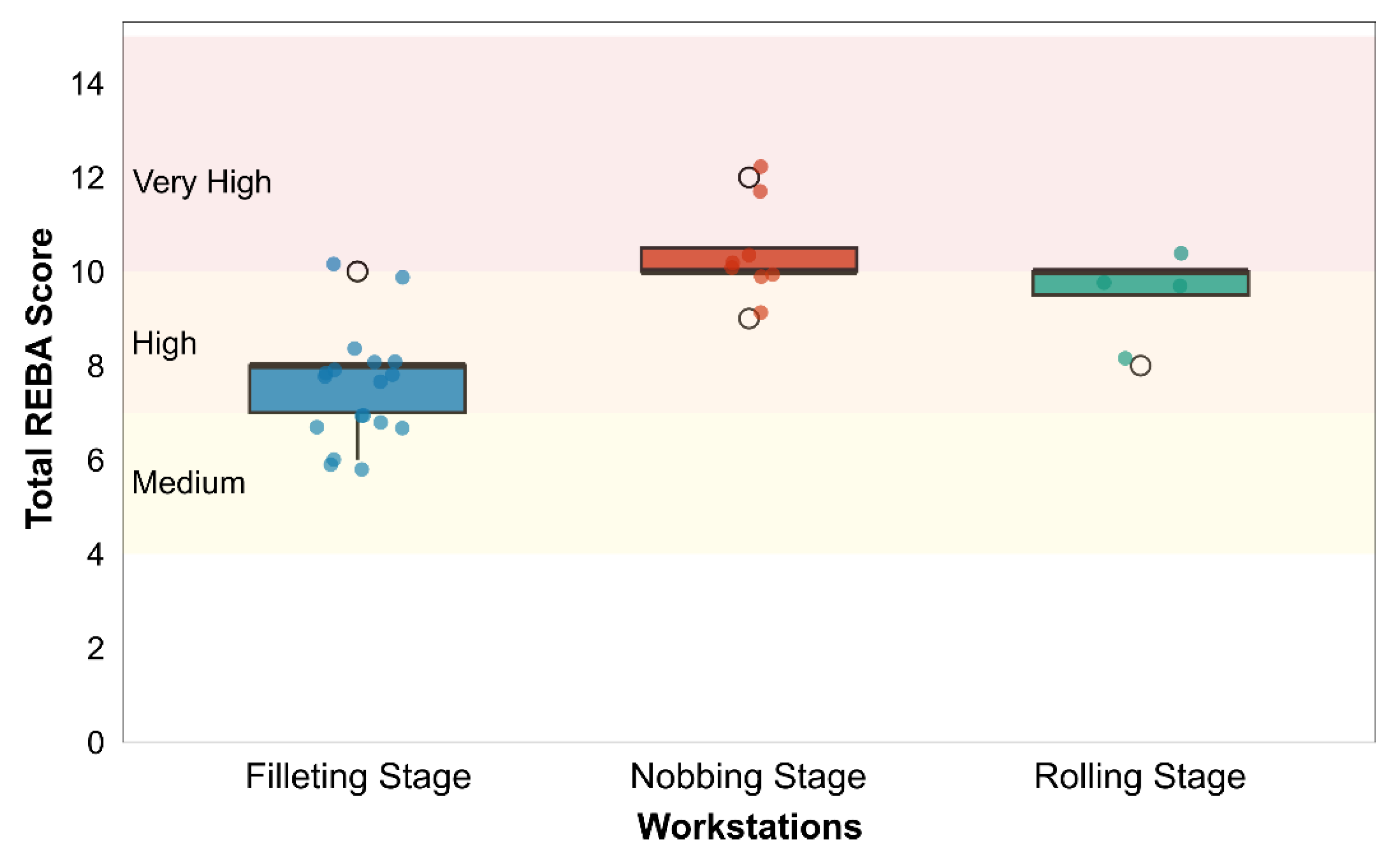
The descriptive statistics (Table 3) are presented for each station and in aggregate for the REBA scores, where the overall distribution was truncated to the left at REBA = 6, meaning that no worker at any workstation reached a negligible or low risk, establishing biomechanical risk at all stations as the reference condition for this production system. The overall mean was 8.60 ± 1.65 (median: 8.0; range: 6–12), with the distribution concentrated in the high-risk stratum. The nobbing stage showed the greatest central tendency (median = 10.0, IQR = 1.0; mean = 10.38 ± 1.06, CV = 10.2%), followed by Rolling (median = 10.0, IQR = 1.0; mean = 9.50 ± 1.00, CV = 10.5%) and Filleting (median = 8.0, IQR = 1.0; mean = 7.61 ± 1.14, CV = 15.0%). The high CV in Filleting reflects the postural heterogeneity within the station attributable to the mixed architecture of the task (sitting standing).
Figure 3 illustrates the station-specific distributional structure, confirming the left-truncation at REBA = 6 and the concentration of nobbing and rolling scores within the High-risk stratum.
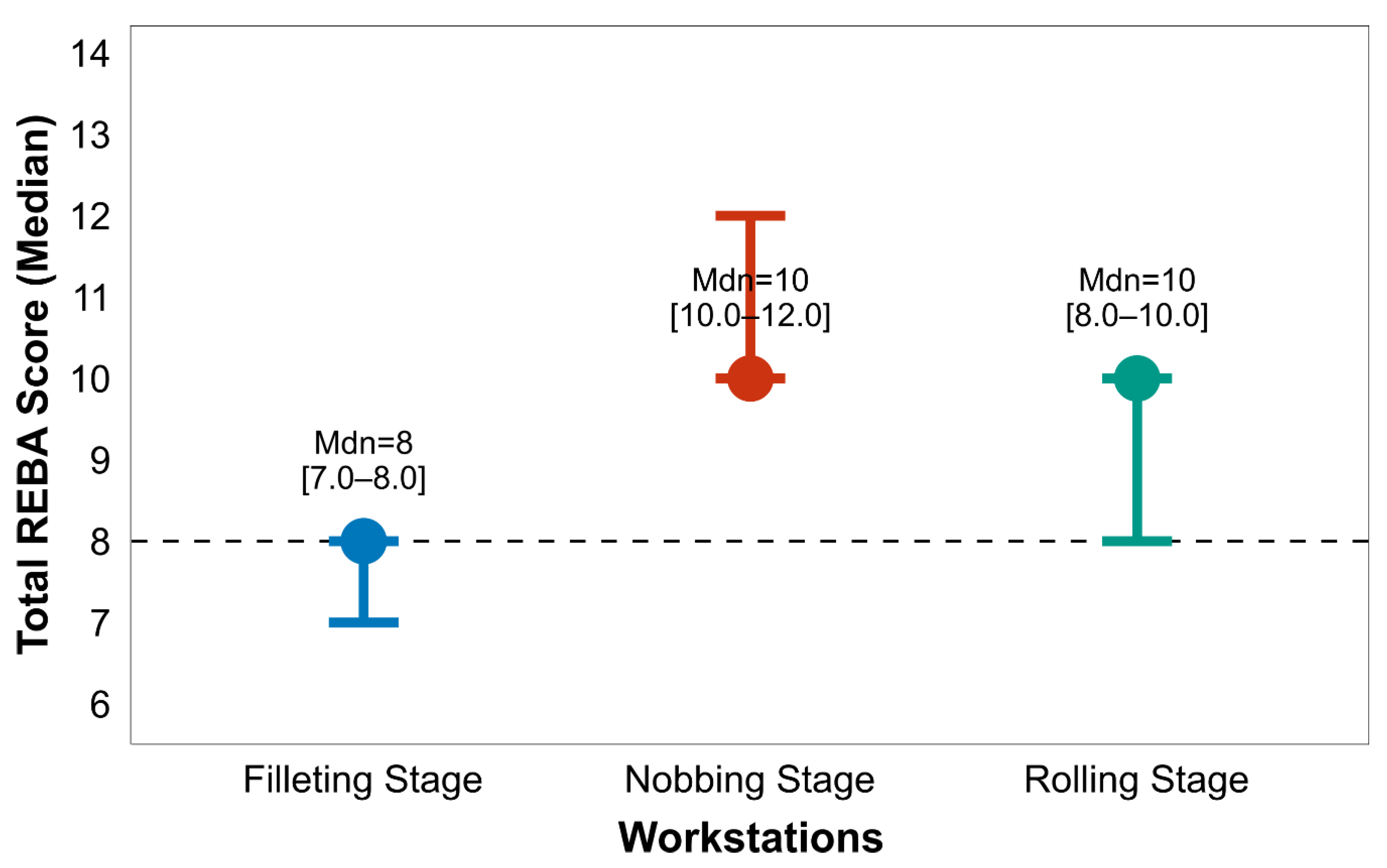
The results of the percentile bootstrap resampling (Figure 4) provide a stress test of these central tendencies against sampling uncertainty, where the Cut interval [10.0–11.0] lies entirely above the Fillet interval [7.0–8.0] without any overlap, a sufficient condition to infer a separation of the distribution without the need for formal hypothesis testing. The Rolling interval [8.0–10.0] partially overlaps with the other two stations, a pattern mechanically driven by the small subgroup size (n = 4), which collapses the bootstrap distribution at the four empirical values, restricting the informative content of the interval to a descriptive position. It is crucial to highlight that, even in the most conservative bootstrap scenario (lower limit of Rolling = 8.0), each simulated median in the 1000 resamples and in the three stations falls within the High or Very High risk category, confirming that the severity of the exposure is not a sampling artifact, but a stable property of the biomechanical environment.

3.2. Categorical Risk Thresholds and Inferential Disparities

The decomposition of the aggregate REBA distribution (Table 4) into ordinal risk strata reveals a risk topology that is severe in magnitude and structured in its station-specific pattern. At the aggregate level: 8 workers (26.7%) at medium risk, 20 (66.7%) at high risk, and 2 (6.7%) at very high risk. The absence of the Insignificant and Low categories among the 30 workers is not a distributional artifact, but a structural property of a production system in which no workstation configuration provides a biomechanically safe postural load.
The station-specific profiles encode a mechanically interpretable gradient, where filleting is the only station with workers at medium risk (44.4%, REBA 6-7), a pattern attributable to the postural relief partially provided by the seated packaging configuration, the only task among the three stations that allows a seated posture with partial trunk unloading. The remaining workers in the Filleting (55.5%) fall into the High (44.4%) or Very High (11.1%) risk categories, due to the standing filleting subtask. The nobbing stage has 100% of its workers in the High-Very High risk range (75.0% High; 25.0% Very High, REBA = 12), with the two Very High risk cases corresponding to workers exhibiting a trunk inclination > 60° and bilateral semi-flexion of the knees during sustained cuts, the most unfavorable postural combination recorded in the dataset. The Rolling stage shows a uniformly High risk (100%, REBA 8-10, RIC = 1.0), reflecting the structural homogeneity of the lamination task.
Fisher’s exact test (Monte Carlo simulation, B = 2000, seed = 2025) confirmed a significant association between workstation and risk category distribution (p = 0.020). The inadmissibility of Pearson’s chi-squared test in this context warrants an explicit statement: 7 of the 9 cells in the 3×3 contingency matrix had expected frequencies less than 5 (range: 0.27–4.8), which violates the Cochran threshold and renders any p-value derived from the chi-squared test anticonservative.
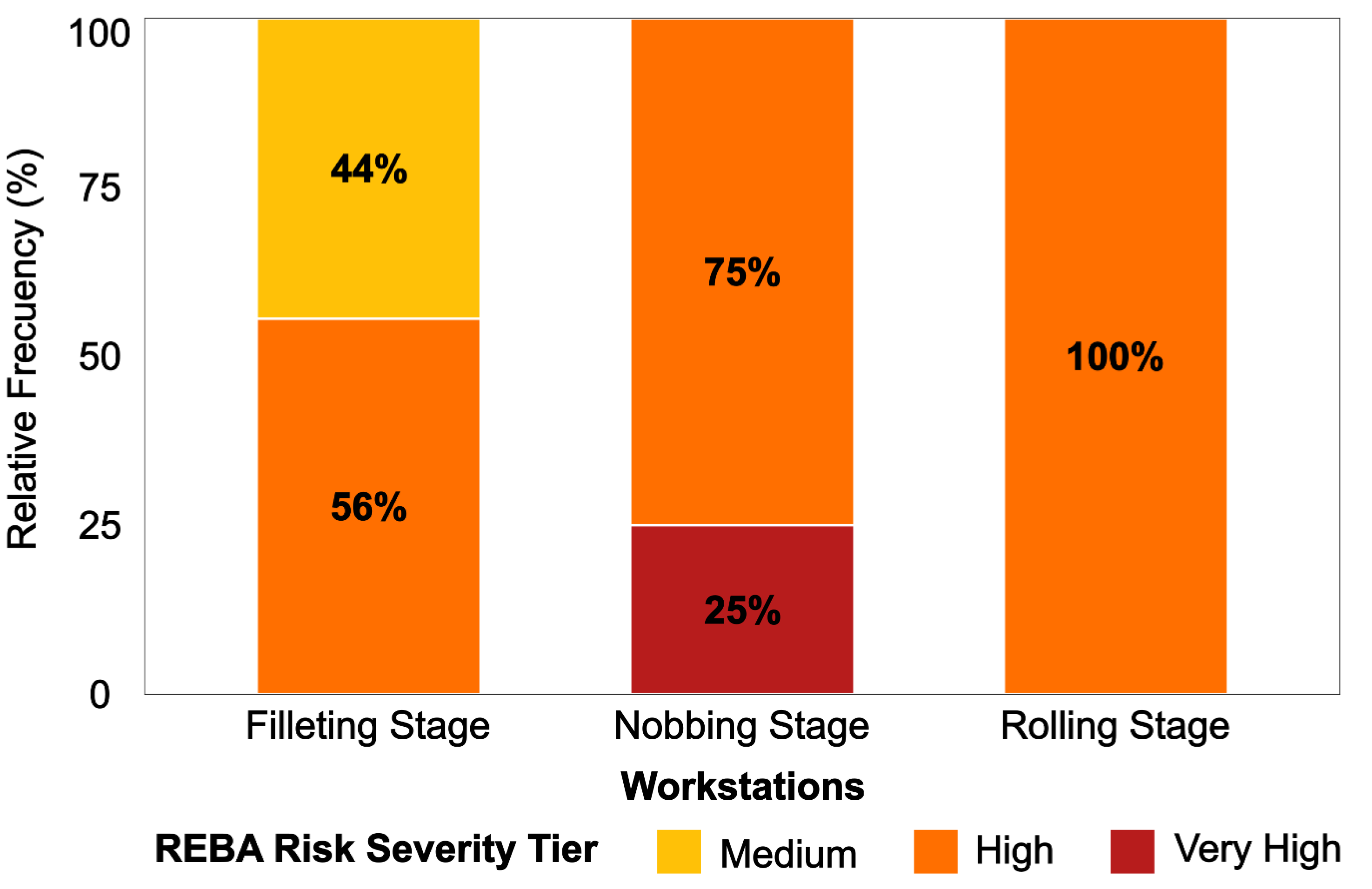
Figure 5 quantifies the distribution of REBA risk categories by workstation, showing distinct proportional patterns across tasks. In the filleting stage (n = 18), 44.4% of workers were classified at medium risk (REBA 4–7), while 55.6% were at high risk (REBA 8–10), with no cases in the very high category. In the nobbing stage (n = 8), 75.0% of workers were categorized as high risk and 25.0% as very high risk (REBA ≥ 11), with no medium-risk observations. The rolling stage (n = 4) exhibited a fully homogeneous distribution, with 100% of workers classified in the high-risk category.
Across all workstations, no workers were classified in negligible or low-risk levels (REBA ≤ 3), confirming a minimum exposure threshold at moderate risk. The proportion of very high risk was exclusively observed in the nobbing stage (25.0%), while medium risk was restricted to filleting (44.4%). The dominance of high-risk classifications across the three stations (≥ 55% in all cases) indicates a consistent concentration of workers within the upper REBA strata, with variability in distribution patterns depending on the workstation.

3.3. Postural Variability Across Operational Units: Non-parametric Inference

The Kruskal-Wallis test (with tie correction) detected highly significant differences between workstations in the REBA score distributions [H (2, n = 30) = 16.72, p < 0.001, ε² = 0.545]. The (large) effect size indicates that workstation membership explains 54.5% of the rank-order variance in postural risk scores, a finding of direct operational relevance: the task assigned to a worker is a stronger predictor of biomechanical risk than any individual characteristic measured (age, height, seniority).
The post-hoc paired structure (Table 5) accurately delineates the biomechanical stratification, where the Filleting-Nobbing contrast produced the greatest separation (mean rank difference = 13.92, Z = 3.86, padj = 0.001), consistent with the 2.39 point difference in the means (10.38 vs. 7.61) and the non-overlapping bootstrap CIs. The Filleting–Rolling contrast reached trend-level significance after Bonferroni correction (Z = 2.23, padj = 0.077), with a mean rank difference of 10.49, a magnitude that is substantially relevant from a clinical point of view (Mdn difference = 2.0 REBA points), equivalent to a risk stratum transition from the lower REBA limit 8–10 to its upper limit) but with little power given the denominator Rolling n = 4. The Nobbing–Rolling comparison was null (Z = −0.66, padj = 1.000): this is not a failure of discrimination, but a detection of a genuine biomechanical equivalence: two structurally distinct standing operations that impose an indistinguishable added postural load on the REBA scale.

3.4. Latent Structure of Ergonomic Risk: A PCA Approach

Postural risk assessment was performed using the Rapid Entire Body Assessment (REBA), which identified biomechanical exposure in body segments during fish processing tasks. These segments were explored through principal component analysis (PCA) of the REBA scores after standardization using z-scores. Only elements with non-zero variance trunk, legs, arm, and wrist were included in the analysis (Table 6). This allowed for the examination of the dimensional structure of the variables to determine the dominant ergonomic factors underlying postural load during routine operational activities.
The first principal component (PC1) represents the dominant biomechanical axis associated with axial and lower body posture, where the trunk (load = −0.65; cos² = 0.43) and legs (load = −0.68; cos² = 0.46) had the highest loads and contributions to this component, accounting for 32.5% and 35.4% of the explained variance, respectively. These values indicate that PC1 primarily captures postural configurations involving trunk tilt and lower limb positioning during task execution.
The second component is associated with upper limb activity, where the upper arm variable showed a dominant load (−0.88) and a high cos² value (0.77), contributing 72.5% to the variance of this component. This indicates that CP2 is primarily driven by the elevation and movement of the upper arm during task performance; the wrist exhibited moderate loads in both components, suggesting a distributed influence rather than a primary role.
The correlation matrix between items (Table 7) revealed a modest but mechanically consistent positive correlation between trunk and legs (r = 0.27), consistent with their coactivation during the forward-leaning standing postures that characterize the Cutting operations: a postural synergy in which the forward trunk lean mechanically requires a compensatory load on the lower extremities to maintain postural balance. These values take into account that all other correlations between items were insignificant (|r| ≤ 0.10), indicating that the retained items encompass biomechanically independent dimensions.
Two components were retained according to Kaiser’s criterion (eigenvalue > 1). PC1 (eigenvalue = 1.31, 32.8% of the variance) was dominated by Trunk (load = −0.65, cos² = 0.43, contribution = 32.5%) and Legs (load = −0.68, cos² = 0.46, contribution = 35.4%), confirming that the trunk-lower limb postural complex is the main architectural determinant of the overall risk of REBA in this occupational context. PC2 (eigenvalue = 1.07, 26.7% of the variance) was dominated by Arm (load = −0.88, cos² = 0.77, contribution = 72.5%), which represents an orthogonal load dimension of the upper extremity. PC1+PC2 cumulatively explain 59.5% of the total variance. The sign of the loads (negative) reflects the directional coding of the standardized scores with respect to the mean, not an inverse relationship.
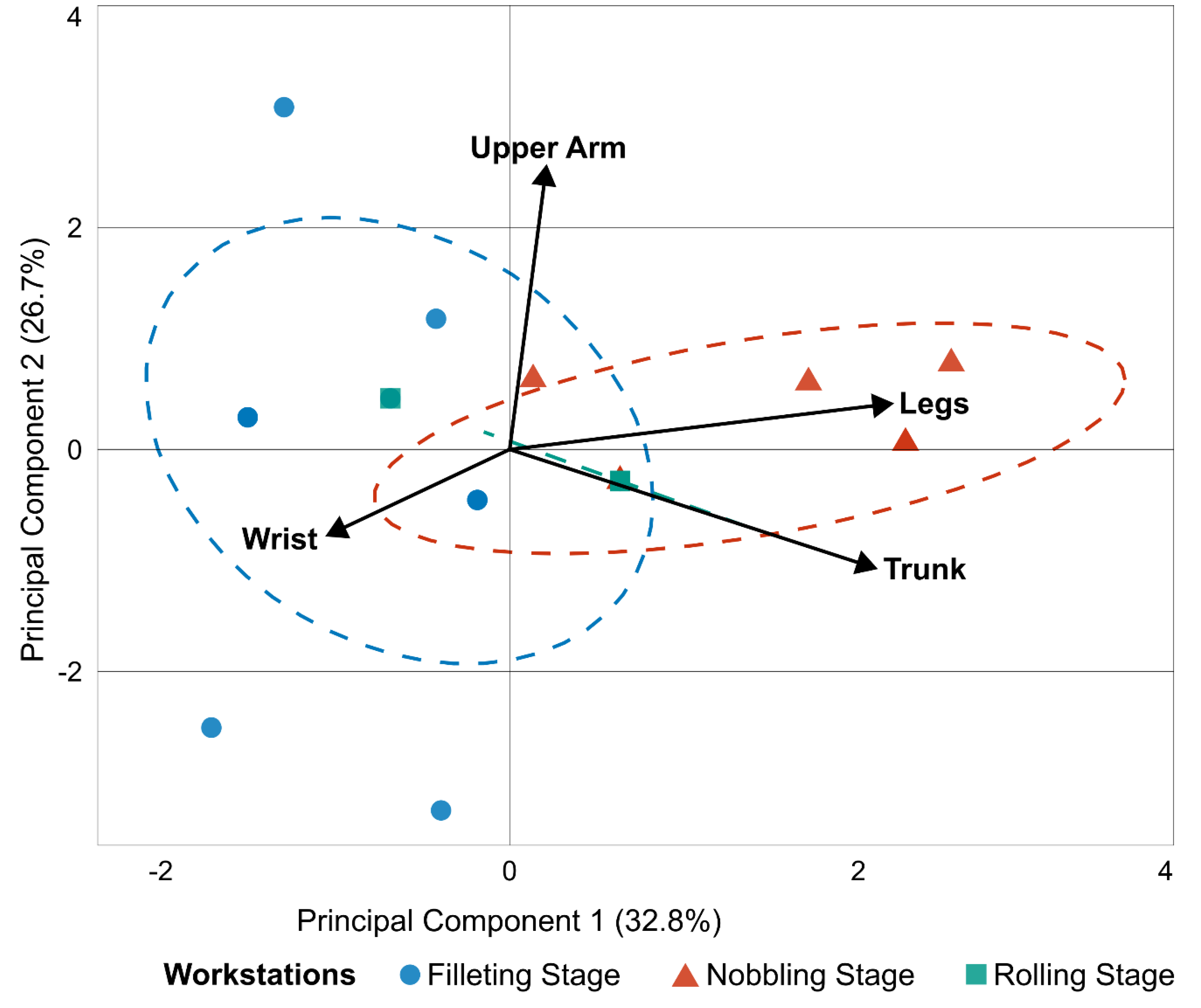
The Principal Component Analysis (PCA) biplot projects the workers’ scores and postural variables from the Rapid Entire Body Assessment method onto the space defined by the first two components (Figure 6). Principal Component 1 (PC1) explains 32.8% of the total variance, while Principal Component 2 (PC2) explains 26.7%, together accounting for 59.5% of the observed ergonomic variability. The factorial plane represents three groups corresponding to the workstations: filleting, nobbing, and fabric rolling, each delimited by ellipses that indicate approximate confidence regions. The vectors of the body variables (trunk, legs, upper arm, and wrist) show the direction and magnitude of their contribution to the dimensional structure of postural risk.
The distribution of points reveals distinct biomechanical patterns between stations. Nobbing workers are primarily concentrated in positive PC1 values, aligned with the trunk and leg vectors, indicating that trunk inclination and lower limb posture are the main determinants of risk at this stage. Filleting workers show a wider dispersion around the origin, reflecting greater postural variability associated with alternating between sitting and standing work. Meanwhile, the rolling stage occupies intermediate positions, relatively close to the upper arm vector, suggesting a greater influence of repetitive upper limb activity on the ergonomic risk profile.
The exclusion of the Neck (all 30 participants scored 3, maximum cervical flexion > 60°) and Forearm (all 30 participants scored 1) from the principal component analysis (PCA) justifies its interpretation as the most relevant ergonomic finding in the manuscript. The universality of the maximum cervical load in all workers across the three stations constitutes evidence of a task-imposed biomechanical constraint as a postural stress factor structurally determined by the geometry of the visual target in anchovy processing, where all operations require the direct and sustained inspection of small objects (3- to 8-cm fillet segments) located at or below chest height. This configuration forces cervical flexion > 60° regardless of the worker’s height, experience, or postural awareness, making training-based intervention structurally insufficient, as the only biomechanically adequate preventive response is adjusting the height of the workstation to position the visual target within the neutral gaze range (10-15° below the horizontal).

4. Discussion

4.1. Systemic Ergonomic Risk in Fish Processing Tasks

The results demonstrate that postural ergonomic exposure is a structural characteristic of the evaluated fish processing system, as the overall mean REBA score reached 8.60 ± 1.65, with scores ranging from 6 to 12 and no worker classified in the negligible or low risk categories. This distribution indicates that biomechanical stress is inherent in the operational design of the production process. Similar findings have been reported in labor-intensive industries where repetitive tasks and prolonged trunk flexion significantly increase the prevalence of musculoskeletal disorders among workers [5,9,15,16]. Furthermore, studies conducted in fish processing environments have documented high frequencies of work-related musculoskeletal symptoms associated with repetitive manual operations and sustained postures, including upper quadrant dysfunction that improves with structured exercise interventions and prevalent musculoskeletal complaints among female workers performing repetitive and prolonged tasks, with statistically significant differences (p < 0.0001) in the different neck, arm, hand, and shoulder disabilities [2,3,30,33]. The stability of these patterns under Bootstrap resampling confirms that the observed exposure represents a robust occupational condition rather than a sampling artifact.

4.2. Workstation-Specific Biomechanical Demands

Comparative analysis between workstations reveals substantial biomechanical disparities associated with task characteristics. Workers in the nobbing stage exhibited the highest ergonomic load, with a mean REBA score of 10.38 ± 1.06 and a median of 10, while filleting operations showed lower central tendency (mean = 7.61). The categorical risk distribution reinforces this pattern, as all nobbing workers were classified within high or very high-risk levels. Statistical inference confirmed that workstation assignment significantly influences ergonomic exposure, as demonstrated by Fisher’s exact test (p = 0.020) and the Kruskal-Wallis analysis (H = 16.72, p < 0.001; ε² = 0.545). These results confirm the data that have been reported on biomechanical patterns dependent on similar tasks in manual production systems where the configuration of the workstation and repetitive operations determine the distribution of musculoskeletal stress [14,18,33,34].

4.3. Multidimensional Structure of Postural Ergonomic Risk

Principal component analysis revealed that ergonomic exposure in fish processing activities is multidimensional, with the first principal component (PC1) dominated by trunk and leg variables, explaining 32.8% of the variance and representing the axial postural configuration associated with sustained forward flexion during manual operations. The second component (PC2), largely defined by upper arm activity, accounted for 26.7% of the variance and reflects the repetitive upper limb movements characteristic of product handling tasks. The PCA biplot illustrates this structural separation, with nobbing workers clustered in the high PC1 region and rolling workers associated with upper limb loading, providing results that fit previous research, which has highlighted that musculoskeletal risk results from complex biomechanical interactions involving posture, repetition, and physical workload in multiple body segments [22,23,33].

4.4. Ergonomic Implications, Limitations, and Future Research

From an applied perspective, the findings highlight the urgent need for ergonomic interventions targeting both axial posture and upper limb loading. The universal cervical flexion detected during the REBA assessment indicates that the current workstation geometry forces workers to maintain continuous visual inspection of small objects below eye level, a configuration that structurally imposes strain on the neck at all workstations. This is supported by documented results on similar ergonomic challenges in manufacturing environments where workstation height and task design strongly influence biomechanical exposure [26,27]. Evidence from ergonomic redesign studies demonstrates that interventions based on REBA-guided assessment can significantly improve workplace safety and reduce musculoskeletal risk [24,28,33]. In this regard, future research should integrate advanced motion capture systems and ergonomic monitoring systems based on machine vision to improve real-time assessment in fish processing environments, as has been used in different industries [1,4,20,33].

5. Conclusions

This study determined the level of ergonomic risk in fish processing tasks using the REBA method, revealing widespread exposure to high biomechanical load throughout the evaluated production system. The overall REBA mean reached 8.60 ± 1.65 (range: 6–12), placing the workforce predominantly in the high-risk category. Specifically, 60.0% of workers were classified as high risk, 13.3% as very high risk, and 26.7% as medium risk, while no worker reached negligible or low risk levels. These findings indicate that ergonomic stress factors are integrated into the operational configuration of the workstations, rather than being sporadic events. The robustness of this pattern, confirmed by bootstrap confidence intervals, demonstrates that the identified exposure represents a stable occupational condition requiring systematic preventive intervention.
Comparative evaluation between workstations quantified clear task-dependent disparities in biomechanical demand. The nobbing stage presented the highest ergonomic load, with a mean REBA score of 10.38 ± 1.06 and 100% of workers classified in high or very high-risk categories, including 25% at very high risk. In contrast, the filleting stage presented a lower mean score (7.61 ± 1.14), although still concentrated at medium to high exposure levels. Inferential analyses confirmed the significance of these differences, with Fisher’s exact test indicating a statistically significant association between workstation and risk category (p = 0.020) and the Kruskal-Wallis test revealing strong differences in the REBA distributions (H = 16.72, p < 0.001, ε² = 0.545), quantitatively demonstrating that workstation assignment accounts for a substantial proportion of the ergonomic risk variability within the production system.
Based on these findings, the study formulates evidence-based recommendations aimed at reducing the risk of musculoskeletal disorders and strengthening preventive management within the organization. Multivariate analysis identified two main biomechanical determinants that explain 59.5% of the total ergonomic variability: axial postural load involving the trunk and lower extremities (32.8%) and upper extremity activity associated with repetitive arm movements (26.7%). Furthermore, the universal cervical flexion observed in all workers indicates a structural limitation in the workstation geometry that requires redesign interventions rather than behavioral corrections. Preventive strategies should prioritize adjustments to workstation height, task layout, and tool ergonomics to reduce trunk bending and upper extremity strain.

Author Contributions

For research articles with several authors, a short paragraph specifying their individual contributions must be provided. The following statements should be used. Conceptualization, R.A.R.-O., C.M.-R. and A.J.R.-Y.; methodology, R.A.R.-O., A.J.R.-Y., C.D.R.-Y., C.M.-R. and R.A.F.-L.; software, R.A.R.-O. and S.R.C.-D.; validation, J.C.P.-R., A.G.V.-H., J.V.S.-V. and L.A.S.-T.; formal analysis, R.A.R.-O., S.R.C.-D. and R.A.F.-L.; investigation, R.A.R.-O., C.M.-R., S.J.P.-G., E.V.B.-J. and A.G.V.-H.; resources, C.D.R.-Y., E.V.B.-J. and S.J.P.-G.; data curation, R.A.R.-O., A.J.R.-Y. and J.V.S.-V.; writing—original draft preparation, R.A.R.-O. and R.A.F.-L.; writing—review and editing, A.J.R.-Y., C.D.R.-Y., C.M.-R. J.C.P.-R., A.G.V.-H, J.V.S.-V, L.A.S.-T., S.J.P.-G., E.V.B.-J., and S.R.C.-D.; visualization, J.C.P.-R. and L.A.S.-T.; supervision, A.J.R.-Y., C.D.R.-Y. and E.V.B.-J.; project administration, R.A.R.-O. and C.M.-R. All authors have read and agreed to the published version of the manuscript.

Funding

This research received no external funding.

Institutional Review Board Statement

All subjects gave their informed consent for inclusion before they participated in the study. The study was conducted in accordance with the Declaration of Helsinki (Fortaleza revision, 2013). The research protocol was reviewed by the Institutional Ethics Committee of Universidad Nacional del Santa (Institutional Committee on Ethics in Research — CEI-UNS), which classified the study as minimal-risk observational research and granted exemption from full ethics approval on the grounds of its non-invasive nature, the absence of experimental intervention, biological specimen collection, or access to sensitive clinical data, and the anonymization of all published records (Certificate N°: CEI-UNS-FI-0001-2026; Project identification code: PIC. FF. II. 012-2025).

Data Availability Statement

Due to the sensitive nature of the occupational health records and the confidentiality agreements established with the participating organization, the datasets analyzed during the current study are not publicly available but are available from the corresponding author on reasonable request.

Acknowledgments

The authors express their gratitude to the representatives and technical management of the fish processing facility for their cooperation and for facilitating access to the production areas during the data collection phase.

Conflicts of Interest

The authors declare no conflicts of interest.

References

  1. Butlewski, M.; Czernecka, W.; Zembik, M. Integrating Motion Capture Technology into Ergonomics Design: Managerial Implications for Systemic Safety Management. Tehnicki Glasnik 2025, 19, 49–54. [Google Scholar] [CrossRef]
  2. V Rajesh N, G.; Gangahanumaiah, S.; Maiya, A.G.; Guddattu, V. Effect of Structured Exercise-Based Intervention on Upper Quadrant Dysfunction among Fish Processing Workers with Work-Related Musculoskeletal Disorders. Indian Journal of Community Medicine 2024, 49, 489–495. [Google Scholar] [CrossRef] [PubMed]
  3. Patel, J.; Ghosh, T. Prevalence of Musculoskeletal Disorders among Female Workers in the Fish Processing Industry in Odisha, India. Int. J. Occup. Saf. Health 2025, 15, 239–249. [Google Scholar] [CrossRef]
  4. Agostinelli, T.; Generosi, A.; Ceccacci, S.; Mengoni, M. Validation of Computer Vision-Based Ergonomic Risk Assessment Tools for Real Manufacturing Environments. Sci. Rep. 2024, 14, 27785. [Google Scholar] [CrossRef]
  5. Mazloumi, A.; Khosravi Danesh, M.K.; Shamsipour, M.; Kohnavard, B. Validation of a Comprehensive Ergonomic Risk Assessment Technique for Tea Harvesting Farmers and Comparison with Some Techniques. Iran. J. Public Health 2025, 54, 1300–1309. [Google Scholar] [CrossRef]
  6. Shaikh, A.M.; Mandal, B.B. Predictive Modeling of Work-Related Musculoskeletal Disorders among Shuttle Car Operators Using ArtificiaNeural Network. Journal of Mines, Metals and Fuels 2025, 73, 65–74. [Google Scholar] [CrossRef]
  7. Pentenga, H.M.; Coenen, P.; Huysmans, M.A.; Speklé, E.M. The Effects of Working with a Passive Arm-Support Exoskeleton on Objective and Self-Reported Measures during Field Tasks–a Randomised Cross-over Study. Ergonomics 2025, 68, 1094–1112. [Google Scholar] [CrossRef]
  8. Bangkadanara, G.; Nakpan, W.; Arporn, S.; Thanachoksawang, C. Enhancing Workplace Safety for Disabled Farmers in Thailand: A Quasi-Experimental Study of Ergonomic Interventions in Vermicompost Production. Curr. Appl. Sci. Technol. 2025, 25. [Google Scholar] [CrossRef]
  9. Kowe, P.; Nyamuziwa, R.S.; Chireshe, A.; Poshai, L.; Jerie, S.; Matsa, M.M.; Matindike, S.; Shabani, T.; Shabani, T.; Hove, J. An Examination of the Occurance of Work-Related Musculoskeletal Disorders (WMSDS) and Symptoms among Small Scale Construction Workers in WINDHOEK, Namibia. Social Sciences and Humanities Open 2025, 12. [Google Scholar] [CrossRef]
  10. Fattah, N.A. Prevalence of Lower Back Pain among Dentists in Kurdistan Region-Iraq. Erbil Dental Journal 2025, 8, 63–72. [Google Scholar] [CrossRef]
  11. Pereira, D.; Leitão, J.; Soares, S. Environmental Workplace Conditions, Occupational Safety, Social Areas, and Gender: Key Drivers of Job Satisfaction in Europe. Journal of Management and Organization 2026, 32, 157–188. [Google Scholar] [CrossRef]
  12. Amanzadeh, P.; Dekamini, F.; Birǎu, R.; Pourmansouri, R. Investigating Basics and Principles of Ergonomics in the Sheet. Multidisciplinary Science Journal 2025, 7. [Google Scholar] [CrossRef]
  13. Zubair, M.U.; Khan, H.; Ahmed, K.; Hassan, M.U.; Manu, P.; Ahmad, J. Occupational Postural Hazards in Digital Construction Management: An Integrated Ergonomic Assessment with Human Factors Engineering and Digital Human Modelling. Applied Sciences (Switzerland) 2025, 15. [Google Scholar] [CrossRef]
  14. Suhaimi, S.N.A.; Zainal Abidin, E.Z.; Malik Malek, M.H.; Syed Ismail, S.N.S.; Rasdi, I.; Karuppiah, K.; Dolah, M.S.; Ismail, N.H. Testing and Evaluation of Newly Developed Harvesting Basket Among Male Pineapple Harvesters in Johor, Malaysia. Pertanika J. Sci. Technol. 2025, 33, 23–41. [Google Scholar] [CrossRef]
  15. Tandazo, O.; Jaramillo-Carrión, V.; Valarezo, E.; Sanchis-Almenara, M.; Montalbán-Domingo, L.; Catalá-Alís, J. Ergonomic Risk Assessment in Construction: Case Study Ecuador. Heliyon 2025, 11. [Google Scholar] [CrossRef] [PubMed]
  16. Dev, A.; Ganaie, M.I.; Mayer, I.A.; Singh, H. Risk of Musculoskeletal Disorders in Female Farmers and Its Socioeconomic Determinants in Kashmir Valley. Clin. Epidemiol. Glob. Health 2025, 31. [Google Scholar] [CrossRef]
  17. Özder, E.H. A Holistic Model for Ergonomic and Sustainable Personnel Scheduling in Urban Transportation. Processes 2025, 13. [Google Scholar] [CrossRef]
  18. Chaiklieng, S.; Suggaravetsiri, P.; Pruktharathikul, V. Risk Factors for Developing Occupational Back Pain in Electronics Industry Workers: A Cross-Sectional Study. Safety 2024, 10. [Google Scholar] [CrossRef]
  19. Brandt, M.; Bláfoss, R.; Jakobsen, M.D.; Samani, A.; Ajslev, J.Z.N.; Madeleine, P.; Andersen, L.L. Influence of Brick Laying Height on Biomechanical Load in Masons: Cross-Sectional Field Study with Technical Measurements. Work 2024, 79, 459–470. [Google Scholar] [CrossRef]
  20. Manohar, B.A.; Devaraj, J.; Chellapandian, C.; Pugalenthi, S. Performance Evaluation of Rapid Entire Body Assessment Using AI-Assisted Ergonomic Analysis in Dentistry. Biomimetics 2025, 10. [Google Scholar] [CrossRef]
  21. Wong, Y.J.; Razali, M.F.; Tan, A.W.T.; Yeo, Y.H.; Aziz, M.S.A. COBOT—ASSISTED REHABILITATION: REDUCING WORK-RELATED MUSCULOSKELETAL DISORDER (WMSD) RISK ON PHYSIOTHERAPISTS. J. Teknol. 2026, 88, 155–164. [Google Scholar] [CrossRef]
  22. Chen, W.; Wang, X.; Gu, D.; Xu, L. Advancing Real-Time Assessment for Work-Related Musculoskeletal Disorders in Construction Using Large Foundation Models. Results in Engineering 2026, 29. [Google Scholar] [CrossRef]
  23. Jeanson, A.L.; Morales, M.R.; Luna, R.I.F. Assessing Musculoskeletal Injury Risk and Skeletal Changes from Backstrap Loom Weaving and Traditional Embroidery in Chiapas, Mexico. PLOS Global Public Health 2025, 5. [Google Scholar] [CrossRef]
  24. Bora, M.A.; Hardi, Y.; Dermawan, A.A.; Cundara, N.; Hanafie, A.; Haslindah, A.; Permatasari, R.D.; Hernando, L.; Candra, J.E.; Leman, A.M.; et al. Application of REBA and QEC Methods in Redesigning Clamping Workstations to Enhance Ergonomic Performance. Journal Europeen des Systemes Automatises 2025, 58, 1275–1284. [Google Scholar] [CrossRef]
  25. Paskarini, I.; Dwiyanti, E.; Mahmudah, M.; Widarjanto, W.; Nugroho, S.A.; Syaiful, D.A. The Interplay of Ergonomic Risk Factor and Lifestyle Factors on Potter’s Well-Being and Work Fatigue in Magelang’s Tourism Village. BMC Public Health 2025, 25. [Google Scholar] [CrossRef]
  26. Abdol Rahman, M.N.A.; Yek, L.Z.; Ho, H.F.; Masood, I.; Abdullah, H.; Hassan, M.F.; Abdul Haq, R.H.A.; Arifin, A.M.T.; Azmir, S.A.; Md Taib, I.; et al. Relationship between Improper Working Posture among Maintenance Workers Using Different Assessment Methods. Journal of Advanced Research in Applied Sciences and Engineering Technology 2025, 49, 15–25. [Google Scholar] [CrossRef]
  27. Leder Horina, J.; Blašković-Zavada, J.; Slavulj, M.; Budimir, D. Ergonomics Study of Musculoskeletal Disorders Among Tram Drivers. Applied Sciences (Switzerland) 2025, 15. [Google Scholar] [CrossRef]
  28. Akhtar, S.M.F.; Mumtaz, N.; Khan, A.R. Prevalence and Nature of Ergonomic Hazards Among Construction Workers in India: A Cross-Sectional Study. Safety 2025, 11. [Google Scholar] [CrossRef]
  29. Harahap, R.; Setiawan, M.R.; Fatharani, L.F.; Putri, H.A.A. Occupational Risk of Knee Osteoarthritis Among Pedicab Operators: A CrossSectional Study in Indonesia. Journal of Public Health and Pharmacy 2025, 5, 522–531. [Google Scholar] [CrossRef]
  30. Ghosh, T.; Patel, J. Prevalence of Respiratory Symptoms among Female Workers in the Fish Processing Industry in Odisha. Int. J. Occup. Saf. Health 2024, 14, 467–474. [Google Scholar] [CrossRef]
  31. Cretskens, I.; Ramaekers, K.; Van Laer, K.; Caris, A. Towards an Increase in Employee Well-Being in Warehouses: Insights from a Qualitative Study. Int. J. Prod. Res. 2026, 64, 1709–1730. [Google Scholar] [CrossRef]
  32. Canever, J.B.; Nonnenmacher, C.H.; Lima, K.M.M. Reliability of Range of Motion Measurements Obtained by Goniometry, Photogrammetry and Smartphone Applications in Lower Limb: A Systematic Review. J. Bodyw. Mov. Ther. 2025, 42, 793–802. [Google Scholar] [CrossRef] [PubMed]
  33. Fehringer, V.; Maurer-Grubinger, C.; Holzgreve, F.; Ohlendorf, D.; Wanke, E.M. Ergonomic Risk Assessment of Professional Dance Using Motion Capture with Ergonomic Evaluation by the Rapid Entire Body Assessment (REBA). Sensors 2025, 26, 70. [Google Scholar] [CrossRef] [PubMed]
  34. Brandt, M.; Bláfoss, R.; Jakobsen, M.D.; Samani, A.; Zielinski Nguyen Ajslev, J.Z.N.; Madeleine, P.; Andersen, L.L. Influence of Brick Laying Height on Biomechanical Load in Masons: Cross-Sectional Field Study with Technical Measurements. Work 2024, 79, 459–470. [Google Scholar] [CrossRef]
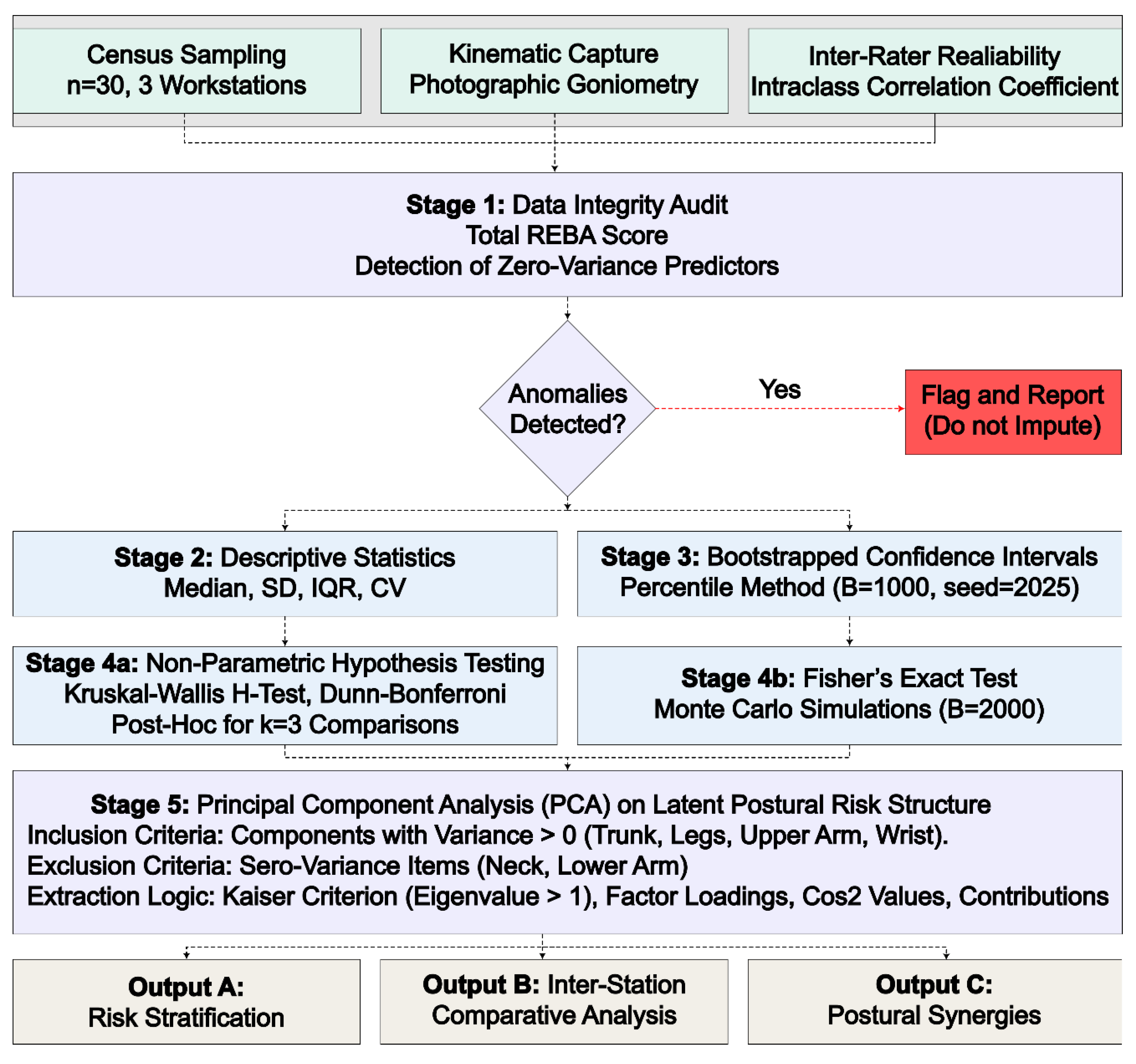
Figure 1. Critical postural configurations at the three evaluated workstations. (A) Filleting: mixed sitting-standing at fixed bench, trunk 20–40°, cervical flexion >60°, wrist deviation >15° during small-object manipulation. (B) Nobbing: sustained bilateral trunk inclination 40–70° with partial knee flexion during cutting operations. (C) Rolling: lateral trunk displacement with bilateral arm extension up to 60 cm from body midline. Red annotations indicate task-imposed postural constraints structurally independent of worker behaviour.
Preprints 204978 g001
Figure 2. Five-stage analytical pipeline for REBA postural risk assessment. Stage 0: data collection from three sources (census sampling, photographic kinematic capture, inter-rater reliability subsample). Stage 1: data integrity audit with a no-imputation exit for detected anomalies. Stages 2–3: descriptive characterization and resampling-based median inference. Stage 4: between-station non-parametric inference (Kruskal-Wallis + Dunn-Bonferroni; Fisher exact test replacing inadmissible chi-square). Stage 5: PCA dimensional decomposition of segmental risk items. All stages executed in R v4.5.1, seed = 2025, with no retrospective modifications.
Preprints 204978 g002
Figure 3. Distribution of REBA scores by workstation (n = 30). Boxes represent IQR; Centerline = median; whiskers = 1.5×IQR; individual observations overlaid (jitter). Shaded bands: yellow = Medium risk (4–7); orange = High (8–10); red = Very High (11–15). No observation falls below the medium threshold across any workstation.
Preprints 204978 g003
Figure 4. Bootstrapped 95% confidence intervals for REBA score medians by workstation. Percentile bootstrap, B = 1,000 resamples, seed = 2025. Error bars = 95% CI. Dashed line = global median (8.0). All lower bounds ≥ 7, confirming High-range exposure under maximum uncertainty scenarios. † Rolling CI is descriptive only (n = 4).
Preprints 204978 g004
Figure 5. Percentage distribution of REBA risk categories by workstation. Yellow = Medium (4–7); orange = High (8–10); red = Very High (11–15). Fisher’s exact test (Monte Carlo, B = 2,000): p = 0.020. Filleting is the only station presenting medium risk workers, rolling shows uniform High risk.
Preprints 204978 g005
Figure 6. PCA biplot of REBA segmental items by workstation (n = 30). Arrows = item loadings on PC1-PC2 space. Ellipses = 90% confidence regions (t-distribution) per workstation. PC1 (32.8%): trunk-legs postural synergy; PC2 (26.7%): distal upper-extremity loading. Nobbing workers cluster in the high-PC1 region; rolling in the high-PC2 region; filleting spans both dimensions, reflecting mixed sitting-standing task architecture. Items excluded from PCA: Neck (variance = 0, all scored 3) and Lower arm (variance = 0, all scored 1).
Preprints 204978 g006
Table 1. Sociodemographic and occupational characteristics by workstation (n = 30).
Characteristic Filleting (n=18) Nobbing (n=8) Rolling (n=4) Total (n=30)
Women, n (%) 15 (83.3) 4 (50.0) 4 (100.0) 23 (76.7)
Age, years [mean± SD] 36.5 ± 10.6 32.1 ± 9.8 45.5 ± 6.7 36.5 ± 10.5
Stature, cm [mean ± SD] 164.2 ± 3.5 163.3 ± 4.2 164.5 ± 1.3 164.0 ± 3.2
Body mass, kg [mean± SD] 65.9 ± 1.8 65.8 ± 2.2 67.0 ± 1.4 66.0 ± 1.7
Tenure, days [mean± SD] 640 ± 544 770 ± 242 540 ± 373 660 ± 501
Shift duration [h] 10 8 8 8–10
SD = standard deviation. Tenure expressed in days; reflects cumulative occupational exposure at the evaluated workstation at the time of assessment.
Table 2. REBA final score, risk stratification, and intervention urgency.
REBA Score Risk Level Action Level Intervention Urgency
1 Negligible 0 No action required
2–3 Low 1 Action may be required
4–7 Medium 2 Intervention necessary
8–10 High 3 Intervention necessary soon
11–15 Very High 4 Immediate intervention required
Table 3. Descriptive statistics and bootstrapped 95% CI for REBA scores by workstation (n = 30).
Workstation n Median Mean SD IQR Min Max CV (%) Bootstrap 95% CI
Filleting stage 18 8.0 7.61 1.14 1.0 6 10 15.0 [7.0–8.0]
Nobbing stage 8 10.0 10.38 1.06 1.0 9 12 10.2 [10.0–11.0]
Rolling stage 4 10.0 9.50 1.00 1.0 8 10 10.5 [8.0–10.0] *
Note: * Rolling n = 4: bootstrap CI collapses onto empirical values; descriptive positioning only. Percentile bootstrap, B = 1000 resamples, seed = 2025. CV = coefficient of variation; SD = standard deviation; IQR = interquartile range.
Table 4. REBA risk category distribution by workstation with segment-level profile (n = 30).
Workstation n Medium n (%) High n (%) Very High n (%) Total n (%)
Filleting stage 18 8 (44.4) 8 (44.4) 2 (11.1) 18 (100)
Nobbing stage 8 0 (0.0) 6 (75.0) 2 (25.0) 8 (100)
Rolling stage 4 0 (0.0) 4 (100.0) 0 (0.0) 4 (100)
Total n (%) 30 8 (26.7) 18 (60.0) 4 (13.3) 30 (100)
Note: * Fisher’s exact test (Monte Carlo, B = 2000, seed = 2025): p = 0.020. χ² inadmissible: 7/9 cells E < 5 (range 0.27–4.80). No worker achieved Negligible or Low risk.
Table 5. Kruskal-Wallis test results and post-hoc Dunn-Bonferroni pairwise comparisons (n = 30).
Comparison Mean Rank Difference Z p-raw p-adj
(Bonferroni)
Decision
Filleting vs Nobbing 13.92 3.86 <0.001 0.001*** Nobbing > Filleting
Filleting vs Rolling 10.49 2.23 0.026 0.077 (trend) Rolling > Filleting
Nobbing vs Rolling -3.43 -0.66 0.509 1.000 Equivalent
Note: Kruskal-Wallis: H (2) = 16.72 (tie-corrected), p < 0.001, ε² = 0.545 (large). Mean rank difference = R ¯ 2   R ¯ 1 (positive: second station higher). *** p < 0.001 after Bonferroni correction (k = 3 comparisons).
Table 6. PCA: component structure, item loadings, cos².
Item PC1
Loading
cos²
PC1
Contribution
PC1 (%)
PC2
Loading
cos²
PC2
Contribution
PC2 (%)
Primary
Dimension
Trunk -0.65 0.43 32.5 0.37 0.14 12.8 PC1
Legs -0.68 0.46 35.4 -0.14 0.02 1.9 PC1
Upper arm -0.07 0.00 0.3 -0.88 0.77 72.5 PC2
Wrist 0.32 0.11 8.0 0.27 0.07 6.7 --
Note: Variables with zero variance were excluded: Neck (all scored 3; max. cervical flexion) and Lower arm (all scored 1). Factors were extracted based on the Kaiser criterion (eigenvalue > 1). Items were z-score standardized prior to PCA. Inter-item correlations: (Trunk, Legs) = 0.27; all other. Loadings with absolute value ≥ 0.60 are considered dominant contributors to the respective component. Sign of loadings reflects directional coding relative to the standardized mean and does not imply an inverse relationship.
Table 7. Eigenvalues and variance distribution for REBA postural components (n = 30).
Component Eigenvalue Variance (%) Cumulative (%) Retained
PC1 1.31 32.8 32.8 Yes
PC2 1.07 26.7 59.5 Yes
PC3 0.95 23.9 83.4 No
PC4 0.67 16.7 100.0 No
Note: Principal components (PCs) were retained based on Kaiser’s criterion (eigenvalue). The cumulative explained variance (59.5%) reflects the proportion of total ergonomic risk variability captured by the primary postural dimensions (PC1: axial-lower limb synergy; PC2: upper limb loading).
Disclaimer/Publisher’s Note: The statements, opinions and data contained in all publications are solely those of the individual author(s) and contributor(s) and not of MDPI and/or the editor(s). MDPI and/or the editor(s) disclaim responsibility for any injury to people or property resulting from any ideas, methods, instructions or products referred to in the content.
Copyright: This open access article is published under a Creative Commons CC BY 4.0 license, which permit the free download, distribution, and reuse, provided that the author and preprint are cited in any reuse.
Prerpints.org logo

Preprints.org is a free preprint server supported by MDPI in Basel, Switzerland.

Subscribe

Disclaimer

Terms of Use

Privacy Policy

Privacy Settings

© 2026 MDPI (Basel, Switzerland) unless otherwise stated