
Preprint
Article

This version is not peer-reviewed.

Chemical Characterization and Resource Utilization Potential of By-Products from Hydroponic Strawberry Cultivation

A peer-reviewed version of this preprint was published in:
Horticulturae 2026, 12(5), 514. https://doi.org/10.3390/horticulturae12050514

Submitted:

22 March 2026

Posted:

23 March 2026

You are already at the latest version

Abstract

Strawberry cultivation generates substantial amounts of agricultural by-products, including spent substrates and plant residues, particularly in hydroponic production systems. However, information on the generation scale, disposal practices, and resource utilization potential of these by-products remains limited. This study investigated the generation scale, disposal practices, and chemical characteristics of by-products from hydroponic strawberry cultivation in two major strawberry-producing regions of Korea, Nonsan in Chungcheongnam-do and Jinju in Gyeongsangnam-do. Based on national statistics and field surveys, annual by-product generation was estimated at 605,400 kL of spent substrates and approximately 25,729 t fresh weight and 6,003 t dry weight of plant residues. Disposal practices varied regionally: in Jinju, over 80% of by-products were recycled as compost or feed, whereas in Nonsan, recycling rates were lower and much was untreated or dumped. Analyses of 463 pesticides and seven heavy metals (Zn, Cu, Ni, Pb, As, Cd, Hg) confirmed concentrations below permissible limits, ensuring safety for recycling. Inorganic analyses showed high levels of N, Ca, P, and K, suggesting potential use as alternative fertilizers. Unlike other greenhouse crops that generate residues mainly at harvest, strawberries produce by-products continuously, requiring decentralized and long-term management. These findings highlight the potential of strawberry by-products for resource utilization and their contribution to environmental conservation and sustainable agriculture when supported by pretreatment, monitoring, and integrated management. These results provide the first comprehensive assessment of the generation scale, disposal practices, and chemical safety of strawberry by-products in Korea, demonstrating their potential as alternative nutrient resources for circular agriculture.

Keywords: 
;  ;  ;  ;  

1. Introduction

Strawberry (Fragaria × ananassa) is one of the most widely cultivated berry crops in protected horticulture worldwide. It represents an important economic commodity in many countries. In particular, strawberry production in Korea has expanded rapidly in recent decades and has become one of the most profitable crops in the protected horticulture sector. In 2024, the greenhouse cultivation area for strawberries in Korea was estimated to exceed 5,000 ha, accounting for approximately 2.5% of the total vegetable cultivation area nationwide. Nevertheless, strawberries represent a high-value crop, contributing approximately 14.7% to the total vegetable production value in Korea [1]. Major production regions such as Chungcheongnam-do and Gyeongsangnam-do play an important role not only in securing domestic supply but also in maintaining export competitiveness. The adoption of high-quality cultivars, including ‘Seolhyang’ and ‘Geumsil’, has further supported the development of production systems that meet consumer preferences and market demands [2]. Despite the economic importance of strawberry production, the management of by-products generated during cultivation remains a major challenge.
Disposal practices vary widely among farms and regions, and in some areas these by-products are still abandoned or illegally dumped [3,4,5]. Such practices may lead to nutrient leaching into soils and water systems, the spread of plant pathogens, odor generation, and the release of fine particulate matter [6,7]. In addition, the collection and disposal of agricultural by-products impose economic burdens on farmers due to additional labor and management costs. With the recent strengthening of environmental regulations, the sustainable management of agricultural by-products has become an increasingly important issue not only at the farm level but also within regional environmental policy frameworks.
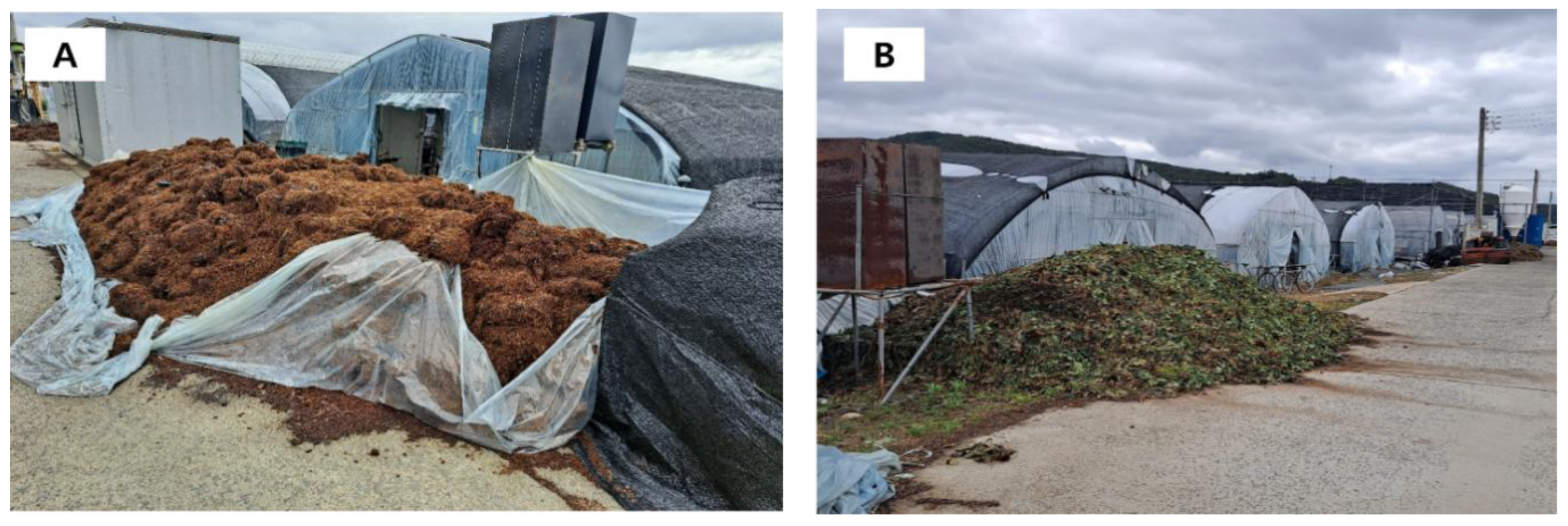
By-products generated from protected strawberry cultivation mainly consist of spent substrates and plant residues [8] (Figure 1 and Figure 2). In Korea, hydroponic strawberry cultivation typically uses organic mixed substrates such as coir and peatmoss, which require periodic replacement during cultivation [9]. Consequently, large quantities of spent substrates are generated each year. In addition, strawberry plants are removed after the harvest period, producing substantial amounts of plant residues. Compared with other greenhouse crops, strawberries are reported to generate relatively large amounts of by-products per unit cultivation area [10].
Although horticultural by-products have traditionally been regarded as waste materials, recent studies have highlighted their potential for resource utilization. Previous research has demonstrated that horticultural by-products can be recycled as compost, liquid fertilizers, or biomass resources for energy production [11,12]. Spent substrates have also been reported to function as soil amendments that improve crop productivity [13]. These findings indicate that, when appropriate pretreatment and safety verification are applied, horticultural by-products can be utilized as alternative agricultural resources that supplement or partially replace conventional fertilizers and soil conditioners.
However, most previous studies have focused primarily on greenhouse vegetables such as paprika, and comprehensive analyses of strawberry cultivation by-products remain limited. Furthermore, unlike many greenhouse crops that generate residues mainly at the end of the harvest period, strawberries produce by-products continuously throughout the cultivation cycle. This characteristic highlights the need for long-term management strategies and regionally appropriate recycling systems for strawberry cultivation residues [14]. In addition, growing global interest in circular agriculture and carbon neutrality has further increased attention to the sustainable utilization of agricultural biomass resources [15]. To the best of our knowledge, this study provides the first integrated assessment of the generation scale, disposal practices, and chemical characteristics of strawberry cultivation by-products in Korea.
Therefore, the present study investigated the generation and disposal practices of by-products in hydroponic strawberry farms located in Jinju, Gyeongsangnam-do, and Nonsan, Chungcheongnam-do, Korea. In addition, the chemical properties of spent substrates and plant residues were analyzed to evaluate their safety and potential for resource utilization. The results of this study provide fundamental information for the sustainable management and recycling of strawberry cultivation by-products within circular agricultural systems.

2. Materials and Methods

2.1. Materials

This study was conducted to investigate the generation and management status of by-products in hydroponic strawberry cultivation. Field surveys were conducted on farms located in Jinju, Gyeongsangnam-do, and Nonsan, Chungcheongnam-do, Korea, using a combination of questionnaires, field visits, and literature reviews. A total of 95 farms participated in the questionnaire survey. The surveyed farms were selected based on their cultivation scale and willingness to participate in the survey. The main survey items included the amount of by-product generation and the disposal methods of spent substrates and plant residues. In this study, “spent substrate” refers to the coir–peatmoss mixture remaining after the hydroponic strawberry cultivation cycle, and “plant residues” refer to the aboveground parts of strawberry plants, including stems and leaves collected after cultivation.
The amount of spent substrate was estimated based on the national hydroponic strawberry cultivation area in 2020 (2,018 ha; Rural Development Administration and Foundation of Agricultural Technology Commercialization and Transfer). A planting density of 85,000 plants per hectare, a substrate requirement of 300,000 L per hectare, and a substrate replacement rate of 10–20% were applied to estimate the generation of spent substrates per cultivation cycle.
The amount of plant residue was estimated through direct measurement. At the end of the cultivation cycle, ten strawberry plants were randomly sampled from representative commercial farms in each region, one located in Jinju and the other in Nonsan (n = 10 per farm). The collected plants, including stems, leaves, and roots, were used to determine fresh and dry weight. Fresh weight was recorded immediately after sampling using an electronic balance, and dry weight was measured after oven-drying the samples at 70 °C for more than 7 days (168 h) in a forced-air drying oven (JSOF-250T, JSR, Korea). The mean fresh and dry weight per plant was used to estimate the total amount of plant residue generated.
Additional estimates of plant residue generation per hectare were derived from publicly available statistical data from the Korean Statistical Information Service (KOSIS), the Rural Development Administration (RDA), and the Korea Rural Economic Institute (KREI).

2.2. Methods

Analyses of pesticide residues, heavy metals, and inorganic components were conducted on spent substrates and plant residues. The spent substrates consisted of used coir–peatmoss mixtures, while plant residues comprised the aboveground parts of plants. The samples were freeze-dried for 7 days (168 h), homogenized using a mortar and grinder, and powdered samples were used for analysis.
Pesticide residues were analyzed using the multi-residue method (QuEChERS) specified by the Ministry of Food and Drug Safety (MFDS, 2022). A 10 g sample was placed in a 50 mL centrifuge tube, and 10 mL of acetonitrile (CH₃CN) was added and mixed for 1 min. Subsequently, 4 g of anhydrous magnesium sulfate (MgSO₄), 1 g of sodium chloride (NaCl), 1 g of trisodium citrate dihydrate, and 0.5 g of disodium hydrogen citrate sesquihydrate were added. The mixture was shaken and centrifuged at 4,000 × g for 10 min at 4 °C. One milliliter of the supernatant was transferred to a 2 mL centrifuge tube containing 150 mg of anhydrous MgSO₄ and 25 mg of primary secondary amine (PSA), mixed for 30 s, and centrifuged again. The purified supernatant was filtered through a PTFE membrane filter (0.2 µm) prior to analysis. Pesticide residues were simultaneously quantified for 463 compounds using GC–MS/MS (7890–7000C, Agilent, USA) and LC–MS/MS (API 4000, AB SCIEX, USA).
Heavy metal analysis of spent substrates and plant residues was conducted using inductively coupled plasma–optical emission spectrometry (ICP–OES) in accordance with the Soil Contamination Standard Test Method (ES 07400.2c) specified by the Ministry of Environment under the Soil Environment Conservation Act (ME, 2017). For sample preparation, 0.25 g of each sample was digested with 10 mL of 0.1 M nitric acid (HNO₃) at 180 °C for 30 min using a microwave digestion system. The digested solution was diluted to a final volume of 20 mL with distilled water. The concentrations of As, Cd, Cu, Hg, Ni, Pb, and Zn were determined using ICP–OES (SpectroGreen, Spectro, Germany). The measured values were compared with the Region 1 standards specified in the Enforcement Rules of the Soil Environment Conservation Act (Law Information Center, Korea, 2024).
The inorganic components of spent substrates and plant residues (N, B, Ca, K, Mg, Mn, Na, P, and Si) were analyzed using 3.0 g of each sample with a guard column (IonPac CG16, 5 × 250 mm, Dionex, USA) and an analytical column (IonPac CS16, 5 × 250 mm, Dionex, USA). Methanesulfonic acid (MSA, 40 mM) was used as the eluent with a flow rate of 1.0 mL·min⁻¹. The injection volume was 25 µL, and inorganic components were quantified using suppressed conductivity detection (CDRS 600, 4 mm, recycle mode).

3. Results and Discussion

3.1. Generation and Disposal Practices of By-Products from Cultivation

In this study, the generation status, disposal practices, and chemical characteristics of by-products from hydroponic strawberry farms in two major producing regions of Korea—Nonsan (Chungcheongnam-do) and Jinju (Gyeongsangnam-do)—were analyzed to evaluate their potential for resource utilization.
Approximately 300 kL of spent substrate was estimated to be generated per hectare. Considering the national hydroponic strawberry cultivation area (2,018 ha), the total amount of spent substrate generated annually was estimated to be approximately 605,400 kL. Assuming a substrate replacement rate of 10%, the annual amount of spent substrate was estimated to be 60,540 kL, whereas a 20% replacement rate resulted in an estimated 121,090 kL. These estimates were calculated based on commonly applied substrate volumes and replacement practices reported for hydroponic strawberry cultivation systems in Korea.
For plant residues, the amount generated per hectare was estimated based on an average fresh weight of 150 g per plant and a dry weight of 35 g per plant, assuming a planting density of 85,000 plants per hectare. Using these values, the annual generation of plant residues was estimated to be approximately 25,729 t on a fresh weight basis and 6,003 t on a dry weight basis.
Disposal practices varied by region. In Jinju, 81.7% of spent substrates and 86.7% of plant residues were recycled as compost or feed. In contrast, only 54% of spent substrates and 38.1% of plant residues were recycled in Nonsan, with the remainder often left unattended or illegally dumped. These regional differences are likely associated with variations in recycling infrastructure, institutional support, and farm distribution patterns [5]. Nonsan, which has the largest strawberry cultivation area in Korea (approximately 700 ha), faces structural challenges in the timely collection and treatment of by-products generated from numerous individual farms. In contrast, Jinju, with a relatively smaller cultivation area and higher farm density, benefits from greater logistical efficiency in collective collection and subsequent composting or feed production.
Residue analysis of 463 pesticide compounds in spent substrates (Table 1A,B) and plant residues (Table 2A,B) revealed 15 compounds in Jinju and 25 in Nonsan for spent substrates, while 11 and 12 compounds were detected in plant residues, respectively. However, all detected concentrations were below the permissible limits. These results indicate that strawberry cultivation by-products from both regions are safe with respect to pesticide residues and therefore have potential for resource utilization. Nevertheless, since pesticide application patterns may vary depending on farm-specific practices, including application history, cultivation methods, and timing of pesticide use, periodic monitoring prior to collection is recommended to ensure safe recycling.

3.2. Chemical Properties and Resource Utilization Potential of By-Products

Heavy metal analysis of spent substrates (Table 3) detected Zn, Cu, Ni, and Pb, but all concentrations were below the limits specified for Region 1 in the Soil Environment Conservation Act of Korea. Region 1 includes agricultural land such as fields, rice paddies, orchards, pasture land, and groundwater protection zones and is therefore subject to the strictest contamination thresholds to protect human health and the environment. In the spent substrate samples, Zn concentrations were 27.8 mg·kg⁻¹ in Jinju and 31.2 mg·kg⁻¹ in Nonsan, while Cu concentrations were 10.6 and 53.7 mg·kg⁻¹, respectively, and Ni concentrations were 2.43 and 1.89 mg·kg⁻¹, respectively. Pb was detected only in Nonsan samples (1.52 mg·kg⁻¹) and was not detected (N.D.) in Jinju. In the plant residues (Table 4), Zn concentrations were 10.3 mg·kg⁻¹ in Jinju and 6.49 mg·kg⁻¹ in Nonsan, while Cu concentrations were 2.19 and 1.02 mg·kg⁻¹, respectively, and Ni concentrations were 0.11 and 0.10 mg·kg⁻¹, respectively. Pb, As, Cd, and Hg were not detected in any of the samples. Zn and Cu are essential micronutrients for plant growth, but excessive accumulation can inhibit photosynthesis and root development [16]. Ni is required for urease activity, but high concentrations can induce leaf chlorosis and inhibit plant growth [17]. Pb is not required for plant metabolism, and its accumulation can impair photosynthesis and cause cellular damage. Moreover, Pb, As, Cd, and Hg are linked to carcinogenicity, neurotoxicity, and renal dysfunction in humans [18], underscoring the need for caution when recycling agricultural by-products. In hydroponic cultivation systems, elevated concentrations of Zn, Cu, and Ni may sometimes originate from corrosion of nutrient solution supply pipes [19]. However, in the present study, all detected concentrations were below the regulatory limits, indicating that the analyzed by-products are suitable for composting or soil amendment applications. Analysis of inorganic components in spent substrates and plant residues (Table 5 and Table 6) revealed high concentrations of major nutrients such as N, Ca, P, and Si. In spent substrates, N levels were high in both regions, at 2,400 mg·L⁻¹ in Jinju and 2,250 mg·L⁻¹ in Nonsan. In Nonsan, Ca, Mn, and Si concentrations were 8,570 mg·L⁻¹, 85.1 mg·L⁻¹, and 343 mg·L⁻¹, respectively, whereas in Jinju they were 4,680 mg·L⁻¹, 44.6 mg·L⁻¹, and 105 mg·L⁻¹, respectively. In plant residues, N levels were 4,010 mg·L⁻¹ in Jinju and 8,800 mg·L⁻¹ in Nonsan, while P contents were 1,190 mg·L⁻¹ and 8,430 mg·L⁻¹, respectively, indicating their potential contribution to soil N and P supply. N is essential for protein, nucleic acid, and chlorophyll synthesis, and plays a crucial role in crop growth and yield [20]. Thus, the high N levels suggest potential use as a nitrogen source in organic fertilizers. K is critical for osmotic regulation, enzyme activation, and nitrogen assimilation [21]. The high concentrations observed in both substrates and residues indicate its potential application as an alternative K fertilizer source. Ca contributes to cell wall strengthening and signal transduction [22], and its elevated levels suggest potential use in soil structure improvement and as a Ca supplement. P is indispensable for root development and cell division, while Mg is essential for photosynthesis and enzyme activation [23,24], further supporting the potential of these by-products as alternative nutrient resources. In Korea, apart from rice, major open-field crops include Chinese cabbage, radish, pepper, garlic, and onion [25]. These crops require substantial amounts of N and Ca during their growth [26]. Thus, the inorganic components of strawberry by-products may help fulfill the nutrient requirements of such crops. In particular, for N-demanding crops such as potato, maize, and barley, the application of strawberry residues as soil amendments could reduce dependence on chemical fertilizers [27]. This approach could reduce fertilizer costs for farmers while also mitigating environmental impacts associated with excessive fertilizer use [28].

4. Conclusions

This study demonstrated that spent substrates and plant residues generated from hydroponic strawberry cultivation contained pesticide residues and heavy metals at levels well below regulatory limits while also containing abundant inorganic nutrients beneficial for crop growth. These findings indicate a strong potential for the recycling and resource utilization of strawberry by-products within sustainable agricultural systems. Unlike many greenhouse crops that generate by-products mainly at the end of the harvest period, strawberry cultivation produces residues continuously throughout the cultivation cycle, highlighting the need for decentralized, long-term, and regionally optimized resource-circulation systems. To ensure safe and effective recycling, appropriate management of pesticide application records, pretreatment processes such as washing and curing, and selective removal of contaminants exceeding regulatory thresholds are required. Moreover, promoting advanced regional models such as Jinju—where recycling rates are already high—and reinforcing institutional support, infrastructure investment, and farmer education in regions with improper disposal practices will be critical. Overall, with appropriate pretreatment, quality control, and resource management systems, strawberry by-products can be transformed from agricultural waste into valuable agricultural inputs, contributing to circular agriculture and environmental sustainability.

Author Contributions

Formal analysis, S.H.J., and Y.J.K.; Investigation, S.H.J., Y.J.K., E.J.K., and Y.K.; Resources, S.H.J., and Y.K.; Validation, D.K., Y.K., J.G.L., J.P., B.S.L., and H.N.; Visualization, S.H.J., Y.J.K., and H.N.; Writing-original draft, S.H.J., Y.J.K., and H.N.; Writing-review and editing, D.K., J.G.L., J.P., B.S.L., and H.N. All authors have read and agreed to the published version of the manuscript.

Funding

This work was supported by Korea Institute of Planning and Evaluation for Technology in Food, Agriculture and Forestry(IPET) and Korea Smart Farm R&D Foundation(KosFarm) through Smart Farm Innovation Technology Development Program, funded by Ministry of Agriculture, Food and Rural Affairs(MAFRA) and Ministry of Science and ICT(MSIT), Rural Development Administration(RDA)(RS-2025-02217575).

Acknowledgments

The authors would like to thank the farmers in Nonsan and Jinju for their cooperation during field surveys and sample collection. The authors also gratefully acknowledge the valuable assistance of external experts for their technical advice and constructive comments that contributed to this study.

Conflicts of Interest

The authors declare no conflict of interest.

References

  1. Korean Statistical Information Service (KOSIS). Agricultural Area Survey. Available online: https://kosis.kr/statHtml/statHtml.do?orgId=101&tblId=DT_1ET0017&vw_cd=MT_ZTITLE (accessed on 26 October 2025).
  2. Ahn, D.; Kim, I.; Lim, J.H.; Choi, J.H.; Park, K.J.; Lee, J. The effect of high CO2 treatment on targeted metabolites of ‘Seolhyang’ strawberry (Fragaria × ananassa) fruits during cold storage. LWT 2021, 143, 111156. [Google Scholar] [CrossRef]
  3. Sønsteby, A.; Woznicki, T.L.; Heide, O.M. Effects of runner removal and partial defoliation on the growth and yield performance of ‘Favori’ everbearing strawberry plants. Horticulturae 2021, 7, 215. Available online: https://www.mdpi.com/2311-7524/7/8/215. [CrossRef]
  4. Kim, E.Y.; Hong, Y.K.; Lee, C.H.; Oh, T.K.; Kim, S.C. Effect of organic compost manufactured with vegetable waste on nutrient supply and phytotoxicity. Appl. Biol. Chem. 2018, 61, 509–521. [Google Scholar] [CrossRef]
  5. Kim, Y.; Park, J.; Suh, K. Analysis of environmental implications and economic feasibility for vitalizing agricultural residues as resources considering waste management cost. J. Korean Soc. Agric. Eng. 2023, 65, 11–23. [Google Scholar] [CrossRef]
  6. Kerdraon, L.; Laval, V.; Suffert, F. Microbiomes and pathogen survival in crop residues, an ecotone between plant and soil. Phytobiomes J. 2019, 3, 246–255. [Google Scholar] [CrossRef]
  7. Krishna, V.V.; Mkondiwa, M. Economics of crop residue management. Annu. Rev. Resour. Econ. 2023, 15, 19–39. [Google Scholar] [CrossRef]
  8. Park, B.; Cho, H.; Kim, M. Environmental impact of hydroponic nutrient wastewater, used hydroponic growing media, and crop wastes from acyclic hydroponic farming system. J. Korea Org. Resour. Recycl. Assoc. 2021, 29, 19–27. [Google Scholar] [CrossRef]
  9. Kim, Y.S.; Park, I.S.; Park, M.S.; Choi, J.M. Physical properties of organic and inorganic substrates distributed in domestic market for hydroponic cultivation of strawberry. Hortic. Sci. Technol. 2020, 38, 499–511. [Google Scholar] [CrossRef]
  10. Lee, Y.J.; Cho, H.S.; Kim, J.Y.; Kang, J.; Rhee, S.; Kim, K. Biochemical methane potential of agricultural residues and influence of ensiling on methane production. J. Korean Soc. Environ. Eng. 2012, 34, 765–771. [Google Scholar] [CrossRef]
  11. Kim, E.Y.; Hong, Y.K.; Lee, C.H.; Oh, T.K.; Kim, S.C. Effect of organic compost manufactured with vegetable waste on nutrient supply and phytotoxicity. Appl. Biol. Chem. 2018, 61, 509–521. [Google Scholar] [CrossRef]
  12. Moreno, A.D.; Duque, A.; González, A.; Ballesteros, I.; Negro, M.J. Valorization of greenhouse horticulture waste from a biorefinery perspective. Foods 2021, 10, 814. [Google Scholar] [CrossRef]
  13. Vandecasteele, B.; Blindeman, L.; Amery, F.; Pieters, C.; Ommeslag, S.; Van Loo, K.; De Tender, C.; Debode, J. Grow – Store – Steam – Repeat: Reuse of spent growing media for circular cultivation of Chrysanthemum. J. Clean. Prod. 2020, 276, 124128. [Google Scholar] [CrossRef]
  14. Jadischke, R.; Lubitz, W.D. Current state of greenhouse waste biomass disposal methods, with a focus on Essex County, Ontario. Sustainability 2025, 17, 1476. [Google Scholar] [CrossRef]
  15. Rodríguez-Espinosa, T.; Papamichael, I.; Voukkali, I.; Pérez Gimeno, A.; Almendro Candel, M.B.; Navarro-Pedreño, J.; Zorpas, A.A.; Gómez Lucas, I. Nitrogen management in farming systems under the use of agricultural wastes and circular economy. Sci. Total Environ. 2023, 876, 162666. [Google Scholar] [CrossRef]
  16. Kaur, H.; Garg, N. Zinc toxicity in plants: a review. Planta 2021, 253, 129. [Google Scholar] [CrossRef] [PubMed]
  17. Labidi, O.; Kouki, R.; Hidouri, S.; Bouzahouane, H.; Caçador, I.; Pérez-Clemente, R.M.; Sleimi, N. Impact of Nickel Toxicity on Growth, Fruit Quality and Antioxidant Response in Zucchini Squash (Cucurbita pepo L.). Plants 2024, 13, 2361. [Google Scholar] [CrossRef] [PubMed]
  18. Rahman, S.U.; Qin, A.; Zain, M.; Mushtaq, Z.; Mehmood, F.; Riaz, L.; Naveed, S.; Ansari, M.J.; Saeed, M.; Ahmad, I.; Shehzad, M. Pb uptake, accumulation, and translocation in plants: Plant physiological, biochemical, and molecular response: A review. Heliyon 2024, 10, e27724. [Google Scholar] [CrossRef]
  19. Tudi, M.; Yang, L.; Yu, J.; Wei, B.; Xue, Y.; Wang, F.; Li, L.; Yu, Q.J.; Ruan, H.D.; Li, Q.; Sadler, R.; Connell, D. Leaching characteristics and potential risk of heavy metals from drip irrigation pipes and mulch substrate in agricultural ecosystems. Sci. Total Environ. 2023, 882, 163573. [Google Scholar] [CrossRef] [PubMed]
  20. Leghari, S.J.; Wahocho, N.A.; Laghari, G.M.; Laghari, A.H.; Banbhan, G.M.; Talpur, K.H.; Ahmed, T.; Wahocho, S.A.; Lashari, A.A. Role of nitrogen for plant growth and development: A review. Adv. Environ. Biol. 2016, 10, 209–218. Available online: https://www.researchgate.net/publication/309704090.
  21. Xu, X.; Du, X.; Wang, F.; Sha, J.; Chen, Q.; Tian, G.; Zhu, Z.; Ge, S.; Jiang, Y. Effects of potassium levels on plant growth, accumulation and distribution of carbon, and nitrate metabolism in apple dwarf rootstock seedlings. Front. Plant Sci. 2020, 11, 904. [Google Scholar] [CrossRef]
  22. Hepler, P.K. The role of calcium in cell division. Cell Calcium 2014, 16, 322–330. [Google Scholar] [CrossRef] [PubMed]
  23. Kumar, R.; Ngangkham, U.; Abdullah, S.N.A. Editorial: Phosphorus starvation in plants. Front. Plant Sci. 2023, 14, 1211439. [Google Scholar] [CrossRef] [PubMed]
  24. Ishfaq, M.; Wang, Y.; Yan, M.; Wang, Z.; Wu, L.; Li, C.; Li, X. Physiological essence of magnesium in plants and its widespread deficiency in the farming system of China. Front. Plant Sci. 2022, 13, 802274. [Google Scholar] [CrossRef]
  25. 25. Statistics Korea (KOSTAT). Agricultural Area Survey in 2016. Available online: https://mods.go.kr/board.es?mid=a20102020000&bid=11707&act=view&list_no=360301 (accessed on 24 March 2017).
  26. Lee, Y.J.; Lee, S.B.; Sung, J. Optimal levels for nutrient diagnosis of crops and on-site application: Dry- or water-soluble-based leaf analysis. Korean J. Soil Sci. Fertil. 2019, 52, 467–474. [Google Scholar] [CrossRef]
  27. Kim, S.H.; Hwang, H.Y.; Kim, M.S.; Park, S.J.; Shim, J.; Lee, Y.H. Assessment of fertilizer usage by food crops at the national level. Korean J. Soil Sci. Fertil. 2020, 53, 231–236. [Google Scholar] [CrossRef]
  28. Kim, S.H.; Hwang, H.Y.; Kim, M.S.; Park, S.J.; Shim, J.; Lee, Y.H. Assessment of fertilizer usage by food crops at the national level. Korean J. Soil Sci. Fertil. 2020, 53, 231–236. [Google Scholar] [CrossRef]
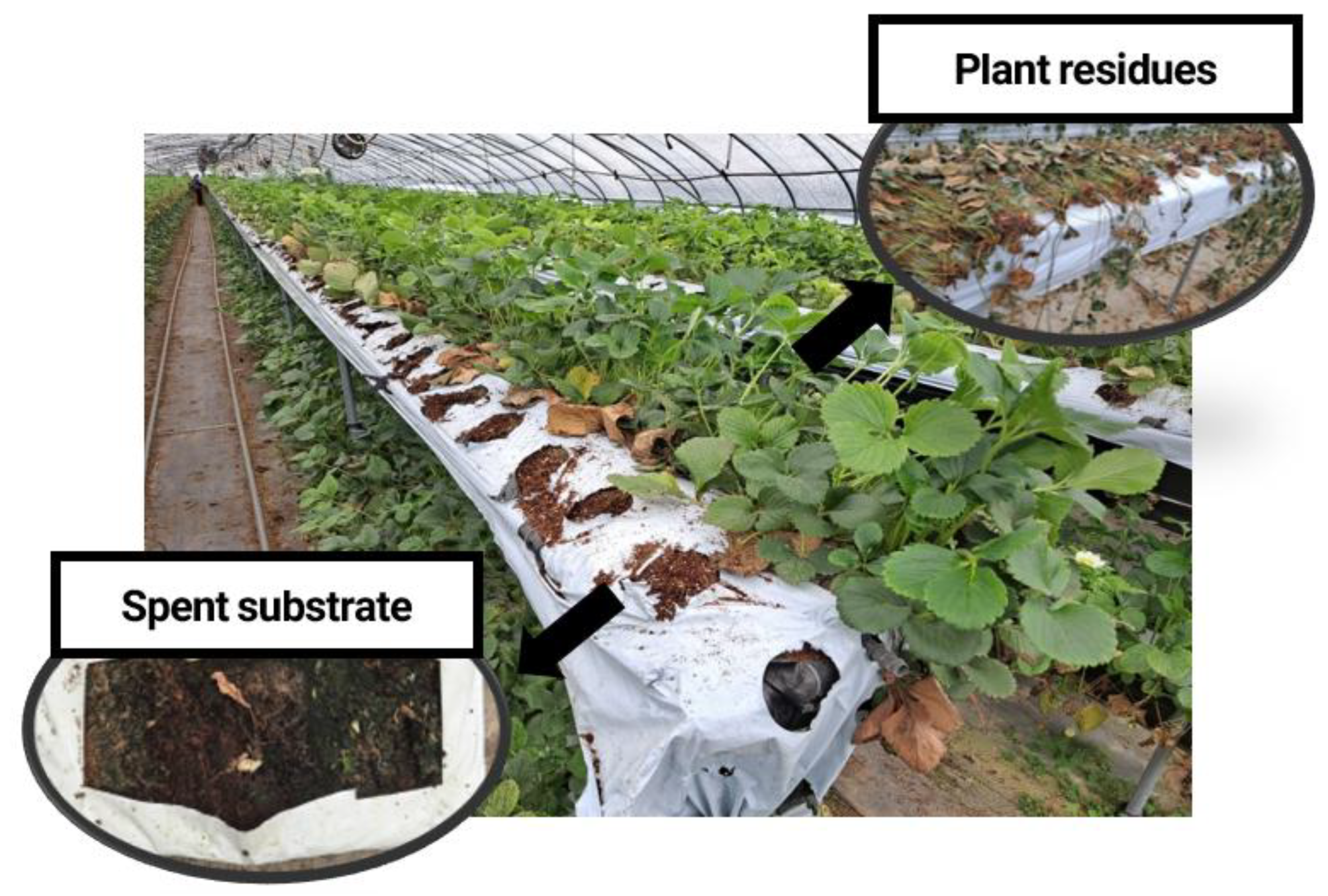
Figure 1. Strawberry cultivation by-products generated after hydroponic cultivation: (A) spent substrate and (B) plant residues collected from strawberry farms.
Preprints 204454 g001
Figure 2. Representative images of by-products generated from hydroponic strawberry cultivation, showing plant residues remaining on cultivation beds and spent substrate accumulated after the cultivation cycle.
Preprints 204454 g002
Table 1. A. Pesticide residues detected among the 463 compounds analyzed in spent substrates after hydroponic strawberry cultivation(continued). B. Pesticide residues detected among the 463 compounds analyzed in spent substrates after hydroponic strawberry cultivation.
Region Abamectin Azoxystrobin Boscalid Carbendazim Chlorantraniliprole Cyantraniliprole Difenoconazole Diflubenzuron Dimethomorph Emamectin Benzoate Flubendiamide Fluopyram Fluxapyroxad Isopyrazam Methoxyfenozide
mg·kg⁻¹
Jinju zN.D. 0.149 0.085 0.011 0.177 0.014 0.029 N.D. 0.030 N.D. N.D. 0.047 0.145 N.D. 0.035
Nonsan 0.081 0.131 0.108 0.029 0.015 0.012 0.025 0.041 0.227 0.017 0.036 0.118 0.122 0.182 0.471
yMRL 0.1 1.0 5.0 2.0 1.0 0.3 0.5 2.0 2.0 0.2 1.0 3.0 4.0 0.5 0.7
Region Metrafenone Orysastrobin Penthiopyrad Prochloraz Procymidone Pydiflumetofen Pyflubumide Pyraclostrobin Pyribencarb Pyriofenone Pyrimethanil Tetraconazole Tefluthrin Thiacloprid Thifluzamide N.D.
mg·kg⁻¹
Jinju zN.D. N.D. N.D. 0.342 0.076 N.D. 0.019 0.016 N.D. N.D. 0.026 0.039 N.D. N.D. N.D. 447
Nonsan 0.693 0.010 0.026 0.579 N.D. 1.038 0.664 N.D. 0.039 0.016 N.D. N.D. 0.130 0.013 0.012 436
yMRL 5.0 0.3 1.0 2.0 10.0 2.0 0.7 1.0 2.0 2.0 3.0 1.0 0.05 2.0 0.5
zND: Not detected. yMRL: Maximum Residue Limit established by the Ministry of Food and Drug Safety (MFDS, Korea, 2024).
Table 2. A. Pesticide residues detected among the 463 compounds analyzed in strawberry plant residues after hydroponic strawberry cultivation(continued). B. Pesticide residues detected among the 463 compounds analyzed in strawberry plant residues after hydroponic strawberry cultivation.
Region Acetamiprid Azoxystrobin Cyflufenamid Difenoconazole Diflubenzuron Fluopyram Fluxametamide Fluxapyroxad Hexaconazole Mefentrifluconozide
mg·kg¹
Jinju zN.D. 0.070 N.D. N.D. 0.095 N.D. 0.013 0.013 0.589 0.013
Nonsan 0.018 0.024 0.052 0.011 N.D. 0.022 N.D. N.D. 0.032 0.022
yMRL 2.0 1.0 0.5 0.5 2.0 3.0 1.0 4.0 0.3 1.0
Region Prochloraz Procymidone Pydiflubumide Pydiflumetofen Pyraclostrobin Pyridalyl Pyrimethanil Spirotetramat Tetraniliprole N.D.
mg·kg⁻¹
Jinju 0.209 zN.D. 0.012 0.564 N.D. N.D. N.D. N.D. 0.016 451
Nonsan 0.176 0.756 N.D. N.D. 0.030 0.013 0.086 0.021 0.028 448
yMRL 2.0 10.0 2.0 2.0 1.0 2.0 3.0 3.0 0.7
zND: Not detected. yMRL: Maximum Residue Limit established by the Ministry of Food and Drug Safety (MFDS, Korea, 2024).
Table 3. Heavy metal concentrations in spent substrates after hydroponic strawberry cultivation.
site Heavy metals
(mg·kg⁻¹)
Cd Cr Cu Hg Ni Pb Zn
Jinju zN.D. N.D. 10.6 N.D. 1.26 N.D. 28.3
Nonsan N.D. N.D. 22.4 N.D. 0.00243 0.00152 31.4
ySoil Contamination Concern Criterion of Region 1 4 5 150 4 100 200 300
zN.D.: Not Detected. ySoil Contamination Concern Criterion of Region 1: Paddy fields, dry fields, orchards, pastures, and mineral spring site.
Table 4. Heavy metal concentrations in strawberry plant residues after hydroponic strawberry cultivation.
site Heavy metals
(mg·kg⁻¹)
Cd Cr Cu Hg Ni Pb Zn
Jinju N.D. N.D. 2.19 N.D. 0.095 N.D. 7.82
Nonsan N.D. N.D. 1.02 N.D. N.D. N.D. 10.3
zN.D.: Not Detected.
Table 5. Inorganic element concentrations in strawberry plant residues after cultivation.
site N Ca K Mg Mn Na P Si
mg·kg⁻¹
Jinju 4,010 7,430 4,920 1,590 47,1 51,4 1,190 65.8
Nonsan 8,800 3,540 2,950 1,300 10,8 45,3 8,430 53,4
Table 6. Inorganic components in strawberry spent substrates after cultivation.
site N Ca K Mg Mn Na P Si
mg·kg⁻¹
Jinju 2,400 4,680 0,416 0,173 44,6 69,2 0,157 105
Nonsan 2,250 8,570 0,462 0,415 85,1 164 0,220 343
Disclaimer/Publisher’s Note: The statements, opinions and data contained in all publications are solely those of the individual author(s) and contributor(s) and not of MDPI and/or the editor(s). MDPI and/or the editor(s) disclaim responsibility for any injury to people or property resulting from any ideas, methods, instructions or products referred to in the content.
Copyright: This open access article is published under a Creative Commons CC BY 4.0 license, which permit the free download, distribution, and reuse, provided that the author and preprint are cited in any reuse.
Prerpints.org logo

Preprints.org is a free preprint server supported by MDPI in Basel, Switzerland.

Subscribe

Disclaimer

Terms of Use

Privacy Policy

Privacy Settings

© 2026 MDPI (Basel, Switzerland) unless otherwise stated
