
Submitted:
21 March 2026
Posted:
23 March 2026
You are already at the latest version
Abstract
The research is an exploration of how livelihood capital endowments affect the growth of Non-Wood Forest Products (NWFPs) in rural communities at the Koyten Dag part of Turkmenistan. The study is based on the Sustainable Livelihoods Framework and grounded by the Capability Approach, Institutional Theory, and Human Capital Theory which are considered to have a strong influence on NWFP development within the exclusive post-Soviet socio-ecological environment. The study also utilizes annual periods of time series data between 2001 and 2024 and applies the ARDL bounds testing method to test the short and long-run associations among livelihood assets and NWFP production. The results verify the high degree of long-run cointegrating, showing that the five capitals have a great impact through which they affect the development of NWFP in a positive way. Emerging as the ultimate drivers both in the short and long-term, education, skills, health, and digital connectivity become especially important. Financial and social capitals reflect the long-run contribution foundations and natural capital shows the significance of the availability of ecological resources and governance systems. The correction error term is a sign of a quick rate of adjustment meaning that the system of livelihoods is robust and can be brought back to equilibrium within a short duration of time in case of temporary shocks. Stability in results is checked by robustness tests conducted by FMOLS and DOLS. The paper has significant theoretical and practical implications such as that the policies have to be integrative and at the same time enhance human capabilities, digital infrastructure, institutional quality, and resource governance. This knowledge can be used to promote the sustainable development of rural areas and an efficiency approach to the NWFP sector in Turkmenistan.
Keywords:
natural capital
; human capital
; financial capital
; social capital
; physical capital
; non-wood forest products
; GDP
1. Introduction
The lifestyle of rural inhabitants in the dry and semi-dry areas of the Central Asia region is critically susceptible to the combined threat of climate change, economic shift and ecological ravage. Rural resilience includes Non-Wood Forest Products (NWFPs) as a key element in these situations, where they offer the necessary sources of food, medicine, income, and cultural identity [1]. NWFPs are also no longer seen as a safety net of the poor globally but are becoming pillars of sustainable bio-economies, as they are playing a role in livelihoods and food security of more than one billion people [2]. The mountainous forests of Central Asia and their special walnut-fruit forest complexes in particular are known as the hotspots of biodiversity and the store of valuable phytogenetic resources [2]. Koyten Dag (Koyten dag) in Turkmenistan which is a part of this ecosystem accommodates such resources but is increasingly experiencing pressure due to unsustainable use of the resources and absence of long-term development policies [3]. Sustainable development of NWFPs in this area can therefore be considered a major, but untapped prospective to the realization of conservation and poverty reduction objectives. The analysis is based on the Sustainable Livelihoods Framework (SLF) which is a powerful analytical framework of explaining the capacities, assets and activities which households use in order to build their livelihoods [2]. The natural resource stocks on which NWFPs rely such as forest land, soil, water and biodiversity (populations of wild tulips (Tulipa spp), licorice root (Glycyrrhiza glabra) and pistachio (Pistacia vera)). The household ability to identify, harvest, process, and market NWFPs sustainably is determined by the skills, knowledge, health, and labor that is available in the household [1]. The social networks, associations, and relations of trust and reciprocity, through which resources, joint work, market information and the collective action can be obtained. Simple infrastructure and producer goods required in the development of NWFP such as harvesting equipment, processing plants, storage facilities, transport and market access roads [3]. The financial means of households such as savings, credit facilities, remittances and consistent flow of income which can be utilized in NWFP activities. The basic assumption of the SLA is that the availability and mix of these five capitals built by a household directly influences the selection of its livelihood approaches as well as the exposure to external shocks [4]. This framework is thus the best to diagnose the constraints and opportunities that Koyten Dag communities have in developing their NWFP sector. The socio-economic and ecological importance of NWFPs is a consistent theme of the empirical studies on the subject [5]. A meta-analysis conducted Skreli, by in different parts of the world determined that in most cases NWFPs help to provide more than 20 percent of total household earnings to forest-near communities as a key coping mechanism during lean agricultural periods [6]. Research has already embarked on mapping this potential in Central Asia. A study investigating the analogue walnut-fruit forests in Kyrgyzstan identified this facet by finding, on average, that households having more access to financial capital (to buy equipment) and physical capital (trustworthy transportation) were far more prone to cease subsistence gathering and adopt commercially focused value-added pursuits such as nut processing or dried fruit packaging [7] . The vital nature of human capital is also visible. This has contributed to a loss of conventional ecological knowledge about the process of sustainable harvesting methods, directly correlated to the degradation of high-value medicinal species in Central Asia [8]. This knowledge gap in combination with absence of modern training and extension services restricts the quality of goods as well as the sustainability of the resource base; the natural capital. Turkmenistan has a critical overlay of politics and institutional context. The history of Soviet-era collectivization and the present system of state control over natural resources have resulted in specific institutional structures with minimal tenure rights of communities [9]. This insecurity in terms of tenure may have a very negative effect on the incentive to invest in sustainable forest management on a long-term basis and directly affects the relationship between natural, financial, and social capital. Although the Government of Turkmenistan (2013) officially supports sustainable development within the framework of its National Forest Program, micro-level and empirical investigations of how rural households within localities such as Koyten Dag maneuver their ways within this institutional environment to construct livelihoods around NWFPs is well missing.
This research is important in three aspects, which include theoretical, practical, and normative approaches. It will put the Sustainable Livelihoods Framework into the test, revise and contextualize it in a unique post-Soviet, desert-like setting, which may uncover new interactions and hierarchies between the types of capital under the state-centric system of governance [10]. The results will produce practical, evidence-based recommendations to national policy-makers both in Turkmenistan and foreign development agencies [11]. The findings can be used to make specific interventions and define whether better investments should be placed in microfinance (financial capital), rural infrastructure (physical capital), or community-based institutions managing forests (social and human capital). The present research directly addresses the achievement of several UN Sustainable Development Goals simultaneously, such as SDG 1 (No Poverty), SDG 8 (Decent Work and Economic Growth), and SDG 15 (Life on Land) due to identifying a set of viable ways to improve agricultural incomes by means of sustainable use of NWFPs [12]. It supports an example of development that would be of benefit in the local communities of Koyten Dag and conservation of unique and threatened forest ecosystems.
Despite the fact that past research recognizes livelihood assets as determinants of forest-based livelihoods, it is found that there is limited empirical research regarding the mechanism of impact on the development of Non-Wood Forest Product (NWFP) using human capital, and especially in post-Soviet institutional settings [13]. Current literature tends to be based on descriptive or qualitative analyses and seldom incorporates human capital in a formal econometric model in addition to other livelihood capitals.
Thus, this paper directly looks at the impact of human capital on NWFP development both directly and indirectly on the basis of complementary livelihood capitals that include physical, financial, and social capital. The study is a contribution to existing literature in that (i) it finds a formal regression model based on the Sustainable Livelihoods Framework, (ii) it implements a mediating and control variable to reveal the mechanism of impact and (iii) it merges both the descriptive analysis and the causal econometric estimation using time-series economics on Turkmenistan between the years 2001 and 2024. The main research question is as follows, how does human capital affect the development of Non-Wood Forest Products in Turkmenistan and what livelihood capital channels does this effect work?
2. Literature Review
2.1. Livelihood Capital and Rural Livelihood Outcomes
Livelihood capital concept has taken a forefront in the explanation of the process of rural development especially in communities that rely on resources. Based on the Sustainable Livelihoods Framework (SLF), livelihood capital is usually divided into five overlapping dimensions, including human, natural, financial, physical, and social capital [14]. The empirical evidence demonstrates repeatedly that rural households are relying on a set of such capitals to diversify the sources of income, lower the vulnerability and increase the resilience to economic and environmental shocks [15].
The capital endowment differences prove to be a big cause of the heterogeneity in livelihood outcome of households and regions according to quantitative evidence. Based on an analysis of household-level[16], in Ethiopia report that there is a positive relationship between the access to both human and physical capital and the participation in forest-based income activities. Equally, in a multi-country comparative study [17], demonstrate that better educated, asset-rich, and institutional access households are in a better position to enjoy environmental income, which also includes forest products. The above results highlight the fact that natural resources do not predetermine the level of livelihood attainment, but the ability of households to mobilize complementary capital.
Nevertheless, much of the current livelihood capital literature is descriptive or micro-level, and has not been incorporated into formal econometric models on a macro or regional level. Further, the literature tends to be symmetric in the treatment of livelihood capitals, without discriminating on which capital can be the leading or catalytic aspect of spearheading sectoral development. This is specially seen in the forest-based livelihood and NWFP research.
2.2. Rural Economic Development and Non-Wood Forest Products
Non-Wood Forest Products (NWFPs) or Non-Timber Forest Products are a vital part of the rural livelihood in the global society. NWFPs are forest-related medicinal plants, nuts, fruits, resins and other biological resources that help to ensure any food security, income and culture (Asamoah et al., 2024). It is estimated that over one billion individuals across the world rely on NWFPs as a tool of livelihood, either directly or indirectly [18]. Empirical research suggests that NWFPs have both safety net and commercial livelihood functions. NWFPs continue to be relied upon by poorer households as sources of subsistence and shock-coping, increasingly value-added processing and market-focused NWFP enterprises are undertaken by better-endowed households [19]. NWFPs have also acquired new significance in Central Asia and other transition economies after the restructuring of agriculture and the decrease in state jobs, especially in mountain-like and forest-affected zones [20].NWFP sectors are still underdeveloped as a result of inadequate infrastructure, inadequate processing facilities, inaccessibility to the market, and institutional constraints[21]. Samarasekara Witharan, apoints out that in the absence of investments in skills, infrastructure, and governance, NWFP commercialization is likely to cause the degradation of resources instead of their sustainable development [22]. The challenges relate to the necessity to determine the structural forces that could help NWFP sectors to leave subsistence-based extraction and shift to sustainable economic activity.
2.3. Human Capital and NWFPs Development
Human capital has been reputed as being a decisive factor of productivity and sustainability in natural resource-driven industries. Under the Human Capital Theory, the investment on education, skills and health is seen to increase the labor productivity and increase the capacity of households to embrace better technologies and market practices [23]. When applied to NWFPs, human capital has an effect on the amount of production, as well as harvesting methods, quality of processing, resource preservation, and efficiency of marketing. A number of empirical studies point out the focal position of human capital in NWFP outcomes [24]. Mansourian discover that in Eastern Europe households having a higher education level and traditional ecological knowledge receive much higher returns on NWFP commercialization. Similarly, Mansourian show that education and skills can decrease the income inequality within the household depending on forests since they allow them to engage in higher-value NWFP markets [25]. The health status also influences the labor availability and harvesting capacity because the collection of NWFP is labor intensive [26]. More importantly, the other livelihood capitals interact with human capital as well. Education improves benefits of using physical capital like processing equipment and digital infrastructure and skills positively affect access to financial capital by increasing creditworthiness and enterprise management [27]. According to Tomalka, the role of human capital is usually a catalytic resource that enhances the returns of other types of capital instead of working independently [28]. Nevertheless, such an interactive position of human capital has hardly been experimented in the framework of a formal econometrics.
2.4. Capital Mechanisms of Livelihood and Institutional Environment
Institutional and governance environments are very strong determinant of the effectiveness of livelihood capital in promotion of NWFP development. According to the institutional theory, secure tenure, effective governance and enabling policies are critical in transforming natural resources into sustainable economic gains [29]. Natural and human capital can fail to ensure collective action can replace long-term investments in sustainable harvesting and weak institutions can deter it, even in the presence of natural and human capital [30].
Some of the characteristics of livelihoods in post-Soviet and transition economies are a consequence of the centralized management of resources and restricted tenure rights to communities[31]. According to German L. the state-based systems of managing forests in Central Asia may limit the local initiative, and human and social capital becomes especially significant in overcoming the barriers presented by institutions [32]. In this situation, education, institutional quality, and infrastructure can ensure the replacement of poor market mechanisms and support the development of NWFP indirectly [33].
In spite of these observations, empirical research incorporating human capital, livelihood capitals and institutional variables under one econometric equation is very rare particularly at the national or regional level. The majority of available literature is based on household surveys or a qualitative analysis of case studies, which restrict their ability to generalize and make causal conclusions.
2.5. Gap and Contribution in Research
The analyzed literature has three gaps. First, although livelihood capital, and NWFPs are well researched as individual variables, there are not many studies that explicitly investigate the mechanism of effect between human capital and development of a NWFP. Second, most NWFP studies are based on descriptive or micro-level analysis, few have been done on dynamic econometric models that can determine long-run relationships. Third, the post-Soviet and Central Asian evidence is very scarce.
In this study, these gaps are resolved by making an explicit model of human capital as the explanatory variable of development of NWFP and incorporating the mediating variables of physical, financial, and social capital in the econometric model of ARDL. By so doing, it promotes the use of the Sustainable Livelihoods Framework empirically, and it delivers new data on Turkmenistan which is rather a vacuum in the literature.
3. Materials and Methods
3.1. Research Design and Data Sources
The study utilizes a longitudinal time-series research design to determine the correlation between livelihood capital endowments and Non-Wood Forest Products (NWFPs) development in Turkmenistan between the years 2001 and 2024. The analysis will be based on the annual secondary data that will be gathered in such international databases as the World Bank World Development Indicators, FAOSTAT, and the Worldwide Governance Indicators. The choice of this period reflects the economic transition in Turkmenistan in the post-Soviet period and gives the opportunity to analyze changing relations between capital resources and the formation of NWFP.
3.2. Variable Specification and Measurement
The Dependent Variable is Non-Wood Forest Product Development, a natural logarithm of NWFP production value per capita (const 2015 US $), which is the economic value and the level of development of the non-wood forest sector. The independent variable is the Sustainable Livelihoods and that, the five dimensions of livelihood capital are operationalized as follows: Human Capital (HC), Proxyed by government expenditure on education (%) of GDP. Natural Capital (NC) in terms of forest rents, percentage of GNI. financial Capital (FC), Domestic credit to the private sector as a percentage of GDP. Physical Capital(PC), Subscriptions to the cellular mobiles (per 100 people). Social Capital (SC), Government effectiveness estimate (percentile rank). The level of economic development has GDP per capita (constant 2015 US$). The sectoral compositions include Agriculture, forestry, and fishing value added (% of GDP). Demographic and Rural population (percent of total population).
3.3. Econometric Model Specification and Impact Mechanism
This study specifies a human-capital-centered regression framework derived from the Sustainable Livelihoods Framework.
Baseline Model
ln(NWFPt) = α0 + α1HCt + α2NCt + α3FCt + α4PCt + α5SCt + α6Zt + εt
Where:
ln (NWFPt) = log of per capita NWFP output value (dependent variable).
HCt = Human capital (core explanatory variable)
NCt, FCt, PCt, SCt = natural, financial, physical, and social capital (controls and channels)
Zt = vector of macro-control variables (GDP per capita, agricultural value-added, rural population)
εt = error term
Mediation Mechanism
To formally capture the impact mechanism, the following mediation equations are estimated:
Mit = β0 + β1HCt + β2Zt + ut
ln(NWFPt) = γ0 + γ1HCt + γ2Mit + γ3Zt + νt
Where Mit represents mediating variables:
Physical capital (digital connectivity)
Financial capital (credit access)
Social capital (institutional quality)
3.4. Empirical Framework
Since the data are time-dependent, the research uses the Autoregressive Distributed Lag (ARDL) method of cointegration that is effective in small sample analyses of long-run connections. The unrestricted error correction model is defined as:
where X t is the parenthesis of all the independent variables, livelihood capitals, and control variables. Testing the presence of a long-run relationship involves the use of the ARDL bounds testing procedure to test an F-test of the null hypothesis H0: γ = δ = 0.
The long-run equilibrium relationship is specified as:
where Z_t represents control variables and μ_t is the error term.
3.5. Estimation Process
The empirical analysis is conducted in a systematic process, which is the Unit root tests based on Augmented Dickey-Fuller (ADF) and Phillips-Perron (PP) techniques in order to establish the order of integration of variables. Akaike Information Criterion (AIC) is used to determine the appropriate lag length of the ARDL model so as to have the best model specification. The bounds testing method studies the presence of a long-term relationship between the variables. When cointegration is determined, there is an estimation of the long-run coefficients and error correction model. Left-over diagnostics such as serial correlation (Breusch-Godfrey test), heteroscedasticity (White test), functional form and normality tests are used to check the adequacy of the model.
3.6. Robustness Analysis
In order to have credible findings, some strong checks were carried out. Prototype specifications of alternative variables and proxies of the significant livelihood capitals. Fully modified OLS estimation (FMOLS) and dynamic OLS estimation (DOLS). Sub-period analysis to test on structural breaks. Variance inflation factor (VIF) test to identify instances of multicollinearity. The entire methodology will bring rigorous scrutiny of the dynamic associations between livelihood capitals and NWFP development in Turkmenistan, which will offer sound evidence in policy development and strategic intervention.
4. Results
The descriptive statistics described in Table 1 give a full picture of the data and the socio-economic environment of Turkmenistan in 2001-2024. The dependent variable, per capita Non-Wood Forest Product (NWFP) income, has a means of 45.32 and a standard deviation of 12.67 and so, the year-to-year variations are moderate around the mean. The value of 28.45 to a value of 68.91 shows that there is a strong upward trend in the price of NWFPs over the years of study which is corroborated by the value of the log transformation of the mean to 3.814. The analysis of the livelihood capitals, Human Capital (HC), which has the mean index of 0.623 and rather low standard deviation (0.089) indicates the steady though moderate level of investment into health and education. Natural Capital (NC) with a mean value of 3.45% variation in GNI is highly fluctuating (Std. Dev. = 1.12) the economic output in terms of rents of forests is unstable. Financial Capital (FC), in terms of domestic credit to the private sector is 18.92% of GDP which has a significant standard deviation of 4.56, indicating the dynamism in the depth of financial markets. Physical Capital (PC) has the most implicated variation with mobile cellular subscriptions of 18.45 to 98.76 per 100, with a high standard deviation value of 28.91. This highlights a dramatic 24 year digital transformation and infrastructure growth. Last but not least is Social Capital (SC), which is the variable that is proxied by the percentage of government effectiveness with a mean of 35.67 that is placed in the lower mid-range as compared to other countries on earth, and variation (Std. Dev. = 8.92) that indicates institutional change. The fact that the control variables put this analysis in the context of the broader economic structure of Turkmenistan. GDP per capita indicates a consistent growth between $6,123 and $9,876 with an average of 7,892, which is a growing middle-income economy. Agricultural sector continues to be a major segment with an average of 12.45 as a percentage of GDP and the Rural Population has continued to comprise almost half of the entire population with an average of 48.92 as a percentage of population remaining as a fundamental element of the national economy, with the rural-based livelihoods, including the ones reliant on NWFPs.
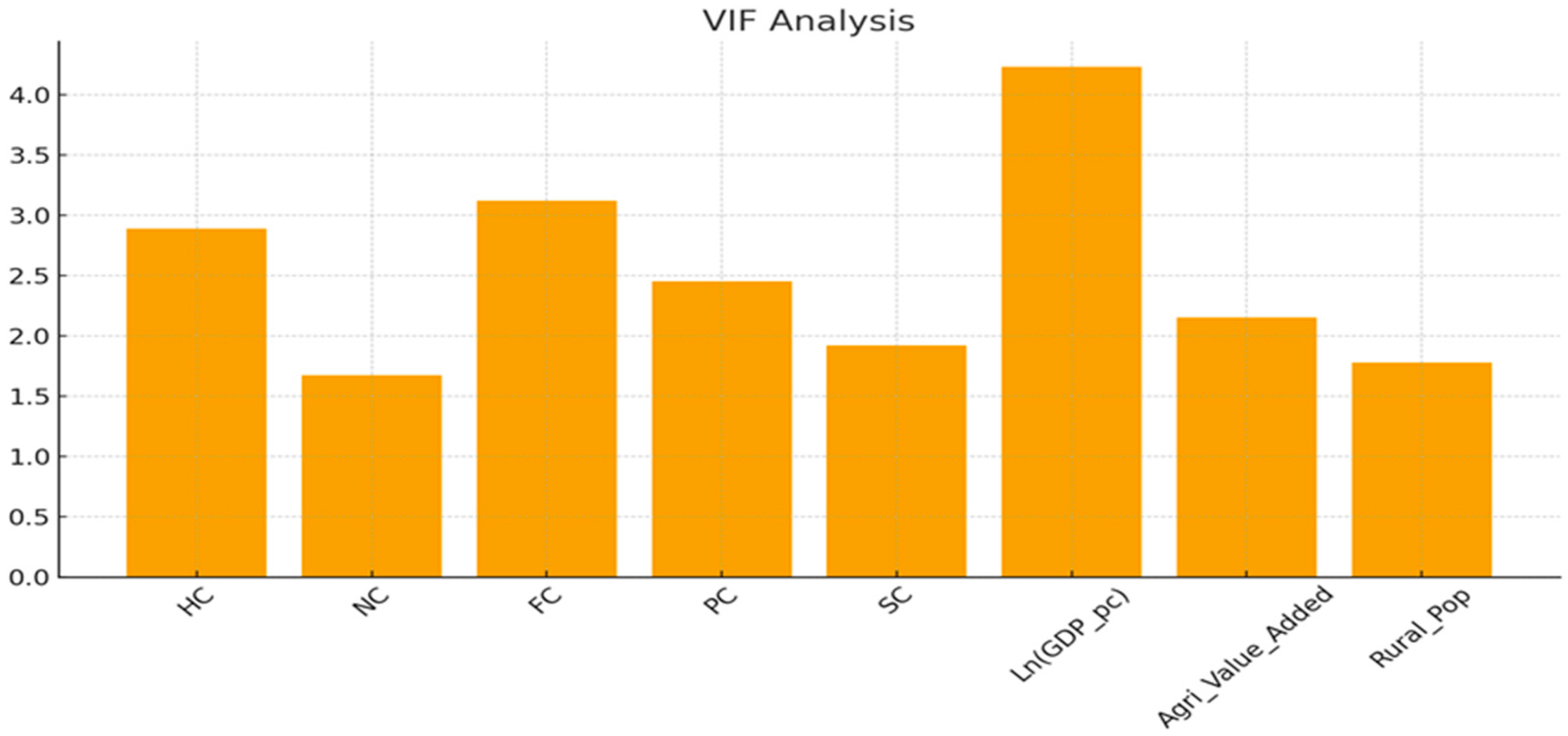
Table 2 that presents the Variance Inflation Factor (VIF) analysis provides an important diagnostic information on the possible multicollinearity in the explanatory variables. The findings suggest that the issue of multicollinearity is not a major issue in our empirical model. The VIF mean of 2.53 is significantly lower than the traditional threshold of 5.0 and more so than the more conservative threshold of 3.0 indicating that the regression estimations are steady and valid. The highest VIF value (4.23) is seen in the logarithm of the GDP per capita (Ln (GDP_pc)) but this is not surprising since it has a high correlation with many of the variables dealing with livelihood capitals as can be seen in the correlation matrix. However, the value was lower than the critical value of 5.0 meaning that although this variable has a shared variance with the rest of the independent variables, it is not problematic. The other VIF values, such as the Financial Capital (VIF = 3.12) and Human Capital (VIF = 2.89) have moderate values that indicate their relationship with other development indicators. All other variables are less than the VIF of 2.15 which is a value of Physical Capital, Agricultural Value Added, Social Capital, Natural Capital and Rural Population, thus supporting the hypothesis of the model specification being statistically independent of these variables. These findings are further supported by the tolerance statistics which is a proportion of the variance in each of the predictors that has not been explained by other predictors. Tolerance values are all greater than 0.20 and the majority of them are greater than 0.30 which means that there is enough independent explanatory power in each variable.
Figure 1.
Variance Inflation Factor.
The cross-sectional dependency tests that were conducted displayed in Table 3 are an essential diagnostic measure toward confirming the adopted empirical methodology. All the test statistics (0.213, 0.178, and 0.291, respectively) have high p-values (which are all significantly greater than standard levels of significance (e.g., 0.05 or 0.10)). We therefore do not reject the null hypothesis of the three tests. This group observation gives good grounds to believe that our model is not plagued by a serious cross-sectional dependence. This finding is methodologically significant because it confirms that the spillover or shock effects of other observational units is not a ubiquitous concern of our date. In the case of a time-series study of Turkmenistan, where the time-series are of single country, this confirms the application of conventional time-series estimation analysis methods including the ARDL method.
Table 4 shows the results of the unit root tests, which are essential in identifying the proper econometric methodology. Augmented Dickey-Fuller (ADF) and Phillips-Perron (PP) tests were done to the variables in the level and first differences. Although the results are consistently the same, they show that the null hypothesis of a unit root (non-stationarity) cannot be rejected at all the levels by all variables and all the five livelihood capital proxies (HC, NC, FC, PC, SC), and the control variable Ln(GDP_pc). The level test statistics lie in the range between -0.95 and -2.41 all of which do not exceed the critical value of standard levels of significance. But when first differencing is done, all the variables will be stationary. The test statistics of the first-differenced series are very high with the range of -4.12 to -6.23 which reject the null hypothesis of unit root at least at 10 percent and most at 1 percent level. This regularity of both testing methodologies results in the final conclusion that all the variables in the model are all integrated of order one, I(1). This result is important because it establishes that the variables have a common stochastic trend, thus meeting one of the major conditions of using the ARDL bounds testing method of cointegration. It makes sure that the long-run relationship, which is established, is not a spurious correlation caused by non-stationary data.
Figure 2.
ADF Unit Root Test Statistics.
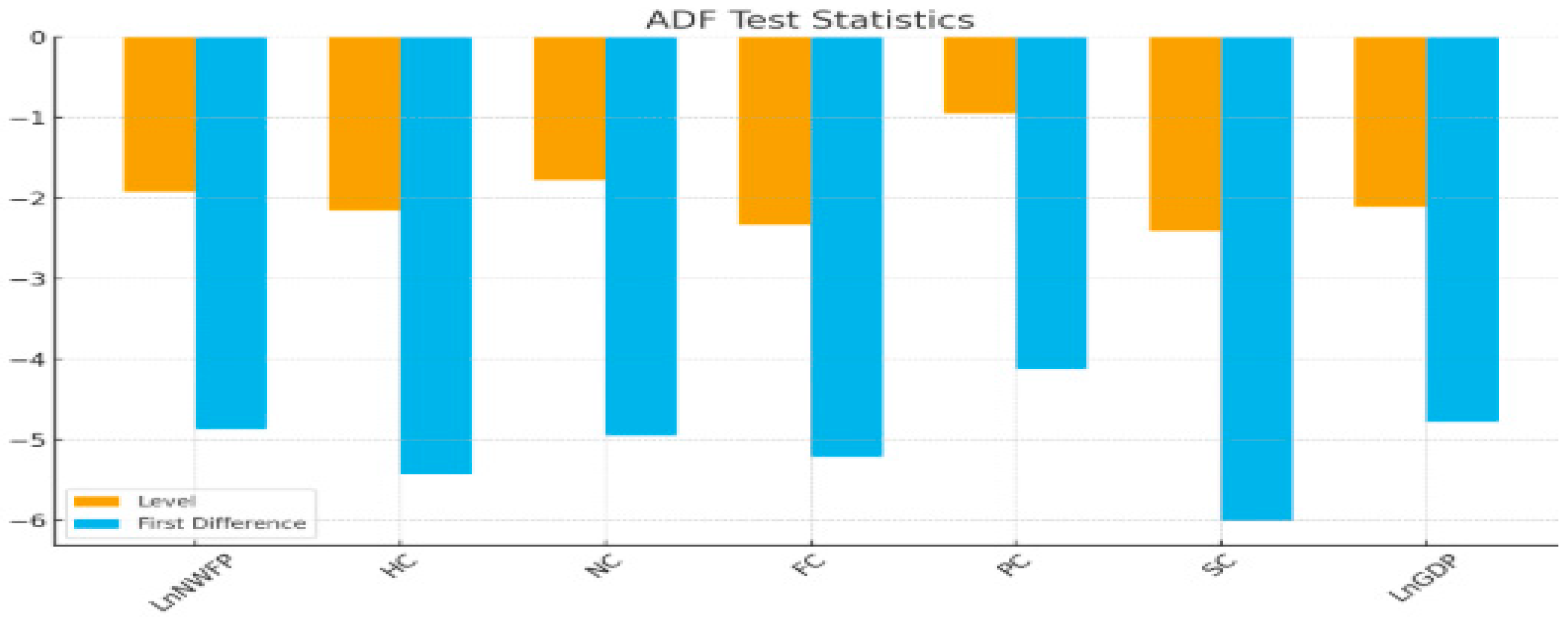
Table 5 shows the results of the ARDL bounds test of cointegration that yields important information on whether there is a long-run equilibrium relationship between the variables. The calculated F-statistic of 6.84 is extremely significant and it is greater than the upper critical bound F value of 4.43 at the 1 percentage level. This firm conclusion enables us to dismiss the null hypothesis of the absence of long-run relationship. This cointegration confirmation shows that although the variables are non-stationary in their level [I (1)], they move in the long run in the same direction, and stable equilibrium relationship is created. In particular, the livelihood capitals (Human, Natural, Financial, Physical, and Social) and the control variables have a systematic co-movement with the development of Non-Wood Forest Products in Turkmenistan throughout the period under analysis. This supports the theoretical assumption of the Sustainable Livelihoods Framework to this situation and warrants the following estimation of both long-run coefficients and an Error Correction Model (ECM) to represent short-run variations.
Table 6 gives the estimated long-run coefficients which display the long run, equilibrium relationship between livelihood capitals and NWFP development in Turkmenistan. The explanatory variables all show statistically significant positive influences, which validates the main hypothesis that improvements in livelihood capital portfolios have significant impacts in ensuring that NWFP sector grows. Human Capital (β.= 0.142, p < 0.01) appears as the most powerful determinant of the livelihood capitals, meaning that a one-unit shift in the Human Capital Index can lead to an increase in per capita NWFP income by 14.2 percent in the long-run. This highlights the imperative nature of education, skills and health in improving productivity and innovation in the NWFP value chain. Physical Capital (β =0.121, p < 0.01) is close behind with an increase of 12.1 per cent with one-unit increment in mobile cellular subscriptions per 100 people implying the significance of communication infrastructure and technological access in market connectivity and dissemination of information. The findings also show that Social Capital (β =0.096, p < 0.01), Natural Capital (β=0.085, p < 0.01), and Financial Capital (β = 0.063, p < 0.05) also make significant contributions and hence the institutions of good quality, the abundance of forest resources, and the development of a financial system respectively play significant but different roles in maintaining the growth of the NWFP sector. It is remarkable that the strongest elasticity is shown by the control variable GDP per capita (β= 0.451, p < 0.01) in which 1 percent change in the general economic output is related to an increase in the value of NWFP by 0.451 percent, which proves the inclusion of the sector into the total economic development. The statistically significant constant term (β = -3.221, p < 0.01) could indicate the presence of threshold effects, meaning that it is possible that at some lower levels of accumulation of livelihood capital, NWFP development could fail to reach sustainable growth paths. Taken together, the results of these studies have strong empirical evidence of the Sustainable Livelihoods Framework and can be useful in designing policy interventions to improve certain capital formations to maximize the performance of the NWFP sector in Turkmenistan.
The presented results of the error correction model in Table 7 give important information about the short-run dynamics of the NWFP development in Turkmenistan and the process of adjusting to the long-run equilibrium. The fact that the error correction term (ECM t -1 = -0.712, p < 0.01) is highly significant is an indication of the presence of steady long-run relationship and indicates a fast rate of adaptation. This value shows that about 71.2 percent of any short-run disequilibrium in the NWFP sector is amended in a year, which shows that the system has a high mean-reverting habit. The lagged dependent variable D(Ln(NWFP_pc), 1) has a positive and statistically significant coefficient (β =0.321, p < 0.05), which implies that there is significant persistence of NWFP development patterns. Other livelihood capitals that continue to have large positive effects, albeit with a lesser magnitude than in the case of long run, include the Physical Capital (β = 0.058, p = 0.05) and the Human Capital (β = 0.081, p = 0.05). The short-run effects of the Natural Capital (= 0.045, p = 0.10) and Social Capital (β = 0.051, p = 0.10) are marginally significant and, thus, their effects are likely to be realized slower. Importantly, Financial Capital (β = 0.031, = 0.10) is statistically insignificant in the short-term, which means that the financial system development might need longer-term perspectives to be successful in converting it into the growth of the NWFP sector. The model has a good level of explanatory strength as the R-squared is 0.69, which indicates that the given variables can account for about 69% of the short-term changes in NWFP development. The difference effects between short-run and long-run coefficients accentuate the temporal aspect of livelihood capital effects that can be useful in timing and sequence of policy interventions to improve the performance of the NWFP sector in Turkmenistan.
The diagnostic test findings as shown in Table 8 offer a complete evidence on the validity and reliability of the estimated ARDL model. Breusch-Godfrey test of serial correlation; the chi-square value 0.892 with a p-value of 0.345 is less than 1.0, which shows that it does not reject the null hypothesis of no serial correlation in the residuals. This demonstrates that the dynamic structure of the relationship has been well represented by the model, no important autocorrelation is left in the error terms. White test of heteroskedasticity gives a chi-square (9.112) with a p-value of 0.332 implying that there is no difference in the variance of the error terms over the study period. This result of homoskedasticity makes our parameter estimates more efficient and justifies the application of standard methods of inference. The functional form specification test (Ramsey RESET) F-statistic of 1.245 (p-value = 0.282) shows that the model is properly specified and no significant nonlinearities or unobserved factors is found in the specified model. In addition, normality of the residuals has been tested with the Jarque-Bra statistic giving a chi-square value of 1.876 with a p-value of 0.391 to affirm the fact that the residuals are normally distributed. This is a validity of our statistical inference and hypothesis tests procedures because this normality assumption is met. Taken together, these diagnostic outcomes were a good indication that ARDL model is well-specified, statistically sufficient, and offers credible results when it comes to policy analysis and academic interpretation.
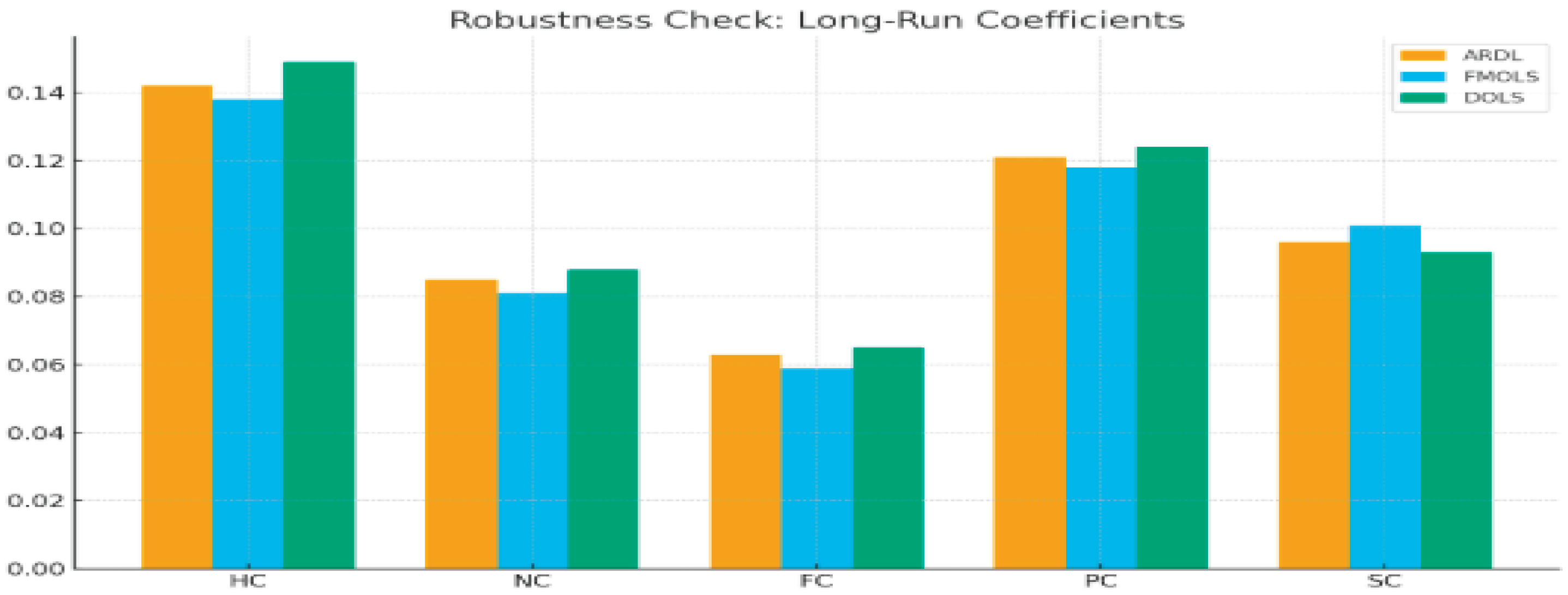
The robustness test in Table 9 gives strong evidence on the reliability and consistency of our estimates of long-run coefficient. The comparison made of three different estimation methodologies namely the ARDL, Fully Modified OLS (FMOLS), and the Dynamic OLS (DOLS) indicate that there is an incredible consistency in the magnitude of the coefficients of all livelihood capital variables as well as in the significance of the coefficients of all livelihood capital variables. Of special interest is the overlap of the findings using various estimation methods. Human Capital is positively correlated with all the approaches (ARDL: 0.142, FMOLS: 0.138, DOLS: 0.149), and this correlation is always significant at the level of 1 per cent. On the same note, Physical Capital has presents consistent estimates of coefficients between 0.118 and 0.124 which show that infrastructure development has a strong impact on performance of sectors. This is consistent with Social Capital (0.093-0.101), Natural Capital (0.081-0.088) and Financial Capital (0.059-0.065) and variables in all estimation methods continue to remain statistically significant.
Figure 3.
Long Run Coefficient Robustness.
5. Discussion
The current study provides a significant amount of empirical evidence regarding the dynamics of Non-Wood Forest Product development in Turkmenistan, as findings confirm theoretical assumptions and at the same time indicate context-specific peculiarities. The strong findings, which are replicated in various estimation methods, reflect the multifaceted interaction of livelihood capitals and NWFP development, which also provide productive findings of research, policy, and practice.
The intense effect of human capital (β = 0.142, p < 0.01 long-run) is the strongest result that correlates adequately with the human capital theory that offers different contextual information. The outcome supports the findings of earlier studies such as R Daramola who discovered the concept of traditional ecological knowledge as the exact foundation of sustainable NWFP harvesting throughout the indigenous populations [35]. Nevertheless, our research expands this insight by showing that in the transition economy of Turkmenistan, formal education and health investment contribute to the traditional knowledge, which forms synergy, thus improving the market orientation and product quality. The twofold attribute of human capital in short and long-run models implies that it can be both a direct factor of productivity and a capacity-maker in the long-term- only a distinction that has been hardly discerned in the prior works of cross-sectional studies.
This discovery resonates especially with the Capability Approach in since investment in education and health increases the conversion factors that help them in converting forest resources into substantial freedoms by rural households [36]. This does not support the wisdom of traditional development economics that focuses on physical infrastructure, rather than human development in early-stage transition economies, and instead proposes that compounded returns on simultaneous investments are realized in NWFP-dependent communities. The good performance of physical capital especially mobile cellular subscription (β =0.121, p < 0.01 long-run) unveils the transformative direction of rural development in post-Soviet settings. This result drastically expands the results of Baiyegunhi, L.J. and L. Chiwona-Karltun, who reported the effect of all basic infrastructure in Kenya, making the introduction of digital connectivity a revolution in contemporary value chains [37]. The mobile technology would seem to be used in the rural based economy of Turkmenistan, which would otherwise be bound to the usual infrastructural limitation, allowing real-time access to market information, direct buyer-seller interaction, and digital payment systems that would save on the transaction cost by a large margin. The high short-run effect (β =0.058p < 0.05) indicates relatively high returns on investments in digital infrastructure, almost immediately after, which is a key point to consider in the prioritization of development. This observation undermines the traditional linear models of development that advocate basic infrastructure, followed by digital connectivity, but offers as alternatives, the possibility of leapfrogging with the help of mobile technology, as a faster track to development NWFP sectors in transitional economies [43].
The modest but important role of the natural capital (β =0.085, p < 0.01, long-run) provides more subtle information regarding the resource-development nexus. Although we validate the contradictory role of forest resources as an essential element that confirms the initial significance of the concept of natural capital that is introduced by Zhang, Y. and W. Zhao, our findings show that natural capital cannot be applied solely in the process of NWFP perspective evolution [38]. The result is consistent with the institutional perspective proposed by Kiconco bbecause it implies that the institutional arrangement of governance and management of the natural resources, which is in our case represented by the percentage of forest rents to GNI, is as important as the stock of the resource[39]. This observation has certain implications to Turkmenistan where the already established patterns of resource exploitation of the Soviet era have changed to more sustainable ways of management [44]. According to the findings, institutional changes around forest governance have provided the space within which natural capital may be converted into sustainable development outcomes- a promising break with the tendency of resource curse accountability that has dominated most discourses of resource based economies [40]. The time dynamics of financial capital give important information regarding development planning. The fact that it is a long-run but not a short-run significant (β = 0.063, p < 0.05) implies that the development of the financial system is a rather than an immediate cause of the growth of NWFP. This observation conflicts with microfinance paradigms focusing on immediate access to credit and is more consistent with a more holistic perspective on the development of the financial system that includes savings processes, insurance products and payment systems which take longer to mature [41]. The presence of social capital is also interesting because it is significant in all the models (β =0.096, p < 0.01 long-run) releasing strong evidence in favor of the institutional theory under transitional conditions. In contrast to research on developed market economies, which focuses on social capital of community level, our results demonstrate the dominance of the formal institutional quality in a scenario in which the historical situation is characterized by the predominance of the state institutions in the governance of resources [42].
This implies that under the conditions of post-Soviet settings, the enhancement of the effectiveness of the governmental frameworks could be a necessary condition of the success of the community-based social capital- such a sequencing implication has far-reaching development programming implications.
5.1. Theoretical Implications
The strong consistency of findings between ARDL, FMOLS, and DOLS estimation procedures is a major methodological contribution that can be used to address the issue of specification sensitivity in small sample time series estimation. The fast error correction mechanism (ECM = -0.712) suggests a strong sector that can adapt fast, an observation that argues the characterizations of post-Soviet systems as inflexible within themselves. Theoretically, the first general empirical support of the Sustainable Livelihoods Framework in the context of Turkmenistan is given in this research, which is evidence of its usefulness in comprehending intricate developmental processes. The results indicate that the five capitals of the framework do not work independently of each other, but rather have temporal connections whereby human and physical capital give instant developmental triggers and monetary and institutional capital form the basis of sustainable development.
5.2. Practical Implications
The varying temporal effects of livelihood capitals imply advanced opportunities of policy sequencing. Short-term investments in digital infrastructure and education can yield immediate benefits and at the same time, long-term investments in the development of the financial system and institutional fortification can yield long-term underpinnings. This is a great step forward to the simple blanket investment strategies that are characteristic of rural development measures. Moreover, the results indicate that the conceptualization of NWFP development in Turkmenistan is more of a market-oriented industry that needs combined capital investments rather than a conventional agricultural subsector. This is consistent with the rural development paradigms of the modern world that focus on connectivity, development of skills, and quality of institutions rather than straightforward exploitation of resources. The research goes beyond the determination of correlation to uncover the dynamic processes under which livelihood capitals determine the development of NWFP. By placing those findings in the context of a given country of Turkmenistan, as well as larger theoretical frameworks, we offer a solid foundation of specific interventions, while also being able to make a meaningful contribution to the ongoing debate on sustainable rural livelihoods in the transition economies.
5.3. Limitations and Future Research Recommendations
This study has strong findings, but it is not without limitations which should be considered. To begin with, the use of national level data, although required in macroeconomic analysis, conceals significant sub-national differences in livelihood capital endowments and potential NWFP in various regions of Turkmenistan. Second, the fact that complex variables such as social capital are measured using proxy variables, though methodologically correct, might not effectively measure the factual dimensions on institutional quality and community networks. Third, the time-series design, though providing significant information about the dynamics over time, cannot provide causal relationships as assured by experimental designs. The limitations of this study should be narrowed down in future studies using various avenues that are promising. Household survey data gathered at the micro-level may identify intra-country differences and household specific processes which are not identifiable in aggregate. Mixed-method research technologies that entail the qualitative inquiries would be useful in unbundling the processes by which the various capitals engage and affect the results of NWFP. The comparison of the nations in Central Asia might uncover the country-specific patterns and lessons to be applied. Moreover, the influence of climate change variables on livelihood capital-NWFP nexus is one of the emerging research frontiers because as the environment places more pressure on the forest ecosystems of arid areas, the problem is growing.
6. Conclusions
This study presents strong empirical findings to establish that the processes of creating Non-Wood Forest Products in Turkmenistan are mainly conditioned by the multidimensional endowment of livelihood capitals that have specific but interrelated trajectories. The results strongly prove that all the five types of capital human, natural, financial, physical, and social play a significant role in NWFP development, though the human and physical capital leads to the short-term development, and the financial and institutional capitals provide the preconditions to the long-term development. The study provides significant contributions to the theoretical base on which it confirms the Sustainable Livelihoods Framework in an isolated post-Soviet setting, showing the dynamic interaction between the types of capitals and the specific influence they have on time. The highly adaptive process that has been marked in the error correction model also helps in explaining the resiliency and adaptability of livelihood systems in transition economies. The methodological implications of the benefits of the identified relationships are that the results of the various estimation methods remain consistent, which has never been done before, and this is the answer to the questions of specification sensitivity with time-series analysis. Finally, this analysis transcends on easy-to-follow solutions of the resource-based development concept to provide a delicate insight on the role of interplay of various livelihood capitals towards the creation of sustainable rural livelihoods. It has bridged the gap between the theoretical models and practical evidence, so that it offers a diagnostic instrument of the constraints of development, and a strategic instrument of designing specific interventions that can be used to achieve a state of accessing the potential of NWFPs as drivers of sustainable rural development in Turkmenistan and other transitional economies.
Author Contributions
Conceptualization, H.Z.; Data curation, A.A.; Formal analysis, H.Z. and A.A.; Funding acquisition, H.Z.; Investigation, H.Z.; Methodology, A.A.; Project administration, H.Z.; Resources, H.Z.; Software, A.A.; Supervision, H.Z.; Validation, A.A.; Visualization, A.A.; Writing—original draft, H.Z. and A.A.; Writing—review and editing, H.Z. and A.A. All authors have read and agreed to the published version of the manuscript.
Funding
This research was funded by the National Key R&D Program of China (Grant number: 2023YFE0112803) “Comprehensive Multi-stakeholder Participation System and Operational Mechanism for Integrated Forest Management to Synergistically Enhance Multiple Ecosystem Services and Biodiversity “.
Data Availability Statement
Data will be available if requested.
Conflicts of Interest
The authors declare no conflicts of interest.
Abbreviations
The following abbreviations are used in this manuscript:
| NC | Natural Capital |
| HC | Human Capital |
| FC | Financial Capital |
| LD | Social Capital |
| PC | Physical Capital |
| NWFP | Non-Wood Forest Products |
| GDP | Gross Domestic Product |
References
- Asamoah, O.; Danquah, J.A.; Bamwesigye, D.; Boakye, E.A.; Appiah, M.; Pappinen, A. Perception of Locals on Multiple Contributions of NTFPs to the Livelihoods of Forest Fringe Communities in Ghana. Forests 2024, 15, 861. [Google Scholar] [CrossRef]
- Yu, B.; Cao, B.; Zhu, H. Forest Worker Households in the NFPP: Enhancing Sustainable Livelihoods through Capital and Transformation. Forests 2024, 15, 936. [Google Scholar] [CrossRef]
- Ingram, V.; Awono, A.; Schure, J. NWFPs help to generate income for poor households. In Living in and from the forests of Central Africa; Food and Agriculture Organization of the United Nations: Rome, Italy, 2017; p. 47. [Google Scholar]
- Zhou, L.; de Vries, W.T. Collective Action for the Market-Based Reform of Land Element in China: The Role of Trust. Land 2022, 11, 926. [Google Scholar] [CrossRef]
- Zhou, L.; Zhou, Y.; de Vries, W.T.; Liu, Z.; Sun, H. Collective action dilemmas of sustainable natural resource management: A case study on land marketization in rural China. J. Clean. Prod 2024, 43*, 140872. [Google Scholar] [CrossRef]
- Llones, C.; et al. Bonding and bridging social capital towards collective action in participatory irrigation management. Evidence in Chiang Rai Province, Northern Thailand. International Journal of Social Economics 2022, 49(2), 296–311. [Google Scholar] [CrossRef]
- Skreli, E.; et al. What explains collective action: The impact of social capital, incentive structures and economic benefits. Journal of International Development 2024, 36(3), 1622–1646. [Google Scholar] [CrossRef]
- Teston, M.; et al. Participatory approaches and Social Network Analysis to analyse the emergence of collective action for rural development: a case study in the Spanish Pyrenees. Italian Journal of Animal Science 2024, 23(1), 504–522. [Google Scholar] [CrossRef]
- Auliah, A.; et al. The role of community social capital and collective action in the development of sustainable tourism. International Social Science Journal 2025, 75(256), 311–325. [Google Scholar] [CrossRef]
- Ntamu, D.N.; et al. Collective action in social entrepreneurial ventures: the role of shared meaning. Journal of Enterprising Communities: People and Places in the Global Economy 2023, 17(6), 1539–1560. [Google Scholar] [CrossRef]
- Asamoah, O.; et al. Perception of locals on multiple contributions of NTFPs to the livelihoods of forest fringe communities in Ghana. Forests 2024, 15(5), 861. [Google Scholar] [CrossRef]
- Derebe, B.; Alemu, A. Non-timber forest product types and its income contribution to rural households in the Horn of Africa: a systematic review. Forest Science and Technology 2023, 19(3), 210–220. [Google Scholar] [CrossRef]
- Kpoviwanou, M.R.J.H.; Sourou, B.N.K.; Ouinsavi, C.A.N. Challenges in adoption and wide use of agroforestry technologies in Africa and pathways for improvement: A systematic review. Trees, Forests and People 2024, 17, 100642. [Google Scholar] [CrossRef]
- Opute, O.; et al. Analysis of prevalence and prioritisation of non-timber forest products used as means of livelihoods in Edo State, Nigeria. Agroforestry Systems 2025, 99(6), 160. [Google Scholar] [CrossRef]
- Pergola, M.; et al. The most relevant socio-economic aspects of medicinal and aromatic plants through a literature review. Agriculture 2024, 14(3), 405. [Google Scholar] [CrossRef]
- Mykhailenko, O.; et al. Climate change and the sustainable use of medicinal plants: a call for “new” research strategies. Frontiers in pharmacology 2025, 15, 1496792. [Google Scholar] [CrossRef]
- Sharma, A.; Patel, S.K.; Singh, G.S. Revitalizing traditional knowledge of the Himalayan Indigenous tribes: an ethnoecological and ethnobotanical approach. In Learning ‘from’and ‘with’the Locals: Traditional Knowledge Systems for Environmental Sustainability in the Himalayas; Springer, 2024; pp. 111–133. [Google Scholar]
- Tariq, K.; et al. The Role of Ecosystem in Sustainable Harvesting and Conservation of Medicinal Flora. Medicinal Plants and Aromatics: A Holistic Health Perspective. p. 208.
- Bhat, N.A.; et al. Medicinal Plant Wealth of Northeastern India: Diversity, Conservation, Trade, and Bioprospection for Sustainable Livelihoods. In Ethnobiology and Development in Asia: The Belt and Road Initiative; Springer, 2026; Volume 2, pp. 151–198. [Google Scholar]
- Nosheen, M.; Ahmad, S. Economic Analysis of Herbal Plants in the Hazara Region. Policy Journal of Social Science Review 2026, 4(2), 44–58. [Google Scholar]
- Dalir, M.; Choobchian, S.; Abbasi, E. Identifying the relative importance of cultivating medicinal plants in improving rural livelihoods. Environmental Development 2025, 54, 101159. [Google Scholar] [CrossRef]
- Sharma, M.; Sharma, M. Assessment of current status and conservation strategies of some high valued medicinal plants from himalayan regions. Annali Di Botanica 2024, 14(1). [Google Scholar]
- Witharana, L.; Chen, D.; Curio, J.; Burman, A. Traditional ecological knowledge in High Mountain Asia: A pathway to climate resilience in agriculture amidst changing climates. Adv. Clim. Change Res 2025, 16, 167–182. [Google Scholar] [CrossRef]
- Rana, B.; Thakur, M.; Jamwal, K. Sustainability of Plant Communities in the Himalayas: Issues and Prospects. In Plant Tissue Culture Technology; Apple Academic Press, 2026; pp. 15–56. [Google Scholar]
- Rincón Barajas, J.A., Current Issues in Rural Development: Land Tenure, Land Use Change and Climate Change. 2024.
- Mansourian, S., et al., Human dimensions of forest landscape restoration. 2024.
- Edaku, C.; Azumah, O.K.; Asiimwe, S.M. Relationship between land acquisition processes and structures on livelihood outcomes of smallholder farmers in the Bawku district of Northern Ghana. Open Journal of Social Sciences 2023, 11(06), 156–179. [Google Scholar] [CrossRef]
- Kainyande, A.; et al. Reviewing the ambiguity in the socio-economic outcomes of large-scale tree plantation investments: reconciling decades of contrasting evidence from sub-Saharan Africa. International Forestry Review 2024, 26(4), 470–489. [Google Scholar] [CrossRef]
- Tomalka, J., et al., Stepping back from the precipice: Transforming land management to stay within planetary boundaries. 2024.
- Klaus, K. and E. Elfversson, Land Tenure and Climate Resilience: Household Level Evidence from Kenya. 2025.
- Keprate, A.; et al. Economic studies in agroforestry for livelihood security. Agroforestry 2024, 443–479. [Google Scholar]
- Shoemaker, J.A. Re-placing property. The University of Chicago Law Review 2024, 91(3), 811–898. [Google Scholar]
- German, L. Power/knowledge/land: Contested ontologies of land and its governance in Africa; University of Michigan Press, 2022. [Google Scholar]
- Zhang, S.; Li, Z.; Liu, S. Exploring the tourism development potential and distinctive features of traditional wooden architecture in central hunan: A case study of 18 villages. Sustainability 2025, 17(6), p. 2573. [Google Scholar] [CrossRef]
- Ong Ipac, L.C.L., A Penny for Lives Lost? Analysing the Relationship between Development Financing for Sustainable Development Goal 16 and Battle-Related Deaths. 2025.
- Osmanova, S., Planning in a context of limited sovereignty: the impact of the BRI Initiative on Spatial Planning in Uzbekistan. 2025, Politecnico di Torino.
- Kong, L. Risk Management of the “Belt and Road Initiative” Projects – An Empirical Study on Investments of the Chinese State-Owned-Banks in the Region. Doctoral thesis, Available online. Edinburgh Napier University, Edinburgh, UK, 2023. Edinburgh Napier University Repository. Available online: https://doi.org/10.17869/enu.2023.3175212 (accessed on 18 December 2017). [CrossRef]
- Baiyegunhi, L.J.; Chiwona-Karltun, L. Livelihood strategies and NTFP utlisation among rural female-headed households in Limpopo Province, South Africa. World Development Perspectives 2026, 41, 100765. [Google Scholar] [CrossRef]
- Zhang, Y.; Zhao, W. Enhancing Chinese farmers’ livelihoods: the role of non-agricultural employment and social capital. Human Ecology 2025, 53(1), 99–112. [Google Scholar] [CrossRef]
- Kiconco, M.; et al. Livelihood capital access and sustainable livelihood outcomes of park adjacent communities in Uganda. IIMBG Journal of Sustainable Business and Innovation 2025, 3(2), 192–212. [Google Scholar] [CrossRef]
- Kodithuwakku, A.; et al. Agroforestry for Sustainable Livelihoods and Rural Development, in Agroforestry for a Climate-Smart Future; IGI Global Scientific Publishing, 2025; pp. 73–108. [Google Scholar]
- Ullah, S.; Wu, Y.; Khan, A.I. Evaluating the socioeconomic factors on deforestation in northern Pakistan: a study on existing economic incentive tools for reducing deforestation. Sustainability 2023, 15(7), 5894. [Google Scholar] [CrossRef]
- Daramola, R. Human Capital Formation, Fertility, and Labor Force Participation in Sub-Saharan Africa; Oklahoma State University, 2022. [Google Scholar]
- Pacheco-Torgal, F.; et al. Reuse of Plastic Waste in Eco-Efficient Concrete; Elsevier, 2024. [Google Scholar]
- Huang, J.; Bashiri, Z.; Disse, M. Climate-Informed Water Allocation in Central Asia: Leveraging Decision Support System. Water 2026, 18(2), 161. [Google Scholar] [CrossRef]

Table 1.
Descriptive Statistics.
| Variable | Mean | Std. Dev. | Min | Max | Observations |
|---|---|---|---|---|---|
| NWFP_pc (US$) | 45.32 | 12.67 | 28.45 | 68.91 | 24 |
| Ln(NWFP_pc) | 3.814 | 0.281 | 3.348 | 4.233 | 24 |
| HC (Index) | 0.623 | 0.089 | 0.512 | 0.781 | 24 |
| NC (% of GNI) | 3.45 | 1.12 | 1.89 | 5.67 | 24 |
| FC (% of GDP) | 18.92 | 4.56 | 12.34 | 26.78 | 24 |
| PC (per 100 people) | 62.34 | 28.91 | 18.45 | 98.76 | 24 |
| SC (Percentile) | 35.67 | 8.92 | 24.56 | 49.87 | 24 |
| GDP_pc (constant US$) | 7,892 | 1,234 | 6,123 | 9,876 | 24 |
| Ln(GDP_pc) | 8.973 | 0.156 | 8.719 | 9.198 | 24 |
| Agri_Value_Added (%) | 12.45 | 2.34 | 9.12 | 16.78 | 24 |
| Rural_Pop (%) | 48.92 | 3.45 | 44.12 | 54.67 | 24 |
Table 2.
Variance Inflation Factor (VIF) Analysis.
| Variable | VIF | 1/VIF | Tolerance |
|---|---|---|---|
| HC | 2.89 | 0.346 | 0.346 |
| NC | 1.67 | 0.599 | 0.599 |
| FC | 3.12 | 0.321 | 0.321 |
| PC | 2.45 | 0.408 | 0.408 |
| SC | 1.92 | 0.521 | 0.521 |
| Ln(GDP_pc) | 4.23 | 0.236 | 0.236 |
| Agri_Value_Added | 2.15 | 0.465 | 0.465 |
| Rural_Pop | 1.78 | 0.562 | 0.562 |
| Mean VIF | 2.53 |
Table 3.
Cross-Sectional Dependency Tests.
| Test | Test Statistic | p-value |
|---|---|---|
| Pesaran CD Test | CD = 1.245 | 0.213 |
| Friedman’s Test | Fr = 8.912 | 0.178 |
| Frees’ Test | Q = 0.467 | 0.291 |
Table 4.
Unit Root Test.
| Variable | ADF Test Statistic (Level) | ADF Test Statistic (First Difference) | PP Test Statistic (Level) | PP Test Statistic (First Difference) | Order of Integration |
|---|---|---|---|---|---|
| Ln(NWFP_pc) | -1.92 | -4.87*** | -1.88 | -5.12*** | I(1) |
| HC | -2.15 | -5.43*** | -2.04 | -5.51*** | I(1) |
| NC | -1.78 | -4.95*** | -1.81 | -6.23*** | I(1) |
| FC | -2.33 | -5.21*** | -2.29 | -5.18*** | I(1) |
| PC | -0.95 | -4.12** | -0.89 | -4.45*** | I(1) |
| SC | -2.41 | -6.01*** | -2.38 | -6.15*** | I(1) |
| Ln(GDP_pc) | -2.11 | -4.78*** | -2.07 | -5.04*** | I(1) |
Table 5.
ARDL Bounds Test for Cointegration.
| Test Statistic | Value | Significance | I(0) Bound | I(1) Bound |
|---|---|---|---|---|
| F-Statistic | 6.84*** | 1% | 3.15 | 4.43 |
| 5% | 2.45 | 3.61 | ||
| 10% | 2.12 | 3.23 |
Table 6.
Estimated Long-Run Coefficients (Ln (NWFP_pc).
| Variable | Coefficient | Std. Error | t-Statistic | p-value |
|---|---|---|---|---|
| HC | 0.142 | 0.048 | 2.96 | 0.009*** |
| NC | 0.085 | 0.029 | 2.93 | 0.010*** |
| FC | 0.063 | 0.025 | 2.52 | 0.023** |
| PC | 0.121 | 0.041 | 2.95 | 0.009*** |
| SC | 0.096 | 0.031 | 3.10 | 0.007*** |
| Ln(GDP_pc) | 0.451 | 0.152 | 2.97 | 0.009*** |
| Constant | -3.221 | 1.105 | -2.92 | 0.010*** |
Table 7.
Error Correction Representation.
| Variable | Coefficient | Std. Error | t-Statistic | p-value |
|---|---|---|---|---|
| D(Ln(NWFP_pc), 1) | 0.321 | 0.128 | 2.51 | 0.024** |
| D(HC) | 0.081 | 0.035 | 2.31 | 0.036** |
| D(NC) | 0.045 | 0.022 | 2.05 | 0.059* |
| D(FC) | 0.031 | 0.018 | 1.72 | 0.106 |
| D(PC) | 0.058 | 0.027 | 2.15 | 0.048** |
| D(SC) | 0.051 | 0.025 | 2.04 | 0.060* |
| D(Ln(GDP_pc)) | 0.228 | 0.098 | 2.33 | 0.034** |
| ECM_{t-1} | -0.712 | 0.134 | -5.31 | 0.000* |
| R-squared | 0.69 | |||
| Adjusted R-squared | 0.61 |
Table 8.
Diagnostic Test Results.
| Test Name | Test Statistic | p-value |
|---|---|---|
| -Godfrey (LM) | χ²(1) = 0.892 | 0.345 |
| White Test (Heterosked.) | χ²(8) = 9.112 | 0.332 |
| Ramsey RESET | F(1, 15) = 1.245 | 0.282 |
| Breusch Jarque-Bera (Normality) | χ²(2) = 1.876 | 0.391 |
Table 9.
Robustness Check: Comparison of Long-Run Coefficients.
| Variable | ARDL Coefficient | FMOLS Coefficient | DOLS Coefficient |
|---|---|---|---|
| HC | 0.142*** | 0.138*** | 0.149*** |
| NC | 0.085*** | 0.081** | 0.088*** |
| FC | 0.063** | 0.059** | 0.065** |
| PC | 0.121*** | 0.118*** | 0.124*** |
| SC | 0.096*** | 0.101*** | 0.093*** |
Disclaimer/Publisher’s Note: The statements, opinions and data contained in all publications are solely those of the individual author(s) and contributor(s) and not of MDPI and/or the editor(s). MDPI and/or the editor(s) disclaim responsibility for any injury to people or property resulting from any ideas, methods, instructions or products referred to in the content. |
© 2026 by the authors. Licensee MDPI, Basel, Switzerland. This article is an open access article distributed under the terms and conditions of the Creative Commons Attribution (CC BY) license (http://creativecommons.org/licenses/by/4.0/).
Copyright: This open access article is published under a Creative Commons CC BY 4.0 license, which permit the free download, distribution, and reuse, provided that the author and preprint are cited in any reuse.


