

Submitted:
19 March 2026
Posted:
20 March 2026
You are already at the latest version
Abstract
Nanoparticles offer a versatile platform for the selective eradication of pathogenic or diseased cells by integrating therapeutic payload delivery with precision targeting. Precision targeting can be achieved (1) actively through ligand conjugation, (2) passively by exploiting the physiological abnormalities of diseased tissues, or (3) intrinsically through the innate biophysical properties of the nanoparticle. Intrinsically selective nanoplatforms (iNPs) are particularly advantageous when the disease-promoting agent does not possess distinct surface markers, such as in the case of certain “untargetable cancers” or cancers without known targets. Indeed, nanocarriers for chemotherapeutic or gene delivery have achieved selective cancer cell apoptosis without requiring marker presentation, thereby expanding the therapeutic window of the payload. Disease-promoting agents whose physical properties are different from those of healthy cells are also good candidates for intrinsic nanoparticle targeting. For example, antimicrobial nanomaterials have been designed to disrupt bacterial membranes and reduce the risk of antimicrobial resistance by leveraging stiffness differentials between bacterial cell walls and eukaryotic membranes. Nanoparticle systems with intrinsic targeting mechanisms can also enable non-invasive imaging with near-infrared fluorescence, MRI, and photoacoustic imaging for real-time biodistribution tracking and treatment monitoring. This review synthesizes current innovations in nanoplatform design with intrinsic targeting capabilities, spans applications in infectious and non-communicable diseases, and discusses emerging strategies to enhance specificity, overcome resistance, and translate these platforms toward clinical and field deployment.
Keywords:
nanotheranostics
; intrinsically selective
; precision therapy
; stimuli-responsive nanoparticles
; biomimetic nanoparticles
; multimodal imaging
; targeted drug delivery
; tumor microenvironment
; antimicrobial nanomaterials
; magneto-electric nanoparticles
1. Introduction
1.1. The Challenge of Selectivity in Nanomedicine
The promise of nanomaterials for theranostics rests on their ability to target diseased tissues with high specificity. Achieving this selectivity is one of the first design challenges when engineering novel nanomedicines. Passive targeting strategies have historically leveraged the enhanced permeability and retention effect (EPR) to accumulate nanoparticles in the tumor microenvironment (TME) due to the aberrant morphology, leaky vessels, and upregulation of angiogenesis (Figure 1). However, the EPR effect is heterogeneous across patients and even within regions of a single tumor [1], primarily occurring in the peritumoral regions due to the intratumoral stagnation of edema resulting from the impaired blood perfusion [2]. As such, passive targeting via EPR is unreliable as a universal targeting mechanism for oncological treatments. Moreover, EPR is seldom observed in non-malignant conditions, and thus has limited its utility beyond cancer therapeutics.
In contrast to passive targeting, active targeting methods leverage specific ligands (such as antibodies, peptides, aptamers, or small molecules) conjugated to the nanoparticle’s surface to bind to a target receptor (Figure 1). This alternative approach faces its own set of obstacles. Many diseases lack distinct surface markers suitable for targeting. Even when the appropriate biomarkers are present, their expression may be heterogeneous and evolve under therapeutic pressure. This shift in marker expression can lead to drug resistance and is common to many fields, including oncology and infectious diseases. Therefore, targeting strategies that operate independently of molecular recognition are needed.
1.2. Defining Intrinsically Selective Nanoplatforms
In this review, we introduce the definition of “intrinsic targeting”. Rather than requiring ligand-receptor binding, intrinsically selective nanoplatforms (iNPs) achieve targeting through fundamental or inherent physicochemical properties and their interactions with the characteristics of the target cell. Importantly, intrinsically selective nanoplatforms do not require specific molecular markers and can therefore treat diseases where targetable biomarkers are absent, heterogeneous, or subject to adaptive resistance. Several mechanisms can contribute to the selectivity of iNPs: (1) responsiveness to pathological microenvironmental cues, including factors such as pH, oxidation-reduction potential, enzymatic activity, and oxygen levels; (2) activation by external physical stimuli, like light, temperature, ultrasound, and magnetic fields; and (3) exploitation of fundamental biophysical differences between healthy and diseased cells, namely electrical and mechanical properties, membrane composition, and metabolic signatures. Furthermore, iNPs can provide imaging contrast and monitor real-time biodistribution, disease progression, and treatment response.
For clarity, we organize intrinsic selectivity into four recurring design strategies that reappear across platforms and applications: (i) biological interface–driven selectivity (e.g., protein-corona effects, membrane coatings, membrane potential, or metabolic targeting), (ii) inherent material-tissue affinity, (iii) physicochemical transport biases (size, shape, and charge), and (iv) mechanical properties (e.g., nanoparticle stiffness) (Figure 1). Beyond intrinsic means of reaching their target, localized iNP activation is also leveraged across platforms to further enhance specificity.
1.3. Scope and Organization of Review
This review provides an overview of intrinsically selective nanoplatforms across the translational research development pipeline. We begin by surveying the material platforms – organic, inorganic, and hybrid – which embody these mechanisms. We then examine the fundamental mechanisms for tissue-specific, ligand-free selectivity. Mechanisms for localized activation of iNPs are then presented, including responses to the biochemical microenvironment and to physical stimuli. Therapeutic applications are then reviewed, including the treatment of infectious diseases, cancer, cardiovascular conditions, and neurological disorders. We then explore how these platforms facilitate multimodal imaging for real-time monitoring. Finally, we conclude by examining translational barriers, discussing emerging technologies, and projecting future directions towards personalized theranostics. Overall, this review aims to synthesize current progress and identify opportunities to advance iNPs toward clinical use.
2. Material Platforms with Intrinsic Selectivity
A variety of nanoplatforms have been engineered to achieve intrinsic targeting without relying on explicit receptor-ligand interactions. This section highlights representative examples across inorganic and organic materials. Generalizable mechanisms for intrinsic targeting will be reviewed in Section 4.
2.1. Inorganic Nanoplatforms
Inorganic nanoparticles possess unique physicochemical properties that can be leveraged to enable intrinsic targeting. In addition, many inorganic platforms exhibit robust heat and light stability, imaging contrast for detection, tunable optical properties, and environmental adaptability, making them multivalent agents for targeted delivery and therapeutic effects. Across inorganic iNPs, intrinsic selectivity is most often enabled through (i) size/shape-dependent transport, (ii) environment-adaptive surface chemistry (e.g., pH- or redox-dependent behavior), and (iii) field-responsive guidance or heating. Several examples below illustrate each of these strategies.
Cerium oxide nanoparticles, also known as nanoceria, may target specific cellular environments based on their redox state by switching between antioxidant and pro-oxidant states (Ce3+/Ce4+) on the surface of the nanoparticle. These states depend on the pH and oxidative stress levels of the destination microenvironment. Therefore, these nanoparticles extend beyond EPR by targeting the pathophysiological state of the target cell instead of relying on leaky vessels [3,4]. Moreover, nanoceria can intrinsically switch chemical behavior based on the local environment, allowing for “smart” targeting and activation [5,6,7]. As such, it acts as a protective antioxidant in neutral pH typical of healthy cells, and as a cytotoxic “kamikaze” in acidic microenvironments typical of cancer cells [8].
Calcium phosphate (CaP) bioceramic systems have long been used for cell targeting and gene transfections in vitro. CaP nanoparticles have been proposed to intrinsically enter cells through endocytosis facilitated by interactions between the positively charged calcium ions and negatively charged caveolae, which are specialized microdomains on the plasma membrane [9]. Literally meaning “little caves”, caveolae are dynamic endocytic carriers and form endocytic vesicles of 50 to 60 nm in a clathrin-independent manner [10]. CaP nanoparticles have been demonstrated to efficiently deliver exogenous cargo (e.g., nucleic acids and proteins) to stem cells and primary neural cells while maintaining low cytotoxicity [11]. These properties make CaP nanoparticles a promising platform for achieving cellular uptake without the need for additional surface modifications or targeting ligands.
Hydroxyapatite, abbreviated as (HA), is a specific CaP with composition (Ca10(PO4)6(OH)2), similar to bone mineral. HA exhibits a natural affinity for bone tissue and can be used to intrinsically target bone matrix. Beyond its bone affinity, HA is highly biocompatible and osteoconductive, rendering it an attractive material for osteopathic cases [12,13,14,15]. HA nanoparticles (nHA) have exhibited higher uptake in bone than surrounding tissues when systematically administered in animal studies [16]. However, macrophage uptake of nHA particles resulting in high liver and spleen accumulation was also observed. As such, localized administration or implantation of nHA particles may be ideal to intrinsically target bone and bypass macrophage clearance. Combinations of HA with bisphosphonates have also been explored to further enhance bone binding through calcium chelation [17,18,19]. In osteoporosis animal models, HA-based nanoconjugates of mPEG, PLGA, and risedronate (a bisphosphonate), were found to increase the relative bioavailability of risedronate 6-fold and 4-fold after intravenous and oral administration of nanoparticles, respectively, over commercially available risedronate tablets and showed significant enhancements in bone micro-architecture [20,21]. Bone-homing hydroxyapatite nanoparticles can also serve as theranostic platforms by radiolabeling with technetium-99m [22,23], phosphorus-32 [24], or rare-earth metals such as lutetium-177 [25].
Semiconductor nanocrystals, widely known as quantum dots, can also be engineered to exhibit intrinsic targeting capabilities. For example, charge-reversal zinc oxide (ZnO) quantum dots coated with charge-reversal polymers act as a sensitive switch from negatively charged surfaces at physiological pH to positively charged surfaces at the slightly acidic extracellular pH of tumors, allowing for selective adhesion to tumor cell membranes [26]. Sulfonic acid-functionalized graphene quantum dots (sulfonic-GQDs) also achieve tumor cell nuclear targeting without any bioligand modifications, but by exploiting the high interstitial fluid pressure (IFP) in solid tumors [27]. Normally repelled by cell membranes, the negatively-charged sulfonic groups on the GQDs passed through the cell membranes of cancer cells in high IFP conditions, and robustly targeted their nuclei both in vitro and in vivo, and based on these in vitro results molecular dynamics simulations recapitulate how the GQDs are capable of this (Figure 2) [27]. These examples show great promise for theranostic applications, as quantum dots are robust light emitters due to intraparticle quantum confinement and are significantly less susceptible to photobleaching than organic fluorescent dyes, making them suited for traceable drug delivery, multicolor bioimaging, and enriched real-time monitoring of targeted payloads [28,29,30].
Magnetic nanoparticles (MNPs), typically smaller than 25 nm, utilize superparamagnetism to exhibit zero net-magnetization in the absence of an external magnetic field, but show strong magnetization once a magnetic field is applied [31]. MNPs can be physically guided or retained at a specific site by a magnetic field gradient. Examples are iron oxide nanoparticles such as magnetite (Fe3O4) or maghemite (y-Fe2O3) [32,33]; carbide nanoparticles like cobalt carbide (CoxCy) and iron carbide (FexCy) [34,35]; and tantalum carbide (Ta4C3) [36]. Some MNPs have a biomimetic interface, drawing inspiration from ferritin proteins [37,38,39] and bacterial magnetosomes [40,41,42]. Magnetic targeting has been shown to concentrate drug-loaded particles in tumors or other organs, independent of tissue architecture, such as vascular pore size and blood vessel density [43,44,45]. Beyond drug delivery, MNPs can be used as MRI contrast agents and for localized hyperthermic treatments [46,47,48].
Inorganic nanoplatforms frequently couple intrinsic selectivity with stable core-dependent multifunctional properties (e.g., optical, magnetic, redox). Organic and polymeric nanoplatforms offer modular chemistry for tuning charge, degradability, and stimulus responsiveness while maintaining biocompatibility.
2.2. Organic and Polymeric Nanoplatforms
Organic nanoplatforms is a broad category describing nanoplatforms made from organic materials including proteins, carbohydrates, lipids, and polymers and are often utilized for their superior biocompatibility, biodegradability, and low toxicity when compared to inorganic materials [49,50]. Organic nanoplatforms include liposomes, polymeric nanoparticles, micelles, dendrimers, and more. These platforms are often intrinsically selective due to their surface charge, surface functionalization, and hydrophobicity/hydrophilicity [20,51]. Ligand-free selectivity can be engineered into diverse organic materials as described below.
Among organic nanoparticles, lipid nanoparticles (LNPs) have demonstrated a strong capacity to encapsulate genetic materials and protect them from enzymatic degradation [52]. Their success has been exemplified by recent clinical applications, including mRNA vaccines for COVID-19 and emerging cancer immunotherapies [53,54]. Beyond cargo protection, LNPs exhibit intrinsic selectivity at both the organ and cellular levels [55,56,57]. LNPs preferentially accumulate in vivo in the liver due to binding with apolipoprotein E (ApoE), which mediates uptake by hepatocytes through LDL receptor pathways [55]. This intrinsic liver tropism has enabled multiple clinical applications for the treatment of hepatic diseases. At the cellular level, LNPs incorporate ionizable lipids that facilitate endosomal escape. These lipids become protonated under acidic endosomal conditions, promoting endosome rupture and thus enabling cytosolic release of encapsulated nucleic acids [56,57]. Additionally, polyethylene glycol (PEG) functionalized lipids further promote nanoparticle targeting by controlling size and aggregation, modulating protein corona formation, and extending systemic circulation time [58,59].
Polymeric nanoparticles are a widely used type of organic nanoparticles that primarily exhibit intrinsic targeting at the cellular level through physicochemical interactions that bias endocytotic uptake mechanisms. Polymeric nanoparticles can exhibit selective internalization across tissues without the need for explicit receptor–ligand recognition because different cell types preferentially exhibit distinct uptake routes [60,61,62]. Cellular internalization of polymeric nanocarriers is thus governed by particle size, surface charge, rigidity, and chemical composition, which collectively determine the endocytic pathways engaged [63,64,65].
Polymeric nanoparticles may also be internalized through pinocytosis or phagocytosis, particularly in immune and phagocytic cell populations [66]. Following uptake, polymeric nanoparticles such as those with integrated acid-sensitive bonds, light-sensitive agents, enzyme-sensitive, among others can further achieve functional selectivity through stimulus-responsive drug release [60,67,68,69]. This process can be triggered by intracellular and extracellular cues such as pH, temperature, and redox reactions [69,70]. These uptake and release characteristics enable polymeric nanoparticles to preferentially deliver therapeutic or diagnostic cargo to diverse cellular and tissue environments.
3. Mechanisms of Tissue-Specific Intrinsic Selectivity
In this section, we will conceptualize the previous nanoplatform examples into generalizable mechanisms-properties that bias biodistribution and cellular uptake independent of receptor-ligand recognition.
3.1. Surface Charge and Zeta Potential
The zeta potential of nanoparticles is a quantification of the electrostatic attraction or repulsion between particles. The zeta potential can be fine-tuned to improve the stability of nanoparticles, and can also be leveraged to target specific tissues or cell types. For instance, mucus-rich tissues (e.g., lungs) composed of glycoproteins with anionic substructures, such as sulfonic acid and sialic acid, strongly attract positively charged nanoparticles but allow neutral and negatively charged particles to pass through. The surface charge of a nanoparticle should therefore be designed with the route of administration in mind. For example, buccal and pulmonary mucous membranes are likely to trap positively charged nanoparticles that are inhaled. Conversely, noncationic nanoparticles ≤34 nm in size have been shown to rapidly translocate from the lung to the mediastinal lymph nodes rapidly following inhalation [71]. In the same study, cationic nanoparticles 6nm in size were shown to pass through the alveolar-capillary membrane and enter the bloodstream.
The zeta potential of a nanoparticle is not necessarily a static parameter. In recent years, several groups have developed nanoparticles capable of changing the zeta potential upon a physical or chemical stimulus such as pH [72,73,74,75]. In addition to playing an important role in tissue-targeting, a change in zeta potential can also be tuned to allow for on-demand cellular uptake. Piezoelectric nanoparticles were designed to undergo charge polarization and thus a change in zeta potential upon the application of a magnetic field [76]. This magneto-electric effect resulted in a decrease in zeta potential from −6.8 mV to −11.2 mV upon the application of a 30 Gauss magnetic field, which led to increased permeation in a panel of cancer cells [76,77].
3.2. Biomimetic Membrane-Coated Nanoparticles
Membrane-coated nanoparticles first emerged in 2011 when poly(lactic-co-glycolic acid) (PLGA) nanoparticles were co-extruded with erythrocyte membranes [62]. Biomimetic coatings have since gained traction in nanomedicine, with exploration of many types of membranes, including red blood cells, stem cells, cancer cells, and leukocytes, to name a few [78,79,80,81]. Several strategies can be leveraged to fuse a biological membrane to a core nanoparticle, including extrusion, microfluidic electroporation, flash nanocomplexation, and sonication [79,82]. The nanoparticle core can be organic or inorganic, depending on the desired physical, chemical, and biological properties (Figure 3). Thus far, PLGA cores have remained most commonly investigated due to their high drug loading capacity, tunability of degradation mechanism, and biocompatibility [79]. Inorganic cores such as mesoporous silica and gold have also been explored with unique opportunity to access multifunctional theranostic capabilities for both drug delivery, radiolabeling, and photothermal therapy [83,84].
Biomimetic membrane-coated nanoparticles exhibit long circulation time, stealth, and inherent targeting capabilities. Immune-cell-coated nanoparticles have an increased competency in recognizing antigens, enhancing their targeting to pathological cells with abnormal or non-self antigens [81]. Platelet membrane-coated nanoparticles have been used to target pathogens as well as damaged endothelial tissues and blood vessels [85]. Cancer cell membrane-coatings were shown to accumulate in cancerous tissue, making them a promising candidate for anticancer theranostics [82,86,87]. Additionally, mesenchymal stem cell membranes can be engineered to home to various tissues based on the site of origin of the pluripotent stem cell. In a study using adipose-derived mesenchymal stem cell (ADSC) membranes coated on PLGA cores, the original homing properties of ADSC targeted the nanoparticles to inflamed joints, resulting in local drug delivery and anti-inflammatory effect in rheumatoid arthritis murine models [88].
3.3. Cell Metabolism-Targeted Platforms
Mitochondria are the intracellular production centers of adenosine triphosphate (ATP) and are also responsible for several other processes essential to cell function and fate. As such, mitochondria are an important therapeutic target in many diseases, such as neurodegeneration, metabolic disorders, ischemia, and cancers [51,89]. These subcellular organelles have a double-membrane system with a highly negative membrane potential around -180 to -200 mV [90]. Delocalized lipophilic cations (DLCs), such as mitoquinone mesylate, rhodamine 123, dequalinium, and JC-1, can be utilized to leverage the negative membrane potential of mitochondria [90,91]. Several studies have employed DLC-nanotechnologies (such as micelles, self-assembling vesicles, and DLC-conjugated anionic polymeric nanoparticles) for rapid and efficient mitochondrial targeting [51,92,93]. Beyond mitochondrial targeting, DLC-conjugated cationic and charge-neutral polymers were both shown to accumulate in endosomal vesicles [51]. DLC-based nanoparticles may therefore be a suitable approach to intrinsically target the mitochondria or the endosome based on the nanoparticulate construct.
Cellular glucose metabolism is upregulated in certain diseased states and can also be targeted. One of the most notable examples is the Warburg effect, in which cancer cells shift to aerobic glycolysis. This prioritizes lactate formation over mitochondrial oxidative phosphorylation, requiring the cells to increase their glucose uptake to keep up with their metabolic demands [94,95]. A strategy to target this diseased cellular glucose metabolism is to use glucose moieties in the core composition of nanoparticles. For example, glucose single-chain polymer nanoparticles were developed to target tumors using the endocytic pathway [96]. At ~10 nm in size, these glycopolymeric nanoparticles were demonstrated to be capable of drug encapsulation and release [97]. Beyond oncological applications, glycopolymeric nanoparticles synthesized with mannose or galactose have also exhibited molecular recognition with surface-immobilized proteins, such as E. coli heat-labile toxin. Upon motif recognition, these small polymeric nanoparticles undergo intermolecular crosslinking to form a film, wrapping the surfaces displaying the molecular recognition motifs [98].
3.4. Cell Stiffness Differentials
The mechanical properties of nanoparticles can also be designed to exploit differences in stiffness between various cell types or healthy vs. diseased cells. “Soft” nanoparticles with Young’s modulus <1.6 MPa characterized by atomic force microscopy (AFM) have been shown to have preferential uptake in cancer cells [99]. Examples include core-shell structures whose hydrogel core can be crosslinked to exhibit the desired mechanical stiffness, and is encapsulated in a lipid bilayer [99,100,101]. “Stiff” nanoparticles with Young’s modulus >10 MPa measured by AFM are better suited to target macrophages, and can be leveraged for immunotherapies. For example, rigid nanoparticles composed of amphiphilic copolymer PLA-b-PItEG exhibited strong interaction with pro-oncologic tumor-associated macrophages (TAMs) [102]. These iNPs deformed TAM cell membranes which activated mechanosensitive potassium ion channels and a downstream cascade leading to immune cell reprogramming towards anti-tumorigenic profiles (Figure 4).
4. Localized Activation of Intrinsically Selective Nanoplatforms
The safety profile and therapeutic window of iNPs can be further improved by leveraging local cues and external triggers to enhance their selectivity and activity. These stimuli are classified into two categories: microenvironment-based chemical stimuli (e.g., local acidity and oxygen concentration), and physical stimuli (e.g., local temperature and artificially applied triggers).
4.1. Microenvironment-Responsive Selectivity
Microenvironment-responsive nanoparticles offer a non-toxic approach for targeting bacteria and tumors with enhanced precision by exploiting pH gradients in diseased tissues. Biofilms may produce an acidic microenvironment due to their metabolic activity [103]. Likewise, the tumor microenvironment (TME) is often acidic, which may contribute to the growth of many solid cancers [104]. Therefore, iNPs with activity limited to acidic microenvironments have been explored to treat and image both disease systems [105,106]. Strategies used in pH-sensitive nanoparticle design include the incorporation of partially ionizable chemical groups like amide (C=O-N-) and imide (C=N-) bonds, which are protonated at acidic pH [107,108,109,110]. Multilayered nanoparticles comprising pH-dependent, hydrolysable polyelectrolyte polymeric chains have been developed to target negatively-charged biofilms and undergo hydrolysis, which results in a positive surface charge and nanoparticle attraction to negatively-charged biofilms (Figure 5) [111].
Redox-responsive drug delivery systems exploit the elevated glutathione (GSH) levels in tumors, which are four-fold higher than in healthy cells, creating a more reductive environment [112,113]. Other reducing agents like hydrogenated nicotinamide adenine dinucleotide phosphate (NADPH), gamma-interferon-inducible lysosomal thiol reductase enzyme (GILT), and thioredoxin also contribute to the tumor’s reductive environment, further supporting controlled drug release. Redox-responsive iNPs can include disulfide bonds, diselenide bonds, succinimide-thioether linkages, and tetrasulfide bonds, with disulfide-containing platforms being most prevalent in liposomes, polymeric micelles, and nanogels [114]. The mechanism involves hydrogen donation from GSH’s thiol group to the nanocarrier, breaking its structure and releasing anticancer drugs into the cytosol, where they are most effective. Disulfide bonds are particularly common due to rapid reduction by GSH and stability in blood circulation, ensuring drug release is localized at tumor sites to minimize side effects [115,116,117].
Enzyme-responsive nanoparticles exploit biochemical signatures of the target tissue by incorporating enzyme-sensitive coatings, cleavable linkers, or catalytic cascades to selectively release the therapeutic payload [118]. Tissues with characteristic enzymatic signatures that can be targeted with enzyme-responsive iNPs, include tumor microenvironments, gastrointestinal organs, regions of inflammation or infection, and the heart, to name a few [119,120,121,122]. For example, hybrid porous silicon nanoparticles with negative surface charge were shown to specifically target positively charged inflamed intestinal sites and preferentially accumulate there after oral administration [122]. The high concentration of lipase enzymes in the diseased intestines subsequently triggered localized payload release from the iNPs, thereby treating the target tissue with high selectivity.
As highlighted by this example, enzyme-responsive systems can be designed to work in conjunction with other stimulus-responsive approaches to enhance treatment selectivity and reduce non-specific activity.
4.2. Physical Stimulus-Responsive Selectivity
Physical external signals such as temperature, light, ultrasound, and magnetic fields can be used to activate iNPs. By confining activation to diseased tissues, these physical stimuli can achieve spatiotemporally controlled therapy and simultaneous imaging, while minimizing off-target toxicity [123].
Nanoplatforms that respond to temperature typically include thermoresponsive polymers that are able to undergo phase transitions at a defined lower critical solution temperature (LCST) or upper critical solution temperature (UCST) [124]. The LCST or UCST can trigger drug release or structural changes. Polymers such as poly(N-isopropylacrylamide) (PNIPAM) or oligo(ethylene glycol)-(OEG) based copolymers are widely used, with their LCST tuned to a mild hyperthermia range of 40–43 °C to respond to tumors’ pathologically elevated temperature and localize payload delivery [124,125]. In cancer therapy, thermosensitive nanosystems can be activated by endogenous temperature differences between the tumor and normal tissue [126]. Hyperthermia can also be externally triggered by focused light or magnetic systems to release cargo at the selected site [127,128,129]. Hybrid design frequently combines the responsiveness to temperature along with other modalities such as magnetic or near-infrared (NIR) absorbing components, to enhance the selectivity and enable multimodal therapy and imaging [130].
Light-activated nanoplatforms exploit ultraviolet, visible, or NIR light to induce photochemical reactions (e.g., photocleavage and photoisomerization) and/or photodynamic effects that can trigger drug release or generate cytotoxic species locally [125,131]. NIR-responsive systems are particularly attractive because biological tissues scatter and absorb NIR less than visible light, enabling NIR penetration depths on the order of centimeters. Among other applications, NIR-responsive iNPs can be leveraged for the precise ablation of tumors via photothermal or photodynamic therapy [123]. iNPs can also embed photosensitizers, photochromic linkers, or plasmonic materials. For example, self-assembled nanoparticles composed of photosensitizer IR-780 and glutathione blocking agent CB-839 cloaked in a tumor cell membrane achieved inherent gastric adenocarcinoma targeting, and treated the tumor by metabolic reprogramming and laser-triggered photodynamic therapy [129]. Upon illumination, the light is converted into heat or reactive oxygen species within the irradiated region, minimizing systemic damage and improving therapeutic indices. When combined with imaging probes, these light-responsive nanoplatforms can function as theranostic systems, allowing real-time monitoring of accumulation and treatment response [61,127].
Ultrasound-responsive nanoparticles transduce mechanical and thermal effects into selective drug release, enhanced tissue penetration, or piezoelectric stimulation of local neural cells [132]. For example, BaTiO3 nanoparticles with chitosan glycol shell were demonstrated to create electromagnetic fields upon ultrasonic treatment, showing promising ventricular rate control for atrial fibrillation treatment [133]. Other typical constructions include polymeric nanoparticles, liposomes, or micro/nanobubbles that are destabilized or fragmented under specific ultrasound frequencies, resulting in burst release of encapsulated cargos at the desired site [134]. Ultrasound is clinically established and can be focused deep within the tissues with good spatial resolution. Therefore, these platforms can support image-guided therapy, particularly when combined with echogenic components for contrast-enhanced ultrasound imaging [135,136]. Moreover, ultrasound can transiently increase vascular and cellular permeability, improving intratumoral penetration of drugs or genes delivered by these nanosystems [137].
Magnetic field-responsive nanoplatforms usually incorporate superparamagnetic iron oxide or related magnetic nanomaterials to enable field-guided targeting, magnetic hyperthermia, and magnetic resonance imaging (MRI). Under an alternating magnetic field, these nanoparticles generate localized heat that can both directly damage tumor cells and act as an internal trigger for temperature-sensitive matrices, producing synergistic magnetothermal drug release [123,125,127]. For example, magnetoliposome encapsulating magnetic nanoparticles (MZFs) and antitumor drugs (As2O3) intrinsically targeted liver tumors through the liposome’s inherent liver tropism [128]. An alternating magnetic field was applied to induce magnetic hyperthermia and drug release, leading to synergistic anti-hepatoma effects in vitro and in vivo. Static magnetic fields can enhance the accumulation of magnetically responsive carriers at specific sites, whereas their intrinsic magnetic properties allow use as T2 or T1 MRI contrast agents, yielding integrated diagnosis and therapy in a single nanoplatform [76]. Multifunctional designs frequently combine magnetic responsiveness with other stimulus-sensitive components, such as pH or light, to better match the complexity of the TME and further refine spatiotemporal selectivity [125,130,138].
5. Therapeutic Applications
In practice, many successful iNPs combine intrinsic uptake biases with conditional activation to maximize selectivity in vivo. We now survey how these design principles have been implemented across therapeutic areas, emphasizing the disease-specific barriers each strategy addresses.
5.1. Cancer Therapy
Despite great advances in cancer therapies, cancer remains difficult to treat, in part due to the intratumoral heterogeneity of cancer cells and their ability to adapt to stressors through mutations and epigenetic reprogramming [139,140]. Nanoparticles designed to intrinsically target cancer cells provide the advantage of bypassing the need for cell surface biomarkers whose expression may be heterogeneous or downregulated by the cancer cells over a treatment regimen. Strategies for intrinsic targeting take advantage of properties inherent to the nanomaterial itself and of the biological conditions inherent to tumors [68,141,142]. As cancer cells are generally softer than their healthy counterparts across many cancer types [143,144], the mechanical properties of nanoparticles influences their internalization or rejection by cancer cells (Figure 6) [99]. The mechanical properties should be carefully selected during the design of iNPs for cancer theranostics, as they predetermine uptake by cancer or immune cells (Figure 4) [102]. Inherent tumor targeting can also be enabled by pH-responsive degradation, enzyme-triggered release, redox sensitivity, and biomimetic membrane coatings, as described in previous sections [60,68,141,145,146,147,148]. In practice, many of these mechanisms overlap and can be combined within a single platform.
Overall, these varied approaches point toward a broader shift in nanoparticle design, building systems that work with tumor biology rather than requiring ligand specificity for targeting. The maturation of these systems holds promise for improving targeting precision, therapeutic reliability, and long-term clinical translation in nanotheranostic applications.
5.1.1. Magneto-Electric Systems
Nanoparticulate systems have been designed to target cancer cells using magnetism, either by using an externally supplied magnetic field to guide or release therapeutic payloads from the nanoplatforms. Intrinsic targeting of tumors was explored using magneto-electric silica nanoparticles which integrate magnetic control for payload delivery with the therapeutic behavior of metal-based components [76]. Rather than relying on molecular recognition, magneto-electric nanoparticles localize to tumors via interactions with the TME and on-demand zeta potential switching for cancer cell permeation [76,149,150]. Once internalized by cancer cells, the release of a therapeutic payload can be triggered by the application of an external AC magnetic field, which is conveniently possible with clinical MRI [76]. A similar magnetic nanosystem has been leveraged to couple magnetic-nanoparticle delivery of chemotherapeutics with photothermal therapy that includes core-shell Fe3O4@SiO2 nanoparticles decorated with gold well developed for magnetic targeting of chemo-photothermal dual therapy in non-small cell lung cancer models [149]. From a practical standpoint, multifunctional designs with magnetic targeting capabilities help reduce systemic exposure while providing theranostic capabilities.
5.1.2. Environmental Targeting
In recent years, “smart” nanoparticles have been developed to remain inert until they encounter specific triggers. In oncology, environmental sensitivity can be leveraged to allow “smart” nanoparticles to exhibit activity confined to the TME, thereby only targeting diseased areas. Environmental triggers include, but are not limited to, enzymatic activity, pH, redox, hypoxia, and the presence of reactive oxygen species (ROS). Enzyme-responsive systems take advantage of the elevated activity of proteases, such as matrix metalloproteinases, and lipases, such as phospholipase A2, within the TME. Matrix metalloproteinases-2 (MMP-2) activatable nanoparticles have demonstrated nonpermeability to normal tissues and uptake by tumor cells both in vitro and in vivo [151,152]. This selectivity has been applied to the intracellular delivery of proteins, chemotherapeutics, and antibodies, as well as tumor imaging, and has been deployed on cores composed of nickel ferrite, gold nanorods, and mesoporous silica, to name a few [151,152]. For example, an MMP-2-activated nanoparticle with a proteinase-sensitive cleavable linker tagged hyaluronic acid core was developed to deliver bispecific antibodies and epigallocatechin gallate across the blood-brain barrier to enhance immune checkpoint blockade therapy and induce ferroptosis in glioblastoma models in vivo [153].
Oxidation-reduction (redox) sensitive platforms activate in response to high intracellular glutathione levels and oxidative stress commonly exhibited by cancer cells [154]. Redox-responsive platforms can be formulated from a myriad of building blocks. Redox-responsive micelles, composed of amphiphilic glycan conjugates, have achieved targeted doxorubicin delivery and laryngopharyngeal cancer therapy in vitro [155]. Redox-responsive metal-organic framework nanocapsules were also leveraged for targeted drug release and triggered metabolic reprogramming of cancer cells [156]. A redox-responsive sialic acid (SA)-imprinted biodegradable silica nanoparticle was recently reported as a novel protein delivery strategy for targeted cancer therapy [157]. Last, a pH and redox-responsive hyperbranched polymeric nanocarrier selectively targeted breast cancer for docetaxel delivery [158].
Hypoxia-responsive iNPs exploit oxygen deprivation in tumors. Hypoxia-responsive azocalix [4]arene (AC4A) has been conjugated to human serum albumin-based nanoplatforms to treat hypoxic tumors, as hypoxia triggers conformational changes in AC4A, leading to drug delivery [159]. Similarly, hypoxia-responsive nanoparticles of copolymeric 4-nitrobenzyl (3-azidopropyl) carbamate and mPEG-PPLG were found to effectively release doxorubicin into cancer cell nuclei in vitro and to mitigate the side effects of the drug in vivo [160].
5.2. Antimicrobial Therapies
In contrast to oncology, where selectivity often exploits the tumor microenvironment, antimicrobial iNPs frequently leverage conserved differences in membrane charge, curvature, and mechanical stiffness between microbes and host cells to achieve broad activity with reduced host toxicity.
5.2.1. Bacterial Infections
Given the extensive application of nanomaterials in combating bacterial infections, many recent innovations have focused on minimizing cytotoxic effects for healthy mammalian cells [161]. A well-established strategy exploits the electrostatic attraction between silver-based nanoparticles (AgNPs) and negatively-charged bacterial membranes [161,162], with particular efficacy against Gram-negative bacteria [163,164]. This intrinsic physical targeting enables AgNPs to circumvent common resistance mechanisms, furthering the importance of AgNPs as antibacterial agents [161]. However, unmodified AgNPs also interact with the negatively-charged components of mammalian cell membranes, resulting in unacceptable host toxicity. Off-target toxicity can be mitigated by modifications, including membrane coating like PEGylation and membrane oxidation have been employed to reduce nonspecific cytotoxicity [111,165]. Another innovation was the incorporation of pH-responsive zwitterions into AgNPs, enabling a transition from a biocompatible, negatively-charged state to a positively-charged antibacterial state localized at infection sites due to the inherently acidic bacterial environment [111].
Liposomes remain a widely-used platform to direct antibiotics to bacterial infections, enabling dose reduction and thus lowering the selective pressure in which antibiotic resistance can develop [161]. Liposomes are particularly advantageous for targeting biofilms, which are difficult to eradicate with conventional therapies [166,167]. Incorporation of cationic lipids confers intrinsic bacterial targeting [168,169,170], although the lipid composition and chain length must be carefully engineered to balance antibacterial efficacy against host cytotoxicity [169]. Alternatively, ionizable, charge-reversing lipids may be incorporated into liposomes to ensure biocompatibility during circulation and activation into an intrinsically selective cationic form only upon encountering a bacterial microenvironment [171].
Some of the most promising innovations to improve selectivity exploit fundamental biophysical differences between bacterial and mammalian cell membranes. Linear cationic polymers exhibit electrostatic attraction to both membrane types, but remain non-toxic until assembly into nanoparticles which preferentially disrupt bacterial membranes. This selectivity emerges from interactions with bacterial negative-curvature lipids that promote pore formation and leakage of intracellular contents, while mammalian membranes enriched in zero-curvature lipids resist disruption [172,173]. Similarly, TiOx@C nanoparticles comprised of a carbon substrate decorated with titanium dioxide dots, specifically penetrated the relatively stiff bacterial cell membranes, while cholesterol within the eukaryotic cell membranes prevented the TiOx@C nanoparticles from disrupting the eukaryotic cell membrane (Figure 7) [174].
5.2.2. Viral Infections
Intrinsic targeting strategies for antiviral nanoparticles aim to disrupt interactions between viral surfaces and host cell receptors. Nanoparticles may be engineered to mimic viral ligand properties, competitively binding host receptors and preventing viral attachment [175,176]. Alternatively, electrostatic and chemical interactions enable direct targeting of viral proteins [175,177,178,179]. For example, porous gold nanoparticles have extensive surface area to engage in gold-thiol interactions, facilitating disulfide bond cleavage in viral proteins and thus reducing the ability of the pathogen to establish infection while maintaining mammalian biocompatibility [177,180]. AgNPs similarly target sulfhydryl groups, both on viral surface proteins and host cell glycoproteins, to inhibit viral attachment [181,182], and also interfere with viral replication by binding to viral nucleic acids or nucleocapsids [175,181,182]. As with antibacterial AgNPs, however, successful in vivo application requires modifications to minimize mammalian cytotoxicity [165,181]. Zinc oxide tetrapod nanoparticles are shown to capture viral bodies and promote engulfment of pathogen/nanoparticle complexes by immunological cells [183]. Antiviral surface coatings have also been shown to reduce viral load on high touch surfaces [184,185], such as fluorinated titanium oxide nanoparticles that induce oxidative stress under fluorescent lighting [185].
5.2.3. Fungal Infections
Intrinsic antifungal targeting presents greater challenges due to close eukaryotic similarity with mammalian cells. Although AgNPs have gained widespread use, continued innovation is required to enhance selectivity and biocompatibility [163]. Copper-based nanoparticles have emerged as a less toxic alternative, preferentially adhering to carboxyl-rich fungal cell walls, leading to membrane destabilization, reactive oxygen species generation, and disruption of enzymatic pathways [186,187]. Recent studies demonstrated the feasibility of discriminating between ergosterol-rich membranes, as in fungi, and cholesterol-dominant mammalian cells for targeted antifungal delivery. For instance, AgNPs conjugated with amphotericin B (AmB) exhibited preferential binding to ergosterol in parasitic membranes, resulting in enhanced eradication and reduced mammalian cytotoxicity, relative to free AmB [188]. This approach is supported by studies showing that AmB-loaded nanocarriers against Candida albicans lowered the minimum inhibitory concentration of required antibiotic and reduced hemolysis [189,190], indicating that such an approach might be employed effectively against fungal infections.
5.3. Cardiovascular Diseases
Intrinsic selectivity principles are increasingly being adapted to chronic non-communicable diseases, where vascular barriers, inflammatory trafficking, and tissue-specific extracellular matrices strongly influence delivery, including cardiovascular diseases. Current focus is on nanoplatforms that improve targeting capabilities and overcome biological barriers [191]. Furthermore, novel biomimetic membrane-coated nanoparticles are gaining traction to achieve highly targeted amelioration of conditions like pressure overload-induced cardiac fibrosis [192]. Macrophage membrane-coated drug delivery systems, comprising lutein-loaded PLGA nanoparticle cores coated with macrophage membrane are emerging as a possible treatment for hypertensive heart disease (HHD) [192]. The macrophage membranes provide protection from phagocytosis by immune cells, granting longer circulation times, [192,193] which, coupled with the ability to easily load drugs onto PLGA cores, make these biomimetic nanoparticles strong for HHD and other possible cardiovascular diseases in the future [194]. Other areas of research include intrinsic atherosclerotic plaque targeting for imaging, which is highly challenging with typical techniques such as MRI and CT due to the small size of coronary vessels, rapid heart motion, and the difficulty to differentiate soft, non-calcified, or lipid-rich plaque components. Plaque inflammation is characterized by an abundance of immune cells in the arterial wall, mainly foamy macrophages and their progenitors, inflammatory Ly-6Chi monocytes [195,196]. These two immune cell types characteristic of plaque can be intrinsically targeted using carbon nanotubes, whose physicochemistry allows them to exclusively accumulate in these two cell types [197]. The carbon nanotube iNPs have been successfully leveraged to photoacoustically image inflamed atherosclerotic plaques with precision, and demonstrate the potential of iNPs for cardiovascular theranostic applications.
5.4. Neurological Disorders
Neurological disorders remain challenging to target due to the challenges posed by the blood-brain barrier (BBB) — not only a physical hurdle, the BBB actively pumps xenobiotics back into the bloodstream after they cross using efflux pumps including P-glycoprotein (P-gp) [198]. Despite these challenges, several nanoparticle strategies have been leveraged to intrinsically target several neurological disorders. Recent studies are highlighted by MK16, a specialized lipid nanoparticle that successfully traversed the BBB in murine models to deliver therapeutic mRNA, effectively reversing memory deficits [199]. The lipid shell is composed of ionizable lipids, cholesterol, and PEG-lipids, which can promote BBB transport by increasing endocytosis signaling in caveolae, and protecting the encapsulated mRNA until reaching target brain cells by encapsulating it in a protective lipid barrier [199]. Nanoparticle treatments for Amyotrophic Lateral Sclerosis (ALS) have progressed further with clinical translation of a gold nanocrystal therapy, termed CNM-Au8 after the company name Clene Nanomedicine, currently under evaluation for ALS treatment [200]. CNM-Au8 functions as an NADH dehydrogenase-mimicking nanozyme that regulates energy metabolism [201]. This unique property makes the nanocrystal a candidate for supporting central nervous system bioenergetics and for strengthening central nervous system cells. Nanoceria are another promising platform for the intrinsic targeting of neurological disorders. Their intrinsic redox activity allows them to directly target and treat oxidative stress which is a central driver of neurodegeneration in diseases like Huntington’s, Alzheimer’s, and Parkinson’s [202], and is also common in ischemic, hemorrhagic, and traumatic brain injuries [203].
6. Diagnostic and Monitoring Capabilities
A key advantage of many iNPs is that they can simultaneously report on delivery and response, either through intrinsic contrast (e.g., magnetic or optical signatures) or by co-loading imaging agents. This section highlights diagnostic modalities and monitoring strategies that enable real-time theranostic feedback.
6.1. Imaging Modalities
Imaging modalities that are widely used for nanoplatform visualization and characterization include fluorescence imaging, magnetic resonance imaging (MRI), computed tomography imaging (CT), and photoacoustic imaging. Long-standing clinical and preclinical use of these modalities enables extensive diagnostic and monitoring capabilities for nanoplatforms.
Fluorescence imaging is widely accessible, as many nanoplatforms can be readily functionalized with fluorophores. In vitro fluorescence studies are routinely used to assess target cell localization [204,205,206] and cellular uptake [207], by incorporating fluorophores either on the nanoplatform surface or within the carrier. Similarly, these techniques have been optimized for in vitro data collection. Localization to the disease site and cellular uptake in vitro are well-established uses of fluorescence imaging [69,208,209]. Environment-responsive platforms further enable monitoring of therapy payload release following cellular internalization [207,210].
MRI generates contrast through differences in the proton excitation and relaxation potential of tissues, and most soft tissues require exogenous contrast agents for clinically relevant imaging [211]. As previously discussed, magnetic nanoparticles often exhibit intrinsic T2 or T1 MRI contrast, with iron oxide, cobalt ferrite, and manganese oxide producing T2-weighted contrast [85,206,212]. These nanoparticles retain contrast functionality after surface modification and can be engineered to remain in a non-contrasting form until internalized by target cells [213].
Much like MRI, CT imaging also benefits from nanomaterials with high X-ray attenuation, such as iron oxide, gold, hafnium oxide, and barium dysprosium nanoparticles [214,215,216]. In-vivo biodistribution of nanoparticles is possible with CT imaging, which provides data on targeted tissue uptake and elimination half-life, as is the case for zirconium oxide nanoparticles [217]. Ligand-free targeted nanoplatforms with surface functionalization can enhance visualization of tumor sites or create contrast greater than conventional iodine-based contrast agents [218,219,220]. Non-iodine nanoparticle based contrast agents are also beneficial due to the potential for decreased doses, decrease in renal toxicity, and increase in blood circulation time [220,221]
Photoacoustic imaging generates data when target tissues absorb emitted light, thermally expand, and produce ultrasound waves due to expansion and contraction [222]. Since its emergence in the early 2000s, this modality has gained increasing interest for diagnostic and therapeutic monitoring [223,224,225]. Nanomaterials with strong optical absorption, such as gold nanorods, have enabled thermal mapping and validation of temperature profiles in tumor thermal therapy [226].
The combination of multiple imaging modalities provides complementary structural, functional, and thermal information. By layering images of soft and hard tissues with temperature maps, treatment efficacy can be monitored [227]. Multimodal nanoplatforms, such as Gd metal−organic framework nanoparticles hybridized with gold nanoparticles, or barium dysprosium create high MRI and CT contrast [216,228]. Combined MRI, photoacoustic, and Raman imaging has clinical applications in surgery to delineate tumor boundaries from healthy tissue (Figure 8) [229].
6.2. Real-Time Monitoring
Imaging modalities such as fluorescence, MRI, and CT can be used for real-time monitoring of nanoplatform-mediated therapies, including treatment response, biodistribution, accumulation, and circulation half-life [206,209,217,230]. Photoacoustic imaging, for example, in combination with nanoplatforms, allows for verification that therapeutic temperature thresholds are met during the therapy [226,231,232]. In vivo monitoring of nanoplatform distribution informs targeting efficiency and optimal treatment timing. Researchers can exploit the properties of their nanoplatforms to release an imaging probe once the therapy has been encapsulated by the target tissue and the therapeutic product is released [207].
6.3. Theranostic Integration
Theranostics integrate diagnosis and therapy within a single platform. Nanoplatforms are well-suited for theranostics due to offering co-delivery of therapeutic payloads and imaging agents while also providing tunable pharmacokinetics and surface chemistry. Intrinsically selective nanomaterials can reduce reliance on precise pre-identification of disease markers by leveraging physiological or biophysical signatures of diseased tissue. For example, coupling chemotherapy with thermal therapies (e.g., photothermal therapy or magnetic hyperthermia) can help delineate disease margins while simultaneously ablating tumor tissue [210,233]. Image-guided therapies combine an imaging modality with a treatment to provide visualization during intervention. These approaches use imaging modalities such as MRI, fluorescence, or photoacoustic imaging to locate tumors and determine boundaries, and then treat with photodynamic therapy, thermal therapy, or surgical resection [208,234,235]. Gold nanoparticles and magnetic iron oxide nanoparticles have been used to assist thermal ablation by targeting tumor cells and mapping temperature profiles at the tumor site with the use of optical backscattered reflectometry [231,232]. In addition to light-mediated photothermal strategies, magnetic nanoparticles can enable magnetic hyperthermia or magnetic ablation under alternating magnetic fields, offering deep-tissue heating that can be paired with MRI-compatible treatment planning and monitoring[46,236,237].
7. Future Perspectives and Emerging Directions
7.1. Clinical Translation Challenges and Opportunities
Therapeutic monitoring has an important and direct impact on translation by providing real-time feedback on dose selection, safety assessment, and patient stratification. We therefore discuss clinical progress and key regulatory considerations specific to ligand-free and stimulus-responsive nanotheranostics. Most intrinsically selective (ligand-free) platforms are still preclinical, but clinical momentum is emerging from formulations that exploit disease physiology rather than affinity ligands. Tumor-acidity/charge-switching carriers [67,207,238], protein-corona–guided delivery concepts [230,239], and externally actuated magnetic strategies [212,240], represent translationally plausible motifs for pairing therapy with imaging or pharmacokinetic readouts. However, label-free targeting is context dependent: EPR and vascular permeability vary across patients; microenvironment triggers (pH, enzymes, hypoxia) are heterogeneous; and corona composition shifts with plasma proteomes and disease state, making it difficult to produce a homogenous response among all patients [241,242]. For biomimetic coatings, scale-up and storage can alter membrane proteins that mediate homotypic adhesion and immune evasion [82,86,243]. Safety issues include immunogenicity, complement activation, long-term inorganic retention, and off-target heating for externally driven platforms.
In the U.S. and EU, nanoplatforms are reviewed as drugs/biologics, devices, or combination products depending on the primary mode of action (chemical payload vs physical energy deposition vs diagnostic function). Sponsors must define critical quality attributes (size/shape distributions, surface chemistry/charge, loading and release, sterility/endotoxin), validate assays for stability and corona behavior, and show that intrinsic selectivity improves a meaningful clinical endpoint (response, survival, or validated diagnostic performance), not only biodistribution.
Although not explicitly engineered for intrinsic selectivity, approved liposomes, albumin nanocarriers, and lipid nanoparticles show that complex nanosystems can satisfy chemistry, manufacturing, and controls, plus pharmacovigilance expectations and reach broad adoption. These precedents suggest a pragmatic path for intrinsically selective nanotheranostics: simplify compositions, integrate companion monitoring, and apply quality-by-design to lock in surface features that drive reproducible selectivity.
7.2. Emerging Directions
Finally, we look ahead to emerging directions that could improve reproducibility and personalization of intrinsic selectivity, including data-driven design, multi-input “logic” gating, and tighter integration of delivery with real-time monitoring.
Artificial intelligence and machine learning will increasingly convert “trial-and-error” nanomedicine into a data-driven workflow. Models trained on physicochemical descriptors can predict protein-corona fingerprints, biodistribution, and clearance, enabling rational use of corona engineering to steer targeting [239,241,242]. Coupled to automated microfluidic synthesis and active learning, AI can iteratively propose and test formulations that maximize selectivity while constraining toxicity and manufacturability. Generative models and digital twins can pre-specify feasible design spaces for quality-by-design.
Beyond single triggers (e.g., pH), the next wave will use multi-input “logic” responses: charge-reversal plus enzyme cleavage, hypoxia-activated phototherapy, or redox-gated drug release. Biomimetic interfaces may evolve from single-cell membrane cloaks to hybrid or modular coatings (tumor + immune cell membranes) that combine homotypic adhesion with immune evasion [86,243]. Materials that adapt their stiffness, shape, or aggregation state in situ could add a biophysical layer of label-free selectivity relevant to tumors, biofilms, and inflamed tissues.
Intrinsically selective nanoplatforms are well-positioned to deliver next-generation payloads (mRNA, CRISPR editors, protein degraders) and to interface with energy-based medicine (focused ultrasound, photothermal/photodynamic therapy, magnetic actuation). Integrating real-time imaging (photoacoustic, MRI, fluorescence) with closed-loop control can enable dose-painting and on-the-fly adjustment of therapy. Pairing nanotheranostics with wearable sensors could further connect delivery to systemic response.
Personalization will move from “one nanoparticle fits all” to patient-adaptive design: screening formulations in a patient’s own plasma to anticipate corona effects; using imaging to quantify delivery and adjust dosing; and even deriving membranes or vesicles from patient tumors for autologous homotypic targeting. Finally, multi-omics biomarkers and AI-based stratification can identify which patients are most likely to benefit from a given intrinsic-selectivity mechanism.
8. Conclusions
Intrinsically selective nanoplatforms (iNPs) provide a compelling route to precise therapy and monitoring when classical ligand–receptor targeting is impractical, unreliable, or vulnerable to heterogeneity and adaptive resistance. Across inorganic, organic, and hybrid material classes, this review highlights how inherent physicochemical and biophysical properties such as size/shape, surface charge and charge-switching behavior, mechanical stiffness, membrane biomimetics, and metabolism/organelle biases—enable preferential localization and uptake in diseased tissues without requiring a predefined molecular marker. iNPs can improve selectivity through localized activation, either by microenvironmental cues (e.g., acidity, redox state, enzymatic activity, hypoxia) or by externally applied physical stimuli (e.g., light, temperature, ultrasound, magnetic fields), enabling spatiotemporally controlled therapy with reduced off-target exposure. Importantly, many iNPs support theranostic coupling by integrating imaging readouts (fluorescence, MRI, CT, photoacoustic imaging) that quantify delivery, activation, and treatment response in real time.
These capabilities directly advance the goals of precision medicine. By reducing dependence on static biomarkers and leveraging disease-state physiology, iNPs broaden eligibility for patients whose tumors or infections lack stable targets, and offer practical pathways to adaptive dosing informed by imaging-confirmed accumulation and response. Theranostic monitoring also supports patient stratification (who is likely to accumulate/activate a platform), optimization of treatment timing, and the emergence of closed-loop “dose-painting” strategies that adjust therapy based on measurable in vivo signals. More broadly, intrinsic selectivity mechanisms are particularly attractive for complex, heterogeneous disease contexts—such as solid tumors, biofilms, and inflamed tissues—where molecular signatures evolve under therapeutic pressure.
Despite rapid progress, several challenges must be addressed for translation. Intrinsic selectivity is context dependent: vascular permeability, microenvironment triggers, and protein corona composition vary across patients, disease stages, and anatomical sites, complicating reproducibility. Externally actuated platforms require careful control of energy deposition and safety margins, while biomimetic coatings introduce scale-up, storage, and batch-consistency constraints. Across all classes, regulators will expect robust definition of critical quality attributes (size/shape distributions, surface chemistry/charge, loading and release behavior), validated assays that correlate “intrinsic” properties with clinical performance, and long-term safety datasets addressing immunogenicity, complement activation, and persistence/clearance.
Looking forward, the most promising opportunities lie in multi-input “logic-gated” designs (combining intrinsic uptake biases with conditional activation), corona- and interface-engineering to stabilize in vivo behavior, and AI/ML-guided formulation discovery linked to automated synthesis and quality-by-design manufacturing. Together, these strategies position iNPs as a practical foundation for next-generation, patient-adaptive nanotheranostics.
Acknowledgments
The Nallathamby lab would like to acknowledge the financial and material support of the Notre Dame Berthiaume Institute for Precision Health (BIPH), and the Notre Dame Centre for Nano Science and Technology (NDNano) undergraduate research fellowships. Shirley Wei, Philip Latorre, Ryan Eastland, Olivia Sayani, Jichong Lyu, Ryan Davey, and Victoria Hopkins were undergraduate research associates. Shirley Wei, Olivia Sayani, Ryan Davey, and Victoria Hopkins were funded by the NDnano Undergraduate Research Fellowship (NURF). Jichong Lyu was funded by the NDnano Undergraduate Research Fellowship (NURF) and the Harper Cancer Research Institute’s Summer Undergraduate Research Fellowship. Hezekiah Williams and Aurelie Brownsberger were funded by the Notre Dame (ND) Energy Materials Science and Engineering Fellowship. This research in the Nallathamby lab was supported by a CDMRP-PRCRP IDEA award (HT94252510332); a Project Development Team grant from the Indiana Clinical and Translational Sciences Institute (CTSI-PDT: 373037-31005-FY19CTSIK), Institutional Research Grants from the American Cancer Society (ACS IRG-17-182-04, ACS IRG-17-182-04-2) and seed grants from the Notre Dame Berthiaume Institute for Precision Health (372333-31025) and (372717-43310-FY17RFP.
References
- Maeda, H. Toward a Full Understanding of the EPR Effect in Primary and Metastatic Tumors as Well as Issues Related to Its Heterogeneity. Adv. Drug Deliv. Rev. 2015, 91, 3–6. [Google Scholar] [CrossRef]
- Fang, J.; Nakamura, H.; Maeda, H. The EPR Effect: Unique Features of Tumor Blood Vessels for Drug Delivery, Factors Involved, and Limitations and Augmentation of the Effect. Adv. Drug Deliv. Rev. 2011, 63, 136–151. [Google Scholar] [CrossRef]
- Wang, H.; Wang, Q.; Dong, J.; Jiang, W.; Kong, L.; Zhang, Q.; Liu, H. New Perspective of Ceria Nanodots for Precise Tumor Therapy via Oxidative Stress Pathway. Heliyon 2022, 8. [Google Scholar] [CrossRef]
- Diaconeasa, Z.; Rugină, D.; Coman, C.; Socaciu, C.; Leopold, L.F.; Vulpoi, A.; Tăbăran, F.; Suciu, M.; Mesaroş, A.; Popa, L.M.; et al. New Insights Regarding the Selectivity and the Uptake Potential of Nanoceria by Human Cells. Colloids Surf. Physicochem. Eng. Asp. 2017, 532, 132–139. [Google Scholar] [CrossRef]
- Lu, M.; Zhang, Y.; Wang, Y.; Jiang, M.; Yao, X. Insight into Several Factors That Affect the Conversion between Antioxidant and Oxidant Activities of Nanoceria. ACS Appl. Mater. Interfaces 2016, 8, 23580–23590. [Google Scholar] [CrossRef] [PubMed]
- Tang, J.L.Y.; Moonshi, S.S.; Ta, H.T. Nanoceria: An Innovative Strategy for Cancer Treatment. Cell. Mol. Life Sci. CMLS 2023, 80, 46. [Google Scholar] [CrossRef] [PubMed]
- Saifi, M.A.; Peddakkulappagari, C.S.; Ahmad, A.; Godugu, C. Leveraging the Pathophysiological Alterations of Obstructive Nephropathy to Treat Renal Fibrosis by Cerium Oxide Nanoparticles. ACS Biomater. Sci. Eng. 2020, 6, 3563–3573. [Google Scholar] [CrossRef]
- Lakshmanan, M.; Saini, M.; Nune, M. Exploring the Innovative Application of Cerium Oxide Nanoparticles for Addressing Oxidative Stress in Ovarian Tissue Regeneration. J. Ovarian Res. 2024, 17, 241. [Google Scholar] [CrossRef]
- Olton, D.Y.E.; Close, J.M.; Sfeir, C.S.; Kumta, P.N. Intracellular Trafficking Pathways Involved in the Gene Transfer of Nano-Structured Calcium Phosphate-DNA Particles. Biomaterials 2011, 32, 7662–7670. [Google Scholar] [CrossRef]
- Kiss, A.L.; Botos, E. Endocytosis via Caveolae: Alternative Pathway with Distinct Cellular Compartments to Avoid Lysosomal Degradation? J. Cell. Mol. Med. 2009, 13, 1228–1237. [Google Scholar] [CrossRef]
- Chao, Y.-W.; Lee, Y.-L.; Tseng, C.-S.; Wang, L.U.-H.; Hsia, K.-C.; Chen, H.; Fustin, J.-M.; Azeem, S.; Chang, T.-T.; Chen, C.-Y.; et al. Improved CaP Nanoparticles for Nucleic Acid and Protein Delivery to Neural Primary Cultures and Stem Cells. ACS Nano 2024, 18, 4822–4839. [Google Scholar] [CrossRef]
- Zhang, K.; Zhou, Y.; Xiao, C.; Zhao, W.; Wu, H.; Tang, J.; Li, Z.; Yu, S.; Li, X.; et al. Application of Hydroxyapatite Nanoparticles in Tumor-Associated Bone Segmental Defect. Sci. Adv. 2019, 5, eaax6946. [Google Scholar] [CrossRef]
- Mao, W.; Yoo, H.S. Inorganic Nanoparticle Functionalization Strategies in Immunotherapeutic Applications. Biomater. Res. 2024, 28, 0086. [Google Scholar] [CrossRef]
- Yu, F.; Wang, H.; Wang, Q.; Zhai, F.; Wang, J.; Huang, C.; Cui, L. Studies of a Novel Bone-Targeted Nano Drug Delivery System with a HAP Core-PSI Coating Structure for Tanshinol Injection. J. Drug Target. 2023, 31, 762–775. [Google Scholar] [CrossRef]
- Zhang, Q.; Qiang, L.; Liu, Y.; Fan, M.; Si, X.; Zheng, P. Biomaterial-Assisted Tumor Therapy: A Brief Review of Hydroxyapatite Nanoparticles and Its Composites Used in Bone Tumors Therapy. Front. Bioeng. Biotechnol. 2023, 11. [Google Scholar] [CrossRef] [PubMed]
- Maia, A.L.C.; Cavalcante, C.H.; de Souza, M.G.F.; Ferreira, C. de A.; Rubello, D.; Chondrogiannis, S.; Cardoso, V.N.; Ramaldes, G.A.; de Barros, A.L.B.; Soares, D.C.F. Hydroxyapatite Nanoparticles: Preparation, Characterization, and Evaluation of Their Potential Use in Bone Targeting: An Animal Study. Nucl. Med. Commun. 2016, 37, 775. [Google Scholar] [CrossRef] [PubMed]
- Kettenberger, U.; Luginbuehl, V.; Procter, P.; Pioletti, D.P. In Vitro and in Vivo Investigation of Bisphosphonate-Loaded Hydroxyapatite Particles for Peri-Implant Bone Augmentation. J. Tissue Eng. Regen. Med. 2017, 11, 1974–1985. [Google Scholar] [CrossRef]
- Kong, D.; Chen, Z. Evaluation of the Interaction between Hydroxyapatite and Bisphosphonate by Nonlinear Capillary Electrochromatography. J. Sep. Sci. 2017, 40, 2030–2036. [Google Scholar] [CrossRef]
- Wu, V.M.; Mickens, J.; Uskoković, V. Bisphosphonate-Functionalized Hydroxyapatite Nanoparticles for the Delivery of the Bromodomain Inhibitor JQ1 in the Treatment of Osteosarcoma. ACS Appl. Mater. Interfaces 2017, 9, 25887–25904. [Google Scholar] [CrossRef]
- Rawat, P.; Manglani, K.; Gupta, S.; kalam, A.; Vohora, D.; Ahmad, F.J.; Talegaonkar, S. Design and Development of Bioceramic Based Functionalized PLGA Nanoparticles of Risedronate for Bone Targeting: In-Vitro Characterization and Pharmacodynamic Evaluation. Pharm. Res. 2015, 32, 3149–3158. [Google Scholar] [CrossRef] [PubMed]
- Rawat, P.; Ahmad, I.; Thomas, S.C.; Pandey, S.; Vohora, D.; Gupta, S.; Ahmad, F.J.; Talegaonkar, S. Revisiting Bone Targeting Potential of Novel Hydroxyapatite Based Surface Modified PLGA Nanoparticles of Risedronate: Pharmacokinetic and Biochemical Assessment. Int. J. Pharm. 2016, 506, 253–261. [Google Scholar] [CrossRef]
- Maia, A.L.C.; Cavalcante, C.H.; de Souza, M.G.F.; Ferreira, C. de A.; Rubello, D.; Chondrogiannis, S.; Cardoso, V.N.; Ramaldes, G.A.; de Barros, A.L.B.; Soares, D.C.F. Hydroxyapatite Nanoparticles: Preparation, Characterization, and Evaluation of Their Potential Use in Bone Targeting: An Animal Study. Nucl. Med. Commun. 2016, 37, 775–782. [Google Scholar] [CrossRef]
- Wang, Y.; Zhou, Y.; Zhai, D.; Deng, H.; Chen, X. Design and in Vitro Evaluation of 223Ra/99mTc-Loaded Spherical Nano-Hydroxyapatite in Bone Tumor Therapy. Nanomed. 2024, 19, 1557–1567. [Google Scholar] [CrossRef] [PubMed]
- Zhai, D.; Wang, Y.; Yu, S.; Zhou, J.; Song, J.; Hao, S.; Chen, X. Design and Evaluation of 32P-Labeled Hydroxyapatite Nanoparticles for Bone Tumor Therapy. Drug Deliv. 2023, 30, 2168791. [Google Scholar] [CrossRef]
- Chakraborty, S.; Das, T.; Sarma, H.D.; Venkatesh, M.; Banerjee, S. Preparation and Preliminary Studies on 177Lu-Labeled Hydroxyapatite Particles for Possible Use in the Therapy of Liver Cancer. Nucl. Med. Biol. 2008, 35, 589–597. [Google Scholar] [CrossRef] [PubMed]
- Wang, Y.; He, L.; Yu, B.; Chen, Y.; Shen, Y.; Cong, H. ZnO Quantum Dots Modified by pH-Activated Charge-Reversal Polymer for Tumor Targeted Drug Delivery. Polymers 2018, 10. [Google Scholar] [CrossRef]
- Yao, C.; Tu, Y.; Ding, L.; Li, C.; Wang, J.; Fang, H.; Huang, Y.; Zhang, K.; Lu, Q.; Wu, M.; et al. Tumor Cell-Specific Nuclear Targeting of Functionalized Graphene Quantum Dots In Vivo. Bioconjug. Chem. 2017, 28, 2608–2619. [Google Scholar] [CrossRef]
- Park, S.Y.; Tan, J.K.S.; Mo, X.; Song, Y.; Lim, J.; Liew, X.R.; Chung, H.; Kim, S. Carbon Quantum Dots with Tunable Size and Fluorescence Intensity for Development of a Nano-biosensor. Small Weinh. Bergstr. Ger. 2025, 21, 2404524. [Google Scholar] [CrossRef] [PubMed]
- Noh, J.; Kim, H.G.; Houck, D.W.; Shah, T.; Zhang, Y.; Brumberg, A.; Schaller, R.D.; Korgel, B.A. Colloidal Germanium Quantum Dots with Broadly Tunable Size and Light Emission. J. Am. Chem. Soc. 2025, 147, 1792–1802. [Google Scholar] [CrossRef]
- Huang, W.; Wang, S.; Gong, H.; Tian, J.; Peng, J.; Cao, J. Size Tunable and Controllable Synthesis of PbS Quantum Dots for Broadband Photoelectric Response. Opt. Mater. 2023, 142, 113977. [Google Scholar] [CrossRef]
- Coey, J.M.D.; Khalafalla, D. Superparamagnetic γ-Fe2O3. Phys. Status Solidi A 1972, 11, 229–241. [Google Scholar] [CrossRef]
- Martins, C.; Rolo, C.; Cacho, V.R.G.; Pereira, L.C.J.; Borges, J.P.; Silva, J.C.; Vieira, T.; Soares, P.I.P. Enhancing the Magnetic Properties of Superparamagnetic Iron Oxide Nanoparticles Using Hydrothermal Treatment for Magnetic Hyperthermia Application. Mater. Adv. 2025, 6, 1726–1743. [Google Scholar] [CrossRef]
- Dulińska-Litewka, J.; Łazarczyk, A.; Hałubiec, P.; Szafrański, O.; Karnas, K.; Karewicz, A. Superparamagnetic Iron Oxide Nanoparticles—Current and Prospective Medical Applications. Materials 2019, 12. [Google Scholar] [CrossRef]
- Sarma, L.; Aomoa, N.; Sarmah, T.; Sarma, S.; Srinivasan, A.; Sharma, G.; Gupta, A.; Reddy, V.R.; Satpati, B.; Srivastava, D.N.; et al. Synthesis of Finest Superparamagnetic Carbon-Encapsulated Magnetic Nanoparticles by a Plasma Expansion Method for Biomedical Applications. J. Alloys Compd. 2018, 749, 768–775. [Google Scholar] [CrossRef]
- Davydov, V.; Rakhmanina, A.; Kireev, I.; Alieva, I.; Zhironkina, O.; Strelkova, O.; Dianova, V.; Samani, T.D.; Mireles, K.; Yahia, L.H.; et al. Solid State Synthesis of Carbon-Encapsulated Iron Carbide Nanoparticles and Their Interaction with Living Cells. J. Mater. Chem. B 2014, 2, 4250–4261. [Google Scholar] [CrossRef]
- Liu, Z.; Lin, H.; Zhao, M.; Dai, C.; Zhang, S.; Peng, W.; Chen, Y. 2D Superparamagnetic Tantalum Carbide Composite MXenes for Efficient Breast-Cancer Theranostics. Theranostics 2018, 8, 1648–1664. [Google Scholar] [CrossRef]
- Zhang, Y.; Zhou, J.; Luo, K.; Zhou, W.; Wang, F.; Li, J.; He, Q. Ferritin-Inspired Encapsulation and Stabilization of Gold Nanoclusters for High-Performance Photothermal Conversion. Angew. Chem. Int. Ed. 2025, 64, e202500058. [Google Scholar] [CrossRef]
- Zhu, Y.; Zhu, Y.; Cao, T.; Liu, X.; Liu, X.; Yan, Y.; Shi, Y.; Wang, J.-C. Ferritin-Based Nanomedicine for Disease Treatment. Med. Rev. 3 49–74. [CrossRef] [PubMed]
- Neusch, A.; Wiedwald, U.; Novoselova, I.P.; Kuckla, D.A.; Tetos, N.; Sadik, S.; Hagemann, P.; Farle, M.; Monzel, C. Semisynthetic Ferritin-Based Nanoparticles with High Magnetic Anisotropy for Spatial Magnetic Manipulation and Inductive Heating. Nanoscale 2024, 16, 15113–15127. [Google Scholar] [CrossRef] [PubMed]
- Ma, K.; Xu, S.; Tao, T.; Qian, J.; Cui, Q.; Rehman, S.u.; Zhu, X.; Chen, R.; Zhao, H.; Wang, C.; et al. Magnetosome-Inspired Synthesis of Soft Ferrimagnetic Nanoparticles for Magnetic Tumor Targeting. Proc. Natl. Acad. Sci. 2022, 119, e2211228119. [Google Scholar] [CrossRef]
- Peigneux, A.; Jabalera, Y.; Vivas, M.A.F.; Casares, S.; Azuaga, A.I.; Jimenez-Lopez, C. Tuning Properties of Biomimetic Magnetic Nanoparticles by Combining Magnetosome Associated Proteins. Sci. Rep. 2019, 9, 8804. [Google Scholar] [CrossRef] [PubMed]
- Rosenfeldt, S.; Mickoleit, F.; Jörke, C.; Clement, J.H.; Markert, S.; Jérôme, V.; Schwarzinger, S.; Freitag, R.; Schüler, D.; Uebe, R.; et al. Towards Standardized Purification of Bacterial Magnetic Nanoparticles for Future in Vivo Applications. Acta Biomater. 2021, 120, 293–303. [Google Scholar] [CrossRef]
- Tonga, G.Y.; Moyano, D.F.; Kim, C.S.; Rotello, V.M. Inorganic Nanoparticles for Therapeutic Delivery: Trials, Tribulations and Promise. Curr. Opin. Colloid Interface Sci. 2014, 19, 49–55. [Google Scholar] [CrossRef]
- Cho, E.C.; Glaus, C.; Chen, J.; Welch, M.J.; Xia, Y. Inorganic Nanoparticle-Based Contrast Agents for Molecular Imaging. Trends Mol. Med. 2010, 16, 561–573. [Google Scholar] [CrossRef] [PubMed]
- Delille, F.; Pu, Y.; Lequeux, N.; Pons, T. Designing the Surface Chemistry of Inorganic Nanocrystals for Cancer Imaging and Therapy. Cancers 2022, 14. [Google Scholar] [CrossRef]
- Shakeri-Zadeh, A.; Bulte, J.W.M. Imaging-Guided Precision Hyperthermia with Magnetic Nanoparticles. Nat. Rev. Bioeng. 2025, 3, 245–260. [Google Scholar] [CrossRef]
- Vassallo, M.; Martella, D.; Barrera, G.; Celegato, F.; Coïsson, M.; Ferrero, R.; Olivetti, E.S.; Troia, A.; Sözeri, H.; Parmeggiani, C.; et al. Improvement of Hyperthermia Properties of Iron Oxide Nanoparticles by Surface Coating. ACS Omega 2023, 8, 2143–2154. [Google Scholar] [CrossRef]
- Rezaei, B.; Mostufa, S.; Azizi, E.; Wang, Y.A.; Li, C.; Gómez-Pastora, J.; He, R.; Wu, K. Investigation on the Magnetic Hyperthermia Performance of Commercial Iron Oxide Magnetic Nanoparticles. IEEE Trans. Magn. 2025, 61, 1–5. [Google Scholar] [CrossRef]
- Mekuye, B.; Abera, B. Nanomaterials: An Overview of Synthesis, Classification, Characterization, and Applications. Nano Sel. 2023, 4, 486–501. [Google Scholar] [CrossRef]
- Mitragotri, S.; Patrick, S. Organic Nanoparticles for Drug Delivery and Imaging. MRS Bull. 2014, 39, 219–223. [Google Scholar] [CrossRef]
- Jiang, Z.; Liu, H.; He, H.; Yadava, N.; Chambers, J.J.; Thayumanavan, S. Anionic Polymers Promote Mitochondrial Targeting of Delocalized Lipophilic Cations. Bioconjug. Chem. 2020, 31, 1344–1353. [Google Scholar] [CrossRef] [PubMed]
- Mashima, R.; Takada, S.; Mashima, R.; Takada, S. Lipid Nanoparticles: A Novel Gene Delivery Technique for Clinical Application. Curr. Issues Mol. Biol. 2022, 44, 5013–5027. [Google Scholar] [CrossRef]
- Polack, F.P.; Thomas, S.J.; Kitchin, N.; Absalon, J.; Gurtman, A.; Lockhart, S.; Perez, J.L.; Marc, G.P.; Moreira, E.D.; Zerbini, C.; et al. Safety and Efficacy of the BNT162b2 mRNA Covid-19 Vaccine. N. Engl. J. Med. 2020, 383, 2603–2615. [Google Scholar] [CrossRef]
- Cafri, G.; Gartner, J.J.; Hopson, K.; Meehan, R.S.; Zaks, T.Z.; Robbins, P.; Rosenberg, S.A. Immunogenicity and Tolerability of Personalized mRNA Vaccine mRNA-4650 Encoding Defined Neoantigens Expressed by the Autologous Cancer. J. Clin. Oncol. 2019, 37, 2643–2643. [Google Scholar] [CrossRef]
- He, Y.; Wang, Y.; Wang, L.; Jiang, W.; Wilhelm, S. Understanding Nanoparticle-Liver Interactions in Nanomedicine. Expert Opin. Drug Deliv. 2024, 21, 829–843. [Google Scholar] [CrossRef]
- Herrera, M.; Kim, J.; Eygeris, Y.; Jozic, A.; Sahay, G. Illuminating Endosomal Escape of Polymorphic Lipid Nanoparticles That Boost mRNA Delivery. Biomater. Sci. 2021, 9, 4289–4300. [Google Scholar] [CrossRef]
- Sun, D.; Lu, Z.-R. Structure and Function of Cationic and Ionizable Lipids for Nucleic Acid Delivery. Pharm. Res. 2023, 40, 27–46. [Google Scholar] [CrossRef]
- Hou, X.; Zaks, T.; Langer, R.; Dong, Y. Lipid Nanoparticles for mRNA Delivery. Nat. Rev. Mater. 2021, 6, 1078–1094. [Google Scholar] [CrossRef] [PubMed]
- Ryals, R.C.; Patel, S.; Acosta, C.; McKinney, M.; Pennesi, M.E.; Sahay, G. The Effects of PEGylation on LNP Based mRNA Delivery to the Eye. PLOS ONE 2020, 15, e0241006. [Google Scholar] [CrossRef] [PubMed]
- Badparvar, F.; Marjani, A.P.; Salehi, R.; Ramezani, F. pH/Redox Responsive Size-switchable Intelligent Nanovehicle for Tumor Microenvironment Targeted DOX Release. Sci. Rep. 2023, 13, 22475. [Google Scholar] [CrossRef]
- Chang, D.; Ma, Y.; Xu, X.; Xie, J.; Ju, S. Stimuli-Responsive Polymeric Nanoplatforms for Cancer Therapy. Front. Bioeng. Biotechnol. 2021, 9. [Google Scholar] [CrossRef]
- Hu, C.-M.J.; Zhang, L.; Aryal, S.; Cheung, C.; Fang, R.H.; Zhang, L. Erythrocyte Membrane-Camouflaged Polymeric Nanoparticles as a Biomimetic Delivery Platform. Proc. Natl. Acad. Sci. 2011, 108, 10980–10985. [Google Scholar] [CrossRef] [PubMed]
- Eltaib, L. Polymeric Nanoparticles in Targeted Drug Delivery: Unveiling the Impact of Polymer Characterization and Fabrication. Polymers 2025, 17, 833. [Google Scholar] [CrossRef] [PubMed]
- Cho, H.; Lai, T.C.; Tomoda, K.; Kwon, G.S. Polymeric Micelles for Multi-Drug Delivery in Cancer. AAPS PharmSciTech 2015, 16, 10–20. [Google Scholar] [CrossRef]
- Zhang, Z.; Xiong, X.; Wan, J.; Xiao, L.; Gan, L.; Feng, Y.; Xu, H.; Yang, X. Cellular Uptake and Intracellular Trafficking of PEG-b-PLA Polymeric Micelles. Biomaterials 2012, 33, 7233–7240. [Google Scholar] [CrossRef]
- Nelemans, L.C.; Gurevich, L.; Nelemans, L.C.; Gurevich, L. Drug Delivery with Polymeric Nanocarriers—Cellular Uptake Mechanisms. Materials 2020, 13. [Google Scholar] [CrossRef]
- Jin, Z.; Jin, M.; Jiang, C.; Yin, X.; Jin, S.; Quan, X.; Gao, Z. Evaluation of Doxorubicin-Loaded pH-Sensitive Polymeric Micelle Release from Tumor Blood Vessels and Anticancer Efficacy Using a Dorsal Skin-Fold Window Chamber Model. Acta Pharmacol. Sin. 2014, 35, 839–845. [Google Scholar] [CrossRef]
- Palanikumar, L.; Al-Hosani, S.; Kalmouni, M.; Nguyen, V.P.; Ali, L.; Pasricha, R.; Barrera, F.N.; Magzoub, M. pH-Responsive High Stability Polymeric Nanoparticles for Targeted Delivery of Anticancer Therapeutics. Commun. Biol. 2020, 3, 95. [Google Scholar] [CrossRef]
- Cheng, R.; Meng, F.; Deng, C.; Klok, H.-A.; Zhong, Z. Dual and Multi-Stimuli Responsive Polymeric Nanoparticles for Programmed Site-Specific Drug Delivery. Biomaterials 2013, 34, 3647–3657. [Google Scholar] [CrossRef] [PubMed]
- Meng, F.; Zhong, Y.; Cheng, R.; Deng, C.; Zhong, Z. Ph-Sensitive Polymeric Nanoparticles for Tumor-Targeting Doxorubicin Delivery: Concept and Recent Advances. Nanomed. 2014, 9, 487–499. [Google Scholar] [CrossRef]
- Choi, H.S.; Ashitate, Y.; Lee, J.H.; Kim, S.H.; Matsui, A.; Insin, N.; Bawendi, M.G.; Semmler-Behnke, M.; Frangioni, J.V.; Tsuda, A. Rapid Translocation of Nanoparticles from the Lung Airspaces to the Body. Nat. Biotechnol. 2010, 28, 1300–1303. [Google Scholar] [CrossRef]
- Akkus, Z.B.; Nazir, I.; Jalil, A.; Tribus, M.; Bernkop-Schnürch, A. Zeta Potential Changing Polyphosphate Nanoparticles: A Promising Approach To Overcome the Mucus and Epithelial Barrier. Mol. Pharm. 2019, 16, 2817–2825. [Google Scholar] [CrossRef]
- Li, H.-J.; Du, J.-Z.; Du, X.-J.; Xu, C.-F.; Sun, C.-Y.; Wang, H.-X.; Cao, Z.-T.; Yang, X.-Z.; Zhu, Y.-H.; Nie, S.; et al. Stimuli-Responsive Clustered Nanoparticles for Improved Tumor Penetration and Therapeutic Efficacy. Proc. Natl. Acad. Sci. 2016, 113, 4164–4169. [Google Scholar] [CrossRef]
- Radovic-Moreno, A.F.; Lu, T.K.; Puscasu, V.A.; Yoon, C.J.; Langer, R.; Farokhzad, O.C. Surface Charge-Switching Polymeric Nanoparticles for Bacterial Cell Wall-Targeted Delivery of Antibiotics. ACS Nano 2012, 6, 4279–4287. [Google Scholar] [CrossRef]
- Zhou, Q.; Hou, Y.; Zhang, L.; Wang, J.; Qiao, Y.; Guo, S.; Fan, L.; Yang, T.; Zhu, L.; Wu, H. Dual-pH Sensitive Charge-Reversal Nanocomplex for Tumor-Targeted Drug Delivery with Enhanced Anticancer Activity. Theranostics 2017, 7, 1806–1819. [Google Scholar] [CrossRef]
- Waters, M.; Hopf, J.; Tam, E.; Wallace, S.; Chang, J.; Bennett, Z.; Aquino, H.; Roeder, R.K.; Helquist, P.; Stack, M.S.; Nallathamby, P. D. Biocompatible, Multi-Mode, Fluorescent, T2 MRI Contrast Magnetoelectric-Silica Nanoparticles (MagSiNs), for On-Demand Doxorubicin Delivery to Metastatic Cancer Cells. Pharm. Basel Switz. 2022, 15, 1216. [Google Scholar] [CrossRef] [PubMed]
- Lyu, J.; Brownsberger, A.F.; Kudary, C.; Waters, M.; Nallathamby, P. Receptor Independent Magnetoelectric Nanocarriers for Spatiotemporally Controlled Chemotherapy of Triple Negative Breast Cancer Variants, Ovarian Cancer, and Prostate Cancer. ChemRxiv 2025, posted 07 December 2025. [Google Scholar] [CrossRef]
- Fang, R.H.; Kroll, A.V.; Gao, W.; Zhang, L. Cell Membrane Coating Nanotechnology. Adv. Mater. 2018, 30, 1706759. [Google Scholar] [CrossRef] [PubMed]
- Vijayan, V.; Uthaman, S.; Park, I.-K. Cell Membrane Coated Nanoparticles: An Emerging Biomimetic Nanoplatform for Targeted Bioimaging and Therapy. Adv. Exp. Med. Biol. 2018, 1064, 45–59. [Google Scholar] [CrossRef]
- Zeng, Y.; Li, S.; Zhang, S.; Wang, L.; Yuan, H.; Hu, F. Cell Membrane Coated-Nanoparticles for Cancer Immunotherapy. Acta Pharm. Sin. B 2022, 12, 3233–3254. [Google Scholar] [CrossRef]
- Oroojalian, F.; Beygi, M.; Baradaran, B.; Mokhtarzadeh, A.; Shahbazi, M.-A. Immune Cell Membrane-Coated Biomimetic Nanoparticles for Targeted Cancer Therapy. Small 2021, 17, 2006484. [Google Scholar] [CrossRef] [PubMed]
- Guo, Q.; Wang, S.; Xu, R.; Tang, Y.; Xia, X. Cancer Cell Membrane-Coated Nanoparticles: A Promising Anti-Tumor Bionic Platform. RSC Adv. 2024, 14, 10608–10637. [Google Scholar] [CrossRef] [PubMed]
- Wen, H.; Poutiainen, P.; Batnasan, E.; Latonen, L.; Lehto, V.-P.; Xu, W. Biomimetic Inorganic Nanovectors as Tumor-Targeting Theranostic Platform against Triple-Negative Breast Cancer. Pharmaceutics 2023, 15. [Google Scholar] [CrossRef] [PubMed]
- Rodrigues, C.F.; Correia, I.J.; Moreira, A.F. Red Blood Cell Membrane-Camouflaged Gold-Core Silica Shell Nanorods for Cancer Drug Delivery and Photothermal Therapy. Int. J. Pharm. 2024, 655, 124007. [Google Scholar] [CrossRef]
- Wei, X.; Gao, J.; Fang, R.H.; Luk, B.T.; Kroll, A.V.; Dehaini, D.; Zhou, J.; Kim, H.W.; Gao, W.; Lu, W.; et al. Nanoparticles Camouflaged in Platelet Membrane Coating as an Antibody Decoy for the Treatment of Immune Thrombocytopenia. Biomaterials 2016, 111, 116–123. [Google Scholar] [CrossRef]
- Fang, R.H.; Hu, C.-M.J.; Luk, B.T.; Gao, W.; Copp, J.A.; Tai, Y.; O’Connor, D.E.; Zhang, L. Cancer Cell Membrane-Coated Nanoparticles for Anticancer Vaccination and Drug Delivery. Nano Lett. 2014, 14, 2181–2188. [Google Scholar] [CrossRef]
- Chen, Z.; Zhao, P.; Luo, Z.; Zheng, M.; Tian, H.; Gong, P.; Gao, G.; Pan, H.; Liu, L.; Ma, A.; et al. Cancer Cell Membrane-Biomimetic Nanoparticles for Homologous-Targeting Dual-Modal Imaging and Photothermal Therapy. ACS Nano 2016, 10, 10049–10057. [Google Scholar] [CrossRef]
- Gu, C.; Yang, S.; Liu, X.; Jin, Y.; Yu, Y.; Lu, L. A Biomimetic Adipocyte Mesenchymal Stem Cell Membrane-Encapsulated Drug Delivery System for the Treatment of Rheumatoid Arthritis. Nano Res. 2023, 16, 11401–11410. [Google Scholar] [CrossRef]
- Murphy, M.P.; Hartley, R.C. Mitochondria as a Therapeutic Target for Common Pathologies. Nat. Rev. Drug Discov. 2018, 17, 865–886. [Google Scholar] [CrossRef]
- Xu, J.; Shamul, J.G.; Kwizera, E.A.; He, X.; Xu, J.; Shamul, J.G.; Kwizera, E.A.; He, X. Recent Advancements in Mitochondria-Targeted Nanoparticle Drug Delivery for Cancer Therapy. Nanomaterials 2022, 12. [Google Scholar] [CrossRef]
- Džajić, I.; Tomašič, T.; Pardo, L.A.; Mašič, L.P.; Cotman, A.E. Lipophilic Cations as Mitochondria-Targeting Moieties: Recent Progress and Design Principles for Medicinal Chemistry. J. Med. Chem. 2025, 68, 23690–23704. [Google Scholar] [CrossRef]
- Pathak, R.K.; Kolishetti, N.; Dhar, S. Targeted Nanoparticles in Mitochondrial Medicine. Wiley Interdiscip. Rev. Nanomed. Nanobiotechnol 2015, 7, 315–329. [Google Scholar] [CrossRef]
- Weissig, V.; Lizano, C.; Torchilin, V.P. Micellar Delivery System for Dequalinium—A Lipophilic Cationic Drug with Anticarcinoma Activity. J. Liposome Res. 1998, 8, 391–400. [Google Scholar] [CrossRef]
- Liberti, M.V.; Locasale, J.W. The Warburg Effect: How Does It Benefit Cancer Cells? Trends Biochem. Sci. 2016, 41, 211–218. [Google Scholar] [CrossRef] [PubMed]
- Li, Z.; Munim, M.B.; Sharygin, D.A.; Bevis, B.J.; Vander Heiden, M.G. Understanding the Warburg Effect in Cancer. Cold Spring Harb. Perspect. Med. 2025, 15, a041532. [Google Scholar] [CrossRef]
- Kröger, A.P.P.; Komil, M.I.; Hamelmann, N.M.; Juan, A.; Stenzel, M.H.; Paulusse, J.M.J. Glucose Single-Chain Polymer Nanoparticles for Cellular Targeting. ACS Macro Lett. 2019, 8, 95–101. [Google Scholar] [CrossRef]
- Kröger, A.P.P.; Hamelmann, N.M.; Juan, A.; Lindhoud, S.; Paulusse, J.M.J. Biocompatible Single-Chain Polymer Nanoparticles for Drug Delivery—A Dual Approach. ACS Appl. Mater. Interfaces 2018. [Google Scholar] [CrossRef]
- Mahon, C.S.; McGurk, C.J.; Watson, S.M.D.; Fascione, M.A.; Sakonsinsiri, C.; Turnbull, W.B.; Fulton, D.A. Molecular Recognition-Mediated Transformation of Single-Chain Polymer Nanoparticles into Crosslinked Polymer Films. Angew. Chem. Int. Ed Engl. 2017, 56, 12913–12918. [Google Scholar] [CrossRef]
- Guo, P.; Liu, D.; Subramanyam, K.; Wang, B.; Yang, J.; Huang, J.; Auguste, D.T.; Moses, M.A. Nanoparticle Elasticity Directs Tumor Uptake. Nat. Commun. 2018, 9, 130. [Google Scholar] [CrossRef] [PubMed]
- Sun, J.; Zhang, L.; Wang, J.; Feng, Q.; Liu, D.; Yin, Q.; Xu, D.; Wei, Y.; Ding, B.; Shi, X.; et al. Tunable Rigidity of (Polymeric Core)–(Lipid Shell) Nanoparticles for Regulated Cellular Uptake. Adv. Mater. 2015, 27, 1402–1407. [Google Scholar] [CrossRef]
- Cao, Y.; Wong, Y.S.; Ben Mabrouk, A.; Anita, V.; Jie Liew, M.W.; Tan, Y.F.; Venkatraman, S.S. Nanolipogels as a Cell-Mimicking Platform for Controlled Release of Biomacromolecules. Nanoscale Adv. 2 1040–1045. [CrossRef]
- Zhang, Z.; Peng, Y.; Qiu, L. Rigid Nanoparticles for Efficient Tumor Immunotherapy through Mechanical Force Mediated Reprogramming of Tumor-Associated Macrophages. Chem. Eng. J. 2024, 491, 152129. [Google Scholar] [CrossRef]
- Behbahani, S.B.; Kiridena, S.D.; Wijayaratna, U.N.; Taylor, C.; Anker, J.N.; Tzeng, T.-R.J. pH Variation in Medical Implant Biofilms: Causes, Measurements, and Its Implications for Antibiotic Resistance. Front. Microbiol. 2022, 13, 1028560. [Google Scholar] [CrossRef]
- Andreucci, E.; Peppicelli, S.; Ruzzolini, J.; Bianchini, F.; Biagioni, A.; Papucci, L.; Magnelli, L.; Mazzanti, B.; Stecca, B.; Calorini, L. The Acidic Tumor Microenvironment Drives a Stem-like Phenotype in Melanoma Cells. J. Mol. Med. Berl. Ger. 2020, 98, 1431–1446. [Google Scholar] [CrossRef] [PubMed]
- Merkl, P.; Aschtgen, M.-S.; Henriques-Normark, B.; Sotiriou, G.A. Biofilm Interfacial Acidity Evaluation by pH-Responsive Luminescent Nanoparticle Films. Biosens. Bioelectron. 2021, 171, 112732. [Google Scholar] [CrossRef]
- Hollmann, B.; Perkins, M.; Chauhan, V.M.; Aylott, J.W.; Hardie, K.R. Fluorescent Nanosensors Reveal Dynamic pH Gradients during Biofilm Formation. Npj Biofilms Microbiomes 2021, 7, 50. [Google Scholar] [CrossRef] [PubMed]
- Chinapaka, R.; Sivaramakrishna, D.; Choudhury, S.K.; Manasa, K.; Cheppali, S.K.; Swamy, M.J. Structure, Self-Assembly, and Phase Behavior of Neuroactive N-Acyl GABAs: Doxorubicin Encapsulation in NPGABA/DPPC Liposomes and Release Studies. Langmuir 2024, 40, 7883–7895. [Google Scholar] [CrossRef]
- Yang, C.; Liu, P. Disulfide/α-Amide-Bridged Doxorubicin Dimeric Prodrug: Effect of Aggregation Structures on pH/GSH Dual-Triggered Drug Release. Langmuir 2024, 40, 11098–11105. [Google Scholar] [CrossRef]
- Basutkar, N.B.; Surapaneni, S.G.; Alam, Md.S.; Ambade, A.V. Visible Light and pH-Responsive Star Copolymer and Doxorubicin-Polymer Conjugate Micelles for Combination Drug Delivery and Bioimaging. J. Macromol. Sci. Part A 2024, 61, 105–116. [Google Scholar] [CrossRef]
- Aram, E.; Sadeghi-Abandansari, H.; Radmanesh, F.; Khorasani, H.R.; Nowroozi, M.R.; Hassanpour, A.; Baharvand, H.; Sabour, D. Shell-Sheddable and Charge Switchable Magnetic Nanoparticle as pH-Sensitive Nanocarrier for Targeted Drug Delivery Applications. Polym. Adv. Technol. 2024, 35, e6366. [Google Scholar] [CrossRef]
- Qiao, Z.; Yao, Y.; Song, S.; Yin, M.; Luo, J. Silver Nanoparticles with pH Induced Surface Charge Switchable Properties for Antibacterial and Antibiofilm Applications. J. Mater. Chem. B 2019, 7, 830–840. [Google Scholar] [CrossRef] [PubMed]
- Xing, F.; Hu, Q.; Qin, Y.; Xu, J.; Zhang, B.; Yu, X.; Wang, W. The Relationship of Redox With Hallmarks of Cancer: The Importance of Homeostasis and Context. Front. Oncol. 2022, 12, 862743. [Google Scholar] [CrossRef]
- Ranbhise, J.S.; Singh, M.K.; Ju, S.; Han, S.; Yun, H.R.; Kim, S.S.; Kang, I. The Redox Paradox: Cancer’s Double-Edged Sword for Malignancy and Therapy. Antioxidants 2025, 14. [Google Scholar] [CrossRef]
- Abed, H.F.; Abuwatfa, W.H.; Husseini, G.A. Redox-Responsive Drug Delivery Systems: A Chemical Perspective. Nanomaterials 2022, 12, 3183. [Google Scholar] [CrossRef]
- Jia, L.; Li, Z.; Zheng, D.; Li, Z.; Zhao, Z. A Targeted and Redox/pH-Responsive Chitosan Oligosaccharide Derivatives Based Nanohybrids for Overcoming Multidrug Resistance of Breast Cancer Cells. Carbohydr. Polym. 2021, 251, 117008. [Google Scholar] [CrossRef] [PubMed]
- Sauraj; kumar, Vinay; Kumar, B.; Priyadarshi, R.; Deeba, F.; Kulshreshtha, A.; Kumar, A.; Agrawal, G.; Gopinath, P.; Negi, Y.S. Redox Responsive Xylan-SS-Curcumin Prodrug Nanoparticles for Dual Drug Delivery in Cancer Therapy. Mater. Sci. Eng. C 2020, 107, 110356. [Google Scholar] [CrossRef] [PubMed]
- Zhang, Y.; Zhou, J.; Yang, C.; Wang, W.; Chu, L.; Huang, F.; Liu, Q.; Deng, L.; Kong, D.; Liu, J.; et al. Folic Acid-Targeted Disulfide-Based Cross-Linking Micelle for Enhanced Drug Encapsulation Stability and Site-Specific Drug Delivery Against Tumors [Corrigendum]. Int. J. Nanomedicine 2021, 16, 7683–7684. [Google Scholar] [CrossRef]
- Du, Z.; Saleh, E.A.M.; M.Moharam, M.; Rab, S.O.; Ballal, S.; Singh, A.; Sabarivani, A.; Sahoo, S.; Hsu, C.-Y. Enzyme Responsive Magnetic Nanoparticles for Targeted Drug Delivery and Precision Medicine. Drug Dev. Res. 2025, 86, e70185. [Google Scholar] [CrossRef]
- Sullivan, H.L.; Liang, Y.; Worthington, K.; Luo, C.; Gianneschi, N.C.; Christman, K.L. Enzyme-Responsive Nanoparticles for the Targeted Delivery of an MMP Inhibitor to Acute Myocardial Infarction. Biomacromolecules 2023, 24, 4695–4704. [Google Scholar] [CrossRef]
- Hao, X.; Zhang, H.; Yang, Y.; Lin, Z.; Bao, H.; Huang, X.; Yao, G.; Yang, Q.; Qian, J.; Zhang, Y. Enzyme-Responsive Biomimetic Ferritin Nanoparticles for Selective Cancer Therapy. Biomaterials 2026, 325, 123545. [Google Scholar] [CrossRef]
- Grützner, V.; Unger, R.E.; Baier, G.; Choritz, L.; Freese, C.; Böse, T.; Landfester, K.; Kirkpatrick, C.J. Enzyme-Responsive Nanocomposites for Wound Infection Prophylaxis in Burn Management: In Vitro Evaluation of Their Compatibility with Healing Processes. Int. J. Nanomedicine 2015, 10, 4111–4124. [Google Scholar] [CrossRef]
- Li, W.; Li, Y.; Liu, Z.; Kerdsakundee, N.; Zhang, M.; Zhang, F.; Liu, X.; Bauleth-Ramos, T.; Lian, W.; Mäkilä, E.; et al. Hierarchical Structured and Programmed Vehicles Deliver Drugs Locally to Inflamed Sites of Intestine. Biomaterials 2018, 185, 322–332. [Google Scholar] [CrossRef]
- Farjadian, F.; Ghasemi, S.; Akbarian, M.; Hoseini-Ghahfarokhi, M.; Moghoofei, M.; Doroudian, M. Physically Stimulus-Responsive Nanoparticles for Therapy and Diagnosis. Front. Chem. 2022, 10. [Google Scholar] [CrossRef]
- Nunziata, G.; Nava, M.; Lacroce, E.; Pizzetti, F.; Rossi, F. Thermo-Responsive Polymer-Based Nanoparticles: From Chemical Design to Advanced Applications. Macromol. Rapid Commun. 2025, 46, 2401127. [Google Scholar] [CrossRef]
- Wang, X.; Li, C.; Wang, Y.; Chen, H.; Zhang, X.; Luo, C.; Zhou, W.; Li, L.; Teng, L.; Yu, H.; et al. Smart Drug Delivery Systems for Precise Cancer Therapy. Acta Pharm. Sin. B 2022, 12, 4098–4121. [Google Scholar] [CrossRef] [PubMed]
- Ribeiro, T.P.; Gomes, F.L.; Vilarinho, R.; Salgado, C.; Martins, M.C.L.; Moreira, J.A.; Monteiro, F.J.; Laranjeira, M.S. Thermoresponsive Nanoparticles for Targeted and Controlled Delivery of Doxorubicin in Triple Negative Breast Cancer: A 2D and 3D in Vitro Evaluation. Drug Deliv. Transl. Res. 2026, 16, 108–123. [Google Scholar] [CrossRef]
- Wang, T.; Wu, C.; Hu, Y.; Zhang, Y.; Ma, J. Stimuli-Responsive Nanocarrier Delivery Systems for Pt-Based Antitumor Complexes: A Review. RSC Adv. 2023, 13, 16488–16511. [Google Scholar] [CrossRef] [PubMed]
- Wang, L.; Zhang, J.; An, Y.; Wang, Z.; Liu, J.; Li, Y.; Zhang, D. A Study on the Thermochemotherapy Effect of Nanosized As2O3/MZF Thermosensitive Magnetoliposomes on Experimental Hepatoma in Vitro and in Vivo. Nanotechnology 2011, 22, 315102. [Google Scholar] [CrossRef]
- Li, Z.; Li, X.; Lu, Y.; Zhu, X.; Zheng, W.; Chen, K.; Liu, S.; Wu, J.; Guan, W. Improved Photodynamic Therapy Based on Glutaminase Blockage via Tumor Membrane Coated CB-839/IR-780 Nanoparticles. Small 2024, 20, 2305174. [Google Scholar] [CrossRef] [PubMed]
- Sánchez-Moreno, P.; de Vicente, J.; Nardecchia, S.; Marchal, J.A.; Boulaiz, H. Thermo-Sensitive Nanomaterials: Recent Advance in Synthesis and Biomedical Applications. Nanomaterials 2018, 8, 935. [Google Scholar] [CrossRef]
- Xiang, J.; Tong, X.; Shi, F.; Yan, Q.; Yu, B.; Zhao, Y. Near-Infrared Light-Triggered Drug Release from UV-Responsive Diblock Copolymer-Coated Upconversion Nanoparticles with High Monodispersity. J. Mater. Chem. B 2018, 6, 3531–3540. [Google Scholar] [CrossRef]
- Han, M.; Yildiz, E.; Bozuyuk, U.; Aydin, A.; Yu, Y.; Bhargava, A.; Karaz, S.; Sitti, M. Janus Microparticles-Based Targeted and Spatially-Controlled Piezoelectric Neural Stimulation via Low-Intensity Focused Ultrasound. Nat. Commun. 2024, 15, 2013. [Google Scholar] [CrossRef] [PubMed]
- Han, J.; Zhang, Y.; Wang, X.; Zhang, G.; Yu, Z.; Wang, C.; Xu, T.; Zhou, Z.; Yang, X.; Jin, X.; et al. Ultrasound-Mediated Piezoelectric Nanoparticle Modulation of Intrinsic Cardiac Autonomic Nervous System for Rate Control in Atrial Fibrillation. Biomater. Sci. 2023, 11, 655–665. [Google Scholar] [CrossRef]
- Liu, D.; Yang, F.; Xiong, F.; Gu, N. The Smart Drug Delivery System and Its Clinical Potential. Theranostics 2016, 6, 1306–1323. [Google Scholar] [CrossRef]
- Chen, Z.; Sang, L.; Qixi, Z.; Li, X.; Liu, Y.; Bai, Z. Ultrasound-Responsive Nanoparticles for Imaging and Therapy of Brain Tumors. Mater. Today Bio 2025, 32, 101661. [Google Scholar] [CrossRef]
- Wang, M.; Yang, Q.; Li, M.; Zou, H.; Wang, Z.; Ran, H.; Zheng, Y.; Jian, J.; Zhou, Y.; Luo, Y.; et al. Multifunctional Nanoparticles for Multimodal Imaging-Guided Low-Intensity Focused Ultrasound/Immunosynergistic Retinoblastoma Therapy. ACS Appl. Mater. Interfaces 2020, 12, 5642–5657. [Google Scholar] [CrossRef]
- Tharkar, P.; Varanasi, R.; Wong, W.S.F.; Jin, C.T.; Chrzanowski, W. Nano-Enhanced Drug Delivery and Therapeutic Ultrasound for Cancer Treatment and Beyond. Front. Bioeng. Biotechnol. 2019, 7. [Google Scholar] [CrossRef]
- Deng, X.; Liu, X.; Zhao, L. Multifunctional Nanoplatforms for Tumor Microenvironment Remodeling: Toward Precision and Intelligent Cancer Therapy. Mater. Today Bio 2025, 35, 102385. [Google Scholar] [CrossRef] [PubMed]
- Hanahan, D.; Weinberg, R.A. Hallmarks of Cancer: The Next Generation. Cell 2011, 144, 646–674. [Google Scholar] [CrossRef] [PubMed]
- Hanahan, D. Hallmarks of Cancer: New Dimensions. Cancer Discov. 2022, 12, 31–46. [Google Scholar] [CrossRef]
- Sun, H.; Li, Y.; Xue, M.; Feng, D. Tumor Microenvironment-Responsive Nanoparticles: Promising Cancer PTT Carriers. Int. J. Nanomedicine 2025, 20, 7987–8001. [Google Scholar] [CrossRef]
- Thomas, R.G.; Surendran, S.P.; Jeong, Y.Y. Tumor Microenvironment-Stimuli Responsive Nanoparticles for Anticancer Therapy. Front. Mol. Biosci. 2020, 7. [Google Scholar] [CrossRef]
- Lin, H.-H.; Lin, H.-K.; Lin, I.-H.; Chiou, Y.-W.; Chen, H.-W.; Liu, C.-Y.; Harn, H.I.-C.; Chiu, W.-T.; Wang, Y.-K.; Shen, M.-R.; et al. Mechanical Phenotype of Cancer Cells: Cell Softening and Loss of Stiffness Sensing. Oncotarget 2015, 6, 20946–20958. [Google Scholar] [CrossRef]
- Alibert, C.; Goud, B.; Manneville, J.-B. Are Cancer Cells Really Softer than Normal Cells? Biol. Cell 2017, 109, 167–189. [Google Scholar] [CrossRef]
- Desai, N.; Rana, D.; Pande, S.; Salave, S.; Giri, J.; Benival, D.; Kommineni, N.; Desai, N.; Rana, D.; Pande, S.; et al. “Bioinspired” Membrane-Coated Nanosystems in Cancer Theranostics: A Comprehensive Review. Pharmaceutics 2023, 15. [Google Scholar] [CrossRef]
- Fatima, R.; Katiyar, P.; Kushwaha, K. Recent Advances in Mesoporous Silica Nanoparticle: Synthesis, Drug Loading, Release Mechanisms, and Diverse Applications. Front. Nanotechnol. 2025, 7. [Google Scholar] [CrossRef]
- Ahmadi, F.; Sodagar-Taleghani, A.; Ebrahimnejad, P.; Pouya Hadipour Moghaddam, S.; Ebrahimnejad, F.; Asare-Addo, K.; Nokhodchi, A. A Review on the Latest Developments of Mesoporous Silica Nanoparticles as a Promising Platform for Diagnosis and Treatment of Cancer. Int. J. Pharm. 2022, 625, 122099. [Google Scholar] [CrossRef]
- Borawake, D.D.; Pande, V.V.; Giri, M.A. Mesoporous Silica Nanoparticles as Theranostic Platform for Smart Drug Delivery: A Review. J. Nanomed. Nanosci. 2017, 2, JNAN-125. [Google Scholar] [CrossRef]
- Miao, Y.; Bao, Q.; Yang, T.; Yang, M.; Mao, C. Magnetic Multifunctional Nanoparticles for Effective Targeted Cancer Therapy. Adv. NanoBiomed Res. 2025, 5, 2400176. [Google Scholar] [CrossRef]
- Chen, W.-H.; Luo, G.-F.; Lei, Q.; Cao, F.-Y.; Fan, J.-X.; Qiu, W.-X.; Jia, H.-Z.; Hong, S.; Fang, F.; Zeng, X.; et al. Rational Design of Multifunctional Magnetic Mesoporous Silica Nanoparticle for Tumor-Targeted Magnetic Resonance Imaging and Precise Therapy. Biomaterials 2016, 76, 87–101. [Google Scholar] [CrossRef] [PubMed]
- Chen, Y.; Ma, H.; Wang, W.; Zhang, M. A Size-Tunable Nanoplatform: Enhanced MMP2-Activated Chemo-Photodynamic Immunotherapy Based on Biodegradable Mesoporous Silica Nanoparticles. Biomater. Sci. 2021, 9, 917–929. [Google Scholar] [CrossRef]
- Sun, L.; Xie, S.; Qi, J.; Liu, E.; Liu, D.; Liu, Q.; Chen, S.; He, H.; Yang, V.C. Cell-Permeable, MMP-2 Activatable, Nickel Ferrite and His-Tagged Fusion Protein Self-Assembled Fluorescent Nanoprobe for Tumor Magnetic-Targeting and Imaging. ACS Appl. Mater. Interfaces 2017, 9, 39209–39222. [Google Scholar] [CrossRef]
- Fan, R.; Chen, C.; Mu, M.; Chuan, D.; Liu, H.; Hou, H.; Huang, J.; Tong, A.; Guo, G.; Xu, J. Engineering MMP-2 Activated Nanoparticles Carrying B7-H3 Bispecific Antibodies for Ferroptosis-Enhanced Glioblastoma Immunotherapy. ACS Nano 2023, 17, 9126–9139. [Google Scholar] [CrossRef]
- Yang, Y.; Sun, W. Recent Advances in Redox-Responsive Nanoparticles for Combined Cancer Therapy. Nanoscale Adv. 2022, 4, 3504–3516. [Google Scholar] [CrossRef]
- Sun, C.; Li, X.; Du, X.; Wang, T. Redox-Responsive Micelles for Triggered Drug Delivery and Effective Laryngopharyngeal Cancer Therapy. Int. J. Biol. Macromol. 2018, 112, 65–73. [Google Scholar] [CrossRef] [PubMed]
- Dong, Y.; Li, J.; Dai, Y.; Zhang, X.; Wang, T.; Zhao, B.; Liu, W.; Chen, L.; Yang, S.; Du, P.; et al. Redox-Responsive Metal-Organic Framework Nanocapsules Enhance Tumor Chemo-Immunotherapy by Modulating Tumor Metabolic Reprogramming. Mater. Today Bio 2025, 31, 101487. [Google Scholar] [CrossRef] [PubMed]
- Lu, H.; Xu, S.; Guo, Z.; Zhao, M.; Liu, Z. Redox-Responsive Molecularly Imprinted Nanoparticles for Targeted Intracellular Delivery of Protein toward Cancer Therapy. ACS Nano 2021, 15, 18214–18225. [Google Scholar] [CrossRef] [PubMed]
- Badparvar, F.; Marjani, A.P.; Salehi, R.; Ramezani, F. Dual pH/Redox-Responsive Hyperbranched Polymeric Nanocarriers with TME-Trigger Size Shrinkage and Charge Reversible Ability for Amplified Chemotherapy of Breast Cancer. Sci. Rep. 2024, 14, 8567. [Google Scholar] [CrossRef]
- Wang, W.; Yao, S.-Y.; Luo, J.; Ding, C.; Huang, Q.; Yang, Y.; Shi, Z.; Lin, J.; Pan, Y.-C.; Zeng, X.; et al. Engineered Hypoxia-Responsive Albumin Nanoparticles Mediating Mitophagy Regulation for Cancer Therapy. Nat. Commun. 2025, 16, 596. [Google Scholar] [CrossRef]
- Zhang, P.; Yang, H.; Shen, W.; Liu, W.; Chen, L.; Xiao, C. Hypoxia-Responsive Polypeptide Nanoparticles Loaded with Doxorubicin for Breast Cancer Therapy. ACS Biomater. Sci. Eng. 2020, 6, 2167–2174. [Google Scholar] [CrossRef]
- AlQurashi, D.M.; AlQurashi, T.F.; Alam, R.I.; Shaikh, S.; Tarkistani, M.A.M. Advanced Nanoparticles in Combating Antibiotic Resistance: Current Innovations and Future Directions. J. Nanotheranostics 2025, 6, 9. [Google Scholar] [CrossRef]
- Qing, Y.; Cheng, L.; Li, R.; Liu, G.; Zhang, Y.; Tang, X.; Wang, J.; Liu, H.; Qin, Y. Potential Antibacterial Mechanism of Silver Nanoparticles and the Optimization of Orthopedic Implants by Advanced Modification Technologies. Int. J. Nanomedicine 2018, 13, 3311–3327. [Google Scholar] [CrossRef] [PubMed]
- Dakal, T.C.; Kumar, A.; Majumdar, R.S.; Yadav, V. Mechanistic Basis of Antimicrobial Actions of Silver Nanoparticles. Front. Microbiol. 2016, 7. [Google Scholar] [CrossRef]
- Normani, S.; Dalla Vedova, N.; Lanzani, G.; Scotognella, F.; Paternò, G.M. Bringing the Interaction of Silver Nanoparticles with Bacteria to Light. Biophys. Rev. 2021, 2, 021304. [Google Scholar] [CrossRef] [PubMed]
- Alavi, M.; Kamarasu, P.; McClements, D.J.; Moore, M.D. Metal and Metal Oxide-Based Antiviral Nanoparticles: Properties, Mechanisms of Action, and Applications. Adv. Colloid Interface Sci. 2022, 306, 102726. [Google Scholar] [CrossRef] [PubMed]
- Rukavina, Z.; Vanić, Ž. Current Trends in Development of Liposomes for Targeting Bacterial Biofilms. Pharmaceutics 2016, 8, 18. [Google Scholar] [CrossRef]
- Makhlouf, Z.; Ali, A.A.; Al-Sayah, M.H. Liposomes-Based Drug Delivery Systems of Anti-Biofilm Agents to Combat Bacterial Biofilm Formation. Antibiotics 2023, 12, 875. [Google Scholar] [CrossRef]
- Scheeder, A.; Brockhoff, M.; Ward, E.N.; Kaminski Schierle, G.S.; Mela, I.; Kaminski, C.F. Molecular Mechanisms of Cationic Fusogenic Liposome Interactions with Bacterial Envelopes. J. Am. Chem. Soc. 2023, 145, 28240–28250. [Google Scholar] [CrossRef]
- Lu, P.; Zhang, X.; Li, F.; Xu, K.-F.; Li, Y.-H.; Liu, X.; Yang, J.; Zhu, B.; Wu, F.-G. Cationic Liposomes with Different Lipid Ratios: Antibacterial Activity, Antibacterial Mechanism, and Cytotoxicity Evaluations. Pharmaceuticals 2022, 15, 1556. [Google Scholar] [CrossRef]
- Guo, R.; Liu, Y.; Li, K.; Tian, B.; Li, W.; Niu, S.; Hong, W. Direct Interactions between Cationic Liposomes and Bacterial Cells Ameliorate the Systemic Treatment of Invasive Multidrug-Resistant Staphylococcus Aureus Infections. Nanomedicine Nanotechnol. Biol. Med. 2021, 34, 102382. [Google Scholar] [CrossRef]
- Deiss-Yehiely, E.; Cárcamo-Oyarce, G.; Berger, A.G.; Ribbeck, K.; Hammond, P.T. pH-Responsive, Charge-Reversing Layer-by-Layer Nanoparticle Surfaces Enhance Biofilm Penetration and Eradication. ACS Biomater. Sci. Eng. 2023, 9, 4794–4804. [Google Scholar] [CrossRef]
- Jiang, Y.; Zheng, W.; Tran, K.; Ma, H.; Liang, H. Transformation from Hydrophilic Yet Membrane-Inactive Linear Chain Polymers to Membrane-Active Nanoantibiotics. Biomacromolecules 2025, 26, 4690–4701. [Google Scholar] [CrossRef]
- Jiang, Y.; Zheng, W.; Tran, K.; Kamilar, E.; Bariwal, J.; Ma, H.; Liang, H. Hydrophilic Nanoparticles That Kill Bacteria While Sparing Mammalian Cells Reveal the Antibiotic Role of Nanostructures. Nat. Commun. 2022, 13, 197. [Google Scholar] [CrossRef]
- You, Y.; Yu, X.; Jiang, J.; Chen, Z.; Zhu, Y.-X.; Chen, Y.; Lin, H.; Shi, J. Bacterial Cell Wall-Specific Nanomedicine for the Elimination of Staphylococcus Aureus and Pseudomonas Aeruginosa through Electron-Mechanical Intervention. Nat. Commun. 2025, 16, 2836. [Google Scholar] [CrossRef] [PubMed]
- Huang, Y.; Guo, X.; Wu, Y.; Chen, X.; Feng, L.; Xie, N.; Shen, G. Nanotechnology’s Frontier in Combatting Infectious and Inflammatory Diseases: Prevention and Treatment. Signal Transduct. Target. Ther. 2024, 9, 34. [Google Scholar] [CrossRef]
- Trigilio, J.; Antoine, T.E.; Paulowicz, I.; Mishra, Y.K.; Adelung, R.; Shukla, D. Tin Oxide Nanowires Suppress Herpes Simplex Virus-1 Entry and Cell-to-Cell Membrane Fusion. PLOS ONE 2012, 7, e48147. [Google Scholar] [CrossRef] [PubMed]
- Meléndez-Villanueva, M.A.; Morán-Santibañez, K.; Martínez-Sanmiguel, J.J.; Rangel-López, R.; Garza-Navarro, M.A.; Rodríguez-Padilla, C.; Zarate-Triviño, D.G.; Trejo-Ávila, L.M. Virucidal Activity of Gold Nanoparticles Synthesized by Green Chemistry Using Garlic Extract. Viruses 2019, 11. [Google Scholar] [CrossRef]
- Kong, B.; Moon, S.; Kim, Y.; Heo, P.; Jung, Y.; Yu, S.-H.; Chung, J.; Ban, C.; Kim, Y.H.; Kim, P.; et al. Virucidal Nano-Perforator of Viral Membrane Trapping Viral RNAs in the Endosome. Nat. Commun. 2019, 10, 185. [Google Scholar] [CrossRef]
- Sun, Y.; Gong, L.; Yin, Y.; Zhang, L.; Sun, Q.; Feng, K.; Cui, Y.; Zhang, Q.; Zhang, X.; Deng, X.; et al. A Gradient pH-Sensitive Polymer-Based Antiviral Strategy via Viroporin-Induced Membrane Acidification. Adv. Mater. 2022, 34, 2109580. [Google Scholar] [CrossRef]
- Kim, J.; Yeom, M.; Lee, T.; Kim, H.-O.; Na, W.; Kang, A.; Lim, J.-W.; Park, G.; Park, C.; Song, D.; et al. Porous Gold Nanoparticles for Attenuating Infectivity of Influenza A Virus. J. Nanobiotechnology 2020, 18, 54. [Google Scholar] [CrossRef] [PubMed]
- Jeremiah, S.S.; Miyakawa, K.; Morita, T.; Yamaoka, Y.; Ryo, A. Potent Antiviral Effect of Silver Nanoparticles on SARS-CoV-2. Biochem. Biophys. Res. Commun. 2020, 533, 195–200. [Google Scholar] [CrossRef]
- Rios-Ibarra, C.P.; Salinas-Santander, M.; Orozco-Nunnelly, D.A.; Bravo-Madrigal, J. Nanoparticle-based Antiviral Strategies to Combat the Influenza Virus (Review). Biomed. Rep. 2024, 20, 1–8. [Google Scholar] [CrossRef]
- Antoine, T.E.; Hadigal, S.R.; Yakoub, A.M.; Mishra, Y.K.; Bhattacharya, P.; Haddad, C.; Valyi-Nagy, T.; Adelung, R.; Prabhakar, B.S.; Shukla, D. Intravaginal Zinc Oxide Tetrapod Nanoparticles as Novel Immunoprotective Agents against Genital Herpes. J. Immunol. 2016, 196, 4566–4575. [Google Scholar] [CrossRef]
- Warnes, S.L.; Little, Z.R.; Keevil, C.W. Human Coronavirus 229E Remains Infectious on Common Touch Surface Materials. mBio 2015, 6. [Google Scholar] [CrossRef]
- Park, G.W.; Cho, M.; Cates, E.L.; Lee, D.; Oh, B.-T.; Vinjé, J.; Kim, J.-H. Fluorinated TiO2 as an Ambient Light-Activated Virucidal Surface Coating Material for the Control of Human Norovirus. J. Photochem. Photobiol. B 2014, 140, 315–320. [Google Scholar] [CrossRef]
- Duong, N.L.; Nguyen, V.M.; Tran, T.A.N.; Phan, T.D.T.; Tran, T.B.Y.; Do, B.L.; Phung Anh, N.; Nguyen, T.A.T.; Ho, T.G.-T.; Nguyen, T. Durian Shell-Mediated Simple Green Synthesis of Nanocopper against Plant Pathogenic Fungi. ACS Omega 2023, 8, 10968–10979. [Google Scholar] [CrossRef]
- Azadi, S.; Azizipour, E.; Amani, A.M.; Vaez, A.; Zareshahrabadi, Z.; Abbaspour, A.; Firuzyar, T.; Dortaj, H.; Kamyab, H.; Chelliapan, S.; et al. Antifungal Activity of Fe3O4@SiO2/Schiff-Base/Cu(II) Magnetic Nanoparticles against Pathogenic Candida Species. Sci. Rep. 2024, 14, 5855. [Google Scholar] [CrossRef] [PubMed]
- Saritha, C.; Rajana, V.K.; Choudhary, K.; Vairagar, A.; Mishra, A.; Penumaka, S.M.; Jain, S.; Dande, A.; Naresh, P.; Kumar, N.; et al. Highly Selective Ergosterol Binding and Impaired Redox Balance Leads to Improved Antileishmanial Efficacy for Amphotericin b Synthesized Silver Nanoparticles with Reduced Toxicity– In Vitro and in Vivo Studies. Free Radic. Biol. Med. 2025, 235, 405–425. [Google Scholar] [CrossRef] [PubMed]
- Kischkel, B.; Rossi, S.A.; Santos, S.R.; Nosanchuk, J.D.; Travassos, L.R.; Taborda, C.P. Therapies and Vaccines Based on Nanoparticles for the Treatment of Systemic Fungal Infections. Front. Cell. Infect. Microbiol. 2020, 10. [Google Scholar] [CrossRef]
- Radwan, M.A.; AlQuadeib, B.T.; Šiller, L.; Wright, M.C.; Horrocks, B. Oral Administration of Amphotericin B Nanoparticles: Antifungal Activity, Bioavailability and Toxicity in Rats. Drug Deliv. 24 40–50. [CrossRef] [PubMed]
- Chen, Q.; Yu, T.; Gong, J.; Shan, H. Advanced Nanomedicine Delivery Systems for Cardiovascular Diseases: Viral and Non-Viral Strategies in Targeted Therapy. Molecules 2025, 30, 962. [Google Scholar] [CrossRef]
- Guo, T.; Chen, L.; Li, F.; Cao, Y.; Li, D.; Xiong, Q.; Ling, Z. Biomimetic Nanoparticles Loaded Lutein Functionalized by Macrophage Membrane for Targeted Amelioration Pressure Overload-Induced Cardiac Fibrosis (5.4). Biomed. Pharmacother. Biomedecine Pharmacother. 2023, 167, 115579. [Google Scholar] [CrossRef] [PubMed]
- Wu, Y.; Wan, S.; Yang, S.; Hu, H.; Zhang, C.; Lai, J.; Zhou, J.; Chen, W.; Tang, X.; Luo, J.; et al. Macrophage Cell Membrane-Based Nanoparticles: A New Promising Biomimetic Platform for Targeted Delivery and Treatment. J. Nanobiotechnology 2022, 20, 542. [Google Scholar] [CrossRef] [PubMed]
- Vijayan, V.; Uthaman, S.; Park, I.-K. Cell Membrane Coated Nanoparticles: An Emerging Biomimetic Nanoplatform for Targeted Bioimaging and Therapy. In Biomimetic Medical Materials: From Nanotechnology to 3D Bioprinting; Noh, I., Ed.; Springer: Singapore, 2018; pp. 45–59. ISBN 978-981-13-0445-3. [Google Scholar]
- Kim, K.; Park, S.; Park, J.; Choi, J.-H. Characteristics of Plaque Lipid-Associated Macrophages and Their Possible Roles in the Pathogenesis of Atherosclerosis. Curr. Opin. Lipidol. 2022, 33, 283–288. [Google Scholar] [CrossRef]
- Swirski, F.K.; Libby, P.; Aikawa, E.; Alcaide, P.; Luscinskas, F.W.; Weissleder, R.; Pittet, M.J. Ly-6Chi Monocytes Dominate Hypercholesterolemia-Associated Monocytosis and Give Rise to Macrophages in Atheromata. J. Clin. Invest. 2007, 117, 195–205. [Google Scholar] [CrossRef]
- Gifani, M.; Eddins, D.J.; Kosuge, H.; Zhang, Y.; Paluri, S.L.A.; Larson, T.; Leeper, N.; Herzenberg, L.A.; Gambhir, S.S.; McConnell, M.V.; et al. Ultra-Selective Carbon Nanotubes for Photoacoustic Imaging of Inflamed Atherosclerotic Plaques. Adv. Funct. Mater. 2021, 31, 2101005. [Google Scholar] [CrossRef]
- Chai, A.B.; Callaghan, R.; Gelissen, I.C. Regulation of P-Glycoprotein in the Brain. Int. J. Mol. Sci. 2022, 23, 14667. [Google Scholar] [CrossRef]
- Wang, C.; Xue, Y.; Markovic, T.; Li, H.; Wang, S.; Zhong, Y.; Du, S.; Zhang, Y.; Hou, X.; Yu, Y.; et al. Blood–Brain-Barrier-Crossing Lipid Nanoparticles for mRNA Delivery to the Central Nervous System. Nat. Mater. 2025, 24, 1653–1663. [Google Scholar] [CrossRef] [PubMed]
- Writing Committee for the HEALEY ALS Platform Trial; HEALEY ALS Platform Trial Study Group CNM-Au8 in Amyotrophic Lateral Sclerosis: The HEALEY ALS Platform Trial. JAMA 2025, 333, 1138–1149. [CrossRef]
- Wang, Z.; Henriques, A.; Rouvière, L.; Callizot, N.; Tan, L.; Hotchkin, M.T.; Rossignol, R.; Mortenson, M.G.; Dorfman, A.R.; Ho, K.S.; et al. A Mechanism Underpinning the Bioenergetic Metabolism-Regulating Function of Gold Nanocatalysts. Small 2024, 20, 2304082. [Google Scholar] [CrossRef]
- Alqahtani, T.; Deore, S.L.; Kide, A.A.; Shende, B.A.; Sharma, R.; Dadarao Chakole, R.; Nemade, L.S.; Kishor Kale, N.; Borah, S.; Shrikant Deokar, S.; et al. Mitochondrial Dysfunction and Oxidative Stress in Alzheimer’s Disease, and Parkinson’s Disease, Huntington’s Disease and Amyotrophic Lateral Sclerosis -An Updated Review. Mitochondrion 2023, 71, 83–92. [Google Scholar] [CrossRef]
- Yang, W.; Zhang, M.; He, J.; Gong, M.; Sun, J.; Yang, X. Central Nervous System Injury Meets Nanoceria: Opportunities and Challenges. Regen. Biomater. 2022, 9, rbac037. [Google Scholar] [CrossRef] [PubMed]
- Deiss-Yehiely, E.; Cárcamo-Oyarce, G.; Berger, A.G.; Ribbeck, K.; Hammond, P.T. pH-Responsive, Charge-Reversing Layer-by-Layer Nanoparticle Surfaces Enhance Biofilm Penetration and Eradication. ACS Biomater. Sci. Eng. 2023, 9, 4794–4804. [Google Scholar] [CrossRef] [PubMed]
- Bui, L.; Edwards, S.; Hall, E.; Alderfer, L.; Round, K.; Owen, M.; Sainaghi, P.; Zhang, S.; Nallathamby, P.D.; Haneline, L.S.; et al. Engineering Bioactive Nanoparticles to Rejuvenate Vascular Progenitor Cells. Commun. Biol. 2022, 5, 635. [Google Scholar] [CrossRef] [PubMed]
- Waters, M.; Hopf, J.; Tam, E.; Wallace, S.; Chang, J.; Bennett, Z.; Aquino, H.; Roeder, R.K.; Helquist, P.; Stack, M.S.; et al. Biocompatible, Multi-Mode, Fluorescent, T2 MRI Contrast Magnetoelectric-Silica Nanoparticles (MagSiNs), for On-Demand Doxorubicin Delivery to Metastatic Cancer Cells. Pharmaceuticals 2022, 15. [Google Scholar] [CrossRef]
- Ba, S.; Qiao, M.; Jia, L.; Zhang, J.; Zhao, X.; Hu, H.; Chen, D.; Ba, S.; Qiao, M.; Jia, L.; et al. Construction of Hierarchical-Targeting pH-Sensitive Liposomes to Reverse Chemotherapeutic Resistance of Cancer Stem-like Cells. Pharmaceutics 2021, 13. [Google Scholar] [CrossRef]
- Nair, L.V.; Nazeer, S.S.; Jayasree, R.S.; Ajayaghosh, A. Fluorescence Imaging Assisted Photodynamic Therapy Using Photosensitizer-Linked Gold Quantum Clusters. ACS Nano 2015, 9, 5825–5832. [Google Scholar] [CrossRef]
- Boada, C.A.; Zinger, A.; Rohen, S.; Martinez, J.O.; Evangelopoulos, M.; Molinaro, R.; Lu, M.; Villarreal-Leal, R.A.; Giordano, F.; Sushnitha, M.; et al. LDL-Based Lipid Nanoparticle Derived for Blood Plasma Accumulates Preferentially in Atherosclerotic Plaque. Front. Bioeng. Biotechnol. 2021, 9, 794676. [Google Scholar] [CrossRef]
- Chen, X.; Chen, F.-Y.; Lu, Y.; Li, Q.; Li, S.; Zheng, C.; Zheng, Y.; Dang, L.; Li, R.-Y.; Liu, Y.; et al. Supramolecular Nano-Tracker for Real-Time Tracking of Drug Release and Efficient Combination Therapy. Adv. Sci. 2024, 11, 2404731. [Google Scholar] [CrossRef]
- Rahman, M. Magnetic Resonance Imaging and Iron-Oxide Nanoparticles in the Era of Personalized Medicine. Nanotheranostics 2023, 7, 424–449. [Google Scholar] [CrossRef]
- Al-Jamal, K.T.; Bai, J.; Wang, J.T.-W.; Protti, A.; Southern, P.; Bogart, L.; Heidari, H.; Li, X.; Cakebread, A.; Asker, D.; et al. Magnetic Drug Targeting: Preclinical in Vivo Studies, Mathematical Modeling, and Extrapolation to Humans. Nano Lett. 2016, 16, 5652–5660. [Google Scholar] [CrossRef] [PubMed]
- Lin, L.-S.; Song, J.; Song, L.; Ke, K.; Liu, Y.; Zhou, Z.; Shen, Z.; Li, J.; Yang, Z.; Tang, W.; et al. Simultaneous Fenton-like Ion Delivery and Glutathione Depletion by MnO2-Based Nanoagent to Enhance Chemodynamic Therapy. Angew. Chem. Int. Ed. 2018, 57, 4902–4906. [Google Scholar] [CrossRef] [PubMed]
- Cole, L.E.; McGinnity, T.L.; Irimata, L.E.; Vargo-Gogola, T.; Roeder, R.K. Effects of Bisphosphonate Ligands and PEGylation on Targeted Delivery of Gold Nanoparticles for Contrast-Enhanced Radiographic Detection of Breast Microcalcifications. Acta Biomater. 2018, 82, 122–132. [Google Scholar] [CrossRef]
- McGinnity, T.L.; Sokolova, V.; Prymak, O.; Nallathamby, P.D.; Epple, M.; Roeder, R.K. Colloidal Stability, Cytotoxicity, and Cellular Uptake of HfO2 Nanoparticles. J. Biomed. Mater. Res. B Appl. Biomater. 2021, 109, 1407–1417. [Google Scholar] [CrossRef]
- González-Mancebo, D.; Becerro, A.I.; Caro, C.; Gómez-González, E.; García-Martín, M.L.; Ocaña, M. Nanoparticulated Bimodal Contrast Agent for Ultra-High-Field Magnetic Resonance Imaging and Spectral X-Ray Computed Tomography. Inorg. Chem. 2024, 63, 10648–10656. [Google Scholar] [CrossRef] [PubMed]
- Shi, H.; Niu, M.; Tan, L.; Liu, T.; Shao, H.; Fu, C.; Ren, X.; Ma, T.; Ren, J.; Li, L.; et al. A Smart All-in-One Theranostic Platform for CT Imaging Guided Tumor Microwave Thermotherapy Based on IL@ZrO2 Nanoparticles. Chem. Sci. 2015, 6, 5016–5026. [Google Scholar] [CrossRef]
- Simão, T.; Chevallier, P.; Lagueux, J.; Côté, M.-F.; Rehbock, C.; Barcikowski, S.; Fortin, M.-A.; Guay, D. Laser-Synthesized Ligand-Free Au Nanoparticles for Contrast Agent Applications in Computed Tomography and Magnetic Resonance Imaging. J. Mater. Chem. B 2016, 4, 6413–6427. [Google Scholar] [CrossRef]
- Fu, L.; Yang, S.; Jiang, S.; Zhou, X.; Sha, Z.; He, C. One-Step Synthesis of Multifunctional Nanoparticles for CT/PA Imaging Guided Breast Cancer Photothermal Therapy. Colloids Surf. B Biointerfaces 2021, 201, 111630. [Google Scholar] [CrossRef]
- Zhang, Y.; Wen, S.; Zhao, L.; Li, D.; Liu, C.; Jiang, W.; Gao, X.; Gu, W.; Ma, N.; Zhao, J.; et al. Ultrastable Polyethyleneimine-Stabilized Gold Nanoparticles Modified with Polyethylene Glycol for Blood Pool, Lymph Node and Tumor CT Imaging. Nanoscale 2016, 8, 5567–5577. [Google Scholar] [CrossRef]
- Ahmad, M.Y.; Liu, S.; Tegafaw, T.; Saidi, A.K.A.A.; Zhao, D.; Liu, Y.; Nam, S.-W.; Chang, Y.; Lee, G.H. Heavy Metal-Based Nanoparticles as High-Performance X-Ray Computed Tomography Contrast Agents. Pharmaceuticals 2023, 16, 1463. [Google Scholar] [CrossRef]
- Barbosa, R.C.S.; Mendes, P.M. A Comprehensive Review on Photoacoustic-Based Devices for Biomedical Applications. Sensors 2022, 22, 9541. [Google Scholar] [CrossRef]
- Reddy, G.R.; Bhojani, M.S.; McConville, P.; Moody, J.; Moffat, B.A.; Hall, D.E.; Kim, G.; Koo, Y.-E.L.; Woolliscroft, M.J.; Sugai, J.V.; et al. Vascular Targeted Nanoparticles for Imaging and Treatment of Brain Tumors. Clin. Cancer Res. 2006, 12, 6677–6686. [Google Scholar] [CrossRef]
- Li, S.; Su, W.; Wu, H.; Yuan, T.; Yuan, C.; Liu, J.; Deng, G.; Gao, X.; Chen, Z.; Bao, Y.; et al. Targeted Tumour Theranostics in Mice via Carbon Quantum Dots Structurally Mimicking Large Amino Acids. Nat. Biomed. Eng. 2020, 4, 704–716. [Google Scholar] [CrossRef]
- MacCuaig, W.M.; Jones, M.A.; Abeyakoon, O.; McNally, L.R. Development of Multispectral Optoacoustic Tomography as a Clinically Translatable Modality for Cancer Imaging. Radiol. Imaging Cancer 2020, 2, e200066. [Google Scholar] [CrossRef]
- Assi, H.; Yang, C.; Shaswary, E.; Tam, M.; Tavakkoli, J.; Kolios, M.; Peyman, G.; Kumaradas, C. Real-Time Control of Nanoparticle-Mediated Thermal Therapy Using Photoacoustic Imaging. IEEE Trans. Biomed. Eng. 2021, 68, 2188–2194. [Google Scholar] [CrossRef]
- Liu, C.; Li, C.; Jiang, S.; Zhang, C.; Tian, Y. pH-Responsive Hollow Fe–Gallic Acid Coordination Polymer for Multimodal Synergistic-Therapy and MRI of Cancer. Nanoscale Adv. 2021, 4, 173–181. [Google Scholar] [CrossRef]
- Tian, C.; Zhu, L.; Lin, F.; Boyes, S.G. Poly(Acrylic Acid) Bridged Gadolinium Metal–Organic Framework–Gold Nanoparticle Composites as Contrast Agents for Computed Tomography and Magnetic Resonance Bimodal Imaging. ACS Appl. Mater. Interfaces 2015, 7, 17765–17775. [Google Scholar] [CrossRef] [PubMed]
- Kircher, M.F.; de la Zerda, A.; Jokerst, J.V.; Zavaleta, C.L.; Kempen, P.J.; Mittra, E.; Pitter, K.; Huang, R.; Campos, C.; Habte, F.; et al. A Brain Tumor Molecular Imaging Strategy Using a New Triple-Modality MRI-Photoacoustic-Raman Nanoparticle. Nat. Med. 2012, 18, 829–834. [Google Scholar] [CrossRef] [PubMed]
- Zhang, Z.-A.; Xin, X.; Liu, C.; Liu, Y.; Duan, H.-X.; Qi, L.; Zhang, Y.-Y.; Zhao, H.; Chen, L.-Q.; Jin, M.-J.; et al. Novel Brain-Targeted Nanomicelles for Anti-Glioma Therapy Mediated by the ApoE-Enriched Protein Corona in Vivo. J. Nanobiotechnology 2021, 19, 453. [Google Scholar] [CrossRef] [PubMed]
- Ashikbayeva, Z.; Aitkulov, A.; Jelbuldina, M.; Issatayeva, A.; Beisenova, A.; Molardi, C.; Saccomandi, P.; Blanc, W.; Inglezakis, V.J.; Tosi, D. Distributed 2D Temperature Sensing during Nanoparticles Assisted Laser Ablation by Means of High-Scattering Fiber Sensors. Sci. Rep. 2020, 10, 12593. [Google Scholar] [CrossRef]
- Cecotka, M.; Radomski, P.; Ziółkowski, P.; Tymińska, A.; Czerwiec, K.; Zieliński, J.; Dong, Y.; Rossner, C.; Petronella, F.; Narajczyk, M.; et al. Laser Irradiation of Human Skin Tissue after Gold Nanoparticles Injection for Thermal Ablation Processes – a Combined Experimental and Numerical Approach. Sci. Rep. 2025, 15, 34422. [Google Scholar] [CrossRef]
- Liu, X.; Zhou, W.; Wang, T.; Miao, S.; Lan, S.; Wei, Z.; Meng, Z.; Dai, Q.; Fan, H. Highly Localized, Efficient, and Rapid Photothermal Therapy Using Gold Nanobipyramids for Liver Cancer Cells Triggered by Femtosecond Laser. Sci. Rep. 2023, 13, 3372. [Google Scholar] [CrossRef]
- Rocha, J.V.R.; Krause, R.F.; Ribeiro, C.E.; Oliveira, N.C. de A.; Ribeiro de Sousa, L.; Leandro Santos, J.; Castro, S. de M.; Valadares, M.C.; Cunha Xavier Pinto, M.; Pavam, M.V.; et al. Near Infrared Biomimetic Hybrid Magnetic Nanocarrier for MRI-Guided Thermal Therapy. ACS Appl. Mater. Interfaces 2024, 17, 13094–13110. [Google Scholar] [CrossRef]
- Thawani, J.P.; Amirshaghaghi, A.; Yan, L.; Stein, J.M.; Liu, J.; Tsourkas, A. Photoacoustic-Guided Surgery with Indocyanine Green-Coated Superparamagnetic Iron Oxide Nanoparticle Clusters. Small 2017, 13, 1701300. [Google Scholar] [CrossRef]
- Adam, A.; Mertz, D. Iron Oxide@Mesoporous Silica Core-Shell Nanoparticles as Multimodal Platforms for Magnetic Resonance Imaging, Magnetic Hyperthermia, Near-Infrared Light Photothermia, and Drug Delivery. Nanomaterials 2023, 13. [Google Scholar] [CrossRef]
- Liu, Y.; Chang, Z.; Yuan, H.; Fales, A.M.; Vo-Dinh, T. Quintuple-Modality (SERS-MRI-CT-TPL-PTT) Plasmonic Nanoprobe for Theranostics. Nanoscale 2013, 5, 12126–12131. [Google Scholar] [CrossRef]
- Zhang, P.; Chen, D.; Li, L.; Sun, K. Charge Reversal Nano-Systems for Tumor Therapy. J. Nanobiotechnology 2022, 20, 31. [Google Scholar] [CrossRef] [PubMed]
- Kim, W.; Ly, N.K.; He, Y.; Li, Y.; Yuan, Z.; Yeo, Y. Protein Corona: Friend or Foe? Co-Opting Serum Proteins for Nanoparticle Delivery. Adv. Drug Deliv. Rev. 2023, 192, 114635. [Google Scholar] [CrossRef] [PubMed]
- Farzin, A.; Etesami, S.A.; Quint, J.; Memic, A.; Tamayol, A. Magnetic Nanoparticles in Cancer Therapy and Diagnosis. Adv. Healthc. Mater. 2020, 9, 1901058. [Google Scholar] [CrossRef]
- Bashiri, G.; Padilla, M.S.; Swingle, K.L.; Shepherd, S.J.; Mitchell, M.J.; Wang, K. Nanoparticle Protein Corona: From Structure and Function to Therapeutic Targeting. Lab. Chip 2023, 23, 1432–1466. [Google Scholar] [CrossRef] [PubMed]
- Singh, N.; Marets, C.; Boudon, J.; Millot, N.; Saviot, L.; Maurizi, L. In Vivo Protein Corona on Nanoparticles: Does the Control of All Material Parameters Orient the Biological Behavior? Nanoscale Adv. 2021, 3, 1209–1229. [Google Scholar] [CrossRef] [PubMed]
- Harris, J.C.; Scully, M.A.; Day, E.S.; Harris, J.C.; Scully, M.A.; Day, E.S. Cancer Cell Membrane-Coated Nanoparticles for Cancer Management. Cancers 2019, 11. [Google Scholar] [CrossRef] [PubMed]
Figure 1.
Graphical summary of the three main modes of nanoparticle targeting: passive, active, and intrinsic. Passive targeting primarily relies on the EPR effect in diseased cancerous tissues. Active targeting relies on ligands displayed on the nanoparticle surface. These ligands can be proteins, peptides, nucleic acids, polysaccharides, and small molecules. Antibodies can also be conjugated to NPs for active targeting. Intrinsic targeting can be achieved through several mechanisms, including (i) biomimetic interface–driven selectivity, (ii) inherent material-tissue affinity, (iii) physicochemical transport biases (size, shape, and charge), and (iv) mechanical properties (e.g., nanoparticle stiffness). Created in BioRender. Moutran, A. (2026).
Figure 1.
Graphical summary of the three main modes of nanoparticle targeting: passive, active, and intrinsic. Passive targeting primarily relies on the EPR effect in diseased cancerous tissues. Active targeting relies on ligands displayed on the nanoparticle surface. These ligands can be proteins, peptides, nucleic acids, polysaccharides, and small molecules. Antibodies can also be conjugated to NPs for active targeting. Intrinsic targeting can be achieved through several mechanisms, including (i) biomimetic interface–driven selectivity, (ii) inherent material-tissue affinity, (iii) physicochemical transport biases (size, shape, and charge), and (iv) mechanical properties (e.g., nanoparticle stiffness). Created in BioRender. Moutran, A. (2026).
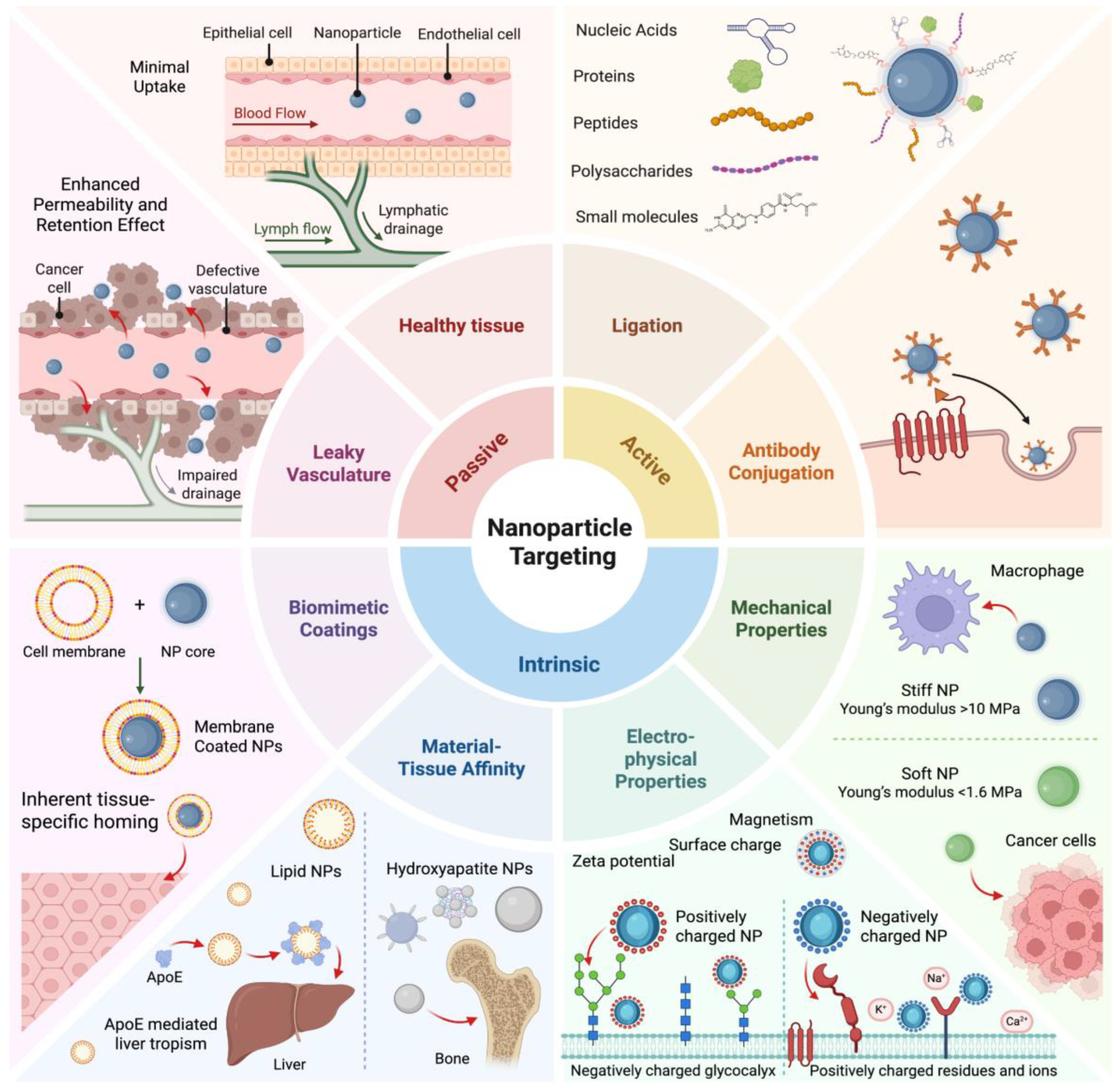
Figure 2.
Functionalized graphene quantum dots crossing through cell membranes in high interstitial fluid pressure conditions. Representative trajectories of the molecular dynamics (MD) simulations with sulfonic-GQDs and amino-GQDs detached from the lipid membranes. The amphiphilic GQDs were composed of a hydrophobic graphene core (2.21 × 2.41 nm2) and a hydrophilic periphery functionalized with SO3– or NH3+. The cell membrane is modeled as a negatively charged phospholipid bilayer for simplification. Water is shown in violet, the GQDs are shown as large spheres (carbon, green; sulfur, yellow; oxygen, red; nitrogen, blue; hydrogen, white) and the phospholipids are shown as tan lines with the hydrophilic charged atoms as small colored spheres (hydrogen, white; oxygen, red; nitrogen, dark blue; carbon, cyan; phosphorus, orange). Reprinted from Bioconjugate Chem. 2017, 28, 10, 2608-2619. [27].
Figure 2.
Functionalized graphene quantum dots crossing through cell membranes in high interstitial fluid pressure conditions. Representative trajectories of the molecular dynamics (MD) simulations with sulfonic-GQDs and amino-GQDs detached from the lipid membranes. The amphiphilic GQDs were composed of a hydrophobic graphene core (2.21 × 2.41 nm2) and a hydrophilic periphery functionalized with SO3– or NH3+. The cell membrane is modeled as a negatively charged phospholipid bilayer for simplification. Water is shown in violet, the GQDs are shown as large spheres (carbon, green; sulfur, yellow; oxygen, red; nitrogen, blue; hydrogen, white) and the phospholipids are shown as tan lines with the hydrophilic charged atoms as small colored spheres (hydrogen, white; oxygen, red; nitrogen, dark blue; carbon, cyan; phosphorus, orange). Reprinted from Bioconjugate Chem. 2017, 28, 10, 2608-2619. [27].
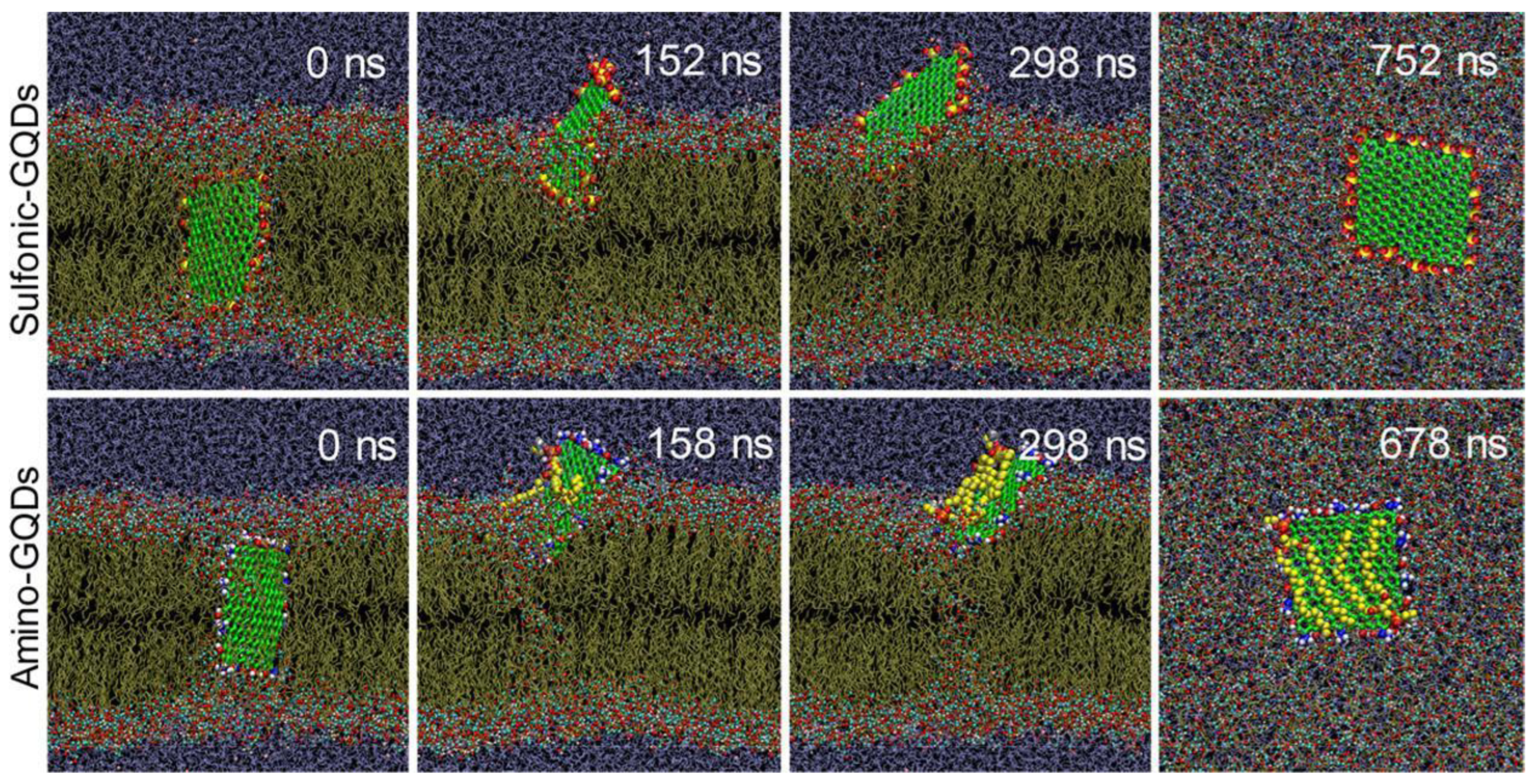
Figure 3.
Cell membrane-coated nanoparticles. A variety of cell types have been used as sources of membranes to coat nanoparticles. Distinct cell membrane types provide unique properties and functionality to nanoparticulate cores. Nanoparticle cores can be selected depending on the desired application. Reprinted with permission from R. H. Fang, A. V. Kroll, W. Gao, L. Zhang, Adv. Mater. 2018, 30, 1706759. Copyright 2018. Advanced Materials. [78].
Figure 3.
Cell membrane-coated nanoparticles. A variety of cell types have been used as sources of membranes to coat nanoparticles. Distinct cell membrane types provide unique properties and functionality to nanoparticulate cores. Nanoparticle cores can be selected depending on the desired application. Reprinted with permission from R. H. Fang, A. V. Kroll, W. Gao, L. Zhang, Adv. Mater. 2018, 30, 1706759. Copyright 2018. Advanced Materials. [78].
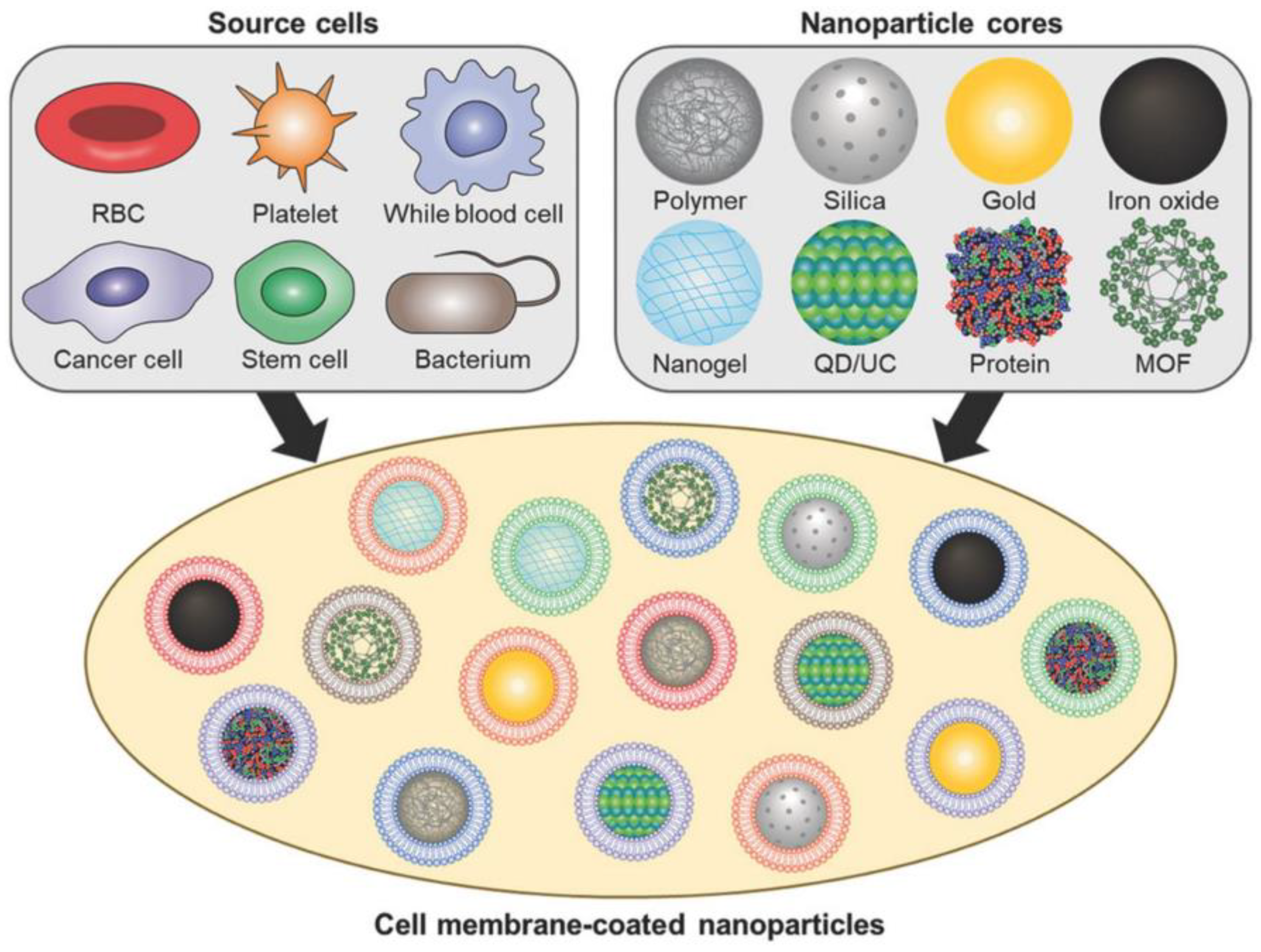
Figure 4.
: Intrinsic macrophage targeting by mechanical forces. Self-assembled rigid nanoparticles with helical polymer shells reprogrammed M2-like TAMs into an M1-like phenotype for tumor immunotherapy. Reprinted with permission from Chem. Eng. J. 2024, 491, 152129. Copyright 2024. [102].
Figure 4.
: Intrinsic macrophage targeting by mechanical forces. Self-assembled rigid nanoparticles with helical polymer shells reprogrammed M2-like TAMs into an M1-like phenotype for tumor immunotherapy. Reprinted with permission from Chem. Eng. J. 2024, 491, 152129. Copyright 2024. [102].
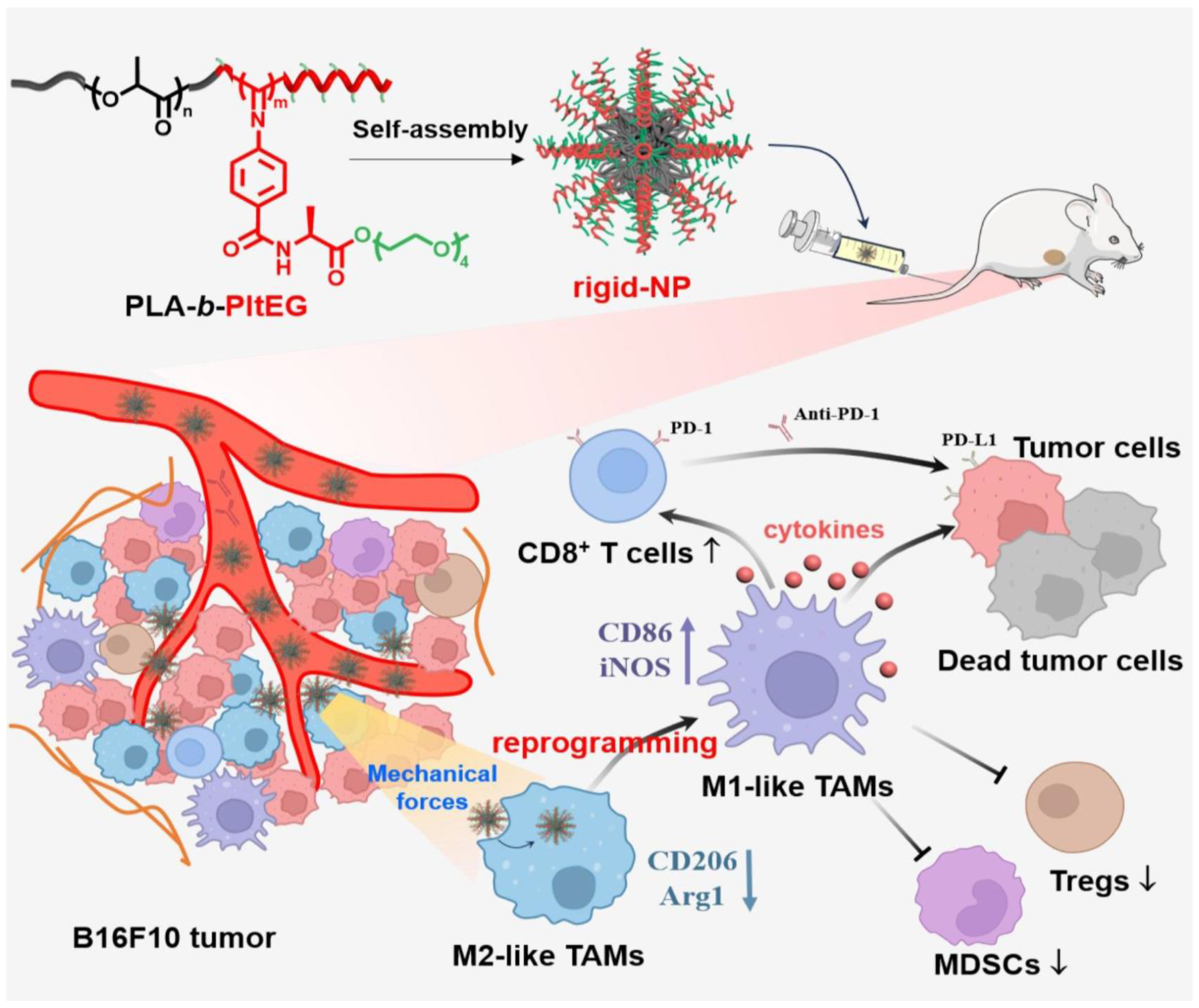
Figure 5.
Intrinsic bacterial targeting via microenvironment selectivity. Zwitterion modified AgNPs showed a pH responsive transition from a negative charge to a positive charge, which enabled the AgNPs to be compatible with mammalian cells and red blood cells (RBCs) in healthy tissues (pH ∼ 7.4), while strongly adhering quickly to negatively charged bacterial surfaces at infectious sites (pH ∼ 5.5) based on electrostatic attraction. Reprinted with permission from J. Mater. Chem. B 7, 830–840 (2019). [111].
Figure 5.
Intrinsic bacterial targeting via microenvironment selectivity. Zwitterion modified AgNPs showed a pH responsive transition from a negative charge to a positive charge, which enabled the AgNPs to be compatible with mammalian cells and red blood cells (RBCs) in healthy tissues (pH ∼ 7.4), while strongly adhering quickly to negatively charged bacterial surfaces at infectious sites (pH ∼ 5.5) based on electrostatic attraction. Reprinted with permission from J. Mater. Chem. B 7, 830–840 (2019). [111].
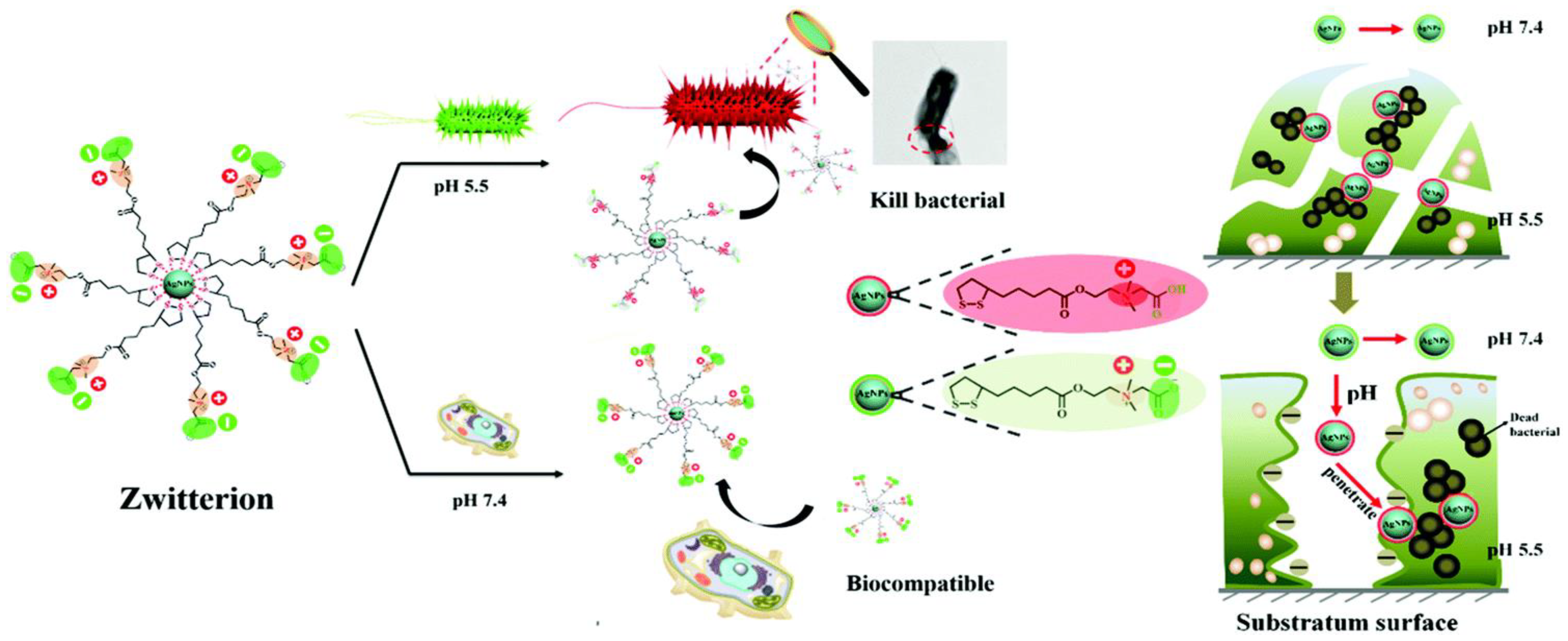
Figure 6.
Inherent tumor cell targeting enabled by iNP mechanical properties. Particle elasticity regulates in vitro cellular uptake. (a) Schematic illustration of nanoliposome–hydrogel complex system. NLP represents nanoliposome encapsulating PBS. Uncrosslinked NLG represents nanoliposome encapsulating uncrosslinked alginate (0 mM CaCl2). Crosslinked NLG represents nanolipogel encapsulating 1–5 mM CaCl2 crosslinked alginate. (b) The internal structure of NPs with various elasticity (NLP-45KPa, NLG-1.6MPa, and NLG-19MPa) characterized by TEM. Scale bars represent 100 nm. (c) The Young’s moduli of synthesized NLP and NLGs characterized by AFM. Relative cellular uptake of synthesized NLP and NLGs by MDA-MB-231 (d), MCF7 (e), and MCF10A (f) cells. Adapted with permission from Nat Commun 9, 130 (2018). [99].
Figure 6.
Inherent tumor cell targeting enabled by iNP mechanical properties. Particle elasticity regulates in vitro cellular uptake. (a) Schematic illustration of nanoliposome–hydrogel complex system. NLP represents nanoliposome encapsulating PBS. Uncrosslinked NLG represents nanoliposome encapsulating uncrosslinked alginate (0 mM CaCl2). Crosslinked NLG represents nanolipogel encapsulating 1–5 mM CaCl2 crosslinked alginate. (b) The internal structure of NPs with various elasticity (NLP-45KPa, NLG-1.6MPa, and NLG-19MPa) characterized by TEM. Scale bars represent 100 nm. (c) The Young’s moduli of synthesized NLP and NLGs characterized by AFM. Relative cellular uptake of synthesized NLP and NLGs by MDA-MB-231 (d), MCF7 (e), and MCF10A (f) cells. Adapted with permission from Nat Commun 9, 130 (2018). [99].
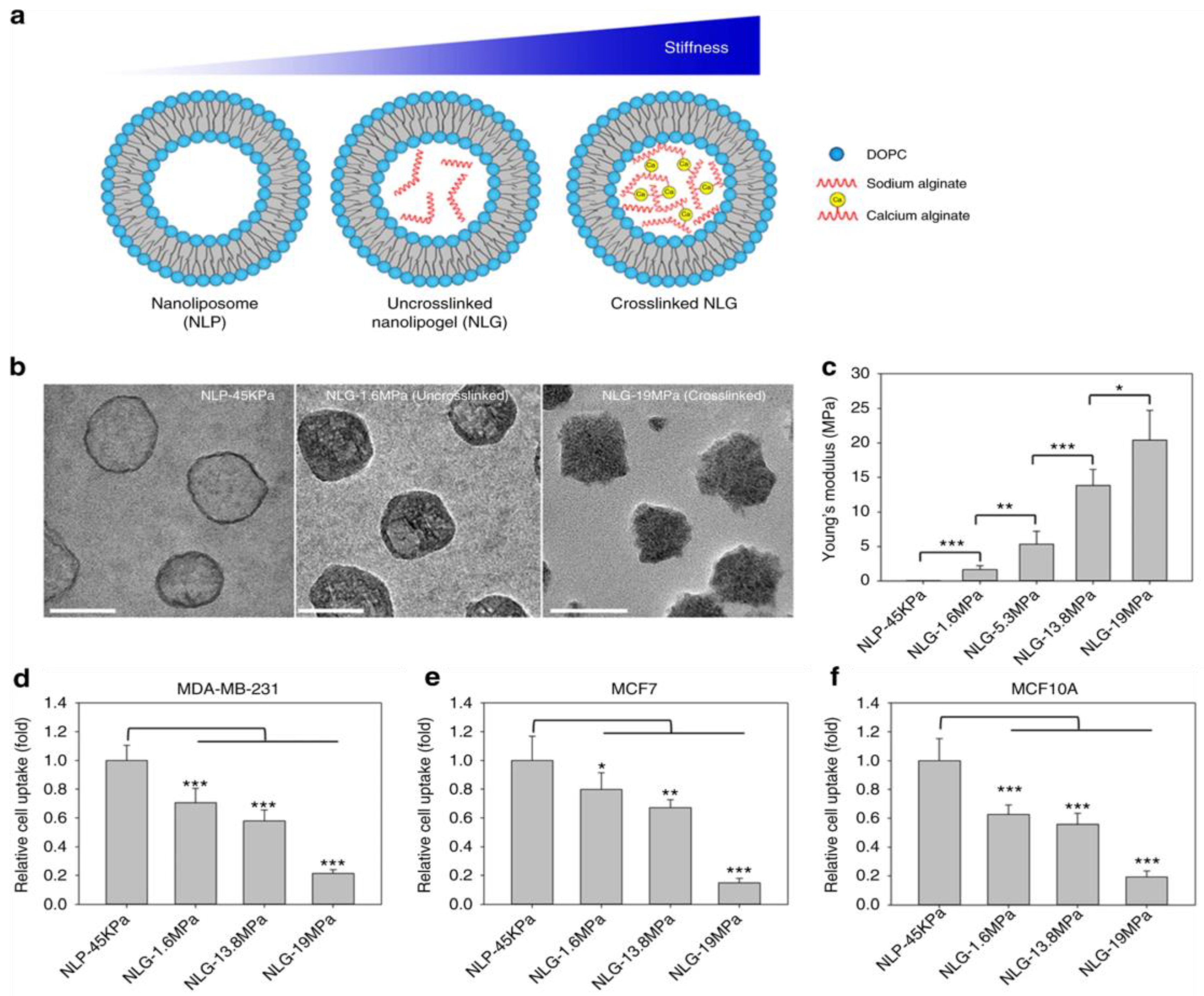
Figure 7.
Exploiting differences in bacterial and eukaryotic cell membranes provides routes for intrinsic selectivity. The fiber-like carbon substrate of TiOx@C nanoparticle is capable of selectively entangling with the peptidoglycan layer of S. aureus, further disrupting the electron transport chain and killing the bacteria by delivering excess electrons to key enzymes of the electron transport chain via TiOx dots. Meanwhile, the carbon substrate of TiOx@C penetrated the cell wall of P. aeruginosa, disrupted the bacterial membrane structure and penetrated into the bacteria, and triggered oxidative stress and protein leakage, thus leading to bacterial death. Reprinted with permission from Nat. Commun. 2025, 16, 2836 [174].
Figure 7.
Exploiting differences in bacterial and eukaryotic cell membranes provides routes for intrinsic selectivity. The fiber-like carbon substrate of TiOx@C nanoparticle is capable of selectively entangling with the peptidoglycan layer of S. aureus, further disrupting the electron transport chain and killing the bacteria by delivering excess electrons to key enzymes of the electron transport chain via TiOx dots. Meanwhile, the carbon substrate of TiOx@C penetrated the cell wall of P. aeruginosa, disrupted the bacterial membrane structure and penetrated into the bacteria, and triggered oxidative stress and protein leakage, thus leading to bacterial death. Reprinted with permission from Nat. Commun. 2025, 16, 2836 [174].
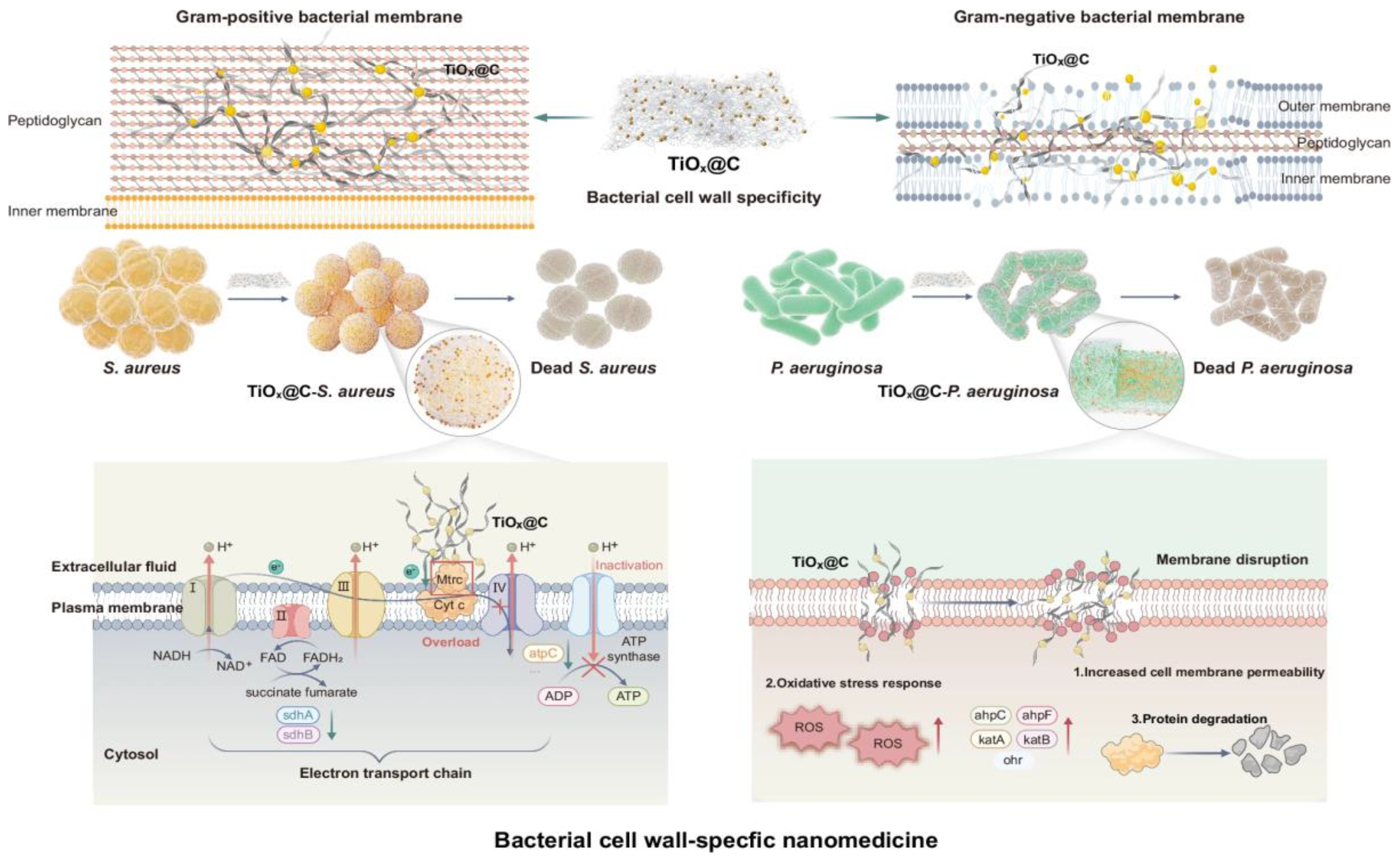
Figure 8.
Triple-modality magnetic resonance imaging–photoacoustic imaging–Raman imaging nanoparticle (MPR) can accurately help delineate the margins of brain tumors in living mice both preoperatively and intraoperatively. The MPRs were detected by all three modalities with at least a picomolar sensitivity both in vitro and in living mice. Reprinted with permission from Nat. Med. 2012, 18, 829–834 [229].
Figure 8.
Triple-modality magnetic resonance imaging–photoacoustic imaging–Raman imaging nanoparticle (MPR) can accurately help delineate the margins of brain tumors in living mice both preoperatively and intraoperatively. The MPRs were detected by all three modalities with at least a picomolar sensitivity both in vitro and in living mice. Reprinted with permission from Nat. Med. 2012, 18, 829–834 [229].
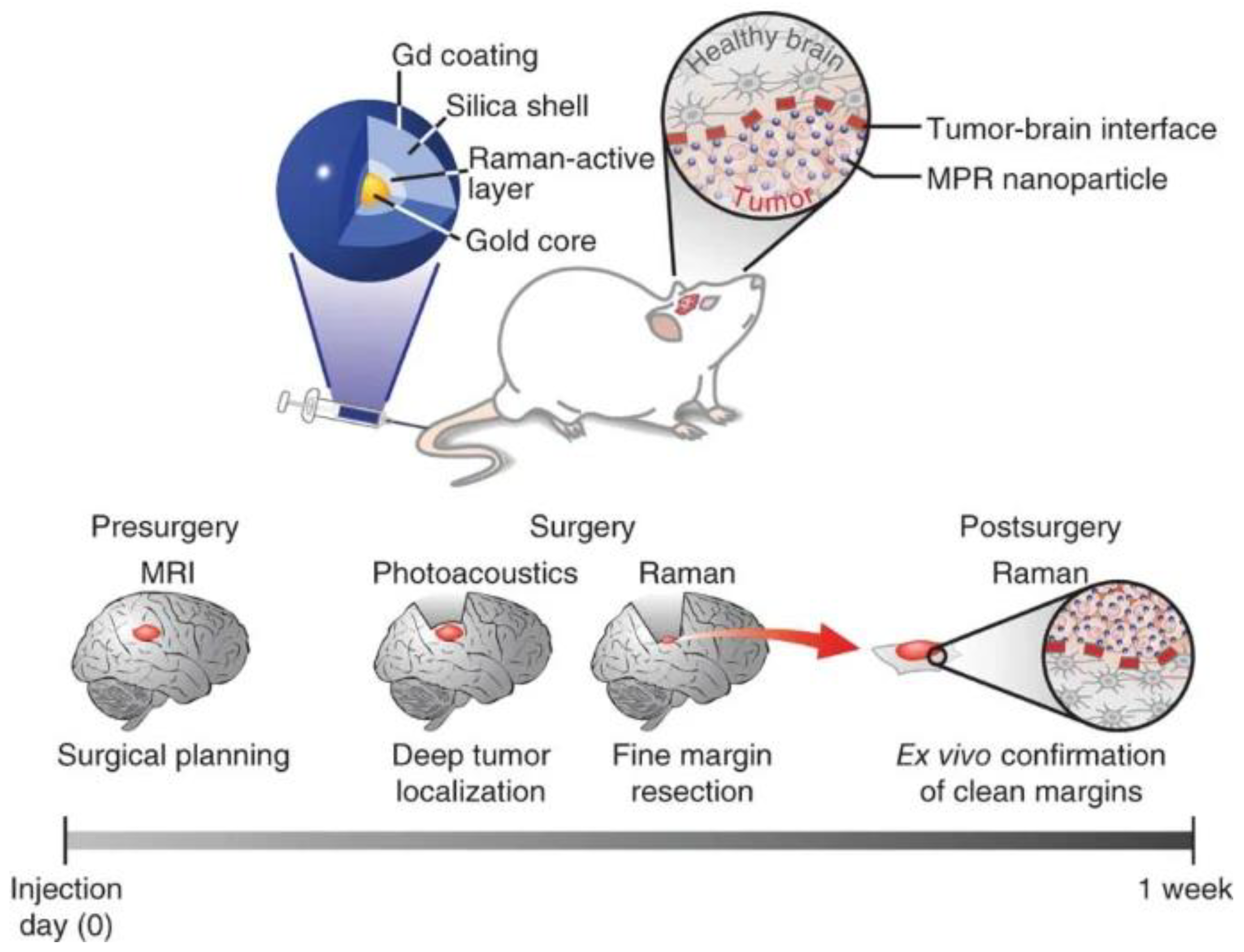
Disclaimer/Publisher’s Note: The statements, opinions and data contained in all publications are solely those of the individual author(s) and contributor(s) and not of MDPI and/or the editor(s). MDPI and/or the editor(s) disclaim responsibility for any injury to people or property resulting from any ideas, methods, instructions or products referred to in the content. |
© 2026 by the authors. Licensee MDPI, Basel, Switzerland. This article is an open access article distributed under the terms and conditions of the Creative Commons Attribution (CC BY) license (http://creativecommons.org/licenses/by/4.0/).
Copyright: This open access article is published under a Creative Commons CC BY 4.0 license, which permit the free download, distribution, and reuse, provided that the author and preprint are cited in any reuse.


