

Submitted:
18 March 2026
Posted:
20 March 2026
You are already at the latest version
Abstract
Unused, underutilized, abandoned, and residual urban spaces are increasingly recognized as potential resources for adaptive reuse, ecological improvement, and urban resilience. In this study, such areas are approached through the overarching concept of waste space, a term used to capture both their condition of underutilization and their transformation potential. While existing research has largely focused on the definition, classification, and emergence of such spaces, their transformation potential under varying spatial and institutional contexts has received comparatively limited attention. Addressing this gap, the study operationalizes selected Social–Ecological Systems (SES) dynamics through spatial analysis in the metropolitan area of İzmir, Türkiye. Using district-level analysis across ten metropolitan districts, the research combines typological and morphological classification of waste spaces with four spatial indicators: Density Index, Location Quotient, Shannon Diversity Index, and Typology Dominance Index. The results show that waste spaces are unevenly distributed across İzmir and form distinct district-level configurations shaped by infrastructure expansion, post-industrial transformation, speculative vacancy, and fragmented urban growth. The study concludes that waste spaces cannot be addressed through a uniform regeneration logic. By linking SES dynamics with measurable spatial indicators, the proposed framework offers a context-sensitive basis for transforming waste spaces and supporting district-specific planning and policy decisions.
Keywords:
waste spaces
; social-ecological systems
; İzmir
; urban transformation
; complex adaptability
; non-linearity
; adaptive governance
; resilience
; sustainability
1. Introduction
Unused, underutilized, abandoned, and residual urban spaces have become a widespread and persistent feature of contemporary cities, reflecting long-term interactions between infrastructure development, planning processes, and institutional fragmentation. Once understood primarily as symptoms of urban decline and frequently stigmatized as blighted or unsafe, such spaces are increasingly recognized as potential resources for sustainable development, urban resilience, and adaptive reuse[1,2,3,4,5,6]. This shift is particularly relevant in metropolitan regions where rapid urbanization coexists with large areas of underutilized land, creating both spatial challenges and opportunities for transformation [7]. A diverse body of urban literature conceptualized these spaces under multiple terms, including brownfields, third landscape, derelict land, vacant land, and urban voids, reflecting their spatial, social, and ecological attributes[8]. This research approaches such areas through the overarching concept of waste space. The term waste inherently carries a negative connotation, generally implying something unused, ruined, or residual. Meanwhile, the term waste in city planning and urban design refers to the outcome of natural and manmade urban processes [9]. One of the first urban theorists to frame this concept systematically was Kevin Lynch in the early 1990s [10]. Although Lynch did not coin the term, he gave it theoretical significance by moving beyond its conventional negative meaning to interpret waste space as a potential resource for rethinking and transforming the city. He characterized waste spaces as physically deteriorated, economically unproductive, socially marginalized or stigmatized, and temporally vacant, but also as potentially productive areas for reuse [10]. Similarly, Alan Berger (2006) [7] explains that contemporary modes of industrial production and consumption generate different forms of waste landscapes, including abandoned or contaminated sites as well as oversized or redundant urban developments, which may hold plural value and latent potential for reuse.
A significant body of literature focuses on the drivers, origins, and categorizations of waste spaces, emphasizing processes such as deindustrialization, financial constraints, suburbanization, and speculative land practices[10,11,12,13]. Parallel studies highlight the social consequences of waste space, including socio-spatial inequality, environmental degradation, and neighborhood decline[14]. While these contributions are essential for understanding how waste space emerges, they offer limited guidance for addressing a critical practical question faced by planners and policymakers: how should urban waste spaces be transformed under different spatial and institutional conditions?
More recent scholarship has sought to move beyond causal explanations by exploring reuse and regeneration strategies, such as adaptive reuse, temporary use, tactical urbanism, and nature-based solutions [15,16,17,18,19]. These studies demonstrate that urban waste spaces can support experimentation, community engagement, and ecological functions [20]. However, this literature often relies on very localized case studies and normative arguments, making it difficult to generalize findings or translate them into decision-support tools applicable at the metropolitan scale [21,22]. Nowadays, a central point of debate in the field concerns whether transformation outcomes are primarily shaped by policy and governance choices or by spatial and morphological configurations. Some scholars argue that institutional arrangements and actor coalitions are the decisive factors in successful regeneration [21]. In contrast, others emphasize the role of urban form, land-use, and spatial discontinuity in shaping transformation capacity [20]. This divergence has led to fragmented analytical approaches, with limited integration among social–institutional analysis, ecologically sensitive approaches, and spatially explicit methods [21,22].
Social–Ecological Systems (SES) theory offers a promising integrative framework for bridging these social, ecological, and spatial dimensions of urban change [23]. Originally developed to study coupled human–environment systems, SES theory conceptualizes cities as complex social-ecological systems shaped by interacting social, ecological, and spatial processes across multiple scales [23]. Within urban research, SES-based approaches have been increasingly employed to examine resilience, sustainability transitions, and governance dynamics[24]. However, these applications have largely remained conceptual, with limited efforts to translate SES dynamics into measurable, spatially explicit indicators that can inform empirical analysis [25,26]. As a consequence, the practical capacity of SES theory to guide planning and policy decisions, particularly those related to reuse strategies and spatial interventions, remains underdeveloped [27]. Accordingly, this study asks how the transformation potential of waste spaces can be assessed across metropolitan districts through SES-informed spatial indicators under varying spatial and institutional conditions.
This study addresses selected SES dynamics as a transformation-oriented analytical framework rather than a theory for explaining the emergence of waste space. It argues that the morphological and typological characteristics of waste spaces can be interpreted as practical spatial proxies for selected SES dynamics, particularly complex adaptability, adaptive governance, cross-scale dynamics, and resilience [28,29,30,31,32,33,34]. By translating these dynamics into a set of spatial indices [35,36,37,38], the study provides an evidence-based approach for differentiating transformation potentials and planning implications rather than prescribing uniform solutions [39].
Using the city of İzmir, Türkiye, as a metropolitan case study area, the research develops and applies a morphology and typology-based framework. For this purpose, waste spaces are classified into three main typologies: vacant parcels, post-industrial sites, and infrastructure-driven spaces. Then, the analysis integrates typological and morphological classification of waste spaces with spatial metrics, including density, location quotient, diversity, and dominance, to assess transformation capacity across districts. One of the main aims of the study is to demonstrate how SES dynamics can be operationalized through spatial analysis to guide the transformation of waste spaces in a context-sensitive and policy-relevant manner.
The principal conclusion is that waste spaces cannot be treated as a homogeneous category. Instead, their transformation potential depends on how spatial pressure, typological diversity, and structural lock-in interact within the urban system. By making these interactions measurable and comparable, the proposed framework helps bridge the gap between urban science and planning practice and offers a transferable decision-support tool for metropolitan regions facing persistent vacancy and uneven development.
2. Theoretical Background
2.1. Social–Ecological Systems Perspective
Urban waste spaces are increasingly evaluated not only as urban residuals but also as components of complex urban systems shaped by interactions among social, ecological, and spatial processes across multiple scales [40,41,42]. SES theory provides one of the most widely used frameworks for analyzing these interactions. SES theory emerged from interdisciplinary research to understand how human and non-human processes interact within shared systems [43,44]. Gradually, the theory has been adopted in urban science to analyze urban transformation, sustainability transitions, ecosystem services, and governance arrangements in cities [45,46,47].
Within the SES approach, urban areas are understood as hybrid socio-ecological environments where infrastructure networks, governance institutions, economic activities, and ecological processes co-evolve over time [41,48,49]. Waste spaces emerge from these intertwined processes. They are simultaneously shaped by planning failures, ownership conflicts, ecological cycles, and social practices [50]. This perspective highlights that when waste spaces are reused adaptively, they can restore ecological functions, improve well-being, and strengthen community and local economies; when neglected, they often generate environmental and social risks.
The SES framework emphasizes that urban areas cannot be understood through isolated variables alone, but through interactions among multiple components operating across spatial and temporal scales [23,42]. In the context of this study, SES theory is not used only as a theoretical framework for understanding the waste space phenomenon, but also as an analytical framework for operationalizing its transformation potential through spatial analysis. In this respect, resilience, complex adaptability, adaptive governance, and non-linear cross-scale dynamics are selective dynamics of SES theory because they can be linked to measurable spatial indicators and used to explain how different waste space typologies and morphologies support or constrain transformation [28,29,51]. Their significance lies not only in their theoretical relevance but also in their capacity to guide us in the spatial interpretation of district-level morphological and typological patterns.
2.2. Key SES Dynamics for Waste Space Transformation
SES theory emphasizes resilience as the capacity of systems to absorb disturbances, reorganize, and adapt while retaining essential structures and functions [33,43]. In urban contexts, resilience is increasingly linked to the reuse of waste spaces for biodiversity, stormwater regulation, urban agriculture, recreation, and cultural activities, thereby enhancing community well-being and social value [32,52]. Hence, waste spaces become a distinctive urban context where resilience is tested and enacted, turning underutilized land into drivers of adaptive and sustainable urban futures.
SES theory also emphasizes the complex adaptability of systems. It means the built environment is a complex social–ecological system in which multiple metabolisms influence each other at different scales, and it calls for many disciplines and approaches to understand its complexity [53]. Waste spaces, when viewed through the lens of SES, become opportunities for complex adaptation and transformation. Hence, complex adaptability becomes a useful analytical tool for transforming degraded, blighted, and problematic spaces in urban landscapes within this conception of the built environment [29,54]. Complex systems are characterized by scale-dependent effects, non-linear behaviors, critical thresholds, intrinsic ambiguity or lack of predictability, innate self-structuring, interlinkages, reliance on past developments, and properties that arise spontaneously. Within this perspective, waste spaces reveal a complex nature involving nonlinearities, planning and policy dimensions, economic conjunctures, and actor–stakeholder interactions across micro and macro scales [55].
Thirdly, adaptive governance within SES theory is a flexible, collaborative approach to managing complex urban areas, particularly in urban transformation [48,56,57]. Hence, it emphasizes experimentation, learning, and coordination among multiple actors to support collaboration and problem-solving in the management of resources, urban landscapes, and ecosystems [58]. In the context of waste space transformation, adaptive governance emphasizes inclusive participation of communities, planners, landowners, decision-makers, and environmental systems to balance ecological, social, and economic goals since these areas have been produced by complex interactions of such human and non-human actors [59]. Its polycentric, multi-level structure helps coordinate actors, institutions, and interventions across scales, thereby strengthening resilience and supporting more sustainable approaches to waste space transformation and reuse [48]. Thus, SES reframes waste spaces as dynamic landscapes of possibility, whose trajectories depend on adaptive governance structures coupled with ecological processes and social practices [51,60].
Ultimately, SES theory challenges urban planners and designers to embrace non-equilibrium, viewing cities as intrinsically unpredictable systems, continuously evolving, and shaped by numerous non-linear interactions [61,62,63]. Within this system, changes occurring at one spatial scale may generate cascading effects across other scales, meaning that local spatial interventions can produce broader systemic consequences. Non-linearity, therefore, underlines that responses within social–ecological systems are not always proportional to the changes introduced, meaning that small alterations in one component of the urban environment may generate disproportionately large and often unpredictable outcomes [31]. This dynamic is particularly important for understanding the waste space phenomenon, which often emerges from interactions between metropolitan and district-scale development processes, infrastructure-driven expansion, and land-use transformations. For instance, urban sprawl may transform previously continuous natural landscapes into fragmented land-cover structures, contributing to the emergence of residual or underutilized urban land [64]. From a transformation perspective, however, recognizing these cross-scale dynamics is equally important for waste space reuse, since interventions that overlook broader metropolitan and district-level processes may unintentionally reproduce similar conditions of vacancy in the future. Within the scope of this research, cross-scale and non-linear dynamics are therefore interpreted through the relative spatial concentration of waste spaces across districts, allowing the analysis to capture how metropolitan-scale processes shape local patterns of waste space and influence the possibilities for their reuse.
2.3. Conceptual Framework
The study develops a conceptual framework (Figure 1) that links the morphological and typological characteristics of waste spaces with SES dynamics discussed above. Therefore, the morphological and typological characteristics of waste spaces are interpreted as spatial proxies of key SES dynamics, including resilience, complex adaptability, adaptive governance, and non-linear cross-scale dynamics. Typological diversity reflects the system’s adaptive capacity, while spatial concentration reveals cross-scale interactions shaping the uneven distribution of waste spaces. Structural dominance signals potential lock-in conditions affecting resilience, whereas overall spatial intensity highlights governance-related processes influencing intervention priorities across districts.
By translating these spatial characteristics into measurable indicators, the framework enables the operationalization of SES dynamics through spatial analysis. This approach allows the study to systematically compare waste space patterns across districts and to interpret their transformation potential within the metropolitan system.
3. Materials and Methods
3.1. Study Area and Scale
The study focuses on the metropolitan area of İzmir, comprising ten major districts: Balçova, Bayraklı, Bornova, Buca, Çiğli, Gaziemir, Narlıdere, Karabağlar, Karşıyaka, and Konak (Figure 2). İzmir is Türkiye’s third-largest city and a major economic, industrial, and transportation hub along the Aegean coast. As of the end of 2025, İzmir’s total population is estimated at 4,504,185 [65]. The urban area extends along the İzmir Bay and inland to the north across the Gediz River Delta, eastward over an alluvial plain shaped by several small streams, and southward into more rugged topography [66]. İzmir’s urban development has been shaped by successive sequences of new settlement and transformation processes, transportation infrastructure development, large-scale urban projects, the loss of previous functions, and plan amendments [67]. As a result, these processes have produced a heterogeneous urban landscape with a significant amount of waste spaces in İzmir [68,69]. Now, these waste spaces coexist with dense residential districts, commercial centers, and transportation corridors [68,70,71,72,73].
İzmir’s metropolitan structure is characterized by remarkable spatial differentiation among its historic core, central districts, and peripheral areas [11,74]. Central districts such as Konak, Bayraklı, and Karşıyaka, which also maintain the city’s strongest relationship with the sea, are characterized by high development density and long-term exposure to infrastructure-led and post-industrial transformation processes [68,75]. In contrast, geographically larger districts such as Bornova, Buca, and Karabağlar encompass extensive urbanized areas shaped by different land-use histories, parcel structures, and planning trajectories [70,75,76]. Peripheral districts such as Gaziemir, Çiğli, and Narlıdere, meanwhile, provide contrasting conditions associated with speculative development, industrial transition, and fragmented urban expansion [77,78,79,80].
The analytical scale of this study is the district level, corresponding to İzmir’s administrative districts. The analysis focuses on ten districts within the İzmir metropolitan area that align with the spatial coverage of the Urban Atlas Land Cover/Land Use 2018 dataset, used here as a standardized basis for district-level evaluation [81]. This scale is deliberately chosen for three reasons. First, district-level evaluation allows for systematic comparison across the metropolitan area while capturing significant variation in urban form and waste space patterns. Second, districts represent a critical governance scale for planning and policy implementation in Türkiye, aligning analytical outputs with decision-making processes related to zoning, regeneration projects, and public investment. Third, identifying characteristics at the district level facilitates the integration of spatial metrics with institutional and policy considerations without oversimplifying local conditions. Importantly, district-level aggregation is used as an analytical device to identify dominant patterns and relative differences in waste space configuration. The underlying assumption is that district-scale morphological and typological profiles can function as indicators of broader system behavior, revealing how the waste space phenomenon accumulates, diversifies, or becomes structurally locked-in over time. In this way, the district-level analysis enables the comparison of how different configurations of urban form relate to waste space patterns within a single metropolitan system. This approach is consistent with SES perspectives that emphasize cross-scale interactions, for instance, whereby local spatial conditions both reflect and influence metropolitan-scale dynamics.
3.2. Data Sources
The spatial delineation of the study area is informed by both analytical objectives and data availability. The ten metropolitan districts were selected deliberately based on their inclusion within the Urban Atlas Land Cover/Land Use 2018 dataset, which provides harmonized, high-resolution land-use information for İzmir’s core metropolitan area. Although the dataset was published in 2026, it represents land-use/land-cover conditions for the 2018 reference year [81]. This does not imply the absence of waste spaces in non-covered districts, but reflects a methodological choice to ensure consistency, comparability, and spatial accuracy in waste space classification. Urban Atlas’s spatial extent corresponds to the most intensively urbanized districts, where processes of urban densification, infrastructure expansion, and post-industrial restructuring are most pronounced. To identify and analyze waste spaces within these districts, the study integrates multiple sources of evidence, including spatial datasets, remote sensing satellite imagery, and field-based observations. These data were compiled and analyzed within a Geographic Information System (GIS) environment using QGIS software, enabling consistent spatial measurement, typological classification, and comparative analysis across districts.
3.2.1. Land Use and Waste Space Identification
The study draws on a combination of secondary spatial datasets and primary field observations to identify, classify, and quantify waste spaces across İzmir’s districts. The main spatial dataset used to identify waste spaces was the Urban Atlas Land Cover/Land Use 2018 dataset, provided by the Copernicus Land Monitoring Service of the European Environment Agency (EEA) [81]. It provides reliable, high-resolution, and comparable land-use and land-cover information for 764 urban Areas with more than 50,000 inhabitants, covering the 2018 reference year across the 38 European Environment Agency (EEA) countries, including EU members, the Western Balkans, and Türkiye [81]. Thus, it is basically a digital thematic land-use/land-cover dataset with a positional accuracy of approximately 2–4 meters, making it suitable for district-scale spatial analysis in İzmir. Its nomenclature and vector-based land-use classes provided me with the point of departure for the identification and morphological assessment of waste spaces across the metropolitan area.
As elaborated in Figure 3 below, waste spaces were first identified through the Urban Atlas nomenclature land without current use (code 13400), which includes derelict, abandoned, and vacant areas without ongoing development or specified use. In addition, the categories mineral extraction and dump sites (13100) and construction sites (13300) include some underutilized areas with former industrial use and brownfields. Thus, some of these areas were also considered within the waste space inventory, since these areas are underutilized lands that remain disconnected from active urban use. To capture the broader spatial logic of waste space production in İzmir, the analysis also included some residual and underutilized areas associated with transportation infrastructure that fall within the categories of fast transit roads and associated land (12210), other roads and associated land (12220), railways and associated land (12230), port areas (12300), and airports (12400). These categories were incorporated because many waste spaces in İzmir emerge adjacent to, beneath, or between major infrastructural systems. Accordingly, waste space was not treated as a single land-use class but as an analytically reconstructed category derived from multiple Urban Atlas nomenclature classes.
This reinterpretation reflects the broader conceptualization adopted in the study, in which waste spaces include vacant parcels, post-industrial areas, and infrastructure-driven residual spaces. This also aligns with the production and emergence patterns of the waste space phenomenon in İzmir, reflecting five recurrent processes within the local urban conjuncture: new settlement and transformation processes, transportation infrastructure development, large-scale urban projects, the loss of previous functions, and plan amendments [75]. Since the Urban Atlas represents land use/land cover conditions for the reference year 2018, its classifications were further verified through the recent Google Earth high-resolution satellite imagery (2026) that was cross-referenced in a QGIS software to assess whether the identified spaces still existed and whether their land-use status had changed. Finally, targeted field visits were used to validate selected locations within ten metropolitan districts and refine the final inventory. A total of four field visits were conducted: the first in November 2023, the second in April 2024, the third in July 2024, and the fourth in October 2025. The field visits covered all ten municipal districts within the İzmir metropolitan area. During field visits, qualitative data were gathered through direct observations of each waste space’s physical characteristics and conditions. Field observations were used to document physical and social conditions, patterns of use, and the occurrence of spontaneous vegetation, helping to capture the evolving characteristics of each waste space. Photographic documentation complemented these observations by providing a visual record of typologies and spatial configurations across the study areas [58]. This multi-step procedure ensured that the waste space database combined the consistency of a standardized land-use dataset with updated visual verification and site-based confirmation.
3.2.2. Spatial Data Processing and GIS-Based Mapping
All spatial data processing and subsequent analyses were conducted within a Geographic Information System (GIS) environment using QGIS software, which provided the primary platform for data integration, measurement, and visualization. The Urban Atlas dataset was first imported and aligned with the İzmir administrative district boundaries from İzmir Metropolitan Municipality Open Data Portal (2024) [82]. To verify and update the latest land-use situation, high-resolution satellite imagery from Google Earth (accessed 26 January, 2025) was integrated and georeferenced within the same coordinate system. This overlay enabled the identification and verification of waste space polygons derived from Urban Atlas land-use categories.
Waste space polygons were subsequently refined through manual digitization and spatial editing to ensure accurate delineation of site boundaries. Each identified polygon was then attributed according to the typological classification adopted in the study. Spatial measurements, including area and perimeter, were calculated using QGIS software. Finally, waste space polygons were aggregated at the district level to enable comparative spatial analysis across the metropolitan area.
Spatial data processing prioritized transparency and replicability. All analytical step including data processing, polygon validation, and aggregation, were documented to facilitate reproducibility. While the study does not rely on proprietary datasets, some planning documents and detailed parcel-level information are subject to institutional access restrictions. These limitations are addressed explicitly in the conclusions.
3.3. Typological Classification of Waste Spaces
A central component of the analytical framework is the typological classification of urban waste spaces. Typological classification is widely used in urban science and land-use research to distinguish different production mechanisms and spatial characteristics of underutilized land [22,83,84]. Meanwhile, it should be noted that this typology is not proposed as a definitive framework for categorizing all waste spaces. Rather, it functions as a guiding reference and feedback mechanism to support planning and transformation processes. In this study, waste spaces were classified into three primary typologies based on their dominant formation processes and spatial characteristics. Each identified waste space polygon was assigned to one of these typologies through the combined interpretation of Urban Atlas land-use classes, high-resolution satellite imagery, and field observations. Field observations further supported the interpretation by verifying site conditions such as vacancy, residual infrastructure spaces, or the presence of former industrial structures. Based on this multi-source interpretation, each polygon was categorized as a vacant parcel, post-industrial site, and infrastructure-driven waste space, as Table 1 below shows.
3.4. Spatial Metrics and Index Construction
To quantify the spatial structure and typological composition of waste spaces across İzmir’s metropolitan districts, a set of spatial indicators was constructed based on a dataset generated in the previous steps. These indicators enabled the systematic comparison of waste space configurations among districts by measuring their spatial intensity, relative concentration, and composition. Rather than relying solely on descriptive statistics, the study employed four complementary spatial metrics that capture different dimensions of the waste space phenomenon: density, relative concentration, typological diversity, and dominance.
Together, these indices provided a multi-dimensional representation of waste space patterns. Density measures the overall spatial intensity of waste spaces within each district, while the Location Quotient evaluates whether waste spaces are disproportionately concentrated compared to the metropolitan average. Typological diversity captures the internal composition of waste space types within each district, reflecting the coexistence of different formation mechanisms. Finally, typology dominance identifies districts where a single waste space type strongly prevails, indicating structural specialization or potential lock-in conditions [22,85,86,87,88,89,90,91,92,93].
All indicators were calculated at the district scale using GIS-based spatial measurements of waste space polygons and district boundaries. Surface areas of waste spaces were first aggregated by typology and district, after which the indices were computed using standard spatial statistical procedures.
3.4.1. Density Index
The Density Index measures the spatial intensity of waste spaces within each district by normalizing the total area of waste spaces by the district’s surface area. Similar density-based indicators are widely used in urban studies to quantify the spatial concentration of specific land-use categories within a defined territory [86,94,95]. In the context of the waste space phenomenon, comparable measures have been employed to evaluate the proportion of vacant, post-industrial, and infrastructure-driven waste spaces relative to total urban area [22,87]. The density index was calculated for every ten metropolitan districts using Equation (1) below.
where;
Di: Density Index
WSarea: Total Waste Space Area (km2)
Darea: District Surface Area (km2)
3.4.2. Location Quotient (LQ)
The Location Quotient (LQ) is an indicator in regional and spatial analysis that measures the relative concentration of a specific factor within a sub-region compared to a larger reference area. Originally developed in economic geography to evaluate regional specialization, the method has been widely applied to examine spatial distributions of industries, social phenomena, and urban activities [88,96,97].
In this study, the Location Quotient (LQ) was employed to assess the spatial concentration of waste spaces across districts in the İzmir metropolitan area. The index compares the share of waste-space area in a district to the district’s share of the total metropolitan area. This indicator matters to show structural specialization, not just the size. Hence, it is significant for comparative urban policy. Equation (2) below shows the calculation formula:
where;
LQi: Location Quatient
xᵢ: Area of typology (i) within the analyzed sub-area (e.g., district)
∑xᵢ: Total area of all typologies within the sub-area
Xᵢ: Area of typology (i) at the larger spatial scale (e.g., city)
∑Xᵢ: Total area of all typologies at the larger spatial scale
The location quotient (LQ) is a non-negative indicator. Values greater than 1 signify that factor i is more concentrated in a given district than in the reference area. In contrast, values equal to or below 1 indicate an average or lower-than-average presence. Increasing LQ values, therefore, reflect stronger spatial concentration of the factor. The resulting values indicate whether waste spaces are over-represented or under-represented in a district relative to the metropolitan structure:
- LQ > 1 → waste spaces are more concentrated than expected, indicating spatial clustering or specialization;
- LQ = 1 → waste-space distribution is proportional to the district’s share of metropolitan land;
- LQ < 1 → waste spaces are less concentrated than expected, indicating a relative deficit.
3.4.3. Shannon Diversity Index (H′)
Originally developed in information theory [98,99] and gradually applied in ecology to measure species diversity [100], The Shannon–Wiener index, commonly referred to as the Shannon diversity index (H), has also been adopted in urban studies to quantify the diversity of land-use categories and spatial elements within urban systems [101,102,103,104] because it captures both the number of categories present and the evenness of their distribution. The study employed the index to assess and quantify the typological diversity (e.g., vacant parcels, post-industrial sites, infrastructure-driven spaces) of urban waste spaces within every ten districts. The index is calculated as in Equation (3) below:
where:
H′: Shannon Diversity Index (− (p₁ ln p₁ + p₂ ln p₂ + p₃ ln p₃)),
—Σ: Indicates that the calculation is performed for all typological categories (i) from 1 to n. The sign (—) ensures that the final index value is positive, since ln(pᵢ) is negative for 0 < pᵢ < 1.
i: Typology category index (e.g., infrastructure-driven, vacant, post-industrial).
n: Total number of waste space typologies considered in the district (in this study, n = 3).
pᵢ: Corresponds to the proportion of each waste space typology ((i) e.g., infrastructure-driven, vacant, and post-industrial)) relative to the total waste space area of the district;
ln(pᵢ): Natural logarithm of the proportion of typology i.
The index takes non-negative values. The Shannon Diversity Index ranges between 0 and ln(n), where n represents the number of categories considered, as seen in the above formula, with higher values indicating greater diversity and mixed typologies. In contrast, lower values suggest that one or a few categories dominate the system. Therefore, typological diversity is used as a spatial indicator for complex adaptability, as a more heterogeneous waste space structure suggests a broader range of potential transformation options. Conversely, strong typological dominance indicates greater structural rigidity and potential lock-in, which may constrain adaptive capacity.
3.4.4. Typology Dominance Index (TDI)
The Typology Dominance Index (TDI) is widely used in landscape ecology for land-use diversity and dominance analysis, where dominance is defined as the proportion of the largest class within a spatial unit [105,106]. In this study, TDI complements the diversity analysis by measuring the extent to which a single waste space typology dominates the overall composition of waste spaces within a district, following the logic of dominance used in land-use diversity analysis. Unlike the Shannon Diversity Index that captures the distribution among multiple categories[107,108], TDI focuses on the relative dominance of the most prevalent typology [91,109,110], which signals structural rigidity and path dependency. Hereby, TDI values range between 0 and 1. Higher TDI values, where values approaching 1 indicate that a single typology overwhelmingly dominates the district’s waste space structure, suggesting low typological diversity and high structural rigidity. Lower TDI values closer to 0.33 (in the case of three typologies) reflect a more balanced distribution among typologies, implying greater structural flexibility and multiple transformation pathways. The index formula is shown in Equation (4) below as:
where:
TDIi: Typology Dominance Index, measuring the degree to which a single waste space typology dominates the overall typological structure within a district
max(pᵢ): The largest typology share within the district (i.e., the dominant waste space typology)
4. Results
4.1. Spatial Distribution and Concentration of Waste Spaces
The spatial analysis reveals interesting variations in the distribution of urban waste spaces across İzmir’s ten metropolitan districts. As illustrated in Figure 4 below, waste spaces are not homogenously dispersed across the metropolitan territory. Instead, their spatial distribution, as seen also in Scheme 1, displays clear clustering patterns associated with central urban areas, major infrastructure corridors, and historically industrialized districts. Concentrations are particularly visible in the northern and central parts of the metropolitan area, including Konak, Bayraklı, Karşıyaka, and Bornova, whereas peripheral districts contain comparatively smaller inventories.
District-level comparison further highlights these spatial disparities. This variation becomes more explicit when visualized through a district-level choropleth representation (Figure 5), which highlights the relative intensity differences across the metropolitan structure. As summarized in Table 2 below, Bornova contains the largest total amount of waste space within the study sample (1.784 km²), followed by Bayraklı (0.969 km²), Çiğli (0.886 km²), Karşıyaka (0.801 km²), and Konak (0.789 km²). On the other hand, Narlıdere contains the smallest inventory of waste spaces (0.025 km²), while Balçova (0.126 km²) also displays a relatively limited amount of waste space. These differences reflect the contrasting development trajectories of the districts, as central and industrialized districts have experienced more intense infrastructure development, industrial restructuring, and redevelopment pressures than peripheral areas.
To account for differences in district size, the spatial intensity of waste spaces was further evaluated using the Density Index, which normalizes the total area of waste spaces by the surface area of each district. The results indicate considerable variation in the relative spatial intensity of waste spaces across the metropolitan area. Konak and Bayraklı exhibit the highest density values, indicating that waste spaces occupy a comparatively large proportion of district territory. Karşıyaka also displays a relatively high density value, while Bornova, Balçova, Gaziemir, Karabağlar, and Çiğli show moderate density levels, suggesting that waste spaces form a visible component of their spatial fabric. By contrast, districts such as Buca and Narlıdere display considerably lower density values, indicating that waste spaces occupy only a limited share of district territory. In these districts, waste spaces tend to appear more fragmented and spatially dispersed, reflecting different urbanization dynamics and lower levels of infrastructural or industrial restructuring.
The Location Quotient (LQ) analysis further refines this spatial interpretation by comparing the concentration of waste spaces in each district relative to the overall district sample. Districts with LQ values above 1, including Konak, Bayraklı, Karşıyaka, and Bornova, contain above-average concentrations of waste spaces within the metropolitan structure. Balçova presents a value close to 1, suggesting a near-average distribution of waste spaces within the district. Conversely, districts such as Buca, Narlıdere, Çiğli, Gaziemir, and Karabağlar display LQ values below 1, indicating that waste spaces are underrepresented relative to the overall distribution within the study area.
Overall, these findings demonstrate that waste spaces in İzmir are characterized by clear spatial concentration patterns rather than uniform metropolitan distribution. However, spatial concentration alone does not fully explain the internal structure of waste spaces across districts. The following section, therefore, examines the typological and morphological patterns through which waste spaces are formed within the metropolitan landscape.
4.2. Typological and Morphological Patterns of Waste Spaces
The typological classification of waste spaces reveals substantial variation in the internal composition of waste spaces across the ten metropolitan districts. As shown in Table 3 and Figure 6 below, three main typologies of vacant parcels, post-industrial sites, and infrastructure-driven waste spaces occur throughout the metropolitan area, but their relative proportions vary significantly between districts. Typological percentages were calculated based on the total waste space area within each district.
Vacant parcels constitute the dominant typology in most districts. This pattern is particularly evident in Buca (95.7%) and Narlıdere (100%), where vacant parcels represent the overwhelming majority of waste spaces, as well as in Karabağlar (80.0%) and Çiğli (76.1%), where vacancy also accounts for a large proportion of the waste space inventory. In Bayraklı, vacant parcels also have the largest share (55.6%), followed by significant post-industrial (25.1%) and infrastructure-driven typologies (19.3%).
Other districts have different typological structures. Karşıyaka (62.5%) and Balçova (65.4%) are characterized primarily by infrastructure-driven waste spaces, reflecting the strong influence of transportation corridors and infrastructural fragmentation within these districts.
In contrast, post-industrial waste spaces are particularly visible in (55.5%) and Gaziemir (46.4%), where former industrial facilities have left large underutilized areas within the urban fabric. These spaces tend to be larger and more spatially connected than vacant parcels, reflecting their origins in big former industrial and logistical activities.
Among all districts, Bornova represents the most balanced typological composition, with relatively similar shares of vacant (37.1%), infrastructure-driven (34.8%), and post-industrial waste spaces (28.2%). This balanced distribution distinguishes Bornova from districts such as Buca or Narlıdere, where a single typology clearly dominates the waste-space structure.
These typological differences are also associated with distinct morphological patterns within the urban fabric. Vacant parcels often appear as fragmented and irregularly shaped spaces dispersed throughout residential or transitional urban areas. In contrast, post-industrial waste spaces typically form larger consolidated blocks, reflecting their historical association with large-scale production sites. Infrastructure-driven waste spaces, on the other hand, frequently display linear or corridor-based morphologies emerging under viaducts and highways, and adjacent to railways and other transportation infrastructures.
4.3. Typological Diversity and Structural Dominance
While typological composition reveals which types of waste spaces exist in each district, additional insight can be obtained by examining the internal balance between these typologies. The Shannon Diversity Index was therefore calculated to evaluate the degree of typological diversity within each district.
As summarized in Table 4, Bornova exhibits the highest diversity value (H′ = 1.092), indicating the most balanced distribution among the three waste-space typologies (vacant 37.1%, infrastructure-driven 34.8%, post-industrial 28.2%). Relatively high diversity values are also observed in Gaziemir (H′ = 1.007), Bayraklı (H′ = 0.991), and Konak (H′ = 0.989), where multiple types of waste spaces coexist within the district structure. These districts, therefore, display more heterogeneous waste-space configurations than those dominated by a single typology.
Moderate diversity levels are found in Karşıyaka (H′ = 0.867) and Balçova (H′ = 0.840), where one typology is clearly dominant but other categories still retain a visible presence (e.g., infrastructure-driven spaces account for 62.5% in Karşıyaka and 65.4% in Balçova). Lower diversity values exist in Çiğli (H′ = 0.675) and Karabağlar (H′ = 0.500), reflecting stronger concentration around a single typological category (vacant parcels represent 76.1% and 80.0%, respectively).
The lowest diversity levels are observed in Buca (H′ = 0.177) and Narlıdere (H′ = 0.000), where waste spaces are overwhelmingly dominated by a single typology (vacant parcels account for 95.7% in Buca and 100% in Narlıdere). In these districts, the internal structure of waste spaces is therefore considerably more homogeneous than in districts with higher diversity values.
In addition to diversity, the Typology Dominance Index (TDI) was calculated to identify districts where a single typology strongly dominates the waste-space structure. Higher dominance values indicate districts where waste spaces are primarily structured around one typological category, while lower values suggest a more balanced internal composition. The highest dominance values occur in Narlıdere (TDI = 1.000) and Buca (TDI = 0.957), followed by Karabağlar (TDI = 0.800) and Çiğli (TDI = 0.761), confirming the strong prevalence of vacancy in these districts. By contrast, lower dominance values are observed in Bornova (TDI = 0.371), Gaziemir (TDI = 0.464), Bayraklı (TDI = 0.556), and Konak (TDI = 0.555), indicating more balanced typological structures.
Overall, the diversity and dominance indices demonstrate that waste spaces across İzmir exhibit significant variation in their internal typological structures. Some districts display heterogeneous configurations with multiple typologies coexisting (e.g., Bornova H′ = 1.092), while others are characterized by strong specialization around a single waste-space form (e.g., Narlıdere TDI = 1.000; Buca TDI = 0.957).
4.4. Synthesis of District-Level Waste Space Profiles
The combined reading of spatial indicators and typological characteristics reveals several distinct district-level waste-space configurations across the metropolitan area. As summarized in Table 5, the synthesis integrates spatial concentration indicators (density index and location quotient), typological diversity (Shannon index), and structural dominance (TDI) to compare waste-space structures across districts.
The results indicate that districts differ not only in the amount of waste space they contain, but also in the internal structural composition and dominant urban processes shaping these spaces. One configuration corresponds to diversified waste-space districts, where multiple typologies coexist, and diversity values are relatively high. These districts display balanced typological shares and lower dominance values, indicating heterogeneous waste-space structures. In the study area, Bornova (H′ = 1.092; TDI = 0.371) represents the distinct example of this configuration, reflecting the interaction of several urban processes, including infrastructure development, industrial restructuring, and urban expansion. A second configuration includes vacancy-dominated districts, where vacant parcels constitute the dominant share of waste spaces and diversity values remain comparatively low. These districts typically exhibit strong typological dominance and highly fragmented spatial structures associated with incomplete development processes and speculative land holding. Examples include Buca (TDI = 0.957) and Karabağlar (TDI = 0.800), where vacancy accumulation forms the dominant pattern. Çiğli also aligns with this configuration, displaying relatively high dominance (TDI = 0.761) and a strong concentration of vacant land.
A third configuration corresponds to infrastructure-driven districts, where waste spaces emerge primarily as residual areas associated with transportation infrastructure. These districts are characterized by corridor-based and linear spatial patterns linked to highways, railways, and other transport networks. Karşıyaka and Balçova illustrate this configuration, where infrastructure-related fragmentation strongly influences the spatial formation of waste spaces. Particularly, Balçova exhibits a near-average level of spatial concentration (LQ ≈ 1), indicating that infrastructure-driven waste spaces are embedded within a relatively balanced district structure. Finally, post-industrial districts represent another distinct configuration, where large parcels associated with former industrial activities dominate the waste space landscape. These districts reflect the spatial legacy of industrial decline and production relocation within the metropolitan area. Konak and Gaziemir illustrate this pattern, where post-industrial transformation processes shape the current distribution of waste spaces.
5. Discussion
5.1. Waste Spaces as Social–Ecological System Components
The results highlight that waste spaces in İzmir are not as isolated residual spaces or leftovers after planning anomalies. Rather, their metropolitan distribution, typological composition, and district-level structural differences indicate that they are embedded within complex social, ecological, and spatial processes. This interpretation is consistent with Social–Ecological Systems (SES) theory, which conceptualizes urban environments as coupled and evolving systems shaped by interactions among infrastructure, governance, land use, ecological processes, and human activities [40,41,42,43,44]. In this sense, waste spaces in İzmir emerge not outside the urban system, but from within it.
This systemic and analytical perspective is particularly important because the results reveal that waste spaces are not distributed randomly across the metropolitan area. The Density Index and Location Quotient (LQ) indicate that districts such as Konak, Bayraklı, and Karşıyaka have more intense and concentrated waste-space configurations than other districts, while Bornova also demonstrates an above-average concentration within a more balanced spatial structure. At the same time, typological composition varies markedly across districts. These patterns show that waste spaces are shaped by cumulative urban processes, including industrial decline, infrastructure-led fragmentation, redevelopment pressure, speculative landholding, and delayed planning implementation [11,12,27]. This also supports the idea within urban science research arguing that the waste space concept should be approached as a strategic urban phenomenon rather than as leftovers with solely negative value [18,22,34].
When we approach through this lens, the district-level waste space patterns in İzmir point to different socio-spatial trajectories of waste space production and persistence. Central districts with high-density urban fabrics and strong redevelopment pressures tend to contain more concentrated and mixed waste space formations, whereas peripheral districts tend to display more fragmented forms of waste space. Thus, the results establish the argument that waste spaces are spatial manifestations of broader urban system behavior, and that their interpretation requires a framework capable of linking local morphology to wider metropolitan dynamics. SES theory offers a holistic and interdisciplinary framework because it allows these patterns to be understood not only in terms of land use but also in relation to adaptability, governance, resilience, and cross-scale interactions [46,47].
5.2. SES Dynamics and Transformation Capacity
5.2.1. Complex Adaptability
The district-level pattern identified in İzmir is interpreted through several interrelated SES dynamics, particularly complex adaptability, adaptive governance, resilience, and non-linear cross-scale interactions. Firstly, the findings significantly support an interpretation through complex adaptability. Here, the Shannon Diversity Index (H′) and the Typology Dominance Index (TDI) are especially revealing. Districts such as Bornova, Gaziemir, Bayraklı, and Konak show relatively high diversity and lower dominance values. By contrast, districts such as Buca, Narlıdere, Karabağlar, and Çiğli are much more strongly dominated by a single typology. In the SES framework, this distinction is important because adaptability depends on the capacity of systems to reorganize, accommodate different trajectories, and generate new configurations under changing conditions [29,30,53,54]. Typological diversity is therefore not merely a descriptive characteristic of waste-space composition. It functions as a spatial indicator of whether a district may support multiple transformation options or whether it is constrained by structural rigidity. Thus, importantly, a more heterogeneous waste space configuration demonstrates a broader range of possible interventions, including adaptive reuse, ecological restoration, incremental redevelopment, or mixed public-space strategies.
Conversely, high typological dominance points to stronger path dependency and lower structural flexibility. This interpretation aligns with studies emphasizing that waste spaces should be differentiated according to their internal conditions, production processes, and reuse capacities rather than treated as a single category [22,83,84].
5.2.2. Non-Linear Cross-Scale Dynamics
From a transformation perspective, the results also highlight the importance of non-linear cross-scale dynamics. It emphasizes that urban systems are marked by cross-scale interactions, feedbacks, thresholds, and nonlinear responses, meaning that transformation strategies in waste space reuse require dedicated integration of local and larger urban processes [39,111]. In the study area, the Location Quotient shows that waste spaces are disproportionately concentrated in specific districts relative to the ten-district metropolitan sample. This indicates that the current distribution of waste spaces is shaped not only by parcel-specific conditions but also by broader metropolitan processes. In other words, waste spaces tend to accumulate where district-level conditions intersect with larger urban transformations, a very common urban trajectory in other Turkish metropolitan cities [11,58,74,75].
This serves us as a very critical departure point for reuse. If interventions are designed only at the parcel scale, without considering the wider district-level and metropolitan processes that have produced these spaces, similar conditions of vacancy and underutilization may persist or re-emerge elsewhere [20,27,34]. Cross-scale dynamics are therefore substantial not only for understanding the uneven accumulation of waste spaces, but also for framing more effective transformation strategies. The reuse approaches should then be considered through site-by-site interventions, but also should engage with broader patterns of infrastructure development, industrial land transition, and spatial restructuring, particularly in districts such as Konak, Bayraklı, and Karşıyaka.
5.2.3. Adaptive Governance
The Density Index provides a significant spatial basis for discussing adaptive governance, although more indirectly. Districts with high density values, for instance, Konak, Bayraklı, and Karşıyaka involve waste spaces that occupy a significant share of the district fabric and where planning intervention is likely to require stronger coordination, prioritization, and institutional flexibility, obviously. This study does not claim to measure governance directly; rather, it identifies the spatial conditions under which governance complexity becomes more visible. This is consistent with the adaptive governance literature within SES theory, which emphasizes flexible, collaborative, and multi-level coordination in complex socio-ecological contexts [48,51,57]. In this context, districts with high density values may be seen as areas where stronger governance among planning institutions, municipalities, and other relevant actors is likely to be required.
5.2.4. Resilience
In waste space reuse, resilience becomes very critical because it determines whether districts can move beyond underutilization and accept changes without reproducing the same spatial problems in new forms. As evident in the results, the Typology Dominance Index (TDI) identifies which districts are more constrained by a single waste space type and therefore require more focused and engaged transformation strategies. Districts with lower TDI values, such as Bornova and Gaziemir, have a more balanced typological structure and support a broader combination of interventions, including adaptive reuse, ecological improvement, and phased redevelopment. Bayraklı, Konak, and Karşıyaka have a more intermediate position, since one typology remains more visible in each district, while the coexistence of secondary typologies still might enable differentiated and combined interventions. On the other hand, districts with high TDI values, such as Buca, Narlıdere, Karabağlar, and Çiğli, are structured around one dominant typology, which narrows the range of feasible interventions and ties reuse more closely to a single production logic. This is important because transformation in these districts cannot rely on mixed or flexible strategies to the same extent. Instead, it can respond directly to the dominant form of waste space. In practical angle, higher dominance means greater rigidity in the district-level waste space structure, while lower dominance provides a broader basis for change. This approach is also mentioned in social-ecological resilience literature, which links the capacity to absorb change and reorganize to the diversity and structure of system components [24,33].
5.3. Planning and Policy Implications
The results show that waste space transformation in İzmir cannot be managed through a single metropolitan regeneration model. This is readable from the Density Index, Location Quotient, Shannon Diversity Index, and Typology Dominance Index. This means that the same planning and policy implications would not be feasible in Konak, Bayraklı, Bornova, Buca, Karşıyaka, and Gaziemir districts. For instance, waste spaces in districts with high density and high concentration, e.g., Konak, Bayraklı, and Karşıyaka, can be evaluated as priority intervention areas because waste spaces are a very interwoven component of the urban fabric. In these districts, municipalities need coordinated district-scale programmes rather than isolated parcel decisions that became a very common practice recently in the administrative agenda of decision makers [12,70,72]. This can involve the preparation of district inventories, which these typological and morphological outputs may help, prioritization of strategic sites, and the use of phased redevelopment tools that can combine adaptive reuse, temporary activation, and selective redevelopment within the same planning area.
The typological results also point to different policy tools for different district profiles. In Buca, Karabağlar, and Narlıdere, where vacant parcels dominate and the TDI is high, the main issue is not heritage of the post-industrial sites or infrastructure fragmentation, but the persistence of delayed development and speculative landholding. In such districts, transformation policy should focus on including stronger implementation controls, negotiated acquisition where inactivity is prolonged, temporary lease-based public use, and planning incentives tied to time-bound development. By contrast, in Konak and Gaziemir, where post-industrial waste spaces play a major role, the policy problem is more complex. Here, reuse strategies to bring back these spaces to life depend on dealing with large parcel structures, obsolete industrial functions, possible contamination, and high remediation costs. That is why these areas require very targeted redevelopment frameworks, brownfield remediation programs, and public–private financing models rather than generic planning policies. In Karşıyaka and Balçova, where infrastructure-driven spaces are more visible, transformation should focus less on conventional redevelopment and more on corridor-level integration, accessibility, interconnectedness, green-infrastructure development, landscape continuity, and the productive reuse of residual land adjacent to transport systems. Because such typological and morphological waste spaces have the potential to be repurposed as linear public spaces that support community use and ecological functions, thereby enhancing urban resilience and strengthening connections between surrounding neighborhoods, as evident in practices from Turkey and the USA of the Nezahat Gökyiğit Botanical Garden, the Mecidiyeköy Under-Viaduct Transformation, and the Under the Elevated projects [112,113,114].
In more diverse districts such as Bornova, Bayraklı, Konak, and Gaziemir, the coexistence of several waste space types means that transformation cannot rely on one tool alone. Hereby, the Shannon Diversity Index is especially useful for deciding whether planning should proceed through a single-track or a multi-track strategy. These districts are better suited to mixed strategies that combine ecological rehabilitation, adaptive reuse, temporary use, and parcel-scale redevelopment. In more specialized districts such as Buca and Narlıdere, where one typology overwhelmingly dominates, the planning agenda is narrower and should be tied more directly to the dominant form of underutilization. Likewise, the Typology Dominance Index is not only descriptive because it can inform decision-makers where flexible combinations are realistic and where transformation will be constrained unless the dominant typology is addressed directly. In this sense, the indices are useful not just for diagnosis, but for selecting the scale and type of intervention.
The adaptive governance dynamic is also equally concrete. Districts with high Density Index values and high LQ values are the places where project-by-project action is least likely to be sufficient. In Konak, Bayraklı, and Karşıyaka, transformation requires stronger coordination between metropolitan and district municipalities, administrative infrastructural actors, landowners, and, obviously, local communities. This is where adaptive governance becomes an operational tool rather than a conceptual one. That means it turns out to be not as a general institutional framework, but as the need to build procedures that can coordinate fragmented responsibilities, sequence interventions over time, and keep sites from remaining inactive while long-term redevelopment is negotiated [59]. Where immediate redevelopment is blocked by ownership disputes, contamination, or financial infeasibility, for instance, interim-use models should be treated as a planning instrument rather than as an informal exception. Temporary public access, lease agreements, low-cost ecological activation, and hybrid financing of public-private partnerships can keep waste spaces in public use while longer-term transformation is prepared [16,115].
An eventual consideration is policy design at the metropolitan level. The Location Quotient results show that waste spaces are not simply a district problem, but they are unevenly concentrated outcomes of broader metropolitan development. This indicates that İzmir needs not only district-specific projects, but also a metropolitan policy framework that formally recognizes waste spaces as a distinct planning category. Such a framework can include a citywide inventory, legal recognition of interim uses, mechanisms for negotiated acquisition or land assembly, and incentives that can support remediation and temporary activation. Without such instruments, districts with high waste space concentration will continue to reproduce underutilization even when individual sites are redeveloped, or at least involved in future master plans.
6. Conclusions
This study demonstrated that the waste space phenomenon in the İzmir metropolitan area does not represent a single urban condition, but a set of distinct district-level configurations with different transformation capacities. Their distribution, typological composition, and internal structure vary significantly across districts, producing different transformation conditions within the metropolitan system. By combining Density Index, Location Quotient, Shannon Diversity Index, and Typology Dominance Index, the research demonstrated that waste spaces are shaped not only by local site conditions but also by broader processes of industrial restructuring, infrastructure expansion, speculative vacancy, and uneven urban development. In this sense, waste spaces in İzmir are better understood as differentiated district-level configurations rather than as a single metropolitan phenomenon.
Therefore, a central contribution of the study is the operationalization of four significant Social–Ecological Systems (SES) dynamics through measurable spatial indicators. The results showed that typological diversity is associated with broader transformation options, while strong typological dominance points to structural rigidity and more limited reuse capacity. Likewise, the concentration of waste spaces across districts highlighted the importance of cross-scale metropolitan processes, indicating that parcel-based interventions alone can be insufficient where underutilization is reproduced by wider urban dynamics. By linking morphology and typology to SES-based interpretation, the study aimed to move the discussion within urban science from why waste spaces emerge toward how their transformation can be differentiated under varying spatial and institutional conditions.
The findings also provide a practical planning and policy implications framework for metropolitan governance. Districts with high concentration and diversity require integrated and holistic strategies, whereas districts dominated by a single typology require more targeted responses tied to the prevailing form of underutilization. Post-industrial sites call for redevelopment frameworks sensitive to large parcels, remediation needs, and obsolete functions, while infrastructure-driven waste spaces require corridor-based strategies focused on connectivity, landscape continuity, and public use. In this respect, the framework offers a comparative basis for identifying priority areas, selecting appropriate intervention tools, and aligning district-level action with wider metropolitan policy.
The study also has some limitations. It is based on a cross-sectional spatial dataset and therefore does not capture the temporal evolution of waste spaces and the full institutional complexity of governance processes. For this reason, future research could extend the framework by incorporating temporal change, ownership structure, and governance indicators. However, even with these limitations, the study provides a robust and transferable foundation for evidence-based planning and policy direction in cities facing similar underutilization, fragmented urban growth, and uneven development. Rather than treating waste spaces as leftovers of urbanization, the research positions them as strategic components of metropolitan transformation.
Supplementary Materials
The following supporting information can be downloaded at the website of this paper posted on Preprints.org.
Funding
This research received no external funding.
Data Availability Statement
Suggested Data Availability Statements are available in section “MDPI Research Data Policies” at https://www.mdpi.com/ethics.
Acknowledgments
The authors have reviewed and edited the output and take full responsibility for the content of this publication.
Conflicts of Interest
The authors declare no conflicts of interest.
Abbreviations
The following abbreviations are used in this manuscript:
| SES | Social Ecological System |
| GIS | Geographical Information Systems |
| EEA | European Environment Agency |
| LQ | Location Quotient |
| H’ | Shannon Diversity Index |
| TDI | Typology Dominance Index |
References
- Accordino, J.; Johnson, G.T. Addressing the Vacant and Abandoned Property Problem. Journal of Urban Affairs 2016, 22, 301–315. [Google Scholar] [CrossRef]
- Burchell, R.W.; Listokin, D. Property abandonment in the United States. The Adaptive Reuse Handbook 1981, 386–410. [Google Scholar]
- Kelling, G.L.; Wilson, J.Q. Broken windows. Atlantic monthly 1982, 249, 29–38. [Google Scholar]
- Kunstler, J.H. Geography of nowhere: The rise and declineof america’s man-made landscape; Simon and Schuster, 1994. [Google Scholar]
- Loukaitou-Sideris, A. Cracks in the city: Addressing the constraints and potentials of urban design. Journal of Urban Design 2007, 1, 91–103. [Google Scholar] [CrossRef]
- Luo, S.; de Wit, S. Augmenting socioecological dynamics in urban leftover spaces: Landscape architectural design as a foundation. Journal of Landscape Architecture 2023, 17, 32–45. [Google Scholar] [CrossRef]
- Berger, A. Drosscape: Wasting Land in Urban America; Princeton Architectural Press, 2006. [Google Scholar]
- Barron, P.; Mariani, M. Terrain vague: interstices at the edge of the pale; Routledge, 2013. [Google Scholar]
- Iodice, S.; De Toro, P. Waste and wasted landscapes: Focus on abandoned industrial areas. Detritus 2020, 11, 103–120. [Google Scholar] [CrossRef]
- Lynch, K.; Southworth, M. Wasting Away; Sierra Club Books, 1990. [Google Scholar]
- Esen, G. Deindustrialisation and neoliberal urbanisation: The rear port of İzmir, Alsancak; Izmir Institute of Technology (Turkey), 2019. [Google Scholar]
- Tutar, Ö.; Bal, E. Transformation of the space in the context of neoliberal urbanization: The case of İzmir new city centre, Turkey. ICONARP International Journal of Architecture and Planning 2019, 7, 428–459. [Google Scholar] [CrossRef]
- Ryan, B.D. Design after decline: How America rebuilds shrinking cities; University of Pennsylvania Press, 2012. [Google Scholar]
- Trancik, R. Finding lost space: theories of urban design; John Wiley & Sons, 1991. [Google Scholar]
- Hasan, M.; Rahman, M.; Islam, S.; Siddika, T. Using the Lost Space–as an Urban Regeneration Strategy: A Case Study of Sylhet. Bangladesh. Journal of Civil and Construction Engineering 2018, 4, 1–8. [Google Scholar]
- Capel, H. El modelo Barcelona: un examen crítico; Ediciones del Serbal Barcelona, 2005. [Google Scholar]
- Lydon, M.; Garcia, A. The next American city and the rise of tactical urbanism. In Tactical Urbanism: Short-Term Action for Long-Term Change; Springer, 2015; pp. 63–88. [Google Scholar]
- Bowman, A.O.M. Terra incognita: Vacant land and urban strategies; Georgetown University Press, 2004. [Google Scholar]
- Németh, J.; Langhorst, J. Rethinking urban transformation: Temporary uses for vacant land. Cities 2014, 40, 143–150. [Google Scholar] [CrossRef]
- Lokman, K. Vacancy as a laboratory: design criteria for reimagining social-ecological systems on vacant urban lands. Landscape Research 2017, 42, 728–746. [Google Scholar] [CrossRef]
- Kremer, P.; Hamstead, Z.A.; McPhearson, T. A social–ecological assessment of vacant lots in New York City. Landscape and Urban Planning 2013, 120, 218–233. [Google Scholar] [CrossRef]
- Kim, G.; Miller, P.A.; Nowak, D.J. Urban vacant land typology: A tool for managing urban vacant land. Sustainable Cities and Society 2018, 36, 144–156. [Google Scholar] [CrossRef]
- Liu, F.; Dai, E.; Yin, J. A review of social–ecological system research and geographical applications. Sustainability 2023, 15, 6930. [Google Scholar] [CrossRef]
- Meerow, S.; Newell, J.P.; Stults, M. Defining urban resilience: A review. Landscape and urban planning 2016, 147, 38–49. [Google Scholar] [CrossRef]
- Nagel, B.; Partelow, S. A methodological guide for applying the social-ecological system (SES) framework: a review of quantitative approaches. Ecology and Society 2022, 27, 39. [Google Scholar] [CrossRef]
- Partelow, S. A review of the social-ecological systems framework. Ecology and Society 2018, 23. [Google Scholar] [CrossRef]
- Nassauer, J.I.; Raskin, J. Urban vacancy and land use legacies: A frontier for urban ecological research, design, and planning. Landscape and urban planning 2014, 125, 245–253. [Google Scholar] [CrossRef]
- Folke, C.; Hahn, T.; Olsson, P.; Norberg, J. Adaptive governance of social-ecological systems. Annu. Rev. Environ. Resour. 2005, 30, 441–473. [Google Scholar] [CrossRef]
- Walker, B.; Holling, C.S.; Carpenter, S.R.; Kinzig, A. Resilience, adaptability and transformability in social–ecological systems. Ecology and society 2004, 9. [Google Scholar] [CrossRef]
- Preiser, R.; Biggs, R.; De Vos, A.; Folke, C. Social-ecological systems as complex adaptive systems. Ecology and Society 2018, 23. [Google Scholar] [CrossRef]
- Mathias, J.-D.; Anderies, J.M.; Baggio, J.; Hodbod, J.; Huet, S.; Janssen, M.A.; Milkoreit, M.; Schoon, M. Exploring non-linear transition pathways in social-ecological systems. Scientific reports 2020, 10, 4136. [Google Scholar] [CrossRef]
- Folke, C.; Colding, J.; Berkes, F. Synthesis: building resilience and adaptive capacity in social-ecological systems. Navigating social-ecological systems: Building resilience for complexity and change 2003, 9, 352–387. [Google Scholar]
- Walker, B.; Salt, D. Resilience thinking: sustaining ecosystems and people in a changing world; Island press, 2012. [Google Scholar]
- Burkholder, S. The new ecology of vacancy: Rethinking land use in shrinking cities. Sustainability 2012, 4, 1154–1172. [Google Scholar] [CrossRef]
- Liehr, S.; Röhrig, J.; Mehring, M.; Kluge, T. How the social-ecological systems concept can guide transdisciplinary research and implementation: addressing water challenges in central northern Namibia. Sustainability 2017, 9, 1109. [Google Scholar] [CrossRef]
- Caniglia, B.S.; Vallée, M.; Frank, B. Resilience, environmental justice and the city; Routledge London, 2016. [Google Scholar]
- Frank, B.; Delano, D.; Caniglia, B.S. Urban systems: A socio-ecological system perspective. Sociology International Journal 2017, 1, 00001. [Google Scholar] [CrossRef]
- Mohamad Selamat, I.A.; Maruthaveeran, S.; Mohd Yusof, M.J.; Shahidan, M.F. Planning Tools to Revitalise Urban Vacant Land from Ecological Perspectives: A Systematic Review. Urban Science 2023, 7, 58. [Google Scholar] [CrossRef]
- Garmestani, A.; Ruhl, J.; Garcia, J.H.; Gilissen, H.K.; Allen, C.R.; Eason, T.; Gunderson, L.; van Rijswick, H.F.; Angeler, D.G. Opportunities and challenges for transformation of urban social-ecological systems. Advances in Ecological Research 2025, 72, 1–21. [Google Scholar]
- Alberti, M.; Marzluff, J.M.; Shulenberger, E.; Bradley, G.; Ryan, C.; Zumbrunnen, C. Integrating humans into ecology: opportunities and challenges for studying urban ecosystems. BioScience 2003, 53, 1169–1179. [Google Scholar] [CrossRef]
- Grimm, N.B.; Faeth, S.H.; Golubiewski, N.E.; Redman, C.L.; Wu, J.; Bai, X.; Briggs, J.M. Global change and the ecology of cities. science 2008, 319, 756–760. [Google Scholar] [CrossRef]
- Liu, J.; Dietz, T.; Carpenter, S.R.; Alberti, M.; Folke, C.; Moran, E.; Pell, A.N.; Deadman, P.; Kratz, T.; Lubchenco, J. Complexity of coupled human and natural systems. science 2007, 317, 1513–1516. [Google Scholar] [CrossRef]
- Berkes, F.; Folke, C. Linking social and ecological systems for resilience and sustainability. Linking social and ecological systems: management practices and social mechanisms for building resilience 1998, 1, 4. [Google Scholar]
- Ostrom, E. A general framework for analyzing sustainability of social-ecological systems. Science 2009, 325, 419–422. [Google Scholar] [CrossRef]
- Barthel, S.; Colding, J.; Erixon, H.; Ernstson, H.; Grahn, S.; Kärsten, C.; Marcus, L.; Torsvall, J. Principles of Social Ecological Design: Case Study Albano Campus, Stockholm; School of Architecture and the Built Environment, 2013. [Google Scholar]
- Colding, J.; Barthel, S. Exploring the social-ecological systems discourse 20 years later. Ecology and Society 2019, 24. [Google Scholar] [CrossRef]
- McPhearson, T.; Cook, E.M.; Berbés-Blázquez, M.; Cheng, C.; Grimm, N.B.; Andersson, E.; Barbosa, O.; Chandler, D.G.; Chang, H.; Chester, M.V. A social-ecological-technological systems framework for urban ecosystem services. One earth 2022, 5, 505–518. [Google Scholar] [CrossRef]
- Folke, C.; Hahn, T.; Olsson, P.; Norberg, J. Adaptive Governance of Social-Ecological Systems. Annual Review of Environment and Resources 2005, 30, 441–473. [Google Scholar] [CrossRef]
- Grimm, N.B.; Grove, J.M.; Pickett, S.T.; Redman, C.L. Integrated approaches to long-term studies of urban ecological systems. In Urban ecology: An international perspective on the interaction between humans and nature; Springer, 2008; pp. 123–141. [Google Scholar]
- Petrosillo, I.; Aretano, R.; Zurlini, G. Socioecological systems, reference module in earth systems and environmental sciences. Socioecological Systems. Doi 2015, 10. [Google Scholar]
- Armitage, D.R.; Plummer, R.; Berkes, F.; Arthur, R.I.; Charles, A.T.; Davidson-Hunt, I.J.; Diduck, A.P.; Doubleday, N.C.; Johnson, D.S.; Marschke, M. Adaptive co-management for social–ecological complexity. Frontiers in Ecology and the Environment 2009, 7, 95–102. [Google Scholar] [CrossRef]
- Du Plessis, C. Understanding cities as social-ecological systems; 2008. [Google Scholar]
- Moffatt, S.; Kohler, N. Conceptualizing the built environment as a social–ecological system. Building Research & Information 2008, 36, 248–268. [Google Scholar] [CrossRef]
- Levin, S.A. Ecosystems and the biosphere as complex adaptive systems. Ecosystems 1998, 1, 431–436. [Google Scholar] [CrossRef]
- Schlüter, M.; Haider, L.J.; Lade, S.J.; Lindkvist, E.; Martin, R.; Orach, K.; Wijermans, N.; Folke, C. Capturing emergent phenomena in social-ecological systems. Ecology and Society 2019, 24. [Google Scholar] [CrossRef]
- Edwards, P.; Sharma-Wallace, L.; Wreford, A.; Holt, L.; Cradock-Henry, N.A.; Flood, S.; Velarde, S.J. Tools for adaptive governance for complex social-ecological systems: a review of role-playing-games as serious games at the community-policy interface. Environmental Research Letters 2019, 14, 113002. [Google Scholar] [CrossRef]
- Karpouzoglou, T.; Dewulf, A.; Clark, J. Advancing adaptive governance of social-ecological systems through theoretical multiplicity. Environmental Science & Policy 2016, 57, 1–9. [Google Scholar] [CrossRef]
- Güney, G. Regenerative Power of Waste Spaces Through the Lens of Social-Ecological Systems: The Case of İzmir. Doctoral, Middle East Technical University, Ankara, Turkey, 2025. [Google Scholar]
- Muñoz-Erickson, T.A.; Campbell, L.K.; Childers, D.L.; Grove, J.M.; Iwaniec, D.M.; Pickett, S.T.; Romolini, M.; Svendsen, E.S. Demystifying governance and its role for transitions in urban social–ecological systems. Ecosphere 2016, 7, e01564. [Google Scholar] [CrossRef]
- Virapongse, A.; Brooks, S.; Metcalf, E.C.; Zedalis, M.; Gosz, J.; Kliskey, A.; Alessa, L. A social-ecological systems approach for environmental management. Journal of Environmental Management 2016, 178, 83–91. [Google Scholar] [CrossRef]
- Ahern, J.; Cilliers, S.; Niemelä, J. The concept of ecosystem services in adaptive urban planning and design: A framework for supporting innovation. Landscape and Urban Planning 2014, 125, 254–259. [Google Scholar] [CrossRef]
- Heymans, A.; Breadsell, J.; Morrison, G.M.; Byrne, J.J.; Eon, C. Ecological urban planning and design: A systematic literature review. Sustainability 2019, 11, 3723. [Google Scholar] [CrossRef]
- Pickett, S.T.; McGrath, B.; Cadenasso, M.L.; Felson, A.J. Ecological resilience and resilient cities. Building Research & Information 2014, 42, 143–157. [Google Scholar]
- Alberti, M.; Marzluff, J.M. Ecological resilience in urban ecosystems: Linking urban patterns to human and ecological functions. Urban ecosystems 2004, 7, 241–265. [Google Scholar] [CrossRef]
- Turkish Statistical Institute. The Results of Address Based Population Registration System, 2025. Available online: https://veriportali.tuik.gov.tr/en/press/53899 (accessed on 16 March).
- Salata, S.; Uzelli, T. Are Soil and Geology Characteristics Considered in Urban Planning? An Empirical Study in Izmir (Türkiye). Urban Science 2023, 7, 5. [Google Scholar] [CrossRef]
- Ajansı, İ.K. İzmir ili için metropol ve seçilmiş ilçelerde nüfus projeksiyonları: Sonuç raporu (2022–2050); İzmir Kalkınma Ajansı: İzmir, Turkey, 2024. [Google Scholar]
- Akkar, Z.M. Kentsel dönüșüm üzerine Batı’daki kavramlar, tanımlar, süreçler ve Türkiye. Planlama 2006, 2, 29–38. [Google Scholar]
- Yılmaz, E.S.; Yılmaz, S. A review on urbanization, pollution and biodiversity in İzmir. Uluslararası Çevresel Eğilimler Dergisi 2019, 3, 31–38. [Google Scholar]
- Tanış, F. Urban Scenes of a Port City: Exploring Beautiful İzmir through Narratives of Cosmopolitan Practices. A+ BE| Architecture and the Built Environment 2022, 1–274. [Google Scholar]
- Cin, M.M.; Egercioğlu, Y. A critical analysis of urban regeneration projects in Turkey: Displacement of Romani settlement case. Procedia-Social and Behavioral Sciences 2016, 216, 269–278. [Google Scholar] [CrossRef]
- Demirel Şanlı, Ş. Planning with complexity: The analysis of İzmir Uzundere urban transformation project through the advocacy coalition framework. 2023.
- Tekeli, P.D.İ. İZMİR-TARİH Projesi Tasarım Stratejisi Raporu, 3 ed.; Dinç Ofset İzmir, Türkiye, September 2015; p. 130. [Google Scholar]
- Acar, Y. Urban transformation within the interface of design and administration: The case of İzmir Harbor District; Middle East Technical University (Turkey), 2011. [Google Scholar]
- Çelik, M.; Doğrusoy, İ.T.; Zengel, R. İzmir’deki Kentsel Atıl Alanları Çözümlemeye Yönelik Bir Değerlendirme. In Mimarlık; 2015. [Google Scholar]
- Egercioğlu, Y.Ç.; Mehmet, S. The effects of urban rail transportation projects on urban areas: Case study of Izmir. In Proceedings of the 2nd International Balkans Conference on Challenges of Civil Engineering (BCCCE), Epoka University, Tirana, Albania, 23–25 May 2013, 2013. [Google Scholar]
- Okta, B.Y. Sustainable planning strategies for a port city: Rethinking the İzmir’s Meles River Basin development in Turkey. In Contemporary Regional Planning Issues; IntechOpen, 2024. [Google Scholar]
- Yetiskul, E.; Kul, F. Agglomeration of population and employment in the urbanization-industrialization interaction: The case of Izmir. Journal of Design for Resilience in Architecture and Planning 2023, 4, 16–30. [Google Scholar] [CrossRef]
- Hepcan, S.; Hepcan, C.C.; Kilicaslan, C.; Ozkan, M.B.; Kocan, N. Analyzing landscape change and urban sprawl in a Mediterranean coastal landscape: a case study from Izmir, Turkey. Journal of Coastal Research 2013, 29, 301–310. [Google Scholar]
- Partigöç, N.S.; Tarhan, Ç. Spatial changes of land use pattern in Guzelbahce district (Izmir). The International Archives of the Photogrammetry, Remote Sensing and Spatial Information Sciences 2018, 42, 405–411. [Google Scholar] [CrossRef]
- Service, C.L.M. Urban Atlas Land Cover/Land Use 2018 (vector), Europe, 3-yearly. 2018. [Google Scholar] [CrossRef]
- Municipality, İ.M. İzmir Open Data Portal. Available online: https://acikveri.bizizmir.com/tr/dataset/izmir-sehir-haritasi/resource/c4b1da96-c547-4cca-a9a7-4053d0fee54f (accessed on 7 March).
- Kim, G.; Newman, G.; Jiang, B. Urban regeneration: Community engagement process for vacant land in declining cities. Cities 2020, 102, 102730. [Google Scholar] [CrossRef]
- Hwang, S.W.; Lee, S.J. Unused, underused, and misused: an examination of theories on urban void spaces. Urban Research & Practice 2020, 13, 540–556. [Google Scholar]
- Herold, M.; Couclelis, H.; Clarke, K.C. The role of spatial metrics in the analysis and modeling of urban land use change. Computers, environment and urban systems 2005, 29, 369–399. [Google Scholar] [CrossRef]
- Alexander, E.R. Density measures: A review and analysis. Journal of architectural and planning research 1993, 181–202. [Google Scholar]
- Pagano, M.A.; Bowman, A.O.M. Vacant land in cities: An urban resource; Brookings Institution, Center on Urban and Metropolitan Policy Washington …, 2000; Volume 1. [Google Scholar]
- Miller, R.E.; Blair, P.D. Input-output analysis: foundations and extensions; Cambridge university press, 2009. [Google Scholar]
- Baeza, J.L.; Cerrone, D.; Männigo, K. Comparing two methods for urban complexity calculation using the Shannon-Wiener Index. WIT Trans. Ecol. Environ 2017, 226, 369–378. [Google Scholar]
- Zachary, D.; Dobson, S. Urban Development and Complexity: Shannon Entropy as a Measure of Diversity. Planning Practice & Research 2021, 36, 157–173. [Google Scholar] [CrossRef]
- McGarigal, K.; Cushman, S.A.; Neel, M.C.; Ene, E. FRAGSTATS: spatial pattern analysis program for categorical maps. Computer software program produced by the authors at the University of Massachusetts, Amherst 2002, 3. [Google Scholar]
- Luck, M.; Wu, J. A gradient analysis of urban landscape pattern: a case study from the Phoenix metropolitan region, Arizona, USA. Landscape Ecology 2002, 17, 327–339. [Google Scholar] [CrossRef]
- Schwarz, N.; Haase, D.; Seppelt, R. Omnipresent sprawl? A review of urban simulation models with respect to urban shrinkage. Environment and Planning B: Planning and Design 2010, 37, 265–283. [Google Scholar] [CrossRef]
- Churchman, A. Disentangling the concept of density. Journal of planning literature 1999, 13, 389–411. [Google Scholar] [CrossRef]
- Angel, S.; Lamson-Hall, P.; Blanco, Z.G. Anatomy of density: measurable factors that constitute urban density. Buildings & Cities 2021, 2. [Google Scholar]
- Xu, N.; Cheng, Y.; Xu, X. Using Location Quotients to Determine Public–Natural Space Spatial Patterns: A Zurich Model. Sustainability 2018, 10, 3462. [Google Scholar] [CrossRef]
- Haggett, P. Locational analysis in human geography; 1965. [Google Scholar]
- Shannon, C.E. A mathematical theory of communication. The Bell system technical journal 1948, 27, 379–423. [Google Scholar] [CrossRef]
- Weaver, W. The mathematical theory of communication; University of Illinois press, 1963. [Google Scholar]
- Magurran, A.E. Measuring biological diversity; John Wiley & Sons, 2003. [Google Scholar]
- Das, P.; Joshi, S.; Rout, J.; Upreti, D. Shannon diversity index (H) as an ecological indicator of environmental pollution-a GIS approach. Journal of Functional and Environmental Botany 2012, 2, 22–26. [Google Scholar] [CrossRef]
- Cervero, R.; Kockelman, K. Travel demand and the 3Ds: Density, diversity, and design. Transportation research part D: Transport and environment 1997, 2, 199–219. [Google Scholar] [CrossRef]
- Frank, L.D.; Schmid, T.L.; Sallis, J.F.; Chapman, J.; Saelens, B.E. Linking objectively measured physical activity with objectively measured urban form: findings from SMARTRAQ. American journal of preventive medicine 2005, 28, 117–125. [Google Scholar] [CrossRef]
- Pattillo, M. Design for Diversity: Exploring Socially Mixed Neighborhoods by Emily Talen; 2009. [Google Scholar]
- Ritsema van Eck, J.; Koomen, E. Characterising urban concentration and land-use diversity in simulations of future land use. The Annals of Regional Science 2008, 42, 123–140. [Google Scholar] [CrossRef]
- Civeira, G.I. LANDSCAPE STRUCTURE IN URBAN AND PERI URBAN AREAS IN THE METROPOLITAN REGION OF BUENOS AIRES (MRBA). Journal of Urban and Landscape Planning 2022, 47–64. [Google Scholar]
- Hulshoff, R.M. Landscape indices describing a Dutch landscape. Landscape ecology 1995, 10, 101–111. [Google Scholar] [CrossRef]
- Ricotta, C.; Avena, G. On the relationship between Pielou’s evenness and landscape dominance within the context of Hill’s diversity profiles. Ecological Indicators 2003, 2, 361–365. [Google Scholar] [CrossRef]
- McGarigal, K. FRAGSTATS: spatial pattern analysis program for quantifying landscape structure; US Department of Agriculture, Forest Service, Pacific Northwest Research Station, 1995; Volume 351. [Google Scholar]
- O’Neill, R.V.; Krummel, J.R.; Gardner, R.e.a.; Sugihara, G.; Jackson, B.; DeAngelis, D.; Milne, B.; Turner, M.G.; Zygmunt, B.; Christensen, S. Indices of landscape pattern. Landscape ecology 1988, 1, 153–162. [Google Scholar] [CrossRef]
- Chapin, F.S.; Mark, A.F.; Mitchell, R.A.; Dickinson, K.J.M. Design principles for social-ecological transformation toward sustainability: lessons from New Zealand sense of place. Ecosphere 2012, 3, 1–22. [Google Scholar] [CrossRef]
- Karaşah, B.; Var, M. Recreational functions of botanical gardens and examining sample of Nezahat Gökyiğit Botanical Garden. 2013. [Google Scholar]
- KAAT. Mecidiyeköy Sanat ve İstanbul Kitapçısı. Available online: https://www.kaat.co/works-item/mecidiyekoy-art (accessed on March 12).
- Bauer, C.; Drake, S.C.; Fletcher, R.; Travieso, C.; Woodward, D. Under the Elevated: Reclaiming Space, Connecting Communities; Design Trust for Public Space: New York, 2015; p. 129. [Google Scholar]
- Loures, L.; Horta, D.; Santos, A.; Panagopoulos, T. Strategies to reclaim derelict industrial areas. WSEAS Transactions on Environment and Development 2006, 2, 599–604. [Google Scholar]
Figure 1.
Conceptual framework linking waste space typologies, spatial indicators, and SES dynamics.
Figure 1.
Conceptual framework linking waste space typologies, spatial indicators, and SES dynamics.
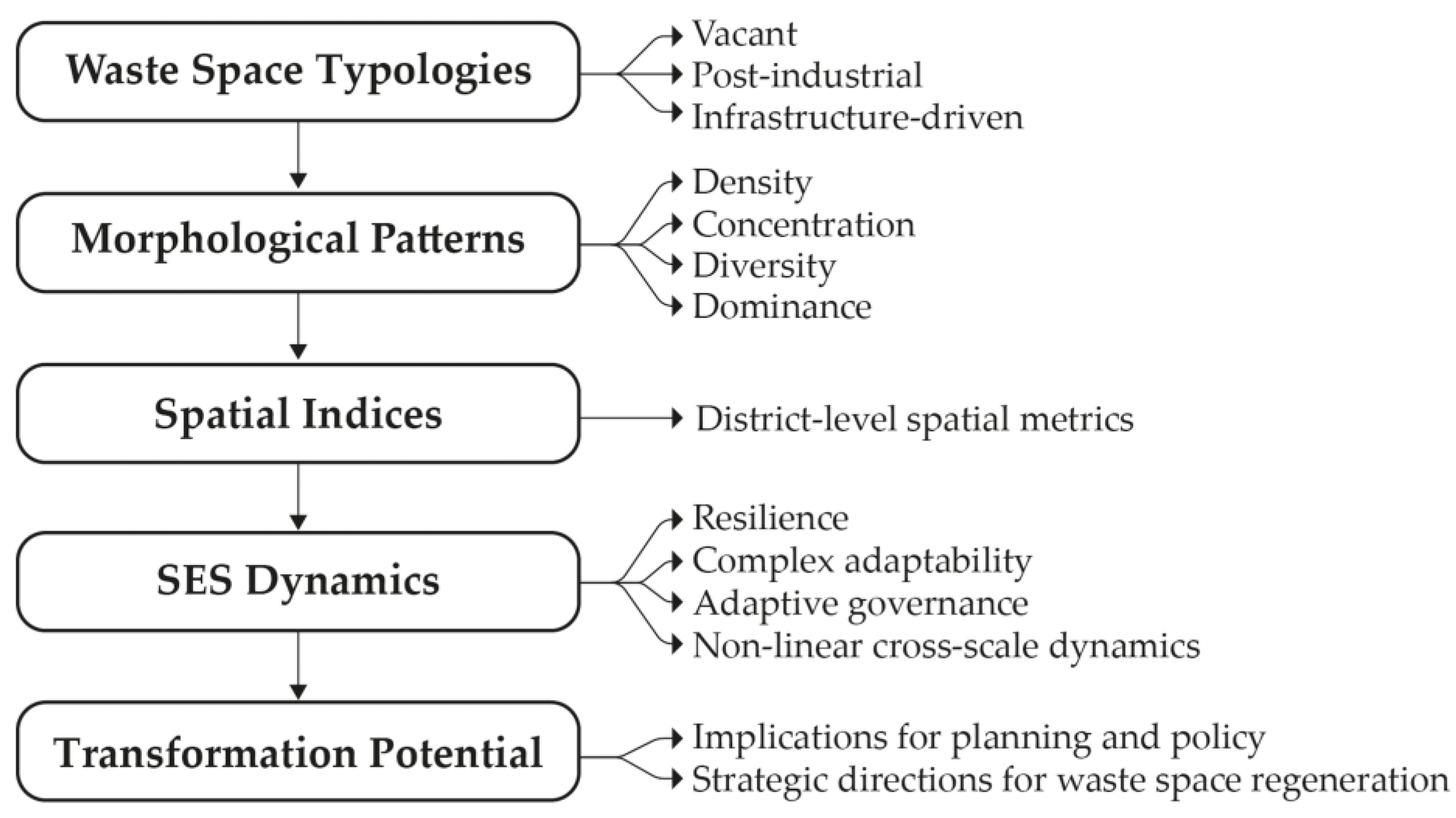
Figure 2.
Location of the study area and selected districts within the İzmir metropolitan region.
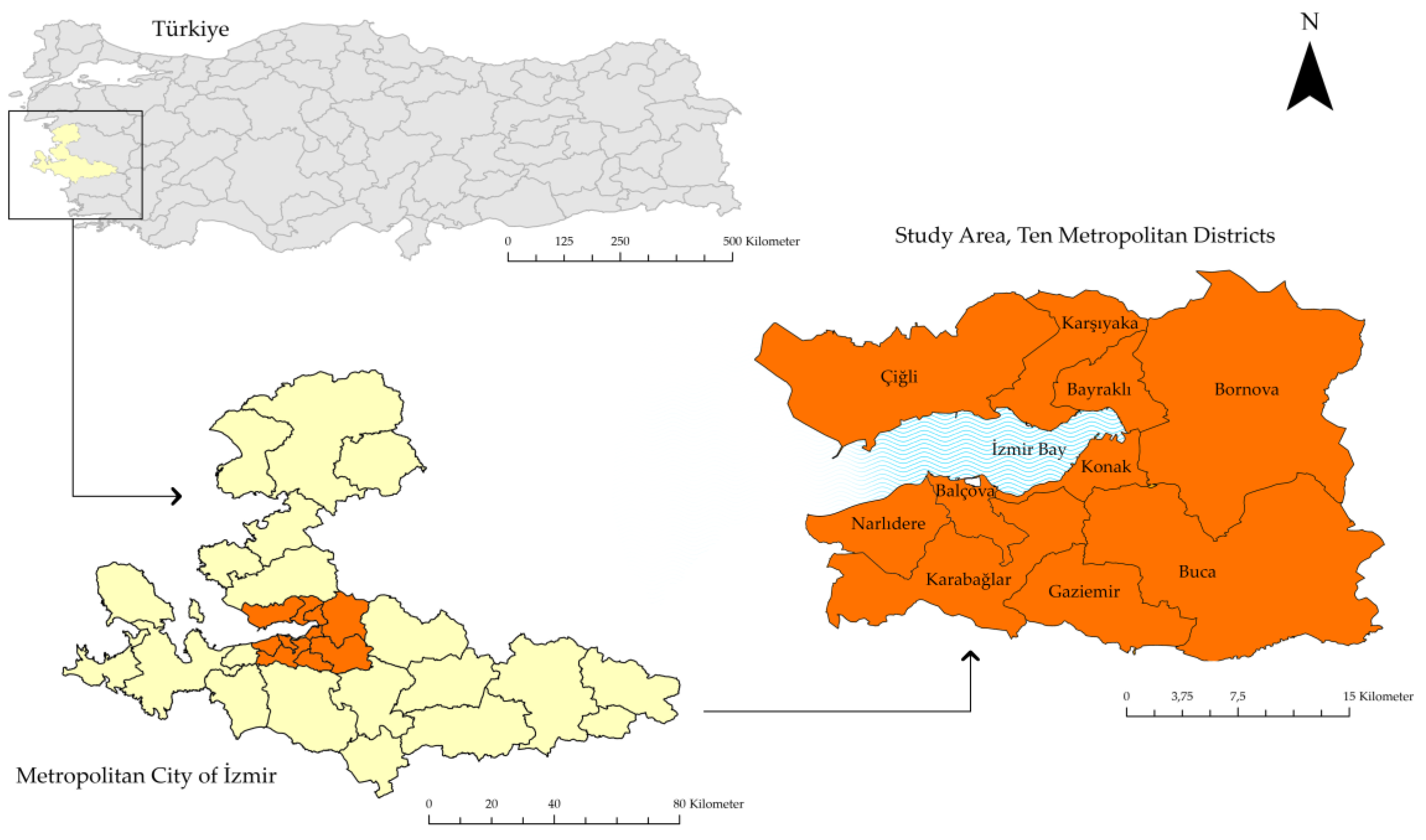
Figure 3.
Urban Atlas land-use map with original nomenclature, revised nomenclature, and identified waste spaces in the İzmir metropolitan area. The original Urban Atlas Land Use 2018 map is shown on the left with original nomenclature at the bottom left, the revised nomenclature used for waste space identification at the bottom right, and the ten selected metropolitan districts with identified waste spaces highlighted in red on the upper right.
Figure 3.
Urban Atlas land-use map with original nomenclature, revised nomenclature, and identified waste spaces in the İzmir metropolitan area. The original Urban Atlas Land Use 2018 map is shown on the left with original nomenclature at the bottom left, the revised nomenclature used for waste space identification at the bottom right, and the ten selected metropolitan districts with identified waste spaces highlighted in red on the upper right.
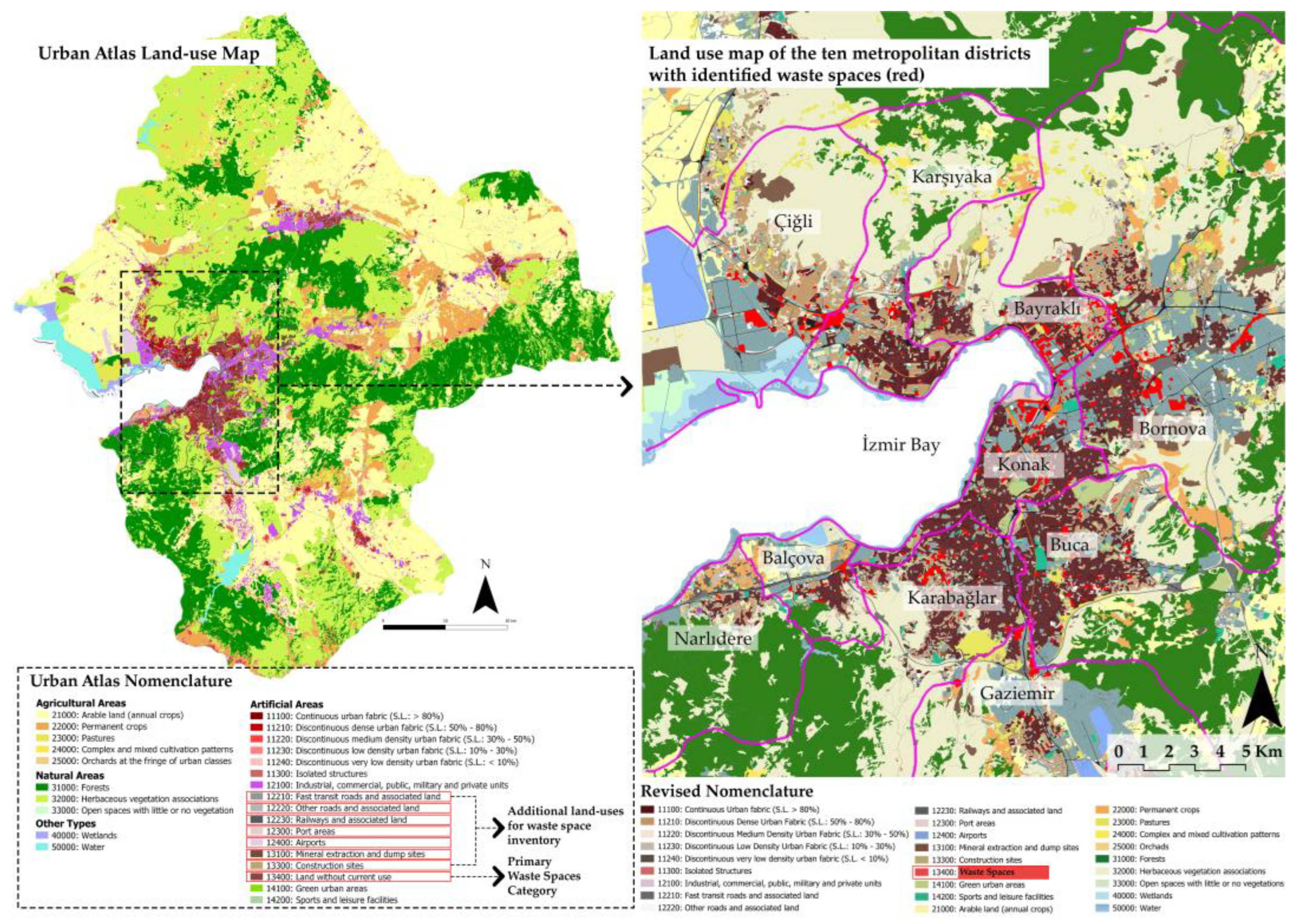
Figure 4.
Waste space distribution map across the ten metropolitan districts of İzmir.
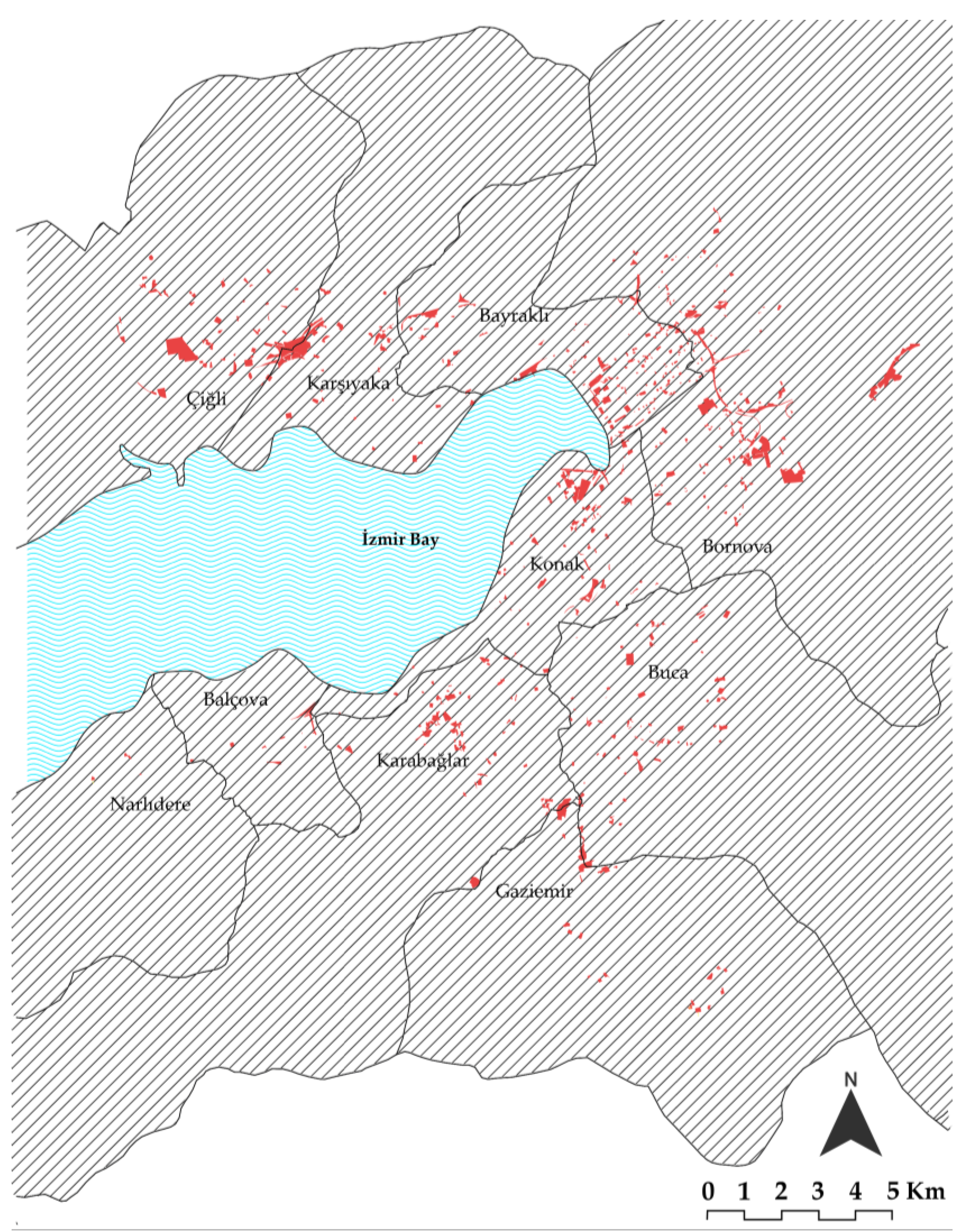
Scheme 1.
Waste space clustering patterns in relation to urban, industrial, and infrastructural uses across ten metropolitan districts of İzmir.
Scheme 1.
Waste space clustering patterns in relation to urban, industrial, and infrastructural uses across ten metropolitan districts of İzmir.
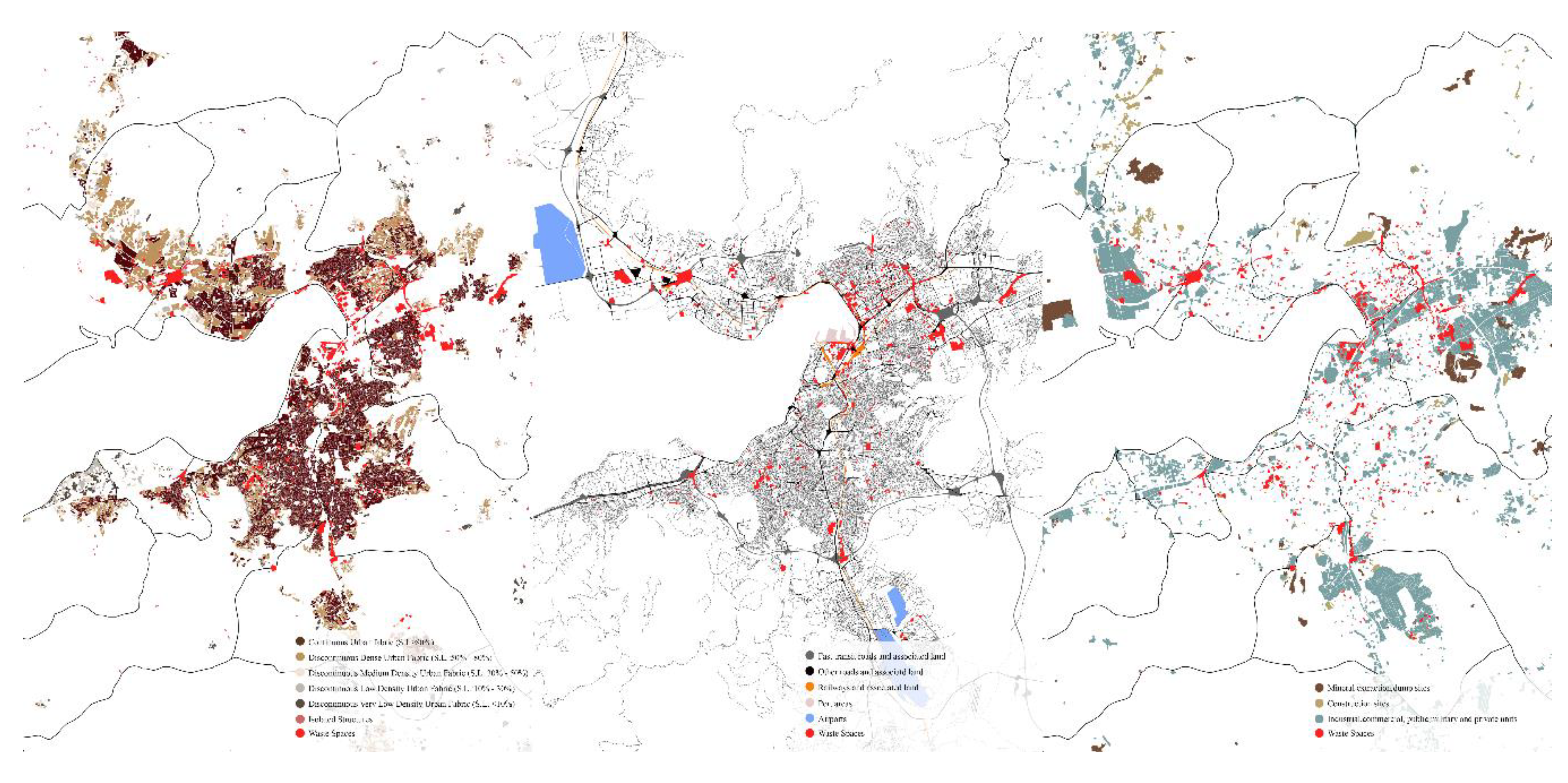
Figure 5.
District-level choropleth map showing the relative variation of the selected waste space indicator across the ten metropolitan districts of the İzmir metropolitan area. Darker shades indicate higher values.
Figure 5.
District-level choropleth map showing the relative variation of the selected waste space indicator across the ten metropolitan districts of the İzmir metropolitan area. Darker shades indicate higher values.
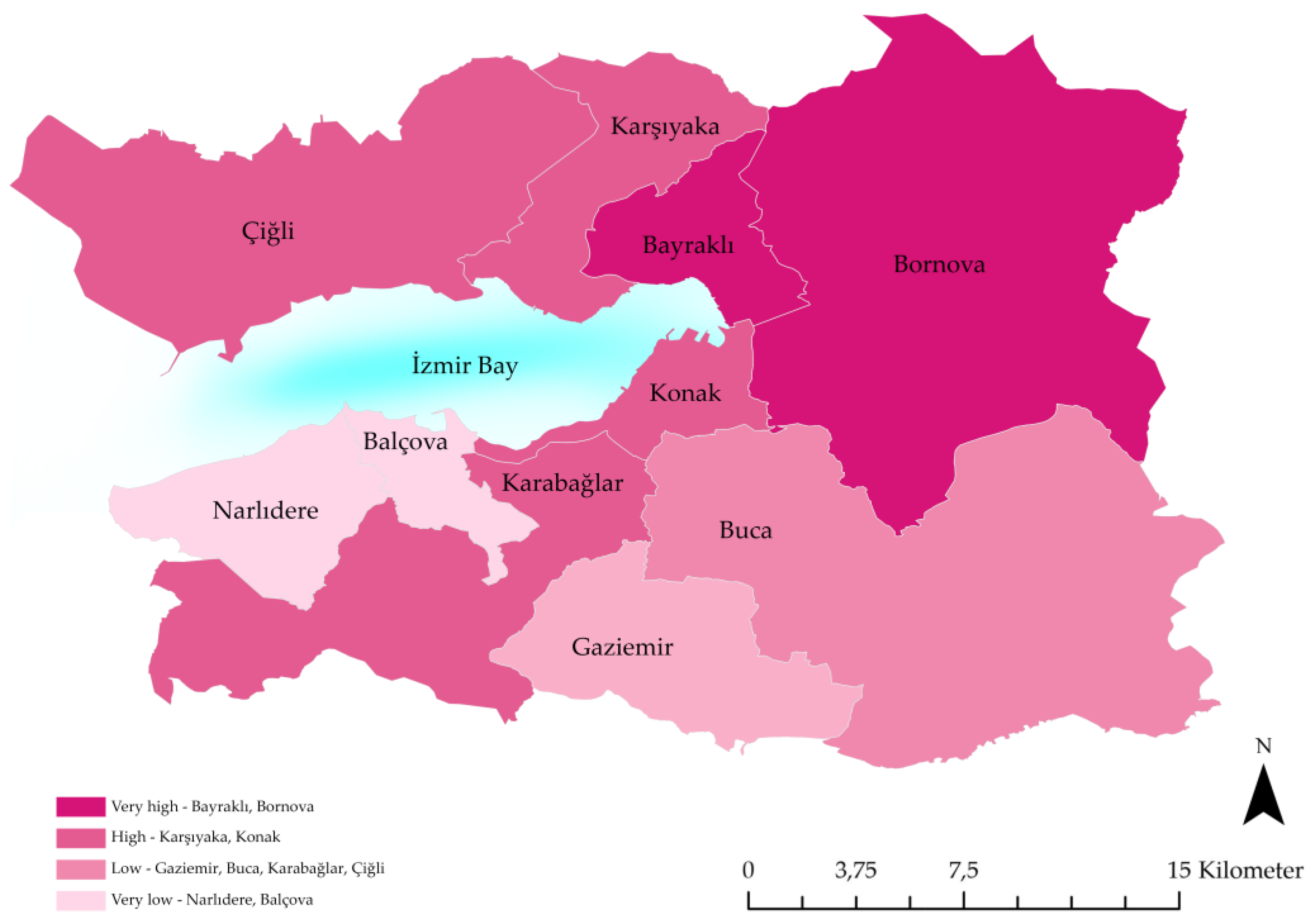
Figure 6.
Typological distribution of waste spaces across the selected districts of the İzmir Metropolitan Area.
Figure 6.
Typological distribution of waste spaces across the selected districts of the İzmir Metropolitan Area.
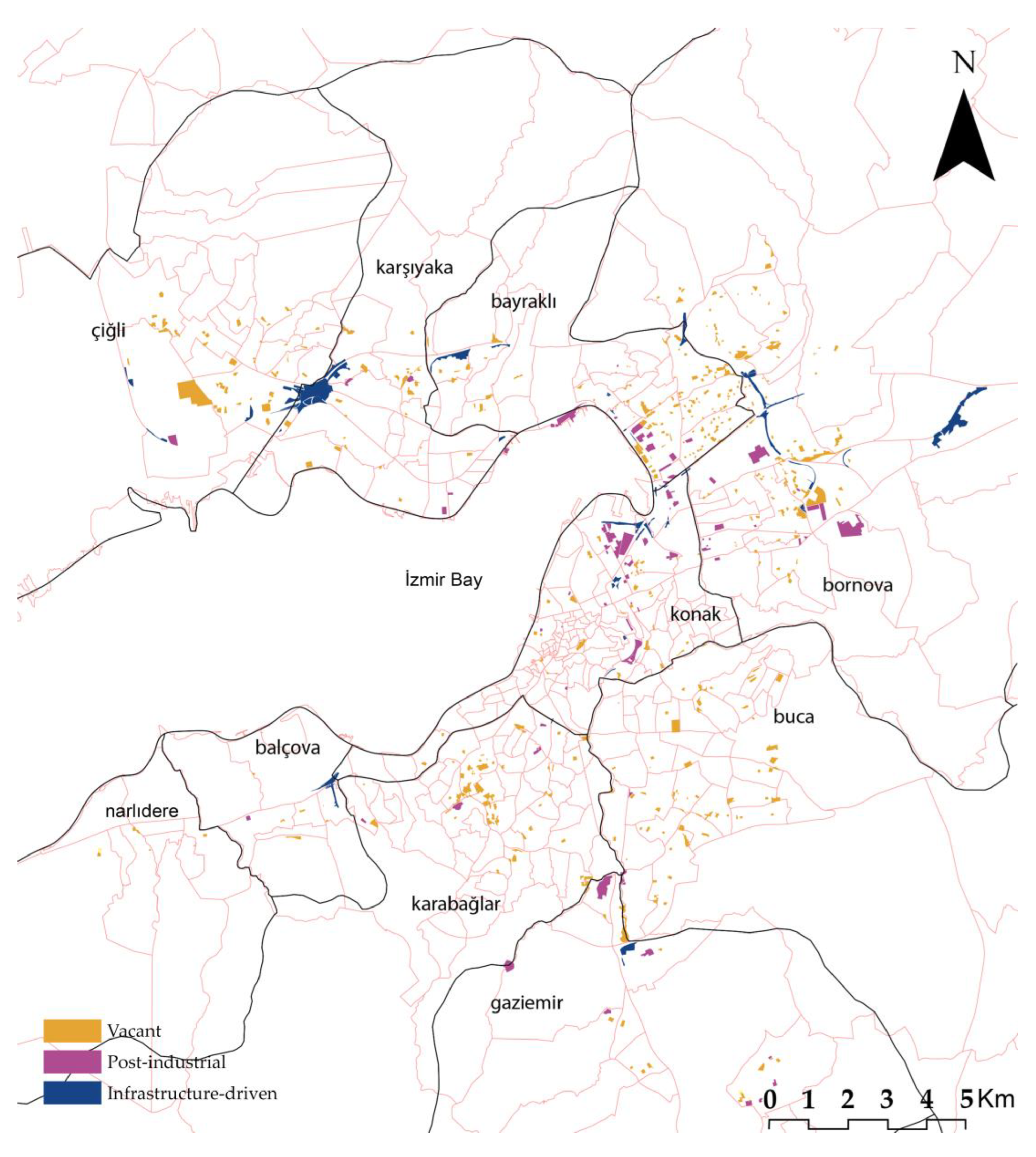

Table 1.
Typological classification of waste spaces in İzmir.
| Typology | Definition | Characteristics | Production Process |
|---|---|---|---|
| Vacant parcels | Undeveloped or long-term vacant parcels within the urban fabric that currently lacks active use |
|
|
| Post-industrial sites | Former industrial areas that have lost their original function and remain abandoned or underutilized |
|
|
| Infrastructure-driven spaces | Residual spaces emerging from large-scale transportation infrastructure and mobility systems |
|
|
Table 2.
District-level spatial indicators of waste spaces in İzmir.
| District | District Area (km²) | Waste Space (km²) | Density (%) | Density Index | LQ *1 |
|---|---|---|---|---|---|
| Balçova | 16 | 0.126 | 0.788 | 0.00788 | 0.98 |
| Bayraklı *2 | 30 | 0.969 | 3.230 | 0.03230 | 4.01 |
| Bornova | 220 | 1.784 | 0.811 | 0.00811 | 1.01 |
| Buca | 178 | 0.515 | 0.289 | 0.00289 | 0.36 |
| Çiğli | 139 | 0.886 | 0.637 | 0.00637 | 0.79 |
| Gaziemir | 70 | 0.471 | 0.673 | 0.00673 | 0.84 |
| Narlıdere | 50 | 0.025 | 0.050 | 0.00050 | 0.06 |
| Karabağlar | 89 | 0.616 | 0.693 | 0.00692 | 0.86 |
| Karşıyaka | 51 | 0.801 | 1.571 | 0.01571 | 1.95 |
| Konak *2 | 24 | 0.789 | 3.288 | 0.03287 | 4.08 |
*1 The LQ was calculated within the sample of ten metropolitan districts rather than for the entirety of İzmir. *2 Bayraklı and Konak exhibit the highest density values across ten metropolitan districts.
Table 3.
Typological composition of waste spaces across districts.
| District | Vacant (km²) | Infrastructure-driven (km²) | Post-industrial (km²) | Total (km²) | Vacant % | Infrastructure-driven % | Post-industrial % |
|---|---|---|---|---|---|---|---|
| Balçova | 0.033 | 0.083 | 0.011 | 0.126 | 25.9 | 65.4 | 8.7 |
| Bayraklı | 0.539 | 0.187 | 0.244 | 0.969 | 55.6 | 19.3 | 25.1 |
| Bornova | 0.661 | 0.620 | 0.503 | 1.784 | 37.1 | 34.8 | 28.2 |
| Buca | 0.493 | 0.000 | 0.022 | 0.515 | 95.7 | 0.0 | 4.3 |
| Çiğli | 0.674 | 0.167 | 0.045 | 0.886 | 76.1 | 18.8 | 5.1 |
| Gaziemir | 0.182 | 0.070 | 0.218 | 0.470 | 38.8 | 14.9 | 46.4 |
| Narlıdere | 0.025 | 0.000 | 0.000 | 0.025 | 100 | 0 | 0 |
| Karabağlar | 0.493 | 0.000 | 0.123 | 0.616 | 80.0 | 0 | 20.0 |
| Karşıyaka | 0.229 | 0.501 | 0.071 | 0.801 | 28.6 | 62.5 | 8.9 |
| Konak | 0.205 | 0.146 | 0.438 | 0.789 | 26.0 | 18.4 | 55.5 |
Table 4.
Typological Diversity and Dominance of Waste Spaces by District.
| District | Vacant (%) | Infrastructure-driven (%) | Post-industrial (%) | Shannon (H′) | TDI | Dominant typology |
|---|---|---|---|---|---|---|
| Balçova | 25.9 | 65.4 | 8.7 | 0.840 | 0.654 | Infrastructure-driven |
| Bayraklı | 55.6 | 19.3 | 25.1 | 0.991 | 0.556 | Vacant |
| Bornova | 37.1 | 34.8 | 28.2 | 1.092 | 0.371 | Vacant |
| Buca | 95.7 | 0.0 | 4.3 | 0.177 | 0.957 | Vacant |
| Çiğli | 76.1 | 18.8 | 5.1 | 0.675 | 0.761 | Vacant |
| Gaziemir | 38.8 | 14.9 | 46.4 | 1.007 | 0.464 | Post-industrial |
| Narlıdere | 100.0 | 0.0 | 0.0 | 0.000 | 1.000 | Vacant |
| Karabağlar | 80.0 | 0.0 | 20.0 | 0.500 | 0.800 | Vacant |
| Karşıyaka | 28.6 | 62.5 | 8.9 | 0.867 | 0.625 | Infrastructure-driven |
| Konak | 26.0 | 18.4 | 55.5 | 0.989 | 0.555 | Post-industrial |
Table 5.
Synthesis of district-level waste-space profiles in the İzmir Metropolitan Area. The table integrates spatial indicators (density index and location quotient), typological diversity (Shannon index), structural dominance (TDI), and typological composition to identify distinct configurations of waste spaces across districts.
Table 5.
Synthesis of district-level waste-space profiles in the İzmir Metropolitan Area. The table integrates spatial indicators (density index and location quotient), typological diversity (Shannon index), structural dominance (TDI), and typological composition to identify distinct configurations of waste spaces across districts.
| District | Density Index | LQ | Shannon (H′) | TDI | Configuration | Spatial Characteristics |
Urban Processes |
|---|---|---|---|---|---|---|---|
| Balçova | 0.00788 | 0.98 | 0.840 | 0.654 | Infrastructure-driven district | Linear and underutilized residual spaces | Infrastructure expansion and spatial fragmentation |
| Bayraklı | 0.03230 | 4.01 | 0.991 | 0.556 | Mixed high-intensity district |
Large inventory multiple typologies |
CBD formation, rapid urban transformation, and redevelopment pressures |
| Bornova | 0.00811 | 1.01 | 1.092 | 0.371 | Diversified waste space district |
Coexistence of vacant parcels, infrastructure-driven spaces, and post-industrial sites |
Interaction of industrial restructuring, infrastructure, and urban expansion |
| Buca | 0.00289 | 0.36 | 0.177 | 0.957 | Vacancy-dominated district | Highly fragmented vacant parcels dispersed in urban expansion areas |
Development delays and speculative vacancy |
| Çiğli | 0.00637 | 0.79 | 0.675 | 0.761 | Vacancy-dominated district | The concentration of vacant land adjacent to industrial areas |
Industrial land-use transition |
| Gaziemir | 0.00672 | 0.84 | 1.007 | 0.464 | Post-industrial transition district |
Large parcels associated with the former industrial activities |
Industrial decline and relocation of production |
| Narlıdere | 0.00050 | 0.06 | 0.000 | 1.000 | Peripheral vacancy district | Scattered vacant parcels in low-density peripheral areas | Peripheral urbanization and speculative development pressure |
| Karabağlar | 0.00692 | 0.86 | 0.500 | 0.800 | Vacancy accumulation district |
Concentration of vacant parcels within dense urban fabric |
Urban restructuring and fragmented land ownership |
| Karşıyaka | 0.01571 | 1.95 | 0.867 | 0.625 | Infrastructure-driven district | Corridor-based residual spaces along transport networks |
Infrastructure fragmentation |
| Konak | 0.03287 | 4.08 | 0.989 | 0.555 | Post-industrial core district | Large consolidated former industrial sites in central urban areas |
Post-industrial transformation |
Disclaimer/Publisher’s Note: The statements, opinions and data contained in all publications are solely those of the individual author(s) and contributor(s) and not of MDPI and/or the editor(s). MDPI and/or the editor(s) disclaim responsibility for any injury to people or property resulting from any ideas, methods, instructions or products referred to in the content. |
© 2026 by the authors. Licensee MDPI, Basel, Switzerland. This article is an open access article distributed under the terms and conditions of the Creative Commons Attribution (CC BY) license (http://creativecommons.org/licenses/by/4.0/).
Copyright: This open access article is published under a Creative Commons CC BY 4.0 license, which permit the free download, distribution, and reuse, provided that the author and preprint are cited in any reuse.


