

Submitted:
19 March 2026
Posted:
23 March 2026
You are already at the latest version
Abstract
Sulfide-alkaline wastewater (SAW) from petrochemical plants, particularly from pyrolysis and hydrotreating units, presents a significant environmental challenge due to its high toxicity, extreme alkalinity (pH > 12), and high concentrations of sulfides and organic pollutants. Traditional treatment methods like acid neutralization or air oxidation are often inefficient, generate secondary waste, or fail to recover valuable components. This study investigates the effectiveness of a novel electrochemical system for the simultaneous treatment of SAW and recovery of valuable products. A lab-scale four-chamber bipolar electrolyzer, equipped with cation-exchange membranes and nickel electrodes, was designed and tested using real industrial wastewater. The wastewater was characterized by a pH of 13.06, chemical oxygen demand of 12600 mg/l, and a sulfide content of approximately 5000 mg/l. The process leverages anodic oxidation to convert sulfide ions into elemental sulfur, while sodium cations migrate through cation-exchange membranes to the cathodic compartments. There, water reduction generates high-purity hydrogen (≥99.9%) and a concentrated, purified sodium hydroxide solution. The results demonstrate the ineffectiveness of conventional electrodialysis with anion-exchange membranes due to rapid membrane degradation. In contrast, the proposed bipolar membrane electrolysis achieved excellent performance: a caustic soda solution with a concentration of 2.3–2.5% was recovered with a current efficiency of 83–85%, containing only trace amounts of sulfides (0.0052%) and organic impurities (0.053%). The process completely removed the original sulfide alkalinity. The study confirms the chemical and mechanical stability of the cation-exchange membranes under harsh SAW conditions. The proposed technology offers a path towards a closed-loop system in refineries by enabling the reuse of recovered caustic, utilization of hydrogen, and potential recovery of sulfur, aligning with the principles of green chemistry and circular economy.
Keywords:
electrochemical wastewater treatment
; bipolar membrane electrolysis
; sulfide-alkaline waste
; oil refining
; anodic oxidation
; resource recovery
; cation-exchange membranes
1. Introduction
Modern oil refining operations are characterized by the generation of significant volumes of gaseous emissions and wastewater, distinguished by their complex chemical composition and high toxicity. Among the wide variety of industrial effluents, sulfide-alkaline wastewater (SAW) occupies a distinct position; it is generated in pyrolysis units, hydrotreating facilities, and other processes involving the alkaline scrubbing of hydrocarbon fractions to remove sulfide-containing compounds. These effluents constitute multicomponent systems containing sulfides, hydrosulfides, mercaptans, organic sulfides, as well as substantial quantities of alkali and dissolved petroleum products [1,2]. The high levels of chemical oxygen demand (COD), alkalinity, and sulfide content render SAW extremely hazardous to the environment and to biological wastewater treatment facilities. The discharge of even small quantities of such wastewater into water bodies triggers a drastic deterioration in water quality, causes aquatic organism mortality, and disrupts ecological equilibrium.
Traditional approaches to the detoxification of SAW are based on the application of reagent-based methods, such as acid neutralization, air oxidation in autoclaves, chlorination, or ozonation. However, each of these methods suffers from significant drawbacks. Acid neutralization leads to the release of highly toxic hydrogen sulfide into the atmosphere and necessitates the subsequent disposal of the resulting salts. Air oxidation proceeds slowly and does not always achieve the required degree of purification, particularly when initial pollutant concentrations are high. Ozonation, while a reasonably effective oxidative method, entails high energy costs for ozone generation and requires the use of complex equipment [3]. Furthermore, reagent-based methods often result in the generation of secondary waste—such as sludges and spent reagents—thereby creating additional environmental challenges. Given the multicomponent nature of industrial wastewater, the effectiveness of individual physicochemical methods—including sorption—is inherently limited [4].
In recent decades, electrochemical wastewater treatment methods have attracted increasing attention from researchers, as they enable the oxidation of pollutants directly at the electrodes without the need for additional chemical reagents. Among these methods, anodic oxidation is of particular interest; this process involves the generation of reactive oxygen species—such as hydroxyl radicals and atomic oxygen—at the anode surface, or the direct transfer of electrons from the reducible substance to the electrode, ultimately leading to the degradation of organic and inorganic pollutants [5,6]. A significant advantage of electrochemical methods is the ability to control the process by adjusting current density, electrode potential, and electrolyte composition, as well as the potential to integrate wastewater treatment with the recovery of valuable products—such as alkali and hydrogen at the cathode, or elemental sulfur from sulfide-containing solutions [7].
The objective of the present study was to experimentally evaluate the efficiency of anodic oxidation and membrane separation processes applied to sulfide-alkaline wastewater, utilizing a laboratory-scale four-compartment bipolar electrolyzer equipped with cation-exchange membranes and nickel electrodes. The research tasks included: the construction of a laboratory-scale experimental setup; the execution of a series of experiments involving the electrochemical treatment of both model and industrial sulfide-alkaline wastewater solutions; the analysis of changes in physicochemical parameters (pH, specific conductivity, alkalinity, sulfide content, and COD) within the anodic and cathodic compartments; and the assessment of the feasibility of recovering a concentrated sodium hydroxide solution free from sulfide sulfur and organic pollutants.
The article is structured as follows: the first section describes the design of the laboratory electrolyzer and the experimental methodology employed; Subsequently, the results of analyses of samples collected during electrolysis are presented and discussed; the conclusion sets forth the main findings regarding the potential of the proposed method for the purification of highly concentrated sulfide-alkaline wastewater from oil refining facilities.
2. Literature Review
Sulfide-alkaline wastes (SAW) represent one of the most challenging categories of industrial effluents to treat, generated at facilities within the petroleum refining and petrochemical industries. Their sources lie in technological processes such as the pyrolysis of hydrocarbon feedstocks, catalytic cracking, hydrotreating, and alkylation—processes in which alkaline scrubbing is employed to remove sulfur compounds from gaseous and liquid hydrocarbon fractions [1,2]. As a result of the reaction between alkaline reagents—typically sodium hydroxide—and hydrogen sulfide, mercaptans, and other organosulfur compounds, water-soluble sulfides, hydrosulfides, and mercaptides are formed; these substances pass into the aqueous phase, thereby defining the specific composition of the SAW (Table 1).
The challenge of treating such wastewater has remained a pressing issue for many years, driven both by the consistent volumes generated at typical oil refineries and by increasingly stringent environmental regulations regarding the discharge of industrial effluents [2]. The composition of sulfide-alkaline wastewaters is highly variable, depending on the type of feedstock being processed, the specific technological processes employed, and equipment operating parameters. A detailed analysis of the component makeup of these effluents reveals the presence of a wide spectrum of reduced sulfur compounds—including sulfides, hydrosulfides, polysulfides, thiosulfates, and sulfites—as well as organic sulfur-containing compounds such as mercaptans, organic sulfides, and disulfides [1]. Additional constituents include alkaline agents, carbonates, and bicarbonates formed through the absorption of carbon dioxide from the air, as well as a hydrocarbon phase comprising dissolved and emulsified petroleum products, naphthenic acids, phenols, and other organic compounds [1,2]. The high Chemical Oxygen Demand (COD) values—reaching tens of thousands of milligrams per liter—and extreme alkalinity levels (pH 12–14) render SAW toxic to aquatic organisms and to the microorganisms within the activated sludge systems of biological wastewater treatment plants. The discharge of even minute quantities of untreated or inadequately treated SAW into water bodies triggers a sharp rise in both COD and Biochemical Oxygen Demand, inhibits natural self-purification processes, and results in the mortality of aquatic organisms due to the acute toxic effects of sulfides and the oxygen depletion caused by their oxidation [2]. Sulfide ions possess the ability to bind with the metal ions situated within the active sites of respiratory chain enzymes, a mechanism that accounts for their high toxicity to aerobic organisms.
Traditional approaches to the detoxification of sulfide-alkaline effluents can be classified into reagent-based, thermal, and physicochemical methods. Among the reagent-based methods, the most widely adopted are neutralization with acids, oxidation using atmospheric oxygen (both at atmospheric pressure and in autoclaves), ozonation, chlorination, and peroxide oxidation [2,3].
Neutralization of sulfide-alkaline effluents with mineral acids—typically sulfuric or hydrochloric acid—results in the conversion of sulfides and sulfide ions into molecular hydrogen sulfide, which subsequently evolves into the gas phase. This method is characterized by the simplicity of its equipment design and relatively low capital costs; however, it suffers from a number of serious drawbacks, the most significant of which is the generation of highly toxic hydrogen sulfide, which requires capture and subsequent recovery or detoxification [2]. Furthermore, the neutralization process is accompanied by uncontrolled foaming of the solution—caused by the evolution of hydrogen sulfide and carbon dioxide (derived from carbonates)—which creates operational difficulties. The neutral salts formed during neutralization increase the total dissolved solids content of the treated water, thereby complicating or precluding its reuse within the industrial process cycle. Consequently, this necessitates either an additional desalination stage or discharge into natural water bodies—an action associated with the salinization of those aquatic environments. Depending on the specific acid employed and the process conditions, the composition of the resulting salts may vary: the use of sulfuric acid yields sodium sulfate, while the use of hydrochloric acid yields sodium chloride. Sodium sulfates can be recovered and utilized in various industrial applications; however, their recovery entails additional energy consumption. Sodium chlorides are in lower demand as marketable products, and their discharge leads to the salinization of water bodies—a consequence that is particularly critical in regions with limited water resources. The hydrogen sulfide released during neutralization requires mandatory capture and processing—for instance, into elemental sulfur via the Claus process—which significantly complicates the process scheme and increases its cost. Furthermore, hydrogen sulfide exhibits high corrosivity, necessitating the use of specialized corrosion-resistant materials for equipment and pipelines.
The oxidation of alkaline sulfide-containing wastewaters using atmospheric oxygen is implemented in two primary variants: atmospheric oxidation at normal pressure and autoclave oxidation at elevated temperatures and pressures. Atmospheric oxidation is characterized by a low process rate—particularly at high initial pollutant concentrations—and fails to ensure the required degree of purification, as primarily sulfides undergo oxidation, while more stable organic sulfur-containing compounds remain in solution [2]. The mechanism of atmospheric sulfide oxidation by atmospheric oxygen in an alkaline medium is quite complex and involves stages of intermediate product formation—specifically, polysulfides and thiosulfates. The process rate is limited by the mass transfer step of oxygen from the gaseous phase into the liquid phase and depends on mixing intensity, temperature, and the presence of catalysts. To intensify the process, various catalytic systems—such as salts of variable-valence metals—are employed; however, their use leads to additional contamination of the wastewater and necessitates the subsequent removal of the catalysts. Autoclave oxidation, conducted at temperatures of 150–200 °C and pressures of 1.5–2.5 MPa, allows for process intensification and the achievement of a higher degree of oxidation; however, it entails significant energy costs for heating and maintaining high pressure, requires the use of specialized corrosion-resistant equipment, and presents the challenge of managing salt and elemental sulfur deposits on the internal surfaces of the reaction vessels [2]. During autoclave oxidation, it is possible to achieve virtually complete oxidation of sulfides to sulfates; however, this precludes the opportunity to recover valuable elemental sulfur. Furthermore, high temperatures and pressures accelerate corrosion processes, thereby necessitating the use of expensive materials, such as titanium or high-alloy steels. The salt and sulfur deposits that form on equipment walls during autoclave oxidation necessitate periodic equipment shutdowns for cleaning, thereby reducing productivity and increasing operating costs.
Ozonation is regarded as an effective method for the oxidation of sulfides and organic compounds present in alkaline sulfide-bearing wastewaters. Experimental studies demonstrate a high degree of pollutant degradation during ozone treatment; however, the method entails significant energy costs for ozone generation, requires the use of complex equipment, and necessitates addressing the issue of residual ozone disposal in off-gases [3]. Ozone is a powerful oxidant with a high redox potential of 2.07 V, enabling it to oxidize the majority of organic and inorganic pollutants (Figure 1 and Figure 2).
In an alkaline medium, ozone decomposes to form hydroxyl radicals, which possess an even higher oxidation potential of 2.80 V; this further intensifies the oxidation process. However, ozone exhibits selectivity in its reactions with various contaminants; consequently, achieving complete purification may require significant treatment time and a high ozone dosage. Furthermore, ozonation often necessitates preliminary wastewater treatment—specifically, the removal of suspended solids and petroleum products—as these substances reduce the efficiency of ozone mass transfer into the liquid phase. The presence of suspended solids and emulsified petroleum products leads to the shielding of the phase interface and a reduction in the ozone mass transfer coefficient. To ensure effective ozonation, it is essential to achieve proper dispersion of the ozone-air mixture within the liquid being treated; this is accomplished through the use of specialized dispersers—such as porous ceramic or cermet elements, or various types of spargers. However, when contaminant concentrations are high, the pores of these dispersers rapidly become clogged with oxidation byproducts, thereby necessitating their periodic cleaning or replacement. The gaseous emissions generated during ozonation contain residual ozone, which is toxic and must be decomposed prior to discharge into the atmosphere. Thermal, catalytic, or adsorption methods are employed to decompose this ozone, a requirement that further complicates the process flowsheet and increases its overall cost.
Chlorination and peroxide oxidation are also employed for the treatment of sulfide-alkaline wastewaters; however, the use of chlorine carries the risk of forming toxic organochlorine compounds, while hydrogen peroxide—although an environmentally safe oxidant—requires the use of catalysts to activate the process and is characterized by a relatively high reagent cost [2]. Chlorine and its compounds (sodium hypochlorite, chlorinated lime) have traditionally been used for the oxidation of sulfides and the disinfection of wastewaters. Chlorine oxidizes sulfides to sulfates or elemental sulfur, depending on the process conditions and reagent ratios. However, in the presence of organic compounds—particularly aromatic hydrocarbons and phenols—organochlorine compounds may form, many of which exhibit high toxicity, carcinogenicity, and mutagenicity. The formation of organochlorine compounds during wastewater chlorination poses a serious environmental problem and necessitates additional treatment steps for their removal. Hydrogen peroxide is an environmentally safe oxidant, as its decomposition products are water and oxygen. However, the rate at which hydrogen peroxide oxidizes pollutants is low in the absence of catalysts, particularly at low temperatures. To activate hydrogen peroxide, catalysts are employed, including variable-valence metal ions, solid catalysts based on metal oxides, and UV irradiation. Fenton’s reagent—a mixture of hydrogen peroxide and iron(II) salts—enables the effective oxidation of a wide spectrum of organic pollutants through the generation of hydroxyl radicals. However, the use of iron salts results in the formation of iron-containing precipitates that require disposal. Furthermore, for the Fenton reaction to proceed effectively, a specific pH range—typically 2–4—must be maintained; for highly alkaline sulfide-alkaline wastewaters, this necessitates preliminary neutralization followed by subsequent alkalization prior to discharge or reuse.
Thermal methods for the detoxification of spent alkaline waste (SAW)—which involve concentration via evaporation followed by the incineration of the organic concentrate, or the direct incineration of the wastewater in specialized furnaces—enable the achievement of virtually complete destruction of organic pollutants and the recovery of mineral salts. However, the high energy intensity of evaporation and incineration processes—driven by the necessity to vaporize large volumes of water—as well as issues regarding equipment corrosion and the removal of sulfur compounds from flue gases, limit the practical application of thermal methods [2]. The evaporation of SAW can be carried out in various types of evaporators, including thin-film, rotary, and forced-circulation units. To minimize energy consumption, multi-stage evaporation systems utilizing secondary steam, as well as heat pumps, are employed. Nevertheless, the highly corrosive nature of concentrated alkaline solutions at elevated temperatures necessitates the use of expensive corrosion-resistant materials—such as nickel, titanium, and specialized steels. The concentrate generated during evaporation—which contains sulfides, organic compounds, and mineral salts—is subsequently directed for incineration. During incineration, organic compounds undergo oxidation to form carbon dioxide and water, while sulfur-containing compounds are oxidized into sulfur oxides. These sulfur oxides must be captured from the flue gases—for instance, through absorption using milk of lime, resulting in the formation of calcium sulfite and calcium sulfate. The mineral salts generated during incineration—specifically sodium sulfates and carbonates—can be recovered and utilized; however, they frequently contain impurities and therefore require further purification. The direct incineration of SAW is performed in specialized furnaces, often utilizing nozzles to atomize the liquid stream within the combustion flame. This process entails rapid heating and vaporization of the water, followed by the combustion of the organic compounds. To ensure complete combustion and prevent the formation of toxic products of incomplete combustion, it is necessary to maintain a high temperature—900–1200 °C—and ensure a sufficient residence time for the gases within the high-temperature zone. This entails significant fuel consumption and the generation of large volumes of flue gases that require treatment.
Physicochemical methods—such as coagulation, flocculation, sorption, ion exchange, and membrane separation—can be employed either independently or in combination with other techniques as part of integrated process schemes. The efficacy of individual physicochemical methods—including sorption—for treating multicomponent industrial wastewaters is limited; this has spurred the development of hybrid technologies that integrate various processes [4]. Sorption-based methods, which utilize natural and synthetic sorbents, are effective for the removal of petroleum products and certain organic compounds; however, they are insufficiently effective against low-molecular-weight polar compounds and sulfides. Recently, studies have emerged focusing on the development of modified sorbents derived from power-generation waste for the removal of phenols and other organic pollutants from wastewater, thereby demonstrating the advancement of sorption technologies for the treatment of complex effluents [8]. Research indicates that natural sorbents, such as bentonite, can be optimized for the removal of pollutants from petrochemical wastewaters, with treatment efficiency being contingent upon process conditions and sorbent modification [9]. Common sorbents include activated carbons, zeolites, and clay minerals, as well as industrial byproducts such as fly ash, slag, and sawdust. Surface modification of sorbents enables the enhancement of their selectivity and sorption capacity toward specific classes of pollutants. For instance, modifying carbon sorbents with metal compounds enhances their efficiency in extracting sulfur-containing compounds; similarly, the use of composite materials based on manganese and cerium yields promising results in treating wastewater to remove specific organic pollutants—such as tetramethylammonium—found in effluents from optoelectronic manufacturing facilities, a technique that may also prove beneficial for petrochemical wastewater [10]. However, sorption-based methods inherently result in the generation of spent sorbents saturated with pollutants, which subsequently require either regeneration or disposal. Sorbent regeneration often entails additional costs and leads to the generation of secondary waste products, specifically spent regeneration solutions. Landfilling spent sorbents fails to resolve the fundamental issue of permanently neutralizing pollutants and poses a long-term environmental hazard. In this context, biosorption is regarded as a promising technology that utilizes non-living biomass to extract pollutants; nevertheless, the efficacy of biosorbents in removing ammonia and other specific compounds warrants further investigation [11].
Ion exchange enables the selective extraction of heavy metal ions and certain anions; however, it necessitates the thorough pretreatment of wastewater to remove organic contaminants that poison the ion-exchange resins [4]. Organic compounds—particularly high-molecular-weight substances and surfactants—adsorb onto the surface of ion-exchange resins, thereby blocking active sites and reducing the resins’ exchange capacity. The regeneration of poisoned resins is complex and not always effective; consequently, protecting the resins requires the preliminary removal of organic pollutants using alternative methods. Furthermore, ion-exchange resins are sensitive to the high pH levels characteristic of sulfide-alkaline wastewater (SAW), which can lead to their degradation. Membrane-based methods—including microfiltration, ultrafiltration, nanofiltration, and reverse osmosis—are capable of achieving a high degree of purification; however, their application for treating SAW is limited due to the high osmotic activity of the wastewater, the membranes’ susceptibility to fouling by organic substances and sulfides, and the challenges associated with the disposal of the resulting concentrates. The high ionic strength of these solutions generates significant osmotic pressure, necessitating the application of high operating pressures to drive water through the membrane, which, in turn, increases energy consumption. Organic substances—particularly petroleum products—and sulfides form deposits on the membrane surfaces; these deposits drastically reduce throughput and necessitate frequent chemical cleaning of the membranes. The concentrates generated during membrane separation contain all the pollutants in a concentrated form and require further processing or disposal—a significant challenge.
The problem of treating industrial wastewater to remove various contaminants—including sulfides, organic compounds, phenols, phosphates, and other constituents—is a subject of active global research. The application of biological treatment methods, particularly the activated sludge process, is widespread at the wastewater treatment facilities of petrochemical enterprises; however, life cycle assessments and carbon footprint analyses of such systems indicate a need for their improvement and integration with other technologies [12]. Combined natural wastewater treatment systems have demonstrated effectiveness in removing organic matter and phosphorus from contaminated watercourses, a capability that holds promise for the development of multi-stage treatment schemes [13]. Research into the use of ochre—a by-product of water treatment processes—for controlling phosphates and sulfides in anaerobic systems highlights the potential for utilizing waste materials to address environmental challenges [14]. The application of mineral coagulants for treating dye-contaminated wastewater has demonstrated the efficacy of such methods; however, the complex, multi-component effluents characteristic of the petrochemical industry necessitate the development of specialized reagents and treatment protocols [15]. Chemical and biological treatment processes applied to wastewater generated during the manufacture of specific chemical compounds—such as N,N’-dinitrosopentamethylenetetramine—underscore the necessity of combining diverse approaches to achieve regulatory compliance [16].
In recent decades, electrochemical methods for wastewater treatment have attracted increasing attention from researchers, as they enable the oxidation of pollutants directly at the electrodes—either without the introduction of additional chemical reagents or with their minimal consumption. Electrochemical methods offer a number of advantages, including the ability to conduct the process at ambient temperatures and pressures, high selectivity, ease of automation, and the capacity to control the process by adjusting electrical parameters [6,7].
Figure 3 illustrates a system of electromembrane units designed for drinking water purification. It is worth noting that these units are compact, automated, suitable for industrial application, feature an attractive design, and can be supplied in a containerized configuration.
Among electrochemical methods, anodic oxidation is of particular interest—a process in which active oxygen species (such as hydroxyl radicals and atomic oxygen) are generated on the anode surface, or in which direct electron transfer occurs from the substance undergoing reduction to the electrode, leading to the destruction of organic and inorganic pollutants [6,7]. The electrochemical degradation of persistent organic pollutants—such as poly- and perfluoroalkyl substances—present in industrial wastewater has demonstrated high efficiency and can be implemented on an industrial scale under appropriate electrolysis conditions [17]. Bioelectrochemical methods, which combine biological and electrochemical treatment, enable not only wastewater purification but also the recovery of metals, accompanied by the simultaneous generation of electricity; this opens up new prospects for the development of energy-efficient waste treatment technologies [18].
Depending on the anode material and electrolysis conditions, the mechanism of anodic oxidation may vary. Anodes made of inert materials—such as platinum or metal oxides—facilitate the generation of hydroxyl radicals via water discharge; these radicals act as potent, non-selective oxidants capable of oxidizing virtually any organic compound into carbon dioxide and water. Conversely, anodes made of active materials—such as nickel, cobalt, or their oxides—can participate directly in the oxidation process through the formation of higher-valence oxides or adsorbed oxygen-containing species, thereby enabling more selective oxidation. A significant advantage of electrochemical methods is the ability to control the process by adjusting parameters such as current density, electrode potential, and electrolyte composition, as well as the potential to integrate wastewater treatment with the recovery of valuable products—for instance, the generation of alkali and hydrogen at the cathode, or the extraction of elemental sulfur from sulfide-containing solutions [7].
The fundamental feasibility of electrochemically oxidizing sulfide ions in an alkaline medium to form elemental sulfur has been demonstrated in a number of studies. In an alkaline environment, sulfide ions can be oxidized at the anode to various products, depending on the electrode potential and the process conditions. At low anodic potentials, elemental sulfur is predominantly formed, whereas at higher potentials, further oxidation of the sulfur to thiosulfate, sulfite, and sulfate ions is possible. The recovery of elemental sulfur in the solid phase is of significant interest, as it allows not only for the removal of a toxic pollutant from wastewater but also for the production of a valuable commercial product used in various industrial sectors—such as sulfuric acid manufacturing, rubber vulcanization, fertilizer production, and others [2]. The sulfur generated during electrochemical oxidation can be separated from the solution using simple mechanical methods: settling, filtration, or centrifugation. The purity of the recovered sulfur depends on the electrolysis conditions and the composition of the influent wastewater; however, in many cases, it is sufficiently high for industrial application. Simultaneously, during the electrolysis of aqueous solutions, water reduction occurs at the cathode, resulting in the evolution of gaseous hydrogen and the formation of hydroxide ions. This enables the production of an alkaline solution and hydrogen—valuable products suitable for reuse within the technological cycle [7]. High-purity hydrogen can be utilized as a fuel, for hydrogenation processes in petroleum refining, or in chemical manufacturing. The alkaline solution can be recycled back into the hydrocarbon alkaline washing process, thereby reducing the need to purchase fresh alkali and minimizing the volume of waste requiring disposal. However, the practical implementation of the electrochemical purification of spent alkaline solutions—coupled with the simultaneous recovery of valuable components—requires the optimization of the electrolyzer design to ensure the separation of the anodic and cathodic compartments, thereby preventing product recombination and secondary contamination [2]. The use of ion-exchange membranes to separate the electrode compartments resolves the issue of product mixing and creates conditions conducive to the selective isolation of target components. In recent years, the advancement of electrochemical technologies has focused on the development of energy-efficient electrolyzers equipped with membranes that enable the separation of anodic and cathodic products and enhance the purity of the resulting substances [5,19].
The fundamental operating principles of proton exchange membrane water electrolyzers (PEMWE) are detailed in a comprehensive review that examines materials for membranes and electrodes, the kinetics of electrode reactions, as well as key challenges and prospects for the commercialization of this technology for hydrogen production [5]. PEMWE systems utilize proton exchange membranes that conduct protons and ensure the high purity of the generated gases. However, the operation of PEMWE requires the use of noble metals—specifically platinum and iridium—as catalysts, which increases equipment costs. Alkaline water electrolysis technology utilizing anion exchange membranes (AEMWE) is regarded as a more economical alternative, as it permits the use of electrocatalysts based on non-noble metals—such as nickel, cobalt, iron, and their alloys—thereby allowing for a substantial reduction in both equipment and operating costs [6,7]. AEMWE systems employ anion exchange membranes that conduct hydroxide ions, enabling the process to be conducted in an alkaline environment where non-noble metals can function effectively.
Research studies on alkaline water electrolysis with anion exchange membranes involve the experimental evaluation of various electrode types, including those based on nickel and its alloys [6]. The results demonstrate the feasibility of achieving high current densities and efficiencies in an alkaline medium, thereby opening up prospects for the industrial application of this technology—not only for hydrogen production but also for addressing environmental challenges. A comprehensive overview of the current state of alkaline water electrolysis with anion exchange membranes is provided by review articles that summarize the latest advancements in the development of membranes, catalysts, and electrodes [7,20]. Particular attention is focused on the development of membranes exhibiting high ionic conductivity and chemical stability in alkaline environments, as well as on the creation of catalysts characterized by high activity and stability. It has been demonstrated that catalysts based on nickel and its alloys with iron, cobalt, and molybdenum can achieve activity comparable to that of noble-metal catalysts, at a significantly lower cost.
Research results regarding the catalytic activity of electrode materials are of significant interest for the development of processes for the anodic oxidation of sulfur-containing compounds. Studies investigating nickel and nickel-iron catalysts for alkaline electrolysis have demonstrated their high activity in oxygen evolution reactions, indicating the fundamental feasibility of utilizing these materials for the anodic oxidation of various compounds in alkaline media [21]. Experimental studies indicate that the Ni90Fe10 catalyst is the most active among non-noble metal catalysts; furthermore, in a practical electrolytic cell utilizing this catalyst, operating voltages are achieved that are comparable to those obtained with a benchmark iridium catalyst [21]. This opens up promising avenues for the development of cost-effective and efficient anodes for the electrochemical treatment of sulfur-containing wastewater. This line of research has been further advanced in studies presenting improved nickel gas-diffusion anodes, which demonstrate high stability under alkaline electrolysis conditions [22]. Gas-diffusion electrodes facilitate the efficient supply of reactants and removal of reaction products, thereby enabling the achievement of high current densities at low overpotentials. Contemporary publications propose fundamentally new approaches to catalyst design for operation in media with reduced alkalinity—a particularly relevant consideration for the treatment of actual wastewater streams, where the chemical composition may vary and alkalinity levels may decrease during the treatment process [23]. For instance, the creation of catalysts with hierarchical structures, the deposition of active components onto high-surface-area substrates, and doping with various elements serve to enhance catalyst activity and stability across a wide pH range.
Issues regarding the design of electrochemical devices for processing waste from the industrial-energy complex—including the principles governing directed mass transfer and the selection of membrane materials—have been examined in detail in specialized literature [24]. The expediency of employing multicompartment bipolar cells for separating liquid media and recovering valuable components has been substantiated, as this approach allows for increased process efficiency and reduced energy consumption [24]. Multicompartment bipolar electrolyzers consist of several cells connected in series, wherein bipolar electrodes function as the anode for one cell and the cathode for the adjacent one. This configuration makes it possible to achieve a higher overall voltage across the entire electrolyzer—and, consequently, higher productivity—while operating at the same power supply voltage. The use of ion-exchange membranes positioned between the electrodes ensures the separation of process streams and prevents the intermingling of products from different compartments. While the literature provides detailed coverage of electrolyzer designs utilizing proton-exchange and anion-exchange membranes for hydrogen production [5,19], the majority of research focuses either on water purification or on electrolysis specifically for hydrogen generation; only a limited number of studies are dedicated to combined processes that simultaneously address the detoxification of toxic effluents and the recovery of valuable components [23,24,25]. In such combined processes, the anode compartment is utilized for the oxidation of contaminants (such as sulfides and organic compounds), while the cathode compartment is employed for the generation of valuable products (such as hydrogen and alkali). The membranes serve to separate the respective media and prevent the back-mixing of the generated products.
Issues regarding the removal of co-contaminants—which may be present in complex industrial wastewaters alongside sulfides—are addressed in reviews dedicated to modern treatment methods. An analysis of the efficacy of technologies such as sorption, ion exchange, and membrane processes for removing various classes of pollutants highlights the importance of combined approaches, as real-world wastewaters often contain multicomponent contaminants requiring sequential or simultaneous treatment using different methods [4]. In particular, the presence of phenols and other organic compounds—characteristic of refinery wastewaters—can significantly complicate the electrochemical treatment process, necessitating either their preliminary removal or the selection of appropriate operating parameters to ensure their oxidation [8]. Phenols and their derivatives are highly toxic and resistant to biological oxidation. The electrochemical oxidation of phenols using anodes made of lead dioxide, tin oxides, antimony oxides, and other materials enables the effective degradation of these compounds into low-toxicity products or their complete mineralization. However, this process may result in the formation of polymeric products that precipitate onto the anode surface, thereby passivating it. Consequently, the electrochemical treatment of wastewaters containing phenols requires the careful selection of both the anode material and the electrolysis parameters.
Research in the field of rational water management within the oil industry underscores the necessity of integrating advanced treatment methods into technological cycles; this not only reduces the environmental burden but also enhances production efficiency through the recycling of treated water and the recovery of valuable components for reuse in the production process [2]. This approach is viewed as a strategic direction for development, enabling a reduction in water consumption and a decrease in the volume of discharged waste. In the context of sulfide-alkaline wastewaters, this translates into the potential for establishing a closed-loop system involving the recycling of alkali back into the hydrocarbon alkaline washing process, as well as the production of marketable commodities—specifically, elemental sulfur and hydrogen. A closed-loop water circulation system enables the repeated reuse of water and its dissolved components, which is particularly relevant for regions facing water scarcity and stringent requirements regarding the quality of discharged water.
Thus, the development of an electrolyzer design incorporating ion-exchange membranes—capable of facilitating directed mass transfer and media separation to enable the simultaneous oxidation of sulfides in the anode compartment and the recovery of alkaline components in the cathode compartment—constitutes the subject of the present study. The proposed approach builds upon principles established in existing works on the design of electrochemical apparatuses, applying them to a specific target: highly concentrated sulfide-alkaline wastewaters generated by petrochemical industries. Its objective is to create an efficient and economically viable technology that not only detoxifies hazardous waste but also yields valuable products suitable for reuse within the industrial process cycle. Particular attention is devoted to the selection of optimal electrode materials—specifically nickel—and membranes (cation-exchange type), ensuring both high process efficiency and a long equipment service life. The results of this research can be applied to the development of industrial-scale systems for the localized treatment of highly concentrated sulfide-bearing wastewaters from oil refining operations, as well as for the establishment of closed-loop water recirculation systems within the industry.
3. Materials and Methods
A process effluent from the monomer production facility of a petrochemical plant—specifically, the stream downstream of the “red oil” removal unit—was selected for electrodialytic purification and separation. The volume of this alkaline wastewater generated during production amounts to approximately 5 m3/h (Figure 4).
The solution is turbid and yellow-green in color. Filtration through activated carbon does not eliminate the turbidity, as it is presumed to be an emulsion of an organic fraction in water.
The industrial wastewater was analyzed using physicochemical methods, including: spectrophotometry on a Shimadzu UV-1800 UV-Vis spectrophotometer; IR spectrophotometry on a Shimadzu IRAffinite-1S FTIR spectrometer; gas chromatography–mass spectrometry (GC-MS) on a system based on the “Kristallux-4000M” chromatograph; and total organic carbon (TOC) analysis on an Elementar Vario TOC Select analyzer. The results of the wastewater composition analysis are presented in Table 2.
The organic fraction consists of major components—petroleum products, formaldehyde, methanol, benzene, and toluene—and minor components, comprising 58 organic compounds of various classes identified through qualitative analysis of the sulfide-alkaline wastewater using gas chromatography coupled with mass spectrometry detection.
Thus, the raw effluent can be characterized as a highly concentrated, sulfide-bearing, alkaline organic system that requires intensive treatment methods to meet regulatory discharge standards or to enable its reuse within the industrial process cycle.
Consequently, while electrodialysis is theoretically feasible, it necessitates pilot-scale testing to assess the actual efficiency and long-term stability of the membranes and structural materials under these specific conditions. Favorable factors include high electrical conductivity (specific electrical conductivity up to 100 mS/cm) and the presence of alkalis in ionic form (hydrate alkalinity up to 150 meq/l). However, the high sulfide content (up to 5 g/l) may lead to corrosion of electrodes and membranes, as well as the formation of sulfide precipitates within the cells. High organic contamination (COD up to 13 g/l; TOC up to 300 mg/l) may result in membrane fouling and a reduction in process efficiency. The presence of suspended solids (turbidity up to 2500 FTU) may cause clogging of the cells, while high carbonate hardness can lead to the deposition of carbonates on the membranes.
To conduct research on the electrochemical separation of solutions, a prototype laboratory electromembrane apparatus was fabricated; this device constitutes a specialized multi-chamber unit. Structurally, the apparatus is designed as a stack assembly comprising two compression plates made of textolite, secured together by stainless steel tie rods to ensure the reliable fixation of the internal components. The internal volume is defined by an alternating arrangement of ion-exchange membranes, bipolar electrodes, and polymer spacer frames, which collectively form sealed working chambers. To enhance mass transfer, turbulence-generating separators are positioned within the chamber cavities. The apparatus is equipped with ports and fittings for the inlet and outlet of process solutions. Depending on the specific research configuration, the apparatus can accommodate between 3 and 10 working chambers. For the experimental trials, various assembly configurations of the membrane apparatus were utilized, incorporating CAM and AAM IONSEP membranes (manufactured in China). All materials in contact with the solutions are chemically and corrosion-resistant. The overall dimensions of the assembled apparatus are 10 cm in width and 10 cm in height, making it a compact and convenient tool for laboratory-scale modeling of electrodialysis processes, studying ion transport kinetics, and optimizing liquid waste treatment protocols prior to technological scale-up. The structural design and internal component layout of the electromembrane cell are illustrated in Figure 5.
The work was initiated using the method of electrodialytic separation and concentration of alkali from spent caustic solutions.
The chambers of the apparatus designated for working and rinse solutions are filled with the corresponding solutions of known concentrations. The assembly schematic of the apparatus for the electrodialytic separation and concentration of alkali mode is presented in Figure 6.
The next series of experiments was conducted in the mode of bipolar membrane electrolysis (Figure 7). In this case, only cation-exchange membranes are used. A nickel plate serves as the bipolar electrode; this can be replaced by a titanium-iridium or titanium-platinum plate, which are more resistant to corrosion and degradation.
The bipolar electrode functioned as an anode relative to Chamber 3 and as a cathode relative to Chamber 2, thereby enabling the sequential flow of current without the need for additional external power sources for the intermediate chambers.
Upon the application of an electric field, electrochemical oxidation of sulfide and hydrosulfide ions to elemental sulfur occurred at the anodes (both monopolar and bipolar) in Chambers 1 and 3, which were filled with sodium hydrosulfide solution in Equation (1):
S2- ⟶ S0 + 2e-
The sulfur formed coagulates and precipitates, allowing for its subsequent separation via mechanical filtration.
Concurrently, at the cathodes (both monopolar and bipolar) in chambers 2 and 4—which were filled with distilled water—the water reduction reaction took place, resulting in the evolution of gaseous hydrogen and the formation of hydroxide ions in Equation (2):
2H2O + 2e- ⟶ H2 + 2OH-
Under the influence of an electric field, sodium cations present in the initial sulfide-alkaline wastewater migrated through the cation-exchange membranes from the anode compartments (1 and 3) into the cathode compartments (2 and 4, respectively). Sodium hydroxide accumulated in the cathode compartments in Equation (3):
Na+ + OH- ⟶ NaOH
Thus, this electrolyzer design enables the simultaneous execution of three target processes:
Purification of sulfide-alkaline wastewater to produce elemental sulfur in the anode chambers;
Recovery of a sodium hydroxide solution suitable for reuse within the technological cycle of oil refining operations [2];
Production of high-purity hydrogen (at least 99.9%).
During the experimental investigations, changes in the physicochemical characteristics of the sulfide-alkaline wastewater resulting from electrochemical treatment in a four-compartment bipolar electrolyzer were evaluated. Quality control of the initial and treated samples was performed based on the following parameters: pH, specific electrical conductivity, total salinity, total and carbonate alkalinity, sulfide ion content, and chemical oxygen demand (COD). Measurements were conducted in accordance with standard analytical procedures.
3.1. Calculated Process Characteristics
The efficiency of electrochemical processing was assessed using the following parameters:
Current efficiency (η, %) for components (sodium hydroxide, sulfides, organic substances) was calculated as the ratio of the amount of substance actually obtained to the theoretical amount, determined by Faraday’s law in Equation (4):
where nexp is the amount of substance transferred to the purified solution during the experiment (mol); F is the Faraday constant (96485 C/mol); I is the current (A); t is the electrolysis time (s).
η = (nexp / ntheor) · 100% = (nexp · F) / (I · t) · 100%,
Specific energy consumption (W, kW·h) was calculated using the formula in Equation (5):
where U is the cell voltage (V).
W = (I · U · t) / 3600,
The current density (j, A/m2) was determined as the ratio of the current strength to the working area of the electrode (S, m2) in Equation (6):
j = I / S
The specific alkali transfer (P, kg/(m2·h)) per unit membrane area was calculated based on the mass of accumulated NaOH in Equation (7):
where m is the mass of NaOH transferred through the membrane (kg); Sm is the working area of the membrane (m2).
P = m / (Sм · t),
The degree of extraction of components and residual concentrations were determined analytically based on the difference in indicators before and after the experiment.
4. Results
Based on the results of the electrodialysis separation using cation- and anion-exchange membranes (as shown in Figure 6), graphs were plotted illustrating the changes in the concentrations of total and hydrate alkalinity, COD, and sulfides (Figure 8, Figure 9 and Figure 10).
The results obtained from the electrodialysis concentration process lead to the conclusion that, while alkalinity is indeed separated and concentrated, the process suffers from a number of serious and inherent drawbacks:
- The process is non-selective. Along with the alkalinity, the primary contaminants—sulfides and organic substances—are also transported. Consequently, the separated alkalinity is no purer than it was in the original wastewater stream.
- This method does not incorporate any oxidation of sulfides or organic matter; thus, all toxic components remain present.
- During the trials, signs of degradation were observed in the anion-exchange membranes.
Using the method of separating sulfide-alkaline wastewater using bipolar membrane electrolysis, it was possible to obtain the desired results, namely, to separate sulfide-alkaline wastewater in chambers 1 and 3 into a practically pure alkaline solution with the required concentration of sodium alkali and an insignificant content of impurities: sulfides and organic substances in chambers 2 and 4 (Table 3).
Electrochemical treatment was carried out in two stages. Since it was necessary to achieve a certain alkali concentration (up to 2.5%) in the target alkaline solution in chambers 2 and 4, it became necessary to replace the sulfide-alkaline effluent with new solutions in chambers 1 and 3 due to their depletion of hydrate alkalinity during the first stage of testing.
Alkali accumulation occurred in cathode chambers 2 and 4. In chamber 2, total alkalinity increased to 456 mg-eq/l, with the hydroxide form predominating (442 mg-eq/l). The SEC reached 83.8 mS/cm with a total salinity of 41.8 g/l. Sulfide content remained low (52.3 mg/l), and the COD decreased to 680 mg/l. Chamber 4 demonstrated the highest alkali accumulation results: total alkalinity reached 592 mg-eq/l, of which 570 mg-eq/l was in the hydroxide form. SEC increased to 111.7 mS/cm, and total salinity to 56.8 g/l. The virtually complete absence of sulfides (29.04 mg/l) and extremely low COD (20 mg/l) indicate the high purity of the resulting sodium hydroxide solution. Such a low COD may be due to efficient separation of the media and minimal diffusion of organic contaminants through the membrane.
Figure 11 shows that bipolar electrolysis with cation-exchange membranes in the cathode chambers produces a colorless, contaminant-free alkaline solution.
To determine possible membrane degradation due to exposure to sulfide-alkaline waste contaminants, additional studies were conducted. Specifically, the membranes were immersed in a sulfide-alkaline waste solution for up to 18 days continuously.
The membranes were then rinsed with distilled water and their strength characteristics were assessed (Figure 12, Figure 13, Figure 14 and Figure 15).
Based on the obtained results of the membrane stability study, it can be concluded that the anion-exchange membrane degraded in the sulfide-alkaline waste solution, changed color, and became brittle.
Therefore, it is not recommended to use anion-exchange membranes for the treatment and separation of this type of wastewater.
Next, to confirm the effectiveness of the proposed method for the treatment and separation of sulfide-alkaline waste by bipolar electrolysis with cation-exchange membranes, calculations of the mass and electrical characteristics of the process were performed (Table 4).
5. Discussion
The experimental data obtained allow us to discuss the mechanisms that determine the efficiency of anodic oxidation of sulfide-alkaline compounds in the electrolyzer design used.
The primary process responsible for sulfide removal is their direct electrochemical oxidation at the anode to elemental sulfur. This reaction is thermodynamically permitted in an alkaline environment and proceeds with a relatively high current efficiency when using nickel electrodes. However, as the results show, the process does not stop at the sulfur formation stage. Some sulfides are likely further oxidized to thiosulfates, sulfites, and even sulfates, especially under high anodic potentials. This is indirectly indicated by the reduction in COD, which significantly exceeds the contribution that could be made by simple sulfur release.
Nickel, as an anode material, exhibits catalytic activity in the oxidation reactions of sulfur-containing compounds. In an alkaline environment, oxide-hydroxide layers (NiO, Ni(OH)2, NiOOH) are formed on the nickel surface, which can participate in oxygen transfer and act as mediators in oxidation reactions [21]. This explains the relatively high efficiency of the process even without the use of noble metals.
Separating the anode and cathode compartments with cation-exchange membranes has proven effective, but is not completely effective. The presence of small amounts of sulfides and relatively high COD values in the cathode compartments, especially in the first part of the experiment, indicate the possibility of diffusion of neutral sulfur-containing and organic compounds through the membrane. Increasing membrane selectivity and optimizing hydrodynamic conditions can further improve separation.
Below is Table 5, which summarizes the literature data and the proposed method for treating sulfide-alkaline wastewater. The table is organized by method group and contains descriptions of the processes, their advantages and disadvantages, and references to relevant sources from the reference list.
The obtained results are consistent with data from other researchers in the field of electrochemical treatment of sulfide-containing wastewater.
Thus, the results of the experimental study confirm the fundamental feasibility of effectively treating sulfide-alkaline wastewater using anodic oxidation in a four-chamber bipolar electrolyzer with cation-exchange membranes. The possibility of recovering sodium hydroxide in the cathode chambers, producing products, including industrial hydrogen, suitable for reuse, is demonstrated. The obtained data serve as the basis for further optimization of the design and operating modes for the development of industrial-scale plants for the local treatment of highly concentrated sulfide-containing wastewater from oil refineries.
Figure 16 shows the proposed flow chart for electrochemical treatment and separation of wastewater for industrial use using bipolar electrodialysis with cation-exchange membranes.
The process is organized in a continuous or semi-continuous cycle and includes the preparation of the initial reagents, electrochemical treatment in a membrane apparatus, and separation of the target products.
The initial sulfide-alkali effluent from the production line enters storage tank 2. Simultaneously, a low-concentration alkali solution (0.02–0.05% NaOH) is fed to tank 1, which serves as a receiving solution for the cathode chambers and for the initial filling of the circuit.
From tanks 1 and 2, the solutions are pumped (not shown in the diagram) into the corresponding chambers of bipolar membrane electrolyzer 4. The electrolyzer is a stack of working chambers (as shown in the diagram in Figure 4) separated by cation-exchange membranes. Nickel plates serve as electrodes.
The odd-numbered anode chambers are filled with the initial sulfide-alkali effluent. Under the influence of an electric field from a DC source 8, sulfide ions and organic contaminants are oxidized on the surface of the nickel anodes. Sulfides are oxidized to elemental sulfur, which coagulates and precipitates.
The even-numbered cathode chambers are filled with a dilute alkali solution. A water reduction reaction occurs at the cathodes, releasing high-purity hydrogen gas. Sodium cations Na+ from the anode chambers migrate through cation-exchange membranes into the cathode chambers, where they combine with hydroxide ions OH− to form sodium hydroxide. Purified alkali solution thus accumulates in the cathode chambers.
5.1. Processing of Products After Electrolysis
The anolyte is removed from the electrolyzer and sent to anolyte separator 5. Here, the solid phase (colloidal sulfur and other insoluble oxidation products) is separated from the liquid phase. Some of the sulfur-free anolyte can be returned to tank 2 (recycled), while some is discharged from the system as neutralized effluent.
Gaseous products from the anode chambers are removed through anode hydraulic seal 3, which prevents air infiltration and equalizes pressure.
The sodium hydroxide-enriched catholyte enters catholyte separator 7. Here, gaseous hydrogen is separated from the liquid phase.
Hydrogen is removed through hydrogen hydraulic seal 6, purified, and can be sent for recycling, for example, to the plant’s fuel system. The liquid catholyte (NaOH solution) after separator 7 is collected in alkali storage tank 9. The resulting commercial product is a clear solution with a concentration of 2.3–2.5% NaOH and minimal impurity content (sulfides and organics). This solution is suitable for reuse in the alkaline hydrocarbon washing process cycle, ensuring a closed water cycle and the return of valuable reagent to production.
6. Conclusions
The experimental study aimed to evaluate the effectiveness of anodic oxidation for the treatment of sulfide-alkaline wastewater from oil refineries using a four-chamber bipolar electrolyzer equipped with cation-exchange membranes and nickel electrodes. The relevance of this study stems from the need to develop environmentally friendly and resource-saving technologies for the treatment of highly toxic sulfide-containing wastewater generated during the pyrolysis and hydrotreating of hydrocarbon feedstocks. Electrochemical methods offer the potential to generate oxidants directly in solution without the addition of chemical reagents, as well as to combine purification with the production of valuable products.
During the study, a laboratory setup was assembled and tested, based on the principle of bipolar membrane electrolysis with a series connection of four chambers separated by cation-exchange membranes. This configuration enabled the targeted transfer of sodium ions from the anode compartment to the cathode compartment, preventing the recombination of electrolysis products, and simultaneously implementing three target processes: the oxidation of sulfide ions to elemental sulfur in the anode chambers, the reduction of water with the release of hydrogen, and the accumulation of sodium hydroxide in the cathode chambers. The use of nickel electrodes as anodes and cathodes is justified by their corrosion resistance in alkaline environments and catalytic activity in the oxidation of sulfur-containing compounds.
The initial effluent had parameters typical of real-world facilities: pH 13.06, specific conductivity 87.4 mS/cm, total salt content 43.7 g/l, total alkalinity 870 mg-eq/l, sulfide content approximately 5000 mg/l, and COD 12600 mg/l. Such high contaminant concentrations confirm that the SAW is classified as a difficult-to-decompose waste requiring intensive treatment methods.
The observed absence of calcium and total hardness indicates that the initial alkali was prepared using softened water, a positive factor minimizing the risk of carbonate deposition on the membranes. The organic matrix of the effluent is represented by a wide range of compounds: petroleum products, formaldehyde, methanol, and aromatic hydrocarbons, which form a stable emulsion that is not broken down by simple filtration. The key result of this study is proof of the fundamental unsuitability of using classical electrodialysis with anion-exchange membranes for processing this type of sulfide-alkaline waste.
Fundamentally different, positive results were obtained using bipolar membrane electrolysis using only cation-exchange membranes. This process flow chart enabled the selective separation of sulfide-alkaline waste into three target products:
A purified alkaline solution with a NaOH content of 2.3% and a hydrate alkalinity of up to 570 mg-eq/l, with minimal contaminants: sulfides—0.0052%, organic impurities—0.053%. The solution is visually colorless, transparent, and suitable for reuse in the monomer production cycle.
High-purity hydrogen (at least 99.9%) is a valuable byproduct, with a yield of 2 kg/h based on 80 kg/h of alkali generated.
Colloidal sulfur is a potentially recoverable component.
The electrochemical parameters of the process confirm its high efficiency:
the alkali current efficiency was 83–85%, an excellent result for this class of processes;
the specific alkali transfer reached 0.3 kg/(m2·h) in a laboratory setup, with a projected increase to 3 kg/(m2·h) in industrial units;
the energy consumption is minimal (0.01–0.012 kW·h per experimental stage);
the current density (214 A/m2) corresponds to industrial operating conditions.
A study of the membrane stability in an aggressive sulfide-alkaline environment led to a clear conclusion: cation-exchange membranes from the Chinese manufacturer IONSEP demonstrate complete chemical and mechanical stability. The anion-exchange membranes underwent irreversible degradation. Therefore, for the industrial-scale treatment of sulfide-alkaline waste from petrochemical production with the recovery of valuable components by electrochemical means, the use of exclusively cation-exchange membranes in a bipolar membrane electrolysis apparatus is recommended.
A technical and economic assessment of the proposed bipolar membrane electrolysis technology demonstrates its potential. When processing the full volume of wastewater (5 m3/h), it is possible to obtain 1-1.5 m3/h of a 2.5% alkali solution and 2 kg/h of hydrogen. 100% alkali recovery from sulfide-alkaline wastewater is achieved, sulfides and organic matter are degraded in the anode chamber, and the neutralization of wastewater does not require the addition of sulfuric acid. Moreover, there is no need for expensive and unstable anion-exchange membranes, which significantly improves the project’s economics.
The obtained results are consistent with current understanding of the electrochemical treatment of sulfide-containing wastewater.
A promising area for further research is the use of nickel-iron catalysts, which can exhibit high activity in alkaline electrolysis and be adapted for the anodic oxidation of sulfur compounds. Another important aspect is improving the selectivity of ion-exchange membranes to minimize the diffusion of neutral sulfur-containing and organic compounds into the cathode compartment. Current developments in anion-exchange and cation-exchange membranes offer materials with increased chemical resistance and selectivity, which can be used in further research.
The practical significance of this work lies in substantiating the fundamental feasibility of creating a closed-loop treatment cycle for sulfide-alkaline wastewater with the recovery of valuable components. The sodium hydroxide produced in the cathode chambers can be returned to the alkaline washing process for hydrocarbons, reducing the need for fresh alkali and decreasing the volume of discharged waste. Elemental sulfur formed in the anode chambers is a commercial product used in various industries. The high-purity hydrogen generated at the cathode can be used as an energy source or in oil refining processes. Thus, the proposed technology complies with the principles of green chemistry and sustainable development, enabling simultaneous resolution of environmental and resource conservation issues.
Author Contributions
Conceptualization, A.A.F., H.I.B. and I.K.I.; methodology, A.A.Ch.; software, A.M.K.; validation, A.A.Ch., A.A.F, I.H.B; formal analysis, I.K.I. and H.I.B.; resources, A.A.F.; data curation, E.S.M.; writing—original draft preparation, R.F.K.; writing—review and editing, A.A.F.; visualization, A.Yu.V.; supervision, I.K.I.,I.H.B. and H.I.B.; project administration, I.K.I. and H.I.B. All authors have read and agreed to the published version of the manuscript.
Funding
This research was funded by RUSSIAN SCIENCE FOUNDATION, grant number 25-29-00026 https://grant.rscf.ru/site/user/forms?rid=000000000000010379092-1_. This study is co-financed by the European Union-NextGenerationEU, through the National Recovery and Resilience Plan of the Republic of Bulgaria, project # BG-RRP-2.013-0001-C01.
Data Availability Statement
The original contributions presented in this study are included in the article/supplementary material. Further inquiries can be directed to the corresponding authors.
Conflicts of Interest
The authors declare no conflicts of interest.
Abbreviations
The following abbreviations are used in this manuscript:
| SAW | Sulfide-alkaline waste |
| COD | Chemical oxygen demand |
| MPC | Maximum Permissible Concentration |
| PEMWE | Proton exchange membrane water electrolyzers |
| AEMWE | Anion exchange membranes water electrolyzers |
| SEC | Specific electrical conductivity |
| GC-MS | Gas chromatography–mass spectrometry |
| TOC | Total organic carbon |
| FTU | Formazine Turbidity Unit |
| MBE | Membrane bipolar electrodialysis |
| MC | Cation-exchange membrane |
| MA | Anion-exchange membrane |
| K | Cathode |
| A | Anode |
| BE | Bipolar electrode |
| TA | Total alkalinity |
| S/HA | Sulfides to hydrate alkalinity |
| COD/HA | Chemical oxygen demand to hydrate alkalinity |
References
- Budnik, V.A.; Bobrovsky, R.I.; Babkin, D.E. Integrated methods for treating sulfur-alkaline wastewater from oil refineries. Oil and Gas Business 2019, 5, 58–85. [Google Scholar] [CrossRef]
- Tran, Q.B.; Hoang, H.Y. Characterization and treatment methods for sulfur-alkaline wastewater. Scientific Collection «InterConf» 2024, 203, 330–335. [Google Scholar]
- Ivantsova, N.A.; Shlykova, A.Yu.; Zarichny, A.I. Purification of sulfur-alkaline wastewater using ozonation. Chemical Safety 2025, 9, 151–161. [Google Scholar] [CrossRef]
- Mirbabayev, M.F.; Bahramova, G. Modern Methods of Purification of Heavy Metal Ions from Wastewater. Advances in Science and Technology 2024, 148, 21–26. [Google Scholar] [CrossRef]
- Carmo, M.; Fritz, D.L.; Mergel, J.; Stolten, D. A comprehensive review on PEM water electrolysis. International Journal of Hydrogen Energy 2013, 38, 4901–4934. [Google Scholar] [CrossRef]
- Kuleshov, V.N.; Kurochkin, S.V.; Kuleshov, N.V.; Gavrilyuk, A.A.; Pushkareva, I.V.; Klimova, M.A.; Grigor’eva, O.Yu. Alkaline Water Electrolysis with Anion-Exchange Membranes and Nickel-Based Catalysts. Russian Journal of Electrochemistry 2023, 59, 915–929. [Google Scholar] [CrossRef]
- Mulk, W.U.; Aziz, A.R.A.; Ismael, M.A.; Ghoto, A.A.; Ali, S.A.; Younas, M.; Gallucci, F. Electrochemical hydrogen production through anion exchange membrane water electrolysis (AEMWE): Recent progress and associated challenges in hydrogen production. International Journal of Hydrogen Energy 2024, 94, 1174–1211. [Google Scholar] [CrossRef]
- Filimonova, A.A.; Vlasova, A.Yu.; Chichirov, A.A.; Kamalieva, R.F. Hybrid Technology of Water Purification Based on the Method of Dosing Sorption Material for Water Treatment Systems of Thermal Power Plants and Water Supply. Regional energy problems 2024, 3(63), 14–28. [Google Scholar] [CrossRef]
- Bahmanpour, H.; Awhadi, S.; Enjili, J.; Hosseini, S.M.; Vanani, H.R.; Eslamian, S.; Ostad-Ali-Askari, K. Optimizing Absorbent Bentonite and Evaluation of Contaminants Removal from Petrochemical Industries Wastewater. International Journal of Constructive Research in Civil Engineering (IJCRCE) 2017, 3(2), 34–42. [Google Scholar]
- Chang, D.T.; Park, D.; Zhu, J.-J.; Fan, H.-J. Assessment of an MnCe-GAC Treatment Process for Tetramethylammonium-Contaminated Wastewater from Optoelectronic Industries. Applied Sciences 2019, 9(21), 4578. [Google Scholar] [CrossRef]
- Abdelfattah, I.; El-Saied, F.A.; Almedolab, A.A.; El-Shamy, A.M. Biosorption as a Perfect Technique for Purification of Wastewater Contaminated with Ammonia. Applied Biochemistry and Biotechnology 2022, 194(11), 4105–4134. [Google Scholar] [CrossRef] [PubMed]
- Ahmadi, Z.; Bidhendi, M.E.; Jaderi, F. Evaluation of Life Cycle, Exergy, and Carbon Footprint of Wastewater Treatment System by Activated Sludge Method in Petrochemical Industries. Advances in Environmental Technology 2023, 9(2), 115–123. [Google Scholar]
- Tunçsiper, B. Combined Natural Wastewater Treatment Systems for Removal of Organic Matter and Phosphorus from Polluted Streams. Journal of Cleaner Production 2019, 228, 1368–1376. [Google Scholar] [CrossRef]
- Öfverström, S.; Davidsson, Å.; Haghighatafshar, S.; Kjerstadius, H.; Jansen, J.L.C. Waste Ochre for Control of Phosphates and Sulfides in Digesters at Wastewater Treatment Plants with Enhanced Biological Phosphorus Removal. Clean Technologies 2020, 2(1), 116–126. [Google Scholar] [CrossRef]
- Amonova, M.M.; Ravshanov, K.A.; Amonov, M.R. Study of coagulant doses in textile wastewater treatment. Universum: Chemistry and Biology 2019, 6(60), 47–49. [Google Scholar]
- Yahyaei, B.; Azizian, S.; Mohammadzadeh, A.; Pajohi-Alamoti, M. Chemical and biological treatment of waste water with a novel silver/ordered mesoporous alumina nanocomposite. Journal of the Iranian Chemical Society 2015, 12, 167–174. [Google Scholar] [CrossRef]
- Gomez-Ruiz, B.; Gómez-Lavín, S.; Diban, N.; Boiteux, V.; Colin, A.; Dauchy, X.; Urtiaga, A. Efficient electrochemical degradation of poly-and perfluoroalkyl substances (PFASs) from the effluents of an industrial wastewater treatment plant. Chemical Engineering Journal 2017, 322, 196–204. [Google Scholar] [CrossRef]
- Adelaja, O.A.; Ibrahim, M.A.; Bello, L.A.; Aiyesanmi, A.F. Bio-electrochemical treatment of food wastewater and copper recovery from copper-contaminated plant with electricity production using biomaterial anode. International Journal of Energy and Water Resources 2019, 3, 187–201. [Google Scholar] [CrossRef]
- Kumar, S.; Lim, H. An overview of water electrolysis technologies for green hydrogen production. Energy Reports 2022, 8, 13793–13813. [Google Scholar] [CrossRef]
- Du, N.; Roy, C.; Peach, R.; Turnbull, M.; Thiele, S.; Bock, C. Anion-Exchange Membrane Water Electrolyzers. Chemical Reviews 2022, 122(13), 11830–11895. [Google Scholar] [CrossRef]
- Cossar, E.; Oyarce, B.A.; Seland, F.; Baranova, E.A. The Performance of Nickel and Nickel-Iron Catalysts Evaluated As Anodes in Anion Exchange Membrane Water Electrolysis. Catalysts 2019, 9, 17. [Google Scholar] [CrossRef]
- Pushkareva, I.V.; Zhixing, Wu; Xianjie, Liu; Solovyev, M.A.; Butrim, S.I.; Kozlova, M.V.; Kulova, T.L.; Crispin, R.; Björk, E.M.; Bessarabov, D.G.; Vagin, M.; Pushkarev, A.S. Advanced Nickel-Based Gas Diffusion Anode for Zero-Gap Anion-Exchange Membrane Water Electrolyzers. ACS Applied Materials & Interfaces 2025, 17(22), 32216–32227. [Google Scholar]
- Shen, H.; Gao, F.Y.; Li, H.; Xu, J.; Jaroniec, M.; Zheng, Y.; Qiao, S.Z. Durable Anion Exchange Membrane Water Electrolysis in Low-Alkaline Concentration Electrolyte. J. Am. Chem. Soc. 2025, 147(26), 22677–22685. [Google Scholar] [CrossRef]
- Iliev, I.K.; Chichirov, A.A.; Filimonova, A.A.; Chichirova, N.D.; Pechenkin, A.V.; Beloev, I.H. Development of Hybrid Membrane Systems for Highly Mineralized Waste Utilization in the Power Industry. Energies 2023, 16(17), 6166. [Google Scholar] [CrossRef]
- Alizadeh, Sh.; Abdullayeva, M.Y. Ways of rational use of water resources in the oil industry. World science 2022, 5(77), 37–43. [Google Scholar]
Figure 1.
Dependence of COD on treatment time during ozonation of alkaline sulfide wastewater.
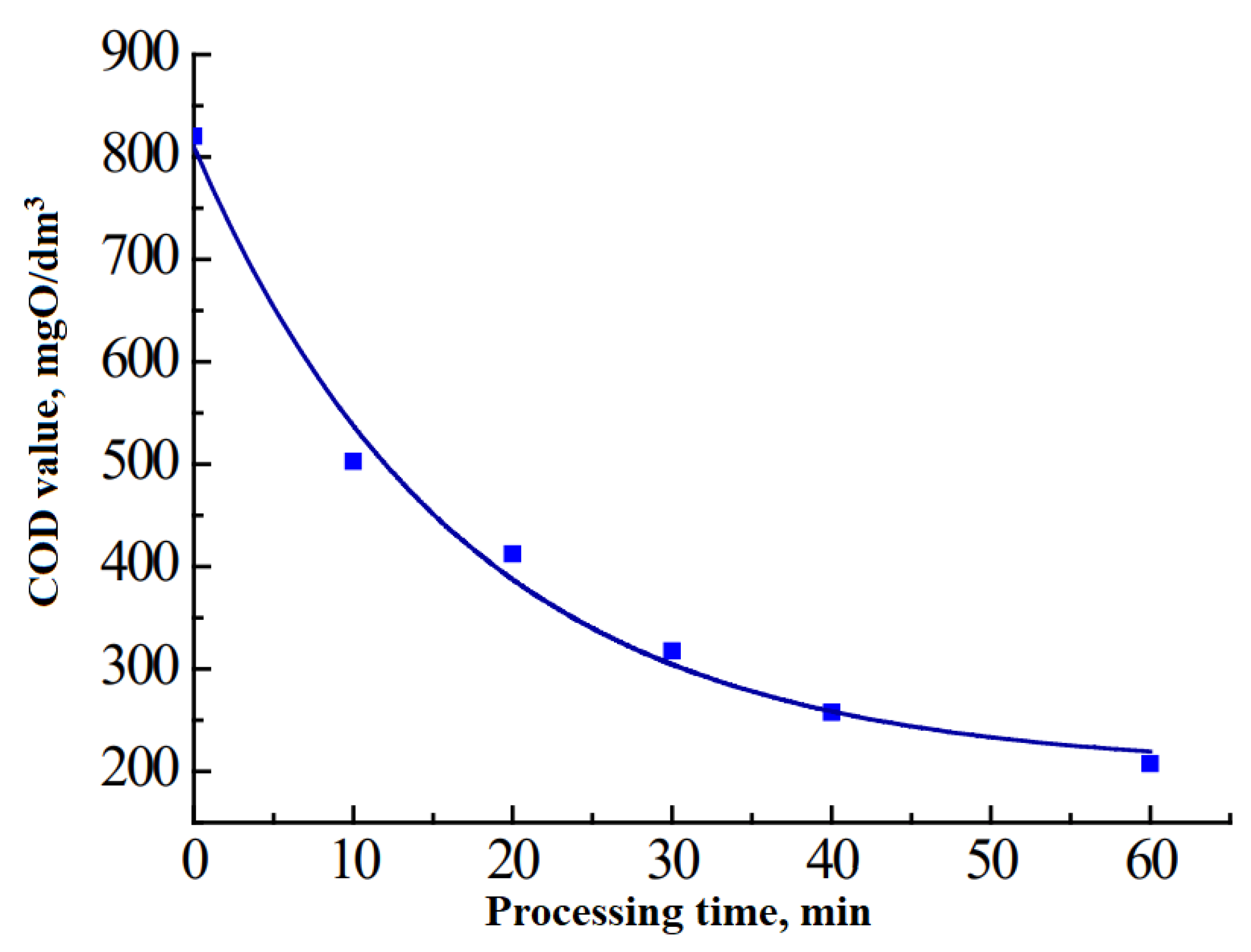
Figure 2.
Dependence of sulfide and sulfate ion concentrations on treatment time during the ozonation of sulfide-alkaline wastewater.
Figure 2.
Dependence of sulfide and sulfate ion concentrations on treatment time during the ozonation of sulfide-alkaline wastewater.
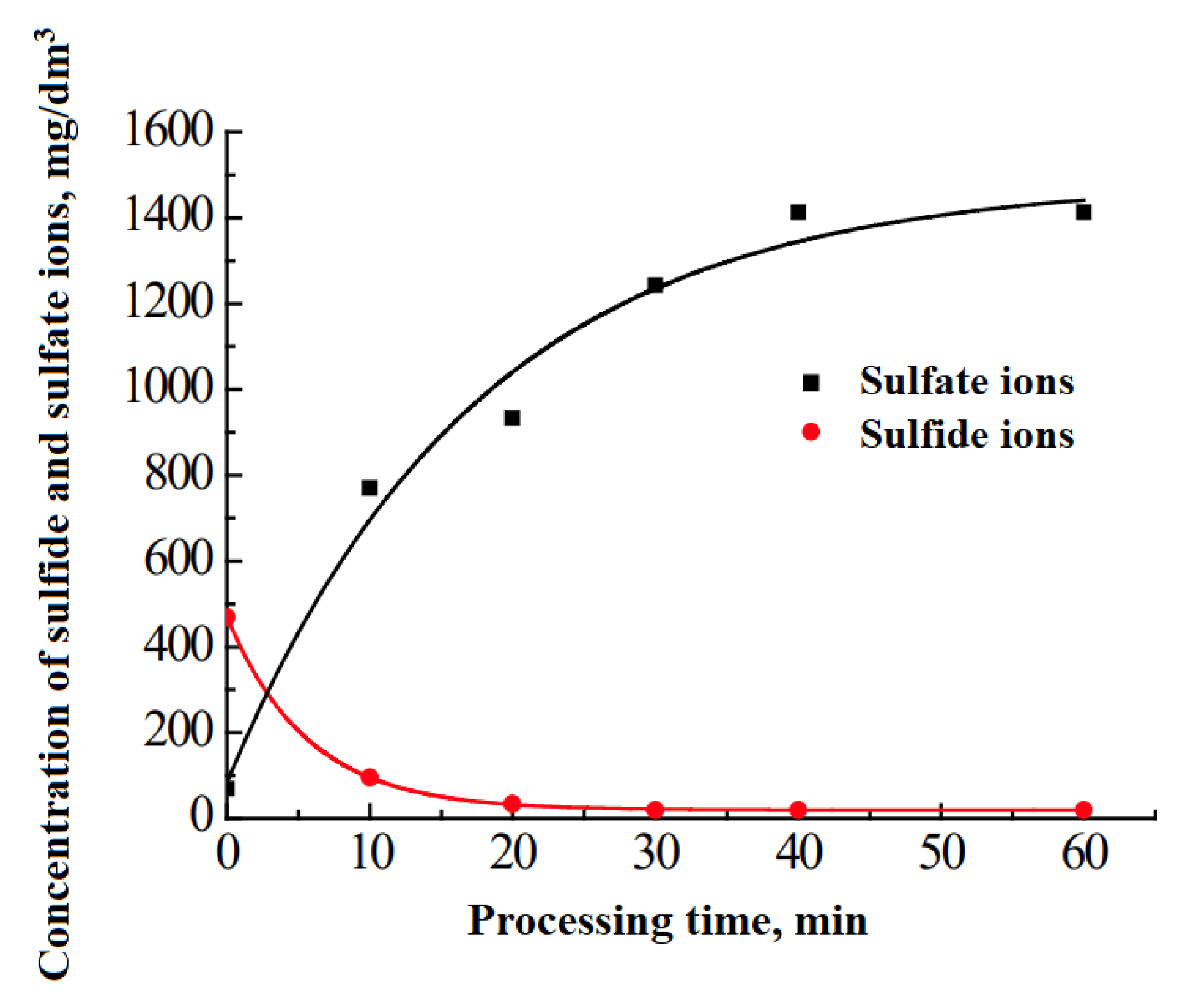
Figure 3.
Appearance of an Electrochemical Wastewater Treatment and Separation System for Industrial Use.
Figure 3.
Appearance of an Electrochemical Wastewater Treatment and Separation System for Industrial Use.
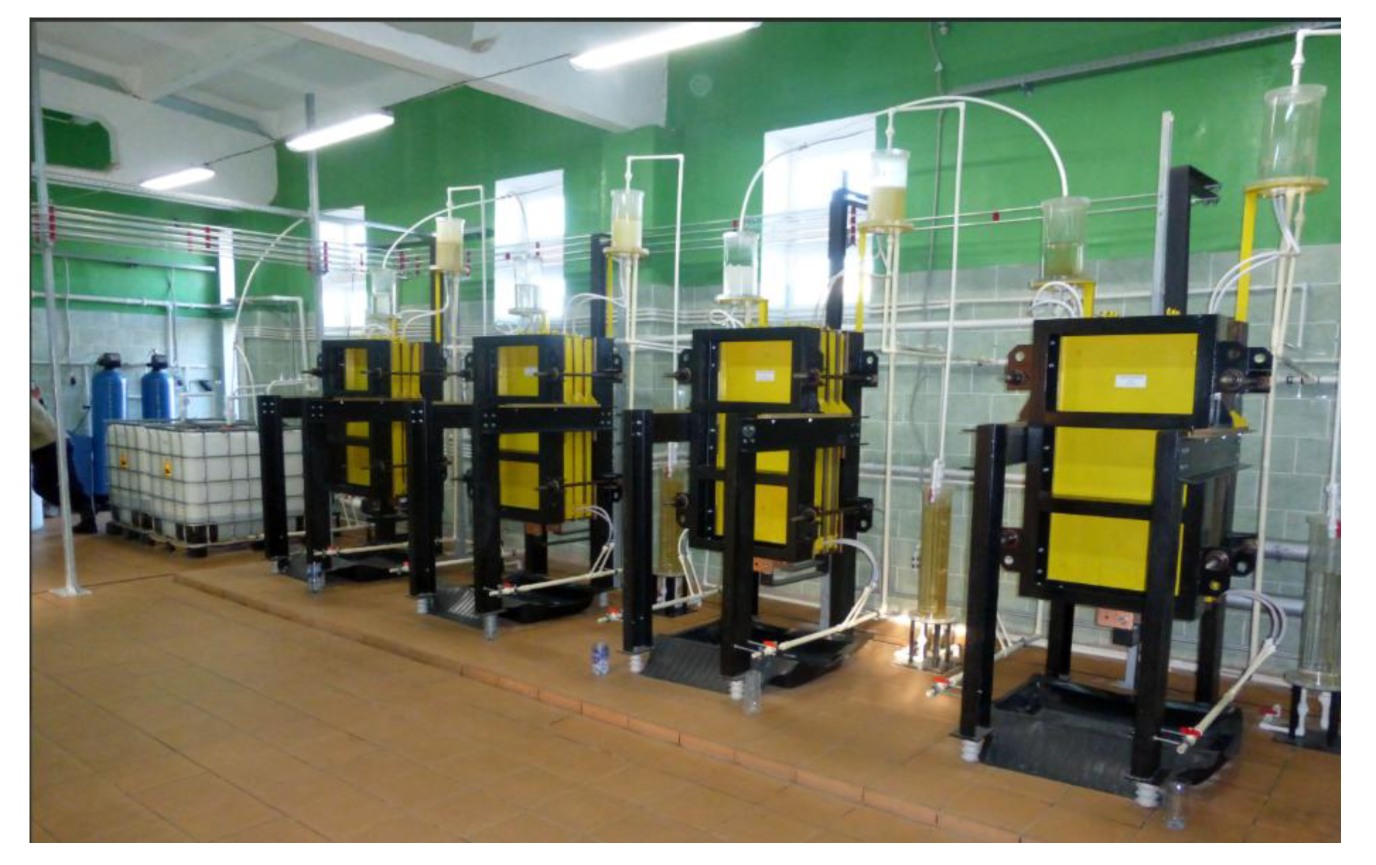
Figure 4.
Appearance of the industrial effluent selected for electrochemical processing.
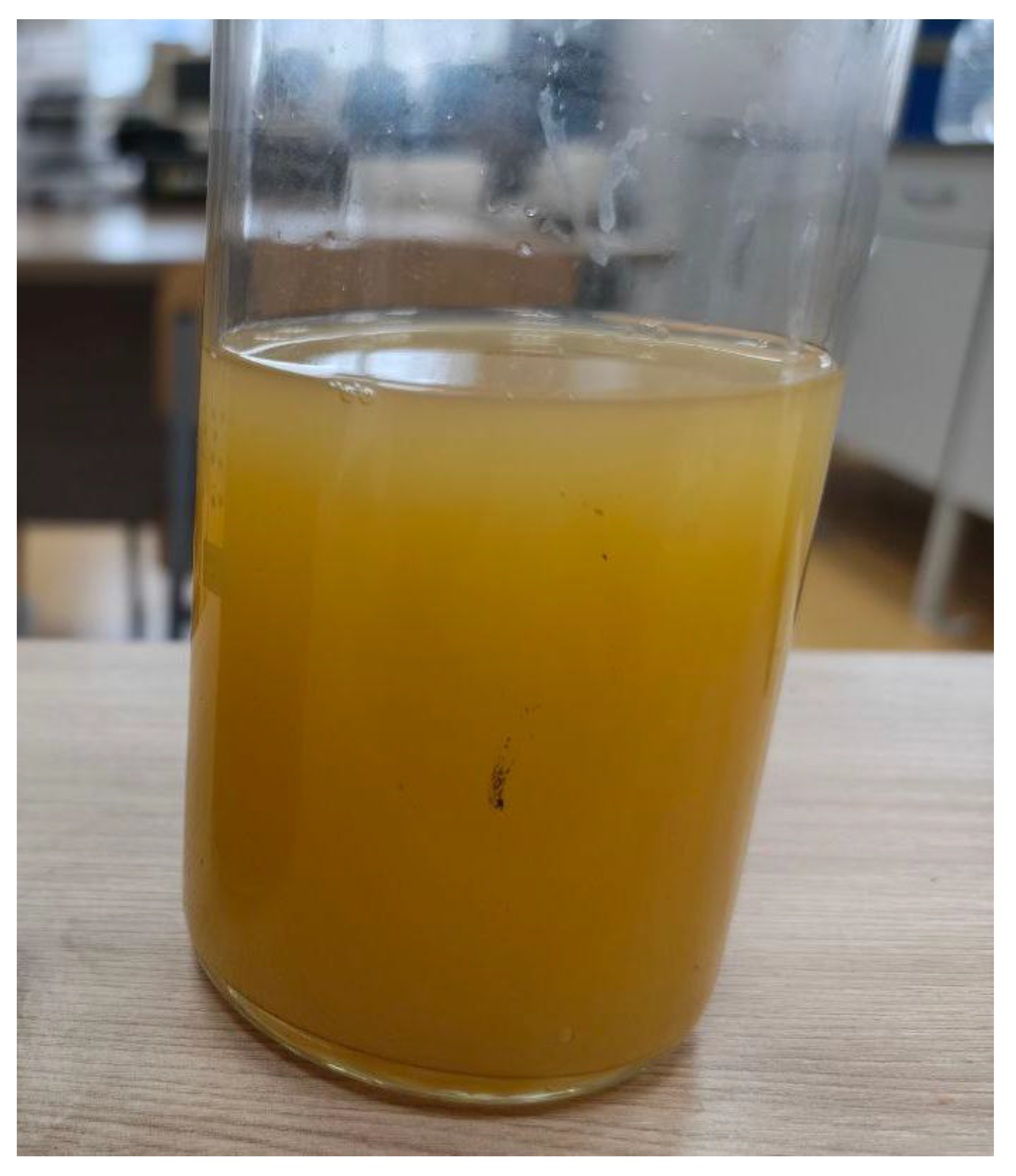
Figure 5.
External view (a) and construction (b) of the electromembrane apparatus: 1—clamping plate; 2—end rubber gasket; 3—monopolar electrode; 4—intermediate rubber gasket; 5—cation-exchange membrane; 6—inserts forming the electrode chambers; 7—bipolar electrode; 8—housing frame.
Figure 5.
External view (a) and construction (b) of the electromembrane apparatus: 1—clamping plate; 2—end rubber gasket; 3—monopolar electrode; 4—intermediate rubber gasket; 5—cation-exchange membrane; 6—inserts forming the electrode chambers; 7—bipolar electrode; 8—housing frame.
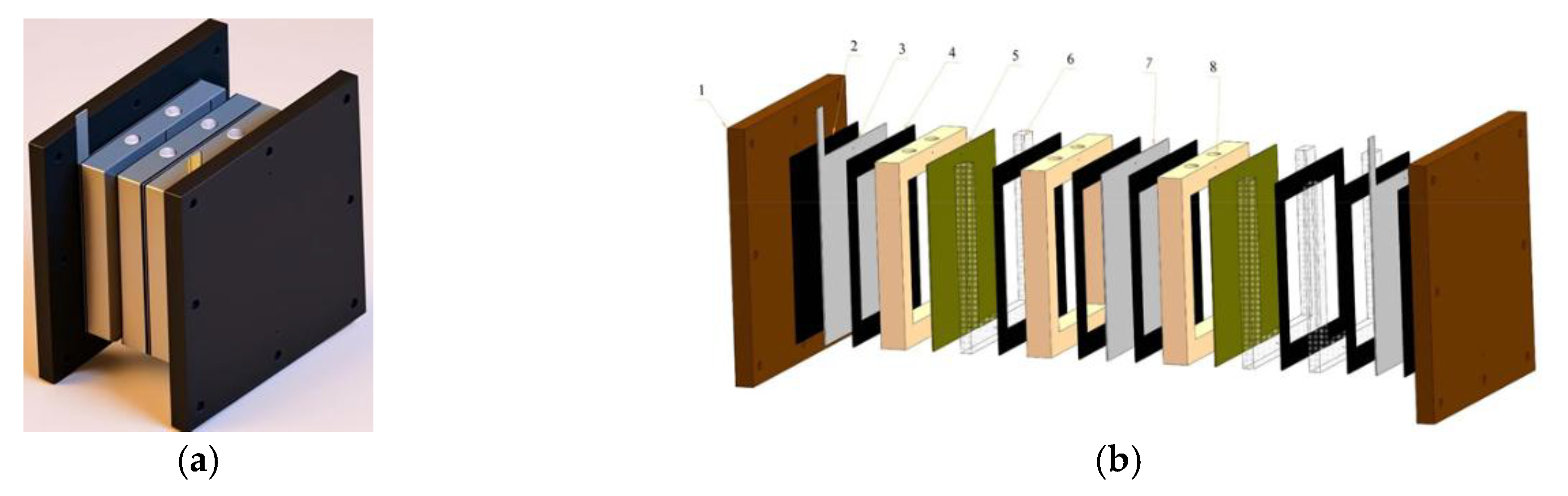
Figure 6.
Electrodialysis separation and concentration. MC—cation-exchange membrane, MA—anion-exchange membrane, K—cathode, A—anode, SAW—sulfide-alkaline waste. 1—anode wash chamber (2% NaOH); 2 chamber—SAW; 3 chamber—0.02% NaOH; 4 chamber—SAW; 5—cathode wash chamber (2% NaOH).
Figure 6.
Electrodialysis separation and concentration. MC—cation-exchange membrane, MA—anion-exchange membrane, K—cathode, A—anode, SAW—sulfide-alkaline waste. 1—anode wash chamber (2% NaOH); 2 chamber—SAW; 3 chamber—0.02% NaOH; 4 chamber—SAW; 5—cathode wash chamber (2% NaOH).
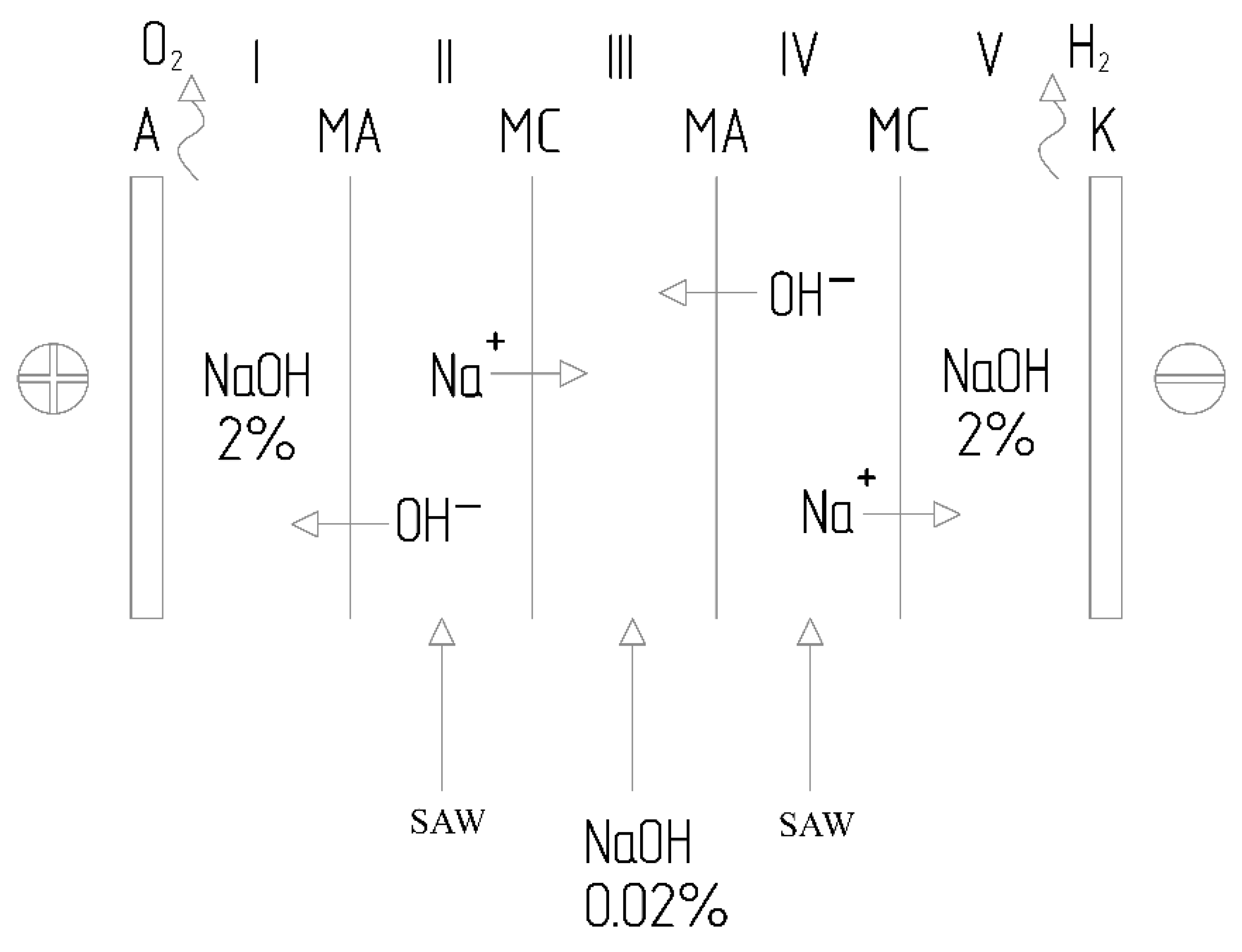
Figure 7.
Assembly option of electrodialysis apparatus in bipolar electrodialysis mode. Shchekinoazot membranes. MC—cation-exchange membrane, K—cathode, A—anode, SAW—sulfide-alkaline waste, BE—bipolar electrode: Ni 99.5%. 1st chamber—SAW; 2nd chamber—0.05% NaOH; 3rd chamber—SAW; 4th chamber—0.05% NaOH.
Figure 7.
Assembly option of electrodialysis apparatus in bipolar electrodialysis mode. Shchekinoazot membranes. MC—cation-exchange membrane, K—cathode, A—anode, SAW—sulfide-alkaline waste, BE—bipolar electrode: Ni 99.5%. 1st chamber—SAW; 2nd chamber—0.05% NaOH; 3rd chamber—SAW; 4th chamber—0.05% NaOH.
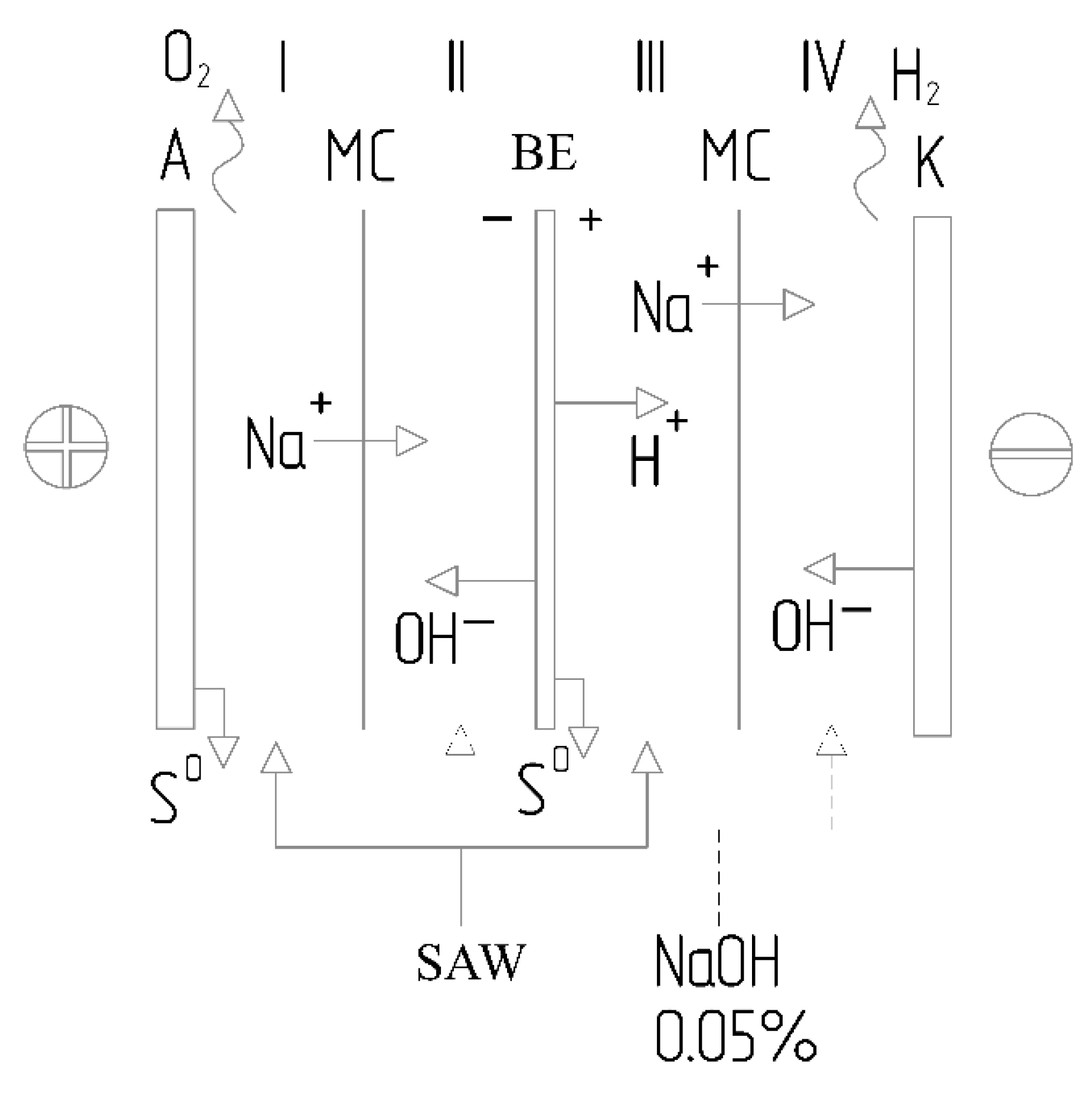
Figure 8.
Change in total alkalinity depending on the amount of electricity Q required to release one mole equivalent of substance (F). TA(1) is the total alkalinity in chamber 1, TA(2) is the total alkalinity in chamber 2, TA(3) is the total alkalinity in chamber 3.
Figure 8.
Change in total alkalinity depending on the amount of electricity Q required to release one mole equivalent of substance (F). TA(1) is the total alkalinity in chamber 1, TA(2) is the total alkalinity in chamber 2, TA(3) is the total alkalinity in chamber 3.
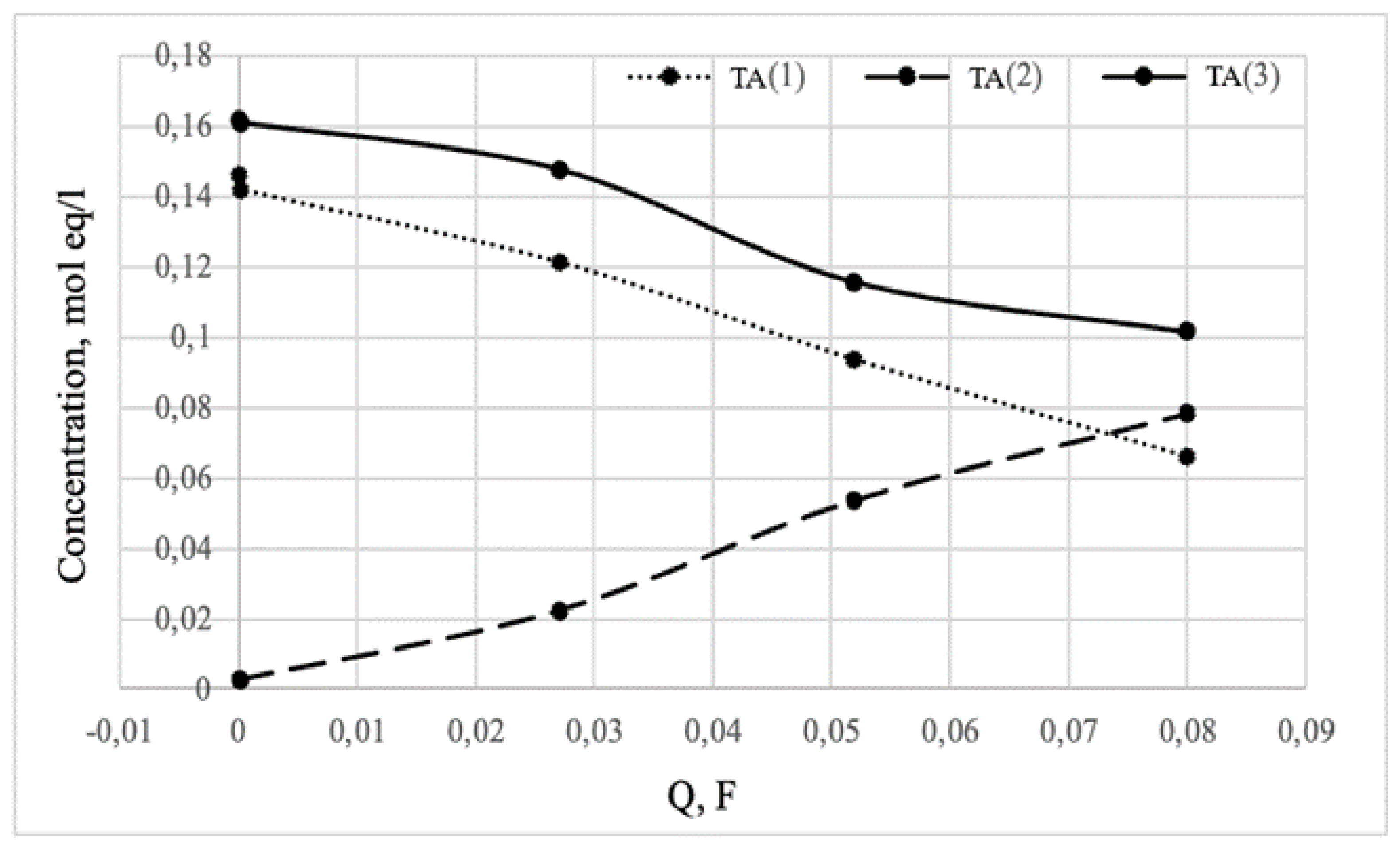
Figure 9.
The ratio of sulfides to hydrate alkalinity as a function of the amount of electricity Q required to release one mole equivalent of the substance (F). S(1)/HA(1) is the ratio of sulfides to hydrate alkalinity in chamber 1, S(2)/HA(2) is the ratio of sulfides to hydrate alkalinity in chamber 2, and S(3)/HA(3) is the ratio of sulfides to hydrate alkalinity in chamber 3.
Figure 9.
The ratio of sulfides to hydrate alkalinity as a function of the amount of electricity Q required to release one mole equivalent of the substance (F). S(1)/HA(1) is the ratio of sulfides to hydrate alkalinity in chamber 1, S(2)/HA(2) is the ratio of sulfides to hydrate alkalinity in chamber 2, and S(3)/HA(3) is the ratio of sulfides to hydrate alkalinity in chamber 3.
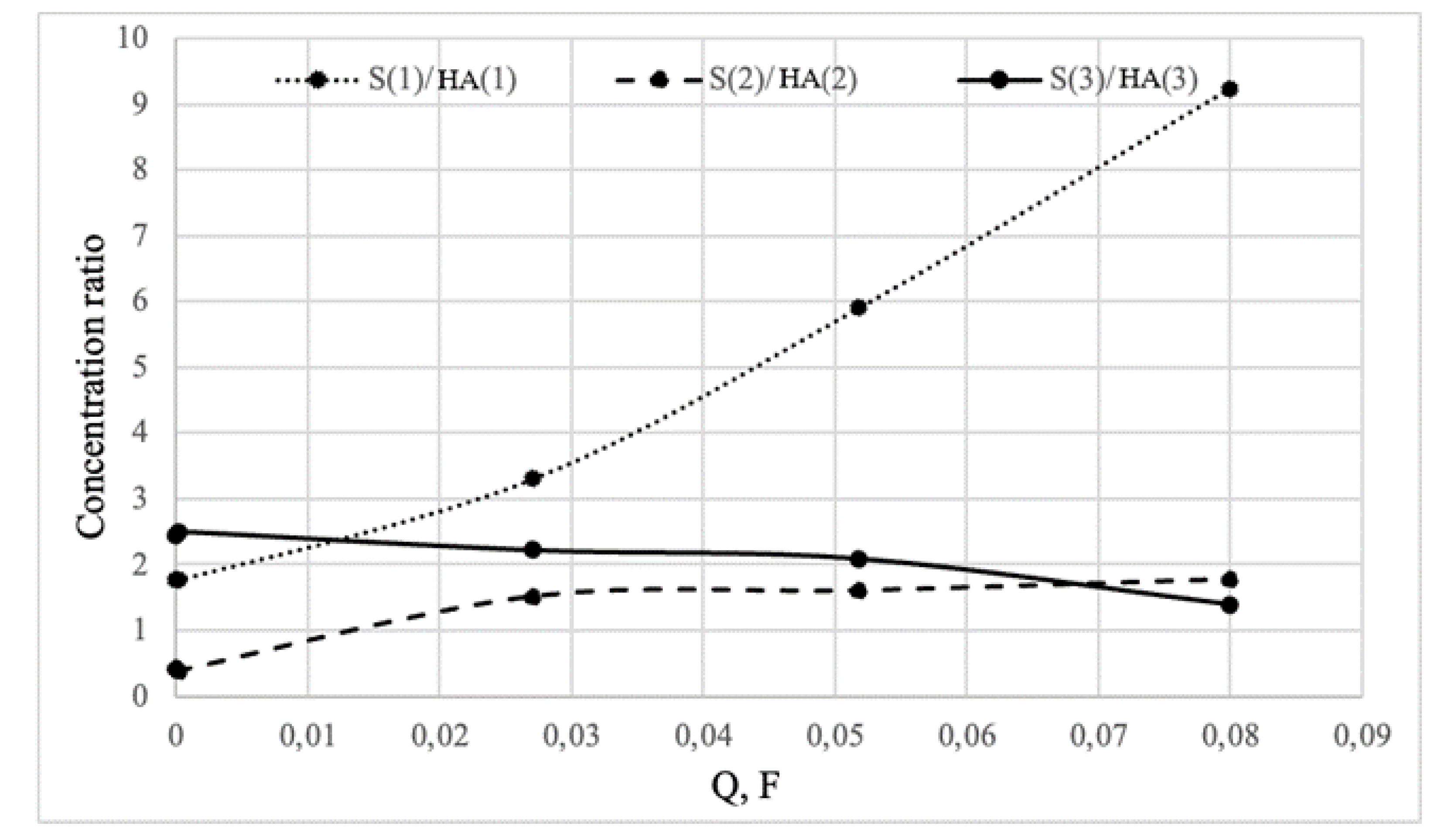
Figure 10.
The ratio of COD to hydrate alkalinity depending on the amount of electricity Q required to release one mole equivalent of the substance (F). The ratio of COD to hydrate alkalinity depending on the amount of electricity passed through the apparatus. COD(1)/HA(1) is the ratio of COD to hydrate alkalinity in chamber 1, COD(2)/HA(2) is the ratio of COD to hydrate alkalinity in chamber 2, and COD(3)/HA(3) is the ratio of COD to hydrate alkalinity in chamber 3.
Figure 10.
The ratio of COD to hydrate alkalinity depending on the amount of electricity Q required to release one mole equivalent of the substance (F). The ratio of COD to hydrate alkalinity depending on the amount of electricity passed through the apparatus. COD(1)/HA(1) is the ratio of COD to hydrate alkalinity in chamber 1, COD(2)/HA(2) is the ratio of COD to hydrate alkalinity in chamber 2, and COD(3)/HA(3) is the ratio of COD to hydrate alkalinity in chamber 3.
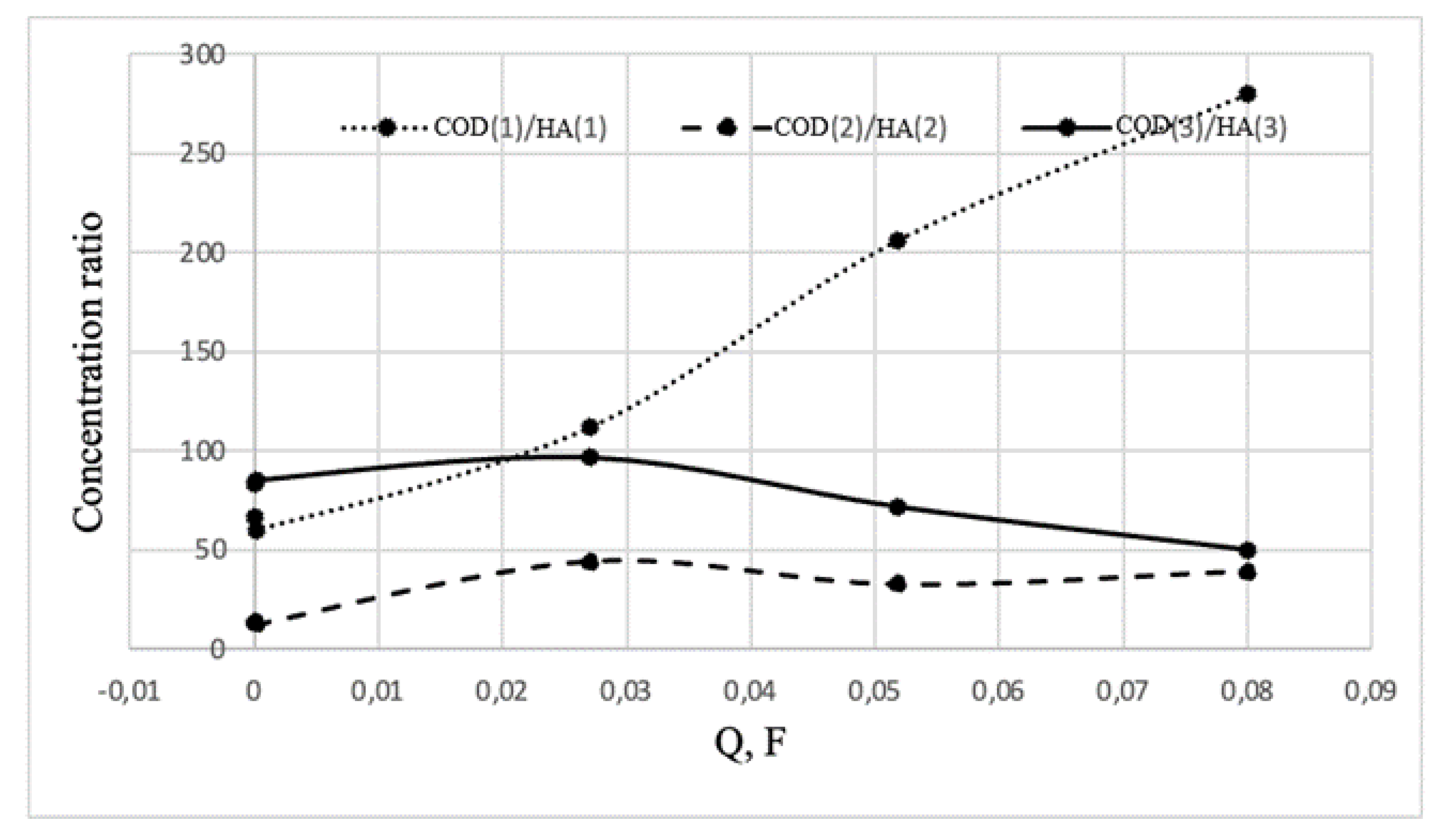
Figure 11.
The solutions in the beakers correspond from left to right to the numbers of the electrodialyzer chambers (1, 2, 3, 4). Chambers 1 and 3 are the alkaline solution after electrodialysis, chambers 2 and 4 are the alkaline solution isolated by bipolar electrolysis.
Figure 11.
The solutions in the beakers correspond from left to right to the numbers of the electrodialyzer chambers (1, 2, 3, 4). Chambers 1 and 3 are the alkaline solution after electrodialysis, chambers 2 and 4 are the alkaline solution isolated by bipolar electrolysis.
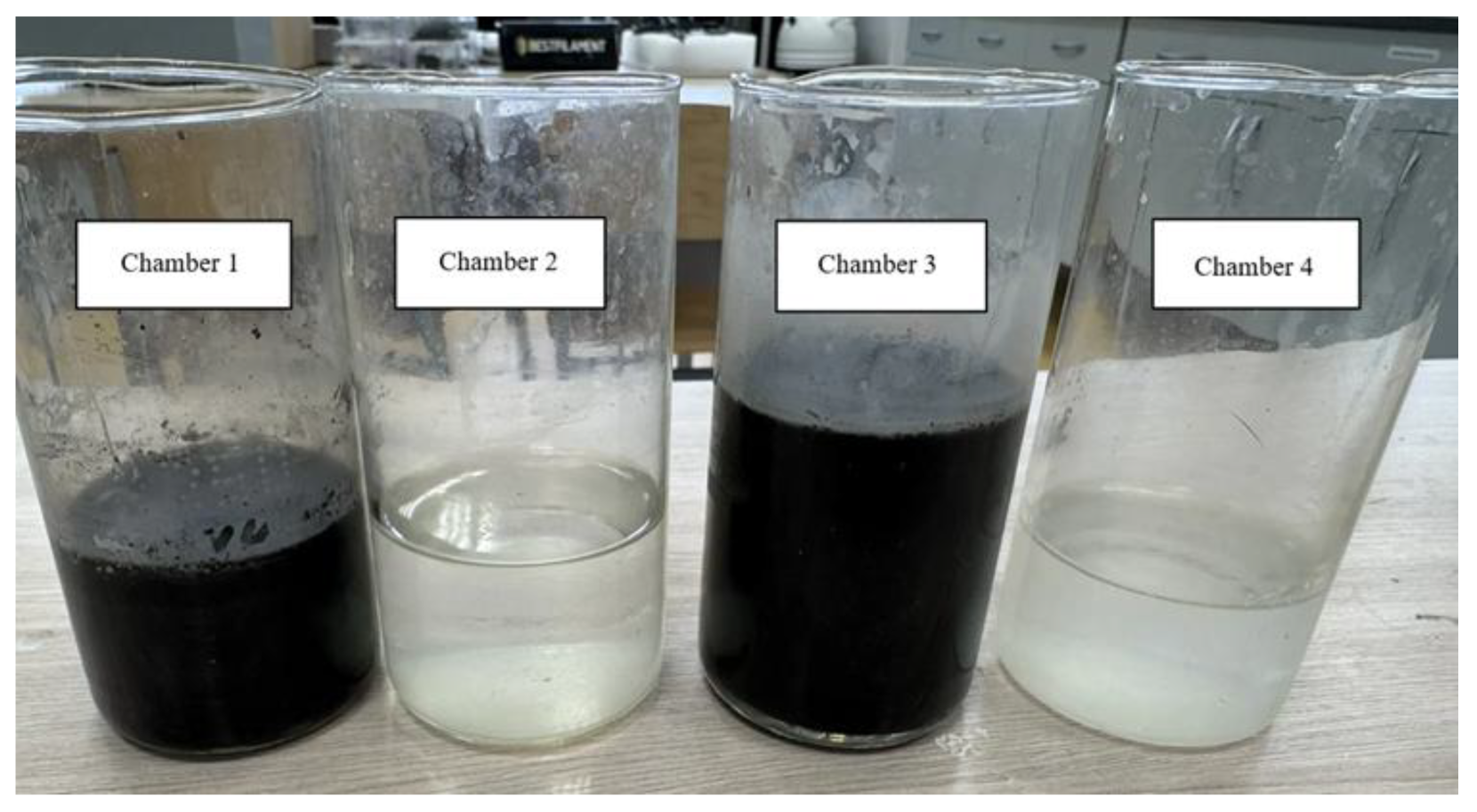
Figure 12.
Appearance of the membranes before the experiment: (a) Cation exchange; (b) Anion exchange.
Figure 12.
Appearance of the membranes before the experiment: (a) Cation exchange; (b) Anion exchange.
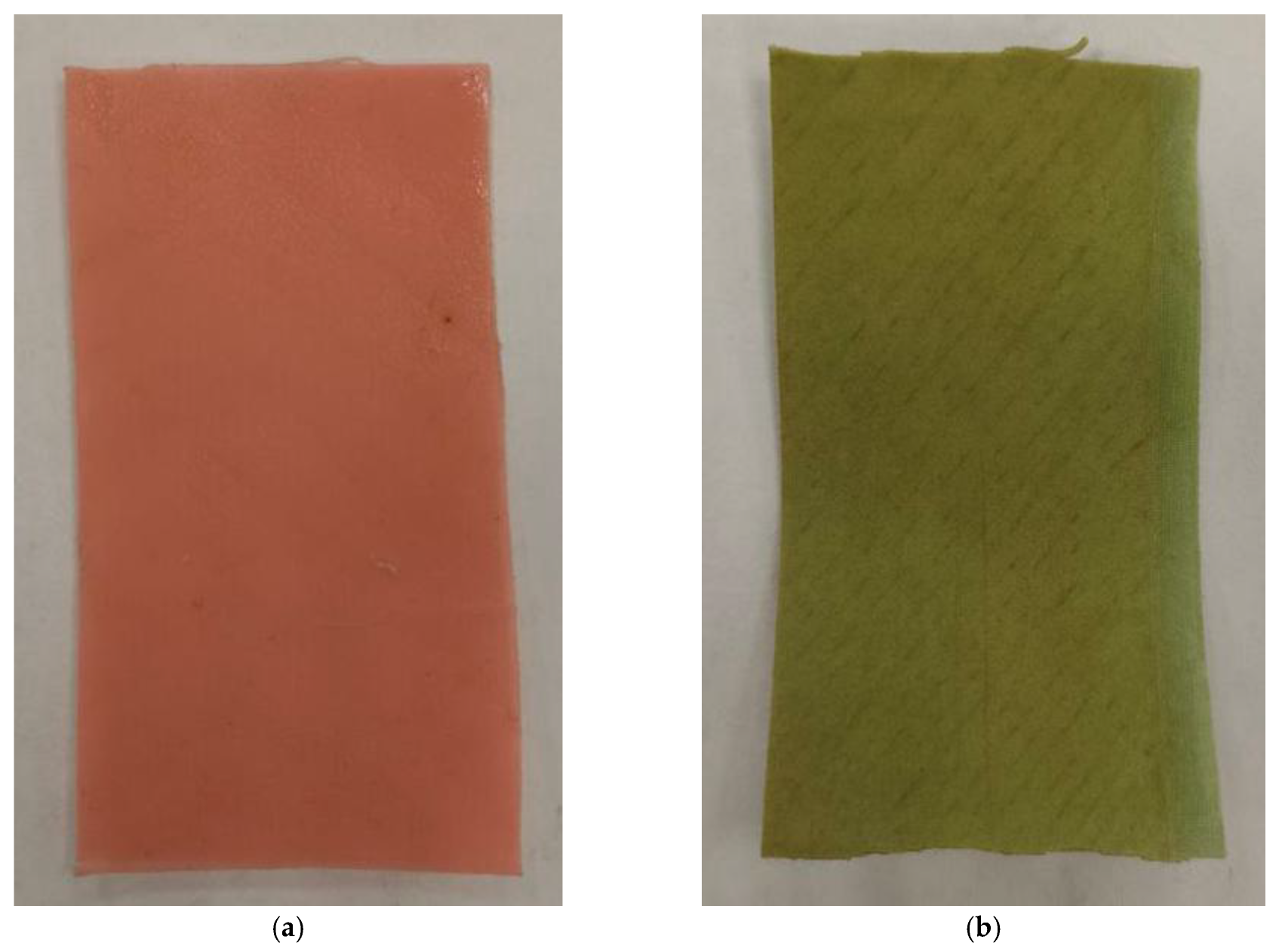
Figure 13.
Appearance of the SAW after 8 days of soaking membranes in it: (a) Cation exchange; (b) Anion exchange.
Figure 13.
Appearance of the SAW after 8 days of soaking membranes in it: (a) Cation exchange; (b) Anion exchange.
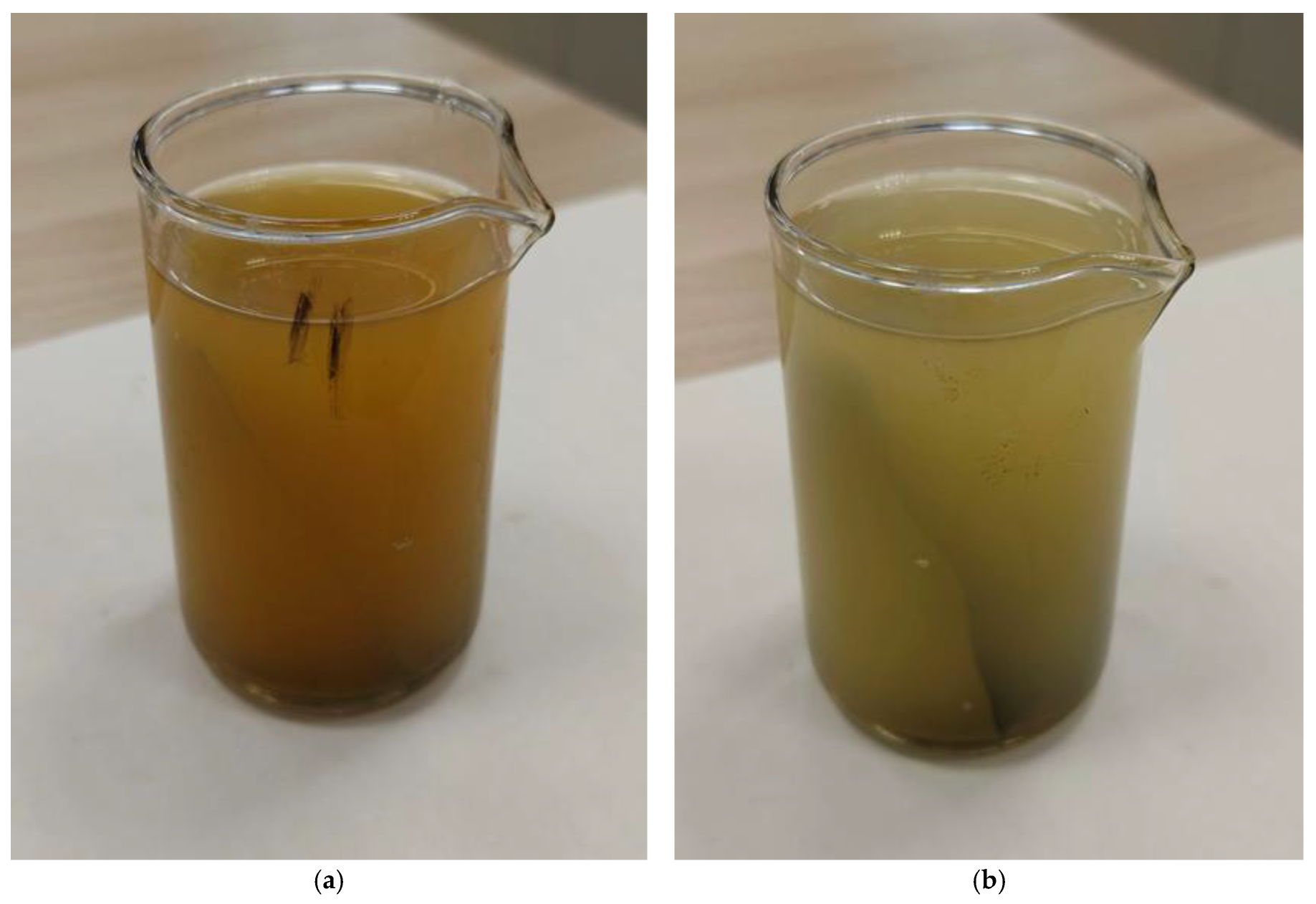
Figure 14.
Appearance of membranes after 8 days of soaking in SAW: (a) Cation exchange; (b) Anion exchange.
Figure 14.
Appearance of membranes after 8 days of soaking in SAW: (a) Cation exchange; (b) Anion exchange.
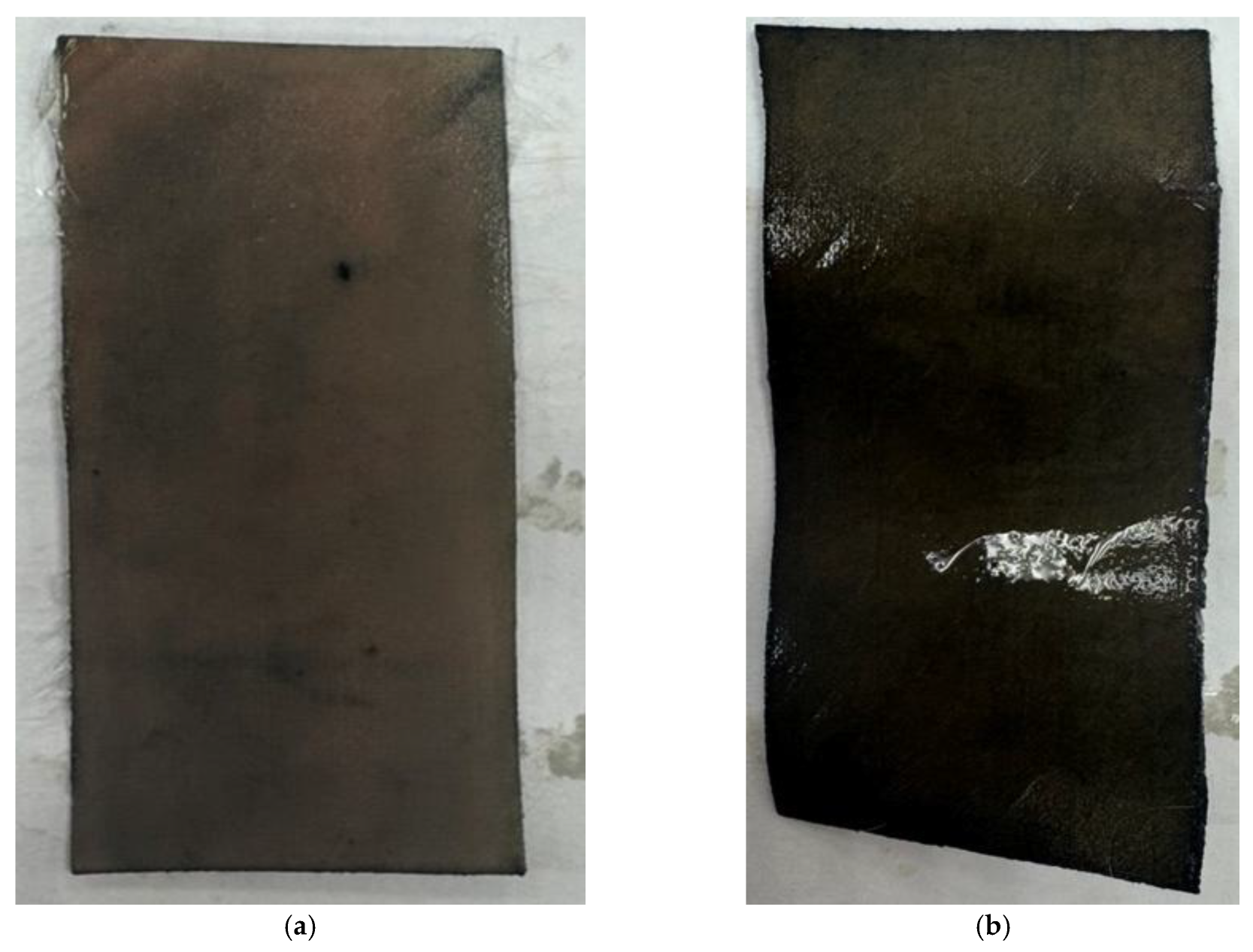
Figure 15.
Appearance of membranes after 2 days of washing in distilled water: (a) Cation exchange; (b) Anion exchange.
Figure 15.
Appearance of membranes after 2 days of washing in distilled water: (a) Cation exchange; (b) Anion exchange.
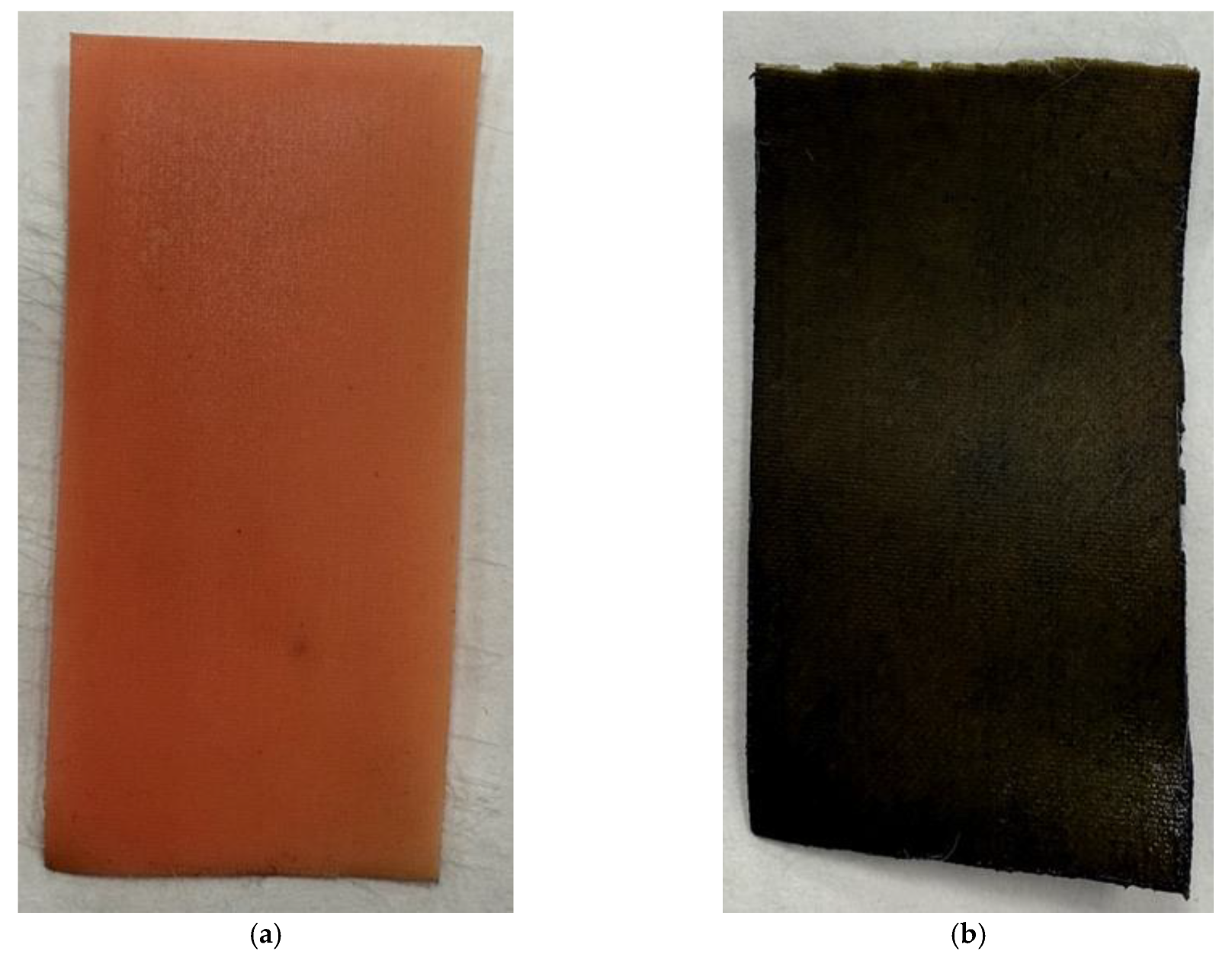
Figure 16.
Basic flow chart of the station for electrochemical separation of sulfide-alkaline wastewater. SAW—sulfide-alkaline wastewater, MBE—membrane bipolar electrodialysis, 1—low-concentration alkaline solution tank (0.02-0.05%), 2—SAW tank, 3—anode hydraulic seal, 4—bipolar membrane electrolyzer, 5—anolyte separator, 6—hydrogen hydraulic seal, 7—catholyte separator, 8—DC source, 9—alkali storage tank.
Figure 16.
Basic flow chart of the station for electrochemical separation of sulfide-alkaline wastewater. SAW—sulfide-alkaline wastewater, MBE—membrane bipolar electrodialysis, 1—low-concentration alkaline solution tank (0.02-0.05%), 2—SAW tank, 3—anode hydraulic seal, 4—bipolar membrane electrolyzer, 5—anolyte separator, 6—hydrogen hydraulic seal, 7—catholyte separator, 8—DC source, 9—alkali storage tank.
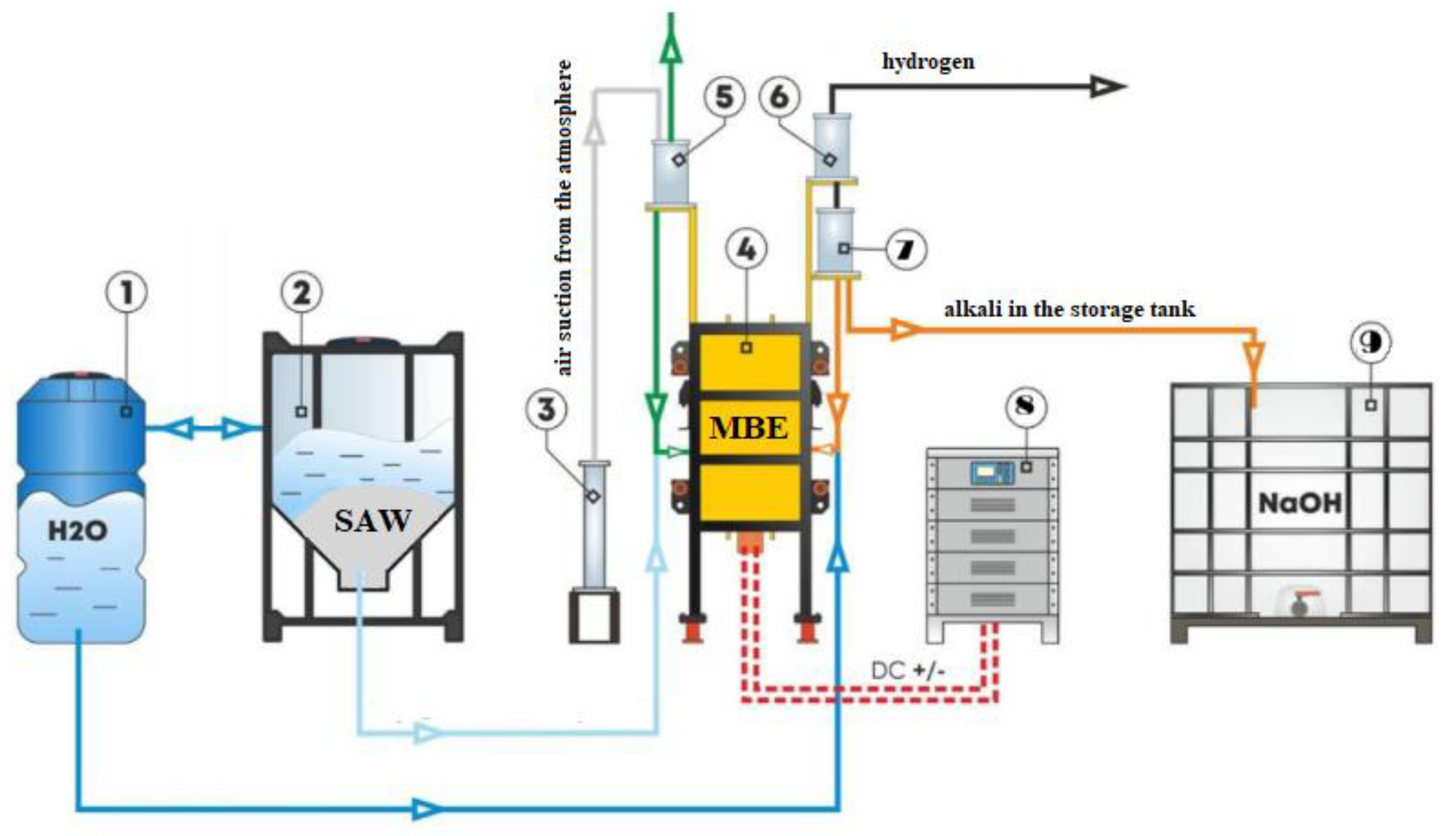

Table 1.
Composition of the Synthetic Wastewater Mixture and Maximum Permissible Concentration (MPC) Standards for Treated Wastewater.
Table 1.
Composition of the Synthetic Wastewater Mixture and Maximum Permissible Concentration (MPC) Standards for Treated Wastewater.
| Indicator Name | Meaning | MPC Standard for Treated Wastewater |
|---|---|---|
| Hydrogen Index, pH | 10-12 | 6.9-9.0 |
| Mass concentration of sulfides, mg/dm3 | 3000-20000 | 0.003 |
| Ammonium nitrogen, mg/dm3 | 500-5000 | 0.4 |
| Sulfates, mg/dm3 | 100-2000 | 100 |
| Chlorides, mg/dm3 | 100-1000 | 300 |
| Petroleum Products, mg/dm3 | 100-800 | 0.05 |
Table 2.
Physicochemical Parameters of the Initial Sulfide-Alkaline Wastewater.
| Tests | Results |
|---|---|
| рН | 13.06±0.1 |
| SEC, mS/cm | 87.4±0.9 |
| Total salinity, g/l | 43.7±0.4 |
| General rigidity, mg-eq/l | 0 |
| Calcium hardness, mg-eq/l | 0 |
| Carbonate hardness, mg-eq/l | 870±69.6 |
| Hydrate alkalinity, mg-eq/l | 50±6.0 |
| Carbonate alkalinity, mg-eq/l | 820±65.6 |
| Bicarbonate alkalinity, mg-eq/l | 0 |
| Total alkalinity, mg-eq/l | 870±69.6 |
| Sulfides, mg/l | 4969.2±944.2 |
| COD, mg/l | 12600±127.6 |
| Color, gr. color. | 5247±524.7 |
| Turbidity unit | 2230±312.2 |
| Total Inorganic Carbon, mgO/l | 1019.9±81.6 |
| Total Carbon, mgO/l | 1207.4±96.6 |
| Total Organic Carbon, mgO/l | 187.5±26.3 |
| Petroleum products, mg/l | 767.812±191.96 |
Table 3.
Changes in the SAW indicators in chambers 1, 3 and catholyte in chambers 2, 4 during bipolar membrane electrolysis with a four-chamber apparatus assembly.
Table 3.
Changes in the SAW indicators in chambers 1, 3 and catholyte in chambers 2, 4 during bipolar membrane electrolysis with a four-chamber apparatus assembly.
| Tests | рН | SEC, mS/cm Total salinity, g/l |
Carbonate hardness, mg-eq/l | Hydrate alkalinity, mg-eq/l | Carbonate alkalinity, mg-eq/l | Bicarbonate alkalinity, mg-eq/l | Total alkalinity, mg-eq/l | Sulfides, mg/l | COD, mg/l |
|---|---|---|---|---|---|---|---|---|---|
| Before electrolysis | 13.06 | 87.4 43.7 |
870 | 150 | 820 | 0 | 870 | 4969.2 | 12600 |
| 1 chamber | 7.26 | 6.82 3.41 |
40 | 0 | 0 | 40 | 40 | 166.3 | 980 |
| 2 chamber | 13.04 | 70.7 35.3 |
332 | 310 | 22 | 0 | 332 | 40.39 | 8600 |
| 3 chamber | 10.06 | 25.94 12.99 |
315 | 0 | 210 | 105 | 315 | 498.96 | 140 |
| 4 chamber | 13.11 | 91.4 45.7 |
433 | 401 | 32 | 0 | 433 | 17.7 | 1600 |
| Replaced the SAW in chambers 1 and 3 with new ones | |||||||||
| 1 chamber | 11.55 | 33.4 16.6 |
500 | 60 | 440 | 0 | 500 | 982.08 | 5600 |
| 2 chamber | 13.14 | 83.8 41.8 |
456 | 442 | 14 | 0 | 456 | 52.272 | 680 |
| 3 chamber | 12.98 | 57.9 29.0 |
620 | 140 | 480 | 0 | 620 | 3041.28 | 10000 |
| 4 chamber | 13.13 | 111.7 56.8 |
592 | 570 | 22 | 0 | 592 | 29.04 | 20 |
Table 4.
Summary of design characteristics of the bipolar membrane electrolysis process.
| Parameter | Meaning / Result |
|---|---|
| Electrical characteristics | |
| Average current | ~1 А |
| Current efficiency for NaOH | |
| Before replacing the SAW | 85% |
| After replacing the SAW | 83.3% |
| Power consumption | |
| Before replacing the SAW | 0.01 kW·h |
| After replacing the SAW | 0.012 kW·h |
| Maximum current | 1.37 A |
| Current density | 214 A/m2 |
| Mass characteristics | |
| Specific transfer of alkali laboratory | 0.3 kg NaOH/(m2·h) |
| Specific transfer of alkali industrial | 3 kg NaOH/(m2·h) |
| Membrane area per laboratory apparatus | 0.0064 m2 |
| Efficiency of purification from impurities | |
| Current efficiency (sulfides) | 0.33% |
| Current efficiency (organic) | 3.8% |
| NaOH content in purified solution | 2.3% |
| Sulfide content in purified solution | 0.0052% |
| Content of organic impurities in the purified solution | 0.053% |
| Extraction of hydrated alkalinity from SAW | 100% |
| Yield of useful products | |
| Alkaline solution (2.3–2.5%) | 1–1.5 m3/h |
| Hydrogen (99.9%) | 2 kg/h |
Table 5.
Comparative analysis of methods for treating sulfide-alkaline wastewater.
| Group of methods | Specific method | Advantages | Disadvantages / Limitations | Sources |
|---|---|---|---|---|
| Reagent methods | Neutralization with acids (H2SO4, HCl) | Simplicity of hardware design, low capital costs. | Formation of highly toxic H2S, requires additional purification from H2S (e.g., Claus process), low selectivity, uncontrolled foaming, increase in the salt content of purified water (secondary salinization), corrosion of equipment. | [1,2] |
| Oxidation with atmospheric oxygen (atmospheric and autoclave) | The autoclave option allows for intensification of the process and achievement of a high degree of oxidation. | Atmospheric: low speed, does not provide deep purification (organics remain). Autoclave: high energy costs, need for specialized equipment, problems with salt and sulfur deposits, loss of valuable elemental sulfur. | [3] | |
| Ozonation (O3) | High efficiency of decomposition of sulfides and organics, especially in alkaline environments. | High energy costs for ozone generation, complexity of equipment, selectivity of reactions, need to utilize residual ozone, clogging of dispersants. | [3] | |
| Chlorination/Peroxidation (Cl2, H2O2, Fenton’s reagent) | Chlorine is readily available. Hydrogen peroxide is environmentally safe (decomposition products are H2O and O2). | Chlorination: risk of formation of toxic organochlorine compounds. Peroxide: slow reaction rate without catalysts, requires an acidic environment (pH 2–4) for the Fenton reaction (neutralization of highly alkaline sulfide-alkaline compounds is necessary), formation of iron-containing precipitates. | [2] | |
| Thermal methods | Concentration by evaporation and combustion / Direct combustion | Almost complete destruction of organic pollutants, possibility of releasing mineral salts. | Extremely high energy consumption, severe equipment corrosion, need to clean flue gases from sulfur oxides (SOx). | [2] |
| Physicochemical methods | Sorption (activated carbons, zeolites, clays, modified sorbents) | Effective for extracting petroleum products and some organic matter, with the possibility of using waste (ash, slag) as sorbents. | They are not effective enough for low-molecular-weight polar compounds and sulfides. They produce spent sorbents that require regeneration or disposal. | [4,8,9,10] |
| Ion exchange | High selectivity towards ionic forms of pollutants. | Requires preliminary deep cleaning from organic matter (resin poisoning), sensitive to high pH values, typical for SAW. | [4] | |
| Membrane separation (micro-, ultra-, nanofiltration, reverse osmosis) | High degree of purification, compactness of installations. | High susceptibility of membranes to contamination by organic matter and sulfides, high osmotic pressure of effluents (energy costs), problem of disposal of highly toxic concentrates. | Not stated directly, but mentioned in the context of difficulties | |
| Electrochemical methods | Electrodialysis with anion exchange and cation exchange membranes | Enables alkali concentration. | Non-selective: sulfides and organics are transported along with the alkali. Membrane degradation: anion-exchange membranes are quickly destroyed in a SAW. No oxidation: toxic components are not rendered harmless, but merely transported. | Experimental data |
| Bipolar membrane electrolysis with cation exchange membranes and Ni electrodes | Simultaneous purification and recovery: removal of sulfides with sulfur recovery, production of pure alkali (2.3–2.5% NaOH) and hydrogen (99.9%). High selectivity. Chemical stability of cation exchange membranes. | Requires optimization of the design and operating modes for scaling. Control over the potential diffusion of neutral organic compounds through the membrane is essential. | [2,5,6,7,21,22,24] and experimental data |
Disclaimer/Publisher’s Note: The statements, opinions and data contained in all publications are solely those of the individual author(s) and contributor(s) and not of MDPI and/or the editor(s). MDPI and/or the editor(s) disclaim responsibility for any injury to people or property resulting from any ideas, methods, instructions or products referred to in the content. |
© 2026 by the authors. Licensee MDPI, Basel, Switzerland. This article is an open access article distributed under the terms and conditions of the Creative Commons Attribution (CC BY) license (http://creativecommons.org/licenses/by/4.0/).
Copyright: This open access article is published under a Creative Commons CC BY 4.0 license, which permit the free download, distribution, and reuse, provided that the author and preprint are cited in any reuse.


