

Submitted:
18 March 2026
Posted:
23 March 2026
You are already at the latest version
Abstract
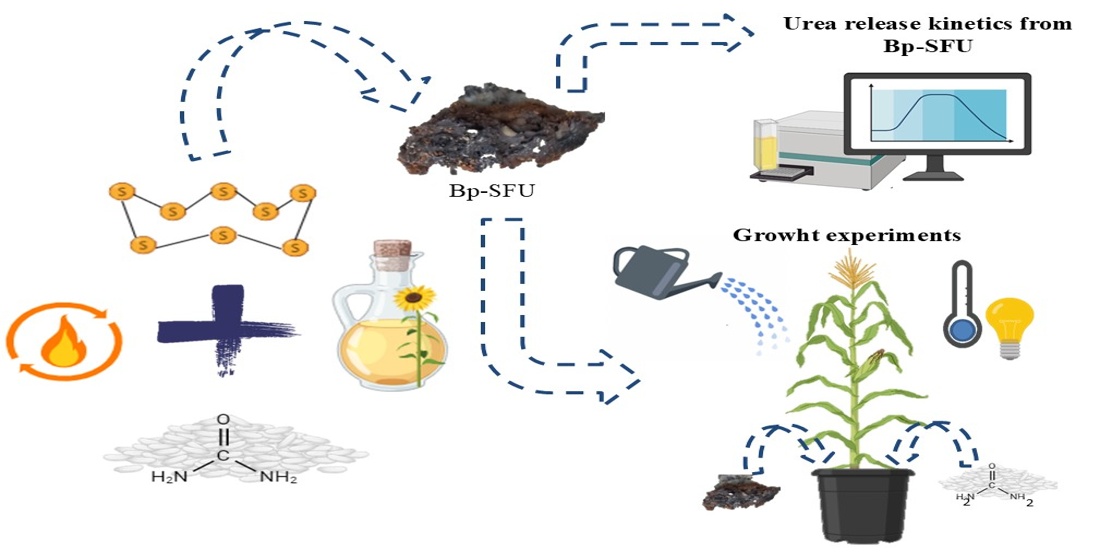
Modern agriculture faces major challenges driven by rapid population growth, climate change, and environmental concerns. Advanced polymeric architectures for controlled-release fertilizers (CRFs) are essential to mitigate these issues. Urea is one of the most widely used nitrogen fertilizers for field crops; however, its agronomic efficiency is limited by volatilization and leaching losses. In this study, we report a sustainable strategy to encapsulate urea using a matrix derived from industrial sulfur waste and vegetable oil, promoting both improved agronomic efficiency and the valorization of industrial residues and renewable resources. Through inverse vulcanization, we synthesized Bp-SF, a sponge-like polymeric material. Two bio-composites loaded with urea, Bp-SF25U and Bp-SF32U, were also prepared. FT-IR analysis confirmed urea encapsulation and the formation of polymeric structures from sunflower oil. SEM imaging revealed a porous morphology, while contact angle measurements confirmed the hydrophobic nature of the polymer matrix. Release kinetics studies demonstrated slow nitrogen release for more than 77 days, governed by diffusion. Pot experiments with maize showed that Bp-SF32U improved plant growth compared with conventional urea. These sulfur cross-linked biopolymers represent a promising approach to enhance urea efficiency while supporting greener fertilization strategies aligned with circular economy principles.
Keywords:
biopolymer
; urea
; controlled-release fertilizer
; sulfur-crosslinked biopolymer
; inverse vulcanization
; nitrogen use efficiency
; maize growth
; sustainable agriculture
1. Introduction
According to United Nations reports, the global population is increasing at an accelerated rate and is projected to reach a peak at 10.3 billion in the mid-2080s, followed by a gradual decline to 10.2 billion in 2100 [1].This rapid growth places increasing pressure on agricultural systems to enhance food production while minimizing environmental degradation.
At the same time, the availability of arable land is declining due to urbanization, soil degradation, and climate change, making the efficient use of agricultural inputs, particularly fertilizers, increasingly critical.
Nitrogen, mainly applied as urea, is one of the most essential macronutrients for crop production and is required in large quantities to sustain high yields [2]. However, urea undergoes rapid urease-mediated hydrolysis, producing ammonia (NH3) and resulting in substantial volatilization losses. The remaining nitrogen is subsequently oxidized by nitrifying microorganisms to nitrate (NO3-), a highly mobile form prone to leaching, while denitrification processes convert part of this nitrate into gaseous nitrogen species. Collectively, these transformations markedly decrease nitrogen use efficiency (NUE) and intensify environmental impacts. These processes significantly reduce nitrogen use efficiency and contribute to environmental pollution [3,4].
Maize (Zea mays L.) is one of the three major staple crops globally and a key source of food, feed, and industrial raw materials. Improving nitrogen use efficiency in maize production is therefore essential to meet increasing food demand in a sustainable manner [5,6]. While conventional chemical fertilizers have historically increased maize yields, their inefficient use, high application rates, and associated environmental impacts have raised concerns regarding soil degradation and nutrient losses. Consequently, current agricultural strategies emphasize the development of environmentally friendly fertilization technologies that maintain or enhance crop productivity while reducing negative environmental externalities [7,8].
Among these strategies, controlled-release fertilizers (CRFs), also referred to as enhanced efficiency fertilizers (EEFs), have emerged as a promising approach to synchronize nutrient release with plant uptake. These systems rely on physical or chemical barriers that regulate nutrient diffusion into the soil, thereby reducing volatilization and leaching losses and improving nitrogen use efficiency [9,10]. Polymer-coated fertilizers represent one of the most widely studied CRF technologies, in which nutrients are encapsulated within polymeric matrices acting as semi-permeable membranes [11,12]. A wide range of polymeric materials have been explored as coating or encapsulation matrices, including polyacrylamides, polyurethanes, polyesters, and cellulose-based derivatives [13,14,15,16].However, many of these systems rely on polymers derived from non-renewable petrochemical monomers and may persist in the environment, raising concerns regarding long-term soil accumulation and sustainability. As a result, the biodegradability, environmental footprint, and raw material origin of polymer coatings remain critical challenges to be addressed [17,18]. This raises concerns regarding their long-term accumulation, environmental footprint, and alignment with sustainable and circular agricultural practices. In response to these limitations, increasing attention has been directed toward the development of biopolymeric matrices derived from renewable resources or industrial by-products, in line with circular economy principles [19]. Such materials enable the valorization of waste streams and reduce dependence on fossil-based raw materials while maintaining the functional properties required for controlled nutrient release biopolymers offer several advantages for fertilizer encapsulation, including lower environmental impact, potential biodegradability, and the valorization of waste streams. Nevertheless, challenges remain in achieving adequate mechanical stability, controlled release performance, and cost-effectiveness compared to conventional polymer systems. In this context, Cavallo et al., recently highlighted the potential of a biobased polymer derived from epoxidized soybean oil (ESO) cross-linked with citric acid as a sustainable matrix for controlled urea release [20]. The stable and low-swelling ESO polymer network governed a diffusion-controlled nitrogen release, significantly improving nitrogen use efficiency and maize growth compared to free urea. The biopolymer combines agronomic effectiveness with Green Chemistry principles, using renewable raw materials and a simple, scalable synthesis, positioning the ESO-based system as a promising sustainable alternative to conventional fertilizers. On the other hand, sulfur-crosslinked biopolymers synthesized via inverse vulcanization have emerged as a versatile and well-established class of functional materials. Farioli et al. reported that sulfur–vegetable oil polymers obtained by inverse vulcanization present high porosity and affinity for nonpolar compounds, allowing their use as efficient sorbents for hydrocarbon-contaminated water [21]. More recently, the same polymeric matrix it was employed as a controlled-release platform for gentamicin, improving its antibacterial performance and highlighting the versatility of sulfur-crosslinked biopolymers for encapsulation applications [22]. Worthington and co-workers reported that inverse vulcanized sulfur polymers present tunable structural and barrier properties, which have been successfully exploited in coatings and encapsulation-related applications. In parallel, Chalker and collaborators extensively explored sulfur-rich polymers derived from elemental sulfur and unsaturated organic comonomers, highlighting their potential in environmental remediation, functional materials, and sustainable polymer design [23]. More recently, the combination of tunable porosity, hydrophobicity, and diffusion-controlled transport has motivated the exploration of these materials in controlled-release and encapsulation systems, including emerging agricultural applications [24]. These characteristics make sulfur-crosslinked biopolymers promising candidates for regulating nutrient release and reducing nitrogen losses in fertilization strategies.
Based on these considerations, the present study aims to evaluate the agronomic performance of urea encapsulated within a sulfur-crosslinked biopolymeric matrix synthesized from industrial sulfur and sunflower oil. The effects of the resulting hybrid polymer–urea fertilizers on nitrogen release behavior, physiological traits, and maize growth were systematically investigated and compared with those of conventional urea.
2. Results and Discussion
3.1. Synthesis and Characterization of Bio-Composites and Polymer
The synthesis of the bio-composites Bp-SF25U and Bp-SF32U was successfully carried out through the inverse vulcanization process. By inverse vulcanization it was possible to synthesize a biopolymer (Bp-SF) based on sulfur and sunflower oil, obtaining a light brown, macroporous material with an appearance similar to that of a sponge (see Figure 1A-Bp-SF). Similar result has been found by Farioli et. al. [21,22]. In contrast, the resulting urea-loaded biocomposites exhibited distinct white inclusions, as shown in Figure 1A-Bp-SF32U. Based on this visual evidence, it can be concluded that the biocomposites were successfully synthesized via inverse vulcanization. Fourier transform infrared spectroscopy was used to confirm the incorporation of urea into the biocomposites. The spectra of Bp-SF, pure urea, and the Bp-SF32U bio-composite are shown in Figure 1B, also the assignment of the characteristic bands is summarized in Table 2.
As observed in the spectrum and summarized in Table 2, the Bp-SF exhibits the same characteristic absorption bands previously assigned by Farioli and Worthington [21,30]. These results confirm that the expected functional groups are present, thereby indicating that the biopolymer was successfully synthesized. The FT-IR spectrum of Bp-SF32U exhibits the same characteristic bands of Bp-SF and representative urea bands of the urea: N–H stretching at 3455 cm−1, the C-N deformation bands at 1625 cm−1, and the C-N stretching band at 1457 cm-1, which are absent in the Bp-SF spectrum. This conclusively confirms the presence of encapsulated urea, consistent with the initial visual observations.
3.2. Urea Release Kinetics from Biocomposites
The contact angle measurement revels that Bp-SF exhibited pronounced hydrophobic behavior, with a contact angle of 121.3 ± 0.1°, primarily attributed to the nonpolar nature of the sulfur–oil network, consistent with previous reports (Farioli, 2024). The incorporation of urea reduced the contact angle to 110.5 ± 0.2° (Bp-SF25U) and 101.7 ± 0.1° (Bp-SF32U), indicating increased surface polarity and improved wettability. This enhanced wettability facilitates water penetration into the polymer matrix, promoting urea dissolution and diffusion. The decrease in contact angle suggests improved surface wettability, which may favor water uptake at the matrix interface and contribute to the diffusion-controlled release of urea.
The urea release from the biocomposites Bp-SF25U and Bp-SF32U evaluated in water, during 77 days, are presented in Figure 2. Both systems exhibited an initial burst release during the first 6 days (burst release zone), followed by a second stage, with a markedly slower release rate (sustained release zone) suggesting a two-stage release mechanism. This behavior is characteristic of slow-release systems, where the biopolymeric matrix regulates nutrient availability. The initial burst release could be ascribed to Fickian diffusion of urea located at or near the surface of the biopolymeric matrix, where diffusional path lengths are minimal and the resistance to mass transfer is low. As the system evolves, the release profile transitions into a sustained regime, primarily governed by the diffusion of urea entrapped within the inner domains of the biocomposites. In this stage, transport occurs through a thicker and more tortuous polymeric barrier, imposing higher diffusional resistance and effectively retarding the outward flux. Comparable biphasic release mechanisms have been described by Cavallo et at, using hydrophobic ESO–citric polymer matrix to encapsulate urea. This composite [20] exhibited a faster initial burst release (≈14–16% within the first 2 h) attributed to the rapid dissolution of surface-localized urea crystallites, as confirmed by SEM analysis. This stage was followed by a sustained release phase governed by diffusion through an interconnected network of micro- and nanopores formed during urea migration, ensuring prolonged nitrogen delivery. This behavior has been observed in other polymer-based delivery systems [20] such as poly(lactic-co-glycolic acid) microparticles loaded with diprophylline, where the burst phase was attributed to the rapid dissolution of drug crystals directly accessible at the particle surface. The modulation of release kinetics is therefore intrinsically linked to the microstructural organization of the polymeric matrix, the distribution of the active agent within the network, and the evolving concentration gradient driving mass transport. The results suggest that the release of encapsulated urea occurs gradually and slowly in both cases. Furthermore, the results indicate that urea would be available during the 69 days of the vegetative growth cycle of maize, implying that a single fertilizer application at sowing could be sufficient. This approach could reduce operational costs and labor requirements by eliminating the need for multiple fertilizer applications during crop development.
Figure 3 depicts the percentage of cumulative release urea profiles over the 77-day evaluation period for Bp-SF32U and Bp-SF25U. It can be observed neither of the biocomposites achieved complete release of the encapsulated urea within this timeframe, instead both biocomposites released up to 60% of the urea loaded. In contrast, free urea exhibited complete release within less than 1 day. Nevertheless, the cumulative release values correlated well with the initial urea loading of each formulation, confirming both the efficiency of the encapsulation process and the stability of the biopolymeric matrices. During the first 6 days, Bp-SF32U exhibited a higher rate release (6.5%/day) compared with Bp-SF25U, probably due to the release of the urea incorporated on the surface of the biocomposite surface. In contrast, Bp-SF25U displayed an almost constant release rate (4.2%/day) up to around day 6. By the end of the experimental period, both systems present an exponential profile. Similar results have been found from CSRF that combining urea with cellulose-based release the 45.11% of the encapsulated urea in 5 days [30]. Moreover, Poly(acrylic acid-co-acrylamide)-grafted on starch release 70% of N after 21 days [31]. These findings highlight that a higher urea loading does not necessarily translate into greater release within the same time window, underscoring the critical influence of the polymeric matrix structure and diffusional resistance in governing the release kinetics.
The incomplete release observed at the end of the study may be due to urea confined in the inner regions of the biopolymeric matrix, limited accessibility, or a decreased concentration gradient reducing the diffusion rate. Far from being a disadvantage, this behavior can be beneficial in prolonged agricultural applications, maintaining a reserve of fertilizer for later crop growth stages and supporting more sustained and efficient nutrition. Furthermore, the release profile analysis indicates that urea remains available throughout the 69-day vegetative growth cycle of maize (Zea mays L.) [35,36], suggesting that a single application at the time of sowing could be sufficient to meet the crop’s nitrogen demand. This strategy would eliminate the need for multiple fertilization events during different phenological stages, thereby reducing operational costs and labor requirements associated with macronutrient application.
Overall, the results demonstrate that biocomposites function as efficient matrices for controlled urea release, with performance tunable through material formulation and polymer-to-fertilizer ratio. Consequently, this approach has the potential to decrease fertilization costs, minimize labor inputs, and mitigate nutrient losses caused by leaching and volatilization, contributing to more sustainable agricultural practices. The kinetic studies of the urea release can be analyzed employing the kinetic models, Korsmeyer-Peppas and Weibull. The data of the Bp-SF32U and Bp-SF25U are fitting using both model in Figure 4A,B, respectively. Also, the parameters of the mathematical models for urea release of the Bp-SF25U and Bp-SF32U obtained are shown in Table 3.
In Bp-SF25U, the Korsmeyer-Peppas model yielded a diffusion exponent n = 0.39273, characteristic of a Fickian or quasi-Fickian diffusion mechanism, where the release is primarily governed by the movement of urea molecules through the polymer network [34]. In contrast, Bp-SF32U exhibited an n = 0.23330, indicating predominantly Fickian diffusion [35], and suggesting that the biopolymer matrix with higher quantity of urea present a higher initial permeability to the water, allowing for a faster initial release. Moreover, the Weibull model further supports this interpretation, the β= 0.43536 for Bp-SF32U suggests a faster initial release followed by stabilization in contrast with the β value obtained for Bp-SF25U (0. 96778) [36]. This behavior can be explained by the fact that the higher urea content in Bp-SF32U generates an abrupt concentration gradient, favoring a more rapid initial diffusion. The results obtained are consistent with previous studies demonstrating that the release control in polymeric matrices is strongly influenced by the matrix structure and the quantity of the active compound load. In slow-release hydrogel systems, release times can extend for days, as reported in recent studies where the hydrogels crosslinked structure and water retention capacity determine the release kinetics Mandal et al., 2025 [37]. In studies using starch-alginate matrices Phang et al., 2020 [38], urea release follows a Fickian diffusion model, with n < 0.43, similar to that observed for Bp-SF32U. However, the matrix’s water retention capacity and the presence of diffusion channels play a fundamental role in these systems, which could explain the differences in release rates. Similarly, urea-coated films show that the release time is determined by the film thickness and permeability [39]. In this context polymer matrix of epoxidated oil bean soy exhibited a stable, diffusion-controlled urea release governed by the hydrophobic and low-swelling nature of the biobased polymer matrix. The fitting of the urea released using Korsmeyer–Peppas and Weibull give the parameters n < 0.45 and β ≈ 0.5–1 respectively, consistent with Fickian diffusion. The initial rapid release was mainly associated with surface-localized urea, while the subsequent stage was characterized by a slower and sustained diffusion through the internal porous structure [20]. Increasing urea content led to a more compact matrix, slightly slowing nutrient diffusion, while maintaining overall release stability. In this context, the differences between Bp-SF25U and Bp-SF32U could be attributed to variations in crosslink density or the arrangement of polymer chains, affecting diffusion. Finally, in systems using mineral coatings, such as urea coated with wax and zeolite [40], the Weibull model accurately describes diffusion-controlled release, which is consistent with the results observed in this study.
3.3. Soil Physical Properties
The soil used for the maize growth experiment was previously analyzed to determine certain physical parameters, which are presented in Table 4.
The soil used in the maize growth experiment is characterized by low electrical conductivity (147.8 µS cm−1) and a slightly acidic pH of 5.90, indicating a non-saline, agriculturally suitable substrate with no obvious salinity stress for crops like maize. Low EC values such as these fall well below thresholds associated with salinity problems (where >0.4 dS m−1 begins to indicate mild salinity) and are typical of productive agricultural soils with minimal soluble salt accumulation. A pH around 5.9 is within the slightly acidic range commonly observed in cultivated soils and is generally acceptable for nutrient availability in many crops [41]. Similar studies of agricultural fields reported slightly acidic pH and low EC values when assessing soil conditions for plant growth, supporting the idea that these measured properties are within typical ranges for non-saline, productive soils [42]. Overall, these values allow general comparison with other scientific soil profiles used in crop studies and indicate that the soil environment is appropriate for evaluating maize response under controlled fertilization treatments.
3.4. Germination of Maize Seedlings
The germination promotion effect of Bp-SF25U and Bp-SF32U fertilizer on the maize seedling was evaluated under laboratory conditions and the results are presented statistically in Figure 5. As can be seen in Figure 5, none of the treatments applied was a 100% germination percentage (% Germ) obtained, but the treatments that presented the highest % Germ (88%) were treatments Bp-SF32U (containing 0.092 g of urea), Bp-SF25U (containing 0.079 g of urea) and 0.092 g of free urea. Control treatment reaches 76% of germination, the same value was obtained using only Bp-SF biopolymer. Importantly, none of the urea doses tested, free or encapsulated, negatively affected seed germination, confirming the safety of these formulations during early maize development. The biopolymer without urea showed any negative effect on germination. Moreover, the encapsulated urea formulations Bp-SF25U and Bp-SF32U enhanced maize seed germination compared to the control and the biopolymer alone. Notably, Bp-SF25U, containing a lower amount of encapsulated urea (0.079 g), achieved the same % Germ (88%) as free urea applied at a higher dose (0.092 g), indicating that urea encapsulation preserves nitrogen effectiveness while reducing the required fertilizer amount. Similarly, Bp-SF32U produced comparable germination results, confirming that lower or equivalent nitrogen doses can generate the same biological response when delivered through the biopolymer matrix.
3.5. Effect of Biopolymer on Plant Growth in Pot Condition
The effect of the different treatment in the maize growth was evaluated measuring the biomass response of both aerial (Pa) and root (Pr) biomass in comparison with control treatment. Figure 6 shows that the Bp-SF32U and Bp-SF25U treatments produced a more pronounced positive effect, particularly on Pr, which reached values approximately 1.23 and 1.93-fold higher than the control, respectively. In both treatment, Pa also increased, reaching approximately 1.33 and 1.42 fold higher than the control, respectively. The treatments containing free urea (0.079 g and 0.092 g of urea) exhibited contrasting responses. Under 0.092 g of free urea, Pr increased to approximately 1.88, whereas Pa showed a moderate increase around 1.37. Conversely, in the treatment using 0.072 g of free urea the Pr biomass dropped below unity (≈0.7), while Pa remained slightly above the control (≈1.17).
Regarding the average Pr statistics, all treatments that involve the encapsulation of urea in the Bp-SF matrix present appreciable differences between them and with respect to that of the control. Overall, the results indicate that the treatment Bp-SF25U promotes plant growth more effectively than Bp-SF alone or free urea. The marked increase in aerial biomass under Bp-SF25U and 0.092 g of free urea suggests enhanced nutrient availability or improved nutrient uptake efficiency when Bp-SF is combined with urea. This supports the assumption that the biopolymer matrix does not have a negative effect on the growth of the root system of the maize plant; on the contrary, it appears to favor it. The This is consistent with the role of Sulfur (S), as an essential mineral nutrient for plants, required for the synthesis of proteins (Met and Cys), oligopeptides (glutathione, phytochelatin), chlorophyll, enzymes, vitamins (thiamine, biotin) and various secondary metabolites (such as glucosinolates.), impacting overall metabolic and photosynthetic processes [43,44]. The consistent increase observed in Pa across these treatments further supports a stimulatory effect on root development, which may contribute to improved nutrient absorption and overall plant vigor.
The reduced Pr biomass observed in the 0.079 g of free urea treatment indicates that this urea concentration alone may leaching or volatilize when not accompanied by the polymer matrix. In contrast, when urea is incorporated into the polymeric treatments (Bp-SF32U and Bp-SF25U) this negative effect is mitigated, suggesting that the polymer may regulate nutrient release, reducing the nitrogen loses. The higher effect in Pr in the treatment of Bp-SF25U could be due to the fact that controlled-release or polymer-coated urea often improves both root morphology and above-ground growth by synchronizing N availability with plant demand. The polymer matrices can reduce the initial spike of available urea and prolong N release, avoiding high local N concentrations that can cause stress. This buffering effect is consistent with our finding that the 0.079 g of free urea treatment reduced the aerial biomass (Pa ≈ 0.7) whereas the same nominal urea dose embedded in Bp-SF (Bp-SF25U) did not cause that reduction and instead increased Pr and Pa. Similar behavior has been demonstrated in studies showing that polymer-coated urea (PCU) increases root growth and nitrogen use efficiency in the super-large-panicle indica/japonica hybrid rice cultivar Yongyou 1540, thereby promoting greater shoot biomass and yield [48].
The variability observed in some treatments may reflect differential plant responses to nutrient availability or heterogeneity in nutrient release dynamics. Nevertheless, the overall pattern shows that polymer–urea combinations promote both aerial and root growth beyond the levels achieved by the individual components.
Several agronomic and physiological studies also report a clear benefit of slow-release formulations on root biomass and activity: a steadier N supply promotes root proliferation and enzymatic activity, improving soil exploration and nutrient acquisition. This matches our observation of increased Pr across polymer-containing treatments and suggests that the polymer matrix not only prevents toxicity but actively promotes root development, which in turn supports the observed gains in shoot biomass.
3. Materials and Methods
3.1. Materials
Biopolymers based on sunflower oil (SF) and elemental sulfur (S) were synthesized via inverse vulcanization. Commercial sunflower oil (Natura®, from AGD (General Deheza, Cordoba, Argentina), and elemental sulfur (Aldrich purity > 99%) were used as comonomers. A 50:50 S–SF mass ratio was employed to produce the cross-linked biopolymer (Bp-SF). Granular urea was purchased from Cicarelli.
3.2. Methods
3.2.1. Synthesis and Characterization Urea Loaded Bio-Composites: Bp-SF-Urea
The biocomposite were synthesized according to the procedure reported by Farioli et al. [21] except that the oil together with urea was heated to 160 ºC and added to the reactor with sulfur at 160 ºC under stirring (900 rpm). Two bio-composites were synthesized, varying the mass of urea and keeping the mass ratio of sunflower oil to sulfur constant at 50:50, which were called: Bp-SF25U (0.25 g Urea/g Bp-SF) and Bp-SF32U (0.32 g urea/g Bp-SF).
The percentage of urea contained in each of the biopolymer used in the test was calculated from Equation 1. The mass of each reactive employed in the reaction is depicted in Table 1.
where mb is the mass of the biopolymer used in the growth assay, mu is the mass of urea encapsulated in the synthesis and/or molding by reactive compression and total mass (mt) is the sum of the masses of the reactants used to obtain the biocomposite (mass of S, mass of vegetable oil and mass of urea).
Successful urea encapsulation within the Bp-SF matrix was confirmed by Fourier Transform Infrared (FTIR-ATR) spectroscopy. The FTIR-ATR spectroscopy experiment was carried out in absorbance mode using a Bruker Tensor 27 spectrometer. The spectra were obtained with 30 scans per spectrum at a spectral resolution of 4 cm−1 in the wavenumber range from 4000 to 500 cm−1. As a reference, the background spectrum of air was collected before the acquisition of each sample spectrum.
3.2.2. Contact Angle Measurement
Surface wettability was evaluated by static water contact angle measurements using a Theta Flow optical tensiometer (Biolin Scientific). A 5 μL droplet of bi-distilled water was placed on each sample (Bp-SF, Bp-SF32, and Bp-SF25U), and measurements were performed in triplicate. The reported contact angle corresponds to the average value obtained from five images analyzed with OneAttension® software.
3.2.3. Controlled Release Analysis
In order to study the release behavior of the encapsulated urea samples were immersed in aqueous solutions. For the release analysis, 3 g of each biocomposite sample were immersed in 150 mL of distilled water in a sealed vessel. The samples were maintained at a constant temperature of 25 °C using a thermostatic bath. At predetermined time intervals, 1 mL aliquots were collected, and the urea concentration was quantified by UV-visible spectroscopy using a Varian Cary® 50 UV-Vis spectrophotometer. Urea quantification was performed by derivatization: each 1 mL aliquot was reacted with 1.8 mL of a solution containing 0.3 g of p-dimethylaminobenzaldehyde (DMAB), 100 mL of acetonitrile, and 3.6 mL of concentrated hydrochloric acid (37% w/w) [20]. This reaction produced a yellow-colored solution, whose absorbance was measured at 420 nm.
The urea release mechanisms from the Bp-SF biocomposites were quantitatively analyzed by fitting the experimental release data to two well-established kinetic models: the Korsmeyer-Peppas [25,26] model. The cumulative release data were fitted to the Korsmeyer-Peppas Equation 2:
where Mt/Mi is the fraction of urea released at time t, k is the kinetic constant, and n is the diffusion exponent indicative of the release mechanism. The value of n was interpreted according to established criteria for spherical matrices.
Additionally, the release data were fitted using the Weibull model [27] to the Weibull Equation 3:
where τ is a scale parameter representing the process time, and β is a shape parameter that characterizes the release curve as exponential (β=1), parabolic (β<1), or sigmoidal (β>1). Model fitting and parameter estimation were performed using nonlinear least-squares regression using OriginPro®.
3.2.4. Soil Physical Properties
The soil used for maize growth experiments was previously analyzed to determine its physical parameters such as conductivity, pH, soil color and odor.
3.2.5. Pot Experiment
The experiment aimed to evaluate the impact of the biopolymeric matrix Bp-SF and the two bio-composites Bp-SF25U and Bp-SF32U on the plant growth. Growth experiments were conducted using Zea mays plants, for this, 1 liter pots (15 cm of diameter) containing 1kg of soil from a field in the Río Cuarto region were used, and maintained for 69 days, until the plants completed the vegetative phase.
The objective of this study was to design a controlled-release system under realistic agronomic conditions, ensuring that the biopolymer/urea ratios reflected feasible formulations for field applications. The fertilization rate was based on field-relevant applications reported in the literature, corresponding to a conventional dose of 75 kg urea ha−1 20. Considering that the experiments were conducted in cylindrical pots with a diameter of 15 cm, the applied urea amounts resulted in equivalent surface-based doses of 45 and 52 kg urea ha−1 for Bp-SF25U and Bp-SF32U, respectively. These values represent reductions of approximately 40% and 30% relative to the recommended urea dose in order to evaluate the effect of the encapsulated urea.
3.2.6. Preparation of Maize Seeds
The seeds were sterilized for 20 min in a 2% sodium hypochlorite solution to eliminate surface microbial contaminants and then rinsed with distilled water.
3.2.7. Seed Germination and Early Seedling Growth
The effect of polymer-fertilizer on seed germination and early-stage seedling growth of maize was investigated by comparison with neat urea treatment and a urea-free control. The experiments were conducted with five treatments comprising a control, each including five replicates and performed in duplicate experiments: Treatment 1: Bp-SF, Treatment 2: 0.316g of Bp-SF25U (79 mg urea encapsulated Bp-SF), Treatment 3: 0.288 g Bp-SF32U (92 mg urea encapsulated Bp-SF), Treatment 4: 92 mg of free urea, Treatment 5: 79 mg of free urea, and Treatment 6: Control (without urea neither biopolymer) with three replicates for each treatment and three independent experiments.
This approach enabled a direct comparison of plant growth performance across treatments, providing insight into the effect of biopolymers matrix with urea encapsulation relative to free urea applications under controlled conditions. The pots were placed in culture chambers under controlled conditions of temperature (24-25 ºC), ambient humidity (60-70%), photoperiod (16 hours of light, 8 hours of darkness) and luminescence intensity (10,000 -11000 lux). The pots were watered with distilled water 2 times a day, and the volume used was 50 mL.
The final germination percentage was obtained by dividing the final number of germinated seeds in each pot by the total number of sown seeds, multiplied by 100. This calculation was performed for the different treatments and control.
3.2.8. Vegetative Growth Measurements
To investigate the effect of different treatments on maize growth performance in terms of aerial biomass (leaves, stems, branches) and root biomass (roots). Six treatments were established, with 10 pots each: Control, two treatments of urea free control (79 mg and 92 mg free urea), treatment with Bp-SF25U, treatment with Bp-SF32U and treatment with Bp-SF. In each treatment, similar masses of the bio-composite/biopolymer incorporated along with the seeds were used (0.288 g of Bp-SF32U -92 mg of free urea-, and 0.316g of Bp-SF25U -79 mg free urea) or biopolymer (0.294 grams of Bp-SF) incorporated along with the seeds were used. Experiments were conducted in growth chambers under controlled conditions of temperature (24-25 ºC), ambient humidity (60-70%), photoperiod (16 hours of light, 8 hours of darkness) and light intensity (10,000 -11000 lux). The pots were watered with distilled water after germination 3 times per week with 20 mL of distiller water per irrigation.
After 69 days of growth, the plants were carefully harvested by removing them from the pots. The aerial part and roots were carefully washed with deionized water to remove any surface soil or dust deposits. The average dry weight was obtained after the plants had been dried in an oven at 60 °C for 48 h.
3.2.9. Statistical Analysis
The data were analyzed using one-way analysis of variance (ANOVA) at a confidence level of α = 0.05% to determine significant differences in crop responses to the treatments. When statistical significance was found (p≤0.05), a comparison of the means was carried out using the Tukey test (OriginPro® 2018).
4. Conclusions
Sulfur-crosslinked biopolymeric matrices synthesized via inverse vulcanization proved to be effective materials for controlled urea delivery. The Bp-SF-based biocomposites exhibited a hydrophobic and porous structure that enabled diffusion-controlled nitrogen release for more than 77 days, with cumulative urea release of approximately 60%, Korsmeyer–Peppas exponents n < 0.40, and Weibull shape parameters β < 1, confirming Fickian transport.
Encapsulated formulations (Bp-SF25U and Bp-SF32U) improved maize germination up to 88%, compared to 76% for the control and the biopolymer alone, achieving responses comparable to free urea while using reduced nitrogen doses. Pot experiments showed significant increases in plant biomass, with root biomass reaching up to 1.93-fold and shoot biomass up to 1.42-fold relative to the control.
Overall, the sulfur–sunflower oil biopolymeric matrix provides a stable, low-cost, and sustainable platform for diffusion-governed urea release, improving agronomic performance while reducing nitrogen losses and supporting circular economy-based fertilization strategies.
Author Contributions
A.S. Farioli: visualization, methodology, validation, data curation, investigation, and formal analysis. P.C. Cavallo: visualization, data curation, and formal analysis. D.F. Acevedo: supervision, formal analysis, writing—original draft preparation, writing—review and editing, funding acquisition and project administration. E. I Yslas: conceptualization, supervision, formal analysis, resources, investigation, funding acquisition, project administration, writing—original draft, and writing—review and editing. All authors have read and agreed to the published version of the manuscript.
Funding
This research was funded by CONICET (PIP 11220210100323CO), as well as FONCyT (PICT 00099/2021, PICT-2021-00112), the Secretariat of Science and Technology of the National University of Río Cuarto (SECyT-UNRC PPI-C616-2 and PPI- B263-1).
Institutional Review Board Statement
Not applicable.
Informed Consent Statement
Not applicable.
Data Availability Statement
The data that support the findings of this study are available from the corresponding author upon reasonable request.
Acknowledgments
E.I. Yslas, P. Cavallo, and D.F. Acevedo are permanent research fellows of CONICET; A.S. Farioli thanks CONICET for research fellowships.
Conflicts of Interest
The authors declare no conflict of interest. The funders had no role in the design of this study; in the collection, analyses or interpretation of data; in the writing of the manuscript; or in the decision to publish the results.
Abbreviations
The following abbreviations are used in this manuscript:
| CRFs | controlled-release fertilizers |
| Bp-SF | Biopolymer obtained by inverser vulcanization of sunflower oil and S |
| Bp-SF25U | Bio-composite obtained using Bp-SF and 25% of urea |
| Bp-SF32U | Bio-composite obtained using Bp-SF and 32% of urea |
| ESO | Expoxidated sunflower oil |
| SF | sunflower oil |
| Pa | Aerial biomass |
| Pr | Root biomass |
References
- Voran, M.J. Human Population Overshoot: The Disavowed Driver of Ecological Crisis. International Journal of Applied Psychoanalytic Studies 2026, 23, e70028. [Google Scholar] [CrossRef]
- Sandhu, N.; Sethi, M.; Kumar, A.; Dang, D.; Singh, J.; Chhuneja, P. Biochemical and Genetic Approaches Improving Nitrogen Use Efficiency in Cereal Crops: A Review. Front. Plant Sci. 2021, 12. [Google Scholar] [CrossRef] [PubMed]
- Ghumman, A.S.M.; et al. A Degradable Inverse Vulcanized Copolymer as a Coating Material for Urea Produced under Optimized Conditions. Polymers 2021, 13, 4040. [Google Scholar] [CrossRef] [PubMed]
- Cantarella, H.; Otto, R.; Soares, J.R.; de B, A.G. Agronomic efficiency of NBPT as a urease inhibitor: A review. J. Adv. Res. 2018, 13, 19–27. [Google Scholar] [CrossRef]
- Liang, Y.; et al. Optimizing Nitrogen Input Increased Yield and Efficiency in Maize-Soybean Strip Intercropping System. Agronomy 2024, 14, 2472. [Google Scholar] [CrossRef]
- Kifle, D. Soil Fertility Management and Cropping System Function in Ameliorating Maize Productivity in Ethiopia. World Journal of Agriculture and Soil Science 2020, 4. [Google Scholar] [CrossRef]
- Wani, S.H.; Dar, Z.A. Maize improvement: current advances in yield, quality, and stress tolerance under changing climatic scenarios 2023, 333.
- Dar, F.A.S.Z.A.; Lone, P.A.S.A.A. Recent Advances in Breeding for Abiotic Stress (Drought) Tolerance in Maize. Int. J. Curr. Microbiol. Appl. Sci. 2017, 6, 2226–2243. [Google Scholar] [CrossRef]
- Suman, J.; et al. Enhanced Efficiency N Fertilizers: an Effective Strategy to Improve Use Efficiency and Ecological Sustainability. Journal of Soil Science and Plant Nutrition 2023, 23, 1472–1488. [Google Scholar] [CrossRef]
- Timilsena, Y.P.; Adhikari, R.; Casey, P.; Muster, T.; Gill, H.; Adhikari, B. Enhanced efficiency fertilisers: a review of formulation and nutrient release patterns. J. Sci. Food Agric. 2015, 95, 1131–1142. [Google Scholar] [CrossRef]
- Gil-Ortiz, R.; et al. Agronomic Assessment of a Controlled-Release Polymer-Coated Urea-Based Fertilizer in Maize. Plants 2021, 10, 594. [Google Scholar] [CrossRef] [PubMed]
- Uzoh, C.F.; Onukwuli, O.D.; Ozofor, I.H.; Odera, R.S. Encapsulation of urea with alkyd resin-starch membranes for controlled N2 release: Synthesis, characterization, morphology and optimum N2 release. Process Safety and Environmental Protection 2019, 121, 133–142. [Google Scholar] [CrossRef]
- Chiaregato, C.G.; França, D.; Messa, L.L.; Pereira, T.D.S.; Faez, R. A review of advances over 20 years on polysaccharide-based polymers applied as enhanced efficiency fertilizers. Carbohydr. Polym. 2022, 279, 119014. [Google Scholar] [CrossRef] [PubMed]
- Lu, H.; et al. Improvement of bio-based polyurethane and its optimal application in controlled release fertilizer. Journal of Controlled Release 2022, 350, 748–760. [Google Scholar] [CrossRef]
- Mohammadbagheri, Z.; Rahmati, A.; Hoshyarmanesh, P. Synthesis of a novel superabsorbent with slow-release urea fertilizer using modified cellulose as a grafting agent and flexible copolymer. Int. J. Biol. Macromol. 2021, 182, 1893–1905. [Google Scholar] [CrossRef]
- Vejan, P.; Khadiran, T.; Abdullah, R.; Ahmad, N. Controlled release fertilizer: A review on developments, applications and potential in agriculture. Journal of Controlled Release 2021, 339, 321–334. [Google Scholar] [CrossRef]
- Majeed, Z.; Ramli, N.K.; Mansor, N.; Man, Z. A comprehensive review on biodegradable polymers and their blends used in controlled-release fertilizer processes. Reviews in Chemical Engineering 2015, 31, 69–95. [Google Scholar] [CrossRef]
- Ramli, R.A. Slow release fertilizer hydrogels: a review. Polym. Chem. 2019, 10, 6073–6090. [Google Scholar] [CrossRef]
- Getahun, M.J.; Kassie, B.B.; Alemu, T.S. Recent advances in biopolymer synthesis, properties, & commercial applications: a review. Process Biochemistry 2024, 145, 261–287. [Google Scholar] [CrossRef]
- Farioli, A.S.; Barbero, C.A.; Yslas, E.I.; Acevedo, D.; Cavallo, P.C. Eco-Friendly Polymer Materials Based on ESO and Citric Acid for Controlled-Release Urea and Improved Nutrient Use. ACS Appl. Polym. Mater. 2025, 7, 14108–14119. [Google Scholar] [CrossRef]
- Farioli, A.S.; Martinez, M.V.; Barbero, C.; Yslas, E.; Acevedo, D. The effect of oil raw material composition in the synthesis of bio-sorbents based on inverse vulcanization on the ability to remediate hydrocarbon-contaminated water. A novel method for decontaminating water/fuel emulsions. J. Appl. Polym. Sci. 2024, 141. [Google Scholar] [CrossRef]
- Farioli, A.S.; Martinez, M.V.; Barbero, C.A.; Acevedo, D.F.; Yslas, E.I. [22] Synthesized through Inverse Vulcanization from Soybean and Sunflower Oils. 2024. [Google Scholar] [CrossRef]
- Chalker, J.M.; Worthington, M.J.H.; Lundquist, N.A.; Esdaile, L.J. Synthesis and Applications of Polymers Made by Inverse Vulcanization. Top. Curr. Chem. 2019, 377, 16. [Google Scholar] [CrossRef] [PubMed]
- Schmitt, C.W.; et al. A critical review on the sustainability of inverse vulcanised polymers. RSC Sustainability 2025, 3, 4190–4227. [Google Scholar] [CrossRef]
- Korsmeyer, R.W.; Gurny, R.; Doelker, E.; Buri, P.; Peppas, N.A. Mechanisms of solute release from porous hydrophilic polymers. Int. J. Pharm. 1983, 15, 25–35. [Google Scholar] [CrossRef]
- Ritger, P.L.; Peppas, N.A. A simple equation for description of solute release I. Fickian and non-fickian release from non-swellable devices in the form of slabs, spheres, cylinders or discs. Journal of Controlled Release 1987, 5, 23–36. [Google Scholar] [CrossRef]
- Langenbucher, F. Letters to the Editor: Linearization of dissolution rate curves by the Weibull distribution. 1972. [Google Scholar] [CrossRef]
- Manoharan, G.; Nithyanandam, R.; Antony, J.S.; Rajendran, S. Investigating the Effects of Urea-Zinc Sulfate-L Phenylalanine on the Corrosion Inhibition of Mild Steel Exposed to pH-4 Sulfuric Acid. Curr. Anal. Chem. 2025, 21, 68–78. [Google Scholar] [CrossRef]
- Paśko, P.; et al. Molecular Profiling and FTIR Characterization of Wheat Germ Oil, Supported by the Screening of Its Anti-Inflammatory and Cytotoxic Properties. Biomolecules 2025, 15, 464. [Google Scholar] [CrossRef]
- Worthington, M.J.H.; Kucera, R.L.; Chalker, J.M. Green chemistry and polymers made from sulfur. Green Chemistry 2017, 19, 2748–2761. [Google Scholar] [CrossRef]
- Trofimov, B.A.; Sinegovskaya, L.M.; Gusarova, N.K. Vibrations of the S–S bond in elemental sulfur and organic polysulfides: a structural guide. Journal of Sulfur Chemistry 2009, 30, 518–554. [Google Scholar] [CrossRef]
- Sugeta, H.; Go, A.; Miyazawa, T. S–S and C–S stretching vibrations and molecular conformations of dialkyl disulfides and cystine. Chem. Lett. 1972, 1, 83–86. [Google Scholar] [CrossRef]
- Etminani-Esfahani, N.; Rahmati, A.; Mansouri, O. Preparation of green hydrogel for slow-release urea and its positive effect on improving wheat yield under deficit irrigation conditions and remediation of soil. Ind. Crops Prod. 2025, 231, 121168. [Google Scholar] [CrossRef]
- Salimi, M.; Motamedi, E.; Motesharezedeh, B.; Hosseini, H.M.; Alikhani, H.A. Starch-g-poly(acrylic acid-co-acrylamide) composites reinforced with natural char nanoparticles toward environmentally benign slow-release urea fertilizers. J. Environ. Chem. Eng. 2020, 8, 103765. [Google Scholar] [CrossRef]
- Yadav, P.; Mehata, D.K.; Yadav, B.; Adhikari, R.; Lahutiya, V. Varietal trial of maize (Zea mays L.) for evaluation of growth and yield parameters in Terai region of Nepal. Journal of Agriculture 2024, 7, 221–232. [Google Scholar] [CrossRef]
- T. Tricahyati, … S. S.-S. N., and undefined 2024, “Inventarisasi Penyakit Pada Jagung (Zea mays L.) di Desa Bakung Kecamatan Indralaya Utara Kabupaten Ogan Ilir Sumatera Selatan. conference.unsri.ac.idT Tricahyati, SHK Suparman, H Hamidson, A Arsi, V Agustin, M Taqiyyuddin, YP SariSeminar Nasional Lahan Suboptimal, 2024•conference.unsri.ac.id, Accessed: Feb. 21, 2026. [Online]. Available: https://conference.unsri.ac.id/index.php/lahansuboptimal/article/view/2998.
- Begum, T.; Follett, P.A.; Sharaby, M.R.; Shankar, S.; Salmieri, S.; Lacroix, M. Development of Optimized Bioactive Nanocomposite Films Using a Central Composite Design for Control of Microbial Contamination in Stored Rice. J. Food Sci. 2025, 90, e70760. [Google Scholar] [CrossRef]
- Broukanlou, M.; Hosseini, S.A.; Pazhang, Y. ZSM-5/PEG/DOX nanocarrier for pH-responsive doxorubicin release: Kinetic, isothermal, and cytotoxic studies. Microporous and Mesoporous Materials 2025, 387, 113531. [Google Scholar] [CrossRef]
- Wambsganss, J.; Huys, R.; Hättenschwiler, S.; Poirier, V.; Munson, A.D.; Freschet, G.T. The afterlife effects of leaf and root litter traits on soil N cycling. Journal of Ecology 2025, 113, 913–930. [Google Scholar] [CrossRef]
- Mandal, M.; Lodhi, R.S.; Chourasia, S.; Das, S.; Das, P. A Review on Sustainable Slow-Release N, P, K Fertilizer Hydrogels for Smart Agriculture; Wiley Online Library, 2025; p. 90. [Google Scholar] [CrossRef]
- S. Phang, L. Sin, S. Bee, T. T.-A. C. Proceedings, and undefined 2020, “Release kinetic model of nitrogen released encapsulated in starch-alginate controlled released urea: Diffusion and its decay release. pubs.aip.org, 2020. [CrossRef]
- Lan, R.; Wang, G.; Yang, L.; Wang, T.J.; Kan, C.; Jin, Y. Prediction of Release Characteristics of Film-Coated Urea from Structure Characterization Data of the Film. Chem. Eng. Technol. 2013, 36. [Google Scholar] [CrossRef]
- Babadi, F.E.; Yunus, R.; Soltani, S.M.; Shotipruk, A. Release Mechanisms and Kinetic Models of Gypsum-Sulfur-Zeolite-Coated Urea Sealed with Microcrystalline Wax for Regulated Dissolution. ACS Omega 2021, 6. [Google Scholar] [CrossRef]
- Nanganoa, L.T.; Ngome, F.A.; Suh, C.; Basga, S.D. Assessing Soil Nutrients Variability and Adequacy for the Cultivation of Maize, Cassava, and Sorghum in Selected Agroecological Zones of Cameroon. International Journal of Agronomy 2020, 2020, 8887318. [Google Scholar] [CrossRef]
- Fadl, M.E.; et al. Irrigation Practices and Their Effects on Soil Quality and Soil Characteristics in Arid Lands: A Comprehensive Geomatic Analysis. Soil Systems 2024, 8, 52. [Google Scholar] [CrossRef]
- Jiang, C.; et al. Effects of Sulfur Application on the Quality of Fresh Waxy Maize. Plants 2024, 13. [Google Scholar] [CrossRef]
- Wang, H.; Cui, S.; Fu, J.; Gong, H.; Liu, S. Sulfur Application Improves the Nutritional Quality of Maize by Regulating the Amino Acid Balance of Grains. Agronomy 2023, 13. [Google Scholar] [CrossRef]
- Xu, R.; et al. Combination of Polymer-Coated Urea and Rapid-Release Urea Increases Grain Yield and Nitrogen Use Efficiency of Rice by Improving Root and Shoot Activities. Agronomy 2024, 14. [Google Scholar] [CrossRef]
- Ejemplo Ouyang, P.; Narayanan, M.; Shi, X.; Chen, X.; Li, Z.; Luo, Y.; Ma, Y. Integrating biochar and bacteria for sustainable remediation of metal-contaminated soils. Biochar 2023, 5, 63. [Google Scholar] [CrossRef]
Figure 1.
(A) Photographs of biopolymer and biocomposite materials; and (B) FT-IR of Bp-SF (red line), urea (blue line) and Bp-SF32U (black line).
Figure 1.
(A) Photographs of biopolymer and biocomposite materials; and (B) FT-IR of Bp-SF (red line), urea (blue line) and Bp-SF32U (black line).
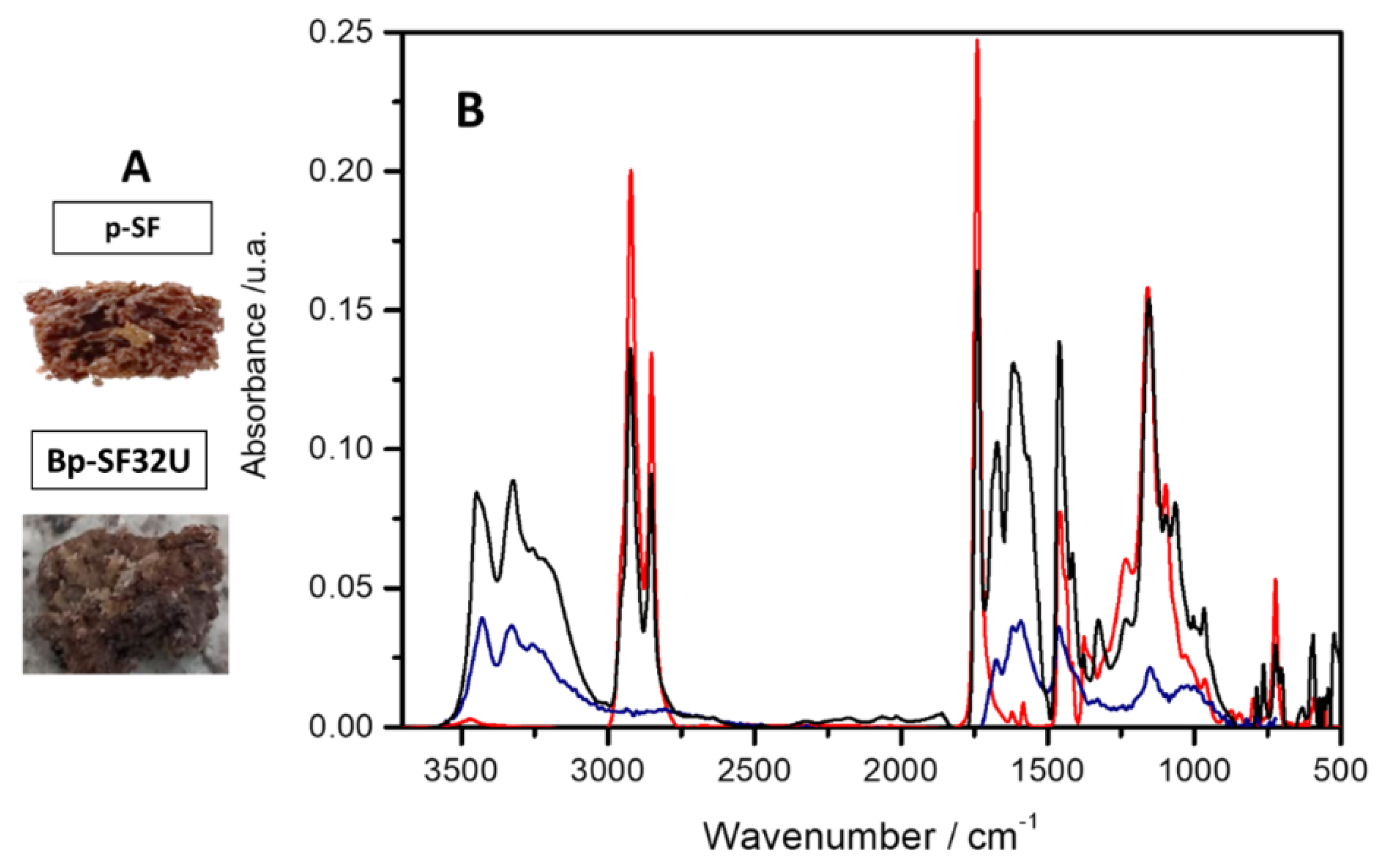
Figure 2.
Mass of Urea released vs. time: Bp-SF32U (black), Bp-SF25U (red).
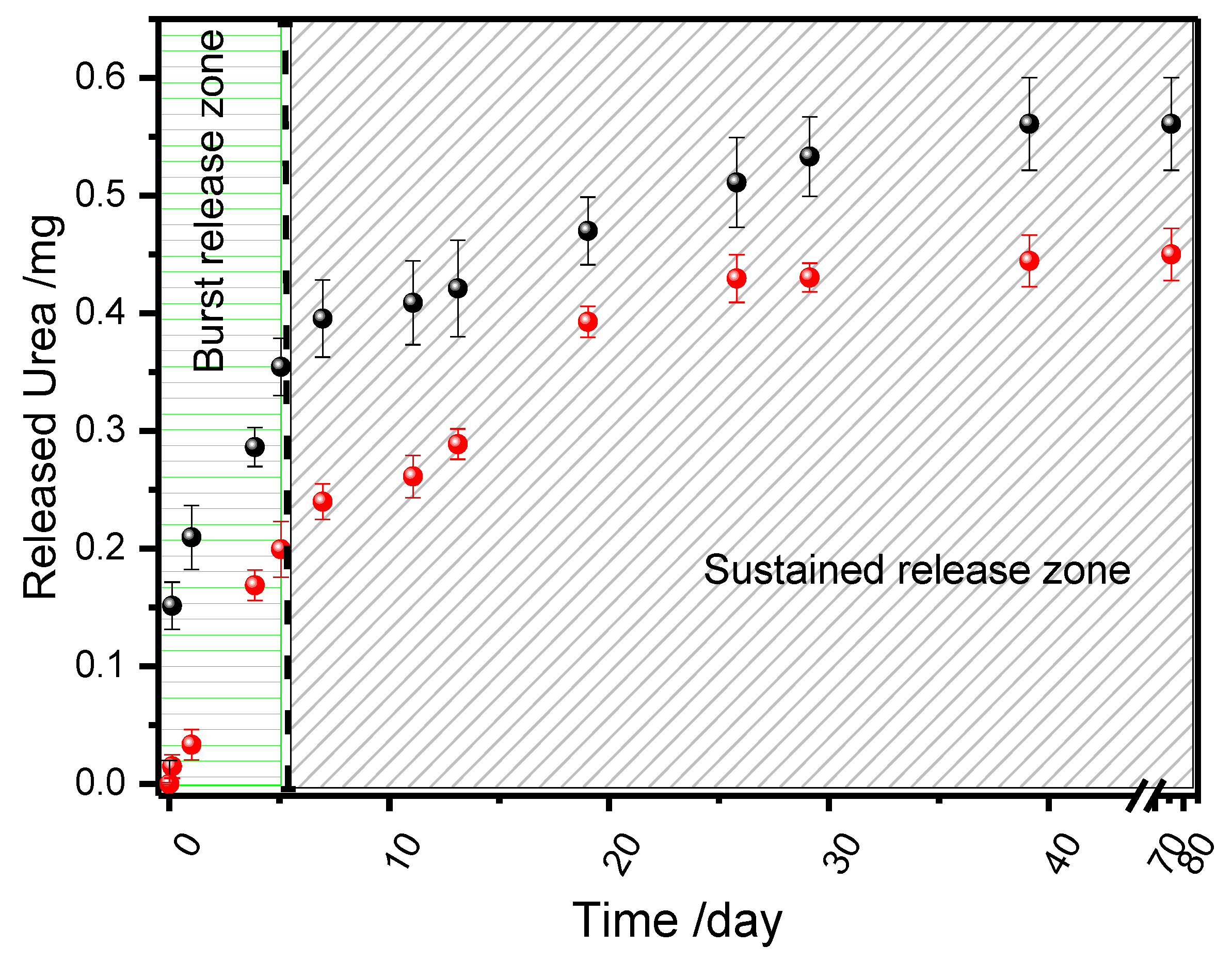
Figure 3.
Profiles of Cumulative percentage urea release of: non-encapsulated (blue circles) and encapsulated urea samples (Bp-SF25U (black circles) and Bp-SF32U (red circles) over time. Error bars indicate the standard deviation of three independent measurements.
Figure 3.
Profiles of Cumulative percentage urea release of: non-encapsulated (blue circles) and encapsulated urea samples (Bp-SF25U (black circles) and Bp-SF32U (red circles) over time. Error bars indicate the standard deviation of three independent measurements.
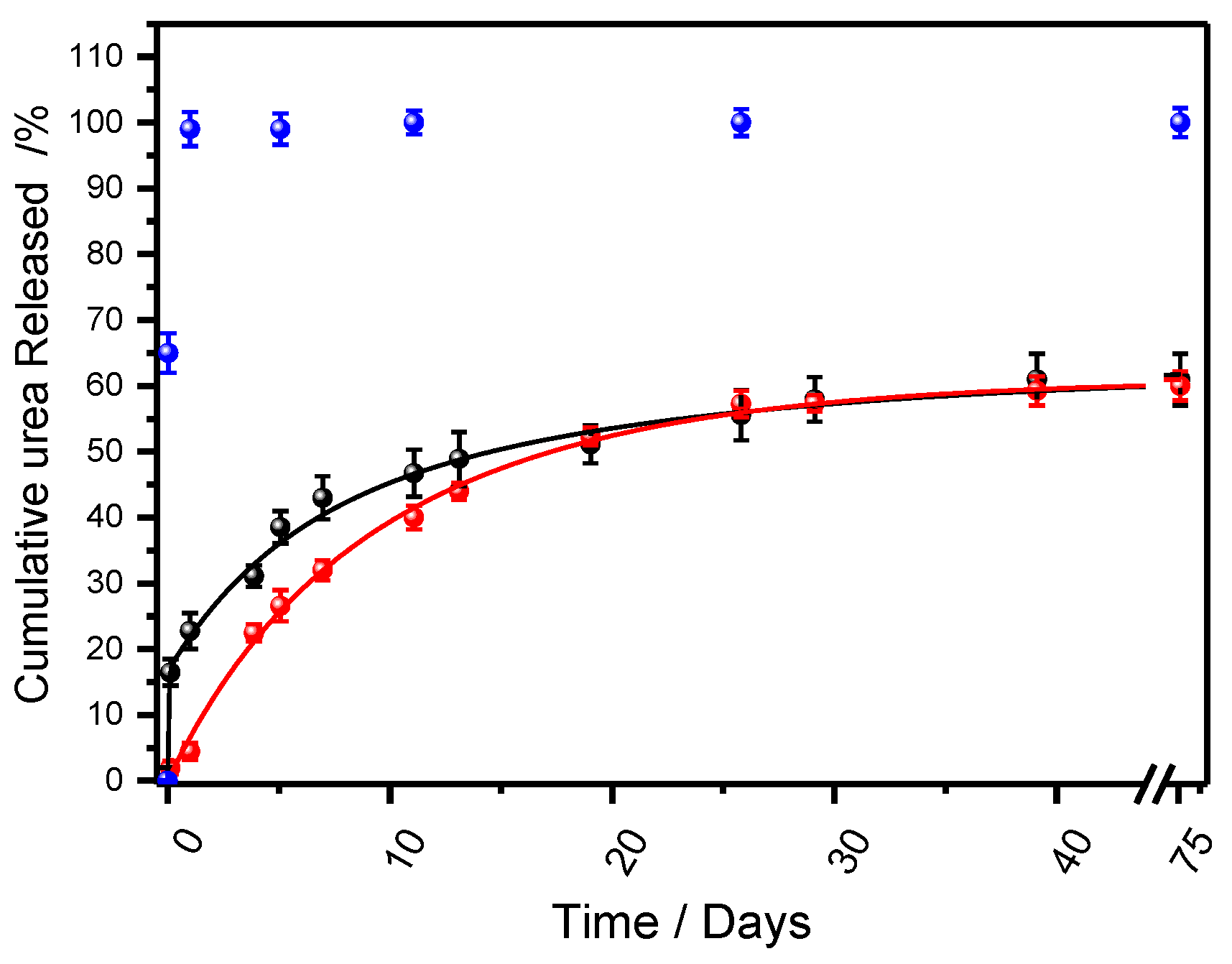
Figure 4.
Kinetic of the urea release profiles for: (A) Bp-SF25U and (B) Bp-SF32U fitting employing: Korsmeyer-Peppas (red line) and Weibull (blue line).
Figure 4.
Kinetic of the urea release profiles for: (A) Bp-SF25U and (B) Bp-SF32U fitting employing: Korsmeyer-Peppas (red line) and Weibull (blue line).
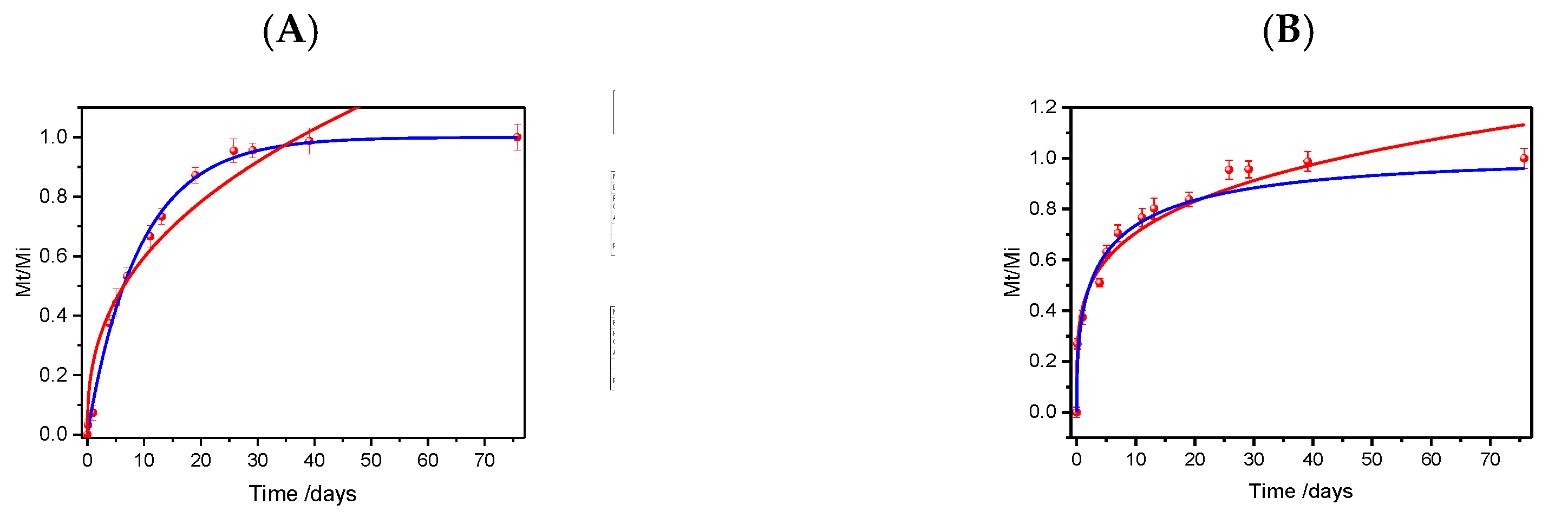
Figure 5.
Germination percentage of each treatment. Each value is mean of triplicate and each replicate consisted of 10 seedlings. Mean ± SE followed by different letter is statistically significant at p < 0.05 by ANOVA post Tukey test.
Figure 5.
Germination percentage of each treatment. Each value is mean of triplicate and each replicate consisted of 10 seedlings. Mean ± SE followed by different letter is statistically significant at p < 0.05 by ANOVA post Tukey test.
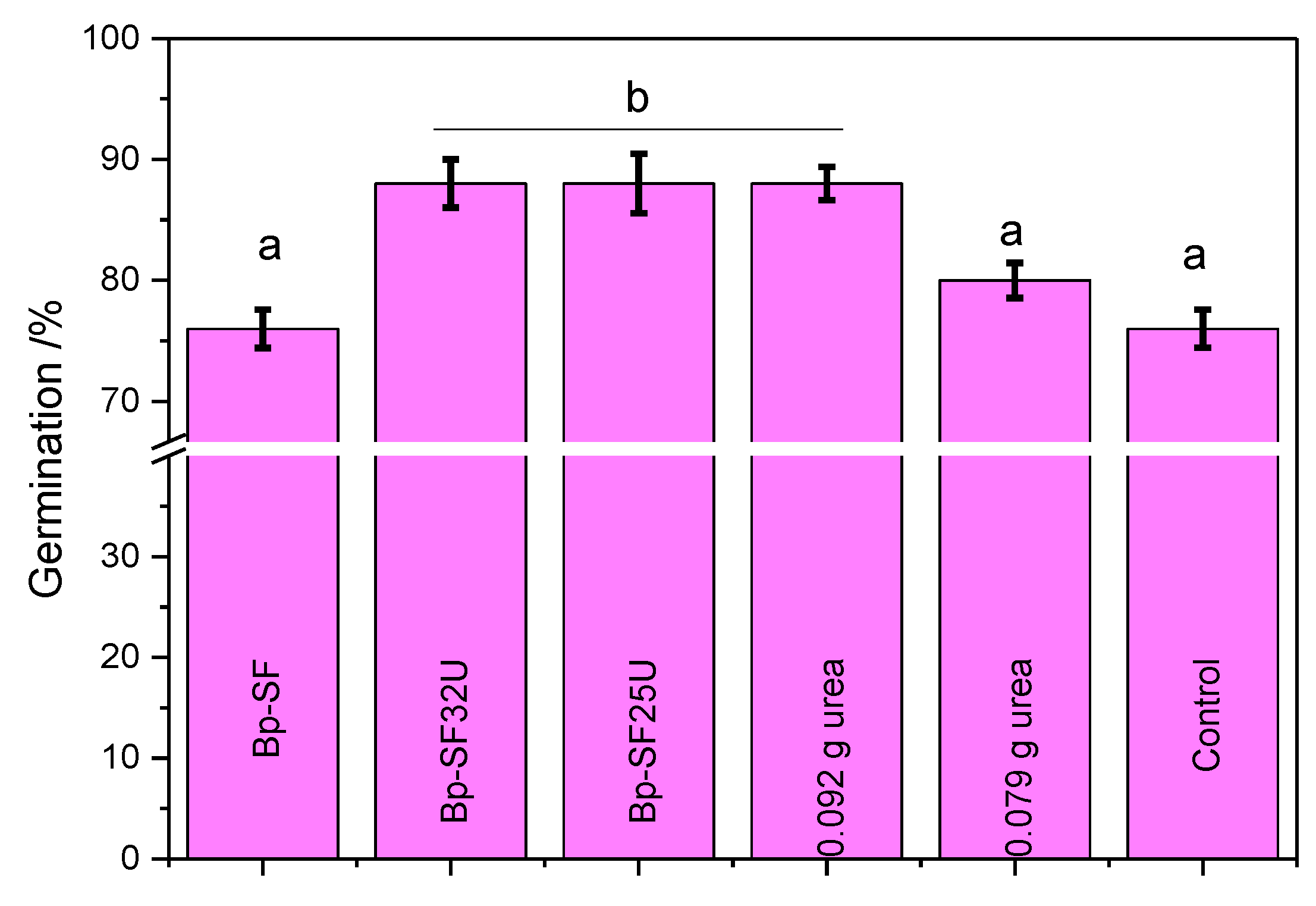
Figure 6.
Dry matter Pa (light blue) and dry matter Pr (green) of the applied treatments compared to the control treatment. Mean ± SD followed by different letter is statistically significant at p < 0.05 by ANOVA post Tukey test.
Figure 6.
Dry matter Pa (light blue) and dry matter Pr (green) of the applied treatments compared to the control treatment. Mean ± SD followed by different letter is statistically significant at p < 0.05 by ANOVA post Tukey test.
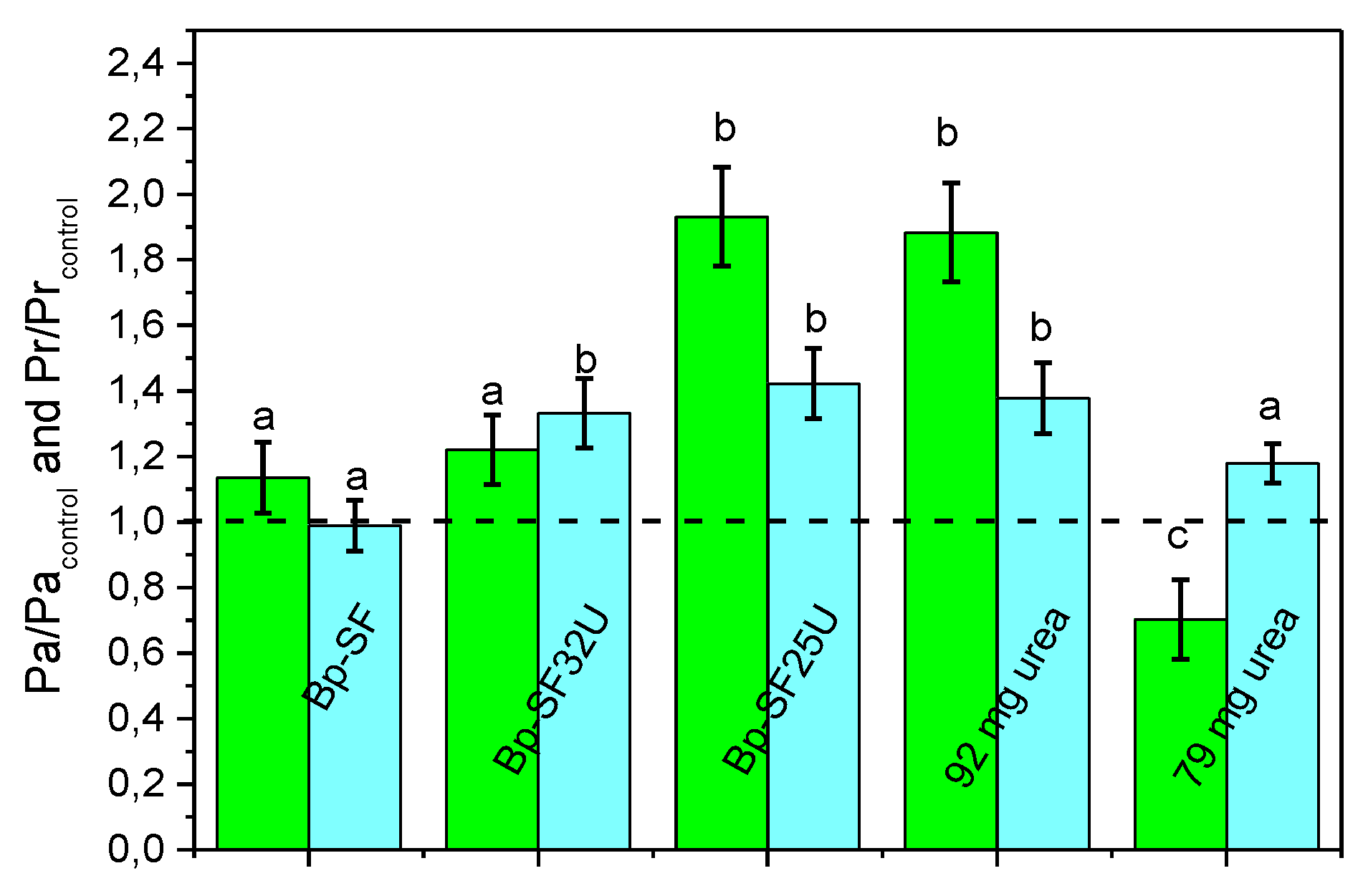

Table 2.
FT-IR assignment of the characteristic bands of urea, Bp-SF and Bp-SF32U.
| Wavenumber (cm-1) | Assignation | Reference |
|---|---|---|
| ~ 3455 | -NH stretching | [25] |
| ~2954 | C–H stretching | [26] |
| ~ 1700 | C=O stretching | [22] |
| [25] | C-N deformation | [25] |
| ~ 1457 | C-N stretching | [25] |
| ~1300–1000 | C–O stretching | [27] |
| 930 | S–S stretching | [21,28,29] |
| 790 | C–S stretching | [28,29] |
| ~500–400 | S–S stretching | [28,29] |
Table 3.
Parameters of mathematical models for urea release of the Bp-SF25U and Bp-SF32U biocomposites.
Table 3.
Parameters of mathematical models for urea release of the Bp-SF25U and Bp-SF32U biocomposites.
| Sample | Mathematical models | Parameters | ||
|---|---|---|---|---|
| Korsmeyer-Peppas* | k | n | R2 | |
| Bp-SF25U | 0.24139 ± 0.03984 | 0.39273 ± 0.05133 | 0.97295 | |
| Bp-SF32U | 0.41256 ± 0.02076 | 0.23330 ± 0.01766 | 0.97458 | |
| Weibull* | α | b | R2 | |
| Bp-SF25U | 9.31504 ± 0.24478 | 0.96778 ± 0.03709 | 0.99898 | |
| Bp-SF32U | 5.17808 ± 0.73226 | 0.43536 ± 0.05148 | 0.96152 | |
*k is the release constant; n is the diffusional exponent used to distinguish the mechanism of drug release; α is time scale parameter; β is shape parameter.
Table 4.
Physical parameters of the soil used for the corn crop growth test.
| Physical Parameters | |
|---|---|
| Conductivity | 147.8 μs |
| pH | 5.90 |
| Soil color | Dark brown |
| Soil Odor | Odorless |
Table 1.
Mass of reactive employed to obtain the biopolymer Bp-SF and the biocomposites Bp-SF25U and Bp-SF32U and the percentage of urea in the biocomposites.
Table 1.
Mass of reactive employed to obtain the biopolymer Bp-SF and the biocomposites Bp-SF25U and Bp-SF32U and the percentage of urea in the biocomposites.
| Biocomposites | Sulfur (grams) |
SF oil (grams) |
Urea (grams) |
%U |
|---|---|---|---|---|
| Bp-SF | 30 | 30 | 0.00 | 0.00% |
| Bp-SF25U | 30 | 30 | 20.00 | 25.00% |
| Bp-SF32U | 30 | 30 | 28.00 | 31.81% |
Disclaimer/Publisher’s Note: The statements, opinions and data contained in all publications are solely those of the individual author(s) and contributor(s) and not of MDPI and/or the editor(s). MDPI and/or the editor(s) disclaim responsibility for any injury to people or property resulting from any ideas, methods, instructions or products referred to in the content. |
© 2026 by the authors. Licensee MDPI, Basel, Switzerland. This article is an open access article distributed under the terms and conditions of the Creative Commons Attribution (CC BY) license (http://creativecommons.org/licenses/by/4.0/).
Copyright: This open access article is published under a Creative Commons CC BY 4.0 license, which permit the free download, distribution, and reuse, provided that the author and preprint are cited in any reuse.


