

Submitted:
17 March 2026
Posted:
18 March 2026
You are already at the latest version
Abstract
Astaxanthin can be derived from different sources such as petrochemical synthesis, natural sourcing from green algae or by microbial fermentation. As one of the strongest antioxidants known by nature, astaxanthin is rising attention as an active ingredient in cosmetical products to support the skin against oxidative stress. In contrast to widely performed chemical antioxidant activity assays, this study focuses on the comparison of synthetic, algal and corynebacterial astaxanthin in a physiological relevant test setting: the intracellular antioxidant activity in cultured human skin cells, keratinocytes. The astaxanthin-rich corynebacterial oleoresin demonstrated to be the superior antioxidant in that assay with a EC50 of 2.7 µM whereas the synthetic and algal-based variants showed no significant effect. In terms of an application of such raw materials, it is therefore tempting to speculate that astaxanthin-containing corynebacterial oleoresins could serve as a natural and superior active ingredient for skin health applications in the future.
Keywords:
intracellular antioxidant activity
; astaxanthin
; keratinocytes
; bioavailability
1. Introduction
Oxidative stress is closely linked to inflammatory processes and therefore also being associated with a series of health issues ranging from cardiovascular and neurodegenerative diseases, diabetes, cancer to skin diseases and aging [1,2,3,4]. Environmental triggers such as pollution and UV light creating ubiquitous oxidative stress to biological systems [5,6,7,8]. Oxidative stress can harm cells in multiple ways as different key processes, associated with different locations within the cell, can be impacted. At the plasma membrane/ cell envelope lipid peroxidation causes membrane alteration as well as interference with receptor signaling [9]. Moreover, intracellular oxidative stress can interfere with diverse cellular processes from DNA repair [10] to protein folding [11,12] as well as subcellular structures [13]. Antioxidants are therefore a dominating group of active ingredients [14] for different purposes ranging from nutrition to cosmetics and pharmaceutical scopes [15,16,17].
Astaxanthin, the queen of carotenoids, is one of the strongest antioxidants known by nature [18]. This excellent activity can be explained by the conjugated double bond system and further oxyfunctionalized groups at the β-ionone rings of the structure [18,19]. The astaxanthin market share is dominated by natural astaxanthin, with a share of > 600 Mio. USD in 2024 and a CAGR of 8.8% in the forecasted period till 2034 [20]. Natural variants on the markets are for example sources from the red yeast Phaffia rhodozyma [21,22,23], the bacterium Paracoccus carotinifaciencs [24] and the green microalgae Haematococcus pluvialis [25]. Besides this established production host, strain and bioprocess engineering allows to tackle the astaxanthin market with other microbial cell factories such as Escherichia coli [26,27] and Yarrowia lipolytica [28,29]. In the last years, Corynebacterium glutamicum was presented as an alternative microbial cell factory for astaxanthin as fermentative protocols [30,31,32] as well as downstream processes [33,34] were established and optimized.
Besides it different sources the synthesized astaxanthins differ in stereochemistry as well as esterification. Synthetic astaxanthin is present as a racemate (1:2:1 mixture of (3S,3’S), (3S,3’R) and (3R,3’R)) as free form astaxanthin [35]. Natural biosynthesis typically results in either 3S,3’S (dominantly algal, bacterial and plant sources) [36,37] or 3R,3’R (dominantly yeast sources) [38] enantiomers. Depending on the specific production host, astaxanthin can be present as free form or being esterified with fatty acids [39,40]. This means that a series of structurally different astaxanthin variants exists with potentially different functional properties. In vitro assays such as the 2,2-diphenyl-1-picrylhydrazyl (DPPH) assay allow the determination of antioxidant activities in an easy manner based on the color change during quenching of the free radical DPPH in the presence of a ROS-scavenger [41]. This assay is widely applied due to its easy, fast and cheap handling. However, the interpretation of such chemical assays for real-world application is limited. Active (pharmaceutical) ingredients have to be bioavailable [42,43,44] in order to fulfill their function at the desired cellular location.
As a promising active ingredient for skin care products it was shown that topical application of astaxanthin reduced wrinkles, improved elasticity and pigmentation [45], supported wound healing [46], and mitigated UV-induced skin damage [47]. Therefore, the scope of this work is on the investigation of the antioxidant activity of three different astaxanthin sources namely, synthetic, algal-based and corynebacterial astaxanthin (as present in a corynebacterial natural extract) in a more physiological relevant test setting using human keratinocytes.
2. Materials and Methods
2.1. Production and Extraction of Corynebacterial Astaxanthin
Astaxanthin-producing C. glutamicum strain ASTA** was cultivated for 48 h in shake flasks as described by [32] using the optimized trace element solution [31]. After cultivation, the biomass was harvested by centrifugation at 10,000 x g for 20 min. Subsequently, the cell pellet was extracted using 90% (v v-1) ethanol, at a solvent-to-biomass ration of 15 mgCDW mL-1 at 60 °C for 30 min in a 1 L stirred bottle reactor equipped with an anchor stirrer (DWK Life Sciences, Mainz, Germany) at 500 rpm. The astaxanthin oleoresin was prepared as described in [33] and was stored at -20 °C until further usage. The astaxanthin content in the oleoresin was 11.6 mg g-1 as determined by HPLC [32].
2.2. Intracellular In Vivo Antioxidant Assay
For the intracellular in vivo antioxidant assay (AOP1), the corynebacterial astaxanthin (as oleoresin) (CA) was compared to two other astaxanthin sources: synthetic astaxanthin (SA) (Sigma-Aldrich, St. Louis, MA, USA; catalog number 1044200) and esterified astaxanthin (as oleoresin; containing 100 mg g-1 astaxanthin (calculated as free astaxanthin); astaxanthin is present as 75% monoester, 20% diester, 5% free) from Haematococcus pluvialis (AA) (Sigma-Aldrich, St. Louis, MA, USA; catalog number 1044210). All samples were dissolved in DMSO to concentration of 3 mM (calculated as free astaxanthin) at 40 °C and 1000 rpm (Thermomixer comfort, Eppendorf, Germany). Stock solutions were shipped frozen to Anti Oxidant Power (Toulouse, France). The assay was performed as described by [48] using human keratinocytes (HaCaT).
2.3. AOP1 Assay with De-Esterified Algal Astaxanthin
In order to verify that the low activity of the algal astaxanthin is based on the esters, a second AOP1 assay was performed, comparing both the free and the esterified astaxanthin from algae. To obtain the free version of the esterified from H. pluvialis, an enzymatic cleavage based on [49] with slight alterations was performed. Per mL of acetone, 1.5 mg H. pluvialis oleoresin was dissolved. The enzyme solution consisted of 2 U mL-1 cholesterol esterase from Pseudomonas fluorescencs (Sigma-Aldrich, St. Louis, MA, USA; catalog number: C9281) in 0.05 M Tris HCl pH 7. The astaxanthin-containing acetone and the enzyme solution were mixed at a ratio of 3:2 and the reaction mixture was shaken at 37° C in the dark for 4 h. The cholesterol esterase was replaced by bovine serum albumin (BSA) as negative control. After incubation, 5 mL hexane was added to the reaction mixture and was mixed vigorously. The hexane layer was transferred into a new tube and subsequently evaporated (Concentrator Plus, Eppendorf, Germany). Successful de-esterification (>99%) was verified by HPLC (figure S1). BSA-treated samples (control) and the cholesterol esterase-treated samples (de-esterified astaxanthin) were dissolved in DMSO at concentrations of 2.5 mM and 2.9 mM (calculated as free astaxanthin), respectively.
2.4. Quantification of Astaxanthin by HPLC
Astaxanthin was quantified by using the Agilent 1200 series (Agilent Technologies, Santa Clara, CA, US) equipped with a reversed-phase precolumn (LiChrospher 100 RP18 EC-5, 40 × 4 mm) (CS-Chromatographie, Langerwehe, Germany), a reversed-phase main column (LiChrospher 100 RP18 EC-5, 125 × 4 mm) (CS-Chromatographie, Langerwehe, Germany), and a diode array detector (DAD) recording the absorption at λ = 470 nm. A defined amount of sample was dissolved in a 7:3 methanol:acetone mixture, of which 50 µL were injected. The mobile phases consisted of methanol:water (9:1) (A) and methanol (B). A gradient at a flow rate of 1.5 mL min–1 was used as the following: 0 min B: 0%, 10 min B: 100%, and 32.5 min B: 100%. Synthetic astaxanthin was used as a reference standard.
3. Results
3.1. Intracellular Antioxidant Activity Testing of Different Astaxanthins
The human keratinocyte cell line HaCaT is a widely used model of the epidermis and therefore is employed to investigate skin physiology and the evaluation of novel cosmetical ingredients [50,51]. As astaxanthin is a promising ingredient for skin applications [52], the assay was performed on human keratinocytes (HaCaT). The assay is based on the fluorescent dye thiazol orange, which is taken up by the cells and upon being illuminated by light, triggers the generation of ROS such as singlet oxygen and hydroxyl radicals. The ROS can be neutralized by the addition of an antioxidant [48]. The results of the AOP1 assay are shown in Figure 1. The half-maximal effective concentration (EC50) of corynebacterial astaxanthin (CA) was determined to be 2.7 µM. In contrast, neither algal-based astaxanthin (AA) nor synthetic astaxanthin (SA) yielded a calculable EC50 as only partial activity was observed even with the highest examined concentrations of 120 µM.
3.2. De-Esterification Algal-Based Astaxanthin and Its Intracellular Activity
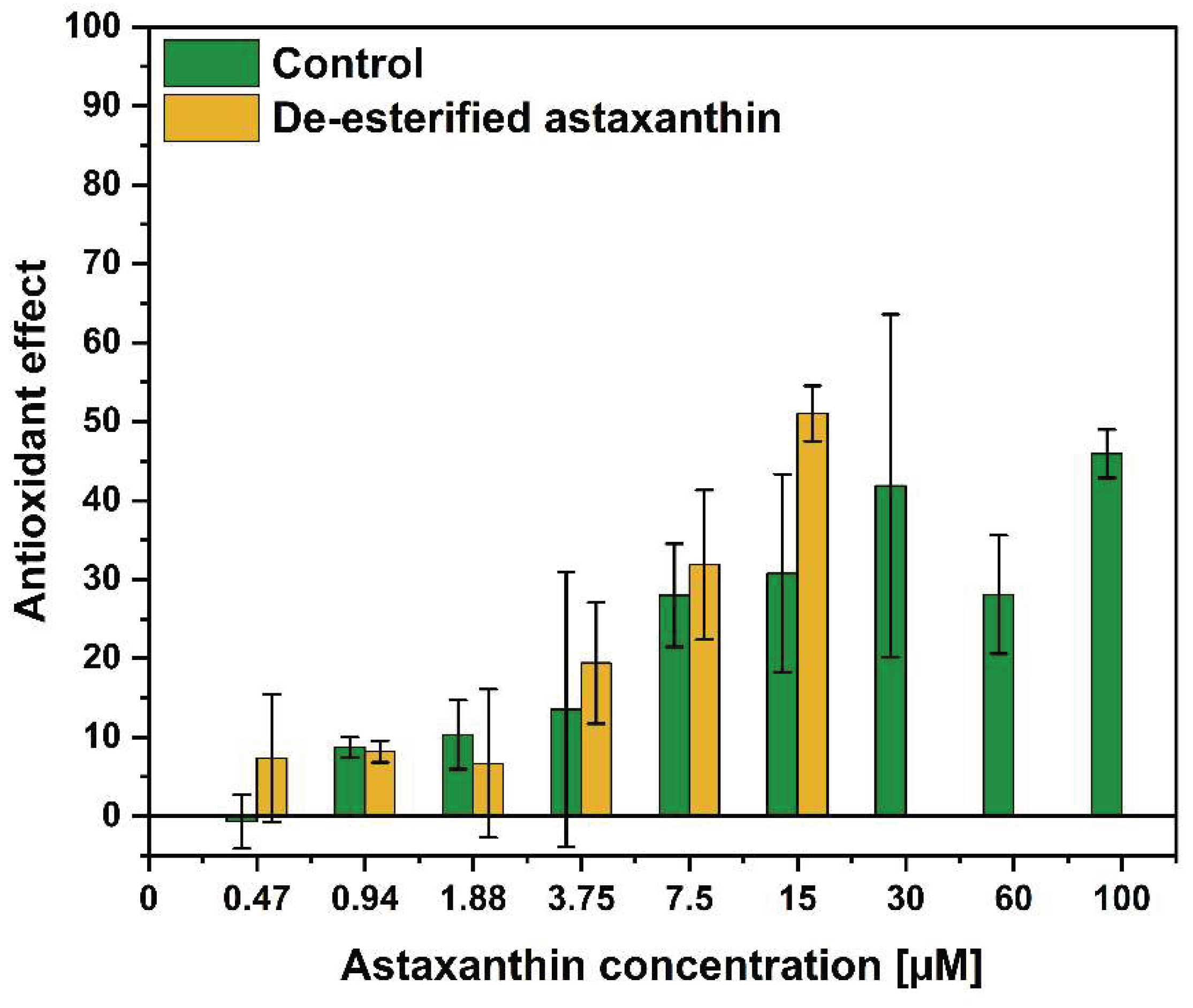
We aimed on de-esterifying the astaxanthin-(di)esters in the algal-based oleoresin in order to verify that the low activity of the algal astaxanthin is based on its esters. Therefore, astaxanthin derived from H. pluvialis was de-esterified by cholesterol esterase, which was confirmed by HPLC analysis (Figure S1). The AOP1 assay comparing the de-esterified and the esterified astaxanthin was performed as described previously and the results are depicted in Figure 2. No statistical differences were observed between the control and de-esterified samples. Notably, the samples containing the de-esterified astaxanthin exhibited cytotoxic effects at concentrations >15 µM (data not shown).
4. Discussion
This work demonstrates that the source and molecular form of astaxanthin strongly influence its intracellular antioxidant activities in cultured human keratinocytes. Astaxanthin-containing corynebacterial oleoresin showed a pronounced intracellular antioxidant effect with an EC50 of 2.7 µM.
In a previous study we have shown that corynebacterial and algal astaxanthin exhibited comparable antioxidant activities as quantified with the widely used DPPH assay [33]. While the natural corynebacterial and algal astaxanthins showed comparable EC50 of 3.2-3.7 µg mL-1, the racemic mixture of the synthetic astaxanthin possessed an approximately 10-fold lower antioxidant activity (correspondingly a higher EC50 of 42 µg mL-1) [33]. These findings are in accordance with previous reports indicating a higher antioxidant activity of enantiomer pure (3S,3’S) astaxanthin compared to the (3R,3’R) enantiomer and the synthetic racemic mixture [53].
The discrepancy between DPPH-based antioxidant activity and the intracellular AOP1 assay highlights the importance to complement chemical assays for specific application evaluations [15]. Chemical antioxidant assays are strong in quantifying radical-scavenging capacity in cell-free solution, however, lack information on the bioavailability and cell uptake as practical hurdles that influence the antioxidant activity in cellular systems [14,54].
Astaxanthin itself is a lipophilic compound [44], but the solubility and bioavailability of the esterified (algal) and free form (corynebacterial and synthetic) astaxanthins [55] as well as the enantiomere composition is considered to affect the stability and bioavailability [56,57]. In vitro and in vivo studies showed that free astaxanthin is absorbed faster as astaxanthin esters have to be hydrolyzed by digestive enzymes and fluids prior uptake [58,59,60].
As the conditions of the AOP1 assay do not favor ester hydrolysis, it is tempting to speculate that the algal-derived astaxanthin was not taken up properly by the HaCaT cells. This might be similar for the cosmetic usage of algal-derived astaxanthin: in contrast to free astaxanthin the esterified form of algal astaxanthin is less bioavailable to the skin due to the absence of hydrolyzing enzymes, disfavoring its usage for topical applications [39,57].
It was therefore questioned if the intracellular antioxidant activity of the algal-based astaxanthin could be elevated after de-esterification. Although the de-esterification was successfully validated by HPLC analysis (Figure S2), the intracellular antioxidant activity in cultured keratinocytes did not differ from the control algal-based oleoresin. Cytotoxic effects of the de-esterified astaxanthin were observed at concentrations >15 µM, leading to incomplete results. The cytotoxicity might be due to the release of free fatty acids during the de-esterification, which are known to exhibit cytotoxicity for in vitro cell culture [61,62].
Despite the clear activity differences observed some limitation should be considered. As the corynebacterial astaxanthin was tested as part of the oleoresin rather than as a purified compound synergistic effect of co-extracted compounds cannot be excluded. The oleoresin matrix itself might account for the superior activity as byproducts in the extract may promote the solubility and/or delivery of the lipophilic astaxanthin [63]. It is known that lipid-rich matrices and formulation strategies can improve the bioavailability of carotenoids as compared to purified compounds [52,58,64]. Additionally, microneedle-based delivery systems can bypass the outermost layer of the skin, thereby potentially facilitating transdermal absorption [65].
The corynebacterial oleoresin has been demonstrated to be the most potential astaxanthin resource for intracellular ROS-scavenging in keratinocytes in this work. The cell-based assay was developed by Gironde et al. 2020 who have also identified astaxanthin as a promising lipophilic compound in there screening, however with only a partial activity in the AOP1 assay [48]. Gironde et al. 2020 used synthetic astaxanthin in their study resulting in the same partial activity observed in this study. Although the synthetic astaxanthin was most likely taken up by the cells due to its free form, its less active enantiomers lead to the low activity. When being compared to the results of Gironde et al. 2020, it has to be highlighted that the astaxanthin-rich corynebacterial oleoresin belongs to the best performing antioxidants validated in the AOP1 assay with an EC50 of 2.7 µM in HaCaT cells (Figure 1).
As these results point out the significance of alternative antioxidant resources from microbial fermentation [26], its real-world applicability should be further evaluated in other cell lines and skin penetration assays to strengthen the conclusion [52]. From an application perspective C. glutamicum is a platform system that offers the opportunity to access other astaxanthin derivatives, such as astaxanthin-diglucoside [32] which may exhibit distinct bioactivities in comparison to the here tested astaxanthin variants.
Supplementary Materials
The following supporting information can be downloaded at the website of this paper posted on Preprints.org, Figure S1.
Author Contributions
Conceptualization, N.A.H., J.S.; methodology, N.A.H. and J.S.; formal analysis, J.S.; investigation, J.S.; data curation, J.S.; writing—original draft preparation, N.A.H., J.S.; writing—review and editing, N.A.H., J.S.; visualization, J.S.; supervision, N.A.H.; project administration, N.A.H.; funding acquisition, N.A.H.. All authors have read and agreed to the published version of the manuscript.
Funding
This research was funded by the German Federal Ministry of Education and Research (BMBF) project KaroTec (grant number: 03VP09460). NAH acknowledges support by the KIT-Publication Fund of Karlsruhe Institute of Technology.
Data Availability Statement
Dataset available on request from the authors.
Acknowledgments
We acknowledge scientific discussion with Rainer Figge and Volker F. Wendisch.
Conflicts of Interest
The authors declare no conflicts of interest. The funders had no role in the design of the study; in the collection, analyses, or interpretation of data; in the writing of the manuscript; or in the decision to publish the results.
Abbreviations
The following abbreviations are used in this manuscript:
| AOP | Antioxidant power test |
| AA | Algal astaxanthin |
| CA | Corynebacterial astaxanthin |
| CDW | Cell dry weight |
| SA | Synthetic astaxanthin |
References
- Zuo, L.; Prather, E.R.; Stetskiv, M.; Garrison, D.E.; Meade, J.R.; Peace, T.I.; Zhou, T. Inflammaging and Oxidative Stress in Human Diseases: From Molecular Mechanisms to Novel Treatments. International Journal of Molecular Sciences 2019, 20, 4472. [Google Scholar] [CrossRef]
- Altanam, S.Y.; Darwish, N.; Bakillah, A. Exploring the Interplay of Antioxidants, Inflammation, and Oxidative Stress: Mechanisms, Therapeutic Potential, and Clinical Implications. Diseases 2025, 13, 309. [Google Scholar] [CrossRef] [PubMed]
- Valaitienė, J.; Laučytė-Cibulskienė, A. Oxidative Stress and Its Biomarkers in Cardiovascular Diseases. Artery Research 2024, 30, 18. [Google Scholar] [CrossRef]
- Reddy, V.P. Oxidative Stress in Health and Disease. Biomedicines 2023, 11, 2925. [Google Scholar] [CrossRef]
- Petruk, G.; Del Giudice, R.; Rigano, M.M.; Monti, D.M. Antioxidants from Plants Protect against Skin Photoaging. Oxid Med Cell Longev 2018, 2018, 1454936. [Google Scholar] [CrossRef]
- Hooda, R.; Madke, B.; Choudhary, A. Photoaging: Reversal of the Oxidative Stress Through Dietary Changes and Plant-Based Products. Cureus 2023, 15, e37321. [Google Scholar] [CrossRef] [PubMed]
- Yang, W.; Omaye, S.T. Air pollutants, oxidative stress and human health. Mutat Res 2009, 674, 45–54. [Google Scholar] [CrossRef]
- Kammeyer, A.; Luiten, R.M. Oxidation events and skin aging. Ageing Res Rev 2015, 21, 16–29. [Google Scholar] [CrossRef]
- Yin, H.; Xu, L.; Porter, N.A. Free Radical Lipid Peroxidation: Mechanisms and Analysis. Chem. Rev. 2011, 111, 5944–5972. [Google Scholar] [CrossRef]
- Cadet, J.; Davies, K.J.A. Oxidative DNA damage & repair: An introduction. Free Radic Biol Med 2017, 107, 2–12. [Google Scholar] [CrossRef]
- Sies, H.; Berndt, C.; Jones, D.P. Oxidative Stress. Annual Review of Biochemistry 2017, 86, 715–748. [Google Scholar] [CrossRef]
- Sies, H.; Jones, D.P. Reactive oxygen species (ROS) as pleiotropic physiological signalling agents. Nature Reviews Molecular Cell Biology 2020, 21, 363–383. [Google Scholar] [CrossRef]
- Forrester, S.J.; Kikuchi, D.S.; Hernandes, M.S.; Xu, Q.; Griendling, K.K. Reactive Oxygen Species in Metabolic and Inflammatory Signaling. Circulation Research 2018, 122, 877–902. [Google Scholar] [CrossRef]
- Gulcin, İ. Antioxidants: a comprehensive review. Arch Toxicol 2025, 99, 1893–1997. [Google Scholar] [CrossRef]
- Forman, H.J.; Zhang, H. Targeting oxidative stress in disease: promise and limitations of antioxidant therapy. Nat Rev Drug Discov 2021, 20, 689–709. [Google Scholar] [CrossRef] [PubMed]
- Dini, I.; Laneri, S. Nutricosmetics: A brief overview. Phytother Res 2019, 33, 3054–3063. [Google Scholar] [CrossRef] [PubMed]
- Budzianowska, A.; Banaś, K.; Budzianowski, J.; Kikowska, M. Antioxidants to Defend Healthy and Youthful Skin—Current Trends and Future Directions in Cosmetology. Applied Sciences 2025, 15, 2571. [Google Scholar] [CrossRef]
- Dutta, S.; Kumar, S.P.J.; Banerjee, R. A comprehensive review on astaxanthin sources, structure, biochemistry and applications in the cosmetic industry. Algal Research 2023, 74, 103168. [Google Scholar] [CrossRef]
- Brotosudarmo, T.H.P.; Limantara, L.; Setiyono, E.; Heriyanto. Structures of Astaxanthin and Their Consequences for Therapeutic Application. Int J Food Sci 2020, 2020, 2156582. [Google Scholar] [CrossRef] [PubMed]
- Insights, G.M. Astaxanthin Market Size & Share 2025 - 2034: Market Size by Source, by Application, Industry Analysis, Growth Forecast April 2025 2025.
- Sun, J.; Zhang, Z.; Gao, L.; Yang, F. Advances and trends for astaxanthin synthesis in Phaffia rhodozyma. Microbial cell factories 2025, 24, 100. [Google Scholar] [CrossRef]
- Ji, W.; Wang, W.; Chen, X.; Sun, M.; Zhang, J.; Nan, B.; Li, X.; Wang, Y.; Wang, Y.; Piao, C. Stress-induced astaxanthin biosynthesis in Phaffia rhodozyma: Bridging mechanistic understanding to industrial Feasibility. Bioresource technology 2025, 435, 132957. [Google Scholar] [CrossRef]
- Luna-Flores, C.H.; Wang, A.; von Hellens, J.; Speight, R.E. Towards commercial levels of astaxanthin production in Phaffia rhodozyma. Journal of Biotechnology 2022, 350, 42–54. [Google Scholar] [CrossRef]
- Mussagy, C.U.; Pereira, J.F.B.; Dufossé, L. Astaxanthin production using Paracoccus carotinifaciens: a way forward? Trends in biotechnology 2023, 41, 996–999. [Google Scholar] [CrossRef] [PubMed]
- Ariyadasa, T.U.; Thevarajah, B.; Anthonio, R.A.D.P.; Nimarshana, P.H.V.; Wasath, W.A.J. From present to prosperity: assessing the current status and envisioning opportunities in the industrial-scale cultivation of Haematococcus pluvialis for astaxanthin production. Phytochem Rev 2024, 23, 749–779. [Google Scholar] [CrossRef]
- Wang, C.; Hong, Z.; Song, M.; Zheng, H.; Zhou, Q.; Yang, H.; Li, H.; Huang, D. Production of astaxanthin with high purity and activity based on engineering improvement strategies. Journal of Biotechnology 2025, 405, 139–149. [Google Scholar] [CrossRef] [PubMed]
- Lu, Q.; Bu, Y.-F.; Liu, J.-Z. Metabolic Engineering of Escherichia coli for Producing Astaxanthin as the Predominant Carotenoid. Marine Drugs 2017, 15, 296. [Google Scholar] [CrossRef]
- Li, N.; Han, Z.; O’Donnell, T.J.; Kurasaki, R.; Kajihara, L.; Williams, P.G.; Tang, Y.; Su, W.W. Production and excretion of astaxanthin by engineered Yarrowia lipolytica using plant oil as both the carbon source and the biocompatible extractant. Applied microbiology and biotechnology 2020, 104, 6977–6989. [Google Scholar] [CrossRef]
- Tramontin, L.R.R.; Kildegaard, K.R.; Sudarsan, S.; Borodina, I. Enhancement of Astaxanthin Biosynthesis in Oleaginous Yeast Yarrowia lipolytica via Microalgal Pathway. Microorganisms 2019, 7, 472. [Google Scholar] [CrossRef]
- Meyer, F.; Schmitt, I.; Schäffer, T.; Wendisch, V.F.; Henke, N.A. Design-of-Experiment-Guided Establishment of a Fermentative Bioprocess for Biomass-Bound Astaxanthin with Corynebacterium glutamicum. Fermentation 2023, 9, 969. [Google Scholar] [CrossRef]
- Meyer, F.; Schmitt, I.; Wendisch, V.F.; Henke, N.A. Response surface-based media optimization for astaxanthin production in Corynebacterium glutamicum. Frontiers in bioengineering and biotechnology 2025, 13–2025. [Google Scholar] [CrossRef] [PubMed]
- Göttl, V.L.; Meyer, F.; Schmitt, I.; Persicke, M.; Peters-Wendisch, P.; Wendisch, V.F.; Henke, N.A. Enhancing astaxanthin biosynthesis and pathway expansion towards glycosylated C40 carotenoids by Corynebacterium glutamicum. Scientific reports 2024, 14, 8081. [Google Scholar] [CrossRef] [PubMed]
- Seeger, J.; Wendisch, V.F.; Henke, N.A. Extraction and Purification of Highly Active Astaxanthin from Corynebacterium glutamicum Fermentation Broth. Marine Drugs 2023, 21, 530. [Google Scholar] [CrossRef]
- Seeger, J.; Zäh, M.; Wendisch, V.F.; Brandenbusch, C.; Henke, N.A. Supercritical carbon dioxide extraction of astaxanthin from Corynebacterium glutamicum. Bioresources and Bioprocessing 2025, 12, 46. [Google Scholar] [CrossRef]
- Higuera-Ciapara, I.; Félix-Valenzuela, L.; Goycoolea, F.M. Astaxanthin: a review of its chemistry and applications. Crit Rev Food Sci Nutr 2006, 46, 185–196. [Google Scholar] [CrossRef] [PubMed]
- Zhang, C.; Yao, W.; Wen, D.; Li, X.; Wu, S.; Leng, X. Dietary Adonis. aestivalis extract improved the flesh pigmentation, antioxidative status and shelf-life of rainbow trout (Oncorhynchus mykiss). Aquaculture Nutrition 2020, 26, 2032–2042. [Google Scholar] [CrossRef]
- Renstrøm, B.; Borch, G.; Skulberg, O.M.; Liaaen-Jensen, S. Optical purity of (3S,3’S)-astaxanthin from Haematococcus pluvialis. Phytochemistry 1981, 20, 2561–2564. [Google Scholar] [CrossRef]
- Andrewes, A.G.; Starr, M.P. (3R,3′R)-astaxanthin from the yeast Phaffia rhodozyma. Phytochemistry 1976, 15, 1009–1011. [Google Scholar] [CrossRef]
- Holtin, K.; Kuehnle, M.; Rehbein, J.; Schuler, P.; Nicholson, G.; Albert, K. Determination of astaxanthin and astaxanthin esters in the microalgae Haematococcus pluvialis by LC-(APCI)MS and characterization of predominant carotenoid isomers by NMR spectroscopy. Analytical and Bioanalytical Chemistry 2009, 395, 1613–1622. [Google Scholar] [CrossRef]
- Miao, F.; Lu, D.; Li, Y.; Zeng, M. Characterization of astaxanthin esters in Haematococcus pluvialis by liquid chromatography–atmospheric pressure chemical ionization mass spectrometry Anal. Analytical Biochemistry 2006, 352, 176–181. [Google Scholar] [CrossRef]
- Blois, M.S. Antioxidant Determinations by the Use of a Stable Free Radical. Nature 1958, 181, 1199–1200. [Google Scholar] [CrossRef]
- Stielow, M.; Witczyńska, A.; Kubryń, N.; Fijałkowski, Ł.; Nowaczyk, J.; Nowaczyk, A. The Bioavailability of Drugs-The Current State of Knowledge. Molecules (Basel, Switzerland) 2023, 28. [Google Scholar] [CrossRef]
- Chen, M.L.; Shah, V.; Patnaik, R.; Adams, W.; Hussain, A.; Conner, D.; Mehta, M.; Malinowski, H.; Lazor, J.; Huang, S.M.; et al. Bioavailability and bioequivalence: an FDA regulatory overview. Pharm Res 2001, 18, 1645–1650. [Google Scholar] [CrossRef] [PubMed]
- Wang, W.; Cui, Y.; Liu, H.; Wang, Y.; Nan, B.; Li, X.; Wang, Y. Progress in the bioavailability of natural astaxanthin: Influencing factors, enhancement strategies, evaluation methods, and limitations of current research. Trends in Food Science & Technology 2025, 160, 104998. [Google Scholar] [CrossRef]
- Tominaga, K.; Hongo, N.; Karato, M.; Yamashita, E. Cosmetic benefits of astaxanthin on humans subjects. Acta biochimica Polonica 2012, 59 1, 43–47. [Google Scholar] [CrossRef]
- Meephansan, J.; Rungjang, A.; Yingmema, W.; Deenonpoe, R.; Ponnikorn, S. Effect of astaxanthin on cutaneous wound healing. Clin Cosmet Investig Dermatol 2017, 10, 259–265. [Google Scholar] [CrossRef] [PubMed]
- Hama, S.; Takahashi, K.; Inai, Y.; Shiota, K.; Sakamoto, R.; Yamada, A.; Tsuchiya, H.; Kanamura, K.; Yamashita, E.; Kogure, K. Protective effects of topical application of a poorly soluble antioxidant astaxanthin liposomal formulation on ultraviolet-induced skin damage. Journal of Pharmaceutical Sciences 2012, 101, 2909–2916. [Google Scholar] [CrossRef]
- Gironde, C.; Rigal, M.; Dufour, C.; Furger, C. AOP1, a New Live Cell Assay for the Direct and Quantitative Measure of Intracellular Antioxidant Effects. Antioxidants 2020, 9, 471. [Google Scholar] [CrossRef]
- Gómez, P.I.; Inostroza, I.; Pizarro, M.; Pérez, J. From genetic improvement to commercial-scale mass culture of a Chilean strain of the green microalga Haematococcus pluvialis with enhanced productivity of the red ketocarotenoid astaxanthin. AoB PLANTS 2013, 5. [Google Scholar] [CrossRef]
- Blanchard, G.; Pich, C.; Hohl, D. HaCaT cells as a model system to study primary cilia in keratinocytes. Experimental Dermatology 2022, 31, 1276–1280. [Google Scholar] [CrossRef]
- McLean, P.; Marshall, J.; García-Bilbao, A.; Beal, D.; Katsumiti, A.; Carrière, M.; Boyles, M.S.P. A comparison of dermal toxicity models; assessing suitability for safe(r)-by-design decision-making and for screening nanomaterial hazards. Toxicology in Vitro 2024, 97, 105792. [Google Scholar] [CrossRef]
- Lima, S.G.M.; Freire, M.; Oliveira, V.D.S.; Solisio, C.; Converti, A.; de Lima Á, A.N. Astaxanthin Delivery Systems for Skin Application: A Review. Mar Drugs 2021, 19. [Google Scholar] [CrossRef]
- Liu, X.; Luo, Q.; Rakariyatham, K.; Cao, Y.; Goulette, T.; Liu, X.; Xiao, H. Antioxidation and anti-ageing activities of different stereoisomeric astaxanthin in vitro and in vivo. Journal of Functional Foods 2016, 25, 50–61. [Google Scholar] [CrossRef]
- Apak, R. Current Issues in Antioxidant Measurement. J Agric Food Chem 2019, 67, 9187–9202. [Google Scholar] [CrossRef] [PubMed]
- Oninku, B.; Lomas, M.W.; Burr, G.; Aryee, A.N.A. Astaxanthin: An overview of its sources, extraction methods, encapsulation techniques, characterization, and bioavailability. Journal of Agriculture and Food Research 2025, 21, 101869. [Google Scholar] [CrossRef]
- Snell, T.W.; Carberry, J. Astaxanthin Bioactivity Is Determined by Stereoisomer Composition and Extraction Method. Nutrients 2022, 14. [Google Scholar] [CrossRef]
- Yang, L.; Qiao, X.; Gu, J.; Li, X.; Cao, Y.; Xu, J.; Xue, C. Influence of molecular structure of astaxanthin esters on their stability and bioavailability. Food Chemistry 2020, 343, 128497. [Google Scholar] [CrossRef] [PubMed]
- Li, Z.; Zhong, S.; Kopec, R.E. Carotenoid Bioaccessibility and Caco-2 Cell Uptake Following Novel Encapsulation Using Medium Chain Triglycerides. J Diet Suppl 2024, 21, 756–770. [Google Scholar] [CrossRef]
- Yang, L.; Qiao, X.; Gu, J.; Li, X.; Cao, Y.; Xu, J.; Xue, C. Influence of molecular structure of astaxanthin esters on their stability and bioavailability. Food Chemistry 2021, 343, 128497. [Google Scholar] [CrossRef]
- Zhou, Q.; Xu, J.; Yang, L.; Gu, C.; Xue, C. Thermal stability and oral absorbability of astaxanthin esters from Haematococcus pluvialis in Balb/c mice. Journal of the Science of Food and Agriculture 2019, 99, 3662–3671. [Google Scholar] [CrossRef]
- Ulloth, J.E.; Casiano, C.A.; De Leon, M. Palmitic and stearic fatty acids induce caspase-dependent and -independent cell death in nerve growth factor differentiated PC12 cells. Journal of Neurochemistry 2003, 84, 655–668. [Google Scholar] [CrossRef] [PubMed]
- Alsabeeh, N.; Chausse, B.; Kakimoto, P.A.; Kowaltowski, A.J.; Shirihai, O. Cell culture models of fatty acid overload: Problems and solutions. Biochim Biophys Acta Mol Cell Biol Lipids 2018, 1863, 143–151. [Google Scholar] [CrossRef]
- Yang, L.; Gu, J.; Luan, T.; Qiao, X.; Cao, Y.; Xue, C.; Xu, J. Influence of oil matrixes on stability, antioxidant activity, bioaccessibility and bioavailability of astaxanthin ester. Journal of the Science of Food and Agriculture 2020, 101. [Google Scholar] [CrossRef]
- Yan, X.; Huang, J.; Huang, L.; Luo, C.; Li, Z.; Xu, P.; Tan, K.; Cheong, K.-L.; Tan, K. Effects of dietary lipids on bioaccessibility and bioavailability of natural carotenoids. LWT 2024, 200, 116171. [Google Scholar] [CrossRef]
- Kaur, R.; Arora, S.; Goswami, M. Evaluation of fabricated solid microneedles as smart approach for transdermal drug delivery system of astaxanthin. International Journal of Applied Pharmaceutics 2023. [Google Scholar] [CrossRef]
Figure 1.
Intracellular antioxidant activity of astaxanthin from different sources. Corynebacterial astaxanthin-containing oleoresin (CA), synthetic and algal (SA) astaxanthin-containing oleoresin (AA) are shown in red, grey and green, respectively.
Figure 1.
Intracellular antioxidant activity of astaxanthin from different sources. Corynebacterial astaxanthin-containing oleoresin (CA), synthetic and algal (SA) astaxanthin-containing oleoresin (AA) are shown in red, grey and green, respectively.
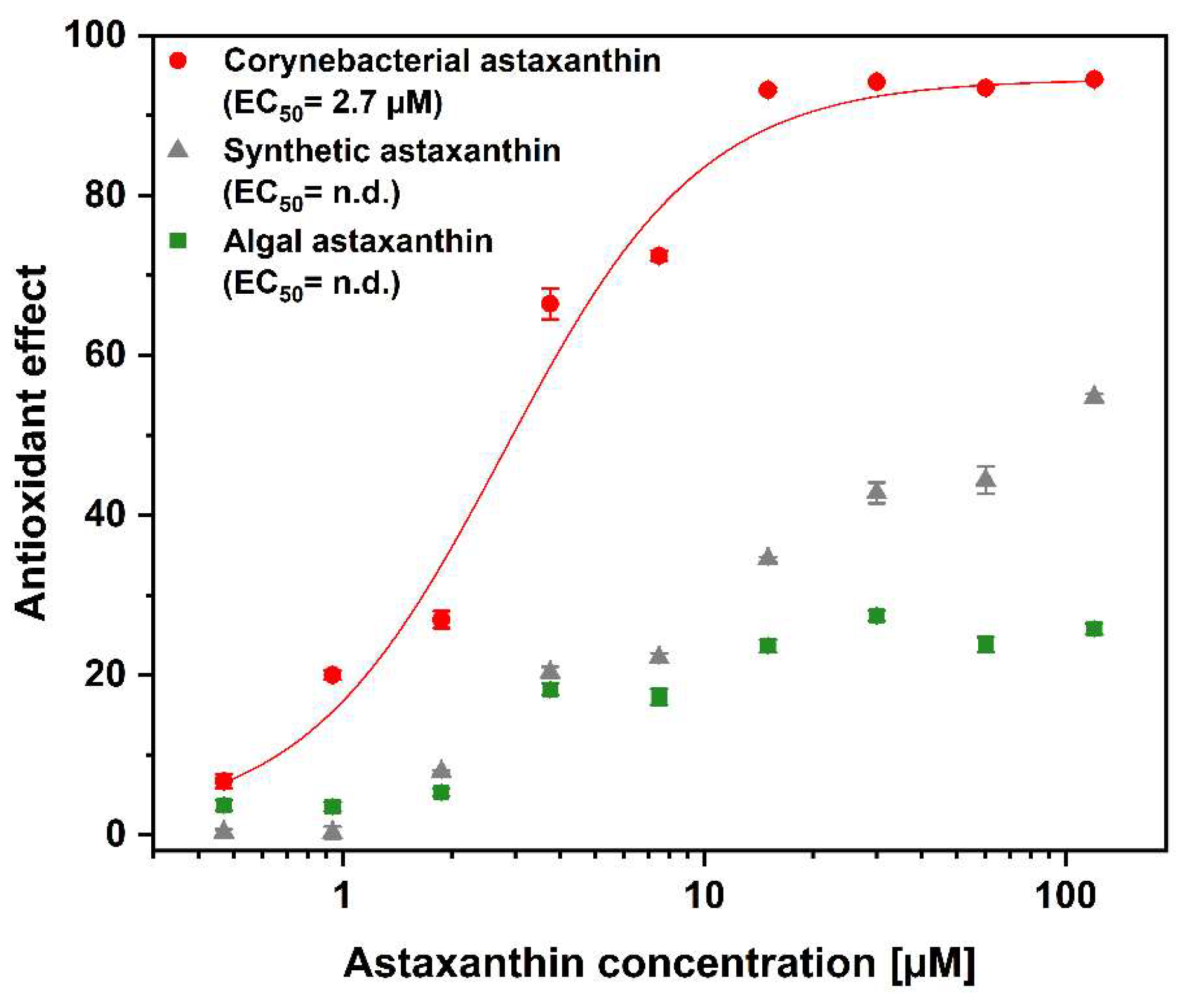
Figure 2.
Intracellular antioxidant activity of de-esterified astaxanthin. Extract from H. pluvialis was treated with BSA (control; shown in green) or cholesterol esterase (de-esterified; shown in yellow).
Figure 2.
Intracellular antioxidant activity of de-esterified astaxanthin. Extract from H. pluvialis was treated with BSA (control; shown in green) or cholesterol esterase (de-esterified; shown in yellow).
Disclaimer/Publisher’s Note: The statements, opinions and data contained in all publications are solely those of the individual author(s) and contributor(s) and not of MDPI and/or the editor(s). MDPI and/or the editor(s) disclaim responsibility for any injury to people or property resulting from any ideas, methods, instructions or products referred to in the content. |
© 2026 by the authors. Licensee MDPI, Basel, Switzerland. This article is an open access article distributed under the terms and conditions of the Creative Commons Attribution (CC BY) license (http://creativecommons.org/licenses/by/4.0/).
Copyright: This open access article is published under a Creative Commons CC BY 4.0 license, which permit the free download, distribution, and reuse, provided that the author and preprint are cited in any reuse.


