

Submitted:
16 March 2026
Posted:
17 March 2026
You are already at the latest version
Abstract
The intensification of ESG disclosure requirements under the Corporate Sustainability Reporting Directive (CSRD) and the International Sustainability Standards Board (ISSB) has increased the demand for artificial intelligence (AI) and data analytics to support large-scale sustainability reporting and verification. However, the existing academic literature remains fragmented across disciplinary domains, including natural language processing, machine learning, auditing, and regulatory compliance. This study addresses this gap through a PRISMA 2020-compliant systematic literature review of 45 peer-reviewed articles published between 2020 and 2025 and indexed in the Scopus database. The analysis combines bibliometric techniques using VOSviewer with qualitative thematic content analysis. The results reveal a rapidly expanding research field with a compound annual growth rate of 91.9%. Four major thematic dimensions emerge: (i) NLP and text mining for ESG disclosure analysis; (ii) machine learning applications for ESG scoring and corporate performance; (iii) AI-enabled ESG assurance, auditing, and governance; and (iv) regulatory frameworks and the digital transformation of sustainability reporting. The findings indicate that AI technologies are progressively transforming ESG disclosure from a predominantly narrative and self-reported practice into a data-driven and verifiable transparency system. These developments have important implications for regulators, corporate practitioners, assurance providers, and investors seeking to enhance the reliability and comparability of sustainability disclosures.
Keywords:
ESG disclosure
; artificial intelligence
; machine learning
; natural language processing
; sustainability reporting
; systematic literature review
; greenwashing detection
; Audit 4.0
; CSRD
; ISSB
1. Introduction
The global architecture of corporate sustainability disclosure is undergoing the most significant regulatory transformation since the emergence of voluntary reporting frameworks in the 1990s. The European Union's Corporate Sustainability Reporting Directive (CSRD), which entered into force in January 2023 and is applicable to approximately 50,000 companies from 2024 onwards, mandates standardized Environmental, Social, and Governance (ESG) reporting according to the European Sustainability Reporting Standards (ESRS) and introduces mandatory third-party assurance obligations (European Commission, 2022). Simultaneously, the International Sustainability Standards Board (ISSB), established by the IFRS Foundation in 2021, issued IFRS S1 and IFRS S2 in June 2023, creating a global baseline for sustainability-related financial disclosures that is being progressively adopted across more than 20 jurisdictions (IFRS Foundation, 2023). Together, these regulatory developments signal the definitive transition of ESG reporting from a largely voluntary and unstandardized practice to a mandatory, auditable, and globally convergent transparency system.
Against this backdrop of regulatory acceleration, the volume and complexity of sustainability disclosure obligations confronting corporate reporting entities are expanding at a pace that substantially exceeds the processing capacity of traditional manual reporting workflows. A large multinational corporation subject to CSRD requirements must now collect, validate, and disclose hundreds of data points across environmental, social, and governance dimensions, integrating information from supply chains, subsidiaries, and operational units across multiple geographies and jurisdictions. This data complexity challenge has transformed what was once a predominantly qualitative narrative exercise into a quantitative, data-intensive, and technology-dependent reporting process, creating institutional demand for artificial intelligence and data analytics solutions capable of supporting ESG data collection, quality assurance, disclosure drafting, and independent verification at scale (De Villiers et al., 2024).
The corporate response to this demand is evidenced by a rapidly expanding market for ESG technology solutions. Global investment in ESG data and analytics platforms exceeded USD 1 billion annually by 2023, with projected growth rates exceeding 20% per annum through 2028 (Bloomberg Intelligence, 2023). Simultaneously, the academic literature addressing the intersection of AI, data analytics, and ESG disclosure has expanded at a compound annual growth rate exceeding 100% since 2020, generating a body of evidence whose scope, methodological diversity, and practical implications have outpaced existing narrative reviews. A rigorous systematic synthesis of this literature, capable of mapping its intellectual structure, identifying its principal findings, and surfacing its critical gaps, is therefore both timely and necessary.
Despite the rapid expansion of AI applications in ESG reporting contexts, the academic literature remains fragmented across disciplinary silos that rarely engage with each other's methodological contributions. Natural language processing researchers analyzing sustainability report readability and greenwashing detection (Chabot, 2025; Smeuninx et al., 2020) operate largely independently from machine learning researchers developing ESG scoring models (D’Amato et al., 2024) and from accounting researchers examining AI adoption in assurance contexts (Moffitt et al., 2018). This fragmentation produces a paradox. While individual research streams are generating methodologically sophisticated contributions, the absence of integrative synthesis means that neither practitioners nor policymakers have access to a comprehensive, evidence-based understanding of how AI and analytics are collectively transforming the ESG disclosure ecosystem.
Existing literature reviews addressing adjacent themes, including reviews of sustainability reporting determinants ((Hahn & Kühnen, 2013), AI in accounting (Kokina & Davenport, 2017), and ESG rating methodologies (Berg et al., 2022), predate the most recent and significant period of AI–ESG convergence (2020–2025) and do not apply systematic bibliometric methodologies capable of mapping the field's intellectual structure. Table 1 presents the principal research streams at the AI–ESG intersection and identifies the specific gaps that this review addresses.
The absence of an integrative systematic review of AI and data analytics applications across the full spectrum of ESG disclosure, encompassing text mining and NLP, machine learning for scoring and performance analysis, AI-assisted assurance and audit, and regulatory compliance and digital transformation, constitutes the primary research gap that motivates this study. Secondary gaps include the lack of bibliometric mapping of the field's intellectual structure and collaboration networks, the absence of a validated framework for classifying the depth of AI integration across heterogeneous study designs, and the scarcity of evidence-based guidance for the four principal stakeholder groups, regulators, practitioners, assurance providers, and investors, navigating AI adoption decisions in ESG reporting contexts.
This study pursues four interrelated research objectives. The first objective is to map the quantitative structure of scientific production at the AI–ESG disclosure intersection through bibliometric analysis, identifying temporal trends, geographical concentrations, citation hierarchies, and keyword co-occurrence patterns. The second objective is to synthesize the qualitative contributions of the identified literature into a coherent thematic framework, classifying studies according to the depth of AI methodological integration and the substantive domain addressed. The third objective is to derive evidence-based theoretical and practical implications from the synthesized corpus, connecting empirical findings to established theoretical frameworks in accounting, sustainability management, and information systems. The fourth objective is to identify the structural gaps and priority research directions that characterize the field's developmental frontier.
These objectives are operationalized through the following central research question: How are artificial intelligence and data analytics transforming sustainable financial reporting and ESG disclosure practices? This question is addressed through a systematic literature review following the PRISMA 2020 protocol (Page et al., 2021), applied to a corpus of 45 peer-reviewed articles identified through a rigorous multi-stage screening process from the Scopus database.
This review makes four principal contributions to the literature. First, it provides the first systematic bibliometric mapping of the AI–ESG disclosure field, documenting its explosive growth trajectory (CAGR of 110.2% over 2020–2025), its geographic concentration, and its intellectual fragmentation. These findings establish the field's pre-paradigmatic status and identify the integrative theoretical work needed to advance it. Second, it introduces and validates a three-level AI Integration Level classification framework, distinguishing studies in which AI serves as the methodological core, as an analytical support tool, or merely as a contextual reference, and offering a replicable instrument for future systematic reviews in AI-augmented accounting research.
Third, it synthesizes evidence across four thematic dimensions, NLP and text mining for disclosure analysis, machine learning for ESG scoring and corporate performance, AI in assurance and audit governance, and regulatory frameworks and digital transformation, generating the first integrated evidence base connecting methodological diversity to practical implications across the complete ESG disclosure value chain. Fourth, it identifies four priority research directions, multilingual NLP development, longitudinal causal identification, AI governance in assurance, and comparative emerging-market studies, that provide a structured agenda for the field's next developmental phase.
Beyond its scholarly contributions, this review serves a direct practical function for the four stakeholder groups most consequentially affected by AI adoption in ESG reporting: regulators and standard-setters designing AI governance frameworks for disclosure and assurance; corporate practitioners navigating ESG technology investment decisions under CSRD and ISSB compliance pressure; assurance providers developing AI-augmented verification methodologies; and institutional investors integrating AI-generated ESG analytics into investment and stewardship processes.
The remainder of this paper is organized as follows. Section 2 describes the methodological framework, presenting the PRISMA-based selection protocol, database search strategy, inclusion and exclusion criteria, AI Integration Level classification framework, data extraction procedures, and quality appraisal approach. Section 3 presents the results in two complementary phases: a quantitative bibliometric analysis characterizing the field's structural landscape, followed by a qualitative content analysis identifying the four principal thematic dimensions. Section 4 discusses the findings' theoretical and practical implications, addresses the review's methodological limitations, and proposes a structured agenda for future research. Section 5 synthesizes the principal conclusions, summarizes the study's contributions to theory and practice, and articulates a forward-looking perspective on the field's developmental trajectory.
2. Materials and Methods
This systematic literature review adheres to the methodological framework established by the Preferred Reporting Items for Systematic Reviews and Meta-Analyses (PRISMA) protocol, recognized for ensuring transparency, reproducibility, and methodological rigor in evidence synthesis research (Page et al., 2021). The PRISMA framework provides explicit guidelines for each phase of the review process, including identification, screening, eligibility assessment, and inclusion, thereby minimizing selective reporting bias and enabling replication by independent researchers (Moher et al., 2009).
2.1. Data Source and Search Strategy
The bibliographic search was conducted in the Scopus database, selected for its extensive multidisciplinary coverage, rigorous indexing standards, and recognized relevance in accounting, finance, and sustainability management (Falagas et al., 2008). The search strategy was structured around three conceptual pillars: (i) ESG and sustainability disclosure terminology, (ii) financial reporting and accounting constructs, and (iii) artificial intelligence and data analytics methods. Table 1 presents the concept groups, search terms, and justification. The operationalized search string applied to Scopus via the TITLE-ABS-KEY field is presented in Table 2.
2.2. Study Selection Process
The initial search yielded 314 records. A sequential filtering procedure was applied in Scopus prior to export, followed by manual abstract and full-text screening. Table 3 details all inclusion and exclusion criteria, and the complete process is visualized in the PRISMA flow diagram (Figure 1).
In the first stage, the publication period was restricted to 2020–2025 (IC1), capturing the convergence of major ESG regulatory frameworks, including TCFD and the EU Non-Financial Reporting Directive (NFRD), with the accelerated adoption of machine learning in accounting research (Cao et al., 2021). The subject area was subsequently restricted to Business, Management and Accounting (IC2), and the corpus was narrowed to peer-reviewed journal articles (IC3) in English (IC4), yielding 71 records for manual screening.
In the first screening stage (EC1), titles and abstracts were independently reviewed to assess the substantive presence of AI or data analytics applied to ESG disclosure or financial reporting. Records where the intersection of all three conceptual pillars was not simultaneously evidenced were excluded (n = 23), retaining 48 articles. In the second stage (EC2), articles classified at AI Integration Level 3 were excluded (n = 3). The final analytical corpus comprises 45 peer-reviewed articles.
2.3. AI Integration Level Classification Framework
To avoid treating methodologically heterogeneous studies as epistemologically equivalent, a three-level classification framework was developed to assess the depth of AI integration in each study's research design. The framework draws on the typology proposed by Kokina and Davenport (2017), differentiating between studies deploying AI as a core methodological apparatus and those referencing it as an enabling or contextual factor. Classification was applied independently by the authors through abstract and full-text reading, and disagreements were resolved through discussion until consensus was reached. Table 4 presents the operational definitions and corpus distribution.
Levels 1 and 2 were retained for analysis (n = 45), as both provide substantive empirical or conceptual evidence on AI applications in ESG disclosure. Level 3 was excluded (n = 1) on the grounds that contextual mentions do not constitute sufficient analytical grounding. The final corpus spans 2020–2025, representing contributions from 22 countries across 26 peer-reviewed journals.
2.4. Qualitative Coding and Dimension Assignment
The four thematic dimensions identified in the qualitative analysis were derived inductively through iterative reading of titles, abstracts, and full texts, and subsequently validated against the keyword co-occurrence network. A structured extraction matrix and explicit coding rules guided classification. Studies with dual thematic relevance were assigned to the dominant dimension based on methodological focus, while secondary dimensions were recorded where applicable. Thematic labels and classifications were cross-validated between authors, and disagreements were resolved through consensus Clarke & Braun (2023).
2.5. Data Extraction and Analysis
Selected articles were organized in a structured extraction matrix encompassing title, authors, year, journal, country, research objective, methodology, AI or analytics technique, ESG dimension addressed, principal findings, and contributions to sustainable reporting practice (Kitchenham & Charters, 2007). Data analysis combined two complementary approaches: (i) quantitative bibliometric analysis using descriptive statistics and VOSviewer keyword co-occurrence mapping (Van Eck & Waltman, 2010); and (ii) qualitative thematic content analysis to identify the four principal dimensions, with inter-rater reliability assessed using Cohen's kappa (Massaro et al., 2016).
2.6. Quality Appraisal
Given the methodological heterogeneity of the corpus, encompassing quantitative empirical studies, qualitative case analyses, mixed-methods investigations, and conceptual frameworks, a formal quality appraisal was conducted using the Mixed Methods Appraisal Tool (MMAT, version 2018), specifically designed for systematic reviews incorporating diverse research designs (Hong et al., 2018). Each study was assessed against the MMAT screening questions and rated High, Medium, or Low based on the proportion of design-specific criteria met. Quality ratings were used to qualify the strength of evidence throughout the synthesis. Table 5 presents the appraisal for all 45 articles in the corpus.
3. Results
The systematic literature review of 45 peer-reviewed articles published between 2020 and 2025 reveals a rapidly emerging and thematically rich research domain at the intersection of artificial intelligence, data analytics, and ESG disclosure. The results are presented through two complementary analytical phases. Section 3.1 reports the quantitative bibliometric findings that characterize the structural landscape of scientific production, whereas Section 3.2 presents the qualitative content analysis identifying the four principal thematic dimensions that structure the field.
3.1. Quantitative Bibliometric Analysis
The bibliometric analysis was conducted on the final corpus of 45 peer-reviewed articles identified through the PRISMA screening process. Bibliometric indicators, including citation counts, co-authorship patterns, keyword distributions, and co-citation structures, were computed for this validated analytical set in order to ensure consistency between the quantitative and qualitative findings (Donthu et al., 2021).
3.1.1. Temporal Distribution and Growth Trajectory
The temporal distribution of publications reveals a markedly accelerated growth trajectory, with a compound annual growth rate (CAGR) of 91.9% over the 2020–2025 period. As illustrated in Table 4, the corpus begins with a single foundational publication in 2020, Smeuninx et al. (2020) corpus-based NLP analysis of sustainability report readability, and expands to 26 publications in 2025 alone, representing 57.8% of the total corpus. The most pronounced acceleration occurs between 2023 and 2024 (+160%), suggesting that the field entered an exponential growth phase coinciding with the operationalization of major regulatory frameworks.
This trajectory reflects the convergence of two parallel developments. The first is the rapid maturation of large language models and NLP tools applicable to financial text. The second is the intensification of ESG regulatory pressure, particularly the European Corporate Sustainability Reporting Directive (CSRD, 2022) and the standards issued by the International Sustainability Standards Board (ISSB), IFRS S1 and IFRS S2 (2023). The COVID-19 pandemic also functioned as a catalyst, accelerating both digital transformation in corporate reporting and academic interest in data-driven approaches to non-financial disclosure (Cao et al., 2020). The absence of publications in 2021 and 2022 within the corpus, followed by the sharp increase from 2023 onward, further confirms that the field’s productive consolidation represents a post-pandemic phenomenon closely linked to the regulatory acceleration cycle.
3.1.2. Geographical Distribution and International Collaboration
The geographical distribution of scientific production, presented in Table 5 and visualized in Figure 2, reveals a significant concentration in Anglo-Saxon and Asian research contexts. The United States leads with 18 affiliated author records (40.0% of the corpus), reflecting the country’s well-established infrastructure in accounting information systems research and the influential contributions of the Rutgers KPMG Center for Continuous Auditing. Researchers from this center, particularly Gu et al., constitute the most productive author pair within the corpus.
China ranks second with 14 records (31.1%), consistent with state-driven investments in big data infrastructure and ESG policy integration. A substantial European presence is also evident, with Italy (9), Spain (8), and France (5) among the leading contributors. This pattern reflects alignment with CSRD regulatory imperatives that are stimulating institutional research on AI-assisted compliance. Notably, Malaysia (8) and Viet Nam (7) demonstrate strong Asia-Pacific engagement, driven by regional sustainability reporting mandates and expanding fintech ecosystems (Nair et al., 2025). The co-authorship network by countries (Figure 2) reveals three primary collaboration clusters. The first is a transatlantic cluster anchored by the United States and China. The second is a Commonwealth cluster connecting the United Kingdom, New Zealand, and South Africa. The third is an emerging cluster linking Australia, the United Arab Emirates, and Spain. The presence of Malta within the US–China cluster reflects specific interdisciplinary research collaborations rather than national research volume. This network structure suggests that international ESG-AI research remains geographically fragmented, with limited collaboration bridges between European regulatory-driven research and Asian technology-driven research traditions.
3.1.3. Most Cited Documents and Citation Impact
Citation analysis provides insight into the intellectual anchors of the field. Table 6 presents the ten most globally cited documents within the corpus. The most cited article, , with 108 citations, proposes a conceptual framework examining how generative AI may transform sustainability reporting. This prominence suggests that theoretical contributions anticipating technological disruption tend to attract disproportionate early scholarly attention. The second most cited work, Smeuninx et al. (2020), with 63 citations, establishes the methodological baseline for corpus-based NLP analysis of sustainability texts. Its foundational nature explains its sustained citation impact despite predating the subsequent acceleration of the field.
The average citation count across the corpus is 11.2 per document, with a total of 504 accumulated citations. Approximately 38% of articles remain uncited, a proportion consistent with the extreme recency of the corpus, with 57.8% of the publications appearing in 2025. Normalized citation analysis further reveals that Gu et al. (2022) Audit 4.0 study, which employs satellite imagery for GHG assurance verification, exhibits the highest citation velocity among mid-period publications. This pattern suggests that methodologically innovative hybrid approaches combining AI with novel data sources tend to generate accelerated scholarly recognition.
3.1.4. Journal Distribution and Keyword Analysis
The 45 articles are distributed across 36 distinct journals, yielding a source-to-article ratio of 1.25. This distribution indicates a nascent interdisciplinary field that has not yet consolidated around dominant publication venues. The leading journals, Sustainable Futures and Meditari Accountancy Research (3 articles each), are followed by the Journal of Emerging Technologies in Accounting, Corporate Social Responsibility and Environmental Management, Journal of Cleaner Production, International Journal of Accounting and Information Management, and Journal of Financial Reporting and Accounting (2 articles each). This pattern confirms that the AI-ESG disclosure intersection is being addressed simultaneously by scholars in accounting technology, sustainability management, and environmental economics, without a single dominant disciplinary outlet.
The keyword co-occurrence network (Figure 3) reveals the conceptual architecture of the field. The central node, sustainability reporting (frequency: 11), functions as the thematic hub connecting the principal research clusters. ESG (10) operates as the broadest transversal connector, while natural language processing (7) and artificial intelligence (7) constitute the main technological nodes. Machine learning (5), textual analysis (2), and greenwashing (3) form a methodological constellation surrounding this central hub. The regulatory dimension is represented by non-financial reporting (2), integrated reporting (3), and ESRS (2), while large language model (2) appears as an emerging technological sub-node. Four distinct color clusters in the network correspond directly to the four thematic dimensions identified in the qualitative analysis (Section 3.2), confirming the analytical coherence between the bibliometric and thematic approaches.
3.1.5. Co-Citation Analysis and Intellectual Structure
The co-citation analysis of authors (Figure 4) reveals a sparse network in which five nodes meet the minimum citation threshold of two: Adams, Carnegie, Bakarich, Baker, and Cho. These authors are organized into two loosely connected clusters. Adams emerges as the most co-cited author, reflecting the foundational influence of Carol Adams’ work on integrated thinking and sustainability accounting frameworks. The sparsity of the co-citation network constitutes a substantive finding. It indicates that the AI-ESG disclosure field has not yet consolidated a shared theoretical canon and instead draws from dispersed intellectual traditions spanning accounting theory, computer science, and sustainability governance.
This intellectual fragmentation contrasts with the dense co-citation networks typically observed in mature research domains and suggests that the field remains in an early paradigm-building stage (Van Eck & Waltman, 2010). The limited cross-citation between the accounting-oriented cluster (Adams, Carnegie) and the analytics-oriented cluster (Bakarich, Baker) further indicates that scholars from different disciplinary backgrounds are not yet systematically engaging with one another’s foundational references. This gap represents both a theoretical limitation and a research opportunity for integrative contributions.
3.2. Qualitative Content Analysis: Thematic Dimensions
The qualitative content analysis of the 45 articles comprising the final corpus identified four principal thematic dimensions structuring research at the intersection of artificial intelligence, data analytics, and ESG disclosure. These dimensions, summarized in Table 7, were derived inductively through iterative coding of titles, abstracts, and full texts and subsequently validated against the keyword co-occurrence network structure (Figure 3). Although analytically distinct, the dimensions exhibit substantive overlaps, particularly between NLP applications and regulatory compliance, reflecting the integrative nature of the field.

Table 7.
Annual distribution of publications and dominant thematic focus per year (2020–2025).
| Year | n | % | Dominant Themes |
|---|---|---|---|
| 2020 | 1 | 2.2% | Big Data; NLP in sustainability reporting (foundational studies) |
| 2021 | 0 | 0.0% | |
| 2022 | 0 | 0.0% | |
| 2023 | 5 | 11.1% | NLP for SDG analysis; ESG assurance; textual ESG detection; Big Data analytics |
| 2024 | 13 | 28.9% | ML for ESG scoring; AI in assurance; LLMs; ESG–firm performance |
| 2025* | 26 | 57.8% | CSRD/ISSB compliance tools; AI adoption & ESG governance; generative AI in reporting |
| Total | 45 | 100% |
Note. The 2025 figure represents publications indexed in Scopus as of the search date (February 2026) and therefore constitutes a partial-year count. CAGR calculated over the full 2020–2025 period (n = 5 intervals).
Table 8.
Geographical distribution of scientific production: top 10 countries by number of affiliated author records.
Table 8.
Geographical distribution of scientific production: top 10 countries by number of affiliated author records.
| Rank | Country | n | % of corpus | Most Productive Authors |
|---|---|---|---|---|
| 1 | United States | 18 | 40.0% | Gu et al. (2022) |
| 2 | China | 14 | 31.1% | Wang & Zeng.; Gu, Y. |
| 3 | Italy | 9 | 20.0% | — |
| 4 | Spain | 8 | 17.8% | — |
| 5 | Malaysia | 8 | 17.8% | — |
| 6 | India | 7 | 15.6% | Sahu, A.K.; Debata, B. |
| 7 | Viet Nam | 7 | 15.6% | — |
| 8 | France | 5 | 11.1% | — |
| 9 | Australia | 4 | 8.9% | — |
| 10 | South Africa | 4 | 8.9% | — |
Note. Author records reflect total institutional affiliations per document; articles with multi-country authorship are counted in each represented country. Percentage calculated relative to total corpus articles (n = 45).
Table 9.
Ten most globally cited documents in the analytical corpus.
| Author(s)/Year | Title (abbreviated) | Cites | Journal | Key Contribution |
|---|---|---|---|---|
| How will AI text generation… impact sustainability reporting? | 108 | Sustainability Accounting, Mgmt & Policy J. | Conceptual framework on generative AI in ESG reporting | |
| Smeuninx et al. (2020) | Measuring the Readability of Sustainability Reports | 63 | Int. J. Business Communication | NLP readability analysis; foundational corpus linguistics methodology |
| D’Amato et al. (2024) | Firms’ profitability and ESG score: A ML approach | 52 | Applied Stochastic Models Bus. & Ind. | ML-based ESG scoring; interpretability tools |
| Aguado-Correa et al. (2023) | Evaluation of non-financial information and SDGs | 41 | European Research on Mgmt & Bus. Economics | NLP applied to SDG alignment in banking sector |
| Moffitt et al. (2018) | Audit 4.0-based ESG assurance using satellite images | 36 | Int. J. Accounting Info. Systems | Big Data + satellite imagery for GHG assurance |
| Brusseau (2023) | AI human impact: ethical investing model | 30 | J. Sustainable Finance & Investment | ESG scoring + AI ethics framework |
| Riyath & Jariya (2024) | ESG reporting, AI, stakeholders and innovation | 22 | J. Financial Reporting & Accounting | AI–ESG integration in sustainability culture |
| Nair et al. (2025) | AI-enabled FinTech for innovative sustainability | 19 | Int. J. Accounting & Info. Mgmt | AI + FinTech for digital accounting and sustainable finance |
| Li et al. (2024) | Using AI in ESG Assurance | 19 | J. Emerging Technologies in Accounting | AI application in ESG assurance practice |
| D. Li & Adriaens (2024) | Deconstruction of ESG Impacts on US Bond Pricing | 18 | J. Management in Engineering | ESG impacts on corporate bond cost of capital |
Note. Citation counts retrieved from Scopus as of February 2026. Titles are abbreviated for display purposes.
Table 10.
Four thematic dimensions of the analytical corpus: operational scope and distribution.
| # | Dimension | Scope | n | Representative Studies |
|---|---|---|---|---|
| 1 | NLP & Text Mining for ESG Disclosure Analysis | Studies applying NLP, corpus linguistics, textual analysis, and LLMs to analyze ESG/sustainability report content, readability, sentiment, and greenwashing detection. | 13 | De Villiers et al. (2024); Chabot (2025); Pérez-López et al. (2023); Lin et al. (2024) |
| 2 | Machine Learning for ESG Scoring & Corporate Performance | Studies using ML algorithms (supervised/unsupervised) to predict, classify, or evaluate ESG scores, disclosure quality, and firm performance. | 9 | D’Amato et al. (2024); Yang et al. (2025); Subramaniam et al. (2024) |
| 3 | AI in ESG Assurance, Audit & Governance | Studies applying AI, Big Data, and advanced analytics to auditing, continuous assurance, internal control, and ESG governance processes. | 8 | Moffitt et al. (2018), Li et al. (2024); Brusseau (2023) |
| 4 | Regulatory Frameworks, Digital Transformation & ESG Reporting Standards | Studies addressing CSRD, NFRD, ISSB, TCFD compliance, ESG software tools, and the digital transformation of mandatory and voluntary reporting. | 15 | De Villiers et al. (2024); Naveed et al. (2025); Hąbek (2025); (Nair et al., 2025) |
Note. n values reflect primary dimension assignment (total = 45). Articles exhibiting dual thematic relevance were assigned to the dominant dimension based on methodological focus.
3.2.1. Dimension 1—NLP & Text Mining for ESG Disclosure Analysis (n = 13)
The largest thematic dimension encompasses studies that apply natural language processing, corpus linguistics, textual analysis, and large language models to examine the content, quality, and characteristics of ESG and sustainability disclosures. This dimension is anchored by foundational methodological contributions, most notably Smeuninx et al. (2020) corpus-based readability analysis, and has expanded rapidly to include sentiment analysis, greenwashing detection, materiality identification, and cross-sectoral disclosure comparison.
The application of BERT-based models and topic modeling algorithms (LDA, GNTM) to climate disclosure texts, as demonstrated in the European energy sector analysis by Chabot (2025), represents the methodological frontier of this dimension. Similarly, ESG-KIBERT, an industry-specific NLP model developed for ESG evaluation, illustrates the progression from generic language models toward domain-adapted tools capable of capturing sector-specific disclosure nuances. The consistent finding across this dimension is that AI-powered textual analysis substantially outperforms traditional manual content analysis in both scalability and inter-rater reliability, enabling the processing of thousands of disclosure documents with quantifiable precision (Pérez-López et al., 2023). Lin et al. (2024) global evolution study further demonstrates how machine learning-based textual analysis can trace longitudinal disclosure trends across jurisdictions, providing regulators with comparative benchmarking tools that were previously unavailable through conventional methods.
Greenwashing detection constitutes a particularly active substream within this dimension. Studies employing NLP to identify discrepancies between stated ESG commitments and measurable performance outcomes demonstrate the regulatory utility of AI tools, a finding directly relevant to CSRD third-party verification requirements. The convergence of textual analysis with climate risk exposure metrics further suggests that this dimension is evolving toward integrated disclosure analytics combining linguistic and financial data sources. Sentiment analysis applied to corporate climate disclosures reveals systematic variations in disclosure tone across industries and regulatory regimes, with carbon-intensive sectors exhibiting significantly more cautious linguistic framing than their service-sector counterparts.
3.2.2. Dimension 2—Machine Learning for ESG Scoring & Corporate Performance (n = 9)
The second thematic dimension encompasses studies applying supervised and unsupervised machine learning algorithms to predict ESG scores, assess disclosure quality, and examine relationships between ESG performance and corporate financial outcomes. This dimension is characterized by methodological sophistication, with studies employing gradient boosting machines, XGBoost, K-means clustering, dual machine learning, and interpretability tools such as SHAP values to enhance both predictive accuracy and analytical transparency.
D’Amato et al.’s (2024) machine learning analysis of ESG-profitability relationships, with 52 citations, constitutes the most influential contribution within this dimension. The study establishes that firm-level ESG scores are significantly associated with financial performance across multiple industry sectors when analyzed through interpretable ML frameworks. The deployment of SHAP values represents a critical methodological advance because it addresses the persistent “black box” critique that has limited ML adoption in regulatory and investment contexts. By providing stakeholders with transparent, feature-level explanations of predictive outputs, the study enhances the interpretability of machine learning applications. Complementing this work, Yang et al. (2025) study on predicting ESG disclosure quality through board secretaries’ characteristics demonstrates the capacity of ML techniques to identify institutional governance predictors of disclosure behavior, extending the analytical scope beyond firm financials to organizational determinants.
A methodologically notable contribution within this dimension is the application of dual machine learning to assess the causal impact of green product certification on ESG performance, thereby addressing the endogeneity challenges that have historically limited causal inference in ESG research. Similarly, the use of gradient boosting to detect double materiality label adopters under CSRD illustrates the practical regulatory application of ML tools, providing supervisory bodies with automated screening capabilities for compliance monitoring. Subramaniam et al.’s (2024) application of machine learning to CSR and ESG reporting further demonstrates how unsupervised clustering algorithms can reveal latent patterns in corporate disclosure strategies that remain invisible to traditional statistical approaches, identifying distinct disclosure archetypes across industry sectors.
3.2.3. Dimension 3—AI in ESG Assurance, Audit & Governance (n = 8)
The third dimension encompasses studies examining the integration of AI, Big Data, and advanced analytics into ESG assurance processes, audit governance, and institutional control systems. This dimension is theoretically grounded in the Audit 4.0 framework, which conceptualizes the transformation of assurance practice through real-time data access, continuous monitoring, and AI-powered anomaly detection. Within the corpus, this dimension includes some of the most methodologically innovative contributions.
Gu et al. (2022) demonstration of satellite image analysis for greenhouse gas emission assurance represents one of the most paradigm-shifting contributions in this dimension, achieving 36 citations. The study illustrates how AI enables assurance providers to independently verify environmental data without relying exclusively on company-reported figures. This capacity for independent data triangulation addresses a fundamental credibility limitation of current ESG assurance practices, in which auditors often depend on internally generated data subject to managerial discretion (Moffitt et al., 2018). Li et al.’s (2024) complementary study on the use of AI in ESG assurance, also originating from the Rutgers research group, extends this line of inquiry by examining the operational integration of AI tools within established audit methodologies and identifying both efficiency gains and professional
Big data analytics in sustainable auditing, examined in emerging market contexts, reveals that data-driven auditing approaches improve both detection rates for ESG compliance deviations and decision-making efficiency across descriptive, predictive, and prescriptive analytical modes. The perceived risk dimensions affecting AI adoption in ESG assurance, analyzed through UTAUT and perceived risk theory, further indicate that auditor trust and regulatory validation constitute the primary barriers to technology adoption in this dimension. These barriers are progressively being addressed through emerging professional standards from the International Auditing and Assurance Standards Board (IAASB). Brusseau’s (2023) ethical investing framework contributes a normative dimension to this cluster by proposing governance structures for responsible AI deployment in assurance contexts that balance automation efficiency with human oversight requirements.
3.2.4. Dimension 4—Regulatory Frameworks, Digital Transformation & ESG Reporting Standards (n = 15)
The fourth and most thematically heterogeneous dimension encompasses studies addressing the regulatory architecture of ESG disclosure, including CSRD, NFRD, TCFD, ISSB, and ESRS frameworks, alongside investigations of digital transformation processes, ESG software solutions, and the institutional governance of AI adoption in reporting contexts. This dimension is distinguished by its policy orientation and by its focus on the organizational and regulatory conditions that enable or constrain AI integration in sustainability reporting.
De Villiers et al. (2024) provide the conceptual anchor for this dimension. Their framework on AI’s impact on sustainability reporting, the most cited paper in the corpus with 108 citations, maps the transformative implications of generative AI for report preparation, verification, and stakeholder communication. The evaluation of ESG software solutions for CSRD compliance in the manufacturing sector provides empirical grounding for the software selection decisions confronting reporting entities, identifying critical capability gaps in regulatory alignment, integration scalability, and AI-powered data quality assurance. (Nair et al., 2025) study on AI-enabled FinTech for innovative sustainability further demonstrates how the convergence of financial technology platforms with AI capabilities creates new institutional pathways for sustainability reporting that extend beyond traditional corporate boundaries.
AI adoption and ESG disclosure quality, examined notably in the Chinese corporate context by Naveed et al. (2025), demonstrates that organizational AI integration significantly enhances the comprehensiveness and credibility of sustainability disclosures. This relationship is mediated by dynamic capability development and sustainability committee heterogeneity. The finding is theoretically significant because it establishes organizational AI capability, rather than mere tool availability, as the key determinant of disclosure quality improvement, aligning with dynamic capability theory in strategic management (Teece et al., 1997). The governance dimension is further elaborated in studies examining the role of blockchain and AI in accounting for ESG performance. These studies reveal that technological complementarities between AI and distributed ledger technologies amplify ESG outcomes beyond what either technology can achieve independently. Evidence on AI adoption and ESG decoupling in supply chains further indicates that organizational AI maturity, measured through integration depth rather than adoption breadth, determines whether AI deployment genuinely improves disclosure substance or merely reinforces symbolic compliance behaviors.
4. Discussion
The systematic analysis of 45 peer-reviewed articles reveals that the intersection of artificial intelligence, data analytics, and ESG disclosure has evolved from a nascent experimental domain into an accelerating field of scholarly inquiry. This development is driven by the convergence of regulatory imperatives and technological maturation. The present discussion synthesizes the principal findings across the four identified thematic dimensions, interprets their collective implications for theory and practice, and identifies the structural limitations and research gaps that define the field’s developmental agenda.
4.1. The Transformative Role of NLP and Text Mining in ESG Disclosure
The predominance of NLP and text mining applications in the corpus, constituting the largest thematic dimension with 13 studies, reflects a fundamental epistemological shift in how ESG disclosure is analyzed. Traditional content analysis approaches, which rely on manual coding of corporate reports, are inherently limited in terms of scalability and consistency. In contrast, AI-powered textual analysis overcomes these constraints by enabling the simultaneous processing of thousands of disclosure documents with reproducible precision (Smeuninx et al., 2020). This methodological transition carries significant implications for both academic research and regulatory oversight.
A particularly consequential finding is the demonstrated capacity of NLP models to detect greenwashing, understood as the misalignment between stated ESG commitments and verifiable environmental performance. Studies employing BERT-based classifiers and sentiment analysis to ESG disclosures in the European energy sector (Chabot, 2025) consistently identify systematic patterns of linguistic inflation in corporate sustainability narratives. Firms operating in high-emission industries exhibit significantly greater divergence between textual claims and measured environmental outcomes. This finding is of direct regulatory relevance. The CSRD’s mandatory third-party verification requirements will create institutional demand for scalable and automated greenwashing detection tools of precisely the type demonstrated in this dimension.
The emergence of domain-adapted language models, exemplified by ESG-KIBERT and other sector-specific NLP architectures, marks the field’s progression beyond generic language models toward tools capable of capturing industry-specific disclosure semantics. This specialization trajectory addresses a fundamental limitation of general-purpose models, which tend to misclassify ESG-relevant terminology that carries different meanings across sectors, such as the concept of “materiality” in financial versus environmental contexts. The convergence of NLP with financial materiality assessment further suggests that text-based AI tools are evolving toward integrated disclosure analytics capable of simultaneously evaluating linguistic quality and economic significance. Such a capability would substantially enhance the decision-usefulness of sustainability reports for investors (De Villiers et al. ,2024).
Despite these advances, the NLP dimension exhibits a critical methodological gap. The predominance of English-language corpora limits the generalizability of findings to non-anglophone reporting contexts. The CSRD’s application across 27 EU member states, where reporting obligations exist in multiple languages, creates an urgent demand for multilingual ESG-NLP tools that remain largely absent from the current corpus. Addressing this gap therefore represents a structural research priority that must be resolved if AI-powered disclosure analysis is to achieve genuine regulatory applicability.
4.2. Machine Learning as an Instrument of ESG Transparency and Accountability
The second thematic dimension, ML for ESG scoring and corporate performance, reveals that machine learning is progressively replacing traditional regression-based approaches in ESG research. These methods offer superior predictive accuracy, a greater capacity to handle non-linear relationships, and, critically, interpretability tools that render model outputs auditable. The adoption of SHAP values, gradient boosting explainability interfaces, and dual causal ML frameworks across the corpus signals the maturation of the field beyond predictive performance toward analytical accountability, a prerequisite for the regulatory acceptance of ML-generated ESG assessments (D’Amato et al., 2024).
A consistent finding across ML studies is that ESG disclosure quality is significantly predicted by organizational governance characteristics, including board composition, secretarial qualifications, and sustainability committee structure (Yang et al., 2025). This evidence challenges deterministic interpretations of disclosure behavior that attribute variation primarily to regulatory pressure or firm size. Instead, the findings align with institutional theory perspectives, which argue that disclosure practices are embedded in organizational governance routines that precede and shape regulatory compliance responses (Dimaggio & Powell, 1983). The practical implication is that strategies aimed at improving ESG reporting must address organizational capability development alongside regulatory compliance, a conclusion with direct relevance for standard-setters designing ISSB implementation guidance.
A methodologically significant contribution within this dimension is the application of unsupervised ML, specifically K-means++ clustering, to identify latent firm-level ESG disclosure profiles (Subramaniam et al., 2024). By revealing that disclosure quality clusters along dimensions not captured by conventional ESG rating methodologies, this approach exposes systematic biases in current rating frameworks and suggests that AI-generated disclosure taxonomies may provide more granular and internally consistent classifications than those produced by commercial ESG data providers. This finding has substantial implications for investors who rely on commercial ESG ratings for portfolio construction and stewardship decisions.
The most significant limitation of the ML dimension relates to data dependency. The accuracy of ML-based ESG scoring models is fundamentally constrained by the quality, consistency, and comparability of the underlying disclosure data on which they are trained. The current heterogeneity of ESG reporting standards, with firms simultaneously reporting under GRI, SASB, TCFD, and emerging ESRS frameworks, introduces systematic noise that degrades model performance. The progressive standardization of ESG reporting under the ISSB framework may paradoxically increase both the value and the reliability of ML-based disclosure analytics by providing models with more consistent training inputs.
4.3. AI-Driven Assurance and the Future of ESG Audit
The third dimension, AI in ESG assurance, audit, and governance, addresses what is arguably the most consequential application of AI within the ESG disclosure ecosystem: the transformation of independent verification from a document-centric and backward-looking process into a data-driven, continuous, and prospectively oriented assurance system. The Audit 4.0 framework, anchored by Gu et al. (2022) satellite imagery application for GHG emission verification, represents a paradigm shift in which assurance providers can independently triangulate company-reported environmental data against exogenous and objectively verifiable sources. This transformation fundamentally alters the power dynamics between reporting entities and their external verifiers.
This development carries profound implications for the credibility of ESG disclosure. Current ESG assurance practice is predominantly limited assurance and is conducted by a combination of audit firms and specialist sustainability consultancies using largely self-reported data (Bakarich et al., 2023). The integration of AI tools capable of cross-referencing corporate disclosures against satellite data, IoT sensor feeds, supply chain transaction records, and regulatory databases, as demonstrated across multiple studies in this dimension, establishes the technical foundation for a high-assurance model of ESG verification that is qualitatively more robust than current attestation practices. The IAASB’s development of ISSA 5000, the forthcoming international sustainability assurance standard, explicitly contemplates the role of technology in assurance evidence gathering. This development suggests that regulatory frameworks are beginning to institutionalize the AI-assurance convergence documented in this corpus.
Perceived risk analyses of AI adoption in ESG assurance identify auditor competency limitations, data privacy concerns, and liability uncertainty as the primary barriers to technology adoption. These barriers are organizational and regulatory rather than technical in nature. The findings therefore indicate that the bottleneck in AI-assurance integration is not technological readiness but institutional readiness. Professional standards, liability frameworks, and training infrastructures necessary to embed AI tools in assurance practice remain underdeveloped relative to technological capability. Addressing this institutional gap represents a priority for professional accounting bodies, standard-setters, and academic programs in assurance and auditing.
Big data analytics applied to sustainable auditing in banking contexts demonstrates that the descriptive, predictive, and prescriptive capabilities of data-driven auditing collectively improve both the detection of ESG compliance deviations and the efficiency of audit resource allocation. The banking sector’s advanced data infrastructure, including centralized transaction databases and established regulatory reporting pipelines, positions it as an early adopter context for AI-powered ESG auditing. Findings from this sector are therefore likely to diffuse to less data-mature industries as standardized ESG data collection infrastructures develop.
4.4. Regulatory Convergence and the Organizational Conditions for AI Integration
The fourth thematic dimension, regulatory frameworks, digital transformation, and ESG reporting standards, situates AI adoption within the institutional context that simultaneously generates demand for and constrains the deployment of data-driven disclosure tools. The CSRD’s entry into force in 2024, which imposes mandatory double materiality assessment and third-party verification on approximately 50,000 European companies, represents the most significant regulatory catalyst for AI integration in ESG reporting since the introduction of the NFRD in 2014. The evaluation of ESG software solutions for CSRD compliance (Hąbek, 2025) reveals that no currently available platform fully satisfies the regulatory, integration, and scalability requirements of large manufacturing enterprises. This gap indicates a substantial market opportunity while simultaneously creating compliance risk for reporting entities.
Evidence that organizational AI adoption significantly enhances ESG disclosure quality, mediated by dynamic capability development (Naveed et al., 2025), aligns with a resource-based view of disclosure behavior. Firms that invest in AI capabilities as organizational assets, rather than deploying AI merely as a point solution, achieve systematic and sustained improvements in disclosure comprehensiveness and stakeholder credibility. This capability-disclosure nexus has important implications for regulatory design. Disclosure mandates that fail to address the organizational capability conditions necessary for effective implementation may generate superficial compliance behaviors, such as symbolic label adoption without substantive double materiality assessment, rather than genuine improvements in ESG transparency.
The conceptual framework proposed by de Villiers et al. (2024), the most cited paper in the corpus with 108 citations, maps the transformative implications of generative AI for sustainability reporting across three dimensions: report preparation through automated drafting and data aggregation, report verification through AI-assisted assurance, and stakeholder communication through personalized disclosure delivery. This framework anticipates a future in which AI fundamentally reconfigures the reporting value chain, reducing compliance costs while increasing both the volume and granularity of disclosed information. The realization of this transformation, however, depends on the resolution of governance challenges, including AI hallucination risks in disclosure contexts, liability attribution for AI-generated reporting errors, and the preservation of human professional judgment in assurance decisions. These issues remain insufficiently addressed in both the academic literature and emerging regulatory frameworks.
The complementarity between blockchain and AI documented by Nguyen et al. (2025), where the integration of distributed ledger technology for data integrity and AI for data analytics generates ESG performance improvements exceeding those produced by either technology independently, suggests that the future of ESG disclosure infrastructure lies in integrated technological ecosystems rather than in AI as a standalone tool. Within such ecosystems, AI functions as the analytical layer of a broader data governance architecture. This systemic perspective has implications for organizational technology investment strategies. The marginal return on AI capability investment is likely to increase as underlying data infrastructures, including standardized ESG taxonomies, interoperable reporting platforms, and blockchain-enabled supply chain transparency systems, continue to mature.
The findings of this review carry several theoretical implications for accounting research, sustainability management, and information systems theory. First, the demonstrated capacity of AI to independently verify and supplement company-reported ESG data challenges a foundational assumption of voluntary disclosure theory: that information asymmetry between firms and external stakeholders is irreducible (Verrecchia, 2001). By creating technical conditions under which stakeholders can access independently verifiable ESG information regardless of managerial disclosure decisions, AI alters the strategic calculus of ESG reporting. Disclosure may shift from a discretionary legitimacy management tool toward a mandatory transparency baseline whose informational content is continuously validated through AI-powered monitoring systems.
Second, the sparse co-citation network identified in the bibliometric analysis, indicating that AI-ESG disclosure research draws from dispersed intellectual traditions without a consolidated theoretical canon, suggests that the field remains in a pre-paradigmatic stage. In this context, theoretical integration represents a significant scholarly opportunity. The convergence of institutional theory, explaining regulatory adoption dynamics, dynamic capability theory, explaining organizational AI integration, and information asymmetry theory, explaining disclosure incentives, offers a promising multi-theoretical framework for advancing conceptual coherence within the field.
Third, the geographical concentration of AI-ESG research in the United States, China, and the European Union, combined with the notable absence of contributions from Latin America, Sub-Saharan Africa, and South Asia, reveals a pattern consistent with Rogers (2003) diffusion of innovations framework. In this model, technology adoption follows a centre–periphery trajectory shaped by institutional readiness, regulatory infrastructure, and absorptive capacity. The alignment between the highest-producing countries and the most advanced ESG regulatory regimes, including SEC climate disclosure rules, CSRD, and China’s dual-carbon policy, suggests that AI-ESG research diffusion is regulation-pulled rather than technology-pushed. Institutional isomorphism theory (DiMaggio & Powell, 1983) would describe this dynamic as coercive isomorphism, whereby regulatory mandates drive the simultaneous adoption of reporting standards and the technological tools necessary for compliance. This regulatory dependence, however, raises concerns about knowledge transferability. AI-ESG frameworks developed under CSRD assumptions may not translate effectively to jurisdictions operating under different institutional logics, data availability regimes, or assurance traditions. Extending AI-ESG research to emerging market contexts therefore represents not merely a geographical gap but a theoretical necessity for testing the boundary conditions of current models
4.6. Limitations of the Review
This systematic literature review is subject to several methodological limitations that should be considered when interpreting its findings. First, the restriction to a single bibliographic database (Scopus) may have introduced selection bias, as relevant contributions indexed exclusively in Web of Science, SSRN, or domain-specific repositories may have been excluded. Future reviews should therefore consider multi-database search strategies to enhance coverage comprehensiveness, particularly for practitioner-oriented contributions and working papers that may not yet be indexed in Scopus.
Second, the temporal delimitation (2020–2025) was designed to capture the contemporary development phase of the field. However, this approach necessarily excludes earlier foundational contributions, particularly within the NLP-accounting and continuous auditing literatures, whose absence from the corpus may understate the theoretical heritage of current research. Scholars seeking to situate the field within a broader historical trajectory should complement this review with targeted searches covering pre-2020 literature.
Third, the AI Integration Level classification framework, which distinguishes studies according to the depth of AI methodological application, was developed inductively for this review and has not yet been externally validated. Although inter-rater reliability was assessed through independent coding and consensus resolution, the framework’s applicability to domains beyond AI-ESG disclosure remains to be tested. Future research applying this classification approach should therefore validate it against alternative typologies of technology integration within accounting research.
Finally, the rapid pace of development in both AI capabilities and ESG regulatory frameworks implies that findings reflecting the state of the literature as of early 2026 may require updating within a relatively short timeframe. The emergence of ISSB’s IFRS S1 and S2 implementation guidance, the IAASB’s ISSA 5000, and continuing advances in generative AI capabilities are likely to generate new research streams that were either nascent or absent within the current corpus.
4.7. Future Research Directions
The findings of this review identify several priority directions for future research at the intersection of AI and ESG disclosure. First, the development and validation of multilingual ESG-NLP models capable of analyzing disclosures in non-English languages represent an urgent methodological priority, particularly given the CSRD’s application across a multilingual European regulatory context. Advancing this agenda will require stronger collaboration between accounting researchers and computational linguists, bridging the disciplinary gap evident in the co-citation network identified in this study.
Second, longitudinal studies examining the causal impact of AI adoption on ESG disclosure quality over time are necessary to determine whether the cross-sectional associations documented in the current corpus reflect genuine capability-driven improvements or endogenous selection effects. Natural experiments arising from differential CSRD implementation timelines across EU member states provide a promising quasi-experimental setting for addressing this causal identification challenge.
Third, research investigating the organizational, professional, and ethical governance of AI in assurance contexts constitutes a critical frontier. Key issues include liability allocation for AI-assisted audit failures, the role of human professional judgment in AI-augmented verification processes, and the development of competency frameworks for AI-literate auditors. Addressing these issues will require interdisciplinary collaboration among accounting scholars, legal researchers, AI ethics specialists, and professional standard-setters.
Fourth, comparative studies examining AI-ESG integration across diverse institutional contexts are needed to determine whether the efficiency gains and transparency improvements documented in the current corpus are transferable across regulatory and technological environments. In particular, research contrasting developed-economy mandatory disclosure regimes with emerging-economy voluntary reporting frameworks could provide valuable insights for the design of capacity-building initiatives supporting ESG reporting reform in emerging markets.
5. Conclusions
This systematic literature review synthesized 45 peer-reviewed articles published between 2020 and 2025, identified through a PRISMA 2020-compliant screening protocol in the Scopus database, to address the central research question: how are artificial intelligence and data analytics transforming sustainable financial reporting and ESG disclosure practices? The evidence assembled across four thematic dimensions, NLP and text mining for ESG disclosure analysis, machine learning for ESG scoring and corporate performance, AI in ESG assurance and audit governance, and regulatory frameworks and digital transformation, converges on a clear conclusion. Artificial intelligence and data analytics are reconstituting sustainability reporting from a largely self-reported and discretionary practice toward a verifiable, data-driven, and increasingly mandatory transparency system.
The bibliometric analysis documented a compound annual growth rate of 91.9% over the 2020–2025 period, with 57.8% of the corpus concentrated in 2025. This pattern confirms that the field has entered an exponential growth phase driven by the convergence of large language model maturation and intensifying regulatory pressure under the CSRD and ISSB frameworks. The geographical distribution reveals a significant concentration in the United States, China, and Western Europe, while Latin America, Sub-Saharan Africa, and most of South and Southeast Asia remain structurally underrepresented. The sparse co-citation network, in which only five authors meet the minimum threshold, confirms the field’s pre-paradigmatic status. Current research draws on dispersed intellectual traditions in accounting theory, computer science, and sustainability governance without a consolidated theoretical canon.
Across the four thematic dimensions, several key findings emerge. NLP-powered textual analysis substantially outperforms traditional manual content analysis in scalability and reproducibility, enabling greenwashing detection at regulatory scale through domain-adapted models such as ESG-KIBERT. Interpretable machine learning frameworks employing SHAP values and gradient boosting surpass regression-based ESG scoring approaches while revealing that organizational governance characteristics, rather than firm size or regulatory pressure alone, significantly predict disclosure quality. Audit 4.0 tools, particularly satellite imagery for GHG emission verification, enable assurance providers to independently triangulate company-reported environmental data against exogenous sources and thereby enhance the credibility of ESG attestation. Finally, organizational AI capability, rather than mere tool adoption, emerges as the primary determinant of disclosure quality improvement under mandatory reporting regimes.
The review makes three principal theoretical contributions. First, it demonstrates that AI-powered independent data verification challenges the foundational assumption of voluntary disclosure theory that information asymmetry between firms and stakeholders is irreducible (Verrecchia, 2001), as AI tools enable access to independently verifiable ESG information regardless of managerial disclosure decisions. Second, the finding that organizational AI capability determines disclosure quality extends dynamic capability theory (Teece et al., 1997) into the ESG reporting domain. This establishes that capability development must precede and accompany regulatory compliance. Third, the convergence of voluntary disclosure theory, institutional theory, and dynamic capability theory offers a multi-theoretical framework for advancing the field’s conceptual coherence beyond its current pre-paradigmatic fragmentation.
The findings carry concrete implications for regulators, practitioners, assurance providers, and investors. For regulators and standard-setters, the evidence that no currently available ESG software platform fully meets CSRD compliance requirements suggests that regulatory frameworks should explicitly address standards for AI-assisted disclosure preparation and governance requirements for AI-augmented assurance; the IAASB’s ISSA 5000 and the ISSB’s implementation guidance represent critical opportunities to institutionalize these specifications. For corporate reporting practitioners, the capability-disclosure nexus implies that ESG transformation strategies must prioritize workforce development, data governance infrastructure, and sustainability committee diversification alongside software procurement, as organizations that treat AI as a compliance shortcut risk generating superficial disclosure improvements that will not withstand AI-powered regulatory monitoring.
For assurance providers, the demonstrated feasibility of Audit 4.0 approaches establishes a technical roadmap for high-assurance ESG attestation that exceeds current limited assurance practice. Professional bodies should therefore prioritize AI competency frameworks, liability guidance, and quality control standards that enable responsible deployment at scale. For investors, the evidence that ML-based analytics reveal systematic biases in commercial ESG rating methodologies suggests that capital market participants should complement commercial ESG data with AI-powered independent analysis. This is particularly relevant for material investment and stewardship decisions in which rating divergence may obscure genuine corporate sustainability performance.
This review is subject to limitations that define the field’s research frontier. The restriction to Scopus as the sole bibliographic database may have excluded relevant contributions indexed in Web of Science or domain-specific repositories. The temporal delimitation to 2020–2025 necessarily excludes earlier foundational work in NLP-accounting and continuous auditing. Additionally, the three-level AI Integration Level classification framework proposed in this review was developed inductively and has not been externally validated; its applicability beyond the AI-ESG disclosure domain requires further testing against alternative technology integration typologies. The predominance of English-language corpora across the corpus limits generalizability to the CSRD’s multilingual regulatory context, making the development of multilingual ESG-NLP models an urgent priority. Future research should pursue longitudinal causal studies leveraging differential CSRD implementation timelines, investigate liability allocation and competency frameworks for AI-augmented assurance, and conduct comparative analyses across institutional contexts to assess whether efficiency gains documented in developed economies are transferable to emerging-market voluntary disclosure regimes.
The 91.9% compound annual growth rate of relevant scientific publications indicates that the AI driven transformation of ESG disclosure is not a passing trend but a structural reconfiguration of how sustainability information is produced, verified, and consumed. The progressive convergence of AI capability, regulatory standardization under the ISSB and CSRD frameworks, and growing investor demand for credible sustainability information creates a historically unique opportunity to establish robust, verifiable, and globally comparable ESG disclosure infrastructure. Realizing this opportunity requires intensified interdisciplinary collaboration between accounting scholars, computer scientists, legal experts, and sustainability practitioners. The field’s fragmented intellectual structure suggests that such collaboration remains insufficient. By providing an integrated systematic synthesis of the AI ESG disclosure literature, this review offers an evidentiary foundation upon which that collective endeavor can be built.
Supplementary Materials
The following supporting information can be downloaded at the website of this paper posted on Preprints.org. Table S1: Complete corpus of included studies (n = 45).
Author Contributions
| Authors | Contribution |
| Percy Antonio Vilchez Olivares | Conceptualization, methodology, investigation,writing—review and editing, project administration and supervision |
| Jesús Brandelt Astorga de la Cruz | methodology, software, validation, formal analysis, resources, data curation, writing—original draft preparation and visualization |
Funding
This research received no external funding.
Institutional Review Board Statement
Not applicable.
Informed Consent Statement
Not applicable.
Data Availability Statement
The bibliometric dataset supporting this systematic literature review was retrieved from Scopus in January 2026. The VOSviewer network visualization files and the complete data extraction matrix are available upon reasonable request from the corresponding author.
Conflicts of Interest
The author declares no conflicts of interest.
Abbreviations
The following abbreviations are used in this manuscript:
| Abbreviation | Definition |
| AI | Artificial Intelligence |
| CAGR | Compound Annual Growth Rate |
| CSRD | Corporate Sustainability Reporting Directive |
| ESG | Environmental, Social, and Governance |
| GHG | Greenhouse Gas |
| IAASB | International Auditing and Assurance Standards Board |
| IFRS | International Financial Reporting Standards |
| ISSB | International Sustainability Standards Board |
| ISSA | International Standard on Sustainability Assurance |
| LLM | Large Language Model |
| ML | Machine Learning |
| MMAT | Mixed Methods Appraisal Tool |
| NLP | Natural Language Processing |
| PRISMA | Preferred Reporting Items for Systematic Reviews and Meta-Analyses |
| SEM | Structural Equation Modeling |
| SHAP | SHapley Additive exPlanations |
| SLR | Systematic Literature Review |
References
- Aguado-Correa, F.; de la Vega-Jiménez, J. J.; López-Jiménez, J. M.; Padilla-Garrido, N.; Rabadán-Martín, I. Evaluation of non-financial information and its contribution to advancing the sustainable development goals within the Spanish banking sector. European Research on Management and Business Economics 2023, 29(1), 100211. [Google Scholar] [CrossRef]
- Ahmed, M. M. A.; Hassan, D. K. A. S. A. Integrated reporting in accounting research from 2013 to 2022: a systematic literature review and future research directions. Meditari Accountancy Research 2025, 33(1), 296–334. [Google Scholar] [CrossRef]
- Bakarich, K. M.; Baranek, D.; O’Brien, P. E. The Current State and Future Implications of Environmental, Social, and Governance Assurance. Current Issues in Auditing 2023, 17(1), 1–21. [Google Scholar] [CrossRef]
- Berg, F.; Kölbel, J. F.; Rigobon, R. Aggregate Confusion: The Divergence of ESG Ratings*. Review of Finance 2022, 26(6), 1315–1344. [Google Scholar] [CrossRef]
- Bloomberg Intelligence. ESG assets may hit $53 trillion by 2025, a third of global AUM. Bloomberg Professional Services 2023. [Google Scholar]
- Brusseau, J. AI human impact: toward a model for ethical investing in AI-intensive companies. Journal of Sustainable Finance & Investment 2023, 13(2), 1030–1057. [Google Scholar] [CrossRef]
- Campbell, J. L.; Foerster, A.; Garg, M.; Unda, L. A. The Determinants and Informativeness of ‘Voluntary’ Climate and Sustainability-related Financial Disclosures in Australia. Abacus 2025, 61(4), 961–1022. [Google Scholar] [CrossRef]
- Cao, S. S.; Jiang, W.; Yang, B.; Zhang, A. How to Talk When a Machine is Listening: Corporate Disclosure in the Age of AI. SSRN Electronic Journal 2020. [Google Scholar] [CrossRef]
- Chabot, M. Textual and AI-based analysis of climate disclosures: Evidence from the European energy sector. The British Accounting Review 2025, 101736. [Google Scholar] [CrossRef]
- Crocco, E.; Broccardo, L.; Alofaysan, H.; Agarwal, R. Sustainability reporting in carbon-intensive industries: Insights from a cross-sector machine learning approach. Business Strategy and the Environment 2024, 33(7), 7201–7215. [Google Scholar] [CrossRef]
- D’Amato, V.; D’Ecclesia, R.; Levantesi, S. Firms’ profitability and ESG score: A machine learning approach. Applied Stochastic Models in Business and Industry 2024, 40(2), 243–261. [Google Scholar] [CrossRef]
- De Villiers, C.; Dimes, R.; Molinari, M. How will AI text generation and processing impact sustainability reporting? Critical analysis, a conceptual framework and avenues for future research. Sustainability Accounting, Management and Policy Journal 2024, 15(1), 96–118. [Google Scholar] [CrossRef]
- Dimaggio, P. J.; Powell, W. W. The Iron Cage Revisited: Institutional Isomorphism and Collective Rationality in Organizational Fields. Source: American Sociological Review 1983, Vol. 48, Number 2. [Google Scholar] [CrossRef]
- Donthu, N.; Kumar, S.; Mukherjee, D.; Pandey, N.; Lim, W. M. How to conduct a bibliometric analysis: An overview and guidelines. Journal of Business Research 2021, 133, 285–296. [Google Scholar] [CrossRef]
- Drempetic, S.; Klein, C.; Zwergel, B. The Influence of Firm Size on the ESG Score: Corporate Sustainability Ratings Under Review. Journal of Business Ethics 2020, 167(2), 333–360. [Google Scholar] [CrossRef]
- European Commission. Directive 2022/2464 of the European Parliament and of the Council on corporate sustainability reporting . Official Journal of the European Union. 2022. Available online: https://eur-lex.europa.eu/legal-content/EN/TXT/?uri=CELEX:32022L2464.
- Falagas, M. E.; Pitsouni, E. I.; Malietzis, G. A.; Pappas, G. Comparison of PubMed, Scopus, Web of Science, and Google Scholar: strengths and weaknesses. The FASEB Journal 2008, 22(2), 338–342. [Google Scholar] [CrossRef]
- Fedorova, E.; Demin, I.; Silina, E. Impact of expenditures and corporate philanthropy disclosure on company value. Corporate Communications: An International Journal 2023, 28(3), 425–450. [Google Scholar] [CrossRef]
- Ferro, A.; Marazzina, D.; Stocco, D. Uncovering ESG Ratings: The (Im)Balance of Aspirational and Performance Features. Corporate Social Responsibility and Environmental Management 2025, 32(5), 5895–5917. [Google Scholar] [CrossRef]
- Gu, Y.; Dai, J.; Vasarhelyi, M. Audit 4.0-Based ESG Assurance: An Example of Using Satellite Images on GHG Emissions. SSRN Electronic Journal 2022. [Google Scholar] [CrossRef]
- Hąbek, P. Evaluating ESG Software Solutions for Sustainability Reporting in the Manufacturing Sector. Management Systems in Production Engineering 2025, 33(3), 420–432. [Google Scholar] [CrossRef]
- Hahn, R.; Kühnen, M. Determinants of sustainability reporting: A review of results, trends, theory, and opportunities in an expanding field of research. Journal of Cleaner Production 2013, Vol. 59, 5–21. [Google Scholar] [CrossRef]
- Hong, Q. N.; Fàbregues, S.; Bartlett, G.; Boardman, F.; Cargo, M.; Dagenais, P.; Gagnon, M. P.; Griffiths, F.; Nicolau, B.; O’Cathain, A.; Rousseau, M. C.; Vedel, I.; Pluye, P. The Mixed Methods Appraisal Tool (MMAT) version 2018 for information professionals and researchers. Education for Information 2018, 34(4), 285–291. [Google Scholar] [CrossRef]
- Huy, P. Q.; Phuc, V. K. Appraisal model on how accounting data analytics impacts public sector sustainability reporting. Sustainable Futures 2024, 8. [Google Scholar] [CrossRef]
- IFRS Foundation. IFRS Sustainability Disclosure Standards (IFRS S1 and IFRS S2). In International Financial Reporting Standards Foundation; 2023. [Google Scholar]
- Nair, A. J.; Manohar, S.; Mittal, A. AI-enabled FinTech for innovative sustainability: promoting organizational sustainability practices in digital accounting and finance. International Journal of Accounting and Information Management 2025, 33(2), 287–312. [Google Scholar] [CrossRef]
- Janvrin, D. J.; Jeffrey, C. Using Data Analytics to Analyze Wind Turbine Upgrade Decisions: An ESG Case. Journal of Emerging Technologies in Accounting 2025, 22(2), 181–200. [Google Scholar] [CrossRef]
- Kitchenham, B.; Charters, S. Guidelines for performing systematic literature reviews in software engineering. Keele University. Technical Report EBSE-2007-01; 2007. [Google Scholar]
- Kokina, J.; Davenport, T. H. The emergence of artificial intelligence: How automation is changing auditing. Journal of Emerging Technologies in Accounting 2017, 14(1), 115–122. [Google Scholar] [CrossRef]
- Lang, T. Identifying Financially Material Content in Corporate Social Responsibility Reports. Journal of Corporate Accounting & Finance 2025, 36(2), 169–182. [Google Scholar] [CrossRef]
- Lee, H.; Kim, J. H.; Jung, H. S. ESG-KIBERT: A new paradigm in ESG evaluation using NLP and industry-specific customization. Decision Support Systems 2025, 193, 114440. [Google Scholar] [CrossRef]
- Li, D.; Adriaens, P. Deconstruction of ESG Impacts on US Corporate Bond Pricing: The Cost of Capital Benefits Across Industry Sectors. Journal of Management in Engineering 2024, 40(1). [Google Scholar] [CrossRef]
- Li, N.; Kim, M.; Dai, J.; Vasarhelyi, M. A. Using Artificial Intelligence in ESG Assurance. Journal of Emerging Technologies in Accounting 2024, 21(2), 83–99. [Google Scholar] [CrossRef]
- Lin, Y.; Shen, R.; Wang, J.; & Julia Yu, Y. Global Evolution of Environmental and Social Disclosure in Annual Reports. Journal of Accounting Research 2024, 62(5), 1941–1988. [Google Scholar] [CrossRef]
- Lodhia, S.; Farooq, M. B.; Sharma, U.; Zaman, R. Digital technologies and sustainability accounting, reporting and assurance: framework and research opportunities. Meditari Accountancy Research 2025, 33(2), 417–441. [Google Scholar] [CrossRef]
- Lu, Q.; Cao, Y.; Yu, K.; Deng, Y. Effects of AI adoption on ESG decoupling in supply chains. Production Planning & Control 2025, 1–19. [Google Scholar] [CrossRef]
- Makarenko, I.; Steiner, B.; Yuhai, K. Toward a novel Sustainability Transparency Index for improved governance in agri-food value chains: A comparative study of Finnish and Ukrainian companies. Accounting and Financial Control 2024, 5(1), 68–81. [Google Scholar] [CrossRef]
- Massaro, M.; Dumay, J.; Guthrie, J. On the shoulders of giants: undertaking a structured literature review in accounting. Accounting, Auditing and Accountability Journal 2016, 29(5), 767–801. [Google Scholar] [CrossRef]
- Mittelbach-Hörmanseder, S.; Barrantes, E. An exploratory study of the demand side of firms’ non-financial information. Accounting, Auditing & Accountability Journal 2025, 38(9), 163–188. [Google Scholar] [CrossRef]
- Moffitt, K. C.; Rozario, A. M.; Vasarhelyi, M. A. Robotic Process Automation for Auditing. Journal of Emerging Technologies in Accounting 2018, 15(1), 1–10. [Google Scholar] [CrossRef]
- Mohamed Riyath, M. I.; Inun Jariya, A. M. The role of ESG reporting, artificial intelligence, stakeholders and innovation performance in fostering sustainability culture and climate resilience. Journal of Financial Reporting and Accounting 2024. [Google Scholar] [CrossRef]
- Moher, D.; Liberati, A.; Tetzlaff, J.; Altman, D. G. Preferred Reporting Items for Systematic Reviews and Meta-Analyses: The PRISMA Statement. PLoS Medicine 2009, 6(7), e1000097. [Google Scholar] [CrossRef]
- Naveed, K.; Farooq, M. B.; Zahir-Ul-Hassan, M. K.; Rauf, F. AI adoption, ESG disclosure quality and sustainability committee heterogeneity: evidence from Chinese companies. Meditari Accountancy Research 2025, 33(2), 708–732. [Google Scholar] [CrossRef]
- Nguyen, N. M.; Abu Afifa, M. M.; Thi Truc Dao, V.; Van Bui, D.; Vo Van, H. Leveraging artificial intelligence and blockchain in accounting to boost ESG performance: the role of risk management and environmental uncertainty. International Journal of Organizational Analysis 2025. [Google Scholar] [CrossRef]
- Nguyen, T. A. Bibliometric Analysis and Systematic Literature Review of Environmental, Social, and Governance Risk. Business Strategy and Development 2025, 8(3). [Google Scholar] [CrossRef]
- Page, M. J.; McKenzie, J. E.; Bossuyt, P. M.; Boutron, I.; Hoffmann, T. C.; Mulrow, C. D.; Shamseer, L.; Tetzlaff, J. M.; Akl, E. A.; Brennan, S. E.; Chou, R.; Glanville, J.; Grimshaw, J. M.; Hróbjartsson, A.; Lalu, M. M.; Li, T.; Loder, E. W.; Mayo-Wilson, E.; McDonald, S.; Moher, D. The PRISMA 2020 statement: an updated guideline for reporting systematic reviews. BMJ 2021, n71. [Google Scholar] [CrossRef] [PubMed]
- Rogers, E. M. Diffusion of Innovations. In Diffusion of Innovations, 5th ed. ; 2003. [Google Scholar]
- Sahu, A. K.; Debata, B. Firm-level climate risk exposure, ESG disclosure and stock liquidity: evidence from textual analysis. China Accounting and Finance Review 2025, 27(2), 181–209. [Google Scholar] [CrossRef]
- Sahu, A. K.; Debata, B.; Dash, S. R. Manager sentiment, policy uncertainty, ESG disclosure and firm performance: a large language model in corporate landscape. International Journal of Accounting & Information Management 2024, 32(5), 858–882. [Google Scholar] [CrossRef]
- Said, F.; Abdul Jalil, A.; Zainal, D. Big Data Analytics Capabilities, Sustainability Reporting on Social Media, and Competitive Advantage: An Exploratory Study. Asian Journal of Business and Accounting 2023, 16(1), 129–160. [Google Scholar] [CrossRef]
- Sekine, T.; Amri, I.; Cherief, A.; Le Guenedal, T.; Sakout, S.; Tilly, S. AI and Decision-Making in Investment—Why We Will Not Return to the Cave. The Journal of Portfolio Management 2025, 52(2), 96–105. [Google Scholar] [CrossRef]
- Shuheng, Q. ESG Information Disclosure and Path Selection of New Energy Enterprises in the Context of Digital Economy. Management (Montevideo) 2025, 3, 272. [Google Scholar] [CrossRef]
- Smeuninx, N.; De Clerck, B.; Aerts, W. Measuring the Readability of Sustainability Reports: A Corpus-Based Analysis Through Standard Formulae and NLP. International Journal of Business Communication 2020, 57(1), 52–85. [Google Scholar] [CrossRef]
- Stander, Y. S. Climate Sentiment Analysis on the Disclosures of the Corporations Listed on the Johannesburg Stock Exchange. Journal of Risk and Financial Management 2025, 18(9), 470. [Google Scholar] [CrossRef]
- Subramaniam, R. K.; Samuel, S. D.; Seera, M.; Alam, N. Utilising machine learning for corporate social responsibility (CSR) and environmental, social, and governance (ESG) evaluation: Transitioning from committees to climate. Sustainable Futures 2024, 8, 100329. [Google Scholar] [CrossRef]
- Suhardjo, I.; Suparman, M.; Rahman, P. Double materiality and stakeholder engagement: JALA’s sustainability journey. Emerald Emerging Markets Case Studies 2025, 15(3), 1–17. [Google Scholar] [CrossRef]
- Sun, Q.; Qiu, X. How does green product certification affect ESG performance? Evidence from dual machine learning. Journal of Cleaner Production 2025, 521, 146201. [Google Scholar] [CrossRef]
- Teece, D. J.; Pisano, G.; Shuen, A. Dynamic capabilities and strategic management. Strategic Management Journal 1997, 18(7), 509–533. [Google Scholar] [CrossRef]
- Teruel-Gutiérrez, R.; Carreres-Prieto, D.; Molina-Moreno, V.; Gálvez-Sánchez, F. J. Financial governance and subcontracting in US defence firms: a predictive model for public accountability. Public Money & Management 2025, 1–10. [Google Scholar] [CrossRef]
- Tiwari, C. K.; Bhat, M. A.; Alshabibi, B.; Al Balushi, Z. S.; Pal, A. Mapping four decades of research on sustainability accounting, sustainable finance, and governance: a bibliometric analysis and future directions. Journal of Financial Reporting and Accounting 2025. [Google Scholar] [CrossRef]
- Van der Lugt, C. T.; Bakker, H.-P.; Mans-Kemp, N. Materiality in reporting integration in South Africa: A natural language processing analysis. South African Journal of Economic and Management Sciences 2025, 28(1). [Google Scholar] [CrossRef]
- Van Eck, N. J.; Waltman, L. Software survey: VOSviewer, a computer program for bibliometric mapping. Scientometrics 2010, 84(2), 523–538. [Google Scholar] [CrossRef]
- Verrecchia, R. E. Essays on disclosure. Journal of Accounting and Economics 2001, 32(1–3), 97–180. [Google Scholar] [CrossRef]
- Clarke, V.; Braun, V. Thematic Analysis: A Practical Guide. In SAGE; 2023. [Google Scholar] [CrossRef]
- Wan Ismail, W. A.; Madah Marzuki, M.; Lode, N. A. Financial reporting quality, industrial revolution 4.0 and social well-being among Malaysian public companies. Asian Journal of Accounting Research 2024, 9(4), 294–308. [Google Scholar] [CrossRef]
- Wang, J.; Zeng, X. Corporate environmental, social, and governance information disclosure and audit governance in the context of green development. Journal of Cleaner Production 2024, 476, 143763. [Google Scholar] [CrossRef]
- Yang, J.; Niu, Y.; Shi, W.; Zhu, K. Predicting ESG disclosure quality through board secretaries’ characteristics: A machine learning approach. Research in International Business and Finance 2025, 76, 102865. [Google Scholar] [CrossRef]
Figure 1.
PRISMA 2020 flow diagram of the study selection process. Note. PRISMA 2020 flow diagram illustrating the systematic study selection process. Starting from 314 records identified in Scopus, inclusion criteria (IC1–IC4) removed 243 records; abstract screening (EC1) excluded 23; full-text review (EC2) excluded 3; yielding a final analytical corpus of n = 45 peer-reviewed articles.
Figure 1.
PRISMA 2020 flow diagram of the study selection process. Note. PRISMA 2020 flow diagram illustrating the systematic study selection process. Starting from 314 records identified in Scopus, inclusion criteria (IC1–IC4) removed 243 records; abstract screening (EC1) excluded 23; full-text review (EC2) excluded 3; yielding a final analytical corpus of n = 45 peer-reviewed articles.
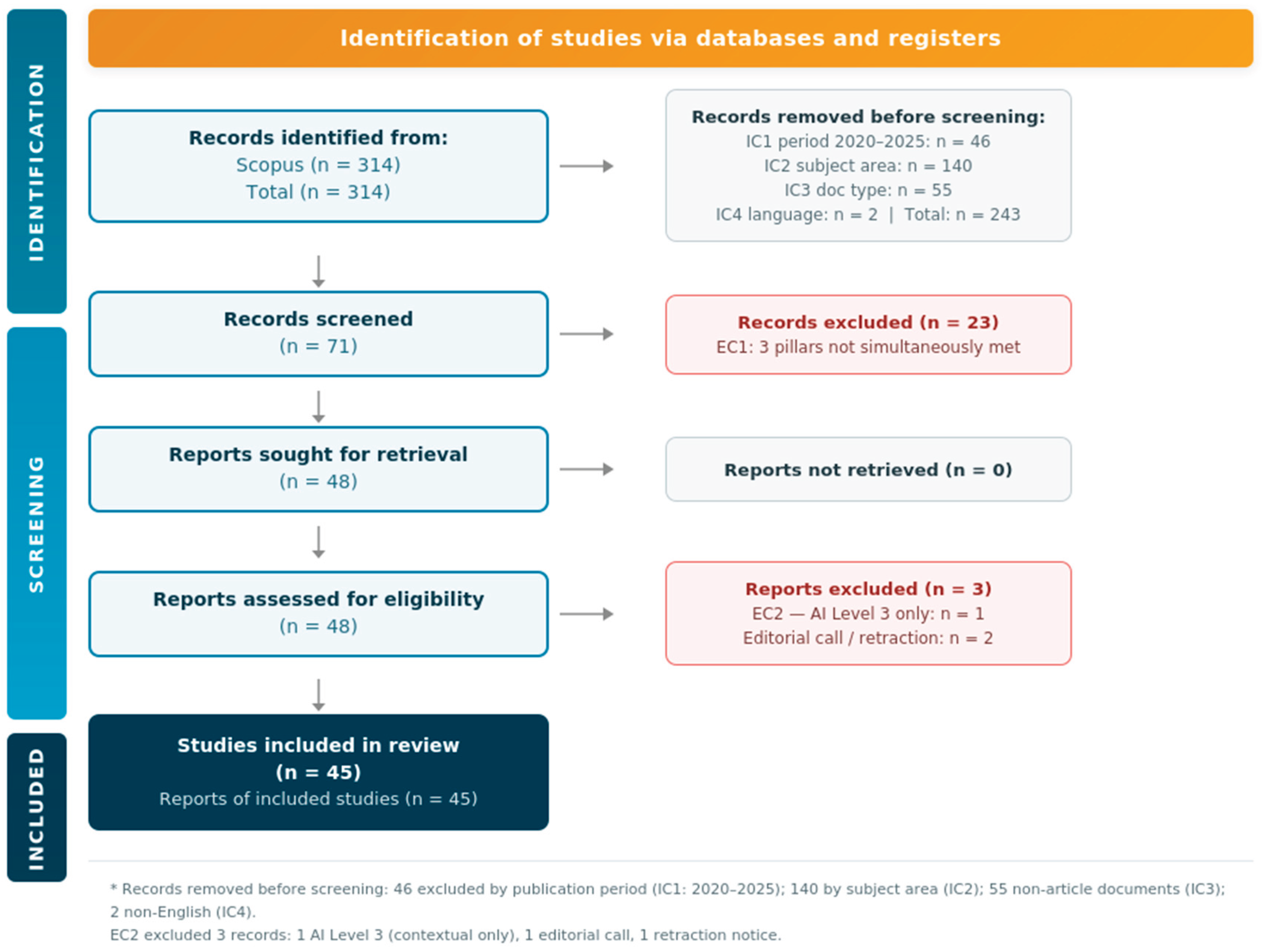
Figure 2.
Co-authorship network by countries. Note. Node size reflects the number of publications per country; line thickness indicates the strength of international collaborative links; colour clusters denote distinct collaboration communities. Minimum country document threshold: 1.
Figure 2.
Co-authorship network by countries. Note. Node size reflects the number of publications per country; line thickness indicates the strength of international collaborative links; colour clusters denote distinct collaboration communities. Minimum country document threshold: 1.
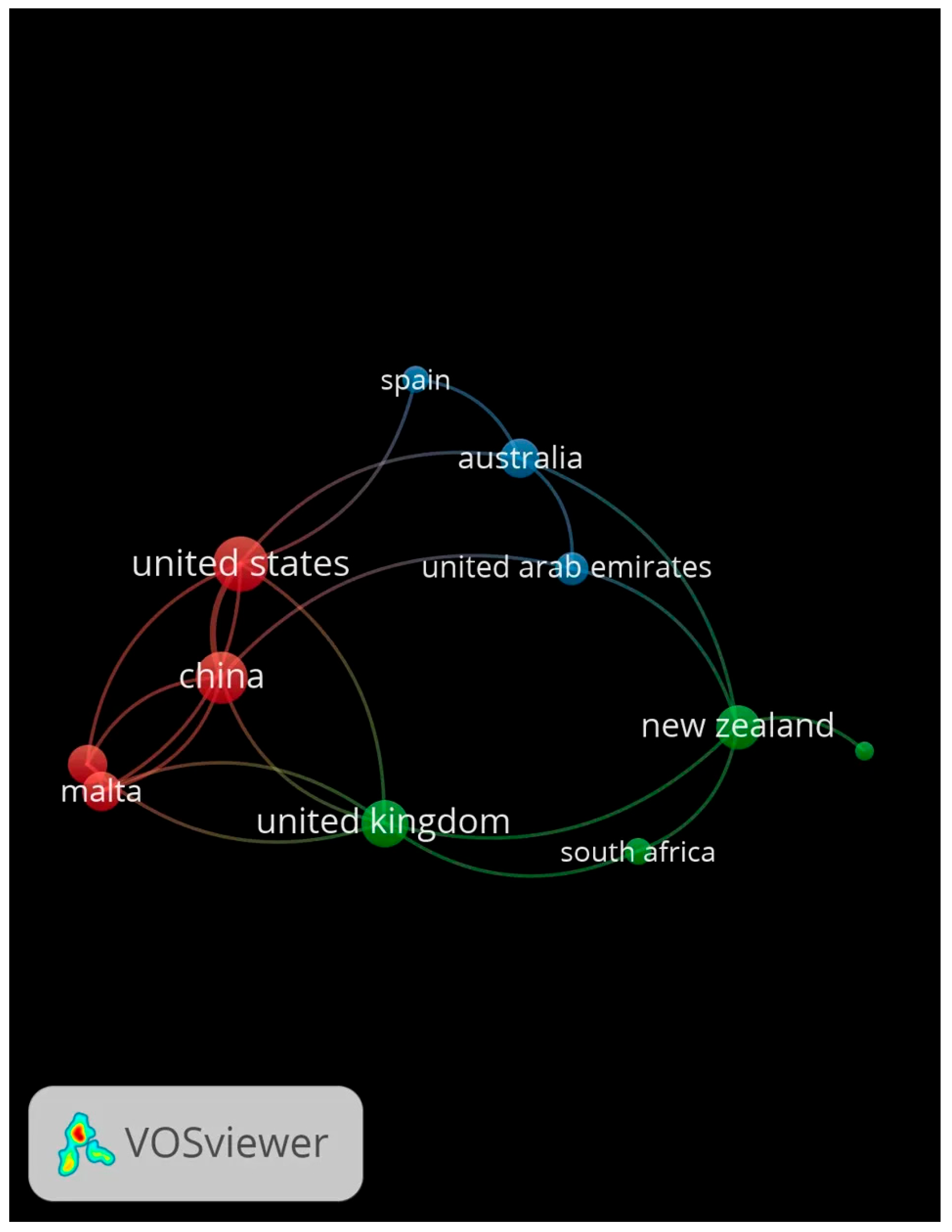
Figure 3.
Keyword co-occurrence network. Nota. Node size reflects author keyword frequency; line thickness indicates co-occurrence strength between keyword pairs; colour clusters denote thematic groupings. Minimum keyword occurrence threshold: 2.
Figure 3.
Keyword co-occurrence network. Nota. Node size reflects author keyword frequency; line thickness indicates co-occurrence strength between keyword pairs; colour clusters denote thematic groupings. Minimum keyword occurrence threshold: 2.
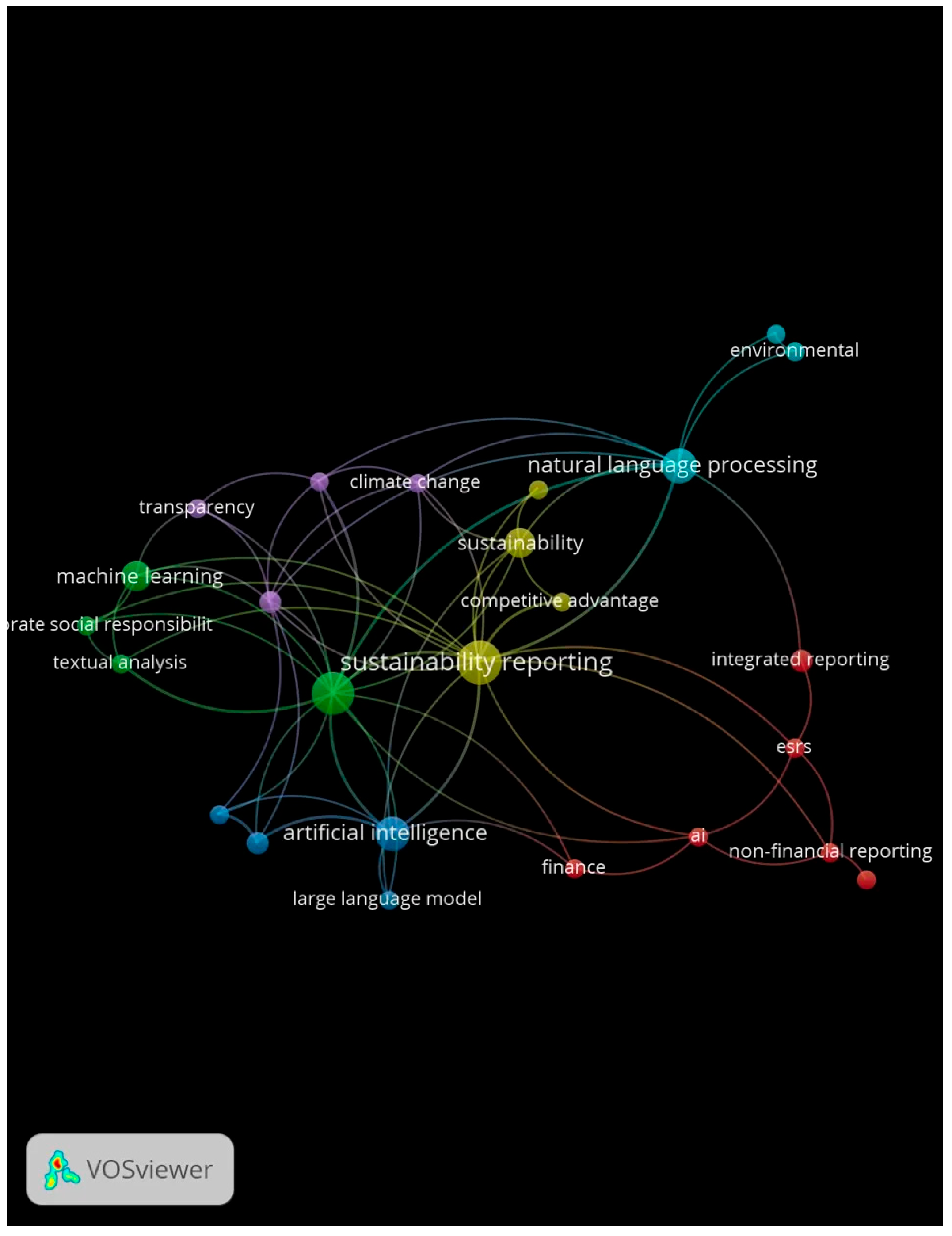
Figure 4.
Co-citation network of cited authors. Nota. Node size reflects total citation count of each cited author; line thickness indicates co-citation frequency between author pairs; colour clusters denote distinct intellectual communities. Minimum co-citation threshold: 2.
Figure 4.
Co-citation network of cited authors. Nota. Node size reflects total citation count of each cited author; line thickness indicates co-citation frequency between author pairs; colour clusters denote distinct intellectual communities. Minimum co-citation threshold: 2.
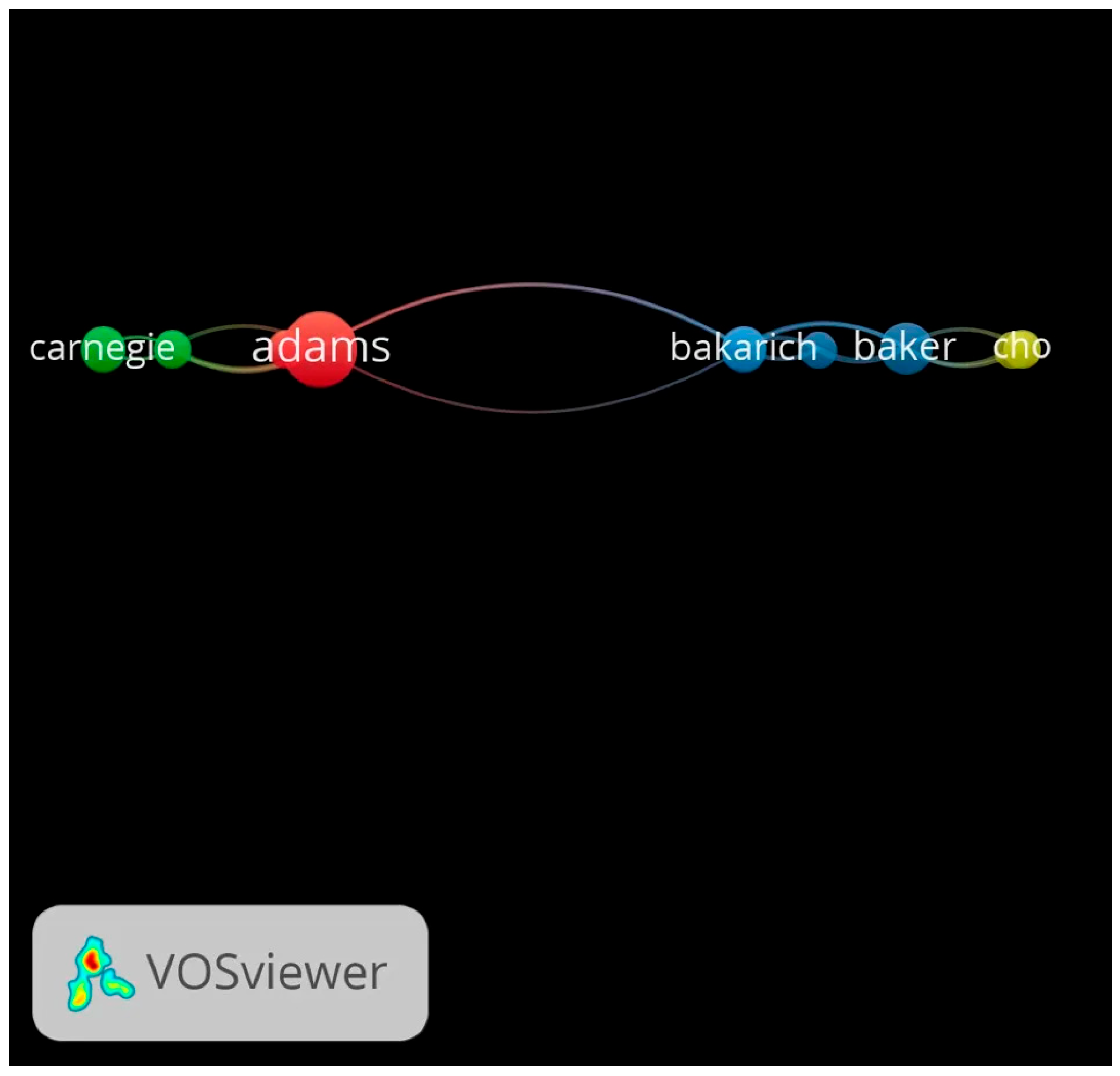
Table 1.
Research streams at the AI-ESG disclosure intersection: representative studies and identified gaps.
Table 1.
Research streams at the AI-ESG disclosure intersection: representative studies and identified gaps.
| Research Stream | Representative Studies | Identified Gap |
|---|---|---|
| Sustainability reporting quality and readability | Smeuninx et al. (2020); De Villiers et al. (2024) | Focuses on text characteristics; limited integration of AI as a verification tool |
| ESG ratings, scores and firm performance | D’Amato et al. (2024); Drempetic et al. (2020) | Uses ML for prediction; rarely connects to disclosure process improvement |
| AI in auditing and continuous assurance | Moffitt et al. (2018); Gu et al. (2022) | Focuses on financial audit; ESG-specific assurance applications are nascent |
| ESG regulatory compliance and CSRD/ISSB adoption | Habek (2025); De Villiers et al. (2024) | Primarily conceptual; lacks systematic evidence of AI-enabled compliance tools |
| AI and data analytics in ESG disclosure (integrated) | — (this review) | No prior SLR synthesizes AI/analytics across all four dimensions simultaneously |
Note. SLR = systematic literature review. The final row identifies the contribution of the present review relative to existing literature streams.
Table 2.
Search strategy: concept groups, search terms, and justification for term selection.
| Concept Group | Search Terms (OR within group) | Justification |
|---|---|---|
| ESG / Sustainability Disclosure | "ESG" OR "environmental social governance" OR "sustainability reporting" OR "sustainability report*" OR "non-financial reporting" OR "integrated reporting" OR "corporate sustainability disclosure" OR "climate-related disclosure" | Captures ESG and sustainability disclosure terminology, including mandatory and voluntary reporting frameworks. |
| Financial Reporting / Accounting | "financial reporting" OR accounting OR "corporate disclosure" OR "disclosure quality" OR materiality OR assurance OR audit* | Anchors the search in accounting and financial reporting, covering quality, assurance, and audit dimensions. |
| AI / Data Analytics | "artificial intelligence" OR AI OR "machine learning" OR "deep learning" OR "natural language processing" OR NLP OR "text mining" OR "data analytics" OR "big data" OR "business intelligence" | Encompasses the main technological labels applied to data-driven analysis in accounting and sustainability research. |
Note. Groups are connected by AND operators; terms within each group by OR. Truncation (*) captures term variants.
Table 3.
Search string applied to the Scopus database.
| Database | Search String (TITLE-ABS-KEY) |
|---|---|
| Scopus | TITLE-ABS-KEY ( ("ESG" OR "environmental social governance" OR "sustainability reporting" OR "non-financial reporting" OR "integrated reporting" OR "corporate sustainability disclosure" OR "climate-related disclosure") AND ("financial reporting" OR accounting OR "corporate disclosure" OR "disclosure quality" OR materiality OR assurance OR audit*) AND ("artificial intelligence" OR AI OR "machine learning" OR "deep learning" OR "natural language processing" OR NLP OR "text mining" OR "data analytics" OR "big data" OR "business intelligence") ) |
Note. Search conducted via Advanced Search in Scopus using the TITLE-ABS-KEY field. Date of search: May 2025.
Table 4.
Inclusion and exclusion criteria applied in the study selection process.
| Code | Type | Criterion | Records After Filter |
|---|---|---|---|
| IC1 | Inclusion | Publication period: 2020–2025 | 268 |
| IC2 | Inclusion | Subject area: Business, Management and Accounting | 128 |
| IC3 | Inclusion | Document type: peer-reviewed journal articles only | 73 |
| IC4 | Inclusion | Language: English only | 71 |
| EC1 | Exclusion | Abstract screening: AI/analytics not substantively applied to ESG disclosure or financial reporting | 48 retained |
| EC2 | Exclusion | Full-text review: AI Level 3 (n=1), editorial call (n=1), retraction notice (n=1) | 45 retained (final) |
Table 5.
AI Integration Level framework: operational definitions and corpus distribution.
| Level | Designation | Operational Definition | n | Included |
|---|---|---|---|---|
| 1 | AI as Methodological Core | The study applies AI/ML techniques (e.g., NLP, deep learning, text mining) as the primary analytical method directly to ESG disclosures or financial reporting data. | 12 | Yes |
| 2 | AI as Analytical Support | AI or data analytics tools are employed as part of a broader analytical framework addressing ESG or financial disclosure, but AI is not the exclusive methodological focus. | 33 | Yes |
| 3 | AI as Contextual Reference | AI is mentioned prospectively or conceptually without direct technical application to reporting or disclosure processes. | 1 | No |
Table 6.
Methodological quality appraisal of all included studies based on the Mixed Methods Appraisal Tool (MMAT).
Table 6.
Methodological quality appraisal of all included studies based on the Mixed Methods Appraisal Tool (MMAT).
| Author(s)/Title Ref. | Approach | S1/S2 | Rating | Critical Appraisal & Identified Constraints |
|---|---|---|---|---|
| Campbell et al. (2025) | Quantitative (NLP) | Yes/Yes | High | NLP/text mining applied to disclosure data; robust methodology; replication across broader contexts recommended. |
| Mohamed, R.i & Inun, J. (2024) | Quantitative (ML) | Yes/Yes | High | ML-based empirical analysis; robust methodology; replication across broader contexts recommended. |
| Janvrin & Jeffrey (2025) | Quantitative (Empirical) | Yes/Yes | High | Quantitative empirical study; robust methodology; replication across broader contexts recommended. |
| Hąbek (2025) | Quantitative (Empirical) | Yes/Yes | High | Quantitative empirical study; robust methodology; replication across broader contexts recommended. |
| Stander (2025) | Quantitative (NLP) | Yes/Yes | Med. | NLP/text mining applied to disclosure data; moderate rigor; exploratory design; causal inference limited. |
| Nguyen (2025) | Quantitative (ML) | Yes/Yes | High | ML-based empirical analysis; robust methodology; replication across broader contexts recommended. |
| Ferro et al. (2025) | Quantitative (ML) | Yes/Yes | High | ML-based empirical analysis; robust methodology; replication across broader contexts recommended. |
| Sun & Qiu (2025) | Quantitative (ML) | Yes/Yes | High | ML-based empirical analysis; robust methodology; replication across broader contexts recommended. |
| Lee et al. (2025) | NLP/LLM | Yes/Yes | High | Transformer-based NLP (BERT/LLM); robust methodology; replication across broader contexts recommended. |
| Nair et al. (2025) | Conceptual/Other | Yes/No | Low | Conceptual or theoretical contribution; limited empirical scope; no primary empirical validation. |
| Sahu & Debata (2025) | Quantitative (NLP) | Yes/Yes | High | NLP/text mining applied to disclosure data; robust methodology; replication across broader contexts recommended. |
| Lang (2025) | Quantitative (NLP) | Yes/Yes | High | NLP/text mining applied to disclosure data; robust methodology; replication across broader contexts recommended. |
| Yang et al. (2025) | Quantitative (ML) | Yes/Yes | High | ML-based empirical analysis; robust methodology; replication across broader contexts recommended. |
| Lodhia et al. (2025) | Conceptual/Other | Yes/No | Low | Conceptual or theoretical contribution; limited empirical scope; no primary empirical validation. |
| Naveed et al. (2025) | Quantitative (Econometric) | Yes/Yes | High | Econometric panel data analysis; robust methodology; replication across broader contexts recommended. |
| Ahmed & Hassan (2025) | Qualitative | Yes/Yes | High | Qualitative/case-based inquiry; robust methodology; replication across broader contexts recommended. |
| Nguyen (2025) | Quantitative (SEM) | Yes/Yes | High | SEM-based quantitative design; robust methodology; replication across broader contexts recommended. |
| Van der Lugt et al. (2025) | Quantitative (NLP) | Yes/Yes | High | NLP/text mining applied to disclosure data; robust methodology; single-country scope; limited generalizability. |
| Sekine et al. (2025) | Quantitative (NLP) | Yes/Yes | High | NLP/text mining applied to disclosure data; robust methodology; self-reported data; potential common method bias. |
| Suhardjo et al. (2025) | Qualitative | Yes/Yes | Med. | Qualitative/case-based inquiry; moderate rigor; single-case design; limited external validity. |
| Tiwari et al. (2025) | Bibliometric | Yes/Yes | High | Systematic bibliometric mapping; robust methodology; replication across broader contexts recommended. |
| Nguyen (2025) | Conceptual/Other | Yes/No | Low | Conceptual or theoretical contribution; limited empirical scope; no primary empirical validation. |
| Lu et al. (2025) | Quantitative (Empirical) | Yes/Yes | High | Quantitative empirical study; robust methodology; replication across broader contexts recommended. |
| Teruel-Gutiérrez et al. (2025) | Conceptual/Other | Yes/No | High | Conceptual or theoretical contribution; robust methodology; no primary empirical validation. |
| Shuheng (2025) | Quantitative (Econometric) | Yes/Yes | High | Econometric panel data analysis; robust methodology; self-reported data; potential common method bias. |
| Mittelbach-Hörmanseder & Barrantes (2025) | Conceptual/Other | Yes/No | Med. | Conceptual or theoretical contribution; moderate rigor; exploratory design; causal inference limited. |
| Subramaniam et al. (2024) | Quantitative (ML) | Yes/Yes | High | ML-based empirical analysis; robust methodology; replication across broader contexts recommended. |
| Huy & Phuc (2024) | NLP/LLM | Yes/Yes | High | Transformer-based NLP (BERT/LLM); robust methodology; self-reported data; potential common method bias. |
| Crocco et al. (2024) | Quantitative (ML) | Yes/Yes | High | ML-based empirical analysis; robust methodology; replication across broader contexts recommended. |
| Wang & Zeng (2024) | Quantitative (NLP) | Yes/Yes | High | NLP/text mining applied to disclosure data; robust methodology; replication across broader contexts recommended. |
| Sahu et al. (2024) | NLP/LLM | Yes/Yes | High | Transformer-based NLP (BERT/LLM); robust methodology; replication across broader contexts recommended. |
| Li et al. (2024) | Quantitative (Empirical) | Yes/Yes | High | Quantitative empirical study; robust methodology; replication across broader contexts recommended. |
| Wan Ismail et al. (2024) | Quantitative (Empirical) | Yes/Yes | High | Quantitative empirical study; robust methodology; replication across broader contexts recommended. |
| D'Amato et al. (2024) | Quantitative (ML) | Yes/Yes | High | ML-based empirical analysis; robust methodology; replication across broader contexts recommended. |
| De Villiers et al. (2024) | NLP/LLM | Yes/Yes | High | Transformer-based NLP (BERT/LLM); robust methodology; replication across broader contexts recommended. |
| Mohamed Riyath et al. (2024) | Quantitative (SEM) | Yes/Yes | High | SEM-based quantitative design; robust methodology; self-reported data; potential common method bias. |
| Camilleri et al. (2024) | Qualitative | Yes/Yes | High | Qualitative/case-based inquiry; robust methodology; replication across broader contexts recommended. |
| Li et al. (2024) | Quantitative (ML) | Yes/Yes | High | ML-based empirical analysis; robust methodology; replication across broader contexts recommended. |
| Makarenko et al. (2024) | Quantitative (NLP) | Yes/Yes | High | NLP/text mining applied to disclosure data; robust methodology; replication across broader contexts recommended. |
| N. Li et al. (2024) | Qualitative | Yes/Yes | Med. | Qualitative/case-based inquiry; moderate rigor; single-case design; limited external validity. |
| Fedorova et al. (2023) | Quantitative (ML) | Yes/Yes | High | ML-based empirical analysis; robust methodology; replication across broader contexts recommended. |
| Said et al. (2023) | Quantitative (Survey) | Yes/Yes | Med. | Survey-based quantitative design; moderate rigor; self-reported data; potential common method bias. |
| Aguado-Correa et al. (2023) | Quantitative (NLP) | Yes/Yes | High | NLP/text mining applied to disclosure data; robust methodology; replication across broader contexts recommended. |
| Brusseau (2023) | Quantitative (ML) | Yes/Yes | High | ML-based empirical analysis; robust methodology; replication across broader contexts recommended. |
| Smeuninx et al. (2020) | Quantitative (NLP) | Yes/Yes | High | NLP/text mining applied to disclosure data; robust methodology; replication across broader contexts recommended. |
Note. S1/S2 = MMAT screening questions. Rating: High (≥4/5 criteria met), Medium (3/5), Low (≤2/5). Articles marked N/A* were flagged during quality appraisal for corpus review (see text). Short title references used; full citations in References section.
Disclaimer/Publisher’s Note: The statements, opinions and data contained in all publications are solely those of the individual author(s) and contributor(s) and not of MDPI and/or the editor(s). MDPI and/or the editor(s) disclaim responsibility for any injury to people or property resulting from any ideas, methods, instructions or products referred to in the content. |
© 2026 by the authors. Licensee MDPI, Basel, Switzerland. This article is an open access article distributed under the terms and conditions of the Creative Commons Attribution (CC BY) license (http://creativecommons.org/licenses/by/4.0/).
Copyright: This open access article is published under a Creative Commons CC BY 4.0 license, which permit the free download, distribution, and reuse, provided that the author and preprint are cited in any reuse.