

Submitted:
17 March 2026
Posted:
18 March 2026
You are already at the latest version
Abstract
New quantum spin perspective redefines notion of quantum spin and reduced Planck c onstant h. Other consequences of this perspective are well-known. Here I propose smooth scale transition of quantum domain using auto-correct orauto-balance mechanism of this perspective. Equilibrium governs nature. All universal constants and equations work just to contribute to maintain equilibrium of cosmos. Relation between elementary quantum of action (¯h) and new quantum spin perspective is also established. why matter wave works the way it works? and why simultaneous measurement of two main pair of canonical conjugates ( x and p and E and t) are not possible in nature? are also explained via this perspective. Cause of uncertainty principle of quantum physics is also comprehended. De Broglie hypothesis and uncertainty principle emerge out of novel formula of h.
Keywords:
new quantum spin perspective
; auto-correct or auto-balance mechanism
; matter waves cause of uncertainty
Introduction
It is equilibrium that governs universe. In physics, universal constants are defined which are somehow responsible for equilibrium in nature. Universal constants such as gravitational constant, reduced Planck constant, Boltzmann constant etc. govern physical phenomena that contribute to equilibrium. In 2022 [1], New Quantum Spin Perspective was proposed that redefines Quantum spin (total angular momentum) J and reduced Planck constant ℏ. New Quantum Spin Perspective has been successful in giving novel formulas of fundamental physical constants, fundamental Planck units, derived Planck units and quantum geometrical operators of quantum geometry, some formulas of Planck star and quantization of space-time of mind-stuff [1,2,3,4] . Loop Quantum Gravity (LQG) is one of the supposed candidate of quantum gravity [5,6,7,8,9,10,11,12,13,14,15,16,17,18,19,20,21,22,23,24], where this perspective was applied to spin network [25,26] that is integral part of LQG [1,2,3,4] Also, relation of quantum spin has been established with Planck temperature, Planck mass and Planck length [2]. Two major equations of new quantum spin perspective are
By putting the value of all physical quantities in equation , , , , and [27,28,29]; one can validate equality of equation [1].
Since, ; the value of Planck constant is . Hence, this value is approximately equal to the actual value of Planck constant; that suggests an agreement with previous formalism i.e., . [1]
Therefore, the quantum spin J in the spin network is the square root of product of Boltzmann constant , Planck temperature , Planck area and Planck mass . Hence, such a quantum spin can also be called as Planck spin at Planck scale [1].
new quantum spin perspective has far reaching consequences in quantum, physics. In this proposal the quantum spin J in the spin network is the square root of product of Boltzmann constant , Planck temperature , Planck area and Planck mass . From , it is found that , , and are synchronized with each other; hence, ℏ always remains constant for Planck scale. This synchronization provides an auto-correct or auto balance mechanism that maintains ℏ constant. At Planck scale or quantum gravity scale, it means that mutual small change in , , and occur in such a way that ℏ remain invariant [1,2,3,4].
Nobody can imagine major quantum mechanical equations without presence of Reduced Planck constant or Planck constant (ℏ or h)) such as Planck’s law of black body radiation [30], photoelectric effect [31], Compton effect [32], Schrodinger equation [33], de Broglie hypothesis [34], quantum mechanical commutator [35], Heisenberg’s uncertaintly principle [35], probability distribution [36], Dirac eqaution [37], quantum spin [1,37] etc. ℏ is the fundamental limit on quantum domain and law of physics beyong which all physical laws are violated [27,30].
In this paper, physical significance of New quantum spin perspective or reduced Planck constant ℏ is explained. Universe makes transition from one era to another era (for instance, Planck to nuclear, nuclear to atomic) in its timeline where ℏ holds quantum domain. Scale transition is another validation of novel formula of ℏ. Relation of ℏ as quantum of action [27,30] and new quantum spin perspective is also given.
Thereafter, I explain some outcomes novel formula of ℏ on quantum physics such as its implications on matter waves and uncertainty principle which are very crucial.
Physical Significance of New Quantum Spin Perspective
Scale transition in Quantum Domain
Reduced Planck constant is not only constant but also a validation mechanism and mathematical tool of quantum domain [27,30]. Beyond reduced Planck constant (and Planck scale) all known physical laws are violated. Here it should be noted that Domain of quantum physics is quite huge. since the discovery of Planck’s distribution law for black body [27,30], this quantum hypothesis has been applied to almost every natural phenomenon and at every scale whether it is atomic scale, nuclear scale or quantum gravity scale (in short quantum scale)[27,30].
In general novel equation of Reduced Planck constant ℏ for whole quantum domain is written as [1]
since the magnitude of ℏ is constant at every scale of cosmos (atomic, nuclear and Planck), subscript scale is named accordingly. It is these three fundamental physical quantities such as temperature, length and mass which are well synchronized with each other in the above formula just to have quantum domain in the end, while Boltzmann constant is constant. It is auto-correct orauto-balance mechanism that is responsible for smooth scale transition of quantum domain in nature that holds constancy of ℏ.
The smooth transition of quantum geometry from Planck scale to nuclear scale and atomic scale can be explained using this new quantum spin perspective. Hence, the constancy of the reduced Planck constant ℏ can provide a way through which smooth transition of Planck scale to nuclear or atomic scale can be understood.
For instance, the value of ℏ for nuclear scale is,
where, (atomic mass unit or or ) , - (from Equation (2)) and (one nuclear radius) for nuclear scale [28,38].
The value of ℏ for atomic scale is,
where, (mass of electron in atomic unit), - (from Equation (2)) and (Bohr radius in atomic units) for atomic scale [28,38].
Here, one should note that just to verify constancy of reduced Planck constant ℏ for nuclear and atomic scale, numerical value of temperature can be obtained from eqn (2) which tells approximate value of temperature for nuclear scale and atomic scale.
Here, the values of temperature , mass , and length within root change in the Equation (3) such a way that the reduced Planck constant ℏ remains constant. Due to this mechanism, the quantum geometry (or LQG) makes smooth transition from the Planck scale to the nuclear scale and atomic scale.
In other words, since is Boltzmann constant, eqn. (3) can also be written as
The term results into same magnitude for every scale in scale transition, so that ℏ remains invariant. The approximate value of this term is,
Thus, collective physical quantity is important in scale transition and for constancy of ℏ.
When big bang [27,39,40,41] occurred, the temperature of universe was of the order of at Planck scale. Afterwards, universe cooled off and various era of timeline of universe came into existence such as Planck, GUT, Inflation, quark, hadron, lepton, photons (radiation dominated era) and molecule, stars, galaxies era (matter dominated era). From big bang to galaxy era, temperature, length, and mass scale changed and various eras came to into existence gradually. It is auto-correct or auto-balance mechanism which maintains quantum domain in nature by maintaining constancy of reduced Planck constant and simultaneously changing temperature, mass and length scale of universe. Table 1 shows New Quantum Spin Perspective as Scale transition in Quantum Domain.

Table 1.
New Quantum Spin Perspective as Scale transition in Quantum Domain
| Sr. No. | scale | Temperature | Mass | Length |
|---|---|---|---|---|
| 1 | Planck | |||
| 2 | Nuclear | |||
| 3 | Atomic |
Max Planck [30] defined ℏ as elementary quantum of action in his seminal paper. How new quantum spin perspective is directly connected with quantum of action is given below.
ℏ as quantum of action and new quantum spin perspective
Elementary quantum of action ℏ is the fundamental and beginning point of study of quantum, discovered by Planck [30]. In physics, action is physical observable that is observer dependent. In nature, one can not measure value smaller than ℏ.
what does action do in physics? It measures change. Smallest value of action tells about smallest change in nature. There is no change present between two observations as far as quantum of action is concerned, but a smallest change value is there. In physics action operator (for action, there is a linear and self-adjoint operator present) is also defined (Hermitian) what is physical significance of quantization of action? one can measure only measurements which are integer multiples of ℏ. In other words, ℏ is the smallest possible action value, for instance, light (or quanta of light, i.e., photon). ℏ is the smallest invariant constant in quantum domain. Till today, no experiment could find the value of action smaller than ℏ. Without action quantization, atoms can not exist [30,42,43,45].
Quantization of action also explains interaction, it means an exchange of an integer number of quanta of action occurs in every interaction between physical systems. Action and angular momentum has same unit (eqn. (1) and (2)). The action quantum is a relativistic invariant, and a fundamental limit in nature [30].
Now think about relation between new quantum spin perspective and ℏ. as it is mentioned earlier, that the values of temperature , mass , and length within root, change in the Equation (3) such a way that the reduced Planck constant ℏ remains invariant or constant. Therefore, ℏ is the constant in disguise that never changes , though novel formula of ℏ has internal physical quantities that change and well synchronized with each other in such a way that it leaves ℏ invariant for quantum domain. So, this is the physical significance of relation of elementary quantum of action ℏ and new quantum spin perspective. Also this is another key importance of auto-correct or auto-balance mechanism of this perspective. By finding breaking point for auto-correct orauto-balance mechanism, it can also tell about where and when nature will make transition from quantum to classical domain. In other words, when synchronization of the values of temperature , mass , and length within root in eqn (3) breaks, ℏ becomes variant that is the point where all known physical laws are violated in nature.
Canonical Conjugates and New Quantum Spin Perspective
Now, consider Planck scale, new quantum spin perspective and pairs of canonical conjugates. Product of Planck length and Planck momentum and Planck energy and Planck time is reduced Planck constant ℏ, i.e.,
and
It should be noted that dimension of both canonical conjugates i.e., and are same as ℏ.
De Broglie Hypothesis and New Quantum Spin Perspective
Introduction De Broglie Hypothesis
In 1905, Albert Einstein [31] firstly described the wave–particle duality of light (photon). In 1924, de Broglie [34] proposed that matter particle like electrons can also behave as wave similar to wave behaves as particle (photon - light quanta). In other words, matter particle can also have wave-particle duality and this duality has been observed experimentally [43]. such matter waves also exhibits wavelength same as photon., i.e.,
Therefore,
which is de Broglie wavelength. Both matter wave, Heisenberg’s uncertainty principle [35] play important role in the interpretation of quantum mechanics [42,43,45,46] that is one of the main topics of research in theoretical physics which arise because of wave-particle duality.
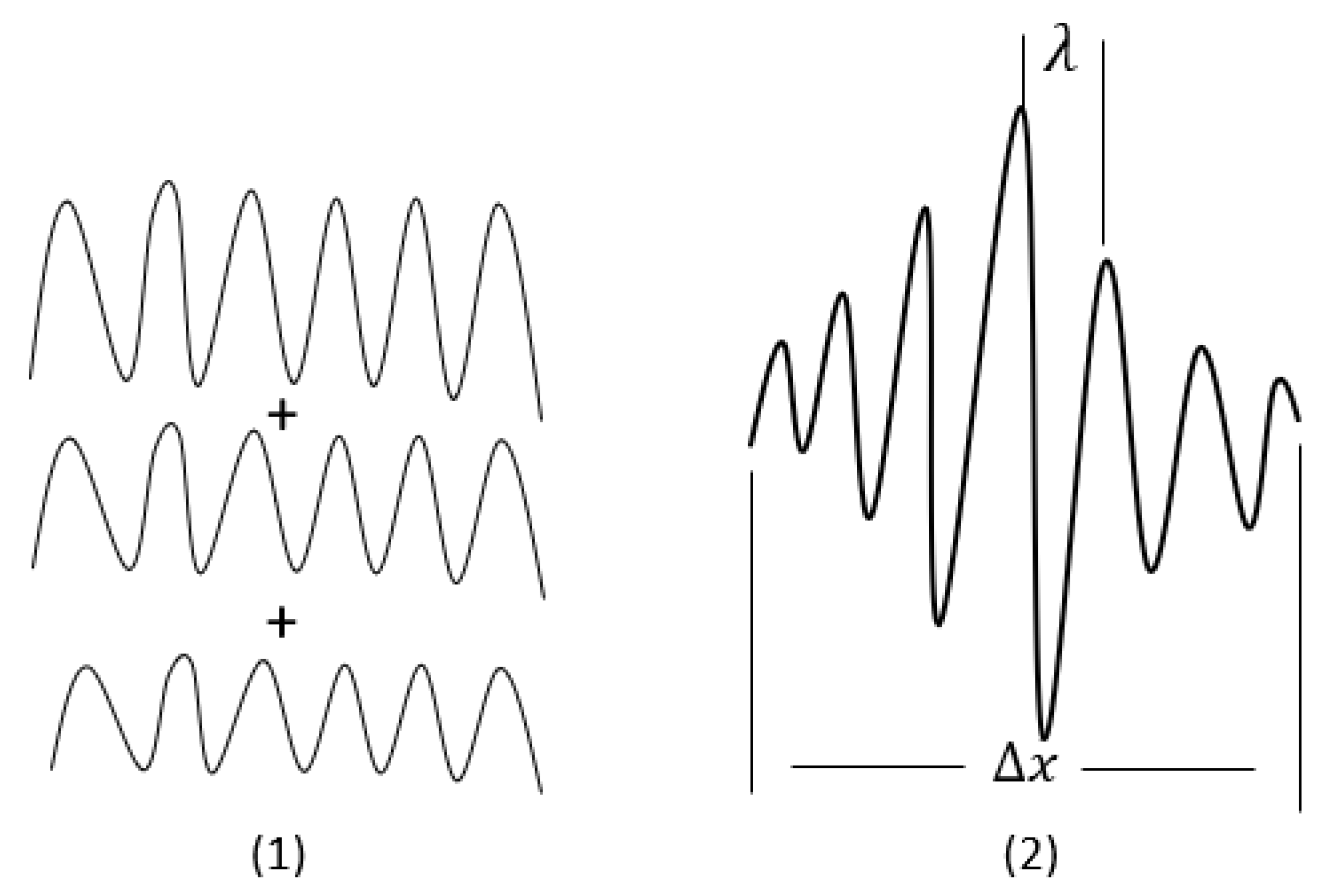
Non-localized harmonic wave is a type of wave that is extended over a volume of space and it is associated with the particles being confined to a small volume. One should note that de Broglie waves cannot be harmonic waves rather a combination of number of harmonic waves. With the aid of Fourier analysis, one can have combination of harmonic waves in the range , (where k is wave number) will create a localized wave. The superposition of harmonic waves which are having small difference in frequency, cancels each other everywhere except a small region that will create a single localized wave which is known as wave packet and it spreads over a space [42,43].
The wave function of this wave packet is given by [42,43]
where k is wave number, is angular frequency, is amplitude and is a factor. Fig. 1 shows superposition of harmonic waves and wave packet.
Figure 1.
Superposition of harmonic waves and wave packet.
De Broglie Hypothesis and New Quantum Spin Perspective
As product of two main pair of canonical conjugate in physics, i.e., Planck length and Planck momentum and Planck energy and Planck time is reduced Planck constant ℏ, I suggest to use ℏ instead of h in the equation of de Broglie wavelength to maintain uniformity in quantum mechanics. Thus reduced Planck constant ℏ is taken into consideration instead of Planck constant h in eqn (11).
At Planck scale,
In general,
And for canonical conjugates E and t
At Planck scale,
In general,
From eqn. (15) and (18),
where ℏ is proportionality constant.
Why Matter Waves Behaves the Way It Behaves?
De-Broglie hypothesis [34] applies to all matter particle of different physical scale of nature. As it is mentioned earlier, classical particles can be localized easily. In case of de - Broglie hypothesis, momentum of matter particle is fixed and it is inversely proportional to wave length of associated matter wave. Main concept of de Broglie hypothesis is if electromagnetic wave (light) can behave as particle (photon), then matter particles (electrons, protons etc.) can also behave as wave (matter wave) which is further supported and proved by experiments. Electromagnetic waves spread across a spectrum and are having different frequency and wavelength. Thus, Matter waves also spread over a space region rather than being confined to a single point that represents the probability amplitude of finding such a particle. In quantum mechanics, this delocalized wave function evolves with time, permitting particles to have wave like patterns (interference and diffraction patterns) the way photons have [34,42,43].
Now, putting novel formula of ℏ in eqn. (15)
Consider a mathematical Product of any quantity a and b which is c. Later on, one finds a and b were already an integral part of resultant quantity c, i.e.,
Likewise, Breaking novel formula of ℏ in eqn. (19) in accordance with de - Broglie hypothesis i.e.,
For Planck scale, eqn. (20) can be easily validated just by putting value of , , and . Hence,
Here the value of Planck momentum from above formula is that is same as that of actual value of Planck momentum, i.e., . The dimension of product () and () are same and it can be validated from table 1. for every scale the way it is validated for Planck scale.
What does it implies regarding matter waves? Again auto-correct orauto-balance mechanism of this perspective can comprehend behaviour of matter waves. In physics, some physical quantities are intrinsic and indefinite that one has to accept as fundamental, using which physical phenomena are understood. Likewise, should we extend this logic to traits of quantum mechanics? Whether duality, probability, uncertainty are fundamental traits of quantum mechanics or consequences of some other thing?
ℏ is the smallest integer value or change (elementary quantum of action) that one can measure according to quantum hypothesis and beyond it either established laws are violated or make transition from quantum to classical domain as a classical limit. Novel formula of ℏ implies that no matter what is happening in quantum phenomenon, nature tends to hold constancy of ℏ, though, nature makes transition from one to another scale of quantum domain. Thus, ℏ is the fundamental constant in disguise that is defined by some other physical quantities such as temperature, mass and length by new quantum spin perspective. Change in temperature, mass and length scale in novel formula of ℏ results into smallest change in quantum domain. Change in temperature, mass and length does not reflect directly at first glance, but it reflects in associated concept of quantum physics that involves ℏ like de Broglie hypothesis and uncertainty principle.
From mass-energy equivalence [31], i.e., - [], photon travels with speed equal to light speed . Since, Matter particles behaves as waves - [], thus it travel as waves with speed less than light speed (because of having slighter mass that require huge amount of energy to accelerate them at speed equal to light speed) [31,34] . In scale transition, change in temperature, mass and length causes matter particles to spread out like electromagnetic wave according to formula of eqn. (20) which further breaks into eqn. (21) and (22). In eqn. (2) and (3) there are two terms which are integral part and give birth of matter wave having wavelength ( or ) and momentum p or . To hold constancy of reduced Planck constant ℏ (quantum hypothesis), matter waves spread and can not have zero dimension the way classical particles have (from eqn. (15) and (18)).
In essence, it is change in terms of smallest change, i.e., ℏ that causes reality to behave dual in nature, otherwise matter particles never behave as waves. Quick change for shorter time in physical system results into dual picture of reality according to eqn. (2) and (3). If one can design an experiment that can keep track of this quick change, matter particle may behave as particle, that is restricted by uncertainty principle [35]. Therefore, de Broglie hypothesis is the emergent concept that emerges out of novel formula of ℏ of new quantum spin perspective.
Heisenberg’s Uncertainty Principle and New Quantum Spin Perspective
Introduction of Heisenberg’s Uncertainty Principle
In 1927, Heisenberg [35] discovered that it is impossible to measure position and momentum of matter particle simultaneously, as no experiment can measure this pair of canonical conjugates simultaneously with precision and certainty. This statement is known as Heisenberg’s uncertainty principle. It is also applicable to two other pair of canonical conjugates, i.e., energy E and time t action J and angle variable w. For x and E and t, this principle is represented as [35,42,43]
where ℏ is reduced Planck constant.
In other words, position of classical particle can be easily simultaneously measured with its canonical conjugate - momentum, since classical mechanics is deterministic in nature, While, quantum mechanics is indeterministic, probabilistic, and uncertain in simultaneous measurement of canonical conjugates of nature, i.e., and [35,42,43].
Consider two cases to understand uncertainty principle.
Case-I
What if uncertainty is zero, it means one can measure position of matter particle with precision (non-plane wave). In that case, what will be the value of uncertainty in momentum ? consider a function [43], i.e.,
where . Thus,
Since,
So,
Case-II
These two cases are ideal which are not possible in observation [43].
Quantum mechanical commutation relation for these three canonical conjugates are written as [35,42,43]
If , then and do commute and if , then and do not commute. In short, the derivation of Heisenberg’s uncertainty principle is given below by considering the commutator [35,42,43].
where position and momentum operator are and respectively. Considering theory of standard deviation with wave function and its complex conjugate and the below uncertainty [35,42,43], i.e.,
Thus,
Using uncertainty for p and x, i.e.,
where (particle is sure to be found somewhere and its probability must be unity). Therefore,
This is the version of uncertainty principle given by Kennard [35,42,43,44]. In general, it is given as
Uncertainty principle has been experimentally proven by some experiments such as diffraction experiments (particularly single slit experiment) and Heisenberg’s gamma ray microscope [42,43]. Uncertainty principle is one of the fundamental principle that is behind interpretation of quantum mechanics [35,42,43,46]. second pair of canonical conjugates E and t of this principle with the first pair x and also play an important role in quantum mechanics, particularly in quantum field theory by combining it with mass-energy equivalence, i.e., , as it explains virtual particles of quantum fields [31,42,43,45].
Another thing that one has to understand is de-Broglie hypothesis and uncertainty principle does not contradict each other. Matter waves consists fixed momentum as well as fixed wavelength, the way it was explained in Davisson and Germer experiment for electrons with experimental evidence. While uncertainty principle implies no experiment can measure position and momentum simultaneously with certainty [42,43].
Measurement disturbs quantum mechanical system. As soon as one measures either of canonical conjugates, i.e.,x or with certainty up to some extent, another variable becomes uncertain or infinite. Suppose, before measurement state of any system is and after measurement state of system is . If one could measure uncertainty in x is in state , then uncertainty in must be . Consider a case of electron whose uncertainty in x is , if electron can exist inside the nucleus. Thus, uncertainty in momentum p is [35,42,43]
Thus, electron can not exist inside the nucleus as it requires very small momentum. Likewise, one can understand other pair of canonical conjugates such as E and tJ and w.
Cause of Uncertainty in Heisenberg’s Uncertainly Principle
Both, de Broglie hypothesis and Heisenberg’s uncertainty principle are inter-connected with other and also core of quantum mechanics and its interpretation [46]. Therefore, novel formula of ℏ equally affects the significance of uncertainty principle, the way it affects de Broglie hypothesis.
Mathematical calculations, various theoretical methods and experimental observations suggest that uncertainty principle is the universal and fundamental principle of quantum domain. Here, main question is about cause of this principle. Why nature does not allow simultaneous measurement of canonical conjugates such as x and E and t with accuracy? is there anything which is more fundamental than this principle and also cause of this principle?
To understand cause of uncertainty principle, one needs to understand, why nature does not allow simultaneous measurement in quantum domain? Earlier, I explain that by breaking the novel formula of ℏ, one understands that de Broglie hypothesis is integral concept of new quantum spin perspective (see, eqn. (20) to (22)). Earlier, I also explain that product of canonical conjugates such as x or lp and Et is ℏ for Planck scale, which can also be explained for other scales from table 1.
As it is explained earlier, product of quantities a and b is c such that change in either a and b affects c. Since c is resultant quantity and it has constant value in the end, increment in a causes decrement b just to hold value of c. It is simple mathematics.
As it is mentioned earlier, ℏ which was once considered to be indistinguishable quantity is now product of pair of canonical conjugates such as x and E and t (see eqn. (9) and (10)) according to novel formula of ℏ of new quantum spin perspective. Heisenberg [35] proved that simultaneous measurement of pair of canonical conjugates such as x and E and t with certainty is not possible, while new quantum spin perspective explains cause of it.
From eqn. (20) and (29), uncertainty principle is re-written as,
From new quantum spin perspective, I explain that de Broglie hypothesis of matter wave and uncertainty principle are integral part of novel formula of ℏ. In quantum physics, from eqn. (13), (15), (16) and (18), one can say that matter wave, which is having shorter length scale () and thus, exhibits bigger energy scale , bigger momentum and shorter interval of time . Earlier I explain that it is change which is eternal in nature. ℏ is the smallest change that one can measure. Since, canonical conjugates x and E and t are part of ℏ, change in either of variable of these pair affect another variable of these pair. From eqn. (30), one can understand that smaller uncertainty or accurate measurement in or will automatically introduce bigger uncertainty or less accuracy in . In LQG and cosmology, it is explained if universe is extrapolated in the backward direction to Planck scale , it becomes hotter, having energy of the order of and momentum of the order of [4,9,12,14,16,27,40,41].
Thus, novel formula of ℏ and auto-correct or auto-balance mechanism of this perspective can explain cause of uncertainty in uncertainty principle. Here one should note that proofs are mathematical and supported by observation.
Conclusions
New quantum spin perspective gives novel formula of quantum spin and reduced Planck constant ℏ which are very useful to understand Planck scale physics, quantum gravity, nature of quantum spin, physical equilibrium in nature. Moreover, these novel formulas are successfully validated.
Within the formula of ℏ, physical quantities such as temperature , mass and length are well-synchronized with each other in such a way that they leave ℏ invariant or holds constancy of ℏ. This synchronization provides an auto-correct or auto-balance mechanism for the formula ℏ that is responsible for quantum domain. Therefore, this perspective is important to comprehend scale transition in quantum domain which is further also mathematically validated and given in table 1.
Elementary quantum of action ℏ is the smallest change or integer value that one can measure in quantum domain. Hence, novel formula of ℏ of new quantum spin perspective explains quantum of action more clearly.
Since, product of pairs of canonical conjugates, i.e., x and E and t are ℏ it has far consequences in quantum mechanics. This is mathematically validated for Planck scale.
As and p are integral part of novel formula of ℏ, de Broglie hypothesis emerge out of this formula or integral concept of novel formula of ℏ. Thus, one can understand behaviour of matter waves using new quantum spin perspective.
As I mention above, canonical conjugates (especially, x and are integral part of novel formula of ℏ, new quantum spin perspective can comprehend cause of uncertainty of uncertainty principle.
It is change which is eternal in cosmos and governs it. Change in quantum domain is understood using new quantum spin perspective.
Acknowledgments
None.
Conflicts of Interest
None.
References
- Vyas, R.; Joshi, M. New Quantum Spin Perspective and Geometrical Operators of Quantum Geometry. arXiv [gr-qc]. 2022, arXiv:2207.03690. [Google Scholar] [CrossRef]
- Vyas, R.; Joshi, M. Implications of New Quantum Spin Perspective in Quantum Gravity. Phys Sci and Biophys J [gr-qc]. 2023, arXiv:2208.00397v27(1). [Google Scholar]
- Vyas, R.; Joshi, M. New Quantum Spin Perspective and Space-time of Mind-stuff. J Appl Conscious Stud 2023, 11, 112–9. [Google Scholar] [CrossRef]
- Vyas, R. Study of Some Aspects of Quantum Gravity and its some Implications. Ph.D. Thesis, 2022. [Google Scholar] [CrossRef]
- Thiemann, T. Modern Canonical Quantum General Relativity; Cambridge University Press: New York, 2017. [Google Scholar]
- Rovelli, C. Rovelli, Quantum Gravity; Cambridge University Press: New York, 2004. [Google Scholar]
- Ashtekar, A.; Pullin, J. Loop Quantum Gravity- the First Thirty Year; World Scientific Publishing: Singapore, 2017. [Google Scholar]
- Rovelli, C.; Vidotto, F. Covariant Loop Quantum Gravity; Cambridge University Press: Cambridge, 2015. [Google Scholar]
- Rovelli, C. “Loop Quantum Gravity”. Living Rev. Relativity 2008, 11, 5. [Google Scholar] [CrossRef] [PubMed]
- Gambini, R.; Pullin, J. Loops, Knots, Gauge Theories and Quantum Gravity; Cambridge University Press: Cambridge, 1996. [Google Scholar]
- Ashtekar, A. Lectures on Non-perturbative Canonical Gravity; World Scientific: Singapore, 1991. [Google Scholar]
- Bojowald, M. Bojowald, Quantum Cosmology; Springer: New York, 2011. [Google Scholar]
- Bojowald, M. Bojowald, Canonical Gravity and Applications; Cambridge University Press: New York, 2011. [Google Scholar]
- Gambini, R.; Pullin, J. A First Course in Loop Quantum Gravity; Oxford University Press: Oxford, 2011. [Google Scholar]
- Gaul, M.; Rovelli, C. “Loop Quantum Gravity and the Meaning of Diffeomorphism Invariance”. Lect. Notes Phys. 1999, 541, 277–324. [Google Scholar]
- Ashtekar, A.; Lewandowski, J. “Background independent quantum gravity: a status report”. Class. Quantum Grav. 2004, 21, R53. [Google Scholar] [CrossRef]
- Alexandrov, S.; Roche, P. “Critical Overview of Loops and Foams”. Phys. Rept. 2011, 506, 41–86. [Google Scholar] [CrossRef]
- S. Mercuri, “Introduction to Loop Quantum Gravity”, PoS ISFTG 016, arXiv: 1001.1330, (2009).
- Dona, P.; Speziale, S. Introductory Lectures to loop Quantum Gravity”. arXiv 2010, arXiv:1007.0402. [Google Scholar] [CrossRef]
- Esposito, G. An Introduction to Quantum Gravity. arXiv 2011, arXiv:1108.3269. [Google Scholar] [CrossRef]
- Rovelli, C. “Zakopane Lectures on Loop Gravity”. arXiv 2011, arXiv:1102.3660. [Google Scholar] [CrossRef]
- Ashtekar, A.; Lewandowski, J. “Quantum Theory of Gravity I: Area Operators”. arXiv 1996, arXiv:gr-qc/9602046. [Google Scholar] [CrossRef]
- Ashtekar, A.; Lewandowski, J. “Quantum Theory of Geometry II: Volume Operators”. arXiv 1997, arXiv:gr-qc/9711031. [Google Scholar] [CrossRef]
- Rovelli, C.; Smolin, L. “Discreteness of Area and Volume in Quantum Gravity”. arXiv 1994, arXiv:gr-qc/9411005. [Google Scholar] [CrossRef]
- Penrose, R. On the Nature of Quantum Geometry ; Magic Without Magic, Freeman: San Francisco, 1972; pp. 333–354. [Google Scholar]
- Penrose, R. Angular momentum: An approach to combinatorial space-time; Quantum Theory and Beyond, Cambridge University Press, 1971; pp. 151–180. [Google Scholar]
- Planck, M. Über irreversible Strahlungsvorgänge. In Von Kirchhoff bis Planck; Schöpf, HG., Ed.; 1978. [Google Scholar]
- Tomilin, K. Natural Systems of Units. To the Centenary Anniversary of the Planck System . Proceedings Of The XXII Workshop On High Energy Physics And Field Theory, 1999; pp. 287–296. [Google Scholar]
- Adler, R. Six easy roads to the Planck scale. Am. J. Phys. 2010, 78(9). [Google Scholar] [CrossRef]
- Planck, M. On the distribution law of energy in the normal spectrum. Annalen der Physik. IV 1901, 553–63. [Google Scholar] [CrossRef]
- Einstein, A. Einstein, "On a Heuristic Point of View about the Creation and Conversion of Light. Annalen der Physik. 1905, 17(6), 132–48. [Google Scholar]
- Compton, A. A Quantum Theory of the Scattering of X-rays by Light Elements. Phys. Rev. 1923, 21, 483. [Google Scholar] [CrossRef]
- Schrodinger, E. An Undulatory theory of the mechanics of the atoms and molecules. Phys. Rev. 1926, 28, 6. [Google Scholar] [CrossRef]
- de Broglie, L. On the Theory of Quanta. Ph.D. Thesis, (English translation). 1924. [Google Scholar]
- Heisenberg, W. Über den anschaulichen Inhalt der quantentheoretischen Kinematik und Mechanik. Zeitschrift für Physik (in German). 1927, 43(3), 172–198. [Google Scholar] [CrossRef]
- Born, M. Zur Quantenmechanik der Stoßvorgänge" [On the quantum mechanics of collisions]. Zeitschrift für Physik (in German). 1926, 37(12), 863–867. [Google Scholar] [CrossRef]
- Dirac, P. The Quantum Theory of the Electron. Roy. Soc. Proc.,’ A 1927, 116, 227. [Google Scholar]
- Teo, B.; Li, W. The Scales of Time, Length, Mass, Energy, and Other Fundamental Physical Quantities in the Atomic World and the Use of Atomic Units in Quantum Mechanical Calculations. J. Chem. Educ. 2011, 88, 921–928. [Google Scholar] [CrossRef]
- Lemaitre, G. Un Univers homogène de masse constante et de rayon croissant rendant compte de la vitesse radiale des nébuleuses extra-galactiques. Annales de la Société Scientifique de Bruxelles 1927, A47, 49–59. [Google Scholar]
- Guth, A. Inflationary universe: A possible solution to the horizon and flatness problems. Phys. Rev. D. 1981, 23, 347. [Google Scholar] [CrossRef]
- Turner, M. The Road to Precision Cosmology. Annual Review of Nuclear and Particle Science 2022, arXiv:2201.0474172(1), 1–35. [Google Scholar] [CrossRef]
- Aruldhas, G. Quantum Mechanics; Prentice Hall India Pvt. Ltd.: India, 2007. [Google Scholar]
- Verma, H. Quantum Physics; Surya Publication: India, 2012. [Google Scholar]
- Kennard, E. Zur Quantenmechanik einfacher Bewegungstypen. Zeitschrift für Physik (in German). 1927, 44(4–5), 326–352. [Google Scholar] [CrossRef]
- Zee, A. Quantum Field Theory in a Nutshell; Princeton University Press: U.S.A., 2010. [Google Scholar]
- Wheeler, J.; Zurek, W. Quantum Theory and Measurement. In Princeton Series in Physics; Princeton University Press, 1983. [Google Scholar]
Disclaimer/Publisher’s Note: The statements, opinions and data contained in all publications are solely those of the individual author(s) and contributor(s) and not of MDPI and/or the editor(s). MDPI and/or the editor(s) disclaim responsibility for any injury to people or property resulting from any ideas, methods, instructions or products referred to in the content. |
© 2026 by the authors. Licensee MDPI, Basel, Switzerland. This article is an open access article distributed under the terms and conditions of the Creative Commons Attribution (CC BY) license (http://creativecommons.org/licenses/by/4.0/).
Copyright: This open access article is published under a Creative Commons CC BY 4.0 license, which permit the free download, distribution, and reuse, provided that the author and preprint are cited in any reuse.


