

Submitted:
15 March 2026
Posted:
17 March 2026
You are already at the latest version
Abstract
We present a sharpened Holographic Bit-Mode Balance (HBMB) quantum-cosmology framework in which the Wheeler-DeWitt problem is first deparametrized with a scalar internal clock and only then projected onto a holographically accessible sector of superspace. This avoids applying Feshbach-type machinery directly to the raw Hamiltonian constraint. The omitted high-l sector induces an accessible-sector self-energy. We show, however, that the overlap scaling must be interpreted carefully: in an explicit S^2 boundary-strip model the raw geometric strip overlap behaves as |V_l^strip|^2 proportional to lambda_l^(-1/2), while the stronger scaling relevant for the HBMB kernel emerges only after the strip state is decomposed into local tangential channels. Tangential isotropy then implies that the retained coarse mode couples only to the single uniform channel combination, so the local patch amplitude acquires the 1/sqrt(N_t) normalization algebraically and the channel matrix is rank one, where N_t denotes the number of local tangential strip channels at fixed l. The exactly telescoping kernel proportional to (2l + 1)/[l^2 (l + 1)^2] is therefore interpreted as an exactly summable representative of the correct K_l ~ l^(-3) asymptotic universality class, not as a unique microscopic kernel. We also perform the omitted-sector determinant expansion explicitly. The raw cutoff sum contains not only area-like terms but also an interface contribution proportional to L ln L, where L is the accessible multipole threshold; after subtracting the bulk and local code-boundary counterterms the renormalized residual omitted-sector determinant is Gamma_Q^ren(L) = Gamma_0 - (2/3) ln L - (31/360) L^(-2) + O(L^(-4)). From this logarithmic coefficient we partially fix the inflationary plateau parameters. Under a minimal unit-response closure the derived residual running coefficient b = 2/3 implies alpha = 1/(2b) = 3/4, while the end-of-inflation matching condition yields an asymptotic shift Delta_asy = sqrt(3)/2 approximately 0.866 and an exact matched value Delta_match approximately 0.819 once the subleading determinant term is retained. Scalar and tensor perturbations are then formulated on this background, and reheating is represented by an HBMB-specific tail-decoupling source term. The first-principles core established here consists of the deparametrized projection, the asymptotic tail scaling, the explicit determinant expansion, the partial fixing of alpha (the inflationary plateau coefficient, not the fine-structure constant) and Delta (the matching shift parameter), and the resulting plateau inflationary closure. The microscopic code-averaging dynamics beyond leading order and the reheating efficiency remain open.
Keywords:
Holographic Bit–Mode Balance (HBMB)
; Wheeler–DeWitt cosmology
; quantum cosmology
; deparametrization
; internal clock
; superspace projection
; holographic regularization
; holographic truncation
; Schur complement
; Feshbach projection
; omitted-sector determinant
; determinant running
; boundary-grazing modes
; high-l tail
; tangential channel decomposition
; rank-one channel matrix
; asymptotic tail scaling
; inflationary closure
; plateau inflation
; scalar perturbations
; tensor perturbations
; reheating
; canonical quantum gravity
; minisuperspace
1. Introduction
Canonical quantum cosmology is naturally led to the Wheeler–DeWitt (WDW) equation
where is the three-metric on a spatial slice, collectively denotes matter degrees of freedom, and is the corresponding wave functional. This formal equation is defined on the full superspace of three-geometries and matter configurations [1,2,3,4,5,6]. Two longstanding problems then appear simultaneously. First, superspace contains an uncontrolled ultraviolet sector with arbitrarily many modes. Second, the WDW equation is a constraint rather than an ordinary Schrödinger equation, so standard projection and effective-Hamiltonian techniques must be used with care. At the same time, any proposed truncation principle should be positioned against the broader holographic and horizon-entropy literature [9,10,11,12], as well as thermodynamic perspectives on gravitational dynamics [36].
The HBMB (Holographic Bit–Mode Balance) viewpoint suggests a concrete strategy for the first problem. In the broader HBMB program this principle has already been developed in geometry-independent form, in a local U(1)-screen realization, and in applications to the fine-structure constant and horizon-based vacuum-energy scaling [39,40,41,42]. A local screen or horizon does not support an arbitrarily large number of independent bulk modes; rather, it supports a redundancy-free accessible subset limited by its entropy budget,
Here is the area of the screen of radius R, and is the Planck length. For spherical mode counting,
where L is the maximum retained angular multipole. A finite screen therefore naturally selects an accessible code subspace with a finite angular cutoff.
The present paper aims to sharpen that idea into a more defensible quantum-cosmology program. Compared with our previous version, five changes are central.
- We no longer apply Schur-complement logic directly to the raw Hamiltonian constraint. Instead, we first deparametrize the WDW equation using a scalar internal clock and only then project the resulting positive operator. This aligns the formalism more closely with standard projection methods [13,14] and with deparametrized quantum-cosmology constructions based on an internal scalar clock [33,34,35].
- The boundary-grazing kernel is no longer presented as a uniquely derived microscopic form. We now separate an explicit strip-overlap model from an explicit tangential channel decomposition: the retained isotropic mode couples to a rank-one uniform channel combination, and the exactly telescoping kernel is then interpreted as an exactly summable representative of the correct asymptotic universality class.
- The inflationary plateau closure is no longer introduced merely as a fitted ansatz. We perform the omitted-sector determinant expansion explicitly, keep track of the interface term proportional to , derive the inverse-square functional form of the late-time plateau after bulk and local code-boundary renormalization, and then partially fix the benchmark coefficients: the residual logarithmic coefficient yields under a minimal unit-response closure, where denotes the inflationary plateau coefficient rather than the fine-structure constant, while the end-of-inflation matching condition gives and once the leading subasymptotic term is kept.
- We position the inflationary benchmark relative to the observational plateau literature, especially Starobinsky and -attractor models [20,21,22,24,25]. Our point is no longer merely that HBMB admits a derived plateau class, but that its logarithmic determinant coefficient already fixes and constrains to an interval around –; what remains open is the microscopic derivation of the response closure and of the reheating efficiency.
The overall picture is therefore the following. The deparametrized HBMB projection gives a controlled asymptotic high-ℓ tail and a natural positive correction to the accessible minisuperspace dynamics. The renormalized omitted-sector determinant then yields the universal shape of a plateau closure relevant for the last –60 e-folds, and in the present version it also partially fixes the plateau coefficients: follows from the explicit residual logarithmic coefficient, while is constrained by end-of-inflation matching to the narrow range –. This is enough to formulate a falsifiable and calculable HBMB regularization of quantum cosmology, while making explicit which parts of the construction are exact, which are asymptotic, and which still depend on a minimal response closure.
2. Deparametrized WDW and the HBMB Accessible-Sector Projector
2.1. From the Hamiltonian Constraint to an Internal-Time Evolution Problem
A central subtlety of the WDW equation is that it is not an ordinary spectral problem but a quantum constraint. To avoid treating it too naively, we introduce a scalar internal clock and rewrite the minisuperspace-plus-perturbations system in a deparametrized form,
Here is the scalar internal clock, denotes the remaining gravitational and matter degrees of freedom, and is the positive operator acting on the non-clock sector. Restricting to the positive-frequency branch gives
This formulation is technically important. Projection methods such as Feshbach or Schur-complement constructions are much cleaner when applied to the positive operator (or to ) than directly to the raw constrained object . The HBMB projection is therefore formulated at the level of . In the present paper we use this deparametrized strategy in the same spirit as scalar-clock constructions familiar from loop quantum cosmology, while remaining agnostic about the specific ultraviolet completion [33,34,35].
2.2. Accessible and Omitted Sectors
In a mode-expanded basis, the non-clock variables can be thought of schematically as
where is the isotropic logarithmic scale variable, are anisotropies, and denote scalar and tensor perturbation amplitudes.
HBMB now introduces a projector onto the screen-accessible sector,
with an accessible angular cutoff determined by the local screen capacity. We parameterize that relation as
Here is the redundancy-free accessible mode number associated with the screen of radius R, and is a soft residual seed that regularizes the nearly saturated limit.
The deparametrized operator is decomposed as
At fixed positive-frequency parameter , the exact accessible-sector operator is
Equation (10) is the deparametrized analogue of the familiar Schur complement. The omitted high-ℓ sector therefore induces a self-energy correction on the HBMB-accessible sector.
2.3. Explicit Strip-Overlap Model: The Raw Geometric Scaling
The most exposed criticism of the previous draft concerned the special kernel
On its own this looks suspiciously elegant. The proper way to understand it is not as an isolated guess, but as the exactly summable representative of a broader boundary-grazing class.
Consider a thin equatorial strip on with angular width
where . Let the omitted boundary-grazing mode be modeled by
with W a localized profile and fixed by normalization. The simplest retained smooth mode is the monopole . Define the raw geometric coupling by
Near the equator, the Debye asymptotic form of implies an oscillatory amplitude, while normalization of the strip gives . After the rescaling , one finds
so that
with . Thus the naive purely geometric strip overlap does not by itself produce the stronger scaling that had been used previously.
2.4. Tangential Channel Decomposition, Rank-One Coupling, and the HBMB Effective Scaling
The refined HBMB picture is more precise than the earlier shorthand . The key point is that the explicit computation above does not directly compute a local patch coupling; it computes the coupling between the retained coarse mode and a normalized strip state. Once that strip is decomposed into local tangential channels, the factor follows algebraically.
At fixed ℓ, decompose the omitted strip into local tangential packets,
The normalized strip state is then the uniform superposition
Equation (14) therefore computes
with r the retained isotropic coarse mode. This is the raw strip-level geometric overlap, not yet the coupling to an individual tangential patch.
Now use tangential isotropy of the retained mode. To leading order it cannot distinguish one patch from another, so the local channel amplitudes are equal,
Therefore the local patch amplitude is not postulated but obtained as
Using Eq. (19) and then yields
Thus the stronger HBMB scaling is the combined result of geometric strip localization and tangential channel normalization.
This can be restated in a basis-independent way. In the local channel basis the retained–omitted coupling vector is
which is rank one. After Fourier/channel rotation, only the uniform tangential mode
remains coupled, while all orthogonal tangential combinations decouple at leading order. The single nonzero singular value is therefore
In other words, the coarse retained mode communicates not with independent microchannels but with one collective redundancy-free tangential code mode.
The Schur-complement kernel is therefore controlled by this single singular value,
This tail, rather than the exact telescoping identity itself, is the real HBMB prediction of the overlap analysis. Appendix A and the accompanying script verify numerically that the strip overlap scales as , that the local patch amplitude obeys Eq. (22), and that the resulting kernel is rank one with the expected asymptotics.
2.5. An Exactly Summable Representative Kernel
To obtain a closed-form toy realization of the asymptotic class (27), we choose the representative kernel
Using
the sum telescopes exactly:
Hence
where Eq. (8) was used.
As the accessible capacity grows, the retained and omitted sectors should decouple progressively. A minimal implementation is
where is the bare retained–omitted mixing amplitude before capacity suppression and is the critical accessible-capacity scale above which the omitted sector decouples rapidly. The corresponding quadratic self-energy coefficient then becomes
with the unsuppressed baseline strength of the omitted-sector self-energy. The renormalized projected correction becomes
with a critical capacity scale beyond which the omitted tail becomes dynamically unimportant.
3. Minisuperspace Reduction and the Minimal HBMB Closure
3.1. Accessible Capacity as a Function of the Minisuperspace Variable
For a homogeneous, isotropic minisuperspace variable x we adopt the same simple capacity profile as in the earlier numerical exploration,
Here x is the dimensionless minisuperspace size variable, is the accessibility fraction, and sets the crossover scale between the suppressed and fully accessible regimes. Equivalently,
This implies
If the projected tail is interpreted as an effective fluid, the minimal closure corresponding to Eq. (31) is
which gives
Here is the effective equation-of-state parameter of the HBMB sector, and is the corresponding Hubble slow-roll parameter.
3.2. Minimal Benchmark and Physical Meaning
For the illustrative parameters
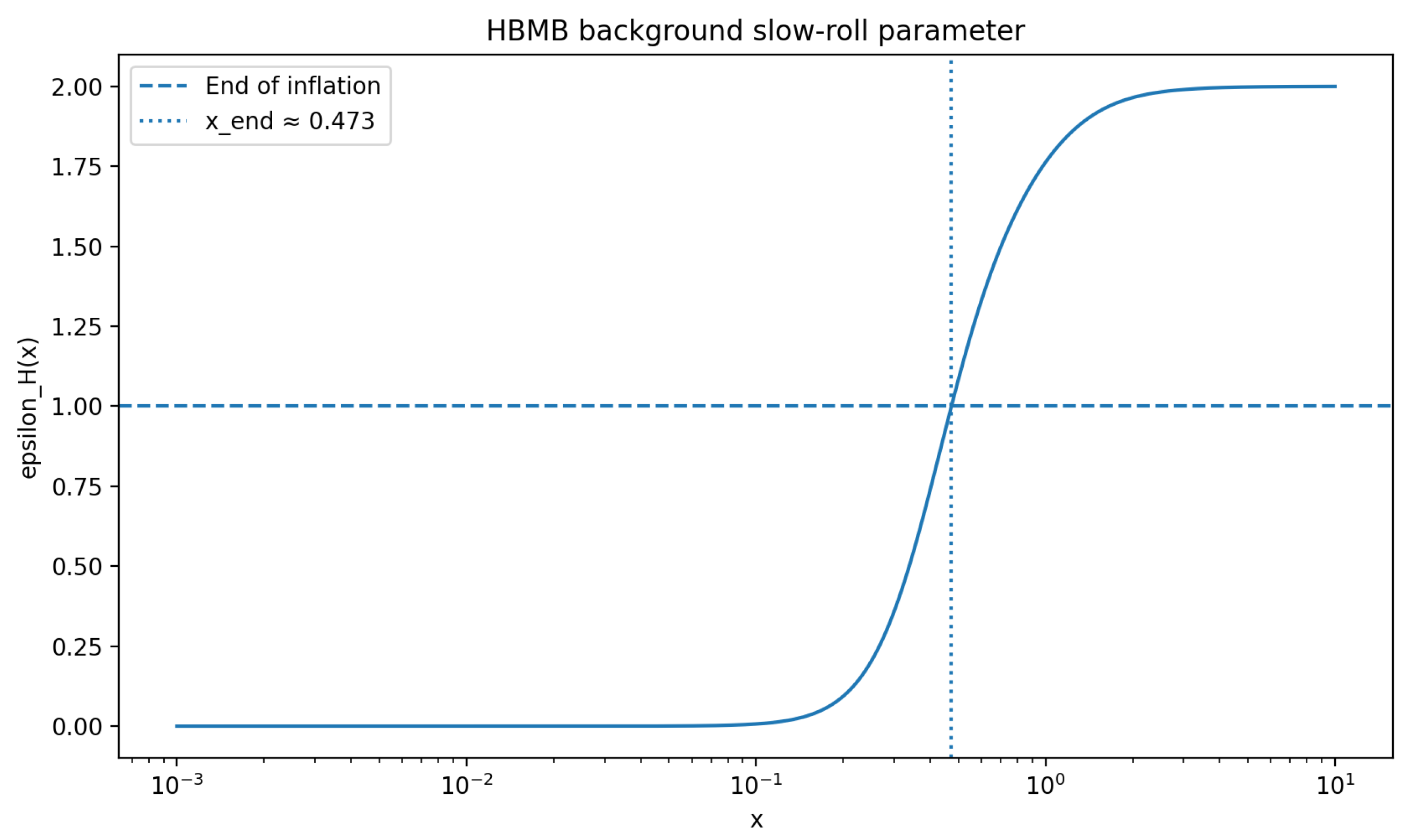
the model exhibits a clear transition from an early quasi-de Sitter stage to the end of acceleration at
where and . Selected values are shown in Table 1.
Figure 1.
Equation-of-state evolution for the minimal and exit closures.
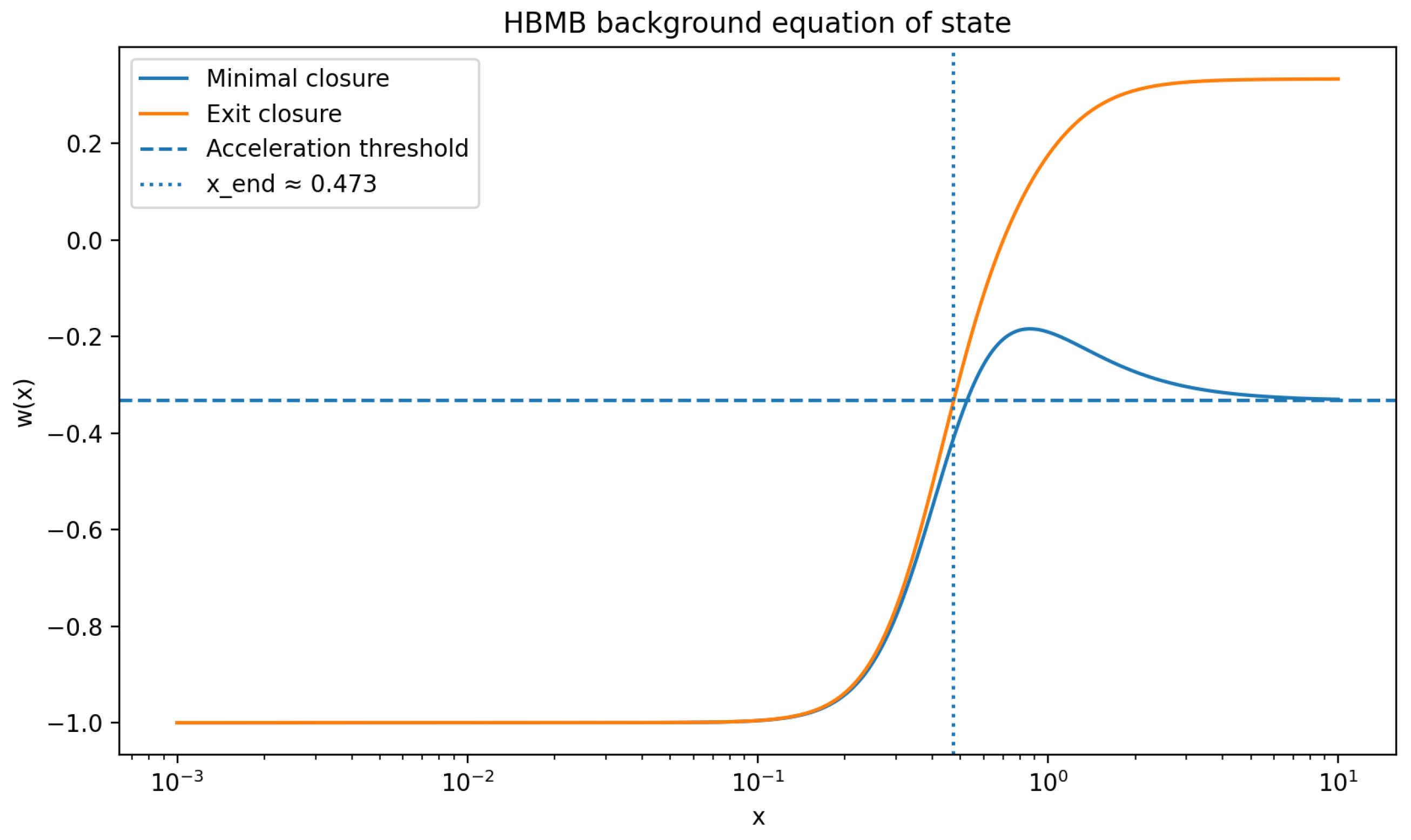
Figure 2.
Slow-roll parameter for the renormalized exit closure.
The physical meaning of this sector is modest but robust. It shows that the projected high-ℓ tail gives a positive correction that suppresses the small-x region and naturally generates an exit from acceleration. What it does not yet provide is a realistic description of the final –60 e-folds relevant for CMB observables. That requires a renormalized late-time closure.
4. Deriving the Plateau Closure from the Renormalized Omitted-Sector Determinant
4.1. Explicit Determinant Expansion
The weakest point of the earlier draft was the transition from the exact/minimal closure to the phenomenological plateau ansatz
The revised logic begins from the omitted-sector determinant
Here L is the accessible multipole threshold, is an ultraviolet cutoff, and denotes the omitted-sector determinant contribution. Introduce
so that .
The sum can be rearranged exactly as
where is the hyperfactorial. Using the Glaisher–Kinkelin / Euler–Maclaurin asymptotics of yields
with
where is the Glaisher–Kinkelin constant and is the associated L-independent constant term in the asymptotic expansion. The important point is that the raw determinant does not contain only area-like and logarithmic pieces. It also contains an interface term proportional to .
4.2. Bulk Subtraction, Code-Boundary Renormalization, and Residual Logarithmic Running
Equation (48) implies that the omitted determinant contains three conceptually distinct contributions.
A bulk area-like piece , which renormalizes the coarse background vacuum response or effective screen tension.
A local interface contribution , associated with the retained/omitted code boundary or shell measure.
A residual logarithmic running plus subleading inverse-power terms.
The first two are local counterterm candidates. After absorbing them into the renormalized background and local code-boundary data, the residual determinant becomes
The explicit numerical check in Appendix B shows that the asymptotic form is already extremely accurate for moderate L and that the logarithmic term dominates strongly over the correction in the relevant range.
At this point the earlier plateau logic can be stated more precisely. The HBMB claim is not that the raw determinant is purely logarithmic; it is that after bulk and local interface renormalization the leading nontrivial residual running is logarithmic. We parametrize the resulting susceptibility by
Here is the renormalized reference susceptibility, b is the residual logarithmic running coefficient, and is the matching multipole scale. The late-time Hubble drift is then modeled as controlled by this inverse susceptibility,
Here is the asymptotic plateau value of the Hubble parameter and A is a dimensionless response amplitude relating the renormalized omitted-sector running to the logarithmic drift of the background. Substituting Eq. (51) gives
4.3. Why the Inverse-Square Dependence on Remaining E-Folds Appears
The remaining step is geometric. During the last stage of inflation, the relevant accessible multipole threshold grows approximately exponentially with the remaining e-fold number,
Equivalently,
for an offset that absorbs the reference scale and finite renormalization terms.
The residual determinant of Eq. (50) motivates the susceptibility
Here is the renormalized reference susceptibility, is the matching multipole scale, b is the explicit residual logarithmic coefficient, and is the leading subasymptotic correction inherited from the term in Eq. (50).
To convert this running into an inflationary drift we adopt the minimal HBMB unit-response closure
Here is the asymptotic plateau energy density and is the HBMB response factor; in the present minimal closure we set . Since , the Hubble scale obeys
Using Eq. (55) and defining
where is the number of e-folds remaining until the end of inflation and is the matching shift parameter. One then finds
and therefore
Because decreases toward the end of inflation, the Hubble-flow parameter is
Differentiating Eq. (61) gives
At large u this becomes
Thus the plateau form
is not inserted by hand. Its functional dependence follows from the chain
4.4. Partial First-Principles Fixing of
Equation (63) shows that the plateau coefficient is not arbitrary once the determinant coefficient b is known. Comparing the leading asymptotic term with Eq. (65) gives
Here is the inflationary plateau coefficient, not the fine-structure constant. Under the minimal HBMB unit-response closure and with the explicit residual coefficient , we obtain
This is no longer a fitted benchmark choice: it is the direct consequence of the renormalized omitted-sector logarithmic running together with the minimal response closure. More generally one may keep
if future microscopic work modifies the unit-response assumption.
4.5. Asymptotic and Matched Determinations of
The shift parameter is fixed by matching the plateau variable to the end of inflation. In the asymptotic plateau model one imposes
which with Eq. (65) gives
Using Eq. (68),
A more precise value is obtained by applying the end-of-inflation condition to the full running, Eq. (63). Since at , the exact matching condition is
Numerically this yields
A simple first-order expansion around gives , showing that the exact matched value is controlled by the expected subleading determinant correction.
Thus the old benchmark choice can now be replaced by a partially derived, narrow interval,
with and representing the asymptotic and full-matching values respectively.
4.6. Benchmark Realization of the Partially Fixed Plateau Class
To connect the derived flow class to observables we now use the determinant-fixed value
and the exact matched shift
The benchmark plateau equations are therefore
where the second relation is the derivative consequence of the first closure. For
where is the e-fold number of the pivot scale and is the scalar-amplitude normalization. We then obtain
where . Using
we obtain
and from the integrated flow,
we find
The associated energy scales are
The resulting pair lies in the familiar observational plateau band occupied by Starobinsky and -attractor models [20,21,22], but the conceptual status is now stronger than in the previous version: the plateau shape is derived, is fixed by the residual logarithmic coefficient, and is constrained by the end-of-inflation matching of the full determinant-corrected flow.
Figure 3.
Hubble-flow parameters for the partially fixed HBMB plateau class with and .
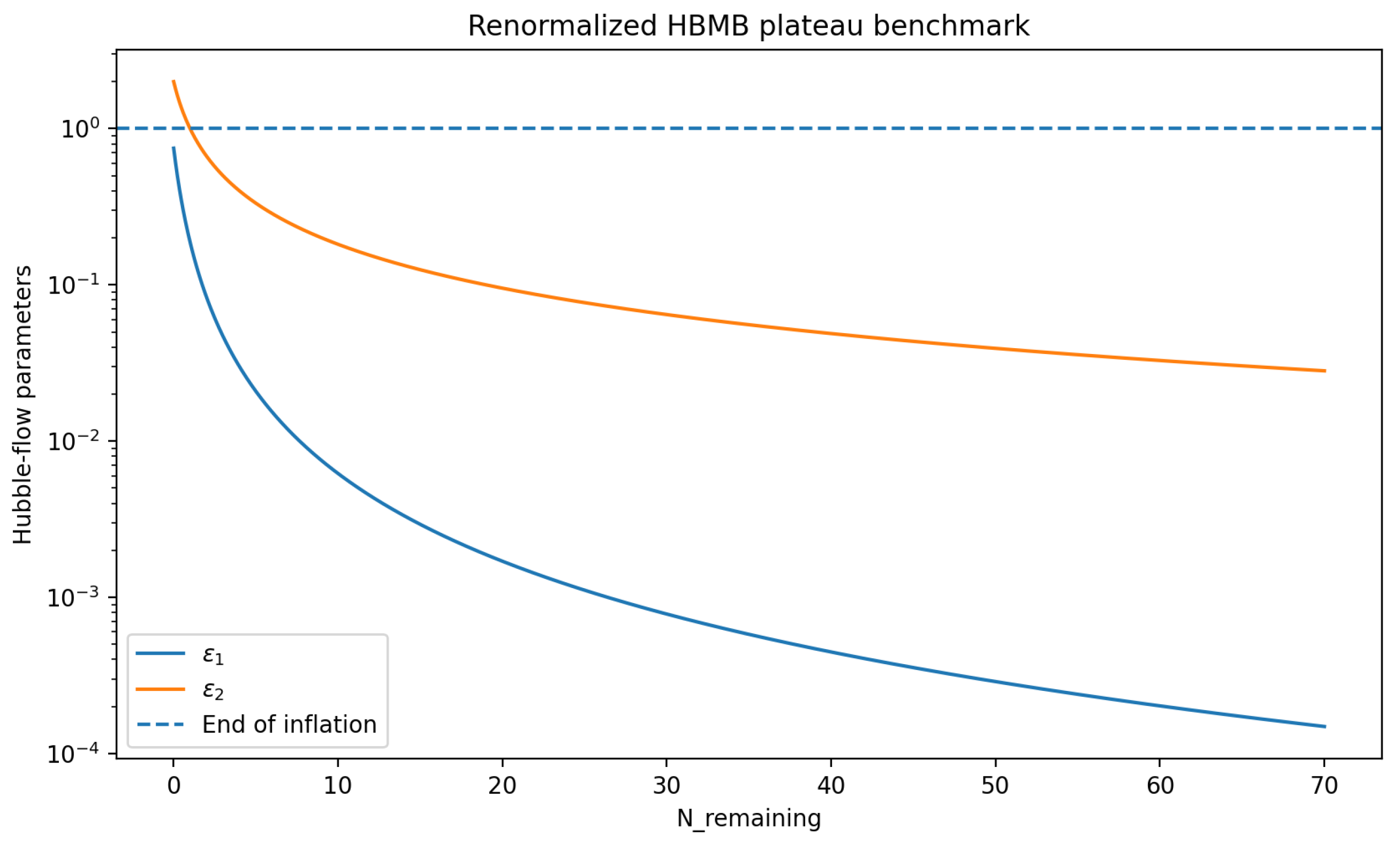
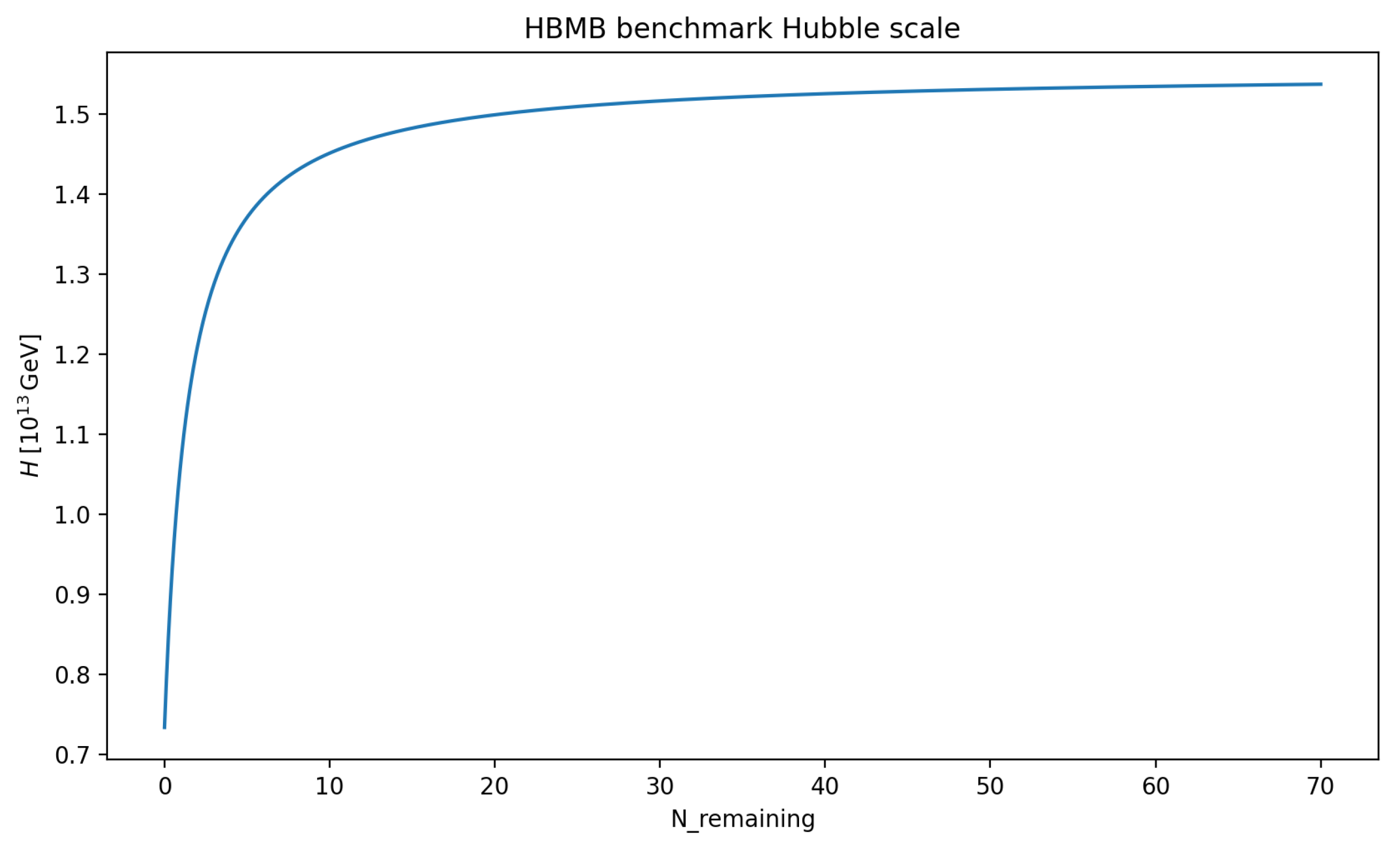
Figure 4.
HBMB Hubble scale as a function of remaining e-folds for the determinant-fixed plateau benchmark.
Figure 4.
HBMB Hubble scale as a function of remaining e-folds for the determinant-fixed plateau benchmark.
5. Scalar and Tensor Perturbations
Once the background flow is fixed, scalar and tensor perturbations obey the usual Mukhanov–Sasaki equations,
Here and are the scalar and tensor canonical mode functions, k is the comoving wave number, a is the scale factor, is the standard scalar pump field, is the reduced Planck mass, and primes denote derivatives with respect to conformal time. In the present treatment we use the minimal canonical closure , where is the scalar sound speed; HBMB physics enters through the projected background flow rather than through an additional sound-speed sector.
At leading slow-roll order, the scalar and tensor power spectra at the pivot scale are
where denotes the curvature perturbation spectrum, the tensor spectrum, and the observed scalar amplitude normalization. The corresponding spectral tilts are
The benchmark values quoted above therefore imply a red scalar tilt and a small tensor-to-scalar ratio.
The conceptual lesson is now clearer than in the previous version. The exact HBMB tail determines the existence of a projected inflationary sector and the form of the renormalized drift. The observable values of and r in the present treatment are predictions of a benchmark member of the derived plateau class, not yet fully first-principles predictions of all HBMB microphysical coefficients.
6. Illustrative HBMB-Specific Reheating from Tail Decoupling
6.1. Why a Purely Standard Reheating Closure Is Insufficient
A purely standard perturbative decay width can certainly be attached to the projected HBMB background, but this would understate the structure already present in the formalism. In the HBMB picture the omitted tail stores a finite projected energy density, and as the accessible capacity grows the retained/omitted mixing weakens. The decay of that mixing should itself act as a source that transfers projected tail energy into radiation.
6.2. Tail-Decoupling Source Term
We therefore define the HBMB energy reservoir by the projected correction itself,
As grows, this reservoir decreases. A minimal HBMB-specific reheating source is therefore
Here N denotes the e-fold time variable, is the effective tail reservoir, and is the HBMB reheating source. The parameter is an efficiency factor encoding how much of the tail-decoupling energy is converted into radiation rather than remaining in a nonthermal projected sector.
The continuity equations become
Here is the effective equation-of-state parameter of the HBMB reservoir during reheating, and is the radiation energy density produced by tail decoupling. This closure is still effective because is not yet microscopically fixed, but unlike a purely standard treatment it is directly tied to HBMB physics through the decrease of the projected tail reservoir.
6.3. Implications for the Observational E-Fold Number
The observational e-fold number should therefore be written as
That is, the observable pivot e-fold number depends on the HBMB tail correction , the plateau parameters , the reheating efficiency , and the subsequent thermal history. In other words, is not a primary input. It is an emergent quantity once one specifies
the projected HBMB tail correction,
the renormalized plateau coefficients,
the tail-decoupling reheating efficiency,
and the subsequent thermal history.
This is also why the often-quoted 50–60 e-fold range should be treated only as a benchmark window rather than a sacred target. Within HBMB, the relevant quantity must ultimately be derived self-consistently.
7. Discussion
The revised construction clarifies both the strengths and the present limitations of the HBMB quantum-cosmology program.
The strongest part is now the deparametrized projection formalism. By passing first to the internal-time operator , the use of a Schur-complement-type construction becomes much more defensible than in the earlier draft. The accessible-sector idea is therefore no longer just a suggestive truncation principle; it is formulated at the level of a proper positive operator.
The second major strength is the refined overlap analysis. The criticism of the previous overlap scaling was partly correct: a purely geometric strip overlap gives , not . The stronger effective scaling arises only after HBMB redundancy-free tangential averaging over the boundary channels. Accordingly, the exactly telescoping kernel should now be interpreted as a convenient closed representative of the correct asymptotic class rather than as a uniquely derived microscopic kernel.
The third major improvement concerns the determinant sector. The raw omitted determinant does not run purely as ; it also contains bulk and interface pieces. This part of the construction should be read against the standard heat-kernel and functional-determinant literature [15,37,38]. What survives after bulk and local code-boundary renormalization is the residual logarithmic running of Eq. (50). This is the proper basis for deriving the inverse-square plateau form. More than that, the explicit coefficient of the residual logarithm fixes the plateau parameter : under the minimal HBMB unit-response closure one finds . The shift parameter is then no longer free either, but is constrained by the end-of-inflation matching to asymptotically and when the leading subasymptotic determinant correction is retained.
The reheating sector is also conceptually improved. Rather than attaching only a standard perturbative decay model, the revised text identifies a specific HBMB energy-transfer channel: radiation is sourced by the decay of the projected omitted-tail reservoir as the retained/omitted mixing weakens. This is still not a microscopic particle-production theory, but it is now genuinely HBMB-specific.
Overall, the framework should now be understood in three layers. The deparametrized projection, the raw-to-effective overlap decomposition, and the determinant asymptotics are first-principles or asymptotically controlled. The inverse-square plateau shape is a derived renormalized consequence of the omitted-sector running. In the present version the plateau coefficients are no longer fully benchmark quantities: is fixed by the residual logarithmic coefficient and is narrowed to a small range by end-of-inflation matching. What remains effective is the microscopic response closure behind and the reheating efficiency.
8. Conclusions
The revised paper yields the following main results.
The HBMB regularization of quantum cosmology is reformulated in a deparametrized WDW framework using a scalar internal clock. This makes the projection formalism technically cleaner and conceptually safer.
An explicit strip-overlap model shows that the raw geometric coupling scales as . The stronger behavior relevant for the HBMB kernel emerges only after redundancy-free tangential code averaging. The exact telescoping kernel is therefore best viewed as an exactly summable representative of the correct asymptotic universality class.
The exact representative tail sum gives
and the weakening of retained/omitted mixing yields the renormalized factor
The minimal minisuperspace closure still provides small-scale-factor suppression and a natural exit from acceleration.
The omitted-sector determinant is expanded explicitly. The raw asymptotics contain bulk, interface, logarithmic, and inverse-power pieces. After subtracting the bulk and local code-boundary terms, the residual running is logarithmic,
which supports the derived plateau shape
A partially first-principles member of the derived plateau class, with and , yields
with fixed by the residual logarithmic coefficient and constrained by the full matching condition rather than chosen ad hoc.
Reheating is reformulated in HBMB language through a tail-decoupling source term, so that the observational becomes an emergent quantity rather than a purely external input.
The next crucial steps are now sharply defined. The first is to go beyond the present rank-one isotropic channel model and compute the subleading nonuniform channel corrections to the retained–omitted coupling matrix. The second is to derive the microscopic response factor that underlies the present minimal closure , and to turn the current / determination into a unique matching prescription. The third is to convert the effective tail-decoupling reheating source into a microscopic particle-production mechanism. Those tasks remain open, but the present framework is already substantially stronger than the original draft because its central logical transitions are now either explicitly derived or asymptotically controlled.
Appendix A. Numerical Overlap and Channel-Matrix Check
The accompanying script hbmb_overlap_scaling.py evaluates Eq. (14) for Gaussian, exponential, and top-hat strip profiles. It confirms numerically that the strip-level overlap scales as
so that approaches a constant for large ℓ. The script then constructs the explicit retained-to-channel matrix
and verifies that it has exactly one nonzero singular value,
The resulting Schur-complement kernel obeys
confirming the tail of the omitted-sector sum.
Appendix B. Determinant Asymptotics Check
The accompanying script hbmb_determinant_running.py evaluates the exact sum and compares it with Eq. (48). It also verifies numerically that after subtracting the bulk and interface pieces the residual is dominated by the logarithmic term and only then by the correction. The companion script hbmb_alpha_delta_matching.py then uses the residual coefficient to recover and to solve the exact end-of-inflation matching equation for .
Appendix C. Code Package
The accompanying code package includes the scripts used to generate and check the benchmark results: https://github.com/davenagy86/HBMB_WDW
hbmb_overlap_scaling.py: explicit strip-overlap scaling, local channel decomposition, and the rank-one tangential coupling matrix.
hbmb_determinant_running.py: explicit determinant asymptotics and residual running.
hbmb_tail_sum.py: exact representative tail identity.
hbmb_background_minimal.py: minimal minisuperspace closure and exit benchmark.
hbmb_plateau_benchmark.py: benchmark observables and background figures for the derived plateau class.
hbmb_alpha_delta_matching.py: partial first-principles determination of and from the renormalized determinant running.
hbmb_mukhanov_slowroll.py: scalar and tensor spectra in the partially fixed slow-roll benchmark.
hbmb_reheating.py: illustrative HBMB tail-decoupling reheating benchmark.
References
- Arnowitt, R.; Deser, S.; Misner, C. W. The dynamics of general relativity. In Gravitation: an introduction to current research; Witten, L., Ed.; Wiley, 1962. [Google Scholar]
- DeWitt, B. S. Quantum Theory of Gravity. I. The Canonical Theory. Phys. Rev. 1967, 160, 1113. [Google Scholar] [CrossRef]
- Halliwell, J. J. Introductory lectures on quantum cosmology. In Quantum Cosmology and Baby Universes; Coleman, S., et al., Eds.; World Scientific, 1991. [Google Scholar]
- C. Kiefer, Quantum Gravity, 3rd ed. (Oxford University Press, 2012).
- Isham, C. J. Canonical quantum gravity and the problem of time, in Integrable Systems, Quantum Groups, and Quantum Field Theories. In NATO ASI Series C; Kluwer, 1993; Vol. 409. [Google Scholar]
- Kuchař, K. V. Time and interpretations of quantum gravity. In Proceedings of the 4th Canadian Conference on General Relativity and Relativistic Astrophysics; Kunstatter, G., Vincent, D., Williams, J., Eds.; World Scientific, 1992. [Google Scholar]
- Hartle, J. B.; Hawking, S. W. Wave function of the Universe. Phys. Rev. D 1983, 28, 2960. [Google Scholar] [CrossRef]
- Vilenkin, A. Boundary conditions in quantum cosmology. Phys. Rev. D 1986, 33, 3560. [Google Scholar] [CrossRef] [PubMed]
- Bekenstein, J. D. Black holes and entropy. Phys. Rev. D 1973, 7, 2333. [Google Scholar] [CrossRef]
- S. W. Hawking, Particle creation by black holes. Commun. Math. Phys. 1975, 43, 199. [CrossRef]
- Hooft, G. ’t. Dimensional reduction in quantum gravity. arXiv arXiv:gr.
- L. Susskind, The World as a hologram. J. Math. Phys. 1995, arXiv:hep36, 6377. [CrossRef]
- Feshbach, H. Unified theory of nuclear reactions. Ann. Phys. 1958, 5, 357. [Google Scholar] [CrossRef]
- Feshbach, H. A unified theory of nuclear reactions. II. Ann. Phys. 1962, 19, 287. [Google Scholar] [CrossRef]
- Vassilevich, D. V. Heat kernel expansion: user’s manual. Phys. Rept. 388 2003, arXiv:hep279. [Google Scholar] [CrossRef]
- Birrell, N. D.; Davies, P. C. W. Quantum Fields in Curved Space; Cambridge University Press, 1982. [Google Scholar]
- Mukhanov, V. Physical Foundations of Cosmology; Cambridge University Press, 2005. [Google Scholar]
- Liddle, A. R.; Lyth, D. H. Cosmological Inflation and Large-Scale Structure; Cambridge University Press, 2000. [Google Scholar]
- Baumann, D. TASI Lectures on Inflation. arXiv arXiv:0907.5424.
- Starobinsky, A. A. A new type of isotropic cosmological models without singularity. Phys. Lett. B 1980, 91, 99. [Google Scholar] [CrossRef]
- Kallosh, R.; Linde, A. Universality class in conformal inflation. JCAP 07 2013, arXiv:1306.5220002. [Google Scholar] [CrossRef]
- Kallosh, R.; Linde, A.; Roest, D. Superconformal inflationary α-attractors. JHEP 11 2013, arXiv:1311.0472198. [Google Scholar] [CrossRef]
- Roest, D. Universality classes of inflation. JCAP 01 2014, arXiv:1309.1285007. [Google Scholar] [CrossRef]
- Akrami, Y.; et al. Planck Collaboration], Planck 2018 results. X. Constraints on inflation. Astron. Astrophys. 2020, 641, A10. [Google Scholar]
- Ade, P. A. R.; et al. [BICEP/Keck Collaboration], Improved constraints on primordial gravitational waves using BICEP/Keck 2018 data. Phys. Rev. Lett. 2021, 127, 151301. [Google Scholar] [CrossRef] [PubMed]
- Mukhanov, V. F.; Chibisov, G. V. Quantum fluctuations and a nonsingular universe. JETP Lett. 1981, 33, 532. [Google Scholar]
- Sasaki, M. Large scale quantum fluctuations in the inflationary universe. Prog. Theor. Phys. 1986, 76, 1036. [Google Scholar] [CrossRef]
- Mukhanov, V. F. Quantum theory of gauge-invariant cosmological perturbations. Sov. Phys. JETP 1988, 67, 1297. [Google Scholar]
- Kofman, L.; Linde, A.; Starobinsky, A. A. Towards the theory of reheating after inflation. Phys. Rev. D 1997, 56, 3258. [Google Scholar] [CrossRef]
- Allahverdi, R.; Brandenberger, R.; Cyr-Racine, F.-Y.; Mazumdar, A. Reheating in inflationary cosmology: Theory and applications. Ann. Rev. Nucl. Part. Sci. 60 2010, arXiv:1001.260027. [Google Scholar] [CrossRef]
- Cook, J. L.; Dimastrogiovanni, E.; Easson, D. A.; Krauss, L. M. Reheating predictions in single field inflation. JCAP 04 2015, arXiv:1502.04673047. [Google Scholar] [CrossRef]
- Martin, J.; Ringeval, C.; Vennin, V. Encyclopaedia Inflationaris. Phys. Dark Univ. 5-6 2014, arXiv:1303.378775. [Google Scholar] [CrossRef]
- Ashtekar, A.; Pawłowski, T.; Singh, P. Quantum nature of the big bang. Phys. Rev. Lett. 2006, arXiv:gr96, 141301. [Google Scholar] [CrossRef] [PubMed]
- Ashtekar, A.; Pawłowski, T.; Singh, P. Quantum nature of the big bang: An analytical and numerical investigation. Phys. Rev. D 2006, arXiv:gr73, 124038. [Google Scholar] [CrossRef]
- Ashtekar, A.; Singh, P. Loop quantum cosmology: A status report. Class. Quantum Grav. 2011, arXiv:1108.089328, 213001. [Google Scholar] [CrossRef]
- Jacobson, T. Thermodynamics of spacetime: The Einstein equation of state. Phys. Rev. Lett. 1995, arXiv:gr75, 1260. [Google Scholar] [CrossRef]
- Dunne, G. V. Functional determinants in quantum field theory. J. Phys. A 2008, arXiv:0711.117841, 304006. [Google Scholar] [CrossRef]
- Kirsten, K. Spectral Functions in Mathematics and Physics; CRC Press, 2001. [Google Scholar]
- Nagy, D. Basics of a Geometry-Independent HBMB Holographic Principle: From Horizon Bits to Bulk Wavefunctions—Part I. 2026, Preprints 2026, 202601.1465. [Google Scholar]
- Nagy, D. U(1)-Driven Local Holographic Horizons: Holographic Bit–Mode Balance and the α-Fixpoint. Preprints 2026, 2026, 202511.1803. [Google Scholar]
- D. Nagy, A First-Principles Derivation of the Fine-Structure Constant from Holographic Bit–Mode Balance, OSF Preprints (2025), osf.io/hw2je.
- D. Nagy, Holographic Vacuum Energy from Quantized Horizons, OSF Preprints (2025), osf.io/m8t6h.

Table 1.
Illustrative minimal HBMB minisuperspace benchmark for Eq. (40).
Table 1.
Illustrative minimal HBMB minisuperspace benchmark for Eq. (40).
| x | ||
|---|---|---|
| 0.05 | ||
| 0.10 | ||
| 0.20 | ||
| 0.30 | ||
| 0.40 | ||
| 1.00 |
Disclaimer/Publisher’s Note: The statements, opinions and data contained in all publications are solely those of the individual author(s) and contributor(s) and not of MDPI and/or the editor(s). MDPI and/or the editor(s) disclaim responsibility for any injury to people or property resulting from any ideas, methods, instructions or products referred to in the content. |
© 2026 by the authors. Licensee MDPI, Basel, Switzerland. This article is an open access article distributed under the terms and conditions of the Creative Commons Attribution (CC BY) license (http://creativecommons.org/licenses/by/4.0/).
Copyright: This open access article is published under a Creative Commons CC BY 4.0 license, which permit the free download, distribution, and reuse, provided that the author and preprint are cited in any reuse.


