

Submitted:
14 March 2026
Posted:
17 March 2026
You are already at the latest version
Abstract
This paper proposes a novel mathematical framework for understanding photon propagation and the nature of quantum entanglement by interpreting the Hamiltonian quaternion multiplication rule ij = k as a physical principle of electromagnetic field interaction. In this model, the unit vector i represents the electric field component, j represents the magnetic field component, and their product k defines the direction of photon propagation. This formulation suggests that the excitation of a magnetic field by an electric field is not merely a consequence of Maxwell’s equations but a manifestation of the non-commutative geometric phase inherent in spacetime. Furthermore, we posit that the speed of light c acts as a critical threshold; upon reaching this velocity, matter effectively transitions into an imaginary (or “virtual”) numerical domain. This transition implies that photons, and by extension any entity travelling at c, exist in a state where local realism is invalid. We argue that this provides a fundamental insight into the mechanism behind the Einstein-Podolsky-Rosen (EPR) paradox and quantum non-locality, suggesting that quantum entanglement is not a “spooky action at a distance” but a natural consequence of connectivity within this imaginary, non-local quaternionic manifold.
Keywords:
Hamiltonian quaternions
; photon precession
; electromagnetic field
; EPR paradox
; quantum entanglement
; non-locality
; imaginary domain
; local realism
1. Introduction
The mathematical description of classical electromagnetism is elegantly captured by Maxwell’s equations, which describe the relationship between electric fields () and magnetic fields () [1]. However, the fundamental nature of the photon – the quantum of light – and its peculiar non-local behavior in quantum mechanics remain subjects of deep inquiry. The Einstein-Podolsky-Rosen (EPR) paradox highlights a seemingly impossible contradiction between quantum mechanics and local realism, suggesting that particles which have interacted can become correlated in ways that defy classical notions of space and time [2].
In this paper, we explore an alternative mathematical foundation based on Hamilton’s quaternions [3]. Specifically, we utilize the fundamental multiplication rule to model the intrinsic dynamics of a photon. We propose that this algebraic relation is not merely symbolic but represents the actual physical precession of field vectors into momentum. Building on this, we investigate the hypothesis that reaching the speed of light corresponds to a phase transition in the Lorentz group, moving from a real (timelike) domain to an imaginary (lightlike/spacelike) domain. This transition offers a geometric explanation for the breakdown of local realism and provides a potential resolution to the EPR paradox.
2. Quaternion Algebra as a Physical Principle
Quaternions form a four-dimensional number system extending complex numbers. A quaternion is defined as , where , , , are real numbers, and , , are the fundamental quaternion units. The defining property of these units is their multiplication rule:
And specifically, the cyclic permutations:
With the anti-commutative relations , etc.
2.1. Physical Mapping of Field Components
We propose the following direct mapping of these abstract units to physical quantities in electromagnetic theory:
- Let the unit represent the direction of the electric field ().
- Let the unit represent the direction of the magnetic field ().
- Let the unit represent the direction of photon propagation () or the Poynting vector ().
2.2 as a Dynamical Process
In a propagating electromagnetic wave, a time-varying electric field generates a magnetic field, and vice versa. This mutual generation ensures the self-sustaining propagation of the wave. The quaternion equation provides a compact representation of this process:
However, the quaternion multiplication is not a simple cross product; it is a geometric product that encodes a 90-degree rotation in the plane defined by and . This can be interpreted as the precession of the field vectors. An electric field vector () acting on a magnetic field vector () results in a vector () orthogonal to both. This suggests that the momentum of the photon () is the geometric resultant of the precessional interaction between its electric and magnetic components. This is not merely a wave traveling forward, but a continuous “tumbling” of the field configuration through the internal space defined by the quaternion algebra.
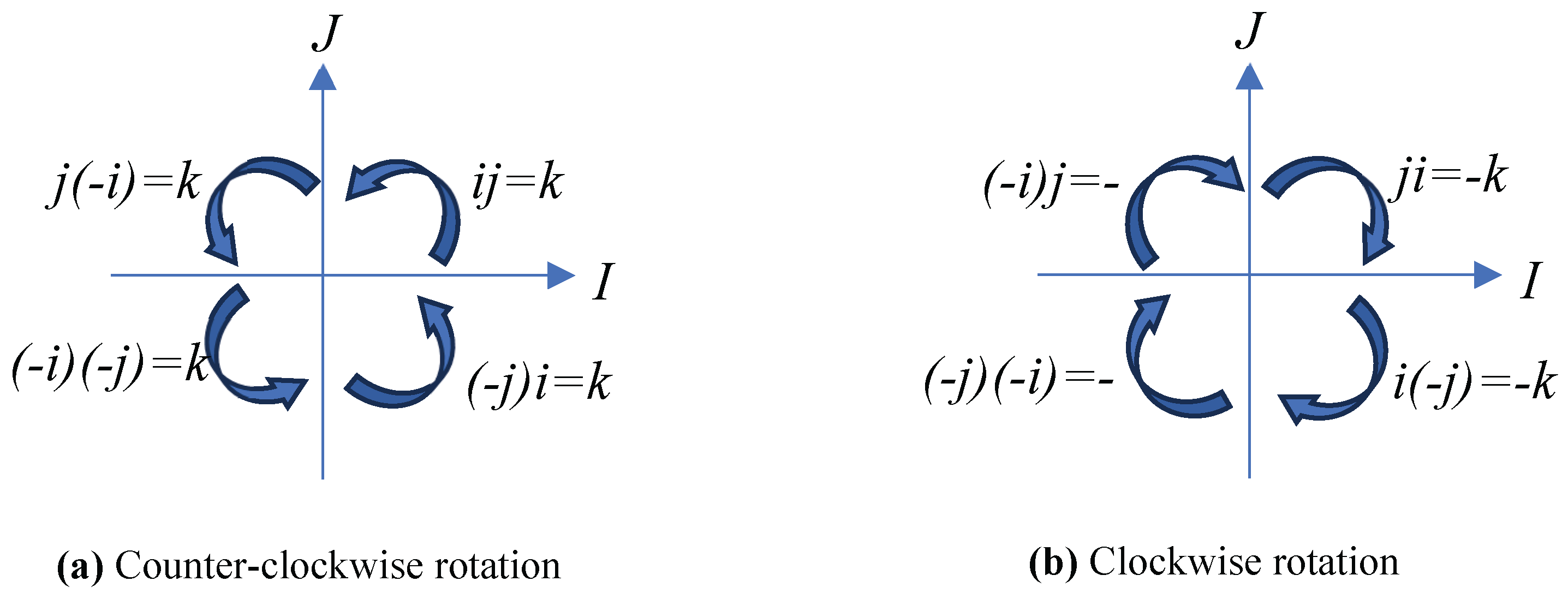
Besides, the photon, therefore, is not a static object moving through space, but a self-sustaining rotational cycle defined by the algebraic closure of the imaginary units: . Note that this example only covers the first quadrant. If we divide the plane’s coordinate axes into four quadrants, the complete situation is as shown in Figure 1.
3. The Speed of Light as a Threshold to the Imaginary Domain
In special relativity, the proper time of a photon is zero. The Lorentz transformation for a particle moving at velocity involves the factor . For , is real. As approaches , approaches infinity. However, if we consider the Minkowski metric signature (+, -, -, -), timelike intervals are real, while lightlike intervals are null and spacelike intervals are imaginary.
We propose that when an entity reaches the speed , its mathematical description undergoes a transition. The equations governing its internal dynamics shift from a real-valued basis to an imaginary-valued basis.
- Subluminal domain (): Matter exists in a “real” domain. Local realism holds. Interactions are timelike and causal. Physical quantities are described by real numbers. The quaternion components are real-valued.
- Luminal domain (): The photon exists in an “imaginary” or “virtual” domain. Because its proper time is zero, its existence is not a path through spacetime, but a pure correlation between a point of emission and a point of absorption. In our quaternion model, if we allow the components of the field vectors to become imaginary numbers, the nature of the propagation changes. The unit , representing propagation, remains real, but the internal precession ( and ) becomes imaginary, representing a phase relationship rather than a measurable field amplitude in the classical sense.
4. Implications for the EPR Paradox and Non-Locality
The EPR paradox demonstrates that quantum mechanics predicts correlations between entangled particles that cannot be explained by local hidden variable theories. This implies that either quantum mechanics is incomplete, or that “spooky action at a distance” is real. Building on this, Bell formulated his famous inequalities to test the viability of local realism [4].
4.1 Photons as Inhabitants of the Virtual Domain
If we accept the premise that photons exist in an imaginary mathematical domain (a “virtual world”), then the principles of local realism, which are axioms of the real, subluminal world, may not apply to them. In the imaginary domain:
- Non-locality becomes intrinsic: The concept of distance may become imaginary or meaningless. Two photons, once correlated, remain part of a single quantum state described by a shared imaginary phase. The quaternion relation that created them (for one decay path, and its conjugate for the other) encodes a perfect anti-correlation.
- Collapse of the wavefunction: The “collapse” upon measurement may represent the transition of information from the imaginary (virtual) domain back into the real domain. When a measurement is made on one photon, it forces the imaginary correlation into a real outcome, instantaneously defining the state of its partner because they were never truly separated in the imaginary domain.
4.2 The Nature of Entanglement
We can therefore re-interpret quantum entanglement not as a signal passing between two separated particles, but as the manifestation of a single, unified process existing entirely within the imaginary (light-speed) domain. The quaternion product and its anti-commutative counterpart provide a natural algebraic representation of the symmetric and anti-symmetric states of a photon pair (such as the singlet state). The system remains in the imaginary domain, defined by and , until a measurement forces a projection onto the real axis, which is the direction (or a specific polarization axis). This projection inherently respects the conservation laws (e.g., angular momentum) encoded in the original quaternion multiplication.
5. Conclusions
By interpreting the Hamiltonian quaternion multiplication rule as the fundamental principle of photon precession, mapping to the electric field, to the magnetic field, and to the propagation direction, we have constructed a model where the photon’s momentum is a geometric phase resulting from field interaction. More importantly, we have argued that achieving the speed of light constitutes a transition into an imaginary mathematical domain. This transition nullifies the conditions required for local realism, providing a geometric and algebraic framework for understanding the EPR paradox [5]. In this view, entangled photons are not two separate entities influencing each other across space, but two aspects of a single process existing in a non-local, imaginary phase space, whose correlation is encoded in the fundamental anti-commutativity of the quaternion algebra. This model suggests that the “spookiness” of quantum mechanics arises from the human perspective of a real-valued spacetime, obscuring the elegant, precessional geometry of the virtual domain where light dwells.
Author Contributions
This is a single authored piece of work.
Funding
This research received no external funding.
Data Availability Statement
No new data were created.
Conflicts of Interest
The author declares no conflicts of interest.
References
- Maxwell, J. C. A dynamical theory of the electromagnetic field. Philosophical Transactions of the Royal Society of London 1865, 155, 459–512. [Google Scholar] [CrossRef]
- Einstein, A.; Podolsky, B.; Rosen, N. Can quantum-mechanical description of physical reality be considered complete? Physical Review 1935, 47(10), 777. [Google Scholar] [CrossRef]
- Hamilton, W. R. On quaternions. Proceedings of the Royal Irish Academy, 1844.
- Bell, J. S. On the Einstein Podolsky Rosen paradox. Physics Physique Fizika 1964, 1(3), 195. [Google Scholar] [CrossRef]
- Kain, B. Probing the connection between entangled particles and wormholes in general relativity. Phys. Rev. Lett. 2023, 131, 101001. [Google Scholar] [CrossRef] [PubMed]
Figure 1.
Directions of photon rotation and precession. Whether in Figure 1(a) or Figure 1(b), we can see that the direction of photon rotation and precession is consistent with the quaternion rule, seemingly conforming to the right-hand screw rule, if we define the direction as pointing outward from the page.
Figure 1.
Directions of photon rotation and precession. Whether in Figure 1(a) or Figure 1(b), we can see that the direction of photon rotation and precession is consistent with the quaternion rule, seemingly conforming to the right-hand screw rule, if we define the direction as pointing outward from the page.
Disclaimer/Publisher’s Note: The statements, opinions and data contained in all publications are solely those of the individual author(s) and contributor(s) and not of MDPI and/or the editor(s). MDPI and/or the editor(s) disclaim responsibility for any injury to people or property resulting from any ideas, methods, instructions or products referred to in the content. |
© 2026 by the authors. Licensee MDPI, Basel, Switzerland. This article is an open access article distributed under the terms and conditions of the Creative Commons Attribution (CC BY) license (http://creativecommons.org/licenses/by/4.0/).
Copyright: This open access article is published under a Creative Commons CC BY 4.0 license, which permit the free download, distribution, and reuse, provided that the author and preprint are cited in any reuse.


