

Submitted:
16 March 2026
Posted:
17 March 2026
You are already at the latest version
Abstract
Neurodevelopmental disorders (NDDs) are characterized by remarkable phenotypic heterogeneity, in which individuals harboring mutations in the same gene display divergent clinical manifestations, ranging from mild cognitive impairment to severe neurodevelopmental deficits. Advances in neurogenetics and neurogenomics have rapidly expanded the catalog of genes associated with NDDs and have provided unprecedented insight into the genetic architecture of these conditions. However, how identical or similar genetic variants give rise to such diverse phenotypic outcomes remains largely unknown. Ubiquitin-mediated protein regulation is a central mechanism controlling diverse processes essential for neural development, including chromatin regulation, transcriptional dynamics, protein turnover, and synaptic function. Importantly, ubiquitination is a multilayered regulatory process governed by multiple determinants, including the availability of ubiquitination sites on substrates, the activity of ubiquitin ligases, the opposing actions of deubiquitinases, and priming post-translational modifications such as phosphorylation or acetylation. These regulatory layers create a dynamic ubiquitination landscape that may vary across individuals, cell types, developmental stages, and environmental contexts. In this review, we discuss how insights from neurogenetics and neurogenomics can be integrated with knowledge of ubiquitin signaling to better understand the molecular basis of phenotypic heterogeneity in NDDs. We propose that differential ubiquitination represents an important mechanistic framework through which genetic variation is translated into diverse molecular and cellular outcomes. Understanding the interplay between neurogenetic variation and ubiquitin-dependent regulatory networks may provide new perspectives on disease mechanisms and inform future therapeutic strategies for neurodevelopmental disorders.
Keywords:
neurodevelopmental disorders
; phenotypic heterogeneity
; ubiquitination
; β-catenin
; MeCP2
; SHANK3
1. Introduction
Neurodevelopmental disorders (NDDs) encompass a diverse group of conditions characterized by impairments in cognitive, behavioral, and social functions that arise from disrupted brain development [1,2]. Advances in neurogenetics and neurogenomics have dramatically expanded our understanding of the genetic architecture underlying these disorders, such as identification of numerous causative or risk-associated genes [3,4].
A striking feature of NDDs is the remarkable phenotypic heterogeneity observed among affected individuals [5,6,7]. Patients carrying identical or highly similar genetic variants frequently exhibit widely divergent clinical manifestations, ranging from mild cognitive impairment to severe intellectual disability or autism spectrum–related phenotypes. This variability poses a major challenge for both mechanistic understanding and clinical management, and the molecular principles that translate genetic variation into diverse phenotypic outcomes remain largely unresolved.
One possible explanation for such phenotypic diversity lies in the multilayered regulatory networks that control protein function in developing neurons. Among these regulatory systems, ubiquitin-mediated protein modification has emerged as a central mechanism governing diverse aspects of cellular physiology, including protein stability, signal transduction, and transcriptional regulation [8,9,10,11]. In the nervous system, ubiquitin signaling plays essential roles in neural progenitor proliferation, neuronal differentiation, and synapse formation [12,13,14,15]. Consistent with these functions, mutations in components of the ubiquitin system have been increasingly linked to NDDs through neurogenetic studies.
Importantly, ubiquitination is not a simple on–off modification but rather a highly dynamic process regulated at multiple levels. The extent of substrate ubiquitination is determined by several factors, including the availability of lysine residues on substrate proteins, the activity and specificity of ubiquitin ligases, the opposing actions of deubiquitinases (DUBs), and priming post-translational modifications such as phosphorylation or acetylation that influence ubiquitin conjugation (Figure 1) [16,17,18,19]. These regulatory layers generate a flexible ubiquitination landscape that may vary among cell types, developmental stages, and environmental contexts. Consequently, even subtle differences in these regulatory mechanisms may alter the ubiquitination status of key substrates, leading to divergent molecular and cellular consequences.
In this context, we propose that differential ubiquitination of critical neuronal substrates may represent an important molecular mechanism contributing to phenotypic heterogeneity in NDDs. Rather than focusing broadly on the ubiquitin system, this review highlights representative examples in which multiple regulatory layers converge on specific substrates relevant to NDDs. We discuss β-catenin, a central signaling molecule in Wnt pathways, methyl-CpG binding protein 2 (MeCP2), a transcriptional regulator implicated in Rett syndrome, and SH3 and multiple ankyrin repeat domains 3 (SHANK3), a synaptic scaffold protein strongly associated with autism spectrum disorders. Through these examples, we illustrate how the convergence of ubiquitin ligases, DUBs, and priming post-translational modifications at the level of individual substrates may generate differential ubiquitination states, potentially contributing to the phenotypic diversity observed in patients with NDDs.
2. Ubiquitination of β-Catenin
β-Catenin is a central component of the Wnt signaling pathway, which plays essential roles in neural development, including the regulation of neural progenitor proliferation, neuronal differentiation, and synapse formation [20,21,22]. Consistent with these functions, dysregulation of β-catenin signaling has been implicated in NDDs, and mutations in the gene encoding β-catenin, CTNNB1, have been identified in patients with intellectual disability, autism spectrum disorder, and other developmental abnormalities [23,24]. A notable feature of CTNNB1-associated disorders is the considerable variability in clinical manifestations among affected individuals [25,26], suggesting that regulatory mechanisms controlling β-catenin activity may modulate disease phenotypes.
The abundance and activity of β-catenin are tightly regulated by ubiquitin-mediated proteolysis [27]. In the absence of Wnt signaling, β-catenin is incorporated into a multiprotein destruction complex composed of Axin, adenomatous polyposis coli (APC), glycogen synthase kinase 3 (GSK3), and casein kinase 1 (CK1). Within this complex, β-catenin undergoes sequential phosphorylation by CK1 and GSK3 at specific N-terminal residues. These phosphorylation events generate a phosphodegron that is recognized by the SCFβ-TrCP ubiquitin ligase complex, which catalyzes the polyubiquitination of β-catenin and targets it for degradation by the 26S proteasome. Through this mechanism, phosphorylation acts as a priming modification that enables ubiquitin-mediated turnover of β-catenin. Binding of Wnt ligands to their receptors leads to inhibition of the destruction complex, resulting in the stabilization and accumulation of β-catenin. Stabilized β-catenin interacts with TCF/LEF transcription factors to activate gene expression programs that control cell proliferation and differentiation. The ubiquitination status of β-catenin therefore acts as a molecular switch that determines the activity of Wnt signaling.
In addition to ubiquitin ligases, DUBs contribute to the dynamic regulation of β-catenin stability. Four DUBs (i.e., USP2a, USP4, USP6NL, and USP47) have been reported to remove ubiquitin chains from β-catenin, thereby promoting its stabilization and enhancing Wnt signaling activity [28,29,30,31]. Although pathogenic mutations in the genes encoding these DUBs have not yet been identified, all four DUBs are expressed in the brain [32,33,34,35]. Notably, Usp2 gene knockout mice exhibit an anxiety-like behavior [34], a phenotype frequently observed in patients with NDDs. Combined with the report demonstrating that excessive expression of β-catenin in the brain induces autism-like behaviors in mice [36], these observations suggest that the activity or abundance of these DUBs may influence NDD pathogenesis through β-catenin regulation.
Taken together, β-catenin provides a well-characterized example in which multi-layered regulation of substrate ubiquitination determines signaling output (Figure 2). Variations in kinase activity, expression levels of ubiquitin ligases or DUBs, or cellular signaling contexts may shift the threshold at which β-catenin is degraded or stabilized, and such differences could lead to divergent transcriptional responses during neurodevelopment, even in individuals carrying similar genetic variants affecting β-catenin signaling. Given the central role of Wnt signaling in brain development, differential ubiquitination of β-catenin may represent a plausible mechanism contributing to the phenotypic heterogeneity observed in NDDs.
3. Ubiquitination of MeCP2
MeCP2 is a transcriptional regulator that plays a crucial role in neuronal maturation [37]. It binds methylated CpG dinucleotides in DNA and modulates gene expression through interactions with chromatin remodeling complexes and other transcriptional regulators [38,39]. The importance of MeCP2 in neurodevelopment is underscored by the fact that mutations in the MeCP2 gene cause Rett syndrome, a severe NDD characterized by intellectual disability, motor impairment, and autistic features [40,41]. Notably, both loss-of-function and increased dosage of MeCP2 can result in neurological abnormalities, highlighting the requirement for precise regulation of MeCP2 abundance and activity [42,43].
Consistently, emerging evidence indicates that MeCP2 is subject to multiple post-translational modifications that may regulate its stability [44]. Phosphorylation at S92 by HIPK2 and S413 by unknown kinase is positioned within PEST degrons and has therefore been postulated to promote MeCP2 degradation [44,45], although this mechanism has not yet been experimentally validated. Several ubiquitin ligases (i.e., RNF4, NEDD4, HERC2, and CRL4–DCAF13) ubiquitinate MeCP2 and promote its proteasomal degradation, thereby contributing to the turnover of this transcriptional regulator [46,47,48,49]. In contrast, the deubiquitinase USP15 counteracts this ubiquitin-mediated degradation by removing ubiquitin moieties from MeCP2 [50]. Interestingly, mutations in genes encoding CUL4B, a core scaffold component of the CRL4 complex, and USP15 have been identified in patients with NDDs. Determining whether these patients exhibit altered MeCP2 abundance will be of important in the future studies. If confirmed, these findings would suggest that differential ubiquitination of MeCP2 contributes to NDD pathogenesis in these individuals.
Given that both excessive and reduced levels of MeCP2 can lead to NDDs, variability in the regulatory mechanisms controlling MeCP2 ubiquitination may contribute to the broad phenotypic spectrum observed in disorders associated with MeCP2 dysfunction (Figure 3). In this regard, extracellular cues such as synaptic activity and neuromodulatory signals have been shown to converge on nuclear MeCP2 through Ca²⁺-dependent and cAMP/PKA-dependent kinase pathways, inducing site-specific phosphorylation that modulates MeCP2 chromatin binding and its interactions with transcriptional cofactors [51,52]. In parallel, MeCP2 ubiquitination in neurons is also likely governed by intracellular signaling cascades downstream of these extracellular stimuli. However, key mechanistic aspects, including the specific E3 ubiquitin ligases involved, the lysine residues targeted for ubiquitination, and the stimulus–response kinetics, remain poorly defined in the neuronal literature. Taken together, differential ubiquitination of MeCP2 provides an illustrative example of how multilayered regulation of transcriptional regulators may contribute to phenotypic heterogeneity in NDDs.
4. Ubiquitination of SHANK3
Ubiquitination of synaptic proteins is widely recognized as a dynamic regulatory mechanism that shapes synapse formation, stability, and multiple forms of synaptic plasticity [53,54]. Among these substrates, SHANK3 is a prominent core component of the postsynaptic density (PSD), where it orchestrates the assembly of multiprotein complexes linking neurotransmitter receptors, signaling molecules, and cytoskeletal elements [55,56]. Genetic studies have established that mutations or deletions of the SHANK3 gene are strongly associated with autism spectrum disorders and Phelan–McDermid syndrome, underscoring the importance of SHANK3 in normal brain development and synaptic function [57,58]. Notably, individuals carrying similar SHANK3 variants often display considerable variability in clinical severity [59,60], suggesting that regulatory mechanisms affecting SHANK3 stability may influence phenotypic outcomes.
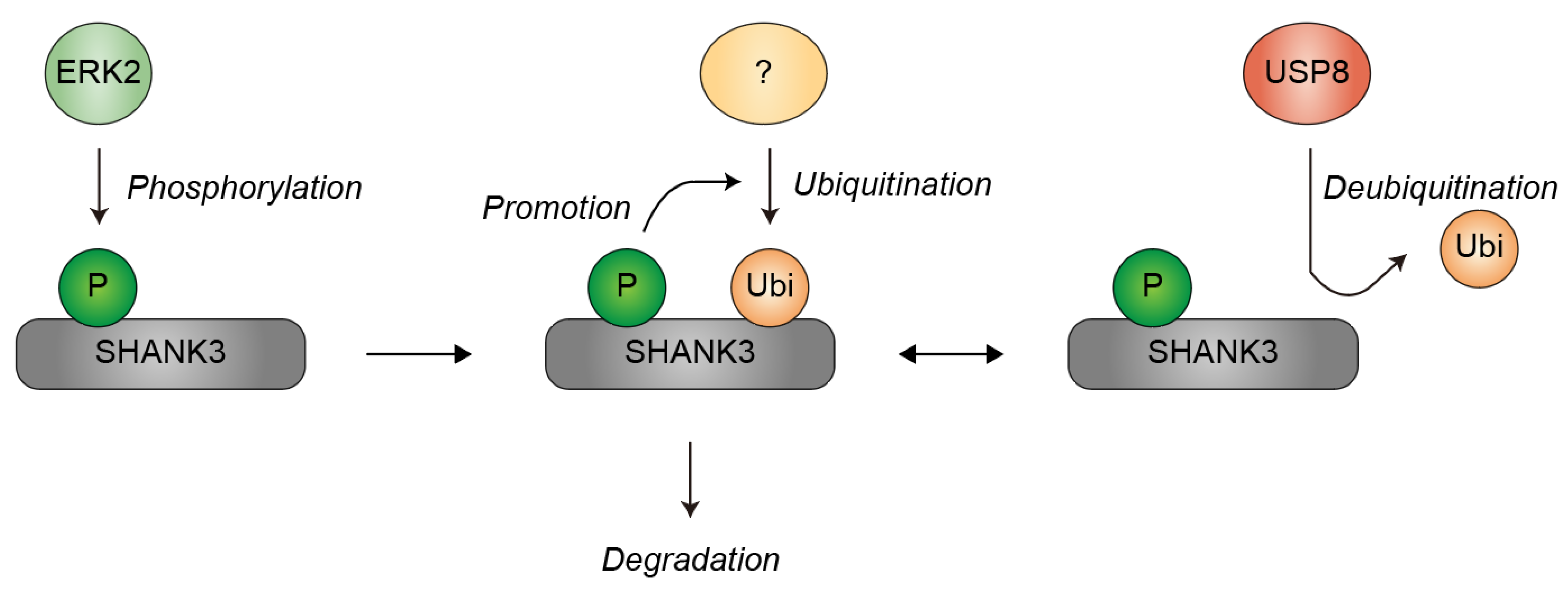
The abundance of SHANK3 at synapses is tightly controlled by protein turnover mechanisms. ERK2 phosphorylates SHANK3 at three serine residues (S1134, S1163, and S1253), resulting in enhanced ubiquitination and subsequent degradation of SHANK3 [61]. Although the ubiquitin ligases responsible for SHANK3 ubiquitination remain to be characterized, USP8 has been identified as a deubiquitinase that removes ubiquitin chains from SHANK3, thereby promoting its stabilization [62].
Given the central role of SHANK3 in organizing synaptic architecture, alterations in its stability or turnover may exert profound effects on synaptic development and plasticity. Variability in the regulatory pathways controlling SHANK3 ubiquitination could therefore influence synaptic protein homeostasis, potentially contributing to the diverse phenotypic manifestations observed among individuals carrying SHANK3 mutations (Figure 4). As with MeCP2, extracellular events such as synaptic activity and ischemic stress have been shown to regulate SHANK3 protein levels through ubiquitin-dependent proteasomal degradation in neurons [62,63], indicating that environmental conditions can modulate the ubiquitination and degradation of SHANK3. In this manner, SHANK3 exemplifies how differential ubiquitination of synaptic proteins may constitute a molecular mechanism underlying phenotypic heterogeneity in NDDs.
5. Conclusions
Advances in neurogenetics and neurogenomics have markedly expanded the repertoire of genes associated with NDDs. Nevertheless, a central challenge that remains unresolved is the striking phenotypic heterogeneity observed among patients carrying identical or closely related genetic variants. The molecular mechanisms that translate genetic variation into diverse cellular and clinical outcomes are therefore an important subject of investigation.
In this review, we have highlighted ubiquitination of key neuronal substrates as a potential mechanism contributing to such phenotypic variability. Ubiquitination is regulated through multiple interconnected layers, including substrate accessibility, ubiquitin ligases, DUBs, and priming post-translational modifications. Through the integration of these regulatory processes, the ubiquitination status of a given substrate can vary substantially depending on cellular context. As illustrated by the examples of β-catenin, MeCP2, and SHANK3, such multilayered regulation converges at the level of individual proteins that control signaling pathways, transcriptional programs, and synaptic organization, respectively. Variability in these regulatory mechanisms may therefore influence the stability or activity of these substrates and ultimately shape neurodevelopmental outcomes.
Importantly, recent neurogenetic and neurogenomic studies increasingly reveal that many NDD-associated genes encode proteins involved in ubiquitin signaling or its regulatory networks. Integrating these genetic insights with molecular studies of ubiquitination dynamics may provide a valuable framework for understanding how genetic variants are translated into heterogeneous phenotypes. In particular, multi-omics approaches that combine genomic, transcriptomic, and proteomic analyses at multiple time points in different cell types may help uncover context-dependent ubiquitination states of disease-relevant substrates across different neuronal cell types and developmental stages.
Although many questions remain regarding the precise mechanisms by which ubiquitin signaling contributes to NDD pathogenesis, a substrate-centered perspective may provide a useful conceptual framework. By focusing on how multiple regulatory layers converge on key neuronal proteins, it becomes possible to consider how subtle variations in ubiquitination dynamics might amplify or buffer the effects of genetic mutations. Further investigation into these regulatory networks may therefore not only improve our understanding of phenotypic heterogeneity in NDDs but also provide new opportunities for therapeutic strategies aimed at modulating ubiquitin-dependent pathways in an individual patient-specific manner.
Author Contributions
Conceptualization, T.N.; literature search and analysis T.N. and M.N.; writing—original draft preparation, T.N. and M.N.; review and editing, T.N.; funding acquisition, T.N. All authors have read and agreed to the published version of the manuscript.
Funding
This research was funded by KAKENHI, grant number 23K06367.
Acknowledgments
We would like to thank laboratory members for fruitful discussion.
Conflicts of Interest
The authors declare no conflicts of interest.
References
- Thapar, A., M. Cooper, and M. Rutter, Neurodevelopmental disorders. Lancet Psychiatry, 2017. 4(4): p. 339-346.
- Morris-Rosendahl, D.J. and M.A. Crocq, Neurodevelopmental disorders-the history and future of a diagnostic concept. Dialogues Clin Neurosci, 2020. 22(1): p. 65-72.
- Gao, S., et al., Genetic advances in neurodevelopmental disorders. Med Rev (2021), 2025. 5(2): p. 139-151. [CrossRef]
- Zheng, X., J. Li, and X. Jin, Functional Neurogenomics to Dissect Disease Mechanisms Across Models. Annu Rev Genomics Hum Genet, 2025. 26(1): p. 189-216. [CrossRef]
- Jeste, S.S. and D.H. Geschwind, Disentangling the heterogeneity of autism spectrum disorder through genetic findings. Nat Rev Neurol, 2014. 10(2): p. 74-81. [CrossRef]
- Chaste, P., et al., A genome-wide association study of autism using the Simons Simplex Collection: Does reducing phenotypic heterogeneity in autism increase genetic homogeneity? Biol Psychiatry, 2015. 77(9): p. 775-84. [CrossRef]
- Geschwind, D.H. and M.W. State, Gene hunting in autism spectrum disorder: on the path to precision medicine. Lancet Neurol, 2015. 14(11): p. 1109-20. [CrossRef]
- Liao, Y., et al., The role of ubiquitination in health and disease. MedComm (2020), 2024. 5(10): p. e736.
- Ohno, M., S. Wakatsuki, and T. Araki, The essential role of E3 ubiquitin ligases in the pathogenesis of neurodevelopmental and psychiatric disorders: Cul3, Cul4, Ube3a, and ZNRF1. Biochem Biophys Res Commun, 2025. 763: p. 151798. [CrossRef]
- Yang, X., et al., Targeting ubiquitination in disease and therapy. Signal Transduct Target Ther, 2025. 10(1): p. 424.
- Nakagawa, M. and T. Nakagawa, CUL4-Based Ubiquitin Ligases in Chromatin Regulation: An Evolutionary Perspective. Cells, 2025. 14(2). [CrossRef]
- Pinto, M.J., D. Tomé, and R.D. Almeida, The Ubiquitinated Axon: Local Control of Axon Development and Function by Ubiquitin. J Neurosci, 2021. 41(13): p. 2796-2813. [CrossRef]
- Ambrozkiewicz, M.C. and S. Lorenz, Understanding ubiquitination in neurodevelopment by integrating insights across space and time. Nat Struct Mol Biol, 2025. 32(1): p. 14-22. [CrossRef]
- Ashitomi, H., et al., Cullin-RING Ubiquitin Ligases in Neurodevelopment and Neurodevelopmental Disorders. Biomedicines, 2025. 13(4). [CrossRef]
- Shigenaka, A., et al., Defective Neural Stem and Progenitor Cell Proliferation in Neurodevelopmental Disorders. J Dev Biol, 2025. 13(4). [CrossRef]
- Haglund, K. and I. Dikic, Ubiquitylation and cell signaling. Embo j, 2005. 24(19): p. 3353-9.
- Komander, D. and M. Rape, The ubiquitin code. Annu Rev Biochem, 2012. 81: p. 203-29. [CrossRef]
- Mattiroli, F. and T.K. Sixma, Lysine-targeting specificity in ubiquitin and ubiquitin-like modification pathways. Nat Struct Mol Biol, 2014. 21(4): p. 308-16. [CrossRef]
- Nakagawa, T., et al., Phosphodegrons in Health and Disease: From Cellular Homeostasis to Therapeutic Potential. Kinases and Phosphatases, 2025. 3(1): 3. [CrossRef]
- Hayat, R., M. Manzoor, and A. Hussain, Wnt signaling pathway: A comprehensive review. Cell Biol Int, 2022. 46(6): p. 863-877. [CrossRef]
- Rim, E.Y., H. Clevers, and R. Nusse, The Wnt Pathway: From Signaling Mechanisms to Synthetic Modulators. Annu Rev Biochem, 2022. 91: p. 571-598. [CrossRef]
- Xue, C., et al., Wnt signaling pathways in biology and disease: mechanisms and therapeutic advances. Signal Transduct Target Ther, 2025. 10(1): p. 106. [CrossRef]
- de Ligt, J., et al., Diagnostic exome sequencing in persons with severe intellectual disability. N Engl J Med, 2012. 367(20): p. 1921-9.
- Zhuang, W., et al., CTNNB1 in neurodevelopmental disorders. Front Psychiatry, 2023. 14: p. 1143328.
- Kayumi, S., et al., Genomic and phenotypic characterization of 404 individuals with neurodevelopmental disorders caused by CTNNB1 variants. Genet Med, 2022. 24(11): p. 2351-2366. [CrossRef]
- Sudnawa, K.K., et al., Clinical phenotypic spectrum of CTNNB1 neurodevelopmental disorder. Clin Genet, 2024. 105(5): p. 523-532. [CrossRef]
- MacDonald, B.T., K. Tamai, and X. He, Wnt/beta-catenin signaling: components, mechanisms, and diseases. Dev Cell, 2009. 17(1): p. 9-26. [CrossRef]
- Shi, J., et al., Deubiquitinase USP47/UBP64E Regulates β-Catenin Ubiquitination and Degradation and Plays a Positive Role in Wnt Signaling. Mol Cell Biol, 2015. 35(19): p. 3301-11. [CrossRef]
- Yun, S.I., et al., Ubiquitin specific protease 4 positively regulates the WNT/β-catenin signaling in colorectal cancer. Mol Oncol, 2015. 9(9): p. 1834-51. [CrossRef]
- Kim, J., et al., Ubiquitin-specific peptidase 2a (USP2a) deubiquitinates and stabilizes β-catenin. Am J Cancer Res, 2018. 8(9): p. 1823-1836.
- Sun, K., et al., Tre2 (USP6NL) promotes colorectal cancer cell proliferation via Wnt/β-catenin pathway. Cancer Cell Int, 2019. 19: p. 102. [CrossRef]
- Yang, S.W., et al., USP47 and C terminus of Hsp70-interacting protein (CHIP) antagonistically regulate katanin-p60-mediated axonal growth. J Neurosci, 2013. 33(31): p. 12728-38. [CrossRef]
- Anckar, J. and A. Bonni, Regulation of neuronal morphogenesis and positioning by ubiquitin-specific proteases in the cerebellum. PLoS One, 2015. 10(1): p. e0117076. [CrossRef]
- Srikanta, S.B., K. Stojkovic, and N. Cermakian, Behavioral phenotyping of mice lacking the deubiquitinase USP2. PLoS One, 2021. 16(2): p. e0241403. [CrossRef]
- Lopes, K.P., et al., Genetic analysis of the human microglial transcriptome across brain regions, aging and disease pathologies. Nat Genet, 2022. 54(1): p. 4-17. [CrossRef]
- Alexander, J.M., A. Pirone, and M.H. Jacob, Excessive β-Catenin in Excitatory Neurons Results in Reduced Social and Increased Repetitive Behaviors and Altered Expression of Multiple Genes Linked to Human Autism. Front Synaptic Neurosci, 2020. 12: p. 14. [CrossRef]
- Gulmez Karaca, K., D.V.C. Brito, and A.M.M. Oliveira, MeCP2: A Critical Regulator of Chromatin in Neurodevelopment and Adult Brain Function. Int J Mol Sci, 2019. 20(18). [CrossRef]
- Tillotson, R. and A. Bird, The Molecular Basis of MeCP2 Function in the Brain. J Mol Biol, 2020. 432(6): p. 1602-1623. [CrossRef]
- Liu, Y., et al., Exploring the complexity of MECP2 function in Rett syndrome. Nat Rev Neurosci, 2025. 26(7): p. 379-398. [CrossRef]
- Gold, W.A., et al., Rett syndrome. Nat Rev Dis Primers, 2024. 10(1): p. 84.
- Bricker, K. and B.V. Vaughn, Rett syndrome: a review of clinical manifestations and therapeutic approaches. Front Sleep, 2024. 3: p. 1373489. [CrossRef]
- Sandweiss, A.J., V.L. Brandt, and H.Y. Zoghbi, Advances in understanding of Rett syndrome and MECP2 duplication syndrome: prospects for future therapies. Lancet Neurol, 2020. 19(8): p. 689-698. [CrossRef]
- D’Mello, S.R., 3rd, MECP2 and the biology of MECP2 duplication syndrome. J Neurochem, 2021. 159(1): p. 29-60. [CrossRef]
- Kalani, L., et al., MeCP2 ubiquitination and sumoylation, in search of a function†. Hum Mol Genet, 2023. 33(1): p. 1-11. [CrossRef]
- Partscht, P., et al., The HIPK2/CDC14B-MeCP2 axis enhances the spindle assembly checkpoint block by promoting cyclin B translation. Sci Adv, 2023. 9(3): p. eadd6982. [CrossRef]
- Wang, Y., RING finger protein 4 (RNF4) derepresses gene expression from DNA methylation. J Biol Chem, 2014. 289(49): p. 33808-13. [CrossRef]
- Ren, P., et al., CRL4(DCAF13) E3 ubiquitin ligase targets MeCP2 for degradation to prevent DNA hypermethylation and ensure normal transcription in growing oocytes. Cell Mol Life Sci, 2024. 81(1): p. 165. [CrossRef]
- Yang, J., et al., Mecp2 fine-tunes quiescence exit by targeting nuclear receptors. Elife, 2024. 12.
- Zhou, B., et al., The Ubiquitin Ligase HERC2 Promotes Ang II-Induced Cardiac Hypertrophy Through Destabilization of MeCP2 to Enhance Lin28a Expression. J Cardiovasc Pharmacol, 2025. 85(2): p. 145-155. [CrossRef]
- Zhang, Z.T., et al., USP15 inhibits hypoxia-induced IL-6 signaling by deubiquitinating and stabilizing MeCP2. Febs j, 2025. 292(1): p. 153-167. [CrossRef]
- Bellini, E., et al., MeCP2 post-translational modifications: a mechanism to control its involvement in synaptic plasticity and homeostasis? Front Cell Neurosci, 2014. 8: p. 236. [CrossRef]
- Sánchez-Lafuente, C.L., et al., The Role of MeCP2 in Regulating Synaptic Plasticity in the Context of Stress and Depression. Cells, 2022. 11(4). [CrossRef]
- Mabb, A.M. and M.D. Ehlers, Ubiquitination in postsynaptic function and plasticity. Annu Rev Cell Dev Biol, 2010. 26: p. 179-210. [CrossRef]
- Patrick, M.B., et al., The ubiquitin-proteasome system and learning-dependent synaptic plasticity - A 10 year update. Neurosci Biobehav Rev, 2023. 152: p. 105280. [CrossRef]
- Monteiro, P. and G. Feng, SHANK proteins: roles at the synapse and in autism spectrum disorder. Nat Rev Neurosci, 2017. 18(3): p. 147-157. [CrossRef]
- Kaizuka, T. and T. Takumi, Postsynaptic density proteins and their involvement in neurodevelopmental disorders. J Biochem, 2018. 163(6): p. 447-455. [CrossRef]
- Durand, C.M., et al., Mutations in the gene encoding the synaptic scaffolding protein SHANK3 are associated with autism spectrum disorders. Nat Genet, 2007. 39(1): p. 25-7. [CrossRef]
- Kolevzon, A., et al., Phelan-McDermid syndrome: a review of the literature and practice parameters for medical assessment and monitoring. J Neurodev Disord, 2014. 6(1): p. 39. [CrossRef]
- Leblond, C.S., et al., Meta-analysis of SHANK Mutations in Autism Spectrum Disorders: a gradient of severity in cognitive impairments. PLoS Genet, 2014. 10(9): p. e1004580. [CrossRef]
- De Rubeis, S., et al., Delineation of the genetic and clinical spectrum of Phelan-McDermid syndrome caused by SHANK3 point mutations. Mol Autism, 2018. 9: p. 31.
- Wang, L., et al., A kinome-wide RNAi screen identifies ERK2 as a druggable regulator of Shank3 stability. Mol Psychiatry, 2020. 25(10): p. 2504-2516. [CrossRef]
- Kerrisk Campbell, M. and M. Sheng, USP8 Deubiquitinates SHANK3 to Control Synapse Density and SHANK3 Activity-Dependent Protein Levels. J Neurosci, 2018. 38(23): p. 5289-5301. [CrossRef]
- Dhawka, L., et al., Post-ischemic ubiquitination at the postsynaptic density reversibly influences the activity of ischemia-relevant kinases. Commun Biol, 2024. 7(1): p. 321. [CrossRef]
Figure 1.
Regulation of ubiquitination by substrate modification, ubiquitin ligases, and deubiquitinases. Protein-modifying enzymes, such as kinases and acetyltransferases, modify substrate proteins, thereby modulating their susceptibility to subsequent ubiquitination. Deubiquitinases remove ubiquitin moieties from substrates, thereby counteracting the activity of ubiquitin ligases. Ubiquitination can result in proteasomal degradation, altered subcellular localization, or modulation of protein activity. Green indicates substrate modifications or modifying enzymes. Yellow denotes ubiquitin or ubiquitin ligases. Red represents deubiquitinases. M, modification. Ubi, ubiquitin.
Figure 1.
Regulation of ubiquitination by substrate modification, ubiquitin ligases, and deubiquitinases. Protein-modifying enzymes, such as kinases and acetyltransferases, modify substrate proteins, thereby modulating their susceptibility to subsequent ubiquitination. Deubiquitinases remove ubiquitin moieties from substrates, thereby counteracting the activity of ubiquitin ligases. Ubiquitination can result in proteasomal degradation, altered subcellular localization, or modulation of protein activity. Green indicates substrate modifications or modifying enzymes. Yellow denotes ubiquitin or ubiquitin ligases. Red represents deubiquitinases. M, modification. Ubi, ubiquitin.
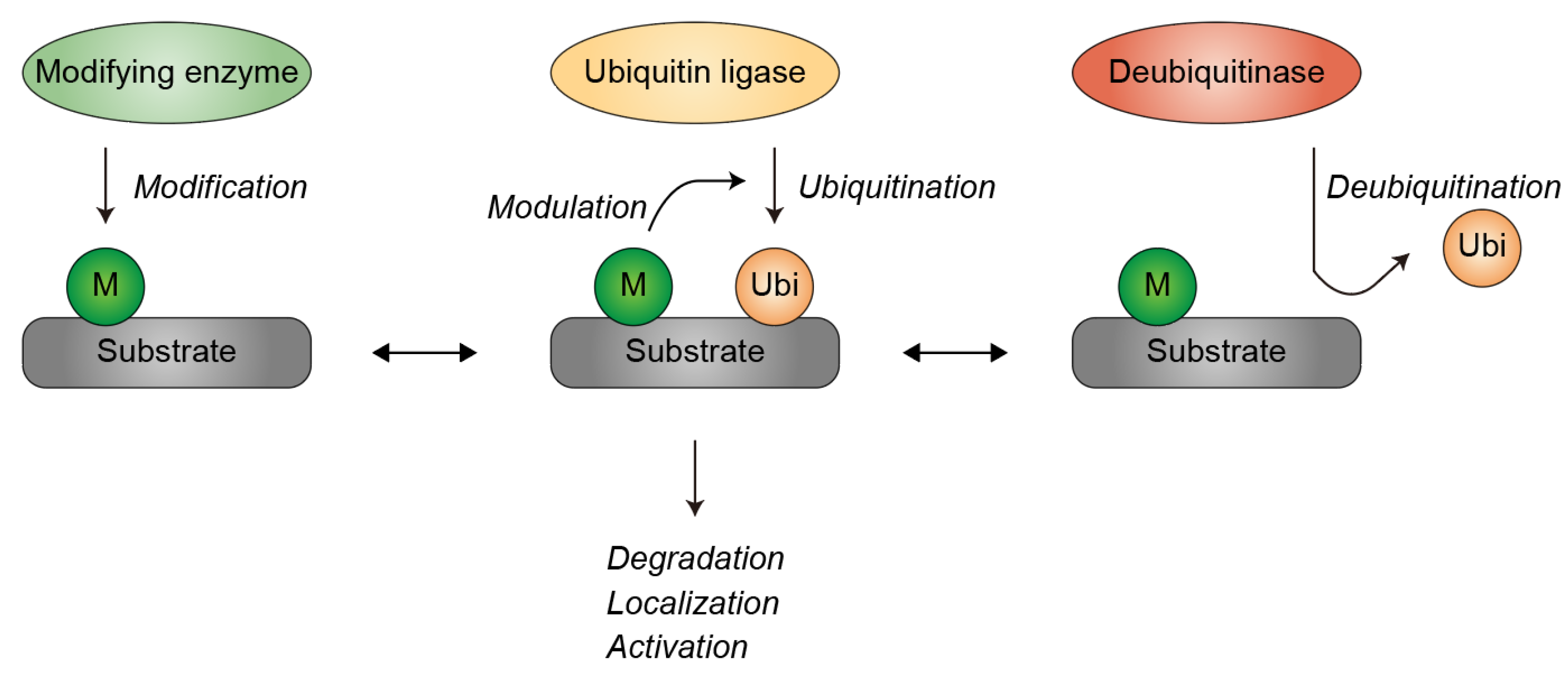
Figure 2.
Regulation of β-catenin ubiquitination by substrate phosphorylation, ubiquitin ligase, and deubiquitinases. GSK3 and CK1 phosphorylate β-catenin, thereby promoting its susceptibility to subsequent ubiquitination catalyzed by the CRL1 ubiquitin ligase complex containing β-TrCP as the substrate receptor (CRL1–β-TrCP). USP2a, USP4, USP6NL, and USP47 remove ubiquitin from β-catenin, thereby antagonizing ubiquitin-mediated degradation. Green indicates phosphate group or kinases. Yellow denotes ubiquitin or the CRL1–β-TrCP ubiquitin ligase complex. Red represents deubiquitinases. CRL1, Cullin-ring ubiquitin ligase 1. P, phosphate group. Ubi, ubiquitin.
Figure 2.
Regulation of β-catenin ubiquitination by substrate phosphorylation, ubiquitin ligase, and deubiquitinases. GSK3 and CK1 phosphorylate β-catenin, thereby promoting its susceptibility to subsequent ubiquitination catalyzed by the CRL1 ubiquitin ligase complex containing β-TrCP as the substrate receptor (CRL1–β-TrCP). USP2a, USP4, USP6NL, and USP47 remove ubiquitin from β-catenin, thereby antagonizing ubiquitin-mediated degradation. Green indicates phosphate group or kinases. Yellow denotes ubiquitin or the CRL1–β-TrCP ubiquitin ligase complex. Red represents deubiquitinases. CRL1, Cullin-ring ubiquitin ligase 1. P, phosphate group. Ubi, ubiquitin.
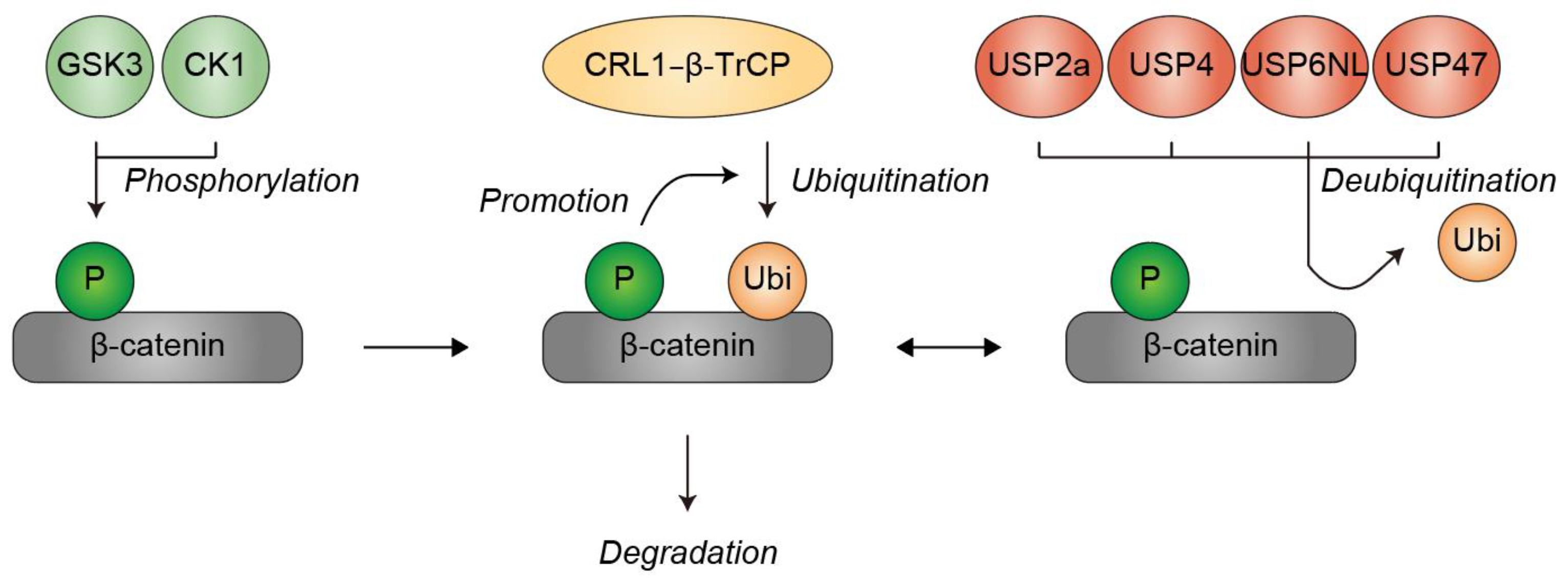
Figure 3.
Regulation of MeCP2 ubiquitination by substrate phosphorylation, ubiquitin ligases, and a deubiquitinase. HIPK2 and an unidentified kinase phosphorylate MeCP2 within PEST degrons, likely enhancing its susceptibility to subsequent ubiquitination catalyzed by RNF4, NEDD4, HERC2, and the CRL4 ubiquitin ligase complex containing DCAF13 as the substrate receptor (CRL4–DCAF13). USP15 removes ubiquitin from MeCP2, thereby antagonizing ubiquitin-mediated degradation. Green indicates phosphorylation events or kinases. Yellow denotes ubiquitin or the ubiquitin ligases. Red represents a deubiquitinase USP15. CRL4, Cullin–RING ubiquitin ligase 4. P, phosphate group; Ubi, ubiquitin.
Figure 3.
Regulation of MeCP2 ubiquitination by substrate phosphorylation, ubiquitin ligases, and a deubiquitinase. HIPK2 and an unidentified kinase phosphorylate MeCP2 within PEST degrons, likely enhancing its susceptibility to subsequent ubiquitination catalyzed by RNF4, NEDD4, HERC2, and the CRL4 ubiquitin ligase complex containing DCAF13 as the substrate receptor (CRL4–DCAF13). USP15 removes ubiquitin from MeCP2, thereby antagonizing ubiquitin-mediated degradation. Green indicates phosphorylation events or kinases. Yellow denotes ubiquitin or the ubiquitin ligases. Red represents a deubiquitinase USP15. CRL4, Cullin–RING ubiquitin ligase 4. P, phosphate group; Ubi, ubiquitin.
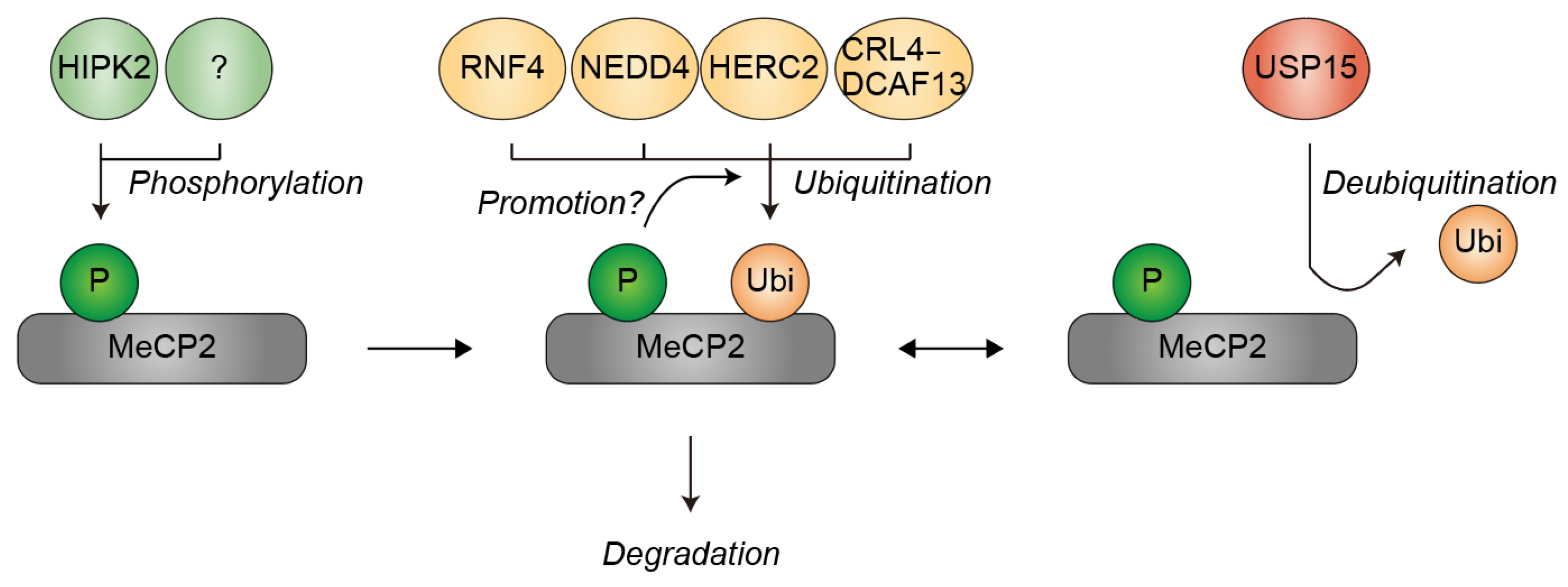
Figure 4.
Regulation of SHANK3 ubiquitination by substrate phosphorylation, ubiquitin ligase(s), and a deubiquitinase. ERK2 phosphorylates SHANK3, thereby enhancing its susceptibility to subsequent ubiquitination catalyzed by currently unidentified ubiquitin ligase(s). USP8 removes ubiquitin from SHANK3, thereby antagonizing ubiquitin-mediated degradation. Green indicates phosphorylation events or kinases. Yellow denotes ubiquitin or ubiquitin ligases. Red represents the deubiquitinase USP8. P, phosphate group; Ubi, ubiquitin.
Figure 4.
Regulation of SHANK3 ubiquitination by substrate phosphorylation, ubiquitin ligase(s), and a deubiquitinase. ERK2 phosphorylates SHANK3, thereby enhancing its susceptibility to subsequent ubiquitination catalyzed by currently unidentified ubiquitin ligase(s). USP8 removes ubiquitin from SHANK3, thereby antagonizing ubiquitin-mediated degradation. Green indicates phosphorylation events or kinases. Yellow denotes ubiquitin or ubiquitin ligases. Red represents the deubiquitinase USP8. P, phosphate group; Ubi, ubiquitin.
Disclaimer/Publisher’s Note: The statements, opinions and data contained in all publications are solely those of the individual author(s) and contributor(s) and not of MDPI and/or the editor(s). MDPI and/or the editor(s) disclaim responsibility for any injury to people or property resulting from any ideas, methods, instructions or products referred to in the content. |
© 2026 by the authors. Licensee MDPI, Basel, Switzerland. This article is an open access article distributed under the terms and conditions of the Creative Commons Attribution (CC BY) license (http://creativecommons.org/licenses/by/4.0/).
Copyright: This open access article is published under a Creative Commons CC BY 4.0 license, which permit the free download, distribution, and reuse, provided that the author and preprint are cited in any reuse.


