

Submitted:
16 March 2026
Posted:
17 March 2026
You are already at the latest version
Abstract
The genus Acanthosaura is characterized by a high level of cryptic species diversity and is subdivided into several species complexes. The phylogenetic relationships within the A. coronata complex remain unresolved due to the presence of cryptic lineages and limited molecular data for several species. In this study, these relationships are clarified using a molecular genetic analysis that integrates newly collected field samples and historical museum specimens with previously uncertain identification. Three mitochondrial genes (cyt b, COI, and ND2) from samples, including fresh collections of A. murphyi from Phu Yen Province (Vietnam) and museum specimens from Vietnam and Myanmar were ana-lyzed. In addition, morphological characters of the examined specimens with diagnostic traits of known species were compared. Phylogenetic analyses confirmed the distinct spe-cies status of A. murphyi and enabled the taxonomic reassignment of previously undeter-mined museum specimens to this species. Specimens from Vietnam and Myanmar formed a single, well-supported clade, suggesting a broader distribution for A. murphyi than previously recognized. It is demonstrated for the first time that A. murphyi belongs to the A. coronata complex, together with A. coronata and A. cuongi, a result consistently supported by both genetic distances and phylogenetic tree topology.
Keywords:
Agamidae
; Acanthosaura
; molecular analysis
; systematic
; phylogeny
; mitochondrial DNA
1. Introduction
The family Agamidae currently comprises 610 species belonging to 64 genera and 6 subfamilies [1]. The majority of agamid lizard species (293 species, i.e., 48%) belong to the subfamily Draconinae Fitzinger, 1843, which includes 33 recent genera of agamas. Conceptions of the phylogenetic and taxonomic diversity of dragonin agamids are constantly evolving. For instance, the genus Japalura sensu lato has long been recognized as paraphyletic based on several genetic sampling [2], however without taxonomic conclusions. Later, based on integrative multilocus and morphological analysis, the first phylogenetic inference of relationships among Japalura s.l. species was conducted [3]. The authors concluded that four major clades should be distinguished. There are 9 species of Japalura Gray, 1853 sensu stricto, and one of the most species-rich genera, Diploderma Hallowell, 1861, with 50 recognized species. They also described the genus Cristidorsa Wang, Che, Lin, Deepak, Datta-Roy, Jiang, Jin, Chen et Silver, 2018 with two species. Finally, J. bapoensis was referred to the genus Pseudocalotes Fitzinger, 1843. Genus Pseudocalotes (23 species), is polyphyletic and is represented by at least two distinct genera [4,5]. The species Pseudocalotes austeniana (Annandale, 1908), previously considered within this genus, was reassigned to Japalura [5]. A recent revision of the genus Phoxophrys Hubrecht, 1881 revealed to be paraphyletic and revalidated Pelturagonia Mocquard, 1890 for all Bornean species of this genus [6].
The genera of the subfamily Draconinae are continually being enriched with new species of agamas [5,7,8,9,10,11,12,13], including those considered extinct for centuries [14]. This is largely due to the active application of molecular methods, which allow for the identification of cryptic diversity within taxa. An ever-increasing number of species represents the genus Acanthosaura Gray, 1831. Some of them are cryptic species, for which it is often difficult to identify clear morphological differences [7,8,15], which has historically led to a number of problems in their systematic that can only be resolved using molecular methods.
Currently, the genus Acanthosaura Gray, 1831 comprises 22 recognized species [1], and is typically assigned to several species groups (complexes), in addition to some species with uncertain position for which molecular data are lacking [8]. Thus, 17 of 22 species were described in the 21st century, a period marked by expanded opportunities for new materials and the implementation of advanced molecular methods.
However, some problems also persist regarding a number of specimens examined using molecular methods, preventing a clear resolution of phylogenetic relationships within the groups and their composition. In 2004, two Acanthosaura specimens originating from an unknown locality in Myanmar were recorded [16]. Subsequent molecular analysis (cyt b gene) revealed their distinct phylogenetic position within an undefined group of Acanthosaura (the cysteine lineage) [16]. In 2020, new cyt b data for A. coronata allowed its placement within the cysteine lineage, together with the two Myanmar specimens and a misidentified A. crucigera isolate ROM37083 from Dong Nai, Cat Tien National Park, Vietnam [7]. In 2018, A. murphyi was described, showing genetic similarity (based on the COI marker) to the Acanthosaura specimen BGM01, which was preliminarily identified as A. capra (MK239022) [17]. In the phylogenetic tree based on COI, the A. murphyi occupies a similar sister position to A. coronata as the two Myanmar specimens in the cyt b tree [8]. Thus, resolving the taxonomic status and relationships of these lineages requires the examination of A. murphyi specimens using at least two genetic markers.
Historically, the grouping of A. capra, A. nataliae, and A. murphyi into a single complex was justified by their external morphological similarities [18]. Namely, all three species of the A. capra complex are large-sized agamids possessing only a single pair of postorbital spines, in contrast to the large species A. armata and other congeners, which have two pairs of spines (postorbital and nuchal or occipital). In this context, the isolated position of A. murphyi is particularly intriguing. Acanthosaura murphyi is a narrow-range endemic species currently known from areas east of the distribution range of A. capra in Vietnam, specifically in Hon Ba Nature Reserve, Khanh Hoa Province, and Ca Forest, bordering Phu Yen and Khanh Khoa provinces. This species has been recorded in more recent collections in Song Hinh Commune, Phu Yen Province, Vietnam.
This study aims to clarify the relationships within the A. coronata complex by conducting a more complete molecular genetic analysis of three genes (cyt b, COI and ND2) using newly obtained fresh material of A. murphyi, as well as museum specimens with disputed or uncertain identification.
2. Materials and Methods
2.1. Sample Collection
The following specimens were used in the molecular genetic analysis: three specimens of A. murphyi ILS H 2922-2924 (vouchers SH-016-018) newly collected from Song Hinh Commune, Phu Yen Province, Vietnam (2019); two historical specimens identified as A. capra ZMB 57526-27, Vietnam (collected by U. Manthey in 1997); two specimens identified as A. sp. A94, A95 (HLMD-RA2969-26970), from the pet trade in Myanmar, sequenced earlier [16]; and two samples of A. grismeri ZMMU R-11575.1 and R-11539. For several A. cuongi (vouchers KKK53, KKK55, KKK108-109, CMR88-90) and A. coronata (vouchers CTDN2, CTDN65, CTDN67, CTDN97, CTDN201, CTDN209) from our previous study [8], for which cyt b and COI sequences were available, ND2 sequences were also obtained. Other sequences of Acanthosaura, including data from our research [8], were downloaded from GenBank NCBI. The morphological characters of historical museum specimens were also examined for comparison with the diagnostic characters of A. murphyi.
2.2. Morphological Analysis
A set of characters was selected to ensure the maximum comparability of published data for all currently recognized species of the genus Acanthosaura. Comparative morphological data were taken from original descriptions and subsequent studies [8,17,19] including comprehensive summarized tables with data on all the species of the genus Acanthosaura [20]. All measurements were taken using dial calipers (in millimeter [mm]) to the nearest 0.1 mm; morphometrics followed Nguyen et al. [17] and Ananjeva et al. [7].
2.3. Molecular Analysis
Tissue samples consisted of muscle and skin fragments, which were collected from the examined specimens using sterile instruments and preserved in 70% ethanol. Prior to DNA extraction, the samples were air-dried to remove ethanol and homogenized in lysis buffer. DNA was extracted using the Biolabmix DU-250 kit (Biolabmix, Novosibirsk, Russia). DNA concentration was measured using a Micro Spectrophotometer Nano-500 (Allsheng Instruments, Hangzhou, China), and samples with a concentration of at least 10 ng/µl were selected for further analysis. Three mitochondrial gene fragments were used in the study: the cytochrome b gene (cyt b), the cytochrome c oxidase subunit I gene (COI), and the NADH dehydrogenase subunit 2 gene (ND2). The primers used are provided in Table 1.
The PCR reaction mixture (25 µl) contained 50–100 ng of DNA, 1 µM of each primer, 0.2 mM dNTPs, 1.5 mM MgCl₂, 2.5 µl of 10× PCR buffer (10 mM Tris-HCl, pH 8.3, 50 mM KCl), and two units of Taq polymerase (Master Mix, AlcorBio, Saint-Petersburg, Russia). The PCR protocol for amplifying the cytochrome c oxidase subunit I fragment (COI) included an initial denaturation step at 95°C for 15 min, followed by 34 cycles of denaturation at 95°C for 30 s, annealing at 56°C for 30 s, extension at 72°C for 1 min, and a final extension at 72°C for 5 min [21]. The protocol for cyt b included an initial denaturation at 95°C for 15 min, followed by 35 cycles of denaturation at 95°C for 30 s, annealing at 52°C for 30 s, extension at 72°C for 30 s, and a final extension at 72°C for 5 min [22]. The protocol for ND2 included step at 95°C for 15 min, followed by 35 cycles of denaturation at 95°C for 30 s, annealing at 52°C for 30 s, extension at 72°C for 30 s, and a final extension at 72°C for 5 min [23,24]. The PCR products were purified using the MagPure Gel Pure DNA Kit (Magen Biotech Co., Guangdong, China). Sequencing was performed on an ABI 3500 automated sequencer (Applied Biosystems) using the BigDye® Terminator v. 3.1 kit (Applied Biosystems) with the same primers used for amplification (Evrogen, Moscow, Russia). Sequences were deposited in GenBank NCBI under the accession numbers PZ027938-46 and PZ056157-77.
2.4. Phylogenetic Analysis
The obtained sequences were manually aligned using Chromas version 2.5.1 (Technelysium Pty Ltd., Australia). Individual gene alignments were then generated with MAFFT version 7.526 using the FFT-NS-2 strategy [25,26]. For Draconinae subfamily phylogeny analysis, the three genes (ND2, COI, cyt b) were concatenated according to their occurrence in the Acanthosaura lepidogaster mitogenome (KR092427). To reconstruct the phylogeny of the subfamily Draconinae, we used mitochondrial genome data. From these data, only the genes examined in our study were selected for alignment, concatenation, and phylogenetic inference. Following alignment, a maximum likelihood phylogeny was inferred with IQ-TREE 3.0.1 [27]. The best-fit substitution model was selected automatically by ModelFinder [28] according to the Bayesian Information Criterion (BIC). Branch support was assessed with 1000 ultrafast bootstrap (UFBoot) replicates and the Shimodaira-Hasegawa-like approximate likelihood ratio test (SH-aLRT). Finally, uncorrected p-distances were calculated with 1000 replicates in MEGA X [29] to estimate pairwise genetic divergence for sequences grouped by species and genus. Standard population genetic parameters for each gene were calculated in DnaSP version 6.12.03 [30].
3. Results
3.1. Phylogenetic Relationships
Phylogenetic analyses of the three mitochondrial genes recovered identical topologies with robust support for both nodes and branches (Figure 1A-C). The acanthosaurs examined in this study cluster into three well-supported clades based on the cyt b and ND2 genes, corresponding to the three species A. coronata, A. cuongi, and A. murphyi. The phylogeny based on COI, which includes several additional specimens not studied for the other two markers, reveals the existence of five clades. Three of these are identical to those in the cyt b and ND2 phylogenies, while the other two represents the branches corresponding to the recently described species A. grismeri (Le et al., 2025) and one sequence of A. capra [17] (Figure 1B).
The A. murphyi sequences we obtained (vouchers SH-016-18 and ZMB 57526-27) were placed within the A. murphyi clade in the COI phylogeny. In the cyt b phylogeny, they also formed a single clade with samples SK94-95 from Myanmar, which undoubtedly assigns them to A. murphyi. The ND2 phylogeny, represented exclusively by our samples, confirmed the separation of the A. murphyi clade. Two specimens from the ZMMU collections (vouchers R-11539 and ZMMU R-11575.1) belong to A. grismeri.
The calculated interspecific genetic distances based on COI revealed substantial p-distances between A. murphyi, A. coronata, and A. cuongi, ranging from 14.4% to 17.4% (Figure 1D). In contrast, the uncorrected p-distance between A. murphyi and A. capra was notably lower at 6.7%, while the divergence between A. coronata and A. grismeri was 8.4% (Figure 1D). The phylogeny based on the three concatenated mitochondrial genes recovered a consistent branching topology within the investigated species group (Figure 2A).
3.2. Morphology of Species from Acanthosaura coronata Complex
As previously mentioned, a significant discrepancy has been identified in the interpretation of the species complex composition, arising from contrasting morphological and molecular analyses. As a morphological group, all three species are large-sized with only one pair of postorbital spines, unlike the large species A. armata and other congeners, which have two pairs of spines (postorbital and nuchal or occipital). They can be distinguished from A. coronata, A. crucigera, A. lepidogaster, and other smaller species by the following highly visible characteristics: all of these large species have only one postorbital spine (superciliary), and no spine is present on the occiput between the tympanum and nuchal crest. A. murphyi is similar to A. nataliae and differs from A. capra in that it has small, weakly keeled scales intermixed with large, keeled scales on the lateral and dorsal surfaces of the body. It can be separated from A. nataliae by some minor pholidosis characters, including the number of scale rows between the nasal, as well as the rostral light bands on the tail. A. murphy also differs from A. nataliae in having more spines on the nuchal crest (8–9 vs. 5–6; [17,19]).
The same basic diagnostic features are evident in genotyped historical museum specimens (see Figure 3, Figure 4 and Figure 5). Some of them have postorbital spines that appear as bumps, while others have no spines at all. These spines can easily break off in acanthosaurs, so this must be taken into account when collecting and keeping of lizards or preservation and storing of specimens. All of them have the large body size: A94, male, body length 130.6; tail length 199.4; A95, female, body length 135.1; length 142.1 (broken); ZMB 57526 126. 0, tail length 172.7 мм; ZMB 57527 131. 9, 179.4 мм.
4. Discussion
The genus Acanthosaura Gray, 1831 includes 22 species recently [1], divided into several complexes of species. Two species, A. aurantiacrista Trivalairat, Kunya, Chanhome, Sumontha, Vasaruchapong, Chomngam et Chiangkul, 2020, and A. cardamomensis Wood, Grismer, Grismer, Neang, Chav et Holden, 2010, are represented only by ND2 sequences, while the others, A. bintangensis Wood, Grismer, Grismer, Ahmad, Onn et Bauer, 2009, A. meridiona Trivalairat, Sumontha, Kunya et Chiangkul, 2022, A. phuketensis Pauwels, Sumontha, Kunya, Nitikul, Samphanthamit, Wood et Grismer, 2015, and A. titiwangsaensis Wood, Grismer, Grismer, Ahmad, Onn et Bauer, 2009, lack any sequences in genetic databases, precluding definitive conclusions about their group assignments.
The other species of Acanthosaura are grouped into the following complexes according to molecular data [8]: 1) armata, which consists of A. armata (Gray, 1827), and A. tongbiguanensis Liu et Rao, 2019; 2) capra, which consists of A. capra Günther, 1861, and A. nataliae Orlov, Truong et Sang, 2006; 3) crucigera, which consists of A. crucigera Boulenger, 1885 and, possibly, A. liui Liu, Hou, Mo et Rao, 2020, 4) lepidogaster, which consists of A. lepidogaster (Cuvier, 1829), A. brachypoda Ananjeva, Orlov, Nguyen et Ryabov, 2011, and A. longicaudata Liu, Rao, Hou, Orlov, Ananjeva et Zhang, 2022; 5) phongdienensis, comprising A. phongdienensis Nguyen, Jin, Vo, Nguyen, Zhou, Che, Murphy et Zhang, 2019, and A. rubrilabris Liu, Rao, Hou, Orlov, Ananjeva et Zhang, 2022; 6) prasina, comprising a species A. prasina Ananjeva, Ermakov, Nguyen, Nguyen, Murphy, Lukonina et Orlov, 2020. The seventh, and most distant, compared to other acanthosaurs, group is the A. coronata complex, that includes (according to this study and our previous [8]) A. coronata Günther, 1861, A. cuongi Ngo, Le, Nguyen, Nguyen, Nguyen, Phan, Nguyen, Ziegler et Do, 2025, A. grismeri Le, Nguyen, Nguyen, Ziegler, Do et Ngo, 2025, and A. murphyi Nguyen, Do, Hoang, Nguyen, Mccormack, Nguyen, Orlov, Nguyen et Nguyen, 2018.
The molecular analysis showed that the topology of BI and ML phylogenetic trees constructed using three mitochondrial genes has a similar structure. The phylogeny based on the cytochrome c oxidase gene fragment (COI) yielded the best result for detection due to its highest representation in genetic databases. We supplemented the data for the rarest, yet most promising, ND2 gene for our agama species, which may allow for a slightly more accurate identification of cryptic species in the future.
Analysis of the mitophylogenies confirms the species status of A. murphyi. This allows us to identify historical museum specimens from ZMB and HLMD that were previously misidentified or in doubt. Our analysis revealed that this group comprises specimens from Central Vietnam, which forms the basis for the species description of A. murphyi. The group also encompasses recent specimens of A. murphyi from Song Hinh Commune in Phu Yen Province, Vietnam, as well as museum specimens from Vietnam that were previously categorized as A. cf. capra ([31], fig. RA00028-4, p. 21). Additionally, the group includes Acanthosaura specimens from Myanmar, for which the precise locality is unknown (Figure 3). This has enabled us to corroborate our previous hypothesis [8] that A. murphyi belongs to the same species group as A. coronata and A. cuongi – the A. coronata complex.
An unexpected finding is the paraphyly of A. capra, which is represented by two groups (species) on the phylogenetic tree. In addition to cyt b sequences of specimens related to A. nataliae and sister to A. lepidogaster (AY572873-86), there is also an A. capra sequence (MK239022) within the studied complex that are sister to A. murphyi. This particular specimen formed the basis for considering A. murphyi as part of the A. capra group, a conclusion that was substantiated in the original species description [17]. It is known that A. capra, which is close to the A. lepidogaster complex, was collected in Krong Pa and Tram Lap, Gia Lai Province, Vietnam, whereas the agama from the A. coronata complex was caught in Bu Gia Map National Park, Binh Phuoc Province, Vietnam. Hopefully, further research and sequencing of material from the terra typica will help determine which of these agamas belongs to the true A. capra.
5. Conclusions
This study provides a revision of the phylogenetic relationships within the Acanthosaura coronata complex, resolving long-standing ambiguities through an integrated molecular and morphological approach. Analysis of phylogeny based on three mitochondrial genes (cyt b, COI, and ND2) from both fresh field collections and historical museum specimens allow us to clarify the taxonomic status of several previously enigmatic lineages. Our phylogenetic analyses robustly confirm the distinct species status of A. murphyi and, for the first time, definitively place it within the A. coronata complex, alongside A. coronata and A. cuongi. This finding, consistently supported by tree topologies based on all three genetic markers and contradicts earlier morphological hypotheses that allied A. murphyi with A. capra.
The genetic data have enabled the taxonomic reassignment of historical museum specimens with uncertain or erroneous identifications. Specimens from the ZMB and HLMD collections, including those from Vietnam and an unknown locality in Myanmar, were unequivocally identified as A. murphyi. This expands the known distribution of A. murphyi considerably westward, suggesting it is not a narrow-range endemic but a more widely distributed species across central Vietnam and potentially into Myanmar. Our study also underscores the necessity of a multi-locus genetic framework for systematic revisions in Acanthosaura.
Author Contributions
Conceptualization, validation, methodology, supervision, project administration, funding acquisition, NBA and NLO; software, AOS and MIM; formal analysis, NBA, AOS and MIM; investigation, NBA, AOS, MIM, LNT; resources, NBA, NLO, LNT, OBM, MIM; data curation, NBA, NLO, OBM, MIM; writing—original draft preparation, NBA, MIM and AOS; writing—review and editing, NBA, MIM, LNT and AOS; visualization, AOS and MIM. All authors have read and agreed to the published version of the manuscript.
Funding
This research was partly supported by a grant of Russian Science Foundation No. RSF-VAST 24- 44-04004 (https://rscf.ru/project/24-44-04004) to NBA, NLO, OBM and MIM, and partly support by National Geographic Society (NGS-52753R-18) for LNT.
Institutional Review Board Statement
Not applicable.
Informed Consent Statement
Not applicable.
Data Availability Statement
Sequences were deposited in GenBank NCBI (https://www.ncbi.nlm.nih.gov/) under the accession numbers PZ027938-46 (COI), PZ056157-72 (ND2), and PZ056173-77 (cyt b).
Acknowledgments
We are grateful to F. Tillack, the Universität Humboldt, Zoologisches Museum, Berlin, Germany (ZMB) and V.F. Orlova, Zoological Museum of Moscow State University (ZMMU), Russia, for permission to examine specimens under their care. We sincerely thanks to S. N. Nguyen (Institute of Life Science, Ho Chi Minh City, Vietnam) (ILS H), for his generous support in accepting and curating the specimens at the institute, ensuring their availability for future research. ILS H samples are stored under his management. Luan Nguyen Thanh would like to sincerely thank Tim McCormack and Thang Tai Nguyen (Asian Turtle Program of Indo-Myanmar Conservation) for their institutional support and Phu Yen Department of Agriculture and Environment for fieldwork.
Conflicts of Interest
The authors declare no conflicts of interest. The funders had no role in the design of the study; in the collection, analyses, or interpretation of data; in the writing of the manuscript; or in the decision to publish the results.
Abbreviations
The following abbreviations are used in this manuscript:
| HLMD | Hessisches Landesmuseum Darmstadt, Germany |
| ILS H | Herpetological collection of the Institute of Life Sciences (ISL), Vietnam Academy of Science and Technology, Ho Chi Minh City, Vietnam |
| ZMB | Universität Humboldt, Zoologisches Museum, Invalidenstrasse 43, 10115 Berlin, Germany |
| ZMMU | Zoological Museum of Moscow State University, 125009 B. Nikitskaya 2, Moscow, Russia |
References
- Uetz, P.; Freed, P.; Aquilar, R.; Reyes, F.; Kudera, J.; Hosek, J. (Eds.) The Reptile Database. Available online: http://www.reptile-database.org (accessed on 10 February 2026).
- Macey, J.R.; Schulte, J.A., II; Larson, A.; Ananjeva, N.B.; Wang, Y.; Pethiyagoda, R.; Rastegar-Pouyani, N.; Papenfuss, T.J. Evaluating trans-Tethys migration: an example using acrodont lizard phylogenetics. Syst. Biol. 2000, 49, 233–256. [Google Scholar] [CrossRef] [PubMed]
- Wang, K.; Che, J.; Lin, S.; Deepak, V.; Aniruddha, D.-R.; Jiang, K.; Jin, J.; Chen, H.; Siler, C.D. Multilocus phylogeny and revised classification for mountain dragons of the genus Japalura s.l. (Reptilia: Agamidae: Draconinae) from Asia. Zool. J. Linn. Soc. 2018, 185, 246–267. [Google Scholar] [CrossRef]
- Shaney, K.J.; Maldonado, J.; Smart, U.; Thammachoti, P.; Fujita, M.; Hamidy, A.; Kurniawan, N.; Harvey, M.B.; Smith, E.N. Phylogeography of montane dragons could shed light on the history of forests and diversification processes on Sumatra. Mol. Phylogenet. Evol. 2020, 149, 106840. [Google Scholar] [CrossRef]
- Gowande, G.G.; Bhosale, H.S.; Phansalkar, P.U.; Sawant, M.; Mirza, Z.A. On the systematics and the phylogenetic position of the poorly known, montane dragon-lizard species Pseudocalotes austeniana (Annandale, 1908) (Squamata, Agamidae, Draconinae). Evol. Syst. 2021, 5, 141–150. [Google Scholar] [CrossRef]
- Harvey, M.B.; Larson, T.R.; Jacobs, J.L.; Shaney, K.; Streicher, J.W.; Hamidy, A.; Kurniawan, N.; Smith, E.N. Phoxophrys After 60 Years: Review of Morphology, Phylogeny, Status of Pelturagonia, and a New Species from Southeastern Kalimantan. Herpetol. Monogr. 2020, 33, 71–107, 37. [Google Scholar] [CrossRef]
- Ananjeva, N.B.; Ermakov, O.A.; Nguyen, S.N.; Nguyen, T.T.; Murphy, R.W.; Lukonina, S.A.; Orlov, N.L. A New Species of Acanthosaura Gray, 1831 (Squamata: Agamidae) from Central Highlands, Vietnam. Russ. J. Herpetol. 2020, 27, 217–230. [Google Scholar] [CrossRef]
- Ananjeva, N.B.; Matsiushova, M.I.; Svinin, A.O.; Bezman-Moseyko, O.S.; Nguyen, T.T.; Orlov, N.L. Unraveling Cryptic Diversity in Acanthosaura (Sauria: Squamata: Agamidae) Species Complexes in Vietnam: Research History and Current Status. Russ. J. Herpetol. 2025, 32, 211–232. [Google Scholar] [CrossRef]
- Honda, M.; Ota, H.; Kobayashi, M.; Nabhitabhata, J.; Yong, H.-S.; Hikida, T. Phylogenetic Relationships of the Flying Lizards, Genus Draco (Reptilia, Agamidae). Zool. Sci. 1999, 16, 535–549. [Google Scholar] [CrossRef]
- Huang, Y.; Li, H.; Wang, Y.; Li, M.; Hou, M.; Cai, B. Taxonomic review of the Calotes versicolor complex (Agamidae, Sauria, Squamata) in China, with description of a new species and subspecies. ZooKeys 2023, 1187, 63–89. [Google Scholar] [CrossRef]
- Ngo, H.N.; Le, L.T.H.; Nguyen, T.T.; Nguyen, T.M.; Nguyen, N.T.; Phan, T.Q.; Nguyen, T.Q.; Ziegler, T.; Do, D.T. A new species of Acanthosaura Gray, 1831 (Reptilia: Agamidae) from the Truong Son Mountain Range, Vietnam. Eur. J. Taxon. 2025, 976, 108–132. [Google Scholar] [CrossRef]
- Wood; Jr, P.L.; Grismer, L.L.; Grismer, J.L.; Neang, T.; Chav, T.; Holden, J. A new cryptic species of Acanthosaura Gray, 1831 (Squamata: Agamidae) from Thailand and Cambodia. Zootaxa 2010, 2488. [Google Scholar] [CrossRef]
- Xu, Y.; Gong, Y.; Hou, M.; Weng, S.; Liu, S.; Deng, J.; Hu, J.; Peng, L. A New Species of the Genus Pseudocalotes (Squamata: Agamidae) from Southwest Yunnan, China. Animals 2024, 14, 826. [Google Scholar] [CrossRef]
- Putra, C.A.; Thasun Amarasinghe, A.A.; Hikmatullah, D.; Scali, S.; Brinkman, J.J.; Manthey, U.; Ineich, I. Rediscovery of Modigliani’s nose-horned lizard, Harpesaurus modiglianii Vinciguerra, 1933 (Reptilia: Agamidae) after 129 years without any observation. Taprobanica 2020, 9, 3–11. [Google Scholar] [CrossRef]
- Liu, S.; Zhang, D.; Hou, M.; Orlov, N.L.; Rao, D.; Ananjeva, N.B.; Li, S. Taxonomic Assessment of Acanthosaura lepidogaster sensu lato (Reptilia: Agamidae) in China Through Extensive Sampling. Russ. J. Herp. 2023, 30, 127–143. [Google Scholar] [CrossRef]
- Kalyabina-Hauf, S.; Ananjeva, N.B.; Joger, U.; Lenk, P.; Murphy, R.W.; Stuart, B.L.; Orlov, N.L.; Ho, C.T.; Wink, M. Molecular Phylogeny of the Genus Acanthosaura (Agamidae). Curr. Herpetol. 2004, 23, 7–16. [Google Scholar] [CrossRef]
- Nguyen, L.T.; Do, D.T.; Hoang, H.V.; Nguyen, T.T.; McCormack, T.E.M.; Nguyen, T.Q.; Orlov, N.L.; Nguyen, V.D.H.; Nguyen, S.N. A New Species of the Genus Acanthosaura Gray, 1831 (Reptilia: Agamidae) from Central Vietnam. Rus. J. Herp. 2018, 25, 259. [Google Scholar] [CrossRef]
- Ananjeva, N.B.; Orlov, N.L.; Kalyabina-Hauf, S.A. Species of Acanthosaura Gray, 1831 (Agamidae: Sauria, Reptilia) of Vietnam: results of molecular and morphological study. Biol. Bull. 2008, 35, 178–186. [Google Scholar] [CrossRef]
- Orlov, N.L.; Nguyen, T.Q.; Nguyen, S.V. A new Acanthosaura allied to A. capra Günther, 1861 (Agamidae, Sauria) from central Vietnam and southern Laos. Rus. J. Herp. 2006, 13, 61–76. [Google Scholar] [CrossRef]
- Liu, S.; Rao, D. A new species of the genus Acanthosaura from Yunnan, China (Squamata, Agamidae). Zookeys 2019, 888, 105–132. [Google Scholar] [CrossRef]
- Abramson, N.I.; Petrova, T.V.; Dokuchaev, N.E.; Obolenskaya, E.V.; Lissovsky, A.A. Phylogeography of the gray red-backed vole Craseomys rufocanus (Rodentia: Cricetidae) across the distribution range inferred from nonrecombining molecular markers. Russ. J. Theriol. 2012, 11, 137–156. [Google Scholar] [CrossRef]
- Irwin, D.M.; Kocher, T.D.; Wilson, A.C. Evolution of the cytochrome b gene of mammals. J. Mol. Evol. 1991, 32, 128–144. [Google Scholar] [CrossRef]
- Macey, J.R.; Larson, A.; Ananjeva, N.B.; Papenfuss, T.J. Replication slippage may cause parallel evolution in the secondary structures of mitochondrial transfer RNAs. Mol. Biol. Evol. 1997, 14, 30–39. [Google Scholar] [CrossRef]
- McGuire, J.A.; Heang, K.B. Phylogenetic systematics of Southeast Asian flying lizards (Iguania: Agamidae: Draco) as inferred from mitochondrial DNA sequence data. Biol. J. Linn. Soc. 2001, 72, 203–229. [Google Scholar] [CrossRef]
- Katoh, K. MAFFT: a novel method for rapid multiple sequence alignment based on fast Fourier transform. Nucleic Acids Res. 2002, 30, 3059–3066. [Google Scholar] [CrossRef] [PubMed]
- Katoh, K.; Standley, D.M. MAFFT Multiple Sequence Alignment Software Version 7: Improvements in Performance and Usability. Mol. Biol. Evol. 2013, 30, 772–780. [Google Scholar] [CrossRef] [PubMed]
- Nguyen, L.-T.; Schmidt, H.A.; Von Haeseler, A.; Minh, B.Q. IQ-TREE: A Fast and Effective Stochastic Algorithm for Estimating Maximum-Likelihood Phylogenies. Mol. Biol. Evol. 2015, 32, 268–274. [Google Scholar] [CrossRef] [PubMed]
- Kalyaanamoorthy, S.; Minh, B.Q.; Wong, T.K.F.; Von Haeseler, A.; Jermiin, L.S. ModelFinder: fast model selection for accurate phylogenetic estimates. Nat. Methods 2017, 14, 587–589. [Google Scholar] [CrossRef]
- Kumar, S.; Stecher, G.; Li, M.; Knyaz, C.; Tamura, K. MEGA X: Molecular Evolutionary Genetics Analysis across Computing Platforms. Mol. Biol. Evol. 2018, 35, 1547–1549. [Google Scholar] [CrossRef]
- Rozas, J.; Ferrer-Mata, A.; Sánchez-DelBarrio, J.C.; Guirao-Rico, S.; Librado, P.; Ramos-Onsins, S.E.; Sánchez-Gracia, A. DnaSP 6: DNA Sequence Polymorphism Analysis of Large Data Sets. Mol. Biol. Evol. 2017, 34, 3299–3302. [Google Scholar] [CrossRef]
- Manthey, U. Agamid Lizards of Southern Asia Draconinae 1. In Terralog; Frankfurt am Main/Rodgau 2008: Edition Chimaira/Verlag ACS GmbH (AQUALOG), 2008; Vol 7a, pp. 1–161. [Google Scholar]
Figure 1.
Phylogenetic reconstruction of the Acanthosaura coronata species group based on three mitochondrial gene fragments. The cytochrome b tree (A) was inferred under the TPM3u+F+G4 model, with branch support assessed using UFBoot/SH-aLRT replicates (1000 replicates each). The COI tree (B) was obtained from an alignment of 545 bp (188 parsimony-informative sites) under the best-fit model TIM3+F+G4; support values are likewise based on 1000 UFBoot/SH-aLRT replicates. The ND2 tree (C) was reconstructed under the TN+F+G4 model from an alignment of 1032 bp (358 parsimony-informative sites). The heat map (D) represents uncorrected p-distances between mitochondrial haplotypes, illustrating levels of genetic divergence within and between putative species of the A. coronata complex. Our A. brachypoda sequences used as the outgoups.
Figure 1.
Phylogenetic reconstruction of the Acanthosaura coronata species group based on three mitochondrial gene fragments. The cytochrome b tree (A) was inferred under the TPM3u+F+G4 model, with branch support assessed using UFBoot/SH-aLRT replicates (1000 replicates each). The COI tree (B) was obtained from an alignment of 545 bp (188 parsimony-informative sites) under the best-fit model TIM3+F+G4; support values are likewise based on 1000 UFBoot/SH-aLRT replicates. The ND2 tree (C) was reconstructed under the TN+F+G4 model from an alignment of 1032 bp (358 parsimony-informative sites). The heat map (D) represents uncorrected p-distances between mitochondrial haplotypes, illustrating levels of genetic divergence within and between putative species of the A. coronata complex. Our A. brachypoda sequences used as the outgoups.
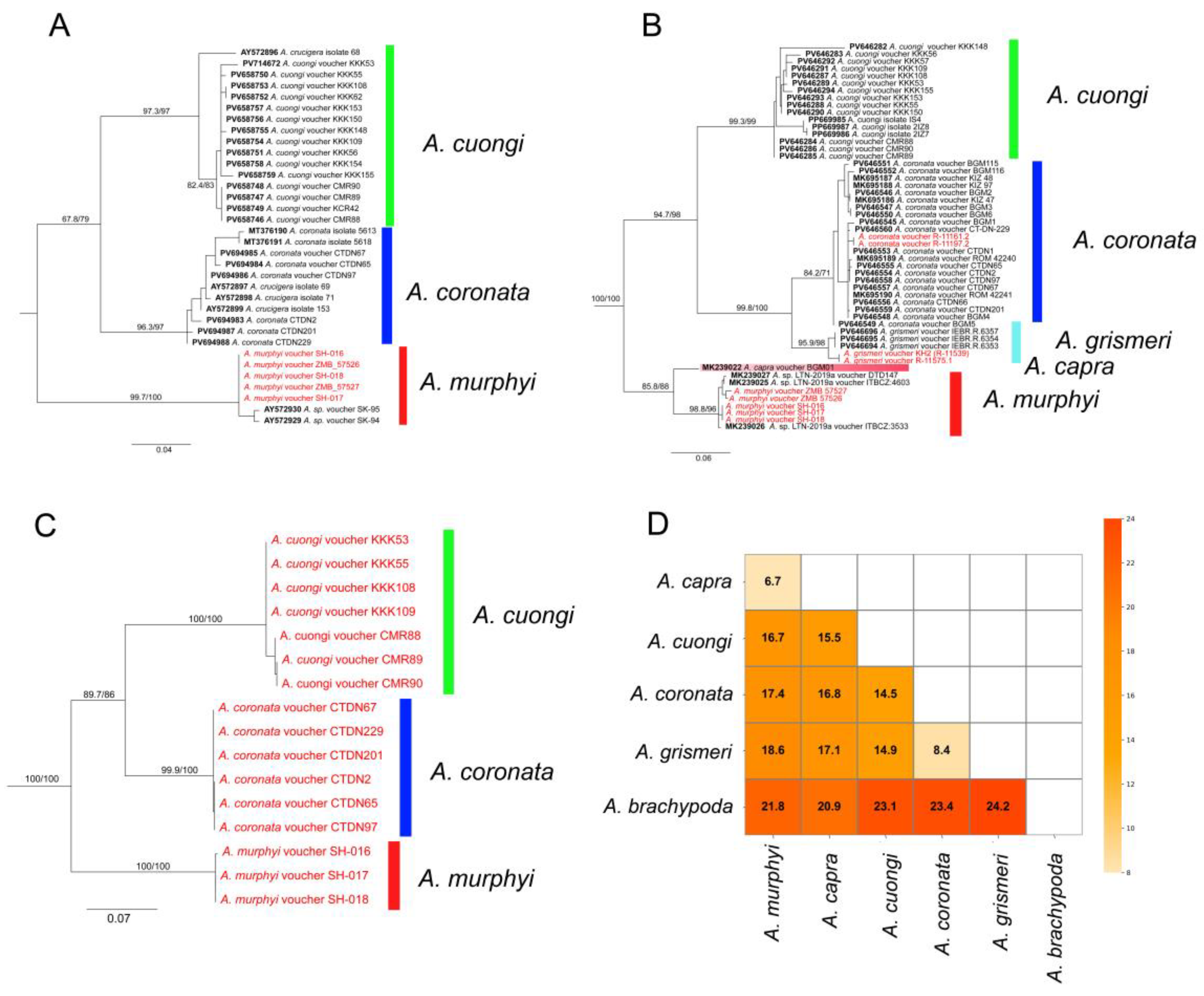
Figure 2.
Phylogenetic reconstruction of the subfamily Draconinae based on three concatenated mitochondrial gene fragments (ND2, COI, cyt b). The mitochondrial tree was inferred from an alignment of 1935 bp (1214 parsimony-informative sites) under the best-fit model GTR+F+I+G4, with branch support assessed using UFBoot/SH-aLRT replicates (1000 replicates each). The three genes (ND2, COI, cyt b) were concatenated according to their occurrence in the Acanthosaura lepidogaster mitogenome (KR092427). Node support values below 70% are indicated by white circles with black outlines, while values above 90% are shown in black.
Figure 2.
Phylogenetic reconstruction of the subfamily Draconinae based on three concatenated mitochondrial gene fragments (ND2, COI, cyt b). The mitochondrial tree was inferred from an alignment of 1935 bp (1214 parsimony-informative sites) under the best-fit model GTR+F+I+G4, with branch support assessed using UFBoot/SH-aLRT replicates (1000 replicates each). The three genes (ND2, COI, cyt b) were concatenated according to their occurrence in the Acanthosaura lepidogaster mitogenome (KR092427). Node support values below 70% are indicated by white circles with black outlines, while values above 90% are shown in black.
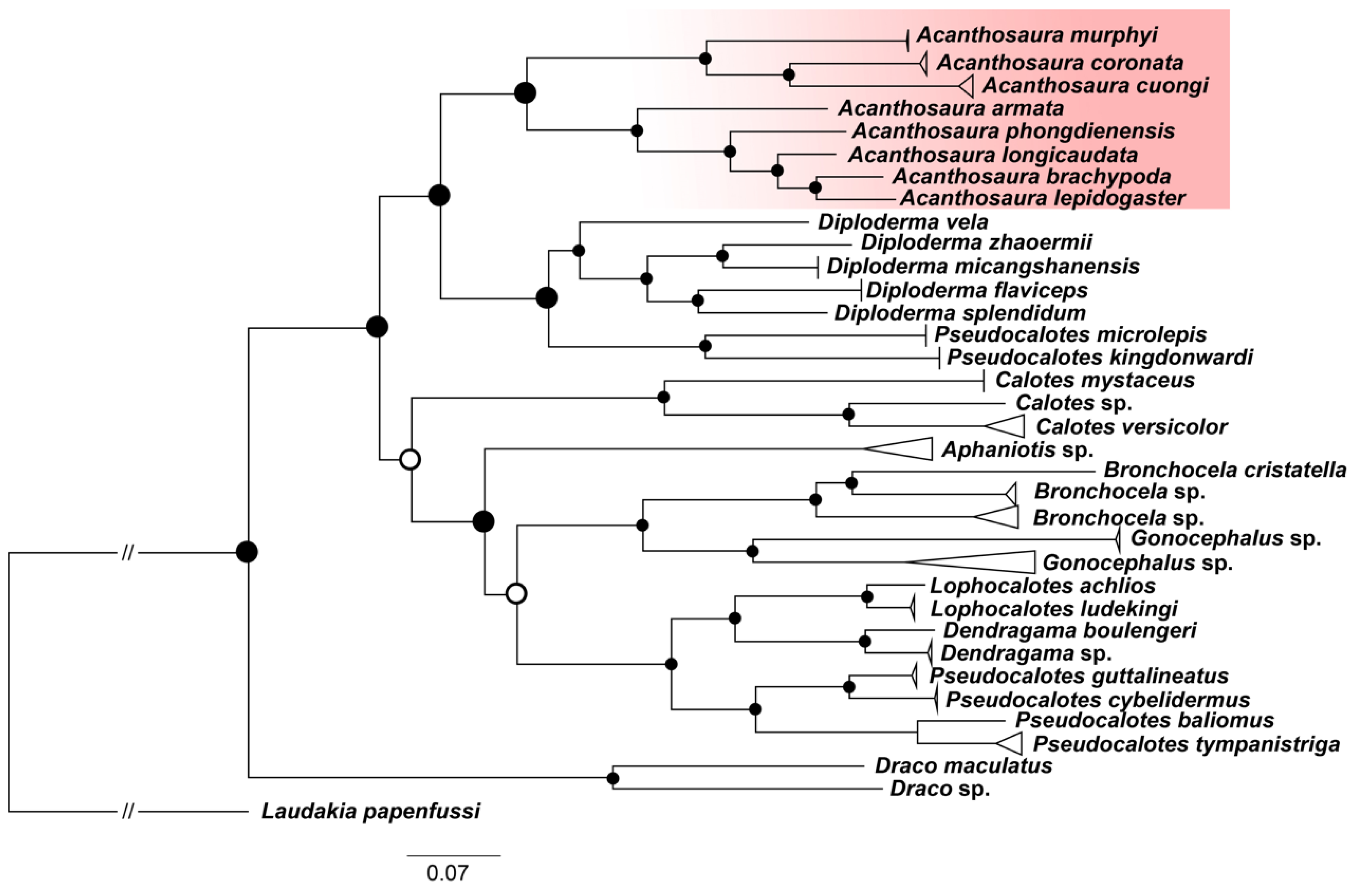
Figure 3.
Specimens of Acanthosaura murphyi. SK-94 and SK-95 (HLMD-RA2969-26970) from Myanmar [16].
Figure 3.
Specimens of Acanthosaura murphyi. SK-94 and SK-95 (HLMD-RA2969-26970) from Myanmar [16].
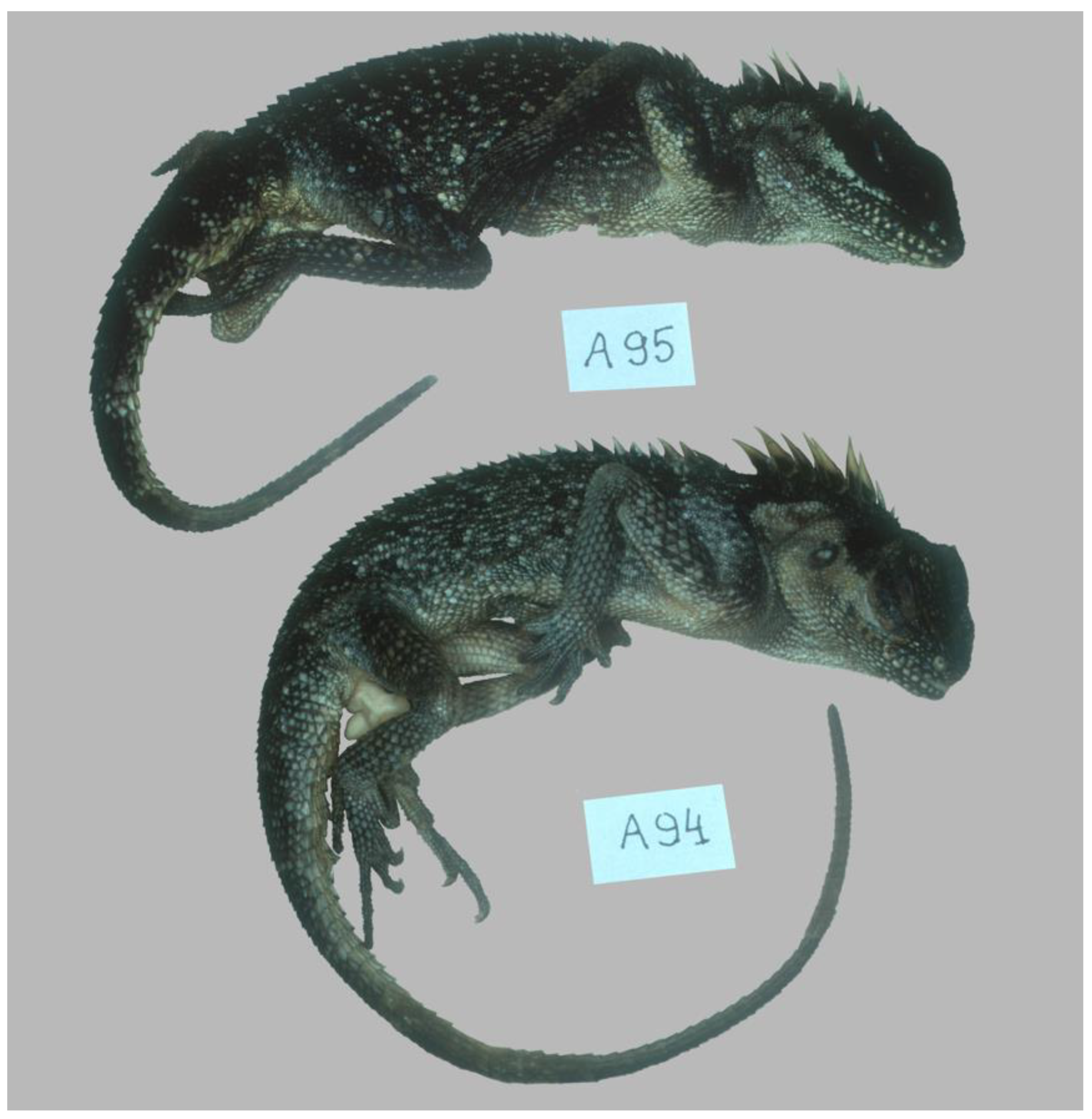
Figure 4.
A. murphyi specimens in the wild: left, specimen with ILS H 2923 (voucher SH-016) from Song Hinh Commune, Phu Yen Province, Vietnam (2019); right, specimen with voucher ZMB 57527 from Vietnam (collected by U. Manthey in 1997).
Figure 4.
A. murphyi specimens in the wild: left, specimen with ILS H 2923 (voucher SH-016) from Song Hinh Commune, Phu Yen Province, Vietnam (2019); right, specimen with voucher ZMB 57527 from Vietnam (collected by U. Manthey in 1997).
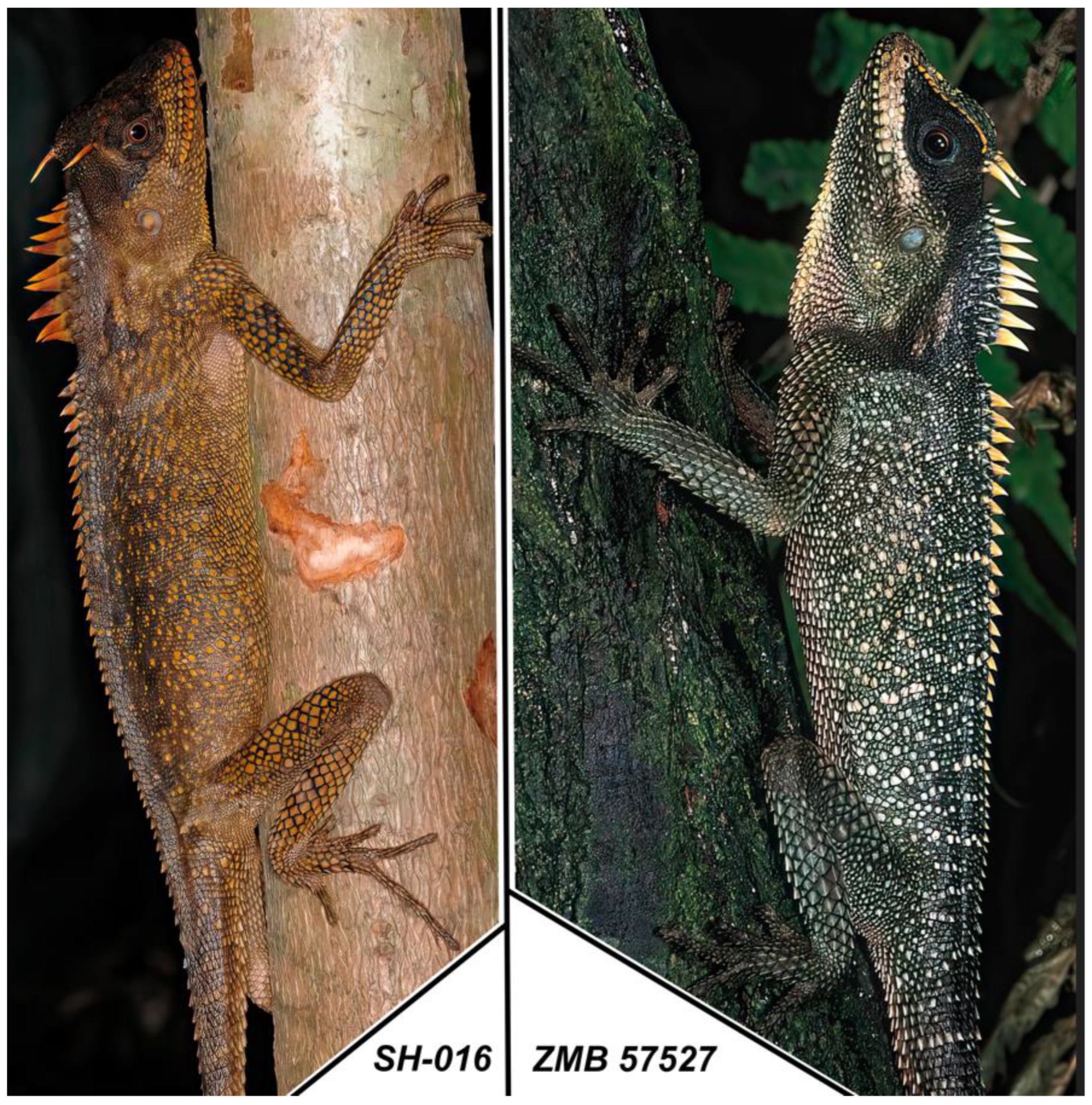
Figure 5.
General view of A. murphyi specimens after preservation: top, specimen with ILS H 2923 (voucher SH-016) from Song Hinh Commune, Phu Yen Province, Vietnam (2019); bottom, specimen with voucher ZMB 57527 from Vietnam (collected by U. Manthey in 1997).
Figure 5.
General view of A. murphyi specimens after preservation: top, specimen with ILS H 2923 (voucher SH-016) from Song Hinh Commune, Phu Yen Province, Vietnam (2019); bottom, specimen with voucher ZMB 57527 from Vietnam (collected by U. Manthey in 1997).
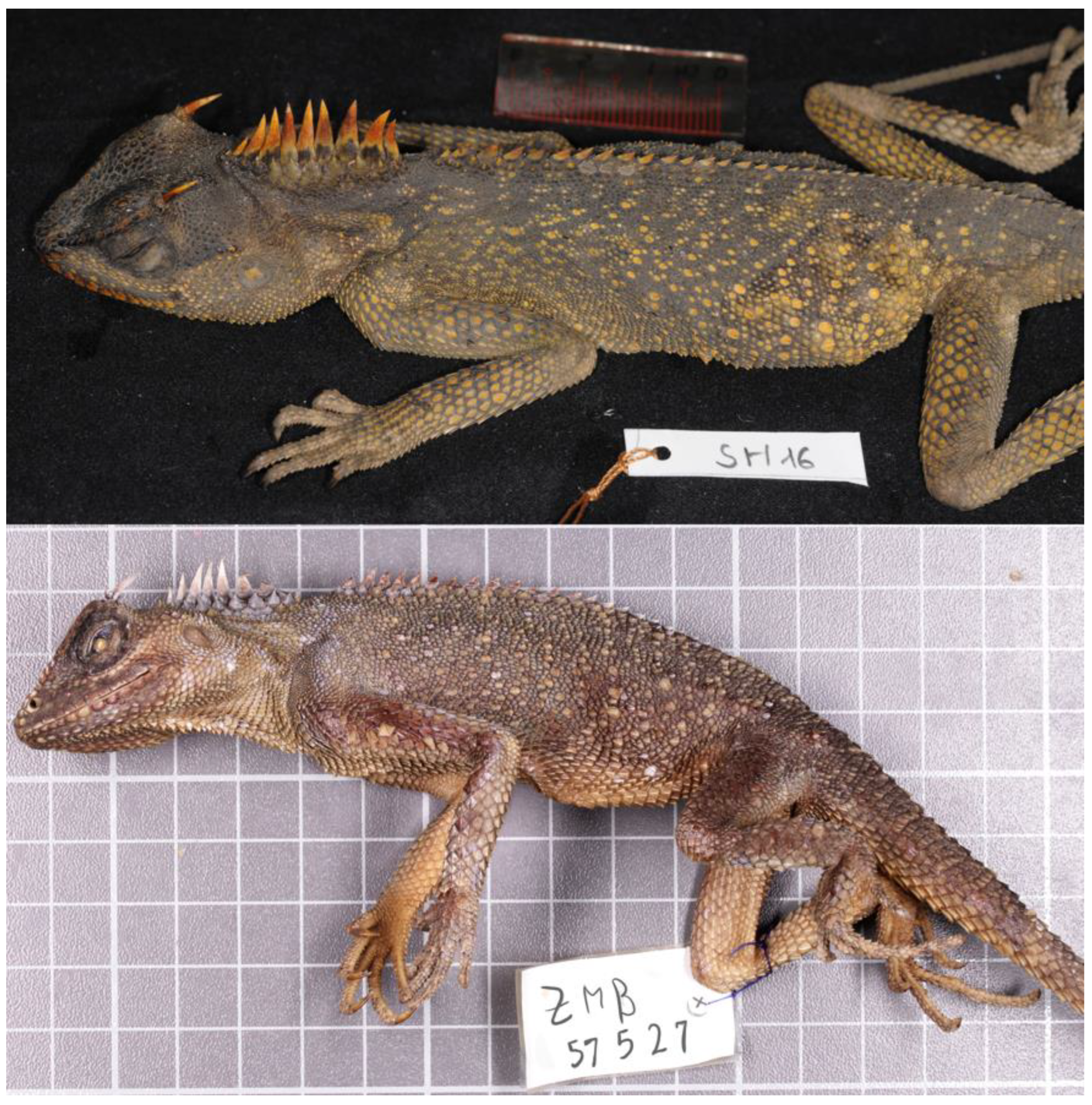

Table 1.
Primers used for the amplification and sequencing of mitochondrial DNA loci in the Acanthosaura species examined.
Table 1.
Primers used for the amplification and sequencing of mitochondrial DNA loci in the Acanthosaura species examined.
| Locus | Primer name | Sequence (5’ – 3’) | Reference |
| COI | VUTF | TGTAAAACGACGGCCAGTTCTCAACCAAYCAYAARGAYATYGG | [21] |
| VUTR | CAGGAAACAGCTATGACTARACTTCTGGRTGKCCRAARAAYCA | ||
| cyt b | L14841 | CCATCCAACATCTCAGCATGATGAAA | [22] |
| H151495 | GCCCCTCAGAATGATATTTGTCCTCA | ||
| ND2 | METF6 | AAGCTTTCGGGCCCATACC | [23,24] |
| ALAr.2m | AAAGTGTCTGAGTTGCATTCRG |
Disclaimer/Publisher’s Note: The statements, opinions and data contained in all publications are solely those of the individual author(s) and contributor(s) and not of MDPI and/or the editor(s). MDPI and/or the editor(s) disclaim responsibility for any injury to people or property resulting from any ideas, methods, instructions or products referred to in the content. |
© 2026 by the authors. Licensee MDPI, Basel, Switzerland. This article is an open access article distributed under the terms and conditions of the Creative Commons Attribution (CC BY) license (http://creativecommons.org/licenses/by/4.0/).
Copyright: This open access article is published under a Creative Commons CC BY 4.0 license, which permit the free download, distribution, and reuse, provided that the author and preprint are cited in any reuse.