

Submitted:
16 March 2026
Posted:
16 March 2026
You are already at the latest version
Abstract
This systematic literature review aims to first, explore the influence of remote work on occupational health and safety, in terms of mental and physical health and second, to shed light on best practices that can be adopted to improve the health and safety of employees working remotely. Twenty-four (24) peer-reviewed articles published from 2020 to 2024, were selected through the preferred reporting items for systematic reviews and meta-analyses (PRISMA) guidelines. The review identified four themes, namely–positive impact of remote work; negative impact of remote work; challenges associated with remote work, and best practices for effective remote work practices. Findings from the study revealed that the impact of remote work on OHS was mixed. Eight (8) papers found that remote employees performed better in their OHS, whereas 18 papers found the opposite. The most dominant health disorders reported were depression, stress, anxiety and musculoskeletal pain. In contrast, the study identified that vertical trust levels and job design that considers physical and psychosocial aspects of the job can enhance safety while working remotely. Remote workers are encouraged to follow ergonomics best practices, take regular breaks during work to stretch and move around to reduce musculoskeletal disorders.
Keywords:
workplace
; safety
; remote work
; telecommuting
; occupational health
1. Introduction
The exposure of workers to various hazards without adequate protection remains nerve-wracking and a major threat to employees' health and safety [1]. Health, as defined by the World Health Organization (WHO) is the overall physical, mental and social well-being, that goes beyond the absence of disease or infirmity [2]. Currently, the health and safety of employees have been questioned in the new working models businesses have now embraced. The global health emergency triggered by the COVID-19 pandemic has propelled many businesses to implement fundamental changes and promote new work models, including remote working [3]. Remote work embraces the concept of "flexplace", referring to policies allowing employees to perform their work from outside the physical workplace [4].
A global workplace statistics by Owl Labs [5] indicates that remote employment has seen a swift rise in popularity, with remote job opportunities expanding by over 1100% since mid-2021. It further reveals that telecommuters tend to be more efficient than their office-based colleagues, attributed to reduced distractions, enhanced job satisfaction, and increased schedule flexibility. The proportion of work conducted at home surged from 4.7% in January 2019 to 61% in May 2020 [5]. An impressive 83% of the global workforce regards hybrid work as the ideal arrangement. Since 2021, the number of individuals opting for remote work has risen by 24%, with those preferring hybrid arrangements increasing by 16%. Around 59% of employees would likely opt for an employer that provides remote work options over one that does not.
It has been documented that remote working offers several benefits, including good work-life balance [6], employee autonomy and control of the environment [7], job crafting and a positive work schedule [8], flexibility, and self-responsibility [3]. Despite these numerous benefits, mental issues, musculoskeletal problems, burnout, indoor environmental problems, isolation, insomnia, stress, depression, and anxiety are some OHS problems that characterize remote work [9,10,11,12,13,14]. Amidst these competing views and findings from prior research, there is the need to re-examine the literature by taking a holistic view of research papers in this field.
Although a systematic literature review on the relationship between remote work and OHS, particularly in a post-pandemic exists [15,16], there are still eminent gaps in the literature. First, while extant studies have largely focused on work-life balance, mental issues and work productivity [15,17], physical well-being impacts have attracted less attention, particularly in a post-pandemic era [18]. Accordingly, this study incorporates the physical health impacts in addition to the mental health impacts of remote work in the systematic review to address the first research question: RQ1: What is the influence of remote work on occupational health and safety, in terms of mental and physical health?
Second, extant systematic review studies [15,16,17,19,20,21,22] have largely neglected a review on best practices that can be adopted to improve the health and safety of employees working remotely. They have extensively focused on the risks associated with remotely work with limited focus on how best remote work can be promoted against adverse health implications. Accordingly, the study addresses the second research question: RQ2: What best practices can be adopted to improve the health and safety of employees working remotely? Considering that most practices to improve health and safety among employees are related to onsite work environment, which may not apply to employees working remotely, this study also sheds light on best practices that can be adopted to improve the health and safety of employees working remotely.
2. Methods
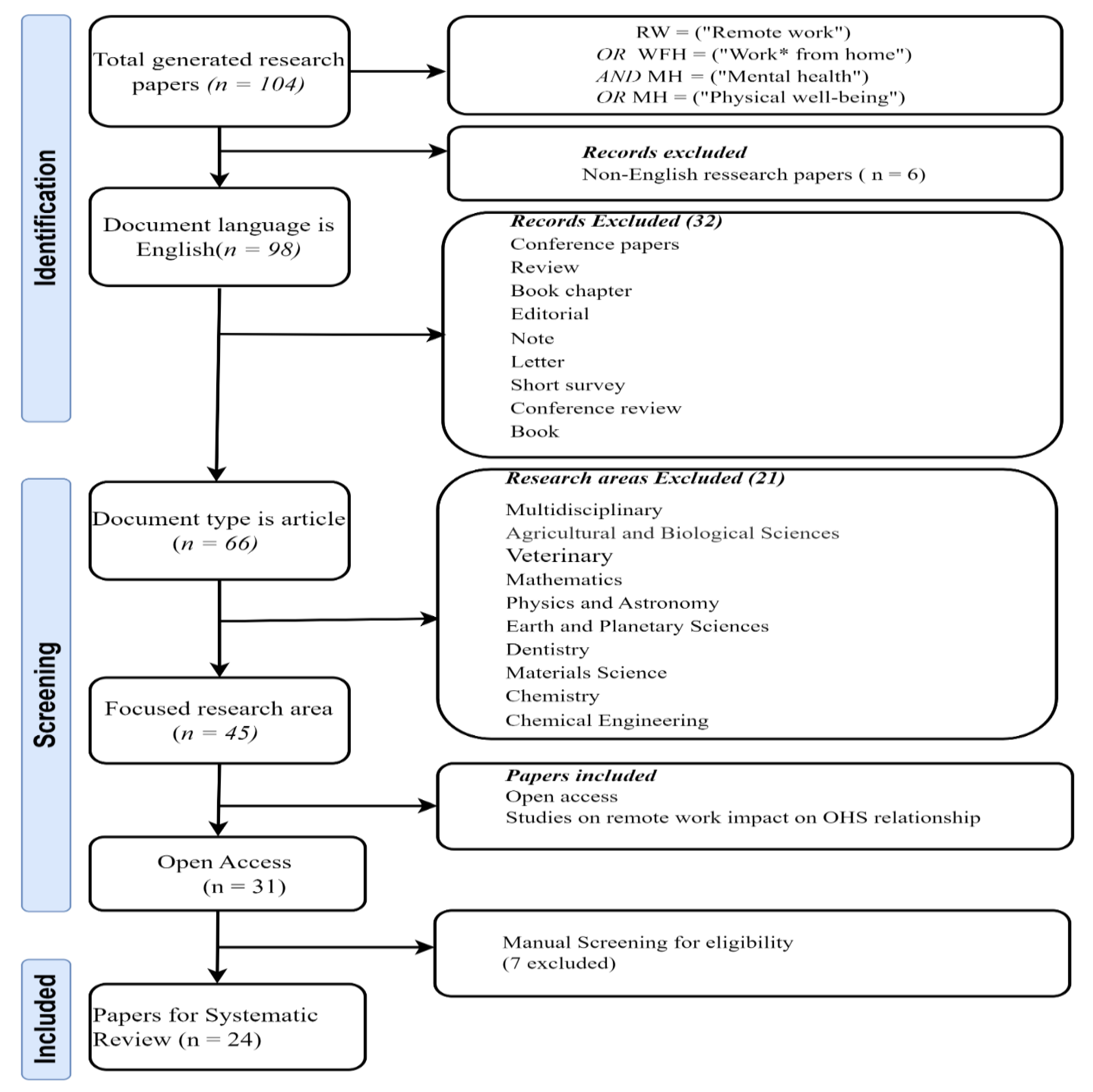
This research scope is centered on remote work and Occupational Health and Safety (OHS). On the part of OHS, this study extensively focuses on mental health and physical well-being. Papers published between 2020 and 2024 were selected from Scopus, Google Scholar database and Science Direct. This sourcing strategy is consistent with existing literature search strategy in OHS studies [21,23,24,25,26,27]. The Table 1 below depicts a sample search strategy employed on remote work and occupational health and safety. The final sample included only open access articles to ensure that easily accessible and frequently read articles are included in the review. We also performed manual screening to remove unrelated articles and articles beyond the scope of OHS.
Figure 1.
PRISMA diagram.
3. Results
The study deduced four themes from the literature review. These are (1) Positive impact of remote work; (2) Negative impact of remote work; (3) Challenges associated with remote work;(4) Best practices for effective remote work practices. Table 2 has the details of all the articles reviewed with related themes. Figure 2 and Figure 3 also report the article distribution by various themes identified in the review and the distribution of mental health problems respectively.
Out of the 24 reviewed articles, 5 (20.8%) discussed that remote work offers some benefits. For instance, Serafim et al. (2024) indicated that remote work reduces depression, mitigates post-traumatic stress and improve quality of life than those who worked in offices [28]. Emmerich et al. (2024) observed in their study that people show positive attitude towards working from home and found also that working from home reduces stress, good work–life balance and good control over working hours [6]. In the same vein, remote work was found to improve mental health and emotional health [29]. Additionally, people who worked from home were associated with an improved affective well-being and individual health [30,31].
Furthermore, out of the 24 articles, as large as 18 (75.0%) reported adverse health consequence of remote work. For instance, it was found that remote work increases depression, stress and anxiety [10,12,32,36,37,42,44,45,46], demoralization [45]; lower job satisfaction [41]; insomnia [13,42]; concentration loss; short temper, weight gain, nutrition problem, food habit change [42]; musculoskeletal pain [12]. It also breeds feelings of isolation, loneliness and lack of social support [6,32]; fear and fatigue [32]. A critical analysis revealed that the negative impact of working from home on workers' mental health, increases especially for women and those who are primarily responsible for household chores while working [7]. Figure 3 illustrates the distribution of mental health problems associated with remote work, as reported in the reviewed articles.
Fast-forward, remote work, also comes with its own challenges as 3 (12.5%) observed several challenges. Oakman et al. (2023) highlighted interruption as a major challenge. They found that employees inability to find a location to work without interruptions leads to higher stress and musculoskeletal pain levels than those who had access to a separate room [12]. Similarly, Galanti et al. (2021) found that remote work is characterized by distracting work environment, family-work conflict and social isolation, which in turns reduce work from home productivity [35].
To overcome these challenges, 7 (29.20%) papers have discussed some best practices for effective remote work practices. Oakman et al. (2023) identified that higher vertical trust levels and job design that considers physical and psychosocial aspects of the job can enhance safety while working remotely [12]. Maulana et al. (2023) found that the use of text-based online intervention as a psychological support reduces the adverse consequence of working from home and promote work-life balance [40]. In terms of preparing employees for remote work, providing mindfulness training can help them manage the stress and anxiety that comes with working remotely [36]. Moreover, it has been proposed that access to natural spaces may improve employees’ work engagement and counteract the negative effects of techno stress, especially during periods of intensive remote working [34]. Additionally, both job autonomy and self-leadership are effective mechanisms for work engagement, which in furtherance improve work-from-home productivity [35]. Griep et al. (2022) found that one best practice for remote is to exercise Work-Time Control (WTC). They explained that controlling daily work schedules can improve working conditions, protect against mental distress, and foster work-life balance for those who work from home [37]. Shockingly, Hyung Kim et al. (2023) found that employees who live at home with children do not suffer from the negative effects of working from home. This implies that the interaction between family and work may be essential in the optimal design of working from home [7].
4. Discussion and Critical Analysis
Drawing on 24 peer-reviewed articles, the analysis revealed a multifaceted and context-specific relationship between remote work and employee well-being, organized around four main themes: the positive and negative impacts of remote work, the challenges it presents, and the best practices to mitigate these challenges for effective remote work.
The findings indicate a heterogeneous and nuanced impact of remote work on OHS, which is far from uniform. While a minority of studies reported positive impacts – confined exclusively to mental health benefits, such as improved emotional well-being and reduced symptoms of depression and post-traumatic stress [6,28,29,30,34], majority of studies reported adverse OHS impacts of remote work, spanning both psychological (e.g., anxiety, depression, emotional exhaustion) and physical dimensions (e.g., musculoskeletal pain, insomnia, fatigue) [7,10,12,13,32,36,37,41,42,44,45,46]. However, it is imperative to question the reasons behind the limited scope of positive impacts, which were narrowly concentrated in mental health, and the conspicuous absence of reported physical health improvements. Specifically, this skew raises several important questions: Are the potential physical benefits of remote work (e.g., reduced exposure to environmental hazards, more control over ergonomic setups) being underestimated in existing literature? Or does the lack of documented physical health benefit a reflection of more profound structural deficiencies in how remote work is typically implemented – for instance, the insufficient employer support in home ergonomics, or increased sedentary lifestyles compounded by inadequate work-life boundaries?
Furthermore, the overemphasis of unfavourable findings warrants additional examination. While this may indeed indicate a genuine and urgent concern, it could also be influenced by response biases, stressors specific to the pandemic, or a proclivity for problem-focused research. Notably, a considerable number of the studies analyzed were conducted during the COVID-19 pandemic, when the abrupt and compulsory transition to remote work likely amplified stress levels and impeded organizational readiness – conditions that may not be applicable in post-pandemic or more adaptable remote work scenarios.
A significant shortcoming in much of the existing scholarship is the lack of differentiation between purely remote and hybrid work models. This oversight constrains the accuracy of inferences drawn regarding occupational health and safety (OHS) outcomes. In purely remote work, which often emerged as an enforced arrangement in response to lockdowns, with limited managerial and structural preparedness, employees report high levels of isolation, digital fatigue, and work intensification, resulting in adverse health consequences. In contrast, hybrid models, which amalgamate in-office and remote work, may provide a balanced solution – maintaining flexibility and autonomy while preserving the social and structural advantages associated with physical workplaces. Nevertheless, a limited number of studies have explicitly compared these models, indicating a lost opportunity for a more detailed understanding. Accordingly, we propose that the flexibility associated with the hybrid model may provide greater social connectivity, organizational support and work routine diversity, resulting in positive physical and mental benefits, compared to the purely remote model. Thus, suggesting an empirical validation.
From a critical perspective, this underscores the necessity to challenge the tendency to homogenize remote work within both academic discourse and organizational practices. Addressing remote work as a singular entity risks while neglecting how variations in intensity, frequency, and job design can significantly influence health outcomes, can lead to weak conclusions. A more refined classification of remote work – incorporating such distinctions – would enhance both the robustness of future research and the relevance of its implications.
Furthermore, the widespread occurrence of challenges such as social isolation, conflicts between family and work, and digital fatigue [35] prompts a crucial consideration: are these challenges inherent to remote work, or do they signal deficiencies in the design of remote work systems? For example, the observation that numerous employees reported diminished satisfaction and heightened fatigue may be indicative of insufficient managerial support, a lack of autonomy, or stringent digital surveillance, rather than remote work itself.
This distinction is vital, as it redirects the inquiry from questioning the feasibility of remote work to examining how it is organized and managed. In essence, remote work is neither inherently detrimental nor advantageous to occupational health and safety; rather, its implications are contingent upon its integration into broader organizational frameworks, which include trust-based leadership, clearly defined expectations, and adaptable human resources practices.
The existing literature identifies several evidence-based approaches for enhancing health and safety in remote environments, including mindfulness techniques, ergonomic assistance, access to natural settings, and effective managerial communication [12]. While promising, these findings also require critical reflection. First, there is an implementation gap which remains underexplored. Most of these interventions assume an existing high level of organizational maturity, digital infrastructure, and leadership commitment, and these conditions are not universally present in all contexts. In resource-constrained environments or where there is mistrust between employees and management, such best practices become questionable. Additionally, some of these reported best practices were only anecdotal reports without any evidence to support them, weakening the confidence in their generalizability. Second, the attention to individual-level interventions (e.g., mindfulness) may be subject to scrutiny. While such tools may be helpful for short-term relief, they may also conflict with the organizational and structural reforms required for long-term goals in preventing the occurrence in the first place.
While the findings derived from this systematic review provide significant contributions to the understanding of OHS implications associated with remote work, it is imperative to critically evaluate the quality and methodological soundness of the 24 studies encompassed within this review. To begin with, a considerable number of studies utilized cross-sectional survey methodologies, which predominantly relied on self-reported data for evaluating mental and physical health outcomes. Although these methodologies are effective in capturing subjective perceptions and identifying correlations, they inherently restrict the capacity to ascertain causal relationships and are susceptible to biases such as recall bias, social desirability bias, and common method bias. Only a limited fraction of the studies employed longitudinal or experimental designs, which are essential for investigating the long-term consequences of remote work and the effectiveness of interventions over extended periods.
Moreover, the sampling methods utilized in numerous studies were non-random and primarily convenience-based, frequently sourcing participants from particular occupational niches (e.g., IT, education, health care) or specific geographical contexts (predominantly high-income environments). These introduce the potential for selection bias and limit the generalizability of findings to a more heterogeneous array of populations, including those situated in low- and middle-income economies or precarious employment sectors where remote work dynamics may differ markedly.
In addition, only a limited number of studies integrated objective health indicators, such as biometric data, clinical evaluations, or third-party observations. Most of the studies lean heavily on subjective health assessments and self-reported symptoms. While these subjective measures are beneficial, they ought to be supplemented by more rigorous metrics to support the evidential foundation.
5. Conclusion and Future Research Direction
The systematic review has shown that the effect of remote work on OHS is still unclear due to the mixed empirical findings, suggesting that the remote work and OHS research stream requires further development. Although we found some best practices, research is needed to validate the practices and how they can contribute to the physical health of remote workers. Fast-forward, a thorough review established other possible factors that may influence remote work and OHS relationship, such as differences in educational background, migration history, age group, home facilities, corporate culture, and team communication [6]. Future research is encouraged to incorporate some of these factors as controls, mediators, or moderators to extend knowledge. Furthermore, there is a need for more intervention studies to evaluate the effectiveness of the identified best practices (such as mindfulness training, job design, work-time control), given that some of these best practices require resource commitment, which might otherwise be difficult in a resource-constrained environment. We also invite future research to consider how different work models (i.e., fully remote and hybrid models) affect OHS outcomes. Finally, other review tools, including bibliometric and meta-analysis, were not considered in this study. Research suggests that in dealing with large volumes of data, a systematic literature review alone may not be sufficient to capture detailed information, therefore, meta-analysis and bibliometric review are highly useful in such cases [47]. Accordingly, future research is encouraged to complement the systematic review with a bibliometric review or a meta-analysis review.
Author Contributions
All authors contributed to the research and writing of this article. All authors have read and agree to the published version of the manuscript.
Funding
This research received no external funding.
Conflicts of Interest
The authors declare no conflict of interest.
Abbreviations
The following abbreviations are used in this manuscript:
| PRISMA | Preferred Reporting Items for Systematic Reviews and Meta-Analyses |
| OHS | Occupational Health and Safety |
| WTC | Work-Time Control |
| WHO | World Health Organization |
References
- Yanar, B; Lay, M; Smith, PM. The Interplay Between Supervisor Safety Support and Occupational Health and Safety Vulnerability on Work Injury. Saf Health Work 2019, 10, 172–9. [Google Scholar] [CrossRef] [PubMed]
- Horváthová, P; Mokrá, K; Konečný, F. The level of occupational safety and health promotion in Czech family manufacturing enterprises. Saf Sci 2023, 157. [Google Scholar] [CrossRef]
- Bullini Orlandi, L; Veglianti, E; Zardini, A; Rossignoli, C. Enhancing employees’ remote work experience: Exploring the role of organizational job resources. Technol Forecast Soc Change 2024, 199, 123075. [Google Scholar] [CrossRef]
- Shifrin, N V.; Michel, JS. Flexible work arrangements and employee health: A meta-analytic review. Work Stress 2022, 36, 60–85. [Google Scholar] [CrossRef]
- Agbede, T. Remote Work Statistics: 50+ Key Facts to Know in 2024. Owl Labs, Glob Work Anal 2024. Available online: https://www.notta.ai/en/blog/remote-work-statistics (accessed on 4 December 2024).
- Emmerich, F; Junghans, J; Zenger, M; Brähler, E; Stöbel-Richter, Y; Irmscher, L; et al. Impact of Home-Based Work during the COVID-19 Pandemic on Mental and Physical Health in a German Population-Based Sample. Healthc 2024, 12, 1–20. [Google Scholar] [CrossRef]
- Hyung Kim, J; Kyung Koh, Y; Park, J. Mental Health Consequences of Working from Home during the Pandemic. Glob Econ Rev 2023, 52, 18–50. [Google Scholar] [CrossRef]
- Wang, B; Liu, Y; Qian, J; Parker, SK. Achieving Effective Remote Working During the COVID-19 Pandemic: A Work Design Perspective. Appl Psychol 2021, 70, 16–59. [Google Scholar] [CrossRef]
- Kim, HY; Hong, YC; Lee, N; Park, JY; Lee, KS; Yun, JY; et al. Working From Home, Work-Life Balance, and Depression/Anxiety Among Korean Workers in the COVID-19 Pandemic Period: A Mediation Analysis. J Occup Environ Med 2023, 65, 98–103. [Google Scholar] [CrossRef]
- Shindaini, AJM; Alam, T; Siddiqua, F; Saha, SK. Mental health condition among female workers during COVID-19 pandemic: insights from Dhaka city, Bangladesh. Int J Public Heal Sci 2024, 13, 219–27. [Google Scholar] [CrossRef]
- Ekpanyaskul, C; Padungtod, C. Occupational Health Problems and Lifestyle Changes Among Novice Working-From-Home Workers Amid the COVID-19 Pandemic. Saf Health Work 2021, 12, 384–9. [Google Scholar] [CrossRef]
- Oakman, J; Lambert, KA; Weale, VP; Stuckey, R; Graham, M. Employees Working from Home: Do Leadership Factors Influence Work-Related Stress and Musculoskeletal Pain? Int J Environ Res Public Health 2023, 20. [Google Scholar] [CrossRef] [PubMed]
- Lee, L; Nam, OH; Lee, KE; Lee, C. Relationship between insomnia and working from home among Korean domestic workers: results from the 5th Korean working condition survey. BMC Public Health 2023, 23, 1–7. [Google Scholar] [CrossRef] [PubMed]
- Niciejewska, M. The Impact of Remote Work of University Teachers During the Covid-19 Pandemic on Occupational Health and Safety With a Focus on Psychological and Musculoskeletal Well-Being. Syst Saf Hum - Tech Facil - Environ 2022, 4, 227–36. [Google Scholar] [CrossRef]
- Hall, CE; Davidson, L; Brooks, SK; Greenberg, N; Weston, D. The relationship between homeworking during COVID-19 and both, mental health, and productivity: a systematic review. BMC Psychol 2023, 11, 1–19. [Google Scholar] [CrossRef]
- Dong, RK; Li, X; Hernan “Banjo” Roxas. Psychological safety and psychosocial safety climate in workplace: A bibliometric analysis and systematic review towards a research agenda. J Safety Res 2024, 91, 1–19. [Google Scholar] [CrossRef]
- Elbaz, S; Richards, JB; Savard, YP. Teleworking and work–life balance during the COVID-19 pandemic: A scoping review. Can Psychol Can 2022, 64. [Google Scholar] [CrossRef]
- Lunde, LK; Fløvik, L; Christensen, JO; Johannessen, HA; Finne, LB; Jørgensen, IL; et al. The relationship between telework from home and employee health: a systematic review. BMC Public Health 2022, 22, 1–14. [Google Scholar] [CrossRef]
- Figueiredo, E; Margaça, C; Hernández-Sánchez, B; Sánchez-García, JC. Teleworking Effects on Mental Health—A Systematic Review and a Research Agenda. Int J Environ Res Public Health 2024, 21, 1–20. [Google Scholar] [CrossRef]
- Ferrara, B; Pansini, M; De Vincenzi, C; Buonomo, I; Benevene, P. Investigating the Role of Remote Working on Employees’ Performance and Well-Being: An Evidence-Based Systematic Review. Int J Environ Res Public Health 2022, 19. [Google Scholar] [CrossRef]
- Hackney, A; Yung, M; Somasundram, KG; Nowrouzi-Kia, B; Oakman, J; Yazdani, A. Working in the digital economy: A systematic review of the impact of work from home arrangements on personal and organizational performance and productivity. PLoS One 2022, 17. [Google Scholar] [CrossRef]
- Charalampous, M; Grant, CA; Tramontano, C; Michailidis, E. Systematically reviewing remote e-workers’ well-being at work: a multidimensional approach. Eur J Work Organ Psychol 2019, 28, 51–73. [Google Scholar] [CrossRef]
- Rodrigues, EA; Rampasso, IS; Pavan Serafim, M; Filho, WL; Anholon, R. Difficulties experienced by managers in the coordination of teams working from home: an exploratory study considering the COVID-19 pandemic. Inf Technol People 2023, 36, 1870–93. [Google Scholar] [CrossRef]
- Rademaker, T; Klingenberg, I; Süß, S. Leadership and technostress: a systematic literature review. Manag Rev Q 2023. [Google Scholar] [CrossRef]
- Gualano, MR; Santoro, PE; Borrelli, I; Rossi, MF; Amantea, C; Daniele, A; et al. TElewoRk-RelAted Stress (TERRA), Psychological and Physical Strain of Working From Home During the COVID-19 Pandemic: A Systematic Review. Work Heal Saf 2023, 71, 58–67. [Google Scholar] [CrossRef]
- Adanaqué-Bravo, I; Escobar-Segovia, K; Gómez-Salgado, J; García-Iglesias, JJ; Fagundo-Rivera, J; Ruiz-Frutos, C. Relationship Between Psychological Distress, Burnout and Work Engagement in Workers During the COVID-19 Pandemic: A Systematic Review. Int J Public Health 2023, 67, 1–11. [Google Scholar] [CrossRef]
- Nowrouzi-Kia, B; Haritos, AM; Long, BZS; Atikian, C; Fiorini, LA; Gohar, B; et al. Remote work transition amidst COVID-19, Impacts on presenteeism, absenteeism, and worker well-being—A scoping review. PLoS One 2024, 19, 1–20. [Google Scholar] [CrossRef]
- Serafim, SD; Goularte, JF; Dalpiaz, G; Caldieraro, MA; Rosa, AR. Mental health, functioning, and quality of life in employees who worked in the office vs. from home during the first wave of COVID-19 in BraziL. Trends Psychiatry Psychother 2024, 46, 1–9. [Google Scholar] [CrossRef]
- Bolisetty, PK; Sharma, P; Bhattacharya, S. Sustainable Health in the Era of Work from Anywhere. Australas Accounting, Bus Financ J 2023, 17, 51–67. [Google Scholar] [CrossRef]
- Tao, Y; Petrović, A; van Ham, M. Working from home and subjective wellbeing during the COVID-19 pandemic: The role of pre-COVID-19 commuting distance and mode choices. J Transp Geogr 2023, 112. [Google Scholar] [CrossRef]
- Denzer, M; Grunau, P. The impacts of working from home on individual health and well-being. Eur J Heal Econ 2024, 25, 743–62. [Google Scholar] [CrossRef]
- Backholm, K; Idås, T. Journalists and the Coronavirus. How Changes in Work Environment Affected Psychological Health During the Pandemic. Journal Pract 2024, 18, 1560–76. [Google Scholar] [CrossRef]
- Connor, C; De Valliere, N; Warwick, J; Stewart-Brown, S; Thompson, A. The COV-ED Survey: exploring the impact of learning and teaching from home on parent/carers’ and teachers’ mental health and wellbeing during COVID-19 lockdown. BMC Public Health 2022, 22, 1–15. [Google Scholar] [CrossRef] [PubMed]
- Curcuruto, M; Williams, S; Brondino, M; Bazzoli, A. Investigating the Impact of Occupational Technostress and Psychological Restorativeness of Natural Spaces on Work Engagement and Work–Life Balance Satisfaction. Int J Environ Res Public Health 2023, 20. [Google Scholar] [CrossRef] [PubMed]
- Galanti, T; Guidetti, G; Mazzei, E; Zappalà, S; Toscano, F. Work from home during the COVID-19 outbreak: The impact on employees’ remote work productivity, engagement, and stress. J Occup Environ Med 2021, 63, E426–32. [Google Scholar] [CrossRef]
- Gore, MN. Loss of work-life balance, experience of stress and anxiety among professionals working from home - An exploratory study in a western Indian city. Int J Occup Saf Heal 2024, 14, 374–83. [Google Scholar] [CrossRef]
- Griep, RH; Almeida M da, CC; Barreto, SM; Brunoni, AR; Duncan, BB; Giatti, L; et al. Working from home, work-time control and mental health: Results from the Brazilian longitudinal study of adult health (ELSA-Brasil). Front Psychol 2022, 13, 1–11. [Google Scholar] [CrossRef]
- Hao, N; Nie, X; Luo, T; Chen, Z. Mental Health Impacts of Working from Home after COVID-19, Does Gender Matter? J Mens Health 2022, 18. [Google Scholar] [CrossRef]
- Kim, HJ; Lee, DW; Choi, J; Hong, YC; Kang, MY. Association between work from home and health-related productivity loss among Korean employees. Ann Occup Environ Med 2024, 36, 1–11. [Google Scholar] [CrossRef]
- Maulana, H; Azizah, FH; Yudhaningrum, L; Erik, E; Tola, B. Automated Text-Based Psychological Support To Improve Work-Life Balance and Sleep Quality: a Pilot Study Report of Work-From-Home Workers in Indonesia. Asia Pacific J Heal Manag 2023, 18, 1–11. [Google Scholar] [CrossRef]
- O’Hare, D; Gaughran, F; Stewart, R; Pinto da Costa, M. A cross-sectional investigation on remote working, loneliness, workplace isolation, well-being and perceived social support in healthcare workers. BJPsych Open 2024, 10, 1–6. [Google Scholar] [CrossRef]
- Pathan, RK; Biswas, M; Yasmin, S; Uddin, MA; Das, A; Khandaker, MU; et al. Impact on mental health due to COVID-19 pandemic: A cross-sectional study in Bangladesh. Clin EHealth 2023, 6, 42–52. [Google Scholar] [CrossRef]
- Ruiz-Frutos, C; Ortega-Moreno, M; Allande-Cussó, R; Domínguez-Salas, S; Dias, A; Gómez-Salgado, J. Health-related factors of psychological distress during the COVID-19 pandemic among non-health workers in Spain. Saf Sci 2021, 133. [Google Scholar] [CrossRef]
- Sasaki, N; Kuroda, R; Mikami, Y; Tsuno, K; Imamura, K; Nishi, D; et al. Working environment at home and mental health in employees working from home in Japan during COVID-19 pandemic: A cross-sectional study. J Occup Health 2023, 65, 1–8. [Google Scholar] [CrossRef]
- Tobia, L; Vittorini, P; Di Battista, G; D’Onofrio, S; Mastrangeli, G; Di Benedetto, P; et al. Study on Psychological Stress Perceived among Employees in an Italian University during Mandatory and Voluntary Remote Working during and after the COVID-19 Pandemic. Int J Environ Res Public Health 2024, 21. [Google Scholar] [CrossRef]
- Wels, J; Wielgoszewska, B; Moltrecht, B; Booth, C; Green, MJ; Hamilton, OKL; et al. Home working and social and mental wellbeing at different stages of the COVID-19 pandemic in the UK: Evidence from 7 longitudinal population surveys. PLoS Med 2023, 20, 1–17. [Google Scholar] [CrossRef]
- Donthu, N; Kumar, S; Mukherjee, D; Pandey, N; Lim, WM. How to conduct a bibliometric analysis: An overview and guidelines. J Bus Res 2021, 133, 285–96. [Google Scholar] [CrossRef]
Figure 2.
Article distribution by them.
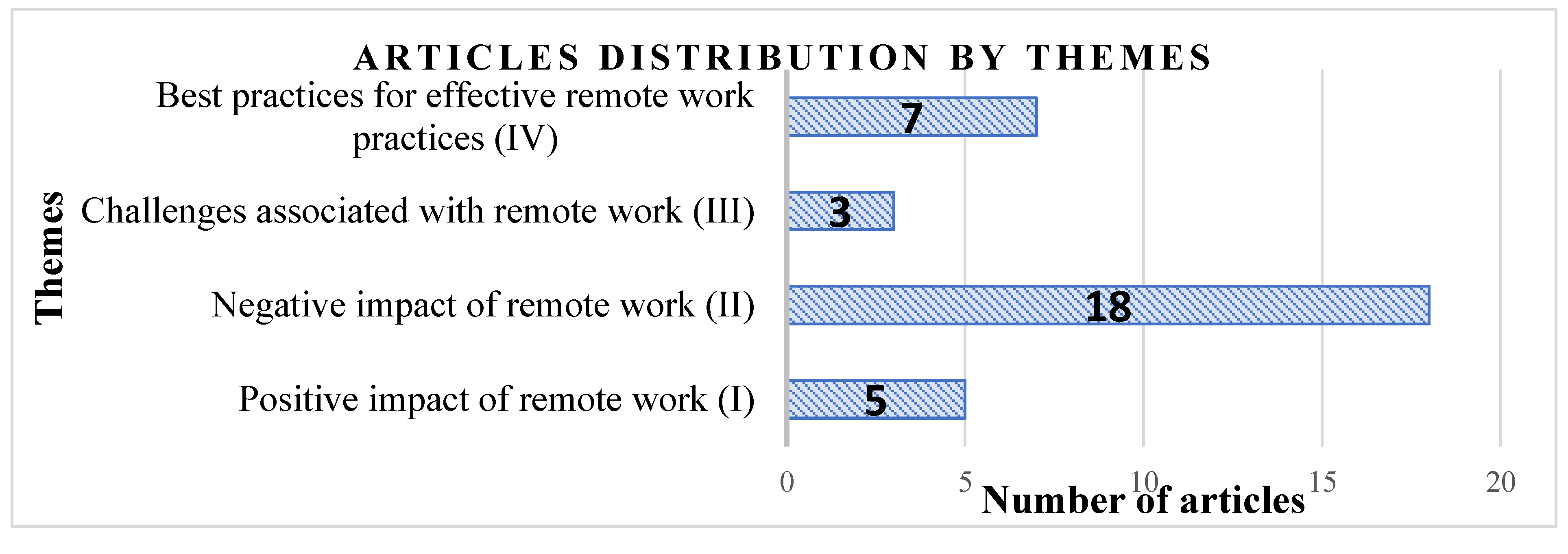
Figure 3.
Distribution of mental health problems.
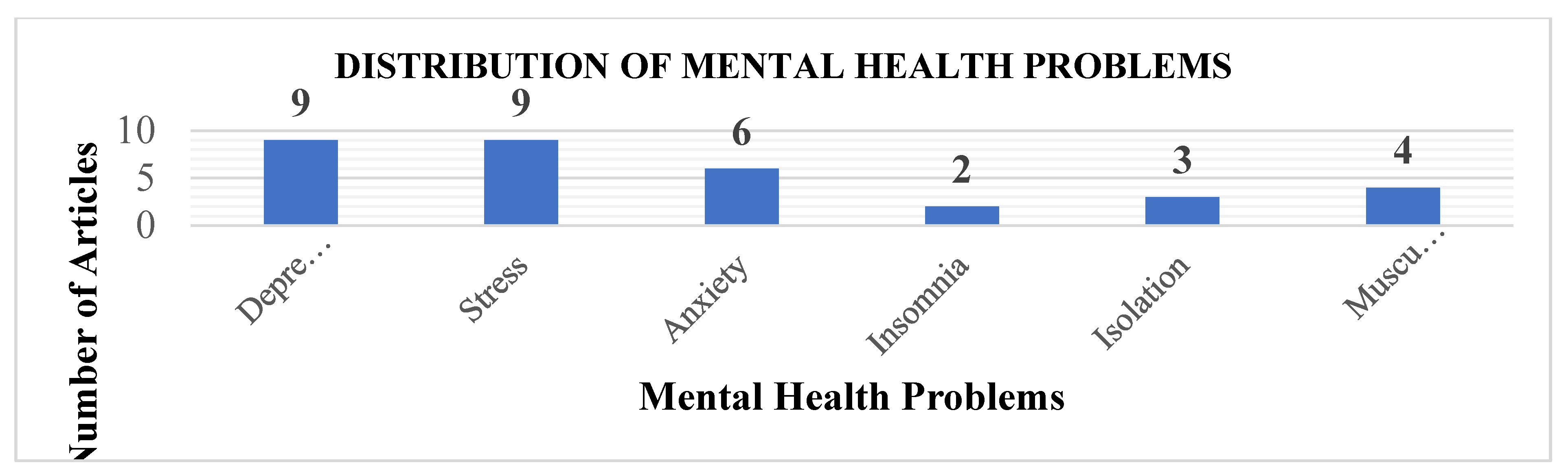

Table 1.
Sample search strategy for remote work and occupational health and safety.
| Line # | Syntax |
|---|---|
| 1 | "Remote work" |
| 2 | OR "Work* from home" |
| 3 | AND "Mental health" |
| 4 | OR "Physical well-being" |
Table 2.
List of papers reviewed and the various themes discussed.
| S/N | Authors (year) | Themes discussed |
|---|---|---|
| 1 | Backholm and Idås (2024) [32] | II |
| 2 | Bolisetty et al. (2023) [29] | I |
| 3 | Connor et al. (2022) [33] | II, III |
| 4 | Curcuruto et al. (2023) [34] | I, IV |
| 5 | Denzer and Grunau (2024) [31] | I |
| 6 | Emmerich et al. (2024) [6] | I II |
| 7 | Galanti et al. (2021) [35] | II, III, IV, |
| 8 | Gore (2024) [36] | II, IV |
| 9 | Griep et al. (2022) [37] | II, IV |
| 10 | Hao et al. (2022) [38] | II |
| 11 | Hyung Kim et al. (2023) [7] | II, IV |
| 12 | Kim et al. (2024) [39] | II |
| 13 | Lee et al. (2023) [13] | II |
| 14 | Maulana et al. (2023) [40] | IV |
| 15 | O’Hare et al. (2024) [41] | II |
| 16 | Oakman et al. (2023) [12] | II, III, IV |
| 17 | Pathan et al. (2023) [42] | II |
| 18 | Ruiz-Frutos et al. (2021) [43] | II |
| 19 | Sasaki et al. (2023) [44] | II |
| 20 | Serafim et al. (2024) [28] | I |
| 21 | Shindaini et al. (2024) [10] | II |
| 22 | Tao et al. (2023) [30] | I |
| 23 | Tobia et al. (2024) [45] | II |
| 24 | Wels et al. (2023) [46] | II |
Note: Themes include, I – Positive impact of remote work; II – Negative impact of remote work, III – Challenges associated with remote work, IV - Best practices for effective remote work practices.
Disclaimer/Publisher’s Note: The statements, opinions and data contained in all publications are solely those of the individual author(s) and contributor(s) and not of MDPI and/or the editor(s). MDPI and/or the editor(s) disclaim responsibility for any injury to people or property resulting from any ideas, methods, instructions or products referred to in the content. |
© 2026 by the authors. Licensee MDPI, Basel, Switzerland. This article is an open access article distributed under the terms and conditions of the Creative Commons Attribution (CC BY) license (http://creativecommons.org/licenses/by/4.0/).
Copyright: This open access article is published under a Creative Commons CC BY 4.0 license, which permit the free download, distribution, and reuse, provided that the author and preprint are cited in any reuse.


