

Submitted:
15 March 2026
Posted:
17 March 2026
You are already at the latest version
Abstract
The armless snake eel, Dalophis imberbis, is a fossorial rare species; being considered as a non-target fishery resource with elusive behavior, knowledge on its distribution and biology results scarce. This study reports three new documented occurrence records of D. imberbis along the northern and southeastern coastal areas of Sicily (central Mediterranean Sea) during 2025. Specimens were collected at depths ranging from 43 m to an unusually shallow depth of 5.4 m. Environmental parameters have been collected through a multiparametric probe and integrated with products from the Copernicus Marine Service (CMS), providing new insights which highlight the presence of the species in relatively warm (17.6-20.8 °C) and moderately oxygen undersaturated (6.9-8.5 mg/L) waters. A global distributional analysis was performed by aggregating the field data with literature records and datasets from the Global Biodiversity Information Facility (GBIF), refining the distribution of the species in the Mediterranean and Atlantic sectors. This work underscores the importance of combining traditional surveys with big-data repositories and remote sensing to monitor rare marine biodiversity.
Keywords:
coastal biodiversity
; Mediterranean Sea
; Sicily
; Dalophis imberbis
; eels
; habitat suitability
1. Introduction
Dalophis imberbis (Delaroche, 1809), commonly known as armless snake eel, is a fossorial fish with serpentiform body belonging to the Ophichthidae family, a worldwide taxon which comprises 377 species [1,2]. The species was originally described as Sphagebranchus imberbis Delaroche, 1809 [3] based on a live specimen from Ibiza, Spain, (reported as Iviça) found in a fish trap for eels. The body is extremely slender, elongated, almost-cylindric, and, excluding its pointed extremes, it results in a uniform thickness of a finger. It is characterized by slow and similar-to-snakes movements, hence the name. The coloration is purplish gray on the dorsal side, characterized by a multitude of small brownish-purple spots densely clustered on a grayish background. The ventral side is yellowish white with silvery reflections.
Dalophis imberbis is the only species of Dalophis genus inhabiting both the Mediterranean Sea and the central eastern Atlantic Ocean [1]. Although the other four congeneric species are distributed along the Atlantic coast of Africa, knowledge about the genus is limited due to uncertainties of the taxonomical identification, especially during the leptocephali larval phase [4,5].
The Mediterranean distribution of D. imberbis is better described by some recent records, which confirmed its presence from the western to the eastern basin, though it seems to be considered rare in the easternmost Levantine basin, in the Adriatic, and the north Tyrrhenian Sea. It seems common in other areas, especially in the central and southern Tyrrhenian Sea [6,7,8,9,10]. Being considered a rare species and a non-target fishery resource [7,11], studies of D. imberbis result in partial knowledge.
Little is known about D. imberbis ecology and biology; it inhabits soft bottoms, burrowing in sand or mud, at depths between 20 and 100 meters [1,11,12]. No information is known about its tolerance limits for environmental parameters. The species seems to have nocturnal behavior [12], but nothing is known about its functional traits.
Dalophis imberbis has been identified during leptocephali larval phase in different areas of the Mediterranean Sea and Atlantic Ocean [13]; nonetheless, nothing is known about its reproduction cycle or many other traits, such as its feeding or behavior, or if it is a solitary or gregarious species.
In contexts where traditional scientific literature lacks detailed data on a species, big-data repositories can offer an indirect, powerful alternative for knowledge extrapolation. The Global Biodiversity Information Facility (GBIF; https://www.gbif.org/) is the worldwide principal gatherer of biodiversity occurrence records [14,15]. The potential of GBIF platform is its capacity to cross-reference data from different sources with the accuracy and reliability given by the standardization of records. In fact, the data stored in this repository are not only from research datasets, including molecular databases (e.g. BOLD, https://www.boldsystems.org/), but also from museums or Citizen Science projects (e.g. iNaturalist, https://www.inaturalist.org/).
The present paper aimed to report the first documented observations of D. imberbis in Sicily Island (southern Italy), focusing on the physical environmental parameters to refine its ecological profile and define the bathymetric and geographical range of distribution of the species, with the integration of literature data and datasets retrieved from GBIF.
2. Materials and Methods
A survey of the macro-zoobenthos bioindicator in soft bottoms was conducted along the coastal areas of Sicily Island (central Mediterranean) during 2025. A Van-Veen grab of 18 Liters was used during the sampling operations.
The survey protocols included the collection of water column parameters using the multiparametric probe Idronaut Ocean Seven 316Plus, data of temperature, conductivity, salinity, pH, oxygen in mg/L, and fluorescence in June and October and they have been associated with the presence of the records (Tab. 1). In a further sampling, in November, the data collection of parameters was not scheduled, hence the values of surface and bottom temperature and salinity have been extracted using E.U. Copernicus Marine Service Information from Mediterranean Sea Physics Analysis and Forecast product [16,17] while dissolved oxygen has been extracted from the Mediterranean Sea Biogeochemistry Analysis and Forecast product [18]. Calculations have been managed and handled in QGIS Development Team, QGIS 3.34.11. [Software]. (Version 3.34.11, 2025.).
The global distributional map (Fig. 1) was generated aggregating the new Sicilian records, with both data from literature [4,6,7,8,9,10,11,12,19,20,21,22,23,24,25] and the GBIF database [26], filtering for the species Dalophis imberbis. Records from GBIF dataset and literature that did not present coordinates were not taken into consideration.
3. Results
A total of three alive individuals of D. imberbis (Fig. 2) were accidentally caught. Two specimens were recorded in two different stations in northern Sicily (MZB_18B; MZB_7B) and the third one in southeastern Sicily (MZB_42A) (Fig. 2; Tab. 1). Identification was performed following Delaroche, (1809). The first individual (Fig. 2A) was collected the 26th June 2025 in front of the Termini Imerese Port (MZB_18B), in Termini Imerese Gulf, the second (Fig. 2B) was collected the 18th October 2025 in Guidaloca Beach (MZB_7B), in the Castellammare del Golfo Gulf, and the third specimen (Fig. 2C) was caught the 11th November 2025 in Agnone Beach (MZB_42A), in southern extreme of Catania Gulf.
In the first and second sites the bottom was muddy, while in the third station the bottom was composed by coarse biogenic sand; depth was respectively 19 m, 43 m and 5.4 m (Tab. 1). On board, body length was estimated to be around 50 cm for the first individual, 30 cm for the second one and 25 cm for the third (Tab. 1). Registered parameters at bottom for first two individuals showed a temperature of 19.7 °C and 17.6 °C, oxygenation of 8.40 mg/L and 8.59 mg/L, density of a-chlorophyll ranging 0.16-0.29 mg/m3, pH of 8.2 and mean salinity of 38.1 (Tab. 2). Parameters calculated by the models showed a temperature of 20.8 °C, salinity of 38.5 and oxygenation of 6.9 mg/L in the station of the third individual (Tab. 2).
The GBIF dataset resulted in 351 occurrence records ranging from the year 1845 to 2025 [26]. The dataset was composed of 43 sources [3,27,28,29,30,31,32,33,34,35,36,37,38,39,40,41,42,43,44,45,46,47,48,49,50,51,52,53,54,55,56,57,58,59,60,61,62,63,64,65,66,67,68], of which the primary one was iNaturalist (168 records). The other records in the dataset came from different typologies, such as single occurrence records, genetic records, or museum specimens. The distributional map (Fig. 1) was made using 286 georeferenced records, including the new records of the present study.
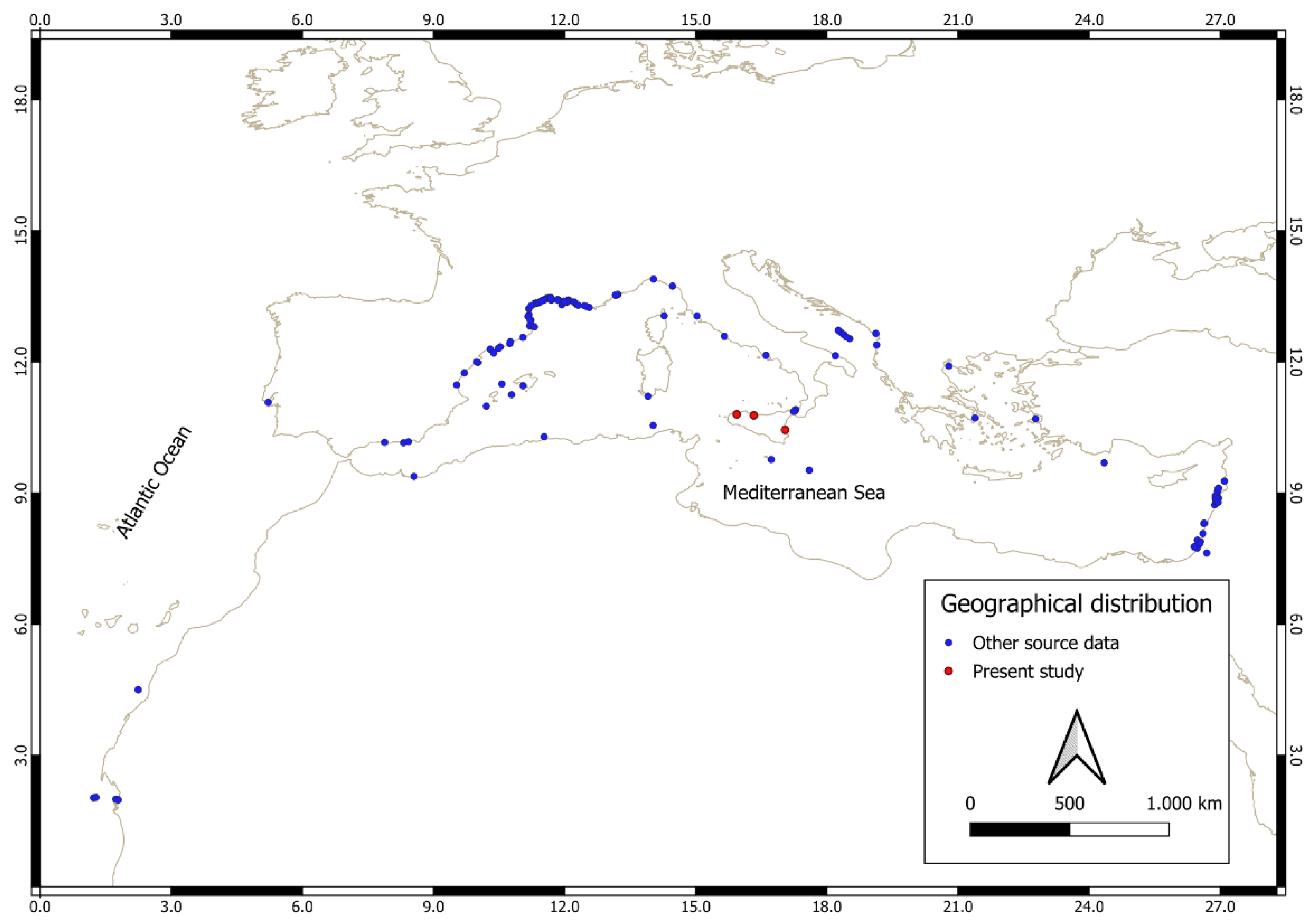
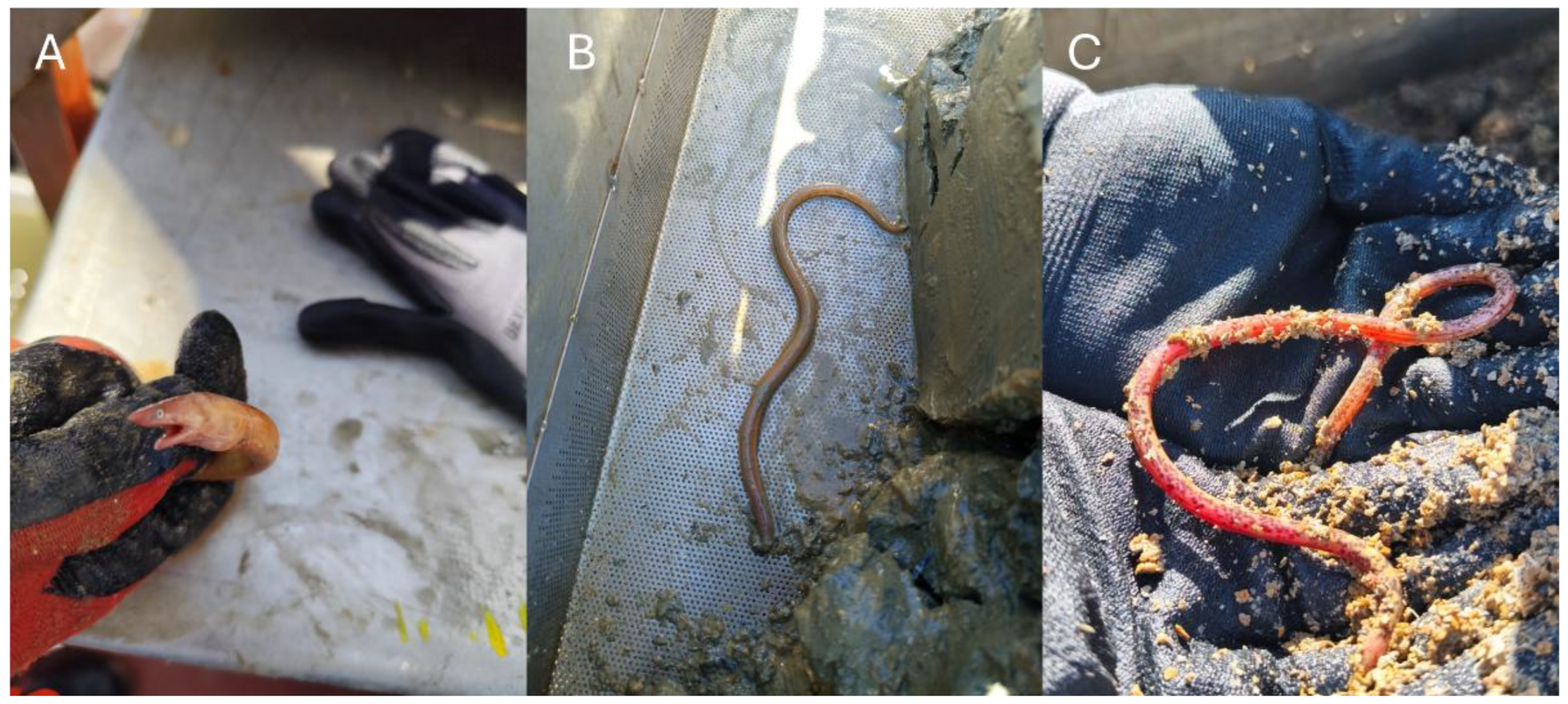
Figure 1.
Geographical distribution of Dalophis imberbis; red dots represent individuals of the present study; blue dots represent records reported from the literature and the biodiversity online databases [4,6,7,8,9,10,12,19,20,21,22,23,25,26].
Figure 2.
Specimens of Dalophis imberbis captured along the Sicilian coast, and soon after released; (A) sample from the site MZB_18B in Termini Imerese (Palermo); (B) sample from the site MZB_7B in Guidaloca Beach, Castellammare del Golfo (Trapani); (C) sample from the site MZB_42A, in Agnone Beach (Siracusa).
Figure 2.
Specimens of Dalophis imberbis captured along the Sicilian coast, and soon after released; (A) sample from the site MZB_18B in Termini Imerese (Palermo); (B) sample from the site MZB_7B in Guidaloca Beach, Castellammare del Golfo (Trapani); (C) sample from the site MZB_42A, in Agnone Beach (Siracusa).

Table 1.
Occurrence records of D. imberbis are reported; columns show information of captures; specifically, the event date, the coordinates, and body length.
Table 1.
Occurrence records of D. imberbis are reported; columns show information of captures; specifically, the event date, the coordinates, and body length.
| Locality | Site ID | Date | Coordinates | Body length (mm) |
| Palermo | MZB_18B | 26th June 2025 | 38.002222° N, 13.730278° E | 500 |
| Trapani | MZB_7B | 18th October 2025 | 38.065278° N, 12.848056° E | 300 |
| Siracusa | MZB_42A | 11th November 2025 | 37.314444° N, 15.107778° E | 250 |
Table 2.
Environmental information for each site; specifically, bottom composition, depth of the catch, and water parameters. These last were referred to the surface (S) and bottom depth (B). Temperature (Temp.), conductivity (Cond.), salinity, pH, dissolved oxygen (Oxygen), Fluorometer. Water parameters of MZB_42A-Siracusa were extrapolated from the E.U. Copernicus Marine Service Information [16,17,18].
Table 2.
Environmental information for each site; specifically, bottom composition, depth of the catch, and water parameters. These last were referred to the surface (S) and bottom depth (B). Temperature (Temp.), conductivity (Cond.), salinity, pH, dissolved oxygen (Oxygen), Fluorometer. Water parameters of MZB_42A-Siracusa were extrapolated from the E.U. Copernicus Marine Service Information [16,17,18].
|
Bottom composition (Locality) |
Depth (m) | Temp. (°C) | Cond. (mS/cm) | Salinity | pH | Oxygen mg/L | Fluorometer | ||||||
| S | B | S | B | S | B | S | B | S | B | S | B | ||
| Mud (Palermo) | 19.0 | 26.7 | 19.7 | 58.8 | 51.4 | 37.9 | 38.1 | 8.1 | 8.2 | 6.4 | 8.4 | 0.2 | 0.2 |
| Mud (Trapani) | 43.0 | 22.5 | 17.6 | 54.2 | 49.0 | 37.9 | 38.0 | 8.1 | 8.2 | 6.6 | 8.5 | 0.1 | 0.4 |
| Biogenic sand (Siracusa) |
5.4 | 20.86 ±2.38 |
20.85 ±2.38 |
- | - | 38.5 ± 1.5 | 38.5 ± 1.5 | - | - | 6.9 ± 0.26 | 6.9 ± 0.26 | ||
4. Discussion
The three Mediterranean occurrence records of D. imberbis represent the first documented observations in the northern and southeastern Sicilian coastal marine habitats. The presence of the species in Sicilian coastal waters was not extensively reported; it was generically reported as bycatch only in bottom trawl surveys in deep waters (55-115 m) in the southern Tyrrhenian Sea [11]. Additionally, data from GBIF documented four old (1845-1960) preserved museum specimens from the Strait of Messina [31,34,46,69].
These recent three occurrence records confirm the presence of D. imberbis in Sicilian coastal waters. Consequently, this species may be more abundant and distributed along the island than it was thought. The integration of this new data with information from different types of historical record sources depicts a more accurate distribution of D. imberbis. The presence of the species in the eastern Atlantic Ocean is confirmed by a few documented records; in Mauritania by an old (1988) museum specimen and environmental DNA [49,65]; in Portuguese waters, through the images of animals published on online biodiversity platforms [38]. The Mediterranean distribution of D. imberbis appears more uniform, especially in northern and northwestern coasts, in Spanish and French localities (Fig. 1), confirmed by a high number of citizen data [38]. Its presence is also confirmed in different localities in southern Mediterranean waters, but, due to the few records, the presence results punctiform along the African coast, and it is characterized by the absence of records between Tunisian and Egyptian waters [26]. On the contrary, in the Levantine basin, the species appears more abundant than it was reported in literature [8,26]. The Aegean Sea and Adriatic Sea remain poorly studied; information was extrapolated from fishery data sources, and this did not allow to well identify specific areas with the presence of D. imberbis, although information indicates the presence of leptocephali larvae in Adriatic Sea [10,21,25,26].
The present captures are in accordance with the actual knowledge on the morphology of the species; the total length is comparable with previous data (e.g. 429.7±62.3 mm in Bonifazi et al., 2019) as well as the type of bottom substrate is in line with other records [7,8,11].
Only one individual has been fished in each site; consequently, it is not possible to suppose if they live in aggregate groups or not. Indirect information comes from an unusual massive stranding event (201 dead animals) and from the estimate of low density (20 ind./km2) in trawl surveys [6,11]. On the contrary, information from GBIF suggests a more precise scenario: many images showed the animals in gregarious behaviors, with two or more individuals burrowing close to each other [38].
Analyzing the depths of the three individuals, the two from northern Sicily are in line with literature, whereas the third was found in very shallow waters (5.4 m). A similar observation come from scuba divers which declared to have observed individuals at 4-5 m in S. le Bris, France [12]. This type of data is supported by GBIF records; many D. imberbis individuals have been photographed by recreational scuba divers in coastal areas (less than 20 m) [38]. A high number of beached animals [6] also supports a shallow water dweller species.
Little is known about the deepest limit; some information comes from trawl surveys, which report the species in hauls in strata 51-115 m [11,21].
The water parameters also showed interesting patterns. The individuals were reported in warm waters (Tab. 2). This may suggest a high tolerance of the species to high temperatures, exhibiting a thermophilic behavior which allows the species to live in the tropical Atlantic area [8,22,23,24,26].
The oxygenation parameters showed interesting results; D. imberbis was caught in a well saturated water and in a moderately sub-saturated water (Tab. 2). This may indicate a wide tolerance to different oxygenation parameters with a possible adaptation to hypoxic boundary conditions.
5. Conclusions
The present study provides a contribution to the biological and ecological knowledge of Dalophis imberbis, a species long characterized as data deficient. This new data expands the known geographical range of the species in the central Mediterranean, reporting the species in three different coastal sites of Sicily.
The record at 5.4 m depth suggests a potentially wider presence in shallow coastal habitats than previously assumed. Furthermore, this work reports, for the first time, indications about characteristics of the environment and constitutes a first baseline to describe the hypothetical range of habitat suitability for D. imberbis.
While the species is currently well-established in the Mediterranean waters, the north-eastern Atlantic distribution is not well-studied. The northernmost Atlantic records are presently limited to the Portuguese coast. However, as sea surface and bottom temperatures continue to rise, due to the thermophilic tendency of the species a northward shift in its Atlantic distribution may be highly plausible.
Our results demonstrate that integrating traditional field surveys with high-resolution environmental modeling and big-data repositories is a powerful strategy for monitoring elusive and rare marine biodiversity. In conclusion, this work not only reports new records from the coast of Sicily but also refines the distribution and the hypothetical range of habitat suitability of D. imberbis.
Author Contributions
Conceptualization, M.B. and S.L.B.; methodology, M.B. and B.S; investigation, M.B.; resources, B.S. and S.L.B.; writing—original draft preparation, M.B.; writing—review and editing, S.L.B.; supervision, S.L.B.; funding acquisition, B.S. and S.L.B. All authors have read and agreed to the published version of the manuscript.
Funding
This research was partially funded by the National Recovery and Resilience Plan (NRRP), Mission 4 Component 2 Investment 1.4 - Italian Ministry of University and Research funded by the European Union – NextGenerationEU; code CN_00000033, Concession Decree No. 1034 of 17 June 2022 adopted by the Italian Ministry of University and Research, CUP B73C22000790001, Project title “National Biodiversity Future Center - NBFC”. Collaboration agreement between the Sicilian Region, Department of the Basin Authority of the Hydrographic District of Sicily, and ARPA Sicily for the implementation of the FSC 2014 POA financing line — Action Line 2.3.1 "Interventions to improve the quality of water bodies, and related Technical Annex and Supplementary Act – EQB Monitoring Coastal Marine Waters: Surveys of Posidonia oceanica meadows; Benthos determination of hard bottoms using the Carlit method; Determination of soft bottoms; Phytoplankton determination - L5” intervention line (CUP F62G16000000001).
Institutional Review Board Statement
Not applicable.
Acknowledgments
The authors are grateful to Dr. Li Vorsi Andrea and Dr. Ponzé Nicolò for providing the photograph of the third individual (Fig. 1D).
Conflicts of Interest
The authors declare no conflicts of interest.
References
- Froese, R.; Pauly, D. Ophichthidae Günther, 1870 2025.
- Van Der Laan, R.; Eschmeyer, W.N.; Fricke, R. Family-Group Names of Recent Fishes. Zootaxa 2014, 3882. [Google Scholar] [CrossRef]
- Delaroche, F.-E. Suite Du Mémoire Sur Les Espèces de Poissons Observées à Iviça. Tableau Des Espèces de Poissons Que j’ai Observées à Iviça Pendant Les Mois de Décembre, Janvier et Février. Tableau Des Poissons Que j’ai Observés à Maïorque et à Barcelonne, Mais Que Je n’ai Point Vus à Iviça. Observations Sur Quelques-Uns Des Poissons Indiqués Dans Le Précédent Tableau, et Descriptions Des Espèces Nouvelles Ou Peu Connues. 1809, 13, 313–361. [Google Scholar]
- Palomera, I.; Fortuño Alós, J.M. Larvas Leptocéfalas de Peces Anguiliforrnes En La Costa Noroccidental de África; Resultados Expediciones Cientificas del Buque Oceanografico Cornide de Saavedra . 1981. [Google Scholar]
- Blache, J.; Bauchot, M.L. Contribution à La Connaissance Des Poissons Anguilliformes de La Côte Occidentale d’Afrique; IFAN, 1972. [Google Scholar]
- Bonifazi, A.; Fratini, F.; Ventura, D. Unusual Massive Beaching of Dalophis Imberbis (Delaroche, 1809) (Anguilliformes, Ophichtidae) from the Central Tyrrhenian Sea. Thalass. Int. J. Mar. Sci. 2019, 35, 573–576. [Google Scholar] [CrossRef]
- Biagi, F.; Sartor, P.; Ardizzone, G.D.; Belcari, P.; Belluscio, A.; Serena, F. Analysis of Demersal Fish Assemblages of the Tuscany and Latium Coasts (North-Western Mediterranean). Sci. Mar. 2002, 66, 233–242. [Google Scholar] [CrossRef]
- CAPAPÉ, C. FIRST SUBSTANTIATED RECORD OF ARMLESS SNAKE EEL DALOPHIS IMBERBIS (OSTEICHTHYES: OPHICHTHIDAE) FROM THE SYRIAN COAST (EASTERN MEDITERRANEAN SEA). Ann. Anali Za Istrske Mediter. Študije Ann. Studi Istriani E Mediterr. Ann. Istrian Mediterr. Stud. Ser. Hist. Nat. 2021, 31, 101. [Google Scholar] [CrossRef]
- Salvadori, S.; Coluccia, E.; Cannas, R.; Cau, A.; Deiana, A.M. A ZZ–ZW Sex Chromosome System in the Finless Eel Dalophis Imberbis (Anguilliformes, Ophichtidae). Genetica 2009, 135, 283–288. [Google Scholar] [CrossRef]
- Papaconstantinou, C. Some Rare Mesopelagic and Bathyal Fish Caught in the Greek Seas. Thalassographica 1990, 13, 35–39. [Google Scholar]
- Busalacchi, B.; Rinelli, P.; De Domenico, F.; Profeta, A.; Perdichizzi, F.; Bottari, T. Analysis of Demersal Fish Assemblages off the Southern Tyrrhenian Sea (Central Mediterranean). Hydrobiologia 2010, 654, 111–124. [Google Scholar] [CrossRef]
- Iglésias, S.P.; Bergot, Patricia; Breton, Pascal; Brunelle, Stéphanie; Camusat, Mathieu; Causse, Romain; Charbonnel, Éric; Chevaldonné, Pierre; Cordier, Yves; Cosquer, Paul; Cuillandre, Jean-Pierre; Curd, Amelia; Dubas, Rémy; Duhau, Muriel; Derrien-Courtel, Sandrine; Devique, Gabriel; Dixneuf, Stéphane; Duhamel, Erwan; Farque, Pierre-André; Francour†, Patrice; Fontana, Yann; Gamon, Adelaïde; Gicqueau, Charly; Goascoz, Nicolas; Hassani, Sami; Jadaud, Angélique; Kopp, Dorothée; Lamour, Laure; Le Bris, Sylvain; Lévèque, Laurent; Liger, Pablo; Lorance, Pascal; Louisy, Patrick; Maran, Vincent; Méhault, Sonia; Metral, Luisa; Morin-Repinçay, Alizée; Mouchel, Olivier; Pere, Anthony; Quéro, Jean-Claude; Renoult, Julien P.; Roche, François; Schweyer, Livier; Spitz, Jérôme; Thiriet, Pierre; Thomas, Wilfried. French Ichthyological Records for 2018 2020.
- The International Barcode of Life Consortium International Barcode of Life Project (iBOL). 2025.
- Steinke, D.; Gemeinholzer, B.; Martínez-Meyer, E.; Noesgaard, D.; Young, A.; Schigel, D. Globally Aggregated Biodiversity Data Impact Predictive and Descriptive Research. Proc. Natl. Acad. Sci. 2025, 122, e2519119122. [Google Scholar] [CrossRef]
- Heberling, J.M.; Miller, J.T.; Noesgaard, D.; Weingart, S.B.; Schigel, D. Data Integration Enables Global Biodiversity Synthesis. Proc. Natl. Acad. Sci. 2021, 118, e2018093118. [Google Scholar] [CrossRef]
- Salon, S.; Cossarini, G.; Bolzon, G.; Feudale, L.; Lazzari, P.; Teruzzi, A.; Solidoro, C.; Crise, A. Novel Metrics Based on Biogeochemical Argo Data to Improve the Model Uncertainty Evaluation of the CMEMS Mediterranean Marine Ecosystem Forecasts. Ocean Sci. 2019, 15, 997–1022. [Google Scholar] [CrossRef]
- European Union-Copernicus Marine Service Mediterranean Sea Physics Analysis and Forecast 2025.
- Feudale, L.; Bolzon, G.; Lazzari, P.; Salon, S.; Teruzzi, A.; Di Biagio, V.; Coidessa, G.; Alvarez, E.; Amadio, C.; Cossarini, G. Mediterranean Sea Biogeochemical Analysis and Forecast (Copernicus Marine Service MED-Biogeochemistry, MedBFM4 System): MEDSEA_ANALYSIS_FORECAST_BGC_006_014_MedBFM4 2023.
- Béarez, P.; Pruvost, P.; Feunteun, E.; Iglésias, S.P.; Francour, P.; Causse, R.; De Mazieres, J.; Tercerie, S.; Bailly, N. Checklist of the Marine Fishes from Metropolitan France 2017.
- Lipej, L.; Dulčić, J. Checklist of the Adriatic Sea Fishes. Zootaxa 2010, 2589. [Google Scholar] [CrossRef]
- Ungaro, N. Analysis of Demersal Species Assemblages from Trawl Surveys in the South Adriatic seaAnalyse Des Assemblages d’espèces Démersales à Partir Des Campagnes de Chalutage Effectuées En Mer Adriatrique. Aquat. Living Resour. 1999, 12, 177–185. [Google Scholar] [CrossRef]
- Golani, D. Checklist of the Mediterranean Fishes of Israel. Zootaxa 2005, 947. [Google Scholar] [CrossRef]
- Bariche, M.; Fricke, R. The Marine Ichthyofauna of Lebanon: An Annotated Checklist, History, Biogeography, and Conservation Status. Zootaxa 2020, 4775. [Google Scholar] [CrossRef] [PubMed]
- Bi̇Lecenoğlu, M.; Kaya, M.; Ci̇Hangi̇R, B.; Çi̇Çek, E. An Updated Checklist of the Marine Fishes of Turkey. Turk. J. Zool. 2014, 38, 901–929. [Google Scholar] [CrossRef]
- Papaconstantinou, C.; Kapiris, K.; Karachle, P.K.; Zenetos, A. Fauna Graeciae. An Updated Checklist of the Fishes in the Hellenic Seas; Monographs on Marine Sciences: National Centre for Marine Research: Athens, 2014; Vol. 7, ISBN 978-960-9798-05-1. [Google Scholar]
- GBIF.org User Occurrence Download 2025, 225228.
- Conselleria de Medio Ambiente, A. Infraestructuras y Territorio. Generalitat Valenciana Banco de Datos de La Biodiversidad de La Comunitat Valenciana; Biodiversity Data Bank of Generalitat Valenciana, 2024. [Google Scholar]
- Fong, J. CAS Ichthyology (ICH). Version 150.500. 2025. [Google Scholar]
- Sibylle, R.; Vaz, S.; Cheret, I.; Tessier, E. CHALIST Survey Catch Data: Bentho-Demersal Assemblages of the Gulf of Lion (North-Western Mediterranean) from 1983 to 1992. 2025. [Google Scholar]
- NIETO RUBIO, P. Colección de Vertebrados (Naturalizados y En Fluido) Del Departamento de Zoología de La Facultad de Biología de La Universidad de Sevilla. Version 1.2. 2018. [Google Scholar]
- Senckenberg Collection Pisces SMF. 2025.
- Tom, M. Epifauna of Haifa Bay, Mediterranean Israeli Shelf-Moshe Tom’s Collection. Version 1.39. 2025. [Google Scholar]
- Edelist, D.; Belmaker, J. Fish and Marine Invertebrates from the Israeli Eastern Mediterranean Sea; 2021. [Google Scholar]
- Swedish Museum of Natural History Fish Collection NRM 2025.
- Inventaire National du Patrimoine Naturel Fish Watch Forum: Observatoire Participatif Des Poissons Marins - Observations de Poissons Marins Du Fish Watch Forum; 2021.
- FishBase FishBase Database 2025.
- Carita, D.; Meister, M.; Ludes-Fraulob, E.; Wandhammer, M. Fishes MZS. Version 1.2. 2020. [Google Scholar]
- iNaturalist contributors; iNaturalist iNaturalist Research-Grade Observations. 2025.
- European Bioinformatics Institute (EMBL-EBI). GBIF Helpdesk INSDC Sequences. Version 1.163. 2025. [Google Scholar]
- The International Barcode of Life Consortium International Barcode of Life Project (iBOL). 2025.
- Lubinevsky, H.; Tom, M. Macrofauna of the Eastern Mediterranean Lsraeli Shelf. Version 1.57. 2025. [Google Scholar]
- Deudero Company, S. Marine Biodiversity Atlas of the Balearic Sea. Version 1.0. 2025. [Google Scholar]
- Guerrero, E.; Abelló, P.; Lombarte, A.; Villanueva, R.; Ramón, M.; Sabatés, A.; Santos, R. Marine Biological Reference Collections: CBMR-General (ICM-CSIC). Version 1.32. 2025. [Google Scholar]
- Solís Fraile, G. Museo Nacional de Ciencias Naturales; MNCN_ICTIO: Madrid, 2020. [Google Scholar]
- Quesada Lara, J.; Agulló Villaronga, J. Museu de Ciències Naturals de Barcelona; MCNB-Cord, 2025. [Google Scholar]
- Harvard University, M.; Morris, P.J. Museum of Comparative Zoology, Harvard University. 2025, 162.484. [Google Scholar]
- naturgucker.de NABU|naturgucker. Occurrence Dataset 2025.
- Natural History Museum Natural History Museum (London) Collection Specimens. 2025.
- Slieker, F.J.A.; van der Es, H.; Andeweg, R.; Langeveld, B.W.; Schnörr, S. Natural History Museum Rotterdam - Specimens. Version 1.45. 2024. [Google Scholar]
- Dondorp, E.; Creuwels, J. Naturalis Biodiversity Center (NL) - Pisces. 2025.
- Møller, P.R.; Carl, H. NHMD Ichthyology Collection. 2025.
- Orrell, T. Informatics and Data Science Center - Digital Stewardship NMNH Extant Specimen Records (USNM, US). Version 1.102. 2025. [Google Scholar]
- Chic, Ò.; Manjabacas, A.; Guerrero, E.; Lombarte, A. Otoliths Reference Collection. In CBMR-AFORO (ICM-CSIC); 2023. [Google Scholar]
- Inventaire National du Patrimoine Naturel Programme BioObs: Observations Naturalistes En Milieux Aquatiques-Observations de BioObs. 2023.
- Inventaire National du Patrimoine Naturel Programme CROMIS: Carnet de Plongée En Ligne de La FFESSM-Observations d’espèces Subaquatiques Collectées Par Les Utilisateurs de CROMIS. 2022.
- Pauwels, O.; Samyn, Y.; Vandenberghe, T. RBINS DaRWIN. 2021. [Google Scholar]
- Royal Belgian Institute of Natural Sciences RBINS Fish Collection 2025.
- Burridge, M.; Lujan, N.K. Royal Ontario Museum - Ichthyology. Version 2.1. 2025. [Google Scholar]
- Inventaire National du Patrimoine Naturel SILENE-FAUNE-PACA - Tour_du_Valat_2017_12_18. 2018.
- Gur, Y. Steinhardt Museum of Natural History (SMNHTAU) Vertebrates. Version 1.7. 2022. [Google Scholar]
- MNHN; Chagnoux, S. The Fishes Collection (IC) of the Muséum National d’Histoire Naturelle (MNHN - Paris). Version 57.423. 2025. [Google Scholar]
- Staatliches Museum für Naturkunde Stuttgart The Ichthyology Collection at the Naturkundemuseum Stuttgart. 2025.
- Bariche, M.; Fricke, R. felipe The Marine Ichthyofauna of Lebanon: An Annotated Checklist, History, Biogeography, and Conservation Status. In Plazi.Org Taxonomic Treatments Database; 2020. [Google Scholar]
- Staatliche Naturwissenschaftliche Sammlungen Bayerns The Pisces Collection at the Zoologische Staatssammlung München. 2025.
- Mohamed El-Hacen, H.; Schilling, C.; Serrão, E.; Sidina, E.; Suominen, S.; Provoost, P.; Gillard, E.; Douvere, F.; Appeltans, W. UNESCO eDNA Expedition in Banc d’Arguin National Park (Mauritania): May 2023; 2024. [Google Scholar]
- UMMZ Fish Division Data Group. LSA IT A University of Michigan Museum of Zoology, Division of Fishes. Version 1.91. 2025. [Google Scholar]
- Leibniz Institute for the Analysis of Biodiversity Change (LIB) ZMH Ichthyology Collection. 2025.
- Lakkis, S. Zooplankton of Lebanon. Version 1.0. 2025. [Google Scholar]
- Merker, S. The Ichthyology Collection at the Naturkundemuseum Stuttgart 2025.
Disclaimer/Publisher’s Note: The statements, opinions and data contained in all publications are solely those of the individual author(s) and contributor(s) and not of MDPI and/or the editor(s). MDPI and/or the editor(s) disclaim responsibility for any injury to people or property resulting from any ideas, methods, instructions or products referred to in the content. |
© 2026 by the authors. Licensee MDPI, Basel, Switzerland. This article is an open access article distributed under the terms and conditions of the Creative Commons Attribution (CC BY) license (http://creativecommons.org/licenses/by/4.0/).
Copyright: This open access article is published under a Creative Commons CC BY 4.0 license, which permit the free download, distribution, and reuse, provided that the author and preprint are cited in any reuse.


