
Submitted:
14 March 2026
Posted:
16 March 2026
You are already at the latest version
Abstract
Regulated river corridors downstream of large dams face competing geomorphic pressures: sediment starvation and channel incision (the hungry water effect) and episodic tributary-driven aggradation during floods. Quantifying their net balance over multi-decadal timescales is essential for flood risk assessment and sediment management. This study presents the first LiDAR-based DEM of Difference (DoD) analysis of the 21 km Loire river corridor downstream of the Villerest dam (constructed 1984, France), using co-registered DEMs from 2003 and 2022 (19-year monitoring period). A uniform minimum level of detection (minLoD) of 0.10 m was applied, consistent with airborne LiDAR vertical accuracy (±0.05–0.15 m RMSE). The corridor exhibited dominant aggradation: mean DoD = +0.172 m, net deposition volume = +300,841 m³, and mean annual vertical change rate ≈ 9.1 mm/yr. Despite sediment-starved conditions immediately downstream of the dam, net deposition dominates the corridor budget. Results are consistent with tributary sediment inputs mobilised during four major flood events (2003, 2008, 2016, 2021), though mechanistic attribution requires coupled hydrological–sediment-transport modelling. Localised erosion, restricted to 5.6% of the corridor area, reflects residual hungry water effects along channel margins. These findings provide the first quantitative morphological baseline for this regulated corridor and suggest a progressive reduction in floodplain storage capacity with implications for downstream flood risk in the Roanne agglomeration.
Keywords:
DEM of difference
; DoD
; LiDAR
; fluvial geomorphology
; river corridor
; erosion
; deposition
; sediment budget
; Villerest
; Loire
; regulated river
; long-term monitoring
; hungry water
; flood risk
1. Introduction
Regulated rivers — those whose flow and sediment regimes are modified by dams, weirs, and other hydraulic infrastructure — represent one of the most geomorphologically altered landforms on Earth [1,2]. The construction of large dams disrupts the natural continuity of sediment supply, typically inducing a downstream sediment deficit that can drive channel incision, bed coarsening, and reduction of bar and floodplain extent — a process described as the hungry water effect [3,4]. However, in some regulated systems, particularly where major tributaries continue to deliver sediment loads below the dam, the downstream morphological response is more complex, featuring localised aggradation, bar rebuilding, and floodplain accretion [5,6]. Under the European Water Framework Directive (WFD) [7], rivers are legally required to achieve good hydromorphological status, making quantitative monitoring of regulated corridor morphology not only a scientific priority but a regulatory obligation.
Quantifying these morphological changes over multi-decadal timescales is methodologically challenging but increasingly feasible through the application of repeat airborne LiDAR surveys and the DEM of Difference (DoD) technique. The DoD approach, which computes per-pixel elevation change between two co-registered DEMs, has become a standard tool in fluvial geomorphology for generating morphological sediment budgets and mapping zones of net erosion and deposition [8,9,10]. Its application to long-term, decadal-scale datasets is particularly valuable, as it integrates the cumulative effect of multiple flood events, channel migration episodes, and anthropogenic interventions across a single monitoring interval.
A central methodological challenge in DoD analysis is the separation of real geomorphic signal from error inherent in the LiDAR acquisition and processing workflow. Wheaton et al. [10] demonstrated that the application of a spatially variable uncertainty surface yields more accurate sediment budget estimates than a simple uniform threshold. Nevertheless, the uniform minimum level of detection (minLoD) approach remains widely used in practice, particularly when detailed LiDAR metadata is unavailable, and produces robust bulk estimates when the geomorphic signal substantially exceeds the noise envelope [11,12].
The Villerest dam, constructed on the Loire River in 1984, serves primarily for flood control and low-flow augmentation in the middle Loire valley. Despite its regional importance, multi-decadal geomorphic monitoring of the river corridor using quantitative remote sensing methods has remained limited. The availability of two co-registered LiDAR-derived DEMs acquired in 2003 and 2022 offers a rare opportunity to quantify multi-decadal morphological change across a 1.9 km² corridor, providing the first long-term DoD-based sediment budget for this regulated reach.
This paper addresses the following specific objectives: (1) compute and map the DoD between the two LiDAR DEMs of the Villerest corridor; (2) apply a uniform minLoD threshold of 0.10 m and classify the corridor into erosion, deposition, and stable zones; (3) derive area and volume statistics constituting a multi-decadal morphological sediment budget; and (4) discuss the results in the context of regulated river geomorphology and the broader DoD literature.
2. Materials and Methods
2.1. Study Area
The study area is the river corridor of the Loire downstream of the Villerest reservoir, located in the Loire department (département 42), Auvergne-Rhône-Alpes, France. The Loire is the longest river in France (~1,012 km), draining a basin of approximately 117,000 km². The Villerest dam, completed in 1984, is located immediately upstream of the study reach. Its primary functions are flood-peak attenuation for the city of Roanne and augmentation of low flows during summer drought periods. The reservoir has a normal operating capacity of approximately 123–128 million m³ at its normal operating level (314 m NGF), rising to a maximum exceptional storage capacity of 235 million m³ at 324 m NGF during extreme flood events [13].
The corridor analysed in this study is defined by a 100 m buffer on each side of the digitised river centreline, encompassing the active channel, lateral gravel bars, the riparian floodplain, and adjacent valley margin slopes. The study reach has a total length of 21.063 km measured along the centreline in QGIS, with a valid LiDAR coverage of 1,895,198 m² (approximately 1.9 km²) within the corridor mask. The corridor is characterised by a single-thread meandering planform with mixed riparian vegetation on both banks. The reach spans from Commelle-Vernay, immediately downstream of the Villerest dam, northward through Roanne to Briennon at the confluence with the Sornin tributary (Easting: 780,898–786,507 m; Northing: 6,545,735–6,562,094 m, EPSG:2154). The monitoring period covered by this study spans from 2003 to 2022, encompassing multiple significant high-flow events on the upper Loire. All spatial data are referenced to the French national coordinate system RGF93 / Lambert-93 (EPSG:2154). The location of the study reach within France, and the regional and corridor-scale context, are shown in Figure 1.
2.2. LiDAR Data
Two LiDAR-derived DEMs were used in this study. DEM A (the older epoch) was acquired in 2003 and obtained from the DREAL Centre-Val de Loire LiDAR dataset (Grid ASCII format), accessed via the French national geoportal. DEM B (the recent epoch) was obtained from the IGN LiDAR HD national programme, bloc MK, département 42 (Loire), and downloaded as open-data MNT tiles at 0.5 m resolution from cartes.gouv.fr. The acquisition year of DEM B is 2022 (IGN LiDAR HD programme). Both rasters were referenced to EPSG:2154 with NoData values encoded as −9999. It should be noted that exact sub-annual acquisition dates for both DEM epochs were not available from the metadata provided. The monitoring interval is therefore defined as 2003–2022 (19 years), and any flood events occurring in the same calendar year as either acquisition date cannot be unambiguously assigned to inside or outside the differencing window. This caveat applies particularly to the December 2003 flood event discussed in Section 4.1.
The original resolution of DEM B tiles is 0.5 m. DEM B was resampled to 1 m to match DEM A during the alignment step described below. The vertical accuracy of airborne LiDAR DEMs under open-canopy conditions over bare ground is typically reported in the range of ±0.05–0.15 m RMSE [14], justifying the adoption of a 0.10 m minLoD threshold.
2.3. Preprocessing Workflow
All preprocessing was performed in QGIS 3.44.7-Solothurn prior to the Python-based DoD computation. The workflow comprised five sequential steps: (1) manual digitisation of the river centreline; (2) construction of a 100 m buffer on each side of the centreline to define the corridor polygon; (3) clipping of both DEMs to the corridor polygon; (4) resampling and spatial alignment of DEM B to exactly match DEM A in CRS, extent, pixel origin, and grid spacing using bilinear resampling; and (5) standardisation of NoData values to −9999 in both rasters. All data were projected in the French national coordinate system RGF93 / Lambert-93 (EPSG:2154), with vertical elevations referenced to the NGF datum.
2.4. DEM of Difference
The DoD was computed on a per-pixel basis as: DoD = B (2022) − A (2003). Positive DoD values indicate net deposition; negative values indicate net erosion. Pixels carrying a NoData flag in either DEM were masked and excluded. The DoD was computed using rasterio and NumPy in Python.
2.5. Minimum Level of Detection Threshold
A uniform minLoD threshold of T = 0.10 m was applied. Three change categories were defined: Erosion (DoD ≤ −0.10 m, classification value −1); Deposition (DoD ≥ +0.10 m, classification value +1); and Stable (|DoD| < 0.10 m, classification value 0). A thresholded classification raster was produced alongside the continuous DoD raster.
2.6. Area and Volume Statistics
Given the 1 m × 1 m pixel size, area equals pixel count in m². Volumes are computed as: Volume = Σ(DoDi × 1 m²) over all classified pixels. Erosion volumes are reported as both signed and absolute values. All volumetric results are also expressed as mean annual rates by dividing total change by the monitoring interval of 19 years (2003–2022).
3. Results
3.1. DoD Map and Classification
Figure 2 presents the continuous DoD map (a) and the thresholded erosion/deposition classification raster (b) for the Villerest corridor. The DoD map reveals that the majority of the corridor surface shows positive elevation change, consistent with widespread deposition over the monitoring period. Erosion is spatially limited, occurring primarily on the outer banks of meander bends and in isolated sections of the active channel. The classification map confirms this pattern: deposition (class +1) dominates the corridor, while erosion (class −1) is restricted to narrow, localised bands along channel margins. Both maps show the full 21 km reach from Commelle-Vernay in the south to the Sornin confluence at Briennon in the north, with Roanne approximately one-third from the southern end.
3.2. DoD Frequency Distribution
Figure 3 shows the frequency distribution of DoD values across all valid pixels. The histogram is strongly leptokurtic with a pronounced positive skew: the deposition tail extends to +9.002 m while the erosion tail reaches −7.028 m. The peak of the distribution is centred just above zero, consistent with the mean DoD of +0.172 m, confirming that net deposition is the dominant signal across the corridor.
3.3. Area, Volume, and Annual Rate Statistics
Table 1 presents the complete DoD statistics. After thresholding, erosion was detected over 105,311 m² (5.6% of the valid corridor area) and deposition over 1,191,342 m² (62.9%). The deposition-to-erosion area ratio of 11.3:1 indicates strongly dominant aggradation. The total net volume gain of +300,841.43 m³ over the 19-year monitoring period (2003–2022) equates to a mean annual net deposition rate of approximately 15,833 m³/yr (Table 2). Two complementary vertical change metrics are reported: (1) the mean DoD of +0.172 m divided by 19 years gives a corridor-wide mean vertical change rate of approximately 9.1 mm/yr, which includes stable pixels; and (2) the net volume divided by the valid corridor area and monitoring period gives a net volumetric aggradation rate of approximately 8.4 mm/yr. The sensitivity analysis (Table 3) reports the latter metric. Both are consistent and indicate decadal-scale aggradation at rates comparable to published values for regulated temperate floodplains.
4. Discussion
4.1. Long-Term Aggradational Trajectory
The dominant depositional signal documented over the 19-year monitoring period (2003–2022) — a net volumetric gain of +300,841 m³ and a deposition-to-erosion area ratio of 11:1 — provides compelling evidence that the Villerest corridor has been in a sustained aggradational state. This is visible in both the DoD map and the histogram (Figure 2 and Figure 3). The mean annual vertical change rate of approximately 9.1 mm/yr (corridor-wide mean) is comparable to floodplain accretion rates of 2–15 mm/yr reported for regulated temperate rivers in similar geomorphic settings [17]. The extreme DoD values in the histogram tails (up to −7.028 m and +9.002 m) indicate episodic high-magnitude change events — bank collapse, local channel avulsion, pool scour, and infilling — superimposed on the background aggradational trend.
At least four notable high-discharge events were recorded at the Villerest corridor during the monitoring period: December 2003 (peak inflow ~2,900 m³/s — the largest since dam construction in 1984), November 2008 (peak ~3,100 m³/s — the record flood for the Villerest dam, ranked 3rd largest on the upper Loire since 1850), June 2016 (~1,100 m³/s), and May 2021 (~1,200 m³/s) [13,15]. The DoD integrates morphological change across the entire 19-year window and cannot independently attribute observed volume changes to specific events. Nevertheless, the occurrence of these four high-magnitude events within the monitoring period is consistent with the episodic, pulse-driven aggradation pattern that characterises regulated corridors where tributary sediment supply is mobilised during floods [5]. The exact acquisition dates of the two LiDAR epochs are not known at sub-annual resolution; accordingly, the December 2003 event cannot be unambiguously confirmed as falling within the differencing window (see Section 2.2). The multi-decadal monitoring interval captures the integrated geomorphic signal of these events and illustrates the value of long monitoring periods over short-term surveys.
4.2. Uncertainty and Threshold Justification
The uniform minLoD of 0.10 m is justified by the vertical accuracy of airborne LiDAR surveys over open terrain [14] and is consistent with thresholds used in comparable studies [11,12]. The large magnitude of the net volume signal (+300,841 m³) relative to the theoretical maximum noise contribution (0.10 m × 1,895,198 m² ≈ 189,520 m³) confirms a high signal-to-noise ratio, lending confidence to the bulk findings. The aggradational signal is further corroborated by independent sedimentological evidence: Dhivert et al. [16] documented preferential fine-grained sediment accumulation in the Villerest reservoir and 3 km downstream of the dam, consistent with a depositional regime in the dam-controlled reach that is also captured in our corridor-scale DoD.
To assess the sensitivity of the results to threshold choice, the DoD was re-analysed at minLoD values of 0.10, 0.15, and 0.20 m (Table 3). The net volumetric signal remains strongly positive at all three thresholds (+300,841, +264,006, and +226,601 m³ respectively), confirming that the dominant aggradational conclusion is robust and not an artefact of the chosen threshold. As expected, increasing the threshold progressively excludes pixels of lower change magnitude, reducing both deposition and erosion areas; however, the deposition-to-erosion area ratio remains above 9:1 at all thresholds (11.3, 10.7, and 9.7 respectively), consistently indicating a strongly depositional corridor. The −24.7% reduction in net volume between the 0.10 m and 0.20 m thresholds reflects the exclusion of genuine low-magnitude change rather than noise, and does not alter the primary interpretation.
To empirically validate the noise floor, the distribution of near-stable pixels — defined as all valid pixels where |DoD| < 0.05 m — was analysed. This population comprised 233,770 pixels (12.3% of the valid corridor area). The mean DoD of this near-stable population was +0.014 m, indicating a negligible systematic vertical offset between the two DEMs. The standard deviation was 0.027 m and the RMSE was 0.031 m, with 90% of near-stable pixels falling within −0.039 m to +0.048 m. The empirically estimated noise floor of 0.031 m is 3.3 times below the applied minLoD of 0.10 m, confirming that the threshold is conservative and that the bulk of classified change represents genuine geomorphic signal rather than instrument noise.
Nevertheless, the vertical accuracy of the 2003 DEM may be lower than that of the recent DEM, reflecting improvements in LiDAR technology over the monitoring period. A spatially variable uncertainty model following Wheaton et al. [10] would ideally account for this asymmetry. Additionally, differential vegetation penetration of the LiDAR point cloud between the two epochs represents a potentially significant systematic bias in riparian corridors. Vegetation encroachment and riparian forest growth over 19 years could cause LiDAR returns to be intercepted at canopy level in 2022 where bare-ground returns were recorded in 2003, producing apparent positive DoD values that reflect vegetation height change rather than ground-surface aggradation. This effect is most likely in densely vegetated floodplain sectors and could contribute positively to the measured net volume, though the magnitude cannot be quantified without multi-return point cloud analysis.
4.3. Comparison with Published Studies
The net aggradational trajectory documented here is consistent with published studies of regulated river corridors where tributary inputs counter dam-induced sediment starvation. Rollet et al. [6] documented sediment deficit and its morphological consequences on the Ain River downstream of dams — a regulated gravel-bed system directly comparable in regulatory context to the Villerest reach — demonstrating that downstream bed degradation and sediment starvation are spatially heterogeneous and attenuate with distance from the dam as tributary inputs intervene. Steiger et al. [17] reported vertical floodplain accretion rates of 2–15 mm/yr for temperate European river systems, a range within which our measured rate of ~9.1 mm/yr falls, reinforcing the plausibility of our findings. The hungry water effect [3] predicts erosion strongest immediately downstream of the dam, diminishing as tributaries restore sediment flux — consistent with the spatially restricted erosion (5.6% of corridor area) observed here, concentrated along channel margins rather than uniformly distributed across the corridor. The methodological framework applied here, combining open-access national LiDAR datasets with a Python-based DoD workflow, demonstrates the potential for low-cost, reproducible morphological monitoring of regulated French river corridors within the WFD monitoring framework.
4.4. Limitations and Sources of Error
Several sources of methodological uncertainty should be acknowledged. First, the corridor mask was generated as a uniform 100 m buffer from a manually digitised centreline. A 100 m buffer was selected as it encompasses the bankfull channel, lateral bars, the low floodplain, and the immediate riparian margin across the full reach — geomorphic units that are directly active in the aggradation–erosion system while excluding the majority of valley-margin slopes not coupled to the channel. Manual centreline digitising typically carries positional uncertainties of ±2–5 m, which propagates into a corresponding uncertainty in the buffer boundary. Near the valley margins, this may result in the inclusion of non-fluvial slope pixels or the exclusion of active lateral migration zones, introducing a small but unquantifiable bias in area and volume estimates. A more rigorous future approach would map geomorphic units explicitly (active channel, bar surfaces, low floodplain, high floodplain, valley margin) to partition volumetric change by unit and assess whether aggradation is concentrated in hydraulically relevant zones. Second, the IGN LiDAR HD tiles were resampled from 0.5 m to 1 m resolution using bilinear interpolation prior to DoD computation. While bilinear resampling is appropriate for continuous elevation surfaces, it introduces mild topographic smoothing at sharp morphological edges such as channel banks and terrace risers, which could marginally underestimate the depth of narrow erosion features. Third, although vertical co-registration was validated empirically (Section 4.2; RMSE = 0.031 m), any residual horizontal misalignment between the two DEMs — even at sub-pixel scale — could generate artefactual DoD signals along topographically sharp features. These three error sources are considered minor relative to the dominant aggradational signal (+300,841 m³ net) but should be addressed in future work through automated centreline extraction, native-resolution processing, and rigorous co-registration using iterative closest point algorithms.
An important interpretive distinction must be drawn between the demonstration of net positive elevation change across the corridor — which this study establishes robustly — and the claim of reduced floodplain storage capacity in a hydraulic sense. A corridor-wide mean positive DoD does not automatically imply a hydraulically meaningful loss of flood storage, because the spatial distribution of aggradation relative to geomorphic unit (active channel vs. low floodplain vs. high terrace) determines its hydraulic significance. The present study cannot partition deposition by geomorphic unit, and accordingly the floodplain storage implication is treated as a hypothesis requiring hydraulic modelling to confirm rather than a demonstrated conclusion. The DoD integrates multi-decadal change into a single difference, masking temporal dynamics within the monitoring period. The study does not include grain-size data or flow records that would allow mechanistic attribution of volumetric change to specific hydrological drivers. Future monitoring should incorporate: (1) repeat LiDAR surveys at 5–10 year intervals to resolve event-scale geomorphic responses; (2) spatially variable uncertainty modelling per Wheaton et al. [10]; (3) geomorphic unit mapping to partition volumetric change spatially; (4) integration with hydrological and hydraulic modelling to assess flood storage implications; and (5) field validation of DoD-inferred volumetric change at representative cross-sections.
4.5. Peak Shaving Hypothesis and Flood Implications
The Villerest dam operates primarily as a flood-control reservoir, attenuating peak discharges — a function known as peak shaving — before releasing water to the downstream corridor. During the November 2008 event, for example, the dam reduced peak inflow of approximately 3,100 m³/s to an outflow of approximately 1,700 m³/s [13]. While this attenuation reduces the immediate hydraulic energy available for channel scour downstream, it does not eliminate sediment supply from lateral tributaries entering the corridor below the dam. The net aggradational signal documented in this study (+300,841 m³ over 19 years) is consistent with a scenario in which tributary-sourced sediment, mobilised during high-discharge events, is deposited in the main channel and floodplain at rates that exceed the attenuated dam outflow’s transport capacity. This represents a potential paradox of flood-control infrastructure: peak shaving may suppress erosive competence in the regulated reach while simultaneously promoting the accumulation of tributary-derived sediment, thereby progressively reducing floodplain storage capacity over decadal timescales. This hypothesis is speculative at this stage and would require coupled hydrological–sediment-transport modelling to test rigorously; however, the DoD evidence presented here provides a necessary morphological baseline for such future investigation.
5. Conclusions
This study has presented the first multi-decadal LiDAR-based DEM of Difference analysis of the Villerest river corridor, Loire, France, using co-registered LiDAR-derived DEMs from 2003 and 2022 spanning a 19-year monitoring period. The analysis reveals a consistently aggradational corridor, with a net deposition volume of +300,841 m³, a deposition-to-erosion area ratio of 11:1, a mean annual net deposition rate of ~15,833 m³/yr, a corridor-wide mean vertical change rate of ~9.1 mm/yr, and a net volumetric aggradation rate normalised to corridor area of ~8.4 mm/yr. Threshold sensitivity analysis confirms that the dominant aggradational signal is robust across minLoD values of 0.10, 0.15, and 0.20 m, and empirical noise floor estimation yields an RMSE of 0.031 m — 3.3 times below the applied threshold — validating the methodological approach. These results are consistent with post-dam aggradational dynamics, plausibly reflecting tributary sediment inputs — notably from the Sornin at Briennon — mobilised during high-discharge events (2003, 2008, 2016, 2021), though mechanistic attribution requires coupled hydrological–sediment-transport modelling that is beyond the scope of this study. The net positive elevation change is also consistent with a peak shaving paradox in which flood attenuation by the dam suppresses erosive competence while promoting tributary sediment accumulation — a hypothesis that warrants rigorous testing. Whether this corridor-wide aggradation translates into a hydraulically meaningful reduction in floodplain storage capacity depends on the spatial distribution of deposition by geomorphic unit, which future work with explicit unit mapping and hydraulic modelling should address. The workflow, implemented transparently in Python using rasterio and NumPy, is fully reproducible and provides a quantitative morphological baseline for ongoing monitoring of this regulated corridor.
Author Contributions
Conceptualization, M.G.S.; methodology, M.G.S.; software, M.G.S.; formal analysis, M.G.S.; investigation, M.G.S.; data curation, M.G.S.; writing — original draft preparation, M.G.S.; writing — review and editing, M.G.S.; visualization, M.G.S. The author has read and agreed to the published version of the manuscript.
Funding
This research received no external funding.
Data Availability Statement
The IGN LiDAR HD DEM tiles (DEM B, 2022) are publicly available at cartes.gouv.fr. The DREAL Centre-Val de Loire LiDAR dataset (DEM A, 2003) is accessible via the French national geoportal. The Python DoD analysis scripts used in this study are available from the corresponding author upon reasonable request.
Acknowledgments
The author thanks Professor Louise Crochemore, IGN, and DREAL Centre-Val de Loire for providing open-access LiDAR datasets.
Conflicts of Interest
The author declares no conflicts of interest.
Abbreviations
The following abbreviations are used in this manuscript:
| Abbreviation | Definition |
| DEM | Digital Elevation Model |
| DoD | DEM of Difference |
| EPSG | European Petroleum Survey Group (geodetic registry code) |
| IGN | Institut National de l’Information Géographique et Forestière |
| LiDAR | Light Detection And Ranging |
| minLoD | Minimum Level of Detection |
| NGF | Nivellement Général de la France (French national vertical datum) |
| RGF93 | Réseau Géodésique Français 1993 |
| RMSE | Root Mean Square Error |
| WFD | Water Framework Directive (EU Directive 2000/60/EC) |
References
- Petts, G.E. Impounded Rivers: Perspectives for Ecological Management; John Wiley & Sons: Chichester, UK, 1984. [Google Scholar]
- Church, M. Bed material transport and the morphology of alluvial river channels. Annu. Rev. Earth Planet. Sci. 2006, 34, 325–354. [Google Scholar] [CrossRef]
- Kondolf, G.M. Hungry water: Effects of dams and gravel mining on river channels. Environ. Manag. 1997, 21, 533–551. [Google Scholar] [CrossRef] [PubMed]
- Williams, G.P.; Wolman, M.G. Downstream Effects of Dams on Alluvial Rivers; USGS Professional Paper 1286; U.S. Government Printing Office: Washington, DC, USA, 1984. [Google Scholar]
- Brandt, S.A. Classification of geomorphological effects downstream of dams. Catena 2000, 40, 375–401. [Google Scholar] [CrossRef]
- Rollet, A.J.; Piégay, H.; Dufour, S.; Bornette, G.; Persat, H. Assessment of consequences of sediment deficit on a gravel river bed downstream of dams in restoration perspectives: Application of a multicriteria, hierarchical and spatially explicit diagnosis. River Res. Appl. 2014, 30, 939–953. [Google Scholar] [CrossRef]
- European Parliament. Directive 2000/60/EC of the European Parliament and of the Council establishing a framework for Community action in the field of water policy. Off. J. Eur. Communities 2000, L 327, 1–73. [Google Scholar]
- Brasington, J.; Langham, J.; Rumsby, B. Methodological sensitivity of morphometric estimates of coarse fluvial sediment transport. Geomorphology 2003, 53, 299–316. [Google Scholar] [CrossRef]
- Lane, S.N.; Westaway, R.M.; Hicks, D.M. Estimation of erosion and deposition volumes in a large, gravel-bed, braided river. Earth Surf. Process. Landf. 2003, 28, 249–271. [Google Scholar] [CrossRef]
- Wheaton, J.M.; Brasington, J.; Darby, S.E.; Sear, D.A. Accounting for uncertainty in DEMs from repeat topographic surveys. Earth Surf. Process. Landf. 2010, 35, 136–156. [Google Scholar] [CrossRef]
- Williams, R.D. DEMs of Difference. In Geomorphological Techniques; British Society for Geomorphology: London, UK, 2012. [Google Scholar]
- Wolter, C.F.; Schilling, K.E.; Streeter, M.T.; Anderson, E.S. Using LiDAR-based DEM elevation difference calculations to estimate net streambank erosion in an Iowa river, USA. River Res. Appl. 2025. [Google Scholar] [CrossRef]
- Loire, Établissement Public. VILLEREST — Un Ouvrage de Bassin au Service des Ligériens; Établissement Public Loire: Orléans, France, 2024; Available online: www.eptb-loire.fr (accessed on 1 March 2026).
- Airborne and Terrestrial Laser Scanning; Vosselman, G., Maas, H.G., Eds.; Whittles Publishing: Caithness, UK, 2010. [Google Scholar]
- Vigicrues. Station K091001010 — Loire à Villerest Aval: Crues Historiques; French Ministry of Ecological Transition: Paris, France, 2024; Available online: www.vigicrues.gouv.fr (accessed on 1 March 2026).
- Dhivert, E.; Phuong, N.N.; Mourier, B.; Grosbois, C.; Gasperi, J. Microplastic trapping in dam reservoirs driven by complex hydrosedimentary processes (Villerest Reservoir, Loire River, France). Water Res. 2022, 225, 119187. [Google Scholar] [CrossRef] [PubMed]
- Steiger, J.; Tabacchi, E.; Dufour, S.; Corenblit, D.; Peiry, J.L. Hydrogeomorphic processes affecting riparian habitat within alluvial channel–floodplain river systems: A review for the temperate zone. River Res. Appl. 2005, 21, 719–737. [Google Scholar] [CrossRef]
Figure 1.
Study area location. (a) France showing the Loire River; the red star marks the Roanne study area. (b) Regional context showing the 21 km study reach (red), Villerest Dam, Roanne agglomération, and the Sornin tributary confluence at Briennon. (c) Study reach schematic in EPSG:2154 coordinates, showing the 200 m corridor buffer (100 m each side), Villerest Dam at the upstream limit, and the total reach length of 21.063 km.
Figure 1.
Study area location. (a) France showing the Loire River; the red star marks the Roanne study area. (b) Regional context showing the 21 km study reach (red), Villerest Dam, Roanne agglomération, and the Sornin tributary confluence at Briennon. (c) Study reach schematic in EPSG:2154 coordinates, showing the 200 m corridor buffer (100 m each side), Villerest Dam at the upstream limit, and the total reach length of 21.063 km.
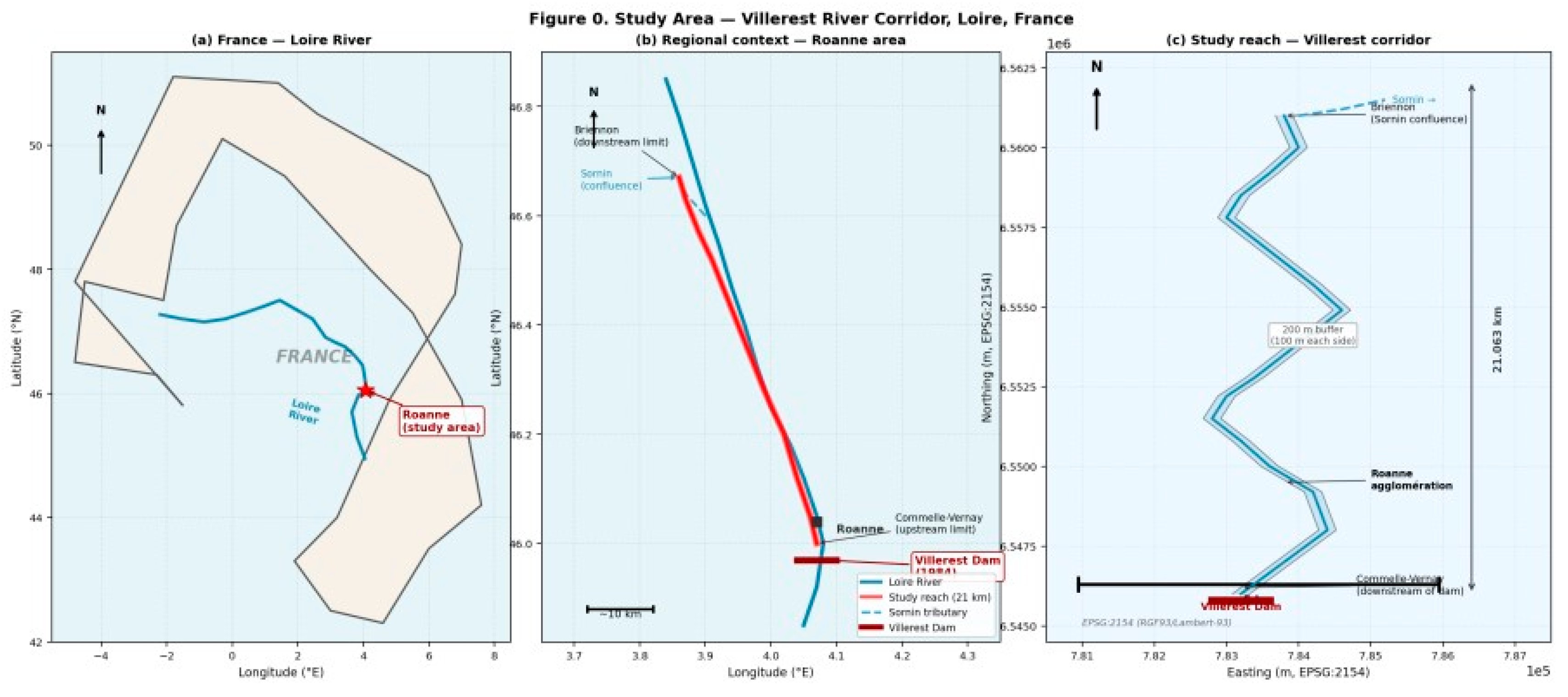
Figure 2.
(a) Continuous DoD map of the Villerest river corridor (B − A) in metres. Yellow–green tones indicate net deposition; cyan–purple tones indicate net erosion. (b) Thresholded erosion/deposition classification (minLoD = 0.10 m): yellow = deposition (+1), white/grey = stable (0), dark purple = erosion (−1). North arrow and 5 km scale bar shown. EPSG:2154 (RGF93/Lambert-93).
Figure 2.
(a) Continuous DoD map of the Villerest river corridor (B − A) in metres. Yellow–green tones indicate net deposition; cyan–purple tones indicate net erosion. (b) Thresholded erosion/deposition classification (minLoD = 0.10 m): yellow = deposition (+1), white/grey = stable (0), dark purple = erosion (−1). North arrow and 5 km scale bar shown. EPSG:2154 (RGF93/Lambert-93).
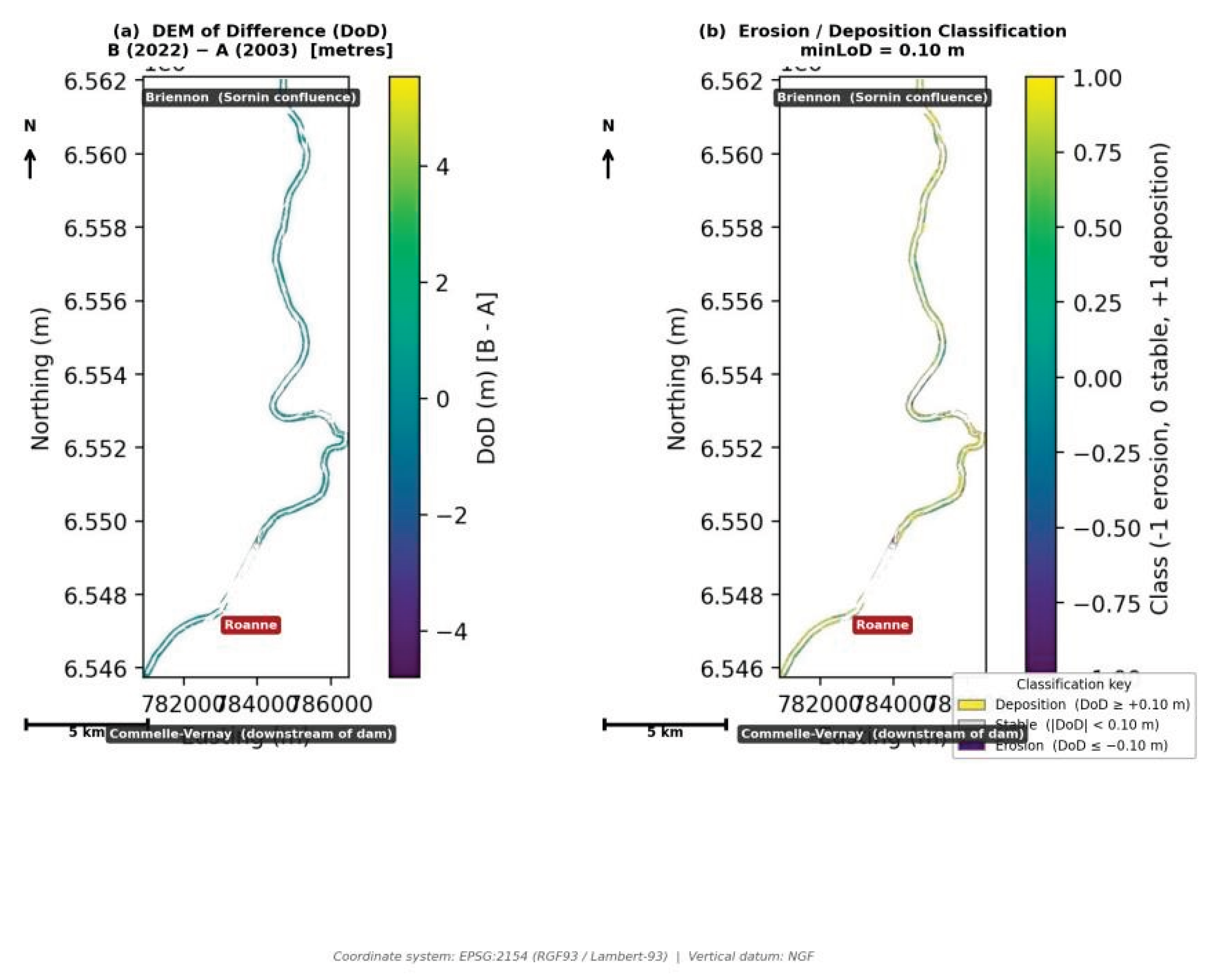
Figure 3.
Frequency distribution of DoD values for all valid pixels in the Villerest corridor (n = 1,895,198 pixels; monitoring period 2003–2022). The positively skewed distribution confirms the dominantly aggradational character of the corridor. Vertical dashed lines at ±0.10 m denote the applied minLoD threshold.
Figure 3.
Frequency distribution of DoD values for all valid pixels in the Villerest corridor (n = 1,895,198 pixels; monitoring period 2003–2022). The positively skewed distribution confirms the dominantly aggradational character of the corridor. Vertical dashed lines at ±0.10 m denote the applied minLoD threshold.
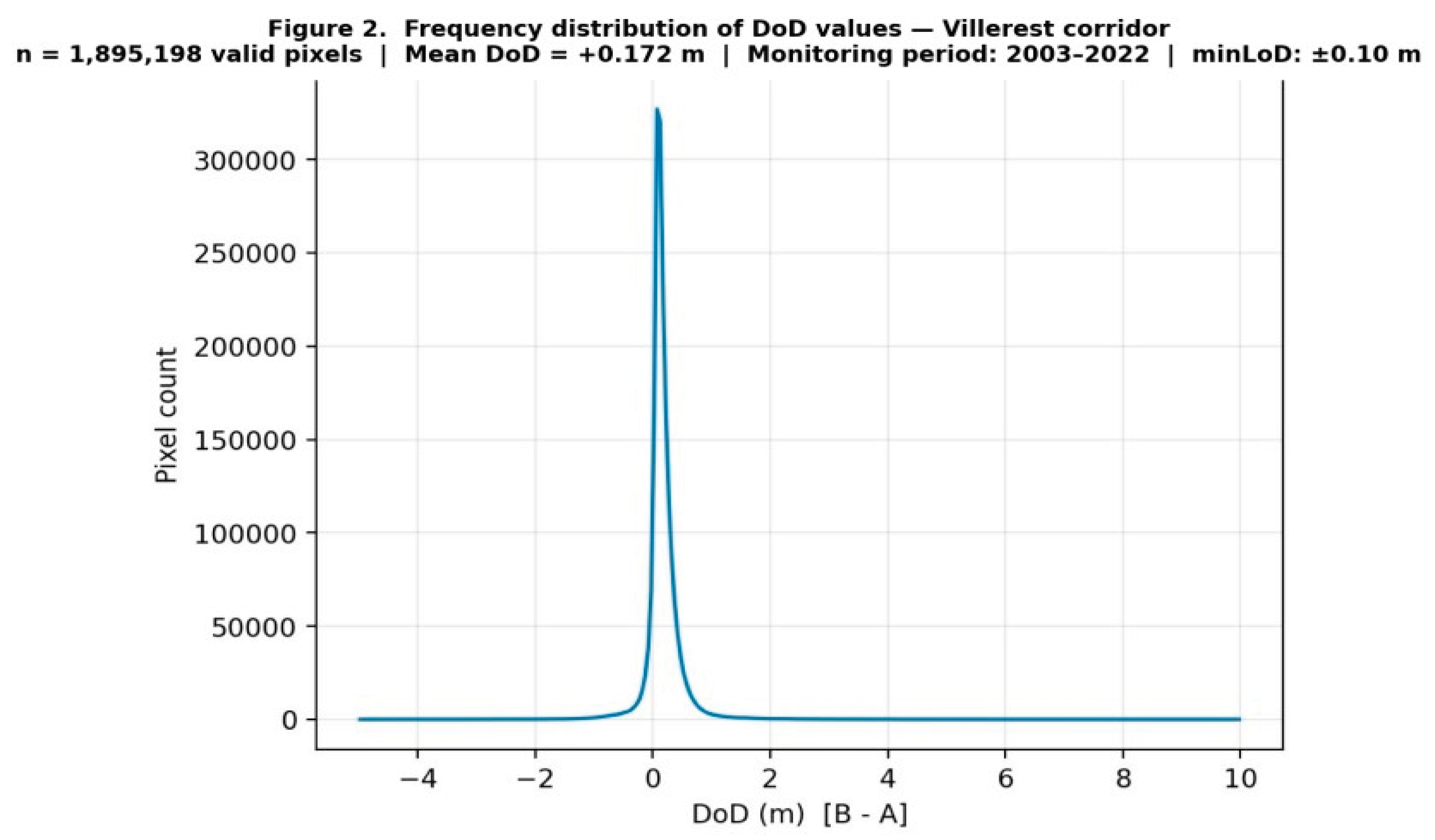

Table 1.
DoD statistics for the Villerest river corridor (minLoD = 0.10 m). Monitoring period: 2003–2022 (19 years).
Table 1.
DoD statistics for the Villerest river corridor (minLoD = 0.10 m). Monitoring period: 2003–2022 (19 years).
| Parameter | Value |
|---|---|
| Survey epoch A — older DEM (DREAL) | 2003 |
| Survey epoch B — recent DEM (IGN LiDAR HD) | 2022 |
| Monitoring period | 2003–2022 (19 years) |
| Coordinate system | EPSG:2154 (RGF93/Lambert-93) |
| Grid resolution (analysis) | 1 m × 1 m |
| DEM B original resolution | 0.5 m (resampled to 1 m) |
| Corridor buffer width | 100 m each side |
| Study reach length | 21.063 km |
| Minimum level of detection (minLoD) | 0.10 m |
| Valid corridor area | 1,895,198 m² |
| DoD minimum | −7.028 m |
| DoD maximum | +9.002 m |
| DoD mean | +0.172 m |
| Erosion area | 105,311 m² (5.6%) |
| Deposition area | 1,191,342 m² (62.9%) |
| Erosion volume (magnitude) | 46,587.65 m³ |
| Deposition volume | 347,429.08 m³ |
| Net volume (Dep − Ero) | +300,841.43 m³ |
| Mean annual net deposition rate | ~15,833 m³/yr |
| Mean vertical aggradation rate | ~9.1 mm/yr |
Table 2.
Volumetric sediment budget with mean annual rate equivalents (2003–2022, 19 years).
| Metric | Total | Annual Rate |
|---|---|---|
| Erosion volume | 46,587.65 m³ | 2,452 m³/yr |
| Deposition volume | 347,429.08 m³ | 18,285 m³/yr |
| Net volume change | +300,841.43 m³ | +15,833 m³/yr |
| Mean vertical change | +0.172 m | ~9.1 mm/yr |
Table 3.
Threshold sensitivity analysis. The DoD was re-thresholded at minLoD = 0.10, 0.15, and 0.20 m. Net volume remains strongly positive at all thresholds, confirming the robustness of the aggradational interpretation.
Table 3.
Threshold sensitivity analysis. The DoD was re-thresholded at minLoD = 0.10, 0.15, and 0.20 m. Net volume remains strongly positive at all thresholds, confirming the robustness of the aggradational interpretation.
| Threshold (m) | Erosion Area (m²) | Deposition Area (m²) | Net Volume (m³) | Net Rate / Corridor Area (mm/yr) |
|---|---|---|---|---|
| 0.10 | 105,311 | 1,191,342 | +300,841 | 8.4 |
| 0.15 | 81,690 | 870,716 | +264,006 | 7.3 |
| 0.20 | 65,939 | 639,311 | +226,601 | 6.3 |
Disclaimer/Publisher’s Note: The statements, opinions and data contained in all publications are solely those of the individual author(s) and contributor(s) and not of MDPI and/or the editor(s). MDPI and/or the editor(s) disclaim responsibility for any injury to people or property resulting from any ideas, methods, instructions or products referred to in the content. |
© 2026 by the author. Licensee MDPI, Basel, Switzerland. This article is an open access article distributed under the terms and conditions of the Creative Commons Attribution (CC BY) license (http://creativecommons.org/licenses/by/4.0/).
Copyright: This open access article is published under a Creative Commons CC BY 4.0 license, which permit the free download, distribution, and reuse, provided that the author and preprint are cited in any reuse.


