

Submitted:
14 March 2026
Posted:
16 March 2026
You are already at the latest version
Abstract
Contemporary theories of emotion explain affective life through biologically prepared modules, cognitive appraisal mechanisms, predictive construction, dimensional organization, neural survival circuits, attachment regulation, adaptive computation, and error minimization. While each framework offers important insight, none fully explains why emotional intensity varies dramatically across contexts, why identical informational input yields divergent responses, or why certain commitments reorganize identity and override instrumental reasoning.This paper introduces the Dynamic Love-Based Valuation (DLBV) framework, proposing that emotional diversity emerges from a unified valuation architecture grounded in identity-relevant valuation, termed love. Love is defined not as romantic behavior nor as a discrete emotion, but as a structural valuation system operating across three qualitatively distinct phases: attraction, immersion, and union. Attraction preserves instrumental rationality and goal-directed evaluation. Immersion reorganizes valuation through identity expansion and potential subordination of rational constraint. Union stabilizes valuation within integrated attachment and responsibility.Within this framework, emotions such as fear, anger, sadness, joy, jealousy, guilt, gratitude, hope, and despair are interpreted as contextual modulations of valuation under specific informational conditions, including threat, violation, deprivation, alignment, rivalry, uncertainty, or loss. Emotional tone and intensity depend not solely on appraisal content or arousal magnitude but on the structural depth at which valuation operates.To move beyond conceptual synthesis, the paper proposes an experimental paradigm designed to test phase-dependent modulation of emotional intensity. The design operationalizes identity-relevant valuation across the three love phases and examines whether identical informational stimuli elicit systematically different affective responses depending on phase-structured commitment. The Dynamic Love-Based Valuation framework therefore offers both an integrative theoretical account and a falsifiable empirical program for investigating the structural architecture of emotion.
Keywords:
Trilogy Theory of Consciousness (TTC)
; Awareness-Based Choice Selection (ABCS)
; emotion
; love
1. A Morning Visit
It was a quiet Sunday morning. I was resting in my bedroom after a heavy brunch, half watching a dull television show, when my daughter called from downstairs:
“Dad, John is here.”
Without moving, I replied, “Show him the gardening tools in the garage and tell him to trim the hedges this week.”
The information was processed instantly. It carried meaning. But it carried no emotional charge. John, the gardener, required no further valuation. The informational intelligence remained neutral, and I returned to the program.
A moment later she called again:
“Dad, Uncle John is here.”
This time I rose halfway from the bed.
The same name. The same informational structure. But a different subject of valuation.
Uncle John is my brother-in-law. He occupies a different category in my internal landscape. He matters. Instantly, the informational intelligence was charged. Joy disrupted the slow rhythm of the morning.
“Let him in. I’ll be right there.”
As I walked across the room, surprise entered the scene. Why would he visit unannounced on a Sunday? The informational intelligence began interacting with memory and expectation. Joy blended with uncertainty.
Why is he here?
The same valued subject now generated suspicion. Suspicion shaded into anxiety.
Something might be wrong.
Memory intervened. A month earlier, he had borrowed a vintage family photograph that I cherished deeply and had accidentally damaged it. The emotional field reorganized. Anxiety gave way to irritation. Irritation intensified into anger. I loved that photograph, not merely the object, but what it represented: identity, history, self.
As I descended the stairs, additional associations surfaced. Subtle family rivalries. Comparisons. Old grievances.
Why is he the favored son-in-law?
Jealousy entered the mixture.
None of these emotions arose from new external information. They emerged from valuation interacting with stored informational intelligence.
Then I reached the living room.
He was not alone.
The lights flicked on.
“SURPRISE! Happy Birthday!”
In an instant, the entire affective landscape reorganized. Fear, irritation, jealousy, and anxiety dissolved into joy, relief, and mild embarrassment as I noticed they were filming me in my pajamas.
The informational input shifted again. The valuation recalibrated. The emotional charge transformed.
I have always known that I hate surprises.
2. Introduction
The episode above illustrates a central yet often underexamined feature of emotional life: information alone does not generate emotion. Human beings are continuously exposed to informational input, yet only a fraction becomes emotionally charged. Emotional activation is selective. It emerges only when something matters.
Emotions are frequently described as primitive impulses, disruptive forces, or remnants of evolutionary survival mechanisms. Some theories conceptualize them as biologically discrete modules competing with rational cognition. Others reduce them to dimensional coordinates of valence and arousal, adaptive computational programs, predictive regulatory states, or attachment-based survival systems. While these frameworks have significantly advanced our understanding of emotional mechanisms, they leave a fundamental question insufficiently addressed:
Why does certain information become emotionally significant while other information remains neutral?
Fear presupposes something valued that could be lost. Disgust or hate presupposes something valued that has been violated. Grief presupposes the loss of meaningful attachment. Joy presupposes alignment with something desired. Across emotional categories, the common denominator is valuation. Emotional differentiation appears to follow not merely from stimulus type or biological activation, but from what is valued and how deeply it is valued.
This observation suggests that emotion may not be an independent psychological faculty separate from informational processing. Rather, emotional experience may represent informational intelligence that becomes affectively charged when it concerns something significant within the system’s valuation architecture.
The present manuscript proposes that emotional life is organized not primarily by survival optimization or discrete affective modules, but by a dynamic valuation architecture grounded in love. Survival remains critically important, yet it is treated as one valued outcome among many rather than the foundational organizing principle. Human beings routinely display emotional commitments that extend beyond immediate survival or reproductive calculus: devotion to ideals, loyalty to identity, artistic passion, moral conviction, and even self-sacrifice for abstract causes. Such phenomena indicate that emotional intensity cannot be reduced solely to adaptive necessity.
Accordingly, this paper describes emotions in a novel framework leaning on love as the valuation system called the Dynamic Love-Based Valuation (DLBV). It argues that emotional diversity can be understood as differentiated expressions of a unified love-based valuation system operating under varying informational conditions and across distinct structural phases. The sections that follow develop this framework and examine prevailing theories of emotion, identifying both their explanatory strengths and the limitations that DLBV seeks to address.
3. Thesis Statement and Operational Definition of Love
3.1 Positioning Emotion Within the Awareness Architecture
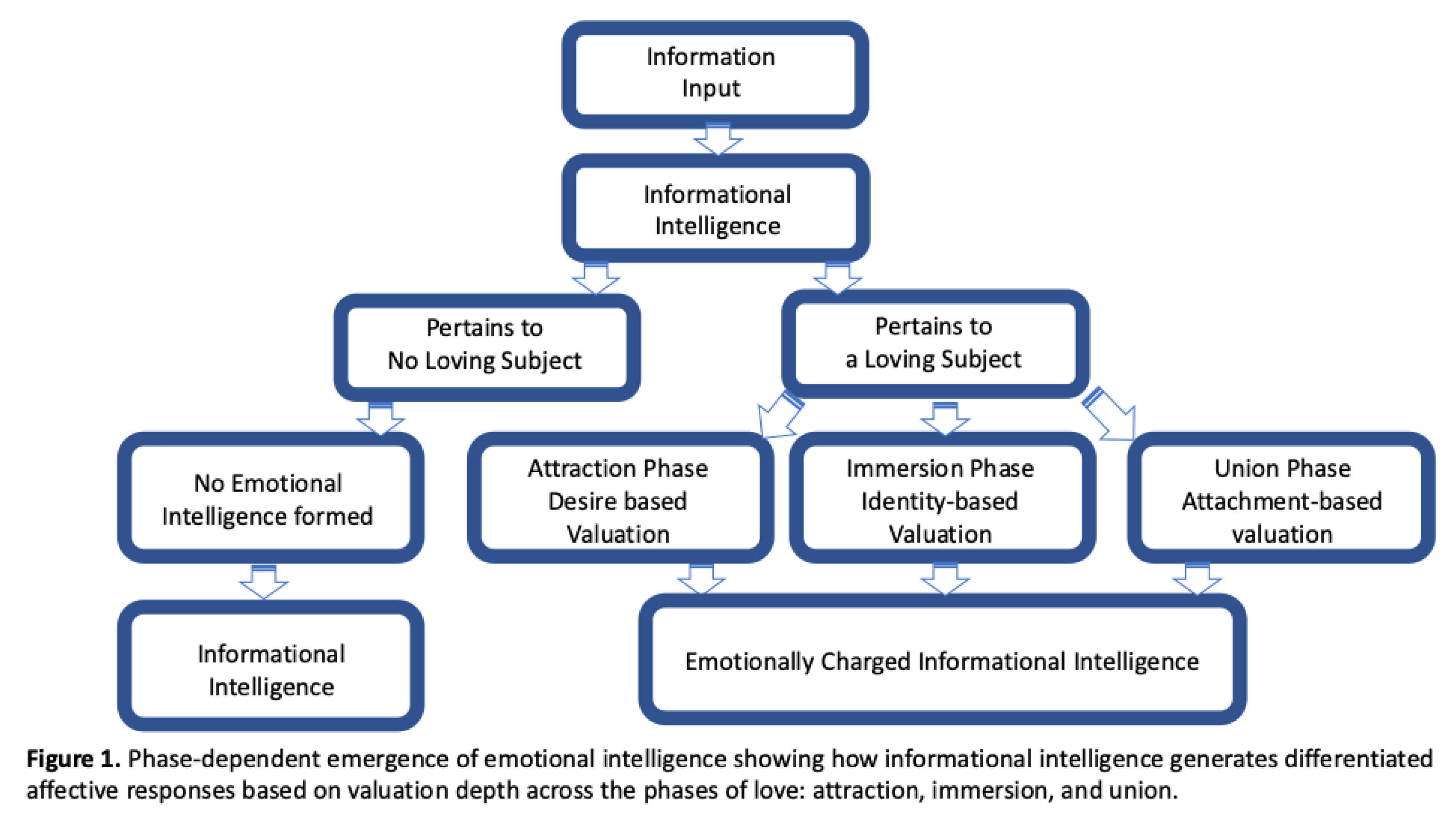
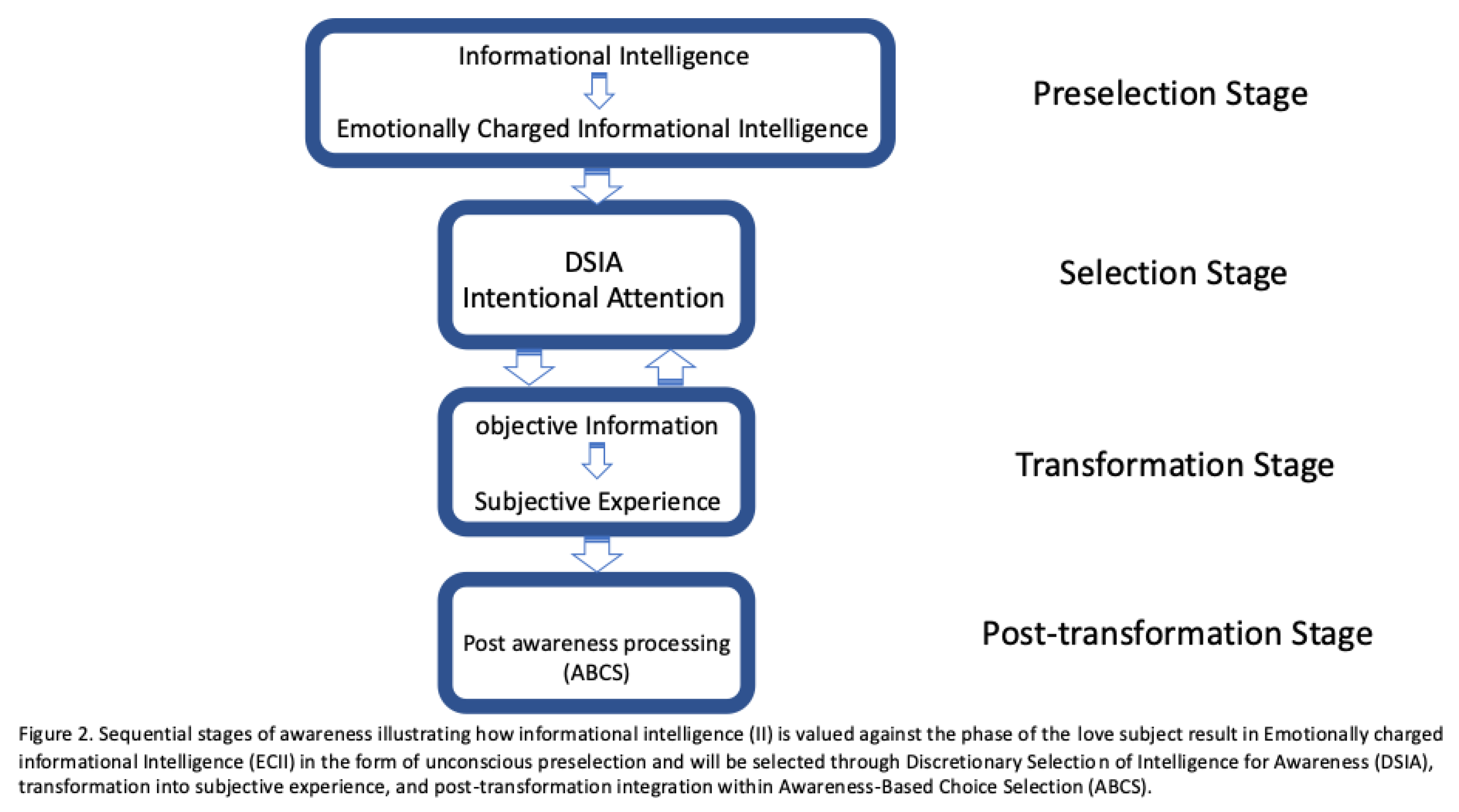
Within the DLBV framework, emotion is not an independent psychological faculty but a functional process within the broader architecture of awareness and decision formation. Informational input is continuously processed into Informational Intelligence (II), defined as contextualized information derived from internal and external stimuli. II serves as the cognitive substrate upon which valuation operates. II may remain neutral when it does not pertain to any subject of love and thus remains as II. When II pertains to a subject of love, valuation generates affective charge, here termed Emotional Intelligence (EI), which is assigned to the II and transforms it into Emotionally Charged Informational Intelligence (ECII) (Figure 1). It is this integrated ECII that functions within the preselection stage of the Trilogy Theory of Consciousness (TTC) (Farhadi, 2023), influencing attention allocation, reasoning, counter-reasoning, and candidate choice formation prior to conscious awareness.
Only a subset of II and ECII advances beyond the preselection stage. Through the selection process, only a select II and ECII enter the transformative stage of awareness, where they are converted into subjective experience (Figure 2). When ECII crosses this threshold, emotion becomes consciously experienced as feeling. In contrast, when II passes without emotional charging, awareness may arise without affective tone.
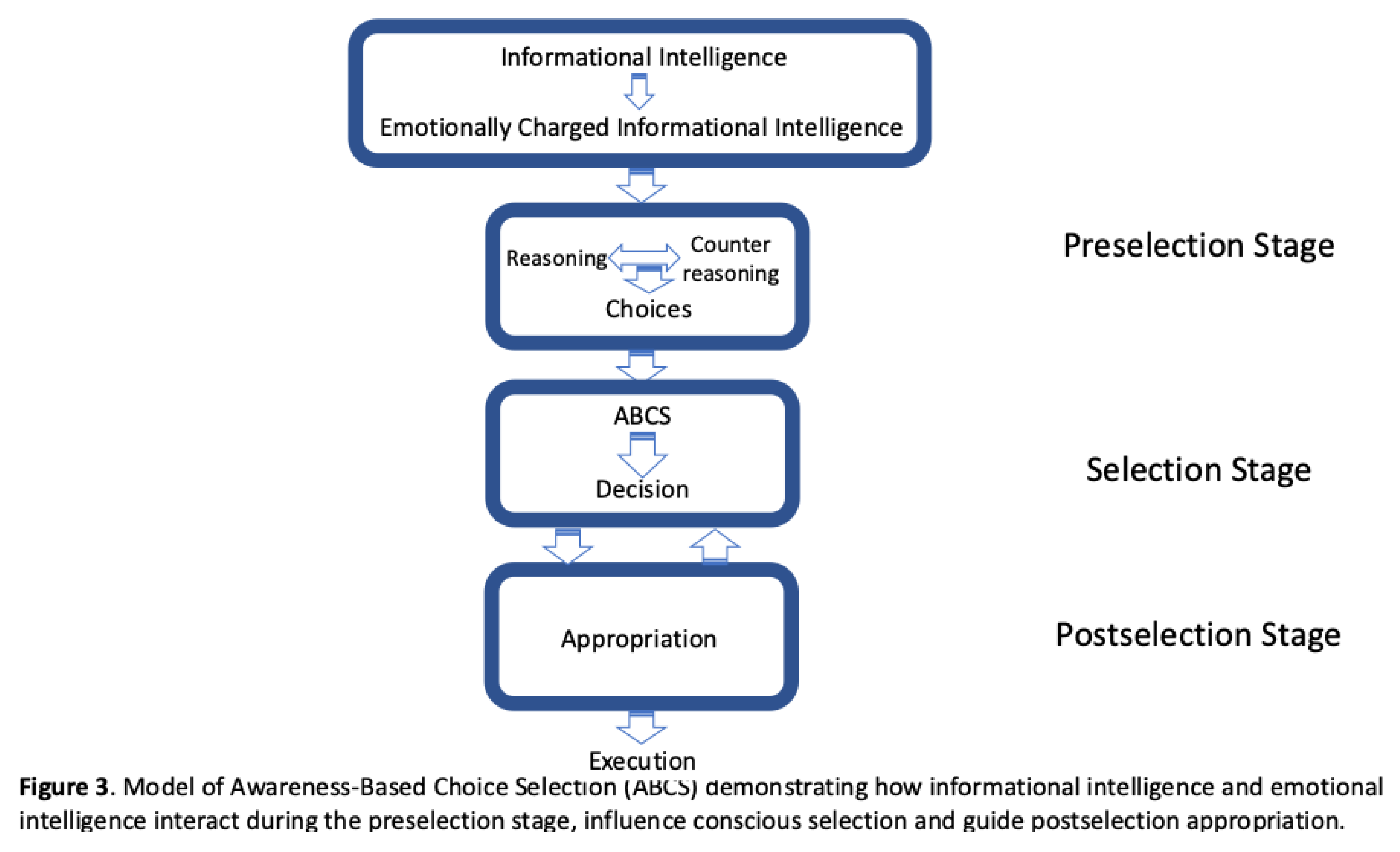
Emotion, therefore, is not separate from informational processing; rather, it represents the valuation-modulated form of informational intelligence within the architecture of awareness. During decision-making, ECII emerging from the valuation of II serves as the substrate for reasoning and counter-reasoning. This dynamic evaluative interplay generates the choice architecture required for Awareness-Based Choice Selection (ABCS) (Figure 3).
The central thesis of this manuscript is that all core emotions arise from a single dynamic valuational system grounded in love. Joy, sadness, fear, anger, disgust, and surprise are not independent primitives or modular programs. They are differentiated expressions of love operating under distinct informational conditions such as gain, loss, uncertainty, violation, and prediction error. Emotional diversity reflects contextual modulation of a unified valuational architecture rather than activation of discrete emotional mechanisms.
In DLBV Theory, love is not treated as romantic sentiment nor as one emotion among others. Love is defined as the dynamic valuational mechanism through which Informational Intelligence (II) is appraised and, when relevant, emotionally charged. It functions as the structural filter that determines whether II remains neutral or transforms into Emotionally Charged Informational Intelligence (ECII). Through this process, certain objects, persons, ideals, or states become integrated into what the system treats as meaningful. Love therefore determines what matters and regulates both whether and how II acquires emotional valence. To clarify this claim, love must be defined operationally.
3.2. The Triphasic Model of Love (TML)
Before integrating love into the broader valuation architecture of DLBV, its internal structure must be defined independently. The Triphasic Model of Love proposes that love is a dynamic process unfolding across three qualitatively distinct phases: attraction, immersion, and union. Each phase represents a specific configuration of valuation and carries distinct implications for cognition, risk tolerance, identity organization, and emotional intensity.
3.2.1. Attraction
Attraction represents the initial phase of love. In this stage, an object, person, ideal, or state is recognized as desirable or beneficial. Valuation is instrumental and goal directed. The individual evaluates costs, benefits, feasibility, and expected outcomes. Desire operates within rational constraints, and reasoning remains dominant.
At this phase, the valued object is yet to be attained and remains external to identity. Emotional intensity is proportional to perceived gain or loss. Risk assessment remains balanced. Emotional responses correspond closely to traditional appraisal-based or goal-relevance frameworks. Attraction therefore represents desire-dependent valuation prior to identity integration.
3.2.2. Immersion
Immersion marks a qualitative shift in valuation. The boundary between self and valued object begins to soften. The valued subject becomes identity relevant rather than merely desirable. Valuation intensifies and reorganizes cognitive hierarchy. This phase unfolds through three structural components.
Belonging
The individual begins to incorporate the valued object into self representation. The object of love is no longer external but becomes part of one's identity structure. Emotional relevance increases because success or threat now implicates the self directly.
Ignorace
Ignorace is a constructed term combining ignoring with grace, denoting the voluntary subordination of rational constraint within immersive valuation. Customary reasoning processes may be intentionally deprioritized. Risk thresholds shift toward greater tolerance. Warning signals and contradictory evidence may be discounted, not due to cognitive failure, but due to reweighted evaluative priorities. Motivational commitment deepens beyond instrumental optimization. Reasoning is not eliminated; rather, its weighting within the decision architecture is recalibrated in favor of identity-congruent attachment. This structural recalibration corresponds to the colloquial notion that “love is blind,” though here it is understood not as perceptual deficit but as valuation-driven cognitive reordering.
Creation
The immersive process culminates in transformation. Identity may be reconfigured. The individual may adopt new roles, values, or commitments that redefine self-concept. This transformation can manifest in creative production, altered life priorities, or existential reorientation. The relationship between one and subject of love may reshape identity in a durable and structural manner.
In immersion, emotional intensity is amplified not merely due to stronger desire or attachment, but due to structural identity reorganization. Identical Informational Intelligence (II) can generate dramatically different Emotionally Charged Informational Intelligence (ECII) depending on whether valuation remains at attraction or has entered immersion. Immersion therefore represents identity-dependent valuation.
3.2.3. Union
Union represents stabilization of valuation following immersive transformation. Emotional turbulence subsides. Commitment, responsibility, and respect replace acquisitive desire. Attachment becomes integrated rather than aspirational.
Union marks the emergence of a structured, bidirectional relationship between the individual and the valued subject. The primary goal shifts toward maintenance and continuity of attachment. Decision-making regains rational balance. Risk thresholds approach baseline levels. Identity expansion from immersion consolidates into identity integration.
Although union reflects restored rational equilibrium, it remains grounded in attachment-based valuation. It represents a distinct structural configuration rather than a return to attraction.
3.2.4. Evolution and Variability of Love Phases
The phases of love do not necessarily unfold in a rigid or universal sequence. While attraction may precede immersion and union in many cases, this progression is not obligatory.
Some attraction processes never enter immersion. Some relationships may stabilize into union without intense immersive transformation. Conversely, certain individuals, such as artists or creators, may dwell predominantly within immersive passion without seeking stabilization in union.
The purpose of TML is not to impose strict categorical boundaries or to provide an objective diagnostic tool for phase assignment. Rather, it offers a descriptive organizational framework that helps explain variations in behavior, emotional intensity, risk tolerance, and identity transformation that are difficult to account for using conventional models of love.
The phases should therefore be understood as structural configurations of valuation rather than fixed, objective developmental stages.
3.3. Structural Implications of TML
The Triphasic Model of Love establishes that valuation is dynamic and phase dependent. It distinguishes:
- Desire-based valuation prior to attainment of the love subject in attraction
- Identity-dependent valuation during immersion
- Attachment-based valuation following attainment of the love subject in union
This distinction is critical because identical Informational Intelligence can generate markedly different Emotional Intelligence depending on the phase of love in which valuation resides. Phase depth alters cognitive weighting of II, emotional amplitude, and behavioral commitment.
Love, in this model, cannot be reduced to desire or attachment alone. Desire seeks acquisition. Attachment preserves connection. Immersion reorganizes identity and recalibrates the hierarchy of goals. During immersion, emotional responses to II may become disproportionate or unpredictable relative to instrumental reasoning.
The triphasic structure therefore provides the necessary architecture for understanding how love functions as the dynamic valuational system that underpins emotional differentiation within DLBV.
4. Core Emotion Mapping: Love as the Underlying Valuational Process
If emotion is understood as the affective charging of Informational Intelligence (II) through identity-relevant valuation, then emotional diversity must be explained not by multiple independent mechanisms but by variations in how love evaluates different informational conditions. Within DLBV Theory, core emotions represent differentiated patterns of Emotional Intelligence (EI) generated when II interacts with valued subjects under distinct contextual constraints.
Love functions as the dynamic valuation system that determines which II becomes emotionally charged and how intensely it is charged. Emotional differentiation reflects variations in informational condition, phase depth within the Triphasic Model of Love, and the structural significance of the valued subject.
4.1. Joy: Love Fulfilled
Joy arises when Informational Intelligence (II) indicates successful attainment, preservation, or meaningful progression of a valued outcome. Emotional Intelligence (EI) signals alignment between valuation and reality and carries positive valence because the valued subject remains secure, advancing, or fulfilled.
Joy reinforces behavioral patterns associated with successful valuation. Its amplitude depends on phase depth. In attraction, joy reflects instrumental success and progress toward acquisition. In immersion, joy may be amplified because identity-relevant valuation is implicated. In union, joy reflects stability, continuity, and sustained attachment.
Although union may represent fulfillment for some forms of love, fulfillment does not necessarily require arrival at union. For many individuals, the immersive process itself may constitute fulfillment. In such cases, progress within the journey of love generates positive EI independent of structural stabilization.
Joy therefore represents positive emotional charging of II under conditions of perceived alignment between valuation and experiential reality.
4.2. Sadness: Love Deprived
Sadness emerges when Informational Intelligence (II) indicates that a valued outcome is threatened with loss, already lost, delayed, or rendered unattainable. Although the valuation of the love subject may persist, II signals deprivation or disruption of what is valued. Emotional Intelligence (EI) therefore carries negative valence.
Sadness does not merely signal failure or impending loss. By preserving the significance of the valued subject, sadness facilitates adaptive recalibration. It may prompt revision of priorities, modification of goals and strategies, or initiation of mourning processes, depending on the phase of love.
In attraction, sadness resulting from loss may lead to substitution of the valued subject and redirection of desire. In immersion, sadness may intensify effort and motivate strategic recalibration because identity integration deepens perceived loss. In union, sadness may manifest as grief grounded in stabilized attachment and relational continuity.
Sadness therefore represents negative emotional charging of II under conditions of deprivation of what is loved.
4.3. Fear and Anxiety: Love Under Threat or Uncertainty
Fear and anxiety arise when Informational Intelligence (II) signals threat, unpredictability, or potential harm to a valued subject. The subject of love remains present, but its integrity or future realization becomes uncertain.
Fear typically corresponds to identifiable or immediate threat. Anxiety reflects extended uncertainty across time. Both represent anticipatory valuation responses.
The intensity of Emotional Intelligence (EI) depends on the structural depth of love and the perceived severity of threat. When valuation is identity dependent, as in immersion, fear and anxiety may be amplified. In cases such as phobia, the valued subject is often the self, and EI reflects anticipated harm to self-preservation.
Fear and anxiety therefore represent emotional charging of II under conditions of anticipated disruption of what is valued.
4.4. Disgust and Hate: Love Being Violated
Disgust emerges when Informational Intelligence (II) indicates contamination, violation, or degradation of a valued subject. It reflects perceived failure of boundary protection and signals incompatibility between what is valued and the perceived intrusion.
Hate may develop when the violation is interpreted as intentional, persistent, or symbolic. While disgust is typically a short-term and reactive negative Emotional Intelligence (EI) directed toward the violating process or condition, hate is more often sustained and cognitively reinforced negative EI directed toward the perceived source or agent responsible for the violation.
Although both involve negative emotional charging of II, they function defensively to preserve the structural integrity of what is loved. When the self is the valued subject, disgust or hate directed toward others may arise in response to perceived threat to self and self-valuation.
The deeper the phase of love, the stronger and more persistent the defensive response.
4.5. Anger: Mobilized Boundary Defense
Anger arises when II indicates that active protection or corrective action is necessary. While disgust and hate identify boundary breach, anger mobilizes behavioral energy toward confrontation, restoration, or deterrence of the process or the perceived source of harm and violation of the love subject.
Within DLBV, anger is not an independent primitive but an action-oriented amplification of defensive EI rooted in disgust or hate. Its intensity depends on phase depth and perceived immediacy of harm or threat.
Anger therefore represents mobilized protection of what is valued. Resentment may be understood as a sustained but behaviorally restrained form of this defensive state.
4.6. Surprise: Love Confronted by Prediction Error
Surprise occurs when II indicates a significant deviation from anticipated outcomes concerning a valued subject. EI reflects the rapid need to update predictive models.
Surprise is typically brief and transitional. Positive surprise may rapidly resolve into joy, while negative surprise may quickly transform into sadness, fear, disgust, or anger depending on implications for valuation.
Surprise therefore represents rapid recalibration of emotional charging in response to prediction error involving what is valued.
5. Secondary and Complex Emotions: Differentiated Configurations of Love
While core emotions reflect primary emotional charging of Informational Intelligence (II) under conditions such as fulfillment, deprivation, threat, violation, or prediction error, secondary and complex emotions arise when the same love-based valuation system interacts with higher-order cognitive processes.
These processes include self-assessment, counterfactual reasoning, social comparison, moral evaluation, memory integration, and temporal projection. In DLBV terms, primary emotions involve direct emotional charging of II through valuation. Secondary and complex emotions emerge when II itself is re-evaluated within reflective or socially mediated cognitive layers before being emotionally charged into ECII.
Thus, complex emotions do not originate from additional affective primitives. They arise when love, as the dynamic valuation architecture, operates recursively through self-awareness and social cognition. The emotional charge is no longer directed solely toward external informational conditions but toward the self in relation to those conditions.
Complex emotions therefore represent multi-layered configurations of love, in which valuation is applied not only to outcomes but to actions, identities, intentions, comparisons, or imagined alternatives.
5.1. Guilt: Love Harmed by the Self
Guilt arises when Informational Intelligence (II) indicates that one’s own action has violated, harmed, or betrayed a valued subject. The valued subject may be another person, a relationship, a moral principle, an ideal, or the self. In all cases, guilt reflects negative Emotional Intelligence (EI) generated when the self is evaluated as the source of disruption to what is loved.
Unlike defensive emotions such as anger or disgust, which are directed outward toward a perceived threat, guilt is inwardly oriented. The II does not merely signal loss or threat, but responsibility. The system recognizes that the boundary violation originated from the self rather than from an external agent.
Within DLBV, guilt represents negative emotional charging of II under conditions of self-attributed violation of love. Its intensity depends on the structural depth of valuation. When the harmed subject is identity-integrated, as in immersion or union, guilt may be particularly intense because the violation threatens not only the valued object but also the integrity of self-concept.
Guilt often mobilizes reparative motivation. Because the underlying valuation persists, the system seeks restoration of alignment between action and love. Thus, guilt reflects love defending its own moral coherence when the self has become the source of harm.
5.2. Regret: Love Confronted by Counterfactual Misalignment
Regret arises when Informational Intelligence (II) indicates that a chosen action has resulted in an outcome that is less aligned with what is valued than an imagined alternative. The emotional charging does not depend primarily on moral violation, but on comparison between actual and counterfactual desired outcomes.
In regret, the value of the subject of love remains intact, but the pathway chosen by the self is evaluated as suboptimal. The system simulates an alternative scenario in which the desired outcome might have been better preserved or enhanced. Negative Emotional Intelligence (EI) emerges from this discrepancy.
Within DLBV, regret represents negative emotional charging of II under conditions of self-attributed misjudgment or mistake rather than direct violation. It requires counterfactual cognition, that is, the capacity to compare actual outcome with a mentally constructed desired one.
The intensity of regret depends on the significance of the desired outcome and the perceived magnitude of the lost opportunity. In attraction, regret may lead to recalibration of strategy or redirection of desire. In immersion, regret may be amplified if the chosen action disrupted an identity-integrated commitment. In union, regret may motivate corrective adjustment aimed at stabilizing attachment.
Where guilt centers on harm to what is loved, regret centers on missed alignment with the desired outcome.
5.3. Shame: Self-Love Under Threat of Self-Evaluation
Shame arises when emotionally charged Informational Intelligence (ECII) reflects a perceived deficiency in the self’s value relative to internalized standards. Unlike guilt, which is directed toward a specific action that harms a valued subject, shame concerns the global assessment of the self as inadequate.
In shame, valuation does not focus on what one did or failed to do, but on what one is or is not. The self becomes the object of evaluation. Informational Intelligence related to performance, appearance, morality, competence, or social standing is charged negatively because it is interpreted as falling short of internalized ideals.
Although the standards underlying shame may originate from social or cultural contexts, they are internalized within the valuation architecture. As a result, shame can arise even in the absence of external judgment or exposure.
Within DLBV, shame represents recursive valuation in which self-love encounters a perceived collapse in self-worth. The valued identity is experienced as compromised. Emotional charging is directed toward the self as the love subject, resulting in a reduction of perceived value, confidence, and coherence of identity. When identity-relevant valuation is deep, especially in immersive or union phases involving ideals, roles, or moral commitments, shame may become particularly intense.
Shame therefore represents negative emotional charging of II directed toward the self as a valued identity under perceived inadequacy.
5.4. Pride: Self-Love Confirmed Through Self-Evaluation
Pride represents a positive configuration of Emotional Intelligence (EI) and functions as the structural counterpart to shame. It arises when emotionally charged Informational Intelligence (ECII) reflects that one’s performance, appearance, morality, competence, or social standing meets or exceeds internalized standards.
Unlike shame, which signals perceived inadequacy of the self, pride reflects successful alignment between identity-relevant valuation and internalized ideals. The self, as a valued subject, is affirmed rather than diminished.
Within DLBV, pride represents recursive valuation in which self-love is positively reinforced through self-assessment. Informational Intelligence concerning the self is emotionally charged with positive valence because it confirms competence, adequacy, or worth relative to internal standards. This reinforcement strengthens identity coherence and stabilizes self-valuation.
The intensity of pride may vary depending on phase depth. When identity-relevant commitments are deeply integrated, especially in immersive or union phases involving roles, achievements, or moral commitments, pride may carry amplified significance.
Pride therefore represents positive emotional charging of II directed toward the self as a valued identity under conditions of perceived adequacy or excellence.
5.5. Trust: Desire for Connection Under Uncertainty
Trust represents a foundational mechanism in the development and maintenance of relational commitment. It emerges when commitment toward a valued outcome or relationship persists despite incomplete Informational Intelligence (II) and residual uncertainty. Trust reflects the maintenance of positive Emotional Intelligence (EI) in the presence of perceived risk.
Within DLBV, trust involves a temporary and intentional reduction in the weighting of uncertainty-related II in favor of commitment to the valued subject. It is not the absence of uncertainty but a decision to proceed despite it. Trust therefore reflects stabilized positive valuation under conditions of incomplete information.
In the attraction phase, trust marks the threshold between instrumental desire and deeper valuation. Without sufficient trust, the process may remain confined to attraction and fail to transition into immersion. In this sense, trust functions as a gateway condition for immersive love.
During immersion, particularly within the subordination of rational constraint, trust becomes embedded in the valuation structure. Decisions and actions may proceed without exhaustive evidential support because identity integration reduces the perceived need for constant verification.
In union, trust stabilizes attachment and cooperative interaction. It must be maintained to preserve relational continuity. Erosion of trust at this stage can destabilize attachment-based valuation and alter emotional responses to II.
Trust, therefore, represents sustained positive valuation under uncertainty and plays a regulatory role across phases of love rather than constituting a primary emotional category.
5.6. Jealousy: Love Under Threat of Rivalry
Jealousy arises when Informational Intelligence (II) signals that a valued relationship, status, or attachment is threatened by the presence of a rival. The loved subject remains valued, but its exclusivity, stability, or accessibility appears vulnerable.
Structurally, jealousy represents a composite Emotional Intelligence (EI) configuration. It often includes anticipatory fear of loss, anger toward the perceived rival, and sadness at potential displacement. Unlike simple fear, jealousy is relational and comparative. The threat is not abstract harm, but replacement.
Within DLBV, jealousy reflects defensive emotional charging of II under conditions of competitive threat to a valued subject. Although often experienced as negative, jealousy can function as a catalytic motivator. It may mobilize effort, strategic planning, increased vigilance, or recalibration of behavior to preserve what is valued. Its expression varies across phases of love.
In attraction, jealousy may intensify desire, increase competitive drive, and accelerate transition toward immersion.
In immersion, jealousy may become amplified because identity integration deepens perceived vulnerability. Rivalry may be experienced not only as threat to the prospective attachment but as threat to self-structure.
In union, jealousy may either reinforce protective attachment or destabilize relational trust, depending on the balance between commitment and insecurity.
The boundary between jealousy and actual loss may become blurred, particularly in immersion. When a relationship has objectively deteriorated or ended, perceived rivalry may serve as a defensive reinterpretation. Accepting defeat or termination of attachment may threaten identity coherence. In such cases, jealousy may be misapplied, prolonging attachment beyond rational thresholds and leading to obsessive persistence or maladaptive behavior.
Jealousy therefore represents love perceiving potential loss due to rivalry.
5.7. Envy: Love Confronted by Comparative Deprivation
Envy arises when II indicates that another individual possesses a valued quality, achievement, status, or relationship that is desirable to the self but currently lacking. Unlike jealousy, which involves threat to an existing love subject, envy concerns perceived deficiency of a desired subject relative to others.
Within DLBV, envy represents emotional charging of II under conditions of comparative valuation. If jealousy protects what one has, envy reacts to what one lacks. The loved subject is not directly threatened; rather, the self becomes aware of disparity between its present state and an external standard embodied by another who has attained the desired attribute.
Structurally, envy typically operates at the attraction level of valuation, where the valued subject is desired but not yet identity-integrated. However, when the domain of comparison becomes central to self-definition, envy may deepen and implicate identity. In such cases, its emotional intensity may increase.
The valence of envy is generally negative due to perceived deprivation. Its emotional charge may be redirected toward diminishing the rival or devaluing the attribute possessed by them, representing destructive envy. Alternatively, envy may manifest constructively, where the perceived discrepancy motivates growth, effort, or aspiration toward attainment of the valued attribute.
Envy therefore represents love encountering comparative deprivation.
5.8. Gratitude: Love Affirmed Through External Beneficence
Gratitude arises when II indicates that a valued outcome has occurred and is attributed, at least partially, to an external agent, circumstance, or source beyond the self. Unlike joy, which reflects alignment between valuation and outcome, gratitude involves recognition of benefit received and acknowledgment of its source.
Structurally, gratitude requires awareness of alternative possible outcomes. In psychology, this is known as Counterfactual Thinking (e.g., Roese, 1997). The individual recognizes that the present outcome could have been otherwise and interprets its occurrence as favorable or meaningful. This counterfactual awareness deepens positive Emotional Intelligence (EI) beyond simple fulfillment.
Within DLBV, gratitude represents positive emotional charging of II under conditions of received benefit linked to relational or external attribution. Its emotional valence is positive, but its functional role differs from joy. Gratitude reinforces connection, reciprocity, and continuity of the valued relationship or support system.
Gratitude may be directed toward individuals, social systems, circumstances, or transcendent agents such as God. It involves recognition of oneself as the recipient of beneficence, which may be interpreted as affirmation of self-worth by the external source. In some cases, gratitude may extend beyond clearly positive outcomes, reframing adverse events as meaningful or growth-inducing. Such reinterpretation preserves valuation even in the presence of difficulty and reflects active maintenance of love-based valuation under complex informational conditions.
Gratitude therefore represents love strengthened through acknowledgment of supportive sources.
5.9. Kindness and Compassion: Love Expanding Beyond Particular Love Subjects
Kindness represents a generalized expression of love that extends beyond specific, identity-integrated love subjects. It is a positive Emotional Intelligence (EI) configuration in which Informational Intelligence (II) regarding others is charged with benevolent valuation. The perspective shifts toward goodwill, and transactional reasoning may tilt toward giving without immediate expectation of reciprocity.
While such generosity may naturally occur within immersive love toward a specific subject, kindness reflects expansion of this orientation beyond a particular loved object. The beneficiary of the action does not need to occupy a deeply integrated phase of love. Rather, kindness reflects a disposition in which the valuation system assigns positive significance broadly to others. It is love operating beyond narrow boundaries of exclusive attachment.
Compassion represents a more specific and intensified configuration that shares similarities with kindness but adds a crucial structural element. Compassion arises when II indicates suffering, vulnerability, or deprivation in another. In addition to benevolent valuation, compassion recruits belonging. The boundary of identity expands such that another’s distress becomes partially integrated into one’s own valuation architecture similar to the idea of to Self-Expansion presented by Aron et al. (2005).
This expansion resembles the belonging component of immersive love, yet it is generalized rather than exclusive. Emotional charging includes empathic resonance and motivational orientation toward alleviating suffering. Unlike simple kindness, compassion requires recognition of distress as the triggering informational condition.
In some cases, this boundary expansion may temporarily prioritize another’s welfare over self-interest. However, unlike immersive romantic attachment, compassion does not necessarily involve full identity reorganization. It represents situational integration of another’s well-being into one’s valuation structure.
If kindness may be described as generalized benevolent love, compassion represents generalized love responding to suffering through boundary expansion.
5.10. Hope, Fear, and Despair: The Fate of Love Under Uncertainty
Hope, fear, and despair represent future-oriented configurations of Emotional Intelligence (EI) that arise when Informational Intelligence (II) concerns the uncertain fate of a valued subject.
Hope arises when II indicates that a valued outcome remains plausible despite delay, adversity, or low probability. It is most salient when probability appears unfavorable, yet valuation of the desired outcome remains strong. Hope reflects anticipated fulfillment of what is valued and sustains engagement despite uncertainty.
Fear, by contrast, reflects anticipated loss of what is valued. It arises when II signals potential harm, disruption, or failure concerning the loved subject. Hope and fear are not strict opposites but may coexist. Under uncertainty, the same II can be emotionally charged in opposite directions depending on which projected scenario receives greater cognitive weighting. They may therefore wax and wane dynamically as the system evaluates possible futures.
Despair represents relinquished hope. It emerges when II indicates that the valued outcome is no longer plausible and that no viable pathway toward attainment or preservation remains. Whereas fear operates under uncertainty, despair reflects perceived impossibility. It marks the collapse of positive future-oriented valuation.
Within DLBV, these three states reflect distinct configurations of love under uncertain conditions. Hope represents positive charging of II toward future realization. Fear represents negative charging of II toward anticipated loss. Despair reflects withdrawal of future-directed valuation when possibility is judged extinguished.
Their expression varies across phases of love. In attraction, fear may inhibit risk-taking and prevent transition toward immersion if uncertainty is weighted negatively. Overcoming fear may facilitate progression into immersive valuation. In immersion, hope often functions as the primary motivational force sustaining identity-integrated commitment. Despair may signal termination of pursuit at any phase when valuation concludes that attainment or preservation is no longer viable.
Hope therefore represents love projected into uncertain possibility. Fear represents love anticipating loss. Despair represents love confronting perceived impossibility.
5.11. Pain and Suffering: From Sensory Signal to Complex Emotional Configuration
Pain occupies a unique position within the Dynamic Love-Based Valuation framework because it may originate either as pure Informational Intelligence (II) or manifest as a complex Emotional Intelligence (EI).
Physical pain begins as nociception, a sensory signal indicating potential or actual bodily damage. At its origin, nociceptive input constitutes raw informational data. It becomes experiential pain when processed into II and evaluated in relation to the self as a primary love subject. When bodily integrity or survival is perceived as threatened, II becomes emotionally charged with negative EI such as fear, disgust, or defensive mobilization.
In this sense, physical pain represents II that rapidly acquires negative emotional charge due to its direct relevance to self-love. The closer the perceived threat to bodily integrity or identity, the stronger the emotional amplification.
However, in everyday language, pain and suffering often refer to complex emotional states without nociception. Psychological or existential pain arises when II indicates loss, rejection, humiliation, betrayal, or failure concerning a valued subject. In such cases, there is no sensory injury, yet emotional charging may equal or exceed physical pain in intensity. The distress emerges from valuation collapse rather than tissue damage.
Within DLBV, suffering represents sustained negative emotional charging of II under conditions of severe disruption to identity-relevant love. When the loved subject is deeply integrated, particularly during immersion or union, threat or loss may generate profound EI commonly described as pain or suffering even in the absence of physical harm.
Pain therefore may be understood as negative emotional charging of II when threat or loss directly implicates what is loved. Nociception supplies informational input. Valuation determines suffering.
5.12. Awe, Wonder, and Curiosity: Love Expanding Toward the Unknown
Awe, wonder, and curiosity represent a family of expansion-oriented emotional configurations within the Dynamic Love-Based Valuation framework. Unlike defensive emotions such as fear or protective emotions such as anger, these states arise when Informational Intelligence (II) encounters novelty, complexity, or magnitude that exceeds current cognitive structures. They do not defend what is loved nor react to loss. Instead, they reflect love moving outward toward the unknown beyond personal boundaries.
Curiosity arises when II signals incomplete knowledge or unresolved problem within a valued domain. The system detects an informational gap and assigns positive valuation to its resolution. Curiosity primarily operates at the attraction level of love. The unknown is desirable but not yet identity-integrated. Emotional charging is positive and motivational, sustaining exploration, learning, and problem solving. Curiosity represents love directed toward resolving informational incompleteness.
Wonder occupies an intermediate position between curiosity and awe. It emerges when II reveals something unexpectedly magnificent, intricate, or beautiful. Unlike curiosity, the primary impulse is not to solve a problem or close a gap, but to appreciate novelty and complexity. Wonder generates emotional elevation and sustained attention without overwhelming cognitive structures. It supports intellectual, artistic, and existential engagement. Wonder represents love appreciating meaningful novelty.
Awe arises when II indicates encounter with perceived vastness or magnitude that exceeds ordinary comprehension. Awe mirrors Keltner and Haidt’s (2003) interpretation of self-diminishment or the shrinking of the self-love subject in the face of the vast. The experience may involve natural grandeur, moral greatness, scientific insight, or existential depth. Unlike curiosity, which seeks answers, awe involves recognition of cognitive limitation and acceptance of recalibration. The sense of self adjusts in response to perceived magnitude. Identity undergoes temporary expansion or reorientation. Emotional charging may be positive, mixed, or humbling.
Within DLBV, awe represents identity-dependent valuation confronted by magnitude beyond ordinary scale. Structurally, it resembles immersive love, but directed toward abstract, collective, or transcendent domains rather than a specific relational subject. Awe therefore represents love expanding beyond current personal boundaries.
Taken together, curiosity, wonder, and awe illustrate that love is not limited to preservation or defense of known subjects of love, but can expand beyond the known subject of love into unknown or abstract domains. These emotions function as the engine of expansion, directing valuation toward novelty, unanswered questions, and domains not yet fully integrated into identity but recognized as worthy of engagement. Through these configurations, valuation extends beyond established attachments and reorganizes cognition in response to complexity, novelty, and perceived vastness.
6. Structural Extension of the Model
At the core of both primary and secondary emotions lies a common structural principle:
Where:
- E represents Emotionally Charged Informational Intelligence or "Feeling."
- V represents Valuational Change (the "affective shift").
- L represents the Phase of Love (Attraction, Immersion, or Union).
- I represents Informational Intelligence, including achievement, loss, threat, violation, anticipation, or prediction error.
- C represents Cognitive Framing, including genetic predispositions, upbringing, past experiences, memory, beliefs, moral values, mood, self-assessment, and social context.
Emotion, in this model, approximates the change in valuation that results from interaction between love and informational input under specific cognitive framing conditions.
Primary emotions arise from immediate environmental contingencies. They tend to be rapid, visceral, and relatively universal across cultures. Their development is fast and often transient. They reflect direct valuation responses to achievement, loss, threat, or violation concerning a valued subject.
Secondary and complex emotions arise when the same valuational architecture interacts with higher-order cognitive processes. These include self-concept, moral standards, social hierarchy, counterfactual reasoning, temporal projection, and identity integration. As cognitive framing becomes layered and recursive, emotional configurations become more differentiated, culturally variable, and enduring.
Emotional complexity therefore does not require new affective substances. It reflects increasing layers of cognitive modulation applied to a single underlying motivational architecture.
Many foundational theories of emotion attribute emotional development to survival instincts or attachment preservation as primary evolutionary drivers. While these perspectives correctly identify survival and attachment as important valued outcomes, they do not sufficiently explain emotional phenomena that extend beyond direct survival or reproductive utility.
Within DLBV, survival is understood as one valued outcome among many, often grounded in self-directed love. However, emotional activation is not structurally dependent on survival alone. Devotion to ideals, artistic immersion, moral outrage, existential awe, envy of status, or shame before abstract standards cannot be reduced to immediate survival calculus.
Love, in its dynamic phases, serves as the foundational valuation architecture from which all emotions can be coherently derived. In this scheme, love is not one emotion among many, but the structural condition that allows emotional experience to emerge.
What differentiates joy from guilt, or fear from jealousy, is not the presence of separate emotional modules, but the informational configuration surrounding what is loved and how valuation is modulated.
7. Comparative Analysis: The Dynamic Love-Based Valuation Theory in Context
With love defined as a triphasic process encompassing desire-based attraction, immersive identity reorganization, and attachment-based union, DLBV theory must be examined in relation to dominant theories of emotion.
DLBV does not dispute that emotions are goal-relevant, cognitively appraised, or evolutionarily adaptive. Rather, it addresses a deeper structural question: can a single dynamic valuation architecture account for both primary and complex emotions without requiring multiple independent affective modules or exception-based explanations?
Many contemporary models successfully describe specific dimensions of emotional life, such as neural circuitry, appraisal patterns, survival relevance, attachment regulation, or predictive processing. However, these models often explain categories of emotion in isolation or rely on distinct mechanisms for different emotional families.
The aim of this comparative analysis is not to reject established frameworks, but to evaluate whether DLBV provides a more unified structural account. Specifically, the following subsections examine prominent emotional theories in parallel with DLBV to determine:
- Where conceptual alignment exists
- Where structural divergence appears
- Whether each theory sufficiently explains the breadth of primary and complex emotions
- Whether emotional diversity requires multiple independent motivational systems or can be derived from a single dynamic valuation base
The central comparative question is whether love, defined as dynamic identity-relevant valuation, can serve as the foundational architecture from which emotional differentiation emerges under varying informational and cognitive conditions.
7.1. Basic Emotion Theory Revisited: Modular Primitives or Differentiated Valuation?
One of the most influential defenses of emotional modularity appears in Ekman’s (1992) articulation of Basic Emotion Theory. Within this framework, emotions are brief, biologically based, coordinated response patterns triggered by automatic appraisal of events relevant to survival or well-being. Ekman proposed that a limited number of emotions qualify as basic due to their evolutionary preparedness and universal expression. These include anger, fear, sadness, happiness, disgust, and surprise.
He argued that these emotions meet a cumulative set of criteria, including distinct and universal facial expressions, cross-cultural recognition, rapid onset, identifiable antecedent events, automatic appraisal mechanisms, and partially distinct physiological signatures. Central to this theory is the concept of the “affect program,” an evolutionarily prepared response system that automatically coordinates facial expression, autonomic activation, and behavioral tendencies in response to specific classes of stimuli. These programs operate rapidly and often outside conscious deliberation, emphasizing their adaptive survival function.
Basic Emotion Theory grounds its empirical strength in cross-cultural findings demonstrating reliable recognition of emotional expressions. These findings strongly support biological differentiation in emotional output and challenge purely constructivist accounts.
However, while Ekman’s framework convincingly demonstrates biological differentiation in expression and response coordination, it remains largely silent regarding the deeper motivational substrate from which these responses arise. Fear, anger, sadness, and disgust are treated as functionally distinct affect programs. The theory does not address whether these differentiated outputs may originate from a unified evaluative architecture operating at a more fundamental level.
DLBV does not reject biological differentiation or the existence of coordinated affective responses. Rather, it proposes that what appear as discrete affect programs may represent differentiated manifestations of a single dynamic valuation system grounded in love as the foundational emotional architecture. In this model, love is not reduced to desire or attachment alone, but defined as identity-relevant valuation capable of varying depth across attraction, immersion, and union.
From this perspective, fear reflects valuation under threat to what is loved; anger reflects valuation under violation of what is loved; sadness reflects valuation under loss of what is loved; and joy reflects valuation under alignment with what is loved. The self functions as a primary love subject, allowing self-directed threat, violation, or loss to generate parallel emotional configurations.
The divergence between Basic Emotion Theory and DLBV is therefore structural rather than empirical. Ekman locates emotional diversity at the level of biologically distinct affect programs. DLBV locates diversity at the level of informational modulation within a unified valuation architecture. The central question becomes not whether fear and anger produce distinct physiological outputs, but whether their generative core is modular or unified.
By reframing emotion as differentiated valuation under varying informational constraints, DLBV seeks to preserve the adaptive insights of Basic Emotion Theory while proposing a deeper explanatory foundation for emotional diversity.
7.2. Appraisal Theory
Appraisal Theory represents one of the most influential cognitive approaches to emotion. Developed primarily by Lazarus (1991) and further elaborated by Scherer (2001), this framework proposes that emotions arise from evaluative processes that assess the significance of events relative to an individual’s goals, values, and coping capacities. Emotions are not pre-packaged biological modules but outcomes of structured appraisal mechanisms that determine whether an event is relevant, whether it facilitates or obstructs valued goals, and whether sufficient resources exist to cope.
Distinct appraisal patterns generate distinct emotions. Fear emerges when an event is evaluated as threatening to a valued goal and difficult to control. Anger arises when goal obstruction is attributed to an external agent. Sadness follows appraisal of irreversible loss. Joy results from goal attainment. Scherer (2001) further proposed a multilevel sequential checking process in which novelty, intrinsic pleasantness, goal relevance, coping potential, and normative significance are rapidly evaluated, often outside conscious awareness.
Appraisal Theory offers a powerful alternative to strict modular accounts of emotion. Unlike Basic Emotion Theory, it does not posit separate biological programs for each emotion but explains emotional differentiation through structured patterns of evaluation. In this respect, it aligns closely with DLBV theory, as both integrate cognition and affect within a unified evaluative architecture and account for contextual variability in emotional responses.
However, while Appraisal Theory grounds emotion in adaptive goal regulation, DLBV locates its foundation in love as a dynamic, triphasic valuation architecture. The difference lies not in whether evaluation occurs, but in what organizes the evaluative system.
At the levels of attraction and union, DLBV aligns closely with Appraisal Theory. Attraction involves recognition of value, goal orientation, and cost–benefit reasoning. Union represents stabilization of attachment, where responsibility and rational oversight are restored within integrated commitment. In these phases, valuation remains largely instrumental, and emotional responses correspond closely to standard appraisal mechanisms.
Divergence emerges in the immersive phase. Appraisal Theory generally assumes stable evaluative standards organized around goal pursuit and adaptive regulation. DLBV introduces a structural transformation during immersion in which valuation itself is reorganized. Identity expands, rational constraints may be intentionally subordinated, and acceptable risk thresholds shift during Ignorace. Emotional intensity becomes a function not only of appraisal magnitude but of phase depth within the love-based valuation architecture.
Appraisal Theory explains how emotions arise from goal relevance, but it does not formally distinguish between ordinary instrumental goals and identity-integrated commitments. DLBV differentiates between attraction-level valuation and immersive valuation, in which the valued object becomes structurally incorporated into the self. When this occurs, appraisal processes are altered at their foundation: evidence weighting shifts, contradictory information may be discounted, and decisions may depart from instrumental rationality.
Thus, two individuals exposed to identical informational circumstances may generate markedly different emotional responses depending on whether their valuation remains at the attraction or union phase, or has entered immersive identity integration.
Furthermore, Appraisal Theory emphasizes rational evaluation as the primary mechanism of emotional differentiation. DLBV proposes that immersive love may involve intentional subordination of rational constraint during Ignorace. This structural feature provides an account of self-sacrifice beyond instrumental logic, persistent attachment despite counterevidence, or choices that appear counterproductive to survival or goal optimization.
In summary, Appraisal Theory locates emotional diversity at the level of cognitive goal evaluation. DLBV locates diversity at the level of dynamic valuation depth within a triphasic love architecture. Appraisal Theory explains how goals generate emotion; DLBV seeks to explain how love organizes the structure, intensity, and transformation of emotional experience across phases of valuation.
7.3. Constructed Emotion Theory
Constructed Emotion Theory, most prominently articulated by Barrett (2006, 2017), represents one of the most influential contemporary challenges to both Basic Emotion Theory and traditional appraisal models. Rather than treating emotions as biologically discrete modules or as direct outputs of cognitive evaluation, Barrett proposes that emotions are constructed through predictive processes that integrate bodily sensations with conceptual knowledge. Emotions are not fixed natural kinds but emerge from more fundamental psychological ingredients assembled in context.
According to Barrett (2017), emotional episodes arise from the interaction of two primary components: core affect and conceptualization. Core affect refers to continuous fluctuations in valence (pleasant–unpleasant) and arousal (activated–deactivated) reflecting ongoing regulation of the body’s internal state. Conceptual knowledge, shaped by language, culture, and prior experience, organizes these affective fluctuations into recognizable emotional categories such as fear, anger, or sadness. Emotions are therefore constructed as predictive inferences about the causes of interoceptive changes. Rather than reactive outputs, they function as regulatory predictions that guide bodily resource allocation and action.
This framework converges with DLBV model in several respects. Both reject strict modular emotional primitives. Both acknowledge contextual modulation, prior knowledge, and predictive processes. Both recognize valence as foundational to affective life. Barrett’s predictive processing account parallels DLBV’s emphasis on informational intelligence and contextual framing.
The divergence lies in the interpretation of valence and the depth of valuation.
In Constructed Emotion Theory, valence is treated as a primary dimension of core affect emerging from interoceptive regulation and predictive coding mechanisms (Barrett, 2017). It reflects bodily pleasantness or unpleasantness without inherent attachment to a specific valued object. Emotional differentiation occurs when conceptual systems categorize these affective states.
In contrast, DLBV proposes that valence originates from valuation grounded in desire, attachment, and identity-relevant love structured through the triphasic model. Positive and negative affect reflect alignment or misalignment between informational intelligence and what has been integrated into the self across attraction, immersion, or union. Valence is therefore not merely a bodily axis but an expression of the relationship between informational input and structured valuation depth.
For example, informational input concerning a neutral object may evoke no emotional response and remain purely informational. The identical informational input, when related to a love subject, may evoke dramatically different emotional reactions depending on phase depth. Emotional type and amplitude thus vary not solely through conceptual categorization, but through the structural depth of valuation within the system.
Constructed Emotion Theory explains how emotional categories are predicted and constructed from bodily regulation and conceptual knowledge. However, it does not explicitly address transformative immersive states in which identity itself reorganizes and rational constraint may be intentionally subordinated. DLBV introduces immersion as a structural shift in valuation architecture. During immersion, identity expands, evidence weighting shifts, acceptable risk thresholds change, and emotional intensity increases beyond ordinary goal-based appraisal. Emotional differentiation in this phase reflects structural reconfiguration, not merely conceptual labeling.
Thus, while Constructed Emotion Theory locates emotional diversity in predictive construction based on core affect and conceptual inference, DLBV locates diversity in informational modulation within a phased valuation system grounded in love. Constructed Emotion Theory explains how emotions are constructed. DLBV seeks to explain why certain valuations acquire transformative depth and how that depth reshapes emotional architecture itself.
7.4. The Circumplex Model of Affect
One of the most influential dimensional approaches to emotion is Russell’s (1980) circumplex model of affect. Rather than proposing discrete emotional modules or emphasizing goal-based appraisal, Russell argued that affective experience can be organized within a two-dimensional psychological space defined by valence (pleasant–unpleasant) and arousal (activated–deactivated). Emotions are not fundamentally distinct natural kinds but positions within this coordinate system. For example, excitement reflects high arousal and positive valence, sadness reflects low arousal and negative valence, anger reflects high arousal and negative valence, and calmness reflects low arousal and positive valence.
In this framework, core affect constitutes the most basic consciously accessible affective state. Emotional categories such as fear, joy, or anger are constructed interpretations imposed upon this underlying dimensional field. Emotional differentiation therefore emerges from quantitative variation along valence and arousal axes rather than from qualitatively distinct systems.
This dimensional approach converges with the DLBV model in its rejection of strict emotional modularity. Both frameworks move away from biologically isolated emotion programs and recognize that emotional experience is structured rather than arbitrary. Russell’s identification of valence as a central organizing principle resonates with DLBV’s emphasis on valuation as fundamental to emotional life.
The divergence lies in the interpretation of valence and the depth of its origin.
In the circumplex model, valence is treated as a fundamental dimension of affective experience. Pleasantness and unpleasantness function as descriptive coordinates within psychological space. Arousal modulates intensity but does not alter structural organization. Emotional states differ in degree, not in generative architecture.
DLBV, by contrast, proposes that valence is derivative of valuation grounded in love as structured through its triphasic phases. Positive affect reflects alignment between informational intelligence and what has been integrated into the self. Negative affect reflects misalignment, threat, violation, or loss relative to valued subjects. In this view, valence is not an independent descriptive axis but an emergent signal from a deeper valuation architecture.
Furthermore, the circumplex model treats emotional variation as continuous within a stable coordinate system. DLBV introduces qualitative shifts between phases of valuation. During attraction and union, emotional responses may map predictably within valence–arousal space. However, in immersion, identity expansion and intentional subordination of rational constraint may produce responses whose magnitude and behavioral consequences exceed what dimensional placement alone would predict. Emotional intensity and commitment therefore depend not only on arousal level but on structural depth within the valuation system.
The circumplex model offers a parsimonious and elegant description of the phenomenological organization of affect. However, it remains agnostic regarding the motivational substrate from which valence arises. DLBV attempts to move beyond descriptive mapping toward explanatory grounding by proposing that the dimensional properties of affect represent surface expressions of a unified, phase-dependent valuation architecture grounded in love.
Thus, while Russell (1980) locates emotional diversity within a continuous affective space defined by valence and arousal, DLBV locates diversity within informational modulation of a structurally phased valuation system. The circumplex model explains where emotions are situated in experiential space; DLBV attempts to explain why they acquire their direction, intensity, and transformative depth.
7.5. Affective Neuroscience
Affective neuroscience, most prominently advanced by Panksepp (1998) and later refined through contemporary neurobiological research, seeks to identify the neural circuits underlying primary emotional systems. Rather than emphasizing cognitive appraisal or dimensional organization, this approach locates the roots of emotion in evolutionarily conserved subcortical networks that generate core affective states shared across mammalian species.
Panksepp proposed several primary emotional systems, including SEEKING, FEAR, RAGE, CARE, LUST, PANIC/GRIEF, and PLAY, each associated with partially distinct neurochemical pathways and adaptive functions. These systems are biologically grounded action programs that evolved to promote survival and reproduction. The FEAR system facilitates threat avoidance, RAGE supports defensive aggression, CARE promotes nurturing behavior, and PANIC/GRIEF responds to separation distress. The SEEKING system, largely mediated by dopaminergic circuitry, drives exploration, motivation, and goal-directed engagement.
The foundation of this framework is based on the basic emotional theory and expands on that. For example, LeDoux (1996, 2012) further clarified neural mechanisms of threat detection, emphasizing amygdala-based survival circuits that enable rapid, preconscious responses. In later work, he distinguished between survival circuits and the subjective experience of fear, proposing that conscious emotional experience emerges from higher-order cortical interpretation of subcortical activation.
Affective neuroscience converges with DLBV framework in several important respects. Both recognize that emotional processes frequently originate outside conscious awareness. Both acknowledge evolutionary continuity across species. Both emphasize survival relevance as central to emotional function. The SEEKING system, in particular, parallels the attraction phase of love by driving motivational orientation toward valued outcomes.
The divergence lies in the level at which emotional differentiation is explained.
Panksepp’s model posits multiple primary emotional systems with partially distinct neural substrates. Emotional diversity is therefore grounded in differentiated biological circuits. FEAR, RAGE, CARE, and PANIC/GRIEF are treated as foundational motivational primitives.
DLBV does not deny neural differentiation. Rather, it questions whether differentiated neural circuits necessarily imply independent motivational origins. It proposes that the various neural systems identified in affective neuroscience may represent biologically specialized implementations of a deeper unified valuation architecture.
Within DLBV, fear reflects valuation under threat to what is loved. Anger reflects valuation under violation of what is loved. Separation distress reflects valuation under loss of what is loved. Care reflects valuation directed toward preservation of a loved subject. In this view, neural systems are expression mechanisms through which valuation interacts with informational intelligence under specific survival-relevant conditions. They are not independent affective substances but differentiated outputs of a unified motivational substrate.
Furthermore, affective neuroscience typically interprets emotional systems primarily as adaptive regulators of survival. DLBV introduces a structural dimension in which immersive love may reorganize valuation to such an extent that survival optimization becomes subordinated to identity-integrated commitment. Phenomena such as self-sacrifice, enduring attachment despite severe cost, or actions that jeopardize personal survival may appear paradoxical within strictly survival-based circuit models. Within DLBV, such responses arise when immersive valuation expands identity boundaries and alters the weighting of self-preservation relative to what has become identity-integrated.
Thus, while affective neuroscience locates emotional diversity at the level of distinct neural circuits (Panksepp, 1998; LeDoux, 1996, 2012), DLBV locates diversity at the level of informational modulation within a unified valuation system grounded in love. Affective neuroscience explains the biological implementation of emotional expression; DLBV seeks to explain the motivational architecture that organizes those implementations across phases of valuation depth.
7.6. Attachment Theory
Attachment Theory, introduced by Bowlby (1969, 1988), proposes that emotional life is fundamentally organized around attachment bonds formed early in development. Humans are understood to possess an innate behavioral system that promotes proximity to caregivers as a mechanism for survival. Emotional states such as security, anxiety, protest, anger, and grief arise in response to the presence, absence, or perceived threat to these attachment relationships.
Within this framework, separation activates anxiety and protest behaviors; prolonged separation may lead to despair; reunion restores emotional regulation. Later extensions of the theory describe how secure and insecure attachment patterns shape emotional regulation, relational expectations, and interpersonal functioning across the lifespan (Ainsworth et al., 1978). Emotional experience is thus deeply rooted in relational dependency and proximity-based security regulation.
Attachment Theory converges strongly with DLBV framework. Both treat love and attachment as foundational rather than secondary phenomena. Both recognize that threat to attachment generates fear and anger, and that loss produces grief. Both acknowledge that emotional intensity scales with depth of relational integration.
The divergence lies in scope and structural framing.
Attachment Theory primarily conceptualizes love within the domain of interpersonal bonds, especially early caregiver relationships. Attachment is framed as a biologically grounded regulatory system aimed at maintaining proximity, safety, and security. DLBV, by contrast, generalizes love beyond interpersonal attachment to include ideals, goals, identities, moral commitments, creative projects, and existential orientations. In DLBV, attachment bonds represent one manifestation within a broader valuation architecture.
Furthermore, Attachment Theory describes attachment formation, maintenance, and stability but does not formally distinguish qualitatively distinct phases of valuation such as attraction, immersion, and union. DLBV introduces a transformative immersive phase characterized by identity reorganization and potential subordination of rational constraint. While attachment during union may represent stabilized valuation integration, attraction and immersion involve structurally different configurations that extend beyond proximity regulation.
Attachment Theory typically interprets attachment behavior as serving security and survival optimization. DLBV introduces the possibility that immersive love may reorganize valuation so profoundly that survival and security themselves become subordinated to identity-integrated commitment. Phenomena such as self-sacrifice, enduring commitment despite relational cost, or devotion to ideals beyond personal survival are not easily reducible to proximity maintenance alone. Within DLBV, such responses emerge when immersive valuation expands identity boundaries and restructures motivational hierarchy.
Thus, Attachment Theory can be understood as describing a central relational subsystem within a more generalized, phase-dependent valuation architecture. DLBV incorporates attachment as a structurally important case of love but proposes a broader framework capable of explaining emotional phenomena that extend beyond interpersonal bonding and security regulation.
7.7. The Somatic Marker Hypothesis
Damasio’s somatic marker hypothesis (Damasio, 1994, 1999) provides a highly influential account of how emotion guides decision-making. According to this model, bodily states associated with prior emotional experiences become “somatic markers” that bias future decisions. These markers operate rapidly and often outside conscious awareness, enabling individuals to evaluate options and avoid harmful outcomes efficiently. Rather than opposing reason, emotion functions as an integral component of rationality by narrowing the decision space and prioritizing certain alternatives.
Damasio supported this claim with neuropsychological evidence. Patients with damage to the ventromedial prefrontal cortex, who exhibit impaired emotional processing, demonstrate profoundly compromised real-world decision-making despite intact intellectual capacity. Their abstract reasoning remains functional, yet their behavioral choices become maladaptive. Emotion therefore operates as a heuristic mechanism in complex and uncertain environments, facilitating adaptive decision-making when purely analytical reasoning would be insufficient.
The somatic marker hypothesis aligns closely with the DLBV framework in recognizing that emotional intelligence is not a passive byproduct of informational processing but an active participant in decision architecture. Within the Trilogy Theory of Consciousness (Farhadi, 2023), emotionally charged informational intelligence contributes to the preselection and weighting of potential options before conscious deliberation occurs. In this respect, Damasio’s model and DLBV also converge with the awareness process in TTC, where emotion biases attention, shapes valuation, and influences what gains access to awareness.
The divergence lies in the depth and source of valuation. Damasio’s model primarily describes how emotionally tagged bodily states assist instrumental and survival-oriented decision-making. Somatic markers bias choices toward outcomes that have previously proven adaptive. Emotional guidance serves efficiency and survival optimization.
DLBV extends this insight by proposing that valuation is not merely historical and adaptive but structurally phased. The depth of love, particularly during immersion, may reorganize the hierarchy of what counts as valuable. In immersive valuation, emotional commitment may reinforce identity-integrated attachments even when those commitments conflict with instrumental optimization or immediate survival advantage.
Within DLBV, emotion does not simply guide decision-making within a stable value system; it may transform the value system itself. Immersive love can recalibrate acceptable risk thresholds, alter evidence weighting, and elevate identity-preserving commitments above instrumental survival calculations. In such cases, emotional valuation does not merely bias among options but restructures the motivational architecture that defines the options.
Thus, while the somatic marker hypothesis explains how emotion enhances rational choice through embodied heuristics, DLBV attempts to explain how valuation depth can reshape the structure of rationality itself.
7.8. Evolutionary Psychology
Evolutionary approaches to emotion, articulated by researchers such as Tooby and Cosmides (1990), conceptualize emotions as adaptive programs designed to solve recurrent survival and reproductive challenges. Within this framework, emotions are specialized computational mechanisms tailored to ancestral environmental problems. Fear facilitates predator avoidance, jealousy protects mate investment, anger deters exploitation, gratitude promotes reciprocal cooperation, and disgust prevents contamination. Emotional systems are thus interpreted as functional adaptations shaped by natural selection.
Evolutionary psychology converges with DLBV framework in recognizing that emotions are not arbitrary but serve adaptive functions. Emotional responses are often generated rapidly, operate partially outside conscious awareness, and guide behavior in contexts of uncertainty. Both frameworks acknowledge that emotional systems promote survival-relevant outcomes.
The divergence emerges at the level of explanatory framing.
Evolutionary psychology situates emotion within a computational architecture optimized for survival and reproductive fitness. Emotional systems are treated as domain-specific adaptations calibrated to maximize inclusive fitness. Emotional diversity is explained through the variety of adaptive problems humans have historically faced.
DLBV does not deny adaptive origins. Rather, it proposes that adaptive function does not exhaust explanatory depth. Within DLBV, survival itself may be understood as immersive valuation in which the self becomes a primary love subject. Reproductive motivation may reflect identity extension beyond the individual. Many adaptive behaviors can therefore be interpreted as expressions of valuation directed toward self-preservation or identity continuation.
However, DLBV introduces the possibility that immersive love may reorganize valuation in ways that transcend immediate survival or reproductive optimization. While self-sacrifice for offspring can be accommodated within inclusive fitness models, sacrifice for abstract ideals, moral principles, artistic commitments, or transcendent causes is less easily reducible to reproductive calculus. In such cases, valuation depth restructures motivational hierarchy beyond direct adaptive payoff.
Within DLBV, emotional commitment at immersive depth may elevate identity-integrated values above instrumental survival calculation. Emotional responses therefore reflect not merely computational optimization but structurally reorganized valuation architecture. Once these emotions enter awareness, they may further influence decision-making through awareness-based choice selection, potentially redirecting behavior in ways not strictly predicted by adaptive computation.
Thus, while evolutionary psychology locates emotional diversity within specialized adaptive programs shaped by natural selection (Tooby & Cosmides, 1990), DLBV locates diversity within informational modulation of a phased valuation system grounded in love. Evolutionary models explain why emotional systems emerged; DLBV seeks to explain how valuation depth reorganizes the hierarchy of goals those systems ultimately serve.
7.9. Predictive Processing and the Free Energy Framework
Predictive processing theories, particularly those associated with Friston (2010) and Seth (2013), propose that the brain operates as a hierarchical prediction engine that minimizes prediction error, often formalized as minimization of free energy. Within this framework, perception, action, and emotion emerge from continuous attempts to reduce uncertainty and maintain physiological and cognitive equilibrium. The brain generates top-down predictions about sensory input and updates internal models when discrepancies, or prediction errors, arise.
From this perspective, emotions can be understood as interoceptive predictions concerning bodily states that guide action and regulate energetic resources. Emotional valence reflects the degree to which predictions align with incoming signals. Successful prediction or efficient error resolution is typically associated with positive affect, whereas persistent or unexpected error may correspond to negative affect.
Predictive processing converges with DLBV framework in emphasizing informational modulation, anticipatory regulation, and the role of uncertainty reduction. Both recognize that emotional responses are not merely reactive outputs but participate in shaping future action. Emotional intelligence can therefore be interpreted as structured response to informational intelligence under conditions of uncertainty.
The divergence lies in the treatment of valuation.
Predictive processing formally describes how prediction error is minimized but remains largely neutral regarding why certain prediction errors carry greater motivational significance than others. While priors and learned models determine expectations, the framework does not fully specify why particular domains of violation become emotionally salient. Not all prediction errors evoke emotion; many are corrected without affective consequence. The critical question becomes: why do some violations of expectation generate awe, fear, anger, or grief, while others remain emotionally insignificant?
DLBV proposes that emotional salience depends on valuation grounded in love. Prediction error becomes emotionally meaningful when it concerns what has been integrated into identity across the phases of attraction, immersion, or union. Valence therefore reflects not merely prediction success or failure but alignment or misalignment between informational intelligence and identity-relevant valuation depth.
Furthermore, DLBV introduces phase-dependent modulation into predictive architecture. During immersive love, prediction error may not always be minimized in the conventional computational sense. Risks, inconsistencies, or counterevidence may be selectively reinterpreted, discounted, or tolerated to preserve identity-integrated commitment. In such cases, valuation depth reshapes the weighting of error signals themselves. Emotional processing does not merely reduce uncertainty; it may actively protect structurally embedded valuation.
Thus, while predictive processing locates emotional dynamics within hierarchical error minimization (Friston, 2010; Seth, 2013), DLBV locates emotional diversity within the interaction between informational discrepancy and phased valuation architecture. Predictive frameworks explain how expectations are updated; DLBV seeks to explain why some expectations matter profoundly enough to reorganize identity and modulate error weighting itself.
7.10. Integrative Synthesis: The Distinctive Contribution of the Dynamic Love-Based Valuation Framework
The preceding review demonstrates that contemporary theories of emotion provide powerful yet partial accounts of affective life. Basic Emotion Theory emphasizes biologically prepared response systems. Appraisal Theory highlights cognitive evaluation of goal relevance. Constructed Emotion Theory explains emotional categorization through predictive inference. The Circumplex Model organizes affect along valence and arousal dimensions. Affective Neuroscience identifies subcortical survival circuits. Attachment Theory grounds emotion in relational bonds. The somatic marker hypothesis situates emotion within decision-making heuristics. Evolutionary psychology frames emotion as adaptive computation. Predictive processing models describe hierarchical error minimization.
DLBV framework does not reject these perspectives. Rather, it proposes a deeper integrative substrate that organizes their insights within a unified valuation architecture. The focus in DLBV is on significance, or the “why,” rather than the mechanics, or the “how,” that are emphasized in most existing theories. Its distinctive contribution may be summarized in five principal propositions.
First, DLBV treats love not as a discrete emotion nor as a composite of basic emotions, but as the structural condition of emotional life. Love, defined as identity-relevant valuation, functions as the organizing principle from which differentiated emotional states emerge. Fear, anger, sadness, joy, guilt, and trust are interpreted as contextual modulations of valuation under specific informational conditions such as threat, violation, deprivation, alignment, or commitment.
Second, by distinguishing between the phases of attraction, immersion, and union, DLBV explains why identical informational input may generate widely varied emotional responses in tone, intensity, and behavioral consequence. Emotional differentiation is not solely a function of appraisal content or arousal magnitude but of the structural depth at which valuation operates. Attraction preserves instrumental rationality. Immersion reorganizes valuation through identity expansion. Union stabilizes valuation within integrated attachment and responsibility.
Third, by conceptualizing immersive love as identity reorganization, DLBV accounts for paradoxical or seemingly non-instrumental emotional responses. When valuation becomes structurally integrated into identity, emotional reactions may exceed simple goal pursuit, attachment maintenance, survival optimization, or reproductive strategy. Sacrifice for ideals, enduring commitment despite cost, or actions that appear counter-adaptive can be interpreted as consequences of immersive valuation depth rather than as irrational malfunction.
Fourth, DLBV explains why emotional intelligence may produce decisions that appear irrational under purely instrumental frameworks. During immersive phases, rational constraint may be intentionally subordinated to identity-preserving valuation. Emotional intensity recalibrates acceptable risk thresholds and reshapes evidence weighting. Decision architecture is therefore transformed, not merely biased.
Fifth, DLBV embeds emotional valuation within the architecture of awareness itself. Emotion is not appended to cognition as a secondary reaction. Instead, emotionally charged informational intelligence participates in the preselection and weighting of alternatives before conscious deliberation. Emotional valuation influences what gains access to awareness, how options are structured, and how choices are formed. In this sense, emotion is foundational to the architecture of decision-making rather than a post hoc embellishment.
Existing models successfully explain emotional categorization, neural implementation, adaptive function, goal evaluation, and predictive regulation. DLBV attempts to explain why certain valuations acquire transformative depth, why emotional intensity varies according to phase structure, and how valuation reorganizes identity and reshapes awareness. Emotional diversity is therefore not merely a matter of modules, dimensions, or computations, but of how deeply love as valuation becomes integrated into one's life.
8. Proposed Empirical Program, Falsifiability Conditions, and Future Directions
8.1 Operationalizing the Architecture
For the proposed model to move beyond conceptual integration, its core constructs must be experimentally tractable. Informational Intelligence (II) may be operationalized as structured cognitive input under neutral valuation conditions. Emotionally Charged Informational Intelligence (ECII) may be operationalized as informational content following measurable valuation modulation, indexed through physiological arousal, affective reporting, or neural activation within salience and valuation networks.
The transition from preselection to transformation may be examined using paradigms that manipulate attentional weighting and identity relevance. For example, stimuli varying in identity salience can be presented while measuring response latency, autonomic markers, and neural correlates of salience detection and executive integration.
Ignorace, defined as voluntary subordination of rational constraint, may be operationalized through controlled decision paradigms in which participants knowingly accept elevated risk when identity-congruent valuation is activated. Risk tolerance shifts, discounting of contradictory evidence, and altered conflict monitoring (e.g., Error-Related Negativity) can serve as measurable indices and the valuation override should occur in the decision phase, not the detection phase.
ABCS may be distinguished from algorithmic or habitual choice mechanisms through tasks requiring deliberative counter-reasoning under emotionally charged conditions, contrasted with low-stakes repetitive tasks.
8.2. Testable Predictions
The model generates several falsifiable predictions:
- Valuation-Dependent ModulationIdentical informational input (II) should generate significantly different behavioral and neural outputs when identity relevance is experimentally manipulated. If emotional intensity does not scale with identity-dependent valuation, the model’s central claim is weakened.
- Ignorace-Linked ReweightingUnder immersive conditions, executive monitoring systems should show measurable reweighting rather than suppression. If reasoning networks are globally impaired rather than selectively recalibrated, the Ignorace construct would be invalidated.
- ECII as Substrate for Choice ExpansionDuring high-valuation states, reasoning and counter-reasoning cycles should change the preselected choices in simulated experimental conditions. If emotionally charged contexts reduce cognitive exploration rather than expand structured deliberation, the Immersion-based alteration in the decision-making paradigm claim would require revision.
- Attraction–Immersion DistinctionIdentity-relevant valuation should produce nonlinear amplification of ECII relative to attraction-level valuation. If emotional intensity increases linearly without structural shift in identity markers, immersion may not represent a distinct phase.
8.3. Falsifiability Criteria
The model would be empirically challenged under the following conditions:
- If emotional experience can be demonstrated to arise independently of valuation processes.
- If identity relevance does not modulate informational transformation into subjective experience.
- If immersive states demonstrate global cognitive impairment rather than structured reweighting.
- If decision-making under emotionally charged conditions does not show measurable differences from algorithmic or habitual selection processes.
The framework explicitly allows for disconfirmation through behavioral, neuroimaging, and psychophysiological data. It does not require metaphysical assumptions for its core claims.
8.4. Limitations
Several limitations warrant acknowledgment.
First, the constructs of II and ECII remain theoretically defined and require further psychometric refinement. Second, identity relevance is a multidimensional variable that may vary across cultures and developmental stages. Third, the simulation of the immersive phase of love may be difficult, if not impossible, to adequately capture in experimental paradigms. Possible proxy measures such as studying "Super-fans," dedicated political activists, or long-term romantic partners may be studied rather than trying to induce or replicate immersive love in the lab. Fourth, the temporal dynamics of transformation from II to ECII remain inferential rather than directly observable.
Additionally, while the model integrates cognitive and affective dimensions, it does not yet provide a full neurocomputational formalism linking valuation weighting to specific circuit-level mechanisms.
8.5. Future Directions
Future work may proceed along several trajectories:
- Development of computational models simulating valuation-weighted informational transformation.
- Longitudinal designs tracking experimental transition from attraction to immersion and attachment.
- Neuroimaging studies examining identity-dependent salience amplification.
- Behavioral paradigms testing Ignorace as structured rational reweighting similar to cognitive bias.
- Integration with predictive processing frameworks to test whether ECII corresponds to precision-weighted prediction error under identity modulation.
Ultimately, the aim is not merely to describe love or emotion phenomenologically, but to situate them within a testable architecture of awareness and decision-making.
9. Conclusions
Emotions have been described as biological modules, cognitive appraisals, predictive constructions, dimensional states, survival circuits, attachment regulators, somatic heuristics, adaptive programs, and error-minimization mechanisms. Each of these perspectives captures an important dimension of affective life. Yet none alone fully explains why emotional intensity varies so dramatically across contexts, why identical informational input produces radically different responses across individuals, or why certain commitments acquire transformative power capable of reorganizing identity and overriding instrumental reasoning.
DLBV framework proposes that emotional diversity is best understood not as a collection of independent affective primitives but as differentiated expressions of a unified valuation architecture grounded in love. Love, defined as identity-relevant valuation, is not one emotion among many but the structural condition for emotional experience itself. Emotional states emerge when informational intelligence interacts with what is valued under varying contextual constraints.
By distinguishing the phases of attraction, immersion, and union, DLBV introduces valuation depth as a central explanatory dimension. Attraction preserves instrumental rationality and goal-directed evaluation. Immersion reorganizes valuation through identity expansion and potential subordination of rational constraint. Union stabilizes attachment within integrated responsibility. Emotional tone, intensity, and behavioral consequence therefore depend not only on informational content but on the structural depth at which valuation operates.
The introduction of an experimental design marks a transition from philosophical synthesis to empirical accountability. By operationalizing identity-relevant valuation and systematically manipulating phase-structured commitment, the proposed paradigm enables direct testing of whether emotional modulation varies predictably across attraction, immersion, and union conditions. If supported, such findings would suggest that emotional architecture is organized around valuation depth rather than isolated affective modules.
This phased architecture explains why fear, anger, sadness, jealousy, gratitude, hope, and despair are not independent motivational substances but contextual modulations of valuation under threat, violation, deprivation, alignment, uncertainty, or loss. It also accounts for behaviors that appear paradoxical under purely instrumental models, including self-sacrifice, persistent commitment despite cost, and devotion to abstract ideals. When immersive valuation integrates a subject into identity, emotional responses may transcend survival optimization or computational efficiency. What appears irrational from a narrow decision-theoretic perspective may reflect coherent identity-based valuation at immersive depth.
DLBV further situates emotional intelligence within the architecture of awareness and decision formation. Emotion is not appended to cognition as a reactive afterthought. Rather, emotionally charged informational intelligence participates in the preselection and weighting of alternatives prior to conscious deliberation. Emotional valuation shapes what enters awareness, how options are structured, and which choices become viable. In this sense, emotion is constitutive of agency rather than secondary to it.
Importantly, DLBV does not deny biological implementation, evolutionary history, predictive processing, or cognitive appraisal. Neural circuits, adaptive pressures, conceptual frameworks, and predictive hierarchies remain indispensable mechanisms. The contribution of DLBV lies at a different explanatory level: it proposes that these mechanisms are organized and modulated by a deeper valuation architecture structured through love.
Future empirical work may examine how valuation depth correlates with neural activation patterns, risk tolerance thresholds, decision latency, resistance to counterevidence, or shifts in prediction-error weighting. Experimental paradigms contrasting attraction-level and immersion-level commitments could determine whether identical informational input yields differential physiological, behavioral, or neural signatures consistent with phased valuation.
Ultimately, the Dynamic Love-Based Valuation framework proposes that emotional life cannot be fully understood without recognizing love as the structural foundation of valuation. Love, understood as identity-relevant valuation, is not merely a poetic metaphor but a structural principle organizing emotional architecture, awareness, and agency.
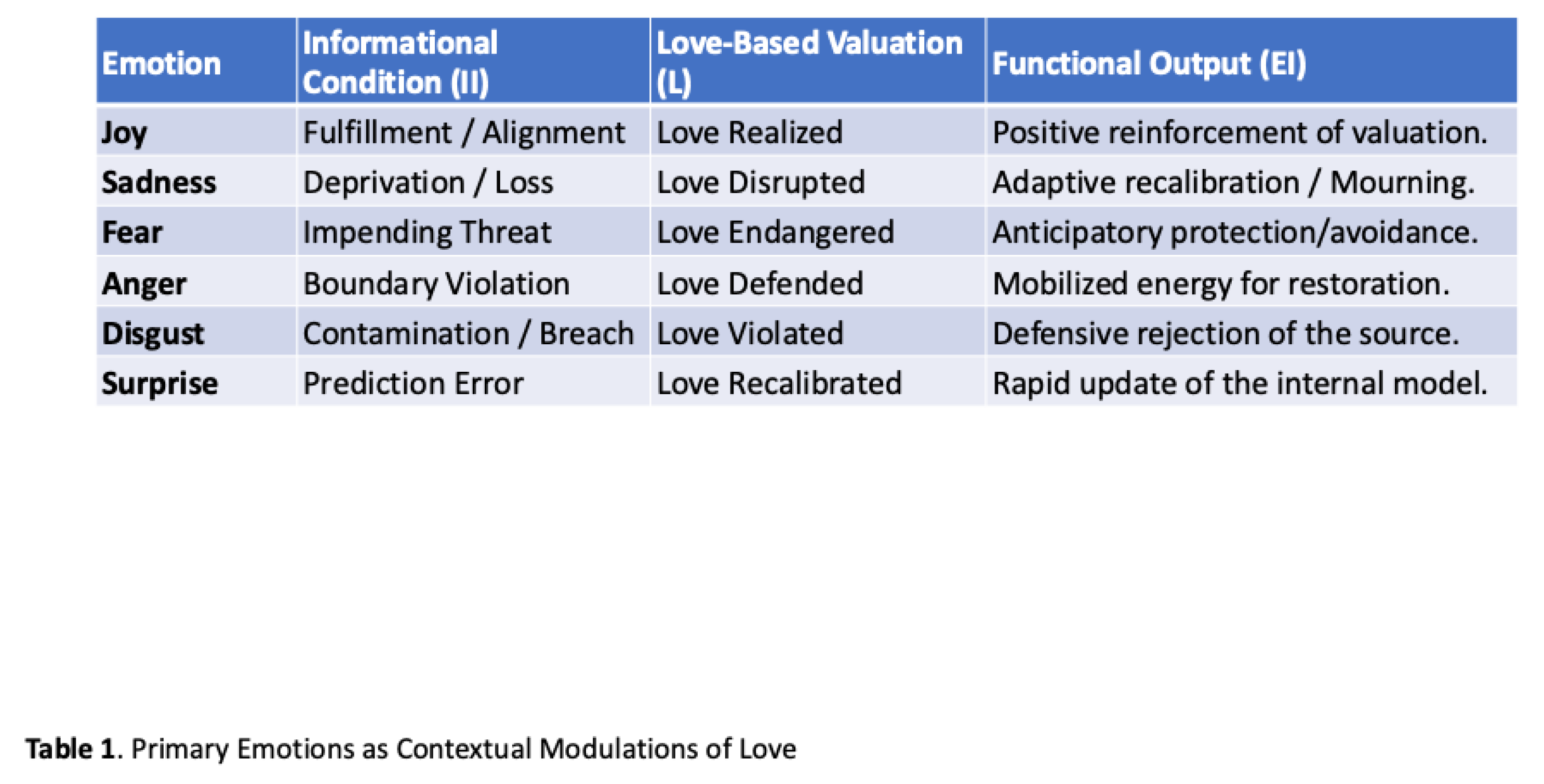
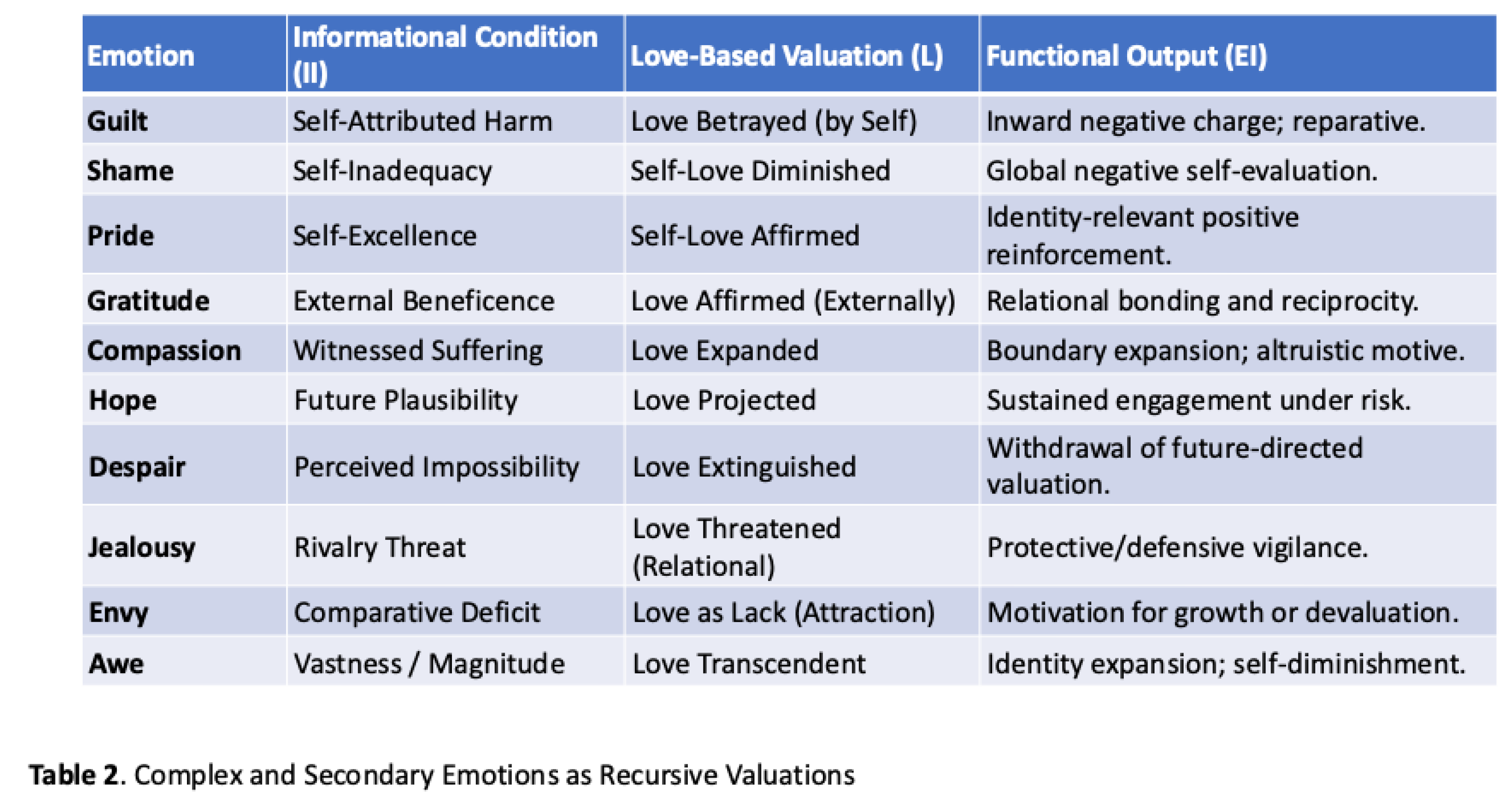
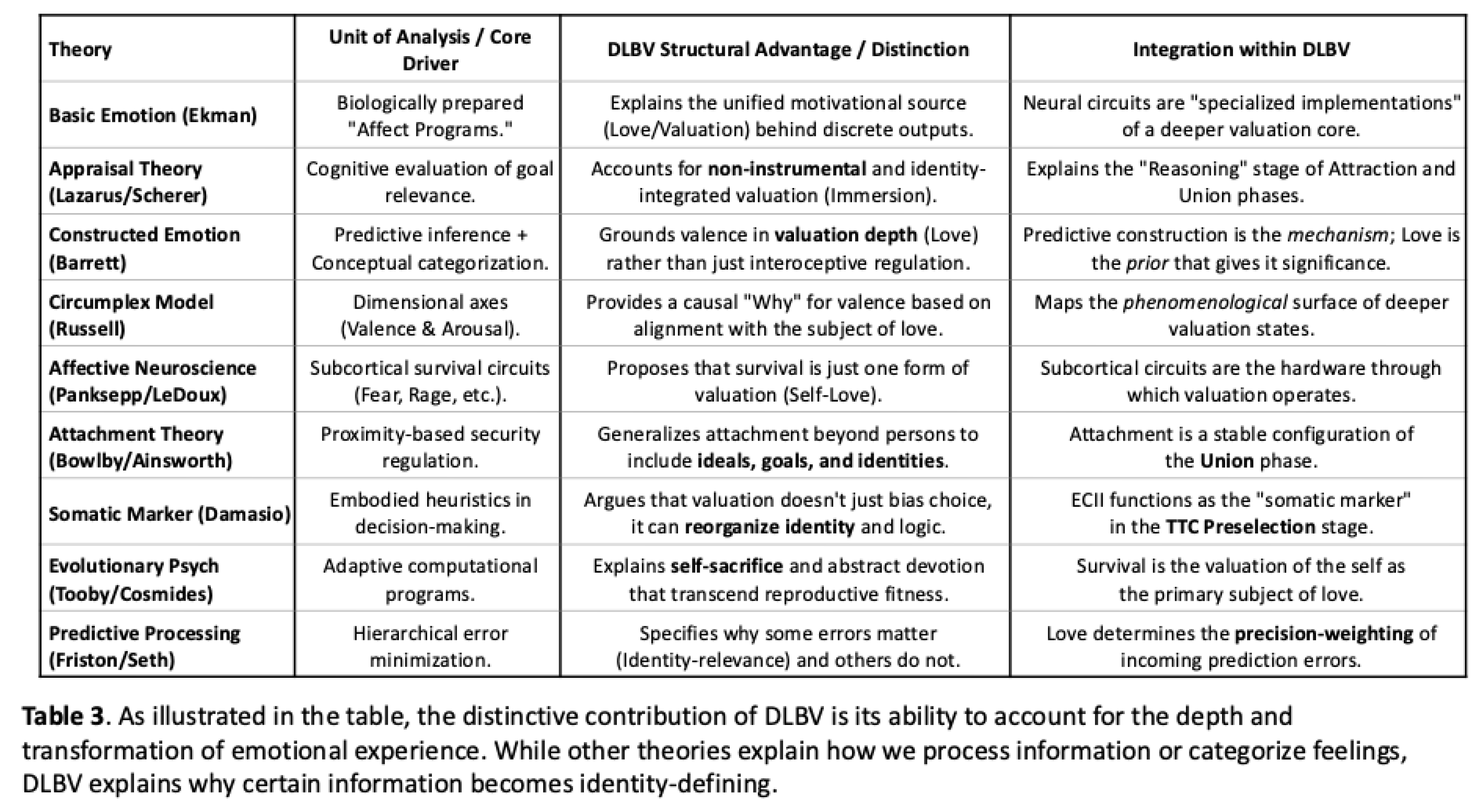
Funding
N/A. The author did not receive support from any organization for the submitted work.
Author confirms that the material presented in this manuscript has not been previously published, nor is it simultaneously under consideration by any other journal.
AI-assisted tools were used only to improve clarity, grammar, and readability of the manuscript. The theoretical framework, arguments, and conclusions were conceived and written entirely by the author.
Conflict of Interests
The author has no conflicts of interest to declare that are relevant to the content of this article.
Author's Contribution
The manuscript has only one author.
References
- Ainsworth, M. D. S.; Blehar, M. C.; Waters, E.; Wall, S. Patterns of attachment; Erlbaum, 1978. [Google Scholar]
- Aron, A.; Fisher, H. E.; Mashek, D. J.; Strong, G.; Li, H.; Brown, L. L. Reward, motivation, and emotion systems associated with early-stage intense romantic love. Journal of Neurophysiology 2005, 94(1), 327–337. [Google Scholar] [CrossRef] [PubMed]
- Barrett, L. F. Are emotions natural kinds? Perspectives on Psychological Science 2006, 1(1), 28–58. [Google Scholar] [CrossRef] [PubMed]
- Barrett, L. F. How emotions are made: The secret life of the brain; Houghton Mifflin Harcourt, 2017. [Google Scholar]
- Bowlby, J. Attachment and loss: Vol. 1. Attachment; Basic Books, 1969. [Google Scholar]
- Bowlby, J. A secure base; Basic Books, 1988. [Google Scholar]
- Damasio, A. R. Descartes’ error: Emotion, reason, and the human brain; Putnam, 1994. [Google Scholar]
- Damasio, A. R. The feeling of what happens: Body and emotion in the making of consciousness; Harcourt, 1999. [Google Scholar]
- Ekman, P. An argument for basic emotions. Cognition & Emotion 1992, 6(3–4), 169–200. [Google Scholar] [CrossRef]
- Farhadi, A. Trilogy: A new paradigm of consciousness. Neuropsychiatry (London) 2023, 13(4), 1–16. [Google Scholar]
- Farhadi, A. Dynamic Love-Based Valuation and the architecture of decision-making; Publishing, 2023. [Google Scholar]
- Fisher, H. E.; Brown, L. L.; Aron, A.; Strong, G.; Mashek, D. Reward, addiction, and emotion in the brain-imaging of newly love-struck, rejected, and long-term lovers. Annals of the New York Academy of Sciences 2010, 1185(1), 284–312. [Google Scholar] [CrossRef]
- Friston, K. The free-energy principle: A rough guide to the brain? Nature Reviews Neuroscience 2010, 11(2), 127–138. [Google Scholar] [CrossRef] [PubMed]
- Keltner, D.; Haidt, J. Approaching awe, a moral, spiritual, and aesthetic emotion. Cognition and Emotion 2003, 17(2), 297–314. [Google Scholar] [CrossRef] [PubMed]
- Lazarus, R. S. Emotion and adaptation; Oxford University Press, 1991. [Google Scholar]
- LeDoux, J. E. The emotional brain: The mysterious underpinnings of emotional life; Simon & Schuster, 1996. [Google Scholar]
- LeDoux, J. E. Rethinking the emotional brain. Neuron 2012, 73(4), 653–676. [Google Scholar] [CrossRef] [PubMed]
- Panksepp, J. Affective neuroscience: The foundations of human and animal emotions; Oxford University Press, 1998. [Google Scholar]
- Roese, N. J. Counterfactual thinking. Psychological Bulletin 1997, 121(1), 133–148. [Google Scholar] [CrossRef] [PubMed]
- Russell, J. A. A circumplex model of affect. Journal of Personality and Social Psychology 1980, 39(6), 1161–1178. [Google Scholar] [CrossRef]
- Scherer, K. R. Appraisal considered as a process of multilevel sequential checking. In Appraisal processes in emotion: Theory, methods, research; Scherer, K. R., Schorr, A., Johnstone, T., Eds.; Oxford University Press, 2001; pp. 92–120. [Google Scholar]
- Seth, A. K. Interoceptive inference and emotion. Trends in Cognitive Sciences 2013, 17(11), 565–573. [Google Scholar] [CrossRef] [PubMed]
- Tooby, J.; Cosmides, L. The past explains the present: Emotional adaptations and the structure of ancestral environments. Ethology and Sociobiology 1990, 11(4-5), 375–424. [Google Scholar] [CrossRef]
Disclaimer/Publisher’s Note: The statements, opinions and data contained in all publications are solely those of the individual author(s) and contributor(s) and not of MDPI and/or the editor(s). MDPI and/or the editor(s) disclaim responsibility for any injury to people or property resulting from any ideas, methods, instructions or products referred to in the content. |
© 2026 by the authors. Licensee MDPI, Basel, Switzerland. This article is an open access article distributed under the terms and conditions of the Creative Commons Attribution (CC BY) license (http://creativecommons.org/licenses/by/4.0/).
Copyright: This open access article is published under a Creative Commons CC BY 4.0 license, which permit the free download, distribution, and reuse, provided that the author and preprint are cited in any reuse.


