

Submitted:
13 March 2026
Posted:
17 March 2026
You are already at the latest version
Abstract
Anthocyanins and betalains are hydrophilic plant pigments with numerous physiological and ecological functions. The biosynthesis routes of anthocyanins and betalains differ with anthocyanins being synthesized from phenylalanine via the general phenylpropanoid pathway, whereas betalains are derived from tyrosine. Although the precursors phenylalanine and tyrosine are present in all plants, there is no known plant where both these pigments are co-accumulated. Most plants synthesize anthocyanins, while certain families in the order Caryophyllales produce betalains. There is apparent mutual exclusion of these two plant pigments. Over the past five decades, evidence accumulated supporting this theory of mutual exclusion of the two pigments. However, recently published reports claim the presence of anthocyanins in well-known betalain-pigmented plants. Here, we explore the causes of such claims and provide recommendations for future studies on the topic.
Keywords:
anthocyanins
; betalains
; flavonoids
; Caryophyllales
Biosynthetic and Phylogenetic Evidence of Mutual Pigment Exclusion
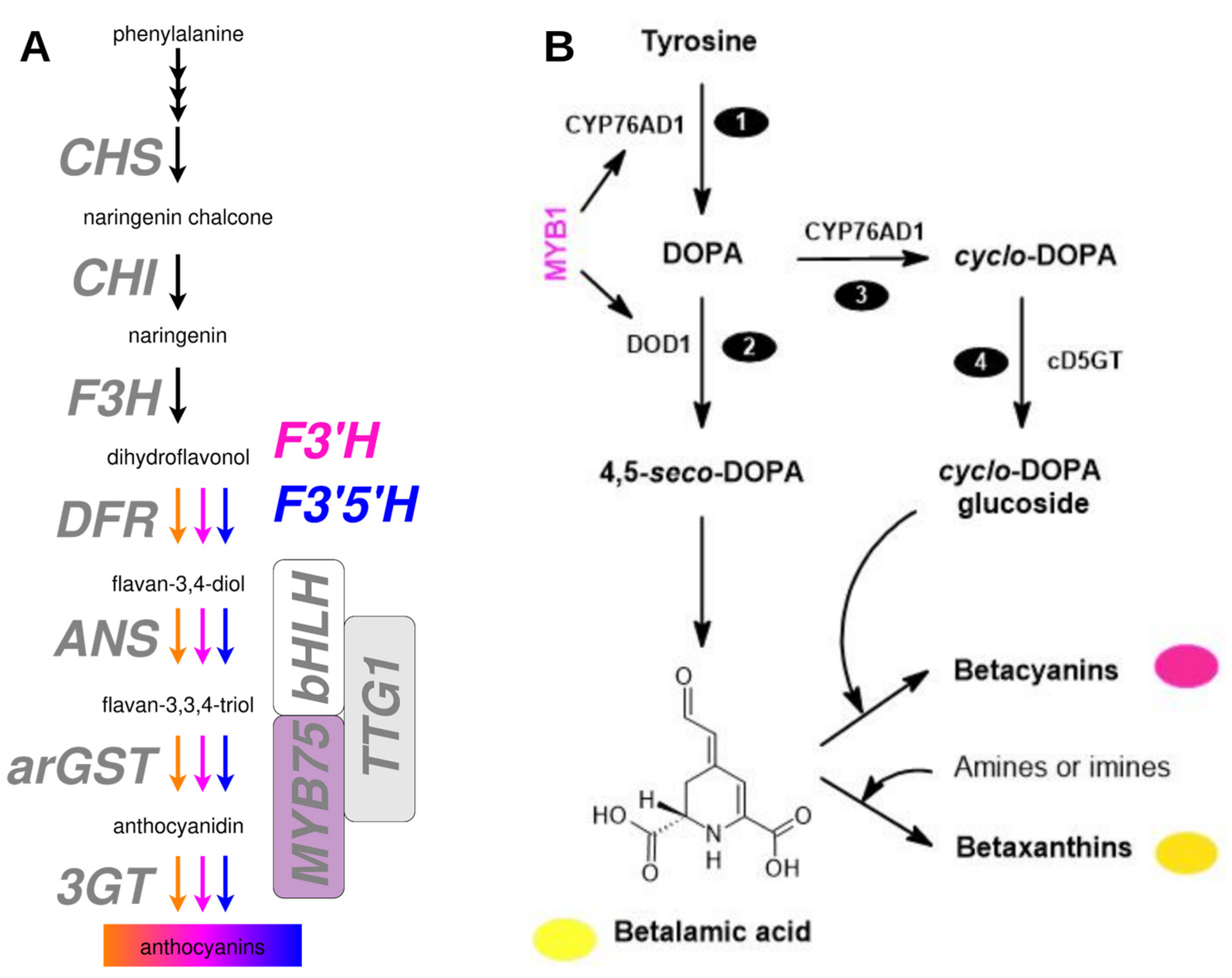
Anthocyanins are hydrophilic plant pigments, well known for providing striking coloration of flowers and fruits, with numerous physiological and ecological functions, including protection against irradiation, protection from UV light, attraction of pollinators and seed dispersers, and camouflage (Grünig et al., 2025). The biosynthesis starts from phenylalanine via the general phenylpropanoid pathway and through a branch of the flavonoid biosynthesis (Figure 1A). While the core biosynthesis appears largely conserved across plants, there are lineage-specific differences in the decoration of anthocyanins with sugar moieties and other chemical groups (Grünig et al., 2025). Although anthocyanin pigmentation is widespread in plants, several families of the core Caryophyllales represent a notable exception. These lineages have lost anthocyanin-pigmentation and synthesize yellow and red pigments of a different pigment class, betalains, which are not found in plants outside of the Caryophyllales (Timoneda et al., 2019). Betalains are also hydrophilic pigments and involved in anthocyanin-analogous functions in around 18 families in the core Caryophyllales (Timoneda et al., 2019). The betalain biosynthesis starts from tyrosine through hydroxylation by a CYP76AD1 enzyme to produce L-3,4-dihydroxyphenylalanine (L-DOPA), which is converted by L-DOPA-4,5-dioxygenase (DOD) to produce betalamic acid - the chromophore of all betalains (Figure 1B) (Khan and Giridhar, 2015). An analysis of the betalain biosynthesis specific enzyme DOD1 suggests that the betalain biosynthesis emerged at least four times independently within the Caryophyllales following a gene duplication of LigB which is also present in plants outside the Caryophyllales (Sheehan et al., 2020).
The anthocyanin loss in betalain-pigmented taxa in the core Caryophyllales is fundamentally different from frequent pigmentation losses at the species level in land plants. However, the mutual pigment exclusion of anthocyanins and betalains could be explained by their functional redundancy (Timoneda et al., 2019). For example, only one of the two pigment types is required to achieve floral coloration and perform the ecophysiological functions, thus a loss of the other pigmentation biosynthetic pathway could happen through genetic drift or other drivers of evolution. Anthocyanin pigmentation was the ancestral state of the Caryophyllales and multiple independent events of anthocyanin pigmentation loss resulted in the mutual exclusiveness of anthocyanins and betalains (Pucker et al., 2024). The anthocyanin biosynthetic genes in betalain-pigmented lineages of the Caryophyllales are not activated due to mutations in the activating MYB gene (Pucker et al., 2024), which has been co-opted by the betalain biosynthesis in the Amaranthaceae (Hatlestad et al., 2015). Additionally, the betalain-pigmented lineages appear to lack a crucial anthocyanin biosynthesis enzyme, the anthocyanin-related glutathione S-transferase (arGST) (Pucker et al., 2024). Multiple independent transitions from phenylalanine-based pigmentation with anthocyanins to tyrosine-based pigmentation with betalains might be explained by the availability of both amino acids in the Caryophyllales, because a duplication of the arogenate dehydrogenase (ADH) in the Caryophyllales gave rise to a feedback-insensitive variant that could increase the availability of tyrosine at the expense of phenylalanine in the Caryophyllales (Lopez-Nieves et al., 2018). In summary, these mechanisms can explain why the anthocyanin biosynthesis has been replaced by betalain biosynthesis in certain families of the Caryophyllales.
Questionable Claims of the Presence of Anthocyanins in Well-Known Betalain-Pigmented Plants
Despite the presence of strong evidence of betalain accumulation in well-studied Caryophyllales species such as amaranth, red beet, quinoa, purslane, alligator weed, dragon fruit, several research papers contain unsubstantiated claims that anthocyanins would be present in those plants (Table S1).
- (1)
- A recurring issue in all the studies listed in Table S1 is the use of inappropriate analytical approaches or the lack of thorough methods. Spectrophotometric quantification without further confirmation using HPLC-MS/MS following the guidelines laid down by Metabolomics Standard Initiative (Sumner et al., 2007) is a frequent issue (Table S1). Authentication of the pigment identity is required, because anthocyanins and betalains absorb light around 530 ± 10 nm and both pigments are hydrophilic and show color at pH 5-6 or pH ﹤4 (Stintzing and Carle, 2004). A simple approach to differentiate the two pigments is based on the knowledge that anthocyanin extracts turn blue in alkaline pH, whereas betalain extracts are yellow/brown at the same pH. This can be easily carried out by adding a small amount of NaOH to the extract. Further, when the pH is made acidic, anthocyanin extracts regain the original extract color instantaneously, whereas betalain extracts do not do so immediately. Given that betalains would be an adequate explanation for the coloration of the plant species listed in Table S1, claims regarding the presence of anthocyanins in these betalain-pigmented taxa remain unsubstantiated and are inconsistent with the compelling evidence in the scientific literature.
- (2)
- Support for the presence of anthocyanins in betalain-pigmented lineages is often drawn from controversial or retracted publications. For example, reports claiming the presence of anthocyanins in betalain-pigmented pitayas have been criticized(Pucker et al., 2021; Khan, 2022; Pucker and Brockington, 2022) and are retracted or in the retraction process, but are still frequently cited.
- (3)
- Mis-interpretation of transcriptomic data. For example, a truncated transcript of an anthocyanidin synthase is highly abundant in the betalain-pigmented Mirabilis jalapa even though it does not result in a functional enzyme (Polturak et al., 2018). Some genes of the anthocyanin biosynthesis are still present and even expressed in betalain-pigmented lineages, but with at least one gene missing the anthocyanin biosynthesis is blocked (Pucker et al., 2024). The detection of transcripts of genes from the wider flavonoid biosynthesis is often mistaken for evidence of an active anthocyanin biosynthesis, because the activity of these genes in other pathways is ignored.
- (4)
- The questionable studies were published between 2008 and 2026 in journals operating under standard peer-review procedures. While these outlets are established, they are not generally regarded as leading or highly selective journals. The acceptance of claims that contradict the well-documented mutual exclusivity of anthocyanins and betalains raises concerns regarding the consistency and subject-specific rigor of the review process. In particular, it suggests that the evaluation may not have consistently involved reviewers with specialized expertise.
Concluding Remarks
Over 50 years, numerous biochemical and genetic studies have failed to provide convincing evidence that would contradict the theory of mutual exclusion of anthocyanins and betalain pigmentation. In summary, this can be seen as strong support for a well tested theory. It is also important to note that mechanistic explanations for the mutual exclusion like the presence/absence of crucial genes further corroborate this theory. Therefore, strong evidence for the co-occurrence of anthocyanin and betalain pigmentation in the same Caryophyllales species would be needed to disprove the mutual exclusion theory.
Any study attempting to show the co-occurence of anthocyanins and betalains should present HPLC-MS/MS analyses including reference compounds. The workflow needs to be described in a reproducible manner and all datasets have to be available in an established repository to enable independent validation. Given the high sensitivity of modern analytical instruments, it would be paramount to quantify the amount of detected compounds to demonstrate that they are not only traces, but can substantially contribute to pigmentation. Finally, such claims should be supported on the transcriptomic level by showing the presence of transcripts for all required steps.
References
- Grünig, N., Horz, J. M., and Pucker, B. (2025). Diversity and ecological functions of anthocyanins. BMC Plant Biol. 26:146.
- Hatlestad, G. J., Akhavan, N. A., Sunnadeniya, R. M., Elam, L., Cargile, S., Hembd, A., Gonzalez, A., McGrath, J. M., and Lloyd, A. M. (2015). The beet Y locus encodes an anthocyanin MYB-like protein that activates the betalain red pigment pathway. Nat. Genet. 47:92–96.
- Khan, M. I. (2022). The reported colour formation mechanism in pitaya fruit through co-accumulation of anthocyanins and betalains is inconsistent and fails to establish the co-accumulation. BMC Genomics 23:740.
- Khan, M. I., and Giridhar, P. (2015). Plant betalains: Chemistry and biochemistry. Phytochemistry 117:267–295.
- Lopez-Nieves, S., Yang, Y., Timoneda, A., Wang, M., Feng, T., Smith, S. A., Brockington, S. F., and Maeda, H. A. (2018). Relaxation of tyrosine pathway regulation underlies the evolution of betalain pigmentation in Caryophyllales. New Phytol. 217:896–908.
- Polturak, G., Heinig, U., Grossman, N., Battat, M., Leshkowitz, D., Malitsky, S., Rogachev, I., and Aharoni, A. (2018). Transcriptome and Metabolic Profiling Provides Insights into Betalain Biosynthesis and Evolution in Mirabilis jalapa. Mol. Plant 11:189–204.
- Pucker, B., and Brockington, S. F. (2022). The evidence for anthocyanins in the betalain-pigmented genus Hylocereus is weak. BMC Genomics 23:739.
- Pucker, B., Singh, H. B., Kumari, M., Khan, M. I., and Brockington, S. F. (2021). The report of anthocyanins in the betalain-pigmented genus Hylocereus is not well evidenced and is not a strong basis to refute the mutual exclusion paradigm. BMC Plant Biol. 21:297.
- Pucker, B., Walker-Hale, N., Dzurlic, J., Yim, W. C., Cushman, J. C., Crum, A., Yang, Y., and Brockington, S. F. (2024). Multiple mechanisms explain loss of anthocyanins from betalain-pigmented Caryophyllales, including repeated wholesale loss of a key anthocyanidin synthesis enzyme. New Phytol. 241:471–489.
- Sheehan, H., Feng, T., Walker-Hale, N., Lopez-Nieves, S., Pucker, B., Guo, R., Yim, W. C., Badgami, R., Timoneda, A., Zhao, L., et al. (2020). Evolution of l-DOPA 4,5-dioxygenase activity allows for recurrent specialisation to betalain pigmentation in Caryophyllales. New Phytol. 227:914–929.
- Stintzing, F. C., and Carle, R. (2004). Functional properties of anthocyanins and betalains in plants, food, and in human nutrition. Trends Food Sci. Technol. 15:19–38.
- Sumner, L. W., Amberg, A., Barrett, D., Beale, M. H., Beger, R., Daykin, C. A., Fan, T. W.-M., Fiehn, O., Goodacre, R., Griffin, J. L., et al. (2007). Proposed minimum reporting standards for chemical analysis Chemical Analysis Working Group (CAWG) Metabolomics Standards Initiative (MSI). Metabolomics Off. J. Metabolomic Soc. 3:211–221.
- Timoneda, A., Feng, T., Sheehan, H., Walker-Hale, N., Pucker, B., Lopez-Nieves, S., Guo, R., and Brockington, S. (2019). The evolution of betalain biosynthesis in Caryophyllales. New Phytol. 224:71–85.
Figure 1.
Simplified illustration of anthocyanin biosynthesis leading to pelardonidin (orange), cyanidin (pink), and delphinidin (blue) (A) and betalatin biosynthetic pathways (B). CHS, chalcone synthase; CHI, chalcone isomerase; F3H, flavanone 3-hydroxylase; F3’H, flavonoid 3’-hydroxylase; F3’5’H, flavonoid 3’,5’-hydroxylase; DFR, dihydroflavonol 3-reductase; ANS, anthocyanidin synthase; arGST, anthocyanin-related glutathione S-transferase; 3GT, UDP-dependent anthocyanidin 3-O-glucosyltransferase; MYB, Myeloblastosis; bHLH, basic helix-loop-helix; TTG1, TRANSPARENT TESTA GLABRA 1. MYB75, bHLH, and TTG1 form a complex that activates the anthocyanin biosynthesis genes. Numbered steps are enzyme-catalyzed. Steps without any assigned numbers are spontaneous or pH-dependent. The colored ellipses indicate the corresponding color of the compound next to it. CYP76AD1 - cytochrome P450 enzyme (multiple variants are known; CYP76AD1 is known to involve in steps 1 and 2), DOPA – L-3,4-dihydroxyphenylalanine, DOD1 – DOPA-4,5-dioxygenase (multiple variants are known). BvMYB1 from sugar beet has been shown to regulate the expression of BvCYP76AD1 and BvDOD1 (Hatlestad et al., 2015). cD5GT - cyclo-DOPA-5-O-glucosyltransferase. Betacyanins and betaxanthins are two subclasses of betalains.
Figure 1.
Simplified illustration of anthocyanin biosynthesis leading to pelardonidin (orange), cyanidin (pink), and delphinidin (blue) (A) and betalatin biosynthetic pathways (B). CHS, chalcone synthase; CHI, chalcone isomerase; F3H, flavanone 3-hydroxylase; F3’H, flavonoid 3’-hydroxylase; F3’5’H, flavonoid 3’,5’-hydroxylase; DFR, dihydroflavonol 3-reductase; ANS, anthocyanidin synthase; arGST, anthocyanin-related glutathione S-transferase; 3GT, UDP-dependent anthocyanidin 3-O-glucosyltransferase; MYB, Myeloblastosis; bHLH, basic helix-loop-helix; TTG1, TRANSPARENT TESTA GLABRA 1. MYB75, bHLH, and TTG1 form a complex that activates the anthocyanin biosynthesis genes. Numbered steps are enzyme-catalyzed. Steps without any assigned numbers are spontaneous or pH-dependent. The colored ellipses indicate the corresponding color of the compound next to it. CYP76AD1 - cytochrome P450 enzyme (multiple variants are known; CYP76AD1 is known to involve in steps 1 and 2), DOPA – L-3,4-dihydroxyphenylalanine, DOD1 – DOPA-4,5-dioxygenase (multiple variants are known). BvMYB1 from sugar beet has been shown to regulate the expression of BvCYP76AD1 and BvDOD1 (Hatlestad et al., 2015). cD5GT - cyclo-DOPA-5-O-glucosyltransferase. Betacyanins and betaxanthins are two subclasses of betalains.
Disclaimer/Publisher’s Note: The statements, opinions and data contained in all publications are solely those of the individual author(s) and contributor(s) and not of MDPI and/or the editor(s). MDPI and/or the editor(s) disclaim responsibility for any injury to people or property resulting from any ideas, methods, instructions or products referred to in the content. |
© 2026 by the authors. Licensee MDPI, Basel, Switzerland. This article is an open access article distributed under the terms and conditions of the Creative Commons Attribution (CC BY) license (http://creativecommons.org/licenses/by/4.0/).
Copyright: This open access article is published under a Creative Commons CC BY 4.0 license, which permit the free download, distribution, and reuse, provided that the author and preprint are cited in any reuse.


