

Submitted:
13 March 2026
Posted:
16 March 2026
You are already at the latest version
Abstract
Thailand preserves one of the most extensive records of Mesozoic vertebrate footprints in Tropical Asia, yet these ichnological data have never been comprehensively synthesized. This review compiles and reassesses all known Triassic to Cretaceous vertebrate tracksites in Thailand to clarify their stratigraphic distribution, taxonomic diversity, and palaeobiogeographical significance. Published records, new field observations, and updated stratigraphic correlations are integrated to evaluate trackmaker attributions and temporal patterns. The Thai record documents diverse assemblages including chirotheriids, early theropods, sauropodomorphs, ornithopods, sauropods, and crocodilians. Upper Triassic–Lower Jurassic assemblages capture a major faunal transition, revealing the co-occurrence of non-dinosaurian archosaurs and some of the earliest dinosaurs in the region, whereas Lower Cretaceous sites are dominated by theropods, sauropods and diverse ornithopods. Comparison with other Asian ichnofaunas indicates faunal continuity across eastern Asia and supports early dinosaur dispersal into equatorial low latitudes. This synthesis also evaluates site conservation, highlighting the vulnerability of several Triassic localities and a positive trend of community-led discoveries since 2009, underscoring the need for proactive management and standardized digital documentation. Overall, the Thai ichnological succession represents the most complete Mesozoic footprint record presently known from Tropical Asia and provides key insights into vertebrate evolution, palaeoecology, and regional biogeography.
Keywords:
vertebrate ichnology
; Khorat Plateau
; palaeobiogeography
; geoconservation
; Southeast Asia
1. Introduction
Over the past several decades, ichnology has experienced a major resurgence as a core discipline within palaebiology, driven by growing recognition that trace fossils record behavioural, ecological, and environmental information unavailable from body fossils alone. Advances in ichnotaxonomy, ichnofacies analysis, and digital documentation, particularly three-dimensional photogrammetry [1], have transformed vertebrate footprints into more robust datasets for reconstructing locomotion, community structure, palaeoecology, and large-scale biogeographic patterns. Within this global context, vertebrate ichnology can now also play an important role in discussions of Mesozoic faunal turnover, biochronology, and continental dispersal.
Despite these developments, Southeast Asia remains underrepresented in synthetic ichnological reviews, with nearly two decades having elapsed since the last national-scale assessment in 2009 [2]. This gap is striking given Thailand’s strategic palaeogeographic position along the equatorial margin of the Indochina Terrane and the presence of extensive continental Mesozoic deposits within the Khorat Group. Vertebrate footprints preserved from the Upper Triassic to the Late Lower Cretaceous provide a rare low-latitude record of archosaur and dinosaur diversity that complements the better-known ichnofaunas of China, Korea and Japan.
Vertebrate ichnology in Thailand emerged relatively late, with the first dinosaur footprints reported in the 1980s from Phu Luang Wildlife Sanctuary (Phu Phan Formation, Lower Cretaceous) [3,4]. Subsequent discoveries during the 1990s and early 2000s, notably at Huai Dan Chum and Phu Faek [5,6], revealed diverse theropod, ornithopod, and sauropod track assemblages and demonstrated that vertebrate footprints are widespread throughout the Khorat Group. More recent fieldwork has extended the record into the Upper Triassic and Lower Jurassic, documenting chirotheriid assemblages and early dinosaur tracks [7]. Together, these discoveries establish Thailand as a key reference area for understanding Mesozoic continental ecosystems within equatorial Asia.
This review has three primary objectives. First, we synthesize all currently documented vertebrate footprint sites in Thailand, providing a standardized overview of their stratigraphic distribution, ichnotaxonomic composition, geographic setting, and preservation status. Second, we assess the palaeoecological and palaeobiogeographic significance of this record, with particular emphasis on faunal transitions and ecosystem structure across Southeast and East Asia. Third, we identify methodological and conceptual challenges, especially those related to legacy documentation, stratigraphic gaps, and site vulnerability, while highlighting opportunities for future research and conservation frameworks.
By integrating historical data within modern ichnological perspectives, this review aims to provide a coherent and up-to-date framework for vertebrate footprint research in Thailand and to reinforce its importance within the broader context of Mesozoic palaeontology in tropical Asia.
2. Materials and Methods
In recent years, documentation of vertebrate footprint sites in Thailand has increasingly followed best-practice protocols that recognize vertebrate tracks as three-dimensional topographic structures and advocate the routine use of photogrammetry or other high-resolution 3D techniques to maximize reproducibility, comparability, and long-term scientific value [1].
However, most sites reviewed here were discovered and documented prior to the widespread availability of high-definition portable cameras, affordable photogrammetric software, and dedicated digital storage infrastructure. During the previous two decades of vertebrate ichnological research in Thailand, palaeoichnology was largely treated as a subsidiary component of vertebrate palaeontology, resulting in inconsistent access to technical support, limited funding, and heterogeneous documentation standards. Consequently, early records often rely on traditional mapping, photography, hand measurements, and casting, with variable levels of precision and completeness [2].
Recent discoveries have catalyzed a marked shift in this paradigm, driven by the growing recognition of ichnology as a distinct, data-intensive discipline. This review therefore represents a synthesis of legacy data collected under heterogeneous conditions and a foundational step toward a more consistent, systematic, and reproducible framework for recording vertebrate footprint sites in Thailand. We anticipate that future work will progressively converge toward full implementation of modern ichnological protocols, strengthening the national ichnological record and facilitating global-scale comparisons.
The dataset examined in this review comprises 19 vertebrate footprint sites spanning six stratigraphic formations, ranging in age from the Upper Triassic to the Lower Cretaceous. Discovery contexts for these sites were documented through systematic compilation of published records, field reports, and first-hand observations. This approach allowed classification of site discoverers into three levels of expertise: non-specialists (local villagers), paraprofessionals (forest rangers), and professionals (geologists or palaeontologists) (Table 1). Temporal trends in site discovery were analysed by comparing datasets compiled before and after 2009 (the date of the previous review) to evaluate shifts in discovery pathways and stakeholder involvement.
Conservation status was assessed using a standardized four-tiered management index (destroyed/lost; unprotected and at risk; partially protected; under active management), applied consistently across nineteen vertebrate footprint localities. Levels of protection were evaluated based on field observations, land-use context, legal status, and curatorial practices, allowing assessment of site vulnerability and exposure to natural or anthropogenic degradation. This integrative approach enabled evaluation of both discovery processes and preservation risks, providing a framework for prioritizing documentation, monitoring, and conservation actions.
3. Geological and Paleogeographical Framework
3.1. Geographical Distribution of Footprint Discoveries in Thailand
Vertebrate footprint sites in Thailand are geographically distributed across the Khorat Plateau, a large tableland in northeastern Thailand (Isan) and adjacent parts of Laos. Situated at elevations of roughly 90–200 m above sea level, the plateau is bounded by the Mekong River to the north and east, the Phetchabun Mountain Range to the west, and the Phnom Dangrek Range to the south (Figure 1). As a geomorphological unit, the Khorat Plateau broadly coincides with the Khorat Basin and forms the core of Thailand’s Mesozoic continental record [8].
Within the Khorat Basin, the Khorat Group constitutes a major Mesozoic continental lithostratigraphic unit composed predominantly of fluvial and lacustrine siliciclastic deposits of Late Jurassic–Early Cretaceous age (Figure 2). It overlies older continental successions, notably the Triassic Kuchinarai Group, which comprises fluvio-lacustrine sediments deposited within extensional half-graben systems during the early stages of basin development.
While many vertebrate footprint localities occur within formations of the Khorat Group, others are preserved in these underlying Triassic units. Nevertheless, all known sites are geographically situated on or along the margins of the Khorat Plateau.
The central sector of the Khorat Plateau forms the historical and scientific core of vertebrate ichnological research in Thailand (Figure 1A). Corresponding to Khon Kaen, Kalasin, and Maha Sarakham provinces, it represents the historical and academic centre of Thai palaeontology, where research began in the late 1970s and where several iconic sites, such as Phu Wiang and the Sirindhorn Museum, are located. [9].
Along the western margin of the Khorat Plateau (Phetchabun, Loei, and Phitsanulok provinces) and its southwestern edge (Chaiyaphum), an increasing number of footprint localities have been documented (Figure 1B). In this sector, the westernmost outcrops of the Khorat Basin succession include both older units and marginal exposures of the Khorat Group, which have yielded several important recent discoveries.
In contrast, the northeastern margin of the plateau, along the Mekong River in Nakhon Phanom Province (Figure 1C), is dominated by Lower Cretaceous strata of the Khorat Group and has yielded two significant tracksites: Huai Dan Chum and Ban Nong Sa Rai.
A single southern outlier at Khao Yai National Park (Prachin Buri Province) represents localized erosional windows exposing the Khorat Group along the forested southern cuesta of the Khorat Plateau (Figure 1D).
3.2. Chronostratigraphic Distribution of Vertebrate Footprint Sites in Thailand
Among the nineteen vertebrate footprint localities currently documented in Thailand, approximately 37% (seven sites) are attributed to the Upper Triassic–Lower Jurassic interval, 37% (seven sites) to the Lower Cretaceous (Berriasian–Barremian), and the remaining 26% (five sites) to the Late Lower Cretaceous (Aptian–Albian). No footprint localities are yet known from the Middle or Upper Jurassic, marking a distinct stratigraphic gap in the regional ichnological record (Figure 2).
The Upper Triassic–Lower Jurassic interval exhibits the most recent growth in documented sites: about 29% (two sites) were identified in 2009 [2,5], while 71% (five sites) have been discovered since, reflecting intensified field activity and improved recognition of track-bearing horizons within the Upper Triassic Formations.
In contrast, most Lower Cretaceous (Berriasian-Barremian) sites, 86% (six out of seven), were already known by 2009, indicating an earlier research emphasis on Phra Wihan and Sao Khua Formation exposures [2,3,4,5,10,11,12,13]. The Late Lower Cretaceous (Aptian–Albian) record shows a more balanced pattern, with 60% of sites discovered before 2009 and 40% afterward, consistent with the continued exploration of Khok Kruat Formation deposits [2,5,10,14].
Overall, this distribution reflects both the exposure and accessibility of key lithostratigraphic units within the Khorat Group and the historical evolution of palaeontological research in northeastern Thailand, which has progressively expanded from the well-studied Lower Cretaceous successions to encompass older Triassic–Jurassic intervals and more peripheral outcrop regions (Table 1).
4. Results
4.1. Discovery and Conservations Patterns
Prior to the 2009 review, ten footprint localities were known, of which 36.4% were discovered by non-specialists, 18.1% by paraprofessionals, and 45.5% by professionals (Figure 4 A2). This pattern reflects the predominance of systematic scientific fieldwork during the early phase of ichnological exploration, complemented by valuable local contributions, particularly in remote areas.
Since 2009, eight additional sites have been documented, with 37.5% discovered by non-specialists, 12.5% by paraprofessionals, and 50% by professionals (Figure 4 B2). The constant participation of local and regional actors underscores the effectiveness of long-term public outreach, training, and communication initiatives.
The overall distribution of preservation status is balanced but concerning: 10.5% of sites are classified as Level 1 (destroyed/lost), 36.9% as Level 2 (unprotected and at risk), 26.3% as Level 3 (partially protected), and 26.3% as Level 4 (under active management) (Figure 3 A). This reflects progress driven by protected areas and museum initiatives (e.g., Phu Faek, Phu Kao), as well as increased familiarity with vertebrate footprints and the lithologies that preserve them. At the same time, it underscores the vulnerability of localities situated in quarries or along riverine exposures.
Among the seven Upper Triassic - Lower Jurassic sites, 57.1% are at minimal protection (Level 2), 28.6% are moderately protected (Level 3), and only 14.3% receive dedicated conservation (Level 4) (Figure 3B). In contrast, the Lower Cretaceous localities show a more heterogeneous protection pattern, with a greater proportion of actively managed sites (33.3% Level 4) but also a measurable fraction of destroyed or lost sites (16.7% Level 1) (Figure 3C).
A comparative analysis reveals a shift in conservation status correlated with discovery date. Pre-2009 sites were predominantly (45.5%) highly protected (Level 4) (Figure 4 A1), whereas post-2009 discoveries exhibit lower protection levels, with 50% minimally protected (Level 2), 37.5% moderately managed (Level 3), and none attaining Level 4 (Figure 4 B1).
4.2. The Huai Hin Lat Formation
The Huai Hin Lat Formation is part of the Kuchinarai Group and consists predominantly of non-marine fluvial–lacustrine deposits. The age of the formation is well constrained by both palynological and vertebrate fossil evidence. Based on these data, Racey et al. [15] and Racey & Goodall [16] proposed a Carnian to Norian age for the unit. Furthermore, Buffetaut & Suteethorn [17] noted that the vertebrate assemblages from this formation show close affinities to those of the Norian Stubensandstein (Löwenstein Formation) of southern Germany. To date, three distinct footprint sites have been identified within the Huai Hin Lat Formation.
4.2.1. Tad Huai Nam Yai
The Tad Huai Nam Yai tracksite, located near Ban Na Po Song, Nam Nao District, Phetchabun Province, was discovered by local villagers in 2000. The site lies within the Huai Hin Lat Formation, which consists predominantly of fluvio–lacustrine sandstone and mudstone. Three vertebrate trackways occur as natural concave epirelief on a steep sandstone surface extending over 80–100 m. Mapping of the lower portions of the trackways was conducted during surveys in 2003, 2011, and 2021. Partial casts made in 2011 are housed at the Sirindhorn Museum, Kalasin Province, Thailand.
The footprints consist of elongated pes impressions measuring approximately 30–35 cm in length and 15 cm in width, characterized by prominent metapodial traces and three dominant digits (II–IV), with digits III and IV being the longest. Associated manus impressions are smaller, ranging from 15–20 cm in length and 10–15 cm in width. Lateral expansions in some tracks suggest reduced outer digits, and the digits display gentle curvature with internal convexity. The trackway is wide-gauge, with an inner pes trackway width of 25–30 cm and an outer width of 45–50 cm. No tail-drag marks are present, implying an elevated tail posture. These features indicate a large, plantigrade tetrapod with a broad gait and well-developed metatarsal impressions.
Based on track morphology and gauge, previous studies have interpreted the trackmakers as phytosaurs, supported by coeval skeletal remains from the same formation [18]. Klein & Lucas [19] attributed these tracks to Apatopus lineatus (Bock, 1952) [20]. Considering both the ichnological evidence and associated phytosaur cranial and dentary material from northeastern Thailand [21], we concur with a phytosaurian affinity for the trackmakers.
The Tad Huai Nam Yai tracksite constitutes one of the earliest ichnological records of vertebrate locomotion in Southeast Asia and represents the longest known Triassic vertebrate trackway in the region. It provides key evidence for basal archosaur locomotor diversity within the Indochina Terrane during the Upper Triassic. The site remains partially exposed on a steep slope and, despite partial casting and museum replication, is vulnerable to erosion; continued monitoring and documentation are recommended to preserve this important ichnological heritage.
4.2.2. Tad Fa
The Tad Fa tracksite, located in Nam Nao District, Phetchabun Province, was discovered in 2022 by a local villager, who reported tridactyl footprints that were initially interpreted and publicized as theropod dinosaur tracks. The site lies within the Dat Fa Member of the Huai Hin Lat Formation and consists of sandstone interbedded with blackish-grey mudstone deposited in a half-graben fluvial–lacustrine basin [22,23].
During the 2022 field visit, three footprints were documented—two preserving four distinct digits (II–V) and one incomplete impression. The footprints measure approximately 18–19 cm in length and 17–18 cm in width. Follow-up work in 2023 revealed at least four trackways composed of narrow-gauge, bipedal, tetradactyl pes impressions without associated manus prints (Figure 5). Digit V is slender and bears a distinct claw trace, whereas digit I is absent. The trackways show a pace length of approximately 62 cm and a stride length of about 120 cm.
The track morphology excludes a theropod origin and is consistent with archosauriform or pseudosuchian trackmakers of the ichnofamily Chirotheriidae [24]. The configuration resembles Chirotherium, Brachychirotherium, or related ichnogenera typical of crurotarsan archosaurs. The plantigrade posture, tetradactyl pattern, and narrow gauge suggest a large archosaur moving across firm, subaerially exposed sediment. On current evidence, a phytosaur- or aetosaur-like archosauriform is the most plausible trackmaker, an interpretation consistent with the presence of phytosaur and aetosaurian vertebrate material currently under study at the Palaeontological Research Centre (PRC), Mahasarakham University [25].
The tracks formed on semi-indurated floodplain deposits within the Huai Hin Lat half-graben system. The combination of fluvial sandstones and overlying mudstones favored partial preservation of the impressions, though surface weathering continues to threaten exposure quality. Detailed morphometric and photogrammetric analysis is required to refine ichnotaxonomic identification and to document the site before further erosion.
4.2.3. Tad Yai
The Tad Yai footprint site, situated in Nam Nao District, Phetchabun Province, was discovered in 2023 by a geologist who recognized sauropod-like tracks. Subsequent investigations in 2024 revealed a total of 94 footprints preserved in concave epirelief, organized into six trackways representing three morphologically distinct vertebrate ichnotaxa. The tracks occur on greyish-brown mudstone of the Dat Fa Member from the Huai Hin Lat Formation.
The first ichnological group comprises 18 footprints, including two isolated prints and a trackway of 16 consecutive impressions. The tridactyl, mesaxonic footprints have digit III as the longest, with lengths ranging from 10 to 17 cm and divarication angles of about 35°. Several preserve distinct claw marks, consistent with referral to the ichnogenus Grallator. Mean footprint dimensions are 12.8 × 11.45 cm; estimated hip height ≈ 57.6 cm, body length ≈ 2.3 m, and running speed ≈ 22.9 km/h [26,27,28,29,30].
The second group includes four trackways attributed to large quadrupedal trackmakers. Individual footprints are rounded to subcircular, deeply impressed, and bordered by displacement rims (Figure 6). Manus prints are sometimes indistinct, and pes impressions may overstep them. When preserved, the manus exhibits a distinct oval to crescentic shape. The trackways occur on a ripple-marked sandstone surface bearing both true tracks and underprints and have been subsequently affected by modern weathering.
The third group consists of a single trackway comprising 29 footprints with pentadactyl manus and pes impressions. The pes impressions have a mean length of 16.9 cm and a mean width of 13.9 cm, whereas the manus impressions average 5.8 cm in length and 8.6 cm in width. The trackway exhibits a narrow-gauge with manus and pes placed close to the midline, and a mean pace angulation of approximately 150° (Figure 7). The pes oversteps the manus, and the footprints are outwardly rotated, with the pes showing a negative orientation relative to the trackway midline.
The Grallator-like tracks represent small bipedal theropods, while the large quadrupedal impressions correspond to Brontopodus-type sauropod trackmakers.
Although preservational masking and undertrack formation can obscure diagnostic characters and occasionally lead to confusion between early sauropodomorph and dicynodont-type tracks [31], several features support a tentative attribution of these trackways to a Brontopodus-like sauropod ichnotaxon. The presence of crescent-shaped manus impressions and a quadrupedal wide-gauge configuration is consistent with sauropodiform trackmakers [32,33]. The absence of clearly ectaxonic, pentadactyl manus–pes sets, together with the differentiated manus and pes morphology, further favors referral to a sauropod-type trackmaker. Although Brontopodus is generally regarded as no earlier than the Lower Jurassic [34,35], its occurrence here would suggest that sauropodiform dinosaurs had already appeared in Thailand by the Upper Triassic–Lower Jurassic transition, consistent with reports of Isanosaurus from the overlying Nam Phong Formation [36,37,38].
The pentadactyl trackway is interpreted as the product of a chirotherian, indicating the persistence of non-dinosaurian archosaurs within the same assemblage.
The Tad Yai site records vertebrate activity on floodplain mudstones of the Dat Fa Member under alternating subaerial exposure and fluvial deposition. It captures a critical ecological shift from non-dinosaurian archosaur-dominated faunas toward increasingly dinosaur-dominated ecosystems typical of the Norian-Rhaetian interval [39,40,41]. As one of the most extensive Triassic track surfaces in Thailand, the site is highly significant but vulnerable to surface erosion; Comprehensive photogrammetric documentation and formal protection are strongly recommended to ensure the long-term preservation of this key ichnological resource.
4.3. The Nam Phong Formation
The Nam Phong Formation is a key lithostratigraphic unit of northeastern Thailand, recording continental sedimentation during the Upper Triassic–Lower Jurassic transition. Formerly included within the Khorat Group, its lower part was later distinguished based on its distinct stratigraphic architecture. The formation shows strong lateral thickness variations, thinning towards the western margin of the Khorat Basin where it is mainly exposed.
Lithologically, the Nam Phong Formation consists predominantly of resistant red-brown, micaceous sandstones ranging from fine-grained to conglomeratic, interbedded with siltstones and mudstones. Common sedimentary structures, including current ripples, cross-lamination, and plane-bed stratification, indicate deposition in fluvial systems dominated by channels, bars, and floodplains under semi-arid climatic conditions.
The formation is now subdivided into a Lower and an Upper Nam Phong Formation, separated by a regional unconformity related to the Indosinian II event. This subdivision is well supported by seismic data from the basin centre. The Lower Nam Phong Formation is generally assigned a Late Triassic (Rhaetian) age while the Upper Nam Phong Formation has a more debated age [16,23,43].
Available evidence suggests that deposition of the Upper Nam Phong Formation may extend into the Middle Jurassic [37]. Palynological data from subsurface wells support a Triassic–Jurassic transition, although precise age constraints remain limited, and the Nam Phong is increasingly regarded as diachronous.
The stratigraphic type section of the Nam Phong Formation near the western margin of the Khorat Basin (Phu Kradung area) requires major revision. Recent geological mapping by the Department of Mineral Resources suggests that part of this section should be reassigned to the underlying Huai Hin Lat Formation [8], implying that exposed successions at the basin margin likely represent only the Upper Nam Phong Formation, while the Lower Nam Phong Formation is mainly recognised in seismic data. This reassessment has important implications for regional correlations and age assignments and highlights that interpretations of vertebrate fossil and ichnological records cannot be considered complete without a comprehensive stratigraphic revision of both parts of the formation.
4.3.1. Tha Song Khon
The Tha Song Khon tracksite is situated along the Nam Phong River, Ban Thung Yai, Phu Kradung District, Loei Province. It was discovered in 2007 by local villagers and occurs as concave epireliefs on a sandstone surface showing desiccation cracks and ripple marks. Stratigraphically, the trackway lies within the upper part of the Nam Phong Formation, near its debated contact with the Phu Kradung Formation, along the type section of both formations [8,42].
The preserved trackway comprises six tetradactyl, bipedal footprints bearing digits I–IV. Digit III is the longest, digits II and IV are subequal, and digit I (hallux) is distinctly impressed and oriented medially to posteromedially at around 90–100° to the axis of digit III. Individual footprints measure approximately 50 cm in length; stride length is 270 cm, giving an estimated hip height of around 245 cm. The tracks are bordered by marginal rims, indicating registration in soft, cohesive sediment that enhanced the preservation of both metatarsal and hallux impressions.
The combination of a semiplantigrade stance, strong medial hallux impression, and tetradactyl morphology indicates a large basal saurischian—likely a theropod—trackmaker. The footprints closely resemble those of the ichnogenus Gigandipus [44], traditionally linked to Eubrontes-grade theropods. However, the Thai specimen shows greater development and medial projection of digit I, suggesting either a distinct ichnotaxon or a variant gait within large basal theropods. Estimated total body length (around 6 m) supports interpretation as a robust, early theropod dinosaur rather than a non-sauropod sauropodomorph.
The Tha Song Khon footprints were formed on a moist but cohesive fluvial substrate within a channel-margin environment, later exposed and preserved as concave epireliefs. The occurrence provides the earliest known ichnological evidence of a large theropod-like dinosaur in mainland Southeast Asia, marking a key discovery near the Triassic–Jurassic transition. A detailed site map and cast replica are curated at the Sirindhorn Museum, Kalasin Province. The trackway surface remains partially exposed along the riverbank and requires continued monitoring and protective management to mitigate erosion.
4.3.2. Non Tum 1
The Non Tum 1 footprint site is located near Ban Non Tum village, Wang Chomphu Subdistrict, Nong Bua Daeng District, Chaiyaphum Province, northeastern Thailand. Tracks are preserved on a fine- to medium-grained sandstone slab of the Nam Phong Formation exposed along the bank of the Chi River. Discovered by local villagers in July 2008, the site contains more than 80 footprints preserved as concave epireliefs [45]. The track-bearing surface lies deep within the Upper Nam Phong Formation, about 650 m below the inferred contact with the overlying Phu Kradung Formation. Biostratigraphic data based on non-marine ostracods (Suchonellina sarytirmenensis) and palynological evidence indicate a Lower Jurassic age (Pliensbachian or younger) [46].
The ichnoassemblage includes three morphologically distinct groups.
The first group consists of five separate bipedal trackways comprising a total of 15 tridactyl footprints. Individual prints measure 33.9–38.3 cm in length and 20.8–26.3 cm in width. Digit III is consistently longer than digits II and IV, with a divarication angle of approximately 35°. Estimated hip height ranges between 166 and 188 cm.
The second group is represented by a single quadrupedal trackway composed of 10 footprints, of which five are well exposed. It displays subcircular pes impressions (3–4 digits) associated with crescent-shaped manus prints (4–5 digits), oriented toward the northwest (Figure 8). The pes measures on average 46.4 × 45.2 cm. Mean pace length are 209.5 cm and stride length 419.2 cm, yielding an inferred hip height of approximately 266.7 cm, an estimated body length of about 4.5 m, and a calculated walking speed of roughly 9.8 km/h.
The third group comprises an unusual quadrupedal trackway consisting of 64 didactyl impressions arranged in parallel manus–pes pairs (23 on the left and 41 on the right). The manus impressions average 11.2 × 22.9 cm, whereas the pes impressions average 18.5 × 23.6 cm. Stride length is approximately 146 cm. Each print shows two blunt anterior digits lacking claw marks, with consistent angulation and no evidence of tail drag.
The tridactyl trackways of Group 1 correspond to Eubrontes, attributed to large theropod dinosaurs. Group 2 displays a wide-gauge quadrupedal gait with marked heteropody, typical of Brontopodus, and therefore represents sauropod trackmakers. Group 3 is distinctive in its didactyl, quadrupedal morphology and wide-gauge pattern, which may reflect buoyancy-modified locomotion. The discontinuous substrate contact suggests the possibility of a subaqueous or swimming-related trackway rather than purely terrestrial locomotion. Comparison with the locomotor model of Episcopopus ventrosus supports interpretation as a large temnospondyl amphibian moving under shallow-water conditions [47,48]. Temnospondyl amphibians are already documented from the Upper Triassic Huai Hin Lat Formation of northeastern Thailand, including capitosaurids such as Cyclotosaurus [49]. Brachyopid temnospondyls are also recorded from the Upper Jurassic Phu Kradung Formation [50]. However, these body fossil occurrences are represented by relatively small specimens, and temnospondyl remains have not yet been recorded from the Nam Phong Formation. The coexistence of Eubrontes-, Brontopodus-, and temnospondyl-type traces indicates a diverse community of vertebrate trackmakers active spanning the Triassic–Jurassic boundary.
The site records activity on a floodplain or low-energy fluvial surface stabilized by microbial mats, producing firm but penetrable substrates. Located within the active channel of the Chi River, the track-bearing slabs are experiencing accelerated erosion due to changing hydrological conditions. High-resolution photogrammetric documentation and detailed sedimentological analyses should be prioritized to preserve the ichnological and palaeoecological value of this exceptional locality.
4.3.3. Huai Duk
The Huai Duk footprint site is located within the Phu Pha Daeng Wildlife Sanctuary, No Hunting Area, Lom Sak District, Phetchabun Province, northeastern Thailand. It was discovered in 2009 by a forest officer and examined during fieldwork in 2010. The tracks occur on an isolated sandstone block measuring approximately 1.5 × 2 m, tentatively assigned to the Upper Nam Phong Formation.
Four small didactyl footprints are preserved as concave epireliefs and can be arranged into two distinct trackways oriented in nearly opposite directions. Mean footprint dimensions are 11 cm in length and 8 cm in width, with an average pace length of 54 cm and overall trackway length of 40 cm. The slender, pointed digits show well-defined distal terminations and narrow interdigital angles, indicating a light, precise gait.
The Huai Duk tracks represent small didactyl impressions produced by a medium-sized, gracile bipedal archosaur. Morphological proportions and narrow gauge suggest a theropod-like affinity, possibly corresponding to a basal member of the Coelurosauria or similar agile archosauriform. These traces, briefly reported by Liard et al. [51], add to the growing number of didactyl morphotypes identified in Thai ichnofaunas from the Upper Triassic-Lower Jurassic interval.
Preserved on a detached sandstone slab within forested terrain, the Huai Duk footprints likely originated on a fine-grained fluvial substrate that later indurated and detached from its parent layer. Their didactyl morphology contributes to a broader pattern of ichnodiversity characterizing Thai Triassic–Jurassic transition assemblages. As the block remains isolated and exposed, detailed photogrammetric documentation is recommended to prevent definitive loss.
4.3.4. Non Tum 2
The Non Tum 2 site is located along the Chi River, upstream from the Non Tum 1 locality, within Wang Chomphu Subdistrict, Nong Bua Daeng District, Chaiyaphum Province. It was discovered during a joint geological and local survey conducted by boat in January 2022. The tracks occur as concave epireliefs on a sandstone bed of the Nam Phong Formation exposed mid-channel. Stratigraphically, this horizon lies roughly 500 m above the Ban Non Tum 1 level, representing an additional track-bearing interval within the Upper Nam Phong Formation, likely of Lower Jurassic age.
Eight footprints are preserved on the sandstone surface, although only three are currently visible, with the remainder submerged by the river during the rainy season. The trackway records a wide-gauge, quadrupedal animal showing subcircular pes impressions measuring approximately 35 cm in length and 40 cm in width (preserving 3–4 digits), and crescent-shaped manus impressions measuring about 20 cm in length and 35 cm in width (preserving four digits). The overall footprint morphology indicates a large trackmaker with consistent pace and orientation. The combination of subcircular pes prints, crescentic manus impressions, and wide-gauge trackway pattern is characteristic of the ichnogenus Brontopodus, attributed to sauropod dinosaurs.
The Non Tum 2 tracks were impressed on firm, fine-grained sandstone deposited within a low-energy river channel or floodplain setting. The site adds a new stratigraphic level to the Nam Phong Formation’s ichnological record, documenting the rise of large sauropod trackmakers during the Lower Jurassic. The track-bearing surface remains partially submerged and seasonally eroded; therefore, monitoring and photogrammetric documentation are recommended to prevent further loss of material.
4.4. The Phra Wihan Formation
The Phra Wihan Formation conformably overlies the Upper Jurassic to Lower Cretaceous Phu Kradung Formation and is itself overlain by the Sao Khua Formation, also of Lower Cretaceous age. The Phra Wihan deposits consist predominantly of sandstones and siltstones with intercalated claystone beds. Palynological data reported by Racey et al. [52] and subsequently confirmed by Racey and Goodall [16] indicate a Berriasian to early Barremian age for this unit.
The Phra Wihan Formation represents the principal dinosaur track-bearing unit in Thailand, with at least five known ichnite localities. These sites have yielded the highest number of dinosaur footprints currently known from the country, including tracks attributed to small theropods, primitive ornithopods, and possible sauropods. Particularly noteworthy are small quadrupedal ornithopod trackways described from the Hin Lat Pa Chad sites [6,53]. As noted by Le Loeuff et al. [6], the presence of ornithopod footprints in the Phra Wihan Formation suggests faunal affinities closer to those of the underlying Phu Kradung Formation. The latter has yielded remains of small ornithopods [54,55,56], in contrast to the overlying Sao Khua Formation, which - despite being the most bone-rich vertebrate-bearing unit in Southeast Asia - has not yet produced any ornithopod remains.
4.4.1. Hin Lat Pa Chad
The Hin Lat Pa Chad tracksite is situated within the hilly terrain of Phu Wiang National Park, a few kilometres from the well-known dinosaur bone localities of the Khon Kaen province. It was discovered in 1989 by a forest officer and geologists. The footprints occur as concave epireliefs on the upper surface of a fine- to medium-grained sandstone bed assigned to the Phra Wihan Formation (Lower Cretaceous).
Eight distinct trackways are preserved on the exposed sandstone surface, representing a diverse assemblage of small to medium-sized vertebrates. A small bipedal theropod trackway is characterized by tridactyl footprints measuring approximately 12 cm in length and 10 cm in width. Several quadrupedal trackways are attributable to small ornithopods, with pes impressions ranging from 10–13 cm in length and 8–12 cm in width, associated with smaller manus prints measuring 5–6 cm in length and 4–6 cm in width. A larger quadrupedal trackway, likely produced by a crocodilian trackmaker, displays footprints approximately 16 cm in length and 19.5 cm in width. In addition, a very small indeterminate trackway is present, with diminutive prints measuring 3–3.7 cm in length and 2.5–3 cm in width. The assemblage reflects a varied ichnofauna preserved on a single bedding plane.
The ornithopod footprints were initially described by Le Loeuff et al. and later assigned by Lockley et al. to the ichnogenus Neoanomoepus, a morphotype also known in the Lower Cretaceous of North America [6,53]. This correlation suggests a widespread radiation of small ornithopods during the Lower Cretaceous and provides key biogeographical evidence linking Southeast Asian track assemblages to other Laurasian sites. The associated theropod trackway represents a small, agile biped consistent with early coelurosaur-grade trackmakers.
The track-bearing sandstone slab displays abundant meniscate burrows typical of the Scoyenia ichnofacies, indicating a floodplain mudflat environment periodically exposed and desiccated. The ichnological and sedimentological features together point to a low-energy, freshwater setting subject to intermittent drying. Cast replicas of the Hin Lat Pa Chad tracks are exhibited at both the Phu Wiang Dinosaur Museum and the Sirindhorn Museum. The original surface remains within the national park and benefits from protected status, though ongoing monitoring is advised to prevent surface degradation from weathering and vegetation cover.
4.4.2. Sai Yai
The Sai Yai Waterfall tracksite is located along the Sai Yai River near the boundary between Kabin Buri and Prachantakham districts, in the northeastern part of Khao Yai National Park, Prachin Buri Province. The site was first reported by Polahan and Daorerk [57] and later redescribed by Lockley et al. [58]. The footprints occur as convex hyporeliefs on an isolated block of reddish-brown sandstone, interpreted as belonging to the Phra Wihan Formation (Lower Cretaceous) rather than to the Sao Khua or Phu Phan formations, as earlier proposed [2].
A total of eleven complete or partial tracks are preserved on the sandstone block, of which only four are complete. The complete footprints range from 14–30 cm in length and 11.5–25 cm in width. The prints display tridactyl morphology, moderate size, and mesaxonic symmetry, consistent with bipedal trackmakers. Preserved features include slender digits and distinct claw traces, although preservation quality varies among specimens. The tracks are visible as positive epireliefs, indicating they were infilled impressions subsequently exposed on the upper bedding surface.
Lockley et al. assigned the tracks to the ichnospecies Siamopodus khaoyaiensis based on a cast housed at Chulalongkorn University, which serves as the holotype and measures 30 cm in length and 25 cm in width. However, the holotype specimen is poorly preserved, and several diagnostic features remain indistinct, leaving the ichnotaxonomic definition of Siamopodus uncertain. A better-preserved cast of the original specimen is currently curated at the Khorat Fossil Museum, Nakhon Ratchasima, offering potential for re-examination and taxonomic revision.
The reddish-brown sandstone matrix and mode of preservation suggest a fluvial or overbank depositional setting under semi-arid conditions typical of the Phra Wihan Formation. The Sai Yai Waterfall site holds considerable ichnotaxonomic and stratigraphic importance as the type locality of Siamopodus khaoyaiensis. Renewed field surveys along the Sai Yai River are strongly recommended to relocate the original outcrop, recover additional material, and confirm its stratigraphic position within the Phra Wihan Formation. The known specimens are preserved in museum collections, but the original site remains unchecked and potentially lost.
4.4.3. Phu Faek
The Phu Faek tracksite is located within Phu Faek Forest Park, Na Khu District, Kalasin Province. It was discovered in 1996 by two schoolgirls in a seasonal riverbed and first described by Buffetaut et al. [11], with further documentation by Le Loeuff et al. [2,6]. The footprints are preserved as natural impressions (concave epireliefs) on a sandstone bed belonging to the Phra Wihan Formation (Lower Cretaceous).
The site preserves several theropod trackways and two isolated sauropod footprints.The first theropod morphotype (A) is characterized by tridactyl footprints measuring 38–43 cm in length and 34–40 cm in width. Digit III is consistently the longest (23–26 cm) and well-defined claw marks are present, indicating a large theropod.
The second theropod morphotype (B) consists of smaller tridactyl footprints attributed to one or more small theropod individuals. These tracks measure approximately 30 cm in footprint length and 30 cm in footprint width.
The sauropod material comprises two large, elongate pes impressions measuring approximately 52 × 40 cm, located upstream from the principal theropod trackways. Shallow depressions anterior to these prints may represent associated manus impressions. Although incomplete, these remains represent the first sauropod tracks recorded in Thailand (2002) [6].
A small sandstone block recovered from the same stream in 2023 bears minute archosaur footprints (around 1 cm long), highlighting additional ichnodiversity at the locality.
The tridactyl tracks are consistent with medium to large-sized theropod dinosaurs, potentially representing a mixed assemblage of morphologically distinct trackmakers. The large pes impressions with associated manus traces are referable to indeterminate Brontopodus-type sauropod tracks, confirming the presence of large sauropods in Lower Cretaceous Thailand.
Sedimentary structures on the track-bearing bed and overlying flagstone layers show abundant meniscate burrows typical of the Scoyenia ichnofacies, indicating low-energy fluvial to floodplain environments subject to episodic subaerial exposure and bioturbation. The Phu Faek site is of exceptional ichnological and heritage importance, representing the first locality in Thailand to yield both large theropod and sauropod footprints. It is officially protected under a conservation program and remains one of the most visited and best-known dinosaur footprint sites in the country.
4.4.4. Mun Daeng
The Mun Daeng Waterfall tracksite is located near Ban Mun Khao within Phu Hin Rong Kla National Park, Dan Sai District, Loei Province. It was discovered in 2006 by a forest officer from the park. The footprints occur as concave epireliefs on fine-grained sandstone attributed to the Phra Wihan Formation (Lower Cretaceous). The track-bearing surface is exposed along a small stream within a forested valley setting.
Nineteen tridactyl, digitigrade footprints (digits II–IV) are preserved on the sandstone surface, forming at least four discernible trackways. Individual footprints measure 32–38 cm in length and 30–36 cm in width, with pace lengths ranging from 120 to 160 cm, corresponding to an estimated hip height of approximately 170 cm. Two morphotypes appear to be present: one showing relatively narrow digit divarication, the other broader, possibly reflecting different theropod trackmakers or variations in gait dynamics.
The tridactyl, mesaxonic morphology and digitigrade stance are characteristic of medium-sized theropod dinosaurs. Differences in footprint proportions and divarication angles suggest multiple individuals or taxa, potentially representing coexisting theropods of varying size or behavioral variation within a single species. These features are consistent with other Lower Cretaceous theropod tracks attributed to Eubrontes- or Grallator-grade ichnotaxa within the Phra Wihan Formation.
The track-bearing sandstone represents deposition within a moderately high-energy fluvial system dominated by braided to meandering channels of the Phra Wihan Formation. The presence of well-defined tracks indicates brief episodes of subaerial exposure and substrate firming, possibly related to seasonal fluctuations in water level. Although partly affected by weathering and stream erosion, the Mun Daeng Waterfall site remains a significant ichnological locality and should be subject to periodic monitoring and 3D documentation to ensure preservation of the footprints in situ.
4.4.5. Ba Chad
The Ba Chad tracksite is located within Phu Faek Forest Park, Na Khu District, Kalasin Province, and lies stratigraphically within the Phra Wihan Formation (Lower Cretaceous). The site was discovered in January 2023 by a local villager and investigated during a subsequent field survey. The footprints occur as concave epireliefs on a weathered sandstone surface displaying ripple marks and fine bedding typical of fluvial floodplain deposits.
Nine tridactyl (mesaxonic) footprints are preserved, ranging from 21 to 30 cm in length and 17 to 30 cm in width. The prints exhibit elongate, slender digits II–IV with distinct claw impressions and moderate divarication angles (Figure 9). The footprints are arranged in four directional clusters, although no continuous trackway can be established. Estimated hip heights range from approximately 95 to 135 cm, indicating at least two trackmakers of differing size classes.
The tridactyl morphology, narrow digit proportions, and size range are consistent with medium-sized theropod dinosaurs, possibly coelurosaurs. These tracks are smaller than those at the nearby Phu Faek site and represent a distinct ichnofaunal component within the same stratigraphic interval. The inferred trackmakers may be related to small- to medium-bodied coelurosaurian taxa such as Phuwiangvenator yaemniyommi, Vayuraptor nongbualamphuensis, and Kinnareemimus khonkaenensis, known from the overlying Sao Khua Formation of northeastern Thailand [59,60].
The track-bearing sandstone surface was deposited under shallow fluvial to floodplain conditions, with periodic subaerial exposure evidenced by ripple marks and desiccation features. Although preservation is limited, the Ba Chad footprints reinforce the ichnological significance of the Phu Faek Forest Park area and contribute to a more complete picture of Lower Cretaceous dinosaur diversity in northeastern Thailand. Continued conservation and documentation efforts within the park are essential to protect these valuable ichnological resources from natural weathering and visitor impact.
4.5. The Sao Khua Formation
The Sao Khua Formation consists predominantly of floodplain deposits composed of sandstone, siltstone, and mudstone, with frequent occurrences of calcrete horizons. Sedimentological evidence indicates deposition within a low-energy fluvial system, characterized by meandering channels and extensive floodplain environments. Although palynological data suggest a Berriasian to early Barremian age for the Sao Khua Formation and U–Pb dating of detrital zircons constrains deposition to no later than the mid–late Valanginian (≤133.6 Ma) [61], freshwater bivalves—particularly Pseudohyria (Matsumotoina) somanai—indicate a Late Barremian age for at least part of the formation [62,63]. The Sao Khua Formation represents the most fossiliferous stratigraphic unit in Thailand, yielding a highly diverse dinosaur assemblage, including sauropods, theropods [64].
4.5.1. Phu Kao
The Phu Kao tracksite is located within a seasonally dry riverbed in Phu Kao–Phu Phan Kham National Park, Ban Dong Bak, Non Sang District, Nong Bua Lamphu Province. It was discovered in February 2000 by the Thai–French Geological Mission. The track-bearing sandstone slab was originally assigned to the Phra Wihan Formation [2,5] but has since been reinterpreted as part of the Sao Khua Formation [65].
Eleven tridactyl footprints forming six discontinuous trackways are preserved as concave epireliefs on the sandstone surface. The tracks are mesaxonic (digits II–IV) and digitigrade, measuring 19–27 cm in width and 19–25 cm in length. Variations in pace and stride lengths suggest locomotion at moderate to relatively high speeds. The tridactyl morphology, narrow gauge, and consistent mesaxonic symmetry indicate small, agile theropods as the trackmakers.
The size range and proportions of the tracks are consistent with small theropod dinosaurs, potentially corresponding to taxa such as Vayuraptor nongbualamphuensis, known from skeletal remains within the same area [59]. The variable orientation and discontinuous arrangement of trackways suggest repeated passage of several individuals across a moist substrate, with subtle differences in stride length reflecting behavioral or speed variations rather than distinct ichnotaxa.
The track-bearing surface represents a moist but intermittently exposed floodplain or channel-margin environment within the Sao Khua Formation, where fluctuating hydrological conditions favored partial drying and track preservation. Despite minor surface disturbance related to nearby road construction, several footprints remain clearly visible. The site is maintained under the protection of the Department of Mineral Resources, which has established a small interpretive pavilion to facilitate educational access.
4.5.2. Nong Sung
The Nong Sung site is located along the road between Nong Sung and Nikhom Kham Soi districts in Mukdahan Province, northeastern Thailand. The outcrop consists of displaced blocks of reddish sandstone moved during road construction activities. These sandstones belong to the Sao Khua Formation (Lower Cretaceous, Barremian) and are well known for preserving both vertebrate body fossils and ichnological material [66].
Footprints at Nong Sung were first recognized in July 2007 during fieldwork by the Sirindhorn Museum team, with confirmation and documentation following in December 2007. Numerous isolated footprints are preserved as convex epireliefs (natural casts) on bioturbated sandstone surfaces. The tracks are tridactyl, measuring 15–22 cm in length and 12–13 cm in width, and represent morphotypes consistent with medium-sized theropod dinosaurs. The tridactyl morphology, mesaxonic symmetry, and size variation indicate multiple theropod trackmakers, possibly coexisting within a dynamic fluvial–floodplain system. Smaller tracks resemble Grallator-grade ichnites, while larger examples are comparable to Eubrontes-type forms.
The footprint-bearing sandstones exhibit intense bioturbation and are interpreted as overbank or floodplain deposits periodically exposed and colonized by vertebrates. The friable nature of the rock has led to severe weathering; most exposed blocks have been lost or are heavily overgrown. Two slabs containing well-preserved tracks are curated at the Sirindhorn Museum, while the remaining in situ material is effectively destroyed or at imminent risk. The site underscores the vulnerability of surface tracksites in unconsolidated sandstones and highlights the need for early conservation action upon discovery.
4.6. The Phu Phan Formation
The Phu Phan Formation consists predominantly of conglomeratic and coarse-grained sandstones, reflecting deposition within a high-energy fluvial system. It conformably overlies the Sao Khua Formation and is itself overlain by the Aptian–Albian Khok Kruat Formation. Based on stratigraphic relationships and palynological evidence, the Phu Phan Formation is considered to be younger than the early Barremian [16].
4.6.1. Phu Luang
The Phu Luang tracksite is located within the Phu Luang Wildlife Sanctuary, Phu Ruea District, Loei Province, and holds historical importance as the earliest discovery of dinosaur footprints in Southeast Asia. The site was first documented by Buffetaut et al. [3,4]. The tracks are preserved as concave epireliefs on a sandstone slab attributed to the Phu Phan Formation.
Fifteen tridactyl footprints are preserved on the exposed sandstone surface. The tracks range from 32 to 37 cm in length and 23 to 29 cm in width and they display mesaxonic symmetry, with elongate central digits and distinct claw impressions (Figure 10). Their overall proportions indicate large, bipedal, digitigrade theropods. Although detailed morphometric data were not recorded at the time of discovery, the uniformity of the footprint dimensions and consistent tridactyl configuration support interpretation as a single morphotype produced under similar substrate conditions.
The Phu Luang tracks were originally attributed to large theropods of the “carnosaur” type, following the terminology used at the time of their description. This classification predates modern ichnotaxonomic revisions and should be reassessed within the framework of large theropod ichnogenera such as Megalosauripus and related morphotypes recognized from the Lower Cretaceous of Asia [67]. The size, digit proportions, and lack of metatarsal impressions are indeed consistent with Megalosauripus-grade tracks produced by robust theropods occupying high trophic niches.
The track-bearing sandstone represents fluvial to overbank deposition within the Phu Phan Formation, consistent with the floodplain settings typical of northeastern Thailand’s Lower Cretaceous basins. The original site, located along an elephant migration route, has suffered surface erosion and physical disturbance, and its present preservation state is uncertain. High-quality cast replicas of the footprint slab are curated at the Sirindhorn Museum, Kalasin Province, providing a valuable record for renewed ichnotaxonomic and paleoecological analysis of large theropod tracks from the Lower Cretaceous of Southeast Asia.
4.6.2. Phu Hin Rong Kla
The Phu Hin Rong Kla tracksite is located within Phu Hin Rong Kla National Park, Phitsanulok Province. The site was initially discovered during the 2010s as a single small theropod footprint by visitors to the park. The track-bearing surface is a flat sandstone bed forming a rock prairie near a tourist camp, in an area formerly used as a helipad and subject to seasonal flooding. According to the 2023 geological map, the site occurs within typical lithologies of the Phu Phan Formation (Lower Cretaceous).
Field investigations conducted in 2024 documented a total of 20 footprints, preserved as concave epireliefs and organized into four trackways and two isolated prints. The tracks occur on a broad, laterally extensive surface associated with abundant burrows characteristic of the Scoyenia ichnofacies. Two trackways consist of medium-sized tridactyl footprints measuring 19.5–24 cm in length and approximately 14 cm in width, with well-defined digit impressions (Figure 11). Two isolated tridactyl prints are slightly larger and more gracile, ranging from 22–32 cm in length and 16–23 cm in width. The remaining two tridactyl trackways display relatively blunt digit terminations and broader digit proportions, with footprints measuring 22–36 cm in length and 20–24 cm in width.
Two of the tridactyl trackways are attributable to medium-sized theropod dinosaurs and are comparable to Eubrontes-grade ichnites. The two isolated tridactyl prints likely represent smaller theropods referable to Grallator-grade morphotypes. The remaining trackways, characterized by blunt digits and broader footprint outlines, are tentatively assigned to small ornithopods and compared with the ichnogenus Caririchnium. Given the extent of the surface and variability in preservation, these ichnotaxonomic assignments remain preliminary and require detailed morphometric analysis.
The track-bearing sandstone represents a floodplain surface subject to repeated subaerial exposure and seasonal inundation, as indicated by the association with Scoyenia ichnofacies burrows. The extensive nature of the exposed surface suggests repeated vertebrate activity under fluctuating substrate conditions. Although the site lies within a protected national park, its proximity to tourist infrastructure and former use as a helipad pose potential conservation concerns. Comprehensive mapping, photogrammetric documentation, and controlled access are recommended before further interpretive or taxonomic conclusions are drawn.
4.7. The Khok Kruat Formation
The Khok Kruat Formation consists predominantly of sandstones, conglomerates, siltstones, and shales with intermittent palaeosol horizons, reflecting deposition in a fluvial system with channel and overbank facies. Palynological and vertebrate evidence indicates an Aptian–Albian age for the formation [16,68]. Dinosaur footprints from this unit have been documented in both northeastern Thailand and adjacent areas of Laos, yielding a diverse ichnofauna - including tracks of advanced iguanodontids and various theropods - and providing a unique perspective on late Lower Cretaceous dinosaur communities in continental Southeast Asia.
4.7.1. Huai Dan Chum
The Huai Dan Chum tracksite is in Tha Uthen District, Nakhon Phanom Province, northeastern Thailand, along Highway 212 approximately 15 km north of Tha Uthen. The site was discovered in 2001 by Nares Sattayarak (Department of Mineral Resources) during quarrying activities, where sandstone blocks were extracted for riverbank stabilization. The track-bearing strata belong to the Khok Kruat Formation (Lower Cretaceous, Aptian–Albian) and consist of fine- to medium-grained fluvial sandstones exposed both as displaced slabs and in situ bedding surfaces.
Initial finds comprised displaced sandstone slabs bearing small tridactyl footprints attributed to theropod dinosaurs [69]. Subsequent excavation in 2003 and 2004 revealed an extensive in situ track surface preserving more than 200 vertebrate footprints, later expanded to over 800 documented tracks following further excavation in 2007. The assemblage includes multiple parallel trackways dominated by small tridactyl theropod footprints preserved as concave epireliefs, suggesting repeated passage of individuals or small groups moving in similar directions. Two tracks preserved as convex hyporeliefs exhibit didactyl morphology. A distinct ornithopod trackway of four well-preserved tridactyl footprints with broad, rounded digits is also present, along with small crocodyliform tracks.
Most dinosaur footprints are attributable to small theropod dinosaurs, including Grallator- and Eubrontes-grade morphotypes, several of which have been referred to the ichnogenus Asianopodus [70]. In our interpretation, Lower Cretaceous Thai theropod forms appear to occupy a broad morphospace that may be characterized by a continuous size gradient, progressive variation in interdigital divarication, and allometric changes in mesaxony and robustness; however, this hypothesis remains provisional and awaits formal testing through comprehensive morphometric analysis. In this context, we suggest that future ichnotaxonomic revision of Thai Early Cretaceous theropod footprints may benefit from recognition of an informal Asian Grallatorid–Eubrontid Plexus, encompassing both classic ichnogenera and regionally common Asian morphotypes such as Asianopodus [71]. The didactyl tracks may reflect deinonychosaurian trackmakers, although poor preservation precludes definitive assignment [72,73]. The ornithopod trackway closely resembles Caririchnium-type footprints known from the Lower Cretaceous of East Asia [70] and is provisionally referred to that ichnogenus. Small crocodyliform tracks assigned to Batrachopus [74] further expand the ichnodiversity of the assemblage and indicate the presence of semi-aquatic archosaurs.
The ichnoassemblage reflects vertebrate activity on low-energy fluvial to floodplain substrates within the Khok Kruat Formation, with conditions favorable for track preservation during episodes of subaerial exposure. Huai Dan Chum represents one of the most diverse and best-preserved Lower Cretaceous vertebrate tracksites in Southeast Asia. It was the first footprint locality officially registered and protected under Thailand’s Fossil Protection Act [75]. A protective structure and on-site museum have been constructed, and detailed maps and cast replicas of the principal track-bearing slabs are curated at the Sirindhorn Museum, Kalasin Province. Despite these protective measures, the site has undergone noticeable surface deterioration over time. Fine anatomical details clearly visible during the initial documentation phase are now significantly degraded, highlighting the intrinsic fragility of the exposed surfaces and the challenges of preserving such sites over the long term.
4.7.2. Ban Nong Sa Rai
The Ban Nong Sa Rai tracksite was located within an active sandstone quarry in Tha Uthen District, Nakhon Phanom Province, approximately 2 km east of the Huai Dan Chum site. The track-bearing strata belong to the Khok Kruat Formation (Lower Cretaceous, Aptian–Albian) and occur within the same stratigraphic interval as the Huai Dan Chum ichnoassemblage. The footprints were preserved on fine- to medium-grained fluvial sandstones exposed during quarrying operations.
The site was first noted in 2010 by R. Liard, who documented a single footprint tentatively attributable to Caririchnium, preserved in association with ripple marks. This footprint measures 23 cm in length and 21 cm in width. In 2018, following the cessation of quarrying activities, geologists from the Department of Mineral Resources (DMR) identified several additional tridactyl dinosaur footprints preserved as both convex hyporeliefs and concave epireliefs. Among these, tracks referable to Eubrontes measure approximately 20 cm in length and 14 cm in width. The best-preserved tracks display mesaxonic morphology and proportions consistent with medium-sized bipedal dinosaurs. Fragmentary vertebrate bone material was also observed on a sandstone block during the 2018 visit.
The tridactyl footprints are morphologically comparable to Eubrontes-grade theropod ichnotaxa, although limited exposure and rapid loss of the track-bearing surfaces prevented detailed morphometric analysis and definitive ichnotaxonomic assignment. The single footprint initially interpreted as Caririchnium suggests the possible presence of ornithopod trackmakers, consistent with the mixed theropod–ornithopod assemblages documented at the nearby Huai Dan Chum site. The associated bone fragments further indicate vertebrate activity within the same depositional system.
The tracks were impressed on fluvial sandstone surfaces bearing ripple marks, indicative of shallow-water channel or floodplain settings subject to periodic subaerial exposure. Despite its ichnological significance, the Ban Nong Sa Rai site was destroyed shortly after documentation, as the footprint-bearing layers were removed and reused as embankment material during quarry operations. This loss highlights the extreme vulnerability of ichnological sites in active industrial contexts and underscores the urgent need for rapid-response documentation protocols, legal protection mechanisms, and emergency funding to safeguard palaeontological resources within the Khok Kruat Formation and comparable settings.
4.7.3. Lam Pao
The Lam Pao tracksite is located on the active spillway of the Lam Pao Dam in Mueang District, Kalasin Province, northeastern Thailand. The exposed strata belong to the Khok Kruat Formation (Lower Cretaceous, Aptian–Albian), which is well known for yielding a rich microvertebrate assemblage, including dinosaur and crocodyliform teeth, turtle shell fragments, shark teeth, and ganoid fish remains [68,76,77]. Notable material from the site includes an incomplete lanceolate atoposaurid tooth with faint parallel ridges and crenulated carinae, spinosaurid teeth, large ganoid scales, and a distinctive button-like ginglymodian tooth.
During a field excursion associated with the 6th International Palaeontological Congress (2022), a new vertebrate ichnological occurrence was identified at the site. The footprints are preserved as concave epireliefs on a fine-grained sandstone block and consist of two tridactyl impressions (Figure 12). The best-preserved footprint (interpreted as a pes) measures 33 cm in length and 25 cm in width, with individual digit lengths of approximately 15–17–15 cm. A second, less distinct impression preserves only the distal portions of two digits. The distance between the two impressions is approximately 67 cm.
The well-preserved footprint displays broad, rounded digits and a low divarication angle, features consistent with an ornithopod affinity. On this basis, the track is tentatively attributed to an iguanodontian-grade trackmaker and shows close similarity to the ichnogenus Caririchnium, which is widely reported from Lower Cretaceous deposits across Asia [78,79,80]. Although ornithopod skeletal remains are relatively common in the Khok Kruat Formation, ichnological evidence for this group remains scarce, making this occurrence particularly significant.
The track-bearing sandstone was deposited in a low-energy fluvial or floodplain setting within the Khok Kruat Formation, consistent with the sedimentological context inferred from the associated microvertebrate assemblage. The Lam Pao ichnite provides rare ichnological confirmation of ornithopod activity in these ecosystems and complements the body-fossil record. However, its location on an active dam spillway exposes the site to ongoing erosion and anthropogenic disturbance. Prompt documentation and potential relocation or casting of the footprint are therefore recommended to ensure long-term preservation of this important ichnological record [81].
5. Discussion
5.1. Ichnodiversity and Evolutionary Patterns
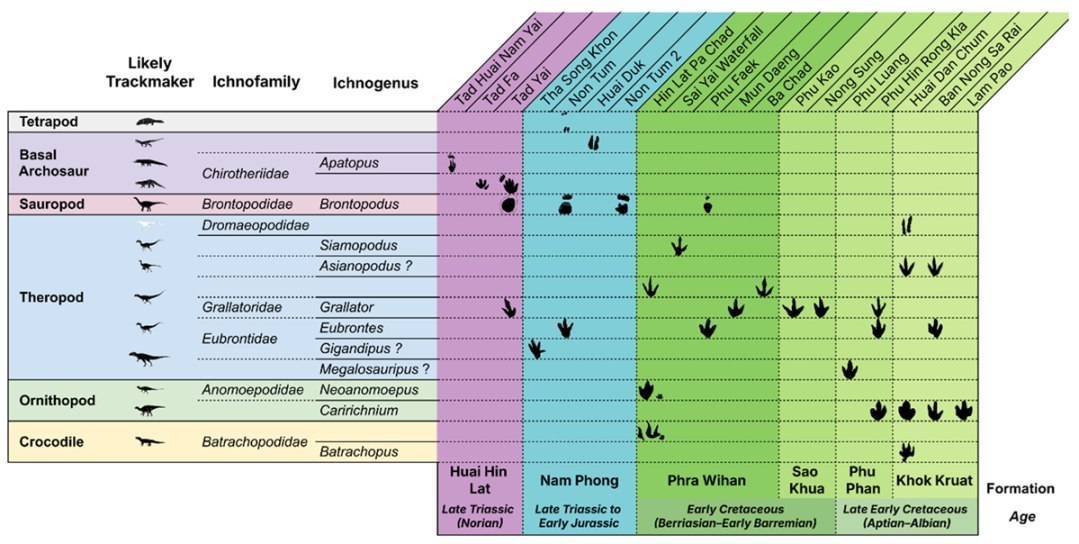
The ichnological record from Upper Triassic to earliest Jurassic deposits of northeastern Thailand reveal a diverse assemblage of vertebrate trace fossils that documents a major faunal transition across the Triassic–Jurassic boundary in Southeast Asia. The stratigraphically lowest footprint site, at Tad Yai, preserves a mixed assemblage including Chirotheriidae, Grallator-type, and Brontopodus-like footprints, illustrating the early co-occurrence of non-dinosaurian archosaurs and basal dinosaurs during the Norian (Table 2). This association provides one of the earliest indications of dinosaur dispersal into Tropical Asia.

Table 2.
Ichnotaxonomical summary and evolution of tetrapod ichnofauna across Mesozoic Formations of Thailand. Black trackmaker silhouettes indicate taxa confirmed by body fossil specimens from the Thai fossil record (adapted from Sita Manitkoon), whereas the white silhouette represents inferred trackmaker that have not yet been confirmed by body fossil evidence in Thailand (adapted from Scott Hartman). Footprints and silhouettes are schematic and not to scale.
Table 2.
Ichnotaxonomical summary and evolution of tetrapod ichnofauna across Mesozoic Formations of Thailand. Black trackmaker silhouettes indicate taxa confirmed by body fossil specimens from the Thai fossil record (adapted from Sita Manitkoon), whereas the white silhouette represents inferred trackmaker that have not yet been confirmed by body fossil evidence in Thailand (adapted from Scott Hartman). Footprints and silhouettes are schematic and not to scale.
 |
Other Norian sites, such as Tad Huai Nam Yai and Tad Fa, are dominated by Chirotheriidae tracks characterized by broad, short impressions and a strong outward rotation of the pes. These morphologies differ from the typically narrower and more elongate European Chirotheriidae, suggesting regional variation possibly linked to substrate conditions or to distinct archosaur trackmakers, most plausibly phytosaurs or other pseudosuchian archosauriforms [24,40]. Such taxa were abundant in fluvial and floodplain settings of the Upper Triassic, and their occurrence in Thailand represents the southeasternmost record of chirotheriid ichnites in Asia, extending the known palaeogeographic range of this group along the south-eastern margin of Laurasia.
Younger sites, including Tha Song Khon and the two Ban Non Tum localities, attributed to the Rhaetian to possibly Hettangian, document the emergence and diversification of tridactyl and large quadrupedal dinosaur footprints (Table 2). At these sites, the Grallator–Eubrontes continuum records small to large theropod or basal saurischian trackmakers, while associated Brontopodus-type tracks indicate the presence of early sauropod or sauropodomorph dinosaurs. The Gigandipus-like morphotype from Tha Song Khon, characterized by a pronounced medially directed hallux impression, reflects a more primitive pedal configuration that foreshadows the Eubrontes morphotype observed at the younger Ban Non Tum 1 locality. Together, these assemblages mark a significant faunal and ichnological turnover from non-dinosaurian archosaur-dominated communities of the Upper Triassic to dinosaur-dominated ichnofaunas of the Early Jurassic in Southeast Asia.
In contrast, the Lower Cretaceous ichnological record of the Khorat Group documents a consistent dominance of theropod footprints across a range of fluvial and overbank depositional environments (Table 2). Small to medium tridactyl tracks, attributable to gracile coelurosaur-grade theropods, occur at multiple sites including Ba Chad, Phu Kao, Nong Sung, and Mun Daeng. Larger theropod ichnites, such as those from Phu Faek, Phu Luang, and Phu Hin Rong Kla, further attest to the persistence of apex predators within these ecosystems.
Toward the Aptian–Albian interval, a progressive expansion and diversification of ornithopod trackmakers becomes evident (Table 2). Smaller quadrupedal traces referred to Neoanomoepus at the Hin Lat Pa Chad site, together with well-preserved Caririchnium-type footprints from Huai Dan Chum, Ban Nong Sa Rai, and Lam Pao, document the increasing abundance and ecological breadth of ornithopods during this time. Collectively, these ichnological patterns align with the broader Mesozoic faunal turnover in Southeast Asia, marking a transition from predominantly theropod- and sauropod-dominated assemblages of the Lower Cretaceous to more taxonomically and ecologically diverse dinosaur communities later in the period.
5.2. Palaeoecological and Environmental Patterns
The oldest Thai tracksites, preserved within the Huai Hin Lat and Nam Phong formations, record palaeoecosystems structured around a diverse assemblage of non-dinosaurian archosauriforms and early dinosaurs. Chirotheriidae tracks, attributed to large pseudosuchians or phytosaurs, dominate many surfaces and reflect the ecological prominence of semi-terrestrial archosaurs occupying fluvial and floodplain environments. These tracks co-occur with Grallator-, Eubrontes-, and Brontopodus-like footprints produced by early saurischians and sauropodomorphs, indicating the presence of dinosaurs within ecosystems still largely structured by non-dinosaurian archosaurs. Together, these assemblages capture a critical ecological transition across the Triassic–Jurassic boundary, marking a shift from archosaur-dominated to increasingly dinosaur-dominated terrestrial communities [82].
Within this transitional context, the Gigandipus-like morphotype from Tha Song Khon, characterized by a strongly medially directed hallux, reflects a functional and biomechanical intermediary between classical chirotheriid trackmakers and the Eubrontes morphotype that becomes prevalent in younger assemblages. This pedal configuration suggests experimentation in locomotor strategies during a period of ecological restructuring, as dinosaurs began to occupy niches previously dominated by other archosaurs. The occurrence of a large, enigmatic didactyl trackway at Ban Non Tum 1, plausibly produced by a partially buoyant temnospondyl amphibian, further underscores the persistence of basal tetrapods within Upper Triassic ecosystems of Southeast Asia, highlighting the ecological complexity and taxonomic heterogeneity of these transitional environments.
Lower Cretaceous tracksites of the Phra Wihan to Khok Kruat formations record a markedly different palaeoecological structure, characterized by sustained theropod dominance across a range of fluvial, floodplain, and overbank depositional settings. Small to medium-sized tridactyl tracks attributable to gracile theropods indicate widespread occupation of terrestrial predator niches, while the continued presence of large theropod footprints attests to the persistence of apex predators within these ecosystems. Alongside this theropod dominance, the progressive expansion of ornithopod trackmakers reflects increasing ecological partitioning and herbivore diversification during the Lower Cretaceous.
Small quadrupedal traces assigned to Neoanomoepus in the Phra Wihan Formation represent early stages of ornithopod ecological expansion, preceding the appearance of more advanced iguanodontian-grade Caririchnium tracks in the Khok Kruat Formation. These ichnites document a shift toward larger, alternately quadrupedal herbivores capable of exploiting a broader range of substrates and habitats. Their close similarity to contemporaneous ichnofaunas from Japan, Korea and China indicates strong palaeoecological continuity across East and Southeast Asia during the Aptian–Albian [78,79,83,84,85]. The presence of didactyl and crocodyliform tracks within the same formations further supports the persistence of diverse semi-aquatic and terrestrial guilds, reinforcing the interpretation of structurally complex and environmentally stable ecosystems during this interval.
5.3. Palaeobiogeography
The Mesozoic vertebrate footprint record of Thailand, spanning the Upper Triassic to the Late Lower Cretaceous within the Khorat Group, occupies a pivotal palaeogeographical position for interpreting continental vertebrate evolution in Southeast Asia. Located along the equatorial margin of the Indochina Terrane, Thailand provides the most continuous and best-documented low-latitude ichnological record in the region, offering a critical tropical counterpart to the more extensively studied, higher-latitude ichnofaunas of China, Korea, and Japan.
Comparative data from neighboring regions highlight both the uniqueness and the regional significance of the Thai record. In the Mesozoic of Cambodia, vertebrate evidence remains sparse, with only unverified reports of dinosaur footprints and a single confirmed Lower Cretaceous sauropod body fossil [86,87,88]. These fragmentary signals contrast sharply with Thailand, where systematic documentation has revealed multiple footprint-rich formations. In Laos, however, confirmed dinosaur footprints from the top of the so-called “Grès Supérieurs Formation” at Muong Phalane - equivalent in age to Thailand’s Khok Kruat Formation - include sauropod, theropod, and large ornithopod tracks that closely mirror Thai Lower Cretaceous ichnofaunas, supporting faunal continuity across the eastern extension of the Khorat Plateau [92].
Further south, ichnological data from Peninsular Malaysia and Singapore remain extremely limited but nonetheless informative. A large trackway from Kelantan, tentatively interpreted as sauropod in origin, indicates that footprint preservation may occur within suitable sedimentary contexts in Sundaland [90,91]. In Singapore, a rare didactyl dinosaur-like footprint from the Upper Triassic Jurong Formation provides a critical low-latitude datapoint broadly contemporaneous with the Upper Triassic Thai record, reinforcing the regional extent of early dinosauriform activity across mainland and adjacent Southeast Asia [92].
In contrast, East Asia (China, Korea, and Japan) preserves some of the most diverse and intensively studied Mesozoic ichnofaunas globally, including abundant theropod, sauropod, ornithopod, avian, crocodyliform, turtle, and choristoderan tracks across a wide range of depositional environments [84,93,94]. The apparent absence of avian and specialized aquatic vertebrate traces in Thailand likely reflects a combination of depositional bias and preservation potential, rather than true faunal absence. Thai tracksites are overwhelmingly associated with fluvial and overbank deposits characteristic of the Scoyenia ichnofacies [95,96], which preferentially preserve large terrestrial dinosaur tracks, whereas lacustrine and marginal-marine systems common in East Asia favor the preservation of smaller and more delicate traces.
Viewed in this regional framework, Thailand emerges as a key palaeobiogeographic bridge. Its ichnological record documents the southeasternmost occurrence of chirotheriid tracks in Asia, significantly extending the known distribution of non-dinosaurian archosauriforms during the Upper Triassic, and provides some of the earliest evidence for dinosaur dispersal into equatorial regions. By recording successive phases of archosaur- and dinosaur-dominated ichnofaunas, the Thai sequence constrains dispersal pathways and faunal continuity between South, Southeast, and East Asia, emphasizing the role of lowland fluvial systems as major corridors for terrestrial vertebrate movement throughout the Mesozoic.
Taken together, regional comparisons demonstrate that Thailand’s ichnological significance lies not in taxonomic novelty alone, but in its capacity to document evolutionary transitions, dispersal dynamics, and ecosystem structure in tropical continental settings that remain underrepresented in the global footprint record.
5.4. Limitations and Preservation Biases
The Thai vertebrate footprint record spans the Norian to the Aptian–Albian and captures key evolutionary phases, including the transition from archosaur-dominated assemblages to dinosaur-dominated ecosystems and the subsequent diversification of ornithopods. However, this record is discontinuous. Unlike several regions of East Asia where Middle–Upper Jurassic strata are preserved within basin or accretionary successions [97,98,99,100], Thailand has not yet yielded confirmed ichnological localities of this age, resulting in an apparent stratigraphic gap between the Triassic–Jurassic transition and the Lower Cretaceous in the current fossil record. This hiatus limits direct assessment of faunal continuity and evolutionary trajectories through a critical interval of global dinosaur diversification. Nevertheless, despite this gap, the Thai succession remains the most complete Mesozoic ichnological record presently known from Tropical Asia. This ichnological record is further complemented by body fossil occurrences from southern Thailand and the lower part of the Upper Phu Kradung Formation.
Documentation quality represents a further constraint. Many Lower Cretaceous footprint sites were recorded prior to the widespread adoption of high-resolution digital methods and are known primarily from field sketches, measurements, casts, or limited photographic documentation. As a result, subtle morphological features, extramorphological variation, and intra-trackway variability are difficult to reassess using modern standards. Comprehensive re-evaluation of these sites using standardized photogrammetric acquisition, quantitative morphometrics, and digital archiving is therefore essential to refine ichnotaxonomic assignments and to evaluate accurately the morphospace occupied by theropod and ornithopod trackmakers within the Khorat Group.
In comparison with East Asian ichnological records, which document a broader ecological spectrum including avian, pterosaur, and specialized semi-aquatic or aquatic reptile tracks (e.g., Koreanaornis, Novapes ulsanensis), the Thai record is notably restricted to terrestrial dinosaurs and crocodyliforms [101,102]. This disparity likely reflects a combination of depositional bias, taphonomic filtering, sampling intensity, and the historical predominance of dinosaur-focused research, rather than a simple absence of these clades from Thai ecosystems. Many Thai tracksites formed in fluvial channel margins and overbank settings favorable to large terrestrial trackmakers but less conducive to preserving delicate avian or pterosaur traces. Despite these limitations, the Thai ichnological record provides uniquely valuable insight into the early establishment, ecological dominance, and subsequent diversification of continental dinosaur faunas in tropical Southeast Asia, offering critical constraints on faunal provinciality and dispersal pathways along the south-eastern margin of Laurasia.
5.5. Conservation Implications
The observed discovery and preservation patterns underscore the interdependence of structured scientific research and sustained community engagement in building a robust ichnological record. While professional fieldwork has historically driven the identification and documentation of vertebrate footprint sites in Thailand, the increasing role of local villagers and forest rangers highlights the effectiveness of long-term outreach, education, and institutional visibility. The establishment of local field museums (e.g., Phu Faek, Phu Kao) and regional research hubs (e.g., Sirindhorn Museum, Phu Wiang Dinosaur Museum, Mahasarakham and Khon Kaen Universities) has facilitated rapid reporting of new discoveries. These networks now constitute a critical component of Thailand’s ichnological research infrastructure.
Institutional visibility and public engagement have further amplified this effect. Cohen documents how dinosaurs [103], and by extension fossil sites, have become embedded in regional identity, educational programs, and tourism strategies, particularly in northeastern Thailand. Notably, this process of cultural integration unfolded over a remarkably short timespan, with dinosaurs transitioning from imported scientific imagery to widely recognized regional symbols within just a few decades [104]. This cultural integration, reinforced by national media coverage and state-supported heritage initiatives, has increased public awareness and legitimacy of palaeontological research, encouraging rapid reporting of new discoveries and reducing the likelihood that sites remain unnoticed or undocumented. The increasing proportion of ichnological sites reported by non-specialists since 2009 reflects the maturation of these informal reporting networks, which now operate as an essential complement to formal scientific surveys.
From a conservation perspective, the results reveal a pronounced stratigraphic and sedimentological bias in site conservation and curation. Upper Triassic tracksites, typically preserved in friable, poorly indurated sandstones and mudstones, yield exceptionally diverse and morphologically informative track assemblages (including tridactyl, tetradactyl, and didactyl forms), yet are acutely vulnerable to fluvial erosion, weathering, and substrate collapse. This combination of high scientific value and low geological resilience renders the Upper Triassic ichnological record the most threatened component of Thailand’s vertebrate footprint heritage. In contrast, Lower Cretaceous tracksites within the more indurated Phra Wihan and Khok Kruat formations exhibit greater physical durability but remain susceptible to surface exfoliation and degradation under tropical climatic conditions, particularly where sites intersect with quarrying, infrastructure development, or river management.
These findings emphasize the necessity of integrating ichnological research with proactive conservation strategies. Enhanced monitoring of known sites, rapid-response documentation of newly exposed surfaces, and timely legal protection are especially critical for Triassic localities and sites discovered in dynamic or anthropogenic settings. More broadly, the data advocates for continuous, anticipatory conservation policies, in which survey and digital documentation are prioritized.
6. Conclusions
This review synthesizes more than three decades of vertebrate ichnological research in Thailand, documenting a spatially expanding and temporally significant footprint record essentially hosted in the Khorat Plateau. From early discoveries concentrated in Khon Kaen and Kalasin provinces, documented tracksites have progressively expanded toward the western and eastern margins of the plateau, including Phetchabun and Nakhon Phanom. The compiled dataset comprises 19 vertebrate footprint sites distributed across six formations spanning the Upper Triassic (Norian) to the Late Lower Cretaceous (Aptian–Albian), representing the most complete ichnological record currently available from Tropical Southeast Asia.
Despite a pronounced stratigraphic gap in the Middle–Upper Jurassic, the Thai footprint record captures a coherent narrative of faunal and ecological change. Upper Triassic assemblages record communities dominated by non-dinosaurian archosaurs (Chirotheriidae) co-occurring with early dinosaurs, documenting one of the earliest phases of dinosaur dispersal into equatorial regions. These are followed by Early Jurassic dinosaur-dominated ichnofaunas and a progressive expansion and ecological diversification of ornithopods during the Aptian–Albian, reflected by the increasing prevalence of Caririchnium-type trackways. Palaeobiogeographically, Thailand occupies a key low-latitude position, representing the southeasternmost occurrence of chirotheriid ichnites in Asia and forming a spatial bridge between Early Mesozoic faunas of China and younger Cretaceous ichnofaunas of Laos, Korea, and Japan.
The review also underscores significant methodological and preservation challenges. Many Lower Cretaceous sites were documented using legacy methods, while friable Upper Triassic substrates remain particularly vulnerable to erosion and irreversible loss. Systematic re-documentation of both legacy and newly discovered sites using standardized three-dimensional workflows is therefore essential to refine ichnotaxonomic interpretations, quantify morphospace occupation, and ensure long-term reproducibility.
Looking forward, key priorities include targeted exploration to resolve the Jurassic gap, expansion of ichnological surveys to encompass more delicate track types (e.g., avian and pterosaurian), and continued support for community-based reporting networks that now play a critical role in site discovery. Overall, the Thai vertebrate footprint record constitutes a unique and irreplaceable archive of Mesozoic life at low latitudes. Safeguarding this heritage will require sustained collaboration between academic institutions, governmental agencies, protected-area authorities, and local communities, integrating standardized documentation, institutional support, and public engagement to advance ichnology as a mature and integrative discipline within Southeast Asian vertebrate palaeontology.
Funding
This research was funded by Mahasarakham University, grant number 6801054.
Acknowledgments
The authors sincerely thank Julien Claude for his insightful remarks and constructive discussions. We are grateful to Yuta Tsukiji and Lionel Cavin for their assistance with photographic documentation. We also thank Sita Manitkoon and Supanut Bhuttarach for their help with map preparation and graphic data processing. Special thanks are extended to Khaosuay Marianne Liard and Khaohom Elisabeth Liard for their assistance with scientific drawings. We thank Sasa-On Khansabha and Krishna Sutcha for their valuable assistance during fieldwork, and Alexandre Trémeau for his collaboration. The authors acknowledge the staff of the Sirindhorn Museum and the Phu Wiang Dinosaur Museum for logistical support, as well as colleagues from the Department of Mineral Resources (DMR) who participated in field investigations over the past 15 years. Finally, we express our gratitude to Jean Le Loeuff, Christelle Souillat, Varavudh Sutheetorn, Haiyan Tong, and all collaborators who contributed to the promotion and development of the Thai–French ichnological missions since the early 2000s.
References
- Falkingham, P.L.; Bates, K.T.; Avanzini, M.; Bennett, M.; Bordy, E.M.; Breithaupt, B.H.; et al. A standard protocol for documenting modern and fossil ichnological data. Palaeontology 2018, 61, 469–480. [Google Scholar] [CrossRef]
- Le Loeuff, J.; Saenyamoon, T.; Souillat, C.; Suteethorn, V.; Buffetaut, E. Mesozoic vertebrate footprints of Thailand and Laos. In Late Palaeozoic and Mesozoic Continental Ecosystems in SE Asia; Buffetaut, E., Cuny, G., Le Loeuff, J., Suteethorn, V., Eds.; Geological Society of London Special Publications: London, UK, 2009; Volume 315, pp. 245–256. [Google Scholar]
- Buffetaut, E.; Ingavat, R.; Sattayarak, N.; Suteetorn, V. Les premières empreintes de pas de dinosaures du Sud-Est asiatique: Pistes de carnosaures du Crétacé inférieur de Thaïlande. C. R. Acad. Sci., Ser. II 1985, 301(9), 643–648. [Google Scholar]
- Buffetaut, E.; Ingavat, R.; Sattayarak, N.; Suteetorn, V. Dinosaur footprints from Southeast Asia: Carnosaur tracks from the Lower Cretaceous of Thailand. C. R. Acad. Sci., Ser. II 1985, 301(9), 643–648. [Google Scholar]
- Le Loeuff, J.; Saenyamoon, T.; Suteethorn, V.; Khansubha, S.; Buffetaut, E. Vertebrate footprints of Southeast Asia (Thailand and Laos): A review. In Proceedings of the International Conference on Geology, Geotechnology and Mineral Resources of Indochina (GEOINDO 2005), Khon Kaen, Thailand, 2005; pp. 582–587. [Google Scholar]
- Le Loeuff, J.; Khansubha, S.; Buffetaut, E.; Suteethorn, V.; Tong, H.; Souillat, C. Dinosaur footprints from the Phra Wihan Formation (Early Cretaceous of Thailand). C. R. Palevol 2002, 1, 287–292. [Google Scholar] [CrossRef]
- Sutcha, K.; Liard, T.; Liard, R. The Mesozoic vertebrate footprint sites of Thailand. In Proceedings of the 18th Regional Geoscience Conference of Southeast Asia (GEOSEA 2024), Khon Kaen, Thailand, 2024; p. 192. [Google Scholar]
- Department of Mineral Resources (DMR). Geologic Map of Northeast Thailand, Scale 1:650,000; DMR: Bangkok, Thailand, 2023. [Google Scholar]
- Department of Mineral Resources. Affiliated Museums. Available online: https://www.dmr.go.th/en/พิพิธภัณฑ์ธรณีวิทยา/ (accessed on 28 January 2026).
- Buffetaut, E.; Suteethorn, V. The dinosaurs of Thailand. J. Southeast Asian Earth Sci. 1993, 8, 77–82. [Google Scholar] [CrossRef]
- Buffetaut, E.; Suteethorn, V.; Tong, H.; Chaimanee, Y.; Khansubha, S. New dinosaur discoveries in the Jurassic and Cretaceous of northeastern Thailand. In Proceedings of the International Conference on Stratigraphy and Tectonic Evolution of Southeast Asia and the South Pacific, Bangkok, Thailand, August 1997; Department of Mineral Resources: Bangkok, Thailand, 1997; pp. 177–187. [Google Scholar]
- Buffetaut, E.; Suteethorn, V.; Le Loeuff, J.; Cuny, G.; Tong, H.; Khansubha, S.; Mantajit, N. A review of the sauropod dinosaurs of Thailand. In Proceedings of the Symposium on Geology of Thailand, Bangkok, Thailand, August 2002; Department of Mineral Resources: Bangkok, Thailand, 2002; pp. 95–101. [Google Scholar]
- Lockley, M.; Sato, Y.; Matsukawa, M. A new dinosaurian ichnogenus from the Cretaceous in Thailand. In Proceedings of the Symposium on Geology of Thailand, Bangkok, Thailand, August 2002; Department of Mineral Resources: Bangkok, Thailand, 2002; pp. 117–119. [Google Scholar]
- Saenyamoon, T. Early Cretaceous Vertebrate Footprints from Huai Dan Chum Site, Tha U-Thane District, Nakhon Phanom Province. Master’s Thesis, Mahasarakham University, Mahasarakham, Thailand, May 2006. [Google Scholar]
- Racey, A.; Love, M.A.; Canham, A.C.; Goodall, J.G.S.; Polachan, S.; Jones, P.D. Stratigraphy and reservoir potential of the Mesozoic Khorat Group, NE Thailand: Part 1. Stratigraphy and sedimentary evolution. J. Pet. Geol. 1996, 19, 5–39. [Google Scholar] [CrossRef]
- Racey, A.; Goodall, J.G.S. Palynology and stratigraphy of the Mesozoic Khorat Group red bed sequences from Thailand. Geol. Soc. Lond. Spec. Publ. 2009, 315, 69–83. [Google Scholar] [CrossRef]
- Buffetaut, E.; Suteethorn, V. The biogeographical significance of the Mesozoic vertebrates from Thailand. In Biogeography and Geological Evolution of SE Asia; Hall, R., Holloway, J.D., Eds.; Backhuys Publishers: Leiden, The Netherlands, 1998; pp. 83–90. [Google Scholar]
- Buffetaut, E.; Ingavat, R. Phytosaur remains (Reptilia, Thecodontia) from the Upper Triassic of north-eastern Thailand. Geobios 1982, 15, 7–17. [Google Scholar] [CrossRef]
- Klein, H.; Lucas, S.G. The Late Triassic tetrapod ichnotaxon Apatopus lineatus (Bock 1952) and its distribution. N.M. Mus. Nat. Hist. Sci. Bull. 2013, 61, 313–324. [Google Scholar]
- Bock, W. Triassic Reptilian Tracks and Trends of Locomotive Evolution: With Remarks on Correlation. J. Paleontol. 1952, 26, 395–433. [Google Scholar]
- Katisart, T. Paleobiology of phytosaur remains from the Huai Hin Lat Formation. Master’s Thesis, Mahasarakham University, Mahasarakham, Thailand, 2005. [Google Scholar]
- Chonglakmani, C. Triassic. In The Geology of Thailand; Ridd, M.F., Barber, A.J., Crow, M.J., Eds.; Geological Society of London: London, UK, 2011; pp. 137–150. [Google Scholar]
- Booth, J.; Sattayarak, N. Subsurface Carboniferous--Cretaceous Geology of NE Thailand. In The Geology of Thailand; Ridd, M.F., Barber, A.J., Crow, M.J., Eds.; Geological Society of London: London, UK, 2011; pp. 185–222. [Google Scholar]
- King, M.J.; Sarjeant, W.A.; Thompson, D.B.; Tresise, G. A revised systematic ichnotaxonomy and review of the vertebrate footprint ichnofamily Chirotheriidae from the British Triassic. Ichnos 2005, 12, 241–299. [Google Scholar] [CrossRef]
- Claude, J. (University of Montpellier, Montpellier, France; IRD, Bangkok, Thailand); Lauprasert, K. (Mahasarakham University, Maha Sarakham, Thailand). Personal communication, 2026.
- Alexander, R.M. Estimates of speeds of dinosaurs. Nature 1976, 261, 129–130. [Google Scholar] [CrossRef]
- Lockley, M.G.; King, M.; Howe, S.; Sharp, T. Dinosaur tracks and other archosaur footprints from the Triassic of South Wales. Ichnos 1996, 5, 23–41. [Google Scholar] [CrossRef]
- Romilio, A.; Shao, C. Analysing trackway-based speed calculations to infer dinosaur locomotive capabilities and behaviours. Hist. Biol. 2024, 36, 2244–2253. [Google Scholar] [CrossRef]
- Ruiz, J.; Torices, A. Humans running at stadiums and beaches and the accuracy of speed estimations from fossil trackways. Ichnos 2013, 20, 31–35. [Google Scholar] [CrossRef]
- Thulborn, T. Dinosaur Tracks; Chapman and Hall: London, UK, 1990. [Google Scholar]
- Lockley, M.G.; Lucas, S.G.; Hunt, A.P. Eosauropus, a new name for a Late Triassic track: Further observations on the Late Triassic ichnogenus Tetrasauropus and related forms, with notes on the limits of interpretation. N. Mex. Mus. Nat. Hist. Sci. Bull. 2006, 37, 192–198. [Google Scholar]
- Xing, L.; Lockley, M.G.; Tang, D.; Klein, H.; Peng, G.; Ye, Y.; Hao, B. Early Jurassic basal sauropodomorpha dominated tracks from Guizhou, China: Morphology, ethology, and paleoenvironment. Geosci. Front. 2019, 10, 229–240. [Google Scholar] [CrossRef]
- Gaston, R.; Lockley, M.; Lucas, S.; Hunt, A. Grallator-dominated fossil footprint assemblages and associated enigmatic footprints from the Chinle Group (Upper Triassic), Gateway area, Colorado. Ichnos 2003, 10, 153–163. [Google Scholar] [CrossRef]
- Hunt, A.P.; Lucas, S.G.; Harris, J.D.; Spielmann, J.A.; Lockley, M.G.; Kirkland, J.I. Triassic--Jurassic tetrapod ichnofacies. N.M. Mus. Nat. Hist. Sci. Bull. 2006, 37, 12–22. [Google Scholar]
- Xing, L.; Lockley, M.G.; Bonnan, M.F.; Marty, D.; Klein, H.; Liu, Y.; Li, N. Late Jurassic--Early Cretaceous trackways of small-sized sauropods from China: new discoveries, ichnotaxonomy and sauropod manus morphology. Cretac. Res. 2015, 56, 470–481. [Google Scholar] [CrossRef]
- Buffetaut, E.; Suteethorn, V.; Cuny, G.; Tong, H.; Le Loeuff, J.; Khansubha, S.; Jongautchariyakul, S. The earliest known sauropod dinosaur. Nature 2000, 407, 72–74. [Google Scholar] [CrossRef] [PubMed]
- Laojumpon, C.; Suteethorn, V.; Chanthasit, P.; Lauprasert, K.; Suteethorn, S. New evidence of sauropod dinosaurs from the Early Jurassic period of Thailand. Acta Geol. Sin. (Engl. Ed.) 2017, 91, 1169–1178. [Google Scholar] [CrossRef]
- Hanta, R.; Sekiya, T.; Shibata, M.; Naksri, W.; Tucker, R.T. Hatchling and early juvenile of early sauropod from the early Middle Jurassic Nam Phong Formation, Chaiyaphum Province, northeastern Thailand. Palaeontol. Res. 2023, 28, 222–239. [Google Scholar] [CrossRef]
- Klein, H.; Lucas, S.G. The Triassic tetrapod footprint record. Bull. N. Mex. Mus. Nat. Hist. Sci. 2021, 83, 1–194. [Google Scholar]
- Klein, H.; Lucas, S.G. Triassic tetrapod footprints. In Vertebrate Ichnology; Lucas, S.G., Hunt, A.P., Klein, H., Eds.; Elsevier: Amsterdam, The Netherlands, 2025; pp. 179–263. [Google Scholar]
- Klein, H.; Lucas, S.G. Early evolution of dinosaurs: indications from the Triassic footprint record. Ital. J. Geosci. 2025, 144, 436–459. [Google Scholar] [CrossRef]
- Ward, D.E.; Bunnag, D. Stratigraphy of the Mesozoic Khorat Group in Northeastern Thailand; Department of Mineral Resources: Bangkok, Thailand, 1964; No. 6. [Google Scholar]
- Mouret, C.H.J.S.; Heggemann, H.; Gouadain, J.; Krisadasima, S. Geological history of the siliciclastic Mesozoic strata of the Khorat Group in the Phu Phan Range area, northeastern Thailand. In Proceedings of the International Symposium on the Biostratigraphy of Mainland Southeast Asia: Facies and Palaeontology, Chiang Mai, Thailand, 1993; pp. 23–49. [Google Scholar]
- Lull, R.S. Triassic Life of the Connecticut Valley, revised ed.; State Geological and Natural History Survey Bulletin: Hartford, CT, USA, 1953; Volume No. 81, pp. 1–336. [Google Scholar]
- Liard, T.; Liard, R.; Le Loeuff, J. The vertebrate footprints from Ban Non Toom, Nong Bua Daeng District, Chaiyaphum Province, Thailand. In Proceedings of the 2nd International Symposium on Asian Dinosaurs in Thailand, Bangkok, Thailand, 2015; p. 59. [Google Scholar]
- Chitnarin, A.; Hanta, R.; Ketmuangmoon, P.; Forel, M.B. Ostracoda (Crustacea) from the Lower Jurassic of northeastern Thailand: stratigraphic and paleoenvironmental implications. Rev. Micropaléontol. 2022, 75, 100611. [Google Scholar] [CrossRef]
- Marsicano, C.A.; Wilson, J.A.; Smith, R.M. A temnospondyl trackway from the Early Mesozoic of Western Gondwana and its implications for basal tetrapod locomotion. PLoS ONE 2014, 9, e103255. [Google Scholar] [CrossRef]
- Ellenberger, P. Contribution à la classification des pistes de vertébrés du Trias: les types du Stormberg d’Afrique du Sud (IIᵉ partie, le Stormberg supérieur-I -- le biome de la zone B/1 ou niveau de Moyeni: ses biocénoses). Palaeovertebrata (Mém. Extraord.) 1974, 104, 1–143. [Google Scholar]
- Ingavat, R.; Janvier, P. Cyclotosaurus cf. posthumus Fraas (Capitosauridae, Stereospondyli) from the Huai Hin Lat Formation (Upper Triassic), Northeastern Thailand: With a note on capitosaurid biogeography. Geobios 1981, 14, 711–725. [Google Scholar] [CrossRef]
- Nonsrirach, T.; Manitkoon, S.; Lauprasert, K. First occurrence of brachyopid temnospondyls in Southeast Asia and review of the Mesozoic amphibians from Thailand. Foss. Rec. 2021, 24, 33–47. [Google Scholar] [CrossRef]
- Liard, T.; Liard, R. Mesozoic vertebrate footprint discoveries from ASEAN. In Proceedings of the Thematic Session “Geoscience for the Society”, 52nd CCOP Annual Session, Bangkok, Thailand, 31 October–3 November 2016; Coordinating Committee for Geoscience Programmes in East and Southeast Asia (CCOP): Bangkok, Thailand, 2016; pp. 41–51. [Google Scholar]
- Racey, A.; Goodall, J.G.S.; Love, M.A.; Polachan, S.; Jones, P.D. New age data for the Mesozoic Khorat Group of northeastern Thailand. In Proceedings of the IGCP 306 Conference: Stratigraphic Correlation of Southeast Asia, Bangkok, Thailand, 15–20 November 1994; Angsuwathana, P., et al., Eds.; 1994; pp. 245–252. [Google Scholar]
- Lockley, M.G.; McCrea, R.T.; Matsukawa, M. Ichnological evidence for small quadrupedal ornithischians from the basal Cretaceous of SE Asia and North America: implications for a global radiation. Geol. Soc. Lond. Spec. Publ. 2009, 315, 255–269. [Google Scholar]
- Buffetaut, E.; Suteethorn, V.; Tong, H.; Cuny, G.; Cavin, L. A pterodactyloid tooth from the Sao Khua Formation (Early Cretaceous) of Thailand. Mahasarakham Univ. J. 2003, 23, 92–98. [Google Scholar]
- Buffetaut, E.; Suteethorn, V.; Tong, H. Dinosaur assemblages from Thailand: A comparison with Chinese faunas. In Papers from the 2005 Heyuan International Dinosaur Symposium; Geological Publishing House: Beijing, China, 2006; pp. 19–37. [Google Scholar]
- Manitkoon, S.; Deesri, U.; Warapeang, P.; Nonsrirach, T.; Chanthasit, P. Ornithischian dinosaurs in Southeast Asia: A review with palaeobiogeographic implications. Foss. Rec. 2023, 26, 1–25. [Google Scholar] [PubMed]
- Polachan, M.; Daorerk, V. Report on additional discovery of dinosaur footprints in Thailand. In Proceedings of the International Symposium on Biostratigraphy of Mainland Southeast Asia: Facies and Palaeontology, Chiang Mai, Thailand, 1993; pp. 225–230. [Google Scholar]
- Lockley, M.; Matsukawa, M.; Sato, Y.; Polahan, M.; Daorerk, V. A distinctive new theropod dinosaur track from the Cretaceous of Thailand: Implications for theropod track diversity. Cretac. Res. 2006, 27, 139–145. [Google Scholar] [CrossRef]
- Samathi, A.; Chanthasit, P.; Sander, P.M. Two new basal coelurosaurian theropod dinosaurs from the Lower Cretaceous Sao Khua Formation of Thailand. Acta Palaeontol. Pol. 2019, 64, 239–260. [Google Scholar] [CrossRef]
- Buffetaut, E.; Suteethorn, V.; Tong, H. An early ‘ostrich dinosaur’ (Theropoda: Ornithomimosauria) from the Early Cretaceous Sao Khua Formation of NE Thailand. Geol. Soc. Lond. Spec. Publ. 2009, 315, 229–243. [Google Scholar] [CrossRef]
- Tucker, R.T.; Hyland, E.G.; Gates, T.A.; King, M.R.; Roberts, E.M.; Foley, E.K.; Zanno, L.E. Age, depositional history, and paleoclimatic setting of Early Cretaceous dinosaur assemblages from the Sao Khua Formation (Khorat Group), Thailand. Palaeogeogr. Palaeoclimatol. Palaeoecol. 2022, 601, 111107. [Google Scholar] [CrossRef]
- Tumpeesuwan, S.; Sato, Y.; Nakhapadungrat, S. A new species of Pseudohyria (Matsumotoina) (Bivalvia: Trigonioidoidea) from the Early Cretaceous Sao Khua Formation, Khorat Group, Northeastern Thailand. Trop. Nat. Hist. 2010, 10, 93–106. [Google Scholar] [CrossRef]
- Tumpeesuwan, S.; Udchachon, M.; Lauprasert, K.; Deesri, U.; Suteethorn, S.; Nuley, P.; Tumpeesuwan, C. The richest diversity and highest abundance of freshwater bivalve fossils from the new fossil locality of the Early Cretaceous Sao Khua Formation at Roi Et Province, Northeastern Thailand. Trop. Nat. Hist. 2024, 24, 137–152. [Google Scholar] [CrossRef]
- Buffetaut, E.; Cuny, G.; Le Loeuff, J.; Suteethorn, V. Late Palaeozoic and Mesozoic continental ecosystems of SE Asia: An introduction. Geol. Soc. Lond. Spec. Publ. 2009, 315, 1–5. [Google Scholar]
- Liard, T.; Liard, R.; Sutcha, K. Dinosaur footprints from the Sao Khua Formation (Early Cretaceous) of Phu Kao National Park, Northeast Thailand. Ann. Paléontol. 2019, 105, 217–222. [Google Scholar]
- Cuny, G.; Cavin, L.; Suteethorn, V. A new hybodont with a cutting dentition from the Lower Cretaceous of Thailand. Cretac. Res. 2009, 30, 515–520. [Google Scholar] [CrossRef]
- Lockley, M.G.; Meyer, C. Megalosauripus and the problematic concept of megalosaur footprints. Gaia 1998, 15, 313–318. [Google Scholar]
- Cavin, L.; Deesri, U.; Suteethorn, V. The Jurassic and Cretaceous bony fish record (Actinopterygii, Dipnoi) from Thailand. Geol. Soc. Lond. Spec. Publ. 2009, 315, 125–144. [Google Scholar]
- Le Loeuff, J.; Suteethorn, V.; Buffetaut, E.; Wongko, K.; Tong, H.; Tonprom, W.; Souillat, C.; Cavin, L. The first dinosaur footprints from the Khok Kruat Formation (Aptian of northeastern Thailand). Proceedings of the 1st International Conference on Palaeontology of Southeast Asia; Mahasarakham Univ. J. 2003, 23, 83–91. [Google Scholar]
- Matsukawa, M.; Lockley, M.; Jianjun, L. Cretaceous terrestrial biotas of East Asia, with special reference to dinosaur-dominated ichnofaunas: Towards a synthesis. Cretac. Res. 2006, 27, 3–21. [Google Scholar] [CrossRef]
- Xing, L.; Lockley, M.G. Theropod tracks from the Jurassic--Cretaceous boundary, Tuchengzi Formation, Chengde, China: Review and new observations. Biosis 2021, 2, 271–282. [Google Scholar]
- Milàn, J.E.; Avanzini, M.A.; Clemmensen, L.B.; García-Ramos, J.C.; Piñuela, L.A. Theropod foot movement recorded by Late Triassic, Early Jurassic and Late Jurassic fossil footprints. N.M. Mus. Nat. Hist. Sci. Bull. 2006, 37, 352–364. [Google Scholar]
- Milàn, J.; Bromley, R.G. True tracks, undertracks and eroded tracks: Experimental work with tetrapod tracks in laboratory and field. Palaeogeogr. Palaeoclimatol. Palaeoecol. 2006, 231, 253–264. [Google Scholar]
- Le Loeuff, J.E.; Lauprasert, K.O.; Suteethorn, S.U.; Souillat, C.H.; Suteethorn, V.A.; Buffetaut, E.R. Late Early Cretaceous crocodyliform trackways from northeastern Thailand. N.M. Mus. Nat. Hist. Sci. Bull. 2010, 51, 175–178. [Google Scholar]
- Department of Mineral Resources, Fossil Protection Division. Fossil Protection Act B.C. 2551; Department of Mineral Resources: Bangkok, Thailand, 2014; p. 24. [Google Scholar]
- Cavin, L.; Deesri, U.; Suteethorn, V. Osteology and relationships of Thaiichthys nov. gen.: A Ginglymodi from the Late Jurassic--Early Cretaceous of Thailand. Palaeontology 2013, 56, 183–208. [Google Scholar] [CrossRef]
- Lauprasert, K.; Laojumpon, C.; Saenphala, W.; Cuny, G.; Thirakhupt, K.; Suteethorn, V. Atoposaurid crocodyliforms from the Khorat Group of Thailand: First record of Theriosuchus from Southeast Asia. Paläontol. Z. 2011, 85, 37–47. [Google Scholar] [CrossRef]
- Xing, L.; Lockley, M.G.; Marty, D.; Zhang, J.; Wang, Y.; Klein, H.; Xie, X. An ornithopod-dominated tracksite from the Lower Cretaceous Jiaguan Formation (Barremian--Albian) of Qijiang, South-Central China: New discoveries, ichnotaxonomy, preservation and palaeoecology. PLoS ONE 2015, 10, e0141059. [Google Scholar] [CrossRef] [PubMed]
- Tsukiji, Y.; Azuma, Y.; Shiraishi, F.; Shibata, M.; Noda, Y. New ornithopod footprints from the Lower Cretaceous Kitadani Formation, Fukui, Japan: Ichnotaxonomical implications. Cretac. Res. 2018, 84, 501–514. [Google Scholar] [CrossRef]
- Yoon, H.S.; Lee, Y.N.; Jung, S.H.; Kong, D.Y.; Kim, S.H.; Son, M. A juvenile ornithopod tracksite from the Lower Cretaceous Haman Formation, South Korea. Cretac. Res. 2021, 125, 104877. [Google Scholar] [CrossRef]
- Liard, T.; Tsukiji, Y.; Shibata, M.; Chanthasit, P. New iguanodontid footprints from the Early Cretaceous Khok Kruat Formation, Northeastern Thailand. In Proceedings of the 18th Regional Geoscience Conference of Southeast Asia (GEOSEA 2024), Khon Kaen, Thailand, 2024; p. 171. [Google Scholar]
- Brusatte, S.L.; Benton, M.J.; Lloyd, G.T.; Ruta, M.; Wang, S.C. Macroevolutionary patterns in the evolutionary radiation of archosaurs (Tetrapoda: Diapsida). Earth Environ. Sci. Trans. R. Soc. Edinb. 2010, 101, 367–382. [Google Scholar] [CrossRef]
- Huh, M.; Hwang, K.G.; Paik, I.S.; Chung, C.H.; Kim, B.S. Dinosaur tracks from the Cretaceous of South Korea: Distribution, occurrences and paleobiological significance. Isl. Arc 2003, 12, 132–144. [Google Scholar] [CrossRef]
- Lockley, M.G.; Houck, K.; Yang, S.-Y.; Matsukawa, M.; Lim, S.-K. Dinosaur-dominated footprint assemblages from the Cretaceous Jindong Formation, Hallyo Haesang National Park area, Goseong County, South Korea: Evidence and implications. Cretac. Res. 2006, 27, 70–101. [Google Scholar] [CrossRef]
- Xing, L.D.; Harris, J.D.; Jia, C.K.; Luo, Z.J.; Wang, S.N.; An, J.F. Early Cretaceous bird-dominated and dinosaur footprint assemblages from the northwestern margin of the Junggar Basin, Xinjiang, China. Palaeoworld 2011, 20, 308–321. [Google Scholar] [CrossRef]
- Liard, T. Preliminary report on vertebrate footprints from Ratanak Mondul District, Battambang Province, Cambodia, Unpublished work; Sirindhorn Museum, Department of Mineral Resources: Kalasin, Thailand, 2016.
- Lim, V.; Buffetaut, E.; Tong, H.; Cavin, L.; Pann, K.; Ngoeun, P.P. The First Dinosaur from the Kingdom of Cambodia: A Sauropod Fibula from the Lower Cretaceous of Koh Kong Province, South-Western Cambodia. Foss. Stud. 2023, 1, 49–59. [Google Scholar] [CrossRef]
- Buffetaut, E.; Tong, H.; Cavin, L.; Lim, V.; Ly, P.S.; Heng, M. Fossil-bearing non-marine Mesozoic formations of south-western Cambodia. In Proceedings of the 18th Regional Geoscience Conference of Southeast Asia (GEOSEA 2024), Khon Kaen, Thailand, 2024; pp. 55–63. [Google Scholar]
- Allain, R.; Taquet, P.; Battail, B.; Dejax, J.; Richir, P.; Véran, M.; Sayarath, P.; Khenthavong, B.; Thamvirith, P.; Hom, B. Pistes de dinosaures dans les niveaux du Crétacé inférieur de Muong Phalane, province de Savannakhet (Laos). C. R. Acad. Sci., Ser. IIa 1997, 325, 815–821. [Google Scholar]
- Bashardin, A.; Liard, T.; Rahman, M.N.A. The comparison of suspected sauropod’s track at Bukit Panau, Kelantan and sauropod’s track from Ban Nom Tum, Thailand. Warta Geol. 2021, 47, 79. [Google Scholar]
- Achmad Bahar, A.M.; Sulaiman, M.S.; Martosuwito, S.; Hartono, U. The sauropod dinosaur trackways from Tanah Merah, Kelantan, Malaysia. In IOP Conference Series: Earth and Environmental Science, Proceedings of the Conference, August 2020; IOP Publishing: Bristol, UK, 2020; Volume 549, p. 012022. [Google Scholar] [CrossRef]
- Oliver, G.; Prave, A. Palaeogeography of Late Triassic red-beds in Singapore and the Indosinian Orogeny. J. Asian Earth Sci. 2013, 76, 214–224. [Google Scholar] [CrossRef]
- Kim, J.Y.; Kim, S.H.; Kim, K.S.; Lockley, M.G. The oldest record of webbed bird and pterosaur tracks from South Korea (Cretaceous Haman Formation, Changseon and Sinsu Islands): more evidence of high avian diversity in East Asia. Cretac. Res. 2006, 27, 56–69. [Google Scholar] [CrossRef]
- Lee, Y.N.; Yu, K.M.; Wood, C.B. A review of vertebrate faunas from the Gyeongsang Supergroup (Cretaceous) in South Korea. Palaeogeogr. Palaeoclimatol. Palaeoecol. 2001, 165, 357–373. [Google Scholar] [CrossRef]
- Buatois, L.A.; Mángano, M.G. Invertebrate ichnology of continental freshwater environments. In Trace Fossils; Miller, W., III, Ed.; Elsevier: Amsterdam, The Netherlands, 2007; pp. 285–323. [Google Scholar]
- Buatois, L.A.; Mángano, M.G. Ichnology: Organism--Substrate Interactions in Space and Time; Cambridge University Press: Cambridge, UK, 2011; pp. 73–75. [Google Scholar]
- Kojima, S. Mesozoic terrane accretion in northeast China, Sikhote-Alin and Japan regions. Palaeogeogr. Palaeoclimatol. Palaeoecol. 1989, 69, 213–232. [Google Scholar]
- Liu, Y.Q.; Kuang, H.W.; Peng, N.; Xu, H.; Zhang, P.; Wang, N.S.; Hu, X.F. Mesozoic basins and associated palaeogeographic evolution in North China. J. Palaeogeogr. 2015, 4, 189–202. [Google Scholar] [CrossRef]
- Choi, Y.; Ryu, I.C.; Seo, J.; Oh, C.W. Evolution of the Mesozoic Yuljeon Basin in South Korea and its tectonic implication. Lithos 2020, 366, 105560. [Google Scholar]
- Park, S.I.; Kwon, S.; Kim, S.W.; Hong, P.S.; Santosh, M. A Mesozoic orogenic cycle from post-collision to subduction in the southwestern Korean Peninsula: New structural, geochemical, and chronological evidence. J. Asian Earth Sci. 2018, 157, 166–186. [Google Scholar] [CrossRef]
- Anfinson, O.A.; Lockley, M.G.; Kim, S.H.; Kim, K.S.; Kim, J.Y. First report of the small bird track Koreanaornis from the Cretaceous of North America: implications for avian ichnotaxonomy and paleoecology. Cretac. Res. 2009, 30, 885–894. [Google Scholar] [CrossRef]
- Lee, Y.N.; Kong, D.Y.; Jung, S.H. The first possible choristoderan trackway from the Lower Cretaceous Daegu Formation of South Korea and its implications on choristoderan locomotion. Sci. Rep. 2020, 10, 14442. [Google Scholar] [CrossRef]
- Cohen, E. Dinosaurs in Thai culture and tourism. Tour. Cult. Commun. 2010, 10, 117–135. [Google Scholar] [CrossRef]
- Ouilapan, S.; Thongcharoenchaikit, C. Identifying dinosaur-like creatures in the mural paintings of the Temple of the Emerald Buddha: An implication to study paleontological knowledge in Thailand. In Proceedings of the 4th Thailand International Symposium on Natural History Museums: Era of Ecosystem Restoration, Bangkok, Thailand, 2024; Volume 16, p. 1. [Google Scholar]
Figure 1.
Geographical distribution of vertebrate footprint localities across the Khorat Plateau, northeastern Thailand. Sites are grouped into four clusters: (A) the northwestern cluster (Loei–Phetchabun area; (B) the central plateau zone (Khon Kaen–Kalasin area); (C) the northeastern margin along the Mekong River (Nakhon Phanom); and (D) a southern outlier near Khao Yai National Park (Prachin Buri Province).
Figure 1.
Geographical distribution of vertebrate footprint localities across the Khorat Plateau, northeastern Thailand. Sites are grouped into four clusters: (A) the northwestern cluster (Loei–Phetchabun area; (B) the central plateau zone (Khon Kaen–Kalasin area); (C) the northeastern margin along the Mekong River (Nakhon Phanom); and (D) a southern outlier near Khao Yai National Park (Prachin Buri Province).
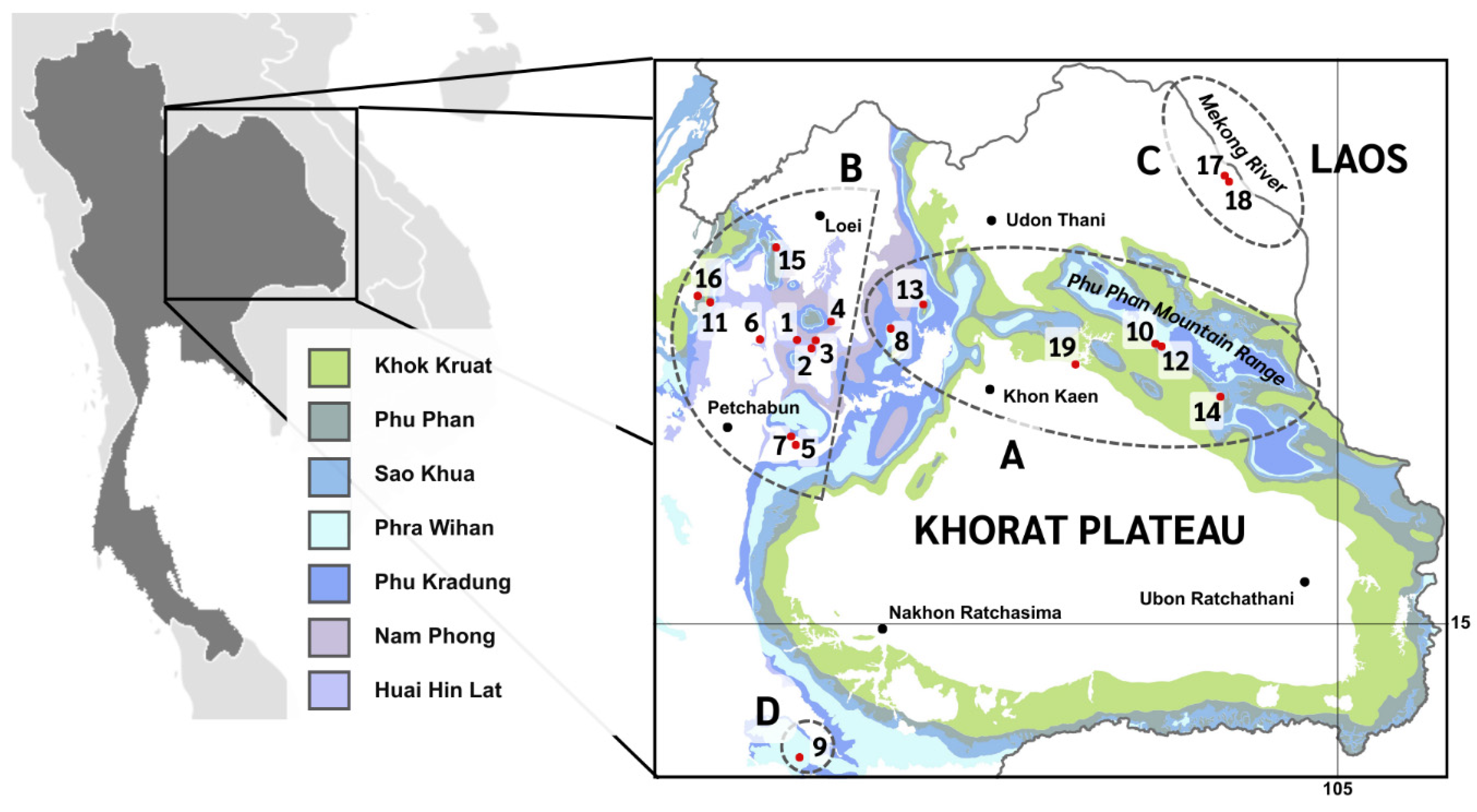
Figure 2.
Simplified stratigraphic log illustrating the Upper Triassic to Lower Cretaceous sedimentary succession of northeastern Thailand (Khorat Plateau). Major stratigraphic boundaries and regional tectonic events are indicated where relevant. The meaning of the icons is detailed in Table 2.
Figure 2.
Simplified stratigraphic log illustrating the Upper Triassic to Lower Cretaceous sedimentary succession of northeastern Thailand (Khorat Plateau). Major stratigraphic boundaries and regional tectonic events are indicated where relevant. The meaning of the icons is detailed in Table 2.
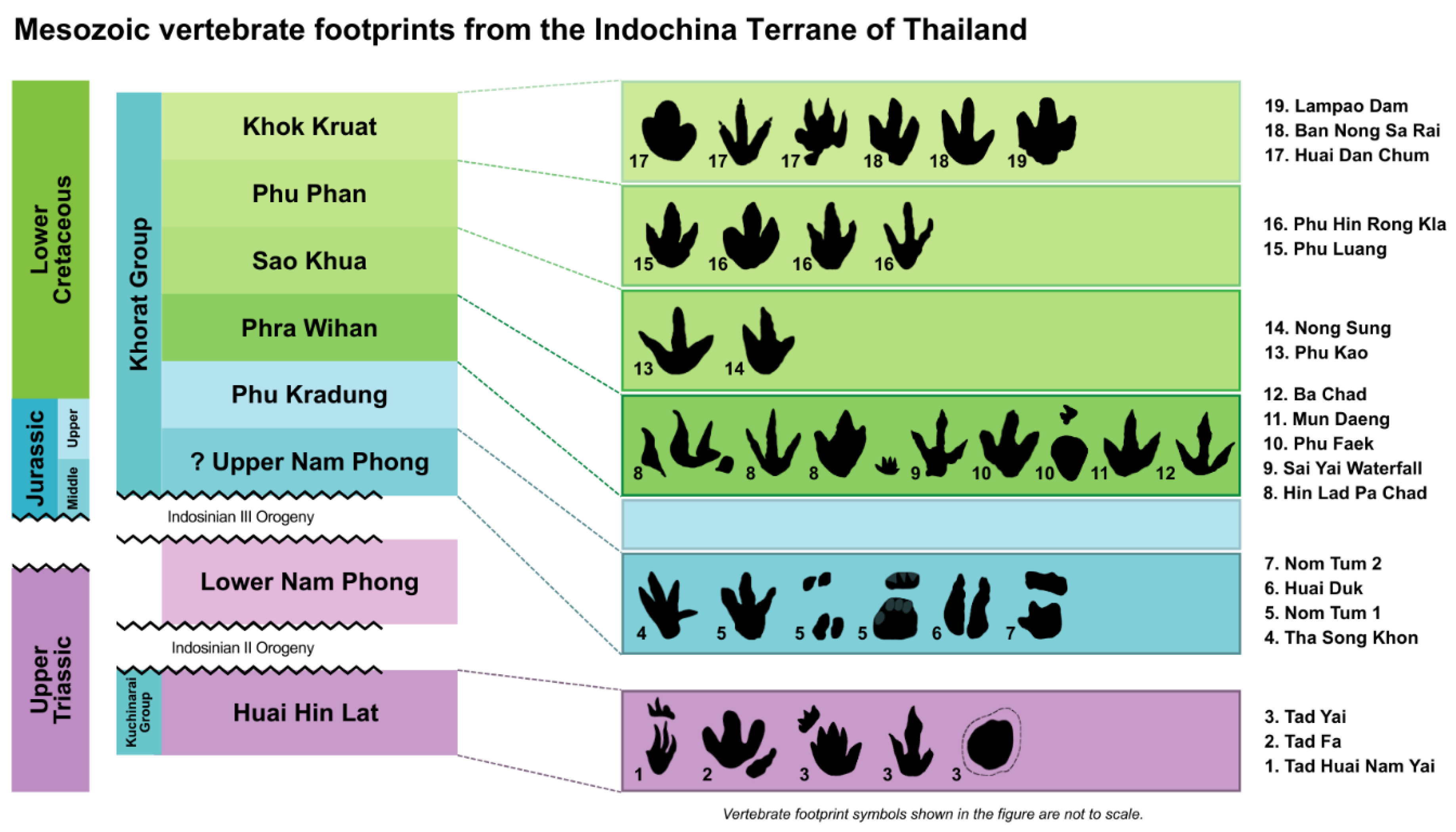
Figure 3.
Conservation status of vertebrate footprint sites in Thailand, categorized into four protection levels. (A) represents the overall national distribution of site conditions, while (B) and (C) compare Triassic–Jurassic and Lower Cretaceous sites separately. Percentages indicate the proportion of sites within each category.
Figure 3.
Conservation status of vertebrate footprint sites in Thailand, categorized into four protection levels. (A) represents the overall national distribution of site conditions, while (B) and (C) compare Triassic–Jurassic and Lower Cretaceous sites separately. Percentages indicate the proportion of sites within each category.
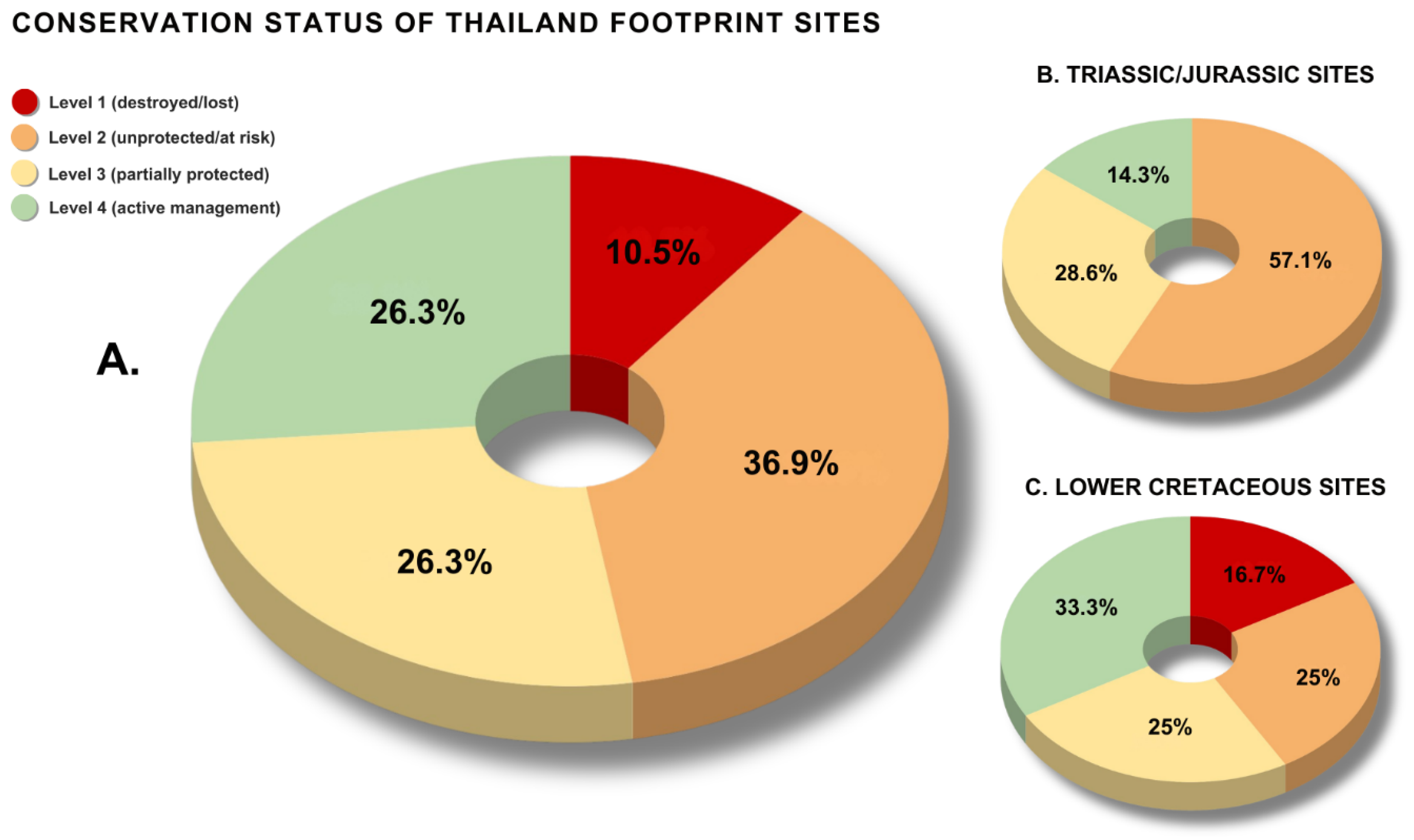
Figure 4.
Comparison of Conservation Status and Discovery Profiles of Thailand’s Vertebrate Footprint Sites Before and After 2009. (A1) and (B1) illustrate the proportion of sites classified under four conservation levels. (A2) and (B2) illustrate the distribution of discoveries by discoverer category.
Figure 4.
Comparison of Conservation Status and Discovery Profiles of Thailand’s Vertebrate Footprint Sites Before and After 2009. (A1) and (B1) illustrate the proportion of sites classified under four conservation levels. (A2) and (B2) illustrate the distribution of discoveries by discoverer category.
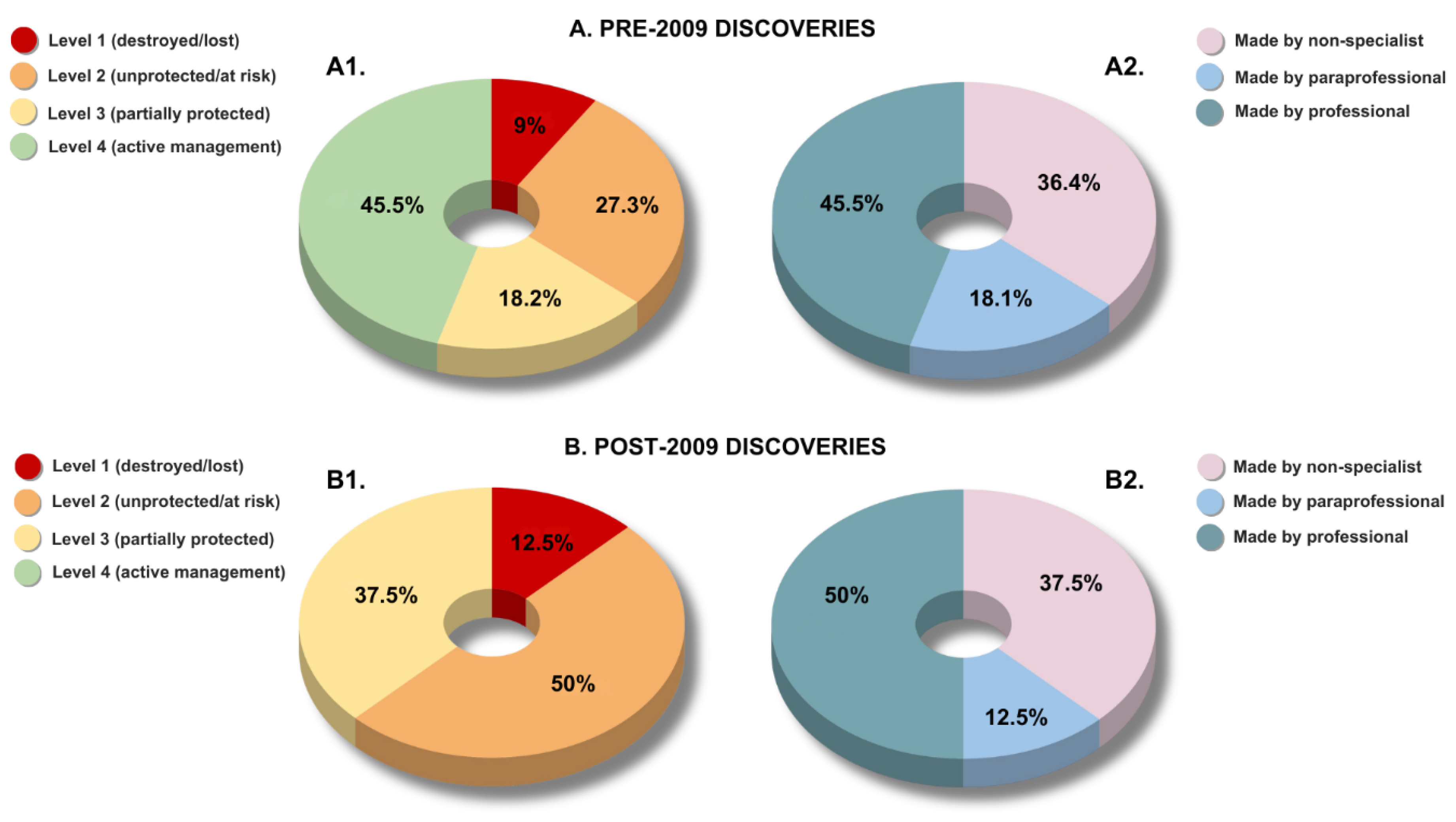
Figure 5.
Tetradactyl archosauriform footprints from the Tad Fa tracksite (Huai Hin Lat Formation). (A) Field photograph of a representative pes. (B) Interpretative outline drawing showing digits II–V; scale bar = 5 cm. (C) False-colour digital elevation model highlighting depth variation and digit morphology (image courtesy of L. Cavin).
Figure 5.
Tetradactyl archosauriform footprints from the Tad Fa tracksite (Huai Hin Lat Formation). (A) Field photograph of a representative pes. (B) Interpretative outline drawing showing digits II–V; scale bar = 5 cm. (C) False-colour digital elevation model highlighting depth variation and digit morphology (image courtesy of L. Cavin).
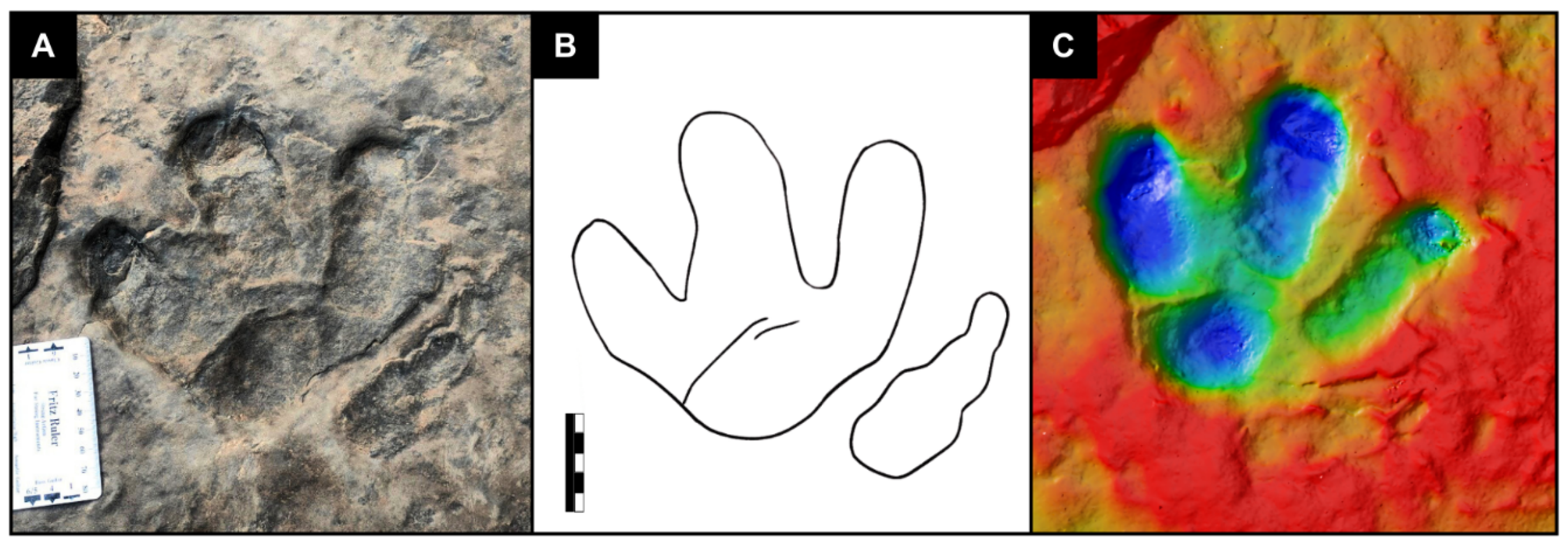
Figure 6.
Sauropod footprints from the Tad Yai tracksite (Huai Hin Lat Formation). (A) Field photograph of a large, subcircular pes impression; note the well-developed displacement rim and associated ripple marks visible at the upper right of the slab. (B) Interpretative outline of the footprint shown in (A), with the outer margin of the impression indicated by a solid line and the inferred true track margin by a dashed line; scale bar = 5 cm. (C) Field photograph of a second large quadrupedal footprint preserved as an undertrack. (D) Interpretative outline of the undertrack shown in (C); scale bar = 5 cm.
Figure 6.
Sauropod footprints from the Tad Yai tracksite (Huai Hin Lat Formation). (A) Field photograph of a large, subcircular pes impression; note the well-developed displacement rim and associated ripple marks visible at the upper right of the slab. (B) Interpretative outline of the footprint shown in (A), with the outer margin of the impression indicated by a solid line and the inferred true track margin by a dashed line; scale bar = 5 cm. (C) Field photograph of a second large quadrupedal footprint preserved as an undertrack. (D) Interpretative outline of the undertrack shown in (C); scale bar = 5 cm.
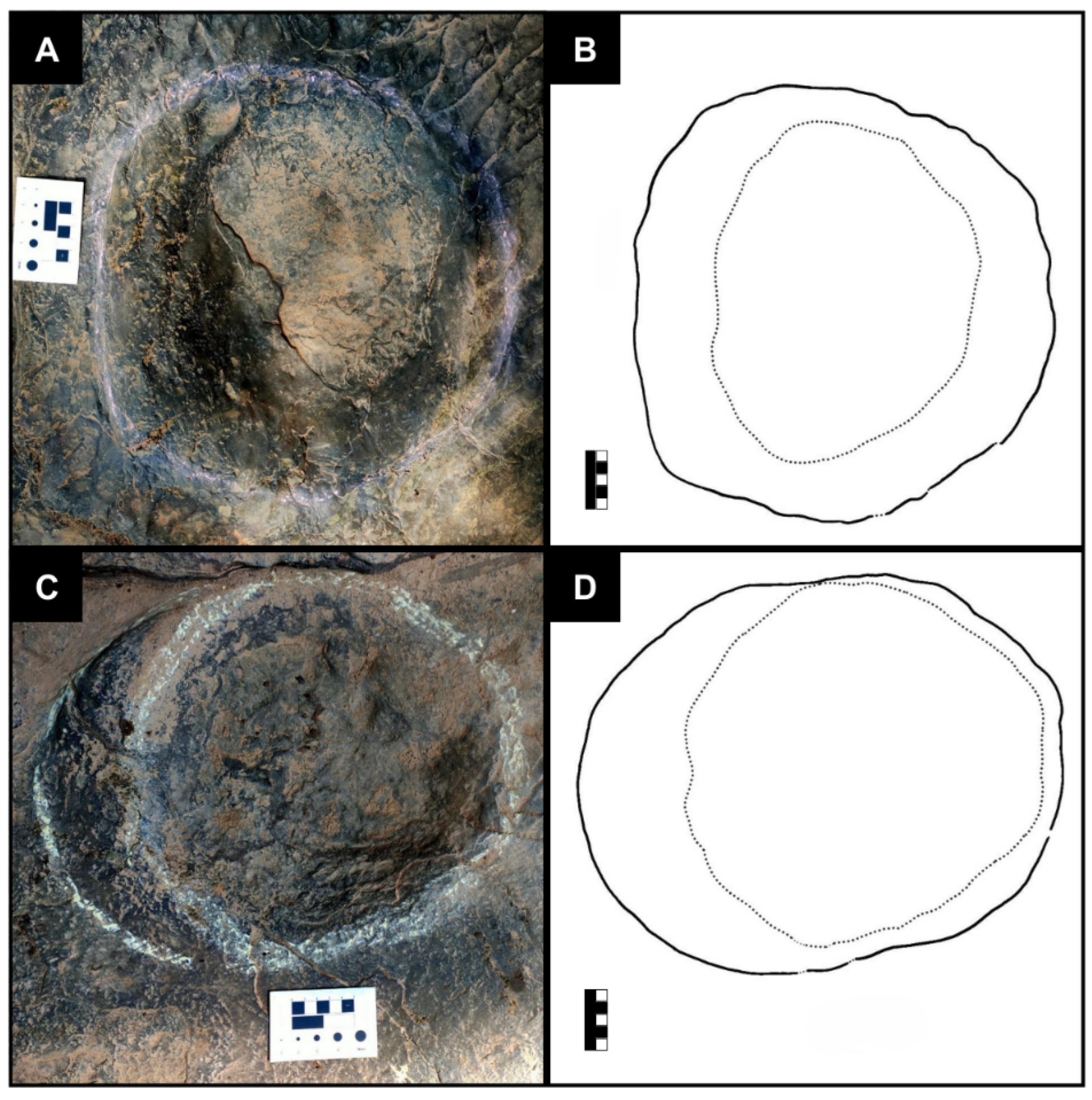
Figure 7.
Chirotheriidae trackway from the Tad Yai tracksite (Huai Hin Lat Formation). (A) Field photograph of a pentadactyl manus–pes trackway. (B) Interpretative outline drawing, showing the alternating manus and pes impressions; scale bar = 20 cm.
Figure 7.
Chirotheriidae trackway from the Tad Yai tracksite (Huai Hin Lat Formation). (A) Field photograph of a pentadactyl manus–pes trackway. (B) Interpretative outline drawing, showing the alternating manus and pes impressions; scale bar = 20 cm.
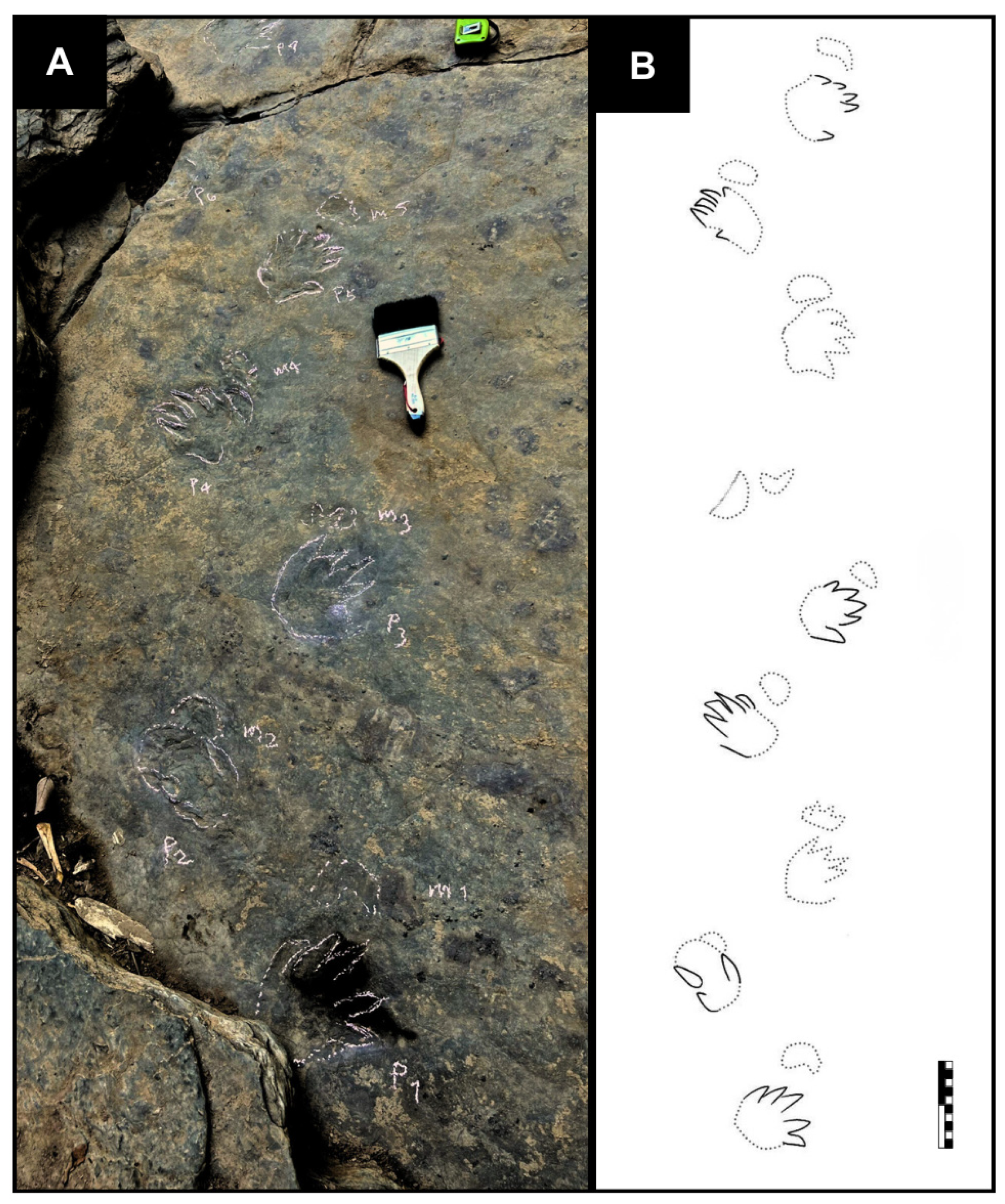
Figure 8.
Sauropod footprints from the Non Tum 1 tracksite (Nam Phong Formation). (A) Field photograph of a large, subcircular pes and manus impression. (B) Interpretative outline of the footprint shown in (A), with the outer margin of the impression indicated by a solid line and the digits by a dashed line; scale bar = 10 cm.
Figure 8.
Sauropod footprints from the Non Tum 1 tracksite (Nam Phong Formation). (A) Field photograph of a large, subcircular pes and manus impression. (B) Interpretative outline of the footprint shown in (A), with the outer margin of the impression indicated by a solid line and the digits by a dashed line; scale bar = 10 cm.
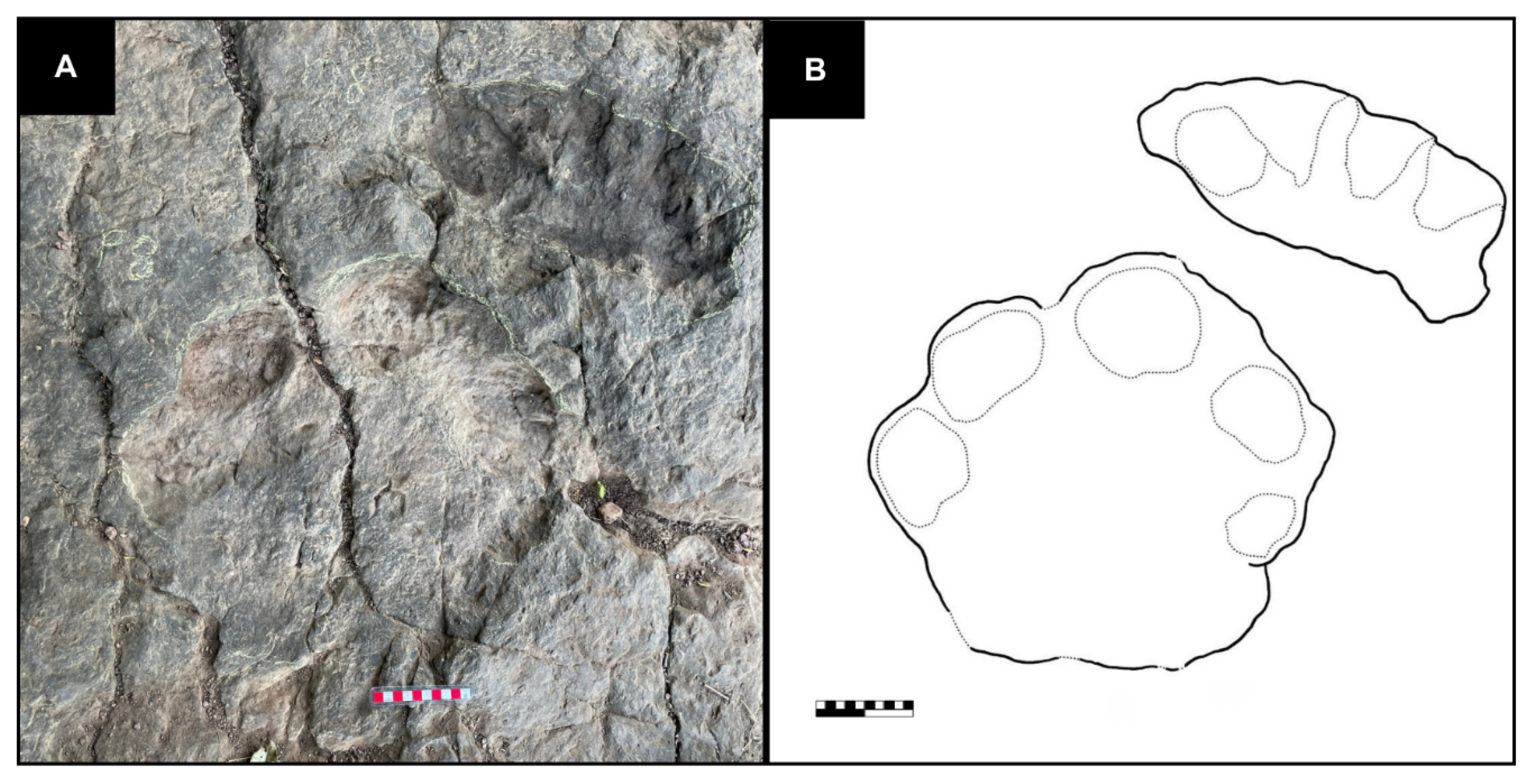
Figure 9.
Tridactyl theropod footprint from the Ba Chad tracksite (Phra Wihan Formation). (A) Field photograph of a well-preserved mesaxonic pes impression. (B) Interpretative outline drawing of the footprint shown in (A); scale bar = 5 cm.
Figure 9.
Tridactyl theropod footprint from the Ba Chad tracksite (Phra Wihan Formation). (A) Field photograph of a well-preserved mesaxonic pes impression. (B) Interpretative outline drawing of the footprint shown in (A); scale bar = 5 cm.
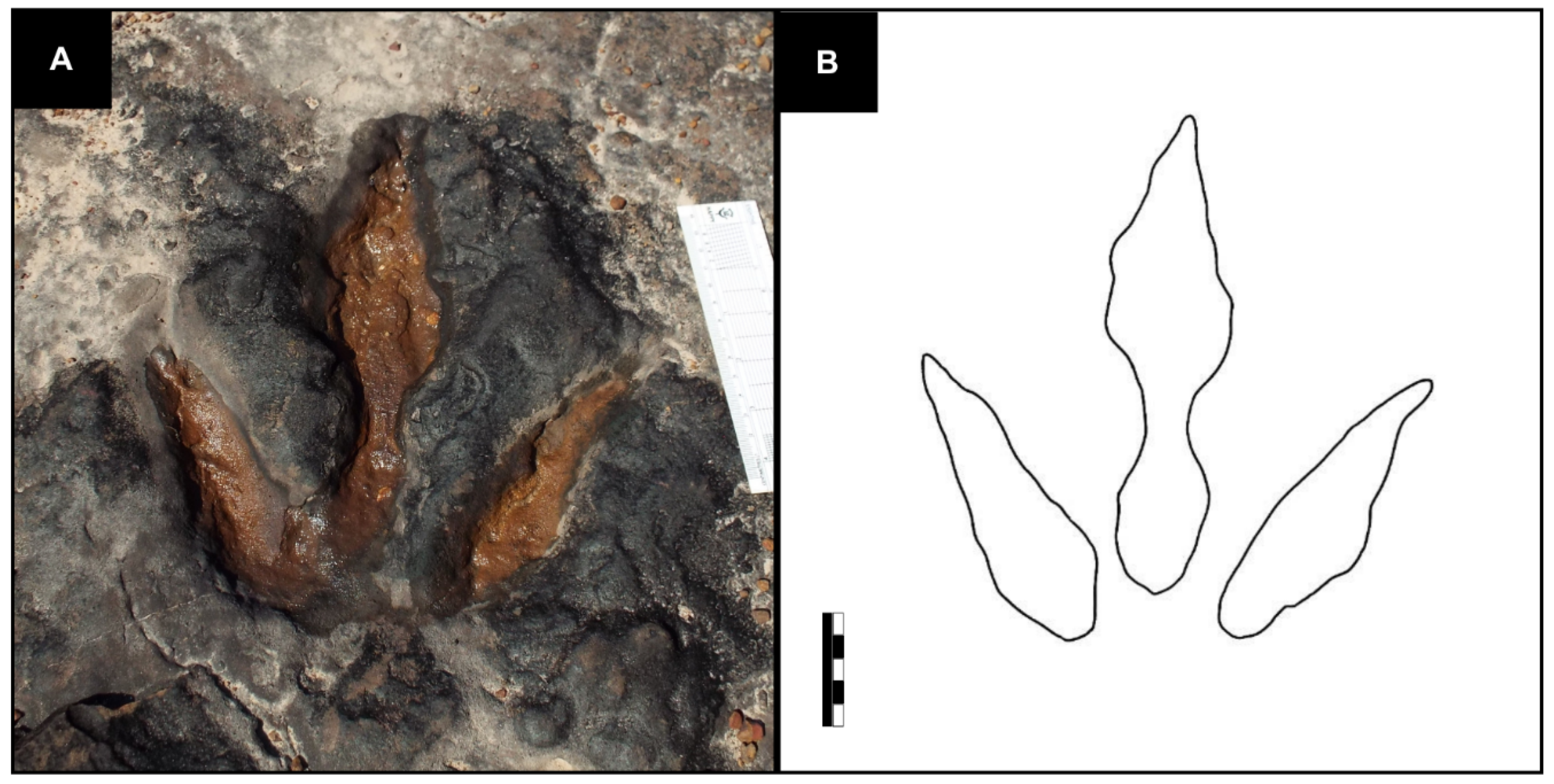
Figure 10.
Large tridactyl theropod footprint from the Phu Luang tracksite (Phu Phan Formation). (A) Field photograph of a well-preserved tridactyl pes impression. (B) Interpretative outline drawing of the footprint shown in (A); scale bar = 10 cm.
Figure 10.
Large tridactyl theropod footprint from the Phu Luang tracksite (Phu Phan Formation). (A) Field photograph of a well-preserved tridactyl pes impression. (B) Interpretative outline drawing of the footprint shown in (A); scale bar = 10 cm.
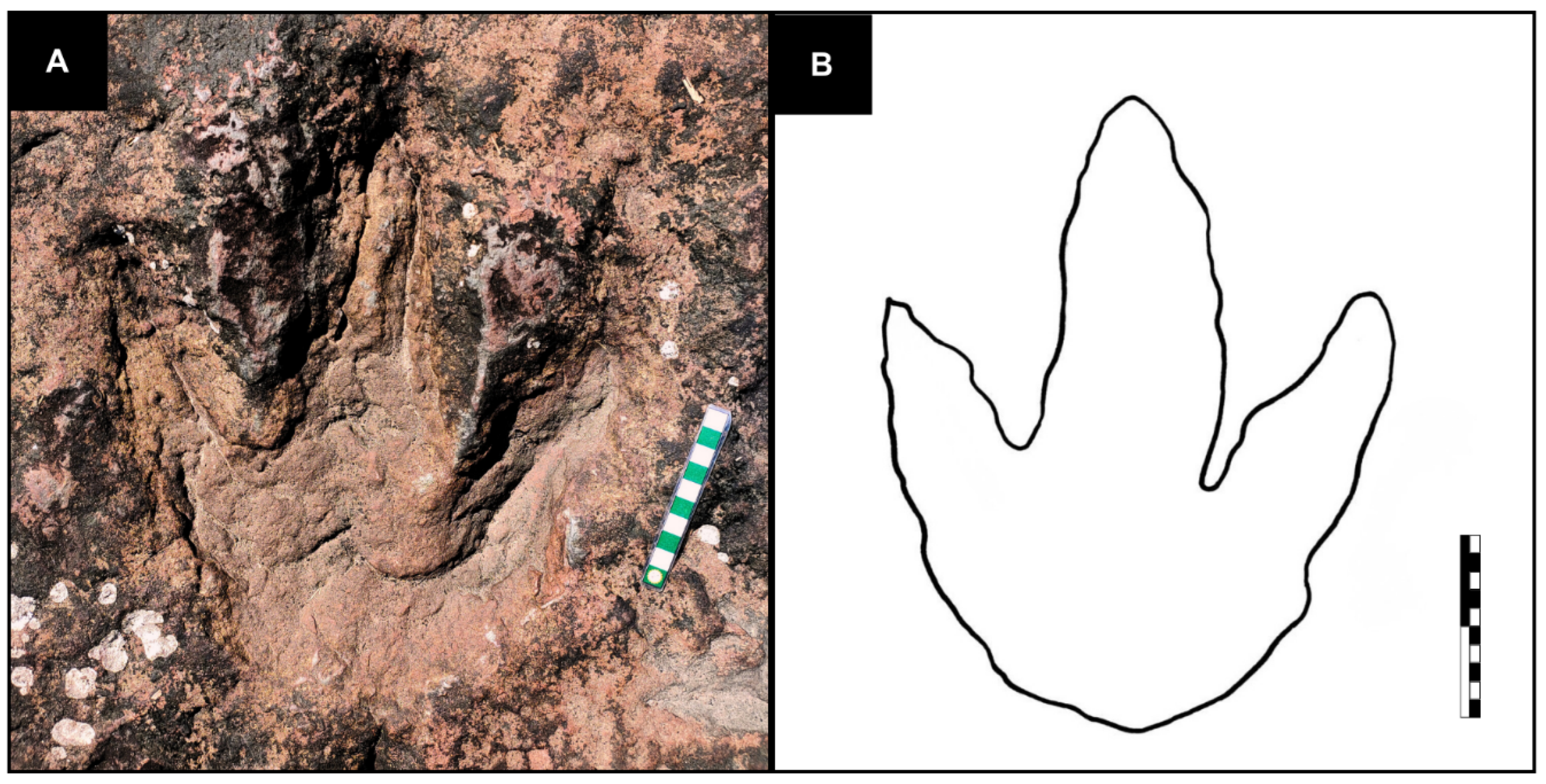
Figure 11.
Tridactyl dinosaur footprint from the Phu Hin Rong Kla tracksite (Phu Phan Formation). (A) Field photograph of a well-preserved tridactyl pes impression. (B) Interpretative outline drawing of the footprint shown in (A), with the external margin of the track indicated by a solid line and internal pad impressions by dashed lines; scale bar = 5 cm.
Figure 11.
Tridactyl dinosaur footprint from the Phu Hin Rong Kla tracksite (Phu Phan Formation). (A) Field photograph of a well-preserved tridactyl pes impression. (B) Interpretative outline drawing of the footprint shown in (A), with the external margin of the track indicated by a solid line and internal pad impressions by dashed lines; scale bar = 5 cm.
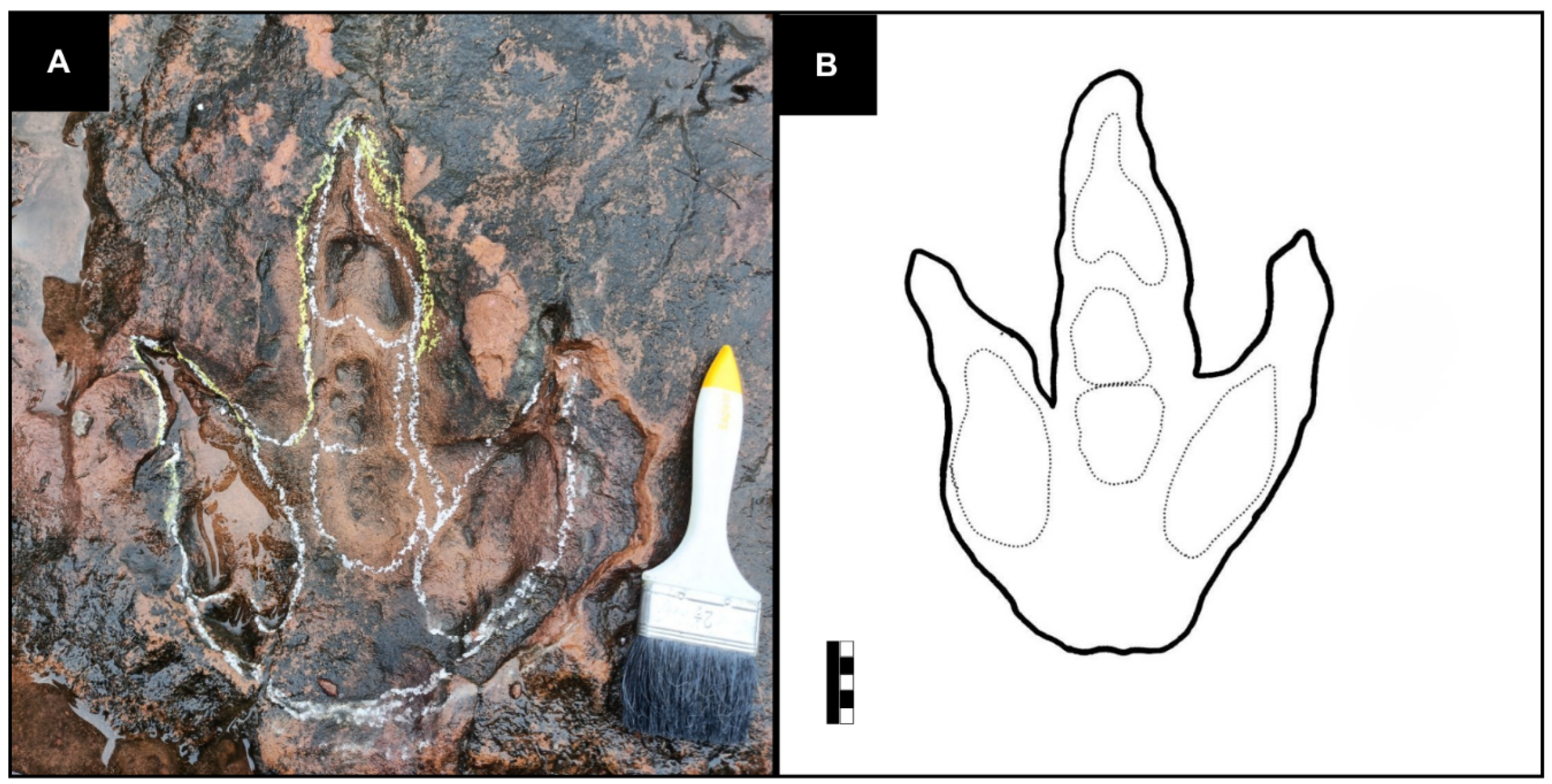
Figure 12.
Ornithopod footprint from the Lam Pao tracksite (Khok Kruat Formation). (A) Field photograph of a well-preserved tridactyl pes impression. (B) Interpretative outline drawing of the footprint shown in (A), illustrating the broad, rounded digits; scale bar = 5 cm. (C) False-colour digital elevation model highlighting depth variation and digit morphology (image courtesy of Y. Tsukiji).
Figure 12.
Ornithopod footprint from the Lam Pao tracksite (Khok Kruat Formation). (A) Field photograph of a well-preserved tridactyl pes impression. (B) Interpretative outline drawing of the footprint shown in (A), illustrating the broad, rounded digits; scale bar = 5 cm. (C) False-colour digital elevation model highlighting depth variation and digit morphology (image courtesy of Y. Tsukiji).
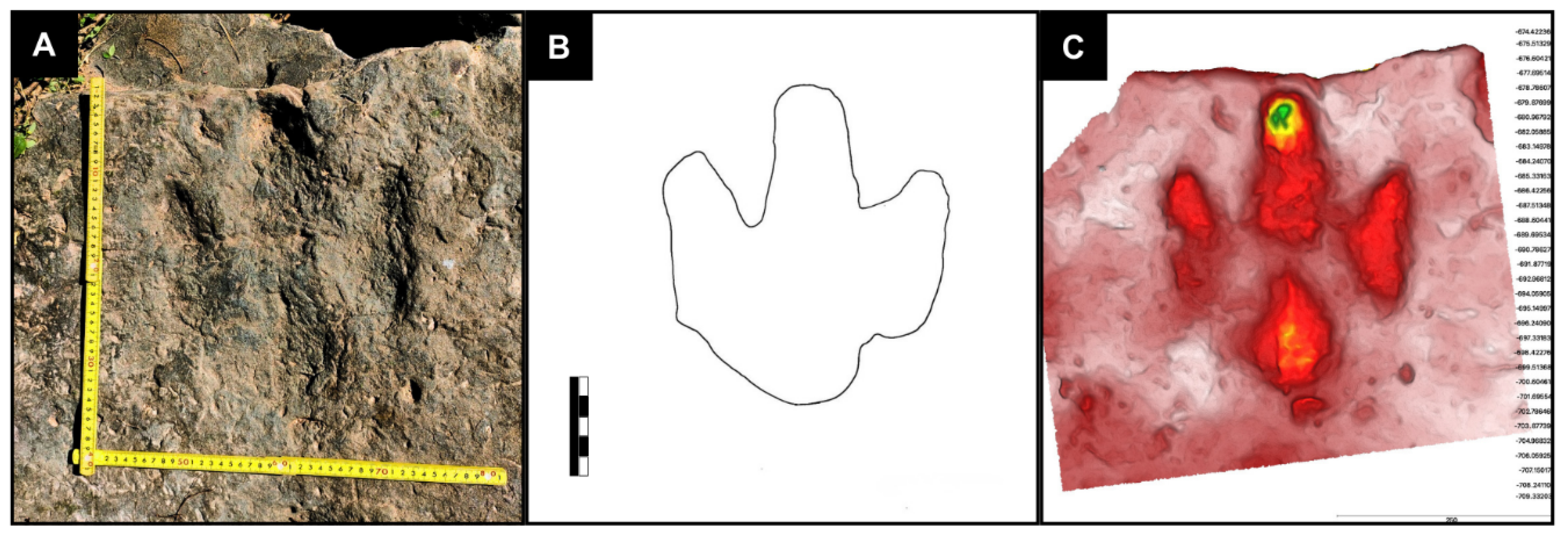
Table 1.
Comprehensive inventory of documented vertebrate footprint tracksites from northeastern Thailand (Indochina Terrane). The table summarizes site name, stratigraphic assignment (series and stage), estimated numerical age (Ma), formation, geographic location, year and type of discovery, conservation status, identified ichnogenera, inferred trackmakers, and corresponding taxa known from the Thai fossil record.
Table 1.
Comprehensive inventory of documented vertebrate footprint tracksites from northeastern Thailand (Indochina Terrane). The table summarizes site name, stratigraphic assignment (series and stage), estimated numerical age (Ma), formation, geographic location, year and type of discovery, conservation status, identified ichnogenera, inferred trackmakers, and corresponding taxa known from the Thai fossil record.
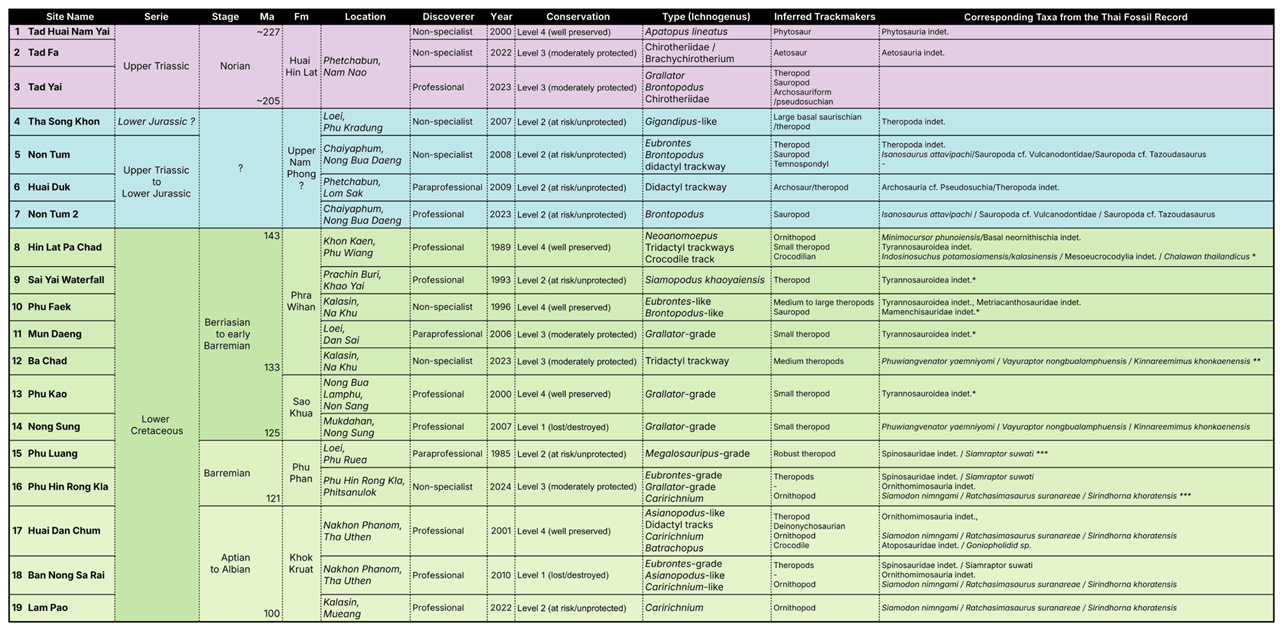 |
Disclaimer/Publisher’s Note: The statements, opinions and data contained in all publications are solely those of the individual author(s) and contributor(s) and not of MDPI and/or the editor(s). MDPI and/or the editor(s) disclaim responsibility for any injury to people or property resulting from any ideas, methods, instructions or products referred to in the content. |
© 2026 by the authors. Licensee MDPI, Basel, Switzerland. This article is an open access article distributed under the terms and conditions of the Creative Commons Attribution (CC BY) license.
Copyright: This open access article is published under a Creative Commons CC BY 4.0 license, which permit the free download, distribution, and reuse, provided that the author and preprint are cited in any reuse.


