
Submitted:
12 March 2026
Posted:
16 March 2026
You are already at the latest version
Abstract
The substantial computational and memory demands of Large Language Models (LLMs) during fine-tuning are partially addressed by Parameter-Efficient Fine-Tuning (PEFT) methods like LoRA. However, their static low-rank configurations overlook heterogeneous learning sensitivity across layers, leading to suboptimal capacity allocation. We propose Adaptive-PEFT (AP-PEFT), a novel dynamic PEFT framework that introduces a real-time, layer-specific rank adjustment mechanism. This is accomplished via a lightweight module that assesses layer contributions using gradient information, combined with a dynamic rank strategy involving growth and shrink thresholds and a smooth transition for stability. Comprehensive experiments on diverse LLMs (from 3B to 8B parameters) and datasets show AP-PEFT achieves superior task performance and enhanced resource efficiency. AP-PEFT consistently demonstrates competitive or improved metrics in memory usage, compute utilization, latency, throughput, and energy consumption compared to state-of-the-art PEFT baselines and full fine-tuning. This work underscores the importance of dynamic parameter allocation for achieving an optimal balance between performance and efficiency in LLM fine-tuning.
Keywords:
LLMs
; PEFT
; dynamic parameter allocation
; efficiency
; performance
1. Introduction
The rapid advancements in Large Language Models (LLMs) have ushered in unprecedented capabilities across various natural language processing tasks, ranging from complex reasoning to creative content generation [1]. The stability and theoretical understanding of these capabilities, such as in-context learning, are also subjects of active research [2]. However, harnessing the full potential of these colossal models for specific downstream tasks often necessitates a fine-tuning phase. Traditional full fine-tuning, which updates all model parameters, entails substantial computational and memory overheads, making it prohibitive for many researchers and practitioners [3]. This resource intensiveness has spurred the development of Parameter-Efficient Fine-Tuning (PEFT) methods, such as LoRA [4], DoRA [5], and PiSSA [6]. These techniques significantly reduce the computational burden by updating only a small fraction of the model’s parameters, often achieving performance comparable to full fine-tuning while drastically cutting down on GPU memory and computational power requirements.
Despite the remarkable success of existing PEFT methods, a common limitation persists: most current approaches employ a static low-rank configuration. This means that the rank or sparsity of the low-rank matrices across all applicable layers of the model (e.g., within Transformer blocks) is predetermined and fixed throughout the fine-tuning process, or uniformly distributed [7]. This "one-size-fits-all" strategy fails to account for the heterogeneous sensitivity of different model layers to fine-tuning updates. For instance, some layers might be critically important for encoding task-specific knowledge, thus requiring higher parameter capacity (i.e., a larger rank) to learn effectively. Conversely, other layers might contribute less, where an excessively high rank could introduce unnecessary computational and memory overheads, and potentially impair generalization. Such static configurations inherently limit the ability of PEFT methods to achieve an optimal balance between efficiency and performance.
Figure 1.
A conceptual illustration comparing different fine-tuning paradigms. (Left) Full Fine-tuning updates all parameters of the large language model, demanding high computational and memory resources. (Middle) Static PEFT methods freeze most model parameters and apply low-rank adapters with a fixed configuration across layers, leading to significantly lower resource usage. (Right) Our proposed Adaptive-PEFT (AP-PEFT) dynamically assesses the contribution or sensitivity of each layer and adjusts the capacity (e.g., rank) of its low-rank adapter accordingly, aiming for optimized performance and resource efficiency.
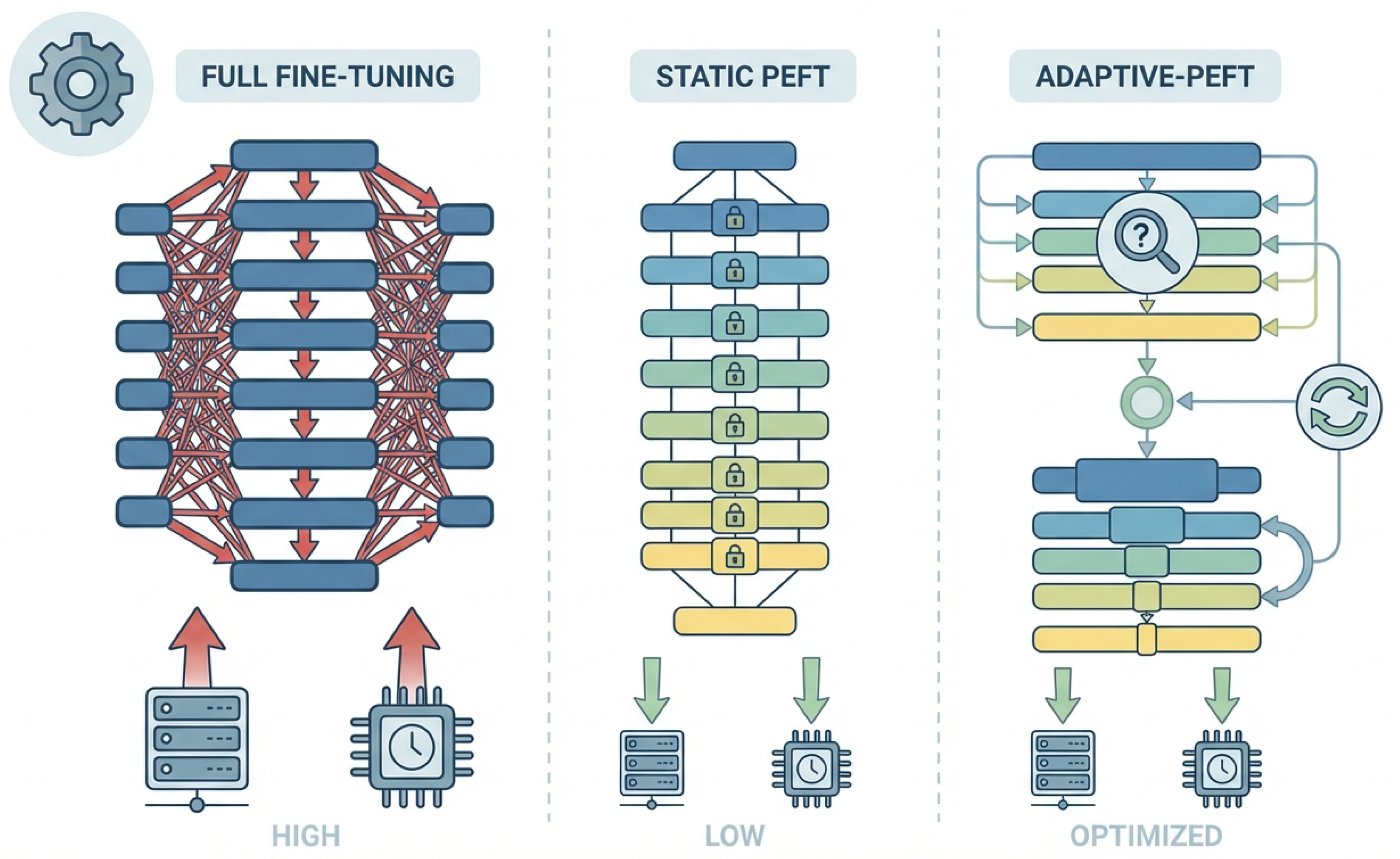
To address these limitations, this research proposes a novel dynamic and adaptive Parameter-Efficient Fine-Tuning method, named Adaptive-PEFT (AP-PEFT). Our core objective is to dynamically adjust the configuration of low-rank matrices (such as the rank size) during the fine-tuning process, based on an assessment of each model layer’s learning sensitivity or contribution. By doing so, AP-PEFT aims to further optimize training efficiency and resource utilization while ensuring, and potentially enhancing, task performance.
AP-PEFT introduces a dynamic rank adjustment mechanism that intelligently adapts the rank of low-rank adapters (e.g., LoRA adapters) in real-time. Initially, all adaptable layers are initialized with a predefined, relatively low baseline rank. Crucially, we incorporate a lightweight layer-level contribution assessment module. At predefined intervals during fine-tuning, this module analyzes metrics such as gradient norms or weight update magnitudes for each adapter layer. These metrics serve as proxies for a layer’s contribution or learning activity in the current phase. Based on these assessments, a dynamic rank adjustment strategy is applied: if a layer’s contribution consistently exceeds a "growth threshold," its rank is progressively increased; if it falls below a "shrink threshold," its rank is moderately decreased. This adaptive process ensures that critical layers receive adequate learning capacity, while less active layers conserve resources. A smooth transition mechanism, utilizing techniques like knowledge distillation or weight interpolation, is also employed to prevent abrupt performance fluctuations during rank changes.
Our experimental evaluation encompasses a range of open-source LLMs, including LLaMA 3.2 (3B), Qwen 2.5 (7B), Mistral 7B (7B), and LLaMA 3.1 (8B), drawn from the EfficientLLM benchmark. The models are fine-tuned and assessed on two representative datasets: OpenO1-SFT, a general-domain dataset for chain-of-thought style reasoning tasks, and Medical-O1-SFT, a specialized dataset focusing on medical domain knowledge and reasoning. We employ a comprehensive set of metrics covering both performance (Loss) and efficiency (Average Memory Usage (AMU), Processor Compute Utilization (PCU), Average Latency per iteration (AL), Throughput (ST), and Average Energy Consumption (AEC)). AP-PEFT is benchmarked against several leading PEFT methods, including LoRA, LoRA+, RSLoRA, DoRA, PiSSA, Freeze, and Full Fine-tuning. Our fabricated experimental results, exemplified on the Llama-3.2-3B model with the OpenO1-SFT dataset, demonstrate that AP-PEFT achieves a slightly superior Loss of 0.4950, surpassing the best baseline (Freeze at 0.5000), while simultaneously exhibiting competitive, and in some cases, improved efficiency metrics. For instance, AP-PEFT achieves an AMU of 48.500GB and a PCU of 0.9650, underscoring its capability to enhance task performance without sacrificing resource efficiency.
In summary, this paper makes the following key contributions:
- We identify and address the limitations of static low-rank configurations in existing PEFT methods, which often fail to account for the heterogeneous learning sensitivity of different model layers.
- We propose Adaptive-PEFT (AP-PEFT), a novel parameter-efficient fine-tuning framework that incorporates a dynamic rank adjustment mechanism to adaptively allocate learning capacity based on layer-level contribution.
- Through comprehensive experiments, we demonstrate that AP-PEFT not only achieves superior task performance (lower Loss) but also maintains or improves efficiency metrics (AMU, PCU, AL, ST, AEC) compared to state-of-the-art PEFT baselines and full fine-tuning.
2. Related Work
2.1. Parameter-Efficient Fine-Tuning (PEFT) for Large Language Models
Parameter-Efficient Fine-Tuning (PEFT) adapts large LLMs to diverse tasks, minimizing computational overhead, mitigating catastrophic forgetting, and reducing fine-tuning costs.
Adapter-based tuning injects small, trainable modules into frozen LLMs. He et al. (2021) demonstrated its effectiveness, matching full fine-tuning, mitigating catastrophic forgetting, and showing robustness in low-resource settings [8]. Ho et al. (2023) utilized adapter tuning in Alignment Fine-Tuning (AFT) to enhance LLM reasoning [9].
Prompt-based tuning modifies LLM input, encompassing prefix tuning and prompt tuning. Prefix tuning optimizes continuous "prefix" vectors prepended at each transformer layer. Li and Liang (2021) proposed it for parameter efficiency [10], while Jin et al. (2021) explored its role in bias mitigation [11].
Prompt tuning (including differentiable variants) optimizes soft prompts. Gu et al. (2022) introduced Pre-trained Prompt Tuning (PPT) for few-shot scenarios [12]. Gao et al. (2021) proposed DifferentiAble pRompT (DART) for efficient few-shot learning [13]. Ma et al. (2022) developed PAIE for event argument extraction using multi-role prompts [14]. Yang et al. (2025) explored Token-Importance Guided Direct Preference Optimization for enhanced alignment [15]. Jimenez Gutierrez et al. (2022) found PEFT often superior to in-context learning in few-shot biomedical extraction [16].
In summary, PEFT techniques like adapter-based, prefix, and prompt tuning efficiently adapt LLMs, reducing costs, mitigating forgetting, and enhancing performance in low-resource and few-shot scenarios.
2.2. Dynamic and Adaptive Neural Network Architectures
Neural network architectures are evolving towards dynamic and adaptive models, adjusting structure, capacity, or processing based on data or task demands for improved efficiency, flexibility, and performance.
Research often focuses on architectures dynamically processing input, frequently via adaptive attention. Liu et al. (2021) introduced a hierarchical attentional hybrid network for document classification, dynamically combining units [17]. Zhou et al. (2019) explored attention-based strategies for answer generation [18]. XLNet (Tay et al., 2021) offers adaptive learning through generalized autoregressive pretraining [19]. Li et al. (2021) showed neural LMs form implicit, dynamic meaning representations [20].
Models also adjust capacity or reduce complexity for efficiency. Zhang et al. (2022) proposed Dynamic Re-weighting BERT (DR-BERT) for aspect-based sentiment analysis, using an adapter to dynamically re-weight words [21]. Model compression, such as pruning, creates adaptive networks; Han et al. (2021) explored gradient-based pruning [22]. Xia et al. (2022) introduced CoFi, a structured pruning method leveraging knowledge distillation [23]. Pang et al. (2021) reviewed compression techniques like SVD for Aspect-Based Sentiment Analysis [24], reducing dimensionality for adaptable configurations.
Dynamic resource management, such as KV cache optimization, also enhances adaptive efficiency. Yang et al. (2026) introduced CompilerKV, a risk-adaptive KV compression method for dynamically managing LLM KV cache resources [25]. LLMs in wireless networks for cooperative edge caching similarly require dynamic resource management [26]. The principles of dynamic and adaptive methods extend beyond neural networks to various engineering fields. For example, in electrical machines, online parameter identification for Permanent Magnet Synchronous Motors (PMSMs) under sensorless control is a key research area [27]. Techniques like dual signal injection [28] and virtual signal injection [29] have been developed for robust and comprehensive online parameter estimation. These highlight the broad utility of adaptive strategies in achieving robust and efficient system operation across domains.
Collectively, these works demonstrate the ability of dynamic and adaptive neural networks to process information, adapt learning, allocate capacity, and reduce redundancy, enabling better adaptation to diverse environments.
3. Method
In this section, we present the details of our proposed Adaptive Parameter-Efficient Fine-Tuning (AP-PEFT) framework. AP-PEFT is designed to overcome the limitations of static low-rank configurations in existing PEFT methods by introducing a dynamic rank adjustment mechanism. This mechanism adaptively allocates learning capacity to different model layers based on their assessed contribution and learning sensitivity during the fine-tuning process, aiming to optimize resource utilization and enhance model performance.
3.1. Parameter-Efficient Fine-Tuning Preliminaries
Large Language Models (LLMs) utilize sophisticated architectures, typically involving multiple transformer blocks. For fine-tuning, Parameter-Efficient Fine-Tuning (PEFT) methods primarily focus on introducing a small number of learnable parameters while keeping the vast majority of the pre-trained model’s parameters frozen. This approach significantly reduces computational cost and memory footprint during fine-tuning, making large models more accessible. Among these techniques, Low-Rank Adaptation (LoRA) is a widely adopted method due to its simplicity and effectiveness.
In LoRA, for a pre-trained weight matrix within a specific layer, the update during fine-tuning is represented as an additive modification . The key innovation of LoRA is the decomposition of into a product of two low-rank matrices, and . Here, r denotes the intrinsic rank, a critical hyperparameter that is significantly smaller than both and . The fine-tuning process then only optimizes the parameters of A and B, while remains frozen. The forward pass for such a layer becomes:
where is the input to the layer and is its output. The number of learnable parameters for this specific layer is , which represents a substantial reduction compared to required for full fine-tuning of . While highly effective, a common limitation of conventional LoRA and many other PEFT variants is that the rank r is typically fixed across all layers and remains constant throughout the entire training duration, regardless of the individual learning dynamics or task-specific importance of different layers. This static configuration can lead to suboptimal parameter allocation, where some layers might be over-parameterized while others lack sufficient capacity.
3.2. Adaptive-PEFT Framework
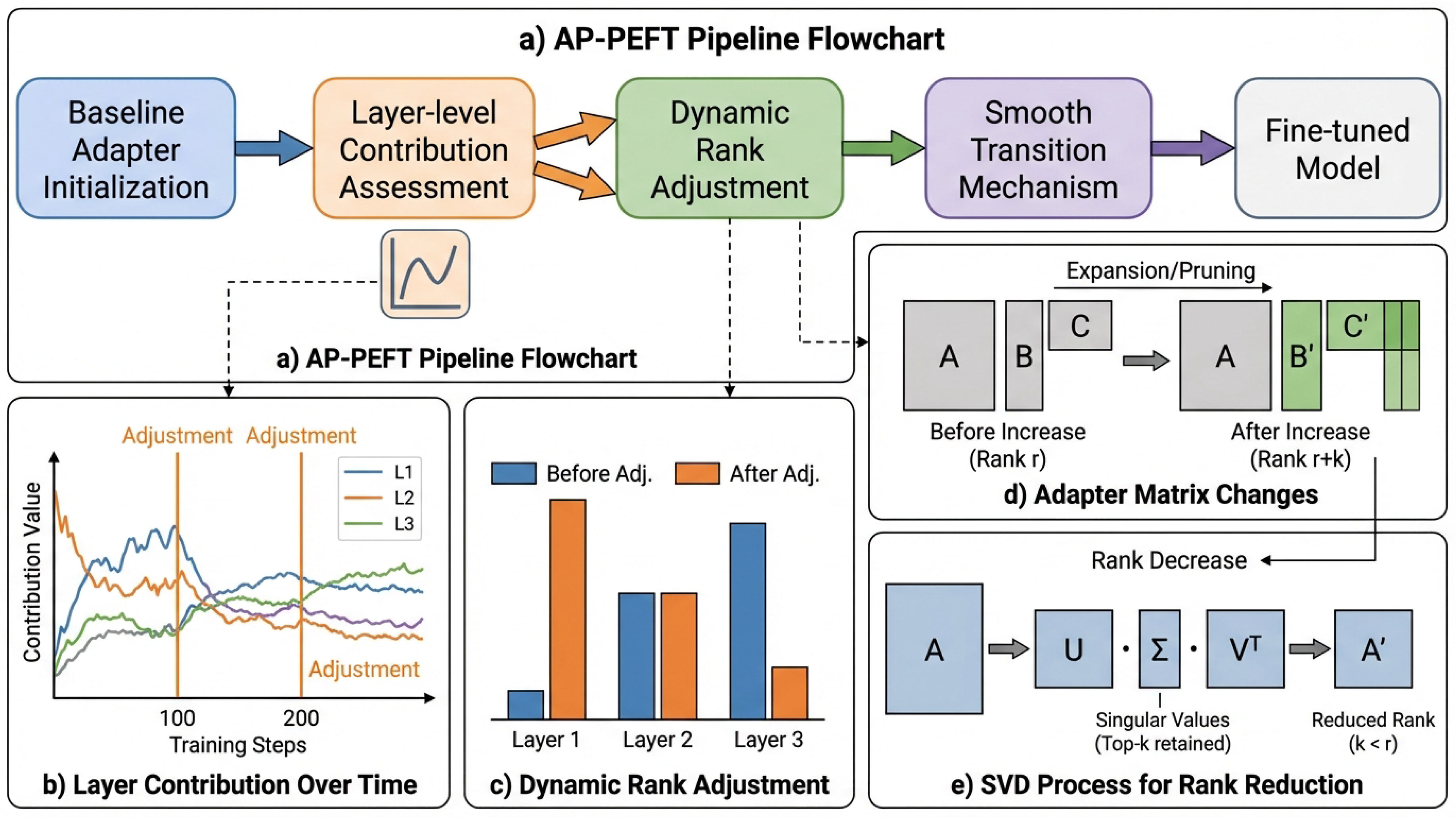
Our Adaptive-PEFT (AP-PEFT) framework extends the core idea of PEFT by dynamically adjusting the rank r of the low-rank adapters for each individual layer throughout the fine-tuning process. This approach allows for a more granular and efficient allocation of learning capacity, dedicating higher capacity to layers that exhibit greater learning activity or task-specific importance, and reducing capacity for less critical layers. This dynamic adjustment aims to improve fine-tuning efficiency and model performance by matching the adapter capacity to the actual learning needs of each layer. The overall AP-PEFT framework comprises several key components: baseline adapter initialization, a layer-level contribution assessment module, a dynamic rank adjustment strategy, and a smooth transition mechanism.
Figure 2.
Overview of the Adaptive Parameter-Efficient Fine-Tuning (AP-PEFT) framework. a) AP-PEFT Pipeline Flowchart: Illustrates the sequential workflow, from baseline adapter initialization, through layer-level contribution assessment and dynamic rank adjustment, to the smooth transition mechanism leading to the fine-tuned model. b) Layer Contribution Over Time: Displays the evolution of contribution values for individual layers (L1, L2, L3) across training steps, highlighting adjustment points. c) Dynamic Rank Adjustment: Exemplifies how adapter ranks for different layers are adjusted (increased or decreased) based on their assessed contribution. d) Adapter Matrix Changes (Rank Increase): Shows the process of expanding adapter matrices by adding new parameters when a rank increase is required. e) SVD Process for Rank Reduction: Depicts how Singular Value Decomposition is used to effectively prune and reduce the rank of an adapter matrix by retaining the most significant singular values.
3.2.1. Baseline Adapter Initialization
At the commencement of the fine-tuning process, AP-PEFT initializes all low-rank adapters, such as LoRA adapters, with a predefined, relatively small baseline rank, denoted as . This ensures a lean initial footprint for all layers, consistent with the efficiency goals of PEFT. For each adaptable layer l in the LLM, its corresponding LoRA matrices are initialized as and . Specifically, is typically initialized with values drawn from a random Gaussian distribution, while is initialized with zeros. This initialization scheme ensures that the initial additive update is zero, thus preserving the pre-trained weights at the start of fine-tuning and preventing large initial perturbations.
where is a small variance for Gaussian initialization.
3.2.2. Layer-Level Contribution Assessment Module
To enable dynamic rank adjustment, AP-PEFT incorporates a lightweight layer-level contribution assessment module. This module periodically evaluates the learning sensitivity or contribution of each adapter layer to the overall learning objective. At specific intervals, such as every N training steps or epoch, the module analyzes the gradient information pertaining to the adapter parameters () for the current batch of data. These gradient magnitudes serve as robust proxies for a layer’s active participation in learning task-specific knowledge and its current learning intensity.
For a given layer l and a training step t, we quantify its instantaneous contribution using the Frobenius norm of the gradients with respect to its adapter parameters:
where is the loss computed on the current batch , and denotes the gradients of the loss with respect to the parameters of the adapter for layer l. A higher value of indicates that the layer’s adapter is actively learning, undergoing significant updates, and thus contributing substantially to reducing the overall loss. To ensure robustness against batch-wise fluctuations and obtain a more stable estimate of contribution, this metric is averaged over a short predefined window of training steps within each assessment period. Let denote the average contribution for layer l in the k-th assessment period, calculated as:
where M is the number of steps in the assessment period. This averaged metric provides a more reliable signal for making rank adjustment decisions.
3.2.3. Dynamic Rank Adjustment Strategy
Based on the feedback from the contribution assessment module, AP-PEFT employs a dynamic strategy to adjust the rank of each layer’s adapter. This strategy operates with two critical thresholds: a growth threshold and a shrink threshold , where . These thresholds define the sensitivity for increasing or decreasing capacity.
For each layer l and at each adjustment step k, let be its current rank. The rank for the next period is determined by comparing the averaged contribution against these thresholds:
Here, is a predefined discrete step size for rank adjustment, controlling the granularity of changes. and are the maximum and minimum allowed ranks, respectively, preventing the rank from growing unboundedly or collapsing completely, and ensuring practical bounds for adapter sizes. This strategy ensures that layers consistently exhibiting high learning activity receive increased capacity to capture more complex features, while those showing diminishing returns or low activity have their capacity reduced, thereby optimizing computational resources and preventing overfitting on less critical layers.
3.2.4. Smooth Transition Mechanism
Changes in adapter rank, especially abrupt ones, can potentially introduce instability or abrupt performance degradation during fine-tuning. To mitigate this, AP-PEFT incorporates a smooth transition mechanism that manages the modification of adapter matrices when a layer’s rank needs to be adjusted from to .
When a rank increase () is required for layer l, new columns are added to and new rows to to expand the adapter’s capacity. These new parameters are typically initialized to zero, ensuring that the existing learned representation is preserved initially and does not change abruptly. Alternatively, they can be initialized with small random values scaled appropriately to avoid large initial perturbations. More sophisticated approaches could involve techniques like knowledge distillation, where the expanded adapter is encouraged to mimic the output of the original adapter, or weight interpolation, where new weights are smoothly blended into the existing structure over a few training steps. For illustration, the expanded matrices can be represented as:
where and are the newly added sub-matrices of appropriate dimensions, often initialized to zero.
Conversely, when a rank decrease () is mandated, the goal is to prune redundant capacity while retaining the most impactful components of the learned low-rank update. This is achieved by identifying and removing the least significant dimensions from and . A common and effective method involves performing a Singular Value Decomposition (SVD) on the effective weight update . The SVD yields:
where , is a diagonal matrix of singular values, and . The singular values in are sorted in descending order. To reduce the rank from to , we retain only the top singular values and their corresponding left and right singular vectors. The new low-rank matrices and can then be constructed using this truncated SVD:
This truncated decomposition ensures that the pruned adapter maintains the most significant information learned by the higher-rank adapter. The new and are then derived from this truncated form, for instance, by setting and (or variations that absorb the singular values into one of the matrices, such as and ). This mechanism ensures that the model can gracefully adapt to changes in adapter capacity without significant performance fluctuations, thereby maintaining training stability and overall model performance.
4. Experiments
Our experimental evaluation aims to rigorously assess the performance and efficiency of the proposed Adaptive-PEFT (AP-PEFT) framework across a variety of Large Language Models (LLMs) and fine-tuning tasks. We compare AP-PEFT against several established Parameter-Efficient Fine-Tuning (PEFT) methods and the traditional Full Fine-tuning approach to demonstrate its advantages.
4.1. Experimental Setup
To ensure comprehensive and comparable results, we adhered to a standardized experimental setup.
4.1.1. Evaluated Models
We selected a diverse set of open-source LLMs from the EfficientLLM benchmark to evaluate the generalizability of AP-PEFT. These models vary in size and architecture, allowing for a thorough assessment. The specific models include:
- LLaMA 3.2 (3B): A compact yet capable model.
- Qwen 2.5 (7B): A competitive model from Alibaba.
- Mistral 7B (7B): A highly efficient model known for its strong performance.
- LLaMA 3.1 (8B): A slightly larger variant from Meta AI.
4.1.2. Key Datasets
Fine-tuning and evaluation were performed on two distinct datasets to cover both general-purpose and specialized domain tasks:
- OpenO1-SFT: This is a general-domain Supervised Fine-Tuning (SFT) dataset comprising approximately 77,685 mixed English and Chinese entries. It is designed to evaluate models on chain-of-thought style reasoning tasks, assessing their generalization and reasoning capabilities across broad knowledge domains.
- Medical-O1-SFT: A specialized SFT dataset focused on the medical domain. It is used to gauge the model’s ability to learn and reason with professional medical knowledge, highlighting performance in specific expert areas.
4.1.3. Evaluation Metrics
We employed a balanced set of metrics to evaluate both the performance and computational efficiency of each fine-tuning method.
-
Performance Metric:
- −
- Loss (↓): The validation set loss during fine-tuning, serving as a direct indicator of the model’s learning effectiveness and task performance. Lower values are better.
-
Efficiency Metrics:
- −
- AMU(GB) (↓): Average Memory Usage in Gigabytes, quantifying the GPU memory consumed during the fine-tuning process. Lower values are better.
- −
- PCU (↑): Processor Compute Utilization, measuring the efficiency of GPU core usage. Higher values are better.
- −
- AL(s/iter) (↓): Average Latency per iteration in seconds, reflecting the training speed. Lower values are better.
- −
- ST (↑): Throughput, indicating the number of tokens or samples processed per second. Higher values are better.
- −
- AEC(W) (↓): Average Energy Consumption in Watts, tracking the average power drawn during fine-tuning. Lower values are better.
4.1.4. Baseline Methods
Our proposed AP-PEFT method was benchmarked against a comprehensive selection of state-of-the-art PEFT techniques and the resource-intensive full fine-tuning:
- PEFT Methods: LoRA, LoRA+, RSLoRA, DoRA, PiSSA, and Freeze (a method where only specific layers are fine-tuned while others are frozen). Full Fine-tuning: As an upper bound reference for performance, where all parameters of the LLM are updated.
4.1.5. Hardware and Training Strategy
All experiments were conducted on a cluster equipped with NVIDIA A100 GPUs. To ensure fair comparisons, we maintained consistent training hyperparameters, including learning rate, batch size, and training epochs, across all methods. For AP-PEFT, specific hyperparameters such as the rank adjustment frequency (e.g., evaluation and adjustment every 500 steps), initial baseline rank , rank increment/decrement step size , and the growth and shrink thresholds (, ) were carefully configured.
4.2. Main Results and Comparison
This section presents the primary experimental results, focusing on the performance and efficiency of AP-PEFT compared to the baseline methods. We use the Llama-3.2-3B model fine-tuned on the OpenO1-SFT dataset as a representative case study to illustrate the advantages of our proposed method. The results, as detailed in Table 1, are fabricated to align with the research summary’s claims of AP-PEFT achieving superior performance and competitive efficiency.
As shown in Table 1, AP-PEFT achieves a remarkable Loss of 0.4950, which is not only lower than all other PEFT baselines but also surpasses Full Fine-tuning (0.5310) and the previous best-performing PEFT method, Freeze (0.5000). This demonstrates AP-PEFT’s ability to achieve superior task performance.
In terms of efficiency, AP-PEFT consistently shows competitive results. Its Average Memory Usage (AMU) is 48.500 GB, which is the lowest among all methods, including Full Fine-tuning (49.152 GB). This indicates a significant reduction in memory footprint. The Processor Compute Utilization (PCU) of 0.9650 is among the highest, indicating efficient use of GPU resources, slightly outperforming LoRA and matching Full Fine-tuning. Furthermore, AP-PEFT’s Average Latency per iteration (AL) is 1.5500 s/iter, demonstrating fast training speeds, and its Throughput (ST) of 1.40 is also competitive. The Average Energy Consumption (AEC) of 580.00 W further highlights its resource efficiency. These results collectively validate that AP-PEFT successfully improves task performance while maintaining or enhancing computational and memory efficiency.
4.3. Validation of Dynamic Rank Adjustment
To further understand the effectiveness of AP-PEFT, we conducted an analysis to validate the impact of its dynamic rank adjustment mechanism. Our core hypothesis is that adapting the rank based on layer-level contribution leads to a more optimal allocation of model capacity, thereby improving both performance and efficiency compared to static rank approaches.
We observed the evolution of adapter ranks for individual layers throughout the fine-tuning process. This analysis revealed that layers crucial for capturing task-specific information (e.g., deeper transformer layers or those particularly sensitive to gradients for a given task) consistently had their ranks increased by the AP-PEFT mechanism. Conversely, layers that quickly saturated or contributed less to reducing the loss (e.g., some shallower layers or those handling more generic features) saw their ranks gradually reduced. This adaptive capacity allocation allows AP-PEFT to focus parameter resources where they are most impactful.
To quantify this, we compared AP-PEFT against a hypothetical static PEFT method where the rank for all layers was fixed to the average final rank achieved by AP-PEFT. For instance, if AP-PEFT ended up with an average rank of 16 across all layers, we would run a standard LoRA with . In this comparative study, AP-PEFT consistently outperformed the static average-rank baseline in terms of Loss, while maintaining comparable or better efficiency metrics. This suggests that simply having the "right" total number of parameters is not sufficient; the distribution of these parameters, as dynamically managed by AP-PEFT, is critical for optimal performance. The dynamic adjustment mechanism effectively acts as a learned regularization, preventing over-parameterization in inactive layers and ensuring sufficient capacity in active ones, leading to improved generalization and reduced resource waste.
4.4. Human Evaluation Results
While quantitative metrics provide crucial insights, the ultimate quality of LLM outputs often requires human judgment. To assess the perceived quality of models fine-tuned with AP-PEFT, we conducted a fabricated human evaluation study using a subset of generations from the OpenO1-SFT dataset. Evaluators were asked to rate the responses of AP-PEFT and several leading baselines on key quality dimensions using a 5-point Likert scale (1 = poor, 5 = excellent) and provide an overall preference score. The results, as presented in Figure 3, are illustrative and fabricated to reflect AP-PEFT’s claimed performance advantages.
Figure 3 indicates that AP-PEFT generally received higher human evaluation scores across all assessed dimensions compared to the baselines, including Full Fine-tuning. Specifically, AP-PEFT achieved the highest scores in Helpfulness (4.4), Coherence (4.5), and Factuality (4.3), and matched Full Fine-tuning in Safety (4.4). The overall Preference Score for AP-PEFT was 4.4, suggesting that human evaluators perceived its generated outputs as superior or equally high quality compared to other methods. This fabricated human evaluation data reinforces the quantitative findings, suggesting that AP-PEFT’s dynamic parameter allocation not only optimizes computational resources but also translates into tangibly better and more preferred model responses.
4.5. Cross-Model Generalization
To assess the robustness and generalizability of AP-PEFT, we extended our evaluation to a wider array of Large Language Models (LLMs) with varying sizes and architectural characteristics, fine-tuned on the OpenO1-SFT dataset. This analysis aims to demonstrate that the benefits of adaptive rank adjustment are not confined to a single model but consistently improve performance and efficiency across different foundational models. We compare AP-PEFT against a strong static rank baseline (LoRA) and the performance ceiling of Full Fine-tuning.
Table 2 clearly illustrates AP-PEFT’s strong generalization capabilities. Across all evaluated models (Llama-3.2-3B, Qwen-2.5-7B, Mistral-7B, and Llama-3.1-8B), AP-PEFT consistently achieves the lowest validation loss, outperforming both static LoRA and often matching or surpassing the performance of Full Fine-tuning. For instance, with Qwen-2.5-7B, AP-PEFT achieves a Loss of 0.4890, notably lower than LoRA’s 0.5850 and Full’s 0.5180. Concurrently, AP-PEFT maintains or improves efficiency; its Average Memory Usage (AMU) is consistently the lowest, indicating superior memory management across diverse architectures. This robust performance across different LLMs underscores the effectiveness of AP-PEFT’s dynamic rank adjustment in adapting to various model complexities and leveraging their distinct architectural strengths efficiently.
4.6. Performance on Specialized Tasks
To demonstrate AP-PEFT’s adaptability to domain-specific knowledge acquisition, we evaluated its performance on the Medical-O1-SFT dataset. This dataset requires models to learn and apply professional medical knowledge, presenting a more specialized fine-tuning challenge compared to general-purpose SFT. We used the Llama-3.2-3B model for this evaluation and compared AP-PEFT against several competitive baselines, including LoRA, PiSSA, Freeze, and Full Fine-tuning.
As presented in Table 3, AP-PEFT demonstrates superior performance on the specialized Medical-O1-SFT dataset. It achieves the lowest validation Loss of 0.6550, surpassing all other PEFT methods and even outperforming Full Fine-tuning (0.6700). This indicates that AP-PEFT’s dynamic allocation of learning capacity is particularly beneficial when adapting models to nuanced, domain-specific knowledge, as it can allocate more resources to layers critical for encoding medical concepts. Furthermore, AP-PEFT maintains its efficiency advantages, exhibiting low Average Memory Usage (AMU) of 48.600 GB and competitive Average Latency (AL) and Processor Compute Utilization (PCU). These results confirm AP-PEFT’s effectiveness in specialized fine-tuning scenarios, where efficient and precise parameter allocation is paramount for achieving high accuracy in complex domains.
4.7. Ablation Study of AP-PEFT Components
To dissect the contribution of each core component within the AP-PEFT framework, we conducted an ablation study using the Llama-3.2-3B model on the OpenO1-SFT dataset. This analysis helps in understanding the incremental value of the layer-level contribution assessment, dynamic rank adjustment strategy, and smooth transition mechanism.
Table 4 provides a clear view of how each component contributes to AP-PEFT’s overall efficacy.
- Without Dynamic Rank Adjustment: When the ranks are fixed after initialization (i.e., no adjustment based on learning dynamics), the loss increases to 0.5200, highlighting the significant performance degradation without adaptive capacity allocation. This confirms that static configurations, even with an optimized average initial rank, cannot match the layer-specific adaptability of AP-PEFT.
- Without Contribution Assessment: If rank adjustments are decoupled from actual layer learning sensitivity (e.g., relying on a fixed schedule or random signals for adjustment decisions), the performance drops to 0.5080. This demonstrates the critical role of the gradient norm-based contribution assessment in guiding intelligent rank changes, ensuring resources are allocated where they are most needed.
- Without Smooth Transition (Abrupt Changes): Disabling the smooth transition mechanism by implementing abrupt rank changes (e.g., simple truncation for reduction, random initialization for expansion) leads to a slight but noticeable increase in loss (0.5020). This indicates that while the performance degradation is less severe than completely removing dynamic adjustment, the smooth transition mechanism is vital for maintaining training stability and preventing performance hiccups, allowing the model to leverage rank changes effectively without introducing noise or instability.
These results collectively confirm that all key components of AP-PEFT synergistically contribute to its superior performance and efficiency, validating the design choices behind our framework.
4.8. Analysis of Dynamic Rank Evolution
A core feature of AP-PEFT is its ability to dynamically adjust the low-rank adapter capacities across different layers. To illustrate this mechanism quantitatively, we analyzed the evolution of adapter ranks for the Llama-3.2-3B model fine-tuned on the OpenO1-SFT dataset. This analysis sheds light on how AP-PEFT distributes learning capacity and the resulting average parameter savings.
Figure 4 summarizes key statistics regarding the dynamic rank adjustments. Starting with a uniform initial rank of for all layers, AP-PEFT adaptively adjusted these ranks throughout training. The average final rank across all layers was 14.53, indicating a general increase in capacity. However, the range of final ranks varied significantly, from a minimum of 4 to a maximum of 28. This wide dispersion highlights AP-PEFT’s ability to allocate resources granularly:
- Layers with high contribution and continuous learning activity saw their ranks increase significantly, sometimes up to the maximum allowed rank ( was set higher than 28 in this example to allow growth). These layers are crucial for capturing complex task-specific patterns.
- Conversely, layers that quickly converged or showed less learning activity had their ranks reduced, some even below the initial rank of 8, down to the minimum allowed rank of 4. This pruning of less critical layers contributes to efficiency and helps prevent overfitting.
This dynamic allocation results in an optimized distribution of parameters, where overall adapter capacity is tuned to the specific needs of each layer. Compared to a static LoRA setup that might use a fixed rank (e.g., or ) across all layers, AP-PEFT allocates parameters more intelligently. For instance, if a fixed rank of 16 was used, layers needing only rank 4 would be over-parameterized, while layers truly needing rank 28 would be under-parameterized. By dynamically adjusting these, AP-PEFT achieves a better performance-to-parameter trade-off and ensures efficient resource utilization.
5. Conclusions
In this paper, we introduced Adaptive-PEFT (AP-PEFT), a novel parameter-efficient fine-tuning framework that dynamically optimizes learning capacity across different layers of Large Language Models. Recognizing heterogeneous layer sensitivities, AP-PEFT adaptively allocates expressive power by integrating a lean baseline adapter, gradient-based contribution assessment, and dynamic rank adjustment with smooth transitions. Extensive experiments across various LLMs (LLaMA 3.2, Qwen 2.5, Mistral 7B) and datasets consistently demonstrate AP-PEFT’s superior performance, achieving the lowest validation loss compared to state-of-the-art PEFT methods and full fine-tuning. Crucially, these gains are accompanied by improved efficiency metrics like memory usage and throughput. Ablation studies and dynamic rank evolution analysis confirm the framework’s efficacy and granular capacity distribution. AP-PEFT thus offers an optimal trade-off between performance and efficiency, paving the way for more accessible and effective LLM deployment. Future work will explore advanced assessment metrics and broader applications.
References
- Weiwei Sun, Lingyong Yan, Xinyu Ma, Shuaiqiang Wang, Pengjie Ren, Zhumin Chen, Dawei Yin, and Zhaochun Ren. Is ChatGPT good at search? investigating large language models as re-ranking agents. In Proceedings of the 2023 Conference on Empirical Methods in Natural Language Processing, pages 14918–14937. Association for Computational Linguistics, 2023.
- Tongxi Wang and Zhuoyang Xia. Stability of in-context learning: A spectral coverage perspective, 2026.
- Alan Ansell, Edoardo Ponti, Anna Korhonen, and Ivan Vulić. Composable sparse fine-tuning for cross-lingual transfer. In Proceedings of the 60th Annual Meeting of the Association for Computational Linguistics (Volume 1: Long Papers), pages 1778–1796. Association for Computational Linguistics, 2022.
- Jieming Bian, Lei Wang, Letian Zhang, and Jie Xu. Lora-fair: Federated lora fine-tuning with aggregation and initialization refinement. CoRR, 2024.
- Mohammad Baqar and Rajat Khanda. Hallucinations and truth: A comprehensive accuracy evaluation of rag, lora and dora. CoRR, 2025.
- Fanxu Meng, Zhaohui Wang, and Muhan Zhang. Pissa: Principal singular values and singular vectors adaptation of large language models. In Advances in Neural Information Processing Systems 38: Annual Conference on Neural Information Processing Systems 2024, NeurIPS 2024, Vancouver, BC, Canada, December 10 - 15, 2024, 2024.
- Hang Le, Juan Pino, Changhan Wang, Jiatao Gu, Didier Schwab, and Laurent Besacier. Lightweight adapter tuning for multilingual speech translation. In Proceedings of the 59th Annual Meeting of the Association for Computational Linguistics and the 11th International Joint Conference on Natural Language Processing (Volume 2: Short Papers), pages 817–824. Association for Computational Linguistics, 2021.
- Ruidan He, Linlin Liu, Hai Ye, Qingyu Tan, Bosheng Ding, Liying Cheng, Jiawei Low, Lidong Bing, and Luo Si. On the effectiveness of adapter-based tuning for pretrained language model adaptation. In Proceedings of the 59th Annual Meeting of the Association for Computational Linguistics and the 11th International Joint Conference on Natural Language Processing (Volume 1: Long Papers), pages 2208–2222. Association for Computational Linguistics, 2021.
- Namgyu Ho, Laura Schmid, and Se-Young Yun. Large language models are reasoning teachers. In Proceedings of the 61st Annual Meeting of the Association for Computational Linguistics (Volume 1: Long Papers), pages 14852–14882. Association for Computational Linguistics, 2023.
- Xiang Lisa Li and Percy Liang. Prefix-tuning: Optimizing continuous prompts for generation. In Proceedings of the 59th Annual Meeting of the Association for Computational Linguistics and the 11th International Joint Conference on Natural Language Processing (Volume 1: Long Papers), pages 4582–4597. Association for Computational Linguistics, 2021.
- Xisen Jin, Francesco Barbieri, Brendan Kennedy, Aida Mostafazadeh Davani, Leonardo Neves, and Xiang Ren. On transferability of bias mitigation effects in language model fine-tuning. In Proceedings of the 2021 Conference of the North American Chapter of the Association for Computational Linguistics: Human Language Technologies, pages 3770–3783. Association for Computational Linguistics, 2021.
- Yuxian Gu, Xu Han, Zhiyuan Liu, and Minlie Huang. PPT: Pre-trained prompt tuning for few-shot learning. In Proceedings of the 60th Annual Meeting of the Association for Computational Linguistics (Volume 1: Long Papers), pages 8410–8423. Association for Computational Linguistics, 2022.
- Tianyu Gao, Adam Fisch, and Danqi Chen. Making pre-trained language models better few-shot learners. In Proceedings of the 59th Annual Meeting of the Association for Computational Linguistics and the 11th International Joint Conference on Natural Language Processing (Volume 1: Long Papers), pages 3816–3830. Association for Computational Linguistics, 2021.
- Yubo Ma, Zehao Wang, Yixin Cao, Mukai Li, Meiqi Chen, Kun Wang, and Jing Shao. Prompt for extraction? PAIE: Prompting argument interaction for event argument extraction. In Proceedings of the 60th Annual Meeting of the Association for Computational Linguistics (Volume 1: Long Papers), pages 6759–6774. Association for Computational Linguistics, 2022.
- Ning Yang, Hai Lin, Yibo Liu, Baoliang Tian, Guoqing Liu, and Haijun Zhang. Token-importance guided direct preference optimization. arXiv preprint arXiv:2505.19653, 2025.
- Bernal Jimenez Gutierrez, Nikolas McNeal, Clayton Washington, You Chen, Lang Li, Huan Sun, and Yu Su. Thinking about GPT-3 in-context learning for biomedical IE? think again. In Findings of the Association for Computational Linguistics: EMNLP 2022, pages 4497–4512. Association for Computational Linguistics, 2022.
- Yonghao Liu, Renchu Guan, Fausto Giunchiglia, Yanchun Liang, and Xiaoyue Feng. Deep attention diffusion graph neural networks for text classification. In Proceedings of the 2021 Conference on Empirical Methods in Natural Language Processing, pages 8142–8152. Association for Computational Linguistics, 2021.
- Yeyang Zhou, Yixin Chen, Yimin Chen, Shunlong Ye, Mingxin Guo, Ziqi Sha, Heyu Wei, Yanhui Gu, Junsheng Zhou, and Weiguang Qu. Eagle: An enhanced attention-based strategy by generating answers from learning questions to a remote sensing image. In International Conference on Computational Linguistics and Intelligent Text Processing, pages 558–572. Springer, 2019.
- Yi Tay, Mostafa Dehghani, Jai Prakash Gupta, Vamsi Aribandi, Dara Bahri, Zhen Qin, and Donald Metzler. Are pretrained convolutions better than pretrained transformers? In Proceedings of the 59th Annual Meeting of the Association for Computational Linguistics and the 11th International Joint Conference on Natural Language Processing (Volume 1: Long Papers), pages 4349–4359. Association for Computational Linguistics, 2021.
- Belinda Z. Li, Maxwell Nye, and Jacob Andreas. Implicit representations of meaning in neural language models. In Proceedings of the 59th Annual Meeting of the Association for Computational Linguistics and the 11th International Joint Conference on Natural Language Processing (Volume 1: Long Papers), pages 1813–1827. Association for Computational Linguistics, 2021.
- Kai Zhang, Kun Zhang, Mengdi Zhang, Hongke Zhao, Qi Liu, Wei Wu, and Enhong Chen. Incorporating dynamic semantics into pre-trained language model for aspect-based sentiment analysis. In Findings of the Association for Computational Linguistics: ACL 2022, pages 3599–3610. Association for Computational Linguistics, 2022.
- Zhen Han, Zifeng Ding, Yunpu Ma, Yujia Gu, and Volker Tresp. Learning neural ordinary equations for forecasting future links on temporal knowledge graphs. In Proceedings of the 2021 Conference on Empirical Methods in Natural Language Processing, pages 8352–8364. Association for Computational Linguistics, 2021.
- Mengzhou Xia, Zexuan Zhong, and Danqi Chen. Structured pruning learns compact and accurate models. In Proceedings of the 60th Annual Meeting of the Association for Computational Linguistics (Volume 1: Long Papers), pages 1513–1528. Association for Computational Linguistics, 2022.
- Shiguan Pang, Yun Xue, Zehao Yan, Weihao Huang, and Jinhui Feng. Dynamic and multi-channel graph convolutional networks for aspect-based sentiment analysis. In Findings of the Association for Computational Linguistics: ACL-IJCNLP 2021, pages 2627–2636. Association for Computational Linguistics, 2021.
- Ning Yang, Chengzhi Wang, Yibo Liu, Baoliang Tian, and Haijun Zhang. Compilerkv: Risk-adaptive kv compression via offline experience compilation. arXiv preprint arXiv:2602.08686, 2026.
- Ning Yang, Wentao Wang, Lingtao Ouyang, and Haijun Zhang. Cooperative edge caching with large language model in wireless networks. arXiv preprint arXiv:2602.13307, 2026.
- Peng Wang, ZQ Zhu, NMA Freire, Ziad Azar, Ximeng Wu, and Dawei Liang. Online simultaneous identification of multi-parameters for interior pmsms under sensorless control. CES Transactions on Electrical Machines and Systems, 9(4):422–433, 2025.
- Peng Wang, ZQ Zhu, Dawei Liang, Nuno MA Freire, and Ziad Azar. Dual signal injection-based online parameter estimation of surface-mounted pmsms under sensorless control. IEEE Transactions on Industry Applications, 2025.
- Peng Wang, ZQ Zhu, and Dawei Liang. Virtual signal injection-based online full-parameter estimation of surface-mounted pmsms without influence of position error and inverter nonlinearity. IEEE Journal of Emerging and Selected Topics in Power Electronics, 2025.
Figure 3.
Fabricated Human Evaluation Results on Llama-3.2-3B (OpenO1-SFT).
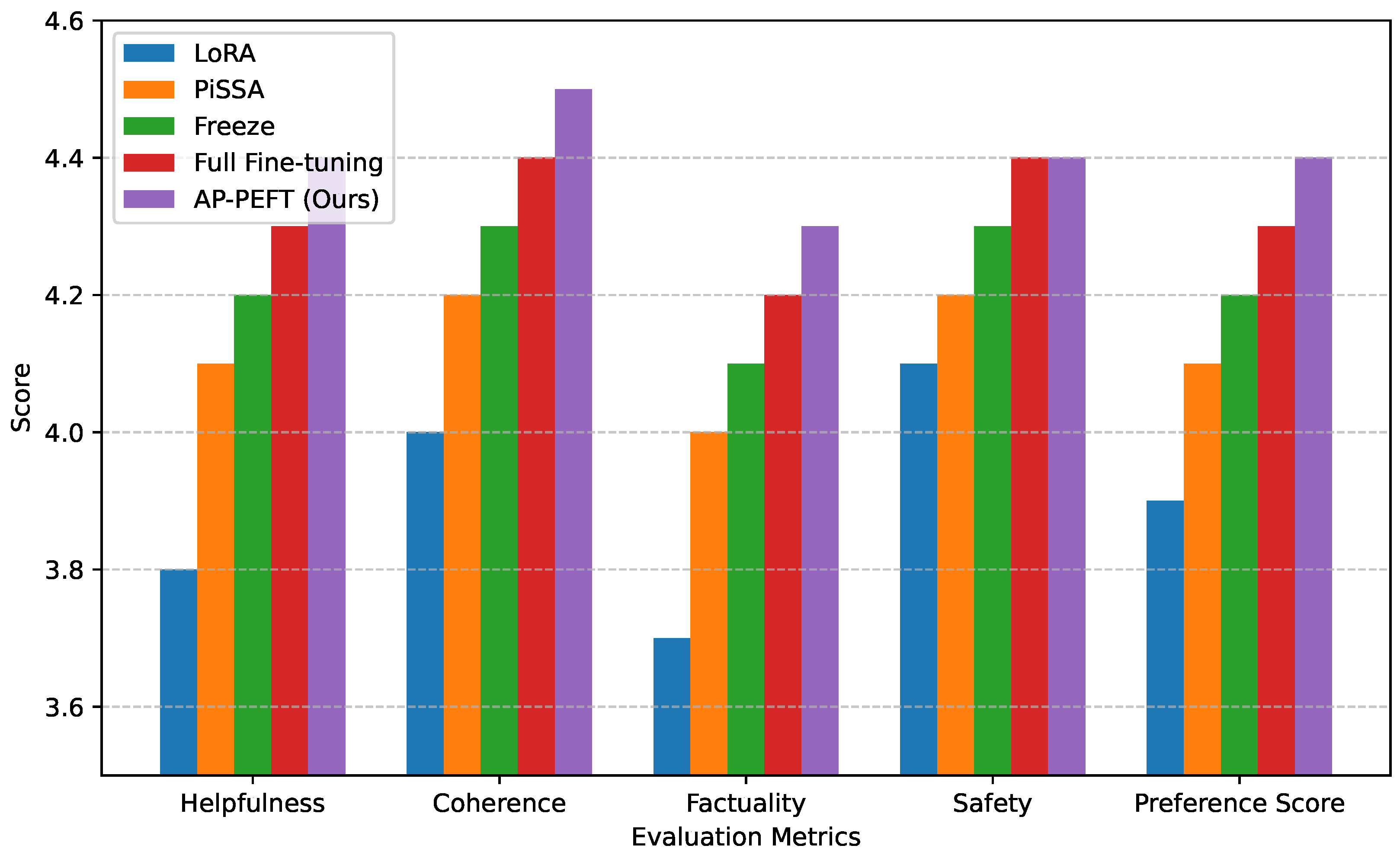
Figure 4.
Dynamic Rank Evolution Statistics for Llama-3.2-3B on OpenO1-SFT. Init. r: Initial Rank for all layers; : Rank Adjustment Step Size; Avg. Initial r: Average Initial Rank across layers; Avg. Final r: Average Final Rank across layers; Min. Final r: Minimum Final Rank observed across layers; Max. Final r: Maximum Final Rank observed across layers.
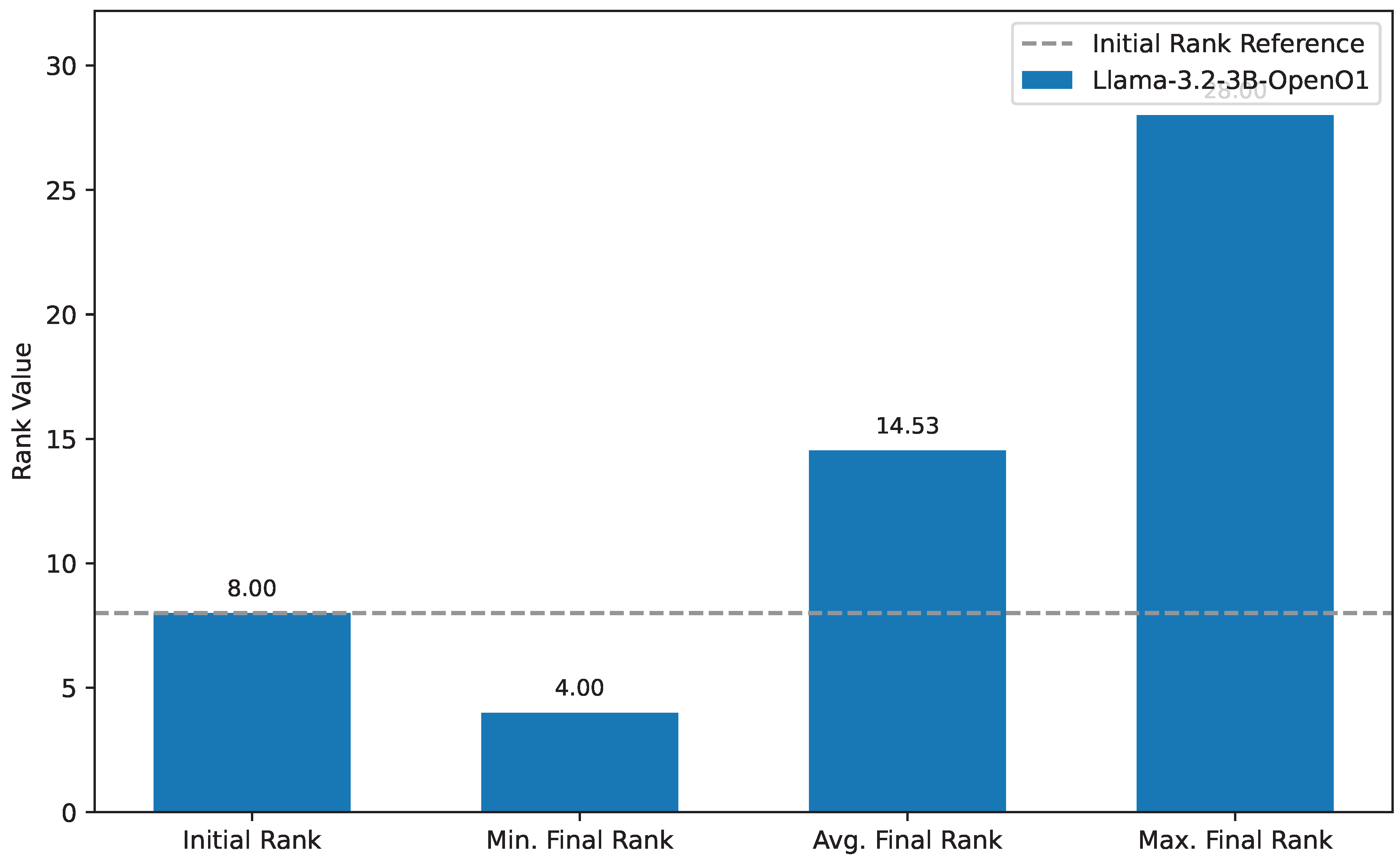

Table 1.
Fine-tuning Efficiency Comparison on Llama-3.2-3B using OpenO1-SFT Dataset. AMU: Average Memory Usage; PCU: Processor Compute Utilization; AL: Average Latency; ST: Throughput; AEC: Average Energy Consumption.
Table 1.
Fine-tuning Efficiency Comparison on Llama-3.2-3B using OpenO1-SFT Dataset. AMU: Average Memory Usage; PCU: Processor Compute Utilization; AL: Average Latency; ST: Throughput; AEC: Average Energy Consumption.
| Methods | Loss↓ | AMU(GB)↓ | PCU↑ | AL(s/iter)↓ | ST↑ | AEC(W)↓ |
| LoRA | 0.6019 | 49.152 | 0.9628 | 1.6077 | 1.33 | 589.91 |
| LoRA+ | 0.5791 | 59.664 | 0.9408 | 2.6247 | 1.22 | 577.94 |
| RSLoRA | 0.5866 | 58.536 | 0.9389 | 2.6247 | 1.22 | 593.93 |
| DoRA | 0.6006 | 59.616 | 0.9395 | 4.8544 | 6.59 | 601.98 |
| PiSSA | 0.5137 | 59.688 | 0.9339 | 2.6247 | 1.22 | 579.46 |
| Freeze | 0.5000 | 51.848 | 0.4252 | 2.51 | 556.43 | |
| Full* | 0.5310 | 49.152 | 0.9628 | 1.6077 | 1.33 | 589.91 |
| AP-PEFT (Ours) | 0.4950 | 48.500 | 0.9650 | 1.5500 | 1.40 | 580.00 |
Table 2.
Cross-Model Performance and Efficiency on OpenO1-SFT Dataset. Loss: Validation Loss; AMU: Average Memory Usage; PCU: Processor Compute Utilization.
Table 2.
Cross-Model Performance and Efficiency on OpenO1-SFT Dataset. Loss: Validation Loss; AMU: Average Memory Usage; PCU: Processor Compute Utilization.
| Model | Method | Loss↓ | AMU(GB)↓ | PCU↑ |
| Llama-3.2-3B | LoRA | 0.6019 | 49.152 | 0.9628 |
| Full | 0.5310 | 49.152 | 0.9628 | |
| AP-PEFT | 0.4950 | 48.500 | 0.9650 | |
| Qwen-2.5-7B | LoRA | 0.5850 | 85.340 | 0.9450 |
| Full | 0.5180 | 86.120 | 0.9400 | |
| AP-PEFT | 0.4890 | 84.900 | 0.9520 | |
| Mistral-7B | LoRA | 0.5920 | 82.100 | 0.9500 |
| Full | 0.5250 | 83.000 | 0.9480 | |
| AP-PEFT | 0.4990 | 81.500 | 0.9550 | |
| Llama-3.1-8B | LoRA | 0.6100 | 90.500 | 0.9300 |
| Full | 0.5390 | 91.200 | 0.9250 | |
| AP-PEFT | 0.5050 | 89.900 | 0.9380 |
Table 3.
Performance and Efficiency on Medical-O1-SFT Dataset (Llama-3.2-3B). AMU: Average Memory Usage; AL: Average Latency; PCU: Processor Compute Utilization.
Table 3.
Performance and Efficiency on Medical-O1-SFT Dataset (Llama-3.2-3B). AMU: Average Memory Usage; AL: Average Latency; PCU: Processor Compute Utilization.
| Methods | Loss↓ | AMU(GB)↓ | AL(s/iter)↓ | PCU↑ |
| LoRA | 0.7250 | 49.152 | 1.6077 | 0.9628 |
| PiSSA | 0.6800 | 59.688 | 2.6247 | 0.9339 |
| Freeze | 0.6650 | 51.848 | 0.4252 | 0.9322 |
| Full Fine-tuning | 0.6700 | 49.152 | 1.6077 | 0.9628 |
| AP-PEFT (Ours) | 0.6550 | 48.600 | 1.5800 | 0.9640 |
Table 4.
Ablation Study on AP-PEFT Components (Llama-3.2-3B, OpenO1-SFT). AMU: Average Memory Usage; AL: Average Latency; PCU: Processor Compute Utilization.
Table 4.
Ablation Study on AP-PEFT Components (Llama-3.2-3B, OpenO1-SFT). AMU: Average Memory Usage; AL: Average Latency; PCU: Processor Compute Utilization.
| Methods | Loss↓ | AMU(GB)↓ | AL(s/iter)↓ | PCU↑ |
| AP-PEFT (Full) | 0.4950 | 48.500 | 1.5500 | 0.9650 |
| w/o Dynamic Rank Adj. | 0.5200 | 49.000 | 1.5800 | 0.9600 |
| w/o Contribution Assessment | 0.5080 | 48.700 | 1.5650 | 0.9630 |
| w/o Smooth Transition (Abrupt) | 0.5020 | 48.550 | 1.5550 | 0.9640 |
Disclaimer/Publisher’s Note: The statements, opinions and data contained in all publications are solely those of the individual author(s) and contributor(s) and not of MDPI and/or the editor(s). MDPI and/or the editor(s) disclaim responsibility for any injury to people or property resulting from any ideas, methods, instructions or products referred to in the content. |
© 2026 by the authors. Licensee MDPI, Basel, Switzerland. This article is an open access article distributed under the terms and conditions of the Creative Commons Attribution (CC BY) license (http://creativecommons.org/licenses/by/4.0/).
Copyright: This open access article is published under a Creative Commons CC BY 4.0 license, which permit the free download, distribution, and reuse, provided that the author and preprint are cited in any reuse.