
Submitted:
12 March 2026
Posted:
16 March 2026
You are already at the latest version
Abstract
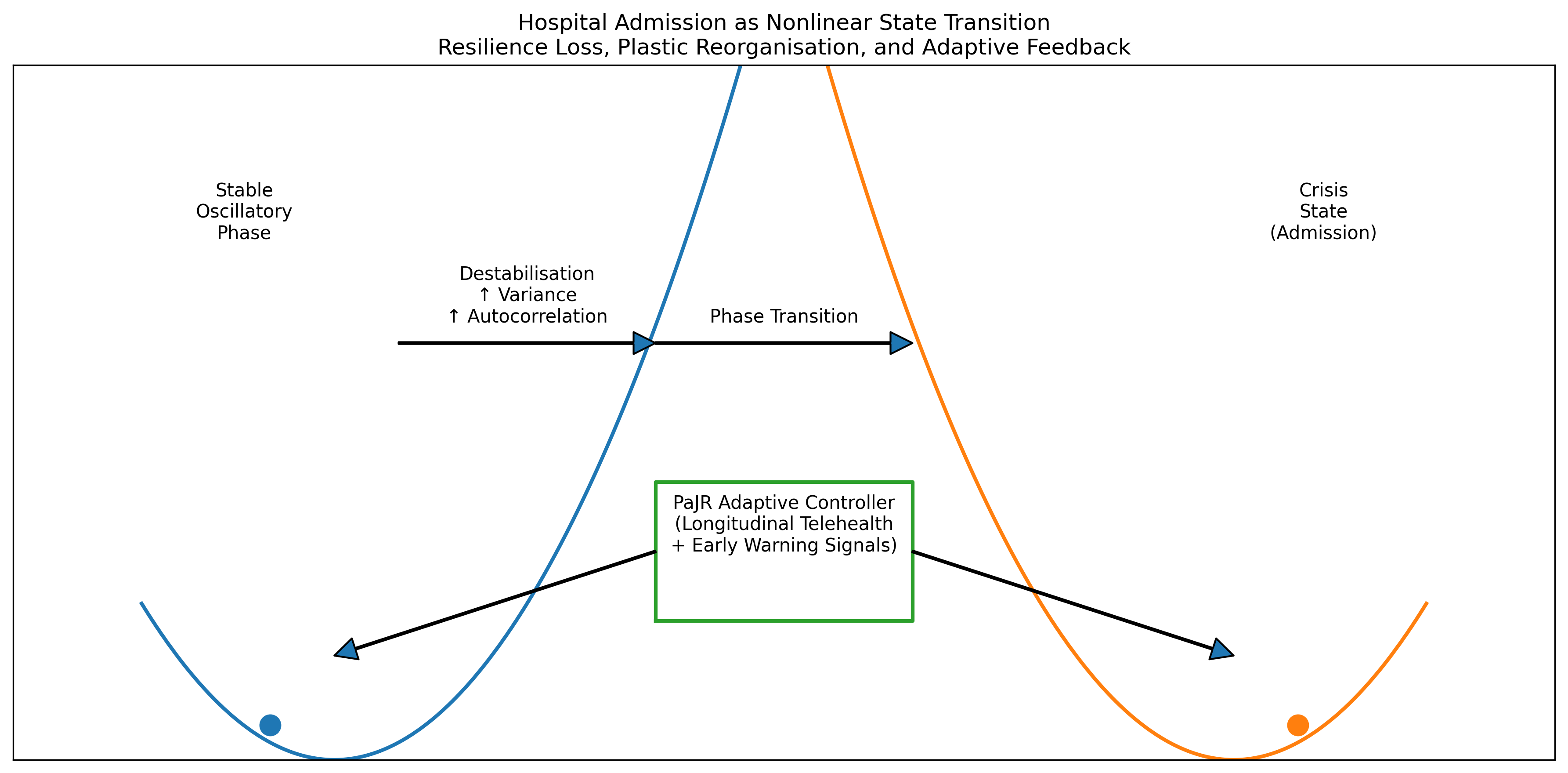
Background: Patients described as high-need, high-cost (HNHC) represent a subset of individuals with complex multimorbidity whose healthcare trajectories are char-acterised by recurrent instability and intensive use of acute care services. Concepts such as trajectory disruption, resilience, and complex adaptive behaviour are widely discussed in health systems research, yet empirical evidence linking these ideas to longitudinal patient monitoring remains limited. The PaJR (Patient Journey Record) monitoring system was designed using principles from complex adaptive systems theory, enabling longitudinal observation of patient trajectories in real-world care. Objective: This study develops a complex adaptive system–informed theory of instability phases within patient trajectories using longitudinal monitoring data generated by the PaJR system. Methods: Analyses draw on two PaJR monitoring datasets used for complementary purposes: a MonashWatch cohort dataset comprising 100 patients and 1,137 monitoring calls used to illustrate trajectory dynamics, and an Irish monitoring dataset comprising 286 patients and 11,108 monitoring calls over 18 months used to examine signal distributions and instability patterns. Monitoring calls capture structured signals across multiple domains including illness, medication, healthcare utilisation, social support, environmental factors, and self-care. Results: Instability signals were concentrated within a minority of monitoring observations, producing a long-tail distribution of alert intensity. Alerts frequently occurred in clusters across consecutive monitoring calls, with approximately 63% of alert calls occurring immediately after a previous alert. Alerts were also commonly multi-domain, with approximately 42% involving disturbances across more than one domain simultaneously. These observations support an instability–plasticity framework that integrates empirical monitoring data with concepts from complex adaptive systems and resilience theory, interpreting clusters of patient-reported signals preceding hospital admission as indicators of declining resilience and increasing trajectory plasticity. Conclusions: Longitudinal relational monitoring can reveal instability patterns within patient journeys that are not visible through episodic health system data. These findings help empirically ground emerging theories of complex healthcare trajectories and suggest that recognising instability phases may support earlier and more adaptive responses for patients with complex healthcare needs.
Keywords:
complex adaptive systems
; patient trajectories
; multimorbidity
; high-need high-cost patients
; telehealth monitoring
; relational monitoring
; resilience
; instability
; patient journey
Copyright: This open access article is published under a Creative Commons CC BY 4.0 license, which permit the free download, distribution, and reuse, provided that the author and preprint are cited in any reuse.


