

Submitted:
12 March 2026
Posted:
16 March 2026
You are already at the latest version
Abstract
Valuably, the International Code of Zoological Nomenclature provides, under its principle of priority, that a species name that has been declared a synonym of an earlier proposed species remains contestable and open to future research. However, as the Code is concerned with namenclature and not with taxonomic concepts, it places no restrictions on declarations of synonymy, enabling them to be published without supporting evidence. This freedom, which is at the core of the synonymy problem contributes to taxonomic inflation and constrains estimates of diversity. From a theoretical perspective, evidence in an unsupported declaration devolves to that of one specimen, the holotype. Furthermore, in the absence of other evidence, the declaration further devolves to one of opinion, with readers left to judge its value based on their knowledge of the declarator. This approach, based on typification, is contrasted with one in which a species exists independently of our perception and is viewable as samples of its local populations. Rather than an arbiter of usage, the holotype then acts only as a referent to its local source population, whose properties define much of the species concept. A worked example of these concepts using data from the planktonic Foraminifera supports the view that evidence of synonymy lies in the source populations of the holotypes.
Keywords:
synonymy
; typification
; species concepts
1. Introduction
That synonymy has long been a problem in taxonomy was shown by [1] who noted Hooker’s [2], p. xiv ‘chaos of synonymy’ and Strickland’s [3], p. 129 ‘curse of Babel’ and discussed the reasons underlying use of such pejorative expressions that led to the gestation of the current Code of Zoological Nomenclature (ICZN, Code) [4]. In it, a declaration of synonymy (ICZN art 23.3) is a statement that unites two nominal taxa under the name determined by the principle of priority (use the earliest available name). The Code does not further specify the contents of the statement and inclusion of supporting evidence for unification is left to the author’s judgement. Importantly, the name remains available: there is a validly named type specimen whose status is contestable. Particularly note that the Code deals with naming taxa, not with taxonomic concepts. Thus in a simple declaration of synonymy a hitherto valid name is demoted to an available name. Evidence is not required because that would involve consideration of taxonomic concepts, which is beyond the scope of the code.
While it is good scientific practice that the status of a demoted species remains contestable, commonly it generates a stack of historical references to names that have been declared synonymous. In the instance of the Mammalia clade the stack is monumentally large [5], Figure 1 and is equally difficult to unwravel as names have moved in and out of synonymy in the course of research. This problem is found across biology ([6,7,8,9,10,11,12]) and its importance for estimates of species diversity is plain to see. Consequently, this instability of valid names, as it was two centuries ago, is cause for complaint and has prompted calls for a code to regulate lists of valid species (e.g., [13,14,15]). However, compaingers for regulation pay little attention to taxonomic procedures that potentially promote instability in species names, particularly the freedom to declare a valid name to be a synonym of an earlier proposed name without citing evidence. Some conceptual issues of such declarations are outlined here with reference to the role of holotypes as objectively named specimens and related to an example from the zooplankton.
2. Materials and Methods
Planktonic Foraminifera are a well researched, globally distributed marine protist clade with an extensive historical record, and a taxonomy based largely on their calcitic shells, which preserve valuable environmental signals [16]. The taxonomy of their modern species [17] was revised by [18] who included a list of synonymous species. For this conceptual review, their designation of Globorotalia oceanica Cushman & Bermudez, 1949 [19] as a synonym of Globorotalia crassaformis (Galloway & Wissler, 1927) [20] is examined informally, based on my identifications of the taxa.
Gulf of Mexico sediment trap (GOM): This trap is a time series (2008–2012) of foraminiferal and particulate flux at 700 m on the northern Gulf of Mexico continental shelf (27.5◦ N; 90.3◦ W; Richey [21]). Tropical Atlantic Central Water is a major component of the upper watermass. Thirty-eight specimens supplied by Dr. Caitlin Reynolds were studied from the GMT2-1 sediment trap (212 µm–425 µm fraction); they were collected between 21 and 27 April 2008. This material (Figure 1.A) is identified as Globorotalia oceanica.
DSDP Site 591A 1H-1-8-10 cm (LHR): This site (31◦ 35.06 S; 164◦ 26.92 E; 2142 m) is on a southern spur of the eastern part of the Lord Howe Rise in the vicinity of the Tasman Front, a westward flowing branch of the subtropical East Australian Current. The age of the sample is 9.4 kyr ([22]; 33 specimens were studied from the >149 µm fraction. This material Figure 1.B) is identified as Globorotalia crassaformis.
Methods for collection of morphometric data which capture specimen shape of the shell in the shown orientation are described in ([23], Figure 1.B-D). As this trait relates to the trophic and hydrodynamic functions of the organism in a planktonic environment it is considered to be significant in taxonomic studies.
3. Results
Alternative world views underly taxonomy, understood as classification in biology. A nominalist view is that the material of classification is tangible: it can be directly observed. This view is also implicit in much neurovision research in the field of categorization: we build personal concepts of objects as groups, whether or not natural, from direct observation, aided by visual recall of known examples. A species consists of the specimens allocated to it, and no more. In antithesis is the realist view ([24,25]) that most organisms are intrinsically grouped because of their homeostatic properties, which are self-regulating and collectively support the well-being of the organism and aid adaptation to its environment. In that view, the task for classification is not about forming groups, but recognizing them. This position was promoted by [26], who was influenced by Fisher’s studies of living species [27], and is consistent with the biological species concept [28].
How does a declaration of synonymy relate to these world views? Where is the evidence that species B-us is a synonym of species A-us. A nominalist might argue that, as their names are objectively attached to their holotypes, their synonomy can be judged from a comparison of these specimens. While few may use that as a sole criterion, in practice it is likely that holotypes have a particular influence on declarations of synonymy because of their authenticity: the names of these specimens cannot be challenged.
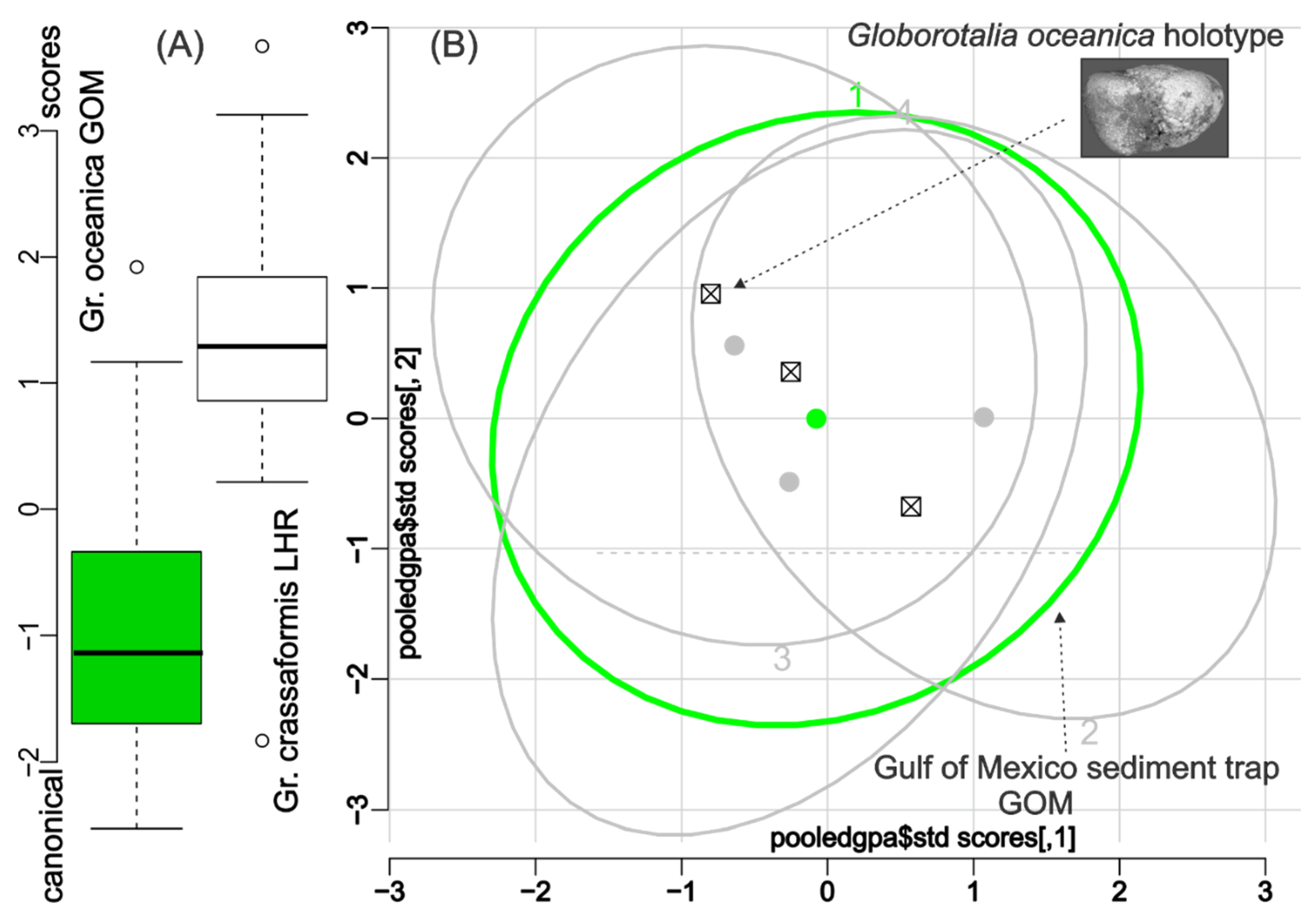
Such simple solutions are not available to the realist taxonomist. Although they accept that taxa are natural groups, they can view them only from samples, not in their entirety. To make a judgement of their synonymy they first have to find samples that might come from unitary populations of the taxa (Figure 1). For morphospecies several steps are suggested. 1. The taxonomist uses their visual perception to select specimens they provisionally identify as A-us or B-us. 2. Morphometric data on a trait present in both groups are gathered. 3. Analyses provide probabilities of specimens belong to unitary populations and the significance of their discrimination. 4. The taxonomist evaluates these statistical grouping data against their knowledge of the functional significance of the trait as a basis for judging whether B-us is a junior synonym of A-us. Figure 2.A is an example of these procedures.
However, these analyses do not address the naming question. Recalling that taxon names are attached to their holotypes, does the analysis establish that the groups recognized in the analysis represent A-us and B-us? How do these names act as referends? Article 23.3 of the Code refers to the unification of taxa, whose only objectively named specimens are the holotypes. A solution based on the view that species taxa are polytypic populations [19] that exist independently of our perception, is that the name is tied via the holotype to the local population from which it was sourced. A declaration of synonymy then needs to show that the holotype of the junior synonym falls within the senior synonym’s source population, as sampled. In practice, this sets a high standard of evidence, often difficult to obtain and may require proxy data, as are used in Figure 2.B.
4. Discussion
Although [18] outline reasons for exclusion of taxa from the list of modern species, for Globorotalia oceanica their comment is that [29] considered it extant. As presented, their procedure closely matches a nominalist interpretation of the role of the holotype as an arbiter of usage although, as [18] acknowledge the collaboration of members of the SCOR/IGBP working group 138 in preparing their list, it is possible that data additional to those from the holotypes were considered. Nevertheless, as we are not privy to them, we do not know the bases of their decision about the status of Globorotalia oceanica. In the absence of data, what [18] provide is their expert judgement about its synonymous status.
Expert judgements like those of [18] on the formal status of species are the modus operandi underpinning taxonomy and to an unknown extent contribute to the ‘synonymy overload’ that plagues estimates of diversity. In the absence of data, is their judgement about the synonymous status of Globorotalia oceanica credible? Here, augmentation theory [30] which focuses on the attributes of experts for judging the value of their opinions, is helpful. Potentially applicable are questions [31], p. 750 to be answered in an appeal to expert opinion, several of which I answer. How credible are Brummer & Kucera (B&K) as an expert source? (ans: highly credible). Are B&K experts in planktonic foraminifera? (ans: yes). Is their decision on Globorotalia oceanica consistent with that of other experts? (ans: yes); Is their decision based on evidence? (ans: limited to the holotypes). Consistent with [31], a test designed specifically for taxonomy ([32] showed that ‘quality of work’ and ‘total productivity’ had the greatest weights when expert opinion is judged. Such reliance may bias how designations of synonymy are assessed and affect, say, the selection of editors for the taxonomic name aggregator WORMS [33]. Usage ranking [34], a bibliometric approach to mapping synonymy, is similarly hobbled by possible biases in expert opinion, as are estimates of synonymy based on a stochastic flux ratio model.
Do the morphometric data support the judgement of [18] which, applied to data in Figure 1, would identify both as representing Globorotalia crassaformis? Evidence of a unitary population is clearly defined in Figure 1.A which sampled a living population. Bimodality in Figure 1.B is due to a group of elliptically-shaped specimens well separated from weakly conical specimens that form the main mode; they are excluded. Canonical discriminant analysis (Figure 2.A) of specimens from Figure 1.A and from the main mode of Figure 1.B shows that it is unlikely that these samples are from a common shape population: the median score for LHR falls close to the maximum score for GOM: the tails of the distributions overlap, as the linear discriminant also detects (Figure 2.B caption). Although these data certainly question the judgement of [18], they are limited to one trait and one dataset and other spatial/temporal records are neglected.
Was the referent question posed above answered? Globorotalia oceanica was described from bottom sediment dredged off the northern coast of Cuba and, as the sample was not available, proxy data are used. The site lies under the same tropically-sourced watermass as the Caribbean sediment trap (GOM) and three other sites [23]. Data ellipses (Figure 2.B) for the four tropical Atlantic – Caribbean samples overlap, with projections for the holotype and paratypes of Globorotalia oceanica positioned within the overlap. From preceding theory this is strong evidence that the name can be applied to these four samples, treated as representing local populations.
5. Conclusions
That the status of a validly proposed taxon is contestable is an essential feature of a science-based taxonomy which should not be impared by regulation of names. Nevertheless, the freedom allowed by the ICZN to simply declare a taxon to be synonymous with a earlier named taxon, without provision of evidence, contributes to taxonomic instability, does not advance knowledge of taxa, and is an impediment to estimates of diversity. Unsupported declarations represent expressions of expert opinion whose acceptance is shown by augmentation research to be biased in favour of the reputational status of their authors.
The kernel of the problem of unsupported declarations of synonymy is that they implicitly devolve to opinions based on the holotypes (typification), the only objectively-named specimens, which are strictly name-bearers and only in a limited sense referents. Reliance on typification contrasts with a realist concept of taxa as composed of sets of local populations. When analyzed, these reveal much about their structure and show that the value of the holotype is no more than the name bearer from the local population from which it was collected.
Where is the evidence of synonymy? It is primarily in the local populations of the name-bearing specimens, a view that is commonly ignored.
Funding
This research received no external funding.
Acknowledgments
Earth Science New Zealand provided resources for this study. .
Conflicts of Interest
The author declares no conflict of interest.
References
- Witteveen, J. Suppressing Synonymy with a Homonym: The Emergence of the Nomenclatural Type Concept in Nineteenth Century Natural History. J Hist Biol 2016, 49, 135–189. [Google Scholar] [CrossRef]
- Hooker, Joseph Dalton. Flora of New Zealand; Lovell Reeve: London, 1853. [Google Scholar]
- Strickland, Hugh Edward. On the Inexpediency of Altering Estabilished Terms in Natural History. Magazine of Natural History and Journal of Zoology, Botany, mineralogy, geology and meteorology 1837, n.s. 1, 127–131. [Google Scholar]
- International Commission on Zoological Nomenclature, Ride, W. D. L., International Trust for Zoological Nomenclature, Natural History Museum (London, England), International Union of Biological Sciences. International Code of Zoological Nomenclature: Code International de Nomenclature Zoologique, 4th ed.; International Trust for Zoological Nomenclature, Natural History Museum (London, England), International Union of Biological Sciences: London; International Trust for Zoological Nomenclature, c/o Natural History Museum, 1999. [Google Scholar]
- Burgin, C. J.; Zijlstra, J. S.; Becker, M. A.; Handika, H.; Alston, J. M.; Widness, J.; Liphardt, S.; Huckaby, D. G.; Upham, N. S. How Many Mammal Species Are There Now? Updates and Trends in Taxonomic, Nomenclatural, and Geographic Knowledge. Journal of Mammalogy 2025, 106, 1082–1117. [Google Scholar] [CrossRef]
- Alroy, J. How Many Named Species Are Valid? Proc. Natl. Acad. Sci. U.S.A. 2002, 99, 3706–3711. [Google Scholar] [CrossRef] [PubMed]
- Garrity, G. M.; Lyons, C. Future-Proofing Biological Nomenclature. OMICS: A Journal of Integrative Biology 2003, 7, 31–33. [Google Scholar] [CrossRef] [PubMed]
- Kennedy, J. Supporting Taxonomic Names in Cell and Molecular Biology Databases. OMICS: A Journal of Integrative Biology 2003, 7, 13–16. [Google Scholar] [CrossRef] [PubMed]
- Rao, M. K. V. The Importance of Botanical Nomenclature and Synonymy in Taxonomy and Biodiversity. Current Science 2004, 87, 602–606. [Google Scholar]
- Benton, M. J. How to Find a Dinosaur, and the Role of Synonymy in Biodiversity Studies. Paleobiology 2008, 34, 516–533. [Google Scholar] [CrossRef]
- Solow, A. R.; Benton, M. J. On the Flux Ratio Method and the Number of Valid Species Names. Paleobiology 2010, 36, 516–518. [Google Scholar] [CrossRef]
- Mora, C.; Tittensor, D. P.; Adl, S.; Simpson, A. G. B.; Worm, B. How Many Species Are There on Earth and in the Ocean? PLoS Biol 2011, 9, e1001127. [Google Scholar] [CrossRef]
- Garnett, S. T.; Christidis, L. Taxonomy Anarchy Hampers Conservation. Nature 2017, 546, 25–27. [Google Scholar] [CrossRef]
- Hobern, D.; Barik, S. K.; Christidis, L.; T.Garnett, S.; Kirk, P.; Orrell, T. M.; Pape, T.; Pyle, R. L.; Thiele, K. R.; Zachos, F. E.; Bánki, O. Towards a Global List of Accepted Species VI: The Catalogue of Life Checklist. Org Divers Evol 2021, 21, 677–690. [Google Scholar] [CrossRef]
- Garnett, S. T.; Bánki, O.; Barik, S. K.; Berryman, A. J.; Bouchard, P.; Buckeridge, J.; Christidis, L.; Cigliano, M. M.; Conix, S.; Crawford-Weaver, H.; Van Dijk, P. P.; Evenhuis, N. L.; Hilton-Taylor, C.; Hobern, D.; Johnston, C.; Klopper, R. R.; Kroh, A.; Le Roux, M.; Pape, T.; Pyle, R. L.; Raz, L.; Thomas, P.; Thomson, S.; Vandepitte, L.; Wambiji, N.; Zachos, F. E.; Lien, A. M. Measuring the Quality of Species List Governance. BioScience 2026, biaf071. [Google Scholar] [CrossRef]
- Schiebel, R. Planktic Foraminiferal Sedimentation and the Marine Calcite Budget. Global Biogeochemical Cycles 2002, 16. [Google Scholar] [CrossRef]
- Schiebel, R.; Hemleben, C. Planktic Foraminifers in the Modern Ocean; Springer: Berlin, 2017. [Google Scholar]
- Brummer, G-A.; Kučera, M. Taxonomic Review of Living Planktonic Foraminifera. Journal of Micropalaeontology 2022, 41, 29–74. [Google Scholar] [CrossRef]
- Cushman, J.A.; Bermudez, P.J. Some Cuban Species of Globorotalia. Contributions from the Cushman Laboratory for Foraminiferal Research 1949, 25, 26–45. [Google Scholar]
- Galloway, J.J.; Wissler, S.G. Pleistocene Foraminifera from the Lomita Quarry, Palos Verde Hills, California. Journal of Paleontology 1927, 1, 35–87. [Google Scholar]
- Richey, J.; Reynolds, C.; Thunell, R. Weekly Resolution Particulate Flux from a Sediment Trap in the Northern Gulf of Mexico, 2008-2012. USGS Open-File Report 2014, 2014–1035, 9. [Google Scholar]
- Nelson, C.S.; Hendy, C.H.; Cuthbertson, A.M. Compendium of Stable Oxygen and Carbon Isotope Data for the Late Quaternary Interval of Deep-Sea Cores from the New Zealand Sector of the Tasman Sea and Southwest Pacific Ocean; Occasional Report; University of Waikato, Department of Earth Sciences: Hamilton, New Zealand, 1993. [Google Scholar]
- Scott, G. H. Representing Zooplankters: An Example from the Foraminifera. Geosciences 2024, 14, 169. [Google Scholar] [CrossRef]
- Beckner, M. The Biological Way of Thought; Columbia University Press, 1959. [Google Scholar] [CrossRef]
- Boyd, R. Homeostasis, Species, and Higher Taxa. In Species; Wilson, R. A., Ed.; The MIT Press, 1999; pp. pp 141–186. [Google Scholar] [CrossRef]
- Simpson, G. G. Principles of Animal Taxonomy; Columbia University Press, 1961. [Google Scholar] [CrossRef]
- Karlin, S. R. A. Fisher and Evolutionary Theory. Statist. Sci. 1992, 7. [Google Scholar] [CrossRef]
- Mayr, E. Principles of Systematic Zoology; McGraw-Hill: New York, 1969. [Google Scholar]
- Aze, T.; Ezard, T. H. G.; Purvis, A.; Coxall, H. K.; Stewart, D. R. M.; Wade, B. S.; Pearson, P. N. A Phylogeny of Cenozoic Macroperforate Planktonic Foraminifera from Fossil Data. Biol Rev Camb Philos Soc 2011, 86, 900–927. [Google Scholar] [CrossRef] [PubMed]
- Walton, D. Argumentation Theory: A Very Short Introduction. In Argumentation in Artificial Intelligence; Simari, G., Rahwan, I., Eds.; Springer US: Boston, MA, 2009; pp. pp 1–22. [Google Scholar] [CrossRef]
- Walton, D. Examination Dialogue: An Argumentation Framework for Critically Questioning an Expert Opinion. Journal of Pragmatics 2006, 38, 745–777. [Google Scholar] [CrossRef]
- Caley, M. J.; O’Leary, R. A.; Fisher, R.; Low-Choy, S.; Johnson, S.; Mengersen, K. What Is an Expert? A Systems Perspective on Expertise. Ecology and Evolution 2014, 4, 231–242. [Google Scholar] [CrossRef]
- Vandepitte, L.; Dekeyzer, S.; Decock, W.; Delgat, L.; Boydens, B.; Tyberghein, L.; Vanhoorne, B.; Hernandez, F.; Mees, J.; Horton, T.; Kroh, A.; Boyko, C. B.; Ahyong, S. T. The World Register of Marine Species (WoRMS) through the Looking Glass: Insights from the Data Management Team in Light of the Crystal Anniversary of WoRMS. Hydrobiologia 2025, 852, 1–22. [Google Scholar] [CrossRef]
- Huber, R.; Klump, J. Charting Taxonomic Knowledge through Ontologies and Ranking Algorithms. Computers & Geosciences 2009, 35, 862–868. [Google Scholar] [CrossRef]
Figure 1.
(A) Density map showing probabilities that specimens in the Gulf of Mexico (GOM) sediment trap belong to a normal (Gaussian) shape population. Specimens across the probability range are shown and the inset shows the holotype of Globorotalia oceanica. (B) Density map showing probabilities that specimens in the Southwest Pacific Holocene core sample 1H-1-8-10 cm (LHR) belong to a normal (Gaussian) shape population. Specimens across the probability range are shown and the inset shows the neotype of Globigerina crassaformis.
Figure 1.
(A) Density map showing probabilities that specimens in the Gulf of Mexico (GOM) sediment trap belong to a normal (Gaussian) shape population. Specimens across the probability range are shown and the inset shows the holotype of Globorotalia oceanica. (B) Density map showing probabilities that specimens in the Southwest Pacific Holocene core sample 1H-1-8-10 cm (LHR) belong to a normal (Gaussian) shape population. Specimens across the probability range are shown and the inset shows the neotype of Globigerina crassaformis.
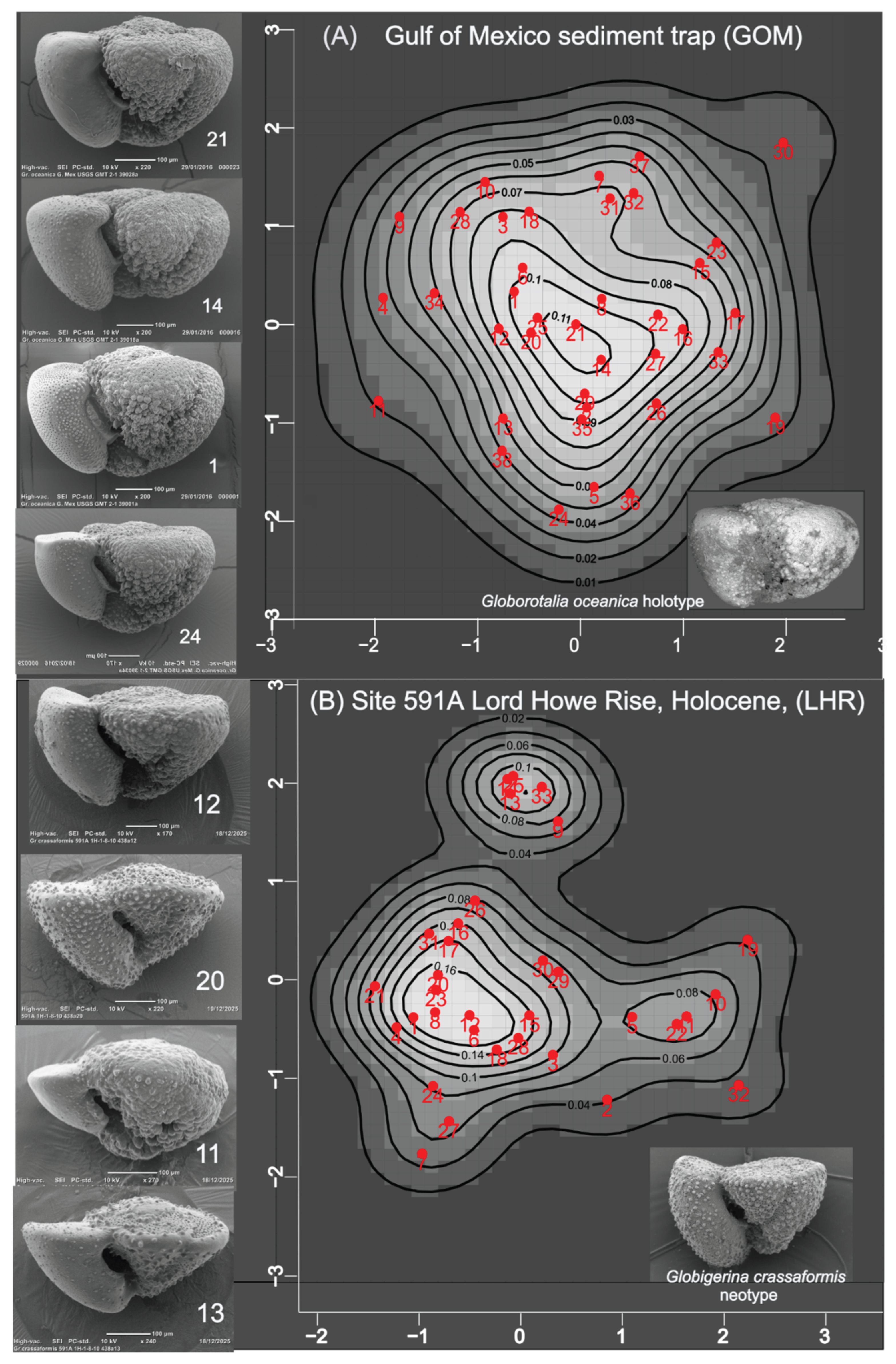
Figure 2.
(A) Discrimination of Gulf of Mexico (GOM) sample from Southwest Pacific (LHR) sample. A generalized canonical discriminant analysis (function candisc in R package candisc (available from https://github.com/friendly/candisc/) of data from a multivariate linear model uses PC1:3 projection data from the procrustes-processed samples. In this analysis almost all of the between-sample variation is accomodated on one axis which strongly discriminates LHR shells from those of GOM. Linear discriminant analysis (R package lda https://CRAN.R-project.org/package=lda) with default priors produced an overall accuracy of 90%, with the confusion table showing three GOM specimens placed in the LHR category. (B) Data ellipses (95% confidence around mean values for a procrustes analysis (R package shapes https://cran.r-project.org/web/packages/shapes/index.html) of pooled samples from the Gulf of Mexico (GOM, green), Cariaco Basin (CAR, 2), and Ceara Rise (CER, 3). Sierra Leone Rise (SLR, 4) samples, with the addition of the three named specimens of Globorotalia oceanica. These specimens lie within the confidence limit of each sample. All of the material is from the source region of Globorotalia oceanica.
Figure 2.
(A) Discrimination of Gulf of Mexico (GOM) sample from Southwest Pacific (LHR) sample. A generalized canonical discriminant analysis (function candisc in R package candisc (available from https://github.com/friendly/candisc/) of data from a multivariate linear model uses PC1:3 projection data from the procrustes-processed samples. In this analysis almost all of the between-sample variation is accomodated on one axis which strongly discriminates LHR shells from those of GOM. Linear discriminant analysis (R package lda https://CRAN.R-project.org/package=lda) with default priors produced an overall accuracy of 90%, with the confusion table showing three GOM specimens placed in the LHR category. (B) Data ellipses (95% confidence around mean values for a procrustes analysis (R package shapes https://cran.r-project.org/web/packages/shapes/index.html) of pooled samples from the Gulf of Mexico (GOM, green), Cariaco Basin (CAR, 2), and Ceara Rise (CER, 3). Sierra Leone Rise (SLR, 4) samples, with the addition of the three named specimens of Globorotalia oceanica. These specimens lie within the confidence limit of each sample. All of the material is from the source region of Globorotalia oceanica.
Disclaimer/Publisher’s Note: The statements, opinions and data contained in all publications are solely those of the individual author(s) and contributor(s) and not of MDPI and/or the editor(s). MDPI and/or the editor(s) disclaim responsibility for any injury to people or property resulting from any ideas, methods, instructions or products referred to in the content. |
© 2026 by the authors. Licensee MDPI, Basel, Switzerland. This article is an open access article distributed under the terms and conditions of the Creative Commons Attribution (CC BY) license (http://creativecommons.org/licenses/by/4.0/).
Copyright: This open access article is published under a Creative Commons CC BY 4.0 license, which permit the free download, distribution, and reuse, provided that the author and preprint are cited in any reuse.


