

Submitted:
13 March 2026
Posted:
13 March 2026
You are already at the latest version
Abstract
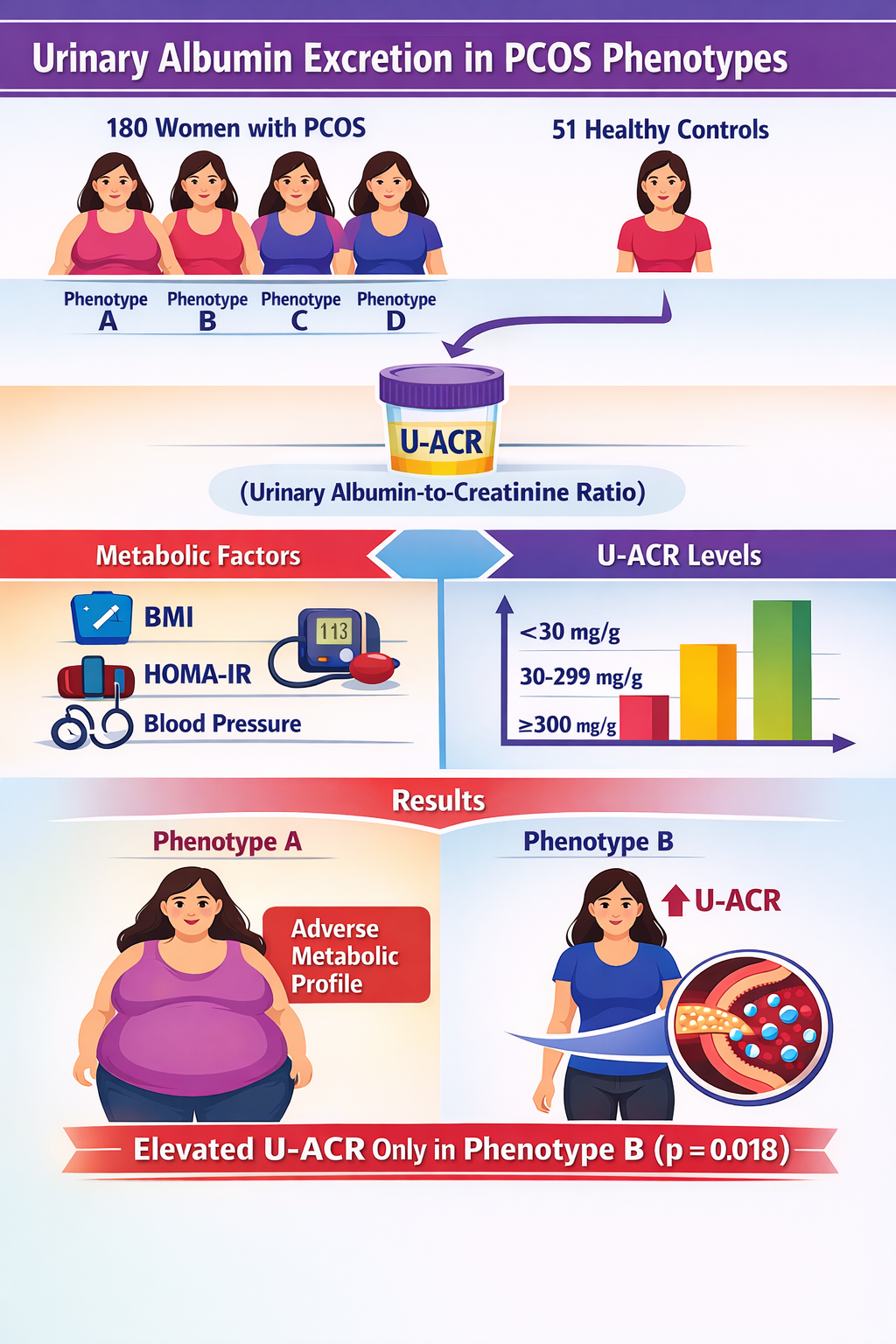
Background/Aim: Albuminuria is an established marker of endothelial dysfunction and an independent predictor of cardiovascular risk. Polycystic ovary syndrome (PCOS) is associated with early metabolic and vascular abnormalities; however, whether urinary albumin excretion differs across PCOS phenotypes remains unclear. This study aimed to evaluate urinary albumin excretion using the urinary albumin-to-creatinine ratio (U-ACR) across distinct PCOS phenotypes and to examine its association with metabolic parameters. Materials and Methods: In this cross-sectional study, 180 women aged 18-35 years with PCOS and 51 age-matched healthy controls were included. PCOS phenotypes were classified according to the Rotterdam criteria as Phenotype A (n = 96), Phenotype B (n = 19), Phenotype C (n = 35), and Phenotype D (n = 30). Insulin resistance was assessed using the homeostasis model assessment for insulin resistance (HOMA-IR). Urinary albumin and creatinine levels were measured in morning urine samples, and U-ACR was calculated. Results: Age was comparable across all groups. Body mass index, waist circumference, diastolic blood pressure, and HOMA-IR were significantly higher in Phenotype A compared with controls and other phenotypes, indicating a more adverse metabolic profile. Serum creatinine levels were similar across all groups. Despite this unfavorable metabolic profile in Phenotype A, U-ACR was significantly elevated only in Phenotype B compared with controls (p = 0.018) and Phenotype D (p = 0.016). No significant correlations were observed between U-ACR and age, body mass index, or HOMA-IR. When participants were categorized according to U-ACR levels (< 30, 30-299.9, and ≥ 300 mg/g creatinine), no significant differences in category distribution were observed between the total PCOS cohort, phenotype subgroups, and controls. Conclusion: Among PCOS phenotypes, U-ACR elevation was observed exclusively in Phenotype B despite similar renal function markers. Notably, this occurred even though Phenotype A exhibited a more adverse metabolic profile, suggesting a dissociation between metabolic burden and early microvascular involvement across PCOS phenotypes. These findings indicate that vascular risk in PCOS may be phenotype-dependent and support the potential value of phenotype-oriented cardiovascular risk assessment.
Keywords:
polycystic ovary syndrome
; polycystic ovary phenotypes
; albumin-to-creatinine ratio
; albuminuria
; endothelial dysfunction
1. Introduction
Polycystic ovary syndrome (PCOS) is one of the most prevalent endocrine-metabolic disorders affecting women of reproductive age, with a reported prevalence reaching up to 20% depending on the diagnostic criteria applied [1,2,3]. Beyond reproductive abnormalities [4], PCOS is frequently accompanied by metabolic disturbances, including insulin resistance (IR) and type 2 diabetes mellitus [5], dyslipidemia [6], and coronary artery disease [7], all of which contribute to increased long-term cardiometabolic risk.
Beyond reflecting renal involvement alone, albuminuria is increasingly recognized as a marker of generalized endothelial dysfunction and systemic microvascular injury, reflecting early subclinical vascular impairment associated with future cardiovascular risk [8,9,10]. Likewise, in women with PCOS, the presence of microalbuminuria has been associated with endothelial dysfunction and increased cardiovascular risk, and has been proposed as an early indicator of atherosclerotic disease development [11,12,13,14,15,16]. Furthermore, premicroalbuminuria (defined as albumin-to-creatinine ratio > 7 mg/g in some studies) has been reported to occur more frequently in patients with PCOS compared with healthy controls and to be associated with a higher prevalence of metabolic syndrome and its individual components [17].
While previous investigations primarily focused on the presence or absence of PCOS, recent evidence emphasizes the heterogeneity of the syndrome, demonstrating that metabolic disturbances and inflammatory burden may vary substantially across different PCOS phenotypes [18]. According to the Rotterdam criteria, PCOS is classified into four phenotypes based on the presence of hyperandrogenism (HA), oligo/anovulation (OA), and polycystic ovarian morphology (PCOM): Phenotype A (HA+OA+PCOM), Phenotype B (HA+OA), Phenotype C (HA+PCOM), and Phenotype D (OA+PCOM) [18]. In general, metabolic disturbances and inflammatory burden appear to be most pronounced in the classical hyperandrogenic phenotypes and tend to decrease across the remaining phenotype categories. Accordingly, the cardiometabolic burden in PCOS appears to be phenotype-dependent, suggesting that cardiovascular risk may not be uniformly distributed among phenotypic subgroups [19].
Importantly, endothelial and microvascular dysfunction may develop through mechanisms that are at least partly independent of traditional metabolic risk markers, potentially involving androgen-related pathways and phenotype-specific biological susceptibility [20]. Thus, although metabolic disturbances are considered most pronounced in certain PCOS phenotypes, metabolic burden alone may not fully explain early vascular alterations. Whether urinary albumin excretion parallels metabolic severity across PCOS phenotypes or instead reflects a distinct phenotype-specific vascular vulnerability remains unclear.
Although increased urinary albumin excretion has been reported in patients with polycystic ovary syndrome, no studies have evaluated urinary albumin excretion across different PCOS phenotypes. Therefore, the aim of this study was to evaluate urinary albumin excretion using the urinary albumin-to-creatinine ratio (U-ACR) across distinct PCOS phenotypes and to explore whether albuminuria may reflect phenotype-specific endothelial risk.
2. Materials and Methods
This prospective case control study was conducted in the Departments of Internal Medicine, Endocrinology and Metabolic Diseases, and Gynecology and Obstetrics at Usak University Training and Research Hospital between April 1, 2022, and July 20, 2023. The study was performed in accordance with the principles of the Declaration of Helsinki. Ethical approval was obtained from the Ethics Committee of Medical School of Usak University (Date: 17.03.2022; Approval No: 17-17-04). Written informed consent was obtained from all participants prior to enrollment.
Women presenting with complaints such as hirsutism, acne, menstrual irregularities, or infertility and diagnosed with PCOS according to the 2003 Rotterdam criteria were included in the study based on biochemical, hormonal, and ultrasonographic evaluations.
PCOS was diagnosed when at least two of the following three Rotterdam criteria were present: (1) oligo/anovulation (OA), (2) clinical (hirsutism and/or acne) and/or biochemical signs of hyperandrogenism (HA), and (3) polycystic ovarian morphology (PCOM) on ultrasonography, after exclusion of other related clinical conditions such as Cushing’s syndrome, congenital adrenal hyperplasia, and androgen-secreting tumors.
Patients were categorized into four phenotypes as follows: Phenotype A (n = 96), HA + OA + PCOM; Phenotype B (n = 19), HA + OA; Phenotype C (n = 35), HA + PCOM; and Phenotype D (n = 30), OA + PCOM (Figure 1). The control group consisted of 51 age-matched women aged 18–35 years (Figure 1) without a diagnosis of PCOS or known malignancy, liver or kidney failure, not using medications affecting insulin resistance, without active infection, hirsutism, acne, or PCOM on ultrasonography, and with regular menstrual cycles.
Systolic blood pressure (SBP), diastolic blood pressure (DBP), height, weight, and waist circumference were measured in all patients and controls. Evaluation of hirsutism was performed by the same investigator (CD). Height (m) and weight (kg) were measured with participants wearing underwear. Waist circumference was measured at the narrowest point between the iliac crest and the lateral costal margin. Body mass index (BMI) was calculated as weight (kg) divided by height squared (m²).
For the measurement of androgen and gonadotropin levels, fasting blood samples were obtained during menstrual cycle days 3-5 in the morning. Serum glucose, creatinine, and insulin samples were obtained after overnight fasting. Androgen measurements were not performed in the control group. Morning urine samples for albumin and creatinine measurements were obtained during a period without menstruation.
All participants were re-evaluated for PCOM by the same examiner (OO). Ultrasonographic assessment was performed using a Mindray DC-7 device (Shenzhen Mindray Bio-Medical Electronics Co., Ltd., Shenzhen, P.R. China) with a transabdominal transducer frequency of 3-6.6 MHz and/or a transvaginal probe frequency of 3-5 MHz. PCOM was defined as the presence of ≥ 12 follicles measuring 2-9 mm in diameter and/or an ovarian volume > 10 mL.
Glucose levels (normal range [NR], 70-105 mg/dL) were measured using the Olympus AU 5800 analyzer (Beckman Coulter Inc., USA) with the hexokinase method. Insulin levels were measured using the Immulite 2000 system (Siemens Healthcare Diagnostics, Siemens AG, Germany) by chemiluminescence. The intra- and inter-assay coefficients of variation for insulin were 4.6% and 5.9%, respectively.
Serum creatinine (NR, 0.6-1.1 mg/dL), urine creatinine (NR, 15-300 mg/dL), and urinary microalbumin levels were analyzed in morning urine samples. Serum and urine creatinine levels were measured using the alkaline picrate method, whereas urinary microalbumin levels were measured by the immunoturbidimetric method using the Abbott Alinity C series analyzer (Abbott Park, IL, USA).
IR was calculated using the homeostasis model assessment–insulin resistance HOMA-IR was calculated using the formula:
fasting plasma glucose (mmol/L) × fasting insulin (µIU/mL) / 22.5.
To assess sample size adequacy, a literature-based sample size estimation was performed using G*Power software (version 3.1.9.7). Because direct phenotype-based data on urinary albumin excretion in PCOS are limited, the calculation was based on the closest recent case-control evidence. Using the difference in microalbuminuria frequency reported by Gungor et al. in women with PCOS and controls (24% vs. 4%), with a two-sided alpha of 0.05 and 80% power, the minimum required sample size was estimated to be 41 participants per group [21]. Accordingly, the final study population exceeded this requirement.
2.1. Statistical Analysis
All statistical analyses were performed using SPSS version 22.0 (IBM Corp., Armonk, NY, USA). The normality of continuous variables was assessed using the Shapiro-Wilk test.
For group comparisons, the independent samples t-test was used for normally distributed continuous variables, whereas the Mann-Whitney U test was applied to non-normally distributed variables. For comparisons involving more than two groups, the Kruskal-Wallis test was used, followed by pairwise comparisons when appropriate. Categorical variables were compared using Fisher’s exact test for two-group comparisons and the Pearson chi-square test for comparisons involving more than two groups.
Normally distributed continuous variables are presented as mean ± standard deviation (SD), while non-normally distributed variables are expressed as median (minimum-maximum).
Statistical significance was evaluated at a 95% confidence interval (CI), and a p value ≤ 0.05 was considered statistically significant.
3. Results
The demographic and clinical characteristics of the study population are summarized in Table 1. Age was comparable across all PCOS phenotypes and the control group.
BMI was significantly higher in the overall PCOS cohort and in Phenotypes A, B, and D compared with controls (all p ≤ 0.028). In addition, BMI was higher in Phenotype A than in Phenotypes C and D (p < 0.001 and p = 0.031, respectively). Waist circumference showed a similar pattern, being significantly greater in the overall PCOS group and particularly in Phenotypes A and B compared with controls (all p ≤ 0.041). Moreover, waist circumference was higher in Phenotype A than in Phenotypes C and D (p < 0.001 and p = 0.005, respectively). SBP values were comparable across groups, whereas DBP was significantly higher in Phenotype A compared with controls and with Phenotypes C and D (p ≤ 0.048).
HOMA-IR levels were significantly higher in all PCOS phenotypes compared with controls (p ≤ 0.024). Among the subgroups, Phenotype A exhibited higher HOMA-IR levels than Phenotypes C and D (both p = 0.008). Detailed metabolic and clinical parameters are presented in Table 1.
Renal and urinary parameters are summarized in Table 2. Serum creatinine levels were comparable across all groups. However, eGFR values were modestly but significantly lower in Phenotype A compared with controls and Phenotype C (p = 0.034 and p = 0.030, respectively). Urinary creatinine levels were similar in all groups.
Urinary albumin levels were significantly higher in Phenotypes A and B compared with both controls and Phenotype C (all p ≤ 0.022). In addition, urinary albumin levels were modestly higher in the overall PCOS cohort than in controls (p = 0.045).
U-ACR was significantly elevated only in Phenotype B compared with both controls and Phenotype D (p = 0.018 and p = 0.016, respectively) (Table 2). Therefore, increased albumin excretion was observed only in the hyperandrogenic oligoanovulatory phenotype.
When participants were categorized according to U-ACR levels (< 30, 30–299.9, and ≥ 300 mg/g creatinine), no significant differences were observed in the distribution of albuminuria between the overall PCOS cohort and the control group or among the individual phenotypic subgroups (Table 3).
Correlation analysis demonstrated significant positive correlations between BMI and age (r= 0.235, p < 0.001) and between BMI and HOMA-IR (r = 0.537, p < 0.001). In contrast, no significant correlations were observed between U-ACR and age, BMI, or HOMA-IR (Table 4).
4. Discussion
Growing evidence indicates that women with PCOS exhibit early vascular and endothelial alterations that may precede overt cardiometabolic disease. The present study evaluated urinary albumin excretion across different PCOS phenotypes and demonstrated that U-ACR levels were not uniformly distributed among phenotypic subgroups. Although overall U-ACR levels were comparable between the total PCOS cohort and controls, phenotype-specific analyses indicated that U-ACR was significantly higher in Phenotype B compared with both the control group and Phenotype D. Serum creatinine levels were similar across all groups, suggesting preserved overall renal function. Nevertheless, eGFR values were modestly but significantly lower in Phenotype A compared with controls and Phenotype C, indicating subtle differences in renal filtration parameters despite comparable creatinine levels. In line with this observation, previous studies have reported that although eGFR levels may not differ significantly between women with PCOS and healthy controls, renal filtration parameters may still show associations with metabolic factors such as BMI, insulin levels, and HOMA-IR, suggesting that early renal alterations in PCOS may occur in parallel with metabolic disturbances [22].
Such differences may involve variations in androgen-related signaling, endothelial responsiveness, or inflammatory activity, which have been increasingly recognized as contributors to cardiovascular risk in PCOS.
From a clinical perspective, these observations highlight the importance of considering phenotypic heterogeneity when evaluating early vascular risk markers in women with PCOS. Although U-ACR levels were not elevated across all phenotypes, the selective increase observed in Phenotype B suggests that urinary albumin assessment may have phenotype-specific value in identifying subgroups with potentially increased microvascular vulnerability. In contrast, the absence of U-ACR elevation in the remaining phenotypes indicates that albuminuria is not uniformly distributed across the PCOS spectrum and may reflect distinct pathophysiological mechanisms within individual phenotypic profiles.
Correlation analysis demonstrated significant positive associations between BMI and age, as well as between BMI and HOMA-IR. In contrast, no significant correlations were observed between U-ACR and age, BMI, or HOMA-IR, suggesting that urinary albumin excretion in this cohort was not directly related to these metabolic parameters. This observation may indicate that urinary albumin excretion reflects a dimension of vascular or endothelial risk that is not fully captured by conventional metabolic indices alone. In the context of PCOS, where cardiometabolic risk is influenced by complex interactions between metabolic, hormonal, and inflammatory pathways, albuminuria may therefore provide complementary information beyond traditional metabolic markers [23].
When participants were classified according to U-ACR categories, no significant differences were observed in the distribution of albuminuria levels between the overall PCOS cohort and the control group. Likewise, comparisons between controls and individual PCOS phenotypes, as well as among the phenotypic subgroups themselves, did not reveal any significant differences in U-ACR category distribution. In a cross-sectional study of Bangladeshi women with PCOS, Kamrul-Hasan et al. reported that albuminuria (defined as U-ACR ≥ 30 mg/g) was present in approximately one-fifth of patients and was associated with certain metabolic features, supporting the concept that urinary albumin excretion may reflect early cardiometabolic risk in PCOS [24].
Ziaee et al., in a study including 78 women with PCOS (mean age 27.2±2.5 years) and 63 age-matched control women (mean age 26.9±2.4 years), defined the threshold for premicroalbuminuria as U-ACR > 7 mg/g [17]. Using this cutoff, the authors reported that the prevalence of premicroalbuminuria was significantly higher in women with PCOS compared with controls, indicating a greater tendency toward increased urinary albumin excretion in this population. When the PCOS cohort was further stratified into subgroups with premicroalbuminuria (U-ACR > 7 mg/g) and without premicroalbuminuria (U-ACR ≤ 7 mg/g), the subgroup with U-ACR > 7 mg/g had a higher proportion of patients with serum glucose levels ≥ 100 mg/dL, serum insulin levels > 10 μIU/mL, serum triglyceride levels > 150 mg/dL, blood pressure ≥ 130/85 mmHg, and waist circumference > 88 cm, as well as a higher prevalence of metabolic syndrome according to the NCEP-ATP III criteria. In our study, when U-ACR levels were categorized into three groups as < 30 mg/g creatinine, 30-299.9 mg/g creatinine, and ≥ 300 mg/g creatinine, no significant differences were observed in patient distribution either among the subgroups and controls, or between the overall patient cohort and controls.
Until recently, the presence or absence of PCOS was considered the principal determinant; however, emerging evidence indicates that metabolic alterations and inflammatory burden vary across the distinct PCOS phenotypes defined in recent years, with the severity and frequency of accompanying metabolic disturbances and inflammation decreasing as the phenotype number progresses [18]. Phenotypes characterized by the coexistence of HA and OA, such as Phenotype A and Phenotype B, are considered the most metabolically active subgroups. These findings further support the concept that vascular alterations in PCOS may not parallel the overall metabolic severity and may instead reflect phenotype-specific biological vulnerability. Interestingly, despite the more adverse metabolic profile observed in Phenotype A, elevated U-ACR levels were not detected in this subgroup. The selective elevation of U-ACR observed in Phenotype B, despite a comparatively more adverse metabolic profile in Phenotype A, raises the possibility that distinct pathophysiological mechanisms may underlie renal microvascular involvement across PCOS phenotypes. Such differences may involve variations in androgen-related signaling, endothelial responsiveness, or inflammatory activity, which have been increasingly recognized as contributors to cardiovascular risk in PCOS. From a clinical perspective, these observations highlight the importance of considering phenotypic heterogeneity when evaluating early vascular risk markers in women with PCOS [25]. Recent studies have begun to explore renal microvascular injury and urinary biomarkers in women with PCOS. In a recent investigation, Gungor et al. reported that markers reflecting glomerular podocyte injury were more frequently detected in women with PCOS exhibiting HA and metabolic disturbances, suggesting a potential link between androgen-related metabolic activity and early renal microvascular vulnerability. Although these findings do not directly establish phenotype-specific differences in albuminuria, they support the concept that hyperandrogenic or metabolically active PCOS subgroups may exhibit a greater propensity for subtle renal and endothelial alterations. In this context, the selective elevation of U-ACR observed in Phenotype B in our cohort may reflect underlying differences in renal microvascular susceptibility across PCOS phenotypes [21].
Although the proportion of patients with U-ACR levels between 30 and 299.9 mg/g creatinine appeared to be higher in Phenotype B than in the other phenotypes and controls, this difference in U-ACR category distribution did not reach statistical significance according to the Pearson chi-square test. Direct phenotype-based data on urinary albumin excretion in PCOS remain limited. Moriconi et al. [26] demonstrated that in individuals with obesity, the U-ACR may underestimate the true extent of albuminuria due to increased urinary creatinine excretion. Because patients with Phenotype A in our cohort exhibited higher levels of adiposity, it is possible that albuminuria may have been partially underestimated in this subgroup when assessed using spot U-ACR measurements. Therefore, in studies involving PCOS or other obese patient populations, particularly obese PCOS subtypes characterized by the coexistence of HA and OA, such as Phenotypes A and B, the assessment of albuminuria using 24-hour urinary albumin excretion, rather than relying solely on the U-ACR, may provide a more accurate and reliable evaluation of endothelial dysfunction and may facilitate the identification of patients who could benefit from further cardiovascular risk assessment and preventive strategies. Additionally, the relatively small number of patients in certain subgroups in our study may have contributed to these findings. This issue may be particularly relevant in cohorts with higher levels of adiposity. Accordingly, reliance exclusively on spot U-ACR measurements may lead to an underrecognition of subtle albumin excretion abnormalities in metabolically active phenotypes of PCOS. In such populations, complementary approaches such as 24-hour urinary albumin excretion may provide a more accurate assessment of renal microvascular involvement and cardiovascular risk [27].
In line with our findings demonstrating significantly higher insulin and HOMA-IR levels in the overall PCOS cohort, as well as in Phenotypes A and B compared with controls, Borzan et al. [28] reported that IR is more pronounced in the hyperandrogenic “classical” PCOS phenotypes defined according to the Rotterdam criteria, particularly Phenotypes A and B. In their study, logistic regression analyses demonstrated a significantly increased risk of IR in these phenotypes compared with healthy controls, underscoring the central role of hyperandrogenism in shaping the metabolic phenotype of PCOS. These findings are concordant with our results and further support the concept that PCOS patients with hyperandrogenism, especially those with Phenotypes A and B, constitute a subgroup characterized by a greater metabolic burden and an increased risk of IR.
Our observation that IR, as reflected by elevated HOMA-IR levels, is significantly higher in the overall PCOS population compared with controls is further supported by a recent systematic review by Marchesan et al. [29]. In this review, the majority of PCOS-control comparative studies (13 out of 17) consistently demonstrated higher HOMA-IR values in women with PCOS, irrespective of ethnicity or study design, underscoring IR as a core metabolic feature of the syndrome. Taken together, these findings reinforce our results and indicate that increased IR is a reproducible and robust characteristic of PCOS, particularly accentuated in classical and hyperandrogenic phenotypes.
Several limitations of the present study should be acknowledged. First, the relatively small and uneven sample sizes across PCOS phenotypes, particularly the limited number of patients in Phenotype B, may have reduced the statistical power and reliability of between-phenotype comparisons and should be considered when interpreting phenotype-specific findings. Second, androgen measurements were not performed in the control group, precluding direct biochemical comparisons of hyperandrogenism between PCOS phenotypes and controls. Third, albuminuria was assessed using a spot U-ACR rather than 24-hour urinary albumin excretion, which may have led to an underestimation of albuminuria, especially in obese and metabolically active PCOS phenotypes.
Despite these limitations, this study has several strengths. The prospective design enhances the internal validity of the findings, and to the best of our knowledge, this is the first study to evaluate albuminuria across different PCOS phenotypes, thereby providing novel insights into phenotype-specific endothelial and cardiovascular risk stratification. In addition, the standardized clinical, biochemical, and ultrasonographic assessments performed by the same investigators, together with strict inclusion and exclusion criteria, strengthen the robustness and reproducibility of the results.
It is well established that elevated U-ACR levels in non-diabetic individuals and in patients with PCOS constitute a risk factor for the development of endothelial dysfunction and cardiovascular disease. Furthermore, the presence of microalbuminuria is recognized as a marker that may be used for the early detection of atherosclerotic disease development [8,11,12,13,14,15,16]. Taken together, these findings suggest that PCOS phenotypes characterized by the coexistence of HA and OA, particularly Phenotype B, may confer an increased cardiovascular and atherosclerotic risk profile. This observation underscores the need for more comprehensive metabolic and vascular risk stratification, as well as the implementation of early and targeted preventive strategies in these high-risk subgroups. In this context, recent international guidelines emphasize the importance of comprehensive cardiometabolic risk assessment in women with PCOS, highlighting that cardiovascular risk may extend beyond reproductive manifestations of the syndrome. Our phenotype-specific findings therefore support the concept that risk evaluation in PCOS may benefit from considering phenotypic heterogeneity rather than relying solely on the presence of the diagnosis itself [23,25].
Although hyperandrogenism is a defining feature of both Phenotype A and Phenotype B, the selective elevation of urinary U-ACR in Phenotype B suggests that absolute androgen concentration alone may not fully account for endothelial vulnerability in PCOS. This finding indicates that vascular and microvascular alterations may be influenced by factors beyond total androgen levels, including differences in androgen bioavailability, receptor sensitivity, downstream signaling pathways, or phenotype-specific inflammatory and vascular responsiveness. Moreover, the coexistence of more pronounced metabolic abnormalities in Phenotype A without a parallel increase in U-ACR supports the concept that renal microvascular involvement in PCOS may not be linearly related to overall metabolic burden. It is also possible that compensatory vascular mechanisms or heterogeneous endothelial susceptibility across phenotypes may contribute to this dissociation. However, the relatively small sample size of Phenotype B (n = 19) represents an important limitation, as the limited number of participants may have influenced statistical stability and effect estimation. Therefore, these findings should be interpreted cautiously and considered hypothesis-generating. Future studies should combine phenotype-based urinary albumin assessment with direct markers of vascular or renal injury and longitudinal cardiovascular follow-up to determine whether the observed signal in Phenotype B reflects a transient biochemical variation or a reproducible marker of early microvascular risk. From a biomarker perspective, these findings also highlight the challenges of identifying universally applicable markers for cardiometabolic risk in PCOS. Recent evidence synthesizing biomarker research in PCOS indicates that although numerous metabolic and inflammatory markers have been investigated, only a limited number have demonstrated consistent clinical utility across different patient populations. In this context, our findings do not establish U-ACR as a universal marker across all PCOS phenotypes, but they suggest that urinary albumin-based assessment may have selective value in particular phenotypic contexts. Such phenotype-oriented biomarker approaches may improve early risk detection and support more individualized cardiometabolic monitoring strategies in women with PCOS [30]. Collectively, our results contribute to the growing recognition that PCOS represents a heterogeneous cardiometabolic condition in which vascular risk may differ substantially acro-s phenotypic subgroups.
5. Conclusions
This study provides the first phenotype-based evaluation of urinary albumin excretion in women with PCOS and demonstrates that albuminuria is not uniformly distributed across PCOS phenotypes. While overall U-ACR levels were comparable between the total PCOS cohort and controls, Phenotype B, representing the classical hyperandrogenic and oligoanovulatory PCOS phenotype, exhibited significantly higher U-ACR levels compared with both controls and Phenotype D. Given the well-established association between albuminuria, endothelial dysfunction, and future cardiovascular risk, these findings suggest that certain hyperandrogenic PCOS phenotypes may exhibit greater susceptibility to early microvascular alterations. Our results highlight the potential value of phenotype-oriented cardiovascular risk stratification in PCOS and indicate that urinary albumin assessment may have selective clinical relevance in specific phenotypic contexts. In addition, more accurate approaches for assessing albuminuria, such as 24-hour urinary albumin excretion, may be particularly informative in obese and metabolically active PCOS phenotypes.
Author Contributions
Conceptualization, O.O., C.A., C.D., D.D., and I.K.; Methodology, O.O., C.A., and C.D.; Software, C.A., C.D., and I.K.; Validation, O.O., C.A., D.D., I.K., and C.D.; Formal Analysis, O.O., C.A., D.D., I.K., and C.D.; Investigation, O.O., C.A., D.D., C.D., and I.K.; Resources, O.O., C.A., D.D., C.D., and I.K.; Data Curation, O.O., C.A., D.D., C.D., and I.K.; Writing – Original Draft Preparation, O.O., C.A., D.D., C.D., and I.K.; Writing – Review & Editing, O.O., C.A., and C.D.; Visualization, O.O., C.A., and I.K; Supervision, O.O, C.D., and C.A.; Project Administration, O.O., C.A., D.D., C.D., and I.K.; Funding Acquisition, O.O., C.A., D.D., and I.K. All authors read and approved the final manuscript.
Funding
This research received no external funding.
Institutional Review Board Statement
This study was conducted in accordance with the principles of the Declaration of Helsinki. Ethical approval was obtained from the Ethics Committee of the Medical School of Usak University (Date: 17.03.2022; Approval No: 17-17-04). The study protocol was registered at ClinicalTrials.gov (Identifier: NCT07441811).
Informed Consent Statement
Informed consent was obtained from all subjects involved in the study.
Data Availability Statement
The original contributions presented in this study are included in the article/supplementary material. Further inquiries can be directed to the corresponding author.
Conflicts of Interest
The authors declare no conflict of interest.
References
- Azziz, R.; Carmina, E.; Chen, Z.; Dunaif, A.; Laven, J.S.; Legro, R.S.; Lizneva, D.; Natterson-Horowtiz, B.; Teede, H.J.; Yildiz, B.O. Polycystic ovary syndrome. Nat Rev Dis Primers 2016, 2, 16057.
- Rotterdam, E.A.-S.P.c.w.g. Revised 2003 consensus on diagnostic criteria and long-term health risks related to polycystic ovary syndrome (PCOS). Hum Reprod 2004, 19, 41-47.
- Yildiz, B.O.; Bozdag, G.; Yapici, Z.; Esinler, I.; Yarali, H. Prevalence, phenotype and cardiometabolic risk of polycystic ovary syndrome under different diagnostic criteria. Hum Reprod 2012, 27, 3067-3073. [CrossRef]
- Balen, A.H.; Conway, G.S.; Kaltsas, G.; Techatrasak, K.; Manning, P.J.; West, C.; Jacobs, H.S. Polycystic ovary syndrome: the spectrum of the disorder in 1741 patients. Hum Reprod 1995, 10, 2107-2111. [CrossRef]
- Norman, R.J.; Masters, L.; Milner, C.R.; Wang, J.X.; Davies, M.J. Relative risk of conversion from normoglycaemia to impaired glucose tolerance or non-insulin dependent diabetes mellitus in polycystic ovarian syndrome. Hum Reprod 2001, 16, 1995-1998. [CrossRef]
- Legro, R.S.; Kunselman, A.R.; Dunaif, A. Prevalence and predictors of dyslipidemia in women with polycystic ovary syndrome. Am J Med 2001, 111, 607-613. [CrossRef]
- Guan, C.; Zahid, S.; Minhas, A.S.; Ouyang, P.; Vaught, A.; Baker, V.L.; Michos, E.D. Polycystic ovary syndrome: a "risk-enhancing" factor for cardiovascular disease. Fertil Steril 2022, 117, 924-935. [CrossRef]
- Gerstein, H.C.; Mann, J.F.; Yi, Q.; Zinman, B.; Dinneen, S.F.; Hoogwerf, B.; Halle, J.P.; Young, J.; Rashkow, A.; Joyce, C.; et al. Albuminuria and risk of cardiovascular events, death, and heart failure in diabetic and nondiabetic individuals. JAMA 2001, 286, 421-426. [CrossRef]
- Barzilay, J.I.; Farag, Y.M.; Durthaler, J. Albuminuria: an underappreciated risk factor for cardiovascular disease. Journal of the American Heart Association 2024, 13, e030131. [CrossRef]
- Boorsma, E.M.; Ter Maaten, J.M.; Damman, K.; Van Essen, B.J.; Zannad, F.; Van Veldhuisen, D.J.; Samani, N.J.; Dickstein, K.; Metra, M.; Filippatos, G. Albuminuria as a marker of systemic congestion in patients with heart failure. Eur Heart J 2023, 44, 368-380. [CrossRef]
- Koroshi, A. Microalbuminuria, is it so important? Hippokratia 2007, 11, 105-107.
- Carmina, E.; Orio, F.; Palomba, S.; Longo, R.A.; Cascella, T.; Colao, A.; Lombardi, G.; Rini, G.B.; Lobo, R.A. Endothelial dysfunction in PCOS: role of obesity and adipose hormones. Am J Med 2006, 119, 356 e351-356. [CrossRef]
- Kelly, C.J.; Speirs, A.; Gould, G.W.; Petrie, J.R.; Lyall, H.; Connell, J.M. Altered vascular function in young women with polycystic ovary syndrome. J Clin Endocrinol Metab 2002, 87, 742-746. [CrossRef]
- Patel, A.A.; Bloomgarden, Z.T.; Futterweit, W. Premicroalbuminuria in women with polycystic ovary syndrome: a metabolic risk marker. Endocr Pract 2008, 14, 193-200. [CrossRef]
- Duleba, A.J.; Ahmed, I.M. Predictors of urinary albumin excretion in women with polycystic ovary syndrome. Fertil Steril 2010, 93, 2285-2290. [CrossRef]
- de Groot, P.C.; Dekkers, O.M.; Romijn, J.A.; Dieben, S.W.; Helmerhorst, F.M. PCOS, coronary heart disease, stroke and the influence of obesity: a systematic review and meta-analysis. Hum Reprod Update 2011, 17, 495-500. [CrossRef]
- Ziaee, A.; Oveisi, S.; Ghorbani, A.; Hashemipour, S.; Mirenayat, M. Association between metabolic syndrome and premicroalbuminuria among Iranian women with polycystic ovary syndrome: a case control study: met syn. and premicroalbuminuria in PCOS. Glob J Health Sci 2012, 5, 187. [CrossRef]
- Azziz, R. Epidemiology, phenotype, and genetics of the polycystic ovary syndrome in adults. Available online: https://www.uptodate.com/contents/epidemiology-phenotype-and-genetics-of-the-polycystic-ovary-syndrome-in-adults?search=polycystic%20ovarian%20syndrome%20subtype&source=search_result&selectedTitle=1%7E150&usage_type=default&display_rank=1 (accessed on November 21, 2023).
- Mitra, S.; Saharia, G.K.; Jena, S.K. Cardio-metabolic risk in Rotterdam clinical phenotypes of PCOS. In Proceedings of the Annales d'Endocrinologie, 2024; pp. 44-47. [CrossRef]
- Berbrier, D.E.; Leone, C.A.; Adler, T.E.; Bender, J.R.; Taylor, H.S.; Stachenfeld, N.S.; Usselman, C.W. Effects of androgen excess and body mass index on endothelial function in women with polycystic ovary syndrome. J Appl Physiol 2023, 134, 868-878. [CrossRef]
- Gungor, K.; Gungor, N.D.; Celik, O.; Ersahin, A.; Celik, N.; Yardim, M.; Yurci, A.; Kobaner, M.; Ilkov Maslarski, I. Polycystic ovary syndrome accompanied by hyperandrogenemia or metabolic syndrome triggers glomerular podocyte injury. Diagnostics 2024, 14, 2197. [CrossRef]
- Can, M.; Duran, C.; Guney, I.; Elmas, H.; Ayhan, M.; Erdem, S.S. The relationship between glomerular filtration rate, and metabolic and inflammatory parameters in obese and non-obese patients with polycystic ovary syndrome. Clin Investig Arterioscler (English Edition) 2020, 32, 256-262.
- Teede, H.J.; Tay, C.T.; Laven, J.J.; Dokras, A.; Moran, L.J.; Piltonen, T.T.; Costello, M.F.; Boivin, J.; Redman, L.M.; Boyle, J.A. Recommendations from the 2023 international evidence-based guideline for the assessment and management of polycystic ovary syndrome. Eur J Endocrinol 2023, 189, G43-G64. [CrossRef]
- Kamrul-Hasan, A.B.; Aalpona, F.Z.; Chanda, P.K.; Ananya, K.F.; Kobra, T.; Miah, O.F.; Kazal, R.K.; Selim, S. Frequency and Correlates of Albuminuria in Adult Bangladeshi Women with Polycystic Ovary Syndrome. Mymensingh Med J 2020, 29, 234-240.
- Tay, C.T.; Mousa, A.; Vyas, A.; Pattuwage, L.; Tehrani, F.R.; Teede, H. 2023 International Evidence-Based Polycystic Ovary Syndrome Guideline Update: insights from a systematic review and meta-analysis on elevated clinical cardiovascular disease in polycystic ovary syndrome. J Am Heart Assoc 2024, 13, e033572. [CrossRef]
- Moriconi, D.; Nannipieri, M.; Jadoon, M.; Solini, A.; Bruno, R.M. Albumin-To-Creatinine Ratio Underestimates True 24-Hour Albuminuria in Obesity: Clinical Relevance for Vascular Risk Stratification. Diabetes Metab Res Rev 2025, 41, e70064. [CrossRef]
- Moriconi, D.; Nannipieri, M.; Jadoon, M.; Solini, A.; Bruno, R. Albumin-To-Creatinine Ratio Underestimates True 24-Hour Albuminuria in Obesity: Clinical Relevance for Vascular Risk Stratification. Diabetes Metab Res Rev 2025, 41, e70064. [CrossRef]
- Borzan, V.; Lerchbaum, E.; Missbrenner, C.; Heijboer, A.C.; Goschnik, M.; Trummer, C.; Theiler-Schwetz, V.; Haudum, C.; Gumpold, R.; Schweighofer, N.; et al. Risk of Insulin Resistance and Metabolic Syndrome in Women with Hyperandrogenemia: A Comparison between PCOS Phenotypes and Beyond. J Clin Med 2021, 10. [CrossRef]
- Marchesan, L.B.; Ramos, R.B.; Spritzer, P.M. Metabolic Features of Women With Polycystic Ovary Syndrome in Latin America: A Systematic Review. Front Endocrinol (Lausanne) 2021, 12, 759835. [CrossRef]
- Walford, H.; Tyler, B.; Abbara, A.; Clarke, S.; Talaulikar, V.; Wattar, B.A. Biomarkers to inform the management of polycystic ovary syndrome: A review of systematic reviews. Clin Endocrinol 2024, 101, 535-548. [CrossRef]
Figure 1.
Flow diagram of the study population.
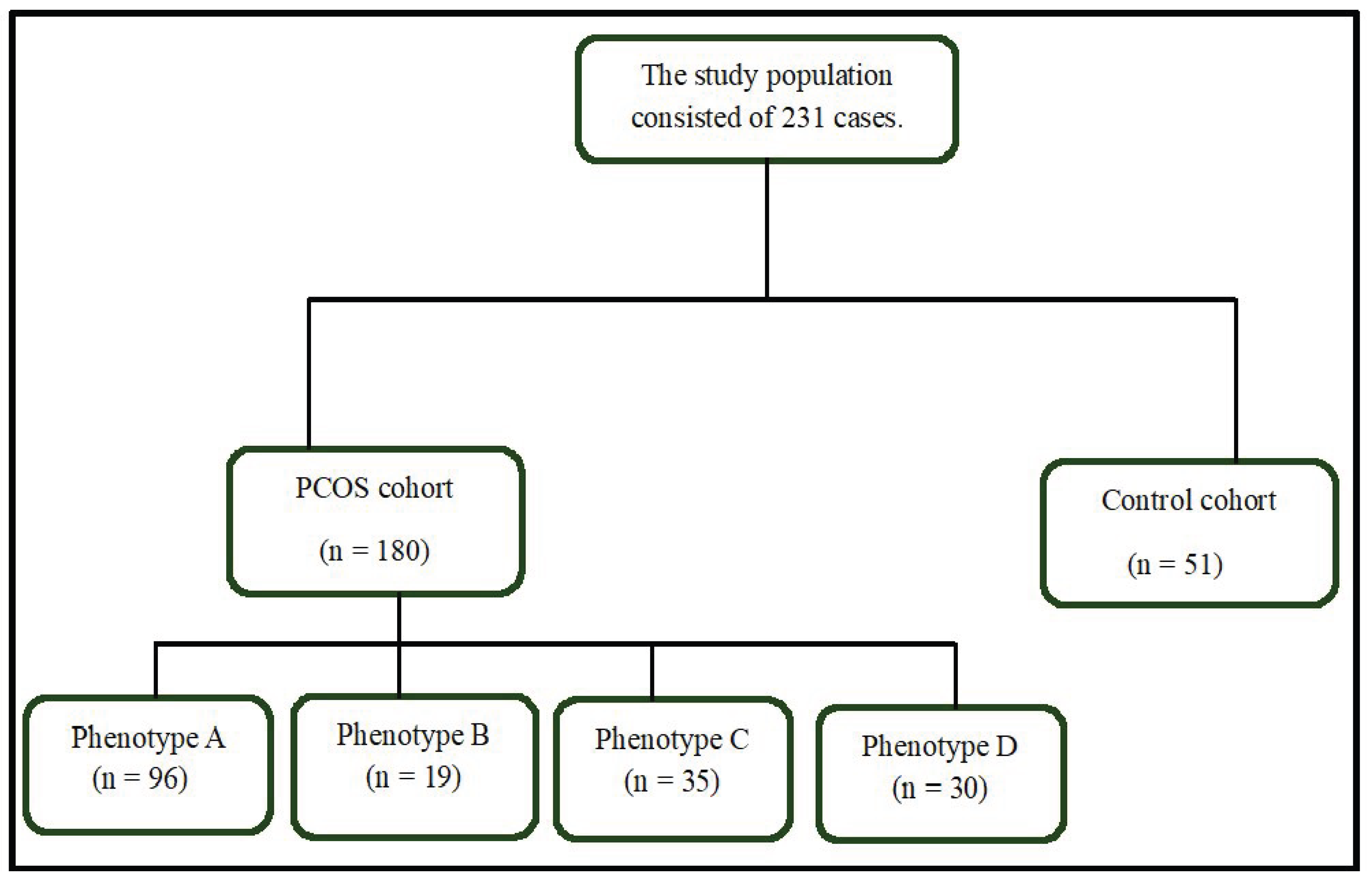

Table 1.
Demographic features of the study population.
| Control Group (n = 51) |
PCOS Subtype 1 (n = 96) | PCOS Subtype 2 (n = 19) | PCOS Subtype 3 (n = 35) | PCOS Subtype 4 (n = 30) | PCOS (n = 180) |
p1 | p2 | p3 | p4 | p5 | p6 | p7 | p8 | p9 | p10 | p11 | |
|---|---|---|---|---|---|---|---|---|---|---|---|---|---|---|---|---|---|
| Age (year) | 23 (22-33) | 25 (18-35) | 22 (18-34) | 25 (18-35) | 24 (20-35) | 24 (18-35) | 0.191 | 0.191 | 0.950 | 0.408 | 0.103 | 0.353 | 0.954 | 0.322 | 0.099 | 0.500 | 0.457 |
| BMI (kg/m²) | 21.48 (17.78-27.34) | 27.19 (17.15-49.77) | 24.83 (15.78-39.84) | 22.14 (15.59-34.08) | 24.88 (17.19-50.22) | 25,49 (15,59-50,22) | < 0.001 | 0.028 | 0.146 | 0.006 | 0.111 | < 0.001 | 0.031 | 0.174 | 0.766 | 0.184 | < 0.001 |
| WC (cm) | 75 (59-100) | 90 (61-129) | 82 (60-120) | 77 (58-105) | 78 (60-116) | 84 (58-129) | < 0.001 | 0.041 | 0.237 | 0.160 | 0.065 | < 0.001 | 0.005 | 0.269 | 0.689 | 0.562 | < 0.001 |
| SBP (mmHg) | 110 (90-130) | 110 (70-150) | 110 (102-160) | 110 (94-140) | 110 (90-140) | 110 (70-160) | 0.076 | 0.152 | 0.774 | 0.728 | 0.783 | 0.199 | 0.065 | 0.185 | 0.043 | 0.544 | 0.194 |
| DBP (mmHg) | 70 (50-90) | 70 (50-93) | 70 (60-90) | 70 (50-90) | 70 (60-90) | 70 (50-93) | 0.048 | 0.227 | 0.799 | 0.580 | 0.846 | 0.040 | 0.035 | 0.146 | 0.125 | 0.721 | 0.239 |
PCOS: Polycystic Ovary Syndrome, BMI: Body Mass Index, WC: Waist Circumference, SBP: Systolic Blood Pressure, DBP: Diastolic Blood Pressure, p1: Comparison between the Control Group and the Phenotype 1, p2: Comparison between the Control Group and the Phenotype 2, p3: Comparison between the Control Group and the Phenotype 3, p4: Comparison between the Control Group and the Phenotype 4, p5: Comparison between the Phenotype 1 and the Phenotype 2, p6: Comparison between the Phenotype 1 and the Phenotype 3, p7: Comparison between the Phenotype 1 and the Phenotype 4, p8: Comparison between the Phenotype 2 and the Phenotype 3, p9: Comparison between the Phenotype 2 and the Phenotype 4, p10: Comparison between the Phenotype 3 and the Phenotype 4, p11 Comparison between patients with or without PCOS. Results are given as median (minimum-maximum).
Table 2.
Some laboratory findings of the study population.
| Control Group (n = 51) |
PCOS Subtype 1 (n = 96) | PCOS Subtype 2 (n = 19) | PCOS Subtype 3 (n = 35) | PCOS Subtype 4 (n = 30) | PCOS (n = 180) |
p1 | p2 | p3 | p4 | p5 | p6 | p7 | p8 | p9 | p10 | p11 | |
|---|---|---|---|---|---|---|---|---|---|---|---|---|---|---|---|---|---|
| Glucose (mg/dL) | 87 (73-98) | 90 ((56-142) | 88 (75-109) | 88 (60-103) | 88 (78-103) | 89 (56-142) | 0.54 | 0.204 | 0.588 | 0.327 | 0.976 | 0.280 | 0.521 | 0.462 | 0.622 | 0.732 | 0.082 |
| Insulin (μU/mL) | 7.32 (2.80-22.00) | 13.70 (3.60-100.50) | 13.60 (4.40-35.70) | 10.10 (2.50-37.80) | 9.60 (2.00-30.50) | 12.59 (2.00-100.50) | < 0.001 | < 0.001 | 0.010 | 0.024 | 0.810 | 0.009 | 0.006 | 0.094 | 0.071 | 0.797 | < 0.001 |
| HOMA-IR | 1.63 (0.58-4.35) | 2.96 (0.77-25.57 | 3.06 (0.92-7.31) | 2.30 (0.55-7.54) | 2.13 (0.38-6.55) | 2.75 (0.38-25.57) | < 0.001 | < 0.001 | 0.120 | 0.024 | 0.775 | 0.008 | 0.008 | 0.094 | 0.071 | 0.813 | < 0.001 |
| PC (mg/dl) | 0.65 (0.60-0.90) | 0.66 (0.50-1.00) | 0.66 (0.60-0.80) | 0.66 (0.50-0.80) | 0.64 (0.50-0.90) | 0.66 (0.50-1.00) | 0.190 | 0.439 | 0.529 | 0.499 | 0.859 | 0.073 | 0.105 | 0.264 | 0.366 | 0.787 | 0.569 |
| CKD-EPI | 122.31 (90.12-129.38) | 121.79 (78.24-137.38) | 119.58 (96.19-132.14) | 123.17 (105.39-137.38) | 123.42 (82.84-136.42) | 122.10 (78.20-137.40) | 0.034 | 0.551 | 0.788 | 0.914 | 0.904 | 0.030 | 0.180 | 0.379 | 0.704 | 0.906 | 0.213 |
| UC (mg/dL) | 103.87 (6.50-381.10) | 126.31 (15.30-419.30) | 120.30 (14.00-330.70) | 96.42 (8.10-246.40) | 137.82 (6.70-395.00) | 122.62 (6.70-419.30) | 0.221 | 0.797 | 0.676 | 0.207 | 0.588 | 0.104 | 0.735 | 0.520 | 0.552 | 0.117 | 0.340 |
| UA mg/L | 15 (5-468) | 22 (5-616) | 45 (5-433) | 12 (5-253) | 15 (4-159) | 21 (4-616) | 0.014 | 0.007 | 0.965 | 0.691 | 0.352 | 0.022 | 0.111 | 0.008 | 0.047 | 0.663 | 0.045 |
| U-ACR mg/g creatinin | 12.38 (5.25-426.62) | 22.81 (3.97-334.43) | 38.95 (5.49-164.72) | 17.78 (5.13-172.63) | 13.62 (2.52-152.99) | 19.66 (2.52-426.62) | 0.143 | 0.018 | 0.513 | 0.876 | 0.096 | 0.526 | 0.135 | 0.056 | 0.016 | 0.445 | 0.156 |
PCOS: Polycystic Ovary Syndrome, BMI: Body Mass Index, WC: Waist Circumference, SBP: Systolic Blood Pressure, DBP: Diastolic Blood Pressure, PC: Plasma Creatinine, UC: Urinary Creatinine, UA: Urinary Albumin, U-ACR: Urinary Albumin-to-Creatinine Ratio, p1: Comparison between the Control Group and the Phenotype 1, p2: Comparison between the Control Group and the Phenotype 2, p3: Comparison between the Control Group and the Phenotype 3, p4: Comparison between the Control Group and the Phenotype 4, p5: Comparison between the Phenotype 1 and the Phenotype 2, p6: Comparison between the Phenotype 1 and the Phenotype 3, p7: Comparison between the Phenotype 1 and the Phenotype 4, p8: Comparison between the Phenotype 2 and the Phenotype 3, p9: Comparison between the Phenotype 2 and the Phenotype 4, p10: Comparison between the Phenotype 3 and the Phenotype 4, p11: Comparison between patients with or without PCOS. Results are presented as median (minimum-maximum).
Table 3.
The number and percentage of cases distributed across groups according to categorized urinary albumin-creatinin ratio levels.
Table 3.
The number and percentage of cases distributed across groups according to categorized urinary albumin-creatinin ratio levels.
| U-ACR category | The Control Group (n = 51) |
Phenotype A (n = 96) |
Phenotype B (n = 19) |
Phenotype C (n = 35) |
Phenotype D (n = 30) |
Total PCOS (n = 180) |
p1 | p2 |
|---|---|---|---|---|---|---|---|---|
| < 29.9 mg/g creatinine | 37 (72.5) | 59 (61.5) | 7 (36.8) | 22 (62.9) | 22 (73.3) | 110 (61.1) | p = 0.105 | p = 0.84 |
| 30-299 mg/g creatinine | 12 (23.5) | 35 (36.5) | 12 (63.2) | 13 (37.1) | 8 (26.7) | 68 (37.8) | ||
| > 300 mg/g creatinine | 2 (3.9) | 2 (2.1) | 0 (0) | 0 (0) | 0 (0) | 2 (1.1) |
PCOS: Polycystic Ovary Syndrome, U-ACR: Urinary albumin-creatinin ratio, p1: Comparison of subgroups among themselves and with the Control Group, p2: Comparison between patients with or without PCOS. Categorical variables were compared using the Pearson chi-square test, as appropriate.
Table 4.
Correlation analysis between selected parameters.
| Age (year) | BMI (kg/m2) | HOMA-IR | U-ACR (mg/g creatinine) | |
|---|---|---|---|---|
| Age (year) | r = 1 | r = 0.235 p < 0.001 |
r = 0.011 p = 0.872 |
r = -0.100 p = 0.128 |
| BMI (kg/m2) | r = 0.235 p < 0.001 |
r = 1 | r = 0.537 p < 0.001 |
r = -0.022 p = 0.738 |
| HOMA-IR | r = 0.011 p = 0.872 |
r = 0.537 p < 0.001 |
r = 1 | r = -0.007 p = 0.920 |
| U-ACR (mg/g creatinine) | r = -0.100 p = 0.128 |
r = -0.022 p = 0.738 |
r = -0.007 p = 0.920 |
BMI: Body Mass Index, HOMA-IR: Homeostasis model assessment-insulin resistance, U-ACR: Urine albumin and creatinine ratio.
Disclaimer/Publisher’s Note: The statements, opinions and data contained in all publications are solely those of the individual author(s) and contributor(s) and not of MDPI and/or the editor(s). MDPI and/or the editor(s) disclaim responsibility for any injury to people or property resulting from any ideas, methods, instructions or products referred to in the content. |
© 2026 by the authors. Licensee MDPI, Basel, Switzerland. This article is an open access article distributed under the terms and conditions of the Creative Commons Attribution (CC BY) license (http://creativecommons.org/licenses/by/4.0/).
Copyright: This open access article is published under a Creative Commons CC BY 4.0 license, which permit the free download, distribution, and reuse, provided that the author and preprint are cited in any reuse.


