

Submitted:
11 March 2026
Posted:
13 March 2026
You are already at the latest version
Abstract
Raman Spectroscopy is non-destructive, label free analytical technique that can probe the biochemical alterations in tissues and cell. Raman Spectroscopy, being sensitive to biochemical perturbations, can potentially provide early and real-time identification of changes proceeding morphological changes, allowing early diagnosis as well as diseases monitoring. Recent research has demonstrated its broad utility across diverse clinical domains, including cancers, neurological conditions and infections.
Raman spectroscopy combined with machine learning algorithms allows rapid assessment and automated pipelines and can act as a clinical adjunct, enhanced by integrating tools like principal component analysis (PCA), linear discriminant analysis (LDA), random forests, and deep learning architectures. These models allow interpretation of complex spectra, and decipher meaningful biomarkers in heterogeneous clinical samples.
This review highlights the earliest and recent progress in Raman based non-destructive diagnosis underscoring advances in cancer diagnosis and challenges faced in clinical settings.
Keywords:
Raman spectroscopy
; Raman imaging
; early diagnosis
; multivariate analysis
; biomarker
1. Introduction
Early and accurate diagnosis is a key factor in disease management. It guides better treatment decisions and improves outcome[1]. There have been rapid advances in field of medical imaging and laboratory technologies in detecting abnormalities, however, even now, cancer is detected late, especially in the developing nations. This leads to a higher incidence and mortality.
Imaging techniques such as computed tomography scan, magnetic resonance imaging and positron emission tomography may provide detailed anatomical images but they are still costly and time consuming and may subject patients to ionizing radiations[2]. They also require specialized expertise in terms of operation and image assessment, and sophisticated infrastructure[3]. Many diseases including cancers, neurodegenerative and metabolic disorders begin with biochemical changes that precede structural alterations and are still a challenge to identify at an early stage.
In case of cancers, histopathology remains the diagnostic gold standard[4]; tissue evaluation typically relies on hematoxylin and eosin (H&E) staining and/or immunohistochemical staining of thin sections followed by pathological assessment. This again requires specialized expertise, making it prone to subjective errors[5]. Moreover, these are not practical for early screening in populated nations owing to time constraints and paucity of experts[6,7]. Other analytical techniques which assay biomolecules in blood, urine or tissue extracts for proteomics and metabolomics often rely on destructive sampling, multiple reagents and time-consuming workflows[8]. These limitations underscore the need for diagnostic methods that are non-destructive, rapid, and painless and can detect early molecular changes without extensive sampling or subjective interpretation.
Optical techniques are gaining popularity in biomedical research and diagnosis due to their high sensitivity, spatial and temporal resolution, lack of ionizing radiation, and ability to perform real-time, multiplexed imaging while being nondestructive[9,10]. Raman spectroscopy (RS) is based on Raman effect, discovered by Sir C. V. Raman (1928)[11]. It provides a fast, non-destructive, and reliable analytical approach that leverages inelastic light scattering to reveal molecular structures and changes in chemical composition through characteristic Raman shifts. Details on basic principles of RS is provided in Section 2.
Cancer diagnostics and prognostics represent a promising application area, offering minimally invasive, real-time, in vivo assessment and detailed molecular profiling. Literature indicates RS has achieved sensitivities of 77–100% and specificities of 45–100% for identifying malignancies[12].Together, RS and machine learning offer an important adjunct to conventional cytological evaluation for diagnosis[13]. It is to be noted that the current article is not a comprehensive literature review or a summary of advancements over a defined time period. In this review, we have discussed earliest and most recent applications of traditional Raman spectroscopy with a goal to highlight the nondestructive attribute that makes RS suitable for exploring cancers and some non-cancerous conditions.
2. Raman Spectroscopy: Basic Principles
Biochemical changes in living systems frequently occur before visible morphological changes, which in turn are also apparent in the optical properties. Optical techniques can be manipulated to exploit the changes in optical properties in response to the biochemical changes that occur due to pathological events in living systems. Often, the optical techniques utilize ultraviolet (UV), visible, near infrared (NIR) and infrared (IR) regions to measure absorption, scattering and/or fluorescence in biological samples.
Optical techniques typically utilize an excitation source, often a laser, to illuminate the sample. The resulting signals are captured by detectors, with modern instruments commonly employing charge-coupled device (CCD) detectors for signal acquisition. In contemporary systems, fiber optic probes are frequently used to transmit light from the excitation source to the sample and to collect the emitted or scattered signals for delivery to the detectors. These probes generally incorporate a combination of optical components—such as lenses, filters, and mirrors—to efficiently guide and isolate the desired signals.
RS is based on the scattering of photons by vibrating molecular bonds and is therefore categorized as a form of vibrational spectroscopy. Depending on the change in energy or frequency, scattered light can be classified as either elastic (no change in energy) or inelastic (with a change in energy). Inelastic scattering corresponds to Raman scattering and is further divided into anti-Stokes scattering, where the scattered photon gains energy, and Stokes scattering, where the scattered photon loses energy. In recent years, RS has shown considerable promise as a nondestructive technique for distinguishing between diseased and healthy tissues. Additionally, multimodal approaches that combine two or more techniques to obtain complementary information simultaneously are increasingly being explored. The Jablonski diagram (Figure 1) represents vibrational spectroscopy based optical phenomena.
Because water—one of the major constituents of living cells and tissues—produces minimal interference in Raman measurements, Raman spectroscopy is well suited for in vivo biomedical investigations. However, since Raman scattering is inherently a weak phenomenon, its early applications in biological systems were quite limited. Advances in instrumentation, including the development of high-power lasers, efficient Rayleigh rejection filters, and improved detection systems such as charge-coupled devices (CCDs), have significantly expanded its use in biological research. In addition, many portable and transportable Raman instruments are now available at comparatively lower costs, further facilitating broader applications. Figure 2 shows a schematic for RS.
RS has found applications in a diverse range of fields including food adulterations, quality control, environmental health and sample characterization[14,15,16,17,18,19,20,21]. The method is versatile and can be applied to a wide range of [22,23]samples, including tissues, individual cells, urine, serum, and can also be applied in vivo using customized probes[19,24,25,26,27].
Variants of conventional RS, such as Surface-Enhanced Raman Spectroscopy (SERS), Coherent Anti-Stokes Raman Scattering (CARS), Spatially Offset Raman Spectroscopy (SORS), and Stimulated Raman Scattering (SRS), further enhance the capabilities of the technique by improving one of more of following attributes: sensitivity, signal strength, imaging speed, and penetration depth. We refer to the cited literature to gain more understanding of these techniques[28,29,30,31,32,33,34,35,36].
3. Methodology
Raman methodology includes sample selection, appropriate parameters for Raman measurements, preprocessing of raw spectra and analysis of the preprocessed spectra to obtain diagnostic information[37,38,39]. Additionally, multimodal approaches may be undertaken to compare and correlate Raman data with other optical/spectroscopic and biological techniques for additional insights[40].
3.1. Sample Selection
Sample selection is an important step, and it depends on the research questions and many practical considerations. Samples may include freshly excised tissues, tissue sections, cultured cells, biofluids (e.g., serum, plasma, urine), hard tissues (bones and teeth), and in vivo measurements in patients and volunteers using fiber-optic or handheld probes[41,42]. Further steps may depend on sample type and their biological and pathological variations of interest with sufficient. For example, tissue may be processed and sectioned for appropriate thickness while cultured cells may be subjected to wash and synchronizations steps before Raman measurements. Another consideration is substrate selection. A substrate is the surface on which sample is placed before measurement. Commonly used substrates include glass, quartz and calcium fluoride.
3.2. Spectral Acquisition Parameters
Once the appropriate sample is selected, Raman spectra are acquired on key parameters which include excitation wavelength, laser power, integration time, spectral range, number of accumulations, and optical configuration. Optimizing laser wavelength, laser power and the type of objectives lead to optimal signal-to-noise ratio (SNR), reduced autofluorescence and minimized sample damage. Usually higher wavelength (near infrared) is preferred to reduce tissue autofluorescence as well as avoid potential tissue damage (for soft tissues and in vivo applications; higher wavelength has lesser energy, E = hc/λ). 532 nm with water immersion objective has been shown to give better results from dental samples[18]. The spectral range generally covers fingerprint and/or high wavenumber regions, capturing vibrational modes of proteins, lipids, nucleic acids, and other biomolecules[42].
3.3. Spectra Preprocessing and Analyses
Preprocessing of spectra is an essential process as raw Raman spectra may contain unwanted components such as spectral noise, cosmic ray spikes, baseline drift due to fluorescence, and intensity variations unrelated to biochemical differences. Preprocessing commonly involves all or a combination of the following steps: removal of cosmic spikes, background/baseline corrections, normalization and smoothing[43]. These steps make spectra comparable across samples[44].
The preprocessed spectra are suitable for further statistical and multivariate analysis through unsupervised as well as supervised methodologies. Commonly applied are principal component analysis (PCA), T-distributed stochastic neighbor embedding (tSNE), linear discriminant analysis (LDA), support vector machine (SVM), partial least squares (PLS), and recently, deep learning based approaches including autoencoders, convolutional neural network (CNN) and artificial neural network (ANN) that can extract diagnostic information from complex spectral datasets[41,45,46,47,48]. For details on preprocessing, multivariate analysis and machine/deep learning classifiers, readers can refer to the cited articles.
4. Applications of Raman Spectroscopy in Clinical Diagnosis
RS has been widely applied in cancer diagnosis. It is being used for tissue classification, cytological exploration, healthy mucosa characterization, intraoperative margin assessment, and liquid-biopsy style screening. It spans from usage of ex vivo tissue section and fresh surgical specimens, in vivo fiber-optic/endoscopic measurements, and biofluids for non-invasive screening[19,49,50,51]. Table 1 summarizes the founding study for non destructive application of RS on major cancers.
4.1. Oral Cancer
Oral cancer is widely explored using RS. In spite of advancements and general access of oral cavity, the survival rate for oral cancers is surprisingly low, especially in the South Asia where oral cancer is endemic[52,53,54]. One of the earliest studies by Venkatkrishna et al in 2001 explored differences between oral and malignant tissues [55]. Raman spectroscopy has been a promising technology in assessing oral cancer progression, identifying differences between cancer stages in patients and healthy volunteers, and diagnostic exploration using cells, tissues, and liquid biopsy approaches[56,57,58,59,60,61,62]. Some of the founding studies in Raman oral cancers has come from Murali Krishna group involving tissues, in vivo studies, exfoliated cells, biofluids and animal studies[10,14,16,63,64,65,66,67,68,69,70,71,72,73,74,75].
4.2. Breast and Cervical Cancers
Breast and cervical cancers are the most common cancers in females. Breast cancer is also the second most common cancer overall[76]. Thus, early intervention can decrease the incidence and mortality in both cases. Mammogram and fine needle aspiration and cytology are the gold standard for breast cancer diagnosis while Pap smear is primarily used for screening cervical cancers. Raman studies on breast cancers have been reviewed by Katie et al[77]. Major biochemical distinctions between normal and abnormal breast tissue are in terms of lipids, proteins and carotenoids. The earliest Raman studies of breast tissues were by Liu et al (1991)[78]. Recent studies have explored tissues[79] using machine learning and cells using deep learning classifiers[80].
Cervical cancers have been explored through tissues as well as in vivo approaches. The earliest studies were by Mahadevan-Jansen et al to distinguish cervical precancers[81] and other confounding factors[82,83,84]. A new study has tried to integrate Raman, AFM, and electron microscopy to gain insights on biochemical signatures as well as surface morphology from cervical tissues[85].
4.3. Colorectal and Gastric Cancer
Various studies have demonstrated the potential of in vivo Raman spectroscopy being a valuable tool in colon cancer diagnosis. The non- invasive technique allows fast and accurate detection, potentially allowing early intervention. Several studies have reported high accuracy in distinguishing normal mucosa, adenomas and adenocarcinoma, while coupling Raman spectroscopy with advanced machine learning[86]. Gastric cancer studies similarly cover serum SERS assays, tissue section mapping, and endoscopic in vivo Raman, with reviews summarizing both in vitro/ex vivo and in vivo results[87]. Biofluid based studies are minimally invasive in these cases and have been explored using serum by several groups[88,89,90].
4.4. Brain Cancer
Several types of brain cancers explored using RS have been reviewed by Kumar[15]. Mizuno eta (1994) applied Fourier transformed RS spectra to distinguish normal, edematous gray, and white matter using ex vivo approach. In vivo studies under operative conditions have been explored by F Leblond group[91,92]. The same group continues to explore different aspects of Raman exploration in different brain tumors including adenoma and glioblastoma[93,94,95,96]. Glioblastoma can be highly aggressive and often recur. Kaur et al have explore unique spectral markers for recurrent Glioblastoma cells[97]. Sahu et al have also looked at discriminatory potential of serum samples for meningioma detection [98].
4.5. Other Cancers
Skin: Real-time, in vivo Raman spectroscopy have been applied to skin cancer diagnosis for non-invasive differentiation of melanoma, basal cell carcinoma, squamous cell carcinomas actinic keratoses, atypical nevi, melanocytic nevi, blue nevi, and seborrheic keratoses. The findings suggested that RS can be applied in real time to distinguishing malignant and benign skin lesions[99]. A recent report has shown utility of multimodal tools besides RS, including optical coherence tomography, photoacoustic tomography and ultrasound[100].
Liver carcinoma: A recent study by Huang et al used a handheld probe for intraoperative liver cancer detection. After surgery the tissues were also collected to detect metabolic differences via LC-MS. In the same study, 240 tissue samples from 120 patients were also employed[101].
4.6. Neurological/Neurodegenerative Disorders
Raman spectroscopy has been explored for diagnosis of neurodegenerative disease from biofluids[13]. Studies have analyzed CSF and plasma/serum Raman spectra for Alzheimer’s Disease classification, with machine-learning aiding discrimination of disease states[102]. Separately, engineered intracranial Raman probes (preclinical) have been piloted for real-time Traumatic brain injury (TBI) monitoring[103]. Alix et al did a follow up study on Amyotrophic lateral sclerosis (ALS) patients to identify spectral patterns [104]. In another Raman serum investigation, patients with ADHD, bipolar disorder, and healthy controls were identified with 97.4% accuracy[105].
4.7. Atherosclerosis
Animal studies have shown ability of RS to characterize plaque (cholesterol, lipid, calcification) and differentiate vulnerable and stable lesions[106]. Fiber-optic and catheter-based Raman probes (integrated with intravascular imaging modalities) have been developed for intravascular plaque assessment[107]. Recently Kesic et al have used serum for identification of atherosclerotic carotid stenosis[108].
4.8. Infections and Pathogen Identification
RS have been used for rapid, label-free identification of bacteria and other pathogens, with several groups demonstrating species-level discrimination and even antibiotic-resistance phenotyping involving large spectral databases as well as deep-learning models. Recent studies report promising clinical-sample workflows for bloodstream infections aiming to reduce culture time[109]. RS has been extensively explored for bacterial species characterization in Popp group[110,111].
Malaria & Dengue: Malaria and Dengue are tropical infectious diseases which affect RBCs and cause significant morbidity and mortality[112]. Circulating RBCs are affected by the infectious pathogen and are susceptible to RBC programmed eryptosis or RBC programmed necrosis. Raman features can distinguish RBCs in healthy and diseased states[113]. Healthy, dengue and malaria serum samples was used by Patel et al to achieve good classifications using PC-LDA [114]. Khan et al have used different multivariate methods to explore dengue serum samples[115,116,117].
COVID-19: The COVID-19 pandemic created an urgent need for tests that are fast, reliable, and easy to use at the point of care. RS based diagnosis is especially useful in view of frequent false negative results through rapid methods. Serum based RS has shown good classification in recent studies[118,119]. In an interesting study, besides Raman exploration, antibody levels were also measures in patients and the study reported 100% sensitivity in differentiating patients at different stages post infection[120].
5. Discussion
Raman spectroscopy has demonstrated tremendous potential as a non-destructive diagnostic technique across a wide range of clinical conditions. The ability to obtain label-free biochemical fingerprints from a wide range of specimens like tissues, biofluids, and even directly from patients in vivo makes RS a unique diagnostic method. Nevertheless, despite these advantages, several barriers still limit widespread clinical adoption.
There is still scope of improvements in signal to noise ratio, fluorescence background reduction, and data analysis pipelines. Recent improvements in instrumentation and machine learning, along with enhanced methods like SERS have helped address some of these limitations. Continued progress will likely expand its clinical use. Achieving full clinical translation will require multi-center and multidisciplinary collaborations between researchers, clinicians, optical engineers, data analysis and statistical[121,122]. Differences in instrument configuration, spectral pre-processing methods, and data labeling can hinder reproducibility across laboratories. Establishing standardized acquisition protocols, harmonized preprocessing pipelines, and shared spectral libraries will be crucial to advancing Raman-based diagnostics from exploratory studies to routine clinical use. While Raman studies in vivo are convenient at accessible sites like oral cavity and skin, integration with modalities like endoscopes and colonoscopes can be useful in gastrointestinal cases. In other cases, biofluid based diagnostic programs can be useful wherein samples can be collected and transported to a central facility for initial screening. Positive cases can be followed up and confirmed via traditional gold standards. Integration of Raman spectroscopy with complementary imaging modalities further strengthens diagnostic capability and reflects a broader move toward multimodal precision diagnostics.
6. Conclusions
Raman spectroscopy represents a rapidly evolving optical tool with strong applications for non-destructive biomedical diagnosis. By probing characteristic vibrational signatures of biomolecules, it enables detailed insight into cellular and extracellular composition without the need for exogenous labels or chemical processing or destructive methodologies. Applications across cancers, neurodegenerative disease, infections, and metabolic disorders consistently demonstrate its potential to detect biochemical alterations that precede gross structural changes.
Ongoing improvements in hardware, signal enhancement techniques, and advanced data analytics are steadily overcoming traditional limitations related to sensitivity, speed, processing time and interpretability. As clinical validation studies increase in scale and standardization improves, Raman spectroscopy is poised to transition from ‘bench-side to bedside’, acting as a practical adjunct in clinical diagnostics, surgical guidance, and personalized medicine. In summary, Raman spectroscopy when combined with enhanced modalities and machine learning offers a powerful, non-destructive approach to biomedical diagnosis.
Author Contributions
Aishwarya wrote the first draft. Aditi and Piyush conceptualized the article. All the authors prepared and edited the manuscript.
Acknowledgments
This work was not supported by any grant from funding agencies.
References
- Rosenberg, A.; DeBusk, L.; Shah, M.; Burshtein, J.; Zakria, D.; Rigel, D. Updated Techniques for Melanoma Diagnosis. Dermatologic clinics 2025, 43, 433–442. [Google Scholar] [CrossRef] [PubMed]
- Hussain, S.; Mubeen, I.; Ullah, N.; Shah, S.S.U.D.; Khan, B.A.; Zahoor, M.; Ullah, R.; Khan, F.A.; Sultan, M.A. Modern diagnostic imaging technique applications and risk factors in the medical field: a review. BioMed research international 2022, 2022, 5164970. [Google Scholar] [CrossRef] [PubMed]
- Liu, F.; Yao, Y.; Zhu, B.; Yu, Y.; Ren, R.; Hu, Y. The novel imaging methods in diagnosis and assessment of cerebrovascular diseases: an overview. Frontiers in medicine 2024, 11, 1269742–1269742. [Google Scholar] [CrossRef] [PubMed]
- Tseng, L.-J.; Matsuyama, A.; MacDonald-Dickinson, V. Histology: The gold standard for diagnosis? The Canadian veterinary journal = La revue veterinaire canadienne 2023, 64, 389–391. [Google Scholar] [PubMed]
- Coudray, N.; Ocampo, P.S.; Sakellaropoulos, T.; Narula, N.; Snuderl, M.; Fenyö, D.; Moreira, A.L.; Razavian, N.; Tsirigos, A. Classification and mutation prediction from non–small cell lung cancer histopathology images using deep learning. Nature Medicine 2018, 24, 1559–1567. [Google Scholar] [CrossRef]
- Haier, J.; Sleeman, J.; Schäfers, J. Editorial series: cancer care in low-and middle-income countries. Clinical & Experimental Metastasis 2019, 36, 477–480. [Google Scholar]
- Yadav, K.; Cree, I.; Field, A.; Vielh, P.; Mehrotra, R. Importance of cytopathologic diagnosis in early cancer diagnosis in resource-constrained countries. JCO Global Oncology 2022, 8, e2100337. [Google Scholar] [CrossRef]
- Kralova, K.; Vrtelka, O.; Fouskova, M.; Smirnova, T.A.; Michalkova, L.; Hribek, P.; Urbanek, P.; Kuckova, S.; Setnicka, V. Comprehensive spectroscopic, metabolomic, and proteomic liquid biopsy in the diagnostics of hepatocellular carcinoma. Talanta 2024, 270, 125527–125527. [Google Scholar] [CrossRef]
- Guo, M.; Hu, X.; Du, W. Near-Infrared-II Fluorescence Imaging of Tumors with Organic Small-Molecule Fluorophores. Sensors (Basel, Switzerland) 2025, 25. [Google Scholar] [CrossRef]
- Kumar, P.; Murali Krishna, C. Optical techniques: investigations in oral cancers. Oral cancer detection: novel strategies and clinical impact 2019, 167–187. [Google Scholar]
- Raman, C.V.; Krishnan, K.S. A new type of secondary radiation. Nature 1928, 121, 501–502. [Google Scholar] [CrossRef]
- Kouri, M.A.; Spyratou, E.; Karnachoriti, M.; Kalatzis, D.; Danias, N.; Arkadopoulos, N.; Seimenis, I.; Raptis, Y.S.; Kontos, A.G.; Efstathopoulos, E.P. Raman Spectroscopy: A Personalized Decision-Making Tool on Clinicians' Hands for In Situ Cancer Diagnosis and Surgery Guidance. Cancers 2022, 14. [Google Scholar] [CrossRef]
- Zhang, Y.; Yu, H.; Li, Y.; Xu, H.; Yang, L.; Shan, P.; Du, Y.; Yan, X.; Chen, X. Raman spectroscopy: A prospective intraoperative visualization technique for gliomas. Frontiers in oncology 2022, 12, 1086643–1086643. [Google Scholar] [CrossRef]
- Kumar, P.; Bhattacharjee, T.; Pandey, M.; Hole, A.; Ingle, A.; Murali Krishna, C. Raman spectroscopy in experimental oral carcinogenesis: investigation of abnormal changes in control tissues. J Raman Spectrosc 2016, 47, 1318–1326. [Google Scholar] [CrossRef]
- Kumar, P. Raman spectroscopy as a promising noninvasive tool in brain cancer detection. Journal of Innovative Optical Health Sciences 2017, 10, 1730012. [Google Scholar] [CrossRef]
- Hole, A.; Bhujbal, M.; Bendale, K.; Kumar, P.; Gera, P.; Krishna, C.M.; Chaudhari, P. Preliminary study of canine oral cancer by Raman spectroscopy. In Proceedings of the Optics and Biophotonics in Low-Resource Settings V, 2019; p. 1086917. [Google Scholar]
- Austin, C.; Kumar, P.; Carter, E.A.; Lee, J.; Smith, T.M.; Hinde, K.; Arora, M.; Lay, P.A. Stress exposure histories revealed by biochemical changes along accentuated lines in teeth. Chemosphere 2023, 329, 138673. [Google Scholar] [CrossRef]
- Kumar, P.; Austin, C. Signal collection through water-immersion objectives improves Raman spectral quality from dental tissues. In Proceedings of the Lasers in Dentistry XXVIII, 2022; p. 1194202. [Google Scholar]
- Kumar, P.; Sahu, A. Serum Raman spectroscopy-based biomedical diagnostics. In Spectroscopic Techniques for Cancer Diagnostics; IOP Publishing Bristol, UK, 2025; p. pp. 9–1–9–18. [Google Scholar]
- Kumar, P. Optoexposomics: Integrating biophotonics and exposomics towards precision health. In Proceedings of the Biomedical Vibrational Spectroscopy 2026: Advances in Research and Industry, San Francisco, 2026. [Google Scholar]
- Kumar, P.; Maroli, A.; Martinez, M.; Petrik, L.; Arora, M. Rapid screening of exposome in urban and semi-urban settings using silicone wrist bands. In Proceedings of the Optical Fibers and Sensors for Medical Diagnostics, Treatment, and Environmental Applications XXVI, San Francisco, 2026; p. 2026. [Google Scholar]
- Bhattacharjee, T.; Khan, A.; Kumar, P.; Ingle, A.; Maru, G.; Krishna, C.M. Raman spectroscopy of serum: A study on 'pre' and 'post' breast adenocarcinoma resection in rat models. J Biophotonics 2015, 8, 575–583. [Google Scholar] [CrossRef]
- Bhattacharjee, T.; Kumar, P.; Maru, G.; Ingle, A.; Krishna, C.M. Swiss bare mice: a suitable model for transcutaneous in vivo Raman spectroscopic studies of breast cancer. Lasers in medical science 2014, 29, 325–333. [Google Scholar] [CrossRef]
- Zhang, S.; Qi, Y.; Tan, S.P.H.; Bi, R.; Olivo, M. Molecular Fingerprint Detection Using Raman and Infrared Spectroscopy Technologies for Cancer Detection: A Progress Review. Biosensors (Basel) 2023, 13. [Google Scholar] [CrossRef] [PubMed]
- Sun, W.; Liao, L.; Zhu, R.; Wang, Y.; Chen, K.; Hou, G.; Chen, S. Precise diagnosis of small cell and non-small cell lung cancer based on Raman spectroscopy. Photodiagnosis and photodynamic therapy 2025, 55, 104747–104747. [Google Scholar] [CrossRef]
- Kumamoto, Y.; Harada, Y.; Takamatsu, T.; Tanaka, H. Label-free Molecular Imaging and Analysis by Raman Spectroscopy. Acta histochemica et cytochemica 2018, 51, 101–110. [Google Scholar] [CrossRef] [PubMed]
- Singh, S.; Deshmukh, A.; Chaturvedi, P.; Murali Krishna, C. In vivo Raman spectroscopic identification of premalignant lesions in oral buccal mucosa. Journal of biomedical optics 2012, 17, 105002–105002. [Google Scholar] [CrossRef]
- Pilot, R.; Signorini, R.; Durante, C.; Orian, L.; Bhamidipati, M.; Fabris, L. A Review on Surface-Enhanced Raman Scattering. Biosensors 2019, 9. [Google Scholar] [CrossRef]
- Tahir, M.A.; Dina, N.E.; Cheng, H.; Valev, V.K.; Zhang, L. Surface-enhanced Raman spectroscopy for bioanalysis and diagnosis. Nanoscale 2021, 13, 11593–11634. [Google Scholar] [CrossRef] [PubMed]
- Djaker, N.; Lenne, P.-F.; Marguet, D.; Colonna, A.; Hadjur, C.; Rigneault, H. Coherent anti-Stokes Raman scattering microscopy (CARS): Instrumentation and applications. Nuclear Instruments and Methods in Physics Research Section A: Accelerators, Spectrometers, Detectors and Associated Equipment 2007, 571, 177–181. [Google Scholar] [CrossRef]
- Matousek, P. Spatially offset Raman spectroscopy for non-invasive analysis of turbid samples. TrAC Trends in Analytical Chemistry 2018, 103, 209–214. [Google Scholar] [CrossRef]
- Tipping, W.J.; Faulds, K.; Graham, D. Advances in Super-resolution Stimulated Raman Scattering Microscopy. Chemical & biomedical imaging 2024, 2, 733–743. [Google Scholar] [CrossRef]
- Itoh, T.; Procházka, M.; Dong, Z.-C.; Ji, W.; Yamamoto, Y.S.; Zhang, Y.; Ozaki, Y. Toward a new era of SERS and TERS at the nanometer scale: From fundamentals to innovative applications. Chemical reviews 2023, 123, 1552–1634. [Google Scholar] [CrossRef]
- Nishiyama, R.; Furuya, K.; Tamura, T.; Nakao, R.; Peterson, W.; Hiramatsu, K.; Ding, T.; Goda, K. Fourier Transform Coherent Anti-Stokes Raman Scattering Spectroscopy: A Comprehensive Review. Analytical Chemistry 2024, 96, 18322–18336. [Google Scholar] [CrossRef] [PubMed]
- Lux, A.; Conti, C.; Botteon, A.; Mosca, S.; Matousek, P. Theoretical and Practical Considerations of Spatially Offset Raman Spectroscopy (SORS) and Micro-SORS. Applied Spectroscopy 2025(79), 919–932. [CrossRef]
- Min, W.; Cheng, J.-X.; Ozeki, Y. Theory, innovations and applications of stimulated Raman scattering microscopy. Nature Photonics 2025, 19, 803–816. [Google Scholar] [CrossRef]
- Butler, H.J.; Ashton, L.; Bird, B.; Cinque, G.; Curtis, K.; Dorney, J.; Esmonde-White, K.; Fullwood, N.J.; Gardner, B.; Martin-Hirsch, P.L. Using Raman spectroscopy to characterize biological materials. Nature protocols 2016, 11, 664–687. [Google Scholar] [CrossRef]
- Traynor, D.; Behl, I.; O’dea, D.; Bonnier, F.; Nicholson, S.; O’connell, F.; Maguire, A.; Flint, S.; Galvin, S.; Healy, C.M. Raman spectral cytopathology for cancer diagnostic applications. Nature Protocols 2021, 16, 3716–3735. [Google Scholar] [CrossRef]
- Haugen, E.J.; Gautam, R.; Locke, A.K.; Mahadevan-Jansen, A. In vivo Raman spectroscopy for real-time biochemical assessment of tissue pathology and physiology. Nature Protocols 2026, 1–29. [Google Scholar] [CrossRef] [PubMed]
- Fedorov Kukk, A.; Wu, D.; Gaffal, E.; Panzer, R.; Emmert, S.; Roth, B. Multimodal system for optical biopsy of melanoma with integrated ultrasound, optical coherence tomography and Raman spectroscopy. Journal of Biophotonics 2022, 15, e202200129. [Google Scholar] [CrossRef]
- Guo, S.; Popp, J.r.; Bocklitz, T. Key Steps in the Workflow to Analyze Raman Spectra. Spectroscopy 2023, 30–33. [Google Scholar] [CrossRef]
- Qi, Y.; Chen, E.X.; Hu, D.; Yang, Y.; Wu, Z.; Zheng, M.; Sadi, M.A.; Jiang, Y.; Zhang, K.; Chen, Z.; et al. Applications of Raman spectroscopy in clinical medicine. Food Frontiers 2024, 5, 392–419. [Google Scholar] [CrossRef]
- Wahl, J.; Klint, E.; Hallbeck, M.; Hillman, J.; Wårdell, K.; Ramser, K. Impact of preprocessing methods on the Raman spectra of brain tissue. Biomed. Opt. Express 2022, 13, 6763–6763. [Google Scholar] [CrossRef] [PubMed]
- Yan, C. A review on spectral data preprocessing techniques for machine learning and quantitative analysis. iScience 2025, 28, 112759–112759. [Google Scholar] [CrossRef]
- Boateng, D. Advances in deep learning-based applications for Raman spectroscopy analysis: A mini-review of the progress and challenges. Microchemical Journal 2025, 209, 112692–112692. [Google Scholar] [CrossRef]
- Guo, S.; Popp, J.; Bocklitz, T. Chemometric analysis in Raman spectroscopy from experimental design to machine learning–based modeling. Nature protocols 2021, 16, 5426–5459. [Google Scholar] [CrossRef]
- Luo, R.; Popp, J.; Bocklitz, T. Deep learning for Raman spectroscopy: A review. Analytica 2022, 3, 287–301. [Google Scholar] [CrossRef]
- Boateng, D. Advances in deep learning-based applications for Raman spectroscopy analysis: A mini-review of the progress and challenges. Microchemical Journal 2025, 112692. [CrossRef]
- Cui, S.; Zhang, S.; Yue, S. Raman Spectroscopy and Imaging for Cancer Diagnosis. Journal of Healthcare Engineering 2018, 2018, 1–11. [Google Scholar] [CrossRef]
- Blake, N.; Gaifulina, R.; Griffin, L.D.; Bell, I.M.; Thomas, G.M. Machine learning of Raman spectroscopy data for classifying cancers: a review of the recent literature. Diagnostics 2022, 12, 1491. [Google Scholar] [CrossRef] [PubMed]
- Auner, G.W.; Koya, S.K.; Huang, C.; Broadbent, B.; Trexler, M.; Auner, Z.; Elias, A.; Mehne, K.C.; Brusatori, M.A. Applications of Raman spectroscopy in cancer diagnosis. Cancer and Metastasis Reviews 2018, 37, 691–717. [Google Scholar] [CrossRef]
- Le Campion, A.C.O.V.; Ribeiro, C.M.B.; Luiz, R.R.; da Silva Júnior, F.F.; Barros, H.C.S.; Dos Santos, K.d.C.B.; Ferreira, S.J.; Gonçalves, L.S.; Ferreira, S.M.S. Low survival rates of oral and oropharyngeal squamous cell carcinoma. International journal of dentistry 2017, 2017, 5815493. [Google Scholar] [CrossRef] [PubMed]
- Zini, A.; Czerninski, R.; Sgan-Cohen, H.D. Oral cancer over four decades: epidemiology, trends, histology, and survival by anatomical sites. Journal of oral pathology & medicine 2010, 39, 299–305. [Google Scholar]
- Sankaranarayanan, R.; Ramadas, K.; Thomas, G.; Muwonge, R.; Thara, S.; Mathew, B.; Rajan, B. Effect of screening on oral cancer mortality in Kerala, India: a cluster-randomised controlled trial. The Lancet 2005, 365, 1927–1933. [Google Scholar] [CrossRef]
- Venkatakrishna, K.; Kurien, J.; Pai, K.M.; Valiathan, M.; Kumar, N.N.; Murali Krishna, C.; Ullas, G.; Kartha, V. Optical pathology of oral tissue: a Raman spectroscopy diagnostic method. Current science 2001, 80, 665–669. [Google Scholar]
- Hanna, K.; Asiedu, A.-L.; Theurer, T.; Muirhead, D.; Speirs, V.; Oweis, Y.; Abu-Eid, R. Advances in Raman spectroscopy for characterising oral cancer and oral potentially malignant disorders. Expert reviews in molecular medicine 2024, 26, e25–e25. [Google Scholar] [CrossRef]
- Byrne, H.J.; Behl, I.; Calado, G.; Ibrahim, O.; Toner, M.; Galvin, S.; Healy, C.M.; Flint, S.; Lyng, F.M. Biomedical applications of vibrational spectroscopy: Oral cancer diagnostics. Spectrochimica Acta Part A: Molecular and Biomolecular Spectroscopy 2021, 252, 119470–119470. [Google Scholar] [CrossRef]
- Hanna, K.; Asiedu, A.-L.; Theurer, T.; Muirhead, D.; Speirs, V.; Oweis, Y.; Abu-Eid, R. Advances in Raman spectroscopy for characterising oral cancer and oral potentially malignant disorders. Expert Reviews in Molecular Medicine 2024, 26, e25. [Google Scholar] [CrossRef] [PubMed]
- Aaboubout, Y.; Soares, M.R.N.; Schut, T.C.B.; Barroso, E.M.; van der Wolf, M.; Sokolova, E.; Artyushenko, V.; Bocharnikov, A.; Usenov, I.; van Lanschot, C.G. Intraoperative assessment of resection margins by Raman spectroscopy to guide oral cancer surgery. Analyst 2023, 148, 4116–4126. [Google Scholar] [CrossRef] [PubMed]
- Li, X.; Li, L.; Sun, Q.; Chen, B.; Zhao, C.; Dong, Y.; Zhu, Z.; Zhao, R.; Ma, X.; Yu, M. Rapid multi-task diagnosis of oral cancer leveraging fiber-optic Raman spectroscopy and deep learning algorithms. Frontiers in Oncology 2023, 13, 1272305. [Google Scholar] [CrossRef] [PubMed]
- Behl, I.; Calado, G.; Vishwakarma, A.; Traynor, D.; Flint, S.; Galvin, S.; Healy, C.M.; Pimentel, M.L.; Malkin, A.; Byrne, H.J.; et al. Classification of cytological samples from oral potentially malignant lesions through Raman spectroscopy: A pilot study. Spectrochim Acta A Mol Biomol Spectrosc 2022, 266, 120437. [Google Scholar] [CrossRef]
- Behl, I.; Calado, G.; Vishwakarma, A.; Traynor, D.; Flint, S.; Galvin, S.; Healy, C.M.; Malkin, A.; Byrne, H.J.; Lyng, F.M. Identification of high-risk oral leukoplakia (OLK) using combined Raman spectroscopic analysis of brush biopsy and saliva samples: A proof of concept study. Spectrochimica Acta Part A: Molecular and Biomolecular Spectroscopy 2025(330), 125721. [CrossRef]
- Sahu, A.; Deshmukh, A.; Ghanate, A.; Singh, S.; Chaturvedi, P.; Krishna, C.M. Raman spectroscopy of oral buccal mucosa: a study on age-related physiological changes and tobacco-related pathological changes. Technology in cancer research & treatment 2012, 11, 529–541. [Google Scholar]
- Singh, S.; Deshmukh, A.; Chaturvedi, P.; Krishna, C.M. In vivo Raman spectroscopy for oral cancers diagnosis. In Proceedings of the SPIE BiOS, 2012; p. pp. 82190K–82190K–82196. [Google Scholar]
- Sahu, A.; Nandakumar, N.; Sawant, S.; Krishna, C.M. Recurrence prediction in oral cancers: a serum Raman spectroscopy study. Analyst 2015, 140, 2294–2301. [Google Scholar] [CrossRef]
- Sahu, A.; Sawant, S.; Talathi-Desai, S.; Murali Krishna, C. Raman spectroscopy of serum: a study on oral cancers. Biomedical Spectroscopy and Imaging 2015, 4, 171–187. [Google Scholar] [CrossRef]
- Kumar, P.; Bhattacharjee, T.; Ingle, A.; Maru, G.; Krishna, C.M. Raman Spectroscopy of Experimental Oral Carcinogenesis: Study on Sequential Cancer Progression in Hamster Buccal Pouch Model. Technol Cancer Res Treat 2016, 15, NP60–72. [Google Scholar] [CrossRef] [PubMed]
- Malik, A.; Sahu, A.; Singh, S.P.; Deshmukh, A.; Chaturvedi, P.; Nair, D.; Nair, S.; Murali Krishna, C. In vivo Raman spectroscopy-assisted early identification of potential second primary/recurrences in oral cancers: An exploratory study. Head Neck 2017, 39, 2216–2223. [Google Scholar] [CrossRef]
- Kumar, P.; Ingle, A.; Krishna, C.M. In vivo Raman spectroscopy: monitoring cancer progression post carcinogen withdrawal. In Proceedings of the Optical Imaging, Therapeutics, and Advanced Technology in Head and Neck Surgery and Otolaryngology, 2019, 2019; p. 108530K. [Google Scholar]
- Hole, A.; Tyagi, G.; Deshmukh, A.; Deshpande, R.; Gota, V.; Chaturvedi, P.; Krishna, C.M. Salivary Raman Spectroscopy: Standardization of Sampling Protocols and Stratification of Healthy and Oral Cancer Subjects. Appl Spectrosc 2021, 75, 581–588. [Google Scholar] [CrossRef]
- Saha, P.; Sawant, S.; Deshmukh, A.; Hole, A.; Murali Krishna, C. Serum Raman spectroscopy: Prognostic applications in oral cancers. Head & Neck 2023, 45, 1244–1254. [Google Scholar] [CrossRef] [PubMed]
- Hole, A.; Bendale, K.; Gera, P.; Chaudhari, P.; Krishna, C.M. Raman spectroscopy of canine cancer to differentiate oral malignancy. In Proceedings of the European Conference on Biomedical Optics, 2025; p. M4A. 4. [Google Scholar]
- Sahu, A.; Sawant, S.; Mamgain, H.; Krishna, C.M. Raman spectroscopy of serum: an exploratory study for detection of oral cancers. Analyst 2013, 138, 4161–4174. [Google Scholar] [CrossRef] [PubMed]
- Sahu, A.K.; Dhoot, S.; Singh, A.; Sawant, S.S.; Nandakumar, N.; Talathi-Desai, S.; Garud, M.; Pagare, S.; Srivastava, S.; Nair, S. Oral cancer screening: serum Raman spectroscopic approach. Journal of biomedical optics 2015, 20, 115006–115006. [Google Scholar] [CrossRef]
- Singh, S.; Sahu, A.; Deshmukh, A.; Chaturvedi, P.; Krishna, C.M. In vivo Raman spectroscopy of oral buccal mucosa: a study on malignancy associated changes (MAC)/cancer field effects (CFE). Analyst 2013, 138, 4175–4182. [Google Scholar] [CrossRef] [PubMed]
- Bray, F.; Laversanne, M.; Sung, H.; Ferlay, J.; Siegel, R.L.; Soerjomataram, I.; Jemal, A. Global cancer statistics 2022: GLOBOCAN estimates of incidence and mortality worldwide for 36 cancers in 185 countries. CA: a cancer journal for clinicians 2024, 74, 229–263. [Google Scholar] [CrossRef]
- Hanna, K.; Krzoska, E.; Shaaban, A.M.; Muirhead, D.; Abu-Eid, R.; Speirs, V. Raman spectroscopy: current applications in breast cancer diagnosis, challenges and future prospects. British journal of cancer 2022, 126, 1125–1139. [Google Scholar] [CrossRef]
- Liu, C.; Alfano, R.; Sha, W.; Zhu, H.; Akins, D.; Cleary, J.; Prudente, R.; Cellmer, E. Human breast tissues studied by IR Fourier-transform Raman spectroscopy. In Proceedings of the Conference on lasers and electro-optics, 1991; p. CWF51. [Google Scholar]
- David, S.; Tran, T.; Dallaire, F.; Sheehy, G.; Azzi, F.; Trudel, D.; Tremblay, F.; Omeroglu, A.; Leblond, F.; Meterissian, S. In situ Raman spectroscopy and machine learning unveil biomolecular alterations in invasive breast cancer. Journal of Biomedical Optics 2023, 28, 036009–036009. [Google Scholar] [CrossRef]
- Li, J.; Wang, X.; Min, S.; Xia, J.; Li, J. Raman spectroscopy combined with convolutional neural network for the sub-types classification of breast cancer and critical feature visualization. Computer Methods and Programs in Biomedicine 2024, 255, 108361. [Google Scholar] [CrossRef] [PubMed]
- Mahadevan-Jansen, A.; Mitchell, M.F.; Ramanujamf, N.; Malpica, A.; Thomsen, S.; Utzinger, U.; Richards-Kortumt, R. Near-infrared Raman spectroscopy for in vitro detection of cervical precancers. Photochemistry and photobiology 1998, 68, 123–132. [Google Scholar]
- Kanter, E.M.; Vargis, E.; Majumder, S.; Keller, M.D.; Woeste, E.; Rao, G.G.; Mahadevan-Jansen, A. Application of Raman spectroscopy for cervical dysplasia diagnosis. Journal of biophotonics 2009, 2, 81–90. [Google Scholar] [CrossRef]
- Kanter, E.M.; Majumder, S.; Kanter, G.J.; Woeste, E.M.; Mahadevan-Jansen, A. Effect of hormonal variation on Raman spectra for cervical disease detection. Am J Obstet Gynecol 2009, 200, 512. e511–512. e515. [Google Scholar] [CrossRef] [PubMed]
- Mahadevan-Jansen, A.; Ramanujam, N.; Follen-Mitchell, M.; Malpica, A.; Thomsen, S.L.; Richards-Kortum, R.R. Optical techniques for diagnosis of cervical precancers: a comparison of Raman and fluorescence spectroscopies. In Proceedings of the Advances in fluorescence sensing technology II, 1995; pp. 110–120. [Google Scholar]
- Proietti, A.; De Angelis, E.; Buccini, L.; Leopizzi, M.; Pernazza, A.; Mura, F.; Accorinti, A.; Sbardella, G.; La Penna, G.; Maria Arseni, R. A pilot multimodal study of cervical cancer: Raman spectroscopy as a molecular fingerprint tool. PloS one 2026, 21, e0327286. [Google Scholar] [CrossRef]
- Fousková, M.; Vališ, J.; Synytsya, A.; Habartová, L.; Petrtýl, J.; Petruželka, L.; Setnička, V. In vivo Raman spectroscopy in the diagnostics of colon cancer. The Analyst 2023, 148, 2518–2526. [Google Scholar] [CrossRef]
- Liu, K.; Zhao, Q.; Li, B.; Zhao, X. Raman Spectroscopy: A Novel Technology for Gastric Cancer Diagnosis. Frontiers in bioengineering and biotechnology 2022, 10, 856591–856591. [Google Scholar] [CrossRef]
- Li, X.; Yang, T.; Yu, T.; Li, S. Discrimination of serum Raman spectroscopy between normal and colorectal cancer. In Proceedings of the European Conference on Biomedical Optics, 2011; p. 808727. [Google Scholar]
- Ito, H.; Uragami, N.; Miyazaki, T.; Yang, W.; Issha, K.; Matsuo, K.; Kimura, S.; Arai, Y.; Tokunaga, H.; Okada, S.; et al. Highly accurate colorectal cancer prediction model based on Raman spectroscopy using patient serum. World J Gastrointest Oncol 2020, 12, 1311–1324. [Google Scholar] [CrossRef] [PubMed]
- Bahreini, M.; Hosseinzadegan, A.; Rashidi, A.; Miri, S.R.; Mirzaei, H.R.; Hajian, P. A Raman-based serum constituents’ analysis for gastric cancer diagnosis: In vitro study. Talanta 2019, 204, 826–832. [Google Scholar] [CrossRef]
- Jermyn, M.; Mok, K.; Mercier, J.; Desroches, J.; Pichette, J.; Saint-Arnaud, K.; Bernstein, L.; Guiot, M.-C.; Petrecca, K.; Leblond, F. Intraoperative brain cancer detection with Raman spectroscopy in humans. Science translational medicine 2015, 7, 274ra219–274ra219. [Google Scholar] [CrossRef]
- Lemoine, É.; Dallaire, F.; Yadav, R.; Agarwal, R.; Kadoury, S.; Trudel, D.; Guiot, M.-C.; Petrecca, K.; Leblond, F. Feature engineering applied to intraoperative in vivo Raman spectroscopy sheds light on molecular processes in brain cancer: a retrospective study of 65 patients. Analyst 2019, 144, 6517–6532. [Google Scholar] [CrossRef]
- Leblond, F.; Dallaire, F.; Ember, K.; Le Moël, A.; Blanquez-Yeste, V.; Tavera, H.; Sheehy, G.; Tran, T.; Guiot, M.-C.; Weil, A.G. Quantitative assessment of the generalizability of a brain tumor Raman spectroscopy machine learning model to various tumor types including astrocytoma and oligodendroglioma. Journal of Biomedical Optics 2025, 30, 010501–010501. [Google Scholar] [CrossRef]
- Daoust, F.; Dallaire, F.; Tavera, H.; Ember, K.; Guiot, M.-C.; Petrecca, K.; Leblond, F. Preliminary study demonstrating cancer cells detection at the margins of whole glioblastoma specimens with Raman spectroscopy imaging. Scientific Reports 2025, 15, 6453. [Google Scholar] [CrossRef]
- Dulude, J.-P.; Le Moël, A.; Dallaire, F.; Doyon, J.; Urmey, K.; Marple, E.; Leblanc, G.; Basile, G.; Mottard, S.; Isler, M. Intraoperative use of high-speed Raman spectroscopy during soft tissue sarcoma resection. Scientific Reports 2025, 15, 8789. [Google Scholar] [CrossRef]
- Blanquez-Yeste, V.; Janelle, F.; Tran, T.; Ember, K.; Sheehy, G.; Dallaire, F.; Marple, E.; Urmey, K.; Labidi, M.; Leblond, F. Development and preclinical evaluation of an endonasal Raman spectroscopy probe for transsphenoidal pituitary adenoma surgery. Journal of Biomedical Optics 2025, 30, 035004–035004. [Google Scholar] [CrossRef] [PubMed]
- Kaur, E.; Sahu, A.; Hole, A.R.; Rajendra, J.; Chaubal, R.; Gardi, N.; Dutt, A.; Moiyadi, A.; Krishna, C.M.; Dutt, S. Unique spectral markers discern recurrent Glioblastoma cells from heterogeneous parent population. Scientific reports 2016, 6, 26538–26538. [Google Scholar] [CrossRef]
- Mehta, K.; Atak, A.; Sahu, A.; Srivastava, S.; M.K., C. An early investigative serum Raman spectroscopy study of meningioma. Analyst 2018, 143, 1916–1923. [Google Scholar] [CrossRef]
- Lui, H.; Zhao, J.; McLean, D.; Zeng, H. Real-time Raman spectroscopy for in vivo skin cancer diagnosis. Cancer research 2012, 72, 2491–2500. [Google Scholar] [CrossRef] [PubMed]
- Fedorov Kukk, A.; Wu, D.; Panzer, R.; Emmert, S.; Roth, B. Four-modal device comprising optical coherence tomography, photoacoustic tomography, ultrasound, and Raman spectroscopy developed for in vivo skin lesion assessment. Biomed. Opt. Express 2025, 16, 1792–1806. [Google Scholar] [CrossRef] [PubMed]
- Huang, L.; Sun, H.; Sun, L.; Shi, K.; Chen, Y.; Ren, X.; Ge, Y.; Jiang, D.; Liu, X.; Knoll, W.; et al. Rapid, label-free histopathological diagnosis of liver cancer based on Raman spectroscopy and deep learning. Nature communications 2023, 14, 48–48. [Google Scholar] [CrossRef] [PubMed]
- Paraskevaidi, M.; Morais, C.L.M.; Halliwell, D.E.; Mann, D.M.A.; Allsop, D.; Martin-Hirsch, P.L.; Martin, F.L. Raman Spectroscopy to Diagnose Alzheimer's Disease and Dementia with Lewy Bodies in Blood. ACS chemical neuroscience 2018, 9, 2786–2794. [Google Scholar] [CrossRef] [PubMed]
- Stevens, A.R.; Stickland, C.A.; Harris, G.; Ahmed, Z.; Goldberg Oppenheimer, P.; Belli, A.; Davies, D.J. Raman Spectroscopy as a Neuromonitoring Tool in Traumatic Brain Injury: A Systematic Review and Clinical Perspectives. Cells 2022, 11. [Google Scholar] [CrossRef]
- Alix, J.J.P.; Verber, N.S.; Schooling, C.N.; Kadirkamanathan, V.; Turner, M.R.; Malaspina, A.; Day, J.C.C.; Shaw, P.J. Label-free fibre optic Raman spectroscopy with bounded simplex-structured matrix factorization for the serial study of serum in amyotrophic lateral sclerosis. Analyst 2022, 147, 5113–5120. [Google Scholar] [CrossRef]
- Dogan, G.Y.; Halimoglu, G.; Kaplanoglu, D.; Aksoy, U.M.; Kandeger, A.; Yavuz, E.; Kartal, S.; Fausto, R.; Ildiz, G.O. Raman Spectra of Blood Serum as Holistic Biomarker for Differential Auxiliary Diagnoses of Attention Deficit and Hyperactivity Disorder (ADHD) in Adults. Spectroscopy Journal 2024, 2, 53–67. [Google Scholar] [CrossRef]
- Matthäus, C.; Dochow, S.; Bergner, G.; Lattermann, A.; Romeike, B.F.M.; Marple, E.T.; Krafft, C.; Dietzek, B.; Brehm, B.R.; Popp, J. In vivo characterization of atherosclerotic plaque depositions by Raman-probe spectroscopy and in vitro coherent anti-stokes Raman scattering microscopic imaging on a rabbit model. Analytical chemistry 2012, 84, 7845–7851. [Google Scholar] [CrossRef] [PubMed]
- van de Poll, S.W.E.; Kastelijn, K.; Bakker Schut, T.C.; Strijder, C.; Pasterkamp, G.; Puppels, G.J.; van der Laarse, A. On-line detection of cholesterol and calcification by catheter based Raman spectroscopy in human atherosclerotic plaque ex vivo. Heart (British Cardiac Society) 2003, 89, 1078–1082. [Google Scholar] [CrossRef]
- Kęsik, J.J.; Paja, W.; Terlecki, P.; Iłżecki, M.; Klebowski, B.; Depciuch, J. Raman spectroscopy combined with machine learning and chemometrics analyses as a tool for identification atherosclerotic carotid stenosis from serum. Spectrochimica Acta Part A: Molecular and Biomolecular Spectroscopy 2025, 326, 125198. [Google Scholar] [CrossRef] [PubMed]
- Ho, C.-S.; Jean, N.; Hogan, C.A.; Blackmon, L.; Jeffrey, S.S.; Holodniy, M.; Banaei, N.; Saleh, A.A.E.; Ermon, S.; Dionne, J. Rapid identification of pathogenic bacteria using Raman spectroscopy and deep learning. Nature communications 2019, 10, 4927–4927. [Google Scholar] [CrossRef]
- Salbreiter, M.; Frempong, S.B.; Even, S.; Wagenhaus, A.; Girnus, S.; Rösch, P.; Popp, J. Lighting the Path: Raman Spectroscopy’s Journey Through the Microbial Maze. Molecules 2024, 29, 5956. [Google Scholar] [CrossRef] [PubMed]
- Stöckel, S.; Kirchhoff, J.; Neugebauer, U.; Rösch, P.; Popp, J. The application of Raman spectroscopy for the detection and identification of microorganisms. J Raman Spectrosc 2016, 47, 89–109. [Google Scholar] [CrossRef]
- Paz-Bailey, G.; Adams, L.E.; Deen, J.; Anderson, K.B.; Katzelnick, L.C. Dengue. The Lancet 2024, 403, 667–682. [Google Scholar] [CrossRef]
- Jacob, S.S.; Lukose, J.; Bankapur, A.; Mithun, N.; Vani Lakshmi, R.; Acharya, M.; Rao, P.; Kamath, A.; Baby, P.M.; Rao, R.K.; et al. Micro-Raman spectroscopy study of optically trapped erythrocytes in malaria, dengue and leptospirosis infections. Frontiers in medicine 2022, 9, 858776–858776. [Google Scholar] [CrossRef] [PubMed]
- Patel, S.K.; Rajora, N.; Kumar, S.; Sahu, A.; Kochar, S.K.; Krishna, C.M.; Srivastava, S. Rapid discrimination of malaria-and dengue-infected patients sera using raman spectroscopy. Analytical chemistry 2019, 91, 7054–7062. [Google Scholar] [CrossRef] [PubMed]
- Khan, S.; Ullah, R.; Saleem, M.; Bilal, M.; Rashid, R.; Khan, I.; Mahmood, A.; Nawaz, M. Raman spectroscopic analysis of dengue virus infection in human blood sera. Optik 2016, 127, 2086–2088. [Google Scholar] [CrossRef]
- Khan, S.; Ullah, R.; Khan, A.; Wahab, N.; Bilal, M.; Ahmed, M. Analysis of dengue infection based on Raman spectroscopy and support vector machine (SVM). Biomed. Opt. Express 2016, 7, 2249–2256. [Google Scholar] [CrossRef]
- Khan, S.; Ullah, R.; Khan, A.; Sohail, A.; Wahab, N.; Bilal, M.; Ahmed, M. Random Forest-Based Evaluation of Raman Spectroscopy for Dengue Fever Analysis. Applied Spectroscopy 2017, 71, 2111–2117. [Google Scholar] [CrossRef]
- Yin, G.; Li, L.; Lu, S.; Yin, Y.; Su, Y.; Zeng, Y.; Luo, M.; Ma, M.; Zhou, H.; Orlandini, L. An efficient primary screening of COVID-19 by serum Raman spectroscopy. J Raman Spectrosc 2021, 52, 949–958. [Google Scholar] [CrossRef] [PubMed]
- Goulart, A.C.C.; Silveira, L.; Carvalho, H.C.; Dorta, C.B.; Pacheco, M.T.T.; Zângaro, R.A. Diagnosing COVID-19 in human serum using Raman spectroscopy. Lasers in Medical Science 2022, 37, 2217–2226. [Google Scholar] [CrossRef]
- Guleken, Z.; Tuyji Tok, Y.; Jakubczyk, P.; Paja, W.; Pancerz, K.; Shpotyuk, Y.; Cebulski, J.; Depciuch, J. Development of novel spectroscopic and machine learning methods for the measurement of periodic changes in COVID-19 antibody level. Measurement 2022, 196, 111258. [Google Scholar] [CrossRef]
- Singh, R. C. V. Raman and the Discovery of the Raman Effect. Physics in Perspective (PIP) 2002, 4, 399–420. [Google Scholar] [CrossRef]
- Wang, Y.; Fang, L.; Wang, Y.; Xiong, Z. Current Trends of Raman Spectroscopy in Clinic Settings: Opportunities and Challenges. Advanced science (Weinheim, Baden-Wurttemberg, Germany) 2024, 11, e2300668–e2300668. [Google Scholar] [CrossRef] [PubMed]
Figure 1.
Jablonski Diagram.
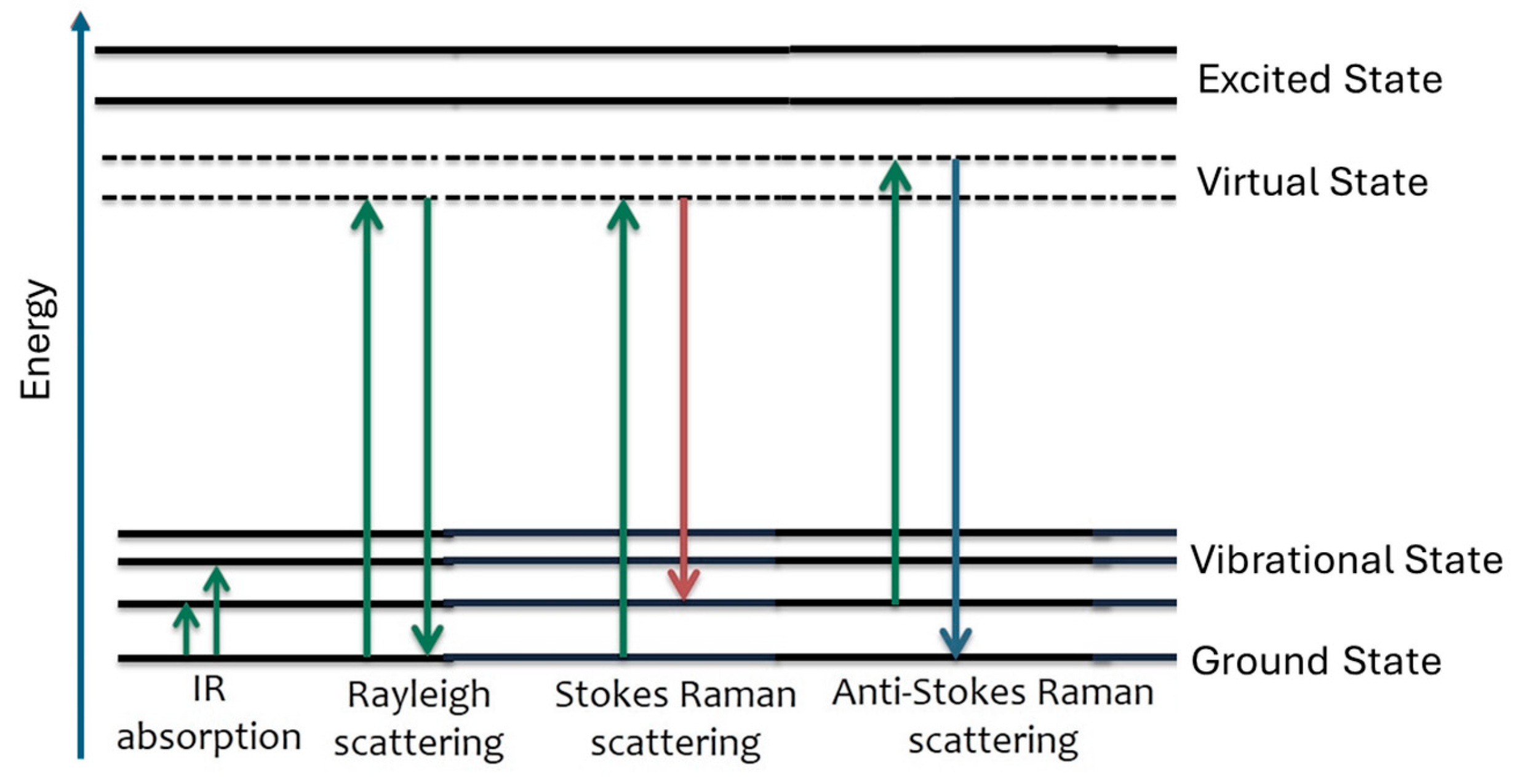
Figure 2.
Schematic of Raman set up.
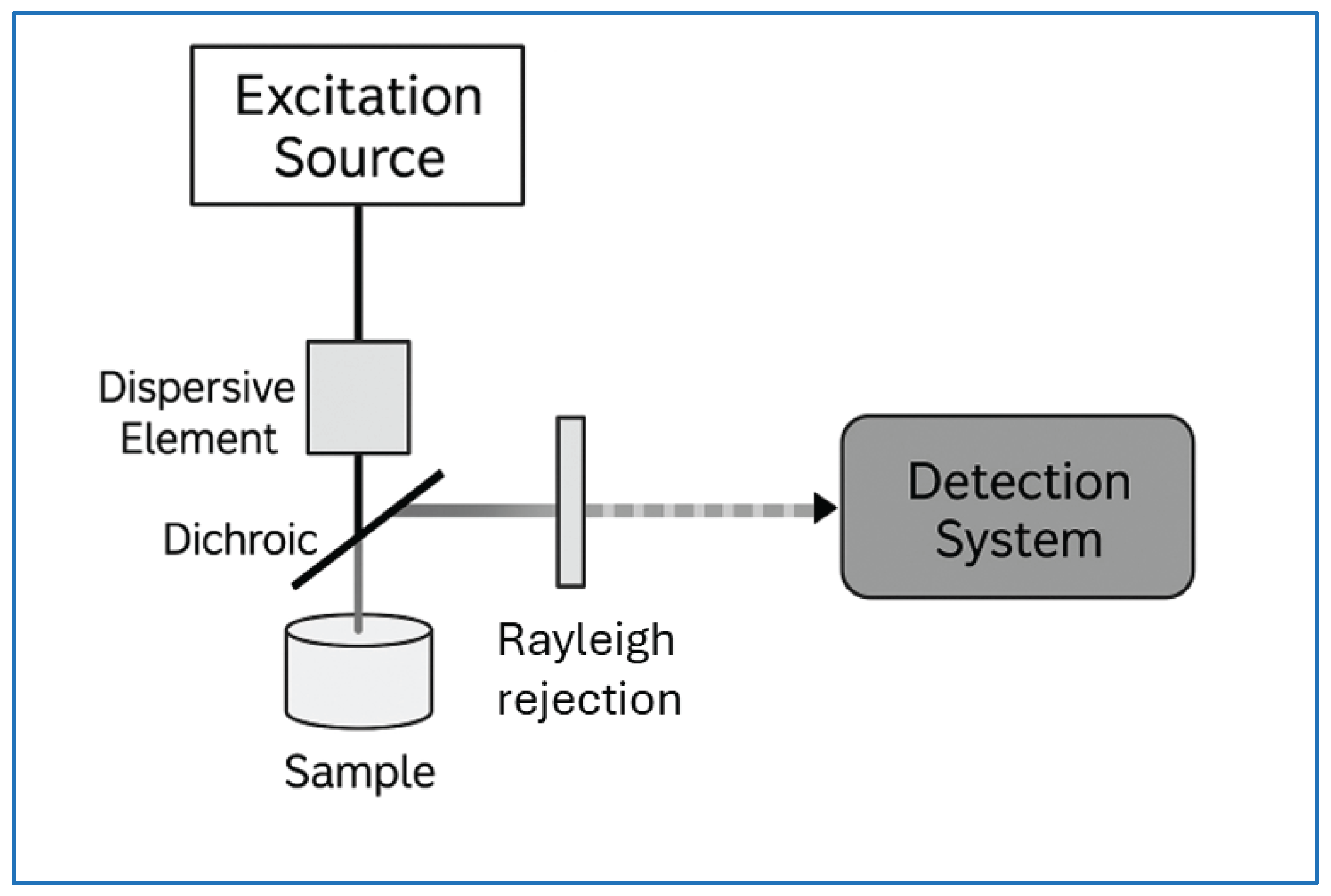

Table 1.
Early Studies Using Raman Spectroscopy for Cancer Diagnosis.
| Condition | Title | Author | Year | Sample / Modality | Raman Technique | Main Findings |
|---|---|---|---|---|---|---|
| Cervical cancer | Near-infrared Raman spectroscopy for in vitro detection of cervical precancers | Mahadevan-Jansen A | 1998 | Ex vivo cervical tissue | Near-infrared Raman | Differentiated normal vs precancerous lesions using biochemical fingerprints |
| Skin cancer | Melanoma diagnosis by Raman spectroscopy and neural networks : Structure Alterations in Proteins and Lipids in Intact Cancer Tissue | Gniadecka M | 2004 | Excised skin lesions | Near-infrared Fourier transform Raman spectra with neural network | Distinguished melanoma melanoma could be differentiated from pigmented nevi, basal cell carcinoma, seborrheic keratoses, and normal skin |
| Colorectal cancer | Classification of colonic tissues using near-infrared Raman spectroscopy and support vector machines | Widjaja E | 2008 | Ex vivo colon tissue | Near-infrared Raman | Support vector machines classification of normal vs cancerous colon tissue |
| Gastric cancer | Diagnostic potential of near-infrared Raman spectroscopy in the stomach: differentiating dysplasia from normal tissue | Teh SK | 2008 | Biopsy tissue | Near-infrared Raman | Differentiated dysplasia from normal gastric mucosa |
| Pancreatic cancer | Evaluation of pancreatic cancer with Raman spectroscopy in a mouse model | Pandya AK | 2008 | Animal pancreatic tissue | Spontaneous Raman | Identified chemical changes in normal and malignant tissue. |
| Brain tumors | Intraoperative brain cancer detection with Raman spectroscopy | Jermyn M | 2015 | In vivo during neurosurgery | Hand-held fiber optic probe Raman | Real-time discrimination of tumor vs normal brain |
| Traumatic brain injury – development | Development of Raman probe device toward neuromonitoring of Traumatic Brain Injury | Mowbray M | 2021 | Animal brain | Intracranial Raman probe | Detected biochemical alterations after Traumatic Brain Injury |
| Atherosclerosis | Determination of human coronary artery composition by Raman spectroscopy | Brennan JF | 1997 | Human artery tissue | Near-infrared Raman | Identified cholesterol, lipids and calcification in plaques |
| Liver fibrosis / cancer | Evaluation of liver fibrosis using Raman spectroscopy and infrared thermography: A pilot study | Ramírez-Elías MG | 2017 | Rat liver tissue | Raman with PCA- Linear Discriminant Analysis (LDA) | Classified normal vs fibrotic liver |
Disclaimer/Publisher’s Note: The statements, opinions and data contained in all publications are solely those of the individual author(s) and contributor(s) and not of MDPI and/or the editor(s). MDPI and/or the editor(s) disclaim responsibility for any injury to people or property resulting from any ideas, methods, instructions or products referred to in the content. |
© 2026 by the authors. Licensee MDPI, Basel, Switzerland. This article is an open access article distributed under the terms and conditions of the Creative Commons Attribution (CC BY) license (http://creativecommons.org/licenses/by/4.0/).
Copyright: This open access article is published under a Creative Commons CC BY 4.0 license, which permit the free download, distribution, and reuse, provided that the author and preprint are cited in any reuse.


