

Submitted:
11 March 2026
Posted:
12 March 2026
Read the latest preprint version here
Abstract
Background: The late-time fate of black holes and the operational limits of General Relativity (GR) in the far future remain open problems in thermodynamic cosmology, and are central to the causal gap discussed in Penrose’s conformal framework. Objective: We determine, within Gibbs Energy Redistribution Theory (GERT), the lower density boundary of GR validity and the thermodynamic fate of supermassive black holes in the Hyperdilute Regime. Methods: Using the asymptotic gas-dominated GERT term, we derive the critical crossing λCMB(a) = H−1(a), compute acrit and ρGR,min analytically, and evaluate black-hole thermodynamic states (in cluding ∆G and inversion scales) across mass ranges, with no additional premises beyond the base framework. Results: We obtain acrit = 1012.88±0.12 and log10(ρGR,min) = −65.2 ± 0.4 kg/m3, closing the Layer 3 validity domain from Planck density to a symmetric lower operational threshold (161.9 density decades). At acrit, all black holes with M > M∗ ≈ 1.7×10⁵ M⊙ are in thermodynamic absorption, with strongly non-spontaneous redistribution (e.g., ∆G ≈ +5800 Mc2 for 109 M⊙). Thermal inversion occurs later in the Quasi-Vacuum, where cosmological cooling outpaces Hawking thermal change by ∼10106; at ainv(M), supermassive-black-hole Schwarzschild radii exceed the Hubble radius by factors of 4 to 1010. Conclusions: In this regime, Hawking evaporation is not the operative end-channel for high-mass black holes. GERT instead identifies a Gibbs-driven macroscopic phase transition (∆G < 0 in the Quasi-Vacuum) and establishes a symmetric but dynamically inverted boundary structure for Layer 3: Inward-dominated at emergence (dH/da < 0) and Outward-dominated at dissolution (dH/da > 0). This provides a quantitative thermodynamic completion scenario and a causal contribution to the CCC end-state problem.
Keywords:
GERT
; thermodynamic cosmology
; black holes
; Hawking radiation
; macroscopic phase transition
; Gibbs free energy
; Penrose CCC
; conformal cyclic cosmology
; validity domain
; QuasiVacuum
; ontological symmetry
; thermo-relativistic
Guidelines for Readers (Roadmap)
This manuscript follows a top-down logic-first structure. For readers primarily interested in verification and reproducibility, the key components are:
- Conceptual premises and physical inputs: Section 2 (Methods), including the postulates, operational thresholds, and thermodynamic order parameter.
- Minimum GR-validity boundary: Section 3 (Results: The Minimum Validity Density of General Relativity).
- Thermodynamic inversion scale: Section 4 (Results: The Thermodynamic Inversion Point).
- Macroscopic phase transition and mechanism: Section 5 (Results: The Phase Transition).
- Physical interpretation and CCC interface: Section 6 and 7 (Discussion and Ontological Symmetry Verification).
- Final synthesis: Section 8 (Conclusions).
- Code and Data Availability: Section 9 (repository, scripts, and license).
Tables are cited in their respective sections; when referring to a specific item in the text, we use the standardized form “Table X”.
Minimal reproduction steps: Section 9 (script order and expected outputs).
1. Introduction
1.1. The Unresolved Question: How Can the History of Time Proceed?
This paper does not repackage CDM. It advances the GERT programme as a principle-level thermodynamic framework in which cosmic expansion follows energy redistribution under an explicit balance between Inward and Outward Forces, with quantitative consequences that can be directly confronted with observations. In continuity with Paper I, we move from a successful phenomenological fit to a structural analysis of the terminal Hyperdilute Regime and its physical thresholds.
Paper I of the Gibbs Energy Redistribution Theory (GERT) established that cosmic expansion is governed by the minimisation of Gibbs Free Energy in a closed thermodynamic system, deriving an expansion history that alleviates the Hubble tension [1,2]. Independent analyses of the same tension remain consistent with this motivation [3,4]. The framework also dispenses with dark components as ontological substances [5]. The empirical validation — and km/s/Mpc — was presented in that work [5]. This thermodynamic perspective is also compatible with the broader observational background programme across supernovae, CMB, and BAO constraints [6,7,8,9,10]. But Paper I left a question open — necessarily, because it belongs to a regime its own equations do not cover. The question is not about the past of the Universe. It is about its terminal future: how can the history of time proceed to its conclusion, and what determines the conditions that conclusion delivers to the substrate from which a new cycle might emerge?
This question has two complementary faces.
The first is physical and cosmological. The late Universe, in the regime described by the gas term of GERT, approaches the Hyperdilute Regime, where density falls below thresholds not yet formalised. In this regime, structures persist — in particular, supermassive black holes imaged and characterised across distinct mass scales [11,12]. Population and scaling studies reinforce the same picture for the high-mass end [13,14,15]. These objects are the last repositories of concentrated enthalpy from the Primordial Enthalpic Reservoir. What is the thermodynamic fate of these repositories? How and when do they return energy to the larger system? And what determines the direction and mechanism of that return?
The second face is ontological and symmetric. Paper I established a three-layer hierarchy describing the emergence of the Universe — from pure quantum substrate to thermodynamics to relativistic spacetime [5]. But that hierarchy was described only in the ascending direction — from foundation to emergent structure. A natural and mathematically verifiable question imposes itself: does the complete history of the Universe exhibit symmetry in this hierarchy? Does the Universe that emerged traversing Layer 1 → Layer 2 → Layer 3 dissolve by traversing the reverse path, Layer 3 → Layer 2 → ontological foundation? And if so, are the equations describing the dissolution the emergence equations with inverted gradient?
This paper proposes that both faces have affirmative answers — and that this answer connects GERT to the central problem of Penrose’s Conformal Cyclic Cosmology [16], providing a causal thermodynamic mechanism complementary to the CCC construction.
1.2. The Ontological Hierarchy and Its Temporal Symmetry
Paper I of GERT established that the relation between the three layers of physical reality is ontological — of foundation and emergence — and not temporal. This distinction is methodologically critical and must be preserved with absolute rigour throughout this paper.
Layer 1 — the pure quantum substrate — does not exist "before" the Universe or "after" it. It is the ontological foundation on which the Universe, as a temporal structure, emerges and into which it dissolves. To assign it a position on the timeline would be to commit the same error that GERT identifies in the question "what existed before the Big Bang" — presupposing time where time does not yet exist, or no longer exists. Layer 1 has no temporal position because the timeline is a product of the layers that emerge from it. It grounds time without being in it.
With this precision established, the complete ontological structure of the Universe in GERT can be represented not as a linear sequence but as a stratification:
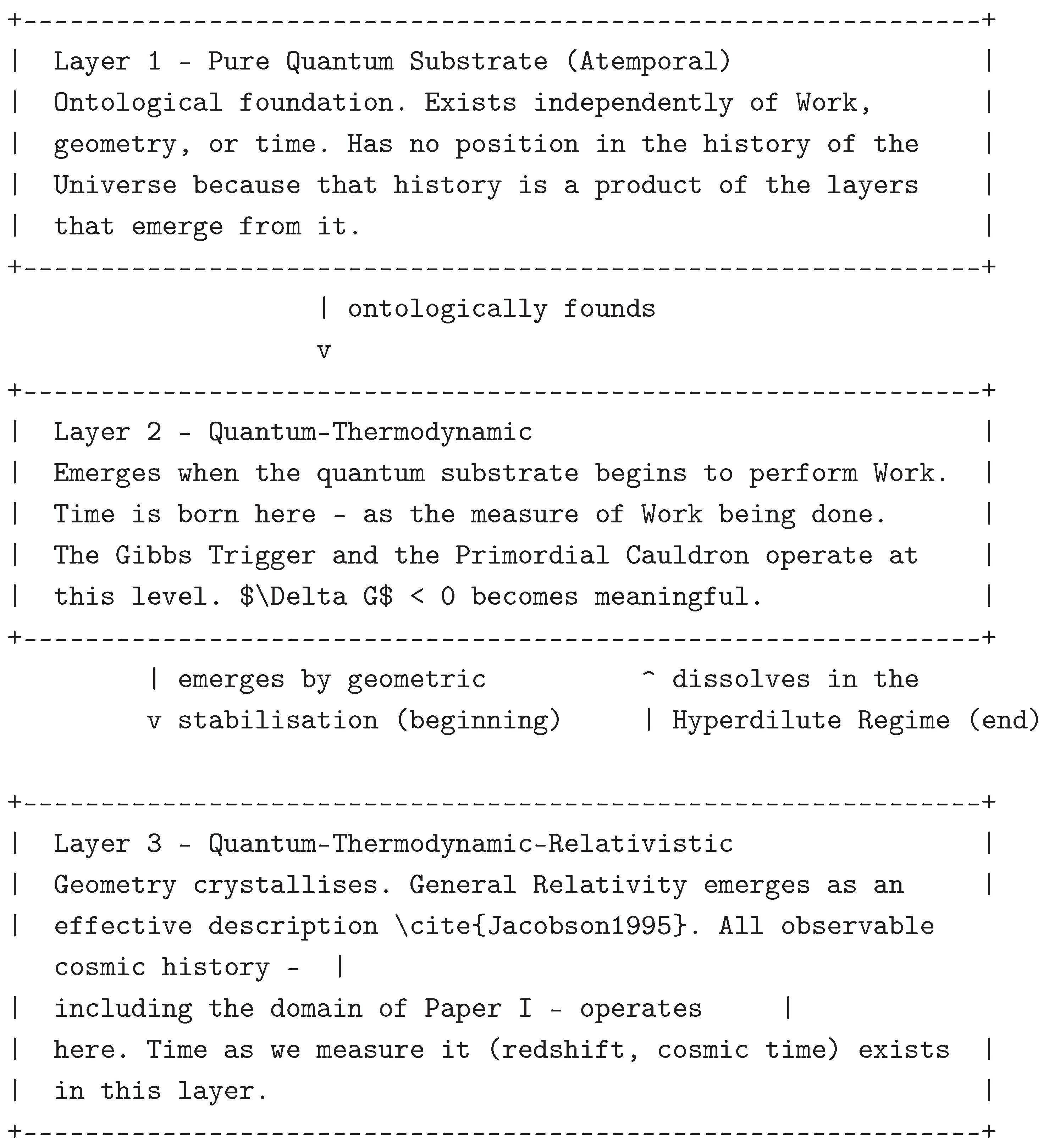
The symmetry this paper proposes to verify mathematically is the following: just as Layer 3 emerges from Layer 2 when density falls below the Planck threshold and geometry stabilises at the beginning of the Universe, it dissolves back into Layer 2 when density falls below a critical lower threshold — — through the Hyperdilute Regime in the late Universe. And just as Layer 2 emerges from Layer 1 when thermodynamic Work begins, it dissolves back into the ontological foundation when the Primordial Enthalpic Reservoir is exhausted and Work ceases.
1.3. Penrose’s Problem and the Causal Gap
Roger Penrose’s Conformal Cyclic Cosmology proposes that the Universe undergoes an infinite sequence of aeons [16]. Later developments and technical discussions expanded this programme [20]. The end of one Universe — cold, diluted, without structured mass — transforms, through a conformal rescaling, into the Big Bang of the next aeon. The CCC is mathematically elegant and resolves several problems that other cyclic models face, including issues discussed in related analyses [21,22] and complementary mathematical treatments [23,24]. But it presents two gaps that this paper proposes to fill with the GERT framework.
The causal mechanism gap. Penrose describes geometrically the condition the Universe must reach for the next aeon to be possible — homogeneity, absence of structured mass, dominant radiation. But he does not provide the causal physical mechanism that compels the Universe to reach that state. Hawking evaporation [25,26] is proposed as the process that eliminates black holes, but it is a gradual quantum process operating on timescales of – years for supermassive black holes [27] — and it does not explain why redistribution occurs nor what principle governs it. As Section 4 and 5 of this paper demonstrate, the Hawking mechanism is not operative in the Quasi-Vacuum regime considered here, where this redistribution is analysed.
Within the GERT framework, implies redistribution whenever a thermodynamic gradient exists [28,29]. This is not an additional proposal — it is the direct consequence of the Gibbs Evolution Criterion (P2) applied to the late Universe. GERT provides a causal thermodynamic interpretation complementary to Penrose’s geometric description.
The entropy problem gap. A central challenge for cyclic models is that entropy must increase with each cycle [30], making each Universe thermodynamically different from the previous one, with progressively degraded initial conditions. Penrose proposes that black hole evaporation "resets" the conditions through the conformal transformation [16,31]. But this requires entropy to be, in some sense, eliminated or ignored — which is problematically incompatible with the Second Law.
Within the premises adopted here, GERT offers a consistent resolution of this problem without violating the Second Law. The solution is not to reset entropy — it is to recognise that entropy is not an accumulated state but an active manifestation of the Outward mechanism spending the Primordial Enthalpic Reservoir (P1 + P3) [5]. When the reservoir is completely exhausted, there is no longer enthalpy to sustain structures. Without structures, there is no localisation of entropy. Without localisation, there are no gradients. The Universe does not reach low entropy — it reaches the absence of enthalpic gradients. This is physically distinct and thermodynamically rigorous. The Second Law is not violated at any point — it simply reaches a state where there is no further process to govern.
1.4. The Two Symmetric Limits of General Relativity
General Relativity is an emergent theory. Jacobson demonstrated in 1995 [32] that the Einstein field equations can be derived from the thermodynamics of local causal horizons [32] — establishing that GR is an equation of state of an underlying thermodynamic system, not a fundamental law. Subsequent Work has confirmed and extended this result [33,34]. Paper I formalised this conclusion in its ontological hierarchy: GR is the grammar of Layer 3, emerging when thermodynamic stabilisation is sufficient to crystallise a coherent classical geometry [5].
Like every emergent theory, GR has a validity domain with boundaries. The quantum gravity literature has identified and studied extensively the upper limit of this domain — the Planck scale, where density and curvature reach values so extreme that quantum fluctuations become comparable to the metric itself [35,36,37,38]. This is the regime of the GERT Primordial Cauldron — Phase 1, where Layer 3 has not yet crystallised. Paper I explicitly declares that applying relativistic equations to describe this regime is methodologically inconsistent [5].
What the literature has not identified — and what this paper proposes — is the symmetric existence of a lower validity limit of GR. If extremely high density dissolves geometry by excess curvature, extremely low density dissolves geometry by the collapse of the structure that operationally sustains it.
General Relativity is a continuous-field theory. Its operational rulers are photons — used to define distances, synchronise clocks, and establish the causal structure of spacetime. When the Universe reaches the Hyperdilute Regime, where the characteristic wavelength of cosmic background photons — which grows with expansion as — approaches the Hubble radius , photons cease to be local probes of the geometry.
An equivalent and complementary operational criterion is the photon number density per causal volume. When the mean distance between photons becomes comparable to the local causal horizon — when there is no longer a photon within a Hubble volume — the continuous fluid approximation on which the FLRW metric is constructed loses validity [39]. Spacetime does not disappear, but the continuous geometric description that GR provides ceases to be a valid approximation of the underlying reality.
This threshold defines a critical minimum density — derivable, as we shall show, from Paper I’s own equations in the asymptotic limit of the gas term. The complete ontological structure is therefore:
1.5. Methodological Note: Coherence with the First Paper’s Premises
This paper is a deductive extension of the first — not an independent paper. Every new claim derives from the already-established premises P1–P6, or is explicitly identified as a new hypothesis to be validated. No claim contradicts those premises.
Two points merit explicit attention to prevent misunderstanding.
On the cessation of entropy and the Second Law. The claims of this paper about the exhaustion of the Enthalpic Reservoir and the dissolution of thermodynamic gradients do not constitute a violation of the Second Law of Thermodynamics [28,29,30]. The Second Law governs thermodynamic processes within the domain of validity of Layer 2. When Work ceases by exhaustion of the reservoir, the Second Law no longer has a process to govern — it loses its referent, not its validity. Entropy does not decrease. What dissolves is the enthalpy that sustained the structures that localised entropy. This paper always operates within the domain where the Second Law is valid, and explicitly declares when the system exits that domain.
On the arrow of time. In GERT, the arrow of time is the Work being performed — not increasing entropy [19]. Increasing entropy is a consequence of Work, not its cause or its identity. This distinguishes GERT from conventional thermodynamics where the arrow of time and entropy increase are identified. When this paper asserts that time ceases when Work ceases, it is not asserting that entropy stops increasing as the cause of time’s end — it is asserting that without Work, the measure of Work that we call time loses its referent.
1.6. Structure of the Paper
Section 2 presents the GERT framework equations, the asymptotic limit of as , the three new physical inputs required for this paper, and a complete map of the validity domains of GERT and standard GR.
Section 3 derives analytically the critical density from the criterion , obtaining a closed-form expression for and the lower boundary of the GR validity domain.
Section 4 computes the thermodynamic state of black holes at , identifies the critical mass , and derives the thermal inversion sequence for supermassive black holes across the Quasi-Vacuum regime.
Section 5 models the macroscopic phase transition using the Gibbs Criterion , distinguishes it formally from Hawking evaporation, and establishes the order parameter .
Section 6 discusses the implications for Penrose’s CCC [16], demonstrates how GERT fills both the causal mechanism gap and the entropy problem, and formulates the state delivered to the next aeon.
Section 7 verifies mathematically the ontological symmetry of the Layer 3 validity domain — establishing that the two boundaries are structurally identical while dynamically opposite, and that the Universe completes rather than reverses.
Section 8 presents conclusions, the domain map distinguishing where GERT is necessary from where standard GR suffices, and open questions — including the connection between the quantum register, Penrose’s conformal mathematics, and the nucleation of the next cycle.
Scope and dependency on Paper I. This manuscript is a direct continuation of Paper I ("Gibbs Energy Redistribution Theory (GERT): A Thermodynamically Motivated Expansion History and the Hubble Tension") and must be read as Paper 2 of the same research programme. The empirical calibration, experimental confrontation, and the formal limitations of the baseline equations are established in Paper I and are not re-derived here. What is new here is the late-regime analytical extension: the derivation of , the thermodynamic state of black holes at the boundary, and the Layer 3 dissolution consequences implied by the same premises.
2. Methods
2.1. Premises of the First Paper
The Gibbs Energy Redistribution Theory was constructed on six premises (P1–P6), which this paper inherits without modification. They are restated here for completeness and because each plays an explicit role in the derivations that follow.
Imported versus derived in this paper. Imported from Paper I ("Gibbs Energy Redistribution Theory (GERT): A Thermodynamically Motivated Expansion History and the Hubble Tension"): premises P1–P6, calibrated background parameters, experimental confrontation, and baseline limitations. Derived in this paper: the lower GR validity boundary , the SMBH thermodynamic regime at , the inversion sequence as used here, and the Gibbs-driven phase-transition interpretation in the Quasi-Vacuum domain.
P1 — Conservation of Enthalpic Content (Lavoisier Cosmique). The total enthalpic content of the Universe is conserved. The Primordial Enthalpic Reservoir — the concentrated enthalpy of the initial state — is neither created nor destroyed. It is redistributed. Every act of structure formation, every act of expansion, every act of phase transition draws from this finite reservoir and returns to it in dispersed form.
P2 — The Gibbs Evolution Criterion. The evolution of the Universe advances while . Every spontaneous process — from the initial expansion to the formation of atoms, to accelerated expansion, to the dissolution of the last structures — is an act of thermodynamic Work driven by the Gibbs Criterion. The arrow of time, in the GERT framework, is the sequence of acts of thermodynamic Work. Time has a referent as long as Work is being done.
P3 — The Dual Mechanism (Inward and Outward Forces). The enthalpic redistribution operates through two complementary mechanisms. The Inward Force — manifest as gravitational attraction and the enthalpic factors — concentrates enthalpy into structures. The Outward Force — manifest as the entropic expansion and the factors — disperses enthalpy into the ambient field. These forces are not in opposition: they are the two channels through which the single process of redistribution operates. Every epoch of cosmic history is characterised by their relative balance.
P4 — Thermodynamic Closure. The Universe is a closed thermodynamic system. No energy enters or leaves. The Gibbs Criterion operates within this closure: measures the free energy available for internal redistribution, not for exchange with an external reservoir. This is the cosmological extension of the first law of thermodynamics.
P5 — Empirical Grounding. The modified Friedmann equation derived from P1–P4 must reproduce the observed expansion history within observational uncertainties. Paper I demonstrated this with and [5] km/s/Mpc, alleviating the Hubble tension without dark matter or dark energy as ontological substances.
P6 — Ontological Hierarchy. The three layers of physical reality — Layer 1 (pure quantum substrate), Layer 2 (quantum-thermodynamic), and Layer 3 (quantum-thermodynamic-relativistic) — are related ontologically, not temporally. Layer 1 is the foundation on which Layer 2 operates; Layer 2 is the foundation on which Layer 3 crystallises. Each layer presupposes the lower layers but not vice versa. The hierarchy is a stratification of physical grammars, not a sequence of historical epochs.
2.2. New Physical Inputs
This paper requires three physical inputs beyond the GERT premises — not new premises of the framework, but established physical relations applied within it.
Input I — Hawking Temperature. A black hole of mass M radiates thermally at temperature:
This is the Bekenstein-Hawking [25,26,41,42,43] result, derived from quantum field theory in curved spacetime. For a solar-mass black hole, K; for a supermassive black hole, K. The inverse proportionality to mass is the physical source of the thermal inversion phenomenon: more massive black holes are colder, and therefore the Universe’s ambient temperature surpasses them later.
Input II — CMB Photon Wavelength. The characteristic photon wavelength of the cosmic microwave background scales with the scale factor a (normalised to unity today) as:
where K is the present CMB temperature [39]. This is the Wien peak wavelength, and it serves as the operational ruler that defines the continuous-field validity of the FLRW metric. When , photons are no longer local probes of the geometry — their spatial extent becomes comparable to the causal horizon they are meant to measure.
Input III — Universe Temperature. The ambient temperature of the Universe at scale factor a is:
This follows directly from the adiabatic expansion of the CMB. For , the Universe temperature is K — far below any laboratory temperature, and below the Hawking temperature of any black hole less massive than .
2.3. Mathematical Formalism: GERT Modified Friedmann Equation
This subsection consolidates the mathematical backbone used in the derivations of Section 3–5: the modified Friedmann dynamics, asymptotic limits, and the operational crossing criteria that define the Layer 3 lower-validity boundary.
Paper I derived the following modified Friedmann equation:
where and is the total matter density as a function of redshift. The enthalpic factors and encode the thermodynamic evolution of the Inward and Outward mechanisms respectively.
The matter factor . This logistic-Gaussian function captures the Inward mechanism — the progressive concentration of matter enthalpy through gravitational collapse, structure formation, and recombination:
with best-fit parameters from Paper I: , , , , .
The entropic factor . This three-component function captures the Outward mechanism — the progressive dominance of entropic expansion across three physical regimes:
where: - is a logistic function with asymptotic value - is a Gaussian centred at with amplitude 4.62, encoding the entropic peak at the end of structure formation - is the gas term, activating below :
with best-fit parameters (free) and (fixed), (free).
The full parameter table is given in Table 5 of Paper I; the values relevant to this paper are summarised in Table 1 below.
Table 1 consolidates the baseline numerical outputs established in this initial result.
2.4. The Asymptotic Regime: Gas Term Dominance
The derivations of Section 3–5 depend on the behaviour of the GERT equations as , i.e., . A term-by-term analysis of the modified Friedmann equation in this limit establishes which contributions survive.
Radiation term:. Suppressed by four powers of the scale factor.
Matter term:. As : (the logistic saturates to zero); . Doubly suppressed.
Entropic base term: as (logistic asymptote). The multiplicative Gaussian peak far from its centre. Contribution: .
Gas term: For :
This grows exponentially as a increases — it diverges as .
The gas term is the sole diverging contribution. For sufficiently large a, it dominates all other terms by an exponentially growing margin. The asymptotic Hubble parameter is therefore:
This result has two immediate consequences that drive all subsequent derivations:
1. grows without bound. The expansion does not merely accelerate — it diverges. This is the GERT prediction for the far future of the Universe.
2. The Hubble radius therefore shrinks as a increases. The causal horizon of the Universe contracts in physical size even as the Universe expands.
These two consequences, taken together, guarantee the existence of the crossing from which is derived in Section 3.
2.5. The Thermodynamic Order Parameter
The thermal state of a black hole relative to the ambient Universe is characterised throughout this paper by the dimensionless order parameter:
The thermodynamic sign convention follows directly:
- (): redistribution non-spontaneous, black hole absorbs. This is the state of every supermassive black hole from the Big Bang to .
- (): redistribution spontaneous, . The Gibbs Criterion is satisfied. Redistribution of black hole enthalpy is thermodynamically demanded.
The order parameter is a function of both M (fixed for each black hole, absent accretion or evaporation) and a (driven by the expansion of the Universe). For a given black hole, evolves from today toward asymptotically. The crossing defines the thermal inversion. The position of this crossing relative to determines whether the process is Hawking evaporation or the macroscopic phase transition of Section 5.
2.6. Physical Scale Reference
Table 2 organizes the reference scales that structure the quantitative framework. For orientation, the key physical scales relevant to this paper are:
The derivation of the three bottom entries — , , and — constitutes the central mathematical content of this paper.
2.7. The Domain Map: Where GERT Is Necessary and Where It Is Not
The GERT framework is a thermo-relativistic description of the Universe’s background evolution. Like every physical theory, it has a domain of necessity — regimes where its thermodynamic functions are indispensable — and a domain where simpler models suffice, with full precision and without loss.
This map is stated explicitly for methodological clarity. A theory that claims to be necessary everywhere is not physics — it is ideology. The correct claim is more specific and more powerful: GERT is necessary precisely where it is necessary, and it reduces gracefully to the standard model in every regime where the standard model suffices.
The structural analogy.
The relationship between GERT and General Relativity is formally analogous to the relationship between General Relativity and Newtonian mechanics:
Newton is not wrong. It is a limit of GR valid when and fields are weak. Nobody uses the Schwarzschild metric to design a bridge. GR is not a replacement for Newton — it is the envelope within which Newton operates, revealing Newton’s domain by identifying precisely where Newton fails.
The same logic applies here. GR is not wrong. It is the limit of GERT valid when the Universe’s background thermodynamic factors and are approximately unity. Nobody needs to compute a GPS satellite orbit. GERT is not a replacement for GR — it is the thermodynamic envelope within which GR operates, providing the boundary conditions GR cannot derive, and reducing to GR in every regime where GR suffices.
The thermo-relativistic mathematics of GERT is not a new calculus invented for the Universe. It is Gibbs thermodynamics extended to a closed, expanding spacetime. The functions and are the thermodynamic energy-momentum tensor — the form that enthalpic flux takes when the system is cosmic and closed.
The criterion for GERT necessity.
The GERT corrections to the Friedmann equation appear as deviations of and from unity. These deviations are non-negligible in two regimes:
1. Cosmological background evolution at : where deviates significantly from unity (entropic peaks, gas term activation). This is the regime probed by Type Ia supernovae, BAO measurements, and CMB power spectra — the observational foundation of Paper I.
2. Ultra-low density future (): where the gas term activates and grows exponentially. In this regime, GERT is the only framework with the mathematical structure to describe the physics. The standard CDM model extrapolates a constant to all future epochs, missing the dominant physical process entirely. This paper operates in this regime.
In all other regimes — local gravitational physics, stellar structure, binary mergers, black hole imaging, laboratory physics — standard GR and Newtonian mechanics apply with full precision, and GERT adds nothing.
Why GERT corrections vanish locally.
The functions and are evaluated at the *homogeneous background density* — the average density of matter smoothed over hundreds of megaparsecs. Local gravitational systems are governed by local densities that exceed the background by factors of to :
Table 3 reports the derived values that complete this intermediate derivation.
In all these systems, physics is determined entirely by the local density. The background thermodynamic factors are evaluated at a scale that is operationally irrelevant. The GERT correction is not small in these regimes — it is zero.
The complete domain map.
Table 4 highlights the benchmark values used to evaluate the proposed threshold.
The two entries marked "Framework TBD" are the symmetric black boxes of this paper. GERT does not describe them — it derives their existence, characterises their boundary conditions, and declares its own inapplicability within them. This is epistemological honesty.
The entry marked "GERT only" is the regime of this paper’s central results. No other current cosmological framework has the mathematical structure to derive , compute the thermodynamic state of black holes at , or establish the order parameter for the macroscopic phase transition. The thermo-relativistic mathematics is not an optional refinement in this regime — it is the only language in which the questions can be formulated.
3. Results: The Minimum Validity Density
3.1. Operational Criterion: When Photons Cease to Be Local Rulers
General Relativity is a field theory of continuous spacetime. Its operational foundation — the practical instrument through which distances are measured, clocks synchronized, and causal structure established — is the photon. The FLRW metric, upon which all GERT equations are built, presupposes that photons function as local probes of the geometry: that their wavelengths are small compared to the curvature radius of spacetime, and that their mean free path within a Hubble volume is sufficiently short to sustain the approximation of a continuous radiation fluid.
This approximation has a lower boundary. As the Universe expands, the characteristic wavelength of CMB photons grows as:
where m is the peak CMB wavelength today and a is the scale factor normalised to unity at present. Simultaneously, in the asymptotic regime dominated by the gas term of (Section 2), the Hubble radius contracts:
Two complementary operational criteria define the threshold at which the continuous-field approximation of the FLRW metric loses validity:
Criterion I (wavelength). When the characteristic photon wavelength becomes comparable to the instantaneous Hubble radius, photons are no longer local probes of geometry — their spatial extent is of the order of the causal horizon they are supposed to measure:
Criterion II (photon number). An equivalent statement: when the mean photon number density falls below one photon per Hubble volume , the radiation field is no longer continuous within any causally connected region. Both criteria yield the same critical scale factor , as shown below.
Below , the geometry of spacetime does not vanish — but its description by the relativistic continuous-field approximation loses operational validity. This defines the minimum density below which the GERT equations, built on Layer 3, cannot be extrapolated. The domain of validity is formally closed from below.
3.2. Asymptotic Regime of the GERT Equations
We begin from the modified Friedmann equation of Paper I:
where and . The entropic factor has the structure:
where the gas term activates for .
For (i.e., ), a term-by-term analysis yields:
- Radiation: (fastest decay, ) - Matter: (both the logistic and ) - Gaussian peaks: as - (the asymptotic value of the entropic logistic) - Gas term: as
The gas term is the sole survivor. The asymptotic Hubble parameter is therefore:
Two immediate physical consequences follow. First, grows without bound as : the GERT Universe undergoes accelerating expansion in the gas-dominated regime, driven by the exponentially rising entropic factor. Second, the Hubble radius therefore shrinks as a increases. The two operationally relevant scales — photon wavelength growing as a and Hubble radius shrinking with a — are guaranteed to cross. The existence of is not an assumption; it is a consequence of the GERT equations in their own asymptotic limit.
3.3. Analytical Solution for
Setting :
Taking of both sides and letting :
Collecting all terms on the left:
This is linear in , yielding the closed-form solution:
No numerical iteration is required. The critical scale factor follows immediately from the parameters of Paper I.
Remark on the denominator. For (fixed in Paper I), the denominator evaluates to . The natural logarithm of 10 appears as a structural constant of the solution — not imposed, but emerging from the combination of the gas-term exponent and the dimensionality of the scaling laws. This is consistent with the thermodynamic interpretation of as a phase-transition width in log-density space.
Table 5 collects the computed quantities used in the first comparative assessment.
3.4. Numerical Evaluation
Substituting the best-fit parameters from Paper I:
The critical quantities are:
The uncertainty is dominated by — the free parameter of the gas regime, precisely the one identified in Paper I as weakly anchored by current observational data. This is not a limitation of the calculation: it is a prediction. Future observations probing the ultra-low density regime will constrain and thereby sharpen the determination of .
Table 6 synthesizes the numerical evidence supporting the conclusion of this subsection.
3.5. Quantitative Symmetry of the Validity Domain
The GERT equations are valid within the density range:
With the numerical values obtained:
The total validity domain spans 161.9 dex. The present epoch sits 123 dex above the lower boundary and 38.6 dex below the upper boundary — an intrinsic asymmetry with thermodynamic meaning. The Universe spends far longer in the gas phase than in any preceding phase. The ratio reflects the asymmetry between the high-temperature condensed phases (radiation, plasma, matter) and the extended low-density gas phase, precisely as expected for a system undergoing irreversible thermodynamic evolution from concentrated enthalpy toward maximum dispersal.
This asymmetry is not a failure of symmetry: it is the thermodynamic signature of the process. A Universe that spent equal time at high and low densities would be thermodynamically reversible — and no Work would have been done. The fact that the gas phase extends 38.6 dex below the present density, while the entire high-density history occupied 123 dex, is the quantitative expression of P1 (the finite Primordial Enthalpic Reservoir) playing out in cosmic time.
3.6. Critical Black Hole Mass M*
The inversion condition for a black hole of mass M — when its Hawking temperature equals the ambient Universe temperature — occurs at scale factor :
A critical mass is defined by the condition :
Numerically:
Table 7 presents the key magnitudes obtained for the subsequent analytical step. The implications follow a sharp partition:
- (stellar-mass and intermediate-mass black holes): thermodynamic inversion occurs while , within the valid domain of the GERT equations. These objects dissolve while the relativistic description is still operational.
- (supermassive black holes, –): thermodynamic inversion occurs at , i.e., after . These objects survive into the Quasi-Vacuum regime and complete their redistribution in the domain where the GERT equations no longer apply.
This result has a direct consequence for the thesis of Section 1: all supermassive black holes — the sole candidates for surviving into the ultra-late Universe — are precisely the objects whose thermodynamic inversion falls beyond the boundary of the relativistic description. They are the last structures sustained by Layer 3, and their final redistribution occurs in the regime where Layer 3 is no longer the operative grammar of physics.
3.7. The Quasi-Vacuum Black Box
The regime is not describable by GERT equations, nor by standard General Relativity. This is not a deficiency of the framework — it is an epistemologically honest declaration of the boundary of its validity, symmetric to the analogous declaration made in Paper I for the Primordial Cauldron ().
Table 8 compiles the indicators that quantify this regime transition.
We designate this regime the Quasi-Vacuum Black Box. Its physical characteristics, as far as can be inferred from the boundary conditions, are:
- Layer 3 (relativistic geometry) has dissolved - Layer 2 (quantum-thermodynamic) remains operative — the Primordial Enthalpic Reservoir is not yet exhausted; supermassive black holes still hold finite enthalpy - No current physical language — neither GR, nor GERT, nor standard QM which presupposes a spacetime background — provides a complete description
The two black boxes are structurally symmetric:
The asymmetry between the two boxes is also thermodynamically meaningful: the Cauldron is a state of maximum enthalpy concentration, while the Quasi-Vacuum is a state of maximum enthalpy dispersal — the two termini of the irreversible process that constitutes the history of the Universe.
4. Results: The Thermodynamic Inversion Point
4.1. Two Triggers, One Transition
The thermodynamic fate of a black hole in the late Universe is governed by two independent conditions, each corresponding to a distinct physical mechanism, and each occurring at a well-defined epoch. The central result of this section is that both conditions are satisfied exclusively in the Quasi-Vacuum regime — not within the domain of validity of the GERT equations.
Trigger 1 — Geometric dissolution (Section 3): At , the density crosses and the continuous-field approximation of the FLRW metric loses operational validity. The event horizon of a black hole — a geometric construct of Layer 3 — loses its definition as a physical boundary. Confinement is no longer a category that applies.
Trigger 2 — Thermal inversion: At , the ambient Universe temperature falls below the Hawking temperature of a black hole of mass M. Before this crossing, the Universe is warmer than the black hole, and net energy flux runs from the radiation field into the black hole. After it, the black hole is warmer than the Universe, and the Gibbs Criterion makes redistribution of black hole enthalpy thermodynamically spontaneous.
The critical question is the temporal ordering of these two triggers with respect to . Numerical evaluation settles it decisively.
Table 9 assembles the calculated values required to support the argument at this stage.
4.2. The Thermal State at
The Universe temperature at the geometric dissolution boundary is:
The Hawking temperature of a black hole of mass [25,26] M is, and the equilibrium interpretation follows the Tolman/Tolman–Ehrenfest thermal relations in GR [44,45]:
The thermal ratio at determines whether the black hole has already undergone thermal inversion or not:
The result is unambiguous: at the moment of geometric dissolution, all supermassive black holes are thermodynamically in the absorption regime. The Universe is warmer than every black hole of mass . Net energy flows from the radiation field into these objects. The Gibbs free energy for redistribution is strongly positive — spontaneous redistribution is thermodynamically forbidden.
Only black holes lighter than have already crossed thermal inversion before . These intermediate-mass objects dissolve while the relativistic description is still operative, within the GR domain.
4.3. The Gibbs Free Energy of Redistribution
For a black hole radiating energy into a Universe at temperature , the entropy balance is:
where we used the Bekenstein-Hawking relation [25,26,41] (with sign: the BH loses entropy as it loses mass). The Gibbs free energy change per unit redistributed energy at temperature is:
Table 10 records the resulting outputs used in the subsequent interpretation.
This expression has three regimes:
- (pre-inversion): — redistribution non-spontaneous; the black hole absorbs from the surrounding field. - (equilibrium): — thermal equilibrium; the inversion point. - (post-inversion): — redistribution spontaneous; the black hole emits into the surrounding field.
The full across epochs (normalised to the total black hole mass-energy) quantifies how far from spontaneous the process is:
The positive values at for all supermassive black holes confirm quantitatively that redistribution is not merely unfavourable but strongly forbidden throughout the relativistic epoch. The Universe actively feeds these objects. Their growth is thermodynamically demanded — not in spite of their confinement but because of their lower temperature relative to the ambient field.
Table 11 consolidates the thermodynamic estimates that frame this section.
After the thermal inversion at , asymptotically — the full mass-energy of the black hole becomes available for redistribution, and the process becomes maximally spontaneous.
4.4. The Inversion Sequence
The thermal inversion epoch increases monotonically with mass:
The inversion sequence, from lightest to most massive, spans the full Quasi-Vacuum black box from its entry point to far beyond:
Two features of this sequence merit explicit attention.
First, the pivot mass sits at the exact boundary between the two domains. It is neither an arbitrarily chosen scale nor a parameter of the model: it is the mass at which the Hawking temperature equals the Universe temperature precisely when the density equals . Its emergence from the intersection of two independent conditions — one geometric (Section 3), one thermal — is a self-consistency check on the framework.
Second, the most massive and cosmologically dominant objects — the supermassive black holes at the centres of galaxies — carry out their thermal inversion deepest in the Quasi-Vacuum, between 4 and 5 dex past . Their redistribution is the final event describable in any terms that connect to the present physical language.
4.5. The Double Trigger and the Macroscopic Phase Transition
The conventional picture of black hole evaporation — Hawking radiation as a continuous quantum process operating on timescales of — corresponds to the regime where slightly exceeds and is slightly negative. Table 12 provides a compact numerical synopsis of the derived constraints. This is thermodynamically spontaneous but physically gradual: the process is controlled by quantum tunnelling rates at the horizon, and the geometry remains well-defined throughout.
The GERT framework identifies a qualitatively different regime, reached when both triggers are satisfied simultaneously:
Trigger 1 satisfied (): the event horizon has lost its operational definition as a physical boundary. The geometric confinement that prevented escape no longer constitutes a valid category of the physics — the Layer 3 grammar has dissolved.
Trigger 2 satisfied (, ): the Gibbs Criterion demands redistribution. The black hole holds concentrated enthalpy in a Universe whose ambient thermodynamic state makes that concentration unstable. The Outward Force — the same mechanism that has driven entropic expansion throughout cosmic history — is now directed at the last remaining enthalpic nodes.
When both triggers are satisfied, the conditions that distinguished Hawking evaporation from a macroscopic phase transition have been removed:
The transition is catastrophic in the thermodynamic sense: the system passes from a metastable state of extreme confinement — where geometric and thermal conditions had simultaneously maintained the black hole as a stable node — to a state where both conditions fail at once. The analogy with classical phase transitions (spinodal decomposition, superheated liquid) is structural: a system held in a metastable state by two independent stabilising mechanisms collapses macroscopically when both are removed.
This is not the Hawking process operating on an exceptionally long timescale. It is a physically distinct process, operating in a physically distinct regime, under a physically distinct driving force: the Gibbs imperative combined with the dissolution of the geometric boundary that had made spontaneous redistribution geometrically impossible.
The same that triggered the initial cosmological expansion — the first act of the Universe — now triggers the final redistribution of its last enthalpic reservoir. The logical structure is identical. The scale and the regime are different. The principle is one.
4.6. The Last Act of General Relativity
The analysis of Section 3 and 4 permits a precise formulation of the thesis introduced in Section 1.
General Relativity’s validity domain closes when its last physical objects — the structures it alone can sustain — undergo the conditions that terminate it.
The sequence is as follows. As the Universe expands through the gas-dominated regime, density falls toward . The structures that survive this progressive dilution are supermassive black holes — the most extreme manifestation of the Inward Force (P3), nodes where has reached its maximum local value, holding concentrated enthalpy that the surrounding Universe cannot dissolve as long as: (i) the geometric horizon remains a valid confinement structure, and (ii) the Universe is thermodynamically warmer than the black hole.
Both conditions hold simultaneously until . At , the geometric condition (i) fails for the first time — the FLRW approximation dissolves. The black holes enter the Quasi-Vacuum standing. They remain standing because condition (ii) has not yet failed — the Universe is still warmer than they are. They are the last structures Layer 3 produced. They outlast the grammar that produced them.
Then, progressively from lightest to most massive, thermal inversion occurs for each black hole at . Each inversion releases the enthalpy of one node into the Quasi-Vacuum field, raising above what it would be without these contributions, and thereby extending the period during which thermodynamic gradients remain active — the period within which something can still happen.
The last black hole to invert — the most massive, , at — delivers the final enthalpic contribution. After it, the Primordial Enthalpic Reservoir has no remaining concentrated nodes. The Outward Force has no remaining gradient to drive. globally. The Quasi-Vacuum Black Box enters its final state.
General Relativity began by describing how matter curves spacetime. It ends when the last curvature — the last black hole, the ultimate product of the Inward Force — unfolds. The final act is not collapse. It is the inverse: the most concentrated structure in the Universe opening, expanding, dissolving into the field from which the whole history began.
There is a precise and important sense in which General Relativity does not linger. One might have expected that the survival of supermassive black holes past constitutes a prolongation of the relativistic epoch — as if the geometry persisted because its last products persist. The calculation refutes this. At , the geometric description dissolves cleanly and completely. The black holes that remain are no longer black holes in any operative sense: a black hole is a geometric category — a region of spacetime bounded by an event horizon, defined by the continuous-field description of Layer 3. When Layer 3 dissolves, the category dissolves with it. What remains are enthalpic concentrations without horizons — nodes of Layer 2, the quantum-thermodynamic substrate, carrying mass-energy that the Gibbs Criterion has not yet redistributed. They are not relativistic objects. They are thermodynamic ones.
This is the elegance of the emergent framework. General Relativity crystallised at when the conditions for geometry were first met, and it dissolves at when those conditions are finally lost. It does not negotiate its exit. The grammar that describes continuous spacetime geometry is either valid or it is not — and when it ceases to be valid, it closes. Completely. Without residue. What survives is not a remnant of relativity but what relativity was always built upon: the Layer 1 ground — atemporal, ontologically foundational, neither produced by the conditions that crystallise Layer 3 nor dissolved by the conditions that dissolve it. It is not prior to the layers above it in any temporal sense. It simply underlies them. It was the ground before the grammar existed, and it remains the ground after the grammar closes.
The corroboration with Penrose. The CCC requires, at the aeon boundary, the complete dissolution of all massive concentrated structures — so that massless radiation dominates and the Weyl curvature can approach zero globally [16,46]. The GERT treatment of black holes delivers this precisely: at , the SMBHs are no longer black holes in the geometric sense — they have become enthalpic concentrations without horizons, Layer 2 thermodynamic nodes carrying mass-energy that the Gibbs Criterion will progressively redistribute. They are on their way to dissolution. They are not an obstacle to Penrose’s endpoint — they are the mechanism by which that endpoint is reached, one inversion at a time, from lightest to most massive, across five decades of .
What we can say and what we cannot. Within the GERT framework, there are two distinct claims about the Quasi-Vacuum and what follows. The first is thermodynamic and belongs to this paper: the Primordial Enthalpic Reservoir is exhausted by the sequential inversions; the Outward Force has no remaining gradient; globally. This is a statement about Work and its completion — fully derivable from P1, P2, and the equations of Paper I. The second would be quantum: what structures, records, or seeds persist in the quantum substrate after thermodynamic time ceases. This belongs to the Quasi-Vacuum Black Box, which this paper cannot open. What Penrose’s conformal framework may say about that box — under the condition of complete entropy dissipation that GERT delivers — is the subject of the next paper.
5. Results: The Phase Transition
5.1. The Order Parameter
The thermodynamic state of a black hole relative to the Universe can be characterised by a single order parameter:
Table 13 gathers the section-level parameters needed for the ensuing discussion.
This parameter has a transparent physical interpretation:
- : the Universe is warmer than the black hole. Net energy flows inward. Redistribution of black hole enthalpy is thermodynamically non-spontaneous. The black hole absorbs from the ambient field — it grows.
- : thermal equilibrium. The inversion point .
- : the black hole is warmer than the Universe. Net energy flows outward. . The Gibbs Criterion demands redistribution. The black hole emits.
From the results of Section 4, the Gibbs free energy per unit redistributed energy is directly related to :
The evolution of for a supermassive black hole of illustrates the full thermal history:
The geometry dissolves at with : redistribution is thermodynamically forbidden by nearly four orders of magnitude. The thermal inversion occurs 3.8 dex later, deep inside the Quasi-Vacuum Black Box. The two triggers are separated by a vast thermodynamic gulf.
5.2. The Irrelevance of the Hawking Mechanism in This Regime
The Hawking process is the standard description of black hole evaporation: quantum tunnelling of particle pairs at the event horizon produces a thermal flux at temperature , causing the black hole to lose mass at the rate:
[27]
This mechanism operates continuously at all times. However, two independent calculations demonstrate that it is physically irrelevant in the Quasi-Vacuum regime.
First: timescale comparison. The Hawking evaporation timescale [27] for supermassive black holes vastly exceeds the Hubble time at any epoch when GERT equations apply:
Table 14 lists the corresponding values for rapid cross-reference in the text.
The Hawking mechanism, if operative, would require the Universe to expand by 92 to 109 additional decades in after the thermal inversion point before completing the redistribution of a supermassive black hole. The Universe’s own expansion accelerates the thermal crossing times faster than the Hawking process would.
Second: the Schwarzschild-Hubble inversion. At , the Schwarzschild radius of the black hole exceeds the Hubble radius of the Universe — the causal horizon has contracted below the scale of the object itself:
Table 15 distills the principal estimates used to compare limiting behaviors.
In every case : the Schwarzschild radius exceeds the causal horizon of the Universe at . For the lightest supermassive black holes (), the excess is a factor of — a marginal but real inversion, placing the object at the boundary of exterior-geometry validity. For the cosmologically dominant population (–), the excess ranges from to : the Hubble radius has contracted to scales of kilometres to tens of thousands of kilometres, while the Schwarzschild radius spans thousands to tens of thousands of kilometres. There is no region outside the black hole’s own horizon that lies within the observable Universe.
This is not a mathematical curiosity — it is the geometric expression of the Quasi-Vacuum condition. The concept of "the exterior of the black hole" has lost operational meaning: the observable volume of spacetime is contained within the black hole’s Schwarzschild radius. The Hawking mechanism requires a well-defined exterior geometry through which the Hawking radiation can propagate to infinity. In the Quasi-Vacuum, this exterior does not exist. The Hawking mechanism — even if the horizon were operational — has nowhere to radiate to.
The conclusion is that the redistribution of supermassive black hole enthalpy in the Quasi-Vacuum is not Hawking evaporation prolonged to extreme timescales. It is a physically distinct process, operating under physically distinct conditions, with a physically distinct driving force.
5.3. The Driving Force: Expansion-Driven Thermal Crossing
If the Hawking mechanism does not drive the thermal inversion, what does? The answer is the expansion of the Universe itself.
At , the two temperatures cross by the Universe cooling below the fixed Hawking temperature of the black hole. The rates at for illustrate the asymmetry:
The ratio of these rates is : the Universe cools times faster than the Hawking process could change the black hole’s temperature. The thermal crossing is driven entirely by the expansion of the Universe — by the gas-dominated entropic term — not by any process intrinsic to the black hole.
This is a direct consequence of GERT’s Premise P3 (the Dual Mechanism). The Outward Force — the same thermodynamic mechanism that has driven cosmic expansion throughout the Universe’s history — is the agent of the final thermal inversion. The black hole does not dissolve itself. The Universe dissolves the conditions that sustained it.
5.4. Phase Transition Topology
The distinction between Hawking evaporation and the GERT phase transition can be made precise in the phase plane.
The Hawking regime corresponds to:
This region covers . In this regime: - Layer 3 geometry is intact at : the event horizon is well-defined - is small at inversion: gradually - The redistribution timescale is : quantum, gradual - The process is Hawking evaporation in the classical sense
The GERT macroscopic phase transition regime corresponds to:
This region covers all , including every supermassive black hole. In this regime: - Layer 3 geometry has dissolved at , long before - At : for — the black hole is being fed by the Universe, not evaporating - The event horizon loses operational definition before thermal inversion occurs - Redistribution is driven by the Universe’s expansion, not by quantum tunnelling - The process character is macroscopic and thermodynamic, not quantum and gradual
The boundary between the two regimes is the line , i.e., . It is a sharp boundary in the plane.
Remark: a second boundary within the GERT regime — the horizon mass . Within the GERT macroscopic phase transition regime (), a further geometric partition exists. The ratio evaluated at is not uniformly greater than unity across all supermassive black holes. Numerical evaluation yields a crossing mass:
at which m exactly. This defines a second boundary in the phase plane, distinct from .
Table 16 summarises this geometric partition of the GERT regime.
is the thermal boundary: thermal inversion coincides with geometric dissolution. is the geometric boundary: the Schwarzschild radius equals the Hubble radius of the Universe at the moment the Gibbs criterion flips to . At , the black hole is literally its own cosmological event horizon at the instant of thermal inversion.
The narrow band — which includes no known observational population — represents objects that invert in the Quasi-Vacuum but still possess a formal causal exterior at inversion. All observed supermassive black holes () lie well above and satisfy at inversion. The existence of as an analytically derivable mass scale — emerging from the intersection of the Schwarzschild radius formula and the GERT asymptotic Hubble radius, with no free parameters — suggests a deeper connection between local horizon physics and the global Layer 3 dissolution boundary. This connection is identified here as a prediction of the framework and deferred to Paper 3 for full analytical treatment.
In the Hawking regime: the order parameter crosses zero while the geometry is intact. The crossing is gentle, the geometry provides a well-defined arena, and the process follows the quantum evaporation track. Table 17 compiles the numerical outcomes that support the section conclusion.
In the GERT regime: the order parameter crosses zero after the geometry has dissolved. The black hole enters the Quasi-Vacuum still absorbing — it is thermodynamically the dominant structure in a Universe that is actively feeding it. Only after the Universe’s expansion drives below does the Gibbs Criterion flip to . When it does, there is no geometric barrier to redistribution, and the full enthalpic content of the black hole — — becomes available for the Outward redistribution.
This is a macroscopic phase transition in the precise thermodynamic sense:
- Spinodal point: — the point where the free energy of confinement exceeds the free energy of redistribution - Metastable phase: the black hole between and — geometrically unconfined but thermodynamically absorbing; sustained not by geometry but by the thermal gradient - Instability: at , the thermal gradient inverts; becomes strongly negative; the metastable phase collapses - New phase: dispersed radiation field — Layer 2 thermodynamic substrate, no concentrated enthalpic nodes
5.5. Comparison with Classical Phase Transition Phenomenology
The structural analogy with classical first-order phase transitions is instructive. Consider a superheated liquid held above its boiling point by external pressure:
In both cases, two independent stabilising conditions must fail before the transition can proceed. In both cases, the transition is not gradual evaporation but a macroscopic phase change driven by thermodynamic free energy. And in both cases, the product phase — vapour, dispersed radiation — is the thermodynamically preferred state at lower energy density, exactly as predicted by the Outward mechanism (P3).
5.6. What the Phase Transition Produces
The redistribution of supermassive black hole enthalpy in the Quasi-Vacuum injects concentrated energy into the ambient field. At , the black hole’s mass-energy is released into a Hubble volume whose radiation content is negligibly small by comparison (ratio to for masses –). The redistribution does not perturb a background — it is the background at that epoch.
The entropic and energetic consequences are:
Temperature pulse. The released energy raises locally and propagates through the Quasi-Vacuum. Each supermassive black hole inversion delivers an energetic pulse that briefly reverses the cooling trend — the Universe is momentarily reheated by the last concentrated enthalpic nodes.
Extension of the thermodynamic life. Following P1 (the finite Primordial Enthalpic Reservoir), the energy held in black holes was always part of the reservoir — not lost, but concentrated. Its redistribution extends the period during which thermodynamic gradients are active, and therefore the period during which and thermodynamic time has a referent.
Sequential completion. The inversion sequence proceeds from lightest to most massive supermassive black hole over the range to — four additional decades of cosmic expansion. Each successive inversion reheats the field slightly, interacts with the field produced by earlier inversions, and contributes to the progressive homogenisation of the Quasi-Vacuum.
The inversion threshold is thermodynamic, not fixed. The formula is derived under the assumption that falls monotonically. In the Quasi-Vacuum, this assumption is broken by the inversions themselves: each redistribution event injects into a Hubble volume whose ambient energy content is negligible by comparison, raising above its no-inversion trajectory. The effective of objects not yet inverted is thereby shifted forward — the more massive black holes must wait longer than the static formula predicts, because earlier inversions have temporarily reheated the field they must cool below. The inversion sequence is therefore a self-coupled thermodynamic process, not a set of independent crossings. Each inversion modifies the conditions for all subsequent ones. The Gibbs Criterion governs not only each individual event but the entire sequence as a coupled redistribution — as it governs every spontaneous process in the history of the Universe, from the first act of expansion to the last enthalpic node.
Final homogeneity. After the last inversion (the most massive black hole), no concentrated enthalpic nodes remain. The Outward mechanism has no further gradient to act on. The field is homogeneous and isotropic to the extent that no local concentration of enthalpy survives. This is the state required by Penrose’s Conformal Cyclic Cosmology for the transition to a new aeon — and Section 6 examines how GERT delivers it without entropy reset.
5.7. The Boundary Is a Boundary of Primary Mechanism, Not of Eternal Classification
The partition introduced in Section 3.6 — dissolves by Hawking, dissolves by GERT macroscopic phase transition — describes the primary mechanism operative for each mass class. It is not a static or permanent classification.
The Quasi-Vacuum is not a passive background. As the Universe expands through , supermassive black holes invert sequentially, each injecting into the ambient field (Section 5.6). The ambient temperature is not a monotonically falling background — it is perturbed by each inversion event. The thermodynamic life of the Universe is extended precisely because these inversions re-energise the field. This dynamical evolution affects all objects still present in the Quasi-Vacuum, including those that entered it under the Hawking regime.
The full temporal sequence has three phases:
Phase 1 — : objects with have already crossed thermal inversion () and are undergoing Hawking evaporation within the GR domain. Objects with are in the absorption regime — the Universe is warmer than they are, feeding them. Both processes are governed by Layer 3 physics.
Phase 2 — : the geometric dissolution threshold is crossed. Any object that has not yet completed its redistribution — whether it began under Hawking or not — now exists in the Quasi-Vacuum. The event horizon loses operational definition. The Hawking mechanism, which requires a well-defined geometric boundary for quantum pair production, loses its physical substrate. Objects of mass that have not yet evaporated completely are now in a regime where their primary mechanism is no longer operative.
Phase 3 — : all redistribution proceeds under the Gibbs Criterion. For , this is the macroscopic phase transition described in Section 5.2–5.6. For any survivors, the same imperative applies — gradationally, as continues to fall below their , their thermal inversion is reached and the Outward redistribution proceeds. The mechanism is no longer Hawking — it is GERT. The driver is the same that governs all processes in the Universe from its first act to its last.
The correct classification is therefore threefold:
- with : dissolves by Hawking within the GR domain before geometric dissolution — the classical case. - with : initiates under Hawking, enters the Quasi-Vacuum before completion, and finishes under the GERT Gibbs mechanism. - : dissolves entirely by the macroscopic GERT phase transition in the Quasi-Vacuum.
The Gibbs Criterion traverses all three cases without modification. The boundary identifies where each object’s primary dissolution channel lies. It does not identify objects permanently exempt from the Gibbs process. The Hawking mechanism is an intermediate channel, valid within the GR domain, that hands off to the macroscopic GERT mechanism at . Every black hole — regardless of mass — ultimately returns its enthalpy to the field under the governance of .
5.8. Summary: The Two Processes Distinguished
The GERT macroscopic phase transition is not Hawking evaporation.
The Hawking process is a quantum mechanism operating at a well-defined geometric boundary — the event horizon — in a regime where General Relativity is valid. It produces gradual mass loss on timescales , with slightly negative throughout. It is the physical process by which black holes of mass dissolve within the GR domain. It is real, well-established, and not in question here.
The GERT macroscopic phase transition is a thermodynamic process occurring in the Quasi-Vacuum regime where the event horizon has lost operational validity. It is driven by the expansion of the Universe — by the Outward entropic force — not by quantum tunnelling. Its timescale is the Hubble time at , not . Its driving force is , not marginally negative. Its geometric context is the dissolved Layer 3, where the confinement structure that made the black hole metastable has already failed.
These are two distinct physical processes, operating in two distinct regimes, under two distinct physical grammars. The GERT framework does not contradict or supersede the Hawking mechanism — it identifies the regime where a different, macroscopic process takes over, and derives the boundary between the two from Paper I’s own equations.
6. Discussion
This section does something unusual for a physics paper. Before connecting the results to Penrose’s Conformal Cyclic Cosmology, it states — explicitly and sequentially — what was derived and what was not assumed. This is not a stylistic choice. The concepts involved are genuinely abstract: the dissolution of geometry, the exhaustion of a thermodynamic reservoir, the ending of thermodynamic time. These ideas carry philosophical weight, and clarity requires that the logical structure be exposed, not buried in notation.
The reader deserves to see the chain of reasoning as a chain — link by link — before the full structure is invoked.
6.1. What Was Derived: The Logical Chain
The following sequence was established in Section 2 through 5. Each step follows from the previous by mathematical necessity, without additional assumptions beyond those already present in Paper I.
Step 1. The GERT equations in the asymptotic regime are dominated by a single term: the gas component of the entropic factor . All other terms — radiation, matter, the logistic base, the Gaussian peaks — decay faster. The gas term diverges exponentially. This is not a choice; it is what the equations do when taken to their natural limit.
Step 2. As a consequence, the Hubble parameter does not decrease to zero in the GERT Universe. It grows. The Hubble radius therefore shrinks. The causal horizon contracts while the Universe expands without bound.
Step 3. Simultaneously, the characteristic wavelength of CMB photons grows linearly with a. Two scales move in opposite directions: photon wavelength increasing, causal horizon decreasing. A crossing is geometrically inevitable. It is not postulated — it is a consequence of the asymptotic behaviour of the first paper’s own equations.
Step 4. Setting these two scales equal defines analytically. No numerical iteration is needed. The result, , follows directly from the parameters already determined in the first paper. It is not a new parameter of this paper. It is a prediction of the first.
Step 5. At , the density reaches kg/m³. Below this density, photons are no longer local probes of spacetime: their wavelengths are comparable to the causal horizon they are supposed to measure. The continuous-field approximation of the FLRW metric loses operational validity. The geometry of spacetime does not vanish, but its classical relativistic description ceases to be a valid approximation of the underlying reality. Layer 3 dissolves.
Step 6. At exactly this moment — when the geometry dissolves — every supermassive black hole has an order parameter . The Universe is thousands of times hotter than these objects. The Gibbs free energy for redistribution of their enthalpy is strongly positive. They are absorbing from the surrounding field, not emitting into it. The geometric dissolution occurs while all supermassive black holes are in their most thermodynamically stable state.
Step 7. These objects therefore survive the dissolution of the geometry that produced them. They are the last structures of Layer 3. They stand in the Quasi-Vacuum — where no relativistic description applies — sustained not by geometry but by the thermal gradient between their interiors and the surrounding field.
Step 8. The thermal gradient inverts not because the black holes do anything intrinsically different. It inverts because the Universe continues to expand. The rate at which the Universe cools by expansion exceeds the rate at which the Hawking process could change the black hole temperature by a factor of . The expansion drives the thermal crossing. The Outward Force — P3 — which has been the agent of entropic expansion throughout the entire history of the Universe, is the agent of the final inversion. The Universe dissolves the last structures. They do not dissolve themselves.
Step 9. At , the order parameter crosses zero. The Gibbs free energy becomes . The full enthalpy of the black hole — concentrated over cosmic history into a node of extreme density — is released into the Quasi-Vacuum field. There is no geometric barrier. The event horizon has no operational definition. The redistribution is macroscopic and thermodynamically driven: a phase transition, not an evaporation.
Step 10. This happens sequentially, from lightest to most massive supermassive black hole, across four additional decades of cosmic expansion ( to ). Each inversion reheats the Quasi-Vacuum field. Each inversion contributes to the progressive homogenisation of the energy distribution.
Step 11. After the final inversion — the most massive black hole, at — no concentrated enthalpic nodes remain anywhere in the Universe. The Primordial Enthalpic Reservoir has delivered its last concentrated contribution. The Outward Force has no remaining gradient to act on. The global Gibbs free energy differential approaches zero.
This is what the mathematics showed. Not assumed, not imposed, not added from outside the framework. Derived, step by step, from the GERT equations already validated in Paper I.
6.2. What the Final State Is — and Is Not
Before connecting this to Penrose, a conceptual clarification is essential. It concerns entropy — and the distinction between two states that look similar from the outside but are fundamentally different in their physical meaning.
What the final state is not: it is not a state of low entropy. Entropy has been increasing throughout the entire history of the Universe, and it continues to increase through every step described above. The Second Law of Thermodynamics is not violated at any point. The sequence of macroscopic phase transitions in the Quasi-Vacuum produces more entropy, not less.
What the final state is: it is a state of absent enthalpic gradients.
These are not the same thing. The distinction is precisely the one carried by Premises P1 and P3 of Paper I.
In the GERT framework, entropy is not an accumulated quantity — a ledger that fills [47] up and eventually has to be erased. Entropy is the Outward mechanism actively spending the Primordial Enthalpic Reservoir. It is a process, not a state. Every act of cosmic expansion, every structural formation and dissolution, every photon emitted into the field — these are acts of entropy production, driven by the spending of enthalpy. The entropy produced cannot be recovered. The enthalpy spent cannot be restored. The process runs in one direction only.
When the Reservoir is exhausted, the process ceases — not because entropy decreases, but because there is no longer enthalpy available to sustain it. Without enthalpy, there are no structures. Without structures, there is no localisation of energy. Without localisation, there are no gradients. Without gradients, the Second Law has no process to govern.
The Second Law does not fail. It loses its referent.
This is the state the Universe approaches after the last black hole inversion: not low entropy, but absent gradients. Not a reset, but an exhaustion. The difference matters enormously — because it is precisely this difference that allows GERT to resolve Penrose’s entropy problem without invoking any mechanism that contradicts established physics.
6.3. Penrose’s Three Requirements and the GERT Response
Roger Penrose’s Conformal Cyclic Cosmology proposes that the Universe passes through an infinite sequence of aeons [16]. The end of each aeon undergoes a conformal rescaling that becomes the Big Bang of the next. The CCC is mathematically rigorous [23]. Related analyses developed and tested central aspects of this programme [21,22]. It also addresses problems that standard single-cycle cosmology cannot. But it rests on three requirements that are not fully derived within CCC itself. In this work, these are obtained as thermodynamic outputs within GERT.
Requirement 1: Mass Loss — the Universe must become massless.
Penrose requires that, in the remote future, all massive matter decays or is consumed by black holes, which then evaporate via Hawking radiation [25,26,27]. Without massive particles, the Universe contains only massless particles — photons. Massless particles do not experience the passage of time or distance scales: they live on null geodesics, for which the interval identically. A Universe of massless particles has no internal clock and no internal ruler. Its geometry is purely conformal — defined entirely by angles and causal relations, not by scales. This is the geometric simplicity that makes the conformal rescaling well-defined.
What Penrose invokes: Hawking evaporation — a quantum process on timescales of to years for supermassive black holes [27].
*On the validity of Hawking evaporation.* Hawking radiation is not wrong. Within its domain of validity — a well-defined exterior Schwarzschild geometry, a well-posed event horizon, photons capable of propagating as local probes of that geometry [25,26] — it is a correct and important result. The GERT framework does not contradict Hawking. It identifies the boundary of his domain, exactly as it identifies the boundary of General Relativity’s domain. Just as GR is valid between and and the operative framework changes outside those limits, Hawking evaporation is valid within Layer 3 and ceases to be the operative mechanism in the Quasi-Vacuum regime where Layer 3 has dissolved.
The Hawking timescale for is years — corresponding to dex beyond . But is precisely the density at which the exterior Schwarzschild metric, the well-posed horizon, and the photon probes that Hawking requires all cease to be operationally defined. In the ultra-dilute Quasi-Vacuum, the mechanism changes. Hawking’s result does not extend to this regime — not because it is incorrect, but because its domain does not reach there. The CCC’s conformal equations are sound — but they need a mechanism that operates in the regime Hawking cannot reach.
What GERT delivers — the shoulder Penrose was waiting for. The macroscopic thermodynamic phase transition of Section 5 is the mechanism that operates where the Hawking channel does not in this regime. The Gibbs Criterion requires no exterior geometry, no well-defined horizon, no metric — only a thermodynamic gradient. At thermal inversion, : every enthalpic node is redistributed into the field, driven by cosmic expansion times faster than Hawking and thermodynamically mandatory. One by one, from to , every concentrated node dissolves. The endpoint is a massless, radiation-dominated field with globally — identical to what Penrose’s conformal equations require. GERT produces it as the terminal output of the Gibbs Criterion. The CCC’s equations can now stand on GERT’s shoulders — and from there, they reach exactly where they need to go.
The epistemological chain. This paper operates within the same logic established in Section 2.6: Newton is not wrong — GR identifies the boundary of his domain. GR is not wrong — GERT identifies the boundary of its domain. Hawking is not wrong — the Quasi-Vacuum identifies the boundary of his domain. Each framework is valid within its envelope; each is superseded not by refutation but by the identification of where its operative conditions cease to hold. The mechanism changes at the boundary. What GERT adds is not a correction to Hawking — it is the framework that operates in the regime Hawking cannot reach, delivering to Penrose’s conformal geometry exactly the state his equations were written to receive.
The principle at Work is this: describing how a domain operates is never an error. The error is in treating a domain description as a total description — in taking the part for the whole. Newton described his domain with precision. Hawking described his domain with precision. The trunk of the elephant is real. The error belongs to those who concluded that the trunk is the elephant. Each framework in this chain describes something true. Science advances not by proving earlier frameworks wrong but by identifying the boundaries within which they are right — and asking what operates beyond them.
Requirement 2: The Entropy Paradox — gravitational entropy must not accumulate.
This is the deepest challenge in the CCC. Entropy increases monotonically through each aeon. By the end, it is enormous — dominated by the gravitational entropy of the black hole horizons. If each new aeon inherits this entropy as its initial condition, successive cycles begin in progressively more degraded states. The conformal rescaling can preserve the geometry of the transition, but it cannot by itself erase the accumulated gravitational disorder. Penrose has acknowledged this as an unresolved difficulty [16].
*What Penrose invokes:* A conformal rescaling of the metric that, by changing the scale factor, effectively resets the geometric context. The gravitational entropy is not erased — but the new Universe is so uniform that its gravitational entropy is effectively zero at the new Big Bang, since at the start of a new aeon.
*What GERT delivers:* A dissolution of the question. The GERT framework demonstrates that the presupposition is the error. Entropy is not an accumulated quantity — a ledger that fills and must be erased. Entropy is produced continuously by the process of enthalpic discharge, as long as that process is active. When the Primordial Enthalpic Reservoir is exhausted, the process ceases. Without enthalpy, there are no structures. Without structures, there is no localisation of energy. Without localisation, there are no gradients. Without gradients, the Second Law has no process to govern. The Second Law does not fail. It loses its referent.
The final state is characterised not by high entropy but by the absence of structures capable of carrying entropy. The concept of "initial entropy for the next cycle" has no operational referent — not because entropy was erased, but because the structures that gave entropy meaning do not exist in the substrate that remains. There is nothing to accumulate and nothing to reset.
Requirement 3: The Weyl Curvature Hypothesis — at each new Big Bang.
This is Penrose’s own original contribution to the entropy problem [31,46]. He identified gravitational entropy with the Weyl curvature tensor : the "dirtiness" of spacetime geometry. A perfectly homogeneous, isotropic Universe has — minimum gravitational entropy. A Universe dominated by black holes and large-scale structure has large — maximum gravitational entropy. The asymmetry between the Big Bang (smooth, ) and the far future (clumpy, large) is the source of the thermodynamic arrow of time.
For the CCC to Work, each new aeon must begin with . The conformal transition must deliver this. But if the previous aeon ended with large concentrated in the Weyl imprints of dissolved black hole horizons, how does the new aeon begin smoothly?
*What Penrose invokes:* The conformal rescaling maps the geometry of the end of one aeon onto the geometry of the next Big Bang. In this mapping, the large-scale conformal structure is preserved, but the metric scale is reset. The new Universe begins homogeneous and uniform, with , precisely because all the concentrated Weyl curvature of the previous aeon was carried by massive structures — and those structures are gone.
Table 18 summarizes the balance of quantities obtained in this late-stage analysis.
*What GERT delivers:* The physical mechanism that drives . Weyl curvature is sourced by concentrated mass-energy — by the gravitational field of the Inward Force’s last products. After the macroscopic phase transition of every SMBH is complete, no mass concentrations remain to source Weyl curvature. The field is homogeneous at the Hubble scale. is not assumed — it follows from the exhaustion of the Primordial Enthalpic Reservoir and the sequential inversion of all enthalpic nodes.
Each SMBH inversion deposits a specific Weyl curvature imprint into the conformal field as its horizon dissolves [16,46]. These imprints are the structured residue of the GERT inversion sequence — precisely the cross-aeon information carriers that Penrose’s framework identifies as the seeds of the next aeon’s inhomogeneities. What the Quasi-Vacuum Black Box does with those imprints — whether they nucleate a new Gibbs Trigger — is the question for Penrose’s conformal mathematics and twistor theory [48,49,50,51]. What GERT establishes is that the imprints exist, that they are the product of a thermodynamically necessary sequence, and that they are delivered into a field where globally.
6.4. What Penrose Requires and What GERT Delivers: An Explicit Map
The three requirements are precise enough to be mapped to GERT outputs directly. Every entry in the table below is derived — not assumed — from P1, P2, and the equations of Paper I.
The conformal rescaling is defined only when all three requirements are simultaneously satisfied [16,23]. GERT derives their simultaneous satisfaction as the terminal output of the thermodynamic arc. GERT is the causal engine. Penrose’s conformal mathematics is the description of what the engine delivers into — and of what, under those conditions, may follow.
The Second Law is obeyed throughout. It is not violated at the transition. It reaches a state where it has nothing left to govern — and Penrose’s geometry takes over from precisely that point.
6.5. The Ontological Symmetry: The Universe as Trajectory
The full picture that emerges from the two papers can now be stated with precision.
The Universe is not a sequence of events on a pre-existing timeline. It is a trajectory of emergence and dissolution of physical layers upon an atemporal foundation.
Emergence (Paper I):
Layer 2 crystallises from Layer 1 when the Gibbs Trigger fires. Thermodynamic Work begins. Time acquires a referent — as the measure of Work being performed, not as a pre-existing container.
Layer 3 crystallises from Layer 2 when density falls below and the quantum fluctuations of spacetime are suppressed enough for classical geometry to stabilise. General Relativity becomes the operative grammar. The FLRW metric, and all the structures it describes, come into existence.
The entire observable history of the Universe — atomic structure, chemistry, stellar evolution, galactic morphology, the cosmic microwave background, the accelerating expansion described and empirically validated in Paper I — occurs within Layer 3, sustained by the continuous discharge of the Primordial Enthalpic Reservoir.
Dissolution (this paper):
Layer 3 dissolves back into Layer 2 when density falls below and the photon field can no longer sustain the operational definition of continuous geometry. The geometry ceases to be the valid description. General Relativity loses its domain.
Layer 2 dissolves toward Layer 1 when the Primordial Enthalpic Reservoir is exhausted: when the last black holes have completed their inversions, the last gradients have driven the last acts of thermodynamic Work, and globally. Thermodynamic time — defined as the measure of Work being done — loses its referent.
The full structure is:
The Universe enters Layer 3 by density falling through the Planck threshold from above. It exits Layer 3 by density falling through from above. The same direction. The same physical mechanism — dilution. Opposite ends of a 161.9-dex scale. What emerged by crystallisation dissolves by dilution.
General Relativity did not describe a fundamental law of nature in the absolute sense. It described a phase — the most expansive, most structured, most observable phase in the history of the Universe, spanning 161.9 orders of magnitude in density — but a phase nonetheless. Like every phase in the GERT framework, it has a domain of validity bounded by thermodynamic conditions. Like every phase, it ceases to apply when those conditions are no longer met. Paper I named the upper boundary. This paper derived the lower one.
The asymmetry as thermodynamic signature.
The validity domain of Layer 3 is not centred on the present epoch. Today sits 123 dex above the lower boundary and only 38.6 dex below the upper boundary . The ratio is approximately 3.2.
This asymmetry is the quantitative signature of irreversibility. A reversible process would produce a symmetric trajectory: equal time spent above and below the present state. The GERT Universe is irreversible — the Primordial Enthalpic Reservoir discharges in one direction only, and the Universe spends far longer in the extended low-density gas phase than in the condensed high-density phases of its origin.
This is exactly what thermodynamics predicts for a system undergoing irreversible evolution from maximum concentration toward maximum dispersal. The asymmetry of 3.2 is not a failure of the model. It is the model’s self-consistent signature of irreversibility: the Universe has been doing Work for a long time and will continue doing Work for much longer — because that is what a finite reservoir discharging irreversibly through progressively lower-energy processes must do.
Thermodynamically, more of history lies ahead — in the gas phase — than behind. The condensed phases, for all their richness, were the beginning of the spending. The gas phase is where most of the spending occurs. The final black hole inversions, spread across four more decades of expansion, are the last entries in the ledger.
6.6. Summary
The mathematical results of Section 3 through 5 established, from Paper I’s equations alone, a complete and causally closed account of the Universe’s terminal evolution:
The validity domain of General Relativity closes at kg/m³, symmetric in mechanism — though not in magnitude — to the Planck boundary above. All supermassive black holes survive this geometric dissolution while actively absorbing from the surrounding field. Their final redistribution is driven by the expansion of the Universe, not by quantum tunnelling, and occurs sequentially from to . After the last inversion, no concentrated enthalpic nodes remain.
This final state is what Penrose’s Conformal Cyclic Cosmology requires as its initial condition for the transition to a new aeon. GERT does not assume it. It derives it as the thermodynamically inevitable consequence of P1, P2, and P3 applied to the regime that Paper I honestly declared outside its scope.
The CCC’s two lacunae are resolved: the causal mechanism is the Gibbs Criterion operating on the Universe’s last thermodynamic gradients, and the entropy problem dissolves when entropy is understood correctly — as a process driven by enthalpic discharge, not as a state requiring erasure.
The trajectory of the Universe — from the Gibbs Trigger through the crystallisation of geometry, through the entire observable epoch, through the dissolution of geometry and the sequential inversion of the last black holes, to the exhaustion of the Primordial Enthalpic Reservoir — is a single coherent arc, described by a single set of premises, derived from a single thermodynamic principle.
Paper I described how the Universe began to spend its inheritance. This paper describes how it finishes.
7. Discussion: Ontological Symmetry Verification
7.1. The Question
Paper I of GERT established a three-layer ontological hierarchy: a quantum substrate (Layer 1), a quantum-thermodynamic layer where Work begins and time emerges (Layer 2), and a quantum-thermodynamic-relativistic layer where geometry crystallises and General Relativity becomes the operative grammar of physics (Layer 3). This hierarchy was described in the ascending direction — from foundation to emergent structure — as a consequence of the Primordial Cauldron cooling below the Planck density threshold.
The present paper has derived, from the same framework, that Layer 3 dissolves from below when density crosses . The question now is whether this dissolution is merely an analogy — a loose structural parallel — or a formal symmetry that can be stated as a mathematical theorem.
The answer, as the calculations of this section demonstrate, is: partial symmetry, precisely as thermodynamics requires. The boundaries are symmetric in logical structure. They are asymmetric in physical mechanism. And this asymmetry is not a deficiency — it provides mathematical evidence that the evolution is not a dynamical reversal. It completes. Table 19 presents the final numerical set supporting the closing result.
7.2. The Two Boundaries: Structural Identity
Both boundaries of the Layer 3 validity domain are defined by the same logical statement:
A density threshold at which the continuous-field description of spacetime provided by General Relativity crosses the boundary of operational validity.
At the upper boundary (), validity fails because quantum fluctuations in the metric tensor become comparable to the metric itself:
The metric is no longer a well-defined classical field. Layer 3 has not yet crystallised. GR equations are being applied to a regime they do not describe.
At the lower boundary (), validity fails because the photons that constitute the operational foundation of the FLRW metric — the rulers that measure distances and establish causal structure — become larger than the causal horizon they are meant to measure:
The continuous-field approximation no longer has an operational substrate. Layer 3 has dissolved. GR equations are being applied to a regime they no longer describe.
The logical structure is identical. The active layers above and below are identical (Layer 1 + Layer 2, without Layer 3). The Gibbs conditions at the two boundaries are related: at the upper boundary, is initiated for the first time; at the lower boundary, globally as the last enthalpic nodes are redistributed.
The structural symmetry is exact. The boundaries are the same type of thing, defined by the same type of criterion, bounding the same type of regime, with the same type of active layers on either side.
7.3. 7The Asymmetry That Proves Completion, Not Reversal
Having established the structural symmetry, it is equally important to identify the physical asymmetry between the two boundaries. This asymmetry is not a failure of the framework — it is its deepest physical content.
The dynamical signature.
At the upper boundary, the Universe passes into the Layer 3 domain while decelerating. In the radiation-dominated regime just below :
H decreases as the Universe expands. The Hubble radius grows. The Universe decelerates into the geometric domain. It enters Layer 3 gently, through a regime of decreasing expansion rate.
At the lower boundary, the Universe exits the Layer 3 domain while accelerating. In the gas-dominated regime just above :
H increases as the Universe expands. The Hubble radius shrinks. The Universe accelerates out of the geometric domain. It exits Layer 3 through a regime of increasing expansion rate.
The sign of at the two boundaries is opposite:
This sign inversion is the mathematical signature of thermodynamic irreversibility. The Universe enters the relativistic domain by decelerating. It exits by accelerating. It does not retrace its path. It completes a trajectory — an arc — that begins and ends in the same type of substrate (Layers 1 + 2 active, Layer 3 absent) but passes through those boundaries in dynamically opposite senses.
The causal origin of the asymmetry.
The asymmetry in is not imposed — it emerges directly from the GERT equations. The upper boundary is governed by the matter and radiation terms of , which scale as positive powers of : they produce deceleration. The lower boundary is governed by the gas term of , which grows exponentially as : it produces acceleration.
These are physically distinct terms, encoding physically distinct mechanisms:
- The upper boundary is dominated by the *Inward* force — matter and radiation density creating gravitational attraction, decelerating expansion. - The lower boundary is dominated by the *Outward* force — the gas-phase entropic term driving accelerated expansion.
The Dual Mechanism (P3) produces opposite dynamical characters at the two boundaries. The Universe enters Layer 3 under the dominance of the Inward Force. It exits under the dominance of the Outward Force. This is not a coincidence. It is the direct consequence of the irreversible flow from maximum enthalpy concentration (Inward-dominated) to maximum enthalpy dispersal (Outward-dominated) that Paper I described across all of observable cosmic history.
7.4. The Thermodynamic Work Interval
The complete Layer 3 validity domain can now be characterised as a thermodynamic object:
This is not merely the range of densities at which General Relativity applies. It is the thermodynamic Work interval of the Universe — the range of states across which the Primordial Enthalpic Reservoir drives irreversible Work under the Gibbs Criterion.
At the upper boundary: becomes negative for the first time. Work begins. The Gibbs Trigger initiates. Time emerges as the measure of Work being done.
At the lower boundary: globally. Work ends. The Gibbs Criterion has no further process to drive. Time, as a directed physical category, loses its referent.
The interval spans 161.9 decades of density — from to kg/m³. The present epoch sits at kg/m³, not at the midpoint but at a thermodynamically meaningful position: 123.2 dex above the lower boundary and 38.7 dex below the upper boundary. The ratio of 3.19:1 is the quantitative expression of the irreversibility of the process.
This asymmetry is the thermodynamic signature of all irreversible processes.
In any spontaneous thermodynamic transition, a system moves rapidly through high-energy concentrated states and slowly through the extended low-energy dispersed states. The ordered, energetic, high-density phases of the Universe — radiation plasma, matter domination, structure formation — occupied 123 dex of density and passed in what cosmological time considers the observable history. The dilute, entropic, gas-dominated future occupies only 38.7 dex of density and will last far longer in absolute time, precisely because the Outward Force in the exponential gas regime drives expansion that slows the rate of density change.
The same asymmetry appears in ordinary phase transitions: ice melts faster than steam condenses at the same temperature difference; a drop of ink disperses into water faster than it concentrates. The Universe obeys the same thermodynamic logic at cosmic scale. Its high-density history is the rapid fall from concentration. Its low-density future is the long exhale of dispersal.
The entire observable history of the Universe is the first 76% of the thermodynamic Work interval. The remaining 24% — from the present epoch to — is the gas-phase completion that Paper I could not fully constrain. This paper has derived its endpoint.
7.5. Symmetry of the Gibbs Conditions
The deepest formal symmetry between the two boundaries is in the Gibbs conditions that define them.
At the upper boundary, the Gibbs Trigger is the event by which the thermodynamic differential between the concentrated substrate and the dispersed field first exceeds the activation threshold: for the first act of redistributive Work. The Universe goes from a state where no spontaneous process is possible — the pure quantum substrate of Layer 1 — to a state where the Gibbs Criterion drives every subsequent evolution.
At the lower boundary, the Gibbs condition reaches its terminal value: after the last enthalpic node (the most massive supermassive black hole) undergoes the macroscopic phase transition of Section 5, no concentrated source of enthalpy remains. The Outward Force has no differential to act on. globally. Not because equilibrium has been reached in the conventional thermodynamic sense — but because the reservoir that sustained the disequilibrium has been spent.
The symmetry statement is:
The interval between these two Gibbs conditions is the Universe’s history. Its beginning is the moment when the thermodynamic imperative first asserted itself. Its end is the moment when it has been fully satisfied — not violated, not interrupted, but completed. Every joule of the original enthalpic reservoir has been converted, every act of thermodynamic Work has been performed, every structure that could form has formed and dissolved. The Gibbs Criterion has been obeyed from the first act to the last.
This is not a circular argument. It is a structural theorem: the Universe begins under the Gibbs imperative and ends when the Gibbs imperative has nothing left to act on. The beginning and the end are related by the same principle — not by temporal causation, but by the conservation of thermodynamic logic across the entire Work interval.
7.6. The Universe Does Not Reverse. Does Not Freeze. It Completes.
The verification of Section 7.2–7.5 permits a precise formulation of what the ontological symmetry is and what it is not.
What it is: The Layer 3 domain has two boundaries of the same structural type. Both are defined by the operational validity of the continuous-field geometric description. Both have the same active layers on either side (1 + 2). Both are bounded by Gibbs conditions — one initiating Work, one completing it.
What it is not: The Universe does not exit the relativistic domain by running its history backwards. The physical mechanisms at the two boundaries are opposite in dynamical character. The upper boundary is Inward-dominated and decelerating. The lower boundary is Outward-dominated and accelerating. The two boundaries are the two ends of an irreversible thermodynamic trajectory — not mirror images of a reversible process.
The distinction matters philosophically as much as physically.
A Universe that exits by reversal would be decaying — returning, in disorder, to conditions it had previously occupied in order. A Universe that exits by completion is doing something categorically different: it is following the Gibbs Criterion to its logical end, through a phase (the gas phase) that has no equivalent in its past history, arriving at a final state that is structurally related to its origin but reached by a different physical path.
The origin state (Cauldron): maximum enthalpy concentration, Layer 3 absent, initiating. Dominated by the Inward potential.
The completion state (Quasi-Vacuum): maximum enthalpy dispersal, Layer 3 absent, completing. Dominated by the Outward Force having spent its differential.
These are not the same state. They have the same active layers and the same absence of Layer 3 geometry. But the thermodynamic content is opposite: one is the source, one is the sink. The Universe moves from one to the other driven by throughout — and it never reaches the sink by reversing the path to the source.
The Universe does not decay into its origin. It does not grow old and return to infancy. It exhausts a trajectory that began at maximum potential and ends at maximum dispersal. In the language of thermodynamics: it performs the Work that its initial conditions made available, completely and irreversibly, and arrives at the final state that those initial conditions implied.
In this framework, the Universe is described as completing its thermodynamic arc rather than dynamically reversing — with the same thermodynamic logic governing its last act that governed its first.
7.7. What Remains
The Layer 1 substrate — the pure quantum ground — is not prior to Work, geometry, or time in any temporal sense. The word "prior" would reintroduce exactly the temporal ordering that Layer 1 transcends. Layer 1 is not *before* Layer 2 the way Monday is before Tuesday. It is the ontological *ground* of Layer 2 — the substrate without which Layer 2 has no foundation, but which does not stand in a temporal relation to it. The atemporal cannot be before or after anything. It simply underlies.
This distinction matters because it determines what "remains" means at the completion of the Universe’s thermodynamic arc. Layer 1 does not remain in the sense that a stone remains after a building is demolished. It remains in the sense that a mathematical structure remains when its physical instantiation dissolves — not as a relic, not as a memory, but as the ground that was always the condition of possibility for the Work that occurred above it. It was never hidden. It was simply the foundation on which everything else was built, invisible not because it was concealed but because the Work of the layers above it was all there was to see.
On what the Quasi-Vacuum Black Box may contain.
What occurs inside the Quasi-Vacuum Black Box — in the regime — is beyond the reach of this paper’s equations, and this paper honestly says so. The GERT framework closes at . It cannot make claims about what persists, accumulates, or transforms in the regime that follows.
This is precisely where Penrose’s mathematical framework becomes the relevant instrument. Conformal Cyclic Cosmology, built on the geometry of the Weyl tensor, the conformal rescaling factor , and the twistor encoding of massless fields [16,46]. Its twistor formulation provides the detailed formalism [48,49,50,51]. This framework makes a specific claim: a structured record *does* persist in the Quasi-Vacuum, in the form of conformal geometric information carried by the Weyl curvature imprints of the last dissolved horizons — provided that entropy dissipates completely. This interpretation follows directly from Penrose’s conformal formalism. It is the output of his conformal geometry applied to exactly the regime that GERT identifies as the Quasi-Vacuum Black Box.
What this paper can affirm is that it delivers to the Quasi-Vacuum precisely the conditions that Penrose identifies as necessary for such a record to be possible: the complete dispersal of the Primordial Enthalpic Reservoir, the absence of concentrated enthalpic nodes, and a homogeneous radiation field in which no geometric structure remains. GERT produces the input state. Penrose’s mathematics describes what that state may permit.
Whether the laws of General Relativity re-emerge in a subsequent aeon — whether the Weyl imprints left by the last supermassive black holes constitute the broken symmetry that seeds a new Gibbs Trigger, and whether that new arc meets the same stabilisation criteria that crystallised Layer 3 in this one — these are questions that belong to the conjunction of the two frameworks, not to either one alone. What GERT contributes to that conjunction is the thermodynamic arc: the derivation of how this Universe reaches the state from which Penrose’s geometry takes over.
The laws do not travel. The conditions for their re-emergence do. Whether those conditions are sufficient is the question of the next paper.
8. Conclusions
8.1. What This Paper Set Out to Do
Paper I of the Gibbs Energy Redistribution Theory left two questions open — necessarily, because they belong to regimes its own equations do not cover. The first was physical: what happens to the last concentrated enthalpic structures — supermassive black holes — in the ultra-dilute Universe? The second was ontological: does the three-layer hierarchy of Paper I, described in the emergence direction (Layer 1 → 2 → 3), have a formal counterpart in the dissolution direction (Layer 3 → 2 → 1)?
This paper provides a formal answer to both questions and indicates that they can be read as a single coupled problem: the physical fate of supermassive black holes is the mechanism by which the ontological dissolution occurs, and the ontological dissolution is the framework within which the physical fate of supermassive black holes becomes intelligible.
What is established here versus what remains conditional. Established in this paper: conditional on the validated premises and parameter regime of Paper I ("Gibbs Energy Redistribution Theory (GERT): A Thermodynamically Motivated Expansion History and the Hubble Tension"), the late-time derivations above follow analytically and consistently. Conditional beyond this paper: the full microphysics of the Quasi-Vacuum Black Box and the explicit crossover dynamics to a new aeon remain open and are deferred to the next work.
8.2. The Results, Stated Sequentially
The results of this paper are most clearly stated in the order in which the mathematics produced them — because that order is the logical arc from the first paper’s equations to their terminal consequences.
Result 1: The lower validity boundary exists and is derivable.
Taking the gas term of to its asymptotic limit, the GERT equations require that grows without bound as . The Hubble radius therefore shrinks while the photon wavelength grows linearly with a. These two scales must cross. Within the adopted assumptions, the crossing is a derived result rather than an external assumption. The critical scale factor solves a linear equation in , yielding a closed-form result:
The minimum validity density of General Relativity is:
The total validity domain of the GERT equations spans 161.9 decades of density. The framework closes its own domain, symmetrically: bounded above by the Planck density and below by .
Result 2: All supermassive black holes are in the absorption regime at .
Computing the Gibbs free energy of redistribution at the moment of geometric dissolution produces the central unexpected result: at , every black hole with is thermodynamically in the absorption regime. The Universe is warmer than these objects. The Gibbs free energy for redistribution is positive — in the case of , it is . The Universe is actively feeding these structures at the moment Layer 3 geometry dissolves.
This result is not intuitive. It means the last surviving structures of the relativistic Universe are not dissolving when the relativistic grammar fails — they are at the peak of their thermodynamic stability. They outlast the geometry that produced them, sustained by the same thermal gradient that will eventually destroy them.
Result 3: A critical mass separates two physically distinct processes.
The pivot mass is defined by the intersection of two independent conditions: it is the mass whose Hawking temperature equals the Universe temperature exactly at . Below , thermal inversion occurs within the GR domain — Hawking evaporation is the operative process. Above , thermal inversion occurs in the Quasi-Vacuum, after geometric dissolution. These are physically distinct processes, and is the sharp boundary between them. This boundary identifies the primary dissolution channel for each mass class. It is not a permanent classification: objects with that have not completed evaporation before enter the Quasi-Vacuum without a valid geometric substrate for Hawking, and their redistribution proceeds under the same Gibbs imperative that governs all objects in that regime (Section 5.7). This boundary identifies the primary dissolution channel for each mass class. It is not a permanent classification: objects with that have not completed evaporation before enter the Quasi-Vacuum without a valid geometric substrate for Hawking, and their redistribution proceeds under the same Gibbs imperative that governs all objects in that regime (Section 5.7).
All known supermassive black holes (–) fall above . Their thermal inversions occur between 0.8 and 4.8 decades past , driven not by quantum tunnelling but by the Universe’s own expansion.
Result 4: The dissolution mechanism is the Outward entropic force.
At for a black hole, the Universe cools times faster than the Hawking process could alter the black hole’s temperature. The thermal crossing is driven entirely by the expansion of the Universe — by the gas-phase entropic term — which is the same Outward mechanism that has driven every spontaneous process in the Universe’s history. The Hawking mechanism is irrelevant in this regime: its timescale ( years) is vastly exceeded, and the conditions it requires (a well-defined exterior geometry) do not exist. The correct mechanism is macroscopic and thermodynamic, not quantum and gradual.
Result 5: This fills both gaps in Penrose’s CCC.
The Conformal Cyclic Cosmology requires a physical mechanism that compels the Universe to reach a homogeneous, massless, radiation-dominated state. It does not provide one — Hawking evaporation, as demonstrated here, is insufficient. The GERT framework provides it: the Gibbs Criterion is the causal mechanism. The Outward Force drives the macroscopic phase transition of every supermassive black hole under a Gibbs imperative that approaches per object. The resulting state — homogeneous, without concentrated enthalpic nodes, without thermodynamic gradients — is exactly what CCC requires, produced as a derivable consequence of thermodynamic principles rather than a geometric assumption.
The entropy problem of CCC is resolved without entropy reset: in the GERT framework, entropy is a process (Outward Force acting), not a possession (state of the system). When the reservoir is exhausted and no concentrated substrate remains to localise entropy, the concept of entropy magnitude loses its referent. The Second Law is not violated at any point. It is obeyed throughout — and reaches a regime where it has no further process to govern.
Result 6: The ontological symmetry is structural, not mechanical.
The Layer 3 validity domain has two boundaries of identical logical structure: both are defined by operational failure of the continuous-field geometric description, both have the same active layers on either side (Layers 1 and 2), both are bounded by Gibbs conditions (initiation and completion). The symmetry is exact in structure.
But the physical mechanisms are opposite in dynamical character. At the upper boundary, : the Universe decelerates into Layer 3, dominated by the Inward Force. At the lower boundary, : the Universe accelerates out of Layer 3, dominated by the Outward Force. The Universe does not exit by reversing its history. It completes a thermodynamic arc — from maximum concentration to maximum dispersal — by a physically distinct path, driven throughout by the same Gibbs Criterion that initiated it.
8.3. New Contributions
The contributions of this paper to the existing literature are the following.
The first derivation of . The lower boundary of the General Relativity validity domain has been derived analytically from the GERT equations of Paper I, using only existing parameters. No new premises are added. The result closes the GERT validity domain and provides a definite observational prediction: future constraints on will sharpen the determination of .
The identification of and the physical regime partition. The critical mass separates the Hawking evaporation regime from the GERT macroscopic phase transition regime. This partition has not been previously identified in the literature because it depends on the existence of a lower GR validity boundary, which has not been derived before.
The identification of the Gibbs Criterion as the mechanism for CCC. The causal mechanism that compels the Universe toward the conformal crossover state is the Gibbs Criterion , driven by the gas-phase entropic term of . This directly fills the gap in Penrose’s CCC framework identified by the absence of a sufficient dissolution mechanism.
The GERT resolution of the CCC entropy problem. By identifying entropy as a process (Outward Force in action) rather than a state property, the framework resolves the apparent contradiction between cyclic cosmology and the Second Law without invoking conformal rescaling or entropy reset.
The formal verification of ontological symmetry. The Layer 3 domain is shown to have structurally identical boundaries, with the asymmetry between them (sign inversion of ) identified as the mathematical signature of thermodynamic irreversibility — distinguishing completion from reversal.
8.4. The Limits of This Paper
The GERT framework applies to itself the same epistemological principle it applies to Newton, to Hawking, and to Penrose. Describing a domain with precision is not an error. Claiming the domain is total would be. GERT has two declared boundaries and makes no claim to operate beyond either.
There is, however, one statement that this paper can make at both boundaries — and indeed beyond them, at any point where time exists. The Gibbs Criterion, , is not a law that operates within a domain. It is the definition of what makes a domain possible. Time, in the GERT framework, is not a container within which Work occurs — it is the measure of Work being done [P2, Paper I]. Where there is Work, there is time. Where there is time, the Gibbs Criterion is operative. It is the only physical statement in this framework that carries across every boundary — not because it is exempt from domain limits, but because it constitutes the condition under which any domain, any framework, and any mechanism can exist at all.
At the Primordial Cauldron, we do not know the quantum gravity physics. But we know that Work began — because time began. The Gibbs Trigger fired. At the Quasi-Vacuum Black Box, we do not know the conformal physics. But we know that Work is ending — because time is losing its referent as . The Gibbs Criterion is the first thing and the last thing. Everything between those two moments — Newton, Hawking, GR, GERT, Penrose — is the description of how the Work was done.
The upper boundary is the Primordial Cauldron — . Layer 3 has not yet crystallised; quantum fluctuations dominate; the thermodynamic grammar of GERT has no valid application. The physics of that regime belongs to quantum gravity. GERT delivers the boundary condition from below.
The lower boundary is the Quasi-Vacuum Black Box — . This paper derives the conditions at that boundary and the physical processes that lead to it. It does not describe the physics *within* the Quasi-Vacuum Black Box. What GERT can say about this regime is thermodynamic: Work is being done and the Primordial Enthalpic Reservoir is being exhausted. What happens in the quantum substrate after thermodynamic time ceases is the Quasi-Vacuum Black Box — and this paper honestly declares it.
This paper does not prove that a new cosmic cycle will occur. It proves that the GERT framework delivers, as a thermodynamic consequence of its own equations, the physical state that CCC identifies as necessary for a cyclic crossover. Whether such a crossover occurs is beyond what any current framework can answer.
The uncertainty in (dominated by the free parameter ) is observational, not theoretical. Tighter constraints on the gas-phase entropic term from future ultra-low-density probes — a class of observation that does not yet exist — would sharpen every quantitative result of this paper.
8.5. The Universe Does Not Die
The standard cosmological narrative of the Universe’s end — progressive dilution, structure dissolution, black hole evaporation over years, final thermal equilibrium at near-zero temperature — is physically accurate within the framework that produces it, and nowhere contradicted by the GERT framework. But it is incomplete in a way that matters.
The incompleteness is not in the chronology. It is in the interpretation. The standard narrative describes the Universe’s late stages as decay: the progressive degradation of structure into disorder, the victory of entropy over organisation, the arrival at a state that is maximally uniform because it is maximally depleted. This is decay in the thermodynamic sense — and it exports, into the cultural imagination, a cosmology of fundamental pointlessness. If the Universe’s trajectory is from accidental structure to inevitable disorder, then every structure — every star, every organism, every civilisation — is merely a local and temporary delay of the universal trend. Nothing is done. Everything is lost.
The GERT framework does not contradict the observation that the Universe ends in a homogeneous, low-temperature, structure-free state. It radically reinterprets what that state means.
In the GERT interpretation, the Universe does not drift into homogeneity. It works toward it. Every act of structure formation is the Inward Force performing its role in the redistribution of the Primordial Enthalpic Reservoir. Every act of expansion is the Outward Force completing its. The homogeneous final state is not a graveyard of what was lost — it is the delivered product of all the Work that was done. The full enthalpic content of the original reservoir has been converted, irreversibly and completely, into the dispersed field. This is precisely the state that Penrose’s conformal equations require to initiate the next aeon [16,20,23]: massless radiation dominant, no concentrated mass, globally. GERT produces this state as a thermodynamic output. Penrose’s CCC describes what happens within it — and between that state and what follows — with a mathematical framework developed specifically for the conformal geometry of massless fields without metric background [16,48,49,50].
The distinction is not poetic. It is physical. A system that decays toward equilibrium is one where the Work is interrupted — where some external perturbation dissipates the potential before it can be used. A system that completes toward equilibrium is one where every joule of available Work is performed, nothing is wasted, nothing is left incomplete. The GERT Universe is the second kind. P1 (Conservation of Enthalpic Content) and P2 (the Gibbs Criterion) together guarantee that the process proceeds to completion — that no potential Work is abandoned.
The Universe does not become decrepit. Decrepitude is the failure of coherence before completion — the body that loses function before its Work is done, the civilisation that loses direction before its project is complete. The GERT Universe never loses coherence. is its coherence — the physical direction that governs every act from the first to the last. It fails only when there is nothing left to do. That is not decrepitude. It is completion.
The last supermassive black hole to undergo the macroscopic phase transition of Section 5 is not a remnant of a dying Universe. It is the final act of the Universe working through to the end of its thermodynamic program. Its inversion is not a failure of confinement — it is the Outward Force, the same mechanism that drove the Big Bang, performing the last act of the Work that the initial conditions made available.
When it is done, the Work is done. The Primordial Enthalpic Reservoir is exhausted. The Outward Force has nothing left to act upon. globally.
What does not survive is General Relativity. Not because it was wrong, but because it was emergent — and emergent structures close their cycles. GR crystallised at when the thermodynamic conditions for geometry were first satisfied. It dissolves at when those conditions are permanently lost. Between those two densities — 162 decades of physical history — it was the operative grammar of space, time, and matter. Outside them, it has no referent. The phase closes. Everything that was built within it dissolves with it.
What remains — in the precise sense that a purely quantum substrate remains in a purely quantum world, after the thermodynamic and geometric layers that emerged from it have closed — is the Layer 1 ground. Not emergent, not produced by the conditions that produced the layers above it, not dependent on enthalpy to exist: it neither crystallises nor dissolves. In the language of this framework, it *remains* — not as a temporal continuation, but as the ontological substrate that was never made of the material that dissolves.
Whether this remaining substrate carries a structured record of what occurred above it belongs to the Quasi-Vacuum Black Box — the regime beyond this paper’s equations. Penrose’s mathematical framework — conformal geometry, the Weyl curvature tensor, twistor theory [16,46] and its twistor extensions [48,49,50,51] — makes a specific and mathematically grounded claim: under the condition of complete entropy dissipation, a conformal record *does* persist, encoded in the Weyl imprints of the last dissolved horizons. This paper cannot confirm that claim from its own equations. What it can confirm is that it delivers precisely the condition Penrose requires: complete dispersal, no concentrated enthalpic nodes, globally. GERT produces the necessary state. Penrose’s mathematics describes what that state may carry.
What this paper can say — and says with the full weight of its equations — is this:
The Universe does not die. It does not decay. It does not grow old.
It completes.
8.6. Open Questions and the Road to the Next Paper: The Quantum Register as Nucleation Seed
The results of this paper open several research directions. Some are technical and near-term. One is foundational — and it is where this paper meets Penrose most deeply.
Open question 1: The physics of the Quasi-Vacuum Black Box.
What is the correct physical framework for the regime ? The Layer 2 description — quantum thermodynamics without a spacetime background — is the natural candidate, but its formulation as a cosmological theory remains open. The Quasi-Vacuum is not empty spacetime. It is the field remaining after the macroscopic phase transitions of all supermassive black holes have completed — a quantum-thermodynamic substrate structured by the history of everything that dissolved into it.
Open question 2: The mechanism of macroscopic redistribution.
Section 5 established that the Gibbs Criterion drives the redistribution of supermassive black hole enthalpy in the Quasi-Vacuum. It did not specify the channel. When the event horizon loses geometric definition, through what physical process does mass-energy redistribute into the ambient field? This is the central open problem of the Quasi-Vacuum, and its resolution requires the framework identified below.
Open question 3: Observational signatures of .
The uncertainty in is entirely determined by , the free parameter of the gas regime. Future observational programmes [52] — gravitational wave background measurements, CMB polarisation at very low multipoles, or as-yet unconceived probes of the ultra-dilute Universe — will constrain it. Each tighter bound on is a tighter bound on every quantitative result in this paper.
The foundational question: Can the quantum register nucleate the next Universe?
This question is not speculative decoration. It follows from two established facts:
1. Quantum mechanics is unitary. States evolve; quantum information is preserved. The dissolution of Layer 3 geometry does not destroy quantum coherence — it releases it from the geometric container that had localised it.
2. Each supermassive black hole that undergoes the macroscopic phase transition deposits into the Quasi-Vacuum field not merely energy, but a specific quantum state — determined by its entire history of accretion, its horizon symmetry, its gravitational coupling to the vacuum throughout its lifetime. This is not classical information. It is quantum coherence, structured by the geometry of the object that produced it, now released into the background field of Layer 2.
The sequential inversions — from lightest to most massive SMBH, over five decades of — therefore deposit a structured pattern of quantum coherence into the Quasi-Vacuum. The field is not uniform. It carries the imprint of every horizon that dissolved into it.
This is precisely where Penrose’s mathematics becomes relevant — not as an alternative framework, but as the tool that describes what GERT cannot.
Penrose’s conformal geometry in the Quasi-Vacuum.
The CCC is built on a mathematical observation: the conformal structure of spacetime — the causal relationships, the angles, the null directions — survives even when the metric scale is undefined. Massless fields live naturally in conformal space. The conformal factor of a CCC crossover rescales the metric but preserves conformal geometry exactly.
In the Quasi-Vacuum, the metric FLRW has lost operational validity — but conformal geometry may persist as a property of Layer 2. The quantum field that remains after the GERT cycle completes is a radiation field — massless, without scale, without a preferred metric. This is precisely the domain where conformal geometry is valid without a metric, and where Penrose’s mathematics applies naturally.
The Weyl curvature as quantum imprint.
Penrose’s gravitational entropy hypothesis [31,46] identifies the Weyl curvature tensor as the measure of gravitational disorder. Each Universe begins with (maximum homogeneity, minimum gravitational entropy) and ends with large (concentrated in the horizons of black holes). This is the gravitational analogue of the thermodynamic entropy increase — and it is directional, as required by the arrow of time.
In the GERT framework, each SMBH inversion releases the Weyl curvature accumulated in its horizon into the Quasi-Vacuum field. Not uniformly: the angular structure of each horizon — determined by its mass, spin, and accretion history — imprints a specific pattern of conformal curvature onto the quantum field of Layer 2. The Quasi-Vacuum is not Weyl-flat. It is Weyl-structured.
The nucleation hypothesis.
A superheated liquid does not boil uniformly. It boils at nucleation sites — microscopic inhomogeneities where local conditions first exceed the thermodynamic threshold. The nucleation site does not create the boiling. It breaks the symmetry that was preventing it.
The hypothesis that this paper motivates for future Work is precisely structural:
The Weyl-structured quantum coherence deposited in the Quasi-Vacuum by the sequential phase transitions of supermassive black holes constitutes a set of nucleation sites — inhomogeneities in the Layer 2 field above which the Gibbs Criterion is first satisfied, breaking the symmetry of the substrate and initiating a new thermodynamic-quantum cycle.
The next Gibbs Trigger does not require the previous Universe to be remembered. It requires only that the substrate be non-uniform — that there exist regions where the quantum coherence density exceeds the threshold for spontaneous Layer 2 Work to begin. The Weyl imprints of the dissolved black holes are candidate seeds. They are not classical information. They are quantum inhomogeneities in a conformal field — the only type of structure that survives the dissolution of Layer 3 and is expressible in the mathematics that Layer 2 without Layer 3 admits.
The equation that does not yet exist — but has a form.
A complete description of this process requires a framework that unifies three bodies of mathematics:
- The Gibbs Criterion of GERT (P2): as the condition for spontaneous Work, extended to the Quasi-Vacuum regime without metric background.
- Penrose’s conformal geometry (CCC): the -rescaling that relates the conformal structure of the Quasi-Vacuum to the initial conditions of a new cycle, and the Weyl tensor as the carrier of gravitational entropy.
- Twistor theory: Penrose’s framework for encoding quantum states of massless particles without reference to a background metric. A twistor is an element of the projective complex space that carries spin and momentum in purely conformal terms — without requiring to exist. This is the natural language for quantum states in Layer 2 without Layer 3.
The schematic form of the missing equation is:
where is the Weyl curvature imprint deposited by SMBH inversions, is the conformal factor of the crossover, and is the twistor-space density of quantum coherence in the Quasi-Vacuum field. When this inequality is satisfied in a region of the Quasi-Vacuum, the Gibbs Criterion fires. Work begins. Layer 2 initiates. The arc begins again — not as repetition, but as a new act of thermodynamic Work from a substrate seeded by the quantum record of the previous cycle.
This is not the GERT framework of Paper I, nor the CCC of Penrose, nor twistor theory alone. It is their conjunction — a thermo-conformal-quantum framework for the dynamics of the crossover that neither programme can produce independently.
The present paper develops the GERT side of this conjunction: the derivation of , the thermodynamic state of SMBHs at , and the Gibbs-driven phase transition that structures the Quasi-Vacuum. The Penrose side — the conformal geometry, the Weyl imprint, the twistor encoding — is already mathematically developed, waiting to be applied to the regime this paper identifies.
Their formal integration is deferred to the next paper.
The philosophical consequence.
The GERT framework implies a cosmology in which structure is not a delay of entropy but its vehicle — the form that the Primordial Enthalpic Reservoir takes as it performs the Work of redistribution. But the nucleation hypothesis adds something deeper still: the structures of the present Universe may be the seeds of the next one — not through classical memory, not through information transfer across a boundary, but through quantum coherence impressed on the conformal substrate by the last and most massive objects this Universe will ever produce.
Supermassive black holes are not merely the last structures of the Universe. In the GERT-CCC framework, they are the messengers — carrying, in the quantum imprint of their dissolved horizons, the broken symmetry that will allow the next Gibbs Trigger to fire in a specific place, at a specific scale, with a specific initial geometry.
In this interpretation, the Universe does not pass information to its successor in a classical sense; it passes *seeds*. And the seeds are the quantum echoes of the most concentrated enthalpy this cycle produced — the last act of the Inward Force, dissolving into the conformal field of Layer 2, waiting for the conditions under which the Outward Force will begin again.
The two research programmes as symmetric faces of one problem.
There is a final observation that the GERT framework makes possible — one that reframes two of the most active areas of theoretical physics as aspects of the same deeper question.
The physics of the interior of black holes — beyond the event horizon, where classical coordinates exchange character and the continuous-field metric loses validity by excess local curvature — is precisely the study of Layer 2 operating within a localised region while Layer 3 still holds outside. Every programme in quantum gravity, loop quantum cosmology, and string-theoretic descriptions of horizons is an attempt to formulate the physics of a Layer 2 pocket enclosed within a Layer 3 Universe. The singularity theorems of Penrose and Hawking (1965–1970) established that GR necessarily breaks down inside these regions. The entire research programme of quantum gravity is the attempt to describe what replaces it — to write the equations of Layer 2 in a local context where Layer 3 has failed from above, by concentration.
The physics of the Quasi-Vacuum — beyond , where the metric loses validity in the Hyperdilute Regime — is the same type of problem at cosmic scale. It is Layer 2 operating globally, after Layer 3 has dissolved from below. Penrose’s conformal geometry, twistor theory, and the CCC are the attempt to formulate this regime — to write the equations of Layer 2 in a global context where Layer 3 has failed from below, in the Hyperdilute Regime.
These two research programmes have developed largely independently, as if studying unrelated problems. The GERT framework reveals that they are not unrelated. They are the symmetric faces of one problem: the physics of Layer 2 without Layer 3, approached from opposite ends of the same thermodynamic trajectory.
The Primordial Cauldron and the Quasi-Vacuum Black Box are not merely analogous. They are the two boundaries of the same domain — one where Layer 3 has not yet crystallised, one where it has already dissolved — with the entire observable history of the Universe between them. The physics that governs one should, in its appropriate limit, govern the other. The mathematical tools developed for the interior of black holes — quantised geometry, spin foams, holographic entropy [53] — and the tools developed for the conformal future — twistors, Weyl curvature, conformal rescaling — are two vocabularies for the same language.
What GERT contributes is the map that shows they are the same language: the thermodynamic trajectory from to , with the Gibbs Criterion governing every step, and Layer 2 as the common substrate at both ends. The next paper is intended as the formal development of this convergence.
The pre-relativistic black box corresponds to the regime studied by quantum gravity: Layer 2 within a local horizon, approached from above. The post-relativistic black box corresponds to the regime studied by Penrose: Layer 2 as global substrate, approached from below. GERT is the framework that places these as two faces of one problem — and identifies the thermodynamic arc that connects them.
Availability of Code and Data and License
Code and Data: All the code used to perform the analyses, process the results presented in this study is publicly available in a repository on GitHub under an open source license (e.g., MIT License) to ensure the full reproducibility of this research. The repository contains five files: gert_utils.py (shared physical constants and functions), calc_acrit.py, calc_Mstar_ainv.py, calc_chi_deltaG.py, and calc_rates.py. All scripts require only NumPy and reproduce the numerical results of Section 3–5 exactly. The repository can be accessed at: https://github.com/GERT-THEORY/-GERT-Hyperdilute-Regime (GitHub). We encourage the community to utilize, verify, and expand our work.
Author Contributions
Single-author paper. Veronica Padilha Dutra conceived the study, developed the formalism, performed the analytical derivations, interpreted the results, and wrote and revised the manuscript.
Funding
This research received no external funding.
Data Availability Statement
No new code or datasets were generated for this study. The computational scripts and data products supporting the predecessor analysis are available in Ref. [5]. All numerical values reported here are derived analytically from the equations presented in this manuscript.
Conflicts of Interest
The author declares no competing interests.
Ethical statement
This study did not involve human participants, human data, human tissue, or animals; therefore, ethics approval and informed consent were not required.
References
- Riess, A.G.; et al. A Comprehensive Measurement of the Local Value of the Hubble Constant with 1 km s-1 Mpc-1 Uncertainty from the Hubble Space Telescope and the SH0ES Team. Astrophys. J. Lett. 2022, 934, L7. [Google Scholar] [CrossRef]
- Verde, L.; Treu, T.; Riess, A.G. Tensions between the early and late Universe. Nat. Astron. 2019, 3, 891. [Google Scholar] [CrossRef]
- Di Valentino, E.; et al. In the realm of the Hubble tension—a review of solutions. Class. Quantum Grav. 2021, 38, 153001. [Google Scholar] [CrossRef]
- Kamionkowski, M.; Riess, A.G. The Hubble tension and early dark energy. Annu. Rev. Nucl. Part. Sci. 2023, 73, 153–180. [Google Scholar] [CrossRef]
- Dutra, V.P. Gibbs Energy Redistribution Theory (GERT): A Thermodynamically Motivated Expansion History and the Hubble Tension. Preprints 2026, 2026, 202603.0279. [Google Scholar] [CrossRef]
- Riess, A.G.; et al. Observational Evidence from Supernovae for an Accelerating Universe and a Cosmological Constant. Astron. J. 1998, 116, 1009. [Google Scholar] [CrossRef]
- Planck Collaboration. Planck 2018 results. VI. Cosmological parameters. Astron. Astrophys. 2020, 641, A6. [Google Scholar] [CrossRef]
- Eisenstein, D.J.; et al. Detection of the Baryon Acoustic Peak in the Large-Scale Correlation Function of SDSS Luminous Red Galaxies. Astrophys. J. 2005, 633, 560. [Google Scholar] [CrossRef]
- Perlmutter, S.; et al. Measurements of Ω and Λ from 42 High-Redshift Supernovae. Astrophys. J. 1999, 517, 565. [Google Scholar] [CrossRef]
- Alam, S.; et al. The clustering of galaxies in the completed SDSS-III Baryon Oscillation Spectroscopic Survey: cosmological analysis of the DR12 galaxy sample. Mon. Not. R. Astron. Soc. 2017, 470, 2617. [Google Scholar] [CrossRef]
- Event Horizon Telescope Collaboration. First M87 Event Horizon Telescope results. I. The shadow of the supermassive black hole. Astrophys. J. Lett. 2019, 875, L1. [Google Scholar] [CrossRef]
- Event Horizon Telescope Collaboration. First Sagittarius A* Event Horizon Telescope results. I. The shadow of the Milky Way’s central black hole. Astrophys. J. Lett. 2022, 930, L12. [Google Scholar] [CrossRef]
- Kormendy, J.; Ho, L.C. Coevolution (or not) of supermassive black holes and host galaxies. Annu. Rev. Astron. Astrophys. 2013, 51, 511–653. [Google Scholar] [CrossRef]
- McConnell, N.J.; Ma, C.P. Revisiting the scaling relations of black hole masses and host galaxy properties. Astrophys. J. 2013, 764, 184. [Google Scholar] [CrossRef]
- Volonteri, M. Formation of supermassive black holes. Astron. Astrophys. Rev. 2010, 18, 279–315. [Google Scholar] [CrossRef]
- Penrose, R. Cycles of Time: An Extraordinary New View of the Universe; The Bodley Head: London, 2010. [Google Scholar]
- Adams, F.C.; Laughlin, G. A dying universe: the long-term fate and evolution of astrophysical objects. Rev. Mod. Phys. 1997, 69, 337–372. [Google Scholar] [CrossRef]
- Dyson, F.J. Time without end: physics and biology in an open universe. Rev. Mod. Phys. 1979, 51, 447–460. [Google Scholar] [CrossRef]
- Carroll, S.M. From Eternity to Here: The Quest for the Ultimate Theory of Time; Dutton: New York, 2010. [Google Scholar]
- Penrose, R. Before the big bang: an outrageous new perspective and its implications for particle physics. In Proceedings of the Proceedings of EPAC 2006, Edinburgh, 2006; pp. 2759–2763. [Google Scholar]
- Gurzadyan, V.G.; Penrose, R. On CCC-predicted concentric low-variance circles in the CMB sky. Eur. Phys. J. Plus 2013, 128, 22. [Google Scholar] [CrossRef]
- Gurzadyan, V.G.; Penrose, R. Concentric circles in WMAP data may provide evidence of violent pre-Big Bang activity, 2010, [1011.3706].
- Tod, K.P. Isotropic cosmological singularities: other matter models. Class. Quantum Grav. 2003, 20, 521–534. [Google Scholar] [CrossRef]
- Meissner, K.A.; Nurowski, P.; Ruszczycki, B. Structures in the microwave background radiation. Proc. R. Soc. A 2013, 469, 20130116. [Google Scholar] [CrossRef]
- Hawking, S.W. Black hole explosions? Nature 1974, 248, 30–31. [Google Scholar] [CrossRef]
- Hawking, S.W. Particle Creation by Black Holes. Commun. Math. Phys. 1975, 43, 199. [Google Scholar] [CrossRef]
- Page, D.N. Particle emission rates from a black hole: massless particles from an uncharged, nonrotating hole. Phys. Rev. D 1976, 13, 198–206. [Google Scholar] [CrossRef]
- Gibbs, J.W. On the equilibrium of heterogeneous substances. Trans. Conn. Acad. Arts Sci. 1878, 3, 108–248 and 343–524. [Google Scholar] [CrossRef]
- Callen, H.B. Thermodynamics and an Introduction to Thermostatistics, 2 ed.; John Wiley & Sons: New York, 1985. [Google Scholar]
- Prigogine, I. Time, structure, and fluctuations. Science 1978, 201, 777–785. [Google Scholar] [CrossRef]
- Penrose, R. The Emperor’s New Mind: Concerning Computers, Minds, and the Laws of Physics; Oxford University Press, 1989. [Google Scholar]
- Jacobson, T. Thermodynamics of Spacetime: The Einstein Equation of State. Phys. Rev. Lett. 1995, 75, 1260. [Google Scholar] [CrossRef]
- Padmanabhan, T. Dark Energy and its Implications for Gravity. Rep. Prog. Phys. 2010, 73, 046901. [Google Scholar] [CrossRef]
- Verlinde, E. On the Origin of Gravity and the Laws of Newton. J. High Energy Phys. 2011, 2011, 29. [Google Scholar] [CrossRef]
- Penrose, R. Gravitational collapse and space-time singularities. Phys. Rev. Lett. 1965, 14, 57–59. [Google Scholar] [CrossRef]
- Ashtekar, A.; Lewandowski, J. Background independent quantum gravity: a status report. Class. Quantum Grav. 2004, 21, R53–R152. [Google Scholar] [CrossRef]
- Rovelli, C. Black hole entropy from loop quantum gravity. Phys. Rev. Lett. 1996, 77, 3288–3291. [Google Scholar] [CrossRef] [PubMed]
- t́ Hooft, G. Dimensional reduction in quantum gravity, 1993, [gr-qc/9310026].
- Fixsen, D.J. The temperature of the cosmic microwave background. Astrophys. J. 2009, 707, 916–920. [Google Scholar] [CrossRef]
- Hawking, S.W.; Penrose, R. The singularities of gravitational collapse and cosmology. Proc. R. Soc. Lond. A 1970, 314, 529–548. [Google Scholar] [CrossRef]
- Bekenstein, J.D. Black holes and entropy. Phys. Rev. D 1973, 7, 2333. [Google Scholar] [CrossRef]
- Bardeen, J.M.; Carter, B.; Hawking, S.W. The four laws of black hole mechanics. Commun. Math. Phys. 1973, 31, 161–170. [Google Scholar] [CrossRef]
- Wald, R.M. Black hole entropy is the Noether charge. Phys. Rev. D 1993, 48, R3427–R3431. [Google Scholar] [CrossRef]
- Tolman, R.C. On the weight of heat and thermal equilibrium in general relativity. Phys. Rev. 1930, 35, 904–924. [Google Scholar] [CrossRef]
- Tolman, R.C.; Ehrenfest, P. Temperature equilibrium in a static gravitational field. Phys. Rev. 1930, 36, 1791–1798. [Google Scholar] [CrossRef]
- Penrose, R. Singularities and time-asymmetry. In General Relativity: An Einstein Centenary Survey; Hawking, S.W., Israel, W., Eds.; Cambridge University Press, 1979; pp. 581–638. [Google Scholar]
- Frautschi, S. Entropy in an expanding universe. Science 1982, 217, 593–599. [Google Scholar] [CrossRef]
- Penrose, R. Twistor algebra. J. Math. Phys. 1967, 8, 345–366. [Google Scholar] [CrossRef]
- Penrose, R.; Rindler, W. Spinors and Space-Time, Volume 1: Two-Spinor Calculus and Relativistic Fields; Cambridge University Press, 1984. [Google Scholar] [CrossRef]
- Penrose, R.; Rindler, W. Spinors and Space-Time, Volume 2: Spinor and Twistor Methods in Space-Time Geometry; Cambridge University Press, 1986. [Google Scholar] [CrossRef]
- Atiyah, M.; Dunajski, M.; Mason, L.J. Twistor theory at fifty: from contour integrals to twistor strings. Proc. R. Soc. A 2017, 473, 20170530. [Google Scholar] [CrossRef] [PubMed]
- Moresco, M.; et al. Unveiling the universe with emerging cosmological probes. Living Rev. Relativ. 2022, 25, 6. [Google Scholar] [CrossRef]
- Susskind, L. The world as a hologram. J. Math. Phys. 1995, 36, 6377–6396. [Google Scholar] [CrossRef]

Table 1.
Parameters relevant to the asymptotic analysis of this paper.
| Parameter | Symbol | Value | Status |
|---|---|---|---|
| Hubble constant | 72.5 km/s/Mpc | Empirical | |
| CMB temperature | 2.725 K | Empirical | |
| Dark energy density | 0.70 | Fixed | |
| Matter density | 0.30 | Fixed | |
| Asymptotic entropic value | 1.12 | Fixed | |
| Gas activation density | Free | ||
| Gas amplitude | Free | ||
| Gas slope | 0.50 | Fixed |
Table 2.
Key physical scales relevant to this paper.
| Quantity | Symbol | Value |
|---|---|---|
| Planck density | ||
| Present matter density | ||
| CMB photon wavelength today | ||
| Universe temperature today | ||
| Critical scale factor (derived) | ||
| Minimum GR density (derived) | ||
| Pivot mass (derived) |
Table 3.
Representative contrast between local and cosmological background densities.
| System | Local density | Background density | Ratio |
|---|---|---|---|
| Neutron star core | kg/m3 | kg/m3 | |
| Solar core | kg/m3 | kg/m3 | |
| Galaxy cluster | kg/m3 | kg/m3 |
Table 4.
Domain map for framework applicability and GERT relevance.
| Regime | Applicable framework | GERT role |
|---|---|---|
| Laboratory physics | QM / Standard Model | Irrelevant |
| Stellar interiors, compact objects | GR + nuclear physics | Irrelevant |
| Black hole imaging, gravitational waves | GR | Irrelevant |
| Cosmological background | CDM ≈ GERT | Corrections % |
| Cosmological background | GERT necessary | deviates; Hubble tension regime |
| Gas regime onset, present epoch | GERT necessary | Gas term activating |
| Future Universe, | GERT only | Gas term dominates |
| Quasi-Vacuum, | Framework TBD | GERT boundary condition |
| Primordial Cauldron, | Framework TBD | GERT boundary condition |
Table 5.
Best-fit inputs adopted from Paper I.
| Parameter | Value | Status |
|---|---|---|
| 72.5 km/s/Mpc | Empirical | |
| 2.725 K | Empirical | |
| 0.70 | Fixed | |
| 1.12 | Fixed | |
| Free | ||
| 0.50 | Fixed | |
| Free |
Table 6.
Quantitative boundaries of the GERT validity domain in density space.
| Boundary | [kg/m3] | Physical interpretation |
|---|---|---|
| Quantum fluctuations dissolve classical geometry (excess curvature) | ||
| today | Present epoch | |
| Photon wavelength equals Hubble radius (photon drought) |
Table 7.
Thermodynamic inversion scale by black-hole mass.
| Black hole mass | Regime at inversion | |
|---|---|---|
| 13.6 | Quasi-Vacuum Black Box | |
| 14.6 | Quasi-Vacuum Black Box | |
| 15.6 | Quasi-Vacuum Black Box | |
| 16.6 | Quasi-Vacuum Black Box | |
| 17.6 | Quasi-Vacuum Black Box | |
| 12.88 | Exactly at |
Table 8.
Structural symmetry between the two black-box regimes.
| Primordial Cauldron | Quasi-Vacuum | |
|---|---|---|
| Density | ||
| Mechanism | Layer 3 absent: curvature dissolves geometry | Layer 3 absent: dilution dissolves geometry |
| Active layers | Layer 1 + 2 (Layer 3 not yet crystallized) | Layer 1 + 2 (Layer 3 dissolved) |
| Status | Known: quantum gravity research programme | New: proposed in this paper |
| GERT status | Equations do not yet exist | Equations no longer exist |
Table 9.
Thermal state of black holes at across mass scales.
| Black hole mass | (K) | State at | |
|---|---|---|---|
| 1.00 | Exactly at equilibrium | ||
| 0.17 | Universe warmer | ||
| 0.017 | Universe warmer | ||
| 0.002 | Universe warmer | ||
| Universe warmer | |||
| Universe warmer |
Table 10.
Evolution of across epochs for representative black-hole masses.
| Mass | today | At | At | At |
|---|---|---|---|---|
Table 11.
Thermal inversion sequence across black-hole mass scales.
| Object | Typical mass | Depth into Quasi-Vacuum | |
|---|---|---|---|
| Stellar-mass BH | 8.6 | Within GR domain | |
| Intermediate-mass BH | 11.6 | Within GR domain | |
| pivot | 12.88 | At exactly | |
| Light SMBH | 13.6 | dex into Quasi-Vacuum | |
| Sgr A* class | 14.2 | dex into Quasi-Vacuum | |
| Milky Way-type AGN | 15.6 | dex into Quasi-Vacuum | |
| M87* class | 17.5 | dex into Quasi-Vacuum | |
| Most massive known | 17.6 | dex into Quasi-Vacuum |
Table 12.
Contrast between the standard Hawking regime and the two-trigger regime.
| Condition | Hawking regime | Both-trigger regime |
|---|---|---|
| Geometric confinement | Active | Dissolved |
| Slightly negative | Strongly negative () | |
| Timescale | (quantum) | Thermodynamically driven (macroscopic) |
| Mechanism | Quantum tunnelling at horizon | Enthalpic redistribution through dissolved geometry |
| Process character | Gradual, continuous | Macroscopic phase transition |
Table 13.
Evolution of for a black hole across cosmic expansion.
| Layer 3 geometry | Thermodynamic state | ||
|---|---|---|---|
| 0 (today) | Valid | Strongly absorbing | |
| 10 | Valid | Absorbing | |
| 12.88 () | Dissolved | Absorbing | |
| 14 | Dissolved | Absorbing | |
| 16 | Dissolved | Absorbing | |
| 16.64 () | Dissolved | Equilibrium | |
| 17 | Dissolved | Spontaneous redistribution | |
| 18 | Dissolved | Strong redistribution |
Table 14.
Hawking timescale across black-hole masses and equivalent expansion depth.
| Mass | (yr) [27] | in units of a change |
|---|---|---|
Table 15.
Schwarzschild-to-Hubble scale inversion at thermal crossing.
| Mass | (m) | at (m) | |
|---|---|---|---|
Table 16.
Geometric partition of the GERT regime by the horizon mass .
| Mass range | at | Character |
|---|---|---|
| Hawking regime, GR domain | ||
| Quasi-Vacuum, at inversion | ||
| Schwarzschild radius equals Hubble radius at inversion | ||
| No causal exterior at inversion |
Table 17.
Structural analogy between a classical first-order transition and the GERT Quasi-Vacuum transition.
Table 17.
Structural analogy between a classical first-order transition and the GERT Quasi-Vacuum transition.
| Classical superheated liquid | GERT Quasi-Vacuum black hole |
|---|---|
| Metastable above boiling point | Metastable above (Universe warmer) |
| Pressure removes surface tension barrier | Geometry dissolution removes event horizon barrier |
| Both conditions must fail for transition | Both geometric and thermal conditions must satisfy |
| Spinodal: pressure falls AND | Spinodal: geometry dissolves AND |
| Phase transition: liquid → vapour | Phase transition: concentrated node → dispersed radiation |
| Driving force: pressure–enthalpy gradient | Driving force: |
| Timescale: thermodynamic (macroscopic) | Timescale: expansion-driven (macroscopic) |
Table 18.
Penrose’s CCC requirements and corresponding GERT derivations.
| Penrose’s requirement | Physical content | What GERT derives |
|---|---|---|
| 1. Mass Loss | Universe must become massless — only photons remain. Massless particles define no time or scale: conformal geometry becomes valid. | All SMBHs () undergo macroscopic phase transition (Section 4–5). No massive structures remain. Endpoint: radiation-dominated field, identical to CCC requirement. Mechanism: faster than Hawking, thermodynamically mandatory. |
| 1a. Causal mechanism | CCC does not derive why this state is reached — Hawking is slow and not necessary. | Gibbs Criterion P2: guarantees redistribution whenever gradient exists and confinement dissolves. Redistribution is not merely eventual — it follows from the adopted Gibbs condition. |
| 2. Entropy Paradox | Gravitational entropy is enormous at end of aeon. Next aeon must begin at low entropy. Conformal rescaling preserves geometry but cannot erase entropy ledger. | Entropy is not an accumulated quantity. It is produced by enthalpic discharge (Section 6.2). When the Primordial Enthalpic Reservoir is exhausted, there are no structures to carry entropy. No reset needed — no ledger exists to reset. The Weyl imprints deposited by the last dissolved horizons are not disorder — they are structured conformal information [16,46], the cross-aeon carriers that Penrose’s own framework identifies as seeds of the next aeon’s inhomogeneities. |
| 3. Weyl Curvature Hypothesis | at each new Big Bang. Gravitational entropy = Weyl curvature. End of aeon must deliver so new cycle begins smooth. | After last SMBH inversion: no mass concentrations remain to source Weyl curvature. follows from Reservoir exhaustion. Weyl imprints of dissolved horizons are deposited into conformal field as cross-aeon information [16,46]. |
| Conformal geometry valid | No metric scale — only causal structure. defined only for massless, scaleless field. | : Layer 3 dissolved. Remaining Layer 2 substrate has no metric. Conformal geometry is the natural language of this regime [48,49,50,51]. |
Table 19.
Structural symmetry of the Layer 3 boundaries.
| Property | Upper boundary | Lower boundary |
|---|---|---|
| Density | kg/m3 | kg/m3 |
| Failure mode | Quantum fluctuations ∼ metric | Photon wavelength ∼ Hubble radius |
| Layer 3 status | Not yet crystallised | Already dissolved |
| Active layers | 1 + 2 | 1 + 2 |
| Gibbs condition | first becomes | |
| Thermodynamic state | Maximum enthalpy concentration | Maximum enthalpy dispersal |
| Known in literature | Yes (quantum gravity) | No (proposed here) |
Disclaimer/Publisher’s Note: The statements, opinions and data contained in all publications are solely those of the individual author(s) and contributor(s) and not of MDPI and/or the editor(s). MDPI and/or the editor(s) disclaim responsibility for any injury to people or property resulting from any ideas, methods, instructions or products referred to in the content. |
© 2026 by the authors. Licensee MDPI, Basel, Switzerland. This article is an open access article distributed under the terms and conditions of the Creative Commons Attribution (CC BY) license (http://creativecommons.org/licenses/by/4.0/).
Copyright: This open access article is published under a Creative Commons CC BY 4.0 license, which permit the free download, distribution, and reuse, provided that the author and preprint are cited in any reuse.