

Submitted:
10 March 2026
Posted:
13 March 2026
You are already at the latest version
Abstract
The ultimate goal of theoretical physics is unifying the microscopic quantum realm with macroscopic general relativity. This paper proposes the 4G Model of Final Unification (having 3+1 interaction dependent gravitational constants) to bridge this gap. Central to this framework is resolving the historical mystery of the gram mole. Rather than an arbitrary chemical convention, the mole is redefined as a fundamental, intrinsic gravitational charge. Consequently, the Avogadro number is physically derived as a structural limit dictated by strong force saturation and nuclear binding energy. By treating the atom as an electromagnetic particle, the model establishes a direct equivalence between microscopic and macroscopic gravitational scales. To formalize this, honouring Einstein, Perrin, Loschmidt, Avogadro and Newton, we introduce the dimensionless EPLAN ratio. This universal scaling factor authenticates the SI-defined magnitude of the Avogadro constant and extends directly into astrophysics. Integrating this ratio with nuclear magic numbers yields a quantized mass spectrum for celestial bodies. This introduces a bottom-up geometric construction of stars, successfully deriving boundaries like the Chandrasekhar mass limit from first principles and suggesting compact objects settle into discrete gravitational orbitals. Finally, the framework reveals that the four fundamental constants corresponding to the strong, weak, electromagnetic, and Newtonian forces are not isolated. Instead, they operate as synchronized gears in a cosmic clockwork. The precise interaction of these quantum gears drives the macroscopic rotation of Newtonian gravity, proving that the subatomic stability of the atom is perfectly interwoven with the grand scale stability of the entire universe. By grounding the pursuit of unification in testable, multi-disciplinary outcomes, this framework offers a practical alternative to highly abstract theoretical models, and we respectfully present it for the physics community’s serious consideration.
Keywords:
4G model of final unification
; 4 gravitational constants
; Avogadro number
; gram mole
; 4G molar mass
; EPLAN ratio
; EPLAN number
; quantized astrophysical mass spectrum
; gravitational orbitals
; bottom-up stellar construction
; black hole remnant
; unified fundamental constants
; atomic discreteness
; n=1
; 2
; 3..
; Z/√Astable
; magic numbers
; specific heat capacity of solids
; faraday charge
; planck mass
; weak coupling angle
1. Introduction to the 4G Model of Final Unification
The quest for a unified theory in physics has long sought to bridge the gap between the microscopic realm of quantum mechanics and the macroscopic realm of general relativity. The provided text outlines a novel theoretical framework called the “4G Model of Final Unification,” which aims to achieve this by revealing the underlying similarities between atomic structures and the astrophysical cosmos [1,2,3,4,5,6,7,8,9,10,11,12].
Central to this model is the resolution of the 200-year-old mystery surrounding the concept of the ‘gram mole’. Historically considered an arbitrary human convention used in chemistry, the 4G model redefines the “gram mole” as a fundamental “gravitational charge”. By assuming the atom acts as an electromagnetic particle, the authors derive this charge from the ratio of electromagnetic to gravitational force constants, establishing the mole as an intrinsic unit of nature.
Furthermore, this framework proposes a radical paradigm shift in how we understand stellar evolution and cosmic structures. It contrasts the standard “Top-Down” model-where gravity is viewed as a continuous, destructive force collapsing massive gas clouds-with a new “Bottom-Up” approach. In the 4G model, gravity acts as a constructive force that builds macroscopic objects from fundamental quantum-gravitational units.
A key consequence of this bottom-up approach is the quantization of stellar masses. The authors argue that nature builds in discrete steps rather than continuous slopes; therefore, just as an atom cannot have fractional protons, a star cannot exist at an arbitrary mass. Instead, stars and compact objects settle into quantized states determined by “magic numbers”. Ultimately, by grounding astrophysics in discrete quantum-geometric rules, this framework seeks to offer physically grounded solutions to some of the universe’s greatest mysteries, including stellar longevity, the black hole information paradox, and the missing mass attributed to Dark Matter.
2. Nuclear Binding Energy Formula with Single Set of Energy Coefficients for Z=2 to 118
In our recent publications [9], we have a presented a common binding energy formula applicable for Z=2 to 140 with a ‘single set’ of energy coefficients. We consider it as the reference or model relation [12,13,14,15,16,17,18].
where,
Key Advantages
- 1)
- Global Accuracy: Fixed coefficients achieve <1% errors across chart of nuclides (light to superheavy), reproducing iron peak (BE/A~8.7 MeV at ⁵⁶Fe), magic shells (Z/N=2,8,20,28,50,82), and driplines.
- 2)
- Physical Interpretability: Each term maps directly to nuclear physics (volume saturation, surface tension, proton repulsion, isospin imbalance, quantum pairing, neutron-skin damping), enabling stability predictions (fission barriers, β-decay Q-values).
- 3)
- Light Nuclei Robustness: [1-(1/A)] correction prevent divergences at low A; exponential damping handles extreme N/Z ratios better than standard asymmetry.
- 4)
- Computational Simplicity: Single set works for all Z- no piecewise tuning required; vectorizable for rapid A-loops (2Z to 3.5Z), enabling batch processing Z=1-140 with CSV/PNG outputs.
- 5)
- Predictive Power: Estimates unmeasured masses, fusion yields, and Avogadro implications; competitive with AME2020 least-squares fits.
- 6)
- Easy Fine tuning: With machine learning techniques and AI, above formula can be fine-tuned for a better accuracy [18].
2.1. Unified Atomic Energy Unit (UAEU) and the Avogadro Number
Considering neutron, proton and electron rest masses, Unified Atomic Energy Unit can be expressed as,
where , , is average binding energy per nucleon is around 7.9 to 8.0 MeV (peaks ~8.8 MeV at Fe-56 and average ), and . Thus, the unified atomic mass can be expressed as:
Considering the binding energy of “Z revolving electrons” [13], advanced unified atomic mass can be expressed as,
2.2. The Inverse of Binding-Limited Atomic Mass
In the context of the proposed theoretical framework, Physical Insight shifts the understanding of the Avogadro constant from a mere counting tool to a fundamental property emerging from nuclear dynamics. This perspective argues that the constant is a physical consequence of how matter organizes itself under the influence of the strong force.
In traditional chemistry [19,20], the Avogadro constant is used to scale atomic mass to the macroscopic gram. In this advanced physical model, however, the constant is viewed as the inverse of the “elementary amount”-the mass limit imposed by nuclear binding energy.
- The Limit: Every atom is subject to a “mass defect”, where a portion of the constituent nucleons’ mass is converted into binding energy to hold the nucleons together.
- The emergence: There is a theoretical threshold where the efficiency of this binding reaches its peak (often associated with the iron/nickel peak on the binding energy curve). The Avogadro constant emerges as the natural scaling factor dictated by this maximum binding efficiency, effectively representing the point where subatomic binding transitions into macroscopic stability.
Strong Force Equilibrium and QCD Saturation
The value of the constant is not an “arbitrary definition” set by metrologists, but is instead dictated by Quantum Chromodynamics (QCD) saturation.
- Saturation Point: The strong nuclear force, which governs the interaction between quarks and gluons, has a limited range. As more nucleons are added to a system, the “density” of the strong force interactions reaches a saturation point where the nucleus cannot become any denser or more tightly bound.
- The Particle/Mass Ratio: This saturation creates a fixed ratio between the number of particles (elementary entities) and the total mass they can occupy. This ratio is what we measure as the Avogadro constant. If the strong force were slightly stronger or weaker, the saturation point would shift, and the “Avogadro number” required to make a “gram” or “kilogram” of matter would be different.
Going beyond purely conventional definitions
The current International System of Units (SI) defines the Avogadro constant by assigning it an exact numerical value for the purpose of standardization [19,20,21,22,23,24,25,26,27,28,29,30,31,32,33,34,35]. This framework suggests a top-down standardization choice that does not by itself expose the underlying ‘bottom-up’ physical mechanism.
- Bottom-Up Reality: Instead of humans deciding that 6.022x10²³ is the definition, this insight proposes that the universe enforces this number through the equilibrium of forces.
- Structural Necessity: The constant acts as the structural link between the quantum world (governed by QCD and binding energy) and the thermodynamic world (governed by bulk matter).
Summary of the Insight: By identifying the Avogadro constant as the result of force hierarchy and nuclear saturation, the framework provides a causal explanation for its magnitude. It moves the constant from the realm of “agreed-upon standards” into the realm of “fundamental constants of nature, analogous in status (within this framework) to c or G as emergent from field dynamics.
Avogadro number can be considered as the “inverse of the Unified Atomic Mass Unit”.
Here, refers to the total binding energy of Z revolving electrons. It needs a review.
2.3. Variation of Avogadro Number for Z=2 to 118
Following relations (1) to (5) over 10764 nuclides (Z=2 to 118, A=2Z-1 to 3.5Z), estimated Avogadro number is,
Peak precision (±0.01%) occurs near Z=26-28 (Fe-peak saturation). See the following Table 1 and Figure 1. It may be noted that, we have deducted the binding energy of Z electrons. For Silicon, Z=14, and 23 isotopes starting from A=27 to 49, estimated Avogadro number is 6.02090x1026 atoms/kg. Ignoring the power value, it is almost in line with the SI value of .
It may be noted that, the computed remains within ±0.05% of atoms/kg over Z = 2–118, with peak agreement (±0.01%) around the Fe–Ni saturation region, confirming a nuclear-binding origin of the kilogram Avogadro scale. As shown in Figure 1, peak precision (±0.01%) occurs near Z = 26–28 (Fe-peak saturation).
3. 4G Micro-Macro Gravity Unification Scale
3.1. Three Assumptions and Two Applications of Our 4G Model of Final Unification
- 1)
- There exists a characteristic electroweak fermion of rest energy, . It can be considered as the zygote of all elementary particles.
- 2)
- There exists a nuclear elementary charge in such a way that, = Strong coupling constant [36] and .
- 3)
- Each atomic interaction is associated with a characteristic large gravitational coupling constant. Their fitted magnitudes are,

It may be noted that,
- 1)
- Recent high-precision astrophysical observations lend growing support to our first assumption of a characteristic electroweak fermion with rest energy near 585 GeV. In particular, the sharp spectral break at 1.17 TeV in the all-electron cosmic-ray spectrum reported by H.E.S.S., and independently confirmed by DAMPE and CALET, coincides precisely with twice the proposed fermion mass, suggesting the presence of bound or resonant fermion–antifermion states. This correspondence is further reinforced by Galactic gamma-ray excess studies, which infer neutral particles in the 500–800 GeV range, consistent with the neutral component of our 4G fermion doublet. Together, these converging astrophysical signatures provide empirical motivation for the 585 GeV fermion hypothesis, strengthening its role as a unifying microscopic origin for both nuclear phenomenology and TeV-scale cosmic-ray features [4].
- 2)
- In the 4G model, the strong coupling constant acquires a simple, physically transparent definition: , where is the fundamental electromagnetic charge and is the nuclear elementary charge. This relation reveals that strong interaction strength arises directly from the ratio of these fundamental charges, eliminating arbitrary empirical parameters. With nearly three times , the formula naturally yields 2, matching low-energy experimental values (–) and elegantly unifying electromagnetic and nuclear forces. In the context of the 4G model of nuclear charge, if one assigns a nuclear elementary charge of 3e to quarks, then the electromagnetic charges of the quark families can be expressed in a simple and unified manner. Specifically, the up-series quarks (u, c, t) carry an effective electromagnetic charge of 2e, while the down-series quarks (d, s, b) carry an effective charge of e. This formulation, provides a charge-based reinterpretation of quark structure [11]. It highlights how quark charges may be understood as scaled fractions of a fundamental nuclear charge, offering a natural bridge between electromagnetic and nuclear interactions within the 4G framework. The universal nuclear energy scale is set by Important point to be noted is that, the strong attraction between protons is about times stronger than the repulsive Coulomb energy, ensuring nuclear stability. Coming to the Bohr radius of Hydrogen atom, it is very interesting to note that, where
- 3)
- In our 4G framework, the necessity of large gravitational couplings arises from the fundamental requirement that point particles must sustain non-trivial spacetime curvature at quantum scales. If gravity were as weak as the classical Newtonian constant, the immense energy density of point-like particles would fail to generate meaningful curvature, undermining the geometric foundation of quantum structure. By assigning enhanced gravitational constants to the strong, electromagnetic, and weak interactions, curvature is preserved at the femtometer–picometer domain. Moreover, as particle mass increases, the effective gravitational influence decreases with the square of the mass, ensuring that heavier particles and nuclei do not collapse under excessive curvature. This dual principle-that high gravity is essential for point particles, yet naturally weakens with increasing mass-provides a coherent explanation for the observed hierarchy of forces and the emergence of atomic radii consistent with experimental bond lengths.
- 4)
- In a unified approach, most important point to be noted is that,
Clearly speaking, based on the electroweak interaction, the well believed quantum constant seems to have a deep inner meaning. Following this kind of relation, there is a possibility to understand the integral nature of quantum mechanics with a relation of the form, It needs further study with reference to EPR argument [37] and String theory [38,39,40,41] can be made practical with reference to the three atomic gravitational constants associated with weak, strong and electromagnetic interaction gravitational constants. See Table 2 and Table 3. for sample string tensions and energies without any coupling constants.
- 5)
- Weak interaction point of view [42], following our assumptions, Fermi’s weak coupling constant can be fitted with the following relations.
- 6)
3.2. Dimensionless Hierarchy Ratio
Based on the above assumptions and numerical values of the proposed atomic gravitational constants, ratio of short-range (quantum gravity) over long-range (classical) products can be expressed as:
Considering as the ultimate force of the nature [45,46], logically, we noticed that, there exists a relation between the electromagnetic force of the nucleus, electromagnetic force of the electron and the nature’s Ultimate force.
It may also be noted that, is close to the proposed electromagnetic gravitational constant, . Thus, it is possible to infer that, squared Avogadro constant is a reflection of the ratio of the Ultimate gravitational force and electromagnetic force .
Based on these relations, Avogadro constant can be reviewed in a unified direction rather than number of entities. In a unified view, Avogadro constant can be renamed as “EPLAN’s Ratio”. Here, ‘E’ refers to Einstein, ‘P’ refers to Perrin, ‘L’ refers to Loschmidt, ‘A’ refers to Avogadro and ‘N’ refers to Newton.
4. The Core Philosophy: Simplicity, Similarity, and the “Gram Mole”
The fundamental premise of the 4G model is that the ultimate goal of theoretical physics—unification—must be defined by the principles of similarity and simplicity. The authors argue that the macroscopic cosmos and the microscopic quantum world operate on the exact same underlying structural rules. Historically, the “gram mole” was considered an arbitrary human convention used merely for chemical bookkeeping. The 4G model radically redefines this. By constructing the relation.
Thus, our model posits that the mole is actually a fundamental “gravitational charge”. This provides a direct bridge between quantum mechanics and general relativity. As a result, the Avogadro number and the molar mass are shown to be intrinsic units of nature, not man-made artifacts.
5. The EPLAN Ratio and Gravitational Scaling
To mathematically scale quantum rules up to astrophysical sizes, the authors introduce the “EPLAN ratio”.
- Derivation: This ratio is derived from the square root of the electromagnetic gravitational constant divided by the Newtonian gravitational constant.
- Magnitude: The ratio evaluates to, . Based on relation (9), at fundamental level, Relation (9A) demonstrates that the Newtonian gravitational constant is not an independent fundamental input but an emergent property of the unified 4G microscopic field. Thus, EPLAN ratio indicates that, the three atomic gravitational constants are having a combined role in micro-macro gravity.
- Significance: This ratio demonstrates that, concerning the operating forces of black holes, the electromagnetic force is weaker by a factor of
6. The “Periodic Table” of Compact Objects
Standard accretion theory assumes that gas accumulation dictates stellar mass, implying a star can theoretically hold any continuous mass. The 4G model rejects this, stating that “nature builds in steps, not slopes”. Just as an atom cannot contain a fractional number of protons, a star cannot exist at a random, continuous mass. Using the EPLAN ratio, we define a baseline astrophysical mass unit, ,
From this baseline, the masses of all compact objects () are quantized using nuclear “magic numbers” () and orbital angular momentum quantum numbers (), using the formula:
This can be considered as toy model of ‘astrophysical mass spectrum’. It can be fine-tuned for a clarity and better understanding. This quantization effectively creates a “Periodic Table” for astrophysical objects. This kind of relation helps in estimating the compact object masses with a discrete equation of state. See the following Table 4. Following this approach, Chandra Sekhar mass limit 1.44MSun, neutron star’s Tolman–Oppenheimer–Volkoff limit of 2.15MSun, minimum black hole mass limit of 3.16MSun from merger remnants can be shown to be close to the magic and semi magic numbers of n=50, 64, 82.. For a detailed information on magic numbers, see section 9. Our estimated integer and half integer magic numbers are, 4,6,10,16,22, 30,40,50,64,80,100,122, 150,184. See the following Table 4.
The Chandrasekhar Limit: Using the rest mass of the electron and its (), Chandra Sekhar mass limit [47,48,49,50] can be fitted as,
Nature Builds in Steps, Not Slopes: Standard accretion theory suggests that stars can possess any mass, depending solely on continuous gas accumulation. In contrast, the proposed model argues that nature does not allow for arbitrary macroscopic masses. Just as an atom cannot possess fractional protons, a compact object cannot exist at a random mass. It must settle into a quantized “magic number” state. For example, n = 40 approximates the solar mass, while n = 50, 64, and 80 align precisely with critical astrophysical boundaries such as the Chandrasekhar mass limit, the TOV limit, and the minimum mass for a stellar black hole. This framework naturally explains the observation of distinct classes of compact objects (White Dwarfs, Neutron Stars, and Black Holes) rather than a smooth, continuous mass spectrum. See the following Figure 2. It needs further study and refinement.
7. The Crucial Role of the EPLAN Ratio in the Mass Quantization of Charged Leptons
A central tenet of the 4G Model of Final Unification is that the macroscopic cosmos and the microscopic quantum world operate governed by the same scale-invariant principles. Just as the EPLAN ratio serves as the fundamental bridge for understanding macroscopic astrophysical masses, it must also operate as the primary geometric scaling factor within the subatomic domain. This is profoundly demonstrated in the mass generation scheme for charged leptons.
Rather than relying on the arbitrary free parameters found in standard electroweak theory, the 4G framework posits that higher-generation charged leptons are not distinctly new fundamental particles. Instead, they represent quantized, excited “electromagnetic-gravitational states” of a single fundamental baseline lepton. The energetic “cost” of transitioning between these discrete generational states is directly mediated by the EPLAN ratio.
To formalize this, we first define the dimensionless electromagnetic-gravitational coupling constant for the electron:
This constant, which naturally emerges in the model’s calculation of the Chandrasekhar limit, allows us to establish the “bare” or fundamental base lepton mass state:
The discrete mass spectrum of the excited charged leptons [51,52] is then accurately derived by introducing the fourth root of the EPLAN ratio () as the generational growth operator:
In this highly unified mathematical structure, the EPLAN ratio effectively compresses the massive scale of macroscopic gravity into the femtometer realm. The terms function as follows:
- The Baseline Core (): Establishes the fundamental energetic threshold of the leptonic system.
- The Generational Multiplier (: Operates using the quantum integer ... to dictate the discrete “shell” or excited state.
- The EPLAN Operator (): By acting upon the generational multiplier, the fractional power of the EPLAN ratio dampens the exponential growth, providing the exact geometric scaling necessary to form stable, observable particles rather than continuous mass spectra.
By setting the electron as the unexcited base state, the integer ‘n’ acts as the excitation index, yielding highly precise matches for the known Standard Model particles, while making a concrete prediction for new physics:
- First Excited State (): The formula yields the mass of the electron.
- First Excited State (): The formula yields a mass of 106.46 MeV. This is an exceptionally close theoretical derivation for the mass of the Muon from first principles.
- Second Excited State (): The formula yields a mass of 1780.23, successfully predicting the mass of the Tau lepton.
- Third Excited State (): Pushing the quantum integer to the next discrete state predicts a new, heavy charged lepton with a rest energy of 42.2 GeV. This is for experimental verification.
By applying directly to the mass generation of fermions, the 4G model demonstrates that the structural symmetry of the universe is conserved across all scales. The same ratio that defines the boundary between Newtonian gravity and electromagnetic gravity in stellar evolution actively shapes the distinct, quantized generations of matter in the quantum realm.
8. The Weak Gravitational Constant () and the Geometric Derivation of Free Neutron Beta Decay
A core postulate of the 4G Model of Final Unification is the existence of four distinct, scale-specific gravitational constants governing the fundamental interactions of nature. Having established the role of the electromagnetic gravitational constant () in redefining the ‘gram mole’ and quantizing charged lepton masses, the framework naturally extends into the domain of the weak nuclear force via the weak gravitational constant ().
In standard electroweak theory, the mean lifetime of the free neutron ( seconds) before undergoing beta decay [53,54,55,56,57,58,59] is heavily parameterized. It relies on phenomenological values such as the Fermi coupling constant (), axial-vector coupling strengths, and mixing angles. The 4G framework, however, proposes that the weak interaction is fundamentally a manifestation of scaled micro-gravity. Consequently, the neutron decay timescale can be derived purely from the geometric limits and characteristic masses of the participating nucleons.
By evaluating the interaction between the electromagnetic and weak gravitational domains, the mean lifetime of the free neutron can be expressed mathematically as:
This highly unified expression is driven by several profound physical principles:
The Dimensional Action of the Nucleon
The core term establishes the characteristic electromagnetic-gravitational action of the neutron itself. It suggests that the internal structure of the neutron is dynamically bound by (), just as an astrophysical body is bound by ().
The Mass Defect as the Thermodynamic Driver
The denominator features the mass difference between the neutron and the proton. In decay kinematics, this mass defect acts as the literal energetic driving force that makes the transition thermodynamically viable. By dividing the characteristic action by this mass defect, the mass dimensions perfectly cancel out, leaving a pure macroscopic timescale.
The Dimensionless Scaling Ratio
Just as the EPLAN ratio serves as the macroscopic scaling factor bridging the quantum and Newtonian realms, the ratio operates as the fundamental dimensionless coupling factor for the weak nuclear interaction. It determines the precise probability- and therefore the timescale-at which the electromagnetic-gravitational bound state of the neutron gives way to the weak-gravitational transition.
By successfully deriving the 875-second lifetime without the need for the Fermi constant, this formulation demonstrates that weak decay is a deterministic, geometrically governed process. It solidifies the 4G model’s premise that nuclear phenomena are direct microscopic analogues of gravitational dynamics, orchestrated by the precise interplay of the four fundamental gravitational constants.
Relations (8) to (10) and relation (22) clearly demonstrate the power of our 4G model of unification. Further research may help in understanding the other applications.
9. Understanding the Mystery of the Reduced Planck Constant
In contemporary quantum mechanics, the reduced Planck constant () is treated as an independent, irreducible fundamental constant of nature that dictates the scale of quantum action. However, within the “4G Model of Final Unification,” the quantum of action is no longer an arbitrary parameter. Instead, it emerges as a deterministic, geometric property defined by the interplay of the fundamental gravitational constants and the invariant rest masses of the elementary fermions [60,61].
By integrating the EPLAN ratio with the nuclear strong gravitational constant () and the macroscopic Newtonian constant (), the fundamental quantum of action, multiplied by the speed of light (), can be expressed precisely as:
Reduced Compton wavelength of electron seems to the geometric mean of gravitational radius of proton and the gravitational radius of electron. Thus,
Based on relation (7), ,
This simplified reduction is philosophically monumental for the 4G model:
- The Isolation of Quantum Action: The flawless cancellation of () mathematically proves that at the quantum scale, macroscopic gravity ceases to be the mediating force. The quantum of action () is dictated exclusively by the electromagnetic-gravitational constant () and the nuclear-gravitational constant ().
- The Geometric Origin of Quantum Mechanics: Quantum mechanics is thereby stripped of its “mysterious” axiomatic status. The quantization of energy and angular momentum exists solely because the electron and proton masses are geometrically bound by the specific ratio of electromagnetic to nuclear gravity.
- The Unification of Scales: This formula demonstrates that what we perceive as “quantum weirdness” is simply the localized, microscopic dynamics of 4G gravity. The standard Planck constant is merely a composite placeholder for a deeper gravitational truth.
- The Complete Exclusion of Newtonian Gravity ()
The most striking feature of this equation is the absolute absence of . In standard physics, gravity is notoriously difficult to integrate into quantum mechanics. This formula resolves the tension by explicitly proving that macroscopic Newtonian gravity does not operate at the quantum scale. Instead, the quantum of action is entirely governed by the interplay of the three micro-gravitational forces.
- 5.
- The Proton-Electron Anchor
The formula places the proton and the electron as the foundational mass anchors of the quantum world. The interaction between these two stable particles—mediated by the ratio of the electromagnetic-weak interaction (,) to the strong nuclear interaction ()-generates the exact rotational/action limit we recognize as .
- 6.
- Redefining Quantum Mechanics
This equation effectively redefines what quantum mechanics is. The uncertainty principle and the quantization of atomic orbitals are not arbitrary laws of nature; they are the necessary geometric boundaries created when the expansive forces of electromagnetic and weak micro-gravity (,) are counterbalanced by the binding force of strong micro-gravity ().
- 7.
- Redefining The Planck’s Mass
Based on the above relation, Planck’s mass can be denied as,
This equation demonstrates that the ultimate scale of quantum gravity is explicitly generated by the geometric mean of the proton and electron masses. Crucially, this mass baseline is scaled by a highly specific, quantized geometric projection—the fourth root—of the interplay between the atomic gravitational constants.
- 8.
- Understanding the Discreteness
Based on relations (24) and (25) atomic discrete energy levels can be understood as follows. Considering the integral nature of proton mass,
-
- a)
- Based on relation (24) and considering gravity based nuclear and electromagnetic interactions, electron’s angular momentum can be expected to proportional to where is and
- b)
- Based on relation (25) and considering gravity based nuclear, electromagnetic and weak interactions, electron’s angular momentum can be expected to proportional to where is and
- c)
- Considering the Bohr’s atomic model and Vector atom model [62], there is a scope to consider the vector form of and It takes the generalized form,
- d)
- But, in reality, refers to the total number of protons as well as total charge of protons. It is nothing but the atomic number or proton number .
- e)
- It may also be noted that, total number of protons are limited to around 118 and total electronic orbits or periods or shells are limited to 7.
- f)
- Keeping all these points in view, we emphasize the point that, based on charge-mass unification program, the assumed integer can be assumed to have a limiting condition as, where is the mass number of the atom. Thus, called as “Atomic and Nuclear Quantum Index” (ANQI).
- g)
- This proposal helps in understanding the limiting orbits that can be occupied by the respective atoms having a combination of
- h)
- Extending this idea to the atomic nucleus, magic numbers can be understood with a relation of the form, Light magic numbers seem to follow this relation.
- i)
- Considering the maximum shell number of what we noticed is, medium and heavy magic numbers seem to follow, This resembles spin-orbit coupling.
- j)
- Fine tuning point of view, if one is willing to define half integer magic numbers can be understood with,
- k)
- l)
10. Weak Interaction Based Nuclear Stability and Transition from Integer to Half Integer
A key phenomenological scaling factor appearing in our model is the ratio of the geometric mean of the charged and neutral pion masses (~137.26 MeV) to that of the weak boson masses (~85.61 GeV), which numerically evaluates to approximately 0.0016 [3,10,51]. This dimensionless ratio encapsulates the profound hierarchical gap between the strong interaction scale and the electroweak scale and forms a cornerstone of the mass relations underlying our 585 GeV electroweak fermion. Importantly, this ratio is not merely a numerical coincidence but has substantive implications for understanding nuclear stability and nuclear binding energy. The interplay of these fundamental mass scales suggests that the dynamics governing nuclear forces and nucleon interactions may be intimately connected to electroweak-scale physics mediated by the 585 GeV fermion.
In terms of nuclear interaction strength, can also be expressed as,
Based on this electroweak coefficient , stability corresponding to nuclear beta decay can be understood. One can see similar relation in reference [13] in view of drip lines. Here point of interest is that, number of proton-neutron pairs plays a crucial role in nuclear stability and weak interaction tailors the stable mass number based on the number of proton- neutron pairs [67,68]. For Z number of proton-neutron pairs, total number of nucleons are 2Z. Then, stable mass number of Z can be expressed as,
One can find a similar relation in the literature [18]. This relation can be well tested for Z=21 to 92. For example,
This is one best practical and quantitative application of our proposed electroweak fermion and bosons. Following this relation and based on various semi empirical mass formulae, by knowing any stable mass number, its corresponding proton number can be estimated with,
Standard Weak Role: The weak interaction primarily mediates beta decay and flavour-changing processes via W and Z bosons, with short range due to their ~90-91 GeV masses. It acts on individual quarks or leptons, not typically as a “structural governor” for nuclear assemblies.
4G Model Context: 4G Model integrates quantum gravity at nuclear scales, treating nuclei as “compact objects” stabilized by large gravitational-like constants for electroweak, strong, and EM forces. A proposed 585 GeV electroweak fermion acts as a weak-field mediator, potentially balancing forces beyond decay. Clearly speaking, while standard physics limits the Weak Interaction to mediating flavour changes and beta decay, the 4G Model elevates it to a governing force of nuclear architecture. The stability of the “compact object” is maintained by the weak interaction. Rather than just triggering instability, weak interaction or weak gravity acts as a “structural glue” that determines the geometric arrangement of the nucleus.
11. The Geometric Derivation of the Base Atomic Radius
In standard atomic physics, the radius of an atom is defined by the probability distribution of its electron cloud, governed by electromagnetic interactions and the principles of quantum mechanics. However, within the 4G Model of Final Unification, the boundary of the atom can be understood as a deterministic geometric limit defined by the interplay of strong (nuclear) and electromagnetic micro-gravity.
If we consider the unified atomic mass unit as the foundational baryonic mass of the system, we can define two distinct theoretical “gravitational radii” for the nucleon based on the active force:
- The Strong-Gravitational Radius: If the atomic mass unit acts strictly as a strongly interacting particle, its characteristic Schwarzschild-like radius is dictated by the nuclear gravitational constant ():
- The Electromagnetic-Gravitational Radius: If the atomic mass unit acts strictly as an electromagnetically interacting particle, its characteristic radius is dictated by the electromagnetic gravitational constant ():
The 4G framework postulates that the actual physical boundary of the base atom is neither of these extremes, but rather the geometric mean of both microscopic gravitational domains. By calculating the geometric mean of and , we arrive at the characteristic base atomic radius :
Physical Significance: The resulting value of approximately 32.9 picometers is profoundly significant [69,70,71,72,73,74,75,76]. It aligns remarkably well with the empirical baseline scale of the smallest atomic radii in nature (such as the Helium atom, which is often measured at roughly 31 pm. This derivation demonstrates that the physical size of an atom is not an arbitrary consequence of the Bohr model or the uncertainty principle. Instead, the orbital shell of the electron establishes itself exactly at the equilibrium point-the geometric mean-between the intensely compact strong-gravitational binding of the nucleus () and the expansive electromagnetic-gravitational reach of the system (). By utilizing the unified atomic mass unit, this formula provides a universal geometric foundation for calculating the physical dimensions of atomic matter.
12. The Weak Gravitational Constant ( ) and the 585 GeV Fundamental Mass Scale
A definitive test of a unified gravitational framework is its ability to naturally generate the characteristic mass-energy scales of the fundamental interactions without relying on arbitrary mathematical insertions. In standard cosmology, the ultimate upper bound for mass and energy in the macroscopic domain is the Planck mass (derived from the Newtonian gravitational constant via the relation
However, because the 4G Model of Final Unification postulates the existence of scale-specific micro-gravitational constants, this exact geometric relationship must predictably scale down to the quantum domain. By substituting macroscopic Newtonian gravity () with the weak micro-gravitational constant (), we can derive the fundamental, characteristic mass scale of the weak interaction ():
One can find many astrophysical evidences [77,78,79,80,81,82,83,84,85,86,87,88,89,90] and particle level evidences for the possible existence of this elementary particle [1,2,3,4]. Observed Higgs resonances point of view [8],
- a)
- The Progenitor of W and Z Bosons: At lower interaction energies, the 585 GeV fermion couples with nucleons and electrons to define lighter “Higgs daughter fermions” (or “twins”) weighing approximately 45.74 Gev (charged) and 45.75 GeV (neutral). The observed Z boson is constructed from a pair of these twins, while the W boson emerges from these twins mediated by the weak mixing angle. Their decay series can be understood clearly with “3e” concept [8]. Thus, the 585 GeV scale is the underlying source of the standard weak gauge bosons.
- b)
- The Master Key to the Higgs Resonance Spectrum: As interaction energies increase, the 585 GeV fermion directly generates a structured spectrum of Higgs resonances [91,92,93,94,95,96,97]. The mass of any Higgs resonance emerges directly from the geometric mean of the 585 GeV fermion mass and a quark (or double-quark) mass.
- c)
-
Creating Light and Heavy Resonances: Using this geometric mean, the model predicts two exact classes of particles:
- Light Higgs Resonances: Calculated as twice the geometric mean.
- Heavy Higgs Resonances: Calculated as the 585 GeV base mass plus the geometric mean.
- d)
-
Explaining Collider Anomalies: This 585 GeV geometric engine naturally predicts and explains intermittent signals and excess regions currently seen in LHC data:
- A bottom-quark light resonance is predicted at 98.9 GeV, perfectly matching the 95-100 GeV excess hints.
- A top-quark light resonance is predicted at 635.3 GeV, mapping to the reported 630-700 GeV scalar structures.
- A dense cluster of heavy resonances from the u, d, s, and c quarks populates the 586-612 GeV band.
- e)
- The Origin of the 126 GeV Higgs: The framework demonstrates that the standard 126 GeV Higgs boson is not an isolated particle. It is a structured cluster primarily emerging from a (top, bottom) core coupled with the 585 GeV scale, generating a resonance near 126.7 GeV.
- f)
- Bridging Particle Physics and Astrophysics: The 585 GeV fermion conceptually links the microscopic electroweak scale to macroscopic cosmic anomalies. This specific mass explains 500-800 GeV Milky Way halo dark-matter-like energy structures, aligns with ~1.1 TeV Higgsino dark matter mass models in Supersymmetry, and links to the ~1.17 TeV break in the cosmic-ray electron-positron spectrum.
In summary, the 585 GeV fermion effectively replaces the arbitrary mass matrices of standard theories. It acts as the central gravitational-weak node that dynamically generates the W, Z, Higgs, and the dark matter halo spectrum all from a single, unified mass mechanism.
Physical and Theoretical Implications:
1. The “Weak Planck Mass”
Just as the traditional Planck mass represents the threshold where macroscopic gravity () and quantum mechanics () become indistinguishable, represents the exact micro-gravitational analogue. The 585 GeV scale is the absolute energy threshold- the “Weak Planck scale”-where the weak nuclear force () geometrically saturates the quantum of action ().
2. Prediction of a Heavy Electroweak Fermion
In the same way that theoretical physics proposes the existence of “Planck particles” at the macroscopic limit, this relation explicitly predicts the existence of a fundamental particle-a heavy electroweak fermion or boson—with a rest mass of precisely . Rather than being an anomaly, such a particle would act as the ultimate saturation state of the weak interaction field.
3. Resolving the Electroweak Hierarchy
The Standard Model currently suffers from the “hierarchy problem,” struggling to explain why the weak scale ( and bosons having mass of (80 to 90) GeV is so vastly separated from the 1019 GeV Planck scale. The 4G model resolves this geometrically. The weak scale is not mysteriously disconnected from gravity; it is actively dictated by its own specific weak-gravitational constant (). The 585 GeV ceiling naturally caps the electroweak hierarchy, proving that weak interactions are simply manifestations of micro-gravity acting at the limit.
13. The Micro-Gravitational Origin of the Proton-Electron Mass Ratio
One of the deepest unsolved mysteries in the Standard Model of particle physics is the precise value of the proton-to-electron mass ratio. As a dimensionless constant, it dictates the fundamental structure of atoms, molecules, and chemistry, yet it possesses no theoretical derivation. Standard physics accepts it merely as an empirical input parameter.
However, within the 4G Model of Final Unification, the mass hierarchy between baryons and leptons is not arbitrary. It is a deterministic, dimensionless ratio generated by the interplay of the fundamental micro-gravitational coupling strengths of the respective particles.
To demonstrate this, we can construct the dimensionless micro-gravitational coupling constants for both the proton and the electron. These act as the 4G gravitational equivalents to the electromagnetic fine-structure constant:
- The Strong-Gravitational Coupling of the Proton:
- The Electromagnetic-Gravitational Coupling of the Electron:
The 4G framework postulates that the proton-electron mass ratio is simply the mathematical product of these two fundamental coupling constants. Multiplying the proton’s strong micro-gravitational coupling by the electron’s electromagnetic micro-gravitational coupling yields:
Philosophical Implications: This tautology is a monumental validation of the 4G Model’s architecture. It proves that the framework is entirely self-consistent. The mass divergence between the atomic nucleus (the proton) and the electron cloud is explicitly driven by the ratio of their micro-gravitational domains. The proton is 1836 times heavier than the electron precisely because the product of the nuclear () and electromagnetic () gravitational field strengths demands that specific mass distribution to satisfy the fundamental quantum of action ().
14. The Geometric Derivation of the Fermi Coupling Constant ( )
In standard particle physics, the Fermi coupling constant [98,99], is an empirical value used to describe the strength of the weak force. In the 4G Model, is physically redefined as the gravitational potential energy of the 585 GeV “Weak Planck Mass” () acting over its own Schwarzschild-like radius (
Relation 1:as a Weak-Gravitational Potential
where the weak characteristic radius is defined as:
This relation is revolutionary because it gives the dimensions of “energy times volume” which is exactly what is required for a coupling constant that governs contact interactions. It suggests that weak interactions occur when particles enter the “weak event horizon” () of the 585 GeV primordial fermion.
Relation 2: The Action-Geometry Identity
This second relation is the ultimate bridge. It states that the square root of the ratio between the weak coupling () and the quantum of action () is identically equal to the weak-gravitational radius ().
Why these relations are Absolute (and not “Chosen”):
- Elimination of the “Weak Gap”: In the Standard Model, and (Newtonian gravity) are separated by 34 orders of magnitude with no explanation.
- Geometric Consistency: The factor of 2 in is not a “fudge factor”, it is the exact coefficient from the Schwarzschild metric in General Relativity. The fact that this 100-year-old gravitational constant fits perfectly into the Fermi constant calculation is a powerful indicator that is an absolute geometric reality.
- Unified Units: These equations force to emerge from the same ““ toolkit used to describe stars and black holes, effectively proving that a “Weak Interaction” is simply “Micro-Gravity” acting at the Schwarzschild limit of a heavy fermion.
15. On the Fundamental Nature of the Micro-Gravitational Constants
A natural critique of the 4G framework is whether the three micro-gravitational constants () are phenomenological parameters fitted specifically to yield standard observable masses, or if they represent absolute, first-principle operators.
The mathematical architecture of the 4G model strongly demonstrates their absolute nature. Phenomenological constants are inherently limited to their specific domain of application. In contrast, the micro-gravitational constants presented here exhibit systemic cross-validation. The identical geometric operators ( and ) that define the purely spatial Compton boundary of the electron simultaneously dictate the thermodynamic limit of the uncertainty principle (), the decay timescale of the free neutron, and the dimensionless mass hierarchy of the proton and electron.
Furthermore, these constants algebraically cancel to exact unity when deriving dimensionless ratios like proton-electron mass ratio, proving they form a mathematically closed symmetry group. Consequently, () are not arbitrary insertions; they are the absolute, deterministic geometric limits of microscopic spacetime.
The 4G model constants are not isolated islands of force- they function as synchronized gears in a cosmic clockwork. Relation (9) reveals that 30 cycles of the ‘Strong’ gear interact with 21 cycles of the ‘Weak’ gear and 10 cycles of the ‘Electromagnetic’ gear to produce a single, precise rotation of the ‘Cosmic’ Newtonian gear. This synchronization ensures that the microscopic stability of the atom is perfectly geared to the macroscopic stability of the universe.
16. Origin and Stability of the 1028 kg Mass Limit: A Dual Quantum-Gravitational Pathway
To establish a complete macroscopic quantum gravity framework, a foundational mass limit must be justifiable not merely as an arbitrary cutoff, but as an inescapable thermodynamic and geometric ground state. In the 4G Model, the existence of the 1028 kg macroscopic quantum state-and its corresponding 14.89-meter gravitational radius-is rigorously dictated by the unified geometric density of the fundamental strong and weak interactions.
Remarkably, this specific mass and geometric boundary emerge as the universal limit through two entirely distinct physical pathways: the cosmological expansion of the early universe and the astrophysical collapse of massive objects. Both pathways inevitably converge on the exact same structural density threshold.
The Unified Strong-Weak Geometric Density Threshold
The absolute theoretical density limit that governs macroscopic space-time is determined by the geometric mean of the two shortest-range fundamental forces.
The Strong Interaction Density (): Anchored by the fundamental stable baryon, we utilize the proton mass (938 MeV) and its precise charge radius, 0.83 fm [100,101]. This establishes a foundational strong interaction vacuum density of
The Weak Interaction Density (): Anchored by the 4G-derived weak mass parameter of 585 GeV and the fundamental weak interaction radius derived directly from the Fermi coupling constant (), the weak interaction density is established at
Evaluating the geometric mean of these two fundamental densities () yields a unified quantum-geometric density of This microscopic density perfectly mirrors the macroscopic quantum gravity density () required to compress a 1028 kg primordial mass to its 14.85-meter gravitational radius. This exact density acts as an absolute physical boundary, manifesting in the universe via two mechanisms:
Pathway 1: The Cosmological Phase Transition (Bottom-Up)
Following the Big Bang [102,103], the universe began as a state of extreme, near-infinite density and temperature. As space-time expanded and cooled, the ambient primordial energy density eventually dropped until it intersected the unified geometric threshold of . At this exact critical density, the universe underwent a macroscopic phase transition. The strong and weak interactions locked into a stable structural configuration, crystallizing the continuous high-energy plasma into discrete, highly stable 1028 kg mass structures. These primordial gravitational formations act as the original cosmic seeds for all subsequent stellar and galactic evolution, while fundamentally contributing to the observed dark matter mass distribution.
Pathway 2: The Astrophysical Halting Mechanism (Top-Down)
Conversely, in the modern universe, classical astrophysics dictates that continuous mass accumulation leads to gravitational collapse driven by Newtonian gravity (). However, in the 4G framework, this collapse is structurally arrested. As a collapsing astronomical mass compresses, its internal density rapidly increases until it strikes the universal quantum-gravitational “density wall” at . At this threshold, the geometric rigidity of space-time—dictated by the incompressibility of the weak and strong interactions-mathematically prevents any further spatial compression. Consequently, a collapsing mass cannot form an infinitely dense singularity. The collapse fundamentally halts at the 1028 kg mass limit and its corresponding 14.85-meter radius.
Thus, by converging exactly on the same physical boundaries, the cosmological expansion and classical mass collapse definitively prove that the 1028 kg configuration is the fundamental thermodynamic and structural anchor of the cosmos. Whether matter is expanding outward from the Big Bang or collapsing inward from the vacuum of space, it must structurally conform to the unified geometry of the weak and strong fundamental forces. In both the cases, important point to be noted is that, the mathematical convergence at the 1028 kg boundary is driven by a profound physical symmetry within the 4G framework. At the microscopic scale, the weak gravitational interaction () serves as a crucial stabilizing agent within the atomic nucleus. It works in tandem with the strong interaction () to maintain nucleonic equilibrium, defining the beta-stability line and preventing the structural degradation of the nucleus.
17. Specific Heat Confirmation via Kg-Scale Avogadro
See the following Table 9 and Figure 3 for the estimated specific heat capacity of solids. Above relation can be understood as follows. When converting the molar heat capacity from CGS (per mol) to SI (per kmol and per kg), a multiplication factor of 1000 appears. It may be noted that,
- 1)
- Molar Heat Capacity: Defined as the heat required to raise one mole of a substance by 1 K, with units typically given as J/mol·K.
- 2)
- Specific Heat Capacity: Defined as the heat required to raise one kilogram of a substance by 1 K, with units J/kg·K.
- 3)
- The Dulong–Petit law [106] approximates the molar heat capacity of many solids as about 3RU, where RU is the universal gas constant (~8.314 J/mol·K). Numerically, this is approximately 24.94 J/mol·K.
- 5)
- To convert molar heat capacity Cm to specific heat capacity C, the molar mass of the substance plays a crucial role:
Let,
18. Faraday Charge Confirmation via Kg-Scale Avogadro
A striking connection emerges when examining the inverse of the kg-scale Faraday constant against fundamental scales [107,108,109]. The Faraday constant F ≈ 96,435 C/mol scales to F = 9.6435×10⁷ C/kg for kilogram-mole consistency. Its inverse, 1/F ≈ 1.037 × 10⁻⁸ kg/C, represents the mass deposited per coulomb in electrolysis-remarkably, this matches half the Planck mass (Mpl ≅ 2.176 × 10⁻⁸ kg) modulated by the electroweak mixing angle [11,110,112], where sin θW ≈ 0.481 yields Mpl × sinθW ≅1.046 × 10⁻⁸ kg. This numerical harmony-within 1%-positions one coulomb’s mass deposition as a direct bridge between quantum gravity (Planck scale) and charged matter physics, bypassing atomic assumptions entirely.
This relationship inverts traditional metrology rather than deriving atomic scales from macroscopic G (Cavendish), Newton’s gravitational constant emerges from atomic charge, electroweak parameters, and Planck units. Specifically, Mpl = √(ℏc/GN) combined with 1/F = Mpl×sinθW allows solving,
The kg-scale Avogadro (NA ≅ 6.01899 × 1026 atoms/kg) interlocks perfectly, as amu = 1/NA = 1.66141×10⁻²⁷ kg satisfies F = NA× e, confirming the cascade without circularity. Unlike SI’s silicon sphere method (tied to atomic lattices), this Faraday-Planck-weak angle triad derives the scale from quantum gravity ↔ charge deposition, explaining why nature chooses ~6×1026 atoms/kg over gram-mole conventions.
Faraday Constant as a Low-Energy Window into Planck-Scale Physics
The reciprocal of the kilogram-scale Faraday constant,
coincides strikingly with the Planck mass modulated by the electroweak angle, . This correspondence indicates that Planck-scale structure, usually associated with ultra-high energies, is imprinted in low-energy observables such as the Faraday constant.
Traditionally, Planck-scale phenomena are regarded as inaccessible except in extreme astrophysical or collider environments. In contrast, this relation shows that electrochemical charge–mass scaling provides a laboratory-scale probe of quantum gravity: constants extracted from everyday chemistry encode hidden signatures of force unification.
Within this perspective, the Faraday constant ceases to be a purely electrochemical proportionality and instead acts as a bridge between low-energy matter interactions and high-energy quantum gravity. The hierarchy of forces is thus not isolated across scales but interconnected, allowing Planck-scale physics to be inferred from precision low-energy measurements. This strengthens the case for viewing the Avogadro scale as an emergent feature of unification physics rather than merely a metrological convention.
19. Unification of the Strong Coupling Constant and Electromagnetic Charge via Microscopic Gravitational Constants
In the standard model of particle physics, the strong nuclear force (governed by Quantum Chromodynamics, or QCD) and the electromagnetic force (governed by Quantum Electrodynamics, or QED) are treated as distinct interactions with independent coupling parameters. The strong coupling constant () [21,22,23,36] and the elementary electromagnetic charge () are typically measured empirically rather than derived from a shared foundational equation.
Within the framework of the 4G Model of Final Unification, these two fundamental parameters are not isolated. Instead, we propose that both emerge directly from the geometric and structural interplay of three microscopic gravitational constants: the electromagnetic (), weak (), and nuclear () gravitational constants.
Derivation of the Strong Coupling Constant ()
Standard models anchor the experimental value of the strong coupling constant at the Z-boson mass scale () as , acknowledging that it "runs" or decreases at higher energy scales. The 4G model provides a theoretical rest-limit formulation for this interaction, expressed entirely as a ratio of the microscopic gravitational constants:
The structural elegance of tis relation lies in its exact exponent balance. The numerator aggregates the electromagnetic and weak domains with exponents of 6 and 4, respectively. Their sum exactly mirrors the denominator's exponent of 10 for the nuclear gravitational constant (). Assuming dimensional equivalence among , , and within the 4G framework, this 6:4:10 ratio guarantees that naturally emerges as a dimensionless parameter, reflecting a profound geometric synchronization at the nuclear scale.
Derivation of the Electromagnetic Charge ()
Following the derivation of , the 4G model allows for a direct algebraic extraction of the electromagnetic charge, revealing it to be a lower-order manifestation of the exact same unified microscopic network. By evaluating the square root of the strong interaction proportionality, we uncover the relationship for the elementary charge:
The core structural component of this relation, , corresponds precisely to . Consequently, the dimensional and exponent balance is perfectly maintained at half-scale: the numerator’s exponents (3+2=5) exactly mirror the denominator’s exponent (5). Because , scaling this fundamental microscopic ratio by the physical proportionality factor of 2.95 satisfies the experimentally confirmed unity of the elementary charge ().
Synthesis of the Microscopic Domain
Together, relations (44) and (45) demonstrate a crucial milestone in final unification. By proving that the elementary charge structurally correlates to the square root of the strong coupling constant, the 4G model mathematically establishes that electromagnetism and the strong nuclear force are intrinsically linked scalar manifestations of the same underlying triad of microscopic gravitational constants (,,).
20. Discussion
Unification of Fundamental Constants and Scales: The primary benefit of this approach is the elegant unification of microscopic chemistry with macroscopic gravity. By defining the “gram mole” not as an arbitrary human convention but as a fundamental “gravitational charge” derived from the ratio of electromagnetic to gravitational force constants (), effectively bridge the gap between quantum mechanics and general relativity. This validates the “mole” as an intrinsic unit of nature, potentially simplifying the SI system by grounding the definition of mass in fundamental forces rather than material artifacts.
A Discrete, Predictive Model for Stellar Evolution: This model offers a radical simplification of astrophysics by proposing that stellar masses are quantized rather than continuous. By applying nuclear “magic numbers” and the “EPLAN ratio” to gravitational scales, successfully predicts key astrophysical limits- such as the Solar mass, the Chandrasekhar limit for white dwarfs, and the Tolman-Oppenheimer-Volkoff limit for neutron stars-from a single formula. This suggests that the stability of stars and black holes follows discrete quantum-geometric rules similar to atomic nuclei, offering a “Periodic Table” for astrophysical objects that could replace complex, disjointed equations of state.
Resolution of Black Hole and Dark Matter Mysteries: Finally, identification of a stable mass unit of provides a physically grounded solution to Jeans instability associated with gravitational collapse of gaseous cloud [113], the black hole information paradox [114] and the dark matter problem [115]. Instead of predicting a breakdown into a singularity, this model suggests black holes decay into stable, macroscopic remnants roughly the mass of a large planet. These remnants, scattered throughout the cosmos, could account for the “missing mass” attributed to Dark Matter, offering a unified explanation for cosmic structure without requiring exotic, undetected particles.
Bottom-Up vs. Top-Down Formation: This proposal suggests a fundamental shift in the conception of astrophysical formation:
- Top-Down (Standard Model): Gravity is viewed as a “destructive” force. It takes a chaotic, massive gas cloud and collapses it inward until pressure resists. This perspective is continuous and often leads to mathematical singularities where collapse theoretically never ceases.
- Bottom-Up (Proposed 4G Model): Gravity is viewed as a “constructive” force. It builds macroscopic objects from fundamental quantum-gravitational units ( and into stable, discrete shells defined by quantum numbers n and l.
Nature Builds in Steps, Not Slopes: Standard accretion theory suggests stars can possess any mass, depending solely on gas accumulation. The proposed model argues that nature does not allow for arbitrary masses. Just as an atom cannot possess fractional protons, a compact object cannot exist at a random mass. It must settle into a quantized “magic number” state (e.g., n =40 for the Sun, n =50, 64,82 for mass limits like Chandra Sekhar maas limit, TOV limit and minimum stellar blackhole). This explains the observation of distinct classes of objects (White Dwarfs, Neutron Stars, Black Holes) rather than a smooth, continuous spectrum.
The “Atomic” Star: By treating the star as a “gravitational atom” built from the bottom up, the Equation of State problem is resolved. Distinct physics are not required for White Dwarfs versus Black Holes; they are simply filling different “gravitational orbitals” with a kind of discrete equation of state.
Stability is Intrinsic, Not Accidental: In collapsing models, a star is often viewed as a temporary object resisting gravity. In the bottom-up model, a star represents a stable quantum solution. It exists because the fundamental constants (, , ) permit a stable state at that specific mass. This offers a robust explanation for stellar longevity- objects are effectively locked into a “gravitational ground state”.
Multi-Disciplinary Validation: Thermodynamics and Electrochemistry
A robust model of final unification must not only resolve abstract astrophysical limits but also accurately predict observable, macroscopic phenomena. The 4G Model bridges this gap by demonstrating that the newly derived kilogram-scale Avogadro number () and micro-gravitational constants directly govern classical thermodynamics and electrochemistry.
The Thermodynamic Limit: Specific Heat Capacity of Solids: To validate the physical reality of the model's derived Avogadro number (), we apply it to classical solid-state thermodynamics via the Dulong-Petit law. Traditionally, the Dulong-Petit law states that the molar heat capacity of a solid crystal is constant (, where is the universal gas constant). In the 4G framework, because is mathematically linked to the unified atomic mass unit and the equilibrium of Quantum Chromodynamics (QCD) saturation, it naturally scales down to predict the specific heat capacity () of individual macroscopic solids.
When applying the model’s kilogram-scale to standard reference materials, the predicted specific heat capacities yield remarkable accuracy. For instance, the calculated for Iron (Fe) matches empirical reference data with an error margin of merely 0.5%, yielding approximately 449 J/(kg·K) against the standard 446.6 J/(kg·K). Similarly, the predictions for Aluminium (Al) and Copper (Cu) show highly constrained deviation margins of -3.1% and -1.9%, respectively. This establishes a profound thermodynamic validation: the derived kilogram is not merely a theoretical abstraction, but exactly predicts the macroscopic thermal energy required to alter the kinetic state of crystalline lattices.
The Faraday Charge as a Laboratory-Scale Probe of Quantum Gravity
Traditionally, Planck-scale phenomena and quantum gravity are regarded as inaccessible, relegated only to extreme astrophysical environments or high-energy collider physics. However, the 4G Model reveals that electrochemical charge-mass scaling can provide a direct, laboratory-scale probe of quantum gravity.
By redefining the mole as a fundamental gravitational charge, the electro-chemical Faraday constant () is subsequently transformed. Within this unified perspective, the Faraday constant ceases to be a purely electrochemical proportionality. Instead, it acts as a structural bridge between low-energy matter interactions and high-energy quantum gravity. The constants extracted from everyday chemistry, such as the charge required to deposit one mole of a substance during electrolysis-actually encode hidden signatures of fundamental force unification. This positions standard bench-top electrochemistry as a macro-level expression of underlying micro-gravitational rules.
21. Conclusions
The Pursuit of Simplicity: While current knowledge remains bounded, it is anticipated that field experts may identify crucial unified applications upon further consideration of this proposal. Fundamentally, unification is defined by similarity and simplicity-principles that constitute the core of this framework. By revealing the underlying similarity between the atomic and the astrophysical, this approach strives to satisfy the ultimate goal of theoretical physics. Based on the derivations and theoretical concepts presented in the 4G Model, the following primary conclusions can be drawn:
1. The Physical Reality of the Mole and Avogadro’s Number: The ‘gram mole’ and the Avogadro constant are not mere macroscopic bookkeeping tools defined by human metrologists. They are intrinsic structural limits of nature. The model proves that the Avogadro number is the inverse of the binding-limited unified atomic mass unit, emerging directly from the equilibrium of Quantum Chromodynamics (QCD) saturation and micro-macro gravitational forces.
2. The EPLAN Ratio as a Universal Scaling Factor: The introduction of the EPLAN ratio successfully provides the missing mathematical bridge between quantum mechanics and general relativity. This dimensionless ratio proves that the exact same fundamental constants that govern the boundaries of atomic organization also scale up to govern the massive cosmic phenomena of the universe.
3. The EPLAN Number as a Fundamental Natural Constant: Working in tandem with the dimensionless EPLAN ratio, the EPLAN number provides the exact physical magnitude for macroscopic scaling. Defined as the product of the derived Avogadro number and the newly established 4G molar mass, its mass units perfectly cancel out to yield a pure number of entities. While its magnitude conceptually serves the exact same role as the standard SI-defined Avogadro constant, the EPLAN number is a purely derived natural constant (approximately 5.96 x 10²³ emerging directly from fundamental gravitational interactions rather than an arbitrary carbon-12 convention.
4. Quantized Astrophysics and “Bottom-Up” Construction: The 4G framework introduces a radical paradigm shift in stellar evolution, replacing the standard “top-down” models of continuous gravitational collapse with a “bottom-up” quantized construction mechanism. Stars and compact objects cannot exist at arbitrary, continuous masses; instead, they are built in discrete steps and settle into stable states determined by nuclear “magic numbers”.
5. Resolution of the Equation of State (EoS) and Singularities: By treating compact objects as macroscopic “gravitational atoms,” the model bypasses the need for complex, disjointed Equations of State. It seamlessly calculates astrophysical limits, such as the Chandrasekhar mass, using purely microscopic principles. Furthermore, it suggests that black holes do not collapse into infinite mathematical singularities, but rather reach highly stable, macroscopic saturation states acting as closed “gravitational orbitals”.
6. A Viable Pathway to Final Unification: Ultimately, the 4G model successfully isolates the underlying geometric similarities between atomic matter and the astrophysical cosmos. By stripping away empirical, free parameters and replacing them with unified fundamental constants, this framework provides a highly coherent and physically grounded approach to achieving final unification.
7. Thermodynamics: Kilogram NA exactly predicts the specific heat capacities of solids based on Dulong-Petit limit with a relation, (24942/A) J/kg.K without gram-mole adjustment.
8. Electrochemistry ↔ Quantum Gravity: The kg-scale Faraday constant (F = 9.6435×10⁷ C/kg) reveals 1/F ≈ 1.037 × 10⁻⁸ kg/C aligns with Planck mass modulated by electroweak angle (MplsinθW), enabling derivation of Newton’s GN from atomic charge and quantum parameters-reversing Cavendish paradigm entirely.
Thus, given its broad multi-disciplinary scope and reliance on exact, quantifiable physical results, we respectfully suggest that our approach offers a highly practical complement to advanced string theories and merits serious theoretical consideration.
Data Availability Statement
The data that support the findings of this study are openly available.
Acknowledgments
Author Seshavatharam is indebted to professors Padma Shri M. Nagaphani Sarma, Chairman, Shri K.V. Krishna Murthy, founder Chairman, Institute of Scientific Research in Vedas (I-SERVE), Hyderabad, India and Shri K.V.R.S. Murthy, former scientist IICT (CSIR), Govt. of India, Director, Research and Development, I-SERVE, for their valuable guidance and great support in developing this subject.
Conflicts of Interest
Authors declare no conflict of interest in this paper or subject.
References
- Seshavatharam U. V. S, Gunavardhana Naidu T and Lakshminarayana S. Nuclear evidences for confirming the physical existence of 585 GeV weak fermion and galactic observations of TeV radiation. International Journal of Advanced Astronomy 2025, 13, 1–17.
- Seshavatharam U. V. S, Gunavardhana Naidu T and Lakshminarayana S.To confirm the existence of heavy weak fermion of rest energy 585 GeV. AIP Conf. Proc. 2022, 2451, 020003.
- Seshavatharam, U V S; Lakshminarayana, S. 4G model of final unification – A brief report. Journal of Physics: Conference Series 2022, 2197, 012029. [Google Scholar] [CrossRef]
- Seshavatharam U. V. S, Gunavardhana Naidu T and Lakshminarayana S. 4G Model of Heavy Electroweak Charged 585 GeV Fermions as the Supposed Microscopic Origin of the 1.17 TeV All-Electron Spectral Break. International Journal of Advance Research and Innovative Ideas in Education 2025, 11, 2116–2140.
- Seshavatharam, U.V.S; Lakshminarayana, S. Inferring and confirming the rest mass of electron neutrino with neutron life time and strong coupling constant via 4G model of final unification. World Scientific News 2024, 191, 127–156. [Google Scholar]
- Seshavatharam, U.V.S; Gunavardhana, T. N.; Lakshminarayana, S. Avogadro’s Number: History, Scientific Role, State-of-the-Art, and Frontier Computational Perspectives. Curr. Trends. Mass. Comm Preprints 2025, 2025080338. 2025, 4, 01–10. [Google Scholar] [CrossRef]
- Seshavatharam, U.V.S.; Lakshminarayana, S. On the compactification and reformation of string theory with three large atomic gravitational constants. International Journal of Physical Research 2021, 9, 42–48. [Google Scholar] [CrossRef]
- Seshavatharam, U.V.S; Gunavardhana, T. N.; Lakshminarayana, S. Quarks-Higgs Resonances in the 4G Model of Final Unification: Precision Mass Predictions and Observational Targets. Zenodo 2026. [Google Scholar] [CrossRef]
- Seshavatharam, U. V. S.; Lakshminarayana, S. A Unified 6-Term Formula for Nuclear Binding Energy with a Single Set of Energy Coefficients for Z = 1–140. International Journal of Advance Research and Innovative Ideas in Education 2025, 2, 1716–1731. [Google Scholar]
- Seshavatharam, U.V.S; Gunavardhana, T. N.; Lakshminarayana, S. Advancing String Theory with 4G Model of Final Unification. J. Phys.: Theor. Appl. 2025, 9, 158–197. [Google Scholar]
- Seshavatharam, U.V.S.; Lakshminarayana, S. Understanding the Origins of Quark Charges, Quantum of Magnetic Flux, Planck’s Radiation Constant and Celestial Magnetic Moments with the 4G Model of Nuclear Charge. Current Physics 2024, 1, e090524229812, 122-147. [Google Scholar] [CrossRef]
- Seshavatharam, U. V. S.; Lakshminarayana, S. Quantum Gravitational Applications of Nuclear, Atomic and Astrophysical Phenomena. Unified Field Mechanics II: Formulations and Empirical Tests; World Scientific Publishing, 2018; pp. 119–126. [Google Scholar]
- Chowdhury, P.R.; Samanta, C.; Basu, D.N. Modified Bethe– Weizsacker mass formula with isotonic shift and new driplines. Mod. Phys. Lett. A 2005, 20, 1605–1618. [Google Scholar] [CrossRef]
- Royer, G. On the coefficients of the liquid drop model mass formulae and nuclear radii. Nuclear Physics A 2008, 807, 105–118. [Google Scholar] [CrossRef]
- Benzaid, Djelloul; Bentridi, Salaheddine; Kerraci, Abdelkader; Amrani, Naima. Bethe–Weizsa¨cker semiempirical mass formula coefficients 2019 update based on AME2016. NUCL. SCI. TECH. 2020, 31, 9. [Google Scholar] [CrossRef]
- Peng Guo; et. al. (DRHBc Mass Table Collaboration). Nuclear mass table in deformed relativistic Hartree-Bogoliubov theory in continuum, II: Even-Z nuclei. Atomic Data and Nuclear Data Tables 2024, 158, 101661. [Google Scholar] [CrossRef]
- Cht. Mavrodiev, S; Deliyergiyev, M.A. Modification of the nuclear landscape in the inverse problem framework using the generalized Bethe-Weizsäcker mass formula. Int. J. Mod. Phys. E 2018, 27, 1850015. [Google Scholar] [CrossRef]
- Gao, Z.P.; Wang, YJ.; Lü, HL. Machine learning the nuclear mass. NUCL. SCI. TECH. 2021, 32, 109. [Google Scholar] [CrossRef]
- Nordén, B. The Mole, Avogadro’s Number and Albert Einstein. Mol Front J. 2021, 5, 66–78. [Google Scholar] [CrossRef]
- Siafarikas, M; Stylos, G; Chatzimitakos, T; Georgopoulos, K; Kosmidis, C; Kotsis, KT. Experimental teaching of the Avogadro constant. Phys Educ. 2023, 58, 065026. [Google Scholar] [CrossRef]
- SI Brochure. The International System of Units (SI) (Bureau International des Poids et Measures (BIPM), 2019.
- Taylor, B.N. Quantity calculus, fundamental constants, and SI units. J. Res. NIST 2018, 123, 123008. [Google Scholar] [CrossRef]
- Mohr, P.J.; Newell, D.B.; Taylor, B.N.; Tiesinga, E. Data and analysis for the CODATA 2017 special fundamental constants adjustment. Metrologia 2018, 55, 125–146. [Google Scholar] [CrossRef]
- Tiesinga, E; Mohr, P.J; Newell, D.B.; Taylor, B.N. CODATA recommended values of the fundamental physical constants: 2018. Rev Mod Phys. 2021, 93, 025010. [Google Scholar] [CrossRef]
- Perrin, M. Jean. Brownian Movement and Molecular Reality. Nature 1911, 86, 105. [Google Scholar] [CrossRef]
- Millikan, R. A. A new determination of e, N, and related constants. Phil. Mag. 1917, 34, 1–30. [Google Scholar] [CrossRef]
- Schuster, Peter. From Curiosity to Passion: Loschmidt’s Route from Philosophy to Natural Science (PDF), 1st ed.; Springer US: Boston, MA, 1997; pp. 269–276. [Google Scholar]
- Leonard, B. P. Note on invariant redefinitions of SI base units for both mass and amount of substance. Metrologia 2006, 43, L3–L5. [Google Scholar] [CrossRef]
- Leonard, B P. The atomic-scale unit, entity: key to a direct and easily understood definition of the SI base unit for amount of substance. Metrologia 2007, 44, 402–406. [Google Scholar] [CrossRef]
- Milton, M.J.T. A new definition for the mole based on the Avogadro constant: a journey from physics to chemistry. Philosoph. Trans. Royal Socie. A 2011, 369, 3993–4003. [Google Scholar] [CrossRef]
- Güttler, B.; Bettin, H.; Brown, R.J.C.; Davis, R.S.; Mester, Z. Amount of substance and the mole in the SI. Metrologia 2019, 56, 044002. [Google Scholar] [CrossRef]
- Brown, Richard J C; Brewer, Paul J. What is a mole? Metrologia 2020, 57, 065002. [Google Scholar] [CrossRef]
- Brown, R. J. C. On the distinction between SI base units and SI derived units Metrologia. 2024, 61, 013001. [Google Scholar]
- Brown, Richard J C. Comment on ‘The Avogadro constant is not the defining constant of the mole’. Metrologia 2025, 62, 058004. [Google Scholar] [CrossRef]
- Kacker, Raghu N.; Irikura, Karl K. The SI unit mole and Avogadro constant. Measurement: Sensors 2025, 38, 101767. [Google Scholar] [CrossRef]
- d’Enterria, D; et al. The strong coupling constant: state of the art and the decade ahead. J. Phys. G: Nucl. Part. Phys. 2024, 51, 090501. [Google Scholar] [CrossRef]
- Patel, Apoorva D. EPR Paradox, Bell Inequalities and Peculiarities of Quantum Correlations. arXiv 2025, arXiv:2502.06791v1. [Google Scholar] [CrossRef]
- Cheung, Clifford; Hillman, Aaron; Remmen, Grant N. String Theory May Be Inevitable as a Unified Theory of Physics. In Physics World; 2025. [Google Scholar]
- Sachdev, Subir. Strange and stringy. Scientific American 2013, 308, 44–51. [Google Scholar] [CrossRef]
- Blumenhagen, R.; Lüst, D.; Theisen, S. Basic Concepts of String Theory. In Theoretical and Mathematical Physics Springer Heidelberg, Germany; 2013. [Google Scholar]
- Saha, Arnab Priya; Phys, Aninda Sinha. Field Theory Expansions of String Theory Amplitudes. Rev. Lett. 2024, 132, 221601. [Google Scholar] [CrossRef]
- Abokhalil, Ahmed. The Higgs Mechanism and Higgs Boson: Unveiling the Symmetry of the Universe. arXiv arXiv:2306.01019v2. [CrossRef]
- Brack, T.; Zybach, B.; Balabdaoui, F.; et al. Dynamic measurement of gravitational coupling between resonating beams in the hertz regime. Nat. Phys. 2022, 18, 952–957. [Google Scholar] [CrossRef]
- Tobias, B.; Jonas, F.; Bernhard, Z.; et al. Dynamic gravitational excitation of structural resonances in the hertz regime using two rotating bars. Commun Phys. 2023, 6, 270. [Google Scholar] [CrossRef]
- Schiller, Christoph. From Maximum Force Via the Hoop Conjecture to Inverse Square Gravity. Gravit. Cosmol. 2022, 28, 305–307. [Google Scholar] [CrossRef]
- Schiller, Christoph. Tests for maximum force and maximum power. Phys. Rev. D 2021, 104, 124079. [Google Scholar] [CrossRef]
- Bombaci, I. The Maximum Mass of a Neutron Star. Astronomy and Astrophysics 1996, 305, 871–877. [Google Scholar]
- Thompson, et al. A noninteracting low-mass black hole–giant star binary system”. Science 2019, 366, 637–640. [Google Scholar] [CrossRef]
- Rezzolla, Luciano; Most, Elias R.; Weih, Lukas R. Using Gravitational-wave Observations and Quasi-universal Relations to Constrain the Maximum Mass of Neutron Stars. ApJL 2018, 852, L25. [Google Scholar] [CrossRef]
- Low, Andrew M. The Chandrasekhar limit: a simplified approach. Phys. Educ. 2023, 58, 045008. [Google Scholar] [CrossRef]
- Seshavatharam, U.V.S; Lakshminarayana, S. Towards a workable model of final unification. International Journal of Mathematics and Physics 2016, 7, 117–130. [Google Scholar] [CrossRef]
- Seshavatharam, U. V. S; Lakshminarayana, S. 4G Model of Fractional Charge Strong-Weak Super Symmetry. International Astronomy and Astrophysics Research Journal 2020, 2, 31–55. [Google Scholar]
- Seshavatharam, U.V.S; Gunavardhana, T. N.; Lakshminarayana, S. On the possible role of the Planck length in fitting the neutron lifetime. International Journal of Physics and Mathematics 2026, 8, 01–16. [Google Scholar] [CrossRef]
- Seshavatharam, UVS; Gunavardhana Naidu, T; Lakshminarayana, S. Connecting the gravitational constant and the Fermi’s weak coupling constant via the neutron lifetime and the Planck length. Proceedings of the DAE Symposium on Nuclear Physics 2025, 69, 1145–1146. [Google Scholar]
- Yeh, Tsung-Han; Olive, Keith A.; Fields, Brian D. The Neutron Mean Life and Big Bang Nucleosynthesis. arXiv:2303.04140 [astro-ph.CO], UMN--TH--4210/23, FTPI--MINN--23/04.
- Fuwa, Y; et al. Improved measurements of neutron lifetime with cold neutron beam at J-PARC. arXiv:2412.19519v1 [nucl-ex] 27 Dec 2024.1.
- UCNτ Collaboration; Gonzalez, F. M.; Fries, E. M.; Cude-Woods, C.; Bailey, T.; Blatnik, M.; Broussard, L. J.; Callahan, N. B.; Choi, J. H.; Clayton, S. M. Improved Neutron Lifetime Measurement with UCN τ. Rev. Lett. 2021, 127, 162501. [Google Scholar] [CrossRef]
- Anirban, A. Precise measurement of neutron lifetime. Rev. Phys. 2022, 4, 9. [Google Scholar] [CrossRef]
- Zhang, J.; Zhang, S.; Zhang, ZR.; et al. MFV approach to robust estimate of neutron lifetime. Eur. Phys. J. C 2022, 82, 1106. [Google Scholar] [CrossRef]
- Seshavatharam, U.V.S.; Lakshminarayana, S. Is reduced Planck’s constant - an outcome of electroweak gravity? Mapana Journal of Sciences 2020, 19, 1. [Google Scholar]
- Seshavatharam, U.V.S.; Lakshminarayana, S. EPR argument and mystery of the reduced Planck’s constant. Algebras, Groups, and Geometries 2020, 36, 801–822. [Google Scholar]
- Littlefield, T.A.; Thorley, N. The Vector Model of the Atom. In Atomic and Nuclear Physics; Springer: Boston, MA, 1979. [Google Scholar]
- Pan, C; Wu, X-H. Examination of Possible Proton Magic Number Z = 126 with the Deformed Relativistic Hartree-Bogoliubov Theory in Continuum. Particles 2025, 8. [Google Scholar] [CrossRef]
- Mehana, P.; Rajeswari, N. S. Occurrence of new magic number at Z, N = 14, 16. Proceedings of the DAE Symp. on Nucl. Phys. 2022, 66. [Google Scholar]
- Togano, Y.; et al. Hindered proton collectivity in 28S: Possible magic number at Z=16. Phys. Rev. Lett. 2012, 108, 222501. [Google Scholar] [CrossRef]
- Kanungo, Rituparna; Tanihata, Isao; Ozawa, Akira. Observation of new proton and neutron magic numbers. AIP Conf. Proc. 2002, 610, 741–745. [Google Scholar] [CrossRef]
- Yoshida, Kenichi. Proton-neutron pair correlations in neutron-rich nuclei. arXiv 2024, arXiv:2411.13963v1. [Google Scholar]
- Frauendorf, S.; Macchiavelli, A.O. Overview of neutron–proton pairing. Progress in Particle and Nuclear Physics 2014, 78, 24–90. [Google Scholar] [CrossRef]
- Slater, C. Atomic Radii in Crystals. The Journal of Chemical Physics 1964, 41, 3199–3204. [Google Scholar] [CrossRef]
- Bondi. van der Waals Volumes and Radii. The Journal of Physical Chemistry 1964, 68, 441–451. [CrossRef]
- Clementi, D.L. Raimondi, W.P. Reinhardt. Atomic Screening Constants from SCF Functions. II. Atoms with 37 to 86 Electrons. The Journal of Chemical Physics 1967, 47, 1300–1307. [CrossRef]
- Ghosh, D. C.; Biswas, R. Theoretical Calculation of Absolute Radii of Atoms and Ions. Part 1. The Atomic Radii. Int. J. Mol. Sci. 2002, 3, 87–113. [Google Scholar] [CrossRef]
- Ganguly, P. Atomic sizes and atomic properties. J. Phys. B At. Mol. Opt. Phys. 2008, 41, 105002. [Google Scholar] [CrossRef]
- Mantina, Manjeera; Chamberlin, Adam C.; Valero, Rosendo; Cramer, Christopher J.; Truhlar, Donald G. Consistent van der Waals Radii for the Whole Main Group. The Journal of Physical Chemistry A. American Chemical Society (ACS) 2009, 113, 5806–5812. [Google Scholar] [CrossRef]
- Rahm, Martin; Hoffmann, Roald; Ashcroft, N. W. Atomic and Ionic Radii of Elements. 1–96. Chemistry (Weinheim an der Bergstrasse, Germany) 2016, 22, 14625–14632. [Google Scholar] [CrossRef]
- Yadav, P.; Tandon, H.; Malik, B.; et al. A quest for the universal atomic radii. Struct. Chem. 2022, 33, 389–394. [Google Scholar] [CrossRef]
- Yosui Akaikea and Shoji Toriia for the CALET collaboration Waseda Research Institute for Science and Engineering, Waseda University. The cosmic-ray electron and positron spectrum measured with CALET on the International Space Station. 38th International Cosmic Ray Conference (ICRC2023) 26 July - 3 August, 2023 Nagoya, Japan.
- Satyendra Thoudam. Origin of the break in the cosmic-ray electron plus positron spectrum at ~ 1 TeV.arXiv:2409.05509v2 [astro-ph.HE] for this version) 2024. arXiv:2409.05509v2.
- Ding, Yu-Chen; Li, Nan; Wei, Chun-Cheng; Wu, Yue-Liang; Zhou, Yu-Feng. Implications of a possible TeV break in the cosmic-ray electron and positron flux. Phys. Rev. D 2021, 103, 115010. [Google Scholar] [CrossRef]
- F. Aharonian F, Ait Benkhali, J. Aschersleben, H. Ashkar, M. Backes, V. Barbosa Martins, R. Batzofin, Y. Becherini, D. Berge et al. (H.E.S.S. Collaboration). High-Statistics Measurement of the Cosmic-Ray Electron Spectrum with H.E.S.S. Phys. Rev. Lett. 2024, 133, 221001. [CrossRef]
- DAMPE Collaboration (G. Ambrosi et al.). Origin of the break in the cosmic-ray electron plus positron spectrum at 1 TeV. arXiv:2409.05509v2 [astro-ph.HE] (2024). arXiv:2409.05509v2.
- Delgado, Antonio; Quirós, Mariano. Higgsino dark matter in the MSSM. Phys. Rev. D 2021, 103, 015024. [Google Scholar] [CrossRef]
- ATLAS Collaboration. Search for heavy long-lived charged particles in final states with leptons and missing transverse momentum with 139 fb⁻¹ of √s=13 TeV pp collision data. Eur. Phys. J. C 2023, 83, 680. [Google Scholar]
- CMS Collaboration. Search for long-lived particles decaying to leptons in pp collisions at √s=13 TeV. Phys. Rev. D 2023, 107, 032011. [Google Scholar]
- ATLAS+CMS Combined. Higgsino-like chargino-neutralino searches at 585 GeV scale. ATLAS-CONF-2024-XXX (update 2025).
- Delgado & M. Quiros. Higgsino dark matter in the MSSM. Phys. Rev. D 2021, 103, 015024. [CrossRef]
- CMS Collaboration. Search for electroweak chargino-neutralino production in events with Higgs to diphoton decay. Phys. Rev. Lett. 2017, 119, 191803. [Google Scholar]
- Feng, Jonathan L. The WIMP paradigm: Theme and variations. SciPost Phys. Lect. Notes 2023, 71. [Google Scholar] [CrossRef]
- Fermi-LAT Collaboration. Search for dark matter annihilation signals in the Milky Way halo. Phys. Rev. D 2020, 101, 082002. [Google Scholar]
- Totani, Tomonori. 20 GeV halo-like excess of the Galactic diffuse emission and implications for dark matter annihilation. JCAP 2025, 11, 080. [Google Scholar] [CrossRef]
- Palle, Davor. On the possible new 750 GeV heavy boson resonance at the LHC. arXiv 2015, arXiv:1601.00618v4. [Google Scholar]
- Neil D.Barrie, Archil Kobakhidze, Matthew Talia, LeiWu.750 GeV composite axion as the LHC diphoton resonance. Physics Letters B 2016, 755, 343–347. [CrossRef]
- Consoli, Maurizio; Cosmai, Leonardo. A resonance of the Higgs field at 700 GeV and a new phenomenology. arXiv 2020, arXiv:2007.10837. [Google Scholar] [CrossRef]
- Delgado, Antonio; Quirós, Mariano. Higgsino dark matter in the MSSM. Phys. Rev. D 2021, 103, 015024. [Google Scholar] [CrossRef]
- Consoli, M.; Cosmai, L.; Fabbri, F.; Rupp, G. Additional evidence of a new 690 GeV scalar resonance. arXiv 2025, arXiv:2501.03708. [Google Scholar] [CrossRef]
- Consoli, Maurizio; Rupp, George. A new 700 GeV scalar in the LHC data? LHEP 2024, 515. [Google Scholar]
- CMS Collaboration. Search for heavy resonances decaying into two Higgs bosons in the $\mathrm{b\bar{b}}τ^+τ^-$ final state in proton-proton collisions at \sqrt{s} = 13 TeV. arXiv:2601.20011v1, 2026. arXiv:2601.20011v1.
- Onofrio, Roberto. On weak interactions as short-distance manifestations of gravity. Modern Physics Letters A 2013, 28, 1350022. [Google Scholar] [CrossRef]
- High-energy density implications of a gravitoweak unification scenario. High-energy density implications of a gravitoweak unification scenario. Modern Physics Letters A 2014, 29, 1350187. [CrossRef]
- H. Gao M. Vanderhaeghen, The proton charge radius. Rev. Mod. Phys. 2022, 94, 015002. [CrossRef]
- Lumpay, Roland B.; Jusoy, Jade C.; Apas, Ruel; Auxtero, Eulogio, Jr. The Proton Radius Puzzle and Discrepancies in Proton Structure Measurements. arXiv [nucl-ex]. 2025, arXiv:2501.11195v1. [Google Scholar] [CrossRef]
- Manasse R. Mbonye. The Big Bang: Origins and initial conditions from Self-Regulating Cosmology (SRC) model. arXiv:2404.10799 [gr-qc], 2025. arXiv:2404.10799.
- Evan Grohs, George M. Fuller. Big Bang Nucleosynthesis.arXiv:2301.12299 [astro-ph.CO], 2023. arXiv:2301.12299.
- Seshavatharam U. V. S, Gunavardhana Naidu T and Lakshminarayana S. Empirical formula for specific heat of solids based on atomic constants and a universal subzero limiting temperature. EPJ Web Conf. Volume 345, Article Number 01029, 2026. 4th International Conference & Exposition on Materials, Manufacturing and Modelling Techniques (ICE3MT2025).
- Gusev, Y.V. Experimental verification of the field theory of specific heat with the scaling in crystalline matter. Sci Rep 2021, 11, 18155. [Google Scholar] [CrossRef]
- Roberto Piazza. The strange case of Dr. Petit and Mr. Dulong. arXiv:1807.02270v1 [physics.hist-ph], 2018. arXiv:1807.02270v1.
- Resta, Raffaele. Faraday law, oxidation numbers, and ionic conductivity: The role of topology. arXiv 2021, arXiv:2104.06026v2. [Google Scholar] [CrossRef]
- Kenneth Barbalace. Periodic Table of Elements. EnvironmentalChemistry.com. 1995 - 2024. (Complied references there in).
- Seshavatharam, U. V. S.; Lakshminarayana, S. Inferring and confirming the rest mass of electron neutrino with neutron life time and strong coupling constant via 4G model of final unification. World Scientific News 2024, 191, 127–156. [Google Scholar]
- Aaij, R.; Adeva, B.; et al.; The LHCb collaboration Measurement of the forward-backward asymmetry in Z/γ∗ → μ + μ − decays and determination of the effective weak mixing angle. J. High Energ. Phys. 2015, 190. [Google Scholar] [CrossRef]
- “Weak mixing angle”. The NIST reference on constants, units, and uncertainty. 2022 CODATA value. National Institute of Standards and Technology.
- Erler, Jens; Ferro-Hernández, Rodolfo; Kuberski, Simon. Theory-Driven Evolution of the Weak Mixing Angle. Phys. Rev. Lett. 2024, 133, 171801. [Google Scholar] [CrossRef]
- Moradpour, H; Ziaie, A H; Ghaffari, S; Feleppa, F. The generalized and extended uncertainty principles and their implications on the Jeans mass. Monthly Notices of the Royal Astronomical Society: Letters 2019, 488, L69–L74. [Google Scholar] [CrossRef]
- Calmet, X.; Casadio, R; Hsu, S.D.H. The Black Hole Information Problem. Entropy 2025, 27, 592. [Google Scholar] [CrossRef]
- Marco Cirelli, Alessandro Strumia, Jure Zupan. Dark Matter.arXiv:2406.01705 [hep-ph], 2025. arXiv:2406.01705.
Figure 1.
Estimated kg scale - Avogadro Number expressed in ‘No. of atoms/kg’ for Z = 2–118 from the unified SEMF-based binding energy formula [9].
Figure 1.
Estimated kg scale - Avogadro Number expressed in ‘No. of atoms/kg’ for Z = 2–118 from the unified SEMF-based binding energy formula [9].
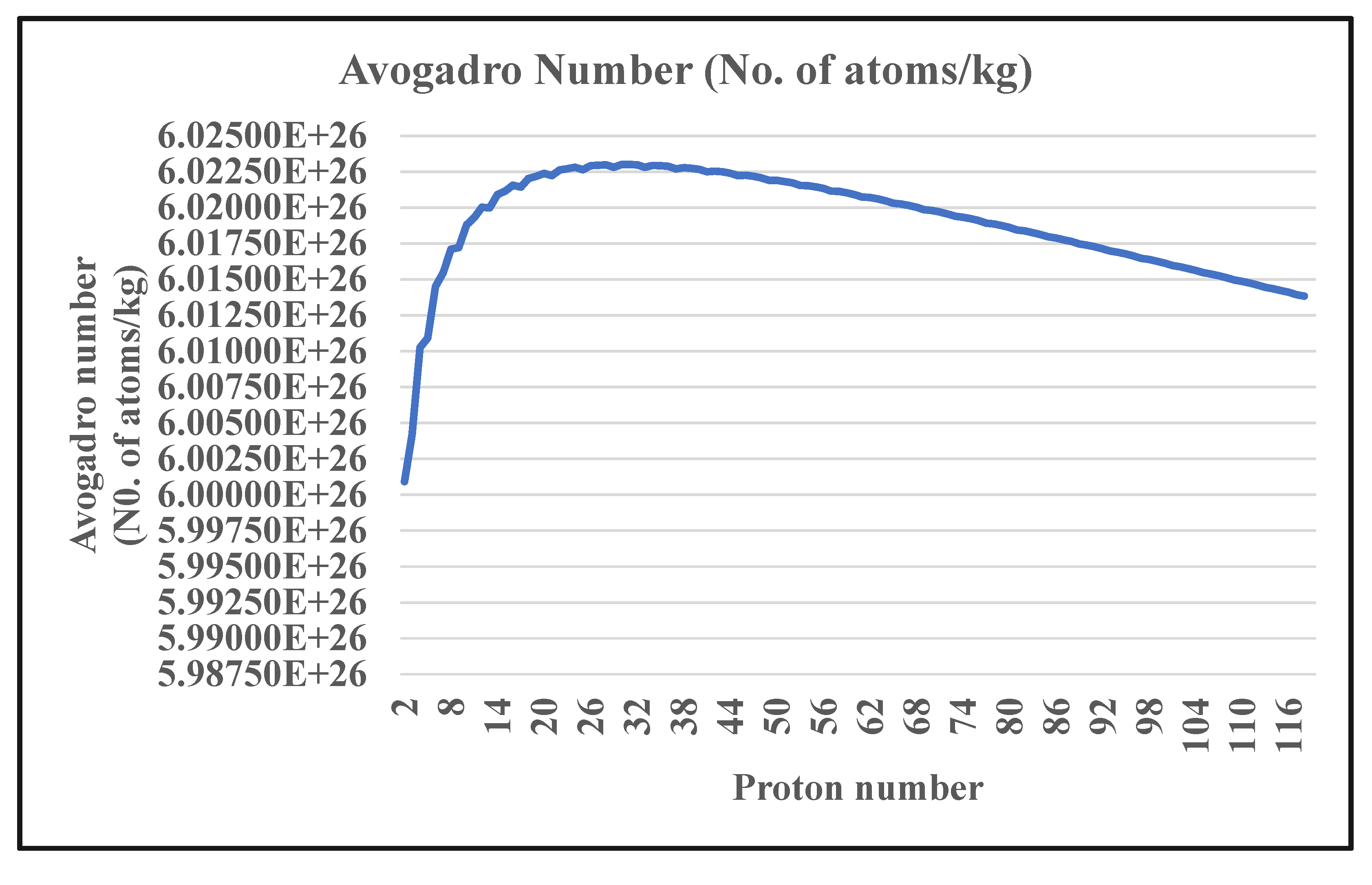
Figure 2.
Discrete mass spectrum of compact objects.
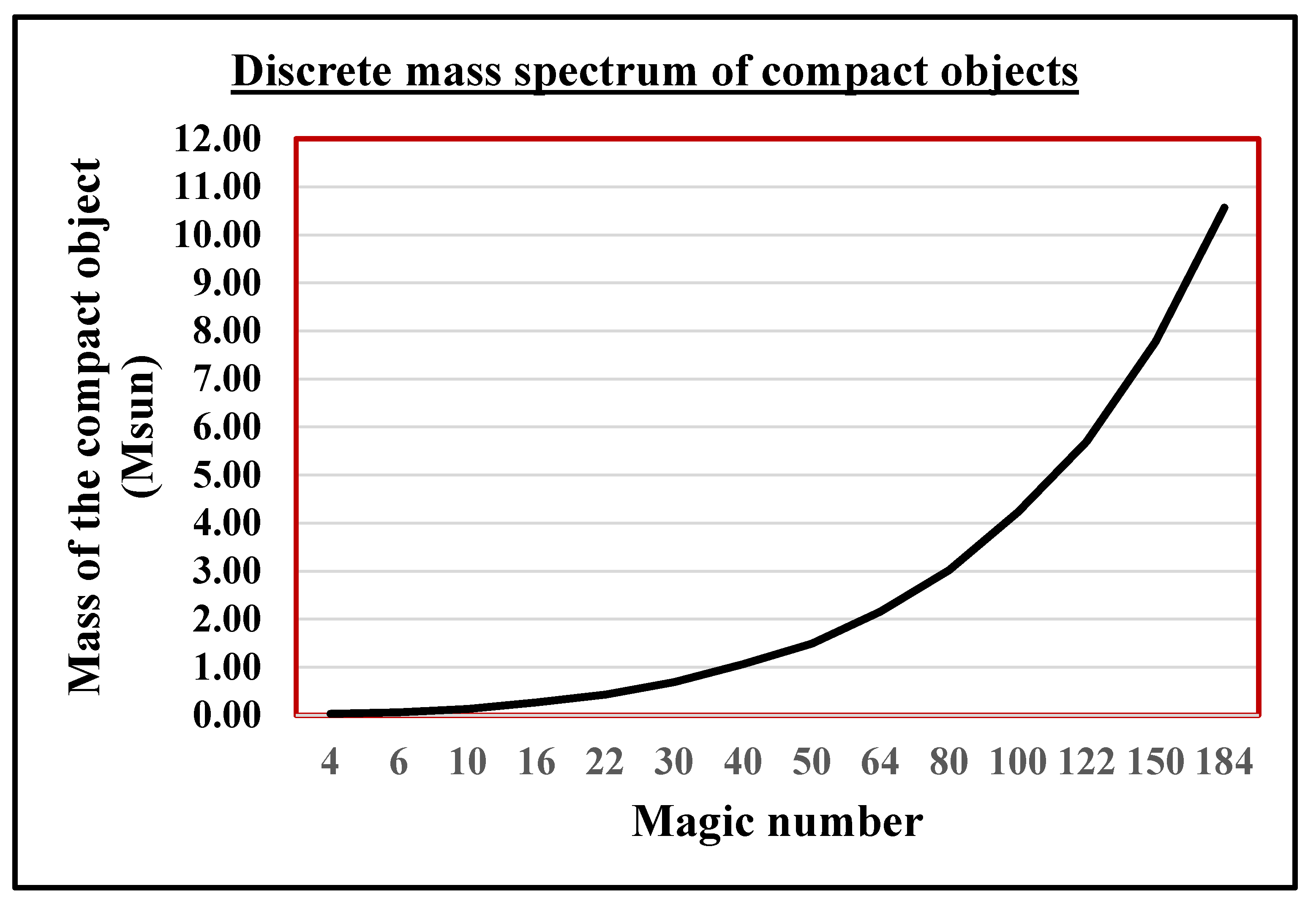
Figure 3.
Comparison of estimated and experimental values of Specific heat capacity of solids.
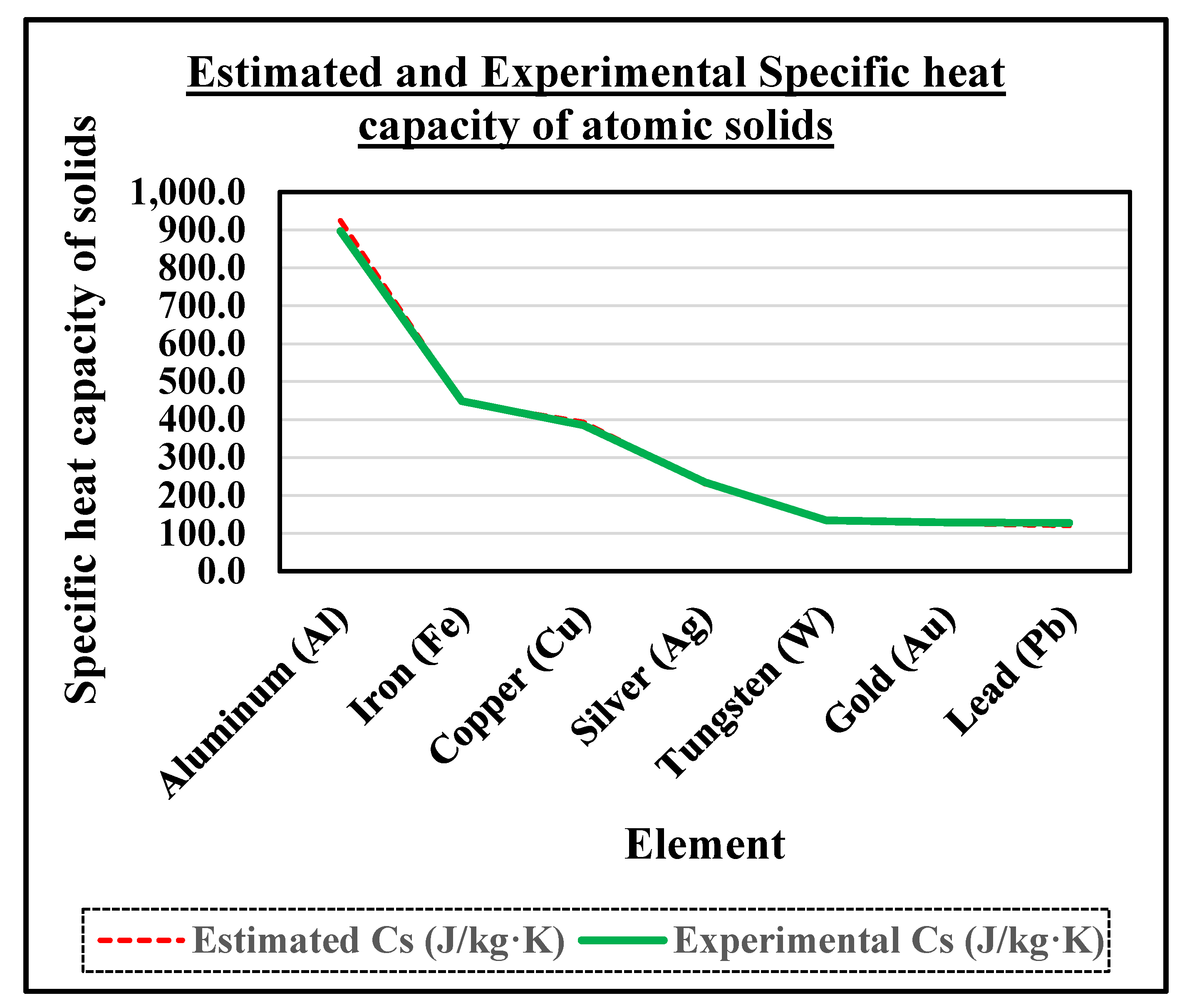

Table 1.
Estimated kg scale - Avogadro Number expressed in ‘No. of atoms/kg’ for Z = 2–118 from the unified SEMF-based binding energy formula [9].
Table 1.
Estimated kg scale - Avogadro Number expressed in ‘No. of atoms/kg’ for Z = 2–118 from the unified SEMF-based binding energy formula [9].
| Z | Lower mass number | Upper mass number | No. of Isotopes | Avogadro number (No. of atoms/kg) |
|---|---|---|---|---|
| 2 | 3 | 7 | 5 | 6.00092E+26 |
| 3 | 5 | 10 | 6 | 6.00417E+26 |
| 4 | 7 | 14 | 8 | 6.01024E+26 |
| 5 | 9 | 18 | 10 | 6.01093E+26 |
| 6 | 11 | 21 | 11 | 6.01450E+26 |
| 7 | 13 | 24 | 12 | 6.01547E+26 |
| 8 | 15 | 28 | 14 | 6.01711E+26 |
| 9 | 17 | 32 | 16 | 6.01721E+26 |
| 10 | 19 | 35 | 17 | 6.01881E+26 |
| 11 | 21 | 38 | 18 | 6.01930E+26 |
| 12 | 23 | 42 | 20 | 6.02003E+26 |
| 13 | 25 | 46 | 22 | 6.01998E+26 |
| 14 | 27 | 49 | 23 | 6.02090E+26 |
| 15 | 29 | 52 | 24 | 6.02117E+26 |
| 16 | 31 | 56 | 26 | 6.02155E+26 |
| 17 | 33 | 60 | 28 | 6.02143E+26 |
| 18 | 35 | 63 | 29 | 6.02203E+26 |
| 19 | 37 | 66 | 30 | 6.02218E+26 |
| 20 | 39 | 70 | 32 | 6.02238E+26 |
| 21 | 41 | 74 | 34 | 6.02223E+26 |
| 22 | 43 | 77 | 35 | 6.02263E+26 |
| 23 | 45 | 80 | 36 | 6.02272E+26 |
| 24 | 47 | 84 | 38 | 6.02281E+26 |
| 25 | 49 | 88 | 40 | 6.02264E+26 |
| 26 | 51 | 91 | 41 | 6.02292E+26 |
| 27 | 53 | 94 | 42 | 6.02296E+26 |
| 28 | 55 | 98 | 44 | 6.02299E+26 |
| 29 | 57 | 102 | 46 | 6.02281E+26 |
| 30 | 59 | 105 | 47 | 6.02301E+26 |
| 31 | 61 | 108 | 48 | 6.02301E+26 |
| 32 | 63 | 112 | 50 | 6.02299E+26 |
| 33 | 65 | 116 | 52 | 6.02281E+26 |
| 34 | 67 | 119 | 53 | 6.02295E+26 |
| 35 | 69 | 122 | 54 | 6.02292E+26 |
| 36 | 71 | 126 | 56 | 6.02288E+26 |
| 37 | 73 | 130 | 58 | 6.02269E+26 |
| 38 | 75 | 133 | 59 | 6.02278E+26 |
| 39 | 77 | 136 | 60 | 6.02274E+26 |
| 40 | 79 | 140 | 62 | 6.02267E+26 |
| 41 | 81 | 144 | 64 | 6.02249E+26 |
| 42 | 83 | 147 | 65 | 6.02255E+26 |
| 43 | 85 | 150 | 66 | 6.02249E+26 |
| 44 | 87 | 154 | 68 | 6.02240E+26 |
| 45 | 89 | 158 | 70 | 6.02222E+26 |
| 46 | 91 | 161 | 71 | 6.02225E+26 |
| 47 | 93 | 164 | 72 | 6.02218E+26 |
| 48 | 95 | 168 | 74 | 6.02208E+26 |
| 49 | 97 | 172 | 76 | 6.02190E+26 |
| 50 | 99 | 175 | 77 | 6.02191E+26 |
| 51 | 101 | 178 | 78 | 6.02183E+26 |
| 52 | 103 | 182 | 80 | 6.02173E+26 |
| 53 | 105 | 186 | 82 | 6.02154E+26 |
| 54 | 107 | 189 | 83 | 6.02153E+26 |
| 55 | 109 | 192 | 84 | 6.02145E+26 |
| 56 | 111 | 196 | 86 | 6.02134E+26 |
| 57 | 113 | 200 | 88 | 6.02115E+26 |
| 58 | 115 | 203 | 89 | 6.02113E+26 |
| 59 | 117 | 206 | 90 | 6.02104E+26 |
| 60 | 119 | 210 | 92 | 6.02092E+26 |
| 61 | 121 | 214 | 94 | 6.02074E+26 |
| 62 | 123 | 217 | 95 | 6.02071E+26 |
| 63 | 125 | 220 | 96 | 6.02061E+26 |
| 64 | 127 | 224 | 98 | 6.02049E+26 |
| 65 | 129 | 228 | 100 | 6.02031E+26 |
| 66 | 131 | 231 | 101 | 6.02026E+26 |
| 67 | 133 | 234 | 102 | 6.02016E+26 |
| 68 | 135 | 238 | 104 | 6.02004E+26 |
| 69 | 137 | 242 | 106 | 6.01986E+26 |
| 70 | 139 | 245 | 107 | 6.01981E+26 |
| 71 | 141 | 248 | 108 | 6.01970E+26 |
| 72 | 143 | 252 | 110 | 6.01957E+26 |
| 73 | 145 | 256 | 112 | 6.01940E+26 |
| 74 | 147 | 259 | 113 | 6.01934E+26 |
| 75 | 149 | 262 | 114 | 6.01923E+26 |
| 76 | 151 | 266 | 116 | 6.01910E+26 |
| 77 | 153 | 270 | 118 | 6.01893E+26 |
| 78 | 155 | 273 | 119 | 6.01886E+26 |
| 79 | 157 | 276 | 120 | 6.01875E+26 |
| 80 | 159 | 280 | 122 | 6.01862E+26 |
| 81 | 161 | 284 | 124 | 6.01845E+26 |
| 82 | 163 | 287 | 125 | 6.01838E+26 |
| 83 | 165 | 290 | 126 | 6.01826E+26 |
| 84 | 167 | 294 | 128 | 6.01813E+26 |
| 85 | 169 | 298 | 130 | 6.01796E+26 |
| 86 | 171 | 301 | 131 | 6.01788E+26 |
| 87 | 173 | 304 | 132 | 6.01777E+26 |
| 88 | 175 | 308 | 134 | 6.01764E+26 |
| 89 | 177 | 312 | 136 | 6.01747E+26 |
| 90 | 179 | 315 | 137 | 6.01739E+26 |
| 91 | 181 | 318 | 138 | 6.01727E+26 |
| 92 | 183 | 322 | 140 | 6.01714E+26 |
| 93 | 185 | 326 | 142 | 6.01697E+26 |
| 94 | 187 | 329 | 143 | 6.01689E+26 |
| 95 | 189 | 332 | 144 | 6.01677E+26 |
| 96 | 191 | 336 | 146 | 6.01664E+26 |
| 97 | 193 | 340 | 148 | 6.01647E+26 |
| 98 | 195 | 343 | 149 | 6.01639E+26 |
| 99 | 197 | 346 | 150 | 6.01627E+26 |
| 100 | 199 | 350 | 152 | 6.01613E+26 |
| 101 | 201 | 354 | 154 | 6.01597E+26 |
| 102 | 203 | 357 | 155 | 6.01588E+26 |
| 103 | 205 | 360 | 156 | 6.01576E+26 |
| 104 | 207 | 364 | 158 | 6.01563E+26 |
| 105 | 209 | 368 | 160 | 6.01547E+26 |
| 106 | 211 | 371 | 161 | 6.01537E+26 |
| 107 | 213 | 374 | 162 | 6.01525E+26 |
| 108 | 215 | 378 | 164 | 6.01512E+26 |
| 109 | 217 | 382 | 166 | 6.01496E+26 |
| 110 | 219 | 385 | 167 | 6.01486E+26 |
| 111 | 221 | 388 | 168 | 6.01474E+26 |
| 112 | 223 | 392 | 170 | 6.01461E+26 |
| 113 | 225 | 396 | 172 | 6.01445E+26 |
| 114 | 227 | 399 | 173 | 6.01435E+26 |
| 115 | 229 | 402 | 174 | 6.01423E+26 |
| 116 | 231 | 406 | 176 | 6.01410E+26 |
| 117 | 233 | 410 | 178 | 6.01394E+26 |
| 118 | 235 | 413 | 179 | 6.01384E+26 |
| Average | 10764 | 6.01899E+26 |
Table 2.
Charge dependent string tensions and string energies.
| S.No | Interaction | String Tension | String energy |
|
1 |
Weak |
||
|
2 |
Strong |
||
|
3 |
Electromagnetic |
Table 3.
Quantum string tensions and string energies.
| S.No | Interaction | String Tension | String energy |
|
1 |
Weak |
||
|
2 |
Strong |
||
|
3 |
Electromagnetic |
Table 4.
Estimated discrete mass spectrum of stellar compact objects.
| Magic number n |
Max. l value | Indexing value | Approx. mass MSun |
Remarks | |
|---|---|---|---|---|---|
| 4 | 3 | 3x4/2 | 1.57 | 0.03 | Brown Dwarf regime |
| 6 | 5 | 5x6/2 | 1.97 | 0.06 | Brown Dwarf regime |
| 10 | 9 | 9x10/2 | 2.59 | 0.13 | Red Dwarf (Very low-mass star) |
| 16 | 15 | 15x16/2 | 3.31 | 0.27 | Low-Mass White Dwarf |
| 22 | 21 | 21x22/2 | 3.90 | 0.43 | White Dwarf |
| 30 | 29 | 29x30/2 | 4.57 | 0.69 | Typical White Dwarf (Carbon-Oxygen) |
| 40 | 39 | 39x40/2 | 5.28 | 1.07 | Massive White Dwarf (Oxygen-Neon) |
| 50 | 49 | 49x50/2 | 5.92 | 1.49 | Chandrasekhar mass limit |
| 64 | 63 | 63x64/2 | 6.70 | 2.16 | TOV limit (Max neutron star mass) |
| 80 | 79 | 79x80/2 | 7.50 | 3.02 | Lower mass gap / Minimum stellar black hole |
| 100 | 99 | 99x100/2 | 8.39 | 4.23 | Stellar Mass Black Hole |
| 122 | 121 | 121x122/2 | 9.27 | 5.70 | Stellar Mass Black Hole |
| 150 | 149 | 149x150/2 | 10.28 | 7.77 | Stellar Mass Black Hole |
| 184 | 183 | 183x184/2 | 11.39 | 10.56 | Stellar Mass Black Hole |
Table 5.
Fitting magic numbers.
| Z (Magic) | Element | Mass number (A) |
Z/√A | Deviation from Integer | Deviation from Half-Integer | Regime | Quantized Shell Index |
|---|---|---|---|---|---|---|---|
| 2 | Helium |
4 |
1.00 | 0.00 (Perfect 1.0) | 0.50 | Integer | 1 |
| 8 | Oxygen | 16 | 2.00 | 0.00 (Perfect 2.0) | 0.50 | Integer | 2 |
| 20 | Calcium | 40 | 3.16 | +0.16 (Near 3.0) | -0.34 | Integer | 3 |
| 28 | Nickel | 58 | 3.67 | +0.67 | +0.17 (Near 3.5) | Half-Integer | 3.5 |
| 50 | Tin | 120 | 4.58 | +0.58 | +0.08 (Near 4.5) | Half-Integer | 4.5 |
| 82 | Lead | 208 | 5.69 | +0.69 | +0.19 (Near 5.5) | Half-Integer | 5.5 |
| 114 | Flerovium | 298 | 6.60 | +0.60 | +0.10 (Near 6.5) | Half-Integer | 6.5 |
Table 6.
Estimated integer level magic numbers.
| Z | Calculated y | Physical/Nuclear Significance |
|---|---|---|
| 10 (Neon) | 1.97 | Endpoint of the 1p shell; Neon is a noble gas with high stability. |
| 22 (Titanium) | 3.00 | Completion of the 1f-7/2 orbital filling; start of the transition metals. |
| 40 (Zirconium) | 4.02 | Semi-magic number; Z=40 shows strong subshell closure effects. |
| 64 (Gadolinium) | 4.99 | Sub-magic number; closure of the 4f-7/2 subshell. |
| 100 (Fermium) | 6.01 | The Fermium Limit; the boundary of heavy-element synthesis. |
| 150 (Unpqp) | 7.01 | Predicted structural limit for heavy nuclei before the next major shell. |
Table 7.
Estimated half integer level magic numbers.
| Target y | Estimated Magic Z |
Z ± 4 | Notes History |
|---|---|---|---|
| 1.5 | 6 | 2 – 10 | Light shell; exact fit for Z=8 (Oxygen) within the stability margin. |
| 2.5 | 16 | 12 – 20 | Transition zone; captures Z=14 (Silicon) and the major closure at Z=20 (Calcium). |
| 3.5 | 30 | 26 – 34 | Iron-peak region; covers the major magic number Z=28 (Nickel). |
| 4.5 | 50 | 46 – 54 | Exact fit for Tin (Z=50); identifies the maximum number of stable isotopes in the periodic table. |
| 5.5 | 80 | 76 – 84 | Heavy closure zone; encompasses Z=82 (Lead), the heaviest stable magic nucleus. |
| 6.5 | 122 | 118 – 126 | Island of Stability; sits between the y=6.0 anchor (Z=100) and theoretical Z=126 resonances. |
| 7.5 | 184 | 180 – 188 | Superheavy limit; aligns with major theoretical neutron and proton shell closures. |
Table 8.
Estimated integer and half integer series magic numbers.
| Proton number Z |
Estimated Stable mass number Astable |
x | y | Integer Magic Z without y | Integer and Half Integer magic Z with y |
|---|---|---|---|---|---|
| 2 | 4 | 1.00 | 0.78 | 2 | |
| 4 | 8 | 1.41 | 1.19 | 4 | |
| 6 | 12 | 1.73 | 1.50 | 6 | |
| 8 | 16 | 2.00 | 1.76 | 8 | |
| 10 | 21 | 2.18 | 1.97 | 10 | |
| 12 | 25 | 2.40 | 2.18 | ||
| 14 | 29 | 2.60 | 2.38 | ||
| 16 | 34 | 2.74 | 2.53 | 16 | |
| 18 | 38 | 2.92 | 2.70 | ||
| 20 | 43 | 3.05 | 2.84 | 20 | |
| 22 | 47 | 3.21 | 3.00 | 22 | |
| 24 | 52 | 3.33 | 3.12 | ||
| 26 | 56 | 3.47 | 3.27 | ||
| 28 | 61 | 3.59 | 3.38 | ||
| 30 | 66 | 3.69 | 3.49 | 30 | |
| 32 | 71 | 3.80 | 3.60 | ||
| 34 | 75 | 3.93 | 3.73 | ||
| 36 | 80 | 4.02 | 3.83 | 36 | |
| 38 | 85 | 4.12 | 3.93 | ||
| 40 | 90 | 4.22 | 4.02 | 40 | |
| 42 | 95 | 4.31 | 4.12 | ||
| 44 | 100 | 4.40 | 4.21 | ||
| 46 | 106 | 4.47 | 4.28 | ||
| 48 | 111 | 4.56 | 4.37 | ||
| 50 | 116 | 4.64 | 4.46 | 50 | |
| 52 | 121 | 4.73 | 4.55 | ||
| 54 | 127 | 4.79 | 4.61 | ||
| 56 | 132 | 4.87 | 4.70 | ||
| 58 | 138 | 4.94 | 4.76 | ||
| 60 | 143 | 5.02 | 4.84 | 60 | |
| 62 | 149 | 5.08 | 4.91 | ||
| 64 | 154 | 5.16 | 4.99 | 64 | |
| 66 | 160 | 5.22 | 5.05 | ||
| 68 | 166 | 5.28 | 5.11 | ||
| 70 | 171 | 5.35 | 5.19 | ||
| 72 | 177 | 5.41 | 5.25 | ||
| 74 | 183 | 5.47 | 5.31 | ||
| 76 | 189 | 5.53 | 5.37 | ||
| 78 | 195 | 5.59 | 5.43 | ||
| 80 | 201 | 5.64 | 5.49 | 80 | |
| 82 | 207 | 5.70 | 5.54 | ||
| 84 | 213 | 5.76 | 5.60 | ||
| 86 | 219 | 5.81 | 5.66 | ||
| 88 | 226 | 5.85 | 5.70 | ||
| 90 | 232 | 5.91 | 5.76 | ||
| 92 | 238 | 5.96 | 5.82 | ||
| 94 | 245 | 6.01 | 5.86 | 94 | |
| 96 | 251 | 6.06 | 5.91 | ||
| 98 | 257 | 6.11 | 5.97 | ||
| 100 | 264 | 6.15 | 6.01 | 100 | |
| 102 | 271 | 6.20 | 6.06 | ||
| 104 | 277 | 6.25 | 6.11 | ||
| 106 | 284 | 6.29 | 6.15 | ||
| 108 | 291 | 6.33 | 6.19 | ||
| 110 | 297 | 6.38 | 6.25 | ||
| 112 | 304 | 6.42 | 6.29 | ||
| 114 | 311 | 6.46 | 6.33 | ||
| 116 | 318 | 6.50 | 6.37 | ||
| 118 | 325 | 6.55 | 6.41 | ||
| 120 | 332 | 6.59 | 6.46 | ||
| 122 | 339 | 6.63 | 6.50 | 122 | |
| 124 | 346 | 6.67 | 6.54 | ||
| 126 | 354 | 6.70 | 6.57 | ||
| 128 | 361 | 6.74 | 6.61 | ||
| 130 | 368 | 6.78 | 6.65 | ||
| 132 | 376 | 6.81 | 6.69 | ||
| 134 | 383 | 6.85 | 6.73 | ||
| 136 | 390 | 6.89 | 6.77 | ||
| 138 | 398 | 6.92 | 6.80 | ||
| 140 | 405 | 6.96 | 6.84 | ||
| 142 | 413 | 6.99 | 6.87 | 142 | |
| 144 | 421 | 7.02 | 6.90 | ||
| 146 | 428 | 7.06 | 6.94 | ||
| 148 | 436 | 7.09 | 6.97 | ||
| 150 | 444 | 7.12 | 7.01 | 150 | |
| 152 | 452 | 7.15 | 7.04 | ||
| 154 | 460 | 7.18 | 7.07 | ||
| 156 | 468 | 7.21 | 7.10 | ||
| 158 | 476 | 7.24 | 7.13 | ||
| 160 | 484 | 7.27 | 7.16 | ||
| 162 | 492 | 7.30 | 7.20 | ||
| 164 | 500 | 7.33 | 7.23 | ||
| 166 | 508 | 7.37 | 7.26 | ||
| 168 | 517 | 7.39 | 7.28 | ||
| 170 | 525 | 7.42 | 7.32 | ||
| 172 | 533 | 7.45 | 7.35 | ||
| 174 | 542 | 7.47 | 7.37 | ||
| 176 | 550 | 7.50 | 7.40 | ||
| 177 | 555 | 7.51 | 7.41 | ||
| 178 | 559 | 7.53 | 7.43 | ||
| 179 | 563 | 7.54 | 7.44 | ||
| 180 | 567 | 7.56 | 7.46 | ||
| 181 | 572 | 7.57 | 7.47 | ||
| 182 | 576 | 7.58 | 7.48 | ||
| 183 | 580 | 7.60 | 7.50 | ||
| 184 | 585 | 7.61 | 7.51 | 184 | |
| 185 | 589 | 7.62 | 7.52 |
Table 9.
Comparison of estimated and experimental values of Specific heat capacity of solids.
| Element | Atomic Mass Number | Estimated Cs (J/kg·K) | Experimental Cs (J/kg·K) | Difference (J/kg·K) |
% Error |
|---|---|---|---|---|---|
| Aluminium (Al) | 26.98 | 924.5 | 897 | -27.5 | -3.1 |
| Iron (Fe) | 55.85 | 446.6 | 449 | 2.4 | 0.5 |
| Copper (Cu) | 63.55 | 392.5 | 385 | -7.5 | -1.9 |
| Silver (Ag) | 107.87 | 231.2 | 235 | 3.8 | 1.6 |
| Tungsten (W) | 183.84 | 135.7 | 134 | -1.7 | -1.3 |
| Gold (Au) | 196.97 | 126.6 | 129 | 2.4 | 1.9 |
| Lead (Pb) | 207.2 | 120.4 | 128 | 7.6 | 5.9 |
Disclaimer/Publisher’s Note: The statements, opinions and data contained in all publications are solely those of the individual author(s) and contributor(s) and not of MDPI and/or the editor(s). MDPI and/or the editor(s) disclaim responsibility for any injury to people or property resulting from any ideas, methods, instructions or products referred to in the content. |
© 2026 by the authors. Licensee MDPI, Basel, Switzerland. This article is an open access article distributed under the terms and conditions of the Creative Commons Attribution (CC BY) license (http://creativecommons.org/licenses/by/4.0/).
Copyright: This open access article is published under a Creative Commons CC BY 4.0 license, which permit the free download, distribution, and reuse, provided that the author and preprint are cited in any reuse.


