
Submitted:
12 March 2026
Posted:
17 March 2026
You are already at the latest version
Abstract
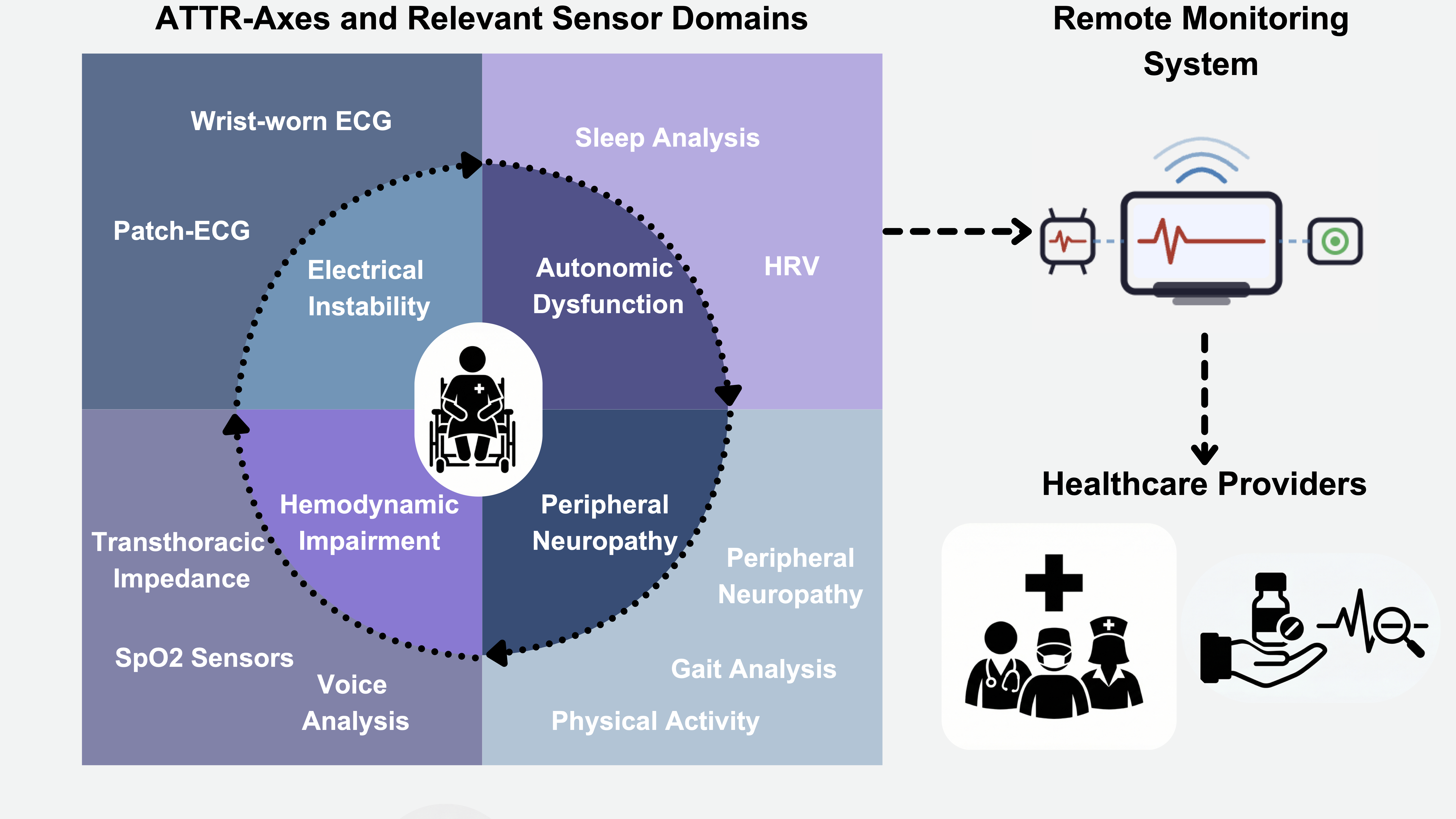
Wearable sensors enable continuous recording of electrocardiographic, photoplethys-mographic, and inertial signals and have accelerated the development of digital bi-omarkers in cardiovascular medicine. Transthyretin amyloidosis (ATTR) is a progressive multisystem disease characterized by arrhythmia, conduction disturbances, hemody-namic impairment, autonomic dysfunction, and gait abnormalities, making it theoreti-cally suitable for multimodal wearable monitoring. This review summarizes current knowledge on wearable applications in ATTR, evaluates the plausibility of extrapolating signal-based biomarkers from related cardiovascular and neurological cohorts, and out-lines methodological and implementation challenges. ATTR-specific data remain limited to small observational studies, mainly on long-term rhythm monitoring and supervised functional assessment. More comprehensive findings support the extraction of metrics such as atrial fibrillation burden, activity patterns, gait variability, and heart rate var-iability. However, ATTR-related structural remodeling and high arrhythmia burden may distort conventional digital biomarkers, necessitating disease-specific preprocessing and prospective validation. Wearable monitoring in ATTR is technically feasible and biologically plausible but remains investigational. Before routine integration into care pathways can be recommended, standardized, phenotype-stratified studies are needed that link wearable-derived characteristics to assessed clinical outcomes.
Keywords:
transthyretin amyloidosis
; wearables
; sensors
; telemonitoring
; heart failure
; neuropathy
; atrial fibrillation
; gait analysis
Copyright: This open access article is published under a Creative Commons CC BY 4.0 license, which permit the free download, distribution, and reuse, provided that the author and preprint are cited in any reuse.


