

Submitted:
11 March 2026
Posted:
12 March 2026
You are already at the latest version
Abstract
Prominin-1 (Prom1/CD133) has long been recognized as a structural determinant of photoreceptor outer segment (OS) morphogenesis, yet rapidly accumulating evidence extends its role to retinal pigment epithelium (RPE) homeostasis, encompassing autophagy–lysosomal flux, outer segment phagocytosis, mitochondrial function, and regulation of inflammatory stress. This review synthesizes mechanistic and transcriptomic insights that position Prom1 as a central regulator of photoreceptor and RPE integrity, reframing Prom1 disease as a multi-compartment retinal disorder relevant to both inherited retinal dystrophies (IRDs) and atrophic age-related macular degeneration (AMD). We develop a dual-axis conceptual model in which Prom1 dysfunction can initiate pathology in either the photoreceptors (OS morphogenesis failure) or the RPE, including impaired autophagic flux, lysosomal activity, defective phagocytosis, and EMT-like de-differentiation, with secondary cross-compartmental degeneration. Clinically, autosomal dominant missense variants associate with macular or cone rod dystrophy, whereas biallelic truncating/splice site mutations drive early onset rod–cone disease and panretinal/RPE atrophy, illustrating genotype–phenotype diversity. By integrating recent high-resolution transcriptomic data from Prom1-deficient RPE cells with long-standing insights into photoreceptor biology, we highlight converging pathways of degeneration that challenge a photoreceptor-centric view and unify disparate phenotypes within a single molecular framework. These insights broaden the therapeutic landscape, advancing gene augmentation and pathway-targeted strategies to preserve RPE integrity, sustain photoreceptor function, and modify disease course in Prom1-associated IRDs and atrophic AMD.
Keywords:
autophagy
; lysosome
; phagocytosis
; mitochondrial function
; epithelial-mesenchymal transition
; partial EMT
; inherited retinal dystrophy
; atrophic age-related macular degeneration
1. Introduction
Retinal degenerations, including inherited retinal dystrophies (IRDs) and age-related macular degeneration (AMD), are leading causes of vision loss worldwide [1,2]. The majority of IRDs are traditionally photoreceptor-centric diseases, including rod-cone dystrophies and cone-rod dystrophies, with each group characterized by a primary loss of either rods or cones and a secondary loss of other cell types, including RPE [3,4]. However, several studies have identified the retinal pigment epithelium (RPE) as the primary site of pathology in several IRDs, including Bestrophinopathies (caused by mutations in the BEST1 gene), X-linked recessive Choroideremia (caused by mutations in the CHM gene), and Leber congenital amaurosis (caused by mutations in the RPE65 gene) [5,6,7]. The RPE involvement in these IRDs shows significant phenotypic similarities to RPE degeneration in atrophic age-related macular degeneration (aAMD), characterized by progressive RPE dysfunction, photoreceptor cell death, and macular atrophy, suggesting that understanding the genetics and mechanisms of inherited macular degenerations may contribute to our understanding of aAMD [8]. A growing consensus positions the retinal pigment epithelium (RPE) as a pivotal focus of disease initiation and progression because it sustains photoreceptors through daily phagocytosis of shed photoreceptor outer segments (POSs), autophagy-lysosomal clearance of debris, mitochondrial quality control, and maintenance of epithelial polarity and barrier integrity [9]. Failures in these RPE processes lead to secondary photoreceptor death, geographic atrophy, and progressive vision loss, underscoring the centrality of RPE biology to retinal health [10]. Genetic defects affecting RPE pathways can impair photoreceptor survival well before RPE loss becomes evident, underscoring the critical need to decipher IRD pathophysiology to develop precise therapeutic interventions [11].
Since its discovery as a pentaspan transmembrane glycoprotein, enriched on plasma-membrane protrusions, Prominin-1 (Prom1/CD133) has occupied a distinctive niche in retinal biology [12,13,14]. Prom1 displays an altered splicing pattern during human retinal development, consisting of increased exon 4 inclusion and exon 25 skipping—the exon 4 skipping disrupts the extracellular domain of Prom1 and produces an unstable, mislocalized protein that cannot reach the photoreceptor cilium. This reduction in functional Prom1 (decreased Prom1 expression) leads to shortened photoreceptor cone outer segments (POSs), cone cilium defects, and abnormal accumulation of cone photoreceptors, suggesting Prom1 exon 4 inclusion is essential for normal cone maturation, structure, and function, and its mis-splicing underlies Prom1-associated maculopathies [15,16]. Localization studies showed Prom1’s presence at the photoreceptor outer segment base, precisely where nascent discs emerge from the connecting cilium – cementing a canonical view of Prom1 as a structural architect of disc morphogenesis [12,17,18]. Consistent with this, animal models lacking Prom1 (global Prom1-KO mice) exhibit defective OS membranes, progressive photoreceptor degeneration, and visual dysfunction, establishing its structural requirement in the neural retina [18,19,20]. Although the mechanisms contributing to Prom1-mediated maintenance or development of the OS structure are unknown, previous studies have shown that the loss of Prom1's interacting partner, Protocadherin 21, a cadherin homolog in the retina, is a potential mechanism for defective OS development [19,21,22]. Prom1 is necessary for maintaining the expression levels of ABCA4 and RDH12 in the mouse retina, supporting the idea that Prom1 also regulates the visual cycle, particularly at the step where all-trans-retinal is reduced to all-trans-retinol, indicating that Prom1 helps the retina maintain its cleanup and recycling step in the visual cycle [23,24].
Clinical examinations reveal a more complex and broader biology. Prom1 variants do not yield a uniform phenotype but rather a spectrum ranging from Stargardt-like macular dystrophy, bull’s-eye maculopathy, and autosomal-dominant and recessive cone-rod dystrophies (CRD) to retinitis pigmentosa (RP)-like panretinal diseases [16,21,25,26,27,28,29]. Some young individuals exhibit early RPE abnormalities, whereas older individuals show combined RPE and photoreceptor loss, suggesting that RPE pathology precedes photoreceptor damage [30]. Others show cone-predominant disease or mixed phenotypes that cannot be explained by canonical mechanisms of disk morphogenesis [31].
As high-resolution imaging modalities, such as spectral domain Optical Coherence Tomography (SD-OCT), fundus autofluorescence (FAF), transcriptomic profiling, and cell-type-specific rodent models have matured, a conceptual shift has emerged: Prom1 should not be viewed solely through the lens of photoreceptor architecture. Instead, Prom1 is emerging as a multifunctional regulator of cellular homeostasis across multiple retinal cell types. In particular, its role in RPE biology—including autophagy, phagocytosis of outer segments, epithelial integrity, mitochondrial dynamics, and immune signaling —has opened a new exploratory framework for both IRDs and atrophic AMD [32,33,34,35].
This review integrates genetic, clinical, mechanistic, and transcriptomic findings to advance a new model of Prom1-related disease: one in which RPE degeneration is not a secondary response to photoreceptor pathology, but a primary driver in many forms of Prom1-associated macular degeneration. This paradigm has profound implications for understanding phenotypic heterogeneity and for designing therapeutics to preserve the health of both photoreceptors and the RPE.
2. Genetic and Clinical Landscape of Prom1-Associated Retinal Diseases
Prom1 mutations span missense, nonsense, frameshift, splice-site, and intronic regulatory variants. Both autosomal dominant (AD) and autosomal recessive (AR) transmission patterns are well documented [16,25,36]. One of the earliest and best characterized autosomal dominant missense variants, p.R373C, is associated with bull’s-eye maculopathy, characterized by macular atrophy and cone-rod dysfunction [28]. Patients harboring this mutation exhibit progressive degeneration of the outer retinal layer, affecting both cone- and rod-mediated vision [36]. In contrast, bi-allelic loss of function alleles, including splice site-variants (c.1984-1G>T) and truncations Prom1 c.1909C>T (p.Q637), Prom1 c.2050C>T (p.R684), are linked to bull’s eye maculopathy and early onset rod-cone disease with panretinal/RPE atrophy [16,37,38,39]. At the population level, Prom1-associated disease appears relatively rare: variant databases catalog many distinct changes, but only a fraction are clinically validated as pathogenic, and ancestry-aware comparative prevalence estimates remain limited. Recent investigations of IRD cohorts confirm that Prom1 mutations, although relatively rare (1-2%), are drivers of macular dystrophy, cone-rod dystrophy, retinitis pigmentosa, Stargardt disease type 4 (STGD4), Leber congenital amaurosis (LCA), and panretinal dystrophy, reaffirming their importance despite the phenotypic variability and heterogeneity, with the route of inheritance and variant type affecting disease severity and progression [36]. Intriguingly, cohort studies confirm the prominence of p.R373C among Prom1-related macular phenotypes, but reveal heterogeneity in macular and peripheral degeneration, suggesting that patients with identical variants may develop distinct disease trajectories, driven by cell-type-specific vulnerabilities, modifier alleles, and potential environmental modifiers [40].
Pathogenic Prom1 variants include loss-of-function (LOF) nonsense, frameshift, and splice-site mutations, as well as dominant-negative missense alleles, collectively leading to macular and panretinal degeneration (Table 1). LOF variants, such as p.Tyr519*, p.Ile393Argfs*21, p.Trp452Leufs*13, p.Leu8fs*, p.Gln637*, p.Arg684*, p.Ile626fs, p>his47fs, and splice defects including c.303+2T>C and c.1142-iG>A, introduce frameshifts, premature termination codons, or aberrant splicing. These changes lead to nonsense-mediated decay or severely truncated Prom1, eliminating its essential role in photoreceptor morphogenesis and disc membrane architecture. These LOF alleles eliminate essential Prom1 functions required for photoreceptor outer segment morphogenesis, disc organization, and membrane curvature stabilization. Their loss disrupts outer-segment renewal, leading to structural disorganization, photoreceptor and RPE stress, culminating in progressive retinal degeneration with disease severity depending on gene dosage (dominant haploinsufficiency vs. reverse recessive null states). Beyond the clinical manifestations already described, the severity of LOF-associated disease depends heavily on allele dosage. Homozygous or compound heterozygous LOF alleles often produce the most severe phenotypes, including LCA or panretinal dystrophy, while heterozygous LOF variants can lead to dominant disease through haploinsufficiency when Prom1 expression falls below a functional threshold. In contrast, dominant-negative missense variants—most notably p.Arg373Cys, p.Gly240Arg, and p.Leu245Pro—primarily yield AD macular degeneration, frequently presenting as bull’s-eye maculopathy or progressive photoreceptor/RPE degeneration. Together, these data show that the pathogenic mechanism of Prom1 variants is strongly mutation-class-dependent: LOF mutations cause disease by disrupting essential photoreceptor structural function, whereas select missense alleles exert toxic dominant effects through defective protein interactions. Recent evidence indicates that Prom1 variants have direct consequences for autophagy regulation. Bulk RNA-sequencing analysis in Prom1 exon-skipped human retinal organoids shows reduced expression of autophagy-associated pathways, reflecting impaired stress-response signaling primarily within cone photoreceptors, the cell population most sensitive to Prom1 exon 4 loss [15]. In contrast, the novel Prom1 c.232delC frameshift variant does not simply truncate the protein analogous to exon-skipping events; rather, it produces a mutated protein that is mislocalized and exhibits reduced stability, indicating a distinct structural and trafficking defect [41]. This mislocalized variant paradoxically augments autophagy, even though apoptotic pathways remain unaffected [41]. These contrasting effects of exon skipping versus c.2321delC demonstrate that Prom1’s role in autophagy regulation is highly domain-specific. Different structural damages—loss of a canonical domain versus the creation of a truncated, mislocalized isoform—can lead to opposite functional outcomes rather than simply LOF, indicating a more complex regulatory role than previously understood (Table 1).
Autofluorescent imaging in Prom1 loss-of-function (p.R373C) patients reveals a characteristic macular ring of increased autofluorescence in the majority of the affected individuals [28]. The study attributes this hyper AF-ring to localized accumulation of lipofuscin within the RPE, likely reflecting impaired processing of photoreceptor OS debris or, alternatively, increased outer segment turnover—indicating that Prom1 dysfunction can produce region-specific lipofuscin buildup as a consequence of disrupted RPE homeostasis [28]. Emerging mechanistic data support this interpretation: Prom1 loss compromises autophagy-lysosomal pathways in the RPE and diminished cathepsin-dependent degradation, thereby limiting the cell’s ability to fully digest phagocytosed OS material and predisposing to the accumulation of bisretinoid fluorophores that form lipofuscin. In parallel, Prom1’s role in maintaining photoreceptor OS architecture suggests that its dysfunction may increase disc shedding or alter the composition of shed membranes, further elevating the lipofuscin precursor load reaching the RPE. Combined, these defects provide a coherent explanation for the hyper-AF rings observed clinically and link Prom1 deficiency to the localized lipofuscin stress that precedes structural RPE compromise and the subsequent photoreceptor degeneration characteristic of Prom1-associated macular pathology.
Figure 1.
FAF images from a 40-year-old male with macular dystrophy (Prom1 c.303+2T>C het).
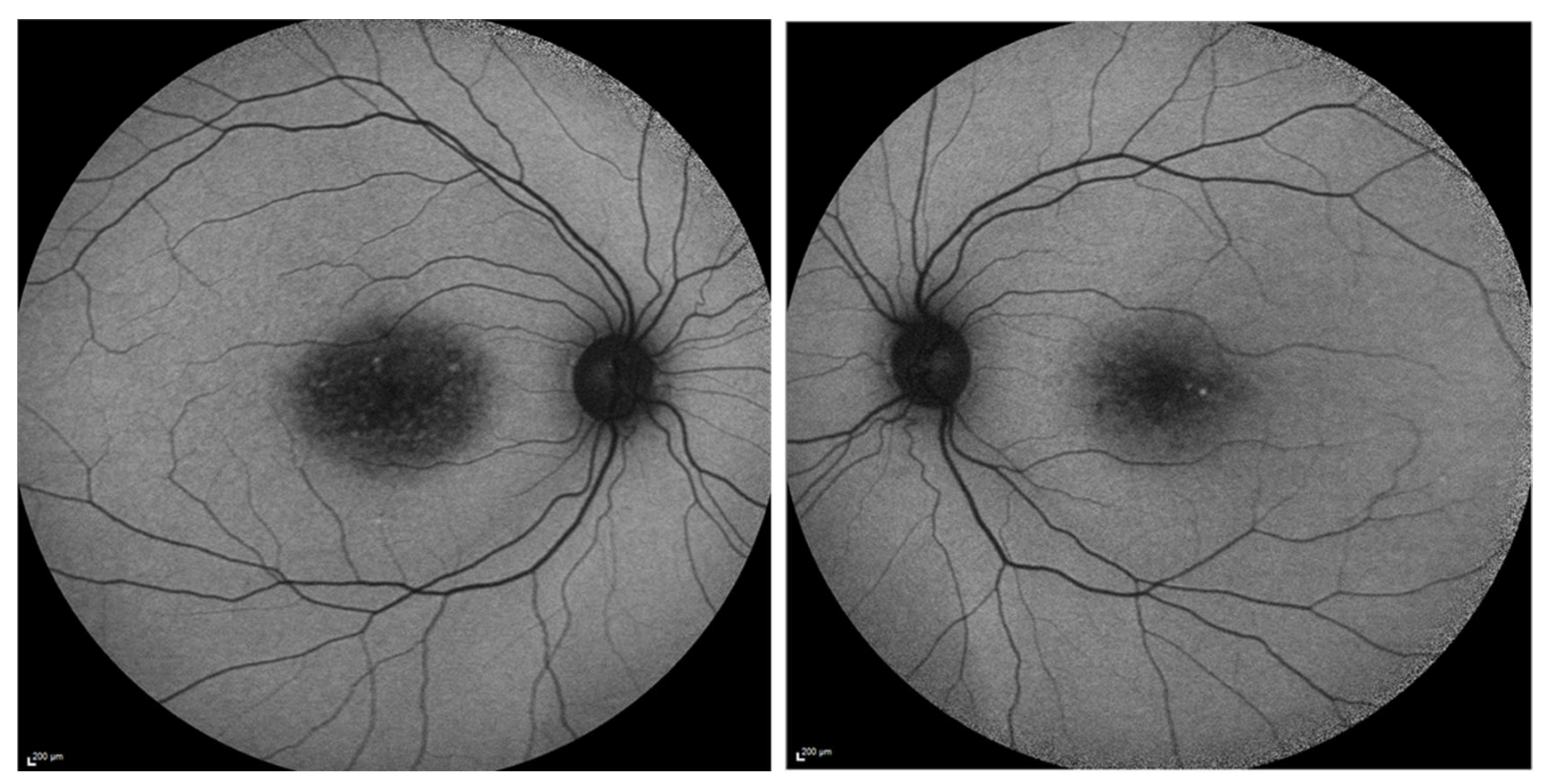
Figure 2.
A. Patient FAF images showing Stargardt disease harboring a novel Prom1 mutation, c.276+477_304-147del (p.Lys101:Pro93del).
Figure 2.
A. Patient FAF images showing Stargardt disease harboring a novel Prom1 mutation, c.276+477_304-147del (p.Lys101:Pro93del).
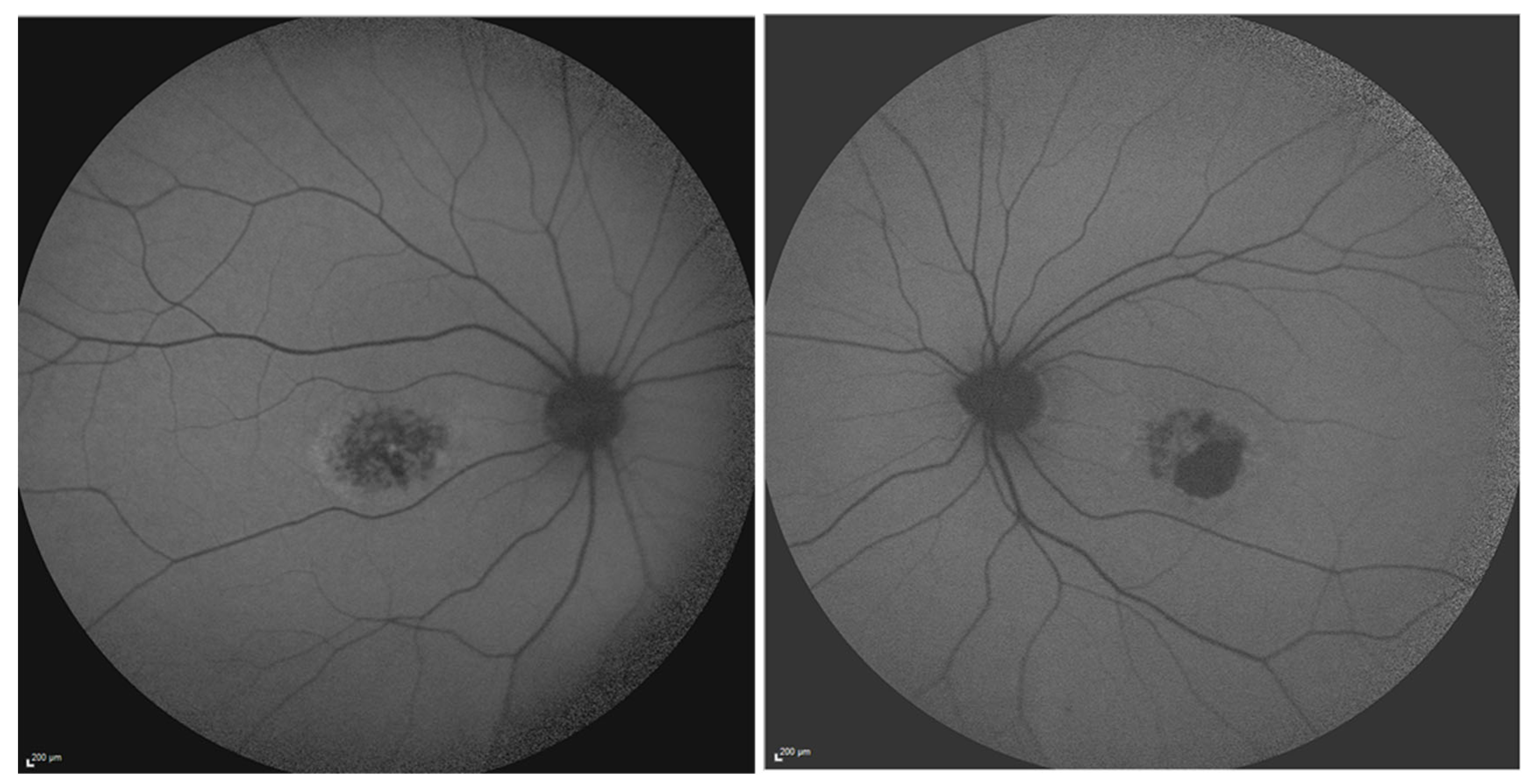
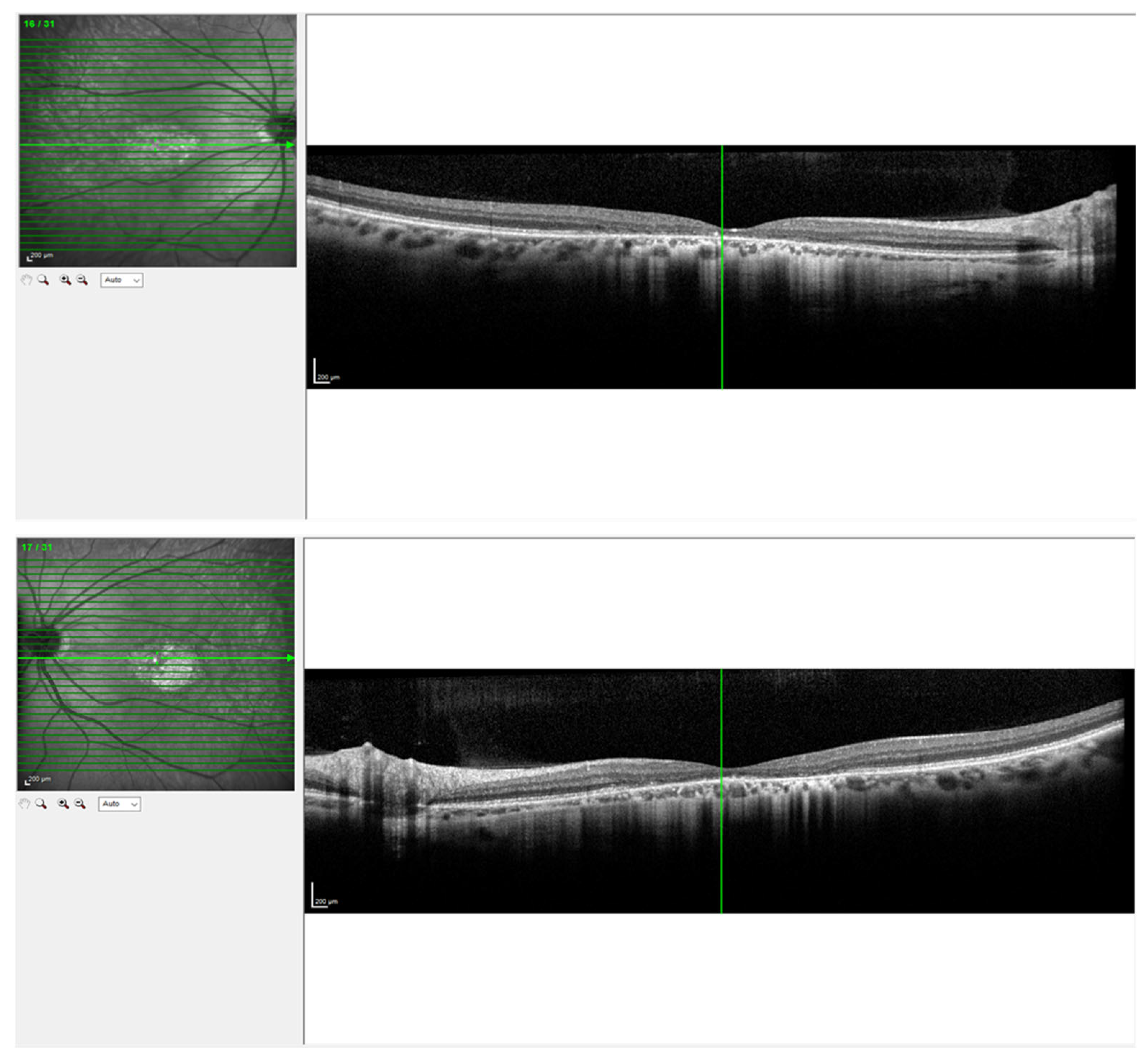
Figure 2.
B. Patient OCT images with Stargardt Prom1 c.276+477_304-147del:p.Lys101:Pro93del mutation showing severe central macular atrophy, neuroretinal thinning, and photoreceptor layer cell loss.
Figure 2.
B. Patient OCT images with Stargardt Prom1 c.276+477_304-147del:p.Lys101:Pro93del mutation showing severe central macular atrophy, neuroretinal thinning, and photoreceptor layer cell loss.
A patient with a Prom1 c.1142-1G>A (homozygous) shows widespread macular autofluorescence abnormalities, including patchy hypo-AF and/or parafoveal hyper-AF, indicating broad RPE dysfunction. This presentation aligns with severe, biallelic Prom1-related disease, which commonly extends beyond the central macula (Figure 3). Furthermore, the paired FAF images of a patient harboring Prom1 c.1877_1878delTA mutation demonstrate peripheral hypo-autofluorescence, a hallmark of retinitis pigmentosa, reflecting peripheral photoreceptor and RPE loss, with a parafoveal hyper-AF ring, a transition zone where photoreceptor stress is maximal (Figure 4)
Figure 3.
FAF images from a patient harboring Prom1 c.1142-1G>A mutation (homozygous).
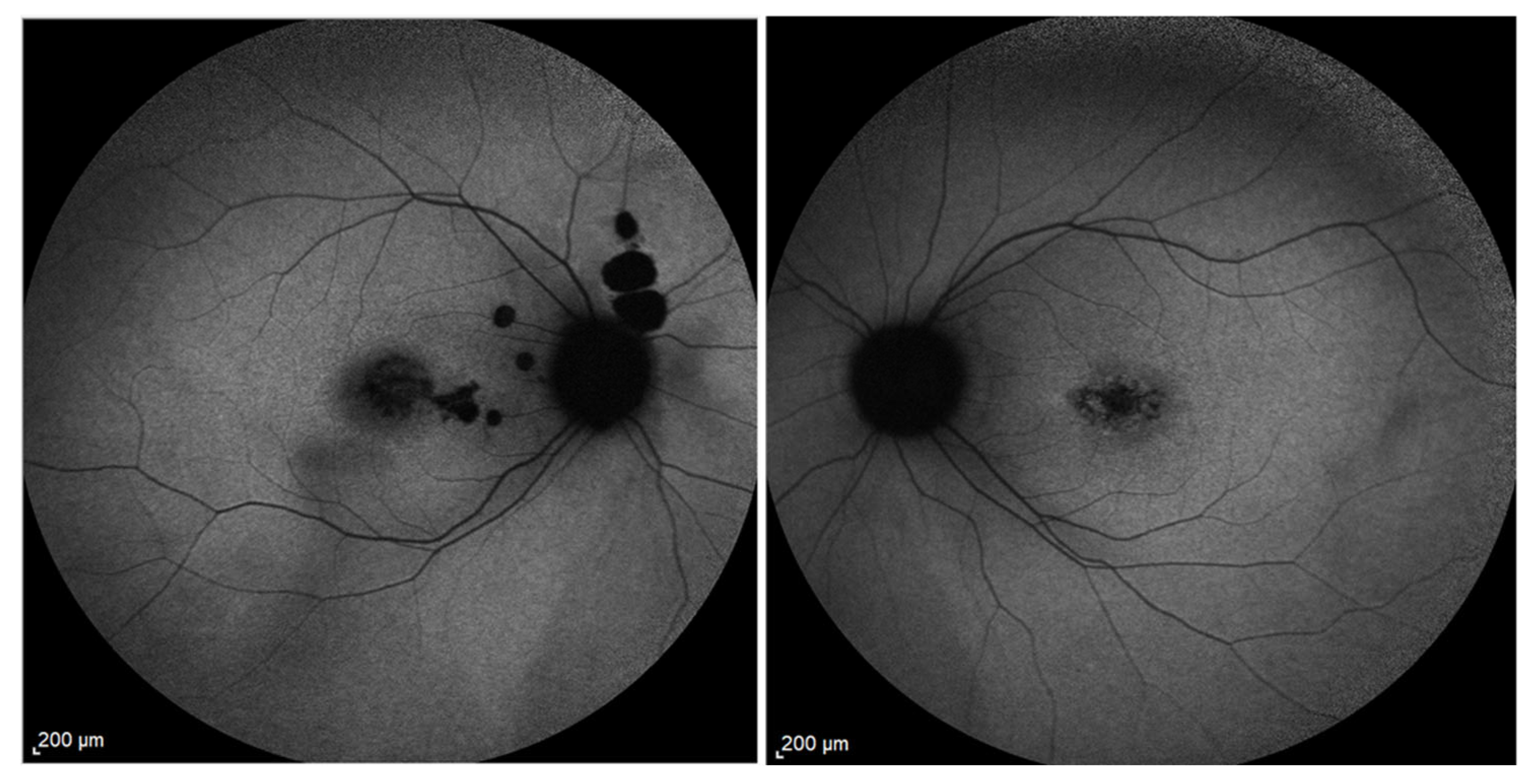
Figure 4.
FAF images from a patient harboring a Prom1 c.1877_1878delTA (p.Ile626fs; heterozygous) pathological mutation.
Figure 4.
FAF images from a patient harboring a Prom1 c.1877_1878delTA (p.Ile626fs; heterozygous) pathological mutation.
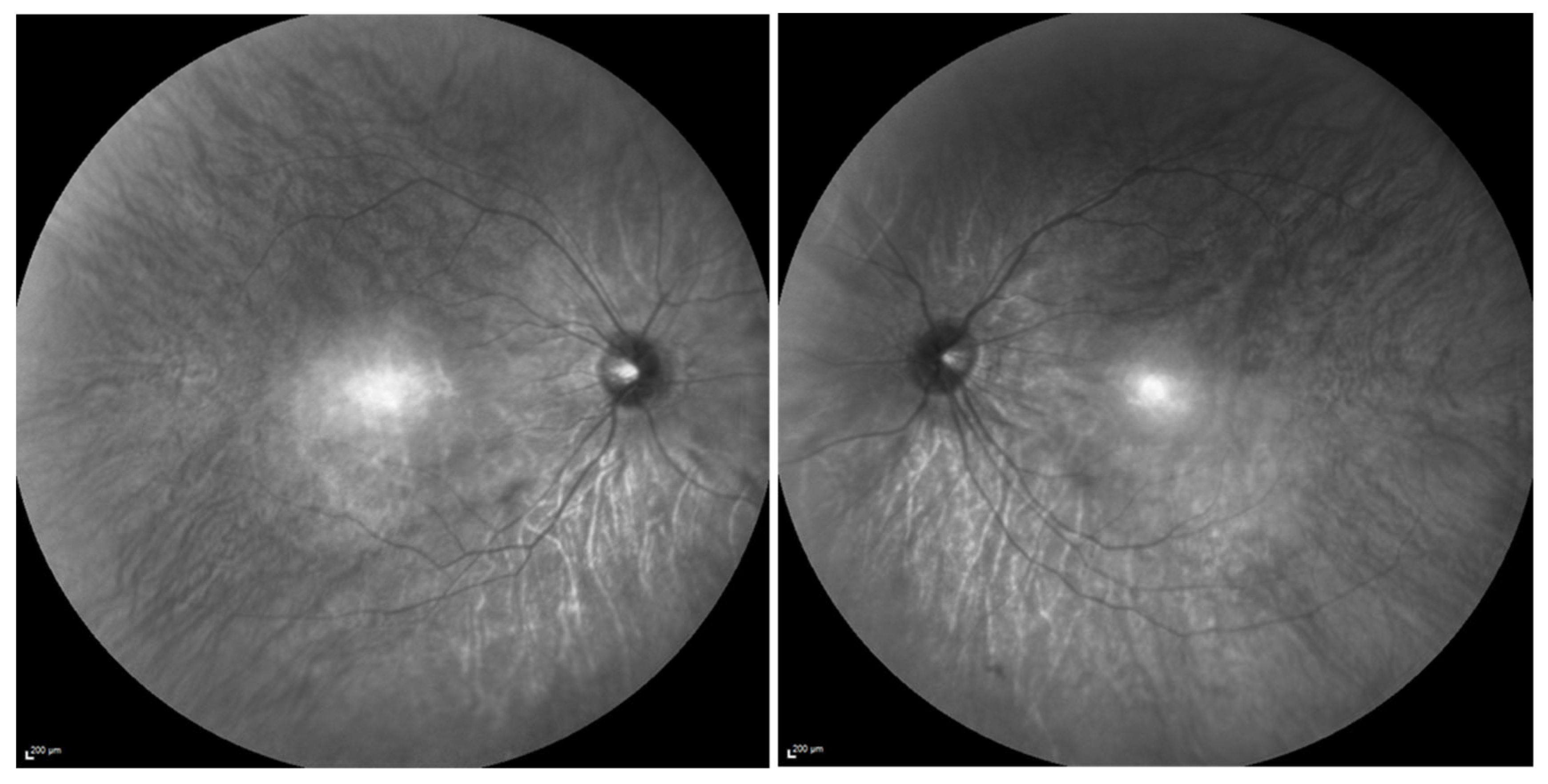
This heterogeneity suggests that Prom1 dysfunction may initiate degeneration in different cell types, depending on the mutation’s impact on protein trafficking, membrane curvature, signaling, or interactions with molecular complexes in the photoreceptor or RPE layers.
3. Prom1’s Presence and Role in the RPE
Contrary to earlier assumptions that Prom1 expression was photoreceptor-specific, our evidence from human/mouse RPE cells and in vivo studies indicates that Prom1 is expressed in the RPE and regulates homeostatic pathways central to retinal longevity. Earlier studies have shown that Prom1 is present on the apical but not the basolateral side of neuroepithelial cells in the E12 mouse embryo [52], and Prom1 immunoreactivity was detected in the microvilli of the pigmented epithelial cells in the adult murine retina [12]. Our own studies showed that Prom1 mRNA expression is higher in the photoreceptor-rich mouse neural retina; however, Prom1 mRNA is detectable in situ in mouse RPE using RNAscope assays, and Prom1 protein expression was confirmed in RPE mitochondria in situ using immunogold transmission electron microscopy [33]. In addition, our studies using high-resolution immunolabeling of mouse retinal sections and transcriptomics of mouse RPE cells confirm that Prom1 plays critical roles in epithelial integrity and cellular homeostasis [35]. Consistent with these observations, we showed Prom1 expression in control and MELAS patient iPSC-derived RPE cells [53]. These observations were recently validated in a study showing Prom1 expression and its N-glycosylation in iPSCs, iPSC-derived RPE cells, and retinal organoids [54].
Mechanistically, our studies show that in human RPE cells, Prom1 suppresses mTORC1/2 signaling, scaffolds p62-HDAC6 at nascent autophagosomes to promote autophagosome biogenesis, and traffics mature autophagosomes to fuse with lysosomes [34]. The loss of Prom1 in mouse RPE cells leads to p62 accumulation, reduction in TFEB-dependent lysosomal biogenesis, and impairment of autophagy flux [32]. In addition, Prom1 supports MerTk-dependent POS phagocytosis, linking the protein to daily clearance processes and metabolic coupling between the photoreceptors and the RPE – placing Prom1 at the intersection of proteostasis (ubiquitin-proteasome and autophagy-lysosomal pathways) and cargo handling in the RPE [35]. These abnormalities parallel mechanisms implicated in AMD pathogenesis, in which impaired autophagy contributes to drusen formation, lipofuscin accumulation, and chronic oxidative stress. Under physiological conditions, Prom1 restrains mTORC1 signaling, thereby permitting TFEB dephosphorylation and nuclear translocation [32,34]. Active TFEB drives transcription of lysosomal hydroxylases and v-ATPase subunits, which are essential for lysosomal acidification and proteolytic capacity. In parallel, Prom1-dependent efficient LC3 lipidation and turnover ensure proper autophagosome maturation and timely lysosomal fusion. This coordinated autophagy-lysosome axis is critical for the daily phagocytosis and degradation of shed photoreceptor OSs—a uniquely demanding proteostatic burden borne by RPE cells. In line with an RPE-first vulnerability, mouse genetics reveal allele-dependent disease kinetics. The Prom1-R373C knock-in mice exhibit RPE lipofuscin-like deposits and atrophy by ~4 months, whereas the global Prom1-null mice preserve RPE integrity early and develop only later morphological changes [18,21]. These divergent timelines suggest that missense variants can lead to a mis-trafficking burden on the RPE, whereas complete loss causes a slower insufficiency-driven collapse of autophagy-lysosomal homeostasis, both converging on aberrant mTORC1-TFEB signaling and impaired degradative capacity. Hyperactive mTORC1 promotes TFEB phosphorylation and cytosolic retention, attenuating lysosomal gene expression [32]. Reduced levels of key proteases and acidification machinery compromise lysosomal competence. Simultaneously, defective LC3 processing and p62 accumulation signal impaired autophagic flux, likely exacerbated by inefficient autophagosome-lysosome fusion. The resulting buildup of undigested outer segment material and lysosomal vacuoles causes chronic cellular stress, driving RPE dysfunction and, ultimately, atrophy. This cascade provides a compelling explanation for RPE degeneration observed in Prom1-associated IRD. Patients with the c.1354dupT variant exhibit age-dependent phenotypes: younger patients show RPE abnormalities with preserved photoreceptors, whereas older individuals show combined RPE and photoreceptor damage, suggesting that RPE is a principal site of pathology in these patients [30]. Findings from the Prom1-null Xenopus laevis significantly reshape the longstanding view of Prom1-associated retinal pathology by demonstrating that RPE dysfunction, not photoreceptor collapse, is the earliest and primary consequence of Prom1 loss [55]. In this model, animals develop subretinal drusenoid-like deposits, progressive RPE thinning, pigment granule infiltration, and marked RPE disorganization well before photoreceptor degeneration becomes evident, indicating that Prom1 loss primarily compromises RPE structural and metabolic integrity. These findings directly challenge the traditional paradigm that photoreceptors represent the initial targets of all pathogenic Prom1 mutations, instead establishing a sequence in which RPE failure likely precedes and drives photoreceptor damage, at least in a subset of Prom1-IRDs. Consistent with these data, our own AAV2/1-mediated RPE-specific Prom1 knockdown in mice similarly induces RPE cell death and photoreceptor degeneration, confirming that Prom1 loss acts primarily within the RPE to initiate retinal pathology [33].
Reframing Prom1 as a regulator of RPE cellular homeostasis, rather than solely as a structural photoreceptor protein, opens a new therapeutic paradigm centered on restoring autophagy-lysosomal function. Instead of broad mTOR inhibition, selective attenuation of RPE mTORC1 hyperactivity may reinstate TFEB activity and lysosomal gene expression with greater precision. Complementary strategies that directly enhance TFEB nuclear function, promote autophagosome-lysosome fusion, or stabilize lysosomal acidification could re-establish degradative capacity even in the setting of Prom1 deficiency. Given Prom1’s membrane-organizing properties, modulation of lipid microdomains may further normalize mTORC1 localization and signaling dynamics. Ultimately, combinatorial approaches—fine-tuning mTORC1 while augmenting TFEB and lysosomal function- may offer synergistic restoration of RPE homeostasis, shifting Prom1 macular disease therapy from structural rescue toward targeted correction of intracellular clearance pathways.
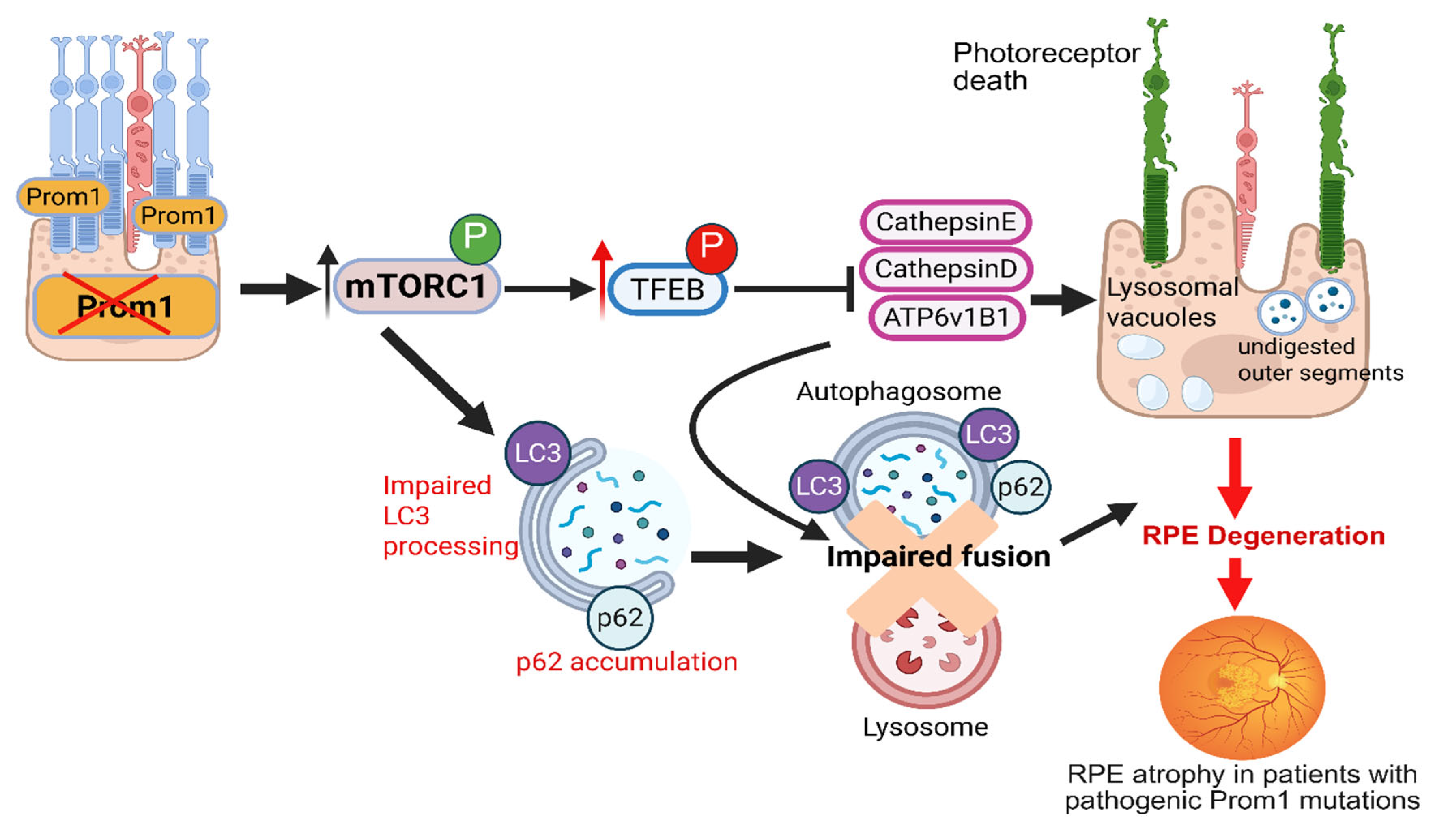
Emerging evidence from our studies and those of others indicates that Prom1 functions not only as a structural membrane organizer but also as a gatekeeper of epithelial identity in the RPE [32,56]. As depicted in the schematic model (Figure 5), loss of Prom1 activates mTORC1 signaling, suppresses TFEB-driven lysosomal programs, and dampens autophagic flux, collectively imposing metabolic and lysosomal stress on the RPE. In addition, transcriptome profiling of Prom1-deficient RPE cells ties Prom1 to mitochondrial homeostasis via PINK1-mediated mitophagy, oxidative phosphorylation, stress/inflammatory signaling, and junctional programs, reinforcing Prom1 as a systems-level regulator of RPE identity and metabolism [35].
Figure 5.
Prom1 regulates mTORC1-TFEB signaling to coordinate autophagy-lysosome function in the RPE. Loss of Prom1 function leads to aberrant mTORC1 activation (green circle, activation), resulting in increased TFEB phosphorylation (red circle, phosphorylation of TFEB is inhibitory), thereby suppressing TFEB nuclear activity. Reduced TFEB-driven transcription diminishes expression of lysosomal genes, including Cathepsin E/D, and ATP6v1B1. Concurrently, mTORC1 hyperactivation impairs LC3 processing and promotes p62 accumulation, reflecting defective autophagic flux. Impaired autophagosome-lysosome fusion further compromises photoreceptor outer segment degradation, leading to lysosomal vacuolization and the buildup of undigested material, culminating in RPE degeneration and atrophy observed in patients with pathogenic loss-of-function Prom1 mutations.
Figure 5.
Prom1 regulates mTORC1-TFEB signaling to coordinate autophagy-lysosome function in the RPE. Loss of Prom1 function leads to aberrant mTORC1 activation (green circle, activation), resulting in increased TFEB phosphorylation (red circle, phosphorylation of TFEB is inhibitory), thereby suppressing TFEB nuclear activity. Reduced TFEB-driven transcription diminishes expression of lysosomal genes, including Cathepsin E/D, and ATP6v1B1. Concurrently, mTORC1 hyperactivation impairs LC3 processing and promotes p62 accumulation, reflecting defective autophagic flux. Impaired autophagosome-lysosome fusion further compromises photoreceptor outer segment degradation, leading to lysosomal vacuolization and the buildup of undigested material, culminating in RPE degeneration and atrophy observed in patients with pathogenic loss-of-function Prom1 mutations.
4. Role of Prom1 in RPE EMT
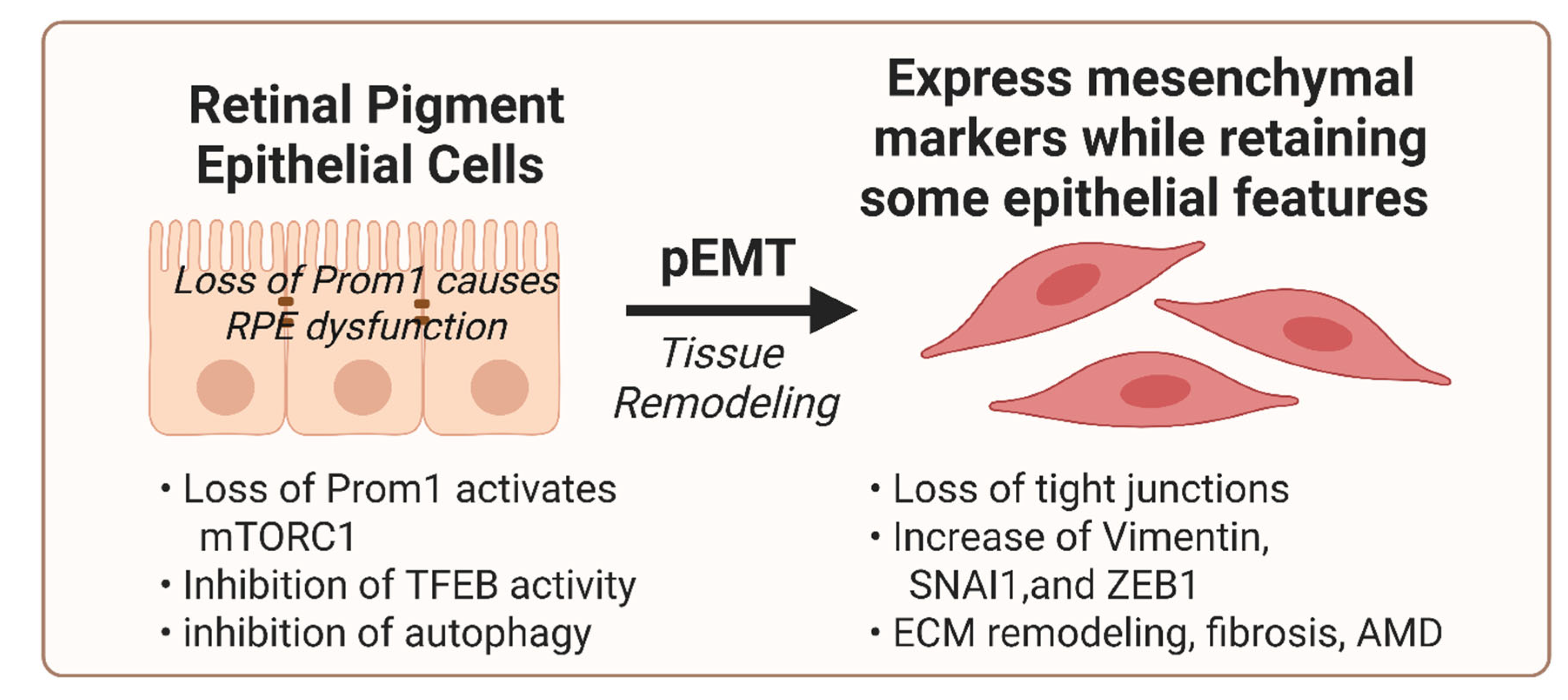
Rather than undergoing complete epithelial-mesenchymal transition (EMT), Prom1-deficient RPE cells adopt a partial EMT (pEMT) state characterized by loss of junctional and polarity genes, disruption of tight junctions, cytoskeletal reorganization, alongside induction of mesenchymal and stress-associated pathways, while retaining aspects of epithelial features, though clarifying spatial-temporal relationships and defining EMT endpoints remain necessary to sharpen mechanistic inference (Figure 6) [35]. This hybrid phenotype aligns with the RPE’s response to chronic mitochondrial dysfunction and inflammatory cues, providing a mechanistic bridge between Prom1 loss and degenerative phenotypes, including maladaptive tissue remodeling, extracellular matrix deposition, and fibrotic progression—implicated in IRDs and aAMD [57,58]. Thus, Prom1-regulated mitochondrial and lysosomal homeostasis, together with junctional stability, is essential to prevent pEMT-driven RPE dysfunction in retinal degenerative disease.
Conceptually, Prom1-associated macular disease may therefore reflect a chronic, mTORC1-driven epithelial destabilization program rather than purely degenerative cell loss. This reframing opens therapeutic opportunities to stabilize epithelial identity. Targeted suppression of mTORC1 hyperactivity, activation of autophagy, restoration of TFEB-mediated lysosomal function, or reinforcement of junctional complexes could prevent or reverse the pEMT trajectory [59,60,61]. More innovatively, therapies designed to modulate EMT plasticity, such as selective inhibition of SNAI1/ZEB1 transcriptional networks or epigenetic reprogramming strategies that reinforce epithelial chromatin states, may recalibrate RPE cells away from a fibrogenic phenotype. Combining metabolic rebalancing (mTORC1 modulation), as shown earlier to play an important role in RPE EMT in aAMD pathogenesis, with anti-fibrotic or ECM-targeted approaches could interrupt the feed-forward loop between cellular stress and tissue remodeling [60]. The mesenchymal transition of RPE cells and ECM dysfunction are two main aspects of fibrotic scar formation and are associated with impaired autophagy [62]. Mechanistically, Prom1 loss perturbs autophagy-lysosomal crosstalk and apical membrane organization, sustaining mTORC1-dependent TFEB phosphorylation, blunting lysosomal biogenesis and autophagic flux; the resulting lysosomal alkalinization and reduced cathepsin activity stabilize EMT drivers (SNAI1/ZEB1) and TGF-beta receptor signaling, while disrupted junctional maintenance (ZO-1) and RhoA-ROCK-driven cytoskeletal tension engage YAP/TAZ and integrin-FAK signaling to amplify ECM synthesis (collagen I, fibronectin, MMP/TIMP imbalance) and matrix stiffening- cardinal features of pEMT and pro-fibrotic remodeling [61,63,64,65,66,67]. Prom1’s role in photoreceptor architecture suggests that its dysfunction can lead to structural instability and may, secondarily, influence the composition and turnover dynamics of shed OS membranes, thereby altering the quality of lipid and bisretinoid precursors reaching the RPE. Accumulation of A2E-rich lipofuscin compromises lysosomal stability and activates ROS/NLRP3-linked stress responses, reinforcing mTORC1 activity and amplifying the pEMT-ECM feed-forward loop [68,69]. In this context, Prom1 emerges not merely as a photoreceptor-associated gene but as a central regulator of epithelial stability in the macula, positing pEMT modulation as a rational and potentially disease-modifying strategy for Prom1-associated macular disease.
Figure 6.
Loss of Prom1 promotes mTORC1 activation and induces partial EMT (pEMT) in the RPE. Under homeostatic conditions, Prom1 supports epithelial integrity in RPE cells. Loss of Prom1 activates mTORC1 signaling, suppresses TFEB activity, and inhibits autophagy, collectively contributing to cellular stress and phenotypic programming. RPE cells undergoing pEMT exhibit loss of tight junction integrity while retaining select epithelial characteristics. This transitional state is characterized by increased expression of mesenchymal markers, including Vimentin, SNAI1, and ZEB1, as well as ECM remodeling. The resulting tissue remodeling environment promotes fibrosis and may contribute to macular pathology, including features observed in advanced degenerative disease.
Figure 6.
Loss of Prom1 promotes mTORC1 activation and induces partial EMT (pEMT) in the RPE. Under homeostatic conditions, Prom1 supports epithelial integrity in RPE cells. Loss of Prom1 activates mTORC1 signaling, suppresses TFEB activity, and inhibits autophagy, collectively contributing to cellular stress and phenotypic programming. RPE cells undergoing pEMT exhibit loss of tight junction integrity while retaining select epithelial characteristics. This transitional state is characterized by increased expression of mesenchymal markers, including Vimentin, SNAI1, and ZEB1, as well as ECM remodeling. The resulting tissue remodeling environment promotes fibrosis and may contribute to macular pathology, including features observed in advanced degenerative disease.
Together, genetic, clinical, mechanistic, and transcriptomic findings support a new model of Prom1-related disease: RPE degeneration can be a primary driver, rather than merely a secondary consequence of Prom1-associated retinal degeneration in a substantial subset of genotypes. This paradigm helps explain phenotypic heterogeneity across dominant missense and recessive null-like alleles and supports therapeutic strategies that preserve both photoreceptor and RPE compartments. Longitudinal imaging (SD-OCT, FAF) of patients, cell-type-specific Prom1-KO mouse models, identification of biomarkers, and ancestry-aware genetics will be essential to disentangle cell-of-origin trajectories across disease stages and to promote interventions that restore autophagy-lysosomal function, enhance phagocytic capacity, and stabilize mitochondrial bioenergetics in the RPE.
6. Future Directions and Therapeutic Implications
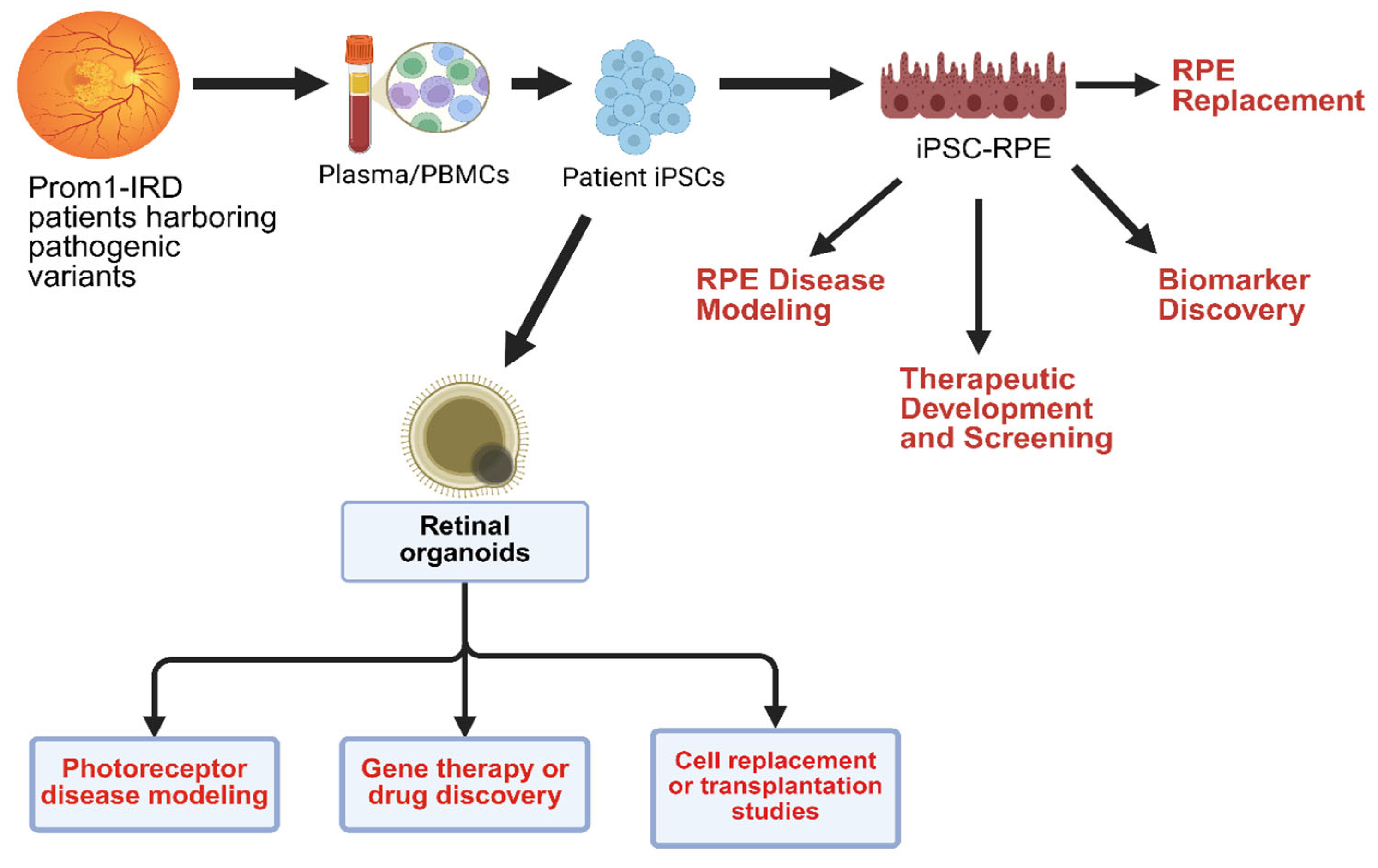
Prom1’s dual role in photoreceptor structure and RPE homeostasis expands therapeutic opportunities across multiple fronts, and the patient-to-pipeline depicted in Figure 7 operationalizes these opportunities in human-relevant models. PBMC-derived patient iPSCs can be used to generate iPSC-RPE and retinal organoids, enabling modeling of RPE and photoreceptor diseases, biomarker discovery, therapeutic screening, and potential RPE/photoreceptor replacement strategies (Figure 7). Together, these complementary systems provide Prom1 variant-specific readouts of efficacy and safety, allowing prioritization of single- or combined-compartment interventions.
Figure 7.
Pipeline for patient-specific translational research in Prom1 IRD: PBMC-derived patient iPSCs yield iPSC-RPE and retinal organoids that enable RPE and photoreceptor disease modeling, therapeutic screening, biomarker discovery, and cell-replacement studies, supporting single and combined-compartment interventions.
Figure 7.
Pipeline for patient-specific translational research in Prom1 IRD: PBMC-derived patient iPSCs yield iPSC-RPE and retinal organoids that enable RPE and photoreceptor disease modeling, therapeutic screening, biomarker discovery, and cell-replacement studies, supporting single and combined-compartment interventions.
6.1. Gene Therapy
AAV-based supplementation remains a compelling strategy for recessive loss-of-function Prom1 variants. In contrast, dominant-negative variants may require a combined approach—allele-specific suppression paired with gene replacement to restore functional protein expression. The patient iPSC platform can enable testing of Prom1 function rescue across iPSC-RPE (RPE-directed) and retinal organoids (photoreceptor-directed) contexts, while concurrently identifying biomarkers for translation. A photoreceptor-targeted AAV-hProm1 vector was recently used to restore Prom1 expression and OS-like structures in patient-derived retinal organoids [54]. Another study used CRISPR/Cas9-mediated correction of patient iPSCs with Prom1-IRD to genetically restore Prom1 function, showing that the gene-editing strategy could inform the design of gene-therapy studies targeting the early stages of Prom1-related IRDs [30].
6.2. RPE-Targeted Therapies
Given that Prom1 plays a central role in maintaining RPE metabolism, polarity, and autophagy, interventions to enhance autophagy, stabilize mitochondria, or strengthen epithelial junctions—offering mutation-agnostic strategies that may mitigate degeneration even without a direct genetic connection. Small molecules that promote mitophagy and restore lysosomal acidification may represent promising avenues for the treatment of downstream effects of Prom1 dysfunction.
6.3. Precision Modeling
Patient iPSC-derived RPE and retinal organoids enable Prom1 variant-level, human-relevant disease modeling, for mechanistic dissection and high-throughput drug and gene-therapy screening for mutation-specific therapeutic vulnerabilities and responses. Co-culture or interface models (organoids + RPE) further capture bidirectional pathology and help stratify therapies by allele class and initiating compartment.
6.4. Combined-Compartment Therapies
Because degeneration can originate in either photoreceptors or RPE, depending on variant and context, multi-compartment strategies, including concurrent photoreceptor gene rescue with RPE autophagy restoration, or staged cell-replacement (RPE monolayer and/or photoreceptor transplantation), may be essential to prevent long-term retinal architecture and visual function.
In sum, we provide a translational workflow, from patient blood draw to compartment-specific human models, that supports gene therapy/small-molecule rescue, biomarker development, and cell-replacement strategies, with the flexibility to deploy single- or dual-compartment interventions matched to Prom1-variant biology.
7. Conclusions
Prom1 is no longer viewed as solely a membrane-shaping protein for photoreceptor disks. It is a multi-functional regulator of cellular integrity in both photoreceptors and RPE. Its dysfunction triggers a web of pathogenic processes—structural collapse, metabolic compromise, loss of epithelial identity, mitochondrial dysfunction, and impairment of lysosomal activity—that explains the spectrum of Prom1-associated IRDs and their striking similarity to aAMD. By reframing Prom1 through a broader biological lens, we not only unify IRDs and AMD degenerative pathways but also identify new therapeutic opportunities. Prom1 thus stands at a critical intersection of retinal cell biology, degenerative disease mechanisms, and translational innovation.
Author Contributions
“Conceptualization, S.B.; methodology, S.B.; software, S.B.; validation, S.B., and E.C.; writing—original draft preparation, S.B.; writing—review and editing, E.C.; visualization, E.C.; supervision, S.B.; funding acquisition, S.B., E.C.. All authors have read and agreed to the published version of the manuscript.
Funding
This work was supported by the International Retinal Research Foundation (GF02527), an unrestricted departmental research grant from Research to Prevent Blindness (RPB), Inc. (New York, NY) to the Vanderbilt Eye Institute (Nashville, TN), The Carl Marshall and Mildred Reeves Foundation Macular Degeneration Research award (Fenton, MO) (GR020592 to SB), the Margy Ann and J Donal M. Gass Chair endowment (EC), and RPB unrestricted grant R24EY028758, and R24EY027285 that support Jonas Children’s Vision Care registry at Columbia University (New York, NY).
Institutional Review Board Statement
Not applicable.
Informed Consent Statement
Not applicable.
Data Availability Statement
No new data were created or analyzed in this study.
Acknowledgments
We thank Dr. Stephen Tsang at Columbia University, New York, NY, for providing FAF images from patients carrying pathogenic Prom1 mutations. The illustrations provided in this manuscript were created in https://BioRender.com.
Conflicts of Interest
The authors declare no conflicts of interest.
Abbreviations
The following abbreviations are used in this manuscript:
| IRDs | Inherited Retinal Dystrophies |
| aAMD | Atrophic Age-related Macular Degeneration |
| RPE | Retinal Pigment Epithelium |
| mTORC1 | Mammalian Target of Rapamycin Complex 1 |
| TFEB | Transcription Factor EB |
| Prom1 | Prominin-1 (CD133) |
| AD | Autosomal Dominant |
| AR | Autosomal Recessive |
| STGD4 | Stargardt disease 4 |
| EMT | Epithelial-Mesenchymal Transition |
| pEMT | partial EMT |
| ECM | Extracellular matrix |
| AAV | Adeno-associated virus |
| POS | Photoreceptor Outer Segment |
| LCA | Leber congenital amaurosis |
| CRD | Cone-rod dystrophies |
| RP | Retinitis Pigmentosa |
| BEST1 | Bestrophin-1 |
| CHM | Choroideremia |
| LOF | Loss-of-function |
| FAF | Fundus autofluorescence |
| SD-OCT | Spectral Domain Optical Coherence Tomography |
| iPSC | induced pluripotent stem cell |
| PBMC | Peripheral Blood Mononuclear Cell |
| MMP | Matrix Metalloproteinases |
| TIMP | Tissue Inhibitors of Metalloproteinases |
| MerTK | Mer proto-oncogene Tyrosine-Kinase |
| FAK | Focal Adhesion Kinase |
| ROS | Reactive Oxygen Species |
| NLRP3 | NOD-like Receptor Protein 3 |
| TGF-beta | Transforming Growth Factor-beta |
References
- Rosa, J.G.S.; Disner, G.R.; Pinto, F.J.; Lima, C.; Lopes-Ferreira, M. Revisiting Retinal Degeneration Hallmarks: Insights from Molecular Markers and Therapy Perspectives. Int J Mol Sci 2023, 24. [Google Scholar] [CrossRef] [PubMed]
- Collaborators, G.B.D.G.A. Global burden of vision impairment due to age-related macular degeneration, 1990-2021, with forecasts to 2050: a systematic analysis for the Global Burden of Disease Study 2021. Lancet Glob Health 2025, 13, e1175–e1190. [Google Scholar] [CrossRef] [PubMed]
- Manley, A.; Meshkat, B.I.; Jablonski, M.M.; Hollingsworth, T.J. Cellular and Molecular Mechanisms of Pathogenesis Underlying Inherited Retinal Dystrophies. Biomolecules 2023, 13. [Google Scholar] [CrossRef] [PubMed]
- Georgiou, M.; Fujinami, K.; Michaelides, M. Inherited retinal diseases: Therapeutics, clinical trials and end points-A review. Clin Exp Ophthalmol 2021, 49, 270–288. [Google Scholar] [CrossRef] [PubMed]
- Guziewicz, K.E.; Sinha, D.; Gomez, N.M.; Zorych, K.; Dutrow, E.V.; Dhingra, A.; Mullins, R.F.; Stone, E.M.; Gamm, D.M.; Boesze-Battaglia, K.; et al. Bestrophinopathy: An RPE-photoreceptor interface disease. Prog Retin Eye Res 2017, 58, 70–88. [Google Scholar] [CrossRef] [PubMed]
- Cehajic Kapetanovic, J.; Barnard, A.R.; MacLaren, R.E. Molecular Therapies for Choroideremia. Genes (Basel) 2019, 10. [Google Scholar] [CrossRef]
- Cideciyan, A.V. Leber congenital amaurosis due to RPE65 mutations and its treatment with gene therapy. Prog Retin Eye Res 2010, 29, 398–427. [Google Scholar] [CrossRef]
- Duncan, J.L.; Pierce, E.A.; Laster, A.M.; Daiger, S.P.; Birch, D.G.; Ash, J.D.; Iannaccone, A.; Flannery, J.G.; Sahel, J.A.; Zack, D.J.; et al. Inherited Retinal Degenerations: Current Landscape and Knowledge Gaps. Transl Vis Sci Technol 2018, 7, 6. [Google Scholar] [CrossRef] [PubMed]
- Datta, S.; Cano, M.; Ebrahimi, K.; Wang, L.; Handa, J.T. The impact of oxidative stress and inflammation on RPE degeneration in non-neovascular AMD. Prog Retin Eye Res 2017, 60, 201–218. [Google Scholar] [CrossRef]
- Lakkaraju, A.; Umapathy, A.; Tan, L.X.; Daniele, L.; Philp, N.J.; Boesze-Battaglia, K.; Williams, D.S. The cell biology of the retinal pigment epithelium. Prog Retin Eye Res 2020, 100846. [Google Scholar] [CrossRef]
- McClements, M.E.; MacLaren, R.E. Gene therapy for retinal disease. Transl Res 2013, 161, 241–254. [Google Scholar] [CrossRef]
- Maw, M.A.; Corbeil, D.; Koch, J.; Hellwig, A.; Wilson-Wheeler, J.C.; Bridges, R.J.; Kumaramanickavel, G.; John, S.; Nancarrow, D.; Roper, K.; et al. A frameshift mutation in prominin (mouse)-like 1 causes human retinal degeneration. Hum Mol Genet 2000, 9, 27–34. [Google Scholar] [CrossRef] [PubMed]
- Corbeil, D.; Roper, K.; Fargeas, C.A.; Joester, A.; Huttner, W.B. Prominin: a story of cholesterol, plasma membrane protrusions and human pathology. Traffic 2001, 2, 82–91. [Google Scholar] [CrossRef] [PubMed]
- Thamm, K.; Simaite, D.; Karbanova, J.; Bermudez, V.; Reichert, D.; Morgenstern, A.; Bornhauser, M.; Huttner, W.B.; Wilsch-Brauninger, M.; Corbeil, D. Prominin-1 (CD133) modulates the architecture and dynamics of microvilli. Traffic 2019, 20, 39–60. [Google Scholar] [CrossRef]
- Moya-Molina, M.; Dorgau, B.; Flood, E.; Letteboer, S.J.F.; Lorentzen, E.; Coxhead, J.; Smith, G.; Roepman, R.; Nagaraja Grellscheid, S.; Armstrong, L.; et al. Deciphering the impact of PROM1 alternative splicing on human photoreceptor development and maturation. Cell Death Dis 2024, 15, 721. [Google Scholar] [CrossRef] [PubMed]
- Del Pozo-Valero, M.; Martin-Merida, I.; Jimenez-Rolando, B.; Arteche, A.; Avila-Fernandez, A.; Blanco-Kelly, F.; Riveiro-Alvarez, R.; Van Cauwenbergh, C.; De Baere, E.; Rivolta, C.; et al. Expanded Phenotypic Spectrum of Retinopathies Associated with Autosomal Recessive and Dominant Mutations in PROM1. Am J Ophthalmol 2019, 207, 204–214. [Google Scholar] [CrossRef]
- Steinberg, R.H.; Fisher, S.K.; Anderson, D.H. Disc morphogenesis in vertebrate photoreceptors. J Comp Neurol 1980, 190, 501–508. [Google Scholar] [CrossRef]
- Zacchigna, S.; Oh, H.; Wilsch-Brauninger, M.; Missol-Kolka, E.; Jaszai, J.; Jansen, S.; Tanimoto, N.; Tonagel, F.; Seeliger, M.; Huttner, W.B.; et al. Loss of the cholesterol-binding protein prominin-1/CD133 causes disk dysmorphogenesis and photoreceptor degeneration. J Neurosci 2009, 29, 2297–2308. [Google Scholar] [CrossRef] [PubMed]
- Xiao, Y.S.; Liang, J.; Gao, M.; Sun, J.R.; Liu, Y.; Chen, J.Q.; Zhao, X.H.; Wang, Y.M.; Chen, Y.H.; Wang, Y.W.; et al. Deletion of prominin-1 in mice results in disrupted photoreceptor outer segment protein homeostasis. Int J Ophthalmol 2021, 14, 1334–1344. [Google Scholar] [CrossRef]
- Yanardag, S.; Rhodes, S.; Saravanan, T.; Guan, T.; Ramamurthy, V. Prominin 1 is crucial for the early development of photoreceptor outer segments. Sci Rep 2024, 14, 10498. [Google Scholar] [CrossRef]
- Yang, Z.; Chen, Y.; Lillo, C.; Chien, J.; Yu, Z.; Michaelides, M.; Klein, M.; Howes, K.A.; Li, Y.; Kaminoh, Y.; et al. Mutant prominin 1 found in patients with macular degeneration disrupts photoreceptor disk morphogenesis in mice. J Clin Invest 2008, 118, 2908–2916. [Google Scholar] [CrossRef] [PubMed]
- Carr, B.J.; Yang, L.L.; Moritz, O.L. Prominin-1 and Photoreceptor Cadherin Localization in Xenopus laevis: Protein-Protein Relationships and Function. Adv Exp Med Biol 2019, 1185, 483–487. [Google Scholar] [CrossRef]
- Dellett, M.; Sasai, N.; Nishide, K.; Becker, S.; Papadaki, V.; Limb, G.A.; Moore, A.T.; Kondo, T.; Ohnuma, S. Genetic background and light-dependent progression of photoreceptor cell degeneration in Prominin-1 knockout mice. Invest Ophthalmol Vis Sci 2014, 56, 164–176. [Google Scholar] [CrossRef] [PubMed]
- Grosspotzl, M.; Riedl, R.; Schliessleder, G.; Hu, Z.J.; Michaelides, M.; Sadda, S.; Birch, D.; Charbel Issa, P.; Wedrich, A.; Seidel, G.; et al. Progression of PROM1-Associated Retinal Degeneration as Determined by Spectral-Domain Optical Coherence Tomography Over a 24-Month Period. Am J Ophthalmol 2024, 259, 109–116. [Google Scholar] [CrossRef] [PubMed]
- Kong, M.D.; Golebka, J.; Anderson, V.R.; Bao, C.; Bailey, J.A.; Exinor, A.; Demirkol, A.; Tsang, S.H. Divergent Manifestations in Biallelic Versus Monoallelic Variants of RP1-, BEST1-, and PROM1-Associated Retinal Disorders. Int J Mol Sci 2025, 26. [Google Scholar] [CrossRef]
- Hwang, S.; Kang, S.W.; Jang, J.H.; Kim, S.J. Genetic and clinical characteristics of PROM1-related retinal degeneration in Korean. Sci Rep 2023, 13, 21877. [Google Scholar] [CrossRef]
- Imani, S.; Cheng, J.; Shasaltaneh, M.D.; Wei, C.; Yang, L.; Fu, S.; Zou, H.; Khan, M.A.; Zhang, X.; Chen, H.; et al. Genetic identification and molecular modeling characterization reveal a novel PROM1 mutation in Stargardt4-like macular dystrophy. Oncotarget 2018, 9, 122–141. [Google Scholar] [CrossRef]
- Michaelides, M.; Gaillard, M.C.; Escher, P.; Tiab, L.; Bedell, M.; Borruat, F.X.; Barthelmes, D.; Carmona, R.; Zhang, K.; White, E.; et al. The PROM1 mutation p.R373C causes an autosomal dominant bull's eye maculopathy associated with rod, rod-cone, and macular dystrophy. Invest Ophthalmol Vis Sci 2010, 51, 4771–4780. [Google Scholar] [CrossRef]
- Zhang, Q.; Zulfiqar, F.; Xiao, X.; Riazuddin, S.A.; Ahmad, Z.; Caruso, R.; MacDonald, I.; Sieving, P.; Riazuddin, S.; Hejtmancik, J.F. Severe retinitis pigmentosa mapped to 4p15 and associated with a novel mutation in the PROM1 gene. Hum Genet 2007, 122, 293–299. [Google Scholar] [CrossRef]
- Puertas-Neyra, K.; Coco-Martin, R.M.; Hernandez-Rodriguez, L.A.; Gobelli, D.; Garcia-Ferrer, Y.; Palma-Vecino, R.; Telleria, J.J.; Simarro, M.; de la Fuente, M.A.; Fernandez-Bueno, I. Clinical exome analysis and targeted gene repair of the c.1354dupT variant in iPSC lines from patients with PROM1-related retinopathies exhibiting diverse phenotypes. Stem Cell Res Ther 2024, 15, 192. [Google Scholar] [CrossRef] [PubMed]
- Cehajic-Kapetanovic, J.; Birtel, J.; McClements, M.E.; Shanks, M.E.; Clouston, P.; Downes, S.M.; Charbel Issa, P.; MacLaren, R.E. Clinical and Molecular Characterization of PROM1-Related Retinal Degeneration. JAMA Netw Open 2019, 2, e195752. [Google Scholar] [CrossRef] [PubMed]
- Bhattacharya, S.; Yin, J.; Huo, W.; Chaum, E. Loss of Prom1 impairs autophagy and promotes epithelial-mesenchymal transition in mouse retinal pigment epithelial cells. J Cell Physiol 2023. [Google Scholar] [CrossRef]
- Bhattacharya, S.; Yang, T.S.; Nabit, B.P.; Krystofiak, E.S.; Rex, T.S.; Chaum, E. Prominin-1 Knockdown Causes RPE Degeneration in a Mouse Model. Cells 2024, 13. [Google Scholar] [CrossRef] [PubMed]
- Bhattacharya, S.; Yin, J.; Winborn, C.S.; Zhang, Q.; Yue, J.; Chaum, E. Prominin-1 Is a Novel Regulator of Autophagy in the Human Retinal Pigment Epithelium. Invest Ophthalmol Vis Sci 2017, 58, 2366–2387. [Google Scholar] [CrossRef]
- Huo, W.; Yin, J.; Ghose, P.; Schafer, J.C.; Chaum, E.; Bhattacharya, S. Prominin-1 Regulates Retinal Pigment Epithelium Homeostasis: Transcriptomic Insights into Degenerative Mechanisms. Int J Mol Sci 2025, 26. [Google Scholar] [CrossRef]
- D'Esposito, F.; Gagliano, C.; Vallone, S.; Cappellani, F.; Gagliano, G.; Randazzo, V.; Tognetto, D.; Esposito, G.; Zeppieri, M. Clinical and Molecular Findings in PROM1-Associated Inherited Retinal Dystrophies. Genes (Basel) 2025, 16. [Google Scholar] [CrossRef]
- Lee, I.J.; Abbey, C.; Leys, M. Clinical Characterization of Autosomal Dominant and Autosomal Recessive PROM1 Mutation With a Report of Novel Mutation. Ophthalmic Surg Lasers Imaging Retina 2022, 53, 422–428. [Google Scholar] [CrossRef]
- de Castro-Miro, M.; Pomares, E.; Lores-Motta, L.; Tonda, R.; Dopazo, J.; Marfany, G.; Gonzalez-Duarte, R. Combined genetic and high-throughput strategies for molecular diagnosis of inherited retinal dystrophies. PLoS One 2014, 9, e88410. [Google Scholar] [CrossRef] [PubMed]
- Peter, V.G.; Kaminska, K.; Santos, C.; Quinodoz, M.; Cancellieri, F.; Cisarova, K.; Pescini Gobert, R.; Rodrigues, R.; Custodio, S.; Paris, L.P.; et al. The first genetic landscape of inherited retinal dystrophies in Portuguese patients identifies recurrent homozygous mutations as a frequent cause of pathogenesis. PNAS Nexus 2023, 2, pgad043. [Google Scholar] [CrossRef]
- Ricca, A.M.; Han, I.C.; Hoffmann, J.; Stone, E.M.; Sohn, E.H. Macular Atrophy and Phenotypic Variability in Autosomal Dominant Stargardt-Like Macular Dystrophy Due to Prom1 Mutation. Retina 2023, 43, 1165–1173. [Google Scholar] [CrossRef]
- Wu, C.; Zhang, L.; Guo, Q.; Li, Y.; Qiu, R.; Yao, S.; Lei, B. The pathogenicity of a novel frame-shift variant c.2321delC of PROM1 in an autosomal recessive cone-rod dystrophy pedigree may be associated with augment of autophagy. Exp Eye Res 2025, 257, 110453. [Google Scholar] [CrossRef]
- Carss, K.J.; Arno, G.; Erwood, M.; Stephens, J.; Sanchis-Juan, A.; Hull, S.; Megy, K.; Grozeva, D.; Dewhurst, E.; Malka, S.; et al. Comprehensive Rare Variant Analysis via Whole-Genome Sequencing to Determine the Molecular Pathology of Inherited Retinal Disease. Am J Hum Genet 2017, 100, 75–90. [Google Scholar] [CrossRef]
- Kim, J.M.; Lee, C.; Lee, G.I.; Kim, N.K.D.; Ki, C.S.; Park, W.Y.; Kim, B.J.; Kim, S.J. Identification of the PROM1 Mutation p.R373C in a Korean Patient With Autosomal Dominant Stargardt-like Macular Dystrophy. Ann Lab Med 2017, 37, 536–539. [Google Scholar] [CrossRef]
- Eidinger, O.; Leibu, R.; Newman, H.; Rizel, L.; Perlman, I.; Ben-Yosef, T. An intronic deletion in the PROM1 gene leads to autosomal recessive cone-rod dystrophy. Mol Vis 2015, 21, 1295–1306. [Google Scholar]
- Eisenberger, T.; Neuhaus, C.; Khan, A.O.; Decker, C.; Preising, M.N.; Friedburg, C.; Bieg, A.; Gliem, M.; Charbel Issa, P.; Holz, F.G.; et al. Increasing the yield in targeted next-generation sequencing by implicating CNV analysis, non-coding exons and the overall variant load: the example of retinal dystrophies. PLoS One 2013, 8, e78496. [Google Scholar] [CrossRef]
- Lee, W.; Paavo, M.; Zernant, J.; Stong, N.; Laurente, Z.; Bearelly, S.; Nagasaki, T.; Tsang, S.H.; Goldstein, D.B.; Allikmets, R. Modification of the PROM1 disease phenotype by a mutation in ABCA4. Ophthalmic Genet 2019, 40, 369–375. [Google Scholar] [CrossRef]
- Ragi, S.D.; Lima de Carvalho, J.R., Jr.; Tanaka, A.J.; Park, K.S.; Mahajan, V.B.; Maumenee, I.H.; Tsang, S.H. Compound heterozygous novel frameshift variants in the PROM1 gene result in Leber congenital amaurosis. Cold Spring Harb Mol Case Stud 2019, 5. [Google Scholar] [CrossRef]
- Permanyer, J.; Navarro, R.; Friedman, J.; Pomares, E.; Castro-Navarro, J.; Marfany, G.; Swaroop, A.; Gonzalez-Duarte, R. Autosomal recessive retinitis pigmentosa with early macular affectation caused by premature truncation in PROM1. Invest Ophthalmol Vis Sci 2010, 51, 2656–2663. [Google Scholar] [CrossRef] [PubMed]
- Salles, M.V.; Motta, F.L.; Dias da Silva, E.; Varela Lima Teixeira, P.; Antunes Costa, K.; Filippelli-Silva, R.; Martin, R.; Pesquero, J.B.; Ferraz Sallum, J.M. PROM1 gene variations in Brazilian patients with macular dystrophy. Ophthalmic Genet 2017, 38, 39–42. [Google Scholar] [CrossRef]
- Fujinami, K.; Oishi, A.; Yang, L.; Arno, G.; Pontikos, N.; Yoshitake, K.; Fujinami-Yokokawa, Y.; Liu, X.; Hayashi, T.; Katagiri, S.; et al. Clinical and genetic characteristics of 10 Japanese patients with PROM1-associated retinal disorder: A report of the phenotype spectrum and a literature review in the Japanese population. Am J Med Genet C Semin Med Genet 2020, 184, 656–674. [Google Scholar] [CrossRef] [PubMed]
- Boulanger-Scemama, E.; El Shamieh, S.; Demontant, V.; Condroyer, C.; Antonio, A.; Michiels, C.; Boyard, F.; Saraiva, J.P.; Letexier, M.; Souied, E.; et al. Next-generation sequencing applied to a large French cone and cone-rod dystrophy cohort: mutation spectrum and new genotype-phenotype correlation. Orphanet J Rare Dis 2015, 10, 85. [Google Scholar] [CrossRef] [PubMed]
- Weigmann, A.; Corbeil, D.; Hellwig, A.; Huttner, W.B. Prominin, a novel microvilli-specific polytopic membrane protein of the apical surface of epithelial cells, is targeted to plasmalemmal protrusions of non-epithelial cells. Proc Natl Acad Sci U S A 1997, 94, 12425–12430. [Google Scholar] [CrossRef]
- Bhattacharya, S.; Yin, J.; Huo, W.; Chaum, E. Modeling of mitochondrial bioenergetics and autophagy impairment in MELAS-mutant iPSC-derived retinal pigment epithelial cells. Stem Cell Res Ther 2022, 13, 260. [Google Scholar] [CrossRef] [PubMed]
- Xu, P.; Guo, F.; Wang, Y.; Chen, G.; Song, X.; Luo, B.Y.; Zheng, D.; Gao, G.; Yin, W.; Zhang, S.; et al. Exogenous Photoreceptor-Specific N-Glycosylated PROM1 Rescues Retinal Degeneration in Patient and Mouse Models. Mol Ther 2026. [Google Scholar] [CrossRef] [PubMed]
- Carr, B.J.; Skitsko, D.; Kriese, L.M.; Song, J.; Li, Z.; Ju, M.J.; Moritz, O.L. prominin-1-null Xenopus laevis develop subretinal drusenoid-like deposits, cone-rod dystrophy and RPE atrophy. J Cell Sci 2024, 137. [Google Scholar] [CrossRef] [PubMed]
- Carr, B.J.; Skitsko, D.; Kriese, L.M.; Song, J.; Li, Z.; Ju, M.J.; Moritz, O.L. Prominin-1 null Xenopus laevis develop subretinal drusenoid-like deposits, cone-rod dystrophy, and RPE atrophy. J Cell Sci 2024. [Google Scholar] [CrossRef]
- Zhou, M.; Geathers, J.S.; Grillo, S.L.; Weber, S.R.; Wang, W.; Zhao, Y.; Sundstrom, J.M. Role of Epithelial-Mesenchymal Transition in Retinal Pigment Epithelium Dysfunction. Front Cell Dev Biol 2020, 8, 501. [Google Scholar] [CrossRef]
- Li, J.; Nagasaka, Y.; Shen, H.; Zhou, X.; Ma, J.; Trevisan-Silva, D.; Sherman, N.E.; Ambati, J.; Gelfand, B.D.; Guo, L.W. TMEM97 governs partial epithelial-mesenchymal transition of retinal pigment epithelial cells via the CTNND2-ADAM10 axis. Mol Ther Nucleic Acids 2025, 36, 102460. [Google Scholar] [CrossRef]
- Feng, H.; Zhao, X.; Guo, Q.; Feng, Y.; Ma, M.; Guo, W.; Dong, X.; Deng, C.; Li, C.; Song, X.; et al. Autophagy resists EMT process to maintain retinal pigment epithelium homeostasis. Int J Biol Sci 2019, 15, 507–521. [Google Scholar] [CrossRef]
- Chowdhury, O.; Bammidi, S.; Gautam, P.; Babu, V.S.; Liu, H.; Shang, P.; Xin, Y.; Mahally, E.; Nemani, M.; Koontz, V.; et al. Activated mTOR Signaling in the RPE Drives EMT, Autophagy, and Metabolic Disruption, Resulting in AMD-Like Pathology in Mice. Aging Cell 2025, e70018. [Google Scholar] [CrossRef]
- Wang, N.; Wang, Y.; Zhang, L.; Yang, W.; Fu, S. Molecular Mechanisms of Epithelial-Mesenchymal Transition in Retinal Pigment Epithelial Cells: Implications for Age-Related Macular Degeneration (AMD) Progression. Biomolecules 2025, 15. [Google Scholar] [CrossRef] [PubMed]
- Blasiak, J.; Pawlowska, E.; Helotera, H.; Ionov, M.; Derwich, M.; Kaarniranta, K. Potential of autophagy in subretinal fibrosis in neovascular age-related macular degeneration. Cell Mol Biol Lett 2025, 30, 54. [Google Scholar] [CrossRef] [PubMed]
- Guha, S.; Baltazar, G.C.; Coffey, E.E.; Tu, L.A.; Lim, J.C.; Beckel, J.M.; Patel, S.; Eysteinsson, T.; Lu, W.; O'Brien-Jenkins, A.; et al. Lysosomal alkalinization, lipid oxidation, and reduced phagosome clearance triggered by activation of the P2X7 receptor. FASEB J 2013, 27, 4500–4509. [Google Scholar] [CrossRef]
- Higashijima, F.; Hasegawa, M.; Yoshimoto, T.; Kobayashi, Y.; Wakuta, M.; Kimura, K. Molecular mechanisms of TGFbeta-mediated EMT of retinal pigment epithelium in subretinal fibrosis of age-related macular degeneration. Front Ophthalmol (Lausanne) 2022, 2, 1060087. [Google Scholar] [CrossRef]
- Yang, H.S.; Jo, Y.H.; Kim, D.; Choi, S.; Moon, B.G.; Lee, Y.; Kim, M.; Koo, D.; Kim, J. Yes-Associated Protein (YAP) Is Associated With Disease Severity and Visual Prognosis in Epiretinal Membrane. Invest Ophthalmol Vis Sci 2025, 66, 39. [Google Scholar] [CrossRef]
- Shu, D.Y.; Butcher, E.; Saint-Geniez, M. EMT and EndMT: Emerging Roles in Age-Related Macular Degeneration. Int J Mol Sci 2020, 21. [Google Scholar] [CrossRef]
- Kaarniranta, K.; Blasiak, J.; Liton, P.; Boulton, M.; Klionsky, D.J.; Sinha, D. Autophagy in age-related macular degeneration. Autophagy 2023, 19, 388–400. [Google Scholar] [CrossRef] [PubMed]
- Falcao, A.S.; Pedro, M.L.; Tenreiro, S.; Seabra, M.C. Targeting Lysosomal Dysfunction and Oxidative Stress in Age-Related Macular Degeneration. Antioxidants (Basel) 2025, 14. [Google Scholar] [CrossRef] [PubMed]
- Brandstetter, C.; Mohr, L.K.; Latz, E.; Holz, F.G.; Krohne, T.U. Light induces NLRP3 inflammasome activation in retinal pigment epithelial cells via lipofuscin-mediated photooxidative damage. J Mol Med (Berl) 2015, 93, 905–916. [Google Scholar] [CrossRef] [PubMed]

Table 1.
Comprehensive Listing of Pathogenic Prom1 Variants: Molecular Classification and Clinical Correlates.
Table 1.
Comprehensive Listing of Pathogenic Prom1 Variants: Molecular Classification and Clinical Correlates.
| Prom1 variant (s) | Predicted amino acid change | Genotype | Variant Effect(s) | Phenotype | Reference |
| c.1557C>A | p.Tyr519* | Compound Heterozygous | Nonsense | Retinal dystrophy | ClinVar RCV000504778.6 [42] |
| c.1177_1178delAT | p.Ile393Argfs*21 | Compound Heterozygous | Frameshift | Retinal dystrophy | ClinVar RCV000504956 [31] |
| c.1354_1355insT (c.1354dupT) (LOF) |
p.Tr452Leufs*13 | Heterozygous and Homozygous | Frameshift | AR, CORD, RP, and STGD4 | PMID: 38956727 [30] |
| c.22del | p.Leu8fs* | Heterozygous | Frameshift (LOF) |
Severe retinal dystrophy | PMID: 31199449 [31] |
| c.436C>T | p.Arg146Ter | Heterozygous (dominant) or Homozygous (recessive) | Nonsense | AR, Retinitis Pigmentosa | ClinVar: RCV000987427.1 [29,42] |
| c.199C>T | p.Gln67* | Homozygous | Nonsense | Retinal dystrophy | PMID: 31199449 [31] |
| c.1142-1G>A | Splice acceptor site | Homozygous | Aberrant splicing | STGD4, Retinitis pigmentosa. CORD, macular dystrophy | ClinVar: RCV002497313.2 PMID: 31199449 [31] |
| c.1117C>T | p.Arg373Cys [AD] | Heterozygous | Missense-dominant negative | Macular and peripheral RPE degeneration | PMID: 38072963 PMID: 28840994 [26,43] |
| c.1901C>T c.2020C>T |
p>Gln637* [AD/AR] p.Arg684* [AD/AR] |
Heterozygous Homozygous |
Nonsense- Truncating-LOF Nonsense- Truncating-LOF |
AD- Bull’s eye maculopathy AR-panretinal dystrophy |
PMID: 35951719 [37] |
| c.642T>A | p.Tyr214* [AD] | Heterozygous | Nonsense- Premature stop-LOF | Retinal dystrophy Best retinal disease |
PMID: 26702251, 24265693. [44,45] Lee_2021 (abstract) |
| c.2110C>T | p.Arg704Cys [AR] | Heterozygous | Missense | Retinal dystrophy | ClinVar: RCV001058099.8 |
| c.303+2T>C | Splice donor | Heterozygous | Splicing abnormality, exon 4 skip- null function | Macular dystrophy; early-onset rod-cone dystrophy |
PMID: 40724865 [25] |
| c.718G>A | p.Gly240Arg | Heterozygous | Missense | AD Bull’s eye macular dystrophy | ClinVar: RCV00036867.2, RCV000262406.5 |
| c.400C>T | p.Arg134Cys | Heterozygous | Missense | AD Stargardt-like macular dystrophy | PMID: 31576780 [46] |
| c.1877_1878del | p.Ile626fs | Heterozygous | Frameshift deletion- loss of protein | Leber’s congenital amaurosis/ macular atrophy | PMID: 31836589 [47] |
| c.139del | p.His47fs | Heterozygous | Frameshift deletion- loss of protein | Leber’s Congenital Amaurosis/ Macular Atrophy | PMID: 31836589 [47] |
| c.734T>C | p.L245P | Heterozygous | Missense | Stargardt4-like macular Dystrophy | PMID: 29416601 [27] |
| c.1726C>T | p.Q576X | Homozygous | Missense | AR RP with macular degeneration RPE atrophy | PMID: 17605048 [29,44] |
| c.1841delG | p.G614Efs12X | Homozygous | Frameshift- truncated non-functional protein | AR RP with macular degeneration | PMID: 10587575 [12,44] |
| c.869delG | p.S290IfsX | Homozygous | Frameshift – truncated protein-LOF | AR RP with macular degeneration | PMID: 20042663 [48] |
| c.2321delC | p.A774Vfs*2 | Heterozygous | Frameshift | AR cone-rod dystrophy | PMID: 40414337 [41] |
| c.2485G>A | p.D829N | Heterozygous | Missense | AD Macular Dystrophy | PMID: 28095140 [49] |
| c.334T>C | p.C112R | Heterozygous | Missense | AD Macular Dystrophy | PMID: 32820593 [50] |
| c.2327A>T | p.D776V | Homozygous | Missense | AR Macular Dystrophy | PMID: 28095140 [49] |
| c.7dup | p.L3Pfs28* | Compound heterozygous | Frameshift | AD Stargardt-like macular dystrophy | PMID: 26103963 [51] |
FAF images from a patient with Prom1 c.303+2T>C (heterozygous) show central macular autofluorescence abnormalities, typically presenting as a mottled hyper- and hypo-autofluorescence confined to the foveal/parafoveal region (Figure 1). This pattern reflects localized RPE dysfunction and outer photoreceptor compromise, characteristic of Prom1-associated macular dystrophy. The FAF paired images from a patient with Prom1 c.276+477_304-147 del (p.Lys101:Pro93 del) display a flecked pattern of mixed hyper- and hypo-autofluorescence, strongly suggestive of pattern dystrophy or Stargardt-like disease (Figure 2A). The flecks reflect lipofuscin accumulation and RPE disruption, and possibly RPE death, consistent with Prom1-associated STGD4-like changes. Patient OCT images with the Prom1 c.276+477_304-147del mutation showing severe central macular atrophy, neuroretinal thinning, and photoreceptor layer cell loss (Figure 2B).
Disclaimer/Publisher’s Note: The statements, opinions and data contained in all publications are solely those of the individual author(s) and contributor(s) and not of MDPI and/or the editor(s). MDPI and/or the editor(s) disclaim responsibility for any injury to people or property resulting from any ideas, methods, instructions or products referred to in the content. |
© 2026 by the authors. Licensee MDPI, Basel, Switzerland. This article is an open access article distributed under the terms and conditions of the Creative Commons Attribution (CC BY) license (http://creativecommons.org/licenses/by/4.0/).
Copyright: This open access article is published under a Creative Commons CC BY 4.0 license, which permit the free download, distribution, and reuse, provided that the author and preprint are cited in any reuse.


