

Submitted:
11 March 2026
Posted:
12 March 2026
You are already at the latest version
Abstract
Electrospinning is a versatile technique for producing polymer nanofibers with high ratios of surface area to volume and tunable porosity. Conventional approach to the optimization of processing parameters such as voltage and flow rate frequently encounters limitations in reproducibility and scalability. This review proposes a comprehensive framework that integrates macromolecular design principles with established electrohydrodynamic theories. We analyze how intrinsic molecular traits, specifically, chain entanglement density, molecular weight distribution (MWD), topological architecture, and polymer-solvent thermodynamic interactions define the boundaries of jet stability and solidification. Key findings highlight that while molecular weight establishes a baseline for spinnability, the MWD dictates the dynamic response under extreme deformation. Notably, high-molecular-weight fractions act as elastic load-bearers that suppress capillary breakup. Furthermore, we discuss here how molecular architecture and solvent-mediated segmental mobility determine whether molecular orientation is kinetically trapped or relaxed during the nanosecond timescales of jet flight. By establishing a hierarchical design logic prioritizing molecular and formulation variables over processing parameters, this framework provides a robust strategy to overcome challenges in scalability and reproducibility, positioning electrospinning as a sensitive probe for macromolecular dynamics under extreme elongation.
Keywords:
electrospinning
; macromolecular design
; chain entanglement
; molecular weight distribution
; polymer dynamics
; nanofiber scaling
1. Introduction
Nowadays, electrospinning has become a flexible method for creating polymer nanofibers. It allows for the production of materials with high ratios of surface area to volume, adjustable porosity, and various structural functions. Due to relatively simple setup and compatibility with many types of polymers, electrospinning is used in areas such as membrane separation, energy devices, biomedical scaffolds, and composite materials [1,2,3]. Even though electrospinning is widely applied, it mainly relies on adjusting processing parameters through trial and error approaches [3,4,5,6,7]. These parameters include applied voltage, solution flow rate, and collector setup. While these factors affect jet behavior and fiber structure, their impacts can vary greatly depending on the polymer-solvent combinations and experimental setups [8,9,10,11,12,13]. This leads to challenges in ensuring reproducibility and rational process design, especially when moving from lab experiments to large-scale manufacturing. There is a growing recognition that these challenges stem not only from processing complexities but also from a lack of attention to the inherent characteristics of the polymers [8,14,15,16,17]. The behavior of polymer solutions under stretching flow is influenced by chain entanglement density [18,19,20,21], molecular weight distribution [22,23,24], molecular structure [25,26], and polymer-solvent thermodynamic interactions [27,28,29,30,31]. These molecular properties affect polymer’s ability to maintain jet stretching, counter capillary instabilities, and ability to solidify rapidly into continuous filaments [32,33]. Thus, electrospinning can be considered as a sensitive indicator of macromolecular dynamics when subjected to extreme deformation. Previous review articles have offered useful insights into electrospinning by focusing on improving processing methods, device designs, or specific material performance [10,34,35,36,37,38,39,40,41,42,43]. However, a cohesive approach that emphasizes macromolecular design in controlling electrospinning remains relatively underexplored. The links between polymer chemistry, chain-level dynamics, and effective strategies for managing fiber formation are often discussed separately instead of as part of a complete design strategy. This review takes into account a macromolecular engineering viewpoint to explore how specific molecular features influence jet stability, relaxation behavior, and solidification during electrospinning. Section 2 describes the basic molecular mechanisms with a focus on chain entanglement, molecular weight distribution, architecture, and polymer-solvent interactions. Section 3 converts these insights into a clear control hierarchy, stressing the importance of molecular design prior to optimizing processing parameters. Finally, Section 4 examines the broader implications of this framework for reproducibility, scalability, and new polymer systems, and suggests future directions for polymer-focused electrospinning design.
2. Macromolecular Engineering: Chemistry and Chain Dynamics
The transition from a polymer solution to a solidified nanofiber involves elongation flow occurring on a very short timescale. Understanding polymer molecular behavior during this non-equilibrium transition is essential for explaining electrospinning-induced structure formation.
2.1. Chain Entanglement
Chain entanglement provides for the transient network elasticity required to suppress capillary breakup under elongation flow, which is an important molecular design parameter [44,45,46,47,48,49,50]. The macromolecular network must also be able to sustain significant elastic stresses during the fast jet stretching. If the intermolecular connectivity is not sufficient, the jet will become unstable and fail to Rayleigh instabilities leading to electrospraying or beads-on-string morphologies [44,45,47,51,52]. Early electrospinning studies relied primarily on weight concentration as an indicator of spinnability [53,54,55]. However, the concentration alone cannot account for the thermodynamics of chain dimension and consequently cannot be generalized across diverse polymer-solvent systems. Polymers with identical concentration but differing molecular weight () [56,57,58,59], molecular architecture (e.g. linear versus branched) [8,58,60,61,62,63] or solvent quality (usually defined by Flory-Huggins interaction parameter) [64,65,66] often exhibit different electrospinning behavior. The studies on polycaprolactone (PCL) [67,68,69,70]illustrated that solutions prepared even at identical concentration (10 wt/v% ) showed obviously different electrospinning behavior based on the solvent choice. Namely, uniform fibers were obtained in chloroform while bead formation dominated in DMF/acetone mixtures. It was attributed to differences in solvent, which modulated the onset of chain overlap and effective entanglement. These observations draw attention to entanglement-based concept which is the critical entanglement concentration () concept, which marks the transition from a semi-dilute unentangled to a semi-dilute entangled solution [71]. Stable fiber formation is typically observed only when the solution concentration reaches a normalized threshold based on the framework [72]. This concentration-dependent transition from electrospinning to continuous fiber formation is illustrated in Figure 1.
The dimensionless overlap parameter , defined as the product of intrinsic viscosity and polymer concentration C, has been widely used as a scaling parameter to compare electrospinning behavior across polymer systems with different molecular weights. This parameter reflects the degree of molecular overlap in solution and provides a unified framework for describing the transition from electrospraying or bead formation to continuous fiber formation [21]. Experimental studies on model linear polymers like poly(ethylene oxide) (PEO) [72,74] and polyacrylonitrile (PAN) [75] have shown that the morphology transitions from droplets to beads and ultimately to uniform fibers correlate with increasing values of . Although no universal critical value exists, stable fiber formation has frequently been reported when reaches values on the order of several times unity, consistent with emergence of a sufficiently interconnected entanglement network capable of resisting capillary breakup. Branched or star-shaped polymers often require higher numbers to achieve the same jet stability as linear polymers because of their compact hydrodynamic volume reduces the probability of effective inter-chain entanglement [76,77]. The optimum entanglement density is critically affected by the macromolecular relaxation time [78]. The entanglements act as virtual crosslinks if the whipping jet process time is shorter than the polymer’s relaxation time (characterized by Deborah number (De)) [79,80]. These kinetic locks the structure in a non-equilibrium state upon solidification. These researches [81,82] now explores the polymer-free electrospinning of supramolecular systems , where traditional covalent entanglements are replaced by high-density hydrogen bond or - stacking in order to achieve fiber stability through pseudo-entanglements that mimic the rheological behavior or high molecular weight polymers [83,84,85].
2.2. Molecular Weight Distribution and Polydispersity Effect
While the weight-average molecular weight () establishes the baseline requirement for chain entanglement, the molecular weight distribution (MWD) as determined by polydispersity index (PDI) influences the dynamic response of polymer solutions under the elongational strain rates, which are characteristics of the electrospinning jet [34,72,83]. The polymers with narrow MWD were favored for their predictable rheological behavior [83], but new publications suggests that engineered polydispersity acts as a stabilizing tool to expand the spinnable window by providing a broader spectrum of relaxation time [72,83,86].
2.2.1. Role of High-Molecular-Weight Fractions in Jet Stabilization
High molecular weight fractions within a polydisperse polymer play a disproportionate role in determining the extensional rheological response of electrospinning solutions [72,86,87]. Shorter chains in such systems contribute to improved processability by reducing the overall solution viscosity and facilitating flow through the spinneret but ultra-high-molecular-weight fractions act as elastic load-bearing components [83,88,89]. These long chains have relaxation times that can exceed the characteristic deformation timescale of the electrospinning jet. They experience a coil to stretch transition as the jet undergoes rapid thinning, storing elastic energy and generating the stabilizing viscoelastic stress required to reduce Rayleigh instabilities [88,89]. The evolution of elastic stress and polymer chain stretching during jet extension is illustrated in Figure 2 [80]. This mechanism affects polyelectrolyte and biopolymers like chitosan [90,91], where adding trace amounts of high molecular weight PEO allows for stabilization of spinning at total concentrations significantly lower than those required for monodisperse samples [72,91,92]. This behavior reflects from a macromolecular perspective the partial decoupling of bulk viscosity from extensional elasticity. Whereas viscosity is influenced by the full molecular weight distribution, extensional stress development is often dominated by the longest relaxation modes associated with the high-molecular-weight tail. Consequently, manipulation of molecular weight distribution provides a strategy to enhance jet stability without proportionally increasing shear viscosity or processing resistance [88,89].
2.2.2. Influence of Polydispersity on Fiber Morphology and Uniformity
The MWD dictates not only jet stability but the distribution of fiber diameters. A broad PDI can lead to bimodal fiber populations, a tuned MWD can reduce the formation of beads and improve morphological uniformity [72,92,93]. The self-stabilizing behavior arises from the strain hardening response inherent to polydisperse solutions [89]. The localized increase in elongational stress preferentially stretches the longest chains as the local necking starts along the jet. This leads to a localized increase in extensional viscosity confirmed by extensional rheometric studies [89]. A broader MWD has been shown to result in a more uniform self-healing jet for polymers like PAN [94,95]. The strain-hardening of the high tails stop the necking before it leads to jet breakup or bead formation [72,93]. This broad relaxation spectrum ensures that the jet can respond to a wider range of temporal instabilities during the high frequency whipping stage [83,89].
2.2.3. Implications for Circular Polymer Design and Industrial Upcycling
The role of MWD is critical in the context of the Circular economy. Recycled polymers like poly(ethylene terephthalate) (PET) [96,97] and polystyrene (PS) [98,99] suffer from chain scission during their initial life cycle resulting in a loss of the high fractions required for the entanglement [96,98]. Numerous studies have demonstrated that the spinnability of degraded polymer streams can be partially recovered through molecular weight restoration strategies. This includes the blending with high-molecular-weight fractions or reconstructing the entanglement network, thereby re-establishing the viscoelastic response required for stable jet formation [34,84,92]. Experimental studies on recycled PET and related polymers have shown that supplement of the high-molecular-weight tail can recover extensional elasticity and re-establish stable jet formation. This highlights how MWD engineering bridges the gap between the irregular molecular spectra of waste plastics and the precision required for high-performance nanofiber fabrication. It also strengthens the idea that electrospinning performance is a function of the entire molecular weight spectrum rather than a single average value [34,72,83,100]. The key macromolecular parameters discussed throughout this section and their respective roles in electrospinning behavior are summarized in Table 1.
2.3. Molecular Architecture
The molecular architecture of polymers introduces topological constraints that influence chain connectivity, relaxation dynamics, and stress transmission during the electrospinning process, in addition to effect of molecular weight and its distribution. The molecular architecture ranging from linear and branch to star-shaped or block copolymer structures dominate the hydrodynamic volume, and the probability of entanglement overlap, even at comparable weight-average molecular weights [19,83,105,106,107].
2.3.1. Architecture Control of Entanglement Efficiency
Linear polymers generally exhibit the most efficient entanglement per unit weight as their extended conformations maximize the radius of gyration relative to their molecular weight. In contrast, branched and star-shaped polymers are characterized by a Zimm-Stockmayer branching index , where g < 1 indicates a more compact conformation [83,108,109,110]. The star-shaped polymers exhibit higher critical entanglement concentrations because they have a smaller hydrodynamic radius at an equivalent [111,112,113]. Experimental reports on star-branched PCL indicate that stable fiber formation typically requires higher concentrations than for linear analogues of similar molecular weight, reflecting the reduced coil dimensions and diminished intermolecular overlap associated with branched topologies [114,115,116]. But hyperbranched polymers [117] and dendrimers [118,119] often fail to spin into continuous fibers even at ultra-high concentrations due to their globular and non-entangling nature, unless they are blended with linear high- samples to provide the necessary elastic connectivity [117].
2.3.2. Block Copolymers and Nonequilibrium Phase Separation
Block copolymers [100,101] introduce a chemical level that drives microphase separation during nanosecond flight time of the jet. Previous studies have shown that electrospinning of block copolymers can produce internal nanodomains within the fibers [1]. The high-strain-rate elongation competes with the thermodynamic drive for the block go segregate according to Flory-Huggins interaction parameter [57,120]. Electrospinning occurs under strongly nonequilibrium conditions characterized by rapid solvent evaporation and short jet residence times, which can preserve transient structural organization and effectively freeze morphologies formed during elongational flow [34,35,121]. The electrospinning has been shown to produce nanofibers with microphase-separated domains in the block copolymer systems. These can become oriented along the fiber axis under extensional deformation [1,122,123]. Such alignment has attracted interest for applications requiring anisotropic transport properties, including ion-conducting membranes. Selective solvent electrospinning can further induce internal compositional asymmetry, producing Janus or multicore fiber architectures in which morphology is governed by block compatibility and solvent selectivity [124,125,126].
2.3.3. Topological Constraints and Relaxation Pathways
Molecular architecture features also influence electrospinning behavior by modifying polymer relaxation pathways under high-strain-rate deformation. Polymers with complex topologies exhibit multiple relaxation modes like arm retraction, branch-point motion or block-specific dynamics [83,86,127]. This additional relaxation mechanism can either stabilize or destabilize the jet depending on their characteristic timescales relative to the electrospinning process[128,129]. When architecture relaxation times are long compared to characteristic deformation time of jet, topological constraints act as transient elastic junctions to enhance resistance to capillary instabilities. The arm retraction time in star-shaped polymers can be significantly longer than the process time of the whipping jet and it will cause the arm act as transient elastic junctions[129,130]. It effectively increases the elongational viscosity and prevents jet breakup. But architectures that relax rapidly may dissipate stress before solidification and reduce jet stability despite adequate entanglement density. The dense grafting of side-chains limits backbone entanglement in highly branched polymers [128,131,132], while increasing chain rigidity. Studies showed that these architectures can produce ultra soft and super elastic nanofiber mats because the architecture prevents the formation of dense and rigid crystalline domains maintaining a permanently amorphous and rubbery state.
2.3.4. Architecture Design for Electrospinning Control
In summary, the transition from linear macromolecules to complex topologies transforms polymer architecture into a primary lever for controlling fiber formation. Architecture unlike molecular weight allows for the decoupling of spinnability from bulk solutions which primarily affects the magnitude of entanglement [133]. This provides for a multidimensional framework for the design of electrospinnable system, where synthetic decisions at the molecular level can be determined by the following ways. 1) By manipulating the branching index and chain length and tune the elongation viscosity and strain-hardening behavior of a solution. This allows for the optimization of high-throughput processes such as needle-less electrospinning where star-shaped or branched architectures can maintain jet stability at lower pumping pressure or higher concentrations than their linear counterparts [134,135]. 2) The use of block copolymer architectures moves the field beyond simple passive fibers [1,101]. As discussed in section 2.3.3 the architectural connectivity of immiscible blocks allows for kinetic trapping of functional nanodomains, it makes it possible to design fibers with built in features like internal nano-channels transportation or Janus-like surface asymmetries governed by chemical composition established during synthesis.
2.4. Chain Relaxation and Nonequilibrium Dynamics
In electrospinning, polymer chains are exposed to extreme elongational deformation over short timescales [121,135]. Under these conditions, the ability of a material to form continuous fibers is not dictated solely by processing parameters, but by the intrinsic relaxation dynamics encoded in its molecular structure. Fiber formation therefore reflects the balance between externally imposed stretching and chemically defined molecular mobility [34,136]. Under these conditions, the ability of polymer chains to relax is not determined only by macroscopic rheological parameters but rooted in chemically defined features like backbone flexibility, segmental mobility, and intermolecular interactions.
2.4.1. Chemical Constraints on Molecular Flexibility
The primary factor determining relaxation behavior is the internal chemical structure of the backbone. Flexible polymers with low internal rotation barriers possess high segmental mobility [106]. This enables the chains to adjust their shape quickly during the electrospinning process. Polymers containing bulky side groups or aromatic moieties generally exhibit reduced segmental mobility due to increased rotational barriers and internal friction along the backbone. Polystyrene (PS), for example, possesses a relatively stiff backbone associated with its phenyl substituents. Poly(methyl methacrylate) (PMMA), while not classified as a rigid-rod polymer, still exhibits slower segmental dynamics compared with highly flexible chains such as poly(ethylene oxide), owing to steric hindrance from its pendant ester groups [83]. This kind of molecular stiffness means the chains take much longer to move. In polyacrylonitrile (PAN), strong dipolar interactions between nitrile groups promote intermolecular cohesion and help stabilize chain alignment during high-strain-rate stretching. When deformation outpaces relaxation, these interactions facilitate the retention of molecular orientation prior to solidification [48,80,83,121]. The preserved alignment in electrospun PAN fibers is particularly significant because it defines the precursor structure for subsequent thermal stabilization and carbonization, processes that translate molecular orientation into macroscopic mechanical performance [25,137].
2.4.2. Intermolecular Interactions
Segmental mobility is influenced by intermolecular interactions such as hydrogen bonding, dipole-dipole interactions, and ionic associations. Strong intermolecular attractions effectively increase the lifetime of entanglements by limiting local chain motion, thereby extending relaxation times under deformation. The studies have shown that these chemical attractions lock the entanglements in place while the jet is flying [83,136,138,139]. This prevents the polymer from forgetting its stretched shape before it hits the collector. The specific amino-acid sequence in recombinant spider silk generates a hierarchy of intermolecular interactions that enables elastic energy storage and delays jet breakup under extreme stretching. Consequently, polymers with comparable molecular weight and architecture may still exhibit markedly different electrospinning behavior depending on their interaction chemistry and the extent of transient physical cross-linking in solution [48,140]. As a result, the polymers with comparable molecular weight and architecture may exhibit markedly different electrospinning behavior depending on their interaction chemistry and the degree of transient physical cross-linking present in the solution [141].
2.4.3. Nonequilibrium Conditions
The competition between deformation induced chain stretching and chemical structure-governed relaxation determines under highly nonequilibrium conditions of electrospinning whether molecular orientation is preserved or disappeared before solidification [83,142]. When the characteristic relaxation time of the polymer exceeds the effective deformation time of the jet, entanglements and intermolecular associations act as transient elastic junctions trapping kinetically stretched chain conformations [80,121,143]. Direct experimental mapping of molecular orientation frozen during electrospinning is shown in Figure 3. This mechanism explains the frequent observation of orientation induced stiffness, residual stress, and changed thermal transitions in electrospun fibers.
The chain relaxation is not just a generic timing issue but it is rooted in the chemical structure of the macromolecule. The internal stiffness of the backbone, the bulkiness of the side group, and the strength of the hydrogen bonds all determine how much of molecular memory the final fiber will have [9,75,83]. This explains why electropsun mats often show higher stiffness and different melting temperatures than traditional films. The understanding of how molecules get trapped leads directly to our next section 2.5.
2.5. Polymer-Solvent Interactions and Segmental Mobility
Polymer-solvent interactions provide a chemically defined pathway through which molecular mobility, relaxation behavior, and solidification dynamics are coupled during electrospinning [83,88,106,141]. Electrospinning unlike conventional polymer processing involves continuous solvent evaporation along the jet track, which is leading to new environment where the segmental mobility is reduced. Polymer chains transition from a highly mobile and solvated state as solvent concentration decreases to one in which segmental motion becomes increasingly constrained directly influences the jet stability and fiber structure formation [33,79].
2.5.1. Thermodynamic Quality and Chain Expansion
The rate and uniformity of this mobility loss are strongly relied on polymer solvent affinity and the chemical nature of the polymer backbone [145,146,147]. Good solvents promote expanded chain conformations and enhance segmental mobility, delay vitrification and allow for a greater molecular relaxation prior to solidification [35,147]. Elastic stress accumulated during jet stretching can partially dissipate, which often results in smoother fibers with reduced internal stress in such systems. But poor solvent conditions accelerate solvent expulsion and mobility lost, thus freezing nonequilibrium chain conformations and stress distributions into the solidified fibers. These differences explain why identical electrospinning conditions can yield markedly different morphologies only depending on solvent choice [35,148,149]. When PAN [150,151,152] dissolved in high-affinity solvents like DMF, the chains are highly expanded leading to stable jets and uniform fibers. However, if less compatible co-solvent is added, the chains begin to contract into tighter coils leading to a sudden transition from smooth fibers to beaded morphologies even if the total polymer concentration remains the same.
2.5.2. Segmental Mobility and the Vitrification Pathway
As the electrospinning jet travels towards the collector, solvent evaporation causes a rapid increase in polymer concentration [30,68,149]. This process gradually restricts segmental mobility which is the ability of small sections of the polymer chain to rotate and rearrange. The rate of the mobility lost determines the vitrification of fiber structure. Solvents with high boiling points and strong affinity for the polymer can act as plasticizers, thereby maintaining polymer segmental mobility for a longer period during electrospinning [135,138,141]. This allows the polymer chains more time to relax or crystalize. But highly volatile solvent promotes mobility arrest and trapping the polymer in a highly disordered condition which in a nonequilibrium state. The research on poly(vinyl alcohol) in water-based systems has shown that adding small amounts of high boiling point additives can prolong this mobile state and lead to much smoother fibers with higher internal molecular alignment [102,103,104].
2.5.3. Binary Solvent System and Evaporation Balance
Modern electrospinning often employs binary or ternary solvent mixtures to balance the competing requirements of solubility, conductivity, and evaporation rate. One solvent serves as solvent to ensure high chain expansion while the second solvent is chosen for its high volatility to trigger rapid solidification. Chloroform is an excellent solvent for PCL but has low conductivity and very high volatility. By adding methanol which is highly conductive but non-solvent for PCL, it is possible to increase the surface charge of the jet while simultaneously using the non-solvent effect to trigger a process called phase separation. This interaction creates a porous internal structure within the fiber and it is highly valued for drug delivery systems where a high internal surface area is required.
2.5.4. Solvent-Induced Phase Separation and Internal Nanostructure
The interactions between the polymer and the solvent environment also controls the formation of surface and internal pores through vapor-induced phase separation [34,135,136,141,148]. The solvent in the jet may interact with water vapor from the air in the environments with high humidity. The water molecules may act as non-solvent droplets if the polymer has a low affinity for water, so it forces the polymer to phase-separate into polymer-rich and polymer-poor regions [67,123,124]. Figure 4 [153] illustrates how different solvent evaporation rate and phase separation mechanisms (VIPS/NIPS/BFs) produce distinct porous structures during electrospinning. This links polymer–solvent interactions to segmental mobility and fiber solidification. These considerations illustrate that electrospinning solidification is not only physical drying process but a chemically controlled way in which polymer-solvent interactions dictate segmental mobility, relaxation opportunities, and the preservation of nonequilibrium structures.
3. Molecular Informed Design Strategies for Electrospinning
This section will focus on practical instruction instead of mechanism description and we try to translate the molecular-level contents into a clear logic for electrospinning. The following discussion emphasizes the order in which molecular and processing variables should be considered to achieve stable electrospinning outcomes. To clarify how the molecular principles discussed in section 2 translate into practical electrospinning control, a schematic overview of the design logic adopted in this section is provided in Figure 5.
3.1. Molecular Design
Molecular design constitutes the primary control level in electrospinning and defines the window for the manipulation of operational parameters. The transition from random electrospraying to stable fiber formation is determined by the macromolecular architecture, especially the degree of chain entanglement and viscoelasticity according to section 2. So it means polymer systems that lack sufficient entanglement density or appropriate relaxation dynamics cannot be electrospun through the adjustment of external variables [129,143]. This suggests that the optimization of the electrospinning process should prioritize polymer selection and solution formation over tuning of parameters from the practical perspective. Some studies have demonstrated that molecular characteristics such as molecular weight distribution and chain topology determine the boundaries of jet stability and structure formation [135,136,147]. Processing parameters like applied voltage or feed rate act only as secondary modulators within these molecularly defined limits. The attempts to compensate for unfavorable molecular properties by accelerating the electric field usually lead to jet instability and structural defects rather than performance enhancement. Successful fiber engineering may need to begin first with a material to ensure that the molecular foundation is compatible with the fluid dynamics of the electrospinning process [37,43,51].
3.2. Molecular Weight and Molecular Weight Distribution
The transition from a liquid droplet to a solid fiber is perhaps the most important part of electrospinning and is usually governed by molecular weight and molecular weight distribution because of their influence on chain entanglement (see sections 2.1 and 2.2). For polymers such as PEO [91], PAN [154], and PCL [67], solutions prepared below this connectivity threshold typically exhibit electrospraying or bead-on-string morphologies because short chains or insufficient overlap cannot generate adequate elastic resistance. As molecular weight or concentration increases beyond the entanglement regime, the formation of a percolated viscoelastic network suppresses Rayleigh instability and enables stable jet thinning. Thus, the transition from droplets to continuous fibers reflects a rheologically defined threshold rather than a purely concentration-based boundary. The jet often fragments into droplets when using low molecular weight batches, because the short chains cannot provide enough internal friction to hold the fluid together leading to a phenomenon known as electrospraying [39]. These droplets begin to connect as the molecular weight increases forming a bead-on-string structures until a sufficiently high molecular weight finally yields smooth and uniform fibers [24,105]. The progressive transition from jet breakup to stable fiber formation as a function of molecular weight characteristics is schematically illustrated in Figure 6. Such transitions highlight that spinnability is not a binary property, but a molecularly defined window that can be expanded through appropriate control of molecular weight distribution.
However, molecular weight is not the only condition that affect this process. Two polymers with identical average molecular weights can behave completely different under high-speed elongation of an electrospinning. This implies the importance of molecular weight distribution [23,24,105]. A polymer with a broad distribution, specifically one containing a high molecular weight fraction, often performs much better in a product setting because these longer chains contribute disproportionately to the elastic stress during jet stretching. Utilizing polymers with broader distribution or blending a small fraction of high-molecular-weight polymer into a lower-molecular-weight matrix can enhance the robustness of the process, making it less sensitive to the environmental conditions or secondary processing parameters [22,83].
3.3. Molecular Architecture and Stress Transmission
Once basic spinnability is achieved, molecular architecture becomes an additional design variable that governs how mechanical stress is transmitted and dissipated along the electrospinning jet [155,156]. Differences in chain topology influence not only the efficiency of intermolecular entanglement but also the spectrum of relaxation pathways available during elongational deformation [33,121]. Linear polymers generally provide the most efficient entanglement per unit molecular weight because their extended conformations maximize intermolecular overlap. In contrast, branched or star-shaped architectures exhibit more compact conformations and therefore typically require higher concentrations to achieve comparable entanglement densities. However, once sufficient connectivity is established, branched architectures introduce additional relaxation modes—such as arm retraction and branch-point motion—that modify the way elastic stresses are distributed during jet thinning. These additional relaxation pathways can broaden the range of conditions under which the jet remains mechanically stable. Instead of a single dominant relaxation time, branched systems exhibit a wider relaxation spectrum, allowing the solution to respond to fluctuations in elongational strain rate during whipping instabilities [108,128,133]. As a result, certain branched polymer systems have been reported to sustain stable electrospinning across a broader concentration window than their strictly linear counterparts. Block copolymers [1,101,122] enable the formation of internal fiber structures like core-shell and lamellar during electrospinning providing a further level of architecture control. The internal morphologies observed in electrospun block copolymer fibers usually arise under nonequilibrium conditions imposed by rapid jet stretching and solvent evaporation unlike equilibrium self-assembly processes [59]. The rapid evaporation of the solvent combined with the intense elongation flow traps the copolymer chains in morphologies that come from their thermodynamic equilibrium. The block ratio and the chemical incompatibility between segments serve as internal parameters for tuning the internal porosity and surface functionality of the resulting fibers. By appropriate selection of polymer topology is possible to tailor fiber properties through material design, thereby reducing reliance on extensive modification of electrospinning hardware or operating conditions.
3.4. Solvent Effects on Relaxation and Solidification
Solvent selection plays a central role in determining whether molecular orientation and internal structures generated during electrospinning are contained or relaxed prior to solidification [145,148]. As discussed in section 2, polymer-solvent interactions influence segmental mobility along the jet trajectory and then affect the balance between molecular relaxation and structure fixation during electrospinning process. Polymer solutions prepared in high affinity solvents tend to remain plasticized for a longer time during the jet’s flight. This extended mobility allows for a partial relaxation of elastic stresses and molecular rearrangement commonly associated with smooth and relatively dense fiber morphologies [121,149]. Solvents with high boiling points and strong affinity for the polymer act as plasticizers, maintaining segmental mobility for a longer duration during electrospinning. In contrast, solvents with lower polymer affinity (poor solvents) promote a rapid increase in solution viscosity and accelerate mobility loss, leading to earlier solidification and the preservation of nonequilibrium conformations. These conditions will promote highly extended chain states or internally heterogeneous structure within electospun fibers [137]. Mixed solvent systems provide for an additional point by allowing evaporation behavior and solubility to be adjusted independently. The combination of a volatile solvent with poorer solvent with higher boiling point can induce phase separation during jet elongation. This is a strategy for production of porous fiber morphologies. Varying the ratio of volatile solvents like tetrahydrofuran to less volatile solvent like dimethylformamide for polymer systems such as PS [148] or PMMA [56] allows for the systematic tuning of fiber morphology from smooth to highly porous. The relative rates of solvent loss and polymer relaxation ultimately determine whether transient molecular arrangements are relaxed or kinetically trapped. Solvent choice variation can be a practical means of fixing specific molecular and structural features that arise during jet elongation accordingly.
3.5. Processing Parameters
Processing parameters [42] provide a practical means to refine fiber characteristics once the polymer molecular properties and solvent environment have been established. Parameters such as applied voltage, feed rate, and collector distance influence the extent and duration of jet stretching during electrospinning. However, their effects depend strongly on how the polymer system responds to externally applied forces [102,147]. The adjustments of processing conditions for well-entangled polymer solutions are commonly used to control fiber diameters, deposition behavior, and throughput without compromising jet continuity. Increasing the applied voltage often results in finer fibers due to enhanced electrostatic stretching, which can provide sufficient molecular connectivity to sustain a stable jet [37,38,43]. The modulation of feed rate allows for adjusting the balance between material supply and solvent evaporation in order to enable consistent fiber formation across a range of operating conditions. However, the response to parameter variation becomes less predictable in polymer systems close to the entanglement threshold. Increasing voltage or flow rate frequently amplifies jet instabilities in such cases. This includes excessive whipping or bead formation rather than producing uniform thinning. This behavior helps to explain why processing conditions reported in the literature are not directly transferable to different polymer systems, even when nominally similar parameters are employed [33,121]. Processing parameters’ effectiveness relies on the presence of appropriate molecular characteristics that allow the jet to respond elastically to applied forces. Parameter optimization is most reliable when applied as a final refinement step following molecular and formulation-level design. For clarity, the respective roles of molecular, solvent, and processing variables discussed in this section are summarized in Table 2.
4. Discussion and Outlook
The molecular design framework discussed in previous sections provides a unified perspective on electrospinning that extends beyond parameter optimization or application-specific view. This section focused on how this framework helps to reexplain the issue of reproducibility and scalability, clarifies its relevance to application domains.
4.1. Reproducibility Challenges in Electrospinning
Electrospinning is often regarded as a technique with limited reproducibility, particularly when studies focus on different polymer systems or are conducted across different laboratories [34,35]. The variations in fiber morphology and jet stability in the literatures are commonly attributed to differences in applied voltage, solution flow rate, and ambient conditions. Even though such factors can influence electrospinning outcomes, the explanations focused on parameters alone are insufficient to explain the systematic inconsistencies reported in the literature. Usual observation is that electrospinning studies on nominally identical polymers frequently report stable fiber formation under totally different processing conditions. Despite the apparent lack of consensus on optimal parameters, continuous fibers may be obtained across broad ranges of concentration or applied voltages in different research. This variability is difficult to explain only on the basis of processing conditions but becomes more reasonable when differences in polymer molecular characteristics such as molecular weight distribution, chain architecture or solvent quality are taken into consideration. Many studies shown that repeating nominally identical electrospinning conditions does not always yield reproducible fiber morphologies [34,102,136,137,157]. Bead formation or jet instability often appear and mistakenly attributed to experimental uncertainty or environmental effects. But this explanation overlooks the sensitivity of electrospinning to small and unreported features like polymer batch to batch variation, partial chain degradation during solution preparation or differences in dissolution and aging history. These molecular level variations can change entanglement density and relaxation behavior significantly even when nominal solution concentrations and processing parameters were the same [21,47,72,80]. In descriptions focused on parameters, apparent “working windows” are often broad and inconsistent across studies. When molecular characteristics are treated as primary variables instead, the jet stability is confined within more clearly defined boundaries, improving interpretability and transferability. The limitations of parameter-centered optimization are shown in cases where extensive adjustment of processing conditions fails to recover stable jet behavior [121]. Increasing the applied voltage, reducing the flow rate or modifying the collector configuration often proves ineffective when bead formation or electrospraying determines the electrospinning process. This research suggests that the polymer molecular characteristics determine if a polymer system is spinnable. Beyond this the parameter optimization becomes ineffective. Consideration of polymer molecular characteristics therefore provides a framework for interpreting variability in electrospinning outcomes and for moving beyond experienced optimization.
4.2. Scalability and Process Robustness
It has been widely acknowledged the difficulty of scaling electrospinning beyond laboratory conditions due to increased instability or reduced uniformity at higher production rates [158,159,160]. Scale-up challenges are often framed in terms of equipment limitations, such as jet–jet interference or electric field distortion. While these factors undoubtedly contribute to process complexity, they do not fully explain why nominally similar hardware configurations can yield markedly different outcomes across polymer systems. Many publications [34,35,80,109] have shown that polymer formulations exhibiting stable electrospinning at small scales may become highly sensitive to minor fluctuations when operated under high-rate conditions. Small variations like flow rate, electric field strength, or ambient conditions can lead to abrupt transitions from continuous fiber formation to bead formation or electrospraying [82,104]. This behavior suggests that many electrospinning systems operate close to molecularly imposed stability boundaries, where robustness is limited by entanglement density and relaxation dynamics rather than by hardware design. The polymer systems reported to exhibit broader molecular weight distributions, more gradual solvent evaporation profiles, or slower relaxation dynamics often display enhanced tolerance to processing perturbations. In these cases, stable jet behavior is maintained over a wider range of operating conditions, enabling more reliable scale-up [121]. These observations imply that scalability in electrospinning is closely linked to molecular design choices that expand the accessible processing window, rather than to equipment-based solutions alone.
4.3. Applications for Validation of Molecular Design Principles
Although electrospinning research is often motivated by application-specific performance targets, comparisons across different application domains reveal common molecular dependencies that extend beyond individual end uses. In filtration and separation applications, fiber uniformity and pore structure are repeatedly correlated with polymer molecular weight, entanglement density, and solvent-mediated solidification behavior [161,162]. Similar trends are observed across different polymer systems, despite variations in device configuration or testing protocols. Energy-related applications provide further illustrative examples. Electrospun polymer nanofibers, particularly those based on PAN [161], are widely employed as precursors for production of carbon nanofibers. Numerous studies [72,137,163] report that molecular weight distribution and chain architecture influence not only electrospinning stability but also stabilization behavior and structural evolution during subsequent thermal treatments. These outcomes highlight that molecular characteristics established during electrospinning can propagate through downstream processing steps. These application-specific constraints are summarized in Table 3, highlighting how different end uses impose distinct tolerance requirements on electrospinning outcomes rather than defining performance targets.
Biomedical fibrous scaffolds offer a contrasting yet complementary case. While performance metrics often emphasize biological response, reported differences in fiber morphology, mechanical compliance, and degradation behavior are frequently associated with polymer chemistry, molecular architecture, and solvent choice [162,164,165]. Across these application areas, successful electrospinning outcomes consistently reflect molecularly governed structure formation rather than empirical parameter optimization, reinforcing the broader relevance of a macromolecular design perspective.
4.4. Methodological Boundaries and Open Challenges
While the macromolecular design framework discussed in this review provides a coherent basis for interpreting many electrospinning phenomena, it is important to recognize its methodological boundaries. The perspective presented here does not aim to replace detailed electrohydrodynamic models of charged jets, nor does it explicitly address charge transport, space-charge effects, or complex multiphysics coupling under extreme processing conditions [88,121,157]. In addition, polymer systems characterized by extremely low molecular weights or dominated by small-molecule components may fall outside the regime where entanglement- or association-based descriptions are applicable. In such cases, alternative stabilization mechanisms or processing strategies may be required. These limitations highlight that molecular design should be viewed as a complementary framework that clarifies feasibility and design constraints, rather than as a universal predictive model [22,26,156].
4.5. Outlook
Taken together, the discussed above observations suggest a gradual shift in the interpretation of electrospinning challenges across the literature. Rather than viewing electrospinning behavior as primarily governed by adjustable processing parameters, an increasing amount of evidence points toward the central role of polymer molecular characteristics in defining stable operating windows. As advances in polymer synthesis and characterization continue to expand the accessible design space, opportunities arise to tailor molecular features such as molecular weight distribution, architecture, and interaction strength more deliberately [6,20,34,35]. Within this context, electrospinning may be increasingly regarded not only as a fabrication technique but also as a sensitive probe of macromolecular behavior under extreme deformation. Continued integration of molecular design considerations into electrospinning research may therefore contribute to more predictable, transferable, and sustainable fiber manufacturing strategies.
5. Conclusions
With the aim of moving beyond empirical parameter optimization toward a more transferable understanding of fiber formation this review has examined electrospinning from a macromolecular perspective. Rather than treating electrospinning outcomes as primarily determined by processing conditions, the discussion has emphasized how polymer molecular characteristics and chain dynamics define the boundaries within which stable electrospinning is possible. By revisiting key concepts such as chain entanglement, molecular weight distribution, relaxation behavior, and solvent-mediated solidification, the review highlights how many long-standing observations in electrospinning can be interpreted within a unified molecular framework. Importantly, this perspective does not introduce new mechanisms but instead integrates insights that have often remained fragmented across polymer physics, rheology, and electrospinning literature. The analysis further suggests that challenges commonly associated with reproducibility and scalability are not isolated technical issues but manifestations of operating near intrinsic stability limits. When material systems are insufficiently specified, apparent inconsistencies in electrospinning behavior become difficult to rationalize and even harder to transfer across studies. In contrast, explicitly acknowledging molecular constraints provides a clearer basis for interpreting variability and for assessing the scale-up feasibility. Applications discussed throughout the review illustrate that molecular considerations are already embedded—often implicitly—in successful electrospinning strategies. Rather than serving as validation targets, these applications impose boundary conditions that define acceptable levels of variability, stability, and structural integrity. Recognizing this distinction helps clarify why certain electrospinning approaches translate effectively across contexts while others remain narrowly applicable. Overall, the central conclusion of this review is not that electrospinning requires more complex models or tighter parameter control, but that it benefits from clearer problem framing. Treating electrospinning as a macromolecularly governed process encourages more explicit definition of material systems, more transparent reporting of variability, and more realistic expectations regarding transferability and scale-up. Such a shift in perspective may help position electrospinning as not only a versatile fabrication technique, but also a robust platform for exploring polymer behavior under extreme deformation.
Author Contributions
Conceptualization, Lan Yi and Christian Dreyer; methodology, Lan Yi ; software, Lan Yi ; validation, Lan Yi ; formal analysis, Lan Yi ; investigation, Lan Yi ; resources, Lan Yi and Christian Dreyer; data curation, Lan Yi ; writing—original draft preparation, Lan Yi ; writing—review and editing, Lan Yi and Christian Dreyer ; visualization, Lan Yi; supervision, Christian Dreyer; project administration, Christian Dreyer; funding acquisition, Christian Dreyer. All authors have read and agreed to the published version of the manuscript.
Funding
This review was supported by Technical University of Applied Sciences Wildau
Institutional Review Board Statement
Not applicable; the study uses published data.
Informed Consent Statement
Not applicable; the study uses published data.
Conflicts of Interest
The authors declare no conflicts of interest and the funder had no role in the design of the study, in the collection, analyses, or interpretation of data, in the writing of the manuscript, or in the decision to publish the results.
References
- Chen, L.; Wang, S.; Yu, Q.; D. Topham, P.; Chen, C.; Wang, L. A comprehensive review of electrospinning block copolymers. Soft Matter 2019, 15, 2490–2510. [Google Scholar] [CrossRef]
- Aman Mohammadi, M.; Hosseini, S.M.; Yousefi, M. Application of electrospinning technique in development of intelligent food packaging: A short review of recent trends. Food Science & Nutrition 2020, 8, 4656–4665. [Google Scholar] [CrossRef] [PubMed]
- Amna, R.; Ali, K.; Malik, M.I.; Shamsah, S.I. A brief review of electrospinning of polymer nanofibers: history and main applications. Journal of New Materials for Electrochemical Systems 2020, 23, 151–163. [Google Scholar] [CrossRef]
- Huang, C.; Thomas, N.L. Fabrication of porous fibers via electrospinning: strategies and applications. Polymer Reviews 2020, 60, 595–647. [Google Scholar] [CrossRef]
- Guo, Y.; Wang, X.; Shen, Y.; Dong, K.; Shen, L.; Alzalab, A.A.A. Research progress, models and simulation of electrospinning technology: a review. Journal of Materials Science 2022, 57, 58–104. [Google Scholar] [CrossRef]
- Han, W.; Wang, L.; Li, Q.; Ma, B.; He, C.; Guo, X.; Nie, J.; Ma, G. A Review: Current Status and Emerging Developments on Natural Polymer-Based Electrospun Fibers. Macromolecular Rapid Communications 2022, 43, 2200456. [Google Scholar] [CrossRef]
- Hosseini Ravandi, S.A.; Sadrjahani, M.; Valipouri, A.; Dabirian, F.; Ko, F.K. Recently developed electrospinning methods: a review. Textile Research Journal 2022, 92, 5130–5145. [Google Scholar] [CrossRef]
- Rezaei, F.; Planckaert, T.; Vercruysse, C.; Verjans, J.; Van Der Voort, P.; Declercq, H.; Hoogenboom, R.; Morent, R.; De Geyter, N. The Influence of Pre-Electrospinning Plasma Treatment on Physicochemical Characteristics of PLA Nanofibers. Macromolecular Materials and Engineering 2019, 304, 1900391. [Google Scholar] [CrossRef]
- Li, Y.; Zhu, J.; Cheng, H.; Li, G.; Cho, H.; Jiang, M.; Gao, Q.; Zhang, X. Developments of Advanced Electrospinning Techniques: A Critical Review. Advanced Materials Technologies 2021, 6, 2100410. [Google Scholar] [CrossRef]
- Ji, D.; Lin, Y.; Guo, X.; Ramasubramanian, B.; Wang, R.; Radacsi, N.; Jose, R.; Qin, X.; Ramakrishna, S. Electrospinning of nanofibres. Nature Reviews Methods Primers 2024, 4, 1. [Google Scholar] [CrossRef]
- Medeiros, G.B.; Lima, F.d.A.; de Almeida, D.S.; Guerra, V.G.; Aguiar, M.L. Modification and functionalization of fibers formed by electrospinning: a review. Membranes 2022, 12, 861. [Google Scholar] [CrossRef]
- Min, T.; Zhou, L.; Sun, X.; Du, H.; Zhu, Z.; Wen, Y. Electrospun functional polymeric nanofibers for active food packaging: A review. Food Chemistry 2022, 391, 133239. [Google Scholar] [CrossRef]
- Mirjalali, S.; Mahdavi Varposhti, A.; Abrishami, S.; Bagherzadeh, R.; Asadnia, M.; Huang, S.; Peng, S.; Wang, C.; Wu, S. A Review on Wearable Electrospun Polymeric Piezoelectric Sensors and Energy Harvesters. Macromolecular Materials and Engineering 2023, 308, 2200442. [Google Scholar] [CrossRef]
- Sibanda, D.; Mallon, P.E. Tailoring multiporous carbon nanomaterials via electrospun polyacrylonitrile block copolymers: Effects of composition and processing on morphology and porosity. Polymer 2025, 324, 128231. [Google Scholar] [CrossRef]
- Pavlova, E.R.; Nifant’ev, I.E.; Minyaev, M.E.; Bagrov, D.V.; Klinov, D.V. Mechanical properties and morphology of electrospun mats made of poly (ømega-pentadecalactone). In Proceedings of the Journal of Physics: Conference Series; IOP Publishing, 2019; Vol. 1310, p. 012013. [Google Scholar] [CrossRef]
- Rajeev, M.; Helms, C.C.; Rajeev, M.; Helms, C.C. A Study of the Relationship between Polymer Solution Entanglement and Electrospun PCL Fiber Mechanics. Polymers 2023, 15. [Google Scholar] [CrossRef]
- Serrano, J.M.; Liu, T.; Khan, A.U.; Botset, B.; Stovall, B.J.; Xu, Z.; Guo, D.; Cao, K.; Hao, X.; Cheng, S.; et al. Composition Design of Block Copolymers for Porous Carbon Fibers. Chemistry of Materials 2019, 31, 8898–8907. [Google Scholar] [CrossRef]
- Bartczak, Z. Effect of Chain Entanglements on Plastic Deformation Behavior of Linear Polyethylene. Macromolecules 2005, 38, 7702–7713. [Google Scholar] [CrossRef]
- Fetters, L.J.; Lohse, D.J.; Graessley, W.W. Chain dimensions and entanglement spacings in dense macromolecular systems. Journal of Polymer Science Part B: Polymer Physics 1999, 37, 1023–1033. [Google Scholar] [CrossRef]
- Kong, D.; Yang, M.; Zhang, X.; Du, Z.; Fu, Q.; Gao, X.; Gong, J. Control of Polymer Properties by Entanglement: A Review. Macromolecular Materials and Engineering 2021, 306, 2100536. [Google Scholar] [CrossRef]
- Wu, S. Chain structure and entanglement. Journal of Polymer Science Part B: Polymer Physics 1989, 27, 723–741. [Google Scholar] [CrossRef]
- Gentekos, D.T.; Sifri, R.J.; Fors, B.P. Controlling polymer properties through the shape of the molecular-weight distribution. Nature Reviews Materials 2019, 4, 761–774. [Google Scholar] [CrossRef]
- Martin, J.R.; Johnson, J.F.; Cooper, A.R. Mechanical Properties of Polymers: The Influence of Molecular Weight and Molecular Weight Distribution. Journal of Macromolecular Science, Part C 1972, 8, 57–199. [Google Scholar] [CrossRef]
- Nunes, R.W.; Martin, J.R.; Johnson, J.F. Influence of molecular weight and molecular weight distribution on mechanical properties of polymers. Polymer Engineering & Science 1982, 22, 205–228. [Google Scholar] [CrossRef]
- Nicholson, L.M.; Whitley, K.S.; Gates, T.S.; Hinkley, J.A. How molecular structure affects mechanical properties of an advanced polymer. 2000. [Google Scholar]
- Allinger, N.L. Molecular structure: understanding steric and electronic effects from molecular mechanics; John Wiley & Sons, 2010. [Google Scholar]
- Shultz, A.R.; Flory, P.J. title = Phase Equilibria in Polymer–Solvent Systems. II. Thermodynamic Interaction Parameters from Critical Miscibility Data. Journal of the American Chemical Society 1953, 75, 3888–3892. [Google Scholar] [CrossRef]
- Tager, A.A. Thermodynamic stability of polymer-solvent and polymer-polymer systems. Polymer Science USSR 1972, 14, 3129–3147. [Google Scholar] [CrossRef]
- Polymer/solvent interaction parameters. 39. [CrossRef]
- Kuwahara, N.; Kaneko, M. The solvent effect on the polymer-solvent interaction in polymer solutions. Die Makromolekulare Chemie 1965, 82, 205–212. [Google Scholar] [CrossRef]
- Kuwahara, N. On the polymer–solvent interaction in polymer solutions. Journal of Polymer Science Part A: General Papers 1963, 1, 2395–2406. [Google Scholar] [CrossRef]
- Extension rate and bending behavior of electrospinning jet: The role of solution conductivity. 222. [CrossRef]
- Wang, C.; Cheng, Y.W.; Hsu, C.H.; Chien, H.S.; Tsou, S.Y. How to manipulate the electrospinning jet with controlled properties to obtain uniform fibers with the smallest diameter?—a brief discussion of solution electrospinning process. Journal of Polymer Research 2011, 18, 111–123. [Google Scholar] [CrossRef]
- Xue, J.; Wu, T.; Dai, Y.; Xia, Y. Electrospinning and Electrospun Nanofibers: Methods, Materials, and Applications. Chemical Reviews 2019, 119, 5298–5415. [Google Scholar] [CrossRef] [PubMed]
- Xue, J.; Xie, J.; Liu, W.; Xia, Y. Electrospun Nanofibers: New Concepts, Materials, and Applications. Accounts of Chemical Research 2017, 50, 1976–1987. [Google Scholar] [CrossRef]
- A comprehensive review: Electrospinning technique for fabrication and surface modification of membranes for water treatment application. 6. [CrossRef]
- Cho, Y.; Baek, J.W.; Sagong, M.; Ahn, S.; Nam, J.S.; Kim, I. Electrospinning and Nanofiber Technology: Fundamentals, Innovations, and Applications. Advanced Materials 2025, 37, 2500162. [Google Scholar] [CrossRef]
- Electrospinning versus fibre production methods: from specifics to technological convergence. 41. [CrossRef]
- Electrospinning: processes, structures, and materials. 4. [CrossRef]
- Martins, A.; Reis, R.L.; Neves, N.M. Electrospinning: processing technique for tissue engineering scaffolding. International Materials Reviews 2008, 53, 257–274. [Google Scholar] [CrossRef]
- Zhang, C.L.; Yu, S.H. Nanoparticles meet electrospinning: recent advances and future prospects. Chemical Society Reviews 2014, 43, 4423–4448. [Google Scholar] [CrossRef]
- Angammana, C.J.; Jayaram, S.H. Fundamentals of electrospinning and processing technologies. Particulate Science and Technology 2016, 34, 72–82. [Google Scholar] [CrossRef]
- Aslan, E.; Almeida, H.; Al-Deyab, S.; El-Newehy, M.; Bartolo, H.; Bártolo, P.J. The Electrospinning Process. In Virtual Prototyping & Bio Manufacturing in Medical Applications; Bidanda, B., Bártolo, P.J., Eds.; Springer International Publishing: Cham, 2021; pp. 153–185. [Google Scholar] [CrossRef]
- Campise, F.; Agudelo, D.C.; Acosta, R.H.; Villar, M.A.; Vallés, E.M.; Monti, G.A.; Vega, D.A. Contribution of Entanglements to Polymer Network Elasticity. Macromolecules 2017, 50, 2964–2972. [Google Scholar] [CrossRef]
- Effect of chain stiffness and entanglements on the elastic behavior of end-linked elastomers. 123. [CrossRef]
- Séréro, Y.; Jacobsen, V.; Berret, J.F.; May, R. Evidence of Nonlinear Chain Stretching in the Rheology of Transient Networks. Macromolecules 2000, 33, 1841–1847. [Google Scholar] [CrossRef]
- Wang, S.Q.; Ravindranath, S.; Wang, Y.; Boukany, P. New theoretical considerations in polymer rheology: Elastic breakdown of chain entanglement network. The Journal of chemical physics 2007, 127. [Google Scholar] [CrossRef]
- Transient network at large deformations: Elastic–plastic transition and necking instability. 8. [CrossRef]
- Viscoelastic properties of entangled polymers: The transient network model. 48. [CrossRef]
- Tanaka, F.; Edwards, S.F. Viscoelastic properties of physically crosslinked networks. 1. Transient network theory. Macromolecules 1992, 25, 1516–1523. [Google Scholar] [CrossRef]
- Lin, Y. Electrospinning polymer fibers for design and fabrication of new materials. PhD thesis, Univerisity of Akron, 2011. [Google Scholar]
- Wang, C.; Hashimoto, T. Self-Organization in Electrospun Polymer Solutions: From Dissipative Structures to Ordered Fiber Structures through Fluctuations. Macromolecules 2018, 51, 4502–4515. [Google Scholar] [CrossRef]
- Experimental investigation of the governing parameters in the electrospinning of polymer solutions. 45. [CrossRef]
- Effect of polymer concentration on the morphology and mechanical characteristics of electrospun cellulose acetate and poly (vinyl chloride) nanofiber mats. 55. [CrossRef]
- Electrospinning fundamentals: optimizing solution and apparatus parameters. [CrossRef]
- Theoretical selection of solvent for production of electrospun PMMA fibers with wrinkled surfaces. 4. [CrossRef]
- Roy, D.; Mandal, S.; Chandrakar, K.; Dwivedi, M. Controlling Porosity and Multifunctionality in Electrospun Polymeric Fibers by Nanoscale Phase Separations: Flory–Huggins Interaction Parameters Revisited. Macromolecular Chemistry and Physics 2025, 226, 2500046. [Google Scholar] [CrossRef]
- Casasola, R.; Thomas, N.L.; Georgiadou, S. Electrospinning of poly(lactic acid): Theoretical approach for the solvent selection to produce defect-free nanofibers. Journal of Polymer Science Part B: Polymer Physics 2016, 54, 1483–1498. [Google Scholar] [CrossRef]
- Mei, L.; Han, R.; Fu, Y.; Liu, Y. Solvent selection for polyacrylonitrile using molecular dynamic simulation and the effect of process parameters of magnetic-field-assisted electrospinning on fiber alignment. High Performance Polymers 2015, 27, 439–448. [Google Scholar] [CrossRef]
- Dayal, P.; Kyu, T. Dynamics and morphology development in electrospun fibers driven by concentration sweeps. Physics of Fluids 2007, 19. [Google Scholar] [CrossRef]
- Pérez-Castillo, M.A.; Caro-Briones, R.; López-González, M.; Martínez-Mejía, G.; Corea, M.; Ruiz-Virgen, L. Solubility-Driven Prediction of Electrospun Nanofibers’ Diameters via Generalized Linear Models. Materials Proceedings 2025, 25, 8. [Google Scholar] [CrossRef]
- Nazari, T.; Garmabi, H. Thermo-rheological and interfacial properties of polylactic acid/polyethylene glycol blends toward the melt electrospinning ability. Journal of Applied Polymer Science 2016, 133, app.44120. [Google Scholar] [CrossRef]
- Rezabeigi, E.; Sta, M.; Swain, M.; McDonald, J.; Demarquette, N.R.; Drew, R.A.L.; Wood-Adams, P.M. Electrospinning of porous polylactic acid fibers during nonsolvent induced phase separation. Journal of Applied Polymer Science 2017, 134, app.44862. [Google Scholar] [CrossRef]
- Bongiardina, N.J.; Sinha, J.; Bowman, C.N. Flory–Huggins Parameters for Thiol-ene Networks Using Hansen Solubility Parameters. Macromolecules 2021, 54, 11439–11448. [Google Scholar] [CrossRef]
- Li, L.; Rumyantsev, A.M.; Srivastava, S.; Meng, S.; De Pablo, J.J.; Tirrell, M.V. Effect of Solvent Quality on the Phase Behavior of Polyelectrolyte Complexes. Macromolecules 2021, 54, 105–114. [Google Scholar] [CrossRef]
- Bandegi, A.; Moghbeli, M.R. Effect of solvent quality and humidity on the porous formation and oil absorbency of SAN electrospun nanofibers. Journal of Applied Polymer Science 2018, 135, 45586. [Google Scholar] [CrossRef]
- Porous electrospun polycaprolactone (PCL) fibres by phase separation. 69. [CrossRef]
- Bosworth, L.A.; Downes, S. Acetone, a Sustainable Solvent for Electrospinning Poly(ε-Caprolactone) Fibres: Effect of Varying Parameters and Solution Concentrations on Fibre Diameter. Journal of Polymers and the Environment 2012, 20, 879–886. [Google Scholar] [CrossRef]
- The effect of solvent and pressure on polycaprolactone solutions for particle and fibre formation. 173. [CrossRef]
- Luo, C.J.; Stride, E.; Edirisinghe, M. Mapping the Influence of Solubility and Dielectric Constant on Electrospinning Polycaprolactone Solutions. Macromolecules 2012, 45, 4669–4680. [Google Scholar] [CrossRef]
- McKee, M.G.; Layman, J.M.; Cashion, M.P.; Long, T.E. Phospholipid Nonwoven Electrospun Membranes. Science 2006, 311, 353–355. [Google Scholar] [CrossRef]
- Shenoy, S.L.; Bates, W.D.; Frisch, H.L.; Wnek, G.E. Role of chain entanglements on fiber formation during electrospinning of polymer solutions: good solvent, non-specific polymer–polymer interaction limit. Polymer 2005, 46, 3372–3384. [Google Scholar] [CrossRef]
- Ewaldz, E.; Randrup, J.; Brettmann, B. Solvent Effects on the Elasticity of Electrospinnable Polymer Solutions. ACS Polymers Au 2022, 2, 108–117. [Google Scholar] [CrossRef]
- Fong, H.; Chun, I.; Reneker, D.H. Beaded nanofibers formed during electrospinning. Polymer 1999, 40, 4585–4592. [Google Scholar] [CrossRef]
- Huang, Z.M.; Zhang, Y.Z.; Kotaki, M.; Ramakrishna, S. A review on polymer nanofibers by electrospinning and their applications in nanocomposites. Composites Science and Technology 2003, 63, 2223–2253. [Google Scholar] [CrossRef]
- McKee, M.G.; Wilkes, G.L.; Colby, R.H.; Long, T.E. Correlations of Solution Rheology with Electrospun Fiber Formation of Linear and Branched Polyesters. Macromolecules 2004, 37, 1760–1767. [Google Scholar] [CrossRef]
- McKee, M.G.; Hunley, M.T.; Layman, J.M.; Long, T.E. Solution Rheological Behavior and Electrospinning of Cationic Polyelectrolytes. Macromolecules 2006, 39, 575–583. [Google Scholar] [CrossRef]
- Yu, J.H.; Fridrikh, S.V.; Rutledge, G.C. The role of elasticity in the formation of electrospun fibers. Polymer 2006, 47, 4789–4797. [Google Scholar] [CrossRef]
- Lauricella, M.; Succi, S.; Zussman, E.; Pisignano, D.; Yarin, A.L. Models of polymer solutions in electrified jets and solution blowing. Reviews of Modern Physics 2020, 92, 035004. [Google Scholar] [CrossRef]
- Gadkari, S. Influence of Polymer Relaxation Time on the Electrospinning Process: Numerical Investigation. Polymers 2017, 9. [Google Scholar] [CrossRef]
- Celebioglu, A.; Uyar, T. Electrospinning of nanofibers from non-polymeric systems: Electrospun nanofibers from native cyclodextrins. Journal of Colloid and Interface Science 2013, 404, 1–7. [Google Scholar] [CrossRef]
- Celebioglu, A.; Uyar, T. Electrospinning of nanofibers from non-polymeric systems: polymer -free nanofibers from cyclodextrin derivatives. Nanoscale 2012, 4, 621–631. [Google Scholar] [CrossRef]
- Rubinstein, M.; Colby, R.H. Polymer Physics; OUP Oxford; Google-Books-ID: RHksknEQYsYC, 2003. [Google Scholar]
- Che, H.; Yuan, J. Recent advances in electrospinning supramolecular systems. Journal of Materials Chemistry B 2022, 10, 8–19. [Google Scholar] [CrossRef]
- Wang, Y.; Chou, J.; Sun, Y.; Wen, S.; Vasilescu, S.; Zhang, H. Supramolecular-based nanofibers. Materials Science and Engineering: C 2019, 101, 650–659. [Google Scholar] [CrossRef]
- McLeish, T.C.B. Tube theory of entangled polymer dynamics. Advances in Physics 2002, 51, 1379–1527. [Google Scholar] [CrossRef]
- Fetters, L.J.; Lohse, D.J.; Richter, D.; Witten, T.A.; Zirkel, A. Connection between Polymer Molecular Weight, Density, Chain Dimensions, and Melt Viscoelastic Properties. Macromolecules 1994, 27, 4639–4647. [Google Scholar] [CrossRef]
- Clasen, C.; Eggers, J.; Fontelos, M.A.; Li, J.; McKINLEY, G.H. The beads-on-string structure of viscoelastic threads. Journal of Fluid Mechanics 2006, 556, 283–308. [Google Scholar] [CrossRef]
- Anna, S.L.; McKinley, G.H. Elasto-capillary thinning and breakup of model elastic liquids. Journal of Rheology 2001, 45, 115–138. [Google Scholar] [CrossRef]
- Yang, J.; Wang, H.; Lou, L.; Meng, Z. A Review of Chitosan-Based Electrospun Nanofibers for Food Packaging: From Fabrication to Function and Modeling Insights. Nanomaterials 2025, 15. [Google Scholar] [CrossRef]
- Pakravan, M.; Heuzey, M.C.; Ajji, A. Core–Shell Structured PEO-Chitosan Nanofibers by Coaxial Electrospinning. Biomacromolecules 2012, 13, 412–421. [Google Scholar] [CrossRef]
- Bhardwaj, N.; Kundu, S.C. Electrospinning: A fascinating fiber fabrication technique. Biotechnology Advances 2010, 28, 325–347. [Google Scholar] [CrossRef]
- Effects of Humidity and Solution Viscosity on Electrospun Fiber Morphology - Roya M. Nezarati, Michelle B. Eifert, Elizabeth Cosgriff-Hernandez, 2013. [CrossRef]
- Rocha, J.E.R.; Tovar, K.R.M.; Mendoza, R.N.; Granados, S.G.; Cavaliere, S.; Giaume, D.; Barboux, P.; Ferrer, J.S.J. Critical Electrospinning Parameters for Synthesis Control of Stabilized Polyacrylonitrile Nanofibers. Nanomaterials 2023, 13. [Google Scholar] [CrossRef]
- Nasouri, K.; Shoushtari, A.; Kaflou, A. Investigation of polyacrylonitrile electrospun nanofibres morphology as a function of polymer concentration, viscosity and Berry number. Micro & Nano Letters 2012, 7, 423–426. [Google Scholar] [CrossRef]
- Vilaplana, F.; Karlsson, S. Quality Concepts for the Improved Use of Recycled Polymeric Materials: A Review. Macromolecular Materials and Engineering 2008, 293, 274–297. [Google Scholar] [CrossRef]
- Awaja, F.; Pavel, D. Recycling of PET. European Polymer Journal 2005, 41, 1453–1477. [Google Scholar] [CrossRef]
- Al-Salem, S.M.; Lettieri, P.; Baeyens, J. Recycling and recovery routes of plastic solid waste (PSW): A review. Waste Management 2009, 29, 2625–2643. [Google Scholar] [CrossRef] [PubMed]
- Gao, F. Handbook of Plastics Recycling, edited by F. La Mantia. Polymer International 2004, 53, 233. [Google Scholar] [CrossRef]
- Rangarajan, P.; Register, R.A.; Adamson, D.H.; Fetters, L.J.; Bras, W.; Naylor, S.; Ryan, A.J. Dynamics of Structure Formation in Crystallizable Block Copolymers. Macromolecules 1995, 28, 1422–1428. [Google Scholar] [CrossRef]
- Noshay, A.; McGrath, J.E. Block Copolymers: Overview and Critical Survey; Elsevier: Google-Books-ID; AEcvBQAAQBAJ, 2013. [Google Scholar]
- Ding, B.; Kim, H.Y.; Lee, S.C.; Lee, D.R.; Choi, K.J. Preparation and characterization of nanoscaled poly(vinyl alcohol) fibers via electrospinning. Fibers and Polymers 2002, 3, 73–79. [Google Scholar] [CrossRef]
- Levocetirizine-loaded electrospun fibers from Water-Soluble polymers: Encapsulation and drug release. 28. [CrossRef]
- Encapsulation of a drug into electrospun fibers spun from water soluble polymers to control solubility and release. 10. [CrossRef]
- Cross, M.M. Polymer rheology: Influence of molecular weight and polydispersity. Journal of Applied Polymer Science 1969, 13, 765–774. [Google Scholar] [CrossRef]
- Kröger, M.; Vermant, J. The Structure and Rheology of Complex Fluids. Applied Rheology 2000, 10, 110–111. [Google Scholar] [CrossRef]
- Zimm, B.H.; Stockmayer, W.H. The Dimensions of Chain Molecules Containing Branches and Rings. The Journal of Chemical Physics 1949, 17, 1301–1314. [Google Scholar] [CrossRef]
- Kenyon, R.; Winkler, P. Branched Polymers. The American Mathematical Monthly 2009, 116, 612–628. [Google Scholar] [CrossRef]
- Conformation of branched polymers. 42. [CrossRef]
- Candau, F.; Rempp, P.; Benoit, H. A New Theoretical Approach to the Problem of Solution Behavior of Branched Polymers. Macromolecules 1972, 5, 627–635. [Google Scholar] [CrossRef]
- Raphael, E.; Pincus, P.; Fredrickson, G.H. Conformation of star polymers in high-molecular-weight solvents. Macromolecules 1993, 26, 1996–2006. [Google Scholar] [CrossRef]
- Daoud, M.; Cotton, J.P. Star shaped polymers: a model for the conformation and its concentration dependence. Journal de Physique 1982, 43, 531–538. [Google Scholar] [CrossRef]
- Allegra, G.; Ganazzoli, F. The conformation of linear and star polymers in solution. Progress in polymer science 1991, 16, 463–508. [Google Scholar] [CrossRef]
- Li, H.; Qiao, T.; Song, P.; Guo, H.; Song, X.; Zhang, B.; Chen, X. Star-shaped PCL/PLLA blended fiber membrane via electrospinning. Journal of Biomaterials Science, Polymer Edition 2015, 26, 420–432. [Google Scholar] [CrossRef]
- Puppi, D.; Detta, N.; Piras, A.M.; Chiellini, F.; Clarke, D.A.; Reilly, G.C.; Chiellini, E. Development of Electrospun Three-Arm Star Poly(ε-Caprolactone) Meshes for Tissue Engineering Applications. 10, 887–897, [20376838]. [CrossRef]
- Shadi, L.; Karimi, M.; Entezami, A.A. Preparation of electroactive nanofibers of star-shaped polycaprolactone/polyaniline blends. Colloid and Polymer Science 2015, 293, 481–491. [Google Scholar] [CrossRef]
- Gao, C.; Yan, D. Hyperbranched polymers: from synthesis to applications. Progress in Polymer Science 2004, 29, 183–275. [Google Scholar] [CrossRef]
- Tomalia, D.A.; Fréchet, J.M. Introduction to “Dendrimers and Dendritic Polymers”. 2005, 30, 217–219. [Google Scholar] [CrossRef]
- Tomalia, D.A.; Baker, H.; Dewald, J.; Hall, M.; Kallos, G.; Martin, S.; Roeck, J.; Ryder, J.; Smith, P. Dendritic Macromolecules: Synthesis of Starburst Dendrimers. 1986, 19, 2466–2468. [Google Scholar] [CrossRef]
- Hur, Y.H.; Jang, W.J.; Kim, D.B.; Jung, Y.S.; Kang, B.G. Systematical Control of the Flory–Huggins Interaction Parameter of Poly(dimethylsiloxane)-b-Polyisoprene via Fluorination. ACS Applied Polymer Materials 2024, 6, 11567–11574. [Google Scholar] [CrossRef]
- Reneker, D.H.; Yarin, A.L. Electrospinning jets and polymer nanofibers. Polymer 2008, 49, 2387–2425. [Google Scholar] [CrossRef]
- Zhang, J.; Yu, X.; Yang, P.; Peng, J.; Luo, C.; Huang, W.; Han, Y. Microphase Separation of Block Copolymer Thin Films. Macromolecular Rapid Communications 2010, 31, 591–608. [Google Scholar] [CrossRef]
- Ma, M.; Krikorian, V.; Yu, J.H.; Thomas, E.L.; Rutledge, G.C. Electrospun Polymer Nanofibers with Internal Periodic Structure Obtained by Microphase Separation of Cylindrically Confined Block Copolymers. Nano Letters 2006, 6, 2969–2972. [Google Scholar] [CrossRef]
- Kim, J.F.; Kim, J.H.; Lee, Y.M.; Drioli, E. Thermally induced phase separation and electrospinning methods for emerging membrane applications: A review. AIChE Journal 2016, 62, 461–490. [Google Scholar] [CrossRef]
- Yi, L.; Luo, S.; Cui, L.; Budai-Szűcs, M.; Móczó, J.; Pukánszky, B. Processes taking place during the preparation and use of electrospun PLA fibers and their effect on controlled drug release. Journal of Thermal Analysis and Calorimetry 2022, 147, 13191–13199. [Google Scholar] [CrossRef]
- Shao, W.; He, J.; Sang, F.; Ding, B.; Chen, L.; Cui, S.; Li, K.; Han, Q.; Tan, W. Coaxial electrospun aligned tussah silk fibroin nanostructured fiber scaffolds embedded with hydroxyapatite–tussah silk fibroin nanoparticles for bone tissue engineering. Materials Science and Engineering: C 2016, 58, 342–351. [Google Scholar] [CrossRef]
- Lee, J.H.; Fetters, L.J.; Archer, L.A. Stress Relaxation of Branched Polymers. Macromolecules 2005, 38, 10763–10771. [Google Scholar] [CrossRef]
- Klein, J. Dynamics of entangled linear, branched, and cyclic polymers. Macromolecules 1986, 19, 105–118. [Google Scholar] [CrossRef]
- Milner, S.T.; McLeish, T.C.B.; Young, R.N.; Hakiki, A.; Johnson, J.M. Dynamic Dilution, Constraint-Release, and Star−Linear Blends. Macromolecules 1998, 31, 9345–9353. [Google Scholar] [CrossRef]
- Zhu, J.; Likhtman, A.E.; Wang, Z. Arm retraction dynamics of entangled star polymers: A forward flux sampling method study. The Journal of Chemical Physics 2017, 147, 044907. [Google Scholar] [CrossRef] [PubMed]
- Bačová, P.; Hawke, L.G.D.; Read, D.J.; Moreno, A.J. Dynamics of Branched Polymers: A Combined Study by Molecular Dynamics Simulations and Tube Theory. 2013, 46, 4633–4650. [Google Scholar] [CrossRef]
- Shao, G.; Li, A.; Liu, Y.; Yuan, B.; Zhang, W. Branched Polymers: Synthesis and Application. 2024, 57, 830–846. [Google Scholar] [CrossRef]
- Branching structure and strain hardening of branched metallocene polyethylenes. 59. [CrossRef]
- A mini-review: Needleless electrospinning of nanofibers for pharmaceutical and biomedical applications. 8. [CrossRef]
- Palwai, S. Physics of Electrospinning. In Electrospinning-Theory, Applications, and Update Challenges; IntechOpen, 2023. [Google Scholar] [CrossRef]
- Li, D.; Xia, Y. Electrospinning of Nanofibers: Reinventing the Wheel? Digital Object Identifier (DOI). 16, 1151–1170. [CrossRef]
- Gupta, P. Processing-structure-property studies of:(I) submicron polymeric fibers produced by electrospinning and (II) films of linear low density polyethylenes as influenced by the short chain branch length in copolymers of ethylene/1-butene, ethylene/1-hexene and ethylene/1-octene synthesized by a single site metallocene catalyst. PhD Thesis, Virginia Polytechnic Institute And State University, 2004. [Google Scholar]
- Karpova, S.G.; Ol’khov, A.A.; Shilkina, N.G.; Popov, A.A.; Filatova, A.G.; Kucherenko, E.L.; Iordanskii, A.L. Influence of drug on the structure and segmental mobility of poly(3-hydroxybutyrate) ultrafine fibers. Polymer Science, Series A 2017, 59, 58–66. [Google Scholar] [CrossRef]
- Effect of segmental motion on hydrolytic degradation of polyglycolide in electro-spun fiber mats. 19. [CrossRef]
- Römer, L.; Scheibel, T. The elaborate structure of spider silk. Prion 2008, 2, 154–161. [Google Scholar] [CrossRef]
- The role of rheology of polymer solutions in predicting nanofiber formation by electrospinning. 48. [CrossRef]
- A review on biopolymer-based fibers via electrospinning and solution blowing and their applications. 6. [CrossRef]
- Des Cloizeaux, J. Relaxation and viscosity anomaly of melts made of long entangled polymers: time-dependent reptation. Macromolecules 1990, 23, 4678–4687. [Google Scholar] [CrossRef]
- Camposeo, A.; Greenfeld, I.; Tantussi, F.; Moffa, M.; Fuso, F.; Allegrini, M.; Zussman, E.; Pisignano, D. Conformational Evolution of Elongated Polymer Solutions Tailors the Polarization of Light-Emission from Organic Nanofibers. Macromolecules 2014, 47, 4704–4710. [Google Scholar] [CrossRef]
- Şimşek, M. Tuning surface texture of electrospun polycaprolactone fibers: Effects of solvent systems and relative humidity. Journal of Materials Research Opens in a new window. 2020, 35, 332–342. [Google Scholar] [CrossRef]
- Kotresh, T.M.; Ramani, R.; Jana, N.; Minu, S.; Shekar, R.I.; Ramachandran, R. Supermolecular Structure, Free Volume, and Glass Transition of Needleless Electrospun Polymer Nanofibers. ACS Applied Polymer Materials 2021, 3, 3989–4007. [Google Scholar] [CrossRef]
- Nadaf, A.; Gupta, A.; Hasan, N.; Ahmad, S.; Kesharwani, P.; Ahmad, F.J. Recent update on electrospinning and electrospun nanofibers: current trends and their applications. RSC advances 2022, 12, 23808–23828. [Google Scholar] [CrossRef]
- Cheng, Y.W.; Wang, C. Solvent-induced crystallization of electrospun syndiotactic polystyrene nanofibers and its reversible desorption/sorption of volatile organic vapors. Journal of Polymer Research 2016, 23, 234. [Google Scholar] [CrossRef]
- Tungprapa, S.; Puangparn, T.; Weerasombut, M.; Jangchud, I.; Fakum, P.; Semongkhol, S.; Meechaisue, C.; Supaphol, P. Electrospun cellulose acetate fibers: effect of solvent system on morphology and fiber diameter. Cellulose 2007, 14, 563–575. [Google Scholar] [CrossRef]
- Ismail, A.F.; Rahman, M.A.; Mustafa, A.; Matsuura, T. The effect of processing conditions on a polyacrylonitrile fiber produced using a solvent-free free coagulation process. Materials Science and Engineering: A 2008, 485, 251–257. [Google Scholar] [CrossRef]
- Kaur, J.; Millington, K.; Smith, S. Producing high-quality precursor polymer and fibers to achieve theoretical strength in carbon fibers: A review. Journal of Applied Polymer Science 2016, 133, app.43963. [Google Scholar] [CrossRef]
- Rahaman, M.S.A.; Ismail, A.F.; Mustafa, A. A review of heat treatment on polyacrylonitrile fiber. Polymer Degradation and Stability 2007, 92, 1421–1432. [Google Scholar] [CrossRef]
- Cao, X.; Chen, W.; Zhao, P.; Yang, Y.; Yu, D.G. Electrospun Porous Nanofibers: Pore−Forming Mechanisms and Applications for Photocatalytic Degradation of Organic Pollutants in Wastewater. Polymers 2022, 14. [Google Scholar] [CrossRef] [PubMed]
- Khan, Z.; Kafiah, F.; Shafi, H.Z.; Nufaiei, F.; Furquan, S.A.; Matin, A. Morphology, mechanical properties and surface characteristics of electrospun polyacrylonitrile (PAN) nanofiber mats. Int. J. Adv. Eng. Nano Technol 2015, 2, 15–22. [Google Scholar]
- Feng, J.J. The stretching of an electrified non-Newtonian jet: A model for electrospinning. Physics of fluids 2002, 14, 3912–3926. [Google Scholar] [CrossRef]
- Avinash, M.B.; Govindaraju, T. Architectonics: Design of Molecular Architecture for Functional Applications. Accounts of Chemical Research 2018, 51, 414–426. [Google Scholar] [CrossRef]
- Electrospinning of linear homopolymers of poly (methyl methacrylate): exploring relationships between fiber formation, viscosity, molecular weight and concentration in a good solvent. 46. [CrossRef]
- Valipouri, A. Production scale up of nanofibers: a review. Journal of Textiles and Polymers 2017, 5, 8–16. [Google Scholar]
- Persano, L.; Camposeo, A.; Tekmen, C.; Pisignano, D. Industrial Upscaling of Electrospinning and Applications of Polymer Nanofibers: A Review. Macromolecular Materials and Engineering 2013, 298, 504–520. [Google Scholar] [CrossRef]
- Vass, P.; Szabó, E.; Domokos, A.; Hirsch, E.; Galata, D.; Farkas, B.; Démuth, B.; Andersen, S.K.; Vigh, T.; Verreck, G.; et al. Scale-up of electrospinning technology: Applications in the pharmaceutical industry. WIREs Nanomedicine and Nanobiotechnology 2020, 12, e1611. [Google Scholar] [CrossRef]
- Zhou, H.; Zhu, J.; Wang, H.L. Tuning of structural/functional feature of carbon fibers: New insights into the stabilization of polyacrylonitrile. Polymer 2023, 282, 126157. [Google Scholar] [CrossRef]
- Gupta, K.C.; Haider, A.; Choi, Y.r.; Kang, I.k. Nanofibrous scaffolds in biomedical applications. Biomaterials Research 2014, 18, 5. [Google Scholar] [CrossRef]
- Si, L.; Massa, M.V.; Dalnoki-Veress, K.; Brown, H.R.; Jones, R.A.L. Chain Entanglement in Thin Freestanding Polymer Films. Physical Review Letters 2005, 94, 127801. [Google Scholar] [CrossRef]
- Vasita, R.; Katti, D.S. Nanofibers and their applications in tissue engineering. International Journal of Nanomedicine 2006, 1, 15–30. [Google Scholar] [CrossRef]
- Dahlin, R.L.; Kasper, F.K.; Mikos, A.G. Polymeric Nanofibers in Tissue Engineering. 17, 349–364. [CrossRef]
Figure 1.
Morphological transition during electrospinning governed by chain entanglement. Representative fiber morphologies illustrating the progression from unstable droplets or bead formation to uniform continuous fibers as polymer entanglement and viscoelastic stress increase. Adapted from [73] under CC BY-NC-ND 4.0 license.
Figure 1.
Morphological transition during electrospinning governed by chain entanglement. Representative fiber morphologies illustrating the progression from unstable droplets or bead formation to uniform continuous fibers as polymer entanglement and viscoelastic stress increase. Adapted from [73] under CC BY-NC-ND 4.0 license.
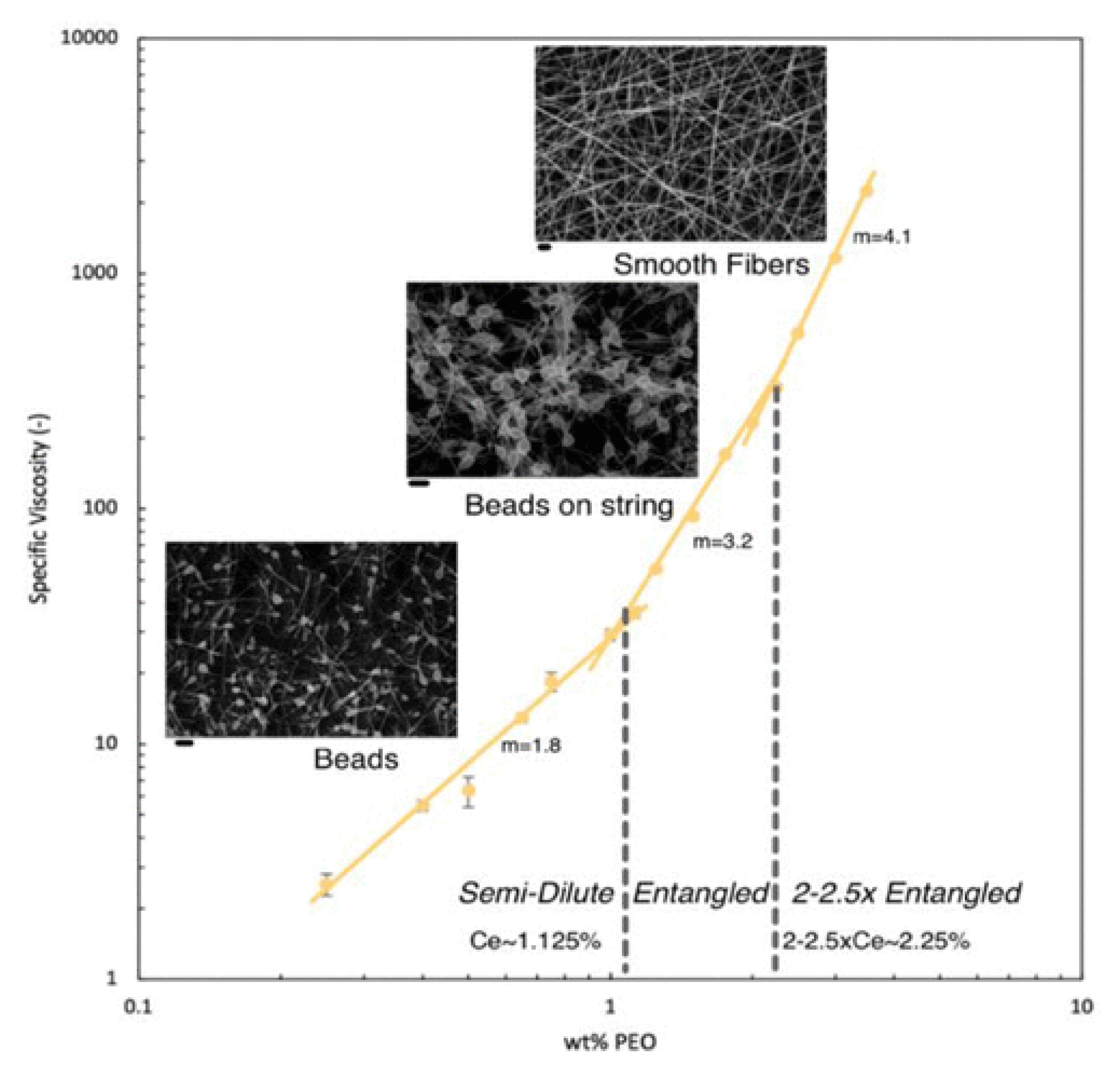
Figure 2.
Development of viscoelastic stresses and polymer chain stretching along the electrospinning jet as a function of relaxation time. Increasing relaxation time enhances elastic stress growth and promotes coil–stretch transition of polymer chains, enabling suppression of capillary breakup and stabilization of continuous fiber formation. Effect of the electric Peclet number (Pe) on the evolution of electrospinning jet dynamics along the axial distance (z) from the nozzle to the onset of the whipping region. (a) Variation of the jet radius (R) as a function of axial position z, illustrating the thinning behavior of the electrified jet for polymer solutions with different Pe numbers. Higher Pe values correspond to faster jet thinning in the Taylor cone region. (b) Evolution of the normalized molecular extension ⟨Q2⟩/L2, representing the degree of polymer chain stretching during jet elongation, where a value approaching unity indicates nearly fully stretched polymer chains. (c) Variation of the local Weissenberg number (Wi+), which characterizes the ratio of polymer relaxation time to the local deformation rate and reflects the strength of extensional flow experienced by the jet. (d) Development of elastic stress (ES) along the jet axis, demonstrating how stronger stretching and higher Wi+ promote the growth of elastic stresses that can stabilize the jet and suppress capillary breakup. Adapted from [80] under CC BY- 4.0 license.
Figure 2.
Development of viscoelastic stresses and polymer chain stretching along the electrospinning jet as a function of relaxation time. Increasing relaxation time enhances elastic stress growth and promotes coil–stretch transition of polymer chains, enabling suppression of capillary breakup and stabilization of continuous fiber formation. Effect of the electric Peclet number (Pe) on the evolution of electrospinning jet dynamics along the axial distance (z) from the nozzle to the onset of the whipping region. (a) Variation of the jet radius (R) as a function of axial position z, illustrating the thinning behavior of the electrified jet for polymer solutions with different Pe numbers. Higher Pe values correspond to faster jet thinning in the Taylor cone region. (b) Evolution of the normalized molecular extension ⟨Q2⟩/L2, representing the degree of polymer chain stretching during jet elongation, where a value approaching unity indicates nearly fully stretched polymer chains. (c) Variation of the local Weissenberg number (Wi+), which characterizes the ratio of polymer relaxation time to the local deformation rate and reflects the strength of extensional flow experienced by the jet. (d) Development of elastic stress (ES) along the jet axis, demonstrating how stronger stretching and higher Wi+ promote the growth of elastic stresses that can stabilize the jet and suppress capillary breakup. Adapted from [80] under CC BY- 4.0 license.
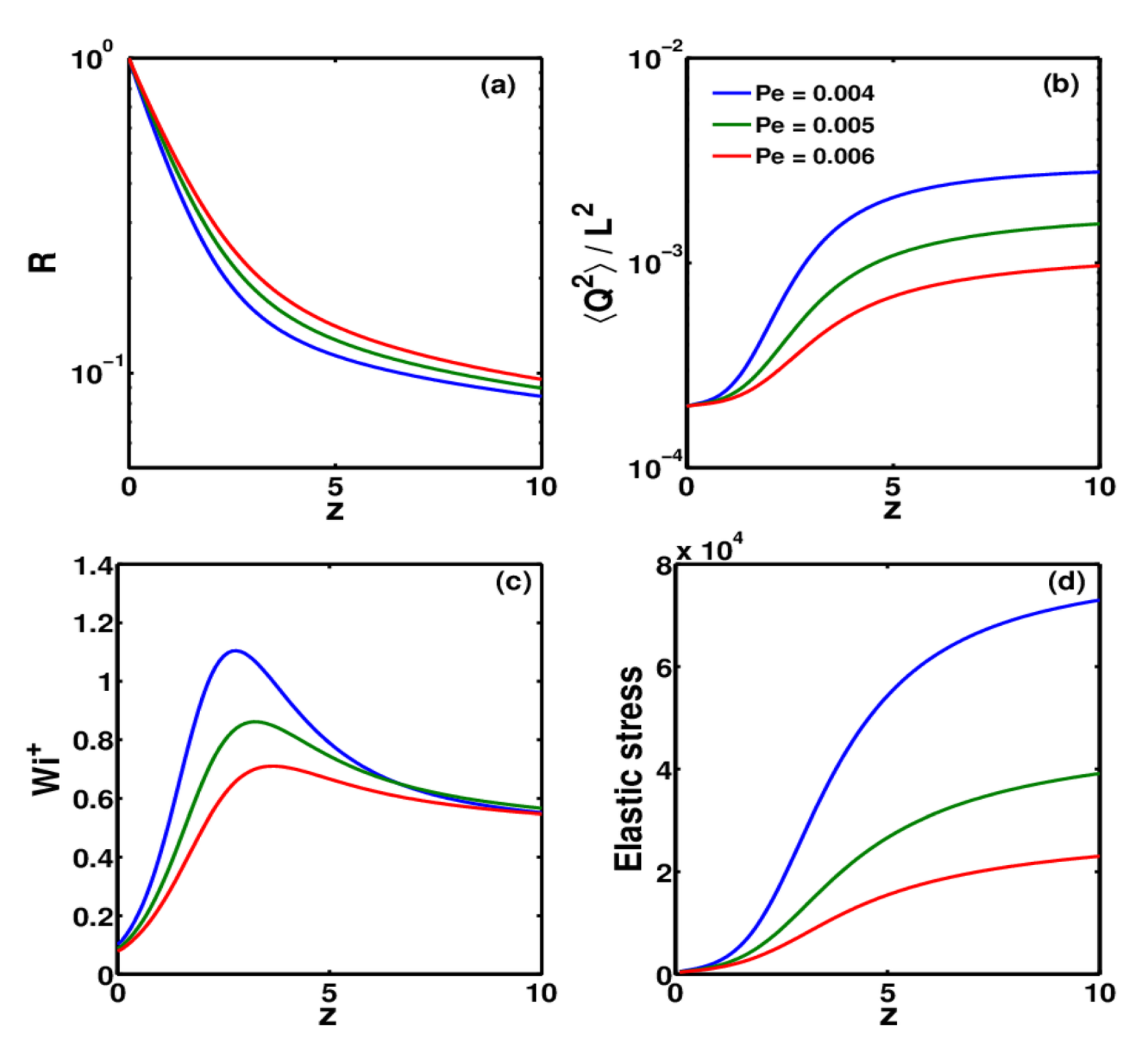
Figure 3.
Spatial distribution of molecular orientation within electrospun polymer fibers. Nanoscale mapping of dichroic ratio reveals heterogeneous molecular alignment across the fiber cross-section, with axially oriented chains in the core and radially oriented chains near the surface. This spatial variation reflects strong elongational stretching followed by incomplete relaxation prior to solidification. Adapted with permission from Andrea Camposeo [144], Macromolecules https://pubs.acs.org/doi/10.1021/ma500390v. Copyright © American Chemical Society.
Figure 3.
Spatial distribution of molecular orientation within electrospun polymer fibers. Nanoscale mapping of dichroic ratio reveals heterogeneous molecular alignment across the fiber cross-section, with axially oriented chains in the core and radially oriented chains near the surface. This spatial variation reflects strong elongational stretching followed by incomplete relaxation prior to solidification. Adapted with permission from Andrea Camposeo [144], Macromolecules https://pubs.acs.org/doi/10.1021/ma500390v. Copyright © American Chemical Society.
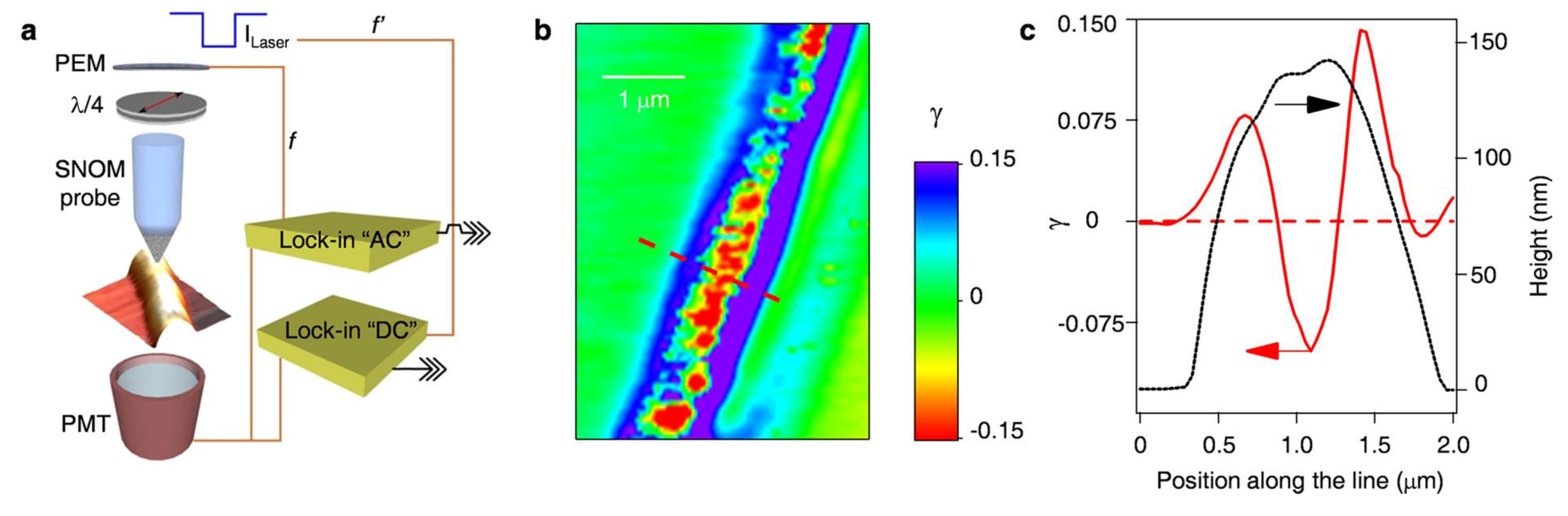
Figure 4.
Solvent-induced phase separation mechanisms during electrospinning. Schematic illustration of pore formation mechanisms in fibers driven by solvent evaporation and environmental conditions, including vapor-induced phase separation (VIPS), non-solvent induced phase separation (NIPS), and breath figure (BF) processes. These mechanisms reflect how evolving solvent concentration and polymer–solvent interaction influence segmental mobility, jet solidification, and the development of internal fiber nanostructure. Adapted from [153] under CC BY- 4.0 license.
Figure 4.
Solvent-induced phase separation mechanisms during electrospinning. Schematic illustration of pore formation mechanisms in fibers driven by solvent evaporation and environmental conditions, including vapor-induced phase separation (VIPS), non-solvent induced phase separation (NIPS), and breath figure (BF) processes. These mechanisms reflect how evolving solvent concentration and polymer–solvent interaction influence segmental mobility, jet solidification, and the development of internal fiber nanostructure. Adapted from [153] under CC BY- 4.0 license.
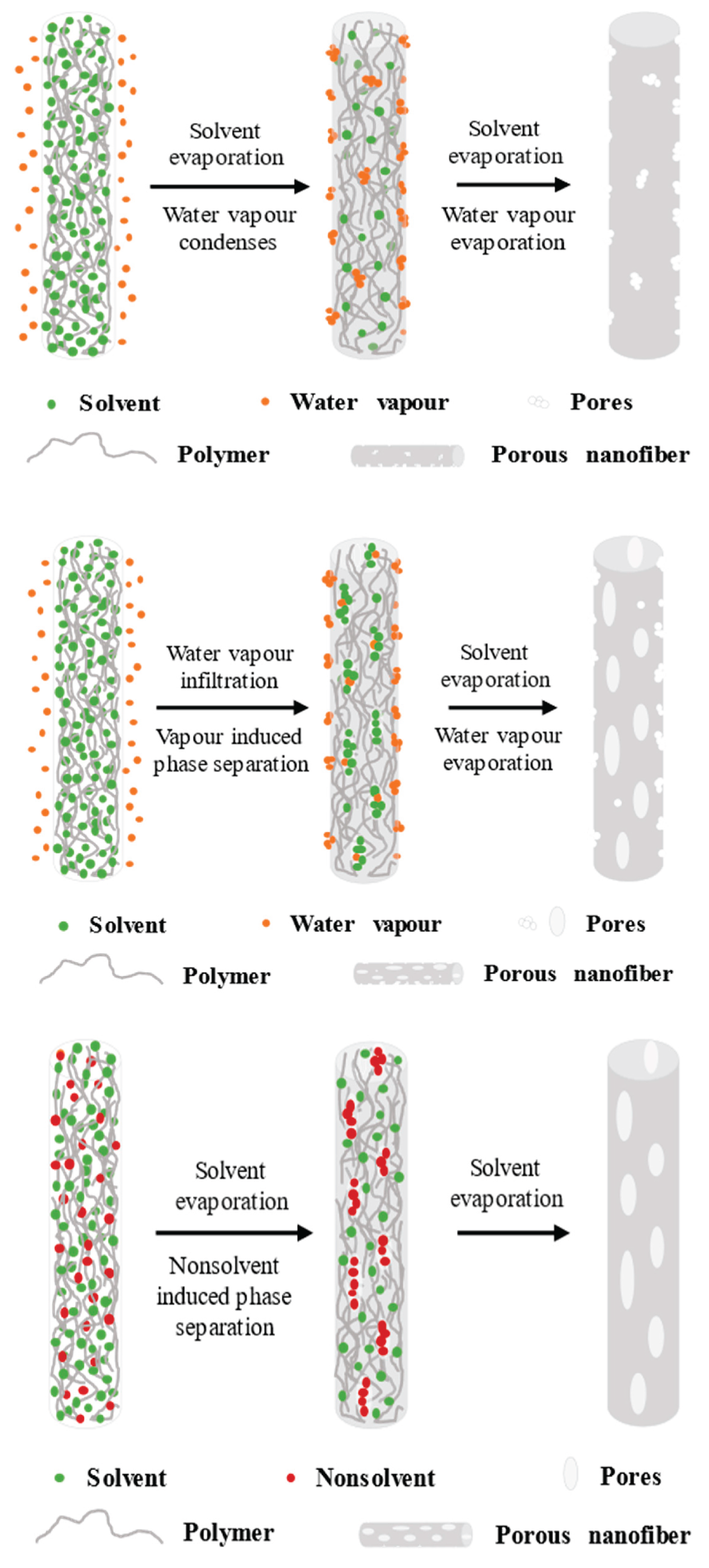
Figure 5.
Design logic flowchart.
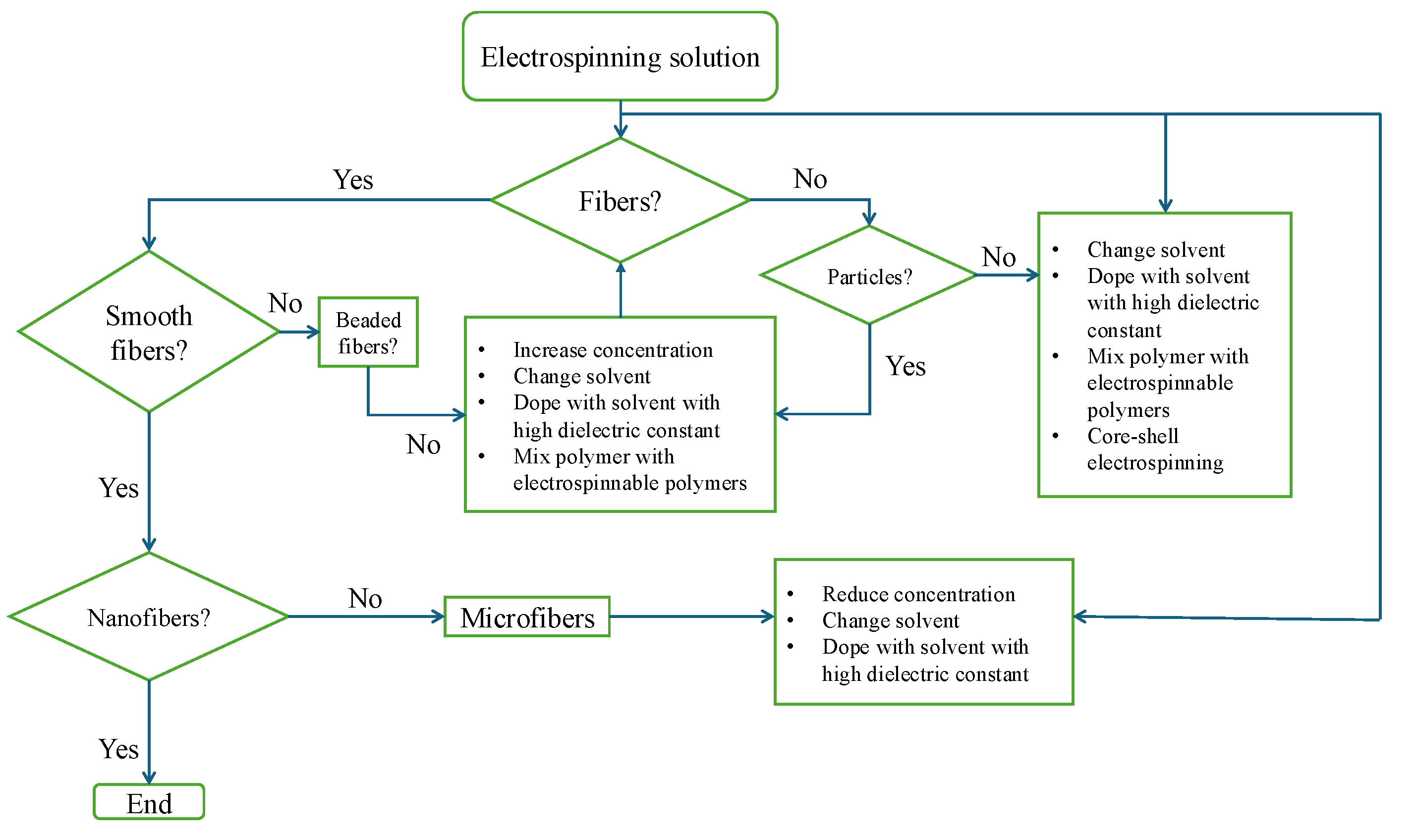
Figure 6.
Molecularly governed stability regimes in electrospinning.
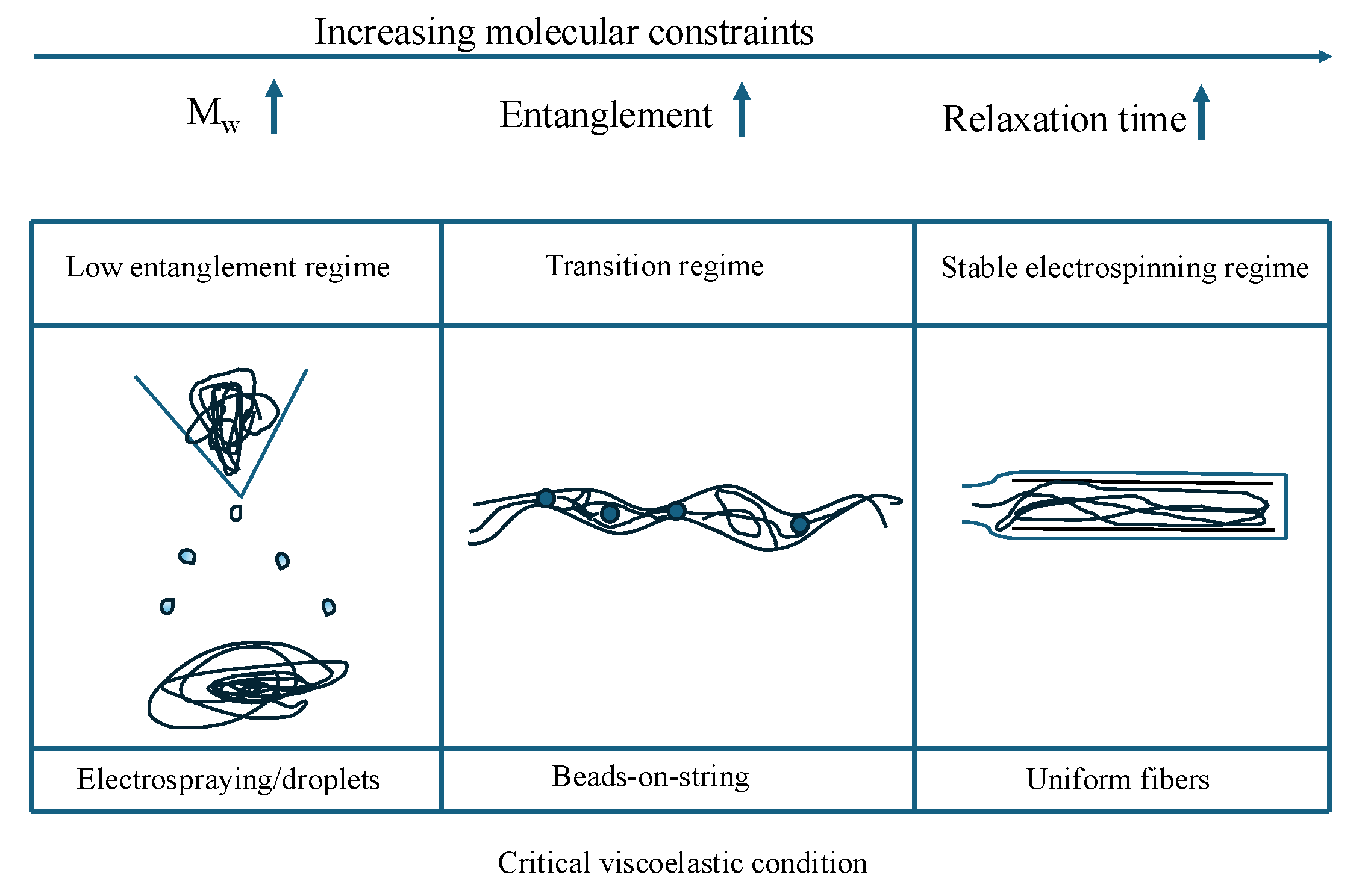

Table 1.
Molecular design parameters governing electrospinning behavior.
| Molecular parameter | Molecular-level effect | Impact on electrospinning behavior | Representative polymer systems |
|---|---|---|---|
| Molecular weight () | Increases chain overlap and entanglement | Enables stable jet formation above | PEO [72,74], PAN [94,95], PCL [67,68,69,70] |
| Molecular weight distribution (PDI) | Broadens relaxation spectrum | Suppresses bead formation via elastic stress storage | PAN [94,95], PET [96,97] |
| Polymer architecture | Alters entanglement efficiency and stress transmission | Modulates jet stability and internal fiber structure | Linear vs. star PCL [67,68,69,70], block copolymers [100,101] |
| Intermolecular interactions | Restricts segmental mobility | Extends relaxation time and stabilizes jet | Poly(vinyl alcohol) (PVA) [102,103,104], chitosan [90,91] |
| Polymer–solvent affinity | Controls coil expansion and vitrification | Determines relaxation vs. structure freezing | PCL/chloroform vs. PCL/DMF [67,68,69,70] |
Table 2.
The respective roles of molecular, solvent, and processing variables in electrospinning.
| Control level | Key variables | Primary role in electrospinning |
|---|---|---|
| Molecular weight & distribution | , MWD | Define spinnability window |
| Molecular architecture | Chain topology, block structure | Control stress transmission and internal structure |
| Solvent environment | Solvent quality, volatility | Govern relaxation and solidification |
| Processing parameters | Voltage, flow rate, distance | Fine-tune fiber dimensions and deposition |
Table 3.
Representative application domains illustrating how application requirements impose boundary conditions on electrospinning rather than serving as performance targets.
Table 3.
Representative application domains illustrating how application requirements impose boundary conditions on electrospinning rather than serving as performance targets.
| Application domain | Key tolerance requirement | Consequence for electrospinning |
|---|---|---|
| Filtration membranes | Narrow fiber diameter distribution | Requires stable jet and low fluctuation |
| Carbon nanofiber precursors | Structural integrity during thermal treatment | Sensitive to MWD and chain continuity |
| Biomedical scaffolds | Mechanical compliance and degradation control | Sensitive to polymer chemistry and solvent history |
Disclaimer/Publisher’s Note: The statements, opinions and data contained in all publications are solely those of the individual author(s) and contributor(s) and not of MDPI and/or the editor(s). MDPI and/or the editor(s) disclaim responsibility for any injury to people or property resulting from any ideas, methods, instructions or products referred to in the content. |
© 2026 by the authors. Licensee MDPI, Basel, Switzerland. This article is an open access article distributed under the terms and conditions of the Creative Commons Attribution (CC BY) license (http://creativecommons.org/licenses/by/4.0/).
Copyright: This open access article is published under a Creative Commons CC BY 4.0 license, which permit the free download, distribution, and reuse, provided that the author and preprint are cited in any reuse.


