
Submitted:
11 March 2026
Posted:
12 March 2026
You are already at the latest version
Abstract
The rapid accumulation of plastic waste has become a major environmental concern, while at the same time it is necessary to create opportunities to rethink how these materials can be reintegrated into productive use, particularly within the construction sector. This study provides a sustainability-oriented review of the reuse of plastic waste, both fossil-based plastics and bioplastics, as building materials, with a specific emphasis on structured decision-support approaches. A systematic literature review was conducted to identify and analyze peer-reviewed studies examining the incorporation of plastic waste into construction applications, including composites, panels, insulation systems, and structural or non-structural components. Particular attention is given to research applying Multi-Criteria Decision Analysis (MCDA) and SWOT analysis as tools for evaluating sustainability performance across environmental, economic, technical, and social dimensions. The findings indicate that recycled plastic and bioplastic-based construction materials can deliver significant advantages, such as diverting waste from disposal pathways, reducing reliance on virgin resources, and, in certain cases, enhancing durability. However, these materials also face important challenges, including limitations in recyclability, concerns related to fire performance, regulatory acceptance, and uncertainties in end-of-life management. MCDA-based studies underscore the critical role of criteria selection and weighting, especially regarding environmental impact reduction and cost competitiveness, in shaping final rankings and decision outcomes. SWOT analyses, in turn, offer complementary strategic insights by highlighting issues related to market readiness, regulatory frameworks, and implementation barriers. By integrating these decision-oriented evaluation approaches, this review contributes to more transparent and evidence-based material selection processes and supports policy development aimed.
Keywords:
circular economy
; (Bio) plastic waste valorization
; sustainable construction materials
; material circularity
; multi-criteria decision analysis (MCDA)
; SWOT analysis
1. Introduction
The rapid expansion of global plastic production and consumption has led to an escalating plastic waste crisis with significant environmental and societal implications. Over the past two decades, plastics production has grown dramatically [1]. According to the OECD, annual global plastics production increased from 234 Mt in 2000 to 460 Mt in 2019, while plastic waste generation rose from 156 Mt to 353 Mt over the same period. Despite sustained recycling efforts, the plastics lifecycle remains largely linear [2,3]. After accounting for processing losses, only approximately 9% of plastic waste was ultimately recycled in 2019, with the majority either incinerated or landfilled. This persistent imbalance between production and end-of-life management contributes to widespread pollution in terrestrial, freshwater, and marine ecosystems and adds to greenhouse gas emissions throughout the plastics lifecycle [4,5].With less than one-tenth of global plastic waste currently recycled, the limitations of conventional waste management systems are evident, underscoring the need for more effective circular strategies [6,7].
Within this context, the construction sector represents both a major material sink and a significant opportunity for circular material use, including the integration of plastic waste [7]. Construction activities consume substantial quantities of raw materials and account for a considerable share of global resource extraction, energy use, and carbon emissions [8]. Although the sector handles large material flows, the reuse and recycling of plastic waste in building materials remains underdeveloped relative to its potential for conserving resources and reducing waste. Applications such as panels, bricks, insulation systems, and composite materials demonstrate how plastic waste can be incorporated into construction products, thereby diverting waste from landfills and reducing reliance on virgin materials [9,10].
Circular economy strategies in the built environment aim to retain material value by promoting reuse and recycling pathways that displace primary resource extraction and minimize mismanaged waste [7]. However, translating circular economy objectives into practical material selection and policy decisions is complex. Plastic and bioplastic waste reuse options vary considerably depending on polymer type, additive composition, processing technologies, performance requirements and particularly regarding fire resistance and durability, as well as end-of-life feasibility [7,11]. While numerous reviews have examined the technical performance and applications of plastic waste in construction, fewer studies have systematically analyzed how sustainability is assessed and how decisions are structured [12]. In particular, the use of formal decision-support tools such as Multi-Criteria Decision Analysis (MCDA) and SWOT analysis remains fragmented. These methods are often applied with differing criteria sets, weighting approaches, and reporting practices, limiting cross-study comparability and weakening the overall evidence base for informed decision-making [12,13].
Accordingly, this review seeks to systematically examine how sustainability-oriented decision-support tools and specifically Multi-Criteria Decision Analysis (MCDA) and SWOT analysis, are applied to evaluate the reuse of circular plastic and bioplastic waste in building materials [14,15]. By synthesizing evaluation criteria, weighting approaches, and decision contexts across environmental, economic, technical, and social/regulatory dimensions, the review aims to enhance transparency in material selection and support the advancement of circular economy strategies within the built environment [15].
A circular economy approach to plastics challenges the traditional linear “take-make-dispose” model by prioritizing the retention of material value through improved design, reuse, repair, and recycling [16]. In this context, circular economy frameworks seek to extend product lifecycles, recover valuable material resources, and close material loops, while minimizing environmental impacts [17]. Despite increasing attention from industry and policymakers, progress toward circularity in plastics remains limited [16]. Based on a study by Schützenhofer et al., as of 2022, only a relatively small share of global plastics production was classified as circular, and post-consumer recycled plastics accounted for a minor fraction of total material flows. Within the construction sector, the reuse of plastic waste represents a promising yet complex circular pathway, as it must reconcile material performance requirements, economic viability, and regulatory compliance [17].
Much of the existing literature on plastic waste in construction focuses on material innovation, performance characterization, and general sustainability advantages [18]. However, comparatively little attention has been given to how sustainability is systematically evaluated across studies, particularly through structured decision-support methodologies [12]. Although MCDA and SWOT analysis are increasingly used to assess building materials, their application in the context of plastic and bioplastic waste reuse is often inconsistent, implicit, or confined to isolated case studies [15]. This lack of comparative synthesis limits understanding of how sustainability decisions are structured, including how criteria are selected, weighted, and prioritized when evaluating circular plastic-based construction materials [19].
To address this gap, the present review systematically analyzes how MCDA methods and SWOT analysis are employed to evaluate the sustainability of circular plastic and bioplastic waste reuse in construction applications. By integrating decision-oriented assessments across environmental, economic, technical, and social dimensions, this study contributes both to academic discourse on sustainability evaluation and to practical guidance for evidence-based material selection, policy development, and circular construction strategies.
Core material scope and circular reuse framework
To ensure conceptual clarity and coherence, this review defines the scope of materials based on their origin and their potential for circular reuse in construction applications. Both fossil-based plastic waste and bioplastic waste are considered within a unified circular economy framework [20]. Rather than assuming bioplastics to be inherently “green” or automatically sustainable, the analysis evaluates all material types according to their performance and circular potential within the construction context.
Fossil-based plastic waste
Fossil-based plastics account for the majority of global plastic production and waste generation, making them a primary focus for circular reuse strategies in the built environment [1]. This review therefore considers the fossil-derived polymers most commonly studied in construction applications, including polyethylene terephthalate (PET), high-density polyethylene (HDPE), low-density polyethylene (LDPE), polypropylene (PP), polyvinyl chloride (PVC), and polystyrene (PS) [2,3]. These materials are typically recovered from post-consumer or post-industrial waste streams and incorporated into building products such as composites, panels, bricks, insulation materials, and lightweight structural or non-structural components [1,4,5]. Their inclusion in this review reflects both their widespread availability and their considerable potential to divert waste from disposal pathways and reduce reliance on virgin materials when applied in long-life construction systems [21].
Bioplastic waste
In addition to fossil-based plastics, this review also examines bioplastic waste, including polylactic acid (PLA), polyhydroxyalkanoates (PHA), starch-based plastics, and bio-based polyethylene terephthalate (bio-PET). These materials are derived from renewable resources and may enter post-consumer or post-industrial waste streams suitable for secondary use. Importantly, bioplastics are not assumed to be inherently environmentally superior [22]. Instead, their sustainability performance is assessed specifically in the context of reuse in construction materials, taking into account durability, processing requirements, end-of-life pathways, and compatibility with existing recycling or composting systems. The analysis focuses on bioplastics that are reused as material resources in building applications, rather than those intended exclusively for biodegradation or composting [23].
Unified circular economy perspective
Both fossil-based plastics and bioplastics are examined within a shared circular reuse framework, in which sustainability is evaluated based on lifecycle performance, their ability to functionally substitute conventional construction materials, and their contribution to broader circular economy objectives [16]. This approach avoids reducing materials to a simple “sustainable” or “unsustainable” label based solely on feedstock origin. Instead, it emphasizes evidence-based assessment supported by structured decision-support tools. By adopting this unified perspective, the review facilitates a balanced comparison of material alternatives and strengthens sustainability-oriented decision-making in the construction sector [1,17].
Application scope of plastic and bioplastic waste in construction
To enable a structured and comparable sustainability assessment across studies, this review classifies the reuse of plastic and bioplastic waste in construction according to functional application types rather than solely by polymer composition [2,22]. This application-based approach recognizes that sustainability performance and decision criteria vary depending on the structural role of the material, its performance requirements, and the regulatory context in which it is used. Accordingly, four principal application categories are considered: structural applications, non-structural building elements, insulation and lightweight materials, and composite systems [2,23].
Structural applications
Structural applications of recycled plastic and bioplastic waste remain relatively limited, although interest in this area is gradually increasing. This cautious development is largely due to the strict mechanical, safety, and regulatory requirements associated with load-bearing construction components [23,24]. Research in this category typically examines plastic-based elements as partial substitutes for conventional materials in beams, columns, decking systems, or reinforcement components, often in hybrid configurations combined with steel, concrete, or fiber reinforcements [25,26].
From a sustainability assessment perspective, structural applications demand particular attention to mechanical strength, long-term durability, creep behavior, fire performance, and compliance with building codes. As a result, MCDA studies focusing on structural uses tend to assign greater weight to technical and safety-related criteria, reflecting the central importance of reliability, performance stability, and regulatory approval in decision-making processes [13].
Non-structural building elements
Non-structural applications constitute the most established and widely implemented pathway for reusing plastic waste in the construction sector. This category encompasses products such as panels, bricks, tiles, façade components, pavements, and modular blocks, in which plastic waste is used either as the primary material or as a partial substitute for conventional constituents, including cement, aggregates, or wood [2,21]. Compared to load-bearing elements, these applications typically face fewer regulatory constraints, which allows greater flexibility in material formulation and product design [5].
In sustainability assessments, non-structural applications often prioritize criteria such as waste diversion potential, cost-effectiveness, ease of manufacturing, and aesthetic performance, while ensuring sufficient mechanical strength for non-load-bearing functions [18]. Consequently, this category frequently dominates MCDA-based material selection studies, as it provides a practical and comparatively less constrained context for evaluating alternative plastic-based construction materials [12].
Insulation and lightweight materials
Plastic and bioplastic waste are particularly suitable for insulation and lightweight construction applications due to their low density, thermal insulation properties, and resistance to moisture [23,28]. This category includes thermal and acoustic insulation panels, lightweight fillers, sandwich core materials, and prefabricated modular components designed to reduce overall building weight and enhance energy efficiency [29].
In sustainability assessments, insulation-related applications typically emphasize criteria such as thermal conductivity, embodied energy, greenhouse gas emissions, and installation efficiency [28]. Mechanical performance requirements in this category are generally less stringent than in structural applications. MCDA-based studies often highlight the trade-offs between improved operational energy performance and challenges associated with fire behavior, smoke toxicity, and uncertainties in end-of-life management [27].
Composite materials and hybrid systems
Composite materials, which combine plastic or bioplastic waste with mineral fillers (such as sand or fly ash) or natural and synthetic fibers, represent a cross-cutting application category that spans structural, non-structural, and insulation uses. These hybrid systems are typically developed to improve mechanical performance, dimensional stability, and long-term durability, while also increasing the proportion of waste materials incorporated into the final product [30].
From a decision-support perspective, composite applications add a layer of complexity, as their sustainability performance depends not only on the characteristics of the plastic fraction but also on the type, proportion, and interaction of reinforcing materials. Consequently, MCDA and SWOT analyses applied to composite systems often consider factors such as multifunctionality, processing requirements, recyclability of multi-material systems, and compatibility with existing construction practices. For these reasons, composite materials are particularly relevant for comprehensive and holistic sustainability evaluations [31,32].
Relevance for sustainability assessment and decision support
By classifying construction applications according to their functional role, this review establishes a consistent link between application type and the sustainability criteria used in MCDA and SWOT-based evaluations [31]. This structured approach enhances transparency and improves comparability across studies, while also helping to identify context-specific trade-offs among environmental, economic, technical, and social dimensions. Furthermore, the framework provides a systematic foundation for synthesizing decision-oriented insights that are directly relevant to material selection, design optimization, and policy development within circular construction systems [32].
Decision-support focus: MCDA and SWOT as sustainability evaluation tools
Although numerous studies have investigated the reuse of plastic waste in construction materials, the methodological approaches used to assess sustainability performance remain highly heterogeneous. Many traditional evaluations focus on isolated indicators, such as mechanical properties, cost, or selected environmental impacts, without adequately addressing the multidimensional nature of sustainability decision-making in the construction sector [33]. Consequently, material selection and technology prioritization often lack transparency, methodological consistency, and cross-study comparability [33,34].
To overcome this limitation, the present review places explicit emphasis on structured decision-support tools, particularly Multi-Criteria Decision Analysis (MCDA) and SWOT analysis. These approaches enable a more systematic evaluation of alternatives across environmental, economic, technical, and social dimensions. Rather than simply cataloguing material innovations, this review examines how sustainability-related decisions are structured, how criteria are selected and weighted, and how conclusions are justified in the context of circular plastic and bioplastic waste reuse in construction [35,36,37].
MCDA methods have gained increasing attention in construction materials research because they can integrate both quantitative and qualitative criteria, address trade-offs among competing objectives, and incorporate stakeholder preferences through explicit weighting schemes [36]. In the context of plastic-based building materials, MCDA is commonly applied to rank alternative materials, compare recycling and reuse pathways, and inform design or policy decisions [35,38]. However, substantial variation exists across studies in terms of criteria selection, normalization procedures, and weighting strategies. These methodological differences can lead to divergent outcomes, even when similar materials or applications are evaluated [35,38].
SWOT analysis, while less quantitative, offers a complementary strategic perspective by capturing context-specific factors such as regulatory acceptance, market readiness, social perception, and implementation barriers [38]. In sustainability-focused construction research, SWOT is frequently used to situate technical and environmental findings within broader economic and institutional contexts. When integrated with MCDA, SWOT can help bridge the gap between numerical rankings and practical feasibility, providing a more comprehensive basis for decision-making [36,37,38].
By synthesizing how MCDA and SWOT are applied in existing studies, this review advances a decision-oriented perspective on circular plastic reuse in construction. This integrated approach enhances the transparency of sustainability assessments, supports evidence-based material selection, and contributes to the development of more robust and context-sensitive circular economy strategies in the built environment [34,35,36,37,38].
2. Methodology
2.1. Systematic Review Framework
A systematic literature review was conducted to identify, analyze, and synthesize peer-reviewed studies addressing the reuse of plastic and bioplastic waste in construction materials, with particular emphasis on sustainability assessment through structured decision-support tools. The review was carried out in accordance with the PRISMA (Preferred Reporting Items for Systematic Reviews and Meta-Analyses) guidelines to ensure transparency, reproducibility, and methodological rigor. As outlined by Moher et al., PRISMA provides a standardized framework for reporting systematic reviews and is widely recognized as a benchmark for high-quality review studies [39].
The primary objective of the PRISMA approach is to guide researchers in developing clear, comprehensive, and well-documented literature review reports. Consistent with prior review studies in related fields, this research adopted the PRISMA framework to structure the literature selection process. Accordingly, three main stages were followed: (i) literature identification and initial screening, (ii) data extraction and organization, and (iii) final eligibility assessment and selection of qualifying publications for inclusion in the review.
2.2. Literature Search Strategy
In line with the defined time frame, only publications published between 2010 and 2025 were considered in the search process. Searches were conducted in the selected databases, including Scopus and Google Scholar, and screening continued until successive pages of results yielded no additional relevant studies.
The search strategy focused specifically on peer-reviewed journal articles. Consequently, literature reviews, book chapters, conference proceedings, postgraduate and doctoral theses, and publications written in languages other than English were excluded. Initial screening was carried out based on titles, keywords, and abstracts to ensure alignment with the predefined inclusion criteria. For studies that met these preliminary criteria, the main content was examined in greater detail, with particular attention to the abstract and conclusion sections to confirm relevance.
The overall workflow of the literature selection and screening process is illustrated in Figure 1.
Search queries were developed by combining keywords related to plastic waste, construction applications, sustainability, and decision-support methodologies. The search strategy integrated terms from the following thematic groups:
- Plastic waste and materials: plastic waste, bioplastic, recycled plastic
- Construction applications: building materials, construction, composites, insulation
- Sustainability concepts: sustainability, circular economy, life cycle
- Decision-support methods: multi-criteria decision analysis, MCDA, SWOT
A representative search string applied across databases was:(“plastic waste” OR “bioplastic waste” OR “recycled plastic”) AND (“building material” OR “construction”) AND (“sustainability” OR “circular economy”) AND (“MCDA” OR “multi-criteria decision” OR “SWOT”).
Equivalent variations of this search string were adapted to meet the specific syntax requirements of each database. To ensure comprehensiveness and minimize the risk of overlooking relevant studies, backward and forward citation tracking was also conducted for key review and methodological papers identified during the screening process.
2.3. Inclusion and Exclusion Criteria
To ensure relevance and methodological quality, studies were selected according to predefined inclusion and exclusion criteria.
Inclusion criteria:
- Peer-reviewed journal articles
- Focus on reuse of plastic or bioplastic waste in construction materials
- Explicit consideration of sustainability aspects
- Application of MCDA methods and/or SWOT analysis, or structured multi-criteria evaluation
Exclusion criteria:
- Studies focusing solely on mechanical or physical characterization without sustainability assessment
- Research addressing plastic waste incineration or energy recovery only
- Non-construction-related reuse pathways
- Conference papers, editorials, and non-peer-reviewed sources
2.4. Study Selection and Data Extraction
After removing the duplicates, titles and abstracts were screened to assess their relevance to the review objectives. Studies that met the initial screening criteria underwent full-text evaluation to confirm their alignment with the defined scope of the review. For each selected study, data were extracted on material type, construction application, sustainability criteria considered, decision-support methods employed, and key findings.
The extracted information was systematically coded to facilitate comparative analysis across different application categories and evaluation frameworks. This structured coding process formed the foundation for the synthesis and discussion presented in the subsequent sections.
3. Results and Discussion
Linking application types to sustainability criteria
To facilitate a systematic and comparable synthesis of sustainability evaluations across diverse studies, it is essential to explicitly connect construction application types with the sustainability criteria most frequently emphasized in decision-support assessments. The existing literature on plastic and bioplastic waste reuse in construction employs a broad range of evaluation criteria, often without clearly explaining how these criteria relate to the material’s functional role within the building system. This variability can obscure the reasoning behind criteria selection and weighting in MCDA-based studies, thereby limiting cross-study comparability and reducing transparency [40,41].
To address this issue, the framework presented in Table 1 was developed to conceptually align construction application categories with the dominant sustainability dimensions identified in the literature. The table provides a structured reference for interpreting and comparing MCDA and SWOT analyses across studies. The rows correspond to the main construction application types considered in this review, such as structural, non-structural, insulation and lightweight materials, and composite systems, and they reflect differences in functional requirements, performance expectations, and regulatory constraints. The columns represent the four core sustainability dimensions most commonly addressed in decision-support evaluations: environmental, economic, technical, and social/regulatory aspects [40,41].
The criteria presented within each cell are not intended to provide an exhaustive list. Instead, they highlight the criteria most frequently prioritized in MCDA-based assessments for each application type. Their selection is grounded in recurring patterns that have been identified during the data extraction process and reflects the specific decision priorities associated with each functional category. By making these relationships explicit, the table serves as a methodological link between the systematic review process and the subsequent synthesis of MCDA and SWOT applications, thereby supporting a more transparent interpretation of evaluation results and weighting approaches.
4. Overview of Plastic and Bioplastic Waste in Construction Applications
The reuse of plastic and bioplastic waste in construction materials has expanded considerably in recent decades, driven by growing environmental concerns, increasing regulatory pressure, and the broader adoption of circular economy principles. Recycled polymers are now incorporated into a wide variety of building products that serve different functional roles and meet diverse performance requirements [2,3,22,23].
To provide a structured overview, this section first outlines the main fossil-based and bioplastic waste streams utilized in construction applications and then examines their principal areas of use. The discussion remains descriptive, focusing on material characteristics, technological processing pathways, and typical applications, rather than engaging in comparative sustainability assessment [1,2,22,23].
4.1. Fossil-Based Plastic Waste
Fossil-based plastics account for the largest share of global plastic waste and therefore represent the main feedstock for circular reuse in construction materials. Among these, polyethylene terephthalate (PET), high-density polyethylene (HDPE), low-density polyethylene (LDPE), polypropylene (PP), polyvinyl chloride (PVC), and polystyrene (PS) are the polymers most frequently reported in construction-related studies [45,46,47,48,49,50,51].
Recycled PET is widely used in the manufacture of panels, fibers, and composite materials. PET fibers are commonly incorporated into cementitious and polymer-based composites to enhance crack resistance and improve impact performance, while PET flakes and pellets are processed into extruded or molded panels and boards. Due to its relatively high tensile strength and chemical stability, PET is particularly suitable for reinforcement purposes and certain semi-structural applications [48,49,50,51].
HDPE and PP are often employed in lumber substitutes, decking systems, paving blocks, and molded bricks. These polymers offer good moisture resistance, durability, and ease of processing, making them appropriate for outdoor applications and environments exposed to high humidity. In addition, mixed polyolefin waste streams are increasingly utilized in molded construction products, especially in cases where strict material purity is not required [52,53].
PVC presents a distinct case in construction reuse because of its extensive use in pipes, profiles, and window frames, combined with its complex additive composition. Although recycled PVC is incorporated into selected building products, its reuse can be controversial due to concerns related to plasticizers, stabilizers, and chlorine content. These additives may complicate recycling processes and raise environmental and health considerations, which in turn affect regulatory approval and market acceptance [45,53].
Polystyrene, particularly in expanded and extruded forms, is primarily reused in insulation and lightweight construction applications. Recycled PS is typically processed into foamed boards and filler materials, contributing to improved thermal and acoustic performance in buildings [54].
4.2. Bioplastic Waste
Alongside fossil-based plastics, bioplastic waste has attracted increasing attention as a potential feedstock for circular construction materials. Commonly studied biopolymers include polylactic acid (PLA), polyhydroxyalkanoates (PHA), starch-based plastics, and bio-based polyethylene terephthalate (bio-PET). These materials are derived wholly or partially from renewable resources and are becoming more prevalent in post-consumer waste streams [22,23,54].
PLA is the most extensively investigated bioplastic in construction-related applications, particularly in panels, lightweight boards, and blended composite systems. PLA-based materials are frequently combined with natural fibers, mineral fillers, or recycled polymers to enhance mechanical stability and dimensional performance. Their relatively low melting temperature and compatibility with conventional polymer-processing technologies support their integration into established manufacturing processes [22,23].
PHA and starch-based plastics have primarily been examined in experimental composite and hybrid systems, where they function as matrix materials or partial substitutes for conventional polymers. Although these bioplastics offer advantages in terms of renewable feedstock origin, their use in large-scale construction applications remains limited [22,23].
A key challenge in reusing bioplastic waste in construction lies in balancing biodegradability with long-term durability. While biodegradability may be beneficial in certain waste-management scenarios, it can conflict with the extended service-life requirements of building components. Additionally, bioplastics often face competing end-of-life pathways, including industrial composting, mechanical recycling, chemical recycling, and material reuse. These alternative routes complicate waste-stream management and may affect the availability of bioplastic waste for construction applications [22,23,54,55].
4.3. Structural Applications
Structural applications of plastic and bioplastic waste remain relatively limited, largely due to the stringent requirements associated with mechanical performance, long-term durability, safety standards, and regulatory compliance [55]. In most cases, recycled polymers are not used as standalone structural materials but are incorporated into hybrid or reinforced systems alongside conventional construction materials. Typical examples include plastic–wood composites for load-bearing decking, polymer-modified concrete components, and fiber-reinforced polymer profiles [56].
Among the various polymers, recycled PET, HDPE, and PP are most frequently investigated for structural applications because of their favorable strength-to-weight ratios and chemical resistance. In several studies, plastic waste is introduced either as reinforcement fibers or as partial substitutes for mineral aggregates in cementitious systems. These strategies are intended to improve properties such as impact resistance, ductility, and crack control, while simultaneously promoting material reuse within structural contexts [57].
4.4. Non-Structural Building Elements
Non-structural building elements represent the most established and widely implemented area for the reuse of plastic waste in construction. This category includes wall panels, façade components, paving blocks, bricks, roofing tiles, partitions, and modular blocks that are not designed to bear primary structural loads [58].
These products are typically manufactured from recycled PET, HDPE, LDPE, PP, or mixed plastic waste streams using processes such as extrusion, compression molding, or melting and casting. Plastic-based bricks and blocks have been developed to enhance water resistance and reduce overall weight, while recycled plastic panels are increasingly applied in interior spaces and temporary construction settings [58,59].
4.5. Insulation and Lightweight Materials
Plastic and bioplastic waste are particularly well suited for insulation and lightweight construction applications due to their low density, thermal insulating properties, and resistance to moisture. This category includes thermal and acoustic insulation panels, sandwich core materials, foamed products, and lightweight fillers [22,60].
Recycled polystyrene, PET foams, and polyethylene-based materials are commonly used in these applications, while bioplastics such as PLA have been investigated in lightweight composite systems. These materials are often incorporated into prefabricated components and modular construction systems, where reduced weight and improved thermal performance are key design considerations [23,61].
4.6. Composite Materials and Hybrid Systems
Composite and hybrid systems combine plastic or bioplastic waste with mineral fillers, industrial by-products, or reinforcing fibers to improve mechanical and functional performance. Common formulations include plastic–sand bricks, polymer–fly ash composites, plastic–wood composites, and fiber-reinforced boards. These hybrid systems allow for higher incorporation rates of waste materials while enhancing technical properties such as strength, stiffness, and dimensional stability. Depending on the material composition and the intended product geometry, typical processing methods include extrusion, hot pressing, injection molding, and reactive compounding [61,62,63].
4.7. Summary and Relevance for Subsequent Analysis
The reuse of plastic and bioplastic waste in construction spans a broad range of material types and application areas, each defined by specific processing methods, functional requirements, and constraints related to waste streams. At present, fossil-based polymers dominate large-scale construction applications, whereas bioplastics are primarily found in experimental or niche systems. Clear distinctions also emerge among structural, non-structural, insulation, and composite applications in terms of material selection criteria and design priorities. This descriptive overview establishes the empirical basis for the subsequent examination of sustainability criteria and decision-support practices. By clearly differentiating material categories and application domains, it supports a more transparent interpretation of MCDA and SWOT-based evaluations and enables a structured comparative synthesis in the following sections [1,2,16,60,63].
5. Sustainability Dimensions and Evaluation Criteria
The sustainability assessment of plastic and bioplastic waste reuse in construction requires the systematic consideration of multiple, and often competing, performance dimensions. Existing studies rely on a diverse set of indicators and metrics, reflecting variations in application contexts, stakeholder priorities, and methodological approaches [35]. This diversity complicates cross-study comparisons and reduces the transparency of decision-support outcomes. To support a coherent synthesis of MCDA- and SWOT-based evaluations, this section organizes and harmonizes the sustainability criteria identified in the literature into four core dimensions: environmental, economic, technical, and social/regulatory [13,36].
This classification aligns with widely adopted sustainability frameworks in construction and materials research and is grounded in recurring patterns observed during the data extraction process. By establishing a common analytical structure, it creates a foundation for systematically comparing criteria selection, weighting practices, and ranking outcomes in the subsequent sections [12,40,41].
5.1. Environmental Dimension
Environmental criteria form a central pillar of sustainability evaluations for plastic-based construction materials, reflecting concerns related to climate change, resource depletion, pollution, and waste management. Across the reviewed studies, environmental performance is most frequently assessed using indicators derived from life cycle assessment (LCA) or simplified lifecycle-based approaches [35,61].
Greenhouse Gas Emissions
Greenhouse gas (GHG) emissions are typically expressed in carbon dioxide equivalents (CO₂-eq) and are among the most commonly reported indicators. MCDA tools have been also used for the quantification of carbon emission but in this case, these metrics account for emissions associated with raw material extraction, waste collection and sorting, reprocessing, manufacturing, transportation, and end-of-life treatment [35,60,64]. In plastic waste reuse systems, GHG performance is strongly influenced by the energy demand of recycling processes and by the degree to which virgin material production is displaced [65].
Waste diversion and resource efficiency
Waste diversion indicators quantify the volume or proportion of plastic waste redirected from landfilling, incineration, or uncontrolled disposal toward material reuse. These measures are often expressed in terms of recycled content, waste utilization rates, or landfill avoidance. Closely related indicators include material circularity and resource efficiency, which assess the extent to which secondary materials substitute for virgin resources in construction products [66,67].
Toxicity and additives
Chemical additives, including plasticizers, flame retardants, stabilizers, and heavy metals, are particularly relevant for recycled plastics, especially PVC and mixed waste streams. Environmental toxicity indicators address the potential release of hazardous substances during processing, use, and end-of-life stages. Increasingly, MCDA frameworks incorporate toxicity-related criteria to capture environmental and health risks that are not reflected solely in carbon-based metrics [35,45].
End-of-Life scenarios
End-of-life indicators evaluate the recyclability, recoverability, or disposal pathways of plastic-based construction materials after their service life. Studies commonly differentiate between closed-loop recycling, open-loop recycling, energy recovery, landfilling, and, in the case of bioplastics, composting. The technical and economic feasibility of future material recovery is a critical determinant of long-term circularity performance and is therefore frequently included in environmental assessments [35,68].
5.2. Economic Dimension
Economic criteria address the financial feasibility and market competitiveness of construction materials derived from plastic waste. These indicators are critical for assessing practical implementation potential and are typically incorporated into MCDA studies alongside environmental and technical considerations [15,69].
Material and feedstock costs
Material cost indicators include the price of plastic waste feedstock, as well as expenses associated with sorting, cleaning, preprocessing, and the acquisition of auxiliary materials such as fillers, reinforcing fibers, and additives. Feedstock availability and variability in material quality can significantly influence overall cost structures, particularly in the case of mixed plastic waste streams and certain bioplastics [15,46,69].
Processing and manufacturing costs
Processing costs encompass expenditures related to energy consumption, labor, equipment operation, maintenance, and quality control during material conversion and product manufacturing. These costs are strongly influenced by the selected processing technology, the scale of production, and the degree of purification or material preparation required prior to manufacturing [69,70].
Lifecycle and maintenance costs
Lifecycle cost indicators expand economic assessment beyond initial production expenses to include installation, operation, maintenance, repair, and replacement over the service life of the building component. For long-life construction applications, lifecycle costing is especially important for identifying trade-offs between higher upfront investments and potential long-term savings resulting from improved durability or reduced maintenance requirements [35,69,70].
5.3. Technical Dimension
Technical performance criteria assess the functional suitability, reliability, and long-term durability of plastic and bioplastic materials used in construction. These indicators are especially critical in applications governed by safety regulations and performance standards, where material failure can have structural or safety implications [71,72,73,74].
Mechanical strength and load-bearing capacity
Mechanical properties, such as compressive strength, tensile strength, flexural strength, and impact resistance, are central indicators in both structural and non-structural applications. These parameters determine a material’s load-bearing capacity, deformation response under stress, and resistance to mechanical damage. In structural or semi-structural uses, mechanical performance often represents a primary decision criterion [72,74].
Fire resistance and thermal stability
Fire performance is a major consideration for polymer-based construction materials. Relevant indicators include ignition resistance, flame spread behavior, smoke production, and thermal degradation characteristics. In many MCDA frameworks, compliance with fire safety standards is treated as a threshold or non-compensatory criterion, meaning that materials must meet minimum regulatory requirements before further evaluation [40,71,72,73].
Durability and ageing resistance
Durability criteria evaluate long-term resistance to environmental stressors such as ultraviolet (UV) radiation, temperature variations, moisture exposure, and chemical agents. Creep behavior and fatigue resistance are also important, particularly in load-bearing or semi-structural components where sustained or cyclic stresses may affect long-term performance [72,73].
Moisture resistance and dimensional stability
Moisture absorption, swelling behavior, and dimensional stability are critical technical indicators, especially for materials intended for outdoor or high-humidity environments. These properties influence service life, maintenance needs, and compatibility with adjacent building components, and are therefore frequently incorporated into technical assessment frameworks [71,74].
5.4. Social and Regulatory Dimension
Social and regulatory criteria encompass issues related to societal acceptance, institutional frameworks, and governance conditions that shape the adoption of plastic-based construction materials. Although these factors are less frequently quantified than environmental or technical indicators, they often play a decisive role in determining whether a material can be successfully implemented in practice [69,75].
Health and safety concerns
Health-related criteria address the potential release of volatile organic compounds (VOCs), microplastics, or other hazardous substances during material processing, installation, and use. Considerations in this category also include worker safety during manufacturing and construction activities, as well as indoor air quality implications for building occupants [69,75].
Code compliance and regulatory acceptance
Compliance with building codes, material standards, and certification schemes is a critical determinant of market entry and widespread adoption. Indicators in this category evaluate conformity with structural, fire, environmental, and safety regulations at national or regional levels. Regulatory approval is often treated as a prerequisite condition in decision-support frameworks [69,75].
Market perception and user acceptance
Market-related criteria reflect perceptions of quality, reliability, aesthetics, and environmental credibility among architects, engineers, contractors, and end-users. Public confidence in recycled and bioplastic materials can significantly influence their commercialization potential and long-term market viability [69,75].
5.5. Harmonization of Sustainability Criteria for Decision-Support Analysis
Across the reviewed studies, sustainability assessments show considerable variation in terms of indicator definitions, measurement approaches, and aggregation methods. Some investigations rely on detailed life cycle inventories and quantitative impact modeling, while others apply qualitative scoring systems or expert-based evaluations. Economic and social criteria, in particular, are often treated inconsistently or, in some cases, excluded from the analysis altogether [12,13].
To support a systematic synthesis, this review consolidates the reported indicators within the four-dimensional framework outlined above. The specific metrics identified in individual studies are mapped onto standardized categories, enabling a structured comparison of criteria selection and weighting practices across different application types and decision contexts. Although this harmonization does not remove methodological diversity, it provides a transparent and coherent basis for interpreting MCDA and SWOT results [19,36,76].
By establishing a consistent structure for sustainability evaluation, this section lays the analytical groundwork for the subsequent examination of MCDA methods, weighting approaches, and ranking outcomes. It also facilitates the identification of recurring trade-offs and underrepresented sustainability dimensions in existing decision-support research on circular plastic and bioplastic waste reuse in construction [40,44].
6. Applications of Multi-Criteria Decision Analysis in Evaluating Plastic-Based Building Materials
Multi-Criteria Decision Analysis (MCDA) methods are increasingly used to support sustainability-oriented decision-making in the assessment of plastic and bioplastic waste reuse in construction materials. These approaches facilitate the structured integration of environmental, economic, technical, and social criteria, enabling stakeholders to explicitly consider trade-offs and prioritize alternatives in situations characterized by complex and sometimes conflicting objectives. This section synthesizes the application of MCDA methods in the reviewed literature, with particular attention to methodological choices, application contexts, and comparative findings [36,41].
6.1. Common MCDA Methods
A range of MCDA techniques has been applied to evaluate plastic-based building materials, reflecting differences in decision contexts, data availability, and analytical objectives. The most commonly used methods include the Analytic Hierarchy Process (AHP), the Technique for Order Preference by Similarity to Ideal Solution (TOPSIS), PROMETHEE, ELECTRE, MAVT and hybrid LCA–MCDA frameworks [32,35,36,40].
AHP is the most frequently applied MCDA method in the reviewed studies. It organizes decision problems into a hierarchical structure consisting of goals, criteria, sub-criteria, and alternatives. Relative weights are derived through pairwise comparisons, typically based on expert judgment. In the context of plastic-based construction materials, AHP is often used to determine the relative importance of sustainability criteria before ranking material options. Its structured approach and relative ease of application contribute to its widespread use. However, outcomes can be sensitive to subjective judgments and the consistency of pairwise comparisons [40].
TOPSIS is commonly employed to rank material alternatives according to their relative distance from an ideal and a negative-ideal solution. It is frequently combined with AHP-derived weights in integrated AHP–TOPSIS models. In construction-related evaluations, TOPSIS is valued for its computational simplicity and its ability to process quantitative performance indicators, making it particularly suitable for comparative material selection studies [42]. MAVT is a foundational idea in Multi-Criteria Decision Analysis. Applications of MAVT seek to describe a decision maker’s value function over two or more objectives and associated criteria. The weighting of the individual value functions can be done formally by the method of indifferences, akin to the underpinnings of stated preference techniques used in the evaluation of non-market impacts in benefit-cost analysis [12,36,42].
Outranking approaches such as PROMETHEE and ELECTRE are less widely used but appear in studies involving more complex decision environments, particularly those characterized by qualitative or uncertain data. Rather than generating straightforward numerical rankings, these methods establish pairwise preference relations among alternatives. In the evaluation of plastic waste reuse in construction, they are mainly applied in policy analysis and technology selection contexts, where stakeholder preferences and threshold effects play a significant role [12,13,19].
Hybrid frameworks that integrate Life Cycle Assessment (LCA) with MCDA represent a growing trend in sustainability evaluation. In these approaches, LCA provides quantitative environmental impact indicators, which are then incorporated into MCDA models alongside economic, technical, and social criteria. Such hybrid methods are particularly relevant for assessing plastic-based construction materials, as they allow lifecycle impacts to be evaluated within a broader decision-making framework. However, their application typically requires extensive data and methodological expertise, which may limit their broader adoption [35].
6.2. Application Contexts of MCDA in Plastic-Based Construction Materials
MCDA methods are applied in the reviewed literature within three primary decision-making contexts: material selection, technology and process comparison, and policy or strategic prioritization [12,19].
Material selection
Material selection is the most common application of MCDA in this field. Studies in this category evaluate alternative plastic-based building products, material formulations, or composite systems to determine the most sustainable option for a specific construction application. The criteria considered typically include environmental impacts, production and lifecycle costs, mechanical performance, and regulatory compliance. These assessments are often conducted during the design or pre-commercialization stages and are intended to support decision-making by architects, engineers, and material developers [13,19].
Technology and process comparison
MCDA is also used to compare recycling, processing, and manufacturing technologies for transforming plastic waste into construction materials. Examples include evaluations of mechanical recycling, chemical recycling, melting–casting, extrusion, and hybrid processing routes. In this context, studies generally emphasize criteria such as energy consumption, process efficiency, scalability, and environmental performance. These analyses inform investment decisions, technology selection, and process optimization strategies [32,35,36].
Policy and strategic prioritization
A smaller but expanding body of literature applies MCDA to policy analysis and strategic planning. In these studies, alternative waste management or circular economy scenarios are assessed in terms of sustainability performance and implementation feasibility. MCDA is used to support policy prioritization, infrastructure planning, and the design of regulatory or financial incentives, often in combination with stakeholder surveys and expert consultations to reflect diverse perspectives [40,41].
6.3. Synthesis of Key Findings from MCDA Studies
A comparative review of MCDA applications reveals several recurring patterns across different material types and construction contexts.
Dominance of environmental criteria
Environmental indicators, particularly greenhouse gas emissions, waste diversion potential, and resource efficiency, are consistently assigned relatively high weights in most MCDA studies. This reflects the fact that environmental performance is often the primary driver behind initiatives promoting plastic waste reuse. In studies that incorporate life cycle assessment (LCA) indicators, environmental criteria frequently exert a strong, and sometimes dominant, influence on the final ranking of alternatives [35].
Sensitivity to criteria weighting
MCDA outcomes are highly sensitive to the weighting schemes applied. Differences in expert judgment, stakeholder priorities, or normalization procedures can result in significant changes in material rankings. Sensitivity analyses reported in several studies show that even modest adjustments in the weights assigned to cost or technical performance criteria can alter the preferred alternative. This sensitivity underscores the importance of transparent weighting procedures and meaningful stakeholder engagement in the decision-making process [19].
Economic constraints and cost competitiveness
Although plastic-based construction materials often demonstrate favorable environmental performance, their adoption is frequently constrained by economic considerations. Elevated processing costs, variability in feedstock quality, and limited economies of scale can reduce their cost competitiveness compared to conventional materials. As a result, economic criteria commonly function as limiting factors in MCDA evaluations, particularly when large-scale implementation is considered [13,32].
Application-specific ranking patterns
MCDA rankings also vary systematically depending on the type of application. Structural and semi-structural uses tend to assign greater weight to technical performance and regulatory compliance criteria, whereas non-structural and insulation applications typically emphasize environmental and cost-related indicators. Composite systems often occupy an intermediate position, balancing improvements in mechanical performance against challenges related to recyclability and processing complexity [32].
6.4. Summary of MCDA Applications in Reviewed Studies

Table 2.
summarizes representative MCDA-based studies identified in this review, highlighting the materials investigated, methodological approaches, evaluation criteria, and principal outcomes.
Table 2.
summarizes representative MCDA-based studies identified in this review, highlighting the materials investigated, methodological approaches, evaluation criteria, and principal outcomes.
| aterial / Application (scope) | MCDA method / tool |
Main criteria considered | Main outcome | Source |
|---|---|---|---|---|
| Plastic waste management | AHP/TOPSIS | Environmental (GHG, leakage/pollution), Economic (cost), Social (acceptance), Technical/logistics | Identifies how MCDA is used to structure plastic-waste decisions; highlights method diversity (AHP/TOPSIS/outranking), criteria heterogeneity, and need for transparent weighting + robustness across studies | 12 |
| End-of-life alternatives for waste plastics (Norway case study) | Modified MAVT | Environmental, economic, social impacts; comparisons of recycling vs incineration vs landfill scenarios | Compares EoL scenarios (incl. recycling inland vs export) and shows decision outcome depends on multi-dimensional trade-offs across sustainability pillars (exact “best” scenario should be stated from full text for your specific wording) | 13 |
| Recycled-plastic paver blocks | TOPSIS | Mechanical strength, water absorption, high-temperature resistance; (often includes cost/sustainability indicators depending on model) | Ranks alternative recycled-plastic compositions (and reinforcement configurations); identifies the most suitable paver composition under TOPSIS based on performance trade-offs (verify exact top-ranked blend from full text) | 42 |
| Waste plastics + agro-waste composites for construction materials (circular economy focus) | AHP/TOPSIS/VIKOR-type combinations | Circular economy + sustainability criteria: environmental benefit, technical performance, economic feasibility, availability, end-of-life | Selects the most suitable waste plastic type(s) for incorporation with agro-waste for building materials under an integrated MCDM framework (verify the exact top-ranked polymer and weighting logic from full text) | 32 |
| Insulation materials in buildings | AHP/TOPSIS/VIKOR | Environmental (LCA indicators), Economic (cost/LCC), Technical (thermal conductivity, fire), Social/health | Synthesizes which MCDM methods dominate insulation selection and highlights lack of standardization in criteria/weights and the importance of LCA/LCC integration | 19 |
| Concrete using waste PET bottle-cap aggregates (sustainable concrete production) | AHP | Concrete performance (fresh + hardened), durability proxies, sustainability/environmental benefit, feasibility | Concludes PET cap aggregates can support sustainable concrete performance and sustainability objectives; proposes/uses MCDM to select the most suitable concrete alternative | 43 |
| Building parts selection - LCA + MCDM (methodological + application paper) | AHP | Environmental impacts from LCA + technical/economic/social criteria depending on case | Provides criteria/method guidance and demonstrates how combining LCA indicators with MCDM supports sustainable building-part selection; emphasizes criteria definition + normalization + interpretation | 35 |
| Ecological paving stones using plastic + glass waste + granular reinforcement | AHP | Mechanical strength, water absorption, constituents/material contribution, process/quality factors | Identifies favorable constituents (e.g., glass/glass waste + gravel) and selects preferred composition(s); reports that some tested pavers may not meet high-traffic standard requirements (reported in paper) | 36 |
| Structural material selection for a multi-storey building (not plastic-specific; method anchor) | Hybrid DSS using AHP + TOPSIS + VIKOR (fuzzy environment) | Four pillars of sustainability (environmental/economic/technical/social) + stakeholder preferences | Shows rankings are sensitive to stakeholder preferences; reports timber can emerge as top option under balanced sustainability weighting | 44 |
| Waste management decision-making critical review scope (not plastic-specific) | AHP, ANP, ELECTRE, fuzzy methods, MAVT/MAUT, PROMETHEE, TOPSIS, and others | Criteria sets across environmental/economic/social/technical; method selection; uncertainty/participation | Reviews how MCDM supports waste management planning; highlights recurring issues: inconsistent criteria, weak transparency in weights, limited uncertainty treatment | 41 |
| Plastic waste management methods evaluation | AHP | Typical AHP hierarchy: environmental, economic, technical, social/regulatory criteria (study-specific) | Uses AHP to rank plastic waste management methods and identify the “best” method under chosen criteria (verify the top-ranked method from full text) | 40 |
6.5. Implications for Decision-Support Practice
The synthesis suggests that MCDA offers a robust framework for integrating diverse sustainability criteria in the evaluation of plastic-based construction materials. At the same time, considerable methodological variation remains in the definition of criteria, weighting approaches, and aggregation techniques. Improving comparability and policy relevance will require greater standardization, clearer reporting practices, and stronger integration with lifecycle-based indicators [12,19,44].
The findings also highlight the importance of developing application-specific decision frameworks that account for functional requirements and regulatory conditions. Future MCDA research would benefit from incorporating a broader range of stakeholder perspectives, conducting more rigorous uncertainty and sensitivity analyses, and explicitly linking evaluation criteria to circular economy performance indicators [32,35].
7. SWOT Analysis of Circular Plastic- and Bioplastic-Based Building Materials
SWOT (Strengths-Weaknesses-Opportunities-Threats) analysis is increasingly employed in the literature as a strategic evaluation tool to complement performance testing and sustainability assessments of recycled plastics in construction. Unlike MCDA, which is designed to rank alternatives based on explicitly defined criteria, scoring systems, and weighting procedures, SWOT analysis is generally used to contextualize feasibility [14,15]. It does so by identifying internal factors (strengths and weaknesses) and external factors (opportunities and threats) that influence real-world adoption, such as regulatory frameworks, market readiness, and supply-chain maturity [37,38]. This approach is frequently adopted in review studies examining the use of plastic waste as aggregate or as a component of construction materials, where SWOT analysis serves to capture socio-economic and implementation-related conditions alongside technical and environmental findings [70]. Accordingly, this section synthesizes recurring SWOT themes reported in the literature on plastic waste reuse in civil engineering and construction materials, with particular attention to studies that explicitly incorporate SWOT analysis to evaluate feasibility and deployment conditions [75,76].
7.1. Strengths
Waste reduction and diversion: A consistently identified strength in SWOT-based discussions is the potential to divert substantial volumes of plastic waste from landfilling, incineration, and uncontrolled disposal by incorporating it into long-life construction products such as bricks, panels, and concrete components. By valorizing waste into durable building materials, these applications contribute directly to circular economy objectives and resource conservation [14].
Durability and resistance in selected applications: Recycled polyolefins (such as HDPE and PP) and PET-based components are frequently recognized for their resistance to moisture and chemical degradation. These characteristics support their suitability for use in outdoor environments, high-humidity conditions, and various non-structural applications. When plastics are used to replace or modify conventional materials, these durability-related properties are often highlighted as practical and performance-related advantages [15].
Lightweight properties and functional flexibility: Plastic-containing construction products generally exhibit lower density than conventional masonry units or mineral aggregates. This reduction in weight can improve handling and transportation efficiency and may facilitate the development of modular or prefabricated construction systems. The design flexibility of polymer-based materials also allows for tailored formulations adapted to specific functional requirements [15].
7.2. Weaknesses
Fire behavior and smoke toxicity concerns: Fire performance remains a significant limitation for polymer-containing construction products, particularly in applications subject to strict fire safety regulations. Even when materials demonstrate adequate mechanical strength or durability, fire-related performance constraints, such as ignition resistance, flame spread, and smoke generation, can restrict regulatory approval and limit broader adoption [38].
Additives, toxicity, and leaching-related uncertainty: The presence of additives, including plasticizers, stabilizers, and flame retardants, can complicate recycling processes and raise concerns about emissions during manufacturing, installation, and use. Potential leaching of hazardous substances is also frequently discussed in studies examining plastic waste aggregates and composite materials. These concerns are especially relevant for mixed or complex waste streams, including those containing PVC fractions, where additive composition may be uncertain [14,15,45].
Recyclability after use and multi-material challenges: A recurring weakness highlighted in the literature is the difficulty of recycling plastic-based construction products at the end of their service life. This challenge is particularly pronounced for composite and multi-material systems, where material separation is technically complex and reverse logistics infrastructure may be limited. As a result, the likelihood of closed-loop recycling is often reduced, increasing the risk that materials will be downcycled or directed toward disposal pathways [75,76].
7.3. Opportunities
Green building policies and circular procurement: Policy instruments such as recycled-content mandates, green public procurement schemes, and broader circular construction strategies create favorable conditions for scaling plastic-waste-derived building products. Strategic analyses of circular economy implementation consistently identify regulatory and institutional support as critical drivers of market expansion. When aligned with performance standards and procurement criteria, such policies can accelerate the adoption of recycled plastic materials in construction [14,75].
Urban mining and long-life material stocks: The concept of buildings as long-term “material banks” presents an opportunity to integrate secondary plastics into durable construction applications. By embedding recycled materials within long-life structures, it becomes possible to treat buildings as temporary repositories of valuable resources that may be recovered in the future. This perspective aligns with circular economy principles in construction and demolition management, emphasizing material retention and future recovery potential [38,75].
Standardization and certification development: The development of harmonized product standards, performance testing protocols particularly for fire safety and durability and clear certification pathways represents a significant opportunity to reduce uncertainty and enhance market confidence. Establishing standardized evaluation frameworks can facilitate regulatory approval, improve comparability among products, and strengthen the credibility of recycled plastic construction materials [14,15].
7.4. Threats
Regulatory barriers and conservative approval environments: Even when laboratory-scale results demonstrate promising mechanical or environmental performance, adoption may be limited by conservative building code frameworks, the absence of harmonized technical guidance, and liability concerns. These regulatory constraints are frequently identified in strategic assessments of recycled materials in construction and can significantly delay or restrict market entry [75,76].
Market distrust and perception risks: Perceptions associated with “waste-based” materials, particularly regarding quality, safety, aesthetics, and long-term reliability can act as barriers to wider acceptance. In construction contexts where public safety and durability are paramount, skepticism toward recycled or unconventional materials may hinder uptake. Such perception-related challenges are often highlighted in strategic feasibility analyses but are not fully captured by technical performance testing alone [75,76].
Competition with virgin materials and price volatility: Fluctuations in virgin polymer prices, variability in feedstock quality, and the costs associated with sorting and processing can undermine the economic competitiveness of recycled plastic products. These risks are especially pronounced during early commercialization stages and in regions with underdeveloped recycling infrastructure, where economies of scale are limited [38].
7.5. Why SWOT Complements but Not Replaces MCDA
SWOT analysis is best understood as a strategic complement to MCDA rather than a substitute for it. MCDA is specifically designed to (i) structure trade-offs through clearly defined criteria, (ii) assign weights that reflect stakeholder priorities, and (iii) produce transparent rankings of alternative options. SWOT analysis, in contrast, provides contextual insight by explaining why an alternative that performs well in an MCDA framework may still encounter practical barriers, such as certification gaps, unfavorable public perception, or policy misalignment [14,15,19]. Conversely, it can help identify conditions under which a lower-ranked alternative may become viable, for example through procurement incentives, regulatory reforms, or evolving market standards. This complementarity is particularly important in the context of circular construction, where successful adoption depends not only on environmental and technical performance but also on governance structures, supply-chain capacity, institutional frameworks, and market readiness [8,12,13]. Figure 2 depicts the SWOT analysis for reusing the plastic waste as a building material in construction sector.
8. Integrated MCDA–SWOT Discussion and Proposed Framework for Decision-Oriented Circular Construction
Decision-making regarding the circular reuse of plastic and bioplastic waste in construction extends beyond technical feasibility or the evaluation of isolated sustainability indicators. Successful adoption depends both on (i) systematically quantified trade-offs across environmental, economic, technical, and social dimensions, and (ii) the broader contextual conditions that determine whether technically viable solutions can be implemented at scale [13,14].
Building on the insights developed in Section 5 and Section 6, this section proposes a conceptual MCDA-SWOT framework that enhances decision-oriented evaluation by integrating quantitative ranking methods with strategic feasibility analysis. Integrating the 9R hierarchy into MCDA design enables the explicit prioritization of higher-order circular strategies. Criteria such as service-life extension, mono-material design, and future recyclability can be weighted to reflect strategic alignment with value-retention principles rather than focusing solely on waste diversion metrics [77,78,79]. This combined approach aims to provide a more comprehensive basis for material selection, policy development, and investment decisions within circular construction systems [79].
8.1. Complementary Roles of MCDA and SWOT
MCDA: Quantitative ranking under explicit trade-offs
MCDA offers a structured approach for translating multi-dimensional sustainability evidence into transparent comparisons among alternative options. By defining evaluation criteria, assigning scores, and applying weighting schemes, MCDA enables:
- Explicit management of trade-offs (e.g., balancing greenhouse gas emissions, cost, and fire performance),
- Transparent prioritization aligned with stakeholder objectives,
- Sensitivity and uncertainty analysis to assess how rankings shift under different assumptions.
Within the reviewed literature, MCDA is most effective when the decision problem is clearly framed, for example, selecting a panel material for a non-structural application, comparing alternative recycling technologies, or evaluating competing design solutions [79]. However, MCDA results may become fragile when criteria are incompletely defined, weighting procedures lack justification, or contextual constraints such as regulatory barriers that are not adequately incorporated into the model [12].
SWOT: Capturing context, readiness, and adoption conditions
SWOT analysis complements MCDA by addressing contextual factors that are difficult to quantify but often decisive in real-world implementation. It captures dimensions such as:
- Market readiness (acceptance, demand, procurement frameworks),
- Regulatory feasibility (building codes, certification pathways, liability considerations),
- Supply-chain maturity (feedstock availability and sorting quality),
- External drivers (policy incentives, circular economy initiatives, urban mining strategies),
- Competitive pressures (price volatility of virgin materials, policy instability).
Rather than serving as an alternative to MCDA, SWOT provides an interpretative layer that explains the feasibility and implementation conditions surrounding ranked alternatives. In doing so, it helps clarify why a top-ranked option in an MCDA model may succeed or fail, when deployed in practice [14,15,69].
8.2. Why Combining MCDA and SWOT Improves Decision Quality
Improved policy design
Effective policy development such as recycled-content mandates, green procurement standards, or financial incentives, requires both:
- Quantitative evidence of sustainability performance (e.g., MCDA or LCA-MCDA results), and
- A strategic understanding of barriers and enabling conditions (captured through SWOT analysis).
An MCDA-only approach may identify a technically superior alternative that proves difficult to implement due to certification gaps, limited supply-chain capacity, or regulatory constraints. Conversely, SWOT analysis alone may highlight promising opportunities without providing a rigorous basis for comparing competing options. By integrating both tools, the MCDA-SWOT approach supports policies that are not only environmentally impactful but also practically implementable, for example, linking recycled-content targets with standardization efforts and fire-safety testing requirements [80,81].
Improved material selection (design and procurement)
Architects, engineers, and procurement teams require transparent evaluation of performance and sustainability trade-offs, while also ensuring that selected materials are certifiable, commercially available, and acceptable to clients [82,117]. An integrated decision-support approach:
- Uses MCDA to rank materials based on sustainability and technical performance,
- Applies SWOT to assess whether top-ranked alternatives are viable within local regulatory, market, and supply-chain conditions,
- Supports application-specific decisions (e.g., structural, non-structural, insulation) by aligning criteria with functional requirements and feasibility considerations.
This combined perspective strengthens confidence in material selection decisions by linking analytical rigor with practical feasibility.
Improved Investment and Scale-Up Decisions
For technology developers and investors, decision-making extends beyond environmental or economic metrics to include adoption risk and market readiness [118]. The integration of MCDA and SWOT enables:
- Quantitative identification of high-performing material or technology pathways,
- Systematic recognition of scale-up risks (e.g., market distrust, regulatory barriers, feedstock variability),
- Prioritization of enabling investments, such as certification processes, supply-chain development, and quality assurance systems.
By combining structured ranking with strategic feasibility analysis, this integrated approach helps avoid the selection of “paper sustainability winners” that perform well in theoretical evaluations but face significant obstacles to commercialization.
8.3. How SWOT Can Inform MCDA Weighting
A central methodological contribution of this review is the formalization of how SWOT-derived insights can inform and strengthen MCDA weighting strategies. Rather than relying solely on expert preference to assign weights, the proposed approach incorporates contextual signals identified through SWOT analysis to make weighting schemes more transparent, context-sensitive, and defensible [117,118,119].
Mechanism 1: Constraint-driven weighting (regulatory and safety thresholds)
When SWOT analysis highlights dominant threats, such as fire safety concerns or regulatory barriers, these factors can be operationalized within MCDA in two primary ways [118]:
- Threshold (gating) approach: Critical criteria such as fire performance and code compliance are treated as non-compensatory constraints. Alternatives must meet predefined minimum standards before being considered in the ranking process.
- Weight escalation: In jurisdictions with strict fire regulations or certification requirements, higher weights can be assigned to criteria such as fire resistance, smoke toxicity, and certification readiness to reflect heightened regulatory scrutiny [14].
Mechanism 2: Opportunity-aligned weighting (policy and market signals)
When SWOT identifies strong enabling conditions such as green public procurement policies or recycled-content incentives MCDA weights can be aligned with these policy priorities [119]. This may involve:
- Increasing the emphasis on waste diversion, recycled content, and greenhouse gas reduction,
- Incorporating or strengthening circularity indicators, such as end-of-life recovery potential or mono-material design strategies.
In this way, the weighting structure reflects not only technical performance but also prevailing policy and market drivers [15].
Mechanism 3: Risk-adjusted weighting (market and supply-chain maturity)
If SWOT analysis reveals supply-chain vulnerabilities, such as feedstock inconsistency or limited sorting infrastructure, MCDA models can incorporate risk-adjusted weighting [119]. This may include:
- Assigning greater weight to feedstock quality stability, process robustness, and scalability,
- Introducing explicit criteria related to supply reliability and quality assurance,
- Developing sensitivity scenarios that compare stable versus unstable supply conditions.
Such adjustments enable MCDA to account for implementation risks that may not be captured through performance metrics alone [12,14].
Mechanism 4: Stakeholder-specific weighting profiles
SWOT analysis often reveals divergent stakeholder priorities, for example, regulators may emphasize safety, manufacturers may prioritize cost and scalability, and municipalities may focus on waste diversion and emissions reduction [120]. MCDA can translate these differences into multiple weighting profiles, such as:
- Regulatory profile: Highest weights assigned to fire safety, toxicity, and compliance,
- Manufacturer profile: Greater emphasis on processing cost, yield, and scalability,
- Municipal profile: Prioritization of diversion rates, greenhouse gas reduction, and circularity indicators,
- Client/market profile: Emphasis on aesthetics, performance assurance, and certification.
8.4. Proposed Conceptual MCDA–SWOT Framework for Circular Plastic Construction Materials
Figure 3 presents a conceptual decision-support workflow that integrates evidence generation, structured multi-criteria ranking, and strategic feasibility assessment. The framework links material performance data and sustainability indicators with MCDA-based prioritization and SWOT-based contextual analysis, ultimately producing context-aware and implementation-ready recommendations [120,121,122].
Step 1: Define decision context and alternatives
The process begins by clearly defining the decision problem and its boundaries. This includes:
- Application type: structural, non-structural, insulation, or composite systems
- Geographic and regulatory context: applicable building codes, certification schemes, and infrastructure conditions
- Alternatives under evaluation: polymer types, material formulations, processing routes, and end-of-life strategies
Clear problem definition ensures that evaluation criteria and constraints reflect real functional and regulatory requirements.
Step 2: Evidence compilation and criteria harmonization
Next, sustainability evidence is compiled and structured:
- Map all performance indicators onto the four sustainability dimensions defined in Section 4 (environmental, economic, technical, social/regulatory)
- Ensure comparability of criteria through consistent units, normalization procedures, and aggregation rules
- Identify data gaps and apply qualitative scoring where necessary
This step establishes a harmonized evidence base suitable for structured evaluation.
Step 3: SWOT-driven context scan
A strategic assessment is then conducted to capture contextual conditions affecting feasibility:
- Internal factors: strengths and weaknesses of each material alternative or technology pathway
- External factors: opportunities and threats specific to the region, market, and regulatory environment
- Output: identification of feasibility signals, implementation barriers, and adoption risks
This step provides qualitative but decision-relevant information that informs subsequent weighting and constraint design.
Step 4: MCDA model construction
Based on the harmonized evidence, the MCDA model is built:
- Select the appropriate MCDA method (e.g., AHP, TOPSIS, PROMETHEE,VIKOR, MAVT, ELECTRE, or hybrid LCA–MCDA)
- Define scoring rules and normalization procedures
- Assign baseline weights using stakeholder elicitation or expert judgment
This stage produces an initial structured comparison among alternatives.
Step 5: SWOT-informed weighting and constraints
SWOT findings are then operationalized within the MCDA model:
- Introduce gating or threshold constraints (e.g., minimum fire performance or regulatory compliance)
- Adjust weights to reflect dominant SWOT signals (e.g., increased emphasis on certification readiness under strict regulatory environments)
- Develop scenario-based weighting sets (e.g., policy-driven, market-driven, or risk-averse scenarios)
This step enhances contextual sensitivity and reduces the risk of unrealistic rankings.
Step 6: Ranking, sensitivity, and robustness analysis
The model generates and tests ranking outcomes:
- Compute rankings under multiple weighting scenarios
- Conduct sensitivity analysis to identify potential ranking reversals
- Identify robust alternatives that maintain high performance across scenarios
This stage ensures transparency and improves confidence in decision outcomes.
Step 7: Decision outputs and implementation roadmap
The final stage translates analytical results into actionable guidance:
- Final recommendations: preferred material and process options by application type
- Implementation measures: required standardization steps, certification pathways, and supply-chain improvements
- Policy and investment guidance: incentives, procurement criteria, infrastructure priorities
The result is a context-aware decision package that integrates sustainability performance with implementation feasibility.
8.5. Methodological Contribution and Implications
The proposed MCDA-SWOT framework advances sustainability assessment beyond simple comparative scoring toward a more decision-oriented approach to circular construction strategy. By integrating structured ranking with contextual feasibility analysis, it supports:
- More robust and defensible weighting schemes grounded in real-world conditions,
- Greater practical relevance through explicit consideration of implementation feasibility and risk,
- Improved transferability across regions by enabling scenario-based decision profiles adapted to different regulatory, market, and policy environments.
Through this integration, sustainability evaluation becomes not only analytically rigorous but also strategically actionable within circular construction systems [120,121,122].
By explicitly linking SWOT-derived insights to the design of MCDA models,including criteria selection, threshold constraints, and scenario-based weighting, the proposed framework addresses a recurring limitation in earlier studies: the gap between quantitative rankings and real-world implementation barriers. This integrated approach offers a practical pathway for aligning measured sustainability performance with regulatory readiness, market acceptance, and broader circular economy objectives.
9. Research Gaps and Future Directions
Although interest in the circular reuse of plastic and bioplastic waste in construction materials has increased substantially, the reviewed literature highlights several persistent limitations that restrict methodological rigor, cross-study comparability, and practical relevance. Addressing these shortcomings is crucial for strengthening evidence-based decision-making and supporting the transition toward circular construction systems. This section identifies the main research gaps and proposes priority directions for future investigation.
Lack of Standardized Sustainability Criteria and Reporting Practices
One of the most significant limitations identified across existing MCDA and sustainability assessment studies is the lack of standardized criteria sets and reporting protocols. Many studies rely on customized indicators, normalization approaches, and scoring scales shaped by local priorities or data constraints rather than shared methodological standards. Although this flexibility enables contextual adaptation, it substantially limits cross-study comparability and constrains the development of cumulative and transferable knowledge [40,43].
Future research should therefore focus on developing harmonized evaluation frameworks that define core environmental, economic, technical, and social/regulatory indicators tailored to specific construction application types. Establishing minimum reporting requirements, such as clear documentation of data sources, system boundaries, weighting rationales, and sensitivity analyses, would improve transparency and support more robust comparative and meta-analytical synthesis [35].
Underrepresentation of Bioplastic Waste in Construction Evaluations
Although bioplastics are becoming increasingly prevalent in consumer markets and waste streams, their reuse in construction materials remains relatively underrepresented in sustainability assessments and MCDA-based research. The majority of existing evaluations focus primarily on fossil-based polymers such as PET, HDPE, and PP, while bioplastics are often confined to small-scale or experimental studies [83,84].
This imbalance limits a comprehensive understanding of the comparative strengths and constraints of bioplastic-based construction materials, particularly with respect to durability, compatibility with existing recycling infrastructures, and long-term environmental performance. Future research should expand empirical evidence on bioplastic waste reuse, including field-scale applications and lifecycle-based assessments, to enable more balanced and informed material selection frameworks [85].
Limited Integration of Social Life Cycle Assessment
Social dimensions remain inadequately addressed in most sustainability evaluations of plastic-based construction materials. Although environmental and economic indicators are frequently quantified, social impacts such as worker safety, community health implications, labor conditions within supply chains, and societal acceptance are often treated only qualitatively or omitted altogether [35,86].
Uncertainty in End-of-Life Management and Circularity Performance
End-of-life management remains a critical yet insufficiently characterized aspect of plastic-based construction materials. Many studies rely on simplified assumptions regarding disposal or recycling pathways, without adequately addressing uncertainties related to collection infrastructure, material degradation over time, contamination, and the economic feasibility of recovery [86,87,88].
Composite and multi-material systems pose particular challenges for closed-loop recycling, yet their long-term end-of-life implications are rarely examined in depth. Future research should incorporate dynamic lifecycle modeling, scenario-based analysis, and material flow analysis to more accurately represent circularity performance under realistic conditions. In addition, greater emphasis on design-for-disassembly principles and mono-material strategies could significantly improve the recyclability of plastic-based construction products at the end of their service life [88].
Regional and Geographic Bias in Existing Studies
The reviewed literature reveals a clear regional imbalance, with most studies concentrated in Europe, East Asia, and a limited number of high-income countries. By contrast, regions facing rapid urbanization and high levels of plastic leakage, such as parts of Africa, South Asia, and Latin America, are significantly underrepresented in systematic sustainability evaluations [89,90].
This geographic skew constrains the generalizability of existing findings, as regulatory frameworks, waste-management systems, labor conditions, and market dynamics differ substantially across regions. Future research should therefore prioritize geographically diverse case studies and comparative analyses that reflect varied socio-economic and institutional contexts. Such efforts are critical for developing inclusive, context-sensitive, and globally applicable circular construction strategies [91,92].
Methodological Advancements for Integrated Decision-Support Frameworks
Beyond the thematic gaps identified above, there is a broader need for methodological advancement in integrated decision-support systems. Although MCDA and SWOT are increasingly applied in the evaluation of circular plastic construction materials, their integration is rarely operationalized in a systematic and reproducible manner. Weighting procedures often lack explicit connections to contextual conditions, and uncertainty analysis is not consistently reported or rigorously applied.
Future research should further develop hybrid MCDA–SWOT–LCA frameworks that incorporate probabilistic modeling, scenario-based weighting approaches, and structured stakeholder participation. The use of digital decision-support tools and open-access databases could also facilitate standardized data sharing and collaborative model refinement. Advancing these methodological dimensions would strengthen the robustness, transferability, and policy relevance of sustainability assessments in circular construction systems.
Implications for Policy, Industry, and Research Communities
Addressing the research gaps identified in this review requires coordinated action across academic, industrial, and policy spheres. Policymakers can promote methodological standardization through targeted funding programs and the development of regulatory guidance. Industry stakeholders can contribute empirical performance and cost data through pilot projects and demonstration initiatives. At the same time, researchers play a critical role in advancing integrative modeling approaches and refining decision-support methodologies.
Strengthening collaboration among these actors will be essential for translating sustainability assessments into practical and scalable circular construction solutions. Future research agendas should therefore prioritize interdisciplinary collaboration, open-data practices, and real-world validation of decision-support frameworks to ensure that analytical advances lead to meaningful implementation outcomes.
10. Conclusions
This review has synthesized current knowledge on the reuse of fossil-based plastic and bioplastic waste in construction materials through a sustainability-driven and decision-oriented lens. By integrating material- and application-based evidence with a systematic examination of Multi-Criteria Decision Analysis (MCDA) and SWOT-based evaluations, the study moves beyond purely descriptive accounts and offers a structured understanding of how circular plastic construction solutions are assessed, prioritized, and translated into practice.
The findings indicate that reusing plastic waste in building materials can meaningfully contribute to circular economy objectives by diverting waste from disposal pathways, reducing reliance on virgin resources, and embedding secondary materials in long-life applications. However, sustainability performance varies significantly across polymer types, construction applications, and regional contexts. It cannot be inferred from feedstock origin alone. Instead, outcomes depend on the interaction of environmental impacts, economic viability, technical performance, and social and regulatory conditions.
The synthesis of MCDA applications confirms the value of quantitative and transparent decision-support tools for managing trade-offs and supporting evidence-based material selection. At the same time, the SWOT analysis demonstrates that successful implementation is strongly influenced by contextual factors, including regulatory frameworks, market acceptance, supply-chain maturity, and policy incentives. The proposed integrated MCDA–SWOT framework addresses this duality by linking structured performance-based ranking with strategic feasibility assessment, thereby enabling more robust and context-sensitive sustainability evaluations.
From a policy perspective, the results highlight the need to align circular economy targets with standardized evaluation frameworks, certification systems, and procurement mechanisms that facilitate the uptake of recycled and bioplastic-based construction materials. For industry stakeholders, the framework provides guidance for prioritizing material innovation, investing in enabling infrastructure, and engaging proactively with regulatory processes. For researchers, the review identifies key priorities, including methodological harmonization, expanded assessment of bioplastics, integration of social life cycle assessment, and improved modeling of end-of-life scenarios.
Overall, advancing circularity in plastic waste management through construction applications requires not only technological development but also systematic decision science and coordinated governance. By strengthening the connection between sustainability evidence, contextual feasibility, and implementation pathways, integrated decision-support frameworks can play a pivotal role in accelerating the transition toward resilient, resource-efficient, and circular built environments.
Author Contributions
Conceptualization, methodology, validation, formal analysis, investigation, resources, data curation, writing—original draft preparation, writing—review and editing, supervision, M.-P.B.
Funding
This research received no external funding.
Institutional Review Board Statement
Not applicable.
Informed Consent Statement
Not applicable.
Data Availability Statement
The original contributions presented in this study are included in the article. Further inquiries can be directed to the corresponding author.
Conflicts of Interest
There is no conflict of interest. The funders had no role in the design of the study; in the collection, analyses, or interpretation of data; in the writing of the manuscript; or in the decision to publish the results.
References
- da Silva, T.R.; de Azevedo, A.R.G.; Cecchin, D.; Marvila, M.T.; Amran, M.; Fediuk, R.; Vatin, N.; Karelina, M.; Klyuev, S.; Szelag, M. Application of plastic wastes in construction materials: A review using the concept of life-cycle assessment in the context of recent research for future perspectives. Materials 2021, 14, 3549. [Google Scholar] [CrossRef] [PubMed]
- Lamba, P.; Kaur, D.P.; Raj, S.; Sorout, J. Recycling/reuse of plastic waste as construction material for sustainable development: a review. Environmental Science and Pollution Research 2022, 29, 86156–86179. [Google Scholar] [CrossRef]
- OECD. Global Plastics Outlook: Economic Drivers, Environmental Impacts and Policy Options; OECD Publishing: Paris, 2022; Available online: https://www.oecd.org/en/publications/global-plastics-outlook-263a7cbb-en.htm.
- Jawaid, M.; Singh, B.; Kian, L.K.; Zaki, S.A.; Radzi, A.M. Processing techniques on plastic waste materials for construction and building applications. Current Opinion in Green and Sustainable Chemistry 2023, 40, 100761. [Google Scholar] [CrossRef]
- Chanhoun, M.; Padonou, S.; Adjovi, E.C.; Olodo, E.; Doko, V. Study of the implementation of waste wood, plastics and polystyrenes for various applications in the building industry. Construction and Building Materials 2018, 167, 936–941. [Google Scholar] [CrossRef]
- Kumar, R.; Kumar, M.; Kumar, I.; Srivastava, D. A review on utilization of plastic waste materials in bricks manufacturing process. Materials Today: Proceedings 2021, 46, 6775–6780. [Google Scholar] [CrossRef]
- Yadav, A.; Chandra, A.; Singh, S. Study on application of waste plastic in the construction industry. Materials Today: Proceedings 2022, 64, 1455–1458. [Google Scholar] [CrossRef]
- Awoyera, P.O.; Adesina, A. Plastic wastes to construction products: Status, limitations and future perspective. Case Studies in Construction Materials 2020, 12, e00330. [Google Scholar] [CrossRef]
- Appiah, J.K.; Berko-Boateng, V.N.; Tagbor, T.A. Use of waste plastic materials for road construction in Ghana. Case studies in construction materials 2017, 6, 1–7. [Google Scholar] [CrossRef]
- Bansal, S.; Kushwah, S.S.; Garg, A.; Sharma, K. Utilization of plastic waste in construction industry in India–A review. Materials Today: Proceedings, 2023. [Google Scholar]
- Seghiri, M.; Boutoutaou, D.; Kriker, A.; Hachani, M.I. The possibility of making a composite material from waste plastic. Energy Procedia 2017, 119, 163–169. [Google Scholar] [CrossRef]
- Santos, M.R.; Dias, L.C.; Cunha, M.C.; Marques, J.R. Multicriteria decision analysis addressing marine and terrestrial plastic waste management: A review. Frontiers in Marine Science 2022, 8, 747712. [Google Scholar] [CrossRef]
- Deshpande, P.C.; Skaar, C.; Brattebø, H.; Fet, A.M. Multi-criteria decision analysis (MCDA) method for assessing the sustainability of end-of-life alternatives for waste plastics: A case study of Norway. Science of the total environment 2020, 719, 137353. [Google Scholar] [CrossRef] [PubMed]
- Krajewska, A.; Siewczyńska, M. Circular Economy in the Construction Sector in Materials, Processes, and Case Studies: Research Review. Sustainability 2025, 17, 7029. [Google Scholar] [CrossRef]
- Ulewicz, M.; Brycht, N. “SWOT analysis about the possibilities of using construction waste in Polish road infrastructure”. Economics and Environment 2025, 92, 796. [Google Scholar] [CrossRef]
- Haigh, R. A decade review of research trends using waste materials in the building and construction industry: a pathway towards a circular economy. In Waste; MDPI, November 2023; Vol. 1, No. 4, pp. 935–959. [Google Scholar]
- Schützenhofer, S.; Kovacic, I.; Rechberger, H.; Mack, S. Improvement of environmental sustainability and circular economy through construction waste management for material reuse. Sustainability 2022, 14, 11087. [Google Scholar] [CrossRef]
- Minde, P.; Kulkarni, M.; Patil, J.; Shelake, A. Comprehensive review on the use of plastic waste in sustainable concrete construction. Discover Materials 2024, 4, 58. [Google Scholar] [CrossRef]
- Siksnelyte-Butkiene, I.; Streimikiene, D.; Balezentis, T.; Skulskis, V. A systematic literature review of multi-criteria decision-making methods for sustainable selection of insulation materials in buildings. Sustainability 2021, 13, 737. [Google Scholar] [CrossRef]
- Haba, B.; Djellali, S.; Abdelouahed, Y.; Boudjelida, S.; Faleschini, F.; Carraro, M. Transforming plastic waste into value: A review of management strategies and innovative applications in sustainable construction. Polymers 2025, 17, 881. [Google Scholar] [CrossRef]
- Bendix, P.; Achenbach, H.; Weißhaupt, P.; Eckert, D.; Oehme, I.; Berg, H. Circular economy for durable products and materials: the recycling of plastic building products in Germany—status quo, potentials and recommendations. Journal of Material Cycles and Waste Management 2022, 24, 1432–1443. [Google Scholar] [CrossRef]
- Oberti, I.; Paciello, A. Bioplastic as a substitute for plastic in construction industry. Encyclopedia 2022, 2, 1408–1420. [Google Scholar] [CrossRef]
- Awad, H.H.; Desouki, M. Multifunctional performance assessment of waste-based bioplastic wall panels for acoustic thermal and structural efficiency in interior architecture. Scientific Reports 2025, 15, 15708. [Google Scholar] [CrossRef]
- Papamichael, I.; Voukkali, I.; Loizia, P.; Zorpas, A.A. Construction and demolition waste framework of circular economy: A mini review. Waste Management & Research 2023, 41, 1728–1740. [Google Scholar]
- Ginga, C.P.; Ongpeng, J.M.C.; Daly, M.K.M. Circular economy on construction and demolition waste: A literature review on material recovery and production. Materials 2020, 13, 2970. [Google Scholar] [CrossRef]
- Timm, J.F.G.; Maciel, V.G.; Passuello, A. Towards sustainable construction: a systematic review of circular economy strategies and ecodesign in the built environment. Buildings 2023, 13, 2059. [Google Scholar] [CrossRef]
- Alam Bhuiyan, M.M.; Hammad, A. A hybrid multi-criteria decision support system for selecting the most sustainable structural material for a multistory building construction. Sustainability 2023, 15, 3128. [Google Scholar] [CrossRef]
- Poonyakan, A.; Rachakornkij, M.; Wecharatana, M.; Smittakorn, W. Potential use of plastic wastes for low thermal conductivity concrete. Materials 2018, 11, 1938. [Google Scholar] [CrossRef] [PubMed]
- Mak, S.L.; Wu, T.M.Y.; Tang, F.W.F.; Li, J.C.H.; Lai, C.W. A review on utilization of plastic wastes in making construction bricks. IOP Conference series: Earth and environmental science, 2021, March; IOP Publishing; Vol. 706, p. 012001. [Google Scholar]
- Kamaruddin, M.A.; Abdullah, M.M.A.; Zawawi, M.H.; Zainol, M.R.R.A. Potential use of plastic waste as construction materials: recent progress and future prospect. IOP Conference Series: Materials Science and Engineering, 2017, November; Iop Publishing; Vol. 267, p. 012011. [Google Scholar]
- Rahat, M.H.H.; Massarra, D.C.; Wang, D.G. Using plastic wastes in construction: opportunities and challenges. EPiC Series in Built Environ 2022, 3, 785–794. [Google Scholar]
- Soni, A.; Das, P.K.; Kumar, S. Selection of waste plastics for incorporation in agro-waste as sustainable building construction materials concerning circular economy: an integrated MCDM approach. Clean Technologies and Environmental Policy 2023, 25, 2929–2949. [Google Scholar] [CrossRef]
- Kortsen, K.; Kilbride, S.; Lowe, S.R.; Peirce, A.; Shaver, M.P. A plastics hierarchy of fates: sustainable choices for a circular future. arXiv 2023, arXiv:2303.14664. [Google Scholar] [CrossRef]
- Minunno, R.; O'Grady, T.; Morrison, G.M.; Gruner, R.L. Exploring environmental benefits of reuse and recycle practices: A circular economy case study of a modular building. Resources, Conservation and Recycling 2020, 160, 104855. [Google Scholar] [CrossRef]
- Theilig, K.; Lourenço, B.; Reitberger, R.; Lang, W. Life cycle assessment and multi-criteria decision-making for sustainable building parts: criteria, methods, and application. The International Journal of Life Cycle Assessment 2024, 29, 1965–1991. [Google Scholar] [CrossRef]
- Malbila, E.; Koungwe, A.G.L.; Toguyeni, D.Y. Multicriteria analysis of the components of ecological paving stones made from plastic and glass waste, and granular reinforcements. Open Ceramics 2024, 18, 100604. [Google Scholar] [CrossRef]
- Athithan, V.; Natarajan, L.T. Reuse of plastic waste as building materials to enhance sustainability in construction: a review. Innovative Infrastructure Solutions 2023, 8, 204. [Google Scholar] [CrossRef]
- Islam, A.B.M.S.; Kutti, W.A.; Nasir, M.; Kazmi, Z.A.; Sodangi, M. Potential use of local waste scoria as an aggregate and SWOT analysis for constructing structural lightweight concrete. Advances in Materials Research-an International Journal 2022, 11, 147–164. [Google Scholar]
- Moher, D.; Shamseer, L.; Clarke, M.; Ghersi, D.; Liberati, A.; Petticrew, M.; Shekelle, P.; Stewart, L.A. Preferred reporting items for systematic review and meta-analysis protocols (PRISMA-P) 2015 statement. Systematic reviews 2015, 4, 1. [Google Scholar] [CrossRef] [PubMed]
- Sindhwani, K.; Gupta, P.; Kumar, A.; Srivastava, R. Evaluation of Plastic Waste Management Methods Using Multi Criteria Decision Making Tool–AHP. Advanced Production and Industrial Engineering 2022, 27, 453–461. [Google Scholar]
- Goulart Coelho, L.M.; Lange, L.C.; Coelho, H.M. Multi-criteria decision making to support waste management: A critical review of current practices and methods. Waste Management & Research 2017, 35, 3–28. [Google Scholar]
- Gholap, A.B.; Shah, M.S.; Deshpande, R.S.; Yadav, R.S. Multi-criteria decision making using TOPSIS for sustainable paver block selection: a case study of recycled plastic compositions. Innovative Infrastructure Solutions 2025, 10, 438. [Google Scholar] [CrossRef]
- Gayake, S.B.; Desai, A.K. Multi-criteria decision making tool for sustainable concrete production using waste polyethylene terephthalate bottle cap aggregates. Smart Construction and Sustainable Cities 2024, 2, 7. [Google Scholar] [CrossRef]
- Alam Bhuiyan, M.M.; Hammad, A. A hybrid multi-criteria decision support system for selecting the most sustainable structural material for a multistory building construction. Sustainability 2023, 15, 3128. [Google Scholar] [CrossRef]
- Al Kindi, I.J.I.; Devi, M.G.; Al Abri, M.; Al Hasan, S.; Al Hatali, E.M.A.M. Production of Plastic Cement Concrete from PVC Waste. Fine Chemical Engineering 2021, 63–79. [Google Scholar] [CrossRef]
- Bucknall, D.G. Plastics as a materials system in a circular economy. Philosophical Transactions of the Royal Society A 2020, 378, 20190268. [Google Scholar] [CrossRef] [PubMed]
- Hahladakis, J.N.; Iacovidou, E.; Gerassimidou, S. Plastic waste in a circular economy. In Environmental materials and waste; Elsevier, 2024; pp. 99–134. [Google Scholar]
- Mokhtar, M.; Sahat, S.; Hamid, B.; Kaamin, M.; Kesot, M.J.; Wen, L.C.; Xin, L.Y.; Ling, N.P.; Lei, V.S.J. Application of plastic bottle as a wall structure for green house. ARPN J. Eng. Appl. Sci 2016, 11, 7617–7621. [Google Scholar]
- Mansour, A.M.H.; Ali, S.A. Reusing waste plastic bottles as an alternative sustainable building material. Energy for sustainable development 2015, 24, 79–85. [Google Scholar] [CrossRef]
- Chowdhury, S.; Maniar, A.T.; Suganya, O. Polyethylene terephthalate (PET) waste as building solution. Int. J. Chem. Environ. Biol. Sci 2013, 1. [Google Scholar]
- Haque, M.S.; Islam, S. Effectiveness of waste plastic bottles as construction material in Rohingya displacement camps. Cleaner Engineering and Technology 2021, 3, 100110. [Google Scholar] [CrossRef]
- Obiadi, B.N. The positive impact of plastic recycling in the built environment, architecture and the waters of the world. Int. J. Trend Sci. Res. Dev 2020, 4, 1427–1435. [Google Scholar]
- Payne, J.; McKeown, P.; Jones, M.D. A circular economy approach to plastic waste. Polymer Degradation and Stability 2019, 165, 170–181. [Google Scholar] [CrossRef]
- Adiyanto, O.; Mohamad, E.; Abd Razak, J. Systematic review of plastic waste as eco-friendly aggregate for sustainable construction. International Journal of Sustainable Construction Engineering and Technology 2022, 13, 243–257. [Google Scholar] [CrossRef]
- Athithan, V.; Natarajan, L.T. Reuse of plastic waste as building materials to enhance sustainability in construction: a review. Innovative Infrastructure Solutions 2023, 8, 204. [Google Scholar] [CrossRef]
- Yadav, K.; Singh, A.; Bhat, O.N.; Sharma, R.L. Transforming waste into innovation: a review of plastic bricks as sustainable construction materials. Discover Civil Engineering 2024, 1, 38. [Google Scholar] [CrossRef]
- Pradha, S.S.; Saranya, K. Recycling plastic waste into construction materials for sustainability. IOP Conference Series. Earth and Environmental Science, 2023, July; IOP Publishing; Vol. 1210, p. 012016. [Google Scholar]
- Ahmed, N. Utilizing plastic waste in the building and construction industry: A pathway towards the circular economy. Construction and Building Materials 2023, 383, 131311. [Google Scholar] [CrossRef]
- Cudzik, J.; Kropisz, K. Assessment of utilizing hard-to-recycle plastic waste from the packaging sector in architectural design—case study for experimental building material. Sustainability 2024, 16, 6133. [Google Scholar] [CrossRef]
- Jalaluddin, M. Use of plastic waste in civil constructions and innovative decorative material (eco-friendly). MOJ Civil Engineering 2017, 3, 359–368. [Google Scholar] [CrossRef]
- Tul Muntaha, S.; Keitsch, M. A pathway for plastic waste in construction materials. Sustainable Development 2025, 33, 19–29. [Google Scholar] [CrossRef]
- Sangal, G.S. Study the effect of plastic waste on strength of concrete. International Journal for Advance Research and Development 2018, 3, 36–39. [Google Scholar]
- Kamal, M.A.; Moussa, R.R.; Guirguis, M.N. Recycled plastic as an aggregate in concrete. Civil Engineering and Architecture 2021, 9, 1289–1294. [Google Scholar] [CrossRef]
- Spandonidis, C.; Belioka, M.P.; Eriksson, O. Multi-criteria-based evaluation of digital carbon footprint tools from a household user perspective. Journal of Cleaner Production 2024, 481, 144151. [Google Scholar] [CrossRef]
- Raut, A.; Patel, M.S.; Jadhwar, N.B.; Khan, U.; Dhengare, S.W. Investigating the application of waste plastic bottle as a construction material-a review. Journal of The International Association of Advanced Technology and Science 2015, 16, 12. [Google Scholar] [CrossRef]
- Shiri, N.D.; Kajava, P.V.; Ranjan, H.V.; Pais, N.L.; Naik, V.M. Processing of waste plastics into building materials using a plastic extruder and compression testing of plastic bricks. Journal of Mechanical Engineering and Automation 2015, 5, 39–42. [Google Scholar]
- Zulkernain, N.H.; Gani, P.; Chuan, N.C.; Uvarajan, T. Utilisation of plastic waste as aggregate in construction materials: A review. Construction and Building Materials 2021, 296, 123669. [Google Scholar] [CrossRef]
- Yue, S.; Wang, P.; Yu, B.; Zhang, T.; Zhao, Z.; Li, Y.; Zhan, S. From plastic waste to treasure: selective upcycling through catalytic technologies. Advanced Energy Materials 2023, 13, 2302008. [Google Scholar] [CrossRef]
- OECD. Global Plastics Outlook: Economic Drivers, Environmental Impacts and Policy Options; OECD Publishing: Paris, 2022. [Google Scholar]
- Ławińska, O.; Korombel, A.; Zajemska, M. Pyrolysis-based municipal solid waste management in Poland—SWOT analysis. Energies 2022, 15, 510. [Google Scholar] [CrossRef]
- Haque, M.S. Sustainable use of plastic brick from waste PET plastic bottle as building block in Rohingya refugee camp: a review. Environmental Science and Pollution Research 2019, 26, 36163–36183. [Google Scholar] [CrossRef] [PubMed]
- Thiam, M.; Fall, M. Engineering properties of a building material with melted plastic waste as the only binder. Journal of Building Engineering 2021, 44, 102684. [Google Scholar] [CrossRef]
- Del Rey Castillo, E.; Almesfer, N.; Saggi, O.; Ingham, J.M. Light-weight concrete with artificial aggregate manufactured from plastic waste. Construction and Building Materials 2020, 265, 120199. [Google Scholar] [CrossRef]
- Bahij, S.; Omary, S.; Feugeas, F.; Faqiri, A. Fresh and hardened properties of concrete containing different forms of plastic waste–A review. Waste Management 2020, 113, 157–175. [Google Scholar] [CrossRef]
- Sultana, N.; Bari, F.S.; Asaduzzaman, M.; Anand, J.C. Strategic policy implications for plastic pollution and the circular economy for developed and developing countries: insights from a SWOT analysis. In Circular Plastics Economy; Elsevier, 2026; pp. 367–391. [Google Scholar]
- Schettini, E.; Vox, G.; Blanco, I. SWOT ANALYSIS AND LAND MANAGEMENT OF PLASTIC WASTES IN AGRICULTURE.
- Belioka, M.P.; Achilias, D. Sustainable management and valorization of microplastics. In From Waste to Wealth; Springer Nature Singapore: Singapore, 2024; pp. 1285–1312. [Google Scholar]
- Almeshal, I.; Tayeh, B.A.; Alyousef, R.; Alabduljabbar, H.; Mohamed, A.M. Eco-friendly concrete containing recycled plastic as partial replacement for sand. Journal of Materials Research and Technology 2020, 9, 4631–4643. [Google Scholar] [CrossRef]
- Jain, D.; Bhadauria, S.S.; Kushwah, S.S. An experimental study of utilization of plastic waste for manufacturing of composite construction material. International Journal of Environmental Science and Technology 2023, 20, 8829–8838. [Google Scholar] [CrossRef]
- Cirino, E.; Curtis, S.; Wallis, J.; Thys, T.; Brown, J.; Rolsky, C.; Erdle, L.M. Assessing benefits and risks of incorporating plastic waste in construction materials. Frontiers in Built Environment 2023, 9, 1206474. [Google Scholar] [CrossRef]
- Mahrous, R.; Giancola, E.; Osman, A.; Asawa, T.; Mahmoud, H. Alternative to PCM: Recycling Plastic Waste for Affordable Thermal Insulation in Building Envelopes: An Experimental Analysis. Future Cities & Environment 2024. [Google Scholar]
- Halimi, Y.; Inchaouh, M.; Zyade, S.; Tahiri, M. Development and characterization of a composite material reinforced by plastic waste: application in the construction sector. GEOMATE Journal 2017, 13, 172–178. [Google Scholar] [CrossRef]
- Adiyanto, O.; Mohamad, E.; Abd Razak, J. Systematic review of plastic waste as eco-friendly aggregate for sustainable construction. International Journal of Sustainable Construction Engineering and Technology 2022, 13, 243–257. [Google Scholar] [CrossRef]
- Almohana, A.I.; Abdulwahid, M.Y.; Galobardes, I.; Mushtaq, J.; Almojil, S.F. Producing sustainable concrete with plastic waste: A review. Environmental Challenges 2022, 9, 100626. [Google Scholar] [CrossRef]
- Tang, K.H.D. Valorization of plastic waste through incorporation into construction materials. Civil and Sustainable Urban Engineering 2022, 2, 96–109. [Google Scholar] [CrossRef]
- Corinaldesi, V.; Donnini, J.; Nardinocchi, A. Lightweight plasters containing plastic waste for sustainable and energy-efficient building. Construction and Building Materials 2015, 94, 337–345. [Google Scholar] [CrossRef]
- Chaturvedi, R.; Singh, P.K. A practicable learning under conversion of plastic waste and building material waste keen on concrete tiles. Materials Today: Proceedings 2021, 45, 2938–2942. [Google Scholar] [CrossRef]
- Jawaid, M.; Singh, B.; Kian, L.K.; Zaki, S.A.; Radzi, A.M. Processing techniques on plastic waste materials for construction and building applications. Current Opinion in Green and Sustainable Chemistry 2023, 40, 100761. [Google Scholar] [CrossRef]
- Hamada, H.M.; Al-Attar, A.; Abed, F.; Beddu, S.; Humada, A.M.; Majdi, A.; Yousif, S.T.; Thomas, B.S. Enhancing sustainability in concrete construction: A comprehensive review of plastic waste as an aggregate material. Sustainable Materials and Technologies 2024, 40, e00877. [Google Scholar] [CrossRef]
- Kalali, E.N.; Lotfian, S.; Shabestari, M.E.; Khayatzadeh, S.; Zhao, C.; Nezhad, H.Y. A critical review of the current progress of plastic waste recycling technology in structural materials. Current Opinion in Green and Sustainable Chemistry 2023, 40, 100763. [Google Scholar] [CrossRef]
- Goli, V.S.N.S.; Mohammad, A.; Singh, D.N. Application of municipal plastic waste as a manmade neo-construction material: issues & wayforward. Resources, Conservation and Recycling 2020, 161, 105008. [Google Scholar] [CrossRef]
- Saikia, N.; De Brito, J. Use of plastic waste as aggregate in cement mortar and concrete preparation: A review. Construction and Building Materials 2012, 34, 385–401. [Google Scholar] [CrossRef]
- Ruiz-Herrero, J.L.; Nieto, D.V.; López-Gil, A.; Arranz, A.; Fernández, A.; Lorenzana, A.; Merino, S.; De Saja, J.A.; Rodríguez-Pérez, M.Á. Mechanical and thermal performance of concrete and mortar cellular materials containing plastic waste. Construction and Building Materials 2016, 104, 298–310. [Google Scholar] [CrossRef]
- Tulashie, S.K.; Boadu, E.K.; Kotoka, F.; Mensah, D. Plastic wastes to pavement blocks: A significant alternative way to reducing plastic wastes generation and accumulation in Ghana. Construction and Building Materials 2020, 241, 118044. [Google Scholar] [CrossRef]
- Belmokaddem, M.; Mahi, A.; Senhadji, Y.; Pekmezci, B.Y. Mechanical and physical properties and morphology of concrete containing plastic waste as aggregate. Construction and Building Materials 2020, 257, 119559. [Google Scholar] [CrossRef]
- Acuña-Pizano, H.; González-Trevizo, M.E.; Luna-León, A.; Martínez-Torres, K.E.; Fernández-Melchor, F. Plastic composites as sustainable building materials: a thermal and mechanical exploration. Construction and Building Materials 2022, 344, 128083. [Google Scholar] [CrossRef]
- Agyeman, S.; Obeng-Ahenkora, N.K.; Assiamah, S.; Twumasi, G. Exploiting recycled plastic waste as an alternative binder for paving blocks production. Case Studies in Construction Materials 2019, 11, e00246. [Google Scholar] [CrossRef]
- Bansal, S.; Kushwah, S.S.; Garg, A.; Sharma, K. Utilization of plastic waste in construction industry in India–A review. Materials Today: Proceedings, 2023. [Google Scholar]
- Aciu, C.; Ilutiu-Varvara, D.A.; Manea, D.L.; Orban, Y.A.; Babota, F. Recycling of plastic waste materials in the composition of ecological mortars. Procedia Manufacturing 2018, 22, 274–279. [Google Scholar] [CrossRef]
- Salim, K.; Houssam, A.; Belaid, A.; Brahim, H. Reinforcement of building plaster by waste plastic and glass. Procedia Structural Integrity 2019, 17, 170–176. [Google Scholar] [CrossRef]
- Ikechukwu, A.F.; Naghizadeh, A. Utilization of plastic waste material in masonry bricks production towards strength, durability and environmental sustainability. Journal of Sustainable Architecture and Civil Engineering 2022, 30, 121–141. [Google Scholar] [CrossRef]
- Daftardar, A.; Shah, R.; Gandhi, P.; Garg, H. Use of waste plastic as a construction material. International Journal of Engineering and Applied Sciences 2017, 4, 257322. [Google Scholar]
- Anum, I.; Job, O.F. Waste to wealth in building materials development: a review of plastic waste in concrete. Arid Zone Journal of Engineering, Technology and Environment 2021, 17, 173–184. [Google Scholar]
- ul Haq, M.Z.; Sood, H.; Kumar, R.; Sharma, V.; Kumar, A.; Srinivas, T.; Gulati, M.; Bindu, K.H.; Kumar, K. Eco-Friendly Building Material Innovation: Geopolymer Bricks from Repurposed Plastic Waste. E3S web of conferences, 2023; EDP Sciences; Vol. 430, p. 01201. [Google Scholar]
- ul Haq, M.Z.; Sharma, V.; Sood, H.; Kumar, R.; Joshi, K.; Manisha, K.; Lakhanpal, S.; Chary, M.R.; Kumar, K. Geopolymerization of Plastic Waste for Sustainable Construction: Unveiling Novel Opportunities in Building Materials. E3S Web of Conferences, 2023; EDP Sciences; Vol. 430, p. 01204. [Google Scholar]
- Briassoulis, D.; Pikasi, A.; Hiskakis, M. End-of-waste life: Inventory of alternative end-of-use recirculation routes of bio-based plastics in the European Union context. Critical Reviews in Environmental Science and Technology 2019, 49, 1835–1892. [Google Scholar] [CrossRef]
- Jain, D.; Bhadauria, S.S.; Kushwah, S.S. Analysis and prediction of plastic waste composite construction material properties using machine learning techniques. Environmental Progress & Sustainable Energy 2023, 42, e14094. [Google Scholar] [CrossRef]
- Dadzie, D.K.; Kaliluthin, A.K.; Kumar, D.R. Exploration of waste plastic bottles use in construction. Civil Engineering Journal 2020, 6, 2262–2272. [Google Scholar] [CrossRef]
- Hernandez, G.; Low, J.; Nand, A.; Bu, A.; Wallis, S.L.; Kestle, L.; Berry, T.A. Quantifying and managing plastic waste generated from building construction in Auckland, New Zealand. Waste Management & Research 2023, 41, 205–213. [Google Scholar]
- Shoubi, M.V.; Shoubi, M.V.; Barough, A.S. Investigating the application of plastic bottle as a sustainable material in the building construction. International Journal of Science, Engineering and Technology Research 2013, 2, 28–34. [Google Scholar]
- Chatziparaskeva, G.; Papamichael, I.; Voukkali, I.; Loizia, P.; Sourkouni, G.; Argirusis, C.; Zorpas, A.A. End-of-life of composite materials in the framework of the circular economy. Microplastics 2022, 1, 377–392. [Google Scholar] [CrossRef]
- Intan, S.K.; Santosa, S. Utilization of PTE and LDPE plastic waste and building material waste as bricks. Korean Journal of Materials Research 2019, 29, 603–608. [Google Scholar] [CrossRef]
- Ogundairo, T.O.; Olukanni, D.O.; Akinwumi, I.I.; Adegoke, D.D. A review on plastic waste as sustainable resource in civil engineering applications. IOP conference series: Materials science and engineering, 2021, March; IOP Publishing; Vol. 1036, p. 012019. [Google Scholar]
- Plesa, L.; Manea, L.D.; Istoan, R. Recycling plastic wastes in order to obtain new building materials. IOP Conference Series: Materials Science and Engineering, 2022, July; IOP Publishing; Vol. 1251, p. 012013. [Google Scholar]
- Abdel Tawab, O.F.; Amin, M.R.; Ibrahim, M.M.; Abdel Wahab, M.; Abd El Rahman, E.N.; Hassanien, R.H.; Hatem, M.H.; Ghaly, A.E. Recycling waste plastic bags as a replacement for cement in production of building bricks and concrete blocks. Journal of Waste Resources and Recycling 2020, 1, 202. [Google Scholar]
- Haque, M.S. Sustainable use of plastic brick from waste PET plastic bottle as building block in Rohingya refugee camp: a review. Environmental Science and Pollution Research 2019, 26, 36163–36183. [Google Scholar] [CrossRef] [PubMed]
- Helms, M.M.; Nixon, J. Exploring SWOT Analysis-Where Are we Now? Journal of Strategy and Management. no 2010, 3, 215–251. [Google Scholar] [CrossRef]
- Gürel, E.; Tat, M. SWOT analysis: A theoretical review. Journal of International Social Research 2017, 10. [Google Scholar] [CrossRef]
- Thuyen, T.T.N. AHP-SWOT analysis of strengths, weaknesses, opportunities, and threats of implementing green innovation. Thailand and the World Economy 2023, 41, 66–87. [Google Scholar]
- Ben Ali, M.; Rauch, E. Sustainable Mobility Transition: A SWOT-AHP Analysis of the Case Study of Italy. Sustainability 2024, 16, 4861. [Google Scholar] [CrossRef]
- Kajanus, M.; Leskinen, P.; Kurttila, M.; Kangas, J. Making use of MCDS methods in SWOT analysis—Lessons learnt in strategic natural resources management. Forest Policy and Economics 2012, 20, 1–9. [Google Scholar] [CrossRef]
- Kangas, J.; Pesonen, M.; Kurttila, M.; Kajanus, M. A’WOT: integrating the AHP with SWOT analysis. In Proceedings of the sixth international symposium on the analytic hierarchy process ISAHP, 2001, August; pp. 2–4. [Google Scholar]
Figure 1.
PRISMA literature review methodology.
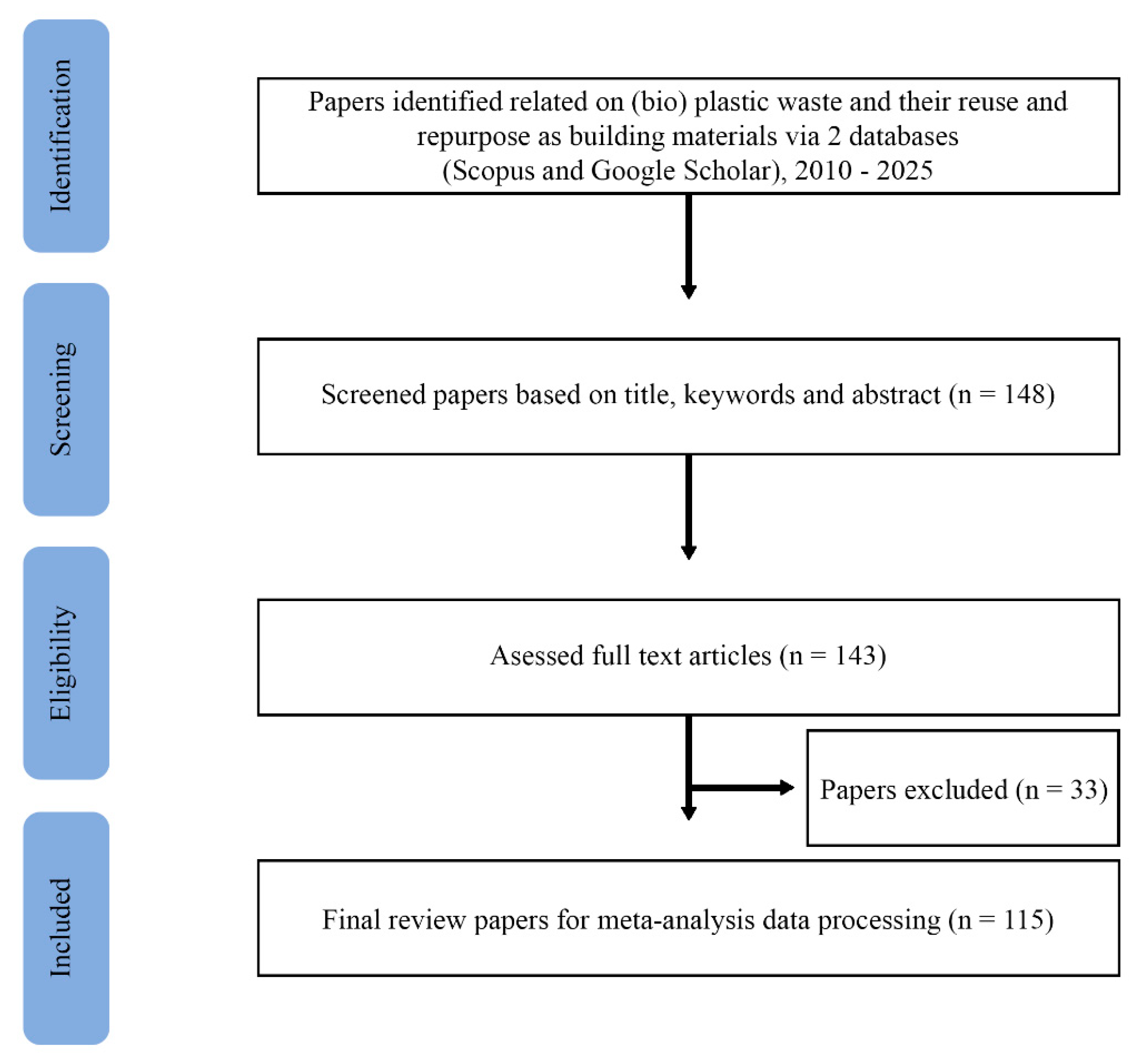
Figure 2.
SWOT analysis for reusing the plastic waste as a building material in construction sector.
Figure 2.
SWOT analysis for reusing the plastic waste as a building material in construction sector.
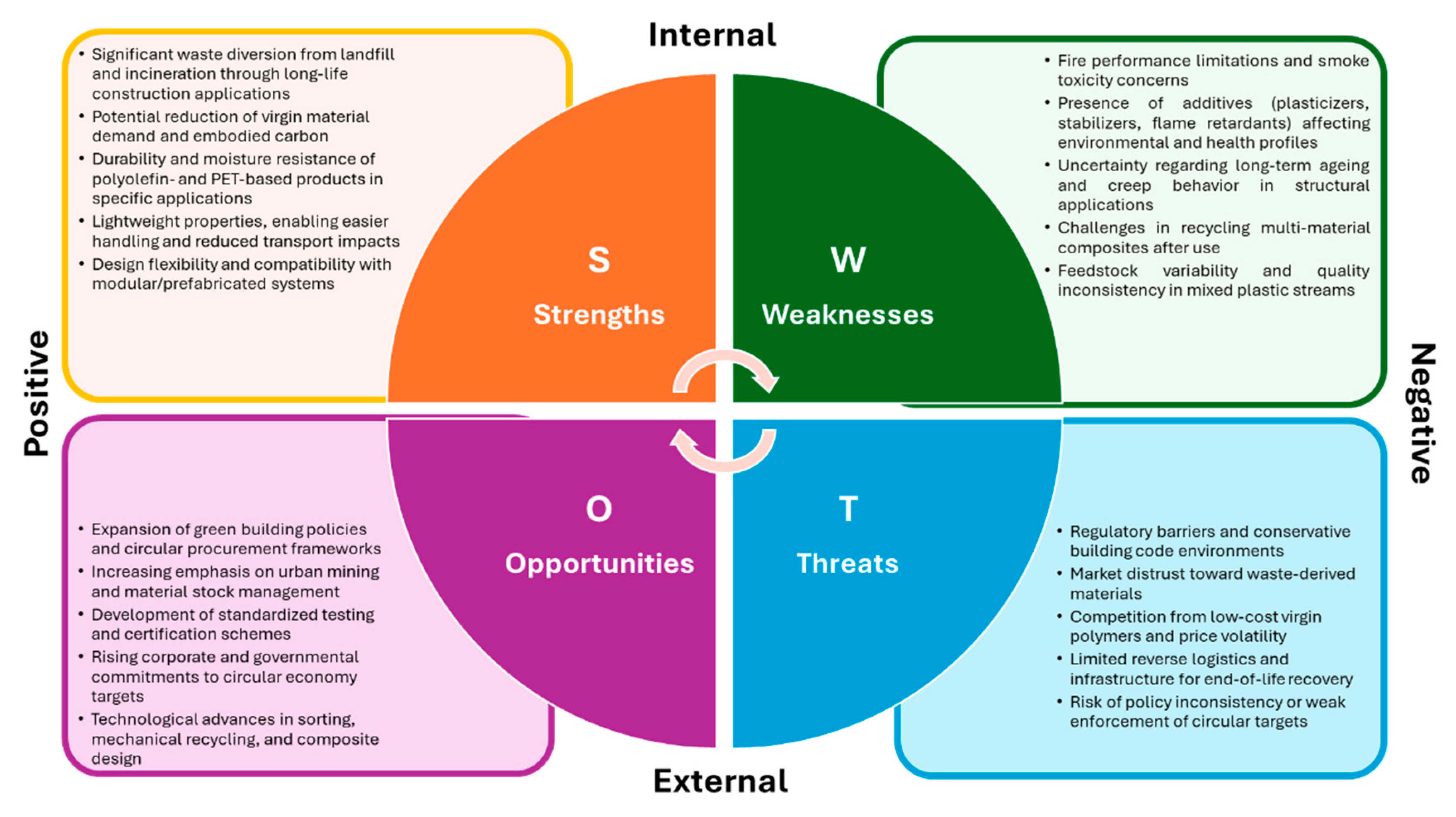
Figure 3.
Phase 1 (Evidence & sustainability indicators), Phase 2 (Context & feasibility assessment) and Phase 3 (Decision modeling, implementation & outputs).
Figure 3.
Phase 1 (Evidence & sustainability indicators), Phase 2 (Context & feasibility assessment) and Phase 3 (Decision modeling, implementation & outputs).
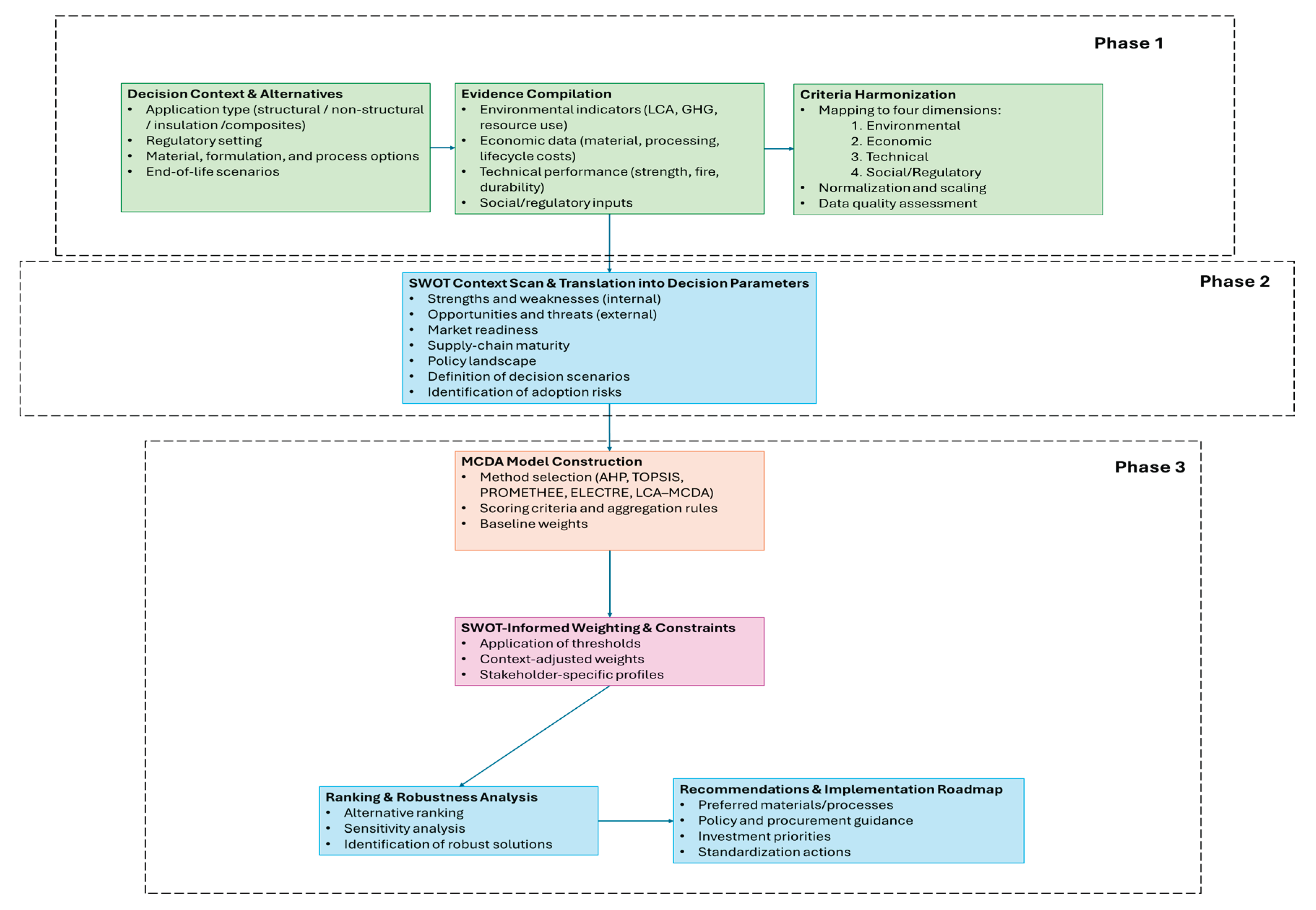
Table 1.
Alignment between construction application types and dominant sustainability evaluation criteria in MCDA-based studies.
Table 1.
Alignment between construction application types and dominant sustainability evaluation criteria in MCDA-based studies.
| Construction Application Type | Environmental Criteria | Economic Criteria | Technical Criteria | Social / Regulatory Criteria | Source |
| Structural Applications | GHG emissions, embodied energy, resource efficiency | Lifecycle cost, maintenance cost | Mechanical strength, durability, creep, fire resistance | Code compliance, safety, liability | [12,13,19,32,40,41,42,43,44] |
| Non-structural Elements | Waste diversion, material circularity, emissions | Material cost, manufacturing cost | Adequate strength, dimensional stability | Market acceptance, aesthetics | [19,32,35,36,40,41,42,43,44] |
| Insulation & Lightweight Materials | Thermal performance, operational energy savings | Installation cost, energy cost savings | Thermal conductivity, moisture resistance | Fire safety, indoor air quality | [12,13,32,36,40,41,42,43,44] |
| Composite & Hybrid Systems | Multi-material impacts, recyclability | Processing complexity, scalability | Interfacial bonding, durability | Standardization, end-of-life management | [12,13,19,40,41,42,43,44] |
Disclaimer/Publisher’s Note: The statements, opinions and data contained in all publications are solely those of the individual author(s) and contributor(s) and not of MDPI and/or the editor(s). MDPI and/or the editor(s) disclaim responsibility for any injury to people or property resulting from any ideas, methods, instructions or products referred to in the content. |
© 2026 by the authors. Licensee MDPI, Basel, Switzerland. This article is an open access article distributed under the terms and conditions of the Creative Commons Attribution (CC BY) license (http://creativecommons.org/licenses/by/4.0/).
Copyright: This open access article is published under a Creative Commons CC BY 4.0 license, which permit the free download, distribution, and reuse, provided that the author and preprint are cited in any reuse.


