

Submitted:
11 March 2026
Posted:
12 March 2026
You are already at the latest version
Abstract
Built heritage is increasingly affected by climate-driven processes, yet its capacity to inform broader understandings of urban environmental change remains insufficiently explored. Here, we synthesize recent literature (2020–2024) on the application of the Historic Urban Landscape (HUL) approach to the integrated management of cultural heritage under climate risk, reframing the historic built environment as a multiscale diagnostic medium for climate–urban interactions. We analyze the steps and tools employed to support decision-making across territorial planning, risk assessment, and heritage governance in the papers selected from Web of Science, Science Direct, and Scopus databases. Results show that the approach is a flexible analytical framework that allows the integration of heterogeneous data, multi-criteria evaluations, and diverse stakeholder perspectives across spatial and temporal scales. Information modelling tools are shown to play a central role in structuring territorial knowledge, identifying patterns of vulnerability, and supporting comparative analyses across urban contexts. Nonetheless, significant challenges persist, including limited quantification of climate-induced degradation mechanisms, uncertainties in linking vulnerability assessments to predictive models, structural constraints on participatory implementation, and a tendency to apply the approach as a checklist due to inadequate understanding of its holistic dimensions. Overall, the HUL approach emerges as a scalable and transferable framework for embedding cultural heritage within climate research, advancing the conceptual integration of built heritage into resilience science and sustainability-oriented urban systems.
Keywords:
cultural heritage
; climate risk
; HUL
; resilience
; risk management
1. Introduction
Heritage deterioration is a growing global concern (Bryant; Turner, 2019). Its drivers include natural causes, neglect, ignorance, temporal decay, and increasing exposure to multiple climate-related threats [1,2,3]. These threats are unevenly distributed around the world, with the Global South carrying a disproportionate burden of the consequences, aggravating risks in densely populated urban areas (Figure 1) [4]. Climate change affects physical, cultural, and social aspects of heritage, positioning it as both a cultural asset and a potential vulnerability. Its losses have long-term impacts and ultimately threaten community sustainability [5,6]. Thus, the state of conservation of historic resources and the mechanisms for their protection can be interpreted as indicators of environmental resilience and adaptive capacity. Climate risk management for heritage protection involves adaptation and mitigation actions that must be implemented in concert to support the conservation and management of cultural assets [7]. This change in perspective emphasizes the need for heritage preservation in parallel with regional development, incorporating preventive adaptation and requiring a greater understanding of the intangible values that heritage represents [8,9].
Climate change has exposed communities to multiple types of threats, which can be exacerbated by their interactions [2]. The dynamic and multidisciplinary nature of cities poses challenges for developing solutions, requiring in-depth technical knowledge and skilled teams that often have limited financial resources [10]. Given that cities can be understood as complex systems composed of multiple interconnected and interdependent layers, urban historical heritage can be regarded as a layer of the urban system [6]. It results from human-ecosystem interaction in a landscape over time, creating a sense of identity among the community and helping to boost economies through the tourism industry [11,12]. This has catalyzed the development of strategies to build resilience and adapt to climate change as an imperative for reducing vulnerabilities [13,14]. The adoption of mitigation strategies, through alternative and sustainable responses that use the connections between nature and human well-being to enable cities to withstand and recover from extreme weather events, emerged as a promising solution [15]. Therefore, a holistic and integrative perspective that considers the social, economic, and cultural co-benefits for communities is required [16,17,18,19].
The Historic Urban Landscape (HUL) approach, adopted by the Recommendation on the Historic Urban Landscape in 2011, is a robust holistic approach to addressing the problem by considering the inclusive and interdisciplinary management of heritage elements in dynamic environments, including the broader urban context, the geographical and environmental setting in which it is inserted, guiding change in historic cities through multi-criteria analyses [20]. From this perspective, the historic built fabric is no longer interpreted as isolated; rather, it functions as a multiscale diagnostic medium that reveals critical interactions among different aspects of the urban environment. To deal with the great diversity of characteristics of both the heritage and the context in which it is inserted, the HUL approach proposes a set of steps and tools that will help implement the approach, assisting managers in decision-making and facilitating the use of information by non-technical groups [21,22]. This article has two goals: to analyze HUL’s implementation, recognizing important challenges, and to evaluate the integration of climate vulnerability assessment within this framework. By examining these aspects, the study seeks to advance understanding of the approach, particularly its potential for integrating climate risk management and heritage conservation.
2. Methodology
A systematic evaluation was conducted on peer-reviewed academic articles published between 2020 and 2024 to examine how the HUL approach has been adopted and analyze the integration of climate vulnerability assessment. The term “historic urban landscape” was searched in the ScienceDirect (SD), Scopus, and Web of Science (WoS) databases. In addition to the time constraint, the search considered only English-language articles and review articles that were open access. Access restrictions were implemented to ensure the replicability of the research, while language limitations prioritized selecting higher-impact articles, given that English has been used as the academic lingua franca [23]. The database results were downloaded as CSV files and processed in Google Sheets, enabling the removal of duplicate entries. The remaining 169 unique records were assessed against five eligibility criteria (Table 1), resulting in 37 relevant studies addressing the HUL approach (Figure 2, Appendix A).
The 37 remaining publications were divided into theoretical and empirical work. In theoretical works, the HUL approach was critically analyzed and developed. The empirical studies were examined using the HUL steps and tools and then submitted to the online AI DeepSeek Chat (DeepSeek-V3.2) to assist in their identification and reduce subjectivity. To be correctly processed, two procedures were adopted: (1) the downloaded papers’ pdf were opened with the software Mozilla Firefox and saved again as pdf; (2) the saved files were opened with a pdf editor, and the abstract text was erased. This was intended to remove metadata and hidden text and to prevent the abstract from being used to justify or underpin the answers, which could misdirect the AI’s responses. The documents were uploaded, and the same two prompts - one for tools and one for strategies - were used on every one of them (Table 2), developed based on the Recommendation and on “The HUL Guidebook” [20,24]. The AI replies were then analyzed and accepted when agreed upon.
3. Climate Change and Cultural Heritage Conservation
The need to predict and prevent impacts resulting from climate change, highlighted by the First World Climate Conference by the World Meteorological Organization in 1979, was the primary catalyst for the conception of climate change as a scientific field. It was defined as changes in the characteristics and properties of the climate caused, directly or indirectly, by human interference in ecosystems [25] and, since the 1980s, has led to the development of reports, programs, agreements, and organizations by researchers and professionals. The 1987 Report of the World Commission on Environment and Development, “Our Common Future,” identified sustainable development as both an approach and a goal to address climate change. However, sustainable development is not possible without considering disaster risk reduction (DRR) [26].
Over the years, the main global DRR efforts have focused on adapting by developing frameworks and goals [3]. Their focus shifted from reducing losses and disaster-induced impacts to life and property to diminishing the vulnerability of elements and improving ecosystems’ adaptability and resilience [26,27]. Resilience refers to a system’s ability to withstand and recover from disturbances while maintaining its basic structures and functions [15]. It requires a dynamic understanding of the subsystems involved and their interactions in order to select the most appropriate strategies [26,28,29,30]. The goal of this modern approach - resilient management - is to make the community capable of resisting, absorbing, adapting, and recovering efficiently from the effects of hazards. It is especially relevant for urban environments, complex systems formed by different layers through time, where the concentration of people, economic activities, institutions, and infrastructure makes them vulnerable to the increased frequency and intensity of extreme weather events [31,32]. Studies reveal different aspects of implementing resilient management, highlighting the complexity inherent in the topic [28,33,34], requiring a series of methods and tools that enable understanding and decision-making regarding climate change risks [35,36,37].
Climate change was only formally recognized as a risk to cultural heritage in 2005 by the World Heritage Committee (despite being studied since the 1990s) [38], with its inclusion on a DRR framework as a criterion in 2015 by the Sendai Framework [39]. Recent estimates indicate that approximately 17% of cultural heritage sites are at risk from climate change [5]. Cultural heritage comprehends tangible and intangible cultural and social aspects that are valued [38] and risk is the chance of negative consequences from a climate-related hazard, a consequence of the combination of elements present in the affected areas (exposure), their likelihood of being negatively affected (vulnerability), and the possibility of an event’s occurrence (hazard) [25]. Heritage is important as a relevant factor of social cohesion and identity [6,40,41],with its loss identified as a threat that challenges the sustainability of economic dynamics, especially in locations that are still in the process of modernization [8,41]. However, Dhar and Khirfan [27] and Shirvani, Dastgerdi, and Kheyroddin [42] identified challenges related to the lack of integration among different planning approaches and the difficulty of knowledge transfer across multiple sectors, which undermine the development of DRR solutions. In addition, Figueiredo, Romão, and Paupério [43] also noted the lack of public data (both at the macro and micro levels), which compromises the adequate characterization of the location and the consistency of risk and impact estimates. In the context of heritage conservation, Zin and Ismail [3] identified a challenge to adequate heritage protection within DRR frameworks due to a knowledge gap between heritage and climate experts.
Current research indicates increasing implementation of adaptation and mitigation strategies for cultural heritage [38], primarily through various approaches to assessing heritage elements. Sevieri et al. [37] developed the Multi-Hazard Risk Prioritization Framework; Ramírez Eudave et al. [41] combined the Vulnerability Index Method (VIM) with machine learning to identify vulnerable structures to earthquakes; and Salazar, Figueiredo, and Romão [44] identified 22 proposed flood vulnerability indicators. These advancements reveal common pitfalls in vulnerability assessments: they are frequently centered on specific monuments, focused on tangible aspects, led by specialists, ignoring contextual characteristics that can influence the durability, conservation status, and management solutions.
Developing comprehensive methodologies is essential to reframing perceptions of heritage urban conservation in the context of contemporary climate challenges. An early example of this course of action is UNESCO’s resource manual “Managing Disasters for World Heritage” [45]. This manual guided the development of disaster risk management (DRM) plans in World Heritage Sites by promoting hazard protection and the reduction of underlying vulnerability factors, underscoring the need for a context-specific evaluation framework and integration of heritage DRM into larger-scale planning. The Sendai Framework also underscores the need for an approach grounded in a broader understanding of risk and inclusive decision-making, supported by the dissemination of open data [3,31,46]. In a more recent example, the Climate Risk Sourcebook incorporated findings from the IPCC’s Sixth Assessment Report to propose a flexible method for climate risk assessment [47]. It identifies and analyses risk drivers, their root causes, and potential impacts and consequences, thereby supporting climate change adaptation, mitigation, and management outcomes. This framework considers stakeholder involvement a crucial element, underscoring the importance of local communities in developing effective actions for climate risk management and adaptation planning. These examples illustrate a trend toward integrating conservation and climate risk assessment through a holistic approach that allows the incorporation of different initiatives, stimulates knowledge sharing, enables community engagement, and translates insights into actionable recommendations [5,6,38,48,49].
4. The HUL Approach
Holistic approaches have been adopted as another avenue for developing solutions that promote resilience and sustainable development [6,50,51]. In the 1960s, Ian McHarg [52] developed a method for suitability analysis in landscape design. It involved mapping and interpreting a site’s natural and artificial processes as a set of superimposed layers to recognize the potential and constraints of the territory (Figure 3). Since then, this approach improved through the incorporation of new methods and tools (i.e. Geographic Information Tools and Multi-criteria Decision Analysis) and has been applied in multiple contexts to optimize complex spatial solutions and enhance planning strategies [53,54,55].
In 2011, the 36th General Conference of UNESCO adopted the Recommendation on the Historic Urban Landscape (Recommendation), which called on its member states to integrate the protection of urban historical heritage, which represents about one-third of World Heritage properties, into their development policies (UNESCO, 2011, 2023b). The Recommendation introduced the concept of HUL as an urban area resulting from the integration of layers of information on historical, cultural, and natural values. It encompasses the broader context of heritage through a multidisciplinary, holistic interpretation that incorporates both tangible and intangible characteristics associated with the element under analysis. The central idea of HUL recognizes the dynamic nature of cities and the need to understand heritage at scales beyond the object [20,36,56].
The HUL approach emerged in response to the increasing complexity of global events and urban processes [57]. It views urban heritage as essential, redefining its role in society and in decision-making processes [36,57]. HUL’s primary goal is to create mechanisms for balancing heritage conservation and sustainable development using political, financial, regulatory, and engagement tools to manage change [58]. It is a tool that must be incorporated into current practices to help heritage management. This new understanding suggests a broader, more flexible concept, allowing multiple interpretations and adaptations across contexts, shifting attention from purely conservative practices to more democratic ones [36,59]. Cunha Ferreira et al. [60] notices three innovative points: (i) the use of a landscape approach; (ii) a multidisciplinary and collaborative perspective; and (iii) the incorporation of multiple stakeholders. Quesada-Ganuza et al. [6] also note the inclusion of climate and socioeconomic risk assessments as an important novelty.
Common criticisms of the HUL approach center on its flexibility, particularly the absence of methodological clarity and tools to allow an effective implementation [56,58]. To bridge the gap between theory and practice, six critical steps are recommended: (1) mapping of natural, cultural, and human resources; (2) collective definition of what to preserve; (3) assessment of climate and socioeconomic risks; (4) integration of protection into urban planning; (5) prioritizing actions that balance conservation and development; (6) creating partnerships and local management structures. To deal with this complexity proposed by HUL, four groups of tools are proposed: (1) understanding and planning, (2) community engagement, (3) regulation, and (4) financing, in order to incorporate all the specificities necessary for its understanding. These tools are interdisciplinary and innovative, and need to be adapted and used simultaneously to ensure successful heritage management [20,24] (Figure 4).
5. Results and Discussions
5.1. Overview
The literature reveals a clear consensus on shifting from a monument-centric conservation to a holistic, values-based paradigm. This is evidenced by 8 theoretical papers (22%) and 29 empirical studies (78%) (Figure 5). The significant concentration of publications on urban planning themes (Figure 6) demonstrates recognition that the HUL approach is valued not only as a heritage tool but also as a systemic governance framework for managing complex urban change. This new perspective facilitates linking HUL to broader agendas, such as UN Sustainable Development Goals (SDGs) [49,61], adaptive reuse [62,63,64,65] and the New Urban Agenda (NUA) [49].
The evolution of the field was characterized by a transition from early studies emphasizing the definition and promotion of HUL [56,66,67] to more recent research focused on its operationalization through the creation of tools, frameworks, and metrics [61,68,69,70,71]. The concentration of papers on the 2023-2024 period (70%) shows growing attention, moving from conceptual debate to empirical application. A key trend involves integrating established digital technologies, such as BIM and GIS [68,69], with emerging tools, including social media data [72] and participatory platforms [67]. This integration aims to improve understanding of HUL’s complexity and dynamism and to engage community participation. This latter aspect is recognized by the theoretical papers as the least implemented and most challenging, despite its central importance [39,56,67,69,73].
Findings indicate that academic discourse on the HUL approach over the last five years has been concentrated in Asia, with particular focus on China (Figure 7) [39,56]. Chinese publications predominantly employ spatial and statistical analysis and GIS [51,57,59,68,70,71,72,74,75,76], presenting a technocratic approach. In contrast, non-Chinese Asian studies apply the HUL framework in contexts of marginalization, degradation, disaster and policy failure [36,49,77,78,79,80]. European research emphasizes governance, community engagement and policy analysis [60,62,63,64,65,81,82]. Meanwhile, African studies [83,84] use HUL to redefine existing heritage paradigms and the legacies of colonialism. Notably, there is a lack of publications from Oceania and the Americas.
5.2. Steps and Tools
The analysis of the 29 empirical studies aimed to assess the use of HUL steps and tools (Figure 8 and Figure 9; Appendix B). Findings show that comprehensive survey and mapping (Step 1) is the most adopted, with a prevalence of 90% (n = 26). This is further reinforced by the predominant use of knowledge and planning tools (Tool 2), employed in 93% of the cases (n = 27), highlighting the technocratic aspect of HUL. Step 1 appears as the starting point, involving data collection and systematization to produce outputs for subsequent analysis. A notable evolution has been observed from traditional mapping and surveying by incorporating new methodologies (i.e., remote sensing, user perception, and spatial analysis) and the integration of the temporal dimension, facilitating the progressive interpretation of changes.
Step 5 (n = 18), prioritization of actions that balance preservation and development, is often an outcome of analysis that recognizes priority areas, with the prioritization often implied than actionable. It is highly influenced by Step 2 (n = 17), collective consensus on what to preserve, which is closely related to Tool 1 (n = 15) - the civic engagement tool. Together, they encompass social and political processes. It is noteworthy that, although Step 2 and Tool 1 are basic requirements of the HUL approach, their implementation is inconsistent, ranging from mere consultation to co-design of solutions with actors varying from specialists to local communities. Also, the evolution of Step 1 and Tool 2 through the use of modern technologies is reflecting on a transition of Step 5 from qualitative prioritization toward a data-driven process with the use of Multi-Criteria Decision Analysis (MCDA) models, reducing reliance on subjective perception of participants.
Despite being used in 14 of the 29 papers, the vulnerability assessment to climatic impacts and socioeconomic stresses (Step 3) represents a significant gap in the HUL approach. Its occurrence is overwhelmingly associated with socio-economic factors (n = 9), including tourism, gentrification, development pressure, policy failures, and post-disaster challenges. Indexes, criteria, and community participation were used in 3 out of 5 papers addressing climate assessment. Only two studies [60,74] conducted climate change assessments in a structured manner, highlighting the weak link between climate threats and heritage action. Step 3 should be closely integrated with Step 1 and Tool 2 to establish a robust diagnostic foundation for the HUL approach.
Steps 4 (n = 13) and 6 (n = 9) - heritage protection integration on urban planning, and establishing local partnerships and management frameworks, respectively - along with Tools 3 (n = 6) and 4 (n = 3) are the least used components. Collectively, they can be considered the action phase of the HUL approach, which should shift from planning for heritage to planning with heritage while securing resources. However, in most papers, the outcomes of Step 4, Step 6, and Tool 4 are theoretical recommendations, whereas Tool 3 is used primarily to analyze and critique existing regulatory systems, with few authors proposing new regulations. This pattern shows HUL’s difficulty in influencing mainstream urban development.
The results reveal the HUL approach’s flaw: none of the analyzed papers fully applied the proposed steps and tools (Appendix B). Most studies perform well in the diagnostic and value identification phases (Steps 1, 2, 5, Tools 1 and 2), but stall in the implementation phase (Steps 4, 6, Tools 3 and 4). The inconsistent participatory aspect can conceal a technocratic approach, in which communities are engaged to identify values but do not participate in decision-making, with proposals remaining expert-led [51,59,78]. Vulnerability assessments (Step 3), when they happen, are frequently centered on socio-economic tensions [58,62,63,75,76,77,80,81,83], while climate change ones are regularly overlooked - HUL is being used as a tool to manage heritage within a dynamic urban environment rather than actively adapting heritage to climate change.
6. Conclusion
This paper shows that the HUL approach provides a critical, scalable framework for reframing-built heritage as a diagnostic medium through which climate–urban–heritage interactions can be understood. The literature revealed its applicability in integrating heterogeneous data and stakeholder perspectives across scales. The number of publications that reported implementation cases also showed a trend toward operationalizing the approach, aligning it with more effective practices. This was evidenced using models, frameworks, and digital tools for documentation and evaluation; the integration with broader agendas (Sustainable Development Goals, Circular Economy, and Urban Resilience) that encompass dimensions beyond heritage conservation; and the expansion of the scale of analysis to incorporate the diversity of the urban environment. It was revealed that community participation remains a critical challenge, despite its positive results, as it ranged from simple consultation to complex co-creation processes, thereby compromising the sense of identity associated with cultural heritage. Additionally, an in-depth examination showed that HUL is often used as a mere checklist, overlooking the relationships and interdependencies between strategies, resulting in partial application - an antithesis of the core definition of the approach.
In the studies examined, the absence of a climate vulnerability assessment was the primary flaw in the application of the HUL approach. The current need to manage climate extremes for heritage preservation has been largely neglected, with climate vulnerability relegated to the background and treated as one of many stressors. This paradox reveals a fundamental flaw that breaks the system proposed by the approach. Given the low adoption of Steps 4 and 6 and Tools 3 and 4, it can be concluded that, despite its holistic intentions, HUL has been a sophisticated mapping exercise focused on problem recognition rather than a framework for solution development.
To move beyond a mapping exercise and become a tool for solution-building capable of facing the growing need for climate adaptation, the HUL approach must be converted into a climate adaptation framework. This would allow the integration of climate imperatives into heritage preservation planning through a values-based conservation and planning framework. Future work should focus on developing an HUL-Climate Adaptation Protocol to operationalize a holistic perspective, placing climate vulnerability assessment and adaptation strategies at the center of the approach as fundamental and non-negotiable steps. It is also suggested that new research on the topic be conducted that expands publications beyond academic articles, adopts languages other than English, and includes not only open-access, so that a more complete picture of the use of the approach can be captured and the most at-risk context can be included. Evolving the HUL into a climate adaptation tool promoting participatory, resilient, and integrated heritage preservation is not merely an academic task, but an urgent practical call to safeguard cultural heritage as a central element of resilient and sustainable urban futures.
Author Contributions
The conception and design of the study were a joint effort by all authors. Joana Guedes prepared the materials, collected and analyzed the data, and wrote the first and revised manuscripts. Esequiel Mesquita and Tiago Ferreira contributed to its critical revision. Every author has read and approved this submitted version.
Funding
This work was financially supported by FUNCAP, Project 01172921/2022 – Cientista Chefe Cultura; by the National Council for Scientific and Technological Development (CNPq) – Project 302054/2022-7 – PQ2, by the Project - 440926/2024-6 – VISION and Project - 402828/2024-0 – CLIC and CAPES Foundation. Esequiel Mesquita thanks to FUNCAP for the financial support. Joana Guedes acknowledges CAPES for the scholarship.
Data availability
The raw/processed data required to reproduce these findings can be shared upon the request to the corresponding author.
Conflicts of Interest
The authors declare that they have no conflicts of interest.
Appendix A
Details from the studies included in the review following application of the five eligibility criteria.

Table A1.
Studies information.
| Ref. No. | Title | Year | Publication Title | DOI | Type of Work | Keywords | Source |
|---|---|---|---|---|---|---|---|
| 39 | A Conceptual Planning Framework To Integration of Industrial Heritage Regeneration With Historic Urban Landscape Approach | 2024 | Geographia Polonica | 10.7163/GPol.0286 | Theoretical | conceptual planning framework; conservation; development; heritage value; historic urban landscape; industrial heritage; partnership; reflexive thematic analysis; regeneration | Scopus |
| 49 | Balancing Social and Cultural Priorities in the UN 2030 Sustainable Development Goals (SDGs) for UNESCO World Heritage Cities | 2024 | Sustainability | 10.3390/su16145833 | Theoretical | historic urban landscape (hul); as-salt city; new urban agenda (nua); social and cultural sustainability; sustainable development goals (sdgs); unesco world heritage list (whl) | Web of Science; Scopus |
| 51 | Collaborating with Local Communities to Identify Improvement Priorities for Historic Urban Landscape Based on Residents’ Satisfaction: An Application of Asymmetric Impact-Performance Analysis in Dandong, China | 2020 | Sustainability | 10.3390/su12041463 | Empirical | asymmetric impact-performance analysis; community engagement; heritage management; historic urban landscape; human perception; urban conservation | Web of Science; Scopus |
| 56 | Historic urban landscape: A systematic review, eight years after the adoption of the HUL approach | 2020 | Journal of Cultural Heritage Management and Sustainable Development | 10.1108/JCHMSD-05-2018-0036 | Theoretical | historic urban landscape; unesco; literature review; heritage conservation; integrated tools; six steps; urban development | Web of Science |
| 57 | A Study of Historic Urban Landscape Change Management Based on Layered Interpretation: A Case Study of Dongxi Ancient Town | 2024 | Land | 10.3390/land13122116 | Empirical | historic urban landscape; sustainable development; ancient town; change management; layering | Web of Science; Scopus |
| 58 | Optimization of Heritage Management Mechanisms through the Prism of Historic Urban Landscape: A Case Study of the Xidi and Hongcun World Heritage Sites | 2024 | Sustainability | 10.3390/su16125136 | Empirical | historic urban landscape; heritage management; southern anhui; traditional villages | Web of Science; Scopus |
| 59 | Heritage Value Assessment and Landscape Preservation of Traditional Chinese Villages Based on the Daily Lives of Local Residents: A Study of Tangfang Village in China and the UNESCO HUL Approach | 2024 | Land | 10.3390/land13091535 | Empirical | historic urban landscape; daily life; rural landscape; traditional chinese village; value | Web of Science; Scopus |
| 39 | A Conceptual Planning Framework To Integration of Industrial Heritage Regeneration With Historic Urban Landscape Approach | 2024 | Geographia Polonica | 10.7163/GPol.0286 | Theoretical | conceptual planning framework; conservation; development; heritage value; historic urban landscape; industrial heritage; partnership; reflexive thematic analysis; regeneration | Scopus |
| 49 | Balancing Social and Cultural Priorities in the UN 2030 Sustainable Development Goals (SDGs) for UNESCO World Heritage Cities | 2024 | Sustainability | 10.3390/su16145833 | Theoretical | historic urban landscape (hul); as-salt city; new urban agenda (nua); social and cultural sustainability; sustainable development goals (sdgs); unesco world heritage list (whl) | Web of Science; Scopus |
| 51 | Collaborating with Local Communities to Identify Improvement Priorities for Historic Urban Landscape Based on Residents’ Satisfaction: An Application of Asymmetric Impact-Performance Analysis in Dandong, China | 2020 | Sustainability | 10.3390/su12041463 | Empirical | asymmetric impact-performance analysis; community engagement; heritage management; historic urban landscape; human perception; urban conservation | Web of Science; Scopus |
| 56 | Historic urban landscape: A systematic review, eight years after the adoption of the HUL approach | 2020 | Journal of Cultural Heritage Management and Sustainable Development | 10.1108/JCHMSD-05-2018-0036 | Theoretical | historic urban landscape; unesco; literature review; heritage conservation; integrated tools; six steps; urban development | Web of Science |
| 57 | A Study of Historic Urban Landscape Change Management Based on Layered Interpretation: A Case Study of Dongxi Ancient Town | 2024 | Land | 10.3390/land13122116 | Empirical | historic urban landscape; sustainable development; ancient town; change management; layering | Web of Science; Scopus |
| 58 | Optimization of Heritage Management Mechanisms through the Prism of Historic Urban Landscape: A Case Study of the Xidi and Hongcun World Heritage Sites | 2024 | Sustainability | 10.3390/su16125136 | Empirical | historic urban landscape; heritage management; southern anhui; traditional villages | Web of Science; Scopus |
| 59 | Heritage Value Assessment and Landscape Preservation of Traditional Chinese Villages Based on the Daily Lives of Local Residents: A Study of Tangfang Village in China and the UNESCO HUL Approach | 2024 | Land | 10.3390/land13091535 | Empirical | historic urban landscape; daily life; rural landscape; traditional chinese village; value | Web of Science; Scopus |
| 60 | The Historic Urban Landscape Approach and the Governance of World Heritage in Urban Contexts: Reflections from Three European Cities | 2023 | Land | 10.3390/land12051020 | Empirical | world heritage; historic urban landscape; cities; communities; governance | Web of Science; Scopus |
| 61 | A Holistic Approach to Strategic Sustainable Development of Urban Voids as Historic Urban Landscapes from the Perspective of Urban Resilience | 2022 | Buildings | 10.3390/buildings12111852 | Empirical | decision making; historic urban landscape; resilience; spatial and urban management; sustainable development; sustainable development goals; urban void | Web of Science; Scopus |
| 62 | Regenerating the Historic Urban Landscape through Circular Bottom-Up Actions: The Urban Seeding Process in Rijeka | 2021 | Sustainability | 10.3390/su13084497 | Empirical | historic urban landscape; circular economy and adaptive reuse; cultural corridor; urban regeneration; urban seeding | Web of Science; Scopus |
| 63 | Cultural heritage adaptive reuse in Salerno: Challenges and solutions | 2023 | City, Culture and Society | 10.1016/j.ccs.2023.100505 | Empirical | adaptive reuse; challenge-solution identification; city of salerno; cultural heritage; historic urban landscape approach; stakeholder engagement | Scopus; Science Direct |
| 64 | Identifying Challenges and Solutions in Cultural Heritage Adaptive Reuse through the Historic Urban Landscape Approach in Amsterdam | 2021 | Sustainability | 10.3390/su13105547 | Empirical | historic urban landscape; adaptive reuse; amsterdam; challenge-solution identification; cultural heritage; stakeholder engagement | Web of Science; Scopus |
| 65 | Assessing Cultural Heritage Adaptive Reuse Practices: Multi-Scale Challenges and Solutions in Rijeka | 2021 | Sustainability | 10.3390/su13073603 | Empirical | adaptive reuse; cultural heritage; stakeholder engagement; challenge assessment; circular city; circular economy; city of rijeka; historic urban landscape approach; solution identification | Web of Science; Scopus |
| 66 | Links between heritage building, historic urban landscape and sustainable development: systematic approach | 2020 | Landscape Architecture And Art | 10.22616/j.landarchart.2020.17.04 | Theoretical | historic urban landscape; heritage building; sustainability | Web of Science; Scopus |
| 67 | Valuing Urban Heritage Through Participatory Heritage Websites: Citizen Perceptions of Historic Urban Landscapes | 2020 | Space and Culture | Theoretical | urban heritage; historic urban landscapes; heritage values; participatory heritage; participatory heritage websites | Web of Science; Scopus | |
| 68 | Mapping the past with historical geographic information systems: layered characteristics of the historic urban landscape of Nanjing, China, since the Ming Dynasty (1368-2024) | 2024 | Heritage Science | 10.1186/s40494-024-01400-4 | Empirical | historic urban landscape (hul); digital heritage; historical geographic information systems (hgis); nanjing; spatiotemporal evolution | Web of Science; Scopus |
| 69 | Urban Heritage Facility Management: A Scoping Review | 2021 | Applied Sciences-Basel | 10.3390/app11209443 | Theoretical | conservation; facility management (fm); the hul approach; urban fm; urban heritage | Web of Science; Scopus |
| 70 | Interpretation of Historic Urban Landscape Genes: A Case Study of Harbin, China | 2024 | Land | 10.3390/land13121988 | Empirical | historic urban landscape; adaptive evolution; genetic interpretation; harbin; urban landscape feature | Web of Science; Scopus |
| 71 | Analysis of Multi-Dimensional Layers in Historic Districts Based on Theory of the Historic Urban Landscape: Taking Shenyang Fangcheng as an Example | 2024 | Land | 10.3390/land13111736 | Empirical | historic urban landscape; historic district; multi-dimensional layers; shenyang fangcheng | Web of Science; Scopus |
| 72 | Heritage Corridor Routing Method From Historic Urban Landscape and Digital Footprint Perspectives -The Case of Historical Urban Area in Nanjing, China | 2023 | Landscape Architecture Frontiers | 10.15302/J-LAF-1-020080 | Empirical | historic urban landscape; digital footprint; heritage corridor; minimum cumulative resistance model; route planning; social network model; urban landscape resources | Web of Science; Scopus |
| 73 | A Landscape-based Approach to Urban Heritage Management: People, Spatial Biography, and Ecosystem | 2023 | Landscape Architecture Frontiers | 10.15302/J-LAF-1-030044 | Theoretical | historic urban landscape; landscape-based approach; public participation; spatial biography; urban ecosystem; urban heritage management | Web of Science; Scopus |
| 74 | To Act or Not to Act: Are Natural Landscapes a Key Force in the Resilience of Historic Urban Landscapes? | 2021 | Sustainability | 10.3390/su131810356 | Empirical | urban resilience; climate change; historic urban landscape; semantic differential analysis; yudai trench historic urban landscape | Web of Science; Scopus |
| 75 | Spatial Distribution of Urban Heritage and Landscape Approach to Urban Contextual Continuity: The Case of Suzhou | 2023 | Land | 10.3390/land12010150 | Empirical | historic urban landscape; built-up area; urban context | Web of Science; Scopus |
| 76 | Information Services as a Method to Evaluate the Sustainability of Intangible Dimensions of a Historic Urban Landscape: A Case Study in Guangzhou, China | 2023 | Sustainability | 10.3390/su15010008 | Empirical | sustainability; intangible heritage; cultural services; historic urban landscape of yuexiu hill; information services | Web of Science; Scopus |
| 77 | The Reconstruction of Post-War Cities-Proposing Integrated Conservation Plans for Aleppo’s Reconstruction | 2023 | Sustainability | 10.3390/su15065472 | Empirical | historic urban landscape; urban conservation; aleppo; civilian war; reconstruction | Web of Science; Scopus |
| 78 | Adapting the Historic Urban Landscape Approach to Study Slums in a Historical City: The Mae Kha Canal Informal Settlements, Chiang Mai | 2024 | Buildings | 10.3390/buildings14071927 | Empirical | chiang mai; historic urban landscape (hul); historical city; mae kha canal informal settlements; settlement composition; slum upgrading; sustainable development planning | Web of Science; Scopus |
| 79 | Green Heritage and Lanna Urban Identity: A Study of Temples in Chiang Mai Old City | 2024 | Sustainability | 10.3390/su16156574 | Empirical | chiang mai; green heritage; historic urban landscape (hul); lanna culture; sustainable landscape management; urban identity | Web of Science; Scopus |
| 80 | Conservation of Beirut’s Urban Heritage Values Through the Historic Urban Landscape Approach | 2022 | Urban Planning | 10.17645/up.v7i1.4762 | Empirical | historic urban landscape; beirut; collaborative tools; intangible heritage; tangible heritage; urban lab | Web of Science; Scopus |
| 81 | Strategic Planning and Management Model for the Regeneration of Historic Urban Landscapes: The Case of Historic Center of Novi Pazar in Serbia | 2020 | Sustainability | 10.3390/su12041323 | Empirical | historic urban landscape; management instruments; model; novi pazar; serbia; strategic planning | Web of Science; Scopus |
| 82 | Characterisation of the Historic Urban Landscape through the Aristotelian Four Causes: Towards Comprehensive GIS Databases | 2021 | Remote Sensing | 10.3390/rs13101879 | Empirical | historic urban landscape; aristotelian causes; data acquisition; geographic information systems; urban characterisation | Web of Science; Scopus |
| 83 | Developing Heritage Preservation on Ilha de Moçambique Using a Historic Urban Landscape Approach | 2024 | Heritage | 10.3390/heritage7040095 | Empirical | historic urban landscape; heritage; ilha de moçambique; local communities; market; rising from the depths | Web of Science; Scopus |
| 84 | Assessment process in the delimitation of historic urban landscape of Algiers by AHP | 2021 | Miscellanea Geographica | 10.2478/mgrsd-2020-0053 | Empirical | historic urban landscape; criteria sig; decision process; landscape assessment; landscape delimitation | Web of Science; Scopus |
| 85 | Understanding the Multi-Dimensional Nature of Cultural Identity in Historic Urban Landscapes: A Study of Jiaxiulou in Guiyang, China | 2024 | Journal of Urban and Regional Analysis | 10.37043/JURA.2024.16.2.4 | Empirical | historic urban landscape; behaviour; cognition; cultural identity; emotion | Web of Science; Scopus |
| 86 | Historic Urban Landscape Paradigm -A Tool for Balancing Values and Changes in the Urban Conservation Process | 2023 | Landscape Architecture Frontiers | 10.15302/J-LAF-1-030043 | Theoretical | historic urban landscape; creative industries; cultural landscape; historic cities; secondary urban cultural landscape attractions; urban conservation; urban heritage | Web of Science; Scopus |
| 87 | Imagine the Old Town of Lijiang: Contextualising community participation for urban heritage management in China | 2021 | Habitat International | 10.1016/j.habitatint.2021.102321 | Empirical | china; community participation; historic urban landscape; contextualised approach; imagine; world heritage | Web of Science; Scopus; Science Direct |
| 88 | Conducting Heritage Tourism-Led Urban Renewal in Chinese Historical and Cultural Urban Spaces: A Case Study of Datong | 2022 | Land | 10.3390/land11122122 | Empirical | historic urban landscape; evaluation criteria; heritage tourism-led urban regeneration; intangible cultural heritage; landscape identity | Web of Science; Scopus |
Appendix B
Identification of the six critical steps and four categories of tools recommended to support HUL implementation in the analyzed studies (2020 – 2024). Step 1 (S1): mapping of natural, cultural and human resources; Step 2 (S2): collective consensus on what to preserve; Step 3 (S3): climatic and socioeconomic vulnerability assessment; Step 4 (S4): heritage protection integration on urban planning; Step 5 (S5): prioritization of actions that balance preservation and development; Step 6 (S6): establish local partnerships and management frameworks. Tool 1 (T1): community engagement tool; Tools 2 (T2): knowledge and planning tools; Tool 3 (T3): regulatory system tools; Tool 4 (T4): financial tools.
Table B1.
Steps and tools identified on the selected studies.
| Ref. No. | Title | Year | DOI | City | Country | S1 | S2 | S 3 | S4 | S6 | T1 | T2 | T3 | T4 |
|---|---|---|---|---|---|---|---|---|---|---|---|---|---|---|
| 36 | Contextualizing UNESCO’s Historic Urban Landscape Approach: A Framework for Identifying Modern Heritage in Post-Blast Beirut | 2024 | 10.3390/land13122241 | Beirute | Lebanon | Yes | Yes | No | No | Yes | Yes | Yes | Yes | No |
| 51 | Collaborating with Local Communities to Identify Improvement Priorities for Historic Urban Landscape Based on Residents’ Satisfaction: An Application of Asymmetric Impact-Performance Analysis in Dandong, China | 2020 | 10.3390/su12041463 | Dandong | China | Yes | Yes | No | No | No | No | Yes | Yes | No |
| 57 | A Study of Historic Urban Landscape Change Management Based on Layered Interpretation: A Case Study of Dongxi Ancient Town | 2024 | 10.3390/land13122116 | Dongxi | China | Yes | No | No | Yes | Yes | No | No | Yes | No |
| 58 | Optimization of Heritage Management Mechanisms through the Prism of Historic Urban Landscape: A Case Study of the Xidi and Hongcun World Heritage Sites | 2024 | 10.3390/su16125136 | Xidi e Hongcun World Heritage Sites | China | Yes | No | SE | Yes | Yes | Yes | Yes | Yes | Yes |
| 59 | Heritage Value Assessment and Landscape Preservation of Traditional Chinese Villages Based on the Daily Lives of Local Residents: A Study of Tangfang Village in China and the UNESCO HUL Approach | 2024 | 10.3390/land13091535 | Tangfang Village | China | Yes | Yes | No | Yes | Yes | Yes | Yes | Yes | No |
| 60 | The Historic Urban Landscape Approach and the Governance of World Heritage in Urban Contexts: Reflections from Three European Cities | 2023 | 10.3390/land12051020 | Edinburg; Florence; Porto | Scotland; Italy; Portugal | No | Yes | Yes | No | Yes | Yes | Yes | Yes | No |
| 61 | A Holistic Approach to Strategic Sustainable Development of Urban Voids as Historic Urban Landscapes from the Perspective of Urban Resilience | 2022 | 10.3390/buildings12111852 | Rijeka | Croatia | Yes | No | Yes | Yes | Yes | No | No | Yes | No |
| 62 | Regenerating the Historic Urban Landscape through Circular Bottom-Up Actions: The Urban Seeding Process in Rijeka | 2021 | 10.3390/su13084497 | Rijeka | Croatia | Yes | Yes | SE | Yes | Yes | Yes | Yes | Yes | No |
| 63 | Cultural heritage adaptive reuse in Salerno: Challenges and solutions | 2023 | 10.1016/j.ccs.2023.100505 | Salerno | Italy | Yes | Yes | SE | Yes | Yes | Yes | No | Yes | Yes |
| 64 | Identifying Challenges and Solutions in Cultural Heritage Adaptive Reuse through the Historic Urban Landscape Approach in Amsterdam | 2021 | 10.3390/su13105547 | Amsterdam | Netherlands | No | Yes | Yes | Yes | Yes | Yes | Yes | No | No |
| 65 | Assessing Cultural Heritage Adaptive Reuse Practices: Multi-Scale Challenges and Solutions in Rijeka | 2021 | 10.3390/su13073603 | Rijeka | Croatia | No | Yes | No | No | No | Yes | Yes | No | No |
| 68 | Mapping the past with historical geographic information systems: Layered characteristics of the historic urban landscape of Nanjing, China, since the Ming Dynasty (1368-2024) | 2024 | 10.1186/s40494-024-01400-4 | Nanjing | China | Yes | No | No | No | No | No | No | Yes | No |
| 70 | Interpretation of Historic Urban Landscape Genes: A Case Study of Harbin, China | 2024 | 10.3390/land13121988 | Harbin | China | Yes | Yes | No | No | No | No | Yes | Yes | Yes |
| 71 | Analysis of Multi-Dimensional Layers in Historic Districts Based on Theory of the Historic Urban Landscape: Taking Shenyang Fangcheng as an Example | 2024 | 10.3390/land13111736 | Shenyang | China | Yes | No | No | No | No | No | No | Yes | No |
| 72 | Heritage Corridor Routing Method From Historic Urban Landscape and Digital Footprint Perspectives -The Case of Historical Urban Area in Nanjing, China | 2023 | 10.15302/J-LAF-1-020080 | Nanjing | China | Yes | Yes | No | Yes | Yes | No | No | Yes | No |
| 74 | To Act or Not to Act: Are Natural Landscapes a Key Force in the Resilience of Historic Urban Landscapes? | 2021 | 10.3390/su131810356 | Guangzhou | China | Yes | Yes | Yes | No | No | No | No | Yes | No |
| 75 | Spatial Distribution of Urban Heritage and Landscape Approach to Urban Contextual Continuity: The Case of Suzhou | 2023 | 10.3390/land12010150 | Suzhou | China | Yes | No | SE | No | No | No | No | Yes | No |
| 76 | Information Services as a Method to Evaluate the Sustainability of Intangible Dimensions of a Historic Urban Landscape: A Case Study in Guangzhou, China | 2023 | 10.3390/su15010008 | Guangzhou | China | Yes | No | SE | No | No | No | No | Yes | No |
| 77 | The Reconstruction of Post-War Cities—Proposing Integrated Conservation Plans for Aleppo’s Reconstruction | 2023 | 10.3390/su15065472 | Aleppo | Síria | Yes | No | SE | Yes | Yes | No | No | Yes | Yes |
| 78 | Adapting the Historic Urban Landscape Approach to Study Slums in a Historical City: The Mae Kha Canal Informal Settlements, Chiang Mai | 2024 | 10.3390/buildings14071927 | Chiang Mai | Thailand | Yes | No | No | Yes | Yes | No | Yes | Yes | No |
| 79 | Green Heritage and Lanna Urban Identity: A Study of Temples in Chiang Mai Old City | 2024 | 10.3390/su16156574 | Chiang Mai | Thailand | Yes | No | No | No | No | No | No | Yes | No |
| 80 | Conservation of Beirut’s Urban Heritage Values Through the Historic Urban Landscape Approach | 2022 | 10.17645/up.v7i1.4762 | Beirute | Lebanon | Yes | Yes | SE | Yes | Yes | No | Yes | Yes | No |
| 81 | Strategic Planning and Management Model for the Regeneration of Historic Urban Landscapes: The Case of Historic Center of Novi Pazar in Serbia | 2020 | 10.3390/su12041323 | Novi Pazar | Serbia | Yes | Yes | SE | Yes | Yes | Yes | Yes | Yes | Yes |
| 82 | Characterisation of the Historic Urban Landscape through the Aristotelian Four Causes: Towards Comprehensive GIS Databases | 2021 | 10.3390/rs13101879 | Guimarães | Portugal | Yes | No | CC | No | No | No | No | Yes | No |
| 83 | Developing Heritage Preservation on Ilha de Moçambique Using a Historic Urban Landscape Approach | 2024 | 10.3390/heritage7040095 | Ilha de Moçambique | Moçambique | Yes | Yes | SE | Yes | Yes | No | No | Yes | Yes |
| 84 | Assessment process in the delimitation of historic urban landscape of Algiers by AHP | 2021 | 10.2478/mgrsd-2020-0053 | Argel | Argel | Yes | No | No | No | Yes | No | No | Yes | No |
| 85 | Understanding the Multi-Dimensional Nature of Cultural Identity in Historic Urban Landscapes: A Study of Jiaxiulou in Guiyang, China. | 2024 | 10.37043/JURA.2024.16.2.4 | Guiyang | China | Yes | Yes | No | No | Yes | No | Yes | Yes | No |
| 87 | Imagine the Old Town of Lijiang: Contextualising community participation for urban heritage management in China | 2021 | 10.1016/j.habitatint.2021.102321 | Lijiang | China | Yes | Yes | No | No | Yes | No | Yes | Yes | No |
| 88 | Conducting Heritage Tourism-Led Urban Renewal in Chinese Historical and Cultural Urban Spaces: A Case Study of Datong | 2022 | 10.3390/land11122122 | Datong | China | Yes | Yes | No | No | No | No | Yes | Yes | No |
References
- Adetunji, O.; Daly, C. Climate Risk Management in Cultural Heritage for Inclusive Adaptation Actions in Nigeria. Heritage 2024, 7, 1237–1264. [Google Scholar] [CrossRef]
- Graus, S.; Ferreira, T.M.; Vasconcelos, G.; Ortega, J. Changing Conditions: Global Warming-Related Hazards and Vulnerable Rural Populations in Mediterranean Europe. Urban Sci. 2024, 8, 42. [Google Scholar] [CrossRef]
- Zin, N.M.; Ismail, F.Z. Cultural Heritage Protection from Disaster Impacts: A Review of Global Disaster Risk Reduction Frameworks. IOP Conf. Ser. Earth Environ. Sci. 2023, 1217, 012004. [Google Scholar] [CrossRef]
- Centre for Research on the Epidemiology of Disasters; World Health Organization EM-DAT - The International Disaster Database. Available online: https://www.emdat.be.
- Marsh, H.; Smith, A.; Terrill, G. World Heritage and the Challenge of Climate Change: A Reform Agenda. Int. J. Herit. Stud. 2023, 29, 39–48. [Google Scholar] [CrossRef]
- Quesada-Ganuza, L.; Garmendia, L.; Roji, E.; Gandini, A. Do We Know How Urban Heritage Is Being Endangered by Climate Change? A Systematic and Critical Review. Int. J. Disaster Risk Reduct. 2021, 65, 102551. [Google Scholar] [CrossRef]
- Ciski, M.; Rząsa, K. Threats to Cultural Heritage Caused by the Global Sea Level Rise as a Result of the Global Warming. Water 2021, 13, 2577. [Google Scholar] [CrossRef]
- Li, Q.; Liu, M.; Song, J.; Du, Y.; Gao, F. The Risk Map of Cross-Regional Cultural Heritage: From a Perspective of Slow Degradation. Sustainability 2022, 14, 13827. [Google Scholar] [CrossRef]
- Snelling, R.; Rismanchi, B.; Holzer, D. Integrating Asset-Specific Flood Vulnerability Assessments with Value-Based Preservation Processes to Develop the Heritage Building Flood Robustness Toolkit. J. Cult. Herit. 2024, 66, 282–293. [Google Scholar] [CrossRef]
- Bryant, M.M.; Turner, J.S. From Thermodynamics to Creativity: McHarg’s Ecological Planning Theory and Its Implications for Resilience Planning and Adaptive Design. Socio-Ecol. Pract. Res. 2019, 1, 325–337. [Google Scholar] [CrossRef]
- Bertolin, C.; Berto, F. Sustainable Management of Heritage Buildings in Long-Term Perspective (SyMBoL): Current Knowledge and Further Research Needs. Int. J. Build. Pathol. Adapt. 2024, 42, 1–17. [Google Scholar] [CrossRef]
- Plieninger, T.; Dijks, S.; Oteros-Rozas, E.; Bieling, C. Assessing, Mapping, and Quantifying Cultural Ecosystem Services at Community Level. Land Use Policy 2013, 33, 118–129. [Google Scholar] [CrossRef]
- United Nations Office for Disaster Risk Reduction. United Nations Sendai Framework for Disaster Risk Reduction 2015 - 2030; United Nations Office for Disaster Risk Reduction (UNISDR): Geneva, Switzerland, 2015; p. 37. [Google Scholar]
- Woroniecki, S.; Wamsler, C.; Boyd, E. The Promises and Pitfalls of Ecosystem-Based Adaptation to Climate Change as a Vehicle for Social Empowerment. Ecol. Soc. 2019, 24, art4. [Google Scholar] [CrossRef]
- Walker, B.H.; Salt, D. Resilience Thinking: Sustaining Ecosystems and People in a Changing World; Island Press: Washington, DC, 2006; ISBN 978-1-59726-093-0. [Google Scholar]
- Chong, J. Ecosystem-Based Approaches to Climate Change Adaptation: Progress and Challenges. Int. Environ. Agreem. Polit. Law Econ. 2014, 14, 391–405. [Google Scholar] [CrossRef]
- Geneletti, D.; Zardo, L. Ecosystem-Based Adaptation in Cities: An Analysis of European Urban Climate Adaptation Plans. Land Use Policy 2016, 50, 38–47. [Google Scholar] [CrossRef]
- Lafrenz Samuels, K.; Platts, E.J. Global Climate Change and UNESCO World Heritage. Int. J. Cult. Prop. 2022, 29, 409–432. [Google Scholar] [CrossRef]
- Richerzhagen, C.; Rodríguez De Francisco, J.; Weinsheimer, F.; Döhnert, A.; Kleiner, L.; Mayer, M.; Morawietz, J.; Philipp, E. Ecosystem-Based Adaptation Projects, More than Just Adaptation: Analysis of Social Benefits and Costs in Colombia. Int. J. Environ. Res. Public. Health 2019, 16, 4248. [Google Scholar] [CrossRef]
- UNESCO Recommendation on the Historic Urban Landscape; Paris, 10 November 2011.
- Li, X.; Hou, W.; Liu, M.; Yu, Z. Traditional Thoughts and Modern Development of the Historical Urban Landscape in China: Lessons Learned from the Example of Pingyao Historical City. Land 2022, 11, 247. [Google Scholar] [CrossRef]
- Yang, B.; Li, S. Design with Nature: Ian McHarg’s Ecological Wisdom as Actionable and Practical Knowledge. Landsc. Urban Plan. 2016, 155, 21–32. [Google Scholar] [CrossRef]
- Di Bitetti, M.S.; Ferreras, J.A. Publish or Perish: The Effect on Citation Rate of Using Languages Other than English in Scientific Publications. Ambio (in English). 2017, 46, 121–127. [Google Scholar] [CrossRef]
- World Heritage Training and Research Institute for the Asia and the Pacific Region; Australian City of Ballarat; Tongji University; Federation University Australia The HUL Guidebook: Managing Heritage in Dynamic and Constantly Changing Urban Environments; a Practical Guide to UNESCO’s Recommendation on the Historic Urban Landscape; 2016.
- IPCC IPCC 2018: Annex I: Glossary. In Global Warming of 1.5 °C: IPCC Special Report on Impacts of Global Warming of 1.5 °C above Pre-industrial Levels in Context of Strengthening Response to Climate Change, Sustainable Development, and Efforts to Eradicate Poverty; Cambridge University Press, 2022; ISBN 978-1-009-15794-0.
- Wen, J.; Wan, C.; Ye, Q.; Yan, J.; Li, W. Disaster Risk Reduction, Climate Change Adaptation and Their Linkages with Sustainable Development over the Past 30 Years: A Review. Int. J. Disaster Risk Sci. 2023, 14, 1–13. [Google Scholar] [CrossRef]
- Dhar, T.K.; Khirfan, L. Climate Change Adaptation in the Urban Planning and Design Research: Missing Links and Research Agenda. J. Environ. Plan. Manag. 2017, 60, 602–627. [Google Scholar] [CrossRef]
- Adini, B.; Cohen, O.; Eide, A.W.; Nilsson, S.; Aharonson-Daniel, L.; Herrera, I.A. Striving to Be Resilient: What Concepts, Approaches and Practices Should Be Incorporated in Resilience Management Guidelines? Technol. Forecast. Soc. Change 2017, 121, 39–49. [Google Scholar] [CrossRef]
- Keller, K.; Helgeson, C.; Srikrishnan, V. Climate Risk Management. Annu. Rev. Earth Planet. Sci. 2021, 49, 95–116. [Google Scholar] [CrossRef]
- UNESCO Updated Policy Document on Climate Action for World Heritage; UNESCO: Paris, France, 2023; p. 37.
- Kioussi, A.; Kirytopoulos, K.; Karoglou, M.; Bakolas, A. A Risk-Based Approach for Assessing Social Sustainability Performance of Cultural Heritage Construction Works. Int. J. Archit. Herit. 2021, 15, 1671–1684. [Google Scholar] [CrossRef]
- UN-Habitat Cities and Climate Action; World cities report; UN-Habitat: Nairobi, Kenya, 2016; ISBN 978-92-1-132955-1.
- Dianat, H.; Wilkinson, S.; Williams, P.; Khatibi, H. Planning the Resilient City: Investigations into Using “Causal Loop Diagram” in Combination with “UNISDR Scorecard” for Making Cities More Resilient. Int. J. Disaster Risk Reduct. 2021, 65, 102561. [Google Scholar] [CrossRef]
- Scharte, B. Translating Resilience Research to Political Practice – The Case of the German Resilience Strategy. Int. J. Disaster Risk Reduct. 2024, 111, 104724. [Google Scholar] [CrossRef]
- Briz, E.; Garmendia, L.; Marcos, I.; Gandini, A. Improving the Resilience of Historic Areas Coping with Natural and Climate Change Hazards: Interventions Based on Multi-Criteria Methodology. Int. J. Archit. Herit. 2024, 18, 1235–1262. [Google Scholar] [CrossRef]
- Makhzoumi, J.; Al-Harithy, H.; Bazzi, M. Contextualizing UNESCO’s Historic Urban Landscape Approach: A Framework for Identifying Modern Heritage in Post-Blast Beirut. Land 2024, 13, 2241. [Google Scholar] [CrossRef]
- Sevieri, G.; Galasso, C.; D’Ayala, D.; De Jesus, R.; Oreta, A.; Grio, M.E.D.A.; Ibabao, R. A Multi-Hazard Risk Prioritisation Framework for Cultural Heritage Assets. Nat. Hazards Earth Syst. Sci. 2020, 20, 1391–1414. [Google Scholar] [CrossRef]
- Orr, S.A.; Richards, J.; Fatorić, S. Climate Change and Cultural Heritage: A Systematic Literature Review (2016–2020). Hist. Environ. Policy Pract. 2021, 12, 434–477. [Google Scholar] [CrossRef]
- Dehghan Pour Farashah, M. A Conceptual Planning Framework to Integration of Industrial Heritage Regeneration with Historic Urban Landscape Approach. Geogr. Pol. 2025, 97, 425–446. [Google Scholar] [CrossRef]
- Hussein, F.; Stephens, J.; Tiwari, R. Cultural Memories for Better Place Experience: The Case of Orabi Square in Alexandria, Egypt. Urban Sci. 2020, 4, 7. [Google Scholar] [CrossRef]
- Ramírez Eudave, R.; Ferreira, T.M.; Vicente, R.; Lourenco, P.B.; Peña, F. Parametric and Machine Learning-Based Analysis of the Seismic Vulnerability of Adobe Historical Buildings Damaged After the September 2017 Mexico Earthquakes. Int. J. Archit. Herit. 2024, 18, 940–963. [Google Scholar] [CrossRef]
- Shirvani Dastgerdi, A.; Kheyroddin, R. Building Resilience in Cultural Landscapes: Exploring the Role of Transdisciplinary and Participatory Planning in the Recovery of the Shushtar Historical Hydraulic System. Sustainability 2023, 15, 10433. [Google Scholar] [CrossRef]
- Figueiredo, R.; Romão, X.; Paupério, E. Flood Risk Assessment of Cultural Heritage at Large Spatial Scales: Framework and Application to Mainland Portugal. J. Cult. Herit. 2020, 43, 163–174. [Google Scholar] [CrossRef]
- Salazar, L.G.F.; Figueiredo, R.; Romão, X. Flood Vulnerability Assessment of Built Cultural Heritage: Literature Review and Identification of Indicators. Int. J. Disaster Risk Reduct. 2024, 111, 104666. [Google Scholar] [CrossRef]
- UNESCO Managing Disaster Risks for World Heritage; UNESCO: Paris, 2010; ISBN 978-92-3-104165-5.
- United Nations Office for Disaster Risk Reduction Global Assessment Report on Disaster Risk Reduction 2025: Resilience Pays: Financing and Investing for Our Future; Erscheinungsort nicht ermittelbar; United Nations, 2025; ISBN 978-92-1-157674-0.
- Zebisch, M.; Renner, K.; Pittore, M.; Fritsch, U.; Fruchter, S.R.; Kienberger, S.; Schinko, T.; Sparkes, E.; Hagenlocher, M.; Schneiderbauer, S.; et al. Climate Risk Sourcebook; Deutsche Gesellschaft für Internationale Zusammenarbeit (GIZ) GmbH: Bonn, 2023. [Google Scholar]
- Dai, T.; Zheng, X.; Yang, J. A Systematic Review of Studies at the Intersection of Urban Climate and Historical Urban Landscape. Environ. Impact Assess. Rev. 2022, 97, 106894. [Google Scholar] [CrossRef]
- El Faouri, B.F.; Sibley, M. Balancing Social and Cultural Priorities in the UN 2030 Sustainable Development Goals (SDGs) for UNESCO World Heritage Cities. Sustainability 2024, 16, 5833. [Google Scholar] [CrossRef]
- Holden, E.; Linnerud, K.; Banister, D. The Imperatives of Sustainable Development. Sustain. Dev. 2017, 25, 213–226. [Google Scholar] [CrossRef]
- Ji, X.; Shao, L.; Du, Y. Collaborating with Local Communities to Identify Improvement Priorities for Historic Urban Landscape Based on Residents’ Satisfaction: An Application of Asymmetric Impact-Performance Analysis in Dandong, China. Sustainability 2020, 12, 1463. [Google Scholar] [CrossRef]
- McHarg, I.L. Design with Nature; Wiley: New York, 1992; Vol. 25th anniversary edition, ISBN 978-0-471-55797-5. [Google Scholar]
- Abubahia, A.M.; Chakhar, S.; Cocea, M. Preference Learning Based Decision Map Algebra: Specification and Implementation. In Advances in Computational Intelligence Systems; Advances in Intelligent Systems and Computing; Ju, Z., Yang, L., Yang, C., Gegov, A., Zhou, D., Eds.; Springer International Publishing: Cham, 2020; Vol. 1043, pp. 342–353. ISBN 978-3-030-29932-3. [Google Scholar]
- Malczewski, J. Multiple Criteria Decision Analysis and Geographic Information Systems. In Trends in Multiple Criteria Decision Analysis; International Series in Operations Research & Management Science; Ehrgott, M., Figueira, J.R., Greco, S., Eds.; Springer US: Boston, MA, 2010; Vol. 142, ISBN 978-1-4419-5903-4. [Google Scholar]
- Simonovic, S.P. From Risk Management to Quantitative Disaster Resilience – a Paradigm Shift. Int. J. Saf. Secur. Eng. 2016, 6, 85–95. [Google Scholar] [CrossRef]
- Rey-Pérez, J.; Pereira Roders, A. Historic Urban Landscape: A Systematic Review, Eight Years after the Adoption of the HUL Approach. J. Cult. Herit. Manag. Sustain. Dev. 2020, 10, 233–258. [Google Scholar] [CrossRef]
- Ma, X.; Sun, J. A Study of Historic Urban Landscape Change Management Based on Layered Interpretation: A Case Study of Dongxi Ancient Town. Land 2024, 13, 2116. [Google Scholar] [CrossRef]
- Tu, L. Optimization of Heritage Management Mechanisms through the Prism of Historic Urban Landscape: A Case Study of the Xidi and Hongcun World Heritage Sites. Sustainability 2024, 16, 5136. [Google Scholar] [CrossRef]
- Li, J.; Wang, J.; Li, X. Heritage Value Assessment and Landscape Preservation of Traditional Chinese Villages Based on the Daily Lives of Local Residents: A Study of Tangfang Village in China and the UNESCO HUL Approach. Land 2024, 13, 1535. [Google Scholar] [CrossRef]
- Cunha Ferreira, T.; Rey-Pérez, J.; Pereira Roders, A.; Tarrafa Silva, A.; Coimbra, I.; Breda Vazquez, I. The Historic Urban Landscape Approach and the Governance of World Heritage in Urban Contexts: Reflections from Three European Cities. Land 2023, 12, 1020. [Google Scholar] [CrossRef]
- Mrak, I.; Ambruš, D.; Marović, I. A Holistic Approach to Strategic Sustainable Development of Urban Voids as Historic Urban Landscapes from the Perspective of Urban Resilience. Buildings 2022, 12, 1852. [Google Scholar] [CrossRef]
- Acri, M.; Dobričić, S.; Debevec, M. Regenerating the Historic Urban Landscape through Circular Bottom-Up Actions: The Urban Seeding Process in Rijeka. Sustainability 2021, 13, 4497. [Google Scholar] [CrossRef]
- Pintossi, N.; Ikiz Kaya, D.; Pereira Roders, A. Cultural Heritage Adaptive Reuse in Salerno: Challenges and Solutions. City Cult. Soc. 2023, 33, 100505. [Google Scholar] [CrossRef]
- Pintossi, N.; Ikiz Kaya, D.; Pereira Roders, A. Identifying Challenges and Solutions in Cultural Heritage Adaptive Reuse through the Historic Urban Landscape Approach in Amsterdam. Sustainability 2021, 13, 5547. [Google Scholar] [CrossRef]
- Pintossi, N.; Ikiz Kaya, D.; Pereira Roders, A. Assessing Cultural Heritage Adaptive Reuse Practices: Multi-Scale Challenges and Solutions in Rijeka. Sustainability 2021, 13, 3603. [Google Scholar] [CrossRef]
- Grazuleviciute-Vileniske, I.; Seduikyte, L.; Daugelaite, A.; Rudokas, K. Links between Heritage Building, Historic Urban Landscape and Sustainable Development: Systematic Approach. Landsc. Archit. Art 2021, 17, 30–38. [Google Scholar] [CrossRef]
- Van Der Hoeven, A. Valuing Urban Heritage Through Participatory Heritage Websites: Citizen Perceptions of Historic Urban Landscapes. Space Cult. 2020, 23, 129–148. [Google Scholar] [CrossRef]
- Bai, X.; Jiao, X.; Sakai, T.; Xu, H. Mapping the Past with Historical Geographic Information Systems: Layered Characteristics of the Historic Urban Landscape of Nanjing, China, since the Ming Dynasty (1368–2024). Herit. Sci. 2024, 12, 283. [Google Scholar] [CrossRef]
- Prabowo, B.N.; Salaj, A.T.; Lohne, J. Urban Heritage Facility Management: A Scoping Review. Appl. Sci. 2021, 11, 9443. [Google Scholar] [CrossRef]
- Sun, J.; Shao, L. Interpretation of Historic Urban Landscape Genes: A Case Study of Harbin, China. Land 2024, 13, 1988. [Google Scholar] [CrossRef]
- Wang, Y.; Jin, C.; Xu, D.; Wang, T.; Wang, B. Analysis of Multi-Dimensional Layers in Historic Districts Based on Theory of the Historic Urban Landscape: Taking Shenyang Fangcheng as an Example. Land 2024, 13, 1736. [Google Scholar] [CrossRef]
- Zhou, X.; Tang, Y.; Su, J. Heritage Corridor Routing Method From Historic Urban Landscape and Digital Footprint Perspectives—The Case of Historical Urban Area in Nanjing, China. Landsc. Archit. Front. 2023, 11, 11. [Google Scholar] [CrossRef]
- Li, J.; Fu, H.; Van Wesemael, P. A Landscape-Based Approach to Urban Heritage Management: People, Spatial Biography, and Ecosystem. Landsc. Archit. Front. 2023, 11, 113. [Google Scholar] [CrossRef]
- Gao, W.; Chen, G.; Jiang, F.; Shen, J.; Wang, Y. To Act or Not to Act: Are Natural Landscapes a Key Force in the Resilience of Historic Urban Landscapes? Sustainability 2021, 13, 10356. [Google Scholar] [CrossRef]
- Jiang, J.; Zang, T.; Xing, J.; Ikebe, K. Spatial Distribution of Urban Heritage and Landscape Approach to Urban Contextual Continuity: The Case of Suzhou. Land 2023, 12, 150. [Google Scholar] [CrossRef]
- Wang, S.; Chen, S.; Gao, W. Information Services as a Method to Evaluate the Sustainability of Intangible Dimensions of a Historic Urban Landscape: A Case Study in Guangzhou, China. Sustainability 2022, 15, 8. [Google Scholar] [CrossRef]
- Dimelli, D.; Kotsoni, A. The Reconstruction of Post-War Cities—Proposing Integrated Conservation Plans for Aleppo’s Reconstruction. Sustainability 2023, 15, 5472. [Google Scholar] [CrossRef]
- Duangputtan, P.; Mishima, N. Adapting the Historic Urban Landscape Approach to Study Slums in a Historical City: The Mae Kha Canal Informal Settlements, Chiang Mai. Buildings 2024, 14, 1927. [Google Scholar] [CrossRef]
- Wonglangka, W.; Han, F. Green Heritage and Lanna Urban Identity: A Study of Temples in Chiang Mai Old City. Sustainability 2024, 16, 6574. [Google Scholar] [CrossRef]
- Y. El-Bastawissi, I.; Raslan, R.; Mohsen, H.; Zeayter, H. Conservation of Beirut’s Urban Heritage Values Through the Historic Urban Landscape Approach. Urban Plan. 2022, 7. [Google Scholar] [CrossRef]
- Muminović, E.; Radosavljević, U.; Beganović, D. Strategic Planning and Management Model for the Regeneration of Historic Urban Landscapes: The Case of Historic Center of Novi Pazar in Serbia. Sustainability 2020, 12, 1323. [Google Scholar] [CrossRef]
- Ramírez Eudave, R.; Ferreira, T.M. Characterisation of the Historic Urban Landscape through the Aristotelian Four Causes: Towards Comprehensive GIS Databases. Remote Sens. 2021, 13, 1879. [Google Scholar] [CrossRef]
- Macamo, S.; Raimundo, M.; Moffett, A.; Lane, P. Developing Heritage Preservation on Ilha de Moçambique Using a Historic Urban Landscape Approach. Heritage 2024, 7, 2011–2030. [Google Scholar] [CrossRef]
- Oumelkheir, B.; Nadia, D. Assessment Process in the Delimitation of Historic Urban Landscape of Algiers by AHP. Misc. Geogr. 2021, 25, 110–126. [Google Scholar] [CrossRef]
- Linfen, S.; Wanyi, Y.; Ujang, N. UNDERSTANDING THE MULTI-DIMENSIONAL NATURE OF CULTURAL IDENTITY IN HISTORIC URBAN LANDSCAPES: A STUDY OF JIAXIULOU IN GUIYANG, CHINA. J. Urban Reg. Anal. 2024, 16. [Google Scholar] [CrossRef]
- Taylor, K. Historic Urban Landscape Paradigm - A Tool for Balancing Values and Changes in the Urban Conservation Process. Landsc. Archit. Front. 2023, 11, 96. [Google Scholar] [CrossRef]
- Li, J.; Krishnamurthy, S.; Pereira Roders, A.; Van Wesemael, P. Imagine the Old Town of Lijiang: Contextualising Community Participation for Urban Heritage Management in China. Habitat Int. 2021, 108, 102321. [Google Scholar] [CrossRef]
- Lei, H.; Zhou, Y. Conducting Heritage Tourism-Led Urban Renewal in Chinese Historical and Cultural Urban Spaces: A Case Study of Datong. Land 2022, 11, 2122. [Google Scholar] [CrossRef]
Figure 1.
Weather-related events across the globe from 2010 to 2024, highlighting the top 10 countries with the most events, and showing the number of people affected according to EM-DAT. Darker colors represent Global South countries.
Figure 1.
Weather-related events across the globe from 2010 to 2024, highlighting the top 10 countries with the most events, and showing the number of people affected according to EM-DAT. Darker colors represent Global South countries.
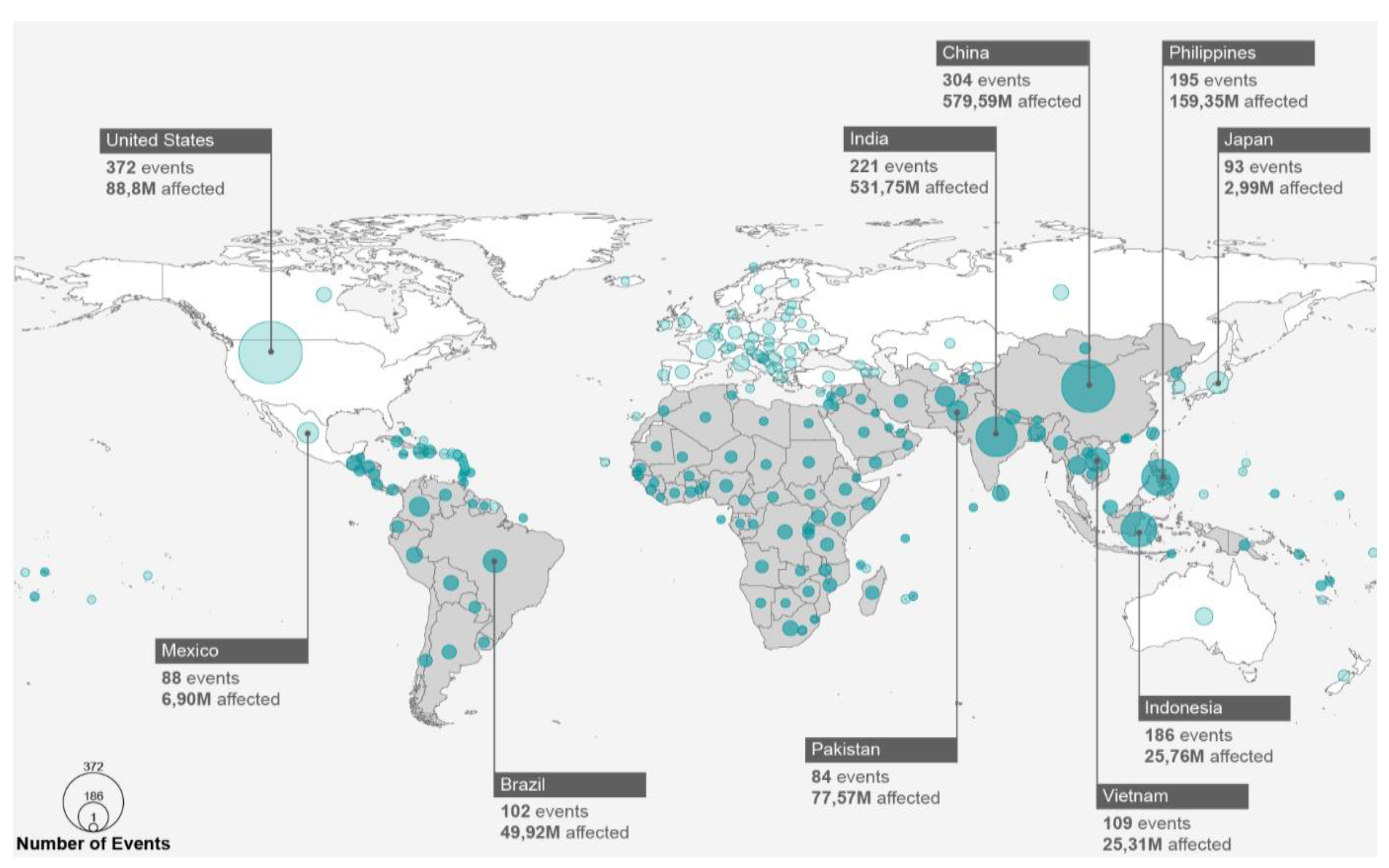
Figure 2.
Literature search and evaluation for inclusion in the review.
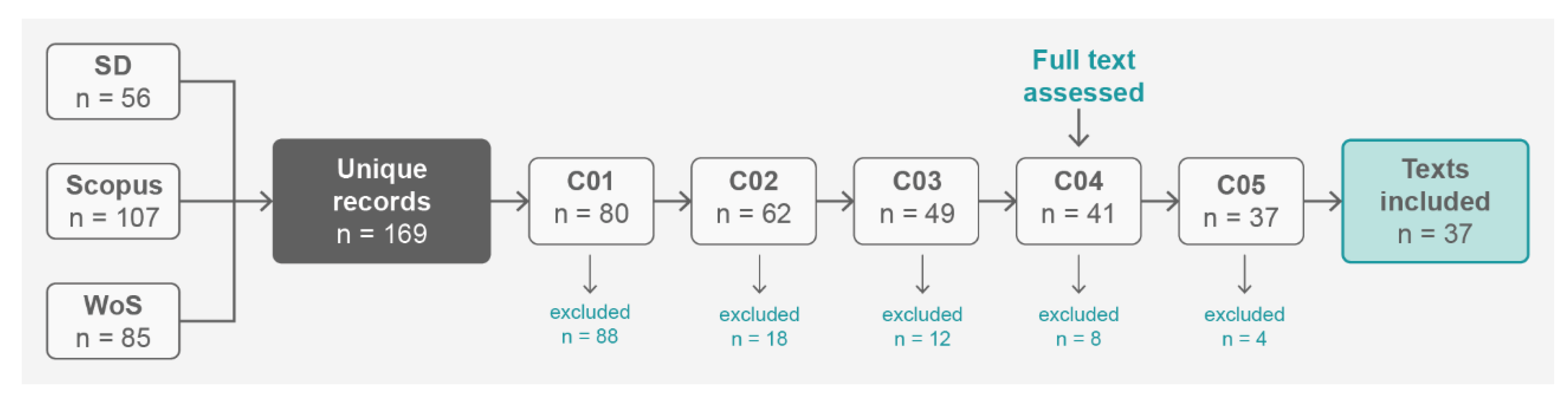
Figure 3.
Analysis of Fortaleza, Brazil, using the HUL concept shows that urban heritage (blue) is part of a complex system of interacting layers: natural, built, socioeconomic, and cultural. Color intensity corresponds to value magnitude; darker shades indicate higher values.
Figure 3.
Analysis of Fortaleza, Brazil, using the HUL concept shows that urban heritage (blue) is part of a complex system of interacting layers: natural, built, socioeconomic, and cultural. Color intensity corresponds to value magnitude; darker shades indicate higher values.
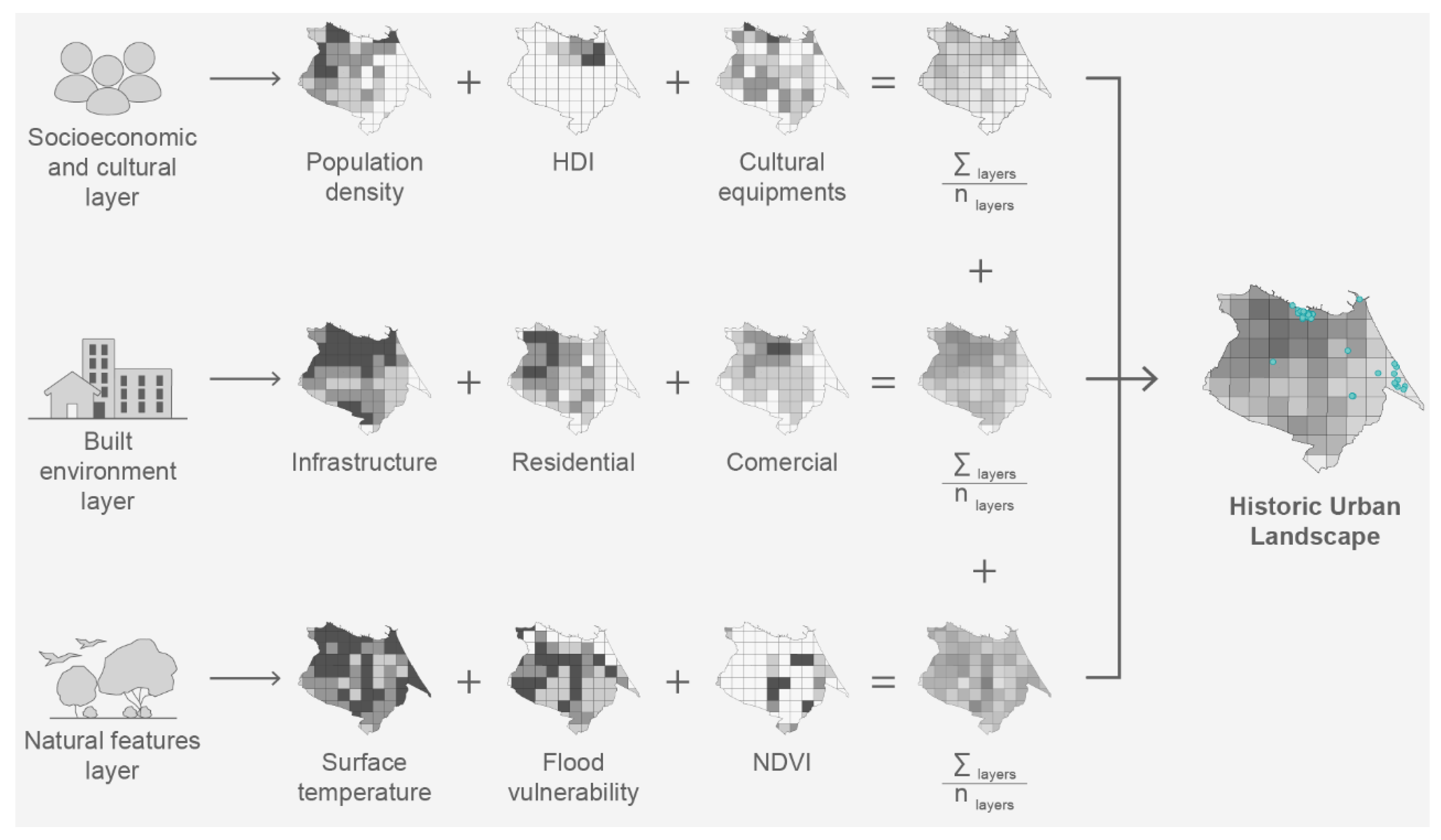
Figure 4.
Example of Fortaleza’s (Brazil) urban heritage (blue) preliminary flood risk assessment using the HUL approach. Color intensity corresponds to value magnitude; darker shades indicate higher risk.
Figure 4.
Example of Fortaleza’s (Brazil) urban heritage (blue) preliminary flood risk assessment using the HUL approach. Color intensity corresponds to value magnitude; darker shades indicate higher risk.
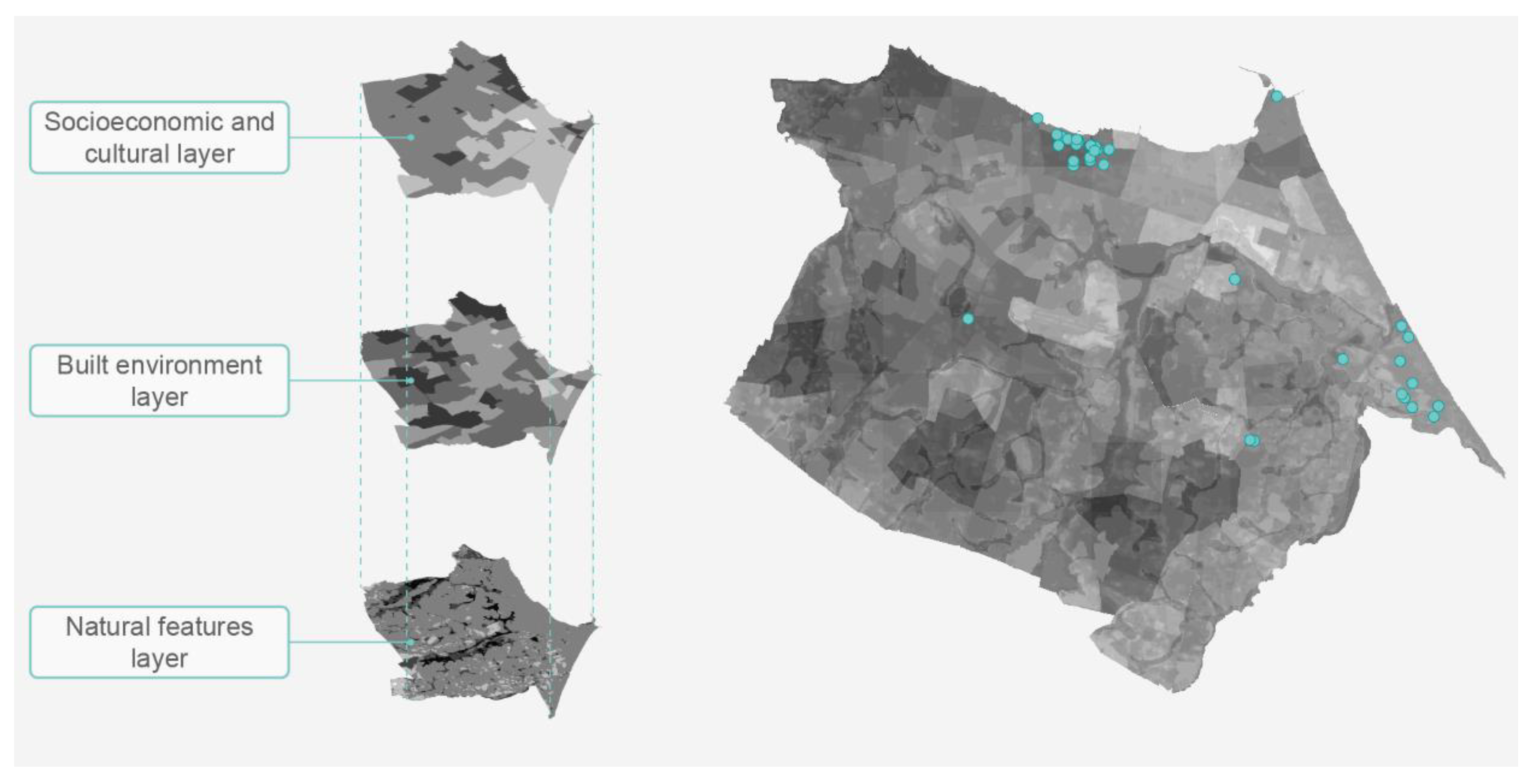
Figure 5.
Types of papers written on HUL from 2020 to 2024.
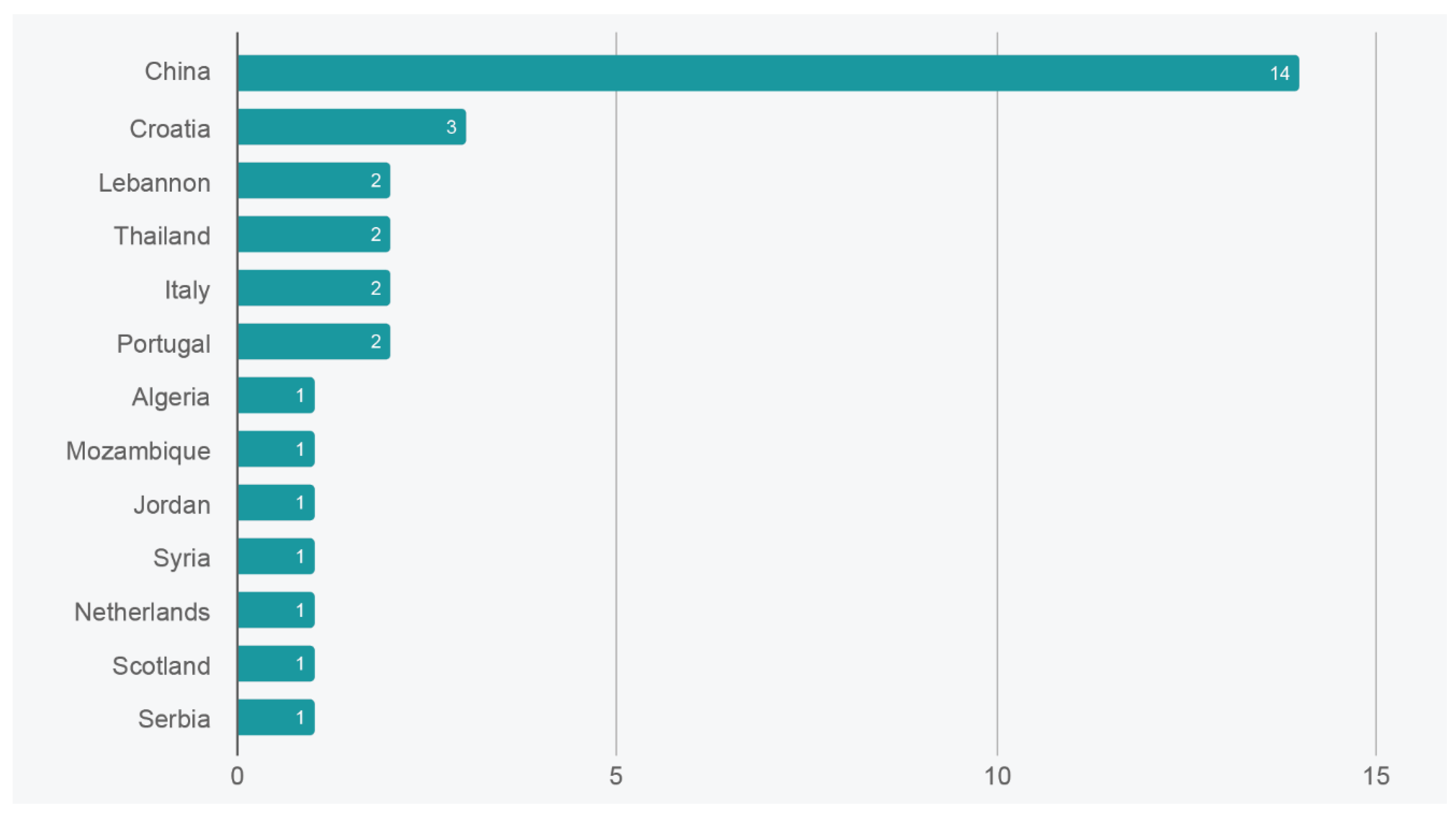
Figure 6.
Subject areas of the published papers.
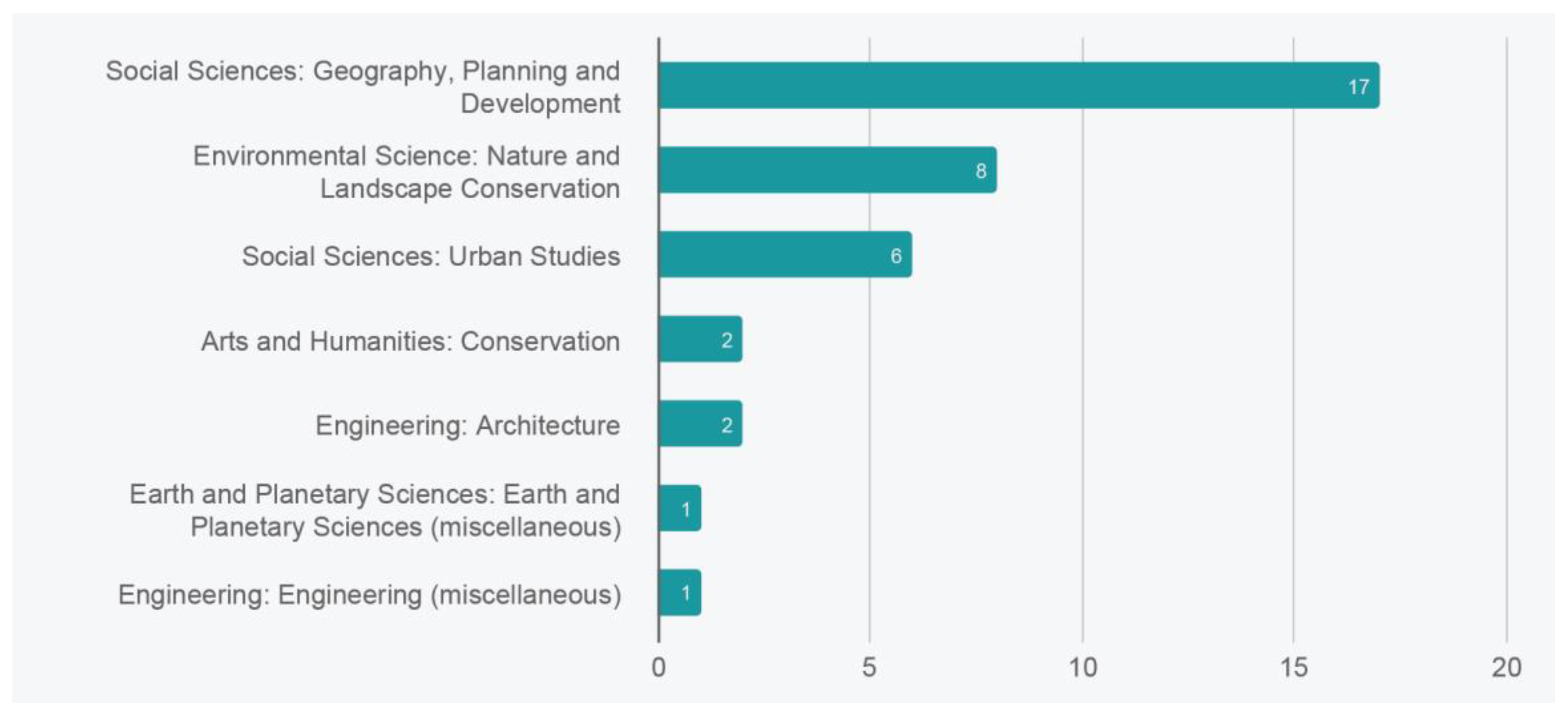
Figure 7.
Distribution by country of studies on HUL applications from 2020 to 2024.
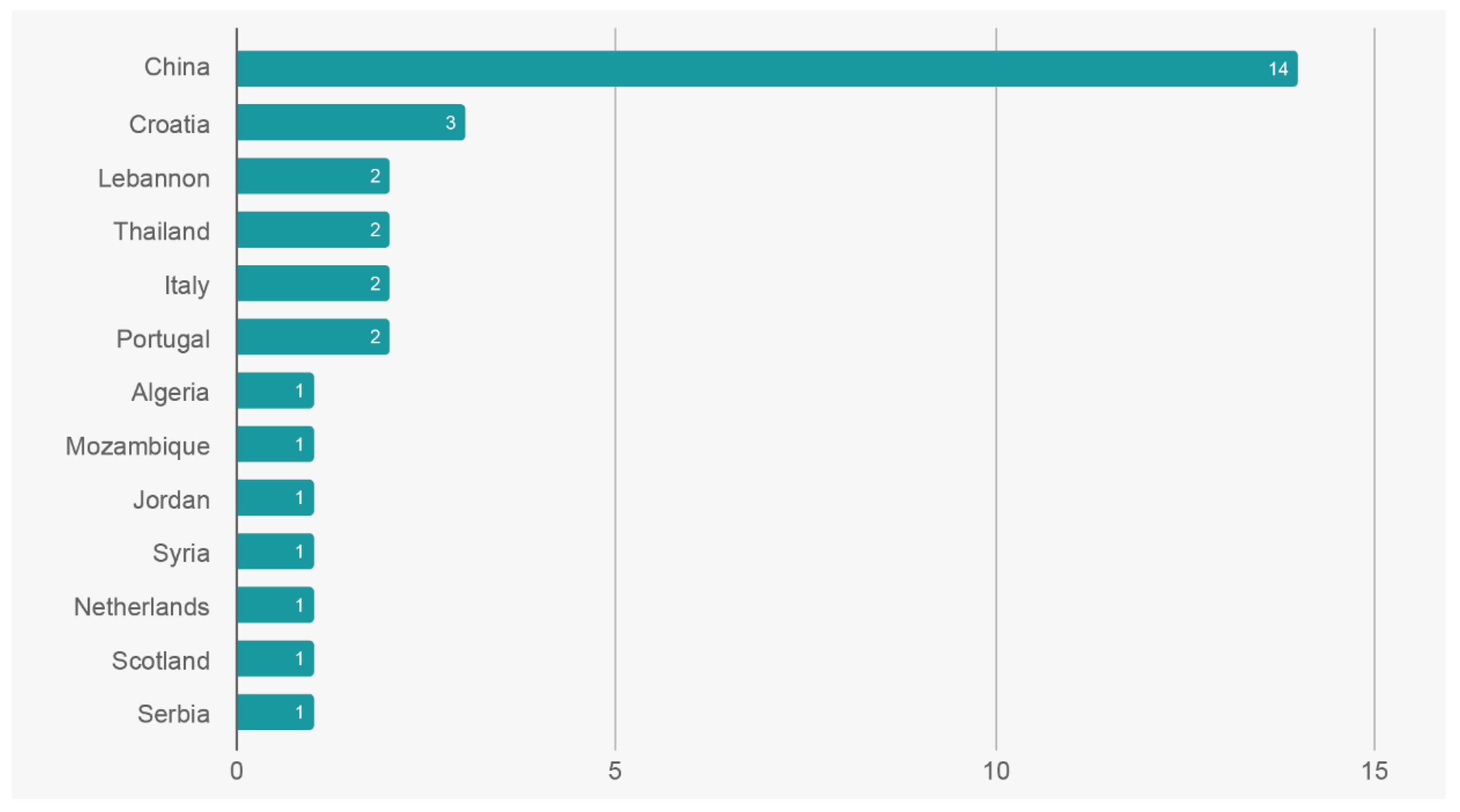
Figure 8.
Use of the six critical steps recommended to facilitate the implementation of the HUL approach in the studies analyzed, published during the period of 2020 to 2024. Step 1: mapping of natural, cultural and human resources; Step 2: collective consensus on what to preserve; Step 3: climatic and socioeconomic vulnerability assessment; Step 4: heritage protection integration on urban planning; Step 5: prioritization of actions that balance preservation and development; Step 6: establish local partnerships and management frameworks.
Figure 8.
Use of the six critical steps recommended to facilitate the implementation of the HUL approach in the studies analyzed, published during the period of 2020 to 2024. Step 1: mapping of natural, cultural and human resources; Step 2: collective consensus on what to preserve; Step 3: climatic and socioeconomic vulnerability assessment; Step 4: heritage protection integration on urban planning; Step 5: prioritization of actions that balance preservation and development; Step 6: establish local partnerships and management frameworks.
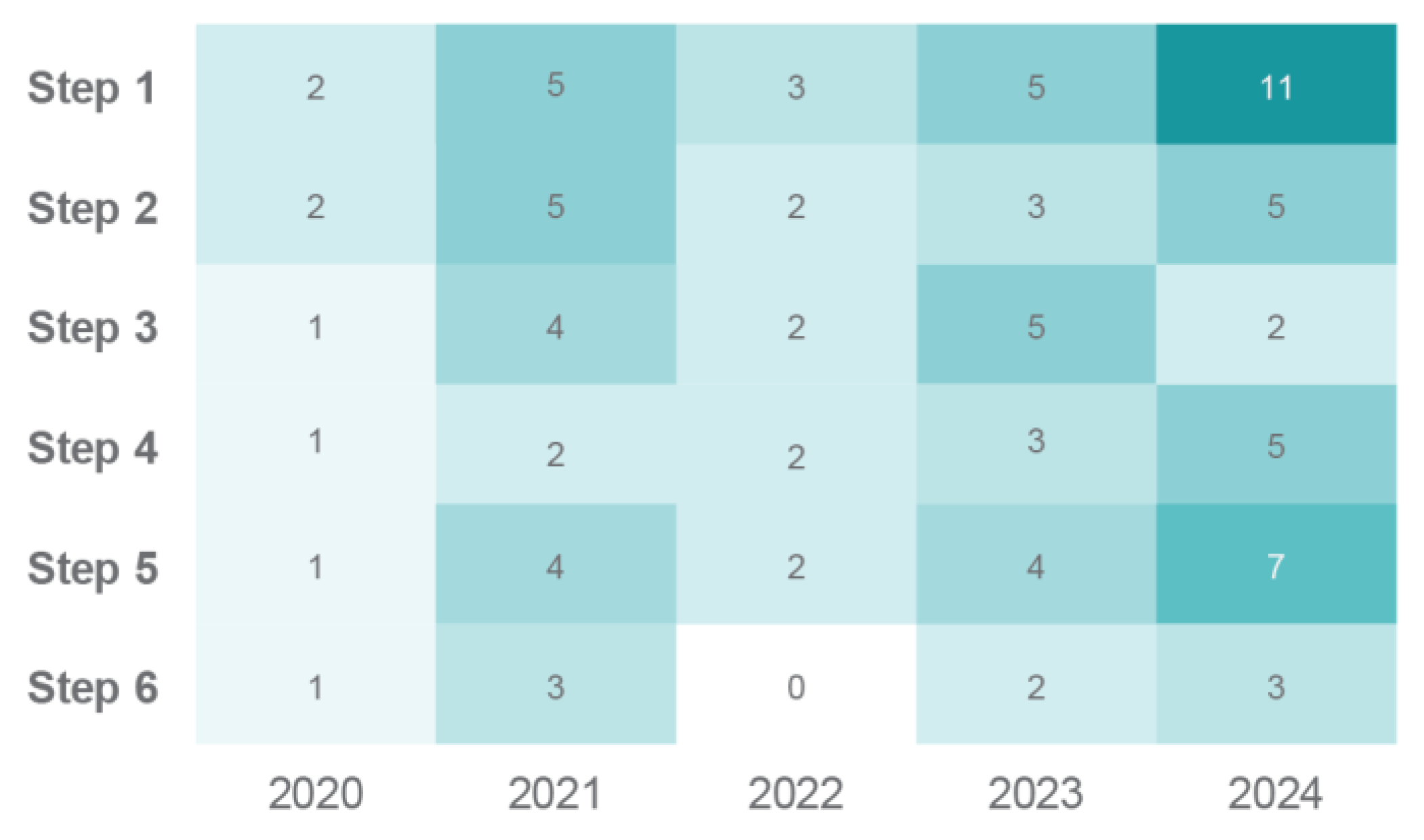
Figure 9.
Categories of tools used from 2020 to 2024 in the analyzed studies for successfully managing the urban environment. Tool 1: community engagement tool; Tools 2: knowledge and planning tools; Tool 3: regulatory system tools; Tool 4: financial tools.
Figure 9.
Categories of tools used from 2020 to 2024 in the analyzed studies for successfully managing the urban environment. Tool 1: community engagement tool; Tools 2: knowledge and planning tools; Tool 3: regulatory system tools; Tool 4: financial tools.
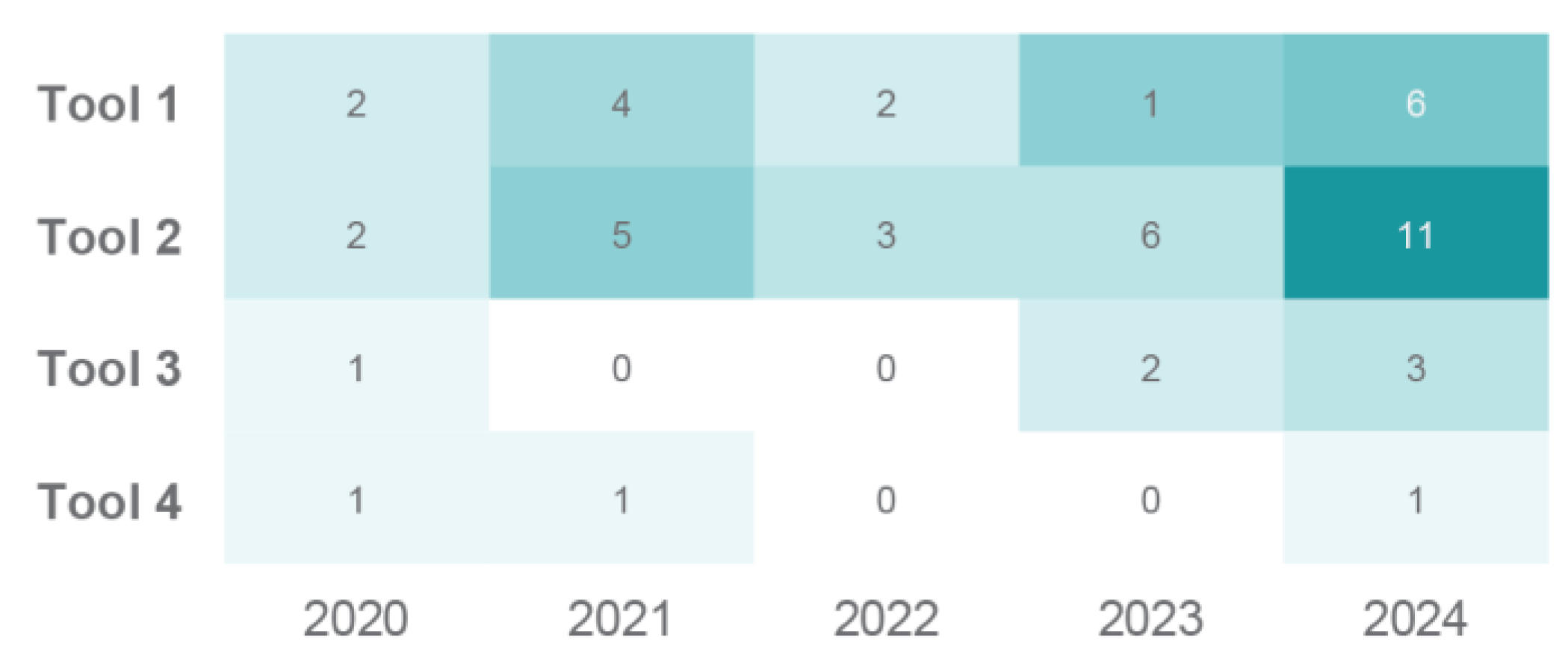
Table 1.
Criteria for inclusion in the review.
| Criteria | Detail |
| C01 | Includes the term “historic urban landscape” OR “HUL” in its keywords |
| C02 | Includes the term “historic urban landscape” OR “HUL” OR “heritage” OR “conservation” OR “preservation” OR “regeneration” OR “historic center” OR “historic centre” in its title. |
| C03 | Includes the term “historic urban landscape” OR “HUL” in its abstract. |
| C04 | The abstract presents the applicability of the HUL approach, discusses its development, use or effectiveness or critically analyzes it. |
| C05 | The paper meets all the previous criteria, has a strong line of reasoning, and is based on current evidence capable of supporting the conclusions presented. Additionally, it presents contributions to the fields of heritage conservation, urban planning, resilience planning, or sustainable development that are relevant to this research. |
| data |
Table 2.
Prompts for identifying steps and tools in AI analysis.
| Goal | Prompt |
| Steps identification | The historic urban landscape (HUL) is the urban area understood as the result of a historic layering of cultural and natural values and attributes, extending beyond the notion of “historic centre” or “ensemble” to include the broader urban context and its geographical setting. Analyze the provided HUL documentation to determine which of the six critical implementation steps are actively employed within the text. For each step, provide a definitive YES or NO assessment regarding its presence in the material, supported by clear justification and verbatim textual evidence. The six critical steps for HUL implementation are: 1. Undertake comprehensive surveys and mapping of the city’s natural, cultural and human resources; 2. Reach consensus using participatory planning and stakeholder consultations on values to protect; 3. Assess vulnerability of attributes to socio-economic stresses and climate change impacts; |
| 4. Integrate urban heritage values and vulnerability status into wider city development frameworks; | |
| 5. Prioritize actions for conservation and development; 6. Establish appropriate partnerships and local management frameworks for identified projects. Present the findings in a table with four columns: - Column 1: Step identification; - Column 2: YES or NO (indicating whether the step is used/referenced in the documentation); - Column 3: Justification (brief academic explanation of why the step is or is not present); - Column 4: Exact Passages (direct quotations from the text that support your assessment). Use formal academic tone throughout. Ensure all conclusions are grounded in direct textual evidence from the provided case material. | |
| Tools identification | The historic urban landscape (HUL) is the urban area understood as the result of a historic layering of cultural and natural values and attributes, extending beyond the notion of “historic centre” or “ensemble” to include the broader urban context and its geographical setting. Analyze the provided HUL documentation to determine which of the four tools are actively employed within the text. For each tool, provide a definitive YES or NO assessment regarding its presence in the material, supported by clear justification and verbatim textual evidence. The four tool categories are defined as follows: 1. Community Engagement Tools: Empower stakeholders to identify values, develop visions, set goals, and agree on actions; facilitate intercultural dialogue and mediation between conflicting interests. 2. Knowledge and Planning Tools: Protect integrity and authenticity of heritage attributes; recognize cultural significance and diversity; include mapping of cultural and natural features, heritage assessments, social and environmental impact assessments. 3. Regulatory Systems: Include special ordinances, acts or decrees managing tangible and intangible components of urban heritage; recognize and reinforce traditional and customary systems. 4. Financial Tools: Improve urban areas while safeguarding heritage values; build capacity and support income-generating development; include government funds, private investment, micro-credit, flexible financing mechanisms, and public-private partnerships. Present findings in a table with four columns: - Column 1: Tool Identification (name of tool category); - Column 2: Usage Status (YES or NO only); - Column 3: Justification (concise academic explanation of why the tool is or is not employed); - Column 4: Evidence (exact passages from the case material that support your determination); Use formal academic tone throughout. Ensure all conclusions are grounded in direct textual evidence from the provided case material. |
| data |
Disclaimer/Publisher’s Note: The statements, opinions and data contained in all publications are solely those of the individual author(s) and contributor(s) and not of MDPI and/or the editor(s). MDPI and/or the editor(s) disclaim responsibility for any injury to people or property resulting from any ideas, methods, instructions or products referred to in the content. |
© 2026 by the authors. Licensee MDPI, Basel, Switzerland. This article is an open access article distributed under the terms and conditions of the Creative Commons Attribution (CC BY) license (http://creativecommons.org/licenses/by/4.0/).
Copyright: This open access article is published under a Creative Commons CC BY 4.0 license, which permit the free download, distribution, and reuse, provided that the author and preprint are cited in any reuse.


