
Submitted:
10 March 2026
Posted:
11 March 2026
You are already at the latest version
Abstract
Various disciplines have delved into the complex relationship between social behavior and its individual and collective benefits. In social psychology, many scholars have explored human behavior driven by altruistic and selfish actions. From the perspective of evolutionary biology, numerous studies have examined the positive and negative effects of the actor and recipient on behaviors. However, when viewed through an interdisciplinary lens, these approaches only partially capture the intricate interplay between the actors’ behaviors and the societal impact of their actions. In a collaborative spirit, this article considers the pivotal work of Carlo Cipolla’s "Laws of Human Stupidity," which sought to classify people based on the benefits for themselves and others. By comparing definitions and interpretations from different disciplines, the article demonstrates the theoretical compatibility of Cipolla’s types of people, behavioral definitions from evolutionary biology and social psychology, and understanding of human intentions behind behavior based on the "Theory of Planned Behavior." Finally, this article compiles the results in a "Social Impact" classification with integrated definitions based on human behaviors and their underlying intentions.
Keywords:
human behavior
; Carlo Cipolla
; altruism
; selfishness
; social impact
1. Introduction
Unraveling the intentions that drive human behavior within the intricate web of human interactions is a significant and pressing challenge. This task intertwines biological, social, and psychological insights with moral and ethical considerations [1,2]. The considerable impact underscores the profound importance of this understanding in shaping human behavior, interactions, and its implications for society [3]. While social psychology focuses on the dichotomy between altruism and selfishness, which is defined by human motivations and shows complex, intricate, and multifaceted definitions due to the influence of internal and external factors, evolutionary biology focuses on the study of social behavior based on the positive or negative effects between actor and receiver in a bidirectional process, where the actor is defined as the individual who performs or expresses the action, and the receiver as the individual who takes part or receives the action [4].
The interaction between the actor and the receiver is crucial but dynamic in determining the outcome and impact of any action [5]. The receiver response and interpretation of the actor’s actions are not just passive elements, but active contributors, as they can significantly influence the actor’s intentions and future behavior, highlighting everyone’s power and responsibility to shape the dynamic nature of social interactions [4]. However, human behavior is triggered by intentions shaped not only by internal desires and external factors, but also by dynamic interactions between individuals [6]. Inferring the underlying intentions behind the behavior can be complex and challenging because the actor and receiver may have different perspectives and motivations.
This article examines and analyzes the definitions of social behaviors from a holistic perspective, considering the impact on both the person initiating the action and the receiver who takes part in the action. This examination will focus on the positive and negative effects of interactions between social psychology and evolutionary biology, and their correlation with the underlying intentions of behaviors. It will compare the abovementioned definitions with Carlo Cipolla’s model described in his book "The Basic Laws of Human Stupidity," which clearly defines the actors and receivers by the gain or loss of their actions, resulting in four types: intelligent, bandits, helpless, and stupid [7]. The final goal is to develop a comprehensive framework for defining a complementary definition of behavior and intentions that enable the decoding or predicting of actions based on Cipolla’s model. Complementarily, this framework aims to the social impact of benefit or harm on society. This article is not intended to become a theoretical model or a review. It aims to provide arguments for further discussion and develop research on human behavior, its intentions, and social impact, which can be applied across multidisciplinary fields.
2. Materials and Methods
The study was divided into three parts. The first part focused on deepening the Cipolla model to define the actions of actors and receivers as a definition of behavior. This part was carried out by examining and analyzing the book written by Carlo Cipolla, "The Basic Laws of Human Stupidity" [7]. This part also included revising literature that analyzed and interpreted Cipolla’s work to clarify definitions related to the variations and applications of his model [8,9,10,11].
The second part was focused on clarifying and contrasting the multidisciplinary perspective of altruistic and selfish behavior from the fields of psychology [5,6] and evolutionary ecology [4]. This part is also considered to clarify the role of underlying intentions under behavioral science [1,2,3]. This part was carried out by an extensive literature review, mainly taken from scientific databases that include ScienceDirect, Google Scholar, and PubMed, specifically on those publications in Psychology, Behavioral Sciences, and Evolutionary Ecology journals.
The third part was focused on correlating interdisciplinary definitions with Cipolla’s model to approach and understand its implications as "Social Impact." This part was carried out using Cipolla’s graph model as a base. The definitions from various fields were integrated into Cipolla’s quadrants graph to better understand the definitions used to construct "Social Impact" based on the resulting behavioral types.
3. Results
The results are divided into three parts. The first part provides a detailed explanation of Cipolla’s model and its development by similar authors. The second part focuses on comparing various definitions of authors from interdisciplinary fields, including Social Psychology and Evolutionary Ecology. This section shows the definitions in analogous terms regarding social behavior and its relationship with the gains or losses of the actor and the receiver, considering the Cipolla model explained in the first part as a basis. The third part focuses on the definitions that describe the relationship between intentions and social behavior, including the "Theory of Mind" (TOM) and the "Theory of Planned Behavior" (TPB).
3.1. The Cipolla’s Model
The economist and historian Carlo M. Cipolla (1922–2000) wrote an essay titled "The Basic Laws of Human Stupidity" [7]. Cipolla’s stupidity quadrant and his five laws of stupidity were proposed for the first time in 1976. Exposed in a humorous mood by the author, these concepts describe the interactions among human beings in terms of a semi-quantitative model based on the gains and losses [8].
Cipolla defines stupidity within a social context in a more detailed way than simply something opposed to intelligence. According to Cipolla, a person who is prejudiced against another or a group does so without any profit or incurring prejudice themselves. This definition is crucial because it highlights the irrationality and destructive nature of stupid actions that are difficult to predict and justify [7]. Cipolla classifies people into four groups based on the consequences of their actions for themselves and others: intelligent people, whose actions result in their benefit and for others; bandits, who profit at the expense of others; helpless people, who benefit others at their expense, and stupid people, who harm others without any benefit to themselves [9]. Cipolla emphasizes the widespread and underestimated presence of stupidity, suggesting that the likelihood of a person being stupid is independent of any other characteristics of that person. He also points out that stupidity is a primary source of collective problems and annoyances contributing to social scourges [7].
Cipolla’s theory is a critique and serves as a framework for understanding social interactions and the impact of non-rational behaviors on collective well-being, aimed at the identification of a "filter" for the concept as opposed to intelligence, which he defined as "stupidity" [10]. Both Cipolla’s "intelligence" and "stupidity" as attributes of human behavior are not revealed so much by the type of communicative behavior produced by a given agent but rather consider the advantages and disadvantages produced as a consequence of the agent’s actions and that is perceived and "objectively evaluated" by the recipient who is the one who qualifies the behaviors based the advantages (benefits) and disadvantages or (prejudices) for the agent; and, advantages (benefits) or disadvantages (losses) for others [10]. Figure 1 shows how Cipolla describes a cross-sectional characterization based on the possibility that helpless individuals and bandits can have intelligent or stupid characteristics, resulting in six types of individuals: intelligent, stupid, intelligent–helpless, intelligent-bandits, stupid–helpless, and stupid–bandits [7].
Inspired by Carlo Cipolla’s work, further studies developed an evolutionary game in which they incorporated the four categories of human behavior inspired by Cipolla’s theory of human stupidity to explore the dynamics of strategies in a population [11]. Adding more diverse strategies in the game theory framework, such as those inspired by Cipolla’s laws, introduces greater complexity and a richer set of dynamics than traditional models of two strategies, named cooperator and defector. This study shows that individuals with low intelligence can inhibit cooperative behaviors and decrease the population’s total wealth, using a mathematical model that reveals a transition from a cooperative regime to a defective one when the probability of individuals adopting stupid behaviors increases [11]. Furthermore, based on Cipolla’s classification of social behaviors, [10] identifies other criteria that help with the definition in a broader range. He proposes including the "Social Wheel" model as an extension of Cipolla’s conceptual model, adding a variant to Cipolla’s model: the actor’s will or unwillingness (volition) to cause advantages to others.
3.2. A Multidisciplinary Perspective of Altruistic and Selfish Behavior
3.2.1. Altruism and Egoism from Social Psychology.
From a simplistic perspective, an actor’s actions can be classified from purely altruistic to selfish based on the immediate results they produce. Altruism in social psychology is generally defined as behavior that benefits others at a cost to oneself [12,13], and the concept has been studied across various disciplines, including psychology, sociology, economics, and evolutionary biology [14,15]. While some view altruism as a cultural or superorganic phenomenon [17], others argue that it has biological roots [16].
Researchers have proposed different explanations for altruism, such as kin selection, reciprocal altruism, and sexual selection [4,16]. Some argue that altruism and volunteerism are closely related but rarely connected in literature [14]. According to [18], personal dispositions and social situations interact in complicated ways to influence helping behavior. Altruists prefer to help without compensation, while "receptive givers" choose to help when there is an expected response. Empathic emotion can elicit an altruistic motivation to help, and this help can reduce the suffering of the person in need rather than alleviate their well-being [19]. Altruistic dispositions are more evident in contexts of easy escape and high emotional emotiveness and where the need for help is obvious [20]. The study carried out by [21] summarizes some alternative sources of prosocial motivation that could explain altruism. Although he does not explore them in the same depth as selfish motivations, he defines 1) Altruistic personality, one who has a stable disposition to help others; 2) Moral reasoning based on principles, referring to decision-making based on universal and impartial moral principles; 3) Devout religion, religious belief as a motivator of personal conduct; and, 4) Internalized prosocial values: Personal values that promote the well-being of others.
Researchers even affirm the possibility of a conjunction between altruism and selfishness since they may have a singular motivational source through which various actions emerge. Then, despite its negative reputation, egoism can sometimes motivate prosocial behavior [22], although social dominance orientation tends to coincide with behavioral selfishness [23]. The study developed by [21] has defined some possibilities to explain selfish motivations for altruism: the elimination of empathy, defined as the elimination of the need for the other as an instrumental goal; avoidance of shame and guilt, as the desire to avoid disapproval; social censure, and self-condemnation; obtaining specific empathic pride, as and anticipated emotional benefit by helping someone for whom there is a feeling of emphatic concern; relief from sadness, as the desire to relieve sadness of someone who is suffering; empathic joy, as the pleasure experience by witnessing the joy of whom is helped; moral hypocrisy, defined as the actions performed to be perceived as morally correct, regardless of the true motivations, going as far as to justify their immoral actions by alluding to morally acceptable reasons.
Selfishness is the motivational state that aims to increase the actor’s well-being (self-realization) [21]. Similar studies define selfishness as an excessive preoccupation with one’s pleasure at the expense of the community’s well-being [24]. Psychological egoism posits that all intentional actions are ultimately self-interested, while psychological altruism suggests that some actions are other-cited May 2011. Recent research challenges traditional views of selfishness, proposing a psychological construction where selfishness is perceived when a situation-specific desire to benefit oneself disregards others’ desires and social expectations [26]. The HEXACO model, particularly the Honesty-Humility factor, strongly predicts egoism [27]. While egoism is often viewed as natural, altruism has been treated with suspicion [28]. Interestingly, perspective-taking can increase egoistic behavior in competitive contexts [29]. Some argue that self-other merging may explain empathy-induced altruism, though this explanation has been challenged [25].
3.2.2. Social Behavior from Evolutionary Ecology.
According to [13], altruism translates into cost-benefit adjustment, in which the actor’s adjustment decreases while the receiver’s adjustment improves. This categorization of altruism is based on the positive or negative effects on the actor and the receiver. Accordingly, social behavior can be classified as reciprocity (mutualism), altruism, egoism, spite, and green beard [13,30].
Figure 2.
Classification of Social Behaviors. Source: West and Gardner, 2011.
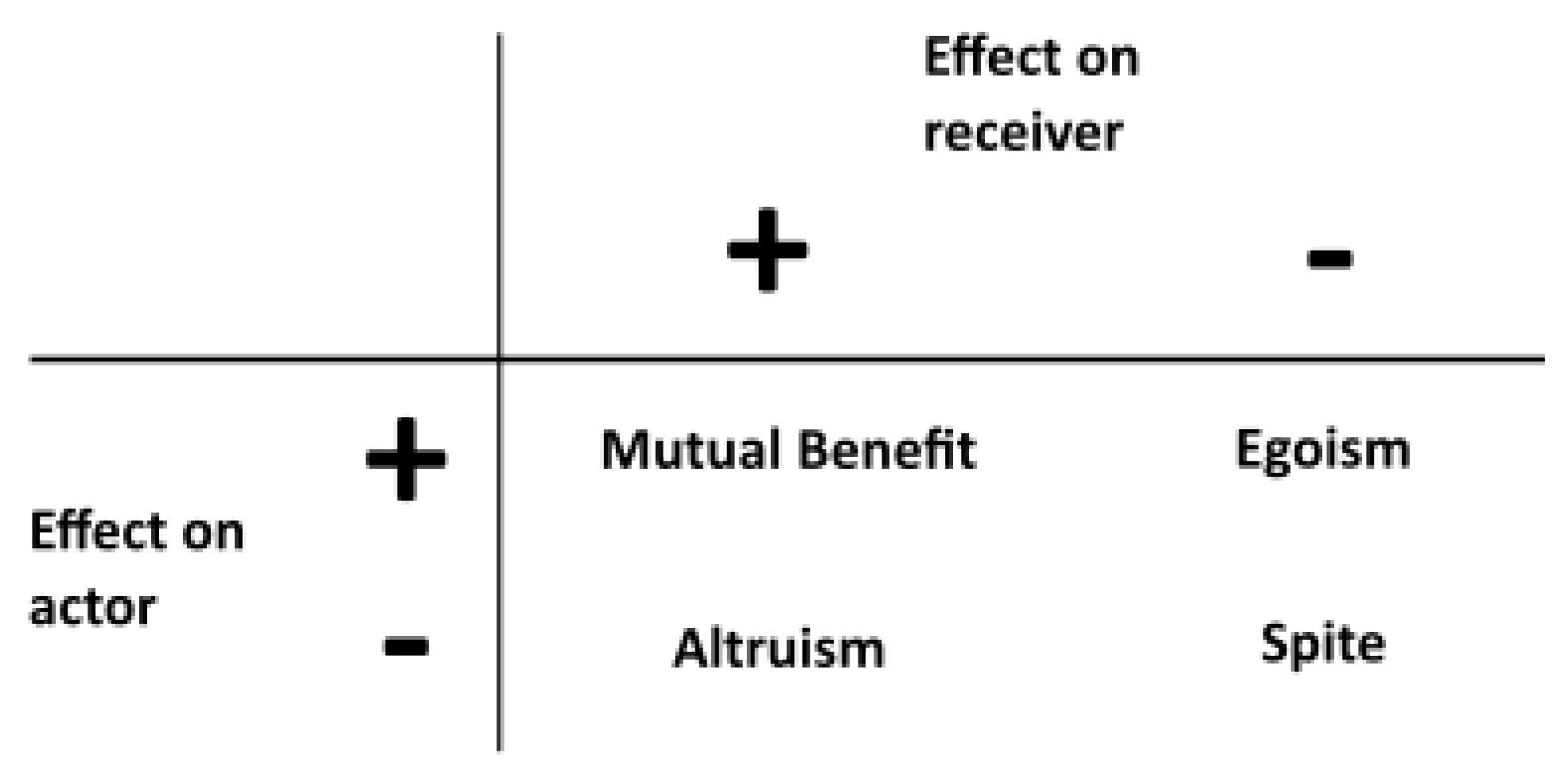
"Reciprocity" or "mutualism" occurs when the actor is more likely to receive help in the future and depends on a direct benefit for cooperation [30], or rather, "an interaction between species that is beneficial to both" [31]. Although mutualism may be at risk of becoming antagonism [32], it is also defined as a beneficial interaction between species, which has received significant attention in ecological research and is developed through mechanisms, including complementary skills [33]. Evolutionary models of mutualism have explored how cooperation can evolve and persist in the face of conflicts of interest, employing various approaches, from adaptive dynamics to quantitative genetics [34]. An important aspect that conditions the development of the mutualist association is that it requires a sustained feedback process by selection to make efficient decisions in cooperative dilemmas, suggesting, similarly to Foster, that intelligent strategies are helpful as a kind of "feedback loop" that contributes to increased intelligence[35].
"Altruism" is defined as a behavior that reduces the actor’s fitness while increasing the recipient’s fitness, and this concept challenges the Darwinian idea of "survival of the fittest" [13]. Explanations for the evolution of altruism include kin selection, reciprocal altruism, and group selection [36,56]. While some argue that altruism is a group phenomenon evolving through individual selection [36], others suggest it is programmed to ensure the survival of social groups [37]. Empathy is proposed as a mechanism underlying directed altruism, with evidence suggesting it is phylogenetically ancient [38]. The concept of evolutionary altruism differs from vernacular altruism [39], and its interpretation varies across disciplines [15]. Some researchers question the existence of strict altruism, arguing that apparent altruistic behaviors may have hidden benefits for the actor [40].
Altruistic acts are not necessarily self-sacrificing, as they can also benefit the actor [13,41]. The idea of altruism as a form of self-sacrifice is challenged, with the reinforcement value of self-being a key consideration [41]. On the other hand, [42] states that evolutionary biology does not support the idea that humans are psychologically selfish by nature. Although natural selection can favor behaviors that benefit the individual, this does not necessarily imply that motivations are purely selfish. [43] showed that Hamilton’s Rule applies to humans, where help is preferentially directed to close relatives, and emotional closeness plays an essential role in the willingness to help. Due to evolutionary pressure, pure selfishness does not always lead to altruism but can lead to different types of helping behaviors: altruistic helpers motivated by a genuine desire to increase the well-being of others; behavioral helpers focused on reciprocity, which are not altruistic or selfish but have a solid reciprocal commitment, helping those they have helped in the past; and, reflective helpers, who have a behavior driven by automatic responses and not by ultimate desires, neither altruistic nor selfish [44].
Evolutionary biology defines "selfishness" at the genetic level, where genes act to enhance their transmission, potentially at the expense of other genes or the organism’s fitness [45]. This concept, popularized by Dawkins’ "The Selfish Gene," challenges the traditional view of genomes as cohesive units [46]. The study of [47] formalized this theory mathematically, showing that genes can be considered fitness-maximizing agents. However, this perspective has been controversial, with critics arguing that genes cannot possess intentions or emotions [48]. Genetic selfishness has implications for understanding altruism, which some claim can be explained through mechanisms like kin selection and reciprocal altruism [40,49]. In this line, [50] notes that this gene-centric view extends beyond individual organisms, influencing the broader environment and other species. The controversial concept of the selfish gene continues to hold significant sway within evolutionary biology despite persistent debates and discussions [46].
Then, "spite" is defined as a behavior where an individual harms themselves to harm others [51]. Initially thought to be rare, recent research suggests that spite can evolve under certain conditions. Spatial population structure and local competition can favor spite evolution [4,52]. Spite can benefit kin and reduce virulence in parasitic relationships [53]. It can evolve in finite populations without population structure [54] and may contribute to the evolution of fairness [55]. Spiteful behaviors can be interpreted as altruistic, benefiting related third parties [51,56]. The distinction between Hamiltonian and Wilsonian spite is considered more semantic than absolute [51]. Spitefulness is positively associated with aggression, psychopathy, narcissism, and Machiavellianism [57,58]. Impulsivity is a common factor linking these traits to aggressive behavior [58,59]. Narcissists tend to respond more aggressively to social rejection [60]. Spite can evolve in small populations with low migration rates, which may be a spiteful and altruistic strategy [56]. However, true spite requires kin discrimination, as indiscriminate harming behaviors may be selfish rather than spiteful [61]. Interestingly, spiteful traits can also contribute to socially beneficial behaviors, such as costly punishment for selfish actions [62]. The evolution of spite in finite populations is possible and can sometimes contribute to its stability by limiting population growth [54].
Finally, the "green beard" effect in evolutionary biology refers to a gene or group of genes that can recognize copies of itself in other individuals and promote altruistic behavior towards them [30,63]. Initially proposed as a theoretical concept, green beard genes have been discovered in various organisms, including ants [64] and potentially in human placentas [50]. While some argue that green beard effects are unlikely due to the need for a single gene to code for both recognition and altruism [66], others suggest that loosely coupled genes or indirect genetic effects can facilitate their evolution [66,67]. Although green beard effects may exist in humans, they are unlikely to be important in complex organisms [30]. Alternative explanations, such as the "red beard" hypothesis, have been proposed to explain human sociality through emotions rather than specific behaviors [68].
3.3. Identification of Underlying Intentions of Human Behavior
Several authors have focused on identifying the intentions of human behavior. However, various theories have been put forward that reflect the complexity of the mind-body problem and the need to integrate philosophical and scientific perspectives [69]. One is the "Theory of Mind" (ToM), which, despite the criticisms that highlight its limitations and potential misinterpretations due to its dependence on biological concepts and reductionism [?], offers a comprehensive explanation to understand why people, under different mental states may be able to process, interpret, and predict the actions of others, depending on the availability of cognitive resources and the complexity of the social situation [71]. The ToM explains the ability to attribute mental states to oneself and others to understand intentions and beliefs, including purpose, knowledge, thought, doubt, assumption, and simulation, based on attributions [72,73,74].
Other research on hidden interests in social interactions has revealed that human actions are motivated by non-explicit personal benefits. Such personal benefits could be motivated by possessing power, opportunities for manipulation, maintaining reputation, or even avoiding negative consequences associated with their acts. The possession of power, for example, acts directly on the behavioral approach system. According to the study developed by [75], there is an essential implication for understanding power dynamics in various social interactions, including how power can affect the perception of others’ intentions and moral decisions. The study suggests that high power is associated with increased approach, positive effect, attention to rewards, and uninhibited behavior, while reduced power is related to the opposite. This means that power influences behavior and how people process information and respond emotionally. The control of power in different contexts can be used by human motivations to justify their altruistic or selfish actions. Such control can lead individuals to see others as targets of manipulation and to justify their use by devaluing others, generating the perception of one’s superiority by maintaining a psychological distance from the less powerful [76]. Power also acts as an intensifier of goal-related motivation, facilitating self-expression and goal-directed action. Still, it also leads to neglect of social aspects and objectification of others [77].
From the social psychology perspective, "desire" is crucial in shaping human behavior and motivation. It serves as a proximal cause of intentions, mediating the effects of attitudes, norms, and perceived control on behavior [78]. The "Theory of Planned Behavior" (TPB) is a widely used model in social psychology to predict and explain human behavior. It states that behavior is guided by beliefs about outcomes, normative expectations, and perceived control, which form behavioral intention. These factors influence behavioral intentions, considering the immediate antecedent of actual behavior [79,80]. Accordingly, attitudes are produced by behavioral beliefs and represent a favorable or unfavorable evaluation of the behavior; subjective norms result from normative beliefs and reflect perceived social pressure or the normative expectations of others; perceived behavioral control arises from control beliefs and pertains to the perceived presence of factors that may facilitate or impede the performance of the behavior, as well as the perceived power of these factors. Intention is formed by the combination of attitude toward the behavior, subjective norm, and perceived behavioral control. It is considered the immediate antecedent of behavior. Finally, behavior is the actual action carried out, which is expected to occur when there is sufficient control over the behavior and the intention to perform it [81]. While the theory traditionally assumes unidirectional causality, recent research suggests reciprocal causal relations between intentions and base components [80]. The TPB has been applied to various domains, including pro-environmental behaviors [82], leisure choices [79], farmer behavior [83], paternal involvement [84], entrepreneurship [85], and green marketing [86]. Despite some criticisms, the theory remains relevant and helpful in explaining behavioral intentions [87]. However, researchers should adhere to guidelines for proper application, including identifying indirect variables and reporting explained variance, to obtain more substantial and consistent results [82].
4. Discussion
4.1. The Social Model: An Approach to Understand Underlying Intentions
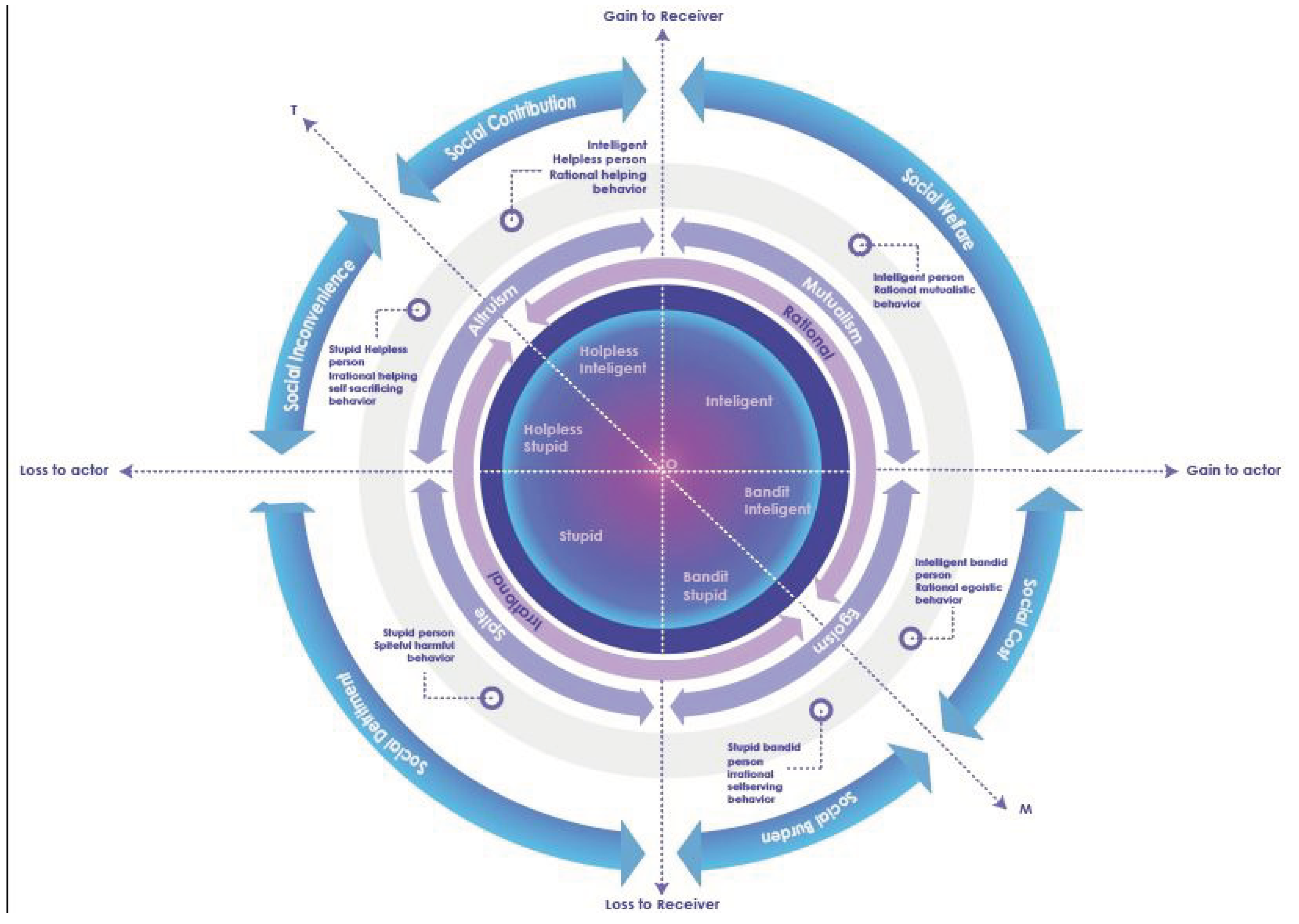
Figure 3 illustrates the compatibility of definitions with Cipolla’s model, as outlined in the first ring, highlighting the unique condition of quadrants that define the benefit or prejudice for the individual and others, which prevails throughout the graph. The second ring corresponds to the definitions of evolutionary biology and social psychology. The third ring corresponds to the combined definitions of Cipolla’s types of people and behaviors. The last ring, finally, defines social impact based on the types of people and their behavior.
The Cipolla model contains the definitions necessary for classifying people based on benefit/prejudice – individual/other. In addition, he suggests another element of substantial importance. Although it does not appear in the graphic model, Cipolla defines it as the "TOM" axis dividing people by the rationality or irrationality of their acts. This axis allows for a more precise classification, resulting in six types of people: smart and stupid, helpless–intelligent or stupid, and smart and stupid bandits.
According to the definitions of evolutionary biology, like Cipolla, the classification of social behaviors coincides with Cipolla’s quadrants in terms of benefit, resulting in four behaviors: altruism, mutualism, selfishness, and spite. Similarly, Cipolla’s model coincides with the definition of positive or negative benefits in the individual and others, concluding that intelligent people are people who obtain benefits for themselves and others (mutualism), bandits obtain benefits for themselves by harming others (selfishness), the helpless people who help others to get benefits but harming themselves (altruism) and finally the stupid, who with their actions harm both others and themselves (spite). As we have seen, the definitions detail several motivations that can be used for each behavior, reinforcing the complexity and, in some cases, even duality in the interpretation. In this sense, the concepts of "green beard" and "red beard" are examples of this complexity, which has not been considered in the comparative model.
Social psychology provides definitions of altruism and selfishness, which, as with evolutionary biology, suggest the most complex types of behavior due to the ambiguity and nature of the intentions before the behavior. In this sense, it is understood that altruistic behavior can develop in people with selfish intentions. However, they help clarify the definition of the behavior specified in the third ring in the following types of people and behaviors: intelligent people, with rational mutualistic behavior; stupid people, with irrational and destructive behavior; helpless intelligent, rational helping behavior; helpless stupid, irrational helping self-sacrificing behavior; bandit intelligent, rational egoistic behavior; and, bandit stupid, irrational, self-serving behavior.

Table 1.
Social Impact definitions according to the combination of Cipolla’s model and behavioral definitions
Table 1.
Social Impact definitions according to the combination of Cipolla’s model and behavioral definitions
| G/L(A)* | G/L(R)* | Cipolla (2011) | Rat./Irrat. | West et al. (2006). | Cipolla and Behavior | Social Impact | Definition |
|---|---|---|---|---|---|---|---|
| + | + | Intelligent | Rational | Mutualism | Intelligent person with rational mutualistic behavior | Social Welfare | An intelligent person with rational mutualistic behavior that benefits both the individual and society |
| - | + | Helpless (Intelligent) | Rational | Altruism | Helpless-Intelligent person with Rational helping behavior | Social Contribution | A helpless but intelligent person with rational, altruistic, self-sacrificing behavior that significantly benefits society. |
| - | + | Helpless (Stupid) | Irrational | Altruism | Helpless-Stupid person with Irrational helping (self-sacrificing) behavior | Social Inconvenience | A helpless but stupid person with irrational altruistic self-sacrificing behavior that causes minor inconvenience to society. |
| + | - | Bandit (Intelligent) | Rational | Egoism | Bandit-Intelligent person with rational egoistic behavior | Social Cost | An Intelligent bandit person with rational egoistic behavior that benefits the individual at the cost of society. |
| + | - | Bandit (Stupid) | Irrational | Egoism | Bandit-Stupid person with irrational, self-serving behavior | Social Burden | A Stupid bandit person with irrational egoistic behavior that causes significant harm to society for minimal personal benefit. |
| - | - | Stupid | Irrational | Spite | Stupid person with Spiteful harmful behavior | Social Detriment | A Stupid person with spiteful, harmful behavior that causes significant harm to both the individual and society. |
* Gains or loses to the Actor (A) or Recipient (R).
Accordingly, the combined definitions in terms of the Social Impact results as follows: Social Welfare (intelligent people with rational mutualistic behavior), Social Contribution (helpless intelligent with rational helping behavior), Social Inconvenience (helpless stupid with irrational self-sacrificing behavior), Social Cost (Bandit intelligent with rational egoistic behavior), Social Burden (Bandit stupid with irrational self-serving behavior), and Social Detriment (Stupid with spiteful harmful behavior) (Table 1). Although spite is a concept from the biology field, it cannot be interpreted as a destructive or negative behavior. The Social Detriment is defined by spiteful behavior as harmful.
Then, it is possible to define the different types of Social Impact according to the kinds of persons and their behaviors: "Social Welfare" is when the actions carried out by intelligent persons result in reciprocal benefits for themselves and society. "Social Contribution" is when the actions carried out by helpless intelligent persons result in benefits for the society with little impact on the actor, including the actions carried out to be received in the future, which in that case can be considered as Social Welfare; "Social Inconvenience," when the actions carried out from a helpless - stupid person results in benefits for society but in a high impact on the actor. According to the definitions, Social Contribution and Social Inconvenience could be based on selfish or selfless intentions. "Social Cost" refers to the situation where the actions of intelligent individuals benefit the actor with minimal societal impact. "Social Burden" refers to the situation where the actions of less intelligent individuals benefit the actor but have a significant negative impact on society. Finally, "Social Detriment" occurs when actions carried out by stupid persons result in losses for actors and society.
From Cipolla’s model, the TOM axis of rationality or irrationality divides altruistic and selfish behavior into two types of behavior, respectively. The contribution from the TPB is essential to explain the nature of rational or irrational behavior. Therefore, the three components of the theory —attitude toward behavior, subjective norms, and perceived behavioral control —can explain the nature of different intentions. For example, empathy and internalized prosocial values are related to subjective norms that can be perceived as perceived social pressure to perform or not perform the behavior.
5. Conclusions
The complexity of behaviors is reflected in both the definitions from social psychology and evolutionary biology due to the argumentation and blurry lines between altruism and egoism. Thus, the resulting and simplified classification into mutual benefit, selfishness, altruism, and spite is fundamental, considering that, from social psychology, a categorization is possible only if the effects of altruistic or selfish actions are known. It is crucial to recognize that evolutionary biology does not offer a definitive answer as to whether humans are fundamentally altruistic or selfish, constituting a piece of the puzzle that suggests further exploration. The concepts of "green beard" and "red beard" exemplify the complexity of behaviors from evolutionary biology and have not been fully explored in the comparative model, but could be further examined in future research. Further explanations can also delve into why specific behaviors are linked to motivations. Research on evolutionary biology offers some clues about egoistic motivations, even when actions contribute to Social Contribution. Although the study shows the complexity and sometimes duality in interpretations, combining Cipolla’s model with different fields of social behavior provides insights into the intersections between biological, psychological, social, and cultural factors that influence the expression of behaviors in other contexts. Determining social impact based on Cipolla’s types of persons and their behaviors can clarify the way back process through TPB theory to describe the underlying intentions. Actor and recipient could be interpreted as individual, but also from a collective perspective. The actor can be construed as a group of persons or a collectivity, and the recipient can be interpreted as a neighbor, a city, a country, society, or nature. Finally, further implications from this study’s results can be applied in other fields. It also has the potential to contribute significantly to the development of artificial intelligence. By better understanding human motivations, we can design algorithms and AI systems to better interpret and respond to human needs and desires more accurately and empathetically. This could have significant implications. Likewise, understanding underlying intentions could help develop AI systems that can detect and mitigate potentially harmful, anti-ethical, or manipulative behaviors.
Acknowledgments
Acknowledgments to the Universidad Internacional SEK, and its Research and Innovation department led by Juan Carlos Navarro Castro, which kindly funded this study a" part of th" "Habitat Lab" project. I also want to thank María José Salazar, who assisted me with the graphical edition of figures.
Conflicts of Interest
The author declare no conflicts of interest.
References
- Maestripieri, D. Editorial: The Evolution of Interdisciplinary Research on Human Behavior, Brain, and Body. Adaptive Human Behavior And Physiology 2015, 1 3, 1–3. [Google Scholar] [CrossRef]
- Bazerman, M.; Gino, F. Behavioral Ethics: Toward a Deeper Understanding of Moral Judgment and Dishonesty. Annual Review Of Law And Social Science 2012, 8 12, 85–104. [Google Scholar] [CrossRef]
- Glenn, S. Understanding Human Behavior: A Key to Solving Social Problems. Environment And Behavior 2019, 3, 3–14. [Google Scholar]
- Gardner, A.; West, S. Spite and the scale of competition. Journal Of Evolutionary Biology 2004, 17, 1195–1203. [Google Scholar] [CrossRef] [PubMed]
- Marsh, K.; Richardson, M.; Baron, R.; Schmidt, R. Contrasting Approaches to Perceiving and Acting With Others. Ecological Psychology 2006, 18, 1–38 1. [Google Scholar] [CrossRef]
- Orbell, S. Intention–behavior relations: A self-regulation perspective. Contemporary Perspectives On The Psychology Of Attitudes 2004, 163–186. [Google Scholar]
- Cipolla, C. The Basic Laws of Human Stupidity; il Mulino, 2011. [Google Scholar]
- Perissi, I.; Bardi, U. The Sixth Law of Stupidity: A Biophysical InterpretaCipolla’sarlo Cipolla’s Stupidity Laws. Systems 2021, 9(57), 7. [Google Scholar] [CrossRef]
- Bárcenas, D.; Kuperman, J.; Kuperman, M. The destructive effect of human stupidity: Cipolla’sn of Cipolla’s fundamental laws. The European Physical Journal B 2020, 93, 1–6. [Google Scholar] [CrossRef]
- Mella, P. Intelligence and Stupidity - The EducatiCipolla’sr of Cipolla’s Te"t and of the"“Social Wheel”. Creative Education 2017, 8, 2515–2534. [Google Scholar] [CrossRef]
- Kuperman, J.; Bárcenas, D.; Kuperman, M. Evolutionary game inspired by Cipolla’s basic laws of human stupidity. Physical Review E 2020, 101 5, 052307. [Google Scholar] [CrossRef]
- Pfattheicher, S.; Nielsen, Y.; Thielmann, I. Prosocial behavior and altruism: A review of concepts and definitions. In Current Opinion In Psychology; 2022; Volume 44 4, pp. 124–129. [Google Scholar]
- West, S.; Gardner, A.; Griffin, A. Altruism. Current Biology 2006, 16 7, R482–R483. [Google Scholar] [CrossRef] [PubMed]
- Haski-Leventhal, D. Altruism and Volunteerism: The perceptions of altruism in four disciplines and their impact on the study of volunteerism. Journal For The Theory Of Social Behaviour 2009, 39, 271–299. [Google Scholar] [CrossRef]
- Monroe, K. A Fat Lady in a Corset: Altruism and Social Theory. American Journal of Political Science 1994, 38 11, 861. [Google Scholar] [CrossRef]
- Tessman, I. Human Altruism as a Courtship Display. Oikos 1995, 74, 157 10. [Google Scholar] [CrossRef]
- Cohen, R. Altruism: Human, Cultural, or What? Journal Of Social Issues 1972, 28 7, 39–57. [Google Scholar] [CrossRef]
- Romer, D.; Gruder, C.; Lizzadro, T. A person–situation approach to altruistic behavior. Journal Of Personality And Social Psychology 1986, 51 11, 1001–1012. [Google Scholar] [CrossRef]
- Toi, M.; Batson, C. More evidence that empathy is a source of altruistic motivation. Journal Of Personality And Social Psychology 1982, 43, 281–292. [Google Scholar] [CrossRef]
- Carlo, G.; Eisenberg, N.; Troyer, D.; Switzer, G.; Speer, A. The altruistic personality: In what contexts is it apparent? Journal Of Personality And Social Psychology 1991, 61, 450–458. [Google Scholar] [CrossRef]
- Batson, C. A Scientific Search for Altruism; Oxford University Press, 2018; p. 10. [Google Scholar]
- Weiß, M.; Iotzov, V.; Zhou, Y.; Hein, G. The bright and dark sides of egoism. Frontiers In Psychiatry 2022, 13 11. [Google Scholar] [CrossRef]
- Halali, E.; Dorfman, A.; Jun, S.; Halevy, N. More for Us or More for Me? Social Dominance as Parochial Egoism. Social Psychological And Personality Science 2018, 9 3, 254–262. [Google Scholar]
- Weigel, R.; Hessing, D.; Elffers, H. Egoism: Concept, measurement and implications for deviance. Psychology, Crime & Law 1999, 5 10, 349–378. [Google Scholar] [CrossRef]
- May, J. Relational Desires and Empirical Evidence against Psychological Egoism. European Journal Of Philosophy 2011, 19 3, 39–58. [Google Scholar] [CrossRef]
- Carlson, R.; Adkins, C.; Crockett, M.; Clark, M. Psychological Selfishness. Perspectives On Psychological Science 2022, 17 9, 1359–1380. [Google Scholar] [CrossRef] [PubMed]
- Vries, R.; Vries, A.; Hoogh, A.; Feij, J. More than the Big Five: Egoism and the HEXACO model of personality. European Journal Of Personality 2009, 23, 635–654. [Google Scholar] [CrossRef]
- Schmid, H. PHILOSOPHICAL EGOISM: ITS NATURE AND LIMITATIONS. Economics And Philosophy 2010, 26 7, 217–240. [Google Scholar] [CrossRef]
- Epley, N.; Caruso, E.; Bazerman, M. When perspective taking increases taking: Reactive egoism in social interaction. Journal Of Personality And Social Psychology 2006, 91, 872–889. [Google Scholar] [CrossRef]
- West, S.; Gardner, A. Altruism, Spite, and Greenbeards. Science 2010, 327, 1341–1344. [Google Scholar] [CrossRef]
- Boucher, D.; James, S.; Keeler, K. The Ecology of Mutualism. Annual Review Of Ecology And Systematics 1982, 13 11, 315–347. [Google Scholar] [CrossRef]
- Kiers, T.; Palmer, T.; Ives, A.; Bruno, J.; Bronstein, J. Mutualisms in a changing world: an evolutionary perspective. Ecology Letters 2010, 13, 1459–1474. Available online: https://onlinelibrary.wiley.com/doi/10.1111/j.1461-0248.2010.01538.x. [CrossRef]
- Jr, E. The evolution of mutualism. Journal Of Evolutionary Biology 2010, 23, 2507–2528. [Google Scholar]
- Akçay, E. Evolutionary models of mutualism. Mutualism 2015, 7, 57–76. [Google Scholar]
- Foster, K.; Wenseleers, T. A general model for the evolution of mutualisms. Journal Of Evolutionary Biology 2006, 19, 1283–1293. [Google Scholar] [CrossRef] [PubMed]
- Darlington, P. Altruism: Its characteristics and evolution. Proceedings Of The National Academy Of Sciences 1978, 75 1. Available online: https://discovery.researcher.life/article/altruism-its-characteristics-and-evolution/8761ace2fd1d38f9b0dec19913f8ab49. [CrossRef] [PubMed]
- Haigh, C. Reconstructing nursing altruism using a biological evolutionary framework. Journal Of Advanced Nursing 2010, 66 6, 1401–1408. [Google Scholar] [CrossRef]
- Waal, F. Putting the Altruism Back into Altruism: The Evolution of Empathy. Annual Review Of Psychology 2008, 59, 279–300. [Google Scholar] [CrossRef]
- Sober, E. What Is Evolutionary Altruism? Canadian Journal Of Philosophy Supplementary Volume 1988, 14 1, 75–99. [Google Scholar] [CrossRef]
- Tullberg, B.; Tullberg, J. On Human Altruism: The Discrepancy between Normative and Factual Conclusions. Oikos 1996, 75 3, 327. [Google Scholar] [CrossRef]
- Lewis, M. Altruism is never self-sacrifice. Behavioral And Brain Sciences 2002, 25 4, 268–268. [Google Scholar] [CrossRef]
- Sober, E. Did evolution make us psychological egoists? From A Biological Point Of View 1994, 9, 8–27. [Google Scholar]
- Burton-Chellew, M. Hamilton’s R. Hamilton’s rule predicts anticipated social support in humans. Behavioral Ecology 2015, 26 1, 130–137. [Google Scholar] [CrossRef]
- Schulz, A. Altruism, egoism, or neither: A cognitive-efficiency-based evolutionary biological perspective on helping behavior. Studies In History And Philosophy Of Science Part C: Studies In History And Philosophy Of Biological And Biomedical Sciences 2016, 56 4, 15–23. [Google Scholar] [CrossRef] [PubMed]
- Ågren, J.; Clark, A. Selfish genetic elements. PLOS Genetics 2018, 14 11, e1007700. [Google Scholar] [CrossRef] [PubMed]
- Yanai, I.; Lercher, M. Forty years of The Selfish Gene are not enough. Genome Biology 2016, 17, 39. [Google Scholar] [CrossRef] [PubMed]
- Gardner, A.; Welch, J. A formal theory of the selfish gene. Journal Of Evolutionary Biology 2011, 24, 1801–1813. [Google Scholar] [CrossRef]
- Midgley, M. Gene-juggling. Philosophy 1979, 54, 439–458. [Google Scholar] [CrossRef]
- Mackie, J. Genes and Egoism. Philosophy 1981, 56, 553–555. [Google Scholar] [CrossRef]
- Haig, D. Gestational drive and the green-bearded placenta. Proceedings Of The National Academy Of Sciences 1996, 93, 6547–6551. [Google Scholar] [CrossRef]
- Gardner, A.; West, S. Spite. Current Biology 2006, 16 9, R662–R664. [Google Scholar] [CrossRef]
- Hawlena, H.; Bashey, F.; Lively, C. THE EVOLUTION OF SPITE: POPULATION STRUCTURE AND BACTERIOCIN-MEDIATED ANTAGONISM IN TWO NATURAL POPULATIONS OF XENORHABDUS BACTERIA. Evolution 2010, 64, 3198–3204. [Google Scholar] [CrossRef]
- Bashey, F.; Young, S.; Hawlena, H.; Lively, C. Spiteful interactions between sympatric natural isolates of Xenorhabdus bovienii benefit kin and reduce virulence. Journal Of Evolutionary Biology 2012, 25, 431–437. [Google Scholar] [CrossRef]
- Smead, R.; Forber, P. THE EVOLUTIONARY DYNAMICS OF SPITE IN FINITE POPULATIONS. Evolution 2013, 67 3, 698–707. [Google Scholar] [CrossRef]
- Forber, P.; Smead, R. The evolution of fairness through spite. Proceedings Of The Royal Society B: Biological Sciences 2014, 281, 20132439. [Google Scholar] [CrossRef]
- Lehmann, L.; Bargum, K.; Reuter, M. An evolutionary analysis of the relationship between spite and altruism. Journal Of Evolutionary Biology 2006, 19, 1507–1516. [Google Scholar] [CrossRef]
- Marcus, D.; Zeigler-Hill, V.; Mercer, S.; Norris, A. The psychology of spite and the measurement of spitefulness. Psychological Assessment 2014, 26, 563–574. [Google Scholar] [CrossRef] [PubMed]
- Rogier, G.; Marzo, A.; Velotti, P. Aggression Among Offenders: The Complex Interplay by Grandiose Narcissism, Spitefulness, and Impulsivity. Criminal Justice And Behavior 2019, 46 10, 1475–1492. [Google Scholar] [CrossRef]
- Vazire, S.; Funder, D. Impulsivity and the Self-Defeating Behavior of Narcissists. Personality And Social Psychology Review 2006, 10 5, 154–165. [Google Scholar] [CrossRef] [PubMed]
- Twenge, J.; Isn’tell, W. “Isn’t It Fun to Get theWe’reect That We’re Goi"g to Deserve?” Narcissism, Social Rejection, and Aggression. Personality And Social Psychology Bulletin 2003, 29 2, 261–272. [Google Scholar] [CrossRef]
- Patel, M.; West, S.; Biernaskie, J. Kin discrimination, negative relatedness, and how to distinguish between selfishness and spite. Evolution Letters 2020, 4 2, 65–72. [Google Scholar] [CrossRef]
- Martínez, J.; Maner, J. Individual differences in spite predict costly third-party punishment. Journal Of Personality 2024, 2. [Google Scholar] [CrossRef]
- Gardner, A. The greenbeard effect. Current Biology 2019, 29 6, R430–R431. [Google Scholar] [CrossRef]
- Grafen, A. Green beard as death warrant. Nature 1998, 394, 521–522. [Google Scholar] [CrossRef]
- Haig, D. Gestational drive and the green-bearded placenta. Proceedings Of The National Academy Of Sciences 1996, 93, 6547–6551. [Google Scholar] [CrossRef] [PubMed]
- Jansen, V.; Baalen, M. Altruism through beard chromodynamics. Nature 2006, 440, 663–666. [Google Scholar] [CrossRef] [PubMed]
- Trubenová, B.; Hager, R. Green beards in the light of indirect genetic effects. Ecology And Evolution 2019, 9, 9597–9608. [Google Scholar] [CrossRef]
- Koliofotis, V. The red-beard evolutionary explanation of human sociality. History And Philosophy Of The Life Sciences 2021, 43, 123 12. [Google Scholar] [CrossRef]
- Priest, S. Theories of the Mind. The Philosophical Quarterly 1993, 43, 121 1. Available online: https://academic.oup.com/pq/article-lookup/doi/10.2307/2219955. [CrossRef]
- Plastow, M. ‘’heory of Mind’ I: a theory of knowledge? Australasian Psychiatry 2012, 20 6, 199–202. [Google Scholar] [CrossRef]
- Apperly, I.; Butterfill, S. Do humans have two systems to track beliefs and belief-like states? Psychological Review 2009, 116, 953–970. [Google Scholar] [CrossRef]
- Calvi, J.; Kennison, S. Theories of Mind. The Encyclopedia Of Cross-Cultural Psychology 2013, 10, 1283–1285. [Google Scholar]
- Premack, D.; Woodruff, G. Does the chimpanzee have a theory of mind? Behavioral And Brain Sciences 1978, 1, 515–526. [Google Scholar] [CrossRef]
- Shvo, M.; Klassen, T.; McIlraith, S. Towards the Role of Theory of Mind in Explanation; 2020. [Google Scholar]
- Keltner, D.; Gruenfeld, D.; Anderson, C. Power, approach, and inhibition. Psychological Review 2003, 110 4, 265–284. [Google Scholar] [CrossRef]
- Kipnis, D. Does power corrupt? Journal Of Personality And Social Psychology 1972, 24, 33–41. [Google Scholar] [CrossRef] [PubMed]
- Guinote, A. How Power Affects People: Activating, Wanting, and Goal Seeking. Annual Review Of Psychology 2017, 68 1, 353–381. [Google Scholar] [CrossRef] [PubMed]
- Perugini, M.; Bagozzi, R. The role of desires and anticipated emotions in goal-directed behaviours: Broadening and deepening the theory of planned behaviour. British Journal Of Social Psychology 2001, 40 3, 79–98. [Google Scholar] [CrossRef] [PubMed]
- Ajzen, I.; Driver, B. Application of the Theory of Planned Behavior to Leisure Choice. Journal Of Leisure Research 1992, 24, 207–224. [Google Scholar] [CrossRef]
- Sussman, R.; Gifford, R. Causality in the Theory of Planned Behavior. Personality And Social Psychology Bulletin 2019, 45, 920–933. [Google Scholar] [CrossRef]
- Ajzen, I. Based on the Theory of Planned Behavior. 2011. Available online: https://api.semanticscholar.org/CorpusID:102488468.
- Yuriev, A.; Dahmen, M.; Paillé, P.; Boiral, O.; Guillaumie, L. Yuriev, A., Dahmen, M., Paillé, P., Boiral, O. & Guillaumie, L. Pro-environmental behaviors through the lens of the theory of planned behavior: A scoping review. Resources, Conservation And Recycling. 155 pp. 104660 (2020,4). [CrossRef]
- Sok, J.; Borges, J.; Schmidt, P.; Ajzen, I. Farmer Behaviour as Reasoned Action: A Critical Review of Research with the Theory of Planned Behaviour. Journal Of Agricultural Economics 2021, 72 6, 388–412. [Google Scholar] [CrossRef]
- Perry, A.; Langley, C. Even with the Best of Intentions: Paternal Involvement and the Theory of Planned Behavior. Family Process. 2013, 52 6, 179–192. [Google Scholar] [CrossRef]
- Krueger, N.; Carsrud, A. Entrepreneurial intentions: Applying the theory of planned behaviour. Entrepreneurship & Regional Development 1993, 5, 315–330 1. [Google Scholar] [CrossRef]
- Kalafatis, S.; Pollard, M.; East, R.; Tsogas, M. Green Ajzen’sng and Ajzen’s theory of planned behaviour: a cross-market examination. Journal Of Consumer Marketing 1999, 16 10, 441–460. [Google Scholar] [CrossRef]
- Ajzen, I. The theory of planned behaviour is alive and well, and not ready to retire: a commentary on Sniehotta, Presseau, and Araújo-Soares. Health Psychology Review 2015, 9 1, 131–137. [Google Scholar] [CrossRef]
Figure 1.
Carlo Cipolla’s types of persons (Source: "The Basic Laws of Human Stupidity", Cipolla, 1991. Modified by the author.)
Figure 1.
Carlo Cipolla’s types of persons (Source: "The Basic Laws of Human Stupidity", Cipolla, 1991. Modified by the author.)
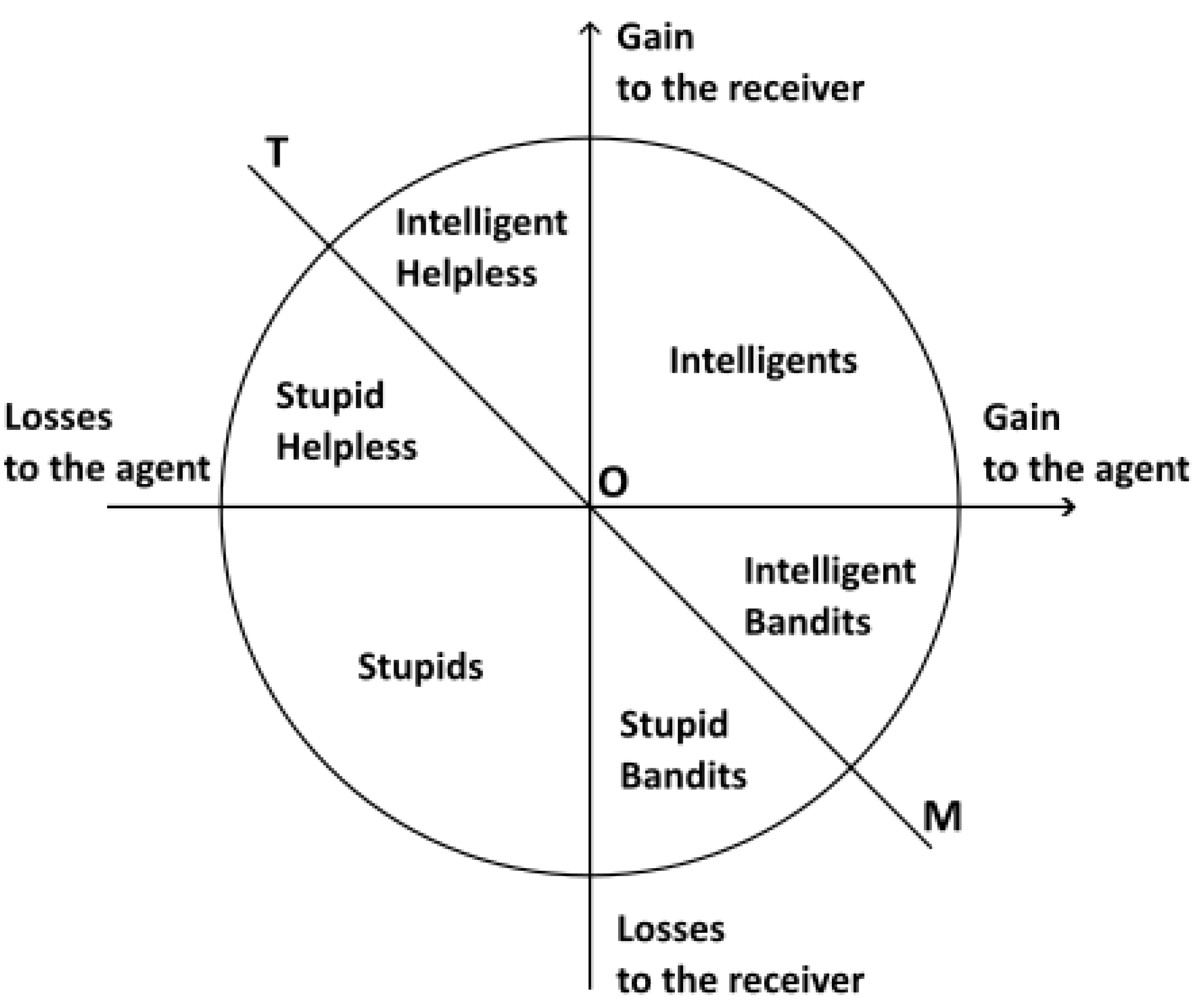
Figure 3.
Social Impact based on Cipolla’s Model with Psychological and Biological definitions of behaviors.
Figure 3.
Social Impact based on Cipolla’s Model with Psychological and Biological definitions of behaviors.
Disclaimer/Publisher’s Note: The statements, opinions and data contained in all publications are solely those of the individual author(s) and contributor(s) and not of MDPI and/or the editor(s). MDPI and/or the editor(s) disclaim responsibility for any injury to people or property resulting from any ideas, methods, instructions or products referred to in the content. |
© 2026 by the authors. Licensee MDPI, Basel, Switzerland. This article is an open access article distributed under the terms and conditions of the Creative Commons Attribution (CC BY) license (http://creativecommons.org/licenses/by/4.0/).
Copyright: This open access article is published under a Creative Commons CC BY 4.0 license, which permit the free download, distribution, and reuse, provided that the author and preprint are cited in any reuse.