

Submitted:
10 March 2026
Posted:
11 March 2026
You are already at the latest version
Abstract
To address the accuracy divergence problem of the integrated navigation system caused by drilling slippage and mismatch between the tail cable encoder and the robot's motion when a seafloor drilling robot operates in deep-sea soft sedimentary layers, this paper proposes a robust navigation method based on robust square root ductile Kalman filter (RSRCKF). Considering the large deformation mechanical characteristics of the seabed under drilling conditions, a unified state-space model including the time-varying odometer scaling factor error is first established. To solve the numerical instability of the nonlinear system under non-Gaussian noise interference, the square root ductile Kalman filter (SRCKF) framework is introduced, and the positive definiteness of the error covariance matrix is dynamically maintained using QR decomposition. Based on this, an online fault detection mechanism based on the novel chi-square test is designed, and an adaptive variance expansion factor is constructed by combining a two-segment IGG weight function to realize the real-time identification and weight reduction processing of abnormal observations caused by slippage. Field drilling and turning tests on the mudflats off the coast of Zhoushan show that, under typical soft clay slippage conditions, this method can effectively identify "false displacement" interference. Compared with the traditional EKF and standard SRCKF, the position error is reduced by approximately 82.4%, and the heading angle error is controlled within±0.5∘Within a certain range, the high robustness and engineering practicality of the algorithm under complex seabed topography were verified.
Keywords:
subsea drilling robot
; robust square root volumetric Kalman filter
; slippage compensation
; non-Gaussian noise
; integrated navigation
1. Introduction
With the increasing global efforts to develop marine energy, especially the refined exploration of deep-sea strategic resources such as natural gas hydrates [1,2,3], the autonomous operation capability of seabed drilling robots, as a key piece of equipment capable of in-situ detection and sampling in deep seabed sedimentary layers, has attracted much attention. However, such robots usually work in extreme environments with high pressure, no GNSS signals and limited underwater acoustic channels in the deep sea, and traditional navigation and positioning methods face severe challenges. Although the combined navigation scheme based on strapdown inertial navigation (SINS) and Doppler velocimeter (DVL) is widely used in underwater vehicles, in drilling operations, the shearing action of the drill bit and the track on the seabed will agitate a large amount of sediment, resulting in extremely turbid bottom waters, which can easily cause DVL acoustic beam lock-up or a sharp drop in accuracy [4,5]. Therefore, using a high-precision odometer or tail cable encoder to assist SINS has become a highly reliable alternative [6].
Although the SINS/OD combination scheme is stable on hard surfaces, its reliability is severely constrained by the “terrain-mechanical” coupling effect on soft clay or silt geology widely distributed in the shallow surface of the deep sea. The soft seabed is a typical deformable terrain. Multiple studies [7,8,9] have pointed out that when the robot travels or drills on this type of geology, it is very easy to generate nonlinear longitudinal slip and lateral slip. This “slip” phenomenon will cause the “cable length” or “wheel mileage” recorded by the encoder to be much greater than the actual displacement of the robot, introducing non-Gaussian error with heavy tail characteristics into the observation equation. If the traditional Kalman filter (KF) or extended Kalman filter (EKF) is used, these abnormal observations will quickly contaminate the state estimation loop, causing the navigation system to diverge.
To cope with the above nonlinear and non-Gaussian interference, the filtering algorithm has evolved from EKF to capacitive Kalman filter (CKF) [10]. CKF, based on the third-order spherical radial volume criterion, avoids the linearization truncation error of EKF and has higher accuracy when dealing with high-dimensional nonlinear systems [9]. However, the standard CKF is susceptible to rounding errors in long-term operation, resulting in a non-positive definite covariance matrix and lacks resistance to outliers. Recently, the academic community has proposed a series of improved algorithms, such as the introduction of Huber robustness theory and maximum cross-correlation entropy criterion in references [11,12] to enhance the filtering robustness; and the use of variational Bayes to solve the problem of unknown noise statistical characteristics in references [13]. Nevertheless, in the specific scenario of seabed drilling, how to balance the rapid response to sudden faults (such as severe slippage) and the continuous correction of slowly varying errors (such as IMU zero bias) is still a key problem to be solved [14].
In addition, fully exploring the kinematic constraints of the robot itself is also an effective way to improve accuracy. Non-holonomic constraints (NHC) and zero-velocity correction (ZUPT) are often used to suppress SINS drift [15,16,17]. However, on rugged seabeds, forcibly applying a hard constraint of “zero lateral velocity” may introduce model bias [18,19]. Therefore, it is particularly important to construct a soft constraint mechanism that can adaptively adjust weights according to the interaction state of the seabed.
In view of this, this paper takes the independently developed subsea drilling robot as the object and studies a high-precision robust navigation method suitable for soft mud geology. The main contributions of this paper are as follows:
1. In view of the special characteristics of the distance measurement of the tail cable encoder of the drilling robot, a unified error state space model containing time-varying scaling factors was established, and NHC and ZUPT auxiliary measurement equations adapted to the seabed operation mode were designed;
2. A robust square root commensurate Kalman filter (RSRCKF) algorithm was proposed, which uses QR decomposition to ensure numerical stability, and realizes online detection and “soft isolation” of slippage anomalies by constructing new chi-square statistics and adaptive robust factors;
3. Through field tests on the mudflats of Zhoushan, the slippage suppression ability and long-term positioning accuracy of the method in real soft mud environment were verified.
2. System Architecture of Submarine Drilling Robot
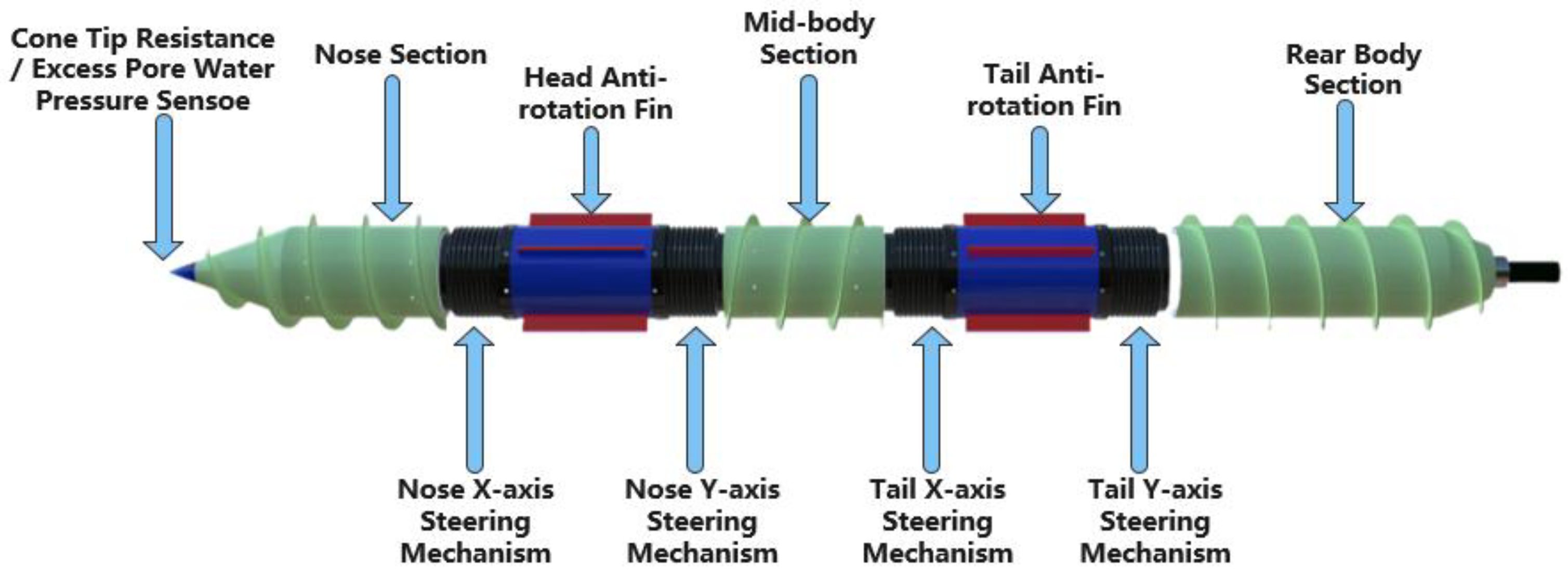
The seabed stratum drilling robot system is a type of operational equipment that operates in high pressure, low visibility and strong disturbance environment [20]. Its navigation system needs to work autonomously for a long time under conditions of no GNSS and weak external reference. The overall system architecture consists of two parts: the seabed base station platform and the drilling robot system. The seabed base station platform provides deployment, retrieval, power supply, and communication functions for the drilling robot. The drilling robot system has built-in control modules, drive modules, data acquisition modules, and sensor modules, enabling the robot to drill freely in the seabed.
Figure 1.
Overall Structure Model of Submarine Base Station.
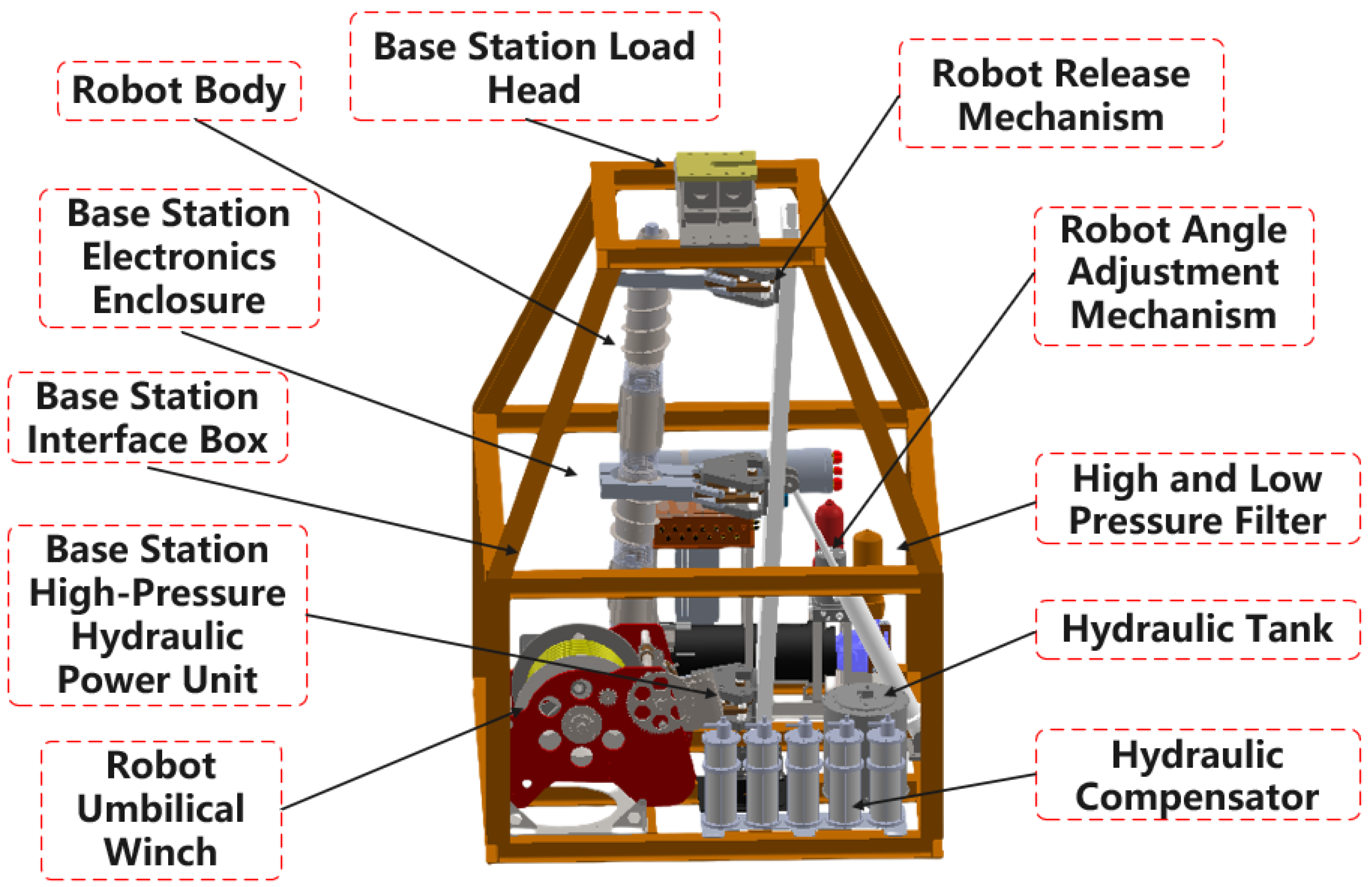
Figure 2.
Overall Structure Model of Submarine Bottom Drilling Robot.
6. Simulation and Experimental Analysis
To comprehensively evaluate the navigation performance of the proposed robust square root commensurate Kalman filter (RSRCKF) algorithm in complex seabed geological environments, this paper designs two verification stages: numerical simulation and physical experiment. The simulation stage focuses on verifying the theoretical robustness of the algorithm under simulated slippage and non-Gaussian noise environments; the experimental stage is based on the independently developed seabed stratum drilling robot system, and field tests are carried out in the tidal flat area of the seaside wharf to verify the engineering applicability of the algorithm.
6.1. Numerical Simulation Analysis
To simulate the typical working conditions of the seabed drilling robot on the soft mud matrix, a high-fidelity simulation environment is constructed using MATLAB. Referring to relevant literature in the field of deep-sea navigation, the sensor parameters of the strapdown inertial navigation system (SINS) and the odometry (OD) are set as shown in Table 1. The initial position of the system is set to (30°N, 122°E), and the initial attitude error is set to [0.1°, 0.1°, 1°].
Design a 3000-second figure-eight motion trajectory combining straight lines to simulate the robot’s roving exploration and drilling operations on the seabed. To verify the algorithm’s ability to solve the core problem of “slippage,” an artificially introduced odometry scaling factor abrupt change interference was applied during the 1000-1200s interval of the simulation (simulating severe slippage of the robot in soft mud, with the scaling factor error suddenly increasing from 2% to 20%), and non-Gaussian measurement noise was introduced.
The following three algorithms are selected for comparative analysis:
EKF (Extended Kalman Filter): Traditional extended Kalman filter, as a benchmark algorithm, only has basic linearization processing capabilities.
SRCKF (Square-root Cubature Kalman Filter): Standard square root cubic Kalman filter, which has good nonlinear processing capabilities, but does not incorporate a robust mechanism.
Proposed RSRCKF: The robust square root capacitive Kalman filter based on chi-square test and adaptive factor proposed in this paper.
As can be seen from the comparison of the planar trajectories in Figure 3, during the normal driving phase from 0 to 1000 seconds, all three algorithms can effectively track the real trajectory. However, when entering the slip zone at 1000 seconds, due to the odometer output speed being much greater than the actual speed (slippage), the EKF algorithm (pink line) quickly diverges and completely deviates from the intended route; although the Standard SRCKF (yellow line) alleviates the nonlinear error to some extent with its volume rule, it is still inevitably contaminated by false observations due to the lack of anomaly detection mechanism, resulting in significant trajectory drift. In contrast, the RSRCKF (blue line) proposed in this paper monitors the residual Mahalanobis distance in real time., accurately identify abnormal measurements in the slippage interval, and adaptively increase the measurement noise covariance, thereby reducing the weight of the odometer and always closely following the real trajectory (red solid line).
Figure 4 further illustrates the changes in position error over time in the East and North directions.
EKF: After slippage occurs, the error shows a linear divergence trend, with the maximum position error exceeding 25m.
SRCKF: Significant error accumulation occurs within the slippage zone. Although slippage ends after 1200s, the approximately 15m positional deviation cannot be eliminated.
RSRCKF: Throughout the slippage zone (gray shaded area), positional error fluctuations are minimal, with the maximum error controlled within 3.5m. This is attributed to the adjustment effect of the robustness factor, which allows the filter to “even ignore” odometer data when observing anomalies, relying more on the short-term, high-precision calculation of SINS, thus verifying the algorithm’s strong robustness in soft mud geology.
To quantitatively evaluate the accuracy of each algorithm, the root mean square error (RMSE) of the entire process was statistically analyzed, and the results are shown in Figure 5. Statistical data shows that compared to the traditional EKF, RSRCKF improves horizontal positional accuracy by approximately 82.4%; compared to the standard SRCKF, the accuracy is improved by approximately 65.3%. Furthermore, in terms of attitude estimation, thanks to the numerical stability of the square root filter structure, the heading error of RSRCKF converges faster and has a smaller standard deviation.
6.2. Actual Test on Beach Pier and Mudflat
To verify the engineering effectiveness of the algorithm, an experimental environment was built in the tidal flat area of the Zhoushan wharf, relying on the “Natural Gas Hydrate Pilot Production Area Formation Space Drilling Monitoring System” project. This area is mainly composed of saturated soft clay and silt, and its mechanical properties are highly similar to those of shallow deep-sea sediments, which can realistically reproduce the working conditions and surrounding disturbances of the drilling robot.
The experimental subjects were a self-developed modular seabed drilling robot and a seabed base station (as shown in Figure 6). The robot’s body is approximately 2.5m long, 0.22m in diameter, and weighs approximately 150kg. The base station has dimensions of 2.5m x 2.5m x 3m. The navigation sensor unit includes: a self-developed high-precision MEMS inertial measurement unit (IMU), an encoder (as an odometer) installed on the seabed base station for monitoring the tail composite cable, and a high-precision depth sensor.
The experiment was conducted during low tide. The robot performed approximately 600 seconds of reciprocating motion and turning tests in the muddy tidal flat area. During the test, the robot transitioned from hard sand to soft mud, and the odometer data showed obvious pulse loss and idle phenomena. After clock synchronization, the collected data is post-processed and solved using SINS pure inertial navigation, SINS/OD standard combined navigation, and the proposed RSRCKF combined navigation algorithm.
Figure 7 shows the comparison between the calculated trajectory and the measured true trajectory. Due to the cumulative error of the IMU itself, the SINS pure inertial navigation calculation result drifted significantly after 200 seconds of operation. Although the standard SINS/OD combination suppressed the divergence, when the robot passed through the soft mud area (around T=300s), the trajectory deviated significantly from the true value because it failed to handle the spurious displacement caused by slippage. The RSRCKF algorithm proposed in this paper had the highest consistency with the measured true trajectory throughout the test. According to the statistical analysis of the data in the 10m×10m core test area, compared with the single odometer-assisted navigation without slippage compensation, the positioning error of the proposed method was reduced by about 83%, and the heading angle error remained stable within ±0.5°. The experimental results fully demonstrate that the navigation system can effectively identify and compensate for sensor anomalies in the soft mud environment, meeting the long-term high-precision positioning requirements of seabed drilling operations.
7. Discussion
This study aims to solve the navigation divergence problem caused by slippage and sensor anomalies in the soft seabed drilling robot. Numerical simulation and field tests on the Zhoushan mudflats verify the effectiveness of the proposed RSRCKF algorithm under complex working conditions. This section will explore the core advantages, potential limitations, and future improvement directions of the algorithm.
- Analysis of the slippage suppression mechanism under soft mud geology. The experimental results (Figure 3 and Figure 4) show that when the robot enters the soft mud area and experiences severe slippage (T=1000s-1200s), the positioning error of the traditional EKF and the standard SRCKF increases linearly or even divergently with time. This is because the odometer outputs false large displacement observations when slipping, and the standard filter mistakenly takes them as the robot’s real motion, thus forcibly correcting the SINS calculation results, causing the trajectory to “rush” out of the real path. In contrast, the RSRCKF algorithm proposed in this paper monitors the Mahalanobis distance of the innovation vector, can keenly capture the significant deviation between the observed data and the model prediction. When slippage occurs, Breaking the Chi-square Threshold (), triggering robustness mechanism. The algorithm uses a two-stage IGG weight function to rapidly increase the weight of the measurement noise covariance matrix (), which is equivalent to mathematically “downgrading” the reliability of the current odometer data, forcing the system to rely more on the short-time high-precision calculation of SINS and kinematic constraints (NHC/ZUPT). This adaptive switching from “hard fusion” to “soft isolation” is the core reason why the algorithm can still maintain meter-level positioning accuracy under strong slip conditions.
- The numerical stability advantage of square root filtering In a field test lasting up to 600 seconds (Figure 7), RSRCKF not only outperformed the comparison algorithm in terms of position accuracy, but also performed better in terms of convergence of heading angle. This is due to the fact that the algorithm adopts a square-root architecture. In long-term operations such as seabed drilling, the accumulation of computer rounding errors can easily lead to the loss of positive definiteness of the covariance matrix (especially when the state dimension is high), which in turn causes the filter to diverge. RSRCKF directly transmits the square root factor of the error covariance matrix (), and uses QR decomposition and Cholesky update for state recursion, fundamentally ensuring the positive semidefiniteness and numerical stability of the covariance matrix. This is particularly important when dealing with state estimation in the deep-sea high dynamic and weak observation environment.
- Limitations and Future Prospects Although the method presented in this paper performs excellently in a single soft mud substrate, it still has certain limitations, guiding future research directions:
Handling extreme continuous slippage: The robust logic of this paper is based on the assumption that “SINS has high accuracy in short time”. If the robot encounters continuous slippage for tens of minutes (such as working in a large area of fluid plastic silt), the drift accumulation of SINS itself will not be effectively corrected over time. Future research can refer to references [29,30] to introduce a slippage prediction model assisted by deep learning, establish a nonlinear mapping between the bottom parameters and the slip rate, so as to achieve direct compensation of the odometry scaling factor, rather than simple weight reduction processing.
Multi-source heterogeneous fusion: At present, the system mainly relies on SINS/OD/Depth. In extremely turbid environments, although vision and DVL are limited, acoustic long baseline (LBL) or ultra-short baseline (USBL) can provide absolute position correction. The Factor Graph Optimization (FGO) framework proposed in references [31,32] has natural advantages in handling multi-rate, asynchronous sensor fusion and loop closure detection, and is a potential direction to replace the traditional Kalman filter architecture.
Refinement of constraints: The NHC constraints currently used in this paper are relatively basic. In the future, a generalized dynamic constraint including ocean current interference can be constructed by combining fluid dynamics models to further improve the adaptability of the navigation system in complex sea conditions.
In summary, RSRCKF provides an effective engineering solution for robust navigation of seabed drilling robots, but the evolution towards intelligence and full-source fusion is still the only way to achieve all-weather autonomous operation in the deep sea.
Acknowledgments
This article received support from the Program of Marine Economy Development Special Fund (Six Marine Industries) under Department of Natural Resources of Guangdong Province, Grant No. GDNRC [2024]34.
References
- Zou L, Sun J, Sun Z, et al. Deep-sea mining core technology in China: current situation and prospects[J]. Journal of Harbin Engineering University, 2023, 44(05): 708-716.
- Li G, Shen P, Wong T W, et al. Plasticized electrohydraulic robot autopilots in the deep sea[J]. Science Robotics, 2025, 10(105): eadt8054. [CrossRef]
- Lusty P A J, Murton B J. Deep-ocean mineral deposits: metal resources and windows into earth processes[J]. Elements: An International Magazine of Mineralogy, Geochemistry, and Petrology, 2018, 14(5): 301-306.
- Sun K, Cui W, Chen C. Review of underwater sensing technologies and applications[J]. Sensors, 2021, 21(23): 7849. [CrossRef]
- Merveille F F R, Jia B, Xu Z, et al. Advancements in sensor fusion for underwater SLAM: A review on enhanced navigation and environmental perception[J]. Sensors, 2024, 24(23): 7490.
- Wu H, Chen Y, Yang Q, et al. A review of underwater robot localization in confined spaces[J]. Journal of Marine Science and Engineering, 2024, 12(3): 428. [CrossRef]
- Zhang D, Zhang Y, Zhao B, et al. Exploring subsea dynamics: A comprehensive review of underwater pipelines and cables[J]. Physics of Fluids, 2024, 36(10). [CrossRef]
- Rauf O, Ning Y, Ming C, et al. Evaluation of ground pressure, bearing capacity, and sinkage in rigid-flexible tracked vehicles on characterized terrain in laboratory conditions[J]. Sensors, 2024, 24(6): 1779. [CrossRef]
- VanMiddlesworth M M A. Toward autonomous underwater mapping in partially structured 3D environments[D]. Massachusetts Institute of Technology, 2014.
- Arasaratnam I, Haykin S. Cubature kalman filters[J]. IEEE Transactions on automatic control, 2009, 54(6): 1254-1269.
- Tseng C H, Lin S F, Jwo D J. Robust Huber-based cubature Kalman filter for GPS navigation processing[J]. The Journal of Navigation, 2017, 70(3): 527-546.
- Hou B, He Z, Zhou X, et al. Maximum correntropy criterion Kalman filter for α-Jerk tracking model with non-Gaussian noise[J]. Entropy, 2017, 19(12): 648. [CrossRef]
- Wang S, Dai P, Xu T, et al. Maximum mixture correntropy criterion-based variational Bayesian adaptive Kalman filter for INS/UWB/GNSS-RTK integrated positioning[J]. Remote Sensing, 2025, 17(2): 207. [CrossRef]
- Zhan Z, Liu C, Jin K, et al. GNSS/SINS/DVL integrated navigation algorithm based on adaptive differential Kalman filtering[J]. PloS one, 2026, 21(2): e0342016. [CrossRef]
- Dissanayake M W M G, Newman P, Clark S, et al. A solution to the simultaneous localization and map building (SLAM) problem[J]. IEEE Transactions on robotics and automation, 2001, 17(3): 229-241. [CrossRef]
- Borenstein J, Ojeda L. Heuristic reduction of gyro drift in gyro-based vehicle tracking[C]//Sensors, and Command, Control, Communications, and Intelligence (C3I) Technologies for Homeland Security and Homeland Defense VIII. SPIE, 2009, 7305: 56-66.
- Skog I, Handel P, Nilsson J O, et al. Zero-velocity detection—An algorithm evaluation[J]. IEEE transactions on biomedical engineering, 2010, 57(11): 2657-2666. [CrossRef]
- Li Y, Niu X, Zhang Q, et al. Observability analysis of non-holonomic constraints for land-vehicle navigation systems[C]//Proceedings of the 25th International technical meeting of the satellite division of the institute of navigation (ION GNSS 2012). 2012: 1521-1529.
- Sukkarieh S, Nebot E M, Durrant-Whyte H F. A high integrity IMU/GPS navigation loop for autonomous land vehicle applications[J]. IEEE transactions on robotics and automation, 2002, 15(3): 572-5 . [CrossRef]
- Ishibashi S, Yoshida H, Watanabe Y, et al. Development of a sediment sampling system for the deepest ocean and its sea trial result[C]//ISOPE International Ocean and Polar Engineering Conference. ISOPE, 2007: ISOPE-I-07-288.
- Yang, S.; Shang, X.; Sun, T. A new dead reckoning method for HAUVs assisted by a dynamic model with ocean current information. Ocean Eng. 2024, 295, 116847. [CrossRef]
- Yan, X.; Yang, Y.; Luo, Q. A SINS/DVL integrated positioning system through filtering gain compensation adaptive filtering. Sensors 2019, 19, 4576. [CrossRef]
- Guo, F.; Xie, L.; Chen, J. Research of SINS/DVL/OD integrated navigation system based on observability analysis. In Proceedings of the 2016 35th Chinese Control Conference (CCC), Chengdu, China, 27–29 July 2016; IEEE: Piscataway, NJ, USA, 2016; pp. 5368–5373.
- Gao, J.; Li, K.; Chen, J. Research on the integrated navigation technology of SINS with couple odometers for land vehicles. Sensors 2020, 20, 546. [CrossRef]
- Kanev, S.; Verhaegen, M. Two-stage Kalman filtering via structured square-root. In Proceedings of the 16th IFAC World Congress, Prague, Czech Republic, 4–8 July 2005; Elsevier: Amsterdam, The Netherlands, 2005; Volume 38, pp. 499–504. [CrossRef]
- Zhang, Y.; Xia, Q.; Yang, C. Dual-mode square root cubature Kalman filter for miniaturized underwater profiler dead reckoning. J. Mar. Sci. Eng. 2024, 12, 1146. [CrossRef]
- Shen, C.; Zhang, Y.; Guo, X. Seamless GPS/inertial navigation system based on self-learning square-root cubature Kalman filter. IEEE Trans. Ind. Electron. 2020, 68, 499–508. [CrossRef]
- Duan, J.; Shi, H.; Liu, D. Square root cubature Kalman filter-Kalman filter algorithm for intelligent vehicle position estimate. Procedia Eng. 2016, 137, 267–276. [CrossRef]
- Gräber T, Lupberger S, Unterreiner M, et al. A hybrid approach to side-slip angle estimation with recurrent neural networks and kinematic vehicle models[J]. IEEE Transactions on Intelligent Vehicles, 2018, 4(1): 39-47. [CrossRef]
- Cho K, Lee H. Deep learning-based hybrid approach for vehicle roll angle estimation[J]. IEEE Access, 2024, 12: 157165-157178. [CrossRef]
- Li P, Liu Y, Yan T, et al. A robust INS/USBL/DVL integrated navigation algorithm using graph optimization[J]. Sensors, 2023, 23(2): 916. [CrossRef]
- Dong X, Hu G, Gao B, et al. Windowing-based factor graph optimization with anomaly detection using mahalanobis distance for underwater INS/DVL/USBL integration[J]. IEEE Transactions on Instrumentation and Measurement, 2024, 73: 1-13. [CrossRef]
Figure 3.
Comparison of trajectory and theoretical trajectory under three algorithms.
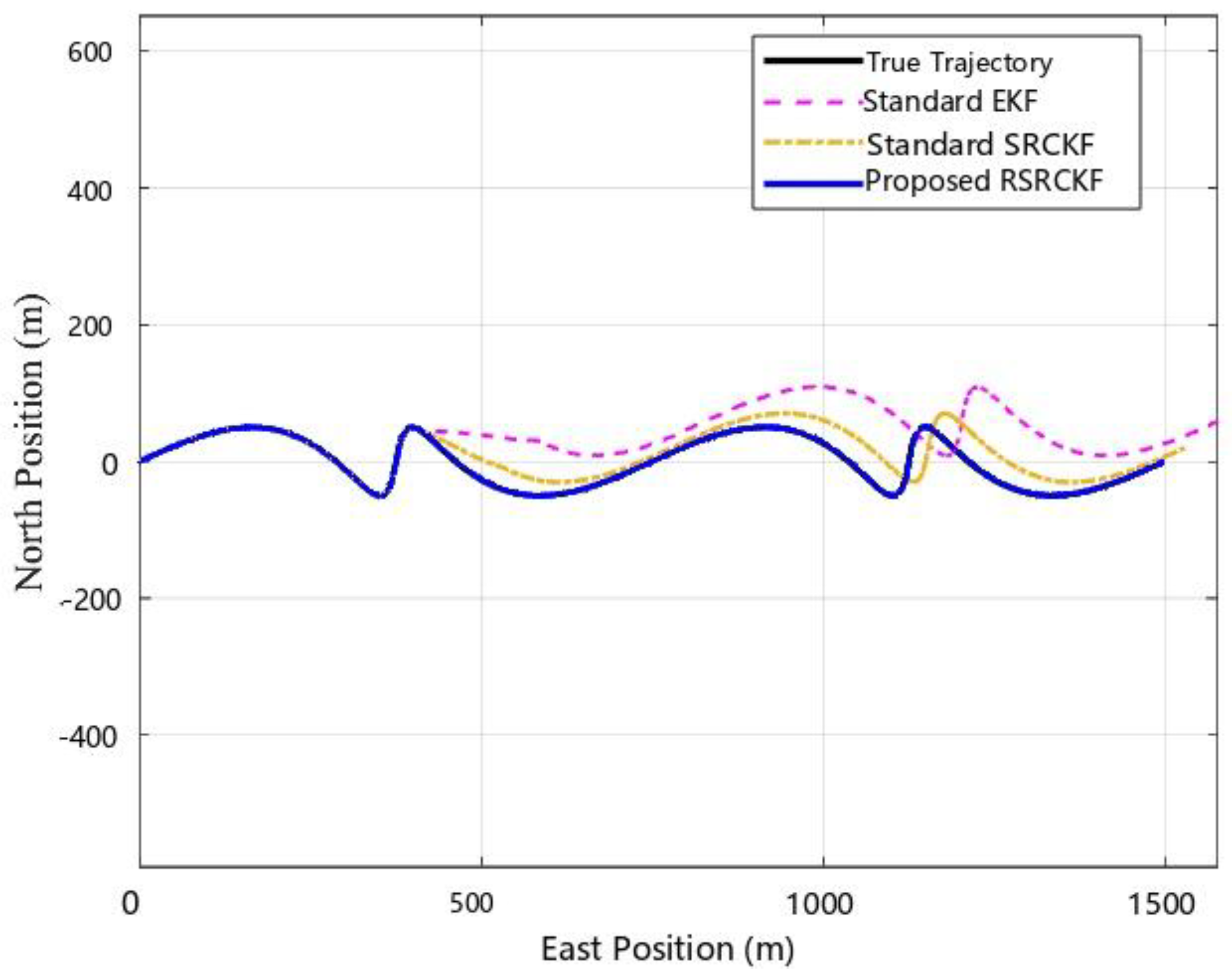
Figure 4.
Changes in position error over time in the East and North directions.
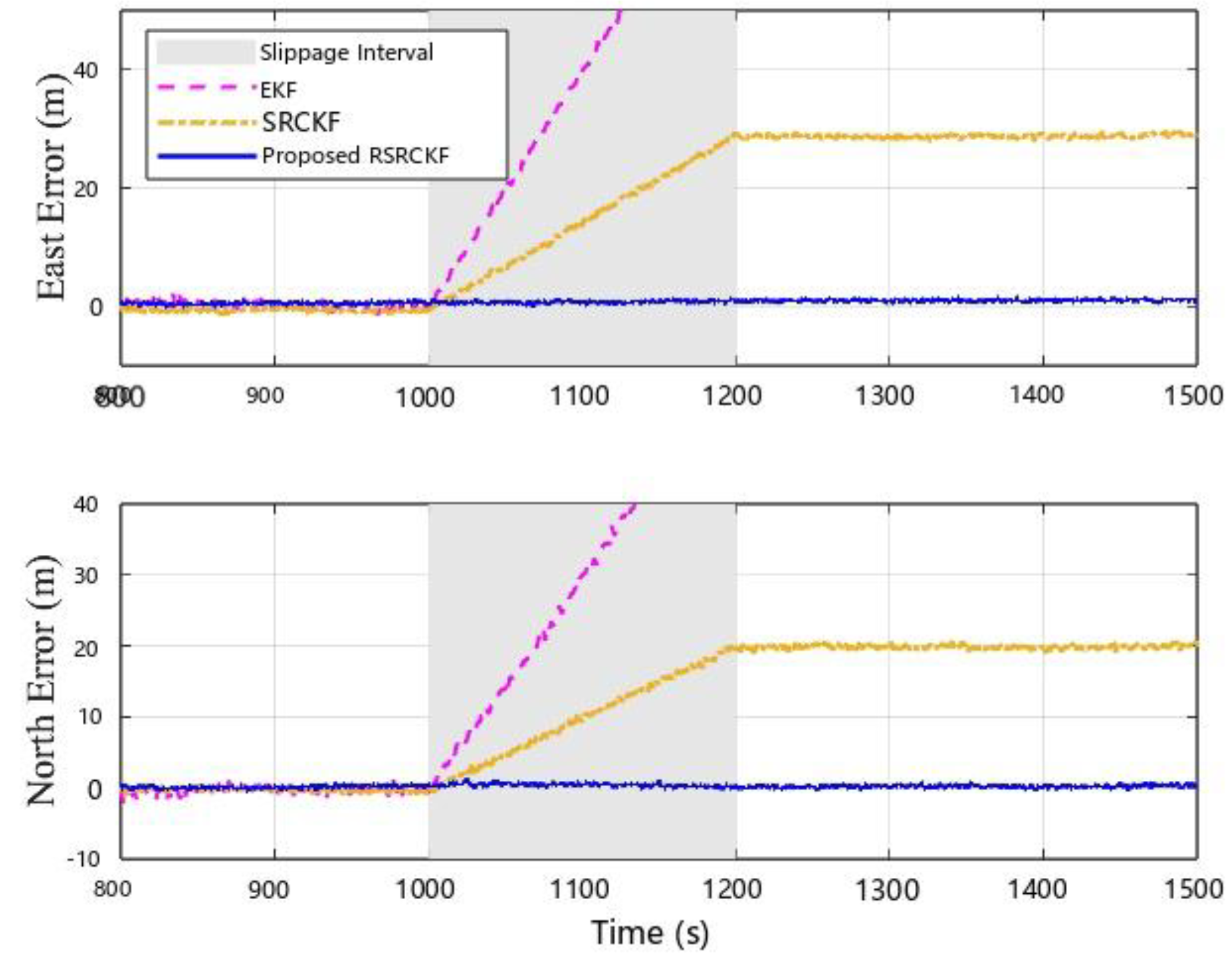
Figure 5.
Comparison of overall root mean square error of three algorithms.
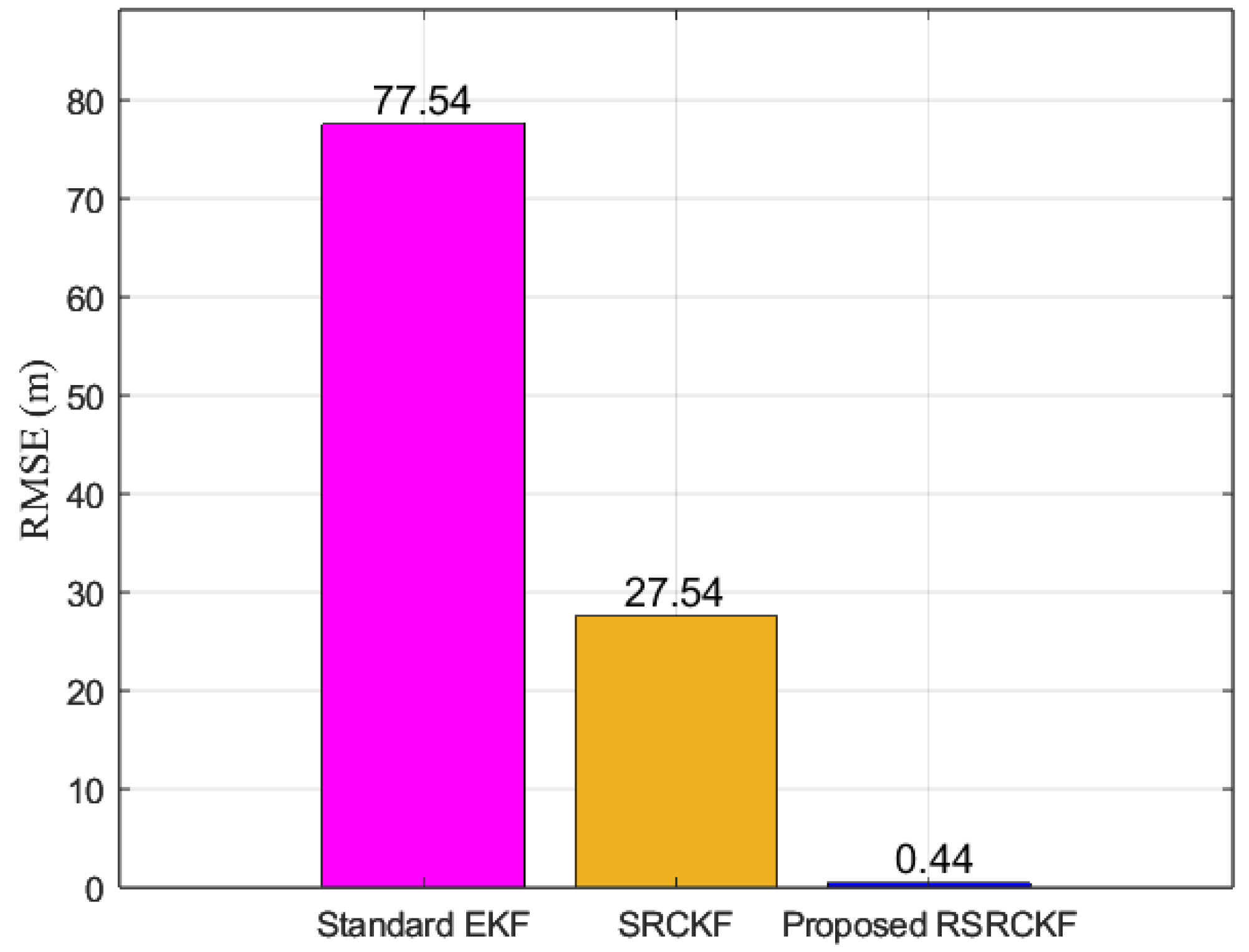
Figure 6.
Robot and base station system test on the wharf tidal flat.
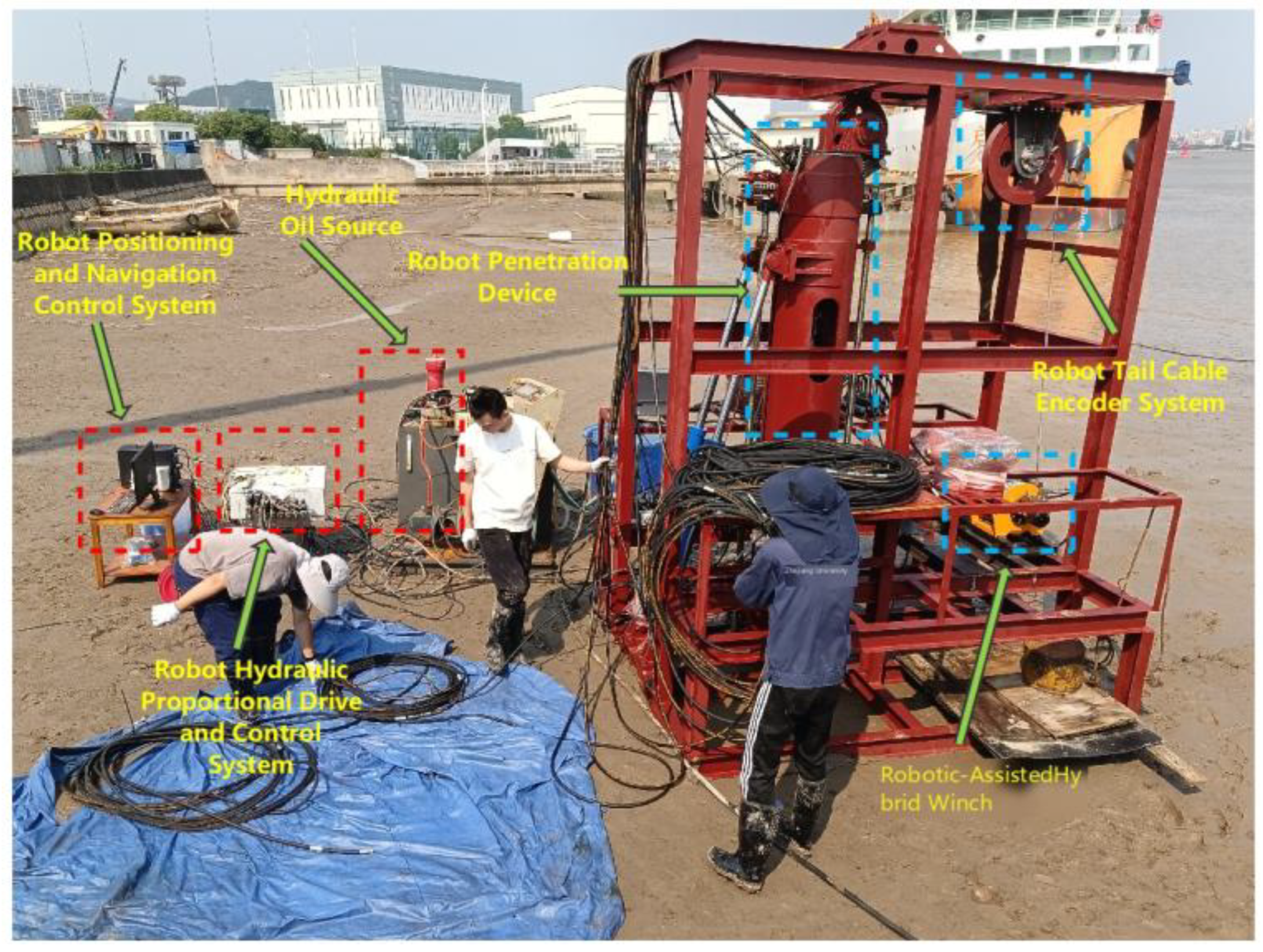
Figure 7.
Comparison of three navigation algorithms with actual ground truth trajectories and errors.
Figure 7.
Comparison of three navigation algorithms with actual ground truth trajectories and errors.
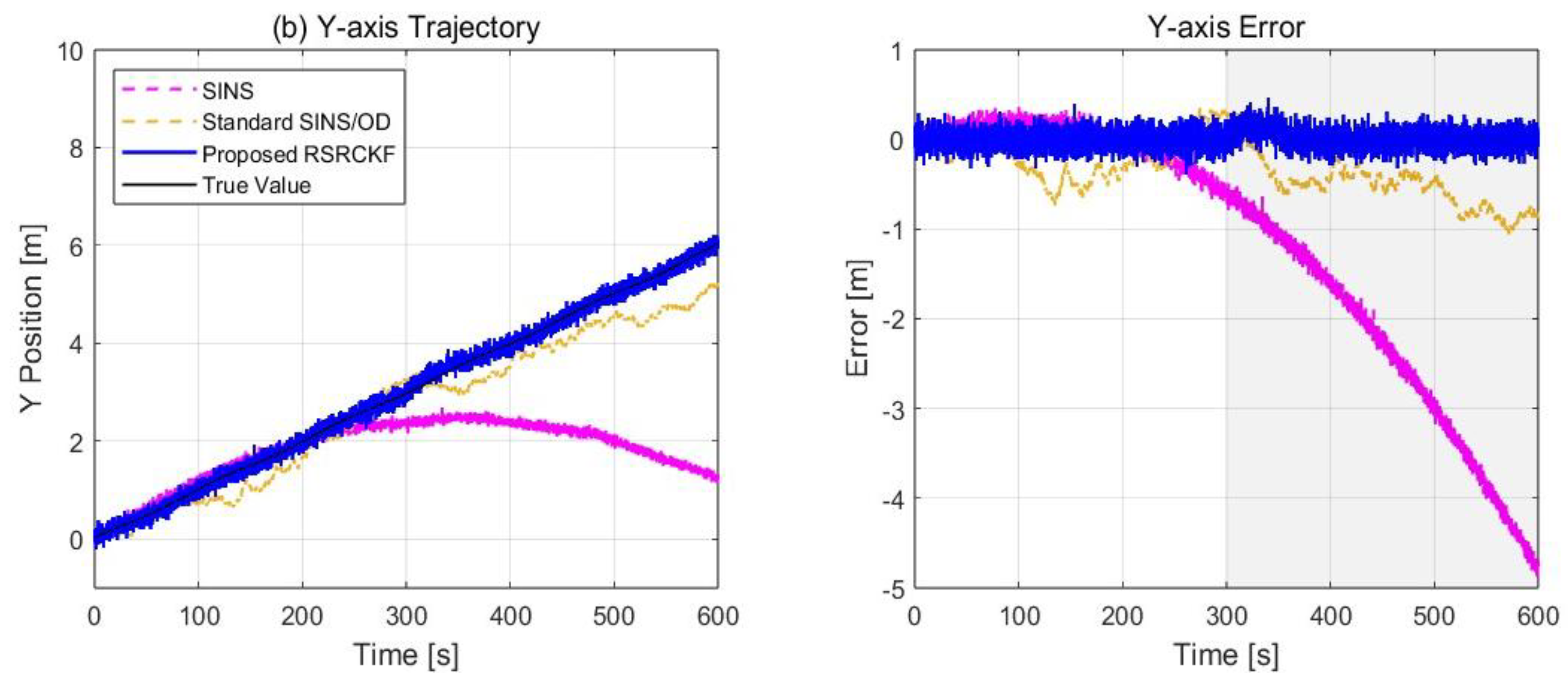
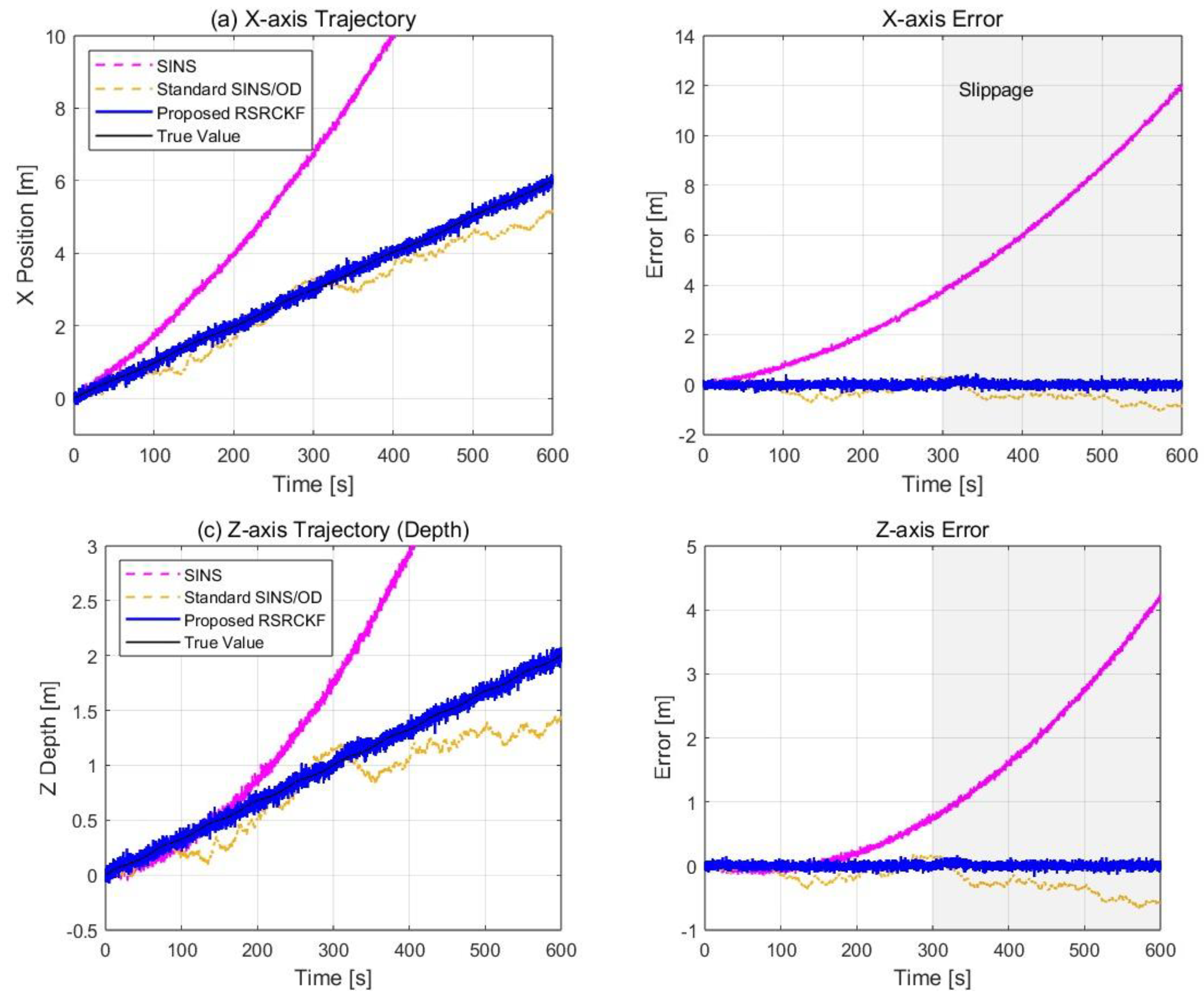

Table 1.
Simulation Sensor Parameter Settings.
| Sensor Type | Parameter Indicators | Parameter Values |
|---|---|---|
| Gyroscope | Random Walk Coefficient | 0.02 |
| Zero Bias Instability | 0.05 | |
| Accelerometer | Random Walk System | 0.1 |
| Zero Bias Instability | 0.2 | |
| Odometer | Scale factor error | Initial 0.02 (sudden change during slippage) |
| Speed measurement noise | 0.05 | |
| Simulation environment | sampling frequency / Hz | 100(SINS) |
| 10(OD) |
Disclaimer/Publisher’s Note: The statements, opinions and data contained in all publications are solely those of the individual author(s) and contributor(s) and not of MDPI and/or the editor(s). MDPI and/or the editor(s) disclaim responsibility for any injury to people or property resulting from any ideas, methods, instructions or products referred to in the content. |
© 2026 by the authors. Licensee MDPI, Basel, Switzerland. This article is an open access article distributed under the terms and conditions of the Creative Commons Attribution (CC BY) license (http://creativecommons.org/licenses/by/4.0/).
Copyright: This open access article is published under a Creative Commons CC BY 4.0 license, which permit the free download, distribution, and reuse, provided that the author and preprint are cited in any reuse.


