

Submitted:
07 March 2026
Posted:
11 March 2026
You are already at the latest version
Abstract
The European Union relies heavily on voluntary tax compliance, yet evidence on how tax literacy (TL) and tax education (TE) relate to tax morale (TM) and voluntary tax compliance or compliance intentions (VTC) remains fragmented across partly disconnected strands of literature. This systematic review examined EU-relevant evidence on the stakeholder contexts in which TL/TE are discussed in relation to TM and VTC, with particular attention to schools, communities, and public institutions. Following PRISMA 2020, searches in Scopus and Web of Science (2000–2025) applied two complementary query streams focused on TL/TE and TM/VTC-related mechanisms. The searches identified 1327 records; after deduplication and screening, 402 studies were included. Based on structured coding of titles, abstracts, and author keywords, the review maps patterns of emphasis and framing rather than causal effects. Public-institutional and education-related contexts were the most frequently signposted stakeholder environments, while digital and outreach-oriented delivery cues were more visible than classroom-based cues. Trust and fairness/justice dominated the explanatory vocabulary. Overall, the review supports an ecosystem-oriented interpretation of stakeholder coordination in EU tax literacy research.
Keywords:
tax literacy
; tax education
; tax morale
; voluntary tax compliance
; compliance intentions
; stakeholder ecosystems
; civic education
; taxpayer education
; European Union
1. Introduction
1.1. Background and Rationale
In the European Union, the practical functioning of taxation rests far more on everyday cooperation than on continuous enforcement, because tax administrations operate largely through taxpayer self-reporting and therefore rely heavily on voluntary compliance (OECD 2017; Sanimirović and Sever 2022; OECD 2025). Most taxpayers are not audited, yet public revenues remain relatively stable, an observation that has long pushed research beyond deterrence-only explanations and toward frameworks in which trust, legitimacy, and perceived fairness are central to understanding voluntary compliance (Kirchler et al. 2008; Koschuk 2021). This distinction matters in European democracies because compliance is embedded in the broader relationship between citizens and the state: when people feel respected by institutions and perceive decision-making as legitimate, compliance tends to resemble civic participation more than mere submission to enforcement (Frey 2003; Mitu 2020; Torgler 2022). In this sense, the issue is not only whether rules can be enforced, but whether citizens accept the fiscal contract as reasonable.
From this perspective, tax literacy is more than technical knowledge. It can also be understood as a civic capability that helps individuals make sense of why taxes exist, how they finance public goods, and how fairness claims relate to institutional legitimacy. Policy-oriented syntheses emphasize that tax morale, understood as the intrinsic motivation to pay taxes, is closely intertwined with trust in institutions and perceptions of fairness, suggesting that what citizens learn, and how they interpret their fiscal environment, may matter for compliance-related attitudes over time (Mitu and Stanciu 2018; OECD 2019). This helps explain why many tax administrations treat education and communication as part of building tax culture rather than as a marginal supplement to enforcement (OECD 2021).
At the same time, tax-related learning does not occur only through formal instruction. In EU contexts, it may also be supported by broader informational and institutional environments, including school-based initiatives, public communication efforts, and structured educational resources made available by public institutions. EU-level initiatives such as the European Commission’s TAXEDU platform illustrate one way in which tax-related learning has been organized for teachers and young people (European Commission 2017). In parallel, recent empirical work continues to show that compliance patterns are associated with attitudes, perceived ethics, and public awareness, that is, outcomes that may plausibly be relevant to education- and communication-related interventions (Surugiu et al. 2025). These considerations suggest that tax literacy and tax education deserve closer examination within the broader EU literature on tax morale and voluntary tax compliance.
Against this background, clarifying the key terms is necessary to reduce ambiguity and ensure analytical consistency. The next section therefore specifies the operational definitions that guide study screening and coding.
1.2. Core Concepts (Operational Definitions)
To maintain conceptual consistency across the review logic model and to support transparent screening and coding decisions, we defined the core constructs in operational terms. These definitions are deliberately “screening-ready” in the sense that each concept is anchored in observable indicators that can be identified in titles, abstracts, keywords, and, where needed, full texts.
Tax literacy (TL). In this review, tax literacy refers to a structured set of competencies that enable individuals to understand, evaluate, and act in relation to taxes in everyday life. TL is treated as multi-dimensional, typically combining (i) knowledge of tax concepts and obligations, (ii) the ability to apply this knowledge to practical situations (for example, filing, understanding VAT/PIT), and (iii) related attitudinal and behavioural dispositions relevant to compliant participation (De Clercq 2021). Screening marker: studies were treated as TL-relevant when they explicitly used the term “tax literacy” or when they measured tax-specific knowledge or skills (for example, VAT, income tax, filing) as an outcome or exposure, even if framed within broader economic or financial literacy (Moučková and Vítek 2018).
Tax education (TE) and taxpayer education. Tax education is defined as intentional, organized learning, whether formal (curriculum-based) or non-formal (programmes, workshops, platforms), that explicitly teaches taxation, the purposes of taxation, taxpayer rights and responsibilities, and/or the link between taxes and public goods. This includes structured initiatives developed by public institutions for schools and young people (European Commission 2017; OECD 2021). Screening marker: studies and programme documents were treated as TE-relevant when they described a planned educational activity with tax-related learning objectives, an identifiable target group (students, teachers, or citizens), and at least one reported outcome (knowledge, attitudes, intentions, or implementation-related insights).
Civic education (tax-relevant civic education). Civic education is used here in a focused, tax-relevant sense. In general terms, civic education develops the knowledge, skills, and attitudes needed for active and responsible citizenship (Borhan 2025). For the purposes of this review, civic education was treated as tax-relevant when it explicitly covered taxation or closely related public-finance themes (for example, redistribution and fairness, public goods, rule-following, or state legitimacy) or when it operationalized civic dispositions (such as trust, legitimacy beliefs, or civic norms) that were theorized and empirically examined as mechanisms linked to tax morale or compliance outcomes. Screening marker: a study was treated as tax-relevant civic education when it included tax-related civic content or empirically connected civic constructs (trust, legitimacy, civic norms) to tax morale and/or compliance outcomes in EU-relevant data.
Tax morale (TM). Tax morale is treated as the intrinsic motivation to pay taxes, that is, willingness to comply that is not reducible to fear of detection or punishment (Torgler 2005; OECD 2019; Kushnirovich 2025). Screening marker: inclusion required an explicit measure of tax morale (for example, items commonly used in Values Surveys), a clearly labelled tax morale construct, or a directly equivalent indicator capturing intrinsic motivation to pay taxes.
Voluntary tax compliance and compliance intentions (VTC). Following the behavioural compliance literature, we distinguish voluntary compliance from compliance driven primarily by deterrence or enforcement. Voluntary compliance is understood as willingness to comply grounded in trust and legitimacy, whereas enforced compliance is driven by the perceived power of authorities (Kirchler et al. 2008). Screening marker: studies were treated as VTC-relevant when they explicitly used “voluntary compliance” or “enforced vs voluntary compliance,” or when they operationalized compliance as intentions, attitudes, or self-reported compliant behaviours and analysed these outcomes through trust, legitimacy, fairness, or civic-norm mechanisms.
Stakeholders in tax literacy ecosystems. Stakeholders are defined as actors who design, deliver, support, or legitimate tax-related learning and the informational environments in which such learning is activated. For analytic clarity, we grouped stakeholders into (i) education actors (schools, teachers, universities, VET providers), (ii) community actors (parents, NGOs, local associations, community organizations), and (iii) public institutions (tax administrations, ministries, municipalities, EU bodies). Screening marker: eligible studies needed to identify at least one stakeholder role beyond the individual learner (for example, teacher training, tax authority outreach, community partnership, or institutional programme governance).
1.3. Review Gap and Intended Contribution
Although tax literacy (TL) and tax education (TE) are increasingly discussed in both policy and academic circles, the EU-relevant evidence base remains fragmented across partially disconnected research traditions (OECD 2021; European Parliamentary Research Service 2025). In tax compliance research, well-established frameworks distinguish voluntary tax compliance/compliance intentions (VTC) from enforced compliance and show that the former is closely tied to trust-based relationships and perceptions of legitimacy (Kirchler et al. 2008). In parallel, work specifically focused on TL continues to refine what the construct actually includes and how it should be operationalized, which indicates that the field is still consolidating its conceptual foundations (De Clercq 2021). The practical consequence is that studies sometimes use similar labels while measuring different things (or measure similar things under different labels) making synthesis and comparison unnecessarily difficult.
A second, closely related gap concerns the core outcome domain. While tax morale (TM) is widely used in EU and Europe-focused empirical research, recent systematic work underscores that TM suffers from substantial heterogeneity in definitions and operationalizations across studies, complicating the interpretation and cumulative value of findings (Puklavec et al. 2025). This matters for our topic because TL/TE are often assumed to influence TM and VTC, yet the chain of reasoning can become blurred if key constructs are not specified in a consistent way at the review level.
A third gap is implementation-focused. Tax administrations and international organizations have documented a wide variety of taxpayer education initiatives and delivery models (including school-based programs and partnerships) yet these mappings are typically not designed as EU-focused systematic syntheses that connect stakeholder arrangements to mechanisms and compliance-relevant outcomes (OECD 2021). Meanwhile, country-level empirical evidence from an EU Member State context suggests that TL can be positively associated with tax compliance (Nichita et al. 2019), but such results are not always integrated with the question that is central for educational policy and practice: who delivers TL/TE, through which stakeholder collaborations, and why these arrangements may plausibly matter for TM and VTC.
Against this background, the present systematic review aims to make three contributions. First, it aims to provide an EU-focused evidence map of TL and TE by distinguishing educational settings and stakeholder architectures (e.g., school-led, institution-led, and partnership-based arrangements). Second, it seeks to synthesize and organize the most recurrent explanatory pathways linking TL/TE to TM and VTC (especially institutional trust, perceived fairness, civic norms, and social capital) while maintaining strict alignment with the operational definitions introduced in Section 1.2. Third, it intends to translate the synthesis into implementation-relevant insights by identifying enabling conditions and barriers in stakeholder collaboration, thereby informing policy-to-practice design choices for TL/TE initiatives across EU Member States.
1.4. Conceptual Framing / Logic Model
Building directly on the operational definitions in Section 1.2, this review uses a conceptual chain in which tax literacy (TL) and tax education (TE) are treated as upstream constructs that may be linked to tax morale (TM) and, more indirectly, to voluntary tax compliance/compliance intentions (VTC). The purpose of this framing is not to assume a direct or uniform causal pathway across all studies, but to provide an organizing logic for synthesizing a heterogeneous EU-relevant evidence base. In this logic, TL/TE are approached as domains of learning, communication, and civic understanding that may plausibly relate to how taxpayers interpret the tax system, their obligations, and the legitimacy of public institutions.
A useful theoretical anchor for this review comes from the tax compliance literature, which distinguishes voluntary compliance from compliance driven primarily by enforcement. In this perspective, voluntary compliance is generally associated with legitimacy, trust, and fairness-related perceptions, whereas enforced compliance is more closely associated with deterrence and the perceived power of authorities (Kirchler et al. 2008). For the purposes of the present review, this distinction matters because education-related studies may report knowledge gains, awareness, or attitudinal change without clearly specifying whether these outcomes are linked to the trust- and legitimacy-oriented pathways typically associated with VTC. The logic model therefore does not assume that all TL/TE activity leads to TM or VTC, but rather that these constructs can reasonably be examined within a common analytical framework.
At the level of mechanisms, the review gives particular attention to pathways that recur in EU-relevant discussions of tax morale and compliance, especially institutional trust, perceived fairness, civic norms, and social capital or community context. These mechanisms are treated here as analytically relevant pathways through which TL/TE may be discussed in relation to TM and VTC. Within this framing, legitimacy is understood less as a separate competing mechanism than as an integrative perception through which trust-, fairness-, norm-, and community-related experiences may be interpreted in compliance-relevant ways. This emphasis is consistent with OECD syntheses that conceptualize TM as an intrinsic willingness to comply and stress the importance of taxpayers’ perceptions of institutions and the tax system (OECD 2019). At the same time, because recent systematic evidence shows substantial variation in how TM is defined and measured, the review maintains a cautious approach to construct alignment and does not presume conceptual equivalence across all included studies (Puklavec et al. 2025).
The same caution applies to the role of stakeholders. In this review, TL/TE are not conceptualized as school-only phenomena or as standardized interventions with uniform effects. Rather, they are treated as processes that may be embedded in broader stakeholder ecosystems involving education actors, community actors, and public institutions. Such configurations may structure the environments through which tax-related learning is delivered, interpreted, reinforced, or legitimized. In this sense, schools, communities, and public institutions are not assumed to “produce” compliance outcomes directly; instead, they are treated as actors and contexts that may influence the credibility, accessibility, relevance, and uptake of TL/TE-related learning. EU-level initiatives such as the European Commission’s TAXEDU portal illustrate one institutional model through which tax-related learning resources are organized and made available to teachers and young people, thereby situating TE within a broader school–institution relationship (European Commission 2017).
Accordingly, the logic model used in this review is best understood as a conceptual map for organizing evidence, not as a tested causal model. It provides a structured way to examine whether and how the EU-relevant literature signposts links among TL/TE, stakeholder configurations, mechanism vocabularies, TM, and VTC. This framing is especially appropriate for a review in which the results are synthesized primarily through structured coding of titles, abstracts, and keywords, because it supports analytical coherence without overstating what the included evidence can demonstrate.
1.5. Review Objective and Research Questions
The definitions in Section 1.2 were specified to ensure that tax literacy (TL), tax education (TE), tax morale (TM), and voluntary tax compliance/compliance intentions (VTC) are used consistently throughout the review, while the conceptual framing in Section 1.4 clarified why these constructs can reasonably be examined within a single analytical chain. Building on this foundation, the present systematic review aims to bring together EU-relevant evidence that remains dispersed across education research, public policy and administration, and the tax compliance/tax morale literature. More specifically, the review seeks to (i) map how TL and TE are represented across EU-relevant contexts, (ii) clarify which stakeholders are signposted as involved in their design, delivery, support, or legitimation, and (iii) organize the mechanisms most frequently invoked or signposted in relation to links among TL/TE, stakeholder involvement, TM, and VTC, while also identifying implementation-relevant cues visible in the included evidence base.
In line with this objective, the review is guided by the following research questions:
RQ1 (Evidence map): What forms of TL and TE are reported in EU contexts, and which stakeholders are signposted as involved in their design, delivery, support, or legitimation?
RQ2 (Mechanisms): Which mechanisms are most frequently invoked or signposted in EU-relevant studies when discussing links among TL/TE, stakeholder involvement, TM, and VTC (e.g., institutional trust, perceived fairness, civic norms, and social capital/community context)?
RQ3 (Policy-to-practice): What implementation-relevant cues, including enabling conditions and barriers, are visible in the EU-relevant evidence base regarding stakeholder collaboration for TL/TE, and what implications may be drawn for policy and educational practice?
1.6. Structure of the Paper
The paper is structured as follows. Section 2 presents the review design, reporting standard, eligibility criteria, information sources, search strategy, and study selection process. Section 3 reports the results of the review, including the PRISMA flow and the thematic evidence mapping. Section 4 discusses the findings in relation to the review questions and the conceptual framing, and outlines limitations and implications for future research. Section 5 concludes by summarizing the review’s contribution and its implications for stakeholder coordination in EU contexts.
2. Methods
2.1. Review Design and Reporting Standard (PRISMA 2020)
This study was designed as a systematic review using a narrative thematic synthesis and an evidence-mapping logic, reflecting the expected heterogeneity of study designs, stakeholder configurations, settings, and outcome measures across the EU-relevant literature on tax literacy (TL), tax education (TE), tax morale (TM), and voluntary tax compliance/compliance intentions (VTC). Given this conceptual and methodological variation, the review was not intended to estimate pooled effect sizes. Instead, it was designed to identify, organize, and synthesize the available evidence in a transparent and reproducible manner, with particular attention to how the included literature frames links among TL/TE, stakeholder involvement, TM, and VTC.
Reporting was guided by PRISMA 2020, which provides a structured framework for documenting study identification, screening, eligibility assessment, and inclusion, as well as for specifying information sources, search strategies, and synthesis procedures (Page et al. 2021a). In line with PRISMA 2020, the review reports the search strategy used for each database, provides a transparent account of the study selection process, including exclusions at full-text stage, and describes the procedures used to extract and synthesize information relevant to the review questions (Page et al. 2021b).
Consistent with the definitional approach established in Section 1.2, the review maintained construct clarity by applying screening-ready definitions during study selection and coding. This was intended to reduce ambiguity when organizing evidence relevant to the TL/TE–TM–VTC chain and to support consistent interpretation of stakeholder roles across studies drawn from partly disconnected strands of literature. Because the corpus was large and heterogeneous, and because the synthesis relied substantially on structured coding of titles, abstracts, and author keywords, the review was designed to characterize patterns of emphasis and framing across the included evidence base rather than to test causal pathways or compare intervention effectiveness directly.
The PRISMA flow was reported in the Results section as both a structured textual account and a flow diagram, documenting records identified, duplicates removed, records screened, full texts assessed, and studies included (Page et al. 2021a). This reporting structure was used to ensure auditability of the review process while keeping the synthesis aligned with the review’s evidence-mapping orientation.
2.2. Eligibility Criteria
Eligibility criteria were specified a priori and applied during title/abstract screening and full-text assessment to ensure consistent inclusion decisions and coding. The criteria were aligned with the operational definitions in Section 1.2 and were designed to preserve EU relevance while keeping the review feasible and implementation-oriented.
Scope (EU relevance and time window). Studies were eligible if they examined TL, TE, TM, VTC, and/or stakeholder-delivered tax learning in one or more EU Member States. Cross-national European studies were also eligible when EU Member States were identifiable and the relevant evidence was reportable or extractable at the level required for screening and synthesis. Studies were not included when EU relevance could not be confirmed. The primary publication window was 2000–2025. Earlier studies were considered only if they were clearly foundational to the constructs used in this review and directly relevant to the review’s conceptual framing.
Study types. Eligible records included empirical quantitative, qualitative, and mixed-methods studies; programme and policy evaluations, including process evaluations; and implementation-focused analyses describing stakeholder collaboration in TL/TE delivery. Institutional or policy reports were eligible only when they documented a clearly specified initiative, including at least objectives, target group, and delivery arrangements, and provided extractable information on stakeholder roles together with outcomes or implementation-relevant insights. Excluded records included purely doctrinal or legal analyses of tax rules without an education, stakeholder, or compliance component, as well as opinion pieces without empirical or programme evidence.
Populations and settings. Eligible studies covered learners in formal education, including primary, secondary, vocational, and higher education; educators and teachers; and broader taxpayer populations when the exposure or outcomes were explicitly linked to TL/TE or to mechanisms relevant to TM/VTC. Studies focused on stakeholder groups, such as tax administration staff, NGOs, community organizations, or local authorities, were eligible when their role in designing, delivering, supporting, or legitimating TL/TE could be identified and extracted.
Core concepts and outcomes (screening routes). To maintain transparent screening while capturing the two strands of evidence required by the review, two entry routes were applied. First, records entered the education stream when they explicitly addressed TL and/or TE, or reported tax-specific learning outcomes, and identified at least one stakeholder role beyond the individual learner, such as school delivery, tax administration involvement, community partnership, or programme governance. Second, records entered the mechanism stream when they examined TM and/or VTC in EU-relevant data and empirically addressed at least one mechanism prioritized in the review model, namely institutional trust, perceived fairness, civic norms, or social capital/community context. This dual-route approach was used to capture both implementation-focused TL/TE evidence and EU-relevant mechanism evidence without conflating conceptually distinct outcomes.
Language and accessibility. For feasibility and auditability, English-language publications were prioritized. Studies published in other EU languages were considered when the full text was accessible and could be reliably screened and extracted. Records that could not be accessed in full text or could not be reliably processed because of language constraints were excluded at full-text stage and documented accordingly.
Explicit exclusion rules. Records were excluded when one or more of the following conditions applied: (i) EU relevance could not be established; (ii) TL/TE content was absent under the operational definitions used in this review; (iii) TM/VTC-related content was present but not linked to an eligible mechanism under the mechanism stream; (iv) no stakeholder role beyond the individual learner could be identified where this was required for inclusion; (v) the paper did not provide empirical, evaluative, or implementation-relevant evidence; or (vi) full text was unavailable or could not be reliably extracted. These rules were applied to support consistent full-text eligibility decisions and to maintain alignment between screening, coding, and the review questions.
2.3. Information Sources
The review drew on two bibliographic databases: Scopus and the Web of Science Core Collection (WoS). These sources were selected because they provide structured indexing and exportable metadata suitable for systematic searching, screening, deduplication, and PRISMA-consistent reporting across a large and heterogeneous EU-relevant literature base.
Searches were conducted in both databases for the 2000–2025 period. No additional non-database searches were undertaken. This decision was made to maintain a transparent, auditable, and methodologically consistent evidence-identification process based on sources with comparable bibliographic export functions.
Records retrieved from Scopus and WoS were exported in standard bibliographic formats and merged into a single screening dataset. The combined dataset provided the basis for duplicate removal, title/abstract screening, full-text assessment, and PRISMA flow reporting. Export settings were configured, where applicable, to retain core bibliographic fields needed for screening and traceability, including titles, authors, publication year, source information, abstracts, author keywords, and DOIs.
2.4. Search Strategy
The search strategy was designed to align with the operational definitions in Section 1.2 and the review logic set out in Section 1.4. To capture the two strands of evidence required by the review questions, searches were structured around two complementary streams: (i) an education stream, targeting studies that explicitly addressed tax literacy (TL) and/or tax education (TE) in learning-related contexts, and (ii) a mechanism stream, targeting studies that examined tax morale (TM) and voluntary tax compliance/compliance intentions (VTC) together with mechanisms prioritized in the review model, namely institutional trust, perceived fairness, legitimacy, civic norms, and social capital/community context.
Because database queries cannot reliably isolate EU-only evidence, and because studies conducted in EU Member States do not always identify the setting as “EU” or “Europe” in titles, abstracts, or keywords, EU relevance was not imposed through a restrictive geographic search filter. Instead, it was applied during screening through the eligibility criteria specified in Section 2.2. This approach was used to reduce the risk of excluding substantively relevant EU studies at the search stage.
Searches were executed in WoS and Scopus for the 2000–2025 period. In WoS, searches were conducted in Advanced Search using the Topic field (TS). In Scopus, searches were conducted using the Title-Abstract-Keywords field (TITLE-ABS-KEY). Two queries were executed in each database, corresponding to the two search streams.
In WoS, the following queries were used:
Query A (TL/TE stream): TS=("tax literacy" OR "tax education" OR "taxpayer education" OR "fiscal education")
Query B (TM/VTC mechanisms stream): TS=("tax morale" OR "voluntary tax compliance" OR "tax compliance intention*" OR "voluntary compliance") AND TS=(trust OR fairness OR legitimacy OR "social capital" OR "social norm*" OR community)
In Scopus, the following queries were used:
Query A (TL/TE stream): TITLE-ABS-KEY("tax literacy" OR "tax education" OR "taxpayer education" OR "fiscal education")
Query B (TM/VTC mechanisms stream): TITLE-ABS-KEY("tax morale" OR "voluntary tax compliance" OR "tax compliance intention*" OR "voluntary compliance") AND TITLE-ABS-KEY(trust OR fairness OR legitimacy OR "social capital" OR "social norm*" OR community)
Where applicable, export settings were configured to retain the bibliographic fields needed for downstream processing, including title, authors, publication year, source information, abstract, author keywords, and DOI. No additional non-database searches were undertaken. The evidence base reported in this review was therefore identified through Scopus and WoS, with EU relevance enforced during screening rather than through the database queries themselves.
2.5. Study Selection Process
Records retrieved from Scopus and WoS were exported and merged into a single screening dataset. Duplicate removal was performed before screening, using DOI matching as the primary rule and title plus author–year checks when DOIs were unavailable. This procedure reduced the initial set of 1327 records to 969 unique records for title and abstract screening.
Title and abstract screening was then conducted against the eligibility criteria specified in Section 2.2, with the operational definitions in Section 1.2 used to support consistent construct interpretation. At this stage, each record was assigned to one of three screening categories: include, exclude, or maybe. Following title and abstract screening, 316 records were excluded and 653 reports were retained for full-text retrieval and eligibility assessment. Reasons for exclusion at this stage were recorded in the screening log using predefined categories, with exclusions occurring mainly because EU relevance could not be established or because the record did not fit the review’s substantive scope.
Full texts were sought for all 653 retained reports. Of these, six reports could not be retrieved and were recorded as unavailable. The remaining 647 reports were assessed at full text using the predefined eligibility criteria. Full-text exclusions were applied when EU relevance could not be confirmed, when TL/TE content was absent under the operational definitions used in the review, when stakeholder roles were not identifiable or extractable where required for inclusion, or when the paper did not provide empirical, evaluative, or implementation-relevant evidence suitable for synthesis. Following full-text assessment, 245 reports were excluded and 402 studies met all eligibility criteria and were included in the final review corpus.
The numerical outcomes of the selection process are reported in the PRISMA flow in Section 3.1, including records identified, duplicates removed, records screened, full texts sought and assessed, exclusions, and final study inclusion.
3. Results
3.1. PRISMA Flow
The database searches (Scopus and Web of Science; 2000–2025) yielded 1327 records. After removing 358 duplicates, 969 unique records were screened by title and abstract, of which 316 were excluded. At the title/abstract stage, exclusions were primarily due to insufficient EU contextual relevance (n = 222). The remaining records were excluded as out of scope at title/abstract (n = 94), most frequently because they were not substantively tax-related according to the screening log. Full texts were sought for 653 reports; six could not be retrieved, leaving 647 reports assessed for eligibility. Of these, 245 full-text reports were excluded based on the predefined eligibility criteria, resulting in 402 studies included in the systematic review. The complete study selection process is presented in the PRISMA 2020 flow diagram (Figure 1).
3.2. Study Characteristics
Across the 402 included studies, publication years (as indexed in Scopus and Web of Science) ranged from 2000 onward. Searches were executed for the 2000–2025 window; where the databases indexed early-access items with a subsequent year label, the indexed year was retained for descriptive reporting. The distribution of included studies by indexed publication year is shown in Figure 2.
With respect to database provenance, 145 studies were indexed in both Scopus and Web of Science, while 126 were unique to Scopus and 131 were unique to Web of Science. Provenance is summarized in Figure 3.
Document-type metadata indicated that journal articles represented the largest share of included records (n = 208; 51.7%), followed by book chapters (n = 21; 5.2%) and conference papers (n = 17; 4.2%); reviews accounted for n = 8 (2.0%). A substantial proportion of records were exported without a harmonized document-type label (n = 141; 35.1%), reflecting differences in indexing and export fields across the two databases. Metadata completeness was high overall: abstracts were available for 397 records (98.8%), author keywords for 375 (93.3%), and DOIs for 314 (78.1%).
Given the dual-stream search strategy, the included corpus spans both studies explicitly framed around tax literacy (TL) and/or tax education (TE) and a larger body of work indexed primarily around tax morale (TM) and voluntary tax compliance or compliance intentions (VTC). The thematic results that follow therefore report stakeholder/setting indicators, delivery modality cues, mechanism constructs, construct emphasis, and implementation cues using structured, term-based coding of titles, abstracts, and keywords.
3.3. Thematic Coding Basis and Reporting Logic
To address the review questions with a large and heterogeneous corpus, thematic results were derived through structured, term-based coding applied to titles, abstracts, and author keywords for all included studies (n = 402). The coding scheme was aligned with the conceptual logic model and focused on five analytic layers: (i) stakeholder and setting cues (schools and higher education; communities and civil society; public institutions and tax administration contexts; and related delivery environments), (ii) delivery modality cues (digital/online channels, outreach/campaigns, formal instruction, training/workshops, and service/guidance), (iii) mechanism constructs (trust, fairness/justice, social norms, deterrence/enforcement, legitimacy, and social capital), (iv) construct emphasis on TL, TE, TM, and VTC, and (v) implementation and policy-to-practice cues (programme/intervention and evaluation framing, policy/reform language, and implementation or scale-up terminology).
Because a given record can reference multiple stakeholders, modalities, and constructs, all indicators are term-based and non-mutually exclusive. They are interpreted as descriptive signals of topical emphasis in bibliographic metadata rather than as definitive study classifications or effect estimates. This approach supports evidence mapping and transparent reporting across a large corpus, while avoiding over-interpretation of terms that may be used differently across disciplines and publication outlets.
To minimize redundancy, the results are reported in a sequenced manner that mirrors the review logic. Section 3.4 maps stakeholder ecosystems and delivery environments (Figure 4). Section 3.5 reports delivery modalities signposted in the corpus (Figure 5). Section 3.6 summarizes mechanism constructs used to frame pathways relevant to TM and VTC (Figure 6). Section 3.7 reports construct emphasis and co-signposting patterns for TL/TE and TM/VTC (Figure 7). Section 3.8 then synthesizes implementation and policy-to-practice cues (Figure 8).
3.4. Stakeholder Ecosystems and Delivery Environments (RQ1)
Stakeholder ecosystems were mapped by identifying setting and actor cues in titles, abstracts, and author keywords. Figure 4 summarizes the distribution of stakeholder and setting indicators across the included corpus (n = 402). As records may contribute to more than one category, totals exceed n = 402.
Public-institution contexts were the most consistently signposted stakeholder environment. Terms consistent with tax authorities, tax administration, and government-related settings appeared in 163 records (40.5%). This prominence suggests that a large portion of the EU-relevant corpus frames compliance-related questions in institutional contexts where administrative interaction, perceived reliability, and governance arrangements are salient. In stakeholder-ecosystem terms, public institutions may function both as delivery actors (for example, through taxpayer guidance, service provision, and outreach) and as contextual anchors relevant to how taxpayers interpret system characteristics linked to TM and VTC.
Education-linked settings were also frequently visible in the corpus. Terms associated with schooling and higher education (for example, education, school, student, teacher, curriculum, university) appeared in 131 records (32.6%). This indicates a substantial educationally anchored segment of the literature, although such cues do not always denote a discrete TE intervention; in some cases, they may refer more broadly to civic or financial education contexts. Even so, the pattern supports the relevance of schools and higher education as recurrent stakeholder environments in EU-relevant work that engages TL/TE-related processes and compliance-linked constructs.
By contrast, community and civil society cues were less frequently explicit in titles, abstracts, or keywords, appearing in 36 records (9.0%). Business or workplace contexts were present in 43 records (10.7%). Their lower visibility does not necessarily indicate limited relevance; rather, it suggests that these contexts are less often foregrounded as indexing terms. In an ecosystem reading, they may still be present indirectly through the mechanism constructs emphasized in the literature, especially social norms and social influence.
A further notable feature of the corpus is the prevalence of media and digitally mediated environment cues. Terms consistent with media, social media, online/digital settings, and communication or outreach appeared in 207 records (51.5%). This indicates that, for many included studies, stakeholder environments are signposted in ways that highlight information exposure and communication infrastructures. Because these cues can co-occur with public-institution and education settings, they are better understood as cross-cutting delivery environments than as a distinct stakeholder category.
Overall, the stakeholder mapping indicates that EU-relevant evidence is most often signposted through public-institutional and education-linked environments, while community and workplace contexts are less frequently foregrounded. The strong presence of media and digital communication cues further suggests that delivery environments and information infrastructures are central to how stakeholder ecosystems are represented in the corpus. Section 3.5 builds on these contexts by examining the delivery modalities most commonly signposted across the included studies.
3.5. Delivery Modality Indicators (RQ1 and RQ3)
Delivery modalities were mapped by coding titles, abstracts, and author keywords for cues that describe how stakeholders deliver TE- and TL-relevant content or structure compliance-relevant information environments. Figure 5 summarizes delivery modality indicators across the included corpus (n = 402). As records may contribute to more than one category, totals exceed n = 402.
Digitally mediated delivery cues were the most prevalent modality indicators. Terms consistent with online/digital channels, e-learning, apps, websites, platforms, or social media appeared in 197 records (49.0%). This pattern indicates that, in the EU-relevant corpus mapped in this review, stakeholder-relevant activity is frequently framed in environments where information access and communication occur through digital infrastructures. Such infrastructures are analytically cross-cutting: they may be used by tax administrations and other public institutions (guidance portals, online services), by educational actors (online learning environments and blended delivery), and by community intermediaries (information diffusion through social media and online groups).
A second cluster of modality cues related to outreach, awareness, and campaign-oriented communication. Outreach and awareness campaign terms appeared in 63 records (15.7%). This is consistent with a strand of literature that frames compliance-related outcomes in relation to public communication and information provision. Within a stakeholder-ecosystem perspective, outreach cues are especially relevant to public institutions, but they may also capture partnerships or spillovers involving schools and communities when campaigns target broader civic audiences.
Indicators consistent with more structured, programmatic formats were less frequently foregrounded. Terms associated with workshops or training formats (seminars, training, modules, programmes) appeared in 30 records (7.5%), while formal instruction cues linked to curriculum, course, or classroom descriptors appeared in 24 records (6.0%). This lower visibility does not by itself indicate limited formal educational activity; it more likely shows that such specificity is not consistently foregrounded in titles, abstracts, or keywords. Where formal instruction cues are present, they align most naturally with school and higher-education environments, while workshop and training cues may capture delivery across multiple settings, including community or workplace contexts.
Two additional modality indicators were present in smaller subsets. Tax authority service and guidance cues (assistance, advice, guidance, service quality, helpdesk) appeared in 12 records (3.0%). Civic or financial education framing cues appeared in 13 records (3.2%). Although modest in frequency, these signals are policy-relevant because they suggest possible embedding of TE/TL within ongoing service environments or within broader capability-building agendas, rather than only as stand-alone tax education programmes.
Overall, the delivery modality mapping indicates that digital channels and outreach-oriented communication are the dominant modality cues in the EU-relevant corpus, while structured classroom and training formats are less frequently foregrounded. Section 3.6 turns to the mechanism constructs through which stakeholder environments and delivery modalities are related to TM and VTC in the mapped literature.
3.6. Mechanism Constructs Linking Stakeholder Environments to TM and VTC (RQ2)
Mechanism constructs were mapped by coding titles, abstracts, and author keywords for terms aligned with the review model (trust, fairness/justice, social norms, deterrence/enforcement, legitimacy, and social capital). Figure 6 summarizes the distribution of mechanism indicators across the included corpus (n = 402). As records may contribute to more than one category, totals exceed n = 402.
Trust-related language was the most frequently signposted mechanism construct, appearing in 174 records (43.3%). This prominence is consistent with a compliance literature in which confidence in institutions, perceived integrity, and governance credibility are often positioned as relevant correlates of TM and VTC. Within the stakeholder-ecosystem perspective, trust cues are also compatible with the view that stakeholder-delivered guidance and education operate in informational environments where credibility and perceived reliability matter for how obligations and institutional intentions are interpreted.
Fairness/justice-related terminology appeared in 109 records (27.1%). This indicates that perceptions of fairness, justice, or equity are frequently used to frame compliance-related questions. For the TL/TE–TM–VTC pathway, fairness cues are relevant because informational clarity and education may help frame perceptions of fairness by reducing uncertainty, clarifying entitlements and obligations, and making administrative procedures more navigable. At the same time, fairness also appears in the literature as a broader institutional property linked to tax policy design and the perceived equity of enforcement.
Social norms terminology was present in 83 records (20.6%). This signals a recurring emphasis on normative expectations, social influence, and shared beliefs about compliance, offering an important bridge between stakeholder environments and individual orientations. Norms-related framing can accommodate school-based socialization perspectives, community-level peer influence accounts, and institutional signalling about appropriate behaviour.
Deterrence/enforcement cues appeared in 90 records (22.4%), indicating that a substantial segment of the corpus explicitly frames compliance within audit, penalty, sanction, or enforcement environments. This is important for interpreting stakeholder-delivered TE and TL: the presence of deterrence cues suggests that many studies describe compliance in mixed models where informational and normative factors coexist with enforcement-related considerations. In this reading, education and communication are discussed less as substitutes for enforcement than as elements within a broader governance environment in which credibility, fairness, and compliance expectations are jointly interpreted.
Legitimacy language appeared in 31 records (7.7%), and explicit social capital phrasing appeared in 17 records (4.2%). These constructs are less frequently foregrounded as indexing terms, but they remain theoretically relevant to the review model. Their lower visibility suggests that such pathways may be present in study arguments without being consistently highlighted in titles, abstracts, or keywords.
Overall, the mechanism mapping indicates that the EU-relevant corpus most often frames stakeholder-relevant pathways to TM and VTC through trust and fairness/justice constructs, with additional emphasis on norms and deterrence. Section 3.7 then reports construct emphasis and co-signposting patterns for TL/TE and TM/VTC to clarify how frequently educational constructs are foregrounded alongside outcome-oriented compliance terms in the included record set.
3.7. Construct Emphasis and Co-Signposting (TL/TE, TM, and VTC) (RQ1 and RQ2)
This subsection reports how the included corpus signposted the focal constructs of the review, using coding of titles, abstracts, and author keywords for explicit references to TL, TE, TM, and VTC-related phrasing. Figure 7 summarizes construct indicators across the included corpus (n = 402). As records may contribute to more than one category, totals exceed n = 402.
Across the corpus, TM was the most frequently foregrounded construct, appearing in 201 records (50.0%). VTC-related phrasing (voluntary compliance and/or compliance intentions) appeared in 120 records (29.9%). By comparison, TE-related terminology appeared in 87 records (21.6%), while explicit TL phrasing appeared in 36 records (9.0%). This distribution is consistent with the dual-stream search logic: the included evidence base contains a sizable segment explicitly indexed around TM and VTC constructs, alongside a smaller but distinct segment that foregrounds TL/TE terminology.
Because the review model focuses on the TL/TE–TM–VTC pathway, it is also relevant to identify where TL/TE terminology is co-signposted alongside TM or VTC language within the same indexed record. Co-signposting was relatively uncommon. Among records explicitly using TL phrasing, three also referenced TM and two referenced VTC, yielding five records that combined TL with TM and/or VTC (1.2% of the included corpus). Co-signposting was more frequent for TE: 13 records referenced TE together with TM and 9 referenced TE together with VTC, yielding 22 records that combined TE with TM and/or VTC (5.5%). Overall, 24 records (6.0%) referenced TL and/or TE together with TM and/or VTC. These counts indicate how often TL/TE terminology is foregrounded alongside compliance constructs, but they do not show how consistently such relationships were operationalized across studies. The detailed co-signposting patterns are reported in Table 1.
This limited co-signposting reinforces the value of examining implementation and policy-to-practice cues more directly. Section 3.8 therefore turns to these indicators to identify where stakeholder action is described in more programmatically interpretable terms.
3.8. Implementation and Policy-to-Practice Cues (RQ3)
To address RQ3, implementation-relevant signals were mapped by coding titles, abstracts, and author keywords for terms commonly associated with policy-to-practice reporting. These included programme/intervention and evaluation framing, policy and reform language, implementation and scale-up terminology, and delivery-related descriptors such as campaign or outreach communication, curriculum or classroom cues, and training or workshop formats. Figure 8 summarizes the distribution of implementation and policy-to-practice indicators across the included corpus (n = 402). As records may contribute to more than one category, totals exceed n = 402.
Intervention/programme/evaluation-related terminology was common, appearing in 188 records (46.8%). This indicates that a substantial portion of the corpus is signposted through evaluative language (for example, “intervention”, “programme”, “evaluation”, “impact”, or “effect”), although such terms do not necessarily correspond to detailed reporting of TE implementation features. Policy, reform, and institutional change cues were also widely visible (168 records; 41.8%), indicating that many records situate compliance-related outcomes in governance and reform contexts that are directly relevant to stakeholder coordination, particularly within public-institutional settings.
More specific operational cues were less prominent. Campaign, outreach, and communication cues appeared in 63 records (15.7%), consistent with the outreach modalities reported in Section 3.5. Curriculum, pedagogy, and classroom cues appeared in 36 records (9.0%), and training, workshop, or seminar cues in 14 records (3.5%). Explicit implementation, adoption, or scale-up language appeared in 28 records (7.0%). Across these indicators, the pattern suggests that policy-to-practice discussion in the corpus is more often signposted through broad evaluative and policy language than through detailed implementation or richly specified educational delivery formats.
Overall, the implementation mapping indicates that the EU-relevant literature more often frames policy-to-practice issues through evaluative and policy language than through detailed reporting of implementation processes or educational delivery formats. This pattern is useful for interpreting stakeholder coordination in the Discussion, particularly because it suggests that the corpus provides stronger visibility on governance, communication, and reform environments than on the comparative design of specific TE models.
4. Discussion
4.1. Summary of Principal Findings in Relation to the Review Questions
This systematic review aimed to map and synthesize EU-relevant evidence on how stakeholder ecosystems, notably schools, communities, and public institutions, are connected to tax literacy (TL) and tax education (TE), and how these inputs are framed in relation to tax morale (TM) and voluntary tax compliance or compliance intentions (VTC). Interpreting the evidence base required attention to what the included studies foreground in their bibliographic metadata, since the corpus was assembled through complementary query streams that captured both TL/TE-focused work and a larger body of TM/VTC-oriented literature.
Across the included record set, the results consistently indicate that stakeholder involvement is most often signposted through public-institutional contexts and education-related settings, while community and civil society contexts are less frequently explicit in titles, abstracts, and keywords. Delivery cues were concentrated around digitally mediated environments and outreach-oriented communication, whereas explicit curriculum- and classroom-linked descriptors were comparatively uncommon in bibliographic metadata. Mechanism constructs were predominantly framed around trust and fairness/justice, complemented by social norms and deterrence language, with legitimacy and social capital less frequently foregrounded. Consistent with the logic model in Section 1.4, legitimacy is interpreted here as an integrative perception that reflects how trust-, fairness-, and norm-related signals are “read” by taxpayers, rather than as a standalone mechanism competing with those constructs. Finally, the corpus displayed a gap between the prevalence of broad policy and evaluation framing and the more limited visibility of explicit implementation and scale-up language in bibliographic metadata.
Overall, these patterns speak directly to the review questions at the level of evidence mapping and framing. For RQ1, they delineate which stakeholders and delivery environments are most salient in how the EU-relevant literature is indexed and described. For RQ2, they show that the dominant explanatory vocabulary aligns with governance- and social-psychological pathways that plausibly connect stakeholder ecosystems to TM and VTC. For RQ3, they suggest that policy-to-practice linkages are more often articulated through institutional and communication environments than through detailed reporting of TE programme design in titles, abstracts, and keywords. The following subsections interpret these findings cautiously, treating them as indicators of emphasis and framing rather than as causal estimates or definitive classifications of study content.
4.2. Stakeholder Ecosystems and Delivery Environments in the EU Evidence Base (RQ1 and RQ3)
For RQ1, the mapped evidence supports an ecosystem-oriented reading of stakeholder involvement in EU-relevant work on tax literacy (TL), tax education (TE), tax morale (TM), and voluntary tax compliance or compliance intentions (VTC). Rather than appearing primarily as isolated delivery agents, stakeholders are most often positioned within institutional and educational environments that structure taxpayers’ information exposure and routine interactions with the state. From this perspective, schools and higher education can be interpreted as early-stage settings for tax-relevant civic capability formation, while public institutions structure the informational and procedural conditions within which those capabilities may later become relevant to compliance-related decisions. This ecosystem framing is consistent with a literature that frequently foregrounds institutional context and governance-related cues when describing compliance-linked constructs.
For RQ3, the results suggest that policy-to-practice linkages are more often articulated through channels, infrastructures, and governance environments than through consistently detailed descriptions of TE programme design. In other words, the operationalization of TE- and TL-relevant activity is frequently signposted through communication and service environments, such as how guidance is delivered, how accessible and intelligible rules appear, and how institutional conduct signals reliability, rather than through standardized curricular packages described in comparable terms across studies. Consequently, policy implications drawn from the mapped corpus are most defensible when they focus on strengthening coordination across stakeholders around information design, accessibility, and communication pathways, while avoiding overly specific claims about the comparative effectiveness of particular educational formats unless those claims are grounded in explicitly reported intervention features.
A final implication concerns the interpretation of community and civil society roles. Their lower explicit visibility in titles, abstracts, and author keywords should not be treated as evidence of limited relevance; instead, it may reflect that community mechanisms are often discussed as background social processes, such as normative influence, rather than being labelled as distinct delivery settings. For this review, the appropriate inference is therefore cautious: the mapped evidence can support ecosystem-level interpretation of stakeholder environments, but granular statements about which stakeholder delivered which intervention should be restricted to studies that report delivery agents and implementation features explicitly.
4.3. Mechanisms Through Which Stakeholder Ecosystems May Relate to TM and VTC (RQ2)
Regarding RQ2, the mechanism mapping shows that the EU-relevant corpus most often frames compliance-related outcomes through constructs associated with trust and fairness/justice, complemented by social norms and deterrence/enforcement, while legitimacy and social capital are less frequently foregrounded. Within the review’s conceptual framing, legitimacy is treated as an integrative perception through which trust-, fairness-, and norm-related signals may be interpreted in compliance-relevant ways, rather than as a fully separate mechanism competing with those constructs. Read in this way, the mapped pattern is consistent with an ecosystem perspective in which stakeholder environments are linked to TM and VTC through multiple, potentially interacting pathways involving institutional signals, informational clarity, and social influence processes.
First, the prominence of trust-related terminology is consistent with a literature that places considerable weight on the perceived reliability and integrity of governance, including the quality and credibility of taxpayer-facing communication. From the perspective of this review, TL- and TE-relevant activity can therefore be read not only as knowledge-oriented input, but also as part of the wider informational environment through which taxpayers interpret obligations and assess institutional intentions. The mapped corpus does not show how uniformly trust was operationalized across studies, but it does indicate that trust is one of the dominant vocabularies through which compliance-related relationships are described.
Second, the salience of fairness and justice language suggests that procedural and distributive concerns are frequently positioned as relevant to the connection between stakeholder environments and compliance intentions. This is important for stakeholder-delivered TE because informational efforts may help frame perceptions of fairness by reducing uncertainty, clarifying entitlements and obligations, and making administrative procedures more navigable. At the same time, fairness also appears in the literature as a broader property of the tax system, tied to tax policy design and the perceived equity of enforcement. In this reading, educational and informational efforts are best understood as operating within, and partly depending on, wider perceptions of fairness generated by institutional practice.
Third, the presence of social norms terminology is compatible with the role of communities and peer environments in relation to TM and VTC, including through informal learning, descriptive expectations about compliance behaviour, and injunctive norms concerning civic responsibility. Although community settings are less often explicitly labelled in titles, abstracts, and keywords, norms-related language suggests that social embedding processes remain an important part of the compliance literature. For the present review, this supports viewing schools, communities, and public institutions as environments relevant to normative climate formation, even where community delivery is not described as a formal intervention.
Finally, deterrence and enforcement language indicates that many studies place VTC within governance settings where the perceived probability and consequences of detection remain salient. This does not diminish the relevance of TL or TE; rather, it suggests that educational and informational activity is often discussed alongside motivational, normative, and enforcement-related considerations. In practical terms, stakeholder-delivered TE appears in the mapped corpus less as a substitute for enforcement than as part of the broader environment in which taxpayers interpret credibility, fairness, and compliance expectations.
4.4. Interpreting Construct Emphasis and the TL/TE–TM–VTC Pathway (RQ1 and RQ2)
The construct mapping provides an important interpretive boundary for how the evidence base can be related to the review’s logic model. While TM and VTC terminology was frequently foregrounded in titles, abstracts, and keywords, TL and TE signposting was less prevalent, and explicit co-signposting of TL/TE together with TM or VTC was relatively uncommon. This pattern does not imply that TL/TE are absent from the substantive content of TM/VTC-oriented studies; rather, it indicates that many records are indexed and described primarily through compliance constructs and mechanism vocabularies rather than through education or literacy terms. For the present review, this has implications for how strongly the TL/TE–TM–VTC pathway can be articulated based solely on bibliographic metadata.
A defensible interpretation is that the mapped corpus contains two partially overlapping strands. One strand explicitly anchors itself in TL/TE terminology and therefore provides the most direct point of entry for examining stakeholder-delivered education and literacy-building activity. The other, larger strand is framed around TM and VTC and often invokes stakeholder environments through mechanism constructs, particularly trust, fairness, norms, and deterrence. In this second strand, TL/TE may operate as implicit contextual variables, background conditions, or adjacent concepts (for example, discussed in relation to information quality or civic capability) without being foregrounded as primary indexing terms. Accordingly, synthesis at the level of stakeholder ecosystems is feasible across both strands, but claims that link changes in TM or VTC specifically to TL/TE inputs should remain limited to studies that explicitly operationalize these constructs.
This distinction is also relevant for interpreting “education” signals. Education-related settings were common in metadata, yet curriculum- or classroom-specific descriptors were less consistently explicit. This supports a cautious stance that not all education-linked records represent TE interventions as such. Some may capture broader civic or financial education contexts, while others may address learning and information exposure in indirect ways. For RQ2, this implies that mechanistic narratives connecting stakeholder environments to TM and VTC may be articulated through informational clarity, institutional signalling, and norm formation, even when TE is not described as a discrete programme component.
From a review perspective, these findings motivate two complementary implications. First, ecosystem-level policy interpretation can reasonably focus on the institutional and informational conditions that the literature consistently foregrounds, such as trust-building through credible guidance, fairness-oriented administrative practice, and communication environments that frame norms and expectations. Second, research-to-policy translation should recognize that the evidence base, as indexed in bibliographic metadata, provides stronger descriptive support for how compliance is framed than for comparative statements about specific TE formats. Future primary research that reports TL/TE operationalizations and implementation features more consistently in abstracts and keywords would improve the cumulative interpretability of stakeholder-delivered education pathways.
4.5. Policy Implications for Stakeholder Coordination in the EU (RQ3)
Within the limits of a metadata- and abstract-driven synthesis, the findings still support several policy-relevant implications at the level of stakeholder coordination and delivery environments, rather than at the level of claims about the effectiveness of specific interventions. Across the mapped corpus, stakeholder relevance is most defensibly interpreted in ecosystem terms: public institutions, educational settings, and community environments are repeatedly signposted as contexts in which tax-relevant knowledge, attitudes, and compliance intentions are discussed, supported, and reinforced. Accordingly, EU-facing policy discussion can usefully prioritize how these environments are aligned and made mutually reinforcing, rather than treating TE as a stand-alone activity delivered in isolation.
A first implication concerns information design and accessibility. The prominence of digitally mediated delivery cues suggests that online channels and public communication infrastructures are central to how compliance-relevant activity is framed in the literature. From a policy-to-practice standpoint, this supports prioritizing plain-language design, navigability, and consistency across taxpayer-facing digital touchpoints, including websites, portals, and digital messaging. In stakeholder terms, coordination matters because educational institutions and community actors often draw on public-institution sources when communicating tax-relevant information; misalignment in terminology, guidance, or perceived reliability may therefore weaken the broader ecosystem’s capacity to support TL and related compliance-relevant orientations.
A second implication relates to trust and fairness as cross-cutting governance conditions. Because trust- and fairness-related language is highly salient in the corpus, policy initiatives that aim to strengthen voluntary compliance through TL/TE should remain attentive to the institutional context in which educational and informational efforts are received. Guidance and education may be necessary for improving understanding, but their relevance for TM and VTC is likely to depend on whether administrative practices appear procedurally fair, predictable, and transparent. For stakeholder coordination, this suggests that communication and education strategies are likely to be more credible when they are coupled with administrative practices that reduce friction, clarify procedures, and signal consistent treatment, thereby aligning informational inputs with lived institutional experience.
A third implication concerns community engagement and civic embedding. The mapped evidence does not allow strong claims about which community-delivered formats are most effective, since community settings are less consistently foregrounded than public-institutional and education-linked environments. Even so, the combination of stakeholder context mapping and norms-related language supports the relevance of community engagement within a broader compliance ecosystem, particularly where peer expectations, civic responsibility, and informal information exchange are salient. In policy terms, this points toward the value of coordination strategies that connect formal educational settings and public communication with local civic intermediaries, rather than assuming that taxpayer learning occurs only through direct institutional contact.
Taken as a whole, these implications are most defensible when read at the level of coordination, communication environments, and institutional fit. The present review is better suited to identifying how the EU-relevant literature frames stakeholder-linked pathways and delivery conditions than to specifying which TE models should be preferred in practice. For that reason, the strongest policy message is not that one delivery format has been shown to outperform others, but that stakeholder alignment across public-institutional, educational, and community environments is repeatedly foregrounded as relevant to TM and VTC in the mapped evidence base.
4.6. Limitations and Implications for Future Research
Several limitations should be considered when interpreting the findings of this review. First, the thematic synthesis in Section 3 relied primarily on titles, abstracts, and author keywords, and therefore captures how the evidence base is signposted in bibliographic metadata rather than providing a uniform, full-text-coded account of study design, measurement, and implementation. As a result, reported patterns are best interpreted as descriptive indicators of topical emphasis and framing, not as evidence of causal effects or as definitive classification of stakeholder roles and delivery modalities.
Second, construct visibility in bibliographic metadata varied substantially. TM and VTC language was frequently foregrounded, whereas TL and TE terminology was less consistently present, and explicit co-signposting of TL/TE with TM or VTC was relatively uncommon. This creates an interpretive constraint for the review’s logic model: while ecosystem-level interpretations are supported by the prevalence of stakeholder contexts and mechanism vocabularies, stronger claims about TL/TE operating as direct explanatory inputs for TM and VTC should be restricted to studies that explicitly operationalize those constructs and report their relationships clearly.
Third, the use of term-based indicators introduces unavoidable ambiguity. For example, “education” cues may denote formal instruction, broader civic socialization, or contextual background rather than a discrete TE programme. Similarly, policy and evaluation vocabulary can reflect a wide range of empirical and conceptual approaches, not all of which provide implementation detail. Although the coding scheme was applied consistently across records, it cannot fully resolve differences in how authors use similar terms across disciplines, methods, and publication venues.
These limitations also point to concrete implications for future research. Primary studies that aim to inform EU policy-to-practice should report TL/TE operationalizations, delivery agents, and implementation features more consistently in abstracts and keywords, including the target population, setting, duration or intensity, and the outcomes measured (TM, VTC, or related constructs). Greater reporting consistency would improve cumulative interpretability and allow future syntheses to move beyond metadata-based mapping toward more comparable, implementation-sensitive synthesis. In addition, more studies that explicitly examine stakeholder interactions, rather than single-actor models, would better match the ecosystem perspective suggested by the mapped evidence and support more actionable stakeholder coordination insights.
Taken together, these limitations and future research implications help define the proper scope of the review’s contribution: not to determine which stakeholder-delivered TE models are most effective, but to map how the EU-relevant evidence base frames stakeholder environments, delivery channels, and mechanism constructs in relation to TM and VTC.
5. Conclusions
This systematic review brought together EU-relevant literature on stakeholder ecosystems in tax literacy (TL) and tax education (TE) in relation to tax morale (TM) and voluntary tax compliance or compliance intentions (VTC). Using PRISMA-consistent procedures and a dual-stream search strategy, the review mapped how the included evidence base signposts stakeholder contexts, delivery environments, mechanism constructs, and focal compliance-related outcomes in titles, abstracts, and author keywords.
Three conclusions follow from the mapped corpus. First, stakeholder involvement is most consistently foregrounded through public-institutional contexts and education-related settings, supporting an ecosystem interpretation in which institutional environments, educational socialization, and broader information exposure are all relevant to compliance-related orientations. Second, delivery environments are frequently signposted through digitally mediated channels and outreach-oriented communication, suggesting that stakeholder action in EU contexts is often framed through scalable communication infrastructures rather than through uniformly described curricular formats. Third, the dominant explanatory vocabulary across the corpus emphasizes trust and fairness/justice, complemented by social norms and deterrence, indicating that compliance-related relationships are often discussed through governance- and social-psychological pathways rather than through narrowly defined educational formats alone.
These conclusions should be read within the limits of the synthesis approach. Because the thematic results were derived primarily from titles, abstracts, and author keywords, the review is best understood as a structured map of how the EU-relevant literature foregrounds stakeholder environments, delivery channels, and mechanism vocabularies in relation to TM and VTC. It does not establish the comparative effectiveness of specific TE models, nor does it provide uniform evidence on how consistently TL/TE constructs were operationalized across studies.
Accordingly, the most defensible policy implication is at the level of stakeholder coordination. Aligning public-institution communication and service environments with educational and community contexts through clear information design, accessibility, and credibility-supporting practices is consistent with the way the mapped evidence base frames pathways relevant to TM and VTC. For future research, more consistent reporting of TL/TE operationalizations, delivery agents, and implementation features in abstracts and keywords would improve cumulative interpretability and support more implementation-sensitive syntheses.
Author Contributions
Conceptualization, N.E.M.; G.T.M. and M.Z.; methodology, N.E.M.; G.T.M. and M.Z.; software, G.T.M. and M.Z.; validation, N.E.M.; formal analysis, N.E.M.; G.T.M. and M.Z.; investigation, N.E.M.; G.T.M. and M.Z.; resources, N.E.M.; G.T.M. and M.Z.; data curation, N.E.M.; G.T.M. and M.Z.; writing—original draft preparation, G.T.M. and M.Z.; writing—review and editing, N.E.M.; visualization, N.E.M.; G.T.M. and M.Z.; supervision, N.E.M.; project administration, N.E.M. All authors have read and agreed to the published version of the manuscript.
Funding
This research received no external funding.
Institutional Review Board Statement
Not applicable.
Informed Consent Statement
Not applicable.
Data Availability Statement
The materials supporting this review are available from the authors upon reasonable request.
Conflicts of Interest
The authors declare no conflicts of interest.
Abbreviations
The following abbreviations are used in this manuscript:
| DOI | Digital Object Identifier |
| EU | European Union |
| EVS | European Values Study |
| PIT | Personal Income Tax |
| PRISMA | Preferred Reporting Items for Systematic Reviews and Meta-Analyses |
| TE | Tax education |
| TL | Tax literacy |
| TM | Tax morale |
| TITLE-ABS-KEY | Scopus field tag for Title/Abstract/Keywords |
| TS | Web of Science field tag for Topic |
| TAXEDU | European Commission tax education portal/initiative |
| VAT | Value-Added Tax |
| VET | Vocational Education and Training |
| VTC | Voluntary tax compliance / compliance intentions |
| WoS | Web of Science |
| WVS | World Values Survey |
References
- Borhan, Hannah. 2025. Civic education as a pathway to inclusive societies. OECD Education Working Papers. [CrossRef]
- De Clercq, Bernadene. 2021. Tax literacy: What does it mean? Meditari Accountancy Research 31 (3): 501–523. [CrossRef]
- European Commission. 2017. TAXEDU. Directorate-General for Taxation and Customs Union. Available online: https://taxation-customs.ec.europa.eu/news/taxedu-2017-11-23_en (accessed on 19 February 2026).
- European Parliamentary Research Service. 2025. The future of EU tax policy harmonisation: Cost of Non-Europe Report. Available online: https://www.europarl.europa.eu/thinktank/en/document/EPRS_STU(2025)774671 (accessed on 19 February 2026).
- Frey, Bruno S. 2003. Deterrence and tax morale in the European Union. European Review 11 (3): 385–406. [CrossRef]
- Kirchler, Erich, Eva Hoelzl, and Ingrid Wahl. 2008. Enforced versus voluntary tax compliance: The “slippery slope” framework. Journal of Economic Psychology 29 (2): 210–225. [CrossRef]
- Koschuk, Tetiana. 2021. Agreements between tax authorities and taxpayers in the context of EU law on state aid. Fìnansi Ukraïni 2021 (1): 64–82. [CrossRef]
- Kushnirovich, Nonna. 2025. Tax morale of immigrants. Behavioral Sciences 16 (1): 43. [CrossRef]
- Mitu, Narcis Eduard. 2020. Voluntary tax compliances as a form of social responsibility: Factors of influences. In Essential Issues in Corporate Social Responsibility. Edited by Samuel O. Idowu and Cristina Sitnikov. Cham: Springer. [CrossRef]
- Mitu, Narcis Eduard, and Cristian Valeriu Stanciu. 2018. Tax principles between theory, practice and social responsibility. In Current Issues in Corporate Social Responsibility. Edited by Samuel O. Idowu, Cristina Sitnikov, Diana Simion, and Claudiu Bocean. Cham: Springer. [CrossRef]
- Moučková, Michaela, and Leoš Vítek. 2018. Tax literacy. Acta Universitatis Agriculturae et Silviculturae Mendelianae Brunensis 66 (2): 553–559. [CrossRef]
- Nichita, Anca, Larissa Batrancea, Ciprian Marcel Pop, Ioan Batrancea, Ioan Dan Morar, Ema Masca, Ana Maria Roux-Cesar, Denis Forte, Henrique Formigoni, and Adilson Aderito da Silva. 2019. We learn not for school but for life: Empirical evidence of the impact of tax literacy on tax compliance. Eastern European Economics 57 (5): 397–429. [CrossRef]
- OECD. 2017. The Changing Tax Compliance Environment and the Role of Audit. Paris: OECD Publishing. [CrossRef]
- OECD. 2019. Tax Morale: What Drives People and Businesses to Pay Tax? Paris: OECD Publishing. [CrossRef]
- OECD. 2021. Building Tax Culture, Compliance and Citizenship: A Global Source Book on Taxpayer Education, 2nd ed. Paris: OECD Publishing. [CrossRef]
- OECD. 2025. Tax Administration 2025: Comparative Information on OECD and Other Advanced and Emerging Economies. Paris: OECD Publishing. [CrossRef]
- Page, Matthew J., Joanne E. McKenzie, Patrick M. Bossuyt, Isabelle Boutron, Tammy C. Hoffmann, Cynthia D. Mulrow, Larissa Shamseer, et al. 2021a. The PRISMA 2020 statement: An updated guideline for reporting systematic reviews. British Medical Journal 372: n71. [CrossRef]
- Page, Matthew J., David Moher, Patrick M. Bossuyt, Isabelle Boutron, Tammy C. Hoffmann, Cynthia D. Mulrow, Larissa Shamseer, et al. 2021b. PRISMA 2020 explanation and elaboration: Updated guidance and exemplars for reporting systematic reviews. British Medical Journal 372: n160. [CrossRef]
- Puklavec, Žiga, Christoph Kogler, Olga Stavrova, and Marcel Zeelenberg. 2025. Unobscuring the concept of tax morale: A systematic review of the literature. Journal of Business Ethics. [CrossRef]
- Sanimirović, Tatjana, and Tina Sever. 2022. Cooperative tax compliance: A path to fiscal sustainability? Transylvanian Review of Administrative Sciences 67E: 123–141. [CrossRef]
- Surugiu, Marius-Răzvan, Valentina Vasile, Camelia Surugiu, Cristina Raluca Mazilescu, Mirela-Clementina Panait, and Elena Bunduchi. 2025. Tax compliance pattern analysis: A survey-based approach. International Journal of Financial Studies 13 (1): 14. [CrossRef]
- Torgler, Benno. 2005. Tax morale and direct democracy. European Journal of Political Economy 21 (2): 525–531. [CrossRef]
- Torgler, Benno. 2022. Behavioral taxation: Opportunities and challenges. FinanzArchiv 78 (1–2): 5. [CrossRef]
Figure 1.
PRISMA 2020 flow diagram of the study selection process.
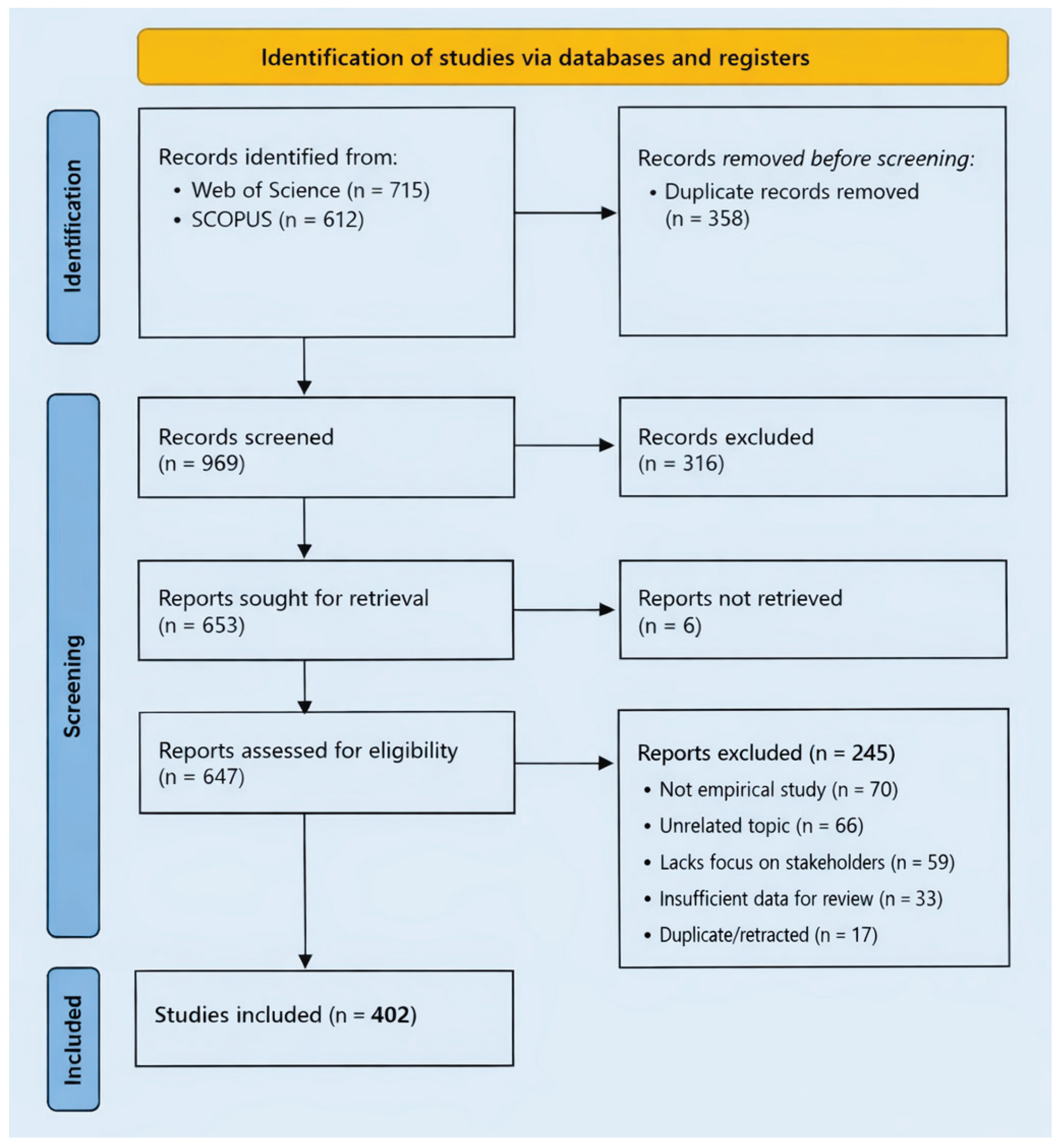
Figure 2.
Included studies by indexed publication year (indexed in Scopus/Web of Science).
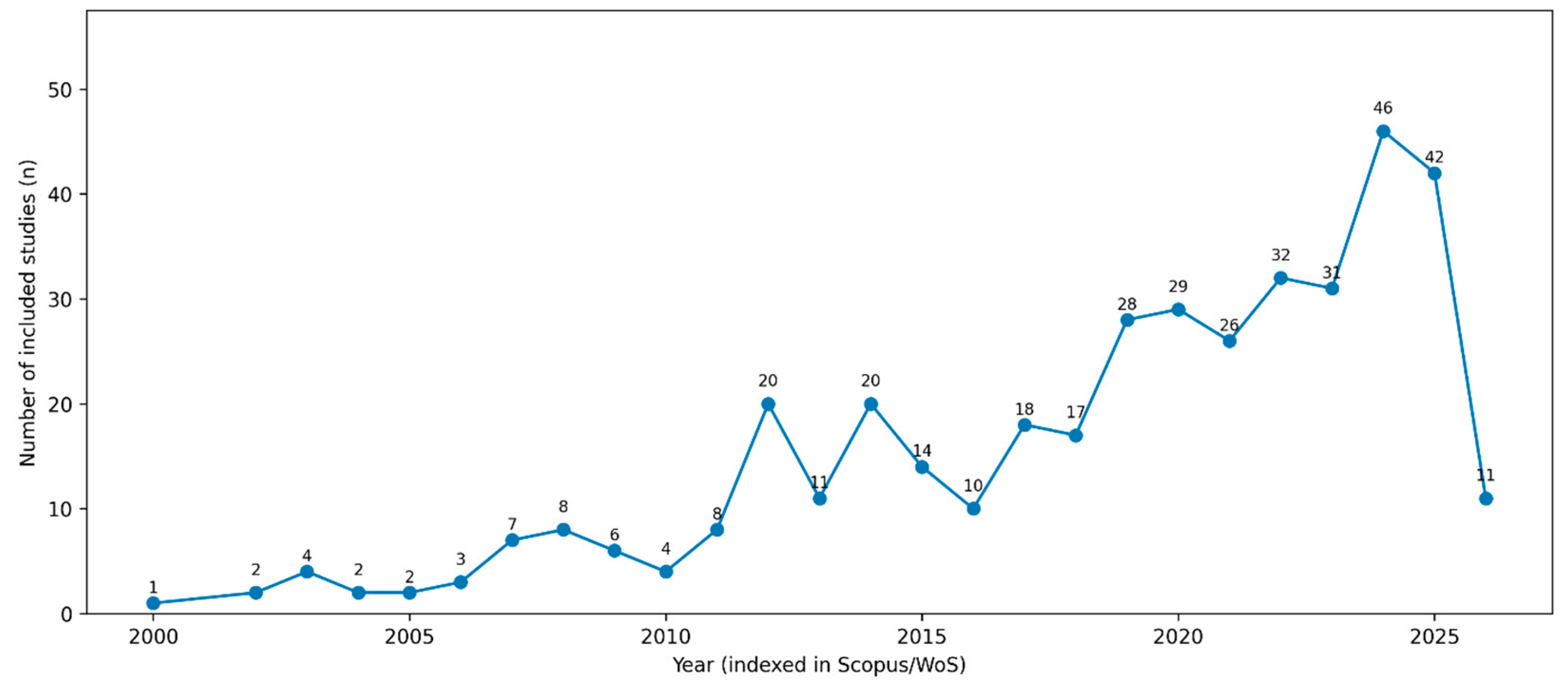
Figure 3.
Database provenance of included studies (n = 402).
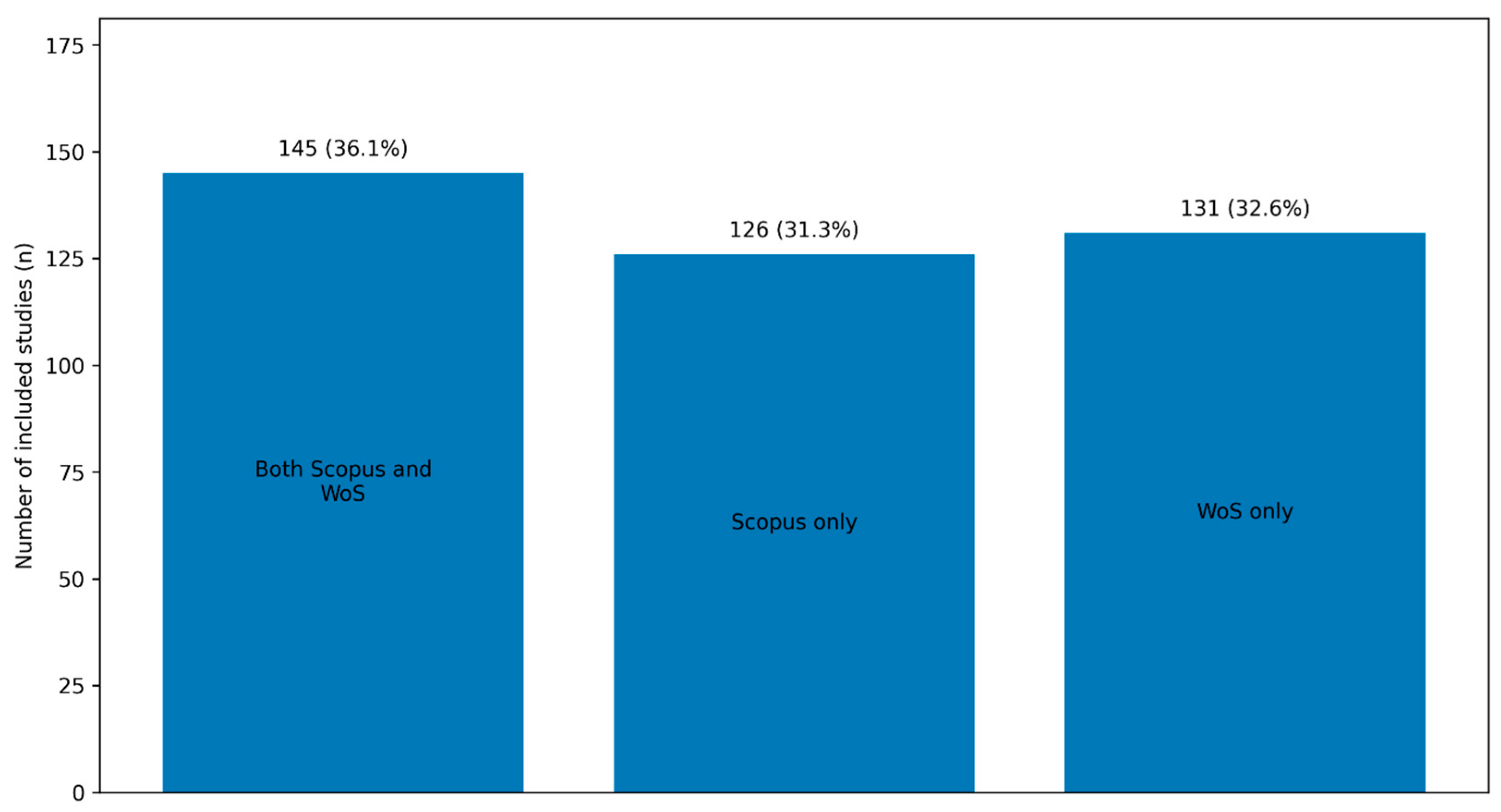
Figure 4.
Stakeholder and setting indicators in titles/abstracts/keywords (n = 402). A record may contribute to more than one category; totals therefore exceed n = 402.
Figure 4.
Stakeholder and setting indicators in titles/abstracts/keywords (n = 402). A record may contribute to more than one category; totals therefore exceed n = 402.
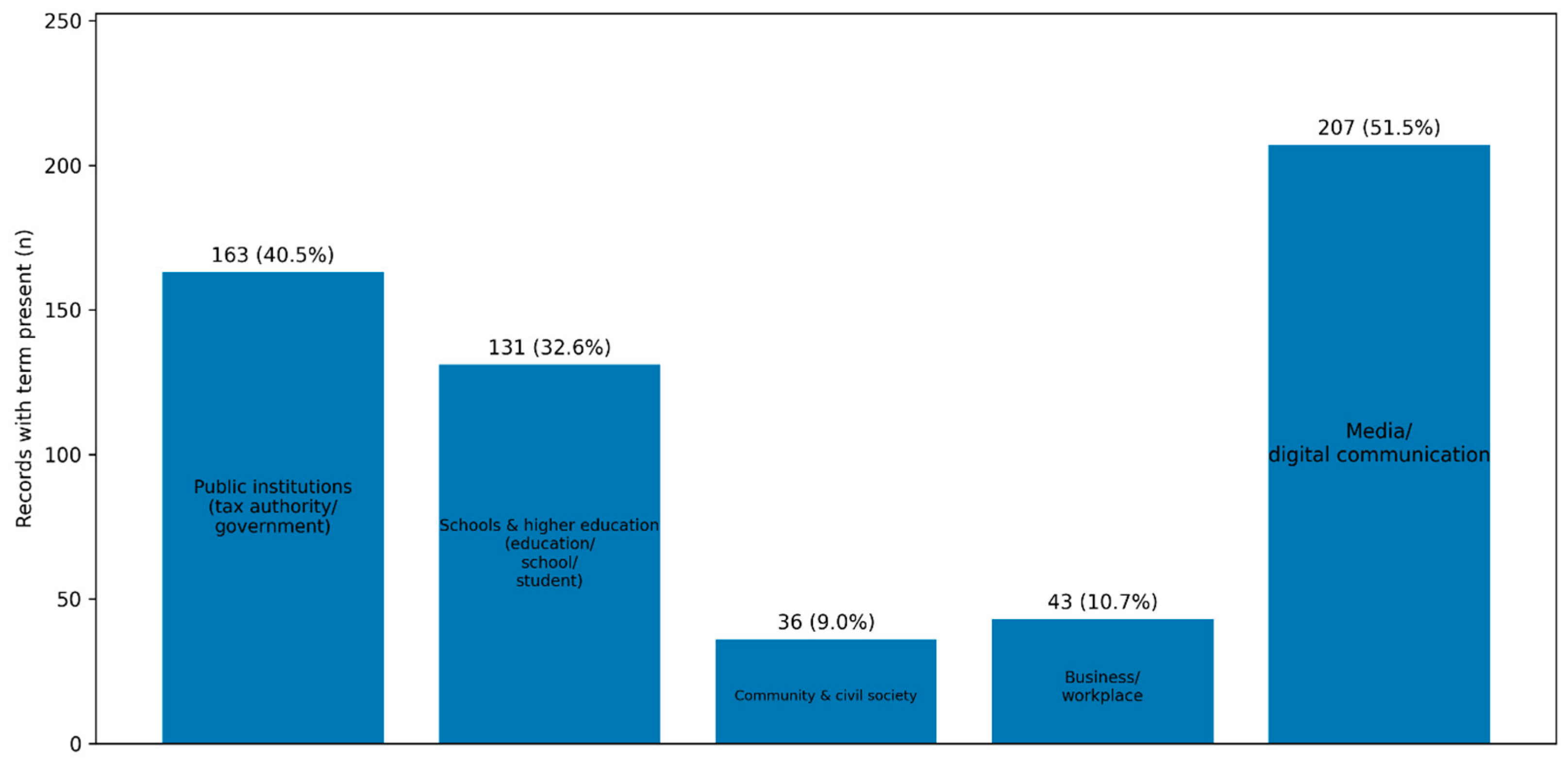
Figure 5.
Delivery modality indicators in titles/abstracts/keywords (n = 402). A record may contribute to more than one category; totals therefore exceed n = 402.
Figure 5.
Delivery modality indicators in titles/abstracts/keywords (n = 402). A record may contribute to more than one category; totals therefore exceed n = 402.
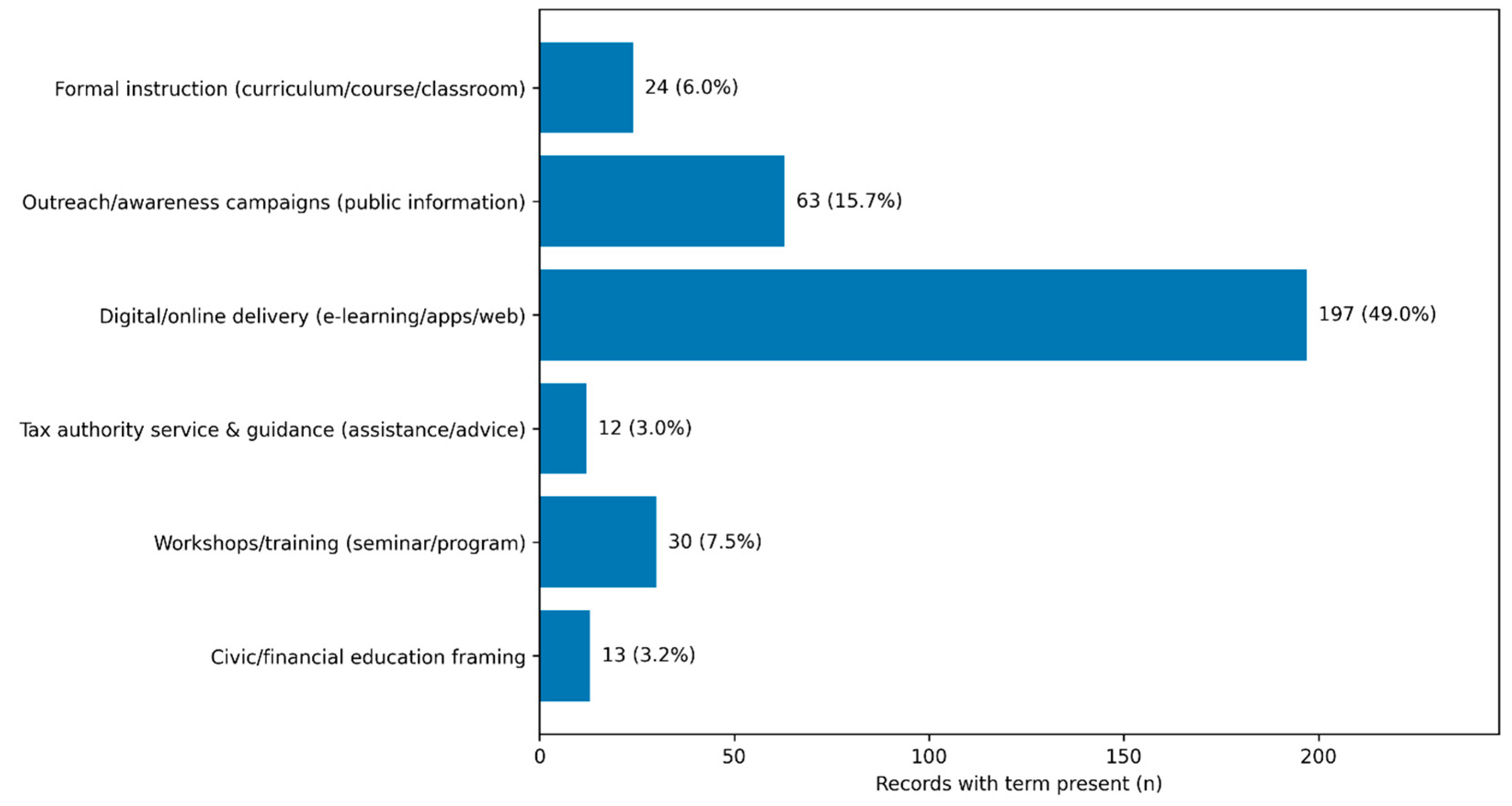
Figure 6.
Mechanism-related terms in titles/abstracts/keywords (n = 402). A record may contribute to more than one category; totals therefore exceed n = 402.
Figure 6.
Mechanism-related terms in titles/abstracts/keywords (n = 402). A record may contribute to more than one category; totals therefore exceed n = 402.
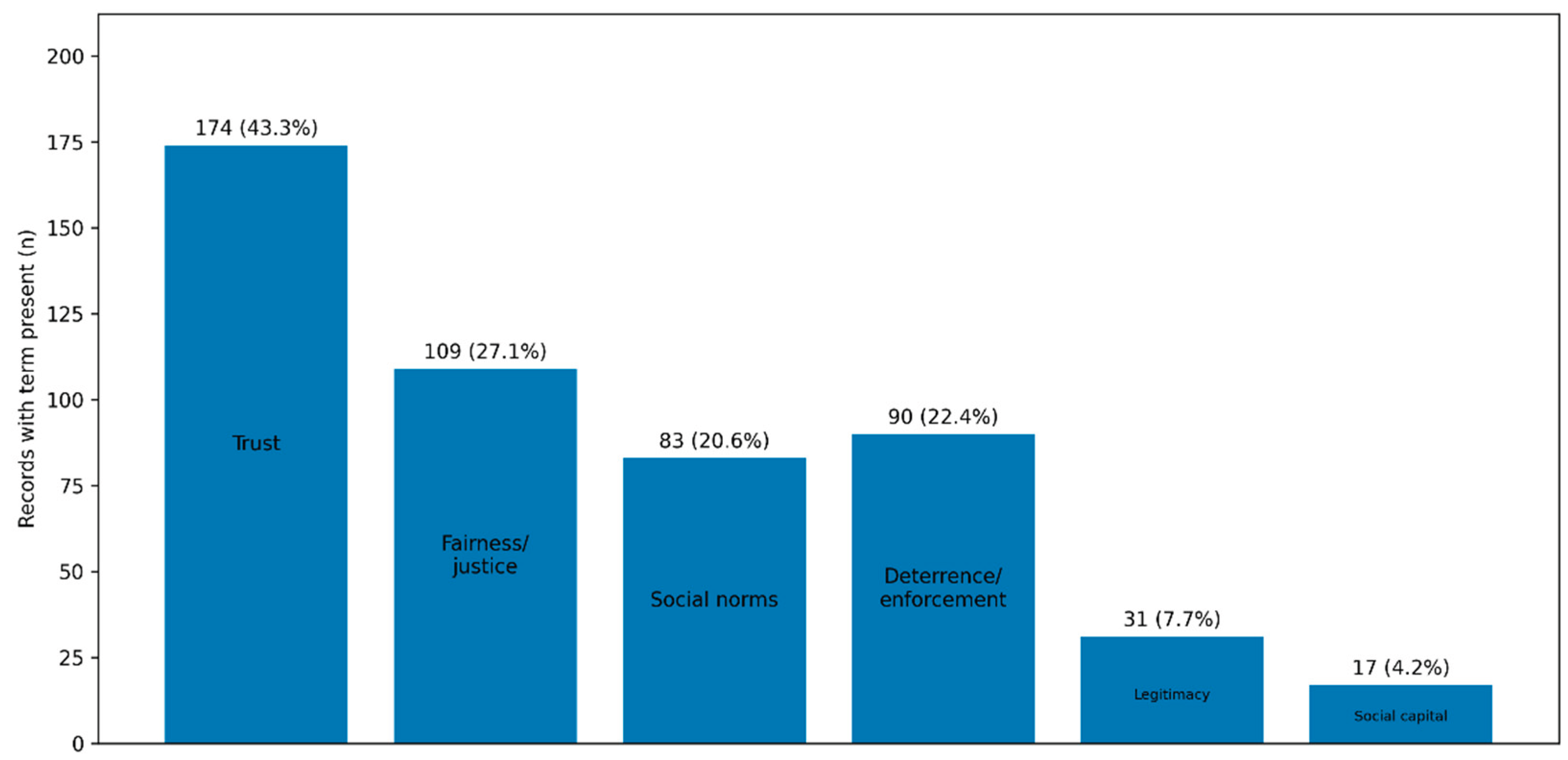
Figure 7.
Construct indicators (TL, TE, TM, and VTC) in titles/abstracts/keywords (n = 402). A record may contribute to more than one category; totals therefore exceed n = 402.
Figure 7.
Construct indicators (TL, TE, TM, and VTC) in titles/abstracts/keywords (n = 402). A record may contribute to more than one category; totals therefore exceed n = 402.
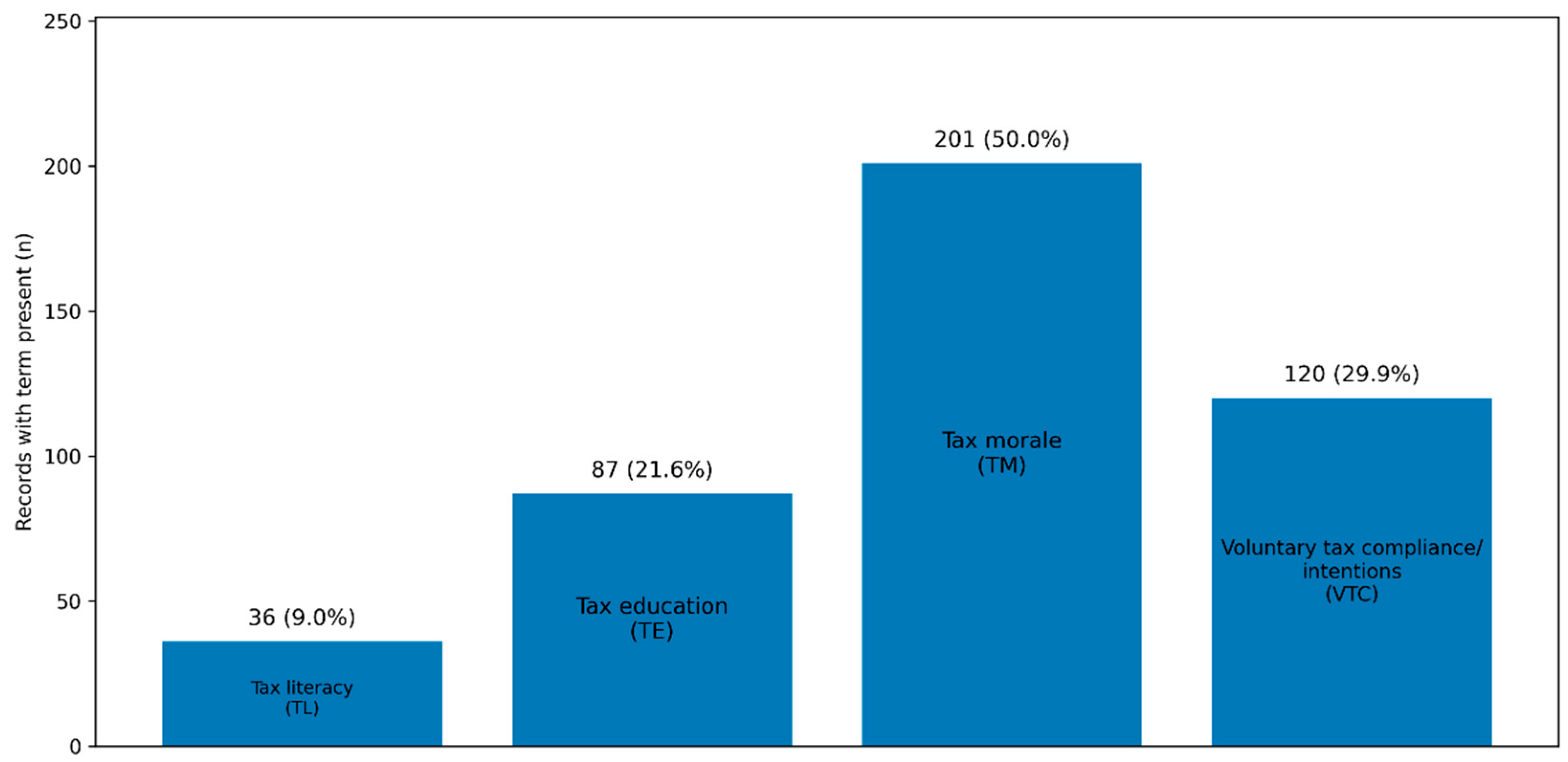
Figure 8.
Implementation and policy-to-practice cues in titles/abstracts/keywords (n = 402). A record may contribute to more than one category; totals therefore exceed n = 402.
Figure 8.
Implementation and policy-to-practice cues in titles/abstracts/keywords (n = 402). A record may contribute to more than one category; totals therefore exceed n = 402.
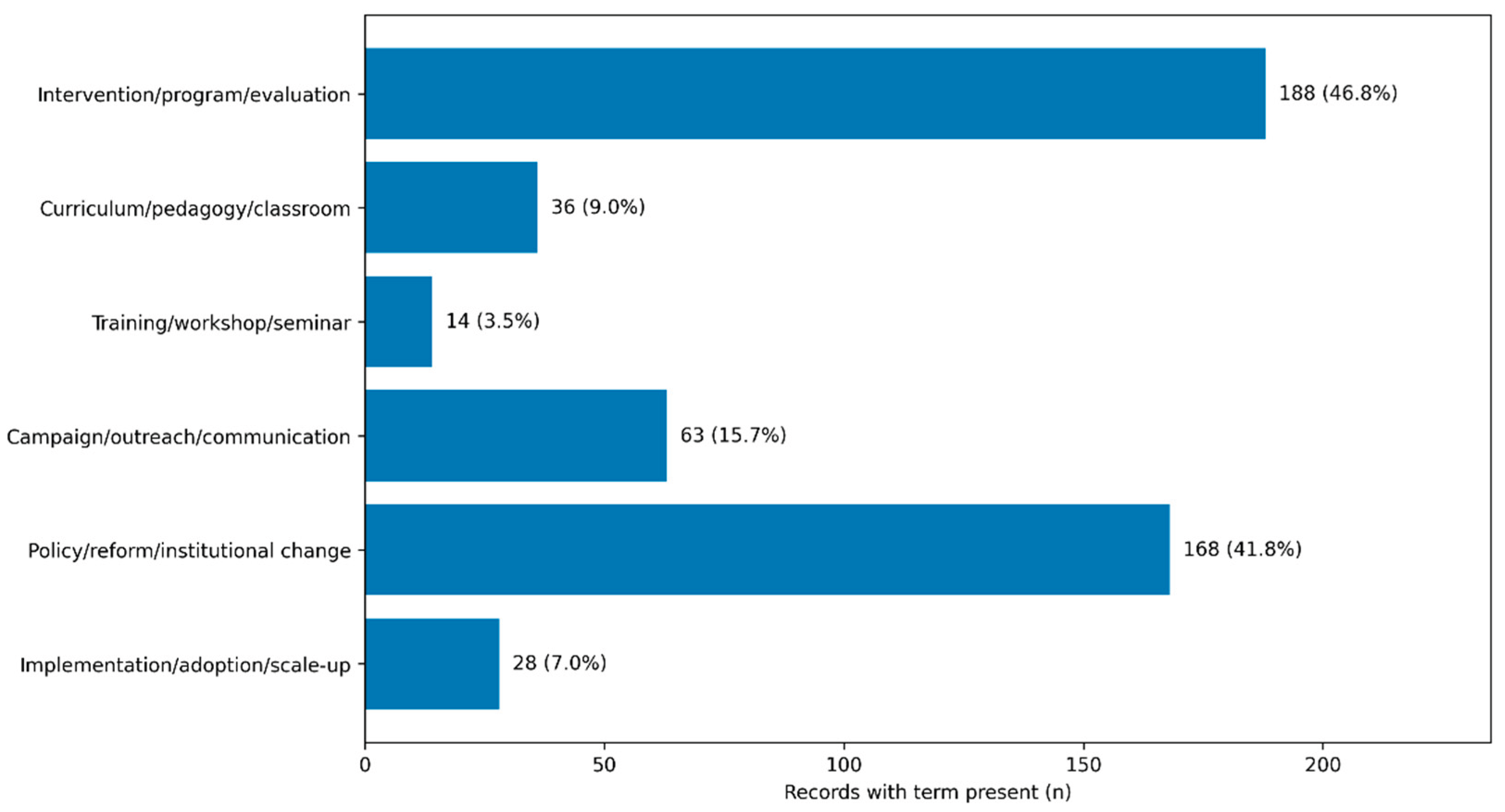

Table 1.
Co-signposting of TL/TE with TM/VTC in titles/abstracts/keywords (n = 402; non-exclusive counts).
Table 1.
Co-signposting of TL/TE with TM/VTC in titles/abstracts/keywords (n = 402; non-exclusive counts).
| Co-signposting pattern | Records (n) * | Corpus share (%) |
|---|---|---|
| TL and TM | 3 | 0.7 |
| TL and VTC | 2 | 0.5 |
| TL and (TM or VTC) | 5 | 1.2 |
| TE and TM | 13 | 3.2 |
| TE and VTC | 9 | 2.2 |
| TE and (TM or VTC) | 22 | 5.5 |
| TL and/or TE with TM and/or VTC | 24 | 6.0 |
Note: Counts are non-exclusive; a record could contribute to more than one co-signposting pattern.
Disclaimer/Publisher’s Note: The statements, opinions and data contained in all publications are solely those of the individual author(s) and contributor(s) and not of MDPI and/or the editor(s). MDPI and/or the editor(s) disclaim responsibility for any injury to people or property resulting from any ideas, methods, instructions or products referred to in the content. |
© 2026 by the authors. Licensee MDPI, Basel, Switzerland. This article is an open access article distributed under the terms and conditions of the Creative Commons Attribution (CC BY) license (http://creativecommons.org/licenses/by/4.0/).
Copyright: This open access article is published under a Creative Commons CC BY 4.0 license, which permit the free download, distribution, and reuse, provided that the author and preprint are cited in any reuse.


