

Submitted:
08 March 2026
Posted:
11 March 2026
You are already at the latest version
Abstract
This paper serves as a practical guide to help the readers select electrochemical instruments with a focus on potentiostats / galvanostats. It is dedicated to professionals in industry, students and researchers from various fields. We provide an overview of the main potentiostats / galvanostats and related electrochemical instruments currently available on the market and the main suppliers worldwide. For each device, we summarize its technical specifications including current and potential ranges as well as the methods the instrument is able to support. We also discuss the limitations of each instrument in order to provide the readers with a clear and comprehensive understanding. Finally, the paper aims to help the readers in selecting the most suitable instrument for their needs while considering performance and budget.
Keywords:
electrochemical instrument
; potentiostat/galvanostat
; technical guide
; electrochemistry
; suppliers
Introduction
Potentiostat is an instrument used in electrochemical studies where a potential (voltage) is applied to an electrochemical cell and typically measures the current [1]. Potentiostat / Galvanostat is a more advanced device capable of both applying a specific potential to measure varying currents (potentiostat mode) and managing the current to observe changes in potential (galvanic mode) [2,3]. These instruments are often referred to as electrochemical workstations. Both types are essential for investigating electrochemical processes, but they operate differently depending on the users’ needs to control during the experiment [4]. These instruments are widely used in many fields such as battery research [5], corrosion studies [6], electrolysis [7], sensors [8], processes and surface modification [9].
In addition to the electrochemical techniques embedded within each instrument, potentiostats / galvanostats can be combined with specific modules to extend their measurements capabilities. For example, electrochemical impedance spectroscopy (EIS) module enables detailed analysis of a system’s resistance and capacitive properties, providing valuable information about charge transfer and interfacial phenomena [10,11]. Furthermore, these devices can be coupled with different optical measurements techniques such as ultra-violet spectrophotometry (UV-VIS), infrared spectroscopy (IR), Raman spectroscopy (RS) or chemiluminescence. Combining electrochemical and optical measurements offers insights into the physicochemical characteristics of the investigated system enhancing the understanding of reaction mechanisms / rates, surface states and molecular interactions.
Many manufacturers offer a variety of potentiostats / galvanostats characterized by their size, number of channels, current and potential ranges [12], embedded methods, precision and cost [13]. Typically, compact models are designed for applications with limited spatial constraints while modular line, usually larger and more versatile, better suits comprehensive studies in electrochemical research. In healthcare and wearable applications, there is a growing need for portable devices that are lightweight and capable of operating in close proximity to or in contact with the human body [14,15]. For such cases, battery powered devices are essential enabling real-time monitoring outside of the traditional laboratory setting [16]. Bluetooth-connected devices (wireless connectivity) are also highly important for such applications which reduce the need for physical wiring and enable greater freedom movement during measurements [17,18].
Moreover, potentiostats / galvanostats can be categorized according to their current / potential ranges [19]. These parameters are critical for matching the instrument to specific electrochemical applications. High current devices (e.g., 1 A to > 100 A) are typically used in applications such as battery, fuel cells, metal plating and electrolysis. Conversely, low-current devices are designed for sensitive applications such as corrosion studies, (bio)sensing [20] and nanoelectrochemistry [21,22]. These devices are equipped with well-isolated channels to avoid noises during the measurements [23,24].
On the other hand, some Potentiostats / Galvanostats are designed as single-channel instruments allowing measurements in only one electrochemical cell at a time. However, multichannel devices equipped with two or more channels enable simultaneous electrochemical measurement across two or more independent cells [6,25]. Many manufacturers offer today the possibility of personalizing the number of added channels into the provided potentiostat / galvanostat. Additionally, certain systems can be connected to a multiplexer which sequentially switches between multiple electrochemical cells (up to 96 independent cells) [26]. This configuration is particularly interesting in high-throughput experiments or long-term potentiometric monitoring where measurements are made across several independent electrochemical setup without requiring multiple instruments [27,28]. Typically, this configuration is used during cell-cultures where electrodes are integrated in each well for real-time monitoring of the cell-culture media [29,30,31].
In this paper, we review the main global manufacturers of potentiostats / galvanostats. For each provider, we analyze the models available in their product catalogues based on parameters such as device size, number of channels, current and potential ranges, embedded techniques, portability, and application-specific features.
Main Suppliers
- Metrohm
Metrohm is one of the most important companies that provides high-precision instruments for chemical analysis. Founded in 1943 Switzerland, Metrohm has expanded to reach the entire world with a presence in over 80 countries. It offers a diverse portfolio of electrochemical instruments, including potentiostats, galvanostats, and multichannel systems, targeting many research and industrial applications (Table 1). According to Metrohm catalogue, instruments are divided into different families (Figure 1). Below is a comprehensive overview of each family [32]:
Family 1: VIONIC
VIONIC is the most advanced potentiostat/galvanostat system. It offers a compliance voltage of ±50 V and a current of ±6 A, making them suitable for applications such as battery research, and corrosion studies. VIONIC supports electrochemical impedance spectroscopy (EIS) at frequencies up to 10 MHz. VIONIC uses INTELLO software designed for flexible experiment setup and thorough data analysis. VIONIC has other important features like selectable floating and a second sense connection for monitoring additional electrodes. VIONIC offers the most versatile combined specifications of any single instrument currently on the market.
Family 2: Compact line
This lightweight and portable potentiostat/galvanostat is used for routine electrochemical analysis, making it ideal for education as well as research. Several models belong to this family. PGSTAT101 is a small, lightweight, and affordable potentiostat/ galvanostat that is ideal for most basic electrochemical research applications. It offers a compliance voltage of ± 10 V and a maximum current of ±100 mA. It includes an onboard integrator for coulometric measurements and current integration cyclic voltammetry. Autolab IMP represents same characteristics as PGSTAT 101 with EIS included covering frequencies from 10 µHz to 1 MHz and is equipped with the full NOVA software. The PGSTAT204 excels with its compact and modular design allowing for superior flexibility in your research. It offers a compliance voltage of ± 20 V and a maximum current of ± 400 mA, along with a modular expansion option that allows users to add one technique like EIS. All Compact Line instruments are supported by NOVA software.
Family 3: Modular line
The Modular Line consists of a range of instruments to suit any requirements in electrochemical research, from low to high voltage and from low to high current. These instruments can be combined with a range of modules allowing you to customize the instrument to your requirements, greatly increasing the possibilities of electrochemical research. NOVA2 software powers all these systems. This line is centered around the AUTOLAB PGSTAT302N, a high-performance potentiostat/galvanostat offering a compliance voltage of ± 30 V and a current of ± 2 A and a bandwidth of 1 MHz. Combined with the FRA32M module, it can accommodate EIS. PGSTAT302N MBA (Multi BA) is a special version of the PGSTAT302N which can be fitted with up to 6 working electrodes. Besides the main working electrode, 5 additional bipotentiostat modules (BA module) can be installed in the instrument, alongside the optional FRA32M module. Another setup within this family is the ECAT complete package, which includes the full AUT302N.MBA.S loaded with additional functional modules including Electrochemical Impedance Spectroscopy (EIS) and true linear voltammetry, pH and temperature sensor, and dual mode bipotentiostat.
Family 4: Multichannel line
The Multichannel Line is designed for applications where simultaneous measurements across multiple electrodes are needed. This family includes two main variants: Multi Autolab M101 and Multi Autolab M204. The M101 model features individual modules capable of delivering up to ± 100 mA with a compliance voltage of ± 10 V, while the M204 modules provide more performance with up to ± 400 mA and a compliance voltage of ± 20 V. The software used for this line is NOVA2 and can support up to twelve independent potentiostat/galvanostat modules in a single cabinet, offering true parallel processing for large-scale experiments. Electrochemical impedance spectroscopy (EIS), dual mode bipotentiostat module, current booster (Booster10A), pH/pX measurement (pX1000), electrochemical quartz crystal microbalance (EQCM), and automation with multiplexing (MUX) – these are the additional capabilities that can be added to the Autolab Multichannel M204 and M101 instruments through a dedicated module.
Family 5: Portable line
The portable potentiostats / galvanostats / EIS are small and affordable instruments that are designed to meet the needs of researchers and professionals requiring mobility, versatility, and ease of use in their electrochemical analyses. They are easily connected to a PC via USB or through wireless connection. Various instrument versions are available:
The µStat 400 is a compact and portable bipotentiostat / galvanostat that can be applied for voltametric, amperometric or potentiometric measurements and can be used with one- or two-working electrodes configuration. Li-ion battery powered, it can be easily connected to a PC via USB and wireless.
The µStat 300 is a portable bipotentiostat that can be applied for voltametric or amperometric measurements and can be used with one- or two-working electrodes configuration. Li-ion Battery powered, it can be easily connected to a PC via USB and wireless.
The DropSTAT is a hand-held, single-technique, potentiostat-based custom electrochemical reader that is configured attending to customer’s needs, allowing the researcher to have a unique instrument able to show in an LCD screen the concentration of the analyte for which an electrochemical sensor has been developed. The device is lightweight and stores data internally, which can be exported via USB
The DropSTATPLUS is a customized electrochemical reader intended for having immediate results based on an optimized procedure. With a touch screen, li-ion battery and the possibility of wireless data transfer, it can store up to 3 methods and up to 8 calibrations per method.
The ORPKIT is a portable oxidation reduction potential (ORP) reader kit. Suitable for in situ measurements with small sample volumes. This system uses disposable ORP sensors and can store data internally.
The µStat-i 400 is a portable bipotentiostat / galvanostat / impedance analyzer (EIS) that can be applied for voltametric, amperometric, potentiometric and EIS measurements and can be used with one- or two-working electrodes configuration. Li-ion Battery powered, it can be easily connected to a PC via USB and wireless.
The µStat-i 400s is an enhanced version of the µStat-i 400, offering similar features with additional capabilities for more advanced electrochemical analyses.
Family 6: Portable multichannel line
The portable multichannel potentiostats / galvanostats / EIS are affordable instruments that enable you to optimize your time. You will be able to develop applications not only in your lab but also in the field with conventional electrodes and with screen-printed electrodes.
They are an ideal and practical solution in many research areas such as (bio)sensor, corrosion, electrocatalysis, coin-cell batteries, fundamental electrochemistry, or (bio)fuel cells among others. They show flexibility with future expandability up to 16 channels, easily connected to a PC via USB, through wireless or even remotely. They allow configurations with multiple working electrodes (WEs) sharing auxiliary (AE) and reference electrodes (RE). Various systems are available:
The µStat 8000 is portable multi potentiostat / galvanostat that can be applied for voltametric, amperometric or potentiometric measurements, being able to perform up to 8 different independent measurements at the same time, including also a multichannel mode that allows you to work with up to 8 working electrodes sharing auxiliary and reference electrode. Li-ion Battery powered, it can be easily connected to a PC via USB or wireless.
The µStat 8000P is an enhanced version of the µStat 8000, providing similar capabilities and characteristics with additional features tailored for specific research needs
The µStat 4000 is a compact portable multi potentiostat / galvanostat that can be applied for voltametric, amperometric or potentiometric measurements, being able to perform up to 4 different independent measurements at the same time and including also a multichannel mode that allows you to work with up to 4 working electrodes sharing auxiliary and reference electrode. Li-ion Battery powered, it can be easily connected to a PC via USB or wireless.
The µStat 4000P extends the capacity of the µStat 4000 by offering four independent channels that can operate simultaneously. This multichannel capability allows for synchronized measurements across multiple working electrodes.
The H2PERMKIT is a kit used to perform hydrogen permeation experiments. It includes one μStat-i Multi4 (4 channels galvanically isolated), one cell and the electrode cable connectors needed. DropView 8400M software allows to evaluate the permeability of the sample with a very straight forward calculation.
The µStat-i MultiX is a multichannel instrument (bipotentiostat / galvanostat /EIS) with up to 16 channels that allows multi-user and multidisciplinary electrochemical research. The system supports a wide range of electrochemical techniques, including voltammetry, amperometry, impedance spectroscopy, and potentiometry.
The µStat-i MXONE, MXONES, MXONEP, and MXONESP are modular configurations of the µStat-i MultiX. Multichannel impedance analyzer for multi-user and multidisciplinary electrochemical research that can be designed according to needs.
Add to all these Metrohm’s potentiostat/galvanostat can be integrated in spectroelectrochemistry electrochemiluminescence (ECL). They represent advanced techniques that combine electrochemical measurements with different spectroscopic methods (UV-Vis, Raman, or IR) in the objective of obtaining deeper details of chemical and biochemical processes.
- BioLogic
BioLogic is a French Company founded in 1983 in France. With more than 40 years of expertise it has established a worldwide presence. It offers a comprehensive range of electrochemical workstations designed to various research and industrial applications [33]. Concerning potentiostat / galvanostat they are divided to 2 major families (Figure 2): essential and premium potentiostats. Below is an overview of several key models, detailing their specifications and capabilities (Table 2). All models operate via EC-Lab control and analysis software.
Essential Potentisostats:
- -
- SP-50e
The SP-50e is monochannel instrument designed for basic applications. It has a voltage compliance of ± 10 V and current ranges from ± 10 µA to ± 1 A. It is not portable and requires an external power source. It supports EIS ranging from 1 MHz to 10 µHz. The SP-50e operates via Ethernet, Wi-Fi, and USB connections. It operates with EC-Lab control and analysis software. Limitations include the absence of multi-channel capabilities and portability.
- -
- VSP
The VSP is a highly modular electrochemical workstation designed for a wide range of applications. It has a voltage compliance of ± 20 V up to 60 V with FlexP-0060 module and current ranges from ± 10 µA to ± 1 A with the possibility to extend up to 800 A using FlexP-0012 modules. It is not portable and requires an external power source. It supports EIS ranging from 1 MHz to 10 µHz. The VSP operates via Ethernet, LAN, Wi-Fi, and USB 2.0 connections. The instrument is multi-channel with up to 5 channels. Multiplexing is supported. Limitations include the need for external modules for high current applications and the absence of portability.
- -
- SP-150e
The SP-150e is a Mono-channel electrochemical workstation designed for general electrochemistry applications. However, it is modular and can be upgraded to a dual-channel (bipotentiostat) configuration by adding a second independent channel. It offers a voltage compliance of ± 20 V and current ranges from ± 10 µA to ± 1 A, with the possibility to extend up to 800 A using FlexP-0012 modules. It is not portable and requires an external power source. EIS capabilities range from 1 MHz to 10 µHz. The SP-150e operates via Ethernet, LAN, Wi-Fi, and USB connections. It supports three EIS quality indicators (THD, NSD, NSR). Limitations include the absence of multi-channel capabilities and portability.
- -
- VMP-3e
The VMP-3e is a High-Performance Multichannel Potentiostat/Galvanostat designed for a wide range of applications. It supports up to 16 channels offering a voltage compliance of ± 10 V extendable to ± 20 V, and current ranges from ± 10 µA to ± 1 A extendable to 800 A using FlexP-0012 modules. EIS capabilities range from 1 MHz to 10 µHz. The VMP-3e operates via Ethernet, Wi-Fi, and USB connections. It is not portable and requires an external power source. Multiplexing is supported, with the number of channels depending on the specific setup. Limitations include the need for external modules for high current applications and the absence of portability.
- -
- VSP-3e
The VSP-3e is an electrochemical workstation tailor-made for energy research. It features up to 8 channels, allowing for customization with potentiostat/galvanostat, EIS, and booster modules. The instrument offers a voltage compliance of ± 20 V, adjustable from ± 10 V, and current ranges from ± 10 µA to ± 1 A, with the possibility to extend up to 800 A using FlexP-0012 modules. EIS capabilities range from 1 MHz to 10 µHz. The VSP-3e operates via Ethernet, Wi-Fi, and USB connections. It is not portable and requires an external power source. Multiplexing is supported, with the number of channels depending on the specific setup. Limitations include the need for external modules for high current applications and the absence of portability.
- -
- HCP-803
The HCP-803 is a high-current electrochemical workstation designed for applications requiring high current capabilities. It is capable of managing ± 80 A with a voltage range of ± 3 V. The potentiostat has the same specifications as the VMP-3e potentiostat boards (with EIS option). It is suitable for single-channel applications requiring high current. Limitations include the absence of multi-channel capabilities and portability.
- -
- HCP-10005
The HCP-1005 is a compact high-current potentiostat designed to study high-capacity secondary batteries with a voltage range of 0.6 to 5 V and a current range of ± 100 A. The EIS capability integrated in the chassis also makes it ideal for following up the performances of cells during ageing tests. It combines the precision and control of a research-grade potentiostat operating via Ethernet, Wi-Fi, and USB connections. It is not portable and requires an external power source. The instrument is suitable for single-channel applications requiring ultra-high current. Limitations include the absence of multi-channel capabilities and portability.
Premium Potentiostats:
- -
- SP-200
The SP-200 is an ultra-low current electrochemical workstation designed for applications requiring high sensitivity. It is a single channel transportable potentiostat, offering a voltage compliance of ± 12 V, and current ranges of ± 1 A going to 10 nA and even to ± 1 pA with external modules. EIS capabilities range from 7 MHz to 10 µHz. The SP-200 operates via ethernet, Wi-Fi, and USB connections. Limitations include the absence of multi-channel capabilities and limited current range.
- -
- VSP-300
The VSP-300 is a high-performance electrochemical workstation. It’s a multichannel potentiostat supporting up to 6 channels. It offers a voltage compliance of ± 12 V, and current ranges from ± 10 µA to ± 1 A, with the possibility to extend up to 120 A using modules. EIS capabilities range from 7 MHz to 10 µHz. The VSP-300 operates via ethernet, Wi-Fi, and USB connections. It is not portable and requires an external power source. Multiplexing is supported, with the number of channels depending on the specific setup. Limitations include the need for external modules for high current applications and the absence of portability.
- -
- SP-300
The SP-300 is a bichannel research-grade electrochemical workstation. It offers a voltage compliance of ± 12 V and current ranges from 1 A to 10 A with the possibility to extend the current using appropriate modules. EIS capabilities range from 7 MHz to 10 µHz. The SP-300 operates via ethernet, Wi-Fi, and USB connections. It is not portable and requires an external power source.
- -
- VMP-300
It is a high-end, modular multichannel potentiostat supporting up to 16 independent channels. The system offers a voltage compliance of ±12 V and a current ranges from ± 1 A to 10 nA, both voltage and current can be extended using appropriate modules. Electrochemical impedance spectroscopy (EIS) is available from 10 µHz to 7 MHz. The VMP-300 is non portable and operates via ethernet, Wi-Fi, and USB connections.
- TOB
Xiamen TOB New Energy Technology Co., Ltd. is a high-tech enterprise specialized in high-end equipment of lithium-ion battery and supercapacitor [34]. It provides many potentiostat cited below (Table 3):
Single-channel potentiostat / galvanostat / electrochemical workstation consists of DDS arbitrary function generator, high power potentiostat/galvanostat, dual-channel correlation analyzer, dual-channel high-speed 16-bit / high-precision 24-bit AD converter and extension interfaces. Max. current is ± 2 A, potential range is ± 10V. EIS frequency range is 10 µHz ~ 1MHz. It can be used for various electrochemical fields such as corrosion, energy, material and electroanalysis. The current can be boosted up to 20 A / 40 A with a current booster CS2020B/ CS2040B. It can be applied to test the corrosion. the tester includes all the electrochemical techniques for corrosion measurement such as OCP, polarization curve (potentiodynamic), EIS, Cyclic polarization CPP (passivation curve), Electrochemical Potentiokinetic Reactivation (EPR), Hydrogen diffusion test, ZRA, Electrochemical noise, etc. It can be used to study metal corrosion mechanism and corrosion resistance, and evaluate the coating durability and sacrificial anode current efficiency. It can also be used for rapid screening of corrosion inhibitors, fungicides, etc. It provides many techniques LSV, CV, galvanostatic charge and discharge (GCD), Constant potential/ current EIS, and precise IR compensation circuit, Corrtest potentiostats that are widely used in supercapacitor, Li-ion batteries, sodium-ion batteries, fuel cell, Li-S batteries, solar cell, solid-state batteries, flow batteries, metal-air batteries etc. It is an excellent scientific tool for researchers in the fields of energy and materials. It is also a corrtest potentiostat that includes all the voltammetric methods such as NPV, DNPV, SWV, ACV, and can be used for fast analysis of the trace elements in the solution. Voltammetry stripping methods can do the Quantitative analysis according to the stripping peak current (please refer to the table for more specifications).
The Portable Potentiostat is internally powered by a lithium battery, which can be placed in a glove box or used outdoors (Figure 3). The lithium battery can be charged in advance, and the type-C interface is used for charging and communication. The circuit adopts a floating-ground design, and the electrochemical parameters of the grounding system can be measured without an isolation transformer. CS100 is mainly used for battery testing, electroanalytical chemistry, and corrosion electrochemical testing. The voltage control range is ± 10V, compliance voltage is ± 12V, the current output range is ± 45 mA, and the minimum current resolution can reach 100 fA. CS studio software provides users a versatile smoothing/differential/ integration kit, which can complete the calculation of peak height, peak area and peak potential of CV curves. It also provides powerful non-linear fitting on Butler-Volmer equation of polarization curve. It can calculate Tafel slope, corrosion current density, limitation current, polarization resistance, corrosion rate. It can also calculate the power spectrum density, noise resistance and noise spectrum resistance based on the electrochemical noise measurements. CS Studio software can achieve real time saving of the measuring data. The data can be automatically saved even in case of sudden power off. CS studio kit has a built-in versatile timing policy for combined measurements, which can facilitate the automation of experiments and save time. CS potentiostat has many technical advantages where its impedance EIS applies correlation integral algorithm and dual-channel over-sampling technique, and has strong anti-interference ability. It is suitable for EIS measurements of high-impedance system (> 109 Ω, such as coating, concrete etc.). It can also be used to obtain Mott-Schottky curve and differential capacitance curve. During the test, the software can display real-time open circuit potential (OCP) without entering. (Please refer to the table for more specifications).
Bipotentiostat / Bigalvanostat with built-in EIS model CS2350M has two sets of built-in independent potentiostat /galvanostat. So, it equals that you have 2 sets potentiostat in one instrument. Full floating module and electrical isolation design guarantee each channel is totally independent, which ensures accurate data. Each set provides full electrochemical techniques including EIS. Experiments can be conducted simultaneously on each channel. Besides this, the two channels can jointly complete experiments of two-working electrode system such as RRDE and hydrogen diffusion. CS2350M bipotentiostat is the real double-channel potentiostat. It uses an ethernet connection. EIS module is included in both channels. It is applied for many missions such as: (1) Electrosythesis, electrodeposition (electroplating), anodic oxidation, electrolysis (2) Electrocatalysis such as Oxygen reduction reaction (ORR), OER, HER, CO2 reduction. (3) Li-ion battery, solar cell, fuel cell, supercapacitor, advanced function materials, sensor, etc (4) Corrosion behavior of metals, and anti-corrosion evaluation (5) Fast evaluation of inhibitor, water quality stabilizer, coating, and cathodic protection efficiency. CS2350M bipotentiostat has many technical advantages like the impedance feature where it applies correlation integral algorithm and dual-channel over-sampling technique, and has strong anti-interference ability. It is suitable for EIS measurements of high-impedance system (> 109 Ω, such as coating, concrete etc.). CS2350M bipotentiostat applies correlation integral algorithm and dual-channel over-sampling technique, and has strong anti-interference ability. It is suitable for EIS measurements of high-impedance system (>109Ω, such as coating, concrete etc.), (please refer to the table for more specifications).
Concerning the Multichannel potentiostat / galvanostat/ EIS is a versatile instrument offering 8 slots. Full floating module and electrical isolation design guarantee each channel is totally independent, which ensures accurate data and efficient simultaneous measurements. Multichannel potentiostat brings convenience to those who have many samples, and is an ideal device for studies of energy materials, battery study, metal corrosion etc. Number of channels can be customized. Different configuration ensures you get desired product suiting to various budgets. The number of channels is expandable by adding and installing more boards, thanks to the intelligent chassis and plug-in design. Each channel’s potential control range is 10 V, current control range ± 1A, can meet experiment requirement for most people. It is applied for many tasks like the study of Energy materials (Li-ion battery, solar cell, fuel cell, supercapacitors), advanced functional materials, electrosynthesis, electroplating / electrodeposition, anode oxidation, electrolysis, corrosion study and corrosion resistance evaluation of metals; quick evaluation of corrosion inhibitors, coatings, and cathodic protection efficiency and finally electrocatalysis (HER, OER, ORR, CO2RR, NRR). It has many advantages such as a high current / voltage: Applied potential range ± 10 V, current ± 1 A. It can meet the needs of most studies. It has comprehensive techniques: an equipped Built-in EIS (10 μHz ~ 1 MHz). There are comprehensive techniques on each channel. They are the manufacturer, and they have been in the market for 20 years, and now is the no. 1 brand of potentiostat product in China (please refer to the table for more specifications).
- CORRTEST
CorrTest Instruments, based in China, manufactures a range of electrochemical devices used in corrosion analysis, coatings evaluation, battery diagnostics, and material research (Figure 4). Their systems function as combined potentiostat / galvanostat and support both direct current (DC) and alternating current (AC) testing techniques (Table 4). None of the models are designed for portability or battery-powered operations, they are intended for lab use and connect to a computer via standard cables. All systems are controlled using CorrTest Soft, the company’s proprietary software [35].
CS300M
The CS300M is a single-channel instrument suited for everyday corrosion studies. It handles typical electrochemical techniques such as linear polarization, cyclic voltammetry, and chronoamperometry, and it also includes support for impedance spectroscopy (EIS). It operates within a potential range of ± 10 volts and supports currents from 10 nanoamperes up to 1 ampere. This model does not support multiplexing, and its capabilities are limited by its basic, non-expandable design.
CS310M
An upgraded option, the CS310M, offers greater precision and better sensitivity for low-current measurements. Like the CS300M, it supports a wide set of DC and AC methods, including EIS, and works across the same ± 10 V potential range. Its current range is from 2 nA to 2 A. The CS310M is also a single-channel unit not supporting multiplexing. Its limitations lie mainly in its fixed configuration and lack of channel expandability.
CS310X series (A, B, C and D)
The CS310X series (A through D) delivers multichannel functionality. Depending on the version, these instruments provide either 4 or 8 fully independent channels, each capable of running simultaneous experiments. They support the full suite of electrochemical methods, including EIS, voltammetry, and polarization studies. These units also accommodate wider current ranges, from extremely low levels to several amps, depending on configuration. Even though, they do support multiplexers, they may require a more involved setup process and are not designed for portability.
CS2350M
The CS2350M is a two-channel potentiostat geared toward coatings and corrosion-related testing. It includes standard DC techniques and EIS capability with a working potential range of ± 10 V. It’s intended for low-to-mid current tasks and, like other mono-channel models, it does not support multiplexing.
CS350M
The CS350M offers ultra-sensitive current detection, extending down into the picoampere range. It is ideal for thin-film and sensor research and supports both DC and EIS measurements. Its design, however, remains single-channel and fixed, with no multiplexing support or portable use.
CS2150M
The CS2150M serves as a versatile option for general-purpose electrochemical work. It handles common methods such as voltammetry, amperometry, and EIS, and is capable of delivering up to 2 amperes of current across a ±10 V potential window. As with other dual-channel devices, it lacks channel expansion options or support for multiplexing.
Across the entire product line, CorrTest Soft is the central software platform used to manage experiments, collect data, and customize testing procedures. Its user interface is built to support advanced control while remaining accessible to new users.
- Kanopy
Kanopy Techno Solutions is a prominent organization specializing in electrochemical science and engineering. Established in 2014 by Joy Bhattacharjee alongside researchers from the Indian Institute of Technology (IIT) Kanpur, the company collaborates with multiple research laboratories across India to support the research and development of its diverse products [36].
Comprehensive solutions for electrochemical laboratory instruments and accessories, including potentiostats, galvanostats, electrodes and various electrochemical cells are provided in this company (Figure 5). This section discusses three instruments under the Potentiostat and Potentiostat/Galvanostat category: K-Lyte 1.0, K-Lyte 1.2 and K-Lyte 1.3 (also referred to as PG-Lyte 1.0). Detailed specifications for each instrument are provided below (Table 5):
- 1.
-
Potentiostat:
- a)
- K-Lyte 1.0 is an entry-level Potentiostat designed to support the initiation of electrochemistry research at both undergraduate and postgraduate levels. It offers fundamental potentiostatic techniques and is suitable for use in aqueous as well as most non-aqueous systems. The instrument has five current ranges from1 µA to 10 mA with an input Bias (leakage current) of ± 15pA. It offers a compliance voltage of ± 15 V, an applied voltage range of ± 2 V with a resolution ≤ 150 µV and supports scan rates from 1 mV/s to 1000 mV/s.
K-Lyte software is a user-friendly application. It is lightweight and runs smoothly on Windows 7 and later versions. The software enables effective setting of experimental parameters for each technique and allows data to be viewed and saved both as images and in .xls/.csv format.
In the potentiostatic mode, three different experimental techniques are included: Linear Sweep Voltammetry, Cyclic Voltammetry and Chronoamperometry. The instrument is equipped with auto-cut protection circuitry to safeguard the PCB from overvoltage and overcurrent conditions. The hardware consists of three main components: analog circuitry, digital circuitry and switching circuitry. K-Lyte 1.0 operates on a 220 V AC power supply and consumes approximately 300 watts. An inbuilt cooling fan maintains the internal circuitry temperature. This device includes a USB connection cable for data transfer. It is powered via a standard C13 IEC connector.
A standard one-year warranty covering failure of any internal electronic components is provided. However, the main limitations for K-Lyte 1.0 include its mono-channel operation and the absence of an internal battery, Bluetooth, wireless connectivity and internal storage.
-
- b)
- K-Lyte 1.2 is a high-end Potentiostat designed to perform a wide range of electroanalytical techniques relevant to physical electrochemistry, nanotechnology, corrosion studies and sensor applications. The instrument can accommodate both aqueous and non-aqueous systems, offering high sensitivity and the capability of recording electrical signals in the nanoampere range. Eight current ranges could be used from 100 nA to 1 A with an input Bias (leakage current) of ± 15pA. It has a compliance voltage of ± 15 V, applied voltage ranges of ± 5 V and ± 10 V, a voltage resolution ≤ 150 µV and supports scan rates between 1 µV/s to 1000 mV/s.
K-Lyte 1.2 shares the same software, hardware features and calibration facilities as K-Lyte 1.0. However, it offers a broader range of experimental techniques compared to K-Lyte 1.0. This device is equipped with a USB connection cable for data transmission between the instrument and a computer, and it is powered using a standard C13 IEC connector. It comes with a one-year warranty that covers failures of internal electronic components. K-Lyte 1.2 shares the same limitations as K-Lyte 1.0.
- 2.
-
Potentiostat/Galvanostat:
- a)
- K-Lyte 1.3 (or referred to as PG-Lyte 1.0) is a high-end Potentiostat/Galvanostat designed to perform a wide range of electroanalytical techniques relevant to physical electrochemistry, nanotechnology, corrosion studies, sensor applications and battery research. Like K-Lyte 1.0 and K-Lyte 1.2, the apparatus provides high sensitivity and capability to record electrical signals in nanoamperes.
This instrument allows switching between two measurement modes: Potentiostatic and Galvanostatic. The compliance voltage is ± 15 V. For Potentiostatic mode, the applied voltage range is ± 5 V and ± 10 V with a voltage resolution is ≤ 150 µV and a scan rate ranging between 1 µV/s to 1000 mV/s. Eight current ranges are available from 100 nA to 1 A with an input Bias (leakage current) of ± 15 pA. Concerning Galvanostatic mode, the applied current range is up to ± 1 A with an applied current resolution up to 15 nA and a scan rate between 1 µA/s to 1000 mA/s.
K-Lyte 1.3 maintains the software, hardware features, calibration facilities, cable connections, warranty and limitation found in both K-Lyte 1.0 and K-Lyte 1.2. In addition, this device designed for mono-channel applications supports the widest range of experimental techniques. Finally, the supplier recommends the K-Lyte Z model for electrochemical impedance measurements (EIS).
- PalmSens / HTDS
PalmSens BV was founded in 2001 by Dr. Kees Van Velzen, a key figure in the digitization of potentiostats during the late 1980s and 1990s. PalmSens BV was the first company to develop a research-grade potentiostat compact enough to fit in a pocket. It is committed to making electrochemistry more accessible, more portable, and user-friendly for researchers and entrepreneurs. The company offers a wide range of instruments suitable for various electrochemical applications, with a strong emphasis on mobility [37]. In collaboration with Analog Devices, PalmSens BV produces the EmStat Pico, the world’s smallest commercially available potentiostat module with EIS capabilities. This section categorizes instruments into three groups (Figure 6): Premium potentiostats, research potentiostats and potentiostats for applications. Further details are provided below (Table 6):
- 1)
-
Premium Potentiostats:
- a)
- Nexus
Nexus incorporates the latest technological advancements, utilizing a high-performance dual-core microcontroller to enable rapid, continuous measurements while efficiently managing data storage. It provides current ranges from 100 pA to 1 A (11 ranges, with femtometer resolution) with a compliance voltage of ± 12V. It supports a wide range of electrochemical techniques, including Electrochemical Impedance Spectroscopy (EIS) up to 1MHz. It features a data acquisition rate of up to 1µs and 32 GB of internal for extended measurements. The device includes an optional built-in bipotentiostat functionality, enabling experiments such as rotating ring-disc and scanning electrochemical microscopy that require a second working electrode. It features MethodSCRIPT, a scripting language developed by PalmSens that allows users to write custom scripts, providing full control over experimental protocols. Nexus operates via Ethernet and USB cables. Moreover, it functions with PSTrace free software platform that is compatible with all PalmSens potentiostats. PSTrace has three modes: scientific, corrosion and analytical modes. Limitations include the absence of multi-channel capabilities, lack of battery operation and portability.
-
- b)
- PalmSens4
The PalmSens4 is an economical, portable, fully equipped laboratory instrument. It is a potentiostat, galvanostat and optionally an FRA / EIS with maximum frequency of 100 kHz or 1MHz, powered via USB or battery. Bluetooth connectivity enables fully floating measurements. It offers a wide potential range (± 5 or ±10 V) and a current range from 100 pA to 10 mA (for Potentiostat) and 1 nA to 10 mA (for Galvanostat), providing high resolution with less noise. PalmSens4 supports several electrochemical techniques such as: voltammetric, pulsed, amperometric, galvanostatic, mixed mode and EIS/GEIS. This device can be configured with a bipotentiostat module to enable measurements using a second working electrode. An optional iR Compensation module is available, providing positive feedback to correct the iR-drop between Reference electrode and the outside of the double layer of the electrochemical cell. PalmSens4 functions with the same software (PSTrace) as Nexus. By default, the PalmSens4 operates as a single-channel device. However, by adding external multiplexers - MUX8-R2 (8 channels) and MUX16 (16 channels) – the device can perform measurements on up to 8 and 16 electrodes respectively.
-
- c)
- MultiPalmSens4
MultiPalmSens4 is a versatile multi-channel potentiostat, galvanostat, and impedance analyzer that can be configured to meet specific requirements and budgets. MultiPalmSens4 supports the same electrochemical techniques as PalmSens4. By default, the MultiPalmSens4 operates as a single-channel device, but it can be extended to 8 channels with the addition of external the multiplexer MUX8-R2. Additionally, each channel includes an auxiliary port for controlling external devices or monitoring temperature and other analog signals. These channels can be configured with ± 5 V or ± 10 V potential range, 100 pA to 10 mA, EIS/FRA with maximum frequency of 100 kHz or 1 MHz, bipotentiostat module for use with a second Working Electrode, iR-compensation add-on module and galvanic isolation. MultiTrace software enables each channel to be operated individually, simultaneously, or in automated sequences. However, this device is not portable, lacks internal battery and Bluetooth connectivity with a limited current range.
- 2)
-
Research Potentiostats:
- a)
- MultiEmStat4
The MultiEmStat4 is a compact potentiostat, galvanostat and optional frequency response analyzer for electrochemical impedance spectroscopy (up to 200 kHz) available with 4, 8 or 12 channels. It is offered in two versions: a low range version (LR), ideal for applications requiring measurement of low currents down to the picoampere range, and a high range version (HR) suitable for applications requiring high currents with a maximum capacity up to 200 mA. It supports the following electrochemical techniques: voltammetric, pulsed, amperometric, galvanostatic, mixed mode and EIS/GEIS. MultiEmStat4 operates via Ethernet and USB cables and is supplied with MultiTrace software that enables the device to function in two modes: individual or simultaneous channel control.
-
- b)
- EmStat4X
The EmStat4X is a compact potentiostat, galvanostat and optional frequency response analyzer for electrochemical impedance spectroscopy (up to 200 kHz), powered via battery or USB connection. It also offers two ranges: low and high ranges. The low range version (LR) is suitable for applications requiring the measurement of low currents down to picoampere level, such as biosensor. The high range version (HR) is used for applications requiring high currents with a maximum capacity up to 200 mA. These two ranges have several features including fast EIS capabilities, allowing fixed-frequency EIS measurements with intervals as short as 1 ms. Moreover, auxiliary ports are present enabling them to connect to multiplexers such as MUX8-R2, temperature and pH sensors, stirrers and external triggers. iR compensation corrects the voltage drop occurring between the reference electrode and the exterior of the electrochemical cell’s double layer. EmStat4X can be operated using PSTrace software or controlled from any platform or operating system by using MethodSCRIPT commands.
-
- c)
- EmStat4 MUX
EmStat4 MUX is a versatile semi-portable potentiostat, galvanostat and impedance analyzer (up to 200 MHz) that supports all popular electrochemical techniques. It features a compliance potential of ±5 V and supports a current range between 1 nA and 10 mA. It is also known as a two in one potentiostat with an integrated multiplexer. When EmStat4 MUX is paired with MUX8-R2, it can provide 8 channels, enabling sequential measurements for up to 8 working electrodes. By stacking additional MUX8-R2 modules, the system can be expanded to 128 channels. This instrument operates in two modes: consecutive and alternate modes. Consecutive mode switches to the next channel after completing a full measurement on the current channel, whereas the alternate mode cycles through all active channels within a defined measurement interval. There are four options to connect the sensor: double-shielded sensor cables, high-density cable, screw terminal and screen-printed electrode connector. EmStat4 MUX can be operated using PSTrace software or controlled from any platform or operating system by using MethodSCRIPT commands. However, it lacks Bluetooth and wireless connectivity.
-
- d)
- EmStat4R
EmStat4R is a portable battery or USB-powered Potentiostat, Galvanostat and optional frequency response analyzer for electrochemical impedance spectroscopy. It is suitable for sensor applications requiring low current ranges. Like previous devices, it can be operated using PSTrace software or using MethodSCRIPT commands. An Android application “PStouch” is also provided. The EmStat4R is offered with either a cell cable or a screen-printed electrode connection module. Both configurations can be equipped with optional EIS/FRA capabilities up to 200 kHz. EmStat4R is powered by USB cable or LiPo battery. Nevertheless, it is limited to a single channel and a narrow current range compared to other devices.
-
- e)
- EmStat4S
EmStat4S operates as a USB-powered potentiostat, galvanostat and optional frequency response analyzer for electrochemical impedance spectroscopy (up to 200 kHz). EmStat4S can be controlled using PSTrace Windows or through custom MethodSCRIPT, enabling control from any platform or operating system. Two versions are available, the LR and HR models for low/high currents and potentials respectively. Nonetheless, it has several limitations: it is restricted to a single channel, lacks an internal battery, does not offer Bluetooth or wireless connectivity and has a limited current range.
- 3)
-
Potentiostats for Applications:
- a)
- Sensit Wearable
Sensit Wearable, a compact portable potentiostat, accelerates the development of new electrochemistry-based wearable sensors. Flexible, wearable electrochemical sensors such as those integrated on the skin’s surface. Sensit Wearable has many applications: continuous glucose monitoring, sweat analysis of athletes and molecular biomarkers. It supports the most common electrochemical techniques and is built around the EmStat Pico Core capable of EIS up to 200 kHz. It has a potential range from – 1.7 V to + 2.0 V and a current range from 100 nA to 5 mA (max ± 3 mA). Sensit Wearable comes with accessories that work with one or two working electrodes, a reference electrode and a counter electrode. It is wireless and includes Bluetooth connectivity as well as a battery for portable use. However, it has a limited battery life, a constrained current and potential and a restricted mono-channel measurement with no built-in multiplexing.
-
- b)
- Sensit BT
The Sensit BT is well suited for electrochemical sensor applications. It is a portable potentiostat wirelessly connected to a smartphone or a tablet and is operated using the Android App “PStouch”. A USB cable port can be used for charging or connecting to a PC to control the Sensit BT via the PSTrace software. It supports a wide range of commonly used electrochemical techniques including Cyclic Voltammetry, Square Wave Voltammetry and electrochemical impedance spectroscopy (FRA/EIS). Two versions are supplied: The Sensit (SPE) and the Sensit BT (SNS). The Sensit (SPE) allows sequential measurements on two separate Screen-Printed Electrodes whereas the Sensit BT (SNS) comes with a lead connected to the working electrode of channel 2 enabling immediate Bipotentiostat measurements out of the box. It is equipped with 500 MB internal storage memory.
-
- c)
- Sensit Smart
Sensit Smart is built around the EmStat Pico potentiostat module and can be plugged into a smartphone or tablet via USB cables. It is portable and controlled via PSTrace software. Like Sensit BT, Sensit Smart supports the commonly used electrochemical techniques and offers the same potential and current ranges. However, Sensit Smart is limited to mono-channel operation with no internal battery, Bluetooth, wireless connectivity and internal storage.
- GAMRY Instruments.
GAMRY Instruments is an American company founded in 1989 with headquarters based outside of Philadelphia, Pennsylvania, USA. It specializes in designing and manufacturing precision electrochemical instrumentation and their accessories [38]. GAMRY claims to be the first company to:
- -
- Integrate a potentiostat into a computer.
- -
- Run a potentiostat on Microsoft Windows.
- -
- Add Electrochemical Impedance Spectroscopy (EIS) to a potentiostat without external hardware.
- -
- Offer fully customizable software for electrochemical experiments (using their Explain™ language).
GAMRY’s focus on performance, reliability, and customer satisfaction has driven their growth and solidified their position in the electrochemistry research market. They currently have distributors and representatives in more than 50 countries worldwide. They commercialize and resell the PTC range of high end potentiostats and galvanostats manufactured by Kolibrik, which is a company founded and based in the Czech Republic. More importantly, GAMRY produces its own lines of high-end instruments like the interface and the reference range of devices (Figure 7), as well as the usb-like GAMRY PAL (Table 7).
The Interface Family
The Interface 1010E is a full-featured potentiostat capable of performing all techniques, including electrochemical impedance spectroscopy, for applications such as physical electrochemistry, electrochemical corrosion, battery testing, fuel cell testing, dye solar cell testing, and sensor development. It can operate as a potentiostat, galvanostat, Zero Resistance Ammeter (ZRA) and it is Floating (Isolated from Earth Ground). It supports methods such as EIS, CV, CA, CP, NPV, CYP, SWV, EFM, CPT, Tafel. It operates using Gamry’s proprietary software Virtual Front Panel™ and eChem Toolkits™. It is a portable device as it only weighs around 3 kg with a size of 24 cm × 6 cm × 27 cm. It has a max applied current of ± 1 A, maximum applied potential of ± 12 V and EIS ranging from 10 μHz to 2 MHz. It can operate as a single-channel potentiostat, bipotentiostat, or multichannel-potentiostat. It is also compatible with Gamry ECM8 Electrochemical Multiplexer.
The Interface 1010B is a general-purpose potentiostat for cyclic voltammetry or similar studies for basic research such as determining redox potentials, reaction mechanisms, diffusion coefficients, rate constants and electrochemical surface area. It can also run electrochemical plating and electrodeposition experiments or experiments for determining concentrations of trace analytes in solution. It is a potentiostat, galvanostat, ZRA and it is Floating (Isolated from Earth Ground). It supports methods such as EIS, CYV, CA, CP, CC, NPV, CYP, SWV, EFM using the software eChem Toolkits™. It is a portable device weighing only 3 kg with a size of 24 cm × 6 cm × 27 cm. It has a max applied current of ± 1 A, maximum applied potential of ± 12 V and EIS ranging from 10 μHz to 20 kHz. It can operate as a single-channel potentiostat, bipotentiostat, or multichannel-potentiostat but it cannot be used in multiplexing.
The Interface 1010T is an entry-level potentiostat designed for undergraduate and graduate teaching labs. It provides all of the capabilities needed for getting students introduced to physical and analytical electrochemistry. It is a potentiostat, galvanostat, ZRA and Floating (Isolated from earth ground). It supports methods such as EIS, CV, CA, CP, NPV, SWV. It is a portable device weighing only 2 kg with a size of 24 cm × 6 cm × 27 cm. It has a max applied current of ± 100 mA, maximum applied potential of ± 5 V and EIS ranging from 10 μHz to 20 kHz. It can only operate as a single-channel potentiostat and it cannot be used in multiplexing.
The Interface 5000P/E are fully-featured potentiostats/galvanostats for battery testing. They are also ideally designed for testing of fuel cells and supercapacitors, cell-level testing of various energy storage and conversion devices and include capabilities for monitoring both half-cell voltages in addition to the whole cell voltage during an experiment due to having a dual electrometer, which allows for monitoring both the anode and cathode in addition to the entire cell in charge/discharge experiments and EIS experiments. They both can operate as a potentiostat, galvanostat or ZRA, supporting methods such as EIS, CV, CA, CP, NPV, CYP, SWV, EFM, CPT, Tafel. They operate using eChemDC Toolkit and eChemAC software and are portable devices as they only weigh around 3 kg with a size of 24 cm × 6 cm × 27 cm. They both have dual electrometer, a max applied current of ± 5 A, maximum applied potential of ± 6 V and EIS ranging from 10 μHz to 2 MHz for the 5000E and from 10 μHz to 20 kHz for the 5000P. They can operate as a multichannel-potentiostat with up to eight potentiostats in a single chassis and they are also compatible with Gamry ECM8 Electrochemical Multiplexer.
The Reference family
The Reference 620 is a high-performance, research-grade potentiostat / galvanostat / ZRA designed for fast, low-current measurements. It can be used in a variety of applications such as physical electrochemistry (especially at microelectrodes), fast cyclic voltammetry, electrochemical corrosion, electrochemical noise measurements, paints and coatings, and sensors. It has a number of auxiliary input and outputs designed to help interfacing with other equipment. It also has a thermocouple input for temperature measurements. It can operate as a potentiostat, galvanostat, Zero Resistance Ammeter (ZRA) and it is Floating (Isolated from Earth Ground). It supports methods such as EIS, CV, CA, CP, NPV, CYP, SWV, EFM, CPT, Tafel. It operates using eChemDC Toolkit and eChemAC software. It is a portable device as it only weighs around 3 kg with a size of 19 cm × 9 cm × 27 cm. It has a max applied current of ± 600 mA, maximum applied potential of ± 11 V and EIS ranging from 10 μHz to 5 MHz. It can operate as a single-channel potentiostat or as a bipotentiostat. It is also compatible with Gamry ECM8 electrochemical multiplexer.
The Reference 3000 is a high-performance potentiostat / galvanostat / ZRA that is very useful for battery, capacitor, or fuel cell development, as well as general electrochemical measurements requiring higher currents. It can operate as a potentiostat, galvanostat, zero resistance ammeter (ZRA) and it is Floating (isolated from earth ground). It supports the same methods as the Reference 620, namely, EIS, CV, CA, CP, NPV, CYP, SWV, EFM, CPT, Tafel. It operates using eChemDC Toolkit and eChemAC software. It is not considered as a portable device as, although it is light at 7 kg with a size of 20 cm × 23 cm × 30 cm, it requires a computer and an external power supply which makes it more suitable for laboratory use than field work. It has a max applied current of ± 3 A at 15V or ± 1.5A at 32V, maximum applied potential of ± 32 V and EIS ranging from 10 μHz to 1 MHz. It can operate as a single-channel potentiostat, bipotentiostat, or multichannel-potentiostat. It is also compatible with Gamry ECM8 Electrochemical Multiplexer.
The Reference 3000AE with Auxiliary Electrometer is a high-performance potentiostat / galvanostat / ZRA just like the Reference 3000 but the Reference 3000 AE features eight additional electrometers and is ideal for battery, capacitor, and fuel cell development. It features eight additional voltage measurements which makes it ideal for testing of multiple cells within a stack or measuring auxiliary voltages from devices such as pressure gauges or pH meters. It can operate as a potentiostat, galvanostat, zero resistance ammeter (ZRA) and it is Floating (isolated from earth ground). It supports the same methods as the Reference 620 and Reference 3000, namely, EIS, CV, CA, CP, NPV, CYP, SWV, EFM, CPT, Tafel. It operates using eChemDC Toolkit and eChemAC software. Although it is not overly heavy and with a size of 20 cm × 23 cm × 30 cm it is not considered as a portable device. as it requires a computer and an external power supply which makes it more suitable for laboratory use than field work. It has a max applied current of ± 3 A at 15V or ± 1.5A at 32V, maximum applied potential of ± 32 V and EIS ranging from 10 μHz to 1 MHz. It can operate as multichannel-potentiostat using the eight additional voltage measurements. It is also compatible with Gamry ECM8 Electrochemical Multiplexer.
The GAMRY PAL
The GAMRY PAL is compact potentiostat made with portability and utility in mind as it has the size of a USB flash drive measuring only 29 mm in length. It’s powerful enough for teaching voltammetry in a hands-on classroom with screen-printed electrodes. It is also capable of performing lightweight laboratory testing using the optional cell cable. The required software Gamry Pal Suite is included. It supports methods such as CV, CA, CP, NPV, LSV, CYP, SWV, OCP. It has a max applied current of 30 mA at ± 1.5V or 20 mA at ± 2.5V, maximum applied potential of ±2.5 V and EIS ranging from 100 mHz to 100 kHz. It can only operate as a single-channel potentiostat and it cannot be used in multiplexing.
- AMETEK Scientific Instruments via Princeton Applied Research and Solatran
AMETEK Scientific Instruments, headquartered in the United States, engineers high-performance potentiostats and potentiostat/galvanostats tailored for a broad spectrum of electrochemical research (Figure 8), from corrosion and sensor development to energy storage and battery science (Table 8). All devices operate with the company’s VersaStudio or PowerSuite software and connect via wired USB or ethernet; none are battery-powered or Bluetooth-enabled. Here’s a clear, narrative summary of their key instruments [39]:
- -
- VersaSTAT3A
The VersaSTAT3A is a compact, single-channel potentiostat/galvanostat (24 × 17 × 8 cm) with ±12 V compliance and a current range spanning 2 pA to 2 A. It covers core electrochemical methods such as: LSV, CV, DPV, SWV, NPV, CA, ZRA, CC, MA, FAM, PAD, LCP, CP, MP, OCP, MM and includes EIS. It connects via cable, is strictly bench-top, and does not support multiplexing.
- -
- VersaSTAT3
The VersaSTAT3 offers the same capabilities but has a slightly narrower current range, starting at 100 pA. Like its sibling, it remains a non-portable, single-channel instrument without multiplexing.
- -
- VersaSTAT3F
Designed for high sensitivity, the VersaSTAT3F pushes the lower current limit to 400 fA while maintaining the broader ± 12 V range and rich method support including EIS. It remains a mono-channel bench-top instrument without multiplexing options.
- -
- VersaSTAT4A and VersaSTAT4
Stepping up the performance, both the VersaSTAT4A and VersaSTAT4 extend the compliance to ± 20 V and handle currents from 4 fA to 4 A in a slightly larger 27 × 22 × 10 cm frame. The “A” model features enhanced electronics for improved stability and broader dynamic range. Both maintain full method versatility (including EIS), function as single-channel units, and do not support multiplexing.
- -
- PARSTAT3000A and PARSTAT4000A
For higher-power applications, the PARSTAT 3000A delivers ± 30 V compliance and up to 20 A of current in a desktop unit (30 × 25 × 12 cm). It supports all listed electrochemical methods including EIS but remains a single-channel, cable-powered instrument with no multiplexing capability. Its counterpart, the PARSTAT 4000A, provides similar voltages with a current limit of 4 A.
- -
- 1287A
The 1287A is well known for its low-noise precision performance. It operates up to ± 20 V (or ± 14.5 V in certain configurations) and supports 100 pA to 2 A current. Like the others, it remains a bench-top, single-channel device without multiplexing support.
- -
- EnergyLab XM, EchemLab XM, and ModuLab XM ECS
EnergyLab XM, EchemLab XM, and ModuLab XM ECS models are configurable electrochemical workstations that can be scaled to multiple channels. These systems support up to ± 20 V and currents from femtoamperes to amperes per channel, with full method support including EIS. Users can incorporate a MUX-12 multiplexer to run multiple working electrodes. These are entirely bench-top and must be custom-configured at installation.
- -
- CellTest multichannel potentiostat
The CellTest Multichannel Potentiostat is purpose-built for high-throughput battery testing. With a flexible channel count (typically several units in a rack), it delivers independent control of voltage and current across each cell and supports methods such as CV, EIS, CA, CP, and OCV. It uses wired connections and is fully modular in design.
- -
- PARSTAT MC
The PARSTAT MC is a multi-channel setup capable of housing up to 16 independently operated potentiostat/galvanostat modules. Each module supports the full method suite and EIS, connecting via cables and managed through PowerSuite software. No multiplexing is required, as each channel is truly independent.
- -
- PARSTAT 3000A-DX
The PARSTAT 3000A-DX expands on the standard 3000A by adding front-end modularity and advanced signal management. It maintains all supported techniques, including EIS, and is engineered for applications where signal clarity and configurability are key. Though each module is single-channel, the system’s overall architecture allows for considerable scalability.
In summary, AMETEK’s electrochemical instruments provide a wide spectrum of solutions, from basic single-channel potentiostats to complex, multi-channel modular systems meeting the demands of both routine analysis and advanced research.
- Phadke Instruments
Phadke Instruments Pvt. Ltd. is an Indian company, based in Mumbai, that was established in 2005 [40]. They specialize in the supply and distribution of analytical and research instruments by providing equipment for electrochemistry, spectroscopy, and materials science, with a strong emphasis on serving research, academia, and industry sectors. Their range of products covers electrochemistry equipment, water and soil testing tools, energy-related instruments, sample preparation devices, and spectroscopy equipment (Figure 9).
Phadke represents several leading international manufacturers and commercializes and resells their high end potentiostats, galvanostats and Zero Resistance Ammeters (ZRAs) like the Zennium range (Zhanner, Germany), the Squidstat range (Admiral Industries, USA), AMEL’s range of multichannel potentiostats (AMEL, Italy) and the Galvanoplot range of compact potentiostats (SolarBiotec, Turkey).
Phadke Instruments manufactures its own, relatively low-cost, family of PhadkeSTAT 20 potentiostats. They can mainly be used for basic electrochemical research, biosensor research, corrosion inhibitor research, photoelectrochemistry research, electrochemical deposition, trace analysis, and teaching (Table 9).
As shown in the Table below, all 5 variations of PhadkeSTAT 20 potentiostats are portables as they share the same small physical size (105mm x 132mm x 55mm) and weigh only 400 g each. The current ranges between 200 nA and 20 mA, the voltage has a range of ± 2 V but they do not support EIS measurements. They all use the EC-Prayog software for their operation which is a Windows-based software that allows for communication between the potentiostat and the computer. They are all single channels and do not support multiplexing. The difference between them lies only in the methods and applications they support, as follows:
PhadkeSTAT 20 Corr
OCP, Tafel
PhadkeSTAT 20 CV
OCP, CV, LSV
PhadkeSTAT 20 Basic
OCP, Tafel, CV, LSV
PhadkeSTAT 20 Standard
OCP, Tafel, CV, LSV, CA
PhadkeSTAT 20 Advanced
OCP, Tafel, CV, LSV, CA, CC, NPV, SWV, DPV
- Electrochemical Instruments Ltd.
Electrochemical Instruments (Elins) is a Russian company that manufactures and sells instruments for electrochemical research [41]. The products provided by Elins include (Figure 10): potentiostats-galvanostats, impedance meters, multichannel potentiostats, and electrochemical cells. Five different models (P-2X, P-20X, P-40X, P-150X, P-45X) of single channel potentiostats-galvanostats and two Multichannel potentiostats, (P-2X8 and P-20X8) are provided by this company (Table 10). The five single channel instruments can work with different voltage ranges and current ranges depending on the different models. Two of these devices (P-40X and P-45X) can be equipped with electrochemical impedance measurement module FRA-24M to perform EIS measurements at different frequencies. The Multichannel potentiostat, galvanostat P-20X8 has 8 independent channel-potentiostats. It can work with 5 current ranges per channel and 1 potential range (± 6 V). The minimum recommended operating current is 10 mA and the maximum current is equal to 2 A per channel. The Multichannel potentiostat, galvanostat P-2X8 has 8 independent channel-potentiostats also, but it can work with 7 current ranges per channel and 1 potential range (± 5 V). The minimum recommended operating current is 10 nA and the maximum current is equal to 0.1 A per channel.
Elins instruments were designed in 2015-2017. All the instruments can be used according to 2, 3, 4 electrode connection schemes, they have built-in non-volatile memory for all experimental data, and built-in functions and self-diagnostic units. Elins instruments operate under ES-8 control software which does not support English language. It should be noted that these instruments cannot work with Smartsoft software. Elins instruments have a certain set of characteristics and capabilities for the best cost solution for almost any task in a variety of areas of electrochemical measurements. They are designed as high-quality modern equipment and are characterized by high stability and accuracy. The following measurements can be supported by these instruments: OCP, POT, BE, CP, CC, CA, CR, LSV, CV, ASV, CSV, CCD, GCD, PCD, ESR, EIS.
The main features of all the potentiostats-galvanostats manufactured by Elins including the specifications, size of the instrument, limitations and supported methods of each instrument are summarized in the table below:
- TEXAS Instruments
Texas Instruments (TI) is an American company that design and manufacture analog and embedded semiconductors that are the essential components of electronic systems [42]. Texas Instruments (TI) does not manufacture full potentiostat-galvanostat instruments like those sold by other specialized electrochemical equipment companies (e.g., Gamry, BioLogic, Metrohm, Phadke, ECI, etc…). However, TI sells analog front-end components that can be used to build potentiostat-galvanostat systems, particularly portable or integrated systems like wearable biosensors or low-power lab devices. In particular, TI provides two analog front-end (AFE) Potentiostats: LMP91000 and LMP91002 (Table 11).
LMP91000 and LMP91002 Sensor AFE Systems: Configurable AFE Potentiostat for Low-Power Chemical Sensing Applications.
Each of LMP91000 and LM91002 is a programmable analog front-end (AFE) to be used in micro-power electrochemical sensing applications. It provides a complete signal path solution between a sensor and a microcontroller that generates an output voltage proportional to the cell current. They mainly work in three-electrode configuration where each contains a working electrode (WE) where the redox reaction occurs, a reference electrode (RE) that maintains a stable potential and a counter electrode (CE) which balances current flow.
These devices function as a miniaturized potentiostat designed for low-power, portable electrochemical sensing. While it does not replace a full lab-grade potentiostat-galvanostat, it implements the essential potentiostat function: maintaining a fixed potential between a working and reference electrode and measuring current at the working electrode. AFE potentiostats are used as integrated potentiostat, they can’t perform cyclic voltammetry or advanced scans, and are not suitable for real-time sweeping of voltage like in EIS. They are ideal for applications like gas detection (e.g., CO, NO2)., biosensors, and low-power field sensors.
The adjustable cell bias and transimpedance amplifier (TIA) gain of these devices are programmable through the I2C interface, which can also be used for sensor diagnostics. An integrated temperature sensor can be read by the user through the VOUT pin and used to provide additional signal correction in the µC or monitored to verify temperature conditions at the sensor. The LMP91000 is optimized for micro-power applications and operates over a voltage range of + 2.7 to + 5.25 V while the LMP91002 operates over a range of + 2.7 to + 3.6 V. The total current consumption can be less than 10 μA for both devices.
The main characteristics of LMP91000 and LMP91002 are summarized in the table below:
Conclusion
The selection of electrochemical instruments, more specifically, potentiostats and/or galvanostats is a time-consuming process. This process requires prior knowledge of the key-parameters to consider when performing electrochemical experiments. Many students, junior researchers, industrial workers, and startups, especially from a non-electrochemistry field, face lack of comprehension of these parameters which often requires external intervention or needs help in choosing the best instrument that fits the intended application. In this paper, we summarized most of the commercial electrochemical workstations (potentiostats and/or galvanostats) available on the market worldwide. For each instrument, we listed the supported methods, the current and potential ranges, a key-parameter to select the electrochemical instruments, characteristics (portability, size, multichannel and/or multiplexing support) in addition to an estimated price for each instrument in the country of manufacture, which may vary according to the applicable taxes in each country for the instrumentation category. Finally, in addition to the presented document, many consulting companies may assist users in selecting the most suitable instrument for their intended application such as Electrochemistry Consulting and Services (E2CS), ElectroSeek, Metrohm, Electrochemeia, Electrosynthesis, ACM instruments, Catalyze Group, Hazen Research, Bio Nano consulting, Electrode Solutions and many others, helping saving both time and budget.
Conflicts of Interest Declaration
The authors declare no conflict of interest.
Acknowledgments
The authors received no financial support to conduct this research.
Abbreviations
| ASV | Anodic Stripping Voltammetry |
| BE | Bulk Electrolysis |
| CA | Chronoamperometry |
| CC | Chronocoulometry |
| CD | Charge-Discharge Cycling |
| CP | Chronopotentiometry |
| CPT | Critical Pitting Temperature |
| CSV | Cathodic Stripping Voltammetry |
| CV | Cyclic Voltammetry |
| CVC | Current voltage curve |
| CYP | Cyclic Polarization |
| DNPV | Differential Normal Pulse Voltammetry |
| DPV | Differential Pulse Voltammetry |
| EFM | Electrochemical Frequency Modulation |
| EIS | Electrochemical Impedance Spectroscopy |
| FAM | Fast Amperometry |
| FCV | Fast Cyclic Voltammetry |
| FEIS | Fast Electrochemical Impedance Spectroscopy |
| FGEIS | Fast Galvanostatic Impedance Spectroscopy |
| FRA | Frequency Response Analyzer |
| GCD | Galvanostatic Charge-Discharge |
| GEIS | Galvanostatic Impedance Spectroscopy |
| I-V Plot | Current Voltage Plot |
| LCP | Linear Current Potential |
| LP | Linear Polarization |
| LSA | Linear Sweep Amperometry |
| LSV | Linear Sweep Voltammetry |
| MA | MultiStep Amperometry |
| MM | Mixed Mode |
| MP | MultiStep Potentiometry |
| MPA | Multiple Pulse Amperometry |
| MPAD | Multiple Pulse Amperometric Detection |
| NPV | Normal Pulse Voltammetry |
| OCP | Open Circuit Potential |
| PAD | Pulsed Amperometric Detection |
| PCD | Potentiostatic Charge–Discharge |
| PDEIS | Potentiodynamic Electrochemical Impedance Spectroscopy |
| SCP | Stripping Chronopotentiometry |
| SWV | Square Wave Voltammetry |
| ZRA | Zero resistance Amperometry |
References
- Smith, J.; Hinson-Smith, V. Product Review: The Potentiostat: Electrochemistry’s Utility Player. Anal Chem 2002, 74, 539A–541 A. [Google Scholar] [CrossRef]
- Elias, J.S. An Improved Potentiostat/Galvanostat for Undergraduate-Designed Electrochemical Laboratories. J Chem Educ 2024, 101, 1703–1710. [Google Scholar] [CrossRef]
- Snizhko, D.; Zholudov, Y.; Kukoba, A.; Xu, G. Potentiostat design keys for analytical applications. Journal of Electroanalytical Chemistry 2023, 936, 117380. [Google Scholar] [CrossRef]
- Irving, P.; Cecil, R.; Yates, M.Z. MYSTAT: A compact potentiostat/galvanostat for general electrochemistry measurements. HardwareX 2021, 9, e00163. [Google Scholar] [CrossRef] [PubMed]
- Dung, T.V.; Huyen, N.T.T.; Huynh, N.L.T.; Binh, N.T.; Dat, N.T.; Nga, N.T.T.; et al. Open-Source Equipment Design for Cost-Effective Redox Flow Battery Research. ChemEngineering 2024, 8, 120. [Google Scholar] [CrossRef]
- Linhardt, P.; Kührer, S.; Ball, G.; Biezma, M.V. Design of a multichannel potentiostat and its application to corrosion testing of a nickel-aluminum bronze. Materials and Corrosion 2018, 69, 358–364. [Google Scholar] [CrossRef]
- Ito, H.; Manabe, A. Chlor-alkali electrolysis. In Electrochemical Power Sources: Fundamentals, Systems, and Applications Hydrogen Production by Water Electrolysis; 2021. [Google Scholar] [CrossRef]
- Beck, J.J.; Alenicheva, V.; Rahn, K.L.; Russo, M.J.; Baldo, T.A.; Henry, C.S. Evaluating the performance of an inexpensive, commercially available, NFC-powered and smartphone controlled potentiostat for electrochemical sensing. Electroanalysis 2023, 35. [Google Scholar] [CrossRef]
- Colburn, A.W.; Levey, K.J.; O’Hare, D.; Macpherson, J.V. Lifting the lid on the potentiostat: a beginner’s guide to understanding electrochemical circuitry and practical operation. Physical Chemistry Chemical Physics 2021, 23, 8100–8117. [Google Scholar] [CrossRef]
- Matsubara, Y. A Small yet Complete Framework for a Potentiostat, Galvanostat, and Electrochemical Impedance Spectrometer. J Chem Educ 2021, 98, 3362–3370. [Google Scholar] [CrossRef]
- Chmayssem, A.; Tanase, C.E.; Verplanck, N.; Gougis, M.; Mourier, V.; Zebda, A.; et al. New Microfluidic System for Electrochemical Impedance Spectroscopy Assessment of Cell Culture Performance: Design and Development of New Electrode Material. Biosensors (Basel) 2022, 12. [Google Scholar] [CrossRef]
- Souza, A.K.P.; Cruz CAde, M.; Júnior ÉCDe, S.; Pontes, F.B. Current Mirror Improved Potentiostat (CMIPot) for a Three Electrode Electrochemical Cell. Sensors 2024, 24, 5897. [Google Scholar] [CrossRef]
- Arevalo-Ramirez, T.; Torres, C.C.; Cela Rosero, A.; Espinoza-Montero, P. Low cost potentiostat: Criteria and considerations for its design and construction. In 2016 IEEE ANDESCON, IEEE; 2016; pp. 1–4. [Google Scholar] [CrossRef]
- Agis, L.; Torres, F.; Gak, J.; Miguez, M. Integrated potentiostat for detection of Chagas disease. International Journal of Circuit Theory and Applications 2018, 46, 2299–2313. [Google Scholar] [CrossRef]
- Fathy, M.A.; Bühlmann, P. Next-Generation Potentiometric Sensors: A Review of Flexible and Wearable Technologies. Biosensors (Basel) 2025, 15, 51. [Google Scholar] [CrossRef]
- Ibrahim, N.F.A.; Noor, A.M.; Sabani, N.; Zakaria, Z.; Wahab, A.A.; Manaf, A.A.; et al. We-VoltamoStat: A wearable potentiostat for voltammetry analysis with a smartphone interface. HardwareX 2023, 15, e00441. [Google Scholar] [CrossRef]
- Krorakai, K.; Klangphukhiew, S.; Kulchat, S.; Patramanon, R. Smartphone-Based NFC Potentiostat for Wireless Electrochemical Sensing. Applied Sciences 2021, 11, 392. [Google Scholar] [CrossRef]
- Gunasekara, D.B.; Hulvey, M.K.; Lunte, S.M. In-channel amperometric detection for microchip electrophoresis using a wireless isolated potentiostat. Electrophoresis 2011, 32, 832–837. [Google Scholar] [CrossRef] [PubMed]
- von Zuben, T.W.; Salles, A.G.; Bonacin, JA. Low-cost open-source potentiostats: A comprehensive review of DIY solutions and fundamental concepts of electronics and its integration with electrochemistry. Electrochim Acta 2024, 498, 144619. [Google Scholar] [CrossRef]
- Chmayssem, A.; Hauchard, D. Direct ultra-trace detection of alkylphenols in water using a cavity carbon-paste microelectrode sensor. Desalination Water Treat 2017, 83. [Google Scholar] [CrossRef]
- Papavinasam, S. Electrochemical polarization techniques for corrosion monitoring. In Techniques for Corrosion Monitoring; Elsevier, 2021; pp. 45–77. [Google Scholar] [CrossRef]
- Habibi, M.; Ghanbari, S. Application of class D power amplifiers in low power potentiostat circuits. International Journal of Circuit Theory and Applications 2017, 45, 790–810. [Google Scholar] [CrossRef]
- Krishnamurthy, A.; Žagar Soderžnik, K. Influence of Potentiostat Hardware on Electrochemical Measurements. Sensors 2024, 24, 4907. [Google Scholar] [CrossRef] [PubMed]
- Souto, R.M. Electronic configurations in potentiostats for the correction of ohmic losses. Electroanalysis 1994, 6, 531–542. [Google Scholar] [CrossRef]
- Pansodtee, P.; Selberg, J.; Jia, M.; Jafari, M.; Dechiraju, H.; Thomsen, T.; et al. The multi-channel potentiostat: Development and evaluation of a scalable mini-potentiostat array for investigating electrochemical reaction mechanisms. PLoS One 2021, 16, e0257167. [Google Scholar] [CrossRef] [PubMed]
- Clark, R.B.; Glasscott, M.W.; Verber, M.D.; DeMartino, J.C.; Netchaev, A.; Ray, J.D.; et al. A Generalized Potentiostat Adaptor for Multiplexed Electroanalysis. Anal Chem 2021, 93, 7381–7387. [Google Scholar] [CrossRef]
- Shi, Y.; Pei, Y.; Lamothe, N.; Macdonald, K.; Payne, S.J.; She, Z. Electrochemical interference study of manganese and iron by multiplex method and the application for manganese analysis in drinking water. Electrochemical Science Advances 2024, 4. [Google Scholar] [CrossRef]
- Paeschke, M.; Dietrich, F.; Uhlig, A.; Hintsche, R. Voltammetric multichannel measurements using silicon fabricated microelectrode arrays. Electroanalysis 1996, 8, 891–898. [Google Scholar] [CrossRef]
- Ramfos, I.; Vassiliadis, N.; Blionas, S.; Efstathiou, K.; Fragoso, A.; O’Sullivan, C.K.; et al. A compact hybrid-multiplexed potentiostat for real-time electrochemical biosensing applications. Biosens Bioelectron 2013, 47, 482–489. [Google Scholar] [CrossRef]
- Chmayssem, A.; Petit, L.; Verplanck, N.; Mourier, V.; Vignoud, S.; Vrana, N.E.; et al. Characterization of the Impact of Classical Cell-culture Media on the Response of Electrochemical Sensors. Electroanalysis 2022, 34, 1201–1211. [Google Scholar] [CrossRef]
- Obeid, P.J.; Yammine, P.; El-Nakat, H.; Kassab, R.; Tannous, T.; Nasr, Z.; et al. Organ-On-A-Chip Devices: Technology Progress and Challenges. ChemBioChem 2024, 25. [Google Scholar] [CrossRef]
- Metrohm website. 2025. Available online: https://www.metrohm.com/ (accessed on 25 August 2025).
- Biologic website. 2025. Available online: https://www.biologic.net/ (accessed on 25 August 2025).
- TOB website. 2025. Available online: https://www.tobmachine.com/ (accessed on 25 August 2025).
- Corrtest instruments website, 2025. Available online: https://www.corrtestinstruments.com (accessed on 25 August 2025).
- Kanopytech website. 2025. Available online: https://www.kanopytech.com/ (accessed on 25 August 2025).
- Palmsens website. 2025.
- Gamry website. 2025.
- AMETEK Scientific Instruments website. 2025.
- Phadke Instruments website. 2025. Available online: https://phadkeinstruments.com/ (accessed on 25 August 2025).
- Electrochemical Instruments Ltd., Elins website. 2025. Available online: https://www.equipnet.ru/ (accessed on 25 August 2025).
- TEXAS Instruments website. 2025. Available online: https://www.ti.com/ (accessed on 25 August 2025).
Figure 1.
Main electrochemical workstations supplied by Metrohm (potentiostats/galvanostats).
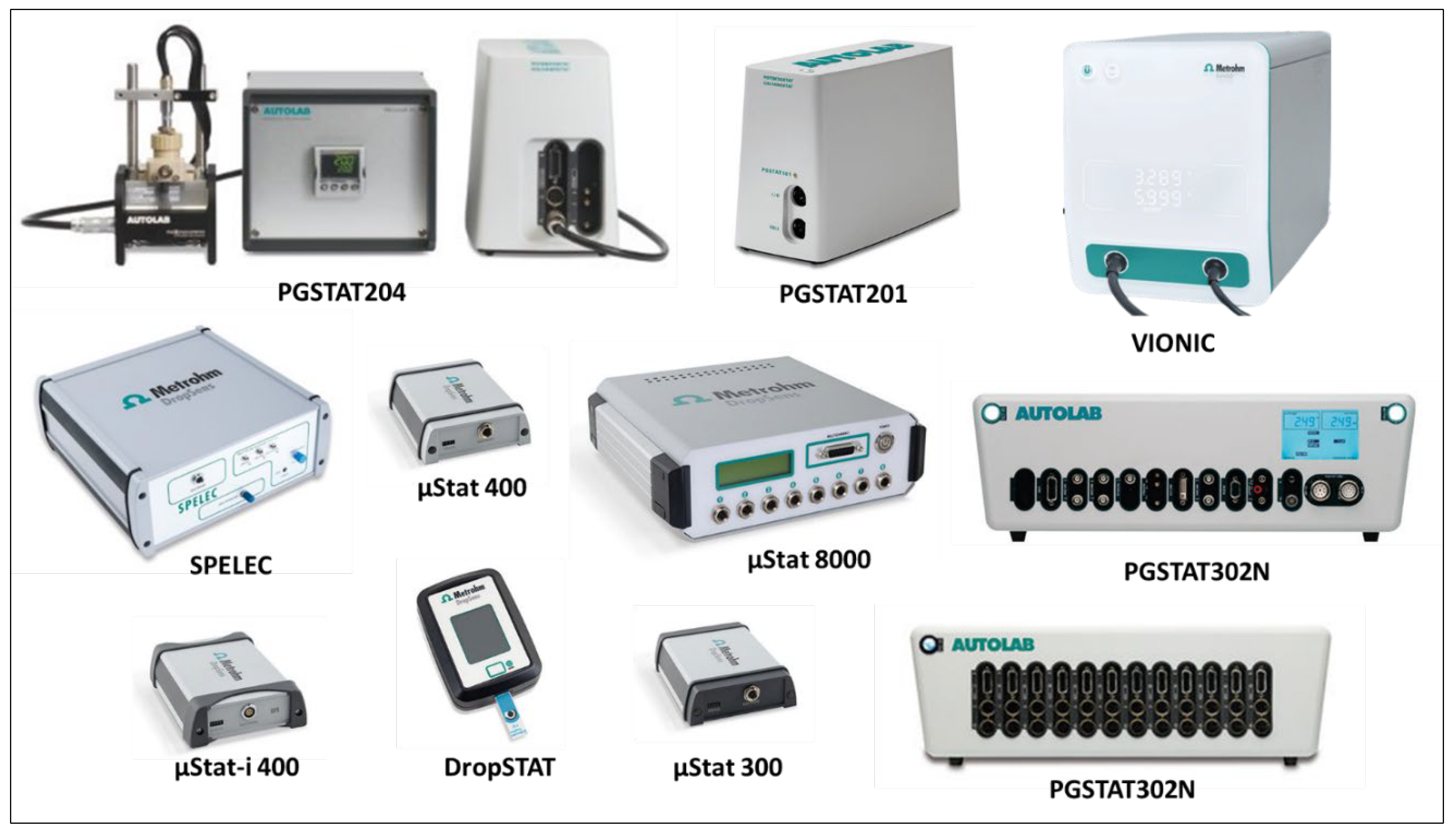
Figure 2.
Main electrochemical workstations supplied by Biologic (potentiostats/galvanostats).
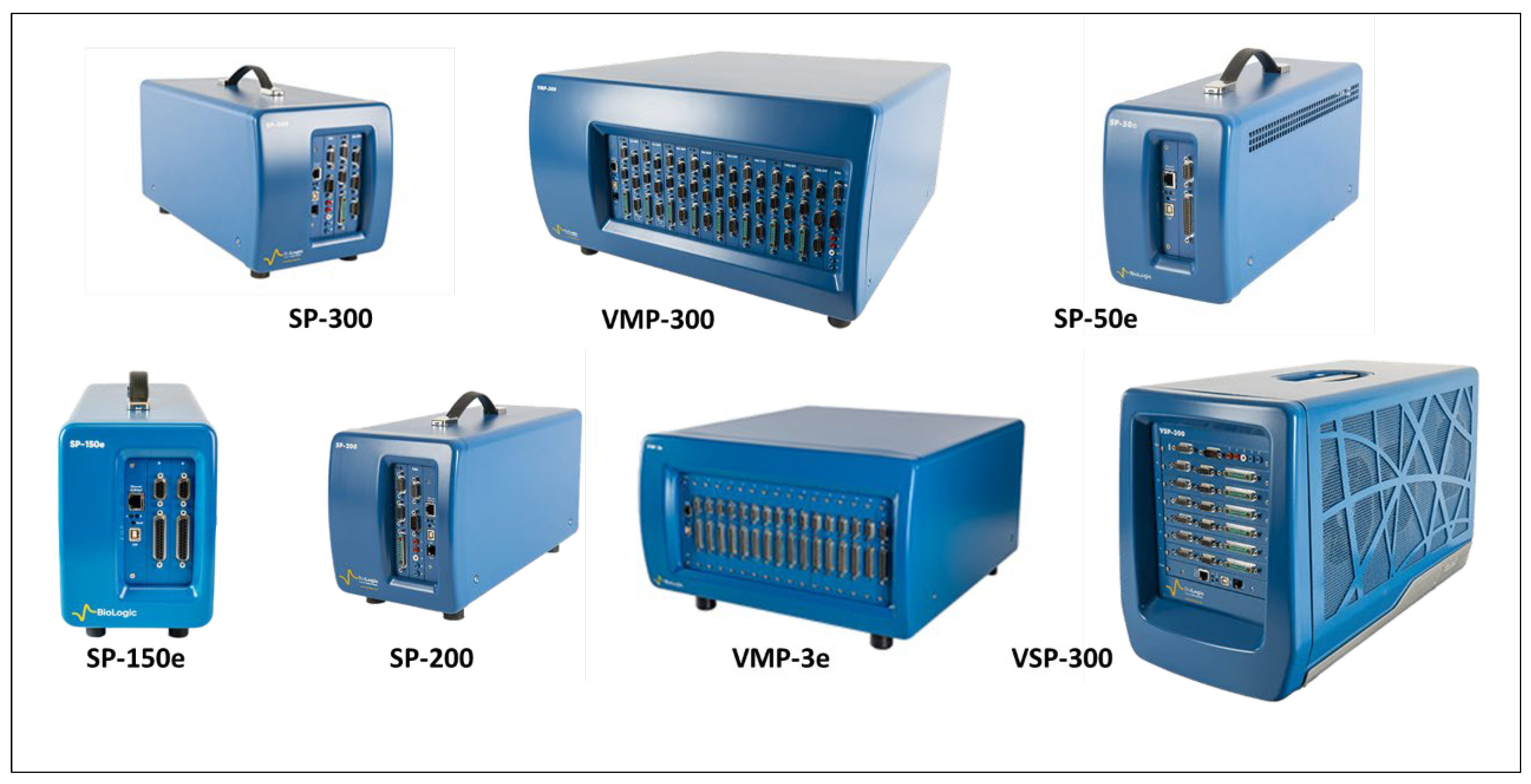
Figure 3.
Main electrochemical workstations supplied by TOB machine (potentiostats/galvanostats).
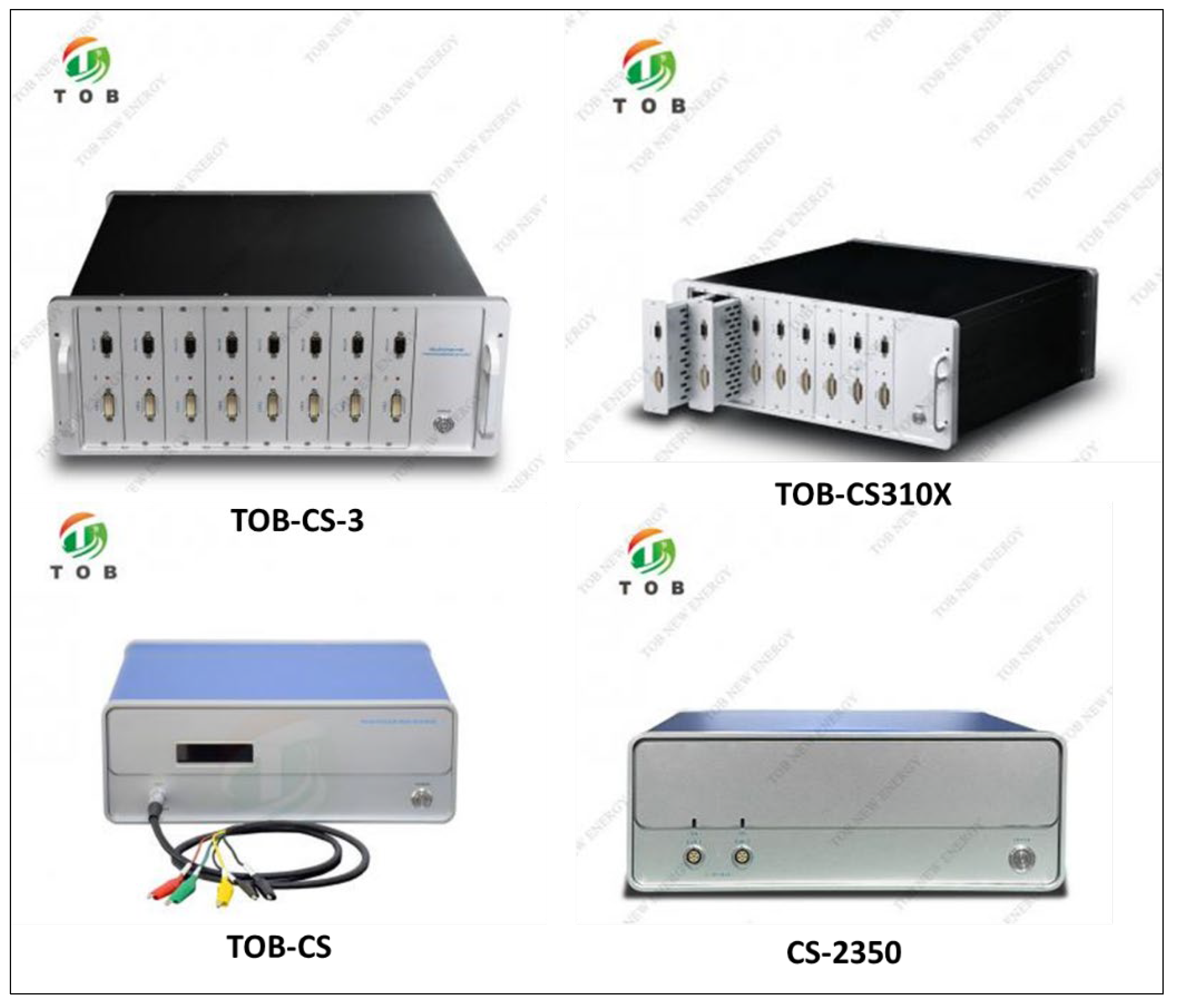
Figure 4.
Main electrochemical workstations supplied by CORRTEST Instruments (potentiostats/galvanostats).
Figure 4.
Main electrochemical workstations supplied by CORRTEST Instruments (potentiostats/galvanostats).
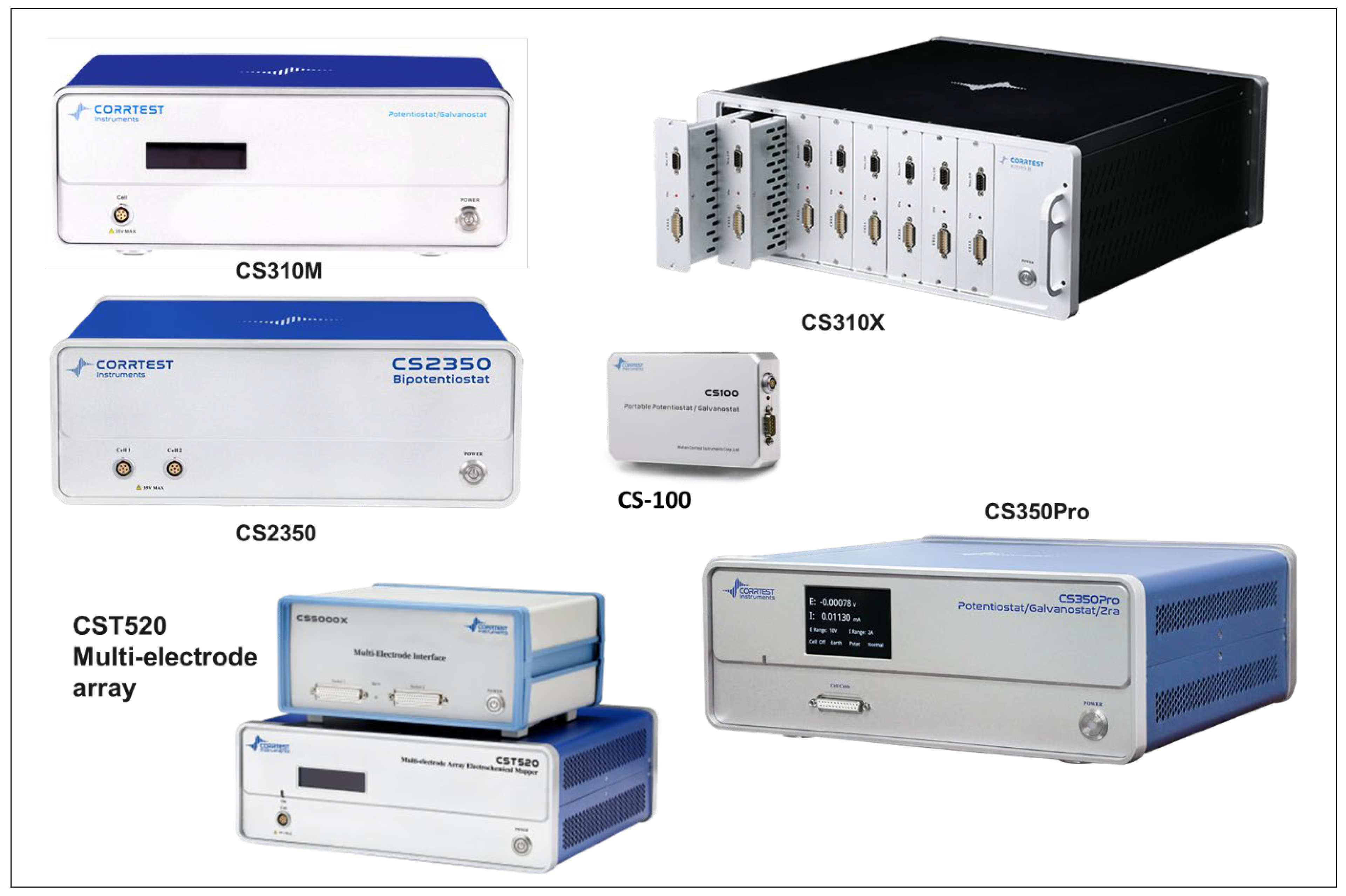
Figure 5.
Main electrochemical workstations supplied by Kanopy Tech. (potentiostats/galvanostats).
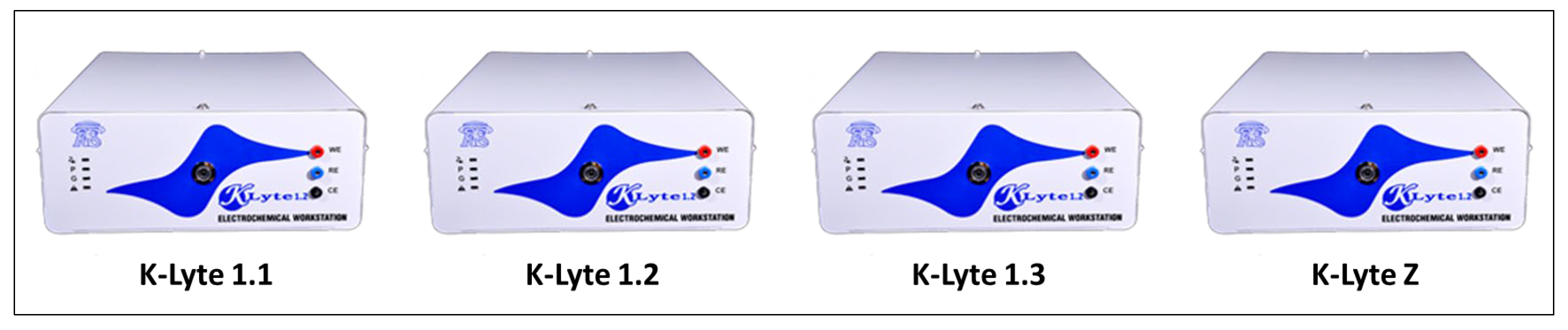
Figure 6.
Main electrochemical workstations supplied by HDTS / PalmSens (potentiostats/galvanostats).
Figure 6.
Main electrochemical workstations supplied by HDTS / PalmSens (potentiostats/galvanostats).
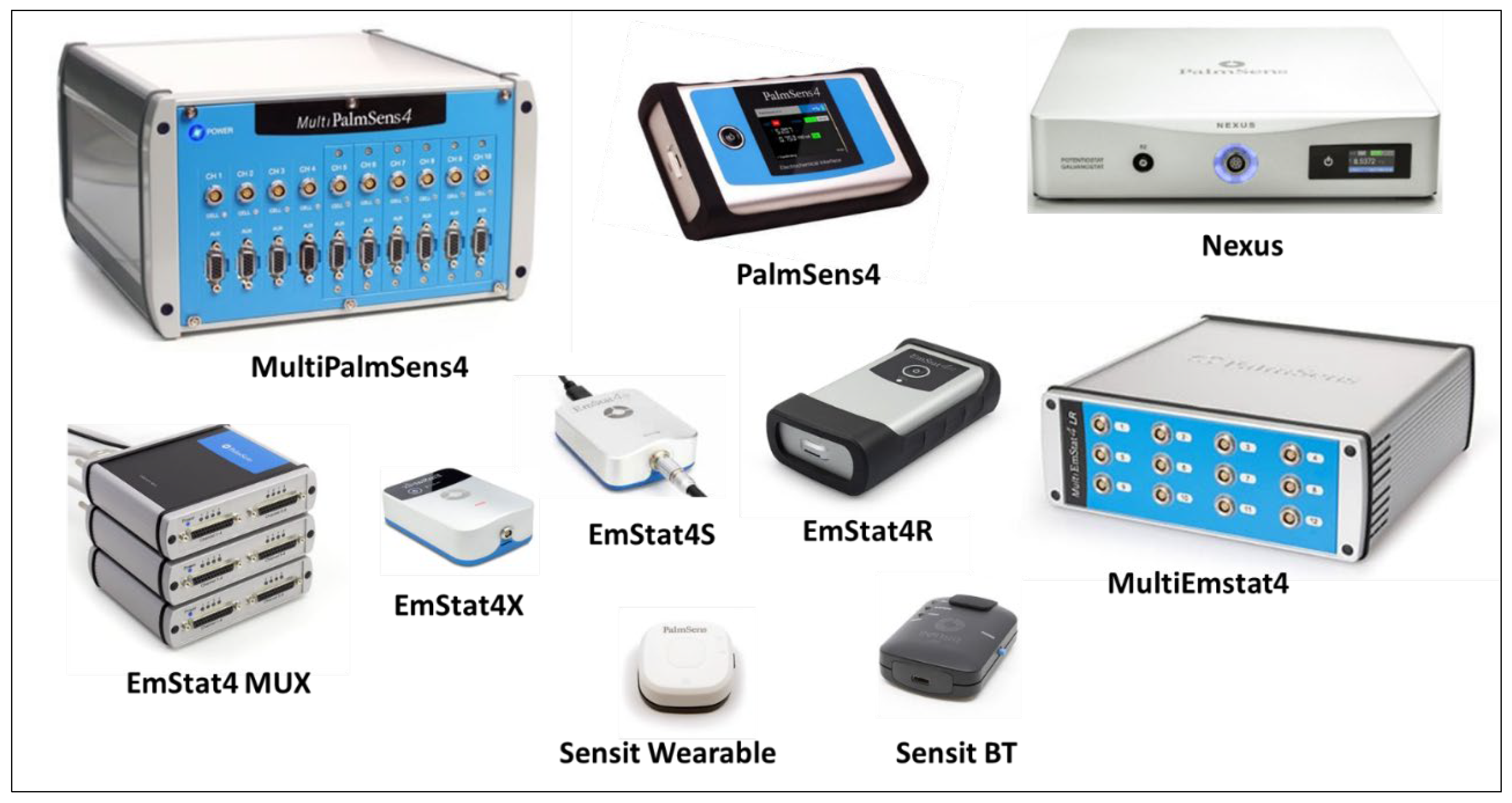
Figure 7.
Main electrochemical workstations supplied by GAMRY instruments (potentiostats/galvanostats).
Figure 7.
Main electrochemical workstations supplied by GAMRY instruments (potentiostats/galvanostats).
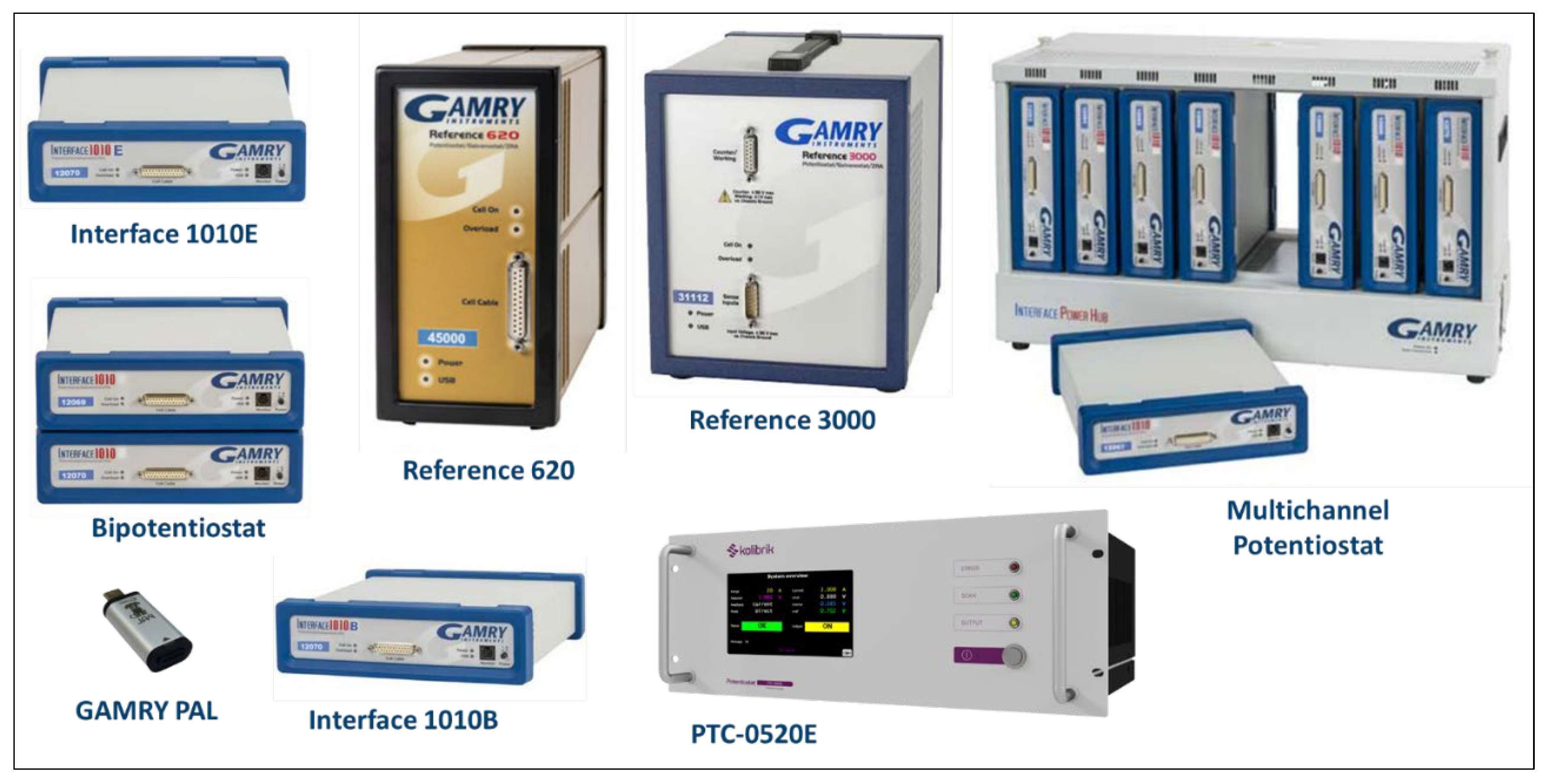
Figure 8.
Main electrochemical workstations supplied by AMETEK Scientific Instruments via Princeton Applied Research and Solatran (potentiostats/galvanostats).
Figure 8.
Main electrochemical workstations supplied by AMETEK Scientific Instruments via Princeton Applied Research and Solatran (potentiostats/galvanostats).
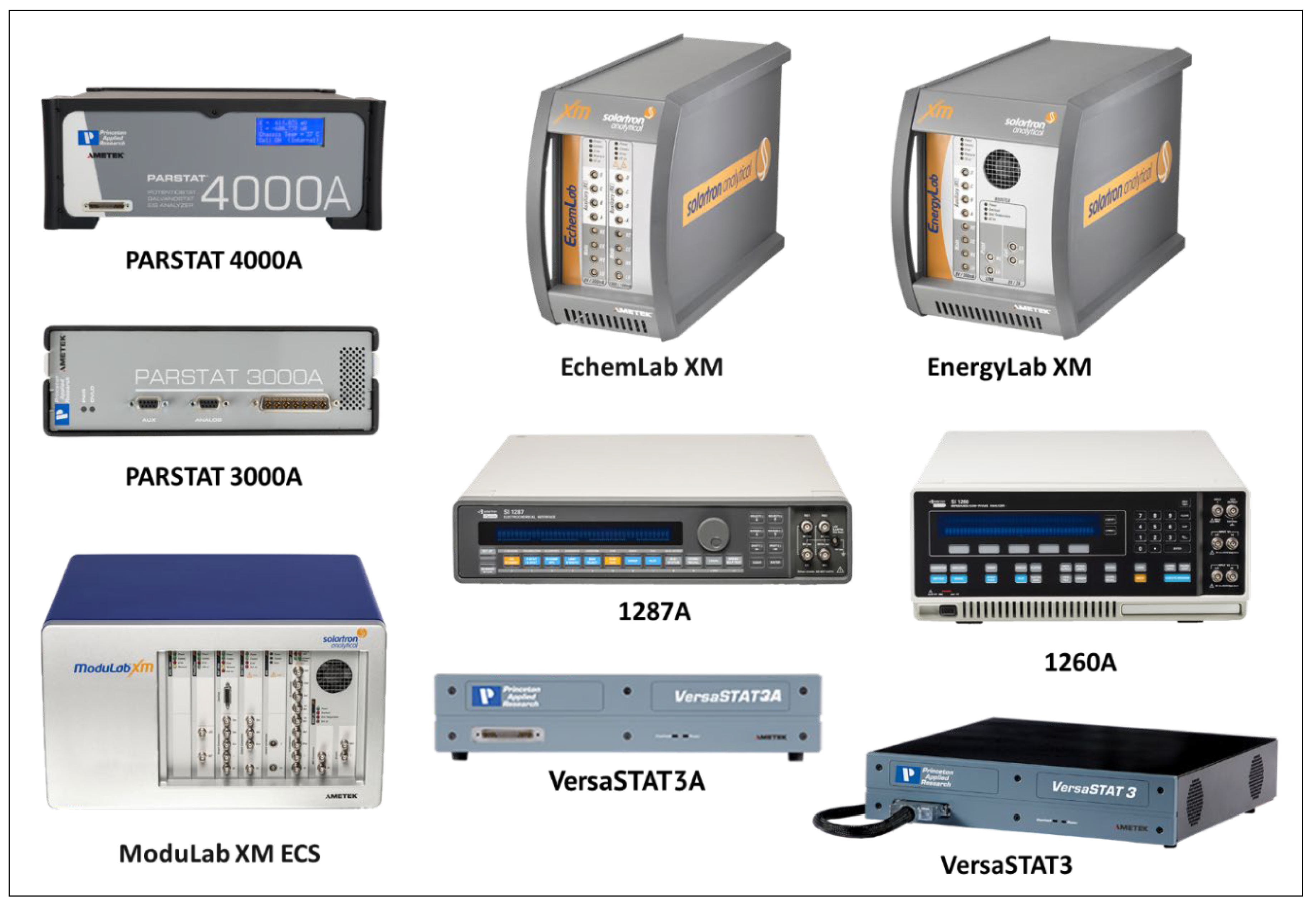
Figure 9.
Main electrochemical workstations supplied by Phadke instruments (potentiostats/galvanostats).
Figure 9.
Main electrochemical workstations supplied by Phadke instruments (potentiostats/galvanostats).
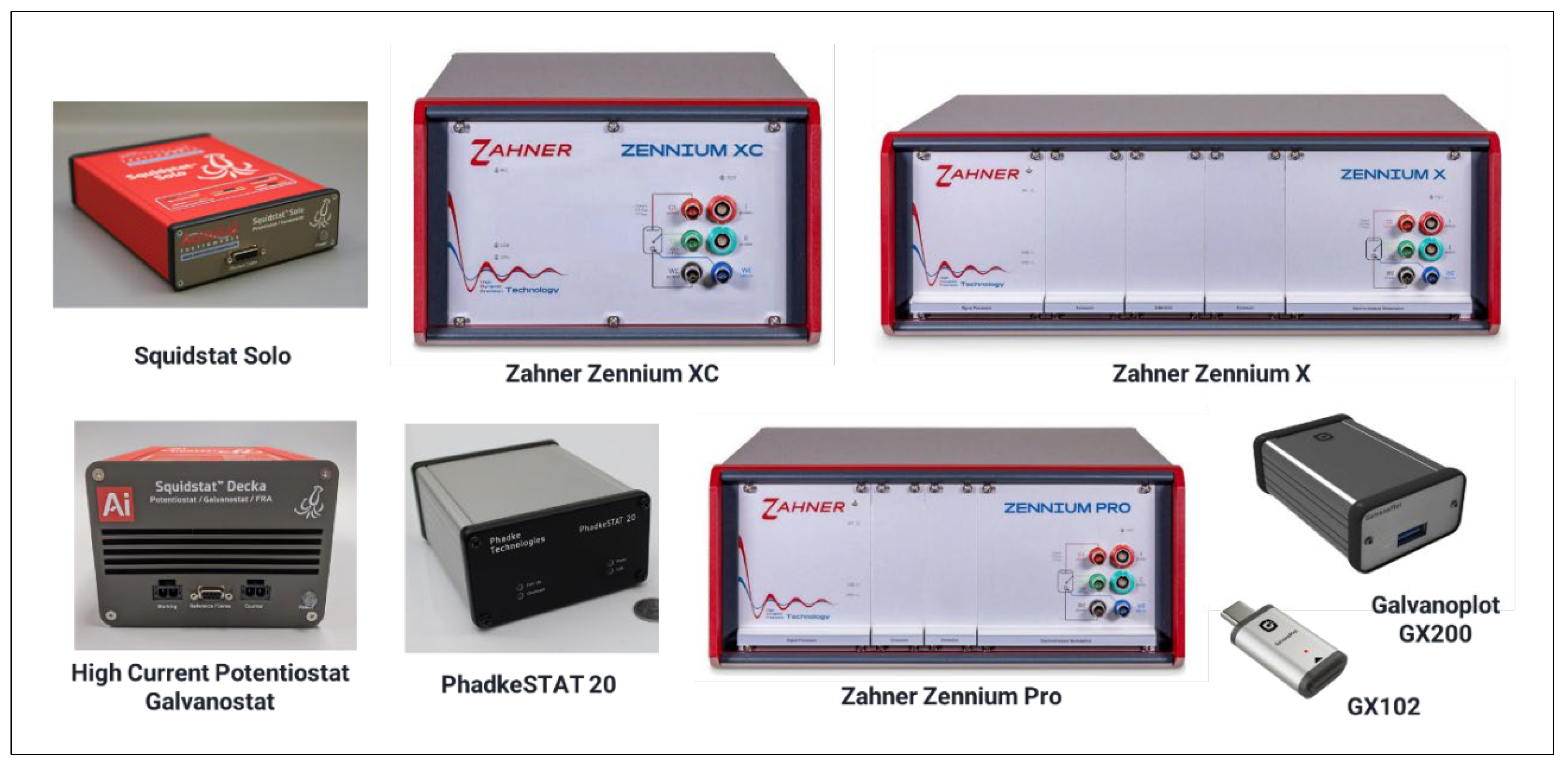
Figure 10.
Main electrochemical workstations supplied by Electrochemical Instruments Ltd. (Elins) (potentiostats/galvanostats).
Figure 10.
Main electrochemical workstations supplied by Electrochemical Instruments Ltd. (Elins) (potentiostats/galvanostats).
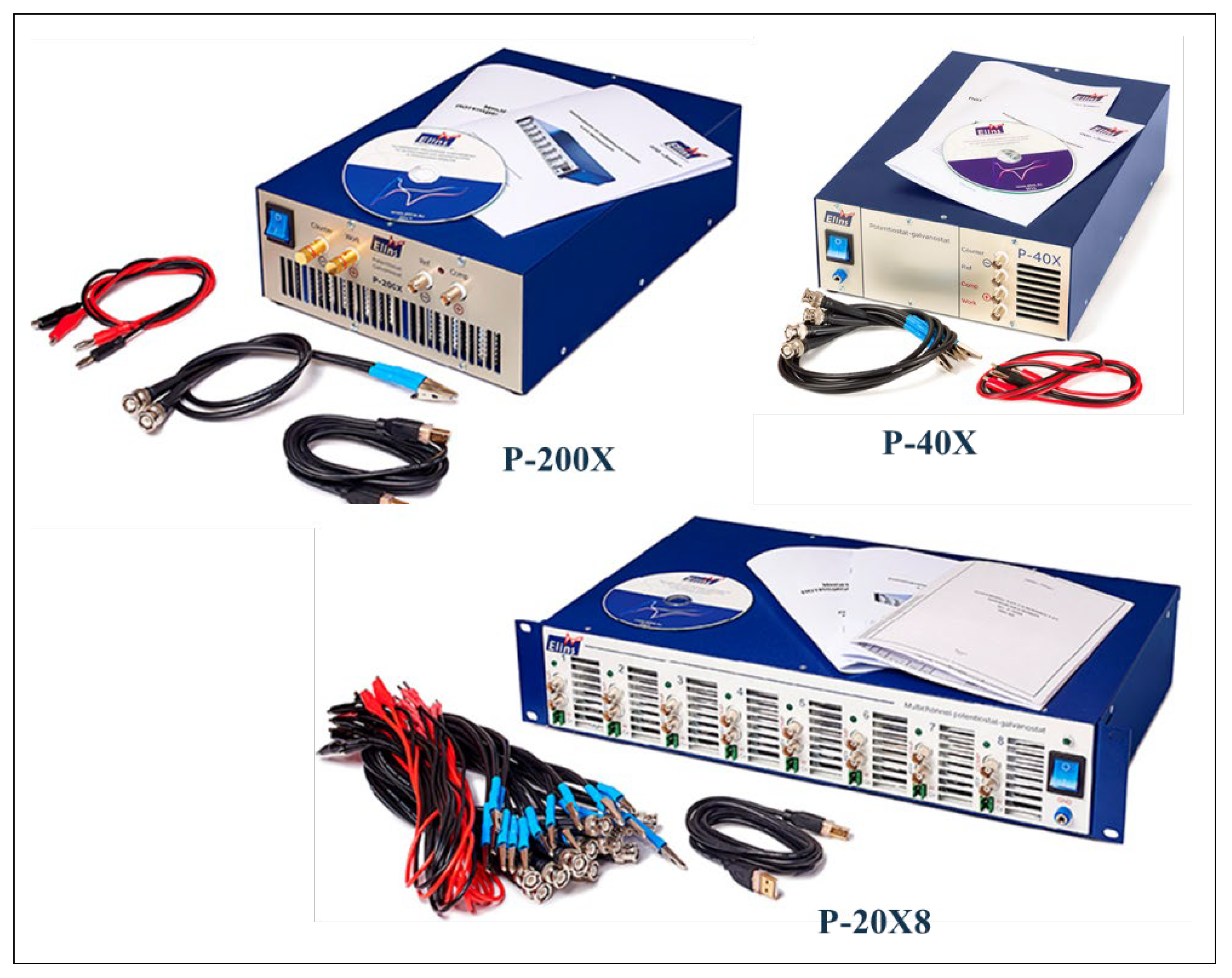

Table 1.
Main electrochemical instruments supplied by Metrohm: name, characteristics, specifications, supported methods, size, number of channels, and limitations.
Table 1.
Main electrochemical instruments supplied by Metrohm: name, characteristics, specifications, supported methods, size, number of channels, and limitations.
| Supplier | Instrument name | Supported methods | Specifications | Potable | Size of the instrument | Mono- or Multi-channels | Multiplexing | Limitations |
|---|---|---|---|---|---|---|---|---|
| METROHM (Switzerland) | VIONIC | CA, CP, CC, MPA, CV, LSV, SWV, DPV, NPV, ASV, CSV, EIS, PDEIS, OCP | ± 50 V ± 6 A | No | Not Specified | Mono | Not Supporting | High voltage |
| PGSTAT101 | Same as Vionic | ± 10 V ±1 00 mA | No | 9 x 15 x 2 cm | Mono | Not Supporting | Limited current range | |
| Autolab IMP | Same as Vionic | ± 10 V ± 100 mA | No | Not Specified | Mono | Not Supporting | Limited current range | |
| PGSTAT204 | Same as Vionic | ± 20 V ± 400 mA | No | Not Specified | Mono | Not Supporting | Limited current range | |
| PGSTAT302N | Same as Vionic | ± 30 V ± 2A | No | 52 × 16 × 42 cm | Mono | Not Supporting | Limited current range | |
| PGSTAT302N.MBA | Same as Vionic | ± 30 V ± 100 mA | No | 52 × 16 × 42 cm | Mono | Not Supporting | Limited current range | |
| PGSTAT302N.MBA.S | Same as Vionic | ± 30 V ± 100 mA | No | 52 × 16 × 42 cm | Mono | Not Supporting | Limited current range | |
| Multi Autolab M101 | Same as Vionic | ± 20 V ± 400 mA | No | 52 × 16 × 52 cm | Multi | Supported through modular designs | Modules purchased separately | |
| Multi Autolab M204 | Same as Vionic | ± 20 V ± 400 mA | No | 52 × 16 × 42 cm | Multi | Supported through modular designs | Modules purchased separately | |
| µStat 300 | CA, CV, LSV, SWV, DPV, NPV, (limited or no EIS, CP, PDEIS, OCP) | ± 2 V ± 3 mA | yes | 13.2 x 10 x 3.6 cm | Mono | Not Supporting | Limited current range | |
| µStat 400 | CA, MPA, CV, LSV, SWV, DPV, NPV, ASV, OCP, EIS | ± 4 V ± 40 mA | yes | 13.2 x 10 x 3.6 cm | Mono | Not Supporting | Limited current range | |
| DropSTAT | CA, CP, CC, MPA, CV, LSV, SWV, DPV, NPV, ASV, CSV, OCP (No EIS or PDEIS support) |
± 2 V ± 200 µA | yes | 6 x 8 x 2.3 cm | Mono | Not Supporting | Limited current range | |
| DropSTATPLUS | Same as DropSTAT | ± 2 V ± 200 µA | yes | 6 x 8 x 2.3 cm | Mono | Not Supporting | Limited current range | |
| ORKPIT | CA, CP, CC, MPA, CV, LSV, SWV, DPV, NPV, ASV, CSV, OCP (No EIS or PDEIS support) |
± 2 V ± 200 µA | yes | 6 x 8 x 2.3 cm | Mono | Not Supporting | Limited current range | |
| µStat-i 400 | CA, CP, CV, LSV, SWV, DPV, NPV, ASV, CSV, EIS, OCP | ± 4 V ± 40 mA | yes | 13.2 x 10 x 3.6 cm | Mono | Not Supporting | Limited current range | |
| µStat-i 400S | Same as µStat-i 400 | ± 4 V ± 40 mA | yes | 13.2 x 10 x 3.6 cm | Mono | Not Supporting | Limited current range | |
| STAT8000 | CA, CP, CC, MPA, CV, LSV, SWV, DPV, NPV, ASV, CSV, EIS, OCP | ± 4 V ± 80 mA | Yes | 20.5 x 7.5 x 22 cm | Multi 8 independent channels |
Supporting up to 8 working electrodes | Limited to 8 channels | |
| STAT8000P | Same as STAT8000 | ± 4 V ± 80 mA | Yes | 20.5 x 7.5 x 22 cm | Multi 8 independent channels | Supporting up to 8 working electrodes | Limited to 8 channels | |
| STAT4000 | CA, CP, CC, MPA, CV, LSV, SWV, DPV, NPV, ASV, CSV, EIS, OCP | ± 4 V ± 80 mA | Yes | 20.5 x 7.5 x 22 cm | Multi 4 independent channels |
Supporting up to 4 working electrodes | Limited to 4 channels | |
| STAT4000P | Same as STAT4000 | ± 4 V ± 80 mA | yes | 20.5 x 7.5 x 22 cm | Multi 4 independent channels | Supporting up to 4 working electrodes | Limited to 4 channels | |
| H2PERMKIT | CA, CP, CC, MPA, CV, LSV, SWV, DPV, NPV, ASV, CSV, EIS, OCP |
± 4 V ± 40 mA | yes | 44 x 30 x 14 cm | Multi 4 independent channels |
Supporting up to 4 working electrodes | Limited to 4 channels | |
| µStat-i MultiX | Same as H2PERMKIT | ± 4 V ± 40 mA | yes | 44 x 30 x 14 cm | Multi 16 independent channels |
Supporting up to 16 working electrodes | ||
| µStat-i MXONE, MXONES, MXONEP, MXONESP | Same as H2PERMKIT | ± 4 V ± 40 mA | yes | 44 x 30 x 14 cm | Multi 8 independent channels | Supporting up to 8 working electrodes | Limited to 8 channels |
Table 2.
Main electrochemical instruments supplied by Biologic: name, characteristics, specifications, supported methods, size, number of channels, and limitations.
Table 2.
Main electrochemical instruments supplied by Biologic: name, characteristics, specifications, supported methods, size, number of channels, and limitations.
| Supplier | Instrument name | Supported methods | Specifications |
Portable | Size of instrument | Mono- or Multi-channels | Multiplexing | Limitations |
|---|---|---|---|---|---|---|---|---|
| Biologic (France) |
VSP-3e | CA, CP, CC, MPA, CV, LSV, SWV, DPV, NPV, ASV, CSV, EIS, PDEIS, OCP | ± 10 V extended up to ± 20 V ± 10 µA to ± 1 A |
No | 225 x 320 x 405 mm | Multi up to 8 channels | Supporting | High current handling; limited portability |
| VMP-3e | Same as VSP-3e | ± 10 V extended up to ± 20 V ± 10 µA to ± 1 A |
No |
448 x 455 x 280 mm |
Multi up to 16 channels | Supporting | High current handling; limited portability | |
| SP-150e | CA, CP, CC, MPA, CV, LSV, SWV, DPV, NPV, ASV, CSV, EIS, PDEIS, OCP |
± 20 V ± 10 µA to ± 1 A |
No | 136 x 372 x 209 mm | Mono | Not Supporting | absence of multi-channel capabilities and portability | |
| SP-50e | CA, CP, CC, MPA, CV, LSV, SWV, DPV, NPV, ASV, CSV, OCP (EIS/PDEIS available only if equipped with impedance module) |
± 10 V ± 10 µA to ± 1 A |
No | 136 x 372 x 209 mm | Mono | Not Supporting | absence of multi-channel capabilities and portability | |
| VSP | CA, CP, CC, MPA, CV, LSV, SWV, DPV, NPV, ASV, CSV, EIS, PDEIS, OCP |
± 20 V ± 10 µA to ± 1 A |
No | 435 x 335 x 95 mm | Multi up to 5 channels | Supporting | Limited to 5 channels; requires external boosters for high current applications | |
| HCP-803 | CA, CP, CC, MPA, CV, LSV, SWV, DPV, NPV, ASV, CSV, EIS (optional), OCP |
± 3 V ± 80 A |
No | 495 x 465 x 262 mm | Mono | Not Supporting | absence of multi-channel capabilities and portability | |
| HCP-10005 | Same as HCP-803 | 0.6 to 5 V ± 100 A |
No | 495 x 465 x 262 mm | Mono | Not Supporting | High Current range, absence of multi-channel capabilities and portability | |
| SP-200 | CA, CP, CC, MPA, CV, LSV, SWV, DPV, NPV, ASV, CSV, EIS, PDEIS, OCP | ± 12 V ± 1 A going to 10 nA and even to ± 1 pA |
Yes | 167 x 410 x 225 mm | Mono | Not Supporting | Limited current range; single channel operation | |
| VSP-300 | Same as SP-200 | ± 12 V from ± 10 µA to ± 1 A extended to 120 A using modules |
No | 254 x 517 x 337 mm | Multi up to 6 channels | Supporting | Requires external boosters for high current; larger size for portability | |
| SP-300 | Same as SP-200 | ± 12 V ± 1 A to 10 nA extended using modules |
No | 205 x 410 x 225 mm | 2 channels | Supporting | requires booster for higher currents, non-portability. | |
| VMP-300 | Same as SP-200 | ± 12 V ± 1 A to 10 nA Extended using modules |
No | 534 x 565 x 315 mm | 16 channels | Supporting | requires booster for higher currents, non-portability. |
Table 3.
Main electrochemical instruments supplied by TOB instruments: name, characteristics, specifications, supported methods, size, number of channels, and limitations.
Table 3.
Main electrochemical instruments supplied by TOB instruments: name, characteristics, specifications, supported methods, size, number of channels, and limitations.
| Supplier | Instrument name | Supported methods | Specifications | Portable | Size of the instrument | Mono- or Multi-channels | Multiplexing | Price |
|---|---|---|---|---|---|---|---|---|
|
TOB instruments (CHINA) |
TOB-CS-2350 |
CV, LSV, CA, CC, CP, CC, LSV, CV, SCV, SWV, NPV, DNPV, ACV, SHACV, FTACV, HDT, RRDE, FE, DPA, DDPA, TPA, IPAD |
± 10V ± 1A |
36.5 x 30.5 x 16 cm |
Dual-channels (2 channels) |
10300$ | ||
| TOB-CS-3 |
Weight: 12.5 Kg 40 x 40 x 14 cm |
CS3008 model : -8 Channels -every channel has EIS (EIS*8) CS3108 model : -8 channels -only one channel has EIS (EIS*1) CS3004 model : -4 channels -every channel has EIS (EIS*4) CS3104 model : -4 channels -only one channel has EIS (EIS*1) |
CS3004 model : -4 channels -every channel has EIS (EIS*4) Price 13800 usd CS3104 model : -4 channels -only one channel has EIS (EIS*1) Price 11500 usd |
|||||
| TOB-CS310X |
OCP, DGP, VSTEP, ISTEP, CP, CA, CC, EIS, CPP, LPR, EPR, EN, ZRA, GCD, PITT, GITT, LSV, CV, SCV, SWV, DPV, NPV, DNPV, ACV, SHACV, FTACV, DPA, DDPA, TPA, IPAD |
± 10 V ± 1 A |
Weight: 12.5 Kg 40 x 40 x 14 cm |
Multichannel (number of channels can be customized |
Each channel is independent Option A : 4-channel, EIS * 1 channel Option B : 4-channel, EIS * 4 Option C : 8-channel, EIS * 1 Option D : 8-channel, EIS * 8 |
Option A: 12100USD Option B: 14500USD Option C: 17380USD Option D: 22380USD |
||
|
TOB-CS Series |
CP, CA, CC, CV, LSV, SCV, SWV, DPV, NPV, DNPV, ACV, CPP, LPR, EPR, EN, ZRA, GCD, PCD, PITT, GITT, DDPA, TPA, IPAD | ± 10 V ± 1A |
Only CS100 is portable |
Net weight: 6.5kg Gross weight: 10kg 36.5 x 30.5 x 16 cm |
Mono channel | CS300M no EIS 4550 usd CS310M with EIS 6400 usd CS350M with EIS 8300 usd CS100 price 2650usd CS100E price 4300 usd |
Table 4.
Main electrochemical instruments supplied by CORRTEST: name, characteristics, specifications, supported methods, size, number of channels, and limitations.
Table 4.
Main electrochemical instruments supplied by CORRTEST: name, characteristics, specifications, supported methods, size, number of channels, and limitations.
| Instrument name | Supported methods | Specifications (ranges) | Portable | Size | Mono- or Multi-channel(s) | Multiplexing | Limitations | Price range (USD) |
|---|---|---|---|---|---|---|---|---|
| CS300M | CV, LSV, DPV, SWV, NPV, DNPV, CSV, ASV | ± 10 V pA to mA |
No | 28 x 20 x 8 cm | Mono-channel | Not supported | No multiplexing, limited channels | 3,000 –3,400 $ |
| CS310M | CV, LSV, DPV, SWV, NPV, DNPV, CSV, ASV, EIS | ± 10 V pA to mA |
No | 28 x 20 x 8 cm | Mono-channel | Not supported | No multiplexing | 5,000 – 6,000 $ |
| CS310X-A | CV, LSV, DPV, SWV, NPV, DNPV, CSV, ASV, EIS | ± 10 V pA to mA |
No | 40 x 30 x 15 cm | Multi-channels (4 channels) | Multiplexer supported | Requires power supply, larger size | 8,800 – 18,000 $ |
| CS310X-B | CV, LSV, DPV, SWV, NPV, DNPV, CSV, ASV, EIS | ± 10 V pA to mA |
No | 40 x 30 x 15 cm | Multi-channels (4 channels) | Multiplexer supported | Requires power supply | 8,800 – 18,000 $ |
| CS310X-C | CV, LSV, DPV, SWV, NPV, DNPV, CSV, ASV, EIS | ± 10 V pA to mA |
No | 50 x 35 x 18 cm | Multi-channels (8 channels) | Multiplexer supported | Requires power supply | 8,800 – 18,000 $ |
| CS310X-D | CV, LSV, DPV, SWV, NPV, DNPV, CSV, ASV, EIS | ± 10 V pA to mA |
No | 50 x 35 x 18 cm | Multi-channels (8 channels) | Multiplexer supported | Requires power supply | 8,800 – 18,000 $ |
| CS2350M | CV, LSV, DPV, SWV, NPV, DNPV, CSV, ASV, EIS | ± 10 V pA to mA |
No | 30 x 22 x 10 cm | Dual-channels (2 channels) |
Not supported | No multiplexing | 7,500 – 8,200 $ |
| CS350M | CV, LSV, DPV, SWV, NPV, DNPV, CSV, ASV, EIS | ± 10 V pA to mA |
No | 28 x 20 x 8 cm | Mono-channel | Not supported | No multiplexing | 3,000 – 3,400 $ |
| CS2150M | CV, LSV, DPV, SWV, NPV, DNPV, CSV, ASV | ± 10 V 2 nA to 2A |
No | 28 x 20 x 8 cm | Dual-channels (2 channels) |
Not supported | No multiplexing | 3,000 – 3,400 $ |
Table 5.
Main electrochemical instruments supplied by Kanopy Techno Solutions: name, characteristics, specifications, supported methods, size, number of channels, and limitations.
Table 5.
Main electrochemical instruments supplied by Kanopy Techno Solutions: name, characteristics, specifications, supported methods, size, number of channels, and limitations.
| Supplier | Instrument name | Supported methods | Specifications | Portable | Size of the instrument |
Mono- or Multi-channels | Multiplexing | Limitations | Price range |
|---|---|---|---|---|---|---|---|---|---|
|
Kanopy Techno Solutions (India) |
K-Lyte 1.0 | LSV, CV, CA | ± 2.0 V 1 µA to 10 mA |
No | 32 x 22 x 9 cm | Mono-channel | Not supporting | No integrated multiplexing and limited to a single channel No Battery included No Bluetooth or wireless connectivity Exposing instruments to wet environments. Currents and voltages exceeding the mentioned specifications. Operating at low (< 0 °C) or high temperatures (> 50 °C) |
|
|
K-Lyte 1.2 |
LSV, CV, CA, OCP, Tafel Analysis, LP, SCP, NPV, DPV, SWV, I-V_Plot | ± 5 V, ± 10 V 100 nA to 1 A |
No | 32 x 22 x 9 cm | Mono-channel | Not supporting | Same as K-Lyte 1.0 |
||
|
K-Lyte 1.3 (or referred to as PG-Lyte 1.0) |
LCV, CV, CA, OCP, Tafel Analysis, LP, SCP, NPV, DPV, SWV, I-V_Plot, LCV, CV, CP, GCD | ± 5 V, ± 10 V 100 nA to 1 A |
No | 32 x 22 x 9 cm | Mono-channel | Not supporting | Same as K-Lyte 1.0 |
Table 6.
Main electrochemical instruments supplied by PalmSens B.V.: name, characteristics, specifications, supported methods, size, number of channels, and limitations.
Table 6.
Main electrochemical instruments supplied by PalmSens B.V.: name, characteristics, specifications, supported methods, size, number of channels, and limitations.
| Supplier | Instrument name | Supported methods | Specifications | Portable | Size of the instrument | Mono- or Multi-channels | Multiplexing | Limitations | Price range |
|---|---|---|---|---|---|---|---|---|---|
|
PalmSens B.V. (Netherlands) |
Nexus |
LSV, CV, FCV, ACV, DPV, SWV, NPV, CA, ZRA, CC, MA, FAM, PAD, LCP, CP, MP, OCP, EIS/GEIS | ± 10 V 100 pA to 1 A (for potentiostat)1 nA to 1 A (for galvanostat) |
No | 20 x 21 x 4.5 cm | Mono-channel | Not supporting | No integrated multiplexing and limited to a single channel No internal battery and Bluetooth connectivity Not portable |
|
|
PalmSens4 |
LSV, CV, FCV, ACV, DPV, SWV, NPV, CA, ZRA, CC, MA, FAM, PAD, MPAD, LSP, CP, MP, OCP, SCP, MM, EIS/GEIS |
± 5 V or ± 10 V 100 pA to 10 mA (for potentiostat) 1 nA to 10 mA (for galvanostat) |
Yes | 15.7 x 9.7 x 3.5 cm | Mono-channel |
Multiplexer supporting: MUX8-R2 (8 channels) MUX16 (16 channels) |
Limited current range Multichannel measurements require external multiplexers Battery life constraints |
||
|
MultiPalmSens4 |
Same as PalmSens4 | ± 5 V or ±10 V 100 pA to 10 mA (for potentiostat) 1 nA to 10 mA (for galvanostat) |
No | 15 x 25 x 25 cm | Mono-channel | Multiplexer supporting: MUX8-R2 (8 channels) |
Limited current range Not portable No internal battery and Bluetooth connectivity |
||
|
MultiEmStat4 |
LSV, CV, DPV, SWV, NPV, CA, ZRA, CC, MA, PAD, LCP, CP, MP, OCP, MM, EIS/GEIS |
± 3 V (for LR) and ± 6 V (for HR) 1 nA to 10 mA (8 ranges for LR) and 100 nA to 100 mA (7 ranges for HR) |
No | 21.2 x 22.1 x 7.7 cm | Multi-channels (4, 8 or 12 channels) |
Supporting | Limited current range Not portable No internal battery and Bluetooth connectivity |
||
|
EmStat4X |
LSV, CV, FCV, ACV, DPV, SWV, NPV, CA, ZRA, CC, MA, FAM, PAD, LCP, CP, MP, OCP, MM, EIS/GEIS, FEIS/FGEIS | Same as MultiEmStat4 |
Yes | 11.4 x 8.0 x 4.5 cm | Mono-channel |
Multiplexer supporting: MUX8-R2 (8 channels) |
Limited current range |
||
|
EmStat4 MUX |
LSV, CV, FCV, ACV, DPV, SWV, NPV, CA, ZRA, CC, MA, FAM, PAD, MPAD, LSP, CP, MP, OCP, SCP, MM, EIS/GEIS, FEIS/FGEIS | ± 3 V 1 nA to 10 mA |
Yes | 13.8 x 12.1 x 3.7 cm | Multichannels (8 channels) | Supporting MUX8-R2 can be stacked to provide up to 128 channels |
No internal Battery No Bluetooth and wireless connectivity |
||
|
EmStat4R |
LSV, CV, FCV, ACV, DPV, SWV, NPV, CA, ZRA, CC, MA, FAM, PAD, LSP, CP, MP, OCP, MM, EIS/GEIS, FEIS/FGEIS | ± 3 V 1 nA to 10 mA |
Yes | Alumium body only: 11.1 x 6 x 2.7 cm With rubber sleeve: 11.8 x 6.8 x 3.3 cm |
Mono-channel | Not supporting | No integrated multiplexing and limited to a single channel Limited current range |
||
|
EmStat4S |
Same as EmStat4X |
Same as MultiEmStat4 |
Yes | 7.2 x 5.5 x 2.6 cm | Mono-channel | Not supporting | No integrated multiplexing and limited to a single channel No internal battery No Bluetooth and wireless connectivity Limited current range |
||
|
Sensit Wearable |
LSV, CV, DPV, SWV, NPV, CA, MA, PAD, MM, OCP, EIS | - 1.7 V to + 2 V 100 nA to 5 mA |
Yes | 35 x 35 x 12 mm | Mono-channel | Not supporting | No integrated multiplexing and limited to a single channel Battery life constraints Limited current-potential range |
||
|
Sensit BT |
LSV, CV, DPV, SWV, NPV, CA, MA, PAD, OCP, EIS | Same as Sensit Wearable |
Yes | 75 x 55 x 23 mm | Mono-channel, but certain configurations allow two-working electrode (BiPot) | Not supporting | Battery life constraints Limited current-potential range |
||
|
Sensit Smart |
Same as Sensit Wearable |
Same as Sensit Wearable |
Yes | 43 x 25 x 11 mm | Mono channel | Not supporting | No integrated multiplexing and limited to a single channel No internal battery No Bluetooth and wireless connectivity No internal storage |
Table 7.
Main electrochemical instruments supplied by GAMRY instruments: name, characteristics, specifications, supported methods, size, number of channels, and limitations.
Table 7.
Main electrochemical instruments supplied by GAMRY instruments: name, characteristics, specifications, supported methods, size, number of channels, and limitations.
| Supplier | Instrument name | Instrument Type |
Software |
Supported methods | Specifications | Portable | Size of the instrument | Mono- or Multi-channels | Multiplexing | Limitations | Price range |
| GAMRY Instruments (USA) |
Interface 1010E | Potentiostat, galvanostat, ZRA | Virtual Front Panel™ and eChem Toolkits™ | EIS, CV, CA, CP, NPV, CYP, SWV, EFM, CPT, Tafel | Max Applied Current - ±1 A Maximum Applied Potential - ±12 V EIS 10 μHz - 2 MHz |
Yes | 24 × 6 × 27 cm | single-channel potentiostat, bipotentiostat, or multichannel-potentiostat | ECM8 Multiplexer compatible | High cost for each module | ~$11,000 |
| Interface 1010B | Potentiostat, galvanostat, ZRA | eChem Toolkits™ | EIS, CYV, CA, CP, CC, NPV, CYP, SWV, EFM | Max Applied Current - ±1 A Maximum Applied Potential - ±12 V EIS 10 μHz - 20 kHz |
Yes | 24 × 6 × 27 cm | single-channel potentiostat, bipotentiostat, or multichannel-potentiostat | No |
~$6500 |
||
| Interface 1010T | Potentiostat | No | EIS, CV, CA, CP, NPV, SWV | Max Applied Current - ±100 mA Maximum Applied Potential - ±5 V EIS 10 μHz - 20 kHz |
Yes | 24 × 6 × 27 cm | No | No | Designed for undergraduate and graduate teaching labs |
?~$2500 |
|
| Interface 5000E/P | Potentiostat, galvanostat, ZRA | eChemDC Toolkit and eChemAC | EIS, CV, CA, CP, NPV, CYP, SWV, EFM, CPT, Tafel | Max Applied Current - ±5A Maximum Applied Potential - ±6 V EIS 10 μHz – 1 MHz/20kHz |
Yes | 24 x 6 x 27 cm | Yes. Up to eight potentiostats in a single chassis | ECM8 Multiplexer compatible | Potential issues with low impedance battery measurements due to contact resistance |
~$7000 |
|
| Reference 620 | Potentiostat, galvanostat, ZRA | eChemDC Toolkit and eChemAC | EIS, CV, CA, CP, NPV, CYP, SWV, EFM, CPT, Tafel | Max Applied Current - ±600 mA Maximum Applied Potential - ±11 V EIS 10 μHz - 5 MHz |
Yes | 9 × 19 × 27 cm | single-channel potentiostat, bipotentiostat | ECM8 Multiplexer compatible | cell resistance, and external interference can impact measurement accuracy in the low current regime | ~$$ | |
| Reference 3000 | Potentiostat, galvanostat, ZRA | eChemDC Toolkit and eChemAC | EIS, CV, CA, CP, NPV, CYP, SWV, EFM, CPT, Tafel | ±3 A@15V or ±1.5A@32V Maximum Applied Potential - ±32 V EIS 10 μHz - 1 MHz |
Yes | 20 × 23 × 30 cm | Single- channel potentiostat, bipotentiostat, or multichannel-potentiostat | ECM8 Multiplexer compatible | limitations in its lowest measurable impedance and phase noise, particularly when combined with the ECM8 multiplexer | ~$10,000 | |
| Reference 3000 with Auxiliary Electrometer (w/AE) | Potentiostat, galvanostat, ZRA | eChemDC Toolkit and eChemAC | EIS, CV, CA, CP, NPV, CYP, SWV, EFM, CPT, Tafel | ±3 A@15V or ±1.5A@32V Maximum Applied Potential - ±32 V EIS 10 μHz - 1 MHz |
Yes | 20 × 23 × 30 cm | Eight additional voltage measurements w/AE | ECM8 Multiplexer compatible | “As above” | ~$15,000 | |
| Gamry PAL | Compact Potentiostat | Gamry Pal Suite | CV, CA, CP, NPV, LSV, CYP, SWV, OCP | 30 mA at ± 1.5V or 20 mA at ± 2.5V Maximum Applied Potential - ±2.5 V EIS 100 mHz – 100 kHz |
Yes | USB-like, Length 29 mm |
No | No | Limitations in voltage and current ranges | ~$ |
Table 8.
Main electrochemical instruments supplied by AMETEK Scientific Instruments via Princeton Applied Research and Solatran: name, characteristics, specifications, supported methods, size, number of channels, and limitations.
Table 8.
Main electrochemical instruments supplied by AMETEK Scientific Instruments via Princeton Applied Research and Solatran: name, characteristics, specifications, supported methods, size, number of channels, and limitations.
| Instrument Name | Supported Methods | Specifications (Ranges) | Portable | Size (cm) | Channels (Number) | Multiplexing (Multiplexer Name) | Limitations | Price Range (USD) |
|---|---|---|---|---|---|---|---|---|
| VersaSTAT3A | LSV, CV, DPV, SWV, NPV, CA, ZRA, CC, MA, FAM, PAD, LCP, CP, MP, OCP, MM, EIS | Compliance Voltage: ±12 V; Potential Range: ±10 V; Current Range: 2 pA to 2 A | No | 24 x 17 x 8 | Mono-channel (1) | Not supported | No internal battery; not portable | $15,000 – $20,000 |
| VersaSTAT3 | LSV, CV, DPV, SWV, NPV, CA, ZRA, CC, MA, FAM, PAD, LCP, CP, MP, OCP, MM, EIS | Compliance Voltage: ±12 V; Potential Range: ±10 V; Current Range: 100 pA to 2 A | No | 24 x 17 x 8 | Mono-channel (1) | Not supported | No internal battery; not portable | $13,000 – $18,000 |
| VersaSTAT3F | LSV, CV, DPV, SWV, NPV, CA, ZRA, CC, MA, FAM, PAD, LCP, CP, MP, OCP, MM, EIS | Compliance Voltage: ±12 V; Potential Range: ±10 V; Current Range: 400 fA to 2 A | No | 24 x 17 x 8 | Mono-channel (1) | Not supported | No internal battery; not portable | $15,000 – $20,000 |
| VersaSTAT4A | LSV, CV, DPV, SWV, NPV, CA, ZRA, CC, MA, FAM, PAD, LCP, CP, MP, OCP, MM, EIS | Compliance Voltage: ±20 V; Potential Range: ±20 V; Current Range: 4 fA to 4 A | No | 27 x 22 x 10 | Mono-channel (1) | Not supported | No internal battery; not portable | $22,000 – $28,000 |
| VersaSTAT4 | LSV, CV, DPV, SWV, NPV, CA, ZRA, CC, MA, FAM, PAD, LCP, CP, MP, OCP, MM, EIS | Compliance Voltage: ±20 V; Potential Range: ±20 V; Current Range: 4 fA to 4 A | No | 27 x 22 x 10 | Mono-channel (1) | Not supported | No internal battery; not portable | $22,000 – $28,000 |
| PARSTAT 3000A | LSV, CV, DPV, SWV, NPV, CA, ZRA, CC, MA, FAM, PAD, LCP, CP, MP, OCP, MM, EIS | Compliance Voltage: ±30 V; Potential Range: ±30 V; Current Range: 4 fA to 20 A | No | 30 x 25 x 12 | Mono-channel (1) | Not supported | No internal battery; not portable | $30,000 – $40,000 |
| PARSTAT 4000A | LSV, CV, DPV, SWV, NPV, CA, ZRA, CC, MA, FAM, PAD, LCP, CP, MP, OCP, MM, EIS | Compliance Voltage: ±30 V; Potential Range: ±30 V; Current Range: 4 fA to 4 A | No | 30 x 25 x 12 | Mono-channel (1) | Not supported | No internal battery; not portable | $30,000 – $40,000 |
| 1287A | LSV, CV, DPV, SWV, NPV, CA, ZRA, CC, MA, FAM, PAD, LCP, CP, MP, OCP, MM, EIS | Compliance Voltage: ±14.5 V or ±20 V; Potential Range: 100 μV to 14.5 V/ 20 V ; Current Range: 100 pA to 2 A | No | 26 x 17 x 10 | Mono-channel (1) | Not supported | No internal battery; not portable | $18,000 – $25,000 |
| EnergyLab XM | LSV, CV, DPV, SWV, NPV, CA, ZRA, CC, MA, FAM, PAD, LCP, CP, MP, OCP, MM, EIS | Modular system; Potential: up to ±20 V; Current: fA to A (user configurable) | No | Modular system (varies) | Mono-channelsupporting multiplexer | Yes (Multiplexer: MUX-12) | Requires configuration; not portable | $50,000 – $80,000 |
| EchemLab XM | LSV, CV, DPV, SWV, NPV, CA, ZRA, CC, MA, FAM, PAD, LCP, CP, MP, OCP, MM, EIS | Modular system; Potential: up to ±20 V; Current: fA to A (user configurable) | No | Modular system (varies) | Mono-channelsupporting multiplexer | Yes (Multiplexer: MUX-12) | Requires configuration; not portable | $50,000 – $80,000 |
| ModuLab XM ECS | LSV, CV, DPV, SWV, NPV, CA, ZRA, CC, MA, FAM, PAD, LCP, CP, MP, OCP, MM, EIS | Compliance Voltage: ±20 V; Potential Range: ±20 V; Current: fA to A (configurable) | No | Modular system (varies) | Mono-channelsupporting multiplexer | Yes (Multiplexer: MUX-12) | Requires configuration; not portable | $60,000 – $90,000 |
| CellTest Multichannel | LSV, CV, DPV, SWV, NPV, CA, ZRA, CC, MA, PAD, LCP, CP, MP, OCP, MM, EIS | Modular; ±20 V; Current range: fA to A (per channel, user configurable) | No | Modular system (varies) | Multi-channel (up to 16) | Yes (MUX-12 or custom options) | Requires configuration; not portable | $80,000 – $150,000 |
| PARSTAT MC | LSV, CV, DPV, SWV, NPV, CA, ZRA, CC, MA, PAD, LCP, CP, MP, OCP, MM, EIS | ±20 V; Current range: fA to 2 A (user selectable per channel); EIS on all channels | No | 45 × 40 × 20 (per unit) | Multi-channel (up to 16) | Yes (MUX-12 or MUX-16) | Requires configuration; not portable | $100,000 – $160,000 |
| PARSTAT 3000A-DX | LSV, CV, DPV, SWV, NPV, CA, ZRA, CC, MA, PAD, LCP, CP, MP, OCP, MM, EIS | ±30 V compliance; Current range: 4 nA to 2 A; High-speed EIS | No | 35 × 30 × 15 | two-channel (2) | Not supported | No internal battery; not portable | $40,000 – $60,000 |
Table 9.
Main electrochemical instruments supplied by Phadke instruments: name, characteristics, specifications, supported methods, size, number of channels, and limitations.
Table 9.
Main electrochemical instruments supplied by Phadke instruments: name, characteristics, specifications, supported methods, size, number of channels, and limitations.
| Supplier | Instrument name | Instrument Type |
Software |
Supported methods | Specifications | Portable | Size of the instrument | Mono- or Multi-channels | Multiplexing | Limitations | Price range |
|---|---|---|---|---|---|---|---|---|---|---|---|
| Phadke Instruments (India) |
PhadkeSTAT 20 Corr | Potentiostat | No | OCP, Tafel | ±2 V Current 200 nA to 20 m A |
Yes | 105mm x 132mm x 55mm | Mono | No | Limited Voltage and current ranges. No EIS |
~S2300 |
| PhadkeSTAT 20 CV | Potentiostat | No | OCP, CV, LSV | ±2 V Current 200 nA to 20 m A |
Yes | 105mm x 132mm x 55mm | Mono | No | As above | ~S2300 | |
| PhadkeSTAT 20 Basic | Potentiostat | No | OCP, Tafel, CV, LSV | ±2 V Current 200 nA to 20 m A |
Yes | 105mm x 132mm x 55mm | Mono | No | As above | ~S2300 | |
| PhadkeSTAT 20 Standard | Potentiostat | No | OCP, Tafel, CV, LSV, CA | ±2 V Current 200 nA to 20 m A |
Yes | 105mm x 132mm x 55mm | Mono | No | As above | ~S2500 | |
| PhadkeSTAT 20 Advanced | Potentiostat | No | OCP, Tafel, CV, LSV, CA, CC, NPV, SWV, DPV | ±2 V Current 200 nA to 20 m A |
Yes | 105mm x 132mm x 55mm | Mono | No | As above | ~S2500 |
Table 10.
Main electrochemical instruments supplied by Electrochemical Instruments Ltd. (Elins): name, characteristics, specifications, supported methods, size, number of channels, and limitations.
Table 10.
Main electrochemical instruments supplied by Electrochemical Instruments Ltd. (Elins): name, characteristics, specifications, supported methods, size, number of channels, and limitations.
| , Supplier | Instrument name | Supported methods | Specifications |
Maximum voltage and current |
Sweep and Registration speed |
Potable | Size of the instrument | Mono- or Multi-channels | Multiplexing | Limitations | Price range |
|---|---|---|---|---|---|---|---|---|---|---|---|
|
Electrochemical Instruments Ltd. (Russia) |
Potentiostat-galvanostat, P-2X | OCP, POT, BE, CP, CC, CA, CR, LSV, CV, ASV, CSV, CCD, GCD, PCD, ESR | ±5 V 6 current ranges, with minimal recommended operating current 10 nA. |
Maximum voltage: 12 V Maximum current: 0.2 A |
Sweep speed: up to 10 V/s Registration speed: up to 200 points/s |
No | 253×175×52 mm3 | mono | No | Absence of any languages in software and documentation but Russian | 85000 rub |
| Potentiostat-galvanostat, P-20X | OCP, POT, BE, CP, CC, CA, CR, LSV, CV, ASV, CSV, CCD, GCD, PCD, ESR | ±2 V and ±15 V 8 current ranges, with minimal recommended operating current 1 nA. |
Maximum voltage: 17 V Maximum current: 1.5 A |
Sweep speed: up to 20 V/s Registration speed: up to 200 points/s |
No | 253×175×52 mm3 | mono | No | Absence of any languages in software and documentation but Russian | 219000 rub | |
| Potentiostat-galvanostat, P-40X | OCP, POT, BE, CP, CC, CA, CR, LSV, CV, ASV, CSV, CCD, GCD, PCD, ESR | ±2 V and ±5 V 8 current ranges, with minimal recommended operating current 1 nA. |
Maximum voltage: 17 V Maximum current: 3 A |
Sweep speed: up to 50 V/s Registration speed: up to 1000 points/s |
No | 361×233×101 mm3 | mono | No | Absence of any languages in software and documentation but Russian | 276000 rub | |
| Potentiostat-galvanostat, P-150X | OCP, POT, BE, CP, CC, CA, CR, LSV, CV, ASV, CSV, CCD, GCD, PCD, ESR | ±2 V and ±9 V 4 current ranges, with minimal recommended operating current 50 μA. |
Maximum voltage: 10 V Maximum current: 15 A |
Sweep speed: up to 20 V/s Registration speed: up to 200 points/s |
No | 361×233×101 mm3 | mono | No | Absence of any languages in software and documentation but Russian | 289000 rub | |
| Potentiostat - galvanostat, P-45X | OCP, POT, BE, CP, CC, CA, CR, LSV, CV, ASV, CSV, CCD, GCD, PCD, ESR | ±1 V, ±2 V, ±5 V and ±12 V 9 current ranges, with minimal recommended operating current 100 pA. |
Maximum voltage: 17 V Maximum current: 3 A . |
Sweep speed: up to 50 V/s Registration speed: up to 1000 points/s |
No | 361×233×101 mm3 | mono | No | Absence of any languages in software and documentation but Russian | 377000 rub | |
| Potentiostat P-40X with electrochemical impedance measurement module FRA-24M | EIS, OCP, POT, BE, CP, CC, CA, CR, LSV, CV, ASV, CSV, CCD, GCD, PCD, ESR |
±2 V and ±5 V 8 current ranges, with minimal recommended operating current 1 nA. EIS frequency from 10 μHz to 1 MHz. |
Maximum voltage: 17 V Maximum current: 3 A |
Sweep speed: up to 50 V/s Registration speed: up to 1000 points/s |
No | 361×233×101 mm3 | mono | No | Absence of any languages in software and documentation but Russian | 460000 rub | |
| Potentiostat P-45X with electrochemical impedance measurement module FRA-24M | EIS, OCP, POT, BE, CP, CC, CA, CR, LSV, CV, ASV, CSV, CCD, GCD, PCD, ESR |
±1 V, ±2 V, ±5 V and ±12 V 9 current ranges, with minimal recommended operating current 100 pA. EIS frequency from 100 μHz to 1 MHz. |
Maximum voltage: 17 V Maximum current: 3 A |
Sweep speed: up to 50 V/s Registration speed: up to 1000 points/s |
No | 361×233×101 mm3 | mono | No | Absence of any languages in software and documentation but Russian | 659000 rub | |
| Multichannel potentiostat, P-20X8 | EIS, OCP, POT, BE, CP, CC, CA, CR, LSV, CV, ASV, CSV, CCD, GCD, PCD, ESR | ±6 V 5 current ranges per channel, with minimal recommended operating current 10 μA. |
Maximum voltage: 10 V Maximum current of each channel is 2 A |
Sweep speed: up to 10 V/s Registration speed: up to 200 points/s |
No | 484×288×93 mm3 | 8 independent channels- potentiostats | No | Absence of any languages in software and documentation but Russian | 627000 rub | |
| Multichannel potentiostat, P-2X8 | EIS, OCP, POT, BE, CP, CC, CA, CR, LSV, CV, ASV, CSV, CCD, GCD, PCD, ESR |
±5 V 7 current ranges per channel, with minimal recommended operating current 10 nA. |
Maximum voltage: 10 V Maximum current of each channel is 0.1 A |
Sweep speed: up to 10 V/s Registration speed: up to 200 points/s |
No | 484×288×48 mm3 | 8 independent channels- potentiostats | No | Absence of any languages in software and documentation but Russian |
289000 rub |
Table 11.
Main electrochemical instruments supplied by TEXAS Instruments (TI): name, characteristics, specifications, supported methods, number of channels, applications, and limitations.
Table 11.
Main electrochemical instruments supplied by TEXAS Instruments (TI): name, characteristics, specifications, supported methods, number of channels, applications, and limitations.
| Feature | LMP91000 | LMP91002 |
|---|---|---|
| Typical Values | TA = 25 °C | TA = 25 °C |
| Supply voltage | 2.7 V to 5.25 V | 2.7 V to 3.6 V |
| Supply Current (Average Over Time) | < 10 µA | < 10 µA |
| Cell Conditioning Current | Up to 10 mA | Up to 10 mA |
| Reference Electrode Bias Current (85 °C) | 900 pA (max) | 900pA (max) |
| Output Drive Current | 750 µA | 750 µA |
| Complete Potentiostat Circuit-to-Interface to | Most Chemical Cells |
Most Non-Biased Gas Sensors |
| Voltage Drift | Low-Bias | Low-Bias |
| Programmable TIA gain | 2.75 kΩ to 350 kΩ | 2.75 kΩ to 350 kΩ |
| Compatible Digital Interface | I2C | I2C |
| Ambient Operating Temperature | –40 °C to 85 °C | –40 °C to 85 °C |
| Package | 14-Pin WSON | 14-Pin WSON |
| Applications | Chemical Species Identification Amperometric Applications Electrochemical Blood Glucose Meter |
Gas Detectors Amperometric Applications Electrochemical Blood Glucose Meter |
Disclaimer/Publisher’s Note: The statements, opinions and data contained in all publications are solely those of the individual author(s) and contributor(s) and not of MDPI and/or the editor(s). MDPI and/or the editor(s) disclaim responsibility for any injury to people or property resulting from any ideas, methods, instructions or products referred to in the content. |
© 2026 by the authors. Licensee MDPI, Basel, Switzerland. This article is an open access article distributed under the terms and conditions of the Creative Commons Attribution (CC BY) license (http://creativecommons.org/licenses/by/4.0/).
Copyright: This open access article is published under a Creative Commons CC BY 4.0 license, which permit the free download, distribution, and reuse, provided that the author and preprint are cited in any reuse.


