

Submitted:
11 March 2026
Posted:
11 March 2026
You are already at the latest version
Abstract
Salinity stress is one of the major obstacle worldwide for the glycophytic crop production, including rice. It alters the cellular metabolism, causing significant crop destruction resulting in substantial reductions in yield. Through genetic engineering, the oxidative stress can be decreased while increasing the photosynthetic capability by using C3 transgenic plants that produce the C4 enzymes like phosphoenolpyruvate carboxykinase (PEPCK) at a high level. In this research, we evaluate the efficiency of transgenic rice plants (Oryza sativa L. cv. IR64) over-expressing PEPCK genes to act against salinity stress as well as increasing its photosynthetic efficiency. The T1 transgenics showed increased levels of several biochemical factors, including ascorbate peroxidase (APX), malondialdehyde (MDA), glutathione reductase (GR) and guaiacol peroxidase (GPX) activities suggesting the existence of an effective antioxidant defense mechanism that helps the plants to deal with oxidative damage driven by salt stress. The photosynthetic parameters like chlorophyll contents, net photosynthetic rate, intercellular CO2 content and stomatal conductance were elevated in transgenic plants when compared with the control plants (null seggregant). It also exhibited higher agronomic characteristics than the control plant. Our findings add a conclusive evidence of PEPCK gene’s potential role in regulating salt stress response and tolerance of rice plants.
Keywords:
PEPCK
; salinity stress
; antioxidant enzymes
; Oryza sativa
; reactive oxygen species (ROS)
; photosynthesis
1. Introduction
The rapid expansion of the global population has led to a significant increase in the demand for food production, despite a projected decline in available fertile land. To meet the needs of an estimated population of 9.7 billion by 2050, it is projected that a 70% increase over current production levels will be required, particularly for staple crops such as rice, wheat, soy, and maize [1]. Furthermore, natural catastrophes and shifting climatic conditions present major obstacles to achieving target crop yields. Advances in crop genome editing and other novel technologies are essential to addressing these challenges and improving productivity; however, a thorough understanding of soil ecology and geochemistry is vital to elucidating plant responses to both biotic and abiotic stressors.
One of the primary constraints affecting global agricultural productivity is soil salinity. Saline soil currently constitutes approximately 25% of the world’s arable land. In certain regions, such as Central Asia, salinity afflicts 60–65% of the soil in stress-affected areas [4]. On a global scale, salinity causes the concerning degradation of roughly 2,000 hectares of agricultural land every day [2]. These conditions lead to a significant 10–25% reduction in crop yields and, in extreme instances, can result in total desertification [3].
Excessive salt concentrations (100–200 mM NaCl) inhibit the growth of major glycophytic crops, including rice, corn, wheat, soybeans, potatoes, and various legumes. Rice (Oryza sativa L.), a primary food source for over half the global population, is notably salt-sensitive. For instance, soil salinity results in rice output deficits of as much as 45% in the Indo-Gangetic Basin of India and 36–69% in the Indus Basin of Pakistan. Consequently, immediate intervention to mitigate the effects of salinity is essential for maintaining cropland viability and boosting productivity in an economically sustainable manner. To establish long-term food security, researchers are increasingly focused on developing new transgenic varieties, as the introduction of genetically engineered crops with enhanced salt tolerance represents a practical and necessary solution to the current crisis.
One possible strategy involves the integration of the single-cell C4-like mechanism into C3 plant mesophyll cells [5]. The transformation from C3 to C4 plants requires gradual modifications in metabolic pathways that might lead to the development of improved varieties with evolutionary advantages. Even so, more must be understood regarding the overall system that manages C4 photosynthesis [6]. Although the engineering of high-level and cell-specific gene expression poses obstacles for the insertion of C4 biochemistry in rice, genes encoding the majority of metabolite transporters and enzymes of the C4 pathway have recently been discovered [7].
PEPCK functions as a primary decarboxylase cytosolic enzyme present in C4 plants and has been observed to respond positively to halophytic stress in some plant species [8]. It contributes to the maintenance of pH and is engaged in several metabolic activities, including the metabolism of amino acids, nitrogen, sugars, organic acids, and malate [9]. Through genetic engineering, transgenic crops expressing high levels of the C4 enzymes PEPC or PEPCK have demonstrated improved photosynthetic capability [9].
In the present research, we overexpressed the PEPCK gene to generate transgenic rice plants (Oryza sativa L., cv. IR64), which exhibited enhanced resilience to salt stress through processes associated with repairing oxidative damage. The resultant transgenic rice plants indicated enhanced photosynthesis, antioxidant capacity, and development, in addition to resistance to salt stress. We have successfully developed a transgenic plant overexpressing a C4 PEPCK gene, thereby taking a progressive step toward bridging a gap in the C4 rice project. Our research indicates that even though optimized C4 biochemistry and higher vein density will eventually be required for highly effective C4 rice, introducing C4 photosynthesis to preexisting veins may currently offer the advantages of greater photosynthesis while progressing toward C4 rice.
2. Materials and Method
2.1. Generation of Transgenic Rice Plants Overexpressing PEPCK Gene
The coding region of the PEPCK gene was amplified from Urochloa panicoides cDNA (GenBank accession no. AF136163.1) using the forward primer 5′-ATGGAGTTGGTTCAGAATAAAA-3′ and the reverse primer 5′-GGTGTGGAGTTCTCTTA-3′. The amplified fragment was cloned into pRT-100 at the NcoI site to generate the 35S promoter:PEPCK:poly(A) cassette, which was subsequently subcloned into the PstI site of pCAMBIA1301
The construct was introduced into embryogenic calli derived from mature rice seeds (O. sativa L. cv. IR64) via Agrobacterium tumefaciens strain LBA4404 following Sahoo and Tuteja [10] and transgenic plants were confirmed by PCR using 0.15–0.20 µg genomic DNA extracted from 0.5 g fresh leaf tissue, with gene-specific and promoter-specific primer combinations. Transgene integration was further verified by Southern blot analysis: 20 µg genomic DNA was digested with XbaI, separated on 0.8% agarose gels, and probed with an α-[^32P] dCTP-labeled CaMV 35S promoter fragment as described by Sambrook et al. [11].
Null-segregant plants served as controls. Ten plants per independent line (thirty plants total) were used as biological replicates. Analyses were performed on T1 seedlings subjected to stress treatments.
2.2. Tolerance Index Assessment of T1 Plants
Three-week-old IR64 T1 rice plants overexpressing phosphoenolpyruvate carboxykinase (PEPCK) and wild-type control plants were grown hydroponically under controlled growth conditions. Salt stress was imposed by supplementing the nutrient solution with 200 mM NaCl for the indicated duration. Following the stress treatment, various physiological and biochemical assays were performed to evaluate the stress response, including measurements of photosynthetic efficiency, growth parameters, and stress-related biochemical markers. Each treatment consisted of three biological replicates, with at least 8–10 plants per replicate..
The tolerance index (TI) was calculated for PEPCK T1 transgenic lines (L2, L7, and L12) and wild-type plants under salt stress using the formula:
T1 (%) = [(plant dry weight under 200 mM NaCl) / (plant dry weight under water)] × 100
For gene expression studies, total RNA was extracted from leaf tissues after 24 h of treatment, using TRIzol reagent. First-strand cDNA was synthesized using SuperScript II Reverse Transcriptase (Invitrogen, USA) and an oligo(dT)₁₈ primer according to the manufacturer’s instructions. Quantitative real-time PCR (qRT-PCR) was performed using gene-specific primers (Forward:5′-GGAAATCCTCGACCCCATCA-3′; Reverse: 5′-CGATCTTGTAGCTGGCGAAC-3′). Amplification was carried out in a StepOne Real-Time PCR System (Applied Biosystems) under the following conditions: 95 °C for 30 s, 60 °C for 30 s, and 72 °C for 30 s. Relative gene expression was quantified using the 2−ΔΔCT method as described by Jayaraman et al. [12]. All reactions were performed in triplicate, and mean expression values were calculated for each sample.
2.3. Measurement of Salinity Tolerance by Leaf Disc Senescence Assay
Leaf discs (1 cm × 1 cm) were excised from fully expanded leaves of three-week-old IR64 T1 rice plants overexpressing phosphoenolpyruvate carboxykinase (PEPCK) (lines L2, L7, and L12) and wild-type control plants. The discs were floated in NaCl solutions containing 100 mM and 200 mM for 72 h at room temperature. Control discs were incubated in distilled water under identical conditions. After the treatment, chlorophyll retention and the degree of leaf bleaching were assessed to evaluate salt stress tolerance. The experiment was conducted with three biological replicates following the method described by Tuteja et al. [13].
2.4. Assessments of Antioxidants in PEPCK Transgenic Lines
21-day-old control plant and PEPCK transgenic plant seedlings were cultivated in 200 mM NaCl for 24 hours in this experiment before being utilized for biochemical studies. Following the salt stress treatment, the accumulation of malondialdehyde (MDA), hydrogen peroxide (H2O2) as well as ion leakage were analysed [14]. The enzyme activity of the ascorbate peroxidase (APX), catalase (CAT), guaiacol peroxidase (GPX), and glutathione reductase (GR) were also evaluated as they play significant functions in stress responses [14].
2.4.1. Proline Estimation
Proline content was determined following the method of Bates et al. Fresh root tissues (500 mg) were ground to a fine powder in liquid nitrogen and homogenized in 10 ml of 3% sulphosalicylic acid under ice-cold conditions. [15]. After centrifuging the resulting mixture at 10,000 g for 15 minutes, 2 ml of the solution was combined with 2 ml of acid ninhydrin and glacial acetic acid. The mix was cooled in ice to stop the chemical reaction after being incubated at 100 °C for one hour, during which time a colourful complex was produced in the water bath. The coloured complex was vortexed for 15–20 seconds after adding 4ml of toluene. Afterward, at 520 nm, the optical density of the layer comprising the chromophore was evaluated to determine the proline content by utilizing an L-Proline standard curve.
2.4.2. Determination of H2O2 Content
The H2O2 level was determined using an updated version of Jana and Choudhuri approach [16]. Hydrogen peroxide (H₂O₂) content was determined using fresh leaf tissue (100 mg). The tissue was ground to a fine powder in liquid nitrogen and homogenized in 3 ml of 50 mM phosphate buffer (pH 7.0). The homogenate was filtered and centrifuged at 6,000 × g for 25 min at 4 °C. An aliquot of 0.9 cm³ of the supernatant was mixed with 0.3 cm³ of 1% (v/v) TiCl₄ in concentrated HCl, and the mixture was centrifuged again at 6,000 × g for 15 min at 4 °C for H₂O₂ estimation.At 410 nm, the absorbance of yellow supernatant was determined. The valuses were compared with a standard curve
The estimation of the levels of electrolytic leakage, lipid peroxidation, and relative water content (RWC), were determined using the procedure outlined by Tuteja et al. [13].
2.4.3. Lipid Peroxidation Measurement (MDA Content)
Malondialdehyde (MDA), a breakdown product of lipid peroxidation, was measured to quantify lipid peroxidation [17]. Using a mixer mill (MM400, Retsch, Germany) with two cycles of 35 Hz per minute, leaves (0.1 g) were crushed into a fine powders. Following the addition of 1 ml of 0.1% trichloroacetic acid (TCA), the resulting solution went through a centrifuge for 15 minutes at 5,000 g and 25 °C. Following centrifugation, 0.75 ml of 0.25% 2-thiobarbituric acid in 10% TCA was mixed with 0.3 ml of the supernatant, and the absorbance was measured at 532 nm and 600 nm. Implementing an absorption coefficient of 155 mM-1 cm-1, the MDA concentration was evaluated by deducting the absorbance of the supernatant at 600 nm from that of 532 nm.
2.4.4. Electrolytic Leakage (Membrane Permeability)
Three days post salt stress, leaves were cut into 1 cm square pieces, placed in a test tube, and were rinsed with 5 ml of deionized water to remove surface contaminants. Electrical conductivity (EC) was subsequently evaluated both prior to and after autoclaving at 121 °C for 20 minutes, while the material was immersed in 5 ml of deionized water in a test tube for two hours.
The formula for calculating the cell membrane stability [%] was 100 - [(EC1/EC2) × 100], where EC1 represents the electric conductivity following a two-hour dip in deionized water and EC2 represents electrical conductivity following a 20-minute autoclave [18].
2.4.5. Relative Water Content
Barrs and Whetherley approach was implemented, and plants from all treatments were chosen at random [19]. To calculate initial mass (Mi), a leaf specimen weighing about 0.1 g was divided into smaller fragments and analyzed. To calculate the completely water-saturated mass (Mf), the leaf specimens were submerged in de-ionized water for 12 hours. After a three-day drying at 60 °C, the specimen’s dry mass (Md) was measured and RWC [%] was calculated using the formula [(Mi - Md)/(Mf - Md)] * 100.
2.5. Quantification of Photosynthetic Parameters
Over the course of 30 days, mature IR64 rice control plants and PEPCK transgenic rice plants were subjected to 0 mM and 200 mM NaCl, respectively. On a sunny weather between 10:00 AM and 12:00 PM, the fourth and fifth fully extended leaves of transgenic lines (L2, L7, and L12) as well as control plants were measured for stomatal conductance (gs), intercellular CO2 concentration (Ci), net photosynthetic rate (Pn), and transpiration rate using an infrared gas analyzer (IRGA from LiCor, located in Lincoln, Nebraska, USA). The examination was conducted in the following atmospheric factors: atmospheric temperature of 30 ± 2 °C, relative humidity of 68.2 ± 6%, atmospheric CO2 of 404 μmol mol−1 , photosynthetically active radiation (PAR) of 1,900 ± 6 μmol m−2 s−1.
2.6. The Agronomic Attributes of T1 Transgenic Plant
Following a 30-day treatment with 200mM NaCl, various agronomic parameters were measured including plant height, number of tillers/plant, number of panicles/plant, number of chaffy grains/panicle, number of filled grain/panicle, leaf area, 100-grain weight, root dry weight, straw dry weight, root length, and plant dry weight pre and post salt stress in both control and PEPCK transgenic rice lines. On a metre scale, the length of the shoot and roots were determined. Plant samples were desiccated in a hot-air oven (Memmert, Model 500, Germany) at 80 °C for four days until a uniform weight was achieved. Dry weight was established by incubating the specimens in a desiccator. The leaf area was determined using a leaf area meter (manufactured by Systronics in Hyderabad, India).
2.7. Determining the Endogenous Ion Content and Soluble Sugar and Hormones
To estimate endogenous ions (potassium, nitrogen, sodium, and phosphorus concentration), leaves from T1 transgenic lines and control lines cultivated for 56 days on 200 mM NaCl and 0 mM NaCl, respectively, were used. Jackson’s method was utilized to calculate the total nitrogen concentration [20]. A spectrophotometer was utilized to determine the phosphorus concentration in accordance with Gupta’s instructions [21]. Using a flame ionization photometer and regular procedure, the potassium content was determined [22]. The Munns et al. [23] technique was used to test the sodium content. After subjecting both transgenic and control plants to a 24-hour salt treatment, the amounts of fructose and glucose in both the roots and shoots were determined [24]. As previously stated by Chen et al. [25] estimates of the endogenous plant hormones (GA, zeatin, and IAA) have been determined.
2.8. Statistical Analysis
Data from three independent experiments was collected and mean values and standard errors were calculated. Applying SPSS (12.0 Inc., USA), the ANOVA test was run on the collected data to find the least significant difference (LSD) for the statistically substantial data, which allowed for the identification of treatment-wise changes in the mean. Duncan’s multiple-range analyses (DMRT) were utilized to determine the means.
3. Results
3.1. Molecular Assessment of the Transgenic PEPCK Plants
Transgenic IR64 rice plants were generated using the pCAMBIA1301-PEPCK T-DNA construct (Figure 1A). The presence of the PEPCK transgene was confirmed via PCR using gene-specific primers and GUS expression analysis. Three transgenic T1 lines (L2, L7, and L12) were selected based on positive GUS staining and PCR results (Figure 1B–D and Figure 2B). Quantitative real-time PCR (qRT-PCR) revealed that these selected lines exhibited approximately a 10-fold increase in PEPCK transcript levels compared to control plants grown under normal conditions (Figure 2A).
3.2. PEPCK Overexpression Confers Salt Tolerance
Leaf disc assay was conducted as an initial screen to evaluate the salt stress tolerance of T1 transgenic lines (L2, L7, and L12) overexpressing PEPCK. Leaf discs (approximately 1 cm × 1 cm) from transgenic and control null plants were incubated in 100 and 200 mM NaCl for 72 hours. Following salt treatment, leaf tissues exhibited visible discoloration. Compared to control plants, all transgenic lines showed a significantly lower reduction in chlorophyll content, suggesting enhanced tolerance to saline stress at both mild (100 mM) and severe (200 mM) concentrations (Figure 2C–D).
3.3. Biochemical and Physiological Responses of PEPCK Transgenic Plants Under Salt Stress
To further evaluate physiological responses to salt stress, selected T1 transgenic lines were subjected to severe salinity (200 mM NaCl). Following treatment, the transgenic plants exhibited two-fold lower malondialdehyde (MDA) levels compared to water-treated controls. Additionally, PEPCK-overexpressing lines showed approximately 2.5-fold lower H₂O₂ accumulation and 1.5-fold lower ion leakage after salt exposure (Figure 3A–C). The enhanced salt tolerance was further supported by a robust biochemical defence response. Under 200 mM NaCl stress, the transgenic lines displayed a 1.5-fold increase in proline content and a 2.7-fold higher relative water content (RWC). Furthermore, the activities of key antioxidant enzymes—including CAT (~1.5-fold), APX (~2.4-fold), GPX (~3.2-fold), and GR (~2.4-fold)—were substantially upregulated in the transgenic lines compared with control plants. These findings suggest that PEPCK plays a vital role in modulating the antioxidant and defence machinery in rice under saline conditions, as reflected by reduced stress indicators relative to null plants lacking the transgene.
3.4. PEPCK Alleviates Agronomic Features in Rice Under Salt Stress
To assess the effect of salt stress on the growth of rice lines overexpressing PEPCK, several agronomic and physiological parameters were measured, including plant height, tiller number per plant, panicle number per plant, filled grains per panicle, chaffy grains per panicle, straw dry weight, 100-grain weight, root length, root dry weight, leaf area, and shoot length (Table 2 and Table 3). The T1 PEPCK overexpressing lines (L2, L7, and L12) exhibited a segregating ratio of 3:1. It was observed in the T1 transgenic rice seeds (Table 1). While comparing the developmental rate of T1 transgenics rice seedlings under NaCl stress to that of control plants, no discernible variation was seen. Under salt stress, T1 transgenic plants exhibited higher values for most growth parameters compared with control plants. In addition, photosynthetic parameters—including stomatal conductance (gs), net photosynthetic rate (Pn), intercellular CO₂ concentration (Ci), and transpiration rate—were significantly elevated in the transgenic lines relative to controls. Notably, control rice plants failed to reach the flowering stage under salt stress conditions (Table 2 and Table 3; Figure 4A–D). Furthermore, ion content analysis under 200 mM NaCl revealed that PEPCK T1 transgenic lines accumulated lower sodium levels than control plants, while exhibiting higher concentrations of potassium, phosphorus, and nitrogen (Table 2). These results indicate that PEPCK-overexpressing plants experienced reduced stress and were able to maintain normal physiological and growth activities under saline conditions.

Table 1.
Segregation ratio (HygR:HygS) of T1 PEPCK overexpressing transgenic rice plants (Oryza sativa L. cv. IR64).
Table 1.
Segregation ratio (HygR:HygS) of T1 PEPCK overexpressing transgenic rice plants (Oryza sativa L. cv. IR64).
| WT (control) | Line 2 | Line 7 | Line 12 | |
| Segregation ratio (HygR:HygS [n]a | 0 | 2.62:1[178] | 2.72:1 [156] | 3.1:1[184] |
a Recording made from seeds.
Table 2.
Agronomical parameters of rice (Oryza sativa L. cv. IR64) null-segregant and T1 generation of PEPCK overexpressing transgenic lines (line 2, line 7 and line 12) under 0 and 200 mM NaCl.
Table 2.
Agronomical parameters of rice (Oryza sativa L. cv. IR64) null-segregant and T1 generation of PEPCK overexpressing transgenic lines (line 2, line 7 and line 12) under 0 and 200 mM NaCl.
| Attributes | Control plants | NaCl (mM)-grown T1 PEPCK transgenic plants | ||||||
| L2 | L7 | L12 | ||||||
| 0 | 200 | 0 | 200 | 0 | 200 | 0 | 200 | |
| Plant height (cm) | 72±3.0 | 31±2.0 | 76± 2.6 | 68±2.6 | 71±3.0 | 66±3.6 | 78±2.0 | 71±3.0 |
| Root length (cm) | 26±1.0 | 12.3±1.1 | 28.3±0.5 | 23.1±0.7 | 23.8±0.7 | 23±0.5 | 29.6±0.7 | 25.1±1.0 |
| Root dry weight (g) | 2.5±0.4 | 1.3±0.2 | 2.8±0.1 | 1.9±0.2 | 3.1±0.3 | 2.5±0.4 | 2.6±0.3 | 2.3±0.1 |
| Leaf area (cm2/plant) | 93±3.6 | 39±3.0 | 93.3±2.5 | 84±3.0 | 97±2.0 | 92.3±2.5 | 100±2.6 | 87±2.0 |
| Total protein(mg g−1 fw) | 1.95±0.04 | 0.67±0.11 | 1.98±0.10 | 1.51±0.22 | 1.99±0.09 | 1.88±0.10 | 1.93±0.05 | 1.58±0.26 |
| Nitrogen (%) | 0.276±0.006 | 0.107±0.004 | 0.314±0.012 | 0.289±0.014 | 0.320±0.015 | 0.298±0.009 | 0.312±0.010 | 0.272±0.011 |
| Phosphorus (%) | 0.268±0.008 | 0.126±0.008 | 0.258±0.009 | 0.227±0.009 | 0.276±0.009 | 0.232±0.008 | 0.256±0.006 | 0.214±0.007 |
| Potassium (%) | 0.168±0.001 | 0.085±0.007 | 0.175±0.008 | 0.135±0.006 | 0.178±0.004 | 0.153±0.002 | 0.154±0.003 | 0.147±0.004 |
| Sodium (%) | 0.044±0.003 | 0.074±0.002 | 0.037±0.004 | 0.051±0.005 | 0.035±0.004 | 0.045±0.003 | 0.038±0.04 | 0.067±0.003 |
Each value represents mean of three replicates ± SE. Means were compared using ANOVA.
Table 3.
Comparison of various yield parameters in rice (Oryza sativa L. cv. IR64) null-segregant (control) and T1 generation of PEPCK overexpressing transgenic lines (line 2, line 7 and line 12) under 0 and 200 mM NaCl.
Table 3.
Comparison of various yield parameters in rice (Oryza sativa L. cv. IR64) null-segregant (control) and T1 generation of PEPCK overexpressing transgenic lines (line 2, line 7 and line 12) under 0 and 200 mM NaCl.
| PARAMETERS | Control plants | NaCl (mM)-grown T1 PEPCK transgenic plants | ||||||
| L2 | L7 | L12 | ||||||
| 0 | 200 | 0 | 200 | 0 | 200 | 0 | 200 | |
| Time required for flowering (days) | 86±3.6 | ND | 95±3.6 | 69.6±5.9 | 97±3.0 | 77±3.6 | 92±3.6 | 65.6±4.521 |
| No. of tillers/plant | 21.3±1.52 | ND | 24±0.17 | 16.6 ±0.57 | 26.6±0.57 | 20±0.17 | 22.6±1.15 | 14.3±0.57 |
| No. of panicle/plant | 25±1 | ND | 22.6±0.57 | 14±0.5 | 25.6±0.57 | 17±1.0 | 20±0.5 | 11.3±0.57 |
| No. of filled grain/panicle | 86±3.4 | ND | 89±3.0 | 80±3.0 | 94±3.0 | 83±3.0 | 84±3.6 | 72±3.6 |
| No. of chaffy grains/panicle | 10.3 ±0.57 | ND | 5.3±0.57 | 10.6±0.57 | 7.6±0.57 | 8.6±0.57 | 4.6±0.57 | 11±1.0 |
| Straw dry weight (g) | 55±3.0 | ND | 59±2.6 | 49±2.6 | 63±3.0 | 53.6±2.51 | 59.3±2.5 | 48.3±1.15 |
| 100 grain weight | 2.88±0.18 | ND | 2.96±0.30 | 2.27±0.13 | 3.24±0.15 | 2.63±0.06 | 2.52±0.13 | 2.25±0.06 |
Control plants did not survive until harvesting under 200 mM NaCl. Each value represents mean of three replicates ± SE. Means were compared using ANOVA. ND no data.
3.5. Carbohydrate Metabolism and Hormone Signaling Under Salt Stress
During salt stress, PEPCK-overexpressing T1 plants accumulated significantly higher levels of soluble sugars compared with control rice lines. Specifically, fructose levels increased by approximately 2.5-fold and glucose levels by nearly 2-fold in both shoots and roots of the transgenic plants (Figure 5A,B). The elevated accumulation of these sugars suggests an enhanced capacity for osmotic adjustment and energy availability under saline conditions. In addition to changes in carbohydrate metabolism, hormone profiling revealed notable differences between transgenic and control plants. The roots and shoots of PEPCK-overexpressing lines exhibited higher concentrations of key growth-regulating phytohormones, including gibberellins (GA), zeatin, and indole-3-acetic acid (IAA), compared with control plants (Figure 5C–E). These elevated hormone levels may contribute to improved growth, cellular expansion, and stress adaptation in the transgenic plants under salt stress.
4. Discussion and Conclusion
Rice production is severely affected by salinity, a complex multigenic stress that influences multiple physiological and metabolic processes in plants. Previous studies have reported the involvement of phosphoenolpyruvate carboxykinase (PEPCK) in plant tolerance to abiotic stresses, including salinity and drought, in species such as Arabidopsis thaliana, and Sorghum bicolor [26,27]. Tolerance to salt stress requires the coordinated regulation of several processes, including ion homeostasis and reactive oxygen species (ROS) detoxification [28]. Therefore, the objective of the present study was to investigate the role and possible mechanism of PEPCK in conferring salt stress tolerance in rice (Oryza sativa L. cv. IR64).
Compared with other abiotic stresses, PEPCK expression has been reported to increase nearly three-fold under NaCl treatment. Previous studies have also shown that several genes, including OsHKT1, PDH45, OsBAT1, and OsSUV3, are activated in response to salt stress [29,30]. In the present study, transgenic rice lines overexpressing PEPCK were generated, and three representative lines (L2, L7, and L12) were selected for functional validation under saline conditions.
A decline in chlorophyll content under abiotic stress is often associated with chlorophyll degradation, which has been widely reported in various crops, including rice [31]. Using the salt tolerance index and the leaf disc senescence assay, we observed significantly enhanced tolerance to salinity in PEPCK-overexpressing transgenic rice lines. Exposure to salt stress (100 and 200 mM NaCl) caused visible leaf bleaching in both transgenic and control plants, reflecting stress-induced damage (Figure 2C, D). However, the loss of chlorophyll was more pronounced at 200 mM NaCl than at 100 mM NaCl, and the degree of bleaching was greatest in the control plants. In contrast, the transgenic lines exhibited enhanced tolerance under both moderate (100 mM) and severe (200 mM) salinity conditions. Under normal growth conditions, the transgenic plants showed development comparable to control plants, whereas under salt stress they exhibited significantly better growth, demonstrating the beneficial effect of PEPCK overexpression.
Furthermore, the transgenic lines maintained higher endogenous nutrient levels, indicating an improved capacity to cope with salt stress. Similar observations have been reported previously in different rice cultivars and other plant species [32,33]. Under salt stress, leaves of the PEPCK-overexpressing transgenic lines accumulated higher potassium and lower sodium levels compared with control plants. These results suggest that PEPCK overexpression may restrict sodium accumulation in leaves, thereby protecting the photosynthetic machinery from salt-induced damage.
The PEPCK transgenic lines maintained significantly higher chlorophyll content under saline conditions compared with control plants, consistent with earlier reports on improved stress tolerance in transgenic crops. [34,35,36]. Salt stress typically reduces photosynthetic parameters such as intercellular CO₂ concentration (Ci), net photosynthetic rate (Pn), and stomatal conductance (gs). However, the reduction in these parameters was less pronounced in the PEPCK-overexpressing lines than in the control plants, indicating improved photosynthetic performance under salinity stress. These findings are consistent with earlier studies reporting enhanced stress tolerance in transgenic plants [31,37]. The ability of the transgenic plants to maintain higher chlorophyll levels likely contributed to improved regulation of the photosynthetic system during salt stress.
Salt stress is known to induce the production of reactive oxygen species (ROS), which can damage proteins, nucleic acids, mitochondria, chloroplasts, and plasma membranes through lipid peroxidation and oxidative degradation [38]. In the present study, transgenic plants exhibited significantly lower levels of lipid peroxidation, ion leakage, and H₂O₂ accumulation compared with control plants under salt stress. These results are consistent with findings from previous studies [39,40]. Salinity-induced accumulation of H₂O₂, a major ROS, can oxidatively damage biomolecules such as proteins, lipids, and nucleic acids, leading to loss of membrane integrity [41]. Plants mitigate such damage through antioxidant defense systems, including the ascorbate–glutathione (AsA–GSH) cycle, in which ascorbate serves as an electron donor for detoxification of H₂O₂. Antioxidant enzymes such as ascorbate peroxidase (APX), glutathione peroxidase (GPX), and glutathione reductase (GR) play critical roles in this process. GR catalyzes the NADPH-dependent reduction of oxidized glutathione (GSSG) to its reduced form (GSH), thereby maintaining a high GSH/GSSG ratio. Our results indicate that the T1 transgenic lines exhibited significantly higher activities of antioxidant enzymes—including APX, GPX, and GR—under salt stress compared with control plants, suggesting enhanced ROS-scavenging capacity.
Sugars also play an important role in plant defense against salinity by stabilizing cellular structures, interacting with phospholipid head groups, and contributing to ROS detoxification [42]. In this study, transgenic lines overexpressing PEPCK accumulated higher levels of fructose and glucose compared with control plants. Similar accumulation of soluble sugars under salt stress has been reported in several plant species, including Medicago sativa, Zea mays, and Vitis vinifera [43,44,45]. Moreover, the transgenic rice plants showed significantly higher endogenous levels of plant hormones in both shoots and roots, which may contribute to the regulation of molecular and biochemical pathways associated with enhanced stress tolerance. These observations are consistent with previous reports highlighting the role of phytohormones in stress adaptation [46,47,48].
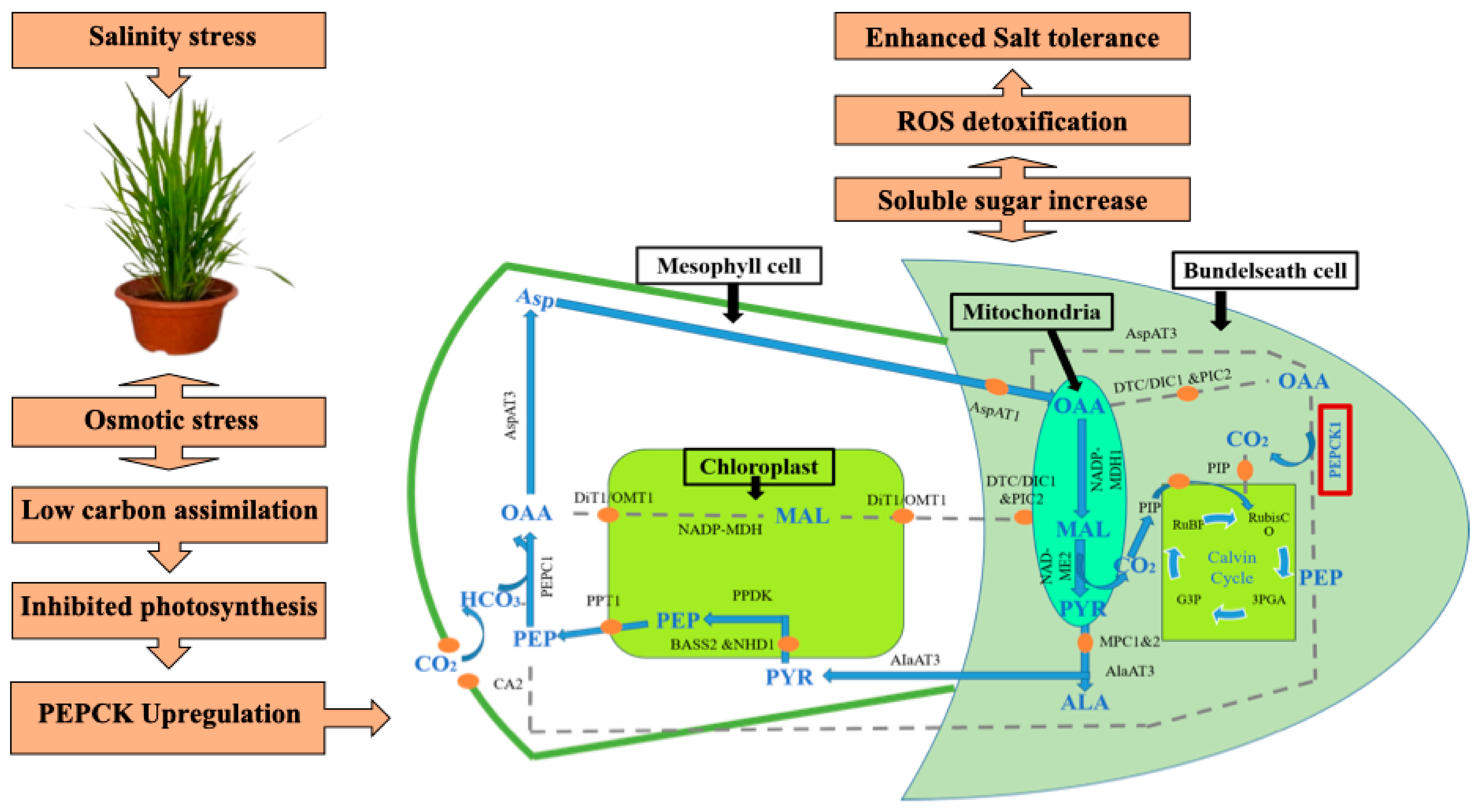
Based on these observations, we propose a conceptual model describing the role of PEPCK in salinity tolerance. Under high salinity conditions, excessive accumulation of Na⁺ ions disrupts cellular homeostasis and reduces photosynthetic efficiency. Overexpression of PEPCK enhances gluconeogenesis and modulates the tricarboxylic acid (TCA) cycle, leading to increased production of osmoprotective sugars. These metabolic adjustments help maintain carbon–nitrogen balance, stabilize cellular pH, facilitate detoxification of ROS, and ultimately improve salinity tolerance (Figure 6).
In conclusion, the present study demonstrates that overexpression of PEPCK enhances salinity tolerance in transgenic rice while maintaining growth and yield-related traits. These findings highlight the potential of targeting metabolic pathway components such as PEPCK to improve crop resilience to salinity stress and contribute to sustainable agricultural productivity under changing climatic conditions.
Conflicts of Interest
The authors declare that they do not have any conflicts of interest.
References
- Li, Y.; Zhong, H.; Shan, Y.; Hang, Y.; Wang, D.; Zhou, Y.; Hubacek, K. Changes in global food consumption increase GHG emissions despite efficiency gains along global supply chains. In Nature Food; 2023. [Google Scholar] [CrossRef]
- Huang, S.; Huang, P.; Hareem, M.; Tahzeeb-ul-Hassan, M.; Younis, U.; Dawar, K.; Fahad, S.; Salmen, S.H.; Ansari, M.J.; Danish, S. Evaluating the hidden potential of deashed biochar in mitigating salinity stress for cultivation of fenugreek. Scientific Reports 2024, 14, 1, 141. [Google Scholar] [CrossRef]
- Shahid, S.A.; Zaman, M.; Heng, L. Soil Salinity: Historical Perspectives and a World Overview of the Problem. In Guideline for Salinity Assessment, Mitigation and Adaptation Using Nuclear and Related Techniques; Springer , 2018; pp. 43–53. [Google Scholar] [CrossRef]
- Mamasolieva, M.A.; L.A.G.; Hudoynazarov, I.A. Study the effect of a Biosolvent preparation on the amount of salts in saline soils and antioxidant enzymes of cotton. JSSWQ 2023, 15(2), 242–51. [Google Scholar]
- Jobe, T.O.; Zenzen, I.; Rahimzadeh, Karvansara, P.; Kopriva, S. Integration of sulfate assimilation with carbon and nitrogen metabolism in transition from C3 to C4 photosynthesis. J. Exp. Bot. 2019, 15(70), 4211–21. [Google Scholar] [CrossRef] [PubMed]
- Ermakova, M.; Arrivault, S.; Giuliani, R.; Danila, F.; Alonso-Cantabrana, H.; Vlad, D.; Ishihara, H.; Feil, R.; Guenther, M.; Borghi, G.L.; Covshoff, S.; Ludwig, M.; Cousins, A.B.; Langdale, J.A.; Kelly, S.; Lunn, J.E.; Stitt, M.; von Caemmerer, S.; Furbank, R.T. Installation of C4 photosynthetic pathway enzymes in rice using a single construct. Plant Biotechnol J. 2021, 19, 575–588. [Google Scholar] [CrossRef] [PubMed]
- Ermakova, M.; Danila, F.R.; Furbank, R.T.; von Caemmerer, S. On the road to C4 rice: advances and perspectives. T P J. 2020, 101(4), 940–50. [Google Scholar] [CrossRef]
- Shen, Z.; Dong, X.M.; Gao, Z.F.; Chao, Q.; Wang, B.C. Phylogenic and phosphorylation regulation difference of phosphoenolpyruvate carboxykinase of C3 and C4 plants. J plant physiol. 2017, 213, 16–22. [Google Scholar] [CrossRef]
- Prusty, S.; Sahoo, R.K. PEPCK Gene for Enhanced Photosynthesis and Salinity Stress Tolerance in Rice: A Review. Agricultural Reviews 2022. [Google Scholar] [CrossRef]
- Sahoo, R.K.; Tuteja, N. Development of Agrobacterium-mediated transformation technology for mature seed-derived callus tissues of indica rice cultivar IR64, GM Crops. Food 2012, 3, 123–128. [Google Scholar] [CrossRef]
- Sambrook, J.; Fritsch, E.F.; Maniatis, T. Molecular Cloning: A Laboratory Manual, 2d ed.; Cold Spring Harbor Laboratory Press: Cold Spring Harbor, New York., 1989. [Google Scholar]
- Jayaraman, A.; Puranik, S.; Rai, N.K.; Vidapu, S.; Sahu, P.P.; Lata, C.; Prasad, M. cDNA-AFLP analysis reveals differential gene expression in response to salt stress in foxtail millet (Setaria italica L.). Mol Biotechnol. 2008, 40, 241–251. [Google Scholar] [CrossRef]
- Tuteja, N.; Sahoo, R.K.; Garg, B.; Tuteja, R. OsSUV3 dual helicase functions in salinity stress tolerance by maintaining photosynthesis and antioxidant machinery in rice (Oryza sativa L. cv. IR64). Plant J. 2013, 76, 115–127. [Google Scholar] [CrossRef]
- Garg, B.; Jaiswal, J.P.; Misra, S.; Tripathi, B.N; Prasad, M.A. A comprehensive study on dehydration-induced antioxidative responses during germination of Indian bread wheat (Triticum aestivum L. em Thell) cultivars collected from different agroclimatic zones. Physiol Mol Biol Plants 2012, 18, 217–228. [Google Scholar] [CrossRef]
- Bates, L.S.; Waldren, R.P.; Teare, I.D. Rapid determination of proline in water stress studies. Plant Soil. 1973, 39, 205–207. [Google Scholar] [CrossRef]
- Jana, S.; Choudhuri, M.A. Glycolate metabolism of three submerged aquatic angiosperms during aging. Aquat. Bot. 1981, 12, 345–354. [Google Scholar] [CrossRef]
- De Vos, C.H.R.; Schat, H.; Vooijs, R.; Ernst. WHO Copper-induced damage to the permeability barrier in roots of Silene cucubalus. J. Plant Physiol. 1989, 135, 164–179. [Google Scholar] [CrossRef]
- Blum, A.; Ebercon, A. Cell membrane stability as a measure of drought and heat tolerance in wheat 1. Crop Science 1981, 21(1), 43–7. [Google Scholar] [CrossRef]
- Barrs, H.D.; Weatherley, P.E. A re-examination of the relative turgidity technique for estimating water deficit in leaves. Aust J Biol Sci. 1962, 15, 413–428. [Google Scholar] [CrossRef]
- Jackson, T.L. Soil chemical analysis; Prentice-Hall of India Private Limited: New Delhi, 1973. [Google Scholar]
- Gupta, P.K. Methods in environmental analysis water, soil and air. Agrobios, India 2004, 242–245. [Google Scholar]
- Chapman, H.D.; Pratt, P.F. Method and of analysis of soil, plant and water, 2nd edn; California University Agricultural Division, California, 1982; p. 170. [Google Scholar]
- Munns, R.; Wallace, P.A.; Teakle, N.L.; Colmer, T.D. Measuring soluble ion concentrations (Na+, K+, Cl−) in salt-treated plants. In Methods in molecular biology;Plant stress tolerance:methods and protocols; Sunkar, R, Ed.; Humana Press. Springer., 2010; vol 639, pp. 371–382. [Google Scholar] [CrossRef]
- Karkacier, M.; Erbas, M.; Uslu, M.K.; Aksu, M. Comparison of different extraction and detectionmethods for sugars using amino-bonded phase HPLC. J Chromatogr Sci. 2003, 41, 331–333. [Google Scholar] [CrossRef]
- Chen, J.; Du. X.M., G; Zhao, H.Y.; Zhou, X. Fluctuation in levels of endogenous plant hormones in ovules of normal and mutant cotton during flowering and their relation to fiber development. J. Plant Growth Regul. 1996, 15, 173–177. [Google Scholar] [CrossRef]
- Li, Y.; Tan, B.; Wang, D.; Mu, Y.; Li, G.; Zhang, Z.; Pan, Y.; Zhu, L. Proteomic analysis revealed different molecular mechanisms of response to PEG stress in drought-sensitive and drought-resistant sorghums. Int. J. Mol. Sci. 2022, 23, 2113297. [Google Scholar] [CrossRef]
- Feria, A.B.; Bosch, N.; Sánchez, A.; Nieto-Ingelmo, A.I.; Osa, C.; Echevarría, C.; Mauriño, S.G.; Monreal, J.A. Phosphoenolpyruvate carboxylase (PEPC) and PEPC-kinase (PEPC-k) isoenzymes in Arabidopsis thaliana: role in control and abiotic stress conditions. Planta 2016, 244, 901–913. [Google Scholar] [CrossRef] [PubMed]
- Hao, S.; Wang, Y.; Yan, Y.; Liu, Y.; Wang, J.; Chen, S. A review on plant responses to salt stress and their mechanisms of salt resistance. Horticulturae 2021, 7, 6–132. [Google Scholar] [CrossRef]
- Wang, J.; Nan, N.; Li, N.; Liu, Y.; Wang, T.J.; Hwang, I.; Liu, B.; Xu, Z.Y. A DNA methylation reader–chaperone regulator–transcription factor complex activates OsHKT1; 5 expression during salinity stress. Plant Cell. 2020, 32, 3535–58. [Google Scholar] [CrossRef] [PubMed]
- Tuteja, N.; Sahoo, R.K.; Huda, K.M.; Tula, S.; Tuteja, R. OsBAT1 augments salinity stress tolerance by enhancing detoxification of ROS and expression of stress-responsive genes in transgenic rice. Plant Mol Biol Rep. 2015, 33, 1192–209. [Google Scholar] [CrossRef]
- Sahoo, R.K.; Tuteja, R.; Gill, R.; Jiménez Bremont, J.F.; Gill, S.S.; Tuteja, N. Marker-free rice (Oryza sativa L. cv. IR 64) overexpressing PDH45 gene confers salinity tolerance by maintaining photosynthesis and antioxidant machinery. Antioxidants 2022, 11–770. [Google Scholar] [CrossRef]
- Abdala, K.A.; Liao, J.; Mohammed, E.A.; Wu, J.M. Transgenic rice (Oryza sativa L.) varieties exhibit superior salt stress resilience: a comparative study of physiological and biochemical responses in transgenic and non-transgenic genotypes. Plant Physiol. Rep. 2024, 29, 948–74. [Google Scholar] [CrossRef]
- Wang, Y.; Wang, J.; Zhao, X.; Yang, S.; Huang, L.; Du, F.; Li, Z.; Zhao, X.; Fu, B.; Wang, W. Overexpression of the transcription factor gene OsSTAP1 increases salt tolerance in rice. Rice 2020, 13, 1–2. [Google Scholar] [CrossRef]
- Cao, W.; Zhang, H.; Zhou, Y.; Zhao, J.; Lu, S.; Wang, X.; Chen, X.; Yuan, L.; Guan, H.; Wang, G.; Shen, W. Suppressing chlorophyll degradation by silencing OsNYC3 improves rice resistance to Rhizoctonia solani, the causal agent of sheath blight. Plant Biotechnol J. 2022, 20(2), 335–49. [Google Scholar] [CrossRef]
- Mukherjee, S.; Mukherjee, A.; Das, P.; Bandyopadhyay, S.; Chattopadhyay, D.; Chatterjee, J.; Majumder, A.L. A salt-tolerant chloroplastic FBPase from Oryza coarctata confers improved photosynthesis with higher yield and multi-stress tolerance to indica rice. PCTOC. 2021, 145, 561–78. [Google Scholar] [CrossRef]
- Nounjan, N.; Mahakham, W.; Siangliw, J.L.; Toojinda, T.; Theerakulpisut, P. Chlorophyll retention and high photosynthetic performance contribute to salinity tolerance in rice carrying drought tolerance quantitative trait loci (QTLs). Agriculture. 2020, 10, 620. [Google Scholar] [CrossRef]
- Liu, C.; Hu, Z.H.; Yu, L.F.; Chen, S.T.; Liu. XM Responses of photosynthetic characteristics and growth in rice and winter wheat to different elevated CO2 concentrations. Photosynthetica 2020, 58, 5. [Google Scholar] [CrossRef]
- Yildiz, M.; Poyraz, İ.; Çavdar, A.; Özgen, Y.; Beyaz, R. Plant responses to salt stress. IntechOpen 2020. [Google Scholar] [CrossRef]
- Basu, S.; Kumari, S.; Kumar, P.; Kumar, G.; Rajwanshi, R. Redox imbalance impedes photosynthetic activity in rice by disrupting cellular membrane integrity and induces programmed cell death under submergence. Physiologia Plantarum 2021, 172(3), 1764–78. [Google Scholar] [CrossRef] [PubMed]
- Kaewneramit, T.; Buaboocha, T.; Sangchai, P.; Wutipraditkul, N. OsCaM1-1 overexpression in the transgenic rice mitigated salt-induced oxidative damage. Biol Plant. 2019, 63, 335. [Google Scholar] [CrossRef]
- Ali, M.; Kamran, M.; Abbasi, G.H.; Saleem, M.H.; Ahmad, S.; Parveen, A.; Malik, Z.; Afzal, S.; Ahmar, S.; Dawar, K.M.; Ali, S. Melatonin-induced salinity tolerance by ameliorating osmotic and oxidative stress in the seedlings of two tomato (Solanum lycopersicum L.) cultivars. J. Plant Growth Regul. 2021, 40, 2236–48. [Google Scholar] [CrossRef]
- Ejaz, S.; Fahad, S.; Anjum, M.A.; Nawaz, A.; Naz, S.; Hussain, S.; Ahmad, S. Role of osmolytes in the mechanisms of antioxidant defense of plants. SAR. 2020, 39, 95–117. [Google Scholar] [CrossRef]
- Gao, Y.; Long, R.; Kang, J.; Wang, Z.; Zhang, T.; Sun, H.; Li, X.; Yang, Q. Comparative proteomic analysis reveals that antioxidant system and soluble sugar metabolism contribute to salt tolerance in alfalfa (Medicago sativa L.) leaves. J. Proteome Res. 2018, 18, 191–203. [Google Scholar] [CrossRef]
- Bai, X.; Zeng, X.; Huang, S.; Liang, J.; Dong, L.; Wei, Y.; Li, Y.; Qu, J.; Wang, Z. Marginal impact of cropping BADH transgenic maize BZ-136 on chemical property, enzyme activity, and bacterial community diversity of rhizosphere soil. Plant Soil. 2019, 436, 527–541. [Google Scholar] [CrossRef]
- Yang, Z.; Shen, L.; Hu, L.; Cai, Y.; Zheng, Q.; Wu, Y. The PEPCK and FBP genes regulate gluconeogenesis metabolism in grape berries in response to light intensity. Horticulturae 2024, 10(12), 1270. [Google Scholar] [CrossRef]
- Anjum, N.; Maiti, M.K. OsNAC121 regulates root development, tillering, panicle morphology, and grain filling in rice plant. Plant Mol. Biol. 2024, 114(4), 1–20. [Google Scholar] [CrossRef]
- Swain, D.M.; Sahoo, R.K.; Srivastava, V.K.; et al. Function of heterotrimeric G-protein γ subunit RGG1 in providing salinity stress tolerance in rice by elevating detoxification of ROS. Planta 2017, 245, 367–383. [Google Scholar] [CrossRef]
- Swain, D.M.; Sahoo, R.K.; Chandan, R.K.; et al. Concurrent overexpression of rice G-protein β and γ subunits provide enhanced tolerance to sheath blight disease and abiotic stress in rice. Planta 2019, 250, 1505–1520. [Google Scholar] [CrossRef]
Figure 1.
Analysis and expression of T1 Transgenic lines ( PEPCK). (A) Structure of T-DNA region of pCAMBIA1301 containing the PEPCK gene (1.4 kb) inserted in HindIII restriction enzyme site of the Multiple Cloning Site (MCS) with the promoter (CaMV35S) and terminator (poly A). (B) The PEPCK overexpressing T1 transgenic lines (L2, L7, and L12) and control plant (wild type) were used for further analysis. (C) Polymerase chain reaction (PCR) analysis of PEPCK overexpressing transgenic (T1) lines by using CaMV35S promoter-specific forward and gene reverse primers showing the expected amplification of a 1.4-kb fragment in three independent transgenic lines (L2, L7, and L12). Here M represents the marker and L2, L7 and L12 are independent transgenic lines (D) Southern blot analysis showing the integration and copy number of the PEPCK gene in all three transgenic lines. Each value represents the mean of three replicates ±SE. Different letters on the top of bars indicate significant differences at p ≤ 0.05 level as determined by Duncan’s multiple range test (DMRT).
Figure 1.
Analysis and expression of T1 Transgenic lines ( PEPCK). (A) Structure of T-DNA region of pCAMBIA1301 containing the PEPCK gene (1.4 kb) inserted in HindIII restriction enzyme site of the Multiple Cloning Site (MCS) with the promoter (CaMV35S) and terminator (poly A). (B) The PEPCK overexpressing T1 transgenic lines (L2, L7, and L12) and control plant (wild type) were used for further analysis. (C) Polymerase chain reaction (PCR) analysis of PEPCK overexpressing transgenic (T1) lines by using CaMV35S promoter-specific forward and gene reverse primers showing the expected amplification of a 1.4-kb fragment in three independent transgenic lines (L2, L7, and L12). Here M represents the marker and L2, L7 and L12 are independent transgenic lines (D) Southern blot analysis showing the integration and copy number of the PEPCK gene in all three transgenic lines. Each value represents the mean of three replicates ±SE. Different letters on the top of bars indicate significant differences at p ≤ 0.05 level as determined by Duncan’s multiple range test (DMRT).
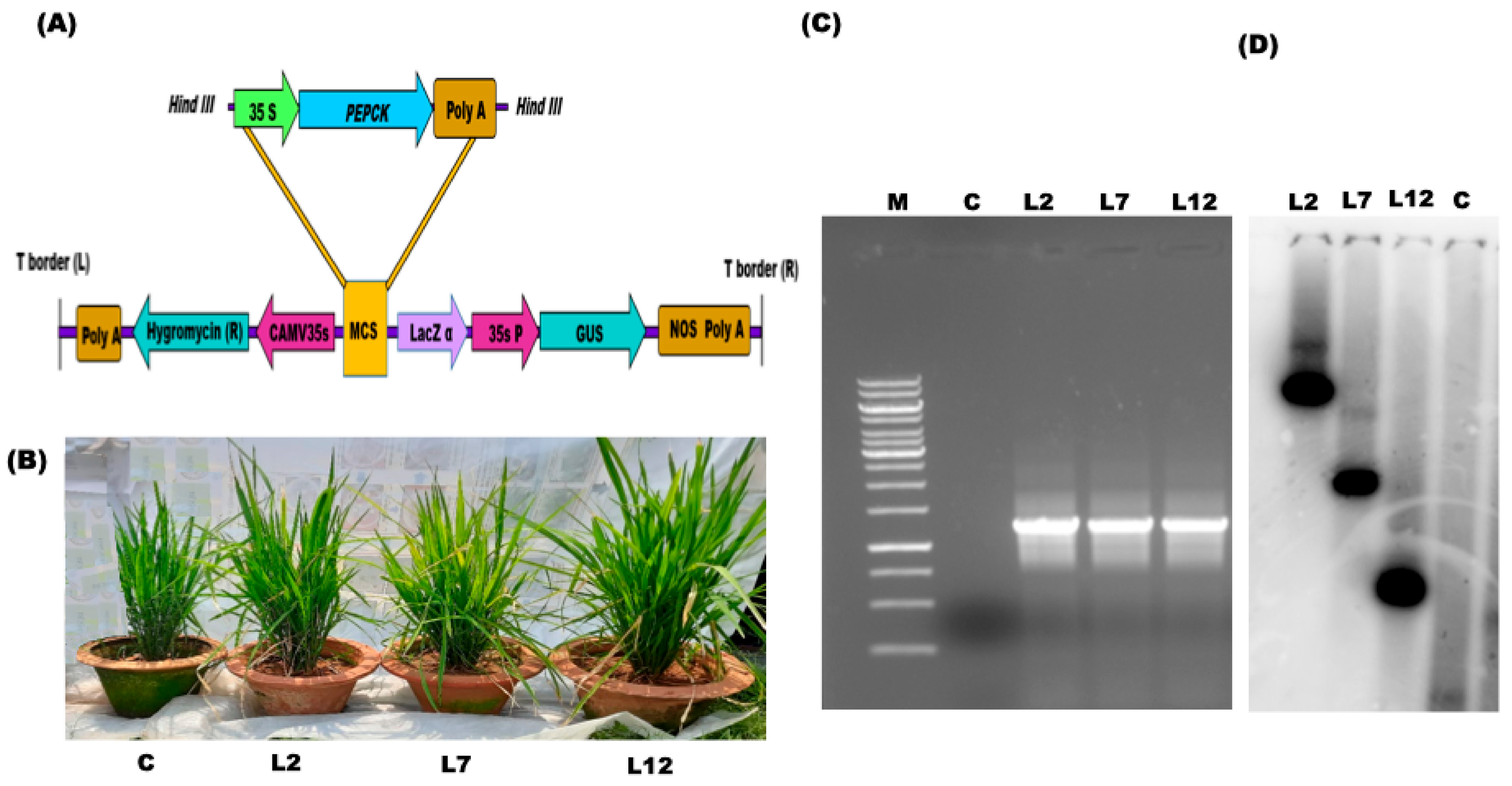
Figure 2.
(A) Relative gene expression analysis of the T1 PEPCK transgenic lines to observe the RNA expression (fold change) in control and transgenic lines. (B) Visualization of GUS activity in leaf tissues of transgenic lines with control plants. (C) Leaf disc senescence assay for salt tolerance in T1 PEPCK transgenic rice lines with control plants. (D) Chlorophyll content (mg g−1 fw) in T1 PEPCK transgenic lines under 100 and 200mM NaCl after 72 hours. Each value represents the mean of three replicates ±SE. Different letters on the top of bars indicate significant differences at p ≤ 0.05 level as determined by Duncan’s multiple range test (DMRT).
Figure 2.
(A) Relative gene expression analysis of the T1 PEPCK transgenic lines to observe the RNA expression (fold change) in control and transgenic lines. (B) Visualization of GUS activity in leaf tissues of transgenic lines with control plants. (C) Leaf disc senescence assay for salt tolerance in T1 PEPCK transgenic rice lines with control plants. (D) Chlorophyll content (mg g−1 fw) in T1 PEPCK transgenic lines under 100 and 200mM NaCl after 72 hours. Each value represents the mean of three replicates ±SE. Different letters on the top of bars indicate significant differences at p ≤ 0.05 level as determined by Duncan’s multiple range test (DMRT).
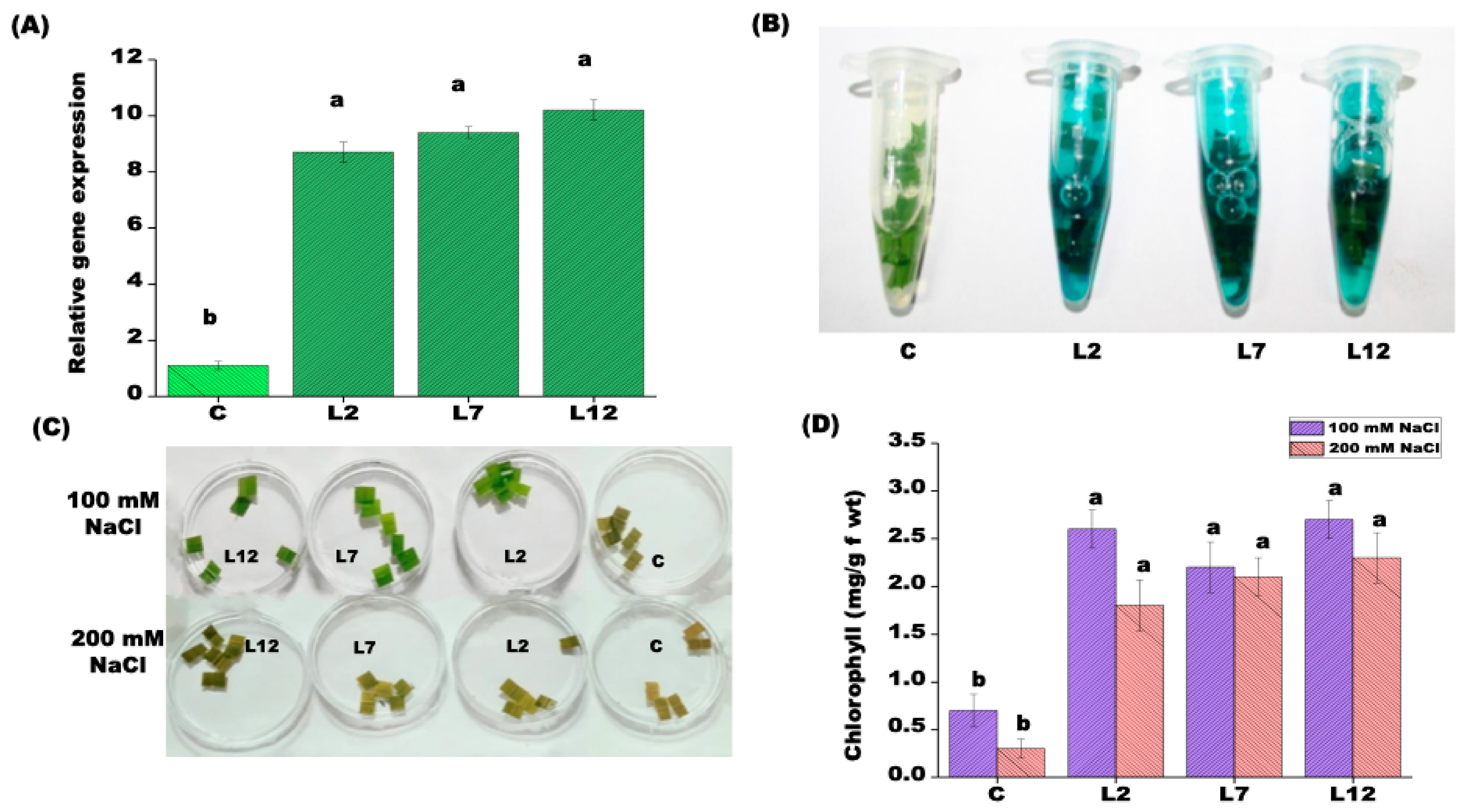
Figure 3.
Biochemical analysis and the response of the antioxidant machinery in PEPCK overexpressing T1 transgenic lines (L2, L7, and L12) and control rice plants exposed to 24 h salt stress (200 mM NaCl). (A) Determination of lipid peroxidation expressed in terms of MDA content. (B) Changes in the level of hydrogen peroxide (H2O2) content. (C) Measurement of electrolytic leakage. (D) Changes in the level of proline accumulation. (E) Catalase (CAT) activity in transgenic lines after salt stress where one unit of enzyme activity defined as 1 μmol H2O2 oxidized min−1. (F) Changes in ascorbate peroxidase (APX) enzyme activity in transgenic lines after salt stress where one unit of enzyme activity defined as 1 μmol of ascorbate oxidized min−1. (G) Changes in guaiacol peroxidase (GPX) activity in transgenic lines after salt stress. (H) Changes in glutathione reductase (GR) activity in transgenic lines after salt stress where one unit of enzyme activity defined as 1 μmol of GS-TNB formed min−1 due to reduction of DTNB. (I) Estimation of relative water content (RWC%) in leaf discs of transgenic and control rice. Each value represents the mean of three replicates ±SE. Different letters on the top of bars indicate significant differences at p ≤ 0.05 level as determined by Duncan’s multiple range test (DMRT).
Figure 3.
Biochemical analysis and the response of the antioxidant machinery in PEPCK overexpressing T1 transgenic lines (L2, L7, and L12) and control rice plants exposed to 24 h salt stress (200 mM NaCl). (A) Determination of lipid peroxidation expressed in terms of MDA content. (B) Changes in the level of hydrogen peroxide (H2O2) content. (C) Measurement of electrolytic leakage. (D) Changes in the level of proline accumulation. (E) Catalase (CAT) activity in transgenic lines after salt stress where one unit of enzyme activity defined as 1 μmol H2O2 oxidized min−1. (F) Changes in ascorbate peroxidase (APX) enzyme activity in transgenic lines after salt stress where one unit of enzyme activity defined as 1 μmol of ascorbate oxidized min−1. (G) Changes in guaiacol peroxidase (GPX) activity in transgenic lines after salt stress. (H) Changes in glutathione reductase (GR) activity in transgenic lines after salt stress where one unit of enzyme activity defined as 1 μmol of GS-TNB formed min−1 due to reduction of DTNB. (I) Estimation of relative water content (RWC%) in leaf discs of transgenic and control rice. Each value represents the mean of three replicates ±SE. Different letters on the top of bars indicate significant differences at p ≤ 0.05 level as determined by Duncan’s multiple range test (DMRT).
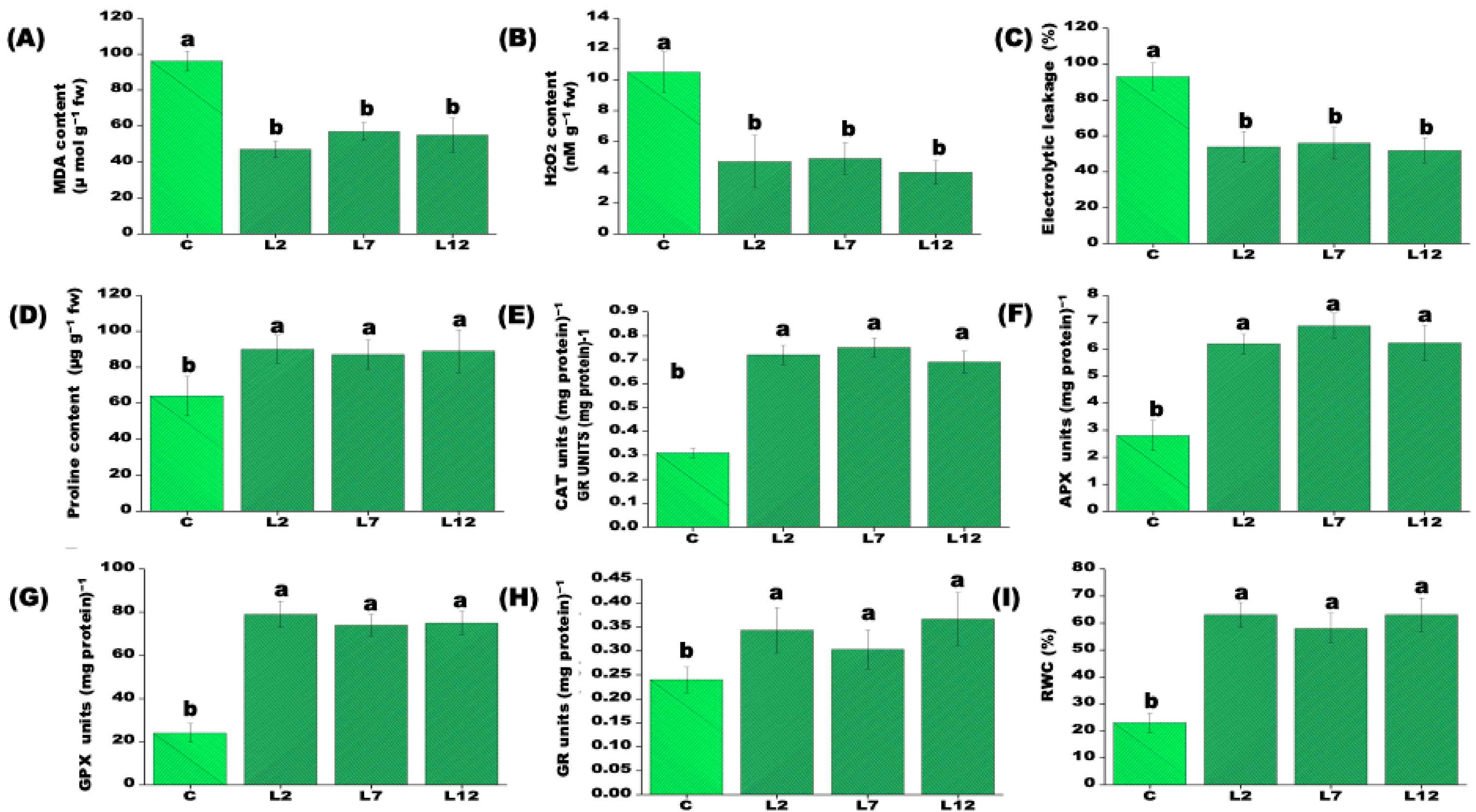
Figure 4.
Measurement of photosynthetic characteristics of control and PEPCK T1 transgenic lines (L2, L7, and L12) under 0mM NaCl and 200 mM NaCl treatment. (A) Total Chlorophyll. (B) Net Photosynthetic rate. (C) Stomatal conductance. (D) Intracellular CO2. (E) Transpiration rate. (F) Values are mean of three replicates ± SE (n = 3). Different letters on the top of bars indicate significant differences at p ≤ 0.05 level as determined by Duncan’s multiple range test (DMRT).
Figure 4.
Measurement of photosynthetic characteristics of control and PEPCK T1 transgenic lines (L2, L7, and L12) under 0mM NaCl and 200 mM NaCl treatment. (A) Total Chlorophyll. (B) Net Photosynthetic rate. (C) Stomatal conductance. (D) Intracellular CO2. (E) Transpiration rate. (F) Values are mean of three replicates ± SE (n = 3). Different letters on the top of bars indicate significant differences at p ≤ 0.05 level as determined by Duncan’s multiple range test (DMRT).
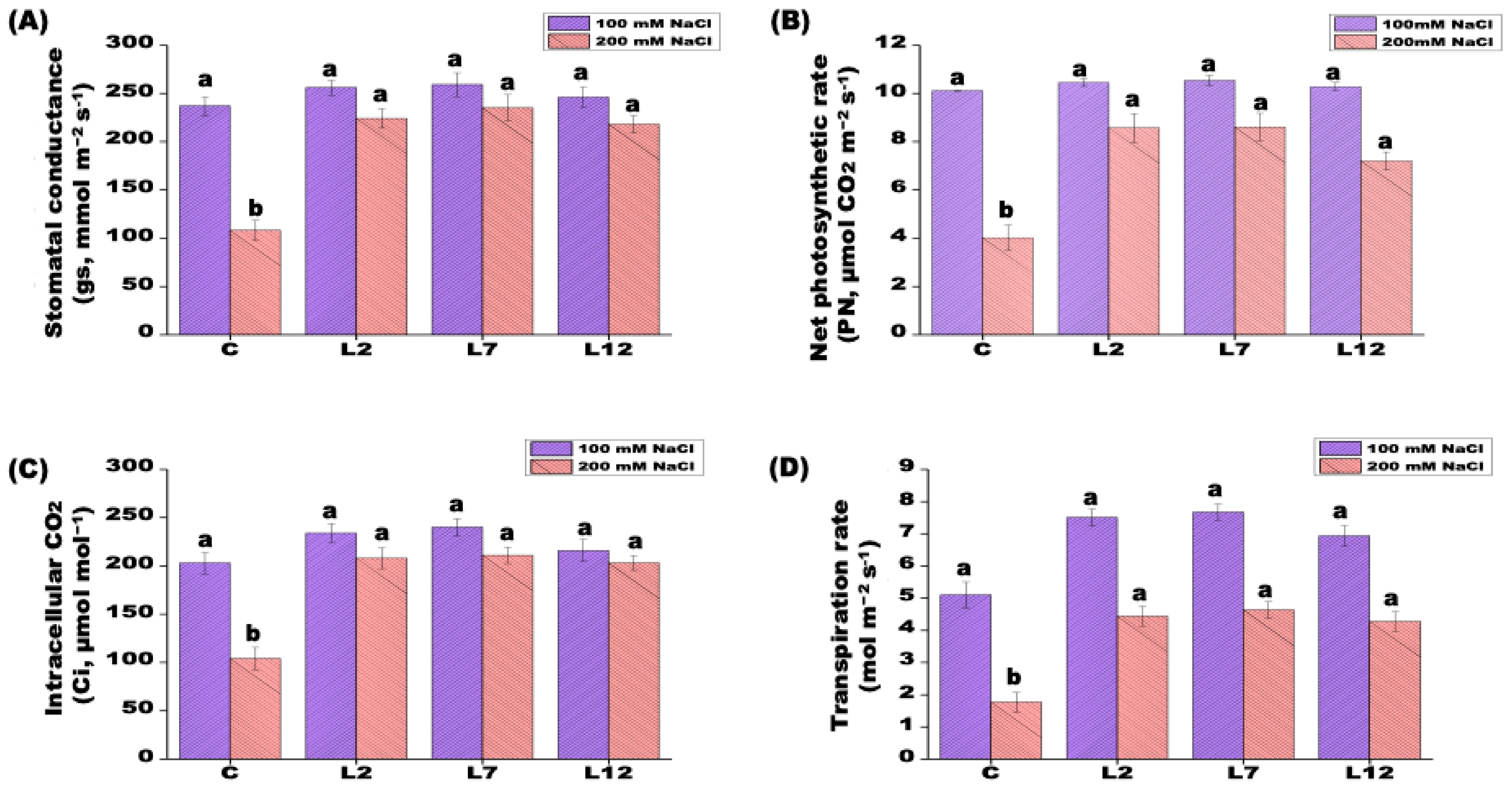
Figure 5.
Soluble sugar content in roots and shoots of PEPCK overexpressing T1 transgenic lines (L2, L7, and L12) compared to control rice plants exposed to 24 h salinity stress (200 mM NaCl). (A) Glucose content in shoots and roots in transgenic lines and control line after salt stress. (B) Fructose content in shoots and roots in transgenic lines and control line after salt stress. (C) Endogenous GA content in transgenic lines and control line after salt stress. (D) Endogenous Zeatin content in transgenic lines and control line after salt stress. (E) Endogenous IAA content in transgenic lines and control line after salt stress. Each value represents the mean of three replicates ±SE. Different letters on the top of bars indicate significant differences at p ≤ 0.05 level as determined by Duncan’s multiple range test (DMRT).
Figure 5.
Soluble sugar content in roots and shoots of PEPCK overexpressing T1 transgenic lines (L2, L7, and L12) compared to control rice plants exposed to 24 h salinity stress (200 mM NaCl). (A) Glucose content in shoots and roots in transgenic lines and control line after salt stress. (B) Fructose content in shoots and roots in transgenic lines and control line after salt stress. (C) Endogenous GA content in transgenic lines and control line after salt stress. (D) Endogenous Zeatin content in transgenic lines and control line after salt stress. (E) Endogenous IAA content in transgenic lines and control line after salt stress. Each value represents the mean of three replicates ±SE. Different letters on the top of bars indicate significant differences at p ≤ 0.05 level as determined by Duncan’s multiple range test (DMRT).
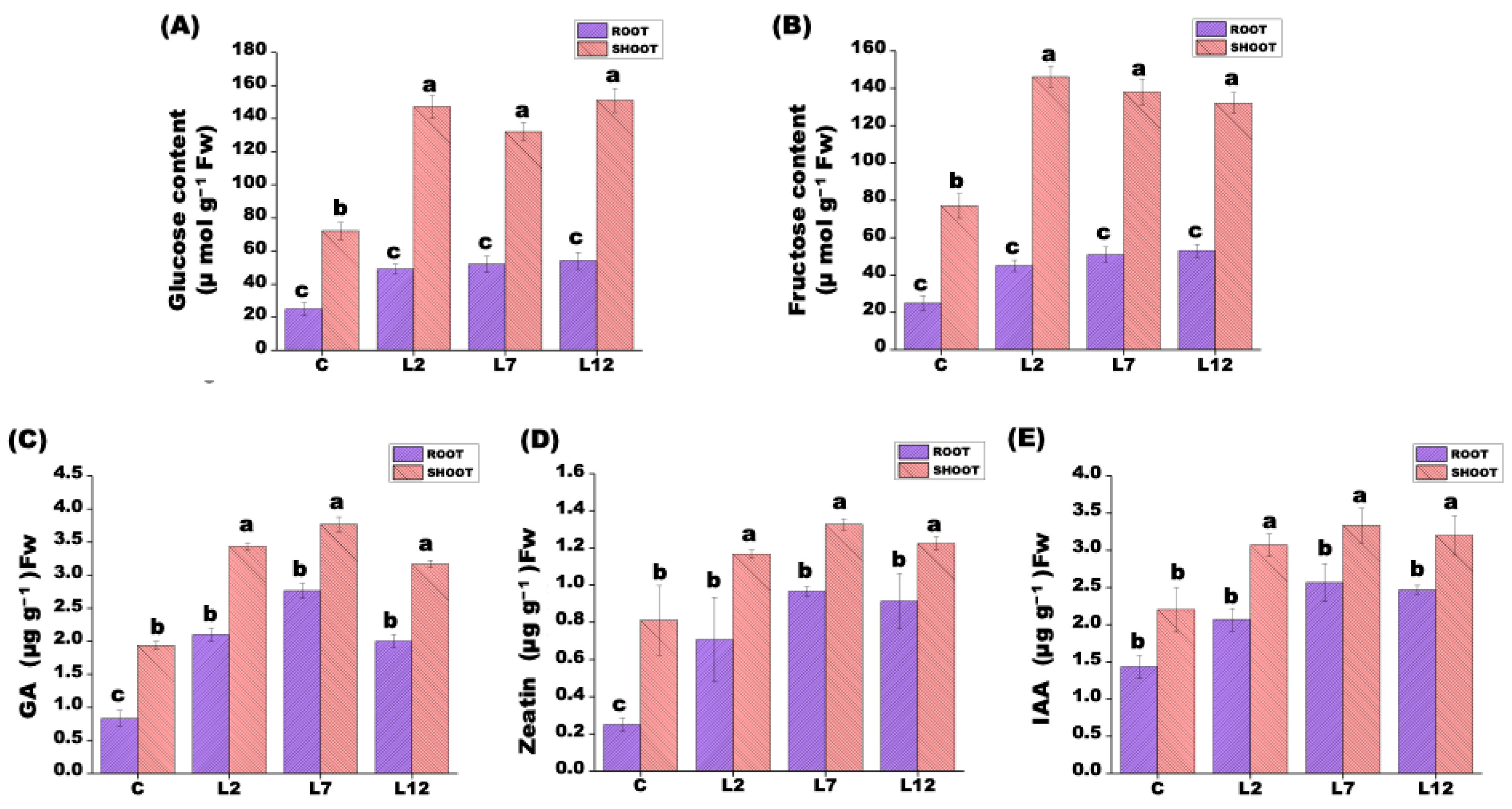
Figure 6.
Schematic representation of biochemical andphysiological responses of plants under salinity stress and how to counteract these effects the plants activate upregulation of phosphoenolpyruvate carboxykinase (PEPCK), which promotes gluconeogenesis and modulates the tricarboxylic acid (TCA) cycle. This metabolic adjustment leads to increased soluble sugar accumulation and enhanced reactive oxygen species (ROS) detoxification, ultimately contributing to improved stress tolerance. Names represent the following metabolites- CO2: carbon dioxide; HCO3−: bicarbonate; OAA: oxaloacetic; MAL: malate; PYR: pyruvate; Asp: aspartate and PEP: phosphoenolpyruvate. Names in black correspond to C4 genes; CA: carbonic anhydrase; PEPC: phosphoenolpyruvate carboxylase; AspAT: aspartate aminotransferase; DiT1: dicarboxylate transporter; OMT1: oxoglutarate/malate transporter; NADP-MDH: NADP-dependent malate dehydrogenase; DTC: dicarboxylate/tricarboxylate transporter; DIC: dicarboxylate carrier; PIC: phosphate carrier; NAD-MDH: NAD-dependent malate dehydrogenase; NAD-ME: NAD-malic enzyme; PEPCK: phosphoenolpyruvate carboxykinase; PIP: plasma membrane intrinsic protein; MPC: mitochondrial pyruvate carrier; AlaAT: alanine aminotransferase; PPDK: pyruvate phosphate dikinase; BASS2: sodium-dependent pyruvate transporter; NHD1 sodium: proton antiporter and PPT: phosphate/phosphoenolpyruvate translocator.
Figure 6.
Schematic representation of biochemical andphysiological responses of plants under salinity stress and how to counteract these effects the plants activate upregulation of phosphoenolpyruvate carboxykinase (PEPCK), which promotes gluconeogenesis and modulates the tricarboxylic acid (TCA) cycle. This metabolic adjustment leads to increased soluble sugar accumulation and enhanced reactive oxygen species (ROS) detoxification, ultimately contributing to improved stress tolerance. Names represent the following metabolites- CO2: carbon dioxide; HCO3−: bicarbonate; OAA: oxaloacetic; MAL: malate; PYR: pyruvate; Asp: aspartate and PEP: phosphoenolpyruvate. Names in black correspond to C4 genes; CA: carbonic anhydrase; PEPC: phosphoenolpyruvate carboxylase; AspAT: aspartate aminotransferase; DiT1: dicarboxylate transporter; OMT1: oxoglutarate/malate transporter; NADP-MDH: NADP-dependent malate dehydrogenase; DTC: dicarboxylate/tricarboxylate transporter; DIC: dicarboxylate carrier; PIC: phosphate carrier; NAD-MDH: NAD-dependent malate dehydrogenase; NAD-ME: NAD-malic enzyme; PEPCK: phosphoenolpyruvate carboxykinase; PIP: plasma membrane intrinsic protein; MPC: mitochondrial pyruvate carrier; AlaAT: alanine aminotransferase; PPDK: pyruvate phosphate dikinase; BASS2: sodium-dependent pyruvate transporter; NHD1 sodium: proton antiporter and PPT: phosphate/phosphoenolpyruvate translocator.
Disclaimer/Publisher’s Note: The statements, opinions and data contained in all publications are solely those of the individual author(s) and contributor(s) and not of MDPI and/or the editor(s). MDPI and/or the editor(s) disclaim responsibility for any injury to people or property resulting from any ideas, methods, instructions or products referred to in the content. |
© 2026 by the authors. Licensee MDPI, Basel, Switzerland. This article is an open access article distributed under the terms and conditions of the Creative Commons Attribution (CC BY) license (http://creativecommons.org/licenses/by/4.0/).
Copyright: This open access article is published under a Creative Commons CC BY 4.0 license, which permit the free download, distribution, and reuse, provided that the author and preprint are cited in any reuse.


