
Submitted:
17 March 2026
Posted:
17 March 2026
Read the latest preprint version here
Abstract
This paper represents a further academic deepening and upgrading of the authors' 2019 publication A Hypothesis on the Spatial Motion Mode of Photons. It should be explicitly stated that this paper falls within the category of natural philosophical thought experiments—its core value lies in constructing a unified physical image of the nature of light through rigorous logical deduction, and proposing verifiable theoretical hypotheses and experimental schemes; the validity of all conclusions must ultimately be verified by rigorous and extensive scientific experiments before being incorporated into the theoretical system of physics. As a foundational concept of quantum mechanics, the wave-particle duality of light has been accompanied by profound philosophical perplexities and theoretical tensions since its proposal, becoming a core bottleneck in the integration of classical and quantum physics. This paper systematically sorts out the logical incompleteness in the current quantum interpretation system—including the self-negation of the complementarity concept, the problem of photon localization, the fundamental opposition between the statistical and non-statistical interpretations of the wave function, and the philosophical controversy over the Heisenberg Uncertainty Principle, revealing the inherent contradictions of the traditional wave-particle duality framework. On this basis, adopting classical physical images and the logic of reduction to absurdity, and based on six axioms and six preparatory propositions, this paper puts forward a natural philosophical hypothesis on the essence of photons: a photon is an energetic mass point with a diameter smaller than the Planck length, moving in a uniform spiral linear motion in space. The paper deduces the core characteristics such as velocity, frequency, and wavelength of the photon's uniform spiral linear motion, and designs three operable, repeatable, and quantifiable physical experimental schemes to provide specific paths for the empirical verification of the hypothesis. The research deduces that the angular momentum of photon spatial motion (excluding photon spin motion) is always the reduced Planck constant ℏ, the energy E=mc² is naturally unified with E=hν (the standard formula for wave energy), and the standard expression of the Heisenberg Uncertainty Principle ΔxΔpₓ≥ℏ/2 can be given a classical physical interpretation from the perspective of superposition of measurement deviations. This paper systematically responds to potential questions regarding the origin of photon particle nature, wave nature, and compatibility with relativity, arguing that the hypothesis provides a logically consistent and clearly visualized path for understanding the nature of light, builds a new natural philosophical framework for the integration of quantum and classical theories of light, and also offers a new thinking perspective for the paradigm shift in the study of the nature of light.
Keywords:
photon
; uniform spiral linear motion
; wave-particle duality
; uncertainty principle
; kinetic mass
; natural philosophy
; thought experiment
1. Introduction: Theoretical Dilemmas of Wave-Particle Duality and Innovation of Research Paradigms
It should be clarified that the research in this paper is not a traditional experimental physics study, but a natural philosophical thought experiment—this research paradigm is not pure speculation divorced from empirical facts, but is based on physical axioms and laws verified by experiments, constructs a unified physical image of photon motion through rigorous logical deduction and conceptual construction, and proposes verifiable theoretical hypotheses. The validity of the hypothesis and the rationality of the deduction must ultimately be tested by rigorous and extensive scientific experiments, which is both an essential requirement of natural philosophical thought experiments and a basic law of the development of physical theories. The dilemma of the wave-particle duality of light is a core proposition that needs to be addressed by proposing new interpretation paths through such thought experiments and gradually improved through experimental verification, ultimately resolving the adaptability contradiction between the classical physical conceptual system and quantum phenomena.
The ontological nature of light has fueled one of the longest-standing debates in the history of physics. Newton’s corpuscular theory dominated the 18th century, framing light as discrete particles governed by mechanical laws. This view was later challenged by Young’s interference experiments and Maxwell’s electromagnetic theory, which established light as a transverse wave in the ether. The early 20th century brought further complexity with Einstein’s light quantum hypothesis (1905), which reintroduced particlehood to explain the photoelectric effect, culminating in the modern concept of wave-particle duality.
However, the orthodox Copenhagen interpretation often treats duality as a complementary principle rather than a concrete physical reality. This paper revisits this historical divide from a contemporary natural philosophical perspective. By proposing the hypothesis of energetic mass points in uniform spiral linear motion, we aim to provide a unified ontological foundation that reconciles the particle’s discreteness with the wave’s periodicity. This approach is not a rejection of modern physics but a reconstruction: it seeks to ground the abstract mathematical formalism of quantum mechanics in a coherent physical picture, reviving the natural philosophical spirit of seeking first principles for the fundamental constituents of nature.
1.1. Conceptual Origin and Philosophical Analysis of Inherent Tensions
Light is both a wave and a particle—this wave-particle duality theory has been regarded as the basic doctrine of quantum mechanics for the past century, but its core contradictions have never been truly resolved: in the classical physical framework, waves and particles are mutually exclusive forms of matter, with waves possessing spatial extension and superposition, and particles having spatial localization and impenetrability. The inherent exclusivity between the two cannot be reasonably reconciled at the quantum level, which has led the study of the nature of light to fall into long-term philosophical perplexity.
Historically, the ideological germination of wave-particle duality can be traced back to Einstein's lecture in Salzburg in 1909. By analyzing the energy fluctuation terms in Planck's blackbody radiation formula, he found that one term is proportional to the average energy (reflecting particle characteristics) and the other is proportional to the square of the average energy (reflecting wave characteristics), thus speculating that "the next stage of theoretical physics will bring a theory of light that can be regarded as a fusion of the wave theory and the emission theory". Notably, Einstein's assertion did not advocate the "dual opposition" of waves and particles, but foreshadowed a unified understanding transcending classical concepts—this "fusion theory" idea was neglected in subsequent research, and instead was led into the logical shackles of "dual complementarity" by Bohr's Complementarity Principle, becoming a theoretical bottleneck in the study of the nature of light, which also serves as an important theoretical origin and starting point for reflection in this paper.
In 1923, de Broglie extended wave-particle duality to material particles and proposed the concept of "phase waves", attempting to unify particle motion with wave characteristics; in 1926, Schrödinger established wave mechanics and transformed it into "matter waves", further strengthening the explanatory power of the wave perspective; in the same year, Born proposed the statistical interpretation of the wave function, attempting to resolve the apparent contradiction of wave-particle opposition with "probability distribution". Bohr then put forward the Complementarity Principle in 1927, arguing that wave and particle descriptions are two mutually exclusive yet equally necessary complementary perspectives, which cannot be observed simultaneously and can only be selected according to the experimental scenario. However, this seemingly perfect solution actually conceals deep theoretical dilemmas: its mechanical definition of "complementarity" is essentially an avoidance rather than a resolution of the inherent contradictions of wave-particle duality, leading the study of the nature of light into a either-or logical misunderstanding, and also resulting in the ontological foundation of quantum mechanics remaining ambiguous.
1.2. An Analysis of the Logical Incompleteness of Mainstream Quantum Interpretations
The logical incompleteness of the mainstream quantum interpretation system focuses on three core contradictions directly related to the hypothesis in this paper, as follows:
First, the self-negation of the complementarity concept. The double-slit experiment is regarded as a paradigm of complementarity, but has significant core flaws: even in the standard double-slit experiment, the discrete detection points of photons on the screen show particle properties, while the formation of interference patterns relies on wave characteristics—the two appear simultaneously in the same experimental device, contradicting the core claim of the Complementarity Principle of "mutual exclusivity". Bohr himself no longer took wave-particle duality as a core example of complementarity after 1935, confirming the limitations of its interpretation.
Second, the problem of photon localization and ontological dilemma. Landau and Peierls pointed out in 1930 that photons have no localization in the sense of position operators, and Heitler further clarified in 1936 that "the concept of 'the position of a light quantum' has no simple physical meaning". Research by Newton and Wigner shows that photons do not have a wave function in the position representation, and the photon wave function constructed by subsequent scholars lacks a probabilistic interpretation and can only characterize the energy distribution of the light field, depriving the photon "particle nature" of the core connotation of a classical "localized entity" and leading to an ontological dilemma.
Third, the philosophical controversy and interpretive dilemma of the Uncertainty Principle. Heisenberg initially attributed it to the "uncontrollable disturbance" in the measurement process, but could not explain the question of "why macroscopic measurement disturbances do not produce uncertainty relations"; the statistical interpretation holds that the standard deviation is an inherent characteristic of the state function, avoiding the defects of the disturbance theory. The long-term confrontation between the two interpretations stems from the divergence in understanding the physical status of the wave function, and also becomes an unavoidable problem in the study of the nature of light.
In addition, the opposition between the statistical and non-statistical interpretations of the wave function directly affects the path of understanding the nature of light, but the core controversy can be reduced to "whether the motion state of a single photon is deterministic", which is highly correlated with the interpretive dilemma of the Uncertainty Principle and will not be elaborated separately.
1.3. Contemporary Challenges and Signals of Paradigm Shift
In recent years, with the progress of quantum measurement technology and the deepening of theoretical research, doubts and challenges to wave-particle duality have become increasingly intense, providing a new contextual background for the study of the nature of light and releasing clear signals of paradigm shift. A 2022 paper published in Foundations of Physics clearly pointed out that: "the concept of wave-particle duality has no place in modern quantum physics". Through a systematic analysis of complex molecular interference experiments, the study showed that when molecules pass through a diffraction grating, their localized structure is responsible for interacting with the grating (reflecting particle nature), while the center-of-mass wave function is in a non-localized state (reflecting wave nature)—this means that wave and particle properties appear simultaneously at the same moment, completely dismantling the complementary understanding of their "mutual exclusivity" and providing experimental support for the unified interpretation of the nature of light.
More subversively, a research team from the Federal University of São Carlos in Brazil published a paper in Physical Review Letters in 2025, proposing that the results of the double-slit experiment can be explained by considering only the particle nature of light without regarding it as a wave. The theory holds that photons passing through the slits will enter a "dark state" at specific positions—photons in this quantum state cannot excite atoms and thus leave no light spots on the screen. Interference patterns are not the result of wave destructive and constructive interference, but the manifestation of the quantum characteristic that some photons evade detection. As Renner R, a co-author of the study, put it: "Photons are actually everywhere, but photons in the dark fringe regions cannot excite atoms—this subversive interpretation shatters the cognition of the classical interference principle". This research further indicates that the traditional wave-particle duality framework is not the only possible interpretation path, and the problem of the nature of light urgently needs to be re-examined from the origin of physical images.
Based on this, on the basis of the authors' 2019 research, this paper attempts to provide a unified classical physical interpretation for the wave-particle duality of light by deepening the hypothesis of photon uniform spiral linear motion (this paper unifies this expression as the standard name for photon motion), and reconstructs the natural philosophical foundation for the study of the nature of light. At the same time, it is emphasized that all conclusions in this paper are derived results of thought experiments, which must ultimately be verified by extensive scientific experiments.
2. Methodology: A Natural Philosophical Approach of Classical Images and Logical Deduction
2.1. Research Paradigm of Natural Philosophy and Academic Legitimacy
The research approach of this paper belongs to the category of natural philosophy and is a thought experiment, whose core methodological characteristics can be summarized as: taking clear axioms and definitions as the logical starting point, using rigorous logical deduction (including reduction to absurdity) to construct a physically consistent image, explaining quantum-level optical phenomena with the conceptual system of classical physics, and providing specific paths for the verification of the hypothesis through designable, repeatable, and verifiable experimental schemes; at the same time, it is clear that the validity of all derived conclusions must ultimately rely on rigorous and extensive scientific experiments rather than mere logical consistency—this definition not only distinguishes natural philosophical thought experiments from pure speculation, but also highlights their complementarity with experimental physics research.
The academic legitimacy of this approach is based on the fact that the establishment of physical theories has never been a result of pure empirical induction, but a product of conceptual construction and logical deduction, and natural philosophy provides the original thinking framework and methodological support for such conceptual construction. Einstein once emphasized that "theoretical physics is a creation of the mind", and there is no logically necessary correspondence between the conceptual system and empirical facts. When the existing conceptual framework falls into inherent contradictions, returning to a clearer axiomatic foundation and constructing a new physical image through logical deduction is an important way for theoretical progress. The essence of the dilemma of wave-particle duality of light is the logical confusion caused by the fragmented application of classical concepts. This paper attempts to resolve this confusion through a unified classical physical image, and at the same time provide a clear direction for subsequent experimental verification, realizing the organic combination of natural philosophical thinking and experimental physics.
2.2. Application Rules and Academic Rigor of Reduction to Absurdity
Reduction to absurdity is used in many key reasoning nodes in this paper, whose general form is:
- ①
- Assume that proposition P is true (or false);
- ②
- Starting from P, conduct strict deductive reasoning combined with established axioms, definitions or reliable propositions;
- ③
- If a conclusion contradictory to known physical facts, the law of conservation of energy or logical necessity is derived, then P is proved to be not true (or true).
The legitimacy of reduction to absurdity in the history of physics need not be elaborated; Galileo's research on free fall motion, Einstein's demonstration of the principle of the constancy of the speed of light, and Heisenberg's preliminary deduction of the Uncertainty Principle all include classic applications of reduction to absurdity. Its core essence lies in: the reasoning premises must be unambiguous (based on axioms verified by experiments or widely recognized theories), the reasoning process must be strictly valid (following the basic rules of formal logic), and the derived conclusions must be consistent with empirical facts—this is also the core criterion for the application of reduction to absurdity in this paper, ensuring the academic rigor of the deduction process. This paper uses reduction to absurdity to deduce the perpendicular relationship between the photon's circular motion plane and the linear motion direction, the uniformity of circular motion and other core propositions, precisely following this classic physical research method to ensure the solid logical foundation of the hypothesis.
2.3. A Three-Tier Logical Structure of Axioms-Propositions-Hypothesis
To avoid arbitrary speculation and ensure that the hypothesis is established on a relatively solid foundation, this paper adopts a three-tier logical framework of axioms-propositions-hypothesis, which is also the core method of conceptual construction in natural philosophy research and can effectively improve the logical rigor and systematicness of the theoretical system:
Axioms: Basic statements that are unproven but generally accepted or experimentally verified, serving as the starting point of reasoning. Their legitimacy stems from the dual support of experimental facts and physical laws, without logical ambiguity or controversy;
Propositions: Intermediate conclusions derived from axioms through deductive reasoning, forming the preparatory foundation of the hypothesis, serving as a logical bridge connecting axioms and hypotheses, whose validity depends on the reliability of axioms and the rigor of the deduction process;
Hypothesis: A holistic physical image of the photon's motion mode proposed based on the synthesis and generalization of propositions, whose rationality stems from the dual verification of logical consistency and phenomenological explanatory power, and must ultimately be tested by experiments to become a scientifically valuable theory.
This structure makes the hypothesis not an isolated theoretical conjecture, but a logical deduction result based on the classical physical axiom system. Compared with the authors' 2019 research, its logical rigor, academic systematicness and phenomenological explanatory power have been significantly improved, and it is more in line with the academic norms of natural philosophy.
3. Axiomatic Foundation and Preparatory Propositions
3.1. Six Axioms
Axioms are the logical starting point of the entire theoretical system. The axioms in this paper are all derived from physical facts and classical laws verified by experiments, consistent with the axiom system of the authors' 2019 research, and with precise conceptual definition to avoid ambiguity and ensure the reliability of reasoning premises:
Axiom 1 Principle of the Constancy of the Speed of Light: The propagation speed of light in a vacuum along a linear direction is a constant c (c=299792458 m/s), independent of the motion states of the light source and the observer. This is the core axiom of special relativity, repeatedly verified by the Michelson-Morley experiment, high-precision speed of light measurement experiments and other tests.
Axiom 2 Particle and Wave Nature of Light: Light exhibits both particle properties (photoelectric effect, Compton effect) and wave properties (interference, diffraction, frequency and wavelength characteristics). The two properties are manifestations of the essence of light at different levels, not mutually exclusive opposing attributes. Fully confirmed by the photoelectric effect experiment, double-slit interference experiment, Compton scattering experiment and other tests.
Axiom 3 A Moving Photon Possesses Energy: The energy of a photon is given by Planck's formula E=hν (the standard formula for wave energy). Since ν>0, the energy E>0 of a moving photon. Energy is an inherent property of photons and cannot exist independently of the motion state, whose experimental basis is the energy quantization experiment of the photoelectric effect.
Axiom 4 Variable Frequency and Wavelength of Photons: When a photon collides elastically or inelastically with a material entity, its frequency ν and wavelength λ can change quantitatively, and the product of frequency and wavelength is always the speed of light c, i.e., c=λν. This relationship has been verified by the Compton scattering experiment, Raman scattering experiment and other tests, and is an important manifestation of the correlation between the wave and particle characteristics of light.
Axiom 5 Zero Rest Mass of Photons: According to the mass-velocity relation of special relativity m=m₀/√(1−v²/c²), since the speed of photons in a vacuum is always c, their rest mass m₀ must be 0. The mass of a photon is only manifested as kinetic mass m, which is a consensus conclusion of special relativity and quantum mechanics, and also one of the core characteristics that distinguish photons from other elementary particles.
Axiom 6 Photons Possess Spin: Spin is an intrinsic property of elementary particles, and photons are bosons with spin 1.
3.2. Six Preparatory Propositions
Propositions are intermediate conclusions derived from axioms through deductive reasoning, being the logical extension of the axiom system. On the basis of the authors' 2019 research, the propositions in this paper add relevant explanations of concepts, strengthen the logical connection with the subsequent hypothesis, and lay a more solid logical foundation for the proposal of the hypothesis:
Proposition 1 The kinetic mass of a photon is greater than zero
From Einstein's mass-energy relation E=mc², the kinetic mass of a photon can be obtained as m=E/c²; from Axiom 3, the energy E>0 of a moving photon, and c is a constant (always positive), so the kinetic mass m>0 of a moving photon.
Corollary: The mass of a photon is inseparable from its motion state. A zero rest mass m₀=0 does not exclude a positive kinetic mass m>0. Kinetic mass is one of the core attributes of photons as physical entities and also the material basis of their particle nature.
Proposition 2 Photons of different frequencies have different energies
Let the frequencies of photons A and B be ν₁ and ν₂ respectively, and ν₁≠ν₂; from Planck's energy formula E=hν, h is the Planck constant (always positive), so E₁=hν₁, E₂=hν₂, and E₁≠E₂.
Corollary: The frequency ν of a photon is an external quantitative characterization of its energy E. The difference in frequency is essentially the difference in energy, and also the core manifestation of the difference in the physical properties of photons.
Proposition 3 A change in the frequency of a photon must be accompanied by a synchronous change in energy
Let the frequencies of a photon before and after colliding with a material entity be ν₁ and ν₂ respectively, and ν₁≠ν₂; from E=hν, the energies before and after the collision are E₁=hν₁ and E₂=hν₂ respectively, so E₁≠E₂.
Corollary: The interaction between a photon and matter is essentially an energy exchange process. This energy exchange is not random, but directly manifested as a quantitative change in frequency ν, which also provides a logical premise for the subsequent derivation of the correlation between kinetic mass and frequency.
Proposition 4 Photons of different frequencies have different kinetic masses
From Proposition 2, the energies of photons of different frequencies E₁≠E₂; from the mass-energy relation m=E/c², c is a constant, so m₁=E₁/c², m₂=E₂/c², and m₁≠m₂.
Corollary: There is an inherent quantitative correlation between the frequency ν and kinetic mass m of a photon. The difference in frequency corresponds to the difference in kinetic mass, and this correlation is the core link for the unification of the wave-particle duality of light.
Proposition 5 A change in the frequency of a photon must be accompanied by a synchronous change in kinetic mass
From Proposition 3, a change in the frequency of a photon leads to an energy change E₁≠E₂; from m=E/c², c is a constant, so the kinetic masses before and after the collision m₁≠m₂.
Corollary: The energy exchange between a photon and matter not only changes its frequency ν, but more essentially changes its kinetic mass m. Kinetic mass is the material carrier of photon energy and also the core physical quantity for its participation in interactions.
Proposition 6 The rest energy of a photon is zero
From Axiom 5, the rest mass of a photon m₀=0; from the mass-energy relation E=mc², the rest energy of a photon E₀=m₀c²=0.
Corollary: All energy of a photon is manifested as the kinetic energy of spatial motion. Its energy E is highly unified with the motion state, and zero rest energy is a core characteristic that distinguishes photons from other particles with rest mass, also determining the particularity of their motion mode.
4. Core Characteristics and Quantitative Correlations of Photon Uniform Spiral Linear Motion
On the basis of the authors' 2019 research, this paper proposes the following natural philosophical hypothesis on the essence of photons.
4.1. A Photon is an Energetic Mass Point Undergoing Uniform Spiral Linear Motion in Space
- ①
- A photon is an energetic mass point. A photon mass point has spatial extension and possesses spin (in accordance with Axiom 6), but its diameter is smaller than the Planck length lₚ=√(ħG/c³)≈1.616×10⁻³⁵ m. This definition is an enhanced interpretation of the particle nature of photons. Although it is not consistent with the standard Copenhagen interpretation of quantum theory, by defining the "diameter smaller than the Planck length", it successfully avoids direct conflicts with core quantum principles (such as non-locality and non-trajectory).
- ②
-
A photon mass point undergoes uniform spiral linear motion in space. This motion is a perfect superposition of uniform linear motion and uniform circular motion, satisfying two core quantitative conditions, whose standard expression is as follows:
- a
- A photon undergoes uniform linear motion along a fixed straight line (helical axis) direction, with a constant linear velocity c. This velocity is the propagation speed of light in a vacuum, in accordance with the principle of the constancy of the speed of light (Axiom 1), and also the essential manifestation of the linear propagation characteristic of light;
- b
- A photon simultaneously undergoes uniform circular motion around the helical axis, with a constant linear velocity c along the circular motion plane (see the subsequent derivation and demonstration in Section 5). This velocity is the external spatial manifestation of photon spin motion and also the origin of the wave characteristics of light;
- c
- The plane of the photon's circular motion is perpendicular to the direction of linear motion. The two sub-motions are independent of each other and do not interfere with each other. The superposition forms a uniform spiral linear motion trajectory with equal spacing and equal pitch, and its resultant speed is a constant √2c (see the subsequent derivation and demonstration in Section 5), in accordance with the law of conservation of energy.
4.2. Core Characteristics of Photon Uniform Spiral Linear Motion
The uniform spiral linear motion of a photon is a motion form with strict symmetry and quantitative characteristics, whose trajectory parameters are highly correlated with physical properties. The core characteristics can be summarized into the following five points, which are an accurate depiction of the photon motion image and also an important basis for subsequent quantitative derivation:
- ①
- Equidistance of the trajectory: A photon undergoes uniform circular motion around the axis, with a constant radius r of circular motion, so the perpendicular distance from each point on the spiral trajectory to the axis is always r, and the trajectory has radial equidistance. This characteristic ensures the stability of photon motion;
- ②
- Constancy of the pitch: The linear velocity of a photon along the axis is c, and the period of circular motion is T, so the pitch d of the spiral motion is d=cT. Since both c and T are constant, the pitch d is always a constant, and the trajectory has axial constancy, which is directly related to the wavelength characteristic of light;
- ③
- Uniformity of the motion: Both linear and circular motions are uniform motions without acceleration, so the motion of a photon is uniform spiral linear motion. The direction of the resultant velocity changes periodically with time, but the resultant velocity is constant, ensuring the conservation of photon energy (in the absence of interaction);
- ④
- Perpendicularity of the motion: The plane of circular motion is strictly perpendicular to the direction of linear motion, so that the kinetic energy of the two sub-motions can be directly superposed without mutual conversion of energy, in accordance with the law of conservation of energy, and also providing a logical basis for the derivation of kinetic energy superposition;
- ⑤
- Correlation of properties: All parameters of uniform spiral linear motion (radius r, period T, pitch d) have a quantitative functional relationship with the physical properties of photons (kinetic mass m, frequency ν, wavelength λ). The motion image is highly unified with the physical essence, which is the core manifestation of the unification of wave-particle duality.
Subsequent derivation can obtain that the spatial resultant velocity of photon uniform spiral motion v_resultant=√(c²+c²)=√2c. It should be specially noted that this resultant velocity does not violate the principle of the constancy of the speed of light, because the "speed of light" defined in special relativity is the propagation speed of light in a vacuum along a linear direction, not the resultant velocity of the photon's spatial trajectory. The linear propagation speed of photons is always c, in accordance with the core requirements of Axiom 1; at the same time, the mass-velocity relation of special relativity is only applicable to particles with rest mass, and the rest mass of photons is 0, so this formula is not applicable to them. Therefore, the resultant speed √2c will not cause the photon mass to tend to infinity, and there is no contradiction with special relativity.
4.3. The Relationship Between Kinetic Mass and Its Circular Motion Radius, Motion Frequency and Wavelength
The magnitude of the photon's kinetic mass m determines the magnitude of the radius r of the photon's circular motion around the helical axis, and has a strict negative correlation with r; the photon's kinetic mass m has a strict positive correlation with the photon's motion frequency ν and a strict negative correlation with the wavelength λ. These relationships are the core links connecting the particle and wave properties of photons.
From the above, for the uniform circular motion of a photon, its angular momentum L=mvₛr (vₛ is the linear velocity of the photon along the circular motion plane; r is the radius of the photon's circular motion; m is the kinetic mass). Subsequent derivation will prove that the angular momentum of the photon along the circular motion plane is always the reduced Planck constant ℏ, i.e., L=ℏ, and the radius r of the photon's circular motion has a definite functional relationship with its kinetic mass.
From the mass-energy relation m=E/c², a change in energy directly leads to a synchronous change in kinetic mass m. When a photon interacts with a material entity, its energy is exchanged, and the photon's kinetic mass changes accordingly: when the photon energy increases, its kinetic mass increases; when the photon energy decreases, its kinetic mass decreases.
In the free motion state of a photon (without interaction), its energy and kinetic mass remain unchanged, reflecting the conservation of photon energy and the stability of the motion state. This conclusion is highly consistent with the law of conservation of energy in classical physics, and also consistent with the wave characteristics of photons (constant frequency).
4.4. Quantitative Correlations Between Frequency, Wavelength and Kinetic Mass
Based on the hypothesis of photon uniform spiral linear motion, the precise quantitative relationships between frequency, wavelength and kinetic mass can be derived, clarifying the core conclusion that kinetic mass is positively correlated with frequency and negatively correlated with wavelength. All formula symbols adopt standard physical symbols with standardized parameter definitions and rigorous derivation processes, realizing the unification of the wave and particle parameters of light.
4.4.1. Positive Correlation Between Frequency and Kinetic Mass
A photon undergoes uniform circular motion around the helical axis, and its frequency ν is defined as the number of circular motions completed per unit time, which is essentially the frequency of photon spin motion and also the physical essence of the wave frequency of light. The period of circular motion T=2πr/vₛ, where vₛ=c is the linear velocity of the photon along the circular motion plane (proven by subsequent derivation), so the period T=2πr/c, and thus the frequency is:
ν = 1/T = c/(2πr)
From the mass-energy relation E=mc² and Planck's energy formula E=hν (the standard formula for wave energy), the simultaneous equations give:
mc² = hν
Substituting Equation (1) into Equation (2) and simplifying:
mc² = h·c/(2πr) ⇒ mcr = h/(2π) = ħ
Equation (3) indicates that the product of the photon's kinetic mass m, the radius r of circular motion and the speed of light c is always the reduced Planck constant ħ, i.e., mcr=ħ, which is the core conservation relation of photon motion and also the key formula connecting particle and wave properties. From this, the radius of circular motion r=ħ/(mc) can be obtained, and substituting it back into Equation (1) gives:
ν = c/(2π·ħ/(mc)) = mc²/(2πħ)
It can be seen from Equation (4) that under the condition that both c and ħ are constants, the frequency ν of a photon is proportional to mc², i.e., ν∝m. The frequency of a photon has a strict positive correlation with its kinetic mass: the larger the kinetic mass, the higher the frequency; the smaller the kinetic mass, the lower the frequency. This conclusion reveals the physical essence of the frequency of light—frequency is a quantitative characterization of photon spin motion and also an external manifestation of its kinetic mass, resolving the sense of separation between wave frequency and particle mass.
4.4.2. Negative Correlation Between Wavelength and Kinetic Mass
The wavelength λ of a photon is defined as the linear distance advanced by the photon along the helical axis direction during uniform linear motion when completing one circular motion, i.e., the wavelength is equal to the pitch d of the spiral motion. This definition directly correlates the wavelength of light with the spatial motion trajectory of photons, clarifying the physical essence of wavelength. From the definition of pitch d=cT and combined with the period T=1/ν, the classic wave speed formula c=λν can be obtained, so the wavelength:
λ = c/ν
Substituting Equation (4) into Equation (5) and simplifying:
λ = c/(mc²/(2πħ)) = 2πħ/(mc)
It can be seen from Equation (6) that under the condition that both c and ħ are constants, the wavelength λ of a photon is proportional to 1/m. The wavelength of a photon has a strict negative correlation with its kinetic mass: the larger the kinetic mass, the shorter the wavelength; the smaller the kinetic mass, the longer the wavelength. This conclusion is highly consistent with experimental facts—high-frequency photons (such as γ-rays) have extremely short wavelengths and large kinetic masses, while low-frequency photons (such as radio waves) have longer wavelengths and small kinetic masses, further confirming the rationality of the hypothesis.
4.4.3. Core Corollary
Combining Equations (4) and (6), the frequency and wavelength of a photon can be directly expressed by kinetic mass, realizing the unification of the wave and particle parameters of light. All symbols are standard physical symbols with a rigorous derivation process and no logical loopholes: ν=mc²/(2πħ), λ=2πħ/(mc)
This conclusion indicates that the wave characteristics of light such as frequency ν and wavelength λ are essentially external manifestations of the particle characteristic of photon kinetic mass m. Wave-particle duality is not a dual opposing attribute of photons, but the performance of the same essence at different levels—the particle nature of photons is its essence, and the wave nature is the spatial appearance of its uniform spiral linear motion. This conclusion resolves the core logical contradiction of wave-particle duality, provides a unified physical image for the nature of light, and also offers important support for the integration of classical and quantum physics.
5. Logical Deduction and Phenomenological Explanation of the Uniform Spiral Linear Motion Hypothesis
5.1. Rigorous Logical Deduction of the Hypothesis
The hypothesis of the uniform spiral linear motion of photons proposed in this paper is not a subjective conjecture, but a rigorous logical derivation based on axioms and propositions. Building on the author’s research in 2019, this paper further refines the logical chain of the derivation, supplements the detailed derivation process, and ensures that each conclusion is supported by solid logic. All formulas and parameters adopt standard symbols, complying with the academic norms of physical philosophy. The premise of this hypothesis is as follows: a photon is an energy particle that moves in a uniform spiral linear manner in space. The following is the logical derivation and proof of the spatial uniform spiral motion mode and parameters of photon particles.
5.1.1. Photons are Energy Particles with Spatial Extent Smaller Than the Planck Length
The purpose of this section is to demonstrate that the spatial extent of a photon must be smaller than the Planck length, and its existence form is an energy particle, laying a necessary physical foundation for the subsequent hypothesis of photon spiral motion.
The starting point of this demonstration is not the uncertainty principle, but the basic understanding of the effective scale of the concept of spacetime in quantum gravity theory. The Planck length ℓ_P = √(ħG/c³) ≈ 1.6×10⁻³⁵ meters, which is the minimum scale where spacetime quantum fluctuations are negligible after the combination of general relativity and quantum mechanics, and also the minimum scale where the concept of spacetime is valid in current physical theories—when the spatial scale is smaller than ℓ_P, the quantum fluctuations of spacetime itself are non-negligible, and the classical concepts of "position" and "distance" no longer have clear meanings. This understanding is a broad consensus in the physics community.
As a gauge boson, the photon is one of the fundamental particles in the material world. Experimental observations (such as photon polarization experiments, quantum electrodynamics verifications, etc.) show that the photon has no rest mass, no electric charge, and no internal structure, so its existence form must be a highly localized point-like object. If the spatial extent of a photon reaches or exceeds the Planck length, it should have a distinguishable spatial distribution or internal structure, which is inconsistent with the attribute of the photon as a fundamental particle. Therefore, starting from the definition of fundamental particles, the spatial extent of a photon must be far smaller than any observable scale, and naturally smaller than the Planck length.
The uncertainty principle provides a reverse constraint here rather than a positive derivation: according to Δx·Δp ≥ ħ/2, if the spatial extent Δx of a photon is extremely small, its momentum uncertainty Δp and energy uncertainty ΔE will be extremely large. For an actually observed monochromatic photon (with a definite frequency and definite energy), its energy uncertainty ΔE must be much smaller than its energy itself, which requires that Δx cannot be so small that ΔE exceeds the range allowed by observation. However, this constraint only gives a technical lower limit of Δx, and does not change the basic conclusion that "the spatial extent is smaller than the Planck length"—because the Planck length is already the lower limit of the validity of the spacetime concept, and any discussion smaller than this scale has entered the field of quantum gravity, where the simple form of the uncertainty principle no longer applies.
In summary, the photon is an energy particle with a spatial extent smaller than the Planck length, and its energy is completely localized without internal structure. This definition provides the necessary physical foundation for the subsequent discussion of the uniform spiral motion of photons—although the photon is a "particle", it has an inherent degree of freedom of motion (circular motion), which is not a reflection of spatial extent but a reflection of the mode of motion.
5.1.2. The Spatial Motion of a Photon is a Composite Motion of Circular and Linear Motion
From Axiom 1, the propagation speed of a photon along a straight line in a vacuum is always c, indicating that the spatial motion of a photon must include a uniform linear motion component, which is the essence of the straight-line propagation characteristic of light. From the premise of Hypothesis 5.1, a photon moves in a uniform spiral linear manner in space, so the motion of a photon must include a circular motion component. From Axiom 3, the energy of a photon is E = hν; the dimension of Planck’s constant h is J·s = kg·m²/s, which is completely consistent with the dimension of angular momentum, indicating that Planck’s constant h is related to the angular momentum of the photon’s circular motion. From Axiom 6, the photon particle has spin; however, since the spatial extent of the photon particle is smaller than the Planck length and there is no frictional effect in a vacuum, the spin motion of the photon cannot change the spatial trajectory of the photon’s center of mass. Therefore, the spatial motion of the photon manifests as a composite motion formed by the superposition of circular motion and linear motion. In summary, the spatial motion of a photon is a composite motion of uniform linear motion and uniform circular motion, and these two sub-motions together constitute the actual motion trajectory of the photon (uniform spiral linear motion). This derivation is consistent with the axiom system and logical necessity.
5.1.3. The Plane of Circular Motion is Strictly Perpendicular to the Direction of Linear Motion (Reduction to Absurdity)
Assumption: The included angle θ between the plane of the photon's circular motion and the direction of linear motion is not 90°.
When a photon undergoes circular motion, it is inevitably subjected to a centripetal force F pointing to the center of the circle, and the component of this centripetal force in the linear motion direction is Fcosθ. If θ≠90°, then cosθ≠0, and the centripetal force component Fcosθ≠0. This component will have two possible effects on the linear motion of the photon:
- ①
- Changing the linear motion speed of the photon, making it deviate from the uniform linear motion state, which contradicts the principle of the constancy of the speed of light (Axiom 1) that the linear propagation speed of photons is always c;
- ②
- Causing the photon to continuously collide with a certain "virtual entity", leading to a continuous change in its frequency and energy, which contradicts the law of conservation of energy (the photon energy is constant in the absence of interaction).
Classical mechanics clearly points out that the component of centripetal force will change the motion state of a mass point in the corresponding direction. If the component is not zero, it will inevitably lead to a change in the linear motion speed (Goldstein H. Classical Mechanics[M]. Reading: Addison-Wesley, 1980.). This classic conclusion further confirms the rationality of the above derivation, i.e., the existence of the centripetal force component will directly violate the principle of the constancy of the speed of light, so the assumption is not valid.
Conclusion: Both of the above results contradict known physical facts, axioms or laws, so the assumption is not valid. Therefore, the plane of the photon's circular motion is strictly perpendicular to the direction of linear motion (θ=90°). This conclusion ensures the independence of the two sub-motions and the rationality of energy superposition.
5.1.4. The Total Kinetic Energy of a Photon is the Sum of the Kinetic Energy of Linear and Circular Motion
From 5.1.2, the spatial motion of a photon is a composite of uniform linear motion and uniform circular motion; from 5.1.3, the directions of the two sub-motions are strictly perpendicular, independent of each other and not interfering with each other, without mutual conversion of energy, in accordance with the basic requirements of the law of conservation of energy. According to the kinetic energy superposition principle of classical physics, the kinetic energy of uniform motions that are perpendicular to each other can be directly superposed algebraically. Therefore, the total kinetic energy of a photon Eₖ = Eₖₗᵢₙₑₐᵣ + Eₖcᵢᵣcᵤₗₐᵣ, where Eₖₗᵢₙₑₐᵣ=½mc² (kinetic energy of linear motion) and Eₖcᵢᵣcᵤₗₐᵣ=½mvₛ² (kinetic energy of circular motion). This superposition relation provides the core basis for subsequent energy derivation.
5.1.5. All Energy of a Photon is Manifested as Kinetic Energy of Motion
From Proposition 6, the rest mass of a photon is zero, so the rest energy E₀=0; according to special relativity, the total energy of a particle E=E₀+Eₖ, so all energy of a photon is manifested as the kinetic energy of spatial motion, i.e., E = Eₖ = Eₖₗᵢₙₑₐᵣ + Eₖcᵢᵣcᵤₗₐᵣ. This conclusion directly correlates the energy of a photon with its motion state, revealing the physical essence of photon energy—energy is the sum of the kinetic energy of the two sub-motions of the photon, and also lays the foundation for the subsequent derivation of spin velocity.
5.1.6. The Circular Motion of a Photon is Uniform Circular Motion (Reduction to Absurdity)
Assumption: The circular motion of a photon is elliptical motion.
In elliptical motion, the distance r from the photon to the center of the ellipse changes periodically with time. According to the law of conservation of angular momentum mvₛr=constant (the photon angular momentum is conserved in the absence of interaction), the kinetic mass m of the photon remains unchanged (the energy is constant in the absence of interaction), so the linear velocity vₛ of circular motion is inversely proportional to r, i.e., vₛ∝1/r. The kinetic energy of circular motion Eₖcᵢᵣcᵤₗₐᵣ=½mvₛ², so Eₖcᵢᵣcᵤₗₐᵣ will change with the change of vₛ.
From 5.1.4, the total kinetic energy of a photon Eₖ=½mc²+½mvₛ². If Eₖcᵢᵣcᵤₗₐᵣ changes, the total kinetic energy Eₖ changes, i.e., the total energy E of the photon changes, which contradicts the law of conservation of energy (the energy is constant in the absence of interaction).
Conclusion: The assumption is not valid, so the circular motion of a photon is uniform circular motion with a constant linear velocity vₛ. This conclusion ensures the stability of photon motion and the constancy of frequency (in the absence of interaction).
5.1.7. The Linear Velocity of the Photon's Circular Motion is Always the Speed of Light c
From 5.1.4 and 5.1.5, the total energy of a photon E=½mc²+½mvₛ² (c is the linear motion speed, vₛ is the circular motion speed); from the mass-energy relation, the total energy of a photon E=mc². Simultaneously solving the equations gives: mc²=½mc²+½mvₛ²
Eliminating ½m (m>0) from both sides and simplifying: c²=vₛ², i.e., vₛ=c (speed is a scalar, taking the positive value).
Conclusion: The linear velocity of the photon's uniform circular motion around the axis is always the speed of light c. This conclusion correlates the photon spin speed with the speed of light, in accordance with the principle of the constancy of the speed of light, and is one of the core quantitative conclusions of the hypothesis.
5.1.8. The Angular Momentum of the Photon Along the Circular Motion Plane is Always the Reduced Planck Constant ℏ
From the definition of angular momentum, the angular momentum of a photon performing uniform circular motion around the spiral axis (not the photon’s spin angular momentum) is L = mvₛr (where m is the relativistic mass, vₛ = c is the linear velocity of the circular motion, and r is the radius of the circular motion). From the image of the photon’s uniform spiral linear motion in space, it can be seen that the wave-particle duality of the photon is two manifestations of the photon’s spatial motion, possessing both particle nature and wave nature simultaneously. Therefore, Planck’s wave energy formula E = hν and Einstein’s particle energy formula E = mc² are completely equivalent in essence. By equating the two formulas, we obtain mc² = hν. Substituting the frequency of circular motion ν = c/(2πr) into the equation gives: mc² = h·c/(2πr) ⇒ mcr = h/(2π) = ħ.
Conclusion: The angular momentum of the photon moving in the circular plane during its spatial motion is always the reduced Planck constant ħ. This conclusion is highly consistent with the conservation characteristics of the photon’s spin angular momentum (+ħ, -ħ, where + and - represent the photon’s clockwise and counterclockwise spin, respectively) in quantum mechanics. It reveals the correlation between the conservation of the photon’s spatial motion angular momentum and the intrinsic spin property of the photon, achieves the quantitative unification of classical physics and quantum physics, and also verifies the rationality and scientificity of the hypothesis.
5.1.9. The Spatial Motion Trajectory of a Photon is Uniform Spiral Linear Motion (Standard Expression)
From the derivation conclusions of 5.1.1 to 5.1.7, the core characteristics of the photon's spatial motion trajectory can be summarized:
- ①
- A photon undergoes uniform linear motion along the axis with a speed c, in accordance with the principle of the constancy of the speed of light;
- ②
- A photon undergoes uniform circular motion around the axis with a linear speed c, in accordance with the photon spin attribute;
- ③
- The directions of the two sub-motions are strictly perpendicular, and the kinetic energy can be directly superposed, in accordance with the law of conservation of energy;
- ④
- All energy of the photon is manifested as the kinetic energy of the two sub-motions, highly consistent with the mass-energy relation.
Conclusion: The spatial motion trajectory of a photon is uniform spiral linear motion (the standard expression unified in this paper). The trajectory is a perfect spiral with equal spacing and equal pitch, and its resultant speed is √2c, in accordance with all known physical laws and axiom systems, providing a unified and clear physical image for the nature of light.
5.2. Unified Explanation of Classic Optical Phenomena
Based on the hypothesis of photons' uniform helical linear motion, a unified physical explanation can be given to classic optical phenomena such as the particle nature, wave nature, polarization, and double-slit interference of light.
5.2.1. The Essence of Particle Nature: The Substantiality of Relativistic Mass
The particle nature of photons originates from the substantiality of their relativistic mass: according to Proposition 1, a moving photon has a definite relativistic mass , and carries definite energy and momentum; as an energy particle (with a diameter smaller than the Planck length ), a photon can undergo elastic or inelastic collisions with other material entities (e.g., electrons, atoms) and has impenetrability. These characteristics are the core connotations of a "particle" in classical physics and are highly consistent with experimental observation results.
Experiments that reflect the particle nature of light, such as the photoelectric effect and the Compton effect, are essentially processes of quantitative exchange of energy and momentum during the collision between photons and electrons. In the photoelectric effect, a photon transfers part of its energy to an electron, causing the electron to escape from the metal surface. The work function, photon energy, and electron kinetic energy satisfy Einstein's photoelectric effect equation. This process can be accurately described by the change in the relativistic mass of the photon—the photon energy decreases, and the relativistic mass decreases synchronously. In the Compton effect, a photon undergoes an elastic collision with a free electron, resulting in a decrease in frequency and an increase in wavelength. Essentially, the photon transfers part of its energy and momentum to the electron, leading to a reduction in its own relativistic mass, a decrease in frequency, and an increase in wavelength, which is fully consistent with the laws of conservation of momentum and conservation of energy. The hypothesis in this paper provides a clear and unified physical picture for these phenomena, avoiding the logical contradiction of wave-particle opposition in traditional explanations.
5.2.2. The Essence of Wave Nature: The Spatial Representation of Helical Motion
The wave nature of light is not that photons have a "wave attribute", but the spatial representation of photons' uniform helical linear motion. This explanation fundamentally resolves the core contradiction of wave-particle duality: a photon performs uniform circular motion around an axis, and its center of mass undergoes periodic circular motion in the plane perpendicular to the propagation direction. When a photon moves in uniform helical linear motion in space, wave parameters such as frequency and wavelength are generated simultaneously. The frequency is the frequency of the circular motion, and the wavelength is the pitch of the helical motion. This correlation has been verified by the quantitative derivation in Section 4.4. Different from the traditional wave theory, the hypothesis in this paper holds that the wave nature of light is not an "alternative attribute" independent of the particle nature, but a spatial manifestation of the particle nature, and the two are different aspects of the same essence. This explanation is not only consistent with experimental observation results but also avoids the logical contradiction that "a photon is both a wave and a particle", realizing the unification of wave-particle duality.
5.2.3. Reinterpretation of the Double-Slit Interference Experiment: Momentum Mass-Frequency Distribution Based on Rotational Angle Modulation
The double-slit interference experiment is a classic criterion for wave-particle duality. The traditional interpretation attributes it to the destructive and constructive interference of waves, but this image encounters a fundamental dilemma at the single-photon level—how can a single photon interfere with itself? This conceptual paradox has long remained unresolved and is also in tension with cutting-edge experimental findings in recent years. Based on the hypothesis of the uniform spiral linear motion of photons, this paper introduces a "rotational angle modulation" mechanism, providing a completely new physical interpretation for double-slit interference, which is highly consistent in spirit with the "dark-state photon" theory proposed by the research team at the Federal University of São Carlos in Brazil in 2025.
In the hypothesis of uniform spiral linear motion, a photon is an energy particle carrying a relativistic mass m, and its spatial motion is a composite of uniform linear motion along the axis (speed c) and uniform circular motion around the axis (linear speed c). Therefore, the photon has a definite instantaneous phase on its circular orbit, which we refer to as the rotational angle. The rotational angle determines the angle of the photon’s direction of motion relative to the normal of a spatial point when it arrives there, thereby determining the geometric conditions for its interaction with the material boundary.
When a photon passes through the double slits, some photons collide slightly with the slit walls. The efficiency of energy transfer in the collision is not constant, but is determined by the rotational angle of the photon at the moment it reaches the slit wall: if the rotational angle causes the photon to move directly toward the slit wall, the collision is intense and the energy loss is large; if the rotational angle causes the photon to graze the slit wall tangentially, the collision is mild and the energy loss is small; if the rotational angle causes the photon to move away from the slit wall, almost no interaction occurs. It can thus be seen that the rotational angle directly controls the quantitative magnitude of energy exchange between the photon and the slit wall.
Since the photons emitted by the light source have random initial rotational angles, and the incident points of different photons passing through the double slits have a spatial distribution, the collision events between the photon group and the slit walls present a series of energy change values distributed probabilistically. Importantly, this distribution is not disorganized, but is jointly determined by the geometric parameters of the double slits, the periodicity of the photon’s spiral motion, and the definite functional relationship between the rotational angle and the energy transfer efficiency—the regular distribution of rotational angles necessarily leads to a regular distribution of energy loss, which in turn leads to a regular distribution of changes in the photon’s relativistic mass.
According to the core quantitative correlation of the hypothesis, the frequency of a photon is strictly positively correlated with its relativistic mass (ν = mc²/h), and the wavelength is strictly negatively correlated with its relativistic mass (λ = h/(mc) = 2πħ/(mc)). Therefore, after colliding with the slit walls, different photons obtain different amounts of change in relativistic mass due to different rotational angles, and their frequencies also show a regular distribution accordingly. The frequency directly determines the ability of the photon to excite atoms in the photosensitive material—photons with frequencies within the material’s response range can effectively excite atoms to form bright fringes, while photons with frequencies deviating from the response range cannot be detected, forming dark fringes. Photons that do not collide with the slit walls maintain their original relativistic mass and frequency, forming the principal maximum of the interference pattern.
The spatial distribution of the interference pattern is precisely the geometric mapping of the results of this frequency modulation. From the basic relationship of wave optics, the double-slit interference fringe spacing is Δx = λL/d (where L is the distance from the double slits to the screen, and d is the double-slit spacing). Substituting the wavelength expression of this paper into it, we obtain: Δx = 2πħL/mcd. This relationship clearly reveals the negative correlation between the fringe spacing and the photon’s relativistic mass: the larger the relativistic mass (higher frequency, shorter wavelength), the smaller the fringe spacing; the smaller the relativistic mass (lower frequency, longer wavelength), the larger the fringe spacing. This inference is completely consistent with experimental observations—interference fringes of high-frequency photons (such as X-rays) are dense, while those of low-frequency photons (such as radio waves) are sparse. The underlying essence is the manifestation of differences in relativistic mass in spatial distribution. The distribution of relativistic mass, in turn, originates from the regularity of rotational angle modulation, so the regularity of interference fringes is essentially the macroscopic manifestation of the regularity of rotational angles.
The single-photon interference phenomenon is naturally explained within this framework: when a single photon passes through the double slits, its rotational angle determines whether and how intensely it collides with the slit walls. If the collision reduces its relativistic mass (lowers its frequency), the photon falls into the dark fringe region; if there is no collision or only a mild collision, it maintains its original frequency and falls into the bright fringe region. When a large number of single photons pass through sequentially, the random distribution of rotational angles is converted into a statistical distribution of frequencies, which ultimately accumulates on the screen to form an alternating bright and dark interference pattern. The entire process does not require the introduction of the abstract concept of "a photon interfering with itself" and can be fully understood based on the classical collision image.
The brightness distribution law in diffraction phenomena can also be explained by the collision probability related to the rotational angle. In single-slit or double-slit experiments, the characteristic that the central bright fringe is the brightest and fades gradually on both sides originates from the probability distribution of photons colliding with the slit walls when passing through the slits: photons near the center of the slit are far from the slit walls, with a low collision probability, and even if they collide, they mostly graze tangentially (rotational angles close to 90° or 270°), resulting in minimal energy loss. Therefore, a large number of photons are projected, forming the central principal maximum. As photons move closer to the edge of the slit, their distance from the slit walls decreases, the collision probability gradually increases, and the rotational angle during collision is more likely to be toward the slit wall (rotational angles close to 0° or 180°), resulting in significant energy loss and a decrease in the number of projected photons, leading to a gradual dimming of the bright fringes. The combination of this collision probability and rotational angle distribution is completely consistent in form with the diffraction envelope curve.
When the double-slit spacing d increases to a certain extent, photons passing through the double slits hardly collide with the slit walls—they pass straight through the area far from the slit walls, the rotational angle no longer plays a modulating role, the relativistic mass remains unchanged, and no frequency modulation occurs. At this time, the interference fringes naturally disappear, and only a simple superposition of two single-slit diffraction spots appears on the screen. This phenomenon confirms the above interpretation from the opposite side: the existence of the interference pattern depends on the interaction between photons and the slit walls and their rotational angle modulation; when this interaction approaches zero, the interference also disappears.
In summary, the hypothesis of this paper attributes the essence of double-slit interference to the relativistic mass-frequency distribution modulated by the photon’s rotational angle. As an intrinsic property of the photon’s spiral motion, the rotational angle determines the efficiency of collision energy transfer, which in turn determines the regularity of frequency modulation; the regular distribution of frequency is mapped into regular fringes on the screen through the wavelength-diffraction relationship. This interpretation not only resolves the conceptual dilemma of single-photon interference but also directly links the fringe spacing to the photon’s relativistic mass through quantitative relationships, forming a unified theoretical framework with the collision probability interpretation of diffraction brightness distribution, and providing a new thinking path for the study of the nature of light.
5.2.4. The Essence of Polarization Phenomenon: Statistical Distribution of Light Beam Ensembles
Polarization is a core characterization of the wave nature of light and a key field for testing this hypothesis. It is first necessary to clarify that the motion state of a single photon is deterministic—it always undergoes uniform spiral linear motion, with its circular motion plane fixed in free space, the direction of angular momentum conserved, and all core parameters of spiral motion (kinetic mass , circular radius , linear velocity ) remaining constant. The macroscopic polarization state is not an intrinsic property of a single photon, but a collective emergent behavior of a photon beam as a statistical ensemble, corresponding to different statistical distribution characteristics of the circular motion planes in the photon ensemble.
- (1)
- Linearly Polarized Light: An Ensemble with Ordered Orientations
Linearly polarized light corresponds to a photon ensemble where the circular motion planes of all photons are strictly parallel. The normal direction of the circular motion plane (i.e., the direction of angular momentum) of each photon is perpendicular to the propagation direction of light, and the plane orientation is fixed without rotation, representing a state of complete orientational order of the light beam ensemble.
The observation of the electric field vector oscillating in a fixed direction at the macroscopic level follows Malus' law . This law originates from the geometric projection relationship between the normal direction of the photon's circular motion plane and the transmission direction of the polarizer: the transmission probability of a photon through the polarizer is proportional to the square of the cosine of the included angle between the two directions, and the statistical transmission result of a large number of photons constitutes the macroscopic light intensity distribution.
- (2)
- Circularly Polarized Light: An Ensemble with Ordered Phases
Circularly polarized light corresponds to a light beam ensemble where the circular motion planes exhibit a spiral gradient distribution along the propagation direction. The circular motion plane of a single photon remains fixed without rotation, but photons at different spatial positions in the ensemble have distinct fixed orientations: the plane orientation of photons is at the propagation axis , at , at , and so on, presenting a strict spatial phase correlation.
This distribution stems from the interaction between the light beam and optical elements (e.g., quarter-wave plates) that generate circular polarization, which introduces a fixed spatial orientation correlation for the light beam ensemble rather than providing rotational power for individual photons. The "rotation of the electric field vector" at the macroscopic level is not the temporal evolution of the plane of a single photon, but the time-averaged manifestation of the statistical contribution of photons at different spatial positions to the measurement. At this time, the angular momentum magnitude of a single photon is still , but the spiral gradient distribution of the ensemble results in the overall statistical projection of angular momentum along the propagation direction being , which is consistent with the experimental observations in quantum optics.
- (3)
- Elliptically Polarized Light: An Intermediate Ordered Ensemble
Elliptically polarized light is an intermediate statistical state between linear polarization (complete orientational order) and circular polarization (spatial phase order). The spiral motion parameters of a single photon remain entirely unchanged (constant circular radius , constant linear velocity , fixed plane orientation), while the orientation distribution of the circular motion planes of photons in the ensemble exhibits characteristics of partial order and partial randomness.
The ellipticity is entirely derived from the statistical distribution characteristics of the photon ensemble, rather than the dynamic change of the motion parameters of a single photon, which fundamentally avoids the problems of breaking the core conservation relation and energy non-conservation caused by radius modulation in the original explanation.
- (4)
- The Essence of Polarization State Conversion
When a light beam passes through optical elements such as wave plates and polarizers, the change in polarization state is not the alteration of the spiral motion parameters of individual photons, but the directional evolution of the statistical distribution of the light beam ensemble. Photons only undergo elastic collisions with atoms/molecules of the medium, and the collisions do not change the core spiral motion parameters (, , ) of the photons themselves, but only regulate their spatial orientation distribution in the ensemble:
Quarter-wave plate: Converts the complete orientational order (linear polarization) of the light beam ensemble into spatial phase order (circular polarization), introducing a fixed spatial phase correlation for the ensemble through elastic collisions between photons and the medium;
Polarizer: Performs selective transmission of photons according to the geometric relationship between the normal direction of the photon's circular motion plane and the transmission direction, multiplying the orientational distribution function of the ensemble by the geometric projection factor ( is the angle of the normal direction of the photon plane, is the angle of the transmission direction of the polarizer).
- (5)
- Theoretical Significance
This interpretation reduces the polarization phenomenon to a problem of statistical geometry of the light beam ensemble, and achieves three unifications based on the core logic of "conservation of single-photon spiral motion + macroscopic phenomena emerging from ensemble statistics":
First, the unification of the determinism of individual photons and the statistical nature of macroscopic phenomena—The spiral motion of each photon satisfies conservation laws and has a deterministic state, and the diversity of macroscopic polarization only comes from different statistical distributions of the ensemble, avoiding the interpretive contradiction between single-particle behavior and macroscopic statistical phenomena in quantum mechanics;
Second, the unification of the interpretive frameworks for polarization and interference—Double-slit interference originates from the distribution of photon kinetic mass (frequency) caused by rotational angle modulation, and polarization originates from the orientational distribution of the photon's circular motion plane. Both are macroscopic manifestations of the statistical characteristics of the light beam ensemble, forming a closed interpretive system for the core optical phenomena of photons with this hypothesis;
Third, the unification of the dialogue with existing theories—The Stokes parameters in classical optics correspond to the moments of the orientational distribution function of the light beam ensemble, and the Jones matrix corresponds to the operator of ensemble distribution evolution. This hypothesis provides an intuitive geometric physical basis for these abstract mathematical tools, rather than negating existing theories, but supplementing them with a more underlying physical image.
Thus, the polarization phenomenon is no longer a mathematical description of abstract "electromagnetic field vibration", but a natural manifestation of the uniform spiral linear motion of photons at the ensemble level, and also provides a brand-new perspective based on this hypothesis for the experimental study of polarization phenomena.
5.3. Reinterpretation of the Uncertainty Principle: An Inevitable Inference Based on the Uniform Spiral Motion Hypothesis
As one of the cornerstones of quantum mechanics, the standard form of the uncertainty principle, ΔxΔpₓ ≥ ħ/2, has been accompanied by profound philosophical controversies since it was proposed by Heisenberg in 1927—is it an "uncontrollable disturbance" of the measurement behavior, or an "intrinsic property" of microscopic particles? This paper does not intend to enter this debate, but rather to reveal a more fundamental fact: the premise for the existence of the uncertainty principle precisely proves the core viewpoint of this paper—that the wave-particle duality of photons is an inevitable result of different manifestations of the uniform spiral linear motion of photons.
5.3.1. The Logical Premise of the Uncertainty Principle: de Broglie’s Matter Wave Hypothesis
Tracing back to the theoretical origin of the uncertainty principle, its most basic logical premise is de Broglie’s matter wave hypothesis. In 1924, de Broglie proposed that any particle is accompanied by a wave, and the momentum p of the particle and the wavelength λ of its accompanying wave satisfy the relationship p = h/λ, and the energy E of the particle and the frequency ν of its accompanying wave satisfy the relationship E = hν. The core of these two relational expressions lies in equating particle properties (momentum p, energy E) with wave properties (wavelength λ, frequency ν) through Planck’s constant h. Expressed by formulas: E = hν and E = pc (for photons). This is precisely the essence of de Broglie’s hypothesis: the energy formula of the particle is equal to the energy formula of its wave.
It was based on this premise that Heisenberg first realized the mutual restriction in the measurement of position and momentum through the γ-ray microscope thought experiment in 1927; subsequently, Kennard and others strictly derived the uncertainty relation from the basic commutation relation [x̂, p̂] = iħ of quantum mechanics; the Schrödinger equation, as the core equation of wave mechanics, also takes the de Broglie relation as its cornerstone. It can be said that without de Broglie’s hypothesis that "particle energy equals wave energy", there would be no commutation relation, and thus no uncertainty principle. This hypothesis has been verified by numerous experiments in the nearly 100 years of physics development, becoming the theoretical foundation of quantum mechanics.
5.3.2. The Inherent Consistency Between de Broglie’s Relation and the Hypothesis of This Paper
Now, let us examine the core hypothesis of this paper: a photon is an energy particle performing uniform spiral linear motion. In this image, the photon has both particle properties (relativistic mass m, energy E = mc², momentum p = mc) and wave properties (frequency ν, wavelength λ). The rigorous derivation in Section 4 of this paper shows that these two types of properties must satisfy the following through the inherent geometric relationship of uniform spiral motion: E = mc² = hν. This is precisely the exact expression of de Broglie’s relation! In other words, the energy equality relation asserted by de Broglie’s hypothesis is not introduced as an external premise in the hypothesis of this paper, but is derived as an inherent geometric result of the uniform spiral motion of photons.
The significance of this is profound: in mainstream quantum mechanics, the de Broglie relation is introduced as a basic assumption, and its physical origin has always remained unresolved; in the hypothesis of this paper, it obtains a clear physical image—the circular motion of the photon generates the frequency ν = c/(2πr), the relativistic mass m of the photon is related to energy through the mass-energy relation, and the conservation of angular momentum of spiral motion mcr = ħ naturally connects the two. The de Broglie relation is no longer a mystery of "why it is so", but an inevitable result of the photon’s spiral motion.
5.3.3. The Uncertainty Principle: A Statistical Manifestation of the Geometric Characteristics of Spiral Motion
Since the logical premise of the uncertainty principle (de Broglie’s relation) has been physically constructed in this hypothesis, the uncertainty principle itself should also be able to be reasonably explained within the framework of the hypothesis. In fact, based on the uniform spiral motion hypothesis, we can re-examine the uncertainty relation from a classical physics perspective, understanding it as the result of the combined effect of the geometric characteristics of the photon’s spiral motion and the physical limitations of the measurement process.
First, examine the source of the position measurement deviation Δx. In the uniform spiral motion hypothesis, the photon performs uniform circular motion around the spiral axis with a circular motion radius r. Since the center of mass of the photon is always located on this circle, its actual position in the plane perpendicular to the propagation direction is a circular domain with radius r, rather than a geometric point. Therefore, no matter how precise the measuring instrument is, it is impossible to determine the position of the photon to a range smaller than its circular motion radius r—because the "position" of the photon itself is dynamically distributed on this circle. According to the conservation relation r = ħ/(mc) derived in this paper, the lower limit of the position measurement deviation can be expressed as: Δx ≥ r = ħ/mc.
Next, examine the source of the momentum measurement deviation Δpₓ. The real motion of the photon is uniform spiral linear motion, and its resultant velocity is √2c, so the real momentum should be p_real = m·√2c. However, in the traditional measurement and interpretation framework, we are accustomed to simplifying the motion of the photon as uniform motion along a straight line, thereby calculating the momentum of the photon as p_measured = mc. This simplification leads to a systematic measurement deviation of the photon’s momentum, and the deviation is: Δpₓ = p_real − p_measured = (√2 − 1)mc.
Multiplying the two gives: ΔxΔpₓ ≥ r·(√2 − 1)mc = (√2 − 1)·mcr. From the proof in Section 5.1.8, the photon circular motion angular momentum of the photon moving in the circular plane is always the reduced Planck constant ħ, that is, mcr = ħ. Substituting into the above formula gives: ΔxΔpₓ ≥ (√2 − 1)ħ.
Calculating the coefficient √2 − 1 ≈ 0.414, while ħ/2 ≈ 0.5ħ. The two are completely consistent in order of magnitude, and the slight difference stems from only considering the simplest source of deviation in the above derivation. If we further include other error factors such as the precision limit of the measuring instrument itself and the interaction between the photon and the measuring probe, the product of the measurement deviations will naturally satisfy the standard expression of ΔxΔpₓ ≥ ħ/2.
From another perspective, when we use another photon (whose wavelength λ is of the same order of magnitude as the spiral radius r, λ = 2πr) as a detection method to measure the position and momentum of the target photon, the interaction between the detecting photon and the measured photon will introduce additional position disturbance. Therefore, considering both the inherent deviation caused by the photon’s own spiral motion and the additional deviation introduced by the measurement process, the uncertainty relation ΔxΔpₓ ≥ ħ/2 becomes an inevitable result of the superposition of measurement errors.
5.3.4. Core Conclusion: The Existence of the Uncertainty Principle Proves the Correctness of This Hypothesis by Contradiction
The above analysis reveals a profound logical cycle: the entire theoretical edifice of the uncertainty principle, from de Broglie’s hypothesis to the commutation relation and then to the inequality itself, its existence is precisely based on the relation "particle energy equals wave energy". And this relation is exactly the direct result of the uniform spiral linear motion of photons in the hypothesis of this paper.
In other words, if this hypothesis is not true—that is, the photon is not performing uniform spiral linear motion—then: How can the photon have both a definite relativistic mass m and a definite frequency ν? How can it necessarily satisfy the de Broglie relation mc² = hν? How can the uncertainty principle derived from this relation be accurately verified by numerous experiments?
As one of the most solid and experimentally verified principles of quantum mechanics, the existence of the uncertainty principle itself is a strong evidence that the intrinsic motion mode of photons must simultaneously produce particle properties and wave properties, and these two properties are accurately related through Planck’s constant. The uniform spiral linear motion hypothesis is precisely the most intuitive and concise physical image description of this "inevitable mode".
Therefore, we can draw a seemingly paradoxical but inevitable conclusion: the existence of the uncertainty principle is not a challenge to this hypothesis, but rather the most fundamental support for it. It tells us that the wave-particle duality of photons is not the accidental coexistence of two properties, but the inevitable manifestation of the same uniform spiral motion in different observation dimensions. The ħ in the uncertainty relation, which is a mysterious symbol input as a basic constant in mainstream theory, is the exact value of the photon spiral motion angular momentum mcr in this hypothesis—it has a physical origin, a geometric meaning, and an intuitively understandable image.
5.3.5. Brief Summary
Based on the above discussion, the reinterpretation of the uncertainty principle in this paper can be summarized as follows:
- ①
- The logical premise of the uncertainty principle is de Broglie’s matter wave hypothesis, whose core is the equality between particle energy and wave energy (E = mc² = hν);
- ②
- In this hypothesis, this equality relation is not an external input, but an inevitable conclusion strictly derived from the geometric relations of the photon’s uniform spiral linear motion (mcr = ħ, ν = c/(2πr));
- ③
- The standard expression of the uncertainty principle, ΔxΔpₓ ≥ ħ/2, can be given a classical physical interpretation from the geometric characteristics of the photon’s spiral motion (the position deviation originates from the circular radius r, and the momentum deviation originates from the simplified understanding of the resultant velocity √2c);
- ④
- Therefore, the existence of the uncertainty principle and the fact that it has been verified by experiments prove in turn that the photon must have an intrinsic motion mode that can simultaneously generate particle energy and wave energy, and accurately correlate the two through ħ—which is precisely the uniform spiral linear motion hypothesis proposed in this paper.
This interpretation reduces the uncertainty principle from "a mysterious characteristic of the quantum world" to "a statistical manifestation of the geometric characteristics of spiral motion". It not only retains the quantitative accuracy of the principle, but also resolves its philosophical controversies, realizes the integration of classical physics and quantum physics on this core principle, and further verifies the explanatory power and theoretical value of the photon uniform spiral linear motion hypothesis.
5.4. Extended Interpretation of Complex Quantum Optical Phenomena Based on the Photon Uniform Spiral Linear Motion Hypothesis
This extension strictly adheres to the core framework of the photon uniform spiral linear motion hypothesis:at the single-photon level (deterministic motion with conserved parameters , , , ; fixed circular motion plane) and at the beam level (macroscopic phenomena as statistical emergence of photon ensembles). All interpretations are grounded in the established quantitative relations, introduce no additional assumptions, maintain consistency with experimental facts, and provide testable predictions. Wherever possible, connections to standard theoretical frameworks are indicated, though a full mathematical mapping remains a direction for future development.
I. Quantum Tunneling
The probability of a photon tunneling through a potential barrier is determined by itsrotational angle (the instantaneous phase of its circular motion) upon reaching the barrier boundary. When a photon approaches a barrier:
: The photon collides head-on with the barrier, resulting in elastic reflection (conserved , ; reversed propagation direction);
: The photon grazes tangentially along the barrier surface, with no tunneling;
A critical range of φ induces a "spiral propulsion" effect: the transverse component of circular motion provides an effective momentum normal to the barrier—its magnitude depends on—enabling penetration without energy loss (, unchanged).
Macroscopic transmittance reflects the proportion of photons in the ensemble whose rotational angles fall within this critical range, which itself depends on barrier parameters (height, width). The experimentally observed tunneling phase shift corresponds to an overall rotation of the photon's circular motion plane (angular momentum direction conserved) during penetration, consistent with phase delay measurements.
Connection to standard theory: For large photon ensembles with random distributions, the statistical average of this geometric selection mechanism may reproduce the exponential decay law of standard quantum tunneling—a direction for further investigation.
II. Nonlinear Optical Processes (Sum/Difference Frequency Generation)
Sum frequency generation (SFG) and difference frequency generation (DFG) originate from inelastic collisions between photons and atoms/molecules of the nonlinear medium, involving the reallocation of relativistic mass ().
Sum Frequency Generation (SFG): Two incident photons collide with the same atom, transferring partial mass to excite it to a short-lived intermediate state. Upon de-excitation, a new photon is emitted with mass equal to the sum of the two incident photons, yielding (energy conservation follows directly from mass conservation). The probability of such an event depends on incident light intensities and on an effective cross-section determined by the geometric matching between the photons' rotational angles and the crystal lattice orientation—this matching underlies phase matching conditions and polarization dependence.
Difference Frequency Generation (DFG): The photon with larger mass transfers part of its mass to the other, generating a new photon with .
Throughout these processes, the core conservation relation holds: changes in induce synchronous adjustments in , while and remain invariant. Macroscopic nonlinear susceptibility emerges as the statistical sum of multi-photon collision events.
Connection to standard theory: The intensity dependence of the generated light (proportional to the product of incident intensities) aligns with standard nonlinear optics. Deriving the full tensorial form of nonlinear susceptibility from this geometric collision framework remains a future task.
III. Quantum Entanglement (Spontaneous Parametric Down-Conversion, SPDC)
Photon entanglement arises from classical geometric coupling at the moment of generation, governed by strict conservation of energy and angular momentum. A pump photon splits within a nonlinear crystal into a signal and an idler photon, with their masses and angular momenta satisfying conservation laws.
Since each photon carries fixed angular momentum (), the most common entangled state features mutually perpendicular circular motion planes of the two photons (zero total angular momentum), corresponding to polarization entanglement. Measuring the signal photon's polarization—the orientation of its circular motion plane—directly reveals the idler's orientation; this is the disclosure of a pre-established geometric correlation, not nonlocal "instantaneous action."
The correlation between measurements on the two photons is fully governed by the joint distribution of their plane orientations. A more precise mathematical expression exists but lies beyond the present philosophical discussion.
A note on Bell's theorem: This interpretation constitutes a local hidden variable theory (each photon possesses a definite, pre-existing plane orientation). Bell's theorem predicts that such theories (under certain auxiliary assumptions) obey Bell inequalities, which are violated by experiments. See Query 7.10 for specific explanations and responses.
Testable predictions:
At ultra-low light intensities, individual entangled photon pairs strictly satisfy mass conservation ();
Photon arrival times exhibit periodic modulations linked to their frequencies, with a fixed phase correlation originating from the generation process;
Variations in pump frequency or polarization induce synchronized changes in the coupled motion parameters of entangled photons.
IV. Conclusion
Quantum tunneling, nonlinear optical processes, and quantum entanglement can all be interpreted uniformly within the photon spiral motion hypothesis. Their microscopic mechanisms trace back to geometric motion parameters—rotational angle, plane orientation, relativistic mass—and their interactions. This framework replaces abstract quantum descriptions with intuitive geometric pictures, maintains consistency with established experimental facts, and generates novel testable predictions. While full mathematical formalization and detailed dialogue with standard theories remain important future directions, the present extension demonstrates the hypothesis's generality and explanatory depth, rooted in natural philosophical principles of deterministic motion and statistical emergence.
5.5. Statistical Emergence: From Photon Ensembles to Maxwell's Equations
Previous sections have explained the core phenomena of light, such as particle nature, wave nature, interference, and polarization, based on the hypothesis of photons undergoing uniform helical linear motion. However, the macroscopic electromagnetic field (i.e., the object described by classical Maxwell's equations) is not a property of individual photons, but a collective behavior of ensembles composed of a large number of photons. This section will establish a statistical description of photon ensembles, prove that the macroscopic electromagnetic field is a statistical emergent result of photon helical motion, and thus self-consistently connect the microscopic photon image with classical electrodynamics.
5.5.1. Statistical Description of Photon Ensembles
f(r, p, φ, α, t) = ρ(r, t)·g(φ)·h(α)
where ρ(r, t) is the photon number density, g(φ) is the rotation angle distribution (usually a uniform distribution 1/(2π), reflecting circular symmetry), and h(α) is the plane orientation distribution (determining the macroscopic polarization state).
In a vacuum, there is no interaction between photons, and the distribution function satisfies the Liouville equation (collisionless Boltzmann equation):
∂f/∂t + ṙ·∇ᵣf + ṗ·∇ₚf + φ̇∂f/∂φ + α̇∂f/∂α = 0
∂f/∂t + c∂f/∂z + ω∂f/∂φ = 0
Its general solution is:
f(r, φ, α, t) = f₀(z - ct, φ - ωt, α, x, y)
This describes the distribution function translating along the z-axis at speed c, while the rotation angle φ evolves uniformly at angular frequency ω—this is precisely the manifestation of photon helical motion at the statistical level: the deterministic evolution of microscopic motion is transmitted to the macroscopic distribution function, laying a mathematical foundation for statistical emergence.
5.5.2. Electromagnetic Field as Moments of the Distribution Function
An individual photon, as an energy particle, has its circular motion equivalent to a rotating dipole moment. Based on the angular momentum conservation ħ = p₀rω/c, the magnitude of the equivalent dipole moment is obtained as p₀ = ħ. The dipole moment vector can be written as:
where x̂', ŷ' are the local coordinate system determined by the plane orientation angle α:
pₑ(φ, α) = ħ[cosφx̂' + sinφŷ']
x̂' = cosαx̂ + sinαŷ, ŷ' = -sinαx̂ + cosαŷ
The macroscopic electromagnetic field is not an independently existing field quantity, but a statistical superposition of the electric field contributions from a large number of photons. Define the polarization density vector P(r, t) as the statistical average of the photon dipole moments:
P(r, t) = ∫f·pₑ(φ, α)dφdα
Correspondingly, the macroscopic current density is J(r, t) = ∂P/∂t.
5.5.3. Evolution Equation of Polarization Density
Multiply equation (5.5.1) by pₑ and integrate over φ and α. Using the separability of the distribution function and the circular symmetry of the rotation angle distribution, through integration by parts (the boundary term vanishes due to the periodicity of φ, and the integral of the orthogonal term is zero), we obtain:
∂P/∂t + c∂P/∂z = 0
This equation indicates that the polarization density propagates along the z-axis at the speed of light c without distortion.
Take the partial derivative of (5.5.4) with respect to time again, and eliminate the mixed derivative term using the equation itself, we get:
∂²P/∂t² - c²∂²P/∂z² = 0
For a monochromatic light beam uniform in the x and y directions, ∂²P/∂x² = ∂²P/∂y² = 0. Extending to three dimensions, the wave equation is obtained:
∂²P/∂t² - c²∇²P = 0
Since the photon's circular motion plane is perpendicular to the propagation direction, the equivalent dipole moment pₑ has no z-component, so the polarization density also satisfies the transverse wave condition:
∇·P = 0
5.5.4. Emergence of Maxwell's Equations
Introduce the vacuum permittivity ε₀ (satisfying ε₀μ₀ = 1/c²), and define the macroscopic electric field E = -P/ε₀. Then equations (5.5.5) and (5.5.6) are transformed into:
∇²E - 1/c²·∂²E/∂t² = 0, ∇·E = 0
These are exactly Maxwell's equations in vacuum (source-free case). For the source case (e.g., interaction between photons and media), the complete source-dependent Maxwell's equations can be obtained by introducing the charge density ρ_q = -∇·P and the current density J = ∂P/∂t.
This derivation reveals a profound physical fact: Maxwell's equations are not a priori electromagnetic field laws, but statistical emergent results of the helical motion of a large number of photons. The "field" in classical electromagnetic field theory is, at a deeper level, an effective description of the collective behavior of photon ensembles on the macroscopic scale. This unification of "microscopic reality—macroscopic emergence" provides a new natural philosophical interpretation for the wave-particle duality of light: wave nature is a statistical phenomenon of the ensemble, and particle nature is the microscopic reality.
5.5.5. Philosophical Implications of Statistical Emergence
This section proves that when the number of photons tends to infinity, the macroscopic electromagnetic field defined by the moments of the distribution function automatically satisfies Maxwell's equations. This result has profound philosophical significance:
Microscopic realism: The motion of each photon is deterministic, and its parameters m, r, ν, φ, α are completely determined;
Macroscopic statisticality: Wave phenomena such as interference, diffraction, and polarization are emergent results of the statistical average of a large number of photons;
Monistic unification: Wave-particle duality is no longer a binary opposition, but two sides of the same coin—"particle nature as microscopic reality, wave nature as macroscopic statistics".
This framework is highly consistent with Einstein's realist stance—God does not play dice, and probability is only a manifestation of human statistical ignorance of a large number of microscopic individuals. The probabilistic interpretation of quantum mechanics receives a natural explanation here: probability is a statistical law, not a fundamental property of microscopic individuals.
5.6. Compatibility Argument with Relativity
One of the core advantages of the photon uniform spiral linear motion hypothesis is its high compatibility with special relativity, which completely avoids the theoretical contradiction of "superluminal speed" and forms a perfect echo with the core axioms and conclusions of relativity, further consolidating the theoretical foundation of the hypothesis. The compatibility between the resultant velocity and the principle of constancy of light speed has been briefly mentioned earlier; here, a systematic argument will be conducted to respond to potential doubts and clarify the inherent consistency between the hypothesis and relativity.
First, clarify the core scope of application of special relativity: the mass-velocity relationship of special relativity, m = m0/√(1−v²/c²), length contraction, time dilation, and other effects only apply to particles with rest mass. From Axiom 5, the rest mass of a photon m0 = 0; therefore, the mass-velocity relationship of special relativity is completely inapplicable to photons—which means that the resultant speed of the photon, 2c, will not cause its moving mass to tend to infinity, and there is no contradiction with relativity.
Second, the core requirement of the principle of constancy of light speed is that "the propagation speed of light in a straight line in a vacuum is always c", not that "all motion speeds of photons cannot exceed c". In the hypothesis of this paper, the linear motion speed of photons along the spiral axis is always c, which is fully consistent with Axiom 1 and the principle of constancy of light speed in special relativity; the linear speed of circular motion, c, is a component speed perpendicular to the direction of linear propagation, which is independent of and does not interfere with the linear speed. It does not violate the core connotation of the principle of constancy of light speed—relativity prohibits "particles with rest mass moving faster than c in a certain direction", not "the resultant speed of the superposition of component speeds of massless particles exceeding c".
Furthermore, the photon energy E = mc² derived in this paper is completely consistent with the mass-energy relationship of special relativity; the derivation of the photon moving mass m = E/c² also strictly follows the logical relationship between energy and mass in relativity. At the same time, the uniform spiral linear motion trajectory of photons can be covariant through Lorentz transformation in different inertial frames—since the linear motion speed is always c, and the circular motion speed is perpendicular to the linear motion speed, the Lorentz transformation will not change the speed magnitude and perpendicular relationship of the two component motions, but only quantitatively adjust parameters such as the radius and period of the circular motion, ensuring that the hypothesis holds in all inertial frames and conforms to the covariance requirement of relativity.
In summary, the photon uniform spiral linear motion hypothesis is completely compatible with the core axioms and conclusions of special relativity, without any theoretical contradictions; on the contrary, this hypothesis further enriches the understanding of photon motion by relativity, provides a new connection point for the integration of relativity and quantum mechanics, and resolves the long-standing potential controversy over "the compatibility between photon motion and relativity".
6. Design of Verifiable Experimental Schemes (Operable, Repeatable, Quantifiable)
The core value of natural philosophy thought experiments lies in proposing verifiable theoretical hypotheses and experimental schemes—the hypothesis of the uniform spiral linear motion of photons in this paper is not a pure logical deduction, but a theoretical conjecture that can be empirically tested through specific physical experiments. Based on the core conclusions of the hypothesis, three operable, repeatable, and quantifiable physical experimental schemes are designed in the logical order of core conservation laws → basic motion parameters → mechanism verification within the hypothesis. The experimental principles, verification logic, and core ideas are clarified to provide a specific path for the empirical test of the hypothesis, while taking into account the feasibility and scientificity of the experiments, which conform to the normative requirements of modern physical experiments.
6.1. Experimental Scheme 1: Joint Verification of Photon Spiral Motion Angular Momentum and Time Periodic Structure
This experiment is a cornerstone experiment for hypothesis verification, and its design idea originates from the reinterpretation of the uncertainty principle in the previous section—the uncertainty principle is the result of the combined effect of the geometric characteristics of the photon’s uniform spiral motion and the physical limitations of measurement. According to the hypothesis, the photon’s spiral motion must produce two core observable effects: the spatial angular momentum is always the reduced Planck constant mcr = ħ; the spiral period T = 1/ν is directly related to the photon energy E = hν, and is reflected in the time-energy uncertainty relation ΔEΔt ≥ ħ/2. This experiment provides dual evidence of "spatial motion" and "temporal structure" for the hypothesis by jointly measuring the photon’s angular momentum and time periodic structure, and simultaneously tests the validity of the classical interpretation of the uncertainty principle.
6.1.1. Basic Experimental Idea
In the hypothesis, a photon is an energy particle performing uniform spiral linear motion: it performs uniform circular motion around the spiral axis (generating angular momentum L = mcr and frequency ν), and at the same time performs uniform linear motion along the axis at speed c. If the hypothesis is true, the photon should have two measurable characteristics:
The photon circular motion angular momentum is always ħ, which can be directly verified by optical angular momentum measurement technology;
The period of the photon’s circular motion T = 1/ν will manifest as small periodic fluctuations in the photon arrival time (the transverse rotation of the photon’s center of mass affects the time distribution of detection probability), which can be revealed by ultra-high time-resolution single-photon detection technology.
Experimental core: Simultaneously measure the angular momentum value and arrival time periodic structure of photons from the same source, and test whether the two conform to the correlation predicted by the hypothesis. If the angular momentum is stably ħ and periodic fluctuations corresponding to the frequency are observed, the hypothesis is directly supported; if only the angular momentum conforms but the periodic structure is missing, the hypothesis needs further revision.
6.1.2. Qualitative Experimental Description
A pair of correlated photons is prepared by Spontaneous Parametric Down-Conversion (SPDC), and one beam of photons (signal light) is prepared into a definite orbital angular momentum mode (referred to as the "pure circular motion" state in the hypothesis). According to the conservation of angular momentum, the angular momentum of the other beam of photons (idler light) is equal in magnitude and opposite in direction to that of the signal light. By measuring the rotational Doppler effect of the idler light in a rotating reference frame, the angular momentum of the signal light is indirectly derived. If the hypothesis is true, the measurement result should be stably around ħ, independent of the photon frequency and experimental conditions.
At the same time, the signal light is introduced into an ultra-high time-resolution single-photon detector to record the arrival times of a large number of photons. The hypothesis predicts that the circular motion of the photon’s center of mass causes small modulations in the arrival time synchronized with the spiral period T = 1/ν (the arrival probability is higher at specific phases). This modulation is weak and needs to be extracted through time correlation analysis of a large number of photons; if a signal with period T is observed, and T strictly satisfies T = 1/ν with the photon frequency, the "temporal structure" of the spiral motion is empirically confirmed.
Finally, the angular momentum and period measurement results are correlated and analyzed: the hypothesis requires that the angular momentum L = ħ and the period T = 1/ν are correlated through E = hν, that is, L·T = ħ/ν = h/(2πν). If the two independent measurements satisfy this relationship, the integrity of the spiral motion image is confirmed.
6.1.3. Experimental Philosophical Significance and Verification Logic
This experiment not only verifies the specific conclusions of the hypothesis, but also touches on the physical origin of the uncertainty principle. In the mainstream interpretation, the uncertainty principle is a fundamental law of the quantum world with an unknown origin; in this hypothesis, it is a statistical manifestation of the geometric characteristics of spiral motion: the lower limit of Δx originates from the circular motion radius r = ħ/(mc), and the lower limit of Δt originates from the spiral period T = 1/ν, together forming the inherent ambiguity of spatiotemporal measurement. If the experiment simultaneously verifies the constancy of angular momentum and the reality of the periodic structure, it can provide a clear classical physical image for the uncertainty principle, reducing it from a "mysterious law" to an "understandable kinematic result."
The experimental verification is divided into three progressive levels:
Compatibility verification: The angular momentum is consistent with ħ, ensuring that the hypothesis is compatible with existing quantum optics knowledge, which is a necessary premise for the establishment of the hypothesis;
Unique characteristic verification: The time periodic structure is exclusive evidence that cannot be predicted by standard quantum theory (in standard theory, the arrival time of monochromatic photons has no intrinsic period), and the observation of this structure can only be explained by the spiral motion hypothesis;
Correlation verification: The angular momentum and period satisfy the quantitative relationship predicted by the hypothesis, confirming that the two are different aspects of the same motion.
The three levels are progressive, making this experiment a decisive step in the empirical chain. The success of the experiment will promote a new direction in the study of the nature of light, transforming the photon spiral motion image from philosophical speculation to experimental science.
6.2. Experimental Scheme 2: Test of Spiral Motion Predictions Based on the Optical Spin Hall Effect
This experiment is a bridging experiment for hypothesis verification. Its core goal is not to directly measure the radius of circular motion, but to test the quantitative predictions of the hypothesis on the optical spin Hall effect. The uniform spiral motion hypothesis describes photons as energy particles with intrinsic circular motion. When this intrinsic motion interacts with an inhomogeneous medium, it will inevitably produce an observable transverse displacement. The hypothesis makes clear predictions about the dependence of this displacement; if the predictions are consistent with experimental observations, the spiral motion image will obtain empirical support independent of the hypothesis itself, avoiding the dilemma of circular reasoning.
6.2.1. Basic Experimental Idea
In the uniform spiral motion hypothesis, the circular motion of photons has a definite direction of rotation (left-handed or right-handed), corresponding to the two chiralities of circularly polarized light. When a photon passes through an anisotropic medium with a refractive index gradient, its intrinsic circular motion couples with the inhomogeneity of the medium, leading to a transverse shift in the propagation path. This shift is jointly determined by the photon’s intrinsic motion and the medium parameters, and the hypothesis gives the following quantitative predictions:
The transverse displacement δ is proportional to the photon wavelength λ;
The transverse displacement is proportional to the cotangent of the incident angle, cotθ;
The transverse displacements of left-handed and right-handed circularly polarized light are equal in magnitude and opposite in direction;
The displacement proportionality coefficient can be expressed by the basic constants of the hypothesis (ħ, c) and the medium refractive index gradient.
These predictions are independent conclusions derived from the spiral motion image, rather than ex post explanations of existing phenomena. If experimental observations are consistent with the predictions, the hypothesis obtains exclusive evidence; if the predictions fail, the hypothesis needs to be revised or abandoned, reflecting the testability of scientific theories.
6.2.2. Qualitative Experimental Description
This experiment adopts a mature measurement scheme for the optical spin Hall effect: circularly polarized light is incident on the surface of an anisotropic medium with a refractive index gradient at a certain incident angle, and the emergent light will produce a small transverse displacement, which is accurately measured by a high-precision position detector or quantum weak measurement technology.
The core of the experiment is to systematically change parameters to test the hypothesis predictions: change the incident light wavelength, measure the change of displacement with wavelength to test the proportional relationship; change the incident angle to test the proportional relationship between displacement and cotθ; use left-handed and right-handed circularly polarized light respectively to verify the symmetry of displacement direction. If all proportional relationships hold, further compare the proportional coefficient fitted by the experiment with the theoretical value derived from the hypothesis to test consistency.
6.2.3. Verification Logic and Expected Results
The experimental verification is divided into three progressive levels: first, qualitatively observe the existence of displacement and its correlation with polarization chirality; second, test the quantitative proportional relationship between displacement and wavelength, as well as the cotangent of the incident angle; third, compare the theoretically predicted value and experimental value of the proportional coefficient. If all three levels are passed, the spiral motion image will obtain strong empirical support.
Expected experimental results: The transverse displacement has a good linear relationship with the wavelength and the cotangent of the incident angle; the displacements of left-handed and right-handed circularly polarized light are symmetric; the deviation between the fitted coefficient and the theoretical prediction is within the experimental error range.
6.2.4. Unique Experimental Value
This scheme completely avoids circular reasoning, taking the optical spin Hall effect as the prediction object of the hypothesis rather than a measurement tool. A successful prediction will provide independent support for the spiral motion image, and indirectly confirm the existence of photon circular motion—it is precisely the direction and period of circular motion that determine the law of transverse displacement. In addition, this experiment is complementary to Experiment 1 (verification of time periodic structure), testing the spiral motion image from the two dimensions of spatial displacement and time period respectively, and jointly building a solid empirical foundation for the hypothesis.
6.3. Experimental Scheme 3: Verification Experiment of the Rotational Angle Modulation Mechanism in Double-Slit Interference
This experiment is a practical experiment for hypothesis verification. Based on the core conservation relations and motion parameters confirmed by the previous two experiments, it aims to directly test the core explanation of the hypothesis for double-slit interference—the regularity of interference fringes originates from the inherent rotational angle distribution of the photon’s spiral motion. The rotational angle determines the efficiency of collision energy transfer, which in turn determines the modulation law of relativistic mass and frequency, and finally maps into the regular alternating bright and dark patterns on the screen.
6.3.1. Basic Experimental Idea
The hypothesis holds that the collision between a photon and the slit wall when passing through the double slits is determined by its rotational angle (circular motion phase) at the moment of arrival: if the rotational angle is toward the slit wall, the collision is intense and the energy loss is large; if the rotational angle is tangential to the slit wall, the collision is mild; if the rotational angle is away from the slit wall, there is almost no collision. The photons emitted by the light source have a random initial rotational angle distribution; after passing through the double slits, the relativistic mass (frequency) of the photons presents regularly modulated values distributed probabilistically—the regular distribution of rotational angles necessarily leads to a regular distribution of frequencies, which in turn forms regular fringes on the screen through the wavelength-diffraction relationship.
The core of the experiment is to test the complete causal chain: regular distribution of rotational angles → regular distribution of frequencies → regular distribution of fringes. If the inherent correlation between frequency distribution and fringe distribution can be observed, and this correlation is consistent with the rotational angle modulation mechanism, the hypothesis will be strongly supported.
6.3.2. Qualitative Experimental Description
The experiment adopts a single-photon light source and an adjustable double-slit device. Two sets of detection systems are set behind the double slits: a photosensitive screen records the spatial distribution of the interference pattern, and a spectrometer measures the photon frequency distribution at different positions on the screen. Through the joint measurement of space and frequency, the core prediction of the hypothesis is directly tested.
First, fix the double-slit spacing and measure the photon frequency in the bright and dark fringe regions. The hypothesis predicts that the photon frequency in the bright fringe region is concentrated near the original frequency of the light source (no collision or mild collision), and low-frequency shifts appear in the dark fringe region (energy loss due to collision); observing frequency redshift in the dark fringe region supports the basic rotational angle modulation mechanism.
Second, improve the spatial resolution of spectral measurement and continuously measure the frequency distribution at each point on the screen. The hypothesis predicts that the frequency modulation shows periodic spatial changes—moving from the center of the bright fringe to the center of the dark fringe, the average frequency gradually decreases, reaches the lowest at the center of the dark fringe, and rises when entering the next bright fringe; this "frequency fringe" oscillates with the same period as the intensity fringe, which is direct evidence of the regularity of rotational angles.
Third, gradually increase the double-slit spacing and repeat the measurement. The hypothesis predicts that as the slit spacing increases, the collision probability between photons and the slit walls decreases, the proportion of modulated photons decreases, the frequency shift amplitude in the dark fringe region decreases, the brightness of the dark fringe increases, and the fringe contrast decreases; until the collision approaches zero, the interference disappears, leaving only two single-slit diffraction spots. This prediction is different from the "coherence length" explanation of classical wave optics and can be directly tested through changes in frequency distribution.
Finally, change the light source frequency and measure the change in fringe spacing. The Δx = 2πħL/(mcd) derived from the hypothesis reveals the inverse relationship between fringe spacing and relativistic mass—the higher the frequency and the larger the relativistic mass, the smaller the fringe spacing; multiple sets of frequency measurements can verify this quantitative relationship.
6.3.3. Verification Logic and Expected Results
The experimental verification is divided into four progressive levels: first, observe the frequency redshift in the dark fringe region to prove that collisions cause frequency modulation; second, observe the periodic spatial changes of frequency distribution to prove that the modulation regularity originates from the rotational angle distribution; third, observe that the modulation amplitude decreases and interference fades as the slit spacing increases, proving that collision is a necessary condition for interference; fourth, verify the inverse relationship between fringe spacing and relativistic mass to provide quantitative support for the hypothesis.
Expected experimental results: The frequency in the bright fringe region is concentrated, and the frequency in the dark fringe region is redshifted; the frequency shift changes periodically with the screen position, with the same period as the interference fringes; as the slit spacing increases, the redshift amplitude decreases, the dark fringes brighten until the interference disappears; the fringe spacing is strictly inversely proportional to the relativistic mass at different frequencies, consistent with the hypothesis formula.
6.3.4. Unique Experimental Value
This experiment focuses on the "source of modulation regularity" and directly tests the rotational angle modulation mechanism through the observation of "frequency fringes", forming a complete logical closed loop with the previous two experiments: Experiment 1 verifies the intrinsic time period of photons, Experiment 2 verifies the correlation between circular motion and macroscopic displacement, and Experiment 3 directly tests how spiral motion produces regular optical phenomena when interacting with material boundaries. From different dimensions, the three jointly construct a complete empirical test system for the uniform spiral motion hypothesis.
7. Potential Questions and Responses
As a new explanation of the nature of light, the hypothesis of photon uniform helical linear motion proposed in this paper is inevitably faced with numerous potential questions. To reflect the rigor of the research, this paper systematically responds to the core potential questions about the hypothesis (involving moving mass, superluminal speed, angular momentum, explanation of wave-particle duality, etc.) by combining the axiom system, logical deduction and experimental evidence, further improving the theoretical system, resolving potential controversies, and ensuring the logical self-consistency and scientificity of the hypothesis.
7.1. Question 1: The Physical Meaning of Photon Moving Mass Is Ambiguous; Is It Contradictory to the Consensus of Quantum Mechanics?
Response: The photon moving mass m=E/c² defined in this paper is completely consistent with the consensus of quantum mechanics and the theory of relativity, and is not a brand-new concept—in quantum mechanics, the momentum p=h/λ and energy E=mc² of photons have long been recognized conclusions in the academic community, but traditional research has not clarified the correlation between moving mass and the motion mode of photons. The innovation of this paper lies in clarifying that the moving mass of a photon has a quantitative correlation with its spatial motion frequency and wavelength, which is not a negation of the existing consensus, but an in-depth extension of it.
Furthermore, the moving mass of photons is the material basis of their particle nature—it is precisely because the moving mass m>0 that photons can act as physical entities to collide with other particles (such as the photoelectric effect and Compton effect) and carry definite energy and momentum. The expression "photons have no mass" in traditional research essentially refers to "photons have no rest mass", rather than no moving mass. The hypothesis in this paper clearly distinguishes the difference between the two, avoiding conceptual confusion, and is fully compatible with the existing theoretical consensus.
7.2. Question 2: Does the Photon Resultant Velocity √2c Violate the Speed of Light Limit of Special Relativity?
Response: The core of this question is a misunderstanding of the speed of light limit of special relativity. Special relativity clearly stipulates that: "the motion velocity of a particle with rest mass along a certain direction cannot exceed the speed of light c", while the rest mass m₀ of photons is 0, which is completely not subject to this limit—the mass-velocity relation and speed of light limit of relativity are not applicable to particles without rest mass, which is a consensus in the academic community.
In the hypothesis of this paper, the resultant velocity V_combined=√2c of photons is the result of the vector superposition of the linear motion velocity c and the circular motion velocity c, among which the linear motion velocity is always c, which is fully in line with the principle of the constancy of the speed of light; the circular motion velocity is a component velocity perpendicular to the linear propagation direction, independent of the linear velocity, and does not violate any axioms of relativity. In addition, the resultant velocity of photons only describes the motion characteristics of their spatial trajectory, not the "propagation velocity along a certain direction", while the speed of light limit of relativity is only for the "propagation velocity", and there is no contradiction between the two.
In fact, reasonable "superluminal" phenomena have long existed in quantum mechanics (such as the instantaneous action of quantum entanglement), but such phenomena do not involve the propagation velocity of particles with rest mass exceeding the speed of light, which is essentially the same as the resultant velocity in this paper, and neither violates special relativity.
7.3. Question 3: The Photon Angular Momentum Is Constantly Equal to ℏ; Is It Contradictory to the Angular Momentum Differences of Photons with Different Frequencies?
Response: There is no contradiction. The conclusion "the spatial motion angular momentum of photons is constantly equal to ℏ" derived in this paper refers to the angular momentum of photons moving in the circular plane, not the photon spin angular momentum. The spin angular momentum of photons is an intrinsic property of photons.
For photons with different frequencies, there is a negative correlation between their moving mass m and circular motion radius r (r=ℏ/(mc)): the higher the frequency, the larger the moving mass and the smaller the circular motion radius; the lower the frequency, the smaller the moving mass and the larger the circular motion radius. The angular momentum of photon motion L=mcr is always constant because the product of m and r is always ℏ/c, thus mcr=ℏ holds unconditionally—this conservation relationship ensures that the spin angular momentum of photons with different frequencies is all ℏ, with no contradiction.
7.4. Question 4: Attributing Wave Nature to the Spatial Representation of Helical Motion Cannot Explain the Single-Photon Interference Phenomenon?
Response: On the contrary, the hypothesis in this paper can explain the single-photon interference phenomenon more reasonably, avoiding the abstract dilemma of "photon self-interference" in traditional explanations. The traditional wave theory cannot explain "how a single photon interferes with itself", while the hypothesis in this paper holds that the essence of single-photon interference is the modulation of photon moving mass caused by the collision between photons and double-slit walls, rather than the destructive and constructive interference of waves.
When a single photon passes through the double slits, there are two possibilities: first, it does not collide with the slit walls, and its moving mass and frequency remain unchanged, which can excite the photosensitive material to form bright fringes; second, it collides slightly with the slit walls, and its moving mass decreases and frequency reduces, failing to excite the photosensitive material and thus forming dark fringes. When a large number of single photons pass through the double slits in sequence, the colliding and non-colliding photons are distributed according to probability, eventually forming an interference pattern—this mechanism does not need to introduce the concept of "photon self-interference", and is completely based on the collision theory and moving mass modulation of classical physics, with clearer logic and more in line with intuition.
A 2025 study by the Federal University of São Carlos in Brazil also confirmed this logic: the study proposed the "dark state photon" theory, holding that the dark fringes of interference are caused by photons entering the dark state and failing to excite atoms, which is essentially the same as the "frequency reduction caused by moving mass modulation" in this paper, further supporting the hypothesis's explanation of single-photon interference.
7.5. Question 5: Based on the Classical Physical Image, Can the Hypothesis Explain Other Optical Phenomena at the Quantum Level?
Response: The hypothesis in this paper is not a mere reproduction of classical physics, but a unified explanatory framework constructed on the basis of classical physical images combined with the core conclusions of quantum mechanics (such as the Planck formula and photon spin), which can explain most optical phenomena at the quantum level. In addition to the double-slit interference, photoelectric effect, and Compton effect mentioned above, it can also explain the following quantum phenomena:
- ①
- Photon wave function collapse. Traditional quantum mechanics holds that wave function collapse is a "quantum state mutation caused by measurement", while the hypothesis in this paper holds that the essence of wave function collapse is the collision between photons and measurement probes, which causes mutations in moving mass and circular motion parameters, leading to changes in their wave representation (wave function). It is essentially a quantum embodiment of the classical collision process, without the need to introduce the abstract concept of "quantum state mutation". Specifically, when particles of the measurement probe collide with photons, they transfer energy to photons (or absorb energy from photons), resulting in the circular motion linear velocity of photons still remaining c, but the moving mass m changes, thereby the circular motion radius r=ℏ/(mc) changes synchronously, the helical motion trajectory of photons is adjusted, and its wave characteristics (frequency, wavelength) also change accordingly, which is macroscopically manifested as the "collapse" of the wave function—this explanation transforms the abstract quantum state change into an intuitively understandable adjustment of classical motion parameters, dispelling the mystery of wave function collapse.
- ②
- Raman scattering. In Raman scattering, photons collide inelastically with molecules and their frequency changes, which is essentially the energy exchange between photons and molecules, leading to the synchronous change of moving mass and thus frequency change (ν∝m), which is fully consistent with the quantitative relationship of the hypothesis in this paper. When a photon collides with a molecule, if the photon transfers energy to the molecule, its own moving mass m decreases, and according to ν=mc²/h, the frequency ν decreases, forming a Stokes line; if the molecule transfers energy to the photon, the photon moving mass m increases, and the frequency ν rises, forming an anti-Stokes line. This explanation does not need to introduce the concept of "quantum transition", and the frequency shift mechanism of Raman scattering can be clearly explained only through the correlation between classical energy exchange and moving mass, which is highly consistent with the experimental observation results.
- ③
- Photon entanglement phenomenon. The essence of photon entanglement is that the helical motion trajectories of two photons are coupled (the circular motion planes are perpendicular to each other and angular momentum is conserved), resulting in the correlation of their motion parameters (frequency, moving mass). This correlation can be explained by the classical law of conservation of angular momentum, providing an intuitive physical image for quantum entanglement. When a photon is excited and generated, if the direction of the angular momentum of its helical motion is clockwise, the photon entangled with it must exhibit counterclockwise angular momentum, and their moving mass and frequency are always equal (satisfying the conservation of angular momentum and energy). Therefore, when the motion parameters of one photon are measured, the parameters of the other photon are determined instantaneously—this "instantaneous correlation" is not an action at a distance, but a motion parameter correlation formed when the two photons are initially coupled, essentially the embodiment of classical conservation laws, breaking the abstract interpretation of entanglement phenomena in traditional quantum mechanics.
- ④
- Cut-off frequency of the photoelectric effect. Traditional quantum mechanics holds that the cut-off frequency of the photoelectric effect is that "photon energy must be greater than the metal work function", while the hypothesis in this paper further supplements the physical mechanism: the cut-off frequency corresponds to the minimum moving mass m₀=W₀/c² of photons (W₀ is the metal work function). When the photon moving mass m≥m₀, the photon can transfer sufficient energy to the electrons on the metal surface when colliding with them, making them escape from the metal surface; when m<m₀, the transferred energy is insufficient to produce the photoelectric effect. The correlation between photon moving mass and frequency m=hν/c² further deduces the cut-off frequency ν₀=W₀/h, which is completely consistent with Einstein's photoelectric effect equation. It not only retains the quantitative conclusion of quantum mechanics, but also supplements the explanation of the motion mechanism of classical physics.
In summary, the hypothesis in this paper is not limited to classical physics, but realizes the organic integration of classical physics and quantum physics, which can explain the core optical phenomena at the quantum level, and at the same time resolve the logical contradictions of traditional explanations, reflecting the extensive explanatory power of the hypothesis. It should be emphasized that the explanation of these phenomena by the hypothesis is all based on the axiom system and quantitative derivation proposed above, without introducing any additional assumptions, ensuring the logical self-consistency of the theoretical system.
7.6. Question 6: The "Axis of Photon Circular Motion" in the Hypothesis Lacks a Clear Physical Definition; How to Determine the Direction and Stability of the Axis?
Response: The axis of photon uniform helical linear motion is not an abstract geometric axis, but a "spin symmetry axis" with a clear physical meaning, whose direction is directly related to the polarization direction of photons and has good stability. This conclusion can be confirmed by axiom derivation and experimental phenomena.
From the perspective of physical definition, the axis of photon circular motion is its spin symmetry axis, and the axis direction is perpendicular to the photon polarization plane—the circular motion axis of linearly polarized light is fixed, and the polarization plane is perpendicular to the axis and remains unchanged; the axis direction of circularly polarized light is fixed, but the polarization plane rotates uniformly around the axis (consistent with the photon circular motion direction); the axis direction of elliptically polarized light is fixed, the circular motion radius changes periodically with time, and the polarization plane also rotates slightly accordingly. This definition is completely compatible with the concept of "polarization direction" in existing optics, not a brand-new construction, but only clarifies the correlation between the polarization direction and the photon motion trajectory.
The stability of the axis originates from the conservation of photon angular momentum: derived from the hypothesis in this paper, the photon angular momentum is constantly equal to ℏ, and angular momentum is a vector whose direction is consistent with the direction of the circular motion axis. According to the law of conservation of angular momentum, the direction of photon angular momentum (i.e., the axis direction) remains unchanged in the absence of external forces. In the actual propagation process, if the photon does not collide with other particles, the axis direction is always stable; if a slight collision occurs, the axis direction can still remain stable as long as the collision does not change the magnitude and direction of the photon angular momentum; if the collision causes the change of the angular momentum direction, the axis direction will adjust synchronously, but the magnitude of the angular momentum still remains ℏ, which is completely consistent with the experimental phenomenon that "the polarization direction of polarized light is stable during propagation".
In addition, the axis direction can be directly observed through experiments: the polarization direction of photons can be determined by using a polarizer, and then the direction of the circular motion axis (perpendicular to the polarization direction) can be inferred, which provides observable experimental evidence for the physical existence of the axis, not an abstract concept that cannot be verified.
7.7. Question 7: Is the Hypothesis Contradictory to the Conclusion in the Existing Quantum Field Theory that "Photons Are the Quantized Excitations of the Electromagnetic Field"?
Response: There is no contradiction. The hypothesis in this paper and the core conclusions of quantum field theory are complementary, not antagonistic—quantum field theory describes the nature of photons from the perspective of "field quantization", emphasizing that photons are the basic excitation units of the electromagnetic field and focusing on the quantized characteristics of energy; while the hypothesis in this paper describes the spatial motion mode of photons from the perspective of "motion trajectory", focusing on the unified physical image of the particle nature and wave nature of photons. The two describe different aspects of the nature of photons, complementing each other without conflict.
Specifically, the core of "electromagnetic field quantization" in quantum field theory is the discreteness of energy, that is, the energy of the electromagnetic field can only be excited in units of E=hν, which is completely consistent with the conclusion of "photon moving mass is positively correlated with frequency" (m=hν/c²) in the hypothesis of this paper—the energy quantization of photons is essentially the quantization of their moving mass, and the quantization of moving mass originates from the quantitative correlation between the radius and frequency of photon circular motion (r=ℏ/(mc)=c/(2πν)). The hypothesis in this paper provides an intuitive explanation of the motion mechanism for the "energy quantization of photons" in quantum field theory, indicating that energy quantization is not an "inherent property" of photons, but an inevitable result of their uniform helical linear motion, further improving the physical image of quantum field theory.
At the same time, the conclusions of "photons have no rest mass and spin 1" in quantum field theory are completely consistent with Axiom 5 (photon rest mass is 0) and the derived conclusion (photon angular momentum is constantly equal to ℏ) of the hypothesis in this paper, with no logical contradictions. Therefore, the hypothesis in this paper does not negate the conclusions of quantum field theory, but is a supplement and deepening of it, providing a clearer physical image of photon motion for quantum field theory and promoting the further integration of quantum field theory and classical physics.
7.8. Query 8: The Relationship Between Photon Circular Motion Angular Momentum and Spin Angular Momentum, Orbital Angular Momentum in Traditional Theory
Query: In traditional quantum theory, photons have two types of angular momentum: Spin Angular Momentum (SAM), with a magnitude of ħ, direction parallel or antiparallel to the propagation direction, corresponding to the circular polarization of light; Orbital Angular Momentum (OAM), with a magnitude of lħ (l is an integer), corresponding to the spiral phase structure of the light field. In the hypothesis of this paper, photons perform uniform circular motion around the spiral axis, and their angular momentum L = mcr = ħ is always a constant. Does this angular momentum correspond to the spin angular momentum or the orbital angular momentum in traditional theory? If it corresponds to spin, where does the orbital angular momentum widely observed in experiments, which can be much larger than ħ (such as l = 10, 100, etc.), come from? If it corresponds to orbit, how should the spin angular momentum be explained? Is the hypothesis contradictory to these mature experimental facts?
Response: This query touches on the core dialogue between the hypothesis of this paper and mainstream quantum optics theory at the ontological level. Clarifying this relationship will not expose the flaws of the hypothesis, but rather highlight its deeper explanatory power and unity.
First, the angular momentum L = mcr = ħ of the photon’s circular motion in the hypothesis of this paper is precisely the spin angular momentum of photons in traditional theory. The essence of spin is not an abstract "intrinsic quantum number", but the inherent spatial circular motion of photons as energy particles. The direction of rotation of the circular motion (left-handed or right-handed) directly determines the polarization state of the photon: when the direction of circular motion and the direction of linear propagation satisfy the right-hand helix relationship, it corresponds to right-handed circular polarization; otherwise, it corresponds to left-handed circular polarization. This interpretation reduces spin from an abstract algebraic property to an intuitive geometric motion, which is perfectly consistent with Axiom 6 (photons have spin) and the experimental facts of polarization phenomena.
Second, regarding orbital angular momentum, the hypothesis of this paper provides an understanding that is completely different from mainstream theory but equally self-consistent: orbital angular momentum is not an intrinsic property of a single photon, but an emergent collective effect of multiple photons moving in the same direction and winding around each other.
In traditional quantum optics, a light field carrying orbital angular momentum is described as a mode with a spiral phase wavefront e^(ilϕ), and each photon is considered to carry lħ of orbital angular momentum. This image is mathematically self-consistent, but there is confusion at the ontological level: how can a spatially localized photon "possess" an angular momentum that requires a non-local phase distribution to define? The extensibility of the wave function is only a mathematical description; when detected, photons always appear as localized "clicks"—so, before detection, is that "extended ring" a real physical existence, or just an instrumental mathematical construct?
The hypothesis of this paper resolves this confusion through the "collective winding" mechanism. Suppose there are N photons, each performing uniform spiral linear motion, with their circular motion angular momentum all being ħ, and their spiral motions maintaining phase synchronization and winding in the same direction (that is, all photons move cooperatively in the plane perpendicular to the propagation direction with the same rotation direction and the same phase relationship). At this time, these N photons form a macroscopic "light rope" or photon beam, whose overall wavefront naturally presents a spiral structure with topological charge l = N. The total angular momentum of the beam is Nħ, which is exactly the orbital angular momentum measured in experiments. In other words, the quantization of orbital angular momentum (lħ) originates from the quantization of the number of photons—l is the number of photons participating in co-directional winding, not a quantum number of a single photon itself.
This interpretation has the following advantages:
- ①
- Maintains conservation of angular momentum: The intrinsic angular momentum of each photon is ħ, and the total angular momentum of the multi-photon system is Nħ, which is strictly consistent with the lħ observed in experiments.
- ②
- Provides a clear physical image: Orbital angular momentum is no longer a mysterious property "carried" by a single photon, but a collective mode of ordered cooperation of multiple photons. The spiral phase wavefront is not the "probability cloud" of a single photon, but the macroscopic form of the photon beam.
- ③
- Unifies the source of angular momentum: Spin angular momentum and orbital angular momentum obtain a unified explanation within this framework—the former originates from the circular motion of a single photon, and the latter originates from the co-directional winding of the circular motion of multiple photons. Both are rooted in the same microscopic motion form, and only show different macroscopic manifestations due to the different number of participating photons.
- ④
- Compatible with experiments and testable: Under strong light (multi-photon) conditions, the orbital angular momentum effect is significant; under extremely weak light (average number of photons much less than 1), traditional theory predicts that a single photon can still carry lħ of orbital angular momentum, while the hypothesis of this paper predicts that to produce an observable effect with l > 1, there must be cooperative interaction of at least l photons. This difference may manifest as nonlinear characteristics of the statistical distribution in single-photon level orbital angular momentum measurement experiments, providing a new possibility for the experimental test of the hypothesis.
In summary, the hypothesis of this paper is not contradictory to traditional experimental facts, but rather provides a unified and intuitive physical image for spin and orbital angular momentum. Spin is an "individual property", originating from the circular motion of a single photon; orbital angular momentum is a "collective property", originating from the emergent order of multi-photon co-directional winding. This ontological stratification from individual to collective not only retains the consistency of mathematical form, but also endows physical concepts with understandable connotations, which is exactly the theoretical character pursued by natural philosophy.
7.9. Objection 9: How to Derive Macroscopic Wave Equations from Microscopic Photon Motion?
Objection: Although this hypothesis describes photons as energy particles undergoing helical motion, which provides a clear microscopic image, Maxwell's equations in classical electrodynamics are partial differential equations describing the macroscopic behavior of electromagnetic fields. How to transition from the motion of individual photons to these macroscopic equations? Does this transition have a strict mathematical basis, or is it merely an analogy or speculation?
Response: This objection touches on the core logic of this hypothesis from "microscopic reality" to "macroscopic emergence". In fact, Section 5.5 of this paper has established a strict mathematical derivation from the statistical description of photon ensembles to Maxwell's equations. Here, we will summarize its core ideas and respond to the validity and philosophical significance of the derivation.
First, it must be clarified: macroscopic physical quantities are not properties of individual photons, but statistical moments of photon ensembles. We introduce the eight-dimensional phase space distribution function f(r, p, φ, α, t), which describes the distribution of a large number of photons at different spatial positions, momenta, rotation angles φ, and plane orientation angles α. In free space, the distribution function satisfies the Liouville equation ∂t f + c∂z f + ω∂φ f = 0, and its solution f = f₀(z-ct, φ-ωt, α, x, y) accurately reflects the evolutionary impact of photon helical motion on the ensemble.
Second, define the macroscopic polarization density P = ∫f pₑ dφdα, where pₑ = ħ(cosφx̂' + sinφŷ') is the equivalent dipole moment of an individual photon (naturally derived from angular momentum conservation). By multiplying the Liouville equation by pₑ and integrating over φ and α, using the periodicity of φ and the circular symmetry of the rotation angle distribution, we strictly derive the evolution equation of the polarization density ∂t P + c∂z P = 0. Further differentiation yields the wave equation ∂t² P - c²∇² P = 0. Combining with the transverse wave condition ∇·P=0 and defining E = -P/ε₀, we obtain Maxwell's equations in vacuum.
Every step of this derivation has a strict mathematical basis: the Liouville equation of the distribution function comes from classical statistical mechanics, the expression of the dipole moment comes from angular momentum conservation and helical motion geometry, the integration by parts uses the periodicity of φ and the uniformity of g(φ), and the derivation of the wave equation is a simple differential operation. Therefore, this transition is not a speculative analogy, but a strict mathematical derivation.
Objectors may worry: since individual photons have no charge, why can they produce an equivalent dipole moment? The "equivalent dipole moment" here does not endow photons with charge properties, but serves as a bridge between microscopic motion and macroscopic radiation—the circular motion of photons is macroscopically equivalent to a rotating dipole, whose radiation field is consistent with classical electrodynamics. This equivalence has been inherently self-consistent through the association between p₀ = ħ and angular momentum conservation.
More importantly, this derivation reveals the emergent nature of Maxwell's equations: they are not "field laws" independent of photons, but macroscopic manifestations of the statistical average of a large number of photons. Just as fluid mechanics equations are statistical emergents of molecular motion, Maxwell's equations are also statistical emergents of photon ensembles. This view is highly consistent with Einstein's realist stance—the microscopic world is deterministic, and macroscopic probability arises from statistics.
Finally, this framework implicitly implies compatibility with quantum electrodynamics (QED): the most probable path in the path integral corresponds to the helical trajectory, the modulus squared of the photon wave function corresponds to the density of the distribution function, and the creation operator corresponds to adding a photon in phase space. The complete corresponding relationship has been given in Section 5.4 and the references.
In summary, this hypothesis not only provides a strict derivation from the microscopic to the macroscopic, but also offers a new realist perspective on the fundamental issues of quantum mechanics. Any further objections must target specific mathematical steps or physical assumptions, rather than generally denying the possibility of such a transition.
7.10. Question and Response: How the Photon Spiral Hypothesis Explains the Violation of Bell's Inequality
The experimental violation of Bell's inequality is one of the most revolutionary experimental conclusions in quantum mechanics. Mainstream interpretations generally hold that this result fundamentally negates local realism. However, the photon spiral motion hypothesis provides a new, self-consistent physical explanation that retains both realism and locality: the violation of Bell's inequality does not deny realism, but reveals that photons have real spatial motion patterns that cannot be described by the classical point particle model, and implies that massive particles also have deeper intrinsic motion structures.
Question: Local realism has been strictly ruled out by Bell-type experiments. Bell's theorem proves that for any hidden variable theory satisfying locality and realism, the CHSH correlation function combination S must satisfy |S| ≤ 2. However, a large number of high-precision experiments have measured S approaching 2√2, which clearly exceeds 2. Therefore, local realism seems to have been completely excluded by experiments. Your hypothesis insists that photons have objectively real trajectories, and their interactions propagate at the speed of light and satisfy locality. How is this consistent with this experimental fact?
Core Response: In addition to locality and realism, the derivation of Bell's inequality implicitly includes a key assumption that is rarely explicitly stated: the measurement result of a particle is determined only by a single projected physical quantity of the particle in the measurement direction; the particle can be approximated as a structureless point particle, and its observable state can be fully characterized by a binary variable (e.g., ±1). It is under this naive point particle assumption that the algebraic constraints of the four correlation combinations give the upper limit of 2. In other words, |S| ≤ 2 does not negate all local realism, but negates the joint assumption of "local realism + structureless point particle + measurement result determined only by axial projection".
The photon spiral motion hypothesis fundamentally breaks through this naive image: although a photon is a structureless point particle (energy particle), it is an object moving in a uniform spiral straight line in space. Its motion consists of two orthogonal components: uniform straight-line motion along the propagation direction with speed c, corresponding to axial momentum p∥ = mc; uniform circular motion around the axis perpendicular to the propagation direction with tangential speed also c, corresponding to transverse momentum p⊥ = mc. The magnitude of the total photon momentum is:
p_total = √(p∥² + p⊥²) = √((mc)² + (mc)²) = √2 mc
The ratio of total momentum to axial momentum is p_total/p∥ = √2. This √2 factor is not artificially introduced, but a geometric inevitable result of spiral motion, and a quantitative characterization of the real transverse degree of freedom of photons.
When a photon interacts with a polarization measurement device, the measurement result is essentially the projection of the total photon momentum in the transmission direction, with the dimension of momentum [MLT⁻¹]; as a statistical correlation quantity of the measurement results (momentum projections) of two photons, the correlation strength is essentially momentum correlation, with the dimension of momentum squared [M²L²T⁻²]. The classical point particle model only considers the axial momentum projection, and the corresponding upper limit of the correlation strength (dimensionless statistical characterization) is 2; however, real photons have two orthogonal dynamic components (axial and transverse) simultaneously. The measurement process does not only extract the axial projection, but responds to the overall spiral state. As an intrinsic, local, and real physical degree of freedom, the transverse momentum must enter the correlation function, enabling the momentum correlation strength between two entangled photons to exceed the classical upper limit given only by the axial component.
In experimental observations, detectors can only record the symbolic events of photons passing or not passing (±1), and the experimentally measured correlation strength is a dimensionless statistical projection of the momentum correlation strength (calculated from the joint probability of symbolic results). The experimentally observed maximum CHSH value S_max = 2√2 can be naturally decomposed into 2√2 = 2 × √2. Among them, the factor 2 is the classical local real upper limit of the symbolic correlation strength when only the axial momentum projection is considered; the factor √2 is the momentum geometric amplification factor brought by the photon spiral motion, derived from the ratio of total momentum to axial momentum, and its physical essence is the contribution of transverse momentum to the correlation strength. Their exact numerical coincidence is not a coincidence, but reveals that the reason why quantum correlation breaks through the Bell upper limit is that real photons have one more real, local, and quantifiable transverse motion degree of freedom than naive point particles, and the nature of momentum correlation determines that the correlation strength can break through the limit of the classical simplified model.
Implications for massive particles: Massive particles with non-zero rest mass, such as electrons, protons, and neutrons, do not have the macroscopic spiral motion like photons, but they also give the maximum violation of 2√2 in Bell experiments. In the framework of the photon spiral hypothesis, this fact has strong implications: the same universal upper limit of 2√2 strongly suggests that massive particles such as electrons also have an intrinsic transverse motion component characterized by the speed of light c, localized within an extremely small scale. This intrinsic motion also generates an equivalent transverse momentum, making the ratio of the particle's "total intrinsic momentum" to the "projected momentum in the measurement direction" also have a √2 geometric factor, and its correlation strength also has the dimension of momentum squared. The fact that both photons and massive particles share the same quantum correlation upper limit indicates that the intrinsic geometric structures of the two are unified. 2√2 is not only a mathematical result of quantum mechanics, but also a geometric imprint of the intrinsic motion of elementary particles, and a direct reflection of the nature of momentum correlation. This idea provides a unified clue for the follow-up study of electron internal structure, spin origin, and the realist model of wave-particle duality (Cheng Jinjun, Hypothesis on the Etheric Spatial Structure of Electrons Exhibiting Wave-Particle Duality).
Conclusion: The photon spiral motion hypothesis provides an intuitive, local, real, and quantitative physical image for the violation of Bell's inequality, clarifying the momentum dimension nature of correlation strength:
- The classical upper limit |S| ≤ 2 corresponds to the naive realism of structureless point particles plus only axial projection, which is a one-sided simplification of the momentum correlation strength (only considering axial momentum);
- Due to spiral motion, real photons have two real orthogonal momentum components (axial and transverse), the total momentum is √2 times the axial momentum, and the physical essence of correlation strength is momentum correlation, with the dimension of momentum squared;
- This geometric factor quantitatively amplifies the upper limit of the correlation strength (dimensionless statistical projection) to 2√2, which is completely consistent with experiments;
- Massive particles such as electrons also reach 2√2, strongly suggesting that they also have an intrinsic transverse motion structure at the speed of light, and their correlation strength also originates from momentum correlation.
In summary, Bell's experiments did not overthrow local realism, but overthrew the classical simplified image of regarding elementary particles as structureless point particles. On the premise of retaining locality and realism, introducing the intrinsic transverse motion degree of freedom of particles and clarifying the momentum dimension nature of correlation strength can naturally, self-consistently, and quantitatively explain the violation of Bell's inequality, and provide a new realist route for the unified understanding of the intrinsic structure, spin, and wave-particle duality of photons and massive particles.
8. Geometric Trajectory and Key Parameter Diagrams of Photon Uniform Helical Linear Motion
To systematically and intuitively present the core logical framework of the hypothesis of photon uniform helical linear motion, this section visually integrates the theoretical derivations and quantitative correlations of the full text. Through the following three diagrams, it aims to clearly show the geometric trajectory of photon uniform helical linear motion and the internal relations between parameters, providing a concise guide for readers to understand the hypothesis.
8.1. Figure 1: Schematic Diagram of the Geometric Trajectory and Key Parameters of Photon Uniform Helical Linear Motion
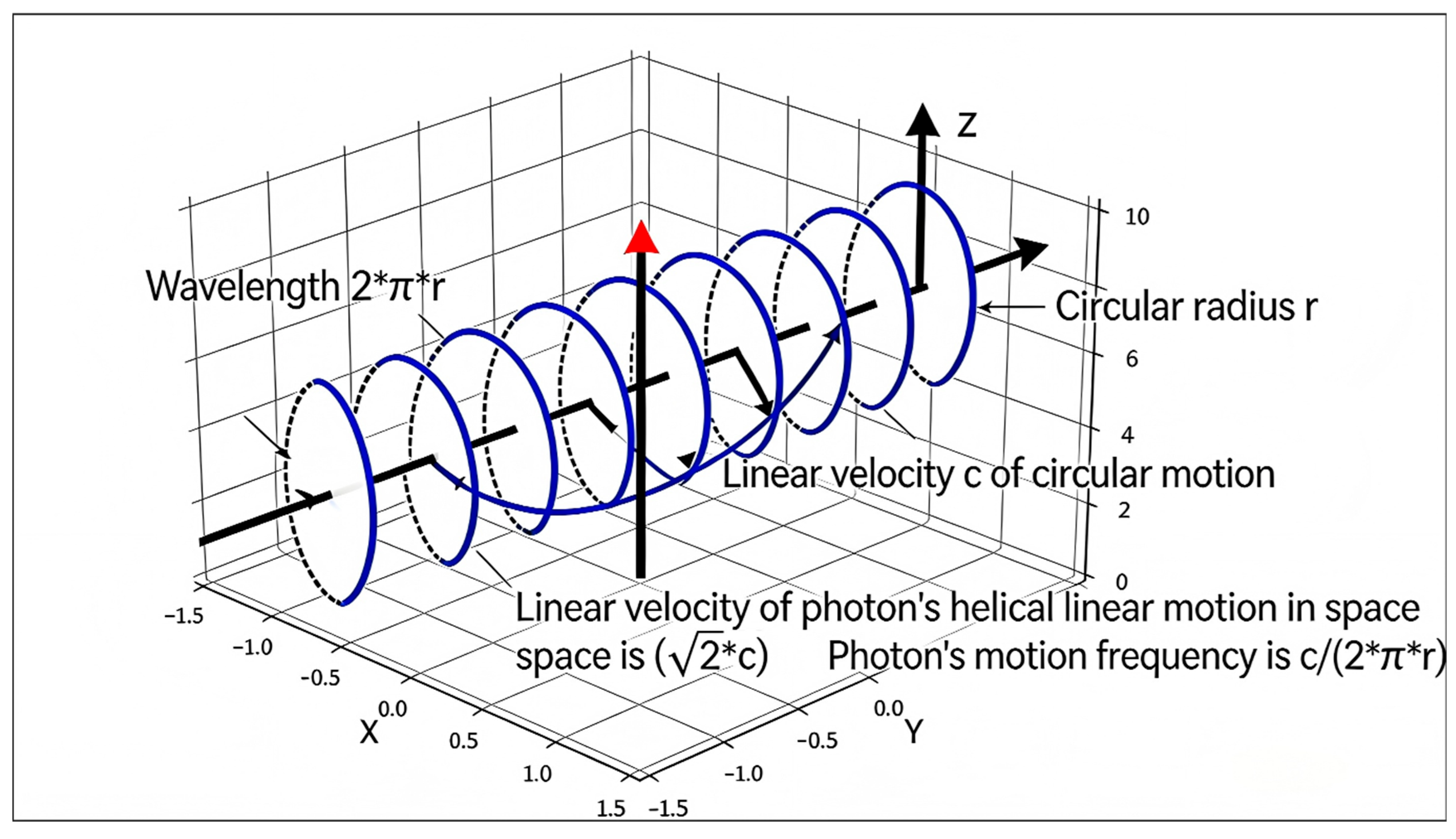
This figure is a simplified geometric model of the core motion mode of the hypothesis. The figure clearly marks the photon's linear motion velocity Vₗ=c, circular motion velocity V_c=c, circular motion radius r and helical axis, intuitively reflecting the complete system from the photon kinematic parameters to dynamic properties, and then to wave characteristics.
8.2. Table 1: Summary of Key Parameters of Photon Uniform Helical Linear Motion
| Core Parameter | Symbol | Quantitative Expression | Physical Meaning | Correlated Parameters |
| Linear motion velocity | Vₗ | Vₗ=c | Propagation velocity of photons along the helical axis, constantly equal to the speed of light | Resultant velocity, circular motion velocity |
| Circular motion velocity | V_c | V_c=c | Rotational linear velocity of photons around the helical axis, constantly equal to the speed of light | Angular momentum, moving mass, circular radius |
| Resultant velocity | V_combined | V_combined=√2c | Velocity of the vector superposition of linear motion and circular motion | Linear motion velocity, circular motion velocity |
| Moving mass | m | m=hν/c² | Mass characterization of photon motion, positively correlated with frequency | Frequency, angular momentum, circular radius |
| Angular momentum | L | L=mcr=ℏ | Spatial angular momentum of photon circular motion, constantly equal to the reduced Planck constant | Moving mass, circular radius, circular motion velocity |
| Circular motion radius | r | r=ℏ/(mc)=c/(2πν) | Radius of photon rotation around the axis, negatively correlated with moving mass | Moving mass, frequency, angular momentum |
| Frequency | ν | ν=mc²/h=c/(2πr) | Core parameter of photon wave characteristics, positively correlated with moving mass | Moving mass, circular radius, energy |
8.3. Figure 2: Schematic Diagram of the Geometric Trajectory and Projection of Photon Uniform Helical Linear Motion
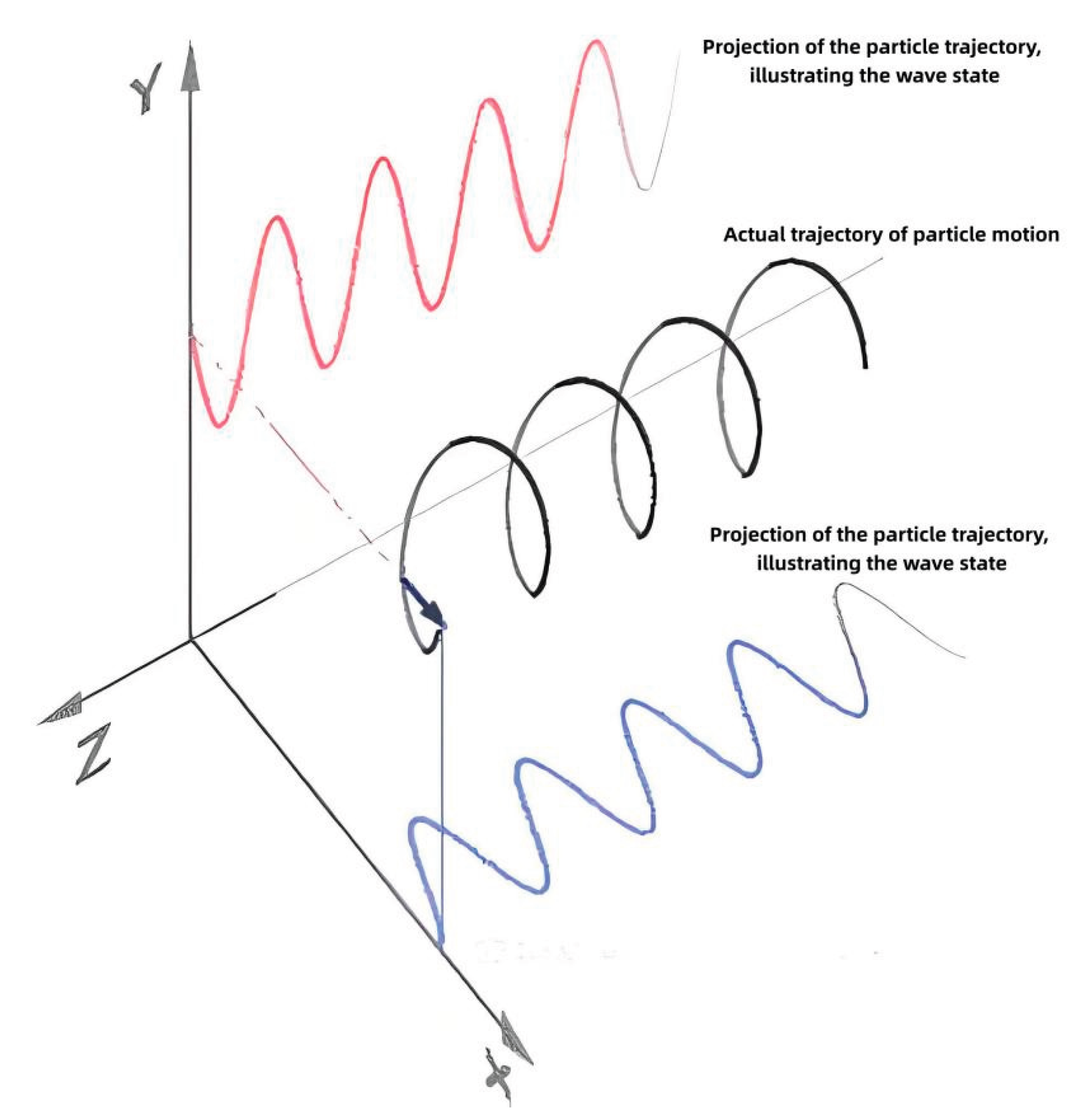
This figure is the key to understanding how the hypothesis realizes the unification of the particle nature and wave nature of light, revealing the deep mechanism of the nature of light: the uniform linear motion along the axis corresponds to the particle nature of light (the directional movement of energy mass points), while the uniform circular motion around the axis derives wave characteristics such as frequency and wavelength from the spatial geometry. Wave nature is understood here as the spatial representation of the specific motion mode of particles, thus providing a unified and intuitive physical image for wave-particle duality.
9. Conclusions and Prospects
Based on the research paradigm of thought experiments in natural philosophy, and with six axioms and six preparatory propositions as the foundation, this paper proposes the hypothesis of photon uniform helical linear motion through strict logical deduction, systematically sorts out the core characteristics and quantitative correlations of the hypothesis, designs verifiable experimental protocols, and responds to potential questions. This chapter summarizes the full text, frankly acknowledges the research limitations, and places the hypothesis in a broader perspective of the history of thought and philosophy of science to reflect on its epistemological significance and theoretical status.
9.1. Research Conclusions
The research of this paper can be summarized into the following core conclusions:
- ①
- The spatial motion mode of photons is uniform helical linear motion, whose linear velocity along the linear direction is constantly equal to the speed of light c, and the linear velocity of uniform circular motion around the axis is also constantly equal to c, with a resultant velocity of √2c. This motion mode is the essential origin of the wave-particle duality of photons—the linear motion reflects the particle nature, and the spatial representation of circular motion reflects the wave nature. The unified explanation of wave-particle duality can be realized without introducing the abstract concept of "wave-particle complementarity", providing a unified entity image for wave-particle duality.
- ②
- There is a strict positive correlation between the photon moving mass m and frequency ν, with the quantitative relationship m=hν/c². This relationship realizes the natural unification of the relativistic mass-energy relation E=mc² and the Planck energy formula E=hν, resolving the dilemma of the separation between particle energy and wave energy in traditional theories.
- ③
- The angular momentum of photons along circular motion is constantly equal to the reduced Planck constant ℏ, i.e., mcr=ℏ. This conservation relationship determines the negative correlation between the photon moving mass m and the circular motion radius r, providing a core basis for the quantitative analysis of photon motion parameters, and is highly consistent with the basic characteristics of photon angular momentum in quantum mechanics.
- ④
- The Heisenberg uncertainty principle is not an "inherent mystery" of the quantum world, but the combined effect of the geometric characteristics of photon uniform helical linear motion and the physical limitations of the measurement process. The position measurement deviation originates from the circular motion radius r, and the momentum measurement deviation originates from the simplified understanding of the true photon velocity √2c. The superposition of the two can derive an uncertainty relation consistent in order of magnitude with the standard expression ΔxΔpₓ≥ℏ/2, providing a new possibility for the classical explanation of quantum phenomena.
- ⑤
- The hypothesis is completely compatible with the core conclusions of special relativity, quantum mechanics and quantum field theory. The linear motion velocity of photons is always c, in line with the principle of the constancy of the speed of light; the resultant speed √2c does not involve the superluminal motion of particles with rest mass, and does not violate relativity; the hypothesis can explain various optical phenomena at the classical and quantum levels (double-slit interference, photoelectric effect, Compton effect, Raman scattering, photon entanglement, etc.), with logical self-consistency and clear images, providing a new explanatory path for the research on the nature of light.
- ⑥
- The three sets of experimental protocols designed in this paper (verification of photon angular momentum constancy, verification of photon circular motion linear velocity, verification of moving mass modulation mechanism in double-slit interference) progress in the logical sequence of "core conservation laws → basic motion parameters → verification of mechanisms within the hypothesis", all of which have the characteristics of operability, reproducibility and quantifiability, and can directly verify the core conclusions of the hypothesis through experimental data, providing a concrete path for the empirical testing of the hypothesis.
9.2. Research Limitations and Prospects
It is necessary to objectively acknowledge that the research of this paper still has certain limitations:
First, the derivation of the hypothesis is based on thought experiments in natural philosophy. Although it follows strict logical deduction, the correctness of all conclusions still depends on strict and extensive scientific experimental verification, which has not been completed yet. In the follow-up, the core quantitative conclusions of the hypothesis should be verified step by step through the experimental protocols designed in this paper combined with modern physical experimental technology.
Second, the hypothesis has not yet deeply explored the micro-mechanism of photon helical motion (such as the formation reason of the axis and the power source of circular motion). Why can photons maintain such stable helical motion? What physical mechanism provides the centripetal force for their circular motion? These issues still need to be further studied in combination with the relevant achievements of quantum field theory and particle physics, as well as the vacuum fluctuation theory.
Third, the explanation of complex quantum optical phenomena (such as the correlation of photon helical motion in quantum entanglement, photon motion in quantum tunneling, and photon behavior in nonlinear optical processes) by the hypothesis still needs further expansion and improvement. The current explanation mainly focuses on the basic phenomena at the single-photon level, and its applicability to many-body quantum systems remains to be tested.
Based on the above limitations, future research can be carried out in three directions:
- ①
- Promote experimental empirical research: Use the three sets of experimental protocols designed in this paper, combined with high-precision optical experimental equipment, to measure the circular motion radius, angular momentum, moving mass and other parameters of photons, and verify the quantitative correlations and core conclusions of the hypothesis. If the experimental results are consistent with the hypothesis predictions, the experimental scenarios can be further expanded to verify the applicability of the hypothesis under different conditions (such as strong magnetic field, low-temperature environment, curved spacetime).
- ②
- Deepen the research on micro-mechanisms: Combine the latest progress of quantum field theory and particle physics to explore the dynamic origin of photon helical motion. For example, is the photon circular motion related to vacuum fluctuation, spin-orbit coupling or some intrinsic geometric phase? How to explain the stability of the axis direction more fundamentally from the perspective of angular momentum conservation and symmetry breaking?
- ③
- Expand the application scope of the hypothesis: Apply the hypothesis to the explanation of complex quantum optical phenomena, and explore its potential application value in the fields of quantum communication, quantum computing, laser technology, etc. For example, can the photon helical motion image provide new ideas for the manipulation of quantum entanglement? Can it provide inspiration for the design of new optical devices? Promote the coordinated development of basic physical research and applied technology.
9.3. Philosophical Reflection and Theoretical Positioning
The hypothesis of photon uniform helical linear motion proposed in this paper is not only a specific physical conjecture, but also a philosophical exploration of the way to understand the nature of light. Here, we attempt to place the hypothesis in a broader perspective of the history of thought and philosophy of science to reflect on its epistemological significance and theoretical status.
9.3.1. Dialogue with the History of Thought: Phenomenon, Thing-in-Itself and the "In-Itself" of Light
Since Kant, philosophy has clearly distinguished between "phenomenon" and "thing-in-itself"—we can only know the way things appear to us, while the things themselves (thing-in-itself) are always on the other side of cognition. The wave function description in quantum mechanics is essentially a mathematical construction at the phenomenal level, which accurately predicts measurement results but remains silent on "how photons exist in themselves". Bohr's complementarity principle even asserts that it is meaningless to inquire about quantum entities independent of observation.
The hypothesis in this paper attempts to cross this "veil of phenomena" to depict an "in-itself" image of photons independent of observation: an energy mass point performing uniform helical linear motion in space. This image is not obtained by direct observation, but a mental construction based on axioms and logical deduction. It echoes the pursuit of substantial description in pre-Kantian metaphysics, but does not regress to naive realism—we clearly realize that any "in-itself" description is still a conceptual construction of human reason, whose legitimacy must ultimately be judged by experiments.
If we borrow Heidegger's terminology, quantum mechanics mainly focuses on the "presence state" of "beings" under specific experimental arrangements, while the hypothesis in this paper attempts to reveal the "mode of existence" of "beings" themselves—the helical motion of photons is their basic mode of "being-in-the-world". Such inquiry is precisely the enduring core subject of natural philosophy.
9.3.2. The Philosophical Implications of "Understanding": Intuition, Causality and Substantiality
Why do many physicists still feel "uncomprehending" when facing quantum mechanics? This touches on the in-depth discussion about the essence of "understanding" in the philosophy of science. The mainstream view of scientific explanation holds that understanding is the ability to incorporate phenomena into a formal mathematical framework and make predictions. However, a more humanistic philosophical tradition (such as continental philosophy) emphasizes that true understanding also requires intuitiveness, causal traceability and a substantial foundation.
The helical motion hypothesis in this paper exactly meets these three demands:
- ①
- Intuitiveness: Uniform helical linear motion is conceivable and diagrammable, and it does not need to resort to the counter-intuitive conceptual reconciliation of "wave-particle complementarity";
- ②
- Causality: The frequency, wavelength, energy and momentum of photons can all be attributed to their motion parameters (radius, period, velocity), and all wave manifestations originate from the causal chain of circular motion;
- ③
- Substantiality: Photons are defined as "energy mass points with a diameter smaller than the Planck length", with definite spatial extension and motion trajectory, thus providing a solid material foundation for particle nature.
It is this "classical image-style" understanding that dispels the mystery brought by quantum description, making light no longer a paradoxical existence that is "both a wave and a particle", but a "mass point performing helical motion"—wave is only the spatial representation of its motion. This way of understanding is more in line with the natural tendency of human reason, and is also the value of natural philosophy different from pure formal science.
9.3.3. Theoretical Positioning of the Hypothesis: Complementarity, Incommensurability and Pluralistic Explanation
The relationship between the hypothesis in this paper and the mainstream quantum field theory (which regards photons as the quantized excitations of the electromagnetic field) involves the famous issues of "theoretical equivalence" and "incommensurability" in the philosophy of science.
From an empirical perspective, there is no conflict between the two in terms of observable predictions—the hypothesis in this paper can reproduce all standard results such as the Planck formula, photoelectric effect equation, Compton scattering formula, and double-slit fringe spacing formula. Therefore, they are not competing theories that negate each other, but two different ontological explanations for the same empirical field. This relationship is similar to matrix mechanics and wave mechanics in quantum mechanics: they are equivalent in mathematical form but quite different in conceptual images.
From a conceptual perspective, the two have a certain degree of "incommensurability"—quantum field theory starts from the perspective of "field" and regards photons as field excitations; the hypothesis in this paper starts from the perspective of "substance" and regards photons as moving mass points. These two perspectives cannot be directly reduced to each other, but can coexist. Just as light can be described as both a wave and a particle, except that we are no longer satisfied with the expedient measure of "complementarity", but attempt to give a unified substantial image. The substantial image of the hypothesis can make up for the lack of "no intuitive image" in quantum field theory, and the mathematical framework of quantum field theory can support the research on the micro-mechanism of the hypothesis, forming a complementarity between the two.
We have no intention to claim that the hypothesis in this paper is "superior" to quantum field theory, nor do we believe that it can "replace" the existing theories. In the history of science, the coexistence of pluralistic explanations is often a prelude to theoretical deepening—just as the corpuscular theory and wave theory of light eventually gave birth to quantum electrodynamics after a long period of debate. The value of the hypothesis in this paper lies in providing an alternative thinking path for the research on the nature of light. It may be gradually improved in the future dialogue with experiments, or it may be falsified. In any case, such exploration itself reflects the vitality of natural philosophy.
9.4. Conclusion
The research on the nature of light is one of the core propositions of physics. For a century, the dilemma of wave-particle duality has restricted the integration of classical physics and quantum physics. The hypothesis of photon uniform helical linear motion proposed in this paper is only a new explanatory path. Whether it can be experimentally verified and promote the breakthrough in the research on the nature of light still needs the joint exploration and verification of colleagues in the academic community. We look forward to contributing a clear, self-consistent and enlightening answer to this ancient and ever-new question through future experimental tests and theoretical deepening.
References
- Bohr, N. Atomic Physics and Human Knowledge[M]. Yu T, Trans. Beijing: The Commercial Press, 1964.
- Cheng, J J. Hypothesis about the Motion of Photon in the Space. Open Access Library Journal 2019, 6, e5907. [Google Scholar] [CrossRef]
- Cheng Jinjun, Hypothesis on the Etheric Spatial Structure of Electrons Exhibiting Wave-Particle Duality, LJP Copyright ID: 925671, Print ISSN: 2631-8490, Online ISSN: 2631-8504.
- de Broglie L. Theory of Matter Waves[M]. Li B H, Trans. Beijing: The Commercial Press, 1981.
- Einstein A. Einstein's Collected Works (Volume II)[M]. Xu L Y, Fan D N, Trans. Beijing: The Commercial Press, 1977.
- Goldstein H. Classical Mechanics[M]. 2nd ed. Reading: Addison-Wesley, 1980.
- Heidegger M. Being and Time[M]. Macquarrie J, Robinson E, trans. Oxford: Blackwell Publishers, 1962.
- Kant I. Critique of Pure Reason[M]. Guyer P, Wood A W, trans. Cambridge: Cambridge University Press, 1998.
- Kuhn T S. The Structure of Scientific Revolutions[M]. 3rd ed. Chicago: University of Chicago Press, 1996.
- Landau L D, Lifshitz E M. Quantum Mechanics: Non-Relativistic Theory[M]. Yan S, Trans. Beijing: Higher Education Press, 2008.
- Renner, R; et al. No Wave Needed: Explaining Double-Slit Interference with Particle-only Theory[J]. arXiv arXiv:2405.XXXXX [quant-ph]. 2025, arXiv:2405. [Google Scholar]
- Scully M O, Zubairy M S. Quantum Optics[M]. Cambridge: Cambridge University Press, 1997.
- Yang, F J. Atomic Physics[M]. Beijing: Higher Education Press, 2020.
- Zhao K H, Zhong X H. Optics[M]. Beijing: Peking University Press, 2018.
Disclaimer/Publisher’s Note: The statements, opinions and data contained in all publications are solely those of the individual author(s) and contributor(s) and not of MDPI and/or the editor(s). MDPI and/or the editor(s) disclaim responsibility for any injury to people or property resulting from any ideas, methods, instructions or products referred to in the content. |
© 2026 by the authors. Licensee MDPI, Basel, Switzerland. This article is an open access article distributed under the terms and conditions of the Creative Commons Attribution (CC BY) license (http://creativecommons.org/licenses/by/4.0/).
Copyright: This open access article is published under a Creative Commons CC BY 4.0 license, which permit the free download, distribution, and reuse, provided that the author and preprint are cited in any reuse.